User login
Was the fruquintinib trial for metastatic CRC a win?
The results of a phase 3 trial that assessed the use of a highly selective, potent oral vascular endothelial growth factor receptor (VEGFR) inhibitor for patients with refractory metastatic colorectal cancer (CRC) were recently published.
The trial, dubbed FRESCO-2, found that use of fruquintinib “resulted in a significant and clinically meaningful benefit in overall survival, compared with placebo in patients with refractory metastatic colorectal cancer.”
More specifically, the median overall survival benefit was 2.6 months – 7.4 months with fruquintinib versus 4.8 months with placebo – among 691 heavily pretreated adults with metastatic colorectal adenocarcinoma. The difference translated to a 34% reduction in the risk of death with fruquintinib at a median follow-up of about 11 months.
These patients had received “all current standard approved cytotoxic and targeted therapies and progressed on or were intolerant to trifluridine-tipiracil or regorafenib,” a less-selective VEGF inhibitor, according to investigators led by Arvind Dasari, MD, from the University of Texas MD Anderson Cancer Center, Houston.
Dr. Dasari and colleagues celebrated the results, stressing that “these data support the use of fruquintinib as a global treatment option for patients with refractory metastatic colorectal cancer.”
The VEGF inhibitor has been approved in China for refractory metastatic CRC since 2018, and the recent phase 3 findings support the bid for Food and Drug Administration approval for this indication. The FDA granted fruquintinib priority review in May 2023.
However, in a tweet, Vinay Prasad, MD, an oncologist/epidemiologist at the University of California, San Francisco, who is an outspoken critic of the pharmaceutical industry, called the trial design “unethical.”
Fruquintinib, he explained, was compared with placebo, not investigators’ choice of treatment for patients dying of CRC.
Trial participants were considered to have refractory cases of CRC after previous lines of systemic treatment had failed. For almost three quarters of patients, more than three lines of therapy had failed, and patients still had options, including fluorouracil (5FU), oxaliplatin, or irinotecan, Dr. Prasad argued.
“Everyone who treats CRC would pull [their] mom off the trial and give 5FU and [bevacizumab] or IrOx [irinotecan plus oxaliplatin] or FOLFOX again, perhaps slightly differently,” Dr. Prasad said.
The “proof is they give [these drugs] post progression,” he continued. “After the control arm patients progressed, many doctors did try” these other options.
Hutchmed, the Hong Kong maker of fruquintinib, which sponsored the trial, did not respond to questions from this news organization about why the trial was designed with a placebo arm instead of investigators’ choice of treatment.
However, CRC specialist Alan Venook, MD, who was not involved in the trial, weighed in. He explained that he understands Dr. Prasad’s concerns but doesn’t necessarily think the trial was unethical.
For patients such as those in FRESCO-2, the impact of current treatment options is “so minimal” that forgoing active drug treatment is “not crazy,” said Dr. Venook, a medical oncologist at UCSF.
“If your chances of getting benefit are 1 in 20 and you are much more likely to get toxicity than benefit, you could argue” that having a placebo control arm in the trial is ethical, provided people understand what they are getting into, Dr. Venook said.
In the trial, almost two thirds of patients who received fruquintinib had grade 3 or worse toxicities, compared with half of placebo patients. The most common were hypertension (14% with fruquintinib vs. 1% with placebo), asthenia (8% vs. 4%), and hand-foot syndrome (6% vs. 0%).
Part of the risk-benefit assessment may also include weighing the estimated costs of fruquintinib against the 2.6-month median overall survival benefit.
“One could debate if 2.6 months of more time is worth the medication getting regulatory approval, or debate pricing when it’s approved, or delve closely into toxicity and quality of life data,” tweeted medical oncologist Temidayo Fadelu, MD, MPH, of Dana-Farber Cancer Center and Harvard Medical School, Boston, in response to Dr. Prasad’s thread. However, like Dr. Venook, Dr. Fadelu did not consider the trial design or the way the trial was conducted to be unethical.
Dr. Venook added that a treatment break is also not out of the question in this context. Some might even say that, given the risk-benefit ratio of current options, a temporary break from treatment “is the right thing to do.”
The study was funded by Hutchmed. The investigators reported ties to Hutchmed and other pharmaceutical companies. Dr. Dasari reported grants, contracts, speaker’s fees, and other payments from Hutchmed and other companies. Dr. Venook disclosed no relevant financial relationships.
A version of this article first appeared on Medscape.com.
The results of a phase 3 trial that assessed the use of a highly selective, potent oral vascular endothelial growth factor receptor (VEGFR) inhibitor for patients with refractory metastatic colorectal cancer (CRC) were recently published.
The trial, dubbed FRESCO-2, found that use of fruquintinib “resulted in a significant and clinically meaningful benefit in overall survival, compared with placebo in patients with refractory metastatic colorectal cancer.”
More specifically, the median overall survival benefit was 2.6 months – 7.4 months with fruquintinib versus 4.8 months with placebo – among 691 heavily pretreated adults with metastatic colorectal adenocarcinoma. The difference translated to a 34% reduction in the risk of death with fruquintinib at a median follow-up of about 11 months.
These patients had received “all current standard approved cytotoxic and targeted therapies and progressed on or were intolerant to trifluridine-tipiracil or regorafenib,” a less-selective VEGF inhibitor, according to investigators led by Arvind Dasari, MD, from the University of Texas MD Anderson Cancer Center, Houston.
Dr. Dasari and colleagues celebrated the results, stressing that “these data support the use of fruquintinib as a global treatment option for patients with refractory metastatic colorectal cancer.”
The VEGF inhibitor has been approved in China for refractory metastatic CRC since 2018, and the recent phase 3 findings support the bid for Food and Drug Administration approval for this indication. The FDA granted fruquintinib priority review in May 2023.
However, in a tweet, Vinay Prasad, MD, an oncologist/epidemiologist at the University of California, San Francisco, who is an outspoken critic of the pharmaceutical industry, called the trial design “unethical.”
Fruquintinib, he explained, was compared with placebo, not investigators’ choice of treatment for patients dying of CRC.
Trial participants were considered to have refractory cases of CRC after previous lines of systemic treatment had failed. For almost three quarters of patients, more than three lines of therapy had failed, and patients still had options, including fluorouracil (5FU), oxaliplatin, or irinotecan, Dr. Prasad argued.
“Everyone who treats CRC would pull [their] mom off the trial and give 5FU and [bevacizumab] or IrOx [irinotecan plus oxaliplatin] or FOLFOX again, perhaps slightly differently,” Dr. Prasad said.
The “proof is they give [these drugs] post progression,” he continued. “After the control arm patients progressed, many doctors did try” these other options.
Hutchmed, the Hong Kong maker of fruquintinib, which sponsored the trial, did not respond to questions from this news organization about why the trial was designed with a placebo arm instead of investigators’ choice of treatment.
However, CRC specialist Alan Venook, MD, who was not involved in the trial, weighed in. He explained that he understands Dr. Prasad’s concerns but doesn’t necessarily think the trial was unethical.
For patients such as those in FRESCO-2, the impact of current treatment options is “so minimal” that forgoing active drug treatment is “not crazy,” said Dr. Venook, a medical oncologist at UCSF.
“If your chances of getting benefit are 1 in 20 and you are much more likely to get toxicity than benefit, you could argue” that having a placebo control arm in the trial is ethical, provided people understand what they are getting into, Dr. Venook said.
In the trial, almost two thirds of patients who received fruquintinib had grade 3 or worse toxicities, compared with half of placebo patients. The most common were hypertension (14% with fruquintinib vs. 1% with placebo), asthenia (8% vs. 4%), and hand-foot syndrome (6% vs. 0%).
Part of the risk-benefit assessment may also include weighing the estimated costs of fruquintinib against the 2.6-month median overall survival benefit.
“One could debate if 2.6 months of more time is worth the medication getting regulatory approval, or debate pricing when it’s approved, or delve closely into toxicity and quality of life data,” tweeted medical oncologist Temidayo Fadelu, MD, MPH, of Dana-Farber Cancer Center and Harvard Medical School, Boston, in response to Dr. Prasad’s thread. However, like Dr. Venook, Dr. Fadelu did not consider the trial design or the way the trial was conducted to be unethical.
Dr. Venook added that a treatment break is also not out of the question in this context. Some might even say that, given the risk-benefit ratio of current options, a temporary break from treatment “is the right thing to do.”
The study was funded by Hutchmed. The investigators reported ties to Hutchmed and other pharmaceutical companies. Dr. Dasari reported grants, contracts, speaker’s fees, and other payments from Hutchmed and other companies. Dr. Venook disclosed no relevant financial relationships.
A version of this article first appeared on Medscape.com.
The results of a phase 3 trial that assessed the use of a highly selective, potent oral vascular endothelial growth factor receptor (VEGFR) inhibitor for patients with refractory metastatic colorectal cancer (CRC) were recently published.
The trial, dubbed FRESCO-2, found that use of fruquintinib “resulted in a significant and clinically meaningful benefit in overall survival, compared with placebo in patients with refractory metastatic colorectal cancer.”
More specifically, the median overall survival benefit was 2.6 months – 7.4 months with fruquintinib versus 4.8 months with placebo – among 691 heavily pretreated adults with metastatic colorectal adenocarcinoma. The difference translated to a 34% reduction in the risk of death with fruquintinib at a median follow-up of about 11 months.
These patients had received “all current standard approved cytotoxic and targeted therapies and progressed on or were intolerant to trifluridine-tipiracil or regorafenib,” a less-selective VEGF inhibitor, according to investigators led by Arvind Dasari, MD, from the University of Texas MD Anderson Cancer Center, Houston.
Dr. Dasari and colleagues celebrated the results, stressing that “these data support the use of fruquintinib as a global treatment option for patients with refractory metastatic colorectal cancer.”
The VEGF inhibitor has been approved in China for refractory metastatic CRC since 2018, and the recent phase 3 findings support the bid for Food and Drug Administration approval for this indication. The FDA granted fruquintinib priority review in May 2023.
However, in a tweet, Vinay Prasad, MD, an oncologist/epidemiologist at the University of California, San Francisco, who is an outspoken critic of the pharmaceutical industry, called the trial design “unethical.”
Fruquintinib, he explained, was compared with placebo, not investigators’ choice of treatment for patients dying of CRC.
Trial participants were considered to have refractory cases of CRC after previous lines of systemic treatment had failed. For almost three quarters of patients, more than three lines of therapy had failed, and patients still had options, including fluorouracil (5FU), oxaliplatin, or irinotecan, Dr. Prasad argued.
“Everyone who treats CRC would pull [their] mom off the trial and give 5FU and [bevacizumab] or IrOx [irinotecan plus oxaliplatin] or FOLFOX again, perhaps slightly differently,” Dr. Prasad said.
The “proof is they give [these drugs] post progression,” he continued. “After the control arm patients progressed, many doctors did try” these other options.
Hutchmed, the Hong Kong maker of fruquintinib, which sponsored the trial, did not respond to questions from this news organization about why the trial was designed with a placebo arm instead of investigators’ choice of treatment.
However, CRC specialist Alan Venook, MD, who was not involved in the trial, weighed in. He explained that he understands Dr. Prasad’s concerns but doesn’t necessarily think the trial was unethical.
For patients such as those in FRESCO-2, the impact of current treatment options is “so minimal” that forgoing active drug treatment is “not crazy,” said Dr. Venook, a medical oncologist at UCSF.
“If your chances of getting benefit are 1 in 20 and you are much more likely to get toxicity than benefit, you could argue” that having a placebo control arm in the trial is ethical, provided people understand what they are getting into, Dr. Venook said.
In the trial, almost two thirds of patients who received fruquintinib had grade 3 or worse toxicities, compared with half of placebo patients. The most common were hypertension (14% with fruquintinib vs. 1% with placebo), asthenia (8% vs. 4%), and hand-foot syndrome (6% vs. 0%).
Part of the risk-benefit assessment may also include weighing the estimated costs of fruquintinib against the 2.6-month median overall survival benefit.
“One could debate if 2.6 months of more time is worth the medication getting regulatory approval, or debate pricing when it’s approved, or delve closely into toxicity and quality of life data,” tweeted medical oncologist Temidayo Fadelu, MD, MPH, of Dana-Farber Cancer Center and Harvard Medical School, Boston, in response to Dr. Prasad’s thread. However, like Dr. Venook, Dr. Fadelu did not consider the trial design or the way the trial was conducted to be unethical.
Dr. Venook added that a treatment break is also not out of the question in this context. Some might even say that, given the risk-benefit ratio of current options, a temporary break from treatment “is the right thing to do.”
The study was funded by Hutchmed. The investigators reported ties to Hutchmed and other pharmaceutical companies. Dr. Dasari reported grants, contracts, speaker’s fees, and other payments from Hutchmed and other companies. Dr. Venook disclosed no relevant financial relationships.
A version of this article first appeared on Medscape.com.
FROM THE LANCET
Finding mild cognitive impairment quickly in primary care
Primary care is the ideal setting to screen for mild cognitive impairment. Screening can be performed in under 10 minutes using brief cognitive assessment tools. When it comes to treatment, deprescribing is a priority, as many drug interactions contribute to cognitive disorders. Drugs also influence the value of nondrug therapies.
At the XXIX National Congress of General and Family Medicine of the Spanish Society for General and Family Physicians, Granada, Spain, Alberto Freire, MD, a family doctor and head of the society’s neurology group, presented a way to detect cognitive impairment in a few minutes during a primary care office visit. He also presented a stepwise algorithm for diagnosing and treating the condition, which is highly prevalent and underdiagnosed.
The specialist dismissed the idea that “memory problems are associated with age,” though it is true that in normal aging, “cognitive frailty develops, and some processes will move a little slower. But there won’t be significant functional impairment.” Mild cognitive impairment falls between normal aging and dementia.
“Primary care is essential for screening for mild cognitive impairment due to its high level of accessibility, proximity, and continuity, but most of all due to its longitudinal perspective, which differentiates it from other specialties,” said Dr. Freire. He pointed out that screening is not the same as diagnosis because screening merely indicates probability or well-founded suspicion that can then be confirmed in secondary care.
He also highlighted the need for assessment of cognitive function using brief cognitive tests, as well as the need for functional assessment of activities of daily living. Many cognitive function tests are available, some of which are patient oriented and some caregiver oriented.
“The patient initially comes to see us due to memory loss that he or she, or that some reliable reporter, has detected,” said Dr. Freire. He indicated that 18.5% of consultations for cognitive impairment are prompted by subjective perceptions of memory complaints, which represent the most common subtype of the condition: mild amnestic cognitive impairment.
Quick cognitive tests
Dr. Freire was in favor of picture-based tests, which he strongly recommended. “These are the most-studied tests in Spain for detecting neurocognitive impairment, and they eliminate the reading factor. They’re quick, they’re easy to use and interpret, and are well-accepted by patients. Also, they assess executive function (verbal fluency) and memory.” Dr. Freire stressed the importance of referencing categories when showing the pictures, as well as the fact that the test is available for free online.
He also questioned whether the Mini-Mental State Examination is dead because “there’s an abbreviated version that the author rejects, and the author’s permission is required to use it. It’s very appropriate for Alzheimer’s disease, but not for cognitive impairment.”
Another notable test is the episodic test (a test that avoids interfering with working memory). It has been validated for amnestic mild cognitive impairment and Alzheimer’s disease, but a reliable caregiver is required to verify patient responses.
For caregiver-oriented tests, Dr. Freire pointed to AD8, which, when paired with any brief cognitive test, significantly increases detection of cognitive impairment.
He also recommended a useful website for everyday consultations created by several scientific societies, including the Spanish Society of General and Family Physicians. The site includes the AD8 and Informant Questionnaire on Cognitive Decline in the Elderly (IQCODE) questionnaires that can be completed online. “It produces a score that indicates the likelihood that the patient has cognitive impairment, and it can be filled out by family members or caregivers to get the result during the consultation,” he said.
Functional assessment
“Functional assessment of the patient’s level of independence for their life in society is what conceptually differentiates mild cognitive impairment from dementia,” explained Dr. Freire. “There are several types of activities of daily living. The instrumental activities (cooking, laundry, talking on the phone, using transportation, managing finances, taking medications, etc.) are the activities that truly distinguish between mild cognitive impairment and dementia. They allow the person to adjust to their environment and retain their independence within the community.”
There are multiple tools for assessing activities of daily living, but Dr. Freire singled out the Mongil test (from Spain), which covers basic, instrumental, and advanced activities. The higher the score, the worse the patient’s condition, so the goal is to lower the score. On the other hand, grouping certain items together helps determine whether there is a risk of falling, sarcopenia, depression, or suicide, among other outcomes. “So, it’s not only useful for diagnosis and treatment but also detects geriatric problems and syndromes. That is, it’s useful for prevention and allows planning of preventive and therapeutic medical interventions,” he explained.
Reversible dementia
Dr. Freire presented a diagnostic and therapeutic algorithm for cognitive impairment to be used when brief cognitive tests are positive. “The first thing is to perform a clinical assessment because although many cases of cognitive impairment go undiagnosed, 10% of the cases of symptomatic dementia are potentially reversible. We shouldn’t overlook these.” These cases of dementia may be brought on by medication use, alcoholism, chronic meningoencephalitis, toxins, normal pressure hydrocephalus, certain brain tumors, hypothyroidism, and nutritional deficits, among other causes. Functional assessment follows, using the scales mentioned above.
Interactions and deprescribing
“As to polypharmacy, there is underuse of good, evidence-backed medications with no major contraindications. But care must also be taken with inappropriate or off-label medications, overtreatment, drug interactions, and adherence,” said Dr. Freire.
“We need to start deprescribing because the chemical basis of cognitive impairment traces back to reduced cholinergic activity, increased dopaminergic activity in the brain, or both. There are many commonly prescribed drugs with anticholinergic interactions that can cause cognitive disorders. These could be psychotropics, hypnotics, analgesics (nonsteroidal anti-inflammatory drugs), first-generation antihistamines, antihypertensives, antiarrhythmics, histamine2 blockers, and even antibiotics like penicillin and quinolones, among many others,” he emphasized.
The next step is to perform comprehensive laboratory testing to rule out vitamin and mineral deficiencies, diabetes, thyroid disorders, kidney failure, liver diseases, urinary infections, and infections of the central nervous system. After that, neuroimaging should be performed. MRI is the preferred method because it allows quantification of atrophy and volumetric measurements.
Strict cardiovascular control
“At this point, treatment can be started, and the patient can be referred to secondary care,” said Dr. Freire, as he proceeded through a therapeutic algorithm following diagnosis of the patient. Regular exercise increases coordination synapses, prevents disease onset, improves executive function, and delays the onset of dementia. “The problem lies in not knowing how much time should be spent daily and weekly on exercise to achieve these goals.
“It is known that a Mediterranean diet and omega-3 fatty acids improve cognitive impairment. However, care should be taken with omega-3s as they are no longer helpful in dementia that has already been established.” The importance of strictly controlling cardiovascular risk factors must also be kept in mind, as backed by validated studies; it has been shown that blood pressure levels below 128 mm Hg make mild cognitive impairment and dementia worse, atrial fibrillation increases the risk of dementia by a factor of 1.4-2.4, diabetes is a risk factor for developing amnestic mild cognitive impairment, tobacco use also leads to cognitive impairment – even in individuals exposed to second-hand smoke – and statins do not change the risk in cases of dyslipidemia.
Nondrug treatment
Dr. Freire also highlighted the importance of multiple nondrug therapies in this field, such as cognitive training and rehabilitation, reminiscence, music therapy, cognitive-behavioral psychotherapy, and sensory interventions, among others. He also recommended patient groups for these individuals.
He added: “In mild cognitive impairment, there is currently no drug that is an improvement over nondrug therapies.”
The drugs aim to improve memory loss, prevent or delay the onset of mild cognitive impairment, and treat initial symptoms of dementia if applicable. The most commonly prescribed drugs are citicoline alone in vascular disease and memory loss, EGb 761 (which is the only approved dose-dependent drug), and others such as phosphatidylserine, nimodipine, and memantine combined with galantamine or piracetam, Dr. Freire concluded.
Dr. Freire had declared receiving funding as a student in training and outreach activities for popular science sponsored by Ferrer, and on the topic of pain by Esteve, Grünenthal Pharma, and Menarini. He has also reported being a consultant for GSK, Lilly, and Pfizer.
A version of this article first appeared on Medscape.com.
Primary care is the ideal setting to screen for mild cognitive impairment. Screening can be performed in under 10 minutes using brief cognitive assessment tools. When it comes to treatment, deprescribing is a priority, as many drug interactions contribute to cognitive disorders. Drugs also influence the value of nondrug therapies.
At the XXIX National Congress of General and Family Medicine of the Spanish Society for General and Family Physicians, Granada, Spain, Alberto Freire, MD, a family doctor and head of the society’s neurology group, presented a way to detect cognitive impairment in a few minutes during a primary care office visit. He also presented a stepwise algorithm for diagnosing and treating the condition, which is highly prevalent and underdiagnosed.
The specialist dismissed the idea that “memory problems are associated with age,” though it is true that in normal aging, “cognitive frailty develops, and some processes will move a little slower. But there won’t be significant functional impairment.” Mild cognitive impairment falls between normal aging and dementia.
“Primary care is essential for screening for mild cognitive impairment due to its high level of accessibility, proximity, and continuity, but most of all due to its longitudinal perspective, which differentiates it from other specialties,” said Dr. Freire. He pointed out that screening is not the same as diagnosis because screening merely indicates probability or well-founded suspicion that can then be confirmed in secondary care.
He also highlighted the need for assessment of cognitive function using brief cognitive tests, as well as the need for functional assessment of activities of daily living. Many cognitive function tests are available, some of which are patient oriented and some caregiver oriented.
“The patient initially comes to see us due to memory loss that he or she, or that some reliable reporter, has detected,” said Dr. Freire. He indicated that 18.5% of consultations for cognitive impairment are prompted by subjective perceptions of memory complaints, which represent the most common subtype of the condition: mild amnestic cognitive impairment.
Quick cognitive tests
Dr. Freire was in favor of picture-based tests, which he strongly recommended. “These are the most-studied tests in Spain for detecting neurocognitive impairment, and they eliminate the reading factor. They’re quick, they’re easy to use and interpret, and are well-accepted by patients. Also, they assess executive function (verbal fluency) and memory.” Dr. Freire stressed the importance of referencing categories when showing the pictures, as well as the fact that the test is available for free online.
He also questioned whether the Mini-Mental State Examination is dead because “there’s an abbreviated version that the author rejects, and the author’s permission is required to use it. It’s very appropriate for Alzheimer’s disease, but not for cognitive impairment.”
Another notable test is the episodic test (a test that avoids interfering with working memory). It has been validated for amnestic mild cognitive impairment and Alzheimer’s disease, but a reliable caregiver is required to verify patient responses.
For caregiver-oriented tests, Dr. Freire pointed to AD8, which, when paired with any brief cognitive test, significantly increases detection of cognitive impairment.
He also recommended a useful website for everyday consultations created by several scientific societies, including the Spanish Society of General and Family Physicians. The site includes the AD8 and Informant Questionnaire on Cognitive Decline in the Elderly (IQCODE) questionnaires that can be completed online. “It produces a score that indicates the likelihood that the patient has cognitive impairment, and it can be filled out by family members or caregivers to get the result during the consultation,” he said.
Functional assessment
“Functional assessment of the patient’s level of independence for their life in society is what conceptually differentiates mild cognitive impairment from dementia,” explained Dr. Freire. “There are several types of activities of daily living. The instrumental activities (cooking, laundry, talking on the phone, using transportation, managing finances, taking medications, etc.) are the activities that truly distinguish between mild cognitive impairment and dementia. They allow the person to adjust to their environment and retain their independence within the community.”
There are multiple tools for assessing activities of daily living, but Dr. Freire singled out the Mongil test (from Spain), which covers basic, instrumental, and advanced activities. The higher the score, the worse the patient’s condition, so the goal is to lower the score. On the other hand, grouping certain items together helps determine whether there is a risk of falling, sarcopenia, depression, or suicide, among other outcomes. “So, it’s not only useful for diagnosis and treatment but also detects geriatric problems and syndromes. That is, it’s useful for prevention and allows planning of preventive and therapeutic medical interventions,” he explained.
Reversible dementia
Dr. Freire presented a diagnostic and therapeutic algorithm for cognitive impairment to be used when brief cognitive tests are positive. “The first thing is to perform a clinical assessment because although many cases of cognitive impairment go undiagnosed, 10% of the cases of symptomatic dementia are potentially reversible. We shouldn’t overlook these.” These cases of dementia may be brought on by medication use, alcoholism, chronic meningoencephalitis, toxins, normal pressure hydrocephalus, certain brain tumors, hypothyroidism, and nutritional deficits, among other causes. Functional assessment follows, using the scales mentioned above.
Interactions and deprescribing
“As to polypharmacy, there is underuse of good, evidence-backed medications with no major contraindications. But care must also be taken with inappropriate or off-label medications, overtreatment, drug interactions, and adherence,” said Dr. Freire.
“We need to start deprescribing because the chemical basis of cognitive impairment traces back to reduced cholinergic activity, increased dopaminergic activity in the brain, or both. There are many commonly prescribed drugs with anticholinergic interactions that can cause cognitive disorders. These could be psychotropics, hypnotics, analgesics (nonsteroidal anti-inflammatory drugs), first-generation antihistamines, antihypertensives, antiarrhythmics, histamine2 blockers, and even antibiotics like penicillin and quinolones, among many others,” he emphasized.
The next step is to perform comprehensive laboratory testing to rule out vitamin and mineral deficiencies, diabetes, thyroid disorders, kidney failure, liver diseases, urinary infections, and infections of the central nervous system. After that, neuroimaging should be performed. MRI is the preferred method because it allows quantification of atrophy and volumetric measurements.
Strict cardiovascular control
“At this point, treatment can be started, and the patient can be referred to secondary care,” said Dr. Freire, as he proceeded through a therapeutic algorithm following diagnosis of the patient. Regular exercise increases coordination synapses, prevents disease onset, improves executive function, and delays the onset of dementia. “The problem lies in not knowing how much time should be spent daily and weekly on exercise to achieve these goals.
“It is known that a Mediterranean diet and omega-3 fatty acids improve cognitive impairment. However, care should be taken with omega-3s as they are no longer helpful in dementia that has already been established.” The importance of strictly controlling cardiovascular risk factors must also be kept in mind, as backed by validated studies; it has been shown that blood pressure levels below 128 mm Hg make mild cognitive impairment and dementia worse, atrial fibrillation increases the risk of dementia by a factor of 1.4-2.4, diabetes is a risk factor for developing amnestic mild cognitive impairment, tobacco use also leads to cognitive impairment – even in individuals exposed to second-hand smoke – and statins do not change the risk in cases of dyslipidemia.
Nondrug treatment
Dr. Freire also highlighted the importance of multiple nondrug therapies in this field, such as cognitive training and rehabilitation, reminiscence, music therapy, cognitive-behavioral psychotherapy, and sensory interventions, among others. He also recommended patient groups for these individuals.
He added: “In mild cognitive impairment, there is currently no drug that is an improvement over nondrug therapies.”
The drugs aim to improve memory loss, prevent or delay the onset of mild cognitive impairment, and treat initial symptoms of dementia if applicable. The most commonly prescribed drugs are citicoline alone in vascular disease and memory loss, EGb 761 (which is the only approved dose-dependent drug), and others such as phosphatidylserine, nimodipine, and memantine combined with galantamine or piracetam, Dr. Freire concluded.
Dr. Freire had declared receiving funding as a student in training and outreach activities for popular science sponsored by Ferrer, and on the topic of pain by Esteve, Grünenthal Pharma, and Menarini. He has also reported being a consultant for GSK, Lilly, and Pfizer.
A version of this article first appeared on Medscape.com.
Primary care is the ideal setting to screen for mild cognitive impairment. Screening can be performed in under 10 minutes using brief cognitive assessment tools. When it comes to treatment, deprescribing is a priority, as many drug interactions contribute to cognitive disorders. Drugs also influence the value of nondrug therapies.
At the XXIX National Congress of General and Family Medicine of the Spanish Society for General and Family Physicians, Granada, Spain, Alberto Freire, MD, a family doctor and head of the society’s neurology group, presented a way to detect cognitive impairment in a few minutes during a primary care office visit. He also presented a stepwise algorithm for diagnosing and treating the condition, which is highly prevalent and underdiagnosed.
The specialist dismissed the idea that “memory problems are associated with age,” though it is true that in normal aging, “cognitive frailty develops, and some processes will move a little slower. But there won’t be significant functional impairment.” Mild cognitive impairment falls between normal aging and dementia.
“Primary care is essential for screening for mild cognitive impairment due to its high level of accessibility, proximity, and continuity, but most of all due to its longitudinal perspective, which differentiates it from other specialties,” said Dr. Freire. He pointed out that screening is not the same as diagnosis because screening merely indicates probability or well-founded suspicion that can then be confirmed in secondary care.
He also highlighted the need for assessment of cognitive function using brief cognitive tests, as well as the need for functional assessment of activities of daily living. Many cognitive function tests are available, some of which are patient oriented and some caregiver oriented.
“The patient initially comes to see us due to memory loss that he or she, or that some reliable reporter, has detected,” said Dr. Freire. He indicated that 18.5% of consultations for cognitive impairment are prompted by subjective perceptions of memory complaints, which represent the most common subtype of the condition: mild amnestic cognitive impairment.
Quick cognitive tests
Dr. Freire was in favor of picture-based tests, which he strongly recommended. “These are the most-studied tests in Spain for detecting neurocognitive impairment, and they eliminate the reading factor. They’re quick, they’re easy to use and interpret, and are well-accepted by patients. Also, they assess executive function (verbal fluency) and memory.” Dr. Freire stressed the importance of referencing categories when showing the pictures, as well as the fact that the test is available for free online.
He also questioned whether the Mini-Mental State Examination is dead because “there’s an abbreviated version that the author rejects, and the author’s permission is required to use it. It’s very appropriate for Alzheimer’s disease, but not for cognitive impairment.”
Another notable test is the episodic test (a test that avoids interfering with working memory). It has been validated for amnestic mild cognitive impairment and Alzheimer’s disease, but a reliable caregiver is required to verify patient responses.
For caregiver-oriented tests, Dr. Freire pointed to AD8, which, when paired with any brief cognitive test, significantly increases detection of cognitive impairment.
He also recommended a useful website for everyday consultations created by several scientific societies, including the Spanish Society of General and Family Physicians. The site includes the AD8 and Informant Questionnaire on Cognitive Decline in the Elderly (IQCODE) questionnaires that can be completed online. “It produces a score that indicates the likelihood that the patient has cognitive impairment, and it can be filled out by family members or caregivers to get the result during the consultation,” he said.
Functional assessment
“Functional assessment of the patient’s level of independence for their life in society is what conceptually differentiates mild cognitive impairment from dementia,” explained Dr. Freire. “There are several types of activities of daily living. The instrumental activities (cooking, laundry, talking on the phone, using transportation, managing finances, taking medications, etc.) are the activities that truly distinguish between mild cognitive impairment and dementia. They allow the person to adjust to their environment and retain their independence within the community.”
There are multiple tools for assessing activities of daily living, but Dr. Freire singled out the Mongil test (from Spain), which covers basic, instrumental, and advanced activities. The higher the score, the worse the patient’s condition, so the goal is to lower the score. On the other hand, grouping certain items together helps determine whether there is a risk of falling, sarcopenia, depression, or suicide, among other outcomes. “So, it’s not only useful for diagnosis and treatment but also detects geriatric problems and syndromes. That is, it’s useful for prevention and allows planning of preventive and therapeutic medical interventions,” he explained.
Reversible dementia
Dr. Freire presented a diagnostic and therapeutic algorithm for cognitive impairment to be used when brief cognitive tests are positive. “The first thing is to perform a clinical assessment because although many cases of cognitive impairment go undiagnosed, 10% of the cases of symptomatic dementia are potentially reversible. We shouldn’t overlook these.” These cases of dementia may be brought on by medication use, alcoholism, chronic meningoencephalitis, toxins, normal pressure hydrocephalus, certain brain tumors, hypothyroidism, and nutritional deficits, among other causes. Functional assessment follows, using the scales mentioned above.
Interactions and deprescribing
“As to polypharmacy, there is underuse of good, evidence-backed medications with no major contraindications. But care must also be taken with inappropriate or off-label medications, overtreatment, drug interactions, and adherence,” said Dr. Freire.
“We need to start deprescribing because the chemical basis of cognitive impairment traces back to reduced cholinergic activity, increased dopaminergic activity in the brain, or both. There are many commonly prescribed drugs with anticholinergic interactions that can cause cognitive disorders. These could be psychotropics, hypnotics, analgesics (nonsteroidal anti-inflammatory drugs), first-generation antihistamines, antihypertensives, antiarrhythmics, histamine2 blockers, and even antibiotics like penicillin and quinolones, among many others,” he emphasized.
The next step is to perform comprehensive laboratory testing to rule out vitamin and mineral deficiencies, diabetes, thyroid disorders, kidney failure, liver diseases, urinary infections, and infections of the central nervous system. After that, neuroimaging should be performed. MRI is the preferred method because it allows quantification of atrophy and volumetric measurements.
Strict cardiovascular control
“At this point, treatment can be started, and the patient can be referred to secondary care,” said Dr. Freire, as he proceeded through a therapeutic algorithm following diagnosis of the patient. Regular exercise increases coordination synapses, prevents disease onset, improves executive function, and delays the onset of dementia. “The problem lies in not knowing how much time should be spent daily and weekly on exercise to achieve these goals.
“It is known that a Mediterranean diet and omega-3 fatty acids improve cognitive impairment. However, care should be taken with omega-3s as they are no longer helpful in dementia that has already been established.” The importance of strictly controlling cardiovascular risk factors must also be kept in mind, as backed by validated studies; it has been shown that blood pressure levels below 128 mm Hg make mild cognitive impairment and dementia worse, atrial fibrillation increases the risk of dementia by a factor of 1.4-2.4, diabetes is a risk factor for developing amnestic mild cognitive impairment, tobacco use also leads to cognitive impairment – even in individuals exposed to second-hand smoke – and statins do not change the risk in cases of dyslipidemia.
Nondrug treatment
Dr. Freire also highlighted the importance of multiple nondrug therapies in this field, such as cognitive training and rehabilitation, reminiscence, music therapy, cognitive-behavioral psychotherapy, and sensory interventions, among others. He also recommended patient groups for these individuals.
He added: “In mild cognitive impairment, there is currently no drug that is an improvement over nondrug therapies.”
The drugs aim to improve memory loss, prevent or delay the onset of mild cognitive impairment, and treat initial symptoms of dementia if applicable. The most commonly prescribed drugs are citicoline alone in vascular disease and memory loss, EGb 761 (which is the only approved dose-dependent drug), and others such as phosphatidylserine, nimodipine, and memantine combined with galantamine or piracetam, Dr. Freire concluded.
Dr. Freire had declared receiving funding as a student in training and outreach activities for popular science sponsored by Ferrer, and on the topic of pain by Esteve, Grünenthal Pharma, and Menarini. He has also reported being a consultant for GSK, Lilly, and Pfizer.
A version of this article first appeared on Medscape.com.
Oral IL-23 receptor antagonist for psoriasis promising: Phase 2b study
SINGAPORE – across all doses, compared with placebo, according to results of the FRONTIER 1 trial.
In the 16-week phase 2b study, 255 adults with moderate to severe plaque psoriasis were randomly assigned into six treatment groups: placebo (n = 43), JNJ-2113 25 mg daily (n = 43), 25 mg twice daily (n = 41), 50 mg daily (n = 43), 100 mg daily (n = 43), or 100 mg twice daily (n = 42).
Of those who took the placebo, only 9.3% achieved the study’s primary endpoint of a 75% or greater improvement in the Psoriasis Area and Severity Index (PASI-75) by week 16. This was compared with 78.6% in the group that took the highest dose.

“Additionally, the onset of action was fairly fast: at week 4, more than 20% of patients had achieved PASI 75,” said Robert Bissonnette, MD, CEO of Innovaderm Research in Montreal, who presented the findings during a late-breaker session at the World Congress of Dermatology.
Patients in the remaining groups demonstrated a response that corresponded to dosing level: with 37.2%, 51.2%, 58.1%, and 65.1% achieving PASI-75 in the 25 mg daily, 25 mg twice-daily, 50 mg daily, and 100 mg daily groups, respectively.
“These results are very interesting because in terms of psoriasis treatment, if this is confirmed in phase 3, it would give us an oral alternative that would be selective for IL-23,” said Dr. Bissonnette, referring to the signaling pathway that plays a critical role in the pathogenesis of several immune-mediated inflammatory diseases, including plaque psoriasis.
Although rarely life-threatening, the skin disorder is often intractable to treatment. In recent years, therapies that block IL-23 signaling and downstream inflammatory cytokine production have proven useful. “We have on the market a number of biological agents targeting IL-23 that we use on a regular basis,” said Dr. Bissonnette. “However, there are currently no orally delivered therapies.”
If successful, JNJ-2113 – a first-in-class oral IL-23 antagonist peptide developed by Janssen – could change the treatment paradigm for patients with moderate to severe plaque psoriasis. “When I was first introduced to the concept, I thought it wouldn’t work as it’s a peptide, that it would be digested by the stomach,” he told the audience. “But because of its GI stability and its potency, when you administer it orally, you can detect pharmacological activity.”
A well-tolerated alternative
Participants in the FRONTIER 1 trial were on average about 44 years old and weighed 88.9 kg (195 lb). Most had been living with psoriasis for about 18 years, with a total PASI score of 19.05. In addition, 43.1% had been treated with phototherapy in the past, 22% with biologics, and 78.4% with systemics.
PASI 90 and 100 were among some of the secondary outcomes measured. Similar to the primary outcome of PASI 75, all treatment groups demonstrated a statistically significant dose-response in PASI 90, compared with placebo. For those on the highest dose of JNJ-2113, 59.5% and 40.5% achieved PASI 90 and PASI 100, respectively, by week 16. The corresponding figures for those receiving placebo were 2.3% and 0%.
The safety profile for JNJ-2113 across all doses was similar to that of placebo, with no evidence of a dose-dependent increase in the occurrence of adverse events (AEs). The most frequently reported AEs were COVID-19 and nasopharyngitis. There were three serious AEs (COVID-19, infected cyst, suicide attempt) among those on the active drug, but the investigators assessed that they were not related to the study intervention. No deaths, major adverse cardiac events, or malignancies were reported during the study.
Approached for an independent comment, Marius-Anton Ionescu, MD, PhD, from the University Hospital Saint Louis, Paris, who specializes in psoriasis, told this news organization that the new development with JNJ-2113 “is really promising.”
Treatment for plaque psoriasis has improved to the point where some biologics, such as risankizumab (Skyrizi), only require patients to have “four shots a year,” he says. “This is the future of psoriasis treatment; it might go down to two shots a year” – a regimen that will be easier than taking an oral medication once or twice a day.
“But it’s good to have an oral option because you will always have some patients who say: ‘Shots are not for me, I’m afraid,’ ” he says.
However, Dr. Ionescu noted that if JNJ-2113 were to pass phase 3 trials, it might face stiff competition from the selective tyrosine kinase 2 (TYK2) inhibitor deucravacitinib (Sotyktu), which the U.S. Food and Drug Administration approved for use in adults with moderate to severe plaque psoriasis last September. “It has very good results and is the first oral therapy that is comparable with biologics for plaque psoriasis,” he says.
But Dr. Bissonnette remains hopeful for the future. “I think JNJ-2113 goes way beyond psoriasis because this type of strategy using oral peptide–blocking receptors could be used in other immune-mediated diseases, including atopic dermatitis and other diseases outside of dermatology.” In addition to running a phase 3 study for moderate to severe plaque psoriasis, Janssen is planning to initiate a phase 2b clinical trial of JNJ-2113 in adults with ulcerative colitis.
The study was funded by Janssen. Dr. Bissonnette reports consulting and investigating for Janssen, and being on advisory panels and receiving research funding from multiple other pharmaceutical companies. Dr. Ionescu is an investigator for Psoriasis National Register France Psobioteq (no honoraria), and an investigator and speaker for Uriage cosmetics (honoraria).
A version of this article first appeared on Medscape.com.
SINGAPORE – across all doses, compared with placebo, according to results of the FRONTIER 1 trial.
In the 16-week phase 2b study, 255 adults with moderate to severe plaque psoriasis were randomly assigned into six treatment groups: placebo (n = 43), JNJ-2113 25 mg daily (n = 43), 25 mg twice daily (n = 41), 50 mg daily (n = 43), 100 mg daily (n = 43), or 100 mg twice daily (n = 42).
Of those who took the placebo, only 9.3% achieved the study’s primary endpoint of a 75% or greater improvement in the Psoriasis Area and Severity Index (PASI-75) by week 16. This was compared with 78.6% in the group that took the highest dose.
“Additionally, the onset of action was fairly fast: at week 4, more than 20% of patients had achieved PASI 75,” said Robert Bissonnette, MD, CEO of Innovaderm Research in Montreal, who presented the findings during a late-breaker session at the World Congress of Dermatology.
Patients in the remaining groups demonstrated a response that corresponded to dosing level: with 37.2%, 51.2%, 58.1%, and 65.1% achieving PASI-75 in the 25 mg daily, 25 mg twice-daily, 50 mg daily, and 100 mg daily groups, respectively.
“These results are very interesting because in terms of psoriasis treatment, if this is confirmed in phase 3, it would give us an oral alternative that would be selective for IL-23,” said Dr. Bissonnette, referring to the signaling pathway that plays a critical role in the pathogenesis of several immune-mediated inflammatory diseases, including plaque psoriasis.
Although rarely life-threatening, the skin disorder is often intractable to treatment. In recent years, therapies that block IL-23 signaling and downstream inflammatory cytokine production have proven useful. “We have on the market a number of biological agents targeting IL-23 that we use on a regular basis,” said Dr. Bissonnette. “However, there are currently no orally delivered therapies.”
If successful, JNJ-2113 – a first-in-class oral IL-23 antagonist peptide developed by Janssen – could change the treatment paradigm for patients with moderate to severe plaque psoriasis. “When I was first introduced to the concept, I thought it wouldn’t work as it’s a peptide, that it would be digested by the stomach,” he told the audience. “But because of its GI stability and its potency, when you administer it orally, you can detect pharmacological activity.”
A well-tolerated alternative
Participants in the FRONTIER 1 trial were on average about 44 years old and weighed 88.9 kg (195 lb). Most had been living with psoriasis for about 18 years, with a total PASI score of 19.05. In addition, 43.1% had been treated with phototherapy in the past, 22% with biologics, and 78.4% with systemics.
PASI 90 and 100 were among some of the secondary outcomes measured. Similar to the primary outcome of PASI 75, all treatment groups demonstrated a statistically significant dose-response in PASI 90, compared with placebo. For those on the highest dose of JNJ-2113, 59.5% and 40.5% achieved PASI 90 and PASI 100, respectively, by week 16. The corresponding figures for those receiving placebo were 2.3% and 0%.
The safety profile for JNJ-2113 across all doses was similar to that of placebo, with no evidence of a dose-dependent increase in the occurrence of adverse events (AEs). The most frequently reported AEs were COVID-19 and nasopharyngitis. There were three serious AEs (COVID-19, infected cyst, suicide attempt) among those on the active drug, but the investigators assessed that they were not related to the study intervention. No deaths, major adverse cardiac events, or malignancies were reported during the study.
Approached for an independent comment, Marius-Anton Ionescu, MD, PhD, from the University Hospital Saint Louis, Paris, who specializes in psoriasis, told this news organization that the new development with JNJ-2113 “is really promising.”
Treatment for plaque psoriasis has improved to the point where some biologics, such as risankizumab (Skyrizi), only require patients to have “four shots a year,” he says. “This is the future of psoriasis treatment; it might go down to two shots a year” – a regimen that will be easier than taking an oral medication once or twice a day.
“But it’s good to have an oral option because you will always have some patients who say: ‘Shots are not for me, I’m afraid,’ ” he says.
However, Dr. Ionescu noted that if JNJ-2113 were to pass phase 3 trials, it might face stiff competition from the selective tyrosine kinase 2 (TYK2) inhibitor deucravacitinib (Sotyktu), which the U.S. Food and Drug Administration approved for use in adults with moderate to severe plaque psoriasis last September. “It has very good results and is the first oral therapy that is comparable with biologics for plaque psoriasis,” he says.
But Dr. Bissonnette remains hopeful for the future. “I think JNJ-2113 goes way beyond psoriasis because this type of strategy using oral peptide–blocking receptors could be used in other immune-mediated diseases, including atopic dermatitis and other diseases outside of dermatology.” In addition to running a phase 3 study for moderate to severe plaque psoriasis, Janssen is planning to initiate a phase 2b clinical trial of JNJ-2113 in adults with ulcerative colitis.
The study was funded by Janssen. Dr. Bissonnette reports consulting and investigating for Janssen, and being on advisory panels and receiving research funding from multiple other pharmaceutical companies. Dr. Ionescu is an investigator for Psoriasis National Register France Psobioteq (no honoraria), and an investigator and speaker for Uriage cosmetics (honoraria).
A version of this article first appeared on Medscape.com.
SINGAPORE – across all doses, compared with placebo, according to results of the FRONTIER 1 trial.
In the 16-week phase 2b study, 255 adults with moderate to severe plaque psoriasis were randomly assigned into six treatment groups: placebo (n = 43), JNJ-2113 25 mg daily (n = 43), 25 mg twice daily (n = 41), 50 mg daily (n = 43), 100 mg daily (n = 43), or 100 mg twice daily (n = 42).
Of those who took the placebo, only 9.3% achieved the study’s primary endpoint of a 75% or greater improvement in the Psoriasis Area and Severity Index (PASI-75) by week 16. This was compared with 78.6% in the group that took the highest dose.
“Additionally, the onset of action was fairly fast: at week 4, more than 20% of patients had achieved PASI 75,” said Robert Bissonnette, MD, CEO of Innovaderm Research in Montreal, who presented the findings during a late-breaker session at the World Congress of Dermatology.
Patients in the remaining groups demonstrated a response that corresponded to dosing level: with 37.2%, 51.2%, 58.1%, and 65.1% achieving PASI-75 in the 25 mg daily, 25 mg twice-daily, 50 mg daily, and 100 mg daily groups, respectively.
“These results are very interesting because in terms of psoriasis treatment, if this is confirmed in phase 3, it would give us an oral alternative that would be selective for IL-23,” said Dr. Bissonnette, referring to the signaling pathway that plays a critical role in the pathogenesis of several immune-mediated inflammatory diseases, including plaque psoriasis.
Although rarely life-threatening, the skin disorder is often intractable to treatment. In recent years, therapies that block IL-23 signaling and downstream inflammatory cytokine production have proven useful. “We have on the market a number of biological agents targeting IL-23 that we use on a regular basis,” said Dr. Bissonnette. “However, there are currently no orally delivered therapies.”
If successful, JNJ-2113 – a first-in-class oral IL-23 antagonist peptide developed by Janssen – could change the treatment paradigm for patients with moderate to severe plaque psoriasis. “When I was first introduced to the concept, I thought it wouldn’t work as it’s a peptide, that it would be digested by the stomach,” he told the audience. “But because of its GI stability and its potency, when you administer it orally, you can detect pharmacological activity.”
A well-tolerated alternative
Participants in the FRONTIER 1 trial were on average about 44 years old and weighed 88.9 kg (195 lb). Most had been living with psoriasis for about 18 years, with a total PASI score of 19.05. In addition, 43.1% had been treated with phototherapy in the past, 22% with biologics, and 78.4% with systemics.
PASI 90 and 100 were among some of the secondary outcomes measured. Similar to the primary outcome of PASI 75, all treatment groups demonstrated a statistically significant dose-response in PASI 90, compared with placebo. For those on the highest dose of JNJ-2113, 59.5% and 40.5% achieved PASI 90 and PASI 100, respectively, by week 16. The corresponding figures for those receiving placebo were 2.3% and 0%.
The safety profile for JNJ-2113 across all doses was similar to that of placebo, with no evidence of a dose-dependent increase in the occurrence of adverse events (AEs). The most frequently reported AEs were COVID-19 and nasopharyngitis. There were three serious AEs (COVID-19, infected cyst, suicide attempt) among those on the active drug, but the investigators assessed that they were not related to the study intervention. No deaths, major adverse cardiac events, or malignancies were reported during the study.
Approached for an independent comment, Marius-Anton Ionescu, MD, PhD, from the University Hospital Saint Louis, Paris, who specializes in psoriasis, told this news organization that the new development with JNJ-2113 “is really promising.”
Treatment for plaque psoriasis has improved to the point where some biologics, such as risankizumab (Skyrizi), only require patients to have “four shots a year,” he says. “This is the future of psoriasis treatment; it might go down to two shots a year” – a regimen that will be easier than taking an oral medication once or twice a day.
“But it’s good to have an oral option because you will always have some patients who say: ‘Shots are not for me, I’m afraid,’ ” he says.
However, Dr. Ionescu noted that if JNJ-2113 were to pass phase 3 trials, it might face stiff competition from the selective tyrosine kinase 2 (TYK2) inhibitor deucravacitinib (Sotyktu), which the U.S. Food and Drug Administration approved for use in adults with moderate to severe plaque psoriasis last September. “It has very good results and is the first oral therapy that is comparable with biologics for plaque psoriasis,” he says.
But Dr. Bissonnette remains hopeful for the future. “I think JNJ-2113 goes way beyond psoriasis because this type of strategy using oral peptide–blocking receptors could be used in other immune-mediated diseases, including atopic dermatitis and other diseases outside of dermatology.” In addition to running a phase 3 study for moderate to severe plaque psoriasis, Janssen is planning to initiate a phase 2b clinical trial of JNJ-2113 in adults with ulcerative colitis.
The study was funded by Janssen. Dr. Bissonnette reports consulting and investigating for Janssen, and being on advisory panels and receiving research funding from multiple other pharmaceutical companies. Dr. Ionescu is an investigator for Psoriasis National Register France Psobioteq (no honoraria), and an investigator and speaker for Uriage cosmetics (honoraria).
A version of this article first appeared on Medscape.com.
AT WCD 2023
JAK inhibitors efficacious for atopic dermatitis in Asian patients, study finds
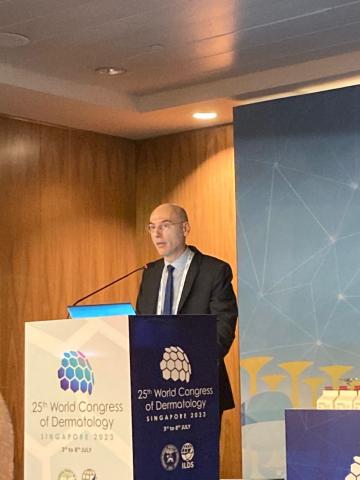
SINGAPORE – conducted in Singapore has found.
“Abrocitinib and upadacitinib surprisingly appeared to have better treatment efficacy compared to baricitinib,” said study lead Yik Weng Yew, MD, PhD, MPH, deputy head of research at Singapore’s National Skin Centre (NSC), who presented the results at the 25th World Congress of Dermatology. “But overall, as a group, I think they show a very good treatment response, as well as a good effect on itch response.”

JAK inhibitors are used to treat a variety of inflammatory diseases including alopecia areata, rheumatoid arthritis, and inflammatory bowel disease. Although treatment for severe eczema was previously limited to topical steroids and oral immunosuppressants, there are now two oral JAK inhibitors – abrocitinib and upadacitinib – approved in 2022 by the Food and Drug Administration for treating AD, which affects up to 2.4% of the global population. (A topical formulation of ruxolitinib, a JAK inhibitor, was approved for AD in 2021.)
The Singapore study is one of the few that have examined the safety and efficacy of JAK inhibitors for treatment of AD in a non-White population.
Chinese population
For the 12-week trial, conducted in 2022, Dr. Yew and associates recruited 35 patients from the NSC. More than half of participants (64%) were men and most (96%) were of Chinese ethnicity. Four of every five patients had previously received systemic agents: 17% had been treated with one systemic agent, 18.9% with two, 15.1% with three, 22.6% with four, and 3.8% with five. The most commonly used agents were cyclosporine (62.3%), methotrexate (47.2%), azathioprine (39.6%), and dupilumab (35.8%).
“The switch in therapy could have been a result of inadequate efficacy or cost reasons because in Singapore patients pay out of pocket for AD treatments,” said Dr. Yew.
Additionally, he offered a caveat on the profile of participants: “Perhaps they were more difficult atopic eczema patients, and therefore, the efficacy [of JAK inhibitors] might be a bit different.”
Clearer skin, less itch
Patients received one of the three study drugs: baricitinib (66%), abrocitinib (21%), and upadacitinib (13%). The distribution was “affected by reimbursement patterns and availability of the drug,” explained Dr. Yew.
They were assessed at weeks 4 and 12. By study end, the proportion of patients who self-reported an improvement in their condition was 100% for upadacitinib, 90% for abrocitinib, and 69% for baricitinib.
Scores on the Investigator Global Assessment (IGA) also improved with treatment. Patients in the baricitinib group saw their mean score fall from 4.0 to 3.0 by week 4, then to 2.0 by week 12. With upadacitinib and abrocitinib, “you can see that there is a nice decrease in IGA responses,” said Dr. Yew, referring to the larger improvement in scores experienced by patients on those two treatments. For patients on upadacitinib, IGA decreased from 3.5 to 2 at 4 weeks, then to 0.5 at 12 weeks, while those taking abrocitinib had their scores drop from 4.0 to 2.0 at 4 weeks, then to 1.0 at 12 weeks.
When it came to itch reduction, the abrocitinib group experienced the biggest reduction, with a median reduction of 5.5 points in itch score. Median reduction in itch score was 4 points for the other two groups. “Oral JAK inhibitors appear to have a good effect on itch response,” said Dr. Yew.
However, the researchers observed no significant reduction in percentage of body surface area affected, the last outcome assessed.
The most commonly reported adverse events were increased creatine kinase levels (11.3% of patients), increased LDL cholesterol levels (9.4%), and herpes zoster (9.4%). Those in the abrocitinib reported a higher number of these adverse events, compared with the other two treatment groups. (There were no herpes zoster cases among those taking baricitinib.)
For herpes zoster, Dr. Yew said “the common recommendation” is to give the inactivated shingles vaccine. “But the problem is that, number one, these patients would have probably failed multiple agents so they probably can’t wait for you to vaccinate before you initiate treatment.”
In addition, people in Singapore have to pay out-of-pocket for the two vaccine doses, “which is probably a month’s worth of medication,” he noted. “So we have a lot of resistance from patients.”
Additionally, Dr. Yew noted that contrary to what has previously been reported in the literature, there were few complaints of acne as a side effect in the Singaporean study population.
Toward greater representation
Dr. Yew pointed out that the study was limited by a few factors: neither the Eczema Area and Severity Index or Scoring of Atopic Dermatitis index data was used, and the study population was small and not representative of the real world.
Still, the new findings contribute to the overall safety and efficacy profile of JAK inhibitors in AD, which has so far been scarce in non-White populations.
“In Western studies, unfortunately, the representation of the population of skin of color or different ethnicities is underrepresented,” said Yousef Binamer, MD, chair of the dermatology department at King Faisal Specialist Hospital, Riyadh, Saudi Arabia, when approached for an independent comment on the results.
“This is now why researchers are looking into specific groups to study them,” which he pointed out, is crucial because “the immunophenotyping of AD is different for each background.”
The incidence and severity of AD tend to be higher in Asian and Middle Eastern populations, for instance, he noted. “It’s very common in Asia, and not so common in very white skin. I did my training in Canada so I see the difference,” said Dr. Binamer. “Asian people tend to be more itchy and have a tendency to scar on pigmentation.” Whereas White people “usually do not have this issue.”
“So I think real-world evidence of JAK inhibitors in the other populations is important,” he said. Studies such as the one conducted in Singapore, as well as the recently reported QUARTZ3 study, which examined the use of the JAK inhibitor ivarmacitinib in 256 Chinese patients with AD, are helping to pave the way.
The study was independently supported. Dr. Yew and Dr. Binamer have reported no relevant financial relationships.
A version of this article first appeared on Medscape.com.
SINGAPORE – conducted in Singapore has found.
“Abrocitinib and upadacitinib surprisingly appeared to have better treatment efficacy compared to baricitinib,” said study lead Yik Weng Yew, MD, PhD, MPH, deputy head of research at Singapore’s National Skin Centre (NSC), who presented the results at the 25th World Congress of Dermatology. “But overall, as a group, I think they show a very good treatment response, as well as a good effect on itch response.”
JAK inhibitors are used to treat a variety of inflammatory diseases including alopecia areata, rheumatoid arthritis, and inflammatory bowel disease. Although treatment for severe eczema was previously limited to topical steroids and oral immunosuppressants, there are now two oral JAK inhibitors – abrocitinib and upadacitinib – approved in 2022 by the Food and Drug Administration for treating AD, which affects up to 2.4% of the global population. (A topical formulation of ruxolitinib, a JAK inhibitor, was approved for AD in 2021.)
The Singapore study is one of the few that have examined the safety and efficacy of JAK inhibitors for treatment of AD in a non-White population.
Chinese population
For the 12-week trial, conducted in 2022, Dr. Yew and associates recruited 35 patients from the NSC. More than half of participants (64%) were men and most (96%) were of Chinese ethnicity. Four of every five patients had previously received systemic agents: 17% had been treated with one systemic agent, 18.9% with two, 15.1% with three, 22.6% with four, and 3.8% with five. The most commonly used agents were cyclosporine (62.3%), methotrexate (47.2%), azathioprine (39.6%), and dupilumab (35.8%).
“The switch in therapy could have been a result of inadequate efficacy or cost reasons because in Singapore patients pay out of pocket for AD treatments,” said Dr. Yew.
Additionally, he offered a caveat on the profile of participants: “Perhaps they were more difficult atopic eczema patients, and therefore, the efficacy [of JAK inhibitors] might be a bit different.”
Clearer skin, less itch
Patients received one of the three study drugs: baricitinib (66%), abrocitinib (21%), and upadacitinib (13%). The distribution was “affected by reimbursement patterns and availability of the drug,” explained Dr. Yew.
They were assessed at weeks 4 and 12. By study end, the proportion of patients who self-reported an improvement in their condition was 100% for upadacitinib, 90% for abrocitinib, and 69% for baricitinib.
Scores on the Investigator Global Assessment (IGA) also improved with treatment. Patients in the baricitinib group saw their mean score fall from 4.0 to 3.0 by week 4, then to 2.0 by week 12. With upadacitinib and abrocitinib, “you can see that there is a nice decrease in IGA responses,” said Dr. Yew, referring to the larger improvement in scores experienced by patients on those two treatments. For patients on upadacitinib, IGA decreased from 3.5 to 2 at 4 weeks, then to 0.5 at 12 weeks, while those taking abrocitinib had their scores drop from 4.0 to 2.0 at 4 weeks, then to 1.0 at 12 weeks.
When it came to itch reduction, the abrocitinib group experienced the biggest reduction, with a median reduction of 5.5 points in itch score. Median reduction in itch score was 4 points for the other two groups. “Oral JAK inhibitors appear to have a good effect on itch response,” said Dr. Yew.
However, the researchers observed no significant reduction in percentage of body surface area affected, the last outcome assessed.
The most commonly reported adverse events were increased creatine kinase levels (11.3% of patients), increased LDL cholesterol levels (9.4%), and herpes zoster (9.4%). Those in the abrocitinib reported a higher number of these adverse events, compared with the other two treatment groups. (There were no herpes zoster cases among those taking baricitinib.)
For herpes zoster, Dr. Yew said “the common recommendation” is to give the inactivated shingles vaccine. “But the problem is that, number one, these patients would have probably failed multiple agents so they probably can’t wait for you to vaccinate before you initiate treatment.”
In addition, people in Singapore have to pay out-of-pocket for the two vaccine doses, “which is probably a month’s worth of medication,” he noted. “So we have a lot of resistance from patients.”
Additionally, Dr. Yew noted that contrary to what has previously been reported in the literature, there were few complaints of acne as a side effect in the Singaporean study population.
Toward greater representation
Dr. Yew pointed out that the study was limited by a few factors: neither the Eczema Area and Severity Index or Scoring of Atopic Dermatitis index data was used, and the study population was small and not representative of the real world.
Still, the new findings contribute to the overall safety and efficacy profile of JAK inhibitors in AD, which has so far been scarce in non-White populations.
“In Western studies, unfortunately, the representation of the population of skin of color or different ethnicities is underrepresented,” said Yousef Binamer, MD, chair of the dermatology department at King Faisal Specialist Hospital, Riyadh, Saudi Arabia, when approached for an independent comment on the results.
“This is now why researchers are looking into specific groups to study them,” which he pointed out, is crucial because “the immunophenotyping of AD is different for each background.”
The incidence and severity of AD tend to be higher in Asian and Middle Eastern populations, for instance, he noted. “It’s very common in Asia, and not so common in very white skin. I did my training in Canada so I see the difference,” said Dr. Binamer. “Asian people tend to be more itchy and have a tendency to scar on pigmentation.” Whereas White people “usually do not have this issue.”
“So I think real-world evidence of JAK inhibitors in the other populations is important,” he said. Studies such as the one conducted in Singapore, as well as the recently reported QUARTZ3 study, which examined the use of the JAK inhibitor ivarmacitinib in 256 Chinese patients with AD, are helping to pave the way.
The study was independently supported. Dr. Yew and Dr. Binamer have reported no relevant financial relationships.
A version of this article first appeared on Medscape.com.
SINGAPORE – conducted in Singapore has found.
“Abrocitinib and upadacitinib surprisingly appeared to have better treatment efficacy compared to baricitinib,” said study lead Yik Weng Yew, MD, PhD, MPH, deputy head of research at Singapore’s National Skin Centre (NSC), who presented the results at the 25th World Congress of Dermatology. “But overall, as a group, I think they show a very good treatment response, as well as a good effect on itch response.”
JAK inhibitors are used to treat a variety of inflammatory diseases including alopecia areata, rheumatoid arthritis, and inflammatory bowel disease. Although treatment for severe eczema was previously limited to topical steroids and oral immunosuppressants, there are now two oral JAK inhibitors – abrocitinib and upadacitinib – approved in 2022 by the Food and Drug Administration for treating AD, which affects up to 2.4% of the global population. (A topical formulation of ruxolitinib, a JAK inhibitor, was approved for AD in 2021.)
The Singapore study is one of the few that have examined the safety and efficacy of JAK inhibitors for treatment of AD in a non-White population.
Chinese population
For the 12-week trial, conducted in 2022, Dr. Yew and associates recruited 35 patients from the NSC. More than half of participants (64%) were men and most (96%) were of Chinese ethnicity. Four of every five patients had previously received systemic agents: 17% had been treated with one systemic agent, 18.9% with two, 15.1% with three, 22.6% with four, and 3.8% with five. The most commonly used agents were cyclosporine (62.3%), methotrexate (47.2%), azathioprine (39.6%), and dupilumab (35.8%).
“The switch in therapy could have been a result of inadequate efficacy or cost reasons because in Singapore patients pay out of pocket for AD treatments,” said Dr. Yew.
Additionally, he offered a caveat on the profile of participants: “Perhaps they were more difficult atopic eczema patients, and therefore, the efficacy [of JAK inhibitors] might be a bit different.”
Clearer skin, less itch
Patients received one of the three study drugs: baricitinib (66%), abrocitinib (21%), and upadacitinib (13%). The distribution was “affected by reimbursement patterns and availability of the drug,” explained Dr. Yew.
They were assessed at weeks 4 and 12. By study end, the proportion of patients who self-reported an improvement in their condition was 100% for upadacitinib, 90% for abrocitinib, and 69% for baricitinib.
Scores on the Investigator Global Assessment (IGA) also improved with treatment. Patients in the baricitinib group saw their mean score fall from 4.0 to 3.0 by week 4, then to 2.0 by week 12. With upadacitinib and abrocitinib, “you can see that there is a nice decrease in IGA responses,” said Dr. Yew, referring to the larger improvement in scores experienced by patients on those two treatments. For patients on upadacitinib, IGA decreased from 3.5 to 2 at 4 weeks, then to 0.5 at 12 weeks, while those taking abrocitinib had their scores drop from 4.0 to 2.0 at 4 weeks, then to 1.0 at 12 weeks.
When it came to itch reduction, the abrocitinib group experienced the biggest reduction, with a median reduction of 5.5 points in itch score. Median reduction in itch score was 4 points for the other two groups. “Oral JAK inhibitors appear to have a good effect on itch response,” said Dr. Yew.
However, the researchers observed no significant reduction in percentage of body surface area affected, the last outcome assessed.
The most commonly reported adverse events were increased creatine kinase levels (11.3% of patients), increased LDL cholesterol levels (9.4%), and herpes zoster (9.4%). Those in the abrocitinib reported a higher number of these adverse events, compared with the other two treatment groups. (There were no herpes zoster cases among those taking baricitinib.)
For herpes zoster, Dr. Yew said “the common recommendation” is to give the inactivated shingles vaccine. “But the problem is that, number one, these patients would have probably failed multiple agents so they probably can’t wait for you to vaccinate before you initiate treatment.”
In addition, people in Singapore have to pay out-of-pocket for the two vaccine doses, “which is probably a month’s worth of medication,” he noted. “So we have a lot of resistance from patients.”
Additionally, Dr. Yew noted that contrary to what has previously been reported in the literature, there were few complaints of acne as a side effect in the Singaporean study population.
Toward greater representation
Dr. Yew pointed out that the study was limited by a few factors: neither the Eczema Area and Severity Index or Scoring of Atopic Dermatitis index data was used, and the study population was small and not representative of the real world.
Still, the new findings contribute to the overall safety and efficacy profile of JAK inhibitors in AD, which has so far been scarce in non-White populations.
“In Western studies, unfortunately, the representation of the population of skin of color or different ethnicities is underrepresented,” said Yousef Binamer, MD, chair of the dermatology department at King Faisal Specialist Hospital, Riyadh, Saudi Arabia, when approached for an independent comment on the results.
“This is now why researchers are looking into specific groups to study them,” which he pointed out, is crucial because “the immunophenotyping of AD is different for each background.”
The incidence and severity of AD tend to be higher in Asian and Middle Eastern populations, for instance, he noted. “It’s very common in Asia, and not so common in very white skin. I did my training in Canada so I see the difference,” said Dr. Binamer. “Asian people tend to be more itchy and have a tendency to scar on pigmentation.” Whereas White people “usually do not have this issue.”
“So I think real-world evidence of JAK inhibitors in the other populations is important,” he said. Studies such as the one conducted in Singapore, as well as the recently reported QUARTZ3 study, which examined the use of the JAK inhibitor ivarmacitinib in 256 Chinese patients with AD, are helping to pave the way.
The study was independently supported. Dr. Yew and Dr. Binamer have reported no relevant financial relationships.
A version of this article first appeared on Medscape.com.
AT WCD 2023

No benefit to adding limited radiation in advanced cancer
TOPLINE:
METHODOLOGY:
- In the phase 2 CHEERS trial, 52 patients with advanced solid tumors were randomized to anti-PD-1/PD-L1 monotherapy and 47 patients to the same treatment plus stereotactic body radiotherapy (3 x 8 Gy) to a maximum of three lesions before the second or third cycle of an immune checkpoint inhibitor.
- Patients had locally advanced or metastatic melanoma, renal cell carcinoma, urothelial carcinoma, non-small cell lung carcinoma, or head and neck squamous cell carcinoma and were treated at five Belgian hospitals.
- Most patients had more than three lesions.
- Seven patients in the experimental group did not complete radiotherapy because of early progression or intercurrent illness.
TAKEAWAY:
- Over a median follow-up of 12.5 months, median progression-free survival was 4.4 months in the radiotherapy group versus 2.8 months in the control group (hazard ratio, 0.95; P = .82).
- Median overall survival was not significantly better with radiotherapy, compared with the control group (14.3 vs. 11 months; HR, 0.82; P = .47), nor was the objective response rate (27% vs. 22%; P = .56).
- However, a post hoc analysis demonstrated a significant association between the number of irradiated lesions and overall survival among patients receiving radiotherapy (HR, 0.31; P = .002).
- The incidence of grade 3 or worse treatment-related adverse events was 18% in both groups.
IN PRACTICE:
Although the study was negative overall, the post hoc analysis coupled with “recent evidence suggests that treating all active disease sites with higher radiation doses ... may be a more promising strategy to optimize systemic disease control,” the authors concluded.
SOURCE:
The study was led by Mathieu Spaas, MD, department of radiation oncology, Ghent (Bellgium) University, and published online in JAMA Oncology.
LIMITATIONS:
- There was insufficient power to detect if certain cancers benefited more from add-on radiation because of the small sample size.
- More than half of patients in the control group had already received some form of radiotherapy before study inclusion, which may mean the study underestimated the benefit of radiotherapy.
DISCLOSURES:
The work was funded by Kom Op Tegen Kanker and Varian Medical Systems.
Investigators disclosed numerous industry ties, including Merck, Novartis, and Bristol Myers Squibb.
A version of this article first appeared on Medscape.com.
TOPLINE:
METHODOLOGY:
- In the phase 2 CHEERS trial, 52 patients with advanced solid tumors were randomized to anti-PD-1/PD-L1 monotherapy and 47 patients to the same treatment plus stereotactic body radiotherapy (3 x 8 Gy) to a maximum of three lesions before the second or third cycle of an immune checkpoint inhibitor.
- Patients had locally advanced or metastatic melanoma, renal cell carcinoma, urothelial carcinoma, non-small cell lung carcinoma, or head and neck squamous cell carcinoma and were treated at five Belgian hospitals.
- Most patients had more than three lesions.
- Seven patients in the experimental group did not complete radiotherapy because of early progression or intercurrent illness.
TAKEAWAY:
- Over a median follow-up of 12.5 months, median progression-free survival was 4.4 months in the radiotherapy group versus 2.8 months in the control group (hazard ratio, 0.95; P = .82).
- Median overall survival was not significantly better with radiotherapy, compared with the control group (14.3 vs. 11 months; HR, 0.82; P = .47), nor was the objective response rate (27% vs. 22%; P = .56).
- However, a post hoc analysis demonstrated a significant association between the number of irradiated lesions and overall survival among patients receiving radiotherapy (HR, 0.31; P = .002).
- The incidence of grade 3 or worse treatment-related adverse events was 18% in both groups.
IN PRACTICE:
Although the study was negative overall, the post hoc analysis coupled with “recent evidence suggests that treating all active disease sites with higher radiation doses ... may be a more promising strategy to optimize systemic disease control,” the authors concluded.
SOURCE:
The study was led by Mathieu Spaas, MD, department of radiation oncology, Ghent (Bellgium) University, and published online in JAMA Oncology.
LIMITATIONS:
- There was insufficient power to detect if certain cancers benefited more from add-on radiation because of the small sample size.
- More than half of patients in the control group had already received some form of radiotherapy before study inclusion, which may mean the study underestimated the benefit of radiotherapy.
DISCLOSURES:
The work was funded by Kom Op Tegen Kanker and Varian Medical Systems.
Investigators disclosed numerous industry ties, including Merck, Novartis, and Bristol Myers Squibb.
A version of this article first appeared on Medscape.com.
TOPLINE:
METHODOLOGY:
- In the phase 2 CHEERS trial, 52 patients with advanced solid tumors were randomized to anti-PD-1/PD-L1 monotherapy and 47 patients to the same treatment plus stereotactic body radiotherapy (3 x 8 Gy) to a maximum of three lesions before the second or third cycle of an immune checkpoint inhibitor.
- Patients had locally advanced or metastatic melanoma, renal cell carcinoma, urothelial carcinoma, non-small cell lung carcinoma, or head and neck squamous cell carcinoma and were treated at five Belgian hospitals.
- Most patients had more than three lesions.
- Seven patients in the experimental group did not complete radiotherapy because of early progression or intercurrent illness.
TAKEAWAY:
- Over a median follow-up of 12.5 months, median progression-free survival was 4.4 months in the radiotherapy group versus 2.8 months in the control group (hazard ratio, 0.95; P = .82).
- Median overall survival was not significantly better with radiotherapy, compared with the control group (14.3 vs. 11 months; HR, 0.82; P = .47), nor was the objective response rate (27% vs. 22%; P = .56).
- However, a post hoc analysis demonstrated a significant association between the number of irradiated lesions and overall survival among patients receiving radiotherapy (HR, 0.31; P = .002).
- The incidence of grade 3 or worse treatment-related adverse events was 18% in both groups.
IN PRACTICE:
Although the study was negative overall, the post hoc analysis coupled with “recent evidence suggests that treating all active disease sites with higher radiation doses ... may be a more promising strategy to optimize systemic disease control,” the authors concluded.
SOURCE:
The study was led by Mathieu Spaas, MD, department of radiation oncology, Ghent (Bellgium) University, and published online in JAMA Oncology.
LIMITATIONS:
- There was insufficient power to detect if certain cancers benefited more from add-on radiation because of the small sample size.
- More than half of patients in the control group had already received some form of radiotherapy before study inclusion, which may mean the study underestimated the benefit of radiotherapy.
DISCLOSURES:
The work was funded by Kom Op Tegen Kanker and Varian Medical Systems.
Investigators disclosed numerous industry ties, including Merck, Novartis, and Bristol Myers Squibb.
A version of this article first appeared on Medscape.com.
Child neurology: Dr. John Bodensteiner considers the path from 1993
For understanding the evolution in child neurology over the past 30 years, it would make sense to start with the science, particularly genetics, that have led to treatments and even cures for numerous inherited diseases over that time. When John Bodensteiner, MD, a pillar in the field of child neurology, was asked, he started with something different.
Parent advocacy accelerates advances in rare pediatric diseases
For the progress in many of the rare diseases seen by child neurologists in the last few decades, Dr. Bodensteiner first acknowledged parent support. “The concept was simple initially. For so many of these relatively rare diseases, like the Rett and Sturge-Weber syndromes, parents were learning of them for the first time. The support groups helped parents understand they were not alone. But it then evolved,” recalled Dr. Bodensteiner, who has been a professor of pediatrics and neurology at numerous institutions, most recently the Mayo Clinic in Rochester, Minn.
Many of these support groups first formed, or at least gained momentum, in the 1990s. “As the support groups grew, the members expanded their role to support research, in addition to supporting each other. They ended up volunteering their own data, providing more information about the epidemiology and disease course. They offered tissue samples for experimental studies. They enrolled their children in trials. And they raised funds,” Dr. Bodensteiner explained.
The impact of this advocacy has been enormous, according to Dr. Bodensteiner. As an expert in neuromuscular diseases, he worked directly with several of these groups.

Although the growth in parent advocacy took place in parallel with major advances in genetics that were driving new insights into disease pathophysiology, Dr. Bodensteiner characterized parent advocates as important partners in accelerating the transition of new information to clinical utility. He suggested that there is little doubt about the importance of their role in moving the science forward by drawing attention to rare disorders that had few, if any, treatment options at the time the advocacy groups were formed.
Since the 1990s, the list of childhood neurologic diseases for which there has been meaningful progress is long. Dr. Bodensteiner selected several examples. For Rett syndrome, key molecular mechanisms have now been isolated, providing meaningful targets that show potential for treatment. For spinal muscular atrophy (SMA), therapies have become available, one of which involves gene replacement that appears to provide cure if initiated early in life. For tuberous sclerosis complex (TSC), gene targets are showing strong promise for controlling seizures and other TSC manifestations.
It has also to be acknowledged that much of the ongoing expansion in knowledge taking place across diseases in pediatric neurology would have taken place with or without parent support. Dr. Bodensteiner singled out seizure disorders only as an illustration. “In the various forms of epilepsy, we now understand mechanisms in much greater detail than we did even a decade ago, let alone 30 years ago,” Dr. Bodensteiner said. In the context of the seizure medicines once widely employed on an empirical basis, “we now often have a clearer picture of why one drug works and not another.”
Growing pains: Child neurology evolves from a subspecialty to a specialty
Until about 10 years ago, child neurology was a subspecialty, variably placed within the departments of pediatrics or neurology based on institution. The decision to elevate child neurology to its own specialty solved some issues but created others, according to Dr. Bodensteiner.
“The initial problem was there was no immediate funding mechanism of residency slots and training,” Dr. Bodensteiner explained. The issue was particularly acute at smaller centers that had been able to support a subspecialty within another department but struggled with a new autonomous unit.
So far, the training requirements for specializing in child neurology remain largely unchanged. Clinical training requires 2 years of straight pediatrics, 1 year of adult neurology, 1 year of basic neurological science,” and 1 year of child neurology, but Dr. Bodensteiner said it might be time to reconsider. He pointed out that neurologists in general and child neurologists specifically are becoming increasingly focused in one area of expertise, such as epilepsy, neuromuscular diseases, and neurodevelopmental delay.
“It can be argued that a few months spent in a dementia clinic during training might not be the best use of time for a child neurologist working in congenital neurological diseases,” he said.
One consequence of the increasing degree of specialization in neurology overall, not just child neurology, has been the changes in recertification, according to Dr. Bodensteiner. Following a model used in other specialties, recertification in child neurology was initially based on an every-10-year examination. Ultimately, this was recognized as inconsistent with the target of keeping clinicians up to date.
“In general, I think that a lot of people waited for 9.5 years before cramming for an examination that was not necessarily relevant to the area in which they were working,” Dr. Bodensteiner said.
The revised process, carried out on an every-3-year cycle, involves board-guided review of the medical literature in 10 topic areas. Child neurologists can elect an article in any of the topic areas, but to complete their recertification process they must read articles in eight of these areas. Dr. Bodensteiner said that this approach has been more popular and is presumably more useful for staying abreast of developments.
Increased specialization necessitates collaboration
The radical increase in specialization in child neurology, like neurology in general, has been a necessary consequence of an avalanche of new information as advances in the field accelerate, but Dr. Bodensteiner cautioned that it is important for those working in these specialized areas to collaborate with others outside of their field of expertise.
“We cannot recognize what we do not know,” Dr. Bodensteiner said. If subspecialization within neurology is critical to stay current with rapid advances in very different diseases, then it also means that clinicians at every level, including within the field of child neurology, need to know when to collaborate or refer to ensure early diagnosis in challenging cases.
“Epileptologists have been trying for years to make it widely known that patients resistant to standard medications deserve referral, but I think this is increasingly true across domains,” Dr. Bodensteiner said. Neurology and child neurology are not alone, but the window of opportunity for effective intervention in children with a progressive disease might be particularly limited.
“The point is that this is more of a risk than it was 20 years ago,” said Dr. Bodensteiner, referring to the growth in new therapies. He cited data suggesting that a causative gene mutation can be identified in about 60% of rare diseases, which is a relatively new phenomenon. Of advances to improve outcomes, faster triage is becoming one of the most important in this increasingly specialized world.
With the growth in knowledge, “there is really no way to be an expert across all diseases in child neurology,” Dr. Bodensteiner said. “As physicians become increasingly insulated in their areas of expertise, I think there needs to be a greater emphasis on communication and collaboration.”
To some degree, this type of specialization has always existed, but Dr. Bodensteiner said the intensification of this trend is among the ways the field has most evolved over the past few decades. In inherited diseases that affect early child development, working together for a prompt diagnosis has assumed a new level of urgency.
For understanding the evolution in child neurology over the past 30 years, it would make sense to start with the science, particularly genetics, that have led to treatments and even cures for numerous inherited diseases over that time. When John Bodensteiner, MD, a pillar in the field of child neurology, was asked, he started with something different.
Parent advocacy accelerates advances in rare pediatric diseases
For the progress in many of the rare diseases seen by child neurologists in the last few decades, Dr. Bodensteiner first acknowledged parent support. “The concept was simple initially. For so many of these relatively rare diseases, like the Rett and Sturge-Weber syndromes, parents were learning of them for the first time. The support groups helped parents understand they were not alone. But it then evolved,” recalled Dr. Bodensteiner, who has been a professor of pediatrics and neurology at numerous institutions, most recently the Mayo Clinic in Rochester, Minn.
Many of these support groups first formed, or at least gained momentum, in the 1990s. “As the support groups grew, the members expanded their role to support research, in addition to supporting each other. They ended up volunteering their own data, providing more information about the epidemiology and disease course. They offered tissue samples for experimental studies. They enrolled their children in trials. And they raised funds,” Dr. Bodensteiner explained.
The impact of this advocacy has been enormous, according to Dr. Bodensteiner. As an expert in neuromuscular diseases, he worked directly with several of these groups.
Although the growth in parent advocacy took place in parallel with major advances in genetics that were driving new insights into disease pathophysiology, Dr. Bodensteiner characterized parent advocates as important partners in accelerating the transition of new information to clinical utility. He suggested that there is little doubt about the importance of their role in moving the science forward by drawing attention to rare disorders that had few, if any, treatment options at the time the advocacy groups were formed.
Since the 1990s, the list of childhood neurologic diseases for which there has been meaningful progress is long. Dr. Bodensteiner selected several examples. For Rett syndrome, key molecular mechanisms have now been isolated, providing meaningful targets that show potential for treatment. For spinal muscular atrophy (SMA), therapies have become available, one of which involves gene replacement that appears to provide cure if initiated early in life. For tuberous sclerosis complex (TSC), gene targets are showing strong promise for controlling seizures and other TSC manifestations.
It has also to be acknowledged that much of the ongoing expansion in knowledge taking place across diseases in pediatric neurology would have taken place with or without parent support. Dr. Bodensteiner singled out seizure disorders only as an illustration. “In the various forms of epilepsy, we now understand mechanisms in much greater detail than we did even a decade ago, let alone 30 years ago,” Dr. Bodensteiner said. In the context of the seizure medicines once widely employed on an empirical basis, “we now often have a clearer picture of why one drug works and not another.”
Growing pains: Child neurology evolves from a subspecialty to a specialty
Until about 10 years ago, child neurology was a subspecialty, variably placed within the departments of pediatrics or neurology based on institution. The decision to elevate child neurology to its own specialty solved some issues but created others, according to Dr. Bodensteiner.
“The initial problem was there was no immediate funding mechanism of residency slots and training,” Dr. Bodensteiner explained. The issue was particularly acute at smaller centers that had been able to support a subspecialty within another department but struggled with a new autonomous unit.
So far, the training requirements for specializing in child neurology remain largely unchanged. Clinical training requires 2 years of straight pediatrics, 1 year of adult neurology, 1 year of basic neurological science,” and 1 year of child neurology, but Dr. Bodensteiner said it might be time to reconsider. He pointed out that neurologists in general and child neurologists specifically are becoming increasingly focused in one area of expertise, such as epilepsy, neuromuscular diseases, and neurodevelopmental delay.
“It can be argued that a few months spent in a dementia clinic during training might not be the best use of time for a child neurologist working in congenital neurological diseases,” he said.
One consequence of the increasing degree of specialization in neurology overall, not just child neurology, has been the changes in recertification, according to Dr. Bodensteiner. Following a model used in other specialties, recertification in child neurology was initially based on an every-10-year examination. Ultimately, this was recognized as inconsistent with the target of keeping clinicians up to date.
“In general, I think that a lot of people waited for 9.5 years before cramming for an examination that was not necessarily relevant to the area in which they were working,” Dr. Bodensteiner said.
The revised process, carried out on an every-3-year cycle, involves board-guided review of the medical literature in 10 topic areas. Child neurologists can elect an article in any of the topic areas, but to complete their recertification process they must read articles in eight of these areas. Dr. Bodensteiner said that this approach has been more popular and is presumably more useful for staying abreast of developments.
Increased specialization necessitates collaboration
The radical increase in specialization in child neurology, like neurology in general, has been a necessary consequence of an avalanche of new information as advances in the field accelerate, but Dr. Bodensteiner cautioned that it is important for those working in these specialized areas to collaborate with others outside of their field of expertise.
“We cannot recognize what we do not know,” Dr. Bodensteiner said. If subspecialization within neurology is critical to stay current with rapid advances in very different diseases, then it also means that clinicians at every level, including within the field of child neurology, need to know when to collaborate or refer to ensure early diagnosis in challenging cases.
“Epileptologists have been trying for years to make it widely known that patients resistant to standard medications deserve referral, but I think this is increasingly true across domains,” Dr. Bodensteiner said. Neurology and child neurology are not alone, but the window of opportunity for effective intervention in children with a progressive disease might be particularly limited.
“The point is that this is more of a risk than it was 20 years ago,” said Dr. Bodensteiner, referring to the growth in new therapies. He cited data suggesting that a causative gene mutation can be identified in about 60% of rare diseases, which is a relatively new phenomenon. Of advances to improve outcomes, faster triage is becoming one of the most important in this increasingly specialized world.
With the growth in knowledge, “there is really no way to be an expert across all diseases in child neurology,” Dr. Bodensteiner said. “As physicians become increasingly insulated in their areas of expertise, I think there needs to be a greater emphasis on communication and collaboration.”
To some degree, this type of specialization has always existed, but Dr. Bodensteiner said the intensification of this trend is among the ways the field has most evolved over the past few decades. In inherited diseases that affect early child development, working together for a prompt diagnosis has assumed a new level of urgency.
For understanding the evolution in child neurology over the past 30 years, it would make sense to start with the science, particularly genetics, that have led to treatments and even cures for numerous inherited diseases over that time. When John Bodensteiner, MD, a pillar in the field of child neurology, was asked, he started with something different.
Parent advocacy accelerates advances in rare pediatric diseases
For the progress in many of the rare diseases seen by child neurologists in the last few decades, Dr. Bodensteiner first acknowledged parent support. “The concept was simple initially. For so many of these relatively rare diseases, like the Rett and Sturge-Weber syndromes, parents were learning of them for the first time. The support groups helped parents understand they were not alone. But it then evolved,” recalled Dr. Bodensteiner, who has been a professor of pediatrics and neurology at numerous institutions, most recently the Mayo Clinic in Rochester, Minn.
Many of these support groups first formed, or at least gained momentum, in the 1990s. “As the support groups grew, the members expanded their role to support research, in addition to supporting each other. They ended up volunteering their own data, providing more information about the epidemiology and disease course. They offered tissue samples for experimental studies. They enrolled their children in trials. And they raised funds,” Dr. Bodensteiner explained.
The impact of this advocacy has been enormous, according to Dr. Bodensteiner. As an expert in neuromuscular diseases, he worked directly with several of these groups.
Although the growth in parent advocacy took place in parallel with major advances in genetics that were driving new insights into disease pathophysiology, Dr. Bodensteiner characterized parent advocates as important partners in accelerating the transition of new information to clinical utility. He suggested that there is little doubt about the importance of their role in moving the science forward by drawing attention to rare disorders that had few, if any, treatment options at the time the advocacy groups were formed.
Since the 1990s, the list of childhood neurologic diseases for which there has been meaningful progress is long. Dr. Bodensteiner selected several examples. For Rett syndrome, key molecular mechanisms have now been isolated, providing meaningful targets that show potential for treatment. For spinal muscular atrophy (SMA), therapies have become available, one of which involves gene replacement that appears to provide cure if initiated early in life. For tuberous sclerosis complex (TSC), gene targets are showing strong promise for controlling seizures and other TSC manifestations.
It has also to be acknowledged that much of the ongoing expansion in knowledge taking place across diseases in pediatric neurology would have taken place with or without parent support. Dr. Bodensteiner singled out seizure disorders only as an illustration. “In the various forms of epilepsy, we now understand mechanisms in much greater detail than we did even a decade ago, let alone 30 years ago,” Dr. Bodensteiner said. In the context of the seizure medicines once widely employed on an empirical basis, “we now often have a clearer picture of why one drug works and not another.”
Growing pains: Child neurology evolves from a subspecialty to a specialty
Until about 10 years ago, child neurology was a subspecialty, variably placed within the departments of pediatrics or neurology based on institution. The decision to elevate child neurology to its own specialty solved some issues but created others, according to Dr. Bodensteiner.
“The initial problem was there was no immediate funding mechanism of residency slots and training,” Dr. Bodensteiner explained. The issue was particularly acute at smaller centers that had been able to support a subspecialty within another department but struggled with a new autonomous unit.
So far, the training requirements for specializing in child neurology remain largely unchanged. Clinical training requires 2 years of straight pediatrics, 1 year of adult neurology, 1 year of basic neurological science,” and 1 year of child neurology, but Dr. Bodensteiner said it might be time to reconsider. He pointed out that neurologists in general and child neurologists specifically are becoming increasingly focused in one area of expertise, such as epilepsy, neuromuscular diseases, and neurodevelopmental delay.
“It can be argued that a few months spent in a dementia clinic during training might not be the best use of time for a child neurologist working in congenital neurological diseases,” he said.
One consequence of the increasing degree of specialization in neurology overall, not just child neurology, has been the changes in recertification, according to Dr. Bodensteiner. Following a model used in other specialties, recertification in child neurology was initially based on an every-10-year examination. Ultimately, this was recognized as inconsistent with the target of keeping clinicians up to date.
“In general, I think that a lot of people waited for 9.5 years before cramming for an examination that was not necessarily relevant to the area in which they were working,” Dr. Bodensteiner said.
The revised process, carried out on an every-3-year cycle, involves board-guided review of the medical literature in 10 topic areas. Child neurologists can elect an article in any of the topic areas, but to complete their recertification process they must read articles in eight of these areas. Dr. Bodensteiner said that this approach has been more popular and is presumably more useful for staying abreast of developments.
Increased specialization necessitates collaboration
The radical increase in specialization in child neurology, like neurology in general, has been a necessary consequence of an avalanche of new information as advances in the field accelerate, but Dr. Bodensteiner cautioned that it is important for those working in these specialized areas to collaborate with others outside of their field of expertise.
“We cannot recognize what we do not know,” Dr. Bodensteiner said. If subspecialization within neurology is critical to stay current with rapid advances in very different diseases, then it also means that clinicians at every level, including within the field of child neurology, need to know when to collaborate or refer to ensure early diagnosis in challenging cases.
“Epileptologists have been trying for years to make it widely known that patients resistant to standard medications deserve referral, but I think this is increasingly true across domains,” Dr. Bodensteiner said. Neurology and child neurology are not alone, but the window of opportunity for effective intervention in children with a progressive disease might be particularly limited.
“The point is that this is more of a risk than it was 20 years ago,” said Dr. Bodensteiner, referring to the growth in new therapies. He cited data suggesting that a causative gene mutation can be identified in about 60% of rare diseases, which is a relatively new phenomenon. Of advances to improve outcomes, faster triage is becoming one of the most important in this increasingly specialized world.
With the growth in knowledge, “there is really no way to be an expert across all diseases in child neurology,” Dr. Bodensteiner said. “As physicians become increasingly insulated in their areas of expertise, I think there needs to be a greater emphasis on communication and collaboration.”
To some degree, this type of specialization has always existed, but Dr. Bodensteiner said the intensification of this trend is among the ways the field has most evolved over the past few decades. In inherited diseases that affect early child development, working together for a prompt diagnosis has assumed a new level of urgency.

Heart-protective diet in PURE study allows whole-fat dairy
Most of the protective food categories are in line with standard dietary guidelines for good health, but one that may be heart-protective is not usually included in such recommendations.

The food categories that were found to be protective include fruit, vegetables, nuts, legumes, and fish but also dairy, “mainly whole-fat,” in an analysis based on the international Prospective Urban and Rural Epidemiological (PURE) study and data from five other international trials that encompassed more than 240,000 people.
A healthy diet scoring system was derived from dietary patterns and clinical events observed in the PURE study and was applied to the populations of the other trials. Higher scores, corresponding to greater consumption of the six food categories, tracked with significantly reduced risks for death, myocardial infarction (MI), and stroke.
Reductions in mortality and CV-disease risk that were linked to the higher scores were especially pronounced in lower-income countries in the study published onlinein the European Heart Journal with lead author Andrew Mente, PhD, Population Health Research Institute, McMaster University, Hamilton, Ont.
The study in part refutes the frequent preference for low-fat or no-fat dairy foods over whole-fat dairy in healthy-diet recommendations. But it is consistent with earlier findings from PURE of reduced mortality risk with increased consumption of dietary fat, including saturated fat.
Whereas healthy-diet recommendations tend to emphasize reduced intake of fat, especially saturated fat, the report notes that “there are almost no national or international strategies and policies to increase a number of protective foods,” such as nuts, fish, and dairy.
“Therefore, while the findings from PURE are largely consistent with the nutrition science and modern dietary recommendations to focus on protective foods, the public’s understanding of healthy eating and relevant global policies have not yet caught up to this science,” it states.
“Guidelines and policy actions need to be updated with this newer evidence,” Dr. Mente said in an interview. “For example, the World Health Organization remains mainly focused on reducing certain nutrients, such as fat, saturated fat, added sugar, and salt,” he said. “These recommendations are echoed by government policy actions and industry, as evident by the continued focus on the usual nutrients in food labels of many countries.”
The current findings, Dr. Mente said, “can be used to ensure that the public’s understanding of healthy eating and relevant global policies are able to catch up to the science.”
Healthy diet score
PURE investigators developed their healthy diet score using data from 147,642 people from the general population in 21 countries. The investigators compared self-reported dietary intakes with long-term clinical outcomes.
The scoring system assigned a value of 1 for each of the six health-food categories when individuals’ intake exceeded the entire cohort’s median intake. It assigned a 0 when intake was below the median. The total PURE healthy diet score consisted of the sum of the six values, with higher scores corresponding to a healthier diet. The mean score for cohort was 2.95.
There were 15,707 deaths and 40,764 CV events during a median follow-up of 9.3 years. A score of at least 5 points, compared with 0 or 1 point, was associated with significantly reduced hazard ratios for mortality, MI, and stroke in multivariable analysis:
- Mortality: HR, 0.70 (95% CI, 0.63-0.77; P < .0001).
- Major CV disease: HR, 0.82 (95% CI, 0.75-0.91; P < .0001).
- MI: HR, 0.86 (95% CI, 0.75-0.99; P = .0014).
- Stroke: HR, 0.81 (95% CI, 0.71-0.93; P = .0034).
The healthy diet score’s relationship to clinical outcomes was explored in five other large independent studies, including three prospective trials of patients with CV disease that spanned 50 countries, a case-control study with MI patients in 52 countries, and a case-control study with stroke patients in 33 countries.
In the three prospective trials, higher scores were associated with reduced mortality, CV disease events, and MI:
- Mortality: HR, 0.73 (95% CI, 0.66-0.81).
- Major CV disease: HR, 0.79 (95% CI, 0.72-0.87).
- MI: HR, 0.85 (95% CI, 0.71-0.99).
In the two case-control studies, a higher diet score was associated with reduced odds ratios for first MI and for stroke:
- MI: OR, 0.72 (95% CI, 0.65-0.80).
- Stroke: OR, 0.57 (95% CI, 0.50-0.65).
In an analysis based on the PURE cohort, incorporation of unprocessed red meat or whole grains into the health diet score produced similar results, suggesting that a “modest amount” of meat or whole grains can be part of a healthy diet, the authors contend.
The results were similar in a combined analysis of all the prospective studies. In particular, improvement in diet score by one quintile was associated with significantly reduced risks for the following:
- Mortality: HR, 0.92 (95% CI, 0.90-0.93).
- Major CV disease: HR, 0.94 (95% CI, 0.93-0.95).
- MI: HR, 0.94 (95% CI, 0.92-0.96).
- Stroke: HR, 0.94 (95% CI, 0.89-0.99).
- Death or CV disease: HR, 0.93 (95% CI, 0.92-0.94).
“This strongly indicates that the take-home message for patients is the same as for general populations,” Dr. Mente said. “Eat plenty of fruits, vegetables, nuts, legumes, and a moderate amount of fish and whole-fat dairy to lower risk of CV disease and mortality.”
Dairy foods are not widely consumed in some cultures, he said, “but availability and cost are also factors in determining consumption.” Nonetheless, a high-quality diet can be achieved without including or excluding dairy foods. Context-specific policies and priorities are needed for different populations, “rather than a one-size-fits-all global policy.”
Food labels in many countries mainly focus on “reducing certain nutrients as the end-all, be-all,” Dr. Mente observed. “Our findings can be used as a basis for recommendations regarding what a healthy diet should be globally and then modified for each region based on the specific types of foods that are available and affordable in each region.”
Moreover, he said, “targeted food policies are needed to increase the availability and affordability of healthy foods, especially in lower-income countries where intakes are low.”
Common human biology
The current results from PURE “confirm prior observations from mostly Western nations that low intakes of fruits, vegetables, nuts, legumes, and fish are major risk factors for poor health,” observes Dariush Mozaffarian, MD, DrPH, MPH, Tufts University, Boston, in an accompanying editorial. “This suggests that common human biology, not merely confounding, explains these observed diet–disease relationships, strengthening causal inference on the power of nutrition.”
Moreover, “These findings provide further support that dairy foods, including whole-fat dairy, can be part of a healthy diet,” Dr. Mozaffarian writes. “The new results in PURE, in combination with prior reports, call for a re-evaluation of unrelenting guidelines to avoid whole-fat dairy products.”
Such studies “remind us of the continuing and devastating rise in diet-related chronic diseases globally, and of the power of protective foods to help address these burdens,” the editorial continues. “It is time for national nutrition guidelines, private sector innovations, government tax policy and agricultural incentives, food procurement policies, labeling and other regulatory priorities, and food-based health care interventions to catch up to the science.”
Not automatically superior
“I do not believe guidelines should be changed based on this single study,” contends Howard D. Sesso, ScD, MPH, associate director of the division of preventive medicine at Brigham and Women’s Hospital, Boston, who isn’t part of PURE. “But I welcome the scientific dialog that should come out of any study that challenges what we think we know,” he told this news organization.
“Many other dietary patterns have been identified over the years that also do a great job in predicting disease risk in observational studies,” observed Dr. Sesso. “Is PURE that much better? Maybe, maybe not. But not enough to dismiss other dietary patterns that are already the basis of dietary recommendations in the U.S., Europe, and worldwide.”
The PURE healthy diet score, he said, “appears to work well within the confines of their large pooling of studies around the world, but that doesn’t automatically make it superior to other dietary patterns.” The score “was only modestly, but not greatly, better than existing dietary patterns evaluated.”
Randomized controlled trials are needed, Dr. Sesso said, to “delve into more specific dietary components,” including unprocessed red meat, whole grains, and high-fat dairy foods. And, he said, more observational studies are needed to examine the score’s association with other cardiometabolic outcomes.
The PURE study is funded by the Population Health Research Institute, the Hamilton Health Sciences Research Institute, the Canadian Institutes of Health Research, the Heart and Stroke Foundation of Ontario; with support from Canadian Institutes of Health Research’s Strategy for Patient Oriented Research through the Ontario SPOR Support Unit, as well as the Ontario Ministry of Health and Long-Term Care; and through unrestricted grants from several pharmaceutical companies, with major contributions from AstraZeneca, Sanofi-Aventis, Boehringer Ingelheim, Servier, and GlaxoSmithKline. Additional contributions are from Novartis and King Pharma. Dr. Mente, Dr. Mozaffarian, and Dr. Sesso have disclosed no relevant financial relationships.
A version of this article first appeared on Medscape.com.
Most of the protective food categories are in line with standard dietary guidelines for good health, but one that may be heart-protective is not usually included in such recommendations.
The food categories that were found to be protective include fruit, vegetables, nuts, legumes, and fish but also dairy, “mainly whole-fat,” in an analysis based on the international Prospective Urban and Rural Epidemiological (PURE) study and data from five other international trials that encompassed more than 240,000 people.
A healthy diet scoring system was derived from dietary patterns and clinical events observed in the PURE study and was applied to the populations of the other trials. Higher scores, corresponding to greater consumption of the six food categories, tracked with significantly reduced risks for death, myocardial infarction (MI), and stroke.
Reductions in mortality and CV-disease risk that were linked to the higher scores were especially pronounced in lower-income countries in the study published onlinein the European Heart Journal with lead author Andrew Mente, PhD, Population Health Research Institute, McMaster University, Hamilton, Ont.
The study in part refutes the frequent preference for low-fat or no-fat dairy foods over whole-fat dairy in healthy-diet recommendations. But it is consistent with earlier findings from PURE of reduced mortality risk with increased consumption of dietary fat, including saturated fat.
Whereas healthy-diet recommendations tend to emphasize reduced intake of fat, especially saturated fat, the report notes that “there are almost no national or international strategies and policies to increase a number of protective foods,” such as nuts, fish, and dairy.
“Therefore, while the findings from PURE are largely consistent with the nutrition science and modern dietary recommendations to focus on protective foods, the public’s understanding of healthy eating and relevant global policies have not yet caught up to this science,” it states.
“Guidelines and policy actions need to be updated with this newer evidence,” Dr. Mente said in an interview. “For example, the World Health Organization remains mainly focused on reducing certain nutrients, such as fat, saturated fat, added sugar, and salt,” he said. “These recommendations are echoed by government policy actions and industry, as evident by the continued focus on the usual nutrients in food labels of many countries.”
The current findings, Dr. Mente said, “can be used to ensure that the public’s understanding of healthy eating and relevant global policies are able to catch up to the science.”
Healthy diet score
PURE investigators developed their healthy diet score using data from 147,642 people from the general population in 21 countries. The investigators compared self-reported dietary intakes with long-term clinical outcomes.
The scoring system assigned a value of 1 for each of the six health-food categories when individuals’ intake exceeded the entire cohort’s median intake. It assigned a 0 when intake was below the median. The total PURE healthy diet score consisted of the sum of the six values, with higher scores corresponding to a healthier diet. The mean score for cohort was 2.95.
There were 15,707 deaths and 40,764 CV events during a median follow-up of 9.3 years. A score of at least 5 points, compared with 0 or 1 point, was associated with significantly reduced hazard ratios for mortality, MI, and stroke in multivariable analysis:
- Mortality: HR, 0.70 (95% CI, 0.63-0.77; P < .0001).
- Major CV disease: HR, 0.82 (95% CI, 0.75-0.91; P < .0001).
- MI: HR, 0.86 (95% CI, 0.75-0.99; P = .0014).
- Stroke: HR, 0.81 (95% CI, 0.71-0.93; P = .0034).
The healthy diet score’s relationship to clinical outcomes was explored in five other large independent studies, including three prospective trials of patients with CV disease that spanned 50 countries, a case-control study with MI patients in 52 countries, and a case-control study with stroke patients in 33 countries.
In the three prospective trials, higher scores were associated with reduced mortality, CV disease events, and MI:
- Mortality: HR, 0.73 (95% CI, 0.66-0.81).
- Major CV disease: HR, 0.79 (95% CI, 0.72-0.87).
- MI: HR, 0.85 (95% CI, 0.71-0.99).
In the two case-control studies, a higher diet score was associated with reduced odds ratios for first MI and for stroke:
- MI: OR, 0.72 (95% CI, 0.65-0.80).
- Stroke: OR, 0.57 (95% CI, 0.50-0.65).
In an analysis based on the PURE cohort, incorporation of unprocessed red meat or whole grains into the health diet score produced similar results, suggesting that a “modest amount” of meat or whole grains can be part of a healthy diet, the authors contend.
The results were similar in a combined analysis of all the prospective studies. In particular, improvement in diet score by one quintile was associated with significantly reduced risks for the following:
- Mortality: HR, 0.92 (95% CI, 0.90-0.93).
- Major CV disease: HR, 0.94 (95% CI, 0.93-0.95).
- MI: HR, 0.94 (95% CI, 0.92-0.96).
- Stroke: HR, 0.94 (95% CI, 0.89-0.99).
- Death or CV disease: HR, 0.93 (95% CI, 0.92-0.94).
“This strongly indicates that the take-home message for patients is the same as for general populations,” Dr. Mente said. “Eat plenty of fruits, vegetables, nuts, legumes, and a moderate amount of fish and whole-fat dairy to lower risk of CV disease and mortality.”
Dairy foods are not widely consumed in some cultures, he said, “but availability and cost are also factors in determining consumption.” Nonetheless, a high-quality diet can be achieved without including or excluding dairy foods. Context-specific policies and priorities are needed for different populations, “rather than a one-size-fits-all global policy.”
Food labels in many countries mainly focus on “reducing certain nutrients as the end-all, be-all,” Dr. Mente observed. “Our findings can be used as a basis for recommendations regarding what a healthy diet should be globally and then modified for each region based on the specific types of foods that are available and affordable in each region.”
Moreover, he said, “targeted food policies are needed to increase the availability and affordability of healthy foods, especially in lower-income countries where intakes are low.”
Common human biology
The current results from PURE “confirm prior observations from mostly Western nations that low intakes of fruits, vegetables, nuts, legumes, and fish are major risk factors for poor health,” observes Dariush Mozaffarian, MD, DrPH, MPH, Tufts University, Boston, in an accompanying editorial. “This suggests that common human biology, not merely confounding, explains these observed diet–disease relationships, strengthening causal inference on the power of nutrition.”
Moreover, “These findings provide further support that dairy foods, including whole-fat dairy, can be part of a healthy diet,” Dr. Mozaffarian writes. “The new results in PURE, in combination with prior reports, call for a re-evaluation of unrelenting guidelines to avoid whole-fat dairy products.”
Such studies “remind us of the continuing and devastating rise in diet-related chronic diseases globally, and of the power of protective foods to help address these burdens,” the editorial continues. “It is time for national nutrition guidelines, private sector innovations, government tax policy and agricultural incentives, food procurement policies, labeling and other regulatory priorities, and food-based health care interventions to catch up to the science.”
Not automatically superior
“I do not believe guidelines should be changed based on this single study,” contends Howard D. Sesso, ScD, MPH, associate director of the division of preventive medicine at Brigham and Women’s Hospital, Boston, who isn’t part of PURE. “But I welcome the scientific dialog that should come out of any study that challenges what we think we know,” he told this news organization.
“Many other dietary patterns have been identified over the years that also do a great job in predicting disease risk in observational studies,” observed Dr. Sesso. “Is PURE that much better? Maybe, maybe not. But not enough to dismiss other dietary patterns that are already the basis of dietary recommendations in the U.S., Europe, and worldwide.”
The PURE healthy diet score, he said, “appears to work well within the confines of their large pooling of studies around the world, but that doesn’t automatically make it superior to other dietary patterns.” The score “was only modestly, but not greatly, better than existing dietary patterns evaluated.”
Randomized controlled trials are needed, Dr. Sesso said, to “delve into more specific dietary components,” including unprocessed red meat, whole grains, and high-fat dairy foods. And, he said, more observational studies are needed to examine the score’s association with other cardiometabolic outcomes.
The PURE study is funded by the Population Health Research Institute, the Hamilton Health Sciences Research Institute, the Canadian Institutes of Health Research, the Heart and Stroke Foundation of Ontario; with support from Canadian Institutes of Health Research’s Strategy for Patient Oriented Research through the Ontario SPOR Support Unit, as well as the Ontario Ministry of Health and Long-Term Care; and through unrestricted grants from several pharmaceutical companies, with major contributions from AstraZeneca, Sanofi-Aventis, Boehringer Ingelheim, Servier, and GlaxoSmithKline. Additional contributions are from Novartis and King Pharma. Dr. Mente, Dr. Mozaffarian, and Dr. Sesso have disclosed no relevant financial relationships.
A version of this article first appeared on Medscape.com.
Most of the protective food categories are in line with standard dietary guidelines for good health, but one that may be heart-protective is not usually included in such recommendations.
The food categories that were found to be protective include fruit, vegetables, nuts, legumes, and fish but also dairy, “mainly whole-fat,” in an analysis based on the international Prospective Urban and Rural Epidemiological (PURE) study and data from five other international trials that encompassed more than 240,000 people.
A healthy diet scoring system was derived from dietary patterns and clinical events observed in the PURE study and was applied to the populations of the other trials. Higher scores, corresponding to greater consumption of the six food categories, tracked with significantly reduced risks for death, myocardial infarction (MI), and stroke.
Reductions in mortality and CV-disease risk that were linked to the higher scores were especially pronounced in lower-income countries in the study published onlinein the European Heart Journal with lead author Andrew Mente, PhD, Population Health Research Institute, McMaster University, Hamilton, Ont.
The study in part refutes the frequent preference for low-fat or no-fat dairy foods over whole-fat dairy in healthy-diet recommendations. But it is consistent with earlier findings from PURE of reduced mortality risk with increased consumption of dietary fat, including saturated fat.
Whereas healthy-diet recommendations tend to emphasize reduced intake of fat, especially saturated fat, the report notes that “there are almost no national or international strategies and policies to increase a number of protective foods,” such as nuts, fish, and dairy.
“Therefore, while the findings from PURE are largely consistent with the nutrition science and modern dietary recommendations to focus on protective foods, the public’s understanding of healthy eating and relevant global policies have not yet caught up to this science,” it states.
“Guidelines and policy actions need to be updated with this newer evidence,” Dr. Mente said in an interview. “For example, the World Health Organization remains mainly focused on reducing certain nutrients, such as fat, saturated fat, added sugar, and salt,” he said. “These recommendations are echoed by government policy actions and industry, as evident by the continued focus on the usual nutrients in food labels of many countries.”
The current findings, Dr. Mente said, “can be used to ensure that the public’s understanding of healthy eating and relevant global policies are able to catch up to the science.”
Healthy diet score
PURE investigators developed their healthy diet score using data from 147,642 people from the general population in 21 countries. The investigators compared self-reported dietary intakes with long-term clinical outcomes.
The scoring system assigned a value of 1 for each of the six health-food categories when individuals’ intake exceeded the entire cohort’s median intake. It assigned a 0 when intake was below the median. The total PURE healthy diet score consisted of the sum of the six values, with higher scores corresponding to a healthier diet. The mean score for cohort was 2.95.
There were 15,707 deaths and 40,764 CV events during a median follow-up of 9.3 years. A score of at least 5 points, compared with 0 or 1 point, was associated with significantly reduced hazard ratios for mortality, MI, and stroke in multivariable analysis:
- Mortality: HR, 0.70 (95% CI, 0.63-0.77; P < .0001).
- Major CV disease: HR, 0.82 (95% CI, 0.75-0.91; P < .0001).
- MI: HR, 0.86 (95% CI, 0.75-0.99; P = .0014).
- Stroke: HR, 0.81 (95% CI, 0.71-0.93; P = .0034).
The healthy diet score’s relationship to clinical outcomes was explored in five other large independent studies, including three prospective trials of patients with CV disease that spanned 50 countries, a case-control study with MI patients in 52 countries, and a case-control study with stroke patients in 33 countries.
In the three prospective trials, higher scores were associated with reduced mortality, CV disease events, and MI:
- Mortality: HR, 0.73 (95% CI, 0.66-0.81).
- Major CV disease: HR, 0.79 (95% CI, 0.72-0.87).
- MI: HR, 0.85 (95% CI, 0.71-0.99).
In the two case-control studies, a higher diet score was associated with reduced odds ratios for first MI and for stroke:
- MI: OR, 0.72 (95% CI, 0.65-0.80).
- Stroke: OR, 0.57 (95% CI, 0.50-0.65).
In an analysis based on the PURE cohort, incorporation of unprocessed red meat or whole grains into the health diet score produced similar results, suggesting that a “modest amount” of meat or whole grains can be part of a healthy diet, the authors contend.
The results were similar in a combined analysis of all the prospective studies. In particular, improvement in diet score by one quintile was associated with significantly reduced risks for the following:
- Mortality: HR, 0.92 (95% CI, 0.90-0.93).
- Major CV disease: HR, 0.94 (95% CI, 0.93-0.95).
- MI: HR, 0.94 (95% CI, 0.92-0.96).
- Stroke: HR, 0.94 (95% CI, 0.89-0.99).
- Death or CV disease: HR, 0.93 (95% CI, 0.92-0.94).
“This strongly indicates that the take-home message for patients is the same as for general populations,” Dr. Mente said. “Eat plenty of fruits, vegetables, nuts, legumes, and a moderate amount of fish and whole-fat dairy to lower risk of CV disease and mortality.”
Dairy foods are not widely consumed in some cultures, he said, “but availability and cost are also factors in determining consumption.” Nonetheless, a high-quality diet can be achieved without including or excluding dairy foods. Context-specific policies and priorities are needed for different populations, “rather than a one-size-fits-all global policy.”
Food labels in many countries mainly focus on “reducing certain nutrients as the end-all, be-all,” Dr. Mente observed. “Our findings can be used as a basis for recommendations regarding what a healthy diet should be globally and then modified for each region based on the specific types of foods that are available and affordable in each region.”
Moreover, he said, “targeted food policies are needed to increase the availability and affordability of healthy foods, especially in lower-income countries where intakes are low.”
Common human biology
The current results from PURE “confirm prior observations from mostly Western nations that low intakes of fruits, vegetables, nuts, legumes, and fish are major risk factors for poor health,” observes Dariush Mozaffarian, MD, DrPH, MPH, Tufts University, Boston, in an accompanying editorial. “This suggests that common human biology, not merely confounding, explains these observed diet–disease relationships, strengthening causal inference on the power of nutrition.”
Moreover, “These findings provide further support that dairy foods, including whole-fat dairy, can be part of a healthy diet,” Dr. Mozaffarian writes. “The new results in PURE, in combination with prior reports, call for a re-evaluation of unrelenting guidelines to avoid whole-fat dairy products.”
Such studies “remind us of the continuing and devastating rise in diet-related chronic diseases globally, and of the power of protective foods to help address these burdens,” the editorial continues. “It is time for national nutrition guidelines, private sector innovations, government tax policy and agricultural incentives, food procurement policies, labeling and other regulatory priorities, and food-based health care interventions to catch up to the science.”
Not automatically superior
“I do not believe guidelines should be changed based on this single study,” contends Howard D. Sesso, ScD, MPH, associate director of the division of preventive medicine at Brigham and Women’s Hospital, Boston, who isn’t part of PURE. “But I welcome the scientific dialog that should come out of any study that challenges what we think we know,” he told this news organization.
“Many other dietary patterns have been identified over the years that also do a great job in predicting disease risk in observational studies,” observed Dr. Sesso. “Is PURE that much better? Maybe, maybe not. But not enough to dismiss other dietary patterns that are already the basis of dietary recommendations in the U.S., Europe, and worldwide.”
The PURE healthy diet score, he said, “appears to work well within the confines of their large pooling of studies around the world, but that doesn’t automatically make it superior to other dietary patterns.” The score “was only modestly, but not greatly, better than existing dietary patterns evaluated.”
Randomized controlled trials are needed, Dr. Sesso said, to “delve into more specific dietary components,” including unprocessed red meat, whole grains, and high-fat dairy foods. And, he said, more observational studies are needed to examine the score’s association with other cardiometabolic outcomes.
The PURE study is funded by the Population Health Research Institute, the Hamilton Health Sciences Research Institute, the Canadian Institutes of Health Research, the Heart and Stroke Foundation of Ontario; with support from Canadian Institutes of Health Research’s Strategy for Patient Oriented Research through the Ontario SPOR Support Unit, as well as the Ontario Ministry of Health and Long-Term Care; and through unrestricted grants from several pharmaceutical companies, with major contributions from AstraZeneca, Sanofi-Aventis, Boehringer Ingelheim, Servier, and GlaxoSmithKline. Additional contributions are from Novartis and King Pharma. Dr. Mente, Dr. Mozaffarian, and Dr. Sesso have disclosed no relevant financial relationships.
A version of this article first appeared on Medscape.com.
FROM EUROPEAN HEART CENTER

FDA expands inclisiran statin-adjunct indication to include primary prevention
Novartis has announced.
The first-in-class small interfering RNA (siRNA) agent was approved in 2021 as an adjunct to statins for patients with clinical cardiovascular disease or heterozygous familial hypercholesterolemia. The indications now include patients taking statins for primary dyslipidemia who have high-risk comorbidities such as diabetes but who do not have a history of cardiovascular events, the company said.
Inclisiran, with a mechanism of action unique among drugs for dyslipidemia, works by “silencing” RNA involved in the synthesis of proprotein convertase subtilisin/kexin type 9. The protein helps regulate the number of LDL cholesterol cell-surface receptors.
Novartis said it has “global rights to develop, manufacture and commercialize Leqvio under a license and collaboration agreement with Alnylam Pharmaceuticals.”
A version of this article first appeared on Medscape.com.
Novartis has announced.
The first-in-class small interfering RNA (siRNA) agent was approved in 2021 as an adjunct to statins for patients with clinical cardiovascular disease or heterozygous familial hypercholesterolemia. The indications now include patients taking statins for primary dyslipidemia who have high-risk comorbidities such as diabetes but who do not have a history of cardiovascular events, the company said.
Inclisiran, with a mechanism of action unique among drugs for dyslipidemia, works by “silencing” RNA involved in the synthesis of proprotein convertase subtilisin/kexin type 9. The protein helps regulate the number of LDL cholesterol cell-surface receptors.
Novartis said it has “global rights to develop, manufacture and commercialize Leqvio under a license and collaboration agreement with Alnylam Pharmaceuticals.”
A version of this article first appeared on Medscape.com.
Novartis has announced.
The first-in-class small interfering RNA (siRNA) agent was approved in 2021 as an adjunct to statins for patients with clinical cardiovascular disease or heterozygous familial hypercholesterolemia. The indications now include patients taking statins for primary dyslipidemia who have high-risk comorbidities such as diabetes but who do not have a history of cardiovascular events, the company said.
Inclisiran, with a mechanism of action unique among drugs for dyslipidemia, works by “silencing” RNA involved in the synthesis of proprotein convertase subtilisin/kexin type 9. The protein helps regulate the number of LDL cholesterol cell-surface receptors.
Novartis said it has “global rights to develop, manufacture and commercialize Leqvio under a license and collaboration agreement with Alnylam Pharmaceuticals.”
A version of this article first appeared on Medscape.com.

Study finds subcutaneous spesolimab reduces flares in patients with GPP
SINGAPORE – presented in a late-breaker session at the World Congress of Dermatology,
In the phase 2b study, patients who received the high-dose regimen (a 600-mg subcutaneous loading dose, then 300-mg SC every 4 weeks) of spesolimab experienced 84% fewer GPP fares over 48 weeks, compared with those on placebo, reported Bruce Strober, MD, PhD, Central Connecticut Dermatology, Cromwell, and clinical professor of dermatology, Yale University, New Haven, Conn. “Additionally, no flares occurred after week 4, and this, in turn, translated into improved patient outcomes.”
GPP is a rare, chronic, systemic neutrophilic skin disease. The resulting flares, characterized by painful pustules all over the body, can lead to sepsis, shock, and other life-threatening complications. “People who have it are considerably burdened by it, so targeted therapy of this disease is incredibly important because it leads to lessened morbidity and, importantly, mortality for these patients,” Dr. Strober said.
“It’s important not only to treat the flares but also to prevent them,” he noted.
The intravenous formulation of spesolimab (Spevigo) was approved for the treatment of GPP flares in adults by the Food and Drug Administration in September 2022. It is now authorized in nearly 40 countries, including Japan, China, and the European Union.
The phase 2 Effisayil 2 study presented at the meeting evaluated the subcutaneous formulation of spesolimab. Data on subcutaneous spesolimab has been submitted to the FDA, and has received breakthrough therapy designation, according to the manufacturer, Boehringer Ingelheim.
Flare prevention
In the study, 123 patients with GPP were randomly assigned 1:1:1:1 to one of four groups: high-dose spesolimab, medium-dose (600-mg SC loading dose, then 300-mg SC every 12 weeks), low-dose (300-mg SC loading dose, then 150-mg SC every 12 weeks), or placebo. In the event of a flare during the randomized treatment period, a patient was administered a single, 900-mg intravenous dose of spesolimab.
Nearly two-thirds of the participants were female and nearly two-thirds were Asian, with a mean age of about 39-43 years.
The mean numbers of GPP flares experienced annually by those in the low-, medium-, and high-dose spesolimab groups were 2.7, 1.9, and 2.4, respectively (2.4% in the placebo group). Fewer than a third had concurrent plaque psoriasis at baseline. Most (48.4%-63.3%) did not have an IL-36RN mutation.
Additionally, the Generalized Pustular Psoriasis Physician Global Assessment total score was 1 in 74.2%-93.5% of participants, and 0 in the remainder.
The primary study endpoint was the time to GPP flare by week 48. The risk of developing a flare among those on high-dose spesolimab was 84% lower, compared with that of those on placebo (hazard ratio, 0.16; 95% confidence interval, 0.05-0.54; P = .0005). No patients on the high dose had a flare after the 4th week of the study.
Similarly, for the secondary endpoint (occurrence of at least one GPP flare by week 48). Dr. Strober and his colleagues reported that high-dose spesolimab was superior to placebo with a risk difference of -39% (95% CI, –0.62 to –0.16; P = .0013). By contrast, the risk differences for the medium- and low-dose spesolimab arms were –0.23 (95% CI, –0.46 to 0.01) and -0.31 (95% CI, –0.54 to –0.08), respectively.
The safety profile of subcutaneous spesolimab across all three doses was similar to that of placebo, and there was no dose-dependent trend. Reported adverse events (AEs) were mild. There were five (5.4%) AEs leading to discontinuation of the drug in the medium- and high-dose groups, but none in the low-dose group. Overall, there were nine (9.7%) serious AEs reported in the spesolimab groups, and three (10%) in the high-dose group; no deaths occurred on any dose.
Participants most often reported injection-site erythema, reported in 13 (14%) of the patients on spesolimab versus 1 (3.3%) of those on placebo.
“Overall, the study demonstrates that subcutaneous spesolimab is effective at controlling GPP flares, especially at a high dose relative to placebo, and supports subcutaneous spesolimab for the therapy for GPP flare prevention,” Dr. Strober said at the meeting.
Targeting the IL-36 pathway
In a comment, Todd Schlesinger, MD, Clinical Research Center of the Carolinas, Charleston, S.C., who moderated the session, said: “It’s very exciting to be able to have a subcutaneous version of the medication.”
“I think the IL-36 is a great pathway,” he said, referring to the signaling pathway within the immune system that is central to the pathogenesis of GPP and several other autoinflammatory diseases.
However, Dr. Schlesinger said that he would have liked to have seen data on how many patients ended up treated with intravenous spesolimab.
He added that he would like future studies of subcutaneous spesolimab to examine the effect in different populations that vary by parameters such as weight, race, and disease severity. “Just seeing how somebody who’s flaring five times a year and you give them this medication and they’re now flaring once a year – that’s interesting data that we might like to know in the future.”
Other than for preventing GPP flares, spesolimab is being studied for treating other IL-36–mediated skin diseases, such as palmoplantar pustulosis.
The study was funded by Boehringer Ingelheim; both Dr. Strober and Dr. Schlesinger do research and consulting for BI, and receive funding from multiple other pharmaceutical companies.
A version of this article first appeared on Medscape.com.
SINGAPORE – presented in a late-breaker session at the World Congress of Dermatology,
In the phase 2b study, patients who received the high-dose regimen (a 600-mg subcutaneous loading dose, then 300-mg SC every 4 weeks) of spesolimab experienced 84% fewer GPP fares over 48 weeks, compared with those on placebo, reported Bruce Strober, MD, PhD, Central Connecticut Dermatology, Cromwell, and clinical professor of dermatology, Yale University, New Haven, Conn. “Additionally, no flares occurred after week 4, and this, in turn, translated into improved patient outcomes.”
GPP is a rare, chronic, systemic neutrophilic skin disease. The resulting flares, characterized by painful pustules all over the body, can lead to sepsis, shock, and other life-threatening complications. “People who have it are considerably burdened by it, so targeted therapy of this disease is incredibly important because it leads to lessened morbidity and, importantly, mortality for these patients,” Dr. Strober said.
“It’s important not only to treat the flares but also to prevent them,” he noted.
The intravenous formulation of spesolimab (Spevigo) was approved for the treatment of GPP flares in adults by the Food and Drug Administration in September 2022. It is now authorized in nearly 40 countries, including Japan, China, and the European Union.
The phase 2 Effisayil 2 study presented at the meeting evaluated the subcutaneous formulation of spesolimab. Data on subcutaneous spesolimab has been submitted to the FDA, and has received breakthrough therapy designation, according to the manufacturer, Boehringer Ingelheim.
Flare prevention
In the study, 123 patients with GPP were randomly assigned 1:1:1:1 to one of four groups: high-dose spesolimab, medium-dose (600-mg SC loading dose, then 300-mg SC every 12 weeks), low-dose (300-mg SC loading dose, then 150-mg SC every 12 weeks), or placebo. In the event of a flare during the randomized treatment period, a patient was administered a single, 900-mg intravenous dose of spesolimab.
Nearly two-thirds of the participants were female and nearly two-thirds were Asian, with a mean age of about 39-43 years.
The mean numbers of GPP flares experienced annually by those in the low-, medium-, and high-dose spesolimab groups were 2.7, 1.9, and 2.4, respectively (2.4% in the placebo group). Fewer than a third had concurrent plaque psoriasis at baseline. Most (48.4%-63.3%) did not have an IL-36RN mutation.
Additionally, the Generalized Pustular Psoriasis Physician Global Assessment total score was 1 in 74.2%-93.5% of participants, and 0 in the remainder.
The primary study endpoint was the time to GPP flare by week 48. The risk of developing a flare among those on high-dose spesolimab was 84% lower, compared with that of those on placebo (hazard ratio, 0.16; 95% confidence interval, 0.05-0.54; P = .0005). No patients on the high dose had a flare after the 4th week of the study.
Similarly, for the secondary endpoint (occurrence of at least one GPP flare by week 48). Dr. Strober and his colleagues reported that high-dose spesolimab was superior to placebo with a risk difference of -39% (95% CI, –0.62 to –0.16; P = .0013). By contrast, the risk differences for the medium- and low-dose spesolimab arms were –0.23 (95% CI, –0.46 to 0.01) and -0.31 (95% CI, –0.54 to –0.08), respectively.
The safety profile of subcutaneous spesolimab across all three doses was similar to that of placebo, and there was no dose-dependent trend. Reported adverse events (AEs) were mild. There were five (5.4%) AEs leading to discontinuation of the drug in the medium- and high-dose groups, but none in the low-dose group. Overall, there were nine (9.7%) serious AEs reported in the spesolimab groups, and three (10%) in the high-dose group; no deaths occurred on any dose.
Participants most often reported injection-site erythema, reported in 13 (14%) of the patients on spesolimab versus 1 (3.3%) of those on placebo.
“Overall, the study demonstrates that subcutaneous spesolimab is effective at controlling GPP flares, especially at a high dose relative to placebo, and supports subcutaneous spesolimab for the therapy for GPP flare prevention,” Dr. Strober said at the meeting.
Targeting the IL-36 pathway
In a comment, Todd Schlesinger, MD, Clinical Research Center of the Carolinas, Charleston, S.C., who moderated the session, said: “It’s very exciting to be able to have a subcutaneous version of the medication.”
“I think the IL-36 is a great pathway,” he said, referring to the signaling pathway within the immune system that is central to the pathogenesis of GPP and several other autoinflammatory diseases.
However, Dr. Schlesinger said that he would have liked to have seen data on how many patients ended up treated with intravenous spesolimab.
He added that he would like future studies of subcutaneous spesolimab to examine the effect in different populations that vary by parameters such as weight, race, and disease severity. “Just seeing how somebody who’s flaring five times a year and you give them this medication and they’re now flaring once a year – that’s interesting data that we might like to know in the future.”
Other than for preventing GPP flares, spesolimab is being studied for treating other IL-36–mediated skin diseases, such as palmoplantar pustulosis.
The study was funded by Boehringer Ingelheim; both Dr. Strober and Dr. Schlesinger do research and consulting for BI, and receive funding from multiple other pharmaceutical companies.
A version of this article first appeared on Medscape.com.
SINGAPORE – presented in a late-breaker session at the World Congress of Dermatology,
In the phase 2b study, patients who received the high-dose regimen (a 600-mg subcutaneous loading dose, then 300-mg SC every 4 weeks) of spesolimab experienced 84% fewer GPP fares over 48 weeks, compared with those on placebo, reported Bruce Strober, MD, PhD, Central Connecticut Dermatology, Cromwell, and clinical professor of dermatology, Yale University, New Haven, Conn. “Additionally, no flares occurred after week 4, and this, in turn, translated into improved patient outcomes.”
GPP is a rare, chronic, systemic neutrophilic skin disease. The resulting flares, characterized by painful pustules all over the body, can lead to sepsis, shock, and other life-threatening complications. “People who have it are considerably burdened by it, so targeted therapy of this disease is incredibly important because it leads to lessened morbidity and, importantly, mortality for these patients,” Dr. Strober said.
“It’s important not only to treat the flares but also to prevent them,” he noted.
The intravenous formulation of spesolimab (Spevigo) was approved for the treatment of GPP flares in adults by the Food and Drug Administration in September 2022. It is now authorized in nearly 40 countries, including Japan, China, and the European Union.
The phase 2 Effisayil 2 study presented at the meeting evaluated the subcutaneous formulation of spesolimab. Data on subcutaneous spesolimab has been submitted to the FDA, and has received breakthrough therapy designation, according to the manufacturer, Boehringer Ingelheim.
Flare prevention
In the study, 123 patients with GPP were randomly assigned 1:1:1:1 to one of four groups: high-dose spesolimab, medium-dose (600-mg SC loading dose, then 300-mg SC every 12 weeks), low-dose (300-mg SC loading dose, then 150-mg SC every 12 weeks), or placebo. In the event of a flare during the randomized treatment period, a patient was administered a single, 900-mg intravenous dose of spesolimab.
Nearly two-thirds of the participants were female and nearly two-thirds were Asian, with a mean age of about 39-43 years.
The mean numbers of GPP flares experienced annually by those in the low-, medium-, and high-dose spesolimab groups were 2.7, 1.9, and 2.4, respectively (2.4% in the placebo group). Fewer than a third had concurrent plaque psoriasis at baseline. Most (48.4%-63.3%) did not have an IL-36RN mutation.
Additionally, the Generalized Pustular Psoriasis Physician Global Assessment total score was 1 in 74.2%-93.5% of participants, and 0 in the remainder.
The primary study endpoint was the time to GPP flare by week 48. The risk of developing a flare among those on high-dose spesolimab was 84% lower, compared with that of those on placebo (hazard ratio, 0.16; 95% confidence interval, 0.05-0.54; P = .0005). No patients on the high dose had a flare after the 4th week of the study.
Similarly, for the secondary endpoint (occurrence of at least one GPP flare by week 48). Dr. Strober and his colleagues reported that high-dose spesolimab was superior to placebo with a risk difference of -39% (95% CI, –0.62 to –0.16; P = .0013). By contrast, the risk differences for the medium- and low-dose spesolimab arms were –0.23 (95% CI, –0.46 to 0.01) and -0.31 (95% CI, –0.54 to –0.08), respectively.
The safety profile of subcutaneous spesolimab across all three doses was similar to that of placebo, and there was no dose-dependent trend. Reported adverse events (AEs) were mild. There were five (5.4%) AEs leading to discontinuation of the drug in the medium- and high-dose groups, but none in the low-dose group. Overall, there were nine (9.7%) serious AEs reported in the spesolimab groups, and three (10%) in the high-dose group; no deaths occurred on any dose.
Participants most often reported injection-site erythema, reported in 13 (14%) of the patients on spesolimab versus 1 (3.3%) of those on placebo.
“Overall, the study demonstrates that subcutaneous spesolimab is effective at controlling GPP flares, especially at a high dose relative to placebo, and supports subcutaneous spesolimab for the therapy for GPP flare prevention,” Dr. Strober said at the meeting.
Targeting the IL-36 pathway
In a comment, Todd Schlesinger, MD, Clinical Research Center of the Carolinas, Charleston, S.C., who moderated the session, said: “It’s very exciting to be able to have a subcutaneous version of the medication.”
“I think the IL-36 is a great pathway,” he said, referring to the signaling pathway within the immune system that is central to the pathogenesis of GPP and several other autoinflammatory diseases.
However, Dr. Schlesinger said that he would have liked to have seen data on how many patients ended up treated with intravenous spesolimab.
He added that he would like future studies of subcutaneous spesolimab to examine the effect in different populations that vary by parameters such as weight, race, and disease severity. “Just seeing how somebody who’s flaring five times a year and you give them this medication and they’re now flaring once a year – that’s interesting data that we might like to know in the future.”
Other than for preventing GPP flares, spesolimab is being studied for treating other IL-36–mediated skin diseases, such as palmoplantar pustulosis.
The study was funded by Boehringer Ingelheim; both Dr. Strober and Dr. Schlesinger do research and consulting for BI, and receive funding from multiple other pharmaceutical companies.
A version of this article first appeared on Medscape.com.
AT WCD 2023