User login
The Red Badge of Katrina
“If this old ninny-woman, Fate, cannot do better than this, she should be deprived of the management of men’s fortunes. She is an old hen who knows not her intention. If she has decided to drown me, why did she not do it in the beginning and save me all this trouble. The whole affair is absurd. … But, no, she cannot mean to drown me. She dare not drown me. She cannot drown me. Not after all this work.”
—Stephen Crane, The Open Boat
Stephen Crane, the famous 19th-century American author of such works as The Red Badge of Courage, also penned a short story entitled The Open Boat during his illustrious career. The tale is a fictionalized narrative of a traumatic experience in his life. A ship on which he was a passenger sank during a storm off the coast of Florida. He found himself one of four survivors drifting in a tiny open dinghy struggling to stay alive in a tumultuous sea and pounding surf.
As Crane shows in his story, his characters’ salvations depend upon whether or not they will adapt to their surroundings and help their fellow human beings—not whether or not they can conquer nature.
I couldn’t help but think of Crane’s story and its inherent intimations after digesting firsthand accounts from medical staff on duty in ICUs during the recent traumatic experiences of Hurricane Katrina. The circumstances seem so unique and foreign in our modern age of delivering expeditious, accurate, and technologically supported medical care. I invite all physicians to bear witness to these incredulous stories and cleanse their own complacent perceptions, tabula rasa if you will, of functioning as a practitioner of 21st-century healthcare. These tales harken back to a not too distant time in medical practice.
Charity Hospital in New Orleans is one of the oldest continuously operating hospitals in the country. Along with University Hospital, another public facility just up Gravier Street in the Crescent City, Charity dispenses the lion’s share of all medical care in the city to one of the most uninsured populations in the country. Both hospitals are staffed and run jointly by Tulane and Louisiana State University (LSU), whose medical schools sit contiguously with Charity on opposite ends and lie unfavorably in one of the Big Easy’s topographical low points. Here are first-hand accounts from hospital staff who endured Hurricane Katrina from the confines of Charity and University hospitals.
Ben DeBoisblanc, MD, an LSU pulmonary attending physician, was assigned to Charity Hospital’s ICU. What follows is his chronicling of the events surrounding Hurricane Katrina.
“Prior to landfall it was obvious that Katrina had all the characteristics of the hurricane experts for decades had predicted would be the worst natural disaster in U.S. history: A category 5 storm hitting a city that is largely below sea level and completely surrounded by water. We were able to reduce our ICU patient load in Charity Hospital to about 50 prior to the storm hitting.
“After evacuating our own families, our emergency activation team set up to provide medical support for the remaining patients. During the storm windows blew out in the ICU, flooding it with about two inches of water. The power went out, but the emergency generators kicked on and all seemed well.
“But an hour later for some unknown reason we lost all power and began bagging our patients in total darkness. We were able to restart the backup generators late in the day on Monday, which allowed us to start cleaning up the mess in the ICU. Although the city was without power, we were high-fiving each other over a job well done. The day crew went to sleep late Monday, but was suddenly awakened at 3 a.m. on Tuesday to help bag patients when the emergency generators went out again. As dawn began to break we began to understand why: Water was pouring into downtown New Orleans from every direction and had flooded the generators that we located on the first floor.
—Ben DeBoisblanc, MD
“Without power for our life support systems (suction, monitors, vents, dialysis, IV fluid pumps, radiology, laboratory, etc.) we realized that we needed to get our patients out ASAP. Subsequently, a sanitation crisis unfolded when we lost water pressure for toilets. We were not only caring for 300 patients in the hospital but we were also providing refuge for more than 1,000 support staff and their families. Before we lost communication with the outside world on Tuesday FEMA instructed us to prepare for evacuation later that day. Much to our surprise the governor’s office was telling news agencies that we had already been evacuated. Needless to say, no outside help came until Friday, despite FEMA’s instructions.
“It soon became clear that if we were going to get out, we would have to get ourselves out. Our hazmat team had acquired four small diesel generators for field use, but did not have diesel fuel on site to power them. Our ICU respiratory therapist used his ‘Mississippi credit card’ (a hammer and a screwdriver) and some oxygen tubing to siphon diesel from on ambulance flooded on the ED ramp. We were able to power up the ICU to run about six vents. For the others we used gas driven portable vents or continued to hand bag. The roof of Charity Hospital was the only cool place to get a few hours of restorative sleep each night, so we broke away from our 12-on, 12-off usual staffing plan to allow each shift to enjoy a few hours with the rats seeking higher ground.
“By Wednesday we were still without any FEMA presence, and a morale crisis erupted among the employees. Although many staff were incapacitated with fear, grief, and despair, others dug deep and rose to the challenge. We could not communicate with police, National Guard, or FEMA, but our ICU residents were able to text message and get live on-air transmissions to CNN.
“On Wednesday, Francesco Simeone, a colleague from Tulane got a call from private air ambulance services wanting to send in their own helicopters to start the evacuation. The only problem was that the only commercial heliport in the area was at the Superdome, which was in the midst of a security crisis.
“Joe Lasky, the chief of Tulane pulmonary services, paddled a canoe from Charity and found a National Guard five-ton truck with a driver that was not in communication with his command. This actually worked to our advantage because he could not be accused of disobeying an order by helping us.
“Wednesday night we put the first four of our patients in the back of the truck and drove them across the street to Tulane Hospital’s parking garage. One patient was 23-year-old kid with Goodpasture’s and acute renal failure who had not been dialyzed in four days and who being bagged with 100% O2 and a 12 cm PEEP valve. We had to emergently insert a chest tube in the back of the National Guard truck when he desaturated in the middle of riding through the floodwaters.
“We then used a ‘borrowed’ pick-up truck to ferry the patients to the rooftop of a parking lot adjacent to Charity Hospital, where we set up a mini-ICU for the next two days. After removing light poles helicopters were able to begin landing, but the sun set before we could get any ICU patients to the roof, leaving us with four patients and no exit strategy for getting them out of New Orleans. The commercial ambulance personnel were able to communicate with military helicopters and by 11 p.m. Wednesday the clap-clap thunder of a Black Hawk was heard overhead. The Black Hawks were configured only as troop carriers, which meant that we would have to provide patient support for all of the sorties.
“The first ride for me was surreal: a moonless night, unlit buildings and towers, pilots with night vision goggles. A triage landing site had been established on the edge of town on the interstate. Amazingly there were thousands of people waiting, ready to help, but no one had known of our plight. We dumped our patients with brief medical records taped to their forearms into waiting ambulances for dispersion all over the region. A day later I got a call that the 23-year-old patient was alive and doing well.
“We continued the air evacuation all day Thursday, Thursday night, and Friday morning. Nurses cat-napped on the concrete roof by putting their heads on the legs of colleagues who bagged and comforted those waiting for the next helicopter. Not knowing the structural integrity of the rooftop, the Black Hawk pilots stayed powered up while we loaded our patients, docs, and O2 cylinders. After 48 hours of screaming commands over the roaring sound of the Black Hawks our entire ICU staff was both deaf and mute. By Friday afternoon we had completed our mission and walked the three blocks back to Charity in chest-deep sewage just in time to discover that FEMA had arrived to begin evacuating our hospital.
“I cried when I left Charity, perhaps for the last time ever. Some were tears of triumph, some were tears of profound sadness. Triumph for the miracle of human resolve that allowed a group of civilian doctors, nurses, and respiratory therapists to accomplish what the federal government could not. We got all of our patients out alive except two. One we expected to die; the other was an intubated elderly lady with COPD whose husband we were forced to leave behind at Charity.
“I remember how he sat day and night fanning his wife in the sweltering heat of the ICU. Fanning even as he seemed to slip into sleep. She died in the arms of her resident physician who could do no more on the rooftop than comfort her with the touch of a hand. I never saw her husband again because he was evacuated before I got back to the hospital. I don’t even know if he knows that she had died. Even if he does know, I somehow feel that he remains profoundly grateful.
“I feel sad because valuable time was lost both due to the anemic early response and because valuable resources were misused. I personally witnessed dozens and dozens of helicopters—many military—land and fly away with able-bodied citizens while patients died on the rooftop. And sadly, many of those able-bodied citizens were physicians.
“It was an experience that I will never forget. I left with one memento: a set of keys of a John Doe with an unknown medical condition that we loaded into a helicopter to be carried to an unknown place with an uncertain future. If you received a John Doe looking for his keys, let me know, I’d love to one day be able return them.”
Steve McPherson, MD, a third-year Tulane medicine resident was assigned to the ICU of University Hospital. Here is his story.
“I was on a typical every third call schedule for the ICU working that Friday night [August 26, 2005]. As far as I knew, Katrina was in the Gulf at a category 2 and headed for the Panhandle. Friday night as I answered four or five pages, I kept checking the weather channel. The reports kept looking worse. Katrina was growing in strength and had changed course to head right at New Orleans.
“Saturday morning I called my fiancée, informed her of the updated prediction of a direct hit category 4-5 hurricane and asked her to start packing to leave. That afternoon a ‘code gray’ [natural disaster] was called, and we were informed by e-mails and pages. This meant that both the Saturday and Sunday teams had to report on Sunday and would be on duty indefinitely.
“Sunday morning I reported to work under the code gray status. Katrina was bearing down on New Orleans, and it was evident from the media that there was going to be some major damage. [New Orleans] Mayor [Ray] Nagin issued a mandatory evacuation. Katrina was becoming a super-storm, and we were right in her path.
—Steve McPherson, MD
“Our attending rounded as usual that morning. Then he met with the upper echelon of hospital administration. At this meeting the house staff were informed that there was a real possibility that the first two floors of the hospital could be flooded. The administration asked all services to prioritize a list of ‘salvageable’ patients. Essentially this meant asking—assuming we lost power, generators, and elevators—who would be the most appropriate to carry manually up to higher floors. Further, assuming the necessity of economy in allocation of medical resources, who would stand the best chance of survival and would benefit from these resources.
“So, we put our heads together with the SICU teams and developed a triage list. The next step in hurricane preparation involved moving the patients away from vulnerable window areas in into an adjacent recovery area that was more internally located. The rest of Sunday afternoon was business as usual. There was, however, a palpable undercurrent of nervous anticipation. Sunday night we pitched a no-hitter. Of course, this was not due to luck but rather because the town was empty. Aside from zero admissions, the hospital that night from a functional standpoint was essentially normal.
“Monday morning Katrina struck. Despite being in a rather sturdy steel frame, brick-and-mortar public building, you could feel that the wind strength was impressive and the rain was pounding relentlessly like a banshee from hell. At 10 a.m., we lost primary power and generator power kicked in. The ICU was still functioning fairly normally. We were obtaining labs, running vents although we had no computer system, and had to retrieve lab results like an old-fashioned errand boy on the main floor.
“Outside, I could see about three feet of water had flooded Gravier Street. Surrounding houses were missing a few windows and shingles, but otherwise the damage seemed minimal, and it looked like initially we had dodged a bullet. I remember thinking that the levies had done their job. This notion became a pipe dream as the water level surrounding the hospital steadily began to rise sometime between the hours of 12 to 2 p.m. We had no idea about the now-infamous levy breaches, but the burgeoning deluge provided the information that the media or government was unable to give us at that time. The feculent water continued to rise slowly throughout the day. Pretty soon, I saw boats with outboard motors cruising by. I’m not sure if anyone in the hospital knew precisely that our predicament was becoming more precarious by the hour.
“Late Monday, a random boat pulled up to the ED ambulance ramp, which had become a makeshift dock. On board was the boat pilot, a New Orleans police officer, and two chronic ventilator/PEG nursing home residents. Our ED staff informed the cop that there was no way we were able to take these patients and care for them given the rising water levels and impending loss of even backup generator power.
“The cop insisted, stating, ‘This is not my problem.’ He laid the patients on the ED ramp and promptly departed. This incident caused quite a ruckus as no one really knew how to handle it.
“Hospital security quickly stepped in and barked, ‘Everybody inside. We’re locking down the building.’ I guess this was a desperate attempt to control a situation that was obviously way out of control by now and discourage any further ‘dumping’ of patients. All of the staff and residents quickly retreated inside the hospital in a knee-jerk reaction to the mandate. As we filed into the hospital like lemmings, Josh Willis, MD, one of our chiefs, suddenly realized the ethical mistake we were making by abandoning the cast-away patients lying on the ED ramp. ‘What kind of doctors are we anyway?’ I remember hearing him inquire rhetorically.
“This statement seemed to summon forth the quiescent words from the oath of Hippocrates when we had pledged to ‘ … apply dietetic measures for the benefit of the sick according to my ability and judgment … [and] … keep them from harm and injustice.’ We realized our mistake, turned around, and went back outside to bring the two patients into the hospital.
“Through early Monday evening, three to four similar trach/PEG patients were delivered from the same nursing home via watercraft. A piece of tape adhered to their threadbare gowns on which was written the name of the nursing home, the patient’s name, and their social security number. This was hardly a thorough past medical history or active problem list. We situated these patients with the other cast-offs inside the ED. It was apparent by initial observation that several of these patients were in dire medical straits at baseline, let alone having to deal with a natural disaster to boot.
“By early Tuesday morning, our backup generators went down. We had no labs, no chemistries, no ABGs. We were shooting from the hip, so to speak, in terms of treatment. Those nursing home patients brought in by boat remained not only in the ED, but also at the bottom of the ‘salvageable’ list.
“Besides just holding their hands, we could only give them supplemental oxygen. Meanwhile, on the roof of the hospital, a couple of smaller portable generators were running with lines powering three to four vents. Somehow it seemed that all the patients who really needed vents and who had made the salvageable list were getting them. By now, we already had to let one patient die … .
“By Tuesday afternoon the hospital had become—for all intents and purposes—entirely useless. The order was given to evacuate the entire hospital. The first order of business was to evacuate the most critically ill, salvageable patients. The house staff instructed the residents to accompany two patients each to Baton Rouge. One of my patients had West Nile virus and the other had dermatomyositis with ARDS in the fibroproliferative stage. The latter patient had been requiring 50%-75% FIO2. With only supplemental oxygen, trach tubes, and bags, we began our journey through the oppressive heat of late summer New Orleans.
“A boat took us to the Claiborne Avenue/I-10 ramp, which had also become a boat launch with awaiting ambulances. As we drove on the overpass past the drowning city, I could see hordes of wayward and destitute people lining the interstate and around the Superdome. The image was surreal. It looked like some third-world country in the throes of utter civil war chaos. The slings and arrows of outrageous fortune continued their incessant barrage as the ambulance I was riding in ran out of oxygen. The O2 sats on my ARDS patient began dropping precipitously into the low 80s. Before we could reach the safety of Maravich Center [now hospital] in Baton Rouge, we had to stop the ambulance so I could wave down a trailing ambulance and obtain more supplemental oxygen. With a wide-open valve on one tank, I alternated between patients until I was able to drop them off at triage. I called my fiancée who also happens to be an RN to pick me up, and we went to Bunkie, La., to await our next move. After two days, we traveled back to the Maravich Center to volunteer. We were told that our help wasn’t needed.
“It was frustrating to watch TV the next few days and see my colleagues still working at both Charity and University hospitals. I felt I should still be there with my teammates trying to sort through the medical maelstrom. In then end, I guess I took care of my patients and did what my attending ordered us to do. I was lucky because I got out on Tuesday. I’m sure it got ugly in there for everyone who didn’t get to leave until Friday.
“This has proven to be an experience that not many people go through and its lessons I will not soon forget. Leadership is a quality that too often gets overlooked when assessing the qualities of a good physician. When push comes to shove, we as physicians are ultimately responsible for running the patient-care ship. Without a doubt though, I do feel a closer bond with my program colleagues. Jeff Wiese, our program director, even sent out an e-mail stating that there would be no hard feelings if any resident wanted to find a new program. So far, there have been zero transfers.
“Based on the camaraderie being expressed among my fellow residents, I don’t anticipate that there will be any ultimately when all is said and done. This fellowship has truly been inspirational and renewed my own ethical ideals about being a physician.”
Conclusion
The harrowing presence of nature pervades Crane’s The Open Boat as it does the above accounts of two medicine residents during the tragedy of Katrina. But the most significant aspect of these struggles lies in human beings’ attempts to help one another survive despite their backgrounds, vocations, or social status. There is no fighting an angry sea or an incensed hurricane; neither can be conquered. But one can learn to survive the onslaught and to care for to the best of one’s ability those fellow human beings who are also caught in the grip of nature’s immense indifference whether they be castaways on the open ocean or deserted doctors in a drowning city.
“It would be difficult to describe the subtle brotherhood of men that was here established on the seas. No one said that it was so. No one mentioned it. But it dwelt in the boat, and each man felt it warm him. They were a captain, an oiler, a cook, and a correspondent, and they were friends, friends in a more curiously iron-bound degree than may be common.”—Stephen Crane, The Open Boat TH
Dr. Bucci is a psychiatric resident at the Mayo Clinic in Rochester, Minn., and a member of Tulane Medical School’s class of 2003.
“If this old ninny-woman, Fate, cannot do better than this, she should be deprived of the management of men’s fortunes. She is an old hen who knows not her intention. If she has decided to drown me, why did she not do it in the beginning and save me all this trouble. The whole affair is absurd. … But, no, she cannot mean to drown me. She dare not drown me. She cannot drown me. Not after all this work.”
—Stephen Crane, The Open Boat
Stephen Crane, the famous 19th-century American author of such works as The Red Badge of Courage, also penned a short story entitled The Open Boat during his illustrious career. The tale is a fictionalized narrative of a traumatic experience in his life. A ship on which he was a passenger sank during a storm off the coast of Florida. He found himself one of four survivors drifting in a tiny open dinghy struggling to stay alive in a tumultuous sea and pounding surf.
As Crane shows in his story, his characters’ salvations depend upon whether or not they will adapt to their surroundings and help their fellow human beings—not whether or not they can conquer nature.
I couldn’t help but think of Crane’s story and its inherent intimations after digesting firsthand accounts from medical staff on duty in ICUs during the recent traumatic experiences of Hurricane Katrina. The circumstances seem so unique and foreign in our modern age of delivering expeditious, accurate, and technologically supported medical care. I invite all physicians to bear witness to these incredulous stories and cleanse their own complacent perceptions, tabula rasa if you will, of functioning as a practitioner of 21st-century healthcare. These tales harken back to a not too distant time in medical practice.
Charity Hospital in New Orleans is one of the oldest continuously operating hospitals in the country. Along with University Hospital, another public facility just up Gravier Street in the Crescent City, Charity dispenses the lion’s share of all medical care in the city to one of the most uninsured populations in the country. Both hospitals are staffed and run jointly by Tulane and Louisiana State University (LSU), whose medical schools sit contiguously with Charity on opposite ends and lie unfavorably in one of the Big Easy’s topographical low points. Here are first-hand accounts from hospital staff who endured Hurricane Katrina from the confines of Charity and University hospitals.
Ben DeBoisblanc, MD, an LSU pulmonary attending physician, was assigned to Charity Hospital’s ICU. What follows is his chronicling of the events surrounding Hurricane Katrina.
“Prior to landfall it was obvious that Katrina had all the characteristics of the hurricane experts for decades had predicted would be the worst natural disaster in U.S. history: A category 5 storm hitting a city that is largely below sea level and completely surrounded by water. We were able to reduce our ICU patient load in Charity Hospital to about 50 prior to the storm hitting.
“After evacuating our own families, our emergency activation team set up to provide medical support for the remaining patients. During the storm windows blew out in the ICU, flooding it with about two inches of water. The power went out, but the emergency generators kicked on and all seemed well.
“But an hour later for some unknown reason we lost all power and began bagging our patients in total darkness. We were able to restart the backup generators late in the day on Monday, which allowed us to start cleaning up the mess in the ICU. Although the city was without power, we were high-fiving each other over a job well done. The day crew went to sleep late Monday, but was suddenly awakened at 3 a.m. on Tuesday to help bag patients when the emergency generators went out again. As dawn began to break we began to understand why: Water was pouring into downtown New Orleans from every direction and had flooded the generators that we located on the first floor.
—Ben DeBoisblanc, MD
“Without power for our life support systems (suction, monitors, vents, dialysis, IV fluid pumps, radiology, laboratory, etc.) we realized that we needed to get our patients out ASAP. Subsequently, a sanitation crisis unfolded when we lost water pressure for toilets. We were not only caring for 300 patients in the hospital but we were also providing refuge for more than 1,000 support staff and their families. Before we lost communication with the outside world on Tuesday FEMA instructed us to prepare for evacuation later that day. Much to our surprise the governor’s office was telling news agencies that we had already been evacuated. Needless to say, no outside help came until Friday, despite FEMA’s instructions.
“It soon became clear that if we were going to get out, we would have to get ourselves out. Our hazmat team had acquired four small diesel generators for field use, but did not have diesel fuel on site to power them. Our ICU respiratory therapist used his ‘Mississippi credit card’ (a hammer and a screwdriver) and some oxygen tubing to siphon diesel from on ambulance flooded on the ED ramp. We were able to power up the ICU to run about six vents. For the others we used gas driven portable vents or continued to hand bag. The roof of Charity Hospital was the only cool place to get a few hours of restorative sleep each night, so we broke away from our 12-on, 12-off usual staffing plan to allow each shift to enjoy a few hours with the rats seeking higher ground.
“By Wednesday we were still without any FEMA presence, and a morale crisis erupted among the employees. Although many staff were incapacitated with fear, grief, and despair, others dug deep and rose to the challenge. We could not communicate with police, National Guard, or FEMA, but our ICU residents were able to text message and get live on-air transmissions to CNN.
“On Wednesday, Francesco Simeone, a colleague from Tulane got a call from private air ambulance services wanting to send in their own helicopters to start the evacuation. The only problem was that the only commercial heliport in the area was at the Superdome, which was in the midst of a security crisis.
“Joe Lasky, the chief of Tulane pulmonary services, paddled a canoe from Charity and found a National Guard five-ton truck with a driver that was not in communication with his command. This actually worked to our advantage because he could not be accused of disobeying an order by helping us.
“Wednesday night we put the first four of our patients in the back of the truck and drove them across the street to Tulane Hospital’s parking garage. One patient was 23-year-old kid with Goodpasture’s and acute renal failure who had not been dialyzed in four days and who being bagged with 100% O2 and a 12 cm PEEP valve. We had to emergently insert a chest tube in the back of the National Guard truck when he desaturated in the middle of riding through the floodwaters.
“We then used a ‘borrowed’ pick-up truck to ferry the patients to the rooftop of a parking lot adjacent to Charity Hospital, where we set up a mini-ICU for the next two days. After removing light poles helicopters were able to begin landing, but the sun set before we could get any ICU patients to the roof, leaving us with four patients and no exit strategy for getting them out of New Orleans. The commercial ambulance personnel were able to communicate with military helicopters and by 11 p.m. Wednesday the clap-clap thunder of a Black Hawk was heard overhead. The Black Hawks were configured only as troop carriers, which meant that we would have to provide patient support for all of the sorties.
“The first ride for me was surreal: a moonless night, unlit buildings and towers, pilots with night vision goggles. A triage landing site had been established on the edge of town on the interstate. Amazingly there were thousands of people waiting, ready to help, but no one had known of our plight. We dumped our patients with brief medical records taped to their forearms into waiting ambulances for dispersion all over the region. A day later I got a call that the 23-year-old patient was alive and doing well.
“We continued the air evacuation all day Thursday, Thursday night, and Friday morning. Nurses cat-napped on the concrete roof by putting their heads on the legs of colleagues who bagged and comforted those waiting for the next helicopter. Not knowing the structural integrity of the rooftop, the Black Hawk pilots stayed powered up while we loaded our patients, docs, and O2 cylinders. After 48 hours of screaming commands over the roaring sound of the Black Hawks our entire ICU staff was both deaf and mute. By Friday afternoon we had completed our mission and walked the three blocks back to Charity in chest-deep sewage just in time to discover that FEMA had arrived to begin evacuating our hospital.
“I cried when I left Charity, perhaps for the last time ever. Some were tears of triumph, some were tears of profound sadness. Triumph for the miracle of human resolve that allowed a group of civilian doctors, nurses, and respiratory therapists to accomplish what the federal government could not. We got all of our patients out alive except two. One we expected to die; the other was an intubated elderly lady with COPD whose husband we were forced to leave behind at Charity.
“I remember how he sat day and night fanning his wife in the sweltering heat of the ICU. Fanning even as he seemed to slip into sleep. She died in the arms of her resident physician who could do no more on the rooftop than comfort her with the touch of a hand. I never saw her husband again because he was evacuated before I got back to the hospital. I don’t even know if he knows that she had died. Even if he does know, I somehow feel that he remains profoundly grateful.
“I feel sad because valuable time was lost both due to the anemic early response and because valuable resources were misused. I personally witnessed dozens and dozens of helicopters—many military—land and fly away with able-bodied citizens while patients died on the rooftop. And sadly, many of those able-bodied citizens were physicians.
“It was an experience that I will never forget. I left with one memento: a set of keys of a John Doe with an unknown medical condition that we loaded into a helicopter to be carried to an unknown place with an uncertain future. If you received a John Doe looking for his keys, let me know, I’d love to one day be able return them.”
Steve McPherson, MD, a third-year Tulane medicine resident was assigned to the ICU of University Hospital. Here is his story.
“I was on a typical every third call schedule for the ICU working that Friday night [August 26, 2005]. As far as I knew, Katrina was in the Gulf at a category 2 and headed for the Panhandle. Friday night as I answered four or five pages, I kept checking the weather channel. The reports kept looking worse. Katrina was growing in strength and had changed course to head right at New Orleans.
“Saturday morning I called my fiancée, informed her of the updated prediction of a direct hit category 4-5 hurricane and asked her to start packing to leave. That afternoon a ‘code gray’ [natural disaster] was called, and we were informed by e-mails and pages. This meant that both the Saturday and Sunday teams had to report on Sunday and would be on duty indefinitely.
“Sunday morning I reported to work under the code gray status. Katrina was bearing down on New Orleans, and it was evident from the media that there was going to be some major damage. [New Orleans] Mayor [Ray] Nagin issued a mandatory evacuation. Katrina was becoming a super-storm, and we were right in her path.
—Steve McPherson, MD
“Our attending rounded as usual that morning. Then he met with the upper echelon of hospital administration. At this meeting the house staff were informed that there was a real possibility that the first two floors of the hospital could be flooded. The administration asked all services to prioritize a list of ‘salvageable’ patients. Essentially this meant asking—assuming we lost power, generators, and elevators—who would be the most appropriate to carry manually up to higher floors. Further, assuming the necessity of economy in allocation of medical resources, who would stand the best chance of survival and would benefit from these resources.
“So, we put our heads together with the SICU teams and developed a triage list. The next step in hurricane preparation involved moving the patients away from vulnerable window areas in into an adjacent recovery area that was more internally located. The rest of Sunday afternoon was business as usual. There was, however, a palpable undercurrent of nervous anticipation. Sunday night we pitched a no-hitter. Of course, this was not due to luck but rather because the town was empty. Aside from zero admissions, the hospital that night from a functional standpoint was essentially normal.
“Monday morning Katrina struck. Despite being in a rather sturdy steel frame, brick-and-mortar public building, you could feel that the wind strength was impressive and the rain was pounding relentlessly like a banshee from hell. At 10 a.m., we lost primary power and generator power kicked in. The ICU was still functioning fairly normally. We were obtaining labs, running vents although we had no computer system, and had to retrieve lab results like an old-fashioned errand boy on the main floor.
“Outside, I could see about three feet of water had flooded Gravier Street. Surrounding houses were missing a few windows and shingles, but otherwise the damage seemed minimal, and it looked like initially we had dodged a bullet. I remember thinking that the levies had done their job. This notion became a pipe dream as the water level surrounding the hospital steadily began to rise sometime between the hours of 12 to 2 p.m. We had no idea about the now-infamous levy breaches, but the burgeoning deluge provided the information that the media or government was unable to give us at that time. The feculent water continued to rise slowly throughout the day. Pretty soon, I saw boats with outboard motors cruising by. I’m not sure if anyone in the hospital knew precisely that our predicament was becoming more precarious by the hour.
“Late Monday, a random boat pulled up to the ED ambulance ramp, which had become a makeshift dock. On board was the boat pilot, a New Orleans police officer, and two chronic ventilator/PEG nursing home residents. Our ED staff informed the cop that there was no way we were able to take these patients and care for them given the rising water levels and impending loss of even backup generator power.
“The cop insisted, stating, ‘This is not my problem.’ He laid the patients on the ED ramp and promptly departed. This incident caused quite a ruckus as no one really knew how to handle it.
“Hospital security quickly stepped in and barked, ‘Everybody inside. We’re locking down the building.’ I guess this was a desperate attempt to control a situation that was obviously way out of control by now and discourage any further ‘dumping’ of patients. All of the staff and residents quickly retreated inside the hospital in a knee-jerk reaction to the mandate. As we filed into the hospital like lemmings, Josh Willis, MD, one of our chiefs, suddenly realized the ethical mistake we were making by abandoning the cast-away patients lying on the ED ramp. ‘What kind of doctors are we anyway?’ I remember hearing him inquire rhetorically.
“This statement seemed to summon forth the quiescent words from the oath of Hippocrates when we had pledged to ‘ … apply dietetic measures for the benefit of the sick according to my ability and judgment … [and] … keep them from harm and injustice.’ We realized our mistake, turned around, and went back outside to bring the two patients into the hospital.
“Through early Monday evening, three to four similar trach/PEG patients were delivered from the same nursing home via watercraft. A piece of tape adhered to their threadbare gowns on which was written the name of the nursing home, the patient’s name, and their social security number. This was hardly a thorough past medical history or active problem list. We situated these patients with the other cast-offs inside the ED. It was apparent by initial observation that several of these patients were in dire medical straits at baseline, let alone having to deal with a natural disaster to boot.
“By early Tuesday morning, our backup generators went down. We had no labs, no chemistries, no ABGs. We were shooting from the hip, so to speak, in terms of treatment. Those nursing home patients brought in by boat remained not only in the ED, but also at the bottom of the ‘salvageable’ list.
“Besides just holding their hands, we could only give them supplemental oxygen. Meanwhile, on the roof of the hospital, a couple of smaller portable generators were running with lines powering three to four vents. Somehow it seemed that all the patients who really needed vents and who had made the salvageable list were getting them. By now, we already had to let one patient die … .
“By Tuesday afternoon the hospital had become—for all intents and purposes—entirely useless. The order was given to evacuate the entire hospital. The first order of business was to evacuate the most critically ill, salvageable patients. The house staff instructed the residents to accompany two patients each to Baton Rouge. One of my patients had West Nile virus and the other had dermatomyositis with ARDS in the fibroproliferative stage. The latter patient had been requiring 50%-75% FIO2. With only supplemental oxygen, trach tubes, and bags, we began our journey through the oppressive heat of late summer New Orleans.
“A boat took us to the Claiborne Avenue/I-10 ramp, which had also become a boat launch with awaiting ambulances. As we drove on the overpass past the drowning city, I could see hordes of wayward and destitute people lining the interstate and around the Superdome. The image was surreal. It looked like some third-world country in the throes of utter civil war chaos. The slings and arrows of outrageous fortune continued their incessant barrage as the ambulance I was riding in ran out of oxygen. The O2 sats on my ARDS patient began dropping precipitously into the low 80s. Before we could reach the safety of Maravich Center [now hospital] in Baton Rouge, we had to stop the ambulance so I could wave down a trailing ambulance and obtain more supplemental oxygen. With a wide-open valve on one tank, I alternated between patients until I was able to drop them off at triage. I called my fiancée who also happens to be an RN to pick me up, and we went to Bunkie, La., to await our next move. After two days, we traveled back to the Maravich Center to volunteer. We were told that our help wasn’t needed.
“It was frustrating to watch TV the next few days and see my colleagues still working at both Charity and University hospitals. I felt I should still be there with my teammates trying to sort through the medical maelstrom. In then end, I guess I took care of my patients and did what my attending ordered us to do. I was lucky because I got out on Tuesday. I’m sure it got ugly in there for everyone who didn’t get to leave until Friday.
“This has proven to be an experience that not many people go through and its lessons I will not soon forget. Leadership is a quality that too often gets overlooked when assessing the qualities of a good physician. When push comes to shove, we as physicians are ultimately responsible for running the patient-care ship. Without a doubt though, I do feel a closer bond with my program colleagues. Jeff Wiese, our program director, even sent out an e-mail stating that there would be no hard feelings if any resident wanted to find a new program. So far, there have been zero transfers.
“Based on the camaraderie being expressed among my fellow residents, I don’t anticipate that there will be any ultimately when all is said and done. This fellowship has truly been inspirational and renewed my own ethical ideals about being a physician.”
Conclusion
The harrowing presence of nature pervades Crane’s The Open Boat as it does the above accounts of two medicine residents during the tragedy of Katrina. But the most significant aspect of these struggles lies in human beings’ attempts to help one another survive despite their backgrounds, vocations, or social status. There is no fighting an angry sea or an incensed hurricane; neither can be conquered. But one can learn to survive the onslaught and to care for to the best of one’s ability those fellow human beings who are also caught in the grip of nature’s immense indifference whether they be castaways on the open ocean or deserted doctors in a drowning city.
“It would be difficult to describe the subtle brotherhood of men that was here established on the seas. No one said that it was so. No one mentioned it. But it dwelt in the boat, and each man felt it warm him. They were a captain, an oiler, a cook, and a correspondent, and they were friends, friends in a more curiously iron-bound degree than may be common.”—Stephen Crane, The Open Boat TH
Dr. Bucci is a psychiatric resident at the Mayo Clinic in Rochester, Minn., and a member of Tulane Medical School’s class of 2003.
“If this old ninny-woman, Fate, cannot do better than this, she should be deprived of the management of men’s fortunes. She is an old hen who knows not her intention. If she has decided to drown me, why did she not do it in the beginning and save me all this trouble. The whole affair is absurd. … But, no, she cannot mean to drown me. She dare not drown me. She cannot drown me. Not after all this work.”
—Stephen Crane, The Open Boat
Stephen Crane, the famous 19th-century American author of such works as The Red Badge of Courage, also penned a short story entitled The Open Boat during his illustrious career. The tale is a fictionalized narrative of a traumatic experience in his life. A ship on which he was a passenger sank during a storm off the coast of Florida. He found himself one of four survivors drifting in a tiny open dinghy struggling to stay alive in a tumultuous sea and pounding surf.
As Crane shows in his story, his characters’ salvations depend upon whether or not they will adapt to their surroundings and help their fellow human beings—not whether or not they can conquer nature.
I couldn’t help but think of Crane’s story and its inherent intimations after digesting firsthand accounts from medical staff on duty in ICUs during the recent traumatic experiences of Hurricane Katrina. The circumstances seem so unique and foreign in our modern age of delivering expeditious, accurate, and technologically supported medical care. I invite all physicians to bear witness to these incredulous stories and cleanse their own complacent perceptions, tabula rasa if you will, of functioning as a practitioner of 21st-century healthcare. These tales harken back to a not too distant time in medical practice.
Charity Hospital in New Orleans is one of the oldest continuously operating hospitals in the country. Along with University Hospital, another public facility just up Gravier Street in the Crescent City, Charity dispenses the lion’s share of all medical care in the city to one of the most uninsured populations in the country. Both hospitals are staffed and run jointly by Tulane and Louisiana State University (LSU), whose medical schools sit contiguously with Charity on opposite ends and lie unfavorably in one of the Big Easy’s topographical low points. Here are first-hand accounts from hospital staff who endured Hurricane Katrina from the confines of Charity and University hospitals.
Ben DeBoisblanc, MD, an LSU pulmonary attending physician, was assigned to Charity Hospital’s ICU. What follows is his chronicling of the events surrounding Hurricane Katrina.
“Prior to landfall it was obvious that Katrina had all the characteristics of the hurricane experts for decades had predicted would be the worst natural disaster in U.S. history: A category 5 storm hitting a city that is largely below sea level and completely surrounded by water. We were able to reduce our ICU patient load in Charity Hospital to about 50 prior to the storm hitting.
“After evacuating our own families, our emergency activation team set up to provide medical support for the remaining patients. During the storm windows blew out in the ICU, flooding it with about two inches of water. The power went out, but the emergency generators kicked on and all seemed well.
“But an hour later for some unknown reason we lost all power and began bagging our patients in total darkness. We were able to restart the backup generators late in the day on Monday, which allowed us to start cleaning up the mess in the ICU. Although the city was without power, we were high-fiving each other over a job well done. The day crew went to sleep late Monday, but was suddenly awakened at 3 a.m. on Tuesday to help bag patients when the emergency generators went out again. As dawn began to break we began to understand why: Water was pouring into downtown New Orleans from every direction and had flooded the generators that we located on the first floor.
—Ben DeBoisblanc, MD
“Without power for our life support systems (suction, monitors, vents, dialysis, IV fluid pumps, radiology, laboratory, etc.) we realized that we needed to get our patients out ASAP. Subsequently, a sanitation crisis unfolded when we lost water pressure for toilets. We were not only caring for 300 patients in the hospital but we were also providing refuge for more than 1,000 support staff and their families. Before we lost communication with the outside world on Tuesday FEMA instructed us to prepare for evacuation later that day. Much to our surprise the governor’s office was telling news agencies that we had already been evacuated. Needless to say, no outside help came until Friday, despite FEMA’s instructions.
“It soon became clear that if we were going to get out, we would have to get ourselves out. Our hazmat team had acquired four small diesel generators for field use, but did not have diesel fuel on site to power them. Our ICU respiratory therapist used his ‘Mississippi credit card’ (a hammer and a screwdriver) and some oxygen tubing to siphon diesel from on ambulance flooded on the ED ramp. We were able to power up the ICU to run about six vents. For the others we used gas driven portable vents or continued to hand bag. The roof of Charity Hospital was the only cool place to get a few hours of restorative sleep each night, so we broke away from our 12-on, 12-off usual staffing plan to allow each shift to enjoy a few hours with the rats seeking higher ground.
“By Wednesday we were still without any FEMA presence, and a morale crisis erupted among the employees. Although many staff were incapacitated with fear, grief, and despair, others dug deep and rose to the challenge. We could not communicate with police, National Guard, or FEMA, but our ICU residents were able to text message and get live on-air transmissions to CNN.
“On Wednesday, Francesco Simeone, a colleague from Tulane got a call from private air ambulance services wanting to send in their own helicopters to start the evacuation. The only problem was that the only commercial heliport in the area was at the Superdome, which was in the midst of a security crisis.
“Joe Lasky, the chief of Tulane pulmonary services, paddled a canoe from Charity and found a National Guard five-ton truck with a driver that was not in communication with his command. This actually worked to our advantage because he could not be accused of disobeying an order by helping us.
“Wednesday night we put the first four of our patients in the back of the truck and drove them across the street to Tulane Hospital’s parking garage. One patient was 23-year-old kid with Goodpasture’s and acute renal failure who had not been dialyzed in four days and who being bagged with 100% O2 and a 12 cm PEEP valve. We had to emergently insert a chest tube in the back of the National Guard truck when he desaturated in the middle of riding through the floodwaters.
“We then used a ‘borrowed’ pick-up truck to ferry the patients to the rooftop of a parking lot adjacent to Charity Hospital, where we set up a mini-ICU for the next two days. After removing light poles helicopters were able to begin landing, but the sun set before we could get any ICU patients to the roof, leaving us with four patients and no exit strategy for getting them out of New Orleans. The commercial ambulance personnel were able to communicate with military helicopters and by 11 p.m. Wednesday the clap-clap thunder of a Black Hawk was heard overhead. The Black Hawks were configured only as troop carriers, which meant that we would have to provide patient support for all of the sorties.
“The first ride for me was surreal: a moonless night, unlit buildings and towers, pilots with night vision goggles. A triage landing site had been established on the edge of town on the interstate. Amazingly there were thousands of people waiting, ready to help, but no one had known of our plight. We dumped our patients with brief medical records taped to their forearms into waiting ambulances for dispersion all over the region. A day later I got a call that the 23-year-old patient was alive and doing well.
“We continued the air evacuation all day Thursday, Thursday night, and Friday morning. Nurses cat-napped on the concrete roof by putting their heads on the legs of colleagues who bagged and comforted those waiting for the next helicopter. Not knowing the structural integrity of the rooftop, the Black Hawk pilots stayed powered up while we loaded our patients, docs, and O2 cylinders. After 48 hours of screaming commands over the roaring sound of the Black Hawks our entire ICU staff was both deaf and mute. By Friday afternoon we had completed our mission and walked the three blocks back to Charity in chest-deep sewage just in time to discover that FEMA had arrived to begin evacuating our hospital.
“I cried when I left Charity, perhaps for the last time ever. Some were tears of triumph, some were tears of profound sadness. Triumph for the miracle of human resolve that allowed a group of civilian doctors, nurses, and respiratory therapists to accomplish what the federal government could not. We got all of our patients out alive except two. One we expected to die; the other was an intubated elderly lady with COPD whose husband we were forced to leave behind at Charity.
“I remember how he sat day and night fanning his wife in the sweltering heat of the ICU. Fanning even as he seemed to slip into sleep. She died in the arms of her resident physician who could do no more on the rooftop than comfort her with the touch of a hand. I never saw her husband again because he was evacuated before I got back to the hospital. I don’t even know if he knows that she had died. Even if he does know, I somehow feel that he remains profoundly grateful.
“I feel sad because valuable time was lost both due to the anemic early response and because valuable resources were misused. I personally witnessed dozens and dozens of helicopters—many military—land and fly away with able-bodied citizens while patients died on the rooftop. And sadly, many of those able-bodied citizens were physicians.
“It was an experience that I will never forget. I left with one memento: a set of keys of a John Doe with an unknown medical condition that we loaded into a helicopter to be carried to an unknown place with an uncertain future. If you received a John Doe looking for his keys, let me know, I’d love to one day be able return them.”
Steve McPherson, MD, a third-year Tulane medicine resident was assigned to the ICU of University Hospital. Here is his story.
“I was on a typical every third call schedule for the ICU working that Friday night [August 26, 2005]. As far as I knew, Katrina was in the Gulf at a category 2 and headed for the Panhandle. Friday night as I answered four or five pages, I kept checking the weather channel. The reports kept looking worse. Katrina was growing in strength and had changed course to head right at New Orleans.
“Saturday morning I called my fiancée, informed her of the updated prediction of a direct hit category 4-5 hurricane and asked her to start packing to leave. That afternoon a ‘code gray’ [natural disaster] was called, and we were informed by e-mails and pages. This meant that both the Saturday and Sunday teams had to report on Sunday and would be on duty indefinitely.
“Sunday morning I reported to work under the code gray status. Katrina was bearing down on New Orleans, and it was evident from the media that there was going to be some major damage. [New Orleans] Mayor [Ray] Nagin issued a mandatory evacuation. Katrina was becoming a super-storm, and we were right in her path.
—Steve McPherson, MD
“Our attending rounded as usual that morning. Then he met with the upper echelon of hospital administration. At this meeting the house staff were informed that there was a real possibility that the first two floors of the hospital could be flooded. The administration asked all services to prioritize a list of ‘salvageable’ patients. Essentially this meant asking—assuming we lost power, generators, and elevators—who would be the most appropriate to carry manually up to higher floors. Further, assuming the necessity of economy in allocation of medical resources, who would stand the best chance of survival and would benefit from these resources.
“So, we put our heads together with the SICU teams and developed a triage list. The next step in hurricane preparation involved moving the patients away from vulnerable window areas in into an adjacent recovery area that was more internally located. The rest of Sunday afternoon was business as usual. There was, however, a palpable undercurrent of nervous anticipation. Sunday night we pitched a no-hitter. Of course, this was not due to luck but rather because the town was empty. Aside from zero admissions, the hospital that night from a functional standpoint was essentially normal.
“Monday morning Katrina struck. Despite being in a rather sturdy steel frame, brick-and-mortar public building, you could feel that the wind strength was impressive and the rain was pounding relentlessly like a banshee from hell. At 10 a.m., we lost primary power and generator power kicked in. The ICU was still functioning fairly normally. We were obtaining labs, running vents although we had no computer system, and had to retrieve lab results like an old-fashioned errand boy on the main floor.
“Outside, I could see about three feet of water had flooded Gravier Street. Surrounding houses were missing a few windows and shingles, but otherwise the damage seemed minimal, and it looked like initially we had dodged a bullet. I remember thinking that the levies had done their job. This notion became a pipe dream as the water level surrounding the hospital steadily began to rise sometime between the hours of 12 to 2 p.m. We had no idea about the now-infamous levy breaches, but the burgeoning deluge provided the information that the media or government was unable to give us at that time. The feculent water continued to rise slowly throughout the day. Pretty soon, I saw boats with outboard motors cruising by. I’m not sure if anyone in the hospital knew precisely that our predicament was becoming more precarious by the hour.
“Late Monday, a random boat pulled up to the ED ambulance ramp, which had become a makeshift dock. On board was the boat pilot, a New Orleans police officer, and two chronic ventilator/PEG nursing home residents. Our ED staff informed the cop that there was no way we were able to take these patients and care for them given the rising water levels and impending loss of even backup generator power.
“The cop insisted, stating, ‘This is not my problem.’ He laid the patients on the ED ramp and promptly departed. This incident caused quite a ruckus as no one really knew how to handle it.
“Hospital security quickly stepped in and barked, ‘Everybody inside. We’re locking down the building.’ I guess this was a desperate attempt to control a situation that was obviously way out of control by now and discourage any further ‘dumping’ of patients. All of the staff and residents quickly retreated inside the hospital in a knee-jerk reaction to the mandate. As we filed into the hospital like lemmings, Josh Willis, MD, one of our chiefs, suddenly realized the ethical mistake we were making by abandoning the cast-away patients lying on the ED ramp. ‘What kind of doctors are we anyway?’ I remember hearing him inquire rhetorically.
“This statement seemed to summon forth the quiescent words from the oath of Hippocrates when we had pledged to ‘ … apply dietetic measures for the benefit of the sick according to my ability and judgment … [and] … keep them from harm and injustice.’ We realized our mistake, turned around, and went back outside to bring the two patients into the hospital.
“Through early Monday evening, three to four similar trach/PEG patients were delivered from the same nursing home via watercraft. A piece of tape adhered to their threadbare gowns on which was written the name of the nursing home, the patient’s name, and their social security number. This was hardly a thorough past medical history or active problem list. We situated these patients with the other cast-offs inside the ED. It was apparent by initial observation that several of these patients were in dire medical straits at baseline, let alone having to deal with a natural disaster to boot.
“By early Tuesday morning, our backup generators went down. We had no labs, no chemistries, no ABGs. We were shooting from the hip, so to speak, in terms of treatment. Those nursing home patients brought in by boat remained not only in the ED, but also at the bottom of the ‘salvageable’ list.
“Besides just holding their hands, we could only give them supplemental oxygen. Meanwhile, on the roof of the hospital, a couple of smaller portable generators were running with lines powering three to four vents. Somehow it seemed that all the patients who really needed vents and who had made the salvageable list were getting them. By now, we already had to let one patient die … .
“By Tuesday afternoon the hospital had become—for all intents and purposes—entirely useless. The order was given to evacuate the entire hospital. The first order of business was to evacuate the most critically ill, salvageable patients. The house staff instructed the residents to accompany two patients each to Baton Rouge. One of my patients had West Nile virus and the other had dermatomyositis with ARDS in the fibroproliferative stage. The latter patient had been requiring 50%-75% FIO2. With only supplemental oxygen, trach tubes, and bags, we began our journey through the oppressive heat of late summer New Orleans.
“A boat took us to the Claiborne Avenue/I-10 ramp, which had also become a boat launch with awaiting ambulances. As we drove on the overpass past the drowning city, I could see hordes of wayward and destitute people lining the interstate and around the Superdome. The image was surreal. It looked like some third-world country in the throes of utter civil war chaos. The slings and arrows of outrageous fortune continued their incessant barrage as the ambulance I was riding in ran out of oxygen. The O2 sats on my ARDS patient began dropping precipitously into the low 80s. Before we could reach the safety of Maravich Center [now hospital] in Baton Rouge, we had to stop the ambulance so I could wave down a trailing ambulance and obtain more supplemental oxygen. With a wide-open valve on one tank, I alternated between patients until I was able to drop them off at triage. I called my fiancée who also happens to be an RN to pick me up, and we went to Bunkie, La., to await our next move. After two days, we traveled back to the Maravich Center to volunteer. We were told that our help wasn’t needed.
“It was frustrating to watch TV the next few days and see my colleagues still working at both Charity and University hospitals. I felt I should still be there with my teammates trying to sort through the medical maelstrom. In then end, I guess I took care of my patients and did what my attending ordered us to do. I was lucky because I got out on Tuesday. I’m sure it got ugly in there for everyone who didn’t get to leave until Friday.
“This has proven to be an experience that not many people go through and its lessons I will not soon forget. Leadership is a quality that too often gets overlooked when assessing the qualities of a good physician. When push comes to shove, we as physicians are ultimately responsible for running the patient-care ship. Without a doubt though, I do feel a closer bond with my program colleagues. Jeff Wiese, our program director, even sent out an e-mail stating that there would be no hard feelings if any resident wanted to find a new program. So far, there have been zero transfers.
“Based on the camaraderie being expressed among my fellow residents, I don’t anticipate that there will be any ultimately when all is said and done. This fellowship has truly been inspirational and renewed my own ethical ideals about being a physician.”
Conclusion
The harrowing presence of nature pervades Crane’s The Open Boat as it does the above accounts of two medicine residents during the tragedy of Katrina. But the most significant aspect of these struggles lies in human beings’ attempts to help one another survive despite their backgrounds, vocations, or social status. There is no fighting an angry sea or an incensed hurricane; neither can be conquered. But one can learn to survive the onslaught and to care for to the best of one’s ability those fellow human beings who are also caught in the grip of nature’s immense indifference whether they be castaways on the open ocean or deserted doctors in a drowning city.
“It would be difficult to describe the subtle brotherhood of men that was here established on the seas. No one said that it was so. No one mentioned it. But it dwelt in the boat, and each man felt it warm him. They were a captain, an oiler, a cook, and a correspondent, and they were friends, friends in a more curiously iron-bound degree than may be common.”—Stephen Crane, The Open Boat TH
Dr. Bucci is a psychiatric resident at the Mayo Clinic in Rochester, Minn., and a member of Tulane Medical School’s class of 2003.
Where Does Hospital Medicine Begin and End?
It is clear to most of us in hospital medicine that the lines are rapidly blurring between the ED, and the floor, and the ICUs. Some of this has been brought about by the transitional units and the ability to place the patient in the most appropriate area with the correct level of monitoring equipment and nurse-to-patient ratio. Some of this has come about with the increased presence of hospitalists and intensivists in-house to complement the already ever-present ED physicians.
But now there is a movement afoot to both increase the use of observation units (OUs) and to change the physician oversight. Once thought to be an extension of the ED, OUs are now part of the hospitalists’ domain as these patients are thought to be more inpatient-light rather than long-term ED patients. And this makes sense when you realize that hospitalists are better suited to managing patients over time rather than ED physicians who favor shorter term relationships; you’re either admitted or “treated and streeted.”
This is further pushed toward the hospitalists’ realm as some OUs continue to treat patients for up to 48 hours (how can you be in a hospital bed for two days and still not be an inpatient?) and helped by the hospitalist’s 24/7 availability.
Having hospitalists serve as the medical directors for the OUs also makes sense because it gets these patients “out of the ED” from a logistic standpoint and shifts the responsibility to the hospitalist, freeing up the ED physicians to better do their primary job. This is just another in a list of examples of how hospitalists can improve ED throughput.
Further, now that governmental payers require closer on-site management of patients in OUs, this makes it virtually impossible for the outpatient-based primary care physicians to have a significant role.
According to The Advisory Board, Washington, D.C., and others, diseases such as CHF readily treated by hospitalists are well-suited to management in OUs. I thought I’d use CHF as an example of how a well-constructed OU might function. Obviously, there are clear classifications and criteria for those patients who are eligible to have their heart failure managed in an OU. And recent data have shown that appropriate management of CHF in OUs can lead to a lower admission rate, better use of resources, and better outcomes.
The OU setting can deliver a more extended course of therapy than traditionally available in the ED or a physician’s office for patients who may not need an acute hospitalization, but who are decompensating. With the best outcomes, management of CHF in an OU can prevent a hospitalization, delay a revisit to the ED, and improve the quality of the patient’s life by decreasing their symptoms and allowing them more time away form the hospital setting.
Not all patients who present to the ED with worsening CHF are candidates for OU management. Some clearly must be admitted. According to the American Heart Association/American College of Cardiology Guidelines the admission criteria for managing a CHF patient in an OU are:
- Adequate systemic perfusion;
- B-type natriuretic peptide < 100pg/mL;
- CXR consistent with CHF; and
- Demonstration of hemodynamic stability as evidenced by one of the following:
- Heart rate >50 or <130;
- Systolic blood pressure >90 and <175; or
- Oxygen saturation >90%.
As more physicians become aware of the benefits of OU care for these patients, there has been a >9% increase in the number of OU patients in both 2003 and 2004, according to Medicare data. And the increased use is even more dramatic for CHF patients.
As one looks at the elements to design and staff a functioning OU, it is apparent this falls clearly in the hospitalist’s capabilities. The idea is to develop more than just a place to stay longer in the ED, but to create an evidence-based, cost-effective management solution for difficult patients. Key components would include:
- Criteria for admission and exclusion based on risk stratification models;
- Protocols for treatment using evidence-based practice guidelines;
- Clear discharge process supported by patient education materials and discharge criteria; and
- Performance standards and an ongoing data collection and quality improvement process.
CHF is an expensive condition to manage, fraught with frequent episodes of decompensation and admission. This takes an economic toll on the system and results in a poorer quality of life for those patients burdened with the disease. Because many physician offices are not set up to handle patients with increasing symptoms related to CHF, the ED becomes the treatment center of last resort. Thoughtful management of those patients correctly suited to OU care can lead to more directed treatment and avoid hospitalizations that are expensive to the system and unnecessary for the patient.
All data point to an increased prevalence of OUs as more hospitals develop them and more patients are treated in OUs. In addition, professional societies are establishing guidelines and criteria for the appropriate use of OUs for certain ED patients. At the same time, management of patients in the OUs and for the OU itself is evolving to the hospitalist, who is the expert in longitudinal management of the hospitalized (and near hospitalized) patient.
Once again the hospitalist is at the center of new initiatives that are a win-win-win. OUs can minimize the patient’s time away from home, improve their functional capacity, relieve congestion in the ED, allow the ED physicians to concentrate on true ED patients, uncrowd the hospital and the ED and improve throughput, and save the system money. And hospitalists with a plan can make this happen.
Not bad for a specialty that is still the new kid on the block. TH
Dr. Wellikson has been CEO of SHM since 2000.
It is clear to most of us in hospital medicine that the lines are rapidly blurring between the ED, and the floor, and the ICUs. Some of this has been brought about by the transitional units and the ability to place the patient in the most appropriate area with the correct level of monitoring equipment and nurse-to-patient ratio. Some of this has come about with the increased presence of hospitalists and intensivists in-house to complement the already ever-present ED physicians.
But now there is a movement afoot to both increase the use of observation units (OUs) and to change the physician oversight. Once thought to be an extension of the ED, OUs are now part of the hospitalists’ domain as these patients are thought to be more inpatient-light rather than long-term ED patients. And this makes sense when you realize that hospitalists are better suited to managing patients over time rather than ED physicians who favor shorter term relationships; you’re either admitted or “treated and streeted.”
This is further pushed toward the hospitalists’ realm as some OUs continue to treat patients for up to 48 hours (how can you be in a hospital bed for two days and still not be an inpatient?) and helped by the hospitalist’s 24/7 availability.
Having hospitalists serve as the medical directors for the OUs also makes sense because it gets these patients “out of the ED” from a logistic standpoint and shifts the responsibility to the hospitalist, freeing up the ED physicians to better do their primary job. This is just another in a list of examples of how hospitalists can improve ED throughput.
Further, now that governmental payers require closer on-site management of patients in OUs, this makes it virtually impossible for the outpatient-based primary care physicians to have a significant role.
According to The Advisory Board, Washington, D.C., and others, diseases such as CHF readily treated by hospitalists are well-suited to management in OUs. I thought I’d use CHF as an example of how a well-constructed OU might function. Obviously, there are clear classifications and criteria for those patients who are eligible to have their heart failure managed in an OU. And recent data have shown that appropriate management of CHF in OUs can lead to a lower admission rate, better use of resources, and better outcomes.
The OU setting can deliver a more extended course of therapy than traditionally available in the ED or a physician’s office for patients who may not need an acute hospitalization, but who are decompensating. With the best outcomes, management of CHF in an OU can prevent a hospitalization, delay a revisit to the ED, and improve the quality of the patient’s life by decreasing their symptoms and allowing them more time away form the hospital setting.
Not all patients who present to the ED with worsening CHF are candidates for OU management. Some clearly must be admitted. According to the American Heart Association/American College of Cardiology Guidelines the admission criteria for managing a CHF patient in an OU are:
- Adequate systemic perfusion;
- B-type natriuretic peptide < 100pg/mL;
- CXR consistent with CHF; and
- Demonstration of hemodynamic stability as evidenced by one of the following:
- Heart rate >50 or <130;
- Systolic blood pressure >90 and <175; or
- Oxygen saturation >90%.
As more physicians become aware of the benefits of OU care for these patients, there has been a >9% increase in the number of OU patients in both 2003 and 2004, according to Medicare data. And the increased use is even more dramatic for CHF patients.
As one looks at the elements to design and staff a functioning OU, it is apparent this falls clearly in the hospitalist’s capabilities. The idea is to develop more than just a place to stay longer in the ED, but to create an evidence-based, cost-effective management solution for difficult patients. Key components would include:
- Criteria for admission and exclusion based on risk stratification models;
- Protocols for treatment using evidence-based practice guidelines;
- Clear discharge process supported by patient education materials and discharge criteria; and
- Performance standards and an ongoing data collection and quality improvement process.
CHF is an expensive condition to manage, fraught with frequent episodes of decompensation and admission. This takes an economic toll on the system and results in a poorer quality of life for those patients burdened with the disease. Because many physician offices are not set up to handle patients with increasing symptoms related to CHF, the ED becomes the treatment center of last resort. Thoughtful management of those patients correctly suited to OU care can lead to more directed treatment and avoid hospitalizations that are expensive to the system and unnecessary for the patient.
All data point to an increased prevalence of OUs as more hospitals develop them and more patients are treated in OUs. In addition, professional societies are establishing guidelines and criteria for the appropriate use of OUs for certain ED patients. At the same time, management of patients in the OUs and for the OU itself is evolving to the hospitalist, who is the expert in longitudinal management of the hospitalized (and near hospitalized) patient.
Once again the hospitalist is at the center of new initiatives that are a win-win-win. OUs can minimize the patient’s time away from home, improve their functional capacity, relieve congestion in the ED, allow the ED physicians to concentrate on true ED patients, uncrowd the hospital and the ED and improve throughput, and save the system money. And hospitalists with a plan can make this happen.
Not bad for a specialty that is still the new kid on the block. TH
Dr. Wellikson has been CEO of SHM since 2000.
It is clear to most of us in hospital medicine that the lines are rapidly blurring between the ED, and the floor, and the ICUs. Some of this has been brought about by the transitional units and the ability to place the patient in the most appropriate area with the correct level of monitoring equipment and nurse-to-patient ratio. Some of this has come about with the increased presence of hospitalists and intensivists in-house to complement the already ever-present ED physicians.
But now there is a movement afoot to both increase the use of observation units (OUs) and to change the physician oversight. Once thought to be an extension of the ED, OUs are now part of the hospitalists’ domain as these patients are thought to be more inpatient-light rather than long-term ED patients. And this makes sense when you realize that hospitalists are better suited to managing patients over time rather than ED physicians who favor shorter term relationships; you’re either admitted or “treated and streeted.”
This is further pushed toward the hospitalists’ realm as some OUs continue to treat patients for up to 48 hours (how can you be in a hospital bed for two days and still not be an inpatient?) and helped by the hospitalist’s 24/7 availability.
Having hospitalists serve as the medical directors for the OUs also makes sense because it gets these patients “out of the ED” from a logistic standpoint and shifts the responsibility to the hospitalist, freeing up the ED physicians to better do their primary job. This is just another in a list of examples of how hospitalists can improve ED throughput.
Further, now that governmental payers require closer on-site management of patients in OUs, this makes it virtually impossible for the outpatient-based primary care physicians to have a significant role.
According to The Advisory Board, Washington, D.C., and others, diseases such as CHF readily treated by hospitalists are well-suited to management in OUs. I thought I’d use CHF as an example of how a well-constructed OU might function. Obviously, there are clear classifications and criteria for those patients who are eligible to have their heart failure managed in an OU. And recent data have shown that appropriate management of CHF in OUs can lead to a lower admission rate, better use of resources, and better outcomes.
The OU setting can deliver a more extended course of therapy than traditionally available in the ED or a physician’s office for patients who may not need an acute hospitalization, but who are decompensating. With the best outcomes, management of CHF in an OU can prevent a hospitalization, delay a revisit to the ED, and improve the quality of the patient’s life by decreasing their symptoms and allowing them more time away form the hospital setting.
Not all patients who present to the ED with worsening CHF are candidates for OU management. Some clearly must be admitted. According to the American Heart Association/American College of Cardiology Guidelines the admission criteria for managing a CHF patient in an OU are:
- Adequate systemic perfusion;
- B-type natriuretic peptide < 100pg/mL;
- CXR consistent with CHF; and
- Demonstration of hemodynamic stability as evidenced by one of the following:
- Heart rate >50 or <130;
- Systolic blood pressure >90 and <175; or
- Oxygen saturation >90%.
As more physicians become aware of the benefits of OU care for these patients, there has been a >9% increase in the number of OU patients in both 2003 and 2004, according to Medicare data. And the increased use is even more dramatic for CHF patients.
As one looks at the elements to design and staff a functioning OU, it is apparent this falls clearly in the hospitalist’s capabilities. The idea is to develop more than just a place to stay longer in the ED, but to create an evidence-based, cost-effective management solution for difficult patients. Key components would include:
- Criteria for admission and exclusion based on risk stratification models;
- Protocols for treatment using evidence-based practice guidelines;
- Clear discharge process supported by patient education materials and discharge criteria; and
- Performance standards and an ongoing data collection and quality improvement process.
CHF is an expensive condition to manage, fraught with frequent episodes of decompensation and admission. This takes an economic toll on the system and results in a poorer quality of life for those patients burdened with the disease. Because many physician offices are not set up to handle patients with increasing symptoms related to CHF, the ED becomes the treatment center of last resort. Thoughtful management of those patients correctly suited to OU care can lead to more directed treatment and avoid hospitalizations that are expensive to the system and unnecessary for the patient.
All data point to an increased prevalence of OUs as more hospitals develop them and more patients are treated in OUs. In addition, professional societies are establishing guidelines and criteria for the appropriate use of OUs for certain ED patients. At the same time, management of patients in the OUs and for the OU itself is evolving to the hospitalist, who is the expert in longitudinal management of the hospitalized (and near hospitalized) patient.
Once again the hospitalist is at the center of new initiatives that are a win-win-win. OUs can minimize the patient’s time away from home, improve their functional capacity, relieve congestion in the ED, allow the ED physicians to concentrate on true ED patients, uncrowd the hospital and the ED and improve throughput, and save the system money. And hospitalists with a plan can make this happen.
Not bad for a specialty that is still the new kid on the block. TH
Dr. Wellikson has been CEO of SHM since 2000.
Tours of Duty
When a hospitalist steps outside during a seemingly unending shift, and a city is silent but for the bark of dogs, something is wrong. When he returns not to a scheduled shift, but to an undefined “tour of duty,” something is very wrong. Such has been the case for many hospitalists and healthcare providers along the Gulf Coast since Hurricane Katrina first devastated miles of the coast in August, and then Hurricane Rita hammered home our vulnerability to natural disasters in September. These sentinel experiences offer learning points for our nation’s healthcare system. “Challenges Hospitals Encountered During the 2005 Hurricane Seasons” (p. 8) lists some of the areas in which hospitals and healthcare providers were tested.
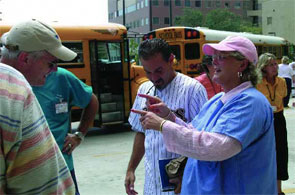
Half the Battle: Getting There
Eniola Otuseso, MD, a hospitalist who works in locum tenens positions across the southeast, calls Atlanta home. Her native Nigeria does not have hurricanes—their natural disasters are dust storms and monsoons—so she had never experienced one. The day before Hurricane Katrina hit, Dr. Otuseso had departed for her next job at Cogent Healthcare’s program at St. Dominic-Jackson Memorial Hospital (Miss.). Unable to take the last flight of the day, she packed a rental car and she, her 22-month-old son, and her teenage niece set off on the 380-mile journey to Jackson, Miss. Her account of the ride gives new meaning to the term “Sunday drive.”
MapQuest directions in hand, Dr. Otuseso took I-20 west toward Mississippi. From the road she called the hotel where she had reservations, only to find them canceled due to overbooking. She proceeded with nervous jitters: She had to report to work at 10 a.m. So she found another hotel, spent the night, and set out again at 6 a.m. Monday.
Then she had another problem: Although she thought she was on I-20 west, she had accidentally taken route 59 south—directly into New Orleans and the brunt of the storm. She notified the hospital that she was on the way, and promptly lost phone service. “I realized I needed to turn around and got off at the next exit, but a tree had blocked the road,” says Dr. Otuseso. “No one was around.”
She took the one-way exit back as trees fell around her. Her nervous jitters escalated to panic.
When a tree fell in front of her car, her attempted circumvention landed the car in the mud, and she ran out of gas trying to dislodge it. Miraculously, she had phone service, but the appalled 9-1-1 operators couldn’t help. Finally, a motorist and his adult passenger stopped and offered a ride. Dr. Otuseso and her wards climbed into the good Samaritan’s vehicle, and they were off again. The frequent need to get out of the car to haul trees from the road slowed their journey.
Finally, the mud was too thick and they became stuck. She managed to reach a nearby house on foot, and the owner used his tractor to move the car. He also offered them respite in his home with his wife and baby. A drenched, discouraged Dr. Otuseso and her children accepted the offer and were ferried there by tractor; her previous companions slogged on.
Dr. Otuseso is a graduate of Medical College of Georgia (Augusta). The rural family that housed her was was uneducated in some of the basics of preventive healthcare. Although culturally and in terms of health beliefs Dr. Otuseso and the family that sheltered her could not have been more different, the host family offered remarkable hospitality by providing food and clothing.
“Tragedy brings different people together,” Dr. Otuseso told her niece. The next day, the hurricane had passed, and the host family transported her to Hattiesburg, Miss., a town a mere 100 miles north of New Orleans. She needed basics: shelter and transportation. Hattiesburg’s hotel lacked power and water, and gas was scarce. Eventually, Dr. Otuseso convinced a service station owner to help her retrieve her rental car and fill it with gas. She then set off for Jackson.
On arrival in Jackson, she checked into another hotel with no water or electricity, but eventually made it to work Tuesday. The hospital had electricity and an endless stream of patients. Dr. Otuseso says that her experience made her more empathetic to patients. She could understand the extent of their loss. And after a lifetime of giving to others, she learned to accept help, hospitality, and assistance from others.
In New Orleans
Rob Minkes, MD, chief of pediatric surgery at Louisiana State University and Children’s Hospital (both of New Orleans) started a shift on Sunday, August 28 that became a four-day tour of duty. With him were more than 700 patients, families, and staff. Throughout the ordeal, they had Internet access and intermittent phone service. It was almost business-as-usual: All employees reported for work, and they even performed procedures in the surgical suite.
Once the storm passed, patients of all ages began to appear needing help. With them came strangers who threatened the hospital’s safety Employees could see looters from the windows. Some visitors who had no official purpose roamed the halls causing fear and despair among employees; although they were few and far between, they created chaos. Once the interlopers were escorted out, the hospital locked down. Lacking armed guards, they contacted local, state, and federal authorities for help, but none came.
“The situation became surreal, like a Stephen King novel,” explains Dr. Minkes. “There was just enough of what was normal, but the workplace and general life began to blend into some kind of limbo.”
He praises staff members who kept doing their jobs. The physicians made rounds, the nurses provided care, the housekeepers cleaned. “People can behave commendably in a crisis,” says Dr. Minkes, who noted that Children’s Hospital was well prepared and their disaster training was effective. The hospital was so prepared, in fact, that it was able to divert a fuel shipment that arrived Monday or Tuesday to a nearby facility that had a greater need.
On Wednesday morning, Children’s Hospital lost water pressure, so running water and air conditioning were history. Hospital leadership made the decision to evacuate patients and staff using any available means. Some neighboring hospitals sent helicopters. A convoy of ambulances and SUVs, staffed with care providers using hand-bag ventilators, set out for Baton Rouge. Those patients well enough were discharged. Hospital leadership received word that the National Guard had aircraft at the airport and could take remaining patients if they could be there by 7 p.m.
John Heaton, MD, chief anesthesiologist for Children’s Hospital, led a caravan of 40 cars, trucks, and SUVs to the interstate and onward to the airport. Staff members returned to the hospital despite worsening violence and health hazards in the city. Wednesday turned to the early hours of Thursday with only a few ICU patients remaining at Children’s.
At 4 a.m. a state trooper who came to support a chopper that was evacuating a patient recommended that staff prepare to evacuate at first light because of increasing danger due to flooding and looting in the city. Until then, Children’s had had very little contact with authorities, and basically made its decisions in isolation. One caravan of employees left with a police escort shortly thereafter. The remaining staff made their way unescorted when the last patient left for safety at 8 a.m., leaving a facility that had operated nobly despite Mother Nature’s wrath and security issues. When staff members left, Children’s Hospital had sustained only two broken windows.
Dr. Minkes praises the staff of every department, and indicates that leadership withstood this test. “The day after the hurricane, we were prepared to stay for two to six weeks,” he says.
When asked if he saw any skill used that surprised him in its utility, he hastens to say that they had power and water for most of the ordeal. He noted, however, that their chief of anesthesiology, an ardent fisher and hunter, calculated how high the waters would rise if the levies broke using a tool he retrieved from the Internet. He assured the staff that the water would not reach Children’s Hospital. It helped people’s spirits immensely.
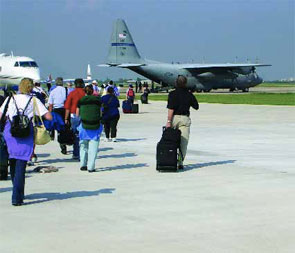
Back to Jackson
Meanwhile, Dr. Otuseso was seeing an influx of patients in Jackson. With her, Lancy Clark, a registered nurse and Cogent Healthcare Program manager who liaises between St.Dominic-Jackson Memorial Hospital’s hospitalists and community physicians, was frankly shocked. The St.Dominic-Jackson facility staff—150 miles from Gulfport—had not thought that the devastation would reach them. It did.
With no electricity or water, St. Dominic-Jackson’s internal and external communication was in a shambles. Their backup: using the telephone, personal cell phones, and overhead page system. Although the county’s priority was to restore power and water to hospitals, its employees were working in the dark. And county-wide gas shortages meant that staff had difficulty reporting to work. Fortunately, the county gave healthcare providers head-of-the-line privileges for fuel.
“I was amazed at how fast people bounced up and worked,” says Clark. “We were all counselors. We often cried with patients as they told us their stories. We used all the resources we could to help emotionally and financially.”
In all of this, the healthcare providers, too, were victims; many have strong roots and family in the devastated communities.
As the adrenaline rush subsided and things started to be a little more normal, care providers began to feel the effects of the strain. All Clark wanted to do was sit in a chair and sink deep into it. Some experts call this compassion fatigue. It is a unique type of burnout experienced by people in fields that provide care for people under extreme circumstances, or the stress of caring for people who are scared, in pain, and/or suffering. Critical incident stress management and debriefing exercises are two ways to alleviate compassion fatigue. Clark indicates that Cogent Healthcare has plans to hold debriefings so they can apply what they learned.
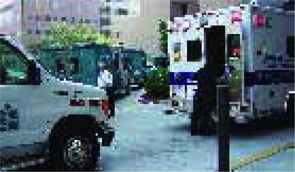
Westward Bound
Some Hurricane Katrina evacuees found their way to Galveston, Texas. Two physicians on the faculty of the University of Texas Medical Branch (UTMB) at Galveston, Janice Smith, MD, and Donna Weaver, MD, worked in a Red Cross clinic assembled in a Methodist church’s indoor racquetball court.
Like hundreds of others, Dr. Smith responded to the call for volunteers early in the process to help the 300 evacuees. She says that there were many bureaucracies, and their nurse-coordinator handled them all well. In terms of challenges, “Every few hours, policies and procedures would change,” says Dr. Smith. “There was no interclinic communication, and roles were unclear. Although it was emotionally difficult seeing patients who had lost everything, that was the easy part compared to dealing with constant change.”
Dr. Weaver, who is codirector for Center for Training in International Health and teaches the Practice of Medicine course at UTMB at Galveston, responded to a request to describe her previous experience in one word: “Nicaragua.”
She often volunteers in Nicaragua (as does Dr. Smith) and in rural U.S. communities they open clinics in people’s homes. Dr. Weaver says the “organized disorganization” of a pharmacy stocked with samples, borrowed supplies and equipment, and no lab facilities created a situation in which physicians had to rely on medical clinical skills. People came with nothing, and medical records were unavailable. The medical history—just what the patient could tell them—was the cornerstone of treatment.
“The low-tech physicians did well,” she says. Listening skills became key. Dr. Weaver intends to reinforce that lesson with her students.
Both physicians could identify gaps that would have been nice to fill. Dr. Smith said that having an on-site dentist would have helped the many people suffering from toothaches. She also appreciates geographic prescribing differences more now, and would have liked to have had a pharmacist there to tell them what certain drugs were or suggest therapeutic alternatives. Dr. Weaver said privacy was at a premium—a situation that was uncomfortable for providers and patients alike. As each day passed, more barriers and walls were rigged to try to improve privacy.
Desk Jockeys No More
Anthony Campbell, RPh, DO, an internist and a pharmacist, and Joseph Matthews, RS, a sanitarian, were deployed together as part of a United States Public Health Service (USPHS) team. They landed in Louisiana to find their accommodations sufficient: a cot in one of five tents at Camp Allen that housed around 125 responders each. Both of these USPHS-commissioned officers had prior hospital-based practices in one of Washington, D.C.’s poorest neighborhoods. It was perhaps this recent experience that made them prime candidates to be plucked from desk jobs and jettisoned back into a stressed clinical milieu. While experience prepared them for the issues of indigence and poverty, it did not temper their reactions to the devastation and exposure to elements.
Their reunion made the task less challenging but the work they did was grueling. Dr. Campbell and Matthews traveled through parishes conducting needs assessments at Red Cross shelters in Washington Parish during the first week. The days were long—sometimes beginning at 5 a.m. and ending after 11 p.m.—and impossibly hot.
Both were impressed with people’s positive attitudes. Many shelters were overcrowded and lacked bathing facilities. Members of the community welcomed displaced people into their homes to shower and took turns preparing copious quantities of food. In a significantly overcrowded shelter, the Federal Emergency Management Agency (FEMA) tried to move people to hotels; often, unrelated people who had been neighbors or who had weathered the storm together would refuse to go unless they could go together. A group of retirees from Maine who were visiting New Orleans, for example, insisted on staying together even if it was in the crowded shelter. This was an unanticipated dynamic.
Matthews talked about what he called, “the changing theater,” a military term that describes the need to change plans frequently when conditions of austerity dictate it. He indicates that many clinicians were unacquainted with the principle of gathering your assets and regrouping when plans take an about-face. That was the case throughout their deployment.
During the second week, Dr. Campbell moved closer to New Orleans, and Matthews went to the area’s largest animal shelter, a place with five huge barns, two filled with horses and three with smaller pets. In the chaos there, his main concern was not the lack of volunteers—they had plenty—but the frequent disregard for human health risks as they handled hungry pets that had been plucked from toxic floodwaters. The need to take universal precautions is not a universal belief. Just trying to get people to wear gloves was an ordeal. The volunteers were often unaware of their own cuts and bruises, and worked relentlessly.
Matthews laughed as he related a story of the volunteers’ compassion. It was late in the evening, and his transport had not arrived. Concerned, he called the base operation and learned that he’d been forgotten. He started to melt down with anger and fatigue. A group of volunteers quickly surrounded him with comfort and reassurance; they thought he was upset because he couldn’t find his pet! It restored his sense of humor and balance.
Meanwhile, Dr. Campbell was knocking on doors in a housing project, looking for people with health needs. Care was centrally located in Washington Parish, but lacking communication methods and transportation, many residents didn’t know about the help offered there. He relied on the project’s resident manager to help his team. The manager often knew who had been evacuated, how many children lived in units, and who was older and remained.
Dr. Campbell cites the heat and incredible stench as indelible memories. His deployment ended in New Orleans. Even in the French Quarter, which sits on higher ground, the air was thick with the smell of rotting food that had been removed from freezers to prevent it from ruining equipment. (Clark in Mississippi also mentioned the memorable foul odor of rotting food.) He understands now why police officers and forensics workers carry Vicks VapoRub to dab under their nose when they find a decomposed body.
Dr. Campbell indicates that the Red Cross shelters needed more trained medical personnel, although they had ample donations of medication from doctors’ offices in the form of samples, and from hospitals and pharmacies. They did not have a pharmacist, however, and he relied on his dual training to provide some of the services that Dr. Smith in Galveston also identified. He was saddened by the devastation. He visited the Superdome and indicates that the debris and human waste told a sad and shocking story.
Patient Satisfaction
Sixty-year-old patient Emelda Zar evacuated from LaFitte, La., before Hurricane Katrina. She landed in a crowded but hospitable shelter in Jackson, Miss. Some days later, her daughter called an ambulance as Zar’s health deteriorated. She was admitted to St. Dominic-Jackson Memorial Hospital and diagnosed with heart failure.
Recently discharged and about to relocate to an apartment and planning to remain in Jackson, she and her grandchildren have nothing but good things to say about the hospital and, in particular, the hospitalists who provided care.
She arrived with no medical records and a serious health problem. Her hospitalists listened and created a care plan. She left the hospital with not only a clear idea of what she needs to do, but with a scheduled follow-up appointment in the community. Like so many of the people we heard about from healthcare providers, she remains upbeat and optimistic.
Progress Notes
Shortly after Dr. Smith and Dr. Weaver were interviewed in Galveston, the news was full of a new threat: Rita. This time, the hurricane’s target was a few hundred miles west of Katrina’s path. Karen Sexton, RN, PhD, vice president and chief executive officer of Hospitals and Clinics for UTMB shared the story of how Katrina changed their response.
During routine monitoring they saw tropical depression #18 develop on Sunday to the point that it was named Rita on Monday, and began to look like trouble for Galveston. By Tuesday, the city mayor had declared a voluntary evacuation, applying one lesson from Katrina: Residents could take their pets in government evacuation vehicles. The university went on emergency status. UTMB looked at decreasing their activity and reducing the hospital census. They sent the students home.
Tuesday night, their hospitalist service and other key physicians wrote transfer summaries for all patients, beginning with those who were gravely ill. This was a change of policy based on their experience with Katrina. They chose to move critically ill patients while they had the greatest control. The pharmacy prepared medication for all patients, and parts of medical records deemed most important were copied.
Wednesday dawned, and it was clear: Rita was coming in as a level 4 or 5 hurricane. For the first time in 114 years of existence, UTMB evacuated under Dr. Sexton’s direction as the incident commander. Using resources sent in part by the governor, their team discharged and evacuated 427 patients in 12 hours.
“We were all a little teary eyed when the first patient left,” says Dr. Sexton. “We knew we had never evacuated before and we knew were making history.”
Key to the success of UTMB’s evacuation were checklists on the units and at two evacuation stations. This, too, was something they learned from Katrina: Track patient disposition and send as much information as possible. With the goal of improving patient safety, UTMB recently started training staff on an aviation model that mimics what the aviation industry does to ensure safety.
They tracked what went with the patient, where the patient went, and that family notifications were done. The staff’s increased awareness and use of checklists were key components for a successful evacuation. No patients were “lost.” As the last patient left, Dr. Sexton found herself with a hospital staffed to support 500 to 700 patients, no patients, and the realization that staff also needed to evacuate but might not be able to navigate the exodus traffic.
Another request to the Texas governor’s office put two C130 cargo planes at their disposal. Staff were given three options: Stay at the hospital, leave of their own accord, or take the C130 to shelter in Houston. One-hundred-thirty-one staff members chose the latter option and left Thursday; the same planes brought them back the following Monday.
During the storm, UTMB’s ED remained open and staffed. It was the only operating ED for miles. A burn victim and several firemen who were harmed fighting a tremendous blaze during the storm on Friday proved that remaining open was the right thing to do to for the community.
Although UTMB lost some equipment, blocks of air conditioning, and some power, administrators believe that they made good decisions and emerged almost unscathed.
“I never felt prouder of our staff,” says Dr. Sexton. “This will be a different place because we all did this together.”
Less than a week later, they continue to treat patients from the community, have started admitting patients, and have welcomed some of their critically ill neonates back.
Conclusion
Who believes weather analysts? Often, we look at unwelcome weather forecasts and dismiss them, thinking that it always sounds worse than it is. Hospitalists and healthcare providers who weathered Katrina and Rita, and who are still working with the aftermath are probably more apt to listen to future dire weather predictions. “Lessons for Hospitalists from the 2005 Hurricane Season” (left) summarizes some of the lessons learned from the 2005 hurricane season to date. Every hospital will have to look at disaster plans and make changes based on what we’ve learned. Self-sufficiency for 48 hours is probably a less-than-ambitious goal; we may need to think in terms of planning for a week or more. Certainly, hospitalists will need to take leadership roles. TH
Contributor Jeannette Wick, RPh, MBA, is a senior clinical research pharmacist at the NIH in Bethesda, Md. The opinions expressed herein are those of the author and not necessarily those of any government agency.
When a hospitalist steps outside during a seemingly unending shift, and a city is silent but for the bark of dogs, something is wrong. When he returns not to a scheduled shift, but to an undefined “tour of duty,” something is very wrong. Such has been the case for many hospitalists and healthcare providers along the Gulf Coast since Hurricane Katrina first devastated miles of the coast in August, and then Hurricane Rita hammered home our vulnerability to natural disasters in September. These sentinel experiences offer learning points for our nation’s healthcare system. “Challenges Hospitals Encountered During the 2005 Hurricane Seasons” (p. 8) lists some of the areas in which hospitals and healthcare providers were tested.
Half the Battle: Getting There
Eniola Otuseso, MD, a hospitalist who works in locum tenens positions across the southeast, calls Atlanta home. Her native Nigeria does not have hurricanes—their natural disasters are dust storms and monsoons—so she had never experienced one. The day before Hurricane Katrina hit, Dr. Otuseso had departed for her next job at Cogent Healthcare’s program at St. Dominic-Jackson Memorial Hospital (Miss.). Unable to take the last flight of the day, she packed a rental car and she, her 22-month-old son, and her teenage niece set off on the 380-mile journey to Jackson, Miss. Her account of the ride gives new meaning to the term “Sunday drive.”
MapQuest directions in hand, Dr. Otuseso took I-20 west toward Mississippi. From the road she called the hotel where she had reservations, only to find them canceled due to overbooking. She proceeded with nervous jitters: She had to report to work at 10 a.m. So she found another hotel, spent the night, and set out again at 6 a.m. Monday.
Then she had another problem: Although she thought she was on I-20 west, she had accidentally taken route 59 south—directly into New Orleans and the brunt of the storm. She notified the hospital that she was on the way, and promptly lost phone service. “I realized I needed to turn around and got off at the next exit, but a tree had blocked the road,” says Dr. Otuseso. “No one was around.”
She took the one-way exit back as trees fell around her. Her nervous jitters escalated to panic.
When a tree fell in front of her car, her attempted circumvention landed the car in the mud, and she ran out of gas trying to dislodge it. Miraculously, she had phone service, but the appalled 9-1-1 operators couldn’t help. Finally, a motorist and his adult passenger stopped and offered a ride. Dr. Otuseso and her wards climbed into the good Samaritan’s vehicle, and they were off again. The frequent need to get out of the car to haul trees from the road slowed their journey.
Finally, the mud was too thick and they became stuck. She managed to reach a nearby house on foot, and the owner used his tractor to move the car. He also offered them respite in his home with his wife and baby. A drenched, discouraged Dr. Otuseso and her children accepted the offer and were ferried there by tractor; her previous companions slogged on.
Dr. Otuseso is a graduate of Medical College of Georgia (Augusta). The rural family that housed her was was uneducated in some of the basics of preventive healthcare. Although culturally and in terms of health beliefs Dr. Otuseso and the family that sheltered her could not have been more different, the host family offered remarkable hospitality by providing food and clothing.
“Tragedy brings different people together,” Dr. Otuseso told her niece. The next day, the hurricane had passed, and the host family transported her to Hattiesburg, Miss., a town a mere 100 miles north of New Orleans. She needed basics: shelter and transportation. Hattiesburg’s hotel lacked power and water, and gas was scarce. Eventually, Dr. Otuseso convinced a service station owner to help her retrieve her rental car and fill it with gas. She then set off for Jackson.
On arrival in Jackson, she checked into another hotel with no water or electricity, but eventually made it to work Tuesday. The hospital had electricity and an endless stream of patients. Dr. Otuseso says that her experience made her more empathetic to patients. She could understand the extent of their loss. And after a lifetime of giving to others, she learned to accept help, hospitality, and assistance from others.
In New Orleans
Rob Minkes, MD, chief of pediatric surgery at Louisiana State University and Children’s Hospital (both of New Orleans) started a shift on Sunday, August 28 that became a four-day tour of duty. With him were more than 700 patients, families, and staff. Throughout the ordeal, they had Internet access and intermittent phone service. It was almost business-as-usual: All employees reported for work, and they even performed procedures in the surgical suite.
Once the storm passed, patients of all ages began to appear needing help. With them came strangers who threatened the hospital’s safety Employees could see looters from the windows. Some visitors who had no official purpose roamed the halls causing fear and despair among employees; although they were few and far between, they created chaos. Once the interlopers were escorted out, the hospital locked down. Lacking armed guards, they contacted local, state, and federal authorities for help, but none came.
“The situation became surreal, like a Stephen King novel,” explains Dr. Minkes. “There was just enough of what was normal, but the workplace and general life began to blend into some kind of limbo.”
He praises staff members who kept doing their jobs. The physicians made rounds, the nurses provided care, the housekeepers cleaned. “People can behave commendably in a crisis,” says Dr. Minkes, who noted that Children’s Hospital was well prepared and their disaster training was effective. The hospital was so prepared, in fact, that it was able to divert a fuel shipment that arrived Monday or Tuesday to a nearby facility that had a greater need.
On Wednesday morning, Children’s Hospital lost water pressure, so running water and air conditioning were history. Hospital leadership made the decision to evacuate patients and staff using any available means. Some neighboring hospitals sent helicopters. A convoy of ambulances and SUVs, staffed with care providers using hand-bag ventilators, set out for Baton Rouge. Those patients well enough were discharged. Hospital leadership received word that the National Guard had aircraft at the airport and could take remaining patients if they could be there by 7 p.m.
John Heaton, MD, chief anesthesiologist for Children’s Hospital, led a caravan of 40 cars, trucks, and SUVs to the interstate and onward to the airport. Staff members returned to the hospital despite worsening violence and health hazards in the city. Wednesday turned to the early hours of Thursday with only a few ICU patients remaining at Children’s.
At 4 a.m. a state trooper who came to support a chopper that was evacuating a patient recommended that staff prepare to evacuate at first light because of increasing danger due to flooding and looting in the city. Until then, Children’s had had very little contact with authorities, and basically made its decisions in isolation. One caravan of employees left with a police escort shortly thereafter. The remaining staff made their way unescorted when the last patient left for safety at 8 a.m., leaving a facility that had operated nobly despite Mother Nature’s wrath and security issues. When staff members left, Children’s Hospital had sustained only two broken windows.
Dr. Minkes praises the staff of every department, and indicates that leadership withstood this test. “The day after the hurricane, we were prepared to stay for two to six weeks,” he says.
When asked if he saw any skill used that surprised him in its utility, he hastens to say that they had power and water for most of the ordeal. He noted, however, that their chief of anesthesiology, an ardent fisher and hunter, calculated how high the waters would rise if the levies broke using a tool he retrieved from the Internet. He assured the staff that the water would not reach Children’s Hospital. It helped people’s spirits immensely.
Back to Jackson
Meanwhile, Dr. Otuseso was seeing an influx of patients in Jackson. With her, Lancy Clark, a registered nurse and Cogent Healthcare Program manager who liaises between St.Dominic-Jackson Memorial Hospital’s hospitalists and community physicians, was frankly shocked. The St.Dominic-Jackson facility staff—150 miles from Gulfport—had not thought that the devastation would reach them. It did.
With no electricity or water, St. Dominic-Jackson’s internal and external communication was in a shambles. Their backup: using the telephone, personal cell phones, and overhead page system. Although the county’s priority was to restore power and water to hospitals, its employees were working in the dark. And county-wide gas shortages meant that staff had difficulty reporting to work. Fortunately, the county gave healthcare providers head-of-the-line privileges for fuel.
“I was amazed at how fast people bounced up and worked,” says Clark. “We were all counselors. We often cried with patients as they told us their stories. We used all the resources we could to help emotionally and financially.”
In all of this, the healthcare providers, too, were victims; many have strong roots and family in the devastated communities.
As the adrenaline rush subsided and things started to be a little more normal, care providers began to feel the effects of the strain. All Clark wanted to do was sit in a chair and sink deep into it. Some experts call this compassion fatigue. It is a unique type of burnout experienced by people in fields that provide care for people under extreme circumstances, or the stress of caring for people who are scared, in pain, and/or suffering. Critical incident stress management and debriefing exercises are two ways to alleviate compassion fatigue. Clark indicates that Cogent Healthcare has plans to hold debriefings so they can apply what they learned.
Westward Bound
Some Hurricane Katrina evacuees found their way to Galveston, Texas. Two physicians on the faculty of the University of Texas Medical Branch (UTMB) at Galveston, Janice Smith, MD, and Donna Weaver, MD, worked in a Red Cross clinic assembled in a Methodist church’s indoor racquetball court.
Like hundreds of others, Dr. Smith responded to the call for volunteers early in the process to help the 300 evacuees. She says that there were many bureaucracies, and their nurse-coordinator handled them all well. In terms of challenges, “Every few hours, policies and procedures would change,” says Dr. Smith. “There was no interclinic communication, and roles were unclear. Although it was emotionally difficult seeing patients who had lost everything, that was the easy part compared to dealing with constant change.”
Dr. Weaver, who is codirector for Center for Training in International Health and teaches the Practice of Medicine course at UTMB at Galveston, responded to a request to describe her previous experience in one word: “Nicaragua.”
She often volunteers in Nicaragua (as does Dr. Smith) and in rural U.S. communities they open clinics in people’s homes. Dr. Weaver says the “organized disorganization” of a pharmacy stocked with samples, borrowed supplies and equipment, and no lab facilities created a situation in which physicians had to rely on medical clinical skills. People came with nothing, and medical records were unavailable. The medical history—just what the patient could tell them—was the cornerstone of treatment.
“The low-tech physicians did well,” she says. Listening skills became key. Dr. Weaver intends to reinforce that lesson with her students.
Both physicians could identify gaps that would have been nice to fill. Dr. Smith said that having an on-site dentist would have helped the many people suffering from toothaches. She also appreciates geographic prescribing differences more now, and would have liked to have had a pharmacist there to tell them what certain drugs were or suggest therapeutic alternatives. Dr. Weaver said privacy was at a premium—a situation that was uncomfortable for providers and patients alike. As each day passed, more barriers and walls were rigged to try to improve privacy.
Desk Jockeys No More
Anthony Campbell, RPh, DO, an internist and a pharmacist, and Joseph Matthews, RS, a sanitarian, were deployed together as part of a United States Public Health Service (USPHS) team. They landed in Louisiana to find their accommodations sufficient: a cot in one of five tents at Camp Allen that housed around 125 responders each. Both of these USPHS-commissioned officers had prior hospital-based practices in one of Washington, D.C.’s poorest neighborhoods. It was perhaps this recent experience that made them prime candidates to be plucked from desk jobs and jettisoned back into a stressed clinical milieu. While experience prepared them for the issues of indigence and poverty, it did not temper their reactions to the devastation and exposure to elements.
Their reunion made the task less challenging but the work they did was grueling. Dr. Campbell and Matthews traveled through parishes conducting needs assessments at Red Cross shelters in Washington Parish during the first week. The days were long—sometimes beginning at 5 a.m. and ending after 11 p.m.—and impossibly hot.
Both were impressed with people’s positive attitudes. Many shelters were overcrowded and lacked bathing facilities. Members of the community welcomed displaced people into their homes to shower and took turns preparing copious quantities of food. In a significantly overcrowded shelter, the Federal Emergency Management Agency (FEMA) tried to move people to hotels; often, unrelated people who had been neighbors or who had weathered the storm together would refuse to go unless they could go together. A group of retirees from Maine who were visiting New Orleans, for example, insisted on staying together even if it was in the crowded shelter. This was an unanticipated dynamic.
Matthews talked about what he called, “the changing theater,” a military term that describes the need to change plans frequently when conditions of austerity dictate it. He indicates that many clinicians were unacquainted with the principle of gathering your assets and regrouping when plans take an about-face. That was the case throughout their deployment.
During the second week, Dr. Campbell moved closer to New Orleans, and Matthews went to the area’s largest animal shelter, a place with five huge barns, two filled with horses and three with smaller pets. In the chaos there, his main concern was not the lack of volunteers—they had plenty—but the frequent disregard for human health risks as they handled hungry pets that had been plucked from toxic floodwaters. The need to take universal precautions is not a universal belief. Just trying to get people to wear gloves was an ordeal. The volunteers were often unaware of their own cuts and bruises, and worked relentlessly.
Matthews laughed as he related a story of the volunteers’ compassion. It was late in the evening, and his transport had not arrived. Concerned, he called the base operation and learned that he’d been forgotten. He started to melt down with anger and fatigue. A group of volunteers quickly surrounded him with comfort and reassurance; they thought he was upset because he couldn’t find his pet! It restored his sense of humor and balance.
Meanwhile, Dr. Campbell was knocking on doors in a housing project, looking for people with health needs. Care was centrally located in Washington Parish, but lacking communication methods and transportation, many residents didn’t know about the help offered there. He relied on the project’s resident manager to help his team. The manager often knew who had been evacuated, how many children lived in units, and who was older and remained.
Dr. Campbell cites the heat and incredible stench as indelible memories. His deployment ended in New Orleans. Even in the French Quarter, which sits on higher ground, the air was thick with the smell of rotting food that had been removed from freezers to prevent it from ruining equipment. (Clark in Mississippi also mentioned the memorable foul odor of rotting food.) He understands now why police officers and forensics workers carry Vicks VapoRub to dab under their nose when they find a decomposed body.
Dr. Campbell indicates that the Red Cross shelters needed more trained medical personnel, although they had ample donations of medication from doctors’ offices in the form of samples, and from hospitals and pharmacies. They did not have a pharmacist, however, and he relied on his dual training to provide some of the services that Dr. Smith in Galveston also identified. He was saddened by the devastation. He visited the Superdome and indicates that the debris and human waste told a sad and shocking story.
Patient Satisfaction
Sixty-year-old patient Emelda Zar evacuated from LaFitte, La., before Hurricane Katrina. She landed in a crowded but hospitable shelter in Jackson, Miss. Some days later, her daughter called an ambulance as Zar’s health deteriorated. She was admitted to St. Dominic-Jackson Memorial Hospital and diagnosed with heart failure.
Recently discharged and about to relocate to an apartment and planning to remain in Jackson, she and her grandchildren have nothing but good things to say about the hospital and, in particular, the hospitalists who provided care.
She arrived with no medical records and a serious health problem. Her hospitalists listened and created a care plan. She left the hospital with not only a clear idea of what she needs to do, but with a scheduled follow-up appointment in the community. Like so many of the people we heard about from healthcare providers, she remains upbeat and optimistic.
Progress Notes
Shortly after Dr. Smith and Dr. Weaver were interviewed in Galveston, the news was full of a new threat: Rita. This time, the hurricane’s target was a few hundred miles west of Katrina’s path. Karen Sexton, RN, PhD, vice president and chief executive officer of Hospitals and Clinics for UTMB shared the story of how Katrina changed their response.
During routine monitoring they saw tropical depression #18 develop on Sunday to the point that it was named Rita on Monday, and began to look like trouble for Galveston. By Tuesday, the city mayor had declared a voluntary evacuation, applying one lesson from Katrina: Residents could take their pets in government evacuation vehicles. The university went on emergency status. UTMB looked at decreasing their activity and reducing the hospital census. They sent the students home.
Tuesday night, their hospitalist service and other key physicians wrote transfer summaries for all patients, beginning with those who were gravely ill. This was a change of policy based on their experience with Katrina. They chose to move critically ill patients while they had the greatest control. The pharmacy prepared medication for all patients, and parts of medical records deemed most important were copied.
Wednesday dawned, and it was clear: Rita was coming in as a level 4 or 5 hurricane. For the first time in 114 years of existence, UTMB evacuated under Dr. Sexton’s direction as the incident commander. Using resources sent in part by the governor, their team discharged and evacuated 427 patients in 12 hours.
“We were all a little teary eyed when the first patient left,” says Dr. Sexton. “We knew we had never evacuated before and we knew were making history.”
Key to the success of UTMB’s evacuation were checklists on the units and at two evacuation stations. This, too, was something they learned from Katrina: Track patient disposition and send as much information as possible. With the goal of improving patient safety, UTMB recently started training staff on an aviation model that mimics what the aviation industry does to ensure safety.
They tracked what went with the patient, where the patient went, and that family notifications were done. The staff’s increased awareness and use of checklists were key components for a successful evacuation. No patients were “lost.” As the last patient left, Dr. Sexton found herself with a hospital staffed to support 500 to 700 patients, no patients, and the realization that staff also needed to evacuate but might not be able to navigate the exodus traffic.
Another request to the Texas governor’s office put two C130 cargo planes at their disposal. Staff were given three options: Stay at the hospital, leave of their own accord, or take the C130 to shelter in Houston. One-hundred-thirty-one staff members chose the latter option and left Thursday; the same planes brought them back the following Monday.
During the storm, UTMB’s ED remained open and staffed. It was the only operating ED for miles. A burn victim and several firemen who were harmed fighting a tremendous blaze during the storm on Friday proved that remaining open was the right thing to do to for the community.
Although UTMB lost some equipment, blocks of air conditioning, and some power, administrators believe that they made good decisions and emerged almost unscathed.
“I never felt prouder of our staff,” says Dr. Sexton. “This will be a different place because we all did this together.”
Less than a week later, they continue to treat patients from the community, have started admitting patients, and have welcomed some of their critically ill neonates back.
Conclusion
Who believes weather analysts? Often, we look at unwelcome weather forecasts and dismiss them, thinking that it always sounds worse than it is. Hospitalists and healthcare providers who weathered Katrina and Rita, and who are still working with the aftermath are probably more apt to listen to future dire weather predictions. “Lessons for Hospitalists from the 2005 Hurricane Season” (left) summarizes some of the lessons learned from the 2005 hurricane season to date. Every hospital will have to look at disaster plans and make changes based on what we’ve learned. Self-sufficiency for 48 hours is probably a less-than-ambitious goal; we may need to think in terms of planning for a week or more. Certainly, hospitalists will need to take leadership roles. TH
Contributor Jeannette Wick, RPh, MBA, is a senior clinical research pharmacist at the NIH in Bethesda, Md. The opinions expressed herein are those of the author and not necessarily those of any government agency.
When a hospitalist steps outside during a seemingly unending shift, and a city is silent but for the bark of dogs, something is wrong. When he returns not to a scheduled shift, but to an undefined “tour of duty,” something is very wrong. Such has been the case for many hospitalists and healthcare providers along the Gulf Coast since Hurricane Katrina first devastated miles of the coast in August, and then Hurricane Rita hammered home our vulnerability to natural disasters in September. These sentinel experiences offer learning points for our nation’s healthcare system. “Challenges Hospitals Encountered During the 2005 Hurricane Seasons” (p. 8) lists some of the areas in which hospitals and healthcare providers were tested.
Half the Battle: Getting There
Eniola Otuseso, MD, a hospitalist who works in locum tenens positions across the southeast, calls Atlanta home. Her native Nigeria does not have hurricanes—their natural disasters are dust storms and monsoons—so she had never experienced one. The day before Hurricane Katrina hit, Dr. Otuseso had departed for her next job at Cogent Healthcare’s program at St. Dominic-Jackson Memorial Hospital (Miss.). Unable to take the last flight of the day, she packed a rental car and she, her 22-month-old son, and her teenage niece set off on the 380-mile journey to Jackson, Miss. Her account of the ride gives new meaning to the term “Sunday drive.”
MapQuest directions in hand, Dr. Otuseso took I-20 west toward Mississippi. From the road she called the hotel where she had reservations, only to find them canceled due to overbooking. She proceeded with nervous jitters: She had to report to work at 10 a.m. So she found another hotel, spent the night, and set out again at 6 a.m. Monday.
Then she had another problem: Although she thought she was on I-20 west, she had accidentally taken route 59 south—directly into New Orleans and the brunt of the storm. She notified the hospital that she was on the way, and promptly lost phone service. “I realized I needed to turn around and got off at the next exit, but a tree had blocked the road,” says Dr. Otuseso. “No one was around.”
She took the one-way exit back as trees fell around her. Her nervous jitters escalated to panic.
When a tree fell in front of her car, her attempted circumvention landed the car in the mud, and she ran out of gas trying to dislodge it. Miraculously, she had phone service, but the appalled 9-1-1 operators couldn’t help. Finally, a motorist and his adult passenger stopped and offered a ride. Dr. Otuseso and her wards climbed into the good Samaritan’s vehicle, and they were off again. The frequent need to get out of the car to haul trees from the road slowed their journey.
Finally, the mud was too thick and they became stuck. She managed to reach a nearby house on foot, and the owner used his tractor to move the car. He also offered them respite in his home with his wife and baby. A drenched, discouraged Dr. Otuseso and her children accepted the offer and were ferried there by tractor; her previous companions slogged on.
Dr. Otuseso is a graduate of Medical College of Georgia (Augusta). The rural family that housed her was was uneducated in some of the basics of preventive healthcare. Although culturally and in terms of health beliefs Dr. Otuseso and the family that sheltered her could not have been more different, the host family offered remarkable hospitality by providing food and clothing.
“Tragedy brings different people together,” Dr. Otuseso told her niece. The next day, the hurricane had passed, and the host family transported her to Hattiesburg, Miss., a town a mere 100 miles north of New Orleans. She needed basics: shelter and transportation. Hattiesburg’s hotel lacked power and water, and gas was scarce. Eventually, Dr. Otuseso convinced a service station owner to help her retrieve her rental car and fill it with gas. She then set off for Jackson.
On arrival in Jackson, she checked into another hotel with no water or electricity, but eventually made it to work Tuesday. The hospital had electricity and an endless stream of patients. Dr. Otuseso says that her experience made her more empathetic to patients. She could understand the extent of their loss. And after a lifetime of giving to others, she learned to accept help, hospitality, and assistance from others.
In New Orleans
Rob Minkes, MD, chief of pediatric surgery at Louisiana State University and Children’s Hospital (both of New Orleans) started a shift on Sunday, August 28 that became a four-day tour of duty. With him were more than 700 patients, families, and staff. Throughout the ordeal, they had Internet access and intermittent phone service. It was almost business-as-usual: All employees reported for work, and they even performed procedures in the surgical suite.
Once the storm passed, patients of all ages began to appear needing help. With them came strangers who threatened the hospital’s safety Employees could see looters from the windows. Some visitors who had no official purpose roamed the halls causing fear and despair among employees; although they were few and far between, they created chaos. Once the interlopers were escorted out, the hospital locked down. Lacking armed guards, they contacted local, state, and federal authorities for help, but none came.
“The situation became surreal, like a Stephen King novel,” explains Dr. Minkes. “There was just enough of what was normal, but the workplace and general life began to blend into some kind of limbo.”
He praises staff members who kept doing their jobs. The physicians made rounds, the nurses provided care, the housekeepers cleaned. “People can behave commendably in a crisis,” says Dr. Minkes, who noted that Children’s Hospital was well prepared and their disaster training was effective. The hospital was so prepared, in fact, that it was able to divert a fuel shipment that arrived Monday or Tuesday to a nearby facility that had a greater need.
On Wednesday morning, Children’s Hospital lost water pressure, so running water and air conditioning were history. Hospital leadership made the decision to evacuate patients and staff using any available means. Some neighboring hospitals sent helicopters. A convoy of ambulances and SUVs, staffed with care providers using hand-bag ventilators, set out for Baton Rouge. Those patients well enough were discharged. Hospital leadership received word that the National Guard had aircraft at the airport and could take remaining patients if they could be there by 7 p.m.
John Heaton, MD, chief anesthesiologist for Children’s Hospital, led a caravan of 40 cars, trucks, and SUVs to the interstate and onward to the airport. Staff members returned to the hospital despite worsening violence and health hazards in the city. Wednesday turned to the early hours of Thursday with only a few ICU patients remaining at Children’s.
At 4 a.m. a state trooper who came to support a chopper that was evacuating a patient recommended that staff prepare to evacuate at first light because of increasing danger due to flooding and looting in the city. Until then, Children’s had had very little contact with authorities, and basically made its decisions in isolation. One caravan of employees left with a police escort shortly thereafter. The remaining staff made their way unescorted when the last patient left for safety at 8 a.m., leaving a facility that had operated nobly despite Mother Nature’s wrath and security issues. When staff members left, Children’s Hospital had sustained only two broken windows.
Dr. Minkes praises the staff of every department, and indicates that leadership withstood this test. “The day after the hurricane, we were prepared to stay for two to six weeks,” he says.
When asked if he saw any skill used that surprised him in its utility, he hastens to say that they had power and water for most of the ordeal. He noted, however, that their chief of anesthesiology, an ardent fisher and hunter, calculated how high the waters would rise if the levies broke using a tool he retrieved from the Internet. He assured the staff that the water would not reach Children’s Hospital. It helped people’s spirits immensely.
Back to Jackson
Meanwhile, Dr. Otuseso was seeing an influx of patients in Jackson. With her, Lancy Clark, a registered nurse and Cogent Healthcare Program manager who liaises between St.Dominic-Jackson Memorial Hospital’s hospitalists and community physicians, was frankly shocked. The St.Dominic-Jackson facility staff—150 miles from Gulfport—had not thought that the devastation would reach them. It did.
With no electricity or water, St. Dominic-Jackson’s internal and external communication was in a shambles. Their backup: using the telephone, personal cell phones, and overhead page system. Although the county’s priority was to restore power and water to hospitals, its employees were working in the dark. And county-wide gas shortages meant that staff had difficulty reporting to work. Fortunately, the county gave healthcare providers head-of-the-line privileges for fuel.
“I was amazed at how fast people bounced up and worked,” says Clark. “We were all counselors. We often cried with patients as they told us their stories. We used all the resources we could to help emotionally and financially.”
In all of this, the healthcare providers, too, were victims; many have strong roots and family in the devastated communities.
As the adrenaline rush subsided and things started to be a little more normal, care providers began to feel the effects of the strain. All Clark wanted to do was sit in a chair and sink deep into it. Some experts call this compassion fatigue. It is a unique type of burnout experienced by people in fields that provide care for people under extreme circumstances, or the stress of caring for people who are scared, in pain, and/or suffering. Critical incident stress management and debriefing exercises are two ways to alleviate compassion fatigue. Clark indicates that Cogent Healthcare has plans to hold debriefings so they can apply what they learned.
Westward Bound
Some Hurricane Katrina evacuees found their way to Galveston, Texas. Two physicians on the faculty of the University of Texas Medical Branch (UTMB) at Galveston, Janice Smith, MD, and Donna Weaver, MD, worked in a Red Cross clinic assembled in a Methodist church’s indoor racquetball court.
Like hundreds of others, Dr. Smith responded to the call for volunteers early in the process to help the 300 evacuees. She says that there were many bureaucracies, and their nurse-coordinator handled them all well. In terms of challenges, “Every few hours, policies and procedures would change,” says Dr. Smith. “There was no interclinic communication, and roles were unclear. Although it was emotionally difficult seeing patients who had lost everything, that was the easy part compared to dealing with constant change.”
Dr. Weaver, who is codirector for Center for Training in International Health and teaches the Practice of Medicine course at UTMB at Galveston, responded to a request to describe her previous experience in one word: “Nicaragua.”
She often volunteers in Nicaragua (as does Dr. Smith) and in rural U.S. communities they open clinics in people’s homes. Dr. Weaver says the “organized disorganization” of a pharmacy stocked with samples, borrowed supplies and equipment, and no lab facilities created a situation in which physicians had to rely on medical clinical skills. People came with nothing, and medical records were unavailable. The medical history—just what the patient could tell them—was the cornerstone of treatment.
“The low-tech physicians did well,” she says. Listening skills became key. Dr. Weaver intends to reinforce that lesson with her students.
Both physicians could identify gaps that would have been nice to fill. Dr. Smith said that having an on-site dentist would have helped the many people suffering from toothaches. She also appreciates geographic prescribing differences more now, and would have liked to have had a pharmacist there to tell them what certain drugs were or suggest therapeutic alternatives. Dr. Weaver said privacy was at a premium—a situation that was uncomfortable for providers and patients alike. As each day passed, more barriers and walls were rigged to try to improve privacy.
Desk Jockeys No More
Anthony Campbell, RPh, DO, an internist and a pharmacist, and Joseph Matthews, RS, a sanitarian, were deployed together as part of a United States Public Health Service (USPHS) team. They landed in Louisiana to find their accommodations sufficient: a cot in one of five tents at Camp Allen that housed around 125 responders each. Both of these USPHS-commissioned officers had prior hospital-based practices in one of Washington, D.C.’s poorest neighborhoods. It was perhaps this recent experience that made them prime candidates to be plucked from desk jobs and jettisoned back into a stressed clinical milieu. While experience prepared them for the issues of indigence and poverty, it did not temper their reactions to the devastation and exposure to elements.
Their reunion made the task less challenging but the work they did was grueling. Dr. Campbell and Matthews traveled through parishes conducting needs assessments at Red Cross shelters in Washington Parish during the first week. The days were long—sometimes beginning at 5 a.m. and ending after 11 p.m.—and impossibly hot.
Both were impressed with people’s positive attitudes. Many shelters were overcrowded and lacked bathing facilities. Members of the community welcomed displaced people into their homes to shower and took turns preparing copious quantities of food. In a significantly overcrowded shelter, the Federal Emergency Management Agency (FEMA) tried to move people to hotels; often, unrelated people who had been neighbors or who had weathered the storm together would refuse to go unless they could go together. A group of retirees from Maine who were visiting New Orleans, for example, insisted on staying together even if it was in the crowded shelter. This was an unanticipated dynamic.
Matthews talked about what he called, “the changing theater,” a military term that describes the need to change plans frequently when conditions of austerity dictate it. He indicates that many clinicians were unacquainted with the principle of gathering your assets and regrouping when plans take an about-face. That was the case throughout their deployment.
During the second week, Dr. Campbell moved closer to New Orleans, and Matthews went to the area’s largest animal shelter, a place with five huge barns, two filled with horses and three with smaller pets. In the chaos there, his main concern was not the lack of volunteers—they had plenty—but the frequent disregard for human health risks as they handled hungry pets that had been plucked from toxic floodwaters. The need to take universal precautions is not a universal belief. Just trying to get people to wear gloves was an ordeal. The volunteers were often unaware of their own cuts and bruises, and worked relentlessly.
Matthews laughed as he related a story of the volunteers’ compassion. It was late in the evening, and his transport had not arrived. Concerned, he called the base operation and learned that he’d been forgotten. He started to melt down with anger and fatigue. A group of volunteers quickly surrounded him with comfort and reassurance; they thought he was upset because he couldn’t find his pet! It restored his sense of humor and balance.
Meanwhile, Dr. Campbell was knocking on doors in a housing project, looking for people with health needs. Care was centrally located in Washington Parish, but lacking communication methods and transportation, many residents didn’t know about the help offered there. He relied on the project’s resident manager to help his team. The manager often knew who had been evacuated, how many children lived in units, and who was older and remained.
Dr. Campbell cites the heat and incredible stench as indelible memories. His deployment ended in New Orleans. Even in the French Quarter, which sits on higher ground, the air was thick with the smell of rotting food that had been removed from freezers to prevent it from ruining equipment. (Clark in Mississippi also mentioned the memorable foul odor of rotting food.) He understands now why police officers and forensics workers carry Vicks VapoRub to dab under their nose when they find a decomposed body.
Dr. Campbell indicates that the Red Cross shelters needed more trained medical personnel, although they had ample donations of medication from doctors’ offices in the form of samples, and from hospitals and pharmacies. They did not have a pharmacist, however, and he relied on his dual training to provide some of the services that Dr. Smith in Galveston also identified. He was saddened by the devastation. He visited the Superdome and indicates that the debris and human waste told a sad and shocking story.
Patient Satisfaction
Sixty-year-old patient Emelda Zar evacuated from LaFitte, La., before Hurricane Katrina. She landed in a crowded but hospitable shelter in Jackson, Miss. Some days later, her daughter called an ambulance as Zar’s health deteriorated. She was admitted to St. Dominic-Jackson Memorial Hospital and diagnosed with heart failure.
Recently discharged and about to relocate to an apartment and planning to remain in Jackson, she and her grandchildren have nothing but good things to say about the hospital and, in particular, the hospitalists who provided care.
She arrived with no medical records and a serious health problem. Her hospitalists listened and created a care plan. She left the hospital with not only a clear idea of what she needs to do, but with a scheduled follow-up appointment in the community. Like so many of the people we heard about from healthcare providers, she remains upbeat and optimistic.
Progress Notes
Shortly after Dr. Smith and Dr. Weaver were interviewed in Galveston, the news was full of a new threat: Rita. This time, the hurricane’s target was a few hundred miles west of Katrina’s path. Karen Sexton, RN, PhD, vice president and chief executive officer of Hospitals and Clinics for UTMB shared the story of how Katrina changed their response.
During routine monitoring they saw tropical depression #18 develop on Sunday to the point that it was named Rita on Monday, and began to look like trouble for Galveston. By Tuesday, the city mayor had declared a voluntary evacuation, applying one lesson from Katrina: Residents could take their pets in government evacuation vehicles. The university went on emergency status. UTMB looked at decreasing their activity and reducing the hospital census. They sent the students home.
Tuesday night, their hospitalist service and other key physicians wrote transfer summaries for all patients, beginning with those who were gravely ill. This was a change of policy based on their experience with Katrina. They chose to move critically ill patients while they had the greatest control. The pharmacy prepared medication for all patients, and parts of medical records deemed most important were copied.
Wednesday dawned, and it was clear: Rita was coming in as a level 4 or 5 hurricane. For the first time in 114 years of existence, UTMB evacuated under Dr. Sexton’s direction as the incident commander. Using resources sent in part by the governor, their team discharged and evacuated 427 patients in 12 hours.
“We were all a little teary eyed when the first patient left,” says Dr. Sexton. “We knew we had never evacuated before and we knew were making history.”
Key to the success of UTMB’s evacuation were checklists on the units and at two evacuation stations. This, too, was something they learned from Katrina: Track patient disposition and send as much information as possible. With the goal of improving patient safety, UTMB recently started training staff on an aviation model that mimics what the aviation industry does to ensure safety.
They tracked what went with the patient, where the patient went, and that family notifications were done. The staff’s increased awareness and use of checklists were key components for a successful evacuation. No patients were “lost.” As the last patient left, Dr. Sexton found herself with a hospital staffed to support 500 to 700 patients, no patients, and the realization that staff also needed to evacuate but might not be able to navigate the exodus traffic.
Another request to the Texas governor’s office put two C130 cargo planes at their disposal. Staff were given three options: Stay at the hospital, leave of their own accord, or take the C130 to shelter in Houston. One-hundred-thirty-one staff members chose the latter option and left Thursday; the same planes brought them back the following Monday.
During the storm, UTMB’s ED remained open and staffed. It was the only operating ED for miles. A burn victim and several firemen who were harmed fighting a tremendous blaze during the storm on Friday proved that remaining open was the right thing to do to for the community.
Although UTMB lost some equipment, blocks of air conditioning, and some power, administrators believe that they made good decisions and emerged almost unscathed.
“I never felt prouder of our staff,” says Dr. Sexton. “This will be a different place because we all did this together.”
Less than a week later, they continue to treat patients from the community, have started admitting patients, and have welcomed some of their critically ill neonates back.
Conclusion
Who believes weather analysts? Often, we look at unwelcome weather forecasts and dismiss them, thinking that it always sounds worse than it is. Hospitalists and healthcare providers who weathered Katrina and Rita, and who are still working with the aftermath are probably more apt to listen to future dire weather predictions. “Lessons for Hospitalists from the 2005 Hurricane Season” (left) summarizes some of the lessons learned from the 2005 hurricane season to date. Every hospital will have to look at disaster plans and make changes based on what we’ve learned. Self-sufficiency for 48 hours is probably a less-than-ambitious goal; we may need to think in terms of planning for a week or more. Certainly, hospitalists will need to take leadership roles. TH
Contributor Jeannette Wick, RPh, MBA, is a senior clinical research pharmacist at the NIH in Bethesda, Md. The opinions expressed herein are those of the author and not necessarily those of any government agency.
What is a 'failure' of bisphosphonate therapy for osteoporosis?
Safety of statins: Effects on muscle and the liver
DHEA supplementation: The claims in perspective
A syringe in the hand is worth two birds in the bush
Influenza 2005-2006: Vaccine supplies adequate, but bird flu looms
Enhancing the Care and Treatment of Skin of Color, Part 2: Understanding Skin Physiology
Restraint and monitoring of psychotic or suicidal patients
Vague laws and debate over use of physical restraint complicate management of dangerous patients. Restraints have historically been over-used in psychiatry, even contributing to patients’ deaths. Still, many psychiatric facilities grapple with a reluctance to use restraint versus a need to protect patients from themselves and from harming others.
The law requires use of “least-restrictive interventions” to manage patients, but clinicians cannot agree on what this term means. This article offers tips to maximize patient safety when using restraints and advice on when to use them.
Psychotic man breaks neck jumping into window
Dane County (WI) Circuit Court
A 40-year-old man was hospitalized during a psychotic episode, in which he acted out aural hallucinations.
The man—who was previously diagnosed with schizophrenia—received a dose of haloperidol, and at least two guards escorted him to a room in the psychiatric unit. While left with a nurse, he tried to smash a window. The nurse hit a panic button to summon help, but the patient climbed on top of his bed and dove headfirst into a shatterproof glass. He fractured his neck and became quadriplegic.
In court, the patient’s attorney argued that the hospital was negligent in its failure to restrain him from harming himself. The patient died shortly after the trial from complications of quadriplegia.
- The jury’s verdict, $13 million, was reduced to approximately $7 million because of a statutory capitation.
Dr. Grant’s observations
The legal issue here is not simply whether the staff failed to prevent the patient from harming himself. Instead, the jury believed a reasonable person could have foreseen danger to the patient, thereby deeming the hospital negligent.
I’m not suggesting that all psychotic patients be restrained to prevent litigation. This case, however, illustrates the importance of assessing patients for dangerousness and intervening appropriately. Because the patient acted out his hallucinations and required two guards to escort him to his room, one could argue that one nurse could not adequately manage this patient.
When restraints are necessary, assess and document the patient’s behavior and the reasons that necessitate restraints. In this case, for example, record that medication alone did not sufficiently calm this patient.
One-on-one verbal and behavioral interventions can be effective alternatives to seclusion and restraint (Table 1).1,2 Predictably, patients respond negatively to restraints, preferring medication instead.4 When less-restrictive, behavioral, or pharmacologic measures fail, consider restraints to protect aggressive, assaultive patients.
Table 1
Possible alternatives to restraints
| Allow the patient to vent his or her feelings one-on-one with staff |
| Offer use of a quiet area or provide privacy if patient is upset |
| Provide alternate activities such as relaxation therapy or art therapy |
| Set firm, clear limits |
| Offer medication |
| Source: Reference 3 |
Security personnel asphyxiate woman
Pima County (AZ) Superior Court
A 32-year-old woman with a history of psychiatric disorders was admitted to a county hospital’s psychiatric department. Several guards and security technicians held her face down on the floor for 15 to 30 minutes. The patient struggled to breathe, turned blue, then stopped breathing. She died of asphyxiation.
The estate sued both the county and the security technicians’ employer, claiming the guards were not properly trained on patient restraint.
- A $105,000 settlement with the county was reached; a confidential settlement was reached with the security employer.
Dr. Grant’s observations
This case shows how improper use of restraints may result in a successful lawsuit.
In 1998, the Hartford Courant ran a series of articles alleging that seclusion and restraint in a psychiatric setting led to 142 deaths across 10 years.5 State and federal legislation passed after the newspaper’s report has focused on protecting patients from improper use of restraints. Be aware of your state’s and hospital’s regulations. The guidelines in Table 2 reflect general policies for using restraints suggested by the Joint Commission on Accreditation of Health-care Organizations.6
Restraints should be used only by trained staff and for only as long as the patient is dangerous to self or others. Also assess patients who may be at increased risk for physical or psychological difficulties if restrained or secluded and consider alternate interventions. Generally, restraints should be avoided in patients with the following relative contraindications:
- pregnant
- history of breathing problems
- head or spinal injuries
- history of recent fractures or surgeries
- seizure disorder
- history of sexual or physical abuse.
Table 2
Guidelines for proper restraint use
| Ensure the restrained patient’s safety and observe him or her continuously: |
|
| Keep the patient as comfortable as possible |
| Provide frequent opportunities for eating, drinking, and elimination, and continually assess physical comfort |
| Assess the continuing need for restraint, and consider alternatives when possible |
| Source: Reference 6 |
Unmonitored suicidal man suffocates himself
Tarrant County (TX) District Court
A 26-year-old man in the suicide prevention unit of a community hospital suffocated himself using a vinyl pillowcase from his room and cellophane wrap from the hospital’s kitchen.
For more than 40 minutes before finding the patient dead, staff had not documented checking the patient’s room, which was required every 15 minutes. Paramedics documented the beginning of rigor mortis.
The estate claimed the hospital had not adequately monitored the patient despite clear indications of suicidality. In the days preceding his death, records showed a deteriorating condition related to problems with his companion, who had told him she was leaving the home they shared. He previously attempted suicide when she threatened to move out and had injured himself on similar occasions.
At the time of his death, four staff members were on duty; one claimed to have seen the patient 5 minutes before he was found. The estate contended that more than 1 hour would have been required for rigor mortis to develop.
- A settlement of $1.1 million was reached.
Dr. Grant’s observations
Immediately assess suicidal patients and their environment to reduce the risk of self-harm. One-on-one observation has been found to be most effective7 and should be required for patients with severe suicide risk. All suicidal patients should (at minimum) be visible to staff members at all times to maintain safety standards.7 Frequently document the patient’s location, activities, and behavior.
To ensure a safe environment for suicidal patients, identify and minimize risk factors associated with hospital settings.8 For example, access to cellophane wrap in this case should have been blocked. Ensure that suicidal patients cannot reach materials they could use to harm themselves such as pillowcases, drapery cords, ingestible cleaning supplies, shower curtains and rods, and breakable objects.
1. Richmond I, Trujillo D, Schmelzer J, et al. Least restrictive alternatives: do they really work? J Nurs Care Qual 1996;11:29-37.
2. Donat DC. Encouraging alternatives to seclusion, restraint, and reliance on PRN drugs in a public psychiatric hospital. Psychiatr Serv 2005;56:1105-8.
3. American Psychiatric Association, American Psychiatric Nurses Association, National Association of Psychiatric Health Systems. Learning from each other: Success stories and ideas for reducing restraint/seclusion in behavioral health 2003. Available at: http://www.psych.org/psych_pract/patient_safety/sandr.cfm. Accessed September 27, 2005.
4. Frueh BC, Knapp RG, Cusack KJ, et al. Patients’ reports of traumatic or harmful experiences within a psychiatric setting. Psychiatr Serv 2005;56:1123-33.
5. Appelbaum PS. Seclusion and restraint: Congress reacts to reports of abuse. Psychiatr Serv 1999;50:881-2.
6. Joint Commission on Accreditation of Healthcare Organizations. Behavioral Healthcare Standards FAQs on special interventions. Available at: http://www.jcaho.org/. Accessed September 27, 2005.
7. Sullivan AM, Barron CT, Bezmen J, et al. The safe treatment of the suicidal patient in an adult inpatient setting: a proactive approach. Psychiatr Q 2005;76:67-83.
8. Lieberman DZ, Resnik HL, Holder-Perkins V. Environmental risk factors in hospital suicide. Suicide Life Threat Behav 2004;34:448-53.
Vague laws and debate over use of physical restraint complicate management of dangerous patients. Restraints have historically been over-used in psychiatry, even contributing to patients’ deaths. Still, many psychiatric facilities grapple with a reluctance to use restraint versus a need to protect patients from themselves and from harming others.
The law requires use of “least-restrictive interventions” to manage patients, but clinicians cannot agree on what this term means. This article offers tips to maximize patient safety when using restraints and advice on when to use them.
Psychotic man breaks neck jumping into window
Dane County (WI) Circuit Court
A 40-year-old man was hospitalized during a psychotic episode, in which he acted out aural hallucinations.
The man—who was previously diagnosed with schizophrenia—received a dose of haloperidol, and at least two guards escorted him to a room in the psychiatric unit. While left with a nurse, he tried to smash a window. The nurse hit a panic button to summon help, but the patient climbed on top of his bed and dove headfirst into a shatterproof glass. He fractured his neck and became quadriplegic.
In court, the patient’s attorney argued that the hospital was negligent in its failure to restrain him from harming himself. The patient died shortly after the trial from complications of quadriplegia.
- The jury’s verdict, $13 million, was reduced to approximately $7 million because of a statutory capitation.
Dr. Grant’s observations
The legal issue here is not simply whether the staff failed to prevent the patient from harming himself. Instead, the jury believed a reasonable person could have foreseen danger to the patient, thereby deeming the hospital negligent.
I’m not suggesting that all psychotic patients be restrained to prevent litigation. This case, however, illustrates the importance of assessing patients for dangerousness and intervening appropriately. Because the patient acted out his hallucinations and required two guards to escort him to his room, one could argue that one nurse could not adequately manage this patient.
When restraints are necessary, assess and document the patient’s behavior and the reasons that necessitate restraints. In this case, for example, record that medication alone did not sufficiently calm this patient.
One-on-one verbal and behavioral interventions can be effective alternatives to seclusion and restraint (Table 1).1,2 Predictably, patients respond negatively to restraints, preferring medication instead.4 When less-restrictive, behavioral, or pharmacologic measures fail, consider restraints to protect aggressive, assaultive patients.
Table 1
Possible alternatives to restraints
| Allow the patient to vent his or her feelings one-on-one with staff |
| Offer use of a quiet area or provide privacy if patient is upset |
| Provide alternate activities such as relaxation therapy or art therapy |
| Set firm, clear limits |
| Offer medication |
| Source: Reference 3 |
Security personnel asphyxiate woman
Pima County (AZ) Superior Court
A 32-year-old woman with a history of psychiatric disorders was admitted to a county hospital’s psychiatric department. Several guards and security technicians held her face down on the floor for 15 to 30 minutes. The patient struggled to breathe, turned blue, then stopped breathing. She died of asphyxiation.
The estate sued both the county and the security technicians’ employer, claiming the guards were not properly trained on patient restraint.
- A $105,000 settlement with the county was reached; a confidential settlement was reached with the security employer.
Dr. Grant’s observations
This case shows how improper use of restraints may result in a successful lawsuit.
In 1998, the Hartford Courant ran a series of articles alleging that seclusion and restraint in a psychiatric setting led to 142 deaths across 10 years.5 State and federal legislation passed after the newspaper’s report has focused on protecting patients from improper use of restraints. Be aware of your state’s and hospital’s regulations. The guidelines in Table 2 reflect general policies for using restraints suggested by the Joint Commission on Accreditation of Health-care Organizations.6
Restraints should be used only by trained staff and for only as long as the patient is dangerous to self or others. Also assess patients who may be at increased risk for physical or psychological difficulties if restrained or secluded and consider alternate interventions. Generally, restraints should be avoided in patients with the following relative contraindications:
- pregnant
- history of breathing problems
- head or spinal injuries
- history of recent fractures or surgeries
- seizure disorder
- history of sexual or physical abuse.
Table 2
Guidelines for proper restraint use
| Ensure the restrained patient’s safety and observe him or her continuously: |
|
| Keep the patient as comfortable as possible |
| Provide frequent opportunities for eating, drinking, and elimination, and continually assess physical comfort |
| Assess the continuing need for restraint, and consider alternatives when possible |
| Source: Reference 6 |
Unmonitored suicidal man suffocates himself
Tarrant County (TX) District Court
A 26-year-old man in the suicide prevention unit of a community hospital suffocated himself using a vinyl pillowcase from his room and cellophane wrap from the hospital’s kitchen.
For more than 40 minutes before finding the patient dead, staff had not documented checking the patient’s room, which was required every 15 minutes. Paramedics documented the beginning of rigor mortis.
The estate claimed the hospital had not adequately monitored the patient despite clear indications of suicidality. In the days preceding his death, records showed a deteriorating condition related to problems with his companion, who had told him she was leaving the home they shared. He previously attempted suicide when she threatened to move out and had injured himself on similar occasions.
At the time of his death, four staff members were on duty; one claimed to have seen the patient 5 minutes before he was found. The estate contended that more than 1 hour would have been required for rigor mortis to develop.
- A settlement of $1.1 million was reached.
Dr. Grant’s observations
Immediately assess suicidal patients and their environment to reduce the risk of self-harm. One-on-one observation has been found to be most effective7 and should be required for patients with severe suicide risk. All suicidal patients should (at minimum) be visible to staff members at all times to maintain safety standards.7 Frequently document the patient’s location, activities, and behavior.
To ensure a safe environment for suicidal patients, identify and minimize risk factors associated with hospital settings.8 For example, access to cellophane wrap in this case should have been blocked. Ensure that suicidal patients cannot reach materials they could use to harm themselves such as pillowcases, drapery cords, ingestible cleaning supplies, shower curtains and rods, and breakable objects.
Vague laws and debate over use of physical restraint complicate management of dangerous patients. Restraints have historically been over-used in psychiatry, even contributing to patients’ deaths. Still, many psychiatric facilities grapple with a reluctance to use restraint versus a need to protect patients from themselves and from harming others.
The law requires use of “least-restrictive interventions” to manage patients, but clinicians cannot agree on what this term means. This article offers tips to maximize patient safety when using restraints and advice on when to use them.
Psychotic man breaks neck jumping into window
Dane County (WI) Circuit Court
A 40-year-old man was hospitalized during a psychotic episode, in which he acted out aural hallucinations.
The man—who was previously diagnosed with schizophrenia—received a dose of haloperidol, and at least two guards escorted him to a room in the psychiatric unit. While left with a nurse, he tried to smash a window. The nurse hit a panic button to summon help, but the patient climbed on top of his bed and dove headfirst into a shatterproof glass. He fractured his neck and became quadriplegic.
In court, the patient’s attorney argued that the hospital was negligent in its failure to restrain him from harming himself. The patient died shortly after the trial from complications of quadriplegia.
- The jury’s verdict, $13 million, was reduced to approximately $7 million because of a statutory capitation.
Dr. Grant’s observations
The legal issue here is not simply whether the staff failed to prevent the patient from harming himself. Instead, the jury believed a reasonable person could have foreseen danger to the patient, thereby deeming the hospital negligent.
I’m not suggesting that all psychotic patients be restrained to prevent litigation. This case, however, illustrates the importance of assessing patients for dangerousness and intervening appropriately. Because the patient acted out his hallucinations and required two guards to escort him to his room, one could argue that one nurse could not adequately manage this patient.
When restraints are necessary, assess and document the patient’s behavior and the reasons that necessitate restraints. In this case, for example, record that medication alone did not sufficiently calm this patient.
One-on-one verbal and behavioral interventions can be effective alternatives to seclusion and restraint (Table 1).1,2 Predictably, patients respond negatively to restraints, preferring medication instead.4 When less-restrictive, behavioral, or pharmacologic measures fail, consider restraints to protect aggressive, assaultive patients.
Table 1
Possible alternatives to restraints
| Allow the patient to vent his or her feelings one-on-one with staff |
| Offer use of a quiet area or provide privacy if patient is upset |
| Provide alternate activities such as relaxation therapy or art therapy |
| Set firm, clear limits |
| Offer medication |
| Source: Reference 3 |
Security personnel asphyxiate woman
Pima County (AZ) Superior Court
A 32-year-old woman with a history of psychiatric disorders was admitted to a county hospital’s psychiatric department. Several guards and security technicians held her face down on the floor for 15 to 30 minutes. The patient struggled to breathe, turned blue, then stopped breathing. She died of asphyxiation.
The estate sued both the county and the security technicians’ employer, claiming the guards were not properly trained on patient restraint.
- A $105,000 settlement with the county was reached; a confidential settlement was reached with the security employer.
Dr. Grant’s observations
This case shows how improper use of restraints may result in a successful lawsuit.
In 1998, the Hartford Courant ran a series of articles alleging that seclusion and restraint in a psychiatric setting led to 142 deaths across 10 years.5 State and federal legislation passed after the newspaper’s report has focused on protecting patients from improper use of restraints. Be aware of your state’s and hospital’s regulations. The guidelines in Table 2 reflect general policies for using restraints suggested by the Joint Commission on Accreditation of Health-care Organizations.6
Restraints should be used only by trained staff and for only as long as the patient is dangerous to self or others. Also assess patients who may be at increased risk for physical or psychological difficulties if restrained or secluded and consider alternate interventions. Generally, restraints should be avoided in patients with the following relative contraindications:
- pregnant
- history of breathing problems
- head or spinal injuries
- history of recent fractures or surgeries
- seizure disorder
- history of sexual or physical abuse.
Table 2
Guidelines for proper restraint use
| Ensure the restrained patient’s safety and observe him or her continuously: |
|
| Keep the patient as comfortable as possible |
| Provide frequent opportunities for eating, drinking, and elimination, and continually assess physical comfort |
| Assess the continuing need for restraint, and consider alternatives when possible |
| Source: Reference 6 |
Unmonitored suicidal man suffocates himself
Tarrant County (TX) District Court
A 26-year-old man in the suicide prevention unit of a community hospital suffocated himself using a vinyl pillowcase from his room and cellophane wrap from the hospital’s kitchen.
For more than 40 minutes before finding the patient dead, staff had not documented checking the patient’s room, which was required every 15 minutes. Paramedics documented the beginning of rigor mortis.
The estate claimed the hospital had not adequately monitored the patient despite clear indications of suicidality. In the days preceding his death, records showed a deteriorating condition related to problems with his companion, who had told him she was leaving the home they shared. He previously attempted suicide when she threatened to move out and had injured himself on similar occasions.
At the time of his death, four staff members were on duty; one claimed to have seen the patient 5 minutes before he was found. The estate contended that more than 1 hour would have been required for rigor mortis to develop.
- A settlement of $1.1 million was reached.
Dr. Grant’s observations
Immediately assess suicidal patients and their environment to reduce the risk of self-harm. One-on-one observation has been found to be most effective7 and should be required for patients with severe suicide risk. All suicidal patients should (at minimum) be visible to staff members at all times to maintain safety standards.7 Frequently document the patient’s location, activities, and behavior.
To ensure a safe environment for suicidal patients, identify and minimize risk factors associated with hospital settings.8 For example, access to cellophane wrap in this case should have been blocked. Ensure that suicidal patients cannot reach materials they could use to harm themselves such as pillowcases, drapery cords, ingestible cleaning supplies, shower curtains and rods, and breakable objects.
1. Richmond I, Trujillo D, Schmelzer J, et al. Least restrictive alternatives: do they really work? J Nurs Care Qual 1996;11:29-37.
2. Donat DC. Encouraging alternatives to seclusion, restraint, and reliance on PRN drugs in a public psychiatric hospital. Psychiatr Serv 2005;56:1105-8.
3. American Psychiatric Association, American Psychiatric Nurses Association, National Association of Psychiatric Health Systems. Learning from each other: Success stories and ideas for reducing restraint/seclusion in behavioral health 2003. Available at: http://www.psych.org/psych_pract/patient_safety/sandr.cfm. Accessed September 27, 2005.
4. Frueh BC, Knapp RG, Cusack KJ, et al. Patients’ reports of traumatic or harmful experiences within a psychiatric setting. Psychiatr Serv 2005;56:1123-33.
5. Appelbaum PS. Seclusion and restraint: Congress reacts to reports of abuse. Psychiatr Serv 1999;50:881-2.
6. Joint Commission on Accreditation of Healthcare Organizations. Behavioral Healthcare Standards FAQs on special interventions. Available at: http://www.jcaho.org/. Accessed September 27, 2005.
7. Sullivan AM, Barron CT, Bezmen J, et al. The safe treatment of the suicidal patient in an adult inpatient setting: a proactive approach. Psychiatr Q 2005;76:67-83.
8. Lieberman DZ, Resnik HL, Holder-Perkins V. Environmental risk factors in hospital suicide. Suicide Life Threat Behav 2004;34:448-53.
1. Richmond I, Trujillo D, Schmelzer J, et al. Least restrictive alternatives: do they really work? J Nurs Care Qual 1996;11:29-37.
2. Donat DC. Encouraging alternatives to seclusion, restraint, and reliance on PRN drugs in a public psychiatric hospital. Psychiatr Serv 2005;56:1105-8.
3. American Psychiatric Association, American Psychiatric Nurses Association, National Association of Psychiatric Health Systems. Learning from each other: Success stories and ideas for reducing restraint/seclusion in behavioral health 2003. Available at: http://www.psych.org/psych_pract/patient_safety/sandr.cfm. Accessed September 27, 2005.
4. Frueh BC, Knapp RG, Cusack KJ, et al. Patients’ reports of traumatic or harmful experiences within a psychiatric setting. Psychiatr Serv 2005;56:1123-33.
5. Appelbaum PS. Seclusion and restraint: Congress reacts to reports of abuse. Psychiatr Serv 1999;50:881-2.
6. Joint Commission on Accreditation of Healthcare Organizations. Behavioral Healthcare Standards FAQs on special interventions. Available at: http://www.jcaho.org/. Accessed September 27, 2005.
7. Sullivan AM, Barron CT, Bezmen J, et al. The safe treatment of the suicidal patient in an adult inpatient setting: a proactive approach. Psychiatr Q 2005;76:67-83.
8. Lieberman DZ, Resnik HL, Holder-Perkins V. Environmental risk factors in hospital suicide. Suicide Life Threat Behav 2004;34:448-53.