User login
Itch-dominant atopic dermatitis often flies under the radar
In the clinical experience of Jonathan I. Silverberg, MD, PhD, MPH,
That’s because a disconnect often exists between clinician-reported and patient-reported outcome measures, Dr. Silverberg, director of clinical research in the division of dermatology at George Washington University School of Medicine and Health Sciences, said during the Revolutionizing Atopic Dermatitis virtual symposium. For example, multiple studies showed only weak to moderate correlations between the patient-focused Worst Itch Numeric Rating Scale (NRS) and Average Pruritus NRS compared with clinician-reported outcomes such as the Eczema Area and Severity Index (EASI), the objective SCORAD, body surface area (BSA), and the Validated Investigator Global Assessment for Atopic Dermatitis (vIGA-AD), with only moderate correlation coefficients ranging from 0.3 to 0.6.

“These findings suggest that clinician-reported outcome measures are poor indicators of the patient experience,” he said. “We need to do a better job capturing patient-reported outcomes to understand how patients are impacted. But there’s something more novel to this because the weak correlations may also suggest that itch and other symptoms follow a different course than the signs of the disease. Just because the lesions flare up doesn’t mean the itch does, and vice versa. Anecdotally, this came up at many patient encounters where the skin looked good, but the patient was miserable with itch.”
To understand how the combination of itch and lesion severity predicts the severity assessment, longitudinal course, burden, and treatment of AD, Dr. Silverberg and colleagues prospectively evaluated 592 adults with AD . They defined four different AD subsets using the verbal rating scale for NRS average itch combined with either the EASI, objective-SCORAD, or vIGA-AD as follows: mild-moderate itch and lesions (MI/ML), mild-moderate itch and severe lesions (MI/SL), severe itch and mild-moderate lesions (SI/ML; the itch dominant subset), and severe itch and lesions (SI/SL). They found that most patients had MI/ML (59.4%-62.3%), followed by SI/ML (21.3%-29.1%), SI/SL (6%-12.9%), and MI/SL (3.8%-6.4%). SI/ML was more common in female and Black patients.
In addition, patients with MI/SL or SI/ML described their AD as being more severe on patient global assessment and had poor quality of life (QOL) scores, while patients with SI/SL were most likely to describe their disease as severe and have poor QOL scores. Patients with SI/ML described their disease as being more severe overall, yet patients with MI/SL or SI/SL were far more likely to be assigned severe PGA scores by clinicians. “The patients who have severe itch and mild lesions consider their disease severe, but the clinician is missing it,” Dr. Silverberg said. “Occasionally they’re picking it up but they’re missing a lot of these severe itch cases when there are milder lesions.”
In other findings, patients who had baseline MI/SL, SI/ML, and SI/SL were associated with similar frequency of AD flares, periods of AD clearance/remission, more itch triggers, and longitudinal courses over time, “which is remarkable,” he said. “It means those that have severe itch, even when they have milder lesions, are going to have unstable, more persistent disease, and have a harder time keeping control of it, and are ultimately going to require systemic therapies.” In fact, most patients with SI/SL (57.8%-66.7%) and MI/SL (53.9%-57.7%) but fewer patients with MI/ML (36.7%-38.4%) and SI/ML (30.8%-32%) initiated systemic, biologic, or phototherapy for their AD during follow-up. “There is a real upshot here clinically, in that patients are just not getting stepped up appropriately to achieve better control of their disease when they have itch-dominant AD,” Dr. Silverberg said.
He described itch-dominant AD as a novel disease phenotype that requires further investigation. “Why is it that some patients are getting such severe itch and milder looking lesions?” he asked. “I don’t think it’s just a matter of poor outcome measures that we have. So, what is it? It’s not entirely clear. Clinically, itch-dominant AD is important as it relates to the issues of diversity and skin of color because in darker skin tones, we cannot easily appreciate erythema. We may totally miss the active lesions. I think that’s a big part of why we see this itch-dominant AD more commonly in Black patients. Therefore, it is so important to ask our patients about their symptoms and to assess the severity of itch. But, even if they have what we think are milder lesions and severe itch, we must recognize they may not be well controlled. They may not be happy. They may have poor quality of life, and they may need to be stepped up appropriately. We need a lot more information to guide the assessment and management of this important subset of patients.”
Dr. Silverberg disclosed that he is a consultant to numerous pharmaceutical companies, receives fees for non-CME/CE services from Eli Lilly, Leo Pharma, Pfizer, Regeneron, and Sanofi Genzyme, as well as contracted research fees from Galderma.
In the clinical experience of Jonathan I. Silverberg, MD, PhD, MPH,
That’s because a disconnect often exists between clinician-reported and patient-reported outcome measures, Dr. Silverberg, director of clinical research in the division of dermatology at George Washington University School of Medicine and Health Sciences, said during the Revolutionizing Atopic Dermatitis virtual symposium. For example, multiple studies showed only weak to moderate correlations between the patient-focused Worst Itch Numeric Rating Scale (NRS) and Average Pruritus NRS compared with clinician-reported outcomes such as the Eczema Area and Severity Index (EASI), the objective SCORAD, body surface area (BSA), and the Validated Investigator Global Assessment for Atopic Dermatitis (vIGA-AD), with only moderate correlation coefficients ranging from 0.3 to 0.6.
“These findings suggest that clinician-reported outcome measures are poor indicators of the patient experience,” he said. “We need to do a better job capturing patient-reported outcomes to understand how patients are impacted. But there’s something more novel to this because the weak correlations may also suggest that itch and other symptoms follow a different course than the signs of the disease. Just because the lesions flare up doesn’t mean the itch does, and vice versa. Anecdotally, this came up at many patient encounters where the skin looked good, but the patient was miserable with itch.”
To understand how the combination of itch and lesion severity predicts the severity assessment, longitudinal course, burden, and treatment of AD, Dr. Silverberg and colleagues prospectively evaluated 592 adults with AD . They defined four different AD subsets using the verbal rating scale for NRS average itch combined with either the EASI, objective-SCORAD, or vIGA-AD as follows: mild-moderate itch and lesions (MI/ML), mild-moderate itch and severe lesions (MI/SL), severe itch and mild-moderate lesions (SI/ML; the itch dominant subset), and severe itch and lesions (SI/SL). They found that most patients had MI/ML (59.4%-62.3%), followed by SI/ML (21.3%-29.1%), SI/SL (6%-12.9%), and MI/SL (3.8%-6.4%). SI/ML was more common in female and Black patients.
In addition, patients with MI/SL or SI/ML described their AD as being more severe on patient global assessment and had poor quality of life (QOL) scores, while patients with SI/SL were most likely to describe their disease as severe and have poor QOL scores. Patients with SI/ML described their disease as being more severe overall, yet patients with MI/SL or SI/SL were far more likely to be assigned severe PGA scores by clinicians. “The patients who have severe itch and mild lesions consider their disease severe, but the clinician is missing it,” Dr. Silverberg said. “Occasionally they’re picking it up but they’re missing a lot of these severe itch cases when there are milder lesions.”
In other findings, patients who had baseline MI/SL, SI/ML, and SI/SL were associated with similar frequency of AD flares, periods of AD clearance/remission, more itch triggers, and longitudinal courses over time, “which is remarkable,” he said. “It means those that have severe itch, even when they have milder lesions, are going to have unstable, more persistent disease, and have a harder time keeping control of it, and are ultimately going to require systemic therapies.” In fact, most patients with SI/SL (57.8%-66.7%) and MI/SL (53.9%-57.7%) but fewer patients with MI/ML (36.7%-38.4%) and SI/ML (30.8%-32%) initiated systemic, biologic, or phototherapy for their AD during follow-up. “There is a real upshot here clinically, in that patients are just not getting stepped up appropriately to achieve better control of their disease when they have itch-dominant AD,” Dr. Silverberg said.
He described itch-dominant AD as a novel disease phenotype that requires further investigation. “Why is it that some patients are getting such severe itch and milder looking lesions?” he asked. “I don’t think it’s just a matter of poor outcome measures that we have. So, what is it? It’s not entirely clear. Clinically, itch-dominant AD is important as it relates to the issues of diversity and skin of color because in darker skin tones, we cannot easily appreciate erythema. We may totally miss the active lesions. I think that’s a big part of why we see this itch-dominant AD more commonly in Black patients. Therefore, it is so important to ask our patients about their symptoms and to assess the severity of itch. But, even if they have what we think are milder lesions and severe itch, we must recognize they may not be well controlled. They may not be happy. They may have poor quality of life, and they may need to be stepped up appropriately. We need a lot more information to guide the assessment and management of this important subset of patients.”
Dr. Silverberg disclosed that he is a consultant to numerous pharmaceutical companies, receives fees for non-CME/CE services from Eli Lilly, Leo Pharma, Pfizer, Regeneron, and Sanofi Genzyme, as well as contracted research fees from Galderma.
In the clinical experience of Jonathan I. Silverberg, MD, PhD, MPH,
That’s because a disconnect often exists between clinician-reported and patient-reported outcome measures, Dr. Silverberg, director of clinical research in the division of dermatology at George Washington University School of Medicine and Health Sciences, said during the Revolutionizing Atopic Dermatitis virtual symposium. For example, multiple studies showed only weak to moderate correlations between the patient-focused Worst Itch Numeric Rating Scale (NRS) and Average Pruritus NRS compared with clinician-reported outcomes such as the Eczema Area and Severity Index (EASI), the objective SCORAD, body surface area (BSA), and the Validated Investigator Global Assessment for Atopic Dermatitis (vIGA-AD), with only moderate correlation coefficients ranging from 0.3 to 0.6.
“These findings suggest that clinician-reported outcome measures are poor indicators of the patient experience,” he said. “We need to do a better job capturing patient-reported outcomes to understand how patients are impacted. But there’s something more novel to this because the weak correlations may also suggest that itch and other symptoms follow a different course than the signs of the disease. Just because the lesions flare up doesn’t mean the itch does, and vice versa. Anecdotally, this came up at many patient encounters where the skin looked good, but the patient was miserable with itch.”
To understand how the combination of itch and lesion severity predicts the severity assessment, longitudinal course, burden, and treatment of AD, Dr. Silverberg and colleagues prospectively evaluated 592 adults with AD . They defined four different AD subsets using the verbal rating scale for NRS average itch combined with either the EASI, objective-SCORAD, or vIGA-AD as follows: mild-moderate itch and lesions (MI/ML), mild-moderate itch and severe lesions (MI/SL), severe itch and mild-moderate lesions (SI/ML; the itch dominant subset), and severe itch and lesions (SI/SL). They found that most patients had MI/ML (59.4%-62.3%), followed by SI/ML (21.3%-29.1%), SI/SL (6%-12.9%), and MI/SL (3.8%-6.4%). SI/ML was more common in female and Black patients.
In addition, patients with MI/SL or SI/ML described their AD as being more severe on patient global assessment and had poor quality of life (QOL) scores, while patients with SI/SL were most likely to describe their disease as severe and have poor QOL scores. Patients with SI/ML described their disease as being more severe overall, yet patients with MI/SL or SI/SL were far more likely to be assigned severe PGA scores by clinicians. “The patients who have severe itch and mild lesions consider their disease severe, but the clinician is missing it,” Dr. Silverberg said. “Occasionally they’re picking it up but they’re missing a lot of these severe itch cases when there are milder lesions.”
In other findings, patients who had baseline MI/SL, SI/ML, and SI/SL were associated with similar frequency of AD flares, periods of AD clearance/remission, more itch triggers, and longitudinal courses over time, “which is remarkable,” he said. “It means those that have severe itch, even when they have milder lesions, are going to have unstable, more persistent disease, and have a harder time keeping control of it, and are ultimately going to require systemic therapies.” In fact, most patients with SI/SL (57.8%-66.7%) and MI/SL (53.9%-57.7%) but fewer patients with MI/ML (36.7%-38.4%) and SI/ML (30.8%-32%) initiated systemic, biologic, or phototherapy for their AD during follow-up. “There is a real upshot here clinically, in that patients are just not getting stepped up appropriately to achieve better control of their disease when they have itch-dominant AD,” Dr. Silverberg said.
He described itch-dominant AD as a novel disease phenotype that requires further investigation. “Why is it that some patients are getting such severe itch and milder looking lesions?” he asked. “I don’t think it’s just a matter of poor outcome measures that we have. So, what is it? It’s not entirely clear. Clinically, itch-dominant AD is important as it relates to the issues of diversity and skin of color because in darker skin tones, we cannot easily appreciate erythema. We may totally miss the active lesions. I think that’s a big part of why we see this itch-dominant AD more commonly in Black patients. Therefore, it is so important to ask our patients about their symptoms and to assess the severity of itch. But, even if they have what we think are milder lesions and severe itch, we must recognize they may not be well controlled. They may not be happy. They may have poor quality of life, and they may need to be stepped up appropriately. We need a lot more information to guide the assessment and management of this important subset of patients.”
Dr. Silverberg disclosed that he is a consultant to numerous pharmaceutical companies, receives fees for non-CME/CE services from Eli Lilly, Leo Pharma, Pfizer, Regeneron, and Sanofi Genzyme, as well as contracted research fees from Galderma.
FROM REVOLUTIONIZING AD 2021
10 reasons why Omicron could cause big destruction
As a physician first and a mental health clinician second, I hope to provide factual medical information on the Omicron variant to my patients, family members, and friends. I also try to remain curious instead of angry about why some choose not to vaccinate.
The most effective way to encourage people to obtain a vaccination is to use communication free of judgment and criticism, which allows a safe space for the unvaccinated to express their motivations and fears behind their current choice of not vaccinating and explore possible barriers to an alternative option that could lead to vaccination.

As an adult psychiatrist, ADHD specialist, and amateur COVID-19 expert, I’d like to offer 10 reasons why Omicron – which ironically means “small” in Latin, can still cause big destruction. Please share these 10 reasons with your patients.
- If you are not vaccinated, this virus will find you within the next few weeks and likely lead to severe symptoms.
- Long-haul symptoms from COVID-19 infection are still possible even for people who contract a milder case of the Omicron variant.
- The monoclonal antibody and antiviral treatments recently approved by the Food and Drug Administration for pre-exposure prevention of COVID-19 are limited. For many reasons, now is not the best time to play Russian roulette and intentionally get infected with a “mild” variant.
- There are not enough testing sites or over-the-counter rapid COVID tests available to keep up with the demand, and the latter are cost prohibitive for many people.
- Emergency care during the next few weeks for unforeseen non–COVID-related illnesses, such as a sudden heart attack or stroke, may be affected by the shortage of medical providers because of illness, quarantine, and burnout.
- There will be fewer first responders, including EMTs, police officers, and firefighters, because of COVID quarantines from illness and exposure.
- Although most Americans oppose temporary shutdowns, de facto shutdowns might be necessary because of the absence of healthy, COVID-negative individuals to maintain a functional society.
- Omicron math is deceiving, since the risk of hospitalization with Omicron appears to be far lower than with the Delta variant. However, the higher volume of infections with Omicron will offset the lower severity leading to comparable numbers of hospitalizations.
- Omicron has made it difficult for some schools to reopen after the holiday break, and reopening might become even more difficult as the surge progresses. Many schools already were in desperate need of substitute teachers, bus drivers, and additional staff necessary for COVID safety precautions before the emergence of the Omicron variant.
- And, for a less altruistic reason, as if the nine reasons above weren’t enough – if infections continue, especially among the unvaccinated – where the virus mutates the most – this can lead to a trifecta variant that not only evades the immune system and is highly infectious but causes severe disease in both the unvaccinated as well as the vaccinated.
Because of its extremely high transmissibility, the Omicron variant – layered atop Delta – presents great risk to us as a society. We must do all we can as clinicians to educate our patients so that they can protect themselves and their families.
Dr. Abraham is a psychiatrist in private practice in Philadelphia. She has no disclosures.
As a physician first and a mental health clinician second, I hope to provide factual medical information on the Omicron variant to my patients, family members, and friends. I also try to remain curious instead of angry about why some choose not to vaccinate.
The most effective way to encourage people to obtain a vaccination is to use communication free of judgment and criticism, which allows a safe space for the unvaccinated to express their motivations and fears behind their current choice of not vaccinating and explore possible barriers to an alternative option that could lead to vaccination.
As an adult psychiatrist, ADHD specialist, and amateur COVID-19 expert, I’d like to offer 10 reasons why Omicron – which ironically means “small” in Latin, can still cause big destruction. Please share these 10 reasons with your patients.
- If you are not vaccinated, this virus will find you within the next few weeks and likely lead to severe symptoms.
- Long-haul symptoms from COVID-19 infection are still possible even for people who contract a milder case of the Omicron variant.
- The monoclonal antibody and antiviral treatments recently approved by the Food and Drug Administration for pre-exposure prevention of COVID-19 are limited. For many reasons, now is not the best time to play Russian roulette and intentionally get infected with a “mild” variant.
- There are not enough testing sites or over-the-counter rapid COVID tests available to keep up with the demand, and the latter are cost prohibitive for many people.
- Emergency care during the next few weeks for unforeseen non–COVID-related illnesses, such as a sudden heart attack or stroke, may be affected by the shortage of medical providers because of illness, quarantine, and burnout.
- There will be fewer first responders, including EMTs, police officers, and firefighters, because of COVID quarantines from illness and exposure.
- Although most Americans oppose temporary shutdowns, de facto shutdowns might be necessary because of the absence of healthy, COVID-negative individuals to maintain a functional society.
- Omicron math is deceiving, since the risk of hospitalization with Omicron appears to be far lower than with the Delta variant. However, the higher volume of infections with Omicron will offset the lower severity leading to comparable numbers of hospitalizations.
- Omicron has made it difficult for some schools to reopen after the holiday break, and reopening might become even more difficult as the surge progresses. Many schools already were in desperate need of substitute teachers, bus drivers, and additional staff necessary for COVID safety precautions before the emergence of the Omicron variant.
- And, for a less altruistic reason, as if the nine reasons above weren’t enough – if infections continue, especially among the unvaccinated – where the virus mutates the most – this can lead to a trifecta variant that not only evades the immune system and is highly infectious but causes severe disease in both the unvaccinated as well as the vaccinated.
Because of its extremely high transmissibility, the Omicron variant – layered atop Delta – presents great risk to us as a society. We must do all we can as clinicians to educate our patients so that they can protect themselves and their families.
Dr. Abraham is a psychiatrist in private practice in Philadelphia. She has no disclosures.
As a physician first and a mental health clinician second, I hope to provide factual medical information on the Omicron variant to my patients, family members, and friends. I also try to remain curious instead of angry about why some choose not to vaccinate.
The most effective way to encourage people to obtain a vaccination is to use communication free of judgment and criticism, which allows a safe space for the unvaccinated to express their motivations and fears behind their current choice of not vaccinating and explore possible barriers to an alternative option that could lead to vaccination.
As an adult psychiatrist, ADHD specialist, and amateur COVID-19 expert, I’d like to offer 10 reasons why Omicron – which ironically means “small” in Latin, can still cause big destruction. Please share these 10 reasons with your patients.
- If you are not vaccinated, this virus will find you within the next few weeks and likely lead to severe symptoms.
- Long-haul symptoms from COVID-19 infection are still possible even for people who contract a milder case of the Omicron variant.
- The monoclonal antibody and antiviral treatments recently approved by the Food and Drug Administration for pre-exposure prevention of COVID-19 are limited. For many reasons, now is not the best time to play Russian roulette and intentionally get infected with a “mild” variant.
- There are not enough testing sites or over-the-counter rapid COVID tests available to keep up with the demand, and the latter are cost prohibitive for many people.
- Emergency care during the next few weeks for unforeseen non–COVID-related illnesses, such as a sudden heart attack or stroke, may be affected by the shortage of medical providers because of illness, quarantine, and burnout.
- There will be fewer first responders, including EMTs, police officers, and firefighters, because of COVID quarantines from illness and exposure.
- Although most Americans oppose temporary shutdowns, de facto shutdowns might be necessary because of the absence of healthy, COVID-negative individuals to maintain a functional society.
- Omicron math is deceiving, since the risk of hospitalization with Omicron appears to be far lower than with the Delta variant. However, the higher volume of infections with Omicron will offset the lower severity leading to comparable numbers of hospitalizations.
- Omicron has made it difficult for some schools to reopen after the holiday break, and reopening might become even more difficult as the surge progresses. Many schools already were in desperate need of substitute teachers, bus drivers, and additional staff necessary for COVID safety precautions before the emergence of the Omicron variant.
- And, for a less altruistic reason, as if the nine reasons above weren’t enough – if infections continue, especially among the unvaccinated – where the virus mutates the most – this can lead to a trifecta variant that not only evades the immune system and is highly infectious but causes severe disease in both the unvaccinated as well as the vaccinated.
Because of its extremely high transmissibility, the Omicron variant – layered atop Delta – presents great risk to us as a society. We must do all we can as clinicians to educate our patients so that they can protect themselves and their families.
Dr. Abraham is a psychiatrist in private practice in Philadelphia. She has no disclosures.
Lung cancer risk misperceptions impede lifesaving screenings
according to analysis of data from the SUMMIT study recently published in the Journal of Thoracic Oncology. Such an approach may be more effective than trying to change risk perceptions.
While 1-year survival among patients diagnosed with early-stage lung cancer is 88%, it is only 19% for those diagnosed with advanced disease. But only 27% of patients are diagnosed with early-stage disease. Screening high-risk asymptomatic adults using LDCT detects early-stage disease and significantly reduces lung cancer mortality, according to Samantha L. Quaife, PhD, of the Wolfson Institute of Population Health at Queen Mary University of London, and associates.
The effectiveness and equity of LDCT lung cancer screening as a population-level early detection strategy is compromised by low uptake among high-risk groups, the authors wrote.
In the United States, only 2% of eligible smokers have been screened since screening was first recommended in 2013. To provide a scientific evidence base for intervention, an understanding of factors making high-risk groups less likely to participate in LDCT screening is critical, Dr. Quaife and colleagues wrote.
Their longitudinal cohort study evaluating psychological correlates of lung cancer screening uptake included 44,000 ever-smokers (aged 55-77 years) who were invited to mail a self-regulatory questionnaire for lung cancer screening. Eligibility for LDCT lung cancer screening and inclusion in the SUMMIT study were further determined through telephone and in-person Lung Health Check (LHC) appointments. The primary outcome was uptake of the invitation to book an LHC appointment by telephone.
Of those invited, 7,966 (18.1%) returned the questionnaire with 7,730 (45% female; mean age, about 64 years) linked to screening uptake data. About 30% reported being current smokers with high tobacco dependence (60.3% smoking within 30 minutes of waking). The analysis from Dr. Quaife and colleagues looked at psychological correlates of lung cancer screening uptake using a psychometrically validated self-regulatory questionnaire for lung cancer screening (SRQ-LCS) to measure psychological constructs hypothesized to be associated with uptake which included consequences, emotional representation, coherence (lung cancer knowledge), treatment control, personal control, risk perception, perceived stigma, response efficacy of smoking cessation, early diagnosis behavioral response, survival from lung cancer, and treatment intention.
Among those who perceived early diagnosis to be more beneficial as a behavioral response, the positive association with uptake was strongest (adjusted odds ratio, 1.37; 95% confidence interval, 1.33-1.41). Those who perceived greater personal control (aOR, 1.09; 95% CI, 1.05-1.11) or believed their risk of lung cancer was high (aOR, 1.08; 95% CI, 1.05-1.10) were also more likely to respond. Other uptake increases were found for those who perceived smoking cessation as an effective means of reducing lung cancer risk or thought the chances of surviving early-stage lung cancer were good or fair (P < .01), and for those who perceived lung cancer as stigmatized (aOR, 1.26; 95% CI, 1.14-1.40). Most of these constructs were also perceived more negatively by current than former smokers.
Income, employment, education, social class, and housing conditions were significantly associated with many of the constructs. Greater affluence correlated with perceived personal control and benefit from early diagnosis, but more negative perceptions of the consequences of lung cancer. Also, those from more affluent areas were more likely to perceive lung cancer to be stigmatized and perceive smoking cessation to be less effective in reducing risk. Current daily smokers were less willing to be treated for early-stage disease, more pessimistic about survival, but had the highest-risk perception scores, at odds with their lower participation in lung screening trials. This contradiction, Dr. Quaife and colleagues suggested, may be explained by current smokers also holding more negative perceptions associated with lower uptake, including negative perceptions of lung cancer controllability, early diagnosis and survival, lower willingness to be treated, and belief that smoking cessation is less effective in reducing risk. All of these undermine positive responses to their high perceived risk.
“These findings pinpoint specific psychological targets for intervention,” the authors wrote. Experimental studies investigating the methods and mechanisms through which these perceptions could be changed are needed.
The study was funded by Cancer Research UK Population Research Fellowship (C50664/A24460) awarded to Dr. Quaife. The study investigators declared no support from financial organizations that might have an interest in the submitted work in the previous 3 years.
according to analysis of data from the SUMMIT study recently published in the Journal of Thoracic Oncology. Such an approach may be more effective than trying to change risk perceptions.
While 1-year survival among patients diagnosed with early-stage lung cancer is 88%, it is only 19% for those diagnosed with advanced disease. But only 27% of patients are diagnosed with early-stage disease. Screening high-risk asymptomatic adults using LDCT detects early-stage disease and significantly reduces lung cancer mortality, according to Samantha L. Quaife, PhD, of the Wolfson Institute of Population Health at Queen Mary University of London, and associates.
The effectiveness and equity of LDCT lung cancer screening as a population-level early detection strategy is compromised by low uptake among high-risk groups, the authors wrote.
In the United States, only 2% of eligible smokers have been screened since screening was first recommended in 2013. To provide a scientific evidence base for intervention, an understanding of factors making high-risk groups less likely to participate in LDCT screening is critical, Dr. Quaife and colleagues wrote.
Their longitudinal cohort study evaluating psychological correlates of lung cancer screening uptake included 44,000 ever-smokers (aged 55-77 years) who were invited to mail a self-regulatory questionnaire for lung cancer screening. Eligibility for LDCT lung cancer screening and inclusion in the SUMMIT study were further determined through telephone and in-person Lung Health Check (LHC) appointments. The primary outcome was uptake of the invitation to book an LHC appointment by telephone.
Of those invited, 7,966 (18.1%) returned the questionnaire with 7,730 (45% female; mean age, about 64 years) linked to screening uptake data. About 30% reported being current smokers with high tobacco dependence (60.3% smoking within 30 minutes of waking). The analysis from Dr. Quaife and colleagues looked at psychological correlates of lung cancer screening uptake using a psychometrically validated self-regulatory questionnaire for lung cancer screening (SRQ-LCS) to measure psychological constructs hypothesized to be associated with uptake which included consequences, emotional representation, coherence (lung cancer knowledge), treatment control, personal control, risk perception, perceived stigma, response efficacy of smoking cessation, early diagnosis behavioral response, survival from lung cancer, and treatment intention.
Among those who perceived early diagnosis to be more beneficial as a behavioral response, the positive association with uptake was strongest (adjusted odds ratio, 1.37; 95% confidence interval, 1.33-1.41). Those who perceived greater personal control (aOR, 1.09; 95% CI, 1.05-1.11) or believed their risk of lung cancer was high (aOR, 1.08; 95% CI, 1.05-1.10) were also more likely to respond. Other uptake increases were found for those who perceived smoking cessation as an effective means of reducing lung cancer risk or thought the chances of surviving early-stage lung cancer were good or fair (P < .01), and for those who perceived lung cancer as stigmatized (aOR, 1.26; 95% CI, 1.14-1.40). Most of these constructs were also perceived more negatively by current than former smokers.
Income, employment, education, social class, and housing conditions were significantly associated with many of the constructs. Greater affluence correlated with perceived personal control and benefit from early diagnosis, but more negative perceptions of the consequences of lung cancer. Also, those from more affluent areas were more likely to perceive lung cancer to be stigmatized and perceive smoking cessation to be less effective in reducing risk. Current daily smokers were less willing to be treated for early-stage disease, more pessimistic about survival, but had the highest-risk perception scores, at odds with their lower participation in lung screening trials. This contradiction, Dr. Quaife and colleagues suggested, may be explained by current smokers also holding more negative perceptions associated with lower uptake, including negative perceptions of lung cancer controllability, early diagnosis and survival, lower willingness to be treated, and belief that smoking cessation is less effective in reducing risk. All of these undermine positive responses to their high perceived risk.
“These findings pinpoint specific psychological targets for intervention,” the authors wrote. Experimental studies investigating the methods and mechanisms through which these perceptions could be changed are needed.
The study was funded by Cancer Research UK Population Research Fellowship (C50664/A24460) awarded to Dr. Quaife. The study investigators declared no support from financial organizations that might have an interest in the submitted work in the previous 3 years.
according to analysis of data from the SUMMIT study recently published in the Journal of Thoracic Oncology. Such an approach may be more effective than trying to change risk perceptions.
While 1-year survival among patients diagnosed with early-stage lung cancer is 88%, it is only 19% for those diagnosed with advanced disease. But only 27% of patients are diagnosed with early-stage disease. Screening high-risk asymptomatic adults using LDCT detects early-stage disease and significantly reduces lung cancer mortality, according to Samantha L. Quaife, PhD, of the Wolfson Institute of Population Health at Queen Mary University of London, and associates.
The effectiveness and equity of LDCT lung cancer screening as a population-level early detection strategy is compromised by low uptake among high-risk groups, the authors wrote.
In the United States, only 2% of eligible smokers have been screened since screening was first recommended in 2013. To provide a scientific evidence base for intervention, an understanding of factors making high-risk groups less likely to participate in LDCT screening is critical, Dr. Quaife and colleagues wrote.
Their longitudinal cohort study evaluating psychological correlates of lung cancer screening uptake included 44,000 ever-smokers (aged 55-77 years) who were invited to mail a self-regulatory questionnaire for lung cancer screening. Eligibility for LDCT lung cancer screening and inclusion in the SUMMIT study were further determined through telephone and in-person Lung Health Check (LHC) appointments. The primary outcome was uptake of the invitation to book an LHC appointment by telephone.
Of those invited, 7,966 (18.1%) returned the questionnaire with 7,730 (45% female; mean age, about 64 years) linked to screening uptake data. About 30% reported being current smokers with high tobacco dependence (60.3% smoking within 30 minutes of waking). The analysis from Dr. Quaife and colleagues looked at psychological correlates of lung cancer screening uptake using a psychometrically validated self-regulatory questionnaire for lung cancer screening (SRQ-LCS) to measure psychological constructs hypothesized to be associated with uptake which included consequences, emotional representation, coherence (lung cancer knowledge), treatment control, personal control, risk perception, perceived stigma, response efficacy of smoking cessation, early diagnosis behavioral response, survival from lung cancer, and treatment intention.
Among those who perceived early diagnosis to be more beneficial as a behavioral response, the positive association with uptake was strongest (adjusted odds ratio, 1.37; 95% confidence interval, 1.33-1.41). Those who perceived greater personal control (aOR, 1.09; 95% CI, 1.05-1.11) or believed their risk of lung cancer was high (aOR, 1.08; 95% CI, 1.05-1.10) were also more likely to respond. Other uptake increases were found for those who perceived smoking cessation as an effective means of reducing lung cancer risk or thought the chances of surviving early-stage lung cancer were good or fair (P < .01), and for those who perceived lung cancer as stigmatized (aOR, 1.26; 95% CI, 1.14-1.40). Most of these constructs were also perceived more negatively by current than former smokers.
Income, employment, education, social class, and housing conditions were significantly associated with many of the constructs. Greater affluence correlated with perceived personal control and benefit from early diagnosis, but more negative perceptions of the consequences of lung cancer. Also, those from more affluent areas were more likely to perceive lung cancer to be stigmatized and perceive smoking cessation to be less effective in reducing risk. Current daily smokers were less willing to be treated for early-stage disease, more pessimistic about survival, but had the highest-risk perception scores, at odds with their lower participation in lung screening trials. This contradiction, Dr. Quaife and colleagues suggested, may be explained by current smokers also holding more negative perceptions associated with lower uptake, including negative perceptions of lung cancer controllability, early diagnosis and survival, lower willingness to be treated, and belief that smoking cessation is less effective in reducing risk. All of these undermine positive responses to their high perceived risk.
“These findings pinpoint specific psychological targets for intervention,” the authors wrote. Experimental studies investigating the methods and mechanisms through which these perceptions could be changed are needed.
The study was funded by Cancer Research UK Population Research Fellowship (C50664/A24460) awarded to Dr. Quaife. The study investigators declared no support from financial organizations that might have an interest in the submitted work in the previous 3 years.
FROM THE JOURNAL OF THORACIC ONCOLOGY
Clinical Edge Journal Scan Commentary: RA January 2022

Along with long-standing concerns about immunodeficiency and use of immunosuppressive medication in people with rheumatoid arthritis (RA) are juxtaposed concerns about their additional risk of COVID-19 during the pandemic. Several studies have reported a high risk of severe COVID-19 outcomes in people with rheumatic disease, though few have compared this risk to the general population. This cohort study by Wang et al.1 examines the risk of COVID-19 in people with RA compared to people with OA and the general population based on an electronic medical record database in the UK. The rate of COVID-19 was higher among people with RA than the general population, with a hazard ratio of 1.42 for confirmed COVID-19 cases, while the rate among people with OA was not increased. This finding confirms suspicions, though, due to the study design, it does not lend additional insight into nuances given the lack of information about RA treatment and activity as in prior studies.
Also of concern in the midst of the pandemic is the effect of RA and its treatment on response to vaccines against SARS-CoV-2. The rapid development of mRNA vaccines has been a boon, but research on vaccine response in people with rheumatic disease has suggested that certain medications can impact antibody formation. Iancovici et al.2 examined antibody and B cell responses after vaccination in people with RA being treated with Janus kinase (JAK)-inhibitors or tumor necrosis factor (TNF)-inhibitors and in healthy volunteers. Though the study is flawed as responses were not assessed at the same timepoint after vaccination in all subjects and limited due to the heterogeneity of treatment and small numbers of subjects, antibody production and other assays were decreased in RA subjects, suggesting reduced humoral immunity. Whether a pause in JAK inhibitor treatment, as recommended by the American College of Rheumatology, makes an appreciable difference in these assessments of vaccine response is as yet unknown. Further, given the limited data, it is unclear whether having RA on its own, rather than the treatments involved, was the causative factor. Research is already underway on SARS-CoV-2 vaccine response in people with RA and other rheumatic diseases, but studies such as these also imply a relative immunodeficiency due to the diseases and their treatment that could extend to other vaccines or infections.
In addition to impacts on SARS-CoV-2 vaccine response, treatment with JAK inhibitors is known to increase risk of herpes zoster (HZ). A post hoc analysis of pooled data from 21 RA and 3 psoriatic arthritis (PsA) tofacitinib trials by Winthrop et al.3 evaluated the number and severity of HZ infections. Interestingly, HZ infections occurred more frequently in participants in the RA clinical trials, with about 11% having an infection compared to 5% in the PsA studies, once again highlighting a potential immunodeficiency particular to people with RA. Most patients had mild to moderate infections, but a small proportion of patients (<5%) had severe infections. Given the possibility of a reduced vaccine response, though unknown, after HZ vaccination in people with RA, consideration should be given not only to vaccination prior to initiation of JAK inhibitor therapy, but to assessment of vaccine efficacy and the ideal dosing schedules in these patients.
References
- Wang Y et al. Increased risk of COVID-19 in patients with rheumatoid arthritis: a general population-based cohort study. Arthritis Care Res (Hoboken) 2021(Dec 7).
- Iancovici L et al. Rheumatoid arthritis patients treated with Janus kinase inhibitors show reduced humoral immune responses following BNT162b2 vaccination. Rheumatology (Oxford). 2021:keab879 (Nov 25).
- Winthrop KL et al. Clinical management of herpes zoster in patients with rheumatoid arthritis or psoriatic arthritis receiving tofacitinib treatment. Rheumatol Ther. 2021 (Dec 6).
Along with long-standing concerns about immunodeficiency and use of immunosuppressive medication in people with rheumatoid arthritis (RA) are juxtaposed concerns about their additional risk of COVID-19 during the pandemic. Several studies have reported a high risk of severe COVID-19 outcomes in people with rheumatic disease, though few have compared this risk to the general population. This cohort study by Wang et al.1 examines the risk of COVID-19 in people with RA compared to people with OA and the general population based on an electronic medical record database in the UK. The rate of COVID-19 was higher among people with RA than the general population, with a hazard ratio of 1.42 for confirmed COVID-19 cases, while the rate among people with OA was not increased. This finding confirms suspicions, though, due to the study design, it does not lend additional insight into nuances given the lack of information about RA treatment and activity as in prior studies.
Also of concern in the midst of the pandemic is the effect of RA and its treatment on response to vaccines against SARS-CoV-2. The rapid development of mRNA vaccines has been a boon, but research on vaccine response in people with rheumatic disease has suggested that certain medications can impact antibody formation. Iancovici et al.2 examined antibody and B cell responses after vaccination in people with RA being treated with Janus kinase (JAK)-inhibitors or tumor necrosis factor (TNF)-inhibitors and in healthy volunteers. Though the study is flawed as responses were not assessed at the same timepoint after vaccination in all subjects and limited due to the heterogeneity of treatment and small numbers of subjects, antibody production and other assays were decreased in RA subjects, suggesting reduced humoral immunity. Whether a pause in JAK inhibitor treatment, as recommended by the American College of Rheumatology, makes an appreciable difference in these assessments of vaccine response is as yet unknown. Further, given the limited data, it is unclear whether having RA on its own, rather than the treatments involved, was the causative factor. Research is already underway on SARS-CoV-2 vaccine response in people with RA and other rheumatic diseases, but studies such as these also imply a relative immunodeficiency due to the diseases and their treatment that could extend to other vaccines or infections.
In addition to impacts on SARS-CoV-2 vaccine response, treatment with JAK inhibitors is known to increase risk of herpes zoster (HZ). A post hoc analysis of pooled data from 21 RA and 3 psoriatic arthritis (PsA) tofacitinib trials by Winthrop et al.3 evaluated the number and severity of HZ infections. Interestingly, HZ infections occurred more frequently in participants in the RA clinical trials, with about 11% having an infection compared to 5% in the PsA studies, once again highlighting a potential immunodeficiency particular to people with RA. Most patients had mild to moderate infections, but a small proportion of patients (<5%) had severe infections. Given the possibility of a reduced vaccine response, though unknown, after HZ vaccination in people with RA, consideration should be given not only to vaccination prior to initiation of JAK inhibitor therapy, but to assessment of vaccine efficacy and the ideal dosing schedules in these patients.
References
- Wang Y et al. Increased risk of COVID-19 in patients with rheumatoid arthritis: a general population-based cohort study. Arthritis Care Res (Hoboken) 2021(Dec 7).
- Iancovici L et al. Rheumatoid arthritis patients treated with Janus kinase inhibitors show reduced humoral immune responses following BNT162b2 vaccination. Rheumatology (Oxford). 2021:keab879 (Nov 25).
- Winthrop KL et al. Clinical management of herpes zoster in patients with rheumatoid arthritis or psoriatic arthritis receiving tofacitinib treatment. Rheumatol Ther. 2021 (Dec 6).
Along with long-standing concerns about immunodeficiency and use of immunosuppressive medication in people with rheumatoid arthritis (RA) are juxtaposed concerns about their additional risk of COVID-19 during the pandemic. Several studies have reported a high risk of severe COVID-19 outcomes in people with rheumatic disease, though few have compared this risk to the general population. This cohort study by Wang et al.1 examines the risk of COVID-19 in people with RA compared to people with OA and the general population based on an electronic medical record database in the UK. The rate of COVID-19 was higher among people with RA than the general population, with a hazard ratio of 1.42 for confirmed COVID-19 cases, while the rate among people with OA was not increased. This finding confirms suspicions, though, due to the study design, it does not lend additional insight into nuances given the lack of information about RA treatment and activity as in prior studies.
Also of concern in the midst of the pandemic is the effect of RA and its treatment on response to vaccines against SARS-CoV-2. The rapid development of mRNA vaccines has been a boon, but research on vaccine response in people with rheumatic disease has suggested that certain medications can impact antibody formation. Iancovici et al.2 examined antibody and B cell responses after vaccination in people with RA being treated with Janus kinase (JAK)-inhibitors or tumor necrosis factor (TNF)-inhibitors and in healthy volunteers. Though the study is flawed as responses were not assessed at the same timepoint after vaccination in all subjects and limited due to the heterogeneity of treatment and small numbers of subjects, antibody production and other assays were decreased in RA subjects, suggesting reduced humoral immunity. Whether a pause in JAK inhibitor treatment, as recommended by the American College of Rheumatology, makes an appreciable difference in these assessments of vaccine response is as yet unknown. Further, given the limited data, it is unclear whether having RA on its own, rather than the treatments involved, was the causative factor. Research is already underway on SARS-CoV-2 vaccine response in people with RA and other rheumatic diseases, but studies such as these also imply a relative immunodeficiency due to the diseases and their treatment that could extend to other vaccines or infections.
In addition to impacts on SARS-CoV-2 vaccine response, treatment with JAK inhibitors is known to increase risk of herpes zoster (HZ). A post hoc analysis of pooled data from 21 RA and 3 psoriatic arthritis (PsA) tofacitinib trials by Winthrop et al.3 evaluated the number and severity of HZ infections. Interestingly, HZ infections occurred more frequently in participants in the RA clinical trials, with about 11% having an infection compared to 5% in the PsA studies, once again highlighting a potential immunodeficiency particular to people with RA. Most patients had mild to moderate infections, but a small proportion of patients (<5%) had severe infections. Given the possibility of a reduced vaccine response, though unknown, after HZ vaccination in people with RA, consideration should be given not only to vaccination prior to initiation of JAK inhibitor therapy, but to assessment of vaccine efficacy and the ideal dosing schedules in these patients.
References
- Wang Y et al. Increased risk of COVID-19 in patients with rheumatoid arthritis: a general population-based cohort study. Arthritis Care Res (Hoboken) 2021(Dec 7).
- Iancovici L et al. Rheumatoid arthritis patients treated with Janus kinase inhibitors show reduced humoral immune responses following BNT162b2 vaccination. Rheumatology (Oxford). 2021:keab879 (Nov 25).
- Winthrop KL et al. Clinical management of herpes zoster in patients with rheumatoid arthritis or psoriatic arthritis receiving tofacitinib treatment. Rheumatol Ther. 2021 (Dec 6).
Surgeon General releases child mental health call to action
The nation’s Surgeon General, Vice Admiral Vivek H. Murthy, MD, MBA, recently released an advisory report on the current state of youth mental health and recommendations to improve well-being. This action follows a number of emergency declarations that have been made by professional organizations such as the American Academy of Child and Adolescent Psychiatry (AACAP), the American Academy of Pediatrics (AAP), and other health care groups to raise awareness about the alarming increase of depression, suicide, anxiety, and other mental health problems in youth.
These reports can be helpful in focusing attention and resources for important public health problems. Many still reference the 1999 report from former Surgeon General David Satcher, MD, PhD, which offered a number of eye-opening statistics regarding the prevalence of mental health conditions and the amount of disability associated with them.

Sadly, the present report indicates that many of these indices have grown worse in the past 20 years. For example, the advisory notes that, even before COVID-19, fully half of female high school students reported persistent feelings of sadness or hopelessness (up 40% from 2009). The report then goes on to cite a number of studies documenting even further rises in youth mental health problems associated with the pandemic.
Most of the advisory, however, is devoted to actions that can be taken by different groups, including young people themselves, parents, educators, the government, and even social media and video game companies, to support mental health and well-being. Multiple online resources are provided at the end of each of these sections.
One of the segments is aimed at health care organizations and professionals. While first making a fairly sweeping statement that “our health care system today is not set up optimally to support the mental health and well-being of children and youth,” this part then outlines five broad recommendations that might help improve the fit. These include the following.
- Increase prevention efforts, such as coordination to enrichment programs and referrals for economic and legal supports for families in need.
- Screen routinely for mental health conditions and link those who screen in with appropriate care.
- Identify mental health needs in parents and caregivers such as depression and substance use that can have negative effects on children.
- Increase partnerships between health care groups and community organizations.
- Build multidisciplinary teams that are culturally appropriate and maximally engage children and caretakers in the decision-making process.
The current report is downloadable for free (see reference below) and it is certainly worthwhile for pediatricians to take a look. Dr. Murthy writes, regarding the current state of mental health, that “it would be a tragedy if we beat back one public health crisis only to allow another to grow in its place.”
The report also outlines specific areas where additional research is needed, such as data on racial and sexual minorities and research on innovative and scalable therapies. In addition to the online resources that are provided, the report is backed by over 250 references.
Since its release, the report has generally been well received, and, indeed, there is much to support. The well-known Child Mind Institute in New York tweeted that “this document is a wake-up call for the country and a long-overdue statement of leadership from the federal government.”
Many of the recommendations are admittedly somewhat commons sense, but there are some that are much less so. For example, one recommendation to youth themselves is to serve others – something that may first come across as counterintuitive but can indeed help children and adolescents develop a sense of purpose and self-worth. The call for pediatric health care professionals to screen parents in addition to the patients themselves will likely result in some debate as well. The recommendation to reduce access to lethal means, including the specific naming of firearms, is also a welcome addition. This report also rightly puts a spotlight on the role of societal factors such as racism and poverty in the development of mental health problems and in getting access to quality treatment.
Also worth noting is how much of the advisory examined the role of media in both the problem and the solution. While recognizing that technology, smartphones, and social media are here to stay, a number of suggestions were given to parents, media organizations, journalists, and entertainment companies to reduce the negative impacts these mediums can have. Explicitly recognized in the report is that “there can be tension between what’s best for the technology company and what’s best for the individual user or society.” Also acknowledged was that the link between media of various types and mental health is complex and inconsistent with there being a strong need for additional work in this area when it comes to academic research as well as product development within these companies themselves.
Yet while there is much to like about the advisory, there remain some areas that seem lacking. For example, the text about what causes mental health conditions gets a little dualistic in mentioning biological and environmental factors without much appreciation that these are hardly independent domains. Perhaps more substantially, there was surprisingly little airtime devoted to an enormous issue that underlies so many other challenges related to mental health care – namely an inadequate workforce that gets smaller by the minute. The topic was treated much too superficially with lots of vague calls to “expand” the workforce that lacked substance or detail.
Overall, however, the new Surgeon General’s Advisory is a welcome document that offers updated knowledge of our current challenges and provides practical responses that truly could make a difference. Now all we have to do is put these recommendations into action.
Dr. Rettew is a child and adolescent psychiatrist and medical director of Lane County Behavioral Health in Eugene, Ore. His latest book is “Parenting Made Complicated: What Science Really Knows About the Greatest Debates of Early Childhood.” You can follow him on Twitter and Facebook @PediPsych.
Reference
“Protecting Youth Mental Health – The U.S. Surgeon General’s Advisory,” U.S. Department of Health & Human Services (2021).
The nation’s Surgeon General, Vice Admiral Vivek H. Murthy, MD, MBA, recently released an advisory report on the current state of youth mental health and recommendations to improve well-being. This action follows a number of emergency declarations that have been made by professional organizations such as the American Academy of Child and Adolescent Psychiatry (AACAP), the American Academy of Pediatrics (AAP), and other health care groups to raise awareness about the alarming increase of depression, suicide, anxiety, and other mental health problems in youth.
These reports can be helpful in focusing attention and resources for important public health problems. Many still reference the 1999 report from former Surgeon General David Satcher, MD, PhD, which offered a number of eye-opening statistics regarding the prevalence of mental health conditions and the amount of disability associated with them.
Sadly, the present report indicates that many of these indices have grown worse in the past 20 years. For example, the advisory notes that, even before COVID-19, fully half of female high school students reported persistent feelings of sadness or hopelessness (up 40% from 2009). The report then goes on to cite a number of studies documenting even further rises in youth mental health problems associated with the pandemic.
Most of the advisory, however, is devoted to actions that can be taken by different groups, including young people themselves, parents, educators, the government, and even social media and video game companies, to support mental health and well-being. Multiple online resources are provided at the end of each of these sections.
One of the segments is aimed at health care organizations and professionals. While first making a fairly sweeping statement that “our health care system today is not set up optimally to support the mental health and well-being of children and youth,” this part then outlines five broad recommendations that might help improve the fit. These include the following.
- Increase prevention efforts, such as coordination to enrichment programs and referrals for economic and legal supports for families in need.
- Screen routinely for mental health conditions and link those who screen in with appropriate care.
- Identify mental health needs in parents and caregivers such as depression and substance use that can have negative effects on children.
- Increase partnerships between health care groups and community organizations.
- Build multidisciplinary teams that are culturally appropriate and maximally engage children and caretakers in the decision-making process.
The current report is downloadable for free (see reference below) and it is certainly worthwhile for pediatricians to take a look. Dr. Murthy writes, regarding the current state of mental health, that “it would be a tragedy if we beat back one public health crisis only to allow another to grow in its place.”
The report also outlines specific areas where additional research is needed, such as data on racial and sexual minorities and research on innovative and scalable therapies. In addition to the online resources that are provided, the report is backed by over 250 references.
Since its release, the report has generally been well received, and, indeed, there is much to support. The well-known Child Mind Institute in New York tweeted that “this document is a wake-up call for the country and a long-overdue statement of leadership from the federal government.”
Many of the recommendations are admittedly somewhat commons sense, but there are some that are much less so. For example, one recommendation to youth themselves is to serve others – something that may first come across as counterintuitive but can indeed help children and adolescents develop a sense of purpose and self-worth. The call for pediatric health care professionals to screen parents in addition to the patients themselves will likely result in some debate as well. The recommendation to reduce access to lethal means, including the specific naming of firearms, is also a welcome addition. This report also rightly puts a spotlight on the role of societal factors such as racism and poverty in the development of mental health problems and in getting access to quality treatment.
Also worth noting is how much of the advisory examined the role of media in both the problem and the solution. While recognizing that technology, smartphones, and social media are here to stay, a number of suggestions were given to parents, media organizations, journalists, and entertainment companies to reduce the negative impacts these mediums can have. Explicitly recognized in the report is that “there can be tension between what’s best for the technology company and what’s best for the individual user or society.” Also acknowledged was that the link between media of various types and mental health is complex and inconsistent with there being a strong need for additional work in this area when it comes to academic research as well as product development within these companies themselves.
Yet while there is much to like about the advisory, there remain some areas that seem lacking. For example, the text about what causes mental health conditions gets a little dualistic in mentioning biological and environmental factors without much appreciation that these are hardly independent domains. Perhaps more substantially, there was surprisingly little airtime devoted to an enormous issue that underlies so many other challenges related to mental health care – namely an inadequate workforce that gets smaller by the minute. The topic was treated much too superficially with lots of vague calls to “expand” the workforce that lacked substance or detail.
Overall, however, the new Surgeon General’s Advisory is a welcome document that offers updated knowledge of our current challenges and provides practical responses that truly could make a difference. Now all we have to do is put these recommendations into action.
Dr. Rettew is a child and adolescent psychiatrist and medical director of Lane County Behavioral Health in Eugene, Ore. His latest book is “Parenting Made Complicated: What Science Really Knows About the Greatest Debates of Early Childhood.” You can follow him on Twitter and Facebook @PediPsych.
Reference
“Protecting Youth Mental Health – The U.S. Surgeon General’s Advisory,” U.S. Department of Health & Human Services (2021).
The nation’s Surgeon General, Vice Admiral Vivek H. Murthy, MD, MBA, recently released an advisory report on the current state of youth mental health and recommendations to improve well-being. This action follows a number of emergency declarations that have been made by professional organizations such as the American Academy of Child and Adolescent Psychiatry (AACAP), the American Academy of Pediatrics (AAP), and other health care groups to raise awareness about the alarming increase of depression, suicide, anxiety, and other mental health problems in youth.
These reports can be helpful in focusing attention and resources for important public health problems. Many still reference the 1999 report from former Surgeon General David Satcher, MD, PhD, which offered a number of eye-opening statistics regarding the prevalence of mental health conditions and the amount of disability associated with them.
Sadly, the present report indicates that many of these indices have grown worse in the past 20 years. For example, the advisory notes that, even before COVID-19, fully half of female high school students reported persistent feelings of sadness or hopelessness (up 40% from 2009). The report then goes on to cite a number of studies documenting even further rises in youth mental health problems associated with the pandemic.
Most of the advisory, however, is devoted to actions that can be taken by different groups, including young people themselves, parents, educators, the government, and even social media and video game companies, to support mental health and well-being. Multiple online resources are provided at the end of each of these sections.
One of the segments is aimed at health care organizations and professionals. While first making a fairly sweeping statement that “our health care system today is not set up optimally to support the mental health and well-being of children and youth,” this part then outlines five broad recommendations that might help improve the fit. These include the following.
- Increase prevention efforts, such as coordination to enrichment programs and referrals for economic and legal supports for families in need.
- Screen routinely for mental health conditions and link those who screen in with appropriate care.
- Identify mental health needs in parents and caregivers such as depression and substance use that can have negative effects on children.
- Increase partnerships between health care groups and community organizations.
- Build multidisciplinary teams that are culturally appropriate and maximally engage children and caretakers in the decision-making process.
The current report is downloadable for free (see reference below) and it is certainly worthwhile for pediatricians to take a look. Dr. Murthy writes, regarding the current state of mental health, that “it would be a tragedy if we beat back one public health crisis only to allow another to grow in its place.”
The report also outlines specific areas where additional research is needed, such as data on racial and sexual minorities and research on innovative and scalable therapies. In addition to the online resources that are provided, the report is backed by over 250 references.
Since its release, the report has generally been well received, and, indeed, there is much to support. The well-known Child Mind Institute in New York tweeted that “this document is a wake-up call for the country and a long-overdue statement of leadership from the federal government.”
Many of the recommendations are admittedly somewhat commons sense, but there are some that are much less so. For example, one recommendation to youth themselves is to serve others – something that may first come across as counterintuitive but can indeed help children and adolescents develop a sense of purpose and self-worth. The call for pediatric health care professionals to screen parents in addition to the patients themselves will likely result in some debate as well. The recommendation to reduce access to lethal means, including the specific naming of firearms, is also a welcome addition. This report also rightly puts a spotlight on the role of societal factors such as racism and poverty in the development of mental health problems and in getting access to quality treatment.
Also worth noting is how much of the advisory examined the role of media in both the problem and the solution. While recognizing that technology, smartphones, and social media are here to stay, a number of suggestions were given to parents, media organizations, journalists, and entertainment companies to reduce the negative impacts these mediums can have. Explicitly recognized in the report is that “there can be tension between what’s best for the technology company and what’s best for the individual user or society.” Also acknowledged was that the link between media of various types and mental health is complex and inconsistent with there being a strong need for additional work in this area when it comes to academic research as well as product development within these companies themselves.
Yet while there is much to like about the advisory, there remain some areas that seem lacking. For example, the text about what causes mental health conditions gets a little dualistic in mentioning biological and environmental factors without much appreciation that these are hardly independent domains. Perhaps more substantially, there was surprisingly little airtime devoted to an enormous issue that underlies so many other challenges related to mental health care – namely an inadequate workforce that gets smaller by the minute. The topic was treated much too superficially with lots of vague calls to “expand” the workforce that lacked substance or detail.
Overall, however, the new Surgeon General’s Advisory is a welcome document that offers updated knowledge of our current challenges and provides practical responses that truly could make a difference. Now all we have to do is put these recommendations into action.
Dr. Rettew is a child and adolescent psychiatrist and medical director of Lane County Behavioral Health in Eugene, Ore. His latest book is “Parenting Made Complicated: What Science Really Knows About the Greatest Debates of Early Childhood.” You can follow him on Twitter and Facebook @PediPsych.
Reference
“Protecting Youth Mental Health – The U.S. Surgeon General’s Advisory,” U.S. Department of Health & Human Services (2021).
Surgical principles of vaginal cuff dehiscence repair


Additional videos from SGS are available here, including these recent offerings:
Strategies for safe dissection of cervical fibroids during hysterectomy
Concomitant laparoscopic and vaginal excision of duplicated collecting system
Additional videos from SGS are available here, including these recent offerings:
Strategies for safe dissection of cervical fibroids during hysterectomy
Concomitant laparoscopic and vaginal excision of duplicated collecting system
Additional videos from SGS are available here, including these recent offerings:
Strategies for safe dissection of cervical fibroids during hysterectomy
Concomitant laparoscopic and vaginal excision of duplicated collecting system
Navigating the Evolving Landscape of the Dermatologic Workforce
As of 2018, the mean dermatologist to population ratio in the United States was 1.10 per 100,000 people, highlighting a shortage of dermatologists that is only predicted to increase in coming years.1-4 This undersupply is fueled by both an increasing burden of dermatologic disease and population growth.4 Without readily available access to dermatologic care, many patients are left waiting for weeks to see a dermatologist, depending on geographic region.5-7 It is not simply patients who perceive wait times to be prolonged; approximately half of dermatologists surveyed by the American Academy of Dermatology (AAD) reported an undersupply of dermatologists in their communities, a finding that strongly correlated with patient wait times.2 Ensuring the dermatologic workforce is sufficient to fulfill patient needs requires innovation of current practice models. To address this unmet demand, many practices have begun incorporating physician extenders, a term that encompasses physicians not board certified in dermatology, physician assistants, and nurse practitioners.7 The evolving landscape of the dermatologic workforce raises questions about future practice models and patient outcomes.
Scope of Practice for Physician Extenders
In practice, the role of physician extenders is highly variable. Legislation involving the scope of practice for physician extenders constantly is changing and varies by state. As of November 2021, 24 states and the District of Columbia permit nurse practitioners “full practice” authority to triage patients, interpret diagnostic tests, and prescribe treatments without physician oversight, including controlled substances.8,9 Even in states with “reduced practice” and “restricted practice” paradigms, which necessitate physician oversight, there remains ambiguity. Across the country, state regulatory bodies differ in statues governing licensing requirements, accessibility of the supervising physician, and ultimately culpability in the case of patient harm. Lack of consensus guidelines that clearly define roles and responsibilities has kindled controversy regarding extent of autonomy and liability for adverse outcomes.10,11
With respect to procedures, the AAD has explicitly recommended that “only active and properly licensed doctors of medicine and osteopathy shall engage in the practice of medicine” but that “under appropriate circumstances, a physician may delegate certain procedures and services to appropriately trained nonphysician office personnel.”12 This statement does not refer to or explicitly list the procedures that are appropriate for delegation to nonphysician personnel, and there is wide variability in how this recommendation is applied in daily practice. As it was originally intended, the AAD’s “Ethics in Medical Practice” position statement indicated that dermatologists must directly oversee physician extenders, a responsibility that is defined as being “present on-site, immediately available and able to respond promptly” to issues arising during the provision of health care services.12
Adverse Events From Cosmetic Procedures
The American Society for Dermatologic Surgery has documented a steady growth in the demand for cosmetic, medical, and surgical services,13 a trend that has heralded an increase in the number of procedures performed by physician extenders.14,15 One study contrasted the risk for adverse events following minimally invasive cosmetic procedures performed by physicians or nonphysicians. Of 2116 patients surveyed, 50 adverse events were documented.14 The cohort treated by nonphysicians experienced a higher incidence of laser burns and dyspigmentation, and the use of improper technique was the most frequently implicated cause of developing an adverse event. Approximately 24.6% of American Society for Dermatologic Surgery members reported treating 10 or more complications of cosmetic procedures performed by nonphysicians.14 Beyond laser burns and dyspigmentation, this wide range of complications included inappropriately placed filler product, facial drooping, and scarring. These studies highlight the need for further investigation into the outcomes of procedures performed by physician extenders.
Training of Physician Extenders
Even with medical management, emphasis on proper training of personnel is key and remains a legitimate concern. The training of physician extenders in dermatology differs greatly by location; while some physician extenders operate under meticulous guidance and thus can expand their skill set, other physician extenders shadow dermatologists for an arbitrary amount of time before being thrust into practice.10 It would be a disservice to both patients and nonphysician providers alike to conflate the latter regimen with the 4 years of medical school, 1 year of internship, and 3 years of rigorous specialized dermatologic training that physicians undergo.
This stark discrepancy between the training of physicians and physician extenders raises difficult questions about the patient’s right to make an informed decision regarding how they receive health care. Indeed, the casually regulated autonomous practice of some nonphysician providers has ignited public shock and ire.11
Reducing Health Care Expenditures
As legislatures deliberate over expanding scope of practice, policies should be based on evidence that prioritizes patient safety. In the appropriate setting, physician extenders can be instrumental to mitigating health care disparities; the use of physician extenders can diminish wait times for patients with routine visits for stable dermatologic disease.16 Moreover, reducing health care expenditures often is cited as a major benefit of increased utilization of physician extenders.14 It stands to reason that compensation of nonphysician providers is less expensive for a practice compared with physicians. Physician extenders participating in the management of stable chronic conditions or mild acute conditions may be cost-efficient in these circumstances; however, evidence suggests that physician extenders may incur greater costs than physicians with respect to the utilization of diagnostic tests or prescribing medications. For example, several studies have documented a substantial difference in the number of biopsies needed per malignant neoplasm by physicians compared to physician extenders.17-19 Particularly in patients younger than 65 years and in patients without history of skin cancer, physician extenders had to perform a greater number of biopsies to diagnose malignant neoplasms vs physicians.18 In addition to increased utilization of diagnostic tests, nonphysician providers more frequently prescribe medications of varying classes.20-22 Whether in outpatient offices, emergency departments, or hospital clinics, physician extenders more frequently prescribe antibiotics, which has concerning implications for antibiotic stewardship.20,21 In states with independent prescription authority, physician extenders are more than 20 times more likely to overprescribeopioids compared to physician extenders in states requiring physician supervision.23 These findings warrant additional investigation into how prescription patterns vary by provider type and how these differences impact patient outcomes.
Final Thoughts
Improving patient care is inherently a team endeavor, and the contributions of all members of the health care team are critical to success. Engaging physician extenders may help mitigate disparities in dermatologic care, with respect to surveillance of stable chronic conditions or the diagnosis of mild acute diseases. However, the exact scope of practice of physician extenders remains ambiguous, and their training regimens can vary drastically. Therefore, in the interest of patient safety, new patients or medically complex patients (ie, cutaneous lymphomas, nonstable autoimmune connective tissue disease) should be examined and managed by physicians. In either scenario, the patient should be informed of which providers are available and should be integrated into the decision-making process for their care. Through mutual respect, close collaboration, and candid assessments of patient complexity, different parties within the medical team can unite behind the mission to improve patient outcomes and champion equitable access to health care.
- Vaidya T, Zubritsky L, Alikhan A, et al. Socioeconomic and geographic barriers to dermatology care in urban and rural US populations. J Am Acad Dermatol. 2018;78:406-408.
- Resneck J Jr, Kimball AB. The dermatology workforce shortage. J Am Acad Dermatol. 2004;50:50-54.
- American Medical Association. Physician Characteristics and Distribution in the US. American Medical Association; 2002.
- Kimball AB, Resneck JS Jr. The US dermatology workforce: a specialty remains in shortage. J Am Acad Dermatol. 2008;59:741-755.
- Tsang MW, Resneck JS Jr. Even patients with changing moles face long dermatology appointment wait-times: a study of simulated patient calls to dermatologists. J Am Acad Dermatol. 2006;55:54-58.
- Suneja T, Smith ED, Chen GJ, et al. Waiting times to see a dermatologist are perceived as too long by dermatologists: implications for the dermatology workforce. Arch Dermatol. 2001;137:1303-1307.
- Zurfley F Jr, Mostow EN. Association between the use of a physician extender and dermatology appointment wait times in Ohio. JAMA Dermatol. 2017;153:1323-1324.
- Bean M. NP practice authority by state. Becker’s Hospital Review website. Published April 8, 2021. Accessed December 4, 2021. https://www.beckershospitalreview.com/nursing/np-practice-authority-by-state.html
- States with full practice authority for nurse practitioners. Maryville University website. Accessed December 15, 2021. https://online.maryville.edu/nursing-degrees/np/resources/states-granting-np-full-practice-authority/
- Slade K, Lazenby M, Grant-Kels JM. Ethics of utilizing nurse practitioners and physician’s assistants in the dermatology setting. Clin Dermatol. 2012;30:516-521
- Hafner K, Palmer G. Skin cancers rise, along with questionable treatments. New York Times. November 20, 2017. Accessed December 4, 2021. https://www.nytimes.com/2017/11/20/health/dermatology-skin-cancer.html
- American Academy of Dermatology. Policy #P-61.500. the use of non-physician office personnel. Published February 22, 2002. Updated July 31, 2004. http://www.aad.org/Forms/Policies/Uploads/AR/COE%20-%20Ethics%20in%20Medical%20Practice%20Booklet.pdf
- 2016 ASDS Survey on Dermatologic Procedures. American Society for Dermatologic Surgery website. Published May 30, 2017. Accessed December 15, 2021. https://www.asds.net/skin-experts/news-room/press-releases/asds-survey-nearly-105-million-treatments-performed-in-2016
- Rossi AM, Wilson B, Hibler BP, et al. Nonphysician practice of cosmetic dermatology: a patient and physician perspective of outcomes and adverse events. Dermatol Surg. 2019;45:588-597.
- Anderson AM, Matsumoto M, Saul MI, et al. Accuracy of skin cancer diagnosis by physician assistants compared with dermatologists in a large health care system. JAMA Dermatol. 2018;154:569-573.
- O’Brien JC, Chong BF. Reducing outpatient dermatology clinic wait times in a safety net health system in Dallas, Texas. J Am Acad Dermatol. 2016;75:631-632.
- Aldredge LM, Young MS. Providing guidance for patients with moderate-to-severe psoriasis who are candidates for biologic therapy: role of the nurse practitioner and physician assistant. J Dermatol Nurses Assoc. 2016;8:14-26.
- Roblin DW, Howard DH, Becker ER, et al. Use of midlevel practitioners to achieve labor cost savings in the primary care practice of an MCO. Health Serv Res. 2004;39:607-626.
- Nault A, Zhang C, Kim K, et al. Biopsy use in skin cancer diagnosis: comparing dermatology physicians and advanced practice professionals. JAMA Dermatol. 2015;151:899-902.
- Privalle A, Havighurst T, Kim K, et al. Number of skin biopsies needed per malignancy: comparing the use of skin biopsies among dermatologists and nondermatologist clinicians [published online August 10, 2019]. J Am Acad Dermatol. 2020;82:110-116.
- Roumie CL, Halasa NB, Edwards KM, et al. Differences in antibiotic prescribing among physicians, residents, and nonphysician clinicians. Am J Med. 2005;118:641-648.
- Sanchez GV, Hersh AL, Shapiro DJ, et al. Outpatient antibiotic prescribing among United States nurse practitioners and physician assistants [published online August 10, 2016]. Open Forum Infect Dis. 2016;3:ofw168.
- Lozada MJ, Raji MA, Goodwin JS, et al. Opioid prescribing by primary care providers: a cross-sectional analysis of nurse practitioner, physician assistant, and physician prescribing patterns [published online April 24, 2020]. J Gen Intern Med. 2020;35:2584-2592.
As of 2018, the mean dermatologist to population ratio in the United States was 1.10 per 100,000 people, highlighting a shortage of dermatologists that is only predicted to increase in coming years.1-4 This undersupply is fueled by both an increasing burden of dermatologic disease and population growth.4 Without readily available access to dermatologic care, many patients are left waiting for weeks to see a dermatologist, depending on geographic region.5-7 It is not simply patients who perceive wait times to be prolonged; approximately half of dermatologists surveyed by the American Academy of Dermatology (AAD) reported an undersupply of dermatologists in their communities, a finding that strongly correlated with patient wait times.2 Ensuring the dermatologic workforce is sufficient to fulfill patient needs requires innovation of current practice models. To address this unmet demand, many practices have begun incorporating physician extenders, a term that encompasses physicians not board certified in dermatology, physician assistants, and nurse practitioners.7 The evolving landscape of the dermatologic workforce raises questions about future practice models and patient outcomes.
Scope of Practice for Physician Extenders
In practice, the role of physician extenders is highly variable. Legislation involving the scope of practice for physician extenders constantly is changing and varies by state. As of November 2021, 24 states and the District of Columbia permit nurse practitioners “full practice” authority to triage patients, interpret diagnostic tests, and prescribe treatments without physician oversight, including controlled substances.8,9 Even in states with “reduced practice” and “restricted practice” paradigms, which necessitate physician oversight, there remains ambiguity. Across the country, state regulatory bodies differ in statues governing licensing requirements, accessibility of the supervising physician, and ultimately culpability in the case of patient harm. Lack of consensus guidelines that clearly define roles and responsibilities has kindled controversy regarding extent of autonomy and liability for adverse outcomes.10,11
With respect to procedures, the AAD has explicitly recommended that “only active and properly licensed doctors of medicine and osteopathy shall engage in the practice of medicine” but that “under appropriate circumstances, a physician may delegate certain procedures and services to appropriately trained nonphysician office personnel.”12 This statement does not refer to or explicitly list the procedures that are appropriate for delegation to nonphysician personnel, and there is wide variability in how this recommendation is applied in daily practice. As it was originally intended, the AAD’s “Ethics in Medical Practice” position statement indicated that dermatologists must directly oversee physician extenders, a responsibility that is defined as being “present on-site, immediately available and able to respond promptly” to issues arising during the provision of health care services.12
Adverse Events From Cosmetic Procedures
The American Society for Dermatologic Surgery has documented a steady growth in the demand for cosmetic, medical, and surgical services,13 a trend that has heralded an increase in the number of procedures performed by physician extenders.14,15 One study contrasted the risk for adverse events following minimally invasive cosmetic procedures performed by physicians or nonphysicians. Of 2116 patients surveyed, 50 adverse events were documented.14 The cohort treated by nonphysicians experienced a higher incidence of laser burns and dyspigmentation, and the use of improper technique was the most frequently implicated cause of developing an adverse event. Approximately 24.6% of American Society for Dermatologic Surgery members reported treating 10 or more complications of cosmetic procedures performed by nonphysicians.14 Beyond laser burns and dyspigmentation, this wide range of complications included inappropriately placed filler product, facial drooping, and scarring. These studies highlight the need for further investigation into the outcomes of procedures performed by physician extenders.
Training of Physician Extenders
Even with medical management, emphasis on proper training of personnel is key and remains a legitimate concern. The training of physician extenders in dermatology differs greatly by location; while some physician extenders operate under meticulous guidance and thus can expand their skill set, other physician extenders shadow dermatologists for an arbitrary amount of time before being thrust into practice.10 It would be a disservice to both patients and nonphysician providers alike to conflate the latter regimen with the 4 years of medical school, 1 year of internship, and 3 years of rigorous specialized dermatologic training that physicians undergo.
This stark discrepancy between the training of physicians and physician extenders raises difficult questions about the patient’s right to make an informed decision regarding how they receive health care. Indeed, the casually regulated autonomous practice of some nonphysician providers has ignited public shock and ire.11
Reducing Health Care Expenditures
As legislatures deliberate over expanding scope of practice, policies should be based on evidence that prioritizes patient safety. In the appropriate setting, physician extenders can be instrumental to mitigating health care disparities; the use of physician extenders can diminish wait times for patients with routine visits for stable dermatologic disease.16 Moreover, reducing health care expenditures often is cited as a major benefit of increased utilization of physician extenders.14 It stands to reason that compensation of nonphysician providers is less expensive for a practice compared with physicians. Physician extenders participating in the management of stable chronic conditions or mild acute conditions may be cost-efficient in these circumstances; however, evidence suggests that physician extenders may incur greater costs than physicians with respect to the utilization of diagnostic tests or prescribing medications. For example, several studies have documented a substantial difference in the number of biopsies needed per malignant neoplasm by physicians compared to physician extenders.17-19 Particularly in patients younger than 65 years and in patients without history of skin cancer, physician extenders had to perform a greater number of biopsies to diagnose malignant neoplasms vs physicians.18 In addition to increased utilization of diagnostic tests, nonphysician providers more frequently prescribe medications of varying classes.20-22 Whether in outpatient offices, emergency departments, or hospital clinics, physician extenders more frequently prescribe antibiotics, which has concerning implications for antibiotic stewardship.20,21 In states with independent prescription authority, physician extenders are more than 20 times more likely to overprescribeopioids compared to physician extenders in states requiring physician supervision.23 These findings warrant additional investigation into how prescription patterns vary by provider type and how these differences impact patient outcomes.
Final Thoughts
Improving patient care is inherently a team endeavor, and the contributions of all members of the health care team are critical to success. Engaging physician extenders may help mitigate disparities in dermatologic care, with respect to surveillance of stable chronic conditions or the diagnosis of mild acute diseases. However, the exact scope of practice of physician extenders remains ambiguous, and their training regimens can vary drastically. Therefore, in the interest of patient safety, new patients or medically complex patients (ie, cutaneous lymphomas, nonstable autoimmune connective tissue disease) should be examined and managed by physicians. In either scenario, the patient should be informed of which providers are available and should be integrated into the decision-making process for their care. Through mutual respect, close collaboration, and candid assessments of patient complexity, different parties within the medical team can unite behind the mission to improve patient outcomes and champion equitable access to health care.
As of 2018, the mean dermatologist to population ratio in the United States was 1.10 per 100,000 people, highlighting a shortage of dermatologists that is only predicted to increase in coming years.1-4 This undersupply is fueled by both an increasing burden of dermatologic disease and population growth.4 Without readily available access to dermatologic care, many patients are left waiting for weeks to see a dermatologist, depending on geographic region.5-7 It is not simply patients who perceive wait times to be prolonged; approximately half of dermatologists surveyed by the American Academy of Dermatology (AAD) reported an undersupply of dermatologists in their communities, a finding that strongly correlated with patient wait times.2 Ensuring the dermatologic workforce is sufficient to fulfill patient needs requires innovation of current practice models. To address this unmet demand, many practices have begun incorporating physician extenders, a term that encompasses physicians not board certified in dermatology, physician assistants, and nurse practitioners.7 The evolving landscape of the dermatologic workforce raises questions about future practice models and patient outcomes.
Scope of Practice for Physician Extenders
In practice, the role of physician extenders is highly variable. Legislation involving the scope of practice for physician extenders constantly is changing and varies by state. As of November 2021, 24 states and the District of Columbia permit nurse practitioners “full practice” authority to triage patients, interpret diagnostic tests, and prescribe treatments without physician oversight, including controlled substances.8,9 Even in states with “reduced practice” and “restricted practice” paradigms, which necessitate physician oversight, there remains ambiguity. Across the country, state regulatory bodies differ in statues governing licensing requirements, accessibility of the supervising physician, and ultimately culpability in the case of patient harm. Lack of consensus guidelines that clearly define roles and responsibilities has kindled controversy regarding extent of autonomy and liability for adverse outcomes.10,11
With respect to procedures, the AAD has explicitly recommended that “only active and properly licensed doctors of medicine and osteopathy shall engage in the practice of medicine” but that “under appropriate circumstances, a physician may delegate certain procedures and services to appropriately trained nonphysician office personnel.”12 This statement does not refer to or explicitly list the procedures that are appropriate for delegation to nonphysician personnel, and there is wide variability in how this recommendation is applied in daily practice. As it was originally intended, the AAD’s “Ethics in Medical Practice” position statement indicated that dermatologists must directly oversee physician extenders, a responsibility that is defined as being “present on-site, immediately available and able to respond promptly” to issues arising during the provision of health care services.12
Adverse Events From Cosmetic Procedures
The American Society for Dermatologic Surgery has documented a steady growth in the demand for cosmetic, medical, and surgical services,13 a trend that has heralded an increase in the number of procedures performed by physician extenders.14,15 One study contrasted the risk for adverse events following minimally invasive cosmetic procedures performed by physicians or nonphysicians. Of 2116 patients surveyed, 50 adverse events were documented.14 The cohort treated by nonphysicians experienced a higher incidence of laser burns and dyspigmentation, and the use of improper technique was the most frequently implicated cause of developing an adverse event. Approximately 24.6% of American Society for Dermatologic Surgery members reported treating 10 or more complications of cosmetic procedures performed by nonphysicians.14 Beyond laser burns and dyspigmentation, this wide range of complications included inappropriately placed filler product, facial drooping, and scarring. These studies highlight the need for further investigation into the outcomes of procedures performed by physician extenders.
Training of Physician Extenders
Even with medical management, emphasis on proper training of personnel is key and remains a legitimate concern. The training of physician extenders in dermatology differs greatly by location; while some physician extenders operate under meticulous guidance and thus can expand their skill set, other physician extenders shadow dermatologists for an arbitrary amount of time before being thrust into practice.10 It would be a disservice to both patients and nonphysician providers alike to conflate the latter regimen with the 4 years of medical school, 1 year of internship, and 3 years of rigorous specialized dermatologic training that physicians undergo.
This stark discrepancy between the training of physicians and physician extenders raises difficult questions about the patient’s right to make an informed decision regarding how they receive health care. Indeed, the casually regulated autonomous practice of some nonphysician providers has ignited public shock and ire.11
Reducing Health Care Expenditures
As legislatures deliberate over expanding scope of practice, policies should be based on evidence that prioritizes patient safety. In the appropriate setting, physician extenders can be instrumental to mitigating health care disparities; the use of physician extenders can diminish wait times for patients with routine visits for stable dermatologic disease.16 Moreover, reducing health care expenditures often is cited as a major benefit of increased utilization of physician extenders.14 It stands to reason that compensation of nonphysician providers is less expensive for a practice compared with physicians. Physician extenders participating in the management of stable chronic conditions or mild acute conditions may be cost-efficient in these circumstances; however, evidence suggests that physician extenders may incur greater costs than physicians with respect to the utilization of diagnostic tests or prescribing medications. For example, several studies have documented a substantial difference in the number of biopsies needed per malignant neoplasm by physicians compared to physician extenders.17-19 Particularly in patients younger than 65 years and in patients without history of skin cancer, physician extenders had to perform a greater number of biopsies to diagnose malignant neoplasms vs physicians.18 In addition to increased utilization of diagnostic tests, nonphysician providers more frequently prescribe medications of varying classes.20-22 Whether in outpatient offices, emergency departments, or hospital clinics, physician extenders more frequently prescribe antibiotics, which has concerning implications for antibiotic stewardship.20,21 In states with independent prescription authority, physician extenders are more than 20 times more likely to overprescribeopioids compared to physician extenders in states requiring physician supervision.23 These findings warrant additional investigation into how prescription patterns vary by provider type and how these differences impact patient outcomes.
Final Thoughts
Improving patient care is inherently a team endeavor, and the contributions of all members of the health care team are critical to success. Engaging physician extenders may help mitigate disparities in dermatologic care, with respect to surveillance of stable chronic conditions or the diagnosis of mild acute diseases. However, the exact scope of practice of physician extenders remains ambiguous, and their training regimens can vary drastically. Therefore, in the interest of patient safety, new patients or medically complex patients (ie, cutaneous lymphomas, nonstable autoimmune connective tissue disease) should be examined and managed by physicians. In either scenario, the patient should be informed of which providers are available and should be integrated into the decision-making process for their care. Through mutual respect, close collaboration, and candid assessments of patient complexity, different parties within the medical team can unite behind the mission to improve patient outcomes and champion equitable access to health care.
- Vaidya T, Zubritsky L, Alikhan A, et al. Socioeconomic and geographic barriers to dermatology care in urban and rural US populations. J Am Acad Dermatol. 2018;78:406-408.
- Resneck J Jr, Kimball AB. The dermatology workforce shortage. J Am Acad Dermatol. 2004;50:50-54.
- American Medical Association. Physician Characteristics and Distribution in the US. American Medical Association; 2002.
- Kimball AB, Resneck JS Jr. The US dermatology workforce: a specialty remains in shortage. J Am Acad Dermatol. 2008;59:741-755.
- Tsang MW, Resneck JS Jr. Even patients with changing moles face long dermatology appointment wait-times: a study of simulated patient calls to dermatologists. J Am Acad Dermatol. 2006;55:54-58.
- Suneja T, Smith ED, Chen GJ, et al. Waiting times to see a dermatologist are perceived as too long by dermatologists: implications for the dermatology workforce. Arch Dermatol. 2001;137:1303-1307.
- Zurfley F Jr, Mostow EN. Association between the use of a physician extender and dermatology appointment wait times in Ohio. JAMA Dermatol. 2017;153:1323-1324.
- Bean M. NP practice authority by state. Becker’s Hospital Review website. Published April 8, 2021. Accessed December 4, 2021. https://www.beckershospitalreview.com/nursing/np-practice-authority-by-state.html
- States with full practice authority for nurse practitioners. Maryville University website. Accessed December 15, 2021. https://online.maryville.edu/nursing-degrees/np/resources/states-granting-np-full-practice-authority/
- Slade K, Lazenby M, Grant-Kels JM. Ethics of utilizing nurse practitioners and physician’s assistants in the dermatology setting. Clin Dermatol. 2012;30:516-521
- Hafner K, Palmer G. Skin cancers rise, along with questionable treatments. New York Times. November 20, 2017. Accessed December 4, 2021. https://www.nytimes.com/2017/11/20/health/dermatology-skin-cancer.html
- American Academy of Dermatology. Policy #P-61.500. the use of non-physician office personnel. Published February 22, 2002. Updated July 31, 2004. http://www.aad.org/Forms/Policies/Uploads/AR/COE%20-%20Ethics%20in%20Medical%20Practice%20Booklet.pdf
- 2016 ASDS Survey on Dermatologic Procedures. American Society for Dermatologic Surgery website. Published May 30, 2017. Accessed December 15, 2021. https://www.asds.net/skin-experts/news-room/press-releases/asds-survey-nearly-105-million-treatments-performed-in-2016
- Rossi AM, Wilson B, Hibler BP, et al. Nonphysician practice of cosmetic dermatology: a patient and physician perspective of outcomes and adverse events. Dermatol Surg. 2019;45:588-597.
- Anderson AM, Matsumoto M, Saul MI, et al. Accuracy of skin cancer diagnosis by physician assistants compared with dermatologists in a large health care system. JAMA Dermatol. 2018;154:569-573.
- O’Brien JC, Chong BF. Reducing outpatient dermatology clinic wait times in a safety net health system in Dallas, Texas. J Am Acad Dermatol. 2016;75:631-632.
- Aldredge LM, Young MS. Providing guidance for patients with moderate-to-severe psoriasis who are candidates for biologic therapy: role of the nurse practitioner and physician assistant. J Dermatol Nurses Assoc. 2016;8:14-26.
- Roblin DW, Howard DH, Becker ER, et al. Use of midlevel practitioners to achieve labor cost savings in the primary care practice of an MCO. Health Serv Res. 2004;39:607-626.
- Nault A, Zhang C, Kim K, et al. Biopsy use in skin cancer diagnosis: comparing dermatology physicians and advanced practice professionals. JAMA Dermatol. 2015;151:899-902.
- Privalle A, Havighurst T, Kim K, et al. Number of skin biopsies needed per malignancy: comparing the use of skin biopsies among dermatologists and nondermatologist clinicians [published online August 10, 2019]. J Am Acad Dermatol. 2020;82:110-116.
- Roumie CL, Halasa NB, Edwards KM, et al. Differences in antibiotic prescribing among physicians, residents, and nonphysician clinicians. Am J Med. 2005;118:641-648.
- Sanchez GV, Hersh AL, Shapiro DJ, et al. Outpatient antibiotic prescribing among United States nurse practitioners and physician assistants [published online August 10, 2016]. Open Forum Infect Dis. 2016;3:ofw168.
- Lozada MJ, Raji MA, Goodwin JS, et al. Opioid prescribing by primary care providers: a cross-sectional analysis of nurse practitioner, physician assistant, and physician prescribing patterns [published online April 24, 2020]. J Gen Intern Med. 2020;35:2584-2592.
- Vaidya T, Zubritsky L, Alikhan A, et al. Socioeconomic and geographic barriers to dermatology care in urban and rural US populations. J Am Acad Dermatol. 2018;78:406-408.
- Resneck J Jr, Kimball AB. The dermatology workforce shortage. J Am Acad Dermatol. 2004;50:50-54.
- American Medical Association. Physician Characteristics and Distribution in the US. American Medical Association; 2002.
- Kimball AB, Resneck JS Jr. The US dermatology workforce: a specialty remains in shortage. J Am Acad Dermatol. 2008;59:741-755.
- Tsang MW, Resneck JS Jr. Even patients with changing moles face long dermatology appointment wait-times: a study of simulated patient calls to dermatologists. J Am Acad Dermatol. 2006;55:54-58.
- Suneja T, Smith ED, Chen GJ, et al. Waiting times to see a dermatologist are perceived as too long by dermatologists: implications for the dermatology workforce. Arch Dermatol. 2001;137:1303-1307.
- Zurfley F Jr, Mostow EN. Association between the use of a physician extender and dermatology appointment wait times in Ohio. JAMA Dermatol. 2017;153:1323-1324.
- Bean M. NP practice authority by state. Becker’s Hospital Review website. Published April 8, 2021. Accessed December 4, 2021. https://www.beckershospitalreview.com/nursing/np-practice-authority-by-state.html
- States with full practice authority for nurse practitioners. Maryville University website. Accessed December 15, 2021. https://online.maryville.edu/nursing-degrees/np/resources/states-granting-np-full-practice-authority/
- Slade K, Lazenby M, Grant-Kels JM. Ethics of utilizing nurse practitioners and physician’s assistants in the dermatology setting. Clin Dermatol. 2012;30:516-521
- Hafner K, Palmer G. Skin cancers rise, along with questionable treatments. New York Times. November 20, 2017. Accessed December 4, 2021. https://www.nytimes.com/2017/11/20/health/dermatology-skin-cancer.html
- American Academy of Dermatology. Policy #P-61.500. the use of non-physician office personnel. Published February 22, 2002. Updated July 31, 2004. http://www.aad.org/Forms/Policies/Uploads/AR/COE%20-%20Ethics%20in%20Medical%20Practice%20Booklet.pdf
- 2016 ASDS Survey on Dermatologic Procedures. American Society for Dermatologic Surgery website. Published May 30, 2017. Accessed December 15, 2021. https://www.asds.net/skin-experts/news-room/press-releases/asds-survey-nearly-105-million-treatments-performed-in-2016
- Rossi AM, Wilson B, Hibler BP, et al. Nonphysician practice of cosmetic dermatology: a patient and physician perspective of outcomes and adverse events. Dermatol Surg. 2019;45:588-597.
- Anderson AM, Matsumoto M, Saul MI, et al. Accuracy of skin cancer diagnosis by physician assistants compared with dermatologists in a large health care system. JAMA Dermatol. 2018;154:569-573.
- O’Brien JC, Chong BF. Reducing outpatient dermatology clinic wait times in a safety net health system in Dallas, Texas. J Am Acad Dermatol. 2016;75:631-632.
- Aldredge LM, Young MS. Providing guidance for patients with moderate-to-severe psoriasis who are candidates for biologic therapy: role of the nurse practitioner and physician assistant. J Dermatol Nurses Assoc. 2016;8:14-26.
- Roblin DW, Howard DH, Becker ER, et al. Use of midlevel practitioners to achieve labor cost savings in the primary care practice of an MCO. Health Serv Res. 2004;39:607-626.
- Nault A, Zhang C, Kim K, et al. Biopsy use in skin cancer diagnosis: comparing dermatology physicians and advanced practice professionals. JAMA Dermatol. 2015;151:899-902.
- Privalle A, Havighurst T, Kim K, et al. Number of skin biopsies needed per malignancy: comparing the use of skin biopsies among dermatologists and nondermatologist clinicians [published online August 10, 2019]. J Am Acad Dermatol. 2020;82:110-116.
- Roumie CL, Halasa NB, Edwards KM, et al. Differences in antibiotic prescribing among physicians, residents, and nonphysician clinicians. Am J Med. 2005;118:641-648.
- Sanchez GV, Hersh AL, Shapiro DJ, et al. Outpatient antibiotic prescribing among United States nurse practitioners and physician assistants [published online August 10, 2016]. Open Forum Infect Dis. 2016;3:ofw168.
- Lozada MJ, Raji MA, Goodwin JS, et al. Opioid prescribing by primary care providers: a cross-sectional analysis of nurse practitioner, physician assistant, and physician prescribing patterns [published online April 24, 2020]. J Gen Intern Med. 2020;35:2584-2592.
Resident Pearl
- Because dermatology residents are immersed in high-volume clinical practice, they offer a unique perspective on current patient needs and daily workflow challenges that can guide the development of health care policies and care models.
Children and COVID: New cases, admissions are higher than ever
Weekly COVID-19 cases in children passed 300,000 for the first time since the pandemic started, according to the American Academy of Pediatrics and the Children’s Hospital Association.
The rate of new COVID-related hospital admissions also reached a new high of 0.74 per 100,000 children as of Dec. 31. The highest rate seen before the current Omicron-fueled surge was 0.47 per 100,000 in early September, data from the Centers for Disease Control and Prevention show.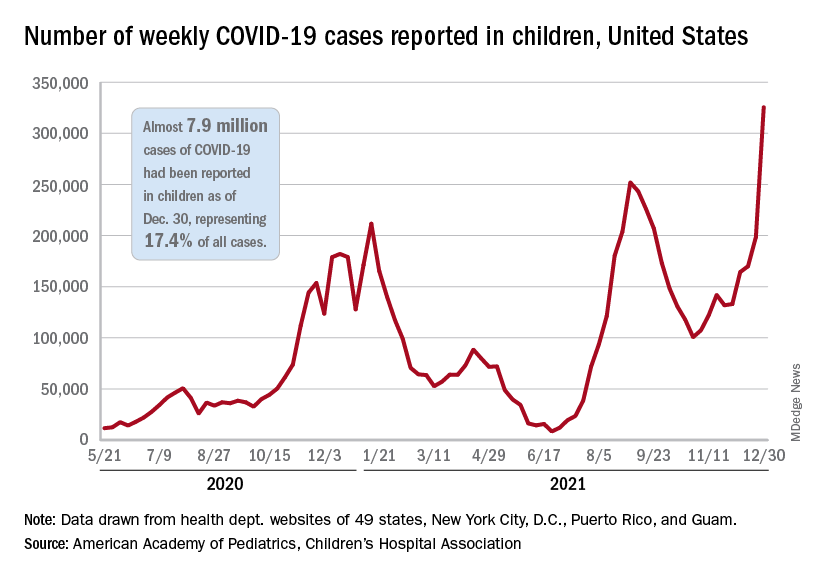
and exceeding the previous week’s count by almost 64%, the AAP and CHA said in their weekly COVID report.
New cases were up in all four regions of the United States, with the Northeast adding the most newly infected children while setting a new high for the fifth consecutive week. The South was just behind for the week but still well off the record it reached in September, the Midwest was third but recorded its busiest week ever, and the West was fourth and nowhere near its previous high, the AAP/CHA report indicated.
The total number of child cases since the pandemic began is almost 7.9 million, they said based on data collected from 49 states (excluding New York), the District of Columbia, New York City, Puerto Rico, and Guam. That figure represents 17.4% of all cases reported in the United States, and the cumulative rate of COVID infection is up to almost 10,500 per 100,000 children, meaning that 1 in 10 children have been infected.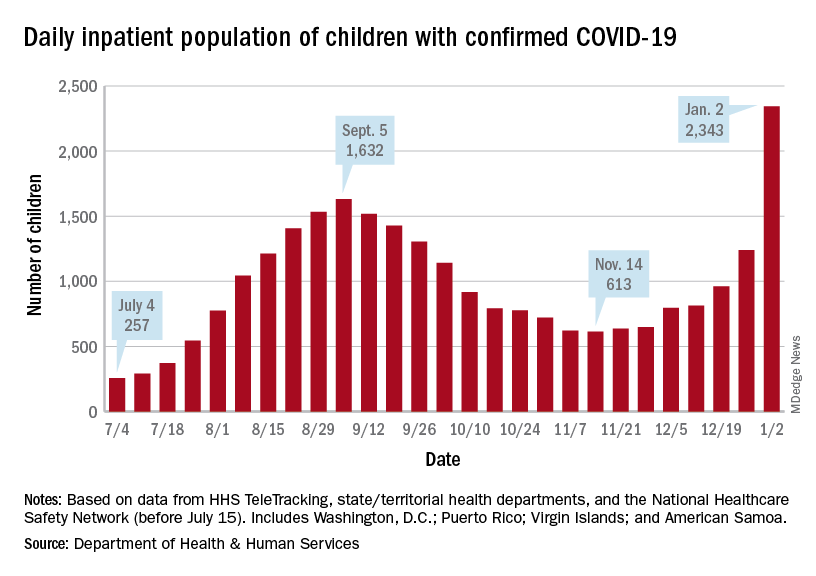
Children are still less likely to be hospitalized than adults, but the gap appears to be closing. On Jan. 2 there were 2,343 children and 87,690 adults in the hospital with confirmed COVID, a ratio of 37 adults for each child, but on Sept. 5, at the height of the previous surge, the ratio of hospitalized adults (93,647) to children (1,632) was 57:1, according to data from the Department of Health & Human Services.
New admissions show a similar pattern: The 0.74 admissions per 100,000 children recorded on Dec. 31 was lower than, for example, adults aged 30-39 years (2.7 per 100,000) or 50-59 years (4.25 per 100,000), but on Sept. 5 the corresponding figures were 0.46 (children), 2.74 (ages 30-39), and 5.03 (aged 50-59), based on the HHS data.
A look at vaccinations
The vaccination response to Omicron, however, has been more subdued and somewhat inconsistent. Vaccine initiation, not surprisingly, was down among eligible children for the week of Dec. 23-29. Before that, both the 5- to 11-year-olds and 12- to 15-year-olds were down for the second week of December and then up a bit (5.6% and 14.3%, respectively) during the third week, while the 16- to 17-year-olds, increased initiation by 63.2%, CDC’s COVID Data Tracker shows.
Less than a quarter (23.5%) of children aged 5-11 received at least one dose of the vaccine in the first 2 months of their eligibility, and only 14.7% are fully vaccinated. Among the older children, coverage looks like this: at least one dose for 61.2% of 12- to 15-year-olds and 67.4% of 16- to 17-year-olds and full vaccination for 51.3% and 57.6%, respectively, the CDC said.
At the state level, Massachusetts and Hawaii have the highest rates for children aged 12-17 years, with 86% having received a least one dose, and Vermont is highest for children aged 5-11 at 56%. The lowest rates can be found in Wyoming (38%) for 12- to 17-year-olds and in Mississippi (6%) for 5- to 11-year-olds, the AAP said in a separate report.
Weekly COVID-19 cases in children passed 300,000 for the first time since the pandemic started, according to the American Academy of Pediatrics and the Children’s Hospital Association.
The rate of new COVID-related hospital admissions also reached a new high of 0.74 per 100,000 children as of Dec. 31. The highest rate seen before the current Omicron-fueled surge was 0.47 per 100,000 in early September, data from the Centers for Disease Control and Prevention show.
and exceeding the previous week’s count by almost 64%, the AAP and CHA said in their weekly COVID report.
New cases were up in all four regions of the United States, with the Northeast adding the most newly infected children while setting a new high for the fifth consecutive week. The South was just behind for the week but still well off the record it reached in September, the Midwest was third but recorded its busiest week ever, and the West was fourth and nowhere near its previous high, the AAP/CHA report indicated.
The total number of child cases since the pandemic began is almost 7.9 million, they said based on data collected from 49 states (excluding New York), the District of Columbia, New York City, Puerto Rico, and Guam. That figure represents 17.4% of all cases reported in the United States, and the cumulative rate of COVID infection is up to almost 10,500 per 100,000 children, meaning that 1 in 10 children have been infected.
Children are still less likely to be hospitalized than adults, but the gap appears to be closing. On Jan. 2 there were 2,343 children and 87,690 adults in the hospital with confirmed COVID, a ratio of 37 adults for each child, but on Sept. 5, at the height of the previous surge, the ratio of hospitalized adults (93,647) to children (1,632) was 57:1, according to data from the Department of Health & Human Services.
New admissions show a similar pattern: The 0.74 admissions per 100,000 children recorded on Dec. 31 was lower than, for example, adults aged 30-39 years (2.7 per 100,000) or 50-59 years (4.25 per 100,000), but on Sept. 5 the corresponding figures were 0.46 (children), 2.74 (ages 30-39), and 5.03 (aged 50-59), based on the HHS data.
A look at vaccinations
The vaccination response to Omicron, however, has been more subdued and somewhat inconsistent. Vaccine initiation, not surprisingly, was down among eligible children for the week of Dec. 23-29. Before that, both the 5- to 11-year-olds and 12- to 15-year-olds were down for the second week of December and then up a bit (5.6% and 14.3%, respectively) during the third week, while the 16- to 17-year-olds, increased initiation by 63.2%, CDC’s COVID Data Tracker shows.
Less than a quarter (23.5%) of children aged 5-11 received at least one dose of the vaccine in the first 2 months of their eligibility, and only 14.7% are fully vaccinated. Among the older children, coverage looks like this: at least one dose for 61.2% of 12- to 15-year-olds and 67.4% of 16- to 17-year-olds and full vaccination for 51.3% and 57.6%, respectively, the CDC said.
At the state level, Massachusetts and Hawaii have the highest rates for children aged 12-17 years, with 86% having received a least one dose, and Vermont is highest for children aged 5-11 at 56%. The lowest rates can be found in Wyoming (38%) for 12- to 17-year-olds and in Mississippi (6%) for 5- to 11-year-olds, the AAP said in a separate report.
Weekly COVID-19 cases in children passed 300,000 for the first time since the pandemic started, according to the American Academy of Pediatrics and the Children’s Hospital Association.
The rate of new COVID-related hospital admissions also reached a new high of 0.74 per 100,000 children as of Dec. 31. The highest rate seen before the current Omicron-fueled surge was 0.47 per 100,000 in early September, data from the Centers for Disease Control and Prevention show.
and exceeding the previous week’s count by almost 64%, the AAP and CHA said in their weekly COVID report.
New cases were up in all four regions of the United States, with the Northeast adding the most newly infected children while setting a new high for the fifth consecutive week. The South was just behind for the week but still well off the record it reached in September, the Midwest was third but recorded its busiest week ever, and the West was fourth and nowhere near its previous high, the AAP/CHA report indicated.
The total number of child cases since the pandemic began is almost 7.9 million, they said based on data collected from 49 states (excluding New York), the District of Columbia, New York City, Puerto Rico, and Guam. That figure represents 17.4% of all cases reported in the United States, and the cumulative rate of COVID infection is up to almost 10,500 per 100,000 children, meaning that 1 in 10 children have been infected.
Children are still less likely to be hospitalized than adults, but the gap appears to be closing. On Jan. 2 there were 2,343 children and 87,690 adults in the hospital with confirmed COVID, a ratio of 37 adults for each child, but on Sept. 5, at the height of the previous surge, the ratio of hospitalized adults (93,647) to children (1,632) was 57:1, according to data from the Department of Health & Human Services.
New admissions show a similar pattern: The 0.74 admissions per 100,000 children recorded on Dec. 31 was lower than, for example, adults aged 30-39 years (2.7 per 100,000) or 50-59 years (4.25 per 100,000), but on Sept. 5 the corresponding figures were 0.46 (children), 2.74 (ages 30-39), and 5.03 (aged 50-59), based on the HHS data.
A look at vaccinations
The vaccination response to Omicron, however, has been more subdued and somewhat inconsistent. Vaccine initiation, not surprisingly, was down among eligible children for the week of Dec. 23-29. Before that, both the 5- to 11-year-olds and 12- to 15-year-olds were down for the second week of December and then up a bit (5.6% and 14.3%, respectively) during the third week, while the 16- to 17-year-olds, increased initiation by 63.2%, CDC’s COVID Data Tracker shows.
Less than a quarter (23.5%) of children aged 5-11 received at least one dose of the vaccine in the first 2 months of their eligibility, and only 14.7% are fully vaccinated. Among the older children, coverage looks like this: at least one dose for 61.2% of 12- to 15-year-olds and 67.4% of 16- to 17-year-olds and full vaccination for 51.3% and 57.6%, respectively, the CDC said.
At the state level, Massachusetts and Hawaii have the highest rates for children aged 12-17 years, with 86% having received a least one dose, and Vermont is highest for children aged 5-11 at 56%. The lowest rates can be found in Wyoming (38%) for 12- to 17-year-olds and in Mississippi (6%) for 5- to 11-year-olds, the AAP said in a separate report.
Asthma treatment does not appear to raise risk of neuropsychiatric disease
Use of a leukotriene receptor antagonist (LTRA) for asthma management did not increase the risk of neuropsychiatric disease, based on data from more than 60,000 asthma patients.
Although LTRAs are established as an effective drug for asthma, the U.S. Food and Drug Administration warnings of the risk for neuropsychiatric (NP) drug reactions – including a boxed warning for montelukast (Singulair) – has raised concerns, writes Ji-Su Shim, MD, of Ewha Womans University, Seoul, South Korea, and colleagues.
However, evidence for such an association is limited, and previous studies have focused only on children and adolescents, and on a single LTRA (montelukast), the researchers say.
In a study published Dec. 1 in the Journal of Allergy and Clinical Immunology: In Practice, the researchers used a Korean national health insurance database to identify 61,571 adult patients with asthma aged 40 years and older between Jan. 2002 and Dec. 2015 with no history of LTRA use.
The patients underwent screening examinations between Jan. 2009 and Dec. 2010, which marked the start of a follow-up period ending on Dec. 31, 2015. The median age of the study population was 61 years, and the mean follow-up period for NPs or other outcomes was approximately 47.6 months for LTRA users and 46.5 months for nonusers. Overall, 11.1% of the study population used pranlukast (Onon), 11% used montelukast, and 0.24% used zafirlukast (Accolate).
A total of 12,168 patients took an LTRA during the follow-up period. The hazard ratio for newly diagnosed neuropsychiatric diseases was not significantly different between LTRA users and nonusers (hazard ratio, 1.01; P = .952) in an adjusted model that included age, sex, pack-years of smoking, alcohol use, physical activity, body mass index, comorbid conditions, other respiratory diseases, and use of other asthma medications.
(75.4% vs. 76.1% for dementia, 12.7% vs. 12.8% for mood disorders, and 5.6% vs. 3.5% for panic disorders).
A subgroup analysis for associations between the duration of LTRA use and NP disease risk also showed no significant difference between LTRA users and nonusers.
“The mechanism of the development of NP symptoms by LTRAs has not been identified,” the researchers write in their discussion of the study findings. “Because most of NP side effects due to montelukast occur in few patients within 2 weeks of drug administration, it also may have relation with the presence of some genetic polymorphisms involving modification of the normal action or metabolism of LTRAs,” they explained.
The FDA’s boxed warning for montelukast noting the risk of serious mental health side effects has renewed interest in the relationship between NPs and LTRAs, the researchers noted. However, the current study findings support previous randomized controlled trials and larger studies, and the current warnings are based mainly on pharmacovigilance studies, case series, and case reports, they said.
The study findings were limited by several factors, including the retrospective design, the potential for misclassification of asthma diagnosis, the exclusion of temporary NP symptoms that might prompt LTRA discontinuation, and the inability to detect possible differences in ethnicities other than Korean, the researchers note.
However, the results suggest that adverse NP symptoms should not prevent physicians from prescribing LTRAs to selected patients with asthma. Instead, the physician should accompany the prescription with “a word of caution in case any mood changes might occur,” the investigators wrote.
“Further studies, such as randomized controlled trials, are needed to reveal the association between the use of LTRAs and the risk of NP events and/or diseases,” they concluded.
Potential genetic predisposition may drive cases
The relatively rare occurrence of NP symptoms in asthma patients using LTRAs has prompted questions from the medical community on whether the relationship really exists, writes Désirée Larenas-Linnemann, MD, of Médica Sur Clinical Foundation and Hospital, Mexico City, in an accompanying editorial ).
The current study provides information about medications and possible adverse drug reactions, but “great care should be taken in the interpretation of the results from such a study,” she notes. Limitations include not only the possible misclassification of asthma and the homogeneous study population, but also the fact that some NPs, such as dementia, are already common in older adults..
Dr. Larenas-Linnemann shared a story of one of her patients, a 2½-year-old boy who began exhibiting hyperactivity and other strange behaviors while on an LRTA. The toddler’s father had previously reported “horrible nightmares, strange thoughts, and to feel upset, unsecure until he suspended the medication.” Cases such as this support a potential genetic predisposition, with drug metabolism playing a role, and clinicians should take genetic backgrounds into account, she said.
“Even though the current study did not show an association between LTRA use or duration of exposure and the occurrence of NP diseases in Korean adults with asthma, this does not imply such a relationship might be present in other age groups (children-adolescents-adults up to 50 years) or in patients with a different genetic background,” she emphasized.
However, “In the meantime, although LTRA should continue to be prescribed if indicated, an index of suspicion for possible NP effects should be maintained,” Dr. Larenas-Linnemann concluded.
“This study is timely, since the boxed warning for montelukast was issued approximately 1 year ago by the FDA,” Thomas B. Casale, MD, of the University of South Florida, Tampa, said in an interview.
Dr. Casale said he was not surprised by the findings, “since most of the data implicating a potential link between the use of montelukast and neuropsychiatric disorders have not been particularly compelling,” and much of the current information comes from case reports and retrospective studies.
“Furthermore, the data appeared to be somewhat stronger in the pediatric population,” Dr. Casale noted. “This study focused on elderly patients (mean age 61) and included two other leukotriene modifiers. The number of patients receiving montelukast was small (56), which may have also confounded the results,” he noted.
As for clinical implications, “I don’t think this study will change practice,” Dr. Casale said. “As indicated, it is in an elderly population, included only a limited number of patients receiving montelukast, and was in a Korean cohort. All of these factors could have influenced the results,” and the data may not be generalizable to patients elsewhere, including the United States, he said. “Also, the study only included patients with asthma and in the United States; the approval for rhinitis is another important indication to study,” he noted.
Additional research is needed in the form of better prospective studies examining the potential link between montelukast and neuropsychiatric disorders in both the pediatric and adult populations having either asthma or rhinitis, Dr. Casale concluded.
The study received no outside funding. The researchers and Dr. Casale have disclosed no relevant financial relationships. Dr. Larenas-Linnemann disclosed personal fees from Allakos, Armstrong, AstraZeneca, Chiesi, DBV Technologies, Grünenthal, GSK, Mylan/Viatris, Menarini, MSD, Novartis, Pfizer, Sanofi, Siegfried, UCB, Alakos, Gossamer, and Carnot, and grants from Sanofi, AstraZeneca, Novartis, Circassia, UCB, GSK, and the Purina Institute.
A version of this article first appeared on Medscape.com.
Use of a leukotriene receptor antagonist (LTRA) for asthma management did not increase the risk of neuropsychiatric disease, based on data from more than 60,000 asthma patients.
Although LTRAs are established as an effective drug for asthma, the U.S. Food and Drug Administration warnings of the risk for neuropsychiatric (NP) drug reactions – including a boxed warning for montelukast (Singulair) – has raised concerns, writes Ji-Su Shim, MD, of Ewha Womans University, Seoul, South Korea, and colleagues.
However, evidence for such an association is limited, and previous studies have focused only on children and adolescents, and on a single LTRA (montelukast), the researchers say.
In a study published Dec. 1 in the Journal of Allergy and Clinical Immunology: In Practice, the researchers used a Korean national health insurance database to identify 61,571 adult patients with asthma aged 40 years and older between Jan. 2002 and Dec. 2015 with no history of LTRA use.
The patients underwent screening examinations between Jan. 2009 and Dec. 2010, which marked the start of a follow-up period ending on Dec. 31, 2015. The median age of the study population was 61 years, and the mean follow-up period for NPs or other outcomes was approximately 47.6 months for LTRA users and 46.5 months for nonusers. Overall, 11.1% of the study population used pranlukast (Onon), 11% used montelukast, and 0.24% used zafirlukast (Accolate).
A total of 12,168 patients took an LTRA during the follow-up period. The hazard ratio for newly diagnosed neuropsychiatric diseases was not significantly different between LTRA users and nonusers (hazard ratio, 1.01; P = .952) in an adjusted model that included age, sex, pack-years of smoking, alcohol use, physical activity, body mass index, comorbid conditions, other respiratory diseases, and use of other asthma medications.
(75.4% vs. 76.1% for dementia, 12.7% vs. 12.8% for mood disorders, and 5.6% vs. 3.5% for panic disorders).
A subgroup analysis for associations between the duration of LTRA use and NP disease risk also showed no significant difference between LTRA users and nonusers.
“The mechanism of the development of NP symptoms by LTRAs has not been identified,” the researchers write in their discussion of the study findings. “Because most of NP side effects due to montelukast occur in few patients within 2 weeks of drug administration, it also may have relation with the presence of some genetic polymorphisms involving modification of the normal action or metabolism of LTRAs,” they explained.
The FDA’s boxed warning for montelukast noting the risk of serious mental health side effects has renewed interest in the relationship between NPs and LTRAs, the researchers noted. However, the current study findings support previous randomized controlled trials and larger studies, and the current warnings are based mainly on pharmacovigilance studies, case series, and case reports, they said.
The study findings were limited by several factors, including the retrospective design, the potential for misclassification of asthma diagnosis, the exclusion of temporary NP symptoms that might prompt LTRA discontinuation, and the inability to detect possible differences in ethnicities other than Korean, the researchers note.
However, the results suggest that adverse NP symptoms should not prevent physicians from prescribing LTRAs to selected patients with asthma. Instead, the physician should accompany the prescription with “a word of caution in case any mood changes might occur,” the investigators wrote.
“Further studies, such as randomized controlled trials, are needed to reveal the association between the use of LTRAs and the risk of NP events and/or diseases,” they concluded.
Potential genetic predisposition may drive cases
The relatively rare occurrence of NP symptoms in asthma patients using LTRAs has prompted questions from the medical community on whether the relationship really exists, writes Désirée Larenas-Linnemann, MD, of Médica Sur Clinical Foundation and Hospital, Mexico City, in an accompanying editorial ).
The current study provides information about medications and possible adverse drug reactions, but “great care should be taken in the interpretation of the results from such a study,” she notes. Limitations include not only the possible misclassification of asthma and the homogeneous study population, but also the fact that some NPs, such as dementia, are already common in older adults..
Dr. Larenas-Linnemann shared a story of one of her patients, a 2½-year-old boy who began exhibiting hyperactivity and other strange behaviors while on an LRTA. The toddler’s father had previously reported “horrible nightmares, strange thoughts, and to feel upset, unsecure until he suspended the medication.” Cases such as this support a potential genetic predisposition, with drug metabolism playing a role, and clinicians should take genetic backgrounds into account, she said.
“Even though the current study did not show an association between LTRA use or duration of exposure and the occurrence of NP diseases in Korean adults with asthma, this does not imply such a relationship might be present in other age groups (children-adolescents-adults up to 50 years) or in patients with a different genetic background,” she emphasized.
However, “In the meantime, although LTRA should continue to be prescribed if indicated, an index of suspicion for possible NP effects should be maintained,” Dr. Larenas-Linnemann concluded.
“This study is timely, since the boxed warning for montelukast was issued approximately 1 year ago by the FDA,” Thomas B. Casale, MD, of the University of South Florida, Tampa, said in an interview.
Dr. Casale said he was not surprised by the findings, “since most of the data implicating a potential link between the use of montelukast and neuropsychiatric disorders have not been particularly compelling,” and much of the current information comes from case reports and retrospective studies.
“Furthermore, the data appeared to be somewhat stronger in the pediatric population,” Dr. Casale noted. “This study focused on elderly patients (mean age 61) and included two other leukotriene modifiers. The number of patients receiving montelukast was small (56), which may have also confounded the results,” he noted.
As for clinical implications, “I don’t think this study will change practice,” Dr. Casale said. “As indicated, it is in an elderly population, included only a limited number of patients receiving montelukast, and was in a Korean cohort. All of these factors could have influenced the results,” and the data may not be generalizable to patients elsewhere, including the United States, he said. “Also, the study only included patients with asthma and in the United States; the approval for rhinitis is another important indication to study,” he noted.
Additional research is needed in the form of better prospective studies examining the potential link between montelukast and neuropsychiatric disorders in both the pediatric and adult populations having either asthma or rhinitis, Dr. Casale concluded.
The study received no outside funding. The researchers and Dr. Casale have disclosed no relevant financial relationships. Dr. Larenas-Linnemann disclosed personal fees from Allakos, Armstrong, AstraZeneca, Chiesi, DBV Technologies, Grünenthal, GSK, Mylan/Viatris, Menarini, MSD, Novartis, Pfizer, Sanofi, Siegfried, UCB, Alakos, Gossamer, and Carnot, and grants from Sanofi, AstraZeneca, Novartis, Circassia, UCB, GSK, and the Purina Institute.
A version of this article first appeared on Medscape.com.
Use of a leukotriene receptor antagonist (LTRA) for asthma management did not increase the risk of neuropsychiatric disease, based on data from more than 60,000 asthma patients.
Although LTRAs are established as an effective drug for asthma, the U.S. Food and Drug Administration warnings of the risk for neuropsychiatric (NP) drug reactions – including a boxed warning for montelukast (Singulair) – has raised concerns, writes Ji-Su Shim, MD, of Ewha Womans University, Seoul, South Korea, and colleagues.
However, evidence for such an association is limited, and previous studies have focused only on children and adolescents, and on a single LTRA (montelukast), the researchers say.
In a study published Dec. 1 in the Journal of Allergy and Clinical Immunology: In Practice, the researchers used a Korean national health insurance database to identify 61,571 adult patients with asthma aged 40 years and older between Jan. 2002 and Dec. 2015 with no history of LTRA use.
The patients underwent screening examinations between Jan. 2009 and Dec. 2010, which marked the start of a follow-up period ending on Dec. 31, 2015. The median age of the study population was 61 years, and the mean follow-up period for NPs or other outcomes was approximately 47.6 months for LTRA users and 46.5 months for nonusers. Overall, 11.1% of the study population used pranlukast (Onon), 11% used montelukast, and 0.24% used zafirlukast (Accolate).
A total of 12,168 patients took an LTRA during the follow-up period. The hazard ratio for newly diagnosed neuropsychiatric diseases was not significantly different between LTRA users and nonusers (hazard ratio, 1.01; P = .952) in an adjusted model that included age, sex, pack-years of smoking, alcohol use, physical activity, body mass index, comorbid conditions, other respiratory diseases, and use of other asthma medications.
(75.4% vs. 76.1% for dementia, 12.7% vs. 12.8% for mood disorders, and 5.6% vs. 3.5% for panic disorders).
A subgroup analysis for associations between the duration of LTRA use and NP disease risk also showed no significant difference between LTRA users and nonusers.
“The mechanism of the development of NP symptoms by LTRAs has not been identified,” the researchers write in their discussion of the study findings. “Because most of NP side effects due to montelukast occur in few patients within 2 weeks of drug administration, it also may have relation with the presence of some genetic polymorphisms involving modification of the normal action or metabolism of LTRAs,” they explained.
The FDA’s boxed warning for montelukast noting the risk of serious mental health side effects has renewed interest in the relationship between NPs and LTRAs, the researchers noted. However, the current study findings support previous randomized controlled trials and larger studies, and the current warnings are based mainly on pharmacovigilance studies, case series, and case reports, they said.
The study findings were limited by several factors, including the retrospective design, the potential for misclassification of asthma diagnosis, the exclusion of temporary NP symptoms that might prompt LTRA discontinuation, and the inability to detect possible differences in ethnicities other than Korean, the researchers note.
However, the results suggest that adverse NP symptoms should not prevent physicians from prescribing LTRAs to selected patients with asthma. Instead, the physician should accompany the prescription with “a word of caution in case any mood changes might occur,” the investigators wrote.
“Further studies, such as randomized controlled trials, are needed to reveal the association between the use of LTRAs and the risk of NP events and/or diseases,” they concluded.
Potential genetic predisposition may drive cases
The relatively rare occurrence of NP symptoms in asthma patients using LTRAs has prompted questions from the medical community on whether the relationship really exists, writes Désirée Larenas-Linnemann, MD, of Médica Sur Clinical Foundation and Hospital, Mexico City, in an accompanying editorial ).
The current study provides information about medications and possible adverse drug reactions, but “great care should be taken in the interpretation of the results from such a study,” she notes. Limitations include not only the possible misclassification of asthma and the homogeneous study population, but also the fact that some NPs, such as dementia, are already common in older adults..
Dr. Larenas-Linnemann shared a story of one of her patients, a 2½-year-old boy who began exhibiting hyperactivity and other strange behaviors while on an LRTA. The toddler’s father had previously reported “horrible nightmares, strange thoughts, and to feel upset, unsecure until he suspended the medication.” Cases such as this support a potential genetic predisposition, with drug metabolism playing a role, and clinicians should take genetic backgrounds into account, she said.
“Even though the current study did not show an association between LTRA use or duration of exposure and the occurrence of NP diseases in Korean adults with asthma, this does not imply such a relationship might be present in other age groups (children-adolescents-adults up to 50 years) or in patients with a different genetic background,” she emphasized.
However, “In the meantime, although LTRA should continue to be prescribed if indicated, an index of suspicion for possible NP effects should be maintained,” Dr. Larenas-Linnemann concluded.
“This study is timely, since the boxed warning for montelukast was issued approximately 1 year ago by the FDA,” Thomas B. Casale, MD, of the University of South Florida, Tampa, said in an interview.
Dr. Casale said he was not surprised by the findings, “since most of the data implicating a potential link between the use of montelukast and neuropsychiatric disorders have not been particularly compelling,” and much of the current information comes from case reports and retrospective studies.
“Furthermore, the data appeared to be somewhat stronger in the pediatric population,” Dr. Casale noted. “This study focused on elderly patients (mean age 61) and included two other leukotriene modifiers. The number of patients receiving montelukast was small (56), which may have also confounded the results,” he noted.
As for clinical implications, “I don’t think this study will change practice,” Dr. Casale said. “As indicated, it is in an elderly population, included only a limited number of patients receiving montelukast, and was in a Korean cohort. All of these factors could have influenced the results,” and the data may not be generalizable to patients elsewhere, including the United States, he said. “Also, the study only included patients with asthma and in the United States; the approval for rhinitis is another important indication to study,” he noted.
Additional research is needed in the form of better prospective studies examining the potential link between montelukast and neuropsychiatric disorders in both the pediatric and adult populations having either asthma or rhinitis, Dr. Casale concluded.
The study received no outside funding. The researchers and Dr. Casale have disclosed no relevant financial relationships. Dr. Larenas-Linnemann disclosed personal fees from Allakos, Armstrong, AstraZeneca, Chiesi, DBV Technologies, Grünenthal, GSK, Mylan/Viatris, Menarini, MSD, Novartis, Pfizer, Sanofi, Siegfried, UCB, Alakos, Gossamer, and Carnot, and grants from Sanofi, AstraZeneca, Novartis, Circassia, UCB, GSK, and the Purina Institute.
A version of this article first appeared on Medscape.com.
Peanut desensitization plummets 1 month after avoiding exposure
Children with peanut allergies treated with peanut oral immunotherapy for 3 years can tolerate increasingly higher exposures to peanuts. But avoidance of peanut-protein exposure for just a single month after the treatment leads to rapid and substantial decreases in tolerance, findings from a small study show.
The findings “underscore the fact that the desensitization achieved with peanut oral immunotherapy is a transient immune state,” report the authors of the study, published in December in The Journal of Allergy and Clinical Immunology: In Practice.
Therefore, “adherence to dosing [in peanut immunotherapy] is very important, and clinicians should expect a decline in tolerance with lapse in dosing,” first author Carla M. Davis, MD, director of the Texas Children’s Hospital Food Allergy Program at Baylor College of Medicine, Houston, told this news organization.
Oral immunotherapy, involving small exposures to peanut protein to build up desensitization, has been shown to mitigate allergic reactions, and, as reported by this news organization, the first peanut oral immunotherapy drug recently received approval from the U.S. Food and Drug Administration.
However, current approaches involve very low daily exposure of about 300 mg of peanut protein, equivalent to only about one to two peanuts, and research is lacking regarding the maximum tolerated doses, as well as on how long the tolerance is sustained if maintenance therapy is discontinued. “For the peanut-allergic population that would like to eat more than 1-2 peanuts, an achievable dose is currently unknown,” the study authors write. “The critical question, of the maximum tolerated dose achieved after POIT, has not been answered.”
To evaluate those issues in their phase 2 study, Dr. Davis and her colleagues enrolled 28 subjects between the ages of 5 and 13 with a diagnosis of eosinophilic esophagitis and peanut allergy.
The treatment protocol included a 1-year buildup phase of oral immunotherapy, followed by a 2-year daily maintenance phase with a dose of 3,900 mg of peanut protein.
After consenting, 11 patients dropped out of the study due to a lack of interest, and two more withdrew after failing to tolerate their first dose, leaving 15 who started treatment in the study, with a mean age of 8.7 years (range, 5.2-12.5 years), and 47% female.
Twelve patients reached the maintenance dose of 3,900 mg over a median of 13 months, and double-blind, placebo-controlled peanut challenges showed that, on average, their mean maximum cumulative tolerated dose after 12 months increased by 12,063 mg (P < .001), and the mean dose triggering a reaction increased by 15,667 mg.
Of the 12 patients, 11 (91.7%) were able to successfully tolerate at least 10,725 mg after 12 months of treatment, and six patients (50.0%) successfully tolerated at least 15,225 mg.
Two patients were able to tolerate up to the maximum cumulative target dose of 26,225 mg, equivalent to more than 105 peanuts.
“The ability to tolerate [greater than] 100 peanuts following peanut oral immunotherapy has never before been demonstrated and gives insight into the potential for food oral immunotherapy to be utilized in a subset of patients who have an immunologic phenotype accepting of this therapy,” the authors write.
“Understanding the risk of ingestion of peanut protein higher than the prescribed peanut oral immunotherapy maintenance dose will improve the safe, practical use of [the therapy],” they add.
Tolerance plummets with avoidance
In the protocol’s third phase, after the 3-year buildup and maintenance therapy, daily peanut exposure was avoided for 30 days, and among the six patients who participated, the mean maximum cumulative tolerated dose declined to just 2,783 mg, and the reaction dose dropped to 4,614 mg (P = .03).
“This was a disappointing finding, because we thought the desensitization would last longer after such a long period of treatment,” Dr. Davis said.
While the avoidance period was only a month, Dr. Davis said she expects the rebound in sensitivity would continue if avoidance was prolonged. “Other studies indicate the decline in tolerance would continue over time, [and] we believe it would continue to decline,” she said.
Further analysis of peanut allergy biomarkers showed significant decreases in skin prick test wheal size and cytokine expression within the first 6 weeks of initiation of the peanut oral immunotherapy. The patterns were reversed during the 1-month avoidance, with both measures increasing.
Of note, the changes in biomarkers varied significantly among the participants.
In terms of adverse events, eight patients (53%) required one or two doses of epinephrine during the study, with all but two patients receiving the epinephrine during the 12-month buildup phase, consistent with previous studies.
In commenting on the study, Richard L. Wasserman, MD, PhD, medical director of pediatric allergy and immunology at Medical City Children’s Hospital, Dallas, noted that the findings pertain to the subset of peanut oral immunotherapy patients (about 30%) who want to be able to eat peanuts.
“Most families just want protection against accidental ingestion, and these observations don’t relate to those patients,” he said in an interview.
Dr. Wasserman noted that his approach with patients is to wait until 3 years of daily maintenance after buildup (as opposed to 2 years in the study) before considering an avoidance challenge.
“When our patients pass a sustained unresponsiveness challenge, we recommend continued exposure of 2,000 mg at least weekly,” he explained.
Dr. Wasserman added that the study’s findings on biomarker changes were notable.
“The eventual reduction in peanut serum IgE in all of their patients is very interesting,” he said. “Many of our patients’ peanut serum IgE plateaus after 2 or 3 years.”
And he added, “This report suggests that we should be making patients aware that they may further decrease their peanut serum IgE by increasing their maintenance dose.”
The study was funded by the Scurlock Foundation/Waring Family Foundation and the Texas Children’s Hospital food allergy program. Dr. Davis is a consultant for Aimmune, DBV, and Moonlight Therapeutics. Dr. Wasserman is a consultant for Aimmune and DBV.
A version of this article first appeared on Medscape.com.
Children with peanut allergies treated with peanut oral immunotherapy for 3 years can tolerate increasingly higher exposures to peanuts. But avoidance of peanut-protein exposure for just a single month after the treatment leads to rapid and substantial decreases in tolerance, findings from a small study show.
The findings “underscore the fact that the desensitization achieved with peanut oral immunotherapy is a transient immune state,” report the authors of the study, published in December in The Journal of Allergy and Clinical Immunology: In Practice.
Therefore, “adherence to dosing [in peanut immunotherapy] is very important, and clinicians should expect a decline in tolerance with lapse in dosing,” first author Carla M. Davis, MD, director of the Texas Children’s Hospital Food Allergy Program at Baylor College of Medicine, Houston, told this news organization.
Oral immunotherapy, involving small exposures to peanut protein to build up desensitization, has been shown to mitigate allergic reactions, and, as reported by this news organization, the first peanut oral immunotherapy drug recently received approval from the U.S. Food and Drug Administration.
However, current approaches involve very low daily exposure of about 300 mg of peanut protein, equivalent to only about one to two peanuts, and research is lacking regarding the maximum tolerated doses, as well as on how long the tolerance is sustained if maintenance therapy is discontinued. “For the peanut-allergic population that would like to eat more than 1-2 peanuts, an achievable dose is currently unknown,” the study authors write. “The critical question, of the maximum tolerated dose achieved after POIT, has not been answered.”
To evaluate those issues in their phase 2 study, Dr. Davis and her colleagues enrolled 28 subjects between the ages of 5 and 13 with a diagnosis of eosinophilic esophagitis and peanut allergy.
The treatment protocol included a 1-year buildup phase of oral immunotherapy, followed by a 2-year daily maintenance phase with a dose of 3,900 mg of peanut protein.
After consenting, 11 patients dropped out of the study due to a lack of interest, and two more withdrew after failing to tolerate their first dose, leaving 15 who started treatment in the study, with a mean age of 8.7 years (range, 5.2-12.5 years), and 47% female.
Twelve patients reached the maintenance dose of 3,900 mg over a median of 13 months, and double-blind, placebo-controlled peanut challenges showed that, on average, their mean maximum cumulative tolerated dose after 12 months increased by 12,063 mg (P < .001), and the mean dose triggering a reaction increased by 15,667 mg.
Of the 12 patients, 11 (91.7%) were able to successfully tolerate at least 10,725 mg after 12 months of treatment, and six patients (50.0%) successfully tolerated at least 15,225 mg.
Two patients were able to tolerate up to the maximum cumulative target dose of 26,225 mg, equivalent to more than 105 peanuts.
“The ability to tolerate [greater than] 100 peanuts following peanut oral immunotherapy has never before been demonstrated and gives insight into the potential for food oral immunotherapy to be utilized in a subset of patients who have an immunologic phenotype accepting of this therapy,” the authors write.
“Understanding the risk of ingestion of peanut protein higher than the prescribed peanut oral immunotherapy maintenance dose will improve the safe, practical use of [the therapy],” they add.
Tolerance plummets with avoidance
In the protocol’s third phase, after the 3-year buildup and maintenance therapy, daily peanut exposure was avoided for 30 days, and among the six patients who participated, the mean maximum cumulative tolerated dose declined to just 2,783 mg, and the reaction dose dropped to 4,614 mg (P = .03).
“This was a disappointing finding, because we thought the desensitization would last longer after such a long period of treatment,” Dr. Davis said.
While the avoidance period was only a month, Dr. Davis said she expects the rebound in sensitivity would continue if avoidance was prolonged. “Other studies indicate the decline in tolerance would continue over time, [and] we believe it would continue to decline,” she said.
Further analysis of peanut allergy biomarkers showed significant decreases in skin prick test wheal size and cytokine expression within the first 6 weeks of initiation of the peanut oral immunotherapy. The patterns were reversed during the 1-month avoidance, with both measures increasing.
Of note, the changes in biomarkers varied significantly among the participants.
In terms of adverse events, eight patients (53%) required one or two doses of epinephrine during the study, with all but two patients receiving the epinephrine during the 12-month buildup phase, consistent with previous studies.
In commenting on the study, Richard L. Wasserman, MD, PhD, medical director of pediatric allergy and immunology at Medical City Children’s Hospital, Dallas, noted that the findings pertain to the subset of peanut oral immunotherapy patients (about 30%) who want to be able to eat peanuts.
“Most families just want protection against accidental ingestion, and these observations don’t relate to those patients,” he said in an interview.
Dr. Wasserman noted that his approach with patients is to wait until 3 years of daily maintenance after buildup (as opposed to 2 years in the study) before considering an avoidance challenge.
“When our patients pass a sustained unresponsiveness challenge, we recommend continued exposure of 2,000 mg at least weekly,” he explained.
Dr. Wasserman added that the study’s findings on biomarker changes were notable.
“The eventual reduction in peanut serum IgE in all of their patients is very interesting,” he said. “Many of our patients’ peanut serum IgE plateaus after 2 or 3 years.”
And he added, “This report suggests that we should be making patients aware that they may further decrease their peanut serum IgE by increasing their maintenance dose.”
The study was funded by the Scurlock Foundation/Waring Family Foundation and the Texas Children’s Hospital food allergy program. Dr. Davis is a consultant for Aimmune, DBV, and Moonlight Therapeutics. Dr. Wasserman is a consultant for Aimmune and DBV.
A version of this article first appeared on Medscape.com.
Children with peanut allergies treated with peanut oral immunotherapy for 3 years can tolerate increasingly higher exposures to peanuts. But avoidance of peanut-protein exposure for just a single month after the treatment leads to rapid and substantial decreases in tolerance, findings from a small study show.
The findings “underscore the fact that the desensitization achieved with peanut oral immunotherapy is a transient immune state,” report the authors of the study, published in December in The Journal of Allergy and Clinical Immunology: In Practice.
Therefore, “adherence to dosing [in peanut immunotherapy] is very important, and clinicians should expect a decline in tolerance with lapse in dosing,” first author Carla M. Davis, MD, director of the Texas Children’s Hospital Food Allergy Program at Baylor College of Medicine, Houston, told this news organization.
Oral immunotherapy, involving small exposures to peanut protein to build up desensitization, has been shown to mitigate allergic reactions, and, as reported by this news organization, the first peanut oral immunotherapy drug recently received approval from the U.S. Food and Drug Administration.
However, current approaches involve very low daily exposure of about 300 mg of peanut protein, equivalent to only about one to two peanuts, and research is lacking regarding the maximum tolerated doses, as well as on how long the tolerance is sustained if maintenance therapy is discontinued. “For the peanut-allergic population that would like to eat more than 1-2 peanuts, an achievable dose is currently unknown,” the study authors write. “The critical question, of the maximum tolerated dose achieved after POIT, has not been answered.”
To evaluate those issues in their phase 2 study, Dr. Davis and her colleagues enrolled 28 subjects between the ages of 5 and 13 with a diagnosis of eosinophilic esophagitis and peanut allergy.
The treatment protocol included a 1-year buildup phase of oral immunotherapy, followed by a 2-year daily maintenance phase with a dose of 3,900 mg of peanut protein.
After consenting, 11 patients dropped out of the study due to a lack of interest, and two more withdrew after failing to tolerate their first dose, leaving 15 who started treatment in the study, with a mean age of 8.7 years (range, 5.2-12.5 years), and 47% female.
Twelve patients reached the maintenance dose of 3,900 mg over a median of 13 months, and double-blind, placebo-controlled peanut challenges showed that, on average, their mean maximum cumulative tolerated dose after 12 months increased by 12,063 mg (P < .001), and the mean dose triggering a reaction increased by 15,667 mg.
Of the 12 patients, 11 (91.7%) were able to successfully tolerate at least 10,725 mg after 12 months of treatment, and six patients (50.0%) successfully tolerated at least 15,225 mg.
Two patients were able to tolerate up to the maximum cumulative target dose of 26,225 mg, equivalent to more than 105 peanuts.
“The ability to tolerate [greater than] 100 peanuts following peanut oral immunotherapy has never before been demonstrated and gives insight into the potential for food oral immunotherapy to be utilized in a subset of patients who have an immunologic phenotype accepting of this therapy,” the authors write.
“Understanding the risk of ingestion of peanut protein higher than the prescribed peanut oral immunotherapy maintenance dose will improve the safe, practical use of [the therapy],” they add.
Tolerance plummets with avoidance
In the protocol’s third phase, after the 3-year buildup and maintenance therapy, daily peanut exposure was avoided for 30 days, and among the six patients who participated, the mean maximum cumulative tolerated dose declined to just 2,783 mg, and the reaction dose dropped to 4,614 mg (P = .03).
“This was a disappointing finding, because we thought the desensitization would last longer after such a long period of treatment,” Dr. Davis said.
While the avoidance period was only a month, Dr. Davis said she expects the rebound in sensitivity would continue if avoidance was prolonged. “Other studies indicate the decline in tolerance would continue over time, [and] we believe it would continue to decline,” she said.
Further analysis of peanut allergy biomarkers showed significant decreases in skin prick test wheal size and cytokine expression within the first 6 weeks of initiation of the peanut oral immunotherapy. The patterns were reversed during the 1-month avoidance, with both measures increasing.
Of note, the changes in biomarkers varied significantly among the participants.
In terms of adverse events, eight patients (53%) required one or two doses of epinephrine during the study, with all but two patients receiving the epinephrine during the 12-month buildup phase, consistent with previous studies.
In commenting on the study, Richard L. Wasserman, MD, PhD, medical director of pediatric allergy and immunology at Medical City Children’s Hospital, Dallas, noted that the findings pertain to the subset of peanut oral immunotherapy patients (about 30%) who want to be able to eat peanuts.
“Most families just want protection against accidental ingestion, and these observations don’t relate to those patients,” he said in an interview.
Dr. Wasserman noted that his approach with patients is to wait until 3 years of daily maintenance after buildup (as opposed to 2 years in the study) before considering an avoidance challenge.
“When our patients pass a sustained unresponsiveness challenge, we recommend continued exposure of 2,000 mg at least weekly,” he explained.
Dr. Wasserman added that the study’s findings on biomarker changes were notable.
“The eventual reduction in peanut serum IgE in all of their patients is very interesting,” he said. “Many of our patients’ peanut serum IgE plateaus after 2 or 3 years.”
And he added, “This report suggests that we should be making patients aware that they may further decrease their peanut serum IgE by increasing their maintenance dose.”
The study was funded by the Scurlock Foundation/Waring Family Foundation and the Texas Children’s Hospital food allergy program. Dr. Davis is a consultant for Aimmune, DBV, and Moonlight Therapeutics. Dr. Wasserman is a consultant for Aimmune and DBV.
A version of this article first appeared on Medscape.com.