User login
Schizophrenia linked to violent behavior, but experts push back
A new meta-analysis suggests the risk for violence is higher in patients with schizophrenia, but some experts beg to differ, calling out study limitations and urging caution when interpreting the findings.
The study suggests patients with schizophrenia spectrum disorder (SSD) are 4.5 times more likely than individuals in the general population to perpetrate violence against others.
While the results showed comorbid substance misuse was associated with a significantly increased risk for violence in those with SSD, data on medication nonadherence, prior exposure to violence, childhood trauma, or other known risk factors were not included in the study.
“I think one of the main implications of this study is that prevention of violence outcomes really should be a focus for clinical services, because these are important outcomes to prevent and many of the factors that increase risk are modifiable, such as substance misuse and treatment adherence,” study coinvestigator Seena Fazel, MD, professor of forensic psychiatry at the University of Oxford (England), said in an interview.
Still, some experts urge caution when interpreting the findings, which they fear could perpetuate stigma against individuals with serious mental illness if not taken in the context of a study that shows association, not causation.
“While potential for violence is certainly a relevant consideration in assessing persons with schizophrenia spectrum disorder, professor emeritus of psychiatry at the State University of New York, Syracuse, who commented on the findings.
The findings were published online Dec. 22, 2021, in JAMA Psychiatry.
No causal link
The meta-analysis included 24 studies involving 51,309 individuals with SSD from 15 countries over 4 decades.
Risk for violence perpetrated by men with schizophrenia was 4.5 times higher (95% confidence interval, 3.6-5.6) than their counterparts in the general population. Among women, the rate was 10.2 times higher (95% CI, 7.1-14.6) versus those without SSD.
The odds of perpetrating sexual offenses (odds ratio, 5.1; 95% CI, 3.8-6.8) and homicide (OR, 17.7; 95% CI, 13.9-22.6) were also increased.
When restricting analysis to studies that used outcomes only from register-based sources, indicating a criminal arrest or conviction, absolute risks of violence perpetration ranged from 2.3% to 24.7% in men with SSD and from 0% to 5.4% in women up to a 35-year follow-up.
“That means that over a 35-year period most men are not going to be involved in these criminal register-based violent outcomes,” Dr. Fazel said. “And at least 90% of the women are not going to have any register-based violent outcomes.”
When accounting for substance use comorbidity, risk for violence perpetration dropped sharply. Those with no substance misuse were 3.5 times more likely than those in the general population to commit acts of violence versus 9.9 times in those with substance misuse comorbidity.
“In these subgroup studies of people with dual diagnoses of schizophrenia and substance misuse, the risk was increased 10-fold,” Dr. Fazel said. “If you look at people without substance misuse comorbidity, there remains a risk there of between three- to fourfold increase. It doesn’t explain the association completely.”
The investigators were quick to point out that this new study identifies an association between SSD and violence, and not causation.
“One important way to consider the association is to think of clinical services for people presenting with a schizophrenia spectrum disorder: Does the evidence suggest that violence is an important enough potential adverse outcome, for a minority of those individuals, such that support for this clinical need should be improved?” study investigator Daniel Whiting, BM BCh, a doctoral research fellow in psychiatry at the University of Oxford, said in an interview. “We highlight this as an implication of the findings.”
Whether the association would change if researchers controlled for substance misuse in both the study and control groups is unknown. Also unclear from this study is what impact other risk factors may have on increasing violent outcomes in individuals with SSD.
Education, treatment adherence important
Dr. Pies pointed out that, “notably, the risk for violence in the study population declined more than sixfold when comorbid substance abuse was excluded from the analysis.”
That aligns with an earlier study conducted in Sweden by Dr. Fazel, which showed that, after controlling for substance misuse, the rate of violent crime among individuals with schizophrenia was only slightly higher than in the general population.
“The fact is that people with schizophrenia who are compliant with proper medication do not commit violent acts any more than those in the general population,” Lynn DeLisi, MD, professor of psychiatry at Harvard Medical School, Boston, and founding editor of Schizophrenia Research, said in a comment.
Indeed, Dr. Fazel’s own research suggests treatment with antipsychotics cuts in half the risk for violent crime by patients with severe mental illness.
“The goal should be education of school officials, families, and primary care physicians to detect this illness early and treat it. Programs that make sure patients comply with medication once they begin it are equally important,” Dr. DeLisi said.
Treatment adherence is important, but the first step toward violence prevention is high-quality risk assessment, said Dr. Fazel. His research team has developed a web-based, free risk calculator shown to help clinicians evaluate the risk that a patient might become violent.
Dr. Pies agreed with the importance of comprehensive, clinical assessments of modifiable risk factors, including substance use, homelessness, medication adherence, and conflictual relationships.
This kind of assessment, “in my experience, is rarely carried out in most evaluations of persons with psychotic symptoms or SSD,” he said.
Perpetuating stigma?
Another concern raised by Dr. Pies and Dr. DeLisi is how the findings might perpetuate stigma toward individuals with serious mental illness. Results from a recently published study showed that, although attitudes toward those with major depression have improved in the United States over the past few decades, stigma toward those with schizophrenia has actually worsened.
The most effective approach to reducing stigma is to “face up to the evidence, then try and prevent the negative outcomes,” Dr. Fazel said.
“The conclusion of this paper is that it’s all pointing toward a strategy toward prevention by developing high-quality risk assessment and then developing high-quality treatment programs that include not just pharmacological treatments but psychosocial treatments and beyond,” he added. “We know that’s the way it works for other disorders as well.”
Although mental illness stigma is a serious problem, Dr. Pies noted, “the risk is not so much that studies of this sort are carried out and then covered in the media, but that they are decontextualized and reduced to ‘bumper sticker’ headlines.”
“The public needs context and perspective,” he said. “It needs to be informed that violent behavior is relatively rare among persons with psychiatric illness, including persons with schizophrenia and related disorders who do not also have a substance use disorder.”
Indeed, some studies have shown that individuals with mental illness are more often the victims of violence than the perpetrators.
“Frankly, the public is much more at risk from the neighborhood lout who drinks heavily and repeatedly starts bar fights than from the average patient with a schizophrenia spectrum disorder,” Dr. Pies said.
Dr. Fazel reported receiving funding from the Wellcome Trust. Dr. DeLisi and Dr. Pies disclosed no relevant financial relationships.
A version of this article first appeared on Medscape.com.
A new meta-analysis suggests the risk for violence is higher in patients with schizophrenia, but some experts beg to differ, calling out study limitations and urging caution when interpreting the findings.
The study suggests patients with schizophrenia spectrum disorder (SSD) are 4.5 times more likely than individuals in the general population to perpetrate violence against others.
While the results showed comorbid substance misuse was associated with a significantly increased risk for violence in those with SSD, data on medication nonadherence, prior exposure to violence, childhood trauma, or other known risk factors were not included in the study.
“I think one of the main implications of this study is that prevention of violence outcomes really should be a focus for clinical services, because these are important outcomes to prevent and many of the factors that increase risk are modifiable, such as substance misuse and treatment adherence,” study coinvestigator Seena Fazel, MD, professor of forensic psychiatry at the University of Oxford (England), said in an interview.
Still, some experts urge caution when interpreting the findings, which they fear could perpetuate stigma against individuals with serious mental illness if not taken in the context of a study that shows association, not causation.
“While potential for violence is certainly a relevant consideration in assessing persons with schizophrenia spectrum disorder, professor emeritus of psychiatry at the State University of New York, Syracuse, who commented on the findings.
The findings were published online Dec. 22, 2021, in JAMA Psychiatry.
No causal link
The meta-analysis included 24 studies involving 51,309 individuals with SSD from 15 countries over 4 decades.
Risk for violence perpetrated by men with schizophrenia was 4.5 times higher (95% confidence interval, 3.6-5.6) than their counterparts in the general population. Among women, the rate was 10.2 times higher (95% CI, 7.1-14.6) versus those without SSD.
The odds of perpetrating sexual offenses (odds ratio, 5.1; 95% CI, 3.8-6.8) and homicide (OR, 17.7; 95% CI, 13.9-22.6) were also increased.
When restricting analysis to studies that used outcomes only from register-based sources, indicating a criminal arrest or conviction, absolute risks of violence perpetration ranged from 2.3% to 24.7% in men with SSD and from 0% to 5.4% in women up to a 35-year follow-up.
“That means that over a 35-year period most men are not going to be involved in these criminal register-based violent outcomes,” Dr. Fazel said. “And at least 90% of the women are not going to have any register-based violent outcomes.”
When accounting for substance use comorbidity, risk for violence perpetration dropped sharply. Those with no substance misuse were 3.5 times more likely than those in the general population to commit acts of violence versus 9.9 times in those with substance misuse comorbidity.
“In these subgroup studies of people with dual diagnoses of schizophrenia and substance misuse, the risk was increased 10-fold,” Dr. Fazel said. “If you look at people without substance misuse comorbidity, there remains a risk there of between three- to fourfold increase. It doesn’t explain the association completely.”
The investigators were quick to point out that this new study identifies an association between SSD and violence, and not causation.
“One important way to consider the association is to think of clinical services for people presenting with a schizophrenia spectrum disorder: Does the evidence suggest that violence is an important enough potential adverse outcome, for a minority of those individuals, such that support for this clinical need should be improved?” study investigator Daniel Whiting, BM BCh, a doctoral research fellow in psychiatry at the University of Oxford, said in an interview. “We highlight this as an implication of the findings.”
Whether the association would change if researchers controlled for substance misuse in both the study and control groups is unknown. Also unclear from this study is what impact other risk factors may have on increasing violent outcomes in individuals with SSD.
Education, treatment adherence important
Dr. Pies pointed out that, “notably, the risk for violence in the study population declined more than sixfold when comorbid substance abuse was excluded from the analysis.”
That aligns with an earlier study conducted in Sweden by Dr. Fazel, which showed that, after controlling for substance misuse, the rate of violent crime among individuals with schizophrenia was only slightly higher than in the general population.
“The fact is that people with schizophrenia who are compliant with proper medication do not commit violent acts any more than those in the general population,” Lynn DeLisi, MD, professor of psychiatry at Harvard Medical School, Boston, and founding editor of Schizophrenia Research, said in a comment.
Indeed, Dr. Fazel’s own research suggests treatment with antipsychotics cuts in half the risk for violent crime by patients with severe mental illness.
“The goal should be education of school officials, families, and primary care physicians to detect this illness early and treat it. Programs that make sure patients comply with medication once they begin it are equally important,” Dr. DeLisi said.
Treatment adherence is important, but the first step toward violence prevention is high-quality risk assessment, said Dr. Fazel. His research team has developed a web-based, free risk calculator shown to help clinicians evaluate the risk that a patient might become violent.
Dr. Pies agreed with the importance of comprehensive, clinical assessments of modifiable risk factors, including substance use, homelessness, medication adherence, and conflictual relationships.
This kind of assessment, “in my experience, is rarely carried out in most evaluations of persons with psychotic symptoms or SSD,” he said.
Perpetuating stigma?
Another concern raised by Dr. Pies and Dr. DeLisi is how the findings might perpetuate stigma toward individuals with serious mental illness. Results from a recently published study showed that, although attitudes toward those with major depression have improved in the United States over the past few decades, stigma toward those with schizophrenia has actually worsened.
The most effective approach to reducing stigma is to “face up to the evidence, then try and prevent the negative outcomes,” Dr. Fazel said.
“The conclusion of this paper is that it’s all pointing toward a strategy toward prevention by developing high-quality risk assessment and then developing high-quality treatment programs that include not just pharmacological treatments but psychosocial treatments and beyond,” he added. “We know that’s the way it works for other disorders as well.”
Although mental illness stigma is a serious problem, Dr. Pies noted, “the risk is not so much that studies of this sort are carried out and then covered in the media, but that they are decontextualized and reduced to ‘bumper sticker’ headlines.”
“The public needs context and perspective,” he said. “It needs to be informed that violent behavior is relatively rare among persons with psychiatric illness, including persons with schizophrenia and related disorders who do not also have a substance use disorder.”
Indeed, some studies have shown that individuals with mental illness are more often the victims of violence than the perpetrators.
“Frankly, the public is much more at risk from the neighborhood lout who drinks heavily and repeatedly starts bar fights than from the average patient with a schizophrenia spectrum disorder,” Dr. Pies said.
Dr. Fazel reported receiving funding from the Wellcome Trust. Dr. DeLisi and Dr. Pies disclosed no relevant financial relationships.
A version of this article first appeared on Medscape.com.
A new meta-analysis suggests the risk for violence is higher in patients with schizophrenia, but some experts beg to differ, calling out study limitations and urging caution when interpreting the findings.
The study suggests patients with schizophrenia spectrum disorder (SSD) are 4.5 times more likely than individuals in the general population to perpetrate violence against others.
While the results showed comorbid substance misuse was associated with a significantly increased risk for violence in those with SSD, data on medication nonadherence, prior exposure to violence, childhood trauma, or other known risk factors were not included in the study.
“I think one of the main implications of this study is that prevention of violence outcomes really should be a focus for clinical services, because these are important outcomes to prevent and many of the factors that increase risk are modifiable, such as substance misuse and treatment adherence,” study coinvestigator Seena Fazel, MD, professor of forensic psychiatry at the University of Oxford (England), said in an interview.
Still, some experts urge caution when interpreting the findings, which they fear could perpetuate stigma against individuals with serious mental illness if not taken in the context of a study that shows association, not causation.
“While potential for violence is certainly a relevant consideration in assessing persons with schizophrenia spectrum disorder, professor emeritus of psychiatry at the State University of New York, Syracuse, who commented on the findings.
The findings were published online Dec. 22, 2021, in JAMA Psychiatry.
No causal link
The meta-analysis included 24 studies involving 51,309 individuals with SSD from 15 countries over 4 decades.
Risk for violence perpetrated by men with schizophrenia was 4.5 times higher (95% confidence interval, 3.6-5.6) than their counterparts in the general population. Among women, the rate was 10.2 times higher (95% CI, 7.1-14.6) versus those without SSD.
The odds of perpetrating sexual offenses (odds ratio, 5.1; 95% CI, 3.8-6.8) and homicide (OR, 17.7; 95% CI, 13.9-22.6) were also increased.
When restricting analysis to studies that used outcomes only from register-based sources, indicating a criminal arrest or conviction, absolute risks of violence perpetration ranged from 2.3% to 24.7% in men with SSD and from 0% to 5.4% in women up to a 35-year follow-up.
“That means that over a 35-year period most men are not going to be involved in these criminal register-based violent outcomes,” Dr. Fazel said. “And at least 90% of the women are not going to have any register-based violent outcomes.”
When accounting for substance use comorbidity, risk for violence perpetration dropped sharply. Those with no substance misuse were 3.5 times more likely than those in the general population to commit acts of violence versus 9.9 times in those with substance misuse comorbidity.
“In these subgroup studies of people with dual diagnoses of schizophrenia and substance misuse, the risk was increased 10-fold,” Dr. Fazel said. “If you look at people without substance misuse comorbidity, there remains a risk there of between three- to fourfold increase. It doesn’t explain the association completely.”
The investigators were quick to point out that this new study identifies an association between SSD and violence, and not causation.
“One important way to consider the association is to think of clinical services for people presenting with a schizophrenia spectrum disorder: Does the evidence suggest that violence is an important enough potential adverse outcome, for a minority of those individuals, such that support for this clinical need should be improved?” study investigator Daniel Whiting, BM BCh, a doctoral research fellow in psychiatry at the University of Oxford, said in an interview. “We highlight this as an implication of the findings.”
Whether the association would change if researchers controlled for substance misuse in both the study and control groups is unknown. Also unclear from this study is what impact other risk factors may have on increasing violent outcomes in individuals with SSD.
Education, treatment adherence important
Dr. Pies pointed out that, “notably, the risk for violence in the study population declined more than sixfold when comorbid substance abuse was excluded from the analysis.”
That aligns with an earlier study conducted in Sweden by Dr. Fazel, which showed that, after controlling for substance misuse, the rate of violent crime among individuals with schizophrenia was only slightly higher than in the general population.
“The fact is that people with schizophrenia who are compliant with proper medication do not commit violent acts any more than those in the general population,” Lynn DeLisi, MD, professor of psychiatry at Harvard Medical School, Boston, and founding editor of Schizophrenia Research, said in a comment.
Indeed, Dr. Fazel’s own research suggests treatment with antipsychotics cuts in half the risk for violent crime by patients with severe mental illness.
“The goal should be education of school officials, families, and primary care physicians to detect this illness early and treat it. Programs that make sure patients comply with medication once they begin it are equally important,” Dr. DeLisi said.
Treatment adherence is important, but the first step toward violence prevention is high-quality risk assessment, said Dr. Fazel. His research team has developed a web-based, free risk calculator shown to help clinicians evaluate the risk that a patient might become violent.
Dr. Pies agreed with the importance of comprehensive, clinical assessments of modifiable risk factors, including substance use, homelessness, medication adherence, and conflictual relationships.
This kind of assessment, “in my experience, is rarely carried out in most evaluations of persons with psychotic symptoms or SSD,” he said.
Perpetuating stigma?
Another concern raised by Dr. Pies and Dr. DeLisi is how the findings might perpetuate stigma toward individuals with serious mental illness. Results from a recently published study showed that, although attitudes toward those with major depression have improved in the United States over the past few decades, stigma toward those with schizophrenia has actually worsened.
The most effective approach to reducing stigma is to “face up to the evidence, then try and prevent the negative outcomes,” Dr. Fazel said.
“The conclusion of this paper is that it’s all pointing toward a strategy toward prevention by developing high-quality risk assessment and then developing high-quality treatment programs that include not just pharmacological treatments but psychosocial treatments and beyond,” he added. “We know that’s the way it works for other disorders as well.”
Although mental illness stigma is a serious problem, Dr. Pies noted, “the risk is not so much that studies of this sort are carried out and then covered in the media, but that they are decontextualized and reduced to ‘bumper sticker’ headlines.”
“The public needs context and perspective,” he said. “It needs to be informed that violent behavior is relatively rare among persons with psychiatric illness, including persons with schizophrenia and related disorders who do not also have a substance use disorder.”
Indeed, some studies have shown that individuals with mental illness are more often the victims of violence than the perpetrators.
“Frankly, the public is much more at risk from the neighborhood lout who drinks heavily and repeatedly starts bar fights than from the average patient with a schizophrenia spectrum disorder,” Dr. Pies said.
Dr. Fazel reported receiving funding from the Wellcome Trust. Dr. DeLisi and Dr. Pies disclosed no relevant financial relationships.
A version of this article first appeared on Medscape.com.
FROM JAMA PSYCHIATRY
NSCLC therapies associated with cardiac events
A new analysis of cardiovascular adverse drug reactions for non–small cell lung cancer (NCSLC)–targeted therapies finds that ALK and ROS1 inhibitors are associated with higher odds of conduction disease and QT prolongation than BRAF and EGFR inhibitors.
The findings are especially important because cardiovascular disease is known to be associated with NSCLC. Even before the start of therapy, 14%-22% of patients with stage I-IV NSCLC have heart failure and 26%-31% of patients have arrhythmias. No other study to date has described cardiovascular effects to this extent as a result of treatment.
The findings were published in the Journal of Thoracic Oncology.
Led by Joel W. Neal, MD, PhD, a medical oncologist at Stanford (Calif.) Health Care, researchers evaluated the association between NSCLC-targeted agents with arrhythmia and heart failure. Their findings are based on analysis of data from the World Health Organization pharmacovigilance database VigiBase. They found that of 98,765 adverse reactions, 61,383 occurred in patients treated with EGFR inhibitors, 15,540 were associated with ALK inhibitors, and 21,842 were associated with BRAF and MEK inhibitors. Arrhythmias occurred in 1,783 patients and 1,146 patients had heart failure.
The specifics
Strong associations with conduction disease and QT prolongation were found for ALK and ROS1 inhibitors, especially crizotinib. Of QT prolongation cases, 38.5% of patients on ceritinib and 18.4% of patients on crizotinib also had conduction disease and 7.9% of alectinib-associated conduction disease cases also had prolongation.
BRAF and MEK inhibitors had stronger associations with heart failure, while osimertinib, a third-generation EGFR tyrosine kinase inhibitor, was strongly associated with QT prolongation, supraventricular tachycardia, and heart failure.
ALK inhibitors were found to be 13 times more likely to lead to conduction disease and five times more likely to lead to lead to long QT syndrome as compared to all NSCLC-targeted therapies together. ALK inhibitor crizotinib had significantly higher odds of conduction disease, compared with all other targeted therapies, but of all ALK inhibitors, ceritinib and lorlatinib had the lowest odds of conduction disease. Crizotinib was 1.9 times more likely to lead to QT prolongation than other ALK inhibitors.
The EGFR inhibitor osimertinib was associated with 49 times more like to lead to long QT syndrome than other EGFR inhibitors and 6 times more likely as compared with all other targeted therapies. The EGFR inhibitor gefitinib was twice as likely than other EGFR inhibitors to lead to conduction disease. The third-generation EGFR inhibitor osimertinib had approximately two times higher odds of supraventricular tachycardia than other EGFR inhibitors.
Osimertinib was associated with 6.8 times higher chances of heart failure, compared with other EGFR inhibitors, and 3.6 times more than other targeted therapies. Dabrafenib and trametinib were associated with two to three times higher odds of heart failure as compared with other targeted therapies.
“There is a need for an understanding of the mechanisms underlying these toxicities and for additional studies to establish standardized guidelines for monitoring, particularly for osimertinib, crizotinib, and alectinib,” the authors wrote
The authors disclosed a number of paid advisory roles with various pharmaceutical companies.
A new analysis of cardiovascular adverse drug reactions for non–small cell lung cancer (NCSLC)–targeted therapies finds that ALK and ROS1 inhibitors are associated with higher odds of conduction disease and QT prolongation than BRAF and EGFR inhibitors.
The findings are especially important because cardiovascular disease is known to be associated with NSCLC. Even before the start of therapy, 14%-22% of patients with stage I-IV NSCLC have heart failure and 26%-31% of patients have arrhythmias. No other study to date has described cardiovascular effects to this extent as a result of treatment.
The findings were published in the Journal of Thoracic Oncology.
Led by Joel W. Neal, MD, PhD, a medical oncologist at Stanford (Calif.) Health Care, researchers evaluated the association between NSCLC-targeted agents with arrhythmia and heart failure. Their findings are based on analysis of data from the World Health Organization pharmacovigilance database VigiBase. They found that of 98,765 adverse reactions, 61,383 occurred in patients treated with EGFR inhibitors, 15,540 were associated with ALK inhibitors, and 21,842 were associated with BRAF and MEK inhibitors. Arrhythmias occurred in 1,783 patients and 1,146 patients had heart failure.
The specifics
Strong associations with conduction disease and QT prolongation were found for ALK and ROS1 inhibitors, especially crizotinib. Of QT prolongation cases, 38.5% of patients on ceritinib and 18.4% of patients on crizotinib also had conduction disease and 7.9% of alectinib-associated conduction disease cases also had prolongation.
BRAF and MEK inhibitors had stronger associations with heart failure, while osimertinib, a third-generation EGFR tyrosine kinase inhibitor, was strongly associated with QT prolongation, supraventricular tachycardia, and heart failure.
ALK inhibitors were found to be 13 times more likely to lead to conduction disease and five times more likely to lead to lead to long QT syndrome as compared to all NSCLC-targeted therapies together. ALK inhibitor crizotinib had significantly higher odds of conduction disease, compared with all other targeted therapies, but of all ALK inhibitors, ceritinib and lorlatinib had the lowest odds of conduction disease. Crizotinib was 1.9 times more likely to lead to QT prolongation than other ALK inhibitors.
The EGFR inhibitor osimertinib was associated with 49 times more like to lead to long QT syndrome than other EGFR inhibitors and 6 times more likely as compared with all other targeted therapies. The EGFR inhibitor gefitinib was twice as likely than other EGFR inhibitors to lead to conduction disease. The third-generation EGFR inhibitor osimertinib had approximately two times higher odds of supraventricular tachycardia than other EGFR inhibitors.
Osimertinib was associated with 6.8 times higher chances of heart failure, compared with other EGFR inhibitors, and 3.6 times more than other targeted therapies. Dabrafenib and trametinib were associated with two to three times higher odds of heart failure as compared with other targeted therapies.
“There is a need for an understanding of the mechanisms underlying these toxicities and for additional studies to establish standardized guidelines for monitoring, particularly for osimertinib, crizotinib, and alectinib,” the authors wrote
The authors disclosed a number of paid advisory roles with various pharmaceutical companies.
A new analysis of cardiovascular adverse drug reactions for non–small cell lung cancer (NCSLC)–targeted therapies finds that ALK and ROS1 inhibitors are associated with higher odds of conduction disease and QT prolongation than BRAF and EGFR inhibitors.
The findings are especially important because cardiovascular disease is known to be associated with NSCLC. Even before the start of therapy, 14%-22% of patients with stage I-IV NSCLC have heart failure and 26%-31% of patients have arrhythmias. No other study to date has described cardiovascular effects to this extent as a result of treatment.
The findings were published in the Journal of Thoracic Oncology.
Led by Joel W. Neal, MD, PhD, a medical oncologist at Stanford (Calif.) Health Care, researchers evaluated the association between NSCLC-targeted agents with arrhythmia and heart failure. Their findings are based on analysis of data from the World Health Organization pharmacovigilance database VigiBase. They found that of 98,765 adverse reactions, 61,383 occurred in patients treated with EGFR inhibitors, 15,540 were associated with ALK inhibitors, and 21,842 were associated with BRAF and MEK inhibitors. Arrhythmias occurred in 1,783 patients and 1,146 patients had heart failure.
The specifics
Strong associations with conduction disease and QT prolongation were found for ALK and ROS1 inhibitors, especially crizotinib. Of QT prolongation cases, 38.5% of patients on ceritinib and 18.4% of patients on crizotinib also had conduction disease and 7.9% of alectinib-associated conduction disease cases also had prolongation.
BRAF and MEK inhibitors had stronger associations with heart failure, while osimertinib, a third-generation EGFR tyrosine kinase inhibitor, was strongly associated with QT prolongation, supraventricular tachycardia, and heart failure.
ALK inhibitors were found to be 13 times more likely to lead to conduction disease and five times more likely to lead to lead to long QT syndrome as compared to all NSCLC-targeted therapies together. ALK inhibitor crizotinib had significantly higher odds of conduction disease, compared with all other targeted therapies, but of all ALK inhibitors, ceritinib and lorlatinib had the lowest odds of conduction disease. Crizotinib was 1.9 times more likely to lead to QT prolongation than other ALK inhibitors.
The EGFR inhibitor osimertinib was associated with 49 times more like to lead to long QT syndrome than other EGFR inhibitors and 6 times more likely as compared with all other targeted therapies. The EGFR inhibitor gefitinib was twice as likely than other EGFR inhibitors to lead to conduction disease. The third-generation EGFR inhibitor osimertinib had approximately two times higher odds of supraventricular tachycardia than other EGFR inhibitors.
Osimertinib was associated with 6.8 times higher chances of heart failure, compared with other EGFR inhibitors, and 3.6 times more than other targeted therapies. Dabrafenib and trametinib were associated with two to three times higher odds of heart failure as compared with other targeted therapies.
“There is a need for an understanding of the mechanisms underlying these toxicities and for additional studies to establish standardized guidelines for monitoring, particularly for osimertinib, crizotinib, and alectinib,” the authors wrote
The authors disclosed a number of paid advisory roles with various pharmaceutical companies.
FROM THE JOURNAL OF THORACIC ONCOLOGY
FDA approves first-in-class inclisiran to lower LDL-C
The Food and Drug Administration has approved inclisiran (Leqvio) as an adjunct to statins for further reduction of LDL cholesterol levels, the drug’s developer, Novartis, announced on Dec. 22, 2021.
The first-in-class small interfering RNA (siRNA) agent is also novel among peer drug therapies for its administration by injection initially, at 3 months, and thereafter twice per year.
Inclisiran is indicated for use atop maximally tolerated statins in adults with clinical cardiovascular disease or in patients with heterozygous familial hypercholesterolemia, the company reported.
Such patients who received inclisiran, compared with placebo, in the ORION-9, ORION-10, and ORION-11 randomized trials on which the FDA approval was based showed LDL-C reductions exceeding 50% over 1-2 years.
The drug works by “silencing” RNA involved in synthesis of PCSK9, which has a role in controlling the number of LDL cholesterol cell-surface receptors, a unique mechanism of action among available treatments for dyslipidemia.
Novartis, the company said, “has obtained global rights to develop, manufacture, and commercialize Leqvio under a license and collaboration agreement with Alnylam Pharmaceuticals.”
A version of this article first appeared on Medscape.com.
The Food and Drug Administration has approved inclisiran (Leqvio) as an adjunct to statins for further reduction of LDL cholesterol levels, the drug’s developer, Novartis, announced on Dec. 22, 2021.
The first-in-class small interfering RNA (siRNA) agent is also novel among peer drug therapies for its administration by injection initially, at 3 months, and thereafter twice per year.
Inclisiran is indicated for use atop maximally tolerated statins in adults with clinical cardiovascular disease or in patients with heterozygous familial hypercholesterolemia, the company reported.
Such patients who received inclisiran, compared with placebo, in the ORION-9, ORION-10, and ORION-11 randomized trials on which the FDA approval was based showed LDL-C reductions exceeding 50% over 1-2 years.
The drug works by “silencing” RNA involved in synthesis of PCSK9, which has a role in controlling the number of LDL cholesterol cell-surface receptors, a unique mechanism of action among available treatments for dyslipidemia.
Novartis, the company said, “has obtained global rights to develop, manufacture, and commercialize Leqvio under a license and collaboration agreement with Alnylam Pharmaceuticals.”
A version of this article first appeared on Medscape.com.
The Food and Drug Administration has approved inclisiran (Leqvio) as an adjunct to statins for further reduction of LDL cholesterol levels, the drug’s developer, Novartis, announced on Dec. 22, 2021.
The first-in-class small interfering RNA (siRNA) agent is also novel among peer drug therapies for its administration by injection initially, at 3 months, and thereafter twice per year.
Inclisiran is indicated for use atop maximally tolerated statins in adults with clinical cardiovascular disease or in patients with heterozygous familial hypercholesterolemia, the company reported.
Such patients who received inclisiran, compared with placebo, in the ORION-9, ORION-10, and ORION-11 randomized trials on which the FDA approval was based showed LDL-C reductions exceeding 50% over 1-2 years.
The drug works by “silencing” RNA involved in synthesis of PCSK9, which has a role in controlling the number of LDL cholesterol cell-surface receptors, a unique mechanism of action among available treatments for dyslipidemia.
Novartis, the company said, “has obtained global rights to develop, manufacture, and commercialize Leqvio under a license and collaboration agreement with Alnylam Pharmaceuticals.”
A version of this article first appeared on Medscape.com.
Serious problems rare in ages 5-11 from COVID vaccine
The CDC has released two studies that showed vaccine safety for ages 5-11 and emphasized the importance of vaccinating children against the coronavirus to prevent serious illness and hospitalization.
In one study published in the Morbidity and Mortality Weekly Report, researchers found that serious problems were rare among children who had received the Pfizer vaccine.
In another study, researchers looked at hundreds of pediatric hospitalizations from the summer and found that nearly all of children who developed severe COVID-19 weren’t fully vaccinated.
“This study demonstrates that unvaccinated children hospitalized for COVID-19 could experience severe disease and reinforces the importance of vaccination of all eligible children to provide individual protection and to protect those who are not yet eligible to be vaccinated,” the authors of the second study wrote.
Nearly 9 million doses of the Pfizer vaccine have been given to children aged 5-11 in the United States so far, according to The New York Times. By mid-December, or about 6 weeks after the age group became eligible for vaccination in October, the CDC said it had received very few reports of serious problems.
CDC researchers evaluated reports received from doctors and the public, including survey responses from parents and guardians of about 43,000 children between ages 5 and 11. Many children reported nonserious events such as pain at the injection site, fatigue, or a headache, especially after the second dose.
Among more than 4,100 adverse event reports received in November and December, 100 were for serious events, with the most common being fever or vomiting.
The CDC had received 11 verified reports of myocarditis, or inflammation of the heart muscle, which has been noted as a rare side effect of the vaccine among boys and men between ages 12 and 29. Among those, seven children had already recovered and four were still recovering at the time of the report.
The CDC received reports of two deaths – girls who were aged 5 and 6 – who had chronic medical conditions and were in “fragile health” before their shots. The agency said that no data suggested a “causal association between death and vaccination.”
The CDC also received some reports that children between ages 5 and 11 received the larger vaccine dose meant for older children and adults. Most reports said that the children didn’t experience any problems after an incorrect dose.
In a separate study about pediatric hospitalizations, CDC researchers looked at more than 700 children under age 18 who were hospitalized for COVID-19 in July and August at six children’s hospitals in Arkansas, Florida, Illinois, Louisiana, Texas, and Washington, D.C.
Researchers found that only one of the 272 vaccine-eligible patients between ages 12 and 17 had been fully vaccinated, and 12 were partially vaccinated.
In addition, about two-thirds of the hospitalized children between ages 12 and 17 had an underlying condition, with obesity being the most common. About one-third of children under age 5 had more than one viral infection.
Overall, about 30% of the children had to be treated in intensive care units, and 15% needed invasive medical ventilation, CDC researchers found. Nearly 3% had multisystem inflammatory syndrome in children, or MIS-C, which is a rare but serious inflammatory condition associated with COVID-19.
Among all the children hospitalized with COVID-19, about 1.5% died.
“Few vaccine-eligible patients hospitalized for COVID-19 were vaccinated, highlighting the importance of vaccination for those aged ≥5 years and other prevention strategies to protect children and adolescents from COVID-19, particularly those with underlying medical conditions,” study authors wrote.
A version of this article first appeared on WebMD.com.
The CDC has released two studies that showed vaccine safety for ages 5-11 and emphasized the importance of vaccinating children against the coronavirus to prevent serious illness and hospitalization.
In one study published in the Morbidity and Mortality Weekly Report, researchers found that serious problems were rare among children who had received the Pfizer vaccine.
In another study, researchers looked at hundreds of pediatric hospitalizations from the summer and found that nearly all of children who developed severe COVID-19 weren’t fully vaccinated.
“This study demonstrates that unvaccinated children hospitalized for COVID-19 could experience severe disease and reinforces the importance of vaccination of all eligible children to provide individual protection and to protect those who are not yet eligible to be vaccinated,” the authors of the second study wrote.
Nearly 9 million doses of the Pfizer vaccine have been given to children aged 5-11 in the United States so far, according to The New York Times. By mid-December, or about 6 weeks after the age group became eligible for vaccination in October, the CDC said it had received very few reports of serious problems.
CDC researchers evaluated reports received from doctors and the public, including survey responses from parents and guardians of about 43,000 children between ages 5 and 11. Many children reported nonserious events such as pain at the injection site, fatigue, or a headache, especially after the second dose.
Among more than 4,100 adverse event reports received in November and December, 100 were for serious events, with the most common being fever or vomiting.
The CDC had received 11 verified reports of myocarditis, or inflammation of the heart muscle, which has been noted as a rare side effect of the vaccine among boys and men between ages 12 and 29. Among those, seven children had already recovered and four were still recovering at the time of the report.
The CDC received reports of two deaths – girls who were aged 5 and 6 – who had chronic medical conditions and were in “fragile health” before their shots. The agency said that no data suggested a “causal association between death and vaccination.”
The CDC also received some reports that children between ages 5 and 11 received the larger vaccine dose meant for older children and adults. Most reports said that the children didn’t experience any problems after an incorrect dose.
In a separate study about pediatric hospitalizations, CDC researchers looked at more than 700 children under age 18 who were hospitalized for COVID-19 in July and August at six children’s hospitals in Arkansas, Florida, Illinois, Louisiana, Texas, and Washington, D.C.
Researchers found that only one of the 272 vaccine-eligible patients between ages 12 and 17 had been fully vaccinated, and 12 were partially vaccinated.
In addition, about two-thirds of the hospitalized children between ages 12 and 17 had an underlying condition, with obesity being the most common. About one-third of children under age 5 had more than one viral infection.
Overall, about 30% of the children had to be treated in intensive care units, and 15% needed invasive medical ventilation, CDC researchers found. Nearly 3% had multisystem inflammatory syndrome in children, or MIS-C, which is a rare but serious inflammatory condition associated with COVID-19.
Among all the children hospitalized with COVID-19, about 1.5% died.
“Few vaccine-eligible patients hospitalized for COVID-19 were vaccinated, highlighting the importance of vaccination for those aged ≥5 years and other prevention strategies to protect children and adolescents from COVID-19, particularly those with underlying medical conditions,” study authors wrote.
A version of this article first appeared on WebMD.com.
The CDC has released two studies that showed vaccine safety for ages 5-11 and emphasized the importance of vaccinating children against the coronavirus to prevent serious illness and hospitalization.
In one study published in the Morbidity and Mortality Weekly Report, researchers found that serious problems were rare among children who had received the Pfizer vaccine.
In another study, researchers looked at hundreds of pediatric hospitalizations from the summer and found that nearly all of children who developed severe COVID-19 weren’t fully vaccinated.
“This study demonstrates that unvaccinated children hospitalized for COVID-19 could experience severe disease and reinforces the importance of vaccination of all eligible children to provide individual protection and to protect those who are not yet eligible to be vaccinated,” the authors of the second study wrote.
Nearly 9 million doses of the Pfizer vaccine have been given to children aged 5-11 in the United States so far, according to The New York Times. By mid-December, or about 6 weeks after the age group became eligible for vaccination in October, the CDC said it had received very few reports of serious problems.
CDC researchers evaluated reports received from doctors and the public, including survey responses from parents and guardians of about 43,000 children between ages 5 and 11. Many children reported nonserious events such as pain at the injection site, fatigue, or a headache, especially after the second dose.
Among more than 4,100 adverse event reports received in November and December, 100 were for serious events, with the most common being fever or vomiting.
The CDC had received 11 verified reports of myocarditis, or inflammation of the heart muscle, which has been noted as a rare side effect of the vaccine among boys and men between ages 12 and 29. Among those, seven children had already recovered and four were still recovering at the time of the report.
The CDC received reports of two deaths – girls who were aged 5 and 6 – who had chronic medical conditions and were in “fragile health” before their shots. The agency said that no data suggested a “causal association between death and vaccination.”
The CDC also received some reports that children between ages 5 and 11 received the larger vaccine dose meant for older children and adults. Most reports said that the children didn’t experience any problems after an incorrect dose.
In a separate study about pediatric hospitalizations, CDC researchers looked at more than 700 children under age 18 who were hospitalized for COVID-19 in July and August at six children’s hospitals in Arkansas, Florida, Illinois, Louisiana, Texas, and Washington, D.C.
Researchers found that only one of the 272 vaccine-eligible patients between ages 12 and 17 had been fully vaccinated, and 12 were partially vaccinated.
In addition, about two-thirds of the hospitalized children between ages 12 and 17 had an underlying condition, with obesity being the most common. About one-third of children under age 5 had more than one viral infection.
Overall, about 30% of the children had to be treated in intensive care units, and 15% needed invasive medical ventilation, CDC researchers found. Nearly 3% had multisystem inflammatory syndrome in children, or MIS-C, which is a rare but serious inflammatory condition associated with COVID-19.
Among all the children hospitalized with COVID-19, about 1.5% died.
“Few vaccine-eligible patients hospitalized for COVID-19 were vaccinated, highlighting the importance of vaccination for those aged ≥5 years and other prevention strategies to protect children and adolescents from COVID-19, particularly those with underlying medical conditions,” study authors wrote.
A version of this article first appeared on WebMD.com.
Opioid agonist therapy guards against self-harm, suicide
FROM THE LANCET PSYCHIATRY
Cessation of opioid agonist therapy (OAT) significantly increases the risk of self-harm and death by suicide in the first month after stopping the treatment in new findings that highlight the need for “advanced safety planning” during this critical time.
Investigators found that 4 weeks after stopping OAT, the risk of death by suicide was almost five times higher and the risk of hospital admission for self-harm was almost three times higher during this period, compared with the 4 weeks after initiation of OAT to treatment end.
These results highlight the importance of a “transition” period when stopping OAT and highlight the need for better supports for patients coming off this treatment, study investigator Prianka Padmanathan, MD, PhD candidate, Population Health Sciences, University of Bristol (England), told this news organization.
She noted the study supports previous findings that OAT “has an important role” in suicide prevention.
“Suicide and self-harm risk is greatly increased during treatment cessation, and advanced safety planning and additional psychosocial support during this time may be required,” Dr. Padmanathan said.
The findings were published online Dec. 15 in The Lancet Psychiatry.
Suicide, self-harm risk
Previous research shows an increased risk for overdose deaths and death in general during the first few weeks of starting and stopping treatment for opioid dependence.
“We wanted to see if the risk of dying by suicide was also elevated during these times,” said Dr. Padmanathan. As suicides are relatively rare, the researchers also looked at self-harm, “which is an important risk factor for suicide.”
, particularly buprenorphine or methadone.
“We tried to exclude people prescribed these drugs for pain and focused specifically on their prescription for opioid dependence,” Dr. Padmanathan said.
They estimated rates and adjusted risk ratios of hospital admissions for nonfatal self-harm and completed suicide during treatment initiation, maintenance, and cessation.
The study included 8,070 patients (69.3% men; mean baseline age, 33.3 years) who received OAT at least once from January 1998 through November 2018. The median treatment time was 84 days. Most of the participants lived in the most deprived neighborhoods and were White.
There were 807 hospital admissions for self-harm (1.99 per 100 person-years) and 46 suicides (0.11 per 100 person-years).
The investigators examined age, sex, socioeconomic status, number of previous OAT treatment episodes, previous self-harm, previous mental illness, and major chronic illness scores as potential confounders.
Need for psychosocial care
Results showed the risk for self-harm was significantly increased while off OAT (aRR, 1.5; 95% confidence interval, 1.21-1.88).
The overall age- and sex-standardized mortality ratio for suicide was 7.5 times higher (95% CI, 5.5-10) in the study cohort, compared with the general population in England between 1998 and 2017.
There was insufficient evidence to show the risk for suicide was higher off, versus on, treatment, but this may be because suicides are relatively rare, Dr. Padmanathan noted.
“The sample may have been too small to enable a difference to be detected. In contrast, self-harm is more common, so there was power to detect a difference there,” she said.
Risk for self-harm was more than double in the first 4 weeks after stopping OAT versus stable periods on treatment (aRR, 2.60; 95% CI, 1.83-3.7). Risk for suicide more than quadrupled during this period (aRR, 4.68; 95% CI, 1.63-13.42).
These new results suggest additional interventions may be in order, Dr. Padmanathan noted.
“We already knew that extra care – for example, providing naloxone when coming off OAT – was important to prevent overdoses. But this study suggests providing psychosocial care and other extra care may also be important to prevent suicides,” she said.
There was no statistical evidence of difference between buprenorphine and methadone in terms of self-harm and suicide risks. However, this may be because the sample was not large enough to detect a difference, said Dr. Padmanathan.
Although there are currently no guidelines to indicate an ideal OAT period, previous study results have suggested extending treatment to 2 years may be beneficial, perhaps reducing self-harm and, therefore, suicides, she noted.
“We think most of these adverse outcomes likely occur during short treatment episodes with an unplanned ending. Extending OAT sufficiently to enable a planned ending might help to reduce these risks,” she added.
‘A window of vulnerability’
Authors of an accompanying editorial note the study “adds weight” to the evidence that OAT is a “lifesaving” treatment.
“It’s critical to recognize that transitions in and out of care are vulnerable periods” when it comes to suicide, the coauthor of the editorial, Paul S. Nestadt, MD, department of psychiatry and behavioral sciences, Johns Hopkins University, Baltimore, told this news organization.
Official suicide statistics may not reflect the entire story, as many deaths that occur because of overdose after treatment cessation are not counted as suicides, he said. “It can be difficult for medical examiners to determine if an overdose was intentional or not,” Dr. Nestadt added.
After treatment has been established, physicians “would be wise to delay treatment cessation” until the patient is in a stable condition and can be closely followed by mental health professionals, the editorialists note.
“We must consider the month following OAT cessation to be a window of vulnerability, not just for relapse but also for suicide,” they write.
The finding that patients prescribed OAT have such a high rate of suicide, compared with the general population, is “troubling” and “highlights the importance of interventions which address both opioid use and suicide risk,” they add.
The editorialists point out the median treatment period of 84 days is less than what is generally recommended, raising the question of whether longer treatment might lower suicide risk after treatment discontinuation.
They also emphasized the need for further study to test potential suicide prevention interventions in the period after treatment cessation.
Dr. Nestadt added the new findings are “quite generalizable outside of the U.K.” and referred to similar studies carried out in Australia and elsewhere.
The study was funded by the Medical Research Council. Dr. Padmanathan was a coapplicant on an a grant awarded to University of Bristol by Bristol and Weston Hospital Charity focusing on suicide prevention for patients presenting to the emergency department with self-harm and harmful substance use. Dr. Nestadt has reported no relevant financial relationships.
A version of this article first appeared on Medscape.com.
FROM THE LANCET PSYCHIATRY
Cessation of opioid agonist therapy (OAT) significantly increases the risk of self-harm and death by suicide in the first month after stopping the treatment in new findings that highlight the need for “advanced safety planning” during this critical time.
Investigators found that 4 weeks after stopping OAT, the risk of death by suicide was almost five times higher and the risk of hospital admission for self-harm was almost three times higher during this period, compared with the 4 weeks after initiation of OAT to treatment end.
These results highlight the importance of a “transition” period when stopping OAT and highlight the need for better supports for patients coming off this treatment, study investigator Prianka Padmanathan, MD, PhD candidate, Population Health Sciences, University of Bristol (England), told this news organization.
She noted the study supports previous findings that OAT “has an important role” in suicide prevention.
“Suicide and self-harm risk is greatly increased during treatment cessation, and advanced safety planning and additional psychosocial support during this time may be required,” Dr. Padmanathan said.
The findings were published online Dec. 15 in The Lancet Psychiatry.
Suicide, self-harm risk
Previous research shows an increased risk for overdose deaths and death in general during the first few weeks of starting and stopping treatment for opioid dependence.
“We wanted to see if the risk of dying by suicide was also elevated during these times,” said Dr. Padmanathan. As suicides are relatively rare, the researchers also looked at self-harm, “which is an important risk factor for suicide.”
, particularly buprenorphine or methadone.
“We tried to exclude people prescribed these drugs for pain and focused specifically on their prescription for opioid dependence,” Dr. Padmanathan said.
They estimated rates and adjusted risk ratios of hospital admissions for nonfatal self-harm and completed suicide during treatment initiation, maintenance, and cessation.
The study included 8,070 patients (69.3% men; mean baseline age, 33.3 years) who received OAT at least once from January 1998 through November 2018. The median treatment time was 84 days. Most of the participants lived in the most deprived neighborhoods and were White.
There were 807 hospital admissions for self-harm (1.99 per 100 person-years) and 46 suicides (0.11 per 100 person-years).
The investigators examined age, sex, socioeconomic status, number of previous OAT treatment episodes, previous self-harm, previous mental illness, and major chronic illness scores as potential confounders.
Need for psychosocial care
Results showed the risk for self-harm was significantly increased while off OAT (aRR, 1.5; 95% confidence interval, 1.21-1.88).
The overall age- and sex-standardized mortality ratio for suicide was 7.5 times higher (95% CI, 5.5-10) in the study cohort, compared with the general population in England between 1998 and 2017.
There was insufficient evidence to show the risk for suicide was higher off, versus on, treatment, but this may be because suicides are relatively rare, Dr. Padmanathan noted.
“The sample may have been too small to enable a difference to be detected. In contrast, self-harm is more common, so there was power to detect a difference there,” she said.
Risk for self-harm was more than double in the first 4 weeks after stopping OAT versus stable periods on treatment (aRR, 2.60; 95% CI, 1.83-3.7). Risk for suicide more than quadrupled during this period (aRR, 4.68; 95% CI, 1.63-13.42).
These new results suggest additional interventions may be in order, Dr. Padmanathan noted.
“We already knew that extra care – for example, providing naloxone when coming off OAT – was important to prevent overdoses. But this study suggests providing psychosocial care and other extra care may also be important to prevent suicides,” she said.
There was no statistical evidence of difference between buprenorphine and methadone in terms of self-harm and suicide risks. However, this may be because the sample was not large enough to detect a difference, said Dr. Padmanathan.
Although there are currently no guidelines to indicate an ideal OAT period, previous study results have suggested extending treatment to 2 years may be beneficial, perhaps reducing self-harm and, therefore, suicides, she noted.
“We think most of these adverse outcomes likely occur during short treatment episodes with an unplanned ending. Extending OAT sufficiently to enable a planned ending might help to reduce these risks,” she added.
‘A window of vulnerability’
Authors of an accompanying editorial note the study “adds weight” to the evidence that OAT is a “lifesaving” treatment.
“It’s critical to recognize that transitions in and out of care are vulnerable periods” when it comes to suicide, the coauthor of the editorial, Paul S. Nestadt, MD, department of psychiatry and behavioral sciences, Johns Hopkins University, Baltimore, told this news organization.
Official suicide statistics may not reflect the entire story, as many deaths that occur because of overdose after treatment cessation are not counted as suicides, he said. “It can be difficult for medical examiners to determine if an overdose was intentional or not,” Dr. Nestadt added.
After treatment has been established, physicians “would be wise to delay treatment cessation” until the patient is in a stable condition and can be closely followed by mental health professionals, the editorialists note.
“We must consider the month following OAT cessation to be a window of vulnerability, not just for relapse but also for suicide,” they write.
The finding that patients prescribed OAT have such a high rate of suicide, compared with the general population, is “troubling” and “highlights the importance of interventions which address both opioid use and suicide risk,” they add.
The editorialists point out the median treatment period of 84 days is less than what is generally recommended, raising the question of whether longer treatment might lower suicide risk after treatment discontinuation.
They also emphasized the need for further study to test potential suicide prevention interventions in the period after treatment cessation.
Dr. Nestadt added the new findings are “quite generalizable outside of the U.K.” and referred to similar studies carried out in Australia and elsewhere.
The study was funded by the Medical Research Council. Dr. Padmanathan was a coapplicant on an a grant awarded to University of Bristol by Bristol and Weston Hospital Charity focusing on suicide prevention for patients presenting to the emergency department with self-harm and harmful substance use. Dr. Nestadt has reported no relevant financial relationships.
A version of this article first appeared on Medscape.com.
FROM THE LANCET PSYCHIATRY
Cessation of opioid agonist therapy (OAT) significantly increases the risk of self-harm and death by suicide in the first month after stopping the treatment in new findings that highlight the need for “advanced safety planning” during this critical time.
Investigators found that 4 weeks after stopping OAT, the risk of death by suicide was almost five times higher and the risk of hospital admission for self-harm was almost three times higher during this period, compared with the 4 weeks after initiation of OAT to treatment end.
These results highlight the importance of a “transition” period when stopping OAT and highlight the need for better supports for patients coming off this treatment, study investigator Prianka Padmanathan, MD, PhD candidate, Population Health Sciences, University of Bristol (England), told this news organization.
She noted the study supports previous findings that OAT “has an important role” in suicide prevention.
“Suicide and self-harm risk is greatly increased during treatment cessation, and advanced safety planning and additional psychosocial support during this time may be required,” Dr. Padmanathan said.
The findings were published online Dec. 15 in The Lancet Psychiatry.
Suicide, self-harm risk
Previous research shows an increased risk for overdose deaths and death in general during the first few weeks of starting and stopping treatment for opioid dependence.
“We wanted to see if the risk of dying by suicide was also elevated during these times,” said Dr. Padmanathan. As suicides are relatively rare, the researchers also looked at self-harm, “which is an important risk factor for suicide.”
, particularly buprenorphine or methadone.
“We tried to exclude people prescribed these drugs for pain and focused specifically on their prescription for opioid dependence,” Dr. Padmanathan said.
They estimated rates and adjusted risk ratios of hospital admissions for nonfatal self-harm and completed suicide during treatment initiation, maintenance, and cessation.
The study included 8,070 patients (69.3% men; mean baseline age, 33.3 years) who received OAT at least once from January 1998 through November 2018. The median treatment time was 84 days. Most of the participants lived in the most deprived neighborhoods and were White.
There were 807 hospital admissions for self-harm (1.99 per 100 person-years) and 46 suicides (0.11 per 100 person-years).
The investigators examined age, sex, socioeconomic status, number of previous OAT treatment episodes, previous self-harm, previous mental illness, and major chronic illness scores as potential confounders.
Need for psychosocial care
Results showed the risk for self-harm was significantly increased while off OAT (aRR, 1.5; 95% confidence interval, 1.21-1.88).
The overall age- and sex-standardized mortality ratio for suicide was 7.5 times higher (95% CI, 5.5-10) in the study cohort, compared with the general population in England between 1998 and 2017.
There was insufficient evidence to show the risk for suicide was higher off, versus on, treatment, but this may be because suicides are relatively rare, Dr. Padmanathan noted.
“The sample may have been too small to enable a difference to be detected. In contrast, self-harm is more common, so there was power to detect a difference there,” she said.
Risk for self-harm was more than double in the first 4 weeks after stopping OAT versus stable periods on treatment (aRR, 2.60; 95% CI, 1.83-3.7). Risk for suicide more than quadrupled during this period (aRR, 4.68; 95% CI, 1.63-13.42).
These new results suggest additional interventions may be in order, Dr. Padmanathan noted.
“We already knew that extra care – for example, providing naloxone when coming off OAT – was important to prevent overdoses. But this study suggests providing psychosocial care and other extra care may also be important to prevent suicides,” she said.
There was no statistical evidence of difference between buprenorphine and methadone in terms of self-harm and suicide risks. However, this may be because the sample was not large enough to detect a difference, said Dr. Padmanathan.
Although there are currently no guidelines to indicate an ideal OAT period, previous study results have suggested extending treatment to 2 years may be beneficial, perhaps reducing self-harm and, therefore, suicides, she noted.
“We think most of these adverse outcomes likely occur during short treatment episodes with an unplanned ending. Extending OAT sufficiently to enable a planned ending might help to reduce these risks,” she added.
‘A window of vulnerability’
Authors of an accompanying editorial note the study “adds weight” to the evidence that OAT is a “lifesaving” treatment.
“It’s critical to recognize that transitions in and out of care are vulnerable periods” when it comes to suicide, the coauthor of the editorial, Paul S. Nestadt, MD, department of psychiatry and behavioral sciences, Johns Hopkins University, Baltimore, told this news organization.
Official suicide statistics may not reflect the entire story, as many deaths that occur because of overdose after treatment cessation are not counted as suicides, he said. “It can be difficult for medical examiners to determine if an overdose was intentional or not,” Dr. Nestadt added.
After treatment has been established, physicians “would be wise to delay treatment cessation” until the patient is in a stable condition and can be closely followed by mental health professionals, the editorialists note.
“We must consider the month following OAT cessation to be a window of vulnerability, not just for relapse but also for suicide,” they write.
The finding that patients prescribed OAT have such a high rate of suicide, compared with the general population, is “troubling” and “highlights the importance of interventions which address both opioid use and suicide risk,” they add.
The editorialists point out the median treatment period of 84 days is less than what is generally recommended, raising the question of whether longer treatment might lower suicide risk after treatment discontinuation.
They also emphasized the need for further study to test potential suicide prevention interventions in the period after treatment cessation.
Dr. Nestadt added the new findings are “quite generalizable outside of the U.K.” and referred to similar studies carried out in Australia and elsewhere.
The study was funded by the Medical Research Council. Dr. Padmanathan was a coapplicant on an a grant awarded to University of Bristol by Bristol and Weston Hospital Charity focusing on suicide prevention for patients presenting to the emergency department with self-harm and harmful substance use. Dr. Nestadt has reported no relevant financial relationships.
A version of this article first appeared on Medscape.com.
FDA backs Pfizer booster for 12- to 15-year-olds

Besides updating the authorization for the Pfizer COVID-19 vaccine, the agency also shortened the recommended time between a second dose and the booster to 5 months or more, based on new evidence. In addition, a third primary series dose is now authorized for certain immunocompromised children 5 years to 11 years old. Full details are available in an FDA news release.
The amended emergency use authorization (EUA) only applies to the Pfizer vaccine, said acting FDA Commissioner Janet Woodcock, MD.
“Just to make sure every everyone is clear on this, right now: If you got [Johnson & Johnson’s one-dose vaccine], you get a booster after 2 months. If you got Moderna, you can get a booster at 6 months or beyond,” she said during a media briefing.
What is new, she said, is “if you got Pfizer as your primary series, you can get a booster at 5 months or beyond.”
A lower risk of myocarditis?
Asked about concerns about the risk of myocarditis with vaccination in the 12- to 15-year age group, Dr. Woodcock said they expect it would be “extremely rare with the third dose.”
“We have the real-world evidence from the Israeli experience to help us with that analysis,” she said.
The data so far consistently points to a higher risk of myocarditis after a second mRNA vaccine dose among males, from teenagers to 30-year-olds, with a peak at about 16 to 17 years of age, Peter Marks, MD, PhD, director of the FDA’s Center for Biologics Evaluation and Research, said during the media call.
The risk of myocarditis is about 2 to 3 times higher after a second vaccine dose, compared to a booster shot, Dr. Marks said, based on available data. It may be related to the closer dose timing of the second dose versus a third, he added.
“The inference here is that on the risk of myocarditis with third doses in the 12- to 15-year age range is likely to be quite acceptable,” he said.
Dr. Marks also pointed out that most cases of myocarditis clear up quickly.
“We’re not seeing long-lasting effects. That’s not to say that we don’t care about this and that it’s not important,” he said.
“But what it is saying is that in the setting of a tremendous number of Omicron and Delta cases in this country, the potential benefits of getting vaccinated in this age group outweigh that risk,” Dr. Marks said. “We can look at that risk-benefit and still feel comfortable.”
He said that “the really overwhelming majority of these cases, 98%, have been mild” -- shown by a 1-day median hospital stay.
Even so, the FDA plans to continue monitoring for the risk of myocarditis “very closely,” he said.
Interestingly, swollen underarm lymph nodes were seen more frequently after the booster dose than after the second dose of a two-dose primary series, the FDA said.
Reducing the time between primary vaccination with the Pfizer vaccine -- two initial doses -- and the booster shot from 6 months to 5 months is based on decreasing efficacy data that the drugmaker submitted to the FDA.
The 5-month interval was evaluated in a study from Israel published Dec. 21 in the New England Journal of Medicine .
Mixing and matching vaccines
Less clear at the moment is guidance about boosters for people who opted to mix and match their primary vaccine series.
“There was a mix-and-match study that was done which showed that in some cases, the mixing and matching … of an adenoviral record vaccine and an mRNA vaccine seem to give a very good immune response,” Dr. Marks said.
Once more data comes in on mixing and matching, “we’ll analyze them and then potentially make recommendations,” he said.
‘It’s not too late’
No federal government media briefing on COVID-19 would be complete without a plea for the unvaccinated to get immunized.
“We’re talking a lot about boosters right now, but it’s not too late for those who have not gotten a vaccine to get a vaccine,” Dr. Marks said, referring to the tens of millions of Americans who remain unvaccinated at the beginning of 2022.
“We know from our previous studies that even a single dose of the vaccine -- and probably two doses -- can help prevent the worst outcomes from COVID-19, including hospitalization and death.”
A version of this article first appeared on WebMD.com.
Besides updating the authorization for the Pfizer COVID-19 vaccine, the agency also shortened the recommended time between a second dose and the booster to 5 months or more, based on new evidence. In addition, a third primary series dose is now authorized for certain immunocompromised children 5 years to 11 years old. Full details are available in an FDA news release.
The amended emergency use authorization (EUA) only applies to the Pfizer vaccine, said acting FDA Commissioner Janet Woodcock, MD.
“Just to make sure every everyone is clear on this, right now: If you got [Johnson & Johnson’s one-dose vaccine], you get a booster after 2 months. If you got Moderna, you can get a booster at 6 months or beyond,” she said during a media briefing.
What is new, she said, is “if you got Pfizer as your primary series, you can get a booster at 5 months or beyond.”
A lower risk of myocarditis?
Asked about concerns about the risk of myocarditis with vaccination in the 12- to 15-year age group, Dr. Woodcock said they expect it would be “extremely rare with the third dose.”
“We have the real-world evidence from the Israeli experience to help us with that analysis,” she said.
The data so far consistently points to a higher risk of myocarditis after a second mRNA vaccine dose among males, from teenagers to 30-year-olds, with a peak at about 16 to 17 years of age, Peter Marks, MD, PhD, director of the FDA’s Center for Biologics Evaluation and Research, said during the media call.
The risk of myocarditis is about 2 to 3 times higher after a second vaccine dose, compared to a booster shot, Dr. Marks said, based on available data. It may be related to the closer dose timing of the second dose versus a third, he added.
“The inference here is that on the risk of myocarditis with third doses in the 12- to 15-year age range is likely to be quite acceptable,” he said.
Dr. Marks also pointed out that most cases of myocarditis clear up quickly.
“We’re not seeing long-lasting effects. That’s not to say that we don’t care about this and that it’s not important,” he said.
“But what it is saying is that in the setting of a tremendous number of Omicron and Delta cases in this country, the potential benefits of getting vaccinated in this age group outweigh that risk,” Dr. Marks said. “We can look at that risk-benefit and still feel comfortable.”
He said that “the really overwhelming majority of these cases, 98%, have been mild” -- shown by a 1-day median hospital stay.
Even so, the FDA plans to continue monitoring for the risk of myocarditis “very closely,” he said.
Interestingly, swollen underarm lymph nodes were seen more frequently after the booster dose than after the second dose of a two-dose primary series, the FDA said.
Reducing the time between primary vaccination with the Pfizer vaccine -- two initial doses -- and the booster shot from 6 months to 5 months is based on decreasing efficacy data that the drugmaker submitted to the FDA.
The 5-month interval was evaluated in a study from Israel published Dec. 21 in the New England Journal of Medicine .
Mixing and matching vaccines
Less clear at the moment is guidance about boosters for people who opted to mix and match their primary vaccine series.
“There was a mix-and-match study that was done which showed that in some cases, the mixing and matching … of an adenoviral record vaccine and an mRNA vaccine seem to give a very good immune response,” Dr. Marks said.
Once more data comes in on mixing and matching, “we’ll analyze them and then potentially make recommendations,” he said.
‘It’s not too late’
No federal government media briefing on COVID-19 would be complete without a plea for the unvaccinated to get immunized.
“We’re talking a lot about boosters right now, but it’s not too late for those who have not gotten a vaccine to get a vaccine,” Dr. Marks said, referring to the tens of millions of Americans who remain unvaccinated at the beginning of 2022.
“We know from our previous studies that even a single dose of the vaccine -- and probably two doses -- can help prevent the worst outcomes from COVID-19, including hospitalization and death.”
A version of this article first appeared on WebMD.com.
Besides updating the authorization for the Pfizer COVID-19 vaccine, the agency also shortened the recommended time between a second dose and the booster to 5 months or more, based on new evidence. In addition, a third primary series dose is now authorized for certain immunocompromised children 5 years to 11 years old. Full details are available in an FDA news release.
The amended emergency use authorization (EUA) only applies to the Pfizer vaccine, said acting FDA Commissioner Janet Woodcock, MD.
“Just to make sure every everyone is clear on this, right now: If you got [Johnson & Johnson’s one-dose vaccine], you get a booster after 2 months. If you got Moderna, you can get a booster at 6 months or beyond,” she said during a media briefing.
What is new, she said, is “if you got Pfizer as your primary series, you can get a booster at 5 months or beyond.”
A lower risk of myocarditis?
Asked about concerns about the risk of myocarditis with vaccination in the 12- to 15-year age group, Dr. Woodcock said they expect it would be “extremely rare with the third dose.”
“We have the real-world evidence from the Israeli experience to help us with that analysis,” she said.
The data so far consistently points to a higher risk of myocarditis after a second mRNA vaccine dose among males, from teenagers to 30-year-olds, with a peak at about 16 to 17 years of age, Peter Marks, MD, PhD, director of the FDA’s Center for Biologics Evaluation and Research, said during the media call.
The risk of myocarditis is about 2 to 3 times higher after a second vaccine dose, compared to a booster shot, Dr. Marks said, based on available data. It may be related to the closer dose timing of the second dose versus a third, he added.
“The inference here is that on the risk of myocarditis with third doses in the 12- to 15-year age range is likely to be quite acceptable,” he said.
Dr. Marks also pointed out that most cases of myocarditis clear up quickly.
“We’re not seeing long-lasting effects. That’s not to say that we don’t care about this and that it’s not important,” he said.
“But what it is saying is that in the setting of a tremendous number of Omicron and Delta cases in this country, the potential benefits of getting vaccinated in this age group outweigh that risk,” Dr. Marks said. “We can look at that risk-benefit and still feel comfortable.”
He said that “the really overwhelming majority of these cases, 98%, have been mild” -- shown by a 1-day median hospital stay.
Even so, the FDA plans to continue monitoring for the risk of myocarditis “very closely,” he said.
Interestingly, swollen underarm lymph nodes were seen more frequently after the booster dose than after the second dose of a two-dose primary series, the FDA said.
Reducing the time between primary vaccination with the Pfizer vaccine -- two initial doses -- and the booster shot from 6 months to 5 months is based on decreasing efficacy data that the drugmaker submitted to the FDA.
The 5-month interval was evaluated in a study from Israel published Dec. 21 in the New England Journal of Medicine .
Mixing and matching vaccines
Less clear at the moment is guidance about boosters for people who opted to mix and match their primary vaccine series.
“There was a mix-and-match study that was done which showed that in some cases, the mixing and matching … of an adenoviral record vaccine and an mRNA vaccine seem to give a very good immune response,” Dr. Marks said.
Once more data comes in on mixing and matching, “we’ll analyze them and then potentially make recommendations,” he said.
‘It’s not too late’
No federal government media briefing on COVID-19 would be complete without a plea for the unvaccinated to get immunized.
“We’re talking a lot about boosters right now, but it’s not too late for those who have not gotten a vaccine to get a vaccine,” Dr. Marks said, referring to the tens of millions of Americans who remain unvaccinated at the beginning of 2022.
“We know from our previous studies that even a single dose of the vaccine -- and probably two doses -- can help prevent the worst outcomes from COVID-19, including hospitalization and death.”
A version of this article first appeared on WebMD.com.
Effect of vitamin D supplementation in early psychosis
Low vitamin D is common in patients with first-episode psychosis (FEP), but supplementation does not appear to improve mental or physical symptoms, new data show.
“Previous work, our own and others, has shown that people with psychosis, even soon after their first diagnosis, have low vitamin D levels, but it was not known whether supplementing with vitamin D in people with early psychosis would improve health outcomes,” study investigator Fiona Gaughran, MD, with the Institute of Psychiatry, Psychology & Neuroscience, King’s College London, told this news organization.
“While we did not demonstrate a benefit of supplementation over 6 months, these very high rates of vitamin deficiency and insufficiency may have longer-term negative health impacts which we have not measured, so raising awareness of the need to optimize vitamin D in people with psychosis is important,” said Dr. Gaughran.
The results of the randomized clinical trial were published online Dec. 28 in JAMA Network Open.
Thoughtful approach, negative result
Participants included 149 adults within 3 years of a first presentation with a functional psychotic disorder. The cohort’s mean age was 28 years, 60% were men, 44% were Black or of other racial and ethnic minority groups, and 56% were White.
Seventy-five participants were randomly assigned to receive 120,000 IU of cholecalciferol or matching placebo administered by the researchers in monthly doses with an oral syringe.
“We chose a dose of 120,000 IU monthly (equivalent to 4,000 IU daily) which was expected to safely increase vitamin D levels. The regimen was discussed with experts with lived experience, and took into account that a daily preparation would add to the significant medication load that people with psychosis already carry,” said Dr. Gaughran.
Vitamin D supplementation as administered in this study was safe and led to a significant increase in 25-hydroxyvitamin D concentrations.
However, at 6 months (mean difference, 3.57; 95% confidence interval, –1.11 to 8.25; P = .13).
There was also no apparent benefit of vitamin D supplementation on any secondary outcome, including the PANSS subscores of global function and depression or cardiometabolic risk factors.
“With respect to clinical practice, we cannot now recommend monthly treatments with 120,000 IU of cholecalciferol in FEP,” the investigators note.
The prevalence of vitamin D insufficiency and deficiency was high in the population – 74.6% overall and 93.4% among ethnic minorities.
“Thus, the sample was well suited to detecting any potential benefits that may have arisen from correcting this. However, even in this subgroup, there was no evidence to support the guiding hypothesis” that vitamin D supplementation would improve outcomes in patients with early psychosis, the researchers note.
They suggest that future studies examine the association of vitamin D with brain-related outcomes based on periods of treatment longer than 6 months and administered as daily rather than bolus treatments.
“Future public health strategies should acknowledge the high prevalence of vitamin D insufficiency and deficiency in people with psychosis and consider any reasonable adjustments which may be needed to address this over and above general population guidance,” said Dr. Gaughran.
The study was funded by the Stanley Medical Research Institute and received support from the National Institute for Health Research Maudsley Biomedical Research Centre, King’s College London, and the NIHR Applied Research Collaboration South London. Dr. Gaughran reported receiving speaking honoraria from Otsuka Lundbeck outside the submitted work. A complete list of author disclosures is available with the original article.
A version of this article first appeared on Medscape.com.
Low vitamin D is common in patients with first-episode psychosis (FEP), but supplementation does not appear to improve mental or physical symptoms, new data show.
“Previous work, our own and others, has shown that people with psychosis, even soon after their first diagnosis, have low vitamin D levels, but it was not known whether supplementing with vitamin D in people with early psychosis would improve health outcomes,” study investigator Fiona Gaughran, MD, with the Institute of Psychiatry, Psychology & Neuroscience, King’s College London, told this news organization.
“While we did not demonstrate a benefit of supplementation over 6 months, these very high rates of vitamin deficiency and insufficiency may have longer-term negative health impacts which we have not measured, so raising awareness of the need to optimize vitamin D in people with psychosis is important,” said Dr. Gaughran.
The results of the randomized clinical trial were published online Dec. 28 in JAMA Network Open.
Thoughtful approach, negative result
Participants included 149 adults within 3 years of a first presentation with a functional psychotic disorder. The cohort’s mean age was 28 years, 60% were men, 44% were Black or of other racial and ethnic minority groups, and 56% were White.
Seventy-five participants were randomly assigned to receive 120,000 IU of cholecalciferol or matching placebo administered by the researchers in monthly doses with an oral syringe.
“We chose a dose of 120,000 IU monthly (equivalent to 4,000 IU daily) which was expected to safely increase vitamin D levels. The regimen was discussed with experts with lived experience, and took into account that a daily preparation would add to the significant medication load that people with psychosis already carry,” said Dr. Gaughran.
Vitamin D supplementation as administered in this study was safe and led to a significant increase in 25-hydroxyvitamin D concentrations.
However, at 6 months (mean difference, 3.57; 95% confidence interval, –1.11 to 8.25; P = .13).
There was also no apparent benefit of vitamin D supplementation on any secondary outcome, including the PANSS subscores of global function and depression or cardiometabolic risk factors.
“With respect to clinical practice, we cannot now recommend monthly treatments with 120,000 IU of cholecalciferol in FEP,” the investigators note.
The prevalence of vitamin D insufficiency and deficiency was high in the population – 74.6% overall and 93.4% among ethnic minorities.
“Thus, the sample was well suited to detecting any potential benefits that may have arisen from correcting this. However, even in this subgroup, there was no evidence to support the guiding hypothesis” that vitamin D supplementation would improve outcomes in patients with early psychosis, the researchers note.
They suggest that future studies examine the association of vitamin D with brain-related outcomes based on periods of treatment longer than 6 months and administered as daily rather than bolus treatments.
“Future public health strategies should acknowledge the high prevalence of vitamin D insufficiency and deficiency in people with psychosis and consider any reasonable adjustments which may be needed to address this over and above general population guidance,” said Dr. Gaughran.
The study was funded by the Stanley Medical Research Institute and received support from the National Institute for Health Research Maudsley Biomedical Research Centre, King’s College London, and the NIHR Applied Research Collaboration South London. Dr. Gaughran reported receiving speaking honoraria from Otsuka Lundbeck outside the submitted work. A complete list of author disclosures is available with the original article.
A version of this article first appeared on Medscape.com.
Low vitamin D is common in patients with first-episode psychosis (FEP), but supplementation does not appear to improve mental or physical symptoms, new data show.
“Previous work, our own and others, has shown that people with psychosis, even soon after their first diagnosis, have low vitamin D levels, but it was not known whether supplementing with vitamin D in people with early psychosis would improve health outcomes,” study investigator Fiona Gaughran, MD, with the Institute of Psychiatry, Psychology & Neuroscience, King’s College London, told this news organization.
“While we did not demonstrate a benefit of supplementation over 6 months, these very high rates of vitamin deficiency and insufficiency may have longer-term negative health impacts which we have not measured, so raising awareness of the need to optimize vitamin D in people with psychosis is important,” said Dr. Gaughran.
The results of the randomized clinical trial were published online Dec. 28 in JAMA Network Open.
Thoughtful approach, negative result
Participants included 149 adults within 3 years of a first presentation with a functional psychotic disorder. The cohort’s mean age was 28 years, 60% were men, 44% were Black or of other racial and ethnic minority groups, and 56% were White.
Seventy-five participants were randomly assigned to receive 120,000 IU of cholecalciferol or matching placebo administered by the researchers in monthly doses with an oral syringe.
“We chose a dose of 120,000 IU monthly (equivalent to 4,000 IU daily) which was expected to safely increase vitamin D levels. The regimen was discussed with experts with lived experience, and took into account that a daily preparation would add to the significant medication load that people with psychosis already carry,” said Dr. Gaughran.
Vitamin D supplementation as administered in this study was safe and led to a significant increase in 25-hydroxyvitamin D concentrations.
However, at 6 months (mean difference, 3.57; 95% confidence interval, –1.11 to 8.25; P = .13).
There was also no apparent benefit of vitamin D supplementation on any secondary outcome, including the PANSS subscores of global function and depression or cardiometabolic risk factors.
“With respect to clinical practice, we cannot now recommend monthly treatments with 120,000 IU of cholecalciferol in FEP,” the investigators note.
The prevalence of vitamin D insufficiency and deficiency was high in the population – 74.6% overall and 93.4% among ethnic minorities.
“Thus, the sample was well suited to detecting any potential benefits that may have arisen from correcting this. However, even in this subgroup, there was no evidence to support the guiding hypothesis” that vitamin D supplementation would improve outcomes in patients with early psychosis, the researchers note.
They suggest that future studies examine the association of vitamin D with brain-related outcomes based on periods of treatment longer than 6 months and administered as daily rather than bolus treatments.
“Future public health strategies should acknowledge the high prevalence of vitamin D insufficiency and deficiency in people with psychosis and consider any reasonable adjustments which may be needed to address this over and above general population guidance,” said Dr. Gaughran.
The study was funded by the Stanley Medical Research Institute and received support from the National Institute for Health Research Maudsley Biomedical Research Centre, King’s College London, and the NIHR Applied Research Collaboration South London. Dr. Gaughran reported receiving speaking honoraria from Otsuka Lundbeck outside the submitted work. A complete list of author disclosures is available with the original article.
A version of this article first appeared on Medscape.com.
FROM JAMA NETWORK OPEN
Sleeve, RYGB reduce liver fat in type 2 diabetes
Both Roux-en-Y gastric bypass (RYGB) and sleeve gastrectomy (SG) are effective at improving hepatic steatosis in type 2 diabetes patients, according to a new analysis of a randomized, controlled trial.
Both procedures resulted in near elimination of liver fat 1 year after the surgery, but the effect on liver fibrosis was less clear. The authors called for more research to examine longer-term effects on fibrosis.

“Both gastric bypass and the sleeve had complete resolution of the liver fat based on their MRI findings. That’s impressive,” said Ali Aminian, MD, who was asked to comment on the study. Dr. Aminian is a professor of surgery and director of the Bariatric & Metabolic Institute at the Cleveland Clinic.
About 25% of the general population, and about 90% of people with type 2 diabetes and obesity have nonalcoholic fatty liver disease (NAFLD), which can lead to liver failure or hepatocellular carcinoma. Hepatic steatosis can combine with obesity, insulin resistance, and inflammation to heighten the risk of cardiovascular disease.
Moderate weight loss can clear liver fat and lead to histologic improvement of hepatic steatosis, and retrospective studies have suggested that RYGB may be more effective than SG and gastric banding in countering hepatic steatosis and steatohepatitis.
In fact, Dr. Aminian recently coauthored a paper describing results from the SPLENDOR study, which looked at 650 adults with obesity and nonalcoholic steatohepatitis (NASH) who underwent bariatric surgery at U.S. hospitals between 2004 and 2016, and compared liver biopsy outcomes to 508 patients who went through nonsurgical weight loss protocols.
After a median follow-up of 7 years, 2.3% In the bariatric surgery group had major adverse liver outcomes, compared with 9.6% in the nonsurgical group (adjusted hazard ratio, 0.12; P = .01). The cumulative incidence of major adverse cardiovascular events (MACE) was 8.5% in the bariatric surgery group and 15.7% in the nonsurgery group (aHR, 0.30; P = .007). 0.6% of the surgical group died within the first year after surgery from surgical complications.
Still, the question has not been tested in a randomized, controlled trial.
In the study published online in the Annals of Internal Medicine, researchers led by Kathrine Aglen Seeberg, MD, and Jens Kristoffer Hertel, PhD, of Vestfold Hospital Trust, Tønsberg, Norway, conducted a prespecified secondary analysis of data from 100 patients (65% female, mean age, 47.5 years) with type 2 diabetes who had been randomized to undergo RYGB or SG between January 2013 and February 2018 at their center.
Prior to surgery, the mean liver fat fraction (LFF) was 19% (stand deviation, 12%). In the SG and RYGB groups, 24% and 26% of patients had no or low-grade steatosis (LFF ≤ 10%). LFF declined by 13% in both groups at 5 weeks, and by 20% and 22% at 1 year, respectively, with no significant difference between the two groups.
At 1 year, 100% of the RYGB group had no or low-grade steatosis, as did 94% in the SG group (no significant difference). At 1 year, both groups had similar percentage decreases in the NAFLD liver fat score (between group difference, –0.05) and NAFLD liver fat percentage (between-group difference, –0.3; no significant difference for either).
At baseline, 6% of the RYGB group and 8% of the SG group had severe fibrosis as measured by the enhanced liver fibrosis (ELF) test. At 1 year, the respective frequencies were 9% and 15%, which were not statistically significant changes.
There was much variation in ELF score changes between Individuals, but 18% moved to a higher ELF category and only 5% improved to a lower ELF category at 1 year.
Limitations of the study include the fact that it was conducted at a single center and in a predominantly White population. The study also did not use liver biopsy, which is the standard for measuring fibrosis. Individuals with type 2 diabetes may have more severe NAFLD, which could limit the applicability to individuals without type 2 diabetes.
Together, the studies produce a clear clinical message, according to Dr. Aminian. “It provides compelling evidence for patients and medical providers that, if we can help patients lose weight, we can reverse fatty liver disease,” he said.
The study was funded by the Southeastern Norway Regional Health Authority. Dr. Aminian has received research support from Medtronic.
Both Roux-en-Y gastric bypass (RYGB) and sleeve gastrectomy (SG) are effective at improving hepatic steatosis in type 2 diabetes patients, according to a new analysis of a randomized, controlled trial.
Both procedures resulted in near elimination of liver fat 1 year after the surgery, but the effect on liver fibrosis was less clear. The authors called for more research to examine longer-term effects on fibrosis.
“Both gastric bypass and the sleeve had complete resolution of the liver fat based on their MRI findings. That’s impressive,” said Ali Aminian, MD, who was asked to comment on the study. Dr. Aminian is a professor of surgery and director of the Bariatric & Metabolic Institute at the Cleveland Clinic.
About 25% of the general population, and about 90% of people with type 2 diabetes and obesity have nonalcoholic fatty liver disease (NAFLD), which can lead to liver failure or hepatocellular carcinoma. Hepatic steatosis can combine with obesity, insulin resistance, and inflammation to heighten the risk of cardiovascular disease.
Moderate weight loss can clear liver fat and lead to histologic improvement of hepatic steatosis, and retrospective studies have suggested that RYGB may be more effective than SG and gastric banding in countering hepatic steatosis and steatohepatitis.
In fact, Dr. Aminian recently coauthored a paper describing results from the SPLENDOR study, which looked at 650 adults with obesity and nonalcoholic steatohepatitis (NASH) who underwent bariatric surgery at U.S. hospitals between 2004 and 2016, and compared liver biopsy outcomes to 508 patients who went through nonsurgical weight loss protocols.
After a median follow-up of 7 years, 2.3% In the bariatric surgery group had major adverse liver outcomes, compared with 9.6% in the nonsurgical group (adjusted hazard ratio, 0.12; P = .01). The cumulative incidence of major adverse cardiovascular events (MACE) was 8.5% in the bariatric surgery group and 15.7% in the nonsurgery group (aHR, 0.30; P = .007). 0.6% of the surgical group died within the first year after surgery from surgical complications.
Still, the question has not been tested in a randomized, controlled trial.
In the study published online in the Annals of Internal Medicine, researchers led by Kathrine Aglen Seeberg, MD, and Jens Kristoffer Hertel, PhD, of Vestfold Hospital Trust, Tønsberg, Norway, conducted a prespecified secondary analysis of data from 100 patients (65% female, mean age, 47.5 years) with type 2 diabetes who had been randomized to undergo RYGB or SG between January 2013 and February 2018 at their center.
Prior to surgery, the mean liver fat fraction (LFF) was 19% (stand deviation, 12%). In the SG and RYGB groups, 24% and 26% of patients had no or low-grade steatosis (LFF ≤ 10%). LFF declined by 13% in both groups at 5 weeks, and by 20% and 22% at 1 year, respectively, with no significant difference between the two groups.
At 1 year, 100% of the RYGB group had no or low-grade steatosis, as did 94% in the SG group (no significant difference). At 1 year, both groups had similar percentage decreases in the NAFLD liver fat score (between group difference, –0.05) and NAFLD liver fat percentage (between-group difference, –0.3; no significant difference for either).
At baseline, 6% of the RYGB group and 8% of the SG group had severe fibrosis as measured by the enhanced liver fibrosis (ELF) test. At 1 year, the respective frequencies were 9% and 15%, which were not statistically significant changes.
There was much variation in ELF score changes between Individuals, but 18% moved to a higher ELF category and only 5% improved to a lower ELF category at 1 year.
Limitations of the study include the fact that it was conducted at a single center and in a predominantly White population. The study also did not use liver biopsy, which is the standard for measuring fibrosis. Individuals with type 2 diabetes may have more severe NAFLD, which could limit the applicability to individuals without type 2 diabetes.
Together, the studies produce a clear clinical message, according to Dr. Aminian. “It provides compelling evidence for patients and medical providers that, if we can help patients lose weight, we can reverse fatty liver disease,” he said.
The study was funded by the Southeastern Norway Regional Health Authority. Dr. Aminian has received research support from Medtronic.
Both Roux-en-Y gastric bypass (RYGB) and sleeve gastrectomy (SG) are effective at improving hepatic steatosis in type 2 diabetes patients, according to a new analysis of a randomized, controlled trial.
Both procedures resulted in near elimination of liver fat 1 year after the surgery, but the effect on liver fibrosis was less clear. The authors called for more research to examine longer-term effects on fibrosis.
“Both gastric bypass and the sleeve had complete resolution of the liver fat based on their MRI findings. That’s impressive,” said Ali Aminian, MD, who was asked to comment on the study. Dr. Aminian is a professor of surgery and director of the Bariatric & Metabolic Institute at the Cleveland Clinic.
About 25% of the general population, and about 90% of people with type 2 diabetes and obesity have nonalcoholic fatty liver disease (NAFLD), which can lead to liver failure or hepatocellular carcinoma. Hepatic steatosis can combine with obesity, insulin resistance, and inflammation to heighten the risk of cardiovascular disease.
Moderate weight loss can clear liver fat and lead to histologic improvement of hepatic steatosis, and retrospective studies have suggested that RYGB may be more effective than SG and gastric banding in countering hepatic steatosis and steatohepatitis.
In fact, Dr. Aminian recently coauthored a paper describing results from the SPLENDOR study, which looked at 650 adults with obesity and nonalcoholic steatohepatitis (NASH) who underwent bariatric surgery at U.S. hospitals between 2004 and 2016, and compared liver biopsy outcomes to 508 patients who went through nonsurgical weight loss protocols.
After a median follow-up of 7 years, 2.3% In the bariatric surgery group had major adverse liver outcomes, compared with 9.6% in the nonsurgical group (adjusted hazard ratio, 0.12; P = .01). The cumulative incidence of major adverse cardiovascular events (MACE) was 8.5% in the bariatric surgery group and 15.7% in the nonsurgery group (aHR, 0.30; P = .007). 0.6% of the surgical group died within the first year after surgery from surgical complications.
Still, the question has not been tested in a randomized, controlled trial.
In the study published online in the Annals of Internal Medicine, researchers led by Kathrine Aglen Seeberg, MD, and Jens Kristoffer Hertel, PhD, of Vestfold Hospital Trust, Tønsberg, Norway, conducted a prespecified secondary analysis of data from 100 patients (65% female, mean age, 47.5 years) with type 2 diabetes who had been randomized to undergo RYGB or SG between January 2013 and February 2018 at their center.
Prior to surgery, the mean liver fat fraction (LFF) was 19% (stand deviation, 12%). In the SG and RYGB groups, 24% and 26% of patients had no or low-grade steatosis (LFF ≤ 10%). LFF declined by 13% in both groups at 5 weeks, and by 20% and 22% at 1 year, respectively, with no significant difference between the two groups.
At 1 year, 100% of the RYGB group had no or low-grade steatosis, as did 94% in the SG group (no significant difference). At 1 year, both groups had similar percentage decreases in the NAFLD liver fat score (between group difference, –0.05) and NAFLD liver fat percentage (between-group difference, –0.3; no significant difference for either).
At baseline, 6% of the RYGB group and 8% of the SG group had severe fibrosis as measured by the enhanced liver fibrosis (ELF) test. At 1 year, the respective frequencies were 9% and 15%, which were not statistically significant changes.
There was much variation in ELF score changes between Individuals, but 18% moved to a higher ELF category and only 5% improved to a lower ELF category at 1 year.
Limitations of the study include the fact that it was conducted at a single center and in a predominantly White population. The study also did not use liver biopsy, which is the standard for measuring fibrosis. Individuals with type 2 diabetes may have more severe NAFLD, which could limit the applicability to individuals without type 2 diabetes.
Together, the studies produce a clear clinical message, according to Dr. Aminian. “It provides compelling evidence for patients and medical providers that, if we can help patients lose weight, we can reverse fatty liver disease,” he said.
The study was funded by the Southeastern Norway Regional Health Authority. Dr. Aminian has received research support from Medtronic.
FROM ANNALS OF INTERNAL MEDICINE
EMA panel endorses two cancer drugs, one sickle cell drug
The drugs are enfortumab vedotin (Padcev, Astellas/Seagen) for urothelial cancer, tepotinib (Tepmetko, Merck) for non–small cell lung cancer (NSCLC), and voxelotor (Oxbryta, Global Blood Therapeutics) for sickle cell hemolytic anemia.
EMA’s Committee for Medicinal Products for Human Use gave the nod for marketing authorization on Dec. 16, 2021, and agency approval generally follows about 6 weeks later. All three products are already approved in the United States.
Enfortumab vedotin for urothelial cancer
The recommendation for Astellas’ antibody-drug conjugate infusion was based on the phase 3 EV-301 trial, which found about a 4-month median overall survival benefit with the antibody-drug conjugate versus investigator-chosen chemotherapy across 608 patients with locally advanced or metastatic urothelial carcinoma previously treated with platinum-based chemotherapy and a programmed death 1 or PD–ligand 1 inhibitor.
The planned European indication is for adults with locally advanced or metastatic disease who met the same criteria – previous platinum-based chemotherapy plus a PD-1 or PD-L1 inhibitor.
The Food and Drug Administration approval came in December 2019, and with the same indication as well as for patients ineligible for cisplatin-containing chemotherapy who have had one or more prior lines of therapy. The U.S. labeling carries a boxed warning of severe and fatal skin reactions including Stevens-Johnson syndrome and toxic epidermal necrolysis.
Tepotinib for NSCLC
The recommendation for Merck’s tepotinib, a once-daily oral MET inhibitor, followed results from the phase 2 VISION study. The study found an investigator-assessed response rate of 56% across 152 patients with advanced or metastatic NSCLC with a confirmed MET exon 14 skipping mutation, regardless of previous therapy.
The planned European indication will be for monotherapy in adults with advanced disease harboring the mutation who require systemic therapy following prior treatment with immunotherapy and/or platinum-based chemotherapy.
The FDA approved the drug in February 2021, and carries the same indication, minus the prior therapy requirement.
Voxelotor for sickle cell disease
Voxelotor is an oral hemoglobin S polymerization inhibitor from Global Blood Therapeutics.
The European approval recommendation was based on a phase 3 trial in 274 patients with sickle cell disease that found a greater than 1 g/dL increase in hemoglobin levels at 24 weeks in 51.1% of patients versus 6.5% randomized to placebo, regardless of whether patients were on concomitant hydroxyurea.
The small molecule binds and stabilizes hemoglobin, preventing the hemoglobin polymerization that causes red blood cells to sickle.
“There is a high unmet need for medicines to treat hemolytic anemia” in sickle cell disease because available treatment options are limited to blood transfusions and allogenic hematopoietic stem cell transplantation,” the EMA explained in a press release announcing the approval recommendation.
The planned European indication is for treating hemolytic anemia in sickle cell disease in patients 12 years or older either alone or in combination with hydroxycarbamide (hydroxyurea).
The FDA approved the agent in November 2019 for the same indication, but can be given to children as young as 4 years old.
A version of this article first appeared on Medscape.com.
The drugs are enfortumab vedotin (Padcev, Astellas/Seagen) for urothelial cancer, tepotinib (Tepmetko, Merck) for non–small cell lung cancer (NSCLC), and voxelotor (Oxbryta, Global Blood Therapeutics) for sickle cell hemolytic anemia.
EMA’s Committee for Medicinal Products for Human Use gave the nod for marketing authorization on Dec. 16, 2021, and agency approval generally follows about 6 weeks later. All three products are already approved in the United States.
Enfortumab vedotin for urothelial cancer
The recommendation for Astellas’ antibody-drug conjugate infusion was based on the phase 3 EV-301 trial, which found about a 4-month median overall survival benefit with the antibody-drug conjugate versus investigator-chosen chemotherapy across 608 patients with locally advanced or metastatic urothelial carcinoma previously treated with platinum-based chemotherapy and a programmed death 1 or PD–ligand 1 inhibitor.
The planned European indication is for adults with locally advanced or metastatic disease who met the same criteria – previous platinum-based chemotherapy plus a PD-1 or PD-L1 inhibitor.
The Food and Drug Administration approval came in December 2019, and with the same indication as well as for patients ineligible for cisplatin-containing chemotherapy who have had one or more prior lines of therapy. The U.S. labeling carries a boxed warning of severe and fatal skin reactions including Stevens-Johnson syndrome and toxic epidermal necrolysis.
Tepotinib for NSCLC
The recommendation for Merck’s tepotinib, a once-daily oral MET inhibitor, followed results from the phase 2 VISION study. The study found an investigator-assessed response rate of 56% across 152 patients with advanced or metastatic NSCLC with a confirmed MET exon 14 skipping mutation, regardless of previous therapy.
The planned European indication will be for monotherapy in adults with advanced disease harboring the mutation who require systemic therapy following prior treatment with immunotherapy and/or platinum-based chemotherapy.
The FDA approved the drug in February 2021, and carries the same indication, minus the prior therapy requirement.
Voxelotor for sickle cell disease
Voxelotor is an oral hemoglobin S polymerization inhibitor from Global Blood Therapeutics.
The European approval recommendation was based on a phase 3 trial in 274 patients with sickle cell disease that found a greater than 1 g/dL increase in hemoglobin levels at 24 weeks in 51.1% of patients versus 6.5% randomized to placebo, regardless of whether patients were on concomitant hydroxyurea.
The small molecule binds and stabilizes hemoglobin, preventing the hemoglobin polymerization that causes red blood cells to sickle.
“There is a high unmet need for medicines to treat hemolytic anemia” in sickle cell disease because available treatment options are limited to blood transfusions and allogenic hematopoietic stem cell transplantation,” the EMA explained in a press release announcing the approval recommendation.
The planned European indication is for treating hemolytic anemia in sickle cell disease in patients 12 years or older either alone or in combination with hydroxycarbamide (hydroxyurea).
The FDA approved the agent in November 2019 for the same indication, but can be given to children as young as 4 years old.
A version of this article first appeared on Medscape.com.
The drugs are enfortumab vedotin (Padcev, Astellas/Seagen) for urothelial cancer, tepotinib (Tepmetko, Merck) for non–small cell lung cancer (NSCLC), and voxelotor (Oxbryta, Global Blood Therapeutics) for sickle cell hemolytic anemia.
EMA’s Committee for Medicinal Products for Human Use gave the nod for marketing authorization on Dec. 16, 2021, and agency approval generally follows about 6 weeks later. All three products are already approved in the United States.
Enfortumab vedotin for urothelial cancer
The recommendation for Astellas’ antibody-drug conjugate infusion was based on the phase 3 EV-301 trial, which found about a 4-month median overall survival benefit with the antibody-drug conjugate versus investigator-chosen chemotherapy across 608 patients with locally advanced or metastatic urothelial carcinoma previously treated with platinum-based chemotherapy and a programmed death 1 or PD–ligand 1 inhibitor.
The planned European indication is for adults with locally advanced or metastatic disease who met the same criteria – previous platinum-based chemotherapy plus a PD-1 or PD-L1 inhibitor.
The Food and Drug Administration approval came in December 2019, and with the same indication as well as for patients ineligible for cisplatin-containing chemotherapy who have had one or more prior lines of therapy. The U.S. labeling carries a boxed warning of severe and fatal skin reactions including Stevens-Johnson syndrome and toxic epidermal necrolysis.
Tepotinib for NSCLC
The recommendation for Merck’s tepotinib, a once-daily oral MET inhibitor, followed results from the phase 2 VISION study. The study found an investigator-assessed response rate of 56% across 152 patients with advanced or metastatic NSCLC with a confirmed MET exon 14 skipping mutation, regardless of previous therapy.
The planned European indication will be for monotherapy in adults with advanced disease harboring the mutation who require systemic therapy following prior treatment with immunotherapy and/or platinum-based chemotherapy.
The FDA approved the drug in February 2021, and carries the same indication, minus the prior therapy requirement.
Voxelotor for sickle cell disease
Voxelotor is an oral hemoglobin S polymerization inhibitor from Global Blood Therapeutics.
The European approval recommendation was based on a phase 3 trial in 274 patients with sickle cell disease that found a greater than 1 g/dL increase in hemoglobin levels at 24 weeks in 51.1% of patients versus 6.5% randomized to placebo, regardless of whether patients were on concomitant hydroxyurea.
The small molecule binds and stabilizes hemoglobin, preventing the hemoglobin polymerization that causes red blood cells to sickle.
“There is a high unmet need for medicines to treat hemolytic anemia” in sickle cell disease because available treatment options are limited to blood transfusions and allogenic hematopoietic stem cell transplantation,” the EMA explained in a press release announcing the approval recommendation.
The planned European indication is for treating hemolytic anemia in sickle cell disease in patients 12 years or older either alone or in combination with hydroxycarbamide (hydroxyurea).
The FDA approved the agent in November 2019 for the same indication, but can be given to children as young as 4 years old.
A version of this article first appeared on Medscape.com.
Too close for comfort: When the psychiatrist is stalked
Dr. A has been treating Ms. W, a graduate student, for depression. Ms. W made subtle comments expressing her interest in pursuing a romantic relationship with her psychiatrist. Dr. A gently redirected her, and she seemed to respond appropriately. However, over the past 2 weeks, Dr. A has seen Ms. W at a local park and at the grocery store. Today, Dr. A is startled to see Ms. W at her weekly yoga class. Dr. A plans to ask her supervisor for advice.
Dr. M is a child psychiatrist who spoke at his local school board meeting in support of masking requirements for students during COVID-19. During the discussion, Dr. M shared that, as a psychiatrist, he does not believe it is especially distressing for students to wear masks, and that doing so is a necessary public health measure. On leaving, other parents shouted, “We know who you are and where you live!” The next day, his integrated clinic started receiving threatening and harassing messages, including threats to kill him or his staff if they take part in vaccinating children against COVID-19.
Because of their work, mental health professionals—like other health care professionals—face an elevated risk of being harassed or stalked. Stalking often includes online harassment and may escalate to serious physical violence. Stalking is criminal behavior by a patient and should not be constructed as a “failure to manage transference.” This article explores basic strategies to reduce the risk of harassment and stalking, describes how to recognize early behaviors, and outlines basic steps health care professionals and their employers can take to respond to stalking and harassing behaviors.
Although this article is intended for psychiatrists, it is important to note that all health professionals have significant risk for experiencing stalking or harassment. This is due in part, but not exclusively, to our clinical work. Estimates of how many health professionals experience stalking vary substantially depending upon the study, and differences in methodologies limit easy comparison or extrapolation. More thorough reviews have reported ranges from 2% to 70% among physicians; psychiatrists and other mental health professionals appear to be at greater risk than those in other specialties and the general population.1-3 Physicians who are active on social media may also be at elevated risk.4 Unexpected communications from patients and their family members—especially those with threatening, harassing, or sexualized tones, or involving contact outside of a work setting—can be distressing. These behaviors represent potential harbingers of more dangerous behavior, including physical assault, sexual assault, or homicide. Despite their elevated risk, many psychiatrists are unaware of how to prevent or respond to stalking or harassment.
Recognizing harassment and stalking
Repeated and unwanted contact or communication, regardless of intent, may constitute stalking. Legal definitions vary by jurisdiction and may not align with subjective experiences or understanding of what constitutes stalking.5 At its essence, stalking is repeated harassing behaviors likely to provoke fear in the targeted person. FOUR is a helpful mnemonic when conceptualizing the attributes of stalking: Fixated, Obsessive, Unwanted, and Repetitive.6Table 1 lists examples of common stalking behaviors. Stalking and harassing behavior may be from a known source (eg, a patient, coworker, or paramour), a masked source (ie, someone known to the target but who conceals or obscures their identity), or from otherwise unknown persons. Behaviors that persist after the person engaging in the behaviors has clearly been informed that they are unwanted or inappropriate are especially concerning. Stalking may escalate to include physical or sexual assault and, in some cases, homicide.
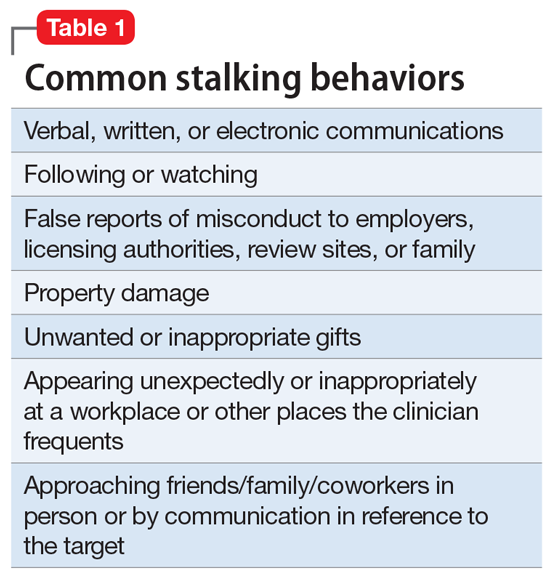
Stalking duration can vary substantially, as can the factors that lead to the cessation of the behavior. Indicators of increased risk for physical violence include unwanted physical presence/following of the target (“approach behaviors”), having a prior violent intimate relationship, property destruction, explicit threats, and having a prior intimate relationship with the target.7
Stalking contact or communication may be unwanted because of the content (eg, sexualized or threatening tone), location (eg, at a professional’s home), or means (eg, through social media). Stalking behaviors are not appropriate in any relationship, including a clinical relationship. They should not be treated as a “failure to manage transference” or in other victim-blaming ways.
There are multiple typologies for stalking behavior. Common motivations for stalking health professionals include resentment or grievance, misjudgment of social boundaries, and delusional fixation, including erotomania.8 Associated psychopathologies vary significantly and, while some may be more amenable to psychiatric treatment than others, psychiatrists should not feel compelled to treat patients who repeatedly violate boundaries, regardless of intent or comorbidity.
Patients are not the exclusive perpetrators of stalking; a recent study found that 4% of physicians surveyed reported current or recent stalking by a current or former intimate partner.9 When a person who is a victim of intimate partner violence is also stalked as part of the abuse, homicide risk increases.10 Workplace homicides of health care professionals are most likely to be committed by a current or former partner or other personal acquaintance, not by a patient.11 Workplace harassment and stalking of health care professionals is especially concerning because this behavior can escalate and endanger coworkers or clients.
Continue to: Risk awareness: Recognize your exposure...
Risk awareness: Recognize your exposure
About 80% of stalking involves some form of technology—often telephone calls but also online or other “cyber” elements.12 One recent survey found the rate of online harassment, including threats of physical and sexual violence, was >20% among physicians who were active on social media.4 Health professionals may be at greater risk of having patients find their personal information simply because patients routinely search online for information about new clinicians. Personal information about a clinician may be readily visible among professional information in search results, or a curious patient may simply scroll further down in the results. For a potential stalker, clicking on a search result linking to a personal social media page may be far easier than finding a home address and going in person—but the action may be just as distressing or risky for the clinician.13 Additionally, items visible in a clinician’s office—or visible in the background of those providing telehealth services from their home—may inadvertently reveal personal information about the clinician, their home, or their family.
Psychiatrists are often in a special position in relation to patients and times of crises. They may be involved in involuntary commitment—or declining an admission when a patient or family wishes it. They may be present at the time of the revelation of a serious diagnosis, abuse, injury, or death. They may be a mandated reporter of child or elder abuse.2 Additionally, physicians may be engaged in discourse on politically charged public health topics.14 These factors may increase their risk of being stalked.
Conducting an online visibility self-assessment can be a useful way to learn what information others can find. Table 2 outlines the steps for completing this exercise. Searching multiple iterations of your current and former names (with and without degrees, titles, and cities) will yield differing results in various search engines. After establishing a baseline of what information is available online, it can be helpful to periodically repeat this exercise, and to set up automated alerts for your name, number(s), email(s), and address(es).
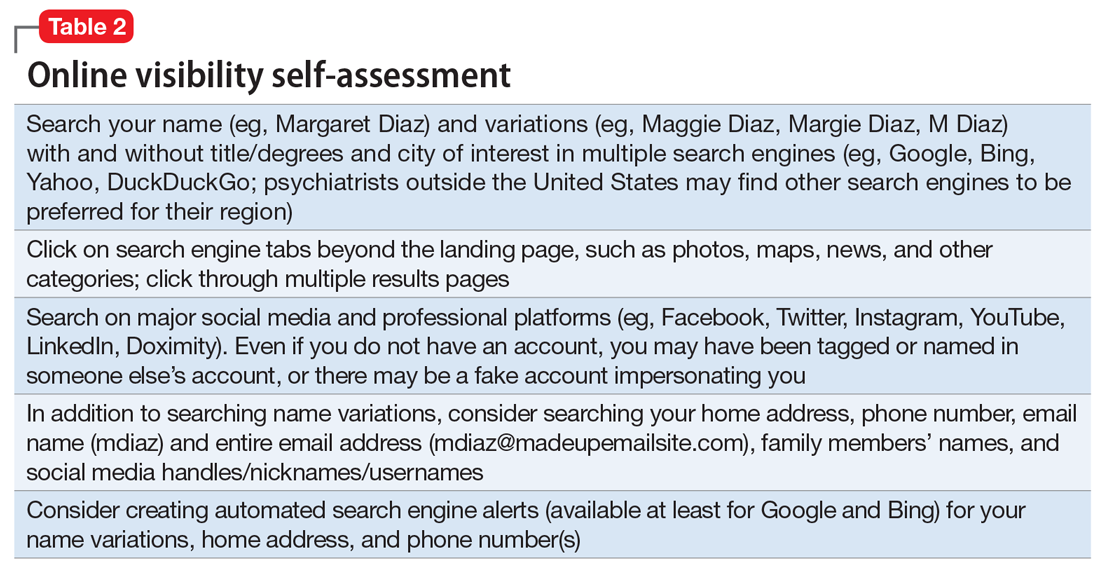
Basic mitigation strategies
In the modern era, being invisible online is impractical and likely impossible—especially for a health care professional. Instead, it may be prudent to limit your public visibility to professional portals (eg, LinkedIn or Doximity) and maximize privacy settings on other platforms. Another basic strategy is to avoid providing personal contact information (your home address, phone number, or personal email) for professional purposes, such as licensing and credentialing, conference submissions, or journal publications. Be aware that driving a visually distinct vehicle—one with vanity plates or distinct bumper stickers, or an exotic sportscar—can make it easier to be recognized and located. A personally recorded voicemail greeting (vs one recorded by, for example, an office manager) may be inappropriately reinforcing for some stalkers.
Workplaces should have an established safety policy that addresses stalking and harassment of employees. Similarly, patients and others should receive clear education on how to contact different staff, including physicians, with consideration of how and when to use electronic health information portals, office numbers, and emails. Workplaces should not disclose staff schedules. For example, a receptionist should say “I’ll have Dr. Diaz return your call when she can” instead of “Dr. Diaz is not in until tomorrow.” Avoid unnecessary location/name signals (eg, a parking spot labeled “Dr. Diaz”). Consider creating alert words or phrases for staff to use to signal they are concerned about their immediate safety—and provide education and training, including drills, to test emergency responses when the words/phrases are used. Leaders and managers should nurture a workplace culture where people are comfortable seeking support if they feel they may be the target of harassment or stalking. Many larger health care organizations have threat management programs, which can play a critical role in preventing, investigating, and responding to stalking of employees. Increasingly, threat management teams are being identified as a best practice in health care settings.15Table 3 summarizes measures to mitigate risk.
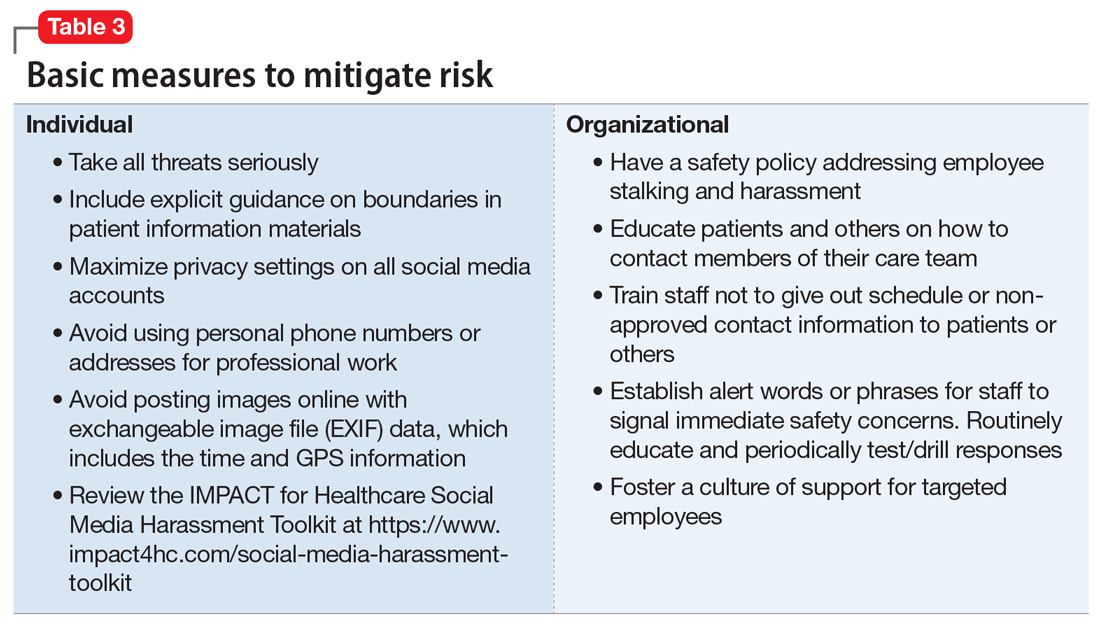
What to do when harassment or stalking occurs
Consulting with subject matter experts is essential. Approach behaviors, stalking patterns, and immediate circumstances vary highly, and so too must responses. A socially inept approach outside of the work setting by a patient may be effectively responded to with a firm explanation of why the behavior was inappropriate and a reiteration of limits. More persistent or serious threats may require taking actions for immediate safety, calling law enforcement or security (who may have the expertise to assist appropriately), or even run/hide/fight measures. Others to notify early on include human resources, supervisors, front desk staff, and coworkers. Although no single measure is always indicated and no single measure will always be effective, consultation with a specialist is always advisable.
Attempting to assess your own risk may be subject to bias and error, even for an experienced forensic psychiatrist. Risk assessment in stalking and harassment cases is complex, nuanced, and beyond the scope of this article; engagement with specialized threat programs or subject matter experts is advisable.15,16 If your medical center or area has police or security officers, engage them early. Risk management, insurers, and legal can also be helpful to consult. Attorneys specializing in harassment, stalking, and domestic violence may be helpful in extreme situations.17Table 417,18 highlights steps to take.
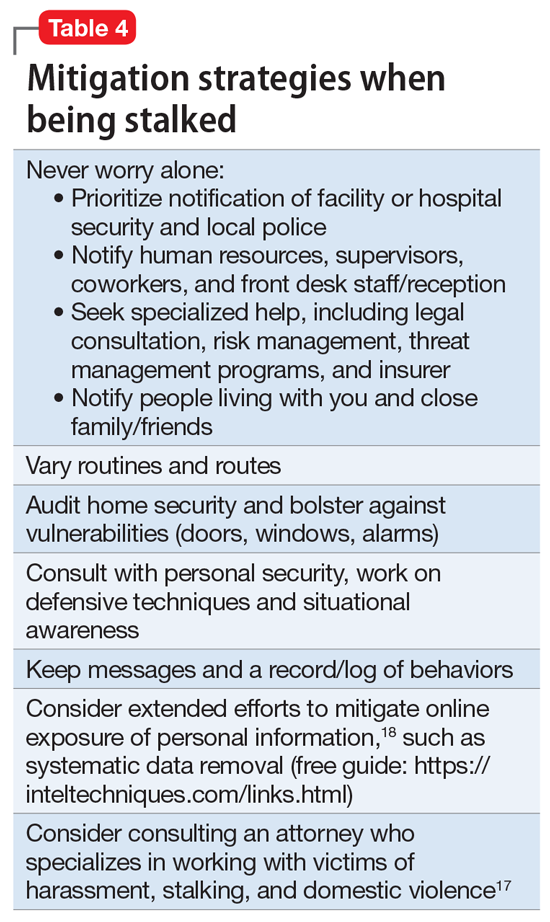
While effective interventions to stop or redirect stalking behavior may vary, some initial considerations include changing established routines (eg, your parking location or daily/weekly patterns such as gym, class, etc.) and letting family and others you live with know what is occurring. Consider implementing and bolstering personal, work, and home security; honing situational awareness skills; and learning advanced situational awareness and self-defense techniques.
Continue to: Clinical documentation and termination of care...
Clinical documentation and termination of care
Repeated and unwanted contact behaviors by a patient may be considered grounds for termination of care by the targeted clinician. Termination may occur through a direct conversation, followed by a mailed letter explaining that the patient’s inappropriate behaviors are the basis for termination. The letter should outline steps for establishing care with another psychiatrist and signing a release to facilitate transfer of records to the next psychiatrist. Ensure that the patient has access to a reasonable supply of medications or refills according to jurisdictional standards for transfer or termination of care.19 While these are common legal standards for termination of care in the United States, clinicians would be well served by appropriate consultation to verify the most appropriate standards for their location.
Documentation of a patient’s behavior should be factual and clear. Under the 21st Century Cures Act, patients often have access to their own electronic records.20 Therefore, clinicians should avoid documenting personal security measures or other information that is not clinically relevant. Communications with legal or risk management should not be documented unless otherwise advised, because such communications may be privileged and may not be clinically relevant.
In some circumstances, continuing to treat a patient who has stalked a member of the current treatment team may be appropriate or necessary. For example, a patient may respond appropriately to redirection after an initial approach behavior and continue to make clinical progress, or may be in a forensic specialty setting with appropriate operational support to continue with treatment.
Ethical dilemmas may arise in underserved areas where there are limited options for psychiatric care and in communicating the reasons for termination to a new clinician. Consultation may help to address these issues. However, as noted before, clinicians should be permitted to discontinue and transfer treatment and should not be compelled to continue to treat a patient who has threatened or harassed them.
Organizational and employer considerations
Victims of stalking have reported that they appreciated explicit support from their supervisor, regular meetings, and measures to reduce potential stalking or violence in the workplace; unsurprisingly, victim blaming and leaving the employee to address the situation on their own were labeled experienced as negative.2 Employers may consider implementing physical security, access controls and panic alarms, and enhancing coworkers’ situational awareness.21 Explicit policies about and attention to reducing workplace violence, including stalking, are always beneficial—and in some settings such policies may be a regulatory requirement.22 Large health care organizations may benefit from developing specialized threat management programs to assist with the evaluation and mitigation of stalking and other workplace violence risks.15,23
Self-care considerations
The impact of stalking can include psychological distress, disruption of work and personal relationships, and false allegations of impropriety. Stalking can make targets feel isolated, violated, and fearful, which makes it challenging to reach out to others for support and safety. It takes time to regain a sense of safety and to find a “new normal,” particularly while experiencing and responding to stalking behavior. Notifying close personal contacts such as family and coworkers about what is occurring (without sharing protected health information) can be helpful for recovery and important for the clinician’s safety. Reaching out for organizational and legal supports is also prudent. It is also important to allow time for, and patience with, a targeted individual’s normal responses, such as decreased work performance, sleep/appetite changes, and hypervigilance, without pathologizing these common stress reactions. Further review of appropriate resources by impacted clinicians is advisable.24-26
1. Nelsen AJ, Johnson RS, Ostermeyer B, et al. The prevalence of physicians who have been stalked: a systematic review. J Am Acad Psychiatry Law. 2015;43(2):177-182.
2. Jutasi C, McEwan TE. Stalking of professionals: a scoping review. Journal of Threat Assessment and Management. 2021;8(3):94-124.
3. Pathé MT, Meloy JR. Commentary: Stalking by patients—psychiatrists’ tales of anger, lust and ignorance. J Am Acad Psychiatry Law. 2013;41(2):200-205.
4. Pendergrast TR, Jain S, Trueger NS, et al. Prevalence of personal attacks and sexual harassment of physicians on social media. JAMA Intern Med. 2021;181(4):550-552.
5. Owens JG. Why definitions matter: stalking victimization in the United States. J Interpers Violence. 2016;31(12):2196-2226.
6. College of Policing. Stalking or harassment. May 2019. Accessed March 8, 2020. https://library.college.police.uk/docs/college-of-policing/Stalking_or_harassment_guidance_200519.pdf
7. McEwan TE, Daffern M, MacKenzie RD, et al. Risk factors for stalking violence, persistence, and recurrence. Journal of Forensic Psychiatry & Psychology. 2017;28(1):3856.
8. Pathé MT, Mullen PE, Purcell R. Patients who stalk doctors: their motives and management. Med J Australia. 2002;176(7):335-338.
9. Reibling ET, Distelberg B, Guptill M, et al. Intimate partner violence experienced by physicians. J Prim Care Community Health. 2020;11:2150132720965077.
10. Matias A, Gonçalves M, Soeiro C, et al. Intimate partner homicide: a meta-analysis of risk factors. Aggression and Violent Behavior. 2019;50:101358.
11. US Bureau of Labor Statistics. Fact sheet. Workplace violence in healthcare, 2018. April 2020. Accessed November 24, 2021. https://www.bls.gov/iif/oshwc/cfoi/workplace-violence-healthcare-2018.htm
12. Truman JL, Morgan RE. Stalking victimization, 2016. Bureau of Justice Statistics, Office of Justice Programs, U.S. Department of Justice. Report No.: NCJ 253526. April 2021. Accessed November 24, 2021. https://bjs.ojp.gov/library/publications/stalking-victimization-2016
13. Reyns BW, Henson B, Fisher BS. Being pursued online: applying cyberlifestyle–routine activities theory to cyberstalking victimization. Criminal Justice and Behavior. 2011;38(11):1149-1169.
14. Stea JN. When promoting knowledge makes you a target. Scientific American Blog Network. March 16, 2020. Accessed November 24, 2021. https://blogs.scientificamerican.com/observations/when-promoting-knowledge-makes-you-a-target/
15. Henkel SJ. Threat assessment strategies to mitigate violence in healthcare. IAHSS Foundation. IAHSS-F RS-19-02. November 2019. Accessed November 24, 2021. https://iahssf.org/assets/IAHSS-Foundation-Threat-Assessment-Strategies-to-Mitigate-Violence-in-Healthcare.pdf
16. McEwan TE. Stalking threat and risk assessment. In: Reid Meloy J, Hoffman J (eds). International Handbook of Threat Assessment. 2nd ed. Oxford University Press; 2021:210-234.
17. Goldberg C. Nobody’s Victim: Fighting Psychos, Stalkers, Pervs, and Trolls. Plume; 2019.
18. Bazzell M. Extreme Privacy: What It Takes to Disappear. 2nd ed. Independently published; 2020.
19. Simon RI, Shuman DW. The doctor-patient relationship. Focus. 2007;5(4):423-431.
20. Department of Health and Human Services. 21st Century Cures Act: Interoperability, Information Blocking, and the ONC Health IT Certification Program Final Rule (To be codified at 45 CFR 170 and 171). Federal Register. 2020;85(85):25642-25961.
21. Sheridan L, North AC, Scott AJ. Stalking in the workplace. Journal of Threat Assessment and Management. 2019;6(2):61-75.
22. The Joint Commission. Workplace Violence Prevention Standards. R3 Report: Requirement, Rationale, Reference. Issue 30. June 18, 2021. Accessed November 24, 2021. https://www.jointcommission.org/-/media/tjc/documents/standards/r3-reports/wpvp-r3-30_revised_06302021.pdf
23. Terry LP. Threat assessment teams. J Healthc Prot Manage. 2015;31(2):23-35.
24. Pathé M. Surviving Stalking. Cambridge University Press; 2002.
25. Noffsinger S. What stalking victims need to restore their mental and somatic health. Current Psychiatry. 2015;14(6):43-47.
26. Mullen P, Whyte S, McIvor R; Psychiatrists’ Support Service, Royal College of Psychiatry. PSS Information Guide: Stalking. Report No. 11. 2017. Accessed November 24, 2021. https://www.rcpsych.ac.uk/docs/default-source/members/supporting-you/pss/pss-guide-11-stalking.pdf?sfvrsn=2f1c7253_2
Dr. A has been treating Ms. W, a graduate student, for depression. Ms. W made subtle comments expressing her interest in pursuing a romantic relationship with her psychiatrist. Dr. A gently redirected her, and she seemed to respond appropriately. However, over the past 2 weeks, Dr. A has seen Ms. W at a local park and at the grocery store. Today, Dr. A is startled to see Ms. W at her weekly yoga class. Dr. A plans to ask her supervisor for advice.
Dr. M is a child psychiatrist who spoke at his local school board meeting in support of masking requirements for students during COVID-19. During the discussion, Dr. M shared that, as a psychiatrist, he does not believe it is especially distressing for students to wear masks, and that doing so is a necessary public health measure. On leaving, other parents shouted, “We know who you are and where you live!” The next day, his integrated clinic started receiving threatening and harassing messages, including threats to kill him or his staff if they take part in vaccinating children against COVID-19.
Because of their work, mental health professionals—like other health care professionals—face an elevated risk of being harassed or stalked. Stalking often includes online harassment and may escalate to serious physical violence. Stalking is criminal behavior by a patient and should not be constructed as a “failure to manage transference.” This article explores basic strategies to reduce the risk of harassment and stalking, describes how to recognize early behaviors, and outlines basic steps health care professionals and their employers can take to respond to stalking and harassing behaviors.
Although this article is intended for psychiatrists, it is important to note that all health professionals have significant risk for experiencing stalking or harassment. This is due in part, but not exclusively, to our clinical work. Estimates of how many health professionals experience stalking vary substantially depending upon the study, and differences in methodologies limit easy comparison or extrapolation. More thorough reviews have reported ranges from 2% to 70% among physicians; psychiatrists and other mental health professionals appear to be at greater risk than those in other specialties and the general population.1-3 Physicians who are active on social media may also be at elevated risk.4 Unexpected communications from patients and their family members—especially those with threatening, harassing, or sexualized tones, or involving contact outside of a work setting—can be distressing. These behaviors represent potential harbingers of more dangerous behavior, including physical assault, sexual assault, or homicide. Despite their elevated risk, many psychiatrists are unaware of how to prevent or respond to stalking or harassment.
Recognizing harassment and stalking
Repeated and unwanted contact or communication, regardless of intent, may constitute stalking. Legal definitions vary by jurisdiction and may not align with subjective experiences or understanding of what constitutes stalking.5 At its essence, stalking is repeated harassing behaviors likely to provoke fear in the targeted person. FOUR is a helpful mnemonic when conceptualizing the attributes of stalking: Fixated, Obsessive, Unwanted, and Repetitive.6Table 1 lists examples of common stalking behaviors. Stalking and harassing behavior may be from a known source (eg, a patient, coworker, or paramour), a masked source (ie, someone known to the target but who conceals or obscures their identity), or from otherwise unknown persons. Behaviors that persist after the person engaging in the behaviors has clearly been informed that they are unwanted or inappropriate are especially concerning. Stalking may escalate to include physical or sexual assault and, in some cases, homicide.
Stalking duration can vary substantially, as can the factors that lead to the cessation of the behavior. Indicators of increased risk for physical violence include unwanted physical presence/following of the target (“approach behaviors”), having a prior violent intimate relationship, property destruction, explicit threats, and having a prior intimate relationship with the target.7
Stalking contact or communication may be unwanted because of the content (eg, sexualized or threatening tone), location (eg, at a professional’s home), or means (eg, through social media). Stalking behaviors are not appropriate in any relationship, including a clinical relationship. They should not be treated as a “failure to manage transference” or in other victim-blaming ways.
There are multiple typologies for stalking behavior. Common motivations for stalking health professionals include resentment or grievance, misjudgment of social boundaries, and delusional fixation, including erotomania.8 Associated psychopathologies vary significantly and, while some may be more amenable to psychiatric treatment than others, psychiatrists should not feel compelled to treat patients who repeatedly violate boundaries, regardless of intent or comorbidity.
Patients are not the exclusive perpetrators of stalking; a recent study found that 4% of physicians surveyed reported current or recent stalking by a current or former intimate partner.9 When a person who is a victim of intimate partner violence is also stalked as part of the abuse, homicide risk increases.10 Workplace homicides of health care professionals are most likely to be committed by a current or former partner or other personal acquaintance, not by a patient.11 Workplace harassment and stalking of health care professionals is especially concerning because this behavior can escalate and endanger coworkers or clients.
Continue to: Risk awareness: Recognize your exposure...
Risk awareness: Recognize your exposure
About 80% of stalking involves some form of technology—often telephone calls but also online or other “cyber” elements.12 One recent survey found the rate of online harassment, including threats of physical and sexual violence, was >20% among physicians who were active on social media.4 Health professionals may be at greater risk of having patients find their personal information simply because patients routinely search online for information about new clinicians. Personal information about a clinician may be readily visible among professional information in search results, or a curious patient may simply scroll further down in the results. For a potential stalker, clicking on a search result linking to a personal social media page may be far easier than finding a home address and going in person—but the action may be just as distressing or risky for the clinician.13 Additionally, items visible in a clinician’s office—or visible in the background of those providing telehealth services from their home—may inadvertently reveal personal information about the clinician, their home, or their family.
Psychiatrists are often in a special position in relation to patients and times of crises. They may be involved in involuntary commitment—or declining an admission when a patient or family wishes it. They may be present at the time of the revelation of a serious diagnosis, abuse, injury, or death. They may be a mandated reporter of child or elder abuse.2 Additionally, physicians may be engaged in discourse on politically charged public health topics.14 These factors may increase their risk of being stalked.
Conducting an online visibility self-assessment can be a useful way to learn what information others can find. Table 2 outlines the steps for completing this exercise. Searching multiple iterations of your current and former names (with and without degrees, titles, and cities) will yield differing results in various search engines. After establishing a baseline of what information is available online, it can be helpful to periodically repeat this exercise, and to set up automated alerts for your name, number(s), email(s), and address(es).
Basic mitigation strategies
In the modern era, being invisible online is impractical and likely impossible—especially for a health care professional. Instead, it may be prudent to limit your public visibility to professional portals (eg, LinkedIn or Doximity) and maximize privacy settings on other platforms. Another basic strategy is to avoid providing personal contact information (your home address, phone number, or personal email) for professional purposes, such as licensing and credentialing, conference submissions, or journal publications. Be aware that driving a visually distinct vehicle—one with vanity plates or distinct bumper stickers, or an exotic sportscar—can make it easier to be recognized and located. A personally recorded voicemail greeting (vs one recorded by, for example, an office manager) may be inappropriately reinforcing for some stalkers.
Workplaces should have an established safety policy that addresses stalking and harassment of employees. Similarly, patients and others should receive clear education on how to contact different staff, including physicians, with consideration of how and when to use electronic health information portals, office numbers, and emails. Workplaces should not disclose staff schedules. For example, a receptionist should say “I’ll have Dr. Diaz return your call when she can” instead of “Dr. Diaz is not in until tomorrow.” Avoid unnecessary location/name signals (eg, a parking spot labeled “Dr. Diaz”). Consider creating alert words or phrases for staff to use to signal they are concerned about their immediate safety—and provide education and training, including drills, to test emergency responses when the words/phrases are used. Leaders and managers should nurture a workplace culture where people are comfortable seeking support if they feel they may be the target of harassment or stalking. Many larger health care organizations have threat management programs, which can play a critical role in preventing, investigating, and responding to stalking of employees. Increasingly, threat management teams are being identified as a best practice in health care settings.15Table 3 summarizes measures to mitigate risk.
What to do when harassment or stalking occurs
Consulting with subject matter experts is essential. Approach behaviors, stalking patterns, and immediate circumstances vary highly, and so too must responses. A socially inept approach outside of the work setting by a patient may be effectively responded to with a firm explanation of why the behavior was inappropriate and a reiteration of limits. More persistent or serious threats may require taking actions for immediate safety, calling law enforcement or security (who may have the expertise to assist appropriately), or even run/hide/fight measures. Others to notify early on include human resources, supervisors, front desk staff, and coworkers. Although no single measure is always indicated and no single measure will always be effective, consultation with a specialist is always advisable.
Attempting to assess your own risk may be subject to bias and error, even for an experienced forensic psychiatrist. Risk assessment in stalking and harassment cases is complex, nuanced, and beyond the scope of this article; engagement with specialized threat programs or subject matter experts is advisable.15,16 If your medical center or area has police or security officers, engage them early. Risk management, insurers, and legal can also be helpful to consult. Attorneys specializing in harassment, stalking, and domestic violence may be helpful in extreme situations.17Table 417,18 highlights steps to take.
While effective interventions to stop or redirect stalking behavior may vary, some initial considerations include changing established routines (eg, your parking location or daily/weekly patterns such as gym, class, etc.) and letting family and others you live with know what is occurring. Consider implementing and bolstering personal, work, and home security; honing situational awareness skills; and learning advanced situational awareness and self-defense techniques.
Continue to: Clinical documentation and termination of care...
Clinical documentation and termination of care
Repeated and unwanted contact behaviors by a patient may be considered grounds for termination of care by the targeted clinician. Termination may occur through a direct conversation, followed by a mailed letter explaining that the patient’s inappropriate behaviors are the basis for termination. The letter should outline steps for establishing care with another psychiatrist and signing a release to facilitate transfer of records to the next psychiatrist. Ensure that the patient has access to a reasonable supply of medications or refills according to jurisdictional standards for transfer or termination of care.19 While these are common legal standards for termination of care in the United States, clinicians would be well served by appropriate consultation to verify the most appropriate standards for their location.
Documentation of a patient’s behavior should be factual and clear. Under the 21st Century Cures Act, patients often have access to their own electronic records.20 Therefore, clinicians should avoid documenting personal security measures or other information that is not clinically relevant. Communications with legal or risk management should not be documented unless otherwise advised, because such communications may be privileged and may not be clinically relevant.
In some circumstances, continuing to treat a patient who has stalked a member of the current treatment team may be appropriate or necessary. For example, a patient may respond appropriately to redirection after an initial approach behavior and continue to make clinical progress, or may be in a forensic specialty setting with appropriate operational support to continue with treatment.
Ethical dilemmas may arise in underserved areas where there are limited options for psychiatric care and in communicating the reasons for termination to a new clinician. Consultation may help to address these issues. However, as noted before, clinicians should be permitted to discontinue and transfer treatment and should not be compelled to continue to treat a patient who has threatened or harassed them.
Organizational and employer considerations
Victims of stalking have reported that they appreciated explicit support from their supervisor, regular meetings, and measures to reduce potential stalking or violence in the workplace; unsurprisingly, victim blaming and leaving the employee to address the situation on their own were labeled experienced as negative.2 Employers may consider implementing physical security, access controls and panic alarms, and enhancing coworkers’ situational awareness.21 Explicit policies about and attention to reducing workplace violence, including stalking, are always beneficial—and in some settings such policies may be a regulatory requirement.22 Large health care organizations may benefit from developing specialized threat management programs to assist with the evaluation and mitigation of stalking and other workplace violence risks.15,23
Self-care considerations
The impact of stalking can include psychological distress, disruption of work and personal relationships, and false allegations of impropriety. Stalking can make targets feel isolated, violated, and fearful, which makes it challenging to reach out to others for support and safety. It takes time to regain a sense of safety and to find a “new normal,” particularly while experiencing and responding to stalking behavior. Notifying close personal contacts such as family and coworkers about what is occurring (without sharing protected health information) can be helpful for recovery and important for the clinician’s safety. Reaching out for organizational and legal supports is also prudent. It is also important to allow time for, and patience with, a targeted individual’s normal responses, such as decreased work performance, sleep/appetite changes, and hypervigilance, without pathologizing these common stress reactions. Further review of appropriate resources by impacted clinicians is advisable.24-26
Dr. A has been treating Ms. W, a graduate student, for depression. Ms. W made subtle comments expressing her interest in pursuing a romantic relationship with her psychiatrist. Dr. A gently redirected her, and she seemed to respond appropriately. However, over the past 2 weeks, Dr. A has seen Ms. W at a local park and at the grocery store. Today, Dr. A is startled to see Ms. W at her weekly yoga class. Dr. A plans to ask her supervisor for advice.
Dr. M is a child psychiatrist who spoke at his local school board meeting in support of masking requirements for students during COVID-19. During the discussion, Dr. M shared that, as a psychiatrist, he does not believe it is especially distressing for students to wear masks, and that doing so is a necessary public health measure. On leaving, other parents shouted, “We know who you are and where you live!” The next day, his integrated clinic started receiving threatening and harassing messages, including threats to kill him or his staff if they take part in vaccinating children against COVID-19.
Because of their work, mental health professionals—like other health care professionals—face an elevated risk of being harassed or stalked. Stalking often includes online harassment and may escalate to serious physical violence. Stalking is criminal behavior by a patient and should not be constructed as a “failure to manage transference.” This article explores basic strategies to reduce the risk of harassment and stalking, describes how to recognize early behaviors, and outlines basic steps health care professionals and their employers can take to respond to stalking and harassing behaviors.
Although this article is intended for psychiatrists, it is important to note that all health professionals have significant risk for experiencing stalking or harassment. This is due in part, but not exclusively, to our clinical work. Estimates of how many health professionals experience stalking vary substantially depending upon the study, and differences in methodologies limit easy comparison or extrapolation. More thorough reviews have reported ranges from 2% to 70% among physicians; psychiatrists and other mental health professionals appear to be at greater risk than those in other specialties and the general population.1-3 Physicians who are active on social media may also be at elevated risk.4 Unexpected communications from patients and their family members—especially those with threatening, harassing, or sexualized tones, or involving contact outside of a work setting—can be distressing. These behaviors represent potential harbingers of more dangerous behavior, including physical assault, sexual assault, or homicide. Despite their elevated risk, many psychiatrists are unaware of how to prevent or respond to stalking or harassment.
Recognizing harassment and stalking
Repeated and unwanted contact or communication, regardless of intent, may constitute stalking. Legal definitions vary by jurisdiction and may not align with subjective experiences or understanding of what constitutes stalking.5 At its essence, stalking is repeated harassing behaviors likely to provoke fear in the targeted person. FOUR is a helpful mnemonic when conceptualizing the attributes of stalking: Fixated, Obsessive, Unwanted, and Repetitive.6Table 1 lists examples of common stalking behaviors. Stalking and harassing behavior may be from a known source (eg, a patient, coworker, or paramour), a masked source (ie, someone known to the target but who conceals or obscures their identity), or from otherwise unknown persons. Behaviors that persist after the person engaging in the behaviors has clearly been informed that they are unwanted or inappropriate are especially concerning. Stalking may escalate to include physical or sexual assault and, in some cases, homicide.
Stalking duration can vary substantially, as can the factors that lead to the cessation of the behavior. Indicators of increased risk for physical violence include unwanted physical presence/following of the target (“approach behaviors”), having a prior violent intimate relationship, property destruction, explicit threats, and having a prior intimate relationship with the target.7
Stalking contact or communication may be unwanted because of the content (eg, sexualized or threatening tone), location (eg, at a professional’s home), or means (eg, through social media). Stalking behaviors are not appropriate in any relationship, including a clinical relationship. They should not be treated as a “failure to manage transference” or in other victim-blaming ways.
There are multiple typologies for stalking behavior. Common motivations for stalking health professionals include resentment or grievance, misjudgment of social boundaries, and delusional fixation, including erotomania.8 Associated psychopathologies vary significantly and, while some may be more amenable to psychiatric treatment than others, psychiatrists should not feel compelled to treat patients who repeatedly violate boundaries, regardless of intent or comorbidity.
Patients are not the exclusive perpetrators of stalking; a recent study found that 4% of physicians surveyed reported current or recent stalking by a current or former intimate partner.9 When a person who is a victim of intimate partner violence is also stalked as part of the abuse, homicide risk increases.10 Workplace homicides of health care professionals are most likely to be committed by a current or former partner or other personal acquaintance, not by a patient.11 Workplace harassment and stalking of health care professionals is especially concerning because this behavior can escalate and endanger coworkers or clients.
Continue to: Risk awareness: Recognize your exposure...
Risk awareness: Recognize your exposure
About 80% of stalking involves some form of technology—often telephone calls but also online or other “cyber” elements.12 One recent survey found the rate of online harassment, including threats of physical and sexual violence, was >20% among physicians who were active on social media.4 Health professionals may be at greater risk of having patients find their personal information simply because patients routinely search online for information about new clinicians. Personal information about a clinician may be readily visible among professional information in search results, or a curious patient may simply scroll further down in the results. For a potential stalker, clicking on a search result linking to a personal social media page may be far easier than finding a home address and going in person—but the action may be just as distressing or risky for the clinician.13 Additionally, items visible in a clinician’s office—or visible in the background of those providing telehealth services from their home—may inadvertently reveal personal information about the clinician, their home, or their family.
Psychiatrists are often in a special position in relation to patients and times of crises. They may be involved in involuntary commitment—or declining an admission when a patient or family wishes it. They may be present at the time of the revelation of a serious diagnosis, abuse, injury, or death. They may be a mandated reporter of child or elder abuse.2 Additionally, physicians may be engaged in discourse on politically charged public health topics.14 These factors may increase their risk of being stalked.
Conducting an online visibility self-assessment can be a useful way to learn what information others can find. Table 2 outlines the steps for completing this exercise. Searching multiple iterations of your current and former names (with and without degrees, titles, and cities) will yield differing results in various search engines. After establishing a baseline of what information is available online, it can be helpful to periodically repeat this exercise, and to set up automated alerts for your name, number(s), email(s), and address(es).
Basic mitigation strategies
In the modern era, being invisible online is impractical and likely impossible—especially for a health care professional. Instead, it may be prudent to limit your public visibility to professional portals (eg, LinkedIn or Doximity) and maximize privacy settings on other platforms. Another basic strategy is to avoid providing personal contact information (your home address, phone number, or personal email) for professional purposes, such as licensing and credentialing, conference submissions, or journal publications. Be aware that driving a visually distinct vehicle—one with vanity plates or distinct bumper stickers, or an exotic sportscar—can make it easier to be recognized and located. A personally recorded voicemail greeting (vs one recorded by, for example, an office manager) may be inappropriately reinforcing for some stalkers.
Workplaces should have an established safety policy that addresses stalking and harassment of employees. Similarly, patients and others should receive clear education on how to contact different staff, including physicians, with consideration of how and when to use electronic health information portals, office numbers, and emails. Workplaces should not disclose staff schedules. For example, a receptionist should say “I’ll have Dr. Diaz return your call when she can” instead of “Dr. Diaz is not in until tomorrow.” Avoid unnecessary location/name signals (eg, a parking spot labeled “Dr. Diaz”). Consider creating alert words or phrases for staff to use to signal they are concerned about their immediate safety—and provide education and training, including drills, to test emergency responses when the words/phrases are used. Leaders and managers should nurture a workplace culture where people are comfortable seeking support if they feel they may be the target of harassment or stalking. Many larger health care organizations have threat management programs, which can play a critical role in preventing, investigating, and responding to stalking of employees. Increasingly, threat management teams are being identified as a best practice in health care settings.15Table 3 summarizes measures to mitigate risk.
What to do when harassment or stalking occurs
Consulting with subject matter experts is essential. Approach behaviors, stalking patterns, and immediate circumstances vary highly, and so too must responses. A socially inept approach outside of the work setting by a patient may be effectively responded to with a firm explanation of why the behavior was inappropriate and a reiteration of limits. More persistent or serious threats may require taking actions for immediate safety, calling law enforcement or security (who may have the expertise to assist appropriately), or even run/hide/fight measures. Others to notify early on include human resources, supervisors, front desk staff, and coworkers. Although no single measure is always indicated and no single measure will always be effective, consultation with a specialist is always advisable.
Attempting to assess your own risk may be subject to bias and error, even for an experienced forensic psychiatrist. Risk assessment in stalking and harassment cases is complex, nuanced, and beyond the scope of this article; engagement with specialized threat programs or subject matter experts is advisable.15,16 If your medical center or area has police or security officers, engage them early. Risk management, insurers, and legal can also be helpful to consult. Attorneys specializing in harassment, stalking, and domestic violence may be helpful in extreme situations.17Table 417,18 highlights steps to take.
While effective interventions to stop or redirect stalking behavior may vary, some initial considerations include changing established routines (eg, your parking location or daily/weekly patterns such as gym, class, etc.) and letting family and others you live with know what is occurring. Consider implementing and bolstering personal, work, and home security; honing situational awareness skills; and learning advanced situational awareness and self-defense techniques.
Continue to: Clinical documentation and termination of care...
Clinical documentation and termination of care
Repeated and unwanted contact behaviors by a patient may be considered grounds for termination of care by the targeted clinician. Termination may occur through a direct conversation, followed by a mailed letter explaining that the patient’s inappropriate behaviors are the basis for termination. The letter should outline steps for establishing care with another psychiatrist and signing a release to facilitate transfer of records to the next psychiatrist. Ensure that the patient has access to a reasonable supply of medications or refills according to jurisdictional standards for transfer or termination of care.19 While these are common legal standards for termination of care in the United States, clinicians would be well served by appropriate consultation to verify the most appropriate standards for their location.
Documentation of a patient’s behavior should be factual and clear. Under the 21st Century Cures Act, patients often have access to their own electronic records.20 Therefore, clinicians should avoid documenting personal security measures or other information that is not clinically relevant. Communications with legal or risk management should not be documented unless otherwise advised, because such communications may be privileged and may not be clinically relevant.
In some circumstances, continuing to treat a patient who has stalked a member of the current treatment team may be appropriate or necessary. For example, a patient may respond appropriately to redirection after an initial approach behavior and continue to make clinical progress, or may be in a forensic specialty setting with appropriate operational support to continue with treatment.
Ethical dilemmas may arise in underserved areas where there are limited options for psychiatric care and in communicating the reasons for termination to a new clinician. Consultation may help to address these issues. However, as noted before, clinicians should be permitted to discontinue and transfer treatment and should not be compelled to continue to treat a patient who has threatened or harassed them.
Organizational and employer considerations
Victims of stalking have reported that they appreciated explicit support from their supervisor, regular meetings, and measures to reduce potential stalking or violence in the workplace; unsurprisingly, victim blaming and leaving the employee to address the situation on their own were labeled experienced as negative.2 Employers may consider implementing physical security, access controls and panic alarms, and enhancing coworkers’ situational awareness.21 Explicit policies about and attention to reducing workplace violence, including stalking, are always beneficial—and in some settings such policies may be a regulatory requirement.22 Large health care organizations may benefit from developing specialized threat management programs to assist with the evaluation and mitigation of stalking and other workplace violence risks.15,23
Self-care considerations
The impact of stalking can include psychological distress, disruption of work and personal relationships, and false allegations of impropriety. Stalking can make targets feel isolated, violated, and fearful, which makes it challenging to reach out to others for support and safety. It takes time to regain a sense of safety and to find a “new normal,” particularly while experiencing and responding to stalking behavior. Notifying close personal contacts such as family and coworkers about what is occurring (without sharing protected health information) can be helpful for recovery and important for the clinician’s safety. Reaching out for organizational and legal supports is also prudent. It is also important to allow time for, and patience with, a targeted individual’s normal responses, such as decreased work performance, sleep/appetite changes, and hypervigilance, without pathologizing these common stress reactions. Further review of appropriate resources by impacted clinicians is advisable.24-26
1. Nelsen AJ, Johnson RS, Ostermeyer B, et al. The prevalence of physicians who have been stalked: a systematic review. J Am Acad Psychiatry Law. 2015;43(2):177-182.
2. Jutasi C, McEwan TE. Stalking of professionals: a scoping review. Journal of Threat Assessment and Management. 2021;8(3):94-124.
3. Pathé MT, Meloy JR. Commentary: Stalking by patients—psychiatrists’ tales of anger, lust and ignorance. J Am Acad Psychiatry Law. 2013;41(2):200-205.
4. Pendergrast TR, Jain S, Trueger NS, et al. Prevalence of personal attacks and sexual harassment of physicians on social media. JAMA Intern Med. 2021;181(4):550-552.
5. Owens JG. Why definitions matter: stalking victimization in the United States. J Interpers Violence. 2016;31(12):2196-2226.
6. College of Policing. Stalking or harassment. May 2019. Accessed March 8, 2020. https://library.college.police.uk/docs/college-of-policing/Stalking_or_harassment_guidance_200519.pdf
7. McEwan TE, Daffern M, MacKenzie RD, et al. Risk factors for stalking violence, persistence, and recurrence. Journal of Forensic Psychiatry & Psychology. 2017;28(1):3856.
8. Pathé MT, Mullen PE, Purcell R. Patients who stalk doctors: their motives and management. Med J Australia. 2002;176(7):335-338.
9. Reibling ET, Distelberg B, Guptill M, et al. Intimate partner violence experienced by physicians. J Prim Care Community Health. 2020;11:2150132720965077.
10. Matias A, Gonçalves M, Soeiro C, et al. Intimate partner homicide: a meta-analysis of risk factors. Aggression and Violent Behavior. 2019;50:101358.
11. US Bureau of Labor Statistics. Fact sheet. Workplace violence in healthcare, 2018. April 2020. Accessed November 24, 2021. https://www.bls.gov/iif/oshwc/cfoi/workplace-violence-healthcare-2018.htm
12. Truman JL, Morgan RE. Stalking victimization, 2016. Bureau of Justice Statistics, Office of Justice Programs, U.S. Department of Justice. Report No.: NCJ 253526. April 2021. Accessed November 24, 2021. https://bjs.ojp.gov/library/publications/stalking-victimization-2016
13. Reyns BW, Henson B, Fisher BS. Being pursued online: applying cyberlifestyle–routine activities theory to cyberstalking victimization. Criminal Justice and Behavior. 2011;38(11):1149-1169.
14. Stea JN. When promoting knowledge makes you a target. Scientific American Blog Network. March 16, 2020. Accessed November 24, 2021. https://blogs.scientificamerican.com/observations/when-promoting-knowledge-makes-you-a-target/
15. Henkel SJ. Threat assessment strategies to mitigate violence in healthcare. IAHSS Foundation. IAHSS-F RS-19-02. November 2019. Accessed November 24, 2021. https://iahssf.org/assets/IAHSS-Foundation-Threat-Assessment-Strategies-to-Mitigate-Violence-in-Healthcare.pdf
16. McEwan TE. Stalking threat and risk assessment. In: Reid Meloy J, Hoffman J (eds). International Handbook of Threat Assessment. 2nd ed. Oxford University Press; 2021:210-234.
17. Goldberg C. Nobody’s Victim: Fighting Psychos, Stalkers, Pervs, and Trolls. Plume; 2019.
18. Bazzell M. Extreme Privacy: What It Takes to Disappear. 2nd ed. Independently published; 2020.
19. Simon RI, Shuman DW. The doctor-patient relationship. Focus. 2007;5(4):423-431.
20. Department of Health and Human Services. 21st Century Cures Act: Interoperability, Information Blocking, and the ONC Health IT Certification Program Final Rule (To be codified at 45 CFR 170 and 171). Federal Register. 2020;85(85):25642-25961.
21. Sheridan L, North AC, Scott AJ. Stalking in the workplace. Journal of Threat Assessment and Management. 2019;6(2):61-75.
22. The Joint Commission. Workplace Violence Prevention Standards. R3 Report: Requirement, Rationale, Reference. Issue 30. June 18, 2021. Accessed November 24, 2021. https://www.jointcommission.org/-/media/tjc/documents/standards/r3-reports/wpvp-r3-30_revised_06302021.pdf
23. Terry LP. Threat assessment teams. J Healthc Prot Manage. 2015;31(2):23-35.
24. Pathé M. Surviving Stalking. Cambridge University Press; 2002.
25. Noffsinger S. What stalking victims need to restore their mental and somatic health. Current Psychiatry. 2015;14(6):43-47.
26. Mullen P, Whyte S, McIvor R; Psychiatrists’ Support Service, Royal College of Psychiatry. PSS Information Guide: Stalking. Report No. 11. 2017. Accessed November 24, 2021. https://www.rcpsych.ac.uk/docs/default-source/members/supporting-you/pss/pss-guide-11-stalking.pdf?sfvrsn=2f1c7253_2
1. Nelsen AJ, Johnson RS, Ostermeyer B, et al. The prevalence of physicians who have been stalked: a systematic review. J Am Acad Psychiatry Law. 2015;43(2):177-182.
2. Jutasi C, McEwan TE. Stalking of professionals: a scoping review. Journal of Threat Assessment and Management. 2021;8(3):94-124.
3. Pathé MT, Meloy JR. Commentary: Stalking by patients—psychiatrists’ tales of anger, lust and ignorance. J Am Acad Psychiatry Law. 2013;41(2):200-205.
4. Pendergrast TR, Jain S, Trueger NS, et al. Prevalence of personal attacks and sexual harassment of physicians on social media. JAMA Intern Med. 2021;181(4):550-552.
5. Owens JG. Why definitions matter: stalking victimization in the United States. J Interpers Violence. 2016;31(12):2196-2226.
6. College of Policing. Stalking or harassment. May 2019. Accessed March 8, 2020. https://library.college.police.uk/docs/college-of-policing/Stalking_or_harassment_guidance_200519.pdf
7. McEwan TE, Daffern M, MacKenzie RD, et al. Risk factors for stalking violence, persistence, and recurrence. Journal of Forensic Psychiatry & Psychology. 2017;28(1):3856.
8. Pathé MT, Mullen PE, Purcell R. Patients who stalk doctors: their motives and management. Med J Australia. 2002;176(7):335-338.
9. Reibling ET, Distelberg B, Guptill M, et al. Intimate partner violence experienced by physicians. J Prim Care Community Health. 2020;11:2150132720965077.
10. Matias A, Gonçalves M, Soeiro C, et al. Intimate partner homicide: a meta-analysis of risk factors. Aggression and Violent Behavior. 2019;50:101358.
11. US Bureau of Labor Statistics. Fact sheet. Workplace violence in healthcare, 2018. April 2020. Accessed November 24, 2021. https://www.bls.gov/iif/oshwc/cfoi/workplace-violence-healthcare-2018.htm
12. Truman JL, Morgan RE. Stalking victimization, 2016. Bureau of Justice Statistics, Office of Justice Programs, U.S. Department of Justice. Report No.: NCJ 253526. April 2021. Accessed November 24, 2021. https://bjs.ojp.gov/library/publications/stalking-victimization-2016
13. Reyns BW, Henson B, Fisher BS. Being pursued online: applying cyberlifestyle–routine activities theory to cyberstalking victimization. Criminal Justice and Behavior. 2011;38(11):1149-1169.
14. Stea JN. When promoting knowledge makes you a target. Scientific American Blog Network. March 16, 2020. Accessed November 24, 2021. https://blogs.scientificamerican.com/observations/when-promoting-knowledge-makes-you-a-target/
15. Henkel SJ. Threat assessment strategies to mitigate violence in healthcare. IAHSS Foundation. IAHSS-F RS-19-02. November 2019. Accessed November 24, 2021. https://iahssf.org/assets/IAHSS-Foundation-Threat-Assessment-Strategies-to-Mitigate-Violence-in-Healthcare.pdf
16. McEwan TE. Stalking threat and risk assessment. In: Reid Meloy J, Hoffman J (eds). International Handbook of Threat Assessment. 2nd ed. Oxford University Press; 2021:210-234.
17. Goldberg C. Nobody’s Victim: Fighting Psychos, Stalkers, Pervs, and Trolls. Plume; 2019.
18. Bazzell M. Extreme Privacy: What It Takes to Disappear. 2nd ed. Independently published; 2020.
19. Simon RI, Shuman DW. The doctor-patient relationship. Focus. 2007;5(4):423-431.
20. Department of Health and Human Services. 21st Century Cures Act: Interoperability, Information Blocking, and the ONC Health IT Certification Program Final Rule (To be codified at 45 CFR 170 and 171). Federal Register. 2020;85(85):25642-25961.
21. Sheridan L, North AC, Scott AJ. Stalking in the workplace. Journal of Threat Assessment and Management. 2019;6(2):61-75.
22. The Joint Commission. Workplace Violence Prevention Standards. R3 Report: Requirement, Rationale, Reference. Issue 30. June 18, 2021. Accessed November 24, 2021. https://www.jointcommission.org/-/media/tjc/documents/standards/r3-reports/wpvp-r3-30_revised_06302021.pdf
23. Terry LP. Threat assessment teams. J Healthc Prot Manage. 2015;31(2):23-35.
24. Pathé M. Surviving Stalking. Cambridge University Press; 2002.
25. Noffsinger S. What stalking victims need to restore their mental and somatic health. Current Psychiatry. 2015;14(6):43-47.
26. Mullen P, Whyte S, McIvor R; Psychiatrists’ Support Service, Royal College of Psychiatry. PSS Information Guide: Stalking. Report No. 11. 2017. Accessed November 24, 2021. https://www.rcpsych.ac.uk/docs/default-source/members/supporting-you/pss/pss-guide-11-stalking.pdf?sfvrsn=2f1c7253_2