ATLANTA – The 13-valent pneumococcal conjugate vaccine should be given to all immunocompromised adults aged 19 years and older, according to new recommendations from the Centers for Disease Control and Prevention.
In a unanimous vote at its June meeting, the CDC’s Advisory Committee on Immunization Practices said that the 13-valent pneumococcal conjugate vaccine (PCV13 [Prevnar 13]) is recommended for the same adults who are currently advised to receive two doses of the 23-valent pneumococcal polysaccharide vaccine (PPSV23 [Pneumovax]), including those with immunocompromising conditions. Patients who are immunocompromised include individuals with HIV infection, hematologic cancer, solid cancer, organ transplant, chronic renal failure/nephrotic syndrome, and diseases requiring treatment with immunosuppressive drugs, as well as patients with functional or anatomic asplenia, cerebrospinal fluid leaks, and cochlear implants.
The new recommendation calls for the use of PCV13 in addition to PPSV23.
According to Dr. Sandra A. Fryhofer, the liaison to the Advisory Committee on Immunization Practices (ACIP) from the American College of Physicians, "We’re very excited that there’s finally some guidance for internists about what to do with immunocompromised patients. Of course, we don’t have all the data yet. ... But this is the best we could do for now. On the surface it’s a very complicated recommendation schedule, but I think as we get more experience with it, maybe it will get easier in the implementation," she said in an interview.
Immunocompromised individuals are at significantly elevated risk for invasive pneumococcal disease (IPD). According to one study, that risk is 173-fold higher among HIV-infected individuals and 186 times higher in those with hematologic cancer compared with age-matched controls (J. Infect. Dis. 2005;192:377-86).
A cost-effectiveness analysis presented at the meeting found that use of PCV13 was cost saving for all the immunocompromised groups together, and for dialysis patients specifically. For HIV-infected patients, the cost per quality-adjusted life year gained was $3,206, well within the bounds of what is considered cost effective, according to the CDC’s Dr. Charles Stoecker.
However, Dr. Fryhofer, of Emory University in Atlanta, noted that the relative costs of PCV13 and PPSV23 – $124.37 versus $55.02 per dose in 2009 – are also likely to factor into the decision about a broader recommendation for PCV13. "This vaccine is more than twice the price of the vaccine we’ve been using. Cost effectiveness is important, and we have to think about stewardship in our resources. But certainly, pneumococcal disease is a leading killer."
The decision for the use of PCV13 in immunocompromised people was made despite the fact that the only study on vaccine efficacy in such individuals investigated the previous 7-valent formulation of the vaccine (PCV7), and was conducted in HIV-infected adults in Malawi (N. Engl. J. Med. 2010;362:812-22). "The only data we have are quite limited and not always applicable to the population we’re looking at, but we believe the data are sufficient to determine that the vaccine may be beneficial in these populations and will not cause harm," ACIP pneumococcal working group chair Dr. Nancy M. Bennett said in an interview. No further vaccine efficacy data are anticipated for the immunocompromised groups, she noted.
The vote for use of PCV13 in immunocompromised adults was taken in two parts, one for those aged 19 and older who have never received a pneumococcal vaccine, and the other for those who already received one or more doses of PPSV23. The former group should receive a single dose of PCV13, followed by a dose of PPSV23 at least 8 weeks later. After that, the current recommendations remain unchanged: a second dose of PPSV23 5 years later, and another one at age 65 or later.
For immunocompromised adults aged 19 and older who have already received one or more doses of PPSV23, the recommendation is to give PCV13 1 year or longer after the most recent PPSV23 dose. A second dose of PPSV23 is recommended 1 or more years after the first PCV13 dose and 5 or more years after the first PPSV23 dose.
Prevnar 13 is licensed for the prevention of IPD in children aged 6 weeks through 5 years, and for the prevention of both IPD and pneumococcal pneumonia in adults aged 50 years and older. The adult licensure, announced by the Food and Drug Administration on Dec. 30, 2011, was based on data showing noninferior immunogenicity compared with PPSV23.
Wider Use Under Consideration
At its February 2012 meeting, the ACIP decided to defer a vote on recommending PCV13 for all adults aged 50 years and older until additional data become available. That vote could come as early as February 2013, but it is more likely to be made at the June 2013 ACIP meeting, said Dr. Bennett, professor of medicine and community and preventive medicine at the University of Rochester (N.Y.).
Specifically, the committee is awaiting two pieces of data before deciding whether to recommend the routine use of PCV13 in adults aged 50 years and older. One is the indirect impact on adults – the so-called herd effect – of the now-routine use of PCV13 in children. Data collected thus far suggest that there has already been a decline in IPD cases since PCV13 was introduced in 2010, specifically due to the PCV13 strains 19A and 7F, the CDC’s Dr. Matthew Moore said.
The committee is also waiting for PCV13 vaccine efficacy data from a large trial in the Netherlands titled CAPITA (Community Acquired Pneumonia Immunization Trial in Adults), which aims to establish the efficacy of PCV13 in the prevention of a first episode of vaccine-serotype specific pneumococcal CAP in 85,000 community-dwelling adults aged 65 years and older (Neth. J. Med. 2008;66:378-83).
"We are interested in whether or not this vaccine should be used in the general population over the age of 50," said Dr. Bennett. "Pneumococcal pneumonia is really the holy grail. That is what we would like to be preventing since it’s much more pervasive than invasive pneumococcal disease. But unfortunately, most studies look at [IPD] as the outcome rather than pneumonia. So [the CAPITA study] is very very important, because if we can show that the vaccine prevents pneumonia in adults – something that’s been very difficult to show with any of the pneumococcal vaccines – then we would really have good evidence upon which to base the recommendation."
All of the sources for this story reported that they had no conflicts of interest.
ATLANTA – The 13-valent pneumococcal conjugate vaccine should be given to all immunocompromised adults aged 19 years and older, according to new recommendations from the Centers for Disease Control and Prevention.
In a unanimous vote at its June meeting, the CDC’s Advisory Committee on Immunization Practices said that the 13-valent pneumococcal conjugate vaccine (PCV13 [Prevnar 13]) is recommended for the same adults who are currently advised to receive two doses of the 23-valent pneumococcal polysaccharide vaccine (PPSV23 [Pneumovax]), including those with immunocompromising conditions. Patients who are immunocompromised include individuals with HIV infection, hematologic cancer, solid cancer, organ transplant, chronic renal failure/nephrotic syndrome, and diseases requiring treatment with immunosuppressive drugs, as well as patients with functional or anatomic asplenia, cerebrospinal fluid leaks, and cochlear implants.
The new recommendation calls for the use of PCV13 in addition to PPSV23.
According to Dr. Sandra A. Fryhofer, the liaison to the Advisory Committee on Immunization Practices (ACIP) from the American College of Physicians, "We’re very excited that there’s finally some guidance for internists about what to do with immunocompromised patients. Of course, we don’t have all the data yet. ... But this is the best we could do for now. On the surface it’s a very complicated recommendation schedule, but I think as we get more experience with it, maybe it will get easier in the implementation," she said in an interview.
Immunocompromised individuals are at significantly elevated risk for invasive pneumococcal disease (IPD). According to one study, that risk is 173-fold higher among HIV-infected individuals and 186 times higher in those with hematologic cancer compared with age-matched controls (J. Infect. Dis. 2005;192:377-86).
A cost-effectiveness analysis presented at the meeting found that use of PCV13 was cost saving for all the immunocompromised groups together, and for dialysis patients specifically. For HIV-infected patients, the cost per quality-adjusted life year gained was $3,206, well within the bounds of what is considered cost effective, according to the CDC’s Dr. Charles Stoecker.
However, Dr. Fryhofer, of Emory University in Atlanta, noted that the relative costs of PCV13 and PPSV23 – $124.37 versus $55.02 per dose in 2009 – are also likely to factor into the decision about a broader recommendation for PCV13. "This vaccine is more than twice the price of the vaccine we’ve been using. Cost effectiveness is important, and we have to think about stewardship in our resources. But certainly, pneumococcal disease is a leading killer."
The decision for the use of PCV13 in immunocompromised people was made despite the fact that the only study on vaccine efficacy in such individuals investigated the previous 7-valent formulation of the vaccine (PCV7), and was conducted in HIV-infected adults in Malawi (N. Engl. J. Med. 2010;362:812-22). "The only data we have are quite limited and not always applicable to the population we’re looking at, but we believe the data are sufficient to determine that the vaccine may be beneficial in these populations and will not cause harm," ACIP pneumococcal working group chair Dr. Nancy M. Bennett said in an interview. No further vaccine efficacy data are anticipated for the immunocompromised groups, she noted.
The vote for use of PCV13 in immunocompromised adults was taken in two parts, one for those aged 19 and older who have never received a pneumococcal vaccine, and the other for those who already received one or more doses of PPSV23. The former group should receive a single dose of PCV13, followed by a dose of PPSV23 at least 8 weeks later. After that, the current recommendations remain unchanged: a second dose of PPSV23 5 years later, and another one at age 65 or later.
For immunocompromised adults aged 19 and older who have already received one or more doses of PPSV23, the recommendation is to give PCV13 1 year or longer after the most recent PPSV23 dose. A second dose of PPSV23 is recommended 1 or more years after the first PCV13 dose and 5 or more years after the first PPSV23 dose.
Prevnar 13 is licensed for the prevention of IPD in children aged 6 weeks through 5 years, and for the prevention of both IPD and pneumococcal pneumonia in adults aged 50 years and older. The adult licensure, announced by the Food and Drug Administration on Dec. 30, 2011, was based on data showing noninferior immunogenicity compared with PPSV23.
Wider Use Under Consideration
At its February 2012 meeting, the ACIP decided to defer a vote on recommending PCV13 for all adults aged 50 years and older until additional data become available. That vote could come as early as February 2013, but it is more likely to be made at the June 2013 ACIP meeting, said Dr. Bennett, professor of medicine and community and preventive medicine at the University of Rochester (N.Y.).
Specifically, the committee is awaiting two pieces of data before deciding whether to recommend the routine use of PCV13 in adults aged 50 years and older. One is the indirect impact on adults – the so-called herd effect – of the now-routine use of PCV13 in children. Data collected thus far suggest that there has already been a decline in IPD cases since PCV13 was introduced in 2010, specifically due to the PCV13 strains 19A and 7F, the CDC’s Dr. Matthew Moore said.
The committee is also waiting for PCV13 vaccine efficacy data from a large trial in the Netherlands titled CAPITA (Community Acquired Pneumonia Immunization Trial in Adults), which aims to establish the efficacy of PCV13 in the prevention of a first episode of vaccine-serotype specific pneumococcal CAP in 85,000 community-dwelling adults aged 65 years and older (Neth. J. Med. 2008;66:378-83).
"We are interested in whether or not this vaccine should be used in the general population over the age of 50," said Dr. Bennett. "Pneumococcal pneumonia is really the holy grail. That is what we would like to be preventing since it’s much more pervasive than invasive pneumococcal disease. But unfortunately, most studies look at [IPD] as the outcome rather than pneumonia. So [the CAPITA study] is very very important, because if we can show that the vaccine prevents pneumonia in adults – something that’s been very difficult to show with any of the pneumococcal vaccines – then we would really have good evidence upon which to base the recommendation."
All of the sources for this story reported that they had no conflicts of interest.
ATLANTA – The 13-valent pneumococcal conjugate vaccine should be given to all immunocompromised adults aged 19 years and older, according to new recommendations from the Centers for Disease Control and Prevention.
In a unanimous vote at its June meeting, the CDC’s Advisory Committee on Immunization Practices said that the 13-valent pneumococcal conjugate vaccine (PCV13 [Prevnar 13]) is recommended for the same adults who are currently advised to receive two doses of the 23-valent pneumococcal polysaccharide vaccine (PPSV23 [Pneumovax]), including those with immunocompromising conditions. Patients who are immunocompromised include individuals with HIV infection, hematologic cancer, solid cancer, organ transplant, chronic renal failure/nephrotic syndrome, and diseases requiring treatment with immunosuppressive drugs, as well as patients with functional or anatomic asplenia, cerebrospinal fluid leaks, and cochlear implants.
The new recommendation calls for the use of PCV13 in addition to PPSV23.
According to Dr. Sandra A. Fryhofer, the liaison to the Advisory Committee on Immunization Practices (ACIP) from the American College of Physicians, "We’re very excited that there’s finally some guidance for internists about what to do with immunocompromised patients. Of course, we don’t have all the data yet. ... But this is the best we could do for now. On the surface it’s a very complicated recommendation schedule, but I think as we get more experience with it, maybe it will get easier in the implementation," she said in an interview.
Immunocompromised individuals are at significantly elevated risk for invasive pneumococcal disease (IPD). According to one study, that risk is 173-fold higher among HIV-infected individuals and 186 times higher in those with hematologic cancer compared with age-matched controls (J. Infect. Dis. 2005;192:377-86).
A cost-effectiveness analysis presented at the meeting found that use of PCV13 was cost saving for all the immunocompromised groups together, and for dialysis patients specifically. For HIV-infected patients, the cost per quality-adjusted life year gained was $3,206, well within the bounds of what is considered cost effective, according to the CDC’s Dr. Charles Stoecker.
However, Dr. Fryhofer, of Emory University in Atlanta, noted that the relative costs of PCV13 and PPSV23 – $124.37 versus $55.02 per dose in 2009 – are also likely to factor into the decision about a broader recommendation for PCV13. "This vaccine is more than twice the price of the vaccine we’ve been using. Cost effectiveness is important, and we have to think about stewardship in our resources. But certainly, pneumococcal disease is a leading killer."
The decision for the use of PCV13 in immunocompromised people was made despite the fact that the only study on vaccine efficacy in such individuals investigated the previous 7-valent formulation of the vaccine (PCV7), and was conducted in HIV-infected adults in Malawi (N. Engl. J. Med. 2010;362:812-22). "The only data we have are quite limited and not always applicable to the population we’re looking at, but we believe the data are sufficient to determine that the vaccine may be beneficial in these populations and will not cause harm," ACIP pneumococcal working group chair Dr. Nancy M. Bennett said in an interview. No further vaccine efficacy data are anticipated for the immunocompromised groups, she noted.
The vote for use of PCV13 in immunocompromised adults was taken in two parts, one for those aged 19 and older who have never received a pneumococcal vaccine, and the other for those who already received one or more doses of PPSV23. The former group should receive a single dose of PCV13, followed by a dose of PPSV23 at least 8 weeks later. After that, the current recommendations remain unchanged: a second dose of PPSV23 5 years later, and another one at age 65 or later.
For immunocompromised adults aged 19 and older who have already received one or more doses of PPSV23, the recommendation is to give PCV13 1 year or longer after the most recent PPSV23 dose. A second dose of PPSV23 is recommended 1 or more years after the first PCV13 dose and 5 or more years after the first PPSV23 dose.
Prevnar 13 is licensed for the prevention of IPD in children aged 6 weeks through 5 years, and for the prevention of both IPD and pneumococcal pneumonia in adults aged 50 years and older. The adult licensure, announced by the Food and Drug Administration on Dec. 30, 2011, was based on data showing noninferior immunogenicity compared with PPSV23.
Wider Use Under Consideration
At its February 2012 meeting, the ACIP decided to defer a vote on recommending PCV13 for all adults aged 50 years and older until additional data become available. That vote could come as early as February 2013, but it is more likely to be made at the June 2013 ACIP meeting, said Dr. Bennett, professor of medicine and community and preventive medicine at the University of Rochester (N.Y.).
Specifically, the committee is awaiting two pieces of data before deciding whether to recommend the routine use of PCV13 in adults aged 50 years and older. One is the indirect impact on adults – the so-called herd effect – of the now-routine use of PCV13 in children. Data collected thus far suggest that there has already been a decline in IPD cases since PCV13 was introduced in 2010, specifically due to the PCV13 strains 19A and 7F, the CDC’s Dr. Matthew Moore said.
The committee is also waiting for PCV13 vaccine efficacy data from a large trial in the Netherlands titled CAPITA (Community Acquired Pneumonia Immunization Trial in Adults), which aims to establish the efficacy of PCV13 in the prevention of a first episode of vaccine-serotype specific pneumococcal CAP in 85,000 community-dwelling adults aged 65 years and older (Neth. J. Med. 2008;66:378-83).
"We are interested in whether or not this vaccine should be used in the general population over the age of 50," said Dr. Bennett. "Pneumococcal pneumonia is really the holy grail. That is what we would like to be preventing since it’s much more pervasive than invasive pneumococcal disease. But unfortunately, most studies look at [IPD] as the outcome rather than pneumonia. So [the CAPITA study] is very very important, because if we can show that the vaccine prevents pneumonia in adults – something that’s been very difficult to show with any of the pneumococcal vaccines – then we would really have good evidence upon which to base the recommendation."
All of the sources for this story reported that they had no conflicts of interest.
Preliminary data indicate that a single 32-mg intravenous dose of ondansetron should be avoided because it may increase the risk of QT prolongation, along with the potentially fatal arrhythmia torsades de pointes, the Food and Drug Administration has announced.
GlaxoSmithKline, which manufactures ondansetron (Zofran), is removing the 32-mg single IV dose from the antinausea and vomiting drug’s label, according to an FDA statement.
The updated label will say that ondansetron, a 5-HT3 receptor antagonist, can continue to be used to treat adults and children with chemotherapy-induced nausea and vomiting at the dose of 0.15 mg/kg administered every 4 hours for three doses. "However, no single intravenous dose of ondansetron should exceed 16 mg due to the risk of QT prolongation," the FDA said.
The new data do not affect recommendations for oral doses of ondansetron (including the single 24-mg oral dose) used for chemotherapy-induced nausea and vomiting, the FDA noted. Recommendations on lower IV doses that are used to prevent postoperative nausea and vomiting (the other approved indication for ondansetron) also are unaffected.
Preliminary results of a study conducted by GlaxoSmithKline showed that QT prolongation "occurs in a dose-dependent manner," the FDA said. At the highest dose tested (the single 32-mg IV dose), the maximum mean difference in QTcF from placebo after baseline-correction was 20 msec. At the lower single dose tested (8 mg), the maximum mean difference in QTcF from placebo after baseline correction was 6 msec.
The FDA, which required GlaxoSmithKline to conduct the study, "will evaluate the final study results when available, and will work with GSK to explore an alternative single dose regimen that is both safe and effective for the prevention of chemotherapy-induced nausea and vomiting in adults," the FDA said.
It pointed out that ECG changes, including QT interval prolongation and torsades de pointes, have been reported in patients treated with ondansetron. In September 2011, the agency announced that it was reviewing the potential for QT prolongation with ondansetron.
Patients who have congenital long QT syndrome, heart failure, or bradyarrhythmias, or who are taking other medications that prolong the QT interval "may be at particular risk for QT prolongation" with ondansetron, the FDA warned.
The statement is available at www.fda.gov/Drugs/DrugSafety/ucm310190.htm. Serious adverse events associated with ondansetron should be reported to the FDA at 800-332-1088 or www.fda.gov/medwatch.
single 32-mg intravenous dose, ondansetro, risk of QT prolongation, fatal arrhythmia, torsades de pointes, the Food and Drug Administration, GlaxoSmithKline, Zofran, antinausea and vomiting, 5-HT3 receptor antagonist, chemotherapy-induced nausea and vomiting,
Preliminary data indicate that a single 32-mg intravenous dose of ondansetron should be avoided because it may increase the risk of QT prolongation, along with the potentially fatal arrhythmia torsades de pointes, the Food and Drug Administration has announced.
GlaxoSmithKline, which manufactures ondansetron (Zofran), is removing the 32-mg single IV dose from the antinausea and vomiting drug’s label, according to an FDA statement.
The updated label will say that ondansetron, a 5-HT3 receptor antagonist, can continue to be used to treat adults and children with chemotherapy-induced nausea and vomiting at the dose of 0.15 mg/kg administered every 4 hours for three doses. "However, no single intravenous dose of ondansetron should exceed 16 mg due to the risk of QT prolongation," the FDA said.
The new data do not affect recommendations for oral doses of ondansetron (including the single 24-mg oral dose) used for chemotherapy-induced nausea and vomiting, the FDA noted. Recommendations on lower IV doses that are used to prevent postoperative nausea and vomiting (the other approved indication for ondansetron) also are unaffected.
Preliminary results of a study conducted by GlaxoSmithKline showed that QT prolongation "occurs in a dose-dependent manner," the FDA said. At the highest dose tested (the single 32-mg IV dose), the maximum mean difference in QTcF from placebo after baseline-correction was 20 msec. At the lower single dose tested (8 mg), the maximum mean difference in QTcF from placebo after baseline correction was 6 msec.
The FDA, which required GlaxoSmithKline to conduct the study, "will evaluate the final study results when available, and will work with GSK to explore an alternative single dose regimen that is both safe and effective for the prevention of chemotherapy-induced nausea and vomiting in adults," the FDA said.
It pointed out that ECG changes, including QT interval prolongation and torsades de pointes, have been reported in patients treated with ondansetron. In September 2011, the agency announced that it was reviewing the potential for QT prolongation with ondansetron.
Patients who have congenital long QT syndrome, heart failure, or bradyarrhythmias, or who are taking other medications that prolong the QT interval "may be at particular risk for QT prolongation" with ondansetron, the FDA warned.
The statement is available at www.fda.gov/Drugs/DrugSafety/ucm310190.htm. Serious adverse events associated with ondansetron should be reported to the FDA at 800-332-1088 or www.fda.gov/medwatch.
Preliminary data indicate that a single 32-mg intravenous dose of ondansetron should be avoided because it may increase the risk of QT prolongation, along with the potentially fatal arrhythmia torsades de pointes, the Food and Drug Administration has announced.
GlaxoSmithKline, which manufactures ondansetron (Zofran), is removing the 32-mg single IV dose from the antinausea and vomiting drug’s label, according to an FDA statement.
The updated label will say that ondansetron, a 5-HT3 receptor antagonist, can continue to be used to treat adults and children with chemotherapy-induced nausea and vomiting at the dose of 0.15 mg/kg administered every 4 hours for three doses. "However, no single intravenous dose of ondansetron should exceed 16 mg due to the risk of QT prolongation," the FDA said.
The new data do not affect recommendations for oral doses of ondansetron (including the single 24-mg oral dose) used for chemotherapy-induced nausea and vomiting, the FDA noted. Recommendations on lower IV doses that are used to prevent postoperative nausea and vomiting (the other approved indication for ondansetron) also are unaffected.
Preliminary results of a study conducted by GlaxoSmithKline showed that QT prolongation "occurs in a dose-dependent manner," the FDA said. At the highest dose tested (the single 32-mg IV dose), the maximum mean difference in QTcF from placebo after baseline-correction was 20 msec. At the lower single dose tested (8 mg), the maximum mean difference in QTcF from placebo after baseline correction was 6 msec.
The FDA, which required GlaxoSmithKline to conduct the study, "will evaluate the final study results when available, and will work with GSK to explore an alternative single dose regimen that is both safe and effective for the prevention of chemotherapy-induced nausea and vomiting in adults," the FDA said.
It pointed out that ECG changes, including QT interval prolongation and torsades de pointes, have been reported in patients treated with ondansetron. In September 2011, the agency announced that it was reviewing the potential for QT prolongation with ondansetron.
Patients who have congenital long QT syndrome, heart failure, or bradyarrhythmias, or who are taking other medications that prolong the QT interval "may be at particular risk for QT prolongation" with ondansetron, the FDA warned.
The statement is available at www.fda.gov/Drugs/DrugSafety/ucm310190.htm. Serious adverse events associated with ondansetron should be reported to the FDA at 800-332-1088 or www.fda.gov/medwatch.
FDA Warns of QT Prolongation with Ondansetron Dose
Display Headline
FDA Warns of QT Prolongation with Ondansetron Dose
Legacy Keywords
single 32-mg intravenous dose, ondansetro, risk of QT prolongation, fatal arrhythmia, torsades de pointes, the Food and Drug Administration, GlaxoSmithKline, Zofran, antinausea and vomiting, 5-HT3 receptor antagonist, chemotherapy-induced nausea and vomiting,
Legacy Keywords
single 32-mg intravenous dose, ondansetro, risk of QT prolongation, fatal arrhythmia, torsades de pointes, the Food and Drug Administration, GlaxoSmithKline, Zofran, antinausea and vomiting, 5-HT3 receptor antagonist, chemotherapy-induced nausea and vomiting,
AIP: Prospective Validation of a Prediction Tool for Identifying Patients at High Risk for Chemotherapy-Induced Nausea and Vomiting
Original Research
Prospective Validation of a Prediction Tool for Identifying Patients at High Risk for Chemotherapy-Induced Nausea and Vomiting
George Dranitsaris, BPharm, PhD,
Nathaniel Bouganim, MD,Carolyn Milano, Lisa Vandermeer, MSc, Susan Dent, MD, Paul Wheatley-Price, MD, Jenny Laporte, RN, Karen-Ann Oxborough, RN, Mark Clemons, MD
Abstract
Background
Even with modern antiemetic regimens, up to 20% of cancer patients suffer from moderate to severe chemotherapy-induced nausea and vomiting (CINV) (≥ grade 2). We previously developed chemotherapy cycle–based risk predictive models for ≥ grade 2 acute and delayed CINV. In this study, the prospective validation of the prediction models and associated scoring systems is described.
Objective
Our objective was to prospectively validate prediction models designed to identify patients at high risk for moderate to severe CINV.
Methods
Patients receiving chemotherapy were provided with CINV symptom diaries. Prior to each cycle of chemotherapy, the acute and delayed CINV scoring systems were used to stratify patients into low- and high-risk groups. Logistic regression was used to compare the occurrence of ≥ grade 2 CINV between patients considered by the model to be at high vs low risk. The external validity of each system was assessed via an area under the receiver operating characteristic (AUROC) curve analysis.
Results
Outcome data were collected from 97 patients following 401 cycles of chemotherapy. The incidence of ≥ grade 2 acute and delayed CINV was 13.5% and 21.4%, respectively. There was a significant correlation between the risk score and the probability of developing acute and delayed CINV following chemotherapy. Both the acute and delayed scoring systems had good predictive accuracy when applied to the validation sample (acute, AUROC = 0.70, 95% CI, 0.62–0.77; delayed, AUROC = 0.75, 95% CI, 0.69–0.80). Patients who were identified as high risk were 3.1 (P = .006) and 4.2 (P < .001) times more likely to develop ≥ grade 2 acute and delayed CINV than were those identified as low risk.
Conclusion
This study demonstrates that the scoring systems are able to accurately identify patients at high risk for acute and delayed CINV.
*For a PDF of the full article click in the link to the left of this introduction.
Prospective Validation of a Prediction Tool for Identifying Patients at High Risk for Chemotherapy-Induced Nausea and Vomiting
George Dranitsaris, BPharm, PhD,
Nathaniel Bouganim, MD,Carolyn Milano, Lisa Vandermeer, MSc, Susan Dent, MD, Paul Wheatley-Price, MD, Jenny Laporte, RN, Karen-Ann Oxborough, RN, Mark Clemons, MD
Abstract
Background
Even with modern antiemetic regimens, up to 20% of cancer patients suffer from moderate to severe chemotherapy-induced nausea and vomiting (CINV) (≥ grade 2). We previously developed chemotherapy cycle–based risk predictive models for ≥ grade 2 acute and delayed CINV. In this study, the prospective validation of the prediction models and associated scoring systems is described.
Objective
Our objective was to prospectively validate prediction models designed to identify patients at high risk for moderate to severe CINV.
Methods
Patients receiving chemotherapy were provided with CINV symptom diaries. Prior to each cycle of chemotherapy, the acute and delayed CINV scoring systems were used to stratify patients into low- and high-risk groups. Logistic regression was used to compare the occurrence of ≥ grade 2 CINV between patients considered by the model to be at high vs low risk. The external validity of each system was assessed via an area under the receiver operating characteristic (AUROC) curve analysis.
Results
Outcome data were collected from 97 patients following 401 cycles of chemotherapy. The incidence of ≥ grade 2 acute and delayed CINV was 13.5% and 21.4%, respectively. There was a significant correlation between the risk score and the probability of developing acute and delayed CINV following chemotherapy. Both the acute and delayed scoring systems had good predictive accuracy when applied to the validation sample (acute, AUROC = 0.70, 95% CI, 0.62–0.77; delayed, AUROC = 0.75, 95% CI, 0.69–0.80). Patients who were identified as high risk were 3.1 (P = .006) and 4.2 (P < .001) times more likely to develop ≥ grade 2 acute and delayed CINV than were those identified as low risk.
Conclusion
This study demonstrates that the scoring systems are able to accurately identify patients at high risk for acute and delayed CINV.
*For a PDF of the full article click in the link to the left of this introduction.
Original Research
Prospective Validation of a Prediction Tool for Identifying Patients at High Risk for Chemotherapy-Induced Nausea and Vomiting
George Dranitsaris, BPharm, PhD,
Nathaniel Bouganim, MD,Carolyn Milano, Lisa Vandermeer, MSc, Susan Dent, MD, Paul Wheatley-Price, MD, Jenny Laporte, RN, Karen-Ann Oxborough, RN, Mark Clemons, MD
Abstract
Background
Even with modern antiemetic regimens, up to 20% of cancer patients suffer from moderate to severe chemotherapy-induced nausea and vomiting (CINV) (≥ grade 2). We previously developed chemotherapy cycle–based risk predictive models for ≥ grade 2 acute and delayed CINV. In this study, the prospective validation of the prediction models and associated scoring systems is described.
Objective
Our objective was to prospectively validate prediction models designed to identify patients at high risk for moderate to severe CINV.
Methods
Patients receiving chemotherapy were provided with CINV symptom diaries. Prior to each cycle of chemotherapy, the acute and delayed CINV scoring systems were used to stratify patients into low- and high-risk groups. Logistic regression was used to compare the occurrence of ≥ grade 2 CINV between patients considered by the model to be at high vs low risk. The external validity of each system was assessed via an area under the receiver operating characteristic (AUROC) curve analysis.
Results
Outcome data were collected from 97 patients following 401 cycles of chemotherapy. The incidence of ≥ grade 2 acute and delayed CINV was 13.5% and 21.4%, respectively. There was a significant correlation between the risk score and the probability of developing acute and delayed CINV following chemotherapy. Both the acute and delayed scoring systems had good predictive accuracy when applied to the validation sample (acute, AUROC = 0.70, 95% CI, 0.62–0.77; delayed, AUROC = 0.75, 95% CI, 0.69–0.80). Patients who were identified as high risk were 3.1 (P = .006) and 4.2 (P < .001) times more likely to develop ≥ grade 2 acute and delayed CINV than were those identified as low risk.
Conclusion
This study demonstrates that the scoring systems are able to accurately identify patients at high risk for acute and delayed CINV.
*For a PDF of the full article click in the link to the left of this introduction.
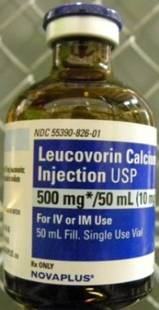
Three lots of leucovorin calcium injection manufactured by Bedford Laboratories have been recalled because of crystalline particulate matter that is visible in some vials, the Food and Drug Administration announced on July 6.
The nationwide recall applies to lots that were shipped between January and June 2011, and expire in 2013. The particulate matter identified is the active drug substance, according to the FDA and a statement by the company, a division of Ben Venue Laboratories in Bedford, Ohio.
Courtesy of FDA
Leucovorin vials with the lot numbers 2017620, 2038374, and 2038374A are being recalled.
To date, no foreign matter has been identified, both said, and no adverse reactions have been reported in association with any of the recalled lots.
Particulate matter is considered a potential health hazard in that it can case vein irritation and phlebitis, clinically occult pulmonary granulomas, local tissue infarction, severe pulmonary dysfunction, occlusion of capillaries and arteries, anaphylactic shock, and death, according to the FDA and Bedford.
Leucovorin is widely used in oncology, with indications for rescue after high-dose methotrexate administration in osteosarcoma as well as to counteract methotrexate toxicity, impaired methotrexate elimination, and inadvertent overdoses of folic acid antagonists. It is also indicated in the treatment of megaloblastic anemias caused by folic acid deficiency, when oral therapy is not feasible; and in combination with 5-fluorouracil in patients with advanced colorectal cancer.
Leucovorin is one of the generic cancer drugs in short supply, according to an FDA listing of current drug shortages. Bedford Laboratories cited "manufacturing delays" for the limited availability of its leucovorin products in an entry last updated April 10, 2012.
Lot numbers of the recalled products are: 2017620, 2038374, and 2038374A. Health care practitioners are advised to quarantine recalled vials for return to the company.
Adverse reactions associated with the recalled leucovorin lots should be reported to the manufacturer at 800-521-5169 or the FDA at 800-332-1088 or www.fda.gov/medwatch.
Three lots of leucovorin calcium injection manufactured by Bedford Laboratories have been recalled because of crystalline particulate matter that is visible in some vials, the Food and Drug Administration announced on July 6.
The nationwide recall applies to lots that were shipped between January and June 2011, and expire in 2013. The particulate matter identified is the active drug substance, according to the FDA and a statement by the company, a division of Ben Venue Laboratories in Bedford, Ohio.
Courtesy of FDA
Leucovorin vials with the lot numbers 2017620, 2038374, and 2038374A are being recalled.
To date, no foreign matter has been identified, both said, and no adverse reactions have been reported in association with any of the recalled lots.
Particulate matter is considered a potential health hazard in that it can case vein irritation and phlebitis, clinically occult pulmonary granulomas, local tissue infarction, severe pulmonary dysfunction, occlusion of capillaries and arteries, anaphylactic shock, and death, according to the FDA and Bedford.
Leucovorin is widely used in oncology, with indications for rescue after high-dose methotrexate administration in osteosarcoma as well as to counteract methotrexate toxicity, impaired methotrexate elimination, and inadvertent overdoses of folic acid antagonists. It is also indicated in the treatment of megaloblastic anemias caused by folic acid deficiency, when oral therapy is not feasible; and in combination with 5-fluorouracil in patients with advanced colorectal cancer.
Leucovorin is one of the generic cancer drugs in short supply, according to an FDA listing of current drug shortages. Bedford Laboratories cited "manufacturing delays" for the limited availability of its leucovorin products in an entry last updated April 10, 2012.
Lot numbers of the recalled products are: 2017620, 2038374, and 2038374A. Health care practitioners are advised to quarantine recalled vials for return to the company.
Adverse reactions associated with the recalled leucovorin lots should be reported to the manufacturer at 800-521-5169 or the FDA at 800-332-1088 or www.fda.gov/medwatch.
Three lots of leucovorin calcium injection manufactured by Bedford Laboratories have been recalled because of crystalline particulate matter that is visible in some vials, the Food and Drug Administration announced on July 6.
The nationwide recall applies to lots that were shipped between January and June 2011, and expire in 2013. The particulate matter identified is the active drug substance, according to the FDA and a statement by the company, a division of Ben Venue Laboratories in Bedford, Ohio.
Courtesy of FDA
Leucovorin vials with the lot numbers 2017620, 2038374, and 2038374A are being recalled.
To date, no foreign matter has been identified, both said, and no adverse reactions have been reported in association with any of the recalled lots.
Particulate matter is considered a potential health hazard in that it can case vein irritation and phlebitis, clinically occult pulmonary granulomas, local tissue infarction, severe pulmonary dysfunction, occlusion of capillaries and arteries, anaphylactic shock, and death, according to the FDA and Bedford.
Leucovorin is widely used in oncology, with indications for rescue after high-dose methotrexate administration in osteosarcoma as well as to counteract methotrexate toxicity, impaired methotrexate elimination, and inadvertent overdoses of folic acid antagonists. It is also indicated in the treatment of megaloblastic anemias caused by folic acid deficiency, when oral therapy is not feasible; and in combination with 5-fluorouracil in patients with advanced colorectal cancer.
Leucovorin is one of the generic cancer drugs in short supply, according to an FDA listing of current drug shortages. Bedford Laboratories cited "manufacturing delays" for the limited availability of its leucovorin products in an entry last updated April 10, 2012.
Lot numbers of the recalled products are: 2017620, 2038374, and 2038374A. Health care practitioners are advised to quarantine recalled vials for return to the company.
Adverse reactions associated with the recalled leucovorin lots should be reported to the manufacturer at 800-521-5169 or the FDA at 800-332-1088 or www.fda.gov/medwatch.
CHICAGO – Wearing a scalp-cooling cap can reduce hair loss in women receiving chemotherapy for breast cancer, the results of a small prospective cohort study suggest.
Among women who used the cooling headgear starting 20 minutes before chemotherapy and continuing for 60-90 minutes after the infusion, 24% did not wear a wig or headband upon completion of chemotherapy, compared with 4% of a control group that did not have access to the device, investigators reported.
Courtesy Dr. Julie Lemieux
Nurse models Penguin Cold Cap, a scalp-cooling system worn to reduce chemotherapy-induced alopecia.
Further, patient satisfaction scores were higher than these numbers in a blinded assessment, according to Dr. Julie Lemieux of Laval University in Quebec City and her coinvestigators.
To grade the results with and without the cooling device, a hairdresser looked at before and after photos of women in the study, and was not told which women were in the scalp-cooling group. The criteria for successful hair preservation was characterization of hair loss as "not at all," "a little," or "moderate" from the beginning to the end of chemotherapy. The procedure was deemed a failure if the reviewer rated hair loss as "a lot," or "all," or "hair shaved."
The hairdresser graded the hair loss intervention as successful in 34% of the scalp-cooling group – as did 49% of the women who wore the caps. Only 9% of the control group received a successful grade from the hairdresser; even fewer, 4%, agreed they had not had substantial hair loss.
In all, 69% of women who tried scalp cooling said the advantages outweighed the disadvantages, and 78% said they would recommend it to other women receiving the same chemotherapy for breast cancer.
"When you look at patient evaluations, they are ... more optimistic than the hairdresser evaluations. They were more satisfied," Dr. Lemieux said in a poster-side interview at the annual meeting of the American Society of Clinical Oncology, where she displayed the results.
Dr. Julie Lemieux
Scalp-cooling systems are approved for the reduction of alopecia in Canada, she said, but controversy persists among oncologists over safety and impact, if any, on the effectiveness of chemotherapy.
"If you cool the scalp there is vasoconstriction, so there is less blood that goes in the scalp ... that is the main mechanism," Dr. Lemieux explained. One concern is that scalp metastases could increase; another is that patients might receive less chemotherapy as a result.
Dr. Lemieux and her colleagues reviewed seven randomized trials of hair-cooling studies and found no safety signals. In all, 260 women were enrolled, and the studies covered a variety of chemotherapy regimens, including at least one that is not known to cause alopecia.
They also did a retrospective cohort study, and found that the incidence of scalp metastases was about 1% whether women used scalp cooling or not (Breast Cancer Res. Treat. 2009;118:547-52). Subsequently, they reported on two cases where the scalp was the first metastatic site, with metastases occurring 7 and 9 years after cooling (Breast Cancer Res. Treat. 2011;128:563-6).
At the San Antonio Breast Cancer Symposium, Dr. Lemieux and her associates reported on a retrospective study that found no difference in survival between patients who used scalp cooling and those who did not.
For the current study, the researchers compared outcomes in 110 patients at Centre des Maladies du Sein Deschênes-Fabia in Quebec City, which uses scalp cooling routinely, with those in 26 patients at the Centre Hospitalier Universitaire de Montréal, where scalp cooling is not available. The median patient age was in the early 50s, and most of the women had stage I or II, hormone receptor–positive breast cancer. A variety of neoadjuvant and adjuvant regimens were used.
The system tested in the study used a cap that is placed in a freezer and changed every 20-30 minutes, starting 20 minutes before chemotherapy and continuing for 60-90 minutes afterward. A new generation of scalp-cooling systems uses a compressor that circulates cold fluid in the cap, and it does not have to be changed.
Dr. Lemieux said the researchers conceived the study as a pilot for a larger randomized controlled trial that will address efficacy, cost, and quality of life issues. They are seeking to raise funds, as the companies that make the systems are too small to sponsor a large trial.
Cost is a concern, she noted, because of the additional time the women spend in the infusion room. "So you have to have that time available in the chemotherapy room," she said. "We also want to look at the cost of the system, of the extra time that women are in hospital, and at quality of life, too."
The trial was funded by the Fondations des Hôpitaux Enfant-Jésus et Saint-Sacrement, the Canadian Breast Cancer Research Alliance, and Sanofi-Aventis. Dr. Lemieux received a research grant from the Fonds de la Recherche en Santé du Québec.
CHICAGO – Wearing a scalp-cooling cap can reduce hair loss in women receiving chemotherapy for breast cancer, the results of a small prospective cohort study suggest.
Among women who used the cooling headgear starting 20 minutes before chemotherapy and continuing for 60-90 minutes after the infusion, 24% did not wear a wig or headband upon completion of chemotherapy, compared with 4% of a control group that did not have access to the device, investigators reported.
Courtesy Dr. Julie Lemieux
Nurse models Penguin Cold Cap, a scalp-cooling system worn to reduce chemotherapy-induced alopecia.
Further, patient satisfaction scores were higher than these numbers in a blinded assessment, according to Dr. Julie Lemieux of Laval University in Quebec City and her coinvestigators.
To grade the results with and without the cooling device, a hairdresser looked at before and after photos of women in the study, and was not told which women were in the scalp-cooling group. The criteria for successful hair preservation was characterization of hair loss as "not at all," "a little," or "moderate" from the beginning to the end of chemotherapy. The procedure was deemed a failure if the reviewer rated hair loss as "a lot," or "all," or "hair shaved."
The hairdresser graded the hair loss intervention as successful in 34% of the scalp-cooling group – as did 49% of the women who wore the caps. Only 9% of the control group received a successful grade from the hairdresser; even fewer, 4%, agreed they had not had substantial hair loss.
In all, 69% of women who tried scalp cooling said the advantages outweighed the disadvantages, and 78% said they would recommend it to other women receiving the same chemotherapy for breast cancer.
"When you look at patient evaluations, they are ... more optimistic than the hairdresser evaluations. They were more satisfied," Dr. Lemieux said in a poster-side interview at the annual meeting of the American Society of Clinical Oncology, where she displayed the results.
Dr. Julie Lemieux
Scalp-cooling systems are approved for the reduction of alopecia in Canada, she said, but controversy persists among oncologists over safety and impact, if any, on the effectiveness of chemotherapy.
"If you cool the scalp there is vasoconstriction, so there is less blood that goes in the scalp ... that is the main mechanism," Dr. Lemieux explained. One concern is that scalp metastases could increase; another is that patients might receive less chemotherapy as a result.
Dr. Lemieux and her colleagues reviewed seven randomized trials of hair-cooling studies and found no safety signals. In all, 260 women were enrolled, and the studies covered a variety of chemotherapy regimens, including at least one that is not known to cause alopecia.
They also did a retrospective cohort study, and found that the incidence of scalp metastases was about 1% whether women used scalp cooling or not (Breast Cancer Res. Treat. 2009;118:547-52). Subsequently, they reported on two cases where the scalp was the first metastatic site, with metastases occurring 7 and 9 years after cooling (Breast Cancer Res. Treat. 2011;128:563-6).
At the San Antonio Breast Cancer Symposium, Dr. Lemieux and her associates reported on a retrospective study that found no difference in survival between patients who used scalp cooling and those who did not.
For the current study, the researchers compared outcomes in 110 patients at Centre des Maladies du Sein Deschênes-Fabia in Quebec City, which uses scalp cooling routinely, with those in 26 patients at the Centre Hospitalier Universitaire de Montréal, where scalp cooling is not available. The median patient age was in the early 50s, and most of the women had stage I or II, hormone receptor–positive breast cancer. A variety of neoadjuvant and adjuvant regimens were used.
The system tested in the study used a cap that is placed in a freezer and changed every 20-30 minutes, starting 20 minutes before chemotherapy and continuing for 60-90 minutes afterward. A new generation of scalp-cooling systems uses a compressor that circulates cold fluid in the cap, and it does not have to be changed.
Dr. Lemieux said the researchers conceived the study as a pilot for a larger randomized controlled trial that will address efficacy, cost, and quality of life issues. They are seeking to raise funds, as the companies that make the systems are too small to sponsor a large trial.
Cost is a concern, she noted, because of the additional time the women spend in the infusion room. "So you have to have that time available in the chemotherapy room," she said. "We also want to look at the cost of the system, of the extra time that women are in hospital, and at quality of life, too."
The trial was funded by the Fondations des Hôpitaux Enfant-Jésus et Saint-Sacrement, the Canadian Breast Cancer Research Alliance, and Sanofi-Aventis. Dr. Lemieux received a research grant from the Fonds de la Recherche en Santé du Québec.
CHICAGO – Wearing a scalp-cooling cap can reduce hair loss in women receiving chemotherapy for breast cancer, the results of a small prospective cohort study suggest.
Among women who used the cooling headgear starting 20 minutes before chemotherapy and continuing for 60-90 minutes after the infusion, 24% did not wear a wig or headband upon completion of chemotherapy, compared with 4% of a control group that did not have access to the device, investigators reported.
Courtesy Dr. Julie Lemieux
Nurse models Penguin Cold Cap, a scalp-cooling system worn to reduce chemotherapy-induced alopecia.
Further, patient satisfaction scores were higher than these numbers in a blinded assessment, according to Dr. Julie Lemieux of Laval University in Quebec City and her coinvestigators.
To grade the results with and without the cooling device, a hairdresser looked at before and after photos of women in the study, and was not told which women were in the scalp-cooling group. The criteria for successful hair preservation was characterization of hair loss as "not at all," "a little," or "moderate" from the beginning to the end of chemotherapy. The procedure was deemed a failure if the reviewer rated hair loss as "a lot," or "all," or "hair shaved."
The hairdresser graded the hair loss intervention as successful in 34% of the scalp-cooling group – as did 49% of the women who wore the caps. Only 9% of the control group received a successful grade from the hairdresser; even fewer, 4%, agreed they had not had substantial hair loss.
In all, 69% of women who tried scalp cooling said the advantages outweighed the disadvantages, and 78% said they would recommend it to other women receiving the same chemotherapy for breast cancer.
"When you look at patient evaluations, they are ... more optimistic than the hairdresser evaluations. They were more satisfied," Dr. Lemieux said in a poster-side interview at the annual meeting of the American Society of Clinical Oncology, where she displayed the results.
Dr. Julie Lemieux
Scalp-cooling systems are approved for the reduction of alopecia in Canada, she said, but controversy persists among oncologists over safety and impact, if any, on the effectiveness of chemotherapy.
"If you cool the scalp there is vasoconstriction, so there is less blood that goes in the scalp ... that is the main mechanism," Dr. Lemieux explained. One concern is that scalp metastases could increase; another is that patients might receive less chemotherapy as a result.
Dr. Lemieux and her colleagues reviewed seven randomized trials of hair-cooling studies and found no safety signals. In all, 260 women were enrolled, and the studies covered a variety of chemotherapy regimens, including at least one that is not known to cause alopecia.
They also did a retrospective cohort study, and found that the incidence of scalp metastases was about 1% whether women used scalp cooling or not (Breast Cancer Res. Treat. 2009;118:547-52). Subsequently, they reported on two cases where the scalp was the first metastatic site, with metastases occurring 7 and 9 years after cooling (Breast Cancer Res. Treat. 2011;128:563-6).
At the San Antonio Breast Cancer Symposium, Dr. Lemieux and her associates reported on a retrospective study that found no difference in survival between patients who used scalp cooling and those who did not.
For the current study, the researchers compared outcomes in 110 patients at Centre des Maladies du Sein Deschênes-Fabia in Quebec City, which uses scalp cooling routinely, with those in 26 patients at the Centre Hospitalier Universitaire de Montréal, where scalp cooling is not available. The median patient age was in the early 50s, and most of the women had stage I or II, hormone receptor–positive breast cancer. A variety of neoadjuvant and adjuvant regimens were used.
The system tested in the study used a cap that is placed in a freezer and changed every 20-30 minutes, starting 20 minutes before chemotherapy and continuing for 60-90 minutes afterward. A new generation of scalp-cooling systems uses a compressor that circulates cold fluid in the cap, and it does not have to be changed.
Dr. Lemieux said the researchers conceived the study as a pilot for a larger randomized controlled trial that will address efficacy, cost, and quality of life issues. They are seeking to raise funds, as the companies that make the systems are too small to sponsor a large trial.
Cost is a concern, she noted, because of the additional time the women spend in the infusion room. "So you have to have that time available in the chemotherapy room," she said. "We also want to look at the cost of the system, of the extra time that women are in hospital, and at quality of life, too."
The trial was funded by the Fondations des Hôpitaux Enfant-Jésus et Saint-Sacrement, the Canadian Breast Cancer Research Alliance, and Sanofi-Aventis. Dr. Lemieux received a research grant from the Fonds de la Recherche en Santé du Québec.
As a community oncologist, I fully embrace the opportunity to cure cancer, but I find the greatest services I provide are to palliate and enhance survivorship. We live in a tremendously fortunate time of scientific discovery. The weapons we have in our armamentarium of cancer killers grow in magnitude and specificity daily. Learning then to continue to balance each patient’s battle with their quality of life is practicing the art of medicine. Although most patients hope that their cancer will be cured, the daily reality of a community oncologist lies in the subtle art of helping patients to manage life with cancer and to strike the right balance between cancer control and quality of life. This management challenge really lies in the individual variability of each patient and in being able to choose the agent that fits the patient, not just the disease.
*For a PDF of the full article, click on the link to the left of this introduction.
As a community oncologist, I fully embrace the opportunity to cure cancer, but I find the greatest services I provide are to palliate and enhance survivorship. We live in a tremendously fortunate time of scientific discovery. The weapons we have in our armamentarium of cancer killers grow in magnitude and specificity daily. Learning then to continue to balance each patient’s battle with their quality of life is practicing the art of medicine. Although most patients hope that their cancer will be cured, the daily reality of a community oncologist lies in the subtle art of helping patients to manage life with cancer and to strike the right balance between cancer control and quality of life. This management challenge really lies in the individual variability of each patient and in being able to choose the agent that fits the patient, not just the disease.
*For a PDF of the full article, click on the link to the left of this introduction.
As a community oncologist, I fully embrace the opportunity to cure cancer, but I find the greatest services I provide are to palliate and enhance survivorship. We live in a tremendously fortunate time of scientific discovery. The weapons we have in our armamentarium of cancer killers grow in magnitude and specificity daily. Learning then to continue to balance each patient’s battle with their quality of life is practicing the art of medicine. Although most patients hope that their cancer will be cured, the daily reality of a community oncologist lies in the subtle art of helping patients to manage life with cancer and to strike the right balance between cancer control and quality of life. This management challenge really lies in the individual variability of each patient and in being able to choose the agent that fits the patient, not just the disease.
*For a PDF of the full article, click on the link to the left of this introduction.
Background The prevalence of concomitant depression among cancer survivors is not well established, although half of those diagnosed with cancer are reported to experience depression at some stage during the cancer experience.
Objectives To establish rates of diagnosed depression in a cohort of nonelderly adult cancer survivors by cancer site, to characterize those with diagnosed depression, and to assess the impact of diagnosed depression on patterns of health care utilization and costs.
Methods Medical and pharmacy claims data on military health care beneficiaries were used to develop a cohort of survivors across all cancer sites. Selected cases were diagnosed with and treated for cancer in fiscal years 2006-2007, and had at least 1 health care claim each subsequent year through fiscal year 2010 to ensure survival of at least 2 years. All cancer sites were included except those for nonmelanoma skin cancer. Fiscal year 2009 was used as the index year for determining annual health care utilization and costs. Bivariate and regression analyses were used.
Results Across the cohort of 11,014 cancer survivors, 12.6% had a comorbid diagnosis of depression at the time of or after a cancer diagnosis. The highest rates of diagnosed depression occurred in those with cancers of the esophagus, pancreas, ovary, or bronchus, lung, or other respiratory organ; and were associated with female sex, single marital status, and enlisted sponsor rank. Survivors who were diagnosed with depression had significantly higher health care utilization for inpatient and outpatient services, more medication prescriptions, and higher annual costs.
Limitations Due to the nature of claims data, we were unable to ascertain cancer stage or phase of illness. In this analysis, we did not include the presence of comorbidities, history of preexisting depression, or health system factors, all of which may impact the rate of depression among cancer survivors.
Conclusions The findings suggest the importance for the Military Health System, as well as other health care systems, to address the mental health needs of cancer survivors and the fiscal efficiencies of cancer care.
*For a PDF of the full article, click on the link to the left of this introduction.
Background The prevalence of concomitant depression among cancer survivors is not well established, although half of those diagnosed with cancer are reported to experience depression at some stage during the cancer experience.
Objectives To establish rates of diagnosed depression in a cohort of nonelderly adult cancer survivors by cancer site, to characterize those with diagnosed depression, and to assess the impact of diagnosed depression on patterns of health care utilization and costs.
Methods Medical and pharmacy claims data on military health care beneficiaries were used to develop a cohort of survivors across all cancer sites. Selected cases were diagnosed with and treated for cancer in fiscal years 2006-2007, and had at least 1 health care claim each subsequent year through fiscal year 2010 to ensure survival of at least 2 years. All cancer sites were included except those for nonmelanoma skin cancer. Fiscal year 2009 was used as the index year for determining annual health care utilization and costs. Bivariate and regression analyses were used.
Results Across the cohort of 11,014 cancer survivors, 12.6% had a comorbid diagnosis of depression at the time of or after a cancer diagnosis. The highest rates of diagnosed depression occurred in those with cancers of the esophagus, pancreas, ovary, or bronchus, lung, or other respiratory organ; and were associated with female sex, single marital status, and enlisted sponsor rank. Survivors who were diagnosed with depression had significantly higher health care utilization for inpatient and outpatient services, more medication prescriptions, and higher annual costs.
Limitations Due to the nature of claims data, we were unable to ascertain cancer stage or phase of illness. In this analysis, we did not include the presence of comorbidities, history of preexisting depression, or health system factors, all of which may impact the rate of depression among cancer survivors.
Conclusions The findings suggest the importance for the Military Health System, as well as other health care systems, to address the mental health needs of cancer survivors and the fiscal efficiencies of cancer care.
*For a PDF of the full article, click on the link to the left of this introduction.
Background The prevalence of concomitant depression among cancer survivors is not well established, although half of those diagnosed with cancer are reported to experience depression at some stage during the cancer experience.
Objectives To establish rates of diagnosed depression in a cohort of nonelderly adult cancer survivors by cancer site, to characterize those with diagnosed depression, and to assess the impact of diagnosed depression on patterns of health care utilization and costs.
Methods Medical and pharmacy claims data on military health care beneficiaries were used to develop a cohort of survivors across all cancer sites. Selected cases were diagnosed with and treated for cancer in fiscal years 2006-2007, and had at least 1 health care claim each subsequent year through fiscal year 2010 to ensure survival of at least 2 years. All cancer sites were included except those for nonmelanoma skin cancer. Fiscal year 2009 was used as the index year for determining annual health care utilization and costs. Bivariate and regression analyses were used.
Results Across the cohort of 11,014 cancer survivors, 12.6% had a comorbid diagnosis of depression at the time of or after a cancer diagnosis. The highest rates of diagnosed depression occurred in those with cancers of the esophagus, pancreas, ovary, or bronchus, lung, or other respiratory organ; and were associated with female sex, single marital status, and enlisted sponsor rank. Survivors who were diagnosed with depression had significantly higher health care utilization for inpatient and outpatient services, more medication prescriptions, and higher annual costs.
Limitations Due to the nature of claims data, we were unable to ascertain cancer stage or phase of illness. In this analysis, we did not include the presence of comorbidities, history of preexisting depression, or health system factors, all of which may impact the rate of depression among cancer survivors.
Conclusions The findings suggest the importance for the Military Health System, as well as other health care systems, to address the mental health needs of cancer survivors and the fiscal efficiencies of cancer care.
*For a PDF of the full article, click on the link to the left of this introduction.
Perceived Levels of Pain Associated with Bone Marrow Aspirates and Biopsies
Original research
Perceived Levels of Pain Associated with Bone Marrow Aspirates and Biopsies
Giampaolo Talamo, MD; Jason Liao, PhD; Jamal Joudeh, MD; Nicholas E. Lamparella, DO; Hoang Dinh, PA; Jozef Malysz, MD; W. Christopher Ehmann, MD
Abstract
Background
Little is known about the degree of pain experienced by patients undergoing a bone marrow aspiration and biopsy (BMAB).
Objective
To evaluate the effectiveness of several strategies aimed at reducing the pain score.
Methods
We conducted a retrospective analysis of 258 consecutive adult patients who underwent BMAB via 6 different approaches, the first 5 of which were performed by one physician. Group A received local anesthesia with 1% lidocaine hydrochloride (5 mL) and a 5-minute wait time before the procedure; group B received local anesthesia with a double dose (10 mL) of lidocaine; group C received 5 mL of local anesthesia with a 10-minute wait; group D received 5 mL of local anesthesia plus a topical spray with ethyl chloride; group E received oral analgesia and anxiolysis 30 minutes before the procedure in addition to the group A dosage of lidocaine; and group F received the same anesthesia as did group A, but the BMAD was performed by a less experienced practitioner.
Results
On a 0 to 10 scale, the mean pain level among the 258 patients was 3.2 (standard deviation = 2.6). Rate of complications was low (<1%). Several strategies failed to improve the pain level, including the administration of a double dose of local anesthesia, waiting longer for the anesthesia effect, and the additional use of a topical anesthetic spray or oral analgesia and anxiolysis. Pain levels were not increased when the procedure was done by a less experienced practitioner. Younger age and female gender were associated with higher pain levels.
Conclusions
Given that the average level of perceived pain during BMAB is low to moderate (approximately 3 on a 0-10 scale), the routine use of conscious sedation for this procedure may not be indicated. Several strategies aimed at reducing the pain level, including doubling the dose of anesthesia and using an oral prophylactic regimen of analgesia and anxiolysis, failed to improve pain scores.
*For a PDF of the full article click in the link to the left of this introduction.
Perceived Levels of Pain Associated with Bone Marrow Aspirates and Biopsies
Giampaolo Talamo, MD; Jason Liao, PhD; Jamal Joudeh, MD; Nicholas E. Lamparella, DO; Hoang Dinh, PA; Jozef Malysz, MD; W. Christopher Ehmann, MD
Abstract
Background
Little is known about the degree of pain experienced by patients undergoing a bone marrow aspiration and biopsy (BMAB).
Objective
To evaluate the effectiveness of several strategies aimed at reducing the pain score.
Methods
We conducted a retrospective analysis of 258 consecutive adult patients who underwent BMAB via 6 different approaches, the first 5 of which were performed by one physician. Group A received local anesthesia with 1% lidocaine hydrochloride (5 mL) and a 5-minute wait time before the procedure; group B received local anesthesia with a double dose (10 mL) of lidocaine; group C received 5 mL of local anesthesia with a 10-minute wait; group D received 5 mL of local anesthesia plus a topical spray with ethyl chloride; group E received oral analgesia and anxiolysis 30 minutes before the procedure in addition to the group A dosage of lidocaine; and group F received the same anesthesia as did group A, but the BMAD was performed by a less experienced practitioner.
Results
On a 0 to 10 scale, the mean pain level among the 258 patients was 3.2 (standard deviation = 2.6). Rate of complications was low (<1%). Several strategies failed to improve the pain level, including the administration of a double dose of local anesthesia, waiting longer for the anesthesia effect, and the additional use of a topical anesthetic spray or oral analgesia and anxiolysis. Pain levels were not increased when the procedure was done by a less experienced practitioner. Younger age and female gender were associated with higher pain levels.
Conclusions
Given that the average level of perceived pain during BMAB is low to moderate (approximately 3 on a 0-10 scale), the routine use of conscious sedation for this procedure may not be indicated. Several strategies aimed at reducing the pain level, including doubling the dose of anesthesia and using an oral prophylactic regimen of analgesia and anxiolysis, failed to improve pain scores.
*For a PDF of the full article click in the link to the left of this introduction.
Original research
Perceived Levels of Pain Associated with Bone Marrow Aspirates and Biopsies
Giampaolo Talamo, MD; Jason Liao, PhD; Jamal Joudeh, MD; Nicholas E. Lamparella, DO; Hoang Dinh, PA; Jozef Malysz, MD; W. Christopher Ehmann, MD
Abstract
Background
Little is known about the degree of pain experienced by patients undergoing a bone marrow aspiration and biopsy (BMAB).
Objective
To evaluate the effectiveness of several strategies aimed at reducing the pain score.
Methods
We conducted a retrospective analysis of 258 consecutive adult patients who underwent BMAB via 6 different approaches, the first 5 of which were performed by one physician. Group A received local anesthesia with 1% lidocaine hydrochloride (5 mL) and a 5-minute wait time before the procedure; group B received local anesthesia with a double dose (10 mL) of lidocaine; group C received 5 mL of local anesthesia with a 10-minute wait; group D received 5 mL of local anesthesia plus a topical spray with ethyl chloride; group E received oral analgesia and anxiolysis 30 minutes before the procedure in addition to the group A dosage of lidocaine; and group F received the same anesthesia as did group A, but the BMAD was performed by a less experienced practitioner.
Results
On a 0 to 10 scale, the mean pain level among the 258 patients was 3.2 (standard deviation = 2.6). Rate of complications was low (<1%). Several strategies failed to improve the pain level, including the administration of a double dose of local anesthesia, waiting longer for the anesthesia effect, and the additional use of a topical anesthetic spray or oral analgesia and anxiolysis. Pain levels were not increased when the procedure was done by a less experienced practitioner. Younger age and female gender were associated with higher pain levels.
Conclusions
Given that the average level of perceived pain during BMAB is low to moderate (approximately 3 on a 0-10 scale), the routine use of conscious sedation for this procedure may not be indicated. Several strategies aimed at reducing the pain level, including doubling the dose of anesthesia and using an oral prophylactic regimen of analgesia and anxiolysis, failed to improve pain scores.
*For a PDF of the full article click in the link to the left of this introduction.
Physicians' Undecided Attitudes Toward Posthumous Reproduction: Fertility Preservation in Cancer Patients with a Poor Prognosis
Original research
Physicians' Undecided Attitudes Toward Posthumous Reproduction: Fertility Preservation in Cancer Patients with a Poor Prognosis
Gwendolyn P. Quinn, PhD; Caprice A. Knapp, PhD; Teri L. Malo, PhD; Jessica McIntyre, BA; Paul B. Jacobsen, PhD; Susan T. Vadaparampil, PhD
Abstract
Background
The American Society for Clinical Oncology (ASCO) established guidelines for fertility preservation for cancer patients. In a national study of US oncologists, we examined attitudes toward the use of fertility preservation among patients with a poor prognosis, focusing on attitudes toward posthumous reproduction.
Method
A cross-sectional survey was administered via mail and Internet to a stratified random sample of US oncologists. The survey measured demographics, knowledge, attitude, and practice behaviors regarding posthumous reproduction and fertility preservation with cancer patients of childbearing age.
Results
Only 16.2% supported posthumous parenting, whereas the majority (51.5%) did not have an opinion. Analysis of variance indicated that attitudes toward posthumous reproduction were significantly related to physician practice behaviors and were dependent on oncologists' knowledge of ASCO guidelines.
Conclusions
Physician attitudes may conflict with the recommended guidelines and may reduce the likelihood that some patients will receive information about fertility preservation. Further education may raise physicians' awareness of poor-prognostic patients' interest in pursuing this technology.
*For a PDF of the full article click in the link to the left of this introduction.
Physicians' Undecided Attitudes Toward Posthumous Reproduction: Fertility Preservation in Cancer Patients with a Poor Prognosis
Gwendolyn P. Quinn, PhD; Caprice A. Knapp, PhD; Teri L. Malo, PhD; Jessica McIntyre, BA; Paul B. Jacobsen, PhD; Susan T. Vadaparampil, PhD
Abstract
Background
The American Society for Clinical Oncology (ASCO) established guidelines for fertility preservation for cancer patients. In a national study of US oncologists, we examined attitudes toward the use of fertility preservation among patients with a poor prognosis, focusing on attitudes toward posthumous reproduction.
Method
A cross-sectional survey was administered via mail and Internet to a stratified random sample of US oncologists. The survey measured demographics, knowledge, attitude, and practice behaviors regarding posthumous reproduction and fertility preservation with cancer patients of childbearing age.
Results
Only 16.2% supported posthumous parenting, whereas the majority (51.5%) did not have an opinion. Analysis of variance indicated that attitudes toward posthumous reproduction were significantly related to physician practice behaviors and were dependent on oncologists' knowledge of ASCO guidelines.
Conclusions
Physician attitudes may conflict with the recommended guidelines and may reduce the likelihood that some patients will receive information about fertility preservation. Further education may raise physicians' awareness of poor-prognostic patients' interest in pursuing this technology.
*For a PDF of the full article click in the link to the left of this introduction.
Original research
Physicians' Undecided Attitudes Toward Posthumous Reproduction: Fertility Preservation in Cancer Patients with a Poor Prognosis
Gwendolyn P. Quinn, PhD; Caprice A. Knapp, PhD; Teri L. Malo, PhD; Jessica McIntyre, BA; Paul B. Jacobsen, PhD; Susan T. Vadaparampil, PhD
Abstract
Background
The American Society for Clinical Oncology (ASCO) established guidelines for fertility preservation for cancer patients. In a national study of US oncologists, we examined attitudes toward the use of fertility preservation among patients with a poor prognosis, focusing on attitudes toward posthumous reproduction.
Method
A cross-sectional survey was administered via mail and Internet to a stratified random sample of US oncologists. The survey measured demographics, knowledge, attitude, and practice behaviors regarding posthumous reproduction and fertility preservation with cancer patients of childbearing age.
Results
Only 16.2% supported posthumous parenting, whereas the majority (51.5%) did not have an opinion. Analysis of variance indicated that attitudes toward posthumous reproduction were significantly related to physician practice behaviors and were dependent on oncologists' knowledge of ASCO guidelines.
Conclusions
Physician attitudes may conflict with the recommended guidelines and may reduce the likelihood that some patients will receive information about fertility preservation. Further education may raise physicians' awareness of poor-prognostic patients' interest in pursuing this technology.
*For a PDF of the full article click in the link to the left of this introduction.
Background Chemotherapy-induced nausea and vomiting (CINV) remain among the most frequently reported distressing side effects associated with anthracycline-based chemotherapy despite significant advances in antiemetic management. The main risk factor for severity of CINV is the emetogenic potential of the chemotherapeutic agents. However, patient-related risk factors have been identified, including genetic makeup. Although studies have noted that ethnicity influences nausea and vomiting in other contexts, there is a paucity of research regarding the impact of ethnicity on CINV. This study was undertaken to evaluate whether Asian women receiving anthracycline-based chemotherapy experience more CINV than non-Asians.
Methods A retrospective, comparative, correlational chart review was performed to abstract the relevant variables.
Results Data from a convenience sample of 358 women with breast cancer who received chemotherapy with doxorubicin between 2004 and 2008 at City of Hope in Duarte, California, were evaluated. The sample consisted of Caucasians (45%), Hispanics (27.7%), Asians (19.8%), and African Americans (7.5%). The results indicate that Asian women with breast cancer undergoing anthracycline-based chemotherapy experienced statistically significantly more clinically important CINV than their non-Asian counterparts.
Limitations The data were collected retrospectively, with a certain population distribution at a specific time.
Conclusion This study provides interesting preliminary evidence that Asian ethnicity plays a role in the development of severe CINV. When managing chemotherapy toxicities in women with breast cancer, health-care providers should tailor therapy to individual risk profiles. Specifically, consideration of antiemetic therapy should accommodate patient characteristics, such as Asian descent.
Click on the PDF icon at the top of this introduction to read the full article.
Background Chemotherapy-induced nausea and vomiting (CINV) remain among the most frequently reported distressing side effects associated with anthracycline-based chemotherapy despite significant advances in antiemetic management. The main risk factor for severity of CINV is the emetogenic potential of the chemotherapeutic agents. However, patient-related risk factors have been identified, including genetic makeup. Although studies have noted that ethnicity influences nausea and vomiting in other contexts, there is a paucity of research regarding the impact of ethnicity on CINV. This study was undertaken to evaluate whether Asian women receiving anthracycline-based chemotherapy experience more CINV than non-Asians.
Methods A retrospective, comparative, correlational chart review was performed to abstract the relevant variables.
Results Data from a convenience sample of 358 women with breast cancer who received chemotherapy with doxorubicin between 2004 and 2008 at City of Hope in Duarte, California, were evaluated. The sample consisted of Caucasians (45%), Hispanics (27.7%), Asians (19.8%), and African Americans (7.5%). The results indicate that Asian women with breast cancer undergoing anthracycline-based chemotherapy experienced statistically significantly more clinically important CINV than their non-Asian counterparts.
Limitations The data were collected retrospectively, with a certain population distribution at a specific time.
Conclusion This study provides interesting preliminary evidence that Asian ethnicity plays a role in the development of severe CINV. When managing chemotherapy toxicities in women with breast cancer, health-care providers should tailor therapy to individual risk profiles. Specifically, consideration of antiemetic therapy should accommodate patient characteristics, such as Asian descent.
Click on the PDF icon at the top of this introduction to read the full article.
Background Chemotherapy-induced nausea and vomiting (CINV) remain among the most frequently reported distressing side effects associated with anthracycline-based chemotherapy despite significant advances in antiemetic management. The main risk factor for severity of CINV is the emetogenic potential of the chemotherapeutic agents. However, patient-related risk factors have been identified, including genetic makeup. Although studies have noted that ethnicity influences nausea and vomiting in other contexts, there is a paucity of research regarding the impact of ethnicity on CINV. This study was undertaken to evaluate whether Asian women receiving anthracycline-based chemotherapy experience more CINV than non-Asians.
Methods A retrospective, comparative, correlational chart review was performed to abstract the relevant variables.
Results Data from a convenience sample of 358 women with breast cancer who received chemotherapy with doxorubicin between 2004 and 2008 at City of Hope in Duarte, California, were evaluated. The sample consisted of Caucasians (45%), Hispanics (27.7%), Asians (19.8%), and African Americans (7.5%). The results indicate that Asian women with breast cancer undergoing anthracycline-based chemotherapy experienced statistically significantly more clinically important CINV than their non-Asian counterparts.
Limitations The data were collected retrospectively, with a certain population distribution at a specific time.
Conclusion This study provides interesting preliminary evidence that Asian ethnicity plays a role in the development of severe CINV. When managing chemotherapy toxicities in women with breast cancer, health-care providers should tailor therapy to individual risk profiles. Specifically, consideration of antiemetic therapy should accommodate patient characteristics, such as Asian descent.
Click on the PDF icon at the top of this introduction to read the full article.