User login
OTC budesonide-formoterol for asthma could save lives, money
, according to a computer modeling study presented at the American Academy of Allergy, Asthma, and Immunology 2023 annual meeting in San Antonio.
Asthma affects 25 million people, about 1 in 13, in the United States. About 28% are uninsured or underinsured, and 70% have mild asthma. Many are using a $30 inhaled epinephrine product (Primatene Mist) – the only FDA-approved asthma inhaler available without a prescription, said Marcus Shaker, MD, MS, professor of pediatrics and medicine at Geisel School of Medicine at Dartmouth, and clinician at Dartmouth Health Children’s, N.H.
A new version of Primatene Mist was reintroduced on the market in 2018 after the product was pulled for containing chlorofluorocarbons in 2011, but it is not recommended by professional medical societies because of safety concerns over epinephrine’s adverse effects, such as increased heart rate and blood pressure.
Drugs in its class (bronchodilators) have long been associated with a higher risk for death or near-death.
Meanwhile, research more than 2 decades ago linked regular use of low-dose inhaled corticosteroids with reduced risk for asthma death.
More recently, two large studies (SYGMA 1 and SYGMA 2) compared maintenance therapy with a low-dose inhaled corticosteroid (budesonide) vs. on-demand treatment with an inhaler containing both a corticosteroid (budesonide) and a long-acting bronchodilator (formoterol).
“Using as-needed budesonide-formoterol led to outcomes that are almost as good as taking a maintenance budesonide dose every day,” said Dr. Shaker.
The Global Initiative for Asthma guidelines now recommend this approach – as-needed inhaled corticosteroids (ICS) plus long-acting bronchodilators – for adults with mild asthma. In the United States, however, the National Heart, Lung, and Blood Institute still suggests daily ICS plus quick-relief therapy as needed.
Dr. Shaker and colleagues used computer modeling to compare the cost-effectiveness of as-needed budesonide-formoterol vs. over-the-counter inhaled epinephrine in underinsured U.S. adults who were self-managing their mild asthma. The study randomly assigned these individuals into three groups: OTC inhaled epinephrine (current reality), OTC budesonide-formoterol (not yet available), or no OTC option. The model assumed that patients treated for an exacerbation were referred to a health care provider and started a regimen of ICS plus as-needed rescue therapy.
In this analysis, which has been submitted for publication, the OTC budesonide-formoterol strategy was associated with 12,495 fewer deaths, prevented nearly 14 million severe asthma exacerbations, and saved more than $68 billion. And “when we looked at OTC budesonide-formoterol vs. having no OTC option at all, budesonide-formoterol was similarly cost-effective,” said Dr. Shaker, who presented the results at an AAAAI oral abstract session.
The cost savings emerged even though in the United States asthma controller therapies (for example, fluticasone) cost about 10 times more than rescue therapies (for instance, salbutamol, OTC epinephrine).
Nevertheless, the results make sense. “If you’re using Primatene Mist, your health costs are predicted to be much greater because you’re going to be in the hospital more. Your asthma is not going to be well-controlled,” Thanai Pongdee, MD, an allergist-immunologist with the Mayo Clinic in Rochester, Minn., told this news organization. “It’s not only the cost of your ER visit but also the cost of loss of work or school, and loss of daily productivity. There are all these associated costs.”
The analysis “is certainly something policy makers could take a look at,” he said.
He noted that current use of budesonide-formoterol is stymied by difficulties with insurance coverage. The difficulties stem from a mismatch between the updated recommendation for as-needed use and the description printed on the brand-name product (Symbicort).
“On the product label, it says Symbicort should be used on a daily basis,” Dr. Pongdee said. “But if a prescription comes through and says you’re going to use this ‘as needed,’ the health plan may say that’s not appropriate because that’s not on the product label.”
Given these access challenges with the all-in-one inhaler, other researchers have developed a workaround – asking patients to continue their usual care (that is, using a rescue inhaler as needed) but to also administer a controller medication after each rescue. When tested in Black and Latino patients with moderate to severe asthma, this easy strategy (patient activated reliever-triggered inhaled corticosteroid, or PARTICS) reduced severe asthma exacerbations about as well as the all-in-one inhaler.
If the all-in-one budesonide-formoterol does become available OTC, Dr. Shaker stressed that it “would not be a substitute for seeing an allergist and getting appropriate medical care and an evaluation and all the rest. But it’s better than the status quo. It’s the sort of thing where the perfect is not the enemy of the good,” he said.
Dr. Shaker is the AAAAI cochair of the Joint Task Force on Practice Parameters and serves as an editorial board member of the Journal of Allergy and Clinical Immunology in Practice. He is also an associate editor of the Annals of Allergy, Asthma, and Immunology. Dr. Pongdee serves as an at-large director on the AAAAI board of directors. He receives grant funding from GlaxoSmithKline, and Mayo Clinic is a trial site for GlaxoSmithKline and AstraZeneca.
A version of this article first appeared on Medscape.com.
, according to a computer modeling study presented at the American Academy of Allergy, Asthma, and Immunology 2023 annual meeting in San Antonio.
Asthma affects 25 million people, about 1 in 13, in the United States. About 28% are uninsured or underinsured, and 70% have mild asthma. Many are using a $30 inhaled epinephrine product (Primatene Mist) – the only FDA-approved asthma inhaler available without a prescription, said Marcus Shaker, MD, MS, professor of pediatrics and medicine at Geisel School of Medicine at Dartmouth, and clinician at Dartmouth Health Children’s, N.H.
A new version of Primatene Mist was reintroduced on the market in 2018 after the product was pulled for containing chlorofluorocarbons in 2011, but it is not recommended by professional medical societies because of safety concerns over epinephrine’s adverse effects, such as increased heart rate and blood pressure.
Drugs in its class (bronchodilators) have long been associated with a higher risk for death or near-death.
Meanwhile, research more than 2 decades ago linked regular use of low-dose inhaled corticosteroids with reduced risk for asthma death.
More recently, two large studies (SYGMA 1 and SYGMA 2) compared maintenance therapy with a low-dose inhaled corticosteroid (budesonide) vs. on-demand treatment with an inhaler containing both a corticosteroid (budesonide) and a long-acting bronchodilator (formoterol).
“Using as-needed budesonide-formoterol led to outcomes that are almost as good as taking a maintenance budesonide dose every day,” said Dr. Shaker.
The Global Initiative for Asthma guidelines now recommend this approach – as-needed inhaled corticosteroids (ICS) plus long-acting bronchodilators – for adults with mild asthma. In the United States, however, the National Heart, Lung, and Blood Institute still suggests daily ICS plus quick-relief therapy as needed.
Dr. Shaker and colleagues used computer modeling to compare the cost-effectiveness of as-needed budesonide-formoterol vs. over-the-counter inhaled epinephrine in underinsured U.S. adults who were self-managing their mild asthma. The study randomly assigned these individuals into three groups: OTC inhaled epinephrine (current reality), OTC budesonide-formoterol (not yet available), or no OTC option. The model assumed that patients treated for an exacerbation were referred to a health care provider and started a regimen of ICS plus as-needed rescue therapy.
In this analysis, which has been submitted for publication, the OTC budesonide-formoterol strategy was associated with 12,495 fewer deaths, prevented nearly 14 million severe asthma exacerbations, and saved more than $68 billion. And “when we looked at OTC budesonide-formoterol vs. having no OTC option at all, budesonide-formoterol was similarly cost-effective,” said Dr. Shaker, who presented the results at an AAAAI oral abstract session.
The cost savings emerged even though in the United States asthma controller therapies (for example, fluticasone) cost about 10 times more than rescue therapies (for instance, salbutamol, OTC epinephrine).
Nevertheless, the results make sense. “If you’re using Primatene Mist, your health costs are predicted to be much greater because you’re going to be in the hospital more. Your asthma is not going to be well-controlled,” Thanai Pongdee, MD, an allergist-immunologist with the Mayo Clinic in Rochester, Minn., told this news organization. “It’s not only the cost of your ER visit but also the cost of loss of work or school, and loss of daily productivity. There are all these associated costs.”
The analysis “is certainly something policy makers could take a look at,” he said.
He noted that current use of budesonide-formoterol is stymied by difficulties with insurance coverage. The difficulties stem from a mismatch between the updated recommendation for as-needed use and the description printed on the brand-name product (Symbicort).
“On the product label, it says Symbicort should be used on a daily basis,” Dr. Pongdee said. “But if a prescription comes through and says you’re going to use this ‘as needed,’ the health plan may say that’s not appropriate because that’s not on the product label.”
Given these access challenges with the all-in-one inhaler, other researchers have developed a workaround – asking patients to continue their usual care (that is, using a rescue inhaler as needed) but to also administer a controller medication after each rescue. When tested in Black and Latino patients with moderate to severe asthma, this easy strategy (patient activated reliever-triggered inhaled corticosteroid, or PARTICS) reduced severe asthma exacerbations about as well as the all-in-one inhaler.
If the all-in-one budesonide-formoterol does become available OTC, Dr. Shaker stressed that it “would not be a substitute for seeing an allergist and getting appropriate medical care and an evaluation and all the rest. But it’s better than the status quo. It’s the sort of thing where the perfect is not the enemy of the good,” he said.
Dr. Shaker is the AAAAI cochair of the Joint Task Force on Practice Parameters and serves as an editorial board member of the Journal of Allergy and Clinical Immunology in Practice. He is also an associate editor of the Annals of Allergy, Asthma, and Immunology. Dr. Pongdee serves as an at-large director on the AAAAI board of directors. He receives grant funding from GlaxoSmithKline, and Mayo Clinic is a trial site for GlaxoSmithKline and AstraZeneca.
A version of this article first appeared on Medscape.com.
, according to a computer modeling study presented at the American Academy of Allergy, Asthma, and Immunology 2023 annual meeting in San Antonio.
Asthma affects 25 million people, about 1 in 13, in the United States. About 28% are uninsured or underinsured, and 70% have mild asthma. Many are using a $30 inhaled epinephrine product (Primatene Mist) – the only FDA-approved asthma inhaler available without a prescription, said Marcus Shaker, MD, MS, professor of pediatrics and medicine at Geisel School of Medicine at Dartmouth, and clinician at Dartmouth Health Children’s, N.H.
A new version of Primatene Mist was reintroduced on the market in 2018 after the product was pulled for containing chlorofluorocarbons in 2011, but it is not recommended by professional medical societies because of safety concerns over epinephrine’s adverse effects, such as increased heart rate and blood pressure.
Drugs in its class (bronchodilators) have long been associated with a higher risk for death or near-death.
Meanwhile, research more than 2 decades ago linked regular use of low-dose inhaled corticosteroids with reduced risk for asthma death.
More recently, two large studies (SYGMA 1 and SYGMA 2) compared maintenance therapy with a low-dose inhaled corticosteroid (budesonide) vs. on-demand treatment with an inhaler containing both a corticosteroid (budesonide) and a long-acting bronchodilator (formoterol).
“Using as-needed budesonide-formoterol led to outcomes that are almost as good as taking a maintenance budesonide dose every day,” said Dr. Shaker.
The Global Initiative for Asthma guidelines now recommend this approach – as-needed inhaled corticosteroids (ICS) plus long-acting bronchodilators – for adults with mild asthma. In the United States, however, the National Heart, Lung, and Blood Institute still suggests daily ICS plus quick-relief therapy as needed.
Dr. Shaker and colleagues used computer modeling to compare the cost-effectiveness of as-needed budesonide-formoterol vs. over-the-counter inhaled epinephrine in underinsured U.S. adults who were self-managing their mild asthma. The study randomly assigned these individuals into three groups: OTC inhaled epinephrine (current reality), OTC budesonide-formoterol (not yet available), or no OTC option. The model assumed that patients treated for an exacerbation were referred to a health care provider and started a regimen of ICS plus as-needed rescue therapy.
In this analysis, which has been submitted for publication, the OTC budesonide-formoterol strategy was associated with 12,495 fewer deaths, prevented nearly 14 million severe asthma exacerbations, and saved more than $68 billion. And “when we looked at OTC budesonide-formoterol vs. having no OTC option at all, budesonide-formoterol was similarly cost-effective,” said Dr. Shaker, who presented the results at an AAAAI oral abstract session.
The cost savings emerged even though in the United States asthma controller therapies (for example, fluticasone) cost about 10 times more than rescue therapies (for instance, salbutamol, OTC epinephrine).
Nevertheless, the results make sense. “If you’re using Primatene Mist, your health costs are predicted to be much greater because you’re going to be in the hospital more. Your asthma is not going to be well-controlled,” Thanai Pongdee, MD, an allergist-immunologist with the Mayo Clinic in Rochester, Minn., told this news organization. “It’s not only the cost of your ER visit but also the cost of loss of work or school, and loss of daily productivity. There are all these associated costs.”
The analysis “is certainly something policy makers could take a look at,” he said.
He noted that current use of budesonide-formoterol is stymied by difficulties with insurance coverage. The difficulties stem from a mismatch between the updated recommendation for as-needed use and the description printed on the brand-name product (Symbicort).
“On the product label, it says Symbicort should be used on a daily basis,” Dr. Pongdee said. “But if a prescription comes through and says you’re going to use this ‘as needed,’ the health plan may say that’s not appropriate because that’s not on the product label.”
Given these access challenges with the all-in-one inhaler, other researchers have developed a workaround – asking patients to continue their usual care (that is, using a rescue inhaler as needed) but to also administer a controller medication after each rescue. When tested in Black and Latino patients with moderate to severe asthma, this easy strategy (patient activated reliever-triggered inhaled corticosteroid, or PARTICS) reduced severe asthma exacerbations about as well as the all-in-one inhaler.
If the all-in-one budesonide-formoterol does become available OTC, Dr. Shaker stressed that it “would not be a substitute for seeing an allergist and getting appropriate medical care and an evaluation and all the rest. But it’s better than the status quo. It’s the sort of thing where the perfect is not the enemy of the good,” he said.
Dr. Shaker is the AAAAI cochair of the Joint Task Force on Practice Parameters and serves as an editorial board member of the Journal of Allergy and Clinical Immunology in Practice. He is also an associate editor of the Annals of Allergy, Asthma, and Immunology. Dr. Pongdee serves as an at-large director on the AAAAI board of directors. He receives grant funding from GlaxoSmithKline, and Mayo Clinic is a trial site for GlaxoSmithKline and AstraZeneca.
A version of this article first appeared on Medscape.com.
FROM AAAAI 2023
Be vigilant about suspected cases of measles, expert advises
HONOLULU – .

“Measles is one of the most contagious of human viruses, and we are seeing a resurgence,” Adelaide A. Hebert, MD, professor of dermatology and pediatrics, and chief of pediatric dermatology at the Universtiy of Texas, Houston, said at the Hawaii Dermatology Seminar provided by MedscapeLIVE! “This is a re-emerging viral infection that dermatologists must recognize. Measles often starts behind the ears, and the eruption can look a lot like a drug eruption,” she noted. “Many of my pediatric colleagues have never seen a case of measles before because we have had a vaccine since 1963. Measles can almost entirely be prevented with vaccination. You get herd immunity if both doses have been administered to 95% of the population.”
In 2021, the World Health Organization estimated that 25 million children worldwide missed the measles vaccine. This caused 9 million cases of measles and 128,000 deaths in 22 countries, mainly from viral pneumonia, secondary bacterial pneumonia, and postviral encephalitis. According to the Centers for Disease Control and Prevention, 1,274 measles cases occurred in 31 states in 2019, mostly in individuals who were not vaccinated against it. Reported cases fell to 13 in 2020 but rose to 49 cases in 2021 and to 121 cases in 2022. As of Feb. 28, 2023, three cases have been reported in the United States.
“Measles spreads through direct contact with an infected person and through airborne transmission,” said Dr. Hebert, who recommended an article published in The Lancet for background on the topic. “Unlike COVID-19, measles has not mutated, so the original measles vaccine will work very well.”
Common clinical signs of measles include a generalized, maculopapular eruption lasting for 3 days or more, a temperature above 101° F plus cough, coryza, or conjunctivitis. Confirmation of measles can be made by PCR for viral RNA. Clinicians can also send a blood draw to the state public health lab for analysis. The serologic standard is a fourfold rise or fall in IgG titer with a paired sample sent 10-14 days after the initial collection.
“You can administer immune globulin up to 6 days after exposure to potentially prevent measles or decrease severity [in] immunocompromised hosts not previously vaccinated,” she said. The recommended intramuscular dose is 0.5 mL/kg, up to a dose of 15 mL/kg. Treatment is supportive and focused on relieving common symptoms and providing nutritional support. Administration of vitamin A is currently recommended for all children with acute measles.
Vitamin A supplements are available either as capsules (50,000 IU; 100,000 IU; 200,000 IU) or in liquid form. Parenteral formulations are also available. “Capsules need to be cut open and the contents squeezed into the mouths of children younger than 2 years,” Dr. Hebert said. “Capsules have the advantage that they can be given to mothers for administration at home.”
The recommended dosage of vitamin A in children is as follows, she said:
- Aged 12 months or older: 200,000 IU daily for 2 days.
- Aged 6 to 11 months: 100,000 IU daily for 2 days.
- Aged 6 months or younger: 50,000 IU daily for 2 days.
The American Academy of Pediatrics recommends a third dose given 2-4 weeks later to children with clinical signs and symptoms of vitamin A deficiency.
In an interview following the meeting, Moise L. Levy, MD, professor of internal medicine and pediatrics at the University of Texas, Austin, emphasized that when clinicians evaluate pediatric patients with viral symptoms such as fever, cough, and skin eruption, “measles should be in the differential diagnosis.” The 2022 uptick in measles cases “would be another reason to engage in regular vaccinations.”
Dr. Hebert disclosed that she is a consultant or advisor for AbbVie, Almirall, Amryt Pharma, Arcutis Biotherapeutics, Beiersdorf, Dermavant Sciences, Galderma Laboratories, L’Oreal, Novan, Ortho Dermatologics, Pfizer, and Verrica.
Dr. Levy disclosed that he is consultant or advisor for Abeona, Castle Creek, Dusa Pharma, Krystal Bio, Novan, Regeneron, and Sanofi-Genzyme.
MedscapeLIVE! and this news organization are owned by the same parent company.
HONOLULU – .
“Measles is one of the most contagious of human viruses, and we are seeing a resurgence,” Adelaide A. Hebert, MD, professor of dermatology and pediatrics, and chief of pediatric dermatology at the Universtiy of Texas, Houston, said at the Hawaii Dermatology Seminar provided by MedscapeLIVE! “This is a re-emerging viral infection that dermatologists must recognize. Measles often starts behind the ears, and the eruption can look a lot like a drug eruption,” she noted. “Many of my pediatric colleagues have never seen a case of measles before because we have had a vaccine since 1963. Measles can almost entirely be prevented with vaccination. You get herd immunity if both doses have been administered to 95% of the population.”
In 2021, the World Health Organization estimated that 25 million children worldwide missed the measles vaccine. This caused 9 million cases of measles and 128,000 deaths in 22 countries, mainly from viral pneumonia, secondary bacterial pneumonia, and postviral encephalitis. According to the Centers for Disease Control and Prevention, 1,274 measles cases occurred in 31 states in 2019, mostly in individuals who were not vaccinated against it. Reported cases fell to 13 in 2020 but rose to 49 cases in 2021 and to 121 cases in 2022. As of Feb. 28, 2023, three cases have been reported in the United States.
“Measles spreads through direct contact with an infected person and through airborne transmission,” said Dr. Hebert, who recommended an article published in The Lancet for background on the topic. “Unlike COVID-19, measles has not mutated, so the original measles vaccine will work very well.”
Common clinical signs of measles include a generalized, maculopapular eruption lasting for 3 days or more, a temperature above 101° F plus cough, coryza, or conjunctivitis. Confirmation of measles can be made by PCR for viral RNA. Clinicians can also send a blood draw to the state public health lab for analysis. The serologic standard is a fourfold rise or fall in IgG titer with a paired sample sent 10-14 days after the initial collection.
“You can administer immune globulin up to 6 days after exposure to potentially prevent measles or decrease severity [in] immunocompromised hosts not previously vaccinated,” she said. The recommended intramuscular dose is 0.5 mL/kg, up to a dose of 15 mL/kg. Treatment is supportive and focused on relieving common symptoms and providing nutritional support. Administration of vitamin A is currently recommended for all children with acute measles.
Vitamin A supplements are available either as capsules (50,000 IU; 100,000 IU; 200,000 IU) or in liquid form. Parenteral formulations are also available. “Capsules need to be cut open and the contents squeezed into the mouths of children younger than 2 years,” Dr. Hebert said. “Capsules have the advantage that they can be given to mothers for administration at home.”
The recommended dosage of vitamin A in children is as follows, she said:
- Aged 12 months or older: 200,000 IU daily for 2 days.
- Aged 6 to 11 months: 100,000 IU daily for 2 days.
- Aged 6 months or younger: 50,000 IU daily for 2 days.
The American Academy of Pediatrics recommends a third dose given 2-4 weeks later to children with clinical signs and symptoms of vitamin A deficiency.
In an interview following the meeting, Moise L. Levy, MD, professor of internal medicine and pediatrics at the University of Texas, Austin, emphasized that when clinicians evaluate pediatric patients with viral symptoms such as fever, cough, and skin eruption, “measles should be in the differential diagnosis.” The 2022 uptick in measles cases “would be another reason to engage in regular vaccinations.”
Dr. Hebert disclosed that she is a consultant or advisor for AbbVie, Almirall, Amryt Pharma, Arcutis Biotherapeutics, Beiersdorf, Dermavant Sciences, Galderma Laboratories, L’Oreal, Novan, Ortho Dermatologics, Pfizer, and Verrica.
Dr. Levy disclosed that he is consultant or advisor for Abeona, Castle Creek, Dusa Pharma, Krystal Bio, Novan, Regeneron, and Sanofi-Genzyme.
MedscapeLIVE! and this news organization are owned by the same parent company.
HONOLULU – .
“Measles is one of the most contagious of human viruses, and we are seeing a resurgence,” Adelaide A. Hebert, MD, professor of dermatology and pediatrics, and chief of pediatric dermatology at the Universtiy of Texas, Houston, said at the Hawaii Dermatology Seminar provided by MedscapeLIVE! “This is a re-emerging viral infection that dermatologists must recognize. Measles often starts behind the ears, and the eruption can look a lot like a drug eruption,” she noted. “Many of my pediatric colleagues have never seen a case of measles before because we have had a vaccine since 1963. Measles can almost entirely be prevented with vaccination. You get herd immunity if both doses have been administered to 95% of the population.”
In 2021, the World Health Organization estimated that 25 million children worldwide missed the measles vaccine. This caused 9 million cases of measles and 128,000 deaths in 22 countries, mainly from viral pneumonia, secondary bacterial pneumonia, and postviral encephalitis. According to the Centers for Disease Control and Prevention, 1,274 measles cases occurred in 31 states in 2019, mostly in individuals who were not vaccinated against it. Reported cases fell to 13 in 2020 but rose to 49 cases in 2021 and to 121 cases in 2022. As of Feb. 28, 2023, three cases have been reported in the United States.
“Measles spreads through direct contact with an infected person and through airborne transmission,” said Dr. Hebert, who recommended an article published in The Lancet for background on the topic. “Unlike COVID-19, measles has not mutated, so the original measles vaccine will work very well.”
Common clinical signs of measles include a generalized, maculopapular eruption lasting for 3 days or more, a temperature above 101° F plus cough, coryza, or conjunctivitis. Confirmation of measles can be made by PCR for viral RNA. Clinicians can also send a blood draw to the state public health lab for analysis. The serologic standard is a fourfold rise or fall in IgG titer with a paired sample sent 10-14 days after the initial collection.
“You can administer immune globulin up to 6 days after exposure to potentially prevent measles or decrease severity [in] immunocompromised hosts not previously vaccinated,” she said. The recommended intramuscular dose is 0.5 mL/kg, up to a dose of 15 mL/kg. Treatment is supportive and focused on relieving common symptoms and providing nutritional support. Administration of vitamin A is currently recommended for all children with acute measles.
Vitamin A supplements are available either as capsules (50,000 IU; 100,000 IU; 200,000 IU) or in liquid form. Parenteral formulations are also available. “Capsules need to be cut open and the contents squeezed into the mouths of children younger than 2 years,” Dr. Hebert said. “Capsules have the advantage that they can be given to mothers for administration at home.”
The recommended dosage of vitamin A in children is as follows, she said:
- Aged 12 months or older: 200,000 IU daily for 2 days.
- Aged 6 to 11 months: 100,000 IU daily for 2 days.
- Aged 6 months or younger: 50,000 IU daily for 2 days.
The American Academy of Pediatrics recommends a third dose given 2-4 weeks later to children with clinical signs and symptoms of vitamin A deficiency.
In an interview following the meeting, Moise L. Levy, MD, professor of internal medicine and pediatrics at the University of Texas, Austin, emphasized that when clinicians evaluate pediatric patients with viral symptoms such as fever, cough, and skin eruption, “measles should be in the differential diagnosis.” The 2022 uptick in measles cases “would be another reason to engage in regular vaccinations.”
Dr. Hebert disclosed that she is a consultant or advisor for AbbVie, Almirall, Amryt Pharma, Arcutis Biotherapeutics, Beiersdorf, Dermavant Sciences, Galderma Laboratories, L’Oreal, Novan, Ortho Dermatologics, Pfizer, and Verrica.
Dr. Levy disclosed that he is consultant or advisor for Abeona, Castle Creek, Dusa Pharma, Krystal Bio, Novan, Regeneron, and Sanofi-Genzyme.
MedscapeLIVE! and this news organization are owned by the same parent company.
AT THE MEDSCAPELIVE! HAWAII DERMATOLOGY SEMINAR
How to help pediatricians apply peanut allergy guidelines
Despite the profound shift in guidelines for preventing peanut allergies in infants after the landmark LEAP study, national surveys in 2021 showed that 70% of parents and caregivers said that they hadn’t heard the new recommendations, and fewer than one-third of pediatricians were following them.
Now, in a 5-year National Institutes of Health–funded study called iREACH, researchers are testing whether a two-part intervention, which includes training videos and a clinical decision support tool, helps pediatricians follow the guidelines and ultimately reduces peanut allergy.
Early results from iREACH, presented at the American Academy of Allergy, Asthma, and Immunology 2023 annual meeting in San Antonio, showed mixed results with a sharp rise in clinician knowledge of the guidelines but only a modest increase in their real-world implementation with high-risk infants.
Raising a food-allergic child while working as a pediatrician herself, Ruchi Gupta, MD, MPH, director of the Center for Food Allergy and Asthma Research at Northwestern University, Chicago, understands the importance and challenge of translating published findings into practice.
During a typical 4- to 6-month well-child visit, pediatricians must check the baby’s growth, perform a physical exam, discuss milestones, field questions about sleep and poop and colic and – if they’re up on the latest guidelines – explain why it’s important to feed peanuts early and often.
“Pediatricians get stuff from every single specialty, and guidelines are always changing,” she told this news organization.
The current feeding guidelines, published in 2017 after the landmark LEAP study, switched from “ ‘don’t introduce peanuts until age 3’ to ‘introduce peanuts now,’ ” said Dr. Gupta.
But the recommendations aren’t entirely straightforward. They require pediatricians to make an assessment when the baby is around 4 months old. If the child is high-risk (has severe eczema or an egg allergy), they need a peanut-specific immunoglobulin E (IgE) test. If the test is negative, the pediatrician should encourage peanut introduction. If positive, they should refer the child to an allergist.
“It’s a little complicated,” Dr. Gupta said.
To boost understanding and adherence, Dr. Gupta’s team created the intervention tested in the iREACH study. It includes a set of training videos, a clinical decision support tool that embeds into the electronic health record (EHR) with pop-ups reminding the physician to discuss early introduction, menus for ordering peanut IgE tests or referring to an allergist if needed, and a caregiver handout that explains how to add peanuts to the baby’s diet. (These resources can be found here.)
The study enrolled 290 pediatric clinicians at 30 local practices, examining 18,460 babies from diverse backgrounds, about one-quarter of whom were from families on public insurance. About half of the clinicians received the intervention, whereas the other half served as the control arm.
The training videos seemed effective. Clinicians’ knowledge of the guidelines rose from 72.6% at baseline to 94.5% after the intervention, and their ability to identify severe eczema went up from 63.4% to 97.6%. This translated to 70.4% success with applying the guidelines when presented various clinical scenarios, up from 29% at baseline. These results are in press at JAMA Network Open.
The next set of analyses, preliminary and unpublished, monitored real-world adherence using natural language processing to pull EHR data from 4- and 6-month well-check visits. It was “AI [artificial intelligence] for notes,” Dr. Gupta said.
For low-risk infants, the training and EHR-embedded support tool greatly improved clinician adherence. Eighty percent of clinicians in the intervention arm followed the guidelines, compared with 26% in the control group.
In high-risk infants, the impact was much weaker. Even after the video-based training, only 17% of pediatric clinicians followed the guidelines – that is, ordered a peanut IgE test or referred to an allergist – compared with 8% in the control group.
Why such a low uptake?
Pediatricians are time-pressed. “How do you add [early introduction] to the other 10 or 15 things you want to talk to a parent about at the 4-month visit?” said Jonathan Necheles, MD, MPH, a pediatrician at Children’s Healthcare Associates in Chicago.
It can also be hard to tell if a baby’s eczema is “severe” or “mild to moderate.” The EHR-integrated support tool included a scorecard for judging eczema severity across a range of skin tones. The condition can be hard to recognize in patients of color. “You don’t get the redness in the same way,” said Dr. Necheles, who worked with Dr. Gupta to develop the iREACH intervention.
Curiously, even though the AI analysis found that less than one-fifth of pediatricians put the guidelines into action for high-risk infants, 69% of them recommended peanut introduction.
One interpretation is that busy pediatricians may be “doing the minimum” – introducing the concept of early introduction and telling parents to try it “but not giving any additional sort of guidance as far as who’s high risk, who’s low risk, who should see the allergist, who should get screened,” said Edwin Kim, MD, allergist-immunologist and director of the Food Allergy Initiative at the University of North Carolina at Chapel Hill.
The ultimate impact of iREACH has yet to be seen. “The end goal is, if pediatricians recommend, will parents follow, and will we reduce peanut allergy?” Dr. Gupta said.
Dr. Gupta consults or serves as an advisor for Genentech, Novartis, Aimmune, Allergenis, and Food Allergy Research & Education; receives research funding from Novartis, Genentech, FARE, Melchiorre Family Foundation, and Sunshine Charitable Foundation; and reports ownership interest from Yobee Care. Dr. Necheles reports no financial disclosures. Dr. Kim reports consultancy with Allergy Therapeutics, Belhaven Biopharma, Duke Clinical Research Institute, Genentech, Nutricia, and Revolo; advisory board membership with ALK, Kenota Health, and Ukko; and grant support from the National Institute of Allergy and Infectious Diseases, Immune Tolerance Network, and Food Allergy Research and Education.
A version of this article first appeared on Medscape.com.
Despite the profound shift in guidelines for preventing peanut allergies in infants after the landmark LEAP study, national surveys in 2021 showed that 70% of parents and caregivers said that they hadn’t heard the new recommendations, and fewer than one-third of pediatricians were following them.
Now, in a 5-year National Institutes of Health–funded study called iREACH, researchers are testing whether a two-part intervention, which includes training videos and a clinical decision support tool, helps pediatricians follow the guidelines and ultimately reduces peanut allergy.
Early results from iREACH, presented at the American Academy of Allergy, Asthma, and Immunology 2023 annual meeting in San Antonio, showed mixed results with a sharp rise in clinician knowledge of the guidelines but only a modest increase in their real-world implementation with high-risk infants.
Raising a food-allergic child while working as a pediatrician herself, Ruchi Gupta, MD, MPH, director of the Center for Food Allergy and Asthma Research at Northwestern University, Chicago, understands the importance and challenge of translating published findings into practice.
During a typical 4- to 6-month well-child visit, pediatricians must check the baby’s growth, perform a physical exam, discuss milestones, field questions about sleep and poop and colic and – if they’re up on the latest guidelines – explain why it’s important to feed peanuts early and often.
“Pediatricians get stuff from every single specialty, and guidelines are always changing,” she told this news organization.
The current feeding guidelines, published in 2017 after the landmark LEAP study, switched from “ ‘don’t introduce peanuts until age 3’ to ‘introduce peanuts now,’ ” said Dr. Gupta.
But the recommendations aren’t entirely straightforward. They require pediatricians to make an assessment when the baby is around 4 months old. If the child is high-risk (has severe eczema or an egg allergy), they need a peanut-specific immunoglobulin E (IgE) test. If the test is negative, the pediatrician should encourage peanut introduction. If positive, they should refer the child to an allergist.
“It’s a little complicated,” Dr. Gupta said.
To boost understanding and adherence, Dr. Gupta’s team created the intervention tested in the iREACH study. It includes a set of training videos, a clinical decision support tool that embeds into the electronic health record (EHR) with pop-ups reminding the physician to discuss early introduction, menus for ordering peanut IgE tests or referring to an allergist if needed, and a caregiver handout that explains how to add peanuts to the baby’s diet. (These resources can be found here.)
The study enrolled 290 pediatric clinicians at 30 local practices, examining 18,460 babies from diverse backgrounds, about one-quarter of whom were from families on public insurance. About half of the clinicians received the intervention, whereas the other half served as the control arm.
The training videos seemed effective. Clinicians’ knowledge of the guidelines rose from 72.6% at baseline to 94.5% after the intervention, and their ability to identify severe eczema went up from 63.4% to 97.6%. This translated to 70.4% success with applying the guidelines when presented various clinical scenarios, up from 29% at baseline. These results are in press at JAMA Network Open.
The next set of analyses, preliminary and unpublished, monitored real-world adherence using natural language processing to pull EHR data from 4- and 6-month well-check visits. It was “AI [artificial intelligence] for notes,” Dr. Gupta said.
For low-risk infants, the training and EHR-embedded support tool greatly improved clinician adherence. Eighty percent of clinicians in the intervention arm followed the guidelines, compared with 26% in the control group.
In high-risk infants, the impact was much weaker. Even after the video-based training, only 17% of pediatric clinicians followed the guidelines – that is, ordered a peanut IgE test or referred to an allergist – compared with 8% in the control group.
Why such a low uptake?
Pediatricians are time-pressed. “How do you add [early introduction] to the other 10 or 15 things you want to talk to a parent about at the 4-month visit?” said Jonathan Necheles, MD, MPH, a pediatrician at Children’s Healthcare Associates in Chicago.
It can also be hard to tell if a baby’s eczema is “severe” or “mild to moderate.” The EHR-integrated support tool included a scorecard for judging eczema severity across a range of skin tones. The condition can be hard to recognize in patients of color. “You don’t get the redness in the same way,” said Dr. Necheles, who worked with Dr. Gupta to develop the iREACH intervention.
Curiously, even though the AI analysis found that less than one-fifth of pediatricians put the guidelines into action for high-risk infants, 69% of them recommended peanut introduction.
One interpretation is that busy pediatricians may be “doing the minimum” – introducing the concept of early introduction and telling parents to try it “but not giving any additional sort of guidance as far as who’s high risk, who’s low risk, who should see the allergist, who should get screened,” said Edwin Kim, MD, allergist-immunologist and director of the Food Allergy Initiative at the University of North Carolina at Chapel Hill.
The ultimate impact of iREACH has yet to be seen. “The end goal is, if pediatricians recommend, will parents follow, and will we reduce peanut allergy?” Dr. Gupta said.
Dr. Gupta consults or serves as an advisor for Genentech, Novartis, Aimmune, Allergenis, and Food Allergy Research & Education; receives research funding from Novartis, Genentech, FARE, Melchiorre Family Foundation, and Sunshine Charitable Foundation; and reports ownership interest from Yobee Care. Dr. Necheles reports no financial disclosures. Dr. Kim reports consultancy with Allergy Therapeutics, Belhaven Biopharma, Duke Clinical Research Institute, Genentech, Nutricia, and Revolo; advisory board membership with ALK, Kenota Health, and Ukko; and grant support from the National Institute of Allergy and Infectious Diseases, Immune Tolerance Network, and Food Allergy Research and Education.
A version of this article first appeared on Medscape.com.
Despite the profound shift in guidelines for preventing peanut allergies in infants after the landmark LEAP study, national surveys in 2021 showed that 70% of parents and caregivers said that they hadn’t heard the new recommendations, and fewer than one-third of pediatricians were following them.
Now, in a 5-year National Institutes of Health–funded study called iREACH, researchers are testing whether a two-part intervention, which includes training videos and a clinical decision support tool, helps pediatricians follow the guidelines and ultimately reduces peanut allergy.
Early results from iREACH, presented at the American Academy of Allergy, Asthma, and Immunology 2023 annual meeting in San Antonio, showed mixed results with a sharp rise in clinician knowledge of the guidelines but only a modest increase in their real-world implementation with high-risk infants.
Raising a food-allergic child while working as a pediatrician herself, Ruchi Gupta, MD, MPH, director of the Center for Food Allergy and Asthma Research at Northwestern University, Chicago, understands the importance and challenge of translating published findings into practice.
During a typical 4- to 6-month well-child visit, pediatricians must check the baby’s growth, perform a physical exam, discuss milestones, field questions about sleep and poop and colic and – if they’re up on the latest guidelines – explain why it’s important to feed peanuts early and often.
“Pediatricians get stuff from every single specialty, and guidelines are always changing,” she told this news organization.
The current feeding guidelines, published in 2017 after the landmark LEAP study, switched from “ ‘don’t introduce peanuts until age 3’ to ‘introduce peanuts now,’ ” said Dr. Gupta.
But the recommendations aren’t entirely straightforward. They require pediatricians to make an assessment when the baby is around 4 months old. If the child is high-risk (has severe eczema or an egg allergy), they need a peanut-specific immunoglobulin E (IgE) test. If the test is negative, the pediatrician should encourage peanut introduction. If positive, they should refer the child to an allergist.
“It’s a little complicated,” Dr. Gupta said.
To boost understanding and adherence, Dr. Gupta’s team created the intervention tested in the iREACH study. It includes a set of training videos, a clinical decision support tool that embeds into the electronic health record (EHR) with pop-ups reminding the physician to discuss early introduction, menus for ordering peanut IgE tests or referring to an allergist if needed, and a caregiver handout that explains how to add peanuts to the baby’s diet. (These resources can be found here.)
The study enrolled 290 pediatric clinicians at 30 local practices, examining 18,460 babies from diverse backgrounds, about one-quarter of whom were from families on public insurance. About half of the clinicians received the intervention, whereas the other half served as the control arm.
The training videos seemed effective. Clinicians’ knowledge of the guidelines rose from 72.6% at baseline to 94.5% after the intervention, and their ability to identify severe eczema went up from 63.4% to 97.6%. This translated to 70.4% success with applying the guidelines when presented various clinical scenarios, up from 29% at baseline. These results are in press at JAMA Network Open.
The next set of analyses, preliminary and unpublished, monitored real-world adherence using natural language processing to pull EHR data from 4- and 6-month well-check visits. It was “AI [artificial intelligence] for notes,” Dr. Gupta said.
For low-risk infants, the training and EHR-embedded support tool greatly improved clinician adherence. Eighty percent of clinicians in the intervention arm followed the guidelines, compared with 26% in the control group.
In high-risk infants, the impact was much weaker. Even after the video-based training, only 17% of pediatric clinicians followed the guidelines – that is, ordered a peanut IgE test or referred to an allergist – compared with 8% in the control group.
Why such a low uptake?
Pediatricians are time-pressed. “How do you add [early introduction] to the other 10 or 15 things you want to talk to a parent about at the 4-month visit?” said Jonathan Necheles, MD, MPH, a pediatrician at Children’s Healthcare Associates in Chicago.
It can also be hard to tell if a baby’s eczema is “severe” or “mild to moderate.” The EHR-integrated support tool included a scorecard for judging eczema severity across a range of skin tones. The condition can be hard to recognize in patients of color. “You don’t get the redness in the same way,” said Dr. Necheles, who worked with Dr. Gupta to develop the iREACH intervention.
Curiously, even though the AI analysis found that less than one-fifth of pediatricians put the guidelines into action for high-risk infants, 69% of them recommended peanut introduction.
One interpretation is that busy pediatricians may be “doing the minimum” – introducing the concept of early introduction and telling parents to try it “but not giving any additional sort of guidance as far as who’s high risk, who’s low risk, who should see the allergist, who should get screened,” said Edwin Kim, MD, allergist-immunologist and director of the Food Allergy Initiative at the University of North Carolina at Chapel Hill.
The ultimate impact of iREACH has yet to be seen. “The end goal is, if pediatricians recommend, will parents follow, and will we reduce peanut allergy?” Dr. Gupta said.
Dr. Gupta consults or serves as an advisor for Genentech, Novartis, Aimmune, Allergenis, and Food Allergy Research & Education; receives research funding from Novartis, Genentech, FARE, Melchiorre Family Foundation, and Sunshine Charitable Foundation; and reports ownership interest from Yobee Care. Dr. Necheles reports no financial disclosures. Dr. Kim reports consultancy with Allergy Therapeutics, Belhaven Biopharma, Duke Clinical Research Institute, Genentech, Nutricia, and Revolo; advisory board membership with ALK, Kenota Health, and Ukko; and grant support from the National Institute of Allergy and Infectious Diseases, Immune Tolerance Network, and Food Allergy Research and Education.
A version of this article first appeared on Medscape.com.
FROM AAAAI 2023
Aerobic, breathing exercises tied to faster concussion recovery
, preliminary findings from a new study suggest.
Heart rate variability biofeedback (HRVB) and progressive aerobic exercise (PAE) were each helpful on their own, but combining them led to even greater improvement in cognition, depression, and mood.
“Managing persistent concussion symptoms is particularly challenging as there are no standard therapies,” study investigator R. Davis Moore, PhD, from the University of South Carolina, Columbia, said in a news release.
“These therapies are inexpensive, easy to implement, and can be self-administered, making them feasible and accessible for everyone with persistent symptoms,” Dr. Moore noted.
The study was released early, ahead of its scheduled presentation in Boston at the annual meeting of the American Academy of Neurology.
Targeting autonomic dysfunction
Concussion can affect the autonomic nervous system, and it is “increasingly clear that this underlies the inability to tolerate exercise, problems with thinking skills, and mood issues in those with persisting symptoms,” Dr. Moore explained.
Preliminary research suggests that HRVB and PAE can improve cardio-autonomic dysfunction and clinical symptoms. However, until now, no study has evaluated whether there is additional benefit from combining the two.
The investigators randomly assigned 30 teens with postconcussive symptoms that had lasted more than 1 month to a 6-week intervention consisting of either HRVB, PAE, or HRVB plus PAE.
The HRVB group practiced resonant-frequency breathing using a handheld biofeedback device for 20 minutes 4 nights a week. The PAE group completed a 3-day-a-week aerobic exercise protocol that gradually increased in intensity and duration. The HRVB plus PAE group did both. Concussion symptoms, HRV, cognition, and mood were assessed at baseline and again 6 weeks later.
All participants experienced improvement in sleep, mood, cognition, and autonomic function, but those who received the combined biofeedback and exercise intervention experienced greater improvements than peers who engaged in exercise or received biofeedback alone.
The study’s top-line results, which were released ahead of the presentation, show that HRVB plus PAE is associated with a twofold greater reduction in symptom severity, compared with PAE only, and a 1.3 times greater reduction in symptom severity, compared with HRVB only.
Similarly, HRVB plus PAE led to a 1.2 times greater reduction in symptoms of depression, compared with PAE only, and a 1.3 times greater reduction, compared with HRVB only.
The combined group also experienced more than 1.4 times the reduction in total mood disturbance than was provided by exercise or biofeedback alone.
The combined group also experienced significantly greater improvements in attention and working memory, as well as greater changes in metrics of HRV, than the groups that participated in exercise or biofeedback alone.
Dr. Moore and colleagues caution that the current results are preliminary and that future studies are needed with larger groups of people.
A limitation of the study was that it did not include a control group of people with persistent postconcussive symptoms who received no intervention.
Complex problem
Commenting on the findings, neuroscientist José Posas, MD, director of the Ochsner Neurology Residency Program, New Orleans, who wasn’t involved in the study, said these preliminary results are “promising” but cited the small number of participants as a limitation.
Dr. Posas said the results “fit with what’s known about the role of postconcussion autonomic dysfunction in persisting postconcussive symptoms.
“Managing persistent concussion symptoms can be challenging,” he added, and this study supports “exercise as medicine” as well as taking a “mind-body, holistic approach” to postconcussion recovery, said Dr. Posas.
Also weighing in, Michael F. Bergeron, PhD, clinical and scientific advisor, Department of Performance Health, Women’s Tennis Association, noted that “each of these therapeutic interventions has been around for some time now. Neither is new.
“Heart rate variability biofeedback based on variation in heart rate corresponding to breathing has been shown to be effective in treating numerous conditions, including reducing (nonclinical) stress, anxiety, depression, anger, and posttraumatic stress disorder in veterans and in some instances enhancing athletic performance. Of course, the validity and reliability of the commercially available apps and devices are potential significant limitations, as well as the stability of the user’s technique,” Dr. Bergeron said.
“It’s also been recognized that low-level aerobic exercise treatment normalizes the cerebrovascular physiological dysfunction in patients with concussion by increasing CO2 sensitivity, which normalizes exercise ventilation and cerebral blood flow and thus reduces some symptoms,” Dr. Bergeron added.
“The combination of treatments is likely the novel aspect, which makes sense because brain injury is complex, and effective interventions need to utilize a complex, integrated biological systems approach across the multiple interdependent domains of influence,” Dr. Bergeron said.
The study was supported by the nonprofit Woodcock Institute at Texas Woman’s University. Dr. Moore, Dr. Bergeron, and Dr. Posas have disclosed no relevant financial relationships.
A version of this article first appeared on Medscape.com.
, preliminary findings from a new study suggest.
Heart rate variability biofeedback (HRVB) and progressive aerobic exercise (PAE) were each helpful on their own, but combining them led to even greater improvement in cognition, depression, and mood.
“Managing persistent concussion symptoms is particularly challenging as there are no standard therapies,” study investigator R. Davis Moore, PhD, from the University of South Carolina, Columbia, said in a news release.
“These therapies are inexpensive, easy to implement, and can be self-administered, making them feasible and accessible for everyone with persistent symptoms,” Dr. Moore noted.
The study was released early, ahead of its scheduled presentation in Boston at the annual meeting of the American Academy of Neurology.
Targeting autonomic dysfunction
Concussion can affect the autonomic nervous system, and it is “increasingly clear that this underlies the inability to tolerate exercise, problems with thinking skills, and mood issues in those with persisting symptoms,” Dr. Moore explained.
Preliminary research suggests that HRVB and PAE can improve cardio-autonomic dysfunction and clinical symptoms. However, until now, no study has evaluated whether there is additional benefit from combining the two.
The investigators randomly assigned 30 teens with postconcussive symptoms that had lasted more than 1 month to a 6-week intervention consisting of either HRVB, PAE, or HRVB plus PAE.
The HRVB group practiced resonant-frequency breathing using a handheld biofeedback device for 20 minutes 4 nights a week. The PAE group completed a 3-day-a-week aerobic exercise protocol that gradually increased in intensity and duration. The HRVB plus PAE group did both. Concussion symptoms, HRV, cognition, and mood were assessed at baseline and again 6 weeks later.
All participants experienced improvement in sleep, mood, cognition, and autonomic function, but those who received the combined biofeedback and exercise intervention experienced greater improvements than peers who engaged in exercise or received biofeedback alone.
The study’s top-line results, which were released ahead of the presentation, show that HRVB plus PAE is associated with a twofold greater reduction in symptom severity, compared with PAE only, and a 1.3 times greater reduction in symptom severity, compared with HRVB only.
Similarly, HRVB plus PAE led to a 1.2 times greater reduction in symptoms of depression, compared with PAE only, and a 1.3 times greater reduction, compared with HRVB only.
The combined group also experienced more than 1.4 times the reduction in total mood disturbance than was provided by exercise or biofeedback alone.
The combined group also experienced significantly greater improvements in attention and working memory, as well as greater changes in metrics of HRV, than the groups that participated in exercise or biofeedback alone.
Dr. Moore and colleagues caution that the current results are preliminary and that future studies are needed with larger groups of people.
A limitation of the study was that it did not include a control group of people with persistent postconcussive symptoms who received no intervention.
Complex problem
Commenting on the findings, neuroscientist José Posas, MD, director of the Ochsner Neurology Residency Program, New Orleans, who wasn’t involved in the study, said these preliminary results are “promising” but cited the small number of participants as a limitation.
Dr. Posas said the results “fit with what’s known about the role of postconcussion autonomic dysfunction in persisting postconcussive symptoms.
“Managing persistent concussion symptoms can be challenging,” he added, and this study supports “exercise as medicine” as well as taking a “mind-body, holistic approach” to postconcussion recovery, said Dr. Posas.
Also weighing in, Michael F. Bergeron, PhD, clinical and scientific advisor, Department of Performance Health, Women’s Tennis Association, noted that “each of these therapeutic interventions has been around for some time now. Neither is new.
“Heart rate variability biofeedback based on variation in heart rate corresponding to breathing has been shown to be effective in treating numerous conditions, including reducing (nonclinical) stress, anxiety, depression, anger, and posttraumatic stress disorder in veterans and in some instances enhancing athletic performance. Of course, the validity and reliability of the commercially available apps and devices are potential significant limitations, as well as the stability of the user’s technique,” Dr. Bergeron said.
“It’s also been recognized that low-level aerobic exercise treatment normalizes the cerebrovascular physiological dysfunction in patients with concussion by increasing CO2 sensitivity, which normalizes exercise ventilation and cerebral blood flow and thus reduces some symptoms,” Dr. Bergeron added.
“The combination of treatments is likely the novel aspect, which makes sense because brain injury is complex, and effective interventions need to utilize a complex, integrated biological systems approach across the multiple interdependent domains of influence,” Dr. Bergeron said.
The study was supported by the nonprofit Woodcock Institute at Texas Woman’s University. Dr. Moore, Dr. Bergeron, and Dr. Posas have disclosed no relevant financial relationships.
A version of this article first appeared on Medscape.com.
, preliminary findings from a new study suggest.
Heart rate variability biofeedback (HRVB) and progressive aerobic exercise (PAE) were each helpful on their own, but combining them led to even greater improvement in cognition, depression, and mood.
“Managing persistent concussion symptoms is particularly challenging as there are no standard therapies,” study investigator R. Davis Moore, PhD, from the University of South Carolina, Columbia, said in a news release.
“These therapies are inexpensive, easy to implement, and can be self-administered, making them feasible and accessible for everyone with persistent symptoms,” Dr. Moore noted.
The study was released early, ahead of its scheduled presentation in Boston at the annual meeting of the American Academy of Neurology.
Targeting autonomic dysfunction
Concussion can affect the autonomic nervous system, and it is “increasingly clear that this underlies the inability to tolerate exercise, problems with thinking skills, and mood issues in those with persisting symptoms,” Dr. Moore explained.
Preliminary research suggests that HRVB and PAE can improve cardio-autonomic dysfunction and clinical symptoms. However, until now, no study has evaluated whether there is additional benefit from combining the two.
The investigators randomly assigned 30 teens with postconcussive symptoms that had lasted more than 1 month to a 6-week intervention consisting of either HRVB, PAE, or HRVB plus PAE.
The HRVB group practiced resonant-frequency breathing using a handheld biofeedback device for 20 minutes 4 nights a week. The PAE group completed a 3-day-a-week aerobic exercise protocol that gradually increased in intensity and duration. The HRVB plus PAE group did both. Concussion symptoms, HRV, cognition, and mood were assessed at baseline and again 6 weeks later.
All participants experienced improvement in sleep, mood, cognition, and autonomic function, but those who received the combined biofeedback and exercise intervention experienced greater improvements than peers who engaged in exercise or received biofeedback alone.
The study’s top-line results, which were released ahead of the presentation, show that HRVB plus PAE is associated with a twofold greater reduction in symptom severity, compared with PAE only, and a 1.3 times greater reduction in symptom severity, compared with HRVB only.
Similarly, HRVB plus PAE led to a 1.2 times greater reduction in symptoms of depression, compared with PAE only, and a 1.3 times greater reduction, compared with HRVB only.
The combined group also experienced more than 1.4 times the reduction in total mood disturbance than was provided by exercise or biofeedback alone.
The combined group also experienced significantly greater improvements in attention and working memory, as well as greater changes in metrics of HRV, than the groups that participated in exercise or biofeedback alone.
Dr. Moore and colleagues caution that the current results are preliminary and that future studies are needed with larger groups of people.
A limitation of the study was that it did not include a control group of people with persistent postconcussive symptoms who received no intervention.
Complex problem
Commenting on the findings, neuroscientist José Posas, MD, director of the Ochsner Neurology Residency Program, New Orleans, who wasn’t involved in the study, said these preliminary results are “promising” but cited the small number of participants as a limitation.
Dr. Posas said the results “fit with what’s known about the role of postconcussion autonomic dysfunction in persisting postconcussive symptoms.
“Managing persistent concussion symptoms can be challenging,” he added, and this study supports “exercise as medicine” as well as taking a “mind-body, holistic approach” to postconcussion recovery, said Dr. Posas.
Also weighing in, Michael F. Bergeron, PhD, clinical and scientific advisor, Department of Performance Health, Women’s Tennis Association, noted that “each of these therapeutic interventions has been around for some time now. Neither is new.
“Heart rate variability biofeedback based on variation in heart rate corresponding to breathing has been shown to be effective in treating numerous conditions, including reducing (nonclinical) stress, anxiety, depression, anger, and posttraumatic stress disorder in veterans and in some instances enhancing athletic performance. Of course, the validity and reliability of the commercially available apps and devices are potential significant limitations, as well as the stability of the user’s technique,” Dr. Bergeron said.
“It’s also been recognized that low-level aerobic exercise treatment normalizes the cerebrovascular physiological dysfunction in patients with concussion by increasing CO2 sensitivity, which normalizes exercise ventilation and cerebral blood flow and thus reduces some symptoms,” Dr. Bergeron added.
“The combination of treatments is likely the novel aspect, which makes sense because brain injury is complex, and effective interventions need to utilize a complex, integrated biological systems approach across the multiple interdependent domains of influence,” Dr. Bergeron said.
The study was supported by the nonprofit Woodcock Institute at Texas Woman’s University. Dr. Moore, Dr. Bergeron, and Dr. Posas have disclosed no relevant financial relationships.
A version of this article first appeared on Medscape.com.
FROM AAN 2023
Childhood trauma tied to increased Parkinson’s disease severity
new research shows.
Results of the first study to evaluate the relationship between childhood trauma and PD investigators found that the relationship appears to be dose dependent. Patients with PD who reported more than one ACE all experienced a statistically significant decrease in QOL, and for each additional ACE, there was significant worsening of motor symptoms.
This study supports a recent-call to-action paper in JAMA Neurology encouraging adoption of “trauma-informed neurology,” study investigator Indu Subramanian, MD, clinical professor, department of neurology, University of California, Los Angeles, said in an interview.
“We need to start asking about ACEs in everyone. It should be part of our medical intake,” said Dr. Subramanian, who is also the director of the Southwest Parkinson’s Disease Research, Education, and Clinical Center, West Los Angeles Veterans Affairs Medical Center.
The study was published online in Neurology: Clinical Practice.
Hard on the mind and body
A robust body of literature has clearly established a connection between ACEs, which include physical and emotional abuse, neglect, and household dysfunction, and negative physical health outcomes across the lifespan. These include stroke, dementia, diabetes, cancer, cardiovascular disease, autoimmune disorders, hypertension, and premature death as well as psychosocial health outcomes such as anxiety, depression, substance use, and suicide.
However, until now, the effects of childhood trauma have not been evaluated in a PD population.
As part of the MVP study, 712 adults with PD responded to an online survey asking about childhood trauma.
As anticipated, patients with the least reported childhood trauma reported the highest current QOL and lowest patient-reported motor and nonmotor symptom burden compared with peers with higher reported childhood trauma, the researchers reported.
PD symptom burden increased and QOL decreased as the number of ACEs increased.
Patients with ACE scores of 4 or higher reported greater PD symptom severity for 45% of the variables assessed, including apathy, muscle pain, daytime sleepiness, restless leg syndrome, depression, fatigue, comprehension, and anxiety (P < .05), compared with peers with trauma scores of 0.
Limitations of the study included the cross-sectional nature, which prevents making any causal determinations. Also, the ACE questionnaire, because it is self-reported and a retrospective collection of data, introduces the risk for recall bias. In addition, 65% of respondents were women, and racial and ethnic minority groups were not well represented.
Looking ahead, Dr. Subramanian and coauthors believe future research should “attempt to include more diverse populations, attempt improve the response rate of these sensitive questions and, most importantly, determine whether the adverse outcomes associated with childhood trauma can be mitigated with lifestyle modification, psychosocial support, and intervention in adulthood.”
“As a trauma-informed approach, something sorely lacking yet needed in the field of movement disorders, clinicians can proactively screen for ACEs while being mindful to avoid retraumatization,” they suggested. “They can begin to identify how ACEs may physiologically contribute to PD symptom and focus on targeting appropriate interventions that may improve outcomes.”
Life experiences matter
In a comment, Michael S. Okun, MD, medical advisor, Parkinson’s Foundation, and director of the Norman Fixel Institute for Neurological Diseases, University of Florida Health, Gainesville, said that “the idea that childhood trauma could be associated with a mild increase in severity of Parkinson’s symptoms such as apathy, pain, sleepiness and depression is fascinating.”
“We should however temper our enthusiasm for the results of this study because they were obtained through a direct patient survey, and not collected from large well characterized medical database,” Dr. Okun said.
He added” “If the data on childhood trauma and Parkinson’s can be replicated, we must ask why this could be?
“For Parkinson clinicians this as a reminder of how important obtaining a complete life history can be when strategizing on a plan to reduce motor and nonmotor Parkinson symptoms. Life experiences matter and can impact symptoms,” Dr. Okun said.
The MVP study was initiated with support of the National Center for Complementary and Integrative Health. The ongoing data collection has been supported by a donation from Sondra and Bill Fondren. Dr. Subramanian and Dr. Okun disclosed no potential conflicts of interest.
A version of this article first appeared on Medscape.com.
new research shows.
Results of the first study to evaluate the relationship between childhood trauma and PD investigators found that the relationship appears to be dose dependent. Patients with PD who reported more than one ACE all experienced a statistically significant decrease in QOL, and for each additional ACE, there was significant worsening of motor symptoms.
This study supports a recent-call to-action paper in JAMA Neurology encouraging adoption of “trauma-informed neurology,” study investigator Indu Subramanian, MD, clinical professor, department of neurology, University of California, Los Angeles, said in an interview.
“We need to start asking about ACEs in everyone. It should be part of our medical intake,” said Dr. Subramanian, who is also the director of the Southwest Parkinson’s Disease Research, Education, and Clinical Center, West Los Angeles Veterans Affairs Medical Center.
The study was published online in Neurology: Clinical Practice.
Hard on the mind and body
A robust body of literature has clearly established a connection between ACEs, which include physical and emotional abuse, neglect, and household dysfunction, and negative physical health outcomes across the lifespan. These include stroke, dementia, diabetes, cancer, cardiovascular disease, autoimmune disorders, hypertension, and premature death as well as psychosocial health outcomes such as anxiety, depression, substance use, and suicide.
However, until now, the effects of childhood trauma have not been evaluated in a PD population.
As part of the MVP study, 712 adults with PD responded to an online survey asking about childhood trauma.
As anticipated, patients with the least reported childhood trauma reported the highest current QOL and lowest patient-reported motor and nonmotor symptom burden compared with peers with higher reported childhood trauma, the researchers reported.
PD symptom burden increased and QOL decreased as the number of ACEs increased.
Patients with ACE scores of 4 or higher reported greater PD symptom severity for 45% of the variables assessed, including apathy, muscle pain, daytime sleepiness, restless leg syndrome, depression, fatigue, comprehension, and anxiety (P < .05), compared with peers with trauma scores of 0.
Limitations of the study included the cross-sectional nature, which prevents making any causal determinations. Also, the ACE questionnaire, because it is self-reported and a retrospective collection of data, introduces the risk for recall bias. In addition, 65% of respondents were women, and racial and ethnic minority groups were not well represented.
Looking ahead, Dr. Subramanian and coauthors believe future research should “attempt to include more diverse populations, attempt improve the response rate of these sensitive questions and, most importantly, determine whether the adverse outcomes associated with childhood trauma can be mitigated with lifestyle modification, psychosocial support, and intervention in adulthood.”
“As a trauma-informed approach, something sorely lacking yet needed in the field of movement disorders, clinicians can proactively screen for ACEs while being mindful to avoid retraumatization,” they suggested. “They can begin to identify how ACEs may physiologically contribute to PD symptom and focus on targeting appropriate interventions that may improve outcomes.”
Life experiences matter
In a comment, Michael S. Okun, MD, medical advisor, Parkinson’s Foundation, and director of the Norman Fixel Institute for Neurological Diseases, University of Florida Health, Gainesville, said that “the idea that childhood trauma could be associated with a mild increase in severity of Parkinson’s symptoms such as apathy, pain, sleepiness and depression is fascinating.”
“We should however temper our enthusiasm for the results of this study because they were obtained through a direct patient survey, and not collected from large well characterized medical database,” Dr. Okun said.
He added” “If the data on childhood trauma and Parkinson’s can be replicated, we must ask why this could be?
“For Parkinson clinicians this as a reminder of how important obtaining a complete life history can be when strategizing on a plan to reduce motor and nonmotor Parkinson symptoms. Life experiences matter and can impact symptoms,” Dr. Okun said.
The MVP study was initiated with support of the National Center for Complementary and Integrative Health. The ongoing data collection has been supported by a donation from Sondra and Bill Fondren. Dr. Subramanian and Dr. Okun disclosed no potential conflicts of interest.
A version of this article first appeared on Medscape.com.
new research shows.
Results of the first study to evaluate the relationship between childhood trauma and PD investigators found that the relationship appears to be dose dependent. Patients with PD who reported more than one ACE all experienced a statistically significant decrease in QOL, and for each additional ACE, there was significant worsening of motor symptoms.
This study supports a recent-call to-action paper in JAMA Neurology encouraging adoption of “trauma-informed neurology,” study investigator Indu Subramanian, MD, clinical professor, department of neurology, University of California, Los Angeles, said in an interview.
“We need to start asking about ACEs in everyone. It should be part of our medical intake,” said Dr. Subramanian, who is also the director of the Southwest Parkinson’s Disease Research, Education, and Clinical Center, West Los Angeles Veterans Affairs Medical Center.
The study was published online in Neurology: Clinical Practice.
Hard on the mind and body
A robust body of literature has clearly established a connection between ACEs, which include physical and emotional abuse, neglect, and household dysfunction, and negative physical health outcomes across the lifespan. These include stroke, dementia, diabetes, cancer, cardiovascular disease, autoimmune disorders, hypertension, and premature death as well as psychosocial health outcomes such as anxiety, depression, substance use, and suicide.
However, until now, the effects of childhood trauma have not been evaluated in a PD population.
As part of the MVP study, 712 adults with PD responded to an online survey asking about childhood trauma.
As anticipated, patients with the least reported childhood trauma reported the highest current QOL and lowest patient-reported motor and nonmotor symptom burden compared with peers with higher reported childhood trauma, the researchers reported.
PD symptom burden increased and QOL decreased as the number of ACEs increased.
Patients with ACE scores of 4 or higher reported greater PD symptom severity for 45% of the variables assessed, including apathy, muscle pain, daytime sleepiness, restless leg syndrome, depression, fatigue, comprehension, and anxiety (P < .05), compared with peers with trauma scores of 0.
Limitations of the study included the cross-sectional nature, which prevents making any causal determinations. Also, the ACE questionnaire, because it is self-reported and a retrospective collection of data, introduces the risk for recall bias. In addition, 65% of respondents were women, and racial and ethnic minority groups were not well represented.
Looking ahead, Dr. Subramanian and coauthors believe future research should “attempt to include more diverse populations, attempt improve the response rate of these sensitive questions and, most importantly, determine whether the adverse outcomes associated with childhood trauma can be mitigated with lifestyle modification, psychosocial support, and intervention in adulthood.”
“As a trauma-informed approach, something sorely lacking yet needed in the field of movement disorders, clinicians can proactively screen for ACEs while being mindful to avoid retraumatization,” they suggested. “They can begin to identify how ACEs may physiologically contribute to PD symptom and focus on targeting appropriate interventions that may improve outcomes.”
Life experiences matter
In a comment, Michael S. Okun, MD, medical advisor, Parkinson’s Foundation, and director of the Norman Fixel Institute for Neurological Diseases, University of Florida Health, Gainesville, said that “the idea that childhood trauma could be associated with a mild increase in severity of Parkinson’s symptoms such as apathy, pain, sleepiness and depression is fascinating.”
“We should however temper our enthusiasm for the results of this study because they were obtained through a direct patient survey, and not collected from large well characterized medical database,” Dr. Okun said.
He added” “If the data on childhood trauma and Parkinson’s can be replicated, we must ask why this could be?
“For Parkinson clinicians this as a reminder of how important obtaining a complete life history can be when strategizing on a plan to reduce motor and nonmotor Parkinson symptoms. Life experiences matter and can impact symptoms,” Dr. Okun said.
The MVP study was initiated with support of the National Center for Complementary and Integrative Health. The ongoing data collection has been supported by a donation from Sondra and Bill Fondren. Dr. Subramanian and Dr. Okun disclosed no potential conflicts of interest.
A version of this article first appeared on Medscape.com.
FROM NEUROLOGY: CLINICAL PRACTICE
Can skin care aid use of diabetes devices?
Technologies that allow people to monitor blood sugar and automate the administration of insulin have radically transformed the lives of patients – and children in particular – with type 1 diabetes. But the devices often come with a cost: Insulin pumps and continuous glucose monitors can irritate the skin at the points of contact, causing some people to stop using their pumps or monitors altogether.
Regular use of lipid-rich skin creams can reduce eczema in children who use insulin pumps and continuous glucose monitors to manage type 1 diabetes, Danish researchers reported last month. The article is currently undergoing peer review at The Lancet Diabetes and Endocrinology, and the authors said they hope their approach will deter more children from abandoning diabetes technology.
“A simple thing can actually change a lot,” said Anna Korsgaard Berg, MD, a pediatrician who specializes in diabetes care at Copenhagen University Hospital’s Steno Diabetes Center in Herlev, Denmark, and a coauthor of the new study. “Not all skin reactions can be solved by the skin care program, but it can help improve the issue.”
More than 1.5 million children and adolescents worldwide live with type 1 diabetes, a condition that requires continuous insulin infusion. Insulin pumps meet this need in many wealthier countries, and are often used in combination with sensors that measure a child’s glucose level. Both the American Diabetes Association and the International Society for Adolescent and Pediatric Diabetes recommend insulin pumps and continuous glucose monitors as core treatment tools.
Dr. Berg and colleagues, who have previously shown that as many as 90% of children who use these devices experience some kind of skin reaction, want to minimize the rate of such discomfort in hopes that fewer children stop using the devices. According to a 2014 study, 18% of people with type 1 diabetes who stopped using continuous glucose monitors did so because of skin irritation.
Lather on that lipid-rich lotion
Dr. Berg and colleagues studied 170 children and adolescents with type 1 diabetes (average age, 11 years) who use insulin pumps, continuous glucose monitors, or both. From March 2020 to July 2021, 112 children (55 girls) employed a skin care program developed for the study, while the other 58 (34 girls) did not receive any skin care advice.
The skin care group received instructions about how to gently insert and remove their insulin pumps or glucose monitors, to minimize skin damage. They also were told to avoid disinfectants such as alcohol, which can irritate skin. The children in this group used a cream containing 70% lipids to help rehydrate their skin, applying the salve each day a device was not inserted into their skin.
Eczema can be a real problem for kids who use insulin pumps and continuous glucose monitors to manage type 1 diabetes. Researchers found that regular use of lipid-rich skin creams can reduce its incidence.
Although insulin pumps and glucose monitors are kept in place for longer periods of time than they once were, Dr. Berg and colleagues noted, users do periodically remove them when bathing or when undergoing medical tests that involve x-rays. On days when the devices were not in place for a period of time, children in the skin care group were encouraged to follow the protocol.
Study results
One-third of children in the skin care group developed eczema or experienced a wound, compared with almost half of the children in the control group, according to the researchers. The absolute difference in developing eczema or wounds between the two groups was 12.9 % (95% confidence interval, –28.7% to 2.9%).
Children in the skin care group were much less likely to develop wounds, the researchers found, when they focused only on wounds and not eczema (odds ratio, 0.29, 95% CI, 0.12-0.68).
Dr. Berg said she would like to explore whether other techniques, such as a combination of patches, adhesives, or other lotions, yield even better results.
“Anything that can help people use technology more consistently is better for both quality of life and diabetes outcomes,” said Priya Prahalad, MD, a specialist in pediatric endocrinology and diabetes at Stanford Medicine Children’s Health in Palo Alto and Sunnyvale, Calif.
Dr. Prahalad, who was not involved in the Danish study, said that although the sample sizes in the trial were relatively small, the data are “headed in the right direction.”
Pediatricians already recommend using moisturizing creams at the sites where pumps or glucose monitors are inserted into the skin, she noted. But the new study simply employed an especially moisturizing cream to mitigate skin damage.
Although one reason for skin irritation may be the repeated insertion and removal of devices, Dr. Berg and Dr. Prahalad stressed that the medical devices themselves may contain allergy-causing components. Device makers are not required to disclose what’s inside the boxes.
“I do not understand why the full content of a device is not by law mandatory to declare, when declaration by law is mandatory for many other products and drugs but not for medical devices,” Dr. Berg said.
Dr. Berg reports receiving lipid cream from Teva Pharmaceuticals and research support from Medtronic. Dr. Prahalad reports no relevant financial relationships.
A version of this article first appeared on Medscape.com.
Technologies that allow people to monitor blood sugar and automate the administration of insulin have radically transformed the lives of patients – and children in particular – with type 1 diabetes. But the devices often come with a cost: Insulin pumps and continuous glucose monitors can irritate the skin at the points of contact, causing some people to stop using their pumps or monitors altogether.
Regular use of lipid-rich skin creams can reduce eczema in children who use insulin pumps and continuous glucose monitors to manage type 1 diabetes, Danish researchers reported last month. The article is currently undergoing peer review at The Lancet Diabetes and Endocrinology, and the authors said they hope their approach will deter more children from abandoning diabetes technology.
“A simple thing can actually change a lot,” said Anna Korsgaard Berg, MD, a pediatrician who specializes in diabetes care at Copenhagen University Hospital’s Steno Diabetes Center in Herlev, Denmark, and a coauthor of the new study. “Not all skin reactions can be solved by the skin care program, but it can help improve the issue.”
More than 1.5 million children and adolescents worldwide live with type 1 diabetes, a condition that requires continuous insulin infusion. Insulin pumps meet this need in many wealthier countries, and are often used in combination with sensors that measure a child’s glucose level. Both the American Diabetes Association and the International Society for Adolescent and Pediatric Diabetes recommend insulin pumps and continuous glucose monitors as core treatment tools.
Dr. Berg and colleagues, who have previously shown that as many as 90% of children who use these devices experience some kind of skin reaction, want to minimize the rate of such discomfort in hopes that fewer children stop using the devices. According to a 2014 study, 18% of people with type 1 diabetes who stopped using continuous glucose monitors did so because of skin irritation.
Lather on that lipid-rich lotion
Dr. Berg and colleagues studied 170 children and adolescents with type 1 diabetes (average age, 11 years) who use insulin pumps, continuous glucose monitors, or both. From March 2020 to July 2021, 112 children (55 girls) employed a skin care program developed for the study, while the other 58 (34 girls) did not receive any skin care advice.
The skin care group received instructions about how to gently insert and remove their insulin pumps or glucose monitors, to minimize skin damage. They also were told to avoid disinfectants such as alcohol, which can irritate skin. The children in this group used a cream containing 70% lipids to help rehydrate their skin, applying the salve each day a device was not inserted into their skin.
Eczema can be a real problem for kids who use insulin pumps and continuous glucose monitors to manage type 1 diabetes. Researchers found that regular use of lipid-rich skin creams can reduce its incidence.
Although insulin pumps and glucose monitors are kept in place for longer periods of time than they once were, Dr. Berg and colleagues noted, users do periodically remove them when bathing or when undergoing medical tests that involve x-rays. On days when the devices were not in place for a period of time, children in the skin care group were encouraged to follow the protocol.
Study results
One-third of children in the skin care group developed eczema or experienced a wound, compared with almost half of the children in the control group, according to the researchers. The absolute difference in developing eczema or wounds between the two groups was 12.9 % (95% confidence interval, –28.7% to 2.9%).
Children in the skin care group were much less likely to develop wounds, the researchers found, when they focused only on wounds and not eczema (odds ratio, 0.29, 95% CI, 0.12-0.68).
Dr. Berg said she would like to explore whether other techniques, such as a combination of patches, adhesives, or other lotions, yield even better results.
“Anything that can help people use technology more consistently is better for both quality of life and diabetes outcomes,” said Priya Prahalad, MD, a specialist in pediatric endocrinology and diabetes at Stanford Medicine Children’s Health in Palo Alto and Sunnyvale, Calif.
Dr. Prahalad, who was not involved in the Danish study, said that although the sample sizes in the trial were relatively small, the data are “headed in the right direction.”
Pediatricians already recommend using moisturizing creams at the sites where pumps or glucose monitors are inserted into the skin, she noted. But the new study simply employed an especially moisturizing cream to mitigate skin damage.
Although one reason for skin irritation may be the repeated insertion and removal of devices, Dr. Berg and Dr. Prahalad stressed that the medical devices themselves may contain allergy-causing components. Device makers are not required to disclose what’s inside the boxes.
“I do not understand why the full content of a device is not by law mandatory to declare, when declaration by law is mandatory for many other products and drugs but not for medical devices,” Dr. Berg said.
Dr. Berg reports receiving lipid cream from Teva Pharmaceuticals and research support from Medtronic. Dr. Prahalad reports no relevant financial relationships.
A version of this article first appeared on Medscape.com.
Technologies that allow people to monitor blood sugar and automate the administration of insulin have radically transformed the lives of patients – and children in particular – with type 1 diabetes. But the devices often come with a cost: Insulin pumps and continuous glucose monitors can irritate the skin at the points of contact, causing some people to stop using their pumps or monitors altogether.
Regular use of lipid-rich skin creams can reduce eczema in children who use insulin pumps and continuous glucose monitors to manage type 1 diabetes, Danish researchers reported last month. The article is currently undergoing peer review at The Lancet Diabetes and Endocrinology, and the authors said they hope their approach will deter more children from abandoning diabetes technology.
“A simple thing can actually change a lot,” said Anna Korsgaard Berg, MD, a pediatrician who specializes in diabetes care at Copenhagen University Hospital’s Steno Diabetes Center in Herlev, Denmark, and a coauthor of the new study. “Not all skin reactions can be solved by the skin care program, but it can help improve the issue.”
More than 1.5 million children and adolescents worldwide live with type 1 diabetes, a condition that requires continuous insulin infusion. Insulin pumps meet this need in many wealthier countries, and are often used in combination with sensors that measure a child’s glucose level. Both the American Diabetes Association and the International Society for Adolescent and Pediatric Diabetes recommend insulin pumps and continuous glucose monitors as core treatment tools.
Dr. Berg and colleagues, who have previously shown that as many as 90% of children who use these devices experience some kind of skin reaction, want to minimize the rate of such discomfort in hopes that fewer children stop using the devices. According to a 2014 study, 18% of people with type 1 diabetes who stopped using continuous glucose monitors did so because of skin irritation.
Lather on that lipid-rich lotion
Dr. Berg and colleagues studied 170 children and adolescents with type 1 diabetes (average age, 11 years) who use insulin pumps, continuous glucose monitors, or both. From March 2020 to July 2021, 112 children (55 girls) employed a skin care program developed for the study, while the other 58 (34 girls) did not receive any skin care advice.
The skin care group received instructions about how to gently insert and remove their insulin pumps or glucose monitors, to minimize skin damage. They also were told to avoid disinfectants such as alcohol, which can irritate skin. The children in this group used a cream containing 70% lipids to help rehydrate their skin, applying the salve each day a device was not inserted into their skin.
Eczema can be a real problem for kids who use insulin pumps and continuous glucose monitors to manage type 1 diabetes. Researchers found that regular use of lipid-rich skin creams can reduce its incidence.
Although insulin pumps and glucose monitors are kept in place for longer periods of time than they once were, Dr. Berg and colleagues noted, users do periodically remove them when bathing or when undergoing medical tests that involve x-rays. On days when the devices were not in place for a period of time, children in the skin care group were encouraged to follow the protocol.
Study results
One-third of children in the skin care group developed eczema or experienced a wound, compared with almost half of the children in the control group, according to the researchers. The absolute difference in developing eczema or wounds between the two groups was 12.9 % (95% confidence interval, –28.7% to 2.9%).
Children in the skin care group were much less likely to develop wounds, the researchers found, when they focused only on wounds and not eczema (odds ratio, 0.29, 95% CI, 0.12-0.68).
Dr. Berg said she would like to explore whether other techniques, such as a combination of patches, adhesives, or other lotions, yield even better results.
“Anything that can help people use technology more consistently is better for both quality of life and diabetes outcomes,” said Priya Prahalad, MD, a specialist in pediatric endocrinology and diabetes at Stanford Medicine Children’s Health in Palo Alto and Sunnyvale, Calif.
Dr. Prahalad, who was not involved in the Danish study, said that although the sample sizes in the trial were relatively small, the data are “headed in the right direction.”
Pediatricians already recommend using moisturizing creams at the sites where pumps or glucose monitors are inserted into the skin, she noted. But the new study simply employed an especially moisturizing cream to mitigate skin damage.
Although one reason for skin irritation may be the repeated insertion and removal of devices, Dr. Berg and Dr. Prahalad stressed that the medical devices themselves may contain allergy-causing components. Device makers are not required to disclose what’s inside the boxes.
“I do not understand why the full content of a device is not by law mandatory to declare, when declaration by law is mandatory for many other products and drugs but not for medical devices,” Dr. Berg said.
Dr. Berg reports receiving lipid cream from Teva Pharmaceuticals and research support from Medtronic. Dr. Prahalad reports no relevant financial relationships.
A version of this article first appeared on Medscape.com.
New data strengthen case for oral immunotherapy in tots
The buzz surrounding OIT – which involves ingesting daily doses of the culprit food to raise the threshold that would trigger a reaction – grew with the approval, by the U.S. Food and Drug Administration of Palforzia, of the peanut OIT pill in January 2020. Yet many allergists remained wary about the treatment, a monthslong regimen that can itself trigger allergic reactions.
Now, accumulating research points to “a possible window of opportunity early in life, less than 3 years of age, for more successful disease remission,” Justin Schwartz, MD, PhD, an allergist at Cincinnati Children’s Hospital, told a crowd at the annual meeting of the American Academy of Allergy, Asthma, & Immunology.
His presentation about OIT in toddlers kicked off a 3-hour clinical practice course, one of several dozen conference offerings highlighting this emerging approach.
Several AAAAI posters add to prior studies (for example, DEVIL and IMPACT) suggesting that OIT proceeds more smoothly and faster during a child’s earliest years – a season fraught with accidental exposures and reactions.
One poster described a retrospective study of 73 children younger than 4 years who underwent OIT at the Cleveland Clinic Food Allergy Center. Sixty-four were treated for peanut allergies, and seven patients received OIT for multiple foods, including tree nuts, milk, wheat, and sesame.
Of the 80 total OIT courses, 76 (95%) reached maintenance – meaning the child tolerated a small amount (for example, 1-2 peanuts) without reacting – in a median of 104 days (~3.4 months).
That is “quite impressive,” said allergist Hugh Windom, MD, whose clinic in Sarasota, Fla., has offered OIT since 2012.
Older children typically have 80%-90% success and take longer (6-8 months) to reach maintenance because of busier schedules and reactions that slow them down, he said. In his clinic’s larger retrospective analysis of preschool-aged OIT patients, presented at the 2022 AAAAI meeting, 89% of patients with peanut allergies and 72% of children with multiple food allergies achieved maintenance.
In the Cleveland Clinic study, children with favorable lab test results after receiving the maintenance dose for 6 months were offered an oral food challenge. Of 24 patients who completed the challenge, 75% “passed with a normal serving size of the treated food (for example, two tablespoons of peanut butter),” Sarah Johnson, MD, lead author and Cleveland Clinic allergy/immunology fellow, said in an interview.
Plus, OIT seemed safer for toddlers. Although 41% of the children had reactions during clinic updosing and 48% had reactions at home, only ~3% of toddler OIT courses required epinephrine. By comparison, ~11% of treatments required epinephrine in a large OIT study of older children.
When a child reacts, “you might keep them on the dose or go a little slower,” said Johnson, who worked with allergist Jaclyn Bjelac, MD, on the study. These setbacks occurred less frequently in toddlers, allowing their OIT to “go a lot faster” than in older children. And so far, Dr. Johnson said, none of the toddlers have shown signs of eosinophilic esophagitis, a rare complication that can develop during OIT.
A smaller analysis of real-world outcomes in an academic clinical setting also found that OIT was well tolerated at very young ages. Since 2020, this ongoing study at UVA Children’s Hospital in Charlottesville has enrolled 22 peanut-allergic children (aged 6 months to 3 years) for OIT. Three patients have dropped out, four are in the buildup phrase, and 15 have reached maintenance dosing. None have reported having to use epinephrine.
Three patients have completed 1 year of maintenance therapy, and another patient accidentally consumed ~3,000 mg of peanut protein (equivalent to ~10 peanuts) after 5 months of maintenance. All four “now incorporate peanut into their diets ad lib,” according to lead author and allergist Jonathan Hemler, MD, who directs the UVA pediatric food allergy program.
These findings are “really reassuring – because even if you may not offer OIT, you’re still going to get questions about it,” said Ama Alexis, MD, an allergist/immunologist in private practice in New York and a clinical assistant professor at NYU Grossmann School of Medicine, commenting on the Cleveland Clinic study.
“It’s great that we’re hearing and seeing so much about OIT,” she added. While training as an allergy/immunology fellow 15 years ago, many saw the treatment as dangerous – “an absolute no-no,” she said.
The AAAAI still considers OIT “investigational,” yet this year’s annual meeting featured 22 posters – plus a course, workshop, seminar, and oral abstract session – on the approach.
The “thought process has shifted,” Dr. Alexis said. “It’s good to see all these numbers, these results. I think once you’re comfortable, you should embrace new therapies.”
Dr. Schwartz has consulted for Shire/Takeda and has received research funding from Knopp Biosciences. Dr. Alexis consults for AbbVie, serves on advisory boards for Jansen and Eli Lilli, and is a member of Pfizer’s advisory board and speaker’s bureau. Dr. Johnson, Dr. Windom, and Dr. Hemler report no relevant financial relationships.
A version of this article first appeared on Medscape.com.
The buzz surrounding OIT – which involves ingesting daily doses of the culprit food to raise the threshold that would trigger a reaction – grew with the approval, by the U.S. Food and Drug Administration of Palforzia, of the peanut OIT pill in January 2020. Yet many allergists remained wary about the treatment, a monthslong regimen that can itself trigger allergic reactions.
Now, accumulating research points to “a possible window of opportunity early in life, less than 3 years of age, for more successful disease remission,” Justin Schwartz, MD, PhD, an allergist at Cincinnati Children’s Hospital, told a crowd at the annual meeting of the American Academy of Allergy, Asthma, & Immunology.
His presentation about OIT in toddlers kicked off a 3-hour clinical practice course, one of several dozen conference offerings highlighting this emerging approach.
Several AAAAI posters add to prior studies (for example, DEVIL and IMPACT) suggesting that OIT proceeds more smoothly and faster during a child’s earliest years – a season fraught with accidental exposures and reactions.
One poster described a retrospective study of 73 children younger than 4 years who underwent OIT at the Cleveland Clinic Food Allergy Center. Sixty-four were treated for peanut allergies, and seven patients received OIT for multiple foods, including tree nuts, milk, wheat, and sesame.
Of the 80 total OIT courses, 76 (95%) reached maintenance – meaning the child tolerated a small amount (for example, 1-2 peanuts) without reacting – in a median of 104 days (~3.4 months).
That is “quite impressive,” said allergist Hugh Windom, MD, whose clinic in Sarasota, Fla., has offered OIT since 2012.
Older children typically have 80%-90% success and take longer (6-8 months) to reach maintenance because of busier schedules and reactions that slow them down, he said. In his clinic’s larger retrospective analysis of preschool-aged OIT patients, presented at the 2022 AAAAI meeting, 89% of patients with peanut allergies and 72% of children with multiple food allergies achieved maintenance.
In the Cleveland Clinic study, children with favorable lab test results after receiving the maintenance dose for 6 months were offered an oral food challenge. Of 24 patients who completed the challenge, 75% “passed with a normal serving size of the treated food (for example, two tablespoons of peanut butter),” Sarah Johnson, MD, lead author and Cleveland Clinic allergy/immunology fellow, said in an interview.
Plus, OIT seemed safer for toddlers. Although 41% of the children had reactions during clinic updosing and 48% had reactions at home, only ~3% of toddler OIT courses required epinephrine. By comparison, ~11% of treatments required epinephrine in a large OIT study of older children.
When a child reacts, “you might keep them on the dose or go a little slower,” said Johnson, who worked with allergist Jaclyn Bjelac, MD, on the study. These setbacks occurred less frequently in toddlers, allowing their OIT to “go a lot faster” than in older children. And so far, Dr. Johnson said, none of the toddlers have shown signs of eosinophilic esophagitis, a rare complication that can develop during OIT.
A smaller analysis of real-world outcomes in an academic clinical setting also found that OIT was well tolerated at very young ages. Since 2020, this ongoing study at UVA Children’s Hospital in Charlottesville has enrolled 22 peanut-allergic children (aged 6 months to 3 years) for OIT. Three patients have dropped out, four are in the buildup phrase, and 15 have reached maintenance dosing. None have reported having to use epinephrine.
Three patients have completed 1 year of maintenance therapy, and another patient accidentally consumed ~3,000 mg of peanut protein (equivalent to ~10 peanuts) after 5 months of maintenance. All four “now incorporate peanut into their diets ad lib,” according to lead author and allergist Jonathan Hemler, MD, who directs the UVA pediatric food allergy program.
These findings are “really reassuring – because even if you may not offer OIT, you’re still going to get questions about it,” said Ama Alexis, MD, an allergist/immunologist in private practice in New York and a clinical assistant professor at NYU Grossmann School of Medicine, commenting on the Cleveland Clinic study.
“It’s great that we’re hearing and seeing so much about OIT,” she added. While training as an allergy/immunology fellow 15 years ago, many saw the treatment as dangerous – “an absolute no-no,” she said.
The AAAAI still considers OIT “investigational,” yet this year’s annual meeting featured 22 posters – plus a course, workshop, seminar, and oral abstract session – on the approach.
The “thought process has shifted,” Dr. Alexis said. “It’s good to see all these numbers, these results. I think once you’re comfortable, you should embrace new therapies.”
Dr. Schwartz has consulted for Shire/Takeda and has received research funding from Knopp Biosciences. Dr. Alexis consults for AbbVie, serves on advisory boards for Jansen and Eli Lilli, and is a member of Pfizer’s advisory board and speaker’s bureau. Dr. Johnson, Dr. Windom, and Dr. Hemler report no relevant financial relationships.
A version of this article first appeared on Medscape.com.
The buzz surrounding OIT – which involves ingesting daily doses of the culprit food to raise the threshold that would trigger a reaction – grew with the approval, by the U.S. Food and Drug Administration of Palforzia, of the peanut OIT pill in January 2020. Yet many allergists remained wary about the treatment, a monthslong regimen that can itself trigger allergic reactions.
Now, accumulating research points to “a possible window of opportunity early in life, less than 3 years of age, for more successful disease remission,” Justin Schwartz, MD, PhD, an allergist at Cincinnati Children’s Hospital, told a crowd at the annual meeting of the American Academy of Allergy, Asthma, & Immunology.
His presentation about OIT in toddlers kicked off a 3-hour clinical practice course, one of several dozen conference offerings highlighting this emerging approach.
Several AAAAI posters add to prior studies (for example, DEVIL and IMPACT) suggesting that OIT proceeds more smoothly and faster during a child’s earliest years – a season fraught with accidental exposures and reactions.
One poster described a retrospective study of 73 children younger than 4 years who underwent OIT at the Cleveland Clinic Food Allergy Center. Sixty-four were treated for peanut allergies, and seven patients received OIT for multiple foods, including tree nuts, milk, wheat, and sesame.
Of the 80 total OIT courses, 76 (95%) reached maintenance – meaning the child tolerated a small amount (for example, 1-2 peanuts) without reacting – in a median of 104 days (~3.4 months).
That is “quite impressive,” said allergist Hugh Windom, MD, whose clinic in Sarasota, Fla., has offered OIT since 2012.
Older children typically have 80%-90% success and take longer (6-8 months) to reach maintenance because of busier schedules and reactions that slow them down, he said. In his clinic’s larger retrospective analysis of preschool-aged OIT patients, presented at the 2022 AAAAI meeting, 89% of patients with peanut allergies and 72% of children with multiple food allergies achieved maintenance.
In the Cleveland Clinic study, children with favorable lab test results after receiving the maintenance dose for 6 months were offered an oral food challenge. Of 24 patients who completed the challenge, 75% “passed with a normal serving size of the treated food (for example, two tablespoons of peanut butter),” Sarah Johnson, MD, lead author and Cleveland Clinic allergy/immunology fellow, said in an interview.
Plus, OIT seemed safer for toddlers. Although 41% of the children had reactions during clinic updosing and 48% had reactions at home, only ~3% of toddler OIT courses required epinephrine. By comparison, ~11% of treatments required epinephrine in a large OIT study of older children.
When a child reacts, “you might keep them on the dose or go a little slower,” said Johnson, who worked with allergist Jaclyn Bjelac, MD, on the study. These setbacks occurred less frequently in toddlers, allowing their OIT to “go a lot faster” than in older children. And so far, Dr. Johnson said, none of the toddlers have shown signs of eosinophilic esophagitis, a rare complication that can develop during OIT.
A smaller analysis of real-world outcomes in an academic clinical setting also found that OIT was well tolerated at very young ages. Since 2020, this ongoing study at UVA Children’s Hospital in Charlottesville has enrolled 22 peanut-allergic children (aged 6 months to 3 years) for OIT. Three patients have dropped out, four are in the buildup phrase, and 15 have reached maintenance dosing. None have reported having to use epinephrine.
Three patients have completed 1 year of maintenance therapy, and another patient accidentally consumed ~3,000 mg of peanut protein (equivalent to ~10 peanuts) after 5 months of maintenance. All four “now incorporate peanut into their diets ad lib,” according to lead author and allergist Jonathan Hemler, MD, who directs the UVA pediatric food allergy program.
These findings are “really reassuring – because even if you may not offer OIT, you’re still going to get questions about it,” said Ama Alexis, MD, an allergist/immunologist in private practice in New York and a clinical assistant professor at NYU Grossmann School of Medicine, commenting on the Cleveland Clinic study.
“It’s great that we’re hearing and seeing so much about OIT,” she added. While training as an allergy/immunology fellow 15 years ago, many saw the treatment as dangerous – “an absolute no-no,” she said.
The AAAAI still considers OIT “investigational,” yet this year’s annual meeting featured 22 posters – plus a course, workshop, seminar, and oral abstract session – on the approach.
The “thought process has shifted,” Dr. Alexis said. “It’s good to see all these numbers, these results. I think once you’re comfortable, you should embrace new therapies.”
Dr. Schwartz has consulted for Shire/Takeda and has received research funding from Knopp Biosciences. Dr. Alexis consults for AbbVie, serves on advisory boards for Jansen and Eli Lilli, and is a member of Pfizer’s advisory board and speaker’s bureau. Dr. Johnson, Dr. Windom, and Dr. Hemler report no relevant financial relationships.
A version of this article first appeared on Medscape.com.
FROM AAAAI 2023
Human and nonhuman milk products have similar effect on preemies’ gut microbiota
No significant differences emerged in gut microbial diversity in preterm infants who exclusively received human milk products, compared with those receiving bovine milk formula or fortifiers, a randomized controlled trial found. Nor were any differences noted in the secondary endpoint of clinical outcomes in the U.K. study, published online in JAMA Network Open.

The finding was unanticipated, according to lead author Nicholas D. Embleton, MBBS, MD, a professor of neonatal medicine at Newcastle University in England. “Over the last 10 years we’ve focused particularly on the role of the microbiome to better understand causal mechanisms of necrotizing enterocolitis, or NEC,” he said in an interview. “We anticipated that an exclusive human milk diet would have measurable impacts on microbiome diversity as a potential mechanism [in] disease modulation as part of the mechanism by which exclusive human milk diets benefit preterm infants.”
Shortfalls in a mother’s own milk supply often necessitate the use of bovine formula or pasteurized human milk from donor milk banks or commercial suppliers.
The effect of an exclusive human milk diet versus one containing bovine products on vulnerable preterm infants is unclear, but some studies have shown lower rates of key neonatal morbidities, possibly mediated by the gut microbiome. In two randomized controlled trials, for example, one showed a lower rate of NEC with donated human milk while the other showed no difference.
Neither, however, was powered to detect a clinically important difference in surgical NEC.
Milk and the microbiome
The current study’s primary endpoint was the effect of an exclusive human milk diet on gut bacterial richness and diversity, as well as the proportions of specific microbial taxa in preterm infants from enrollment to 34 weeks’ postmenstrual age.
Conducted at four neonatal intensive care units in the United Kingdom from 2017 to 2020, the study recruited 126 infants born at less than 30 weeks’ gestation and fed exclusively with their own mother’s milk before 72 hours of age. With a median gestational age of 27 weeks and a median birth weight of just over 900 grams, the babies were randomized 1:1 either to their own mother’s milk plus a pasteurized ready-to-feed human milk product or to their mother’s milk plus a standard preterm formula (controls). Stool samples were collected to analyze intestinal microbiota.
In terms of clinical outcomes, four infants died in the standard-care control group and eight in the intervention group at a median postnatal age of 25 days and 15 days, respectively, but none died primarily of NEC. Formula and ready-to-feed human milk both represented less than 1% of all fluid intake, respectively.
Although there were no effects on overall measures of gut bacterial diversity, there were some insignificant effects on specific bacterial taxa previously associated with human milk feeding. “These findings suggest that the clinical impact of human milk-derived products is not modulated via microbiomic mechanisms,” the authors wrote.
Human milk could benefit, however, via components such as specific oligosaccharides, which act largely by modulating the growth of friendly Bifidobacteria and other species, Dr. Embleton said. “However, it’s possible these oligosaccharides might also directly interact via the gut epithelium as a signaling molecule. And, of course, there are many other components that might also act directly on the gut without changing the microbiome.”
*Commenting on the study but not involved in it, Brenda L. Poindexter, MD, MS, chief of the division of neonatology at Children’s Healthcare of Atlanta and Emory University, called it “incredibly important,” especially in the context of the claims of superiority made by the manufacturers of human-milk-based fortifiers. “These findings convincingly debunk the notion that the use of bovine-derived fortifiers increases risk of morbidities such as NEC through the mechanism of alterations in the microbiome, Dr. Poindexter said.
“They refute that claim as there was no difference in NEC between the groups and, interestingly, no impact on the microbiome. One of the hypothesized mechanisms for those who purport that bovine fortifiers are ‘bad’ is that they alter the microbiome, which increases risk of NEC,” she said. “The only limitation is that the study was not powered to detect a difference in NEC, but it is incredibly important nonetheless.”
The current findings differ somewhat from those of a similar trial from 2022 showing lower microbial diversity and higher relative abundances of Enterobacteriaceae and lower abundances of Clostridium sensu stricto in preterm infants receiving an exclusive human milk diet. “These results highlight how nutrient fortifiers impact the microbiota of very-low-birth-weight infants during a critical developmental window,” the authors wrote.
Dr. Embleton conceded that his group’s study set the bar deliberately high to avoid finding too many differences purely due to chance, and it therefore might have missed bacterial changes present in low proportions. “Also, the technique we used, 16s rRNA, doesn’t explore the microbiome at the strain level, so there may have been changes we didn’t detect.”
He added that the study populations also had a relatively high usage of mother’s own milk and findings may differ in other populations and settings where the use of mother’s own milk is much lower. Furthermore, the differences reported by individual hospitals in the babies’ gut microbiomes were more significant than most feeding interventions.
So can mothers needing to use nonhuman supplements be reassured by the results? “It is difficult to know how parents may interpret our findings. We need more studies powered to detect differences in functional outcomes before we can draw conclusions and share those findings in a way parents can understand,” Dr. Embleton said. “At present, there is perhaps a too simplistic message that cow milk formula is ‘harmful.’ ”
Most babies exposed to cow’s milk fortifier or formula do not develop NEC, and many with NEC have only ever received their own mother’s milk or donor milk, he added. “It could be that with advances in pasteurization or other similar techniques the quality and therefore the functional benefits of human milk can be better preserved.”
More research is needed on the mechanisms of preterm feeding interventions, including donor human milk, fortifiers, and probiotics, Dr. Embleton said. “The gut microbiome in preterm infants is complex and very different from that in term infants.”
The study was sponsored by Newcastle Hospitals NHS Foundation Trust and funded by Prolacta Biosciences, which provided human milk formula and fortifier. Dr. Embleton reported financial ties to Danone Early Life Nutrition, Nestlé Nutrition Institute Lecture, Astarte Lecture, and NeoKare outside of the submitted work. Several coauthors reported similar ties to multiple private companies and various research funding bodies. Dr. Poindexter has no conflicts of interest.
*This story was updated on March 3, 2023.
No significant differences emerged in gut microbial diversity in preterm infants who exclusively received human milk products, compared with those receiving bovine milk formula or fortifiers, a randomized controlled trial found. Nor were any differences noted in the secondary endpoint of clinical outcomes in the U.K. study, published online in JAMA Network Open.
The finding was unanticipated, according to lead author Nicholas D. Embleton, MBBS, MD, a professor of neonatal medicine at Newcastle University in England. “Over the last 10 years we’ve focused particularly on the role of the microbiome to better understand causal mechanisms of necrotizing enterocolitis, or NEC,” he said in an interview. “We anticipated that an exclusive human milk diet would have measurable impacts on microbiome diversity as a potential mechanism [in] disease modulation as part of the mechanism by which exclusive human milk diets benefit preterm infants.”
Shortfalls in a mother’s own milk supply often necessitate the use of bovine formula or pasteurized human milk from donor milk banks or commercial suppliers.
The effect of an exclusive human milk diet versus one containing bovine products on vulnerable preterm infants is unclear, but some studies have shown lower rates of key neonatal morbidities, possibly mediated by the gut microbiome. In two randomized controlled trials, for example, one showed a lower rate of NEC with donated human milk while the other showed no difference.
Neither, however, was powered to detect a clinically important difference in surgical NEC.
Milk and the microbiome
The current study’s primary endpoint was the effect of an exclusive human milk diet on gut bacterial richness and diversity, as well as the proportions of specific microbial taxa in preterm infants from enrollment to 34 weeks’ postmenstrual age.
Conducted at four neonatal intensive care units in the United Kingdom from 2017 to 2020, the study recruited 126 infants born at less than 30 weeks’ gestation and fed exclusively with their own mother’s milk before 72 hours of age. With a median gestational age of 27 weeks and a median birth weight of just over 900 grams, the babies were randomized 1:1 either to their own mother’s milk plus a pasteurized ready-to-feed human milk product or to their mother’s milk plus a standard preterm formula (controls). Stool samples were collected to analyze intestinal microbiota.
In terms of clinical outcomes, four infants died in the standard-care control group and eight in the intervention group at a median postnatal age of 25 days and 15 days, respectively, but none died primarily of NEC. Formula and ready-to-feed human milk both represented less than 1% of all fluid intake, respectively.
Although there were no effects on overall measures of gut bacterial diversity, there were some insignificant effects on specific bacterial taxa previously associated with human milk feeding. “These findings suggest that the clinical impact of human milk-derived products is not modulated via microbiomic mechanisms,” the authors wrote.
Human milk could benefit, however, via components such as specific oligosaccharides, which act largely by modulating the growth of friendly Bifidobacteria and other species, Dr. Embleton said. “However, it’s possible these oligosaccharides might also directly interact via the gut epithelium as a signaling molecule. And, of course, there are many other components that might also act directly on the gut without changing the microbiome.”
*Commenting on the study but not involved in it, Brenda L. Poindexter, MD, MS, chief of the division of neonatology at Children’s Healthcare of Atlanta and Emory University, called it “incredibly important,” especially in the context of the claims of superiority made by the manufacturers of human-milk-based fortifiers. “These findings convincingly debunk the notion that the use of bovine-derived fortifiers increases risk of morbidities such as NEC through the mechanism of alterations in the microbiome, Dr. Poindexter said.
“They refute that claim as there was no difference in NEC between the groups and, interestingly, no impact on the microbiome. One of the hypothesized mechanisms for those who purport that bovine fortifiers are ‘bad’ is that they alter the microbiome, which increases risk of NEC,” she said. “The only limitation is that the study was not powered to detect a difference in NEC, but it is incredibly important nonetheless.”
The current findings differ somewhat from those of a similar trial from 2022 showing lower microbial diversity and higher relative abundances of Enterobacteriaceae and lower abundances of Clostridium sensu stricto in preterm infants receiving an exclusive human milk diet. “These results highlight how nutrient fortifiers impact the microbiota of very-low-birth-weight infants during a critical developmental window,” the authors wrote.
Dr. Embleton conceded that his group’s study set the bar deliberately high to avoid finding too many differences purely due to chance, and it therefore might have missed bacterial changes present in low proportions. “Also, the technique we used, 16s rRNA, doesn’t explore the microbiome at the strain level, so there may have been changes we didn’t detect.”
He added that the study populations also had a relatively high usage of mother’s own milk and findings may differ in other populations and settings where the use of mother’s own milk is much lower. Furthermore, the differences reported by individual hospitals in the babies’ gut microbiomes were more significant than most feeding interventions.
So can mothers needing to use nonhuman supplements be reassured by the results? “It is difficult to know how parents may interpret our findings. We need more studies powered to detect differences in functional outcomes before we can draw conclusions and share those findings in a way parents can understand,” Dr. Embleton said. “At present, there is perhaps a too simplistic message that cow milk formula is ‘harmful.’ ”
Most babies exposed to cow’s milk fortifier or formula do not develop NEC, and many with NEC have only ever received their own mother’s milk or donor milk, he added. “It could be that with advances in pasteurization or other similar techniques the quality and therefore the functional benefits of human milk can be better preserved.”
More research is needed on the mechanisms of preterm feeding interventions, including donor human milk, fortifiers, and probiotics, Dr. Embleton said. “The gut microbiome in preterm infants is complex and very different from that in term infants.”
The study was sponsored by Newcastle Hospitals NHS Foundation Trust and funded by Prolacta Biosciences, which provided human milk formula and fortifier. Dr. Embleton reported financial ties to Danone Early Life Nutrition, Nestlé Nutrition Institute Lecture, Astarte Lecture, and NeoKare outside of the submitted work. Several coauthors reported similar ties to multiple private companies and various research funding bodies. Dr. Poindexter has no conflicts of interest.
*This story was updated on March 3, 2023.
No significant differences emerged in gut microbial diversity in preterm infants who exclusively received human milk products, compared with those receiving bovine milk formula or fortifiers, a randomized controlled trial found. Nor were any differences noted in the secondary endpoint of clinical outcomes in the U.K. study, published online in JAMA Network Open.
The finding was unanticipated, according to lead author Nicholas D. Embleton, MBBS, MD, a professor of neonatal medicine at Newcastle University in England. “Over the last 10 years we’ve focused particularly on the role of the microbiome to better understand causal mechanisms of necrotizing enterocolitis, or NEC,” he said in an interview. “We anticipated that an exclusive human milk diet would have measurable impacts on microbiome diversity as a potential mechanism [in] disease modulation as part of the mechanism by which exclusive human milk diets benefit preterm infants.”
Shortfalls in a mother’s own milk supply often necessitate the use of bovine formula or pasteurized human milk from donor milk banks or commercial suppliers.
The effect of an exclusive human milk diet versus one containing bovine products on vulnerable preterm infants is unclear, but some studies have shown lower rates of key neonatal morbidities, possibly mediated by the gut microbiome. In two randomized controlled trials, for example, one showed a lower rate of NEC with donated human milk while the other showed no difference.
Neither, however, was powered to detect a clinically important difference in surgical NEC.
Milk and the microbiome
The current study’s primary endpoint was the effect of an exclusive human milk diet on gut bacterial richness and diversity, as well as the proportions of specific microbial taxa in preterm infants from enrollment to 34 weeks’ postmenstrual age.
Conducted at four neonatal intensive care units in the United Kingdom from 2017 to 2020, the study recruited 126 infants born at less than 30 weeks’ gestation and fed exclusively with their own mother’s milk before 72 hours of age. With a median gestational age of 27 weeks and a median birth weight of just over 900 grams, the babies were randomized 1:1 either to their own mother’s milk plus a pasteurized ready-to-feed human milk product or to their mother’s milk plus a standard preterm formula (controls). Stool samples were collected to analyze intestinal microbiota.
In terms of clinical outcomes, four infants died in the standard-care control group and eight in the intervention group at a median postnatal age of 25 days and 15 days, respectively, but none died primarily of NEC. Formula and ready-to-feed human milk both represented less than 1% of all fluid intake, respectively.
Although there were no effects on overall measures of gut bacterial diversity, there were some insignificant effects on specific bacterial taxa previously associated with human milk feeding. “These findings suggest that the clinical impact of human milk-derived products is not modulated via microbiomic mechanisms,” the authors wrote.
Human milk could benefit, however, via components such as specific oligosaccharides, which act largely by modulating the growth of friendly Bifidobacteria and other species, Dr. Embleton said. “However, it’s possible these oligosaccharides might also directly interact via the gut epithelium as a signaling molecule. And, of course, there are many other components that might also act directly on the gut without changing the microbiome.”
*Commenting on the study but not involved in it, Brenda L. Poindexter, MD, MS, chief of the division of neonatology at Children’s Healthcare of Atlanta and Emory University, called it “incredibly important,” especially in the context of the claims of superiority made by the manufacturers of human-milk-based fortifiers. “These findings convincingly debunk the notion that the use of bovine-derived fortifiers increases risk of morbidities such as NEC through the mechanism of alterations in the microbiome, Dr. Poindexter said.
“They refute that claim as there was no difference in NEC between the groups and, interestingly, no impact on the microbiome. One of the hypothesized mechanisms for those who purport that bovine fortifiers are ‘bad’ is that they alter the microbiome, which increases risk of NEC,” she said. “The only limitation is that the study was not powered to detect a difference in NEC, but it is incredibly important nonetheless.”
The current findings differ somewhat from those of a similar trial from 2022 showing lower microbial diversity and higher relative abundances of Enterobacteriaceae and lower abundances of Clostridium sensu stricto in preterm infants receiving an exclusive human milk diet. “These results highlight how nutrient fortifiers impact the microbiota of very-low-birth-weight infants during a critical developmental window,” the authors wrote.
Dr. Embleton conceded that his group’s study set the bar deliberately high to avoid finding too many differences purely due to chance, and it therefore might have missed bacterial changes present in low proportions. “Also, the technique we used, 16s rRNA, doesn’t explore the microbiome at the strain level, so there may have been changes we didn’t detect.”
He added that the study populations also had a relatively high usage of mother’s own milk and findings may differ in other populations and settings where the use of mother’s own milk is much lower. Furthermore, the differences reported by individual hospitals in the babies’ gut microbiomes were more significant than most feeding interventions.
So can mothers needing to use nonhuman supplements be reassured by the results? “It is difficult to know how parents may interpret our findings. We need more studies powered to detect differences in functional outcomes before we can draw conclusions and share those findings in a way parents can understand,” Dr. Embleton said. “At present, there is perhaps a too simplistic message that cow milk formula is ‘harmful.’ ”
Most babies exposed to cow’s milk fortifier or formula do not develop NEC, and many with NEC have only ever received their own mother’s milk or donor milk, he added. “It could be that with advances in pasteurization or other similar techniques the quality and therefore the functional benefits of human milk can be better preserved.”
More research is needed on the mechanisms of preterm feeding interventions, including donor human milk, fortifiers, and probiotics, Dr. Embleton said. “The gut microbiome in preterm infants is complex and very different from that in term infants.”
The study was sponsored by Newcastle Hospitals NHS Foundation Trust and funded by Prolacta Biosciences, which provided human milk formula and fortifier. Dr. Embleton reported financial ties to Danone Early Life Nutrition, Nestlé Nutrition Institute Lecture, Astarte Lecture, and NeoKare outside of the submitted work. Several coauthors reported similar ties to multiple private companies and various research funding bodies. Dr. Poindexter has no conflicts of interest.
*This story was updated on March 3, 2023.
FROM JAMA NETWORK OPEN
Topical or intralesional cidofovir an option for recalcitrant warts
HONOLULU – Combining or those located in areas that are challenging to treat, according to John S. Barbieri, MD, MBA.
“There are 5 million office visits per year in the United States for warts and molluscum, and they’re most common in pediatrics,” Dr. Barbieri, of the department of dermatology at Brigham and Women’s Hospital, Boston, said at the Hawaii Dermatology Seminar provided by MedscapeLIVE! “In fact, some studies have suggested that one in three children in primary school suffers from warts.”
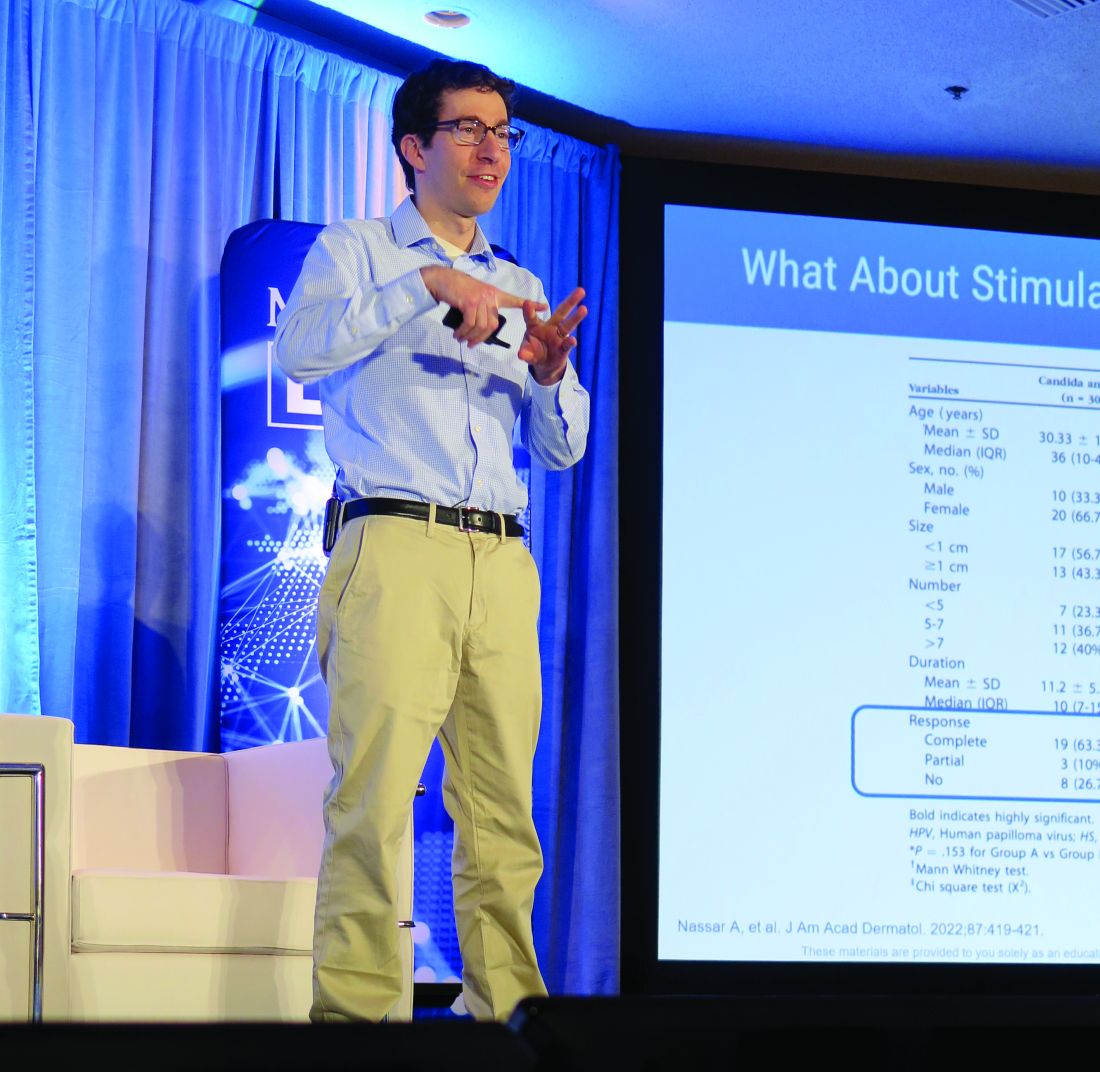
According to a 2012 Cochrane review of topical therapies for warts, first-line treatments such as salicylic acid, cryotherapy, 5-FU, or Candida antigen injection often have modest efficacy when used alone. For example, the authors found that salicylic acid and cryotherapy cleared warts in about 60%-70% of cases, respectively, but clearance rates were improved by combining the two therapies.
In an earlier literature review and meta-analysis, investigators evaluated the effect of 5-FU plus salicylic acid or salicylic acid alone. The therapeutic effect for common warts across all studies was a 63.4% response rate (complete healing) for 5-FU/SA vversus 23.1% for the 5-FU–free controls, respectively. For plantar warts, the response rate was 63% versus 11%, respectively.
“But what about the person with multiple warts or those in challenging locations where you might worry about destructive treatments hurting the nail fold or causing nail dystrophy?” Dr. Barbieri asked. “Maybe they’ve used salicylic acid or intralesional Candida and they’re still not getting better. What can we do for these patients?”
Emerging research suggests that topical cidofovir can be a valuable option for recalcitrant warts or those in sensitive locations. In a case report of a 10-year-old boy with more than 50 severe verrucous papules on his hands and face that were recalcitrant to multiple conventional therapies, topical 1% cidofovir applied daily for 8 weeks was effective, with no adverse side effects. A young female patient who presented to Dr. Barbieri with multiple warts around the nail matrix of several fingers experienced complete clearance after treatment with topical cidofovir, he said. Other researchers found this approach to be effective for plantar warts as well, in a report of two brothers with severe combined immunodeficiency after hematopoietic stem cell transplantation with persistent warts that did not respond to traditional topical treatments.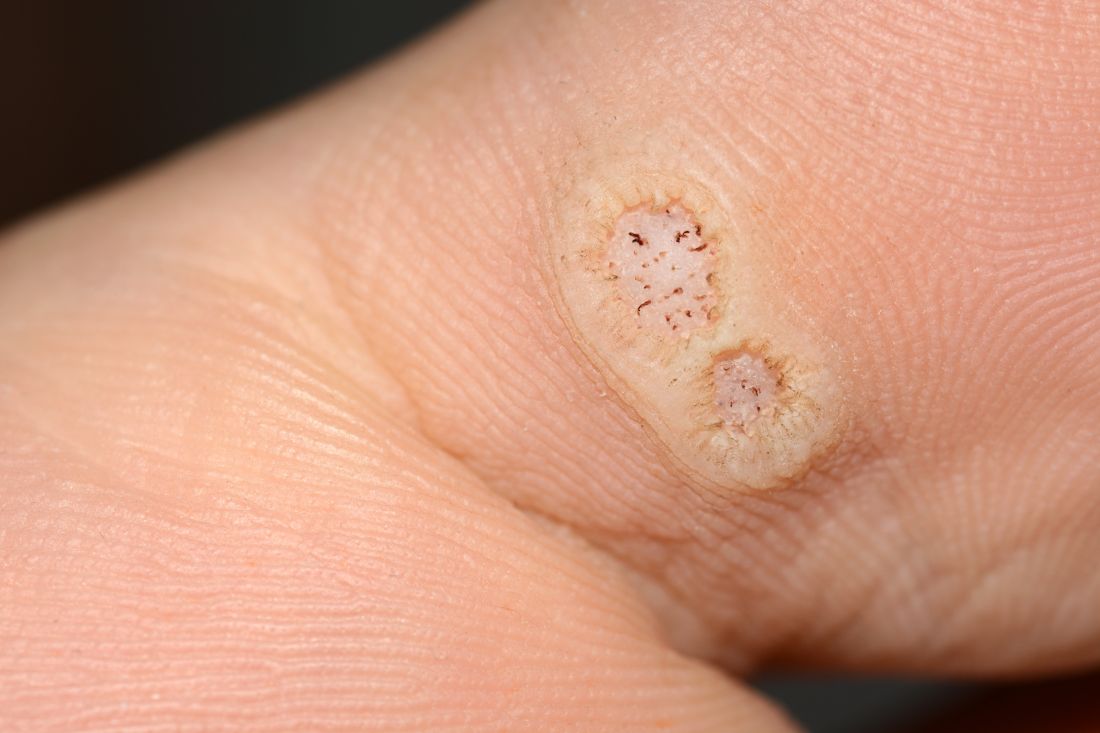
“Topical cidofovir is typically a painless treatment, which is nice, especially for our pediatric patients who might be afraid of other therapies like or cryotherapy or intralesional injections,” One limitation is that it is “a bit expensive,” Dr. Barbieri said. “To have topical cidofovir compounded is typically $100-$300, depending on the quantity and strength that you ask for.”
Intralesional cidofovir is another treatment option. In a retrospective study of 58 patients, Dr. Barbieri and colleagues evaluated the outcome of intralesional cidofovir treatment of warts in immunocompromised and nonimmunocompromised patients. Rates of improvement ranged from 98.3% to 100%, while resolution rates ranged from 75.9% to 97.6%.
“Most of the patients had warts for more than 5 years and almost half of them had recalcitrant warts,” Dr. Barbieri said. “These were mostly adult patients, but I think this is a treatment that can work in younger populations as well. About 10%-15% had HIV or cancer or diabetes or were transplant recipients, but despite these challenges and despite these recalcitrant warts, about 100% had improvement.”
He pointed out that cidofovir is available as a 75 mg/mL vial that comes with a 5 mL single-use vial. He dilutes this with normal saline to create a 15 mg/mL solution.
“If you want to be efficient you can try to schedule multiple patients together on the same day as a single vial is sufficient to treat about 25 patients,” assuming about 1 mL is injected per patient, he said. “The challenge with intralesional cidofovir is that it’s painful beyond just the needle part of the injection. Sometimes a nerve block can be helpful. But this can be an effective treatment for patients with recalcitrant warts or those with comorbidities.”
Other intralesional therapies to try for recalcitrant warts, he said, include bleomycin (1 U/mL solution, 1-2 mL per treatment, spaced every 2-4 weeks), and 5-FU (a 4:1 mixture of 5-FU [50 mg/mL] and 2% lidocaine).
Dr. Barbieri disclosed that he receives consulting fees from Dexcel for work unrelated to his presentation. Medscape and this news organization are owned by the same parent company.
HONOLULU – Combining or those located in areas that are challenging to treat, according to John S. Barbieri, MD, MBA.
“There are 5 million office visits per year in the United States for warts and molluscum, and they’re most common in pediatrics,” Dr. Barbieri, of the department of dermatology at Brigham and Women’s Hospital, Boston, said at the Hawaii Dermatology Seminar provided by MedscapeLIVE! “In fact, some studies have suggested that one in three children in primary school suffers from warts.”
According to a 2012 Cochrane review of topical therapies for warts, first-line treatments such as salicylic acid, cryotherapy, 5-FU, or Candida antigen injection often have modest efficacy when used alone. For example, the authors found that salicylic acid and cryotherapy cleared warts in about 60%-70% of cases, respectively, but clearance rates were improved by combining the two therapies.
In an earlier literature review and meta-analysis, investigators evaluated the effect of 5-FU plus salicylic acid or salicylic acid alone. The therapeutic effect for common warts across all studies was a 63.4% response rate (complete healing) for 5-FU/SA vversus 23.1% for the 5-FU–free controls, respectively. For plantar warts, the response rate was 63% versus 11%, respectively.
“But what about the person with multiple warts or those in challenging locations where you might worry about destructive treatments hurting the nail fold or causing nail dystrophy?” Dr. Barbieri asked. “Maybe they’ve used salicylic acid or intralesional Candida and they’re still not getting better. What can we do for these patients?”
Emerging research suggests that topical cidofovir can be a valuable option for recalcitrant warts or those in sensitive locations. In a case report of a 10-year-old boy with more than 50 severe verrucous papules on his hands and face that were recalcitrant to multiple conventional therapies, topical 1% cidofovir applied daily for 8 weeks was effective, with no adverse side effects. A young female patient who presented to Dr. Barbieri with multiple warts around the nail matrix of several fingers experienced complete clearance after treatment with topical cidofovir, he said. Other researchers found this approach to be effective for plantar warts as well, in a report of two brothers with severe combined immunodeficiency after hematopoietic stem cell transplantation with persistent warts that did not respond to traditional topical treatments.
“Topical cidofovir is typically a painless treatment, which is nice, especially for our pediatric patients who might be afraid of other therapies like or cryotherapy or intralesional injections,” One limitation is that it is “a bit expensive,” Dr. Barbieri said. “To have topical cidofovir compounded is typically $100-$300, depending on the quantity and strength that you ask for.”
Intralesional cidofovir is another treatment option. In a retrospective study of 58 patients, Dr. Barbieri and colleagues evaluated the outcome of intralesional cidofovir treatment of warts in immunocompromised and nonimmunocompromised patients. Rates of improvement ranged from 98.3% to 100%, while resolution rates ranged from 75.9% to 97.6%.
“Most of the patients had warts for more than 5 years and almost half of them had recalcitrant warts,” Dr. Barbieri said. “These were mostly adult patients, but I think this is a treatment that can work in younger populations as well. About 10%-15% had HIV or cancer or diabetes or were transplant recipients, but despite these challenges and despite these recalcitrant warts, about 100% had improvement.”
He pointed out that cidofovir is available as a 75 mg/mL vial that comes with a 5 mL single-use vial. He dilutes this with normal saline to create a 15 mg/mL solution.
“If you want to be efficient you can try to schedule multiple patients together on the same day as a single vial is sufficient to treat about 25 patients,” assuming about 1 mL is injected per patient, he said. “The challenge with intralesional cidofovir is that it’s painful beyond just the needle part of the injection. Sometimes a nerve block can be helpful. But this can be an effective treatment for patients with recalcitrant warts or those with comorbidities.”
Other intralesional therapies to try for recalcitrant warts, he said, include bleomycin (1 U/mL solution, 1-2 mL per treatment, spaced every 2-4 weeks), and 5-FU (a 4:1 mixture of 5-FU [50 mg/mL] and 2% lidocaine).
Dr. Barbieri disclosed that he receives consulting fees from Dexcel for work unrelated to his presentation. Medscape and this news organization are owned by the same parent company.
HONOLULU – Combining or those located in areas that are challenging to treat, according to John S. Barbieri, MD, MBA.
“There are 5 million office visits per year in the United States for warts and molluscum, and they’re most common in pediatrics,” Dr. Barbieri, of the department of dermatology at Brigham and Women’s Hospital, Boston, said at the Hawaii Dermatology Seminar provided by MedscapeLIVE! “In fact, some studies have suggested that one in three children in primary school suffers from warts.”
According to a 2012 Cochrane review of topical therapies for warts, first-line treatments such as salicylic acid, cryotherapy, 5-FU, or Candida antigen injection often have modest efficacy when used alone. For example, the authors found that salicylic acid and cryotherapy cleared warts in about 60%-70% of cases, respectively, but clearance rates were improved by combining the two therapies.
In an earlier literature review and meta-analysis, investigators evaluated the effect of 5-FU plus salicylic acid or salicylic acid alone. The therapeutic effect for common warts across all studies was a 63.4% response rate (complete healing) for 5-FU/SA vversus 23.1% for the 5-FU–free controls, respectively. For plantar warts, the response rate was 63% versus 11%, respectively.
“But what about the person with multiple warts or those in challenging locations where you might worry about destructive treatments hurting the nail fold or causing nail dystrophy?” Dr. Barbieri asked. “Maybe they’ve used salicylic acid or intralesional Candida and they’re still not getting better. What can we do for these patients?”
Emerging research suggests that topical cidofovir can be a valuable option for recalcitrant warts or those in sensitive locations. In a case report of a 10-year-old boy with more than 50 severe verrucous papules on his hands and face that were recalcitrant to multiple conventional therapies, topical 1% cidofovir applied daily for 8 weeks was effective, with no adverse side effects. A young female patient who presented to Dr. Barbieri with multiple warts around the nail matrix of several fingers experienced complete clearance after treatment with topical cidofovir, he said. Other researchers found this approach to be effective for plantar warts as well, in a report of two brothers with severe combined immunodeficiency after hematopoietic stem cell transplantation with persistent warts that did not respond to traditional topical treatments.
“Topical cidofovir is typically a painless treatment, which is nice, especially for our pediatric patients who might be afraid of other therapies like or cryotherapy or intralesional injections,” One limitation is that it is “a bit expensive,” Dr. Barbieri said. “To have topical cidofovir compounded is typically $100-$300, depending on the quantity and strength that you ask for.”
Intralesional cidofovir is another treatment option. In a retrospective study of 58 patients, Dr. Barbieri and colleagues evaluated the outcome of intralesional cidofovir treatment of warts in immunocompromised and nonimmunocompromised patients. Rates of improvement ranged from 98.3% to 100%, while resolution rates ranged from 75.9% to 97.6%.
“Most of the patients had warts for more than 5 years and almost half of them had recalcitrant warts,” Dr. Barbieri said. “These were mostly adult patients, but I think this is a treatment that can work in younger populations as well. About 10%-15% had HIV or cancer or diabetes or were transplant recipients, but despite these challenges and despite these recalcitrant warts, about 100% had improvement.”
He pointed out that cidofovir is available as a 75 mg/mL vial that comes with a 5 mL single-use vial. He dilutes this with normal saline to create a 15 mg/mL solution.
“If you want to be efficient you can try to schedule multiple patients together on the same day as a single vial is sufficient to treat about 25 patients,” assuming about 1 mL is injected per patient, he said. “The challenge with intralesional cidofovir is that it’s painful beyond just the needle part of the injection. Sometimes a nerve block can be helpful. But this can be an effective treatment for patients with recalcitrant warts or those with comorbidities.”
Other intralesional therapies to try for recalcitrant warts, he said, include bleomycin (1 U/mL solution, 1-2 mL per treatment, spaced every 2-4 weeks), and 5-FU (a 4:1 mixture of 5-FU [50 mg/mL] and 2% lidocaine).
Dr. Barbieri disclosed that he receives consulting fees from Dexcel for work unrelated to his presentation. Medscape and this news organization are owned by the same parent company.
AT THE MEDSCAPELIVE! HAWAII DERMATOLOGY SEMINAR
Too many screenings, too little time, not enough payment
Pediatricians have long charted the vitals of children and adolescents – height, weight, blood pressure – to ensure that kids are healthy and developing as they should. This is the core of the profession. But today the American Academy of Pediatrics recommends that pediatricians also perform maternal depression screenings, childhood depression screenings, autism screenings, and suicide risk screenings once children become 12 years old in addition to other screenings. Specific screening tools might include the Modified Checklist for Autism in Toddlers (MCHAT) for autism screening, the PHQ2 and PHQ9 (part of the longer Patient Health Questionnaire) for depression screening, and the Suicide Behavior Questionnaire Revised (SBQ-R) for suicide screening.
The AAP’s list of recommended screenings – which are developed by various research groups and endorsed by AAP – includes approximately 30 screenings in all, which vary somewhat depending on age. Seven screenings are mental and behavioral health assessments that would, depending on the screening results, require other expertise to address.

“We all want to keep [children] healthy. We actually do want to do these screenings, because they can be very helpful,” said Herschel Lessin, MD, of the Children’s Medical Group in Hopewell Junction, N.Y. Dr. Lessin’s concern is that he may not have anywhere to refer children and their families if he conducts a screening that flags something concerning such as a deeply depressed teenager. Sometimes first appointments with mental health professionals are not available for months.
“Sure – they want us to screen for depression, they want us to screen for anxiety. OK, you get a positive. What do you do? Well, guess what – there are no resources for children and mental health in this country,” Dr. Lessin said.
In Dr. Lessin’s view, economic realities prevent pediatricians from performing detailed psychological screenings anyway – no matter how useful or evidence based they might be, even if mental health support was abundant. He estimates that his practice conducts 20-25 visits a day, around 20 minutes each, of which maybe a dozen are well-child visits, just to keep the doors open. If he thoroughly screened every child or adolescent in the manner recommended by the AAP, Dr. Lessin said, he could do a fraction of that volume and would have to close his doors as a result.
Beside the time burden, insurers reimburse developmental and psychological screenings at low rates, Dr. Lessin said, even with claims that accurately itemize every screening delivered.
“Insurance companies refuse to pay adequately for any of this stuff. They expect me to do it for free, or do it for pennies,” Dr. Lessin said. He said that the natural result of such an arrangement is that some pediatricians stop taking insurance and only work with families that can afford their rates, further entrenching unequal health care by catering to wealthy families who can afford to pay for longer visits. Other pediatricians just don’t do all of the recommended screenings.
“I don’t want it to sound like I’m whining about being paid. They don’t adequately resource what they expect us to do, which is to be society’s social worker,” Dr. Lessin said.
Practical advice for interpreting and prioritizing screenings
Other pediatricians called for screening developers to include guidance for pediatricians about how to counsel families when a screening turns up a concerning result.

“What can we do as pediatricians in that moment to help that family?” asked Karalyn Kinsella, MD, of Pediatric Associates of Cheshire in Cheshire, Conn.
Sometimes the path forward is clear, as with an autism screening; in those cases, Dr. Kinsella said, Connecticut requires referral for a full autism evaluation from birth to age 3. But for other situations, such as an anxiety screening, it is less clear how to proceed.
Dr. Kinsella said that in her experience in-person appointments with a mental health professional, compared with telehealth, work best for her patients. This enables the teenager to find a good fit with a therapist, which can take time when first appointments are so elusive. Any support for pediatricians to bridge the gap until therapy is established is welcome.
“It would be great if it came along with some training – just a brief training – of some ways we can help families before they get into a therapist, or before it gets to the point that they need therapy,” Dr. Kinsella said.
Dr. Kinsella stressed that pediatricians need to use their own judgment when interpreting screening results. Sometimes the MCHAT will miss cases of autism, for example, or the PHQ9 will flag a teenager for depression who is actually just fidgety and having some trouble sleeping.
In her view, the existence of such screens – which might also include screenings for drug abuse, toxic stress, or food insecurity, along with autism, anxiety, and maternal or child depression – is a good development, despite their imperfections and the difficulties of getting help in a timely manner.
“Twenty years ago we really didn’t have any screens,” Dr. Kinsella said.
But it may be that there are now too many recommended screens in pediatrics, even if they all individually have value.

“In the adult world, screenings haven’t mushroomed as in pediatrics” said Dr. Timothy J. Joos, MD, MPH, who practices combined internal medicine and pediatrics at Neighborcare Health in Seattle. Recommended adult health screenings are largely driven by the work of the United States Preventive Services Task Force, which requires a high level of evidence before a screening is recommended. The pediatrics screening world, in Dr. Joos’s view, is populated by a more diffuse set of actors and has therefore inevitably resulted in a profusion of recommended screenings.
Although its main focus is adults, Dr. Joos noted that the USPSTF has evaluated many of the pediatric screenings currently endorsed by AAP. Sometimes there is strong evidence for these screenings, such as universal screening for depression and anxiety in older children. But Dr. Joos noted that per the USPSTF, many of the screenings now recommended by AAP on asymptomatic children for autism, high cholesterol, high blood pressure, or anemia don’t have strong evidence on a population level.
“In many cases, we have a good screen, but it just lacks the research,” Dr. Joos said. Nonetheless, every screening is recommended with “equal weight,” Dr. Joos said, calling for AAP to offer a more prioritized approach to screening rather than an “all comers” approach.
“If you don’t set priorities, you don’t have priorities,” Dr. Joos said, which leads to untenable expectations for what can be accomplished during short visits.
AAP responds
Susan Kressly, MD, who chairs AAP’s Section on Administration and Practice and is a consultant based in Sanibel, Fla., said that we know that using targeting screenings will miss a significant proportion of patients whom you could better assist and care for; for example, if you just go by your gut feeling about whether kids are using drugs or alcohol and just screen those kids. Every screening endorsed by AAP has some degree of evidence for use at a population level rather than case by case, Dr. Kressly noted.
This doesn’t mean that every single screening must be done at each and every recommended interval, she emphasized.
“The first priority is what’s important to the patient and the family. While we understand that screening is at a population health level, there should be some intelligent use and prioritization of these screening tools,” Dr. Kressly said. As examples, Dr. Kressly noted that there is no need to keep administering autism screenings in families whose children already receive autism services, or to ask a teenager questions about anxiety they had answered 6 weeks earlier.
The screenings should be seen as a tool for enhancing relationships with children and their families, not as a series of endless tasks, Dr. Kressly concluded.
Dr. Lessin’s priority is that pediatricians get more support – time, money, training, adequately resourced mental health care – to carry out their expanded role.
“Pediatricians are pretty nice. We want to do the right thing, but everything blocks us from doing it,” Dr. Lessin said.
Dr. Joos, Dr. Kinsella, and Dr. Lessin are on the MDedge Pediatric News Editorial Advisory Board.
Pediatricians have long charted the vitals of children and adolescents – height, weight, blood pressure – to ensure that kids are healthy and developing as they should. This is the core of the profession. But today the American Academy of Pediatrics recommends that pediatricians also perform maternal depression screenings, childhood depression screenings, autism screenings, and suicide risk screenings once children become 12 years old in addition to other screenings. Specific screening tools might include the Modified Checklist for Autism in Toddlers (MCHAT) for autism screening, the PHQ2 and PHQ9 (part of the longer Patient Health Questionnaire) for depression screening, and the Suicide Behavior Questionnaire Revised (SBQ-R) for suicide screening.
The AAP’s list of recommended screenings – which are developed by various research groups and endorsed by AAP – includes approximately 30 screenings in all, which vary somewhat depending on age. Seven screenings are mental and behavioral health assessments that would, depending on the screening results, require other expertise to address.
“We all want to keep [children] healthy. We actually do want to do these screenings, because they can be very helpful,” said Herschel Lessin, MD, of the Children’s Medical Group in Hopewell Junction, N.Y. Dr. Lessin’s concern is that he may not have anywhere to refer children and their families if he conducts a screening that flags something concerning such as a deeply depressed teenager. Sometimes first appointments with mental health professionals are not available for months.
“Sure – they want us to screen for depression, they want us to screen for anxiety. OK, you get a positive. What do you do? Well, guess what – there are no resources for children and mental health in this country,” Dr. Lessin said.
In Dr. Lessin’s view, economic realities prevent pediatricians from performing detailed psychological screenings anyway – no matter how useful or evidence based they might be, even if mental health support was abundant. He estimates that his practice conducts 20-25 visits a day, around 20 minutes each, of which maybe a dozen are well-child visits, just to keep the doors open. If he thoroughly screened every child or adolescent in the manner recommended by the AAP, Dr. Lessin said, he could do a fraction of that volume and would have to close his doors as a result.
Beside the time burden, insurers reimburse developmental and psychological screenings at low rates, Dr. Lessin said, even with claims that accurately itemize every screening delivered.
“Insurance companies refuse to pay adequately for any of this stuff. They expect me to do it for free, or do it for pennies,” Dr. Lessin said. He said that the natural result of such an arrangement is that some pediatricians stop taking insurance and only work with families that can afford their rates, further entrenching unequal health care by catering to wealthy families who can afford to pay for longer visits. Other pediatricians just don’t do all of the recommended screenings.
“I don’t want it to sound like I’m whining about being paid. They don’t adequately resource what they expect us to do, which is to be society’s social worker,” Dr. Lessin said.
Practical advice for interpreting and prioritizing screenings
Other pediatricians called for screening developers to include guidance for pediatricians about how to counsel families when a screening turns up a concerning result.
“What can we do as pediatricians in that moment to help that family?” asked Karalyn Kinsella, MD, of Pediatric Associates of Cheshire in Cheshire, Conn.
Sometimes the path forward is clear, as with an autism screening; in those cases, Dr. Kinsella said, Connecticut requires referral for a full autism evaluation from birth to age 3. But for other situations, such as an anxiety screening, it is less clear how to proceed.
Dr. Kinsella said that in her experience in-person appointments with a mental health professional, compared with telehealth, work best for her patients. This enables the teenager to find a good fit with a therapist, which can take time when first appointments are so elusive. Any support for pediatricians to bridge the gap until therapy is established is welcome.
“It would be great if it came along with some training – just a brief training – of some ways we can help families before they get into a therapist, or before it gets to the point that they need therapy,” Dr. Kinsella said.
Dr. Kinsella stressed that pediatricians need to use their own judgment when interpreting screening results. Sometimes the MCHAT will miss cases of autism, for example, or the PHQ9 will flag a teenager for depression who is actually just fidgety and having some trouble sleeping.
In her view, the existence of such screens – which might also include screenings for drug abuse, toxic stress, or food insecurity, along with autism, anxiety, and maternal or child depression – is a good development, despite their imperfections and the difficulties of getting help in a timely manner.
“Twenty years ago we really didn’t have any screens,” Dr. Kinsella said.
But it may be that there are now too many recommended screens in pediatrics, even if they all individually have value.
“In the adult world, screenings haven’t mushroomed as in pediatrics” said Dr. Timothy J. Joos, MD, MPH, who practices combined internal medicine and pediatrics at Neighborcare Health in Seattle. Recommended adult health screenings are largely driven by the work of the United States Preventive Services Task Force, which requires a high level of evidence before a screening is recommended. The pediatrics screening world, in Dr. Joos’s view, is populated by a more diffuse set of actors and has therefore inevitably resulted in a profusion of recommended screenings.
Although its main focus is adults, Dr. Joos noted that the USPSTF has evaluated many of the pediatric screenings currently endorsed by AAP. Sometimes there is strong evidence for these screenings, such as universal screening for depression and anxiety in older children. But Dr. Joos noted that per the USPSTF, many of the screenings now recommended by AAP on asymptomatic children for autism, high cholesterol, high blood pressure, or anemia don’t have strong evidence on a population level.
“In many cases, we have a good screen, but it just lacks the research,” Dr. Joos said. Nonetheless, every screening is recommended with “equal weight,” Dr. Joos said, calling for AAP to offer a more prioritized approach to screening rather than an “all comers” approach.
“If you don’t set priorities, you don’t have priorities,” Dr. Joos said, which leads to untenable expectations for what can be accomplished during short visits.
AAP responds
Susan Kressly, MD, who chairs AAP’s Section on Administration and Practice and is a consultant based in Sanibel, Fla., said that we know that using targeting screenings will miss a significant proportion of patients whom you could better assist and care for; for example, if you just go by your gut feeling about whether kids are using drugs or alcohol and just screen those kids. Every screening endorsed by AAP has some degree of evidence for use at a population level rather than case by case, Dr. Kressly noted.
This doesn’t mean that every single screening must be done at each and every recommended interval, she emphasized.
“The first priority is what’s important to the patient and the family. While we understand that screening is at a population health level, there should be some intelligent use and prioritization of these screening tools,” Dr. Kressly said. As examples, Dr. Kressly noted that there is no need to keep administering autism screenings in families whose children already receive autism services, or to ask a teenager questions about anxiety they had answered 6 weeks earlier.
The screenings should be seen as a tool for enhancing relationships with children and their families, not as a series of endless tasks, Dr. Kressly concluded.
Dr. Lessin’s priority is that pediatricians get more support – time, money, training, adequately resourced mental health care – to carry out their expanded role.
“Pediatricians are pretty nice. We want to do the right thing, but everything blocks us from doing it,” Dr. Lessin said.
Dr. Joos, Dr. Kinsella, and Dr. Lessin are on the MDedge Pediatric News Editorial Advisory Board.
Pediatricians have long charted the vitals of children and adolescents – height, weight, blood pressure – to ensure that kids are healthy and developing as they should. This is the core of the profession. But today the American Academy of Pediatrics recommends that pediatricians also perform maternal depression screenings, childhood depression screenings, autism screenings, and suicide risk screenings once children become 12 years old in addition to other screenings. Specific screening tools might include the Modified Checklist for Autism in Toddlers (MCHAT) for autism screening, the PHQ2 and PHQ9 (part of the longer Patient Health Questionnaire) for depression screening, and the Suicide Behavior Questionnaire Revised (SBQ-R) for suicide screening.
The AAP’s list of recommended screenings – which are developed by various research groups and endorsed by AAP – includes approximately 30 screenings in all, which vary somewhat depending on age. Seven screenings are mental and behavioral health assessments that would, depending on the screening results, require other expertise to address.
“We all want to keep [children] healthy. We actually do want to do these screenings, because they can be very helpful,” said Herschel Lessin, MD, of the Children’s Medical Group in Hopewell Junction, N.Y. Dr. Lessin’s concern is that he may not have anywhere to refer children and their families if he conducts a screening that flags something concerning such as a deeply depressed teenager. Sometimes first appointments with mental health professionals are not available for months.
“Sure – they want us to screen for depression, they want us to screen for anxiety. OK, you get a positive. What do you do? Well, guess what – there are no resources for children and mental health in this country,” Dr. Lessin said.
In Dr. Lessin’s view, economic realities prevent pediatricians from performing detailed psychological screenings anyway – no matter how useful or evidence based they might be, even if mental health support was abundant. He estimates that his practice conducts 20-25 visits a day, around 20 minutes each, of which maybe a dozen are well-child visits, just to keep the doors open. If he thoroughly screened every child or adolescent in the manner recommended by the AAP, Dr. Lessin said, he could do a fraction of that volume and would have to close his doors as a result.
Beside the time burden, insurers reimburse developmental and psychological screenings at low rates, Dr. Lessin said, even with claims that accurately itemize every screening delivered.
“Insurance companies refuse to pay adequately for any of this stuff. They expect me to do it for free, or do it for pennies,” Dr. Lessin said. He said that the natural result of such an arrangement is that some pediatricians stop taking insurance and only work with families that can afford their rates, further entrenching unequal health care by catering to wealthy families who can afford to pay for longer visits. Other pediatricians just don’t do all of the recommended screenings.
“I don’t want it to sound like I’m whining about being paid. They don’t adequately resource what they expect us to do, which is to be society’s social worker,” Dr. Lessin said.
Practical advice for interpreting and prioritizing screenings
Other pediatricians called for screening developers to include guidance for pediatricians about how to counsel families when a screening turns up a concerning result.
“What can we do as pediatricians in that moment to help that family?” asked Karalyn Kinsella, MD, of Pediatric Associates of Cheshire in Cheshire, Conn.
Sometimes the path forward is clear, as with an autism screening; in those cases, Dr. Kinsella said, Connecticut requires referral for a full autism evaluation from birth to age 3. But for other situations, such as an anxiety screening, it is less clear how to proceed.
Dr. Kinsella said that in her experience in-person appointments with a mental health professional, compared with telehealth, work best for her patients. This enables the teenager to find a good fit with a therapist, which can take time when first appointments are so elusive. Any support for pediatricians to bridge the gap until therapy is established is welcome.
“It would be great if it came along with some training – just a brief training – of some ways we can help families before they get into a therapist, or before it gets to the point that they need therapy,” Dr. Kinsella said.
Dr. Kinsella stressed that pediatricians need to use their own judgment when interpreting screening results. Sometimes the MCHAT will miss cases of autism, for example, or the PHQ9 will flag a teenager for depression who is actually just fidgety and having some trouble sleeping.
In her view, the existence of such screens – which might also include screenings for drug abuse, toxic stress, or food insecurity, along with autism, anxiety, and maternal or child depression – is a good development, despite their imperfections and the difficulties of getting help in a timely manner.
“Twenty years ago we really didn’t have any screens,” Dr. Kinsella said.
But it may be that there are now too many recommended screens in pediatrics, even if they all individually have value.
“In the adult world, screenings haven’t mushroomed as in pediatrics” said Dr. Timothy J. Joos, MD, MPH, who practices combined internal medicine and pediatrics at Neighborcare Health in Seattle. Recommended adult health screenings are largely driven by the work of the United States Preventive Services Task Force, which requires a high level of evidence before a screening is recommended. The pediatrics screening world, in Dr. Joos’s view, is populated by a more diffuse set of actors and has therefore inevitably resulted in a profusion of recommended screenings.
Although its main focus is adults, Dr. Joos noted that the USPSTF has evaluated many of the pediatric screenings currently endorsed by AAP. Sometimes there is strong evidence for these screenings, such as universal screening for depression and anxiety in older children. But Dr. Joos noted that per the USPSTF, many of the screenings now recommended by AAP on asymptomatic children for autism, high cholesterol, high blood pressure, or anemia don’t have strong evidence on a population level.
“In many cases, we have a good screen, but it just lacks the research,” Dr. Joos said. Nonetheless, every screening is recommended with “equal weight,” Dr. Joos said, calling for AAP to offer a more prioritized approach to screening rather than an “all comers” approach.
“If you don’t set priorities, you don’t have priorities,” Dr. Joos said, which leads to untenable expectations for what can be accomplished during short visits.
AAP responds
Susan Kressly, MD, who chairs AAP’s Section on Administration and Practice and is a consultant based in Sanibel, Fla., said that we know that using targeting screenings will miss a significant proportion of patients whom you could better assist and care for; for example, if you just go by your gut feeling about whether kids are using drugs or alcohol and just screen those kids. Every screening endorsed by AAP has some degree of evidence for use at a population level rather than case by case, Dr. Kressly noted.
This doesn’t mean that every single screening must be done at each and every recommended interval, she emphasized.
“The first priority is what’s important to the patient and the family. While we understand that screening is at a population health level, there should be some intelligent use and prioritization of these screening tools,” Dr. Kressly said. As examples, Dr. Kressly noted that there is no need to keep administering autism screenings in families whose children already receive autism services, or to ask a teenager questions about anxiety they had answered 6 weeks earlier.
The screenings should be seen as a tool for enhancing relationships with children and their families, not as a series of endless tasks, Dr. Kressly concluded.
Dr. Lessin’s priority is that pediatricians get more support – time, money, training, adequately resourced mental health care – to carry out their expanded role.
“Pediatricians are pretty nice. We want to do the right thing, but everything blocks us from doing it,” Dr. Lessin said.
Dr. Joos, Dr. Kinsella, and Dr. Lessin are on the MDedge Pediatric News Editorial Advisory Board.