User login
CPT 2011 Update
In the past, observation services typically did not exceed 24 hours or two calendar days. However, changes in healthcare policy coupled with the impetus to reduce wasteful spending have spurred an atmosphere of scrutiny over hospital admissions. Sometimes there are discrepancies between a hospital’s utilization review committee and a payor’s utilization review committee in determining the appropriateness of healthcare services and supplies, in accordance with each party’s definition of medical necessity. This situation has caused an increase in both the number and cost of observation stays.
In response, subsequent observation-care codes (99224-99226) were developed and published in the 2011 edition of Current Procedural Terminology (CPT).1

Codes and Their Uses
CPT outlines three subsequent observation care codes:
- 99224: Subsequent observation care, per day, for the evaluation and management (E/M) of a patient, which requires at least two of these three key components: problem-focused interval history; problem-focused examination; and medical decision-making that is straightforward or of low complexity. Counseling and/or coordination of care with other providers or agencies are provided consistent with the nature of the problem(s) and the patient’s and/or family’s needs. Usually, the patient is stable, recovering, or improving. Physicians typically spend 15 minutes at the bedside and on the patient’s hospital floor or unit.
- 99225: Subsequent observation care, per day, for the E/M of a patient, which requires at least two of these three key components: expanded problem focused interval history; expanded problem focused examination; and medical decision-making of moderate complexity. Counseling and/or coordination of care with other providers or agencies are provided consistent with the nature of the problem(s) and the patient’s and/or family’s needs. Usually, the patient is responding inadequately to therapy or has developed a minor complication. Physicians typically spend 25 minutes at the bedside and on the patient’s hospital floor or unit.
- 99226: Subsequent observation care, per day, for the E/M of a patient, which requires at least two of these three key components: detailed interval history; detailed examination; and medical decision-making of high complexity. Counseling and/or coordination of care with other providers or agencies are provided consistent with the nature of the problem(s) and the patient’s and/or family’s needs. Usually, the patient is unstable or has developed a significant complication or a significant new problem. Physicians typically spend 35 minutes at the bedside and on the patient’s hospital floor or unit.
Subsequent observation-care codes replicate the key components and time requirements established for subsequent hospital care services (99231-99233). However, the relative value units (RVUs) of physician work associated with subsequent observation care are not weighted equally (see Table 1, below). Subsequent observation care is a less-intense service, and therefore is valued at a lesser rate.
The attending of record writes the orders to admit the patient to observation (OBS); indicates the reason for the stay; outlines the plan of care; and manages the patient during the stay. Specialists typically are called onto an OBS case for their opinion/advice (i.e. consultants) but do not function as the attending of record.
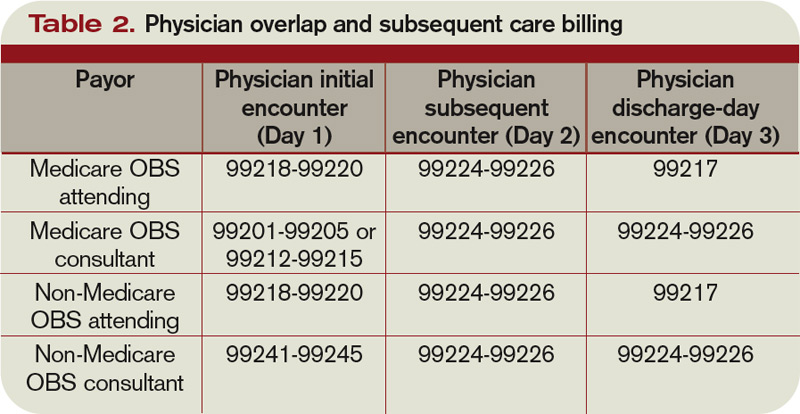
According to CPT 2011, subsequent OBS care codes can be reported by both the attending physician of record and specialists who provide medically necessary, nonoverlapping care to patients on any day other than the admission or discharge day (see Table 2, above). At press time, CMS and private payors had not provided written clarification on the use of subsequent observation-care codes. Therefore, it is imperative to monitor payments, denials, and policy clarifications providing further billing instruction.
On the Horizon
Prior reporting guidelines required the reporting of subsequent observation-care days with established outpatient codes (99212-99215). Some member plans insisted on referrals for all outpatient visits regardless nature of the service. Without the mandated referral for established patient visits performed in the observation setting, physician services were denied for coverage.
The creation of subsequent observation codes might play a role in decreasing these denials. Be sure to review the private payors’ fee schedules for inclusion of 99224-99226 codes. If missing, contact the payor or include it as an agenda item during your contract negotiations.
For more information on observation care services, check out “Observation Care” in the July 2010 issue of The Hospitalist. TH
Carol Pohlig is a billing and coding expert with the University of Pennsylvania Medical Center, Philadelphia. She also is faculty for SHM’s inpatient coding course.
References
- Abraham M, Ahlman J, Boudreau A, Connelly J, Evans D. Current Procedural Terminology: Professional Edition. Chicago: American Medical Association Press; 2011.
- Centers for Medicare and Medicaid Services. Medicare Claims Processing Manual: Chapter 12, Section 30.6.8. Available at: www.cms.hhs.gov/manuals/downloads/clm104c12.pdf. Accessed Jan. 16, 2011.
In the past, observation services typically did not exceed 24 hours or two calendar days. However, changes in healthcare policy coupled with the impetus to reduce wasteful spending have spurred an atmosphere of scrutiny over hospital admissions. Sometimes there are discrepancies between a hospital’s utilization review committee and a payor’s utilization review committee in determining the appropriateness of healthcare services and supplies, in accordance with each party’s definition of medical necessity. This situation has caused an increase in both the number and cost of observation stays.
In response, subsequent observation-care codes (99224-99226) were developed and published in the 2011 edition of Current Procedural Terminology (CPT).1
Codes and Their Uses
CPT outlines three subsequent observation care codes:
- 99224: Subsequent observation care, per day, for the evaluation and management (E/M) of a patient, which requires at least two of these three key components: problem-focused interval history; problem-focused examination; and medical decision-making that is straightforward or of low complexity. Counseling and/or coordination of care with other providers or agencies are provided consistent with the nature of the problem(s) and the patient’s and/or family’s needs. Usually, the patient is stable, recovering, or improving. Physicians typically spend 15 minutes at the bedside and on the patient’s hospital floor or unit.
- 99225: Subsequent observation care, per day, for the E/M of a patient, which requires at least two of these three key components: expanded problem focused interval history; expanded problem focused examination; and medical decision-making of moderate complexity. Counseling and/or coordination of care with other providers or agencies are provided consistent with the nature of the problem(s) and the patient’s and/or family’s needs. Usually, the patient is responding inadequately to therapy or has developed a minor complication. Physicians typically spend 25 minutes at the bedside and on the patient’s hospital floor or unit.
- 99226: Subsequent observation care, per day, for the E/M of a patient, which requires at least two of these three key components: detailed interval history; detailed examination; and medical decision-making of high complexity. Counseling and/or coordination of care with other providers or agencies are provided consistent with the nature of the problem(s) and the patient’s and/or family’s needs. Usually, the patient is unstable or has developed a significant complication or a significant new problem. Physicians typically spend 35 minutes at the bedside and on the patient’s hospital floor or unit.
Subsequent observation-care codes replicate the key components and time requirements established for subsequent hospital care services (99231-99233). However, the relative value units (RVUs) of physician work associated with subsequent observation care are not weighted equally (see Table 1, below). Subsequent observation care is a less-intense service, and therefore is valued at a lesser rate.
The attending of record writes the orders to admit the patient to observation (OBS); indicates the reason for the stay; outlines the plan of care; and manages the patient during the stay. Specialists typically are called onto an OBS case for their opinion/advice (i.e. consultants) but do not function as the attending of record.
According to CPT 2011, subsequent OBS care codes can be reported by both the attending physician of record and specialists who provide medically necessary, nonoverlapping care to patients on any day other than the admission or discharge day (see Table 2, above). At press time, CMS and private payors had not provided written clarification on the use of subsequent observation-care codes. Therefore, it is imperative to monitor payments, denials, and policy clarifications providing further billing instruction.
On the Horizon
Prior reporting guidelines required the reporting of subsequent observation-care days with established outpatient codes (99212-99215). Some member plans insisted on referrals for all outpatient visits regardless nature of the service. Without the mandated referral for established patient visits performed in the observation setting, physician services were denied for coverage.
The creation of subsequent observation codes might play a role in decreasing these denials. Be sure to review the private payors’ fee schedules for inclusion of 99224-99226 codes. If missing, contact the payor or include it as an agenda item during your contract negotiations.
For more information on observation care services, check out “Observation Care” in the July 2010 issue of The Hospitalist. TH
Carol Pohlig is a billing and coding expert with the University of Pennsylvania Medical Center, Philadelphia. She also is faculty for SHM’s inpatient coding course.
References
- Abraham M, Ahlman J, Boudreau A, Connelly J, Evans D. Current Procedural Terminology: Professional Edition. Chicago: American Medical Association Press; 2011.
- Centers for Medicare and Medicaid Services. Medicare Claims Processing Manual: Chapter 12, Section 30.6.8. Available at: www.cms.hhs.gov/manuals/downloads/clm104c12.pdf. Accessed Jan. 16, 2011.
In the past, observation services typically did not exceed 24 hours or two calendar days. However, changes in healthcare policy coupled with the impetus to reduce wasteful spending have spurred an atmosphere of scrutiny over hospital admissions. Sometimes there are discrepancies between a hospital’s utilization review committee and a payor’s utilization review committee in determining the appropriateness of healthcare services and supplies, in accordance with each party’s definition of medical necessity. This situation has caused an increase in both the number and cost of observation stays.
In response, subsequent observation-care codes (99224-99226) were developed and published in the 2011 edition of Current Procedural Terminology (CPT).1
Codes and Their Uses
CPT outlines three subsequent observation care codes:
- 99224: Subsequent observation care, per day, for the evaluation and management (E/M) of a patient, which requires at least two of these three key components: problem-focused interval history; problem-focused examination; and medical decision-making that is straightforward or of low complexity. Counseling and/or coordination of care with other providers or agencies are provided consistent with the nature of the problem(s) and the patient’s and/or family’s needs. Usually, the patient is stable, recovering, or improving. Physicians typically spend 15 minutes at the bedside and on the patient’s hospital floor or unit.
- 99225: Subsequent observation care, per day, for the E/M of a patient, which requires at least two of these three key components: expanded problem focused interval history; expanded problem focused examination; and medical decision-making of moderate complexity. Counseling and/or coordination of care with other providers or agencies are provided consistent with the nature of the problem(s) and the patient’s and/or family’s needs. Usually, the patient is responding inadequately to therapy or has developed a minor complication. Physicians typically spend 25 minutes at the bedside and on the patient’s hospital floor or unit.
- 99226: Subsequent observation care, per day, for the E/M of a patient, which requires at least two of these three key components: detailed interval history; detailed examination; and medical decision-making of high complexity. Counseling and/or coordination of care with other providers or agencies are provided consistent with the nature of the problem(s) and the patient’s and/or family’s needs. Usually, the patient is unstable or has developed a significant complication or a significant new problem. Physicians typically spend 35 minutes at the bedside and on the patient’s hospital floor or unit.
Subsequent observation-care codes replicate the key components and time requirements established for subsequent hospital care services (99231-99233). However, the relative value units (RVUs) of physician work associated with subsequent observation care are not weighted equally (see Table 1, below). Subsequent observation care is a less-intense service, and therefore is valued at a lesser rate.
The attending of record writes the orders to admit the patient to observation (OBS); indicates the reason for the stay; outlines the plan of care; and manages the patient during the stay. Specialists typically are called onto an OBS case for their opinion/advice (i.e. consultants) but do not function as the attending of record.
According to CPT 2011, subsequent OBS care codes can be reported by both the attending physician of record and specialists who provide medically necessary, nonoverlapping care to patients on any day other than the admission or discharge day (see Table 2, above). At press time, CMS and private payors had not provided written clarification on the use of subsequent observation-care codes. Therefore, it is imperative to monitor payments, denials, and policy clarifications providing further billing instruction.
On the Horizon
Prior reporting guidelines required the reporting of subsequent observation-care days with established outpatient codes (99212-99215). Some member plans insisted on referrals for all outpatient visits regardless nature of the service. Without the mandated referral for established patient visits performed in the observation setting, physician services were denied for coverage.
The creation of subsequent observation codes might play a role in decreasing these denials. Be sure to review the private payors’ fee schedules for inclusion of 99224-99226 codes. If missing, contact the payor or include it as an agenda item during your contract negotiations.
For more information on observation care services, check out “Observation Care” in the July 2010 issue of The Hospitalist. TH
Carol Pohlig is a billing and coding expert with the University of Pennsylvania Medical Center, Philadelphia. She also is faculty for SHM’s inpatient coding course.
References
- Abraham M, Ahlman J, Boudreau A, Connelly J, Evans D. Current Procedural Terminology: Professional Edition. Chicago: American Medical Association Press; 2011.
- Centers for Medicare and Medicaid Services. Medicare Claims Processing Manual: Chapter 12, Section 30.6.8. Available at: www.cms.hhs.gov/manuals/downloads/clm104c12.pdf. Accessed Jan. 16, 2011.
Passion for Patient Care
When William D. Atchley Jr., MD, FACP, SFHM, left private practice for hospital medicine in 1995, he didn’t realize he was helping to make history. Dr. Atchley was practicing with an internal-medicine multispecialty group when a medical school withdrew its residency program from the community hospital next door. Soon after, physicians in the group began experiencing frequent disruptions in order to care for a handful of hospitalized patients.
Dr. Atchley and two colleagues, all of whom enjoyed the hospital setting, solved the problem by forming an inpatient rounding team at Sentara Leigh Hospital in Norfolk, Va. They believe it was the first hospitalist program in Virginia.
“When we first started doing this, we were looking at each other saying, ‘Is this something for the long run … or is it going to be something that is a flash in the pan?’ ” says Dr. Atchley, chief of the Division of Hospital Medicine at Sentara Medical Group, which operates hospitalist programs at five sites in southeastern Virginia. “If you had asked me to look into a crystal ball, I would not have projected hospital medicine would have grown so quickly. It truly is phenomenal, and it’s been an exciting ride. It was great to be on the ground floor of this, and it’s been nice to see how things have evolved.”

Question: You studied biomedical engineering prior to medical school. Are there similarities between that field and HM?
Answer: Engineering teaches you how to approach problem-solving. That’s particularly helpful with some of the system issues we talk about, such as dealing with throughput or applications of electronic medical records and computerized physician order entry. It’s given me a good background to understand issues that come up regarding quality and patient safety, and trying to take a systemwide viewpoint about looking at how care is delivered.
Q: What’s the biggest change you’ve seen in HM over the past 16 years?
A: The job I had in 1995 is vastly different from the job I have now. At that time, it was all about taking care of internal-medicine adult patients. We’ve seen the evolution of surgical comanagement, and hospitalists have truly become leaders of change in terms of how care is being delivered in the hospital. Things like patient safety, quality, and learning to deal with the limited resources we have, in terms of the cost of healthcare, were not even on the radar screen 16 years ago.
Q: Why is it important for you to continue seeing patients?
A: To have validity with your fellow hospitalists who are working in the trenches. You can only appreciate what their day-to-day challenges are when you roll up your sleeves and you’re out there with them. I think it gives me “street cred” with them. I still understand the things that are great about the job, but at the same time, I see the things that are frustrating about the job.
Q: What is your biggest professional reward?
A: Being actively engaged in SHM. I served on its board of directors, and I’ve served as secretary and treasurer. I continue to be active in the society. I was honored to be elected as a senior fellow (SFHM) in the organization.
Q: What did it mean to you to be elected a senior fellow?
A: I’m very humbled and gracious to the organization. That’s been my greatest professional achievement.
Q: You also serve as a facilitator with SHM’s Leadership Academy. Why are you so passionate about that program?
A: It gives hospitalists the essential tools they need to be able to roll up their sleeves and start tackling problems at their hospitals. It’s a great opportunity for anybody who is thinking about running a group or taking a leading role in a healthcare system.
Q: What is your biggest professional challenge?
A: It’s learning to be able to lead the next generation of hospitalists, to get them to be as enthusiastic about practicing hospital medicine as I am.
Q: Why is that so challenging?
A: If you have ever practiced in a traditional general internal-medicine practice (office-based), and then you become a hospitalist, you don’t want to go back to office-based. It’s more difficult to generate that enthusiasm for what hospital medicine is all about to people who are just coming on.
Q: Have you found a strategy that works?
A: It’s much easier said than done. It’s really about getting them energized and getting them excited about what they’re doing. Part of that is explaining it’s about more than just the patient in front of them. The hospital really is their site of practice, and there are opportunities for them to advance. If they want to do research or if they want to be involved with quality or patient safety, the opportunities are unlimited.
Q: Do you encourage the next generation of hospitalists to seek out committee assignments, research, or other opportunities outside of clinical work?
A: It’s definitely something for them to embrace. What’s important is crafting a type of staffing or schedule model that allows them to do clinical work but at the same time have a protected time to do their committee work.
In the old model I grew up with, doctors basically did committee work before they started seeing patients or after they were finished. There needs to be time carved out so they can be focused on that and don’t have to do it on the fly. … That’s what makes things successful with hospital medicine. There are programs across the country that (protect physician time), and they serve as a model for what I think our profession should be.
Q: What’s next professionally?
A: Right now, I’m thinking about what I want to be doing for the next 10 years. Is it going back and just doing clinical work? Is it continuing to be the clinical chief, or is it being involved with other things systemwide? I’ll certainly continue to be actively engaged on a national level with SHM, because that’s my passion. But after being a hospitalist for 16 years, I’m pausing and reflecting on what I’ve been doing, what my options are, and what I want to do for the remainder of the time before I retire. TH
Mark Leiser is a freelance writer based in New Jersey.
When William D. Atchley Jr., MD, FACP, SFHM, left private practice for hospital medicine in 1995, he didn’t realize he was helping to make history. Dr. Atchley was practicing with an internal-medicine multispecialty group when a medical school withdrew its residency program from the community hospital next door. Soon after, physicians in the group began experiencing frequent disruptions in order to care for a handful of hospitalized patients.
Dr. Atchley and two colleagues, all of whom enjoyed the hospital setting, solved the problem by forming an inpatient rounding team at Sentara Leigh Hospital in Norfolk, Va. They believe it was the first hospitalist program in Virginia.
“When we first started doing this, we were looking at each other saying, ‘Is this something for the long run … or is it going to be something that is a flash in the pan?’ ” says Dr. Atchley, chief of the Division of Hospital Medicine at Sentara Medical Group, which operates hospitalist programs at five sites in southeastern Virginia. “If you had asked me to look into a crystal ball, I would not have projected hospital medicine would have grown so quickly. It truly is phenomenal, and it’s been an exciting ride. It was great to be on the ground floor of this, and it’s been nice to see how things have evolved.”
Question: You studied biomedical engineering prior to medical school. Are there similarities between that field and HM?
Answer: Engineering teaches you how to approach problem-solving. That’s particularly helpful with some of the system issues we talk about, such as dealing with throughput or applications of electronic medical records and computerized physician order entry. It’s given me a good background to understand issues that come up regarding quality and patient safety, and trying to take a systemwide viewpoint about looking at how care is delivered.
Q: What’s the biggest change you’ve seen in HM over the past 16 years?
A: The job I had in 1995 is vastly different from the job I have now. At that time, it was all about taking care of internal-medicine adult patients. We’ve seen the evolution of surgical comanagement, and hospitalists have truly become leaders of change in terms of how care is being delivered in the hospital. Things like patient safety, quality, and learning to deal with the limited resources we have, in terms of the cost of healthcare, were not even on the radar screen 16 years ago.
Q: Why is it important for you to continue seeing patients?
A: To have validity with your fellow hospitalists who are working in the trenches. You can only appreciate what their day-to-day challenges are when you roll up your sleeves and you’re out there with them. I think it gives me “street cred” with them. I still understand the things that are great about the job, but at the same time, I see the things that are frustrating about the job.
Q: What is your biggest professional reward?
A: Being actively engaged in SHM. I served on its board of directors, and I’ve served as secretary and treasurer. I continue to be active in the society. I was honored to be elected as a senior fellow (SFHM) in the organization.
Q: What did it mean to you to be elected a senior fellow?
A: I’m very humbled and gracious to the organization. That’s been my greatest professional achievement.
Q: You also serve as a facilitator with SHM’s Leadership Academy. Why are you so passionate about that program?
A: It gives hospitalists the essential tools they need to be able to roll up their sleeves and start tackling problems at their hospitals. It’s a great opportunity for anybody who is thinking about running a group or taking a leading role in a healthcare system.
Q: What is your biggest professional challenge?
A: It’s learning to be able to lead the next generation of hospitalists, to get them to be as enthusiastic about practicing hospital medicine as I am.
Q: Why is that so challenging?
A: If you have ever practiced in a traditional general internal-medicine practice (office-based), and then you become a hospitalist, you don’t want to go back to office-based. It’s more difficult to generate that enthusiasm for what hospital medicine is all about to people who are just coming on.
Q: Have you found a strategy that works?
A: It’s much easier said than done. It’s really about getting them energized and getting them excited about what they’re doing. Part of that is explaining it’s about more than just the patient in front of them. The hospital really is their site of practice, and there are opportunities for them to advance. If they want to do research or if they want to be involved with quality or patient safety, the opportunities are unlimited.
Q: Do you encourage the next generation of hospitalists to seek out committee assignments, research, or other opportunities outside of clinical work?
A: It’s definitely something for them to embrace. What’s important is crafting a type of staffing or schedule model that allows them to do clinical work but at the same time have a protected time to do their committee work.
In the old model I grew up with, doctors basically did committee work before they started seeing patients or after they were finished. There needs to be time carved out so they can be focused on that and don’t have to do it on the fly. … That’s what makes things successful with hospital medicine. There are programs across the country that (protect physician time), and they serve as a model for what I think our profession should be.
Q: What’s next professionally?
A: Right now, I’m thinking about what I want to be doing for the next 10 years. Is it going back and just doing clinical work? Is it continuing to be the clinical chief, or is it being involved with other things systemwide? I’ll certainly continue to be actively engaged on a national level with SHM, because that’s my passion. But after being a hospitalist for 16 years, I’m pausing and reflecting on what I’ve been doing, what my options are, and what I want to do for the remainder of the time before I retire. TH
Mark Leiser is a freelance writer based in New Jersey.
When William D. Atchley Jr., MD, FACP, SFHM, left private practice for hospital medicine in 1995, he didn’t realize he was helping to make history. Dr. Atchley was practicing with an internal-medicine multispecialty group when a medical school withdrew its residency program from the community hospital next door. Soon after, physicians in the group began experiencing frequent disruptions in order to care for a handful of hospitalized patients.
Dr. Atchley and two colleagues, all of whom enjoyed the hospital setting, solved the problem by forming an inpatient rounding team at Sentara Leigh Hospital in Norfolk, Va. They believe it was the first hospitalist program in Virginia.
“When we first started doing this, we were looking at each other saying, ‘Is this something for the long run … or is it going to be something that is a flash in the pan?’ ” says Dr. Atchley, chief of the Division of Hospital Medicine at Sentara Medical Group, which operates hospitalist programs at five sites in southeastern Virginia. “If you had asked me to look into a crystal ball, I would not have projected hospital medicine would have grown so quickly. It truly is phenomenal, and it’s been an exciting ride. It was great to be on the ground floor of this, and it’s been nice to see how things have evolved.”
Question: You studied biomedical engineering prior to medical school. Are there similarities between that field and HM?
Answer: Engineering teaches you how to approach problem-solving. That’s particularly helpful with some of the system issues we talk about, such as dealing with throughput or applications of electronic medical records and computerized physician order entry. It’s given me a good background to understand issues that come up regarding quality and patient safety, and trying to take a systemwide viewpoint about looking at how care is delivered.
Q: What’s the biggest change you’ve seen in HM over the past 16 years?
A: The job I had in 1995 is vastly different from the job I have now. At that time, it was all about taking care of internal-medicine adult patients. We’ve seen the evolution of surgical comanagement, and hospitalists have truly become leaders of change in terms of how care is being delivered in the hospital. Things like patient safety, quality, and learning to deal with the limited resources we have, in terms of the cost of healthcare, were not even on the radar screen 16 years ago.
Q: Why is it important for you to continue seeing patients?
A: To have validity with your fellow hospitalists who are working in the trenches. You can only appreciate what their day-to-day challenges are when you roll up your sleeves and you’re out there with them. I think it gives me “street cred” with them. I still understand the things that are great about the job, but at the same time, I see the things that are frustrating about the job.
Q: What is your biggest professional reward?
A: Being actively engaged in SHM. I served on its board of directors, and I’ve served as secretary and treasurer. I continue to be active in the society. I was honored to be elected as a senior fellow (SFHM) in the organization.
Q: What did it mean to you to be elected a senior fellow?
A: I’m very humbled and gracious to the organization. That’s been my greatest professional achievement.
Q: You also serve as a facilitator with SHM’s Leadership Academy. Why are you so passionate about that program?
A: It gives hospitalists the essential tools they need to be able to roll up their sleeves and start tackling problems at their hospitals. It’s a great opportunity for anybody who is thinking about running a group or taking a leading role in a healthcare system.
Q: What is your biggest professional challenge?
A: It’s learning to be able to lead the next generation of hospitalists, to get them to be as enthusiastic about practicing hospital medicine as I am.
Q: Why is that so challenging?
A: If you have ever practiced in a traditional general internal-medicine practice (office-based), and then you become a hospitalist, you don’t want to go back to office-based. It’s more difficult to generate that enthusiasm for what hospital medicine is all about to people who are just coming on.
Q: Have you found a strategy that works?
A: It’s much easier said than done. It’s really about getting them energized and getting them excited about what they’re doing. Part of that is explaining it’s about more than just the patient in front of them. The hospital really is their site of practice, and there are opportunities for them to advance. If they want to do research or if they want to be involved with quality or patient safety, the opportunities are unlimited.
Q: Do you encourage the next generation of hospitalists to seek out committee assignments, research, or other opportunities outside of clinical work?
A: It’s definitely something for them to embrace. What’s important is crafting a type of staffing or schedule model that allows them to do clinical work but at the same time have a protected time to do their committee work.
In the old model I grew up with, doctors basically did committee work before they started seeing patients or after they were finished. There needs to be time carved out so they can be focused on that and don’t have to do it on the fly. … That’s what makes things successful with hospital medicine. There are programs across the country that (protect physician time), and they serve as a model for what I think our profession should be.
Q: What’s next professionally?
A: Right now, I’m thinking about what I want to be doing for the next 10 years. Is it going back and just doing clinical work? Is it continuing to be the clinical chief, or is it being involved with other things systemwide? I’ll certainly continue to be actively engaged on a national level with SHM, because that’s my passion. But after being a hospitalist for 16 years, I’m pausing and reflecting on what I’ve been doing, what my options are, and what I want to do for the remainder of the time before I retire. TH
Mark Leiser is a freelance writer based in New Jersey.
Flexibility Is King
Michael Radzienda, MD, FHM, once worked in a hospitalist program in which physicians were scheduled 30 days straight on clinical duty and 30 days off clinical duty. Although it sounds harsh by today’s standards, that job was so satisfying, he says, the schedule never felt like a burden. Conversely, he’s seen hospitalists work five days on and five days off, and the job was treacherous.
His point: Work schedules are just one influential piece of the job satisfaction pie.
“Satisfaction has more to do with work relationships and opportunities for growth,” says Dr. Radzienda, chief of hospital medicine and director of hospital medicine service at Medical College of Wisconsin/Froedtert Memorial Lutheran General Hospital in Milwaukee.
Shift-based staffing has become the norm, as more than 70% of hospitalist groups use a shift-based staffing model, according to the State of Hospital Medicine: 2010 Report Based on 2009 Data.1 That figure is up 40% from SHM’s 2005-2006 survey. Conversely, the number of HM groups employing call-based and hybrid (some shift, some call) coverage is declining—2.8% of groups employ call-based schedules, and 26.9% use a hybrid schedule. Those figures have dropped significantly from the 2005-2006 report, from 25% and 35%, respectively.
If you are going to make HM a career, you’ll need time to be with your family and pursue other interests, Dr. Radzienda says. As HM groups turn to more shift-based models, in which hospitalists work a set number of predetermined shifts and have no call responsibility, the challenge is setting a schedule that balances productivity and quality time off.
Fixed = Inflexible
The most popular way to schedule is through blocks of five days on/five days off (5/5) or seven days on/seven days off (7/7), in which hospitalists work 12 or 14 hours at a time, says Troy Ahlstrom, MD, FHM, a member of SHM’s Practice Analysis Committee and CFO of Hospitalists of Northern Michigan, a hospitalist-owned and -managed group based in Traverse City, Mich. Many HM groups employ this model because it’s easy to schedule and is attractive to residents who want a fixed schedule. But from a career satisfaction standpoint, the 5/5 and 7/7 schedule models present their own issues.
Fairness is the first potential pitfall. If all of the physicians in a group work the same schedule, they all have to log the same number of shifts and receive the same compensation. This leaves little to no wiggle room for hospitalists who want to make more money by picking up more shifts or those who want to work fewer shifts, Dr. Ahlstrom says. “People have different income goals,” he adds.
Second, physicians have to see the same number of patients throughout the day. This doesn’t take into consideration the reality that some hospitalists naturally work faster than others, thereby forcing the slower-paced doctors to keep up with an imposed patient load. “Invariably, no matter what you do, people are different,” Dr. Ahlstrom says.
Another consideration is that when physicians are working 12 to 14 hours a day, essentially they have no time for activities other than work and sleep, which doesn’t match the realities of life. Inevitably, things in personal lives crop up, which leads to swapping shifts that the group scheduler doesn’t know about or overloading the scheduler with shift-change requests, Dr. Ahlstrom explains.
Additionally, 7/7 schedules and their ilk squeeze a year’s worth of work into a compressed time frame, which can lead to intense stress and burnout, says John Nelson, MD, FACP, MHM, director of the hospitalist practice at Overlake Hospital in Bellevue, Wash., SHM co-founder, and practice management columnist for The Hospitalist. “Maximizing the number of days off is not the holy grail,” he says. “If you choose to shut your life down on days that you work, that is going to be toxic.”
Flexibility Equates to Fairness
Dr. Nelson has long advocated a flexible shift schedule that accommodates individual preferences by giving physicians in the group autonomy in deciding how much or how little they want to work. While the group as a whole has to get all the work done, the flexibility comes from one physician taking more shifts as another takes less.
Dr. Radzienda tries to create teams within his group by pairing hospitalists with similar scheduling preferences. For example, he might have a pair working 5/5 and another working 14/14. “Up front, it takes a lot of work, but once you template it out, it becomes a good strategy,” he says.
He also strives to build robust backup plans and jeopardy models (see “Surge Protection,” September 2010, p. 43) into the schedule for short-notice callouts, as you never know when a hospitalist will need to miss a day or two because of illness or a family emergency. “Psychologically, it helps to know that you don’t have to be a hero if you’re ill or emotionally strained,” Dr. Radzienda says.
Dr. Ahlstrom agrees that a flex-schedule strategy has a positive impact on hospitalists’ career satisfaction and longevity. He suggests hospitalists be allowed to specify how many patients they want to see and be compensated according to their workload through built-in bonuses for physicians who work more. Dr. Nelson suggests paying hospitalists per relative value unit (RVU) of work. “I think hospitalists would like it and find it liberating to be paid on production,” he says.
An added bonus to flexible work hours and patient load, according to Dr. Ahlstrom, is that pay difference “will lead to a far more collegial atmosphere, because physicians know they are getting compensated fairly for the amount of work done.”
Another advantage of a flexible schedule is hospitalists knowing they have the option of ramping up or scaling back the number of shifts they work, Dr. Ahlstrom says—for example, a physician who wants to reduce shifts in order to coach his daughter’s softball team or have Friday nights off to watch her son play high school football.
“You prevent burnout by allowing people to change their work schedule depending on what’s going on in their life,” Dr. Ahlstrom says. TH
Lisa Ryan is a freelance writer based in New Jersey.
Michael Radzienda, MD, FHM, once worked in a hospitalist program in which physicians were scheduled 30 days straight on clinical duty and 30 days off clinical duty. Although it sounds harsh by today’s standards, that job was so satisfying, he says, the schedule never felt like a burden. Conversely, he’s seen hospitalists work five days on and five days off, and the job was treacherous.
His point: Work schedules are just one influential piece of the job satisfaction pie.
“Satisfaction has more to do with work relationships and opportunities for growth,” says Dr. Radzienda, chief of hospital medicine and director of hospital medicine service at Medical College of Wisconsin/Froedtert Memorial Lutheran General Hospital in Milwaukee.
Shift-based staffing has become the norm, as more than 70% of hospitalist groups use a shift-based staffing model, according to the State of Hospital Medicine: 2010 Report Based on 2009 Data.1 That figure is up 40% from SHM’s 2005-2006 survey. Conversely, the number of HM groups employing call-based and hybrid (some shift, some call) coverage is declining—2.8% of groups employ call-based schedules, and 26.9% use a hybrid schedule. Those figures have dropped significantly from the 2005-2006 report, from 25% and 35%, respectively.
If you are going to make HM a career, you’ll need time to be with your family and pursue other interests, Dr. Radzienda says. As HM groups turn to more shift-based models, in which hospitalists work a set number of predetermined shifts and have no call responsibility, the challenge is setting a schedule that balances productivity and quality time off.
Fixed = Inflexible
The most popular way to schedule is through blocks of five days on/five days off (5/5) or seven days on/seven days off (7/7), in which hospitalists work 12 or 14 hours at a time, says Troy Ahlstrom, MD, FHM, a member of SHM’s Practice Analysis Committee and CFO of Hospitalists of Northern Michigan, a hospitalist-owned and -managed group based in Traverse City, Mich. Many HM groups employ this model because it’s easy to schedule and is attractive to residents who want a fixed schedule. But from a career satisfaction standpoint, the 5/5 and 7/7 schedule models present their own issues.
Fairness is the first potential pitfall. If all of the physicians in a group work the same schedule, they all have to log the same number of shifts and receive the same compensation. This leaves little to no wiggle room for hospitalists who want to make more money by picking up more shifts or those who want to work fewer shifts, Dr. Ahlstrom says. “People have different income goals,” he adds.
Second, physicians have to see the same number of patients throughout the day. This doesn’t take into consideration the reality that some hospitalists naturally work faster than others, thereby forcing the slower-paced doctors to keep up with an imposed patient load. “Invariably, no matter what you do, people are different,” Dr. Ahlstrom says.
Another consideration is that when physicians are working 12 to 14 hours a day, essentially they have no time for activities other than work and sleep, which doesn’t match the realities of life. Inevitably, things in personal lives crop up, which leads to swapping shifts that the group scheduler doesn’t know about or overloading the scheduler with shift-change requests, Dr. Ahlstrom explains.
Additionally, 7/7 schedules and their ilk squeeze a year’s worth of work into a compressed time frame, which can lead to intense stress and burnout, says John Nelson, MD, FACP, MHM, director of the hospitalist practice at Overlake Hospital in Bellevue, Wash., SHM co-founder, and practice management columnist for The Hospitalist. “Maximizing the number of days off is not the holy grail,” he says. “If you choose to shut your life down on days that you work, that is going to be toxic.”
Flexibility Equates to Fairness
Dr. Nelson has long advocated a flexible shift schedule that accommodates individual preferences by giving physicians in the group autonomy in deciding how much or how little they want to work. While the group as a whole has to get all the work done, the flexibility comes from one physician taking more shifts as another takes less.
Dr. Radzienda tries to create teams within his group by pairing hospitalists with similar scheduling preferences. For example, he might have a pair working 5/5 and another working 14/14. “Up front, it takes a lot of work, but once you template it out, it becomes a good strategy,” he says.
He also strives to build robust backup plans and jeopardy models (see “Surge Protection,” September 2010, p. 43) into the schedule for short-notice callouts, as you never know when a hospitalist will need to miss a day or two because of illness or a family emergency. “Psychologically, it helps to know that you don’t have to be a hero if you’re ill or emotionally strained,” Dr. Radzienda says.
Dr. Ahlstrom agrees that a flex-schedule strategy has a positive impact on hospitalists’ career satisfaction and longevity. He suggests hospitalists be allowed to specify how many patients they want to see and be compensated according to their workload through built-in bonuses for physicians who work more. Dr. Nelson suggests paying hospitalists per relative value unit (RVU) of work. “I think hospitalists would like it and find it liberating to be paid on production,” he says.
An added bonus to flexible work hours and patient load, according to Dr. Ahlstrom, is that pay difference “will lead to a far more collegial atmosphere, because physicians know they are getting compensated fairly for the amount of work done.”
Another advantage of a flexible schedule is hospitalists knowing they have the option of ramping up or scaling back the number of shifts they work, Dr. Ahlstrom says—for example, a physician who wants to reduce shifts in order to coach his daughter’s softball team or have Friday nights off to watch her son play high school football.
“You prevent burnout by allowing people to change their work schedule depending on what’s going on in their life,” Dr. Ahlstrom says. TH
Lisa Ryan is a freelance writer based in New Jersey.
Michael Radzienda, MD, FHM, once worked in a hospitalist program in which physicians were scheduled 30 days straight on clinical duty and 30 days off clinical duty. Although it sounds harsh by today’s standards, that job was so satisfying, he says, the schedule never felt like a burden. Conversely, he’s seen hospitalists work five days on and five days off, and the job was treacherous.
His point: Work schedules are just one influential piece of the job satisfaction pie.
“Satisfaction has more to do with work relationships and opportunities for growth,” says Dr. Radzienda, chief of hospital medicine and director of hospital medicine service at Medical College of Wisconsin/Froedtert Memorial Lutheran General Hospital in Milwaukee.
Shift-based staffing has become the norm, as more than 70% of hospitalist groups use a shift-based staffing model, according to the State of Hospital Medicine: 2010 Report Based on 2009 Data.1 That figure is up 40% from SHM’s 2005-2006 survey. Conversely, the number of HM groups employing call-based and hybrid (some shift, some call) coverage is declining—2.8% of groups employ call-based schedules, and 26.9% use a hybrid schedule. Those figures have dropped significantly from the 2005-2006 report, from 25% and 35%, respectively.
If you are going to make HM a career, you’ll need time to be with your family and pursue other interests, Dr. Radzienda says. As HM groups turn to more shift-based models, in which hospitalists work a set number of predetermined shifts and have no call responsibility, the challenge is setting a schedule that balances productivity and quality time off.
Fixed = Inflexible
The most popular way to schedule is through blocks of five days on/five days off (5/5) or seven days on/seven days off (7/7), in which hospitalists work 12 or 14 hours at a time, says Troy Ahlstrom, MD, FHM, a member of SHM’s Practice Analysis Committee and CFO of Hospitalists of Northern Michigan, a hospitalist-owned and -managed group based in Traverse City, Mich. Many HM groups employ this model because it’s easy to schedule and is attractive to residents who want a fixed schedule. But from a career satisfaction standpoint, the 5/5 and 7/7 schedule models present their own issues.
Fairness is the first potential pitfall. If all of the physicians in a group work the same schedule, they all have to log the same number of shifts and receive the same compensation. This leaves little to no wiggle room for hospitalists who want to make more money by picking up more shifts or those who want to work fewer shifts, Dr. Ahlstrom says. “People have different income goals,” he adds.
Second, physicians have to see the same number of patients throughout the day. This doesn’t take into consideration the reality that some hospitalists naturally work faster than others, thereby forcing the slower-paced doctors to keep up with an imposed patient load. “Invariably, no matter what you do, people are different,” Dr. Ahlstrom says.
Another consideration is that when physicians are working 12 to 14 hours a day, essentially they have no time for activities other than work and sleep, which doesn’t match the realities of life. Inevitably, things in personal lives crop up, which leads to swapping shifts that the group scheduler doesn’t know about or overloading the scheduler with shift-change requests, Dr. Ahlstrom explains.
Additionally, 7/7 schedules and their ilk squeeze a year’s worth of work into a compressed time frame, which can lead to intense stress and burnout, says John Nelson, MD, FACP, MHM, director of the hospitalist practice at Overlake Hospital in Bellevue, Wash., SHM co-founder, and practice management columnist for The Hospitalist. “Maximizing the number of days off is not the holy grail,” he says. “If you choose to shut your life down on days that you work, that is going to be toxic.”
Flexibility Equates to Fairness
Dr. Nelson has long advocated a flexible shift schedule that accommodates individual preferences by giving physicians in the group autonomy in deciding how much or how little they want to work. While the group as a whole has to get all the work done, the flexibility comes from one physician taking more shifts as another takes less.
Dr. Radzienda tries to create teams within his group by pairing hospitalists with similar scheduling preferences. For example, he might have a pair working 5/5 and another working 14/14. “Up front, it takes a lot of work, but once you template it out, it becomes a good strategy,” he says.
He also strives to build robust backup plans and jeopardy models (see “Surge Protection,” September 2010, p. 43) into the schedule for short-notice callouts, as you never know when a hospitalist will need to miss a day or two because of illness or a family emergency. “Psychologically, it helps to know that you don’t have to be a hero if you’re ill or emotionally strained,” Dr. Radzienda says.
Dr. Ahlstrom agrees that a flex-schedule strategy has a positive impact on hospitalists’ career satisfaction and longevity. He suggests hospitalists be allowed to specify how many patients they want to see and be compensated according to their workload through built-in bonuses for physicians who work more. Dr. Nelson suggests paying hospitalists per relative value unit (RVU) of work. “I think hospitalists would like it and find it liberating to be paid on production,” he says.
An added bonus to flexible work hours and patient load, according to Dr. Ahlstrom, is that pay difference “will lead to a far more collegial atmosphere, because physicians know they are getting compensated fairly for the amount of work done.”
Another advantage of a flexible schedule is hospitalists knowing they have the option of ramping up or scaling back the number of shifts they work, Dr. Ahlstrom says—for example, a physician who wants to reduce shifts in order to coach his daughter’s softball team or have Friday nights off to watch her son play high school football.
“You prevent burnout by allowing people to change their work schedule depending on what’s going on in their life,” Dr. Ahlstrom says. TH
Lisa Ryan is a freelance writer based in New Jersey.
Alternative Access
Effective communication between a physician and their patient is critical to a successful treatment relationship. Even in the best of circumstances, however, we know that physicians and patients often have markedly different impressions of what is said during an interaction or the meaning of information provided. When a language barrier is present, or a patient has a hearing or visual impairment, these communication challenges multiply. How physicians address such challenges has multiple legal implications.
The ADA
Title III of the Americans with Disabilities Act (ADA) prohibits discrimination against visually impaired and deaf and hard-of-hearing people in places of public accommodation. Included within the definition of places of public accommodation is any “professional office of a healthcare provider,” regardless of the size of the office or number of employees. Thus, the ADA applies to doctors, dentists, psychiatrists and psychologists, hospitals, nursing homes and health clinics, and all other providers of mental and physical care. Accordingly, the ADA requires hospitals to provide effective means of communication for patients, family members, and hospital visitors who are visually impaired, deaf, or hard of hearing.
Public accommodations must comply with specific requirements related to effective communication with people with hearing, vision, or speech disabilities. Specifically, unless a hospital or physician can demonstrate that providing communication aids or services would fundamentally alter the nature of the goods or services offered, or would result in an undue burden, a hospital or physician must ensure that no individual with a disability is excluded, denied services, segregated, or otherwise treated differently than other individuals because of the absence of auxiliary aids and services.
Auxiliary aids and services relating to communications, in turn, include:
- Qualified interpreters;
- Note-takers;
- Transcription services;
- Written materials;
- Telephone handset amplifiers;
- Assistive listening devices;
- Assistive listening systems;
- Telephones compatible with hearing aids;
- Closed-caption decoders;
- Open and closed captioning;
- Telecommunications devices for deaf persons (TDDs);
- Videotext displays or other effective methods of making aurally delivered materials available to individuals with hearing impairments;
- Qualified readers;
- Taped texts;
- Audio recordings;
- Braille materials; and
- Large-print materials or other methods of making visually delivered materials available to individuals with visual impairments.
The U.S. Department of Justice (DOJ) has issued memorandums outlining the obligations of physicians and other healthcare providers to provide auxiliary aids or services to people with hearing impairments. The memo recommended that healthcare providers consult with patients about appropriate auxiliary aids and services. The memo noted, however, that private providers are not required to accede to a patient’s specific choice of auxiliary aid or service as long as the provider satisfies his or her obligation to ensure effective communication.
In comparison, healthcare providers working at public entities or hospitals must have a conversation with patients as part of a doctor’s process in providing effective communication, and physicians must give primary consideration to the patient’s choice (see “Americans with Disabilities Act Title II Requirements,” above).
The DOJ has indicated that in determining what constitutes an effective auxiliary aid or service, healthcare providers must consider, among other things, the length and complexity of the communication involved. For example, a note pad and written materials might be sufficient for some routine appointments, to discuss uncomplicated symptoms or minor injuries, or to complete insurance forms or medical history inquiries. When the information is lengthy or complex, however, such as a patient’s discussion of symptoms with medical personnel or a physician’s presentation of diagnosis and treatment options to patients or family members, it might be necessary to provide a qualified sign language interpreter or other interpreter; the use of handwritten notes might be inadequate.
The DOJ also has specified that hospitals should have arrangements in place to ensure that qualified interpreters are readily available on a scheduled basis, and on an unscheduled basis with minimal delay, including on-call arrangements for after-hours emergencies. Larger facilities can choose to have interpreters on staff. Hospitals should develop protocols and provide training to ensure that hospital staff know how to obtain interpreter services and other communication aids and services when needed.
The DOJ has recommended hospitals have signs and other types of notices to advise persons with disabilities that services and assistance are available, along with what they need to do to obtain them. A hospital must be prepared to make and receive relay system calls.
If telephones and televisions are provided in patient rooms, hospitals must provide patients who are deaf or hard of hearing comparable accessible equipment upon request, including TDDs, telephones that are hearing-aid compatible and have volume control, and televisions with closed captioning or decoders. For training or other educational services offered to patients or members of the public, additional aids and services (e.g. note-takers, captioned videos, assistive listening systems) might be necessary for effective communication.
Visual alarms are not required in patient rooms. However, evacuation procedures should include specific measures to ensure the safety of patients and visitors who are deaf or hard of hearing. Certain built-in communication features required for hospitals built or altered after the effective date of the ADA in 1992 include:
- Visual alarms, which must be provided in all public and common-use areas, including restrooms, where audible alarms are provided;
- TDDs, which must be provided at public pay phones serving emergency, recovery, or waiting rooms, and at least one TDD must be provided at other locations where there are four or more pay phones; and
- A certain percentage of public phones that must have other features, such as TDD plug-in capability, volume controls, and hearing-aid compatibility.
Also important: Hospitals and healthcare providers are not allowed to charge patients with a disability to cover the costs of providing auxiliary aids and services. Instead, the costs must be treated as overhead expenses that are passed on to all patients.
New Regulations
Effective March 15, amendments to the ADA regulations will take effect modifying both Title II and Title III. One of the relevant changes to the regulations include video remote interpreting (VRI) services as a kind of auxiliary aid, which could be used to provide effective communication. VRI is an interpreting service that delivers high-quality video images over dedicated lines or wireless technology.
The amended Title II regulations effective March 15 also expand on the explanation of an effective auxiliary aid and provide that “in order to be effective, auxiliary aids and services must be provided in accessible formats, in a timely manner, and in such a way as to protect the privacy and independence of the individual with a disability.” A public entity cannot require an individual with a disability to bring another individual to interpret for him or her, or rely on an adult accompanying an individual with a disability to interpret or facilitate communication, except in the case of an emergency or when the individual with a disability specifically requests that the accompanying adult interpret or facilitate communication, the accompanying adult agrees to provide such assistance, and reliance on that adult for such assistance is appropriate under the circumstances.
Similarly, a public entity cannot rely on a minor child to interpret or facilitate communication, except in an emergency involving an imminent threat to the safety or welfare of an individual or the public and no interpreter is available.
Title IV of Civil Rights Act
Individuals who do not speak English as their primary language and who have a limited ability to read, write, speak, or understand English might be eligible to receive language assistance with respect to particular services, benefits, or encounters.
Title VI and U.S. Department of Health and Human Services (HHS) regulations require recipients of federal financial assistance from HHS to take reasonable steps to provide meaningful access to limited-English-proficiency (LEP) persons. Recipients of HHS assistance might include hospitals, nursing homes, home health agencies, managed-care organizations, universities and other entities with health or social service research programs, and state, county, and local health agencies. It might also include Medicaid agencies, state, county, and local welfare agencies, programs for families, youth, and children, Head Start programs, public and private contractors, subcontractors, and vendors, and physicians and other providers who receive financial assistance from HHS.
HHS has indicated that the obligation to provide meaningful access is fact-dependent and starts with an individualized assessment that balances four factors:
- Number or proportion of LEP persons eligible to be served or likely to be encountered by the program or grantee;
- Frequency with which LEP individuals come into contact with the program;
- Nature and importance of the program, activity or service provided by the recipient to its beneficiaries; and
- Resources available to the grantee/recipient and the costs of interpretation/translation services.
HHS notes that there is no “one size fits all” solution for compliance with respect to LEP persons, and what constitutes “reasonable steps” for large providers might not be reasonable where small providers are concerned.
Use of family members or friends. HHS has indicated that some LEP persons feel more comfortable when a trusted family member or friend acts as an interpreter. When an LEP person attempts to access the services of a recipient of federal financial assistance, who upon application of the four factors is required to provide an interpreter, the recipient should make the LEP person aware that he or she has the option of having the recipient provide an interpreter for them without charge, or of using their own interpreter. Recipients also should consider special circumstances that might affect whether a family member or friend should serve as an interpreter, such as whether the situation is an emergency, and whether there are concerns over competency, confidentiality, privacy, or conflict of interest. Recipients cannot require LEP persons to use family members or friends as interpreters.
Vital documents. Recipients can use the four factors to determine if specific documents or portions of documents should be translated into the language of frequently encountered LEP groups eligible to be served or likely to be affected by the recipient’s program. Recipients should assess whether specific documents or portions of documents are “vital” to the program, information, encounter, or service involved, and the consequences to the LEP person if the information in question is not provided accurately or in a timely manner.
Compliance plans. HHS provides recipients with a “safe harbor” that, if undertaken, will be considered strong evidence that the recipient has satisfied its written translation obligations. If a recipient determines that it should provide language assistance services, a recipient might develop an implementation plan to address the identified needs of the LEP populations it serves. Recipients have considerable flexibility in developing this plan, but should: 1) identify LEP individuals who need language assistance; 2) identify language assistance measures (i.e. how staff can obtain services or respond to LEP callers); 3) train staff; 4) provide notice to LEP persons (e.g. posting signs); and 5) monitor and update the LEP plan.
Voluntary compliance efforts. The Office for Civil Rights and HHS have indicated they are committed to assisting recipients of HHS financial assistance in complying with their obligations under Title VI of the Civil Rights Act of 1964. HHS provides a variety of practical technical assistance to recipients to assist them in serving LEP persons so that they are in compliance with the Title VI regulations. The requirement to provide meaningful access to LEP persons is enforced and implemented by the HHS Office for Civil Rights through the procedures identified in the Title VI regulations. These procedures include complaint investigations, compliance reviews, efforts to secure voluntary compliance, and technical assistance.
Additionally, the American Medical Association has prepared the “Office Guide to Communicating with Limited English Proficient Patients” (download a PDF at www.ama-assn.org/ama1/pub/upload/mm/433/lep_booklet.pdf), which provides useful guidance to physicians.
Conclusion
The requirements for providing assistance to patients presenting with a language barrier, or patients who have hearing or visual impairments, are challenging. Advance planning for interacting with such patients can assist in successful physician-patient communications. Nonetheless, there is no “one size fits all” approach. Accordingly, if you have a question about a specific situation, consult the Office for Civil Rights (www.hhs.gov/ocr), the Department of Justice ADA Information Line (800-514-0301), or an attorney. TH
Carmen Decker is an attorney with Hershey Skinner, LLC, specializing in the representation of healthcare and licensed professionals. Kari Hershey is general counsel to the Colorado Medical Society and an instructor at the University of Colorado Law School.
Effective communication between a physician and their patient is critical to a successful treatment relationship. Even in the best of circumstances, however, we know that physicians and patients often have markedly different impressions of what is said during an interaction or the meaning of information provided. When a language barrier is present, or a patient has a hearing or visual impairment, these communication challenges multiply. How physicians address such challenges has multiple legal implications.
The ADA
Title III of the Americans with Disabilities Act (ADA) prohibits discrimination against visually impaired and deaf and hard-of-hearing people in places of public accommodation. Included within the definition of places of public accommodation is any “professional office of a healthcare provider,” regardless of the size of the office or number of employees. Thus, the ADA applies to doctors, dentists, psychiatrists and psychologists, hospitals, nursing homes and health clinics, and all other providers of mental and physical care. Accordingly, the ADA requires hospitals to provide effective means of communication for patients, family members, and hospital visitors who are visually impaired, deaf, or hard of hearing.
Public accommodations must comply with specific requirements related to effective communication with people with hearing, vision, or speech disabilities. Specifically, unless a hospital or physician can demonstrate that providing communication aids or services would fundamentally alter the nature of the goods or services offered, or would result in an undue burden, a hospital or physician must ensure that no individual with a disability is excluded, denied services, segregated, or otherwise treated differently than other individuals because of the absence of auxiliary aids and services.
Auxiliary aids and services relating to communications, in turn, include:
- Qualified interpreters;
- Note-takers;
- Transcription services;
- Written materials;
- Telephone handset amplifiers;
- Assistive listening devices;
- Assistive listening systems;
- Telephones compatible with hearing aids;
- Closed-caption decoders;
- Open and closed captioning;
- Telecommunications devices for deaf persons (TDDs);
- Videotext displays or other effective methods of making aurally delivered materials available to individuals with hearing impairments;
- Qualified readers;
- Taped texts;
- Audio recordings;
- Braille materials; and
- Large-print materials or other methods of making visually delivered materials available to individuals with visual impairments.
The U.S. Department of Justice (DOJ) has issued memorandums outlining the obligations of physicians and other healthcare providers to provide auxiliary aids or services to people with hearing impairments. The memo recommended that healthcare providers consult with patients about appropriate auxiliary aids and services. The memo noted, however, that private providers are not required to accede to a patient’s specific choice of auxiliary aid or service as long as the provider satisfies his or her obligation to ensure effective communication.
In comparison, healthcare providers working at public entities or hospitals must have a conversation with patients as part of a doctor’s process in providing effective communication, and physicians must give primary consideration to the patient’s choice (see “Americans with Disabilities Act Title II Requirements,” above).
The DOJ has indicated that in determining what constitutes an effective auxiliary aid or service, healthcare providers must consider, among other things, the length and complexity of the communication involved. For example, a note pad and written materials might be sufficient for some routine appointments, to discuss uncomplicated symptoms or minor injuries, or to complete insurance forms or medical history inquiries. When the information is lengthy or complex, however, such as a patient’s discussion of symptoms with medical personnel or a physician’s presentation of diagnosis and treatment options to patients or family members, it might be necessary to provide a qualified sign language interpreter or other interpreter; the use of handwritten notes might be inadequate.
The DOJ also has specified that hospitals should have arrangements in place to ensure that qualified interpreters are readily available on a scheduled basis, and on an unscheduled basis with minimal delay, including on-call arrangements for after-hours emergencies. Larger facilities can choose to have interpreters on staff. Hospitals should develop protocols and provide training to ensure that hospital staff know how to obtain interpreter services and other communication aids and services when needed.
The DOJ has recommended hospitals have signs and other types of notices to advise persons with disabilities that services and assistance are available, along with what they need to do to obtain them. A hospital must be prepared to make and receive relay system calls.
If telephones and televisions are provided in patient rooms, hospitals must provide patients who are deaf or hard of hearing comparable accessible equipment upon request, including TDDs, telephones that are hearing-aid compatible and have volume control, and televisions with closed captioning or decoders. For training or other educational services offered to patients or members of the public, additional aids and services (e.g. note-takers, captioned videos, assistive listening systems) might be necessary for effective communication.
Visual alarms are not required in patient rooms. However, evacuation procedures should include specific measures to ensure the safety of patients and visitors who are deaf or hard of hearing. Certain built-in communication features required for hospitals built or altered after the effective date of the ADA in 1992 include:
- Visual alarms, which must be provided in all public and common-use areas, including restrooms, where audible alarms are provided;
- TDDs, which must be provided at public pay phones serving emergency, recovery, or waiting rooms, and at least one TDD must be provided at other locations where there are four or more pay phones; and
- A certain percentage of public phones that must have other features, such as TDD plug-in capability, volume controls, and hearing-aid compatibility.
Also important: Hospitals and healthcare providers are not allowed to charge patients with a disability to cover the costs of providing auxiliary aids and services. Instead, the costs must be treated as overhead expenses that are passed on to all patients.
New Regulations
Effective March 15, amendments to the ADA regulations will take effect modifying both Title II and Title III. One of the relevant changes to the regulations include video remote interpreting (VRI) services as a kind of auxiliary aid, which could be used to provide effective communication. VRI is an interpreting service that delivers high-quality video images over dedicated lines or wireless technology.
The amended Title II regulations effective March 15 also expand on the explanation of an effective auxiliary aid and provide that “in order to be effective, auxiliary aids and services must be provided in accessible formats, in a timely manner, and in such a way as to protect the privacy and independence of the individual with a disability.” A public entity cannot require an individual with a disability to bring another individual to interpret for him or her, or rely on an adult accompanying an individual with a disability to interpret or facilitate communication, except in the case of an emergency or when the individual with a disability specifically requests that the accompanying adult interpret or facilitate communication, the accompanying adult agrees to provide such assistance, and reliance on that adult for such assistance is appropriate under the circumstances.
Similarly, a public entity cannot rely on a minor child to interpret or facilitate communication, except in an emergency involving an imminent threat to the safety or welfare of an individual or the public and no interpreter is available.
Title IV of Civil Rights Act
Individuals who do not speak English as their primary language and who have a limited ability to read, write, speak, or understand English might be eligible to receive language assistance with respect to particular services, benefits, or encounters.
Title VI and U.S. Department of Health and Human Services (HHS) regulations require recipients of federal financial assistance from HHS to take reasonable steps to provide meaningful access to limited-English-proficiency (LEP) persons. Recipients of HHS assistance might include hospitals, nursing homes, home health agencies, managed-care organizations, universities and other entities with health or social service research programs, and state, county, and local health agencies. It might also include Medicaid agencies, state, county, and local welfare agencies, programs for families, youth, and children, Head Start programs, public and private contractors, subcontractors, and vendors, and physicians and other providers who receive financial assistance from HHS.
HHS has indicated that the obligation to provide meaningful access is fact-dependent and starts with an individualized assessment that balances four factors:
- Number or proportion of LEP persons eligible to be served or likely to be encountered by the program or grantee;
- Frequency with which LEP individuals come into contact with the program;
- Nature and importance of the program, activity or service provided by the recipient to its beneficiaries; and
- Resources available to the grantee/recipient and the costs of interpretation/translation services.
HHS notes that there is no “one size fits all” solution for compliance with respect to LEP persons, and what constitutes “reasonable steps” for large providers might not be reasonable where small providers are concerned.
Use of family members or friends. HHS has indicated that some LEP persons feel more comfortable when a trusted family member or friend acts as an interpreter. When an LEP person attempts to access the services of a recipient of federal financial assistance, who upon application of the four factors is required to provide an interpreter, the recipient should make the LEP person aware that he or she has the option of having the recipient provide an interpreter for them without charge, or of using their own interpreter. Recipients also should consider special circumstances that might affect whether a family member or friend should serve as an interpreter, such as whether the situation is an emergency, and whether there are concerns over competency, confidentiality, privacy, or conflict of interest. Recipients cannot require LEP persons to use family members or friends as interpreters.
Vital documents. Recipients can use the four factors to determine if specific documents or portions of documents should be translated into the language of frequently encountered LEP groups eligible to be served or likely to be affected by the recipient’s program. Recipients should assess whether specific documents or portions of documents are “vital” to the program, information, encounter, or service involved, and the consequences to the LEP person if the information in question is not provided accurately or in a timely manner.
Compliance plans. HHS provides recipients with a “safe harbor” that, if undertaken, will be considered strong evidence that the recipient has satisfied its written translation obligations. If a recipient determines that it should provide language assistance services, a recipient might develop an implementation plan to address the identified needs of the LEP populations it serves. Recipients have considerable flexibility in developing this plan, but should: 1) identify LEP individuals who need language assistance; 2) identify language assistance measures (i.e. how staff can obtain services or respond to LEP callers); 3) train staff; 4) provide notice to LEP persons (e.g. posting signs); and 5) monitor and update the LEP plan.
Voluntary compliance efforts. The Office for Civil Rights and HHS have indicated they are committed to assisting recipients of HHS financial assistance in complying with their obligations under Title VI of the Civil Rights Act of 1964. HHS provides a variety of practical technical assistance to recipients to assist them in serving LEP persons so that they are in compliance with the Title VI regulations. The requirement to provide meaningful access to LEP persons is enforced and implemented by the HHS Office for Civil Rights through the procedures identified in the Title VI regulations. These procedures include complaint investigations, compliance reviews, efforts to secure voluntary compliance, and technical assistance.
Additionally, the American Medical Association has prepared the “Office Guide to Communicating with Limited English Proficient Patients” (download a PDF at www.ama-assn.org/ama1/pub/upload/mm/433/lep_booklet.pdf), which provides useful guidance to physicians.
Conclusion
The requirements for providing assistance to patients presenting with a language barrier, or patients who have hearing or visual impairments, are challenging. Advance planning for interacting with such patients can assist in successful physician-patient communications. Nonetheless, there is no “one size fits all” approach. Accordingly, if you have a question about a specific situation, consult the Office for Civil Rights (www.hhs.gov/ocr), the Department of Justice ADA Information Line (800-514-0301), or an attorney. TH
Carmen Decker is an attorney with Hershey Skinner, LLC, specializing in the representation of healthcare and licensed professionals. Kari Hershey is general counsel to the Colorado Medical Society and an instructor at the University of Colorado Law School.
Effective communication between a physician and their patient is critical to a successful treatment relationship. Even in the best of circumstances, however, we know that physicians and patients often have markedly different impressions of what is said during an interaction or the meaning of information provided. When a language barrier is present, or a patient has a hearing or visual impairment, these communication challenges multiply. How physicians address such challenges has multiple legal implications.
The ADA
Title III of the Americans with Disabilities Act (ADA) prohibits discrimination against visually impaired and deaf and hard-of-hearing people in places of public accommodation. Included within the definition of places of public accommodation is any “professional office of a healthcare provider,” regardless of the size of the office or number of employees. Thus, the ADA applies to doctors, dentists, psychiatrists and psychologists, hospitals, nursing homes and health clinics, and all other providers of mental and physical care. Accordingly, the ADA requires hospitals to provide effective means of communication for patients, family members, and hospital visitors who are visually impaired, deaf, or hard of hearing.
Public accommodations must comply with specific requirements related to effective communication with people with hearing, vision, or speech disabilities. Specifically, unless a hospital or physician can demonstrate that providing communication aids or services would fundamentally alter the nature of the goods or services offered, or would result in an undue burden, a hospital or physician must ensure that no individual with a disability is excluded, denied services, segregated, or otherwise treated differently than other individuals because of the absence of auxiliary aids and services.
Auxiliary aids and services relating to communications, in turn, include:
- Qualified interpreters;
- Note-takers;
- Transcription services;
- Written materials;
- Telephone handset amplifiers;
- Assistive listening devices;
- Assistive listening systems;
- Telephones compatible with hearing aids;
- Closed-caption decoders;
- Open and closed captioning;
- Telecommunications devices for deaf persons (TDDs);
- Videotext displays or other effective methods of making aurally delivered materials available to individuals with hearing impairments;
- Qualified readers;
- Taped texts;
- Audio recordings;
- Braille materials; and
- Large-print materials or other methods of making visually delivered materials available to individuals with visual impairments.
The U.S. Department of Justice (DOJ) has issued memorandums outlining the obligations of physicians and other healthcare providers to provide auxiliary aids or services to people with hearing impairments. The memo recommended that healthcare providers consult with patients about appropriate auxiliary aids and services. The memo noted, however, that private providers are not required to accede to a patient’s specific choice of auxiliary aid or service as long as the provider satisfies his or her obligation to ensure effective communication.
In comparison, healthcare providers working at public entities or hospitals must have a conversation with patients as part of a doctor’s process in providing effective communication, and physicians must give primary consideration to the patient’s choice (see “Americans with Disabilities Act Title II Requirements,” above).
The DOJ has indicated that in determining what constitutes an effective auxiliary aid or service, healthcare providers must consider, among other things, the length and complexity of the communication involved. For example, a note pad and written materials might be sufficient for some routine appointments, to discuss uncomplicated symptoms or minor injuries, or to complete insurance forms or medical history inquiries. When the information is lengthy or complex, however, such as a patient’s discussion of symptoms with medical personnel or a physician’s presentation of diagnosis and treatment options to patients or family members, it might be necessary to provide a qualified sign language interpreter or other interpreter; the use of handwritten notes might be inadequate.
The DOJ also has specified that hospitals should have arrangements in place to ensure that qualified interpreters are readily available on a scheduled basis, and on an unscheduled basis with minimal delay, including on-call arrangements for after-hours emergencies. Larger facilities can choose to have interpreters on staff. Hospitals should develop protocols and provide training to ensure that hospital staff know how to obtain interpreter services and other communication aids and services when needed.
The DOJ has recommended hospitals have signs and other types of notices to advise persons with disabilities that services and assistance are available, along with what they need to do to obtain them. A hospital must be prepared to make and receive relay system calls.
If telephones and televisions are provided in patient rooms, hospitals must provide patients who are deaf or hard of hearing comparable accessible equipment upon request, including TDDs, telephones that are hearing-aid compatible and have volume control, and televisions with closed captioning or decoders. For training or other educational services offered to patients or members of the public, additional aids and services (e.g. note-takers, captioned videos, assistive listening systems) might be necessary for effective communication.
Visual alarms are not required in patient rooms. However, evacuation procedures should include specific measures to ensure the safety of patients and visitors who are deaf or hard of hearing. Certain built-in communication features required for hospitals built or altered after the effective date of the ADA in 1992 include:
- Visual alarms, which must be provided in all public and common-use areas, including restrooms, where audible alarms are provided;
- TDDs, which must be provided at public pay phones serving emergency, recovery, or waiting rooms, and at least one TDD must be provided at other locations where there are four or more pay phones; and
- A certain percentage of public phones that must have other features, such as TDD plug-in capability, volume controls, and hearing-aid compatibility.
Also important: Hospitals and healthcare providers are not allowed to charge patients with a disability to cover the costs of providing auxiliary aids and services. Instead, the costs must be treated as overhead expenses that are passed on to all patients.
New Regulations
Effective March 15, amendments to the ADA regulations will take effect modifying both Title II and Title III. One of the relevant changes to the regulations include video remote interpreting (VRI) services as a kind of auxiliary aid, which could be used to provide effective communication. VRI is an interpreting service that delivers high-quality video images over dedicated lines or wireless technology.
The amended Title II regulations effective March 15 also expand on the explanation of an effective auxiliary aid and provide that “in order to be effective, auxiliary aids and services must be provided in accessible formats, in a timely manner, and in such a way as to protect the privacy and independence of the individual with a disability.” A public entity cannot require an individual with a disability to bring another individual to interpret for him or her, or rely on an adult accompanying an individual with a disability to interpret or facilitate communication, except in the case of an emergency or when the individual with a disability specifically requests that the accompanying adult interpret or facilitate communication, the accompanying adult agrees to provide such assistance, and reliance on that adult for such assistance is appropriate under the circumstances.
Similarly, a public entity cannot rely on a minor child to interpret or facilitate communication, except in an emergency involving an imminent threat to the safety or welfare of an individual or the public and no interpreter is available.
Title IV of Civil Rights Act
Individuals who do not speak English as their primary language and who have a limited ability to read, write, speak, or understand English might be eligible to receive language assistance with respect to particular services, benefits, or encounters.
Title VI and U.S. Department of Health and Human Services (HHS) regulations require recipients of federal financial assistance from HHS to take reasonable steps to provide meaningful access to limited-English-proficiency (LEP) persons. Recipients of HHS assistance might include hospitals, nursing homes, home health agencies, managed-care organizations, universities and other entities with health or social service research programs, and state, county, and local health agencies. It might also include Medicaid agencies, state, county, and local welfare agencies, programs for families, youth, and children, Head Start programs, public and private contractors, subcontractors, and vendors, and physicians and other providers who receive financial assistance from HHS.
HHS has indicated that the obligation to provide meaningful access is fact-dependent and starts with an individualized assessment that balances four factors:
- Number or proportion of LEP persons eligible to be served or likely to be encountered by the program or grantee;
- Frequency with which LEP individuals come into contact with the program;
- Nature and importance of the program, activity or service provided by the recipient to its beneficiaries; and
- Resources available to the grantee/recipient and the costs of interpretation/translation services.
HHS notes that there is no “one size fits all” solution for compliance with respect to LEP persons, and what constitutes “reasonable steps” for large providers might not be reasonable where small providers are concerned.
Use of family members or friends. HHS has indicated that some LEP persons feel more comfortable when a trusted family member or friend acts as an interpreter. When an LEP person attempts to access the services of a recipient of federal financial assistance, who upon application of the four factors is required to provide an interpreter, the recipient should make the LEP person aware that he or she has the option of having the recipient provide an interpreter for them without charge, or of using their own interpreter. Recipients also should consider special circumstances that might affect whether a family member or friend should serve as an interpreter, such as whether the situation is an emergency, and whether there are concerns over competency, confidentiality, privacy, or conflict of interest. Recipients cannot require LEP persons to use family members or friends as interpreters.
Vital documents. Recipients can use the four factors to determine if specific documents or portions of documents should be translated into the language of frequently encountered LEP groups eligible to be served or likely to be affected by the recipient’s program. Recipients should assess whether specific documents or portions of documents are “vital” to the program, information, encounter, or service involved, and the consequences to the LEP person if the information in question is not provided accurately or in a timely manner.
Compliance plans. HHS provides recipients with a “safe harbor” that, if undertaken, will be considered strong evidence that the recipient has satisfied its written translation obligations. If a recipient determines that it should provide language assistance services, a recipient might develop an implementation plan to address the identified needs of the LEP populations it serves. Recipients have considerable flexibility in developing this plan, but should: 1) identify LEP individuals who need language assistance; 2) identify language assistance measures (i.e. how staff can obtain services or respond to LEP callers); 3) train staff; 4) provide notice to LEP persons (e.g. posting signs); and 5) monitor and update the LEP plan.
Voluntary compliance efforts. The Office for Civil Rights and HHS have indicated they are committed to assisting recipients of HHS financial assistance in complying with their obligations under Title VI of the Civil Rights Act of 1964. HHS provides a variety of practical technical assistance to recipients to assist them in serving LEP persons so that they are in compliance with the Title VI regulations. The requirement to provide meaningful access to LEP persons is enforced and implemented by the HHS Office for Civil Rights through the procedures identified in the Title VI regulations. These procedures include complaint investigations, compliance reviews, efforts to secure voluntary compliance, and technical assistance.
Additionally, the American Medical Association has prepared the “Office Guide to Communicating with Limited English Proficient Patients” (download a PDF at www.ama-assn.org/ama1/pub/upload/mm/433/lep_booklet.pdf), which provides useful guidance to physicians.
Conclusion
The requirements for providing assistance to patients presenting with a language barrier, or patients who have hearing or visual impairments, are challenging. Advance planning for interacting with such patients can assist in successful physician-patient communications. Nonetheless, there is no “one size fits all” approach. Accordingly, if you have a question about a specific situation, consult the Office for Civil Rights (www.hhs.gov/ocr), the Department of Justice ADA Information Line (800-514-0301), or an attorney. TH
Carmen Decker is an attorney with Hershey Skinner, LLC, specializing in the representation of healthcare and licensed professionals. Kari Hershey is general counsel to the Colorado Medical Society and an instructor at the University of Colorado Law School.
How You Can Save Your Hospital a Million Bucks

What is value-based purchasing (VBP) and why should I care? Well, for starters, your hospital’s CFO might not know that starting in 2013 (just two years from now), the Centers for Medicare & Medicaid Services (CMS) will be withholding at least 1% of all Medicare payments, but CMS is giving your hospital a chance to get some or all of that money back. For a busy hospital, the withholding will easily be $1 million; for many hospitals, that figure is more like $2 million to $3 million.
SHM thinks hospitalists are uniquely positioned to be champions for the C-suite, helping the hospital’s balance sheet, aiding in staff retention, and providing better care for our patients. And that’s where VBP comes in.
In March 2010, Congress passed the Patient Protection and Affordable Care Act (see “Health Reform Turns 1,” p. 16). This law includes a provision that establishes a VBP program for hospital payments beginning with discharges on Oct. 1, 2012. Payment will be based on hospital performance on quality measures determined by Health and Human Services (HHS). The VBP program will pay hospitals for their actual performance on quality measures, rather than for just reporting those measures, starting in 2013.
This is a null-set game, in which the funding for the best performers is clearly coming out of the hide of low-performing hospitals. Funding will be phased in from 2013 through 2017. Hospitals will have their payments for all Medicare DRGs reduced by 1% in 2013, 1.25% in 2014, 1.5% in 2015, 1.75% in 2016, and 2% in 2017 and beyond. Just ask your CFO what this means at your hospital and see his or her brow furrow.
The good news (i.e. carrot) is that a hospital that meets or exceeds the performance standards will be eligible to earn back all the Medicare money that was withheld and even earn a bonus of as much as 2%.
VBP Metrics
So just what performance will be measured in the new VBP program? While physicians might see quality in clinical terms, the VBP program defines performance more broadly; that means it includes the patient experience. In fact, about 70% of the quality measures will be based on clinical performance, and a full 30% will come from scores on post-discharge patient satisfaction questionnaires (e.g. HCAHPS). To understand the importance of the patient satisfaction part of the VBP equation, just note that Press Ganey, the largest private company helping hospitals understand what their customers are thinking, is jumping into the VBP arena with both feet. Your hospital’s CFO (and lead hospitalist) should contact Press Ganey and run your current performance numbers through their VBP calculator to see if you are on the hilltop or in a deep hole.
The clinical measures will be selected from those used in the current Medicare pay-for-reporting program and likely will include measures for myocardial infarction, heart failure, pneumonia, and surgical care. In addition, HHS is mandated to include measures of efficiency, looking at ways to assess the spending per Medicare beneficiary. This is the real value equation: value = outcomes ÷ cost.
HM to the Rescue
No one in the hospital community sits more at the nexus of clinical care on these measures, efficiency, and the patient experience than hospitalists. This is an opportunity and a risk for hospitalists; that is why SHM is actively planning strategies to help hospitalists assist their hospitals in assessing how their current performance would play out in the payment world post-2013. In addition, SHM will have tools to assist hospitalists in creating change to help their institutions be in the top half of the nation’s hospitals—those who will get their millions of withheld dollars back.
SHM’s board of directors recently passed the following position statement on value-based purchasing:
“SHM supports the Affordable Care Act (ACA) Section 3001 directing the Secretary of HHS to establish a value-based purchasing program under the hospital inpatient prospective payment system. We believe that the Medicare reimbursement system must be changed to promote value, and we strongly support policies that link quality measurement to performance-based payment. We are pleased that under ACA the Secretary will establish performance standards that reward hospitals based on either attaining a certain performance standard or making improvements relative to a previous performance period. Hospitalists, who care for more hospitalized patients than any other physician group and lead system change and quality improvement efforts, will be critical to improving the performance of hospitals under this program.”
As mentioned above, the VBP program poses some risks to hospitalists. We cannot improve our hospital’s performance by ourselves, no matter how well motivated and trained we are. Hospitalists tend to attract a group of patients who traditionally have less satisfaction with their hospital experience (e.g. acutely ill patients admitted through the ED). But for more than a decade, hospitalists have been touting our goal to change the system for the better and to strive to be rewarded for value and performance, not simply for the doing.
In some ways, hospitals’ financial support of hospitalist groups has been predicated on the value we currently provide in efficiency (e.g. decreased length of stay, better use of resources) and effectiveness (e.g. improved measurable quality). The VBP program in ACA is just a first big step for the largest payor of hospital care—CMS—to change the ground rules.
Well-prepared hospitalists can provide leadership and help deliver their institutions to the top half of hospitals (those that will receive bonus payment) and, at the same time, begin to change the culture of their hospital to provide their patients with a better clinical outcome and a better patient experience.
Congress and President Obama are our allies here. A million dollars should get your hospital executives’ attention. Now is the time for hospitalists—with SHM’s help—to step up and show what we can do. TH
Dr. Wellikson is CEO of SHM.
What is value-based purchasing (VBP) and why should I care? Well, for starters, your hospital’s CFO might not know that starting in 2013 (just two years from now), the Centers for Medicare & Medicaid Services (CMS) will be withholding at least 1% of all Medicare payments, but CMS is giving your hospital a chance to get some or all of that money back. For a busy hospital, the withholding will easily be $1 million; for many hospitals, that figure is more like $2 million to $3 million.
SHM thinks hospitalists are uniquely positioned to be champions for the C-suite, helping the hospital’s balance sheet, aiding in staff retention, and providing better care for our patients. And that’s where VBP comes in.
In March 2010, Congress passed the Patient Protection and Affordable Care Act (see “Health Reform Turns 1,” p. 16). This law includes a provision that establishes a VBP program for hospital payments beginning with discharges on Oct. 1, 2012. Payment will be based on hospital performance on quality measures determined by Health and Human Services (HHS). The VBP program will pay hospitals for their actual performance on quality measures, rather than for just reporting those measures, starting in 2013.
This is a null-set game, in which the funding for the best performers is clearly coming out of the hide of low-performing hospitals. Funding will be phased in from 2013 through 2017. Hospitals will have their payments for all Medicare DRGs reduced by 1% in 2013, 1.25% in 2014, 1.5% in 2015, 1.75% in 2016, and 2% in 2017 and beyond. Just ask your CFO what this means at your hospital and see his or her brow furrow.
The good news (i.e. carrot) is that a hospital that meets or exceeds the performance standards will be eligible to earn back all the Medicare money that was withheld and even earn a bonus of as much as 2%.
VBP Metrics
So just what performance will be measured in the new VBP program? While physicians might see quality in clinical terms, the VBP program defines performance more broadly; that means it includes the patient experience. In fact, about 70% of the quality measures will be based on clinical performance, and a full 30% will come from scores on post-discharge patient satisfaction questionnaires (e.g. HCAHPS). To understand the importance of the patient satisfaction part of the VBP equation, just note that Press Ganey, the largest private company helping hospitals understand what their customers are thinking, is jumping into the VBP arena with both feet. Your hospital’s CFO (and lead hospitalist) should contact Press Ganey and run your current performance numbers through their VBP calculator to see if you are on the hilltop or in a deep hole.
The clinical measures will be selected from those used in the current Medicare pay-for-reporting program and likely will include measures for myocardial infarction, heart failure, pneumonia, and surgical care. In addition, HHS is mandated to include measures of efficiency, looking at ways to assess the spending per Medicare beneficiary. This is the real value equation: value = outcomes ÷ cost.
HM to the Rescue
No one in the hospital community sits more at the nexus of clinical care on these measures, efficiency, and the patient experience than hospitalists. This is an opportunity and a risk for hospitalists; that is why SHM is actively planning strategies to help hospitalists assist their hospitals in assessing how their current performance would play out in the payment world post-2013. In addition, SHM will have tools to assist hospitalists in creating change to help their institutions be in the top half of the nation’s hospitals—those who will get their millions of withheld dollars back.
SHM’s board of directors recently passed the following position statement on value-based purchasing:
“SHM supports the Affordable Care Act (ACA) Section 3001 directing the Secretary of HHS to establish a value-based purchasing program under the hospital inpatient prospective payment system. We believe that the Medicare reimbursement system must be changed to promote value, and we strongly support policies that link quality measurement to performance-based payment. We are pleased that under ACA the Secretary will establish performance standards that reward hospitals based on either attaining a certain performance standard or making improvements relative to a previous performance period. Hospitalists, who care for more hospitalized patients than any other physician group and lead system change and quality improvement efforts, will be critical to improving the performance of hospitals under this program.”
As mentioned above, the VBP program poses some risks to hospitalists. We cannot improve our hospital’s performance by ourselves, no matter how well motivated and trained we are. Hospitalists tend to attract a group of patients who traditionally have less satisfaction with their hospital experience (e.g. acutely ill patients admitted through the ED). But for more than a decade, hospitalists have been touting our goal to change the system for the better and to strive to be rewarded for value and performance, not simply for the doing.
In some ways, hospitals’ financial support of hospitalist groups has been predicated on the value we currently provide in efficiency (e.g. decreased length of stay, better use of resources) and effectiveness (e.g. improved measurable quality). The VBP program in ACA is just a first big step for the largest payor of hospital care—CMS—to change the ground rules.
Well-prepared hospitalists can provide leadership and help deliver their institutions to the top half of hospitals (those that will receive bonus payment) and, at the same time, begin to change the culture of their hospital to provide their patients with a better clinical outcome and a better patient experience.
Congress and President Obama are our allies here. A million dollars should get your hospital executives’ attention. Now is the time for hospitalists—with SHM’s help—to step up and show what we can do. TH
Dr. Wellikson is CEO of SHM.
What is value-based purchasing (VBP) and why should I care? Well, for starters, your hospital’s CFO might not know that starting in 2013 (just two years from now), the Centers for Medicare & Medicaid Services (CMS) will be withholding at least 1% of all Medicare payments, but CMS is giving your hospital a chance to get some or all of that money back. For a busy hospital, the withholding will easily be $1 million; for many hospitals, that figure is more like $2 million to $3 million.
SHM thinks hospitalists are uniquely positioned to be champions for the C-suite, helping the hospital’s balance sheet, aiding in staff retention, and providing better care for our patients. And that’s where VBP comes in.
In March 2010, Congress passed the Patient Protection and Affordable Care Act (see “Health Reform Turns 1,” p. 16). This law includes a provision that establishes a VBP program for hospital payments beginning with discharges on Oct. 1, 2012. Payment will be based on hospital performance on quality measures determined by Health and Human Services (HHS). The VBP program will pay hospitals for their actual performance on quality measures, rather than for just reporting those measures, starting in 2013.
This is a null-set game, in which the funding for the best performers is clearly coming out of the hide of low-performing hospitals. Funding will be phased in from 2013 through 2017. Hospitals will have their payments for all Medicare DRGs reduced by 1% in 2013, 1.25% in 2014, 1.5% in 2015, 1.75% in 2016, and 2% in 2017 and beyond. Just ask your CFO what this means at your hospital and see his or her brow furrow.
The good news (i.e. carrot) is that a hospital that meets or exceeds the performance standards will be eligible to earn back all the Medicare money that was withheld and even earn a bonus of as much as 2%.
VBP Metrics
So just what performance will be measured in the new VBP program? While physicians might see quality in clinical terms, the VBP program defines performance more broadly; that means it includes the patient experience. In fact, about 70% of the quality measures will be based on clinical performance, and a full 30% will come from scores on post-discharge patient satisfaction questionnaires (e.g. HCAHPS). To understand the importance of the patient satisfaction part of the VBP equation, just note that Press Ganey, the largest private company helping hospitals understand what their customers are thinking, is jumping into the VBP arena with both feet. Your hospital’s CFO (and lead hospitalist) should contact Press Ganey and run your current performance numbers through their VBP calculator to see if you are on the hilltop or in a deep hole.
The clinical measures will be selected from those used in the current Medicare pay-for-reporting program and likely will include measures for myocardial infarction, heart failure, pneumonia, and surgical care. In addition, HHS is mandated to include measures of efficiency, looking at ways to assess the spending per Medicare beneficiary. This is the real value equation: value = outcomes ÷ cost.
HM to the Rescue
No one in the hospital community sits more at the nexus of clinical care on these measures, efficiency, and the patient experience than hospitalists. This is an opportunity and a risk for hospitalists; that is why SHM is actively planning strategies to help hospitalists assist their hospitals in assessing how their current performance would play out in the payment world post-2013. In addition, SHM will have tools to assist hospitalists in creating change to help their institutions be in the top half of the nation’s hospitals—those who will get their millions of withheld dollars back.
SHM’s board of directors recently passed the following position statement on value-based purchasing:
“SHM supports the Affordable Care Act (ACA) Section 3001 directing the Secretary of HHS to establish a value-based purchasing program under the hospital inpatient prospective payment system. We believe that the Medicare reimbursement system must be changed to promote value, and we strongly support policies that link quality measurement to performance-based payment. We are pleased that under ACA the Secretary will establish performance standards that reward hospitals based on either attaining a certain performance standard or making improvements relative to a previous performance period. Hospitalists, who care for more hospitalized patients than any other physician group and lead system change and quality improvement efforts, will be critical to improving the performance of hospitals under this program.”
As mentioned above, the VBP program poses some risks to hospitalists. We cannot improve our hospital’s performance by ourselves, no matter how well motivated and trained we are. Hospitalists tend to attract a group of patients who traditionally have less satisfaction with their hospital experience (e.g. acutely ill patients admitted through the ED). But for more than a decade, hospitalists have been touting our goal to change the system for the better and to strive to be rewarded for value and performance, not simply for the doing.
In some ways, hospitals’ financial support of hospitalist groups has been predicated on the value we currently provide in efficiency (e.g. decreased length of stay, better use of resources) and effectiveness (e.g. improved measurable quality). The VBP program in ACA is just a first big step for the largest payor of hospital care—CMS—to change the ground rules.
Well-prepared hospitalists can provide leadership and help deliver their institutions to the top half of hospitals (those that will receive bonus payment) and, at the same time, begin to change the culture of their hospital to provide their patients with a better clinical outcome and a better patient experience.
Congress and President Obama are our allies here. A million dollars should get your hospital executives’ attention. Now is the time for hospitalists—with SHM’s help—to step up and show what we can do. TH
Dr. Wellikson is CEO of SHM.
Minivan, Major Lesson

I recently visited my parents in my ancestral home of Wisconsin. As parents of a certain age, they inexplicably are genetically predisposed to owning a minivan. Another quirk of their DNA is that they must own a new minivan. No sooner has the last wisp of new-car smell osmosed from the burled walnut interior than they are trading up to the newest, tricked-out minivan. Perhaps more puzzling is the manner of pride they display in their minivan.
Now, my dad, as if not readily apparent, is not cool. And to see him folded into the driver’s seat, his furry-ear-to-furry-ear grin signaling a self-satisfaction customarily reserved for his grandchildren, painstakingly recounting glory-day stories and 4:30 p.m. dinner buffets, further solidifies his place in the Annals of Uncool.
When I’m home, they tend to employ my chauffeur services (most likely in retribution for my peri-pubescent years), and on the first day back home, I stopped their newest ride near the back door of the house, foot idling on the brake while this exchange occurred: “That’s a fascinating story about how much more challenging the world was when you were my age, Dad. You are a true American hero. Would you like to get out here or in the garage?”
“Here,” he replied.
“OK, then get out,” I countered.
“I can’t,” he responded knowingly.
“Why not?” I queried, the patience seeping from my voice.
“Because the door’s not open,” he answered, seemingly mocking me.
“Then open it,” I replied, silently recounting the evidence for his institutionalization.
“I can’t,” he responded.
“Why not?” I replied again, this time calculating the likelihood that I was adopted.
“Because it’s locked,” came his retort.
“Then unlock it,” I answered, reconfirming my decision to move away for college.
“I can’t,” he replied, ostensibly encouraging parenticide.
“Why not?” I queried, strongly contemplating parenticide.
“Because you haven’t put the car in park,” he responded triumphantly.
A System So Safe
As a safety feature, the minivan needed to be in park before you could open the door to exit. I’ve never heard of anyone actually falling out of a moving car, but recollecting high school, I can fathom the right mix, type, and number of teenagers where possibility would meet inevitability. But, apparently, enough people are falling out of moving vehicles that car engineers have built a system that is so safe, this can’t happen. So no matter how hard someone tries, it just isn’t possible to fall out of a moving car (believe me, toward the end of a week of my father’s car stories, my mind had worked every possible angle).
Likewise, newer vehicles employ occupant-sensitive sensors that detect the weight, size, and position of the passenger to determine if the airbag should deploy. Rather than depending on the driver to turn the passenger-side airbag on or off, the car does it for you: heavy enough to trigger the sensor, and the airbag will deploy; too light, and the car assumes you are a child and doesn’t deploy. It’s a system that is so safe because it doesn’t depend on the operator to get it right.
Ditto motion sensors that detect objects behind the car while reversing (avoiding accidental back-overs), antilock brakes (to maintain control during panicked braking), traction control (improves stability during acceleration), electronic stability control (foils spinouts), tire-pressure-monitoring systems (avoids blowouts), daytime running lights (ensures others see you), rollover airbags (they stay inflated to keep you in the car), lane-departure warning (alerts you if you stray from your lane), and doors that automatically lock after the car starts (again, falling out of cars).
For all the negative press of late, car manufacturers understand safety.
A System Not So Safe
Contrast this to healthcare, in which 10% of patients will suffer a serious, preventable, adverse event during their hospital stay.1 Read that sentence again. That’s 10%; that’s preventable; that’s a number that has largely remained unchanged in the past decade. If 1 in 10 drivers suffered a serious adverse preventable auto accident, Congress would do nothing but hold automotive safety hearings.
In medicine, we still largely employ unsafe systems in which even the best doctors can, and do, hurt patients. Sure, we have made strides in this arena (oxygen tubing that only works if hooked up properly, smart pumps that avert IV dosing errors, CO2 monitors to detect proper endotracheal tube placement), but remarkably, in this era of patient safety, we still utilize systems that largely depend on the heroism of the individual.
As physicians, we are famously autonomous and value our professional independence, even to the degree that it might harm patients. We generally eschew standardization, believing that each patient is inherently different. In fact, the thrill of the improvisational theater that follows every patient’s chief compliant is one of the great satisfiers in medicine. We love that feeling that comes from sleuthing each case, deftly enacting a plan of action to shepherd the patient to health.
To suggest following protocols, guidelines, and checklists is derisively dismissed as “cookbook medicine.” To work in teams in which certain tasks are delegated to others is seen as weakness—we don’t need a system that utilizes a pharmacist; rather, we should know the doses of all medicines, their interactions, and the effect of renal and liver impairment on their clearance. To suggest otherwise is an insult to our Oslerian roots. To examine our errors, our system breakdowns, our patient harms is anathema to our practice, an admission of failure.
The result is that most of us continue to toil in systems that have become exponentially unsafe as healthcare has become more complex. Today, we still have a system that will more or less allow us to kill a patient by doing nothing more than forgetting the letter “g.” I can go to my hospital today and intend to write “4 grams of magnesium sulfate (MgSO4)” and inadvertently forget the “g” in “Mg.” This could result in an order for a lethal dose of morphine sulfate (MSO4). It’s that easy to hurt a patient. Now, you might say that would never happen, because the pharmacy would catch it. And this is likely. But is it guaranteed? Can you 100% ensure it wouldn’t happen? Consider that nearly 20% of medication doses administered in a hospital are done so incorrectly.2 Nearly 1 in 5. This is the type of system we are employing to stop this lethal overdose. Is this system, which depends on another human to prevent an error, foolproof, or just a snare waiting to prove you the fool?
This represents our opportunity. As hospitalists, the hospital is our tapestry, our system of care, our responsibility. Few others are as well-positioned to ensure that the systems that envelop our patients are highly functional, reliable, and safe. This will take work—work that will feel burdensome, underappreciated, undercompensated. And, fully recognizing that none of us went into medicine to become systems engineers, this will be hard.
However, if not us, who? Who will ensure that our fathers, our mothers, our children will be as safe in the hospital as they are on the drive to the hospital? TH
Dr. Glasheen is associate professor of medicine at the University of Colorado Denver, where he serves as director of the Hospital Medicine Program and the Hospitalist Training Program, and as associate program director of the Internal Medicine Residency Program.
References
- Global health leaders join the World Health Organization to announce accelerated efforts to improve patient safety. World Health Organization website. Available at: www.who.int/mediacentre/news/releases/2004/pr74/en/. Accessed Feb. 14, 2011.
- Barker KN, Flynn EA, Pepper GA, Bates DW, Mikeal RL. Medication errors observed in 36 health care facilities. Arch Intern Med. 2002;162(16):1897-1903.
I recently visited my parents in my ancestral home of Wisconsin. As parents of a certain age, they inexplicably are genetically predisposed to owning a minivan. Another quirk of their DNA is that they must own a new minivan. No sooner has the last wisp of new-car smell osmosed from the burled walnut interior than they are trading up to the newest, tricked-out minivan. Perhaps more puzzling is the manner of pride they display in their minivan.
Now, my dad, as if not readily apparent, is not cool. And to see him folded into the driver’s seat, his furry-ear-to-furry-ear grin signaling a self-satisfaction customarily reserved for his grandchildren, painstakingly recounting glory-day stories and 4:30 p.m. dinner buffets, further solidifies his place in the Annals of Uncool.
When I’m home, they tend to employ my chauffeur services (most likely in retribution for my peri-pubescent years), and on the first day back home, I stopped their newest ride near the back door of the house, foot idling on the brake while this exchange occurred: “That’s a fascinating story about how much more challenging the world was when you were my age, Dad. You are a true American hero. Would you like to get out here or in the garage?”
“Here,” he replied.
“OK, then get out,” I countered.
“I can’t,” he responded knowingly.
“Why not?” I queried, the patience seeping from my voice.
“Because the door’s not open,” he answered, seemingly mocking me.
“Then open it,” I replied, silently recounting the evidence for his institutionalization.
“I can’t,” he responded.
“Why not?” I replied again, this time calculating the likelihood that I was adopted.
“Because it’s locked,” came his retort.
“Then unlock it,” I answered, reconfirming my decision to move away for college.
“I can’t,” he replied, ostensibly encouraging parenticide.
“Why not?” I queried, strongly contemplating parenticide.
“Because you haven’t put the car in park,” he responded triumphantly.
A System So Safe
As a safety feature, the minivan needed to be in park before you could open the door to exit. I’ve never heard of anyone actually falling out of a moving car, but recollecting high school, I can fathom the right mix, type, and number of teenagers where possibility would meet inevitability. But, apparently, enough people are falling out of moving vehicles that car engineers have built a system that is so safe, this can’t happen. So no matter how hard someone tries, it just isn’t possible to fall out of a moving car (believe me, toward the end of a week of my father’s car stories, my mind had worked every possible angle).
Likewise, newer vehicles employ occupant-sensitive sensors that detect the weight, size, and position of the passenger to determine if the airbag should deploy. Rather than depending on the driver to turn the passenger-side airbag on or off, the car does it for you: heavy enough to trigger the sensor, and the airbag will deploy; too light, and the car assumes you are a child and doesn’t deploy. It’s a system that is so safe because it doesn’t depend on the operator to get it right.
Ditto motion sensors that detect objects behind the car while reversing (avoiding accidental back-overs), antilock brakes (to maintain control during panicked braking), traction control (improves stability during acceleration), electronic stability control (foils spinouts), tire-pressure-monitoring systems (avoids blowouts), daytime running lights (ensures others see you), rollover airbags (they stay inflated to keep you in the car), lane-departure warning (alerts you if you stray from your lane), and doors that automatically lock after the car starts (again, falling out of cars).
For all the negative press of late, car manufacturers understand safety.
A System Not So Safe
Contrast this to healthcare, in which 10% of patients will suffer a serious, preventable, adverse event during their hospital stay.1 Read that sentence again. That’s 10%; that’s preventable; that’s a number that has largely remained unchanged in the past decade. If 1 in 10 drivers suffered a serious adverse preventable auto accident, Congress would do nothing but hold automotive safety hearings.
In medicine, we still largely employ unsafe systems in which even the best doctors can, and do, hurt patients. Sure, we have made strides in this arena (oxygen tubing that only works if hooked up properly, smart pumps that avert IV dosing errors, CO2 monitors to detect proper endotracheal tube placement), but remarkably, in this era of patient safety, we still utilize systems that largely depend on the heroism of the individual.
As physicians, we are famously autonomous and value our professional independence, even to the degree that it might harm patients. We generally eschew standardization, believing that each patient is inherently different. In fact, the thrill of the improvisational theater that follows every patient’s chief compliant is one of the great satisfiers in medicine. We love that feeling that comes from sleuthing each case, deftly enacting a plan of action to shepherd the patient to health.
To suggest following protocols, guidelines, and checklists is derisively dismissed as “cookbook medicine.” To work in teams in which certain tasks are delegated to others is seen as weakness—we don’t need a system that utilizes a pharmacist; rather, we should know the doses of all medicines, their interactions, and the effect of renal and liver impairment on their clearance. To suggest otherwise is an insult to our Oslerian roots. To examine our errors, our system breakdowns, our patient harms is anathema to our practice, an admission of failure.
The result is that most of us continue to toil in systems that have become exponentially unsafe as healthcare has become more complex. Today, we still have a system that will more or less allow us to kill a patient by doing nothing more than forgetting the letter “g.” I can go to my hospital today and intend to write “4 grams of magnesium sulfate (MgSO4)” and inadvertently forget the “g” in “Mg.” This could result in an order for a lethal dose of morphine sulfate (MSO4). It’s that easy to hurt a patient. Now, you might say that would never happen, because the pharmacy would catch it. And this is likely. But is it guaranteed? Can you 100% ensure it wouldn’t happen? Consider that nearly 20% of medication doses administered in a hospital are done so incorrectly.2 Nearly 1 in 5. This is the type of system we are employing to stop this lethal overdose. Is this system, which depends on another human to prevent an error, foolproof, or just a snare waiting to prove you the fool?
This represents our opportunity. As hospitalists, the hospital is our tapestry, our system of care, our responsibility. Few others are as well-positioned to ensure that the systems that envelop our patients are highly functional, reliable, and safe. This will take work—work that will feel burdensome, underappreciated, undercompensated. And, fully recognizing that none of us went into medicine to become systems engineers, this will be hard.
However, if not us, who? Who will ensure that our fathers, our mothers, our children will be as safe in the hospital as they are on the drive to the hospital? TH
Dr. Glasheen is associate professor of medicine at the University of Colorado Denver, where he serves as director of the Hospital Medicine Program and the Hospitalist Training Program, and as associate program director of the Internal Medicine Residency Program.
References
- Global health leaders join the World Health Organization to announce accelerated efforts to improve patient safety. World Health Organization website. Available at: www.who.int/mediacentre/news/releases/2004/pr74/en/. Accessed Feb. 14, 2011.
- Barker KN, Flynn EA, Pepper GA, Bates DW, Mikeal RL. Medication errors observed in 36 health care facilities. Arch Intern Med. 2002;162(16):1897-1903.
I recently visited my parents in my ancestral home of Wisconsin. As parents of a certain age, they inexplicably are genetically predisposed to owning a minivan. Another quirk of their DNA is that they must own a new minivan. No sooner has the last wisp of new-car smell osmosed from the burled walnut interior than they are trading up to the newest, tricked-out minivan. Perhaps more puzzling is the manner of pride they display in their minivan.
Now, my dad, as if not readily apparent, is not cool. And to see him folded into the driver’s seat, his furry-ear-to-furry-ear grin signaling a self-satisfaction customarily reserved for his grandchildren, painstakingly recounting glory-day stories and 4:30 p.m. dinner buffets, further solidifies his place in the Annals of Uncool.
When I’m home, they tend to employ my chauffeur services (most likely in retribution for my peri-pubescent years), and on the first day back home, I stopped their newest ride near the back door of the house, foot idling on the brake while this exchange occurred: “That’s a fascinating story about how much more challenging the world was when you were my age, Dad. You are a true American hero. Would you like to get out here or in the garage?”
“Here,” he replied.
“OK, then get out,” I countered.
“I can’t,” he responded knowingly.
“Why not?” I queried, the patience seeping from my voice.
“Because the door’s not open,” he answered, seemingly mocking me.
“Then open it,” I replied, silently recounting the evidence for his institutionalization.
“I can’t,” he responded.
“Why not?” I replied again, this time calculating the likelihood that I was adopted.
“Because it’s locked,” came his retort.
“Then unlock it,” I answered, reconfirming my decision to move away for college.
“I can’t,” he replied, ostensibly encouraging parenticide.
“Why not?” I queried, strongly contemplating parenticide.
“Because you haven’t put the car in park,” he responded triumphantly.
A System So Safe
As a safety feature, the minivan needed to be in park before you could open the door to exit. I’ve never heard of anyone actually falling out of a moving car, but recollecting high school, I can fathom the right mix, type, and number of teenagers where possibility would meet inevitability. But, apparently, enough people are falling out of moving vehicles that car engineers have built a system that is so safe, this can’t happen. So no matter how hard someone tries, it just isn’t possible to fall out of a moving car (believe me, toward the end of a week of my father’s car stories, my mind had worked every possible angle).
Likewise, newer vehicles employ occupant-sensitive sensors that detect the weight, size, and position of the passenger to determine if the airbag should deploy. Rather than depending on the driver to turn the passenger-side airbag on or off, the car does it for you: heavy enough to trigger the sensor, and the airbag will deploy; too light, and the car assumes you are a child and doesn’t deploy. It’s a system that is so safe because it doesn’t depend on the operator to get it right.
Ditto motion sensors that detect objects behind the car while reversing (avoiding accidental back-overs), antilock brakes (to maintain control during panicked braking), traction control (improves stability during acceleration), electronic stability control (foils spinouts), tire-pressure-monitoring systems (avoids blowouts), daytime running lights (ensures others see you), rollover airbags (they stay inflated to keep you in the car), lane-departure warning (alerts you if you stray from your lane), and doors that automatically lock after the car starts (again, falling out of cars).
For all the negative press of late, car manufacturers understand safety.
A System Not So Safe
Contrast this to healthcare, in which 10% of patients will suffer a serious, preventable, adverse event during their hospital stay.1 Read that sentence again. That’s 10%; that’s preventable; that’s a number that has largely remained unchanged in the past decade. If 1 in 10 drivers suffered a serious adverse preventable auto accident, Congress would do nothing but hold automotive safety hearings.
In medicine, we still largely employ unsafe systems in which even the best doctors can, and do, hurt patients. Sure, we have made strides in this arena (oxygen tubing that only works if hooked up properly, smart pumps that avert IV dosing errors, CO2 monitors to detect proper endotracheal tube placement), but remarkably, in this era of patient safety, we still utilize systems that largely depend on the heroism of the individual.
As physicians, we are famously autonomous and value our professional independence, even to the degree that it might harm patients. We generally eschew standardization, believing that each patient is inherently different. In fact, the thrill of the improvisational theater that follows every patient’s chief compliant is one of the great satisfiers in medicine. We love that feeling that comes from sleuthing each case, deftly enacting a plan of action to shepherd the patient to health.
To suggest following protocols, guidelines, and checklists is derisively dismissed as “cookbook medicine.” To work in teams in which certain tasks are delegated to others is seen as weakness—we don’t need a system that utilizes a pharmacist; rather, we should know the doses of all medicines, their interactions, and the effect of renal and liver impairment on their clearance. To suggest otherwise is an insult to our Oslerian roots. To examine our errors, our system breakdowns, our patient harms is anathema to our practice, an admission of failure.
The result is that most of us continue to toil in systems that have become exponentially unsafe as healthcare has become more complex. Today, we still have a system that will more or less allow us to kill a patient by doing nothing more than forgetting the letter “g.” I can go to my hospital today and intend to write “4 grams of magnesium sulfate (MgSO4)” and inadvertently forget the “g” in “Mg.” This could result in an order for a lethal dose of morphine sulfate (MSO4). It’s that easy to hurt a patient. Now, you might say that would never happen, because the pharmacy would catch it. And this is likely. But is it guaranteed? Can you 100% ensure it wouldn’t happen? Consider that nearly 20% of medication doses administered in a hospital are done so incorrectly.2 Nearly 1 in 5. This is the type of system we are employing to stop this lethal overdose. Is this system, which depends on another human to prevent an error, foolproof, or just a snare waiting to prove you the fool?
This represents our opportunity. As hospitalists, the hospital is our tapestry, our system of care, our responsibility. Few others are as well-positioned to ensure that the systems that envelop our patients are highly functional, reliable, and safe. This will take work—work that will feel burdensome, underappreciated, undercompensated. And, fully recognizing that none of us went into medicine to become systems engineers, this will be hard.
However, if not us, who? Who will ensure that our fathers, our mothers, our children will be as safe in the hospital as they are on the drive to the hospital? TH
Dr. Glasheen is associate professor of medicine at the University of Colorado Denver, where he serves as director of the Hospital Medicine Program and the Hospitalist Training Program, and as associate program director of the Internal Medicine Residency Program.
References
- Global health leaders join the World Health Organization to announce accelerated efforts to improve patient safety. World Health Organization website. Available at: www.who.int/mediacentre/news/releases/2004/pr74/en/. Accessed Feb. 14, 2011.
- Barker KN, Flynn EA, Pepper GA, Bates DW, Mikeal RL. Medication errors observed in 36 health care facilities. Arch Intern Med. 2002;162(16):1897-1903.
Par Excellence

I’m often asked about the attributes associated with high-functioning practices, so I thought I’d offer a list of them in this column. I’ve written entire columns about some of them in prior issues of The Hospitalist, so I will provide only brief commentary about each of them here.
I think this list can serve as a valuable frame of reference for any hospitalist practice, though it is geared more toward nonacademic settings. It is based on my own career as a hospitalist, which spans more than 20 years, and 15 years’ work as a consultant with nearly 300 institutions around the country. While I think my experience has given me a valuable perspective, others might reasonably omit some attributes listed here or add others.
I believe the single most important measure of a practice is excellent outcomes for its patients. That said, all of the attributes I describe here have more to do with excellent operational, or business, performance. It is possible for a practice to have all of these attributes and still provide disappointing clinical quality for its patients, but that seems really unlikely to me. And even a practice that provides superior clinical care probably won’t be able to do so for long without high-functioning business operations.
I think each of these attributes might be a cause of a practice’s excellent performance, but it is possible that some are a result of it. They are listed in no particular order.
A culture of practice ownership. The most important attribute associated with a high-functioning practice is that the providers in the group maintain a mindset of practice ownership. Even if you are employees of a hospital or other organization, you should think of yourselves as owners of the practice’s performance. When problems arise, you shouldn’t simply assume it is up to the practice leader alone, or an administrator outside of the practice to solve it. Instead, each doctor should always be thinking about how to improve the practice and taking action to make it happen. For more, see “Foster Ownership Culture” in the August 2008 issue, or visit my website and take a quiz (http://nelsonflores.com/html/quiz.html) to assess your ownership culture.
An effective group leader. All groups need a leader who takes the role seriously and doesn’t just view the job description as making the work schedule and attending more meetings than the other hospitalists. (Unfortunately, my experience is that this is precisely what a lot of leaders think.) Of the many markers that effective leaders display, one that seems pretty reliable to me is whether the group has routinely scheduled meetings, with an agenda provided in advance and minutes circulated a few days later. I wrote about effective group leaders in a June 2008 column titled “Follow the Money.”
Autonomy in making decisions. Even when you are an employee of a larger entity, the practice should be structured so that hospitalists have as much autonomy in decision-making as possible. For example, you should always be able to adjust the group’s work schedule (e.g. when shifts start and stop). You also should have a lot of say about your staffing and workload. The latter typically requires that the group is connected to the financial consequences of its choices, which usually means a compensation system based, to a significant degree, on productivity.
While still common for hospitalists, when the largest salary component is fixed, it will always follow that someone outside the group (e.g. an administrator at the hospital) will end up deciding how hard you will have to work to justify the promised salary. And the hospitalists will almost always find fault with that person’s decision—a recipe for constant frustration that inhibits the development of an ownership culture, among other things.
Each doctor sees the job as more than just providing care to patients. In addition to providing quality care for your patients, each hospitalist in the group must work to improve the performance of the hospital. This means work on clinical protocols, medical staff functions (e.g. credentials committee), documentation and coding for both CPT and DRG billing, etc.
Strong social connections. Every high-performing practice I’ve worked with is notable for the social connections between the hospitalists themselves, as well as between hospitalists and other physicians, nursing staff, and administrators. This shouldn’t be taken lightly. Social connections matter—a lot. And while the hospitalists in most groups feel reasonably connected with one another, too often they feel isolated from the other doctors and administrators at the hospital. I wrote some more thoughts about this in a June 2010 column, “Square Peg, Square Hole.”
Hospitalists actively involved in recruiting for their practice. The hospitalists themselves—at a minimum, the group leader—should be very involved in recruiting new members for the group. Professional recruiters are very valuable but can be a lot more effective if the hospitalists themselves participate in the process. The group will land better candidates that way. For more, see “We’re Hiring,” from July 2008.
Hospitalists know data about their performance. Too many practices fail to provide routine data about each provider’s clinical and financial performance. Make sure your group isn’t in this category. Develop a routine report of key metrics for your practice. Usually it is fine, and best, to provide to the whole group unblinded performance data about each individual hospitalist. For more information, check out “Measuring Hospitalist Performance: Metrics, Reports, and Dashboards” on the SHM website.
Don’t rely solely on consensus-based decision-making. Relying on consensus is reasonable for most decisions, if a group has about eight to 10 members. Larger groups need to decide how they’ll make decisions if consensus can’t be reached easily. And they need to have the discipline to stick to their agreed upon process, usually a vote. For more on this subject, see “Play by the Rules” in the December 2007 issue. TH
Dr. Nelson has been a practicing hospitalist since 1988 and is co-founder and past president of SHM. He is a principal in Nelson Flores Hospital Medicine Consultants, a national hospitalist practice management consulting firm (www.nelsonflores.com). He is also course co-director and faculty for SHM’s “Best Practices in Managing a Hospital Medicine Program” course. This column represents his views and is not intended to reflect an official position of SHM.
I’m often asked about the attributes associated with high-functioning practices, so I thought I’d offer a list of them in this column. I’ve written entire columns about some of them in prior issues of The Hospitalist, so I will provide only brief commentary about each of them here.
I think this list can serve as a valuable frame of reference for any hospitalist practice, though it is geared more toward nonacademic settings. It is based on my own career as a hospitalist, which spans more than 20 years, and 15 years’ work as a consultant with nearly 300 institutions around the country. While I think my experience has given me a valuable perspective, others might reasonably omit some attributes listed here or add others.
I believe the single most important measure of a practice is excellent outcomes for its patients. That said, all of the attributes I describe here have more to do with excellent operational, or business, performance. It is possible for a practice to have all of these attributes and still provide disappointing clinical quality for its patients, but that seems really unlikely to me. And even a practice that provides superior clinical care probably won’t be able to do so for long without high-functioning business operations.
I think each of these attributes might be a cause of a practice’s excellent performance, but it is possible that some are a result of it. They are listed in no particular order.
A culture of practice ownership. The most important attribute associated with a high-functioning practice is that the providers in the group maintain a mindset of practice ownership. Even if you are employees of a hospital or other organization, you should think of yourselves as owners of the practice’s performance. When problems arise, you shouldn’t simply assume it is up to the practice leader alone, or an administrator outside of the practice to solve it. Instead, each doctor should always be thinking about how to improve the practice and taking action to make it happen. For more, see “Foster Ownership Culture” in the August 2008 issue, or visit my website and take a quiz (http://nelsonflores.com/html/quiz.html) to assess your ownership culture.
An effective group leader. All groups need a leader who takes the role seriously and doesn’t just view the job description as making the work schedule and attending more meetings than the other hospitalists. (Unfortunately, my experience is that this is precisely what a lot of leaders think.) Of the many markers that effective leaders display, one that seems pretty reliable to me is whether the group has routinely scheduled meetings, with an agenda provided in advance and minutes circulated a few days later. I wrote about effective group leaders in a June 2008 column titled “Follow the Money.”
Autonomy in making decisions. Even when you are an employee of a larger entity, the practice should be structured so that hospitalists have as much autonomy in decision-making as possible. For example, you should always be able to adjust the group’s work schedule (e.g. when shifts start and stop). You also should have a lot of say about your staffing and workload. The latter typically requires that the group is connected to the financial consequences of its choices, which usually means a compensation system based, to a significant degree, on productivity.
While still common for hospitalists, when the largest salary component is fixed, it will always follow that someone outside the group (e.g. an administrator at the hospital) will end up deciding how hard you will have to work to justify the promised salary. And the hospitalists will almost always find fault with that person’s decision—a recipe for constant frustration that inhibits the development of an ownership culture, among other things.
Each doctor sees the job as more than just providing care to patients. In addition to providing quality care for your patients, each hospitalist in the group must work to improve the performance of the hospital. This means work on clinical protocols, medical staff functions (e.g. credentials committee), documentation and coding for both CPT and DRG billing, etc.
Strong social connections. Every high-performing practice I’ve worked with is notable for the social connections between the hospitalists themselves, as well as between hospitalists and other physicians, nursing staff, and administrators. This shouldn’t be taken lightly. Social connections matter—a lot. And while the hospitalists in most groups feel reasonably connected with one another, too often they feel isolated from the other doctors and administrators at the hospital. I wrote some more thoughts about this in a June 2010 column, “Square Peg, Square Hole.”
Hospitalists actively involved in recruiting for their practice. The hospitalists themselves—at a minimum, the group leader—should be very involved in recruiting new members for the group. Professional recruiters are very valuable but can be a lot more effective if the hospitalists themselves participate in the process. The group will land better candidates that way. For more, see “We’re Hiring,” from July 2008.
Hospitalists know data about their performance. Too many practices fail to provide routine data about each provider’s clinical and financial performance. Make sure your group isn’t in this category. Develop a routine report of key metrics for your practice. Usually it is fine, and best, to provide to the whole group unblinded performance data about each individual hospitalist. For more information, check out “Measuring Hospitalist Performance: Metrics, Reports, and Dashboards” on the SHM website.
Don’t rely solely on consensus-based decision-making. Relying on consensus is reasonable for most decisions, if a group has about eight to 10 members. Larger groups need to decide how they’ll make decisions if consensus can’t be reached easily. And they need to have the discipline to stick to their agreed upon process, usually a vote. For more on this subject, see “Play by the Rules” in the December 2007 issue. TH
Dr. Nelson has been a practicing hospitalist since 1988 and is co-founder and past president of SHM. He is a principal in Nelson Flores Hospital Medicine Consultants, a national hospitalist practice management consulting firm (www.nelsonflores.com). He is also course co-director and faculty for SHM’s “Best Practices in Managing a Hospital Medicine Program” course. This column represents his views and is not intended to reflect an official position of SHM.
I’m often asked about the attributes associated with high-functioning practices, so I thought I’d offer a list of them in this column. I’ve written entire columns about some of them in prior issues of The Hospitalist, so I will provide only brief commentary about each of them here.
I think this list can serve as a valuable frame of reference for any hospitalist practice, though it is geared more toward nonacademic settings. It is based on my own career as a hospitalist, which spans more than 20 years, and 15 years’ work as a consultant with nearly 300 institutions around the country. While I think my experience has given me a valuable perspective, others might reasonably omit some attributes listed here or add others.
I believe the single most important measure of a practice is excellent outcomes for its patients. That said, all of the attributes I describe here have more to do with excellent operational, or business, performance. It is possible for a practice to have all of these attributes and still provide disappointing clinical quality for its patients, but that seems really unlikely to me. And even a practice that provides superior clinical care probably won’t be able to do so for long without high-functioning business operations.
I think each of these attributes might be a cause of a practice’s excellent performance, but it is possible that some are a result of it. They are listed in no particular order.
A culture of practice ownership. The most important attribute associated with a high-functioning practice is that the providers in the group maintain a mindset of practice ownership. Even if you are employees of a hospital or other organization, you should think of yourselves as owners of the practice’s performance. When problems arise, you shouldn’t simply assume it is up to the practice leader alone, or an administrator outside of the practice to solve it. Instead, each doctor should always be thinking about how to improve the practice and taking action to make it happen. For more, see “Foster Ownership Culture” in the August 2008 issue, or visit my website and take a quiz (http://nelsonflores.com/html/quiz.html) to assess your ownership culture.
An effective group leader. All groups need a leader who takes the role seriously and doesn’t just view the job description as making the work schedule and attending more meetings than the other hospitalists. (Unfortunately, my experience is that this is precisely what a lot of leaders think.) Of the many markers that effective leaders display, one that seems pretty reliable to me is whether the group has routinely scheduled meetings, with an agenda provided in advance and minutes circulated a few days later. I wrote about effective group leaders in a June 2008 column titled “Follow the Money.”
Autonomy in making decisions. Even when you are an employee of a larger entity, the practice should be structured so that hospitalists have as much autonomy in decision-making as possible. For example, you should always be able to adjust the group’s work schedule (e.g. when shifts start and stop). You also should have a lot of say about your staffing and workload. The latter typically requires that the group is connected to the financial consequences of its choices, which usually means a compensation system based, to a significant degree, on productivity.
While still common for hospitalists, when the largest salary component is fixed, it will always follow that someone outside the group (e.g. an administrator at the hospital) will end up deciding how hard you will have to work to justify the promised salary. And the hospitalists will almost always find fault with that person’s decision—a recipe for constant frustration that inhibits the development of an ownership culture, among other things.
Each doctor sees the job as more than just providing care to patients. In addition to providing quality care for your patients, each hospitalist in the group must work to improve the performance of the hospital. This means work on clinical protocols, medical staff functions (e.g. credentials committee), documentation and coding for both CPT and DRG billing, etc.
Strong social connections. Every high-performing practice I’ve worked with is notable for the social connections between the hospitalists themselves, as well as between hospitalists and other physicians, nursing staff, and administrators. This shouldn’t be taken lightly. Social connections matter—a lot. And while the hospitalists in most groups feel reasonably connected with one another, too often they feel isolated from the other doctors and administrators at the hospital. I wrote some more thoughts about this in a June 2010 column, “Square Peg, Square Hole.”
Hospitalists actively involved in recruiting for their practice. The hospitalists themselves—at a minimum, the group leader—should be very involved in recruiting new members for the group. Professional recruiters are very valuable but can be a lot more effective if the hospitalists themselves participate in the process. The group will land better candidates that way. For more, see “We’re Hiring,” from July 2008.
Hospitalists know data about their performance. Too many practices fail to provide routine data about each provider’s clinical and financial performance. Make sure your group isn’t in this category. Develop a routine report of key metrics for your practice. Usually it is fine, and best, to provide to the whole group unblinded performance data about each individual hospitalist. For more information, check out “Measuring Hospitalist Performance: Metrics, Reports, and Dashboards” on the SHM website.
Don’t rely solely on consensus-based decision-making. Relying on consensus is reasonable for most decisions, if a group has about eight to 10 members. Larger groups need to decide how they’ll make decisions if consensus can’t be reached easily. And they need to have the discipline to stick to their agreed upon process, usually a vote. For more on this subject, see “Play by the Rules” in the December 2007 issue. TH
Dr. Nelson has been a practicing hospitalist since 1988 and is co-founder and past president of SHM. He is a principal in Nelson Flores Hospital Medicine Consultants, a national hospitalist practice management consulting firm (www.nelsonflores.com). He is also course co-director and faculty for SHM’s “Best Practices in Managing a Hospital Medicine Program” course. This column represents his views and is not intended to reflect an official position of SHM.
Burned by bait-and-switch contract? Best approach is to avoid burning bridges

I am leaving my current hospitalist company, and they are telling me that I have to pay them back the $10,000 sign-on/relocation bonus that was originally given to me. When I looked at the contract that I was given at the onset of our interview meetings, there was no clause stating a timeframe or any mention of me paying this back if I left the company. However, when I stated that I was giving my three-month notice, they said that their reasoning was based on a clause in the contract that says if I left before the end of the first year, then I would need to return the bonus.
I have worked for this company for nine months and moved to this city specifically for the purpose of this job. I didn’t believe what they were saying because I had read over the initial contract very well ... but then I compared that initial contract and the one that I actually signed. They changed some things that we never talked about; for instance, they changed the insurance from occurrence type to claims made, and they added a sentence at the end of the paragraph discussing the bonus.
I just think this was not very honest of them. Do I have any recourse? I wouldn’t even mind paying back a portion of it, but it makes me so mad that they obviously were being sneaky in changing the 14-page contract.
Cindy Nichols, MD
Austin, Texas
Dr. Hospitalist responds: I am sorry to hear of the troubles. When I read your note, I thought unfortunately of the English playwright Noel Coward, who once said, “It is discouraging to think how many people are shocked by honesty and how few by deceit.” Unfortunately, this happens all too commonly. Sounds like you are the unfortunate victim of nothing more than a bait-and-switch. I am not a lawyer and am not offering legal advice, but I suggest you contact a healthcare attorney familiar with employment contracts in Texas. But it would seem to me that since you did sign the contract, I suspect you have little recourse.
Although you are going to be out some money, I actually think this is more damaging to your employer than it is to you. You might have to repay the $10,000, but this could cost your employer much more. In today’s environment, in which anyone who has access to the Internet or a smartphone, one’s reputation can be reviled or revered at the whim of one’s keystroke. It does not seem to me that it makes much sense to engage in business in such a deceitful manner. Word can spread easily about a dishonest employer, even though the contract handed to you could have been the action of a single dishonest employee, rather than a corporate strategy. If the company is fortunate, you will take the time to let someone senior in the company know what happened to you. With this information, they can review their practice and assure that it doesn’t happen to another employee.
More likely, I expect that you are not likely to waste your time speaking with anyone else in the company, but that instead you will tell friends and colleagues about how you were victimized by this employer. It is a small world and this company’s image will suffer immeasurably from these water-cooler discussions. But I encourage you to take the high road: Contact a higher-up in the company and hold a professional discussion with them.
Best-case scenario: They respect your feedback and honor the original contract. Worst-case scenario: You walk away from people you really don’t want to work with, and you walk away with your dignity intact. TH
I am leaving my current hospitalist company, and they are telling me that I have to pay them back the $10,000 sign-on/relocation bonus that was originally given to me. When I looked at the contract that I was given at the onset of our interview meetings, there was no clause stating a timeframe or any mention of me paying this back if I left the company. However, when I stated that I was giving my three-month notice, they said that their reasoning was based on a clause in the contract that says if I left before the end of the first year, then I would need to return the bonus.
I have worked for this company for nine months and moved to this city specifically for the purpose of this job. I didn’t believe what they were saying because I had read over the initial contract very well ... but then I compared that initial contract and the one that I actually signed. They changed some things that we never talked about; for instance, they changed the insurance from occurrence type to claims made, and they added a sentence at the end of the paragraph discussing the bonus.
I just think this was not very honest of them. Do I have any recourse? I wouldn’t even mind paying back a portion of it, but it makes me so mad that they obviously were being sneaky in changing the 14-page contract.
Cindy Nichols, MD
Austin, Texas
Dr. Hospitalist responds: I am sorry to hear of the troubles. When I read your note, I thought unfortunately of the English playwright Noel Coward, who once said, “It is discouraging to think how many people are shocked by honesty and how few by deceit.” Unfortunately, this happens all too commonly. Sounds like you are the unfortunate victim of nothing more than a bait-and-switch. I am not a lawyer and am not offering legal advice, but I suggest you contact a healthcare attorney familiar with employment contracts in Texas. But it would seem to me that since you did sign the contract, I suspect you have little recourse.
Although you are going to be out some money, I actually think this is more damaging to your employer than it is to you. You might have to repay the $10,000, but this could cost your employer much more. In today’s environment, in which anyone who has access to the Internet or a smartphone, one’s reputation can be reviled or revered at the whim of one’s keystroke. It does not seem to me that it makes much sense to engage in business in such a deceitful manner. Word can spread easily about a dishonest employer, even though the contract handed to you could have been the action of a single dishonest employee, rather than a corporate strategy. If the company is fortunate, you will take the time to let someone senior in the company know what happened to you. With this information, they can review their practice and assure that it doesn’t happen to another employee.
More likely, I expect that you are not likely to waste your time speaking with anyone else in the company, but that instead you will tell friends and colleagues about how you were victimized by this employer. It is a small world and this company’s image will suffer immeasurably from these water-cooler discussions. But I encourage you to take the high road: Contact a higher-up in the company and hold a professional discussion with them.
Best-case scenario: They respect your feedback and honor the original contract. Worst-case scenario: You walk away from people you really don’t want to work with, and you walk away with your dignity intact. TH
I am leaving my current hospitalist company, and they are telling me that I have to pay them back the $10,000 sign-on/relocation bonus that was originally given to me. When I looked at the contract that I was given at the onset of our interview meetings, there was no clause stating a timeframe or any mention of me paying this back if I left the company. However, when I stated that I was giving my three-month notice, they said that their reasoning was based on a clause in the contract that says if I left before the end of the first year, then I would need to return the bonus.
I have worked for this company for nine months and moved to this city specifically for the purpose of this job. I didn’t believe what they were saying because I had read over the initial contract very well ... but then I compared that initial contract and the one that I actually signed. They changed some things that we never talked about; for instance, they changed the insurance from occurrence type to claims made, and they added a sentence at the end of the paragraph discussing the bonus.
I just think this was not very honest of them. Do I have any recourse? I wouldn’t even mind paying back a portion of it, but it makes me so mad that they obviously were being sneaky in changing the 14-page contract.
Cindy Nichols, MD
Austin, Texas
Dr. Hospitalist responds: I am sorry to hear of the troubles. When I read your note, I thought unfortunately of the English playwright Noel Coward, who once said, “It is discouraging to think how many people are shocked by honesty and how few by deceit.” Unfortunately, this happens all too commonly. Sounds like you are the unfortunate victim of nothing more than a bait-and-switch. I am not a lawyer and am not offering legal advice, but I suggest you contact a healthcare attorney familiar with employment contracts in Texas. But it would seem to me that since you did sign the contract, I suspect you have little recourse.
Although you are going to be out some money, I actually think this is more damaging to your employer than it is to you. You might have to repay the $10,000, but this could cost your employer much more. In today’s environment, in which anyone who has access to the Internet or a smartphone, one’s reputation can be reviled or revered at the whim of one’s keystroke. It does not seem to me that it makes much sense to engage in business in such a deceitful manner. Word can spread easily about a dishonest employer, even though the contract handed to you could have been the action of a single dishonest employee, rather than a corporate strategy. If the company is fortunate, you will take the time to let someone senior in the company know what happened to you. With this information, they can review their practice and assure that it doesn’t happen to another employee.
More likely, I expect that you are not likely to waste your time speaking with anyone else in the company, but that instead you will tell friends and colleagues about how you were victimized by this employer. It is a small world and this company’s image will suffer immeasurably from these water-cooler discussions. But I encourage you to take the high road: Contact a higher-up in the company and hold a professional discussion with them.
Best-case scenario: They respect your feedback and honor the original contract. Worst-case scenario: You walk away from people you really don’t want to work with, and you walk away with your dignity intact. TH
ONLINE EXCLUSIVE: Rep. Giffords, shooting survivors recover nicely
Enter text here
Enter text here
Enter text here
ONLINE EXCLUSIVE: Opinions Mixed on Application of Touchscreen Technology at Bedside
It sounds counterintuitive, but could touchscreen technology make HM more personal? Satish Misra, MD, thinks so. A first-year internal-medicine resident at Johns Hopkins School of Medicine in Baltimore, he also serves as a senior editor for iMedicalApps.com, a blog that publishes commentary and reviews of mobile medical technology and applications in the healthcare realm.
Dr. Misra envisions smartphones and tablet computers as a way of connecting more with patients. “It’s just a much more interactive platform than your standard keyboard and screen,” he says. “It’s something that’s easy to put in front of both myself and the patient, as opposed to between us. It sort of demystifies a lot of what you’re trying to say.
“You can imagine if you’re trying to explain endoscopy to a patient. It’s one thing to use yourself as an example … it’s another thing to have a 3-D image you can rotate with your finger and enlarge in certain places.”
Not all patients are ready to see those details, though. And that’s where other intangible lessons come in handy for hospitalists, says Steven Peskin, MD, MBA, FACP, executive vice president and chief medical officer of Yardley, Pa.-based MediMedia USA. He agrees there are times when the use of touchscreen technology to educate might enhance the patient encounter. But hospitalists need to use their judgment in deciding which patients can tolerate learning—for example, the exact path a catheterization tube takes on its way north from entry in that patient’s groin.
“Some might be scared to death; others might be reassured,” Dr. Peskin says. “The personalization is still largely in the personal skills, the very-old-school bedside manner.
The power of digital media to pictorially or visually or graphically show somebody something—sure, absolutely, that’s valuable. I wouldn’t equate that with patient-physician communication or healthcare professional communication. I think that still relies more on eye contact, empathy, and listening.”
Richard Quinn is a freelance writer based in New Jersey.
It sounds counterintuitive, but could touchscreen technology make HM more personal? Satish Misra, MD, thinks so. A first-year internal-medicine resident at Johns Hopkins School of Medicine in Baltimore, he also serves as a senior editor for iMedicalApps.com, a blog that publishes commentary and reviews of mobile medical technology and applications in the healthcare realm.
Dr. Misra envisions smartphones and tablet computers as a way of connecting more with patients. “It’s just a much more interactive platform than your standard keyboard and screen,” he says. “It’s something that’s easy to put in front of both myself and the patient, as opposed to between us. It sort of demystifies a lot of what you’re trying to say.
“You can imagine if you’re trying to explain endoscopy to a patient. It’s one thing to use yourself as an example … it’s another thing to have a 3-D image you can rotate with your finger and enlarge in certain places.”
Not all patients are ready to see those details, though. And that’s where other intangible lessons come in handy for hospitalists, says Steven Peskin, MD, MBA, FACP, executive vice president and chief medical officer of Yardley, Pa.-based MediMedia USA. He agrees there are times when the use of touchscreen technology to educate might enhance the patient encounter. But hospitalists need to use their judgment in deciding which patients can tolerate learning—for example, the exact path a catheterization tube takes on its way north from entry in that patient’s groin.
“Some might be scared to death; others might be reassured,” Dr. Peskin says. “The personalization is still largely in the personal skills, the very-old-school bedside manner.
The power of digital media to pictorially or visually or graphically show somebody something—sure, absolutely, that’s valuable. I wouldn’t equate that with patient-physician communication or healthcare professional communication. I think that still relies more on eye contact, empathy, and listening.”
Richard Quinn is a freelance writer based in New Jersey.
It sounds counterintuitive, but could touchscreen technology make HM more personal? Satish Misra, MD, thinks so. A first-year internal-medicine resident at Johns Hopkins School of Medicine in Baltimore, he also serves as a senior editor for iMedicalApps.com, a blog that publishes commentary and reviews of mobile medical technology and applications in the healthcare realm.
Dr. Misra envisions smartphones and tablet computers as a way of connecting more with patients. “It’s just a much more interactive platform than your standard keyboard and screen,” he says. “It’s something that’s easy to put in front of both myself and the patient, as opposed to between us. It sort of demystifies a lot of what you’re trying to say.
“You can imagine if you’re trying to explain endoscopy to a patient. It’s one thing to use yourself as an example … it’s another thing to have a 3-D image you can rotate with your finger and enlarge in certain places.”
Not all patients are ready to see those details, though. And that’s where other intangible lessons come in handy for hospitalists, says Steven Peskin, MD, MBA, FACP, executive vice president and chief medical officer of Yardley, Pa.-based MediMedia USA. He agrees there are times when the use of touchscreen technology to educate might enhance the patient encounter. But hospitalists need to use their judgment in deciding which patients can tolerate learning—for example, the exact path a catheterization tube takes on its way north from entry in that patient’s groin.
“Some might be scared to death; others might be reassured,” Dr. Peskin says. “The personalization is still largely in the personal skills, the very-old-school bedside manner.
The power of digital media to pictorially or visually or graphically show somebody something—sure, absolutely, that’s valuable. I wouldn’t equate that with patient-physician communication or healthcare professional communication. I think that still relies more on eye contact, empathy, and listening.”
Richard Quinn is a freelance writer based in New Jersey.