User login
Device could aid treatment decisions in ALL, other cancers
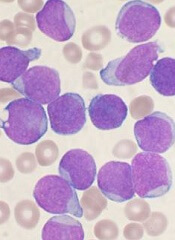
A new device might help physicians choose the optimal treatment for cancer patients, according to research published in Nature Biotechnology.
The device was designed to predict responses to treatment by measuring individual cell growth after drug exposure.
Researchers found they could predict whether a particular drug would kill leukemia or glioblastoma cells, based on how the drug affected the cells’ mass.
“We’ve developed a functional assay that can measure drug response of individual cells while maintaining viability for downstream analysis such as sequencing,” said study author Scott Manalis, PhD, of the Massachusetts Institute of Technology in Cambridge.
He and his colleagues were inspired to develop their assay, in part, by a test that has been used for decades to choose antibiotics to treat bacterial infections. The antibiotic susceptibility test involves simply taking bacteria from a patient, exposing them to a range of antibiotics, and observing whether the bacteria grow or die.
To translate that approach to cancer, the researchers needed a way to rapidly measure cell responses to drugs, and to do it with a limited number of cells.
For the past several years, Dr Manalis’s lab has been developing a device known as a suspended microchannel resonator (SMR).
According to the researchers, the SMR can measure cell masses 10 to 100 times more accurately than any other technique. This allows for the precise calculation of growth rates of single cells over short periods of time.
For this study, Dr Manalis and his colleagues used the SMR to determine whether drug susceptibility could be predicted by measuring cancer cell growth rates following drug exposure.
The team analyzed cells from patients with different subtypes of glioblastoma and B-cell acute lymphocytic leukemia (ALL) that have previously been shown to be either sensitive or resistant to specific therapies—MDM2 inhibitors for glioblastoma and BCR-ABL inhibitors for ALL.
After exposing the cancer cells to the drugs, the researchers waited about 15 hours, then measured the cell’s growth rates. Each cell was measured several times over a period of 15 to 20 minutes, providing enough data for the team to calculate the mass accumulation rate.
They found that cells known to be susceptible to a given therapy changed the way they accumulate mass, whereas resistant cells continued to grow as if unaffected.
“We’re able to show that cells we know are sensitive to therapy respond by dramatically reducing their growth rate relative to cells that are resistant,” said study author Mark Stevens, of the Dana-Farber Cancer Institute in Boston, Massachusetts.
“And because the cells are still alive, we have the opportunity to study the same cells following our measurement.”
The researchers said a major advantage of this technique is that it can be done with very small numbers of cells. In the experiments with ALL cells, the team showed they could get accurate results with a droplet of blood containing about 1000 ALL cells.
Another advantage is the speed at which small changes in cell mass can be measured, said Anthony Letai, MD, PhD, of the Dana-Farber Cancer Institute.
“This system is well suited to making rapid measurements,” said Dr Letai, who was not involved in this study. “I look forward to seeing them apply this to many more cancers and many more drugs.”
The researchers are now using their technique to test cells’ susceptibility to drugs, then isolate the cells and sequence the RNA found in them, revealing which genes are turned on.
“Now that we have a way to identify cells that are not responding to a given therapy, we are excited about isolating these cells and analyzing them to understand mechanisms of resistance,” Dr Manalis said.
In another recent paper published in Nature Biotechnology, the researchers described a higher throughput version of the SMR device that can do in 1 day the same number of measurements that took several months with the device used in this study.
This is an important step toward making the approach suitable for clinical samples, Dr Manalis said. 
A new device might help physicians choose the optimal treatment for cancer patients, according to research published in Nature Biotechnology.
The device was designed to predict responses to treatment by measuring individual cell growth after drug exposure.
Researchers found they could predict whether a particular drug would kill leukemia or glioblastoma cells, based on how the drug affected the cells’ mass.
“We’ve developed a functional assay that can measure drug response of individual cells while maintaining viability for downstream analysis such as sequencing,” said study author Scott Manalis, PhD, of the Massachusetts Institute of Technology in Cambridge.
He and his colleagues were inspired to develop their assay, in part, by a test that has been used for decades to choose antibiotics to treat bacterial infections. The antibiotic susceptibility test involves simply taking bacteria from a patient, exposing them to a range of antibiotics, and observing whether the bacteria grow or die.
To translate that approach to cancer, the researchers needed a way to rapidly measure cell responses to drugs, and to do it with a limited number of cells.
For the past several years, Dr Manalis’s lab has been developing a device known as a suspended microchannel resonator (SMR).
According to the researchers, the SMR can measure cell masses 10 to 100 times more accurately than any other technique. This allows for the precise calculation of growth rates of single cells over short periods of time.
For this study, Dr Manalis and his colleagues used the SMR to determine whether drug susceptibility could be predicted by measuring cancer cell growth rates following drug exposure.
The team analyzed cells from patients with different subtypes of glioblastoma and B-cell acute lymphocytic leukemia (ALL) that have previously been shown to be either sensitive or resistant to specific therapies—MDM2 inhibitors for glioblastoma and BCR-ABL inhibitors for ALL.
After exposing the cancer cells to the drugs, the researchers waited about 15 hours, then measured the cell’s growth rates. Each cell was measured several times over a period of 15 to 20 minutes, providing enough data for the team to calculate the mass accumulation rate.
They found that cells known to be susceptible to a given therapy changed the way they accumulate mass, whereas resistant cells continued to grow as if unaffected.
“We’re able to show that cells we know are sensitive to therapy respond by dramatically reducing their growth rate relative to cells that are resistant,” said study author Mark Stevens, of the Dana-Farber Cancer Institute in Boston, Massachusetts.
“And because the cells are still alive, we have the opportunity to study the same cells following our measurement.”
The researchers said a major advantage of this technique is that it can be done with very small numbers of cells. In the experiments with ALL cells, the team showed they could get accurate results with a droplet of blood containing about 1000 ALL cells.
Another advantage is the speed at which small changes in cell mass can be measured, said Anthony Letai, MD, PhD, of the Dana-Farber Cancer Institute.
“This system is well suited to making rapid measurements,” said Dr Letai, who was not involved in this study. “I look forward to seeing them apply this to many more cancers and many more drugs.”
The researchers are now using their technique to test cells’ susceptibility to drugs, then isolate the cells and sequence the RNA found in them, revealing which genes are turned on.
“Now that we have a way to identify cells that are not responding to a given therapy, we are excited about isolating these cells and analyzing them to understand mechanisms of resistance,” Dr Manalis said.
In another recent paper published in Nature Biotechnology, the researchers described a higher throughput version of the SMR device that can do in 1 day the same number of measurements that took several months with the device used in this study.
This is an important step toward making the approach suitable for clinical samples, Dr Manalis said.
A new device might help physicians choose the optimal treatment for cancer patients, according to research published in Nature Biotechnology.
The device was designed to predict responses to treatment by measuring individual cell growth after drug exposure.
Researchers found they could predict whether a particular drug would kill leukemia or glioblastoma cells, based on how the drug affected the cells’ mass.
“We’ve developed a functional assay that can measure drug response of individual cells while maintaining viability for downstream analysis such as sequencing,” said study author Scott Manalis, PhD, of the Massachusetts Institute of Technology in Cambridge.
He and his colleagues were inspired to develop their assay, in part, by a test that has been used for decades to choose antibiotics to treat bacterial infections. The antibiotic susceptibility test involves simply taking bacteria from a patient, exposing them to a range of antibiotics, and observing whether the bacteria grow or die.
To translate that approach to cancer, the researchers needed a way to rapidly measure cell responses to drugs, and to do it with a limited number of cells.
For the past several years, Dr Manalis’s lab has been developing a device known as a suspended microchannel resonator (SMR).
According to the researchers, the SMR can measure cell masses 10 to 100 times more accurately than any other technique. This allows for the precise calculation of growth rates of single cells over short periods of time.
For this study, Dr Manalis and his colleagues used the SMR to determine whether drug susceptibility could be predicted by measuring cancer cell growth rates following drug exposure.
The team analyzed cells from patients with different subtypes of glioblastoma and B-cell acute lymphocytic leukemia (ALL) that have previously been shown to be either sensitive or resistant to specific therapies—MDM2 inhibitors for glioblastoma and BCR-ABL inhibitors for ALL.
After exposing the cancer cells to the drugs, the researchers waited about 15 hours, then measured the cell’s growth rates. Each cell was measured several times over a period of 15 to 20 minutes, providing enough data for the team to calculate the mass accumulation rate.
They found that cells known to be susceptible to a given therapy changed the way they accumulate mass, whereas resistant cells continued to grow as if unaffected.
“We’re able to show that cells we know are sensitive to therapy respond by dramatically reducing their growth rate relative to cells that are resistant,” said study author Mark Stevens, of the Dana-Farber Cancer Institute in Boston, Massachusetts.
“And because the cells are still alive, we have the opportunity to study the same cells following our measurement.”
The researchers said a major advantage of this technique is that it can be done with very small numbers of cells. In the experiments with ALL cells, the team showed they could get accurate results with a droplet of blood containing about 1000 ALL cells.
Another advantage is the speed at which small changes in cell mass can be measured, said Anthony Letai, MD, PhD, of the Dana-Farber Cancer Institute.
“This system is well suited to making rapid measurements,” said Dr Letai, who was not involved in this study. “I look forward to seeing them apply this to many more cancers and many more drugs.”
The researchers are now using their technique to test cells’ susceptibility to drugs, then isolate the cells and sequence the RNA found in them, revealing which genes are turned on.
“Now that we have a way to identify cells that are not responding to a given therapy, we are excited about isolating these cells and analyzing them to understand mechanisms of resistance,” Dr Manalis said.
In another recent paper published in Nature Biotechnology, the researchers described a higher throughput version of the SMR device that can do in 1 day the same number of measurements that took several months with the device used in this study.
This is an important step toward making the approach suitable for clinical samples, Dr Manalis said.
Holographic imaging and deep learning diagnose malaria
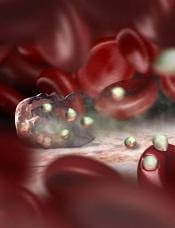
Image by Peter H. Seeberger
Scientists say they have devised a technique that can be used to diagnose malaria quickly and with clinically relevant accuracy.
The technique involves using computer deep learning and light-based, holographic scans to spot malaria-infected cells from an untouched blood sample without any help from a human.
The scientists believe this could form the basis of a fast, reliable malaria test that could be given by most anyone, anywhere in the field.
The team described the method in PLOS ONE.
“With this technique, the path is there to be able to process thousands of cells per minute,” said study author Adam Wax, PhD, of Duke University in Durham, North Carolina.
“That’s a huge improvement to the 40 minutes it currently takes a field technician to stain, prepare, and read a slide to personally look for infection.”
The new technique is based on a technology called quantitative phase spectroscopy. As a laser sweeps through the visible spectrum of light, sensors capture how each discrete light frequency interacts with a sample of blood.
The resulting data captures a holographic image that provides a wide array of information that can indicate a malaria infection.
“We identified 23 parameters that are statistically significant for spotting malaria,” said study author Han Sang Park, a doctoral student in Dr Wax’s lab.
For example, as the disease progresses, red blood cells decrease in volume, lose hemoglobin, and deform as the parasite within grows larger. This affects features such as cell volume, perimeter, shape, and center of mass.
“However, none of the parameters were reliable more than 90% of the time on their own,” Park said. “So we decided to use them all.”
“To be adopted, any new diagnostic device has to be just as reliable as a trained field worker with a microscope,” Dr Wax said. “Otherwise, even with a 90% success rate, you’d still miss more than 20 million [malaria] cases a year.”
To get a more accurate reading, Dr Wax and his colleagues turned to deep learning—a method by which computers teach themselves how to distinguish between different objects.
Feeding data on healthy and diseased cells into a computer enabled the deep learning program to determine which sets of measurements at which thresholds most clearly distinguished healthy cells from diseased cells.
When the scientists put the resulting algorithm to the test with hundreds of cells, the algorithm was able to correctly spot malaria more than 95% of the time—a number the team believes will increase as more cells are used to train the program.
The team noted that, because the technique breaks data-rich holograms down to just 23 numbers, tests can be easily transmitted in bulk. They said this is important for locations that often do not have reliable, fast internet connections.
Dr Wax and his colleagues are now looking to develop the technology into a diagnostic device through a startup company called M2 Photonics Innovations. They hope to show that a device based on this technology would be accurate and cost-efficient enough to be useful in the field.
Dr Wax has also received funding to begin exploring the use of the technique for spotting cancerous cells in blood samples.
Image by Peter H. Seeberger
Scientists say they have devised a technique that can be used to diagnose malaria quickly and with clinically relevant accuracy.
The technique involves using computer deep learning and light-based, holographic scans to spot malaria-infected cells from an untouched blood sample without any help from a human.
The scientists believe this could form the basis of a fast, reliable malaria test that could be given by most anyone, anywhere in the field.
The team described the method in PLOS ONE.
“With this technique, the path is there to be able to process thousands of cells per minute,” said study author Adam Wax, PhD, of Duke University in Durham, North Carolina.
“That’s a huge improvement to the 40 minutes it currently takes a field technician to stain, prepare, and read a slide to personally look for infection.”
The new technique is based on a technology called quantitative phase spectroscopy. As a laser sweeps through the visible spectrum of light, sensors capture how each discrete light frequency interacts with a sample of blood.
The resulting data captures a holographic image that provides a wide array of information that can indicate a malaria infection.
“We identified 23 parameters that are statistically significant for spotting malaria,” said study author Han Sang Park, a doctoral student in Dr Wax’s lab.
For example, as the disease progresses, red blood cells decrease in volume, lose hemoglobin, and deform as the parasite within grows larger. This affects features such as cell volume, perimeter, shape, and center of mass.
“However, none of the parameters were reliable more than 90% of the time on their own,” Park said. “So we decided to use them all.”
“To be adopted, any new diagnostic device has to be just as reliable as a trained field worker with a microscope,” Dr Wax said. “Otherwise, even with a 90% success rate, you’d still miss more than 20 million [malaria] cases a year.”
To get a more accurate reading, Dr Wax and his colleagues turned to deep learning—a method by which computers teach themselves how to distinguish between different objects.
Feeding data on healthy and diseased cells into a computer enabled the deep learning program to determine which sets of measurements at which thresholds most clearly distinguished healthy cells from diseased cells.
When the scientists put the resulting algorithm to the test with hundreds of cells, the algorithm was able to correctly spot malaria more than 95% of the time—a number the team believes will increase as more cells are used to train the program.
The team noted that, because the technique breaks data-rich holograms down to just 23 numbers, tests can be easily transmitted in bulk. They said this is important for locations that often do not have reliable, fast internet connections.
Dr Wax and his colleagues are now looking to develop the technology into a diagnostic device through a startup company called M2 Photonics Innovations. They hope to show that a device based on this technology would be accurate and cost-efficient enough to be useful in the field.
Dr Wax has also received funding to begin exploring the use of the technique for spotting cancerous cells in blood samples.
Image by Peter H. Seeberger
Scientists say they have devised a technique that can be used to diagnose malaria quickly and with clinically relevant accuracy.
The technique involves using computer deep learning and light-based, holographic scans to spot malaria-infected cells from an untouched blood sample without any help from a human.
The scientists believe this could form the basis of a fast, reliable malaria test that could be given by most anyone, anywhere in the field.
The team described the method in PLOS ONE.
“With this technique, the path is there to be able to process thousands of cells per minute,” said study author Adam Wax, PhD, of Duke University in Durham, North Carolina.
“That’s a huge improvement to the 40 minutes it currently takes a field technician to stain, prepare, and read a slide to personally look for infection.”
The new technique is based on a technology called quantitative phase spectroscopy. As a laser sweeps through the visible spectrum of light, sensors capture how each discrete light frequency interacts with a sample of blood.
The resulting data captures a holographic image that provides a wide array of information that can indicate a malaria infection.
“We identified 23 parameters that are statistically significant for spotting malaria,” said study author Han Sang Park, a doctoral student in Dr Wax’s lab.
For example, as the disease progresses, red blood cells decrease in volume, lose hemoglobin, and deform as the parasite within grows larger. This affects features such as cell volume, perimeter, shape, and center of mass.
“However, none of the parameters were reliable more than 90% of the time on their own,” Park said. “So we decided to use them all.”
“To be adopted, any new diagnostic device has to be just as reliable as a trained field worker with a microscope,” Dr Wax said. “Otherwise, even with a 90% success rate, you’d still miss more than 20 million [malaria] cases a year.”
To get a more accurate reading, Dr Wax and his colleagues turned to deep learning—a method by which computers teach themselves how to distinguish between different objects.
Feeding data on healthy and diseased cells into a computer enabled the deep learning program to determine which sets of measurements at which thresholds most clearly distinguished healthy cells from diseased cells.
When the scientists put the resulting algorithm to the test with hundreds of cells, the algorithm was able to correctly spot malaria more than 95% of the time—a number the team believes will increase as more cells are used to train the program.
The team noted that, because the technique breaks data-rich holograms down to just 23 numbers, tests can be easily transmitted in bulk. They said this is important for locations that often do not have reliable, fast internet connections.
Dr Wax and his colleagues are now looking to develop the technology into a diagnostic device through a startup company called M2 Photonics Innovations. They hope to show that a device based on this technology would be accurate and cost-efficient enough to be useful in the field.
Dr Wax has also received funding to begin exploring the use of the technique for spotting cancerous cells in blood samples.
‘Fresher’ RBCs no safer than standard RBCs, AABB says
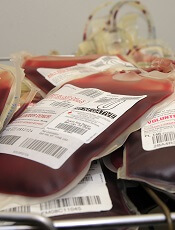
Photo courtesy of UAB Hospital
AABB has released new guidelines on when to perform red blood cell (RBC) transfusions and the optimal duration of RBC storage.
The guidelines state that a restrictive transfusion threshold—waiting to transfuse until a patient’s hemoglobin level is 7-8 g/dL—is safe in most clinical settings.
And, for most patients, “fresh” RBCs—stored for less than 10 days—are no safer than standard-issue RBCs—stored for up to 42 days.
“One of the biggest controversies concerning transfusion therapy is whether older blood is harmful compared to fresher blood,” said guideline author Aaron Tobian, MD, PhD, of the Johns Hopkins University School of Medicine in Baltimore, Maryland.
“Now, we have information that can accurately inform guidelines about red blood cell storage duration. If data suggest no harm from the use of standard-issue blood and fresher blood would only constrain the use of a limited resource, continuing with standard practice of using older blood is appropriate. The newly released guidelines now clearly inform the community.”
The guidelines were published in JAMA alongside a related editorial.
The recommendations in the guidelines are based on an analysis of randomized clinical trials in which researchers evaluated hemoglobin thresholds for RBC transfusion (trials conducted from 1950 through May 2016) and RBC storage duration (trials conducted from 1948 through May 2016).
For transfusion thresholds, there were 31 trials including 12,587 subjects. The results of these trials suggested that restrictive transfusion thresholds (transfusing when the hemoglobin level is 7-8 g/dL) were not associated with higher rates of adverse clinical outcomes when compared to liberal thresholds (transfusing when the hemoglobin level is 9-10 g/dL).
For RBC storage duration, there were 13 trials including 5515 subjects. The results suggested that transfusing fresher blood did not improve clinical outcomes.
Transfusion threshold
The guideline authors said it is good practice, when making transfusion decisions, to consider the patient’s hemoglobin level, the overall clinical context, patient preference, and alternative therapies.
However, in general, a hemoglobin level of 7 g/dL should serve as the threshold for transfusing adult patients who are hemodynamically stable, even if they are in critical care. This is a strong recommendation based on moderate-quality evidence.
“While the recommended threshold of 7 g/dL is consistent with previous AABB guidelines, the strength of the new recommendation reflects the quality and quantity of the new data, much of which was generated since 2012,” said guideline author Jeffrey Carson, MD, of Robert Wood Johnson University Hospital in New Brunswick, New Jersey.
“Clinically, these results show that no harm will come from waiting to transfuse a patient until the hemoglobin level reaches a lower point. The restrictive approach is associated with reductions in blood use, blood conservation, and lower expenses.”
The guidelines also state that, for patients with pre-existing cardiovascular disease and those undergoing cardiac or orthopedic surgery, the threshold should be 8 g/dL. This is a strong recommendation based on moderate-quality evidence.
Neither of the aforementioned recommendations apply to patients with acute coronary syndrome, severe thrombocytopenia, or chronic transfusion-dependent anemia.
Dr Carson said additional trials are needed to determine whether these patients benefit from transfusion at higher hemoglobin levels.
“We are about to embark on a large, international clinical trial supported by the NIH [National Institutes of Health] that will provide the evidence needed to determine the best course of action for patients who have had a heart attack,” he said.
Dr Carson and his colleagues also noted that, although the recommendations are based on the available evidence, the hemoglobin transfusion thresholds assessed may not be optimal. And the use of hemoglobin transfusion thresholds may be an imperfect surrogate for oxygen delivery.
Storage duration
The guidelines state that most patients, including neonates, should receive standard-issue RBCs (stored for 42 days or less) rather than limiting patients to only fresh RBCs (stored for less than 10 days). This is a strong recommendation based on moderate-quality evidence.
The trials analyzed showed that patients who received standard-issue RBCs faced no higher risk of complications—including 30-day mortality, myocardial infarction, cerebrovascular accident, rebleeding, pneumonia, or thromboembolism—than those who received fresh RBCs.
However, the guideline authors said the trial results may not apply to RBCs nearing their expiration date (stored for 35 to 42 days), as only a small proportion of patients in these trials were exposed to such RBCs.
Furthermore, the trials did not include patients undergoing a massive or exchange transfusion, neonates and children with underlying renal disease at higher risk of hyperkalemia, patients undergoing intrauterine transfusions, or patients with hemoglobinopathies requiring chronic transfusion support.
So the optimal RBC storage duration for these patients is unknown.
Photo courtesy of UAB Hospital
AABB has released new guidelines on when to perform red blood cell (RBC) transfusions and the optimal duration of RBC storage.
The guidelines state that a restrictive transfusion threshold—waiting to transfuse until a patient’s hemoglobin level is 7-8 g/dL—is safe in most clinical settings.
And, for most patients, “fresh” RBCs—stored for less than 10 days—are no safer than standard-issue RBCs—stored for up to 42 days.
“One of the biggest controversies concerning transfusion therapy is whether older blood is harmful compared to fresher blood,” said guideline author Aaron Tobian, MD, PhD, of the Johns Hopkins University School of Medicine in Baltimore, Maryland.
“Now, we have information that can accurately inform guidelines about red blood cell storage duration. If data suggest no harm from the use of standard-issue blood and fresher blood would only constrain the use of a limited resource, continuing with standard practice of using older blood is appropriate. The newly released guidelines now clearly inform the community.”
The guidelines were published in JAMA alongside a related editorial.
The recommendations in the guidelines are based on an analysis of randomized clinical trials in which researchers evaluated hemoglobin thresholds for RBC transfusion (trials conducted from 1950 through May 2016) and RBC storage duration (trials conducted from 1948 through May 2016).
For transfusion thresholds, there were 31 trials including 12,587 subjects. The results of these trials suggested that restrictive transfusion thresholds (transfusing when the hemoglobin level is 7-8 g/dL) were not associated with higher rates of adverse clinical outcomes when compared to liberal thresholds (transfusing when the hemoglobin level is 9-10 g/dL).
For RBC storage duration, there were 13 trials including 5515 subjects. The results suggested that transfusing fresher blood did not improve clinical outcomes.
Transfusion threshold
The guideline authors said it is good practice, when making transfusion decisions, to consider the patient’s hemoglobin level, the overall clinical context, patient preference, and alternative therapies.
However, in general, a hemoglobin level of 7 g/dL should serve as the threshold for transfusing adult patients who are hemodynamically stable, even if they are in critical care. This is a strong recommendation based on moderate-quality evidence.
“While the recommended threshold of 7 g/dL is consistent with previous AABB guidelines, the strength of the new recommendation reflects the quality and quantity of the new data, much of which was generated since 2012,” said guideline author Jeffrey Carson, MD, of Robert Wood Johnson University Hospital in New Brunswick, New Jersey.
“Clinically, these results show that no harm will come from waiting to transfuse a patient until the hemoglobin level reaches a lower point. The restrictive approach is associated with reductions in blood use, blood conservation, and lower expenses.”
The guidelines also state that, for patients with pre-existing cardiovascular disease and those undergoing cardiac or orthopedic surgery, the threshold should be 8 g/dL. This is a strong recommendation based on moderate-quality evidence.
Neither of the aforementioned recommendations apply to patients with acute coronary syndrome, severe thrombocytopenia, or chronic transfusion-dependent anemia.
Dr Carson said additional trials are needed to determine whether these patients benefit from transfusion at higher hemoglobin levels.
“We are about to embark on a large, international clinical trial supported by the NIH [National Institutes of Health] that will provide the evidence needed to determine the best course of action for patients who have had a heart attack,” he said.
Dr Carson and his colleagues also noted that, although the recommendations are based on the available evidence, the hemoglobin transfusion thresholds assessed may not be optimal. And the use of hemoglobin transfusion thresholds may be an imperfect surrogate for oxygen delivery.
Storage duration
The guidelines state that most patients, including neonates, should receive standard-issue RBCs (stored for 42 days or less) rather than limiting patients to only fresh RBCs (stored for less than 10 days). This is a strong recommendation based on moderate-quality evidence.
The trials analyzed showed that patients who received standard-issue RBCs faced no higher risk of complications—including 30-day mortality, myocardial infarction, cerebrovascular accident, rebleeding, pneumonia, or thromboembolism—than those who received fresh RBCs.
However, the guideline authors said the trial results may not apply to RBCs nearing their expiration date (stored for 35 to 42 days), as only a small proportion of patients in these trials were exposed to such RBCs.
Furthermore, the trials did not include patients undergoing a massive or exchange transfusion, neonates and children with underlying renal disease at higher risk of hyperkalemia, patients undergoing intrauterine transfusions, or patients with hemoglobinopathies requiring chronic transfusion support.
So the optimal RBC storage duration for these patients is unknown.
Photo courtesy of UAB Hospital
AABB has released new guidelines on when to perform red blood cell (RBC) transfusions and the optimal duration of RBC storage.
The guidelines state that a restrictive transfusion threshold—waiting to transfuse until a patient’s hemoglobin level is 7-8 g/dL—is safe in most clinical settings.
And, for most patients, “fresh” RBCs—stored for less than 10 days—are no safer than standard-issue RBCs—stored for up to 42 days.
“One of the biggest controversies concerning transfusion therapy is whether older blood is harmful compared to fresher blood,” said guideline author Aaron Tobian, MD, PhD, of the Johns Hopkins University School of Medicine in Baltimore, Maryland.
“Now, we have information that can accurately inform guidelines about red blood cell storage duration. If data suggest no harm from the use of standard-issue blood and fresher blood would only constrain the use of a limited resource, continuing with standard practice of using older blood is appropriate. The newly released guidelines now clearly inform the community.”
The guidelines were published in JAMA alongside a related editorial.
The recommendations in the guidelines are based on an analysis of randomized clinical trials in which researchers evaluated hemoglobin thresholds for RBC transfusion (trials conducted from 1950 through May 2016) and RBC storage duration (trials conducted from 1948 through May 2016).
For transfusion thresholds, there were 31 trials including 12,587 subjects. The results of these trials suggested that restrictive transfusion thresholds (transfusing when the hemoglobin level is 7-8 g/dL) were not associated with higher rates of adverse clinical outcomes when compared to liberal thresholds (transfusing when the hemoglobin level is 9-10 g/dL).
For RBC storage duration, there were 13 trials including 5515 subjects. The results suggested that transfusing fresher blood did not improve clinical outcomes.
Transfusion threshold
The guideline authors said it is good practice, when making transfusion decisions, to consider the patient’s hemoglobin level, the overall clinical context, patient preference, and alternative therapies.
However, in general, a hemoglobin level of 7 g/dL should serve as the threshold for transfusing adult patients who are hemodynamically stable, even if they are in critical care. This is a strong recommendation based on moderate-quality evidence.
“While the recommended threshold of 7 g/dL is consistent with previous AABB guidelines, the strength of the new recommendation reflects the quality and quantity of the new data, much of which was generated since 2012,” said guideline author Jeffrey Carson, MD, of Robert Wood Johnson University Hospital in New Brunswick, New Jersey.
“Clinically, these results show that no harm will come from waiting to transfuse a patient until the hemoglobin level reaches a lower point. The restrictive approach is associated with reductions in blood use, blood conservation, and lower expenses.”
The guidelines also state that, for patients with pre-existing cardiovascular disease and those undergoing cardiac or orthopedic surgery, the threshold should be 8 g/dL. This is a strong recommendation based on moderate-quality evidence.
Neither of the aforementioned recommendations apply to patients with acute coronary syndrome, severe thrombocytopenia, or chronic transfusion-dependent anemia.
Dr Carson said additional trials are needed to determine whether these patients benefit from transfusion at higher hemoglobin levels.
“We are about to embark on a large, international clinical trial supported by the NIH [National Institutes of Health] that will provide the evidence needed to determine the best course of action for patients who have had a heart attack,” he said.
Dr Carson and his colleagues also noted that, although the recommendations are based on the available evidence, the hemoglobin transfusion thresholds assessed may not be optimal. And the use of hemoglobin transfusion thresholds may be an imperfect surrogate for oxygen delivery.
Storage duration
The guidelines state that most patients, including neonates, should receive standard-issue RBCs (stored for 42 days or less) rather than limiting patients to only fresh RBCs (stored for less than 10 days). This is a strong recommendation based on moderate-quality evidence.
The trials analyzed showed that patients who received standard-issue RBCs faced no higher risk of complications—including 30-day mortality, myocardial infarction, cerebrovascular accident, rebleeding, pneumonia, or thromboembolism—than those who received fresh RBCs.
However, the guideline authors said the trial results may not apply to RBCs nearing their expiration date (stored for 35 to 42 days), as only a small proportion of patients in these trials were exposed to such RBCs.
Furthermore, the trials did not include patients undergoing a massive or exchange transfusion, neonates and children with underlying renal disease at higher risk of hyperkalemia, patients undergoing intrauterine transfusions, or patients with hemoglobinopathies requiring chronic transfusion support.
So the optimal RBC storage duration for these patients is unknown.
Funding to Support Opioid-Related Treatment Programs
HHS has announced $53 million in funding to 44 states, 4 tribes, and the District of Columbia. The money will be used to improve access to treatment for opioid use disorders, reduce opioid-related deaths, and strengthen drug misuse prevention efforts.
Administered by SAMHSA and the CDC, the funding supports 6 programs. Among those:
The Medication-Assisted Treatment Prescription Drug Opioid Addiction Grants will provide up to $11 million to 11 states to expand medication-assisted treatment (MAT) services. The program targets 11 states with the highest rates of primary treatment admissions for heroin and prescription opioids per capita: Alaska, Arizona, Colorado, Connecticut, Illinois, Louisiana, New Hampshire, North Carolina, Oklahoma, Oregon, and Rhode Island.
The Prescription Drug Opioid Overdose Prevention Grants will provide up to $11 million to 12 states for training in preventing opioid overdose-related deaths, as well as funding the purchase and distribution of naloxone to first responders.
The Strategic Prevention Framework Partnerships for Prescription Drugs Grants will provide $9.3 million to 21 states and 4 tribes to help raise awareness about drug use and misuse. The tribes are the Little Traverse Bay Bands of Odawa Indians, Cherokee Nation, Southern Plains Tribal Health Board, and the Nooksack Indian Tribe.
Launched in 2015, the funding is part of the HHS Opioid Initiative. The program concentrates on evidence-based strategies that have the most impact, focusing on improving prescribing practices, expanding access to MAT, and increasing the use of naloxone.
HHS has announced $53 million in funding to 44 states, 4 tribes, and the District of Columbia. The money will be used to improve access to treatment for opioid use disorders, reduce opioid-related deaths, and strengthen drug misuse prevention efforts.
Administered by SAMHSA and the CDC, the funding supports 6 programs. Among those:
The Medication-Assisted Treatment Prescription Drug Opioid Addiction Grants will provide up to $11 million to 11 states to expand medication-assisted treatment (MAT) services. The program targets 11 states with the highest rates of primary treatment admissions for heroin and prescription opioids per capita: Alaska, Arizona, Colorado, Connecticut, Illinois, Louisiana, New Hampshire, North Carolina, Oklahoma, Oregon, and Rhode Island.
The Prescription Drug Opioid Overdose Prevention Grants will provide up to $11 million to 12 states for training in preventing opioid overdose-related deaths, as well as funding the purchase and distribution of naloxone to first responders.
The Strategic Prevention Framework Partnerships for Prescription Drugs Grants will provide $9.3 million to 21 states and 4 tribes to help raise awareness about drug use and misuse. The tribes are the Little Traverse Bay Bands of Odawa Indians, Cherokee Nation, Southern Plains Tribal Health Board, and the Nooksack Indian Tribe.
Launched in 2015, the funding is part of the HHS Opioid Initiative. The program concentrates on evidence-based strategies that have the most impact, focusing on improving prescribing practices, expanding access to MAT, and increasing the use of naloxone.
HHS has announced $53 million in funding to 44 states, 4 tribes, and the District of Columbia. The money will be used to improve access to treatment for opioid use disorders, reduce opioid-related deaths, and strengthen drug misuse prevention efforts.
Administered by SAMHSA and the CDC, the funding supports 6 programs. Among those:
The Medication-Assisted Treatment Prescription Drug Opioid Addiction Grants will provide up to $11 million to 11 states to expand medication-assisted treatment (MAT) services. The program targets 11 states with the highest rates of primary treatment admissions for heroin and prescription opioids per capita: Alaska, Arizona, Colorado, Connecticut, Illinois, Louisiana, New Hampshire, North Carolina, Oklahoma, Oregon, and Rhode Island.
The Prescription Drug Opioid Overdose Prevention Grants will provide up to $11 million to 12 states for training in preventing opioid overdose-related deaths, as well as funding the purchase and distribution of naloxone to first responders.
The Strategic Prevention Framework Partnerships for Prescription Drugs Grants will provide $9.3 million to 21 states and 4 tribes to help raise awareness about drug use and misuse. The tribes are the Little Traverse Bay Bands of Odawa Indians, Cherokee Nation, Southern Plains Tribal Health Board, and the Nooksack Indian Tribe.
Launched in 2015, the funding is part of the HHS Opioid Initiative. The program concentrates on evidence-based strategies that have the most impact, focusing on improving prescribing practices, expanding access to MAT, and increasing the use of naloxone.
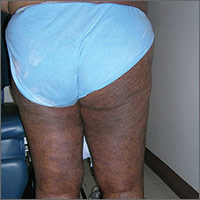
Rash from waist to below knees
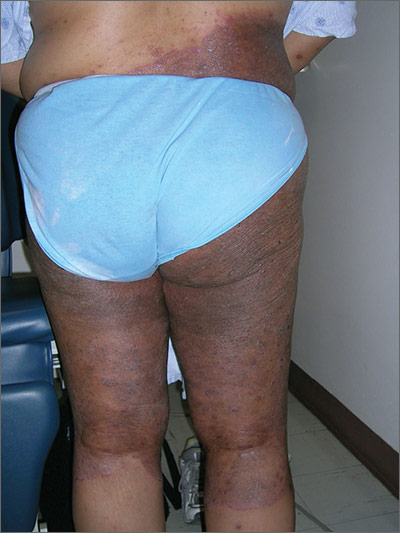
The FP suspected a fungal infection that was worsened by topical triamcinolone. He performed a potassium hydroxide (KOH) preparation and it was positive for branching septate hyphae, confirming the diagnosis of tinea corporis (See video on how to perform a KOH preparation here).
Knowing something about fungal epidemiology, he realized that this was most likely Trichophyton rubrum. He looked at the patient’s feet as well, but she did not have evidence of tinea pedis or onychomycosis. This patient’s diagnosis could also be called tinea incognito because a topical steroid was applied to the area, potentially changing the appearance of the infection. Since the infection was also in the groin, the term tinea cruris would describe that part of the rash. The hyperpigmentation seen is one form of post-inflammatory hyperpigmentation and may or may not resolve after the tinea is eradicated.
The FP knew that a topical antifungal cream wouldn’t be able to cure this massive case of tinea corporis, so he prescribed oral terbinafine 250 mg/d for 3 weeks. He also advised the patient to discontinue the hydroxyzine and the triamcinolone. The patient returned for a follow-up visit 3 weeks later and was delighted by the results. She had been able to sleep well—without incessant itching—for the first time in a year.
One month later, she returned to the FP with regrowth of fungus in the involved area. It wasn’t as bad as when she first presented, but the KOH preparation was again positive. The FP reassessed the situation and realized that large tinea infections may require more than the recommended duration of therapy. As she had no risk factors for liver disease and previous liver function tests were normal, the FP gave the patient an additional 4 weeks of oral terbinafine 250 mg/d. A 2-month follow-up appointment was arranged, at which time there was no further evidence of an active fungal infection. The post-inflammatory hyperpigmentation was lighter, but not fully gone.
Photos and text for Photo Rounds Friday courtesy of Richard P. Usatine, MD. This case was adapted from: Usatine R, Jimenez A. Tinea corporis. In: Usatine R, Smith M, Mayeaux EJ, et al, eds. Color Atlas of Family Medicine. 2nd ed. New York, NY: McGraw-Hill;2013:788-794.
To learn more about the Color Atlas of Family Medicine, see: www.amazon.com/Color-Family-Medicine-Richard-Usatine/dp/0071769641/
You can now get the second edition of the Color Atlas of Family Medicine as an app by clicking on this link: usatinemedia.com
The FP suspected a fungal infection that was worsened by topical triamcinolone. He performed a potassium hydroxide (KOH) preparation and it was positive for branching septate hyphae, confirming the diagnosis of tinea corporis (See video on how to perform a KOH preparation here).
Knowing something about fungal epidemiology, he realized that this was most likely Trichophyton rubrum. He looked at the patient’s feet as well, but she did not have evidence of tinea pedis or onychomycosis. This patient’s diagnosis could also be called tinea incognito because a topical steroid was applied to the area, potentially changing the appearance of the infection. Since the infection was also in the groin, the term tinea cruris would describe that part of the rash. The hyperpigmentation seen is one form of post-inflammatory hyperpigmentation and may or may not resolve after the tinea is eradicated.
The FP knew that a topical antifungal cream wouldn’t be able to cure this massive case of tinea corporis, so he prescribed oral terbinafine 250 mg/d for 3 weeks. He also advised the patient to discontinue the hydroxyzine and the triamcinolone. The patient returned for a follow-up visit 3 weeks later and was delighted by the results. She had been able to sleep well—without incessant itching—for the first time in a year.
One month later, she returned to the FP with regrowth of fungus in the involved area. It wasn’t as bad as when she first presented, but the KOH preparation was again positive. The FP reassessed the situation and realized that large tinea infections may require more than the recommended duration of therapy. As she had no risk factors for liver disease and previous liver function tests were normal, the FP gave the patient an additional 4 weeks of oral terbinafine 250 mg/d. A 2-month follow-up appointment was arranged, at which time there was no further evidence of an active fungal infection. The post-inflammatory hyperpigmentation was lighter, but not fully gone.
Photos and text for Photo Rounds Friday courtesy of Richard P. Usatine, MD. This case was adapted from: Usatine R, Jimenez A. Tinea corporis. In: Usatine R, Smith M, Mayeaux EJ, et al, eds. Color Atlas of Family Medicine. 2nd ed. New York, NY: McGraw-Hill;2013:788-794.
To learn more about the Color Atlas of Family Medicine, see: www.amazon.com/Color-Family-Medicine-Richard-Usatine/dp/0071769641/
You can now get the second edition of the Color Atlas of Family Medicine as an app by clicking on this link: usatinemedia.com
The FP suspected a fungal infection that was worsened by topical triamcinolone. He performed a potassium hydroxide (KOH) preparation and it was positive for branching septate hyphae, confirming the diagnosis of tinea corporis (See video on how to perform a KOH preparation here).
Knowing something about fungal epidemiology, he realized that this was most likely Trichophyton rubrum. He looked at the patient’s feet as well, but she did not have evidence of tinea pedis or onychomycosis. This patient’s diagnosis could also be called tinea incognito because a topical steroid was applied to the area, potentially changing the appearance of the infection. Since the infection was also in the groin, the term tinea cruris would describe that part of the rash. The hyperpigmentation seen is one form of post-inflammatory hyperpigmentation and may or may not resolve after the tinea is eradicated.
The FP knew that a topical antifungal cream wouldn’t be able to cure this massive case of tinea corporis, so he prescribed oral terbinafine 250 mg/d for 3 weeks. He also advised the patient to discontinue the hydroxyzine and the triamcinolone. The patient returned for a follow-up visit 3 weeks later and was delighted by the results. She had been able to sleep well—without incessant itching—for the first time in a year.
One month later, she returned to the FP with regrowth of fungus in the involved area. It wasn’t as bad as when she first presented, but the KOH preparation was again positive. The FP reassessed the situation and realized that large tinea infections may require more than the recommended duration of therapy. As she had no risk factors for liver disease and previous liver function tests were normal, the FP gave the patient an additional 4 weeks of oral terbinafine 250 mg/d. A 2-month follow-up appointment was arranged, at which time there was no further evidence of an active fungal infection. The post-inflammatory hyperpigmentation was lighter, but not fully gone.
Photos and text for Photo Rounds Friday courtesy of Richard P. Usatine, MD. This case was adapted from: Usatine R, Jimenez A. Tinea corporis. In: Usatine R, Smith M, Mayeaux EJ, et al, eds. Color Atlas of Family Medicine. 2nd ed. New York, NY: McGraw-Hill;2013:788-794.
To learn more about the Color Atlas of Family Medicine, see: www.amazon.com/Color-Family-Medicine-Richard-Usatine/dp/0071769641/
You can now get the second edition of the Color Atlas of Family Medicine as an app by clicking on this link: usatinemedia.com
A Creepy Crawly Anomaly
ANSWER
The correct answer is dermatofibroma (choice “c”), based on the classic histologic picture and the lack of supportive findings for other items in the differential. These include seborrheic keratosis, granular cell tumor, basal cell carcinoma, and sweat duct cancer.
DISCUSSION
This is a perfect example of one of the most common benign tumors, seen daily in dermatology offices worldwide. Alternately referred to as superficial benign fibrous histiocytomas, dermatofibromas (DFs) typically manifest on lower extremities, are about twice as common in women as in men, and usually affect patients in their early 40s.
DFs appear most commonly as low, firm, round to ovoid, pinkish brown papules that dimple with lateral digital pressure. Though not pathognomic, the “dimple sign” is highly suggestive of this diagnosis. DF lesions can also manifest as firm, convex papules or nodules (as in this case) with the same coloring but without the dimple sign.
For years, DFs were believed to be a reaction to trauma (eg, bug bite). While this theory still has its adherents, more recent studies suggest these are true tumors composed of skin fibroblasts. Their ability to occur internally, even in bone, provides further evidence against their putatively reactive nature.
Histologically, the typical DF shows whorling fascicles of a fibroblastic spindle cell proliferation in the dermis. By contrast, the most dangerous item in the differential, the rare but greatly feared malignant dermatofibrosarcoma protuberans, is characterized by a storiform (cartwheel-shaped) pattern of spindle cells.
DFs are often subject to trauma from shaving and therefore surgically removed. However, since this was not the case for this patient, she chose to leave her lesion in place.
ANSWER
The correct answer is dermatofibroma (choice “c”), based on the classic histologic picture and the lack of supportive findings for other items in the differential. These include seborrheic keratosis, granular cell tumor, basal cell carcinoma, and sweat duct cancer.
DISCUSSION
This is a perfect example of one of the most common benign tumors, seen daily in dermatology offices worldwide. Alternately referred to as superficial benign fibrous histiocytomas, dermatofibromas (DFs) typically manifest on lower extremities, are about twice as common in women as in men, and usually affect patients in their early 40s.
DFs appear most commonly as low, firm, round to ovoid, pinkish brown papules that dimple with lateral digital pressure. Though not pathognomic, the “dimple sign” is highly suggestive of this diagnosis. DF lesions can also manifest as firm, convex papules or nodules (as in this case) with the same coloring but without the dimple sign.
For years, DFs were believed to be a reaction to trauma (eg, bug bite). While this theory still has its adherents, more recent studies suggest these are true tumors composed of skin fibroblasts. Their ability to occur internally, even in bone, provides further evidence against their putatively reactive nature.
Histologically, the typical DF shows whorling fascicles of a fibroblastic spindle cell proliferation in the dermis. By contrast, the most dangerous item in the differential, the rare but greatly feared malignant dermatofibrosarcoma protuberans, is characterized by a storiform (cartwheel-shaped) pattern of spindle cells.
DFs are often subject to trauma from shaving and therefore surgically removed. However, since this was not the case for this patient, she chose to leave her lesion in place.
ANSWER
The correct answer is dermatofibroma (choice “c”), based on the classic histologic picture and the lack of supportive findings for other items in the differential. These include seborrheic keratosis, granular cell tumor, basal cell carcinoma, and sweat duct cancer.
DISCUSSION
This is a perfect example of one of the most common benign tumors, seen daily in dermatology offices worldwide. Alternately referred to as superficial benign fibrous histiocytomas, dermatofibromas (DFs) typically manifest on lower extremities, are about twice as common in women as in men, and usually affect patients in their early 40s.
DFs appear most commonly as low, firm, round to ovoid, pinkish brown papules that dimple with lateral digital pressure. Though not pathognomic, the “dimple sign” is highly suggestive of this diagnosis. DF lesions can also manifest as firm, convex papules or nodules (as in this case) with the same coloring but without the dimple sign.
For years, DFs were believed to be a reaction to trauma (eg, bug bite). While this theory still has its adherents, more recent studies suggest these are true tumors composed of skin fibroblasts. Their ability to occur internally, even in bone, provides further evidence against their putatively reactive nature.
Histologically, the typical DF shows whorling fascicles of a fibroblastic spindle cell proliferation in the dermis. By contrast, the most dangerous item in the differential, the rare but greatly feared malignant dermatofibrosarcoma protuberans, is characterized by a storiform (cartwheel-shaped) pattern of spindle cells.
DFs are often subject to trauma from shaving and therefore surgically removed. However, since this was not the case for this patient, she chose to leave her lesion in place.
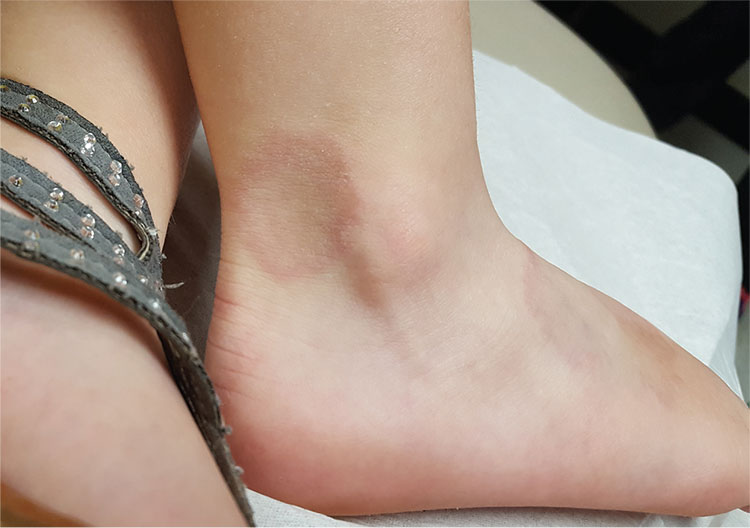
A 48-year-old woman is referred to dermatology for examination of a lesion on her ankle. Although the patient is certain that it has remained unchanged for years, she takes her primary care provider’s recommendation and agrees to be seen. She says the lesion occasionally itches and has a “crawly” feeling to it, but its size remains consistent.
Located on the lateral aspect of her left ankle is a brownish red, firm, round, intradermal nodule. It measures 8.5 mm and has a faint brown macular halo around it. Biopsy shows multiple round fascicles of spindle cells proliferating in the dermis. Special stains rule out the possibility of dermatofibrosarcoma protuberans, the most serious item in the differential.
The patient’s medical history includes breast cancer and a significant family history of skin cancer.

Suicide risk factors differ for women in military than in civilian population
WASHINGTON – Women service personnel face different suicide risks from their civilian counterparts, according to a Department of Defense appointee.
Data are few about suicide among women in the military – in part because not much research has been conducted over the years into service women’s health outcomes – according to Jacqueline Garrick, but insights gleaned from the reports of military women, both active duty and veterans, who survived suicide attempts, shed light on what to look for as risk factors. Ms. Garrick, special assistant, Manpower and Reserve Affairs in the Department of Defense, made her comments during a panel discussion at the American Psychiatric Association’s Institute on Psychiatric Services.*
One of the most salient of suicide risks can emerge when a service woman’s intimate relationship ends. This loss is compounded by the absence of social support that results from the military’s inherently masculine environment where “fitting in is definitely harder for women,” according to Ms. Garrick, a licensed clinical social worker, U.S. Army veteran, and policy analyst.
Deployment and combat zone traumas, whether physical, mental, or both, are other risk factors. Horrors witnessed in war can have psychological implications for men and women personnel. But for women, who also possibly face additional concerns of sexual assault and lack of social support, the traumas can become debilitating and lead to risk of suicide, Ms. Garrick said.
Women in the military overlap with civilians in their suicide risk factors where mental health history, abuse, and exposure to suicide are concerned, but where the two cohorts particularly diverge, Ms. Garrick said, is access to lethal means, particularly among women veterans. Civilian women who attempt suicide are more likely to cut themselves or overdose on drugs, whereas, “Military women have firearms, and they know how to use them,” Ms. Garrick said. “So, if you’re screening [for suicide in this population], pay close attention to whether there are weapons in the home.”
Traumatic brain injury is another area in which risks for suicide in military women could exist, but not enough is known at this point, Ms. Garrick said.
A suicide risk intervention called “safety planning” is one that Ms. Garrick said she has been developing in her work with the DOD. This includes asking these women what makes them feel “safe” at home, determining what their families know about the whereabouts and the safety features of their firearms, and learning what level of peer support exists for them and how to build it if it is lacking. Building resilience is another area, including finding military women opportunities to use their experiences in positive ways, such as through mentoring others.
For more information on suicide prevention for these women, Ms. Garrick referred clinicians to the suicide risk assessment and prevention clinical guidelines issued by the DOD and the Department of Veterans Affairs.
For patients at acute risk, Ms. Garrick said, “I recommend sitting with them as you watch them put this number into their phone: 800-273-8255. That’s the lifeline number that will connect you directly with the VA if you press 1.”
Because there has been a historic lack of interest on behalf of the military in women’s health outcomes related to their service compared with that of men, there is a need to create a database going forward to better inform DOD health and disability policies for women in the military, Ms. Garrick said. This places the onus on psychiatrists who evaluate this cohort to “tease out any potential psychological stressors that might not be obvious from their personnel file.” Some women have been exposed to the same levels of traumatic combat experiences as their male colleagues, even though it wasn’t until earlier this year that women became eligible for the same combat roles as men.
“If you look in their files, they might not have the same awards and titles as men, but they might have seen the same people being killed or the same number of dead bodies,” she said.
Ms. Garrick’s views are her own and do not represent those of the Department of Defense.
*Correction 10/14/16: An earlier version of this story misstated Ms. Garrick's position.
[email protected]
On Twitter @whitneymcknight
WASHINGTON – Women service personnel face different suicide risks from their civilian counterparts, according to a Department of Defense appointee.
Data are few about suicide among women in the military – in part because not much research has been conducted over the years into service women’s health outcomes – according to Jacqueline Garrick, but insights gleaned from the reports of military women, both active duty and veterans, who survived suicide attempts, shed light on what to look for as risk factors. Ms. Garrick, special assistant, Manpower and Reserve Affairs in the Department of Defense, made her comments during a panel discussion at the American Psychiatric Association’s Institute on Psychiatric Services.*
One of the most salient of suicide risks can emerge when a service woman’s intimate relationship ends. This loss is compounded by the absence of social support that results from the military’s inherently masculine environment where “fitting in is definitely harder for women,” according to Ms. Garrick, a licensed clinical social worker, U.S. Army veteran, and policy analyst.
Deployment and combat zone traumas, whether physical, mental, or both, are other risk factors. Horrors witnessed in war can have psychological implications for men and women personnel. But for women, who also possibly face additional concerns of sexual assault and lack of social support, the traumas can become debilitating and lead to risk of suicide, Ms. Garrick said.
Women in the military overlap with civilians in their suicide risk factors where mental health history, abuse, and exposure to suicide are concerned, but where the two cohorts particularly diverge, Ms. Garrick said, is access to lethal means, particularly among women veterans. Civilian women who attempt suicide are more likely to cut themselves or overdose on drugs, whereas, “Military women have firearms, and they know how to use them,” Ms. Garrick said. “So, if you’re screening [for suicide in this population], pay close attention to whether there are weapons in the home.”
Traumatic brain injury is another area in which risks for suicide in military women could exist, but not enough is known at this point, Ms. Garrick said.
A suicide risk intervention called “safety planning” is one that Ms. Garrick said she has been developing in her work with the DOD. This includes asking these women what makes them feel “safe” at home, determining what their families know about the whereabouts and the safety features of their firearms, and learning what level of peer support exists for them and how to build it if it is lacking. Building resilience is another area, including finding military women opportunities to use their experiences in positive ways, such as through mentoring others.
For more information on suicide prevention for these women, Ms. Garrick referred clinicians to the suicide risk assessment and prevention clinical guidelines issued by the DOD and the Department of Veterans Affairs.
For patients at acute risk, Ms. Garrick said, “I recommend sitting with them as you watch them put this number into their phone: 800-273-8255. That’s the lifeline number that will connect you directly with the VA if you press 1.”
Because there has been a historic lack of interest on behalf of the military in women’s health outcomes related to their service compared with that of men, there is a need to create a database going forward to better inform DOD health and disability policies for women in the military, Ms. Garrick said. This places the onus on psychiatrists who evaluate this cohort to “tease out any potential psychological stressors that might not be obvious from their personnel file.” Some women have been exposed to the same levels of traumatic combat experiences as their male colleagues, even though it wasn’t until earlier this year that women became eligible for the same combat roles as men.
“If you look in their files, they might not have the same awards and titles as men, but they might have seen the same people being killed or the same number of dead bodies,” she said.
Ms. Garrick’s views are her own and do not represent those of the Department of Defense.
*Correction 10/14/16: An earlier version of this story misstated Ms. Garrick's position.
[email protected]
On Twitter @whitneymcknight
WASHINGTON – Women service personnel face different suicide risks from their civilian counterparts, according to a Department of Defense appointee.
Data are few about suicide among women in the military – in part because not much research has been conducted over the years into service women’s health outcomes – according to Jacqueline Garrick, but insights gleaned from the reports of military women, both active duty and veterans, who survived suicide attempts, shed light on what to look for as risk factors. Ms. Garrick, special assistant, Manpower and Reserve Affairs in the Department of Defense, made her comments during a panel discussion at the American Psychiatric Association’s Institute on Psychiatric Services.*
One of the most salient of suicide risks can emerge when a service woman’s intimate relationship ends. This loss is compounded by the absence of social support that results from the military’s inherently masculine environment where “fitting in is definitely harder for women,” according to Ms. Garrick, a licensed clinical social worker, U.S. Army veteran, and policy analyst.
Deployment and combat zone traumas, whether physical, mental, or both, are other risk factors. Horrors witnessed in war can have psychological implications for men and women personnel. But for women, who also possibly face additional concerns of sexual assault and lack of social support, the traumas can become debilitating and lead to risk of suicide, Ms. Garrick said.
Women in the military overlap with civilians in their suicide risk factors where mental health history, abuse, and exposure to suicide are concerned, but where the two cohorts particularly diverge, Ms. Garrick said, is access to lethal means, particularly among women veterans. Civilian women who attempt suicide are more likely to cut themselves or overdose on drugs, whereas, “Military women have firearms, and they know how to use them,” Ms. Garrick said. “So, if you’re screening [for suicide in this population], pay close attention to whether there are weapons in the home.”
Traumatic brain injury is another area in which risks for suicide in military women could exist, but not enough is known at this point, Ms. Garrick said.
A suicide risk intervention called “safety planning” is one that Ms. Garrick said she has been developing in her work with the DOD. This includes asking these women what makes them feel “safe” at home, determining what their families know about the whereabouts and the safety features of their firearms, and learning what level of peer support exists for them and how to build it if it is lacking. Building resilience is another area, including finding military women opportunities to use their experiences in positive ways, such as through mentoring others.
For more information on suicide prevention for these women, Ms. Garrick referred clinicians to the suicide risk assessment and prevention clinical guidelines issued by the DOD and the Department of Veterans Affairs.
For patients at acute risk, Ms. Garrick said, “I recommend sitting with them as you watch them put this number into their phone: 800-273-8255. That’s the lifeline number that will connect you directly with the VA if you press 1.”
Because there has been a historic lack of interest on behalf of the military in women’s health outcomes related to their service compared with that of men, there is a need to create a database going forward to better inform DOD health and disability policies for women in the military, Ms. Garrick said. This places the onus on psychiatrists who evaluate this cohort to “tease out any potential psychological stressors that might not be obvious from their personnel file.” Some women have been exposed to the same levels of traumatic combat experiences as their male colleagues, even though it wasn’t until earlier this year that women became eligible for the same combat roles as men.
“If you look in their files, they might not have the same awards and titles as men, but they might have seen the same people being killed or the same number of dead bodies,” she said.
Ms. Garrick’s views are her own and do not represent those of the Department of Defense.
*Correction 10/14/16: An earlier version of this story misstated Ms. Garrick's position.
[email protected]
On Twitter @whitneymcknight
Survival benefit maintained long term with ipilimumab for high-risk melanoma
COPENHAGEN – Five years on, patients with high-risk stage III melanoma treated with the checkpoint inhibitor ipilimumab, following complete resection, continue to have significantly better overall, recurrence-free, and distant metastasis–free survival, compared with patients treated with placebo, reported investigators in a phase III trial.
Five-year overall survival among patients who received a 10-mg/kg dose of ipilimumab (Yervoy) in the EORTC 18071 trial was 65.4%, compared with 54.4% for patients who received placebo. This difference translated into a hazard ratio for death with ipilimumab of 0.72 (P = .001), reported Alexander M.M. Eggermont, MD, from the Gustave Roussy Cancer Center in Villejuif, France.

The survival benefit with ipilimumab “was consistent across all survival endpoints,” he said at a briefing prior to his presentation of the data in a symposium at the European Society for Medical Oncology Congress.
He noted, however, that the 10-mg/kg dose of ipilimumab selected in phase II trials is associated with significant toxicities.
“Ipilimumab is not an easy drug to handle. My recommendation is to keep it in [cancer] centers,” he said.
In the trial, 951 patients with high-risk, stage III, completely resected melanoma were randomly assigned to receive induction therapy with ipilimumab 10 mg/kg every 3 weeks for four cycles or placebo, followed by maintenance with the assigned therapy every 12 weeks for up to 3 years.
The investigators previously reported that, at a median follow-up of 2.7 years, ipilimumab was associated with significantly prolonged overall survival (the primary endpoint), with a hazard ratio vs. placebo of 0.75 (P = .001).
At ESMO 2016, Dr. Eggermont reported final survival results from the trial, at a median follow-up of 5.3 years.
The rate of 5-year overall survival for the 475 patients assigned to ipilimumab was 65.4%, compared with 54.4% among the 476 patients assigned to placebo (HR, 0.72, P = .001).
At 5 years, 41% of patients assigned to ipilimumab were free of recurrences, compared with 30% of patients on placebo, The median recurrence-free survival was 27.6 months vs. 17.1 months, respectively (HR, 0.76, P = .0008).
Similarly, the rate of distant metastasis-free survival at 5 years was 48.3% for patients assigned to ipilimumab, vs. 38.9% in the placebo group (HR for death or distant metastasis, 0.76; P = .002).
The safety analysis showed that twice as many patients assigned to ipilimumab had grade 3 or 4 adverse events (54.1% vs. 26.2%). Grade 3 or 4 adverse immune events occurred in 41.6% vs. 2.7%, respectively.
Five patients assigned to ipilimumab died from immune-related causes: three from colitis (two of whom had intestinal perforations), one from myocarditis, and one from multiorgan failure associated with Guillain-Barré syndrome.
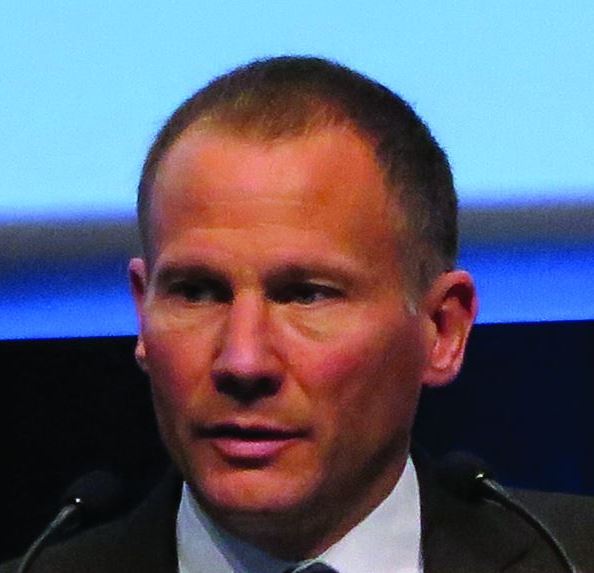
“The final analysis shows, for the first time, that checkpoint blockade is effective in the adjuvant setting,” he said.
The data suggest, however, that the benefit appears to be concentrated in patients with higher-risk features, such as involvement of four or more lymph nodes, microscopic nodal disease, or ulceration, he said.
The discussant also agreed with Dr. Eggermont’s assertions that the decision to treat patients with ipilimumab should factor in toxicity, and that treatment should be administered only in centers experienced in using the drug.
The trial was sponsored by Bristol-Myers Squibb. Dr. Eggermont disclosed serving on an advisory board for Bristol-Myers Squibb and Merck. Dr. Michielin disclosed consulting and/or honoraria from Amgen, Bristol-Myers Squibb, Roche, Merck Sharp & Dohme, Novartis, and GlaxoSmithKline.
COPENHAGEN – Five years on, patients with high-risk stage III melanoma treated with the checkpoint inhibitor ipilimumab, following complete resection, continue to have significantly better overall, recurrence-free, and distant metastasis–free survival, compared with patients treated with placebo, reported investigators in a phase III trial.
Five-year overall survival among patients who received a 10-mg/kg dose of ipilimumab (Yervoy) in the EORTC 18071 trial was 65.4%, compared with 54.4% for patients who received placebo. This difference translated into a hazard ratio for death with ipilimumab of 0.72 (P = .001), reported Alexander M.M. Eggermont, MD, from the Gustave Roussy Cancer Center in Villejuif, France.
The survival benefit with ipilimumab “was consistent across all survival endpoints,” he said at a briefing prior to his presentation of the data in a symposium at the European Society for Medical Oncology Congress.
He noted, however, that the 10-mg/kg dose of ipilimumab selected in phase II trials is associated with significant toxicities.
“Ipilimumab is not an easy drug to handle. My recommendation is to keep it in [cancer] centers,” he said.
In the trial, 951 patients with high-risk, stage III, completely resected melanoma were randomly assigned to receive induction therapy with ipilimumab 10 mg/kg every 3 weeks for four cycles or placebo, followed by maintenance with the assigned therapy every 12 weeks for up to 3 years.
The investigators previously reported that, at a median follow-up of 2.7 years, ipilimumab was associated with significantly prolonged overall survival (the primary endpoint), with a hazard ratio vs. placebo of 0.75 (P = .001).
At ESMO 2016, Dr. Eggermont reported final survival results from the trial, at a median follow-up of 5.3 years.
The rate of 5-year overall survival for the 475 patients assigned to ipilimumab was 65.4%, compared with 54.4% among the 476 patients assigned to placebo (HR, 0.72, P = .001).
At 5 years, 41% of patients assigned to ipilimumab were free of recurrences, compared with 30% of patients on placebo, The median recurrence-free survival was 27.6 months vs. 17.1 months, respectively (HR, 0.76, P = .0008).
Similarly, the rate of distant metastasis-free survival at 5 years was 48.3% for patients assigned to ipilimumab, vs. 38.9% in the placebo group (HR for death or distant metastasis, 0.76; P = .002).
The safety analysis showed that twice as many patients assigned to ipilimumab had grade 3 or 4 adverse events (54.1% vs. 26.2%). Grade 3 or 4 adverse immune events occurred in 41.6% vs. 2.7%, respectively.
Five patients assigned to ipilimumab died from immune-related causes: three from colitis (two of whom had intestinal perforations), one from myocarditis, and one from multiorgan failure associated with Guillain-Barré syndrome.
“The final analysis shows, for the first time, that checkpoint blockade is effective in the adjuvant setting,” he said.
The data suggest, however, that the benefit appears to be concentrated in patients with higher-risk features, such as involvement of four or more lymph nodes, microscopic nodal disease, or ulceration, he said.
The discussant also agreed with Dr. Eggermont’s assertions that the decision to treat patients with ipilimumab should factor in toxicity, and that treatment should be administered only in centers experienced in using the drug.
The trial was sponsored by Bristol-Myers Squibb. Dr. Eggermont disclosed serving on an advisory board for Bristol-Myers Squibb and Merck. Dr. Michielin disclosed consulting and/or honoraria from Amgen, Bristol-Myers Squibb, Roche, Merck Sharp & Dohme, Novartis, and GlaxoSmithKline.
COPENHAGEN – Five years on, patients with high-risk stage III melanoma treated with the checkpoint inhibitor ipilimumab, following complete resection, continue to have significantly better overall, recurrence-free, and distant metastasis–free survival, compared with patients treated with placebo, reported investigators in a phase III trial.
Five-year overall survival among patients who received a 10-mg/kg dose of ipilimumab (Yervoy) in the EORTC 18071 trial was 65.4%, compared with 54.4% for patients who received placebo. This difference translated into a hazard ratio for death with ipilimumab of 0.72 (P = .001), reported Alexander M.M. Eggermont, MD, from the Gustave Roussy Cancer Center in Villejuif, France.
The survival benefit with ipilimumab “was consistent across all survival endpoints,” he said at a briefing prior to his presentation of the data in a symposium at the European Society for Medical Oncology Congress.
He noted, however, that the 10-mg/kg dose of ipilimumab selected in phase II trials is associated with significant toxicities.
“Ipilimumab is not an easy drug to handle. My recommendation is to keep it in [cancer] centers,” he said.
In the trial, 951 patients with high-risk, stage III, completely resected melanoma were randomly assigned to receive induction therapy with ipilimumab 10 mg/kg every 3 weeks for four cycles or placebo, followed by maintenance with the assigned therapy every 12 weeks for up to 3 years.
The investigators previously reported that, at a median follow-up of 2.7 years, ipilimumab was associated with significantly prolonged overall survival (the primary endpoint), with a hazard ratio vs. placebo of 0.75 (P = .001).
At ESMO 2016, Dr. Eggermont reported final survival results from the trial, at a median follow-up of 5.3 years.
The rate of 5-year overall survival for the 475 patients assigned to ipilimumab was 65.4%, compared with 54.4% among the 476 patients assigned to placebo (HR, 0.72, P = .001).
At 5 years, 41% of patients assigned to ipilimumab were free of recurrences, compared with 30% of patients on placebo, The median recurrence-free survival was 27.6 months vs. 17.1 months, respectively (HR, 0.76, P = .0008).
Similarly, the rate of distant metastasis-free survival at 5 years was 48.3% for patients assigned to ipilimumab, vs. 38.9% in the placebo group (HR for death or distant metastasis, 0.76; P = .002).
The safety analysis showed that twice as many patients assigned to ipilimumab had grade 3 or 4 adverse events (54.1% vs. 26.2%). Grade 3 or 4 adverse immune events occurred in 41.6% vs. 2.7%, respectively.
Five patients assigned to ipilimumab died from immune-related causes: three from colitis (two of whom had intestinal perforations), one from myocarditis, and one from multiorgan failure associated with Guillain-Barré syndrome.
“The final analysis shows, for the first time, that checkpoint blockade is effective in the adjuvant setting,” he said.
The data suggest, however, that the benefit appears to be concentrated in patients with higher-risk features, such as involvement of four or more lymph nodes, microscopic nodal disease, or ulceration, he said.
The discussant also agreed with Dr. Eggermont’s assertions that the decision to treat patients with ipilimumab should factor in toxicity, and that treatment should be administered only in centers experienced in using the drug.
The trial was sponsored by Bristol-Myers Squibb. Dr. Eggermont disclosed serving on an advisory board for Bristol-Myers Squibb and Merck. Dr. Michielin disclosed consulting and/or honoraria from Amgen, Bristol-Myers Squibb, Roche, Merck Sharp & Dohme, Novartis, and GlaxoSmithKline.
Key clinical point: The CTLA-4 checkpoint inhibitor ipilimumab offers survival benefit, compared with placebo in patients with malignant melanoma.
Major finding: The hazard ratio for death with ipilimumab vs. placebo was 0.72 (P = .001).
Data source: Randomized, controlled, phase III trial in 951 patients with high-risk stage III malignant melanoma following complete resection.
Disclosures: The trial was sponsored by Bristol-Myers Squibb. Dr. Eggermont disclosed serving on an advisory board for Bristol-Myers Squibb and Merck. Dr. Michielin disclosed consulting and/or honoraria from Amgen, Bristol-Myers Squibb, Roche, Merck Sharp & Dohme, Novartis, and GlaxoSmithKline.
‘Thank you, EMR!’
“Thank you, EMR!” Said no doctor. Ever.
At least up until now.
For years, we have had to put up with these machines in our exam rooms, distracting data entry devices that offer insignificant contributions to the work we do. That’s starting to change.
Recently, I led a workshop at the annual Kaiser Permanente internal medicine conference in Southern California. I gave one of my more popular sessions on the art of diagnosis and therapy (inspired and borrowed from Dr. Irwin M. Braverman’s marvelous lectures on learning dermatology through art).
What’s more, the listed steroids change automatically based on the current formulary. This ensures the lowest cost to the patient and minimizes rework of having to go back and pick another when the patient balks at unjustifiably high prices. The clinician has only to click and sign to place the order. Now a primary care physician – or even a dermatologist! – needs only to estimate the potency of the therapy, pick a vehicle (cream, ointment, gel, solution), and the EMR guides him or her to prescribe the right medication. It is easy to use, active at the point of care, and helpful to both clinician and patient.
This SRX program was developed by our local physicians in conjunction with pharmacists and the informatics team. It has enormous potential, providing more point of care clinical decision support based on best practice, formulary, and even personalized information automatically gleaned from that patient’s chart. As of now, we can customize our order entry such that if I want to order labs to look for connective tissue disease, I have to type only .CTD, and my personal picks for a lupus workup come up. It saves me time. Yes, I did just say that in reference to my EMR. And it helps ensure high-quality care. Whenever new diagnostics or new treatments become best practice, I can put them on my preference list, thereby making the best thing to do the easy thing to do.
The internal medicine physicians were appreciative for my lecture and loved learning through art. However, the big hit was the SRX DERM. “This will make it so much easier,” said one hospitalist, “thanks for doing this!”
I had nothing to do with it though. Thank you, EMR.
Dr. Benabio is a partner physician in the department of dermatology of the Southern California Permanente Group in San Diego. He is @Dermdoc on Twitter. Write to him at [email protected].
“Thank you, EMR!” Said no doctor. Ever.
At least up until now.
For years, we have had to put up with these machines in our exam rooms, distracting data entry devices that offer insignificant contributions to the work we do. That’s starting to change.
Recently, I led a workshop at the annual Kaiser Permanente internal medicine conference in Southern California. I gave one of my more popular sessions on the art of diagnosis and therapy (inspired and borrowed from Dr. Irwin M. Braverman’s marvelous lectures on learning dermatology through art).
What’s more, the listed steroids change automatically based on the current formulary. This ensures the lowest cost to the patient and minimizes rework of having to go back and pick another when the patient balks at unjustifiably high prices. The clinician has only to click and sign to place the order. Now a primary care physician – or even a dermatologist! – needs only to estimate the potency of the therapy, pick a vehicle (cream, ointment, gel, solution), and the EMR guides him or her to prescribe the right medication. It is easy to use, active at the point of care, and helpful to both clinician and patient.
This SRX program was developed by our local physicians in conjunction with pharmacists and the informatics team. It has enormous potential, providing more point of care clinical decision support based on best practice, formulary, and even personalized information automatically gleaned from that patient’s chart. As of now, we can customize our order entry such that if I want to order labs to look for connective tissue disease, I have to type only .CTD, and my personal picks for a lupus workup come up. It saves me time. Yes, I did just say that in reference to my EMR. And it helps ensure high-quality care. Whenever new diagnostics or new treatments become best practice, I can put them on my preference list, thereby making the best thing to do the easy thing to do.
The internal medicine physicians were appreciative for my lecture and loved learning through art. However, the big hit was the SRX DERM. “This will make it so much easier,” said one hospitalist, “thanks for doing this!”
I had nothing to do with it though. Thank you, EMR.
Dr. Benabio is a partner physician in the department of dermatology of the Southern California Permanente Group in San Diego. He is @Dermdoc on Twitter. Write to him at [email protected].
“Thank you, EMR!” Said no doctor. Ever.
At least up until now.
For years, we have had to put up with these machines in our exam rooms, distracting data entry devices that offer insignificant contributions to the work we do. That’s starting to change.
Recently, I led a workshop at the annual Kaiser Permanente internal medicine conference in Southern California. I gave one of my more popular sessions on the art of diagnosis and therapy (inspired and borrowed from Dr. Irwin M. Braverman’s marvelous lectures on learning dermatology through art).
What’s more, the listed steroids change automatically based on the current formulary. This ensures the lowest cost to the patient and minimizes rework of having to go back and pick another when the patient balks at unjustifiably high prices. The clinician has only to click and sign to place the order. Now a primary care physician – or even a dermatologist! – needs only to estimate the potency of the therapy, pick a vehicle (cream, ointment, gel, solution), and the EMR guides him or her to prescribe the right medication. It is easy to use, active at the point of care, and helpful to both clinician and patient.
This SRX program was developed by our local physicians in conjunction with pharmacists and the informatics team. It has enormous potential, providing more point of care clinical decision support based on best practice, formulary, and even personalized information automatically gleaned from that patient’s chart. As of now, we can customize our order entry such that if I want to order labs to look for connective tissue disease, I have to type only .CTD, and my personal picks for a lupus workup come up. It saves me time. Yes, I did just say that in reference to my EMR. And it helps ensure high-quality care. Whenever new diagnostics or new treatments become best practice, I can put them on my preference list, thereby making the best thing to do the easy thing to do.
The internal medicine physicians were appreciative for my lecture and loved learning through art. However, the big hit was the SRX DERM. “This will make it so much easier,” said one hospitalist, “thanks for doing this!”
I had nothing to do with it though. Thank you, EMR.
Dr. Benabio is a partner physician in the department of dermatology of the Southern California Permanente Group in San Diego. He is @Dermdoc on Twitter. Write to him at [email protected].
Ebola research update: September 2016
The struggle to defeat Ebola virus disease continues globally, although it may not always make the headlines. To catch up on what you may have missed, here are some notable news items and journal articles published over the past few weeks that are worth a second look.
, according to a study of EVD patients treated in the United States.
An analysis of the 2014 Ebola virus disease outbreak in Nigeria found that early detection of cases, an efficacious incident management system, and rapid case management with on-site mobilization and training of local professionals were important to better outcomes, prompt containment, and no infection among EVD care-providers.
Viral genome sequence data uniquely reveals the 2013-2016 epidemic of Ebola virus disease in West Africa to be “a heterogeneous and spatially dissociated collection of transmission clusters of that were of varying size, duration, and connectivity,” according to a recent study.
A case study of Lassa fever involved the development of a mathematical framework which was applied to try to determine how much of disease transmission was from animal to human and how much was from human to human. This knowledge can be used to “infer human disease risk based on knowledge of infection patterns in the animal reservoir host and the contact mechanisms required for transmission to humans.”
A decontamination protocol that relies on the use of both peracetic acid and hydrogen peroxide fumigation was proposed for a biosafety level 3 field laboratory as a part of an Ebola treatment center in Guinea. Inoculated stainless steel disks of bioindicators containing spores of Geobacillus stearothermophilus were used to control the protocol.
A survey in New Zealand indicated that a future Ebola outbreak would have “large social and economic consequences” because judging from survey responses, a large percentage of the population would avoid social contact, such as going to work, school, and social events, to protect their health, according to a study in Disaster Medicine and Public Health Preparedness. Survey respondents also indicated a willingness to receive a vaccine.
Investigators identified contact tracing as an important determinant of the 2014-2015 Ebola epidemic’s behavior in Guinea. Also, early availability of Ebola treatment unit beds was key in limiting the number of Ebola cases.
The WHO Ebola Response Team said that empirical and modeling studies performed during the West African Ebola virus disease epidemic have demonstrated that large epidemics of EVD can be prevented, that “a rapid response can interrupt transmission and restrict the size of outbreaks, even in densely populated cities.”
In 2015, the first nationwide semen testing and counseling program for male Ebola survivors, the Men’s Health Screening Program, was established in Liberia, according to a report in MMWR. Researchers said involvement with the survivor community, communication, and flexibility were key to the program’s success.
A $13 million NIH grant to study how the Ebola virus replicates has been awarded to a team at Washington University, St. Louis.
A recent study found that vector delivery of two antibody components of the ZMapp product works in mice against systemic and airway challenge with a mouse-adapted strain of Ebola virus. The authors say this platform “provides a generic manufacturing solution and overcomes some of the delivery challenges associated with repeated administration of the protective protein.”
U.S. Army researchers based at Fort Detrick, Md., are developing relationships with Ebola survivors in Uganda, who the researchers believe may hold the key to a vaccine or treatment for the infection because many Ugandans have survived the epidemic.
A qualitative study in PLOS Current Outbreaks found that the preparedness of U.S. health care volunteers in the West Africa Ebola deployment was inadequate. The authors said effective policies and practices must be developed and implemented to properly protect the health and well-being of volunteers.
Investigators hypothesized that cannabidiol, based on its pharmacological effects and favorable safety profile, should be considered as a treatment for individuals with post-Ebola sequelae because it can reduce pain and inflammation.
[email protected]
On Twitter @richpizzi
The struggle to defeat Ebola virus disease continues globally, although it may not always make the headlines. To catch up on what you may have missed, here are some notable news items and journal articles published over the past few weeks that are worth a second look.
, according to a study of EVD patients treated in the United States.
An analysis of the 2014 Ebola virus disease outbreak in Nigeria found that early detection of cases, an efficacious incident management system, and rapid case management with on-site mobilization and training of local professionals were important to better outcomes, prompt containment, and no infection among EVD care-providers.
Viral genome sequence data uniquely reveals the 2013-2016 epidemic of Ebola virus disease in West Africa to be “a heterogeneous and spatially dissociated collection of transmission clusters of that were of varying size, duration, and connectivity,” according to a recent study.
A case study of Lassa fever involved the development of a mathematical framework which was applied to try to determine how much of disease transmission was from animal to human and how much was from human to human. This knowledge can be used to “infer human disease risk based on knowledge of infection patterns in the animal reservoir host and the contact mechanisms required for transmission to humans.”
A decontamination protocol that relies on the use of both peracetic acid and hydrogen peroxide fumigation was proposed for a biosafety level 3 field laboratory as a part of an Ebola treatment center in Guinea. Inoculated stainless steel disks of bioindicators containing spores of Geobacillus stearothermophilus were used to control the protocol.
A survey in New Zealand indicated that a future Ebola outbreak would have “large social and economic consequences” because judging from survey responses, a large percentage of the population would avoid social contact, such as going to work, school, and social events, to protect their health, according to a study in Disaster Medicine and Public Health Preparedness. Survey respondents also indicated a willingness to receive a vaccine.
Investigators identified contact tracing as an important determinant of the 2014-2015 Ebola epidemic’s behavior in Guinea. Also, early availability of Ebola treatment unit beds was key in limiting the number of Ebola cases.
The WHO Ebola Response Team said that empirical and modeling studies performed during the West African Ebola virus disease epidemic have demonstrated that large epidemics of EVD can be prevented, that “a rapid response can interrupt transmission and restrict the size of outbreaks, even in densely populated cities.”
In 2015, the first nationwide semen testing and counseling program for male Ebola survivors, the Men’s Health Screening Program, was established in Liberia, according to a report in MMWR. Researchers said involvement with the survivor community, communication, and flexibility were key to the program’s success.
A $13 million NIH grant to study how the Ebola virus replicates has been awarded to a team at Washington University, St. Louis.
A recent study found that vector delivery of two antibody components of the ZMapp product works in mice against systemic and airway challenge with a mouse-adapted strain of Ebola virus. The authors say this platform “provides a generic manufacturing solution and overcomes some of the delivery challenges associated with repeated administration of the protective protein.”
U.S. Army researchers based at Fort Detrick, Md., are developing relationships with Ebola survivors in Uganda, who the researchers believe may hold the key to a vaccine or treatment for the infection because many Ugandans have survived the epidemic.
A qualitative study in PLOS Current Outbreaks found that the preparedness of U.S. health care volunteers in the West Africa Ebola deployment was inadequate. The authors said effective policies and practices must be developed and implemented to properly protect the health and well-being of volunteers.
Investigators hypothesized that cannabidiol, based on its pharmacological effects and favorable safety profile, should be considered as a treatment for individuals with post-Ebola sequelae because it can reduce pain and inflammation.
[email protected]
On Twitter @richpizzi
The struggle to defeat Ebola virus disease continues globally, although it may not always make the headlines. To catch up on what you may have missed, here are some notable news items and journal articles published over the past few weeks that are worth a second look.
, according to a study of EVD patients treated in the United States.
An analysis of the 2014 Ebola virus disease outbreak in Nigeria found that early detection of cases, an efficacious incident management system, and rapid case management with on-site mobilization and training of local professionals were important to better outcomes, prompt containment, and no infection among EVD care-providers.
Viral genome sequence data uniquely reveals the 2013-2016 epidemic of Ebola virus disease in West Africa to be “a heterogeneous and spatially dissociated collection of transmission clusters of that were of varying size, duration, and connectivity,” according to a recent study.
A case study of Lassa fever involved the development of a mathematical framework which was applied to try to determine how much of disease transmission was from animal to human and how much was from human to human. This knowledge can be used to “infer human disease risk based on knowledge of infection patterns in the animal reservoir host and the contact mechanisms required for transmission to humans.”
A decontamination protocol that relies on the use of both peracetic acid and hydrogen peroxide fumigation was proposed for a biosafety level 3 field laboratory as a part of an Ebola treatment center in Guinea. Inoculated stainless steel disks of bioindicators containing spores of Geobacillus stearothermophilus were used to control the protocol.
A survey in New Zealand indicated that a future Ebola outbreak would have “large social and economic consequences” because judging from survey responses, a large percentage of the population would avoid social contact, such as going to work, school, and social events, to protect their health, according to a study in Disaster Medicine and Public Health Preparedness. Survey respondents also indicated a willingness to receive a vaccine.
Investigators identified contact tracing as an important determinant of the 2014-2015 Ebola epidemic’s behavior in Guinea. Also, early availability of Ebola treatment unit beds was key in limiting the number of Ebola cases.
The WHO Ebola Response Team said that empirical and modeling studies performed during the West African Ebola virus disease epidemic have demonstrated that large epidemics of EVD can be prevented, that “a rapid response can interrupt transmission and restrict the size of outbreaks, even in densely populated cities.”
In 2015, the first nationwide semen testing and counseling program for male Ebola survivors, the Men’s Health Screening Program, was established in Liberia, according to a report in MMWR. Researchers said involvement with the survivor community, communication, and flexibility were key to the program’s success.
A $13 million NIH grant to study how the Ebola virus replicates has been awarded to a team at Washington University, St. Louis.
A recent study found that vector delivery of two antibody components of the ZMapp product works in mice against systemic and airway challenge with a mouse-adapted strain of Ebola virus. The authors say this platform “provides a generic manufacturing solution and overcomes some of the delivery challenges associated with repeated administration of the protective protein.”
U.S. Army researchers based at Fort Detrick, Md., are developing relationships with Ebola survivors in Uganda, who the researchers believe may hold the key to a vaccine or treatment for the infection because many Ugandans have survived the epidemic.
A qualitative study in PLOS Current Outbreaks found that the preparedness of U.S. health care volunteers in the West Africa Ebola deployment was inadequate. The authors said effective policies and practices must be developed and implemented to properly protect the health and well-being of volunteers.
Investigators hypothesized that cannabidiol, based on its pharmacological effects and favorable safety profile, should be considered as a treatment for individuals with post-Ebola sequelae because it can reduce pain and inflammation.
[email protected]
On Twitter @richpizzi