User login
The surprising failure of vitamin D in deficient kids
Welcome to Impact Factor, your weekly dose of commentary on a new medical study. I’m Dr F. Perry Wilson of the Yale School of Medicine.
My basic gripe is that you’ve got all these observational studies linking lower levels of vitamin D to everything from dementia to falls to cancer to COVID infection, and then you do a big randomized trial of supplementation and don’t see an effect.
And the explanation is that vitamin D is not necessarily the thing causing these bad outcomes; it’s a bystander – a canary in the coal mine. Your vitamin D level is a marker of your lifestyle; it’s higher in people who eat healthier foods, who exercise, and who spend more time out in the sun.
And yet ... if you were to ask me whether supplementing vitamin D in children with vitamin D deficiency would help them grow better and be healthier, I probably would have been on board for the idea.
And, it looks like, I would have been wrong.
Yes, it’s another negative randomized trial of vitamin D supplementation to add to the seemingly ever-growing body of literature suggesting that your money is better spent on a day at the park rather than buying D3 from your local GNC.
We are talking about this study, appearing in JAMA Pediatrics.
Briefly, 8,851 children from around Ulaanbaatar, Mongolia, were randomized to receive 14,000 international units of vitamin D3 or placebo every week for 3 years.
Before we get into the results of the study, I need to point out that this part of Mongolia has a high rate of vitamin D deficiency. Beyond that, a prior observational study by these authors had shown that lower vitamin D levels were linked to the risk of acquiring latent tuberculosis infection in this area. Other studies have linked vitamin D deficiency with poorer growth metrics in children. Given the global scourge that is TB (around 2 million deaths a year) and childhood malnutrition (around 10% of children around the world), vitamin D supplementation is incredibly attractive as a public health intervention. It is relatively low on side effects and, importantly, it is cheap – and thus scalable.
Back to the study. These kids had pretty poor vitamin D levels at baseline; 95% of them were deficient, based on the accepted standard of levels less than 20 ng/mL. Over 30% were severely deficient, with levels less than 10 ng/mL.
The initial purpose of this study was to see if supplementation would prevent TB, but that analysis, which was published a few months ago, was negative. Vitamin D levels went up dramatically in the intervention group – they were taking their pills – but there was no difference in the rate of latent TB infection, active TB, other respiratory infections, or even serum interferon gamma levels.
Nothing.
But to be fair, the TB seroconversion rate was lower than expected, potentially leading to an underpowered study.
Which brings us to the just-published analysis which moves away from infectious disease to something where vitamin D should have some stronger footing: growth.
Would the kids who were randomized to vitamin D, those same kids who got their vitamin D levels into the normal range over 3 years of supplementation, grow more or grow better than the kids who didn’t?
And, unfortunately, the answer is still no.
At the end of follow-up, height z scores were not different between the groups. BMI z scores were not different between the groups. Pubertal development was not different between the groups. This was true not only overall, but across various subgroups, including analyses of those kids who had vitamin D levels less than 10 ng/mL to start with.
So, what’s going on? There are two very broad possibilities we can endorse. First, there’s the idea that vitamin D supplementation simply doesn’t do much for health. This is supported, now, by a long string of large clinical trials that show no effect across a variety of disease states and predisease states. In other words, the observational data linking low vitamin D to bad outcomes is correlation, not causation.
Or we can take the tack of some vitamin D apologists and decide that this trial just got it wrong. Perhaps the dose wasn’t given correctly, or 3 years isn’t long enough to see a real difference, or the growth metrics were wrong, or vitamin D needs to be given alongside something else to really work and so on. This is fine; no study is perfect and there is always something to criticize, believe me. But we need to be careful not to fall into the baby-and-bathwater fallacy. Just because we think a study could have done something better, or differently, doesn’t mean we can ignore all the results. And as each new randomized trial of vitamin D supplementation comes out, it’s getting harder and harder to believe that these trialists keep getting their methods wrong. Maybe they are just testing something that doesn’t work.
What to do? Well, it should be obvious. If low vitamin D levels are linked to TB rates and poor growth but supplementation doesn’t fix the problem, then we have to fix what is upstream of the problem. We need to boost vitamin D levels not through supplements, but through nutrition, exercise, activity, and getting outside. That’s a randomized trial you can sign me up for any day.
Dr. Wilson is associate professor, department of medicine, Yale University, New Haven, Conn. He reported no relevant conflicts of interest.
A version of this video transcript first appeared on Medscape.com.
Welcome to Impact Factor, your weekly dose of commentary on a new medical study. I’m Dr F. Perry Wilson of the Yale School of Medicine.
My basic gripe is that you’ve got all these observational studies linking lower levels of vitamin D to everything from dementia to falls to cancer to COVID infection, and then you do a big randomized trial of supplementation and don’t see an effect.
And the explanation is that vitamin D is not necessarily the thing causing these bad outcomes; it’s a bystander – a canary in the coal mine. Your vitamin D level is a marker of your lifestyle; it’s higher in people who eat healthier foods, who exercise, and who spend more time out in the sun.
And yet ... if you were to ask me whether supplementing vitamin D in children with vitamin D deficiency would help them grow better and be healthier, I probably would have been on board for the idea.
And, it looks like, I would have been wrong.
Yes, it’s another negative randomized trial of vitamin D supplementation to add to the seemingly ever-growing body of literature suggesting that your money is better spent on a day at the park rather than buying D3 from your local GNC.
We are talking about this study, appearing in JAMA Pediatrics.
Briefly, 8,851 children from around Ulaanbaatar, Mongolia, were randomized to receive 14,000 international units of vitamin D3 or placebo every week for 3 years.
Before we get into the results of the study, I need to point out that this part of Mongolia has a high rate of vitamin D deficiency. Beyond that, a prior observational study by these authors had shown that lower vitamin D levels were linked to the risk of acquiring latent tuberculosis infection in this area. Other studies have linked vitamin D deficiency with poorer growth metrics in children. Given the global scourge that is TB (around 2 million deaths a year) and childhood malnutrition (around 10% of children around the world), vitamin D supplementation is incredibly attractive as a public health intervention. It is relatively low on side effects and, importantly, it is cheap – and thus scalable.
Back to the study. These kids had pretty poor vitamin D levels at baseline; 95% of them were deficient, based on the accepted standard of levels less than 20 ng/mL. Over 30% were severely deficient, with levels less than 10 ng/mL.
The initial purpose of this study was to see if supplementation would prevent TB, but that analysis, which was published a few months ago, was negative. Vitamin D levels went up dramatically in the intervention group – they were taking their pills – but there was no difference in the rate of latent TB infection, active TB, other respiratory infections, or even serum interferon gamma levels.
Nothing.
But to be fair, the TB seroconversion rate was lower than expected, potentially leading to an underpowered study.
Which brings us to the just-published analysis which moves away from infectious disease to something where vitamin D should have some stronger footing: growth.
Would the kids who were randomized to vitamin D, those same kids who got their vitamin D levels into the normal range over 3 years of supplementation, grow more or grow better than the kids who didn’t?
And, unfortunately, the answer is still no.
At the end of follow-up, height z scores were not different between the groups. BMI z scores were not different between the groups. Pubertal development was not different between the groups. This was true not only overall, but across various subgroups, including analyses of those kids who had vitamin D levels less than 10 ng/mL to start with.
So, what’s going on? There are two very broad possibilities we can endorse. First, there’s the idea that vitamin D supplementation simply doesn’t do much for health. This is supported, now, by a long string of large clinical trials that show no effect across a variety of disease states and predisease states. In other words, the observational data linking low vitamin D to bad outcomes is correlation, not causation.
Or we can take the tack of some vitamin D apologists and decide that this trial just got it wrong. Perhaps the dose wasn’t given correctly, or 3 years isn’t long enough to see a real difference, or the growth metrics were wrong, or vitamin D needs to be given alongside something else to really work and so on. This is fine; no study is perfect and there is always something to criticize, believe me. But we need to be careful not to fall into the baby-and-bathwater fallacy. Just because we think a study could have done something better, or differently, doesn’t mean we can ignore all the results. And as each new randomized trial of vitamin D supplementation comes out, it’s getting harder and harder to believe that these trialists keep getting their methods wrong. Maybe they are just testing something that doesn’t work.
What to do? Well, it should be obvious. If low vitamin D levels are linked to TB rates and poor growth but supplementation doesn’t fix the problem, then we have to fix what is upstream of the problem. We need to boost vitamin D levels not through supplements, but through nutrition, exercise, activity, and getting outside. That’s a randomized trial you can sign me up for any day.
Dr. Wilson is associate professor, department of medicine, Yale University, New Haven, Conn. He reported no relevant conflicts of interest.
A version of this video transcript first appeared on Medscape.com.
Welcome to Impact Factor, your weekly dose of commentary on a new medical study. I’m Dr F. Perry Wilson of the Yale School of Medicine.
My basic gripe is that you’ve got all these observational studies linking lower levels of vitamin D to everything from dementia to falls to cancer to COVID infection, and then you do a big randomized trial of supplementation and don’t see an effect.
And the explanation is that vitamin D is not necessarily the thing causing these bad outcomes; it’s a bystander – a canary in the coal mine. Your vitamin D level is a marker of your lifestyle; it’s higher in people who eat healthier foods, who exercise, and who spend more time out in the sun.
And yet ... if you were to ask me whether supplementing vitamin D in children with vitamin D deficiency would help them grow better and be healthier, I probably would have been on board for the idea.
And, it looks like, I would have been wrong.
Yes, it’s another negative randomized trial of vitamin D supplementation to add to the seemingly ever-growing body of literature suggesting that your money is better spent on a day at the park rather than buying D3 from your local GNC.
We are talking about this study, appearing in JAMA Pediatrics.
Briefly, 8,851 children from around Ulaanbaatar, Mongolia, were randomized to receive 14,000 international units of vitamin D3 or placebo every week for 3 years.
Before we get into the results of the study, I need to point out that this part of Mongolia has a high rate of vitamin D deficiency. Beyond that, a prior observational study by these authors had shown that lower vitamin D levels were linked to the risk of acquiring latent tuberculosis infection in this area. Other studies have linked vitamin D deficiency with poorer growth metrics in children. Given the global scourge that is TB (around 2 million deaths a year) and childhood malnutrition (around 10% of children around the world), vitamin D supplementation is incredibly attractive as a public health intervention. It is relatively low on side effects and, importantly, it is cheap – and thus scalable.
Back to the study. These kids had pretty poor vitamin D levels at baseline; 95% of them were deficient, based on the accepted standard of levels less than 20 ng/mL. Over 30% were severely deficient, with levels less than 10 ng/mL.
The initial purpose of this study was to see if supplementation would prevent TB, but that analysis, which was published a few months ago, was negative. Vitamin D levels went up dramatically in the intervention group – they were taking their pills – but there was no difference in the rate of latent TB infection, active TB, other respiratory infections, or even serum interferon gamma levels.
Nothing.
But to be fair, the TB seroconversion rate was lower than expected, potentially leading to an underpowered study.
Which brings us to the just-published analysis which moves away from infectious disease to something where vitamin D should have some stronger footing: growth.
Would the kids who were randomized to vitamin D, those same kids who got their vitamin D levels into the normal range over 3 years of supplementation, grow more or grow better than the kids who didn’t?
And, unfortunately, the answer is still no.
At the end of follow-up, height z scores were not different between the groups. BMI z scores were not different between the groups. Pubertal development was not different between the groups. This was true not only overall, but across various subgroups, including analyses of those kids who had vitamin D levels less than 10 ng/mL to start with.
So, what’s going on? There are two very broad possibilities we can endorse. First, there’s the idea that vitamin D supplementation simply doesn’t do much for health. This is supported, now, by a long string of large clinical trials that show no effect across a variety of disease states and predisease states. In other words, the observational data linking low vitamin D to bad outcomes is correlation, not causation.
Or we can take the tack of some vitamin D apologists and decide that this trial just got it wrong. Perhaps the dose wasn’t given correctly, or 3 years isn’t long enough to see a real difference, or the growth metrics were wrong, or vitamin D needs to be given alongside something else to really work and so on. This is fine; no study is perfect and there is always something to criticize, believe me. But we need to be careful not to fall into the baby-and-bathwater fallacy. Just because we think a study could have done something better, or differently, doesn’t mean we can ignore all the results. And as each new randomized trial of vitamin D supplementation comes out, it’s getting harder and harder to believe that these trialists keep getting their methods wrong. Maybe they are just testing something that doesn’t work.
What to do? Well, it should be obvious. If low vitamin D levels are linked to TB rates and poor growth but supplementation doesn’t fix the problem, then we have to fix what is upstream of the problem. We need to boost vitamin D levels not through supplements, but through nutrition, exercise, activity, and getting outside. That’s a randomized trial you can sign me up for any day.
Dr. Wilson is associate professor, department of medicine, Yale University, New Haven, Conn. He reported no relevant conflicts of interest.
A version of this video transcript first appeared on Medscape.com.
U.S. flu activity already at mid-season levels
according to the Centers of Disease Control and Prevention.
Nationally, 6% of all outpatient visits were because of flu or flu-like illness for the week of Nov. 13-19, up from 5.8% the previous week, the CDC’s Influenza Division said in its weekly FluView report.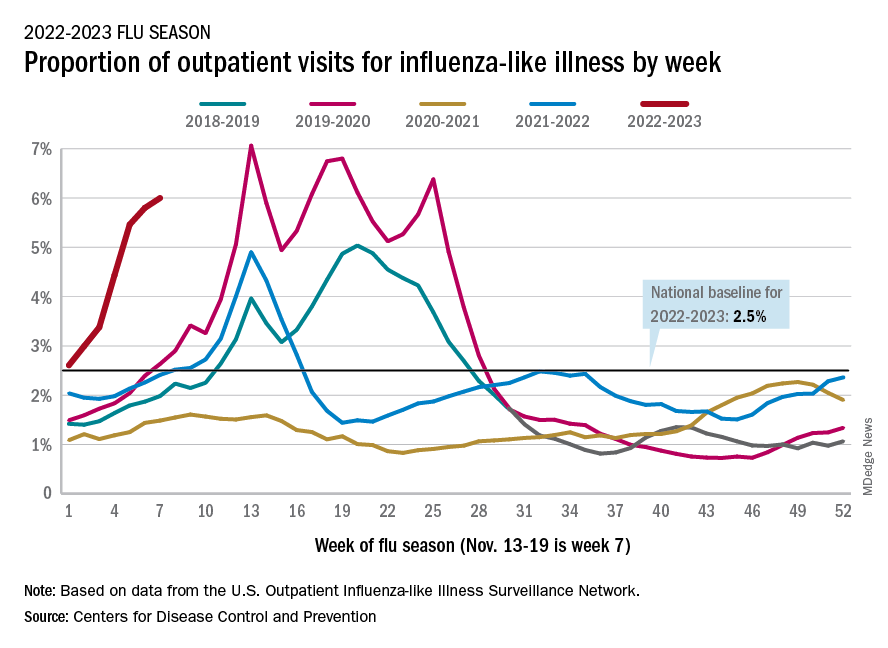
Those figures are the highest recorded in November since 2009, but the peak of the 2009-10 flu season occurred even earlier – the week of Oct. 18-24 – and the rate of flu-like illness had already dropped to just over 4.0% by Nov. 15-21 that year and continued to drop thereafter.
Although COVID-19 and respiratory syncytial virus (RSV) are included in the data from the CDC’s Outpatient Influenza-like Illness Surveillance Network, the agency did note that “seasonal influenza activity is elevated across the country” and estimated that “there have been at least 6.2 million illnesses, 53,000 hospitalizations, and 2,900 deaths from flu” during the 2022-23 season.
Total flu deaths include 11 reported in children as of Nov. 19, and children ages 0-4 had a higher proportion of visits for flu like-illness than other age groups.
The agency also said the cumulative hospitalization rate of 11.3 per 100,000 population “is higher than the rate observed in [the corresponding week of] every previous season since 2010-2011.” Adults 65 years and older have the highest cumulative rate, 25.9 per 100,000, for this year, compared with 20.7 for children 0-4; 11.1 for adults 50-64; 10.3 for children 5-17; and 5.6 for adults 18-49 years old, the CDC said.
A version of this article first appeared on WebMD.com.
according to the Centers of Disease Control and Prevention.
Nationally, 6% of all outpatient visits were because of flu or flu-like illness for the week of Nov. 13-19, up from 5.8% the previous week, the CDC’s Influenza Division said in its weekly FluView report.
Those figures are the highest recorded in November since 2009, but the peak of the 2009-10 flu season occurred even earlier – the week of Oct. 18-24 – and the rate of flu-like illness had already dropped to just over 4.0% by Nov. 15-21 that year and continued to drop thereafter.
Although COVID-19 and respiratory syncytial virus (RSV) are included in the data from the CDC’s Outpatient Influenza-like Illness Surveillance Network, the agency did note that “seasonal influenza activity is elevated across the country” and estimated that “there have been at least 6.2 million illnesses, 53,000 hospitalizations, and 2,900 deaths from flu” during the 2022-23 season.
Total flu deaths include 11 reported in children as of Nov. 19, and children ages 0-4 had a higher proportion of visits for flu like-illness than other age groups.
The agency also said the cumulative hospitalization rate of 11.3 per 100,000 population “is higher than the rate observed in [the corresponding week of] every previous season since 2010-2011.” Adults 65 years and older have the highest cumulative rate, 25.9 per 100,000, for this year, compared with 20.7 for children 0-4; 11.1 for adults 50-64; 10.3 for children 5-17; and 5.6 for adults 18-49 years old, the CDC said.
A version of this article first appeared on WebMD.com.
according to the Centers of Disease Control and Prevention.
Nationally, 6% of all outpatient visits were because of flu or flu-like illness for the week of Nov. 13-19, up from 5.8% the previous week, the CDC’s Influenza Division said in its weekly FluView report.
Those figures are the highest recorded in November since 2009, but the peak of the 2009-10 flu season occurred even earlier – the week of Oct. 18-24 – and the rate of flu-like illness had already dropped to just over 4.0% by Nov. 15-21 that year and continued to drop thereafter.
Although COVID-19 and respiratory syncytial virus (RSV) are included in the data from the CDC’s Outpatient Influenza-like Illness Surveillance Network, the agency did note that “seasonal influenza activity is elevated across the country” and estimated that “there have been at least 6.2 million illnesses, 53,000 hospitalizations, and 2,900 deaths from flu” during the 2022-23 season.
Total flu deaths include 11 reported in children as of Nov. 19, and children ages 0-4 had a higher proportion of visits for flu like-illness than other age groups.
The agency also said the cumulative hospitalization rate of 11.3 per 100,000 population “is higher than the rate observed in [the corresponding week of] every previous season since 2010-2011.” Adults 65 years and older have the highest cumulative rate, 25.9 per 100,000, for this year, compared with 20.7 for children 0-4; 11.1 for adults 50-64; 10.3 for children 5-17; and 5.6 for adults 18-49 years old, the CDC said.
A version of this article first appeared on WebMD.com.
More work needed to optimize STI screening in primary care settings
TAMPA – Boosting screening for sexually transmitted infections in primary care settings could help alleviate some of the barriers to optimal testing and treatment, a new quality improvement initiative suggests.
Many primary care doctors are challenged for time and send people to other health care settings, such as a local health department or a clinic that specializes in STI diagnosis and treatment, said Wendy Kays, DNP, APRN, AGNP-BC, AAHIVS, a nurse practitioner and researcher at Care Resource, Miami.
However, for multiple reasons, many patients do not follow up and are not screened or treated, Dr. Kays said at the Association of Nurses in AIDS Care annual meeting. Some people can afford the copay to see a primary care provider, for example, but do not have the resources to pay for a second clinical visit or laboratory testing.
In other instances, transportation can be a problem. “People, especially in the neighborhood where we are located, depend a lot on buses to go to their primary care,” Dr. Kays told this news organization. But “follow-up is very important. It can promote early treatment and prevent the spread of disease.”
Primary care is critical as a gateway into health care that could help address low rates of STI screening, she said. There is also evidence that STIs are on the rise because of the COVID-19 pandemic.
If more primary care doctors tested and treated STIs using standardized Centers for Disease Control and Prevention guidelines, patients would not have to make a trip to another location, Dr. Kays said.
“The primary health setting … is actually the perfect place to get your screening,” said Jimmie Leckliter, MSN-Ed, RN, PHN, in an interview. He was not affiliated with the presentation. “I’m a former ER nurse, and a lot of people are using the ER as primary care, and it’s not really set up to do that screening.”
Mr. Leckliter suggested that primary care doctors incorporate some questions about sexual health during a regular head-to-toe checkup and ask questions in a very clinical, nonjudgmental way.
He also acknowledged that for some physicians it can be uncomfortable to raise the issues. “Unfortunately, I think in our society, talking to people about sex is taboo, and people become uncomfortable. We need to be able to learn to put our biases aside and treat our patients. That’s what our job is, added Mr. Leckliter, an adjunct faculty member at the College of the Desert’s School of Nursing and Allied Health Programs, Palm Springs, Calif.
Clinicians should be aware of the stigma associated with sending a person to an STD clinic for further workup, Mr. Leckliter advised. “You have to look at the stigma in the community in which you’re located. It makes a big difference,” he said. “Is it mainly a Latino or African American community?”
Compliance was a challenge
Dr. Kays and colleague performed a quality improvement project focused on implementing the CDC’s STI treatment guidelines at Care Resource. One goal was to educate a multidisciplinary team on the importance of screening in the primary care setting. The clientele at Care Resource consists primarily of underprivileged minorities, including the Latino, Black, gay, and transgender communities.
Six health care providers participated – two medical doctors and four advanced-practice providers. They evaluated patient charts from the electronic health record system 4 weeks before the intervention and 4 weeks after.
The education had a positive impact, the researchers reported, even though three providers were compliant with the CDC-recommended screening protocol and three others were not.
The quality improvement initiative had some limitations, Dr. Kays noted. “The hope is that the [quality improvement] process will continue moving forward, and early diagnosis and treatment of STIs will be standardized in this primary care practice.”
An evidence-based tool to screen for STIs in primary care is “crucial,” she added. Using a standardized, evidence-based protocol in primary care “can create positive change in patients’ outcomes.”
The study was independently supported. Dr. Kays and Mr. Leckliter report no relevant financial relationships.
A version of this article first appeared on Medscape.com.
TAMPA – Boosting screening for sexually transmitted infections in primary care settings could help alleviate some of the barriers to optimal testing and treatment, a new quality improvement initiative suggests.
Many primary care doctors are challenged for time and send people to other health care settings, such as a local health department or a clinic that specializes in STI diagnosis and treatment, said Wendy Kays, DNP, APRN, AGNP-BC, AAHIVS, a nurse practitioner and researcher at Care Resource, Miami.
However, for multiple reasons, many patients do not follow up and are not screened or treated, Dr. Kays said at the Association of Nurses in AIDS Care annual meeting. Some people can afford the copay to see a primary care provider, for example, but do not have the resources to pay for a second clinical visit or laboratory testing.
In other instances, transportation can be a problem. “People, especially in the neighborhood where we are located, depend a lot on buses to go to their primary care,” Dr. Kays told this news organization. But “follow-up is very important. It can promote early treatment and prevent the spread of disease.”
Primary care is critical as a gateway into health care that could help address low rates of STI screening, she said. There is also evidence that STIs are on the rise because of the COVID-19 pandemic.
If more primary care doctors tested and treated STIs using standardized Centers for Disease Control and Prevention guidelines, patients would not have to make a trip to another location, Dr. Kays said.
“The primary health setting … is actually the perfect place to get your screening,” said Jimmie Leckliter, MSN-Ed, RN, PHN, in an interview. He was not affiliated with the presentation. “I’m a former ER nurse, and a lot of people are using the ER as primary care, and it’s not really set up to do that screening.”
Mr. Leckliter suggested that primary care doctors incorporate some questions about sexual health during a regular head-to-toe checkup and ask questions in a very clinical, nonjudgmental way.
He also acknowledged that for some physicians it can be uncomfortable to raise the issues. “Unfortunately, I think in our society, talking to people about sex is taboo, and people become uncomfortable. We need to be able to learn to put our biases aside and treat our patients. That’s what our job is, added Mr. Leckliter, an adjunct faculty member at the College of the Desert’s School of Nursing and Allied Health Programs, Palm Springs, Calif.
Clinicians should be aware of the stigma associated with sending a person to an STD clinic for further workup, Mr. Leckliter advised. “You have to look at the stigma in the community in which you’re located. It makes a big difference,” he said. “Is it mainly a Latino or African American community?”
Compliance was a challenge
Dr. Kays and colleague performed a quality improvement project focused on implementing the CDC’s STI treatment guidelines at Care Resource. One goal was to educate a multidisciplinary team on the importance of screening in the primary care setting. The clientele at Care Resource consists primarily of underprivileged minorities, including the Latino, Black, gay, and transgender communities.
Six health care providers participated – two medical doctors and four advanced-practice providers. They evaluated patient charts from the electronic health record system 4 weeks before the intervention and 4 weeks after.
The education had a positive impact, the researchers reported, even though three providers were compliant with the CDC-recommended screening protocol and three others were not.
The quality improvement initiative had some limitations, Dr. Kays noted. “The hope is that the [quality improvement] process will continue moving forward, and early diagnosis and treatment of STIs will be standardized in this primary care practice.”
An evidence-based tool to screen for STIs in primary care is “crucial,” she added. Using a standardized, evidence-based protocol in primary care “can create positive change in patients’ outcomes.”
The study was independently supported. Dr. Kays and Mr. Leckliter report no relevant financial relationships.
A version of this article first appeared on Medscape.com.
TAMPA – Boosting screening for sexually transmitted infections in primary care settings could help alleviate some of the barriers to optimal testing and treatment, a new quality improvement initiative suggests.
Many primary care doctors are challenged for time and send people to other health care settings, such as a local health department or a clinic that specializes in STI diagnosis and treatment, said Wendy Kays, DNP, APRN, AGNP-BC, AAHIVS, a nurse practitioner and researcher at Care Resource, Miami.
However, for multiple reasons, many patients do not follow up and are not screened or treated, Dr. Kays said at the Association of Nurses in AIDS Care annual meeting. Some people can afford the copay to see a primary care provider, for example, but do not have the resources to pay for a second clinical visit or laboratory testing.
In other instances, transportation can be a problem. “People, especially in the neighborhood where we are located, depend a lot on buses to go to their primary care,” Dr. Kays told this news organization. But “follow-up is very important. It can promote early treatment and prevent the spread of disease.”
Primary care is critical as a gateway into health care that could help address low rates of STI screening, she said. There is also evidence that STIs are on the rise because of the COVID-19 pandemic.
If more primary care doctors tested and treated STIs using standardized Centers for Disease Control and Prevention guidelines, patients would not have to make a trip to another location, Dr. Kays said.
“The primary health setting … is actually the perfect place to get your screening,” said Jimmie Leckliter, MSN-Ed, RN, PHN, in an interview. He was not affiliated with the presentation. “I’m a former ER nurse, and a lot of people are using the ER as primary care, and it’s not really set up to do that screening.”
Mr. Leckliter suggested that primary care doctors incorporate some questions about sexual health during a regular head-to-toe checkup and ask questions in a very clinical, nonjudgmental way.
He also acknowledged that for some physicians it can be uncomfortable to raise the issues. “Unfortunately, I think in our society, talking to people about sex is taboo, and people become uncomfortable. We need to be able to learn to put our biases aside and treat our patients. That’s what our job is, added Mr. Leckliter, an adjunct faculty member at the College of the Desert’s School of Nursing and Allied Health Programs, Palm Springs, Calif.
Clinicians should be aware of the stigma associated with sending a person to an STD clinic for further workup, Mr. Leckliter advised. “You have to look at the stigma in the community in which you’re located. It makes a big difference,” he said. “Is it mainly a Latino or African American community?”
Compliance was a challenge
Dr. Kays and colleague performed a quality improvement project focused on implementing the CDC’s STI treatment guidelines at Care Resource. One goal was to educate a multidisciplinary team on the importance of screening in the primary care setting. The clientele at Care Resource consists primarily of underprivileged minorities, including the Latino, Black, gay, and transgender communities.
Six health care providers participated – two medical doctors and four advanced-practice providers. They evaluated patient charts from the electronic health record system 4 weeks before the intervention and 4 weeks after.
The education had a positive impact, the researchers reported, even though three providers were compliant with the CDC-recommended screening protocol and three others were not.
The quality improvement initiative had some limitations, Dr. Kays noted. “The hope is that the [quality improvement] process will continue moving forward, and early diagnosis and treatment of STIs will be standardized in this primary care practice.”
An evidence-based tool to screen for STIs in primary care is “crucial,” she added. Using a standardized, evidence-based protocol in primary care “can create positive change in patients’ outcomes.”
The study was independently supported. Dr. Kays and Mr. Leckliter report no relevant financial relationships.
A version of this article first appeared on Medscape.com.
Study affirms shorter regimens for drug-resistant tuberculosis
Two short-course bedaquiline-containing treatment regimens for rifampicin-resistant tuberculosis showed “robust evidence” for superior efficacy and less ototoxicity compared to a 9-month injectable control regimen, researchers report.
The findings validate the World Health Organization’s current recommendation of a 9-month, bedaquiline-based oral regimen, “which was based only on observational data,” noted lead author Ruth Goodall, PhD, from the Medical Research Council Clinical Trials Unit at University College London, and colleagues.
The study was published in The Lancet.
The Standard Treatment Regimen of Anti-tuberculosis Drugs for Patients With MDR-TB (STREAM) stage 2 study was a randomized, phase 3, noninferiority trial conducted at 13 hospital clinics in seven countries that had prespecified tests for superiority if noninferiority was shown. The study enrolled individuals aged 15 years or older who had rifampicin-resistant TB without fluoroquinolone or aminoglycoside resistance.
The study’s first stage, STREAM stage 1, showed that The 9-month regimen was recommended by the WHO in 2016. That recommendation was superceded in 2020 when concerns of hearing loss associated with aminoglycosides prompted the WHO to endorse a 9-month bedaquiline-containing, injectable-free alternative, the authors write.
Seeking shorter treatment for better outcomes
STREAM stage 2 used a 9-month injectable regimen as its control. The investigators measured it against a fully oral 9-month bedaquiline-based treatment (primary comparison), as well as a 6-month oral bedaquiline regimen that included 8 weeks of a second-line injectable (secondary comparison).
The 9-month fully oral treatment included levofloxacin, clofazimine, ethambutol, and pyrazinamide for 40 weeks; bedaquiline, high-dose isoniazid, and prothionamide were given for the 16-week intensive phase.
The 6-month regimen included bedaquiline, clofazimine, pyrazinamide, and levofloxacin for 28 weeks, supplemented by high-dose isoniazid with kanamycin for an 8-week intensive phase.
For both comparisons, the primary outcome was favorable status at 76 weeks, defined as cultures that were negative for Mycobacterium tuberculosis without a preceding unfavorable outcome (defined as any death, bacteriologic failure or recurrence, or major treatment change).
Among 517 participants in the modified intention-to-treat population across the study groups, 62% were men, and 38% were women (median age, 32.5 years).
For the primary comparison, 71% of the control group and 83% of the oral regimen group had a favorable outcome.
In the secondary comparison, 69% had a favorable outcome in the control group, compared with 91% of those receiving the 6-month regimen.
Although the rate of grade 3 or 4 adverse events was similar in all three groups, there was significantly less ototoxicity among patients who received the oral regimen, compared with control patients (2% vs. 9%); 4% of those taking the 6-month regimen had hearing loss, compared with 8% of control patients.
Exploratory analyses comparing both bedaquiline-containing regimens revealed a significantly higher proportion of favorable outcomes among participants receiving the 6-month regimen (91%), compared with patients taking the fully oral 9-month regimen (79%). There were no significant differences in the rate of grade 3 or 4 adverse events.
The trial’s main limitation was its open-label design, which might have influenced decisions about treatment change, note the investigators.
“STREAM stage 2 has shown that two short-course, bedaquiline-containing regimens are not only non-inferior but superior to a 9-month injectable-containing regimen,” they conclude.
“The STREAM stage 2 fully oral regimen avoided the toxicity of aminoglycosides, and the 6-month regimen was highly effective, with reduced levels of ototoxicity. These two regimens offer promising treatment options for patients with MDR or rifampicin-resistant tuberculosis,” the authors write.
Dr. Goodall added, “Although both STREAM regimens were very effective, participants experienced relatively high levels of adverse events during the trial (though many of these were likely due to the close laboratory monitoring of the trial).
“While hearing loss was reduced on the 6-month regimen, it was not entirely eliminated,” she said. “Other new regimens in the field containing the medicine linezolid report side effects such as anemia and peripheral neuropathy. So more work needs to be done to ensure the treatment regimens are as safe and tolerable for patients as possible. In addition, even 6 months’ treatment is long for patients to tolerate, and further regimen shortening would be a welcome development for patients and health systems.”
‘A revolution in MDR tuberculosis’
“The authors must be commended on completing this challenging high-quality, phase 3, non-inferiority, randomized controlled trial involving 13 health care facilities across Ethiopia, Georgia, India, Moldova, Mongolia, South Africa, and Uganda ... despite the COVID-19 pandemic,” noted Keertan Dheda, MD, PhD, and Christoph Lange, MD, PhD, in an accompanying comment titled, “A Revolution in the Management of Multidrug-Resistant Tuberculosis”.
Although the WHO recently approved an all-oral 6-month bedaquiline, pretomanid, and linezolid plus moxifloxacin (BPaLM) regimen, results from the alternate 6-month regimen examined in STREAM stage 2 “do provide confidence in using 2 months of an injectable as part of a salvage regimen in patients for whom MDR tuberculosis treatment is not successful” or in those with extensively drug-resistant (XDR) or pre-XDR TB, “for whom therapeutic options are few,” noted Dr. Dheda, from the University of Cape Town (South Africa) and the London School of Hygiene and Tropical Medicine, and Dr. Lange, from the University of Lübeck (Germany), Baylor College of Medicine, and Texas Children’s Hospital, both in Houston.
The study authors and the commentators stress that safer and simpler treatments are still needed for MDR TB. “The search is now on for regimens that could further reduce duration, toxicity, and pill burden,” note Dr. Dheda and Dr. Lange.
However, they also note that “substantial resistance” to bedaquiline is already emerging. “Therefore, if we are to protect key drugs from becoming functionally redundant, drug-susceptibility testing capacity will need to be rapidly improved to minimize resistance amplification and onward disease transmission.”
The study was funded by USAID and Janssen Research and Development. Dr. Goodall has disclosed no relevant financial relationships. Dr. Dheda has received funding from the EU and the South African Medical Research Council for studies related to the diagnosis or management of drug-resistant tuberculosis. Dr. Lange is supported by the German Center for Infection Research and has received funding from the European Commission for studies on the development of novel antituberculosis medicines and for studies related to novel diagnostics of tuberculosis; consulting fees from INSMED; speaker’s fees from INSMED, GILEAD, and Janssen; and is a member of the data safety board of trials from Medicines sans Frontiers, all of which are unrelated to the current study.
A version of this article first appeared on Medscape.com.
Two short-course bedaquiline-containing treatment regimens for rifampicin-resistant tuberculosis showed “robust evidence” for superior efficacy and less ototoxicity compared to a 9-month injectable control regimen, researchers report.
The findings validate the World Health Organization’s current recommendation of a 9-month, bedaquiline-based oral regimen, “which was based only on observational data,” noted lead author Ruth Goodall, PhD, from the Medical Research Council Clinical Trials Unit at University College London, and colleagues.
The study was published in The Lancet.
The Standard Treatment Regimen of Anti-tuberculosis Drugs for Patients With MDR-TB (STREAM) stage 2 study was a randomized, phase 3, noninferiority trial conducted at 13 hospital clinics in seven countries that had prespecified tests for superiority if noninferiority was shown. The study enrolled individuals aged 15 years or older who had rifampicin-resistant TB without fluoroquinolone or aminoglycoside resistance.
The study’s first stage, STREAM stage 1, showed that The 9-month regimen was recommended by the WHO in 2016. That recommendation was superceded in 2020 when concerns of hearing loss associated with aminoglycosides prompted the WHO to endorse a 9-month bedaquiline-containing, injectable-free alternative, the authors write.
Seeking shorter treatment for better outcomes
STREAM stage 2 used a 9-month injectable regimen as its control. The investigators measured it against a fully oral 9-month bedaquiline-based treatment (primary comparison), as well as a 6-month oral bedaquiline regimen that included 8 weeks of a second-line injectable (secondary comparison).
The 9-month fully oral treatment included levofloxacin, clofazimine, ethambutol, and pyrazinamide for 40 weeks; bedaquiline, high-dose isoniazid, and prothionamide were given for the 16-week intensive phase.
The 6-month regimen included bedaquiline, clofazimine, pyrazinamide, and levofloxacin for 28 weeks, supplemented by high-dose isoniazid with kanamycin for an 8-week intensive phase.
For both comparisons, the primary outcome was favorable status at 76 weeks, defined as cultures that were negative for Mycobacterium tuberculosis without a preceding unfavorable outcome (defined as any death, bacteriologic failure or recurrence, or major treatment change).
Among 517 participants in the modified intention-to-treat population across the study groups, 62% were men, and 38% were women (median age, 32.5 years).
For the primary comparison, 71% of the control group and 83% of the oral regimen group had a favorable outcome.
In the secondary comparison, 69% had a favorable outcome in the control group, compared with 91% of those receiving the 6-month regimen.
Although the rate of grade 3 or 4 adverse events was similar in all three groups, there was significantly less ototoxicity among patients who received the oral regimen, compared with control patients (2% vs. 9%); 4% of those taking the 6-month regimen had hearing loss, compared with 8% of control patients.
Exploratory analyses comparing both bedaquiline-containing regimens revealed a significantly higher proportion of favorable outcomes among participants receiving the 6-month regimen (91%), compared with patients taking the fully oral 9-month regimen (79%). There were no significant differences in the rate of grade 3 or 4 adverse events.
The trial’s main limitation was its open-label design, which might have influenced decisions about treatment change, note the investigators.
“STREAM stage 2 has shown that two short-course, bedaquiline-containing regimens are not only non-inferior but superior to a 9-month injectable-containing regimen,” they conclude.
“The STREAM stage 2 fully oral regimen avoided the toxicity of aminoglycosides, and the 6-month regimen was highly effective, with reduced levels of ototoxicity. These two regimens offer promising treatment options for patients with MDR or rifampicin-resistant tuberculosis,” the authors write.
Dr. Goodall added, “Although both STREAM regimens were very effective, participants experienced relatively high levels of adverse events during the trial (though many of these were likely due to the close laboratory monitoring of the trial).
“While hearing loss was reduced on the 6-month regimen, it was not entirely eliminated,” she said. “Other new regimens in the field containing the medicine linezolid report side effects such as anemia and peripheral neuropathy. So more work needs to be done to ensure the treatment regimens are as safe and tolerable for patients as possible. In addition, even 6 months’ treatment is long for patients to tolerate, and further regimen shortening would be a welcome development for patients and health systems.”
‘A revolution in MDR tuberculosis’
“The authors must be commended on completing this challenging high-quality, phase 3, non-inferiority, randomized controlled trial involving 13 health care facilities across Ethiopia, Georgia, India, Moldova, Mongolia, South Africa, and Uganda ... despite the COVID-19 pandemic,” noted Keertan Dheda, MD, PhD, and Christoph Lange, MD, PhD, in an accompanying comment titled, “A Revolution in the Management of Multidrug-Resistant Tuberculosis”.
Although the WHO recently approved an all-oral 6-month bedaquiline, pretomanid, and linezolid plus moxifloxacin (BPaLM) regimen, results from the alternate 6-month regimen examined in STREAM stage 2 “do provide confidence in using 2 months of an injectable as part of a salvage regimen in patients for whom MDR tuberculosis treatment is not successful” or in those with extensively drug-resistant (XDR) or pre-XDR TB, “for whom therapeutic options are few,” noted Dr. Dheda, from the University of Cape Town (South Africa) and the London School of Hygiene and Tropical Medicine, and Dr. Lange, from the University of Lübeck (Germany), Baylor College of Medicine, and Texas Children’s Hospital, both in Houston.
The study authors and the commentators stress that safer and simpler treatments are still needed for MDR TB. “The search is now on for regimens that could further reduce duration, toxicity, and pill burden,” note Dr. Dheda and Dr. Lange.
However, they also note that “substantial resistance” to bedaquiline is already emerging. “Therefore, if we are to protect key drugs from becoming functionally redundant, drug-susceptibility testing capacity will need to be rapidly improved to minimize resistance amplification and onward disease transmission.”
The study was funded by USAID and Janssen Research and Development. Dr. Goodall has disclosed no relevant financial relationships. Dr. Dheda has received funding from the EU and the South African Medical Research Council for studies related to the diagnosis or management of drug-resistant tuberculosis. Dr. Lange is supported by the German Center for Infection Research and has received funding from the European Commission for studies on the development of novel antituberculosis medicines and for studies related to novel diagnostics of tuberculosis; consulting fees from INSMED; speaker’s fees from INSMED, GILEAD, and Janssen; and is a member of the data safety board of trials from Medicines sans Frontiers, all of which are unrelated to the current study.
A version of this article first appeared on Medscape.com.
Two short-course bedaquiline-containing treatment regimens for rifampicin-resistant tuberculosis showed “robust evidence” for superior efficacy and less ototoxicity compared to a 9-month injectable control regimen, researchers report.
The findings validate the World Health Organization’s current recommendation of a 9-month, bedaquiline-based oral regimen, “which was based only on observational data,” noted lead author Ruth Goodall, PhD, from the Medical Research Council Clinical Trials Unit at University College London, and colleagues.
The study was published in The Lancet.
The Standard Treatment Regimen of Anti-tuberculosis Drugs for Patients With MDR-TB (STREAM) stage 2 study was a randomized, phase 3, noninferiority trial conducted at 13 hospital clinics in seven countries that had prespecified tests for superiority if noninferiority was shown. The study enrolled individuals aged 15 years or older who had rifampicin-resistant TB without fluoroquinolone or aminoglycoside resistance.
The study’s first stage, STREAM stage 1, showed that The 9-month regimen was recommended by the WHO in 2016. That recommendation was superceded in 2020 when concerns of hearing loss associated with aminoglycosides prompted the WHO to endorse a 9-month bedaquiline-containing, injectable-free alternative, the authors write.
Seeking shorter treatment for better outcomes
STREAM stage 2 used a 9-month injectable regimen as its control. The investigators measured it against a fully oral 9-month bedaquiline-based treatment (primary comparison), as well as a 6-month oral bedaquiline regimen that included 8 weeks of a second-line injectable (secondary comparison).
The 9-month fully oral treatment included levofloxacin, clofazimine, ethambutol, and pyrazinamide for 40 weeks; bedaquiline, high-dose isoniazid, and prothionamide were given for the 16-week intensive phase.
The 6-month regimen included bedaquiline, clofazimine, pyrazinamide, and levofloxacin for 28 weeks, supplemented by high-dose isoniazid with kanamycin for an 8-week intensive phase.
For both comparisons, the primary outcome was favorable status at 76 weeks, defined as cultures that were negative for Mycobacterium tuberculosis without a preceding unfavorable outcome (defined as any death, bacteriologic failure or recurrence, or major treatment change).
Among 517 participants in the modified intention-to-treat population across the study groups, 62% were men, and 38% were women (median age, 32.5 years).
For the primary comparison, 71% of the control group and 83% of the oral regimen group had a favorable outcome.
In the secondary comparison, 69% had a favorable outcome in the control group, compared with 91% of those receiving the 6-month regimen.
Although the rate of grade 3 or 4 adverse events was similar in all three groups, there was significantly less ototoxicity among patients who received the oral regimen, compared with control patients (2% vs. 9%); 4% of those taking the 6-month regimen had hearing loss, compared with 8% of control patients.
Exploratory analyses comparing both bedaquiline-containing regimens revealed a significantly higher proportion of favorable outcomes among participants receiving the 6-month regimen (91%), compared with patients taking the fully oral 9-month regimen (79%). There were no significant differences in the rate of grade 3 or 4 adverse events.
The trial’s main limitation was its open-label design, which might have influenced decisions about treatment change, note the investigators.
“STREAM stage 2 has shown that two short-course, bedaquiline-containing regimens are not only non-inferior but superior to a 9-month injectable-containing regimen,” they conclude.
“The STREAM stage 2 fully oral regimen avoided the toxicity of aminoglycosides, and the 6-month regimen was highly effective, with reduced levels of ototoxicity. These two regimens offer promising treatment options for patients with MDR or rifampicin-resistant tuberculosis,” the authors write.
Dr. Goodall added, “Although both STREAM regimens were very effective, participants experienced relatively high levels of adverse events during the trial (though many of these were likely due to the close laboratory monitoring of the trial).
“While hearing loss was reduced on the 6-month regimen, it was not entirely eliminated,” she said. “Other new regimens in the field containing the medicine linezolid report side effects such as anemia and peripheral neuropathy. So more work needs to be done to ensure the treatment regimens are as safe and tolerable for patients as possible. In addition, even 6 months’ treatment is long for patients to tolerate, and further regimen shortening would be a welcome development for patients and health systems.”
‘A revolution in MDR tuberculosis’
“The authors must be commended on completing this challenging high-quality, phase 3, non-inferiority, randomized controlled trial involving 13 health care facilities across Ethiopia, Georgia, India, Moldova, Mongolia, South Africa, and Uganda ... despite the COVID-19 pandemic,” noted Keertan Dheda, MD, PhD, and Christoph Lange, MD, PhD, in an accompanying comment titled, “A Revolution in the Management of Multidrug-Resistant Tuberculosis”.
Although the WHO recently approved an all-oral 6-month bedaquiline, pretomanid, and linezolid plus moxifloxacin (BPaLM) regimen, results from the alternate 6-month regimen examined in STREAM stage 2 “do provide confidence in using 2 months of an injectable as part of a salvage regimen in patients for whom MDR tuberculosis treatment is not successful” or in those with extensively drug-resistant (XDR) or pre-XDR TB, “for whom therapeutic options are few,” noted Dr. Dheda, from the University of Cape Town (South Africa) and the London School of Hygiene and Tropical Medicine, and Dr. Lange, from the University of Lübeck (Germany), Baylor College of Medicine, and Texas Children’s Hospital, both in Houston.
The study authors and the commentators stress that safer and simpler treatments are still needed for MDR TB. “The search is now on for regimens that could further reduce duration, toxicity, and pill burden,” note Dr. Dheda and Dr. Lange.
However, they also note that “substantial resistance” to bedaquiline is already emerging. “Therefore, if we are to protect key drugs from becoming functionally redundant, drug-susceptibility testing capacity will need to be rapidly improved to minimize resistance amplification and onward disease transmission.”
The study was funded by USAID and Janssen Research and Development. Dr. Goodall has disclosed no relevant financial relationships. Dr. Dheda has received funding from the EU and the South African Medical Research Council for studies related to the diagnosis or management of drug-resistant tuberculosis. Dr. Lange is supported by the German Center for Infection Research and has received funding from the European Commission for studies on the development of novel antituberculosis medicines and for studies related to novel diagnostics of tuberculosis; consulting fees from INSMED; speaker’s fees from INSMED, GILEAD, and Janssen; and is a member of the data safety board of trials from Medicines sans Frontiers, all of which are unrelated to the current study.
A version of this article first appeared on Medscape.com.
Future HIV PrEP innovations aim to address adherence, women’s health, and combination treatments
TAMPA – Pre-exposure prophylaxis (PrEP) has shown to be effective in many clinical and real-world studies, but concerns remain, according to research presented at the annual meeting of the Association of Nurses in AIDS Care (ANAC).
Only about 20% of people who could benefit from PrEP use the preventative medication, for example. Another concern is adherence, as regular use generally drops off over time, rarely lasting more than a few months for most people.
Furthermore, most studies to date evaluated safety and effectiveness of PrEP options among men who have sex with men. Now the focus is increasing on other populations, including women at risk of HIV exposure.
Researchers working on new forms and formulations of PrEP are looking for ways to address those challenges.
said Craig W. Hendrix, MD, professor and director of the Division of Clinical Pharmacology at Johns Hopkins University School of Medicine, Baltimore.
“What I hear a lot of folks say [is] there are two or three options for PrEP, so why do we need more? We need choices that fit into a broader range of lifestyles,” Dr. Hendrix said.
For example, a medically fortified douche containing PrEP might be more likely to be used by people who use a douche before or after sex on a regular basis. This is called a “behaviorally congruent” strategy, Dr. Hendrix said.
In addition to a medical douche, formulations designed to continuously deliver PrEP, such as a subdermal implant, are in the works as well.
Another option for women, the dapivirine vaginal ring, is available internationally but not in the United States. “It was withdrawn from [Food and Drug Administration] consideration by the sponsor. I think it’s a huge loss not to have that,” Dr. Hendrix said.
During development, “frequent expulsions forced reformulation to a less stiff ring,” Dr. Hendrix said. “I don’t imagine that’s terrific, but it shows how important it is to have something that fits the anatomy and the lifestyle.”
“Currently, we have in the U.S. three licensed, really terrific options for PrEP, and they’re all for men that have sex with men and transgender women,” Dr. Hendrix said.
Three current options
The three current PrEP regimens in the United States often go by their abbreviations: F/TDF, F/TAF, and CAB-IM.
- F/TDF is emtricitabine (F) 200 mg in combination with tenofovir disoproxil fumarate (TDF) 300 mg (Truvada, Gilead or generics)
- F/TAF is emtricitabine (F) 200 mg in combination with tenofovir alafenamide (TAF) 25 mg (Descovy, Gilead)
- CAB-IM is cabotegravir (CAB) 600 mg injection (Apretude, GlaxoSmithKline)
There is an important distinction: Daily oral PrEP with F/TDF is recommended to prevent HIV infection among all people at risk through sex or injection drug use. Daily oral PrEP with F/TAF is recommended to prevent HIV infection among people at risk through sex, excluding people at risk through receptive vaginal sex, the CDC notes.
The cost-effectiveness of the injection remains a potential issue, Dr. Hendrix said. On the other hand, “cost-effectiveness goes out the window if there is no adherence.”
An active pipeline
There are 24 new PrEP products in development, as well as 24 other multipurpose prevention technologies (MPTs), which are combination products containing PrEP and one or two other medications.
These 48 products include 28 unique antiviral and contraceptive drugs and 12 delivery methods or formulations. “Why so many?” Dr. Hendrix asked. “Many will not make it through development.”
Pills that include HIV PrEP and contraception or PrEP and sexually transmitted infection (STI) treatment are being evaluated, for example. “HIV risk, pregnancy risk, and other viral STIs overlap. Ideally, you can have one target for all three. That would increase efficiency of dosing and adherence,” Dr. Hendrix said.
Dual prevention pills (DPPs) hypothetically provide HIV PrEP and contraception better than either product alone, Dr. Hendrix said. Plans are to market them as family planning or women’s health products to avoid any stigma or distrust associated with HIV PrEP. An initial rollout is planned in 2024 in sub-Saharan Africa where the unmet need is highest, he added.
“Imagine how effective this could be in women in the United States,” Dr. Hendrix said. “My hope is fourth-quarter 2024” availability in the United States.
A way to prevent STIs and HIV in an all-in-one product “would be terrific,” Dr. Hendrix said.
“I think we’re going to see a lot more innovation going in that direction. The pill is close. The other things are going to be further off because the regulatory pathway is a little more complicated.”
Longer lasting protection?
All of the innovations have gone one of two directions, Dr. Hendrix said. One direction is to make PrEP even longer acting, “so that you have even less to worry [about] in terms of adherence.”
Going forward, “most of the focus has all been on continuously acting or long-active PrEP. It’s getting longer and longer: We’ve got 2 months, and they’re looking at a 6-month subcutaneous injection,” Dr. Hendrix said. The investigational agent lenacapavir is in development as PrEP, as well as for HIV treatment.
“This could get us from 2 to 6 months,” Dr. Hendrix said.
Some of the subcutaneous implants look as if they could provide PrEP for up to 12 months, he added. “An implant could also avoid peaks and troughs with bi-monthly injections.”
On-demand PrEP
The other direction is on-demand. “This is for the folks that don’t want drug in their body all the time. They only want it when they need it. And a twist on that ... is actually using products that are already used with sex now but medicating them.”
On-demand rectal options include a medicated douche and a fast-dissolving insert or suppository.
Fast-dissolving vaginal inserts are also in development. “These inserts are small, easy to store, inexpensive, and possibly inapparent to a partner,” Dr. Hendrix said.
Phase 2 studies will need to determine if these products “fit into folks’ active sex lives,” he said. “There’s still a need for human-friendly, human-designed products.”
A rectal microbicide that got as far as Phase 2 research provides a cautionary tale. The concentrations and the biology worked fine, Dr. Hendrix said. “It was a gel with an applicator, and it just was not liked by the folks in the study.” He added, “Your adherence is going to be in the tank if you’ve got a product that people don’t like to use.”
‘Extremely excited’
Asked for her perspective on Dr. Hendrix’s presentation, session moderator Rasheeta D. Chandler, PhD, RN, an associate professor at the Nell Hodgson Woodruff School of Nursing at Emory University, Atlanta, said: “I am extremely excited, because I work with cisgender women, particularly with underserved women and women of color, and there’s a tendency to focus on men who have sex with men.”
“I understand, because they are the population that is most affected, but Black women are also extremely affected by this disease,” Dr. Chandler told this news organization.
Dr. Chandler applauded Dr. Hendrix for addressing women’s health needs as well and not treating PrEP in women “as an afterthought.”
“Finally, our voices are being heard that [PrEP] should be equitable across all different types of individuals who identify differently in a sexual context,” Dr. Chandler said.
More work is warranted to evaluate PrEP in other populations, including transgender men and individuals who inject drugs, Dr. Hendrix said.
For more information and updates on HIV PrEP and MPTs, visit the website of the nonprofit AIDS Vaccine Advocacy Coalition.
Dr. Hendrix has disclosed receiving research grants from Gilead and Merck. Dr. Chandler has reported no relevant financial relationships.
A version of this article first appeared on Medscape.com.
TAMPA – Pre-exposure prophylaxis (PrEP) has shown to be effective in many clinical and real-world studies, but concerns remain, according to research presented at the annual meeting of the Association of Nurses in AIDS Care (ANAC).
Only about 20% of people who could benefit from PrEP use the preventative medication, for example. Another concern is adherence, as regular use generally drops off over time, rarely lasting more than a few months for most people.
Furthermore, most studies to date evaluated safety and effectiveness of PrEP options among men who have sex with men. Now the focus is increasing on other populations, including women at risk of HIV exposure.
Researchers working on new forms and formulations of PrEP are looking for ways to address those challenges.
said Craig W. Hendrix, MD, professor and director of the Division of Clinical Pharmacology at Johns Hopkins University School of Medicine, Baltimore.
“What I hear a lot of folks say [is] there are two or three options for PrEP, so why do we need more? We need choices that fit into a broader range of lifestyles,” Dr. Hendrix said.
For example, a medically fortified douche containing PrEP might be more likely to be used by people who use a douche before or after sex on a regular basis. This is called a “behaviorally congruent” strategy, Dr. Hendrix said.
In addition to a medical douche, formulations designed to continuously deliver PrEP, such as a subdermal implant, are in the works as well.
Another option for women, the dapivirine vaginal ring, is available internationally but not in the United States. “It was withdrawn from [Food and Drug Administration] consideration by the sponsor. I think it’s a huge loss not to have that,” Dr. Hendrix said.
During development, “frequent expulsions forced reformulation to a less stiff ring,” Dr. Hendrix said. “I don’t imagine that’s terrific, but it shows how important it is to have something that fits the anatomy and the lifestyle.”
“Currently, we have in the U.S. three licensed, really terrific options for PrEP, and they’re all for men that have sex with men and transgender women,” Dr. Hendrix said.
Three current options
The three current PrEP regimens in the United States often go by their abbreviations: F/TDF, F/TAF, and CAB-IM.
- F/TDF is emtricitabine (F) 200 mg in combination with tenofovir disoproxil fumarate (TDF) 300 mg (Truvada, Gilead or generics)
- F/TAF is emtricitabine (F) 200 mg in combination with tenofovir alafenamide (TAF) 25 mg (Descovy, Gilead)
- CAB-IM is cabotegravir (CAB) 600 mg injection (Apretude, GlaxoSmithKline)
There is an important distinction: Daily oral PrEP with F/TDF is recommended to prevent HIV infection among all people at risk through sex or injection drug use. Daily oral PrEP with F/TAF is recommended to prevent HIV infection among people at risk through sex, excluding people at risk through receptive vaginal sex, the CDC notes.
The cost-effectiveness of the injection remains a potential issue, Dr. Hendrix said. On the other hand, “cost-effectiveness goes out the window if there is no adherence.”
An active pipeline
There are 24 new PrEP products in development, as well as 24 other multipurpose prevention technologies (MPTs), which are combination products containing PrEP and one or two other medications.
These 48 products include 28 unique antiviral and contraceptive drugs and 12 delivery methods or formulations. “Why so many?” Dr. Hendrix asked. “Many will not make it through development.”
Pills that include HIV PrEP and contraception or PrEP and sexually transmitted infection (STI) treatment are being evaluated, for example. “HIV risk, pregnancy risk, and other viral STIs overlap. Ideally, you can have one target for all three. That would increase efficiency of dosing and adherence,” Dr. Hendrix said.
Dual prevention pills (DPPs) hypothetically provide HIV PrEP and contraception better than either product alone, Dr. Hendrix said. Plans are to market them as family planning or women’s health products to avoid any stigma or distrust associated with HIV PrEP. An initial rollout is planned in 2024 in sub-Saharan Africa where the unmet need is highest, he added.
“Imagine how effective this could be in women in the United States,” Dr. Hendrix said. “My hope is fourth-quarter 2024” availability in the United States.
A way to prevent STIs and HIV in an all-in-one product “would be terrific,” Dr. Hendrix said.
“I think we’re going to see a lot more innovation going in that direction. The pill is close. The other things are going to be further off because the regulatory pathway is a little more complicated.”
Longer lasting protection?
All of the innovations have gone one of two directions, Dr. Hendrix said. One direction is to make PrEP even longer acting, “so that you have even less to worry [about] in terms of adherence.”
Going forward, “most of the focus has all been on continuously acting or long-active PrEP. It’s getting longer and longer: We’ve got 2 months, and they’re looking at a 6-month subcutaneous injection,” Dr. Hendrix said. The investigational agent lenacapavir is in development as PrEP, as well as for HIV treatment.
“This could get us from 2 to 6 months,” Dr. Hendrix said.
Some of the subcutaneous implants look as if they could provide PrEP for up to 12 months, he added. “An implant could also avoid peaks and troughs with bi-monthly injections.”
On-demand PrEP
The other direction is on-demand. “This is for the folks that don’t want drug in their body all the time. They only want it when they need it. And a twist on that ... is actually using products that are already used with sex now but medicating them.”
On-demand rectal options include a medicated douche and a fast-dissolving insert or suppository.
Fast-dissolving vaginal inserts are also in development. “These inserts are small, easy to store, inexpensive, and possibly inapparent to a partner,” Dr. Hendrix said.
Phase 2 studies will need to determine if these products “fit into folks’ active sex lives,” he said. “There’s still a need for human-friendly, human-designed products.”
A rectal microbicide that got as far as Phase 2 research provides a cautionary tale. The concentrations and the biology worked fine, Dr. Hendrix said. “It was a gel with an applicator, and it just was not liked by the folks in the study.” He added, “Your adherence is going to be in the tank if you’ve got a product that people don’t like to use.”
‘Extremely excited’
Asked for her perspective on Dr. Hendrix’s presentation, session moderator Rasheeta D. Chandler, PhD, RN, an associate professor at the Nell Hodgson Woodruff School of Nursing at Emory University, Atlanta, said: “I am extremely excited, because I work with cisgender women, particularly with underserved women and women of color, and there’s a tendency to focus on men who have sex with men.”
“I understand, because they are the population that is most affected, but Black women are also extremely affected by this disease,” Dr. Chandler told this news organization.
Dr. Chandler applauded Dr. Hendrix for addressing women’s health needs as well and not treating PrEP in women “as an afterthought.”
“Finally, our voices are being heard that [PrEP] should be equitable across all different types of individuals who identify differently in a sexual context,” Dr. Chandler said.
More work is warranted to evaluate PrEP in other populations, including transgender men and individuals who inject drugs, Dr. Hendrix said.
For more information and updates on HIV PrEP and MPTs, visit the website of the nonprofit AIDS Vaccine Advocacy Coalition.
Dr. Hendrix has disclosed receiving research grants from Gilead and Merck. Dr. Chandler has reported no relevant financial relationships.
A version of this article first appeared on Medscape.com.
TAMPA – Pre-exposure prophylaxis (PrEP) has shown to be effective in many clinical and real-world studies, but concerns remain, according to research presented at the annual meeting of the Association of Nurses in AIDS Care (ANAC).
Only about 20% of people who could benefit from PrEP use the preventative medication, for example. Another concern is adherence, as regular use generally drops off over time, rarely lasting more than a few months for most people.
Furthermore, most studies to date evaluated safety and effectiveness of PrEP options among men who have sex with men. Now the focus is increasing on other populations, including women at risk of HIV exposure.
Researchers working on new forms and formulations of PrEP are looking for ways to address those challenges.
said Craig W. Hendrix, MD, professor and director of the Division of Clinical Pharmacology at Johns Hopkins University School of Medicine, Baltimore.
“What I hear a lot of folks say [is] there are two or three options for PrEP, so why do we need more? We need choices that fit into a broader range of lifestyles,” Dr. Hendrix said.
For example, a medically fortified douche containing PrEP might be more likely to be used by people who use a douche before or after sex on a regular basis. This is called a “behaviorally congruent” strategy, Dr. Hendrix said.
In addition to a medical douche, formulations designed to continuously deliver PrEP, such as a subdermal implant, are in the works as well.
Another option for women, the dapivirine vaginal ring, is available internationally but not in the United States. “It was withdrawn from [Food and Drug Administration] consideration by the sponsor. I think it’s a huge loss not to have that,” Dr. Hendrix said.
During development, “frequent expulsions forced reformulation to a less stiff ring,” Dr. Hendrix said. “I don’t imagine that’s terrific, but it shows how important it is to have something that fits the anatomy and the lifestyle.”
“Currently, we have in the U.S. three licensed, really terrific options for PrEP, and they’re all for men that have sex with men and transgender women,” Dr. Hendrix said.
Three current options
The three current PrEP regimens in the United States often go by their abbreviations: F/TDF, F/TAF, and CAB-IM.
- F/TDF is emtricitabine (F) 200 mg in combination with tenofovir disoproxil fumarate (TDF) 300 mg (Truvada, Gilead or generics)
- F/TAF is emtricitabine (F) 200 mg in combination with tenofovir alafenamide (TAF) 25 mg (Descovy, Gilead)
- CAB-IM is cabotegravir (CAB) 600 mg injection (Apretude, GlaxoSmithKline)
There is an important distinction: Daily oral PrEP with F/TDF is recommended to prevent HIV infection among all people at risk through sex or injection drug use. Daily oral PrEP with F/TAF is recommended to prevent HIV infection among people at risk through sex, excluding people at risk through receptive vaginal sex, the CDC notes.
The cost-effectiveness of the injection remains a potential issue, Dr. Hendrix said. On the other hand, “cost-effectiveness goes out the window if there is no adherence.”
An active pipeline
There are 24 new PrEP products in development, as well as 24 other multipurpose prevention technologies (MPTs), which are combination products containing PrEP and one or two other medications.
These 48 products include 28 unique antiviral and contraceptive drugs and 12 delivery methods or formulations. “Why so many?” Dr. Hendrix asked. “Many will not make it through development.”
Pills that include HIV PrEP and contraception or PrEP and sexually transmitted infection (STI) treatment are being evaluated, for example. “HIV risk, pregnancy risk, and other viral STIs overlap. Ideally, you can have one target for all three. That would increase efficiency of dosing and adherence,” Dr. Hendrix said.
Dual prevention pills (DPPs) hypothetically provide HIV PrEP and contraception better than either product alone, Dr. Hendrix said. Plans are to market them as family planning or women’s health products to avoid any stigma or distrust associated with HIV PrEP. An initial rollout is planned in 2024 in sub-Saharan Africa where the unmet need is highest, he added.
“Imagine how effective this could be in women in the United States,” Dr. Hendrix said. “My hope is fourth-quarter 2024” availability in the United States.
A way to prevent STIs and HIV in an all-in-one product “would be terrific,” Dr. Hendrix said.
“I think we’re going to see a lot more innovation going in that direction. The pill is close. The other things are going to be further off because the regulatory pathway is a little more complicated.”
Longer lasting protection?
All of the innovations have gone one of two directions, Dr. Hendrix said. One direction is to make PrEP even longer acting, “so that you have even less to worry [about] in terms of adherence.”
Going forward, “most of the focus has all been on continuously acting or long-active PrEP. It’s getting longer and longer: We’ve got 2 months, and they’re looking at a 6-month subcutaneous injection,” Dr. Hendrix said. The investigational agent lenacapavir is in development as PrEP, as well as for HIV treatment.
“This could get us from 2 to 6 months,” Dr. Hendrix said.
Some of the subcutaneous implants look as if they could provide PrEP for up to 12 months, he added. “An implant could also avoid peaks and troughs with bi-monthly injections.”
On-demand PrEP
The other direction is on-demand. “This is for the folks that don’t want drug in their body all the time. They only want it when they need it. And a twist on that ... is actually using products that are already used with sex now but medicating them.”
On-demand rectal options include a medicated douche and a fast-dissolving insert or suppository.
Fast-dissolving vaginal inserts are also in development. “These inserts are small, easy to store, inexpensive, and possibly inapparent to a partner,” Dr. Hendrix said.
Phase 2 studies will need to determine if these products “fit into folks’ active sex lives,” he said. “There’s still a need for human-friendly, human-designed products.”
A rectal microbicide that got as far as Phase 2 research provides a cautionary tale. The concentrations and the biology worked fine, Dr. Hendrix said. “It was a gel with an applicator, and it just was not liked by the folks in the study.” He added, “Your adherence is going to be in the tank if you’ve got a product that people don’t like to use.”
‘Extremely excited’
Asked for her perspective on Dr. Hendrix’s presentation, session moderator Rasheeta D. Chandler, PhD, RN, an associate professor at the Nell Hodgson Woodruff School of Nursing at Emory University, Atlanta, said: “I am extremely excited, because I work with cisgender women, particularly with underserved women and women of color, and there’s a tendency to focus on men who have sex with men.”
“I understand, because they are the population that is most affected, but Black women are also extremely affected by this disease,” Dr. Chandler told this news organization.
Dr. Chandler applauded Dr. Hendrix for addressing women’s health needs as well and not treating PrEP in women “as an afterthought.”
“Finally, our voices are being heard that [PrEP] should be equitable across all different types of individuals who identify differently in a sexual context,” Dr. Chandler said.
More work is warranted to evaluate PrEP in other populations, including transgender men and individuals who inject drugs, Dr. Hendrix said.
For more information and updates on HIV PrEP and MPTs, visit the website of the nonprofit AIDS Vaccine Advocacy Coalition.
Dr. Hendrix has disclosed receiving research grants from Gilead and Merck. Dr. Chandler has reported no relevant financial relationships.
A version of this article first appeared on Medscape.com.
FROM ANAC 2022
People living with HIV are a model population for vaccination
TAMPA – People living with HIV (PLWH) were more likely than other populations to get vaccinated for flu and COVID-19, to seek reputable sources of information, and to be connected through essential community organizations that share essential health and wellness information, according to the results of a large survey.
PLWH, therefore, would have been an ideal model population for creating and disseminating effective messaging around COVID-19 immunizations earlier in the pandemic, said Kathleen Gallagher, MPH, an epidemiologist, researcher, and health services administrator at the Patient Advocate Foundation.
The PLWH community can still offer valuable insights into effective ways to reach out to people, to disseminate correct information, and to link people with resources, Ms. Gallagher said during a poster presentation at the annual meeting of the Association of Nurses in AIDS Care (ANAC).
Local, community-based organizations “are the people that these individuals trust, they are people entrenched in their community, and they have existing relationships with them in terms of getting vaccinated and listening to their concerns,” Ms. Gallagher said.
“It’s a missed opportunity.”
A highly compliant group
The July 2021 survey of 271 PLWH was part of a larger, longitudinal survey of 1,400 people with any chronic illness asked about attitudes and barriers to vaccination. The PLWH population was important to focus on, the researchers note, because they could be potentially high risk for more serious COVID-19 outcomes.
The PLWH group was 81% White and 90% male, and 83% were age 56 or older. In addition, 86% had an annual household income below $48,000.
Ninety-three percent of the PLWH group had had flu vaccination in the prior 3 years and received at least one COVID-19 vaccination.
Unable vs. unwilling to vaccinate
Ms. Gallagher and colleagues found 12 people (4%) in the PLWH group did not get vaccinated against COVID-19. It’s a small number, “so you have to take this with a grain of salt,” she said. “But we asked them why they were hesitant. They either were unable or unwilling – and the unable part is not surprising.”
Those who were unable to get vaccinated were either homebound or had concerns about being in a clinic where they could be exposed to COVID while waiting to get the vaccine.
“And then there were some who were just not willing” to get vaccinated, Ms. Gallagher said. She added most cited vaccine safety concerns and “a lot of the misinformation or confusing information around efficacy.”
Trusted information sources
Although people reported getting COVID-19 vaccine information from multiple sources, including online and from television, 64% or nearly two-thirds sought information from their doctors or health care teams.
In fact, doctors emerged as the most trusted source, as indicated by 72% of PLWH.
“I was a little surprised that doctors scored so highly because, sometimes in other cohorts that we looked at, it wasn’t the case,” Ms. Gallagher said. However, she added, a lot of PLWH “have a very strong trust bond with their provider because this is a very personal, very sensitive diagnosis.”
How did social media score? “A whopping 1%,” she said. “So at least this was a savvy group, and they realized that that was not the place to go for vaccination information.”
Overcoming barriers
A lack of vaccine availability at the time of their appointment was the number one barrier to immunization. Also, a small number of people said knowing someone who had an adverse reaction to COVID-19 vaccination was a barrier for them. Ms. Gallagher explained that, by definition in the survey, an adverse reaction to vaccination had to be serious enough to drive people to seek medical care.
When asked to comment on the poster, Andrew Komensky, RN, told this news organization that he found the results “interesting, because I’m an infection preventionist, in addition to being an HIV nurse.” He is director of infection prevention and control at CharterCARE Health Partners, Providence, R.I.
Mr. Komensky said he was surprised that a high proportion of PLWH cited their doctor – and not their nurse – as the most trusted source of information. “In my experience in COVID care ... it was a nursing staff who had most of the contact with patients, who did most of the education, and provided most of the information surrounding vaccination and potential side effects.”
It made sense to Mr. Komensky that the PLWH population would be compliant with vaccinations. “People who are living with HIV do everything they possibly can just to stay healthy.”
A version of this article first appeared on Medscape.com.
TAMPA – People living with HIV (PLWH) were more likely than other populations to get vaccinated for flu and COVID-19, to seek reputable sources of information, and to be connected through essential community organizations that share essential health and wellness information, according to the results of a large survey.
PLWH, therefore, would have been an ideal model population for creating and disseminating effective messaging around COVID-19 immunizations earlier in the pandemic, said Kathleen Gallagher, MPH, an epidemiologist, researcher, and health services administrator at the Patient Advocate Foundation.
The PLWH community can still offer valuable insights into effective ways to reach out to people, to disseminate correct information, and to link people with resources, Ms. Gallagher said during a poster presentation at the annual meeting of the Association of Nurses in AIDS Care (ANAC).
Local, community-based organizations “are the people that these individuals trust, they are people entrenched in their community, and they have existing relationships with them in terms of getting vaccinated and listening to their concerns,” Ms. Gallagher said.
“It’s a missed opportunity.”
A highly compliant group
The July 2021 survey of 271 PLWH was part of a larger, longitudinal survey of 1,400 people with any chronic illness asked about attitudes and barriers to vaccination. The PLWH population was important to focus on, the researchers note, because they could be potentially high risk for more serious COVID-19 outcomes.
The PLWH group was 81% White and 90% male, and 83% were age 56 or older. In addition, 86% had an annual household income below $48,000.
Ninety-three percent of the PLWH group had had flu vaccination in the prior 3 years and received at least one COVID-19 vaccination.
Unable vs. unwilling to vaccinate
Ms. Gallagher and colleagues found 12 people (4%) in the PLWH group did not get vaccinated against COVID-19. It’s a small number, “so you have to take this with a grain of salt,” she said. “But we asked them why they were hesitant. They either were unable or unwilling – and the unable part is not surprising.”
Those who were unable to get vaccinated were either homebound or had concerns about being in a clinic where they could be exposed to COVID while waiting to get the vaccine.
“And then there were some who were just not willing” to get vaccinated, Ms. Gallagher said. She added most cited vaccine safety concerns and “a lot of the misinformation or confusing information around efficacy.”
Trusted information sources
Although people reported getting COVID-19 vaccine information from multiple sources, including online and from television, 64% or nearly two-thirds sought information from their doctors or health care teams.
In fact, doctors emerged as the most trusted source, as indicated by 72% of PLWH.
“I was a little surprised that doctors scored so highly because, sometimes in other cohorts that we looked at, it wasn’t the case,” Ms. Gallagher said. However, she added, a lot of PLWH “have a very strong trust bond with their provider because this is a very personal, very sensitive diagnosis.”
How did social media score? “A whopping 1%,” she said. “So at least this was a savvy group, and they realized that that was not the place to go for vaccination information.”
Overcoming barriers
A lack of vaccine availability at the time of their appointment was the number one barrier to immunization. Also, a small number of people said knowing someone who had an adverse reaction to COVID-19 vaccination was a barrier for them. Ms. Gallagher explained that, by definition in the survey, an adverse reaction to vaccination had to be serious enough to drive people to seek medical care.
When asked to comment on the poster, Andrew Komensky, RN, told this news organization that he found the results “interesting, because I’m an infection preventionist, in addition to being an HIV nurse.” He is director of infection prevention and control at CharterCARE Health Partners, Providence, R.I.
Mr. Komensky said he was surprised that a high proportion of PLWH cited their doctor – and not their nurse – as the most trusted source of information. “In my experience in COVID care ... it was a nursing staff who had most of the contact with patients, who did most of the education, and provided most of the information surrounding vaccination and potential side effects.”
It made sense to Mr. Komensky that the PLWH population would be compliant with vaccinations. “People who are living with HIV do everything they possibly can just to stay healthy.”
A version of this article first appeared on Medscape.com.
TAMPA – People living with HIV (PLWH) were more likely than other populations to get vaccinated for flu and COVID-19, to seek reputable sources of information, and to be connected through essential community organizations that share essential health and wellness information, according to the results of a large survey.
PLWH, therefore, would have been an ideal model population for creating and disseminating effective messaging around COVID-19 immunizations earlier in the pandemic, said Kathleen Gallagher, MPH, an epidemiologist, researcher, and health services administrator at the Patient Advocate Foundation.
The PLWH community can still offer valuable insights into effective ways to reach out to people, to disseminate correct information, and to link people with resources, Ms. Gallagher said during a poster presentation at the annual meeting of the Association of Nurses in AIDS Care (ANAC).
Local, community-based organizations “are the people that these individuals trust, they are people entrenched in their community, and they have existing relationships with them in terms of getting vaccinated and listening to their concerns,” Ms. Gallagher said.
“It’s a missed opportunity.”
A highly compliant group
The July 2021 survey of 271 PLWH was part of a larger, longitudinal survey of 1,400 people with any chronic illness asked about attitudes and barriers to vaccination. The PLWH population was important to focus on, the researchers note, because they could be potentially high risk for more serious COVID-19 outcomes.
The PLWH group was 81% White and 90% male, and 83% were age 56 or older. In addition, 86% had an annual household income below $48,000.
Ninety-three percent of the PLWH group had had flu vaccination in the prior 3 years and received at least one COVID-19 vaccination.
Unable vs. unwilling to vaccinate
Ms. Gallagher and colleagues found 12 people (4%) in the PLWH group did not get vaccinated against COVID-19. It’s a small number, “so you have to take this with a grain of salt,” she said. “But we asked them why they were hesitant. They either were unable or unwilling – and the unable part is not surprising.”
Those who were unable to get vaccinated were either homebound or had concerns about being in a clinic where they could be exposed to COVID while waiting to get the vaccine.
“And then there were some who were just not willing” to get vaccinated, Ms. Gallagher said. She added most cited vaccine safety concerns and “a lot of the misinformation or confusing information around efficacy.”
Trusted information sources
Although people reported getting COVID-19 vaccine information from multiple sources, including online and from television, 64% or nearly two-thirds sought information from their doctors or health care teams.
In fact, doctors emerged as the most trusted source, as indicated by 72% of PLWH.
“I was a little surprised that doctors scored so highly because, sometimes in other cohorts that we looked at, it wasn’t the case,” Ms. Gallagher said. However, she added, a lot of PLWH “have a very strong trust bond with their provider because this is a very personal, very sensitive diagnosis.”
How did social media score? “A whopping 1%,” she said. “So at least this was a savvy group, and they realized that that was not the place to go for vaccination information.”
Overcoming barriers
A lack of vaccine availability at the time of their appointment was the number one barrier to immunization. Also, a small number of people said knowing someone who had an adverse reaction to COVID-19 vaccination was a barrier for them. Ms. Gallagher explained that, by definition in the survey, an adverse reaction to vaccination had to be serious enough to drive people to seek medical care.
When asked to comment on the poster, Andrew Komensky, RN, told this news organization that he found the results “interesting, because I’m an infection preventionist, in addition to being an HIV nurse.” He is director of infection prevention and control at CharterCARE Health Partners, Providence, R.I.
Mr. Komensky said he was surprised that a high proportion of PLWH cited their doctor – and not their nurse – as the most trusted source of information. “In my experience in COVID care ... it was a nursing staff who had most of the contact with patients, who did most of the education, and provided most of the information surrounding vaccination and potential side effects.”
It made sense to Mr. Komensky that the PLWH population would be compliant with vaccinations. “People who are living with HIV do everything they possibly can just to stay healthy.”
A version of this article first appeared on Medscape.com.
FROM ANAC 2022
Study finds chronic jet lag–like body clocks in people with HIV
, according to findings that suggest both a possible mechanism for increased comorbidities in PLWH and potential solutions.
“It is very well known that sleep problems are common in people living with HIV, and many different reasons for this have been proposed,” coauthor Malcolm von Schantz, PhD, professor of chronobiology at Northumbria University in Newcastle upon Tyne, England, said in an interview. “But the novelty of our findings is the observation of delayed circadian rhythms.”
The mistimed circadian phase in PLWH is linked to later sleep onset and earlier waking and has “important potential implications” for the health and well-being of PLWH, wrote senior author Karine Scheuermaier, MD, from the University of the Witwatersrand, in Johannesburg, South Africa, and coauthors.
Until now, research on sleep in HIV has focused primarily on its homeostatic components, such as sleep duration and staging, rather than on circadian-related aspects, they noted.
“If the lifestyle‐independent circadian misalignment observed in the current study is confirmed to be a constant feature of chronic HIV infection, then it may be a mediator both of poorer sleep health and of poorer physical health in PLWH, which could potentially be alleviated through light therapy or chronobiotic medication or supplements,” they suggested.
HIV endemic in study population
The study analyzed a random sample of 187 participants (36 with HIV and 151 without) in the HAALSI (Health and Ageing in Africa: A Longitudinal Study of an INDEPTH Community in South Africa) study, which is part of the Agincourt Health and Socio-demographic Surveillance System.
The study population ranged in age from 45 to 93 years, with an average age of 60.6 years in the HIV-positive group and 68.2 years in the HIV-negative group. Demographic data, Pittsburgh Sleep Quality Index score, and valid actigraphy (measured with an accelerometer for 14 consecutive days) were available for 172 participants (18% with HIV). A subgroup of 51 participants (22% with HIV) also had valid dim light melatonin onset (DLMO) data, a sensitive measure of the internal circadian clock. DLMO was measured for a minimum of 5 consecutive days with hourly saliva sampling between 5 p.m. and 11 p.m. while sitting in a dimly lit room.
In 36 participants (16% with HIV) with both valid actigraphy and DLMO data, circadian phase angle of entrainment was calculated by subtracting DLMO time from habitual sleep-onset time obtained from actigraphy.
After adjustment for age and sex, the study found a slightly later sleep onset (adjusted average delay of 10 minutes), earlier awakening (adjusted average advance of 10 minutes), and shorter sleep duration in PLWH compared with HIV-negative participants.
At the same time, melatonin production in PLWH started more than an hour later on average than in HIV-negative participants, “with half of the HIV+ group having an earlier habitual sleep onset than DLMO time” the authors wrote. In a subgroup of 36 participants with both valid actigraphy and DLMO data, the median circadian phase angle of entrainment was smaller in PLWH (–6 minutes vs. +1 hour 25 minutes in the HIV-negative group).
“Collectively, our data suggest that the sleep phase occurred earlier than what would be biologically optimal among the HIV+ participants,” they added.
Asynchrony between bedtime and circadian time
“Ideally, with this delayed timing of circadian phase, they should have delayed their sleep phase (sleep timing) by an equal amount to be sleeping at their optimal biological time,” Dr. Scheuermaier explained. “Their sleep onset was delayed by 12 minutes (statistically significant but biologically not that much) while their circadian phase was delayed by more than an hour.”
Possible consequences of a smaller phase angle of entrainment include difficulty in initiating and maintaining sleep, the authors wrote. “The shorter, potentially mistimed sleep relative to the endogenous circadian cycle observed in this study provides objectively measured evidence supporting the abundant previous subjective reports of poor sleep quality and insomnia in PLWH.”
They noted that a strength of their study is that participants were recruited from rural South Africa, where HIV prevalence is not confined to the so-called “high-risk” groups of gay men, other men who have sex with men, people who inject drugs, and sex workers.
“Behavioral factors associated with belonging to one or more of these groups would be strong potential confounders for studies of sleep and circadian phase,” they explained. “By contrast, in rural southern Africa, the epidemic has been less demographically discriminating ... There are no notable differences in lifestyle between the HIV– and HIV+ individuals in this study. The members of this aging population are mostly beyond retirement age, living quiet, rural lives supported by government remittances and subsistence farming.”
Direct evidence warrants further study
The study is “unique” in that it provides “the first direct evidence for potential circadian disturbances in PWLH,” agreed Peng Li, PhD, who was not involved in the study.
“The assessment of dim light melatonin onset in PLWH is a strength of the study; together with actigraphy-based sleep onset assessment, it provides a measure for the phase angle of entrainment,” said Dr. Li, who is research director of the medical biodynamics program, division of sleep and circadian disorders, Brigham and Women’s Hospital, Boston.
But actigraphy has limitations that affect the interpretation of the results, he told this news organization.
“Without the help of sleep diaries, low specificity in assessing sleep using actigraphy has been consistently reported,” he said. “The low specificity means a significant overestimation of sleep. This lowers the value of the reported sleep readouts and limits the validity of sleep onset estimation, especially considering that differences in sleep measures between the two groups are relatively small, compromising the clinical meaning.”
Additionally, he explained that it’s not clear whether sleep onset in the study participants was spontaneous or was “forced” to accommodate routines. “This is a limitation in field study as compared with in-lab studies,” he said.
Dr. Li also pointed to the small sample size and younger age of PLWH, suggesting the study might have benefited from a matched design. Finally, he said the study did not examine gender differences.
“In the general population, it is known that females usually have advanced circadian phase compared to males. ... More rigorous design and analyses based on sex/gender especially in this often-marginalized population are warranted to better inform HIV-specific or general clinical guidelines.”
The study was supported by the Academy of Medical Sciences. The authors did not mention any competing interests. Dr. Li reported grant support from the BrightFocus Foundation. The study is not directly related to this paper. He also receives grant support from the NIH through a Departmental Award, Harvard University Center for AIDS Research and a Pilot Project, HIV and Aging Research Consortium. The projects are on circadian disturbances and cognitive performance in PLWH.
A version of this article first appeared on Medscape.com.
, according to findings that suggest both a possible mechanism for increased comorbidities in PLWH and potential solutions.
“It is very well known that sleep problems are common in people living with HIV, and many different reasons for this have been proposed,” coauthor Malcolm von Schantz, PhD, professor of chronobiology at Northumbria University in Newcastle upon Tyne, England, said in an interview. “But the novelty of our findings is the observation of delayed circadian rhythms.”
The mistimed circadian phase in PLWH is linked to later sleep onset and earlier waking and has “important potential implications” for the health and well-being of PLWH, wrote senior author Karine Scheuermaier, MD, from the University of the Witwatersrand, in Johannesburg, South Africa, and coauthors.
Until now, research on sleep in HIV has focused primarily on its homeostatic components, such as sleep duration and staging, rather than on circadian-related aspects, they noted.
“If the lifestyle‐independent circadian misalignment observed in the current study is confirmed to be a constant feature of chronic HIV infection, then it may be a mediator both of poorer sleep health and of poorer physical health in PLWH, which could potentially be alleviated through light therapy or chronobiotic medication or supplements,” they suggested.
HIV endemic in study population
The study analyzed a random sample of 187 participants (36 with HIV and 151 without) in the HAALSI (Health and Ageing in Africa: A Longitudinal Study of an INDEPTH Community in South Africa) study, which is part of the Agincourt Health and Socio-demographic Surveillance System.
The study population ranged in age from 45 to 93 years, with an average age of 60.6 years in the HIV-positive group and 68.2 years in the HIV-negative group. Demographic data, Pittsburgh Sleep Quality Index score, and valid actigraphy (measured with an accelerometer for 14 consecutive days) were available for 172 participants (18% with HIV). A subgroup of 51 participants (22% with HIV) also had valid dim light melatonin onset (DLMO) data, a sensitive measure of the internal circadian clock. DLMO was measured for a minimum of 5 consecutive days with hourly saliva sampling between 5 p.m. and 11 p.m. while sitting in a dimly lit room.
In 36 participants (16% with HIV) with both valid actigraphy and DLMO data, circadian phase angle of entrainment was calculated by subtracting DLMO time from habitual sleep-onset time obtained from actigraphy.
After adjustment for age and sex, the study found a slightly later sleep onset (adjusted average delay of 10 minutes), earlier awakening (adjusted average advance of 10 minutes), and shorter sleep duration in PLWH compared with HIV-negative participants.
At the same time, melatonin production in PLWH started more than an hour later on average than in HIV-negative participants, “with half of the HIV+ group having an earlier habitual sleep onset than DLMO time” the authors wrote. In a subgroup of 36 participants with both valid actigraphy and DLMO data, the median circadian phase angle of entrainment was smaller in PLWH (–6 minutes vs. +1 hour 25 minutes in the HIV-negative group).
“Collectively, our data suggest that the sleep phase occurred earlier than what would be biologically optimal among the HIV+ participants,” they added.
Asynchrony between bedtime and circadian time
“Ideally, with this delayed timing of circadian phase, they should have delayed their sleep phase (sleep timing) by an equal amount to be sleeping at their optimal biological time,” Dr. Scheuermaier explained. “Their sleep onset was delayed by 12 minutes (statistically significant but biologically not that much) while their circadian phase was delayed by more than an hour.”
Possible consequences of a smaller phase angle of entrainment include difficulty in initiating and maintaining sleep, the authors wrote. “The shorter, potentially mistimed sleep relative to the endogenous circadian cycle observed in this study provides objectively measured evidence supporting the abundant previous subjective reports of poor sleep quality and insomnia in PLWH.”
They noted that a strength of their study is that participants were recruited from rural South Africa, where HIV prevalence is not confined to the so-called “high-risk” groups of gay men, other men who have sex with men, people who inject drugs, and sex workers.
“Behavioral factors associated with belonging to one or more of these groups would be strong potential confounders for studies of sleep and circadian phase,” they explained. “By contrast, in rural southern Africa, the epidemic has been less demographically discriminating ... There are no notable differences in lifestyle between the HIV– and HIV+ individuals in this study. The members of this aging population are mostly beyond retirement age, living quiet, rural lives supported by government remittances and subsistence farming.”
Direct evidence warrants further study
The study is “unique” in that it provides “the first direct evidence for potential circadian disturbances in PWLH,” agreed Peng Li, PhD, who was not involved in the study.
“The assessment of dim light melatonin onset in PLWH is a strength of the study; together with actigraphy-based sleep onset assessment, it provides a measure for the phase angle of entrainment,” said Dr. Li, who is research director of the medical biodynamics program, division of sleep and circadian disorders, Brigham and Women’s Hospital, Boston.
But actigraphy has limitations that affect the interpretation of the results, he told this news organization.
“Without the help of sleep diaries, low specificity in assessing sleep using actigraphy has been consistently reported,” he said. “The low specificity means a significant overestimation of sleep. This lowers the value of the reported sleep readouts and limits the validity of sleep onset estimation, especially considering that differences in sleep measures between the two groups are relatively small, compromising the clinical meaning.”
Additionally, he explained that it’s not clear whether sleep onset in the study participants was spontaneous or was “forced” to accommodate routines. “This is a limitation in field study as compared with in-lab studies,” he said.
Dr. Li also pointed to the small sample size and younger age of PLWH, suggesting the study might have benefited from a matched design. Finally, he said the study did not examine gender differences.
“In the general population, it is known that females usually have advanced circadian phase compared to males. ... More rigorous design and analyses based on sex/gender especially in this often-marginalized population are warranted to better inform HIV-specific or general clinical guidelines.”
The study was supported by the Academy of Medical Sciences. The authors did not mention any competing interests. Dr. Li reported grant support from the BrightFocus Foundation. The study is not directly related to this paper. He also receives grant support from the NIH through a Departmental Award, Harvard University Center for AIDS Research and a Pilot Project, HIV and Aging Research Consortium. The projects are on circadian disturbances and cognitive performance in PLWH.
A version of this article first appeared on Medscape.com.
, according to findings that suggest both a possible mechanism for increased comorbidities in PLWH and potential solutions.
“It is very well known that sleep problems are common in people living with HIV, and many different reasons for this have been proposed,” coauthor Malcolm von Schantz, PhD, professor of chronobiology at Northumbria University in Newcastle upon Tyne, England, said in an interview. “But the novelty of our findings is the observation of delayed circadian rhythms.”
The mistimed circadian phase in PLWH is linked to later sleep onset and earlier waking and has “important potential implications” for the health and well-being of PLWH, wrote senior author Karine Scheuermaier, MD, from the University of the Witwatersrand, in Johannesburg, South Africa, and coauthors.
Until now, research on sleep in HIV has focused primarily on its homeostatic components, such as sleep duration and staging, rather than on circadian-related aspects, they noted.
“If the lifestyle‐independent circadian misalignment observed in the current study is confirmed to be a constant feature of chronic HIV infection, then it may be a mediator both of poorer sleep health and of poorer physical health in PLWH, which could potentially be alleviated through light therapy or chronobiotic medication or supplements,” they suggested.
HIV endemic in study population
The study analyzed a random sample of 187 participants (36 with HIV and 151 without) in the HAALSI (Health and Ageing in Africa: A Longitudinal Study of an INDEPTH Community in South Africa) study, which is part of the Agincourt Health and Socio-demographic Surveillance System.
The study population ranged in age from 45 to 93 years, with an average age of 60.6 years in the HIV-positive group and 68.2 years in the HIV-negative group. Demographic data, Pittsburgh Sleep Quality Index score, and valid actigraphy (measured with an accelerometer for 14 consecutive days) were available for 172 participants (18% with HIV). A subgroup of 51 participants (22% with HIV) also had valid dim light melatonin onset (DLMO) data, a sensitive measure of the internal circadian clock. DLMO was measured for a minimum of 5 consecutive days with hourly saliva sampling between 5 p.m. and 11 p.m. while sitting in a dimly lit room.
In 36 participants (16% with HIV) with both valid actigraphy and DLMO data, circadian phase angle of entrainment was calculated by subtracting DLMO time from habitual sleep-onset time obtained from actigraphy.
After adjustment for age and sex, the study found a slightly later sleep onset (adjusted average delay of 10 minutes), earlier awakening (adjusted average advance of 10 minutes), and shorter sleep duration in PLWH compared with HIV-negative participants.
At the same time, melatonin production in PLWH started more than an hour later on average than in HIV-negative participants, “with half of the HIV+ group having an earlier habitual sleep onset than DLMO time” the authors wrote. In a subgroup of 36 participants with both valid actigraphy and DLMO data, the median circadian phase angle of entrainment was smaller in PLWH (–6 minutes vs. +1 hour 25 minutes in the HIV-negative group).
“Collectively, our data suggest that the sleep phase occurred earlier than what would be biologically optimal among the HIV+ participants,” they added.
Asynchrony between bedtime and circadian time
“Ideally, with this delayed timing of circadian phase, they should have delayed their sleep phase (sleep timing) by an equal amount to be sleeping at their optimal biological time,” Dr. Scheuermaier explained. “Their sleep onset was delayed by 12 minutes (statistically significant but biologically not that much) while their circadian phase was delayed by more than an hour.”
Possible consequences of a smaller phase angle of entrainment include difficulty in initiating and maintaining sleep, the authors wrote. “The shorter, potentially mistimed sleep relative to the endogenous circadian cycle observed in this study provides objectively measured evidence supporting the abundant previous subjective reports of poor sleep quality and insomnia in PLWH.”
They noted that a strength of their study is that participants were recruited from rural South Africa, where HIV prevalence is not confined to the so-called “high-risk” groups of gay men, other men who have sex with men, people who inject drugs, and sex workers.
“Behavioral factors associated with belonging to one or more of these groups would be strong potential confounders for studies of sleep and circadian phase,” they explained. “By contrast, in rural southern Africa, the epidemic has been less demographically discriminating ... There are no notable differences in lifestyle between the HIV– and HIV+ individuals in this study. The members of this aging population are mostly beyond retirement age, living quiet, rural lives supported by government remittances and subsistence farming.”
Direct evidence warrants further study
The study is “unique” in that it provides “the first direct evidence for potential circadian disturbances in PWLH,” agreed Peng Li, PhD, who was not involved in the study.
“The assessment of dim light melatonin onset in PLWH is a strength of the study; together with actigraphy-based sleep onset assessment, it provides a measure for the phase angle of entrainment,” said Dr. Li, who is research director of the medical biodynamics program, division of sleep and circadian disorders, Brigham and Women’s Hospital, Boston.
But actigraphy has limitations that affect the interpretation of the results, he told this news organization.
“Without the help of sleep diaries, low specificity in assessing sleep using actigraphy has been consistently reported,” he said. “The low specificity means a significant overestimation of sleep. This lowers the value of the reported sleep readouts and limits the validity of sleep onset estimation, especially considering that differences in sleep measures between the two groups are relatively small, compromising the clinical meaning.”
Additionally, he explained that it’s not clear whether sleep onset in the study participants was spontaneous or was “forced” to accommodate routines. “This is a limitation in field study as compared with in-lab studies,” he said.
Dr. Li also pointed to the small sample size and younger age of PLWH, suggesting the study might have benefited from a matched design. Finally, he said the study did not examine gender differences.
“In the general population, it is known that females usually have advanced circadian phase compared to males. ... More rigorous design and analyses based on sex/gender especially in this often-marginalized population are warranted to better inform HIV-specific or general clinical guidelines.”
The study was supported by the Academy of Medical Sciences. The authors did not mention any competing interests. Dr. Li reported grant support from the BrightFocus Foundation. The study is not directly related to this paper. He also receives grant support from the NIH through a Departmental Award, Harvard University Center for AIDS Research and a Pilot Project, HIV and Aging Research Consortium. The projects are on circadian disturbances and cognitive performance in PLWH.
A version of this article first appeared on Medscape.com.
FROM JOURNAL OF PINEAL RESEARCH
PrEP education during STI testing could boost HIV protection
TAMPA –
It comes down to numbers, said Gabriela Brito, MSN, RN, ACRN, a researcher at nonprofit CAN Community Health, headquartered in Sarasota, Fla. More people seek screening for STIs compared with those who actively seek PrEP for HIV prevention.
“One out of five individuals got tested and were diagnosed with an STI in 2021, so we can capture a huge amount of people just from STI testing and direct them to PrEP programs,” Ms. Brito said in an interview during a poster presentation here at the annual meeting of the Association of Nurses in AIDS Care (ANAC). “So our initiative is pretty much about capturing people” at the point of care.
Ms. Brito reported that as of September 30, 2022, 2,174 patients were receiving PrEP services through one of 40 CAN Community Health clinics. Nearly one-third, 32%, were initially seen for free STI screening.
Striving for better adherence
In some cases, the issue is not starting people on PrEP, it’s keeping them on the regimen over time. The study revealed that 61% of the people were still taking the medication at 6 months.
This figure might have been even lower without CAN Community Health PrEP navigators. Of the 2,174 patients, 63% work with a “PrEP navigator.” These navigators help people access the medication and check in with them on a regular basis to address any questions or reasons behind a lack of adherence.
“If we’re seeing someone’s missing their appointments, our PrEP navigator will start reaching out to them to see what’s going on,” study coauthor Cheryl Netherly, BSW, LPN, ACLPN, said in an interview.
“It could be they moved to a different area or entered a mutually monogamous relationship. They don’t realize they can continue through telehealth if they need to, because sometimes it is hard to get off of work to go [see] the doctor,” Ms. Netherly added. “So we find ways to break those barriers.”
More education needed
Greater awareness around PrEP is another issue. “I think educating people and educating professionals, it’s really crucial. It can also help diminish the stigma around PrEP,” Ms. Brito said.
An analogy is when birth control pills first came out, and some providers would not prescribe them because they were concerned women would be promiscuous, Ms. Netherly said.
“When PrEP first came out, there was a lot of that same mindset,” Ms. Netherly added. “But PrEP does not change your behavior. It’s just adding a layer of protection to the behavior, so you can understand how to keep yourself healthy.”
A primary care tenet
The strategy of identifying potential PrEP candidates during STI screening is “extremely important,” Myra L. Rutland, CPN, DNP, FNP-BC, a family nurse practitioner and director for infectious disease and community outreach at Spectrum Community Health Center in Philadelphia, said when asked to comment. Ms. Rutland was not involved in the CAN Community Health study.
“This is primary care at its most generic level. Primary care means that you intervene before there’s a problem,” Ms. Rutland said.
“We have great medications. Now if patients are adherent to the medication, they are not just a little bit effective – they are between 95% and 99% effective at preventing HIV,” she added.
The goal is to increase awareness that “if you contract any type of sexual transmitted infection ... that means that perhaps you may have come in contact with HIV,” Ms. Rutland said. “So why not offer PrEP? I do that with all of my patients.”
The study was independently supported. Ms. Brito and Ms. Rutland report no relevant financial relationships.
A version of this article first appeared on Medscape.com.
TAMPA –
It comes down to numbers, said Gabriela Brito, MSN, RN, ACRN, a researcher at nonprofit CAN Community Health, headquartered in Sarasota, Fla. More people seek screening for STIs compared with those who actively seek PrEP for HIV prevention.
“One out of five individuals got tested and were diagnosed with an STI in 2021, so we can capture a huge amount of people just from STI testing and direct them to PrEP programs,” Ms. Brito said in an interview during a poster presentation here at the annual meeting of the Association of Nurses in AIDS Care (ANAC). “So our initiative is pretty much about capturing people” at the point of care.
Ms. Brito reported that as of September 30, 2022, 2,174 patients were receiving PrEP services through one of 40 CAN Community Health clinics. Nearly one-third, 32%, were initially seen for free STI screening.
Striving for better adherence
In some cases, the issue is not starting people on PrEP, it’s keeping them on the regimen over time. The study revealed that 61% of the people were still taking the medication at 6 months.
This figure might have been even lower without CAN Community Health PrEP navigators. Of the 2,174 patients, 63% work with a “PrEP navigator.” These navigators help people access the medication and check in with them on a regular basis to address any questions or reasons behind a lack of adherence.
“If we’re seeing someone’s missing their appointments, our PrEP navigator will start reaching out to them to see what’s going on,” study coauthor Cheryl Netherly, BSW, LPN, ACLPN, said in an interview.
“It could be they moved to a different area or entered a mutually monogamous relationship. They don’t realize they can continue through telehealth if they need to, because sometimes it is hard to get off of work to go [see] the doctor,” Ms. Netherly added. “So we find ways to break those barriers.”
More education needed
Greater awareness around PrEP is another issue. “I think educating people and educating professionals, it’s really crucial. It can also help diminish the stigma around PrEP,” Ms. Brito said.
An analogy is when birth control pills first came out, and some providers would not prescribe them because they were concerned women would be promiscuous, Ms. Netherly said.
“When PrEP first came out, there was a lot of that same mindset,” Ms. Netherly added. “But PrEP does not change your behavior. It’s just adding a layer of protection to the behavior, so you can understand how to keep yourself healthy.”
A primary care tenet
The strategy of identifying potential PrEP candidates during STI screening is “extremely important,” Myra L. Rutland, CPN, DNP, FNP-BC, a family nurse practitioner and director for infectious disease and community outreach at Spectrum Community Health Center in Philadelphia, said when asked to comment. Ms. Rutland was not involved in the CAN Community Health study.
“This is primary care at its most generic level. Primary care means that you intervene before there’s a problem,” Ms. Rutland said.
“We have great medications. Now if patients are adherent to the medication, they are not just a little bit effective – they are between 95% and 99% effective at preventing HIV,” she added.
The goal is to increase awareness that “if you contract any type of sexual transmitted infection ... that means that perhaps you may have come in contact with HIV,” Ms. Rutland said. “So why not offer PrEP? I do that with all of my patients.”
The study was independently supported. Ms. Brito and Ms. Rutland report no relevant financial relationships.
A version of this article first appeared on Medscape.com.
TAMPA –
It comes down to numbers, said Gabriela Brito, MSN, RN, ACRN, a researcher at nonprofit CAN Community Health, headquartered in Sarasota, Fla. More people seek screening for STIs compared with those who actively seek PrEP for HIV prevention.
“One out of five individuals got tested and were diagnosed with an STI in 2021, so we can capture a huge amount of people just from STI testing and direct them to PrEP programs,” Ms. Brito said in an interview during a poster presentation here at the annual meeting of the Association of Nurses in AIDS Care (ANAC). “So our initiative is pretty much about capturing people” at the point of care.
Ms. Brito reported that as of September 30, 2022, 2,174 patients were receiving PrEP services through one of 40 CAN Community Health clinics. Nearly one-third, 32%, were initially seen for free STI screening.
Striving for better adherence
In some cases, the issue is not starting people on PrEP, it’s keeping them on the regimen over time. The study revealed that 61% of the people were still taking the medication at 6 months.
This figure might have been even lower without CAN Community Health PrEP navigators. Of the 2,174 patients, 63% work with a “PrEP navigator.” These navigators help people access the medication and check in with them on a regular basis to address any questions or reasons behind a lack of adherence.
“If we’re seeing someone’s missing their appointments, our PrEP navigator will start reaching out to them to see what’s going on,” study coauthor Cheryl Netherly, BSW, LPN, ACLPN, said in an interview.
“It could be they moved to a different area or entered a mutually monogamous relationship. They don’t realize they can continue through telehealth if they need to, because sometimes it is hard to get off of work to go [see] the doctor,” Ms. Netherly added. “So we find ways to break those barriers.”
More education needed
Greater awareness around PrEP is another issue. “I think educating people and educating professionals, it’s really crucial. It can also help diminish the stigma around PrEP,” Ms. Brito said.
An analogy is when birth control pills first came out, and some providers would not prescribe them because they were concerned women would be promiscuous, Ms. Netherly said.
“When PrEP first came out, there was a lot of that same mindset,” Ms. Netherly added. “But PrEP does not change your behavior. It’s just adding a layer of protection to the behavior, so you can understand how to keep yourself healthy.”
A primary care tenet
The strategy of identifying potential PrEP candidates during STI screening is “extremely important,” Myra L. Rutland, CPN, DNP, FNP-BC, a family nurse practitioner and director for infectious disease and community outreach at Spectrum Community Health Center in Philadelphia, said when asked to comment. Ms. Rutland was not involved in the CAN Community Health study.
“This is primary care at its most generic level. Primary care means that you intervene before there’s a problem,” Ms. Rutland said.
“We have great medications. Now if patients are adherent to the medication, they are not just a little bit effective – they are between 95% and 99% effective at preventing HIV,” she added.
The goal is to increase awareness that “if you contract any type of sexual transmitted infection ... that means that perhaps you may have come in contact with HIV,” Ms. Rutland said. “So why not offer PrEP? I do that with all of my patients.”
The study was independently supported. Ms. Brito and Ms. Rutland report no relevant financial relationships.
A version of this article first appeared on Medscape.com.
AT ANAC 2022
More vaccinated people dying of COVID as fewer get booster shots
“We can no longer say this is a pandemic of the unvaccinated,” Kaiser Family Foundation Vice President Cynthia Cox, who conducted the analysis, told The Washington Post.
People who had been vaccinated or boosted made up 58% of COVID-19 deaths in August, the analysis showed. The rate has been on the rise: 23% of coronavirus deaths were among vaccinated people in September 2021, and the vaccinated made up 42% of deaths in January and February 2022, the Post reported.
Research continues to show that people who are vaccinated or boosted have a lower risk of death. The rise in deaths among the vaccinated is the result of three factors, Ms. Cox said.
- A large majority of people in the United States have been vaccinated (267 million people, the said).
- People who are at the greatest risk of dying from COVID-19 are more likely to be vaccinated and boosted, such as the elderly.
- Vaccines lose their effectiveness over time; the virus changes to avoid vaccines; and people need to choose to get boosters to continue to be protected.
The case for the effectiveness of vaccines and boosters versus skipping the shots remains strong. People age 6 months and older who are unvaccinated are six times more likely to die of COVID-19, compared to those who got the primary series of shots, the Post reported. Survival rates were even better with additional booster shots, particularly among older people.
“I feel very confident that if people continue to get vaccinated at good numbers, if people get boosted, we can absolutely have a very safe and healthy holiday season,” Ashish Jha, White House coronavirus czar, said on Nov. 22.
The number of Americans who have gotten the most recent booster has been increasing ahead of the holidays. CDC data show that 12% of the U.S. population age 5 and older has received a booster.
A new study by a team of researchers from Harvard University and Yale University estimates that 94% of the U.S. population has been infected with COVID-19 at least once, leaving just 1 in 20 people who have never had the virus.
“Despite these high exposure numbers, there is still substantial population susceptibility to infection with an Omicron variant,” the authors wrote.
They said that if all states achieved the vaccination levels of Vermont, where 55% of people had at least one booster and 22% got a second one, there would be “an appreciable improvement in population immunity, with greater relative impact for protection against infection versus severe disease. This additional protection results from both the recovery of immunity lost due to waning and the increased effectiveness of the bivalent booster against Omicron infections.”
A version of this article first appeared on WebMD.com.
“We can no longer say this is a pandemic of the unvaccinated,” Kaiser Family Foundation Vice President Cynthia Cox, who conducted the analysis, told The Washington Post.
People who had been vaccinated or boosted made up 58% of COVID-19 deaths in August, the analysis showed. The rate has been on the rise: 23% of coronavirus deaths were among vaccinated people in September 2021, and the vaccinated made up 42% of deaths in January and February 2022, the Post reported.
Research continues to show that people who are vaccinated or boosted have a lower risk of death. The rise in deaths among the vaccinated is the result of three factors, Ms. Cox said.
- A large majority of people in the United States have been vaccinated (267 million people, the said).
- People who are at the greatest risk of dying from COVID-19 are more likely to be vaccinated and boosted, such as the elderly.
- Vaccines lose their effectiveness over time; the virus changes to avoid vaccines; and people need to choose to get boosters to continue to be protected.
The case for the effectiveness of vaccines and boosters versus skipping the shots remains strong. People age 6 months and older who are unvaccinated are six times more likely to die of COVID-19, compared to those who got the primary series of shots, the Post reported. Survival rates were even better with additional booster shots, particularly among older people.
“I feel very confident that if people continue to get vaccinated at good numbers, if people get boosted, we can absolutely have a very safe and healthy holiday season,” Ashish Jha, White House coronavirus czar, said on Nov. 22.
The number of Americans who have gotten the most recent booster has been increasing ahead of the holidays. CDC data show that 12% of the U.S. population age 5 and older has received a booster.
A new study by a team of researchers from Harvard University and Yale University estimates that 94% of the U.S. population has been infected with COVID-19 at least once, leaving just 1 in 20 people who have never had the virus.
“Despite these high exposure numbers, there is still substantial population susceptibility to infection with an Omicron variant,” the authors wrote.
They said that if all states achieved the vaccination levels of Vermont, where 55% of people had at least one booster and 22% got a second one, there would be “an appreciable improvement in population immunity, with greater relative impact for protection against infection versus severe disease. This additional protection results from both the recovery of immunity lost due to waning and the increased effectiveness of the bivalent booster against Omicron infections.”
A version of this article first appeared on WebMD.com.
“We can no longer say this is a pandemic of the unvaccinated,” Kaiser Family Foundation Vice President Cynthia Cox, who conducted the analysis, told The Washington Post.
People who had been vaccinated or boosted made up 58% of COVID-19 deaths in August, the analysis showed. The rate has been on the rise: 23% of coronavirus deaths were among vaccinated people in September 2021, and the vaccinated made up 42% of deaths in January and February 2022, the Post reported.
Research continues to show that people who are vaccinated or boosted have a lower risk of death. The rise in deaths among the vaccinated is the result of three factors, Ms. Cox said.
- A large majority of people in the United States have been vaccinated (267 million people, the said).
- People who are at the greatest risk of dying from COVID-19 are more likely to be vaccinated and boosted, such as the elderly.
- Vaccines lose their effectiveness over time; the virus changes to avoid vaccines; and people need to choose to get boosters to continue to be protected.
The case for the effectiveness of vaccines and boosters versus skipping the shots remains strong. People age 6 months and older who are unvaccinated are six times more likely to die of COVID-19, compared to those who got the primary series of shots, the Post reported. Survival rates were even better with additional booster shots, particularly among older people.
“I feel very confident that if people continue to get vaccinated at good numbers, if people get boosted, we can absolutely have a very safe and healthy holiday season,” Ashish Jha, White House coronavirus czar, said on Nov. 22.
The number of Americans who have gotten the most recent booster has been increasing ahead of the holidays. CDC data show that 12% of the U.S. population age 5 and older has received a booster.
A new study by a team of researchers from Harvard University and Yale University estimates that 94% of the U.S. population has been infected with COVID-19 at least once, leaving just 1 in 20 people who have never had the virus.
“Despite these high exposure numbers, there is still substantial population susceptibility to infection with an Omicron variant,” the authors wrote.
They said that if all states achieved the vaccination levels of Vermont, where 55% of people had at least one booster and 22% got a second one, there would be “an appreciable improvement in population immunity, with greater relative impact for protection against infection versus severe disease. This additional protection results from both the recovery of immunity lost due to waning and the increased effectiveness of the bivalent booster against Omicron infections.”
A version of this article first appeared on WebMD.com.
Study supports banning probiotics from the ICU
NASHVILLE, TENN. – Supported by several cases series, according to new findings presented at the annual meeting of the American College of Chest Physicians (CHEST).
According to data presented by Scott Mayer, MD, chief resident at HealthONE Denver, which is part of the HCA Healthcare chain of hospitals, the risk is increased by any probiotic exposure. However, the risk is particularly acute for powdered formulations, presumably because powder more easily disseminates to contaminate central venous catheters.
“We think that probiotics should be eliminated entirely from the ICU. If not, we encourage eliminating the powder formulations,” said Dr. Mayer, who led the study.
The data linking probiotics to ICU bacteremia were drawn from 23,533 ICU admissions over a 5-year period in the HCA hospital database. Bacteremia proven to be probiotic-related was uncommon (0.37%), but the consequences were serious.
For those with probiotic-related bacteremia, the mortality rate was 25.6% or essentially twofold greater than the 13.5% mortality rate among those without probiotic bacteremia. An odds ratio drawn from a regression analysis confirmed a significant difference (OR, 2.23; 95% confidence interval, 1.30-3.71; P < .01).
“The absolute risk of mortality is modest but not insignificant,” said Dr. Mayer. This suggests one probiotic-related mortality for about every 200 patients taking a probiotic in the ICU.
These deaths occur without any clear compensatory benefit from taking probiotics, according to Dr. Mayer. There is a long list of potential benefits from probiotics that might be relevant to patients in the ICU, particularly prophylaxis for Clostridioides difficile infection, but also including a variety of gastrointestinal disorders, such as irritable bowel syndrome; however, none of these are firmly established in general, and particularly for patients in the ICU.
“The American College of Gastroenterology currently recommends against probiotics for the prevention of C. diff.,” Dr. Mayer said. Although the American Gastroenterological Association has issued a “conditional recommendation” for prevention of C. diff. infection with probiotics, Dr. Mayer pointed out this is qualified by a “low quality of evidence” and it is not specific to the ICU setting.
“The evidence for benefit is weak or nonexistent, but the risks are real,” Dr. Mayer said.
To confirm that probiotic-associated ICU bacteremias in the HCA hospital database were, in fact, related to probiotics being taken by patients at time of admission, Dr. Mayer evaluated the record of each of the 86 patients with probiotic bacteremia–associated mortality.
“I identified the organism that grew from the blood cultures to confirm that it was contained in the probiotic the patient was taking,” explained Dr. Mayer, who said this information was available in the electronic medical records.
The risk of probiotic-associated bacteremia in ICU patients was consistent with a series of case series that prompted the study. Dr. Mayer explained that he became interested when he encountered patients on his ICU rounds who were taking probiotics. He knew very little about these agents and explored the medical literature to see what evidence was available.
“I found several case reports of ICU patients with probiotic-associated infections, several of which were suspected of being associated with contamination of the central lines,” Dr. Mayer said. In one case, the patient was not taking a probiotic, but a patient in an adjacent bed was receiving a powdered probiotic that was implicated. This prompted suspicion that the cause was central-line contamination.
This was evaluated in the HCA ICU database and also found to be a significant risk. Among the 67 patients in whom a capsule or tablet was used, the rate of probiotic-associated bacteremia was 0.33%. For those in which the probiotic was a powdered formulation, the rate was 0.76%, a significant difference (P < .01).
Dr. Mayer acknowledged that these data do not rule out all potential benefits from probiotics in the ICU. He believes an obstacle to proving benefit has been the heterogeneity of available products, which are likely to be relevant to any therapeutic role, including prevention of C. diff. infection.
“There are now a large number of products available, and they contain a large variety of strains of organisms, so this has been a difficult area to study,” he said. However, he maintains it is prudent at this point to avoid probiotics in the ICU because the risks are not confined to the patient making this choice.
“My concern is not just the lack of evidence of benefit relative to the risk for the patient but the potential for probiotics in the ICU to place other patients at risk,” Dr. Mayer said.
Others have also noted the potential benefits of probiotics in the ICU, but the promise remains elusive. In a 2018 review article published in the Journal of Emergency and Critical Care Medicine, the authors evaluated a series of potential applications of probiotics in critically ill patients. These included treatment of ventilator-associated pneumonia (VAP), catheter-associated urinary tract infections (CAUTI), and surgical-site infections (SSI). For each, the data were negative or inconclusive.
Over the 4 years that have passed since the review was published, several trials have further explored the potential benefits of probiotics in the ICU but none have changed this basic conclusion. For example, a 2021 multinational trial, published in The Lancet, randomized more than 2,600 patients to probiotics or placebo and showed no effect on VAP incidence (21.9% vs. 21.3%).
The lead author of the 2018 review, Heather A. Vitko, PhD, an associate professor in the department of acute and tertiary care, University of Pittsburgh School of Nursing, also emphasized that the potential for benefit cannot be considered without the potential for risk. She, like Dr. Mayer, cited the case studies implicating probiotics in systemic infections.
For administration, probiotic capsules or sachets “often need to be opened for administration through a feeding tube,” she noted. The risk of contamination comes from both the air and contaminated hands, the latter of which “can cause a translocation to a central line catheter where the microbes have direct entry into the systemic circulation.”
She did not call for a ban of probiotics in the ICU, but she did recommend “a precautionary approach,” encouraging clinicians to “distinguish between reality [of what has been proven] and what is presented in the marketing of antibiotics.”
Dr. Mayer and Dr. Vitko have reported no relevant financial relationships.
A version of this article first appeared on Medscape.com.
NASHVILLE, TENN. – Supported by several cases series, according to new findings presented at the annual meeting of the American College of Chest Physicians (CHEST).
According to data presented by Scott Mayer, MD, chief resident at HealthONE Denver, which is part of the HCA Healthcare chain of hospitals, the risk is increased by any probiotic exposure. However, the risk is particularly acute for powdered formulations, presumably because powder more easily disseminates to contaminate central venous catheters.
“We think that probiotics should be eliminated entirely from the ICU. If not, we encourage eliminating the powder formulations,” said Dr. Mayer, who led the study.
The data linking probiotics to ICU bacteremia were drawn from 23,533 ICU admissions over a 5-year period in the HCA hospital database. Bacteremia proven to be probiotic-related was uncommon (0.37%), but the consequences were serious.
For those with probiotic-related bacteremia, the mortality rate was 25.6% or essentially twofold greater than the 13.5% mortality rate among those without probiotic bacteremia. An odds ratio drawn from a regression analysis confirmed a significant difference (OR, 2.23; 95% confidence interval, 1.30-3.71; P < .01).
“The absolute risk of mortality is modest but not insignificant,” said Dr. Mayer. This suggests one probiotic-related mortality for about every 200 patients taking a probiotic in the ICU.
These deaths occur without any clear compensatory benefit from taking probiotics, according to Dr. Mayer. There is a long list of potential benefits from probiotics that might be relevant to patients in the ICU, particularly prophylaxis for Clostridioides difficile infection, but also including a variety of gastrointestinal disorders, such as irritable bowel syndrome; however, none of these are firmly established in general, and particularly for patients in the ICU.
“The American College of Gastroenterology currently recommends against probiotics for the prevention of C. diff.,” Dr. Mayer said. Although the American Gastroenterological Association has issued a “conditional recommendation” for prevention of C. diff. infection with probiotics, Dr. Mayer pointed out this is qualified by a “low quality of evidence” and it is not specific to the ICU setting.
“The evidence for benefit is weak or nonexistent, but the risks are real,” Dr. Mayer said.
To confirm that probiotic-associated ICU bacteremias in the HCA hospital database were, in fact, related to probiotics being taken by patients at time of admission, Dr. Mayer evaluated the record of each of the 86 patients with probiotic bacteremia–associated mortality.
“I identified the organism that grew from the blood cultures to confirm that it was contained in the probiotic the patient was taking,” explained Dr. Mayer, who said this information was available in the electronic medical records.
The risk of probiotic-associated bacteremia in ICU patients was consistent with a series of case series that prompted the study. Dr. Mayer explained that he became interested when he encountered patients on his ICU rounds who were taking probiotics. He knew very little about these agents and explored the medical literature to see what evidence was available.
“I found several case reports of ICU patients with probiotic-associated infections, several of which were suspected of being associated with contamination of the central lines,” Dr. Mayer said. In one case, the patient was not taking a probiotic, but a patient in an adjacent bed was receiving a powdered probiotic that was implicated. This prompted suspicion that the cause was central-line contamination.
This was evaluated in the HCA ICU database and also found to be a significant risk. Among the 67 patients in whom a capsule or tablet was used, the rate of probiotic-associated bacteremia was 0.33%. For those in which the probiotic was a powdered formulation, the rate was 0.76%, a significant difference (P < .01).
Dr. Mayer acknowledged that these data do not rule out all potential benefits from probiotics in the ICU. He believes an obstacle to proving benefit has been the heterogeneity of available products, which are likely to be relevant to any therapeutic role, including prevention of C. diff. infection.
“There are now a large number of products available, and they contain a large variety of strains of organisms, so this has been a difficult area to study,” he said. However, he maintains it is prudent at this point to avoid probiotics in the ICU because the risks are not confined to the patient making this choice.
“My concern is not just the lack of evidence of benefit relative to the risk for the patient but the potential for probiotics in the ICU to place other patients at risk,” Dr. Mayer said.
Others have also noted the potential benefits of probiotics in the ICU, but the promise remains elusive. In a 2018 review article published in the Journal of Emergency and Critical Care Medicine, the authors evaluated a series of potential applications of probiotics in critically ill patients. These included treatment of ventilator-associated pneumonia (VAP), catheter-associated urinary tract infections (CAUTI), and surgical-site infections (SSI). For each, the data were negative or inconclusive.
Over the 4 years that have passed since the review was published, several trials have further explored the potential benefits of probiotics in the ICU but none have changed this basic conclusion. For example, a 2021 multinational trial, published in The Lancet, randomized more than 2,600 patients to probiotics or placebo and showed no effect on VAP incidence (21.9% vs. 21.3%).
The lead author of the 2018 review, Heather A. Vitko, PhD, an associate professor in the department of acute and tertiary care, University of Pittsburgh School of Nursing, also emphasized that the potential for benefit cannot be considered without the potential for risk. She, like Dr. Mayer, cited the case studies implicating probiotics in systemic infections.
For administration, probiotic capsules or sachets “often need to be opened for administration through a feeding tube,” she noted. The risk of contamination comes from both the air and contaminated hands, the latter of which “can cause a translocation to a central line catheter where the microbes have direct entry into the systemic circulation.”
She did not call for a ban of probiotics in the ICU, but she did recommend “a precautionary approach,” encouraging clinicians to “distinguish between reality [of what has been proven] and what is presented in the marketing of antibiotics.”
Dr. Mayer and Dr. Vitko have reported no relevant financial relationships.
A version of this article first appeared on Medscape.com.
NASHVILLE, TENN. – Supported by several cases series, according to new findings presented at the annual meeting of the American College of Chest Physicians (CHEST).
According to data presented by Scott Mayer, MD, chief resident at HealthONE Denver, which is part of the HCA Healthcare chain of hospitals, the risk is increased by any probiotic exposure. However, the risk is particularly acute for powdered formulations, presumably because powder more easily disseminates to contaminate central venous catheters.
“We think that probiotics should be eliminated entirely from the ICU. If not, we encourage eliminating the powder formulations,” said Dr. Mayer, who led the study.
The data linking probiotics to ICU bacteremia were drawn from 23,533 ICU admissions over a 5-year period in the HCA hospital database. Bacteremia proven to be probiotic-related was uncommon (0.37%), but the consequences were serious.
For those with probiotic-related bacteremia, the mortality rate was 25.6% or essentially twofold greater than the 13.5% mortality rate among those without probiotic bacteremia. An odds ratio drawn from a regression analysis confirmed a significant difference (OR, 2.23; 95% confidence interval, 1.30-3.71; P < .01).
“The absolute risk of mortality is modest but not insignificant,” said Dr. Mayer. This suggests one probiotic-related mortality for about every 200 patients taking a probiotic in the ICU.
These deaths occur without any clear compensatory benefit from taking probiotics, according to Dr. Mayer. There is a long list of potential benefits from probiotics that might be relevant to patients in the ICU, particularly prophylaxis for Clostridioides difficile infection, but also including a variety of gastrointestinal disorders, such as irritable bowel syndrome; however, none of these are firmly established in general, and particularly for patients in the ICU.
“The American College of Gastroenterology currently recommends against probiotics for the prevention of C. diff.,” Dr. Mayer said. Although the American Gastroenterological Association has issued a “conditional recommendation” for prevention of C. diff. infection with probiotics, Dr. Mayer pointed out this is qualified by a “low quality of evidence” and it is not specific to the ICU setting.
“The evidence for benefit is weak or nonexistent, but the risks are real,” Dr. Mayer said.
To confirm that probiotic-associated ICU bacteremias in the HCA hospital database were, in fact, related to probiotics being taken by patients at time of admission, Dr. Mayer evaluated the record of each of the 86 patients with probiotic bacteremia–associated mortality.
“I identified the organism that grew from the blood cultures to confirm that it was contained in the probiotic the patient was taking,” explained Dr. Mayer, who said this information was available in the electronic medical records.
The risk of probiotic-associated bacteremia in ICU patients was consistent with a series of case series that prompted the study. Dr. Mayer explained that he became interested when he encountered patients on his ICU rounds who were taking probiotics. He knew very little about these agents and explored the medical literature to see what evidence was available.
“I found several case reports of ICU patients with probiotic-associated infections, several of which were suspected of being associated with contamination of the central lines,” Dr. Mayer said. In one case, the patient was not taking a probiotic, but a patient in an adjacent bed was receiving a powdered probiotic that was implicated. This prompted suspicion that the cause was central-line contamination.
This was evaluated in the HCA ICU database and also found to be a significant risk. Among the 67 patients in whom a capsule or tablet was used, the rate of probiotic-associated bacteremia was 0.33%. For those in which the probiotic was a powdered formulation, the rate was 0.76%, a significant difference (P < .01).
Dr. Mayer acknowledged that these data do not rule out all potential benefits from probiotics in the ICU. He believes an obstacle to proving benefit has been the heterogeneity of available products, which are likely to be relevant to any therapeutic role, including prevention of C. diff. infection.
“There are now a large number of products available, and they contain a large variety of strains of organisms, so this has been a difficult area to study,” he said. However, he maintains it is prudent at this point to avoid probiotics in the ICU because the risks are not confined to the patient making this choice.
“My concern is not just the lack of evidence of benefit relative to the risk for the patient but the potential for probiotics in the ICU to place other patients at risk,” Dr. Mayer said.
Others have also noted the potential benefits of probiotics in the ICU, but the promise remains elusive. In a 2018 review article published in the Journal of Emergency and Critical Care Medicine, the authors evaluated a series of potential applications of probiotics in critically ill patients. These included treatment of ventilator-associated pneumonia (VAP), catheter-associated urinary tract infections (CAUTI), and surgical-site infections (SSI). For each, the data were negative or inconclusive.
Over the 4 years that have passed since the review was published, several trials have further explored the potential benefits of probiotics in the ICU but none have changed this basic conclusion. For example, a 2021 multinational trial, published in The Lancet, randomized more than 2,600 patients to probiotics or placebo and showed no effect on VAP incidence (21.9% vs. 21.3%).
The lead author of the 2018 review, Heather A. Vitko, PhD, an associate professor in the department of acute and tertiary care, University of Pittsburgh School of Nursing, also emphasized that the potential for benefit cannot be considered without the potential for risk. She, like Dr. Mayer, cited the case studies implicating probiotics in systemic infections.
For administration, probiotic capsules or sachets “often need to be opened for administration through a feeding tube,” she noted. The risk of contamination comes from both the air and contaminated hands, the latter of which “can cause a translocation to a central line catheter where the microbes have direct entry into the systemic circulation.”
She did not call for a ban of probiotics in the ICU, but she did recommend “a precautionary approach,” encouraging clinicians to “distinguish between reality [of what has been proven] and what is presented in the marketing of antibiotics.”
Dr. Mayer and Dr. Vitko have reported no relevant financial relationships.
A version of this article first appeared on Medscape.com.
FROM CHEST 2022