User login
Richard Franki is the associate editor who writes and creates graphs. He started with the company in 1987, when it was known as the International Medical News Group. In his years as a journalist, Richard has worked for Cap Cities/ABC, Disney, Harcourt, Elsevier, Quadrant, Frontline, and Internet Brands. In the 1990s, he was a contributor to the ill-fated Indications column, predecessor of Livin' on the MDedge.
Drug overdose deaths declined in 2018
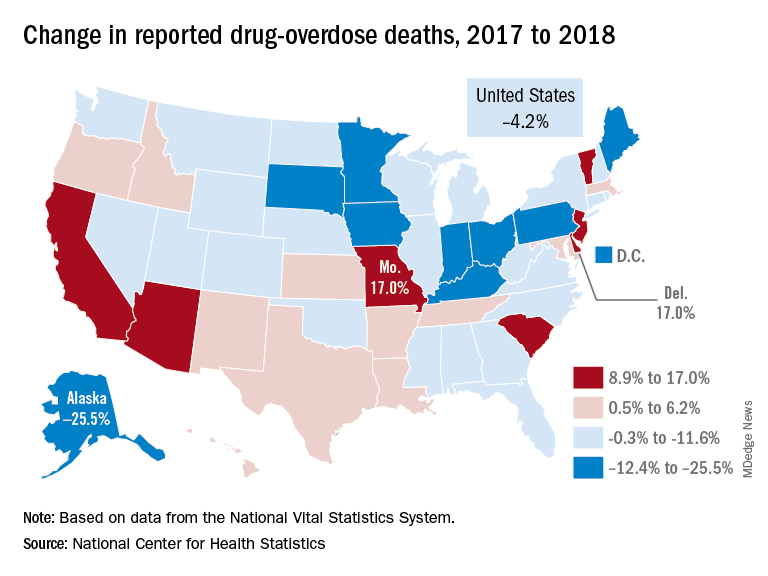
Reported drug overdose deaths in the United States declined by 4.2% from December 2017 to December 2018, the Centers for Disease Control and Prevention reported on July 17.
“The latest provisional data on overdose deaths show that America’s united efforts to curb opioid use disorder and addiction are working. Lives are being saved, and we’re beginning to win the fight against this crisis,” Health & Human Services Secretary Alex Azar said in a written statement. “Under President Trump’s leadership, and thanks to efforts on the ground by communities across America, the number of patients receiving medication-assisted treatment has risen, distribution of overdose-reversing drugs is up, and nationwide opioid prescriptions are down.”
The new data show that total drug overdose deaths were down from 70,699 in 2017 to 67,744 in 2018, a drop of 4.2%, the CDC said.
States, of course, fell on both sides of that national figure. Delaware and Missouri wound up on the other end of the scale with increases of 17.0% from 2017 to 2018. Deaths in Vermont, Arizona, and South Carolina also rose by double digits, data from the National Vital Statistics System show.
“While the declining trend of overdose deaths is an encouraging sign, by no means have we declared victory against the epidemic or addiction in general,” Secretary Azar said. “This crisis developed over 2 decades and it will not be solved overnight. We also face other emerging threats, like concerning trends in cocaine and methamphetamine overdoses.”
Reported drug overdose deaths in the United States declined by 4.2% from December 2017 to December 2018, the Centers for Disease Control and Prevention reported on July 17.
“The latest provisional data on overdose deaths show that America’s united efforts to curb opioid use disorder and addiction are working. Lives are being saved, and we’re beginning to win the fight against this crisis,” Health & Human Services Secretary Alex Azar said in a written statement. “Under President Trump’s leadership, and thanks to efforts on the ground by communities across America, the number of patients receiving medication-assisted treatment has risen, distribution of overdose-reversing drugs is up, and nationwide opioid prescriptions are down.”
The new data show that total drug overdose deaths were down from 70,699 in 2017 to 67,744 in 2018, a drop of 4.2%, the CDC said.
States, of course, fell on both sides of that national figure. Delaware and Missouri wound up on the other end of the scale with increases of 17.0% from 2017 to 2018. Deaths in Vermont, Arizona, and South Carolina also rose by double digits, data from the National Vital Statistics System show.
“While the declining trend of overdose deaths is an encouraging sign, by no means have we declared victory against the epidemic or addiction in general,” Secretary Azar said. “This crisis developed over 2 decades and it will not be solved overnight. We also face other emerging threats, like concerning trends in cocaine and methamphetamine overdoses.”
Reported drug overdose deaths in the United States declined by 4.2% from December 2017 to December 2018, the Centers for Disease Control and Prevention reported on July 17.
“The latest provisional data on overdose deaths show that America’s united efforts to curb opioid use disorder and addiction are working. Lives are being saved, and we’re beginning to win the fight against this crisis,” Health & Human Services Secretary Alex Azar said in a written statement. “Under President Trump’s leadership, and thanks to efforts on the ground by communities across America, the number of patients receiving medication-assisted treatment has risen, distribution of overdose-reversing drugs is up, and nationwide opioid prescriptions are down.”
The new data show that total drug overdose deaths were down from 70,699 in 2017 to 67,744 in 2018, a drop of 4.2%, the CDC said.
States, of course, fell on both sides of that national figure. Delaware and Missouri wound up on the other end of the scale with increases of 17.0% from 2017 to 2018. Deaths in Vermont, Arizona, and South Carolina also rose by double digits, data from the National Vital Statistics System show.
“While the declining trend of overdose deaths is an encouraging sign, by no means have we declared victory against the epidemic or addiction in general,” Secretary Azar said. “This crisis developed over 2 decades and it will not be solved overnight. We also face other emerging threats, like concerning trends in cocaine and methamphetamine overdoses.”
Weaponized ticks, pothead parents, and spider smoothies
Spider smoothie, anyone?
Eating spiders, grasshoppers, and cicadas – does that idea BUG you? Plenty of people around the world chomp down on insects as part of a balanced diet. But here in the United States, there’s definitely still an “ick” factor – as in, “ick, that thing has far too many legs to put in my mouth.”

These creepy crawlers, however, could be the key to a healthier lifestyle. Scientists have been recently looking at insects as a source of protein and antioxidants, among other health buzzwords.
Researchers from the University of Teremo in Italy took a look at commercially available insects (ever heard that phrase before?) and found that certain bugs, such as crickets, silkworms, caterpillars, and cicadas, displayed two or three times as much antioxidant activity as orange juice and olive oil. Perhaps you’d like a nice glass of cicada juice to go with your morning cereal?
Barclays also recently predicted that the insect protein market could be worth as much as $8 billion in the next decade, because of several factors. The earth’s population is rising, and people need new sources of food. We know bugs are plentiful – just go outside in the summer and stand with your mouth open, and you’ve got a three-course meal in 5 minutes.
We can also thank the teens: Barclays stated that Gen Z is the “most health-aware and environmentally conscious” generation yet, and therefore are all aboard the bug-eating train.
So, are you ready to start making eggs with a side of fried crickets? Perhaps a nice plant-based burger topped with cicada crumbles? Just make sure to stay away from the zombie ones.
Mom, put the joint down!
Way to harsh my mellow. You might think that smoking a little Mary Jane would chill parents out a bit. Turns out, that’s not the case.

A study from Ohio State University examined California parents, their substance use, and their disciplinarian styles. This is one of the first studies to look at how substance use relates to parenting, and the news is not good for the kids.
If you’re thinking about getting your parents into pot, think again. Parents who used marijuana in the past year tended to discipline their children more than parents who hadn’t used. Researchers also found similar trends with parents who used alcohol in the past.
Kids, if you’ve got a no-smoking, no-drinking square of a parent, be happy. It might save you a few groundings.
The true power of the dark side
When people go the grocery store, the produce department is – for many people – a big waste of space. It’s something to be skipped over. Who wants to buy fruits or vegetables anyway? Sure, they’re healthy, but they’re totally gross.

Turns out, there may be a way to get even your stubborn Uncle Joe, who probably thinks the food pyramid is a communist plot, to buy veggies. The key is a little black dress.
Okay, we’re not literally talking about sticking pineapples or broccoli in actual black dresses. But according to a study published in Food Quality and Preference, placing various types of produce against a black background made them more attractive to consumers over white or shades of gray. Even the lowly carrot, rated least attractive by the study participants when placed in front of every other color, got a big boost when placed on a black background. Something about black just brought out its natural shine.
So, next time you go through the produce department and it looks like it’s been designed by a teenager going through a particularly rough Goth phase, now you’ll know why.
The Lyme disease truth is out there
The setting is Rocky Mountain Laboratories in Hamilton, Mont. A man and a woman, both wearing dark suits, are standing in a large, poorly lit room full of file cabinets. Each is holding a flashlight.
Sculder: Explain to me again, Mully, why we couldn’t just ask to see these files?

Mully: C’mon, Sculder. My very secret and very reliable source said that Dr. Willy Burgdorfer, the scientist who discovered Lyme disease and worked in this lab, was actually a bioweapons specialist. My source said that Burgdorfer and “other bioweapons specialists stuffed ticks with pathogens to cause severe disability, disease – even death – to potential enemies.” If we had asked to see the records, they would have been destroyed by operatives of the shadow government.
Sculder: Where did you find this secret and reliable source, Mully?
Mully: I read his press release.
Sculder: Did the press release say anything about releases of diseased ticks, either accidental or by design?
Mully: Not until I ran it past a Navajo code talker.
Sculder stares at him blankly for several seconds.
Mully: Okay, okay. There’s this congressman, Rep. Chris Smith from New Jersey. The House of Representatives just approved his amendment to the 2020 National Defense Authorization Act. The amendment “directs the Inspector General of the Department of Defense to investigate the possible involvement of DOD biowarfare labs in the weaponization of Lyme disease in ticks and other insects from 1950 to 1975.” Honestly, it does.
Sculder turns around and quickly walks away. Mully follows her.
Mully: It could’ve happened! What if it’s another in the long line of government conspiracies that were too crazy to be true? Like Roswell. Or birtherism. Or New Coke. I suppose you’re going to tell me that Elvis and J. Edgar Hoover didn’t help NASA fake the moon landings?
Spider smoothie, anyone?
Eating spiders, grasshoppers, and cicadas – does that idea BUG you? Plenty of people around the world chomp down on insects as part of a balanced diet. But here in the United States, there’s definitely still an “ick” factor – as in, “ick, that thing has far too many legs to put in my mouth.”
These creepy crawlers, however, could be the key to a healthier lifestyle. Scientists have been recently looking at insects as a source of protein and antioxidants, among other health buzzwords.
Researchers from the University of Teremo in Italy took a look at commercially available insects (ever heard that phrase before?) and found that certain bugs, such as crickets, silkworms, caterpillars, and cicadas, displayed two or three times as much antioxidant activity as orange juice and olive oil. Perhaps you’d like a nice glass of cicada juice to go with your morning cereal?
Barclays also recently predicted that the insect protein market could be worth as much as $8 billion in the next decade, because of several factors. The earth’s population is rising, and people need new sources of food. We know bugs are plentiful – just go outside in the summer and stand with your mouth open, and you’ve got a three-course meal in 5 minutes.
We can also thank the teens: Barclays stated that Gen Z is the “most health-aware and environmentally conscious” generation yet, and therefore are all aboard the bug-eating train.
So, are you ready to start making eggs with a side of fried crickets? Perhaps a nice plant-based burger topped with cicada crumbles? Just make sure to stay away from the zombie ones.
Mom, put the joint down!
Way to harsh my mellow. You might think that smoking a little Mary Jane would chill parents out a bit. Turns out, that’s not the case.
A study from Ohio State University examined California parents, their substance use, and their disciplinarian styles. This is one of the first studies to look at how substance use relates to parenting, and the news is not good for the kids.
If you’re thinking about getting your parents into pot, think again. Parents who used marijuana in the past year tended to discipline their children more than parents who hadn’t used. Researchers also found similar trends with parents who used alcohol in the past.
Kids, if you’ve got a no-smoking, no-drinking square of a parent, be happy. It might save you a few groundings.
The true power of the dark side
When people go the grocery store, the produce department is – for many people – a big waste of space. It’s something to be skipped over. Who wants to buy fruits or vegetables anyway? Sure, they’re healthy, but they’re totally gross.
Turns out, there may be a way to get even your stubborn Uncle Joe, who probably thinks the food pyramid is a communist plot, to buy veggies. The key is a little black dress.
Okay, we’re not literally talking about sticking pineapples or broccoli in actual black dresses. But according to a study published in Food Quality and Preference, placing various types of produce against a black background made them more attractive to consumers over white or shades of gray. Even the lowly carrot, rated least attractive by the study participants when placed in front of every other color, got a big boost when placed on a black background. Something about black just brought out its natural shine.
So, next time you go through the produce department and it looks like it’s been designed by a teenager going through a particularly rough Goth phase, now you’ll know why.
The Lyme disease truth is out there
The setting is Rocky Mountain Laboratories in Hamilton, Mont. A man and a woman, both wearing dark suits, are standing in a large, poorly lit room full of file cabinets. Each is holding a flashlight.
Sculder: Explain to me again, Mully, why we couldn’t just ask to see these files?
Mully: C’mon, Sculder. My very secret and very reliable source said that Dr. Willy Burgdorfer, the scientist who discovered Lyme disease and worked in this lab, was actually a bioweapons specialist. My source said that Burgdorfer and “other bioweapons specialists stuffed ticks with pathogens to cause severe disability, disease – even death – to potential enemies.” If we had asked to see the records, they would have been destroyed by operatives of the shadow government.
Sculder: Where did you find this secret and reliable source, Mully?
Mully: I read his press release.
Sculder: Did the press release say anything about releases of diseased ticks, either accidental or by design?
Mully: Not until I ran it past a Navajo code talker.
Sculder stares at him blankly for several seconds.
Mully: Okay, okay. There’s this congressman, Rep. Chris Smith from New Jersey. The House of Representatives just approved his amendment to the 2020 National Defense Authorization Act. The amendment “directs the Inspector General of the Department of Defense to investigate the possible involvement of DOD biowarfare labs in the weaponization of Lyme disease in ticks and other insects from 1950 to 1975.” Honestly, it does.
Sculder turns around and quickly walks away. Mully follows her.
Mully: It could’ve happened! What if it’s another in the long line of government conspiracies that were too crazy to be true? Like Roswell. Or birtherism. Or New Coke. I suppose you’re going to tell me that Elvis and J. Edgar Hoover didn’t help NASA fake the moon landings?
Spider smoothie, anyone?
Eating spiders, grasshoppers, and cicadas – does that idea BUG you? Plenty of people around the world chomp down on insects as part of a balanced diet. But here in the United States, there’s definitely still an “ick” factor – as in, “ick, that thing has far too many legs to put in my mouth.”
These creepy crawlers, however, could be the key to a healthier lifestyle. Scientists have been recently looking at insects as a source of protein and antioxidants, among other health buzzwords.
Researchers from the University of Teremo in Italy took a look at commercially available insects (ever heard that phrase before?) and found that certain bugs, such as crickets, silkworms, caterpillars, and cicadas, displayed two or three times as much antioxidant activity as orange juice and olive oil. Perhaps you’d like a nice glass of cicada juice to go with your morning cereal?
Barclays also recently predicted that the insect protein market could be worth as much as $8 billion in the next decade, because of several factors. The earth’s population is rising, and people need new sources of food. We know bugs are plentiful – just go outside in the summer and stand with your mouth open, and you’ve got a three-course meal in 5 minutes.
We can also thank the teens: Barclays stated that Gen Z is the “most health-aware and environmentally conscious” generation yet, and therefore are all aboard the bug-eating train.
So, are you ready to start making eggs with a side of fried crickets? Perhaps a nice plant-based burger topped with cicada crumbles? Just make sure to stay away from the zombie ones.
Mom, put the joint down!
Way to harsh my mellow. You might think that smoking a little Mary Jane would chill parents out a bit. Turns out, that’s not the case.
A study from Ohio State University examined California parents, their substance use, and their disciplinarian styles. This is one of the first studies to look at how substance use relates to parenting, and the news is not good for the kids.
If you’re thinking about getting your parents into pot, think again. Parents who used marijuana in the past year tended to discipline their children more than parents who hadn’t used. Researchers also found similar trends with parents who used alcohol in the past.
Kids, if you’ve got a no-smoking, no-drinking square of a parent, be happy. It might save you a few groundings.
The true power of the dark side
When people go the grocery store, the produce department is – for many people – a big waste of space. It’s something to be skipped over. Who wants to buy fruits or vegetables anyway? Sure, they’re healthy, but they’re totally gross.
Turns out, there may be a way to get even your stubborn Uncle Joe, who probably thinks the food pyramid is a communist plot, to buy veggies. The key is a little black dress.
Okay, we’re not literally talking about sticking pineapples or broccoli in actual black dresses. But according to a study published in Food Quality and Preference, placing various types of produce against a black background made them more attractive to consumers over white or shades of gray. Even the lowly carrot, rated least attractive by the study participants when placed in front of every other color, got a big boost when placed on a black background. Something about black just brought out its natural shine.
So, next time you go through the produce department and it looks like it’s been designed by a teenager going through a particularly rough Goth phase, now you’ll know why.
The Lyme disease truth is out there
The setting is Rocky Mountain Laboratories in Hamilton, Mont. A man and a woman, both wearing dark suits, are standing in a large, poorly lit room full of file cabinets. Each is holding a flashlight.
Sculder: Explain to me again, Mully, why we couldn’t just ask to see these files?
Mully: C’mon, Sculder. My very secret and very reliable source said that Dr. Willy Burgdorfer, the scientist who discovered Lyme disease and worked in this lab, was actually a bioweapons specialist. My source said that Burgdorfer and “other bioweapons specialists stuffed ticks with pathogens to cause severe disability, disease – even death – to potential enemies.” If we had asked to see the records, they would have been destroyed by operatives of the shadow government.
Sculder: Where did you find this secret and reliable source, Mully?
Mully: I read his press release.
Sculder: Did the press release say anything about releases of diseased ticks, either accidental or by design?
Mully: Not until I ran it past a Navajo code talker.
Sculder stares at him blankly for several seconds.
Mully: Okay, okay. There’s this congressman, Rep. Chris Smith from New Jersey. The House of Representatives just approved his amendment to the 2020 National Defense Authorization Act. The amendment “directs the Inspector General of the Department of Defense to investigate the possible involvement of DOD biowarfare labs in the weaponization of Lyme disease in ticks and other insects from 1950 to 1975.” Honestly, it does.
Sculder turns around and quickly walks away. Mully follows her.
Mully: It could’ve happened! What if it’s another in the long line of government conspiracies that were too crazy to be true? Like Roswell. Or birtherism. Or New Coke. I suppose you’re going to tell me that Elvis and J. Edgar Hoover didn’t help NASA fake the moon landings?
Alopecia areata: Study finds racial disparities
, according to a new study involving registry data for more than 11,000 individuals.

These new findings “raise a different perspective from the conventional view that AA does not differ by race/ethnicity,” said Hemin Lee, MD, MPH, of the division of pharmacoepidemiology and pharmacoeconomics at Brigham and Women’s Hospital, Boston, and associates.
Multivariate-adjusted odds ratios for ever-diagnosis of AA were 1.77 for African Americans and 0.4 for Asians when whites were the referent group. Hispanics/Latinos were similar to whites, with an odds ratio of 0.9, and the group of other races/ethnicities (including American Indians and Pacific Islanders) was higher at 1.27, the investigators noted. The report is in the Journal of the American Academy of Dermatology.
The odds played out in a similar fashion when broken down by AA subtype. With whites as the referent at 1.0, blacks were most likely to have been diagnosed with AA transient/persistent at 1.93 and Asians were lowest at 0.46. For AA totalis/universalis, odds ratios were 1.57 for blacks and 0.32 for Asians, they said, based on 2000-2016 data from the National Alopecia Areata Registry.
“An intricate interplay between genetic and environmental factors may account for the racial differences. Pathogenesis of AA is at times linked with autoimmunity by its strong association with HLA class II alleles,” Dr. Lee and associates wrote.
The study involved 11,404 participants from the registry: 9,340 had reported at least one episode of AA and 2,064 had no history of lifetime alopecia. The multivariate analysis was based on the same group of noncases but a subgroup of 1,970 AA patients who had been enrolled in the registry “through academic institutions after dermatologist-confirmed diagnosis,” they said.
There was no funding source to report. One of Dr. Lee’s associates has received honoraria from Abbvie, Amgen, the Centers for Disease Control and Prevention, Janssen, Merck, Novartis, Pfizer, and Amgen, which have been donated to charity, and is an investigator for Sanofi/Regeneron with no financial compensation. All other authors have no conflicts of interest.
SOURCE: Lee H et al. J Am Acad Dermatol. 2019 Jul 3. doi: 10.1016/j.jaad.2019.06.1300.
, according to a new study involving registry data for more than 11,000 individuals.
These new findings “raise a different perspective from the conventional view that AA does not differ by race/ethnicity,” said Hemin Lee, MD, MPH, of the division of pharmacoepidemiology and pharmacoeconomics at Brigham and Women’s Hospital, Boston, and associates.
Multivariate-adjusted odds ratios for ever-diagnosis of AA were 1.77 for African Americans and 0.4 for Asians when whites were the referent group. Hispanics/Latinos were similar to whites, with an odds ratio of 0.9, and the group of other races/ethnicities (including American Indians and Pacific Islanders) was higher at 1.27, the investigators noted. The report is in the Journal of the American Academy of Dermatology.
The odds played out in a similar fashion when broken down by AA subtype. With whites as the referent at 1.0, blacks were most likely to have been diagnosed with AA transient/persistent at 1.93 and Asians were lowest at 0.46. For AA totalis/universalis, odds ratios were 1.57 for blacks and 0.32 for Asians, they said, based on 2000-2016 data from the National Alopecia Areata Registry.
“An intricate interplay between genetic and environmental factors may account for the racial differences. Pathogenesis of AA is at times linked with autoimmunity by its strong association with HLA class II alleles,” Dr. Lee and associates wrote.
The study involved 11,404 participants from the registry: 9,340 had reported at least one episode of AA and 2,064 had no history of lifetime alopecia. The multivariate analysis was based on the same group of noncases but a subgroup of 1,970 AA patients who had been enrolled in the registry “through academic institutions after dermatologist-confirmed diagnosis,” they said.
There was no funding source to report. One of Dr. Lee’s associates has received honoraria from Abbvie, Amgen, the Centers for Disease Control and Prevention, Janssen, Merck, Novartis, Pfizer, and Amgen, which have been donated to charity, and is an investigator for Sanofi/Regeneron with no financial compensation. All other authors have no conflicts of interest.
SOURCE: Lee H et al. J Am Acad Dermatol. 2019 Jul 3. doi: 10.1016/j.jaad.2019.06.1300.
, according to a new study involving registry data for more than 11,000 individuals.
These new findings “raise a different perspective from the conventional view that AA does not differ by race/ethnicity,” said Hemin Lee, MD, MPH, of the division of pharmacoepidemiology and pharmacoeconomics at Brigham and Women’s Hospital, Boston, and associates.
Multivariate-adjusted odds ratios for ever-diagnosis of AA were 1.77 for African Americans and 0.4 for Asians when whites were the referent group. Hispanics/Latinos were similar to whites, with an odds ratio of 0.9, and the group of other races/ethnicities (including American Indians and Pacific Islanders) was higher at 1.27, the investigators noted. The report is in the Journal of the American Academy of Dermatology.
The odds played out in a similar fashion when broken down by AA subtype. With whites as the referent at 1.0, blacks were most likely to have been diagnosed with AA transient/persistent at 1.93 and Asians were lowest at 0.46. For AA totalis/universalis, odds ratios were 1.57 for blacks and 0.32 for Asians, they said, based on 2000-2016 data from the National Alopecia Areata Registry.
“An intricate interplay between genetic and environmental factors may account for the racial differences. Pathogenesis of AA is at times linked with autoimmunity by its strong association with HLA class II alleles,” Dr. Lee and associates wrote.
The study involved 11,404 participants from the registry: 9,340 had reported at least one episode of AA and 2,064 had no history of lifetime alopecia. The multivariate analysis was based on the same group of noncases but a subgroup of 1,970 AA patients who had been enrolled in the registry “through academic institutions after dermatologist-confirmed diagnosis,” they said.
There was no funding source to report. One of Dr. Lee’s associates has received honoraria from Abbvie, Amgen, the Centers for Disease Control and Prevention, Janssen, Merck, Novartis, Pfizer, and Amgen, which have been donated to charity, and is an investigator for Sanofi/Regeneron with no financial compensation. All other authors have no conflicts of interest.
SOURCE: Lee H et al. J Am Acad Dermatol. 2019 Jul 3. doi: 10.1016/j.jaad.2019.06.1300.
FROM THE JOURNAL OF THE AMERICAN ACADEMY OF DERMATOLOGY
Measles cases have slowed but not stopped
The United States continues to slowly add new cases of measles to 2019’s postelimination-record total, but California was officially removed from the outbreak list this week, according to the Centers for Disease Control and Prevention.
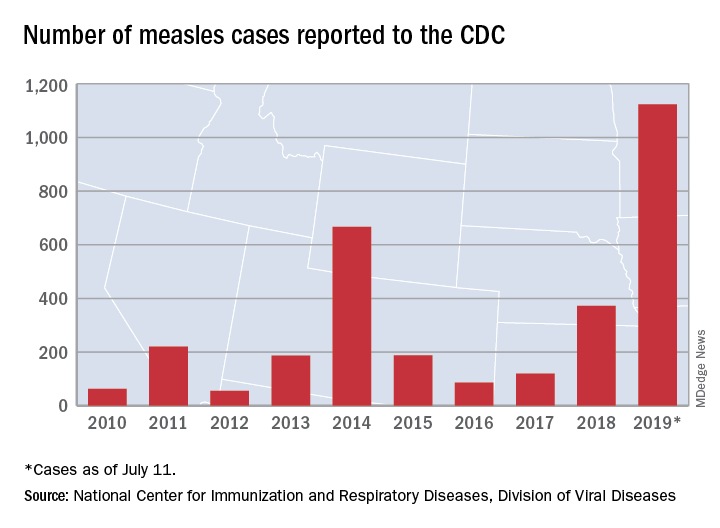
That is the highest number of cases reported since measles was declared eliminated in 2000 and the most in a single year since 1992.
The end of outbreak-related activity in California leaves three locations still dealing with ongoing cases: Rockland County, N.Y.; New York City; and King, Pierce, and Snohomish Counties in Washington, the CDC said.
Those three jurisdictions currently report the following:
- reported four new cases from July 3 to July 11 and is up to 175 cases for the year.
- had one new case from July 1 to July 8 and is now at 564 for the year.
- reported two cases from July 1 to July 10 and is now at 10 for the year (the other two counties have a total of three cases). Clark County in Washington reported 71 cases in an earlier, unrelated outbreak.
The United States continues to slowly add new cases of measles to 2019’s postelimination-record total, but California was officially removed from the outbreak list this week, according to the Centers for Disease Control and Prevention.
That is the highest number of cases reported since measles was declared eliminated in 2000 and the most in a single year since 1992.
The end of outbreak-related activity in California leaves three locations still dealing with ongoing cases: Rockland County, N.Y.; New York City; and King, Pierce, and Snohomish Counties in Washington, the CDC said.
Those three jurisdictions currently report the following:
- reported four new cases from July 3 to July 11 and is up to 175 cases for the year.
- had one new case from July 1 to July 8 and is now at 564 for the year.
- reported two cases from July 1 to July 10 and is now at 10 for the year (the other two counties have a total of three cases). Clark County in Washington reported 71 cases in an earlier, unrelated outbreak.
The United States continues to slowly add new cases of measles to 2019’s postelimination-record total, but California was officially removed from the outbreak list this week, according to the Centers for Disease Control and Prevention.
That is the highest number of cases reported since measles was declared eliminated in 2000 and the most in a single year since 1992.
The end of outbreak-related activity in California leaves three locations still dealing with ongoing cases: Rockland County, N.Y.; New York City; and King, Pierce, and Snohomish Counties in Washington, the CDC said.
Those three jurisdictions currently report the following:
- reported four new cases from July 3 to July 11 and is up to 175 cases for the year.
- had one new case from July 1 to July 8 and is now at 564 for the year.
- reported two cases from July 1 to July 10 and is now at 10 for the year (the other two counties have a total of three cases). Clark County in Washington reported 71 cases in an earlier, unrelated outbreak.
Dancing parrots, flying spiders, and ER fish tales
Cockatoo cha-cha-cha

Humans love to dance. Whether it’s just a little bobbing back and forth or a full-on tango, spontaneous dancing is a universal expression of feeling and joy. However, feeling the rhythm is nearly unique to the human species. Not even our closest relatives in the animal kingdom, primates, have been observed busting a move to music.
So who are our ballroom brethren? Parrots, strangely enough. Parrots are nature’s great imitators, so how can we be sure they aren’t just mimicking (or mocking) their human owners’ movements?
Several studies have been conducted on a particularly funky cockatoo named Snowball. He’s a viral Internet sensation, and researchers have been watching him for the past decade as he stomps his feet and bangs his head to all kinds of music – he jams to everything from classic rock to modern pop. Snowball’s owner also assured scientists that her bird does not get his dance moves from her; Snowball is a unique choreographer.
A follow-up study about Snowball was recently published, in which the authors suggested the reason for spontaneous parrot dancing could be the strong auditory-motor connections that exist in parrot brains. They’re similar to humans, but not primates. They also detailed Snowball’s 14 distinct dance moves. Someone get that parrot on America’s Got Talent, ASAP.
It’s a bird, it’s a plane – oh no, it’s a spider
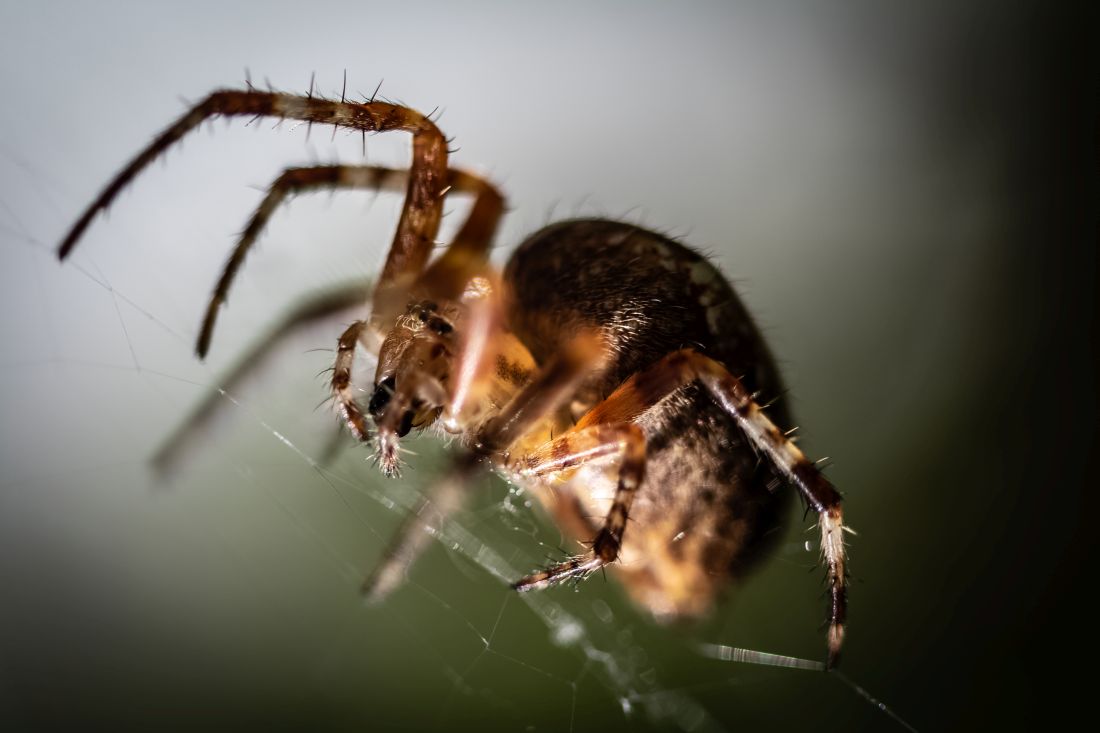
Arachnophobes, just skip this one. If you’re not unsettled by spiders yet, you’re about to be!
In case you didn’t know, spiders can fly. Or rather, they float (spiders with wings would just be straight-up horrifying).
Scientists (and fans of Charlotte’s Web) have known for centuries that spiders can turn into their own personal airships, but it wasn’t always clear how they do it. It was commonly believed that spider-flying, aka “ballooning,” was caused by the spider using its silk as a kind of kite, with the wind catching on the silk and bringing the spider along with it. That explanation, however, doesn’t account for the fact that spiders only balloon during light winds, which are rarely strong enough to carry a spider.
Two intrepid spider fans from the University of Bristol (England) think they have solved the mystery of the flying arachnids.
It turns out that spiders are able to sense the earth’s electric field and use that to soar around. They let loose some silk, which picks up a negative charge. This charge repels the negative charge of whatever they are standing on and can create enough force to launch them into the air. Spiders, those smart little buggers, can increase these charges by climbing onto twigs or grass. Plants rooted in the earth have a strong negative charge but stick up into the positively charged air.
All this fancy science-babble to say: Spiders can fly, and we know how! Stay indoors, folks.
Hospital lures fishermen to ED
There are some things you expect to see when you walk into a hospital: an admitting desk, waiting areas full of people, security guards, bad art work, maybe a friendly greeter at the door (sorry, that’s the Walmart).
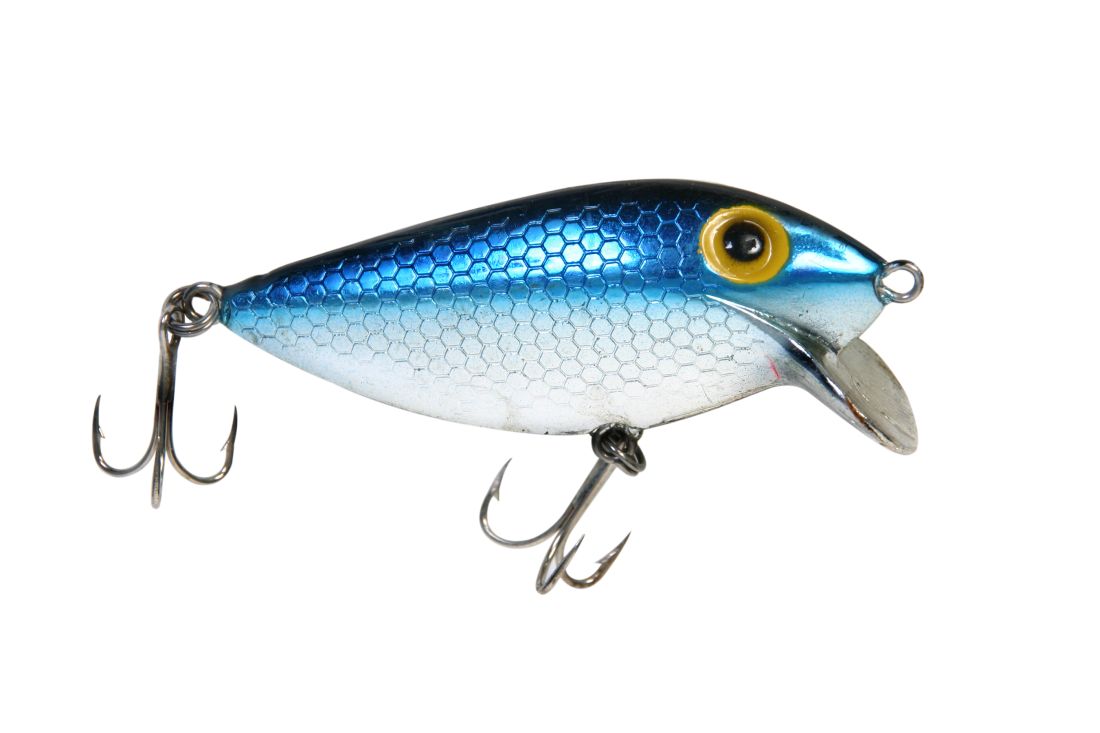
The main lobby at Adirondack Medical Center in Saranac Lake, N.Y., however, has something you might not expect: a display of fishing lures.
Each of the more than 100 lures on display originally showed up at the hospital’s emergency department attached to an arm, leg, nose, or lip – pretty much every body part possible, Gary Nye, a physician assistant in the ED, told newyorkupstate.com. He’s even removed lures from several patients’ penises and scrotums. “Usually alcohol has something to do with it,” he noted.
One individual came in with hooks from a lure stuck on both thumbs. He got one set of hooks stuck on one thumb, and as he tried to get it out, he ended up getting the lure’s other set of hooks caught on his other thumb. A nurse who has worked in the ED for 20 years said that alcohol may been involved.
Dr. Michael Pond, the hospital’s former medical director and the one who started the display in 1990, explained why the lures are now kept in a locked case. A number of years ago, when the display was less secure, “someone cut out and stole four to five antique lures out of the case. I mean, these were absolutely gorgeous and expensive lures – Pikie Minnows and [other] things. [They] were made out of wood and painted.”
As with so many fish stories, you should have seen the one that got away.
Inspiration really can come from anywhere

On the surface, a study detailing a new, potentially practice-changing method of converting type A blood to type O doesn’t seem disgusting, silly, or odd enough to make it into Livin’ on the MDedge. But when you dig a little deeper, you’ll see that the method involves a bacteria in the human microbiome.
Now you might be getting a bit suspicious. This is going to be another story about poop, you might be thinking.
And you’d be right!
But the real star of the show isn’t human poop. No, in this case, we owe this groundbreaking discovery to the humble beaver.
In an earlier study published in the ISME Journal, the same group of researchers from the University of British Columbia in Vancouver (of course they’re Canadian) analyzed the microbiomes of beavers to see just how they broke down the complex carbohydrates and glycoproteins found in wood. That was the catalyst that got the researchers thinking about the human microbiome and the problem of stripping red blood cells of their antigens.
Basically, just as the beaver breaks down wood with bacteria in their microbiome, the modified bacteria the researchers conjured up can be used to break down the A and B antigens of red blood cells, leaving a simple type O cell that can be transfused into any patient.
Rumors that all future blood transfusions are required by law to be accompanied by a playing of O Canada remain unsubstantiated.

Cockatoo cha-cha-cha
Humans love to dance. Whether it’s just a little bobbing back and forth or a full-on tango, spontaneous dancing is a universal expression of feeling and joy. However, feeling the rhythm is nearly unique to the human species. Not even our closest relatives in the animal kingdom, primates, have been observed busting a move to music.
So who are our ballroom brethren? Parrots, strangely enough. Parrots are nature’s great imitators, so how can we be sure they aren’t just mimicking (or mocking) their human owners’ movements?
Several studies have been conducted on a particularly funky cockatoo named Snowball. He’s a viral Internet sensation, and researchers have been watching him for the past decade as he stomps his feet and bangs his head to all kinds of music – he jams to everything from classic rock to modern pop. Snowball’s owner also assured scientists that her bird does not get his dance moves from her; Snowball is a unique choreographer.
A follow-up study about Snowball was recently published, in which the authors suggested the reason for spontaneous parrot dancing could be the strong auditory-motor connections that exist in parrot brains. They’re similar to humans, but not primates. They also detailed Snowball’s 14 distinct dance moves. Someone get that parrot on America’s Got Talent, ASAP.
It’s a bird, it’s a plane – oh no, it’s a spider
Arachnophobes, just skip this one. If you’re not unsettled by spiders yet, you’re about to be!
In case you didn’t know, spiders can fly. Or rather, they float (spiders with wings would just be straight-up horrifying).
Scientists (and fans of Charlotte’s Web) have known for centuries that spiders can turn into their own personal airships, but it wasn’t always clear how they do it. It was commonly believed that spider-flying, aka “ballooning,” was caused by the spider using its silk as a kind of kite, with the wind catching on the silk and bringing the spider along with it. That explanation, however, doesn’t account for the fact that spiders only balloon during light winds, which are rarely strong enough to carry a spider.
Two intrepid spider fans from the University of Bristol (England) think they have solved the mystery of the flying arachnids.
It turns out that spiders are able to sense the earth’s electric field and use that to soar around. They let loose some silk, which picks up a negative charge. This charge repels the negative charge of whatever they are standing on and can create enough force to launch them into the air. Spiders, those smart little buggers, can increase these charges by climbing onto twigs or grass. Plants rooted in the earth have a strong negative charge but stick up into the positively charged air.
All this fancy science-babble to say: Spiders can fly, and we know how! Stay indoors, folks.
Hospital lures fishermen to ED
There are some things you expect to see when you walk into a hospital: an admitting desk, waiting areas full of people, security guards, bad art work, maybe a friendly greeter at the door (sorry, that’s the Walmart).
The main lobby at Adirondack Medical Center in Saranac Lake, N.Y., however, has something you might not expect: a display of fishing lures.
Each of the more than 100 lures on display originally showed up at the hospital’s emergency department attached to an arm, leg, nose, or lip – pretty much every body part possible, Gary Nye, a physician assistant in the ED, told newyorkupstate.com. He’s even removed lures from several patients’ penises and scrotums. “Usually alcohol has something to do with it,” he noted.
One individual came in with hooks from a lure stuck on both thumbs. He got one set of hooks stuck on one thumb, and as he tried to get it out, he ended up getting the lure’s other set of hooks caught on his other thumb. A nurse who has worked in the ED for 20 years said that alcohol may been involved.
Dr. Michael Pond, the hospital’s former medical director and the one who started the display in 1990, explained why the lures are now kept in a locked case. A number of years ago, when the display was less secure, “someone cut out and stole four to five antique lures out of the case. I mean, these were absolutely gorgeous and expensive lures – Pikie Minnows and [other] things. [They] were made out of wood and painted.”
As with so many fish stories, you should have seen the one that got away.
Inspiration really can come from anywhere
On the surface, a study detailing a new, potentially practice-changing method of converting type A blood to type O doesn’t seem disgusting, silly, or odd enough to make it into Livin’ on the MDedge. But when you dig a little deeper, you’ll see that the method involves a bacteria in the human microbiome.
Now you might be getting a bit suspicious. This is going to be another story about poop, you might be thinking.
And you’d be right!
But the real star of the show isn’t human poop. No, in this case, we owe this groundbreaking discovery to the humble beaver.
In an earlier study published in the ISME Journal, the same group of researchers from the University of British Columbia in Vancouver (of course they’re Canadian) analyzed the microbiomes of beavers to see just how they broke down the complex carbohydrates and glycoproteins found in wood. That was the catalyst that got the researchers thinking about the human microbiome and the problem of stripping red blood cells of their antigens.
Basically, just as the beaver breaks down wood with bacteria in their microbiome, the modified bacteria the researchers conjured up can be used to break down the A and B antigens of red blood cells, leaving a simple type O cell that can be transfused into any patient.
Rumors that all future blood transfusions are required by law to be accompanied by a playing of O Canada remain unsubstantiated.
Cockatoo cha-cha-cha
Humans love to dance. Whether it’s just a little bobbing back and forth or a full-on tango, spontaneous dancing is a universal expression of feeling and joy. However, feeling the rhythm is nearly unique to the human species. Not even our closest relatives in the animal kingdom, primates, have been observed busting a move to music.
So who are our ballroom brethren? Parrots, strangely enough. Parrots are nature’s great imitators, so how can we be sure they aren’t just mimicking (or mocking) their human owners’ movements?
Several studies have been conducted on a particularly funky cockatoo named Snowball. He’s a viral Internet sensation, and researchers have been watching him for the past decade as he stomps his feet and bangs his head to all kinds of music – he jams to everything from classic rock to modern pop. Snowball’s owner also assured scientists that her bird does not get his dance moves from her; Snowball is a unique choreographer.
A follow-up study about Snowball was recently published, in which the authors suggested the reason for spontaneous parrot dancing could be the strong auditory-motor connections that exist in parrot brains. They’re similar to humans, but not primates. They also detailed Snowball’s 14 distinct dance moves. Someone get that parrot on America’s Got Talent, ASAP.
It’s a bird, it’s a plane – oh no, it’s a spider
Arachnophobes, just skip this one. If you’re not unsettled by spiders yet, you’re about to be!
In case you didn’t know, spiders can fly. Or rather, they float (spiders with wings would just be straight-up horrifying).
Scientists (and fans of Charlotte’s Web) have known for centuries that spiders can turn into their own personal airships, but it wasn’t always clear how they do it. It was commonly believed that spider-flying, aka “ballooning,” was caused by the spider using its silk as a kind of kite, with the wind catching on the silk and bringing the spider along with it. That explanation, however, doesn’t account for the fact that spiders only balloon during light winds, which are rarely strong enough to carry a spider.
Two intrepid spider fans from the University of Bristol (England) think they have solved the mystery of the flying arachnids.
It turns out that spiders are able to sense the earth’s electric field and use that to soar around. They let loose some silk, which picks up a negative charge. This charge repels the negative charge of whatever they are standing on and can create enough force to launch them into the air. Spiders, those smart little buggers, can increase these charges by climbing onto twigs or grass. Plants rooted in the earth have a strong negative charge but stick up into the positively charged air.
All this fancy science-babble to say: Spiders can fly, and we know how! Stay indoors, folks.
Hospital lures fishermen to ED
There are some things you expect to see when you walk into a hospital: an admitting desk, waiting areas full of people, security guards, bad art work, maybe a friendly greeter at the door (sorry, that’s the Walmart).
The main lobby at Adirondack Medical Center in Saranac Lake, N.Y., however, has something you might not expect: a display of fishing lures.
Each of the more than 100 lures on display originally showed up at the hospital’s emergency department attached to an arm, leg, nose, or lip – pretty much every body part possible, Gary Nye, a physician assistant in the ED, told newyorkupstate.com. He’s even removed lures from several patients’ penises and scrotums. “Usually alcohol has something to do with it,” he noted.
One individual came in with hooks from a lure stuck on both thumbs. He got one set of hooks stuck on one thumb, and as he tried to get it out, he ended up getting the lure’s other set of hooks caught on his other thumb. A nurse who has worked in the ED for 20 years said that alcohol may been involved.
Dr. Michael Pond, the hospital’s former medical director and the one who started the display in 1990, explained why the lures are now kept in a locked case. A number of years ago, when the display was less secure, “someone cut out and stole four to five antique lures out of the case. I mean, these were absolutely gorgeous and expensive lures – Pikie Minnows and [other] things. [They] were made out of wood and painted.”
As with so many fish stories, you should have seen the one that got away.
Inspiration really can come from anywhere
On the surface, a study detailing a new, potentially practice-changing method of converting type A blood to type O doesn’t seem disgusting, silly, or odd enough to make it into Livin’ on the MDedge. But when you dig a little deeper, you’ll see that the method involves a bacteria in the human microbiome.
Now you might be getting a bit suspicious. This is going to be another story about poop, you might be thinking.
And you’d be right!
But the real star of the show isn’t human poop. No, in this case, we owe this groundbreaking discovery to the humble beaver.
In an earlier study published in the ISME Journal, the same group of researchers from the University of British Columbia in Vancouver (of course they’re Canadian) analyzed the microbiomes of beavers to see just how they broke down the complex carbohydrates and glycoproteins found in wood. That was the catalyst that got the researchers thinking about the human microbiome and the problem of stripping red blood cells of their antigens.
Basically, just as the beaver breaks down wood with bacteria in their microbiome, the modified bacteria the researchers conjured up can be used to break down the A and B antigens of red blood cells, leaving a simple type O cell that can be transfused into any patient.
Rumors that all future blood transfusions are required by law to be accompanied by a playing of O Canada remain unsubstantiated.
Flying acid zombies, poster face-lifts, and feces of champions
The flying dead
Just when you thought cicada infestations couldn’t get worse – the cicadas are now zombies on an acid trip.
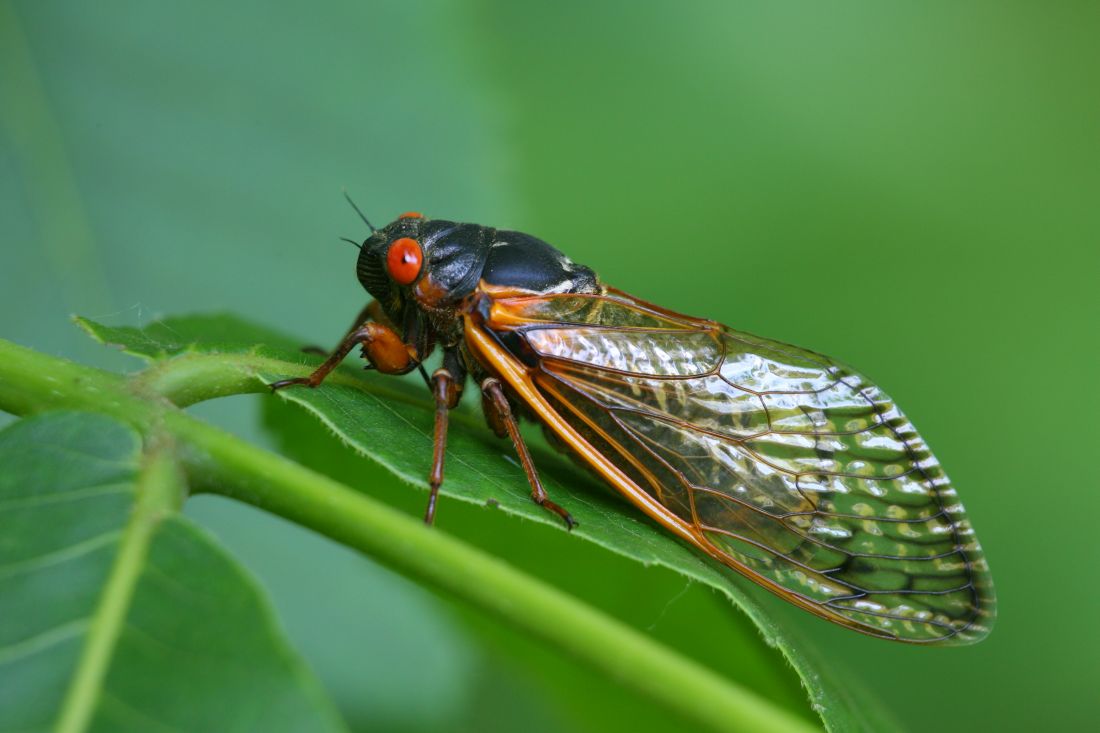
West Virginia University researchers recently discovered that a fungus called Massopora, which has compounds similar to those found in psychedelic mushrooms, can infect cicadas and cause seriously weird behavior.
How weird, you ask? Well, male cicadas try to mate with everything they encounter, even though the fungus has eaten away their limbs … and their genitals. Talk about a bad trip.
It gets worse. These zombie-like cicadas are flying around and exposing their healthy brethren to the fungus. So, now we have to worry about potentially billions of these buggers becoming rotting, flying, hypersexual machines.
Makes a person really want to stay inside for the whole summer, perhaps in a fortified bunker. Just in case.
Also, for the curious: One of the study’s authors concedes that if a person were “motivated enough,” they might be able to get high off the cicada fungus. Not interested in finding out exactly how many cicadas you’d have to crunch on before you start tasting colors?
Poster do-over

It’s time to get ready for a revolution – and just in time for 4th of July. No, we’re not redeclaring independence from Britain. It’s something much, much more radical, at least to the scientific community.
Get ready for … the redesign of the science poster.
Mike Morrison, a doctoral student in psychology, has proposed a new way to present information at meetings that breathes new life into the tired poster design. While fascinating insights could be held on a poster, the reality of meetings and conferences is that people often skim over the posters they see, barely registering the information.
Morrison is taking advantage of the ever-present smartphone to ramp up the classic science poster to a new level. He proposes a format where the key research finding is smack in the middle, in big, readable language. Accompanying this is a QR code you can scan, which would take you to a page with the full details of the study.
Morrison tweeted out his idea, and it spread quickly through the scientific community, gaining traction from younger scientists and students who love the idea.
We’re in the age of remakes now – in which classics are reinvented for a new audience. It’s time the science poster got a face-lift, too.
Running a marathon, one Veillonella at a time

What’s the difference between an elite athlete and a person who’s out of juice after running for 30 seconds?
Well, many things, we’re sure. A proper diet, rigorous training, not spending 12 hours a day sitting behind a computer screen. But just to add insult to injury, according to a study published in Nature Medicine, athletes even poop better than us normal people.
That may require a bit of explanation. A group of researchers from Harvard University, Boston, analyzed stool samples from elite marathon runners before and just after they participated in the 2015 Boston Marathon. They found that, following the race, the athletes had significantly higher amounts of Veillonella in their microbiota. This bacteria breaks down lactic acid, which is made during intense exercise and causes muscle fatigue and stress.
Naturally, the next step was to take that bacteria, feed it to mice, then get them running on a treadmill.
While not every mouse fed Veillonella saw increased performance, on average, mice that received the bacteria saw a 13% improvement over their non–Veillonella enhanced friends.
The researchers noted that this sort of probiotic treatment could be useful to patients with metabolic diseases, such as diabetes. Plus, there’s the obvious benefit to athletes. We look forward to hearing advertisements swearing by Veillonella-infused Wheaties, the true breakfast of champions.
Put a little boredom in your life

Is your job an endless, soul-sucking vortex of dreariness? Do you stare at the wall for hours at a time while you’re at work, wishing you had something better to do? Do you look forward to leaving early to go to the dentist? [Editor query: What does this have to do with health care? LOTME: You’ll see. We’re building dramatic tension.]
Did you answer yes to any of these questions? Way to go! You’ve taken the first step on the road to creativity. [Still waiting. We’re almost there.]
A recent study examined the effects of boredom by assigning people to either a really boring task – sorting a bowl of red and green beans by color for 30 minutes using only one hand – or a nonboring art project using paper, glue, and, of course, beans. [What’s with the beans? It’s not our fault they used beans.]
The next task was the same for both groups: Come up with some reasons for being late for work and think of ideas for a new product by a hypothetical company. The answers were graded on their uniqueness, and the bean-sorting group had more creative ideas than did the art-project group.
The point is, ladies and gentlemen, that boredom is good. Boredom is right. Boredom works. [A Gordon Gekko reference? Couldn’t you find something from this century? No.]
By now you’re probably wondering: “But how can I get one of those really boring jobs? After all, I’m a doctor. I heal the sick and care for the needy. My work is way too interesting to inspire true creativity.” Have you ever considered writing a medical humor column?
[Note to readers: We’ve pulled the staff away from their building blocks and crayons and given them a timeout. Hopefully things will be a little better by next week.]

The flying dead
Just when you thought cicada infestations couldn’t get worse – the cicadas are now zombies on an acid trip.
West Virginia University researchers recently discovered that a fungus called Massopora, which has compounds similar to those found in psychedelic mushrooms, can infect cicadas and cause seriously weird behavior.
How weird, you ask? Well, male cicadas try to mate with everything they encounter, even though the fungus has eaten away their limbs … and their genitals. Talk about a bad trip.
It gets worse. These zombie-like cicadas are flying around and exposing their healthy brethren to the fungus. So, now we have to worry about potentially billions of these buggers becoming rotting, flying, hypersexual machines.
Makes a person really want to stay inside for the whole summer, perhaps in a fortified bunker. Just in case.
Also, for the curious: One of the study’s authors concedes that if a person were “motivated enough,” they might be able to get high off the cicada fungus. Not interested in finding out exactly how many cicadas you’d have to crunch on before you start tasting colors?
Poster do-over
It’s time to get ready for a revolution – and just in time for 4th of July. No, we’re not redeclaring independence from Britain. It’s something much, much more radical, at least to the scientific community.
Get ready for … the redesign of the science poster.
Mike Morrison, a doctoral student in psychology, has proposed a new way to present information at meetings that breathes new life into the tired poster design. While fascinating insights could be held on a poster, the reality of meetings and conferences is that people often skim over the posters they see, barely registering the information.
Morrison is taking advantage of the ever-present smartphone to ramp up the classic science poster to a new level. He proposes a format where the key research finding is smack in the middle, in big, readable language. Accompanying this is a QR code you can scan, which would take you to a page with the full details of the study.
Morrison tweeted out his idea, and it spread quickly through the scientific community, gaining traction from younger scientists and students who love the idea.
We’re in the age of remakes now – in which classics are reinvented for a new audience. It’s time the science poster got a face-lift, too.
Running a marathon, one Veillonella at a time
What’s the difference between an elite athlete and a person who’s out of juice after running for 30 seconds?
Well, many things, we’re sure. A proper diet, rigorous training, not spending 12 hours a day sitting behind a computer screen. But just to add insult to injury, according to a study published in Nature Medicine, athletes even poop better than us normal people.
That may require a bit of explanation. A group of researchers from Harvard University, Boston, analyzed stool samples from elite marathon runners before and just after they participated in the 2015 Boston Marathon. They found that, following the race, the athletes had significantly higher amounts of Veillonella in their microbiota. This bacteria breaks down lactic acid, which is made during intense exercise and causes muscle fatigue and stress.
Naturally, the next step was to take that bacteria, feed it to mice, then get them running on a treadmill.
While not every mouse fed Veillonella saw increased performance, on average, mice that received the bacteria saw a 13% improvement over their non–Veillonella enhanced friends.
The researchers noted that this sort of probiotic treatment could be useful to patients with metabolic diseases, such as diabetes. Plus, there’s the obvious benefit to athletes. We look forward to hearing advertisements swearing by Veillonella-infused Wheaties, the true breakfast of champions.
Put a little boredom in your life
Is your job an endless, soul-sucking vortex of dreariness? Do you stare at the wall for hours at a time while you’re at work, wishing you had something better to do? Do you look forward to leaving early to go to the dentist? [Editor query: What does this have to do with health care? LOTME: You’ll see. We’re building dramatic tension.]
Did you answer yes to any of these questions? Way to go! You’ve taken the first step on the road to creativity. [Still waiting. We’re almost there.]
A recent study examined the effects of boredom by assigning people to either a really boring task – sorting a bowl of red and green beans by color for 30 minutes using only one hand – or a nonboring art project using paper, glue, and, of course, beans. [What’s with the beans? It’s not our fault they used beans.]
The next task was the same for both groups: Come up with some reasons for being late for work and think of ideas for a new product by a hypothetical company. The answers were graded on their uniqueness, and the bean-sorting group had more creative ideas than did the art-project group.
The point is, ladies and gentlemen, that boredom is good. Boredom is right. Boredom works. [A Gordon Gekko reference? Couldn’t you find something from this century? No.]
By now you’re probably wondering: “But how can I get one of those really boring jobs? After all, I’m a doctor. I heal the sick and care for the needy. My work is way too interesting to inspire true creativity.” Have you ever considered writing a medical humor column?
[Note to readers: We’ve pulled the staff away from their building blocks and crayons and given them a timeout. Hopefully things will be a little better by next week.]
The flying dead
Just when you thought cicada infestations couldn’t get worse – the cicadas are now zombies on an acid trip.
West Virginia University researchers recently discovered that a fungus called Massopora, which has compounds similar to those found in psychedelic mushrooms, can infect cicadas and cause seriously weird behavior.
How weird, you ask? Well, male cicadas try to mate with everything they encounter, even though the fungus has eaten away their limbs … and their genitals. Talk about a bad trip.
It gets worse. These zombie-like cicadas are flying around and exposing their healthy brethren to the fungus. So, now we have to worry about potentially billions of these buggers becoming rotting, flying, hypersexual machines.
Makes a person really want to stay inside for the whole summer, perhaps in a fortified bunker. Just in case.
Also, for the curious: One of the study’s authors concedes that if a person were “motivated enough,” they might be able to get high off the cicada fungus. Not interested in finding out exactly how many cicadas you’d have to crunch on before you start tasting colors?
Poster do-over
It’s time to get ready for a revolution – and just in time for 4th of July. No, we’re not redeclaring independence from Britain. It’s something much, much more radical, at least to the scientific community.
Get ready for … the redesign of the science poster.
Mike Morrison, a doctoral student in psychology, has proposed a new way to present information at meetings that breathes new life into the tired poster design. While fascinating insights could be held on a poster, the reality of meetings and conferences is that people often skim over the posters they see, barely registering the information.
Morrison is taking advantage of the ever-present smartphone to ramp up the classic science poster to a new level. He proposes a format where the key research finding is smack in the middle, in big, readable language. Accompanying this is a QR code you can scan, which would take you to a page with the full details of the study.
Morrison tweeted out his idea, and it spread quickly through the scientific community, gaining traction from younger scientists and students who love the idea.
We’re in the age of remakes now – in which classics are reinvented for a new audience. It’s time the science poster got a face-lift, too.
Running a marathon, one Veillonella at a time
What’s the difference between an elite athlete and a person who’s out of juice after running for 30 seconds?
Well, many things, we’re sure. A proper diet, rigorous training, not spending 12 hours a day sitting behind a computer screen. But just to add insult to injury, according to a study published in Nature Medicine, athletes even poop better than us normal people.
That may require a bit of explanation. A group of researchers from Harvard University, Boston, analyzed stool samples from elite marathon runners before and just after they participated in the 2015 Boston Marathon. They found that, following the race, the athletes had significantly higher amounts of Veillonella in their microbiota. This bacteria breaks down lactic acid, which is made during intense exercise and causes muscle fatigue and stress.
Naturally, the next step was to take that bacteria, feed it to mice, then get them running on a treadmill.
While not every mouse fed Veillonella saw increased performance, on average, mice that received the bacteria saw a 13% improvement over their non–Veillonella enhanced friends.
The researchers noted that this sort of probiotic treatment could be useful to patients with metabolic diseases, such as diabetes. Plus, there’s the obvious benefit to athletes. We look forward to hearing advertisements swearing by Veillonella-infused Wheaties, the true breakfast of champions.
Put a little boredom in your life
Is your job an endless, soul-sucking vortex of dreariness? Do you stare at the wall for hours at a time while you’re at work, wishing you had something better to do? Do you look forward to leaving early to go to the dentist? [Editor query: What does this have to do with health care? LOTME: You’ll see. We’re building dramatic tension.]
Did you answer yes to any of these questions? Way to go! You’ve taken the first step on the road to creativity. [Still waiting. We’re almost there.]
A recent study examined the effects of boredom by assigning people to either a really boring task – sorting a bowl of red and green beans by color for 30 minutes using only one hand – or a nonboring art project using paper, glue, and, of course, beans. [What’s with the beans? It’s not our fault they used beans.]
The next task was the same for both groups: Come up with some reasons for being late for work and think of ideas for a new product by a hypothetical company. The answers were graded on their uniqueness, and the bean-sorting group had more creative ideas than did the art-project group.
The point is, ladies and gentlemen, that boredom is good. Boredom is right. Boredom works. [A Gordon Gekko reference? Couldn’t you find something from this century? No.]
By now you’re probably wondering: “But how can I get one of those really boring jobs? After all, I’m a doctor. I heal the sick and care for the needy. My work is way too interesting to inspire true creativity.” Have you ever considered writing a medical humor column?
[Note to readers: We’ve pulled the staff away from their building blocks and crayons and given them a timeout. Hopefully things will be a little better by next week.]
Cancer deaths cost over $94 billion in lost earnings in 2015
Cancer led to 492,000 deaths for Americans aged 16-84 years in 2015, and those deaths cost $94.4 billion in lost earnings that year, according to a study published in JAMA Oncology.
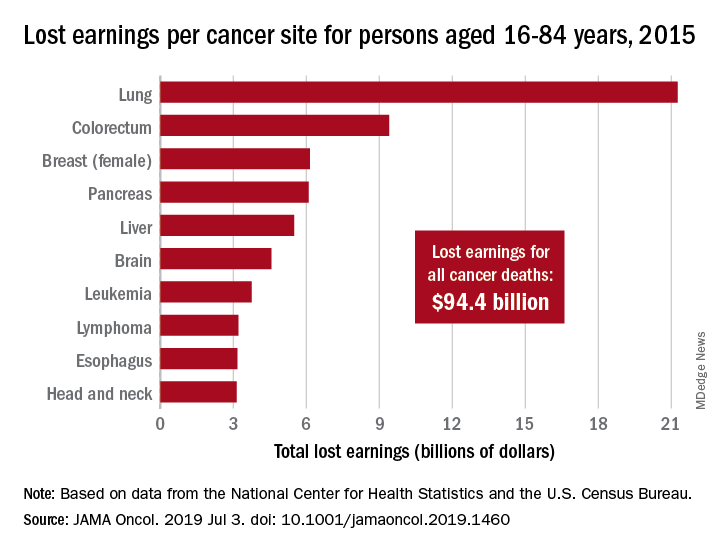
Cancer also took more than 8.7 million years of life from those individuals, with lung cancer being the most costly in terms of both lost earnings and years of life lost, said Farhad Islami, MD, PhD, and associates at the American Cancer Society, Atlanta.
“Person-years of life lost and lost earnings were high for many cancers associated with modifiable risk factors and effective screening and treatment, suggesting that a substantial proportion of the mortality burden is potentially avoidable,” they wrote, adding that “implementation of comprehensive cancer prevention interventions and equitable access to high-quality care across all states could reduce the burden of cancer and associated geographic and other differences in the country.”
In 2015, lung cancer took more than 2.2 million years of life and $21.3 billion in earnings from Americans aged 16-84 years. Colorectal cancer was next with 766,000 years of life lost and $9.4 billion in lost earnings, followed by female breast cancer with losses of 746,000 years of life and 6.2 billion in earnings, Dr. Islami and associated reported.
For all cancers, the cost in lost earnings per death was almost $192,000, with the highest costs coming from cancers of the brain and nervous system ($315,000) and cervix ($311,000). On that basis, lung cancer cost was lower than average at $159,000 per death, they noted.
At the state level, lost-earnings rates were lowest in Utah ($19.6 million per 100,000 persons) and highest in Kentucky ($35.3 million per 100,000). “If all states had Utah’s lost earnings rate in 2015, lost earnings in the U.S. would have been reduced by 29.3%, or $27.7 billion, and life years lost nationwide in 2015 would be reduced by 2.4 million,” Dr. Islami and his associates said in a written statement.
Data for the study were obtained from the National Center for Health Statistics (mortality) and the U.S. Census Bureau (earnings). The study was supported by the Intramural Research Department of the American Cancer Society, and all of the investigators are employees of the society.
SOURCE: Islami F et al. JAMA Oncol. 2019 Jul 3. doi: 10.1001/jamaoncol.2019.1460.
Cancer led to 492,000 deaths for Americans aged 16-84 years in 2015, and those deaths cost $94.4 billion in lost earnings that year, according to a study published in JAMA Oncology.
Cancer also took more than 8.7 million years of life from those individuals, with lung cancer being the most costly in terms of both lost earnings and years of life lost, said Farhad Islami, MD, PhD, and associates at the American Cancer Society, Atlanta.
“Person-years of life lost and lost earnings were high for many cancers associated with modifiable risk factors and effective screening and treatment, suggesting that a substantial proportion of the mortality burden is potentially avoidable,” they wrote, adding that “implementation of comprehensive cancer prevention interventions and equitable access to high-quality care across all states could reduce the burden of cancer and associated geographic and other differences in the country.”
In 2015, lung cancer took more than 2.2 million years of life and $21.3 billion in earnings from Americans aged 16-84 years. Colorectal cancer was next with 766,000 years of life lost and $9.4 billion in lost earnings, followed by female breast cancer with losses of 746,000 years of life and 6.2 billion in earnings, Dr. Islami and associated reported.
For all cancers, the cost in lost earnings per death was almost $192,000, with the highest costs coming from cancers of the brain and nervous system ($315,000) and cervix ($311,000). On that basis, lung cancer cost was lower than average at $159,000 per death, they noted.
At the state level, lost-earnings rates were lowest in Utah ($19.6 million per 100,000 persons) and highest in Kentucky ($35.3 million per 100,000). “If all states had Utah’s lost earnings rate in 2015, lost earnings in the U.S. would have been reduced by 29.3%, or $27.7 billion, and life years lost nationwide in 2015 would be reduced by 2.4 million,” Dr. Islami and his associates said in a written statement.
Data for the study were obtained from the National Center for Health Statistics (mortality) and the U.S. Census Bureau (earnings). The study was supported by the Intramural Research Department of the American Cancer Society, and all of the investigators are employees of the society.
SOURCE: Islami F et al. JAMA Oncol. 2019 Jul 3. doi: 10.1001/jamaoncol.2019.1460.
Cancer led to 492,000 deaths for Americans aged 16-84 years in 2015, and those deaths cost $94.4 billion in lost earnings that year, according to a study published in JAMA Oncology.
Cancer also took more than 8.7 million years of life from those individuals, with lung cancer being the most costly in terms of both lost earnings and years of life lost, said Farhad Islami, MD, PhD, and associates at the American Cancer Society, Atlanta.
“Person-years of life lost and lost earnings were high for many cancers associated with modifiable risk factors and effective screening and treatment, suggesting that a substantial proportion of the mortality burden is potentially avoidable,” they wrote, adding that “implementation of comprehensive cancer prevention interventions and equitable access to high-quality care across all states could reduce the burden of cancer and associated geographic and other differences in the country.”
In 2015, lung cancer took more than 2.2 million years of life and $21.3 billion in earnings from Americans aged 16-84 years. Colorectal cancer was next with 766,000 years of life lost and $9.4 billion in lost earnings, followed by female breast cancer with losses of 746,000 years of life and 6.2 billion in earnings, Dr. Islami and associated reported.
For all cancers, the cost in lost earnings per death was almost $192,000, with the highest costs coming from cancers of the brain and nervous system ($315,000) and cervix ($311,000). On that basis, lung cancer cost was lower than average at $159,000 per death, they noted.
At the state level, lost-earnings rates were lowest in Utah ($19.6 million per 100,000 persons) and highest in Kentucky ($35.3 million per 100,000). “If all states had Utah’s lost earnings rate in 2015, lost earnings in the U.S. would have been reduced by 29.3%, or $27.7 billion, and life years lost nationwide in 2015 would be reduced by 2.4 million,” Dr. Islami and his associates said in a written statement.
Data for the study were obtained from the National Center for Health Statistics (mortality) and the U.S. Census Bureau (earnings). The study was supported by the Intramural Research Department of the American Cancer Society, and all of the investigators are employees of the society.
SOURCE: Islami F et al. JAMA Oncol. 2019 Jul 3. doi: 10.1001/jamaoncol.2019.1460.
FROM JAMA ONCOLOGY
‘Tis the season … for fireworks injuries
according to the Consumer Product Safety Commission.

Of the estimated 9,100 fireworks-related injuries treated in emergency departments last year, 5,600 (62%) occurred between June 22 and July 22, 2018. That works out to a rate of 1.7 ED-treated injuries per 100,000 people for that 1 month and a rate of 2.8 per 100,000 for the entire year, the CPSC said in its 2018 Fireworks Annual Report.
Children had higher injury rates than adults in the Fourth of July window, and those aged 10-14 years had the highest rate of all, 5.2 injuries per 100,000 population. They were followed by teens aged 15-19 years (3.1 per 100,000) and children aged 5-9 (2.7 per 100,000), the CPSC investigators said based on data from the National Electronic Injury Surveillance System.
A deeper dive into the data pool shows that firecrackers caused more injuries – 19% of the total for the month – than any other type of firework device (reloadable shells were second at 12%). Burns were the most common type of injury, making up 44% of the total, and hands and fingers were the body parts most often injured (28% of the total), they reported.
There were five fireworks-related deaths last year – below the average of 7.6 per year since 2003 – but the total for 2018 may go up because reporting for the year is not yet complete. In one of the 2018 cases, an 18-year-old taped a tube to a football helmet and tried to launch a mortar shell while wearing the helmet. The first one worked, but the second shell got stuck and exploded in the tube, the CPSC said.
“CPSC works year-round to help prevent deaths and injuries from fireworks, by verifying fireworks meet safety regulations in our ports, marketplace, and on the road,” acting CPSC Chairman Ann Marie Buerkle said in a written statement. “Beyond CPSC’s efforts, we want to make sure everyone takes simple safety steps to celebrate safely with their family and friends.”
according to the Consumer Product Safety Commission.
Of the estimated 9,100 fireworks-related injuries treated in emergency departments last year, 5,600 (62%) occurred between June 22 and July 22, 2018. That works out to a rate of 1.7 ED-treated injuries per 100,000 people for that 1 month and a rate of 2.8 per 100,000 for the entire year, the CPSC said in its 2018 Fireworks Annual Report.
Children had higher injury rates than adults in the Fourth of July window, and those aged 10-14 years had the highest rate of all, 5.2 injuries per 100,000 population. They were followed by teens aged 15-19 years (3.1 per 100,000) and children aged 5-9 (2.7 per 100,000), the CPSC investigators said based on data from the National Electronic Injury Surveillance System.
A deeper dive into the data pool shows that firecrackers caused more injuries – 19% of the total for the month – than any other type of firework device (reloadable shells were second at 12%). Burns were the most common type of injury, making up 44% of the total, and hands and fingers were the body parts most often injured (28% of the total), they reported.
There were five fireworks-related deaths last year – below the average of 7.6 per year since 2003 – but the total for 2018 may go up because reporting for the year is not yet complete. In one of the 2018 cases, an 18-year-old taped a tube to a football helmet and tried to launch a mortar shell while wearing the helmet. The first one worked, but the second shell got stuck and exploded in the tube, the CPSC said.
“CPSC works year-round to help prevent deaths and injuries from fireworks, by verifying fireworks meet safety regulations in our ports, marketplace, and on the road,” acting CPSC Chairman Ann Marie Buerkle said in a written statement. “Beyond CPSC’s efforts, we want to make sure everyone takes simple safety steps to celebrate safely with their family and friends.”
according to the Consumer Product Safety Commission.
Of the estimated 9,100 fireworks-related injuries treated in emergency departments last year, 5,600 (62%) occurred between June 22 and July 22, 2018. That works out to a rate of 1.7 ED-treated injuries per 100,000 people for that 1 month and a rate of 2.8 per 100,000 for the entire year, the CPSC said in its 2018 Fireworks Annual Report.
Children had higher injury rates than adults in the Fourth of July window, and those aged 10-14 years had the highest rate of all, 5.2 injuries per 100,000 population. They were followed by teens aged 15-19 years (3.1 per 100,000) and children aged 5-9 (2.7 per 100,000), the CPSC investigators said based on data from the National Electronic Injury Surveillance System.
A deeper dive into the data pool shows that firecrackers caused more injuries – 19% of the total for the month – than any other type of firework device (reloadable shells were second at 12%). Burns were the most common type of injury, making up 44% of the total, and hands and fingers were the body parts most often injured (28% of the total), they reported.
There were five fireworks-related deaths last year – below the average of 7.6 per year since 2003 – but the total for 2018 may go up because reporting for the year is not yet complete. In one of the 2018 cases, an 18-year-old taped a tube to a football helmet and tried to launch a mortar shell while wearing the helmet. The first one worked, but the second shell got stuck and exploded in the tube, the CPSC said.
“CPSC works year-round to help prevent deaths and injuries from fireworks, by verifying fireworks meet safety regulations in our ports, marketplace, and on the road,” acting CPSC Chairman Ann Marie Buerkle said in a written statement. “Beyond CPSC’s efforts, we want to make sure everyone takes simple safety steps to celebrate safely with their family and friends.”
Long-term trend: Women receiving fewer pelvic exams
according to the National Center for Health Statistics.
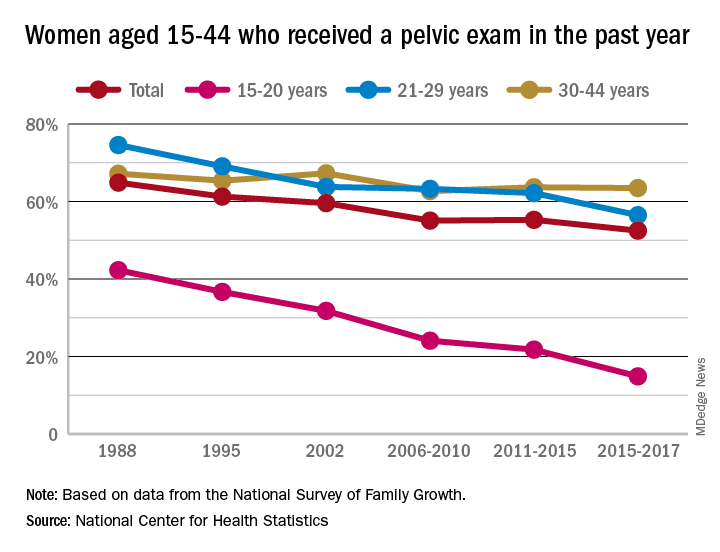
Sixty-five percent of women aged 15-44 years had received a pelvic examination in the past year when asked in 1988 as part of the National Survey of Family Growth, but the 3-year average for the 2015-2017 surveys was 53%, a significant decline, the NCHS said in a recent report.
The decrease was seen in all three of the age subgroups – 15-20 years, 21-29 years, and 30-44 years – over the length of the study period, with the trend in only the oldest women not reaching significance. The 30-44 group also was the only one of the three in which the rate ever increased at any point, the survey data show.
Data for other subgroups focused on the last 3-year period. From 2015 to 2017, non-Hispanic black women were more likely to have received a pelvic examination in the past year (60%) than were non-Hispanic white (54%) or Hispanic women (45%). An association with education level also was seen: Women with a bachelor’s degree or higher were most likely to get an exam (69%), and those with less than a high-school degree were least likely (52%), the researchers reported.
In 2018, the American College of Obstetricians and Gynecologists altered its recommendation that annual pelvic examinations be part of the well-woman visit for those aged 21 years and over, advising instead “that pelvic examinations be performed when indicated by medical history or symptoms,” the NCHS authors explained. They also suggested that their data “could provide a benchmark for estimates of the prevalence of pelvic examinations before the 2018 ACOG-updated guidelines.”
according to the National Center for Health Statistics.
Sixty-five percent of women aged 15-44 years had received a pelvic examination in the past year when asked in 1988 as part of the National Survey of Family Growth, but the 3-year average for the 2015-2017 surveys was 53%, a significant decline, the NCHS said in a recent report.
The decrease was seen in all three of the age subgroups – 15-20 years, 21-29 years, and 30-44 years – over the length of the study period, with the trend in only the oldest women not reaching significance. The 30-44 group also was the only one of the three in which the rate ever increased at any point, the survey data show.
Data for other subgroups focused on the last 3-year period. From 2015 to 2017, non-Hispanic black women were more likely to have received a pelvic examination in the past year (60%) than were non-Hispanic white (54%) or Hispanic women (45%). An association with education level also was seen: Women with a bachelor’s degree or higher were most likely to get an exam (69%), and those with less than a high-school degree were least likely (52%), the researchers reported.
In 2018, the American College of Obstetricians and Gynecologists altered its recommendation that annual pelvic examinations be part of the well-woman visit for those aged 21 years and over, advising instead “that pelvic examinations be performed when indicated by medical history or symptoms,” the NCHS authors explained. They also suggested that their data “could provide a benchmark for estimates of the prevalence of pelvic examinations before the 2018 ACOG-updated guidelines.”
according to the National Center for Health Statistics.
Sixty-five percent of women aged 15-44 years had received a pelvic examination in the past year when asked in 1988 as part of the National Survey of Family Growth, but the 3-year average for the 2015-2017 surveys was 53%, a significant decline, the NCHS said in a recent report.
The decrease was seen in all three of the age subgroups – 15-20 years, 21-29 years, and 30-44 years – over the length of the study period, with the trend in only the oldest women not reaching significance. The 30-44 group also was the only one of the three in which the rate ever increased at any point, the survey data show.
Data for other subgroups focused on the last 3-year period. From 2015 to 2017, non-Hispanic black women were more likely to have received a pelvic examination in the past year (60%) than were non-Hispanic white (54%) or Hispanic women (45%). An association with education level also was seen: Women with a bachelor’s degree or higher were most likely to get an exam (69%), and those with less than a high-school degree were least likely (52%), the researchers reported.
In 2018, the American College of Obstetricians and Gynecologists altered its recommendation that annual pelvic examinations be part of the well-woman visit for those aged 21 years and over, advising instead “that pelvic examinations be performed when indicated by medical history or symptoms,” the NCHS authors explained. They also suggested that their data “could provide a benchmark for estimates of the prevalence of pelvic examinations before the 2018 ACOG-updated guidelines.”
Minimally invasive cosmetic surgery: Steady growth in 2018
that brought the total to nearly 16 million procedures, according to the American Society of Plastic Surgeons.
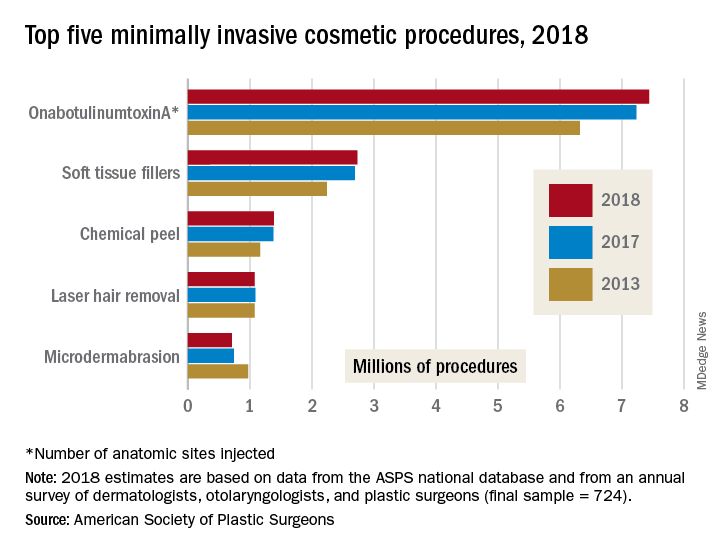
The most popular form of minimally invasive cosmetic surgery among the estimated 15.9 million procedures performed in 2018 was, once again, onabotulinumtoxinA injection, which represented almost half of the total for the year with 7.4 million anatomic sites injected (up by 2.9%), the ASPS said in its 2018 Plastic Surgery Statistics Report.
Soft-tissue-filler injections, the next most popular type of surgery, were up 1.7% to almost 2.7 million procedures, while chemical peels rose 0.6% to nearly 1.4 million procedures. Numbers for 2018 were down, however, for the two other top-five surgeries: Laser hair removal slipped 0.9% from 2017 and microdermabrasion fell 4.2%, the ASPS reported.
Going back quite a bit further in time – the year 2000, to be exact – reveals 21st-century growth of 228% for the minimally invasive sector as a whole, but the long-term trend for cosmetic surgery was not quite as rosy – down by 4.7% since 2000. From 2017 to 2018, though, cosmetic surgery procedures were up by 1.2%, with breast augmentation the most popular, followed by liposuction, rhinoplasty, blepharoplasty, and abdominoplasty, according to the ASPS.
The 2018 statistics report was based on analysis of the society’s Tracking Operations and Outcomes for Plastic Surgeons database and an annual survey of board-certified dermatologists, otolaryngologists, and plastic surgeons (final sample = 724).
that brought the total to nearly 16 million procedures, according to the American Society of Plastic Surgeons.
The most popular form of minimally invasive cosmetic surgery among the estimated 15.9 million procedures performed in 2018 was, once again, onabotulinumtoxinA injection, which represented almost half of the total for the year with 7.4 million anatomic sites injected (up by 2.9%), the ASPS said in its 2018 Plastic Surgery Statistics Report.
Soft-tissue-filler injections, the next most popular type of surgery, were up 1.7% to almost 2.7 million procedures, while chemical peels rose 0.6% to nearly 1.4 million procedures. Numbers for 2018 were down, however, for the two other top-five surgeries: Laser hair removal slipped 0.9% from 2017 and microdermabrasion fell 4.2%, the ASPS reported.
Going back quite a bit further in time – the year 2000, to be exact – reveals 21st-century growth of 228% for the minimally invasive sector as a whole, but the long-term trend for cosmetic surgery was not quite as rosy – down by 4.7% since 2000. From 2017 to 2018, though, cosmetic surgery procedures were up by 1.2%, with breast augmentation the most popular, followed by liposuction, rhinoplasty, blepharoplasty, and abdominoplasty, according to the ASPS.
The 2018 statistics report was based on analysis of the society’s Tracking Operations and Outcomes for Plastic Surgeons database and an annual survey of board-certified dermatologists, otolaryngologists, and plastic surgeons (final sample = 724).
that brought the total to nearly 16 million procedures, according to the American Society of Plastic Surgeons.
The most popular form of minimally invasive cosmetic surgery among the estimated 15.9 million procedures performed in 2018 was, once again, onabotulinumtoxinA injection, which represented almost half of the total for the year with 7.4 million anatomic sites injected (up by 2.9%), the ASPS said in its 2018 Plastic Surgery Statistics Report.
Soft-tissue-filler injections, the next most popular type of surgery, were up 1.7% to almost 2.7 million procedures, while chemical peels rose 0.6% to nearly 1.4 million procedures. Numbers for 2018 were down, however, for the two other top-five surgeries: Laser hair removal slipped 0.9% from 2017 and microdermabrasion fell 4.2%, the ASPS reported.
Going back quite a bit further in time – the year 2000, to be exact – reveals 21st-century growth of 228% for the minimally invasive sector as a whole, but the long-term trend for cosmetic surgery was not quite as rosy – down by 4.7% since 2000. From 2017 to 2018, though, cosmetic surgery procedures were up by 1.2%, with breast augmentation the most popular, followed by liposuction, rhinoplasty, blepharoplasty, and abdominoplasty, according to the ASPS.
The 2018 statistics report was based on analysis of the society’s Tracking Operations and Outcomes for Plastic Surgeons database and an annual survey of board-certified dermatologists, otolaryngologists, and plastic surgeons (final sample = 724).