User login
Cicatricial Alopecia
A great victory for our patients suffering from cicatricial alopecia—Dr. Pratima Karnik, assistant professor of dermatology at Cleveland’s Case Western Reserve University, received a $1.77 National Institutes of Health grant to fund a 5 year study on hair follicle, stem cell specific, PPAR-gamma deficiency in scarring alopecia.
Her research, published in the Journal of Investigative Dermatology, linked a defect in lipid processing and peroxisome biogenesis to cicatricial alopecia. As a result, it paved the way for a breakthrough finding in understanding the pathophysiology of the permanent hair loss disorder (J Invest Dermatol. 2009 May;129(5):1066-70).
Dr. Karnik and her colleagues found that unprocessed lipids are responsible for developing scarring hair loss. Their research suggests that processed lipids are necessary for hair growth and unprocessed lipids are toxic to hair. The bench-side research has led to clinical findings that treating patients with drugs that enhance lipid processing may relieve the clinical symptoms of the disorder.
Central centrifugal cicatricial alopecia, a scarring hair loss prevalent in African Americans, has no well-defined cause and has been difficult to and frustrating for patients.
Dr. Karnik’s research, and the work of the Cicatricial Alopecia Research Foundation (www.carfintl.org), is helping patients and physicians understand the biology, natural history, and treatment options for patients.
I personally attended a session with NIH Director Dr. Francis S. Collins, on behalf of CARF, where underrepresented and underfunded organizations had a chance to voice their opinions to the NIH and gain the well deserved attention they need.
Dr. Collins suggested that a new structure of communication was being established at the NIH, noting that any organization can send a brief summary of issues it would like to bring to the attention of the NIH. The e-mail address is [email protected]. He ensured us he would look at every e-mail and respond to each one.
Often, rare diseases are difficult to study given the lack of attention and funding. The work of Dr. Karnik and her collaborative team, and organizations like CARF, give hope to the thousands of people suffering from cicatricial alopecia.
A great victory for our patients suffering from cicatricial alopecia—Dr. Pratima Karnik, assistant professor of dermatology at Cleveland’s Case Western Reserve University, received a $1.77 National Institutes of Health grant to fund a 5 year study on hair follicle, stem cell specific, PPAR-gamma deficiency in scarring alopecia.
Her research, published in the Journal of Investigative Dermatology, linked a defect in lipid processing and peroxisome biogenesis to cicatricial alopecia. As a result, it paved the way for a breakthrough finding in understanding the pathophysiology of the permanent hair loss disorder (J Invest Dermatol. 2009 May;129(5):1066-70).
Dr. Karnik and her colleagues found that unprocessed lipids are responsible for developing scarring hair loss. Their research suggests that processed lipids are necessary for hair growth and unprocessed lipids are toxic to hair. The bench-side research has led to clinical findings that treating patients with drugs that enhance lipid processing may relieve the clinical symptoms of the disorder.
Central centrifugal cicatricial alopecia, a scarring hair loss prevalent in African Americans, has no well-defined cause and has been difficult to and frustrating for patients.
Dr. Karnik’s research, and the work of the Cicatricial Alopecia Research Foundation (www.carfintl.org), is helping patients and physicians understand the biology, natural history, and treatment options for patients.
I personally attended a session with NIH Director Dr. Francis S. Collins, on behalf of CARF, where underrepresented and underfunded organizations had a chance to voice their opinions to the NIH and gain the well deserved attention they need.
Dr. Collins suggested that a new structure of communication was being established at the NIH, noting that any organization can send a brief summary of issues it would like to bring to the attention of the NIH. The e-mail address is [email protected]. He ensured us he would look at every e-mail and respond to each one.
Often, rare diseases are difficult to study given the lack of attention and funding. The work of Dr. Karnik and her collaborative team, and organizations like CARF, give hope to the thousands of people suffering from cicatricial alopecia.
A great victory for our patients suffering from cicatricial alopecia—Dr. Pratima Karnik, assistant professor of dermatology at Cleveland’s Case Western Reserve University, received a $1.77 National Institutes of Health grant to fund a 5 year study on hair follicle, stem cell specific, PPAR-gamma deficiency in scarring alopecia.
Her research, published in the Journal of Investigative Dermatology, linked a defect in lipid processing and peroxisome biogenesis to cicatricial alopecia. As a result, it paved the way for a breakthrough finding in understanding the pathophysiology of the permanent hair loss disorder (J Invest Dermatol. 2009 May;129(5):1066-70).
Dr. Karnik and her colleagues found that unprocessed lipids are responsible for developing scarring hair loss. Their research suggests that processed lipids are necessary for hair growth and unprocessed lipids are toxic to hair. The bench-side research has led to clinical findings that treating patients with drugs that enhance lipid processing may relieve the clinical symptoms of the disorder.
Central centrifugal cicatricial alopecia, a scarring hair loss prevalent in African Americans, has no well-defined cause and has been difficult to and frustrating for patients.
Dr. Karnik’s research, and the work of the Cicatricial Alopecia Research Foundation (www.carfintl.org), is helping patients and physicians understand the biology, natural history, and treatment options for patients.
I personally attended a session with NIH Director Dr. Francis S. Collins, on behalf of CARF, where underrepresented and underfunded organizations had a chance to voice their opinions to the NIH and gain the well deserved attention they need.
Dr. Collins suggested that a new structure of communication was being established at the NIH, noting that any organization can send a brief summary of issues it would like to bring to the attention of the NIH. The e-mail address is [email protected]. He ensured us he would look at every e-mail and respond to each one.
Often, rare diseases are difficult to study given the lack of attention and funding. The work of Dr. Karnik and her collaborative team, and organizations like CARF, give hope to the thousands of people suffering from cicatricial alopecia.
Eyelash Growth: A Beneficial Side Effect of Prostaglandin Analogues [letter]
What Is Your Diagnosis? Diffuse Nonepidermolytic Palmoplantar Keratoderma With Woolly Hair and Cardiomyopathy (Naxos-Carvajal Syndrome)
Oral Ivermectin Superior to Malathion Lotion for Persistent Head Lice
Oral ivermectin was found superior to malathion lotion in eliminating persistent head lice infestation in a study of children and their household contacts, according to a report in the March 11 issue of the New England Journal of Medicine.
“Ivermectin may be a good alternative to malathion when topical insecticide resistance is suspected,” said Dr. Olivier Chosidow of the Université Pierre et Marie Curie, Paris, and his associates.
Resistance of head lice to both pyrethroids and malathion appears to be increasing. Ivermectin has been used to treat onchocerciasis, lymphatic filariasis, helminthiases, and ectoparasite infections such as scabies.
Dr. Chosidow and his colleagues assessed the efficacy and safety of ivermectin against head lice in a randomized, double-blind controlled trial of patients recruited from the community who had persistent infestation despite using topical pyrethroid-based or malathion insecticide.
The study involved 812 children and their contacts in 376 households in the United Kingdom, Ireland, France, and Israel. The study households were randomly assigned to receive either active oral ivermectin plus a placebo lotion (185 households and 398 patients) or active malathion lotion plus a placebo tablet (191 households and 414 patients) to ensure blinding to treatment assignment. The medications were given by trained staff at clinics to ensure that they were used properly.
After two treatments, given 1 week apart, any patients who still had head lice infestation were switched to the alternative treatment.
The primary end point – clearance of head lice infestation on day 15 after the first two treatments – was achieved in more than 95% of the ivermectin patients, compared with 85% of the malathion patients. A total of 92% of households in the ivermectin group were cleared of head lice, compared with 79% of households in the malathion group.
Seventy patients with persistent infestation switched to the alternative treatment. After another 2 weeks, 100% of the patients using malathion and 97% of those using ivermectin achieved clearance of head lice, the investigators said (N. Engl. J. Med. 2010;362:896-905).
Seven patients in the ivermectin group (1.8%) and five in the malathion group (1.2%) discontinued treatment because of adverse effects, including impetigo, nausea or vomiting, gastroenteritis, and rash or urticaria.
Two serious adverse events occurred: One girl taking ivermectin developed seizures 6 days after the first dose, and one girl taking malathion developed a severe headache requiring hospitalization 6 days after the first application. Both girls recovered. The seizure was found to have a right rolandic focus, and the patient was given a prescription for oxcarbazepine.
The study was funded by Johnson & Johnson–Merck Sharp & Dohme–Chibret. Dr. Chosidow reported receiving consulting fees from Laboratoires Pierre Fabre and Johnson & Johnson, and lecture fees from Pohl Boskamp.
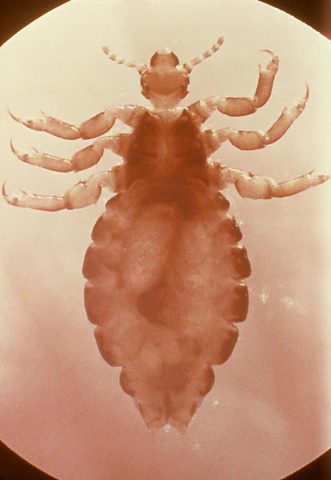
(Image Copyright: CDC/Reed and Carnrick Pharmaceuticals)
Oral ivermectin was found superior to malathion lotion in eliminating persistent head lice infestation in a study of children and their household contacts, according to a report in the March 11 issue of the New England Journal of Medicine.
“Ivermectin may be a good alternative to malathion when topical insecticide resistance is suspected,” said Dr. Olivier Chosidow of the Université Pierre et Marie Curie, Paris, and his associates.
Resistance of head lice to both pyrethroids and malathion appears to be increasing. Ivermectin has been used to treat onchocerciasis, lymphatic filariasis, helminthiases, and ectoparasite infections such as scabies.
Dr. Chosidow and his colleagues assessed the efficacy and safety of ivermectin against head lice in a randomized, double-blind controlled trial of patients recruited from the community who had persistent infestation despite using topical pyrethroid-based or malathion insecticide.
The study involved 812 children and their contacts in 376 households in the United Kingdom, Ireland, France, and Israel. The study households were randomly assigned to receive either active oral ivermectin plus a placebo lotion (185 households and 398 patients) or active malathion lotion plus a placebo tablet (191 households and 414 patients) to ensure blinding to treatment assignment. The medications were given by trained staff at clinics to ensure that they were used properly.
After two treatments, given 1 week apart, any patients who still had head lice infestation were switched to the alternative treatment.
The primary end point – clearance of head lice infestation on day 15 after the first two treatments – was achieved in more than 95% of the ivermectin patients, compared with 85% of the malathion patients. A total of 92% of households in the ivermectin group were cleared of head lice, compared with 79% of households in the malathion group.
Seventy patients with persistent infestation switched to the alternative treatment. After another 2 weeks, 100% of the patients using malathion and 97% of those using ivermectin achieved clearance of head lice, the investigators said (N. Engl. J. Med. 2010;362:896-905).
Seven patients in the ivermectin group (1.8%) and five in the malathion group (1.2%) discontinued treatment because of adverse effects, including impetigo, nausea or vomiting, gastroenteritis, and rash or urticaria.
Two serious adverse events occurred: One girl taking ivermectin developed seizures 6 days after the first dose, and one girl taking malathion developed a severe headache requiring hospitalization 6 days after the first application. Both girls recovered. The seizure was found to have a right rolandic focus, and the patient was given a prescription for oxcarbazepine.
The study was funded by Johnson & Johnson–Merck Sharp & Dohme–Chibret. Dr. Chosidow reported receiving consulting fees from Laboratoires Pierre Fabre and Johnson & Johnson, and lecture fees from Pohl Boskamp.
(Image Copyright: CDC/Reed and Carnrick Pharmaceuticals)
Oral ivermectin was found superior to malathion lotion in eliminating persistent head lice infestation in a study of children and their household contacts, according to a report in the March 11 issue of the New England Journal of Medicine.
“Ivermectin may be a good alternative to malathion when topical insecticide resistance is suspected,” said Dr. Olivier Chosidow of the Université Pierre et Marie Curie, Paris, and his associates.
Resistance of head lice to both pyrethroids and malathion appears to be increasing. Ivermectin has been used to treat onchocerciasis, lymphatic filariasis, helminthiases, and ectoparasite infections such as scabies.
Dr. Chosidow and his colleagues assessed the efficacy and safety of ivermectin against head lice in a randomized, double-blind controlled trial of patients recruited from the community who had persistent infestation despite using topical pyrethroid-based or malathion insecticide.
The study involved 812 children and their contacts in 376 households in the United Kingdom, Ireland, France, and Israel. The study households were randomly assigned to receive either active oral ivermectin plus a placebo lotion (185 households and 398 patients) or active malathion lotion plus a placebo tablet (191 households and 414 patients) to ensure blinding to treatment assignment. The medications were given by trained staff at clinics to ensure that they were used properly.
After two treatments, given 1 week apart, any patients who still had head lice infestation were switched to the alternative treatment.
The primary end point – clearance of head lice infestation on day 15 after the first two treatments – was achieved in more than 95% of the ivermectin patients, compared with 85% of the malathion patients. A total of 92% of households in the ivermectin group were cleared of head lice, compared with 79% of households in the malathion group.
Seventy patients with persistent infestation switched to the alternative treatment. After another 2 weeks, 100% of the patients using malathion and 97% of those using ivermectin achieved clearance of head lice, the investigators said (N. Engl. J. Med. 2010;362:896-905).
Seven patients in the ivermectin group (1.8%) and five in the malathion group (1.2%) discontinued treatment because of adverse effects, including impetigo, nausea or vomiting, gastroenteritis, and rash or urticaria.
Two serious adverse events occurred: One girl taking ivermectin developed seizures 6 days after the first dose, and one girl taking malathion developed a severe headache requiring hospitalization 6 days after the first application. Both girls recovered. The seizure was found to have a right rolandic focus, and the patient was given a prescription for oxcarbazepine.
The study was funded by Johnson & Johnson–Merck Sharp & Dohme–Chibret. Dr. Chosidow reported receiving consulting fees from Laboratoires Pierre Fabre and Johnson & Johnson, and lecture fees from Pohl Boskamp.
(Image Copyright: CDC/Reed and Carnrick Pharmaceuticals)
The Evolution of the Graft: The Maturation of a Medical Specialty
Current Concepts in Hair Transplantation for Men and Women
Effective Therapeutic Option in the Treatment of Androgenetic Alopecia
Understanding and Treating Brittle Nails
Eruptive Vellus Hair Cysts: Report of a Pediatric Case With Partial Response to Calcipotriene Therapy
Oral Ivermectin Proves Superior to Insecticide for Treating Head Lice
BERLIN — Oral ivermectin proved superior to conventional therapy with malathion lotion for the treatment of difficult to eradicate head lice infestations in a large multinational randomized trial.
The number needed to treat—that is, the number of patients who needed to be treated with two doses of oral ivermectin 1 week apart instead of two applications of topical malathion in order for one additional patient to become louse-free—was 9.8, Dr. Olivier Chosidow reported at the annual congress of the European Academy of Dermatology and Venereology.
“Our randomized trial suggests strongly that ivermectin could be valuable, at least in patients who've previously failed standard therapy because their head lice aren't sensitive enough to local insecticides,” said Dr. Chosidow of the University of Paris.
He reported on 812 patients with head lice infestation in 376 randomized households. All participants were at least 2 years old and weighed at least 15 kg. At enrollment, all had live head lice detected by combing which had not been eradicated by topical insecticide therapy 2–6 weeks earlier. The households were randomized to double-blind/double-placebo supervised treatment with two single doses of oral ivermectin (Stromectol, Mectizan) at 400 mcg/kg or 0.5% malathion lotion, both administered on days 1 and 8.
The primary study end point was the absence of head lice upon inspection by combing on day 15. The success rate was 95% in the ivermectin group, compared with 85% in the malathion group. The secondary end points were the absence of head lice on days 2, 8, 22, and 29. The ivermectin group fared significantly better at each time point.
Generally mild treatment-related adverse events were noted in 7.5% of the ivermectin group and 10.9% who received malathion. There were no serious adverse events. It is well-established that ivermectin does not cross the human blood/brain barrier, according to Dr. Chosidow. Families appreciated the convenience of oral therapy.
Oral ivermectin is not approved by the Food and Drug Administration for the treatment of pediculosis. However, the Centers for Disease Control and Prevention guidelines recommend it for the treatment of scabies as an alternative to first-line topical 5% permethrin.
Dr. Erwin Tschachler, EADV secretary-general elect, singled out Dr. Chosidow's study as one of the infectious disease highlights of the congress.
“This is the first time an oral therapy for this parasitic infestation has been successful,” commented Dr. Tschacler, head of the research division for biology and pathobiology of the skin at the University of Vienna Medical School.
Although head lice are associated with low socioeconomic status, no socioeconomic stratum is immune to infestation, and outbreaks are a growing problem in many European countries, he added.
Dr. Chosidow received a research grant from Johnson & Johnson, which sponsored the ivermectin study.

'Ivermectin could be valuable, at least in patients who've previously failed standard therapy.'
Source Dr. Chosidow
BERLIN — Oral ivermectin proved superior to conventional therapy with malathion lotion for the treatment of difficult to eradicate head lice infestations in a large multinational randomized trial.
The number needed to treat—that is, the number of patients who needed to be treated with two doses of oral ivermectin 1 week apart instead of two applications of topical malathion in order for one additional patient to become louse-free—was 9.8, Dr. Olivier Chosidow reported at the annual congress of the European Academy of Dermatology and Venereology.
“Our randomized trial suggests strongly that ivermectin could be valuable, at least in patients who've previously failed standard therapy because their head lice aren't sensitive enough to local insecticides,” said Dr. Chosidow of the University of Paris.
He reported on 812 patients with head lice infestation in 376 randomized households. All participants were at least 2 years old and weighed at least 15 kg. At enrollment, all had live head lice detected by combing which had not been eradicated by topical insecticide therapy 2–6 weeks earlier. The households were randomized to double-blind/double-placebo supervised treatment with two single doses of oral ivermectin (Stromectol, Mectizan) at 400 mcg/kg or 0.5% malathion lotion, both administered on days 1 and 8.
The primary study end point was the absence of head lice upon inspection by combing on day 15. The success rate was 95% in the ivermectin group, compared with 85% in the malathion group. The secondary end points were the absence of head lice on days 2, 8, 22, and 29. The ivermectin group fared significantly better at each time point.
Generally mild treatment-related adverse events were noted in 7.5% of the ivermectin group and 10.9% who received malathion. There were no serious adverse events. It is well-established that ivermectin does not cross the human blood/brain barrier, according to Dr. Chosidow. Families appreciated the convenience of oral therapy.
Oral ivermectin is not approved by the Food and Drug Administration for the treatment of pediculosis. However, the Centers for Disease Control and Prevention guidelines recommend it for the treatment of scabies as an alternative to first-line topical 5% permethrin.
Dr. Erwin Tschachler, EADV secretary-general elect, singled out Dr. Chosidow's study as one of the infectious disease highlights of the congress.
“This is the first time an oral therapy for this parasitic infestation has been successful,” commented Dr. Tschacler, head of the research division for biology and pathobiology of the skin at the University of Vienna Medical School.
Although head lice are associated with low socioeconomic status, no socioeconomic stratum is immune to infestation, and outbreaks are a growing problem in many European countries, he added.
Dr. Chosidow received a research grant from Johnson & Johnson, which sponsored the ivermectin study.
'Ivermectin could be valuable, at least in patients who've previously failed standard therapy.'
Source Dr. Chosidow
BERLIN — Oral ivermectin proved superior to conventional therapy with malathion lotion for the treatment of difficult to eradicate head lice infestations in a large multinational randomized trial.
The number needed to treat—that is, the number of patients who needed to be treated with two doses of oral ivermectin 1 week apart instead of two applications of topical malathion in order for one additional patient to become louse-free—was 9.8, Dr. Olivier Chosidow reported at the annual congress of the European Academy of Dermatology and Venereology.
“Our randomized trial suggests strongly that ivermectin could be valuable, at least in patients who've previously failed standard therapy because their head lice aren't sensitive enough to local insecticides,” said Dr. Chosidow of the University of Paris.
He reported on 812 patients with head lice infestation in 376 randomized households. All participants were at least 2 years old and weighed at least 15 kg. At enrollment, all had live head lice detected by combing which had not been eradicated by topical insecticide therapy 2–6 weeks earlier. The households were randomized to double-blind/double-placebo supervised treatment with two single doses of oral ivermectin (Stromectol, Mectizan) at 400 mcg/kg or 0.5% malathion lotion, both administered on days 1 and 8.
The primary study end point was the absence of head lice upon inspection by combing on day 15. The success rate was 95% in the ivermectin group, compared with 85% in the malathion group. The secondary end points were the absence of head lice on days 2, 8, 22, and 29. The ivermectin group fared significantly better at each time point.
Generally mild treatment-related adverse events were noted in 7.5% of the ivermectin group and 10.9% who received malathion. There were no serious adverse events. It is well-established that ivermectin does not cross the human blood/brain barrier, according to Dr. Chosidow. Families appreciated the convenience of oral therapy.
Oral ivermectin is not approved by the Food and Drug Administration for the treatment of pediculosis. However, the Centers for Disease Control and Prevention guidelines recommend it for the treatment of scabies as an alternative to first-line topical 5% permethrin.
Dr. Erwin Tschachler, EADV secretary-general elect, singled out Dr. Chosidow's study as one of the infectious disease highlights of the congress.
“This is the first time an oral therapy for this parasitic infestation has been successful,” commented Dr. Tschacler, head of the research division for biology and pathobiology of the skin at the University of Vienna Medical School.
Although head lice are associated with low socioeconomic status, no socioeconomic stratum is immune to infestation, and outbreaks are a growing problem in many European countries, he added.
Dr. Chosidow received a research grant from Johnson & Johnson, which sponsored the ivermectin study.
'Ivermectin could be valuable, at least in patients who've previously failed standard therapy.'
Source Dr. Chosidow