User login
ICYMI: Durvalumab boosts overall survival in stage III NSCLC
Patients with unresectable stage III non–small cell lung cancer who received durvalumab had their overall and progression-free survival boosted by about 12 months, compared with patients who received a placebo, according to results of the multicenter, randomized, double-blind, placebo-controlled, phase 3 PACIFIC trial published in the New England Journal of Medicine (2018 Sep 25. doi: 10.1056/NEJMoa1809697).
We covered this story at the World Conference on Lung Cancer before it was published in the journal. Find our coverage at the link below.
Patients with unresectable stage III non–small cell lung cancer who received durvalumab had their overall and progression-free survival boosted by about 12 months, compared with patients who received a placebo, according to results of the multicenter, randomized, double-blind, placebo-controlled, phase 3 PACIFIC trial published in the New England Journal of Medicine (2018 Sep 25. doi: 10.1056/NEJMoa1809697).
We covered this story at the World Conference on Lung Cancer before it was published in the journal. Find our coverage at the link below.
Patients with unresectable stage III non–small cell lung cancer who received durvalumab had their overall and progression-free survival boosted by about 12 months, compared with patients who received a placebo, according to results of the multicenter, randomized, double-blind, placebo-controlled, phase 3 PACIFIC trial published in the New England Journal of Medicine (2018 Sep 25. doi: 10.1056/NEJMoa1809697).
We covered this story at the World Conference on Lung Cancer before it was published in the journal. Find our coverage at the link below.
FROM THE NEW ENGLAND JOURNAL OF MEDICINE
Self-report of prenatal marijuana use not very reliable
Even in the setting of legalized marijuana use, estimated prevalence of marijuana use during pregnancy was lower by self-report than it was by umbilical cord testing.
Torri D. Metz, MD, of the University of Utah Health, Salt Lake City, and her colleagues surveyed women at two urban hospitals in Colorado, which has legalized both medical and recreational use of marijuana. They found that, while 6% of the 116 women in the study reported using marijuana in the past 30 days, umbilical cord testing showed as many as 22% had detectable levels of 11-nor-delta-9-tetrahydrocannabinol-9-carboxylic, and 10% had levels above quantification.
The majority of studies of maternal marijuana use during pregnancy rely on self-report, so this could affect attempts to assess the effects of such prenatal use, they said.
Adverse outcomes associated with marijuana use during pregnancy include fetal growth restriction, small for gestational age, preterm birth, and adverse neurodevelopmental outcomes, studies have shown.
Read more in Obstetrics & Gynecology.
Even in the setting of legalized marijuana use, estimated prevalence of marijuana use during pregnancy was lower by self-report than it was by umbilical cord testing.
Torri D. Metz, MD, of the University of Utah Health, Salt Lake City, and her colleagues surveyed women at two urban hospitals in Colorado, which has legalized both medical and recreational use of marijuana. They found that, while 6% of the 116 women in the study reported using marijuana in the past 30 days, umbilical cord testing showed as many as 22% had detectable levels of 11-nor-delta-9-tetrahydrocannabinol-9-carboxylic, and 10% had levels above quantification.
The majority of studies of maternal marijuana use during pregnancy rely on self-report, so this could affect attempts to assess the effects of such prenatal use, they said.
Adverse outcomes associated with marijuana use during pregnancy include fetal growth restriction, small for gestational age, preterm birth, and adverse neurodevelopmental outcomes, studies have shown.
Read more in Obstetrics & Gynecology.
Even in the setting of legalized marijuana use, estimated prevalence of marijuana use during pregnancy was lower by self-report than it was by umbilical cord testing.
Torri D. Metz, MD, of the University of Utah Health, Salt Lake City, and her colleagues surveyed women at two urban hospitals in Colorado, which has legalized both medical and recreational use of marijuana. They found that, while 6% of the 116 women in the study reported using marijuana in the past 30 days, umbilical cord testing showed as many as 22% had detectable levels of 11-nor-delta-9-tetrahydrocannabinol-9-carboxylic, and 10% had levels above quantification.
The majority of studies of maternal marijuana use during pregnancy rely on self-report, so this could affect attempts to assess the effects of such prenatal use, they said.
Adverse outcomes associated with marijuana use during pregnancy include fetal growth restriction, small for gestational age, preterm birth, and adverse neurodevelopmental outcomes, studies have shown.
Read more in Obstetrics & Gynecology.
FROM OBSTETRICS & GYNECOLOGY

Study elicits patients’ most disturbing epilepsy symptoms
NEW ORLEANS – according to a study presented at the annual meeting of the American Epilepsy Society. The most prominent symptoms and effects on daily life may differ in the early, middle, and late stages of the disease, the results suggest.
Lead study author Jacqueline A. French, MD, professor of neurology at New York University, and her colleagues interviewed 62 patients with focal-onset epilepsy to examine patients’ experiences living with epilepsy. The investigators focused on salient symptoms and functional impacts – those that were reported by at least 50% of patients and were associated with a high degree of disturbance (patients rated them 5 or greater on a scale from 0 [no disturbance] to 10 [high disturbance]).
Of 51 symptoms that patients described during the interviews, the following 8 met the salience criteria for the total cohort: twitching or tremors, confusion, difficulty in talking, loss of awareness of others’ presence, stiffening, impaired consciousness or loss of consciousness, difficulty in remembering, and dizziness or lightheadedness. Patients reported salient functional impacts on driving and transportation, work and school, and leisure and social activities. Some symptoms met salience criteria among patients in certain stages of the disease (for example, tongue biting in patients with early-stage epilepsy and anxiety, fear, or panic in late-stage epilepsy) but not among patients in the other cohorts.
“These findings underscore the need to consider all these experiences when developing patient-reported outcome measures for use in clinical trials,” said Dr. French and her colleagues. “It may be useful to tailor measures of patient experiences to the patient’s stage of disease.”
Previous qualitative studies of epilepsy symptoms and burdens were based on small numbers of patients and interviews at a single center. For the present study, the researchers conducted qualitative, semistructured, in-person interviews with adults with focal epilepsy in different areas of the United States (such as California, Minnesota, New York, Ohio, and Pennsylvania). Patients were grouped by early, middle, or late disease stage. Patients in the early cohort (n = 19) had at least two seizures in the past year, a diagnosis of focal epilepsy in the past year, and had not yet received antiepileptic drug (AED) treatment or had received treatment with only one AED and had not failed treatment. Patients in the middle cohort (n = 17) had at least one seizure in the past year, a diagnosis of focal epilepsy within the past 5 years, and had failed one AED because of lack of efficacy or had received their first add-on AED. Patients in the late cohort (n = 26) had at least one seizure every 3 months during the past year, a diagnosis of focal epilepsy at age 12 years or older, and inadequate response to treatment of at least 3 months with two AEDs that were tolerated and appropriately chosen.
Patients’ mean age was 37 years (range, 19-60 years), 73% were female, 79% were white, 69% had a college degree as their highest level of education, and 65% were employed. Patients’ seizure types included simple partial without motor signs (52%), simple partial with motor signs (16%), complex partial (68%), or secondarily generalized (65%).
While driving or transportation was a salient impact for all three groups, memory loss was a salient impact in the early and middle cohorts only. Headaches and sadness or depression were salient impacts for the late cohort only.
This study was funded by Eisai and two of the authors are former or current employees of Eisai.
SOURCE: French JA et al. AES 2018, Abstract 1.196.
NEW ORLEANS – according to a study presented at the annual meeting of the American Epilepsy Society. The most prominent symptoms and effects on daily life may differ in the early, middle, and late stages of the disease, the results suggest.
Lead study author Jacqueline A. French, MD, professor of neurology at New York University, and her colleagues interviewed 62 patients with focal-onset epilepsy to examine patients’ experiences living with epilepsy. The investigators focused on salient symptoms and functional impacts – those that were reported by at least 50% of patients and were associated with a high degree of disturbance (patients rated them 5 or greater on a scale from 0 [no disturbance] to 10 [high disturbance]).
Of 51 symptoms that patients described during the interviews, the following 8 met the salience criteria for the total cohort: twitching or tremors, confusion, difficulty in talking, loss of awareness of others’ presence, stiffening, impaired consciousness or loss of consciousness, difficulty in remembering, and dizziness or lightheadedness. Patients reported salient functional impacts on driving and transportation, work and school, and leisure and social activities. Some symptoms met salience criteria among patients in certain stages of the disease (for example, tongue biting in patients with early-stage epilepsy and anxiety, fear, or panic in late-stage epilepsy) but not among patients in the other cohorts.
“These findings underscore the need to consider all these experiences when developing patient-reported outcome measures for use in clinical trials,” said Dr. French and her colleagues. “It may be useful to tailor measures of patient experiences to the patient’s stage of disease.”
Previous qualitative studies of epilepsy symptoms and burdens were based on small numbers of patients and interviews at a single center. For the present study, the researchers conducted qualitative, semistructured, in-person interviews with adults with focal epilepsy in different areas of the United States (such as California, Minnesota, New York, Ohio, and Pennsylvania). Patients were grouped by early, middle, or late disease stage. Patients in the early cohort (n = 19) had at least two seizures in the past year, a diagnosis of focal epilepsy in the past year, and had not yet received antiepileptic drug (AED) treatment or had received treatment with only one AED and had not failed treatment. Patients in the middle cohort (n = 17) had at least one seizure in the past year, a diagnosis of focal epilepsy within the past 5 years, and had failed one AED because of lack of efficacy or had received their first add-on AED. Patients in the late cohort (n = 26) had at least one seizure every 3 months during the past year, a diagnosis of focal epilepsy at age 12 years or older, and inadequate response to treatment of at least 3 months with two AEDs that were tolerated and appropriately chosen.
Patients’ mean age was 37 years (range, 19-60 years), 73% were female, 79% were white, 69% had a college degree as their highest level of education, and 65% were employed. Patients’ seizure types included simple partial without motor signs (52%), simple partial with motor signs (16%), complex partial (68%), or secondarily generalized (65%).
While driving or transportation was a salient impact for all three groups, memory loss was a salient impact in the early and middle cohorts only. Headaches and sadness or depression were salient impacts for the late cohort only.
This study was funded by Eisai and two of the authors are former or current employees of Eisai.
SOURCE: French JA et al. AES 2018, Abstract 1.196.
NEW ORLEANS – according to a study presented at the annual meeting of the American Epilepsy Society. The most prominent symptoms and effects on daily life may differ in the early, middle, and late stages of the disease, the results suggest.
Lead study author Jacqueline A. French, MD, professor of neurology at New York University, and her colleagues interviewed 62 patients with focal-onset epilepsy to examine patients’ experiences living with epilepsy. The investigators focused on salient symptoms and functional impacts – those that were reported by at least 50% of patients and were associated with a high degree of disturbance (patients rated them 5 or greater on a scale from 0 [no disturbance] to 10 [high disturbance]).
Of 51 symptoms that patients described during the interviews, the following 8 met the salience criteria for the total cohort: twitching or tremors, confusion, difficulty in talking, loss of awareness of others’ presence, stiffening, impaired consciousness or loss of consciousness, difficulty in remembering, and dizziness or lightheadedness. Patients reported salient functional impacts on driving and transportation, work and school, and leisure and social activities. Some symptoms met salience criteria among patients in certain stages of the disease (for example, tongue biting in patients with early-stage epilepsy and anxiety, fear, or panic in late-stage epilepsy) but not among patients in the other cohorts.
“These findings underscore the need to consider all these experiences when developing patient-reported outcome measures for use in clinical trials,” said Dr. French and her colleagues. “It may be useful to tailor measures of patient experiences to the patient’s stage of disease.”
Previous qualitative studies of epilepsy symptoms and burdens were based on small numbers of patients and interviews at a single center. For the present study, the researchers conducted qualitative, semistructured, in-person interviews with adults with focal epilepsy in different areas of the United States (such as California, Minnesota, New York, Ohio, and Pennsylvania). Patients were grouped by early, middle, or late disease stage. Patients in the early cohort (n = 19) had at least two seizures in the past year, a diagnosis of focal epilepsy in the past year, and had not yet received antiepileptic drug (AED) treatment or had received treatment with only one AED and had not failed treatment. Patients in the middle cohort (n = 17) had at least one seizure in the past year, a diagnosis of focal epilepsy within the past 5 years, and had failed one AED because of lack of efficacy or had received their first add-on AED. Patients in the late cohort (n = 26) had at least one seizure every 3 months during the past year, a diagnosis of focal epilepsy at age 12 years or older, and inadequate response to treatment of at least 3 months with two AEDs that were tolerated and appropriately chosen.
Patients’ mean age was 37 years (range, 19-60 years), 73% were female, 79% were white, 69% had a college degree as their highest level of education, and 65% were employed. Patients’ seizure types included simple partial without motor signs (52%), simple partial with motor signs (16%), complex partial (68%), or secondarily generalized (65%).
While driving or transportation was a salient impact for all three groups, memory loss was a salient impact in the early and middle cohorts only. Headaches and sadness or depression were salient impacts for the late cohort only.
This study was funded by Eisai and two of the authors are former or current employees of Eisai.
SOURCE: French JA et al. AES 2018, Abstract 1.196.
REPORTING FROM AES 2018
Key clinical point: The most prominent symptoms and functional impacts of epilepsy may differ in the early, middle, and late stages of the disease.
Major finding: More than 50% of patients reported functional impacts on driving and transportation, work and school, and leisure and social activities.
Study details: An analysis of data from semistructured interviews with 62 adults with focal epilepsy.
Disclosures: This study was funded by Eisai and two of the authors are former or current employees of Eisai.
Source: French JA et al. AES 2018, Abstract 1.196.
AHA: Statins associated with high degree of safety
The benefits of statins highly offset the associated risks in appropriate patients, according to a scientific statement issued by the American Heart Association.
“The review covers the general patient population, as well as demographic subgroups, including the elderly, children, pregnant women, East Asians, and patients with specific conditions.” wrote Connie B. Newman, MD, of New York University, together with her colleagues. The report is in Arteriosclerosis, Thrombosis, and Vascular Biology.
After an extensive review of the literature pertaining to statin safety and tolerability, Dr. Newman and her colleagues reported the compiled findings from several randomized controlled trials, in addition to observational data, where required. They found that the risk of serious muscle complications, such as rhabdomyolysis, attributable to statin use was less than 0.1%. Furthermore, they noted that the risk of serious hepatotoxicity was even less likely, occurring in about 1 in 10,000 patients treated with therapy.
“There is no convincing evidence for a causal relationship between statins and cancer, cataracts, cognitive dysfunction, peripheral neuropathy, erectile dysfunction, or tendinitis,” the experts wrote. “In U.S. clinical practices, roughly 10% of patients stop taking a statin because of subjective complaints, most commonly muscle symptoms without raised creatine kinase,” they further reported.
Contrastingly, data from randomized trials have shown that the change in the incidence of muscle-related symptoms in patients treated with statins versus placebo is less than 1%. Moreover, the incidence is even lower, with an estimated rate of 0.1%, in those who stopped statin therapy because of these symptoms. Given these results, Dr. Newman and her colleagues said that muscle-related symptoms among statin-treated patients are not due to the pharmacological activity of the statin.
“Restarting statin therapy in these patients can be challenging, but it is important, especially in patients at high risk of cardiovascular events, for whom prevention of these events is a priority,” they added.
A large proportion of the population takes statin therapy to lower the risk of major cardiovascular events, including ischemic stroke, myocardial infarction, and other adverse effects of cardiovascular disease. At maximal doses, statins may decrease LDL-cholesterol levels by roughly 55%-60%. In addition, given the multitude of available generics, statins are an economical treatment option for most patients.
However, Dr. Newman and her colleagues suggested that, when considering statin therapy in special populations, particularly in patients with end-stage renal failure or severe hepatic disease, commencing treatment is not recommended.
“The lack of proof of cardiovascular benefit in patients with end-stage renal disease suggests that initiating statin treatment in these patients is generally not warranted,” the experts wrote. “Data on safety in people with more serious liver disease are insufficient, and statin treatment is generally discouraged,” they added.
With respect to statin-induced adverse effects, they are usually reversible upon discontinuation of therapy, with the exception of hemorrhagic stroke. However, damage from an ischemic stroke or myocardial infarction may result in death. As a result, in patients who would benefit from statin therapy, based on most recent guidelines, cardiovascular benefits greatly exceed potential safety concerns.
Dr. Newman and her coauthors disclosed financial affiliations with Amgen, Kowa, Regeneron, Sanofi, and others.
SOURCE: Newman CB et al. Arterioscler Thromb Vasc Biol. 2018 Dec 10. doi: 10.1161/ATV.0000000000000073
The benefits of statins highly offset the associated risks in appropriate patients, according to a scientific statement issued by the American Heart Association.
“The review covers the general patient population, as well as demographic subgroups, including the elderly, children, pregnant women, East Asians, and patients with specific conditions.” wrote Connie B. Newman, MD, of New York University, together with her colleagues. The report is in Arteriosclerosis, Thrombosis, and Vascular Biology.
After an extensive review of the literature pertaining to statin safety and tolerability, Dr. Newman and her colleagues reported the compiled findings from several randomized controlled trials, in addition to observational data, where required. They found that the risk of serious muscle complications, such as rhabdomyolysis, attributable to statin use was less than 0.1%. Furthermore, they noted that the risk of serious hepatotoxicity was even less likely, occurring in about 1 in 10,000 patients treated with therapy.
“There is no convincing evidence for a causal relationship between statins and cancer, cataracts, cognitive dysfunction, peripheral neuropathy, erectile dysfunction, or tendinitis,” the experts wrote. “In U.S. clinical practices, roughly 10% of patients stop taking a statin because of subjective complaints, most commonly muscle symptoms without raised creatine kinase,” they further reported.
Contrastingly, data from randomized trials have shown that the change in the incidence of muscle-related symptoms in patients treated with statins versus placebo is less than 1%. Moreover, the incidence is even lower, with an estimated rate of 0.1%, in those who stopped statin therapy because of these symptoms. Given these results, Dr. Newman and her colleagues said that muscle-related symptoms among statin-treated patients are not due to the pharmacological activity of the statin.
“Restarting statin therapy in these patients can be challenging, but it is important, especially in patients at high risk of cardiovascular events, for whom prevention of these events is a priority,” they added.
A large proportion of the population takes statin therapy to lower the risk of major cardiovascular events, including ischemic stroke, myocardial infarction, and other adverse effects of cardiovascular disease. At maximal doses, statins may decrease LDL-cholesterol levels by roughly 55%-60%. In addition, given the multitude of available generics, statins are an economical treatment option for most patients.
However, Dr. Newman and her colleagues suggested that, when considering statin therapy in special populations, particularly in patients with end-stage renal failure or severe hepatic disease, commencing treatment is not recommended.
“The lack of proof of cardiovascular benefit in patients with end-stage renal disease suggests that initiating statin treatment in these patients is generally not warranted,” the experts wrote. “Data on safety in people with more serious liver disease are insufficient, and statin treatment is generally discouraged,” they added.
With respect to statin-induced adverse effects, they are usually reversible upon discontinuation of therapy, with the exception of hemorrhagic stroke. However, damage from an ischemic stroke or myocardial infarction may result in death. As a result, in patients who would benefit from statin therapy, based on most recent guidelines, cardiovascular benefits greatly exceed potential safety concerns.
Dr. Newman and her coauthors disclosed financial affiliations with Amgen, Kowa, Regeneron, Sanofi, and others.
SOURCE: Newman CB et al. Arterioscler Thromb Vasc Biol. 2018 Dec 10. doi: 10.1161/ATV.0000000000000073
The benefits of statins highly offset the associated risks in appropriate patients, according to a scientific statement issued by the American Heart Association.
“The review covers the general patient population, as well as demographic subgroups, including the elderly, children, pregnant women, East Asians, and patients with specific conditions.” wrote Connie B. Newman, MD, of New York University, together with her colleagues. The report is in Arteriosclerosis, Thrombosis, and Vascular Biology.
After an extensive review of the literature pertaining to statin safety and tolerability, Dr. Newman and her colleagues reported the compiled findings from several randomized controlled trials, in addition to observational data, where required. They found that the risk of serious muscle complications, such as rhabdomyolysis, attributable to statin use was less than 0.1%. Furthermore, they noted that the risk of serious hepatotoxicity was even less likely, occurring in about 1 in 10,000 patients treated with therapy.
“There is no convincing evidence for a causal relationship between statins and cancer, cataracts, cognitive dysfunction, peripheral neuropathy, erectile dysfunction, or tendinitis,” the experts wrote. “In U.S. clinical practices, roughly 10% of patients stop taking a statin because of subjective complaints, most commonly muscle symptoms without raised creatine kinase,” they further reported.
Contrastingly, data from randomized trials have shown that the change in the incidence of muscle-related symptoms in patients treated with statins versus placebo is less than 1%. Moreover, the incidence is even lower, with an estimated rate of 0.1%, in those who stopped statin therapy because of these symptoms. Given these results, Dr. Newman and her colleagues said that muscle-related symptoms among statin-treated patients are not due to the pharmacological activity of the statin.
“Restarting statin therapy in these patients can be challenging, but it is important, especially in patients at high risk of cardiovascular events, for whom prevention of these events is a priority,” they added.
A large proportion of the population takes statin therapy to lower the risk of major cardiovascular events, including ischemic stroke, myocardial infarction, and other adverse effects of cardiovascular disease. At maximal doses, statins may decrease LDL-cholesterol levels by roughly 55%-60%. In addition, given the multitude of available generics, statins are an economical treatment option for most patients.
However, Dr. Newman and her colleagues suggested that, when considering statin therapy in special populations, particularly in patients with end-stage renal failure or severe hepatic disease, commencing treatment is not recommended.
“The lack of proof of cardiovascular benefit in patients with end-stage renal disease suggests that initiating statin treatment in these patients is generally not warranted,” the experts wrote. “Data on safety in people with more serious liver disease are insufficient, and statin treatment is generally discouraged,” they added.
With respect to statin-induced adverse effects, they are usually reversible upon discontinuation of therapy, with the exception of hemorrhagic stroke. However, damage from an ischemic stroke or myocardial infarction may result in death. As a result, in patients who would benefit from statin therapy, based on most recent guidelines, cardiovascular benefits greatly exceed potential safety concerns.
Dr. Newman and her coauthors disclosed financial affiliations with Amgen, Kowa, Regeneron, Sanofi, and others.
SOURCE: Newman CB et al. Arterioscler Thromb Vasc Biol. 2018 Dec 10. doi: 10.1161/ATV.0000000000000073
FROM ARTERIOSCLEROSIS, THROMBOSIS, AND VASCULAR BIOLOGY
Key clinical point: After rigorous review, the benefits of statin therapy were found to markedly exceed associated risks.
Major finding: .
Study details: A scientific statement on statin safety and associated adverse events from the American Heart Association.
Disclosures: Several writing group members disclosed financial affiliations with Amgen, Kowa, Regeneron, Sanofi, and others.
Source: Newman CB et al. Arterioscler Thromb Vasc Biol. 2018 Dec 10. doi: 10.1161/ATV.0000000000000073.
Exercise during adjuvant breast cancer therapy improves CV outcomes
SAN ANTONIO – A tailored 12-month exercise program during adjuvant breast cancer treatment appears to protect cardiovascular function, particularly in patients receiving chemotherapy, according to findings from the randomized EBBA-II trial.
The overall change in VO2max at 12 months was +0.3% in 271 patients randomized to the intervention group, compared with –8.9% in 274 patients in the “usual care” control group, Inger Thune, MD, PhD, said at the San Antonio Breast Cancer Symposium.
Among patients receiving chemotherapy, the VO2max change at 12 months was +1.6% in 120 patients in the intervention group, compared with –2.76% in 122 patients in the control group, said Dr. Thune of the Cancer Center at Oslo University Hospital.
Study participants were women aged 18-75 years (mean of 55 years at diagnosis) with stage I-II breast cancer, mean body mass index of 25 kg/m2, and a mean VO2max before surgery of 31.5 mL/kg per minute. The intervention group entered a 12-month individualized exercise program 2-3 weeks after surgery based on their own VO2max at baseline.
They met for training sessions in groups of 10-12 women for 60 minutes twice weekly over the 12-month study period, and were also told to perform at least 120 minutes of exercise at home for a total of 240 minutes of exercise weekly.
Of note, the adherence rate among participants was encouragingly high at about 90%, she said, adding that the findings strongly support tailored exercise during adjuvant breast cancer treatment, as such an intervention appears to counteract declines in cardiovascular function – particularly in those receiving chemotherapy.
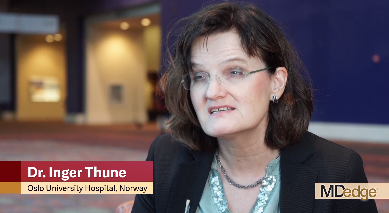
In this video interview, Dr. Thune further discussed the study design, implications of the findings, and future directions.
“Cardiovascular morbidity is so important for our breast cancer patients that I think that it’s time to have physical activity [and] physical function as a main interest for all clinicians dealing with breast cancer patients,” she said.
Dr. Thune reported having no disclosures.
SAN ANTONIO – A tailored 12-month exercise program during adjuvant breast cancer treatment appears to protect cardiovascular function, particularly in patients receiving chemotherapy, according to findings from the randomized EBBA-II trial.
The overall change in VO2max at 12 months was +0.3% in 271 patients randomized to the intervention group, compared with –8.9% in 274 patients in the “usual care” control group, Inger Thune, MD, PhD, said at the San Antonio Breast Cancer Symposium.
Among patients receiving chemotherapy, the VO2max change at 12 months was +1.6% in 120 patients in the intervention group, compared with –2.76% in 122 patients in the control group, said Dr. Thune of the Cancer Center at Oslo University Hospital.
Study participants were women aged 18-75 years (mean of 55 years at diagnosis) with stage I-II breast cancer, mean body mass index of 25 kg/m2, and a mean VO2max before surgery of 31.5 mL/kg per minute. The intervention group entered a 12-month individualized exercise program 2-3 weeks after surgery based on their own VO2max at baseline.
They met for training sessions in groups of 10-12 women for 60 minutes twice weekly over the 12-month study period, and were also told to perform at least 120 minutes of exercise at home for a total of 240 minutes of exercise weekly.
Of note, the adherence rate among participants was encouragingly high at about 90%, she said, adding that the findings strongly support tailored exercise during adjuvant breast cancer treatment, as such an intervention appears to counteract declines in cardiovascular function – particularly in those receiving chemotherapy.
In this video interview, Dr. Thune further discussed the study design, implications of the findings, and future directions.
“Cardiovascular morbidity is so important for our breast cancer patients that I think that it’s time to have physical activity [and] physical function as a main interest for all clinicians dealing with breast cancer patients,” she said.
Dr. Thune reported having no disclosures.
SAN ANTONIO – A tailored 12-month exercise program during adjuvant breast cancer treatment appears to protect cardiovascular function, particularly in patients receiving chemotherapy, according to findings from the randomized EBBA-II trial.
The overall change in VO2max at 12 months was +0.3% in 271 patients randomized to the intervention group, compared with –8.9% in 274 patients in the “usual care” control group, Inger Thune, MD, PhD, said at the San Antonio Breast Cancer Symposium.
Among patients receiving chemotherapy, the VO2max change at 12 months was +1.6% in 120 patients in the intervention group, compared with –2.76% in 122 patients in the control group, said Dr. Thune of the Cancer Center at Oslo University Hospital.
Study participants were women aged 18-75 years (mean of 55 years at diagnosis) with stage I-II breast cancer, mean body mass index of 25 kg/m2, and a mean VO2max before surgery of 31.5 mL/kg per minute. The intervention group entered a 12-month individualized exercise program 2-3 weeks after surgery based on their own VO2max at baseline.
They met for training sessions in groups of 10-12 women for 60 minutes twice weekly over the 12-month study period, and were also told to perform at least 120 minutes of exercise at home for a total of 240 minutes of exercise weekly.
Of note, the adherence rate among participants was encouragingly high at about 90%, she said, adding that the findings strongly support tailored exercise during adjuvant breast cancer treatment, as such an intervention appears to counteract declines in cardiovascular function – particularly in those receiving chemotherapy.
In this video interview, Dr. Thune further discussed the study design, implications of the findings, and future directions.
“Cardiovascular morbidity is so important for our breast cancer patients that I think that it’s time to have physical activity [and] physical function as a main interest for all clinicians dealing with breast cancer patients,” she said.
Dr. Thune reported having no disclosures.
REPORTING FROM SABCS 2018
Key clinical point: An exercise program during adjuvant breast cancer treatment improves cardiovascular outcomes.
Major finding: The rate of VO2max change at 12 months was +0.3% in the exercise group versus –8.9% in the control group.
Study details: EBBA-II, a randomized trial of 546 women.
Disclosures: Dr. Thune reported having no disclosures.
Statin-diabetes link
Also today, should metabolic syndrome be renamed circadian syndrome? A smart phone application diagnoses STEMI nearly as well as ECG, and fewer people having insurance may have helped slow health spending growth in 2017.
Amazon Alexa
Apple Podcasts
Google Podcasts
Spotify
Also today, should metabolic syndrome be renamed circadian syndrome? A smart phone application diagnoses STEMI nearly as well as ECG, and fewer people having insurance may have helped slow health spending growth in 2017.
Amazon Alexa
Apple Podcasts
Google Podcasts
Spotify
Also today, should metabolic syndrome be renamed circadian syndrome? A smart phone application diagnoses STEMI nearly as well as ECG, and fewer people having insurance may have helped slow health spending growth in 2017.
Amazon Alexa
Apple Podcasts
Google Podcasts
Spotify

RCC strongly linked to melanoma, and vice versa
A review of registry data from a major cancer center revealed a strong, bidirectional association between renal cell carcinoma (RCC) and melanoma.
A greater than twofold risk of melanoma in patients with RCC, and a nearly threefold risk of RCC in melanoma patients, were found in the review of the International Tumor Registry Database at The University of Texas MD Anderson Cancer Center.
The incidence of subsequent melanomas or RCCs in this study was in line with other recent reports from cancer registry analyses, reported Kevin B. Kim, MD, and his coinvestigators.
“Clinicians should be more watchful for these secondary cancers in patients with a history of melanoma or RCC,” they wrote. The report is in Cancer Epidemiology.
They found a total of 13,879 patients with melanoma and 7,597 patients with RCC in their review. Of those patients, 89 had both a melanoma and an RCC diagnosis. About 30% were first diagnosed with RCC, 61% were first diagnosed with melanoma, and 9% had both diagnoses around the same time.
Among the RCC-first patients, the standardized incidence ratio for developing a second primary melanoma was 2.31 (95% confidence interval, 1.52-3.37; P less than .001), while for melanoma-first patients, for developing a second primary RCC, it was 2.87 (95% CI, 2.16-3.74; P less than .001).
Those statistics were consistent with other registry reports, according to Dr. Kim and his colleagues, who wrote that the standardized incidence ratios in those studies ranged from 1.28 to 2.5.
In the MD Anderson registry study, nearly one-third of patients with secondary primary melanoma or RCC had a history of additional secondary cancers, according to the researchers. Those diagnoses included nonmelanoma skin cancers, leukemias, prostate cancer, breast cancer, and colon cancer, among others.
That suggested the presence of possible common risk factors that may have included abnormal genetics, though the database lacked the genetic sequencing and family history data to explore that hypothesis further.
“It would be highly desirable to assess germline genetic information on patients and their families, and also somatic gene aberrations in the tumor lesions, in a more systematic way in order to better elucidate the contribution of the genetics in the association between melanoma and RCC,” Dr. Kim and his colleagues said.
They reported that they had no conflicts of interest.
SOURCE: Kim KB et al. Cancer Epidemiol. 2018 Oct 19;57:80-4.
A review of registry data from a major cancer center revealed a strong, bidirectional association between renal cell carcinoma (RCC) and melanoma.
A greater than twofold risk of melanoma in patients with RCC, and a nearly threefold risk of RCC in melanoma patients, were found in the review of the International Tumor Registry Database at The University of Texas MD Anderson Cancer Center.
The incidence of subsequent melanomas or RCCs in this study was in line with other recent reports from cancer registry analyses, reported Kevin B. Kim, MD, and his coinvestigators.
“Clinicians should be more watchful for these secondary cancers in patients with a history of melanoma or RCC,” they wrote. The report is in Cancer Epidemiology.
They found a total of 13,879 patients with melanoma and 7,597 patients with RCC in their review. Of those patients, 89 had both a melanoma and an RCC diagnosis. About 30% were first diagnosed with RCC, 61% were first diagnosed with melanoma, and 9% had both diagnoses around the same time.
Among the RCC-first patients, the standardized incidence ratio for developing a second primary melanoma was 2.31 (95% confidence interval, 1.52-3.37; P less than .001), while for melanoma-first patients, for developing a second primary RCC, it was 2.87 (95% CI, 2.16-3.74; P less than .001).
Those statistics were consistent with other registry reports, according to Dr. Kim and his colleagues, who wrote that the standardized incidence ratios in those studies ranged from 1.28 to 2.5.
In the MD Anderson registry study, nearly one-third of patients with secondary primary melanoma or RCC had a history of additional secondary cancers, according to the researchers. Those diagnoses included nonmelanoma skin cancers, leukemias, prostate cancer, breast cancer, and colon cancer, among others.
That suggested the presence of possible common risk factors that may have included abnormal genetics, though the database lacked the genetic sequencing and family history data to explore that hypothesis further.
“It would be highly desirable to assess germline genetic information on patients and their families, and also somatic gene aberrations in the tumor lesions, in a more systematic way in order to better elucidate the contribution of the genetics in the association between melanoma and RCC,” Dr. Kim and his colleagues said.
They reported that they had no conflicts of interest.
SOURCE: Kim KB et al. Cancer Epidemiol. 2018 Oct 19;57:80-4.
A review of registry data from a major cancer center revealed a strong, bidirectional association between renal cell carcinoma (RCC) and melanoma.
A greater than twofold risk of melanoma in patients with RCC, and a nearly threefold risk of RCC in melanoma patients, were found in the review of the International Tumor Registry Database at The University of Texas MD Anderson Cancer Center.
The incidence of subsequent melanomas or RCCs in this study was in line with other recent reports from cancer registry analyses, reported Kevin B. Kim, MD, and his coinvestigators.
“Clinicians should be more watchful for these secondary cancers in patients with a history of melanoma or RCC,” they wrote. The report is in Cancer Epidemiology.
They found a total of 13,879 patients with melanoma and 7,597 patients with RCC in their review. Of those patients, 89 had both a melanoma and an RCC diagnosis. About 30% were first diagnosed with RCC, 61% were first diagnosed with melanoma, and 9% had both diagnoses around the same time.
Among the RCC-first patients, the standardized incidence ratio for developing a second primary melanoma was 2.31 (95% confidence interval, 1.52-3.37; P less than .001), while for melanoma-first patients, for developing a second primary RCC, it was 2.87 (95% CI, 2.16-3.74; P less than .001).
Those statistics were consistent with other registry reports, according to Dr. Kim and his colleagues, who wrote that the standardized incidence ratios in those studies ranged from 1.28 to 2.5.
In the MD Anderson registry study, nearly one-third of patients with secondary primary melanoma or RCC had a history of additional secondary cancers, according to the researchers. Those diagnoses included nonmelanoma skin cancers, leukemias, prostate cancer, breast cancer, and colon cancer, among others.
That suggested the presence of possible common risk factors that may have included abnormal genetics, though the database lacked the genetic sequencing and family history data to explore that hypothesis further.
“It would be highly desirable to assess germline genetic information on patients and their families, and also somatic gene aberrations in the tumor lesions, in a more systematic way in order to better elucidate the contribution of the genetics in the association between melanoma and RCC,” Dr. Kim and his colleagues said.
They reported that they had no conflicts of interest.
SOURCE: Kim KB et al. Cancer Epidemiol. 2018 Oct 19;57:80-4.
FROM CANCER EPIDEMIOLOGY
Key clinical point: Review of international tumor registry data demonstrated a strong and bidirectional association between renal cell carcinoma (RCC) and melanoma.
Major finding: Standardized incidence ratios were 2.31 for developing a second primary melanoma in patients who first had an RCC diagnosis, and 2.87 for developing a second primary RCC in patients who had melanoma first.
Study details: Analysis of 13,879 patients with melanoma and 7,597 patients with RCC in the International Tumor Registry Database at The University of Texas MD Anderson Cancer Center.
Disclosures: The authors reported that they had no conflicts of interest.
Source: Kim KB et al. Cancer Epidemiol. 2018 Oct 19;57:80-4.
Corpora callosa of young football players could be at risk
Younger players are not immune to the brain damage that can come with playing football, National Public Radio says, quoting a grim report from the annual meeting of the Radiological Society of North America.

The technique of magnetic resonance imaging, which essentially records a video of brain structure and function in real time, was used to scan the brains of 26 boys aged an average of 12 years before and after a season of football. The findings were compared with the brain scans of 26 other boys of similar age who were not football players, according to NPR.
Damage to the region that connects the two halves of the brain was evident in a majority of the football players but not in their control counterparts. in the shape of the corpus callosum. When these changes come at a time in life when the brain is developing, the results can be lifetime consequences on thought, behavior, and emotion.
“You have to understand that the NFL players were also most likely once collegiate players; they were also high school players and they were also probably youth players,” says radiologist Christopher T. Whitlow, MD, PhD, of Wake Forest Baptist Health in Winston-Salem, N.C., and a coauthor of the new findings, in the interview. “To us, it’s more than a question about concussions, it’s a question about long-term cumulative exposure.
“We don’t know what [the results] mean … do these changes persist over time? Do they accumulate with multiple seasons? And then No. 3, probably the most important: Do they have any relevance to long-term health?”
Average can be just fine
The need to excel is drilled into many people from childhood. Hard work is a virtue, but the pressure to shine can have disastrous consequences. In South Korea, for example, academic pressure is a major cause of suicide in youth.
A recent TED Women conference held in Palm Springs, Calif., provided some reassurance for those in the “forgotten middle” – those who were adequate but not stellar students, and who do their work diligently but not outstandingly.
“Those at the top get noticed and those at the bottom get extra help but no one really thinks about the kids in the middle who make up the majority,” says Danielle R. Moss Lee, EdD, a social activist and chief of the New York Civil Liberties Union, who spoke at the conference. These folks can be valuable contributors but are often overlooked. As a result, when it comes to excelling, they “check out.”
“We have to create different ways to harness their potential. I didn’t appreciate how average I was until I was a college student and I bumped into a science teacher and he couldn’t believe what college I was attending,” Dr. Lee says.
Sometimes it takes a push from a loved one to spur action. In Dr. Lee’s case, she says she was happy being an average student. Her mother’s search for extracurricular activities led her to discover writing and set her on a path to personal and professional accomplishment.
Dr. Lee’s message was that “the middle isn’t a permanent location.”
Others experts see the situation differently. “Most psychological traits are evenly distributed, meaning that a significant proportion of the population will have average intelligence and leadership potential,” says Tomas Chamorro-Premuzic, PhD, of University College London, in an interview with BBC News.
“The world’s progress depends on those who stand out via their exceptional and innovative contributions, but these individuals are part of the top 1% in their field, combining truly unconventional levels of talent, work ethic, and focus,” Dr. Chamorro-Premuzic says. “For the remaining 99% of us, the acceptance that our talents and motivation are much more conventional, and unlikely to result in world-changing accomplishments, would reflect a healthier, more rational self-concept than illusions of grandiosity or fantasized talent.”
Shared sorrow mark club members
A recent article in Time described the experiences of some who have lost their children and whose worlds have been forever altered. From all walks of life and diverse backgrounds, these folks become tethered together. “It’s a club you spend your whole life hoping you won’t ever become a part of,” says Nicole Hockley, whose son Dylan, 6, was killed in the December 2012 shooting at Sandy Hook Elementary School in Connecticut. “But once you’re in, you’re in.”
Mitchell Dworet and Melissa Wiley are connected by death of their children. Mr. Dworet’s 17-year-old son Nicholas was killed during the shooting at Marjory Stoneman Douglas High School in Parkland, Fla., in February 2018. A month later, Ms. Willey’s daughter Jaelynn, 16, was shot to death by a fellow student at Great Mills High School in Maryland. They connected through Facebook. “I felt like I should reach out. I wanted to pay it forward,” explains Mr. Dworet.
“When you’ve gone through this kind of tragedy with other people, you see their humanity, where they’re coming from,” says Darrell Scott, whose 17-year-old daughter Rachel was killed at Columbine. Politics can differ – as can views on the painful issue of gun control measures – and friendships might not develop. Still, however, they share one enduring bond.
The connection with others can help in the immediate aftermath, and can continue to be important over time. “When you lose a child violently and publicly, there’s an outpouring of support at first,” said Sandy Phillips, whose 24-year-old daughter Jessi was shot with 11 others at a cinema in Aurora, Colo., in 2012. “Once the vigils are over and the media is gone, that’s when things get really bad. The world moves on, and you don’t. You can’t. It’s a pain you can’t outrun.”
“A huge emotional jolt”
In the aftermath of the magnitude 7.0 earthquake that shook Anchorage, Alaska, on Nov. 30, and the many aftershocks, residents are scrambling to cope with their changed lives. For those who lost possessions, the pain is real. But there comes the realization for many that they survived and that material possessions can, for the most part, be replaced.
Psychological changes, meanwhile, can prove profound and lasting. Researchers have found that large earthquakes can produce PTSD and anxiety. Some survivors can come away from earthquakes with difficulty concentrating and hypervigilance.
As one resident explains to Anchorage Daily News, “I felt yesterday like I had one final nerve and every aftershock was playing on that nerve.”
K.J. Worbey, a mental health counselor for Southcentral Foundation – an Alaska Native health care organization – describes the experience as a “huge emotional jolt.” She adds there is “lots of uncertainly about our own safety. Safety of our families and our homes. ... When we are faced with that kind of an emotional crisis, it takes a whole lot of energy to navigate it.”
Ms. Worbey recommends limiting alcohol, eating a healthy diet, and exercising appropriately. “Try to get some energy out. Try and get that excess emotional stuff out,” she said. Other prudent measures include sticking to a normal routine as much as is possible, including mealtimes and sleep, and talking with neighbors and friends.
Drug diversions can cost lives
A recent article in the Dallas Morning News has highlighted the humanity of health caregivers. Within the past several years, two nurses at University of Texas Southwestern Medical Center’s Williams P. Clements Jr. Hospital in Dallas have died of self-inflicted drug overdoses during a work shift.
It’s unusual for one hospital to have two caregivers die of overdoses in such a short time, experts say.
“This is an extreme example,” says Kimberly New, a nurse and lawyer in Tennessee who consults with hospitals nationwide on how to prevent diversions. “That type of alarming situation would be the reason to bring someone in and look at their controls.”
For addicted health care staff, access to their drug of need can be as near as the hospital’s drug supply room. In the past 4 years, hospitals in Texas have reported more than 200 thefts by employees. The tally is likely much higher, as thefts go undetected. The consequences of the thefts in terms of overdoses and deaths are unknown, as those details are not tracked.
Other consequences also hit home for those tasked with providing care: While focusing on their addictions, a nurse or other caregiver can dangerously comprise their duties. This can, in turn, compromise patient care – and can threaten survival if an oversight or mistake is egregiously wrong.
The response by hospitals like the Clements facility is typically a hard-line approach to institute procedures to safeguard the drugs from diversion. This tact is necessary but completely overlooks the reasons for the drug addiction. As with such measures, the effect can be to drive the abuser underground. Hiding the addiction and raiding the hospital’s drug supply can be preferred over admitting the problem and risking the health care workers’ careers – and ultimately, their lives.
Younger players are not immune to the brain damage that can come with playing football, National Public Radio says, quoting a grim report from the annual meeting of the Radiological Society of North America.
The technique of magnetic resonance imaging, which essentially records a video of brain structure and function in real time, was used to scan the brains of 26 boys aged an average of 12 years before and after a season of football. The findings were compared with the brain scans of 26 other boys of similar age who were not football players, according to NPR.
Damage to the region that connects the two halves of the brain was evident in a majority of the football players but not in their control counterparts. in the shape of the corpus callosum. When these changes come at a time in life when the brain is developing, the results can be lifetime consequences on thought, behavior, and emotion.
“You have to understand that the NFL players were also most likely once collegiate players; they were also high school players and they were also probably youth players,” says radiologist Christopher T. Whitlow, MD, PhD, of Wake Forest Baptist Health in Winston-Salem, N.C., and a coauthor of the new findings, in the interview. “To us, it’s more than a question about concussions, it’s a question about long-term cumulative exposure.
“We don’t know what [the results] mean … do these changes persist over time? Do they accumulate with multiple seasons? And then No. 3, probably the most important: Do they have any relevance to long-term health?”
Average can be just fine
The need to excel is drilled into many people from childhood. Hard work is a virtue, but the pressure to shine can have disastrous consequences. In South Korea, for example, academic pressure is a major cause of suicide in youth.
A recent TED Women conference held in Palm Springs, Calif., provided some reassurance for those in the “forgotten middle” – those who were adequate but not stellar students, and who do their work diligently but not outstandingly.
“Those at the top get noticed and those at the bottom get extra help but no one really thinks about the kids in the middle who make up the majority,” says Danielle R. Moss Lee, EdD, a social activist and chief of the New York Civil Liberties Union, who spoke at the conference. These folks can be valuable contributors but are often overlooked. As a result, when it comes to excelling, they “check out.”
“We have to create different ways to harness their potential. I didn’t appreciate how average I was until I was a college student and I bumped into a science teacher and he couldn’t believe what college I was attending,” Dr. Lee says.
Sometimes it takes a push from a loved one to spur action. In Dr. Lee’s case, she says she was happy being an average student. Her mother’s search for extracurricular activities led her to discover writing and set her on a path to personal and professional accomplishment.
Dr. Lee’s message was that “the middle isn’t a permanent location.”
Others experts see the situation differently. “Most psychological traits are evenly distributed, meaning that a significant proportion of the population will have average intelligence and leadership potential,” says Tomas Chamorro-Premuzic, PhD, of University College London, in an interview with BBC News.
“The world’s progress depends on those who stand out via their exceptional and innovative contributions, but these individuals are part of the top 1% in their field, combining truly unconventional levels of talent, work ethic, and focus,” Dr. Chamorro-Premuzic says. “For the remaining 99% of us, the acceptance that our talents and motivation are much more conventional, and unlikely to result in world-changing accomplishments, would reflect a healthier, more rational self-concept than illusions of grandiosity or fantasized talent.”
Shared sorrow mark club members
A recent article in Time described the experiences of some who have lost their children and whose worlds have been forever altered. From all walks of life and diverse backgrounds, these folks become tethered together. “It’s a club you spend your whole life hoping you won’t ever become a part of,” says Nicole Hockley, whose son Dylan, 6, was killed in the December 2012 shooting at Sandy Hook Elementary School in Connecticut. “But once you’re in, you’re in.”
Mitchell Dworet and Melissa Wiley are connected by death of their children. Mr. Dworet’s 17-year-old son Nicholas was killed during the shooting at Marjory Stoneman Douglas High School in Parkland, Fla., in February 2018. A month later, Ms. Willey’s daughter Jaelynn, 16, was shot to death by a fellow student at Great Mills High School in Maryland. They connected through Facebook. “I felt like I should reach out. I wanted to pay it forward,” explains Mr. Dworet.
“When you’ve gone through this kind of tragedy with other people, you see their humanity, where they’re coming from,” says Darrell Scott, whose 17-year-old daughter Rachel was killed at Columbine. Politics can differ – as can views on the painful issue of gun control measures – and friendships might not develop. Still, however, they share one enduring bond.
The connection with others can help in the immediate aftermath, and can continue to be important over time. “When you lose a child violently and publicly, there’s an outpouring of support at first,” said Sandy Phillips, whose 24-year-old daughter Jessi was shot with 11 others at a cinema in Aurora, Colo., in 2012. “Once the vigils are over and the media is gone, that’s when things get really bad. The world moves on, and you don’t. You can’t. It’s a pain you can’t outrun.”
“A huge emotional jolt”
In the aftermath of the magnitude 7.0 earthquake that shook Anchorage, Alaska, on Nov. 30, and the many aftershocks, residents are scrambling to cope with their changed lives. For those who lost possessions, the pain is real. But there comes the realization for many that they survived and that material possessions can, for the most part, be replaced.
Psychological changes, meanwhile, can prove profound and lasting. Researchers have found that large earthquakes can produce PTSD and anxiety. Some survivors can come away from earthquakes with difficulty concentrating and hypervigilance.
As one resident explains to Anchorage Daily News, “I felt yesterday like I had one final nerve and every aftershock was playing on that nerve.”
K.J. Worbey, a mental health counselor for Southcentral Foundation – an Alaska Native health care organization – describes the experience as a “huge emotional jolt.” She adds there is “lots of uncertainly about our own safety. Safety of our families and our homes. ... When we are faced with that kind of an emotional crisis, it takes a whole lot of energy to navigate it.”
Ms. Worbey recommends limiting alcohol, eating a healthy diet, and exercising appropriately. “Try to get some energy out. Try and get that excess emotional stuff out,” she said. Other prudent measures include sticking to a normal routine as much as is possible, including mealtimes and sleep, and talking with neighbors and friends.
Drug diversions can cost lives
A recent article in the Dallas Morning News has highlighted the humanity of health caregivers. Within the past several years, two nurses at University of Texas Southwestern Medical Center’s Williams P. Clements Jr. Hospital in Dallas have died of self-inflicted drug overdoses during a work shift.
It’s unusual for one hospital to have two caregivers die of overdoses in such a short time, experts say.
“This is an extreme example,” says Kimberly New, a nurse and lawyer in Tennessee who consults with hospitals nationwide on how to prevent diversions. “That type of alarming situation would be the reason to bring someone in and look at their controls.”
For addicted health care staff, access to their drug of need can be as near as the hospital’s drug supply room. In the past 4 years, hospitals in Texas have reported more than 200 thefts by employees. The tally is likely much higher, as thefts go undetected. The consequences of the thefts in terms of overdoses and deaths are unknown, as those details are not tracked.
Other consequences also hit home for those tasked with providing care: While focusing on their addictions, a nurse or other caregiver can dangerously comprise their duties. This can, in turn, compromise patient care – and can threaten survival if an oversight or mistake is egregiously wrong.
The response by hospitals like the Clements facility is typically a hard-line approach to institute procedures to safeguard the drugs from diversion. This tact is necessary but completely overlooks the reasons for the drug addiction. As with such measures, the effect can be to drive the abuser underground. Hiding the addiction and raiding the hospital’s drug supply can be preferred over admitting the problem and risking the health care workers’ careers – and ultimately, their lives.
Younger players are not immune to the brain damage that can come with playing football, National Public Radio says, quoting a grim report from the annual meeting of the Radiological Society of North America.
The technique of magnetic resonance imaging, which essentially records a video of brain structure and function in real time, was used to scan the brains of 26 boys aged an average of 12 years before and after a season of football. The findings were compared with the brain scans of 26 other boys of similar age who were not football players, according to NPR.
Damage to the region that connects the two halves of the brain was evident in a majority of the football players but not in their control counterparts. in the shape of the corpus callosum. When these changes come at a time in life when the brain is developing, the results can be lifetime consequences on thought, behavior, and emotion.
“You have to understand that the NFL players were also most likely once collegiate players; they were also high school players and they were also probably youth players,” says radiologist Christopher T. Whitlow, MD, PhD, of Wake Forest Baptist Health in Winston-Salem, N.C., and a coauthor of the new findings, in the interview. “To us, it’s more than a question about concussions, it’s a question about long-term cumulative exposure.
“We don’t know what [the results] mean … do these changes persist over time? Do they accumulate with multiple seasons? And then No. 3, probably the most important: Do they have any relevance to long-term health?”
Average can be just fine
The need to excel is drilled into many people from childhood. Hard work is a virtue, but the pressure to shine can have disastrous consequences. In South Korea, for example, academic pressure is a major cause of suicide in youth.
A recent TED Women conference held in Palm Springs, Calif., provided some reassurance for those in the “forgotten middle” – those who were adequate but not stellar students, and who do their work diligently but not outstandingly.
“Those at the top get noticed and those at the bottom get extra help but no one really thinks about the kids in the middle who make up the majority,” says Danielle R. Moss Lee, EdD, a social activist and chief of the New York Civil Liberties Union, who spoke at the conference. These folks can be valuable contributors but are often overlooked. As a result, when it comes to excelling, they “check out.”
“We have to create different ways to harness their potential. I didn’t appreciate how average I was until I was a college student and I bumped into a science teacher and he couldn’t believe what college I was attending,” Dr. Lee says.
Sometimes it takes a push from a loved one to spur action. In Dr. Lee’s case, she says she was happy being an average student. Her mother’s search for extracurricular activities led her to discover writing and set her on a path to personal and professional accomplishment.
Dr. Lee’s message was that “the middle isn’t a permanent location.”
Others experts see the situation differently. “Most psychological traits are evenly distributed, meaning that a significant proportion of the population will have average intelligence and leadership potential,” says Tomas Chamorro-Premuzic, PhD, of University College London, in an interview with BBC News.
“The world’s progress depends on those who stand out via their exceptional and innovative contributions, but these individuals are part of the top 1% in their field, combining truly unconventional levels of talent, work ethic, and focus,” Dr. Chamorro-Premuzic says. “For the remaining 99% of us, the acceptance that our talents and motivation are much more conventional, and unlikely to result in world-changing accomplishments, would reflect a healthier, more rational self-concept than illusions of grandiosity or fantasized talent.”
Shared sorrow mark club members
A recent article in Time described the experiences of some who have lost their children and whose worlds have been forever altered. From all walks of life and diverse backgrounds, these folks become tethered together. “It’s a club you spend your whole life hoping you won’t ever become a part of,” says Nicole Hockley, whose son Dylan, 6, was killed in the December 2012 shooting at Sandy Hook Elementary School in Connecticut. “But once you’re in, you’re in.”
Mitchell Dworet and Melissa Wiley are connected by death of their children. Mr. Dworet’s 17-year-old son Nicholas was killed during the shooting at Marjory Stoneman Douglas High School in Parkland, Fla., in February 2018. A month later, Ms. Willey’s daughter Jaelynn, 16, was shot to death by a fellow student at Great Mills High School in Maryland. They connected through Facebook. “I felt like I should reach out. I wanted to pay it forward,” explains Mr. Dworet.
“When you’ve gone through this kind of tragedy with other people, you see their humanity, where they’re coming from,” says Darrell Scott, whose 17-year-old daughter Rachel was killed at Columbine. Politics can differ – as can views on the painful issue of gun control measures – and friendships might not develop. Still, however, they share one enduring bond.
The connection with others can help in the immediate aftermath, and can continue to be important over time. “When you lose a child violently and publicly, there’s an outpouring of support at first,” said Sandy Phillips, whose 24-year-old daughter Jessi was shot with 11 others at a cinema in Aurora, Colo., in 2012. “Once the vigils are over and the media is gone, that’s when things get really bad. The world moves on, and you don’t. You can’t. It’s a pain you can’t outrun.”
“A huge emotional jolt”
In the aftermath of the magnitude 7.0 earthquake that shook Anchorage, Alaska, on Nov. 30, and the many aftershocks, residents are scrambling to cope with their changed lives. For those who lost possessions, the pain is real. But there comes the realization for many that they survived and that material possessions can, for the most part, be replaced.
Psychological changes, meanwhile, can prove profound and lasting. Researchers have found that large earthquakes can produce PTSD and anxiety. Some survivors can come away from earthquakes with difficulty concentrating and hypervigilance.
As one resident explains to Anchorage Daily News, “I felt yesterday like I had one final nerve and every aftershock was playing on that nerve.”
K.J. Worbey, a mental health counselor for Southcentral Foundation – an Alaska Native health care organization – describes the experience as a “huge emotional jolt.” She adds there is “lots of uncertainly about our own safety. Safety of our families and our homes. ... When we are faced with that kind of an emotional crisis, it takes a whole lot of energy to navigate it.”
Ms. Worbey recommends limiting alcohol, eating a healthy diet, and exercising appropriately. “Try to get some energy out. Try and get that excess emotional stuff out,” she said. Other prudent measures include sticking to a normal routine as much as is possible, including mealtimes and sleep, and talking with neighbors and friends.
Drug diversions can cost lives
A recent article in the Dallas Morning News has highlighted the humanity of health caregivers. Within the past several years, two nurses at University of Texas Southwestern Medical Center’s Williams P. Clements Jr. Hospital in Dallas have died of self-inflicted drug overdoses during a work shift.
It’s unusual for one hospital to have two caregivers die of overdoses in such a short time, experts say.
“This is an extreme example,” says Kimberly New, a nurse and lawyer in Tennessee who consults with hospitals nationwide on how to prevent diversions. “That type of alarming situation would be the reason to bring someone in and look at their controls.”
For addicted health care staff, access to their drug of need can be as near as the hospital’s drug supply room. In the past 4 years, hospitals in Texas have reported more than 200 thefts by employees. The tally is likely much higher, as thefts go undetected. The consequences of the thefts in terms of overdoses and deaths are unknown, as those details are not tracked.
Other consequences also hit home for those tasked with providing care: While focusing on their addictions, a nurse or other caregiver can dangerously comprise their duties. This can, in turn, compromise patient care – and can threaten survival if an oversight or mistake is egregiously wrong.
The response by hospitals like the Clements facility is typically a hard-line approach to institute procedures to safeguard the drugs from diversion. This tact is necessary but completely overlooks the reasons for the drug addiction. As with such measures, the effect can be to drive the abuser underground. Hiding the addiction and raiding the hospital’s drug supply can be preferred over admitting the problem and risking the health care workers’ careers – and ultimately, their lives.

Submit VAM abstracts
The abstract submission site for the 2019 Vascular Annual Meeting is now open. Submissions may be considered for the following programs: Scientific Session, Vascular and Endovascular Surgical Society (VESS), International Forum, International Fast Talk, Poster Competition and Interactive Poster. In addition to the International Forum and International Fast Talk, the international community has added two further opportunities to showcase research: The International Young Surgeon Competition and the International Poster Competition. This year the submission site is mobile friendly! Get more information on submission and policy guidelines here.
The abstract submission site for the 2019 Vascular Annual Meeting is now open. Submissions may be considered for the following programs: Scientific Session, Vascular and Endovascular Surgical Society (VESS), International Forum, International Fast Talk, Poster Competition and Interactive Poster. In addition to the International Forum and International Fast Talk, the international community has added two further opportunities to showcase research: The International Young Surgeon Competition and the International Poster Competition. This year the submission site is mobile friendly! Get more information on submission and policy guidelines here.
The abstract submission site for the 2019 Vascular Annual Meeting is now open. Submissions may be considered for the following programs: Scientific Session, Vascular and Endovascular Surgical Society (VESS), International Forum, International Fast Talk, Poster Competition and Interactive Poster. In addition to the International Forum and International Fast Talk, the international community has added two further opportunities to showcase research: The International Young Surgeon Competition and the International Poster Competition. This year the submission site is mobile friendly! Get more information on submission and policy guidelines here.
SVSConnect is on the Way
Anticipation is growing for SVSConnect, a new online community for SVS members. This site will give users an online home for connecting with colleagues on various topics including case complications, techniques, practice management and even work-life balance. A group of “early adopters” has already begun testing the waters, but the site will become open to all members before year’s end. Keep an eye on our Pulse newsletters, emails and the SVS website for an official launch date.
Anticipation is growing for SVSConnect, a new online community for SVS members. This site will give users an online home for connecting with colleagues on various topics including case complications, techniques, practice management and even work-life balance. A group of “early adopters” has already begun testing the waters, but the site will become open to all members before year’s end. Keep an eye on our Pulse newsletters, emails and the SVS website for an official launch date.
Anticipation is growing for SVSConnect, a new online community for SVS members. This site will give users an online home for connecting with colleagues on various topics including case complications, techniques, practice management and even work-life balance. A group of “early adopters” has already begun testing the waters, but the site will become open to all members before year’s end. Keep an eye on our Pulse newsletters, emails and the SVS website for an official launch date.