User login
MicroRNAs show promising predictive value for early breast cancer
Key clinical point: Differences in microRNAs (mRNAs), a group of small RNAs that regulate gene expression, can be used to distinguish among breast cancer subtypes.
Major finding: Altered expression of microRNAs distinguished between cancer and healthy samples, and also identified breast cancer subtypes including HER2, Luminal A, Luminal B, and triple negative breast cancer, according to a retrospective study of 740 breast cancer cases included in the review.
Study details: The data come from a review of the latest research on the prognostic and predictive value of microRNAs in patients with luminal A breast cancer.
Disclosures: The study was supported by the Scientific Grant Agency of the Ministry of Education of the Slovak Republic, the Slovak Research and Development Agency, and the Operational Programme Research and Innovation funded by the ERDF.
Citation: Kudela E et al. Int J Mol Sci. 2020 Oct 17. doi: 10.3390/ijms21207691.
Key clinical point: Differences in microRNAs (mRNAs), a group of small RNAs that regulate gene expression, can be used to distinguish among breast cancer subtypes.
Major finding: Altered expression of microRNAs distinguished between cancer and healthy samples, and also identified breast cancer subtypes including HER2, Luminal A, Luminal B, and triple negative breast cancer, according to a retrospective study of 740 breast cancer cases included in the review.
Study details: The data come from a review of the latest research on the prognostic and predictive value of microRNAs in patients with luminal A breast cancer.
Disclosures: The study was supported by the Scientific Grant Agency of the Ministry of Education of the Slovak Republic, the Slovak Research and Development Agency, and the Operational Programme Research and Innovation funded by the ERDF.
Citation: Kudela E et al. Int J Mol Sci. 2020 Oct 17. doi: 10.3390/ijms21207691.
Key clinical point: Differences in microRNAs (mRNAs), a group of small RNAs that regulate gene expression, can be used to distinguish among breast cancer subtypes.
Major finding: Altered expression of microRNAs distinguished between cancer and healthy samples, and also identified breast cancer subtypes including HER2, Luminal A, Luminal B, and triple negative breast cancer, according to a retrospective study of 740 breast cancer cases included in the review.
Study details: The data come from a review of the latest research on the prognostic and predictive value of microRNAs in patients with luminal A breast cancer.
Disclosures: The study was supported by the Scientific Grant Agency of the Ministry of Education of the Slovak Republic, the Slovak Research and Development Agency, and the Operational Programme Research and Innovation funded by the ERDF.
Citation: Kudela E et al. Int J Mol Sci. 2020 Oct 17. doi: 10.3390/ijms21207691.
Income loss shows no link to stress levels in young women with breast cancer
Key clinical point: Over a 12-month period, 15.4% of women with early breast cancer reported losing income. Although stress, anxiety, and depression were not association with household income changes (risk ratios 2.42, 1.12, and 1.41, respectively), the proportion of women reporting high stress was greatest among those who lost income (13.2%, compared to 3.1% among women maintaining an income of $100,000 or higher).
Major finding: Women with a household income below $50,000 had a higher risk of losing household income compared to those with incomes of $50,000 or higher, suggesting that lower income women may be more vulnerable to income loss after diagnosis with breast cancer.
Study details: The data come from a prospective, longitudinal cohort study including 467 women with early breast cancer enrolled in the Young and Strong cohort trial from 2012 to 2013.
Disclosures: The study was supported by an ASCO Improving Cancer Care grant, the National Institutes of Health, an NIH training grants. The researchers had no financial conflicts to disclose.
Citation: Cook EE et al. BMC Public Health. 2020 Oct 6. doi: 10.1186/s12889-020-09562-z.
Key clinical point: Over a 12-month period, 15.4% of women with early breast cancer reported losing income. Although stress, anxiety, and depression were not association with household income changes (risk ratios 2.42, 1.12, and 1.41, respectively), the proportion of women reporting high stress was greatest among those who lost income (13.2%, compared to 3.1% among women maintaining an income of $100,000 or higher).
Major finding: Women with a household income below $50,000 had a higher risk of losing household income compared to those with incomes of $50,000 or higher, suggesting that lower income women may be more vulnerable to income loss after diagnosis with breast cancer.
Study details: The data come from a prospective, longitudinal cohort study including 467 women with early breast cancer enrolled in the Young and Strong cohort trial from 2012 to 2013.
Disclosures: The study was supported by an ASCO Improving Cancer Care grant, the National Institutes of Health, an NIH training grants. The researchers had no financial conflicts to disclose.
Citation: Cook EE et al. BMC Public Health. 2020 Oct 6. doi: 10.1186/s12889-020-09562-z.
Key clinical point: Over a 12-month period, 15.4% of women with early breast cancer reported losing income. Although stress, anxiety, and depression were not association with household income changes (risk ratios 2.42, 1.12, and 1.41, respectively), the proportion of women reporting high stress was greatest among those who lost income (13.2%, compared to 3.1% among women maintaining an income of $100,000 or higher).
Major finding: Women with a household income below $50,000 had a higher risk of losing household income compared to those with incomes of $50,000 or higher, suggesting that lower income women may be more vulnerable to income loss after diagnosis with breast cancer.
Study details: The data come from a prospective, longitudinal cohort study including 467 women with early breast cancer enrolled in the Young and Strong cohort trial from 2012 to 2013.
Disclosures: The study was supported by an ASCO Improving Cancer Care grant, the National Institutes of Health, an NIH training grants. The researchers had no financial conflicts to disclose.
Citation: Cook EE et al. BMC Public Health. 2020 Oct 6. doi: 10.1186/s12889-020-09562-z.
Exercise and diet intervention fail to improve fatigue in breast cancer patients on chemotherapy
Key clinical point: An exercise and diet intervention had no significant impact on fatigue in women with breast cancer who were undergoing chemotherapy or radiotherapy.
Major finding: Based on the general cancer-related fatigue score using the MFI-20 questionnaire, general fatigue levels were not significantly different between groups of breast cancer patients randomized to an Adapted Physical Activity Diet (APAD) program and controls (P = 0.274).
Study details: The data come from a randomized, controlled trial of 360 adult women with early breast cancer designed to evaluate the impact of an exercise and nutrition intervention on fatigue during 6 months of chemotherapy and radiotherapy.
Disclosures: The study was supported by the INCa-DGOS and by a Montpellier Cancer SIRIC grant. The researchers had no financial conflicts to disclose.
Citation: Jacot W et al. Nutrients. 2020 Oct 9. doi: 10.3390/nu12103081.
Key clinical point: An exercise and diet intervention had no significant impact on fatigue in women with breast cancer who were undergoing chemotherapy or radiotherapy.
Major finding: Based on the general cancer-related fatigue score using the MFI-20 questionnaire, general fatigue levels were not significantly different between groups of breast cancer patients randomized to an Adapted Physical Activity Diet (APAD) program and controls (P = 0.274).
Study details: The data come from a randomized, controlled trial of 360 adult women with early breast cancer designed to evaluate the impact of an exercise and nutrition intervention on fatigue during 6 months of chemotherapy and radiotherapy.
Disclosures: The study was supported by the INCa-DGOS and by a Montpellier Cancer SIRIC grant. The researchers had no financial conflicts to disclose.
Citation: Jacot W et al. Nutrients. 2020 Oct 9. doi: 10.3390/nu12103081.
Key clinical point: An exercise and diet intervention had no significant impact on fatigue in women with breast cancer who were undergoing chemotherapy or radiotherapy.
Major finding: Based on the general cancer-related fatigue score using the MFI-20 questionnaire, general fatigue levels were not significantly different between groups of breast cancer patients randomized to an Adapted Physical Activity Diet (APAD) program and controls (P = 0.274).
Study details: The data come from a randomized, controlled trial of 360 adult women with early breast cancer designed to evaluate the impact of an exercise and nutrition intervention on fatigue during 6 months of chemotherapy and radiotherapy.
Disclosures: The study was supported by the INCa-DGOS and by a Montpellier Cancer SIRIC grant. The researchers had no financial conflicts to disclose.
Citation: Jacot W et al. Nutrients. 2020 Oct 9. doi: 10.3390/nu12103081.
DNA-based model predicts overall survival in breast cancer
Key clinical point: A prognostic signature including 8 DNA repair-related genes (MDC1, RPA3, MED17, DDB2, SFPQ, XRCC4, CYP19A1, and PARP3) predicted overall survival in breast cancer patients
Major finding: The areas under the curve were for 3-year survival and 5-year survival were 0.717 and 0.772, respectively, in the GSE9893 data set, and 0.691 and 0.718, respectively, in the GSE42568 data set.
Study details: The data come from 1,096 women with breast cancer; gene expression profiles and clinical data were collected from a Chinese health database between October 9, 2019, and February 3, 2020.
Disclosures: The study received no outside funding. The researchers had no financial conflicts to disclose.
Citation: Zhang D et al. JAMA Netw Open. 2020 Oct 5. doi:10.1001/jamanetworkopen.2020.14622.
Key clinical point: A prognostic signature including 8 DNA repair-related genes (MDC1, RPA3, MED17, DDB2, SFPQ, XRCC4, CYP19A1, and PARP3) predicted overall survival in breast cancer patients
Major finding: The areas under the curve were for 3-year survival and 5-year survival were 0.717 and 0.772, respectively, in the GSE9893 data set, and 0.691 and 0.718, respectively, in the GSE42568 data set.
Study details: The data come from 1,096 women with breast cancer; gene expression profiles and clinical data were collected from a Chinese health database between October 9, 2019, and February 3, 2020.
Disclosures: The study received no outside funding. The researchers had no financial conflicts to disclose.
Citation: Zhang D et al. JAMA Netw Open. 2020 Oct 5. doi:10.1001/jamanetworkopen.2020.14622.
Key clinical point: A prognostic signature including 8 DNA repair-related genes (MDC1, RPA3, MED17, DDB2, SFPQ, XRCC4, CYP19A1, and PARP3) predicted overall survival in breast cancer patients
Major finding: The areas under the curve were for 3-year survival and 5-year survival were 0.717 and 0.772, respectively, in the GSE9893 data set, and 0.691 and 0.718, respectively, in the GSE42568 data set.
Study details: The data come from 1,096 women with breast cancer; gene expression profiles and clinical data were collected from a Chinese health database between October 9, 2019, and February 3, 2020.
Disclosures: The study received no outside funding. The researchers had no financial conflicts to disclose.
Citation: Zhang D et al. JAMA Netw Open. 2020 Oct 5. doi:10.1001/jamanetworkopen.2020.14622.
Textured breast implants may raise risk of cancer relapse
Key clinical point: The use of textured implants in reconstructive surgery after breast cancer mastectomy was significantly associated with lower rates of disease-free survival compared to smooth implants, but no difference was noted in local and regional recurrence-free survival based on implant texture.
Major finding: Rates of disease-free survival were significantly lower among breast cancer patients who received textured breast implants compared to those who received smooth implants (hazard ratio 3.054); the association was even stronger among patients with stage II or III tumors (HR 8.874).
Study details: The data come from a cohort study of 650 women representing 687 cases of breast cancer who were treated at a single center in South Korea between January 1, 2011, and December 31, 2016.
Disclosures: The study received no outside funding. The researchers had no financial conflicts to disclose.
Citation: Lee K-T et al. JAMA Surg. 2020 Oct 7. doi: 10.1001/jamasurg.2020.4124.
Key clinical point: The use of textured implants in reconstructive surgery after breast cancer mastectomy was significantly associated with lower rates of disease-free survival compared to smooth implants, but no difference was noted in local and regional recurrence-free survival based on implant texture.
Major finding: Rates of disease-free survival were significantly lower among breast cancer patients who received textured breast implants compared to those who received smooth implants (hazard ratio 3.054); the association was even stronger among patients with stage II or III tumors (HR 8.874).
Study details: The data come from a cohort study of 650 women representing 687 cases of breast cancer who were treated at a single center in South Korea between January 1, 2011, and December 31, 2016.
Disclosures: The study received no outside funding. The researchers had no financial conflicts to disclose.
Citation: Lee K-T et al. JAMA Surg. 2020 Oct 7. doi: 10.1001/jamasurg.2020.4124.
Key clinical point: The use of textured implants in reconstructive surgery after breast cancer mastectomy was significantly associated with lower rates of disease-free survival compared to smooth implants, but no difference was noted in local and regional recurrence-free survival based on implant texture.
Major finding: Rates of disease-free survival were significantly lower among breast cancer patients who received textured breast implants compared to those who received smooth implants (hazard ratio 3.054); the association was even stronger among patients with stage II or III tumors (HR 8.874).
Study details: The data come from a cohort study of 650 women representing 687 cases of breast cancer who were treated at a single center in South Korea between January 1, 2011, and December 31, 2016.
Disclosures: The study received no outside funding. The researchers had no financial conflicts to disclose.
Citation: Lee K-T et al. JAMA Surg. 2020 Oct 7. doi: 10.1001/jamasurg.2020.4124.
Vacuum-assisted biopsy predicts post-treatment residual disease in breast cancer
Key clinical point: Vacuum-assisted biopsy accurately predicted residual disease in breast cancer patients after neoadjuvant chemotherapy.
Major finding: The overall false negative rate using vacuum-assisted biopsy (VAB) was 18.7%; in a subgroup of patients with a complete/partial response and imaging abnormalities of 2 cm or smaller, the false negative rate was 3.2% and the negative predictive value was 97.4% for an overall accuracy of 89.5% with VAB.
Study details: The data come from a diagnostic study of 166 women with breast cancer who received neoadjuvant chemotherapy followed by image-guided biopsy.
Disclosures: The study received no outside funding. The researchers had no financial conflicts to disclose.
Citation: Tasoulis MK et al. JAMA Surg. 2020 Oct 7. doi: 10.1001/jamasurg.2020.4103.
Key clinical point: Vacuum-assisted biopsy accurately predicted residual disease in breast cancer patients after neoadjuvant chemotherapy.
Major finding: The overall false negative rate using vacuum-assisted biopsy (VAB) was 18.7%; in a subgroup of patients with a complete/partial response and imaging abnormalities of 2 cm or smaller, the false negative rate was 3.2% and the negative predictive value was 97.4% for an overall accuracy of 89.5% with VAB.
Study details: The data come from a diagnostic study of 166 women with breast cancer who received neoadjuvant chemotherapy followed by image-guided biopsy.
Disclosures: The study received no outside funding. The researchers had no financial conflicts to disclose.
Citation: Tasoulis MK et al. JAMA Surg. 2020 Oct 7. doi: 10.1001/jamasurg.2020.4103.
Key clinical point: Vacuum-assisted biopsy accurately predicted residual disease in breast cancer patients after neoadjuvant chemotherapy.
Major finding: The overall false negative rate using vacuum-assisted biopsy (VAB) was 18.7%; in a subgroup of patients with a complete/partial response and imaging abnormalities of 2 cm or smaller, the false negative rate was 3.2% and the negative predictive value was 97.4% for an overall accuracy of 89.5% with VAB.
Study details: The data come from a diagnostic study of 166 women with breast cancer who received neoadjuvant chemotherapy followed by image-guided biopsy.
Disclosures: The study received no outside funding. The researchers had no financial conflicts to disclose.
Citation: Tasoulis MK et al. JAMA Surg. 2020 Oct 7. doi: 10.1001/jamasurg.2020.4103.
Immediate breast reconstruction after chemotherapy doesn’t hurt survival
Key clinical point: Outcomes including recurrence, disease-free survival, and overall survival were similar for breast cancer patients who underwent immediate breast reconstruction (IBR) with nipple-sparing mastectomy (NSM) or skin-sparing mastectomy (SSM) following neoadjuvant chemotherapy.
Major finding: Breast cancer patients who underwent IBR with NSM/SSM as surgical treatment showed similar rates of overall survival at 5 years compared to those who underwent conventional mastectomy (92.0% vs. 89.3%).
Study details: The data come from a retrospective, case-control study of 1,266 breast cancer patients who underwent neoadjuvant chemotherapy followed by immediate breast reconstruction or conventional mastectomy at a single center between January 1, 2010, and November 30, 2016.
Disclosures: The study received no outside funding. The researchers had no financial conflicts to disclose.
Citation: Wu Z-Y et al. JAMA Surg. 2020 Oct 14. doi: 10.1001/jamasurg.2020.4132.
Key clinical point: Outcomes including recurrence, disease-free survival, and overall survival were similar for breast cancer patients who underwent immediate breast reconstruction (IBR) with nipple-sparing mastectomy (NSM) or skin-sparing mastectomy (SSM) following neoadjuvant chemotherapy.
Major finding: Breast cancer patients who underwent IBR with NSM/SSM as surgical treatment showed similar rates of overall survival at 5 years compared to those who underwent conventional mastectomy (92.0% vs. 89.3%).
Study details: The data come from a retrospective, case-control study of 1,266 breast cancer patients who underwent neoadjuvant chemotherapy followed by immediate breast reconstruction or conventional mastectomy at a single center between January 1, 2010, and November 30, 2016.
Disclosures: The study received no outside funding. The researchers had no financial conflicts to disclose.
Citation: Wu Z-Y et al. JAMA Surg. 2020 Oct 14. doi: 10.1001/jamasurg.2020.4132.
Key clinical point: Outcomes including recurrence, disease-free survival, and overall survival were similar for breast cancer patients who underwent immediate breast reconstruction (IBR) with nipple-sparing mastectomy (NSM) or skin-sparing mastectomy (SSM) following neoadjuvant chemotherapy.
Major finding: Breast cancer patients who underwent IBR with NSM/SSM as surgical treatment showed similar rates of overall survival at 5 years compared to those who underwent conventional mastectomy (92.0% vs. 89.3%).
Study details: The data come from a retrospective, case-control study of 1,266 breast cancer patients who underwent neoadjuvant chemotherapy followed by immediate breast reconstruction or conventional mastectomy at a single center between January 1, 2010, and November 30, 2016.
Disclosures: The study received no outside funding. The researchers had no financial conflicts to disclose.
Citation: Wu Z-Y et al. JAMA Surg. 2020 Oct 14. doi: 10.1001/jamasurg.2020.4132.
Black women show higher rates of three breast cancer subtypes
Key clinical point: Breast cancer subtypes may be associated with race and ethnicity; certain subtypes were significantly more common in Black women and infiltrating duct carcinoma compared to White women, but lobular carcinoma, and tubular adenocarcinoma were less common in Hispanic women compared to nonHispanic White women.
Major finding: The incidence of HR-negative and ERBB2-positive; HR-positive and ERBB2-positive; and triple negative breast cancer was significantly higher among Black women compared to nonHispanic White women, but the incidence of the HR-positive and ERBB2-negative subtype in Black women was lower (incidence rate ratios of 1.12, 1.46, 2.07, and 0.86, respectively).
Study details: The data come from a population-based cohort study of 239,211 women with breast cancer diagnosed between January 1, 2010, and December 31, 2015.
Disclosures: The study was supported by grants to the researchers from several organizations including the Natural Science Foundation of China, the Beijing Municipal Natural Science Foundation, the Special Research Fund for Central Universities, Peking Union Medical College, the Beijing Hope Run Special Fund of Cancer Foundation of China, and the PhD Innovation Fund of Cancer Hospital, Chinese Academy of Medical Sciences. The researchers had no financial conflicts to disclose.
Citation: Kong X et al. JAMA Netw Open. 2020 Oct 19. doi:10.1001/jamanetworkopen.2020.20303.
Key clinical point: Breast cancer subtypes may be associated with race and ethnicity; certain subtypes were significantly more common in Black women and infiltrating duct carcinoma compared to White women, but lobular carcinoma, and tubular adenocarcinoma were less common in Hispanic women compared to nonHispanic White women.
Major finding: The incidence of HR-negative and ERBB2-positive; HR-positive and ERBB2-positive; and triple negative breast cancer was significantly higher among Black women compared to nonHispanic White women, but the incidence of the HR-positive and ERBB2-negative subtype in Black women was lower (incidence rate ratios of 1.12, 1.46, 2.07, and 0.86, respectively).
Study details: The data come from a population-based cohort study of 239,211 women with breast cancer diagnosed between January 1, 2010, and December 31, 2015.
Disclosures: The study was supported by grants to the researchers from several organizations including the Natural Science Foundation of China, the Beijing Municipal Natural Science Foundation, the Special Research Fund for Central Universities, Peking Union Medical College, the Beijing Hope Run Special Fund of Cancer Foundation of China, and the PhD Innovation Fund of Cancer Hospital, Chinese Academy of Medical Sciences. The researchers had no financial conflicts to disclose.
Citation: Kong X et al. JAMA Netw Open. 2020 Oct 19. doi:10.1001/jamanetworkopen.2020.20303.
Key clinical point: Breast cancer subtypes may be associated with race and ethnicity; certain subtypes were significantly more common in Black women and infiltrating duct carcinoma compared to White women, but lobular carcinoma, and tubular adenocarcinoma were less common in Hispanic women compared to nonHispanic White women.
Major finding: The incidence of HR-negative and ERBB2-positive; HR-positive and ERBB2-positive; and triple negative breast cancer was significantly higher among Black women compared to nonHispanic White women, but the incidence of the HR-positive and ERBB2-negative subtype in Black women was lower (incidence rate ratios of 1.12, 1.46, 2.07, and 0.86, respectively).
Study details: The data come from a population-based cohort study of 239,211 women with breast cancer diagnosed between January 1, 2010, and December 31, 2015.
Disclosures: The study was supported by grants to the researchers from several organizations including the Natural Science Foundation of China, the Beijing Municipal Natural Science Foundation, the Special Research Fund for Central Universities, Peking Union Medical College, the Beijing Hope Run Special Fund of Cancer Foundation of China, and the PhD Innovation Fund of Cancer Hospital, Chinese Academy of Medical Sciences. The researchers had no financial conflicts to disclose.
Citation: Kong X et al. JAMA Netw Open. 2020 Oct 19. doi:10.1001/jamanetworkopen.2020.20303.
Painful pustules on hands
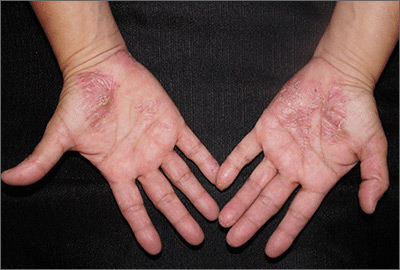
Close inspection of the plaques revealed multiple small pustules and mahogany colored macules on a broad, well-demarcated scaly red plaque. This pattern was consistent with palmoplantar pustular psoriasis.
Palmoplantar psoriasis is a chronic disease that may manifest at any age and in both sexes. The diagnosis may be clinical, as it was in this case. Bacterial culture of a pustule may demonstrate staphylococcus superinfection—a problem more likely to occur in smokers. More widespread disease, spiking fevers, or tachycardia could indicate a need for hospitalization for further work-up and management.
With disease localized to this patient’s hands and feet, the physician considered dyshidrotic eczema as part of the differential diagnosis. However dyshidrotic eczema, which presents with clear tapioca-like vesicles, is profoundly itchy; pustular psoriasis is often painful. Other differences: The vesicles in dyshidrotic eczema do not uniformly form pustules nor do they form brown macules upon healing, as occurs in palmoplantar pustular psoriasis.
Treatment for very limited disease includes topical ultrapotent steroids, topical retinoids, or phototherapy—either alone or in combination. However, more extensive disease, even if limited to hands and feet, merits systemic therapy with acitretin, methotrexate, or biologic agents. (Acitretin and methotrexate are reliable teratogens and should not be used in women who are, or may become, pregnant.) Individuals with known superinfection often benefit from antibiotic therapy, as well.
In this case, the patient had already undergone a tubal ligation for contraception. Therefore, she was started on acitretin 25 mg PO daily. Patients on systemic retinoids undergo laboratory surveillance for transaminitis and hypertriglyceridemia regularly. Adverse effects are generally well tolerated, but include photosensitivity and dry skin, lips, and eyes. The patient improved significantly on 25 mg/d and the dosage was reduced to 10 mg/d after 3 months. She currently remains clear on this regimen.
Text and photos courtesy of Jonathan Karnes, MD, medical director, MDFMR Dermatology Services, Augusta, ME. (Photo copyright retained.)
Misiak-Galazka M, Zozula J, Rudnicka L. Palmoplantar pustulosis: recent advances in etiopathogenesis and emerging treatments. Am J Clin Dermatol. 2020;21:355-370.
Close inspection of the plaques revealed multiple small pustules and mahogany colored macules on a broad, well-demarcated scaly red plaque. This pattern was consistent with palmoplantar pustular psoriasis.
Palmoplantar psoriasis is a chronic disease that may manifest at any age and in both sexes. The diagnosis may be clinical, as it was in this case. Bacterial culture of a pustule may demonstrate staphylococcus superinfection—a problem more likely to occur in smokers. More widespread disease, spiking fevers, or tachycardia could indicate a need for hospitalization for further work-up and management.
With disease localized to this patient’s hands and feet, the physician considered dyshidrotic eczema as part of the differential diagnosis. However dyshidrotic eczema, which presents with clear tapioca-like vesicles, is profoundly itchy; pustular psoriasis is often painful. Other differences: The vesicles in dyshidrotic eczema do not uniformly form pustules nor do they form brown macules upon healing, as occurs in palmoplantar pustular psoriasis.
Treatment for very limited disease includes topical ultrapotent steroids, topical retinoids, or phototherapy—either alone or in combination. However, more extensive disease, even if limited to hands and feet, merits systemic therapy with acitretin, methotrexate, or biologic agents. (Acitretin and methotrexate are reliable teratogens and should not be used in women who are, or may become, pregnant.) Individuals with known superinfection often benefit from antibiotic therapy, as well.
In this case, the patient had already undergone a tubal ligation for contraception. Therefore, she was started on acitretin 25 mg PO daily. Patients on systemic retinoids undergo laboratory surveillance for transaminitis and hypertriglyceridemia regularly. Adverse effects are generally well tolerated, but include photosensitivity and dry skin, lips, and eyes. The patient improved significantly on 25 mg/d and the dosage was reduced to 10 mg/d after 3 months. She currently remains clear on this regimen.
Text and photos courtesy of Jonathan Karnes, MD, medical director, MDFMR Dermatology Services, Augusta, ME. (Photo copyright retained.)
Close inspection of the plaques revealed multiple small pustules and mahogany colored macules on a broad, well-demarcated scaly red plaque. This pattern was consistent with palmoplantar pustular psoriasis.
Palmoplantar psoriasis is a chronic disease that may manifest at any age and in both sexes. The diagnosis may be clinical, as it was in this case. Bacterial culture of a pustule may demonstrate staphylococcus superinfection—a problem more likely to occur in smokers. More widespread disease, spiking fevers, or tachycardia could indicate a need for hospitalization for further work-up and management.
With disease localized to this patient’s hands and feet, the physician considered dyshidrotic eczema as part of the differential diagnosis. However dyshidrotic eczema, which presents with clear tapioca-like vesicles, is profoundly itchy; pustular psoriasis is often painful. Other differences: The vesicles in dyshidrotic eczema do not uniformly form pustules nor do they form brown macules upon healing, as occurs in palmoplantar pustular psoriasis.
Treatment for very limited disease includes topical ultrapotent steroids, topical retinoids, or phototherapy—either alone or in combination. However, more extensive disease, even if limited to hands and feet, merits systemic therapy with acitretin, methotrexate, or biologic agents. (Acitretin and methotrexate are reliable teratogens and should not be used in women who are, or may become, pregnant.) Individuals with known superinfection often benefit from antibiotic therapy, as well.
In this case, the patient had already undergone a tubal ligation for contraception. Therefore, she was started on acitretin 25 mg PO daily. Patients on systemic retinoids undergo laboratory surveillance for transaminitis and hypertriglyceridemia regularly. Adverse effects are generally well tolerated, but include photosensitivity and dry skin, lips, and eyes. The patient improved significantly on 25 mg/d and the dosage was reduced to 10 mg/d after 3 months. She currently remains clear on this regimen.
Text and photos courtesy of Jonathan Karnes, MD, medical director, MDFMR Dermatology Services, Augusta, ME. (Photo copyright retained.)
Misiak-Galazka M, Zozula J, Rudnicka L. Palmoplantar pustulosis: recent advances in etiopathogenesis and emerging treatments. Am J Clin Dermatol. 2020;21:355-370.
Misiak-Galazka M, Zozula J, Rudnicka L. Palmoplantar pustulosis: recent advances in etiopathogenesis and emerging treatments. Am J Clin Dermatol. 2020;21:355-370.
Mixed outcomes in tenofovir trial for chronic hepatitis B
About one-third of patients with chronic hepatitis B maintained a profile consistent with inactive disease 1 year after withdrawal from treatment in the randomized HBRN trial, which compared tenofovir with and without pegylated interferon (PEG-IFN). The two treatment groups, however, had similarly low rates of hepatitis B surface antigen (HBsAg) loss, the trial’s primary end point.
The successful withdrawals could inform discussions with patients who are “very motivated to have a finite treatment course,” said investigator Norah Terrault, MD, from the University of Southern California, Los Angeles. The results might “help patients in talking about expectations,” she said, because “there’s a one in three chance they won’t go back on treatment” if they meet specific metrics.
In HBRN, the metrics for withdrawal from treatment after 192 weeks included low levels of viral DNA (<1,000 IU/mL) for at least 24 weeks, no cirrhosis, negative week 144 test results for the hepatitis B envelope antigen (HBeAg), and week 180 conversion to anti-HBe positivity.
Of 102 patients who received tenofovir monotherapy for 192 weeks and who completed the trial, 51 met these criteria. After withdrawal from treatment, 30% still had DNA levels below 1,000 IU/mL and normal ALT at week 240, which is consistent with inactive chronic hepatitis B.
Of the 99 participants in the combination group – who received PEG-IFN for the first 24 of 192 weeks in addition to tenofovir – 60 met the withdrawal criteria at 192 weeks. At week 240, 39% of this withdrawal group still had DNA and ALT values consistent with inactive disease.
Rates of HBsAg loss, which signals functional cure, were low in the two groups, however. At week 240, fewer patients in the tenofovir monotherapy group tested negative for HBsAg than in the tenofovir plus PEG-IFN combination group, but the difference was not significant (4.5% vs. 5.7%).
The timing of HBsAg loss differed between the groups. In the combination group, the loss largely occurred before treatment withdrawal, likely because of the antiviral effects of interferon, Dr. Terrault said in an interview. In the monotherapy group, the loss occurred after 192 weeks, possibly reflecting the immunologic consequences of treatment withdrawal.
The timing of ALT flares also differed between groups. In the combination group, 58% of flares occurred during the 24-week PEG-IFN period. In the monotherapy group, 70% of flares occurred after tenofovir was stopped at 192 weeks.
The flare picture is a tricky one, said Dr. Terrault. The episodes might be a positive factor in HBsAg loss, but severe flares carry a risk for decompensation. Good predictors of the severity of flares are lacking, and “that is the hurdle” to finding a balance with these trade-offs.
‘Partially a failure and partially a success’
The findings are “partially a failure and partially a success,” said Robert Gish, MD, from Loma Linda (Calif.) University of Health, who was not involved in the study.
The low rates of HBsAg loss and the similarity between the two treatment groups represent the failure, he explained. The success is for the patients who were HBeAg-positive when the study began because they had high HBeAg loss rates in both the monotherapy and combination groups (41% vs. 61%; P = .06).
Loss of HBeAg was numerically higher in the combination group because of the interferon effect. That could be viewed as a “subjective benefit” of PEG-IFN, even though the difference wasn’t statistically significant, said Dr. Gish.
The low rates of HBsAg loss could relate to two features of the patient profile, he explained. At study entry, the participants had moderately high levels of quantitative HBsAg and were predominately of Asian ancestry, which are predisposing factors for limited HBsAg loss.
Previous studies have suggested that peak HBsAg loss could take 2-3 years to develop after treatment withdrawal in a trial population. In the HBRN trial, rates almost 1 year after withdrawal are similar to 1-year rates from other studies, Dr. Terrault said. How these results for HBsAg loss in the two treatment groups will look at the 3-year mark is not known.
The trial design standardized withdrawal protocol and the length of time patients were on treatment before withdrawal was attempted, which are strengths of this study, said Dr. Terrault. And “a triumph of this study is execution of a standard for nucleic acid treatment in a protocolized way, followed by withdrawal. That is something we are happy about.”
Dr. Terrault reported receiving institutional grant support from Roche/Genentech and Gilead Sciences. Dr. Gish reported receiving research support from Gilead Sciences and serving as a consultant and on advisory boards for several pharmaceutical companies.
This article first appeared on Medscape.com.
About one-third of patients with chronic hepatitis B maintained a profile consistent with inactive disease 1 year after withdrawal from treatment in the randomized HBRN trial, which compared tenofovir with and without pegylated interferon (PEG-IFN). The two treatment groups, however, had similarly low rates of hepatitis B surface antigen (HBsAg) loss, the trial’s primary end point.
The successful withdrawals could inform discussions with patients who are “very motivated to have a finite treatment course,” said investigator Norah Terrault, MD, from the University of Southern California, Los Angeles. The results might “help patients in talking about expectations,” she said, because “there’s a one in three chance they won’t go back on treatment” if they meet specific metrics.
In HBRN, the metrics for withdrawal from treatment after 192 weeks included low levels of viral DNA (<1,000 IU/mL) for at least 24 weeks, no cirrhosis, negative week 144 test results for the hepatitis B envelope antigen (HBeAg), and week 180 conversion to anti-HBe positivity.
Of 102 patients who received tenofovir monotherapy for 192 weeks and who completed the trial, 51 met these criteria. After withdrawal from treatment, 30% still had DNA levels below 1,000 IU/mL and normal ALT at week 240, which is consistent with inactive chronic hepatitis B.
Of the 99 participants in the combination group – who received PEG-IFN for the first 24 of 192 weeks in addition to tenofovir – 60 met the withdrawal criteria at 192 weeks. At week 240, 39% of this withdrawal group still had DNA and ALT values consistent with inactive disease.
Rates of HBsAg loss, which signals functional cure, were low in the two groups, however. At week 240, fewer patients in the tenofovir monotherapy group tested negative for HBsAg than in the tenofovir plus PEG-IFN combination group, but the difference was not significant (4.5% vs. 5.7%).
The timing of HBsAg loss differed between the groups. In the combination group, the loss largely occurred before treatment withdrawal, likely because of the antiviral effects of interferon, Dr. Terrault said in an interview. In the monotherapy group, the loss occurred after 192 weeks, possibly reflecting the immunologic consequences of treatment withdrawal.
The timing of ALT flares also differed between groups. In the combination group, 58% of flares occurred during the 24-week PEG-IFN period. In the monotherapy group, 70% of flares occurred after tenofovir was stopped at 192 weeks.
The flare picture is a tricky one, said Dr. Terrault. The episodes might be a positive factor in HBsAg loss, but severe flares carry a risk for decompensation. Good predictors of the severity of flares are lacking, and “that is the hurdle” to finding a balance with these trade-offs.
‘Partially a failure and partially a success’
The findings are “partially a failure and partially a success,” said Robert Gish, MD, from Loma Linda (Calif.) University of Health, who was not involved in the study.
The low rates of HBsAg loss and the similarity between the two treatment groups represent the failure, he explained. The success is for the patients who were HBeAg-positive when the study began because they had high HBeAg loss rates in both the monotherapy and combination groups (41% vs. 61%; P = .06).
Loss of HBeAg was numerically higher in the combination group because of the interferon effect. That could be viewed as a “subjective benefit” of PEG-IFN, even though the difference wasn’t statistically significant, said Dr. Gish.
The low rates of HBsAg loss could relate to two features of the patient profile, he explained. At study entry, the participants had moderately high levels of quantitative HBsAg and were predominately of Asian ancestry, which are predisposing factors for limited HBsAg loss.
Previous studies have suggested that peak HBsAg loss could take 2-3 years to develop after treatment withdrawal in a trial population. In the HBRN trial, rates almost 1 year after withdrawal are similar to 1-year rates from other studies, Dr. Terrault said. How these results for HBsAg loss in the two treatment groups will look at the 3-year mark is not known.
The trial design standardized withdrawal protocol and the length of time patients were on treatment before withdrawal was attempted, which are strengths of this study, said Dr. Terrault. And “a triumph of this study is execution of a standard for nucleic acid treatment in a protocolized way, followed by withdrawal. That is something we are happy about.”
Dr. Terrault reported receiving institutional grant support from Roche/Genentech and Gilead Sciences. Dr. Gish reported receiving research support from Gilead Sciences and serving as a consultant and on advisory boards for several pharmaceutical companies.
This article first appeared on Medscape.com.
About one-third of patients with chronic hepatitis B maintained a profile consistent with inactive disease 1 year after withdrawal from treatment in the randomized HBRN trial, which compared tenofovir with and without pegylated interferon (PEG-IFN). The two treatment groups, however, had similarly low rates of hepatitis B surface antigen (HBsAg) loss, the trial’s primary end point.
The successful withdrawals could inform discussions with patients who are “very motivated to have a finite treatment course,” said investigator Norah Terrault, MD, from the University of Southern California, Los Angeles. The results might “help patients in talking about expectations,” she said, because “there’s a one in three chance they won’t go back on treatment” if they meet specific metrics.
In HBRN, the metrics for withdrawal from treatment after 192 weeks included low levels of viral DNA (<1,000 IU/mL) for at least 24 weeks, no cirrhosis, negative week 144 test results for the hepatitis B envelope antigen (HBeAg), and week 180 conversion to anti-HBe positivity.
Of 102 patients who received tenofovir monotherapy for 192 weeks and who completed the trial, 51 met these criteria. After withdrawal from treatment, 30% still had DNA levels below 1,000 IU/mL and normal ALT at week 240, which is consistent with inactive chronic hepatitis B.
Of the 99 participants in the combination group – who received PEG-IFN for the first 24 of 192 weeks in addition to tenofovir – 60 met the withdrawal criteria at 192 weeks. At week 240, 39% of this withdrawal group still had DNA and ALT values consistent with inactive disease.
Rates of HBsAg loss, which signals functional cure, were low in the two groups, however. At week 240, fewer patients in the tenofovir monotherapy group tested negative for HBsAg than in the tenofovir plus PEG-IFN combination group, but the difference was not significant (4.5% vs. 5.7%).
The timing of HBsAg loss differed between the groups. In the combination group, the loss largely occurred before treatment withdrawal, likely because of the antiviral effects of interferon, Dr. Terrault said in an interview. In the monotherapy group, the loss occurred after 192 weeks, possibly reflecting the immunologic consequences of treatment withdrawal.
The timing of ALT flares also differed between groups. In the combination group, 58% of flares occurred during the 24-week PEG-IFN period. In the monotherapy group, 70% of flares occurred after tenofovir was stopped at 192 weeks.
The flare picture is a tricky one, said Dr. Terrault. The episodes might be a positive factor in HBsAg loss, but severe flares carry a risk for decompensation. Good predictors of the severity of flares are lacking, and “that is the hurdle” to finding a balance with these trade-offs.
‘Partially a failure and partially a success’
The findings are “partially a failure and partially a success,” said Robert Gish, MD, from Loma Linda (Calif.) University of Health, who was not involved in the study.
The low rates of HBsAg loss and the similarity between the two treatment groups represent the failure, he explained. The success is for the patients who were HBeAg-positive when the study began because they had high HBeAg loss rates in both the monotherapy and combination groups (41% vs. 61%; P = .06).
Loss of HBeAg was numerically higher in the combination group because of the interferon effect. That could be viewed as a “subjective benefit” of PEG-IFN, even though the difference wasn’t statistically significant, said Dr. Gish.
The low rates of HBsAg loss could relate to two features of the patient profile, he explained. At study entry, the participants had moderately high levels of quantitative HBsAg and were predominately of Asian ancestry, which are predisposing factors for limited HBsAg loss.
Previous studies have suggested that peak HBsAg loss could take 2-3 years to develop after treatment withdrawal in a trial population. In the HBRN trial, rates almost 1 year after withdrawal are similar to 1-year rates from other studies, Dr. Terrault said. How these results for HBsAg loss in the two treatment groups will look at the 3-year mark is not known.
The trial design standardized withdrawal protocol and the length of time patients were on treatment before withdrawal was attempted, which are strengths of this study, said Dr. Terrault. And “a triumph of this study is execution of a standard for nucleic acid treatment in a protocolized way, followed by withdrawal. That is something we are happy about.”
Dr. Terrault reported receiving institutional grant support from Roche/Genentech and Gilead Sciences. Dr. Gish reported receiving research support from Gilead Sciences and serving as a consultant and on advisory boards for several pharmaceutical companies.
This article first appeared on Medscape.com.