User login
Challenges in outpatient psychiatry
The patient who shuns our recommendations can be very frustrating to treat
Editor’s Note: This is the first in a series of articles by Dr. Miller about challenges in outpatient psychiatry.
“I don’t understand why it’s so hard for me to get up and get started in the mornings,” my patient said. She was on the verge of losing her job for repeatedly being late to work.
“I really believe you’d have an easier time if you didn’t drink every night then start your mornings with that wake-up shot of gin,” I replied.
“Here we go again,” she said, exasperated with me.
It was a conversation that has been going on for years (literally) and with which we have both been quite frustrated. My patient wants to get better, she asks for my help, and then she refuses any solutions I might suggest.

Patients with addictions have their own challenges; this patient does not want to stop drinking and all my efforts to suggest that alcohol is part of the problem simply don’t matter. When it became clear that it was not simply a matter of her willingness to believe that alcohol was a problem, I made stronger suggestions. She should try a 12-step program, and when that recommendation was scorned, I insisted she go to an outpatient intensive program and pressed the name and phone number into her palm. There have been prescriptions for oral naltrexone, which initially was helpful until the patient stopped taking it, and an offer for a topiramate trial. At the suggestion of a colleague, I even offered to go with her to an intake for substance use treatment. None of my efforts, however, change the fact that this patient does not want these interventions, and our treatment plans don’t seem to converge.
Patients with addictions are often complex, and the forces in play are more than simply the agreement that a problem exists and a desire to stop. Patients who want – yet don’t want – help come in many varieties. We’ve all sat with patients who refuse to take the medications we prescribe or who come back appointment after appointment still never having turned on the lightbox we convinced them to purchase. There are patients who are miserably troubled by being overweight but are not open to changing their diet, exercising, joining a weight-loss group, taking medications, or having bariatric surgery. There are patients who insist they can’t stop smoking but won’t give any of the available treatments a try. There are those we badger to get the lab work that make it safe for them to continue on the medications we prescribe. There are moments when we may wonder what more we have to offer patients who either can’t or won’t follow our suggestions, what may have once been considered “doctor’s orders.”
These are the patients we’ve referred to as “noncompliant.” It’s a term that recently has been questioned, and one that implies a willful refusal to abide by a physician’s decision. Often, it’s worth exploring what holds them back from following our directions. The term noncompliance implies that the person is a bad patient and it does not leave room for the idea that the patient may not agree with the diagnosis or treatment plan or is unwilling to accept the cost or risk of the prescribed solution. Sometimes, understanding what leads a patient to resist can be helpful; unwarranted fears can be addressed and logistical barriers may be overcome.
In some cases, these patient encounters may leave us feeling helpless and worried. In the worst of these cases, where a patient’s refusal to follow through with treatment suggestions may leave them vulnerable to very bad outcomes, I personally have had times when I’ve felt like I’m standing by helplessly watching as a Mack truck speeds into a brick wall.
“In my experience noncompliance is almost always a sign of deeper resistance or ambivalence that needs to be explored,” notes Neha Jain, MD, a geriatric psychiatrist at the University of Connecticut, Farmington.
Dr. Jain communicated with me about patients who don’t want to take the medications she recommends. “A typical scenario is when a patient comes to see me, but says that either they don’t believe in medications or are extraordinarily sensitive to them. I almost always offer medication as a choice and am quick to offer not taking medication as an option for those who are safe. If they refuse, I’ll review their goals and talk about why they came to see me, a primarily prescribing psychiatrist. This often leads to a deeper discussion of why they are resistant to meds, ranging from the stigma of ‘taking a crazy pill’ to what taking a medication means for their ego. For these patients I might offer a few ‘consulting’ sessions, which are really therapy sessions. Often they either become receptive to taking medicines, or they may continue with therapy alone, either with me or with someone else.”
Peter D. Kramer, MD, a psychiatrist in Providence, R.I., and author of “Ordinarily Well: The Case for Antidepressants,” says that the issues are even more complex when patients hide that they have not complied with the psychiatrist’s recommendations. “It seems to me that noncompliance that remains secret, not discussed with the therapist and then discovered incidentally or belatedly, presents an occasion to consider the success of the therapeutic alliance – in older terms, to think more about the transference.”
Dr. Kramer notes that, as our approach to psychotherapy has changed, the psychiatrist’s response to such behavior has also changed. “The prevailing focus on cognitive therapies assumes that when patients realize that a belief or behavior is illogical, they will correct it. When psychotherapy was more analytic, it focused on the reasons patients engaged in irrational and self-destructive acts repeatedly – and patients’ failure to self-correct didn’t frustrate the therapist so much. Instead you thought, ‘If education worked, I’d be out of a job.’ We deal with failures to trust. We deal with what philosophers call weakness of will. While I can’t say that I am never frustrated or surprised, I do see working with these problems as the reason I am there.”
Sometimes we learn that the patient who dismisses our suggestions has already tried the remedies we are suggesting and is just as frustrated as we are. We may be left with the unfortunate situation that nothing we do seems to foster meaningful change for the patient. In these instances it may be helpful to clarify the goals of treatment and inquire whether he feels he is making progress. We may consider trying other forms of treatment, consultation with another clinician, or more intensive therapy if the patient will agree. Other times, we may be left to rethink our treatment, consider the ways in which the patient does find the treatment helpful, and empathize with our patient’s distress while continuing to gently suggest that there might be options available whenever they feel ready.
So my patient did lose her job. She found another position with more flexible hours and, despite her heavy drinking, her life has gone mostly well. She comes to see me only rarely because the medication I prescribe helps stabilize her mood, but she stopped scheduling her regular psychotherapy sessions. Still, while she manages her life around her drinking, I worry about the toll it is taking, as there has been ample evidence that her body cannot sustain this for much longer. From what I can tell, the fact that I remain available is helpful to both the patient and her family but yes, it’s a little like standing by helplessly and watching a Mack truck race toward a brick wall.
Dr. Miller is the coauthor with Annette Hanson, MD, of “Committed: The Battle Over Involuntary Psychiatric Care” (Baltimore: Johns Hopkins University Press, 2016) and has a private practice in Baltimore. Patient details were altered to preserve confidentiality.
The patient who shuns our recommendations can be very frustrating to treat
The patient who shuns our recommendations can be very frustrating to treat
Editor’s Note: This is the first in a series of articles by Dr. Miller about challenges in outpatient psychiatry.
“I don’t understand why it’s so hard for me to get up and get started in the mornings,” my patient said. She was on the verge of losing her job for repeatedly being late to work.
“I really believe you’d have an easier time if you didn’t drink every night then start your mornings with that wake-up shot of gin,” I replied.
“Here we go again,” she said, exasperated with me.
It was a conversation that has been going on for years (literally) and with which we have both been quite frustrated. My patient wants to get better, she asks for my help, and then she refuses any solutions I might suggest.
Patients with addictions have their own challenges; this patient does not want to stop drinking and all my efforts to suggest that alcohol is part of the problem simply don’t matter. When it became clear that it was not simply a matter of her willingness to believe that alcohol was a problem, I made stronger suggestions. She should try a 12-step program, and when that recommendation was scorned, I insisted she go to an outpatient intensive program and pressed the name and phone number into her palm. There have been prescriptions for oral naltrexone, which initially was helpful until the patient stopped taking it, and an offer for a topiramate trial. At the suggestion of a colleague, I even offered to go with her to an intake for substance use treatment. None of my efforts, however, change the fact that this patient does not want these interventions, and our treatment plans don’t seem to converge.
Patients with addictions are often complex, and the forces in play are more than simply the agreement that a problem exists and a desire to stop. Patients who want – yet don’t want – help come in many varieties. We’ve all sat with patients who refuse to take the medications we prescribe or who come back appointment after appointment still never having turned on the lightbox we convinced them to purchase. There are patients who are miserably troubled by being overweight but are not open to changing their diet, exercising, joining a weight-loss group, taking medications, or having bariatric surgery. There are patients who insist they can’t stop smoking but won’t give any of the available treatments a try. There are those we badger to get the lab work that make it safe for them to continue on the medications we prescribe. There are moments when we may wonder what more we have to offer patients who either can’t or won’t follow our suggestions, what may have once been considered “doctor’s orders.”
These are the patients we’ve referred to as “noncompliant.” It’s a term that recently has been questioned, and one that implies a willful refusal to abide by a physician’s decision. Often, it’s worth exploring what holds them back from following our directions. The term noncompliance implies that the person is a bad patient and it does not leave room for the idea that the patient may not agree with the diagnosis or treatment plan or is unwilling to accept the cost or risk of the prescribed solution. Sometimes, understanding what leads a patient to resist can be helpful; unwarranted fears can be addressed and logistical barriers may be overcome.
In some cases, these patient encounters may leave us feeling helpless and worried. In the worst of these cases, where a patient’s refusal to follow through with treatment suggestions may leave them vulnerable to very bad outcomes, I personally have had times when I’ve felt like I’m standing by helplessly watching as a Mack truck speeds into a brick wall.
“In my experience noncompliance is almost always a sign of deeper resistance or ambivalence that needs to be explored,” notes Neha Jain, MD, a geriatric psychiatrist at the University of Connecticut, Farmington.
Dr. Jain communicated with me about patients who don’t want to take the medications she recommends. “A typical scenario is when a patient comes to see me, but says that either they don’t believe in medications or are extraordinarily sensitive to them. I almost always offer medication as a choice and am quick to offer not taking medication as an option for those who are safe. If they refuse, I’ll review their goals and talk about why they came to see me, a primarily prescribing psychiatrist. This often leads to a deeper discussion of why they are resistant to meds, ranging from the stigma of ‘taking a crazy pill’ to what taking a medication means for their ego. For these patients I might offer a few ‘consulting’ sessions, which are really therapy sessions. Often they either become receptive to taking medicines, or they may continue with therapy alone, either with me or with someone else.”
Peter D. Kramer, MD, a psychiatrist in Providence, R.I., and author of “Ordinarily Well: The Case for Antidepressants,” says that the issues are even more complex when patients hide that they have not complied with the psychiatrist’s recommendations. “It seems to me that noncompliance that remains secret, not discussed with the therapist and then discovered incidentally or belatedly, presents an occasion to consider the success of the therapeutic alliance – in older terms, to think more about the transference.”
Dr. Kramer notes that, as our approach to psychotherapy has changed, the psychiatrist’s response to such behavior has also changed. “The prevailing focus on cognitive therapies assumes that when patients realize that a belief or behavior is illogical, they will correct it. When psychotherapy was more analytic, it focused on the reasons patients engaged in irrational and self-destructive acts repeatedly – and patients’ failure to self-correct didn’t frustrate the therapist so much. Instead you thought, ‘If education worked, I’d be out of a job.’ We deal with failures to trust. We deal with what philosophers call weakness of will. While I can’t say that I am never frustrated or surprised, I do see working with these problems as the reason I am there.”
Sometimes we learn that the patient who dismisses our suggestions has already tried the remedies we are suggesting and is just as frustrated as we are. We may be left with the unfortunate situation that nothing we do seems to foster meaningful change for the patient. In these instances it may be helpful to clarify the goals of treatment and inquire whether he feels he is making progress. We may consider trying other forms of treatment, consultation with another clinician, or more intensive therapy if the patient will agree. Other times, we may be left to rethink our treatment, consider the ways in which the patient does find the treatment helpful, and empathize with our patient’s distress while continuing to gently suggest that there might be options available whenever they feel ready.
So my patient did lose her job. She found another position with more flexible hours and, despite her heavy drinking, her life has gone mostly well. She comes to see me only rarely because the medication I prescribe helps stabilize her mood, but she stopped scheduling her regular psychotherapy sessions. Still, while she manages her life around her drinking, I worry about the toll it is taking, as there has been ample evidence that her body cannot sustain this for much longer. From what I can tell, the fact that I remain available is helpful to both the patient and her family but yes, it’s a little like standing by helplessly and watching a Mack truck race toward a brick wall.
Dr. Miller is the coauthor with Annette Hanson, MD, of “Committed: The Battle Over Involuntary Psychiatric Care” (Baltimore: Johns Hopkins University Press, 2016) and has a private practice in Baltimore. Patient details were altered to preserve confidentiality.
Editor’s Note: This is the first in a series of articles by Dr. Miller about challenges in outpatient psychiatry.
“I don’t understand why it’s so hard for me to get up and get started in the mornings,” my patient said. She was on the verge of losing her job for repeatedly being late to work.
“I really believe you’d have an easier time if you didn’t drink every night then start your mornings with that wake-up shot of gin,” I replied.
“Here we go again,” she said, exasperated with me.
It was a conversation that has been going on for years (literally) and with which we have both been quite frustrated. My patient wants to get better, she asks for my help, and then she refuses any solutions I might suggest.
Patients with addictions have their own challenges; this patient does not want to stop drinking and all my efforts to suggest that alcohol is part of the problem simply don’t matter. When it became clear that it was not simply a matter of her willingness to believe that alcohol was a problem, I made stronger suggestions. She should try a 12-step program, and when that recommendation was scorned, I insisted she go to an outpatient intensive program and pressed the name and phone number into her palm. There have been prescriptions for oral naltrexone, which initially was helpful until the patient stopped taking it, and an offer for a topiramate trial. At the suggestion of a colleague, I even offered to go with her to an intake for substance use treatment. None of my efforts, however, change the fact that this patient does not want these interventions, and our treatment plans don’t seem to converge.
Patients with addictions are often complex, and the forces in play are more than simply the agreement that a problem exists and a desire to stop. Patients who want – yet don’t want – help come in many varieties. We’ve all sat with patients who refuse to take the medications we prescribe or who come back appointment after appointment still never having turned on the lightbox we convinced them to purchase. There are patients who are miserably troubled by being overweight but are not open to changing their diet, exercising, joining a weight-loss group, taking medications, or having bariatric surgery. There are patients who insist they can’t stop smoking but won’t give any of the available treatments a try. There are those we badger to get the lab work that make it safe for them to continue on the medications we prescribe. There are moments when we may wonder what more we have to offer patients who either can’t or won’t follow our suggestions, what may have once been considered “doctor’s orders.”
These are the patients we’ve referred to as “noncompliant.” It’s a term that recently has been questioned, and one that implies a willful refusal to abide by a physician’s decision. Often, it’s worth exploring what holds them back from following our directions. The term noncompliance implies that the person is a bad patient and it does not leave room for the idea that the patient may not agree with the diagnosis or treatment plan or is unwilling to accept the cost or risk of the prescribed solution. Sometimes, understanding what leads a patient to resist can be helpful; unwarranted fears can be addressed and logistical barriers may be overcome.
In some cases, these patient encounters may leave us feeling helpless and worried. In the worst of these cases, where a patient’s refusal to follow through with treatment suggestions may leave them vulnerable to very bad outcomes, I personally have had times when I’ve felt like I’m standing by helplessly watching as a Mack truck speeds into a brick wall.
“In my experience noncompliance is almost always a sign of deeper resistance or ambivalence that needs to be explored,” notes Neha Jain, MD, a geriatric psychiatrist at the University of Connecticut, Farmington.
Dr. Jain communicated with me about patients who don’t want to take the medications she recommends. “A typical scenario is when a patient comes to see me, but says that either they don’t believe in medications or are extraordinarily sensitive to them. I almost always offer medication as a choice and am quick to offer not taking medication as an option for those who are safe. If they refuse, I’ll review their goals and talk about why they came to see me, a primarily prescribing psychiatrist. This often leads to a deeper discussion of why they are resistant to meds, ranging from the stigma of ‘taking a crazy pill’ to what taking a medication means for their ego. For these patients I might offer a few ‘consulting’ sessions, which are really therapy sessions. Often they either become receptive to taking medicines, or they may continue with therapy alone, either with me or with someone else.”
Peter D. Kramer, MD, a psychiatrist in Providence, R.I., and author of “Ordinarily Well: The Case for Antidepressants,” says that the issues are even more complex when patients hide that they have not complied with the psychiatrist’s recommendations. “It seems to me that noncompliance that remains secret, not discussed with the therapist and then discovered incidentally or belatedly, presents an occasion to consider the success of the therapeutic alliance – in older terms, to think more about the transference.”
Dr. Kramer notes that, as our approach to psychotherapy has changed, the psychiatrist’s response to such behavior has also changed. “The prevailing focus on cognitive therapies assumes that when patients realize that a belief or behavior is illogical, they will correct it. When psychotherapy was more analytic, it focused on the reasons patients engaged in irrational and self-destructive acts repeatedly – and patients’ failure to self-correct didn’t frustrate the therapist so much. Instead you thought, ‘If education worked, I’d be out of a job.’ We deal with failures to trust. We deal with what philosophers call weakness of will. While I can’t say that I am never frustrated or surprised, I do see working with these problems as the reason I am there.”
Sometimes we learn that the patient who dismisses our suggestions has already tried the remedies we are suggesting and is just as frustrated as we are. We may be left with the unfortunate situation that nothing we do seems to foster meaningful change for the patient. In these instances it may be helpful to clarify the goals of treatment and inquire whether he feels he is making progress. We may consider trying other forms of treatment, consultation with another clinician, or more intensive therapy if the patient will agree. Other times, we may be left to rethink our treatment, consider the ways in which the patient does find the treatment helpful, and empathize with our patient’s distress while continuing to gently suggest that there might be options available whenever they feel ready.
So my patient did lose her job. She found another position with more flexible hours and, despite her heavy drinking, her life has gone mostly well. She comes to see me only rarely because the medication I prescribe helps stabilize her mood, but she stopped scheduling her regular psychotherapy sessions. Still, while she manages her life around her drinking, I worry about the toll it is taking, as there has been ample evidence that her body cannot sustain this for much longer. From what I can tell, the fact that I remain available is helpful to both the patient and her family but yes, it’s a little like standing by helplessly and watching a Mack truck race toward a brick wall.
Dr. Miller is the coauthor with Annette Hanson, MD, of “Committed: The Battle Over Involuntary Psychiatric Care” (Baltimore: Johns Hopkins University Press, 2016) and has a private practice in Baltimore. Patient details were altered to preserve confidentiality.
A 13-month-old, healthy black male presented with a 6-month history of dry, scaly skin on the body
Ichthyosis vulgaris
Ichthyoses describe a group of disorders of cornification in which the epidermis differentiates abnormally, leading to generalized scaling of the skin. Ichthyosis is derived from the Greek word for fish, “ichthys.” Ichthyosis vulgaris is the most common of these conditions and often presents in early childhood during the first year of life. It is inherited in an autosomal-dominant pattern. Skin is dry and scaly over the entire body, although the antecubital and popliteal fossa may be uninvolved. The scalp may be involved as well. Atopy and keratosis pilaris may be associated. By adulthood, symptoms tend to abate.

X-linked ichthyosis is an X-linked recessive trait, in which males are affected and mothers are carriers. The condition is caused by a deficiency of steroid sulfatase. This deficiency can result in low levels of estrogen during pregnancy in the mother of an affected fetus, hampering labor progression, and often requiring C-section. Children usually present before 3 months of age. Scales are large and dark. The antecubital and popliteal fossa are usually spared. The neck almost always is involved, coining the term “dirty neck disease.” Corneal opacities are present upon ophthalmologic examination. There is an increased risk of cryptorchidism and testicular cancer. Skin symptoms tend to worsen into adulthood.
Lamellar ichthyosis generally occurs at birth with a striking collodion-type membrane covering the body and underlying erythroderma, which then desquamates. Ectropion is usually present as well. Resulting scales are large and gray-brown. Lamellar ichthyosis is inherited in an autosomal recessive pattern. Mutations in transglutaminase 1 (TGM1), ALOXE3, ALOX12B, and ABCA12 genes have been implicated in this disorder.
Acquired ichthyosis can appear clinically similar to ichthyosis vulgaris. It occurs in patients with systemic diseases such as Hodgkin disease, non-Hodgkin lymphoma, mycosis fungoides, multiple myeloma, hypothyroidism, sarcoidosis, AIDS, and others.
improve hyperkeratosis. Urea-containing products can be helpful. Salicylic acid may be used but merit caution in children because of salicylate toxicity. Oral and topical retinoid can be helpful in lamellar ichthyosis.

This case and photo were submitted by Dr. Bilu Martin.
Dr. Bilu Martin is a board-certified dermatologist in private practice at Premier Dermatology, MD, in Aventura, Fla. More diagnostic cases are available at mdedge.com/edermatologynews.com. To submit a case for possible publication, send an email to [email protected].
Ichthyosis vulgaris
Ichthyoses describe a group of disorders of cornification in which the epidermis differentiates abnormally, leading to generalized scaling of the skin. Ichthyosis is derived from the Greek word for fish, “ichthys.” Ichthyosis vulgaris is the most common of these conditions and often presents in early childhood during the first year of life. It is inherited in an autosomal-dominant pattern. Skin is dry and scaly over the entire body, although the antecubital and popliteal fossa may be uninvolved. The scalp may be involved as well. Atopy and keratosis pilaris may be associated. By adulthood, symptoms tend to abate.
X-linked ichthyosis is an X-linked recessive trait, in which males are affected and mothers are carriers. The condition is caused by a deficiency of steroid sulfatase. This deficiency can result in low levels of estrogen during pregnancy in the mother of an affected fetus, hampering labor progression, and often requiring C-section. Children usually present before 3 months of age. Scales are large and dark. The antecubital and popliteal fossa are usually spared. The neck almost always is involved, coining the term “dirty neck disease.” Corneal opacities are present upon ophthalmologic examination. There is an increased risk of cryptorchidism and testicular cancer. Skin symptoms tend to worsen into adulthood.
Lamellar ichthyosis generally occurs at birth with a striking collodion-type membrane covering the body and underlying erythroderma, which then desquamates. Ectropion is usually present as well. Resulting scales are large and gray-brown. Lamellar ichthyosis is inherited in an autosomal recessive pattern. Mutations in transglutaminase 1 (TGM1), ALOXE3, ALOX12B, and ABCA12 genes have been implicated in this disorder.
Acquired ichthyosis can appear clinically similar to ichthyosis vulgaris. It occurs in patients with systemic diseases such as Hodgkin disease, non-Hodgkin lymphoma, mycosis fungoides, multiple myeloma, hypothyroidism, sarcoidosis, AIDS, and others.
improve hyperkeratosis. Urea-containing products can be helpful. Salicylic acid may be used but merit caution in children because of salicylate toxicity. Oral and topical retinoid can be helpful in lamellar ichthyosis.
This case and photo were submitted by Dr. Bilu Martin.
Dr. Bilu Martin is a board-certified dermatologist in private practice at Premier Dermatology, MD, in Aventura, Fla. More diagnostic cases are available at mdedge.com/edermatologynews.com. To submit a case for possible publication, send an email to [email protected].
Ichthyosis vulgaris
Ichthyoses describe a group of disorders of cornification in which the epidermis differentiates abnormally, leading to generalized scaling of the skin. Ichthyosis is derived from the Greek word for fish, “ichthys.” Ichthyosis vulgaris is the most common of these conditions and often presents in early childhood during the first year of life. It is inherited in an autosomal-dominant pattern. Skin is dry and scaly over the entire body, although the antecubital and popliteal fossa may be uninvolved. The scalp may be involved as well. Atopy and keratosis pilaris may be associated. By adulthood, symptoms tend to abate.
X-linked ichthyosis is an X-linked recessive trait, in which males are affected and mothers are carriers. The condition is caused by a deficiency of steroid sulfatase. This deficiency can result in low levels of estrogen during pregnancy in the mother of an affected fetus, hampering labor progression, and often requiring C-section. Children usually present before 3 months of age. Scales are large and dark. The antecubital and popliteal fossa are usually spared. The neck almost always is involved, coining the term “dirty neck disease.” Corneal opacities are present upon ophthalmologic examination. There is an increased risk of cryptorchidism and testicular cancer. Skin symptoms tend to worsen into adulthood.
Lamellar ichthyosis generally occurs at birth with a striking collodion-type membrane covering the body and underlying erythroderma, which then desquamates. Ectropion is usually present as well. Resulting scales are large and gray-brown. Lamellar ichthyosis is inherited in an autosomal recessive pattern. Mutations in transglutaminase 1 (TGM1), ALOXE3, ALOX12B, and ABCA12 genes have been implicated in this disorder.
Acquired ichthyosis can appear clinically similar to ichthyosis vulgaris. It occurs in patients with systemic diseases such as Hodgkin disease, non-Hodgkin lymphoma, mycosis fungoides, multiple myeloma, hypothyroidism, sarcoidosis, AIDS, and others.
improve hyperkeratosis. Urea-containing products can be helpful. Salicylic acid may be used but merit caution in children because of salicylate toxicity. Oral and topical retinoid can be helpful in lamellar ichthyosis.
This case and photo were submitted by Dr. Bilu Martin.
Dr. Bilu Martin is a board-certified dermatologist in private practice at Premier Dermatology, MD, in Aventura, Fla. More diagnostic cases are available at mdedge.com/edermatologynews.com. To submit a case for possible publication, send an email to [email protected].
A 13-month-old, healthy black male presented with a 6-month history of dry, scaly skin on the body, including scalp and extremities. His neck was unaffected. His mother reports an uneventful pregnancy and natural childbirth. He had been prescribed triamcinolone in the past for eczema.
Unintended consequences in the drive to simplify computerized test ordering
“X marks the spot!”
It’s one of the classic pirate tropes, bringing to mind images of Long John Silver, buried treasure, and a secret map with an “X” to show the hidden gold.
Today that “X” (or, in some cases, a check mark or radio button) seems to be indicating where the money is to be lost, rather than found.
Hospital computer systems are increasingly reliant on preprogrammed order lists that you check off rather than the actual test itself. We’ve gone from having to write out the tests we want, to typing them into a box, to checking them off with a mouse.
I’ve seen systems where you’re offered a menu such as:
A. Brain MRI (noncontrast)
B. Brain MRI (w/wo contrast)
C. Head MRA (noncontrast)
D. Head MRA (with contrast)
E. Neck MRA (noncontrast)
F. Neck MRA (with contrast)
G. Brain MRI and head/neck MRA (noncontrast)
H. Brain MRI and head/neck MRA (w/wo contrast)
And that’s just for the brain and its vascular supply. Expand that to the rest of the nervous system, then to the whole body, then to other tests (labs) ... and you get the idea.
I suppose the driving force here is to make the system easier to use. Doctors are busy. It saves time just have to check a box if you want three tests, rather than note all of them individually.
But it’s really not that hard to check off three. Probably less than 5 seconds (as of my last time on call). And this is where, to me, X marks the spot where the money isn’t.
Humans, like most animals, are pretty good at defaulting to a low-energy setting. So if you only have to check off one box instead of three, or five, or whatever, why bother?
If the patient is being admitted for a stroke/TIA, then it makes sense to do the brain MRI and head/neck MRA. But what if it’s just headaches, or a new seizure, or a concussion? I see plenty of times when more tests are done than necessary, simply because the ordering physician either didn’t know what was really needed or because it was easier to just check the box.
This is not, in my experience, rare. I’d say anywhere from one-third to half of patients I’ve consulted on had an overkill neurological work-up, in which tests with no medical indications had been ordered. They’ve generally already been put in the system, or even done, before I get to the bedside.

I suppose one could say they should wait for the specialist to get there before any of the costly tests are ordered, but that opens up another can of worms. What if a critical finding that needed to be acted upon isn’t found in time because of such a rule? Not only that, but waiting for me to show up and order tests means it will take longer to get them done, adding onto the hospital stay, and (again) running up costs.
So that’s not an answer, either. There really isn’t one, unfortunately.
But, in our haste to make things easier, or faster, or even just flashier, the trend seems to be at the cost of doing things reasonably. At the same time that we’re trying to save money, the single “X” may be marking the spot where we’re actually throwing it away.
Dr. Block has a solo neurology practice in Scottsdale, Ariz.
“X marks the spot!”
It’s one of the classic pirate tropes, bringing to mind images of Long John Silver, buried treasure, and a secret map with an “X” to show the hidden gold.
Today that “X” (or, in some cases, a check mark or radio button) seems to be indicating where the money is to be lost, rather than found.
Hospital computer systems are increasingly reliant on preprogrammed order lists that you check off rather than the actual test itself. We’ve gone from having to write out the tests we want, to typing them into a box, to checking them off with a mouse.
I’ve seen systems where you’re offered a menu such as:
A. Brain MRI (noncontrast)
B. Brain MRI (w/wo contrast)
C. Head MRA (noncontrast)
D. Head MRA (with contrast)
E. Neck MRA (noncontrast)
F. Neck MRA (with contrast)
G. Brain MRI and head/neck MRA (noncontrast)
H. Brain MRI and head/neck MRA (w/wo contrast)
And that’s just for the brain and its vascular supply. Expand that to the rest of the nervous system, then to the whole body, then to other tests (labs) ... and you get the idea.
I suppose the driving force here is to make the system easier to use. Doctors are busy. It saves time just have to check a box if you want three tests, rather than note all of them individually.
But it’s really not that hard to check off three. Probably less than 5 seconds (as of my last time on call). And this is where, to me, X marks the spot where the money isn’t.
Humans, like most animals, are pretty good at defaulting to a low-energy setting. So if you only have to check off one box instead of three, or five, or whatever, why bother?
If the patient is being admitted for a stroke/TIA, then it makes sense to do the brain MRI and head/neck MRA. But what if it’s just headaches, or a new seizure, or a concussion? I see plenty of times when more tests are done than necessary, simply because the ordering physician either didn’t know what was really needed or because it was easier to just check the box.
This is not, in my experience, rare. I’d say anywhere from one-third to half of patients I’ve consulted on had an overkill neurological work-up, in which tests with no medical indications had been ordered. They’ve generally already been put in the system, or even done, before I get to the bedside.
I suppose one could say they should wait for the specialist to get there before any of the costly tests are ordered, but that opens up another can of worms. What if a critical finding that needed to be acted upon isn’t found in time because of such a rule? Not only that, but waiting for me to show up and order tests means it will take longer to get them done, adding onto the hospital stay, and (again) running up costs.
So that’s not an answer, either. There really isn’t one, unfortunately.
But, in our haste to make things easier, or faster, or even just flashier, the trend seems to be at the cost of doing things reasonably. At the same time that we’re trying to save money, the single “X” may be marking the spot where we’re actually throwing it away.
Dr. Block has a solo neurology practice in Scottsdale, Ariz.
“X marks the spot!”
It’s one of the classic pirate tropes, bringing to mind images of Long John Silver, buried treasure, and a secret map with an “X” to show the hidden gold.
Today that “X” (or, in some cases, a check mark or radio button) seems to be indicating where the money is to be lost, rather than found.
Hospital computer systems are increasingly reliant on preprogrammed order lists that you check off rather than the actual test itself. We’ve gone from having to write out the tests we want, to typing them into a box, to checking them off with a mouse.
I’ve seen systems where you’re offered a menu such as:
A. Brain MRI (noncontrast)
B. Brain MRI (w/wo contrast)
C. Head MRA (noncontrast)
D. Head MRA (with contrast)
E. Neck MRA (noncontrast)
F. Neck MRA (with contrast)
G. Brain MRI and head/neck MRA (noncontrast)
H. Brain MRI and head/neck MRA (w/wo contrast)
And that’s just for the brain and its vascular supply. Expand that to the rest of the nervous system, then to the whole body, then to other tests (labs) ... and you get the idea.
I suppose the driving force here is to make the system easier to use. Doctors are busy. It saves time just have to check a box if you want three tests, rather than note all of them individually.
But it’s really not that hard to check off three. Probably less than 5 seconds (as of my last time on call). And this is where, to me, X marks the spot where the money isn’t.
Humans, like most animals, are pretty good at defaulting to a low-energy setting. So if you only have to check off one box instead of three, or five, or whatever, why bother?
If the patient is being admitted for a stroke/TIA, then it makes sense to do the brain MRI and head/neck MRA. But what if it’s just headaches, or a new seizure, or a concussion? I see plenty of times when more tests are done than necessary, simply because the ordering physician either didn’t know what was really needed or because it was easier to just check the box.
This is not, in my experience, rare. I’d say anywhere from one-third to half of patients I’ve consulted on had an overkill neurological work-up, in which tests with no medical indications had been ordered. They’ve generally already been put in the system, or even done, before I get to the bedside.
I suppose one could say they should wait for the specialist to get there before any of the costly tests are ordered, but that opens up another can of worms. What if a critical finding that needed to be acted upon isn’t found in time because of such a rule? Not only that, but waiting for me to show up and order tests means it will take longer to get them done, adding onto the hospital stay, and (again) running up costs.
So that’s not an answer, either. There really isn’t one, unfortunately.
But, in our haste to make things easier, or faster, or even just flashier, the trend seems to be at the cost of doing things reasonably. At the same time that we’re trying to save money, the single “X” may be marking the spot where we’re actually throwing it away.
Dr. Block has a solo neurology practice in Scottsdale, Ariz.
Opportunistic salpingectomy appears to reduce risk of ovarian cancer
Women at high risk of ovarian cancer secondary to genetic predisposition (BRCA gene mutation, Lynch syndrome) still are recommended to undergo bilateral salpingo-oophorectomy after completion of child bearing or by age 40-45 years depending on the specific mutation and family history. For a woman not at risk of hereditary-related ovarian cancer, opportunistic salpingectomy would appear to reduce the risk of ovarian cancer.
Unlike bilateral tubal ligation, which has a greater protective risk of endometrioid and clear-cell carcinoma of the ovary, as well. A Swedish population-based cohort study involving over a quarter of a million women undergoing benign surgery noted a statistically significant decrease in ovarian cancer risk with salpingectomy. The degree of risk reduction was greater when bilateral salpingectomy was performed.1 Moreover, a Danish case-control study of over 13,000 women with ovarian cancer demonstrated a 42% decrease in epithelial carcinoma risk following bilateral salpingectomy.2
Bilateral salpingectomy does not appear to decrease ovarian function. A study by Venturella et al. that compared 91 women undergoing bilateral salpingectomy with 95 women with mesosalpinx removal within the tubes during salpingectomy observed no significant difference in change of ovarian reserve.3 Moreover, Kotlyar et al. performed a literature review and noted similar findings.4 Finally, in another study by Venturella et al. no effects were noted 3-5 years following prophylactic bilateral salpingectomy on ovarian reserve in women undergoing total laparoscopic hysterectomy in their late reproductive years, compared with healthy women with intact uterus and adnexa.5
Introduction of opportunistic salpingectomy secondary to potential ovarian cancer reduction has seen increased adoption over the years. A U.S. study of 400,000 hysterectomies performed for benign indications from 1998 to 2011 showed an increased annual rate of bilateral salpingectomy of 8% (1998-2008) and a 24% annual increase (2008-2011).6 A retrospective study of 12,143 hysterectomies performed within a large U.S. health care system reported an increased rate of salpingectomy from 15% in 2011 to 45% in 2012 to 73% in 2014.7
Given the fact that the American College of Obstetricians and Gynecologists and the AAGL recommend vaginal hysterectomy as the approach of choice when feasible, tips and tricks on opportunistic salpingectomy form an important topic.
For this edition of the Master Class in Gynecologic Surgery, I have enlisted the assistance of Rosanne M. Kho, MD. Dr. Kho’s academic and clinical work focuses on advancing vaginal and minimally invasive surgery. Dr. Kho is a strong advocate of the vaginal approach for benign hysterectomy and is recognized for her passion for bringing vaginal surgery back into the armamentarium of the gynecologic surgeon. Dr. Kho is published in the field of gynecologic surgery, having authored many peer-reviewed manuscripts and book chapters. She is currently an associate editor for the Journal of Minimally Invasive Gynecology (JMIG).
It is truly a pleasure to welcome Dr. Kho to this edition of the Master Class in Gynecologic Surgery.
Dr. Miller is a clinical associate professor at the University of Illinois in Chicago and past president of the AAGL. He is a reproductive endocrinologist and minimally invasive gynecologic surgeon in metropolitan Chicago and the director of minimally invasive gynecologic surgery at Advocate Lutheran General Hospital, Park Ridge, Ill. He has no disclosures relevant to this Master Class.
References
1. J Natl Cancer Inst. 2015 Jan 27. doi: 10.1093/jnci/dju410.
2. Acta Obstet Gynecol Scand. 2015 Jan;94(1):86-94.
3. Fertil Steril. 2015 Nov;104(5):1332-9.
4. J Minim Invasive Gynecol. 2017 May-Jun;24(4):563-78.
5. J Minim Invasive Gynecol. 2017 Jan 1;24(1):145-50.
6. Am J Obstet Gynecol. 2015 Nov;213(5):713.e1-13.
7. Obstet Gynecol. 2016 Aug;128(2):277-83.
Women at high risk of ovarian cancer secondary to genetic predisposition (BRCA gene mutation, Lynch syndrome) still are recommended to undergo bilateral salpingo-oophorectomy after completion of child bearing or by age 40-45 years depending on the specific mutation and family history. For a woman not at risk of hereditary-related ovarian cancer, opportunistic salpingectomy would appear to reduce the risk of ovarian cancer.
Unlike bilateral tubal ligation, which has a greater protective risk of endometrioid and clear-cell carcinoma of the ovary, as well. A Swedish population-based cohort study involving over a quarter of a million women undergoing benign surgery noted a statistically significant decrease in ovarian cancer risk with salpingectomy. The degree of risk reduction was greater when bilateral salpingectomy was performed.1 Moreover, a Danish case-control study of over 13,000 women with ovarian cancer demonstrated a 42% decrease in epithelial carcinoma risk following bilateral salpingectomy.2
Bilateral salpingectomy does not appear to decrease ovarian function. A study by Venturella et al. that compared 91 women undergoing bilateral salpingectomy with 95 women with mesosalpinx removal within the tubes during salpingectomy observed no significant difference in change of ovarian reserve.3 Moreover, Kotlyar et al. performed a literature review and noted similar findings.4 Finally, in another study by Venturella et al. no effects were noted 3-5 years following prophylactic bilateral salpingectomy on ovarian reserve in women undergoing total laparoscopic hysterectomy in their late reproductive years, compared with healthy women with intact uterus and adnexa.5
Introduction of opportunistic salpingectomy secondary to potential ovarian cancer reduction has seen increased adoption over the years. A U.S. study of 400,000 hysterectomies performed for benign indications from 1998 to 2011 showed an increased annual rate of bilateral salpingectomy of 8% (1998-2008) and a 24% annual increase (2008-2011).6 A retrospective study of 12,143 hysterectomies performed within a large U.S. health care system reported an increased rate of salpingectomy from 15% in 2011 to 45% in 2012 to 73% in 2014.7
Given the fact that the American College of Obstetricians and Gynecologists and the AAGL recommend vaginal hysterectomy as the approach of choice when feasible, tips and tricks on opportunistic salpingectomy form an important topic.
For this edition of the Master Class in Gynecologic Surgery, I have enlisted the assistance of Rosanne M. Kho, MD. Dr. Kho’s academic and clinical work focuses on advancing vaginal and minimally invasive surgery. Dr. Kho is a strong advocate of the vaginal approach for benign hysterectomy and is recognized for her passion for bringing vaginal surgery back into the armamentarium of the gynecologic surgeon. Dr. Kho is published in the field of gynecologic surgery, having authored many peer-reviewed manuscripts and book chapters. She is currently an associate editor for the Journal of Minimally Invasive Gynecology (JMIG).
It is truly a pleasure to welcome Dr. Kho to this edition of the Master Class in Gynecologic Surgery.
Dr. Miller is a clinical associate professor at the University of Illinois in Chicago and past president of the AAGL. He is a reproductive endocrinologist and minimally invasive gynecologic surgeon in metropolitan Chicago and the director of minimally invasive gynecologic surgery at Advocate Lutheran General Hospital, Park Ridge, Ill. He has no disclosures relevant to this Master Class.
References
1. J Natl Cancer Inst. 2015 Jan 27. doi: 10.1093/jnci/dju410.
2. Acta Obstet Gynecol Scand. 2015 Jan;94(1):86-94.
3. Fertil Steril. 2015 Nov;104(5):1332-9.
4. J Minim Invasive Gynecol. 2017 May-Jun;24(4):563-78.
5. J Minim Invasive Gynecol. 2017 Jan 1;24(1):145-50.
6. Am J Obstet Gynecol. 2015 Nov;213(5):713.e1-13.
7. Obstet Gynecol. 2016 Aug;128(2):277-83.
Women at high risk of ovarian cancer secondary to genetic predisposition (BRCA gene mutation, Lynch syndrome) still are recommended to undergo bilateral salpingo-oophorectomy after completion of child bearing or by age 40-45 years depending on the specific mutation and family history. For a woman not at risk of hereditary-related ovarian cancer, opportunistic salpingectomy would appear to reduce the risk of ovarian cancer.
Unlike bilateral tubal ligation, which has a greater protective risk of endometrioid and clear-cell carcinoma of the ovary, as well. A Swedish population-based cohort study involving over a quarter of a million women undergoing benign surgery noted a statistically significant decrease in ovarian cancer risk with salpingectomy. The degree of risk reduction was greater when bilateral salpingectomy was performed.1 Moreover, a Danish case-control study of over 13,000 women with ovarian cancer demonstrated a 42% decrease in epithelial carcinoma risk following bilateral salpingectomy.2
Bilateral salpingectomy does not appear to decrease ovarian function. A study by Venturella et al. that compared 91 women undergoing bilateral salpingectomy with 95 women with mesosalpinx removal within the tubes during salpingectomy observed no significant difference in change of ovarian reserve.3 Moreover, Kotlyar et al. performed a literature review and noted similar findings.4 Finally, in another study by Venturella et al. no effects were noted 3-5 years following prophylactic bilateral salpingectomy on ovarian reserve in women undergoing total laparoscopic hysterectomy in their late reproductive years, compared with healthy women with intact uterus and adnexa.5
Introduction of opportunistic salpingectomy secondary to potential ovarian cancer reduction has seen increased adoption over the years. A U.S. study of 400,000 hysterectomies performed for benign indications from 1998 to 2011 showed an increased annual rate of bilateral salpingectomy of 8% (1998-2008) and a 24% annual increase (2008-2011).6 A retrospective study of 12,143 hysterectomies performed within a large U.S. health care system reported an increased rate of salpingectomy from 15% in 2011 to 45% in 2012 to 73% in 2014.7
Given the fact that the American College of Obstetricians and Gynecologists and the AAGL recommend vaginal hysterectomy as the approach of choice when feasible, tips and tricks on opportunistic salpingectomy form an important topic.
For this edition of the Master Class in Gynecologic Surgery, I have enlisted the assistance of Rosanne M. Kho, MD. Dr. Kho’s academic and clinical work focuses on advancing vaginal and minimally invasive surgery. Dr. Kho is a strong advocate of the vaginal approach for benign hysterectomy and is recognized for her passion for bringing vaginal surgery back into the armamentarium of the gynecologic surgeon. Dr. Kho is published in the field of gynecologic surgery, having authored many peer-reviewed manuscripts and book chapters. She is currently an associate editor for the Journal of Minimally Invasive Gynecology (JMIG).
It is truly a pleasure to welcome Dr. Kho to this edition of the Master Class in Gynecologic Surgery.
Dr. Miller is a clinical associate professor at the University of Illinois in Chicago and past president of the AAGL. He is a reproductive endocrinologist and minimally invasive gynecologic surgeon in metropolitan Chicago and the director of minimally invasive gynecologic surgery at Advocate Lutheran General Hospital, Park Ridge, Ill. He has no disclosures relevant to this Master Class.
References
1. J Natl Cancer Inst. 2015 Jan 27. doi: 10.1093/jnci/dju410.
2. Acta Obstet Gynecol Scand. 2015 Jan;94(1):86-94.
3. Fertil Steril. 2015 Nov;104(5):1332-9.
4. J Minim Invasive Gynecol. 2017 May-Jun;24(4):563-78.
5. J Minim Invasive Gynecol. 2017 Jan 1;24(1):145-50.
6. Am J Obstet Gynecol. 2015 Nov;213(5):713.e1-13.
7. Obstet Gynecol. 2016 Aug;128(2):277-83.
Making an effective referral is surprisingly complex
Referrals actually are a complex procedure that can result in crucial health, developmental, and mental health benefits, yet patients attend referred services at wildly variable rates of 11%-81%, and for mental health and early intervention (EI) less than half the time.1 When surveyed, primary care providers (PCP) say that they want to share in the care of 75% of patients they refer, especially for mental health concerns. Yet after decades of practice, I can count on one hand the number of children I have referred to mental health or EI services for whom I received feedback from the specialist (here meaning agencies or providers outside the office). Lately, if the specialist is using the same EHR, I sometimes discover their note when reviewing the document list, but I was not cc’d. In fact, the most common outcome is that the patient never sees the specialist and we don’t find out until the next visit, often months later when precious time for intervention has passed. Less than 50% of children with a mental health issue that qualifies as a disorder are detected by PCPs, and less than half of those children complete a referral. But there are lots of reasons for that, you say, such as a lack of specialists. But less than half of referrals for toddlers with developmental delays are completed to EI services even when such services are available and free of cost.

What makes referrals so complicated? Lack of referral completion can come from structural factors and interpersonal factors. We and our patients both are frustrated by lack of specialty resources, specialists who do not accept our patient’s insurance (or any insurance), distance, transportation, hours of operation issues, overall life burdens or priorities of families, and of course, cost. We can help with a few of these, either with our own list or ideally with the help of a care coordinator or social worker keeping a list identifying local specialists, payment methods accepted, and perhaps reduced-cost care options or financial assistance. However, the interpersonal issues that can make or break a referral definitely are within our reach.
Some of the reasons patients report for not following through on a referral include not feeling that their PCP evaluated the situation adequately through history or that the PCP failed to perform tests, such as screens. Because 27% of referrals are made based on the first phone contact about an issue (a dump?), and most are made at the first visit an issue is considered (two-thirds for mental health referrals), this feeling is unsurprising and likely true.2 Families often do not know what kind of expertise we have to size up a need, especially if discussion about development or mental health have not been a regular part of care before a problem is detected. Parents of children with developmental delays who declined referral felt they were more expert on their child’s development than the PCP. Another reason given for not attending a referral is that the condition being referred for and what to expect from the referral, including logistics, was not clear to the parents of the patient. Low-literacy parents (30% of low-income samples) did not find written materials helpful. Parents referred to EI services, for example, sometimes thought they were being sent to Child Protective Services or feared notification of immigration. PCPs who have more time for visits and/or had a care navigator available to explain the process have more successful referrals (80%), especially if the manager makes the phone contact, which takes a parent on average seven calls to EI. In some cases, the parent does not agree that a consultation is needed. If this had been part of the referral discussion, a shared understanding might have been attained or an intermediate step chosen.
In many practices, language, literacy, and cultural differences are major barriers. Other barriers come from the parent or another family member denying there is an issue, not believing that the intervention being suggested is effective, concern over stigma for diagnoses such as mental illness or autism, not prioritizing therapies we recommend over other potential solutions such as home efforts or herbal medicine, or simple fear. The key here is for us to both give information and nonjudgmentally listen to the parent’s (or child’s) point of view and barriers, showing empathy by echoing their feelings, then using a motivational interviewing approach to weighing pros and cons of taking steps towards a referral. Requesting a “Talk Back” from the parent of what you tried to convey can assure understanding. The “warm hand off” to a smiling colocated professional that is so helpful at overcoming fear has recently been simulated by onsite tele-intake visits, resulting in 80% of patients keeping a visit for mental health care.3
For collaborative and cost-efficient care, we need to provide the specialist with data we have gathered, what questions we want answered, how best to communicate back, and what role we want in subsequent care. Referral completion is three times higher when PCPs schedule the appointment and communicate with the specialist. We need back a timely note or call about their impression, any tests or treatments initiated, and their ideas about sharing care going forward. A structured referral template makes for more satisfactory communication, but the key is actually sending and receiving it! Most PCPs surveyed count on the family to convey information back from a specialist. This respects their ownership of the issue, but what they tell us may be inaccurate, incomplete, and/or miss concerns the specialist may not have wanted to tell the patient, such as rare but serious possibilities being considered or delicate social issues uncovered.
Great discrepancies have been found between the frequency PCPs report providing information to specialists (69%) and what specialists report about frequency of receipt (38%). PCPs report hearing back about 21% of mental health referrals.4 Both may be true if referral information is lost in the system somewhere. Simply faxing the referral form to EI programs (that routinely contact families) rather than just giving families a phone number (33%) increased referral success to 58%! Text reminders also hold promise. Finally, with such low completion rates, tracking referrals made and information back is crucial, yet only 6 of 17 practices in one study did so.5 Apart from intra-EHR referral, newer software-as-a-service systems can transmit consent forms that include permission and information for the specialist to contact the patient and report on kept appointments (such as CHADIS) as well as exchanging results (such as Salesforce) that hold promise for closing the loop.
New interest by health care systems in better referrals is not just caused by care considerations, but for financial reasons. Specialty care costs more than primary care management, and missed specialist appointments are not only missed opportunities but also costly! And one-half of all outpatient visits are for referrals! This may become the best motivator for your practice or system to undertake a quality improvement project to improve this crucial primary care procedure.
Dr. Howard is assistant professor of pediatrics at Johns Hopkins University, Baltimore, and creator of CHADIS (www.CHADIS.com). She reported no other relevant disclosures. Dr. Howard’s contribution to this publication was as a paid expert to MDedge News. Email her at [email protected]
References
1. Acad Pediatr. 2014 May-Jun;14(3):315-23.
2. Hosp Community Psychiatry. 1992 May;43(5):489-93.
3. Pediatrics. 2019 Mar 1;143(3): e20182738.
4. Arch Pediatr Adolesc Med. 2000 May;154(5):499-506.
5. Pediatrics. 2010 Feb 1. doi: 10.1542/peds.2009-0388.
Referrals actually are a complex procedure that can result in crucial health, developmental, and mental health benefits, yet patients attend referred services at wildly variable rates of 11%-81%, and for mental health and early intervention (EI) less than half the time.1 When surveyed, primary care providers (PCP) say that they want to share in the care of 75% of patients they refer, especially for mental health concerns. Yet after decades of practice, I can count on one hand the number of children I have referred to mental health or EI services for whom I received feedback from the specialist (here meaning agencies or providers outside the office). Lately, if the specialist is using the same EHR, I sometimes discover their note when reviewing the document list, but I was not cc’d. In fact, the most common outcome is that the patient never sees the specialist and we don’t find out until the next visit, often months later when precious time for intervention has passed. Less than 50% of children with a mental health issue that qualifies as a disorder are detected by PCPs, and less than half of those children complete a referral. But there are lots of reasons for that, you say, such as a lack of specialists. But less than half of referrals for toddlers with developmental delays are completed to EI services even when such services are available and free of cost.
What makes referrals so complicated? Lack of referral completion can come from structural factors and interpersonal factors. We and our patients both are frustrated by lack of specialty resources, specialists who do not accept our patient’s insurance (or any insurance), distance, transportation, hours of operation issues, overall life burdens or priorities of families, and of course, cost. We can help with a few of these, either with our own list or ideally with the help of a care coordinator or social worker keeping a list identifying local specialists, payment methods accepted, and perhaps reduced-cost care options or financial assistance. However, the interpersonal issues that can make or break a referral definitely are within our reach.
Some of the reasons patients report for not following through on a referral include not feeling that their PCP evaluated the situation adequately through history or that the PCP failed to perform tests, such as screens. Because 27% of referrals are made based on the first phone contact about an issue (a dump?), and most are made at the first visit an issue is considered (two-thirds for mental health referrals), this feeling is unsurprising and likely true.2 Families often do not know what kind of expertise we have to size up a need, especially if discussion about development or mental health have not been a regular part of care before a problem is detected. Parents of children with developmental delays who declined referral felt they were more expert on their child’s development than the PCP. Another reason given for not attending a referral is that the condition being referred for and what to expect from the referral, including logistics, was not clear to the parents of the patient. Low-literacy parents (30% of low-income samples) did not find written materials helpful. Parents referred to EI services, for example, sometimes thought they were being sent to Child Protective Services or feared notification of immigration. PCPs who have more time for visits and/or had a care navigator available to explain the process have more successful referrals (80%), especially if the manager makes the phone contact, which takes a parent on average seven calls to EI. In some cases, the parent does not agree that a consultation is needed. If this had been part of the referral discussion, a shared understanding might have been attained or an intermediate step chosen.
In many practices, language, literacy, and cultural differences are major barriers. Other barriers come from the parent or another family member denying there is an issue, not believing that the intervention being suggested is effective, concern over stigma for diagnoses such as mental illness or autism, not prioritizing therapies we recommend over other potential solutions such as home efforts or herbal medicine, or simple fear. The key here is for us to both give information and nonjudgmentally listen to the parent’s (or child’s) point of view and barriers, showing empathy by echoing their feelings, then using a motivational interviewing approach to weighing pros and cons of taking steps towards a referral. Requesting a “Talk Back” from the parent of what you tried to convey can assure understanding. The “warm hand off” to a smiling colocated professional that is so helpful at overcoming fear has recently been simulated by onsite tele-intake visits, resulting in 80% of patients keeping a visit for mental health care.3
For collaborative and cost-efficient care, we need to provide the specialist with data we have gathered, what questions we want answered, how best to communicate back, and what role we want in subsequent care. Referral completion is three times higher when PCPs schedule the appointment and communicate with the specialist. We need back a timely note or call about their impression, any tests or treatments initiated, and their ideas about sharing care going forward. A structured referral template makes for more satisfactory communication, but the key is actually sending and receiving it! Most PCPs surveyed count on the family to convey information back from a specialist. This respects their ownership of the issue, but what they tell us may be inaccurate, incomplete, and/or miss concerns the specialist may not have wanted to tell the patient, such as rare but serious possibilities being considered or delicate social issues uncovered.
Great discrepancies have been found between the frequency PCPs report providing information to specialists (69%) and what specialists report about frequency of receipt (38%). PCPs report hearing back about 21% of mental health referrals.4 Both may be true if referral information is lost in the system somewhere. Simply faxing the referral form to EI programs (that routinely contact families) rather than just giving families a phone number (33%) increased referral success to 58%! Text reminders also hold promise. Finally, with such low completion rates, tracking referrals made and information back is crucial, yet only 6 of 17 practices in one study did so.5 Apart from intra-EHR referral, newer software-as-a-service systems can transmit consent forms that include permission and information for the specialist to contact the patient and report on kept appointments (such as CHADIS) as well as exchanging results (such as Salesforce) that hold promise for closing the loop.
New interest by health care systems in better referrals is not just caused by care considerations, but for financial reasons. Specialty care costs more than primary care management, and missed specialist appointments are not only missed opportunities but also costly! And one-half of all outpatient visits are for referrals! This may become the best motivator for your practice or system to undertake a quality improvement project to improve this crucial primary care procedure.
Dr. Howard is assistant professor of pediatrics at Johns Hopkins University, Baltimore, and creator of CHADIS (www.CHADIS.com). She reported no other relevant disclosures. Dr. Howard’s contribution to this publication was as a paid expert to MDedge News. Email her at [email protected]
References
1. Acad Pediatr. 2014 May-Jun;14(3):315-23.
2. Hosp Community Psychiatry. 1992 May;43(5):489-93.
3. Pediatrics. 2019 Mar 1;143(3): e20182738.
4. Arch Pediatr Adolesc Med. 2000 May;154(5):499-506.
5. Pediatrics. 2010 Feb 1. doi: 10.1542/peds.2009-0388.
Referrals actually are a complex procedure that can result in crucial health, developmental, and mental health benefits, yet patients attend referred services at wildly variable rates of 11%-81%, and for mental health and early intervention (EI) less than half the time.1 When surveyed, primary care providers (PCP) say that they want to share in the care of 75% of patients they refer, especially for mental health concerns. Yet after decades of practice, I can count on one hand the number of children I have referred to mental health or EI services for whom I received feedback from the specialist (here meaning agencies or providers outside the office). Lately, if the specialist is using the same EHR, I sometimes discover their note when reviewing the document list, but I was not cc’d. In fact, the most common outcome is that the patient never sees the specialist and we don’t find out until the next visit, often months later when precious time for intervention has passed. Less than 50% of children with a mental health issue that qualifies as a disorder are detected by PCPs, and less than half of those children complete a referral. But there are lots of reasons for that, you say, such as a lack of specialists. But less than half of referrals for toddlers with developmental delays are completed to EI services even when such services are available and free of cost.
What makes referrals so complicated? Lack of referral completion can come from structural factors and interpersonal factors. We and our patients both are frustrated by lack of specialty resources, specialists who do not accept our patient’s insurance (or any insurance), distance, transportation, hours of operation issues, overall life burdens or priorities of families, and of course, cost. We can help with a few of these, either with our own list or ideally with the help of a care coordinator or social worker keeping a list identifying local specialists, payment methods accepted, and perhaps reduced-cost care options or financial assistance. However, the interpersonal issues that can make or break a referral definitely are within our reach.
Some of the reasons patients report for not following through on a referral include not feeling that their PCP evaluated the situation adequately through history or that the PCP failed to perform tests, such as screens. Because 27% of referrals are made based on the first phone contact about an issue (a dump?), and most are made at the first visit an issue is considered (two-thirds for mental health referrals), this feeling is unsurprising and likely true.2 Families often do not know what kind of expertise we have to size up a need, especially if discussion about development or mental health have not been a regular part of care before a problem is detected. Parents of children with developmental delays who declined referral felt they were more expert on their child’s development than the PCP. Another reason given for not attending a referral is that the condition being referred for and what to expect from the referral, including logistics, was not clear to the parents of the patient. Low-literacy parents (30% of low-income samples) did not find written materials helpful. Parents referred to EI services, for example, sometimes thought they were being sent to Child Protective Services or feared notification of immigration. PCPs who have more time for visits and/or had a care navigator available to explain the process have more successful referrals (80%), especially if the manager makes the phone contact, which takes a parent on average seven calls to EI. In some cases, the parent does not agree that a consultation is needed. If this had been part of the referral discussion, a shared understanding might have been attained or an intermediate step chosen.
In many practices, language, literacy, and cultural differences are major barriers. Other barriers come from the parent or another family member denying there is an issue, not believing that the intervention being suggested is effective, concern over stigma for diagnoses such as mental illness or autism, not prioritizing therapies we recommend over other potential solutions such as home efforts or herbal medicine, or simple fear. The key here is for us to both give information and nonjudgmentally listen to the parent’s (or child’s) point of view and barriers, showing empathy by echoing their feelings, then using a motivational interviewing approach to weighing pros and cons of taking steps towards a referral. Requesting a “Talk Back” from the parent of what you tried to convey can assure understanding. The “warm hand off” to a smiling colocated professional that is so helpful at overcoming fear has recently been simulated by onsite tele-intake visits, resulting in 80% of patients keeping a visit for mental health care.3
For collaborative and cost-efficient care, we need to provide the specialist with data we have gathered, what questions we want answered, how best to communicate back, and what role we want in subsequent care. Referral completion is three times higher when PCPs schedule the appointment and communicate with the specialist. We need back a timely note or call about their impression, any tests or treatments initiated, and their ideas about sharing care going forward. A structured referral template makes for more satisfactory communication, but the key is actually sending and receiving it! Most PCPs surveyed count on the family to convey information back from a specialist. This respects their ownership of the issue, but what they tell us may be inaccurate, incomplete, and/or miss concerns the specialist may not have wanted to tell the patient, such as rare but serious possibilities being considered or delicate social issues uncovered.
Great discrepancies have been found between the frequency PCPs report providing information to specialists (69%) and what specialists report about frequency of receipt (38%). PCPs report hearing back about 21% of mental health referrals.4 Both may be true if referral information is lost in the system somewhere. Simply faxing the referral form to EI programs (that routinely contact families) rather than just giving families a phone number (33%) increased referral success to 58%! Text reminders also hold promise. Finally, with such low completion rates, tracking referrals made and information back is crucial, yet only 6 of 17 practices in one study did so.5 Apart from intra-EHR referral, newer software-as-a-service systems can transmit consent forms that include permission and information for the specialist to contact the patient and report on kept appointments (such as CHADIS) as well as exchanging results (such as Salesforce) that hold promise for closing the loop.
New interest by health care systems in better referrals is not just caused by care considerations, but for financial reasons. Specialty care costs more than primary care management, and missed specialist appointments are not only missed opportunities but also costly! And one-half of all outpatient visits are for referrals! This may become the best motivator for your practice or system to undertake a quality improvement project to improve this crucial primary care procedure.
Dr. Howard is assistant professor of pediatrics at Johns Hopkins University, Baltimore, and creator of CHADIS (www.CHADIS.com). She reported no other relevant disclosures. Dr. Howard’s contribution to this publication was as a paid expert to MDedge News. Email her at [email protected]
References
1. Acad Pediatr. 2014 May-Jun;14(3):315-23.
2. Hosp Community Psychiatry. 1992 May;43(5):489-93.
3. Pediatrics. 2019 Mar 1;143(3): e20182738.
4. Arch Pediatr Adolesc Med. 2000 May;154(5):499-506.
5. Pediatrics. 2010 Feb 1. doi: 10.1542/peds.2009-0388.
A new era of TTP treatment
Earlier this year, the Food and Drug Administration approved Cablivi (caplacizumab-yhdp) (Sanofi Genzyme, Cambridge, Mass.) for the treatment of acquired thrombotic thrombocytopenic purpura (TTP), making it the first medication specifically indicated for the treatment of TTP.

The approval of caplacizumab and the clinical trial results that approval is based on are the most promising developments in the treatment of TTP since the introduction of plasma exchange (PE) therapy. However, many questions remain about how to best administer caplacizumab, specifically, which patients should receive it? Should all TTP patients start on caplacizumab therapy or should it be limited to patients with histories of TTP or those slow to respond to standard therapy with PE and immunosuppression?
TTP is a rare thrombotic microangiopathy characterized by thrombocytopenia and microangiopathic hemolytic anemia caused by the inhibition of ADAMTS13, a metalloproteinase, which cleaves large-molecular-weight von Willebrand factor (vWF) multimers. Caplacizumab is a humanized bivalent, variable domain-only immunoglobulin fragment. The drug targets the A1 domain of vWF and inhibits the binding between vWF and the platelet glycoprotein Ib-IX-V receptor, preventing the formation of the microvascular thrombi and platelet loss associated with TTP.
FDA approval of caplacizumab came shortly after the publication of the results of the HERCULES trial in the New England Journal of Medicine by Marie Scully, MD, and her colleagues (N Engl J Med. 2019; 380[4]: 335-46).
HERCULES was an international phase 3, double blinded, placebo-controlled, randomized study designed to evaluate the efficacy and safety of caplacizumab. In total, 145 patients participated in the trial. Caplacizumab or placebo were given in addition to standard therapy of plasma exchange (PE) and immunosuppression. Caplacizumab or placebo were administered as an intravenous loading dose prior to the first PE after randomization and subcutaneously once daily until 30 days after the last PE. All patients received daily PE until 2 days after platelet count normalization.
The primary measure of the study was the time to platelet count response of greater than 150 x 109/L following the cessation of daily PE. Secondary measures included TTP-related death; TTP relapse; major thromboembolic events; proportion of subjects with refractory TTP; normalization of organ damage markers including lactate dehydrogenase, cardiac troponin I, and serum creatinine; and other adverse events.
The authors found that the median time of normalization of the platelet count was shorter in the caplacizumab group, compared with placebo, with the caplacizumab group being 1.55 times more likely to have a normalized platelet count at any given time point in the study. While statistically significant differences were identified in the rate of platelet normalization, the median number of days of PE until normalization was only 2 days less in the caplacizumab group (five treatments) than in the placebo group (seven treatments), which may not be clinically significant for the treating physician.
In fact, the secondary endpoints of the study seem much more clinically promising in the treatment of TTP. The composite rate of TTP-related death, TTP recurrence, or major thromboembolic events during the treatment period was significantly lower in the caplacizumab group (12%) versus placebo (49%). No TTP-related deaths occurred in the caplacizumab group. The caplacizumab group was also statistically less likely to have a TTP exacerbation, defined as disease recurrence within 30 days from the last PE, than the placebo group.
End organ damage serum markers also improved faster in the caplacizumab group, although there was no significant difference between groups. Overall hospitalization (median of 9 vs. 12 days) and ICU stays (median of 3 vs. 5 days) were shorter in the caplacizumab group, compared with the placebo group.
While several relapses, defined as disease recurrence after 30 days from the last PE, occurred in the caplacizumab group, the relapses were only found in patients with ADAMTS13 activity of less than 10% at the end of the treatment period. Mild side effects, such as mucocutaneous bleeding were more frequent in the caplacizumab group. No major bleeding complications were observed.
The HERCULES trial generates more questions about the role of ADAMTS13 activity testing to monitor treatment response and to make therapy decisions. Extremely low ADAMTS13 activity levels at the cessation of therapy may be a sign of treatment inadequacy and may warrant closer follow-up of at-risk patients on caplacizumab.
Sanofi Genzyme estimates that the U.S. list price will be approximately $270,000 for a standard treatment course, according to a news release from the company. Whether payers will add it to formularies remains uncertain, but the high drug cost may be countered by potential savings in the reduction of hospital and ICU days with caplacizumab therapy. Sanofi Genzyme will also have a patient support program for eligible patients.
Caplacizumab has been approved in Europe since August 2018, but is not readily available in the United States. Given the dearth of clinical experience with the drug outside of the TITAN and HERCULES trials, strong recommendations for when and how to initiate therapy remain elusive.
As caplacizumab is further introduced into clinical practice, more studies are needed to identify which patient groups will benefit most from therapy. The current data for caplacizumab shows that it will be used as an adjunct to standard PE therapy, rather than as a replacement. How the drug is used in combination with current TTP treatments – such as corticosteroids, rituximab, bortezomib, vincristine, N-acetylcysteine, and splenectomy – should be evaluated to identify which treatment combinations not only improve platelet counts, but also reduce mortality and morbidity while remaining cost effective.
Dr. Ricci is a staff physician and Apheresis Director at the Taussig Cancer Institute at the Cleveland Clinic. She reported having no conflicts of interest.
Earlier this year, the Food and Drug Administration approved Cablivi (caplacizumab-yhdp) (Sanofi Genzyme, Cambridge, Mass.) for the treatment of acquired thrombotic thrombocytopenic purpura (TTP), making it the first medication specifically indicated for the treatment of TTP.
The approval of caplacizumab and the clinical trial results that approval is based on are the most promising developments in the treatment of TTP since the introduction of plasma exchange (PE) therapy. However, many questions remain about how to best administer caplacizumab, specifically, which patients should receive it? Should all TTP patients start on caplacizumab therapy or should it be limited to patients with histories of TTP or those slow to respond to standard therapy with PE and immunosuppression?
TTP is a rare thrombotic microangiopathy characterized by thrombocytopenia and microangiopathic hemolytic anemia caused by the inhibition of ADAMTS13, a metalloproteinase, which cleaves large-molecular-weight von Willebrand factor (vWF) multimers. Caplacizumab is a humanized bivalent, variable domain-only immunoglobulin fragment. The drug targets the A1 domain of vWF and inhibits the binding between vWF and the platelet glycoprotein Ib-IX-V receptor, preventing the formation of the microvascular thrombi and platelet loss associated with TTP.
FDA approval of caplacizumab came shortly after the publication of the results of the HERCULES trial in the New England Journal of Medicine by Marie Scully, MD, and her colleagues (N Engl J Med. 2019; 380[4]: 335-46).
HERCULES was an international phase 3, double blinded, placebo-controlled, randomized study designed to evaluate the efficacy and safety of caplacizumab. In total, 145 patients participated in the trial. Caplacizumab or placebo were given in addition to standard therapy of plasma exchange (PE) and immunosuppression. Caplacizumab or placebo were administered as an intravenous loading dose prior to the first PE after randomization and subcutaneously once daily until 30 days after the last PE. All patients received daily PE until 2 days after platelet count normalization.
The primary measure of the study was the time to platelet count response of greater than 150 x 109/L following the cessation of daily PE. Secondary measures included TTP-related death; TTP relapse; major thromboembolic events; proportion of subjects with refractory TTP; normalization of organ damage markers including lactate dehydrogenase, cardiac troponin I, and serum creatinine; and other adverse events.
The authors found that the median time of normalization of the platelet count was shorter in the caplacizumab group, compared with placebo, with the caplacizumab group being 1.55 times more likely to have a normalized platelet count at any given time point in the study. While statistically significant differences were identified in the rate of platelet normalization, the median number of days of PE until normalization was only 2 days less in the caplacizumab group (five treatments) than in the placebo group (seven treatments), which may not be clinically significant for the treating physician.
In fact, the secondary endpoints of the study seem much more clinically promising in the treatment of TTP. The composite rate of TTP-related death, TTP recurrence, or major thromboembolic events during the treatment period was significantly lower in the caplacizumab group (12%) versus placebo (49%). No TTP-related deaths occurred in the caplacizumab group. The caplacizumab group was also statistically less likely to have a TTP exacerbation, defined as disease recurrence within 30 days from the last PE, than the placebo group.
End organ damage serum markers also improved faster in the caplacizumab group, although there was no significant difference between groups. Overall hospitalization (median of 9 vs. 12 days) and ICU stays (median of 3 vs. 5 days) were shorter in the caplacizumab group, compared with the placebo group.
While several relapses, defined as disease recurrence after 30 days from the last PE, occurred in the caplacizumab group, the relapses were only found in patients with ADAMTS13 activity of less than 10% at the end of the treatment period. Mild side effects, such as mucocutaneous bleeding were more frequent in the caplacizumab group. No major bleeding complications were observed.
The HERCULES trial generates more questions about the role of ADAMTS13 activity testing to monitor treatment response and to make therapy decisions. Extremely low ADAMTS13 activity levels at the cessation of therapy may be a sign of treatment inadequacy and may warrant closer follow-up of at-risk patients on caplacizumab.
Sanofi Genzyme estimates that the U.S. list price will be approximately $270,000 for a standard treatment course, according to a news release from the company. Whether payers will add it to formularies remains uncertain, but the high drug cost may be countered by potential savings in the reduction of hospital and ICU days with caplacizumab therapy. Sanofi Genzyme will also have a patient support program for eligible patients.
Caplacizumab has been approved in Europe since August 2018, but is not readily available in the United States. Given the dearth of clinical experience with the drug outside of the TITAN and HERCULES trials, strong recommendations for when and how to initiate therapy remain elusive.
As caplacizumab is further introduced into clinical practice, more studies are needed to identify which patient groups will benefit most from therapy. The current data for caplacizumab shows that it will be used as an adjunct to standard PE therapy, rather than as a replacement. How the drug is used in combination with current TTP treatments – such as corticosteroids, rituximab, bortezomib, vincristine, N-acetylcysteine, and splenectomy – should be evaluated to identify which treatment combinations not only improve platelet counts, but also reduce mortality and morbidity while remaining cost effective.
Dr. Ricci is a staff physician and Apheresis Director at the Taussig Cancer Institute at the Cleveland Clinic. She reported having no conflicts of interest.
Earlier this year, the Food and Drug Administration approved Cablivi (caplacizumab-yhdp) (Sanofi Genzyme, Cambridge, Mass.) for the treatment of acquired thrombotic thrombocytopenic purpura (TTP), making it the first medication specifically indicated for the treatment of TTP.
The approval of caplacizumab and the clinical trial results that approval is based on are the most promising developments in the treatment of TTP since the introduction of plasma exchange (PE) therapy. However, many questions remain about how to best administer caplacizumab, specifically, which patients should receive it? Should all TTP patients start on caplacizumab therapy or should it be limited to patients with histories of TTP or those slow to respond to standard therapy with PE and immunosuppression?
TTP is a rare thrombotic microangiopathy characterized by thrombocytopenia and microangiopathic hemolytic anemia caused by the inhibition of ADAMTS13, a metalloproteinase, which cleaves large-molecular-weight von Willebrand factor (vWF) multimers. Caplacizumab is a humanized bivalent, variable domain-only immunoglobulin fragment. The drug targets the A1 domain of vWF and inhibits the binding between vWF and the platelet glycoprotein Ib-IX-V receptor, preventing the formation of the microvascular thrombi and platelet loss associated with TTP.
FDA approval of caplacizumab came shortly after the publication of the results of the HERCULES trial in the New England Journal of Medicine by Marie Scully, MD, and her colleagues (N Engl J Med. 2019; 380[4]: 335-46).
HERCULES was an international phase 3, double blinded, placebo-controlled, randomized study designed to evaluate the efficacy and safety of caplacizumab. In total, 145 patients participated in the trial. Caplacizumab or placebo were given in addition to standard therapy of plasma exchange (PE) and immunosuppression. Caplacizumab or placebo were administered as an intravenous loading dose prior to the first PE after randomization and subcutaneously once daily until 30 days after the last PE. All patients received daily PE until 2 days after platelet count normalization.
The primary measure of the study was the time to platelet count response of greater than 150 x 109/L following the cessation of daily PE. Secondary measures included TTP-related death; TTP relapse; major thromboembolic events; proportion of subjects with refractory TTP; normalization of organ damage markers including lactate dehydrogenase, cardiac troponin I, and serum creatinine; and other adverse events.
The authors found that the median time of normalization of the platelet count was shorter in the caplacizumab group, compared with placebo, with the caplacizumab group being 1.55 times more likely to have a normalized platelet count at any given time point in the study. While statistically significant differences were identified in the rate of platelet normalization, the median number of days of PE until normalization was only 2 days less in the caplacizumab group (five treatments) than in the placebo group (seven treatments), which may not be clinically significant for the treating physician.
In fact, the secondary endpoints of the study seem much more clinically promising in the treatment of TTP. The composite rate of TTP-related death, TTP recurrence, or major thromboembolic events during the treatment period was significantly lower in the caplacizumab group (12%) versus placebo (49%). No TTP-related deaths occurred in the caplacizumab group. The caplacizumab group was also statistically less likely to have a TTP exacerbation, defined as disease recurrence within 30 days from the last PE, than the placebo group.
End organ damage serum markers also improved faster in the caplacizumab group, although there was no significant difference between groups. Overall hospitalization (median of 9 vs. 12 days) and ICU stays (median of 3 vs. 5 days) were shorter in the caplacizumab group, compared with the placebo group.
While several relapses, defined as disease recurrence after 30 days from the last PE, occurred in the caplacizumab group, the relapses were only found in patients with ADAMTS13 activity of less than 10% at the end of the treatment period. Mild side effects, such as mucocutaneous bleeding were more frequent in the caplacizumab group. No major bleeding complications were observed.
The HERCULES trial generates more questions about the role of ADAMTS13 activity testing to monitor treatment response and to make therapy decisions. Extremely low ADAMTS13 activity levels at the cessation of therapy may be a sign of treatment inadequacy and may warrant closer follow-up of at-risk patients on caplacizumab.
Sanofi Genzyme estimates that the U.S. list price will be approximately $270,000 for a standard treatment course, according to a news release from the company. Whether payers will add it to formularies remains uncertain, but the high drug cost may be countered by potential savings in the reduction of hospital and ICU days with caplacizumab therapy. Sanofi Genzyme will also have a patient support program for eligible patients.
Caplacizumab has been approved in Europe since August 2018, but is not readily available in the United States. Given the dearth of clinical experience with the drug outside of the TITAN and HERCULES trials, strong recommendations for when and how to initiate therapy remain elusive.
As caplacizumab is further introduced into clinical practice, more studies are needed to identify which patient groups will benefit most from therapy. The current data for caplacizumab shows that it will be used as an adjunct to standard PE therapy, rather than as a replacement. How the drug is used in combination with current TTP treatments – such as corticosteroids, rituximab, bortezomib, vincristine, N-acetylcysteine, and splenectomy – should be evaluated to identify which treatment combinations not only improve platelet counts, but also reduce mortality and morbidity while remaining cost effective.
Dr. Ricci is a staff physician and Apheresis Director at the Taussig Cancer Institute at the Cleveland Clinic. She reported having no conflicts of interest.
For Latino patients, mental illness often goes untreated
Intergenerational trauma, attitudes can allow cycles of depression, anxiety to continue

The stigma tied to mental illness can be particularly difficult to overcome for people of Latin American descent, writes Concepción de León in El Espace, a column in the New York Times focused on news and culture relevant to Latinx communities. Sometimes those seeking help run into familiar mantras. “Let me know if any of these sound familiar: 'Boys don’t cry. We don’t air family business. You have to be strong. Turn to God.' These refrains (all of which I’ve heard at least once...) are just some of the responses that people dealing with mental health challenges in Latino communities have come to know well,” Ms. de León wrote. The unequal access to mental health services and health insurance that is a reality for some Latinos compounds the problem. The result is that mental illness can go untreated. Indeed, according to Ms. de León, Latinos, who are just as likely to suffer from a mental illness as non-Hispanic whites, are half as likely to seek treatment. Adriana Alejandre, a Latina who is a licensed marriage and family therapist in Los Angeles, is seeking to change that statistic. Through her podcast, Latinx Therapy, she seeks to spread the word that seeking therapy for mental illness is a positive step. There’s a long way to go, partly because Latino communities tend to value the group over the individual. “The downfall is that people suffer in silence,” said Ms. Alejandre. Therapy is important for some Latinos, according to Ms. Alejandre, because of intergenerational trauma that “allows the cycle to continue – whether it’s trauma, whether it’s depression, anxiety, domestic violence.” Ms. de León said one strategy she used for more than 1 year while she was in therapy was to set boundaries by not sharing what she was doing with family members. Ms. Alejandre said. “But the system will not change if someone does not initiate the change.” The New York Times.
Some state governments are seeking to make mental health services more available. The proposed budget of democratic Gov. Tony Evers of Wisconsin aims to allocate $22 million in mental health funding to school districts in the state to pay for social workers, psychologists, counselors, and nurses. The money would come on top of the $3 million designated by his predecessor and continues the efforts in Wisconsin to give children with mental health problems more access to needed help. The proposed budget also would add $7 million to a state program that works with local health agencies with the goal of providing mental health services for students and would allocate about $2.5 million annually for school staff training. The news is welcome to school districts across Wisconsin. “Schools are struggling to meet all of those [mental health] needs. I think there is an understanding that this is really something we need to be addressing,” said Joanne Juhnke, policy director at Wisconsin Family Ties, which helps families with children who have mental health challenges. Post Crescent, part of the USA Today network.
In Pennsylvania, the state Supreme Court is set to rule on whether those who provide mental health treatment to people addicted to illicit drugs can be free from prosecution. Right now, they are not. As reported in the Legal Intelligence, the case concerns two physicians at a drug addiction treatment facility who treated a man with an opioid addiction. In July 2018, a three-judge Superior Court panel upheld that physicians should not have liability protections under the Mental Health Procedures Act (MHPA). The ruling reversed a lower court decision. The Superior Court judges sympathized with the view that treatment of mental illness in drug treatment facilities be given more legal leeway. Whether that leeway remains in place depends on the Supreme Court. If judges decide no, physicians who recognize signs of mental illness in patients being treated for drug addiction would treat the illness at the risk of subsequent liability. The case has again raised the issue of whether alcoholism and drug dependency should be considered mental illnesses. “We don’t believe it was the intended purpose of the MPHA to include drug addiction. Our concern is we don’t want hospitals or rehab facilities just having patients be seen by psychiatrists in order to invoke the MHPA,” said Patrick Mintzer, the lawyer who will argue the cases before the court. A counter view came from Jack Panella, one of the three Superior Court judges. In his decision, he wrote: “In light of current scientific research, as well as the recent addition of ‘addiction disorders’ to the American Psychiatric Association’s Diagnostic and Statistical Manual–5, we suggest that the Department of Human Services revise this definition.” The Legal Intelligence.
An op-ed in the Des Moines Register applauds republican Gov. Kim Reynolds for introducing two bills that are aimed at expanding mental health services to children and family in Iowa. “After decades of discussion and growing public support, these two bills take a huge step toward establishing a children’s mental health system,” wrote guest columnists Erin Drinnin of the United Way of Central Iowa and Kim Scorza of Seasons Center for Behavioral Health. The two also serve as cochairs of the Coalition to Advance Mental Health in Iowa for Kids (CAMHI4Kids), which includes more than 50 organizations. “Just like building a house requires a sturdy foundation, these bills are an important first step toward creating a structure for children’s mental well-being. In particular, CAMHI4Kids appreciates that these bills establish a voice and a seat for children and families at a regional level, using a system that is already in place,” wrote Ms. Drinnin and Ms. Scorza. The legislation would spell out the core services that would be available regardless of location in Iowa. The services would be geared toward children, rather than adults, reflecting the different mental health needs of children. “These important steps would finally sew together a patchwork of care that families currently must navigate with little direction. If a child is hurt on the playground, a caregiver knows to follow a clear path of care to help that child recover. But for a caregiver who is concerned about a child’s mental health, they often don’t know where to turn for help and must seek out services that might not exist in their community,” wrote Ms. Drinnin and Ms. Scorza. In Iowa, 80,000 children have a diagnosed serious emotional disturbance. About half of children aged 14 years and older with mental illness drop out of high school, and 70% of youth in Iowa’s juvenile justice system have a mental illness. “We are proud that Iowa is working together in a bipartisan way to ensure that our kids have the best start for future success,” wrote Ms. Drinnin and Ms. Scorza. Des Moines Register.
Bill Reilly is the peer support program manager for Bert Nash Community Mental Health Center in Douglas County, Kan. His mental health troubles began in childhood and led to stints in alcohol rehabilitation and mental hospitals, and he tried to end his life several times. But Mr. Reilly now offers his experience to those in trouble. “Those [experiences] can be viewed as a negative until you turn that conversation around and ask, ‘How can this be helpful to another person?’ And to me, that’s where the urgency comes into the work that we’re doing because a clinical relationship is one thing, but a peer support relationship is something different.” He was speaking in support of an initiative that seeks to train and place peer support people in hospital emergency departments in Kansas. The initiative is being spearheaded by Bob Tryanski, Douglas County director of behavioral health projects. “In addition to giving folks the opportunity to have the work experience in an environment where we need peer support, we would wrap around those peers with training, professional development, with coaching and support in an ongoing way,” Mr. Tryanski said, “so that they could become real, robust, huge resources, not just to the emergency department but in our community.” If approved, hiring and training of peers would begin in April, with the goal of having six people in place in emergency rooms by the summer and hiring an additional six people by year end. LJWorld.com.
Intergenerational trauma, attitudes can allow cycles of depression, anxiety to continue
Intergenerational trauma, attitudes can allow cycles of depression, anxiety to continue
The stigma tied to mental illness can be particularly difficult to overcome for people of Latin American descent, writes Concepción de León in El Espace, a column in the New York Times focused on news and culture relevant to Latinx communities. Sometimes those seeking help run into familiar mantras. “Let me know if any of these sound familiar: 'Boys don’t cry. We don’t air family business. You have to be strong. Turn to God.' These refrains (all of which I’ve heard at least once...) are just some of the responses that people dealing with mental health challenges in Latino communities have come to know well,” Ms. de León wrote. The unequal access to mental health services and health insurance that is a reality for some Latinos compounds the problem. The result is that mental illness can go untreated. Indeed, according to Ms. de León, Latinos, who are just as likely to suffer from a mental illness as non-Hispanic whites, are half as likely to seek treatment. Adriana Alejandre, a Latina who is a licensed marriage and family therapist in Los Angeles, is seeking to change that statistic. Through her podcast, Latinx Therapy, she seeks to spread the word that seeking therapy for mental illness is a positive step. There’s a long way to go, partly because Latino communities tend to value the group over the individual. “The downfall is that people suffer in silence,” said Ms. Alejandre. Therapy is important for some Latinos, according to Ms. Alejandre, because of intergenerational trauma that “allows the cycle to continue – whether it’s trauma, whether it’s depression, anxiety, domestic violence.” Ms. de León said one strategy she used for more than 1 year while she was in therapy was to set boundaries by not sharing what she was doing with family members. Ms. Alejandre said. “But the system will not change if someone does not initiate the change.” The New York Times.
Some state governments are seeking to make mental health services more available. The proposed budget of democratic Gov. Tony Evers of Wisconsin aims to allocate $22 million in mental health funding to school districts in the state to pay for social workers, psychologists, counselors, and nurses. The money would come on top of the $3 million designated by his predecessor and continues the efforts in Wisconsin to give children with mental health problems more access to needed help. The proposed budget also would add $7 million to a state program that works with local health agencies with the goal of providing mental health services for students and would allocate about $2.5 million annually for school staff training. The news is welcome to school districts across Wisconsin. “Schools are struggling to meet all of those [mental health] needs. I think there is an understanding that this is really something we need to be addressing,” said Joanne Juhnke, policy director at Wisconsin Family Ties, which helps families with children who have mental health challenges. Post Crescent, part of the USA Today network.
In Pennsylvania, the state Supreme Court is set to rule on whether those who provide mental health treatment to people addicted to illicit drugs can be free from prosecution. Right now, they are not. As reported in the Legal Intelligence, the case concerns two physicians at a drug addiction treatment facility who treated a man with an opioid addiction. In July 2018, a three-judge Superior Court panel upheld that physicians should not have liability protections under the Mental Health Procedures Act (MHPA). The ruling reversed a lower court decision. The Superior Court judges sympathized with the view that treatment of mental illness in drug treatment facilities be given more legal leeway. Whether that leeway remains in place depends on the Supreme Court. If judges decide no, physicians who recognize signs of mental illness in patients being treated for drug addiction would treat the illness at the risk of subsequent liability. The case has again raised the issue of whether alcoholism and drug dependency should be considered mental illnesses. “We don’t believe it was the intended purpose of the MPHA to include drug addiction. Our concern is we don’t want hospitals or rehab facilities just having patients be seen by psychiatrists in order to invoke the MHPA,” said Patrick Mintzer, the lawyer who will argue the cases before the court. A counter view came from Jack Panella, one of the three Superior Court judges. In his decision, he wrote: “In light of current scientific research, as well as the recent addition of ‘addiction disorders’ to the American Psychiatric Association’s Diagnostic and Statistical Manual–5, we suggest that the Department of Human Services revise this definition.” The Legal Intelligence.
An op-ed in the Des Moines Register applauds republican Gov. Kim Reynolds for introducing two bills that are aimed at expanding mental health services to children and family in Iowa. “After decades of discussion and growing public support, these two bills take a huge step toward establishing a children’s mental health system,” wrote guest columnists Erin Drinnin of the United Way of Central Iowa and Kim Scorza of Seasons Center for Behavioral Health. The two also serve as cochairs of the Coalition to Advance Mental Health in Iowa for Kids (CAMHI4Kids), which includes more than 50 organizations. “Just like building a house requires a sturdy foundation, these bills are an important first step toward creating a structure for children’s mental well-being. In particular, CAMHI4Kids appreciates that these bills establish a voice and a seat for children and families at a regional level, using a system that is already in place,” wrote Ms. Drinnin and Ms. Scorza. The legislation would spell out the core services that would be available regardless of location in Iowa. The services would be geared toward children, rather than adults, reflecting the different mental health needs of children. “These important steps would finally sew together a patchwork of care that families currently must navigate with little direction. If a child is hurt on the playground, a caregiver knows to follow a clear path of care to help that child recover. But for a caregiver who is concerned about a child’s mental health, they often don’t know where to turn for help and must seek out services that might not exist in their community,” wrote Ms. Drinnin and Ms. Scorza. In Iowa, 80,000 children have a diagnosed serious emotional disturbance. About half of children aged 14 years and older with mental illness drop out of high school, and 70% of youth in Iowa’s juvenile justice system have a mental illness. “We are proud that Iowa is working together in a bipartisan way to ensure that our kids have the best start for future success,” wrote Ms. Drinnin and Ms. Scorza. Des Moines Register.
Bill Reilly is the peer support program manager for Bert Nash Community Mental Health Center in Douglas County, Kan. His mental health troubles began in childhood and led to stints in alcohol rehabilitation and mental hospitals, and he tried to end his life several times. But Mr. Reilly now offers his experience to those in trouble. “Those [experiences] can be viewed as a negative until you turn that conversation around and ask, ‘How can this be helpful to another person?’ And to me, that’s where the urgency comes into the work that we’re doing because a clinical relationship is one thing, but a peer support relationship is something different.” He was speaking in support of an initiative that seeks to train and place peer support people in hospital emergency departments in Kansas. The initiative is being spearheaded by Bob Tryanski, Douglas County director of behavioral health projects. “In addition to giving folks the opportunity to have the work experience in an environment where we need peer support, we would wrap around those peers with training, professional development, with coaching and support in an ongoing way,” Mr. Tryanski said, “so that they could become real, robust, huge resources, not just to the emergency department but in our community.” If approved, hiring and training of peers would begin in April, with the goal of having six people in place in emergency rooms by the summer and hiring an additional six people by year end. LJWorld.com.
The stigma tied to mental illness can be particularly difficult to overcome for people of Latin American descent, writes Concepción de León in El Espace, a column in the New York Times focused on news and culture relevant to Latinx communities. Sometimes those seeking help run into familiar mantras. “Let me know if any of these sound familiar: 'Boys don’t cry. We don’t air family business. You have to be strong. Turn to God.' These refrains (all of which I’ve heard at least once...) are just some of the responses that people dealing with mental health challenges in Latino communities have come to know well,” Ms. de León wrote. The unequal access to mental health services and health insurance that is a reality for some Latinos compounds the problem. The result is that mental illness can go untreated. Indeed, according to Ms. de León, Latinos, who are just as likely to suffer from a mental illness as non-Hispanic whites, are half as likely to seek treatment. Adriana Alejandre, a Latina who is a licensed marriage and family therapist in Los Angeles, is seeking to change that statistic. Through her podcast, Latinx Therapy, she seeks to spread the word that seeking therapy for mental illness is a positive step. There’s a long way to go, partly because Latino communities tend to value the group over the individual. “The downfall is that people suffer in silence,” said Ms. Alejandre. Therapy is important for some Latinos, according to Ms. Alejandre, because of intergenerational trauma that “allows the cycle to continue – whether it’s trauma, whether it’s depression, anxiety, domestic violence.” Ms. de León said one strategy she used for more than 1 year while she was in therapy was to set boundaries by not sharing what she was doing with family members. Ms. Alejandre said. “But the system will not change if someone does not initiate the change.” The New York Times.
Some state governments are seeking to make mental health services more available. The proposed budget of democratic Gov. Tony Evers of Wisconsin aims to allocate $22 million in mental health funding to school districts in the state to pay for social workers, psychologists, counselors, and nurses. The money would come on top of the $3 million designated by his predecessor and continues the efforts in Wisconsin to give children with mental health problems more access to needed help. The proposed budget also would add $7 million to a state program that works with local health agencies with the goal of providing mental health services for students and would allocate about $2.5 million annually for school staff training. The news is welcome to school districts across Wisconsin. “Schools are struggling to meet all of those [mental health] needs. I think there is an understanding that this is really something we need to be addressing,” said Joanne Juhnke, policy director at Wisconsin Family Ties, which helps families with children who have mental health challenges. Post Crescent, part of the USA Today network.
In Pennsylvania, the state Supreme Court is set to rule on whether those who provide mental health treatment to people addicted to illicit drugs can be free from prosecution. Right now, they are not. As reported in the Legal Intelligence, the case concerns two physicians at a drug addiction treatment facility who treated a man with an opioid addiction. In July 2018, a three-judge Superior Court panel upheld that physicians should not have liability protections under the Mental Health Procedures Act (MHPA). The ruling reversed a lower court decision. The Superior Court judges sympathized with the view that treatment of mental illness in drug treatment facilities be given more legal leeway. Whether that leeway remains in place depends on the Supreme Court. If judges decide no, physicians who recognize signs of mental illness in patients being treated for drug addiction would treat the illness at the risk of subsequent liability. The case has again raised the issue of whether alcoholism and drug dependency should be considered mental illnesses. “We don’t believe it was the intended purpose of the MPHA to include drug addiction. Our concern is we don’t want hospitals or rehab facilities just having patients be seen by psychiatrists in order to invoke the MHPA,” said Patrick Mintzer, the lawyer who will argue the cases before the court. A counter view came from Jack Panella, one of the three Superior Court judges. In his decision, he wrote: “In light of current scientific research, as well as the recent addition of ‘addiction disorders’ to the American Psychiatric Association’s Diagnostic and Statistical Manual–5, we suggest that the Department of Human Services revise this definition.” The Legal Intelligence.
An op-ed in the Des Moines Register applauds republican Gov. Kim Reynolds for introducing two bills that are aimed at expanding mental health services to children and family in Iowa. “After decades of discussion and growing public support, these two bills take a huge step toward establishing a children’s mental health system,” wrote guest columnists Erin Drinnin of the United Way of Central Iowa and Kim Scorza of Seasons Center for Behavioral Health. The two also serve as cochairs of the Coalition to Advance Mental Health in Iowa for Kids (CAMHI4Kids), which includes more than 50 organizations. “Just like building a house requires a sturdy foundation, these bills are an important first step toward creating a structure for children’s mental well-being. In particular, CAMHI4Kids appreciates that these bills establish a voice and a seat for children and families at a regional level, using a system that is already in place,” wrote Ms. Drinnin and Ms. Scorza. The legislation would spell out the core services that would be available regardless of location in Iowa. The services would be geared toward children, rather than adults, reflecting the different mental health needs of children. “These important steps would finally sew together a patchwork of care that families currently must navigate with little direction. If a child is hurt on the playground, a caregiver knows to follow a clear path of care to help that child recover. But for a caregiver who is concerned about a child’s mental health, they often don’t know where to turn for help and must seek out services that might not exist in their community,” wrote Ms. Drinnin and Ms. Scorza. In Iowa, 80,000 children have a diagnosed serious emotional disturbance. About half of children aged 14 years and older with mental illness drop out of high school, and 70% of youth in Iowa’s juvenile justice system have a mental illness. “We are proud that Iowa is working together in a bipartisan way to ensure that our kids have the best start for future success,” wrote Ms. Drinnin and Ms. Scorza. Des Moines Register.
Bill Reilly is the peer support program manager for Bert Nash Community Mental Health Center in Douglas County, Kan. His mental health troubles began in childhood and led to stints in alcohol rehabilitation and mental hospitals, and he tried to end his life several times. But Mr. Reilly now offers his experience to those in trouble. “Those [experiences] can be viewed as a negative until you turn that conversation around and ask, ‘How can this be helpful to another person?’ And to me, that’s where the urgency comes into the work that we’re doing because a clinical relationship is one thing, but a peer support relationship is something different.” He was speaking in support of an initiative that seeks to train and place peer support people in hospital emergency departments in Kansas. The initiative is being spearheaded by Bob Tryanski, Douglas County director of behavioral health projects. “In addition to giving folks the opportunity to have the work experience in an environment where we need peer support, we would wrap around those peers with training, professional development, with coaching and support in an ongoing way,” Mr. Tryanski said, “so that they could become real, robust, huge resources, not just to the emergency department but in our community.” If approved, hiring and training of peers would begin in April, with the goal of having six people in place in emergency rooms by the summer and hiring an additional six people by year end. LJWorld.com.
What is your diagnosis?
A skin biopsy of one of the lesions on the right toe showed dermal edema with an associated lymphohistiocytic infiltrate. There are scattered areas of perieccrine involvement and areas of vasculitis. Laboratory work up showed a normal complete blood count, a negative antinuclear antibodies (ANA) titer, a negative double-stranded DNA, normal levels of inflammatory markers, and negative cryoglobulins and cold agglutinins. The patient was diagnosed with pernio. The lesions improved within several weeks. She now wears thicker socks when she is ice skating.
Children, women, and the elderly are at a higher risk.1 This condition is frequently described in Northwestern Europe and the United Kingdom, especially in those living in houses without central heating.2
Clinically, the lesions appear a few hours or days after cold exposure on the toes, fingers, and in some unusual cases on the nose and the ears. The lesions present as erythematous to violaceous macules, papules, or nodules that in severe cases may blister and ulcerate. The lesions may be asymptomatic, pruritic, or tender. In children, pernio can be associated with the presence of cryoglobulins, cold agglutinins, anorexia nervosa, and genetic interferonopathy; it may precede the diagnosis of chronic myelomonocytic leukemia and may occur as a presenting sign of a blast crisis in acute lymphoblastic leukemia.3,4 The skin lesions usually resolve within days to a few weeks. Histopathologic analysis shows dermal edema with associated superficial and deep lymphohistiocytic infiltrate and perieccrine involvement.
The differential diagnosis of pernio includes other cold-induced syndromes such as Raynaud’s syndrome, cold panniculitis, cold urticaria, livedo reticularis, acrocyanosis, and chilblain lupus. In chilblain lupus (a form of chronic cutaneous lupus), the lesions may be very similar to pernio but the histopathology is consistent with changes of discoid lupus. Lesions of idiopathic palmoplantar hidradenitis present as erythematous tender nodules on the palms and the soles.5 The lesions can be triggered by vigorous physical activity, exposure to moisture, and excessive sweating. White, blue, and red discoloration of the fingers is seen in Raynaud’s phenomenon rather than the fixed erythematous to violaceous macules, papules, or nodules seen in pernio. Patients with erythromelalgia present with red painful palms and soles triggered by heat and, in contrast to pernio, relieved by cooling. Sweet syndrome, a febrile neutrophilic dermatoses, is characterized by tender erythematous papules and plaques with associated systemic symptoms. These patients may have an associated internal malignancy or infection, or the disorder may be triggered by medications or pregnancy.
Our patient had no systemic symptoms, and the pathology didn’t show any neutrophils. When the diagnosis is in doubt, a skin biopsy may help elucidate the diagnosis.
Once the diagnosis of pernio is made, it is recommended to order a complete blood count to rule out blood malignancies and cryoproteins.
Treatment of this condition consists of rewarming the extremity. If rewarming does not improve the patient’s symptoms, systemic treatment with nifedipine may be warranted.
Dr. Matiz is a pediatric dermatologist at Southern California Permanente Medical Group, San Diego. Dr. Matiz said she had no relevant financial disclosures. Email her at [email protected].
References
1. Pediatrics. 2005 Sep;116(3):e472-5.
2. Mayo Clin Proc. 2014 Feb;89(2):207-15.
3. Pediatr Dermatol. 2018 Jan;35(1):e74-5.
4. Pediatr Dermatol. 2000 Mar-Apr;17(2):97-9.
5. Eur J Pediatr. 2001 Mar;160(3):189-91.
A skin biopsy of one of the lesions on the right toe showed dermal edema with an associated lymphohistiocytic infiltrate. There are scattered areas of perieccrine involvement and areas of vasculitis. Laboratory work up showed a normal complete blood count, a negative antinuclear antibodies (ANA) titer, a negative double-stranded DNA, normal levels of inflammatory markers, and negative cryoglobulins and cold agglutinins. The patient was diagnosed with pernio. The lesions improved within several weeks. She now wears thicker socks when she is ice skating.
Children, women, and the elderly are at a higher risk.1 This condition is frequently described in Northwestern Europe and the United Kingdom, especially in those living in houses without central heating.2
Clinically, the lesions appear a few hours or days after cold exposure on the toes, fingers, and in some unusual cases on the nose and the ears. The lesions present as erythematous to violaceous macules, papules, or nodules that in severe cases may blister and ulcerate. The lesions may be asymptomatic, pruritic, or tender. In children, pernio can be associated with the presence of cryoglobulins, cold agglutinins, anorexia nervosa, and genetic interferonopathy; it may precede the diagnosis of chronic myelomonocytic leukemia and may occur as a presenting sign of a blast crisis in acute lymphoblastic leukemia.3,4 The skin lesions usually resolve within days to a few weeks. Histopathologic analysis shows dermal edema with associated superficial and deep lymphohistiocytic infiltrate and perieccrine involvement.
The differential diagnosis of pernio includes other cold-induced syndromes such as Raynaud’s syndrome, cold panniculitis, cold urticaria, livedo reticularis, acrocyanosis, and chilblain lupus. In chilblain lupus (a form of chronic cutaneous lupus), the lesions may be very similar to pernio but the histopathology is consistent with changes of discoid lupus. Lesions of idiopathic palmoplantar hidradenitis present as erythematous tender nodules on the palms and the soles.5 The lesions can be triggered by vigorous physical activity, exposure to moisture, and excessive sweating. White, blue, and red discoloration of the fingers is seen in Raynaud’s phenomenon rather than the fixed erythematous to violaceous macules, papules, or nodules seen in pernio. Patients with erythromelalgia present with red painful palms and soles triggered by heat and, in contrast to pernio, relieved by cooling. Sweet syndrome, a febrile neutrophilic dermatoses, is characterized by tender erythematous papules and plaques with associated systemic symptoms. These patients may have an associated internal malignancy or infection, or the disorder may be triggered by medications or pregnancy.
Our patient had no systemic symptoms, and the pathology didn’t show any neutrophils. When the diagnosis is in doubt, a skin biopsy may help elucidate the diagnosis.
Once the diagnosis of pernio is made, it is recommended to order a complete blood count to rule out blood malignancies and cryoproteins.
Treatment of this condition consists of rewarming the extremity. If rewarming does not improve the patient’s symptoms, systemic treatment with nifedipine may be warranted.
Dr. Matiz is a pediatric dermatologist at Southern California Permanente Medical Group, San Diego. Dr. Matiz said she had no relevant financial disclosures. Email her at [email protected].
References
1. Pediatrics. 2005 Sep;116(3):e472-5.
2. Mayo Clin Proc. 2014 Feb;89(2):207-15.
3. Pediatr Dermatol. 2018 Jan;35(1):e74-5.
4. Pediatr Dermatol. 2000 Mar-Apr;17(2):97-9.
5. Eur J Pediatr. 2001 Mar;160(3):189-91.
A skin biopsy of one of the lesions on the right toe showed dermal edema with an associated lymphohistiocytic infiltrate. There are scattered areas of perieccrine involvement and areas of vasculitis. Laboratory work up showed a normal complete blood count, a negative antinuclear antibodies (ANA) titer, a negative double-stranded DNA, normal levels of inflammatory markers, and negative cryoglobulins and cold agglutinins. The patient was diagnosed with pernio. The lesions improved within several weeks. She now wears thicker socks when she is ice skating.
Children, women, and the elderly are at a higher risk.1 This condition is frequently described in Northwestern Europe and the United Kingdom, especially in those living in houses without central heating.2
Clinically, the lesions appear a few hours or days after cold exposure on the toes, fingers, and in some unusual cases on the nose and the ears. The lesions present as erythematous to violaceous macules, papules, or nodules that in severe cases may blister and ulcerate. The lesions may be asymptomatic, pruritic, or tender. In children, pernio can be associated with the presence of cryoglobulins, cold agglutinins, anorexia nervosa, and genetic interferonopathy; it may precede the diagnosis of chronic myelomonocytic leukemia and may occur as a presenting sign of a blast crisis in acute lymphoblastic leukemia.3,4 The skin lesions usually resolve within days to a few weeks. Histopathologic analysis shows dermal edema with associated superficial and deep lymphohistiocytic infiltrate and perieccrine involvement.
The differential diagnosis of pernio includes other cold-induced syndromes such as Raynaud’s syndrome, cold panniculitis, cold urticaria, livedo reticularis, acrocyanosis, and chilblain lupus. In chilblain lupus (a form of chronic cutaneous lupus), the lesions may be very similar to pernio but the histopathology is consistent with changes of discoid lupus. Lesions of idiopathic palmoplantar hidradenitis present as erythematous tender nodules on the palms and the soles.5 The lesions can be triggered by vigorous physical activity, exposure to moisture, and excessive sweating. White, blue, and red discoloration of the fingers is seen in Raynaud’s phenomenon rather than the fixed erythematous to violaceous macules, papules, or nodules seen in pernio. Patients with erythromelalgia present with red painful palms and soles triggered by heat and, in contrast to pernio, relieved by cooling. Sweet syndrome, a febrile neutrophilic dermatoses, is characterized by tender erythematous papules and plaques with associated systemic symptoms. These patients may have an associated internal malignancy or infection, or the disorder may be triggered by medications or pregnancy.
Our patient had no systemic symptoms, and the pathology didn’t show any neutrophils. When the diagnosis is in doubt, a skin biopsy may help elucidate the diagnosis.
Once the diagnosis of pernio is made, it is recommended to order a complete blood count to rule out blood malignancies and cryoproteins.
Treatment of this condition consists of rewarming the extremity. If rewarming does not improve the patient’s symptoms, systemic treatment with nifedipine may be warranted.
Dr. Matiz is a pediatric dermatologist at Southern California Permanente Medical Group, San Diego. Dr. Matiz said she had no relevant financial disclosures. Email her at [email protected].
References
1. Pediatrics. 2005 Sep;116(3):e472-5.
2. Mayo Clin Proc. 2014 Feb;89(2):207-15.
3. Pediatr Dermatol. 2018 Jan;35(1):e74-5.
4. Pediatr Dermatol. 2000 Mar-Apr;17(2):97-9.
5. Eur J Pediatr. 2001 Mar;160(3):189-91.
An 8-year-old girl comes to our pediatric dermatology clinic in the company of her mother for evaluation of painless purple spots on her toes. The lesions have been present for about 2 weeks. She has not been treated with any medications or creams. She denies any fevers, weight loss, mouth ulcers, sun sensitivity, joint pain, or any other symptoms. The patient has been a very healthy girl with occasional colds and no recent illnesses. The girl has never been admitted to the hospital. All her vaccinations are up to date. She takes no chronic medications. She lives in San Diego with her parents and two siblings. The girl recently started practicing ice-skating several times a week. There is no family history of any chronic medical conditions. She has no pets.
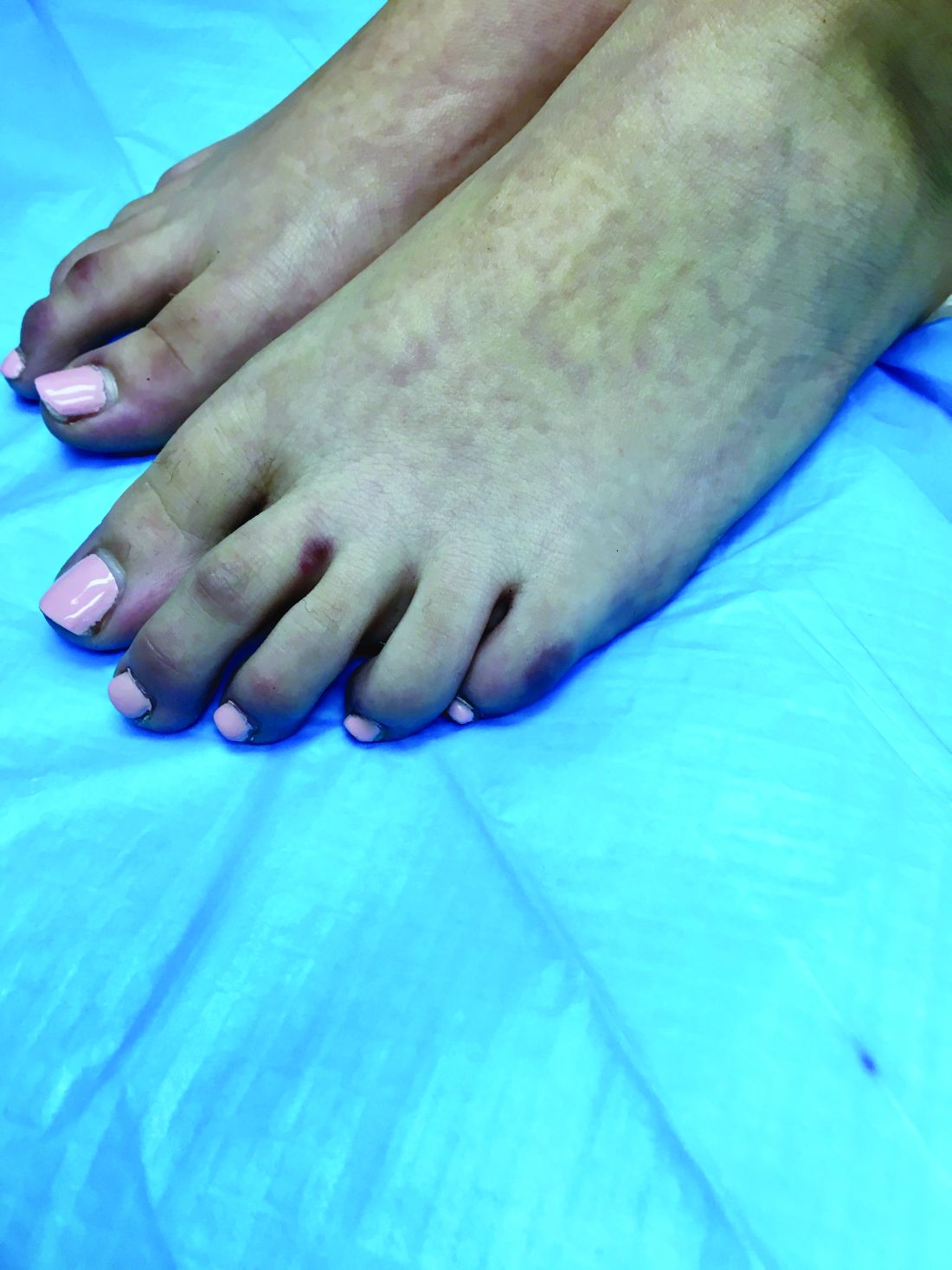
Up-close view of climate change proves sobering
Dr. Carl Bell steps away from American College of Psychiatrists meeting and gets a jolt
It used to be difficult to conceive of writing about climate change in light of the illnesses we psychiatrists treat. But talking about climate change has become unavoidable. Sometimes, it seems that things weigh heavy on my heart, and I have to write about them – especially when it is serious.

David Alan Pollack, MD, has been talking about climate change for some years now, and while I understood his concern, I had yet to see the psychological effects up close and personal. After all, I live in Chicago, and we are surrounded by concrete and asphalt.
Thankfully, I also travel, and I get a chance to get into nature. While in Hawaii at the American College of Psychiatrists annual meeting in February, I went snorkeling in Hanauma Bay. I saw coral and fish. The problem is I have a very vivid memories of snorkeling in that exact same nature preserve, which also was a Marine Life Conservation District in 1972 while I was attending the American Psychiatric Association annual meeting.
The contrast between the two experiences leaves me with a glum, sad, disappointed, heart-broken feeling because it was an intimate and personal experience with climate change. In 1972, I saw every type of coral imaginable: brain coral, club finger coral, elk coral, great star coral, pillar coral, staghorn coral, table coral, and tube coral. If I remember correctly, there were corky sea fingers and sea fans, but not sea turtles. In 1972, I saw bigeyefish, damselfish, doctorfish, filefish, goatfish, gobies, hogfish, lemon butterflyfish, lizardfish, parrottfish, porcupinefish, pufferfish, queen angelfish, rock beauties, sergeant majors, soldierfish, spot-tail spot-tail butterflyfish, Spanish hogfish, squirrelfish, tangs, trunkfish, or any bluehead or yellowhead wrasses.
In 2019, I saw two pieces of coral less that 9 inches in diameter and not a single sea urchin. There were maybe three types of tropical fish that I was unfamiliar with seeing. The difference between what I saw in 1972 and what I saw in 2019 was like the difference between the rain forest in Puerto Rico and the dunes of the Sahara Desert.
Sure, I have heard David talk about the mental health effects of climate change on stress, anxiety, and depression, and I have always thought that he was right. But to see climate change up close and personal is a sobering experience. I apologize to them for being part of the system and process that is destroying the planet – and leaving them with a hot mess.
At this point, it seems to me that we cannot just try to save the planet by being better stewards of our garbage and pointing out measurable indicators of climate change. We need to actively rather than passively try to save the planet. Of course, the question is who will pay for the active efforts to depollute Earth. From what I saw for myself in Hanauma Bay, I don’t think we have much time. So I am hoping that more people will take the issue of climate change seriously.
Dr. Bell is a staff psychiatrist at Jackson Park Hospital’s Medical/Surgical-Psychiatry Inpatient Unit in Chicago, clinical psychiatrist emeritus in the department of psychiatry at the University of Illinois at Chicago, former president/CEO of Community Mental Health Council, and former director of the Institute for Juvenile Research (birthplace of child psychiatry), also in Chicago. Check out Dr. Bell’s new book, “Fetal Alcohol Exposure in the African-American Community,” at https://thirdworldpressfoundation.org/product/pre-order-fetal-alcohol-exposure-in-the-african-american-community/.
Dr. Carl Bell steps away from American College of Psychiatrists meeting and gets a jolt
Dr. Carl Bell steps away from American College of Psychiatrists meeting and gets a jolt
It used to be difficult to conceive of writing about climate change in light of the illnesses we psychiatrists treat. But talking about climate change has become unavoidable. Sometimes, it seems that things weigh heavy on my heart, and I have to write about them – especially when it is serious.
David Alan Pollack, MD, has been talking about climate change for some years now, and while I understood his concern, I had yet to see the psychological effects up close and personal. After all, I live in Chicago, and we are surrounded by concrete and asphalt.
Thankfully, I also travel, and I get a chance to get into nature. While in Hawaii at the American College of Psychiatrists annual meeting in February, I went snorkeling in Hanauma Bay. I saw coral and fish. The problem is I have a very vivid memories of snorkeling in that exact same nature preserve, which also was a Marine Life Conservation District in 1972 while I was attending the American Psychiatric Association annual meeting.
The contrast between the two experiences leaves me with a glum, sad, disappointed, heart-broken feeling because it was an intimate and personal experience with climate change. In 1972, I saw every type of coral imaginable: brain coral, club finger coral, elk coral, great star coral, pillar coral, staghorn coral, table coral, and tube coral. If I remember correctly, there were corky sea fingers and sea fans, but not sea turtles. In 1972, I saw bigeyefish, damselfish, doctorfish, filefish, goatfish, gobies, hogfish, lemon butterflyfish, lizardfish, parrottfish, porcupinefish, pufferfish, queen angelfish, rock beauties, sergeant majors, soldierfish, spot-tail spot-tail butterflyfish, Spanish hogfish, squirrelfish, tangs, trunkfish, or any bluehead or yellowhead wrasses.
In 2019, I saw two pieces of coral less that 9 inches in diameter and not a single sea urchin. There were maybe three types of tropical fish that I was unfamiliar with seeing. The difference between what I saw in 1972 and what I saw in 2019 was like the difference between the rain forest in Puerto Rico and the dunes of the Sahara Desert.
Sure, I have heard David talk about the mental health effects of climate change on stress, anxiety, and depression, and I have always thought that he was right. But to see climate change up close and personal is a sobering experience. I apologize to them for being part of the system and process that is destroying the planet – and leaving them with a hot mess.
At this point, it seems to me that we cannot just try to save the planet by being better stewards of our garbage and pointing out measurable indicators of climate change. We need to actively rather than passively try to save the planet. Of course, the question is who will pay for the active efforts to depollute Earth. From what I saw for myself in Hanauma Bay, I don’t think we have much time. So I am hoping that more people will take the issue of climate change seriously.
Dr. Bell is a staff psychiatrist at Jackson Park Hospital’s Medical/Surgical-Psychiatry Inpatient Unit in Chicago, clinical psychiatrist emeritus in the department of psychiatry at the University of Illinois at Chicago, former president/CEO of Community Mental Health Council, and former director of the Institute for Juvenile Research (birthplace of child psychiatry), also in Chicago. Check out Dr. Bell’s new book, “Fetal Alcohol Exposure in the African-American Community,” at https://thirdworldpressfoundation.org/product/pre-order-fetal-alcohol-exposure-in-the-african-american-community/.
It used to be difficult to conceive of writing about climate change in light of the illnesses we psychiatrists treat. But talking about climate change has become unavoidable. Sometimes, it seems that things weigh heavy on my heart, and I have to write about them – especially when it is serious.
David Alan Pollack, MD, has been talking about climate change for some years now, and while I understood his concern, I had yet to see the psychological effects up close and personal. After all, I live in Chicago, and we are surrounded by concrete and asphalt.
Thankfully, I also travel, and I get a chance to get into nature. While in Hawaii at the American College of Psychiatrists annual meeting in February, I went snorkeling in Hanauma Bay. I saw coral and fish. The problem is I have a very vivid memories of snorkeling in that exact same nature preserve, which also was a Marine Life Conservation District in 1972 while I was attending the American Psychiatric Association annual meeting.
The contrast between the two experiences leaves me with a glum, sad, disappointed, heart-broken feeling because it was an intimate and personal experience with climate change. In 1972, I saw every type of coral imaginable: brain coral, club finger coral, elk coral, great star coral, pillar coral, staghorn coral, table coral, and tube coral. If I remember correctly, there were corky sea fingers and sea fans, but not sea turtles. In 1972, I saw bigeyefish, damselfish, doctorfish, filefish, goatfish, gobies, hogfish, lemon butterflyfish, lizardfish, parrottfish, porcupinefish, pufferfish, queen angelfish, rock beauties, sergeant majors, soldierfish, spot-tail spot-tail butterflyfish, Spanish hogfish, squirrelfish, tangs, trunkfish, or any bluehead or yellowhead wrasses.
In 2019, I saw two pieces of coral less that 9 inches in diameter and not a single sea urchin. There were maybe three types of tropical fish that I was unfamiliar with seeing. The difference between what I saw in 1972 and what I saw in 2019 was like the difference between the rain forest in Puerto Rico and the dunes of the Sahara Desert.
Sure, I have heard David talk about the mental health effects of climate change on stress, anxiety, and depression, and I have always thought that he was right. But to see climate change up close and personal is a sobering experience. I apologize to them for being part of the system and process that is destroying the planet – and leaving them with a hot mess.
At this point, it seems to me that we cannot just try to save the planet by being better stewards of our garbage and pointing out measurable indicators of climate change. We need to actively rather than passively try to save the planet. Of course, the question is who will pay for the active efforts to depollute Earth. From what I saw for myself in Hanauma Bay, I don’t think we have much time. So I am hoping that more people will take the issue of climate change seriously.
Dr. Bell is a staff psychiatrist at Jackson Park Hospital’s Medical/Surgical-Psychiatry Inpatient Unit in Chicago, clinical psychiatrist emeritus in the department of psychiatry at the University of Illinois at Chicago, former president/CEO of Community Mental Health Council, and former director of the Institute for Juvenile Research (birthplace of child psychiatry), also in Chicago. Check out Dr. Bell’s new book, “Fetal Alcohol Exposure in the African-American Community,” at https://thirdworldpressfoundation.org/product/pre-order-fetal-alcohol-exposure-in-the-african-american-community/.
Hope for hyperhidrosis
Hyperhidrosis – excessive sweating – is one of those diagnoses that make most physicians cringe because we know that the side effects of most of the common treatments are very limiting and patients continue to be frustrated. New treatments are emerging, and although oxybutynin is not Food and Drug Administration–approved for hyperhidrosis, it does show promise.

Primary hyperhidrosis is the excessive sweating from the axilla, palms, soles, or cranial-facial area. It is a clinical diagnosis that has been occurring for more than 6 months and meets at least four1 of the following criteria:
1. It occurs in eccrine dense areas (axilla, soles, palms or head).
2. It is bilateral and symmetrical.
3. It is absent nocturnally.
4. Its onset should be before age 25 years.
5. It occurs at least weekly.
6. There is a positive family history.
7. It impairs daily activities.
If signs of underlying disease are apparent – such as palpitations, night sweats, weight loss, unilateral symptoms, anxiety, or hypertension – further workup is needed to rule out disorders such as diabetes, hyperthyroidism, pheochromocytoma, or peripheral nerve injury.1
The pathophysiology of hyperhidrosis is not clearly understood. It is believed to be due to increased cholinergic stimulation given that there is no hypertrophy or hyperplasia of the sweat gland.2 Genetics appear to play a role as there is usually a family history of the disorder.2
Topical treatments are usually first line, starting with aluminum chloride antiperspirants, or anticholinergic creams such as glycopyrrolate or glycopyrronium. Unfortunately, many patients complain of the skin irritation so they discontinue their use.1
Botulinum toxin type A is a very safe and effective way of treating hyperhidrosis and is FDA approved for that purpose.3 Its drawbacks are that it is an injection (approximately 25 in each armpit), and it is very costly, usually $1,000-1,500 per session for both underarms. There are no major side effects, and reduction in sweating lasts for 4-12 months, with a median of 6 months.3
Oral treatment of hyperhidrosis, with medications such as glycopyrrolate and benztropine, has been reserved for second- or third-line treatment because of the unwanted side effects of dry mouth and drowsiness. But more recent studies are showing favorable outcomes with oxybutynin.1
Oxybutynin is well known and FDA approved for treatment of urinary frequency, incontinence, and enuresis. Recent studies have shown great success for use to control generalized hyperhidrosis. The mechanism of action is blocking the binding of acetylcholine and numerous other neurotransmitters.2
The literature does not give clear-cut dosing because it is not approved for hyperhidrosis, but gradually increasing doses starting at 2.5 mg daily for a week, then increasing to twice daily for 2 weeks, and then to 5 mg twice daily as a continued dose appears to be the most effective regimen with few side effects. The dosage can be increased, but increased side effects are noted with doses reaching 15 mg/day.1,2

Oxybutynin is not FDA approved for the treatment of hyperhidrosis, but it is an inexpensive drug, which makes it a viable option for use off label given all of the current research with positive outcomes.
It should be noted that if patients have any urinary retention, gastric motility issues, or narrow angle glaucoma, oxybutynin is contraindicated.
More studies are on the horizon, but finally there is hope for hyperhidrosis.
Dr. Pearce is a pediatrician in Frankfort, Ill. She said she had no relevant financial disclosures. Email her at [email protected].
References
1. Skin Appendage Disord. 2015 Mar;1(1):6-13.
2. An Bras Dermatol. 2017 Mar-Apr;92(2):217-20.
3. ISRN Dermatol. 2012. doi: 10.5402/2012/702714.
Hyperhidrosis – excessive sweating – is one of those diagnoses that make most physicians cringe because we know that the side effects of most of the common treatments are very limiting and patients continue to be frustrated. New treatments are emerging, and although oxybutynin is not Food and Drug Administration–approved for hyperhidrosis, it does show promise.
Primary hyperhidrosis is the excessive sweating from the axilla, palms, soles, or cranial-facial area. It is a clinical diagnosis that has been occurring for more than 6 months and meets at least four1 of the following criteria:
1. It occurs in eccrine dense areas (axilla, soles, palms or head).
2. It is bilateral and symmetrical.
3. It is absent nocturnally.
4. Its onset should be before age 25 years.
5. It occurs at least weekly.
6. There is a positive family history.
7. It impairs daily activities.
If signs of underlying disease are apparent – such as palpitations, night sweats, weight loss, unilateral symptoms, anxiety, or hypertension – further workup is needed to rule out disorders such as diabetes, hyperthyroidism, pheochromocytoma, or peripheral nerve injury.1
The pathophysiology of hyperhidrosis is not clearly understood. It is believed to be due to increased cholinergic stimulation given that there is no hypertrophy or hyperplasia of the sweat gland.2 Genetics appear to play a role as there is usually a family history of the disorder.2
Topical treatments are usually first line, starting with aluminum chloride antiperspirants, or anticholinergic creams such as glycopyrrolate or glycopyrronium. Unfortunately, many patients complain of the skin irritation so they discontinue their use.1
Botulinum toxin type A is a very safe and effective way of treating hyperhidrosis and is FDA approved for that purpose.3 Its drawbacks are that it is an injection (approximately 25 in each armpit), and it is very costly, usually $1,000-1,500 per session for both underarms. There are no major side effects, and reduction in sweating lasts for 4-12 months, with a median of 6 months.3
Oral treatment of hyperhidrosis, with medications such as glycopyrrolate and benztropine, has been reserved for second- or third-line treatment because of the unwanted side effects of dry mouth and drowsiness. But more recent studies are showing favorable outcomes with oxybutynin.1
Oxybutynin is well known and FDA approved for treatment of urinary frequency, incontinence, and enuresis. Recent studies have shown great success for use to control generalized hyperhidrosis. The mechanism of action is blocking the binding of acetylcholine and numerous other neurotransmitters.2
The literature does not give clear-cut dosing because it is not approved for hyperhidrosis, but gradually increasing doses starting at 2.5 mg daily for a week, then increasing to twice daily for 2 weeks, and then to 5 mg twice daily as a continued dose appears to be the most effective regimen with few side effects. The dosage can be increased, but increased side effects are noted with doses reaching 15 mg/day.1,2
Oxybutynin is not FDA approved for the treatment of hyperhidrosis, but it is an inexpensive drug, which makes it a viable option for use off label given all of the current research with positive outcomes.
It should be noted that if patients have any urinary retention, gastric motility issues, or narrow angle glaucoma, oxybutynin is contraindicated.
More studies are on the horizon, but finally there is hope for hyperhidrosis.
Dr. Pearce is a pediatrician in Frankfort, Ill. She said she had no relevant financial disclosures. Email her at [email protected].
References
1. Skin Appendage Disord. 2015 Mar;1(1):6-13.
2. An Bras Dermatol. 2017 Mar-Apr;92(2):217-20.
3. ISRN Dermatol. 2012. doi: 10.5402/2012/702714.
Hyperhidrosis – excessive sweating – is one of those diagnoses that make most physicians cringe because we know that the side effects of most of the common treatments are very limiting and patients continue to be frustrated. New treatments are emerging, and although oxybutynin is not Food and Drug Administration–approved for hyperhidrosis, it does show promise.
Primary hyperhidrosis is the excessive sweating from the axilla, palms, soles, or cranial-facial area. It is a clinical diagnosis that has been occurring for more than 6 months and meets at least four1 of the following criteria:
1. It occurs in eccrine dense areas (axilla, soles, palms or head).
2. It is bilateral and symmetrical.
3. It is absent nocturnally.
4. Its onset should be before age 25 years.
5. It occurs at least weekly.
6. There is a positive family history.
7. It impairs daily activities.
If signs of underlying disease are apparent – such as palpitations, night sweats, weight loss, unilateral symptoms, anxiety, or hypertension – further workup is needed to rule out disorders such as diabetes, hyperthyroidism, pheochromocytoma, or peripheral nerve injury.1
The pathophysiology of hyperhidrosis is not clearly understood. It is believed to be due to increased cholinergic stimulation given that there is no hypertrophy or hyperplasia of the sweat gland.2 Genetics appear to play a role as there is usually a family history of the disorder.2
Topical treatments are usually first line, starting with aluminum chloride antiperspirants, or anticholinergic creams such as glycopyrrolate or glycopyrronium. Unfortunately, many patients complain of the skin irritation so they discontinue their use.1
Botulinum toxin type A is a very safe and effective way of treating hyperhidrosis and is FDA approved for that purpose.3 Its drawbacks are that it is an injection (approximately 25 in each armpit), and it is very costly, usually $1,000-1,500 per session for both underarms. There are no major side effects, and reduction in sweating lasts for 4-12 months, with a median of 6 months.3
Oral treatment of hyperhidrosis, with medications such as glycopyrrolate and benztropine, has been reserved for second- or third-line treatment because of the unwanted side effects of dry mouth and drowsiness. But more recent studies are showing favorable outcomes with oxybutynin.1
Oxybutynin is well known and FDA approved for treatment of urinary frequency, incontinence, and enuresis. Recent studies have shown great success for use to control generalized hyperhidrosis. The mechanism of action is blocking the binding of acetylcholine and numerous other neurotransmitters.2
The literature does not give clear-cut dosing because it is not approved for hyperhidrosis, but gradually increasing doses starting at 2.5 mg daily for a week, then increasing to twice daily for 2 weeks, and then to 5 mg twice daily as a continued dose appears to be the most effective regimen with few side effects. The dosage can be increased, but increased side effects are noted with doses reaching 15 mg/day.1,2
Oxybutynin is not FDA approved for the treatment of hyperhidrosis, but it is an inexpensive drug, which makes it a viable option for use off label given all of the current research with positive outcomes.
It should be noted that if patients have any urinary retention, gastric motility issues, or narrow angle glaucoma, oxybutynin is contraindicated.
More studies are on the horizon, but finally there is hope for hyperhidrosis.
Dr. Pearce is a pediatrician in Frankfort, Ill. She said she had no relevant financial disclosures. Email her at [email protected].
References
1. Skin Appendage Disord. 2015 Mar;1(1):6-13.
2. An Bras Dermatol. 2017 Mar-Apr;92(2):217-20.
3. ISRN Dermatol. 2012. doi: 10.5402/2012/702714.