User login
VIDEO: Lyme disease spreading, but better testing may be coming
SANDESTIN, FLA. – Lyme disease is spreading in the United States, which makes it a high priority for rheumatologists, who will need to care for an increasing number of patients with posttreatment disorders affecting the joints, an expert said at the annual Congress of Clinical Rheumatology.
Sheila Arvikar, MD, an instructor in the rheumatology division at Harvard Medical School, Boston, said that the disease – the most common vector-borne illness in the United States – is no longer strictly confined to the U.S. Northeast and the upper Midwest, according to reports from the Centers for Disease Control and Prevention. Neighboring areas are increasingly affected, the reports have shown.
The video associated with this article is no longer available on this site. Please view all of our videos on the MDedge YouTube channel
That the disease may be spreading makes the need for awareness and better testing more acute, she said. Current testing is limited by a lack of sensitivity in early disease, and the standard two-tier combination of enzyme-linked immunosorbent assay and Western blot can be time consuming. But recent studies have found that whole cell sonicate ELISA combined with an ELISA for peptide C6 are equally or even more effective than the more cumbersome, two-tier version, Dr. Arvikar said.
A problem encountered by rheumatologists are patients who contracted Lyme disease but who continue to have joint pain and other symptoms despite treatment for the disease. This so-called posttreatment Lyme disease syndrome (PTLDS) can be similar to fibromyalgia or chronic fatigue syndrome, involving chronic symptoms but no chronic infection and no objective synovitis or inflammation.
There are no Food and Drug Administration–approved treatments for it, but options such as tricyclics, serotonin norepinephrine reuptake inhibitors, gabapentin, and pregabalin can be helpful, she said, along with exercise and cognitive-behavioral therapy. She also noted myriad alternative treatments marketed for PTLDS that have not been shown to be effective and can even be harmful, such as urine ingestion and treatment with bee venom.
“These patients are really desperate for anything to help with their symptoms, and there are lot of people out there who are preying on them with these therapies that aren’t really helpful. It’s important for us to be aware that these things are out there.”
Dr. Arvikar reported having no financial disclosures.
SOURCE: Arvikar S, CCR 2018.
SANDESTIN, FLA. – Lyme disease is spreading in the United States, which makes it a high priority for rheumatologists, who will need to care for an increasing number of patients with posttreatment disorders affecting the joints, an expert said at the annual Congress of Clinical Rheumatology.
Sheila Arvikar, MD, an instructor in the rheumatology division at Harvard Medical School, Boston, said that the disease – the most common vector-borne illness in the United States – is no longer strictly confined to the U.S. Northeast and the upper Midwest, according to reports from the Centers for Disease Control and Prevention. Neighboring areas are increasingly affected, the reports have shown.
The video associated with this article is no longer available on this site. Please view all of our videos on the MDedge YouTube channel
That the disease may be spreading makes the need for awareness and better testing more acute, she said. Current testing is limited by a lack of sensitivity in early disease, and the standard two-tier combination of enzyme-linked immunosorbent assay and Western blot can be time consuming. But recent studies have found that whole cell sonicate ELISA combined with an ELISA for peptide C6 are equally or even more effective than the more cumbersome, two-tier version, Dr. Arvikar said.
A problem encountered by rheumatologists are patients who contracted Lyme disease but who continue to have joint pain and other symptoms despite treatment for the disease. This so-called posttreatment Lyme disease syndrome (PTLDS) can be similar to fibromyalgia or chronic fatigue syndrome, involving chronic symptoms but no chronic infection and no objective synovitis or inflammation.
There are no Food and Drug Administration–approved treatments for it, but options such as tricyclics, serotonin norepinephrine reuptake inhibitors, gabapentin, and pregabalin can be helpful, she said, along with exercise and cognitive-behavioral therapy. She also noted myriad alternative treatments marketed for PTLDS that have not been shown to be effective and can even be harmful, such as urine ingestion and treatment with bee venom.
“These patients are really desperate for anything to help with their symptoms, and there are lot of people out there who are preying on them with these therapies that aren’t really helpful. It’s important for us to be aware that these things are out there.”
Dr. Arvikar reported having no financial disclosures.
SOURCE: Arvikar S, CCR 2018.
SANDESTIN, FLA. – Lyme disease is spreading in the United States, which makes it a high priority for rheumatologists, who will need to care for an increasing number of patients with posttreatment disorders affecting the joints, an expert said at the annual Congress of Clinical Rheumatology.
Sheila Arvikar, MD, an instructor in the rheumatology division at Harvard Medical School, Boston, said that the disease – the most common vector-borne illness in the United States – is no longer strictly confined to the U.S. Northeast and the upper Midwest, according to reports from the Centers for Disease Control and Prevention. Neighboring areas are increasingly affected, the reports have shown.
The video associated with this article is no longer available on this site. Please view all of our videos on the MDedge YouTube channel
That the disease may be spreading makes the need for awareness and better testing more acute, she said. Current testing is limited by a lack of sensitivity in early disease, and the standard two-tier combination of enzyme-linked immunosorbent assay and Western blot can be time consuming. But recent studies have found that whole cell sonicate ELISA combined with an ELISA for peptide C6 are equally or even more effective than the more cumbersome, two-tier version, Dr. Arvikar said.
A problem encountered by rheumatologists are patients who contracted Lyme disease but who continue to have joint pain and other symptoms despite treatment for the disease. This so-called posttreatment Lyme disease syndrome (PTLDS) can be similar to fibromyalgia or chronic fatigue syndrome, involving chronic symptoms but no chronic infection and no objective synovitis or inflammation.
There are no Food and Drug Administration–approved treatments for it, but options such as tricyclics, serotonin norepinephrine reuptake inhibitors, gabapentin, and pregabalin can be helpful, she said, along with exercise and cognitive-behavioral therapy. She also noted myriad alternative treatments marketed for PTLDS that have not been shown to be effective and can even be harmful, such as urine ingestion and treatment with bee venom.
“These patients are really desperate for anything to help with their symptoms, and there are lot of people out there who are preying on them with these therapies that aren’t really helpful. It’s important for us to be aware that these things are out there.”
Dr. Arvikar reported having no financial disclosures.
SOURCE: Arvikar S, CCR 2018.
EXPERT ANALYSIS AT CCR 18

VIDEO: Dual studies seek answers in isolated skin vasculitis
SANDESTIN, FLA. – Patients with isolated skin vasculitis have always faced a frustrating clinical problem with no clear solution.
The video associated with this article is no longer available on this site. Please view all of our videos on the MDedge YouTube channel
ARAMIS (A Randomized Multicenter Study for Isolated Skin Vasculitis) and its linked genetic investigation, CUTIS (Clinical Transcriptomics in Systemic Vasculitis), may finally identify not only optimal treatments but also insight into the root causes and predictors of treatment response, Christian Pagnoux, MD, said at the annual Congress of Clinical Rheumatology.
“Isolated skin vasculitis is a much-understudied disease, with only one clinical trial to guide our treatment,” said Dr. Pagnoux of the Mount Sinai Hospital, Toronto. In 1995, a 3-month trial randomized 41 patients to skin emollients or to colchicine 0.5 mg/day. Colchicine wasn’t significantly better, but some who had attained remission on it relapsed after discontinuing the drug, which suggested there might be some benefit (Arch Dermatol. 1995;131[12]:1399-1402).
That hint of efficacy in just three patients 23 years ago forms the sole basis of the typical treatment for this disorder: colchicine, Dr. Pagnoux said. “We know that it doesn’t work, yet we continue to prescribe it. Patients deserve better.”
ARAMIS and CUTIS are the first attempts since then at solving this puzzle. ARAMIS is now recruiting about 90 patients in 10 North American medical centers. The three-armed crossover trial will randomize patients to colchicine 0.6 mg twice a day, dapsone 150 mg/day, or azathioprine 2 mg/kg per day for 6 months. Nonresponders can then be rerandomized to one of the other two study drugs for another 6 months. The primary endpoint is clinical response. Secondary endpoints include changes in physician and patient global assessment of response, Skindex29 score, health-related quality of life, and the Patient-Reported Outcomes Measurement Information System.
ARAMIS patients may also participate in CUTIS, the linked histopathologic and genetic investigation. More broad-ranging than ARAMIS, CUTIS is seeking 50 patients with several forms of idiopathic vasculitis, including cryoglobulinemic vasculitis, drug-induced vasculitis, eosinophilic granulomatosis with polyangiitis, IgA vasculitis, isolated cutaneous vasculitis, granulomatosis with polyangiitis, microscopic polyangiitis, polyarteritis nodosa, and urticarial vasculitis.
The study will examine histopathologic and transcriptomic characteristics in punch biopsies of the lesions. “We very much hope that gene expression profiling on these lesions will help define novel pathways and help us to classify and target therapies,” Dr. Pagnoux said.
To learn more about these studies and refer patients into them, visit the Rare Disease Network pages for ARAMIS and CUTIS.
Dr. Pagnoux had no financial disclosures relevant to either study.
SOURCE: Pagnoux C. CCR 2018
SANDESTIN, FLA. – Patients with isolated skin vasculitis have always faced a frustrating clinical problem with no clear solution.
The video associated with this article is no longer available on this site. Please view all of our videos on the MDedge YouTube channel
ARAMIS (A Randomized Multicenter Study for Isolated Skin Vasculitis) and its linked genetic investigation, CUTIS (Clinical Transcriptomics in Systemic Vasculitis), may finally identify not only optimal treatments but also insight into the root causes and predictors of treatment response, Christian Pagnoux, MD, said at the annual Congress of Clinical Rheumatology.
“Isolated skin vasculitis is a much-understudied disease, with only one clinical trial to guide our treatment,” said Dr. Pagnoux of the Mount Sinai Hospital, Toronto. In 1995, a 3-month trial randomized 41 patients to skin emollients or to colchicine 0.5 mg/day. Colchicine wasn’t significantly better, but some who had attained remission on it relapsed after discontinuing the drug, which suggested there might be some benefit (Arch Dermatol. 1995;131[12]:1399-1402).
That hint of efficacy in just three patients 23 years ago forms the sole basis of the typical treatment for this disorder: colchicine, Dr. Pagnoux said. “We know that it doesn’t work, yet we continue to prescribe it. Patients deserve better.”
ARAMIS and CUTIS are the first attempts since then at solving this puzzle. ARAMIS is now recruiting about 90 patients in 10 North American medical centers. The three-armed crossover trial will randomize patients to colchicine 0.6 mg twice a day, dapsone 150 mg/day, or azathioprine 2 mg/kg per day for 6 months. Nonresponders can then be rerandomized to one of the other two study drugs for another 6 months. The primary endpoint is clinical response. Secondary endpoints include changes in physician and patient global assessment of response, Skindex29 score, health-related quality of life, and the Patient-Reported Outcomes Measurement Information System.
ARAMIS patients may also participate in CUTIS, the linked histopathologic and genetic investigation. More broad-ranging than ARAMIS, CUTIS is seeking 50 patients with several forms of idiopathic vasculitis, including cryoglobulinemic vasculitis, drug-induced vasculitis, eosinophilic granulomatosis with polyangiitis, IgA vasculitis, isolated cutaneous vasculitis, granulomatosis with polyangiitis, microscopic polyangiitis, polyarteritis nodosa, and urticarial vasculitis.
The study will examine histopathologic and transcriptomic characteristics in punch biopsies of the lesions. “We very much hope that gene expression profiling on these lesions will help define novel pathways and help us to classify and target therapies,” Dr. Pagnoux said.
To learn more about these studies and refer patients into them, visit the Rare Disease Network pages for ARAMIS and CUTIS.
Dr. Pagnoux had no financial disclosures relevant to either study.
SOURCE: Pagnoux C. CCR 2018
SANDESTIN, FLA. – Patients with isolated skin vasculitis have always faced a frustrating clinical problem with no clear solution.
The video associated with this article is no longer available on this site. Please view all of our videos on the MDedge YouTube channel
ARAMIS (A Randomized Multicenter Study for Isolated Skin Vasculitis) and its linked genetic investigation, CUTIS (Clinical Transcriptomics in Systemic Vasculitis), may finally identify not only optimal treatments but also insight into the root causes and predictors of treatment response, Christian Pagnoux, MD, said at the annual Congress of Clinical Rheumatology.
“Isolated skin vasculitis is a much-understudied disease, with only one clinical trial to guide our treatment,” said Dr. Pagnoux of the Mount Sinai Hospital, Toronto. In 1995, a 3-month trial randomized 41 patients to skin emollients or to colchicine 0.5 mg/day. Colchicine wasn’t significantly better, but some who had attained remission on it relapsed after discontinuing the drug, which suggested there might be some benefit (Arch Dermatol. 1995;131[12]:1399-1402).
That hint of efficacy in just three patients 23 years ago forms the sole basis of the typical treatment for this disorder: colchicine, Dr. Pagnoux said. “We know that it doesn’t work, yet we continue to prescribe it. Patients deserve better.”
ARAMIS and CUTIS are the first attempts since then at solving this puzzle. ARAMIS is now recruiting about 90 patients in 10 North American medical centers. The three-armed crossover trial will randomize patients to colchicine 0.6 mg twice a day, dapsone 150 mg/day, or azathioprine 2 mg/kg per day for 6 months. Nonresponders can then be rerandomized to one of the other two study drugs for another 6 months. The primary endpoint is clinical response. Secondary endpoints include changes in physician and patient global assessment of response, Skindex29 score, health-related quality of life, and the Patient-Reported Outcomes Measurement Information System.
ARAMIS patients may also participate in CUTIS, the linked histopathologic and genetic investigation. More broad-ranging than ARAMIS, CUTIS is seeking 50 patients with several forms of idiopathic vasculitis, including cryoglobulinemic vasculitis, drug-induced vasculitis, eosinophilic granulomatosis with polyangiitis, IgA vasculitis, isolated cutaneous vasculitis, granulomatosis with polyangiitis, microscopic polyangiitis, polyarteritis nodosa, and urticarial vasculitis.
The study will examine histopathologic and transcriptomic characteristics in punch biopsies of the lesions. “We very much hope that gene expression profiling on these lesions will help define novel pathways and help us to classify and target therapies,” Dr. Pagnoux said.
To learn more about these studies and refer patients into them, visit the Rare Disease Network pages for ARAMIS and CUTIS.
Dr. Pagnoux had no financial disclosures relevant to either study.
SOURCE: Pagnoux C. CCR 2018
REPORTING FROM CCR 18

VIDEO: Big Data, self-diagnosis to play role in future of RA, expert says
SANDESTIN, FLA. – Big data informing patient treatment, computer algorithms reading imaging instead of humans, and even accurate patient self-diagnosis could emerge over the next 10 years in the treatment of rheumatoid arthritis, an expert said at the annual Congress of Clinical Rheumatology.
The video associated with this article is no longer available on this site. Please view all of our videos on the MDedge YouTube channel
Gerd Burmester, MD, director of rheumatology and clinical immunology at Charité University in Berlin, trotted out staggering numbers on future medical data collection on patients. Data analytics companies project that more than 1,000 terabytes of data per lifetime is expected to be gathered, with just 10% expected to be clinical information and 30% in the form of “-omics,” such as proteomics and genomics, he said. The other 60% is expected to come from sensors and wearables that patients essentially collect themselves with their own devices, he said.
“We will have to use data in the interest of the patient,” he said. “This is the real secret. In order to do this, we need cognitive computing, which assesses structured and unstructured data and is self-learning.”
The days of images being read by human radiologists could be numbered, he said.
“There will be a revolution in imaging scoring,” he said, with computer algorithms generating scores, more quickly separating the normal scans from those that need clinical attention.
He described a possible scenario in which patients get genetic analyses, blood biomarker testing, and imaging performed at kiosks about town, producing a diagnosis without a single physician visit. It might seem fanciful, but when he asked the audience how many thought it was impossible over the next decade, no one raised a hand.
With advances such as the self-rheumatoid arthritis examination tool Rheuma-Check and the decline in cost for whole genome sequencing – along with wait times to see rheumatologists sometimes as long as 6 months – such a scenario might not be far fetched, Dr. Burmester said. It is possible, he said, because patient histories that used to sit in charts, images that used to be on film only, and genetic data that used to be unavailable, are all now in structured, digital form.
Referring to a recent commentary in the New England Journal of Medicine, Dr. Burmester said physicians have to accept the coming role of computer algorithms.
“If medicine wishes to stay in control of its own future,” he said, “physicians will not only have to embrace algorithms, they will also have to excel at developing and evaluating them, bringing machine-learning methods into the medical domain.”
SOURCE: Burmester, G. CCR 2018.
SANDESTIN, FLA. – Big data informing patient treatment, computer algorithms reading imaging instead of humans, and even accurate patient self-diagnosis could emerge over the next 10 years in the treatment of rheumatoid arthritis, an expert said at the annual Congress of Clinical Rheumatology.
The video associated with this article is no longer available on this site. Please view all of our videos on the MDedge YouTube channel
Gerd Burmester, MD, director of rheumatology and clinical immunology at Charité University in Berlin, trotted out staggering numbers on future medical data collection on patients. Data analytics companies project that more than 1,000 terabytes of data per lifetime is expected to be gathered, with just 10% expected to be clinical information and 30% in the form of “-omics,” such as proteomics and genomics, he said. The other 60% is expected to come from sensors and wearables that patients essentially collect themselves with their own devices, he said.
“We will have to use data in the interest of the patient,” he said. “This is the real secret. In order to do this, we need cognitive computing, which assesses structured and unstructured data and is self-learning.”
The days of images being read by human radiologists could be numbered, he said.
“There will be a revolution in imaging scoring,” he said, with computer algorithms generating scores, more quickly separating the normal scans from those that need clinical attention.
He described a possible scenario in which patients get genetic analyses, blood biomarker testing, and imaging performed at kiosks about town, producing a diagnosis without a single physician visit. It might seem fanciful, but when he asked the audience how many thought it was impossible over the next decade, no one raised a hand.
With advances such as the self-rheumatoid arthritis examination tool Rheuma-Check and the decline in cost for whole genome sequencing – along with wait times to see rheumatologists sometimes as long as 6 months – such a scenario might not be far fetched, Dr. Burmester said. It is possible, he said, because patient histories that used to sit in charts, images that used to be on film only, and genetic data that used to be unavailable, are all now in structured, digital form.
Referring to a recent commentary in the New England Journal of Medicine, Dr. Burmester said physicians have to accept the coming role of computer algorithms.
“If medicine wishes to stay in control of its own future,” he said, “physicians will not only have to embrace algorithms, they will also have to excel at developing and evaluating them, bringing machine-learning methods into the medical domain.”
SOURCE: Burmester, G. CCR 2018.
SANDESTIN, FLA. – Big data informing patient treatment, computer algorithms reading imaging instead of humans, and even accurate patient self-diagnosis could emerge over the next 10 years in the treatment of rheumatoid arthritis, an expert said at the annual Congress of Clinical Rheumatology.
The video associated with this article is no longer available on this site. Please view all of our videos on the MDedge YouTube channel
Gerd Burmester, MD, director of rheumatology and clinical immunology at Charité University in Berlin, trotted out staggering numbers on future medical data collection on patients. Data analytics companies project that more than 1,000 terabytes of data per lifetime is expected to be gathered, with just 10% expected to be clinical information and 30% in the form of “-omics,” such as proteomics and genomics, he said. The other 60% is expected to come from sensors and wearables that patients essentially collect themselves with their own devices, he said.
“We will have to use data in the interest of the patient,” he said. “This is the real secret. In order to do this, we need cognitive computing, which assesses structured and unstructured data and is self-learning.”
The days of images being read by human radiologists could be numbered, he said.
“There will be a revolution in imaging scoring,” he said, with computer algorithms generating scores, more quickly separating the normal scans from those that need clinical attention.
He described a possible scenario in which patients get genetic analyses, blood biomarker testing, and imaging performed at kiosks about town, producing a diagnosis without a single physician visit. It might seem fanciful, but when he asked the audience how many thought it was impossible over the next decade, no one raised a hand.
With advances such as the self-rheumatoid arthritis examination tool Rheuma-Check and the decline in cost for whole genome sequencing – along with wait times to see rheumatologists sometimes as long as 6 months – such a scenario might not be far fetched, Dr. Burmester said. It is possible, he said, because patient histories that used to sit in charts, images that used to be on film only, and genetic data that used to be unavailable, are all now in structured, digital form.
Referring to a recent commentary in the New England Journal of Medicine, Dr. Burmester said physicians have to accept the coming role of computer algorithms.
“If medicine wishes to stay in control of its own future,” he said, “physicians will not only have to embrace algorithms, they will also have to excel at developing and evaluating them, bringing machine-learning methods into the medical domain.”
SOURCE: Burmester, G. CCR 2018.
EXPERT ANALYSIS AT CCR 18

VIDEO: First year after bariatric surgery critical for HbA1c improvement
BOSTON – Acute weight loss during the first year after bariatric surgery has a significant effect on hemoglobin A1c level improvement at 5 years’ follow-up, according to a study presented at the annual meeting of the American Association of Clinical Endocrinologists.
The data presented could help clinicians understand when and where to focus their efforts to help patients optimize weight loss in order to see the best long-term benefits of the procedure, according to presenter Keren Zhou, MD, an endocrinology fellow at the Cleveland Clinic.
“Clinicians need to really focus on that first year weight loss after bariatric surgery to try and optimize 5-year A1c outcomes,” said Dr. Zhou. “It also answers another question people have been having, which is how much does weight regain after bariatric surgery really matter? What we’ve been able to show here is that weight regain didn’t look very correlated at all.”
Dr. Zhou and her colleagues developed the ancillary study using data from the STAMPEDE (Surgical Treatment and Medications Potentially Eradicate Diabetes Efficiently) trial, specifically looking at 96 patients: 49 who underwent bariatric surgery and 47 who had a sleeve gastrectomy.
Patients were majority female, on average 48 years old, with a mean body mass index of 36.5 and HbA1c level of 9.4.
Overall, bariatric surgery patients lost an average of 27.2% in the first year, and regained around 8.2% from the first to fifth year, while sleeve gastrectomy lost and regained 25.1% and 9.4% respectively.
When comparing weight loss in the first year and HbA1c levels, Dr. Zhou and her colleagues found a significant correlation for both bariatric surgery and sleeve gastrectomy patients (r +.34; P = .0006).
“It was interesting because when we graphically represented the weight changes in addition to the A1c over time, we found that they actually correlated quite closely, but it was only when we did the statistical analysis on the numbers that we found that [in both groups] people who lost less weight had a higher A1c at the 5-year mark,” said Dr. Zhou.
In the non–multivariable analysis, however, investigators found a more significant correlation between weight regain and HbA1c levels in gastrectomy patients, however these findings changed when Dr. Zhou and her fellow investigators controlled for insulin use and baseline C-peptide.
In continuing studies, Dr. Zhou and her team will dive deeper into why these correlations exist, as right now they can only speculate.
Dr. Zhou reported no relevant financial disclosures.
SOURCE: Zhou K et al. AACE 18. Abstract 240-F.
BOSTON – Acute weight loss during the first year after bariatric surgery has a significant effect on hemoglobin A1c level improvement at 5 years’ follow-up, according to a study presented at the annual meeting of the American Association of Clinical Endocrinologists.
The data presented could help clinicians understand when and where to focus their efforts to help patients optimize weight loss in order to see the best long-term benefits of the procedure, according to presenter Keren Zhou, MD, an endocrinology fellow at the Cleveland Clinic.
“Clinicians need to really focus on that first year weight loss after bariatric surgery to try and optimize 5-year A1c outcomes,” said Dr. Zhou. “It also answers another question people have been having, which is how much does weight regain after bariatric surgery really matter? What we’ve been able to show here is that weight regain didn’t look very correlated at all.”
Dr. Zhou and her colleagues developed the ancillary study using data from the STAMPEDE (Surgical Treatment and Medications Potentially Eradicate Diabetes Efficiently) trial, specifically looking at 96 patients: 49 who underwent bariatric surgery and 47 who had a sleeve gastrectomy.
Patients were majority female, on average 48 years old, with a mean body mass index of 36.5 and HbA1c level of 9.4.
Overall, bariatric surgery patients lost an average of 27.2% in the first year, and regained around 8.2% from the first to fifth year, while sleeve gastrectomy lost and regained 25.1% and 9.4% respectively.
When comparing weight loss in the first year and HbA1c levels, Dr. Zhou and her colleagues found a significant correlation for both bariatric surgery and sleeve gastrectomy patients (r +.34; P = .0006).
“It was interesting because when we graphically represented the weight changes in addition to the A1c over time, we found that they actually correlated quite closely, but it was only when we did the statistical analysis on the numbers that we found that [in both groups] people who lost less weight had a higher A1c at the 5-year mark,” said Dr. Zhou.
In the non–multivariable analysis, however, investigators found a more significant correlation between weight regain and HbA1c levels in gastrectomy patients, however these findings changed when Dr. Zhou and her fellow investigators controlled for insulin use and baseline C-peptide.
In continuing studies, Dr. Zhou and her team will dive deeper into why these correlations exist, as right now they can only speculate.
Dr. Zhou reported no relevant financial disclosures.
SOURCE: Zhou K et al. AACE 18. Abstract 240-F.
BOSTON – Acute weight loss during the first year after bariatric surgery has a significant effect on hemoglobin A1c level improvement at 5 years’ follow-up, according to a study presented at the annual meeting of the American Association of Clinical Endocrinologists.
The data presented could help clinicians understand when and where to focus their efforts to help patients optimize weight loss in order to see the best long-term benefits of the procedure, according to presenter Keren Zhou, MD, an endocrinology fellow at the Cleveland Clinic.
“Clinicians need to really focus on that first year weight loss after bariatric surgery to try and optimize 5-year A1c outcomes,” said Dr. Zhou. “It also answers another question people have been having, which is how much does weight regain after bariatric surgery really matter? What we’ve been able to show here is that weight regain didn’t look very correlated at all.”
Dr. Zhou and her colleagues developed the ancillary study using data from the STAMPEDE (Surgical Treatment and Medications Potentially Eradicate Diabetes Efficiently) trial, specifically looking at 96 patients: 49 who underwent bariatric surgery and 47 who had a sleeve gastrectomy.
Patients were majority female, on average 48 years old, with a mean body mass index of 36.5 and HbA1c level of 9.4.
Overall, bariatric surgery patients lost an average of 27.2% in the first year, and regained around 8.2% from the first to fifth year, while sleeve gastrectomy lost and regained 25.1% and 9.4% respectively.
When comparing weight loss in the first year and HbA1c levels, Dr. Zhou and her colleagues found a significant correlation for both bariatric surgery and sleeve gastrectomy patients (r +.34; P = .0006).
“It was interesting because when we graphically represented the weight changes in addition to the A1c over time, we found that they actually correlated quite closely, but it was only when we did the statistical analysis on the numbers that we found that [in both groups] people who lost less weight had a higher A1c at the 5-year mark,” said Dr. Zhou.
In the non–multivariable analysis, however, investigators found a more significant correlation between weight regain and HbA1c levels in gastrectomy patients, however these findings changed when Dr. Zhou and her fellow investigators controlled for insulin use and baseline C-peptide.
In continuing studies, Dr. Zhou and her team will dive deeper into why these correlations exist, as right now they can only speculate.
Dr. Zhou reported no relevant financial disclosures.
SOURCE: Zhou K et al. AACE 18. Abstract 240-F.
REPORTING FROM AACE 18
Key clinical point:
Major finding: Change in weight within the first year was significantly correlated with lower HbA1c levels at 5 years (P = .0003).
Study details: Ancillary study of 96 patients who underwent either bariatric surgery or sleeve gastrectomy and participated in the STAMPEDE study.
Disclosures: Presenter reported no relevant financial disclosures.
Source: Zhou K et al. AACE 18. Abstract 240-F.

VIDEO: Half of after-hours calls to endocrinology fellows are nonurgent
Many calls to endocrinology fellows are often not urgent and could be directed to the clinic, potentially reducing work burden on the on-call fellows, a review of one center’s call logs suggests.
Nearly half of all calls were not urgent, many were after hours, and refill requests constituted the most common reason the patient initiated contact, according to Uzma Mohammad Siddiqui, MD, who presented results of the call log review in a poster presentation at the annual meeting of the American Association of Clinical Endocrinologists.
The log review was part of a quality initiative intended to streamline care of patients to their primary endocrinologists whenever appropriate, according to Dr. Siddiqui, a second-year fellow at the University of Massachusetts Medical School in Worcester.
“A lot of these calls were happening after 6:00 p.m. until midnight, sometimes waking fellows up from their sleep,” Dr. Siddiqui said in an interview. “Fellows thought that these were disruptive to their personal life, and also it was causing frustration among patients when they were not able to reach their primary endocrinologists.”
On-call endocrinology fellows logged a total of 100 calls between July and August 2017. Of those calls, the fellows categorized 47% as nonurgent, Dr. Siddiqui reported.
About one-quarter of the calls came in between 8 p.m. and 3 a.m., with an average of 1.6 calls logged per 24-hour period. The actual average is probably higher, since fellows missed logging some calls during busy inpatient service days, the investigators said.
The most common reason for the calls, at 39%, was for refills of insulin, test strips, or noninsulin medication, which could have been directed to the clinic, according to Dr. Siddiqui and coauthors of the poster.
The rest of the calls were for insulin pump failure (9%), hyperglycemia (14%) or hypoglycemia (9%), concerns related to insulin regimen (9%) or thyroid-related medication (5%), requests for test results (4%), fever or rash reports (6%), and inpatient consults (5%).
To tackle the issue of nonurgent calls, Dr. Siddiqui and colleagues have been educating patients to call during work hours for test results, and to request refills 3 business days ahead of time. In addition, they are reminding providers to ask about refills during the clinic visit and to discuss with patients when an after-hours call because of blood glucose thresholds would be warranted.
Dr. Siddiqui and colleagues are now analyzing results of these initiatives to show to what extent they are reducing work burden on fellows and improving patient satisfaction.
“Even in the past 2-3 months, we have seen a significant improvement,” Dr. Siddiqui said.
“The patients get to speak to their primary endocrinologist and are happier with their care, because they have one provider, one person who’s answering their questions,” she added. “With this, we also reduced the burden of nonurgent calls, so the fellows have more personal time, are not getting disturbed in their sleep, and have less chances of being over worked or fatigued.”
Dr. Siddiqui reported no disclosures related to the presentation.
Many calls to endocrinology fellows are often not urgent and could be directed to the clinic, potentially reducing work burden on the on-call fellows, a review of one center’s call logs suggests.
Nearly half of all calls were not urgent, many were after hours, and refill requests constituted the most common reason the patient initiated contact, according to Uzma Mohammad Siddiqui, MD, who presented results of the call log review in a poster presentation at the annual meeting of the American Association of Clinical Endocrinologists.
The log review was part of a quality initiative intended to streamline care of patients to their primary endocrinologists whenever appropriate, according to Dr. Siddiqui, a second-year fellow at the University of Massachusetts Medical School in Worcester.
“A lot of these calls were happening after 6:00 p.m. until midnight, sometimes waking fellows up from their sleep,” Dr. Siddiqui said in an interview. “Fellows thought that these were disruptive to their personal life, and also it was causing frustration among patients when they were not able to reach their primary endocrinologists.”
On-call endocrinology fellows logged a total of 100 calls between July and August 2017. Of those calls, the fellows categorized 47% as nonurgent, Dr. Siddiqui reported.
About one-quarter of the calls came in between 8 p.m. and 3 a.m., with an average of 1.6 calls logged per 24-hour period. The actual average is probably higher, since fellows missed logging some calls during busy inpatient service days, the investigators said.
The most common reason for the calls, at 39%, was for refills of insulin, test strips, or noninsulin medication, which could have been directed to the clinic, according to Dr. Siddiqui and coauthors of the poster.
The rest of the calls were for insulin pump failure (9%), hyperglycemia (14%) or hypoglycemia (9%), concerns related to insulin regimen (9%) or thyroid-related medication (5%), requests for test results (4%), fever or rash reports (6%), and inpatient consults (5%).
To tackle the issue of nonurgent calls, Dr. Siddiqui and colleagues have been educating patients to call during work hours for test results, and to request refills 3 business days ahead of time. In addition, they are reminding providers to ask about refills during the clinic visit and to discuss with patients when an after-hours call because of blood glucose thresholds would be warranted.
Dr. Siddiqui and colleagues are now analyzing results of these initiatives to show to what extent they are reducing work burden on fellows and improving patient satisfaction.
“Even in the past 2-3 months, we have seen a significant improvement,” Dr. Siddiqui said.
“The patients get to speak to their primary endocrinologist and are happier with their care, because they have one provider, one person who’s answering their questions,” she added. “With this, we also reduced the burden of nonurgent calls, so the fellows have more personal time, are not getting disturbed in their sleep, and have less chances of being over worked or fatigued.”
Dr. Siddiqui reported no disclosures related to the presentation.
Many calls to endocrinology fellows are often not urgent and could be directed to the clinic, potentially reducing work burden on the on-call fellows, a review of one center’s call logs suggests.
Nearly half of all calls were not urgent, many were after hours, and refill requests constituted the most common reason the patient initiated contact, according to Uzma Mohammad Siddiqui, MD, who presented results of the call log review in a poster presentation at the annual meeting of the American Association of Clinical Endocrinologists.
The log review was part of a quality initiative intended to streamline care of patients to their primary endocrinologists whenever appropriate, according to Dr. Siddiqui, a second-year fellow at the University of Massachusetts Medical School in Worcester.
“A lot of these calls were happening after 6:00 p.m. until midnight, sometimes waking fellows up from their sleep,” Dr. Siddiqui said in an interview. “Fellows thought that these were disruptive to their personal life, and also it was causing frustration among patients when they were not able to reach their primary endocrinologists.”
On-call endocrinology fellows logged a total of 100 calls between July and August 2017. Of those calls, the fellows categorized 47% as nonurgent, Dr. Siddiqui reported.
About one-quarter of the calls came in between 8 p.m. and 3 a.m., with an average of 1.6 calls logged per 24-hour period. The actual average is probably higher, since fellows missed logging some calls during busy inpatient service days, the investigators said.
The most common reason for the calls, at 39%, was for refills of insulin, test strips, or noninsulin medication, which could have been directed to the clinic, according to Dr. Siddiqui and coauthors of the poster.
The rest of the calls were for insulin pump failure (9%), hyperglycemia (14%) or hypoglycemia (9%), concerns related to insulin regimen (9%) or thyroid-related medication (5%), requests for test results (4%), fever or rash reports (6%), and inpatient consults (5%).
To tackle the issue of nonurgent calls, Dr. Siddiqui and colleagues have been educating patients to call during work hours for test results, and to request refills 3 business days ahead of time. In addition, they are reminding providers to ask about refills during the clinic visit and to discuss with patients when an after-hours call because of blood glucose thresholds would be warranted.
Dr. Siddiqui and colleagues are now analyzing results of these initiatives to show to what extent they are reducing work burden on fellows and improving patient satisfaction.
“Even in the past 2-3 months, we have seen a significant improvement,” Dr. Siddiqui said.
“The patients get to speak to their primary endocrinologist and are happier with their care, because they have one provider, one person who’s answering their questions,” she added. “With this, we also reduced the burden of nonurgent calls, so the fellows have more personal time, are not getting disturbed in their sleep, and have less chances of being over worked or fatigued.”
Dr. Siddiqui reported no disclosures related to the presentation.
REPORTING FROM AACE 2018
Key clinical point: Calls to endocrinology fellows often are not urgent and could be directed to the clinic, potentially reducing work burden and improving patient satisfaction.
Major finding: On-call fellows documented 47% of calls as nonurgent, and medication or test strip refills were the most common reason for calls.
Study details: A quality initiative based on 100 calls logged by on-call endocrinology fellows at a single institution in July-August 2017.
Disclosures: The primary study author had no disclosures.

VIDEO: CASTLE-AF suggests atrial fibrillation burden better predicts outcomes
BOSTON – From the earliest days of using catheter ablation to treat atrial fibrillation (AF), in the 1990s, clinicians have defined ablation success based on whether patients had recurrence of their arrhythmia following treatment. New findings suggest that this standard was off, and that
The new study used data collected in the CASTLE-AF (Catheter Ablation vs. Standard Conventional Treatment in Patients With LV Dysfunction and AF) multicenter trial, which compared the efficacy of AF ablation with antiarrhythmic drug treatment in patients with heart failure for improving survival and freedom from hospitalization for heart failure. The trial’s primary finding showed that, in 363 randomized patients, AF ablation cut the primary adverse event rate by 38% relative to antiarrhythmic drug therapy (New Engl J Med. 2018 Feb 1;378[5]:417-27)

“There have been concerns about the high recurrence rate of AF following ablation,” with reported cumulative recurrence rates running as high as 80% by 5 years after ablation, noted Dr. Brachmann. “The news now is that recurrence alone doesn’t make a difference; we can still help patients” by reducing their AF burden, although he cautioned that this relationship has so far only been seen in patients with heart failure with reduced ejection fraction, the type of patients enrolled in CASTLE-AF.
“This information is very informative for clinicians counseling patients who undergo ablation. Ablation may not eliminate all of a patient’s AF, but it will substantially reduce it, and that’s associated with better outcomes,” commented Andrew D. Krahn, MD, professor and chief of cardiology at the University of British Columbia in Vancouver. “Early on using ablation, we had a curative approach and used ablation to ‘clip the wire.’ Now we have growing, objective evidence for ‘debulking’ the problem” working without the need to completely eliminate all AF episodes.

To run the post hoc analysis Dr. Brachmann and his associates categorized the 363 patients randomized in CASTLE-AF by the treatment they received during the study’s first 12 weeks: 150 patients underwent catheter ablation, and 210 received drug treatment, with three patients dropping out. Although this division of the patients diverged from the randomized subgroups, the ablated and drug-treated patients showed no significant differences when compared for several clinical parameters.
Ablation was significantly more effective than drug therapy for cutting atrial fibrillation burden, which started at an average of about 50% in all patients at baseline. AF burden fell to an average of about 10%-15% among the ablated patients when measured at several time points during follow-up, whereas AF burden remained at an average of about 50% or higher among the drug-treated patients.
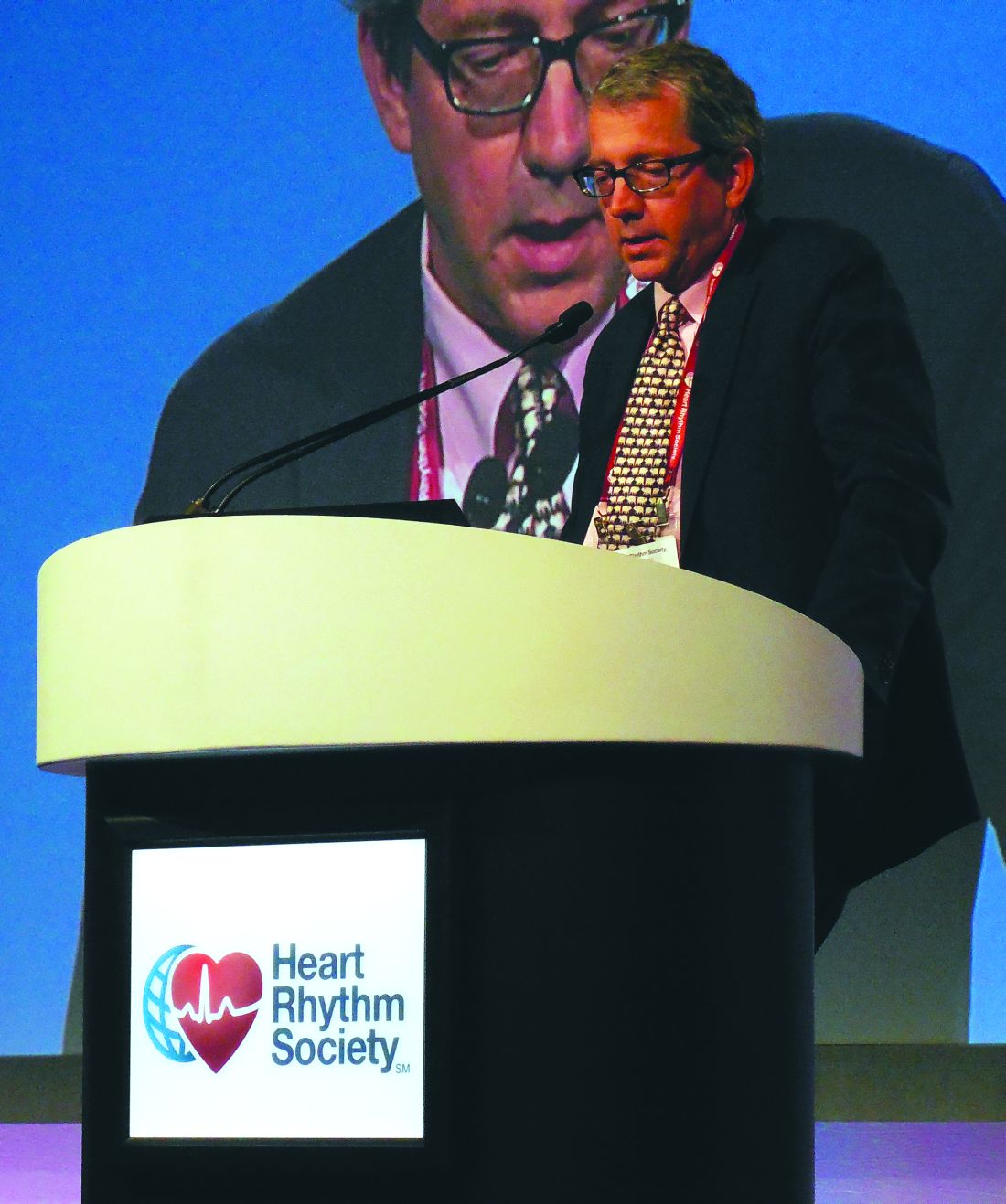
A receiver operating characteristic analysis showed that change in AF burden after ablation produced a statistically significant 0.66 area-under-the-curve for the primary endpoint, which suggested that reduction in AF burden post ablation could account for about two-thirds of the drop in deaths and hospitalizations for heart failure. Among the nonablated patients the area-under-the-curve was an insignificant 0.49 showing that with drug treatment AF burden had no discernible relationship with outcomes.
One further observation in the new analysis was that a drop in AF burden was linked with improved outcomes regardless of whether or not a “blanking period” was imposed on the data. Researchers applied a 90-day blanking period after ablation when assessing the treatment’s efficacy to censor from the analysis recurrences that occurred soon after ablation. The need for a blanking period during the first 90 days “was put to rest” by this new analysis, Dr. Brachmann said.
CASTLE-AF was sponsored by Biotronik. Dr. Brachmann has been a consultant to and has received research funding from Biotronik and several other companies. Dr. Krahn has been a consultant to Medtronic and has received research support from Medtronic and Boston Scientific. Dr. Link had no disclosures.
SOURCE: Brachmann J et al. Heart Rhythm 2018, Abstract B-LBCT02-04.
This new analysis of data from the CASTLE-AF trial is exciting. It shows that, if we reduce the atrial fibrillation burden when we perform catheter ablation of atrial fibrillation in patients with heart failure, patients do better.
The video associated with this article is no longer available on this site. Please view all of our videos on the MDedge YouTube channel
Until now, cardiac electrophysiologists who perform atrial fibrillation (AF) ablation have been too hard on themselves by counting as a failure every patient who develops an AF recurrence that lasts for 30 seconds or more. We know that patients who have a substantial drop in their AF burden after catheter ablation report feeling better even if they continue to have some AF events. When their AF burden drops substantially, patients are better able to work and perform activities of daily life. Many options, including noninvasive devices, are now available to monitor patients’ postablation change in AF burden.
We currently tell patients the success rates of catheter ablation on AF based on recurrence rates. Maybe we need to change our definition of success to a cut in AF burden. Based on these new findings, patients don’t need to be perfect after ablation, with absolutely no recurrences. I have patients who are very happy with their outcome after ablation who still have episodes. The success rate of catheter ablation for treating AF may be much better than we have thought.
Andrea M. Russo, MD , is professor and director of the electrophysiology and arrhythmia service at Cooper University Health Care in Camden, N.J. She made these comments during a press conference and in a video interview. She had no relevant disclosures.
This new analysis of data from the CASTLE-AF trial is exciting. It shows that, if we reduce the atrial fibrillation burden when we perform catheter ablation of atrial fibrillation in patients with heart failure, patients do better.
The video associated with this article is no longer available on this site. Please view all of our videos on the MDedge YouTube channel
Until now, cardiac electrophysiologists who perform atrial fibrillation (AF) ablation have been too hard on themselves by counting as a failure every patient who develops an AF recurrence that lasts for 30 seconds or more. We know that patients who have a substantial drop in their AF burden after catheter ablation report feeling better even if they continue to have some AF events. When their AF burden drops substantially, patients are better able to work and perform activities of daily life. Many options, including noninvasive devices, are now available to monitor patients’ postablation change in AF burden.
We currently tell patients the success rates of catheter ablation on AF based on recurrence rates. Maybe we need to change our definition of success to a cut in AF burden. Based on these new findings, patients don’t need to be perfect after ablation, with absolutely no recurrences. I have patients who are very happy with their outcome after ablation who still have episodes. The success rate of catheter ablation for treating AF may be much better than we have thought.
Andrea M. Russo, MD , is professor and director of the electrophysiology and arrhythmia service at Cooper University Health Care in Camden, N.J. She made these comments during a press conference and in a video interview. She had no relevant disclosures.
This new analysis of data from the CASTLE-AF trial is exciting. It shows that, if we reduce the atrial fibrillation burden when we perform catheter ablation of atrial fibrillation in patients with heart failure, patients do better.
The video associated with this article is no longer available on this site. Please view all of our videos on the MDedge YouTube channel
Until now, cardiac electrophysiologists who perform atrial fibrillation (AF) ablation have been too hard on themselves by counting as a failure every patient who develops an AF recurrence that lasts for 30 seconds or more. We know that patients who have a substantial drop in their AF burden after catheter ablation report feeling better even if they continue to have some AF events. When their AF burden drops substantially, patients are better able to work and perform activities of daily life. Many options, including noninvasive devices, are now available to monitor patients’ postablation change in AF burden.
We currently tell patients the success rates of catheter ablation on AF based on recurrence rates. Maybe we need to change our definition of success to a cut in AF burden. Based on these new findings, patients don’t need to be perfect after ablation, with absolutely no recurrences. I have patients who are very happy with their outcome after ablation who still have episodes. The success rate of catheter ablation for treating AF may be much better than we have thought.
Andrea M. Russo, MD , is professor and director of the electrophysiology and arrhythmia service at Cooper University Health Care in Camden, N.J. She made these comments during a press conference and in a video interview. She had no relevant disclosures.
BOSTON – From the earliest days of using catheter ablation to treat atrial fibrillation (AF), in the 1990s, clinicians have defined ablation success based on whether patients had recurrence of their arrhythmia following treatment. New findings suggest that this standard was off, and that
The new study used data collected in the CASTLE-AF (Catheter Ablation vs. Standard Conventional Treatment in Patients With LV Dysfunction and AF) multicenter trial, which compared the efficacy of AF ablation with antiarrhythmic drug treatment in patients with heart failure for improving survival and freedom from hospitalization for heart failure. The trial’s primary finding showed that, in 363 randomized patients, AF ablation cut the primary adverse event rate by 38% relative to antiarrhythmic drug therapy (New Engl J Med. 2018 Feb 1;378[5]:417-27)
“There have been concerns about the high recurrence rate of AF following ablation,” with reported cumulative recurrence rates running as high as 80% by 5 years after ablation, noted Dr. Brachmann. “The news now is that recurrence alone doesn’t make a difference; we can still help patients” by reducing their AF burden, although he cautioned that this relationship has so far only been seen in patients with heart failure with reduced ejection fraction, the type of patients enrolled in CASTLE-AF.
“This information is very informative for clinicians counseling patients who undergo ablation. Ablation may not eliminate all of a patient’s AF, but it will substantially reduce it, and that’s associated with better outcomes,” commented Andrew D. Krahn, MD, professor and chief of cardiology at the University of British Columbia in Vancouver. “Early on using ablation, we had a curative approach and used ablation to ‘clip the wire.’ Now we have growing, objective evidence for ‘debulking’ the problem” working without the need to completely eliminate all AF episodes.
To run the post hoc analysis Dr. Brachmann and his associates categorized the 363 patients randomized in CASTLE-AF by the treatment they received during the study’s first 12 weeks: 150 patients underwent catheter ablation, and 210 received drug treatment, with three patients dropping out. Although this division of the patients diverged from the randomized subgroups, the ablated and drug-treated patients showed no significant differences when compared for several clinical parameters.
Ablation was significantly more effective than drug therapy for cutting atrial fibrillation burden, which started at an average of about 50% in all patients at baseline. AF burden fell to an average of about 10%-15% among the ablated patients when measured at several time points during follow-up, whereas AF burden remained at an average of about 50% or higher among the drug-treated patients.
A receiver operating characteristic analysis showed that change in AF burden after ablation produced a statistically significant 0.66 area-under-the-curve for the primary endpoint, which suggested that reduction in AF burden post ablation could account for about two-thirds of the drop in deaths and hospitalizations for heart failure. Among the nonablated patients the area-under-the-curve was an insignificant 0.49 showing that with drug treatment AF burden had no discernible relationship with outcomes.
One further observation in the new analysis was that a drop in AF burden was linked with improved outcomes regardless of whether or not a “blanking period” was imposed on the data. Researchers applied a 90-day blanking period after ablation when assessing the treatment’s efficacy to censor from the analysis recurrences that occurred soon after ablation. The need for a blanking period during the first 90 days “was put to rest” by this new analysis, Dr. Brachmann said.
CASTLE-AF was sponsored by Biotronik. Dr. Brachmann has been a consultant to and has received research funding from Biotronik and several other companies. Dr. Krahn has been a consultant to Medtronic and has received research support from Medtronic and Boston Scientific. Dr. Link had no disclosures.
SOURCE: Brachmann J et al. Heart Rhythm 2018, Abstract B-LBCT02-04.
BOSTON – From the earliest days of using catheter ablation to treat atrial fibrillation (AF), in the 1990s, clinicians have defined ablation success based on whether patients had recurrence of their arrhythmia following treatment. New findings suggest that this standard was off, and that
The new study used data collected in the CASTLE-AF (Catheter Ablation vs. Standard Conventional Treatment in Patients With LV Dysfunction and AF) multicenter trial, which compared the efficacy of AF ablation with antiarrhythmic drug treatment in patients with heart failure for improving survival and freedom from hospitalization for heart failure. The trial’s primary finding showed that, in 363 randomized patients, AF ablation cut the primary adverse event rate by 38% relative to antiarrhythmic drug therapy (New Engl J Med. 2018 Feb 1;378[5]:417-27)
“There have been concerns about the high recurrence rate of AF following ablation,” with reported cumulative recurrence rates running as high as 80% by 5 years after ablation, noted Dr. Brachmann. “The news now is that recurrence alone doesn’t make a difference; we can still help patients” by reducing their AF burden, although he cautioned that this relationship has so far only been seen in patients with heart failure with reduced ejection fraction, the type of patients enrolled in CASTLE-AF.
“This information is very informative for clinicians counseling patients who undergo ablation. Ablation may not eliminate all of a patient’s AF, but it will substantially reduce it, and that’s associated with better outcomes,” commented Andrew D. Krahn, MD, professor and chief of cardiology at the University of British Columbia in Vancouver. “Early on using ablation, we had a curative approach and used ablation to ‘clip the wire.’ Now we have growing, objective evidence for ‘debulking’ the problem” working without the need to completely eliminate all AF episodes.
To run the post hoc analysis Dr. Brachmann and his associates categorized the 363 patients randomized in CASTLE-AF by the treatment they received during the study’s first 12 weeks: 150 patients underwent catheter ablation, and 210 received drug treatment, with three patients dropping out. Although this division of the patients diverged from the randomized subgroups, the ablated and drug-treated patients showed no significant differences when compared for several clinical parameters.
Ablation was significantly more effective than drug therapy for cutting atrial fibrillation burden, which started at an average of about 50% in all patients at baseline. AF burden fell to an average of about 10%-15% among the ablated patients when measured at several time points during follow-up, whereas AF burden remained at an average of about 50% or higher among the drug-treated patients.
A receiver operating characteristic analysis showed that change in AF burden after ablation produced a statistically significant 0.66 area-under-the-curve for the primary endpoint, which suggested that reduction in AF burden post ablation could account for about two-thirds of the drop in deaths and hospitalizations for heart failure. Among the nonablated patients the area-under-the-curve was an insignificant 0.49 showing that with drug treatment AF burden had no discernible relationship with outcomes.
One further observation in the new analysis was that a drop in AF burden was linked with improved outcomes regardless of whether or not a “blanking period” was imposed on the data. Researchers applied a 90-day blanking period after ablation when assessing the treatment’s efficacy to censor from the analysis recurrences that occurred soon after ablation. The need for a blanking period during the first 90 days “was put to rest” by this new analysis, Dr. Brachmann said.
CASTLE-AF was sponsored by Biotronik. Dr. Brachmann has been a consultant to and has received research funding from Biotronik and several other companies. Dr. Krahn has been a consultant to Medtronic and has received research support from Medtronic and Boston Scientific. Dr. Link had no disclosures.
SOURCE: Brachmann J et al. Heart Rhythm 2018, Abstract B-LBCT02-04.
REPORTING FROM HEART RHYTHM 2018
Key clinical point: Higher atrial fibrillation (AF) burden was more important than AF recurrence for predicting bad outcomes post ablation.
Major finding: Patients whose AF burden fell to 5% or less had about a threefold higher rate of good outcomes, compared with other patients.
Study details: Post hoc analysis of 360 patients with heart failure and AF enrolled in CASTLE-AF, a multicenter, randomized trial.
Disclosures: CASTLE-AF was sponsored by Biotronik. Dr. Brachmann has been a consultant to and has received research funding from Biotronik and several other companies. Dr. Krahn has been a consultant to Medtronic and has received research support from Medtronic and Boston Scientific. Dr. Link had no disclosures.
Source: Brachmann J et al. Heart Rhythm 2018, Abstract B-LBCT02-04.
VIDEO: The effect of removing pregnancy drug category labeling
AUSTIN, TEX. – In a randomized survey, the Food and Drug Administration’s previous letter-category labeling of drugs for pregnant women made prescribers more likely to prescribe appropriate medication than the new labeling standards without the letters.
The FDA removed the letter categories A, B, C, D, and X in 2014 in the belief “that a narrative structure for pregnancy labeling is best able to capture and convey the potential risks of drug exposure based on animal or human data, or both,” as stated in the FDA ruling.
“The [old] FDA categories are actually based upon the evidence related to clinical trials or animal trials and known risks to the fetus or the mother. The categorizations really reflect the evidence that we have or the absence of evidence as to whether medications can be safely used during pregnancy,” Dr. Robinson explained in a video interview. But letters can be perceived as overall “grades,” even though they aren’t.
The researchers sought to evaluate the effect of the letters’ removal by surveying doctors at two centers in New York City and two annual specialty meetings from October 2015 to May 2016.
The survey “included demographic information, followed by four clinical vignettes. Each vignette described a pregnant woman and presented an indication for prescribing a particular drug which was FDA approved. Each vignette was followed by detailed drug information as found in the FDA-approved package insert with the new [Pregnancy and Lactation Labeling Rule] content and formatting,” Dr. Robinson said at the meeting.
The 162 survey respondents estimated their likelihood of prescribing given the information in the vignette. The respondents were randomized to see the letter category or not. Category X (positive evidence of risk that clearly outweighs potential benefits) was not included. For all four remaining categories, the respondents who were shown the letter category were more likely to prescribe. Category B was significantly affected in a mixed linear model, and both categories B and C were significantly affected in a multivariate model.
“The new system of revised labeling may be more ambiguous and present new challenges for clinical decision making that could result in decreased access to medications for pregnant women,” Dr. Robinson said.
Dr. Robinson and her coauthors reported no relevant disclosures.
SOURCE: Robinson A et al. ACOG 2018. Abstract OP5.
AUSTIN, TEX. – In a randomized survey, the Food and Drug Administration’s previous letter-category labeling of drugs for pregnant women made prescribers more likely to prescribe appropriate medication than the new labeling standards without the letters.
The FDA removed the letter categories A, B, C, D, and X in 2014 in the belief “that a narrative structure for pregnancy labeling is best able to capture and convey the potential risks of drug exposure based on animal or human data, or both,” as stated in the FDA ruling.
“The [old] FDA categories are actually based upon the evidence related to clinical trials or animal trials and known risks to the fetus or the mother. The categorizations really reflect the evidence that we have or the absence of evidence as to whether medications can be safely used during pregnancy,” Dr. Robinson explained in a video interview. But letters can be perceived as overall “grades,” even though they aren’t.
The researchers sought to evaluate the effect of the letters’ removal by surveying doctors at two centers in New York City and two annual specialty meetings from October 2015 to May 2016.
The survey “included demographic information, followed by four clinical vignettes. Each vignette described a pregnant woman and presented an indication for prescribing a particular drug which was FDA approved. Each vignette was followed by detailed drug information as found in the FDA-approved package insert with the new [Pregnancy and Lactation Labeling Rule] content and formatting,” Dr. Robinson said at the meeting.
The 162 survey respondents estimated their likelihood of prescribing given the information in the vignette. The respondents were randomized to see the letter category or not. Category X (positive evidence of risk that clearly outweighs potential benefits) was not included. For all four remaining categories, the respondents who were shown the letter category were more likely to prescribe. Category B was significantly affected in a mixed linear model, and both categories B and C were significantly affected in a multivariate model.
“The new system of revised labeling may be more ambiguous and present new challenges for clinical decision making that could result in decreased access to medications for pregnant women,” Dr. Robinson said.
Dr. Robinson and her coauthors reported no relevant disclosures.
SOURCE: Robinson A et al. ACOG 2018. Abstract OP5.
AUSTIN, TEX. – In a randomized survey, the Food and Drug Administration’s previous letter-category labeling of drugs for pregnant women made prescribers more likely to prescribe appropriate medication than the new labeling standards without the letters.
The FDA removed the letter categories A, B, C, D, and X in 2014 in the belief “that a narrative structure for pregnancy labeling is best able to capture and convey the potential risks of drug exposure based on animal or human data, or both,” as stated in the FDA ruling.
“The [old] FDA categories are actually based upon the evidence related to clinical trials or animal trials and known risks to the fetus or the mother. The categorizations really reflect the evidence that we have or the absence of evidence as to whether medications can be safely used during pregnancy,” Dr. Robinson explained in a video interview. But letters can be perceived as overall “grades,” even though they aren’t.
The researchers sought to evaluate the effect of the letters’ removal by surveying doctors at two centers in New York City and two annual specialty meetings from October 2015 to May 2016.
The survey “included demographic information, followed by four clinical vignettes. Each vignette described a pregnant woman and presented an indication for prescribing a particular drug which was FDA approved. Each vignette was followed by detailed drug information as found in the FDA-approved package insert with the new [Pregnancy and Lactation Labeling Rule] content and formatting,” Dr. Robinson said at the meeting.
The 162 survey respondents estimated their likelihood of prescribing given the information in the vignette. The respondents were randomized to see the letter category or not. Category X (positive evidence of risk that clearly outweighs potential benefits) was not included. For all four remaining categories, the respondents who were shown the letter category were more likely to prescribe. Category B was significantly affected in a mixed linear model, and both categories B and C were significantly affected in a multivariate model.
“The new system of revised labeling may be more ambiguous and present new challenges for clinical decision making that could result in decreased access to medications for pregnant women,” Dr. Robinson said.
Dr. Robinson and her coauthors reported no relevant disclosures.
SOURCE: Robinson A et al. ACOG 2018. Abstract OP5.
REPORTING FROM ACOG 2018
VIDEO: Promoting upright and mobile labor could save over $700 million yearly
AUSTIN, TEX. – Encouraging an upright position and allowing mobility during labor is a cost-effective intervention that could save hundreds of millions of dollars while preventing cesarean deliveries, uterine rupture, and maternal deaths, according to a recent cost-effectiveness study.
Alyssa Hersh, a medical student at Oregon Health & Sciences University, Portland, developed the analysis using an innovative model that examines the costs associated not just with the first delivery, but also the probable next delivery.
“Our model was dependent on the ability to reduce cesareans and also reduce labor times,” said Ms. Hersh in a video interview. “So this reduction in cesareans allowed women to avoid having an increased risk of uterine rupture, of emergent hysterectomy, and other downstream consequences.”
The “two-delivery model” takes into account the average number of births per woman in the United States, “such that the risks, benefits, and costs are framed within the public health perspective of the average U.S. childrearing woman’s entire reproductive course,” she and her coauthors wrote in the poster accompanying the presentation at the annual clinical and scientific meeting of the American College of Obstetricians and Gynecologists.
This model captures the downstream effects of a first cesarean delivery on the next delivery, for example, providing a more realistic picture of the true costs of cesarean delivery for a nulliparous female.
Some of the known benefits of being upright and mobile during labor, Ms. Hersh said, include shortened labor and reduced risk for cesarean delivery. Cost-effectiveness of this approach for low-risk women, she said, had not been fully explored.
For the analysis, Ms. Hersh and her colleagues used a theoretical cohort of 1.8 million women, approximating the number of nulliparous term deliveries in the United States each year. They used rates of cesarean delivery for women laboring in upright and recumbent positions that were drawn from the literature, but lower than national averages: 7.8% of recumbent women and 5.4% of upright women went on to cesarean delivery in the model used by the investigators.
The outcomes tracked in the analysis included cesarean delivery, uterine rupture, hysterectomy attributed to uterine rupture, costs, and quality-adjusted life years (QALYs). All of the outcomes were tracked for the index pregnancy and the second pregnancy.
Ms. Hersh and her coinvestigators found that in the theoretical cohort, “laboring upright led to 64,890 fewer cesarean deliveries, 15 fewer maternal deaths, 113 fewer uterine ruptures, and 30 fewer hysterectomies.”
These reductions were associated with a savings for this cohort of $785 million, and an increase in QALYs of 2,142.
Using Monte Carlo simulation techniques to ascertain the effect of varying cesarean rates and other components of the model, Ms. Hersh and her colleagues found that the model remained cost-effective even with variation in all of the inputs.
“Laboring upright is a no-cost intervention that leads to improved outcomes, decreased costs, and increased QALYs during a woman’s first and second deliveries,” wrote Ms. Hersh and her associates. “This model argues for increasing systems factors that support women to be upright and mobile during labor, and in doing so, promoting improved health for our patients.”
Said Ms. Hersh, “This is an easy way for hospitals to adopt policies that can enable women to have improved outcomes.”
Ms. Hersh and her colleagues had no relevant financial disclosures.
SOURCE: Hersh A et al. ACOG 2018. Abstract 34C.
AUSTIN, TEX. – Encouraging an upright position and allowing mobility during labor is a cost-effective intervention that could save hundreds of millions of dollars while preventing cesarean deliveries, uterine rupture, and maternal deaths, according to a recent cost-effectiveness study.
Alyssa Hersh, a medical student at Oregon Health & Sciences University, Portland, developed the analysis using an innovative model that examines the costs associated not just with the first delivery, but also the probable next delivery.
“Our model was dependent on the ability to reduce cesareans and also reduce labor times,” said Ms. Hersh in a video interview. “So this reduction in cesareans allowed women to avoid having an increased risk of uterine rupture, of emergent hysterectomy, and other downstream consequences.”
The “two-delivery model” takes into account the average number of births per woman in the United States, “such that the risks, benefits, and costs are framed within the public health perspective of the average U.S. childrearing woman’s entire reproductive course,” she and her coauthors wrote in the poster accompanying the presentation at the annual clinical and scientific meeting of the American College of Obstetricians and Gynecologists.
This model captures the downstream effects of a first cesarean delivery on the next delivery, for example, providing a more realistic picture of the true costs of cesarean delivery for a nulliparous female.
Some of the known benefits of being upright and mobile during labor, Ms. Hersh said, include shortened labor and reduced risk for cesarean delivery. Cost-effectiveness of this approach for low-risk women, she said, had not been fully explored.
For the analysis, Ms. Hersh and her colleagues used a theoretical cohort of 1.8 million women, approximating the number of nulliparous term deliveries in the United States each year. They used rates of cesarean delivery for women laboring in upright and recumbent positions that were drawn from the literature, but lower than national averages: 7.8% of recumbent women and 5.4% of upright women went on to cesarean delivery in the model used by the investigators.
The outcomes tracked in the analysis included cesarean delivery, uterine rupture, hysterectomy attributed to uterine rupture, costs, and quality-adjusted life years (QALYs). All of the outcomes were tracked for the index pregnancy and the second pregnancy.
Ms. Hersh and her coinvestigators found that in the theoretical cohort, “laboring upright led to 64,890 fewer cesarean deliveries, 15 fewer maternal deaths, 113 fewer uterine ruptures, and 30 fewer hysterectomies.”
These reductions were associated with a savings for this cohort of $785 million, and an increase in QALYs of 2,142.
Using Monte Carlo simulation techniques to ascertain the effect of varying cesarean rates and other components of the model, Ms. Hersh and her colleagues found that the model remained cost-effective even with variation in all of the inputs.
“Laboring upright is a no-cost intervention that leads to improved outcomes, decreased costs, and increased QALYs during a woman’s first and second deliveries,” wrote Ms. Hersh and her associates. “This model argues for increasing systems factors that support women to be upright and mobile during labor, and in doing so, promoting improved health for our patients.”
Said Ms. Hersh, “This is an easy way for hospitals to adopt policies that can enable women to have improved outcomes.”
Ms. Hersh and her colleagues had no relevant financial disclosures.
SOURCE: Hersh A et al. ACOG 2018. Abstract 34C.
AUSTIN, TEX. – Encouraging an upright position and allowing mobility during labor is a cost-effective intervention that could save hundreds of millions of dollars while preventing cesarean deliveries, uterine rupture, and maternal deaths, according to a recent cost-effectiveness study.
Alyssa Hersh, a medical student at Oregon Health & Sciences University, Portland, developed the analysis using an innovative model that examines the costs associated not just with the first delivery, but also the probable next delivery.
“Our model was dependent on the ability to reduce cesareans and also reduce labor times,” said Ms. Hersh in a video interview. “So this reduction in cesareans allowed women to avoid having an increased risk of uterine rupture, of emergent hysterectomy, and other downstream consequences.”
The “two-delivery model” takes into account the average number of births per woman in the United States, “such that the risks, benefits, and costs are framed within the public health perspective of the average U.S. childrearing woman’s entire reproductive course,” she and her coauthors wrote in the poster accompanying the presentation at the annual clinical and scientific meeting of the American College of Obstetricians and Gynecologists.
This model captures the downstream effects of a first cesarean delivery on the next delivery, for example, providing a more realistic picture of the true costs of cesarean delivery for a nulliparous female.
Some of the known benefits of being upright and mobile during labor, Ms. Hersh said, include shortened labor and reduced risk for cesarean delivery. Cost-effectiveness of this approach for low-risk women, she said, had not been fully explored.
For the analysis, Ms. Hersh and her colleagues used a theoretical cohort of 1.8 million women, approximating the number of nulliparous term deliveries in the United States each year. They used rates of cesarean delivery for women laboring in upright and recumbent positions that were drawn from the literature, but lower than national averages: 7.8% of recumbent women and 5.4% of upright women went on to cesarean delivery in the model used by the investigators.
The outcomes tracked in the analysis included cesarean delivery, uterine rupture, hysterectomy attributed to uterine rupture, costs, and quality-adjusted life years (QALYs). All of the outcomes were tracked for the index pregnancy and the second pregnancy.
Ms. Hersh and her coinvestigators found that in the theoretical cohort, “laboring upright led to 64,890 fewer cesarean deliveries, 15 fewer maternal deaths, 113 fewer uterine ruptures, and 30 fewer hysterectomies.”
These reductions were associated with a savings for this cohort of $785 million, and an increase in QALYs of 2,142.
Using Monte Carlo simulation techniques to ascertain the effect of varying cesarean rates and other components of the model, Ms. Hersh and her colleagues found that the model remained cost-effective even with variation in all of the inputs.
“Laboring upright is a no-cost intervention that leads to improved outcomes, decreased costs, and increased QALYs during a woman’s first and second deliveries,” wrote Ms. Hersh and her associates. “This model argues for increasing systems factors that support women to be upright and mobile during labor, and in doing so, promoting improved health for our patients.”
Said Ms. Hersh, “This is an easy way for hospitals to adopt policies that can enable women to have improved outcomes.”
Ms. Hersh and her colleagues had no relevant financial disclosures.
SOURCE: Hersh A et al. ACOG 2018. Abstract 34C.
REPORTING FROM ACOG 2018

VIDEO: Three questions with Aaron B. Caughey, MD
AUSTIN, TEX. – This interview was conducted at the annual clinical and scientific meeting of the American College of Obstetricians and Gynecologists. It has been edited for length and clarity.
OB.GYN. NEWS: Here at ACOG, there were two studies from your research group at Oregon Health & Sciences University, Portland, that examined the cost-effectiveness of pregnancy interventions using a “two-delivery” model. Could you explain a little more about what that is, and how you arrived at this model?
DR. CAUGHEY: We’ve been working on decision analytics and cost-effectiveness studies of a number of ways to approach pregnancy, whether it be complicated pregnancies or uncomplicated normal pregnancies.
The video associated with this article is no longer available on this site. Please view all of our videos on the MDedge YouTube channel
One of the things that we think is really important to think about is the impact of management and outcomes in the current pregnancy, and how it might affect future pregnancies.
So, for example, if you have a vaginal delivery this time, that makes you multiparous with a prior vaginal delivery next time; that is kind of the goal in pregnancy. It just makes all future labor and delivery experiences so much easier. Whereas, if you have a prior C-section, we all know that now you’re high risk. Everybody gets nervous about you. Are you going to get a trial of labor? Can you find a hospital that will do a trial of labor? And there are all these downstream implications of the delivery in the first pregnancy.
If you think about it, there are a number of ways that we can manage the first pregnancy. There are a number of risk factors for increasing risk for cesarean delivery. And we can include those in models that are considered in downstream pregnancies. And so we’ve been doing that increasingly.
When we think about our vaginal birth after cesarean models, we had two presentations that considered that. One was how we manage the maternal position in labor, and the other was how we use doulas in labor. You think, well gosh, we’re spending money on this doula in this pregnancy – that’s a certain expenditure. Is it worth it?
Part of “Is it worth it?” is not just the current pregnancy, but the downstream pregnancy as well.
OB.GYN. NEWS: What has sparked your interest in looking at obstetric care delivery in this way?
DR. CAUGHEY: I did my PhD in health economics. I began it as a 3rd-year maternal fetal medicine fellow and during my early career as an assistant professor at the University of California, San Francisco.
A lot of people think that economics in general is kind of about finance. Actually, microeconomics in particular is about the allocation of scarce resources to optimize utility – utility as general wellbeing or happiness.
So people will say that this thing, or that intervention, is cost effective, and often what they think they mean is, “It saves money.” But most things don’t save money. Most things in health care cost money. There are a few things in health care that do save money – vaccinations, contraception. Contraception actually saves money – but most things cost money. We have to spend money to get something right.
And the way we do that in health economics is that we think we’re going to get some happiness, some utility, some better outcomes from the money we’re putting in. One of the things that we don’t do very well as a species is think about these downstream outcomes.
In our models, when we think about morbidity and mortality we’re incorporating two and three pregnancy models. Think about what happens in the future, and then think about if we do something – if we spend money on an induction of labor or having a doula or something like that, is it worth it for what we get?
Antenatal testing, for example. Or, is it worth it for you to be testing people with diabetes once a week? Twice a week? More? Less? Part of it is figuring out what you’ll get for it. The measurement of what you get for it is called quality-adjusted life years, and that’s the measure of happiness multiplied times life expectancy.
We incorporate that in standard ways to build these models, to help us make decisions around best practices. Now, the economics piece of it probably matters. We’re the richest country that’s probably ever going to be – not just ever has been but probably ever going to be – the way we’re using up scarce resources to beat the band.
Yet, we still have an issue of allocation. We have people that have less; we have enormous disparities, whether it be racial and ethnic disparities, or socioeconomic disparities. And so we need to figure out ways to be more efficient and allocate those scarce resources properly to the outcomes that will be the best.
I think that’s what we’re working on: creating models to think about how to allocate those scarce resources.
OB.GYN. NEWS: How can a busy obstetrician think about the work you’re doing and incorporate it into her practice on a day-to-day basis?
DR. CAUGHEY: As an economist, I want to step back from time to time and think about public health and allocation of scarce resources.
But as a busy practicing clinician, I don’t necessarily want you consciously to think about cost. There are people who will push back on this and say, “Oh no, we should always be cost conscious.” Actually, what I really want you to do is incorporate best practices into the care of the patient at that moment, and do the thing that improves her outcomes best at that moment.
What we want to do, instead, is design systems that will properly incentivize. Incentivize doesn’t mean you think, “Oh gosh, if I do this thing I’m going to get an extra dollar.” It means subconsciously that those incentives are there, and those incentives don’t have to just be about dollars. Often in our field, they’re about time – what takes less time and more time to do something. So if we provide little extra roadblocks, then you’re more likely to go the other way and do something else.
For example: the hard stop. We did all this research in the 2000s to show that you probably shouldn’t deliver babies just for fun before 39 weeks’ gestational age. There should be an indication. If we don’t allow any hard stop, if we don’t block the pathway, then patients are pushing us, they’re uncomfortable, they’re like, “Just deliver me.” So we said, “No, no, no, we’re going to block this. In fact, we’re actually going to provide a hard stop reimbursement-wise. And medical directors of hospitals are going to have to preapprove.” And so that provides a blockade, and makes it easier just not to do it.
So I think that’s what we want: At the bedside and in your office, we want clinicians to still just be really good doctors. But then, to get involved and help design systems to incentivize us to do the right things.
Aaron B. Caughey, MD, PhD, is professor and chair of the department of obstetrics and gynecology and associate dean for Women’s Health Research and Policy at Oregon Health & Science University, Portland, and is a member of the U.S. Preventive Services Task Force. He reported that he had no relevant financial disclosures.
AUSTIN, TEX. – This interview was conducted at the annual clinical and scientific meeting of the American College of Obstetricians and Gynecologists. It has been edited for length and clarity.
OB.GYN. NEWS: Here at ACOG, there were two studies from your research group at Oregon Health & Sciences University, Portland, that examined the cost-effectiveness of pregnancy interventions using a “two-delivery” model. Could you explain a little more about what that is, and how you arrived at this model?
DR. CAUGHEY: We’ve been working on decision analytics and cost-effectiveness studies of a number of ways to approach pregnancy, whether it be complicated pregnancies or uncomplicated normal pregnancies.
The video associated with this article is no longer available on this site. Please view all of our videos on the MDedge YouTube channel
One of the things that we think is really important to think about is the impact of management and outcomes in the current pregnancy, and how it might affect future pregnancies.
So, for example, if you have a vaginal delivery this time, that makes you multiparous with a prior vaginal delivery next time; that is kind of the goal in pregnancy. It just makes all future labor and delivery experiences so much easier. Whereas, if you have a prior C-section, we all know that now you’re high risk. Everybody gets nervous about you. Are you going to get a trial of labor? Can you find a hospital that will do a trial of labor? And there are all these downstream implications of the delivery in the first pregnancy.
If you think about it, there are a number of ways that we can manage the first pregnancy. There are a number of risk factors for increasing risk for cesarean delivery. And we can include those in models that are considered in downstream pregnancies. And so we’ve been doing that increasingly.
When we think about our vaginal birth after cesarean models, we had two presentations that considered that. One was how we manage the maternal position in labor, and the other was how we use doulas in labor. You think, well gosh, we’re spending money on this doula in this pregnancy – that’s a certain expenditure. Is it worth it?
Part of “Is it worth it?” is not just the current pregnancy, but the downstream pregnancy as well.
OB.GYN. NEWS: What has sparked your interest in looking at obstetric care delivery in this way?
DR. CAUGHEY: I did my PhD in health economics. I began it as a 3rd-year maternal fetal medicine fellow and during my early career as an assistant professor at the University of California, San Francisco.
A lot of people think that economics in general is kind of about finance. Actually, microeconomics in particular is about the allocation of scarce resources to optimize utility – utility as general wellbeing or happiness.
So people will say that this thing, or that intervention, is cost effective, and often what they think they mean is, “It saves money.” But most things don’t save money. Most things in health care cost money. There are a few things in health care that do save money – vaccinations, contraception. Contraception actually saves money – but most things cost money. We have to spend money to get something right.
And the way we do that in health economics is that we think we’re going to get some happiness, some utility, some better outcomes from the money we’re putting in. One of the things that we don’t do very well as a species is think about these downstream outcomes.
In our models, when we think about morbidity and mortality we’re incorporating two and three pregnancy models. Think about what happens in the future, and then think about if we do something – if we spend money on an induction of labor or having a doula or something like that, is it worth it for what we get?
Antenatal testing, for example. Or, is it worth it for you to be testing people with diabetes once a week? Twice a week? More? Less? Part of it is figuring out what you’ll get for it. The measurement of what you get for it is called quality-adjusted life years, and that’s the measure of happiness multiplied times life expectancy.
We incorporate that in standard ways to build these models, to help us make decisions around best practices. Now, the economics piece of it probably matters. We’re the richest country that’s probably ever going to be – not just ever has been but probably ever going to be – the way we’re using up scarce resources to beat the band.
Yet, we still have an issue of allocation. We have people that have less; we have enormous disparities, whether it be racial and ethnic disparities, or socioeconomic disparities. And so we need to figure out ways to be more efficient and allocate those scarce resources properly to the outcomes that will be the best.
I think that’s what we’re working on: creating models to think about how to allocate those scarce resources.
OB.GYN. NEWS: How can a busy obstetrician think about the work you’re doing and incorporate it into her practice on a day-to-day basis?
DR. CAUGHEY: As an economist, I want to step back from time to time and think about public health and allocation of scarce resources.
But as a busy practicing clinician, I don’t necessarily want you consciously to think about cost. There are people who will push back on this and say, “Oh no, we should always be cost conscious.” Actually, what I really want you to do is incorporate best practices into the care of the patient at that moment, and do the thing that improves her outcomes best at that moment.
What we want to do, instead, is design systems that will properly incentivize. Incentivize doesn’t mean you think, “Oh gosh, if I do this thing I’m going to get an extra dollar.” It means subconsciously that those incentives are there, and those incentives don’t have to just be about dollars. Often in our field, they’re about time – what takes less time and more time to do something. So if we provide little extra roadblocks, then you’re more likely to go the other way and do something else.
For example: the hard stop. We did all this research in the 2000s to show that you probably shouldn’t deliver babies just for fun before 39 weeks’ gestational age. There should be an indication. If we don’t allow any hard stop, if we don’t block the pathway, then patients are pushing us, they’re uncomfortable, they’re like, “Just deliver me.” So we said, “No, no, no, we’re going to block this. In fact, we’re actually going to provide a hard stop reimbursement-wise. And medical directors of hospitals are going to have to preapprove.” And so that provides a blockade, and makes it easier just not to do it.
So I think that’s what we want: At the bedside and in your office, we want clinicians to still just be really good doctors. But then, to get involved and help design systems to incentivize us to do the right things.
Aaron B. Caughey, MD, PhD, is professor and chair of the department of obstetrics and gynecology and associate dean for Women’s Health Research and Policy at Oregon Health & Science University, Portland, and is a member of the U.S. Preventive Services Task Force. He reported that he had no relevant financial disclosures.
AUSTIN, TEX. – This interview was conducted at the annual clinical and scientific meeting of the American College of Obstetricians and Gynecologists. It has been edited for length and clarity.
OB.GYN. NEWS: Here at ACOG, there were two studies from your research group at Oregon Health & Sciences University, Portland, that examined the cost-effectiveness of pregnancy interventions using a “two-delivery” model. Could you explain a little more about what that is, and how you arrived at this model?
DR. CAUGHEY: We’ve been working on decision analytics and cost-effectiveness studies of a number of ways to approach pregnancy, whether it be complicated pregnancies or uncomplicated normal pregnancies.
The video associated with this article is no longer available on this site. Please view all of our videos on the MDedge YouTube channel
One of the things that we think is really important to think about is the impact of management and outcomes in the current pregnancy, and how it might affect future pregnancies.
So, for example, if you have a vaginal delivery this time, that makes you multiparous with a prior vaginal delivery next time; that is kind of the goal in pregnancy. It just makes all future labor and delivery experiences so much easier. Whereas, if you have a prior C-section, we all know that now you’re high risk. Everybody gets nervous about you. Are you going to get a trial of labor? Can you find a hospital that will do a trial of labor? And there are all these downstream implications of the delivery in the first pregnancy.
If you think about it, there are a number of ways that we can manage the first pregnancy. There are a number of risk factors for increasing risk for cesarean delivery. And we can include those in models that are considered in downstream pregnancies. And so we’ve been doing that increasingly.
When we think about our vaginal birth after cesarean models, we had two presentations that considered that. One was how we manage the maternal position in labor, and the other was how we use doulas in labor. You think, well gosh, we’re spending money on this doula in this pregnancy – that’s a certain expenditure. Is it worth it?
Part of “Is it worth it?” is not just the current pregnancy, but the downstream pregnancy as well.
OB.GYN. NEWS: What has sparked your interest in looking at obstetric care delivery in this way?
DR. CAUGHEY: I did my PhD in health economics. I began it as a 3rd-year maternal fetal medicine fellow and during my early career as an assistant professor at the University of California, San Francisco.
A lot of people think that economics in general is kind of about finance. Actually, microeconomics in particular is about the allocation of scarce resources to optimize utility – utility as general wellbeing or happiness.
So people will say that this thing, or that intervention, is cost effective, and often what they think they mean is, “It saves money.” But most things don’t save money. Most things in health care cost money. There are a few things in health care that do save money – vaccinations, contraception. Contraception actually saves money – but most things cost money. We have to spend money to get something right.
And the way we do that in health economics is that we think we’re going to get some happiness, some utility, some better outcomes from the money we’re putting in. One of the things that we don’t do very well as a species is think about these downstream outcomes.
In our models, when we think about morbidity and mortality we’re incorporating two and three pregnancy models. Think about what happens in the future, and then think about if we do something – if we spend money on an induction of labor or having a doula or something like that, is it worth it for what we get?
Antenatal testing, for example. Or, is it worth it for you to be testing people with diabetes once a week? Twice a week? More? Less? Part of it is figuring out what you’ll get for it. The measurement of what you get for it is called quality-adjusted life years, and that’s the measure of happiness multiplied times life expectancy.
We incorporate that in standard ways to build these models, to help us make decisions around best practices. Now, the economics piece of it probably matters. We’re the richest country that’s probably ever going to be – not just ever has been but probably ever going to be – the way we’re using up scarce resources to beat the band.
Yet, we still have an issue of allocation. We have people that have less; we have enormous disparities, whether it be racial and ethnic disparities, or socioeconomic disparities. And so we need to figure out ways to be more efficient and allocate those scarce resources properly to the outcomes that will be the best.
I think that’s what we’re working on: creating models to think about how to allocate those scarce resources.
OB.GYN. NEWS: How can a busy obstetrician think about the work you’re doing and incorporate it into her practice on a day-to-day basis?
DR. CAUGHEY: As an economist, I want to step back from time to time and think about public health and allocation of scarce resources.
But as a busy practicing clinician, I don’t necessarily want you consciously to think about cost. There are people who will push back on this and say, “Oh no, we should always be cost conscious.” Actually, what I really want you to do is incorporate best practices into the care of the patient at that moment, and do the thing that improves her outcomes best at that moment.
What we want to do, instead, is design systems that will properly incentivize. Incentivize doesn’t mean you think, “Oh gosh, if I do this thing I’m going to get an extra dollar.” It means subconsciously that those incentives are there, and those incentives don’t have to just be about dollars. Often in our field, they’re about time – what takes less time and more time to do something. So if we provide little extra roadblocks, then you’re more likely to go the other way and do something else.
For example: the hard stop. We did all this research in the 2000s to show that you probably shouldn’t deliver babies just for fun before 39 weeks’ gestational age. There should be an indication. If we don’t allow any hard stop, if we don’t block the pathway, then patients are pushing us, they’re uncomfortable, they’re like, “Just deliver me.” So we said, “No, no, no, we’re going to block this. In fact, we’re actually going to provide a hard stop reimbursement-wise. And medical directors of hospitals are going to have to preapprove.” And so that provides a blockade, and makes it easier just not to do it.
So I think that’s what we want: At the bedside and in your office, we want clinicians to still just be really good doctors. But then, to get involved and help design systems to incentivize us to do the right things.
Aaron B. Caughey, MD, PhD, is professor and chair of the department of obstetrics and gynecology and associate dean for Women’s Health Research and Policy at Oregon Health & Science University, Portland, and is a member of the U.S. Preventive Services Task Force. He reported that he had no relevant financial disclosures.
REPORTING FROM ACOG 2018

VIDEO: Addressing the opioid epidemic: Psychiatrists are poised to lead
NEW YORK – Psychiatrists are uniquely equipped to take the lead in providing cost-effective, evidence-based addiction treatment services, according to Lama Bazzi, MD, and Elie Aoun, MD.
As cochairs of a session titled, “Psychiatrists at the Helm of the Opioid Epidemic” at the annual meeting of the American Psychiatric Association, Dr. Bazzi and Dr. Aoun addressed how psychiatrists can take the lead as part of multidisciplinary teams, as well as roles they can play in policy and the criminal justice system to “shift the paradigm in terms of how the general public thinks about addiction.”
They also discussed existing models and some new models they have been working on to address the problem.
“We want to empower psychiatrists to feel that they already have the knowledge base to do what needs to be done, and to just ... put out there different ways that we can brainstorm together to do that,” Dr. Bazzi of Maimonides Medical Center, Brooklyn, N.Y., said in a video interview at the meeting.
She and Dr. Aoun also discussed an ongoing project that involves input from law enforcement and support from the APA; an online training module is being developed to address different mental disorders – including substance use disorders – and other issues that officers face, such as racial biases and disparities.
“The curriculum that we’re working on is going to be symptom based,” said Dr. Aoun, of Columbia University, New York, explaining that this approach is more practical for helping law enforcement officers in dealing with issues involving individuals with mental disorders.
Another project focuses on keeping people with mental disorders out of the criminal justice system, he said.
“Every step [of the criminal justice process] is an opportunity to intercept people with mental illness and provide them with intervention,” he said, noting that an adaptation of the model for patients with addictions is also in the works.
He and Dr. Bazzi also focused on where psychiatrists, as experts in both mental health and addiction, can fit into the process.
Dr. Bazzi and Dr. Aoun reported having no disclosures.
NEW YORK – Psychiatrists are uniquely equipped to take the lead in providing cost-effective, evidence-based addiction treatment services, according to Lama Bazzi, MD, and Elie Aoun, MD.
As cochairs of a session titled, “Psychiatrists at the Helm of the Opioid Epidemic” at the annual meeting of the American Psychiatric Association, Dr. Bazzi and Dr. Aoun addressed how psychiatrists can take the lead as part of multidisciplinary teams, as well as roles they can play in policy and the criminal justice system to “shift the paradigm in terms of how the general public thinks about addiction.”
They also discussed existing models and some new models they have been working on to address the problem.
“We want to empower psychiatrists to feel that they already have the knowledge base to do what needs to be done, and to just ... put out there different ways that we can brainstorm together to do that,” Dr. Bazzi of Maimonides Medical Center, Brooklyn, N.Y., said in a video interview at the meeting.
She and Dr. Aoun also discussed an ongoing project that involves input from law enforcement and support from the APA; an online training module is being developed to address different mental disorders – including substance use disorders – and other issues that officers face, such as racial biases and disparities.
“The curriculum that we’re working on is going to be symptom based,” said Dr. Aoun, of Columbia University, New York, explaining that this approach is more practical for helping law enforcement officers in dealing with issues involving individuals with mental disorders.
Another project focuses on keeping people with mental disorders out of the criminal justice system, he said.
“Every step [of the criminal justice process] is an opportunity to intercept people with mental illness and provide them with intervention,” he said, noting that an adaptation of the model for patients with addictions is also in the works.
He and Dr. Bazzi also focused on where psychiatrists, as experts in both mental health and addiction, can fit into the process.
Dr. Bazzi and Dr. Aoun reported having no disclosures.
NEW YORK – Psychiatrists are uniquely equipped to take the lead in providing cost-effective, evidence-based addiction treatment services, according to Lama Bazzi, MD, and Elie Aoun, MD.
As cochairs of a session titled, “Psychiatrists at the Helm of the Opioid Epidemic” at the annual meeting of the American Psychiatric Association, Dr. Bazzi and Dr. Aoun addressed how psychiatrists can take the lead as part of multidisciplinary teams, as well as roles they can play in policy and the criminal justice system to “shift the paradigm in terms of how the general public thinks about addiction.”
They also discussed existing models and some new models they have been working on to address the problem.
“We want to empower psychiatrists to feel that they already have the knowledge base to do what needs to be done, and to just ... put out there different ways that we can brainstorm together to do that,” Dr. Bazzi of Maimonides Medical Center, Brooklyn, N.Y., said in a video interview at the meeting.
She and Dr. Aoun also discussed an ongoing project that involves input from law enforcement and support from the APA; an online training module is being developed to address different mental disorders – including substance use disorders – and other issues that officers face, such as racial biases and disparities.
“The curriculum that we’re working on is going to be symptom based,” said Dr. Aoun, of Columbia University, New York, explaining that this approach is more practical for helping law enforcement officers in dealing with issues involving individuals with mental disorders.
Another project focuses on keeping people with mental disorders out of the criminal justice system, he said.
“Every step [of the criminal justice process] is an opportunity to intercept people with mental illness and provide them with intervention,” he said, noting that an adaptation of the model for patients with addictions is also in the works.
He and Dr. Bazzi also focused on where psychiatrists, as experts in both mental health and addiction, can fit into the process.
Dr. Bazzi and Dr. Aoun reported having no disclosures.
REPORTING FROM APA