User login
DDW: Antibiotic rifaximin eases functional dyspepsia
WASHINGTON – Two weeks of antibiotic therapy with rifaximin provided relief from functional dyspepsia symptoms in a phase III double-blind, randomized trial.
“This is the first study that demonstrates that rifaximin is efficacious in the treatment of functional dyspepsia, particularly for global dyspeptic symptoms, bloating, and possibly belching. Our finding may suggest a role for the gut microbiota in the pathogenesis of functional dyspepsia,” Dr. Victoria Tan said at the annual Digestive Disease Week.

Rifaximin (Xifaxan) works by reducing or altering bacteria in the gut and has been shown to be efficacious in the treatment of diarrhea-predominant irritable bowel syndrome. It is approved to treat traveler’s diarrhea caused by Escherichia coli and to prevent hepatic encephalopathy.
The study randomly assigned 95 consecutive adults with functional dyspepsia as per ROME III criteria who had a normal gastroscopy within the last 2 years, had active symptoms in the month prior to enrollment, and were Helicobacter pylori negative, to rifaximin 400 mg or placebo three times a day for 2 weeks. In all, 33 rifaximin and 39 placebo patients were evaluable for the primary efficacy outcome of adequate relief of global dyspeptic symptoms (either no or mild dyspeptic symptoms) at any of the follow-up time points.
At baseline, 77% of patients had moderate to severe global dyspepsia symptoms, 74% of the placebo group and 55%% of the rifaximin group had moderate to severe belching, and roughly half of all patients were not on any GI medications. Mean age of the patients was 52 years.
Global dyspepsia symptoms improved with rifaximin beginning at week 2 and significantly favored rifaximin by week 8, with 23.5% of rifaximin patients reporting moderate to severe symptoms compared with 47.4% given placebo (P value = .04), said Dr. Tan of the University of Hong Kong.
Rates of moderate to severe belching were significantly improved with rifaximin at week 4 compared with placebo (14.3% vs. 35.7%; P = .03), but this difference was no longer significant at week 8 (26.5% vs. 29%).
The story was similar for moderate to severe bloating: Rates declined significantly with rifaximin at week 4 (20% vs. 43%; P = .03), but were no longer significant at week 8 (26.5% vs. 34.2%), she said.
A subgroup analysis of female patients showed significant improvements in moderate to severe global dyspeptic symptoms with rifaximin compared with placebo at week 4 (20.8% vs. 59.4%; P = .006) and week 8 (20% vs. 48.4%; P = .048).
Treatment response was not reflected in change in hydrogen breath response, Dr. Tan said. Results of a 3-hour hydrogen breath test performed after a 12-hour overnight fast showed no differences between the rifaximin and placebo groups for H2 peak above baseline (2.94 ppm vs. 0.11 ppm; P = .29), H2 area under the curve (+43.64 ppm vs. –49.71 ppm; P = .76), and oro-cecal transit time (24.23 minutes vs. 16.5 minutes; P = .68).
Adverse events were very similar between the two groups at both 4 and 8 weeks, Dr. Tan said. Only one major event occurred, a severe case of acute hepatitis in a woman in the placebo arm who also took traditional Chinese herbs.
On Twitter @pwendl
WASHINGTON – Two weeks of antibiotic therapy with rifaximin provided relief from functional dyspepsia symptoms in a phase III double-blind, randomized trial.
“This is the first study that demonstrates that rifaximin is efficacious in the treatment of functional dyspepsia, particularly for global dyspeptic symptoms, bloating, and possibly belching. Our finding may suggest a role for the gut microbiota in the pathogenesis of functional dyspepsia,” Dr. Victoria Tan said at the annual Digestive Disease Week.
Rifaximin (Xifaxan) works by reducing or altering bacteria in the gut and has been shown to be efficacious in the treatment of diarrhea-predominant irritable bowel syndrome. It is approved to treat traveler’s diarrhea caused by Escherichia coli and to prevent hepatic encephalopathy.
The study randomly assigned 95 consecutive adults with functional dyspepsia as per ROME III criteria who had a normal gastroscopy within the last 2 years, had active symptoms in the month prior to enrollment, and were Helicobacter pylori negative, to rifaximin 400 mg or placebo three times a day for 2 weeks. In all, 33 rifaximin and 39 placebo patients were evaluable for the primary efficacy outcome of adequate relief of global dyspeptic symptoms (either no or mild dyspeptic symptoms) at any of the follow-up time points.
At baseline, 77% of patients had moderate to severe global dyspepsia symptoms, 74% of the placebo group and 55%% of the rifaximin group had moderate to severe belching, and roughly half of all patients were not on any GI medications. Mean age of the patients was 52 years.
Global dyspepsia symptoms improved with rifaximin beginning at week 2 and significantly favored rifaximin by week 8, with 23.5% of rifaximin patients reporting moderate to severe symptoms compared with 47.4% given placebo (P value = .04), said Dr. Tan of the University of Hong Kong.
Rates of moderate to severe belching were significantly improved with rifaximin at week 4 compared with placebo (14.3% vs. 35.7%; P = .03), but this difference was no longer significant at week 8 (26.5% vs. 29%).
The story was similar for moderate to severe bloating: Rates declined significantly with rifaximin at week 4 (20% vs. 43%; P = .03), but were no longer significant at week 8 (26.5% vs. 34.2%), she said.
A subgroup analysis of female patients showed significant improvements in moderate to severe global dyspeptic symptoms with rifaximin compared with placebo at week 4 (20.8% vs. 59.4%; P = .006) and week 8 (20% vs. 48.4%; P = .048).
Treatment response was not reflected in change in hydrogen breath response, Dr. Tan said. Results of a 3-hour hydrogen breath test performed after a 12-hour overnight fast showed no differences between the rifaximin and placebo groups for H2 peak above baseline (2.94 ppm vs. 0.11 ppm; P = .29), H2 area under the curve (+43.64 ppm vs. –49.71 ppm; P = .76), and oro-cecal transit time (24.23 minutes vs. 16.5 minutes; P = .68).
Adverse events were very similar between the two groups at both 4 and 8 weeks, Dr. Tan said. Only one major event occurred, a severe case of acute hepatitis in a woman in the placebo arm who also took traditional Chinese herbs.
On Twitter @pwendl
WASHINGTON – Two weeks of antibiotic therapy with rifaximin provided relief from functional dyspepsia symptoms in a phase III double-blind, randomized trial.
“This is the first study that demonstrates that rifaximin is efficacious in the treatment of functional dyspepsia, particularly for global dyspeptic symptoms, bloating, and possibly belching. Our finding may suggest a role for the gut microbiota in the pathogenesis of functional dyspepsia,” Dr. Victoria Tan said at the annual Digestive Disease Week.
Rifaximin (Xifaxan) works by reducing or altering bacteria in the gut and has been shown to be efficacious in the treatment of diarrhea-predominant irritable bowel syndrome. It is approved to treat traveler’s diarrhea caused by Escherichia coli and to prevent hepatic encephalopathy.
The study randomly assigned 95 consecutive adults with functional dyspepsia as per ROME III criteria who had a normal gastroscopy within the last 2 years, had active symptoms in the month prior to enrollment, and were Helicobacter pylori negative, to rifaximin 400 mg or placebo three times a day for 2 weeks. In all, 33 rifaximin and 39 placebo patients were evaluable for the primary efficacy outcome of adequate relief of global dyspeptic symptoms (either no or mild dyspeptic symptoms) at any of the follow-up time points.
At baseline, 77% of patients had moderate to severe global dyspepsia symptoms, 74% of the placebo group and 55%% of the rifaximin group had moderate to severe belching, and roughly half of all patients were not on any GI medications. Mean age of the patients was 52 years.
Global dyspepsia symptoms improved with rifaximin beginning at week 2 and significantly favored rifaximin by week 8, with 23.5% of rifaximin patients reporting moderate to severe symptoms compared with 47.4% given placebo (P value = .04), said Dr. Tan of the University of Hong Kong.
Rates of moderate to severe belching were significantly improved with rifaximin at week 4 compared with placebo (14.3% vs. 35.7%; P = .03), but this difference was no longer significant at week 8 (26.5% vs. 29%).
The story was similar for moderate to severe bloating: Rates declined significantly with rifaximin at week 4 (20% vs. 43%; P = .03), but were no longer significant at week 8 (26.5% vs. 34.2%), she said.
A subgroup analysis of female patients showed significant improvements in moderate to severe global dyspeptic symptoms with rifaximin compared with placebo at week 4 (20.8% vs. 59.4%; P = .006) and week 8 (20% vs. 48.4%; P = .048).
Treatment response was not reflected in change in hydrogen breath response, Dr. Tan said. Results of a 3-hour hydrogen breath test performed after a 12-hour overnight fast showed no differences between the rifaximin and placebo groups for H2 peak above baseline (2.94 ppm vs. 0.11 ppm; P = .29), H2 area under the curve (+43.64 ppm vs. –49.71 ppm; P = .76), and oro-cecal transit time (24.23 minutes vs. 16.5 minutes; P = .68).
Adverse events were very similar between the two groups at both 4 and 8 weeks, Dr. Tan said. Only one major event occurred, a severe case of acute hepatitis in a woman in the placebo arm who also took traditional Chinese herbs.
On Twitter @pwendl
AT DDW® 2015

DDW: Novel acid blocker holds its own against PPIs
WASHINGTON – An experimental acid suppressant was effective for prevention of peptic ulcer recurrence during NSAID therapy, with a safety profile similar to that of a currently marketed proton pump inhibitor, investigators reported.
At 2 years of follow-up, rates of recurrent peptic ulcers or hemorrhagic lesions in the stomach or duodenum among patients who took vonoprazan (marketed in Japan as Takecab) at a 10-mg or 20-mg daily oral dose were numerically but not statistically significantly lower than those for patients who took a 15-mg once daily dose of lansoprazole (Prevacid), said Dr. Yuji Mizokami of University of Tsukuba Hospital in Ibaraki, Japan.

“The long-term safety profile of vonoprazan was similar to lansoprazole, and no safety issues were identified,” he said at the annual Digestive Disease Week.
Proton pump inhibitors (PPIs) such as lansoprazole are frequently prescribed as concomitant gastroprotective agents in patients on long-term therapy with a nonsteroidal anti-inflammatory drug (NSAID) such as aspirin or ibuprofen.
PIs have relatively short half-lives, however, which may limit their effectiveness as gastroprotectives. In addition, polymorphisms in the gene encoding for cytochrome P2C19 (CYP2C19) can affect PPI metabolism, Dr. Mizokami said.
Vonoprazan belongs to a new class of acid-suppressing drugs called potassium-competitive acid blockers (PCABs), which, unlike PPIs, do not need to be activated by acid to become effective and are not affected by genetic variations. Vonoprazan migrates from blood into the secretory canaliculus of acid-secreting parietal cells, and because of its longer elimination half-life and stability in acidic environments, provides a strong acid-inhibiting effect from the first dose, and remains effective for 24 hours, Dr. Mizokami explained.
He presented data from a 2-year extension of a phase III, 24-week noninferiority study comparing vonoprazan with lansoprazole for prevention of peptic ulcer recurrence. In that study, 5.5% of patients on lansoprazole had recurrent gastric or duodenal ulcers by week 24, compared with 3.3% of patients on 10 mg vonoprazan, and 3.4% of those on 20 mg vonoprazan.
A total of 357 patients completed the extension study: 108 initially assigned to lansoprazole, 131 to vonoprazan 10 mg, and 118 to vonoprazan 20 mg.
At 1 year, the rates of recurrent ulcers were 7% for patients on lansoprazole, 3.6% for those on vonoprazan 10 mg, and 5.4% for those on vonoprazan 20 mg. The respective rates at 2 years were 7.5%. 3.8%, and 5.9%. In a safety analysis (intention-to-treat), treatment-emergent adverse events were mild, did not appear to be dose dependent with vonoprazan, and did not increase over time.
Serious treatment-emergent events occurred in 8.6% among the patients on lansoprazole, 8.3% among patients on 10 mg vonoprazan, and 14.2% among those on 20 mg. Events leading to drug discontinuation occurred in 7.6%, 4.1%, and 12.2% of patients, respectively.
In all three study arms, but especially in the vonoprazan arms, there was an increase in serum gastrin seen at week 4, which increased moderately until week 52. After that, it began to decline among patients on vonoprazan, while plateauing among patients on lansoprazole.
There were also increases in pepsinogen I and II at week 4 in all three treatment groups; the levels remained stable thereafter, as did the ratio of pepsinogen I to pepsinogen II.
Vonoprazan is currently approved only in Japan. The manufacturer, Takeda, has not said if or when it intends to file for a New Drug Application in the United States. The study was supported by Takeda Pharmaceuticals. Dr. Mizokami disclosed serving as a consultant on the study. Four of the coauthors are company employees.
WASHINGTON – An experimental acid suppressant was effective for prevention of peptic ulcer recurrence during NSAID therapy, with a safety profile similar to that of a currently marketed proton pump inhibitor, investigators reported.
At 2 years of follow-up, rates of recurrent peptic ulcers or hemorrhagic lesions in the stomach or duodenum among patients who took vonoprazan (marketed in Japan as Takecab) at a 10-mg or 20-mg daily oral dose were numerically but not statistically significantly lower than those for patients who took a 15-mg once daily dose of lansoprazole (Prevacid), said Dr. Yuji Mizokami of University of Tsukuba Hospital in Ibaraki, Japan.
“The long-term safety profile of vonoprazan was similar to lansoprazole, and no safety issues were identified,” he said at the annual Digestive Disease Week.
Proton pump inhibitors (PPIs) such as lansoprazole are frequently prescribed as concomitant gastroprotective agents in patients on long-term therapy with a nonsteroidal anti-inflammatory drug (NSAID) such as aspirin or ibuprofen.
PIs have relatively short half-lives, however, which may limit their effectiveness as gastroprotectives. In addition, polymorphisms in the gene encoding for cytochrome P2C19 (CYP2C19) can affect PPI metabolism, Dr. Mizokami said.
Vonoprazan belongs to a new class of acid-suppressing drugs called potassium-competitive acid blockers (PCABs), which, unlike PPIs, do not need to be activated by acid to become effective and are not affected by genetic variations. Vonoprazan migrates from blood into the secretory canaliculus of acid-secreting parietal cells, and because of its longer elimination half-life and stability in acidic environments, provides a strong acid-inhibiting effect from the first dose, and remains effective for 24 hours, Dr. Mizokami explained.
He presented data from a 2-year extension of a phase III, 24-week noninferiority study comparing vonoprazan with lansoprazole for prevention of peptic ulcer recurrence. In that study, 5.5% of patients on lansoprazole had recurrent gastric or duodenal ulcers by week 24, compared with 3.3% of patients on 10 mg vonoprazan, and 3.4% of those on 20 mg vonoprazan.
A total of 357 patients completed the extension study: 108 initially assigned to lansoprazole, 131 to vonoprazan 10 mg, and 118 to vonoprazan 20 mg.
At 1 year, the rates of recurrent ulcers were 7% for patients on lansoprazole, 3.6% for those on vonoprazan 10 mg, and 5.4% for those on vonoprazan 20 mg. The respective rates at 2 years were 7.5%. 3.8%, and 5.9%. In a safety analysis (intention-to-treat), treatment-emergent adverse events were mild, did not appear to be dose dependent with vonoprazan, and did not increase over time.
Serious treatment-emergent events occurred in 8.6% among the patients on lansoprazole, 8.3% among patients on 10 mg vonoprazan, and 14.2% among those on 20 mg. Events leading to drug discontinuation occurred in 7.6%, 4.1%, and 12.2% of patients, respectively.
In all three study arms, but especially in the vonoprazan arms, there was an increase in serum gastrin seen at week 4, which increased moderately until week 52. After that, it began to decline among patients on vonoprazan, while plateauing among patients on lansoprazole.
There were also increases in pepsinogen I and II at week 4 in all three treatment groups; the levels remained stable thereafter, as did the ratio of pepsinogen I to pepsinogen II.
Vonoprazan is currently approved only in Japan. The manufacturer, Takeda, has not said if or when it intends to file for a New Drug Application in the United States. The study was supported by Takeda Pharmaceuticals. Dr. Mizokami disclosed serving as a consultant on the study. Four of the coauthors are company employees.
WASHINGTON – An experimental acid suppressant was effective for prevention of peptic ulcer recurrence during NSAID therapy, with a safety profile similar to that of a currently marketed proton pump inhibitor, investigators reported.
At 2 years of follow-up, rates of recurrent peptic ulcers or hemorrhagic lesions in the stomach or duodenum among patients who took vonoprazan (marketed in Japan as Takecab) at a 10-mg or 20-mg daily oral dose were numerically but not statistically significantly lower than those for patients who took a 15-mg once daily dose of lansoprazole (Prevacid), said Dr. Yuji Mizokami of University of Tsukuba Hospital in Ibaraki, Japan.
“The long-term safety profile of vonoprazan was similar to lansoprazole, and no safety issues were identified,” he said at the annual Digestive Disease Week.
Proton pump inhibitors (PPIs) such as lansoprazole are frequently prescribed as concomitant gastroprotective agents in patients on long-term therapy with a nonsteroidal anti-inflammatory drug (NSAID) such as aspirin or ibuprofen.
PIs have relatively short half-lives, however, which may limit their effectiveness as gastroprotectives. In addition, polymorphisms in the gene encoding for cytochrome P2C19 (CYP2C19) can affect PPI metabolism, Dr. Mizokami said.
Vonoprazan belongs to a new class of acid-suppressing drugs called potassium-competitive acid blockers (PCABs), which, unlike PPIs, do not need to be activated by acid to become effective and are not affected by genetic variations. Vonoprazan migrates from blood into the secretory canaliculus of acid-secreting parietal cells, and because of its longer elimination half-life and stability in acidic environments, provides a strong acid-inhibiting effect from the first dose, and remains effective for 24 hours, Dr. Mizokami explained.
He presented data from a 2-year extension of a phase III, 24-week noninferiority study comparing vonoprazan with lansoprazole for prevention of peptic ulcer recurrence. In that study, 5.5% of patients on lansoprazole had recurrent gastric or duodenal ulcers by week 24, compared with 3.3% of patients on 10 mg vonoprazan, and 3.4% of those on 20 mg vonoprazan.
A total of 357 patients completed the extension study: 108 initially assigned to lansoprazole, 131 to vonoprazan 10 mg, and 118 to vonoprazan 20 mg.
At 1 year, the rates of recurrent ulcers were 7% for patients on lansoprazole, 3.6% for those on vonoprazan 10 mg, and 5.4% for those on vonoprazan 20 mg. The respective rates at 2 years were 7.5%. 3.8%, and 5.9%. In a safety analysis (intention-to-treat), treatment-emergent adverse events were mild, did not appear to be dose dependent with vonoprazan, and did not increase over time.
Serious treatment-emergent events occurred in 8.6% among the patients on lansoprazole, 8.3% among patients on 10 mg vonoprazan, and 14.2% among those on 20 mg. Events leading to drug discontinuation occurred in 7.6%, 4.1%, and 12.2% of patients, respectively.
In all three study arms, but especially in the vonoprazan arms, there was an increase in serum gastrin seen at week 4, which increased moderately until week 52. After that, it began to decline among patients on vonoprazan, while plateauing among patients on lansoprazole.
There were also increases in pepsinogen I and II at week 4 in all three treatment groups; the levels remained stable thereafter, as did the ratio of pepsinogen I to pepsinogen II.
Vonoprazan is currently approved only in Japan. The manufacturer, Takeda, has not said if or when it intends to file for a New Drug Application in the United States. The study was supported by Takeda Pharmaceuticals. Dr. Mizokami disclosed serving as a consultant on the study. Four of the coauthors are company employees.
AT DDW® 2015

Restarting anticoagulants, antiplatelets after major GI bleeding event raises rebleeding risk
WASHINGTON – Early resumption of antiplatelet agents or anticoagulants after a major gastrointestinal bleeding event is clearly associated with an increased risk of rebleeding, but a decreased risk of death, results from an observational study show.
Furthermore, anticoagulant treatment “is associated with a higher risk of rebleeding and death compared with antiplatelet treatment after a previous GI event,” Dr. Angel Lanas said to an overflow crowd at the annual Digestive Disease Week.

In a separate case-control study, Dr. Lanas and his associates recently reported that the risk of GI bleeding was twofold higher for anticoagulants than for low-dose aspirin in patients hospitalized for GI bleeding (Clin. Gastroenterol. Hepatol. 2015 May;13:906-12.e2. [doi:10.1016/j.cgh.2014.11.007])
The current study examined adverse events in a cohort of 160 patients who developed a major gastrointestinal bleed (GIB) while using anticoagulants and/or antiplatelet therapy between March 2008 and July 2013. Long-term interruption or short-term resumption of these treatments has important clinical implications and differences in the intrinsic risks between antiplatelet or anticoagulant users after drug resumption are not well established, said Dr. Lanas of the University of Zaragoza (Spain).
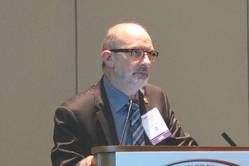
Drug use information was prospectively collected during the GIB event, with data during the follow-up period obtained from two different Spanish databases.
Treatment during the index bleeding event was continued without interruption in 11 patients and interrupted in 149 patients (93%). Among those whose therapy was interrupted, 21 (14%) never resumed therapy and 128 (86%) resumed therapy (118 patients within 15 days and 10 patients after 15 days). The 86% treatment resumption rate is much higher than the 40%-66% rates reported in previous studies, indicating that Spanish physicians restarted treatment quite early, Dr. Lanas observed.
The mean age at baseline was 76.6 years, 61.3% of patients were men, and half had a Charlson index score > 4. Median follow-up was 21.5 months (range 1-63 months).
Ischemic events did not differ between patients who did or did not restart anticoagulants or antiplatelets (16.4% vs. 14.3%; P value = .806). However, rebleeding occurred in 32% of patients who resumed therapy versus none who did not (P = .002), but deaths were higher in those who did not restart therapy (38.1% vs. 12.5%; P = .003), Dr. Lanas said.
These differences remain significant in Kaplan-Meier survival curves for death (P = .021) and rebleeding (P = .004).
A comparison of early therapy resumption (≤ 15 days) vs. delayed (mean delay 62 days) or no resumption revealed similar results. Early resumption was associated with a higher rate of rebleeding (32.2% vs. 9.7%; P = .012), but a lower rate of death (11% vs. 35.5%; P = .001), with no difference in ischemic events (17% vs. 13%; P = .586), Dr. Lanas said.
Again, the differences remain significant in Kaplan-Meier survival curves for death (P = .011) and rebleeding (P = .013).
When the investigators looked at rebleeding according to drug use, patients receiving anticoagulants vs. antiplatelets had significantly higher rates of rebleeding (34.7% vs. 20.5%; P = .043), death (22.2% vs. 10.2%; P = .038), and any event (68.1% vs. 52.3%; P = .043).
After adjustment for gender, age, Charlson index, diabetes, and arterial hypertension, the risk of rebleeding was more than threefold higher for dual antiplatelet and anticoagulant users than for antiplatelet-alone users (odds ratio, 3.45; P = .025) and was twofold higher for anticoagulant vs. antiplatelet users (OR, 2.07; P = .045), Dr. Lanas said.
Finally, an analysis of the cause of bleeding suggests the cause of rebleeding may be different from the original event and that there is a shift toward the lower GI tract, he added.
The index bleeding event was caused largely by an upper GI peptic ulcer in 48% of all 160 patients, with 43.7% of events due to lower GI diverticulosis, vascular lesions, ischemic, or other lesions. In contrast, peptic ulcers accounted for only 7% of rebleeding events, while lower GI events accounted for 72%. Proton pump inhibition use was evenly distributed in upper and lower GI bleeding, although effective endoscopic treatment may have influenced upper GI bleeds, Dr. Lanas said.
“The importance of this is that we may have very good therapy tools for the upper GI, but still we have problems controlling the bleeding from the lower GI,” he added.
During a discussion of the study, an audience member asked how many days clinicians should wait to restart anticoagulants or antiplatelets.
“In those patients with peptic ulcer bleeding, it’s better to just give the antiplatelet therapy soon after the bleeding event or just to not interrupt the aspirin because the morality at 30 days was higher in those who were interrupted,” Dr. Lanas advised. “...I think for the cutoff point to show differences for patients with a worse outcome versus those with a better outcome, you shouldn’t restart anticoagulant therapy before day 15 after the bleeding event.”
Dr. Lanas received consulting fees, speaking and teaching fees, other financial support, and grant and research support from Bayer.
On Twitter @pwendl
WASHINGTON – Early resumption of antiplatelet agents or anticoagulants after a major gastrointestinal bleeding event is clearly associated with an increased risk of rebleeding, but a decreased risk of death, results from an observational study show.
Furthermore, anticoagulant treatment “is associated with a higher risk of rebleeding and death compared with antiplatelet treatment after a previous GI event,” Dr. Angel Lanas said to an overflow crowd at the annual Digestive Disease Week.
In a separate case-control study, Dr. Lanas and his associates recently reported that the risk of GI bleeding was twofold higher for anticoagulants than for low-dose aspirin in patients hospitalized for GI bleeding (Clin. Gastroenterol. Hepatol. 2015 May;13:906-12.e2. [doi:10.1016/j.cgh.2014.11.007])
The current study examined adverse events in a cohort of 160 patients who developed a major gastrointestinal bleed (GIB) while using anticoagulants and/or antiplatelet therapy between March 2008 and July 2013. Long-term interruption or short-term resumption of these treatments has important clinical implications and differences in the intrinsic risks between antiplatelet or anticoagulant users after drug resumption are not well established, said Dr. Lanas of the University of Zaragoza (Spain).
Drug use information was prospectively collected during the GIB event, with data during the follow-up period obtained from two different Spanish databases.
Treatment during the index bleeding event was continued without interruption in 11 patients and interrupted in 149 patients (93%). Among those whose therapy was interrupted, 21 (14%) never resumed therapy and 128 (86%) resumed therapy (118 patients within 15 days and 10 patients after 15 days). The 86% treatment resumption rate is much higher than the 40%-66% rates reported in previous studies, indicating that Spanish physicians restarted treatment quite early, Dr. Lanas observed.
The mean age at baseline was 76.6 years, 61.3% of patients were men, and half had a Charlson index score > 4. Median follow-up was 21.5 months (range 1-63 months).
Ischemic events did not differ between patients who did or did not restart anticoagulants or antiplatelets (16.4% vs. 14.3%; P value = .806). However, rebleeding occurred in 32% of patients who resumed therapy versus none who did not (P = .002), but deaths were higher in those who did not restart therapy (38.1% vs. 12.5%; P = .003), Dr. Lanas said.
These differences remain significant in Kaplan-Meier survival curves for death (P = .021) and rebleeding (P = .004).
A comparison of early therapy resumption (≤ 15 days) vs. delayed (mean delay 62 days) or no resumption revealed similar results. Early resumption was associated with a higher rate of rebleeding (32.2% vs. 9.7%; P = .012), but a lower rate of death (11% vs. 35.5%; P = .001), with no difference in ischemic events (17% vs. 13%; P = .586), Dr. Lanas said.
Again, the differences remain significant in Kaplan-Meier survival curves for death (P = .011) and rebleeding (P = .013).
When the investigators looked at rebleeding according to drug use, patients receiving anticoagulants vs. antiplatelets had significantly higher rates of rebleeding (34.7% vs. 20.5%; P = .043), death (22.2% vs. 10.2%; P = .038), and any event (68.1% vs. 52.3%; P = .043).
After adjustment for gender, age, Charlson index, diabetes, and arterial hypertension, the risk of rebleeding was more than threefold higher for dual antiplatelet and anticoagulant users than for antiplatelet-alone users (odds ratio, 3.45; P = .025) and was twofold higher for anticoagulant vs. antiplatelet users (OR, 2.07; P = .045), Dr. Lanas said.
Finally, an analysis of the cause of bleeding suggests the cause of rebleeding may be different from the original event and that there is a shift toward the lower GI tract, he added.
The index bleeding event was caused largely by an upper GI peptic ulcer in 48% of all 160 patients, with 43.7% of events due to lower GI diverticulosis, vascular lesions, ischemic, or other lesions. In contrast, peptic ulcers accounted for only 7% of rebleeding events, while lower GI events accounted for 72%. Proton pump inhibition use was evenly distributed in upper and lower GI bleeding, although effective endoscopic treatment may have influenced upper GI bleeds, Dr. Lanas said.
“The importance of this is that we may have very good therapy tools for the upper GI, but still we have problems controlling the bleeding from the lower GI,” he added.
During a discussion of the study, an audience member asked how many days clinicians should wait to restart anticoagulants or antiplatelets.
“In those patients with peptic ulcer bleeding, it’s better to just give the antiplatelet therapy soon after the bleeding event or just to not interrupt the aspirin because the morality at 30 days was higher in those who were interrupted,” Dr. Lanas advised. “...I think for the cutoff point to show differences for patients with a worse outcome versus those with a better outcome, you shouldn’t restart anticoagulant therapy before day 15 after the bleeding event.”
Dr. Lanas received consulting fees, speaking and teaching fees, other financial support, and grant and research support from Bayer.
On Twitter @pwendl
WASHINGTON – Early resumption of antiplatelet agents or anticoagulants after a major gastrointestinal bleeding event is clearly associated with an increased risk of rebleeding, but a decreased risk of death, results from an observational study show.
Furthermore, anticoagulant treatment “is associated with a higher risk of rebleeding and death compared with antiplatelet treatment after a previous GI event,” Dr. Angel Lanas said to an overflow crowd at the annual Digestive Disease Week.
In a separate case-control study, Dr. Lanas and his associates recently reported that the risk of GI bleeding was twofold higher for anticoagulants than for low-dose aspirin in patients hospitalized for GI bleeding (Clin. Gastroenterol. Hepatol. 2015 May;13:906-12.e2. [doi:10.1016/j.cgh.2014.11.007])
The current study examined adverse events in a cohort of 160 patients who developed a major gastrointestinal bleed (GIB) while using anticoagulants and/or antiplatelet therapy between March 2008 and July 2013. Long-term interruption or short-term resumption of these treatments has important clinical implications and differences in the intrinsic risks between antiplatelet or anticoagulant users after drug resumption are not well established, said Dr. Lanas of the University of Zaragoza (Spain).
Drug use information was prospectively collected during the GIB event, with data during the follow-up period obtained from two different Spanish databases.
Treatment during the index bleeding event was continued without interruption in 11 patients and interrupted in 149 patients (93%). Among those whose therapy was interrupted, 21 (14%) never resumed therapy and 128 (86%) resumed therapy (118 patients within 15 days and 10 patients after 15 days). The 86% treatment resumption rate is much higher than the 40%-66% rates reported in previous studies, indicating that Spanish physicians restarted treatment quite early, Dr. Lanas observed.
The mean age at baseline was 76.6 years, 61.3% of patients were men, and half had a Charlson index score > 4. Median follow-up was 21.5 months (range 1-63 months).
Ischemic events did not differ between patients who did or did not restart anticoagulants or antiplatelets (16.4% vs. 14.3%; P value = .806). However, rebleeding occurred in 32% of patients who resumed therapy versus none who did not (P = .002), but deaths were higher in those who did not restart therapy (38.1% vs. 12.5%; P = .003), Dr. Lanas said.
These differences remain significant in Kaplan-Meier survival curves for death (P = .021) and rebleeding (P = .004).
A comparison of early therapy resumption (≤ 15 days) vs. delayed (mean delay 62 days) or no resumption revealed similar results. Early resumption was associated with a higher rate of rebleeding (32.2% vs. 9.7%; P = .012), but a lower rate of death (11% vs. 35.5%; P = .001), with no difference in ischemic events (17% vs. 13%; P = .586), Dr. Lanas said.
Again, the differences remain significant in Kaplan-Meier survival curves for death (P = .011) and rebleeding (P = .013).
When the investigators looked at rebleeding according to drug use, patients receiving anticoagulants vs. antiplatelets had significantly higher rates of rebleeding (34.7% vs. 20.5%; P = .043), death (22.2% vs. 10.2%; P = .038), and any event (68.1% vs. 52.3%; P = .043).
After adjustment for gender, age, Charlson index, diabetes, and arterial hypertension, the risk of rebleeding was more than threefold higher for dual antiplatelet and anticoagulant users than for antiplatelet-alone users (odds ratio, 3.45; P = .025) and was twofold higher for anticoagulant vs. antiplatelet users (OR, 2.07; P = .045), Dr. Lanas said.
Finally, an analysis of the cause of bleeding suggests the cause of rebleeding may be different from the original event and that there is a shift toward the lower GI tract, he added.
The index bleeding event was caused largely by an upper GI peptic ulcer in 48% of all 160 patients, with 43.7% of events due to lower GI diverticulosis, vascular lesions, ischemic, or other lesions. In contrast, peptic ulcers accounted for only 7% of rebleeding events, while lower GI events accounted for 72%. Proton pump inhibition use was evenly distributed in upper and lower GI bleeding, although effective endoscopic treatment may have influenced upper GI bleeds, Dr. Lanas said.
“The importance of this is that we may have very good therapy tools for the upper GI, but still we have problems controlling the bleeding from the lower GI,” he added.
During a discussion of the study, an audience member asked how many days clinicians should wait to restart anticoagulants or antiplatelets.
“In those patients with peptic ulcer bleeding, it’s better to just give the antiplatelet therapy soon after the bleeding event or just to not interrupt the aspirin because the morality at 30 days was higher in those who were interrupted,” Dr. Lanas advised. “...I think for the cutoff point to show differences for patients with a worse outcome versus those with a better outcome, you shouldn’t restart anticoagulant therapy before day 15 after the bleeding event.”
Dr. Lanas received consulting fees, speaking and teaching fees, other financial support, and grant and research support from Bayer.
On Twitter @pwendl
EXPERT ANALYSIS FROM DDW® 2015

DDW: Budesonide improves dysphagia, histology, and endoscopic findings in EoE
WASHINGTON – Treatment with an oral formulation of budesonide was associated with significant improvements in dysphagia and esophageal eosinophil counts in adolescents and adults with eosinophilic esophagitis, in a study that is also the first to use a recently validated scoring instrument to evaluate medical therapy for this disorder in a randomized trial.
Results of the multicenter, double-blind, randomized study comparing treatment with an oral budesonide suspension to placebo for 12 weeks in almost 100 patients with eosinophilic esophagitis (EoE) were reported in two separate presentations at the annual Digestive Disease Week. One of the investigators, Dr. Evan Dellon of the Center for Gastrointestinal Biology and Disease, at the University of North Carolina, Chapel Hill, said that treatment with this “mucoadherent” formulation of the topical steroid was associated with significant improvements in dysphagia symptoms, as measured with the Dysphagia Symptom Questionnaire (DSQ), and a histologic response rate of 39%, vs. 3% among those on placebo.
“The study not only adds to the evidence that topical budesonide is effective for inducing histologic response in subjects with active EoE, but [also] shows for the first time that symptoms of dysphagia, as measured with a validated symptom instrument, improve concordantly with the histologic and endoscopic findings,” Dr. Dellon said in an interview after the meeting. “Moreover, this study shows that a topical steroid formulation designed specifically for EoE, rather than an asthma formulation that is adapted for esophageal use, will likely be a beneficial and potentially preferred clinical treatment option.”
Another study investigator, Dr. Ikuo Hirano, professor of medicine and director of the gastroenterology and hepatology fellowship program at Northwestern University, Chicago, reported that treatment was also associated with significant improvements in the EoE Endoscopic Reference Score, EREFS, which was designed to classify and grade the severity of five major endoscopic features of EoE: edema, rings, exudates, furrows, and stricture formation. This was the first study to use this validated endoscopic scoring instrument in a randomized controlled trial of a medical therapy in patients with EoE, he said at the meeting.
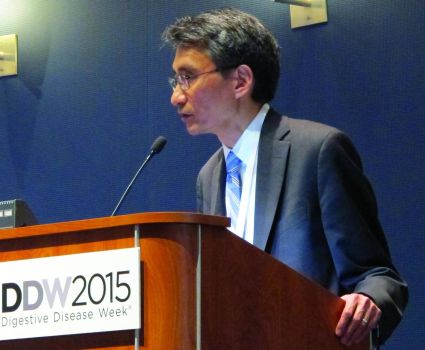
The study was conducted between 2012 and 2014 at 25 U.S. sites, in patients aged 11-40 years with EoE. Baseline demographic and endoscopic characteristics were similar in the two groups. Their mean age was 21-22 years (41% of those on placebo and 35% of those on budesonide were younger than age 18 years) and 69% were male; most patients had edema, all had dysphagia, and 39%-41% had heartburn. Patients were excluded if they had esophageal stricture on screening endoscopy that did not allow passage of a standard adult diagnostic endoscope.
Patients were randomized to treatment with budesonide suspension, at a dose of 2 mg twice a day (51 patients) or a placebo suspension (42 patients). The primary outcomes were a change in the DSQ score from baseline, and the proportion of patients with a histologic response, defined as at least 6 eosinophils per high-power field (eos/hpf) from all biopsies. The final analysis included 87 patients.
At baseline, the mean peak eosinophil counts were 156/hpf among those on budesonide and 130/hpf among those on placebo; after treatment, the mean peak counts dropped to 39/hpf among those on budesonide (a 65% reduction) and to 113/hpf among those on placebo (a 10% reduction), a statistically significant difference (P < .05), said Dr. Dellon, also with the department of medicine at UNC.
From a mean of about 29 in both groups at baseline, DSQ scores dropped by a mean of 14.3 among the treated patients, vs. 7.5 among those on placebo, which was a statistically significant difference (P = .0096). The other primary endpoint, the histologic response rate, was 39% among treated patients, vs. 3% among those on placebo, also a significant difference (P < .0001).
Adverse events were not different between the two groups, and growth velocity among those under age 18 years and cortisol levels were not different between the two groups, he added. There was one case of esophageal candidiasis in a patient on budesonide.
During his presentation, Dr. Hirano said that there were also significant improvements in EREFS scores from baseline in the proximal and distal esophagus among those treated with budesonide, but not among those on placebo. Based on EREFS scores, oral budesonide “resulted in significant improvement in endoscopic features of edema, exudate, rings, [and] furrows, compared to placebo,” but there was no significant change in strictures, another component of the EREFS, in either the treatment or placebo groups. However, patients with high-grade strictures were not enrolled in the study, he added.
After treatment, proximal, distal, and total EREFS scores correlated with peak eosinophil counts, a highly statistically significant finding.
Dr. Hirano said that the primary endpoints used in most EoE clinical trials to date have focused mostly on assessments of symptoms and histopathology, which have limitations. “Symptoms are difficult to quantify and often intermittent [and] they may improve as a result of changes in eating behavior and food avoidance,” he said. Patient-reported outcome instruments have been recently validated, “but have questionable utility in clinical practice” and histology “has shown limited correlation between degree of esophageal eosinophilia and symptom severity [and does not] assess for modeling, an important determinant of overall disease complications,” he added.
The utility of endoscopy in EoE includes the features that are present in vast majority of patients with EoE, and provides a gross assessment of overall disease activity, “both in terms of inflammatory and fibrostenotic features,” he said.
“Endoscopic outcomes are now emerging as clinically relevant endpoints of therapy of trials of eosinophilic esophagitis that supports and complements” symptom and histologic assessments, Dr. Hirano commented, adding that more studies are need to determine the “relative importance of these individual endoscopic features as well as the appropriate utilization of endoscopic parameters in disease management.”
The study was funded by Meritage Pharma, recently acquired by the Shire group of companies. All authors received research funds to conduct the study, and Dr. Hirano disclosed having worked as a consultant for Meritage. Dr. Dellon’s disclosures included receiving grant and research support from Meritage. Shire is developing the oral budesonide suspension formulation as a treatment for adolescents and adults with EoE.
WASHINGTON – Treatment with an oral formulation of budesonide was associated with significant improvements in dysphagia and esophageal eosinophil counts in adolescents and adults with eosinophilic esophagitis, in a study that is also the first to use a recently validated scoring instrument to evaluate medical therapy for this disorder in a randomized trial.
Results of the multicenter, double-blind, randomized study comparing treatment with an oral budesonide suspension to placebo for 12 weeks in almost 100 patients with eosinophilic esophagitis (EoE) were reported in two separate presentations at the annual Digestive Disease Week. One of the investigators, Dr. Evan Dellon of the Center for Gastrointestinal Biology and Disease, at the University of North Carolina, Chapel Hill, said that treatment with this “mucoadherent” formulation of the topical steroid was associated with significant improvements in dysphagia symptoms, as measured with the Dysphagia Symptom Questionnaire (DSQ), and a histologic response rate of 39%, vs. 3% among those on placebo.
“The study not only adds to the evidence that topical budesonide is effective for inducing histologic response in subjects with active EoE, but [also] shows for the first time that symptoms of dysphagia, as measured with a validated symptom instrument, improve concordantly with the histologic and endoscopic findings,” Dr. Dellon said in an interview after the meeting. “Moreover, this study shows that a topical steroid formulation designed specifically for EoE, rather than an asthma formulation that is adapted for esophageal use, will likely be a beneficial and potentially preferred clinical treatment option.”
Another study investigator, Dr. Ikuo Hirano, professor of medicine and director of the gastroenterology and hepatology fellowship program at Northwestern University, Chicago, reported that treatment was also associated with significant improvements in the EoE Endoscopic Reference Score, EREFS, which was designed to classify and grade the severity of five major endoscopic features of EoE: edema, rings, exudates, furrows, and stricture formation. This was the first study to use this validated endoscopic scoring instrument in a randomized controlled trial of a medical therapy in patients with EoE, he said at the meeting.
The study was conducted between 2012 and 2014 at 25 U.S. sites, in patients aged 11-40 years with EoE. Baseline demographic and endoscopic characteristics were similar in the two groups. Their mean age was 21-22 years (41% of those on placebo and 35% of those on budesonide were younger than age 18 years) and 69% were male; most patients had edema, all had dysphagia, and 39%-41% had heartburn. Patients were excluded if they had esophageal stricture on screening endoscopy that did not allow passage of a standard adult diagnostic endoscope.
Patients were randomized to treatment with budesonide suspension, at a dose of 2 mg twice a day (51 patients) or a placebo suspension (42 patients). The primary outcomes were a change in the DSQ score from baseline, and the proportion of patients with a histologic response, defined as at least 6 eosinophils per high-power field (eos/hpf) from all biopsies. The final analysis included 87 patients.
At baseline, the mean peak eosinophil counts were 156/hpf among those on budesonide and 130/hpf among those on placebo; after treatment, the mean peak counts dropped to 39/hpf among those on budesonide (a 65% reduction) and to 113/hpf among those on placebo (a 10% reduction), a statistically significant difference (P < .05), said Dr. Dellon, also with the department of medicine at UNC.
From a mean of about 29 in both groups at baseline, DSQ scores dropped by a mean of 14.3 among the treated patients, vs. 7.5 among those on placebo, which was a statistically significant difference (P = .0096). The other primary endpoint, the histologic response rate, was 39% among treated patients, vs. 3% among those on placebo, also a significant difference (P < .0001).
Adverse events were not different between the two groups, and growth velocity among those under age 18 years and cortisol levels were not different between the two groups, he added. There was one case of esophageal candidiasis in a patient on budesonide.
During his presentation, Dr. Hirano said that there were also significant improvements in EREFS scores from baseline in the proximal and distal esophagus among those treated with budesonide, but not among those on placebo. Based on EREFS scores, oral budesonide “resulted in significant improvement in endoscopic features of edema, exudate, rings, [and] furrows, compared to placebo,” but there was no significant change in strictures, another component of the EREFS, in either the treatment or placebo groups. However, patients with high-grade strictures were not enrolled in the study, he added.
After treatment, proximal, distal, and total EREFS scores correlated with peak eosinophil counts, a highly statistically significant finding.
Dr. Hirano said that the primary endpoints used in most EoE clinical trials to date have focused mostly on assessments of symptoms and histopathology, which have limitations. “Symptoms are difficult to quantify and often intermittent [and] they may improve as a result of changes in eating behavior and food avoidance,” he said. Patient-reported outcome instruments have been recently validated, “but have questionable utility in clinical practice” and histology “has shown limited correlation between degree of esophageal eosinophilia and symptom severity [and does not] assess for modeling, an important determinant of overall disease complications,” he added.
The utility of endoscopy in EoE includes the features that are present in vast majority of patients with EoE, and provides a gross assessment of overall disease activity, “both in terms of inflammatory and fibrostenotic features,” he said.
“Endoscopic outcomes are now emerging as clinically relevant endpoints of therapy of trials of eosinophilic esophagitis that supports and complements” symptom and histologic assessments, Dr. Hirano commented, adding that more studies are need to determine the “relative importance of these individual endoscopic features as well as the appropriate utilization of endoscopic parameters in disease management.”
The study was funded by Meritage Pharma, recently acquired by the Shire group of companies. All authors received research funds to conduct the study, and Dr. Hirano disclosed having worked as a consultant for Meritage. Dr. Dellon’s disclosures included receiving grant and research support from Meritage. Shire is developing the oral budesonide suspension formulation as a treatment for adolescents and adults with EoE.
WASHINGTON – Treatment with an oral formulation of budesonide was associated with significant improvements in dysphagia and esophageal eosinophil counts in adolescents and adults with eosinophilic esophagitis, in a study that is also the first to use a recently validated scoring instrument to evaluate medical therapy for this disorder in a randomized trial.
Results of the multicenter, double-blind, randomized study comparing treatment with an oral budesonide suspension to placebo for 12 weeks in almost 100 patients with eosinophilic esophagitis (EoE) were reported in two separate presentations at the annual Digestive Disease Week. One of the investigators, Dr. Evan Dellon of the Center for Gastrointestinal Biology and Disease, at the University of North Carolina, Chapel Hill, said that treatment with this “mucoadherent” formulation of the topical steroid was associated with significant improvements in dysphagia symptoms, as measured with the Dysphagia Symptom Questionnaire (DSQ), and a histologic response rate of 39%, vs. 3% among those on placebo.
“The study not only adds to the evidence that topical budesonide is effective for inducing histologic response in subjects with active EoE, but [also] shows for the first time that symptoms of dysphagia, as measured with a validated symptom instrument, improve concordantly with the histologic and endoscopic findings,” Dr. Dellon said in an interview after the meeting. “Moreover, this study shows that a topical steroid formulation designed specifically for EoE, rather than an asthma formulation that is adapted for esophageal use, will likely be a beneficial and potentially preferred clinical treatment option.”
Another study investigator, Dr. Ikuo Hirano, professor of medicine and director of the gastroenterology and hepatology fellowship program at Northwestern University, Chicago, reported that treatment was also associated with significant improvements in the EoE Endoscopic Reference Score, EREFS, which was designed to classify and grade the severity of five major endoscopic features of EoE: edema, rings, exudates, furrows, and stricture formation. This was the first study to use this validated endoscopic scoring instrument in a randomized controlled trial of a medical therapy in patients with EoE, he said at the meeting.
The study was conducted between 2012 and 2014 at 25 U.S. sites, in patients aged 11-40 years with EoE. Baseline demographic and endoscopic characteristics were similar in the two groups. Their mean age was 21-22 years (41% of those on placebo and 35% of those on budesonide were younger than age 18 years) and 69% were male; most patients had edema, all had dysphagia, and 39%-41% had heartburn. Patients were excluded if they had esophageal stricture on screening endoscopy that did not allow passage of a standard adult diagnostic endoscope.
Patients were randomized to treatment with budesonide suspension, at a dose of 2 mg twice a day (51 patients) or a placebo suspension (42 patients). The primary outcomes were a change in the DSQ score from baseline, and the proportion of patients with a histologic response, defined as at least 6 eosinophils per high-power field (eos/hpf) from all biopsies. The final analysis included 87 patients.
At baseline, the mean peak eosinophil counts were 156/hpf among those on budesonide and 130/hpf among those on placebo; after treatment, the mean peak counts dropped to 39/hpf among those on budesonide (a 65% reduction) and to 113/hpf among those on placebo (a 10% reduction), a statistically significant difference (P < .05), said Dr. Dellon, also with the department of medicine at UNC.
From a mean of about 29 in both groups at baseline, DSQ scores dropped by a mean of 14.3 among the treated patients, vs. 7.5 among those on placebo, which was a statistically significant difference (P = .0096). The other primary endpoint, the histologic response rate, was 39% among treated patients, vs. 3% among those on placebo, also a significant difference (P < .0001).
Adverse events were not different between the two groups, and growth velocity among those under age 18 years and cortisol levels were not different between the two groups, he added. There was one case of esophageal candidiasis in a patient on budesonide.
During his presentation, Dr. Hirano said that there were also significant improvements in EREFS scores from baseline in the proximal and distal esophagus among those treated with budesonide, but not among those on placebo. Based on EREFS scores, oral budesonide “resulted in significant improvement in endoscopic features of edema, exudate, rings, [and] furrows, compared to placebo,” but there was no significant change in strictures, another component of the EREFS, in either the treatment or placebo groups. However, patients with high-grade strictures were not enrolled in the study, he added.
After treatment, proximal, distal, and total EREFS scores correlated with peak eosinophil counts, a highly statistically significant finding.
Dr. Hirano said that the primary endpoints used in most EoE clinical trials to date have focused mostly on assessments of symptoms and histopathology, which have limitations. “Symptoms are difficult to quantify and often intermittent [and] they may improve as a result of changes in eating behavior and food avoidance,” he said. Patient-reported outcome instruments have been recently validated, “but have questionable utility in clinical practice” and histology “has shown limited correlation between degree of esophageal eosinophilia and symptom severity [and does not] assess for modeling, an important determinant of overall disease complications,” he added.
The utility of endoscopy in EoE includes the features that are present in vast majority of patients with EoE, and provides a gross assessment of overall disease activity, “both in terms of inflammatory and fibrostenotic features,” he said.
“Endoscopic outcomes are now emerging as clinically relevant endpoints of therapy of trials of eosinophilic esophagitis that supports and complements” symptom and histologic assessments, Dr. Hirano commented, adding that more studies are need to determine the “relative importance of these individual endoscopic features as well as the appropriate utilization of endoscopic parameters in disease management.”
The study was funded by Meritage Pharma, recently acquired by the Shire group of companies. All authors received research funds to conduct the study, and Dr. Hirano disclosed having worked as a consultant for Meritage. Dr. Dellon’s disclosures included receiving grant and research support from Meritage. Shire is developing the oral budesonide suspension formulation as a treatment for adolescents and adults with EoE.
AT DDW 2015
Key clinical point: A mucoadherent oral formulation of budesonide shows promise as an effective treatment for eosinophilic esophagitis (EoE), with a favorable safety profile.
Major finding: Beneficial effects of oral budesonide in a study of adolescents and adults with EoE included a histologic response rate of 39% and significantly improved dysphagia symptoms.
Data source: A randomized, double-blind multicenter U.S. study evaluated the healing effects and response to of oral budesonide vs. placebo in 93 patients with EoE, aged 11-40 years.
Disclosures: The study was funded by Meritage Pharma, recently acquired by the Shire group of companies. All authors received research funds to conduct the study. Dr. Dellon’s disclosures included receiving grant and research support from Meritage. Dr. Hirano disclosed having worked as a consultant for Meritage.
DDW: Postbleed blood thinners up rebleeding risk, lower death risk
WASHINGTON – Early resumption of antiplatelet agents or anticoagulants after a major gastrointestinal bleeding event is clearly associated with an increased risk of rebleeding, but a decreased risk of death, results from an observational study show.
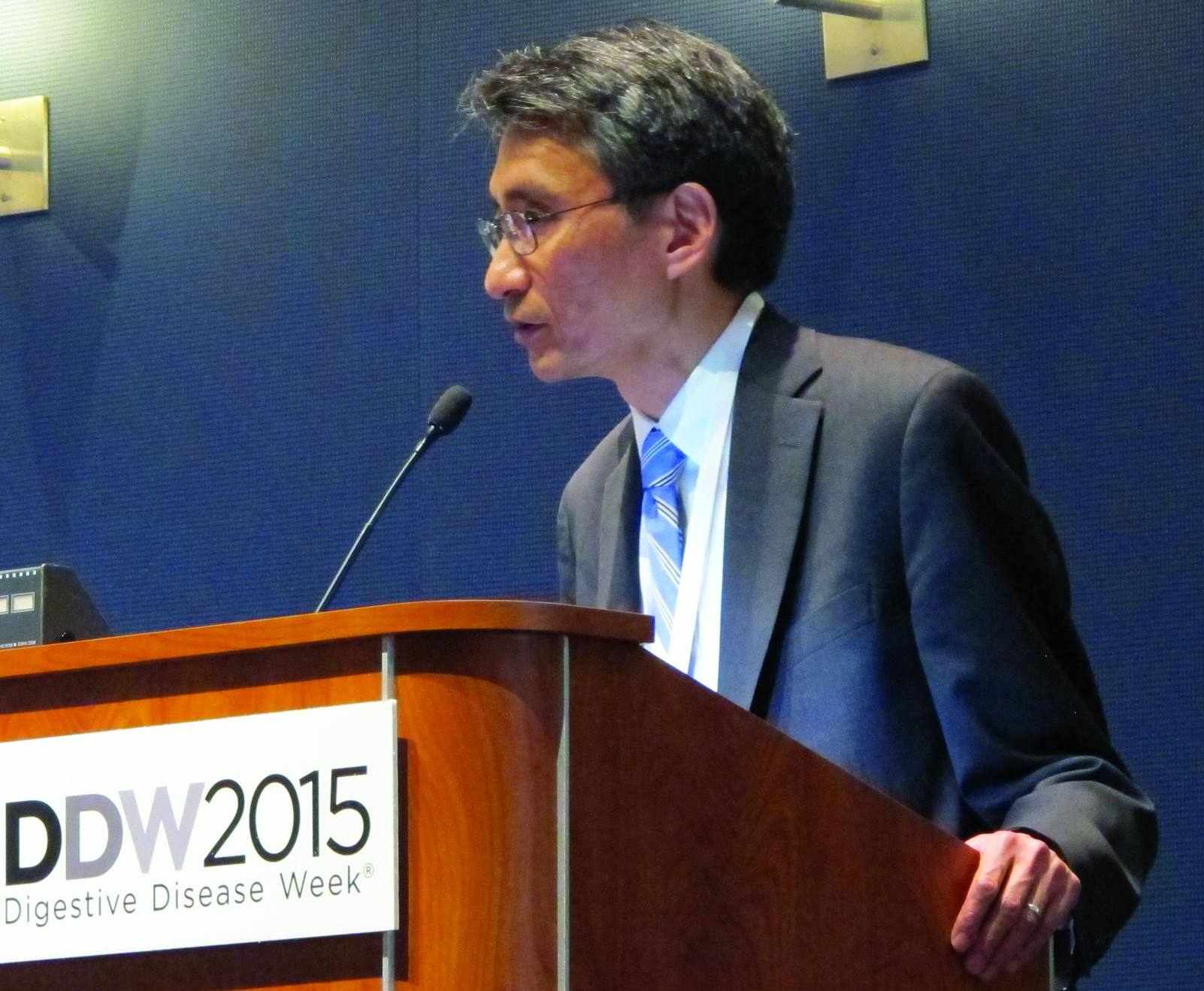
Furthermore, anticoagulant treatment “is associated with a higher risk of rebleeding and death compared with antiplatelet treatment after a previous GI event,” Dr. Angel Lanas said to an overflow crowd at the annual Digestive Disease Week.

In a separate case-control study, Dr. Lanas and his associates recently reported that the risk of GI bleeding was twofold higher for anticoagulants than for low-dose aspirin in patients hospitalized for GI bleeding (Clin. Gastroenterol. Hepatol. 2015 May;13:906-12.e2. [doi:10.1016/j.cgh.2014.11.007])
The current study examined adverse events in a cohort of 160 patients who developed a major gastrointestinal bleed (GIB) while using anticoagulants and/or antiplatelet therapy between March 2008 and July 2013. Long-term interruption or short-term resumption of these treatments has important clinical implications and differences in the intrinsic risks between antiplatelet or anticoagulant users after drug resumption are not well established, said Dr. Lanas of the University of Zaragoza, Spain.
Drug use information was prospectively collected during the GIB event, with data during the follow-up period obtained from two different Spanish databases.
Treatment during the index bleeding event was continued without interruption in 11 patients and interrupted in 149 patients (93%). Among those whose therapy was interrupted, 21 (14%) never resumed therapy and 128 (86%) resumed therapy (118 patients within 15 days and 10 patients after 15 days). The 86% treatment resumption rate is much higher than the 40%-66% rates reported in previous studies, indicating that Spanish physicians restarted treatment quite early, Dr. Lanas observed.
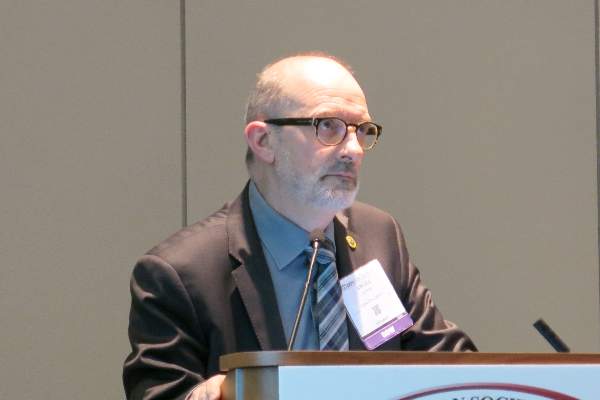
The mean age at baseline was 76.6 years, 61.3% of patients were men, and half had a Charlson index score > 4. Median follow-up was 21.5 months (range 1-63 months).
Ischemic events did not differ between patients who did or did not restart anticoagulants or antiplatelets (16.4% vs. 14.3%; P value = .806). However, rebleeding occurred in 32% of patients who resumed therapy versus none who did not (P = .002), but deaths were higher in those who did not restart therapy (38.1% vs. 12.5%; P = .003), Dr. Lanas said.
These differences remain significant in Kaplan-Meier survival curves for death (P = .021) and rebleeding (P = .004).
A comparison of early therapy resumption (≤ 15 days) vs. delayed (mean delay 62 days) or no resumption revealed similar results. Early resumption was associated with a higher rate of rebleeding (32.2% vs. 9.7%; P = .012), but a lower rate of death (11% vs. 35.5%; P = .001), with no difference in ischemic events (17% vs. 13%; P = .586), Dr. Lanas said.
Again, the differences remain significant in Kaplan-Meier survival curves for death (P = .011) and rebleeding (P = .013).
When the investigators looked at rebleeding according to drug use, patients receiving anticoagulants vs. antiplatelets had significantly higher rates of rebleeding (34.7% vs. 20.5%; P = .043), death (22.2% vs. 10.2%; P = .038), and any event (68.1% vs. 52.3%; P = .043).
After adjustment for gender, age, Charlson index, diabetes, and arterial hypertension, the risk of rebleeding was more than threefold higher for dual antiplatelet and anticoagulant users than for antiplatelet-alone users (odds ratio, 3.45; P = .025) and was twofold higher for anticoagulant vs. antiplatelet users (OR, 2.07; P = .045), Dr. Lanas said.
Finally, an analysis of the cause of bleeding suggests the cause of rebleeding may be different from the original event and that there is a shift toward the lower GI tract, he added.
The index bleeding event was caused largely by an upper GI peptic ulcer in 48% of all 160 patients, with 43.7% of events due to lower GI diverticulosis, vascular lesions, ischemic, or other lesions. In contrast, peptic ulcers accounted for only 7% of rebleeding events, while lower GI events accounted for 72%. Proton pump inhibition use was evenly distributed in upper and lower GI bleeding, although effective endoscopic treatment may have influenced upper GI bleeds, Dr. Lanas said.
“The importance of this is that we may have very good therapy tools for the upper GI, but still we have problems controlling the bleeding from the lower GI,” he added.
During a discussion of the study, an audience member asked how many days clinicians should wait to restart anticoagulants or antiplatelets.
“In those patients with peptic ulcer bleeding, it’s better to just give the antiplatelet therapy soon after the bleeding event or just to not interrupt the aspirin because the morality at 30 days was higher in those who were interrupted,” Dr. Lanas advised. “...I think for the cutoff point to show differences for patients with a worse outcome versus those with a better outcome, you shouldn’t restart anticoagulant therapy before day 15 after the bleeding event.”
Dr. Lanas received consulting fees, speaking and teaching fees, other financial support, and grant and research support from Bayer.
On Twitter @pwendl
WASHINGTON – Early resumption of antiplatelet agents or anticoagulants after a major gastrointestinal bleeding event is clearly associated with an increased risk of rebleeding, but a decreased risk of death, results from an observational study show.
Furthermore, anticoagulant treatment “is associated with a higher risk of rebleeding and death compared with antiplatelet treatment after a previous GI event,” Dr. Angel Lanas said to an overflow crowd at the annual Digestive Disease Week.
In a separate case-control study, Dr. Lanas and his associates recently reported that the risk of GI bleeding was twofold higher for anticoagulants than for low-dose aspirin in patients hospitalized for GI bleeding (Clin. Gastroenterol. Hepatol. 2015 May;13:906-12.e2. [doi:10.1016/j.cgh.2014.11.007])
The current study examined adverse events in a cohort of 160 patients who developed a major gastrointestinal bleed (GIB) while using anticoagulants and/or antiplatelet therapy between March 2008 and July 2013. Long-term interruption or short-term resumption of these treatments has important clinical implications and differences in the intrinsic risks between antiplatelet or anticoagulant users after drug resumption are not well established, said Dr. Lanas of the University of Zaragoza, Spain.
Drug use information was prospectively collected during the GIB event, with data during the follow-up period obtained from two different Spanish databases.
Treatment during the index bleeding event was continued without interruption in 11 patients and interrupted in 149 patients (93%). Among those whose therapy was interrupted, 21 (14%) never resumed therapy and 128 (86%) resumed therapy (118 patients within 15 days and 10 patients after 15 days). The 86% treatment resumption rate is much higher than the 40%-66% rates reported in previous studies, indicating that Spanish physicians restarted treatment quite early, Dr. Lanas observed.
The mean age at baseline was 76.6 years, 61.3% of patients were men, and half had a Charlson index score > 4. Median follow-up was 21.5 months (range 1-63 months).
Ischemic events did not differ between patients who did or did not restart anticoagulants or antiplatelets (16.4% vs. 14.3%; P value = .806). However, rebleeding occurred in 32% of patients who resumed therapy versus none who did not (P = .002), but deaths were higher in those who did not restart therapy (38.1% vs. 12.5%; P = .003), Dr. Lanas said.
These differences remain significant in Kaplan-Meier survival curves for death (P = .021) and rebleeding (P = .004).
A comparison of early therapy resumption (≤ 15 days) vs. delayed (mean delay 62 days) or no resumption revealed similar results. Early resumption was associated with a higher rate of rebleeding (32.2% vs. 9.7%; P = .012), but a lower rate of death (11% vs. 35.5%; P = .001), with no difference in ischemic events (17% vs. 13%; P = .586), Dr. Lanas said.
Again, the differences remain significant in Kaplan-Meier survival curves for death (P = .011) and rebleeding (P = .013).
When the investigators looked at rebleeding according to drug use, patients receiving anticoagulants vs. antiplatelets had significantly higher rates of rebleeding (34.7% vs. 20.5%; P = .043), death (22.2% vs. 10.2%; P = .038), and any event (68.1% vs. 52.3%; P = .043).
After adjustment for gender, age, Charlson index, diabetes, and arterial hypertension, the risk of rebleeding was more than threefold higher for dual antiplatelet and anticoagulant users than for antiplatelet-alone users (odds ratio, 3.45; P = .025) and was twofold higher for anticoagulant vs. antiplatelet users (OR, 2.07; P = .045), Dr. Lanas said.
Finally, an analysis of the cause of bleeding suggests the cause of rebleeding may be different from the original event and that there is a shift toward the lower GI tract, he added.
The index bleeding event was caused largely by an upper GI peptic ulcer in 48% of all 160 patients, with 43.7% of events due to lower GI diverticulosis, vascular lesions, ischemic, or other lesions. In contrast, peptic ulcers accounted for only 7% of rebleeding events, while lower GI events accounted for 72%. Proton pump inhibition use was evenly distributed in upper and lower GI bleeding, although effective endoscopic treatment may have influenced upper GI bleeds, Dr. Lanas said.
“The importance of this is that we may have very good therapy tools for the upper GI, but still we have problems controlling the bleeding from the lower GI,” he added.
During a discussion of the study, an audience member asked how many days clinicians should wait to restart anticoagulants or antiplatelets.
“In those patients with peptic ulcer bleeding, it’s better to just give the antiplatelet therapy soon after the bleeding event or just to not interrupt the aspirin because the morality at 30 days was higher in those who were interrupted,” Dr. Lanas advised. “...I think for the cutoff point to show differences for patients with a worse outcome versus those with a better outcome, you shouldn’t restart anticoagulant therapy before day 15 after the bleeding event.”
Dr. Lanas received consulting fees, speaking and teaching fees, other financial support, and grant and research support from Bayer.
On Twitter @pwendl
WASHINGTON – Early resumption of antiplatelet agents or anticoagulants after a major gastrointestinal bleeding event is clearly associated with an increased risk of rebleeding, but a decreased risk of death, results from an observational study show.
Furthermore, anticoagulant treatment “is associated with a higher risk of rebleeding and death compared with antiplatelet treatment after a previous GI event,” Dr. Angel Lanas said to an overflow crowd at the annual Digestive Disease Week.
In a separate case-control study, Dr. Lanas and his associates recently reported that the risk of GI bleeding was twofold higher for anticoagulants than for low-dose aspirin in patients hospitalized for GI bleeding (Clin. Gastroenterol. Hepatol. 2015 May;13:906-12.e2. [doi:10.1016/j.cgh.2014.11.007])
The current study examined adverse events in a cohort of 160 patients who developed a major gastrointestinal bleed (GIB) while using anticoagulants and/or antiplatelet therapy between March 2008 and July 2013. Long-term interruption or short-term resumption of these treatments has important clinical implications and differences in the intrinsic risks between antiplatelet or anticoagulant users after drug resumption are not well established, said Dr. Lanas of the University of Zaragoza, Spain.
Drug use information was prospectively collected during the GIB event, with data during the follow-up period obtained from two different Spanish databases.
Treatment during the index bleeding event was continued without interruption in 11 patients and interrupted in 149 patients (93%). Among those whose therapy was interrupted, 21 (14%) never resumed therapy and 128 (86%) resumed therapy (118 patients within 15 days and 10 patients after 15 days). The 86% treatment resumption rate is much higher than the 40%-66% rates reported in previous studies, indicating that Spanish physicians restarted treatment quite early, Dr. Lanas observed.
The mean age at baseline was 76.6 years, 61.3% of patients were men, and half had a Charlson index score > 4. Median follow-up was 21.5 months (range 1-63 months).
Ischemic events did not differ between patients who did or did not restart anticoagulants or antiplatelets (16.4% vs. 14.3%; P value = .806). However, rebleeding occurred in 32% of patients who resumed therapy versus none who did not (P = .002), but deaths were higher in those who did not restart therapy (38.1% vs. 12.5%; P = .003), Dr. Lanas said.
These differences remain significant in Kaplan-Meier survival curves for death (P = .021) and rebleeding (P = .004).
A comparison of early therapy resumption (≤ 15 days) vs. delayed (mean delay 62 days) or no resumption revealed similar results. Early resumption was associated with a higher rate of rebleeding (32.2% vs. 9.7%; P = .012), but a lower rate of death (11% vs. 35.5%; P = .001), with no difference in ischemic events (17% vs. 13%; P = .586), Dr. Lanas said.
Again, the differences remain significant in Kaplan-Meier survival curves for death (P = .011) and rebleeding (P = .013).
When the investigators looked at rebleeding according to drug use, patients receiving anticoagulants vs. antiplatelets had significantly higher rates of rebleeding (34.7% vs. 20.5%; P = .043), death (22.2% vs. 10.2%; P = .038), and any event (68.1% vs. 52.3%; P = .043).
After adjustment for gender, age, Charlson index, diabetes, and arterial hypertension, the risk of rebleeding was more than threefold higher for dual antiplatelet and anticoagulant users than for antiplatelet-alone users (odds ratio, 3.45; P = .025) and was twofold higher for anticoagulant vs. antiplatelet users (OR, 2.07; P = .045), Dr. Lanas said.
Finally, an analysis of the cause of bleeding suggests the cause of rebleeding may be different from the original event and that there is a shift toward the lower GI tract, he added.
The index bleeding event was caused largely by an upper GI peptic ulcer in 48% of all 160 patients, with 43.7% of events due to lower GI diverticulosis, vascular lesions, ischemic, or other lesions. In contrast, peptic ulcers accounted for only 7% of rebleeding events, while lower GI events accounted for 72%. Proton pump inhibition use was evenly distributed in upper and lower GI bleeding, although effective endoscopic treatment may have influenced upper GI bleeds, Dr. Lanas said.
“The importance of this is that we may have very good therapy tools for the upper GI, but still we have problems controlling the bleeding from the lower GI,” he added.
During a discussion of the study, an audience member asked how many days clinicians should wait to restart anticoagulants or antiplatelets.
“In those patients with peptic ulcer bleeding, it’s better to just give the antiplatelet therapy soon after the bleeding event or just to not interrupt the aspirin because the morality at 30 days was higher in those who were interrupted,” Dr. Lanas advised. “...I think for the cutoff point to show differences for patients with a worse outcome versus those with a better outcome, you shouldn’t restart anticoagulant therapy before day 15 after the bleeding event.”
Dr. Lanas received consulting fees, speaking and teaching fees, other financial support, and grant and research support from Bayer.
On Twitter @pwendl
EXPERT ANALYSIS FROM DDW 2015
Key clinical point: Early resumption of antiplatelet agents or anticoagulants after a major gastrointestinal bleeding event is clearly associated with an increased risk of rebleeding, but a decreased risk of death.
Major finding: Rebleeding occurred in 32% of patients who resumed therapy versus none who did not (P = .002), but deaths were higher in those who did not restart therapy (38.1% vs. 12.5%; P = .003).
Data source: Retrospective, observational cohort study of 160 patients who developed GI bleeding while on antiplatelet or anticoagulant therapy.
Disclosures: Dr. Lanas received consulting fees, speaking and teaching fees, other financial support, and grant and research support from Bayer.

DDW: Menopausal hormone therapy increases major GI bleed risk
Menopausal hormone therapy is associated with an increased risk of major gastrointestinal bleeding, particularly in the lower gastrointestinal tract, that is associated with duration of use, a study has found.
Analysis of data from 73,863 women enrolled in the Nurses’ Health Study II in 1989 showed that current users of menopausal hormone therapy had a 46% increase in the risk of a major gastrointestinal bleed and a more than twofold increase in the risk of a lower GI bleed or ischemic colitis, compared with never users, said Dr. Prashant Singh of Massachusetts General Hospital, Boston.
Past users showed a much smaller increase risk of bleeding, while increasing duration of hormone therapy was significantly associated with increasing risk of major and low gastrointestinal bleeding.
“Although our findings show that menopausal hormone therapy may increase the risk of major GI bleeding, especially in the lower GI tract, it is important for these patients to know that this therapy is still an effective treatment; however, both clinician and patient should be more cautious in using this therapy in some cases, such as with patients who have a history of ischemic colitis,” Dr. Singh said at the annual Digestive Disease Week.
Dr. Singh does not have any relevant financial or other relationship with any manufacturer or provider of commercial products or services that he discussed during the presentation.
Menopausal hormone therapy is associated with an increased risk of major gastrointestinal bleeding, particularly in the lower gastrointestinal tract, that is associated with duration of use, a study has found.
Analysis of data from 73,863 women enrolled in the Nurses’ Health Study II in 1989 showed that current users of menopausal hormone therapy had a 46% increase in the risk of a major gastrointestinal bleed and a more than twofold increase in the risk of a lower GI bleed or ischemic colitis, compared with never users, said Dr. Prashant Singh of Massachusetts General Hospital, Boston.
Past users showed a much smaller increase risk of bleeding, while increasing duration of hormone therapy was significantly associated with increasing risk of major and low gastrointestinal bleeding.
“Although our findings show that menopausal hormone therapy may increase the risk of major GI bleeding, especially in the lower GI tract, it is important for these patients to know that this therapy is still an effective treatment; however, both clinician and patient should be more cautious in using this therapy in some cases, such as with patients who have a history of ischemic colitis,” Dr. Singh said at the annual Digestive Disease Week.
Dr. Singh does not have any relevant financial or other relationship with any manufacturer or provider of commercial products or services that he discussed during the presentation.
Menopausal hormone therapy is associated with an increased risk of major gastrointestinal bleeding, particularly in the lower gastrointestinal tract, that is associated with duration of use, a study has found.
Analysis of data from 73,863 women enrolled in the Nurses’ Health Study II in 1989 showed that current users of menopausal hormone therapy had a 46% increase in the risk of a major gastrointestinal bleed and a more than twofold increase in the risk of a lower GI bleed or ischemic colitis, compared with never users, said Dr. Prashant Singh of Massachusetts General Hospital, Boston.
Past users showed a much smaller increase risk of bleeding, while increasing duration of hormone therapy was significantly associated with increasing risk of major and low gastrointestinal bleeding.
“Although our findings show that menopausal hormone therapy may increase the risk of major GI bleeding, especially in the lower GI tract, it is important for these patients to know that this therapy is still an effective treatment; however, both clinician and patient should be more cautious in using this therapy in some cases, such as with patients who have a history of ischemic colitis,” Dr. Singh said at the annual Digestive Disease Week.
Dr. Singh does not have any relevant financial or other relationship with any manufacturer or provider of commercial products or services that he discussed during the presentation.
FROM DDW 2015
Key clinical point: Menopausal hormone therapy is associated with an increased risk of major gastrointestinal bleeding, particularly in the lower gastrointestinal tract.
Major finding: Current users of menopausal hormone therapy had a 46% increase in the risk of a major gastrointestinal bleed and a more than twofold increase in the risk of a lower GI bleed or ischemic colitis.
Data source: Analysis of data from 73,863 women enrolled in the Nurses’ Health Study II.
Disclosures: No conflicts of interest were disclosed.
VIDEO: Esophagectomy outcomes better in hospitals that handle complex cases
SEATTLE – Hospitals that perform at least one nongastric conduit esophageal reconstruction per year have half the esophagectomy mortality of hospitals that do not, according to a review by the Mayo Clinic in Rochester, Minn., of 11,211 esophagectomies in the Nationwide Inpatient Sample database from 2000 to 2011.
“There is tremendous variation in outcome after esophagectomy, and some advocate for regionalization to high-volume hospitals,” the investigators said. The findings suggest that case complexity could be one of the things that help define which hospitals do it best, they added.
The study seems to confirm that hospital case volume makes a difference in surgical outcomes, said Dr. Nabil Rizk, a thoracic surgeon at Memorial Sloan-Kettering Cancer Center in New York.
Dr. Rizk, a discussant on the paper at the American Association for Thoracic Surgery annual meeting, explained how the study fits into regionalization trends, but also shared his concerns about the work in an interview at the meeting.
The video associated with this article is no longer available on this site. Please view all of our videos on the MDedge YouTube channel
SEATTLE – Hospitals that perform at least one nongastric conduit esophageal reconstruction per year have half the esophagectomy mortality of hospitals that do not, according to a review by the Mayo Clinic in Rochester, Minn., of 11,211 esophagectomies in the Nationwide Inpatient Sample database from 2000 to 2011.
“There is tremendous variation in outcome after esophagectomy, and some advocate for regionalization to high-volume hospitals,” the investigators said. The findings suggest that case complexity could be one of the things that help define which hospitals do it best, they added.
The study seems to confirm that hospital case volume makes a difference in surgical outcomes, said Dr. Nabil Rizk, a thoracic surgeon at Memorial Sloan-Kettering Cancer Center in New York.
Dr. Rizk, a discussant on the paper at the American Association for Thoracic Surgery annual meeting, explained how the study fits into regionalization trends, but also shared his concerns about the work in an interview at the meeting.
The video associated with this article is no longer available on this site. Please view all of our videos on the MDedge YouTube channel
SEATTLE – Hospitals that perform at least one nongastric conduit esophageal reconstruction per year have half the esophagectomy mortality of hospitals that do not, according to a review by the Mayo Clinic in Rochester, Minn., of 11,211 esophagectomies in the Nationwide Inpatient Sample database from 2000 to 2011.
“There is tremendous variation in outcome after esophagectomy, and some advocate for regionalization to high-volume hospitals,” the investigators said. The findings suggest that case complexity could be one of the things that help define which hospitals do it best, they added.
The study seems to confirm that hospital case volume makes a difference in surgical outcomes, said Dr. Nabil Rizk, a thoracic surgeon at Memorial Sloan-Kettering Cancer Center in New York.
Dr. Rizk, a discussant on the paper at the American Association for Thoracic Surgery annual meeting, explained how the study fits into regionalization trends, but also shared his concerns about the work in an interview at the meeting.
The video associated with this article is no longer available on this site. Please view all of our videos on the MDedge YouTube channel
AT THE AATS ANNUAL MEETING

Acid exposure time found most useful in pH-impedance testing
pH-impedance testing best predicted response to reflux treatment when patients were off proton pump inhibitors, and abnormal acid exposure time was the single most useful testing parameter, a prospective study has found.
“Impedance-based reflux parameters complement but do not replace acid-based parameters in predicting symptom outcome from both medical and surgical antireflux therapy,” wrote Dr. Amit Patel and his associates at the Washington School of Medicine, St. Louis. The study appears in the May issue of Clinical Gastroenterology and Hepatology (doi:10.1016/j.cgh.2014.08.02).
“Because abnormal acid reflux time and symptom-reflux correlation parameters are detected more often when testing is performed off therapy, pH-impedance testing off antisecretory therapy maximizes prediction of symptomatic outcome from GERD [gastroesophageal reflux disease] therapy,” the researchers wrote.
Clinicians continue to debate the role of pH-impedance testing in management of GERD, whether testing should be performed on or off antisecretory therapy, and which testing parameters are most useful for predicting treatment response, the investigators noted. Therefore, they followed 187 adults with persistent GERD symptoms who underwent pH-impedance testing at their center during a 5-year period. Average age of patients was 54 years, almost 71% were female, and none had histopathologic evidence of esophageal motor disorders. Almost half had been off proton pump inhibitors for 7 days when tested, and 68% were managed medically as opposed to surgically.
Global symptom assessment (GSS) and dominant symptom intensity (DSI) scores both improved significantly during an average of 40 months of follow-up, the researchers said. After the researchers controlled for demographics, symptoms at presentation, use of proton pump inhibitors (PPI), and parameters that predicted treatment response in the univariate analyses, only abnormal acid exposure time (AET) predicted linear improvement in DSI scores (P =.027), while abnormal AET (P =.002) and symptom association probability (P =.026) predicted significant improvements in linear and dichotomous GSS, they reported. Abnormal AET and being off PPIs during testing also more than doubled the odds of at least a 50% improvement in GSS.
In contrast, dichotomous reflux exposure time did not predict response in any of the analyses, said the investigators. “Established thresholds for the total number of reflux events did not predict linear or dichotomous global symptom severity improvement,” they added. “Our data therefore suggest that performing pH-impedance testing off PPI therapy increases the yield of abnormal AET and symptom-reflux association with reflux events, facilitating predicting value for symptom improvement with both medical and surgical antireflux therapy.”
The researchers could not corroborate patients’ compliance with antisecretory therapy, assess the reasons physicians chose medical or surgical management, or evaluate the impact of the placebo effect or other factors unrelated to reflux, they said.
The study was partly funded by the National Institute for Diabetes and Digestive and Kidney Diseases, the National Institutes of Health, and the Washington University Department of Medicine Mentors in Medicine and Clinical Science Training and Research programs. The authors declared no relevant conflicts of interest.
pH-impedance testing best predicted response to reflux treatment when patients were off proton pump inhibitors, and abnormal acid exposure time was the single most useful testing parameter, a prospective study has found.
“Impedance-based reflux parameters complement but do not replace acid-based parameters in predicting symptom outcome from both medical and surgical antireflux therapy,” wrote Dr. Amit Patel and his associates at the Washington School of Medicine, St. Louis. The study appears in the May issue of Clinical Gastroenterology and Hepatology (doi:10.1016/j.cgh.2014.08.02).
“Because abnormal acid reflux time and symptom-reflux correlation parameters are detected more often when testing is performed off therapy, pH-impedance testing off antisecretory therapy maximizes prediction of symptomatic outcome from GERD [gastroesophageal reflux disease] therapy,” the researchers wrote.
Clinicians continue to debate the role of pH-impedance testing in management of GERD, whether testing should be performed on or off antisecretory therapy, and which testing parameters are most useful for predicting treatment response, the investigators noted. Therefore, they followed 187 adults with persistent GERD symptoms who underwent pH-impedance testing at their center during a 5-year period. Average age of patients was 54 years, almost 71% were female, and none had histopathologic evidence of esophageal motor disorders. Almost half had been off proton pump inhibitors for 7 days when tested, and 68% were managed medically as opposed to surgically.
Global symptom assessment (GSS) and dominant symptom intensity (DSI) scores both improved significantly during an average of 40 months of follow-up, the researchers said. After the researchers controlled for demographics, symptoms at presentation, use of proton pump inhibitors (PPI), and parameters that predicted treatment response in the univariate analyses, only abnormal acid exposure time (AET) predicted linear improvement in DSI scores (P =.027), while abnormal AET (P =.002) and symptom association probability (P =.026) predicted significant improvements in linear and dichotomous GSS, they reported. Abnormal AET and being off PPIs during testing also more than doubled the odds of at least a 50% improvement in GSS.
In contrast, dichotomous reflux exposure time did not predict response in any of the analyses, said the investigators. “Established thresholds for the total number of reflux events did not predict linear or dichotomous global symptom severity improvement,” they added. “Our data therefore suggest that performing pH-impedance testing off PPI therapy increases the yield of abnormal AET and symptom-reflux association with reflux events, facilitating predicting value for symptom improvement with both medical and surgical antireflux therapy.”
The researchers could not corroborate patients’ compliance with antisecretory therapy, assess the reasons physicians chose medical or surgical management, or evaluate the impact of the placebo effect or other factors unrelated to reflux, they said.
The study was partly funded by the National Institute for Diabetes and Digestive and Kidney Diseases, the National Institutes of Health, and the Washington University Department of Medicine Mentors in Medicine and Clinical Science Training and Research programs. The authors declared no relevant conflicts of interest.
pH-impedance testing best predicted response to reflux treatment when patients were off proton pump inhibitors, and abnormal acid exposure time was the single most useful testing parameter, a prospective study has found.
“Impedance-based reflux parameters complement but do not replace acid-based parameters in predicting symptom outcome from both medical and surgical antireflux therapy,” wrote Dr. Amit Patel and his associates at the Washington School of Medicine, St. Louis. The study appears in the May issue of Clinical Gastroenterology and Hepatology (doi:10.1016/j.cgh.2014.08.02).
“Because abnormal acid reflux time and symptom-reflux correlation parameters are detected more often when testing is performed off therapy, pH-impedance testing off antisecretory therapy maximizes prediction of symptomatic outcome from GERD [gastroesophageal reflux disease] therapy,” the researchers wrote.
Clinicians continue to debate the role of pH-impedance testing in management of GERD, whether testing should be performed on or off antisecretory therapy, and which testing parameters are most useful for predicting treatment response, the investigators noted. Therefore, they followed 187 adults with persistent GERD symptoms who underwent pH-impedance testing at their center during a 5-year period. Average age of patients was 54 years, almost 71% were female, and none had histopathologic evidence of esophageal motor disorders. Almost half had been off proton pump inhibitors for 7 days when tested, and 68% were managed medically as opposed to surgically.
Global symptom assessment (GSS) and dominant symptom intensity (DSI) scores both improved significantly during an average of 40 months of follow-up, the researchers said. After the researchers controlled for demographics, symptoms at presentation, use of proton pump inhibitors (PPI), and parameters that predicted treatment response in the univariate analyses, only abnormal acid exposure time (AET) predicted linear improvement in DSI scores (P =.027), while abnormal AET (P =.002) and symptom association probability (P =.026) predicted significant improvements in linear and dichotomous GSS, they reported. Abnormal AET and being off PPIs during testing also more than doubled the odds of at least a 50% improvement in GSS.
In contrast, dichotomous reflux exposure time did not predict response in any of the analyses, said the investigators. “Established thresholds for the total number of reflux events did not predict linear or dichotomous global symptom severity improvement,” they added. “Our data therefore suggest that performing pH-impedance testing off PPI therapy increases the yield of abnormal AET and symptom-reflux association with reflux events, facilitating predicting value for symptom improvement with both medical and surgical antireflux therapy.”
The researchers could not corroborate patients’ compliance with antisecretory therapy, assess the reasons physicians chose medical or surgical management, or evaluate the impact of the placebo effect or other factors unrelated to reflux, they said.
The study was partly funded by the National Institute for Diabetes and Digestive and Kidney Diseases, the National Institutes of Health, and the Washington University Department of Medicine Mentors in Medicine and Clinical Science Training and Research programs. The authors declared no relevant conflicts of interest.
Key clinical point: pH-impedance testing best predicted response to reflux treatment when patients were off proton pump inhibitors, and abnormal acid exposure time was the single most useful parameter.
Major finding: Acid exposure time consistently predicted response to antireflux therapy in univariate and multivariable analyses, while reflux exposure time did not.
Data source: Prospective, single-center study of 187 patients who underwent pH-impedance testing.
Disclosures: This study was partly funded by the National Institute for Diabetes and Digestive and Kidney Diseases, the National Institutes of Health, and the Washington University Department of Medicine Mentors in Medicine and Clinical Science Training and Research programs. The authors declared no relevant conflicts of interest.
Stress independently predicts peptic ulcers
High levels of psychological stress more than doubled the odds of peptic ulcers, and the link remained statistically significant even after controlling for factors such as Helicobacter pylori infection and cigarette smoking, according to a prospective study published in the March issue of Clinical Gastroenterology and Hepatology.
The findings contradict the widely accepted view that stress does not cause peptic ulcers, said Dr. Susan Levenstein of Aventino Medical Group in Rome and her associates. “Clinicians treating ulcer patients should investigate potential psychological stress among other risk factors,” they said.
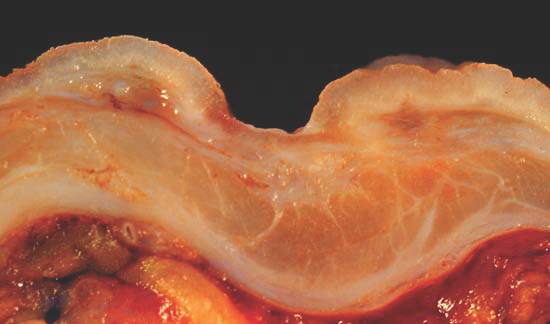
Source: American Gastroenterological Association
Although “a vast literature links peptic ulcer to stress,” past studies suffered so many methodologic weaknesses that groups such as the U.S. National Institute of Diabetes and Digestive and Kidney Diseases rejected the evidence outright, Dr. Levenstein and her associates noted. Many studies were cross-sectional, for example, or did not control for confounders such as helicobacteriosis, they said.
To further study the effects of stress on ulcer risk, the researchers analyzed historical data from 76 patients who lacked a history of gastric and duodenal ulcers in 1982, but by 1994 had developed “distinct breach[es] in the mucosa” that were confirmed by endoscopy or contrast radiology. The researchers did not count erosions that lacked appreciable depth as ulcers, they noted (Clin. Gastroenterol. Hepatol. 2014 Aug. 8 [doi:10.1016/j.cgh.2014.07.052]).
Study subjects answered 12 questions about their stress levels, such as, “Do your hands easily shake?” “Do you often suffer from fits of dizziness?” “Do you constantly have thoughts that trouble and worry you?” and “Do you usually feel misunderstood by other people?” They answered these questions at baseline in 1982-1983, again in 1987-1988, and again in 1993-1994.
Respondents who scored in the top tertile for psychological stress had an ulcer incidence of 3.5%, compared with 1.6% for those in the lowest tertile (odds ratio, 2.2; 95% confidence interval, 1.2-3.9; P < .01), reported the investigators. And controlling for smoking, helicobacteriosis, use of nonsteroidal anti-inflammatory drugs, and low socioeconomic status only partially weakened the relationship between stress and ulcers, they said. After accounting for those risk factors, every one-point increase on the stress questionnaire still upped the odds of peptic ulcer by 12% (odds ratio, 1.12; 95% confidence interval, 1.01-1.23)they reported.
Helicobacteri pylori infection was the strongest independent predictor of ulcers (OR, 3.3; 95% CI, 2.02-5.69), while cigarette smoking came in a close second (OR, 2.91; 95% CI, 1.38-6.16), said the researchers. Notably, stress and helicobacteriosis did not seem to synergistically increase the chances of ulcers, they reported. “Stress affected H. pylori–related ulcers at least as much as those related to neither H. pylori nor nonsteroidal anti-inflammatory drugs,” they said.
Several factors might explain the stress-ulcer link, such as increased acid load, activation of the hypothalamic-pituitary-adrenal axis, shifts in blood flow, and cytokine activation that might impair gastrointestinal mucosal defenses, said the investigators. Although the baseline data in their study were more than 2 decades old, that meant that patients likely had not been treated to eradicate H. pylori and were less likely to have taken proton pump inhibitors than the current population that has over-the-counter access to PPIs, they added. They also noted that past studies found a particularly strong link between stress and bleeding or perforated ulcers, which have not declined as much as other types of ulcers. “These results support a multicausal model of peptic ulcer etiology, with intertwined biological and psychosocial components,” they concluded.
The Kirby Family Foundation funded the statistical analysis. The researchers reported no conflicts of interest.
Stress was the most frequently cited cause of ulcer disease before Helicobacter pylori was discovered. The harried executive who developed an ulcer was a widely accepted profile of an ulcer diathesis. When the role of H. pylori infection and NSAIDs became clear, the role of stress was downplayed and some articles and textbooks dismissed stress as a potential cause for ulcer disease.

|
Dr. Nimish Vakil |
Studies of New York City residents suggest a higher incidence of ulcer disease after the 9-11 attacks and studies from Japan have shown an increase in the incidence of ulcer disease after the nuclear reactor disaster. In this issue of Clinical Gastroenterology and Hepatology, Dr. Levenstein and her colleagues report the results of a study of stress and the incidence of ulcer disease in Danish subjects. In 1982-1983, a population-based study in Denmark collected sera and psychological data in over 3000 subjects and reinterviewed them in 1987-1988 and 1993-1994. An ad-hoc, unvalidated scale developed by the authors measured stress. It included a psychological scale used by the Danish military to identify recruits unsuitable for military service but also included tranquilizer use, working more than 40 hours a week, and unemployment. In multivariate analysis, they found that stress increased the risk for both gastric and duodenal ulcers, with an adjusted odds ratio of 1.19 per point increase in the stress scale for gastric ulcers (95% confidence interval, 1.03-1.37) and a odds ratio of 1.1 per point increase in the stress index for duodenal ulcers (95% CI, 0.98-1.27).
There are obvious limitations with this study: a historical cohort, an unvalidated stress scale, the inclusion of items that may not represent stress in some cultures (e.g., working more than 40 hours/week) and the lower bound of confidence intervals for risk which are very close to one. However, studies such as this tell us that we have been too quick to dismiss the role of stress in ulcer pathogenesis. With declining H. pylori prevalence and the development of safer NSAIDs, stress will undergo a renaissance in the pathogenesis of ulcer disease.
Dr. Nimish Vakil, AGAF, FASGE, FACP, is a physician specializing in gastroenterology at the Aurora Wilkinson Medical Clinic in Summit, Wisc. He is a consultant for Astra Zeneca, Ironwood, and Baxter Pharmaceuticals.
Stress was the most frequently cited cause of ulcer disease before Helicobacter pylori was discovered. The harried executive who developed an ulcer was a widely accepted profile of an ulcer diathesis. When the role of H. pylori infection and NSAIDs became clear, the role of stress was downplayed and some articles and textbooks dismissed stress as a potential cause for ulcer disease.
|
|
Dr. Nimish Vakil |
Studies of New York City residents suggest a higher incidence of ulcer disease after the 9-11 attacks and studies from Japan have shown an increase in the incidence of ulcer disease after the nuclear reactor disaster. In this issue of Clinical Gastroenterology and Hepatology, Dr. Levenstein and her colleagues report the results of a study of stress and the incidence of ulcer disease in Danish subjects. In 1982-1983, a population-based study in Denmark collected sera and psychological data in over 3000 subjects and reinterviewed them in 1987-1988 and 1993-1994. An ad-hoc, unvalidated scale developed by the authors measured stress. It included a psychological scale used by the Danish military to identify recruits unsuitable for military service but also included tranquilizer use, working more than 40 hours a week, and unemployment. In multivariate analysis, they found that stress increased the risk for both gastric and duodenal ulcers, with an adjusted odds ratio of 1.19 per point increase in the stress scale for gastric ulcers (95% confidence interval, 1.03-1.37) and a odds ratio of 1.1 per point increase in the stress index for duodenal ulcers (95% CI, 0.98-1.27).
There are obvious limitations with this study: a historical cohort, an unvalidated stress scale, the inclusion of items that may not represent stress in some cultures (e.g., working more than 40 hours/week) and the lower bound of confidence intervals for risk which are very close to one. However, studies such as this tell us that we have been too quick to dismiss the role of stress in ulcer pathogenesis. With declining H. pylori prevalence and the development of safer NSAIDs, stress will undergo a renaissance in the pathogenesis of ulcer disease.
Dr. Nimish Vakil, AGAF, FASGE, FACP, is a physician specializing in gastroenterology at the Aurora Wilkinson Medical Clinic in Summit, Wisc. He is a consultant for Astra Zeneca, Ironwood, and Baxter Pharmaceuticals.
Stress was the most frequently cited cause of ulcer disease before Helicobacter pylori was discovered. The harried executive who developed an ulcer was a widely accepted profile of an ulcer diathesis. When the role of H. pylori infection and NSAIDs became clear, the role of stress was downplayed and some articles and textbooks dismissed stress as a potential cause for ulcer disease.
|
|
Dr. Nimish Vakil |
Studies of New York City residents suggest a higher incidence of ulcer disease after the 9-11 attacks and studies from Japan have shown an increase in the incidence of ulcer disease after the nuclear reactor disaster. In this issue of Clinical Gastroenterology and Hepatology, Dr. Levenstein and her colleagues report the results of a study of stress and the incidence of ulcer disease in Danish subjects. In 1982-1983, a population-based study in Denmark collected sera and psychological data in over 3000 subjects and reinterviewed them in 1987-1988 and 1993-1994. An ad-hoc, unvalidated scale developed by the authors measured stress. It included a psychological scale used by the Danish military to identify recruits unsuitable for military service but also included tranquilizer use, working more than 40 hours a week, and unemployment. In multivariate analysis, they found that stress increased the risk for both gastric and duodenal ulcers, with an adjusted odds ratio of 1.19 per point increase in the stress scale for gastric ulcers (95% confidence interval, 1.03-1.37) and a odds ratio of 1.1 per point increase in the stress index for duodenal ulcers (95% CI, 0.98-1.27).
There are obvious limitations with this study: a historical cohort, an unvalidated stress scale, the inclusion of items that may not represent stress in some cultures (e.g., working more than 40 hours/week) and the lower bound of confidence intervals for risk which are very close to one. However, studies such as this tell us that we have been too quick to dismiss the role of stress in ulcer pathogenesis. With declining H. pylori prevalence and the development of safer NSAIDs, stress will undergo a renaissance in the pathogenesis of ulcer disease.
Dr. Nimish Vakil, AGAF, FASGE, FACP, is a physician specializing in gastroenterology at the Aurora Wilkinson Medical Clinic in Summit, Wisc. He is a consultant for Astra Zeneca, Ironwood, and Baxter Pharmaceuticals.
High levels of psychological stress more than doubled the odds of peptic ulcers, and the link remained statistically significant even after controlling for factors such as Helicobacter pylori infection and cigarette smoking, according to a prospective study published in the March issue of Clinical Gastroenterology and Hepatology.
The findings contradict the widely accepted view that stress does not cause peptic ulcers, said Dr. Susan Levenstein of Aventino Medical Group in Rome and her associates. “Clinicians treating ulcer patients should investigate potential psychological stress among other risk factors,” they said.
Source: American Gastroenterological Association
Although “a vast literature links peptic ulcer to stress,” past studies suffered so many methodologic weaknesses that groups such as the U.S. National Institute of Diabetes and Digestive and Kidney Diseases rejected the evidence outright, Dr. Levenstein and her associates noted. Many studies were cross-sectional, for example, or did not control for confounders such as helicobacteriosis, they said.
To further study the effects of stress on ulcer risk, the researchers analyzed historical data from 76 patients who lacked a history of gastric and duodenal ulcers in 1982, but by 1994 had developed “distinct breach[es] in the mucosa” that were confirmed by endoscopy or contrast radiology. The researchers did not count erosions that lacked appreciable depth as ulcers, they noted (Clin. Gastroenterol. Hepatol. 2014 Aug. 8 [doi:10.1016/j.cgh.2014.07.052]).
Study subjects answered 12 questions about their stress levels, such as, “Do your hands easily shake?” “Do you often suffer from fits of dizziness?” “Do you constantly have thoughts that trouble and worry you?” and “Do you usually feel misunderstood by other people?” They answered these questions at baseline in 1982-1983, again in 1987-1988, and again in 1993-1994.
Respondents who scored in the top tertile for psychological stress had an ulcer incidence of 3.5%, compared with 1.6% for those in the lowest tertile (odds ratio, 2.2; 95% confidence interval, 1.2-3.9; P < .01), reported the investigators. And controlling for smoking, helicobacteriosis, use of nonsteroidal anti-inflammatory drugs, and low socioeconomic status only partially weakened the relationship between stress and ulcers, they said. After accounting for those risk factors, every one-point increase on the stress questionnaire still upped the odds of peptic ulcer by 12% (odds ratio, 1.12; 95% confidence interval, 1.01-1.23)they reported.
Helicobacteri pylori infection was the strongest independent predictor of ulcers (OR, 3.3; 95% CI, 2.02-5.69), while cigarette smoking came in a close second (OR, 2.91; 95% CI, 1.38-6.16), said the researchers. Notably, stress and helicobacteriosis did not seem to synergistically increase the chances of ulcers, they reported. “Stress affected H. pylori–related ulcers at least as much as those related to neither H. pylori nor nonsteroidal anti-inflammatory drugs,” they said.
Several factors might explain the stress-ulcer link, such as increased acid load, activation of the hypothalamic-pituitary-adrenal axis, shifts in blood flow, and cytokine activation that might impair gastrointestinal mucosal defenses, said the investigators. Although the baseline data in their study were more than 2 decades old, that meant that patients likely had not been treated to eradicate H. pylori and were less likely to have taken proton pump inhibitors than the current population that has over-the-counter access to PPIs, they added. They also noted that past studies found a particularly strong link between stress and bleeding or perforated ulcers, which have not declined as much as other types of ulcers. “These results support a multicausal model of peptic ulcer etiology, with intertwined biological and psychosocial components,” they concluded.
The Kirby Family Foundation funded the statistical analysis. The researchers reported no conflicts of interest.
High levels of psychological stress more than doubled the odds of peptic ulcers, and the link remained statistically significant even after controlling for factors such as Helicobacter pylori infection and cigarette smoking, according to a prospective study published in the March issue of Clinical Gastroenterology and Hepatology.
The findings contradict the widely accepted view that stress does not cause peptic ulcers, said Dr. Susan Levenstein of Aventino Medical Group in Rome and her associates. “Clinicians treating ulcer patients should investigate potential psychological stress among other risk factors,” they said.
Source: American Gastroenterological Association
Although “a vast literature links peptic ulcer to stress,” past studies suffered so many methodologic weaknesses that groups such as the U.S. National Institute of Diabetes and Digestive and Kidney Diseases rejected the evidence outright, Dr. Levenstein and her associates noted. Many studies were cross-sectional, for example, or did not control for confounders such as helicobacteriosis, they said.
To further study the effects of stress on ulcer risk, the researchers analyzed historical data from 76 patients who lacked a history of gastric and duodenal ulcers in 1982, but by 1994 had developed “distinct breach[es] in the mucosa” that were confirmed by endoscopy or contrast radiology. The researchers did not count erosions that lacked appreciable depth as ulcers, they noted (Clin. Gastroenterol. Hepatol. 2014 Aug. 8 [doi:10.1016/j.cgh.2014.07.052]).
Study subjects answered 12 questions about their stress levels, such as, “Do your hands easily shake?” “Do you often suffer from fits of dizziness?” “Do you constantly have thoughts that trouble and worry you?” and “Do you usually feel misunderstood by other people?” They answered these questions at baseline in 1982-1983, again in 1987-1988, and again in 1993-1994.
Respondents who scored in the top tertile for psychological stress had an ulcer incidence of 3.5%, compared with 1.6% for those in the lowest tertile (odds ratio, 2.2; 95% confidence interval, 1.2-3.9; P < .01), reported the investigators. And controlling for smoking, helicobacteriosis, use of nonsteroidal anti-inflammatory drugs, and low socioeconomic status only partially weakened the relationship between stress and ulcers, they said. After accounting for those risk factors, every one-point increase on the stress questionnaire still upped the odds of peptic ulcer by 12% (odds ratio, 1.12; 95% confidence interval, 1.01-1.23)they reported.
Helicobacteri pylori infection was the strongest independent predictor of ulcers (OR, 3.3; 95% CI, 2.02-5.69), while cigarette smoking came in a close second (OR, 2.91; 95% CI, 1.38-6.16), said the researchers. Notably, stress and helicobacteriosis did not seem to synergistically increase the chances of ulcers, they reported. “Stress affected H. pylori–related ulcers at least as much as those related to neither H. pylori nor nonsteroidal anti-inflammatory drugs,” they said.
Several factors might explain the stress-ulcer link, such as increased acid load, activation of the hypothalamic-pituitary-adrenal axis, shifts in blood flow, and cytokine activation that might impair gastrointestinal mucosal defenses, said the investigators. Although the baseline data in their study were more than 2 decades old, that meant that patients likely had not been treated to eradicate H. pylori and were less likely to have taken proton pump inhibitors than the current population that has over-the-counter access to PPIs, they added. They also noted that past studies found a particularly strong link between stress and bleeding or perforated ulcers, which have not declined as much as other types of ulcers. “These results support a multicausal model of peptic ulcer etiology, with intertwined biological and psychosocial components,” they concluded.
The Kirby Family Foundation funded the statistical analysis. The researchers reported no conflicts of interest.
FROM CLINICAL GASTROENTEROLOGY AND HEPATOLOGY
Key clinical point: High stress levels independently predicted peptic ulcers.
Major finding: After adjustment for other risk factors, every one-point increase on a 12-item stress questionnaire increased the odds of peptic ulcers by 12% (OR, 1.12; 95% CI, 1.01-1.23).
Data source: Prospective, population-based study of 76 patients with peptic ulcers.
Disclosures: The Kirby Family Foundation funded the statistical analysis. The researchers reported no conflicts of interest.

Improved version of gastric stimulator for gastroparesis approved as humanitarian device
An improved version of a neurostimulator device for treating gastroparesis has been approved by the Food and Drug Administration, according to the manufacturer.
In a Jan. 23 press release, Medtronic said that the FDA had approved a new version of the Enterra neurostimulator device, which has been available since 2000. It was approved as a treatment for chronic, intractable (drug refractory) nausea and vomiting associated with gastroparesis related to diabetes or of idiopathic etiology in patients aged 18-70 years, under a Humanitarian Device Exemption.

The programmable device – a battery-powered neurostimulator implanted under the skin in the lower abdominal region – “uses mild electrical pulses to stimulate the antrum portion of the stomach muscle wall,” which “may reduce the symptoms of nausea and the number of vomiting episodes related to gastroparesis,” according to the Medtronic website. The improvements of the new version – the Enterra II system – include new programming software and an indicator that alerts the clinician and patient when the device needs to be replaced; the battery lasts from 5 to 10 years. In addition, it does not have a magnetic activation switch, so it is more compatible with electromagnetic interference, according to the website.
A humanitarian use device “is a device that is intended to benefit patients by treating or diagnosing a disease or condition that affects or is manifested in fewer than 4,000 individuals in the United States per year,” according to the FDA. For approval, the company submits a humanitarian device exemption application, which does not require submission of effectiveness data, but “must contain sufficient information for the FDA to determine that the device does not pose an unreasonable or significant risk of illness or injury, and that the probable benefit to health outweighs the risk of injury or illness from its use, taking into account the probable risks and benefits of currently available devices or alternative forms of treatment.”
The Medtronic release points out that use of the gastric electrical stimulation therapy at a medical center requires approval from the center’s Institutional Review Board.
An improved version of a neurostimulator device for treating gastroparesis has been approved by the Food and Drug Administration, according to the manufacturer.
In a Jan. 23 press release, Medtronic said that the FDA had approved a new version of the Enterra neurostimulator device, which has been available since 2000. It was approved as a treatment for chronic, intractable (drug refractory) nausea and vomiting associated with gastroparesis related to diabetes or of idiopathic etiology in patients aged 18-70 years, under a Humanitarian Device Exemption.
The programmable device – a battery-powered neurostimulator implanted under the skin in the lower abdominal region – “uses mild electrical pulses to stimulate the antrum portion of the stomach muscle wall,” which “may reduce the symptoms of nausea and the number of vomiting episodes related to gastroparesis,” according to the Medtronic website. The improvements of the new version – the Enterra II system – include new programming software and an indicator that alerts the clinician and patient when the device needs to be replaced; the battery lasts from 5 to 10 years. In addition, it does not have a magnetic activation switch, so it is more compatible with electromagnetic interference, according to the website.
A humanitarian use device “is a device that is intended to benefit patients by treating or diagnosing a disease or condition that affects or is manifested in fewer than 4,000 individuals in the United States per year,” according to the FDA. For approval, the company submits a humanitarian device exemption application, which does not require submission of effectiveness data, but “must contain sufficient information for the FDA to determine that the device does not pose an unreasonable or significant risk of illness or injury, and that the probable benefit to health outweighs the risk of injury or illness from its use, taking into account the probable risks and benefits of currently available devices or alternative forms of treatment.”
The Medtronic release points out that use of the gastric electrical stimulation therapy at a medical center requires approval from the center’s Institutional Review Board.
An improved version of a neurostimulator device for treating gastroparesis has been approved by the Food and Drug Administration, according to the manufacturer.
In a Jan. 23 press release, Medtronic said that the FDA had approved a new version of the Enterra neurostimulator device, which has been available since 2000. It was approved as a treatment for chronic, intractable (drug refractory) nausea and vomiting associated with gastroparesis related to diabetes or of idiopathic etiology in patients aged 18-70 years, under a Humanitarian Device Exemption.
The programmable device – a battery-powered neurostimulator implanted under the skin in the lower abdominal region – “uses mild electrical pulses to stimulate the antrum portion of the stomach muscle wall,” which “may reduce the symptoms of nausea and the number of vomiting episodes related to gastroparesis,” according to the Medtronic website. The improvements of the new version – the Enterra II system – include new programming software and an indicator that alerts the clinician and patient when the device needs to be replaced; the battery lasts from 5 to 10 years. In addition, it does not have a magnetic activation switch, so it is more compatible with electromagnetic interference, according to the website.
A humanitarian use device “is a device that is intended to benefit patients by treating or diagnosing a disease or condition that affects or is manifested in fewer than 4,000 individuals in the United States per year,” according to the FDA. For approval, the company submits a humanitarian device exemption application, which does not require submission of effectiveness data, but “must contain sufficient information for the FDA to determine that the device does not pose an unreasonable or significant risk of illness or injury, and that the probable benefit to health outweighs the risk of injury or illness from its use, taking into account the probable risks and benefits of currently available devices or alternative forms of treatment.”
The Medtronic release points out that use of the gastric electrical stimulation therapy at a medical center requires approval from the center’s Institutional Review Board.