User login
For MD-IQ use only
How to review scientific literature
And Ilana Yurkiewicz, MD, talks about chaos and opportunity. Dr. Yurkiewicz is a fellow in hematology and oncology at Stanford (Calif.) University and is also a columnist for Hematology News. More from Dr. Yurkiewicz here.
Subscribe to Blood & Cancer here:
Show notes
By Hitomi Hosoya, MD, PhD,
Resident in the department of internal medicine, University of Pennsylvania Health System
- If you are a peer reviewer of a manuscript submitted to a journal, you should be unbiased, consistent, constructive, and focused on the research. COPE guideline is a good resource.
- If you are a reader of a published article, it is important to ensure that the abstract has the same conclusion as the body of the article.
- If you are a clinical practitioner and wondering how to apply findings of published data, the editorial section is a good source.
- If you are a trainee and wondering how to stay up-to-date, Oxford Textbook of Oncology or ASCO University are recommended.
Reference:
https://publicationethics.org/resources/guidelines-new/cope-ethical-guidelines-peer-reviewers
And Ilana Yurkiewicz, MD, talks about chaos and opportunity. Dr. Yurkiewicz is a fellow in hematology and oncology at Stanford (Calif.) University and is also a columnist for Hematology News. More from Dr. Yurkiewicz here.
Subscribe to Blood & Cancer here:
Show notes
By Hitomi Hosoya, MD, PhD,
Resident in the department of internal medicine, University of Pennsylvania Health System
- If you are a peer reviewer of a manuscript submitted to a journal, you should be unbiased, consistent, constructive, and focused on the research. COPE guideline is a good resource.
- If you are a reader of a published article, it is important to ensure that the abstract has the same conclusion as the body of the article.
- If you are a clinical practitioner and wondering how to apply findings of published data, the editorial section is a good source.
- If you are a trainee and wondering how to stay up-to-date, Oxford Textbook of Oncology or ASCO University are recommended.
Reference:
https://publicationethics.org/resources/guidelines-new/cope-ethical-guidelines-peer-reviewers
And Ilana Yurkiewicz, MD, talks about chaos and opportunity. Dr. Yurkiewicz is a fellow in hematology and oncology at Stanford (Calif.) University and is also a columnist for Hematology News. More from Dr. Yurkiewicz here.
Subscribe to Blood & Cancer here:
Show notes
By Hitomi Hosoya, MD, PhD,
Resident in the department of internal medicine, University of Pennsylvania Health System
- If you are a peer reviewer of a manuscript submitted to a journal, you should be unbiased, consistent, constructive, and focused on the research. COPE guideline is a good resource.
- If you are a reader of a published article, it is important to ensure that the abstract has the same conclusion as the body of the article.
- If you are a clinical practitioner and wondering how to apply findings of published data, the editorial section is a good source.
- If you are a trainee and wondering how to stay up-to-date, Oxford Textbook of Oncology or ASCO University are recommended.
Reference:
https://publicationethics.org/resources/guidelines-new/cope-ethical-guidelines-peer-reviewers
A novel approach to MIPS quality reporting for facility-based providers
A cornerstone of hospital medicine is the delivery of high-quality inpatient care by improving the performance of the systems and facilities in which hospitalists work. By extension, hospitalists are often held accountable, in varying ways, for improving the performance of facility metrics, such as those in the Hospital Value-Based Purchasing (HVBP), Inpatient Quality Reporting, and Hospital Readmissions Reduction programs.

Despite the work hospitalists were already doing to improve both efficiency and quality within their institutions, the 2010 Affordable Care Act introduced penalties for clinicians who did not submit qualifying provider-level data via the Physician Quality Reporting System program. Initially only an incentive program, PQRS was ultimately incorporated into the Physician Value-Based Payment (VBP) Modifier to make performance-based payment adjustments to Medicare physician payment. At this point, many hospitalists were not only accountable for helping to improve the metrics of their facilities, but also required to report individually or within their groups on provider-level measures, many of which were irrelevant to hospital medicine practice.
With this dual burden becoming evident, the Society of Hospital Medicine approached the Centers for Medicare & Medicaid Services with a possible solution. Could hospitalists elect to use their facilities’ metrics as a stand-in for the provider level metrics? Not only would this reduce the burden of reporting irrelevant metrics, but it would also help alleviate some of the disadvantages hospitalists face within Physician VBP.
The CMS was initially very supportive of the concept, but informed the SHM such alignment was not possible under existing law. In brief, the law required Physician VBP to remain completely within the Physician Fee Schedule and its related metrics; facility level metrics from a different payment system could not be used.
Undeterred, the SHM sought opportunities to change the law. As Congress was developing the Medicare Access and Chip Reauthorization Act (MACRA), the SHM worked closely with lawmakers to include language that would permit measures in “other payment systems” to be used for physician performance assessment. This language was retained in the final version of MACRA that was signed into law on April 16, 2015.
The SHM continued its advocacy, working closely with the CMS and its new authority to shape an option to align Medicare’s facility metrics and scores with provider reporting. Today that idea is a reality. Beginning this year, the CMS will have a new Merit-based Incentive Payment System (MIPS) reporting option available for hospitalists: facility-based measurement.
Facility-based measurement enables clinicians to receive a score for the Quality and Cost categories of the MIPS, without the need to collect and report on measures separately. Eligible providers would receive the MIPS score in those categories associated with the same percentile as their hospital’s score in HVBP. No more administrative work necessary to collect, clean and report on data for quality measures in the MIPS. If you are eligible, the CMS will automatically calculate a Quality and Cost score and combine this with your score from Improvement Activities and Promoting Interoperability (if you are not exempt) to give you a final MIPS score. If you decide to report on quality measures through the traditional MIPS pathway as well, the CMS will give you the higher of the scores.
There are certainly trade-offs associated with the facility-based measurement option. You do not have the burden of reporting measures on your own, but you do not get to pick what measures and what facility’s score you receive. Facility-level measures may be more difficult to improve performance, particularly as an individual, but the automatic application of facility-based measurement to eligible clinicians and groups serves as a backstop for MIPS reporting.
Aligning facility and clinician performance should encourage collaboration and innovation to meet these shared goals. As such, facility-based measurement represents a massive philosophical and practical shift in CMS measure reporting. As we enter these uncharted waters together, we hope to continue learning from your experiences and perspectives and working to refine facility-based measurement in the future.
For more information about facility-based reporting and the MIPS in general, visit www.macraforhm.org.
Mr. Lapps is government relations senior manager and Mr. Boswell is government relations director at the Society of Hospital Medicine.
Who is eligible for facility-based measurement?
- Individual providers who bill more than 75% of their Medicare Part B professional services in Place of Service 21 (Emergency Department), 22 (Hospital Outpatient), and 23 (Inpatient Hospital), billing at least one service in POS 21 or 23, and work in a hospital with an HVBP score.
- Groups who have at least 75% of their individual clinicians who meet the eligibility criteria.
- Nearly all hospitalists should qualify for facility-based measurement as individuals, while group eligibility depends on the demographics of their staff.
A cornerstone of hospital medicine is the delivery of high-quality inpatient care by improving the performance of the systems and facilities in which hospitalists work. By extension, hospitalists are often held accountable, in varying ways, for improving the performance of facility metrics, such as those in the Hospital Value-Based Purchasing (HVBP), Inpatient Quality Reporting, and Hospital Readmissions Reduction programs.
Despite the work hospitalists were already doing to improve both efficiency and quality within their institutions, the 2010 Affordable Care Act introduced penalties for clinicians who did not submit qualifying provider-level data via the Physician Quality Reporting System program. Initially only an incentive program, PQRS was ultimately incorporated into the Physician Value-Based Payment (VBP) Modifier to make performance-based payment adjustments to Medicare physician payment. At this point, many hospitalists were not only accountable for helping to improve the metrics of their facilities, but also required to report individually or within their groups on provider-level measures, many of which were irrelevant to hospital medicine practice.
With this dual burden becoming evident, the Society of Hospital Medicine approached the Centers for Medicare & Medicaid Services with a possible solution. Could hospitalists elect to use their facilities’ metrics as a stand-in for the provider level metrics? Not only would this reduce the burden of reporting irrelevant metrics, but it would also help alleviate some of the disadvantages hospitalists face within Physician VBP.
The CMS was initially very supportive of the concept, but informed the SHM such alignment was not possible under existing law. In brief, the law required Physician VBP to remain completely within the Physician Fee Schedule and its related metrics; facility level metrics from a different payment system could not be used.
Undeterred, the SHM sought opportunities to change the law. As Congress was developing the Medicare Access and Chip Reauthorization Act (MACRA), the SHM worked closely with lawmakers to include language that would permit measures in “other payment systems” to be used for physician performance assessment. This language was retained in the final version of MACRA that was signed into law on April 16, 2015.
The SHM continued its advocacy, working closely with the CMS and its new authority to shape an option to align Medicare’s facility metrics and scores with provider reporting. Today that idea is a reality. Beginning this year, the CMS will have a new Merit-based Incentive Payment System (MIPS) reporting option available for hospitalists: facility-based measurement.
Facility-based measurement enables clinicians to receive a score for the Quality and Cost categories of the MIPS, without the need to collect and report on measures separately. Eligible providers would receive the MIPS score in those categories associated with the same percentile as their hospital’s score in HVBP. No more administrative work necessary to collect, clean and report on data for quality measures in the MIPS. If you are eligible, the CMS will automatically calculate a Quality and Cost score and combine this with your score from Improvement Activities and Promoting Interoperability (if you are not exempt) to give you a final MIPS score. If you decide to report on quality measures through the traditional MIPS pathway as well, the CMS will give you the higher of the scores.
There are certainly trade-offs associated with the facility-based measurement option. You do not have the burden of reporting measures on your own, but you do not get to pick what measures and what facility’s score you receive. Facility-level measures may be more difficult to improve performance, particularly as an individual, but the automatic application of facility-based measurement to eligible clinicians and groups serves as a backstop for MIPS reporting.
Aligning facility and clinician performance should encourage collaboration and innovation to meet these shared goals. As such, facility-based measurement represents a massive philosophical and practical shift in CMS measure reporting. As we enter these uncharted waters together, we hope to continue learning from your experiences and perspectives and working to refine facility-based measurement in the future.
For more information about facility-based reporting and the MIPS in general, visit www.macraforhm.org.
Mr. Lapps is government relations senior manager and Mr. Boswell is government relations director at the Society of Hospital Medicine.
Who is eligible for facility-based measurement?
- Individual providers who bill more than 75% of their Medicare Part B professional services in Place of Service 21 (Emergency Department), 22 (Hospital Outpatient), and 23 (Inpatient Hospital), billing at least one service in POS 21 or 23, and work in a hospital with an HVBP score.
- Groups who have at least 75% of their individual clinicians who meet the eligibility criteria.
- Nearly all hospitalists should qualify for facility-based measurement as individuals, while group eligibility depends on the demographics of their staff.
A cornerstone of hospital medicine is the delivery of high-quality inpatient care by improving the performance of the systems and facilities in which hospitalists work. By extension, hospitalists are often held accountable, in varying ways, for improving the performance of facility metrics, such as those in the Hospital Value-Based Purchasing (HVBP), Inpatient Quality Reporting, and Hospital Readmissions Reduction programs.
Despite the work hospitalists were already doing to improve both efficiency and quality within their institutions, the 2010 Affordable Care Act introduced penalties for clinicians who did not submit qualifying provider-level data via the Physician Quality Reporting System program. Initially only an incentive program, PQRS was ultimately incorporated into the Physician Value-Based Payment (VBP) Modifier to make performance-based payment adjustments to Medicare physician payment. At this point, many hospitalists were not only accountable for helping to improve the metrics of their facilities, but also required to report individually or within their groups on provider-level measures, many of which were irrelevant to hospital medicine practice.
With this dual burden becoming evident, the Society of Hospital Medicine approached the Centers for Medicare & Medicaid Services with a possible solution. Could hospitalists elect to use their facilities’ metrics as a stand-in for the provider level metrics? Not only would this reduce the burden of reporting irrelevant metrics, but it would also help alleviate some of the disadvantages hospitalists face within Physician VBP.
The CMS was initially very supportive of the concept, but informed the SHM such alignment was not possible under existing law. In brief, the law required Physician VBP to remain completely within the Physician Fee Schedule and its related metrics; facility level metrics from a different payment system could not be used.
Undeterred, the SHM sought opportunities to change the law. As Congress was developing the Medicare Access and Chip Reauthorization Act (MACRA), the SHM worked closely with lawmakers to include language that would permit measures in “other payment systems” to be used for physician performance assessment. This language was retained in the final version of MACRA that was signed into law on April 16, 2015.
The SHM continued its advocacy, working closely with the CMS and its new authority to shape an option to align Medicare’s facility metrics and scores with provider reporting. Today that idea is a reality. Beginning this year, the CMS will have a new Merit-based Incentive Payment System (MIPS) reporting option available for hospitalists: facility-based measurement.
Facility-based measurement enables clinicians to receive a score for the Quality and Cost categories of the MIPS, without the need to collect and report on measures separately. Eligible providers would receive the MIPS score in those categories associated with the same percentile as their hospital’s score in HVBP. No more administrative work necessary to collect, clean and report on data for quality measures in the MIPS. If you are eligible, the CMS will automatically calculate a Quality and Cost score and combine this with your score from Improvement Activities and Promoting Interoperability (if you are not exempt) to give you a final MIPS score. If you decide to report on quality measures through the traditional MIPS pathway as well, the CMS will give you the higher of the scores.
There are certainly trade-offs associated with the facility-based measurement option. You do not have the burden of reporting measures on your own, but you do not get to pick what measures and what facility’s score you receive. Facility-level measures may be more difficult to improve performance, particularly as an individual, but the automatic application of facility-based measurement to eligible clinicians and groups serves as a backstop for MIPS reporting.
Aligning facility and clinician performance should encourage collaboration and innovation to meet these shared goals. As such, facility-based measurement represents a massive philosophical and practical shift in CMS measure reporting. As we enter these uncharted waters together, we hope to continue learning from your experiences and perspectives and working to refine facility-based measurement in the future.
For more information about facility-based reporting and the MIPS in general, visit www.macraforhm.org.
Mr. Lapps is government relations senior manager and Mr. Boswell is government relations director at the Society of Hospital Medicine.
Who is eligible for facility-based measurement?
- Individual providers who bill more than 75% of their Medicare Part B professional services in Place of Service 21 (Emergency Department), 22 (Hospital Outpatient), and 23 (Inpatient Hospital), billing at least one service in POS 21 or 23, and work in a hospital with an HVBP score.
- Groups who have at least 75% of their individual clinicians who meet the eligibility criteria.
- Nearly all hospitalists should qualify for facility-based measurement as individuals, while group eligibility depends on the demographics of their staff.
A prescription for medicine’s gender inequality
A small study identifies skin microbiome changes after UV exposure. Lower prices drive OTC insulin sales at Walmart. And early intensive treatment of multiple sclerosis may benefit patients.
Amazon Alexa
Apple Podcasts
Google Podcasts
Spotify
A small study identifies skin microbiome changes after UV exposure. Lower prices drive OTC insulin sales at Walmart. And early intensive treatment of multiple sclerosis may benefit patients.
Amazon Alexa
Apple Podcasts
Google Podcasts
Spotify
A small study identifies skin microbiome changes after UV exposure. Lower prices drive OTC insulin sales at Walmart. And early intensive treatment of multiple sclerosis may benefit patients.
Amazon Alexa
Apple Podcasts
Google Podcasts
Spotify

Crisis Communication for Multilingual Communities
Civil rights laws mandate that federally funded emergency response and recovery services must be accessible to all Americans. But at least 350 languages are spoken in the US, according to the US Census Bureau. And millions of people have hearing or vision problems or cannot read.
Recent devastating fires, hurricanes, and earthquakes have underscored the need for clear communication in disasters. Now the US Department of Health and Human Services (HHS) has unveiled a “plain language checklist” to help first responders make sure important information is shared.
The checklist, developed through the HHS Language Access Steering Committee, complements an emergency preparedness checklist released in 2016. It includes recommendations, action steps, and resources to help first responders provide on-the-ground language assistance. For example, a key recommendation is to not only identify languages and dialects spoken in the community, but specific types of sign language as well. The action steps include accessing state and local demographic data and identifying public spaces that serve people lacking English proficiency, such as libraries that offer language access resources.
The checklist also provides practical tips for working with interpreters, such as speaking directly in the first person to the individual (not the interpreter), avoiding idioms, acronyms, and double negatives. Red flags include interpreters who need repeated clarifications, who overuse English terms, and whose interpretations seem overly long or short compared with the statements being interpreted.
The HHS also recommends:
- Working with Centers for Independent Living and other groups who work with people with disabilities;
- Identifying local partners, such as hospitals, faith-based organizations, and legal services; and
- Coordinating with TV, print, radio, and online media to share plain-language, culturally appropriate emergency information.
The checklist is available at https://www.hhs.gov/about/news/2018/12/04/new-hhs-checklist-helps-first-responders-ensure-language-access-and-effective-communication-during-emergencies.html
Civil rights laws mandate that federally funded emergency response and recovery services must be accessible to all Americans. But at least 350 languages are spoken in the US, according to the US Census Bureau. And millions of people have hearing or vision problems or cannot read.
Recent devastating fires, hurricanes, and earthquakes have underscored the need for clear communication in disasters. Now the US Department of Health and Human Services (HHS) has unveiled a “plain language checklist” to help first responders make sure important information is shared.
The checklist, developed through the HHS Language Access Steering Committee, complements an emergency preparedness checklist released in 2016. It includes recommendations, action steps, and resources to help first responders provide on-the-ground language assistance. For example, a key recommendation is to not only identify languages and dialects spoken in the community, but specific types of sign language as well. The action steps include accessing state and local demographic data and identifying public spaces that serve people lacking English proficiency, such as libraries that offer language access resources.
The checklist also provides practical tips for working with interpreters, such as speaking directly in the first person to the individual (not the interpreter), avoiding idioms, acronyms, and double negatives. Red flags include interpreters who need repeated clarifications, who overuse English terms, and whose interpretations seem overly long or short compared with the statements being interpreted.
The HHS also recommends:
- Working with Centers for Independent Living and other groups who work with people with disabilities;
- Identifying local partners, such as hospitals, faith-based organizations, and legal services; and
- Coordinating with TV, print, radio, and online media to share plain-language, culturally appropriate emergency information.
The checklist is available at https://www.hhs.gov/about/news/2018/12/04/new-hhs-checklist-helps-first-responders-ensure-language-access-and-effective-communication-during-emergencies.html
Civil rights laws mandate that federally funded emergency response and recovery services must be accessible to all Americans. But at least 350 languages are spoken in the US, according to the US Census Bureau. And millions of people have hearing or vision problems or cannot read.
Recent devastating fires, hurricanes, and earthquakes have underscored the need for clear communication in disasters. Now the US Department of Health and Human Services (HHS) has unveiled a “plain language checklist” to help first responders make sure important information is shared.
The checklist, developed through the HHS Language Access Steering Committee, complements an emergency preparedness checklist released in 2016. It includes recommendations, action steps, and resources to help first responders provide on-the-ground language assistance. For example, a key recommendation is to not only identify languages and dialects spoken in the community, but specific types of sign language as well. The action steps include accessing state and local demographic data and identifying public spaces that serve people lacking English proficiency, such as libraries that offer language access resources.
The checklist also provides practical tips for working with interpreters, such as speaking directly in the first person to the individual (not the interpreter), avoiding idioms, acronyms, and double negatives. Red flags include interpreters who need repeated clarifications, who overuse English terms, and whose interpretations seem overly long or short compared with the statements being interpreted.
The HHS also recommends:
- Working with Centers for Independent Living and other groups who work with people with disabilities;
- Identifying local partners, such as hospitals, faith-based organizations, and legal services; and
- Coordinating with TV, print, radio, and online media to share plain-language, culturally appropriate emergency information.
The checklist is available at https://www.hhs.gov/about/news/2018/12/04/new-hhs-checklist-helps-first-responders-ensure-language-access-and-effective-communication-during-emergencies.html
Mediterranean diet cut Parkinson’s risk
‘Telereferrals’ improved mental health referral follow-through for children. How to take action to cut cardiovascular disease risk in rheumatoid patients. And the U.S. Preventive Services Task Force recommends counseling for perinatal depression prevention.
Amazon Alexa
Apple Podcasts
Google Podcasts
Spotify
‘Telereferrals’ improved mental health referral follow-through for children. How to take action to cut cardiovascular disease risk in rheumatoid patients. And the U.S. Preventive Services Task Force recommends counseling for perinatal depression prevention.
Amazon Alexa
Apple Podcasts
Google Podcasts
Spotify
‘Telereferrals’ improved mental health referral follow-through for children. How to take action to cut cardiovascular disease risk in rheumatoid patients. And the U.S. Preventive Services Task Force recommends counseling for perinatal depression prevention.
Amazon Alexa
Apple Podcasts
Google Podcasts
Spotify

What I learned from Navy SEALs about resilience
In 2017, the National Academy of Medicine recognized the urgent need to address burnout, wellness, and resilience in physicians. A consortium was subsequently put together comprising many cosponsoring organizations, including the Accreditation Council for Graduate Medical Education (ACGME), and the American Board of Medical Specialties (ABMS). One of many outputs of this consortium was a discussion paper, “A Journey to Construct an All-Encompassing Conceptual Model of Factors Affecting Clinician Well-Being and Resilience.”
The authors conceptually divided wellness and resilience drivers into external and individual factors. It turns out that a large portion of clinician well-being and resilience is related to individual factors that include personal factors, skills, and abilities. Taking personal responsibility and ownership of developing these individual factors is important, but many do not know where to begin.
My journey in this area began 5 years ago. This was a time when organizational resources were sparse and there was little local or national attention to addressing physician wellness. My life was horribly out of balance. While this should have been obvious, the “hit-on-the-head” moment was weighing myself one day and realizing that I was 30 pounds overweight. This was the ultimate sign to me that there was a problem because throughout my entire life, I was always very athletic, even during residency and fellowship training. I was using food as a reward system for several years which, in combination with a dramatic decrease in physical activity due to prioritizing everything related to work, led to this problem. A slowing metabolism that we all face as we age certainly accentuated it.
I was taking care of everybody else, but not myself. Many family members, friends, and even patients told me this over the years, which I conveniently ignored. For several years, my patients were asking me, “How are you doing?” at the end of their office visits. As a surgeon with a busy cancer practice, this should have been a signal for me – my cancer patients asking me how I am doing!
I started to think more about why this was happening. I realized that I was a victim of my own passions. In terms of my clinical practice, I cherished and absolutely loved every aspect of my practice and taking care of patients. I loved educating our next generation and thrived on conducting research, presenting at meetings, and publishing papers. And as I was accumulating more administrative roles and responsibilities at the department, hospital, and medical school levels, I realized I had a growing passion for administrative work. I found that the administrative work was uniquely challenging and allowed me to meaningfully serve others in a very special way.
In all of these areas for which I had a deep passion, I was committed to nothing short of excellence in everything I did. That is what I expected of myself. Self-compassion was almost absent. In addition, I have a people-pleasing personality and find it difficult to say no to people. As I have come to realize, this characteristic can be self-destructive.
I began to recognize that I fell into an acceptance (and almost expectation) that every 6-8 months I’d experience an episode of burnout that lasted 3-4 days. My burnout trigger was feeling a sense of helplessness. Everything seemed to come down all at once, and I felt helpless to dig out of it.
I realized I wanted to change, but I had no idea what resources were available or how to go about making a change. One day, I was talking to a colleague about these issues, and he asked, “Have you read the book, ‘Lone Survivor?’ ” I hadn’t heard of it, but I picked it up and started reading. Looking back, this was one of the most important decisions I made in my effort to help myself. “Lone Survivor” tells the the story of Marcus Luttrell, a retired U.S. Navy SEAL who received the Navy Cross for his actions facing Taliban fighters during Operation Red Wings.
When I finished reading this book, I realized that this was a remarkable story of resilience. The entirety of his story really connected with me. I then began to think there might be something I could learn from the Navy SEAL community that I could apply to my own civilian life.
Candidates who enter training for Navy SEALs are physically fit to succeed, but only approximately 20% make it through Basic Underwater Demolition/SEAL (BUD/S). Many drop out on request, largely because they don’t have the mental toughness and emotional resilience to tolerate intense stress continuously over a prolonged period of time. The ones who succeed have a deep meaning to their “Why” to become a SEAL.
I then learned about a retired Navy SEAL Commander, Mark Devine, who had a program intended to train civilians in physical fitness, mental toughness, emotional resilience, intuitional awareness, and spiritual consciousness in a manner similar to that of preparing prospective candidates for BUD/S training. The website stated that the defining attribute for enrollees was “a burning desire to better oneself.” I connected with that. After resolving my self-doubts and uncomfortable feelings about doing this, I signed up for the 3-day Fundamentals immersion program.
My 3 days with Coach Divine and his team were truly transformative. This was definitely not a “Navy SEAL Fantasy Camp,” and perhaps were the 3 most difficult days of my life in many regards.
When I got back from this program, I had a framework and toolbox for developing resilience to avoid burnout and improve my personal wellness. I immediately changed several things in my life, in an enduring way for the past 5 years. I started to train regularly. While I could not find a predictable time to do this during the week, I prioritized training during weekends. I improved my nutrition, stopped using food as a reward system, and started getting more sleep. Within 6 months after completing the program, I dropped the 30 pounds by being disciplined, not motivated, to make these changes. I also developed a morning ritual upon awakening. This consists of drinking a glass of water, doing box-breathing exercises, positive self-talk, thinking through my day, prioritizing what needs to be done, doing an ethos check-in to make sure that the priorities of the day correlate with my “Why,” engaging in further positive self-talk, and then engaging in positive visualization. I think this mindfulness activity has been critically important.
With the enduring changes I made, my regular schedule of burnout episodes every 6-8 months stopped, despite some very stressful events in my life. Go figure. My productivity was not affected, and my happiness was certainly improved. I had a definite sense that the changes I made were real and effective. One day a few years later while rounding with an intern, one of my patients said to the resident, “I remember Dr. Nussenbaum when he was fat.” The intern looked at me with a puzzled expression.
Based on my own journey, what advice can I give you to improve your own personal wellness and resilience? Most importantly, know your “Why” and your “3 Ps” (passion, purpose, and principles in life). What’s your personal ethos? Make sure that the job you do and the activities you perform tie into your ethos as much and as often as possible. Engage in mindfulness activities. There are many possibilities. For me, the mindfulness activity is my morning ritual. Talking about failures with trusted friends and colleagues rather than hiding them can also increase your resilience.
Developing and maintaining resilience is still an evolving and ongoing process for me. I consider this a lifelong learning process, rather than a one-time deal. Most difficult has been becoming disciplined and patient to learn new things and incorporate them into my life, and along the way becoming comfortable with being uncomfortable. And taking the necessary time to define a personal ethos, which took much longer than I thought it would.
I’ve continued to learn from several resources available from the Harvard Business Review, and from reading several widely available books. I have taken an academic approach to supplement what I learned from Coach Divine and his team, which is not surprising to those that know me well. Societies also now have many resources, such as The American Medical Association’s Burnout Tip-of-the Week, as one example.
One of the four guiding principles from the recent article, “Charter on Physician Well-Being,” states that physician well-being is a shared responsibility. It’s shared among the organizations we work in, society and its regulatory agencies, and individuals. It’s important to remind ourselves that taking individual responsibility for your wellness and developing resilience will still be a key component even as resources from our organizations and society continue to expand and become more available. Improving physician well-being needs to be a team sport.
Dr. Brian Nussenbaum is executive director of the American Board of Otolaryngology–Head and Neck Surgery. He lives in Houston. These remarks were adapted from a presentation that Dr. Nussenbaum gave at the Triological Society’s Combined Sections Meeting in Coronado, Calif., which was jointly sponsored by the Triological Society and the American College of Surgeons.
In 2017, the National Academy of Medicine recognized the urgent need to address burnout, wellness, and resilience in physicians. A consortium was subsequently put together comprising many cosponsoring organizations, including the Accreditation Council for Graduate Medical Education (ACGME), and the American Board of Medical Specialties (ABMS). One of many outputs of this consortium was a discussion paper, “A Journey to Construct an All-Encompassing Conceptual Model of Factors Affecting Clinician Well-Being and Resilience.”
The authors conceptually divided wellness and resilience drivers into external and individual factors. It turns out that a large portion of clinician well-being and resilience is related to individual factors that include personal factors, skills, and abilities. Taking personal responsibility and ownership of developing these individual factors is important, but many do not know where to begin.
My journey in this area began 5 years ago. This was a time when organizational resources were sparse and there was little local or national attention to addressing physician wellness. My life was horribly out of balance. While this should have been obvious, the “hit-on-the-head” moment was weighing myself one day and realizing that I was 30 pounds overweight. This was the ultimate sign to me that there was a problem because throughout my entire life, I was always very athletic, even during residency and fellowship training. I was using food as a reward system for several years which, in combination with a dramatic decrease in physical activity due to prioritizing everything related to work, led to this problem. A slowing metabolism that we all face as we age certainly accentuated it.
I was taking care of everybody else, but not myself. Many family members, friends, and even patients told me this over the years, which I conveniently ignored. For several years, my patients were asking me, “How are you doing?” at the end of their office visits. As a surgeon with a busy cancer practice, this should have been a signal for me – my cancer patients asking me how I am doing!
I started to think more about why this was happening. I realized that I was a victim of my own passions. In terms of my clinical practice, I cherished and absolutely loved every aspect of my practice and taking care of patients. I loved educating our next generation and thrived on conducting research, presenting at meetings, and publishing papers. And as I was accumulating more administrative roles and responsibilities at the department, hospital, and medical school levels, I realized I had a growing passion for administrative work. I found that the administrative work was uniquely challenging and allowed me to meaningfully serve others in a very special way.
In all of these areas for which I had a deep passion, I was committed to nothing short of excellence in everything I did. That is what I expected of myself. Self-compassion was almost absent. In addition, I have a people-pleasing personality and find it difficult to say no to people. As I have come to realize, this characteristic can be self-destructive.
I began to recognize that I fell into an acceptance (and almost expectation) that every 6-8 months I’d experience an episode of burnout that lasted 3-4 days. My burnout trigger was feeling a sense of helplessness. Everything seemed to come down all at once, and I felt helpless to dig out of it.
I realized I wanted to change, but I had no idea what resources were available or how to go about making a change. One day, I was talking to a colleague about these issues, and he asked, “Have you read the book, ‘Lone Survivor?’ ” I hadn’t heard of it, but I picked it up and started reading. Looking back, this was one of the most important decisions I made in my effort to help myself. “Lone Survivor” tells the the story of Marcus Luttrell, a retired U.S. Navy SEAL who received the Navy Cross for his actions facing Taliban fighters during Operation Red Wings.
When I finished reading this book, I realized that this was a remarkable story of resilience. The entirety of his story really connected with me. I then began to think there might be something I could learn from the Navy SEAL community that I could apply to my own civilian life.
Candidates who enter training for Navy SEALs are physically fit to succeed, but only approximately 20% make it through Basic Underwater Demolition/SEAL (BUD/S). Many drop out on request, largely because they don’t have the mental toughness and emotional resilience to tolerate intense stress continuously over a prolonged period of time. The ones who succeed have a deep meaning to their “Why” to become a SEAL.
I then learned about a retired Navy SEAL Commander, Mark Devine, who had a program intended to train civilians in physical fitness, mental toughness, emotional resilience, intuitional awareness, and spiritual consciousness in a manner similar to that of preparing prospective candidates for BUD/S training. The website stated that the defining attribute for enrollees was “a burning desire to better oneself.” I connected with that. After resolving my self-doubts and uncomfortable feelings about doing this, I signed up for the 3-day Fundamentals immersion program.
My 3 days with Coach Divine and his team were truly transformative. This was definitely not a “Navy SEAL Fantasy Camp,” and perhaps were the 3 most difficult days of my life in many regards.
When I got back from this program, I had a framework and toolbox for developing resilience to avoid burnout and improve my personal wellness. I immediately changed several things in my life, in an enduring way for the past 5 years. I started to train regularly. While I could not find a predictable time to do this during the week, I prioritized training during weekends. I improved my nutrition, stopped using food as a reward system, and started getting more sleep. Within 6 months after completing the program, I dropped the 30 pounds by being disciplined, not motivated, to make these changes. I also developed a morning ritual upon awakening. This consists of drinking a glass of water, doing box-breathing exercises, positive self-talk, thinking through my day, prioritizing what needs to be done, doing an ethos check-in to make sure that the priorities of the day correlate with my “Why,” engaging in further positive self-talk, and then engaging in positive visualization. I think this mindfulness activity has been critically important.
With the enduring changes I made, my regular schedule of burnout episodes every 6-8 months stopped, despite some very stressful events in my life. Go figure. My productivity was not affected, and my happiness was certainly improved. I had a definite sense that the changes I made were real and effective. One day a few years later while rounding with an intern, one of my patients said to the resident, “I remember Dr. Nussenbaum when he was fat.” The intern looked at me with a puzzled expression.
Based on my own journey, what advice can I give you to improve your own personal wellness and resilience? Most importantly, know your “Why” and your “3 Ps” (passion, purpose, and principles in life). What’s your personal ethos? Make sure that the job you do and the activities you perform tie into your ethos as much and as often as possible. Engage in mindfulness activities. There are many possibilities. For me, the mindfulness activity is my morning ritual. Talking about failures with trusted friends and colleagues rather than hiding them can also increase your resilience.
Developing and maintaining resilience is still an evolving and ongoing process for me. I consider this a lifelong learning process, rather than a one-time deal. Most difficult has been becoming disciplined and patient to learn new things and incorporate them into my life, and along the way becoming comfortable with being uncomfortable. And taking the necessary time to define a personal ethos, which took much longer than I thought it would.
I’ve continued to learn from several resources available from the Harvard Business Review, and from reading several widely available books. I have taken an academic approach to supplement what I learned from Coach Divine and his team, which is not surprising to those that know me well. Societies also now have many resources, such as The American Medical Association’s Burnout Tip-of-the Week, as one example.
One of the four guiding principles from the recent article, “Charter on Physician Well-Being,” states that physician well-being is a shared responsibility. It’s shared among the organizations we work in, society and its regulatory agencies, and individuals. It’s important to remind ourselves that taking individual responsibility for your wellness and developing resilience will still be a key component even as resources from our organizations and society continue to expand and become more available. Improving physician well-being needs to be a team sport.
Dr. Brian Nussenbaum is executive director of the American Board of Otolaryngology–Head and Neck Surgery. He lives in Houston. These remarks were adapted from a presentation that Dr. Nussenbaum gave at the Triological Society’s Combined Sections Meeting in Coronado, Calif., which was jointly sponsored by the Triological Society and the American College of Surgeons.
In 2017, the National Academy of Medicine recognized the urgent need to address burnout, wellness, and resilience in physicians. A consortium was subsequently put together comprising many cosponsoring organizations, including the Accreditation Council for Graduate Medical Education (ACGME), and the American Board of Medical Specialties (ABMS). One of many outputs of this consortium was a discussion paper, “A Journey to Construct an All-Encompassing Conceptual Model of Factors Affecting Clinician Well-Being and Resilience.”
The authors conceptually divided wellness and resilience drivers into external and individual factors. It turns out that a large portion of clinician well-being and resilience is related to individual factors that include personal factors, skills, and abilities. Taking personal responsibility and ownership of developing these individual factors is important, but many do not know where to begin.
My journey in this area began 5 years ago. This was a time when organizational resources were sparse and there was little local or national attention to addressing physician wellness. My life was horribly out of balance. While this should have been obvious, the “hit-on-the-head” moment was weighing myself one day and realizing that I was 30 pounds overweight. This was the ultimate sign to me that there was a problem because throughout my entire life, I was always very athletic, even during residency and fellowship training. I was using food as a reward system for several years which, in combination with a dramatic decrease in physical activity due to prioritizing everything related to work, led to this problem. A slowing metabolism that we all face as we age certainly accentuated it.
I was taking care of everybody else, but not myself. Many family members, friends, and even patients told me this over the years, which I conveniently ignored. For several years, my patients were asking me, “How are you doing?” at the end of their office visits. As a surgeon with a busy cancer practice, this should have been a signal for me – my cancer patients asking me how I am doing!
I started to think more about why this was happening. I realized that I was a victim of my own passions. In terms of my clinical practice, I cherished and absolutely loved every aspect of my practice and taking care of patients. I loved educating our next generation and thrived on conducting research, presenting at meetings, and publishing papers. And as I was accumulating more administrative roles and responsibilities at the department, hospital, and medical school levels, I realized I had a growing passion for administrative work. I found that the administrative work was uniquely challenging and allowed me to meaningfully serve others in a very special way.
In all of these areas for which I had a deep passion, I was committed to nothing short of excellence in everything I did. That is what I expected of myself. Self-compassion was almost absent. In addition, I have a people-pleasing personality and find it difficult to say no to people. As I have come to realize, this characteristic can be self-destructive.
I began to recognize that I fell into an acceptance (and almost expectation) that every 6-8 months I’d experience an episode of burnout that lasted 3-4 days. My burnout trigger was feeling a sense of helplessness. Everything seemed to come down all at once, and I felt helpless to dig out of it.
I realized I wanted to change, but I had no idea what resources were available or how to go about making a change. One day, I was talking to a colleague about these issues, and he asked, “Have you read the book, ‘Lone Survivor?’ ” I hadn’t heard of it, but I picked it up and started reading. Looking back, this was one of the most important decisions I made in my effort to help myself. “Lone Survivor” tells the the story of Marcus Luttrell, a retired U.S. Navy SEAL who received the Navy Cross for his actions facing Taliban fighters during Operation Red Wings.
When I finished reading this book, I realized that this was a remarkable story of resilience. The entirety of his story really connected with me. I then began to think there might be something I could learn from the Navy SEAL community that I could apply to my own civilian life.
Candidates who enter training for Navy SEALs are physically fit to succeed, but only approximately 20% make it through Basic Underwater Demolition/SEAL (BUD/S). Many drop out on request, largely because they don’t have the mental toughness and emotional resilience to tolerate intense stress continuously over a prolonged period of time. The ones who succeed have a deep meaning to their “Why” to become a SEAL.
I then learned about a retired Navy SEAL Commander, Mark Devine, who had a program intended to train civilians in physical fitness, mental toughness, emotional resilience, intuitional awareness, and spiritual consciousness in a manner similar to that of preparing prospective candidates for BUD/S training. The website stated that the defining attribute for enrollees was “a burning desire to better oneself.” I connected with that. After resolving my self-doubts and uncomfortable feelings about doing this, I signed up for the 3-day Fundamentals immersion program.
My 3 days with Coach Divine and his team were truly transformative. This was definitely not a “Navy SEAL Fantasy Camp,” and perhaps were the 3 most difficult days of my life in many regards.
When I got back from this program, I had a framework and toolbox for developing resilience to avoid burnout and improve my personal wellness. I immediately changed several things in my life, in an enduring way for the past 5 years. I started to train regularly. While I could not find a predictable time to do this during the week, I prioritized training during weekends. I improved my nutrition, stopped using food as a reward system, and started getting more sleep. Within 6 months after completing the program, I dropped the 30 pounds by being disciplined, not motivated, to make these changes. I also developed a morning ritual upon awakening. This consists of drinking a glass of water, doing box-breathing exercises, positive self-talk, thinking through my day, prioritizing what needs to be done, doing an ethos check-in to make sure that the priorities of the day correlate with my “Why,” engaging in further positive self-talk, and then engaging in positive visualization. I think this mindfulness activity has been critically important.
With the enduring changes I made, my regular schedule of burnout episodes every 6-8 months stopped, despite some very stressful events in my life. Go figure. My productivity was not affected, and my happiness was certainly improved. I had a definite sense that the changes I made were real and effective. One day a few years later while rounding with an intern, one of my patients said to the resident, “I remember Dr. Nussenbaum when he was fat.” The intern looked at me with a puzzled expression.
Based on my own journey, what advice can I give you to improve your own personal wellness and resilience? Most importantly, know your “Why” and your “3 Ps” (passion, purpose, and principles in life). What’s your personal ethos? Make sure that the job you do and the activities you perform tie into your ethos as much and as often as possible. Engage in mindfulness activities. There are many possibilities. For me, the mindfulness activity is my morning ritual. Talking about failures with trusted friends and colleagues rather than hiding them can also increase your resilience.
Developing and maintaining resilience is still an evolving and ongoing process for me. I consider this a lifelong learning process, rather than a one-time deal. Most difficult has been becoming disciplined and patient to learn new things and incorporate them into my life, and along the way becoming comfortable with being uncomfortable. And taking the necessary time to define a personal ethos, which took much longer than I thought it would.
I’ve continued to learn from several resources available from the Harvard Business Review, and from reading several widely available books. I have taken an academic approach to supplement what I learned from Coach Divine and his team, which is not surprising to those that know me well. Societies also now have many resources, such as The American Medical Association’s Burnout Tip-of-the Week, as one example.
One of the four guiding principles from the recent article, “Charter on Physician Well-Being,” states that physician well-being is a shared responsibility. It’s shared among the organizations we work in, society and its regulatory agencies, and individuals. It’s important to remind ourselves that taking individual responsibility for your wellness and developing resilience will still be a key component even as resources from our organizations and society continue to expand and become more available. Improving physician well-being needs to be a team sport.
Dr. Brian Nussenbaum is executive director of the American Board of Otolaryngology–Head and Neck Surgery. He lives in Houston. These remarks were adapted from a presentation that Dr. Nussenbaum gave at the Triological Society’s Combined Sections Meeting in Coronado, Calif., which was jointly sponsored by the Triological Society and the American College of Surgeons.
500 Women in Medicine: Part II
Ms. Gerull and Ms. Loe are third-year medical students at Washington University School of Medicine in St. Louis. According to Gerull and Loe, the aim is to create a network of support and advancement for women in medicine. 500 Women in Medicine is a pod of the organization 500 Women Scientists.
Apple Podcasts
Google Podcasts
Spotify
Ms. Gerull and Ms. Loe are third-year medical students at Washington University School of Medicine in St. Louis. According to Gerull and Loe, the aim is to create a network of support and advancement for women in medicine. 500 Women in Medicine is a pod of the organization 500 Women Scientists.
Apple Podcasts
Google Podcasts
Spotify
Ms. Gerull and Ms. Loe are third-year medical students at Washington University School of Medicine in St. Louis. According to Gerull and Loe, the aim is to create a network of support and advancement for women in medicine. 500 Women in Medicine is a pod of the organization 500 Women Scientists.
Apple Podcasts
Google Podcasts
Spotify

ESMO 2018 and more
And Ilana Yurkiewicz, MD, stops by for this week’s Clinical Correlation. Dr. Yurkiewicz is a hematology fellow at Stanford and also is a columnist at MDedge Hematology/Oncology. More from Dr. Yurkiewicz here.
Subscribe to Blood & Cancer here:
SHOW NOTES
By Emily Bryer, DO
Resident in the department of internal medicine, University of Pennsylvania Health System
- CheckMate 142: Durable clinical benefit with nivolumab plus low-dose ipilimumab as first-line therapy in microsatellite high (MSI-H) and non-MSI-H colon cancer
- Phase 2 study included 45 patients with metastatic colorectal cancer
- Overall response rate (primary end point) was 60% and disease control rate was 84%
- Almost every patient had some response and the therapy was well-tolerated
- https://academic.oup.com/annonc/article/29/suppl_8/mdy424.019/5141601?searchresult=1
- Tribe 2: FOLFOXIRI plus bevacizumab followed by reintroduction of FOLFOXIRI plus bevacizumab versus FOLFOX plus bevacizumab followed by FOLFIRI plus bevacizumab
- Phase 3 study of 654 patients with unresectable metastatic colorectal cancer
- Progression free survival (primary end point) of FOLFOXIRI regimen was 18.9 months, compared with 16.2 months of the FOLFOX then FOLFIRI regimen
- Side effects of FOLFOXIRI: febrile neutropenia, neutropenia, GI toxicities
- https://www.thelancet.com/journals/lanonc/article/PIIS1470-2045(15)00122-9/fulltext
- Trifluridine/tipiracil versus placebo in patients with heavily pretreated metastatic gastric cancer (TAGS): a randomized, double-blind, placebo-controlled, phase 3 trial
- Phase 3 study included 506 patients with metastatic gastric cancer
- Trifluridine/tipiracil (oral drug) provided a 2-month overall survival advantage (primary end point), compared with placebo
- Major side effect: neutropenia
- https://www.ncbi.nlm.nih.gov/pubmed/30355453
- Safety and clinical activity of 1L atezolizumab plus bevacizumab in a phase 1b study in hepatocellular carcinoma (HCC)
- Phase 1B study included 100 patients with HCC who had not received prior therapy
- Disease control rate was high as was duration of response
- Primary outcomes included safety and efficacy
- The overall response rate was 34% and the most common side effect was hypertension
- http://ascopubs.org/doi/abs/10.1200/JCO.2018.36.15_suppl.4074
And Ilana Yurkiewicz, MD, stops by for this week’s Clinical Correlation. Dr. Yurkiewicz is a hematology fellow at Stanford and also is a columnist at MDedge Hematology/Oncology. More from Dr. Yurkiewicz here.
Subscribe to Blood & Cancer here:
SHOW NOTES
By Emily Bryer, DO
Resident in the department of internal medicine, University of Pennsylvania Health System
- CheckMate 142: Durable clinical benefit with nivolumab plus low-dose ipilimumab as first-line therapy in microsatellite high (MSI-H) and non-MSI-H colon cancer
- Phase 2 study included 45 patients with metastatic colorectal cancer
- Overall response rate (primary end point) was 60% and disease control rate was 84%
- Almost every patient had some response and the therapy was well-tolerated
- https://academic.oup.com/annonc/article/29/suppl_8/mdy424.019/5141601?searchresult=1
- Tribe 2: FOLFOXIRI plus bevacizumab followed by reintroduction of FOLFOXIRI plus bevacizumab versus FOLFOX plus bevacizumab followed by FOLFIRI plus bevacizumab
- Phase 3 study of 654 patients with unresectable metastatic colorectal cancer
- Progression free survival (primary end point) of FOLFOXIRI regimen was 18.9 months, compared with 16.2 months of the FOLFOX then FOLFIRI regimen
- Side effects of FOLFOXIRI: febrile neutropenia, neutropenia, GI toxicities
- https://www.thelancet.com/journals/lanonc/article/PIIS1470-2045(15)00122-9/fulltext
- Trifluridine/tipiracil versus placebo in patients with heavily pretreated metastatic gastric cancer (TAGS): a randomized, double-blind, placebo-controlled, phase 3 trial
- Phase 3 study included 506 patients with metastatic gastric cancer
- Trifluridine/tipiracil (oral drug) provided a 2-month overall survival advantage (primary end point), compared with placebo
- Major side effect: neutropenia
- https://www.ncbi.nlm.nih.gov/pubmed/30355453
- Safety and clinical activity of 1L atezolizumab plus bevacizumab in a phase 1b study in hepatocellular carcinoma (HCC)
- Phase 1B study included 100 patients with HCC who had not received prior therapy
- Disease control rate was high as was duration of response
- Primary outcomes included safety and efficacy
- The overall response rate was 34% and the most common side effect was hypertension
- http://ascopubs.org/doi/abs/10.1200/JCO.2018.36.15_suppl.4074
And Ilana Yurkiewicz, MD, stops by for this week’s Clinical Correlation. Dr. Yurkiewicz is a hematology fellow at Stanford and also is a columnist at MDedge Hematology/Oncology. More from Dr. Yurkiewicz here.
Subscribe to Blood & Cancer here:
SHOW NOTES
By Emily Bryer, DO
Resident in the department of internal medicine, University of Pennsylvania Health System
- CheckMate 142: Durable clinical benefit with nivolumab plus low-dose ipilimumab as first-line therapy in microsatellite high (MSI-H) and non-MSI-H colon cancer
- Phase 2 study included 45 patients with metastatic colorectal cancer
- Overall response rate (primary end point) was 60% and disease control rate was 84%
- Almost every patient had some response and the therapy was well-tolerated
- https://academic.oup.com/annonc/article/29/suppl_8/mdy424.019/5141601?searchresult=1
- Tribe 2: FOLFOXIRI plus bevacizumab followed by reintroduction of FOLFOXIRI plus bevacizumab versus FOLFOX plus bevacizumab followed by FOLFIRI plus bevacizumab
- Phase 3 study of 654 patients with unresectable metastatic colorectal cancer
- Progression free survival (primary end point) of FOLFOXIRI regimen was 18.9 months, compared with 16.2 months of the FOLFOX then FOLFIRI regimen
- Side effects of FOLFOXIRI: febrile neutropenia, neutropenia, GI toxicities
- https://www.thelancet.com/journals/lanonc/article/PIIS1470-2045(15)00122-9/fulltext
- Trifluridine/tipiracil versus placebo in patients with heavily pretreated metastatic gastric cancer (TAGS): a randomized, double-blind, placebo-controlled, phase 3 trial
- Phase 3 study included 506 patients with metastatic gastric cancer
- Trifluridine/tipiracil (oral drug) provided a 2-month overall survival advantage (primary end point), compared with placebo
- Major side effect: neutropenia
- https://www.ncbi.nlm.nih.gov/pubmed/30355453
- Safety and clinical activity of 1L atezolizumab plus bevacizumab in a phase 1b study in hepatocellular carcinoma (HCC)
- Phase 1B study included 100 patients with HCC who had not received prior therapy
- Disease control rate was high as was duration of response
- Primary outcomes included safety and efficacy
- The overall response rate was 34% and the most common side effect was hypertension
- http://ascopubs.org/doi/abs/10.1200/JCO.2018.36.15_suppl.4074
Opioids often prescribed in low-income areas
Also today, undervaccination poses a particular danger to patients with HIV, patients with inflammatory bowl disease aren’t getting appropriate reproductive counseling, and the type of exercise does matter when it comes to preventing falls among elderly patients.
Amazon Alexa
Apple Podcasts
Google Podcasts
Spotify
Also today, undervaccination poses a particular danger to patients with HIV, patients with inflammatory bowl disease aren’t getting appropriate reproductive counseling, and the type of exercise does matter when it comes to preventing falls among elderly patients.
Amazon Alexa
Apple Podcasts
Google Podcasts
Spotify
Also today, undervaccination poses a particular danger to patients with HIV, patients with inflammatory bowl disease aren’t getting appropriate reproductive counseling, and the type of exercise does matter when it comes to preventing falls among elderly patients.
Amazon Alexa
Apple Podcasts
Google Podcasts
Spotify

The Dyad Model for Interprofessional Academic Patient Aligned Care Teams
Background
In 2011, 5 US Department of Veterans Affairs (VA) medical centers were selected by the VA Office of Academic Affiliations (OAA) to establish Centers of Excellence in Primary Care Education (CoEPCE). As part of VA’s New Models of Care initiative, the 5 CoEPCEs are using VA primary care settings to develop and test innovative approaches to prepare physician residents and students, advanced practice nurses (APRNs), undergraduate nursing students, and other health professions trainees (such as pharmacy, social work, psychology, physician assistants) for primary care practice. The CoEPCE sites are developing, implementing, and evaluating curricula to prepare learners from relevant professions to practice in patientcentered, interprofessional team-based primary care settings. Patient aligned care teams (PACTs) that have 2 or more health professions trainees engaged in learning, working, and teaching are known as interprofessional academic PACTs (iAPACTs), which is the preferred model for the VA.
The Cleveland Transforming Outpatient Care (TOPC)-CoEPCE was designed for collaborative learning among nurse practitioner (NP) students and physician residents. Its robust curriculum consists of a dedicated half-day of didactics for all learners, interprofessional quality improvement projects, panel management sessions, and primary care clinical sessions for nursing and physician learners that include the dyad workplace learning model.
In 2015, the OAA lead evaluator observed the TOPC-CoEPCE dyad model process, reviewed background documents, and conducted 10 open-ended interviews with TOPC-CoEPCE staff, participating trainees, faculty, and affiliate leadership. Informants described their involvement, challenges encountered, and benefits of the TOPCCoEPC dyad model to participants, veterans, VA, and affiliates.
Lack of Interprofessional Learning Opportunities
Current health care professional education models typically do not have many workplace learning settings where physician and nursing trainees learn together and provide patient-centered care. Often in a shared clinical environment, trainees may engage in “parallel play,” which can result in physician trainees and NP students learning independently and being ill-prepared to practice effectively together.
Moreover, trainees from different professions have different learning needs. For example, less experienced NP students require greater time, supervision, and evaluation of their patient care skills. On the other hand, senior physician residents, who require less clinical instruction, need to be engaged in ways that provide opportunities to enhance their ambulatory teaching skills. Although enhancement of resident teaching skills occurs in the inpatient hospital setting, there have been limited teaching experiences for residents in a primary care setting where the instruction is traditionally faculty-based. The TOPCCoEPCE dyad model offers an opportunity to simultaneously provide trainees with a true interprofessional experience through advancement of skills in primary care, teamwork, and teaching, while addressing health care needs.
The Dyad Model
In 2011, the OAA directed COEPCE sites to develop innovative curriculum and workplace learning strategies to create more opportunities for physician and NP trainees to work as a team. There is evidence demonstrating that when students develop a shared understanding of each other’s skill set, care procedures, and values, patient care is improved.1 Further, training in pairs can be an effective strategy in education of preclerkship medical students.2 In April 2013, TOPC-CoEPCE staff asked representatives from the Student-Run Clinic at Case Western Reserve University (CWRU) in Cleveland, Ohio, to present their approach to pairing nursing and medical students in clinic under supervision by volunteer faculty. However, formal structure and curricular objectives were lacking. To address diverse TOPCCoEPCE trainee needs and create a team approach to patient care, the staff formalized and developed a workplace curriculum called the dyad model. Specifically, the model pairs 1 NP student with a senior (PGY2 or PGY3) physician resident to care for ambulatory patients as a dyad teaching/learning team. The dyad model has 3 goals: improving clinical performance, learning team dynamics, and improving the physician resident’s teaching skills in an ambulatory setting.
Planning and Implementation
Planning the dyad model took 4 months. Initial conceptualization of the model was discussed at TOPC-CoEPCE infrastructure meetings. Workgroups with representatives from medicine, nursing, evaluation and medical center administration were formed to finalize the model. The workgroups met weekly or biweekly to develop protocols for scheduling, ongoing monitoring and assessment, microteaching session curriculum development, and logistics. A pilot program was initiated for 1 month with 2 dyads to monitor learner progress and improve components, such as adjusting the patient exam start times and curriculum. In maintaining the program, the workgroups continue to meet monthly to check for areas for further improvement and maintain dissemination activities.
Curriculum
The dyad model is a novel opportunity to have trainees from different professions not only collaborate in the care of the same patient at the same time, but also negotiate their respective responsibilities preand postvisit. The experience focuses on interprofessional relationships and open communication. TOPC-CoEPCE used a modified version of the RIME (Reporter-Interpreter-Manager-Educator) model called the O-RIME model (Table 1), which includes an observer (O) phase as the first component for clarification about a beginners’ role.3,4 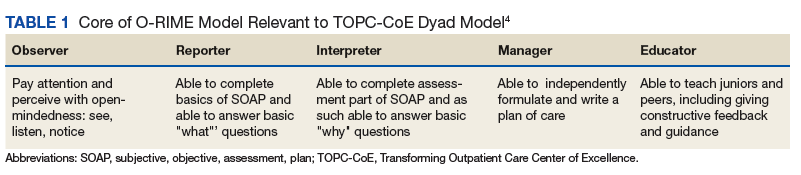

Four dyad pairs provide collaborative clinical care for veterans during one halfday session per week. The dyad conducts 4 hour-long patient visits per session. To be a dyad participant, the physician residents must be at least a PGY2, and their schedule must align with the NP student clinic schedule. Participation is mandatory for both NP students and physician residents. TOPC staff assemble the pairs.
The dyad model requires knowledge of the clinical and curricular interface and when to block the dyad team members’ schedules for 4 patients instead of 6. Physician residents are in the TOPC-CoEPCE for 12 weeks and then on inpatient for 12 weeks. Depending on the nursing school affiliate, NP student trainees are scheduled for either a 6- or 12-month TOPC-CoEPCE experience. For the 12-month NP students, they are paired with up to 4 internal medicine residents over the course of their dyad participation so they can experience different teaching styles of each resident while developing more varied interprofessional communication skills.
Faculty Roles and Development
The dyad model also seeks to address the paucity of deliberate interprofessional precepting in academic primary care settings. The TOPC-CoEPCE staff decided to use the existing primary care clinic faculty development series bimonthly for 1 hour each. The dyad model team members presented sessions covering foundational material in interprofessional teaching and precepting skills, which prepare faculty to precept for different professions and the dyad teams. It is important for preceptors to develop awareness of learners from different professions and the corresponding educational trajectories, so they can communicate with paired trainees of differing professions and academic levels who may require different levels of discussion.
Resources
By utilizing advanced residents as teachers, faculty were able to increase the number of learners in the clinic without increasing the number preceptors. For example, precepting a student typically requires more preceptor time, especially when we consider that the preceptor must also see the patient. The TOPC-CoEPCE faculty run the microteaching sessions, and an evaluator monitors and evaluates the program. The microteaching sessions were derived from several teaching resources.
Monitoring and Assessment
The Cleveland TOPC administered 2 different surveys developed by the Dyad Model Infrastructure and Evaluation workgroup. A 7-item survey assesses dyad team communication and interprofessional team functioning, and an 8-item survey assesses the teaching/mentoring of the resident as teacher. Both were collected from all participants to evaluate the residents’ and students’ point of view. Surveys are collected in the first and last weeks of the dyad experience. Feedback from participants has been used to make improvements to the program (eg, monitoring how the dyad teams are functioning, coaching individual learners).
Partnerships
In addition to TOPC staff and faculty support and engagement, the initiative has benefited from partnerships with VA clinic staff and with the associated academic affiliates. In particular, the Associate Chief of General Internal Medicine at the Cleveland VA medical center and interim clinic director helped institute changes to the primary care clinic structure. Additionally, buy-in from the clinic nurse manager was needed to make adjustments with staff schedules and clinic resources. To implement the dyad model, the clinic director had to approve reductions in the residents’ clinic loads for the mornings when they participated.
The NP affiliates’ faculty at the schools of nursing are integral partners who assist with student recruitment and participate in the planning and refinement of TOPCCoEPCE components. The Frances Payne Bolton School of Nursing at CWRU and the Breen School of Nursing of Ursuline College in Pepper Pike, Ohio, were involved in the planning stages and continue to receive monthly updates from TOPC-CoEPCE. Similarly, the CWRU School of Medicine and Cleveland Clinic Foundation affiliates contribute on an ongoing basis to the improvement and implementation process.
Discussion
One challenge has been advancing aspects of a nonhierarchical team approach while it is a teacher-student relationship. The dyad model is viewed as an opportunity to recognize nonhierarchical structures and teach negotiation and communication skills as well as increase interprofessional understanding of each other’s education, expertise, and scope of practice.
Another challenge is accommodating the diversity in NP training and clinical expertise. The NP student participants are in either the first or second year of their academic program. This is a challenge since both physician residents and physician faculty preceptors need to assess the NP students’ skills before providing opportunities to build on their skill level. Staff members have learned the value of checking in weekly on this issue.
Factors for Success
VA facility support and TOPC-CoEPCE leadership with the operations/academic partnership remain critical to integrating and sustaining the model into the Cleveland primary care clinic. The expertise of TOPC-CoEPCE dyad model faculty who serve as facilitators has been crucial, as they oversee team development concepts such as developing problem solving and negotiation skills. The workgroups ensured that faculty were skilled in understanding the different types of learners and provided guidance to dyad teams. Another success factor was the continual monitoring of the process and real-time evaluation of the program to adapt the model as needed.
Accomplishments and Benefits
There is evidence that the dyad model is achieving its goals: Trainees are using team skills during and outside formal dyad pairs; NP students report improvements in skill levels and comfort; and physician residents feel the teaching role in the dyad pair is an opportunity for them to improve their practice.
Interprofessional Educational Capacity
The dyad model complements the curriculum components and advances trainee understanding of 4 core domains: shared decision-making (SDM), sustained relationships (SR), interprofessional collaboration (IPC), and performance improvement (PI) (Table 2). The dyad model supports the other CoEPCE interprofessional education activities and is reinforced by these activities. The model is a learning laboratory for studying team dynamics and developing a curriculum that strengthens a team approach to patient-centered care.
Participants’ Knowledge, Attitudes, Skills, and Competencies
As of May 2015, 35 trainees (21 internal medicine physician residents and 14 NP students) have participated in dyads. Because physician residents participate over 2 years and may partner with more than 1 NP student, this has resulted in 27 dyad pairs in this time frame. Findings from an analysis of evaluations suggest that the dyad pair trainees learn from one another, and the model provides a safe space where trainees can practice and increase their confidence.1,6,7 The NP students seem to increase clinical skills quickly—expanding physical exam skills, building a differential diagnosis, and formulating therapeutic plans—and progressing to the Interpreter and Manager levels in the O-RIME model. The physician resident achieves the Educator level.
As of September 2015, the results from the pairs who completed beginning and end evaluations show that the physician residents increased the amount of feedback they provided about performance to the student, and likewise the student NPs also felt they received an increased amount of feedback about performance from the physician resident. In addition, physician residents reported improving the most in the following areas: allowing the student to make commitments in diagnoses and treatment plans and asking the student to provide supporting evidence for their commitment to the diagnoses. NP students reported the largest increases in receiving weekly feedback about their performance from the physician and their ability to listen to the patient.1,6,7
Interprofessional Collaboration
The TOPC-CoEPCE staff observed strengthened dyad pair relationships and mutual respect between the dyad partners. Trainees communicate with each other and work together to provide care of the patient. Second, dyad pair partners are learning about the other profession—their trajectory, their education model, and their differences. The physician resident develops an awareness of the partner NP student’s knowledge and expertise, such as their experience of social and psychological factors to become a more effective teacher, contributing to patient-centered care. The evaluation results illustrate increased ability of trainees to give and receive feedback and the change in roles for providing diagnosis and providing supporting evidence within the TOPCCoEPCE dyad team.6-8
The Future
The model has broad applicability for interprofessional education in the VA since it enhances skills that providers need to work in a PACT/PCMH model. Additionally, the TOPC-CoEPCE dyad model has proven to be an effective interprofessional training experience for its affiliates and may have applicability in other VA/affiliate training programs. The dyad model can be adapted to different trainee types in the ambulatory care setting. The TOPCCoEPCE is piloting a version of the dyad with NP residents (postgraduate) and first-year medical students. Additionally, the TOPCCoEPCE is paving the way for integrating improvement of physician resident teaching skills into the primary care setting and facilitating bidirectional teaching among different professions. TOPC-CoEPCE intends to develop additional resources to facilitate use of the model application in other settings such as the dyad implementation template.
1. Billett SR. Securing intersubjectivity through interprofessional workplace learning experiences. J Interprof Care. 2014;28(3):206-211.
2. Tolsgaard MG, Bjørck S, Rasmussen MB, Gustafsson A, Ringsted C. Improving efficiency of clinical skills training: a randomized trial. J Gen Intern Med. 2013;28(8);1072-1077.
3. Pangaro L. A new vocabulary and other innovations for improving descriptive in-training evaluations. Acad Med. 1999;74(11):1203-1207.
4. Tham KY. Observer-Reporter-Interpreter-Manager-Educator (O-RIME) framework to guide formative assessment of medical students. Ann Acad Med Singapore. 2013;42(11):603-607.
6. Clementz L, Dolansky MA, Lawrence RH, et al. Dyad teams: interprofessional collaboration and learning in ambulatory setting. Poster session presented: 38th Annual Meeting of the Society of General Internal Medicine; April 2015:Toronto, Canada. www.pcori.org/sites/default/files /SGIM-Conference-Program-2015.pdf. Accessed August 29, 2018.
7. Singh M, Clementz L, Dolansky MA, et al. MD-NP learning dyad model: an innovative approach to interprofessional teaching and learning. Workshop presented at: Annual Meeting of the Midwest Society of General Internal Medicine; August 27, 2015: Cleveland, Ohio.
8. Lawrence RH, Dolansky MA, Clementz L, et al. Dyad teams: collaboration and learning in the ambulatory care setting. Poster session presented at: AAMC meeting, Innovations in Academic Medicine; November 7-11, 2014: Chicago, IL.
Background
In 2011, 5 US Department of Veterans Affairs (VA) medical centers were selected by the VA Office of Academic Affiliations (OAA) to establish Centers of Excellence in Primary Care Education (CoEPCE). As part of VA’s New Models of Care initiative, the 5 CoEPCEs are using VA primary care settings to develop and test innovative approaches to prepare physician residents and students, advanced practice nurses (APRNs), undergraduate nursing students, and other health professions trainees (such as pharmacy, social work, psychology, physician assistants) for primary care practice. The CoEPCE sites are developing, implementing, and evaluating curricula to prepare learners from relevant professions to practice in patientcentered, interprofessional team-based primary care settings. Patient aligned care teams (PACTs) that have 2 or more health professions trainees engaged in learning, working, and teaching are known as interprofessional academic PACTs (iAPACTs), which is the preferred model for the VA.
The Cleveland Transforming Outpatient Care (TOPC)-CoEPCE was designed for collaborative learning among nurse practitioner (NP) students and physician residents. Its robust curriculum consists of a dedicated half-day of didactics for all learners, interprofessional quality improvement projects, panel management sessions, and primary care clinical sessions for nursing and physician learners that include the dyad workplace learning model.
In 2015, the OAA lead evaluator observed the TOPC-CoEPCE dyad model process, reviewed background documents, and conducted 10 open-ended interviews with TOPC-CoEPCE staff, participating trainees, faculty, and affiliate leadership. Informants described their involvement, challenges encountered, and benefits of the TOPCCoEPC dyad model to participants, veterans, VA, and affiliates.
Lack of Interprofessional Learning Opportunities
Current health care professional education models typically do not have many workplace learning settings where physician and nursing trainees learn together and provide patient-centered care. Often in a shared clinical environment, trainees may engage in “parallel play,” which can result in physician trainees and NP students learning independently and being ill-prepared to practice effectively together.
Moreover, trainees from different professions have different learning needs. For example, less experienced NP students require greater time, supervision, and evaluation of their patient care skills. On the other hand, senior physician residents, who require less clinical instruction, need to be engaged in ways that provide opportunities to enhance their ambulatory teaching skills. Although enhancement of resident teaching skills occurs in the inpatient hospital setting, there have been limited teaching experiences for residents in a primary care setting where the instruction is traditionally faculty-based. The TOPCCoEPCE dyad model offers an opportunity to simultaneously provide trainees with a true interprofessional experience through advancement of skills in primary care, teamwork, and teaching, while addressing health care needs.
The Dyad Model
In 2011, the OAA directed COEPCE sites to develop innovative curriculum and workplace learning strategies to create more opportunities for physician and NP trainees to work as a team. There is evidence demonstrating that when students develop a shared understanding of each other’s skill set, care procedures, and values, patient care is improved.1 Further, training in pairs can be an effective strategy in education of preclerkship medical students.2 In April 2013, TOPC-CoEPCE staff asked representatives from the Student-Run Clinic at Case Western Reserve University (CWRU) in Cleveland, Ohio, to present their approach to pairing nursing and medical students in clinic under supervision by volunteer faculty. However, formal structure and curricular objectives were lacking. To address diverse TOPCCoEPCE trainee needs and create a team approach to patient care, the staff formalized and developed a workplace curriculum called the dyad model. Specifically, the model pairs 1 NP student with a senior (PGY2 or PGY3) physician resident to care for ambulatory patients as a dyad teaching/learning team. The dyad model has 3 goals: improving clinical performance, learning team dynamics, and improving the physician resident’s teaching skills in an ambulatory setting.
Planning and Implementation
Planning the dyad model took 4 months. Initial conceptualization of the model was discussed at TOPC-CoEPCE infrastructure meetings. Workgroups with representatives from medicine, nursing, evaluation and medical center administration were formed to finalize the model. The workgroups met weekly or biweekly to develop protocols for scheduling, ongoing monitoring and assessment, microteaching session curriculum development, and logistics. A pilot program was initiated for 1 month with 2 dyads to monitor learner progress and improve components, such as adjusting the patient exam start times and curriculum. In maintaining the program, the workgroups continue to meet monthly to check for areas for further improvement and maintain dissemination activities.
Curriculum
The dyad model is a novel opportunity to have trainees from different professions not only collaborate in the care of the same patient at the same time, but also negotiate their respective responsibilities preand postvisit. The experience focuses on interprofessional relationships and open communication. TOPC-CoEPCE used a modified version of the RIME (Reporter-Interpreter-Manager-Educator) model called the O-RIME model (Table 1), which includes an observer (O) phase as the first component for clarification about a beginners’ role.3,4
Four dyad pairs provide collaborative clinical care for veterans during one halfday session per week. The dyad conducts 4 hour-long patient visits per session. To be a dyad participant, the physician residents must be at least a PGY2, and their schedule must align with the NP student clinic schedule. Participation is mandatory for both NP students and physician residents. TOPC staff assemble the pairs.
The dyad model requires knowledge of the clinical and curricular interface and when to block the dyad team members’ schedules for 4 patients instead of 6. Physician residents are in the TOPC-CoEPCE for 12 weeks and then on inpatient for 12 weeks. Depending on the nursing school affiliate, NP student trainees are scheduled for either a 6- or 12-month TOPC-CoEPCE experience. For the 12-month NP students, they are paired with up to 4 internal medicine residents over the course of their dyad participation so they can experience different teaching styles of each resident while developing more varied interprofessional communication skills.
Faculty Roles and Development
The dyad model also seeks to address the paucity of deliberate interprofessional precepting in academic primary care settings. The TOPC-CoEPCE staff decided to use the existing primary care clinic faculty development series bimonthly for 1 hour each. The dyad model team members presented sessions covering foundational material in interprofessional teaching and precepting skills, which prepare faculty to precept for different professions and the dyad teams. It is important for preceptors to develop awareness of learners from different professions and the corresponding educational trajectories, so they can communicate with paired trainees of differing professions and academic levels who may require different levels of discussion.
Resources
By utilizing advanced residents as teachers, faculty were able to increase the number of learners in the clinic without increasing the number preceptors. For example, precepting a student typically requires more preceptor time, especially when we consider that the preceptor must also see the patient. The TOPC-CoEPCE faculty run the microteaching sessions, and an evaluator monitors and evaluates the program. The microteaching sessions were derived from several teaching resources.
Monitoring and Assessment
The Cleveland TOPC administered 2 different surveys developed by the Dyad Model Infrastructure and Evaluation workgroup. A 7-item survey assesses dyad team communication and interprofessional team functioning, and an 8-item survey assesses the teaching/mentoring of the resident as teacher. Both were collected from all participants to evaluate the residents’ and students’ point of view. Surveys are collected in the first and last weeks of the dyad experience. Feedback from participants has been used to make improvements to the program (eg, monitoring how the dyad teams are functioning, coaching individual learners).
Partnerships
In addition to TOPC staff and faculty support and engagement, the initiative has benefited from partnerships with VA clinic staff and with the associated academic affiliates. In particular, the Associate Chief of General Internal Medicine at the Cleveland VA medical center and interim clinic director helped institute changes to the primary care clinic structure. Additionally, buy-in from the clinic nurse manager was needed to make adjustments with staff schedules and clinic resources. To implement the dyad model, the clinic director had to approve reductions in the residents’ clinic loads for the mornings when they participated.
The NP affiliates’ faculty at the schools of nursing are integral partners who assist with student recruitment and participate in the planning and refinement of TOPCCoEPCE components. The Frances Payne Bolton School of Nursing at CWRU and the Breen School of Nursing of Ursuline College in Pepper Pike, Ohio, were involved in the planning stages and continue to receive monthly updates from TOPC-CoEPCE. Similarly, the CWRU School of Medicine and Cleveland Clinic Foundation affiliates contribute on an ongoing basis to the improvement and implementation process.
Discussion
One challenge has been advancing aspects of a nonhierarchical team approach while it is a teacher-student relationship. The dyad model is viewed as an opportunity to recognize nonhierarchical structures and teach negotiation and communication skills as well as increase interprofessional understanding of each other’s education, expertise, and scope of practice.
Another challenge is accommodating the diversity in NP training and clinical expertise. The NP student participants are in either the first or second year of their academic program. This is a challenge since both physician residents and physician faculty preceptors need to assess the NP students’ skills before providing opportunities to build on their skill level. Staff members have learned the value of checking in weekly on this issue.
Factors for Success
VA facility support and TOPC-CoEPCE leadership with the operations/academic partnership remain critical to integrating and sustaining the model into the Cleveland primary care clinic. The expertise of TOPC-CoEPCE dyad model faculty who serve as facilitators has been crucial, as they oversee team development concepts such as developing problem solving and negotiation skills. The workgroups ensured that faculty were skilled in understanding the different types of learners and provided guidance to dyad teams. Another success factor was the continual monitoring of the process and real-time evaluation of the program to adapt the model as needed.
Accomplishments and Benefits
There is evidence that the dyad model is achieving its goals: Trainees are using team skills during and outside formal dyad pairs; NP students report improvements in skill levels and comfort; and physician residents feel the teaching role in the dyad pair is an opportunity for them to improve their practice.
Interprofessional Educational Capacity
The dyad model complements the curriculum components and advances trainee understanding of 4 core domains: shared decision-making (SDM), sustained relationships (SR), interprofessional collaboration (IPC), and performance improvement (PI) (Table 2). The dyad model supports the other CoEPCE interprofessional education activities and is reinforced by these activities. The model is a learning laboratory for studying team dynamics and developing a curriculum that strengthens a team approach to patient-centered care.
Participants’ Knowledge, Attitudes, Skills, and Competencies
As of May 2015, 35 trainees (21 internal medicine physician residents and 14 NP students) have participated in dyads. Because physician residents participate over 2 years and may partner with more than 1 NP student, this has resulted in 27 dyad pairs in this time frame. Findings from an analysis of evaluations suggest that the dyad pair trainees learn from one another, and the model provides a safe space where trainees can practice and increase their confidence.1,6,7 The NP students seem to increase clinical skills quickly—expanding physical exam skills, building a differential diagnosis, and formulating therapeutic plans—and progressing to the Interpreter and Manager levels in the O-RIME model. The physician resident achieves the Educator level.
As of September 2015, the results from the pairs who completed beginning and end evaluations show that the physician residents increased the amount of feedback they provided about performance to the student, and likewise the student NPs also felt they received an increased amount of feedback about performance from the physician resident. In addition, physician residents reported improving the most in the following areas: allowing the student to make commitments in diagnoses and treatment plans and asking the student to provide supporting evidence for their commitment to the diagnoses. NP students reported the largest increases in receiving weekly feedback about their performance from the physician and their ability to listen to the patient.1,6,7
Interprofessional Collaboration
The TOPC-CoEPCE staff observed strengthened dyad pair relationships and mutual respect between the dyad partners. Trainees communicate with each other and work together to provide care of the patient. Second, dyad pair partners are learning about the other profession—their trajectory, their education model, and their differences. The physician resident develops an awareness of the partner NP student’s knowledge and expertise, such as their experience of social and psychological factors to become a more effective teacher, contributing to patient-centered care. The evaluation results illustrate increased ability of trainees to give and receive feedback and the change in roles for providing diagnosis and providing supporting evidence within the TOPCCoEPCE dyad team.6-8
The Future
The model has broad applicability for interprofessional education in the VA since it enhances skills that providers need to work in a PACT/PCMH model. Additionally, the TOPC-CoEPCE dyad model has proven to be an effective interprofessional training experience for its affiliates and may have applicability in other VA/affiliate training programs. The dyad model can be adapted to different trainee types in the ambulatory care setting. The TOPCCoEPCE is piloting a version of the dyad with NP residents (postgraduate) and first-year medical students. Additionally, the TOPCCoEPCE is paving the way for integrating improvement of physician resident teaching skills into the primary care setting and facilitating bidirectional teaching among different professions. TOPC-CoEPCE intends to develop additional resources to facilitate use of the model application in other settings such as the dyad implementation template.
Background
In 2011, 5 US Department of Veterans Affairs (VA) medical centers were selected by the VA Office of Academic Affiliations (OAA) to establish Centers of Excellence in Primary Care Education (CoEPCE). As part of VA’s New Models of Care initiative, the 5 CoEPCEs are using VA primary care settings to develop and test innovative approaches to prepare physician residents and students, advanced practice nurses (APRNs), undergraduate nursing students, and other health professions trainees (such as pharmacy, social work, psychology, physician assistants) for primary care practice. The CoEPCE sites are developing, implementing, and evaluating curricula to prepare learners from relevant professions to practice in patientcentered, interprofessional team-based primary care settings. Patient aligned care teams (PACTs) that have 2 or more health professions trainees engaged in learning, working, and teaching are known as interprofessional academic PACTs (iAPACTs), which is the preferred model for the VA.
The Cleveland Transforming Outpatient Care (TOPC)-CoEPCE was designed for collaborative learning among nurse practitioner (NP) students and physician residents. Its robust curriculum consists of a dedicated half-day of didactics for all learners, interprofessional quality improvement projects, panel management sessions, and primary care clinical sessions for nursing and physician learners that include the dyad workplace learning model.
In 2015, the OAA lead evaluator observed the TOPC-CoEPCE dyad model process, reviewed background documents, and conducted 10 open-ended interviews with TOPC-CoEPCE staff, participating trainees, faculty, and affiliate leadership. Informants described their involvement, challenges encountered, and benefits of the TOPCCoEPC dyad model to participants, veterans, VA, and affiliates.
Lack of Interprofessional Learning Opportunities
Current health care professional education models typically do not have many workplace learning settings where physician and nursing trainees learn together and provide patient-centered care. Often in a shared clinical environment, trainees may engage in “parallel play,” which can result in physician trainees and NP students learning independently and being ill-prepared to practice effectively together.
Moreover, trainees from different professions have different learning needs. For example, less experienced NP students require greater time, supervision, and evaluation of their patient care skills. On the other hand, senior physician residents, who require less clinical instruction, need to be engaged in ways that provide opportunities to enhance their ambulatory teaching skills. Although enhancement of resident teaching skills occurs in the inpatient hospital setting, there have been limited teaching experiences for residents in a primary care setting where the instruction is traditionally faculty-based. The TOPCCoEPCE dyad model offers an opportunity to simultaneously provide trainees with a true interprofessional experience through advancement of skills in primary care, teamwork, and teaching, while addressing health care needs.
The Dyad Model
In 2011, the OAA directed COEPCE sites to develop innovative curriculum and workplace learning strategies to create more opportunities for physician and NP trainees to work as a team. There is evidence demonstrating that when students develop a shared understanding of each other’s skill set, care procedures, and values, patient care is improved.1 Further, training in pairs can be an effective strategy in education of preclerkship medical students.2 In April 2013, TOPC-CoEPCE staff asked representatives from the Student-Run Clinic at Case Western Reserve University (CWRU) in Cleveland, Ohio, to present their approach to pairing nursing and medical students in clinic under supervision by volunteer faculty. However, formal structure and curricular objectives were lacking. To address diverse TOPCCoEPCE trainee needs and create a team approach to patient care, the staff formalized and developed a workplace curriculum called the dyad model. Specifically, the model pairs 1 NP student with a senior (PGY2 or PGY3) physician resident to care for ambulatory patients as a dyad teaching/learning team. The dyad model has 3 goals: improving clinical performance, learning team dynamics, and improving the physician resident’s teaching skills in an ambulatory setting.
Planning and Implementation
Planning the dyad model took 4 months. Initial conceptualization of the model was discussed at TOPC-CoEPCE infrastructure meetings. Workgroups with representatives from medicine, nursing, evaluation and medical center administration were formed to finalize the model. The workgroups met weekly or biweekly to develop protocols for scheduling, ongoing monitoring and assessment, microteaching session curriculum development, and logistics. A pilot program was initiated for 1 month with 2 dyads to monitor learner progress and improve components, such as adjusting the patient exam start times and curriculum. In maintaining the program, the workgroups continue to meet monthly to check for areas for further improvement and maintain dissemination activities.
Curriculum
The dyad model is a novel opportunity to have trainees from different professions not only collaborate in the care of the same patient at the same time, but also negotiate their respective responsibilities preand postvisit. The experience focuses on interprofessional relationships and open communication. TOPC-CoEPCE used a modified version of the RIME (Reporter-Interpreter-Manager-Educator) model called the O-RIME model (Table 1), which includes an observer (O) phase as the first component for clarification about a beginners’ role.3,4
Four dyad pairs provide collaborative clinical care for veterans during one halfday session per week. The dyad conducts 4 hour-long patient visits per session. To be a dyad participant, the physician residents must be at least a PGY2, and their schedule must align with the NP student clinic schedule. Participation is mandatory for both NP students and physician residents. TOPC staff assemble the pairs.
The dyad model requires knowledge of the clinical and curricular interface and when to block the dyad team members’ schedules for 4 patients instead of 6. Physician residents are in the TOPC-CoEPCE for 12 weeks and then on inpatient for 12 weeks. Depending on the nursing school affiliate, NP student trainees are scheduled for either a 6- or 12-month TOPC-CoEPCE experience. For the 12-month NP students, they are paired with up to 4 internal medicine residents over the course of their dyad participation so they can experience different teaching styles of each resident while developing more varied interprofessional communication skills.
Faculty Roles and Development
The dyad model also seeks to address the paucity of deliberate interprofessional precepting in academic primary care settings. The TOPC-CoEPCE staff decided to use the existing primary care clinic faculty development series bimonthly for 1 hour each. The dyad model team members presented sessions covering foundational material in interprofessional teaching and precepting skills, which prepare faculty to precept for different professions and the dyad teams. It is important for preceptors to develop awareness of learners from different professions and the corresponding educational trajectories, so they can communicate with paired trainees of differing professions and academic levels who may require different levels of discussion.
Resources
By utilizing advanced residents as teachers, faculty were able to increase the number of learners in the clinic without increasing the number preceptors. For example, precepting a student typically requires more preceptor time, especially when we consider that the preceptor must also see the patient. The TOPC-CoEPCE faculty run the microteaching sessions, and an evaluator monitors and evaluates the program. The microteaching sessions were derived from several teaching resources.
Monitoring and Assessment
The Cleveland TOPC administered 2 different surveys developed by the Dyad Model Infrastructure and Evaluation workgroup. A 7-item survey assesses dyad team communication and interprofessional team functioning, and an 8-item survey assesses the teaching/mentoring of the resident as teacher. Both were collected from all participants to evaluate the residents’ and students’ point of view. Surveys are collected in the first and last weeks of the dyad experience. Feedback from participants has been used to make improvements to the program (eg, monitoring how the dyad teams are functioning, coaching individual learners).
Partnerships
In addition to TOPC staff and faculty support and engagement, the initiative has benefited from partnerships with VA clinic staff and with the associated academic affiliates. In particular, the Associate Chief of General Internal Medicine at the Cleveland VA medical center and interim clinic director helped institute changes to the primary care clinic structure. Additionally, buy-in from the clinic nurse manager was needed to make adjustments with staff schedules and clinic resources. To implement the dyad model, the clinic director had to approve reductions in the residents’ clinic loads for the mornings when they participated.
The NP affiliates’ faculty at the schools of nursing are integral partners who assist with student recruitment and participate in the planning and refinement of TOPCCoEPCE components. The Frances Payne Bolton School of Nursing at CWRU and the Breen School of Nursing of Ursuline College in Pepper Pike, Ohio, were involved in the planning stages and continue to receive monthly updates from TOPC-CoEPCE. Similarly, the CWRU School of Medicine and Cleveland Clinic Foundation affiliates contribute on an ongoing basis to the improvement and implementation process.
Discussion
One challenge has been advancing aspects of a nonhierarchical team approach while it is a teacher-student relationship. The dyad model is viewed as an opportunity to recognize nonhierarchical structures and teach negotiation and communication skills as well as increase interprofessional understanding of each other’s education, expertise, and scope of practice.
Another challenge is accommodating the diversity in NP training and clinical expertise. The NP student participants are in either the first or second year of their academic program. This is a challenge since both physician residents and physician faculty preceptors need to assess the NP students’ skills before providing opportunities to build on their skill level. Staff members have learned the value of checking in weekly on this issue.
Factors for Success
VA facility support and TOPC-CoEPCE leadership with the operations/academic partnership remain critical to integrating and sustaining the model into the Cleveland primary care clinic. The expertise of TOPC-CoEPCE dyad model faculty who serve as facilitators has been crucial, as they oversee team development concepts such as developing problem solving and negotiation skills. The workgroups ensured that faculty were skilled in understanding the different types of learners and provided guidance to dyad teams. Another success factor was the continual monitoring of the process and real-time evaluation of the program to adapt the model as needed.
Accomplishments and Benefits
There is evidence that the dyad model is achieving its goals: Trainees are using team skills during and outside formal dyad pairs; NP students report improvements in skill levels and comfort; and physician residents feel the teaching role in the dyad pair is an opportunity for them to improve their practice.
Interprofessional Educational Capacity
The dyad model complements the curriculum components and advances trainee understanding of 4 core domains: shared decision-making (SDM), sustained relationships (SR), interprofessional collaboration (IPC), and performance improvement (PI) (Table 2). The dyad model supports the other CoEPCE interprofessional education activities and is reinforced by these activities. The model is a learning laboratory for studying team dynamics and developing a curriculum that strengthens a team approach to patient-centered care.
Participants’ Knowledge, Attitudes, Skills, and Competencies
As of May 2015, 35 trainees (21 internal medicine physician residents and 14 NP students) have participated in dyads. Because physician residents participate over 2 years and may partner with more than 1 NP student, this has resulted in 27 dyad pairs in this time frame. Findings from an analysis of evaluations suggest that the dyad pair trainees learn from one another, and the model provides a safe space where trainees can practice and increase their confidence.1,6,7 The NP students seem to increase clinical skills quickly—expanding physical exam skills, building a differential diagnosis, and formulating therapeutic plans—and progressing to the Interpreter and Manager levels in the O-RIME model. The physician resident achieves the Educator level.
As of September 2015, the results from the pairs who completed beginning and end evaluations show that the physician residents increased the amount of feedback they provided about performance to the student, and likewise the student NPs also felt they received an increased amount of feedback about performance from the physician resident. In addition, physician residents reported improving the most in the following areas: allowing the student to make commitments in diagnoses and treatment plans and asking the student to provide supporting evidence for their commitment to the diagnoses. NP students reported the largest increases in receiving weekly feedback about their performance from the physician and their ability to listen to the patient.1,6,7
Interprofessional Collaboration
The TOPC-CoEPCE staff observed strengthened dyad pair relationships and mutual respect between the dyad partners. Trainees communicate with each other and work together to provide care of the patient. Second, dyad pair partners are learning about the other profession—their trajectory, their education model, and their differences. The physician resident develops an awareness of the partner NP student’s knowledge and expertise, such as their experience of social and psychological factors to become a more effective teacher, contributing to patient-centered care. The evaluation results illustrate increased ability of trainees to give and receive feedback and the change in roles for providing diagnosis and providing supporting evidence within the TOPCCoEPCE dyad team.6-8
The Future
The model has broad applicability for interprofessional education in the VA since it enhances skills that providers need to work in a PACT/PCMH model. Additionally, the TOPC-CoEPCE dyad model has proven to be an effective interprofessional training experience for its affiliates and may have applicability in other VA/affiliate training programs. The dyad model can be adapted to different trainee types in the ambulatory care setting. The TOPCCoEPCE is piloting a version of the dyad with NP residents (postgraduate) and first-year medical students. Additionally, the TOPCCoEPCE is paving the way for integrating improvement of physician resident teaching skills into the primary care setting and facilitating bidirectional teaching among different professions. TOPC-CoEPCE intends to develop additional resources to facilitate use of the model application in other settings such as the dyad implementation template.
1. Billett SR. Securing intersubjectivity through interprofessional workplace learning experiences. J Interprof Care. 2014;28(3):206-211.
2. Tolsgaard MG, Bjørck S, Rasmussen MB, Gustafsson A, Ringsted C. Improving efficiency of clinical skills training: a randomized trial. J Gen Intern Med. 2013;28(8);1072-1077.
3. Pangaro L. A new vocabulary and other innovations for improving descriptive in-training evaluations. Acad Med. 1999;74(11):1203-1207.
4. Tham KY. Observer-Reporter-Interpreter-Manager-Educator (O-RIME) framework to guide formative assessment of medical students. Ann Acad Med Singapore. 2013;42(11):603-607.
6. Clementz L, Dolansky MA, Lawrence RH, et al. Dyad teams: interprofessional collaboration and learning in ambulatory setting. Poster session presented: 38th Annual Meeting of the Society of General Internal Medicine; April 2015:Toronto, Canada. www.pcori.org/sites/default/files /SGIM-Conference-Program-2015.pdf. Accessed August 29, 2018.
7. Singh M, Clementz L, Dolansky MA, et al. MD-NP learning dyad model: an innovative approach to interprofessional teaching and learning. Workshop presented at: Annual Meeting of the Midwest Society of General Internal Medicine; August 27, 2015: Cleveland, Ohio.
8. Lawrence RH, Dolansky MA, Clementz L, et al. Dyad teams: collaboration and learning in the ambulatory care setting. Poster session presented at: AAMC meeting, Innovations in Academic Medicine; November 7-11, 2014: Chicago, IL.
1. Billett SR. Securing intersubjectivity through interprofessional workplace learning experiences. J Interprof Care. 2014;28(3):206-211.
2. Tolsgaard MG, Bjørck S, Rasmussen MB, Gustafsson A, Ringsted C. Improving efficiency of clinical skills training: a randomized trial. J Gen Intern Med. 2013;28(8);1072-1077.
3. Pangaro L. A new vocabulary and other innovations for improving descriptive in-training evaluations. Acad Med. 1999;74(11):1203-1207.
4. Tham KY. Observer-Reporter-Interpreter-Manager-Educator (O-RIME) framework to guide formative assessment of medical students. Ann Acad Med Singapore. 2013;42(11):603-607.
6. Clementz L, Dolansky MA, Lawrence RH, et al. Dyad teams: interprofessional collaboration and learning in ambulatory setting. Poster session presented: 38th Annual Meeting of the Society of General Internal Medicine; April 2015:Toronto, Canada. www.pcori.org/sites/default/files /SGIM-Conference-Program-2015.pdf. Accessed August 29, 2018.
7. Singh M, Clementz L, Dolansky MA, et al. MD-NP learning dyad model: an innovative approach to interprofessional teaching and learning. Workshop presented at: Annual Meeting of the Midwest Society of General Internal Medicine; August 27, 2015: Cleveland, Ohio.
8. Lawrence RH, Dolansky MA, Clementz L, et al. Dyad teams: collaboration and learning in the ambulatory care setting. Poster session presented at: AAMC meeting, Innovations in Academic Medicine; November 7-11, 2014: Chicago, IL.