User login
CLINICAL UPDATEClinical Characteristics of a Topical Azole Antimycotic: Implications Related to Antifungal and Anti-Inflammatory Activities
Clinical Characteristics of a Topical Azole Antimycotic: Implications Related to Antifungal and Anti-Inflammatory Activities
Highlights from a Presentation at the 32nd Annual Hawaii Dermatology SeminarTM. Waikoloa, Hawaii, March 1-7, 2008.
A supplement to Skin & Allergy News supported by an educational grant from OrthoNeutrogena..
This supplement was jointly sponsored by The Elsevier Office of Continuing Medical Education (EOCME), an ACCME accredited provider, and Skin & Allergy News.
• Faculty/Faculty Disclosures
• Educational Reviewer
• Target Audience
• Educational Needs
• Learning Objectives
• Accreditation
[[{"attributes":{},"fields":{}}]]
To view the supplement, click the image above.
Faculty/Faculty Disclosure
James Q. Del Rosso, DO, MD
Clinical Associate Professor, Dermatology
University of Nevada School of Medicine
Las Vegas, Nevada
Touro University Nevada College of Osteopathic Medicine
Henderson, Nevada
Dermatology Residency Director
Valley Hospital Medical Center
Las Vegas, Nevada
Dr. Del Rosso has received grant/research support, has been a consultant, and has served on the speaker's bureau of OrthoNeutrogena, Medicis Pharmaceutical Corporation, Stiefel Laboratories, Inc., Ranbaxy Pharmaceuticals Inc., and Galderma Laboratories, L.P. In this supplement, Dr. Del Rosso will reference unlabeled/unapproved uses of sertaconazole 2% cream.
Educational Reviewer
Ronald K. Miller, PhD
Dr. Miller has nothing to disclose.
Target Audience
This educational activity has been developed for dermatologists, podiatrists, and other health care professionals who treat patients diagnosed with superficial fungal infections.
Educational Needs
Superficial fungal infections can be caused by a broad spectrum of fungal pathogens including dermatophytes, yeasts, and molds and can usually be treated successfully with topical antifungal therapy. Diagnosis of superficial fungal infections is commonly based on location and characteristics of the lesions. However, care must be taken to differentiate fungal infections caused by dermatophytes from those caused by yeasts, such asCandidaorMalassezia. In addition, most cutaneous infections involve itching and may further involve secondary bacterial infection. Depending on the nature of the infection and the patient's symptoms, treatment of cutaneous fungal infections requires consideration of many factors. For example, mixed infections with multiple causes require the use of broad-spectrum anti-infective agents, while symptoms such as itching and secondary bacterial infection require the use of topical remedies with both anti-inflammatory and antipruritic properties.
Sertaconazole nitrate, an imidazole antifungal agent, has demonstrated a broad spectrum of activity against multiple fungal organisms, including dermatophytes and yeasts, such asCandidaandMalassezia. This compound may exhibit fungicidal activity that is not concentration- and organism-dependent. Although sertaconazole 2% cream is approved in the United States for treatment of tinea pedis, multiple studies support its use for other cutaneous dermatophyte infections, cutaneous candidiasis, tinea versicolor, and seborrheic dermatitis. In addition to antifungal activity, sertaconazole nitrate has been shown to exhibit anti-inflammatory and antipruritic activity in multiple laboratory studies. These properties may relate to more rapid reduction in symptoms in the clinical setting. Understanding these unique properties of sertaconazole may improve patient care in the treatment of superficial fungal infections.
Learning Objectives
By reading and studying this supplement, participants should be prepared to:
• Name three organisms that are targeted by sertaconazole.
• Describe the anti-inflammatory and antibacterial properties of sertaconazole.
• Discuss the clinical trial results of sertaconazole for the treatment of a variety of fungal infections, including tinea pedis, tinea versicolor, and intertrigo.
Accreditation
This activity has been planned and implemented in accordance with the Essential Areas and Policies of the Accreditation Council for Continuing Medical Education (ACCME) through the joint sponsorship of the Elsevier Office of Continuing Medical Education (EOCME) and Skin & Allergy News. The EOCME is accredited by the ACCME to provide continuing medical education (CME) for physicians.
The EOCME designated this educational supplement for a maximum of 1 AMA PRA Category 1 Credit(s)TM. Physicians should only claim credit commensurate with the extent of their participation in the activity.
Term of Approval: July 2008 - July 31, 2009.
Copyright © 2008 by Elsevier Inc.
Highlights from a Presentation at the 32nd Annual Hawaii Dermatology SeminarTM. Waikoloa, Hawaii, March 1-7, 2008.
A supplement to Skin & Allergy News supported by an educational grant from OrthoNeutrogena..
This supplement was jointly sponsored by The Elsevier Office of Continuing Medical Education (EOCME), an ACCME accredited provider, and Skin & Allergy News.
• Faculty/Faculty Disclosures
• Educational Reviewer
• Target Audience
• Educational Needs
• Learning Objectives
• Accreditation
[[{"attributes":{},"fields":{}}]]
To view the supplement, click the image above.
Faculty/Faculty Disclosure
James Q. Del Rosso, DO, MD
Clinical Associate Professor, Dermatology
University of Nevada School of Medicine
Las Vegas, Nevada
Touro University Nevada College of Osteopathic Medicine
Henderson, Nevada
Dermatology Residency Director
Valley Hospital Medical Center
Las Vegas, Nevada
Dr. Del Rosso has received grant/research support, has been a consultant, and has served on the speaker's bureau of OrthoNeutrogena, Medicis Pharmaceutical Corporation, Stiefel Laboratories, Inc., Ranbaxy Pharmaceuticals Inc., and Galderma Laboratories, L.P. In this supplement, Dr. Del Rosso will reference unlabeled/unapproved uses of sertaconazole 2% cream.
Educational Reviewer
Ronald K. Miller, PhD
Dr. Miller has nothing to disclose.
Target Audience
This educational activity has been developed for dermatologists, podiatrists, and other health care professionals who treat patients diagnosed with superficial fungal infections.
Educational Needs
Superficial fungal infections can be caused by a broad spectrum of fungal pathogens including dermatophytes, yeasts, and molds and can usually be treated successfully with topical antifungal therapy. Diagnosis of superficial fungal infections is commonly based on location and characteristics of the lesions. However, care must be taken to differentiate fungal infections caused by dermatophytes from those caused by yeasts, such asCandidaorMalassezia. In addition, most cutaneous infections involve itching and may further involve secondary bacterial infection. Depending on the nature of the infection and the patient's symptoms, treatment of cutaneous fungal infections requires consideration of many factors. For example, mixed infections with multiple causes require the use of broad-spectrum anti-infective agents, while symptoms such as itching and secondary bacterial infection require the use of topical remedies with both anti-inflammatory and antipruritic properties.
Sertaconazole nitrate, an imidazole antifungal agent, has demonstrated a broad spectrum of activity against multiple fungal organisms, including dermatophytes and yeasts, such asCandidaandMalassezia. This compound may exhibit fungicidal activity that is not concentration- and organism-dependent. Although sertaconazole 2% cream is approved in the United States for treatment of tinea pedis, multiple studies support its use for other cutaneous dermatophyte infections, cutaneous candidiasis, tinea versicolor, and seborrheic dermatitis. In addition to antifungal activity, sertaconazole nitrate has been shown to exhibit anti-inflammatory and antipruritic activity in multiple laboratory studies. These properties may relate to more rapid reduction in symptoms in the clinical setting. Understanding these unique properties of sertaconazole may improve patient care in the treatment of superficial fungal infections.
Learning Objectives
By reading and studying this supplement, participants should be prepared to:
• Name three organisms that are targeted by sertaconazole.
• Describe the anti-inflammatory and antibacterial properties of sertaconazole.
• Discuss the clinical trial results of sertaconazole for the treatment of a variety of fungal infections, including tinea pedis, tinea versicolor, and intertrigo.
Accreditation
This activity has been planned and implemented in accordance with the Essential Areas and Policies of the Accreditation Council for Continuing Medical Education (ACCME) through the joint sponsorship of the Elsevier Office of Continuing Medical Education (EOCME) and Skin & Allergy News. The EOCME is accredited by the ACCME to provide continuing medical education (CME) for physicians.
The EOCME designated this educational supplement for a maximum of 1 AMA PRA Category 1 Credit(s)TM. Physicians should only claim credit commensurate with the extent of their participation in the activity.
Term of Approval: July 2008 - July 31, 2009.
Copyright © 2008 by Elsevier Inc.
Highlights from a Presentation at the 32nd Annual Hawaii Dermatology SeminarTM. Waikoloa, Hawaii, March 1-7, 2008.
A supplement to Skin & Allergy News supported by an educational grant from OrthoNeutrogena..
This supplement was jointly sponsored by The Elsevier Office of Continuing Medical Education (EOCME), an ACCME accredited provider, and Skin & Allergy News.
• Faculty/Faculty Disclosures
• Educational Reviewer
• Target Audience
• Educational Needs
• Learning Objectives
• Accreditation
[[{"attributes":{},"fields":{}}]]
To view the supplement, click the image above.
Faculty/Faculty Disclosure
James Q. Del Rosso, DO, MD
Clinical Associate Professor, Dermatology
University of Nevada School of Medicine
Las Vegas, Nevada
Touro University Nevada College of Osteopathic Medicine
Henderson, Nevada
Dermatology Residency Director
Valley Hospital Medical Center
Las Vegas, Nevada
Dr. Del Rosso has received grant/research support, has been a consultant, and has served on the speaker's bureau of OrthoNeutrogena, Medicis Pharmaceutical Corporation, Stiefel Laboratories, Inc., Ranbaxy Pharmaceuticals Inc., and Galderma Laboratories, L.P. In this supplement, Dr. Del Rosso will reference unlabeled/unapproved uses of sertaconazole 2% cream.
Educational Reviewer
Ronald K. Miller, PhD
Dr. Miller has nothing to disclose.
Target Audience
This educational activity has been developed for dermatologists, podiatrists, and other health care professionals who treat patients diagnosed with superficial fungal infections.
Educational Needs
Superficial fungal infections can be caused by a broad spectrum of fungal pathogens including dermatophytes, yeasts, and molds and can usually be treated successfully with topical antifungal therapy. Diagnosis of superficial fungal infections is commonly based on location and characteristics of the lesions. However, care must be taken to differentiate fungal infections caused by dermatophytes from those caused by yeasts, such asCandidaorMalassezia. In addition, most cutaneous infections involve itching and may further involve secondary bacterial infection. Depending on the nature of the infection and the patient's symptoms, treatment of cutaneous fungal infections requires consideration of many factors. For example, mixed infections with multiple causes require the use of broad-spectrum anti-infective agents, while symptoms such as itching and secondary bacterial infection require the use of topical remedies with both anti-inflammatory and antipruritic properties.
Sertaconazole nitrate, an imidazole antifungal agent, has demonstrated a broad spectrum of activity against multiple fungal organisms, including dermatophytes and yeasts, such asCandidaandMalassezia. This compound may exhibit fungicidal activity that is not concentration- and organism-dependent. Although sertaconazole 2% cream is approved in the United States for treatment of tinea pedis, multiple studies support its use for other cutaneous dermatophyte infections, cutaneous candidiasis, tinea versicolor, and seborrheic dermatitis. In addition to antifungal activity, sertaconazole nitrate has been shown to exhibit anti-inflammatory and antipruritic activity in multiple laboratory studies. These properties may relate to more rapid reduction in symptoms in the clinical setting. Understanding these unique properties of sertaconazole may improve patient care in the treatment of superficial fungal infections.
Learning Objectives
By reading and studying this supplement, participants should be prepared to:
• Name three organisms that are targeted by sertaconazole.
• Describe the anti-inflammatory and antibacterial properties of sertaconazole.
• Discuss the clinical trial results of sertaconazole for the treatment of a variety of fungal infections, including tinea pedis, tinea versicolor, and intertrigo.
Accreditation
This activity has been planned and implemented in accordance with the Essential Areas and Policies of the Accreditation Council for Continuing Medical Education (ACCME) through the joint sponsorship of the Elsevier Office of Continuing Medical Education (EOCME) and Skin & Allergy News. The EOCME is accredited by the ACCME to provide continuing medical education (CME) for physicians.
The EOCME designated this educational supplement for a maximum of 1 AMA PRA Category 1 Credit(s)TM. Physicians should only claim credit commensurate with the extent of their participation in the activity.
Term of Approval: July 2008 - July 31, 2009.
Copyright © 2008 by Elsevier Inc.
Clinical Characteristics of a Topical Azole Antimycotic: Implications Related to Antifungal and Anti-Inflammatory Activities
Clinical Characteristics of a Topical Azole Antimycotic: Implications Related to Antifungal and Anti-Inflammatory Activities
Roundup on Cosmetic Dermatology 2008
A supplement to Skin & Allergy News.
This supplement was produced in affiliation with the 32ndHawaii Dermatology SeminarTMand the Cosmetic Dermatology SeminarTM.
•Topic Highlights
•Guest Editors
To view the supplement, click the image above.
Topic Highlights
• Evolution of Fillers Continues at a Rapid Pace
• Development of Fractional Laser Devices: Challenging Clinicians to Keep Pace
• Future Laser May Hit Fat Target
• Extend Cosmetic Offerings to Medical Patients
• 'Mini-Face-Lift' Is in Realm of Cosmetic Surgery
• Injectables Menu Offers Options for Most Patients
• Botanical Products Move to Front of Cosmeceuticals Class
• Bromelain (Pineapple Extract)
• Fractional Laser Side Effect Risk Low, Study Finds
• Fillers Changing Cosmetic Approach
Guest Editors
David J. Goldberg, M.D., J.D.
Director, Skin Laser & Surgery Specialists of New York/New Jersey
Clinical Professor of Dermatology
Director, Laser Research
Mount Sinai School of Medicine
Adjunct Professor of Law
Fordham University Law School
New York, New York
Dr. Goldberg has nothing to disclose.
Christopher B. Zachary, M.B.B.S., F.R.C.P.
Professor and Chair
Department of Dermatology
University of California, Irvine
School of Medicine
Irvine, California
Dr. Zachary has nothing to disclose.
Copyright © 2008 by Elsevier Inc.
A supplement to Skin & Allergy News.
This supplement was produced in affiliation with the 32ndHawaii Dermatology SeminarTMand the Cosmetic Dermatology SeminarTM.
•Topic Highlights
•Guest Editors
To view the supplement, click the image above.
Topic Highlights
• Evolution of Fillers Continues at a Rapid Pace
• Development of Fractional Laser Devices: Challenging Clinicians to Keep Pace
• Future Laser May Hit Fat Target
• Extend Cosmetic Offerings to Medical Patients
• 'Mini-Face-Lift' Is in Realm of Cosmetic Surgery
• Injectables Menu Offers Options for Most Patients
• Botanical Products Move to Front of Cosmeceuticals Class
• Bromelain (Pineapple Extract)
• Fractional Laser Side Effect Risk Low, Study Finds
• Fillers Changing Cosmetic Approach
Guest Editors
David J. Goldberg, M.D., J.D.
Director, Skin Laser & Surgery Specialists of New York/New Jersey
Clinical Professor of Dermatology
Director, Laser Research
Mount Sinai School of Medicine
Adjunct Professor of Law
Fordham University Law School
New York, New York
Dr. Goldberg has nothing to disclose.
Christopher B. Zachary, M.B.B.S., F.R.C.P.
Professor and Chair
Department of Dermatology
University of California, Irvine
School of Medicine
Irvine, California
Dr. Zachary has nothing to disclose.
Copyright © 2008 by Elsevier Inc.
A supplement to Skin & Allergy News.
This supplement was produced in affiliation with the 32ndHawaii Dermatology SeminarTMand the Cosmetic Dermatology SeminarTM.
•Topic Highlights
•Guest Editors
To view the supplement, click the image above.
Topic Highlights
• Evolution of Fillers Continues at a Rapid Pace
• Development of Fractional Laser Devices: Challenging Clinicians to Keep Pace
• Future Laser May Hit Fat Target
• Extend Cosmetic Offerings to Medical Patients
• 'Mini-Face-Lift' Is in Realm of Cosmetic Surgery
• Injectables Menu Offers Options for Most Patients
• Botanical Products Move to Front of Cosmeceuticals Class
• Bromelain (Pineapple Extract)
• Fractional Laser Side Effect Risk Low, Study Finds
• Fillers Changing Cosmetic Approach
Guest Editors
David J. Goldberg, M.D., J.D.
Director, Skin Laser & Surgery Specialists of New York/New Jersey
Clinical Professor of Dermatology
Director, Laser Research
Mount Sinai School of Medicine
Adjunct Professor of Law
Fordham University Law School
New York, New York
Dr. Goldberg has nothing to disclose.
Christopher B. Zachary, M.B.B.S., F.R.C.P.
Professor and Chair
Department of Dermatology
University of California, Irvine
School of Medicine
Irvine, California
Dr. Zachary has nothing to disclose.
Copyright © 2008 by Elsevier Inc.
Examining Alternative Topical Therapy for Atopic Dermatitis
A supplement to Skin and Allergy News and supported by SkinMedica.
This supplement is based on a faculty clinical roundtable discussion held September 29, 2007, in San Francisco, California.
Topic Highlights
•Table of Contents
•Faculty/Faculty Disclosure
To view the supplement, click the image above.
Table of Contents
• Epidemiology and Pathogenesis
• Treatment Goals and Approaches
• Core Therapy
• Microbial Colonization and Infection
• Adherence Issues
• Topical Steroids: Choices and Issues
• HPA-Axis Suppression
• A New Steroid Option
• Incorporating New Therapy Into Practice
• Summary Comments and Observations
Faculty/Faculty Disclosure
Lawrence F. Eichenfield, MD
Moderator
Professor of Pediatrics and Medicine (Dermatology)
University of California, San Diego
Chief of Pediatric and Adolescent Dermatology
Rady Children's Hospital
San Diego, California
Dr. Eichenfield has disclosed that he is an investigator for and has received research grants and support from Hill Dermaceuticals, Inc., Novartis Pharmaceuticals Corporation, and Stiefel Laboratories, Inc. He also is a consultant to and on the advisory board of Astellas Pharma Inc., Graceway Pharmaceuticals, LLC, Novartis, Stiefel, and SkinMedica, Inc.
Robert G. Greenberg, MD
Private Practice
Director, East Bay Psoriasis Treatment Center
San Ramon, California
Dr. Greenberg has disclosed that he is a consultant to and on the speaker's bureau for Abbott Laboratories, Amgen Inc., CollaGenex Pharmaceuticals Inc., Dermik Laboratories, Galderma Laboratories, L.P., Genentech, Inc., Medicis Pharmaceutical Corporation, SkinMedica, Stiefel, and Warner Chilcott.
Leon H. Kircik, MD
Associate Clinical Professor of Dermatology
Indiana University Medical Center
Medical Director
DermResearch, PLLC
Louisville, Kentucky
Dr. Kircik has disclosed that he has received research support from, is consultant to, and is on the speaker's bureau for 3M Laboratories, Abbott, Acambis, Allergan Inc., Amgen, Astellas, Bayer HealthCare Pharmaceuticals, Biogen-Idec, Biolife, LLC, Breckenridge Pharmaceutical, Inc., Centocor, Inc., CollaGenex, CombiMatrix, Coria Laboratories, Ltd., Dermik, The Dow Chemical Company, Ferndale Laboratories, Inc., Galderma, Genentech, GlaxoSmithKline, Healthpoint, Ltd., Intendis, Medicis, Merck Serono, NanoBio Corporation, Novartis, NUCRYST Pharmaceuticals Corp., OrthoNeutrogena, QLT Inc., Quatrix, SkinMedica, Stiefel, ToleRx, Inc., Valeant Pharmaceuticals International, and Warner-Chilcott.
Amy S. Paller, MD
Walter J. Hamlin Professor and Chair
Department of Dermatology
Northwestern University
Feinberg School of Medicine
Chicago, Illinois
Dr. Paller has disclosed that she is a consultant to Astellas, Novartis, SkinMedica, and Stiefel.
Rebecca L. Smith, MD
Fort Mill Dermatology, LLC
Fort Mill, South Carolina
Dr. Smith has disclosed that she is a consultant to Coria, SkinMedica, and Stiefel.
Copyright © 2007 Elsevier Inc.
A supplement to Skin and Allergy News and supported by SkinMedica.
This supplement is based on a faculty clinical roundtable discussion held September 29, 2007, in San Francisco, California.
Topic Highlights
•Table of Contents
•Faculty/Faculty Disclosure
To view the supplement, click the image above.
Table of Contents
• Epidemiology and Pathogenesis
• Treatment Goals and Approaches
• Core Therapy
• Microbial Colonization and Infection
• Adherence Issues
• Topical Steroids: Choices and Issues
• HPA-Axis Suppression
• A New Steroid Option
• Incorporating New Therapy Into Practice
• Summary Comments and Observations
Faculty/Faculty Disclosure
Lawrence F. Eichenfield, MD
Moderator
Professor of Pediatrics and Medicine (Dermatology)
University of California, San Diego
Chief of Pediatric and Adolescent Dermatology
Rady Children's Hospital
San Diego, California
Dr. Eichenfield has disclosed that he is an investigator for and has received research grants and support from Hill Dermaceuticals, Inc., Novartis Pharmaceuticals Corporation, and Stiefel Laboratories, Inc. He also is a consultant to and on the advisory board of Astellas Pharma Inc., Graceway Pharmaceuticals, LLC, Novartis, Stiefel, and SkinMedica, Inc.
Robert G. Greenberg, MD
Private Practice
Director, East Bay Psoriasis Treatment Center
San Ramon, California
Dr. Greenberg has disclosed that he is a consultant to and on the speaker's bureau for Abbott Laboratories, Amgen Inc., CollaGenex Pharmaceuticals Inc., Dermik Laboratories, Galderma Laboratories, L.P., Genentech, Inc., Medicis Pharmaceutical Corporation, SkinMedica, Stiefel, and Warner Chilcott.
Leon H. Kircik, MD
Associate Clinical Professor of Dermatology
Indiana University Medical Center
Medical Director
DermResearch, PLLC
Louisville, Kentucky
Dr. Kircik has disclosed that he has received research support from, is consultant to, and is on the speaker's bureau for 3M Laboratories, Abbott, Acambis, Allergan Inc., Amgen, Astellas, Bayer HealthCare Pharmaceuticals, Biogen-Idec, Biolife, LLC, Breckenridge Pharmaceutical, Inc., Centocor, Inc., CollaGenex, CombiMatrix, Coria Laboratories, Ltd., Dermik, The Dow Chemical Company, Ferndale Laboratories, Inc., Galderma, Genentech, GlaxoSmithKline, Healthpoint, Ltd., Intendis, Medicis, Merck Serono, NanoBio Corporation, Novartis, NUCRYST Pharmaceuticals Corp., OrthoNeutrogena, QLT Inc., Quatrix, SkinMedica, Stiefel, ToleRx, Inc., Valeant Pharmaceuticals International, and Warner-Chilcott.
Amy S. Paller, MD
Walter J. Hamlin Professor and Chair
Department of Dermatology
Northwestern University
Feinberg School of Medicine
Chicago, Illinois
Dr. Paller has disclosed that she is a consultant to Astellas, Novartis, SkinMedica, and Stiefel.
Rebecca L. Smith, MD
Fort Mill Dermatology, LLC
Fort Mill, South Carolina
Dr. Smith has disclosed that she is a consultant to Coria, SkinMedica, and Stiefel.
Copyright © 2007 Elsevier Inc.
A supplement to Skin and Allergy News and supported by SkinMedica.
This supplement is based on a faculty clinical roundtable discussion held September 29, 2007, in San Francisco, California.
Topic Highlights
•Table of Contents
•Faculty/Faculty Disclosure
To view the supplement, click the image above.
Table of Contents
• Epidemiology and Pathogenesis
• Treatment Goals and Approaches
• Core Therapy
• Microbial Colonization and Infection
• Adherence Issues
• Topical Steroids: Choices and Issues
• HPA-Axis Suppression
• A New Steroid Option
• Incorporating New Therapy Into Practice
• Summary Comments and Observations
Faculty/Faculty Disclosure
Lawrence F. Eichenfield, MD
Moderator
Professor of Pediatrics and Medicine (Dermatology)
University of California, San Diego
Chief of Pediatric and Adolescent Dermatology
Rady Children's Hospital
San Diego, California
Dr. Eichenfield has disclosed that he is an investigator for and has received research grants and support from Hill Dermaceuticals, Inc., Novartis Pharmaceuticals Corporation, and Stiefel Laboratories, Inc. He also is a consultant to and on the advisory board of Astellas Pharma Inc., Graceway Pharmaceuticals, LLC, Novartis, Stiefel, and SkinMedica, Inc.
Robert G. Greenberg, MD
Private Practice
Director, East Bay Psoriasis Treatment Center
San Ramon, California
Dr. Greenberg has disclosed that he is a consultant to and on the speaker's bureau for Abbott Laboratories, Amgen Inc., CollaGenex Pharmaceuticals Inc., Dermik Laboratories, Galderma Laboratories, L.P., Genentech, Inc., Medicis Pharmaceutical Corporation, SkinMedica, Stiefel, and Warner Chilcott.
Leon H. Kircik, MD
Associate Clinical Professor of Dermatology
Indiana University Medical Center
Medical Director
DermResearch, PLLC
Louisville, Kentucky
Dr. Kircik has disclosed that he has received research support from, is consultant to, and is on the speaker's bureau for 3M Laboratories, Abbott, Acambis, Allergan Inc., Amgen, Astellas, Bayer HealthCare Pharmaceuticals, Biogen-Idec, Biolife, LLC, Breckenridge Pharmaceutical, Inc., Centocor, Inc., CollaGenex, CombiMatrix, Coria Laboratories, Ltd., Dermik, The Dow Chemical Company, Ferndale Laboratories, Inc., Galderma, Genentech, GlaxoSmithKline, Healthpoint, Ltd., Intendis, Medicis, Merck Serono, NanoBio Corporation, Novartis, NUCRYST Pharmaceuticals Corp., OrthoNeutrogena, QLT Inc., Quatrix, SkinMedica, Stiefel, ToleRx, Inc., Valeant Pharmaceuticals International, and Warner-Chilcott.
Amy S. Paller, MD
Walter J. Hamlin Professor and Chair
Department of Dermatology
Northwestern University
Feinberg School of Medicine
Chicago, Illinois
Dr. Paller has disclosed that she is a consultant to Astellas, Novartis, SkinMedica, and Stiefel.
Rebecca L. Smith, MD
Fort Mill Dermatology, LLC
Fort Mill, South Carolina
Dr. Smith has disclosed that she is a consultant to Coria, SkinMedica, and Stiefel.
Copyright © 2007 Elsevier Inc.
Use of a Topical Emulsion for Wound Healing
A supplement to Skin & Allergy News and supported by OrthoNeutrogena. The content of this supplement was developed from a roundtable program.
•Faculty/Faculty Disclosures
•Roundtable Participants
To view the supplement, click the image above.
Topic Highlights
• The Mechanisms of Wound Healing
• The Role of the Macrophage in Wound Healing
• Treatment of Actinic Keratoses and Nonmelanoma Skin Cancer Lesions
• The Use of a Topical Emulsion for Wound Healing
• Radiation Dermatitis
• The Use of a Topical Emulsion for Treatment of Radiation Dermatitis
Faculty/Faculty Disclosures
Joel L. Cohen, MD
Assistant Clinical Professor
Department of Dermatology
University of Colorado
Englewood, Colo.
Dr. Cohen has disclosed that he is a consultant to Johnson & Johnson.
Joseph L. Jorizzo, MD
Professor, Founding and Former Chair
Department of Dermatology
Wake Forest University School of Medicine
Winston-Salem, N.C.
Dr. Jorizzo has nothing to disclose.
Leon H. Kircik, MD
Clinical Professor of Dermatology
Indiana School of Medicine
Medical Director
DermResearch, PLLC
Louisville, Ky.
Dr. Kircik has disclosed that he has received research support from, is consultant to, and is on the speaker's bureau for 3M Pharmaceuticals, Abbott Laboratories, Acambis, Allergan Inc., Amgen Inc., Astellas, Bayer HealthCare Pharmaceuticals, Biogen-Idec, Biolife, LLC, Breckenridge Pharmaceutical, Inc., Centocor, Inc., CollaGenex Pharmaceuticals Inc., CombiMatrix, Coria Laboratories, Ltd., Dermik Laboratories, The Dow Chemical Company, Ferndale Laboratories, Inc., Galderma Laboratories, L.P., Genentech, Inc., GlaxoSmithKline, Healthpoint, Ltd. Intendis, Medicis Pharmaceutical Corporation, Merck Serono, NanoBio Corporation, Novartis Pharmaceuticals Corporation, NUCRYST Pharmaceuticals Corp., OrthoNeutrogena, QLT Inc., Quatrix, SkinMedica, Inc., Stiefel Laboratories, Inc., ToleRx, Inc., Valeant Pharmaceuticals International, and Warner-Chilcott.
Roundtable Participants
Linda Carlin, RN, MS, OCn
CJW Medical Center
Richmond Va.
Sharon R. Hymes, MD
University of Texas
Anderson Cancer Center
Houston, Tex.
Tania J. Phillips, MD
Boston University School of Medicine
Boston, Mass.
Copyright © 2007 Elsevier Inc.
A supplement to Skin & Allergy News and supported by OrthoNeutrogena. The content of this supplement was developed from a roundtable program.
•Faculty/Faculty Disclosures
•Roundtable Participants
To view the supplement, click the image above.
Topic Highlights
• The Mechanisms of Wound Healing
• The Role of the Macrophage in Wound Healing
• Treatment of Actinic Keratoses and Nonmelanoma Skin Cancer Lesions
• The Use of a Topical Emulsion for Wound Healing
• Radiation Dermatitis
• The Use of a Topical Emulsion for Treatment of Radiation Dermatitis
Faculty/Faculty Disclosures
Joel L. Cohen, MD
Assistant Clinical Professor
Department of Dermatology
University of Colorado
Englewood, Colo.
Dr. Cohen has disclosed that he is a consultant to Johnson & Johnson.
Joseph L. Jorizzo, MD
Professor, Founding and Former Chair
Department of Dermatology
Wake Forest University School of Medicine
Winston-Salem, N.C.
Dr. Jorizzo has nothing to disclose.
Leon H. Kircik, MD
Clinical Professor of Dermatology
Indiana School of Medicine
Medical Director
DermResearch, PLLC
Louisville, Ky.
Dr. Kircik has disclosed that he has received research support from, is consultant to, and is on the speaker's bureau for 3M Pharmaceuticals, Abbott Laboratories, Acambis, Allergan Inc., Amgen Inc., Astellas, Bayer HealthCare Pharmaceuticals, Biogen-Idec, Biolife, LLC, Breckenridge Pharmaceutical, Inc., Centocor, Inc., CollaGenex Pharmaceuticals Inc., CombiMatrix, Coria Laboratories, Ltd., Dermik Laboratories, The Dow Chemical Company, Ferndale Laboratories, Inc., Galderma Laboratories, L.P., Genentech, Inc., GlaxoSmithKline, Healthpoint, Ltd. Intendis, Medicis Pharmaceutical Corporation, Merck Serono, NanoBio Corporation, Novartis Pharmaceuticals Corporation, NUCRYST Pharmaceuticals Corp., OrthoNeutrogena, QLT Inc., Quatrix, SkinMedica, Inc., Stiefel Laboratories, Inc., ToleRx, Inc., Valeant Pharmaceuticals International, and Warner-Chilcott.
Roundtable Participants
Linda Carlin, RN, MS, OCn
CJW Medical Center
Richmond Va.
Sharon R. Hymes, MD
University of Texas
Anderson Cancer Center
Houston, Tex.
Tania J. Phillips, MD
Boston University School of Medicine
Boston, Mass.
Copyright © 2007 Elsevier Inc.
A supplement to Skin & Allergy News and supported by OrthoNeutrogena. The content of this supplement was developed from a roundtable program.
•Faculty/Faculty Disclosures
•Roundtable Participants
To view the supplement, click the image above.
Topic Highlights
• The Mechanisms of Wound Healing
• The Role of the Macrophage in Wound Healing
• Treatment of Actinic Keratoses and Nonmelanoma Skin Cancer Lesions
• The Use of a Topical Emulsion for Wound Healing
• Radiation Dermatitis
• The Use of a Topical Emulsion for Treatment of Radiation Dermatitis
Faculty/Faculty Disclosures
Joel L. Cohen, MD
Assistant Clinical Professor
Department of Dermatology
University of Colorado
Englewood, Colo.
Dr. Cohen has disclosed that he is a consultant to Johnson & Johnson.
Joseph L. Jorizzo, MD
Professor, Founding and Former Chair
Department of Dermatology
Wake Forest University School of Medicine
Winston-Salem, N.C.
Dr. Jorizzo has nothing to disclose.
Leon H. Kircik, MD
Clinical Professor of Dermatology
Indiana School of Medicine
Medical Director
DermResearch, PLLC
Louisville, Ky.
Dr. Kircik has disclosed that he has received research support from, is consultant to, and is on the speaker's bureau for 3M Pharmaceuticals, Abbott Laboratories, Acambis, Allergan Inc., Amgen Inc., Astellas, Bayer HealthCare Pharmaceuticals, Biogen-Idec, Biolife, LLC, Breckenridge Pharmaceutical, Inc., Centocor, Inc., CollaGenex Pharmaceuticals Inc., CombiMatrix, Coria Laboratories, Ltd., Dermik Laboratories, The Dow Chemical Company, Ferndale Laboratories, Inc., Galderma Laboratories, L.P., Genentech, Inc., GlaxoSmithKline, Healthpoint, Ltd. Intendis, Medicis Pharmaceutical Corporation, Merck Serono, NanoBio Corporation, Novartis Pharmaceuticals Corporation, NUCRYST Pharmaceuticals Corp., OrthoNeutrogena, QLT Inc., Quatrix, SkinMedica, Inc., Stiefel Laboratories, Inc., ToleRx, Inc., Valeant Pharmaceuticals International, and Warner-Chilcott.
Roundtable Participants
Linda Carlin, RN, MS, OCn
CJW Medical Center
Richmond Va.
Sharon R. Hymes, MD
University of Texas
Anderson Cancer Center
Houston, Tex.
Tania J. Phillips, MD
Boston University School of Medicine
Boston, Mass.
Copyright © 2007 Elsevier Inc.
BEST PRACTICES IN: Managing Superficial Fungal Infections
A supplement to Skin & Allergy News. This supplement was sponsored by Ferndale Laboratories Inc. and Primus Pharmaceuticals, makers of Aloquin Gel and Alcortin A Gel.
- Back to Basics: Recognizing and Treating Common Cutaneous Pathogens
- Diagnosis
- Considerations in Choosing Therapy
- Maximizing Treatment Success
- Counseling Patients About Preventing Infection and Transmission
Faculty/Faculty Disclosure
Jacquelyn B. Garrett, MD, FAAD
Diplomate, American Board of Dermatology,
Dermatology private practice at Christian Hospital,
St. Louis, MO
Dr. Garrett has nothing to disclose.
Copyright (C) 2009 Elsevier Inc.
A supplement to Skin & Allergy News. This supplement was sponsored by Ferndale Laboratories Inc. and Primus Pharmaceuticals, makers of Aloquin Gel and Alcortin A Gel.
- Back to Basics: Recognizing and Treating Common Cutaneous Pathogens
- Diagnosis
- Considerations in Choosing Therapy
- Maximizing Treatment Success
- Counseling Patients About Preventing Infection and Transmission
Faculty/Faculty Disclosure
Jacquelyn B. Garrett, MD, FAAD
Diplomate, American Board of Dermatology,
Dermatology private practice at Christian Hospital,
St. Louis, MO
Dr. Garrett has nothing to disclose.
Copyright (C) 2009 Elsevier Inc.
A supplement to Skin & Allergy News. This supplement was sponsored by Ferndale Laboratories Inc. and Primus Pharmaceuticals, makers of Aloquin Gel and Alcortin A Gel.
- Back to Basics: Recognizing and Treating Common Cutaneous Pathogens
- Diagnosis
- Considerations in Choosing Therapy
- Maximizing Treatment Success
- Counseling Patients About Preventing Infection and Transmission
Faculty/Faculty Disclosure
Jacquelyn B. Garrett, MD, FAAD
Diplomate, American Board of Dermatology,
Dermatology private practice at Christian Hospital,
St. Louis, MO
Dr. Garrett has nothing to disclose.
Copyright (C) 2009 Elsevier Inc.
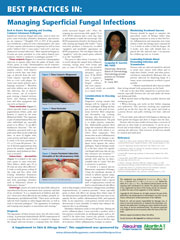
Managing Atopic Dermatitis in Children: The Role of Newer Nonsteroidal Topical Treatments
A supplement to Skin & Allergy News and supported by Ferndale Laboratories. The articles in this supplement are based on faculty interviews.
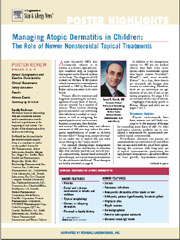
To view the supplement, click the image above.
Faculty/Faculty Disclosure
Leon H. Kircik, MD
Associate Clinical Professor of Dermatology
Indiana University Medical Center
Medical Director
DermResearch, PLLC
Louisville, Ky
Dr. Kircik has disclosed that he has received research support from, is a consultant to, and is on the speaker's bureau for 3M Pharmaceuticals, Abbott Laboratories, Acambis, Allergan Inc., Amgen Inc., Astellas, Bayer HealthCare Pharmaceuticals, Biogen-Idec, Biolife, LLC, Breckenridge Pharmaceutical, Inc., Centocor, Inc., CollaGenex Pharmaceuticals Inc., CombiMatrix, Coria Laboratories, Ltd., Dermik Laboratories, The Dow Chemical Company, Ferndale Laboratories, Inc., Galderma Laboratories, L.P., Genentech, Inc., GlaxoSmithKline, Healthpoint, Ltd., Intendis, Medicis Pharmaceutical Corporation, Merck Serono, NanoBio Corporation, Novartis Pharmaceuticals Corporation, NUCRYST Pharmaceuticals Corp., OrthoNeutrogena, QLT Inc., Quatrix, SkinMedica, Inc., Stiefel Laboratories, Inc., ToleRx, Inc., Valeant Pharmaceuticals International, and Warner-Chilcott.
Poster Review
* Patient Demographics and Baseline Characteristics
* Clinical Assessments
* Safety Evaluation
* Results
* Adverse Events
* Summary by Dr. Kircik
Copyright © 2007 Elsevier Inc.
A supplement to Skin & Allergy News and supported by Ferndale Laboratories. The articles in this supplement are based on faculty interviews.
To view the supplement, click the image above.
Faculty/Faculty Disclosure
Leon H. Kircik, MD
Associate Clinical Professor of Dermatology
Indiana University Medical Center
Medical Director
DermResearch, PLLC
Louisville, Ky
Dr. Kircik has disclosed that he has received research support from, is a consultant to, and is on the speaker's bureau for 3M Pharmaceuticals, Abbott Laboratories, Acambis, Allergan Inc., Amgen Inc., Astellas, Bayer HealthCare Pharmaceuticals, Biogen-Idec, Biolife, LLC, Breckenridge Pharmaceutical, Inc., Centocor, Inc., CollaGenex Pharmaceuticals Inc., CombiMatrix, Coria Laboratories, Ltd., Dermik Laboratories, The Dow Chemical Company, Ferndale Laboratories, Inc., Galderma Laboratories, L.P., Genentech, Inc., GlaxoSmithKline, Healthpoint, Ltd., Intendis, Medicis Pharmaceutical Corporation, Merck Serono, NanoBio Corporation, Novartis Pharmaceuticals Corporation, NUCRYST Pharmaceuticals Corp., OrthoNeutrogena, QLT Inc., Quatrix, SkinMedica, Inc., Stiefel Laboratories, Inc., ToleRx, Inc., Valeant Pharmaceuticals International, and Warner-Chilcott.
Poster Review
* Patient Demographics and Baseline Characteristics
* Clinical Assessments
* Safety Evaluation
* Results
* Adverse Events
* Summary by Dr. Kircik
Copyright © 2007 Elsevier Inc.
A supplement to Skin & Allergy News and supported by Ferndale Laboratories. The articles in this supplement are based on faculty interviews.
To view the supplement, click the image above.
Faculty/Faculty Disclosure
Leon H. Kircik, MD
Associate Clinical Professor of Dermatology
Indiana University Medical Center
Medical Director
DermResearch, PLLC
Louisville, Ky
Dr. Kircik has disclosed that he has received research support from, is a consultant to, and is on the speaker's bureau for 3M Pharmaceuticals, Abbott Laboratories, Acambis, Allergan Inc., Amgen Inc., Astellas, Bayer HealthCare Pharmaceuticals, Biogen-Idec, Biolife, LLC, Breckenridge Pharmaceutical, Inc., Centocor, Inc., CollaGenex Pharmaceuticals Inc., CombiMatrix, Coria Laboratories, Ltd., Dermik Laboratories, The Dow Chemical Company, Ferndale Laboratories, Inc., Galderma Laboratories, L.P., Genentech, Inc., GlaxoSmithKline, Healthpoint, Ltd., Intendis, Medicis Pharmaceutical Corporation, Merck Serono, NanoBio Corporation, Novartis Pharmaceuticals Corporation, NUCRYST Pharmaceuticals Corp., OrthoNeutrogena, QLT Inc., Quatrix, SkinMedica, Inc., Stiefel Laboratories, Inc., ToleRx, Inc., Valeant Pharmaceuticals International, and Warner-Chilcott.
Poster Review
* Patient Demographics and Baseline Characteristics
* Clinical Assessments
* Safety Evaluation
* Results
* Adverse Events
* Summary by Dr. Kircik
Copyright © 2007 Elsevier Inc.
CLINICAL UPDATERecent Insights Into the Origin and Management of Atopic Dermatitis
Recent Insights Into the Origin and Management of Atopic Dermatitis
A supplement to Skin & Allergy News and supported by Johnson & Johnson. The articles in this supplement are based on faculty interviews. This supplement is produced in affiliation with Skin Disease Education Foundation's Women's & Pediatric Dermatology Seminar 2007
A supplement to Skin & Allergy News and supported by Johnson & Johnson. The articles in this supplement are based on faculty interviews. This supplement is produced in affiliation with Skin Disease Education Foundation's Women's & Pediatric Dermatology Seminar 2007
A supplement to Skin & Allergy News and supported by Johnson & Johnson. The articles in this supplement are based on faculty interviews. This supplement is produced in affiliation with Skin Disease Education Foundation's Women's & Pediatric Dermatology Seminar 2007
Recent Insights Into the Origin and Management of Atopic Dermatitis
Recent Insights Into the Origin and Management of Atopic Dermatitis
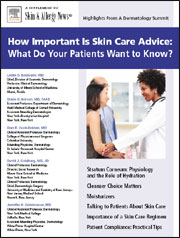
How Important Is Skin Care Advice: What Do Your Patients Want to Know?
A supplement to Skin & Allergy News.
The supplement is based on proceedings from the Skin Hydration Summit held on Saturday, March 17, 2007, in New York, New York. This supplement was supported by Unilever.
•Topic Highlights
•Faculty/Faculty Disclosure
To view the supplement, click the image above.
Topic Highlights
• Foreward
• Introduction
• Stratum Corneum: Physiology and the Role of Hydration
• Cleanser Choice Matters
• Moisturizers
• Moisturizers With Sun Protection
• Talking to Patients About Skin Care
• Importance of a Skin Care Regimen
• Acne
• Atopic Dermatitis
• Sensitive Skin
• Additional Skin Conditions
• Patient Compliance: Practical Tips
• Summary
Faculty/Faculty Disclosure
Leslie S. Baumann, MD
Chief, Division of Cosmetic Dermatology
Professor, Clinical Dermatology
University of Miami School of Medicine
Miami, Florida
Dr. Baumann has received funding for clinical grants from Allergan, Inc., Avon Products, Inc., Galderma Laboratories, Medicis Pharmaceuticals Corporation, Stiefel Laboratories, and Unilever PLC.
Diane S. Berson, MD, FAAD
Assistant Professor, Department of Dermatology
Weill Medical College of Cornell University
Assistant Attending Dermatologist
New York-Presbyterian Hospital
New York, New York
Dr. Berson is a consultant to Kao Brands and OrthoNeutrogena. She has received funding for clinical grants from CollaGenex, Inc., DUSA Pharmaceuticals, Inc., Galderma Laboratories, Medicis Pharmaceuticals Corporation, and Stiefel Laboratories.
Fran E. Cook-Bolden, MD
Clinical Assistant Professor, Dermatology
College of Physicians and Surgeons
Columbia University
Attending Physician, Dermatology
St. Luke's-Roosevelt Hospital Center
New York, New York
Dr. Cook-Bolden has nothing to disclose.
David J. Goldberg, MD, JD
Clinical Professor, Dermatology
Director, Laser Research
Mount Sinai School of Medicine
New York, New York
Clinical Professor, Dermatology
Chief, Dermatologic Surgery
University of Medicine and Dentistry of New Jersey-New Jersey Medical School
Newark, New Jersey
Dr. Goldberg has nothing to disclose.
Jennifer H. Goldwasser, MD
Clinical Assistant Professor, Dermatology
New York Medical College
Valhalla, New York
Assistant Attending Physician, Dermatology
White Plains Hospital Center
White Plains, New York
Dr. Goldwasser has nothing to disclose.
Copyright © 2007 Elsevier Inc.
A supplement to Skin & Allergy News.
The supplement is based on proceedings from the Skin Hydration Summit held on Saturday, March 17, 2007, in New York, New York. This supplement was supported by Unilever.
•Topic Highlights
•Faculty/Faculty Disclosure
To view the supplement, click the image above.
Topic Highlights
• Foreward
• Introduction
• Stratum Corneum: Physiology and the Role of Hydration
• Cleanser Choice Matters
• Moisturizers
• Moisturizers With Sun Protection
• Talking to Patients About Skin Care
• Importance of a Skin Care Regimen
• Acne
• Atopic Dermatitis
• Sensitive Skin
• Additional Skin Conditions
• Patient Compliance: Practical Tips
• Summary
Faculty/Faculty Disclosure
Leslie S. Baumann, MD
Chief, Division of Cosmetic Dermatology
Professor, Clinical Dermatology
University of Miami School of Medicine
Miami, Florida
Dr. Baumann has received funding for clinical grants from Allergan, Inc., Avon Products, Inc., Galderma Laboratories, Medicis Pharmaceuticals Corporation, Stiefel Laboratories, and Unilever PLC.
Diane S. Berson, MD, FAAD
Assistant Professor, Department of Dermatology
Weill Medical College of Cornell University
Assistant Attending Dermatologist
New York-Presbyterian Hospital
New York, New York
Dr. Berson is a consultant to Kao Brands and OrthoNeutrogena. She has received funding for clinical grants from CollaGenex, Inc., DUSA Pharmaceuticals, Inc., Galderma Laboratories, Medicis Pharmaceuticals Corporation, and Stiefel Laboratories.
Fran E. Cook-Bolden, MD
Clinical Assistant Professor, Dermatology
College of Physicians and Surgeons
Columbia University
Attending Physician, Dermatology
St. Luke's-Roosevelt Hospital Center
New York, New York
Dr. Cook-Bolden has nothing to disclose.
David J. Goldberg, MD, JD
Clinical Professor, Dermatology
Director, Laser Research
Mount Sinai School of Medicine
New York, New York
Clinical Professor, Dermatology
Chief, Dermatologic Surgery
University of Medicine and Dentistry of New Jersey-New Jersey Medical School
Newark, New Jersey
Dr. Goldberg has nothing to disclose.
Jennifer H. Goldwasser, MD
Clinical Assistant Professor, Dermatology
New York Medical College
Valhalla, New York
Assistant Attending Physician, Dermatology
White Plains Hospital Center
White Plains, New York
Dr. Goldwasser has nothing to disclose.
Copyright © 2007 Elsevier Inc.
A supplement to Skin & Allergy News.
The supplement is based on proceedings from the Skin Hydration Summit held on Saturday, March 17, 2007, in New York, New York. This supplement was supported by Unilever.
•Topic Highlights
•Faculty/Faculty Disclosure
To view the supplement, click the image above.
Topic Highlights
• Foreward
• Introduction
• Stratum Corneum: Physiology and the Role of Hydration
• Cleanser Choice Matters
• Moisturizers
• Moisturizers With Sun Protection
• Talking to Patients About Skin Care
• Importance of a Skin Care Regimen
• Acne
• Atopic Dermatitis
• Sensitive Skin
• Additional Skin Conditions
• Patient Compliance: Practical Tips
• Summary
Faculty/Faculty Disclosure
Leslie S. Baumann, MD
Chief, Division of Cosmetic Dermatology
Professor, Clinical Dermatology
University of Miami School of Medicine
Miami, Florida
Dr. Baumann has received funding for clinical grants from Allergan, Inc., Avon Products, Inc., Galderma Laboratories, Medicis Pharmaceuticals Corporation, Stiefel Laboratories, and Unilever PLC.
Diane S. Berson, MD, FAAD
Assistant Professor, Department of Dermatology
Weill Medical College of Cornell University
Assistant Attending Dermatologist
New York-Presbyterian Hospital
New York, New York
Dr. Berson is a consultant to Kao Brands and OrthoNeutrogena. She has received funding for clinical grants from CollaGenex, Inc., DUSA Pharmaceuticals, Inc., Galderma Laboratories, Medicis Pharmaceuticals Corporation, and Stiefel Laboratories.
Fran E. Cook-Bolden, MD
Clinical Assistant Professor, Dermatology
College of Physicians and Surgeons
Columbia University
Attending Physician, Dermatology
St. Luke's-Roosevelt Hospital Center
New York, New York
Dr. Cook-Bolden has nothing to disclose.
David J. Goldberg, MD, JD
Clinical Professor, Dermatology
Director, Laser Research
Mount Sinai School of Medicine
New York, New York
Clinical Professor, Dermatology
Chief, Dermatologic Surgery
University of Medicine and Dentistry of New Jersey-New Jersey Medical School
Newark, New Jersey
Dr. Goldberg has nothing to disclose.
Jennifer H. Goldwasser, MD
Clinical Assistant Professor, Dermatology
New York Medical College
Valhalla, New York
Assistant Attending Physician, Dermatology
White Plains Hospital Center
White Plains, New York
Dr. Goldwasser has nothing to disclose.
Copyright © 2007 Elsevier Inc.
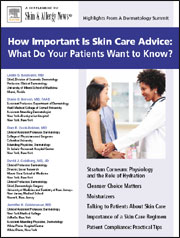
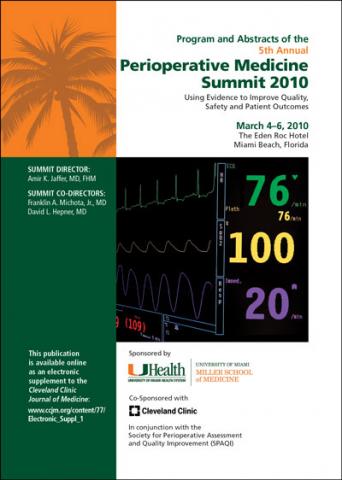
Perioperative Medicine Summit 2010
Summit Director:
Amir K. Jaffer, MD
Contents
Abstract 1: Venous thromboembolism after total hip and knee replacement in older adults with single and co-occurring comorbidities
Alok Kapoor, MD, MSc; A. Labonte; M. Winter; J.B. Segal; R.A. Silliman; J.N. Katz; E. Losina; and D.R. Berlowitz
Abstract 2: Are there consequences of discontinuing angiotensin system inhibitors preoperatively in ambulatory and same-day admission patients?
Vasudha Goel, MBBS; David Rahmani, BS; Roy Braid, BS; Dmitry Rozin, BS; and Rebecca Twersky, MD, MPH
Abstract 3: Residents’ knowledge of ACC/AHA guidelines for preoperative cardiac evaluation is limited
BobbieJean Sweitzer, MD; Michael Vigoda, MD, MBA; Nikola Milokjic; Ben Boedeker, DVM, MD, PhD, MBA; Kip D. Robinson, MD, FACP; Michael A. Pilla, MD; Robert Gaiser, MD; Angela F. Edwards, MD; Ronald P. Olson, MD; Matthew D. Caldwell, MD; Shawn T. Beaman, MD; Jeffrey A. Green, MD; Jesse M. Ehrenfeld, MD, MPH; Marsha L. Wakefield, MD; Praveen Kalra, MD; David M. Feinstein, MD; Deborah C. Richman, MBChB, FFA(SA); Gail Van Norman; Gary E. Loyd, MD, MMM; Paul W. Kranner, MD; Stevin Dubin, MD; Sunil Eappen, MD; Sergio D. Bergese, MD; Suzanne Karan, MD; James R. Rowbottom, MD, FCCP; and Keith Candiotti, MD
Abstract 4: Descriptive perioperative BNP and CRP in vascular surgery patients
Thomas Barrett, MD, MCR, and Rebecca Duby, BS
Abstract 5: Selective serotonin reuptake inhibitors and risk of intraoperative bleeding
Adriana Oprea, MD, and Paula Zimbrean, MD
Abstract 6: Incidence and nature of postoperative complications in patients with obstructive sleep apnea undergoing noncardiac surgery
Roop Kaw, MD; Vinay Pasupuleti, MBBS, PhD; Esteban Walker, PhD; Anuradha Ramaswamy, MD; Thadeo Catacutan, MD; and Nancy Foldvary, DO
Abstract 7: HMG-CoA reductase inhibitor therapy and the risk of venous thromboembolism in joint replacement surgery
William Ho, MBBS; Brendan Flaim, MBBS, FRACP; and Andrea Chan, MBBS, FRACP
Abstract 8: Risk prediction models for cardiac morbidity and mortality in noncardiac surgery: A systematic review of the literature
Ramani Moonesinghe, MBBS, MRCP, FRCA; Kathy Rowan, PhD; Judith Hulf, CBE, FRCA; Michael G. Mythen, MD, FRCA; and Michael P.W. Grocott, MD, FRCA
Abstract 9: Economic aspects of preoperative testing
Gerhard Fritsch, MD; Maria Flamm, MD; Josef Seer, MD; and Andreas Soennichsen, MD
Abstract 10: Postoperative myocardial infarction and in-hospital mortality predictors in patients undergoing rlective noncardiac surgery
Anitha Rajamanickam, MD; Ali Usmani, MD; Jelica Janicijevic, MD; Preethi Patel, MD; Eric Hixson; Omeed Zardkoohi, MD; Michael Pecic; Changhong Yu; Michael Kattan, PhD; Sagar Kalahasti, MD; and Mina K. Chung, MD
Abstract 11: Incidence and predictors of postoperative heart failure in patients undergoing elective noncardiac surgery
Anitha Rajamanickam, MD; Ali Usmani, MD; Jelica Janicijevic, MD; Preethi Patel, MD; Eric Hixson; Omeed Zardkoohi, MD; Michael Pecic; Changhong Yu; Michael Kattan, PhD; Sagar Kalahasti, MD; and Mina K. Chung, MD
Abstract 12: Predictors of length of stay in patients undergoing total knee replacement surgery
Vishal Sehgal, MD; Pardeep Bansal, MD; Praveen Reddy, MD; Vishal Sharma, MD; Rajendra Palepu, MD; Linda Thomas, MD; and Jeremiah Eagan, MD
Abstract 13: Analysis of surgeon utilization of the Preoperative Assessment Communication Education (PACE) center in the pediatric population
Lisa Price Stevens, MD, and Ezinne Akamiro, BA, MD/MHA
Abstract 14: Use of the BATHE method to increase satisfaction amongst patients undergoing cardiac and major vascular operations
Samuel DeMaria, MD; Anthony P. DeMaria, MA; Menachem Weiner, MD; and George Silvay, MD
Abstract 15: Indication for surgery predicts long-term but not in-hospital mortality in patients undergoing lower extremity bypass vascular surgery
Brigid C. Flynn, MD; Michael Mazzeffi , MD; Carol Bodian, PhD; and Vivek Moitra, MD
Abstract 16: Research and outcomes on analgesia and nociception during surgery
Jinu Kim, MD; Tehila Adams, MD; Deepak Sreedharan, MD; Shanti Raju, MD; and Henry Bennett, PhD
Abstract 17: A snapshot survey of fluid prescribing
Helen Grote, MD; Luke Evans, MRCS; Abdel Omer, MD, PhD, FRCS; and Rob Lewis, MD, FRCA
Abstract 18: Predictors of difficult intubation with the video laryngoscope
Dario Galante, MD
Abstract 19: Use of technology to improve operational efficiency
Lucy Duffy, RN, MA, and Rita Lanaras, RN, BS, CNOR
Abstract 20: The ASA physical status score for the nonanesthesiologist
Adriana Oprea, MD, and David Silverman, MD
Abstract 21: Development of a shared multidisciplinary electronic preanesthetic record
Meghan Tadel, MD; R. Boyer, DO, MS; N. Smith; and P. Kallas, MD
Abstract 22: Development of a patient selection protocol prior to robotic radical prostatectomy (RRP) in the Preoperative Assessment Unit (PAU)
James Dyer, MD
Abstract 23: Protocol-driven preoperative testing in the Preoperative Assessment Unit (PAU): Which patients should receive a resting transthoracic echocardiogram (TTE) prior to elective noncardiac surgery?
James Dyer, MD
Abstract 24: High-risk preoperative assessment for elective orthopedic surgery patients
Terrence Adam, MD, PhD; Connie Parenti, MD; Terence Gioe, MD; Karen Ringsred, MD; and Joseph Wels, MD
Abstract 25: A novel use of web-based software to efficiently triage presurgical patients based on perioperative risk: A pilot
Alicia Kalamas, MD
Abstract 26: Value of a specialized clinic for day admission surgery for cardiac and major vascular operations
George Silvay, MD, PhD; Samuel DeMaria, MD; Marietta dePerio, NP, CCRN; Ellen Hughes, MA, RN; Samantha Silvay; Marina Krol, PhD; Brigid C. Flynn, MD; and David L. Reich, MD
Abstract 27: Preoperative evaluation for parathyroidectomy—rule out pheochromocytoma
Rubin Bahuva, MD; Sudhir Manda, MD; and Saurabh Kandpal, MD
Abstract 28: Should we stop the oral selective estrogen receptor modulator raloxifene prior to surgery?
Vesselin Dimov, MD; Tarek Hamieh, MD; and Ajay Kumar, MD
Abstract 29: Should mesalamine be stopped prior to noncardiac surgery to avoid bleeding complications?
Vesselin Dimov, MD; Tarek Hamieh, MD; and Ajay Kumar, MD
Abstract 30: Thyroidectomy: Perioperative management of acute thyroid storm
Stephen VanHaerents, MD, and Aashish A. Shah, MD
Abstract 31: Core competencies: Not just for the ACGME—but for successful and ethical perioperative management of a young respiratory cripple
Deborah Richman, MBChB, FFA(SA); Misako P. Sakamaki, MD; and Slawomir P. Oleszak, MD
Abstract 32: ‘If I have to be transfused I only want my wwn blood, or blood from family members’—what is best-practice advice to be given in the preoperative clinic?
Deborah Richman, MBChB, FFA(SA), and Joseph L. Conrad, MD
Abstract 33: Prolonged QTc and hypokalemia: A bad combination before surgery
Chadi Alraies, MD, and Abdul Hamid Alraiyes, MD
Abstract 34: Perioperative management of a parturient with neuromyelitis optica
Neeti Sadana, MD; Michael Orosco, MD; Michaela Farber, MD; and Scott Segal, MD
Abstract 35: ‘High’-pertension
Anuradha Ramaswamy, MD, and Franklin A. Michota, Jr., MD
Abstract 36: Perioperative care in neuromuscular scoliosis
Saurabh Basu Kandpal, MD, and Priya Baronia, MD
Summit Director:
Amir K. Jaffer, MD
Contents
Abstract 1: Venous thromboembolism after total hip and knee replacement in older adults with single and co-occurring comorbidities
Alok Kapoor, MD, MSc; A. Labonte; M. Winter; J.B. Segal; R.A. Silliman; J.N. Katz; E. Losina; and D.R. Berlowitz
Abstract 2: Are there consequences of discontinuing angiotensin system inhibitors preoperatively in ambulatory and same-day admission patients?
Vasudha Goel, MBBS; David Rahmani, BS; Roy Braid, BS; Dmitry Rozin, BS; and Rebecca Twersky, MD, MPH
Abstract 3: Residents’ knowledge of ACC/AHA guidelines for preoperative cardiac evaluation is limited
BobbieJean Sweitzer, MD; Michael Vigoda, MD, MBA; Nikola Milokjic; Ben Boedeker, DVM, MD, PhD, MBA; Kip D. Robinson, MD, FACP; Michael A. Pilla, MD; Robert Gaiser, MD; Angela F. Edwards, MD; Ronald P. Olson, MD; Matthew D. Caldwell, MD; Shawn T. Beaman, MD; Jeffrey A. Green, MD; Jesse M. Ehrenfeld, MD, MPH; Marsha L. Wakefield, MD; Praveen Kalra, MD; David M. Feinstein, MD; Deborah C. Richman, MBChB, FFA(SA); Gail Van Norman; Gary E. Loyd, MD, MMM; Paul W. Kranner, MD; Stevin Dubin, MD; Sunil Eappen, MD; Sergio D. Bergese, MD; Suzanne Karan, MD; James R. Rowbottom, MD, FCCP; and Keith Candiotti, MD
Abstract 4: Descriptive perioperative BNP and CRP in vascular surgery patients
Thomas Barrett, MD, MCR, and Rebecca Duby, BS
Abstract 5: Selective serotonin reuptake inhibitors and risk of intraoperative bleeding
Adriana Oprea, MD, and Paula Zimbrean, MD
Abstract 6: Incidence and nature of postoperative complications in patients with obstructive sleep apnea undergoing noncardiac surgery
Roop Kaw, MD; Vinay Pasupuleti, MBBS, PhD; Esteban Walker, PhD; Anuradha Ramaswamy, MD; Thadeo Catacutan, MD; and Nancy Foldvary, DO
Abstract 7: HMG-CoA reductase inhibitor therapy and the risk of venous thromboembolism in joint replacement surgery
William Ho, MBBS; Brendan Flaim, MBBS, FRACP; and Andrea Chan, MBBS, FRACP
Abstract 8: Risk prediction models for cardiac morbidity and mortality in noncardiac surgery: A systematic review of the literature
Ramani Moonesinghe, MBBS, MRCP, FRCA; Kathy Rowan, PhD; Judith Hulf, CBE, FRCA; Michael G. Mythen, MD, FRCA; and Michael P.W. Grocott, MD, FRCA
Abstract 9: Economic aspects of preoperative testing
Gerhard Fritsch, MD; Maria Flamm, MD; Josef Seer, MD; and Andreas Soennichsen, MD
Abstract 10: Postoperative myocardial infarction and in-hospital mortality predictors in patients undergoing rlective noncardiac surgery
Anitha Rajamanickam, MD; Ali Usmani, MD; Jelica Janicijevic, MD; Preethi Patel, MD; Eric Hixson; Omeed Zardkoohi, MD; Michael Pecic; Changhong Yu; Michael Kattan, PhD; Sagar Kalahasti, MD; and Mina K. Chung, MD
Abstract 11: Incidence and predictors of postoperative heart failure in patients undergoing elective noncardiac surgery
Anitha Rajamanickam, MD; Ali Usmani, MD; Jelica Janicijevic, MD; Preethi Patel, MD; Eric Hixson; Omeed Zardkoohi, MD; Michael Pecic; Changhong Yu; Michael Kattan, PhD; Sagar Kalahasti, MD; and Mina K. Chung, MD
Abstract 12: Predictors of length of stay in patients undergoing total knee replacement surgery
Vishal Sehgal, MD; Pardeep Bansal, MD; Praveen Reddy, MD; Vishal Sharma, MD; Rajendra Palepu, MD; Linda Thomas, MD; and Jeremiah Eagan, MD
Abstract 13: Analysis of surgeon utilization of the Preoperative Assessment Communication Education (PACE) center in the pediatric population
Lisa Price Stevens, MD, and Ezinne Akamiro, BA, MD/MHA
Abstract 14: Use of the BATHE method to increase satisfaction amongst patients undergoing cardiac and major vascular operations
Samuel DeMaria, MD; Anthony P. DeMaria, MA; Menachem Weiner, MD; and George Silvay, MD
Abstract 15: Indication for surgery predicts long-term but not in-hospital mortality in patients undergoing lower extremity bypass vascular surgery
Brigid C. Flynn, MD; Michael Mazzeffi , MD; Carol Bodian, PhD; and Vivek Moitra, MD
Abstract 16: Research and outcomes on analgesia and nociception during surgery
Jinu Kim, MD; Tehila Adams, MD; Deepak Sreedharan, MD; Shanti Raju, MD; and Henry Bennett, PhD
Abstract 17: A snapshot survey of fluid prescribing
Helen Grote, MD; Luke Evans, MRCS; Abdel Omer, MD, PhD, FRCS; and Rob Lewis, MD, FRCA
Abstract 18: Predictors of difficult intubation with the video laryngoscope
Dario Galante, MD
Abstract 19: Use of technology to improve operational efficiency
Lucy Duffy, RN, MA, and Rita Lanaras, RN, BS, CNOR
Abstract 20: The ASA physical status score for the nonanesthesiologist
Adriana Oprea, MD, and David Silverman, MD
Abstract 21: Development of a shared multidisciplinary electronic preanesthetic record
Meghan Tadel, MD; R. Boyer, DO, MS; N. Smith; and P. Kallas, MD
Abstract 22: Development of a patient selection protocol prior to robotic radical prostatectomy (RRP) in the Preoperative Assessment Unit (PAU)
James Dyer, MD
Abstract 23: Protocol-driven preoperative testing in the Preoperative Assessment Unit (PAU): Which patients should receive a resting transthoracic echocardiogram (TTE) prior to elective noncardiac surgery?
James Dyer, MD
Abstract 24: High-risk preoperative assessment for elective orthopedic surgery patients
Terrence Adam, MD, PhD; Connie Parenti, MD; Terence Gioe, MD; Karen Ringsred, MD; and Joseph Wels, MD
Abstract 25: A novel use of web-based software to efficiently triage presurgical patients based on perioperative risk: A pilot
Alicia Kalamas, MD
Abstract 26: Value of a specialized clinic for day admission surgery for cardiac and major vascular operations
George Silvay, MD, PhD; Samuel DeMaria, MD; Marietta dePerio, NP, CCRN; Ellen Hughes, MA, RN; Samantha Silvay; Marina Krol, PhD; Brigid C. Flynn, MD; and David L. Reich, MD
Abstract 27: Preoperative evaluation for parathyroidectomy—rule out pheochromocytoma
Rubin Bahuva, MD; Sudhir Manda, MD; and Saurabh Kandpal, MD
Abstract 28: Should we stop the oral selective estrogen receptor modulator raloxifene prior to surgery?
Vesselin Dimov, MD; Tarek Hamieh, MD; and Ajay Kumar, MD
Abstract 29: Should mesalamine be stopped prior to noncardiac surgery to avoid bleeding complications?
Vesselin Dimov, MD; Tarek Hamieh, MD; and Ajay Kumar, MD
Abstract 30: Thyroidectomy: Perioperative management of acute thyroid storm
Stephen VanHaerents, MD, and Aashish A. Shah, MD
Abstract 31: Core competencies: Not just for the ACGME—but for successful and ethical perioperative management of a young respiratory cripple
Deborah Richman, MBChB, FFA(SA); Misako P. Sakamaki, MD; and Slawomir P. Oleszak, MD
Abstract 32: ‘If I have to be transfused I only want my wwn blood, or blood from family members’—what is best-practice advice to be given in the preoperative clinic?
Deborah Richman, MBChB, FFA(SA), and Joseph L. Conrad, MD
Abstract 33: Prolonged QTc and hypokalemia: A bad combination before surgery
Chadi Alraies, MD, and Abdul Hamid Alraiyes, MD
Abstract 34: Perioperative management of a parturient with neuromyelitis optica
Neeti Sadana, MD; Michael Orosco, MD; Michaela Farber, MD; and Scott Segal, MD
Abstract 35: ‘High’-pertension
Anuradha Ramaswamy, MD, and Franklin A. Michota, Jr., MD
Abstract 36: Perioperative care in neuromuscular scoliosis
Saurabh Basu Kandpal, MD, and Priya Baronia, MD
Summit Director:
Amir K. Jaffer, MD
Contents
Abstract 1: Venous thromboembolism after total hip and knee replacement in older adults with single and co-occurring comorbidities
Alok Kapoor, MD, MSc; A. Labonte; M. Winter; J.B. Segal; R.A. Silliman; J.N. Katz; E. Losina; and D.R. Berlowitz
Abstract 2: Are there consequences of discontinuing angiotensin system inhibitors preoperatively in ambulatory and same-day admission patients?
Vasudha Goel, MBBS; David Rahmani, BS; Roy Braid, BS; Dmitry Rozin, BS; and Rebecca Twersky, MD, MPH
Abstract 3: Residents’ knowledge of ACC/AHA guidelines for preoperative cardiac evaluation is limited
BobbieJean Sweitzer, MD; Michael Vigoda, MD, MBA; Nikola Milokjic; Ben Boedeker, DVM, MD, PhD, MBA; Kip D. Robinson, MD, FACP; Michael A. Pilla, MD; Robert Gaiser, MD; Angela F. Edwards, MD; Ronald P. Olson, MD; Matthew D. Caldwell, MD; Shawn T. Beaman, MD; Jeffrey A. Green, MD; Jesse M. Ehrenfeld, MD, MPH; Marsha L. Wakefield, MD; Praveen Kalra, MD; David M. Feinstein, MD; Deborah C. Richman, MBChB, FFA(SA); Gail Van Norman; Gary E. Loyd, MD, MMM; Paul W. Kranner, MD; Stevin Dubin, MD; Sunil Eappen, MD; Sergio D. Bergese, MD; Suzanne Karan, MD; James R. Rowbottom, MD, FCCP; and Keith Candiotti, MD
Abstract 4: Descriptive perioperative BNP and CRP in vascular surgery patients
Thomas Barrett, MD, MCR, and Rebecca Duby, BS
Abstract 5: Selective serotonin reuptake inhibitors and risk of intraoperative bleeding
Adriana Oprea, MD, and Paula Zimbrean, MD
Abstract 6: Incidence and nature of postoperative complications in patients with obstructive sleep apnea undergoing noncardiac surgery
Roop Kaw, MD; Vinay Pasupuleti, MBBS, PhD; Esteban Walker, PhD; Anuradha Ramaswamy, MD; Thadeo Catacutan, MD; and Nancy Foldvary, DO
Abstract 7: HMG-CoA reductase inhibitor therapy and the risk of venous thromboembolism in joint replacement surgery
William Ho, MBBS; Brendan Flaim, MBBS, FRACP; and Andrea Chan, MBBS, FRACP
Abstract 8: Risk prediction models for cardiac morbidity and mortality in noncardiac surgery: A systematic review of the literature
Ramani Moonesinghe, MBBS, MRCP, FRCA; Kathy Rowan, PhD; Judith Hulf, CBE, FRCA; Michael G. Mythen, MD, FRCA; and Michael P.W. Grocott, MD, FRCA
Abstract 9: Economic aspects of preoperative testing
Gerhard Fritsch, MD; Maria Flamm, MD; Josef Seer, MD; and Andreas Soennichsen, MD
Abstract 10: Postoperative myocardial infarction and in-hospital mortality predictors in patients undergoing rlective noncardiac surgery
Anitha Rajamanickam, MD; Ali Usmani, MD; Jelica Janicijevic, MD; Preethi Patel, MD; Eric Hixson; Omeed Zardkoohi, MD; Michael Pecic; Changhong Yu; Michael Kattan, PhD; Sagar Kalahasti, MD; and Mina K. Chung, MD
Abstract 11: Incidence and predictors of postoperative heart failure in patients undergoing elective noncardiac surgery
Anitha Rajamanickam, MD; Ali Usmani, MD; Jelica Janicijevic, MD; Preethi Patel, MD; Eric Hixson; Omeed Zardkoohi, MD; Michael Pecic; Changhong Yu; Michael Kattan, PhD; Sagar Kalahasti, MD; and Mina K. Chung, MD
Abstract 12: Predictors of length of stay in patients undergoing total knee replacement surgery
Vishal Sehgal, MD; Pardeep Bansal, MD; Praveen Reddy, MD; Vishal Sharma, MD; Rajendra Palepu, MD; Linda Thomas, MD; and Jeremiah Eagan, MD
Abstract 13: Analysis of surgeon utilization of the Preoperative Assessment Communication Education (PACE) center in the pediatric population
Lisa Price Stevens, MD, and Ezinne Akamiro, BA, MD/MHA
Abstract 14: Use of the BATHE method to increase satisfaction amongst patients undergoing cardiac and major vascular operations
Samuel DeMaria, MD; Anthony P. DeMaria, MA; Menachem Weiner, MD; and George Silvay, MD
Abstract 15: Indication for surgery predicts long-term but not in-hospital mortality in patients undergoing lower extremity bypass vascular surgery
Brigid C. Flynn, MD; Michael Mazzeffi , MD; Carol Bodian, PhD; and Vivek Moitra, MD
Abstract 16: Research and outcomes on analgesia and nociception during surgery
Jinu Kim, MD; Tehila Adams, MD; Deepak Sreedharan, MD; Shanti Raju, MD; and Henry Bennett, PhD
Abstract 17: A snapshot survey of fluid prescribing
Helen Grote, MD; Luke Evans, MRCS; Abdel Omer, MD, PhD, FRCS; and Rob Lewis, MD, FRCA
Abstract 18: Predictors of difficult intubation with the video laryngoscope
Dario Galante, MD
Abstract 19: Use of technology to improve operational efficiency
Lucy Duffy, RN, MA, and Rita Lanaras, RN, BS, CNOR
Abstract 20: The ASA physical status score for the nonanesthesiologist
Adriana Oprea, MD, and David Silverman, MD
Abstract 21: Development of a shared multidisciplinary electronic preanesthetic record
Meghan Tadel, MD; R. Boyer, DO, MS; N. Smith; and P. Kallas, MD
Abstract 22: Development of a patient selection protocol prior to robotic radical prostatectomy (RRP) in the Preoperative Assessment Unit (PAU)
James Dyer, MD
Abstract 23: Protocol-driven preoperative testing in the Preoperative Assessment Unit (PAU): Which patients should receive a resting transthoracic echocardiogram (TTE) prior to elective noncardiac surgery?
James Dyer, MD
Abstract 24: High-risk preoperative assessment for elective orthopedic surgery patients
Terrence Adam, MD, PhD; Connie Parenti, MD; Terence Gioe, MD; Karen Ringsred, MD; and Joseph Wels, MD
Abstract 25: A novel use of web-based software to efficiently triage presurgical patients based on perioperative risk: A pilot
Alicia Kalamas, MD
Abstract 26: Value of a specialized clinic for day admission surgery for cardiac and major vascular operations
George Silvay, MD, PhD; Samuel DeMaria, MD; Marietta dePerio, NP, CCRN; Ellen Hughes, MA, RN; Samantha Silvay; Marina Krol, PhD; Brigid C. Flynn, MD; and David L. Reich, MD
Abstract 27: Preoperative evaluation for parathyroidectomy—rule out pheochromocytoma
Rubin Bahuva, MD; Sudhir Manda, MD; and Saurabh Kandpal, MD
Abstract 28: Should we stop the oral selective estrogen receptor modulator raloxifene prior to surgery?
Vesselin Dimov, MD; Tarek Hamieh, MD; and Ajay Kumar, MD
Abstract 29: Should mesalamine be stopped prior to noncardiac surgery to avoid bleeding complications?
Vesselin Dimov, MD; Tarek Hamieh, MD; and Ajay Kumar, MD
Abstract 30: Thyroidectomy: Perioperative management of acute thyroid storm
Stephen VanHaerents, MD, and Aashish A. Shah, MD
Abstract 31: Core competencies: Not just for the ACGME—but for successful and ethical perioperative management of a young respiratory cripple
Deborah Richman, MBChB, FFA(SA); Misako P. Sakamaki, MD; and Slawomir P. Oleszak, MD
Abstract 32: ‘If I have to be transfused I only want my wwn blood, or blood from family members’—what is best-practice advice to be given in the preoperative clinic?
Deborah Richman, MBChB, FFA(SA), and Joseph L. Conrad, MD
Abstract 33: Prolonged QTc and hypokalemia: A bad combination before surgery
Chadi Alraies, MD, and Abdul Hamid Alraiyes, MD
Abstract 34: Perioperative management of a parturient with neuromyelitis optica
Neeti Sadana, MD; Michael Orosco, MD; Michaela Farber, MD; and Scott Segal, MD
Abstract 35: ‘High’-pertension
Anuradha Ramaswamy, MD, and Franklin A. Michota, Jr., MD
Abstract 36: Perioperative care in neuromuscular scoliosis
Saurabh Basu Kandpal, MD, and Priya Baronia, MD

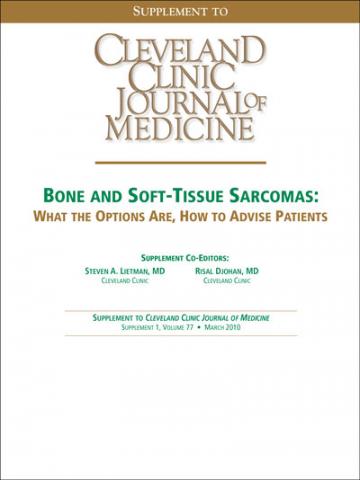
Bone and Soft-Tissue Sarcomas
Supplement Co-Editors:
Steven A. Lietman, MD, and Risal Djohan, MD
Contents
Clinical presentation and imaging of bone and soft-tissue sarcomas
Hakan Ilaslan, MD; Jean Schils, MD; William Nageotte, PA-C; Steven A. Lietman, MD; and Murali Sundaram, MD
Bone sarcomas: Overview of management, with a focus on surgical treatment considerations
Steven A. Lietman, MD, and Michael J. Joyce, MD
Soft-tissue sarcomas: Overview of management, with a focus on surgical treatment considerations
Steven A. Lietman, MD
Considerations surrounding reconstruction after resection of musculoskeletal sarcomas
Andrea Moreira-Gonzalez, MD; Risal Djohan, MD; and Robert Lohman, MD
Use of chemotherapy for patients with bone and soft-tissue sarcomas
Robert Wesolowski, MD, and George Thomas Budd, MD
Use of radiation therapy for patients with soft-tissue and bone sarcomas
Lawrence J. Sheplan, MD, and Justin J. Juliano, MD
Supplement Co-Editors:
Steven A. Lietman, MD, and Risal Djohan, MD
Contents
Clinical presentation and imaging of bone and soft-tissue sarcomas
Hakan Ilaslan, MD; Jean Schils, MD; William Nageotte, PA-C; Steven A. Lietman, MD; and Murali Sundaram, MD
Bone sarcomas: Overview of management, with a focus on surgical treatment considerations
Steven A. Lietman, MD, and Michael J. Joyce, MD
Soft-tissue sarcomas: Overview of management, with a focus on surgical treatment considerations
Steven A. Lietman, MD
Considerations surrounding reconstruction after resection of musculoskeletal sarcomas
Andrea Moreira-Gonzalez, MD; Risal Djohan, MD; and Robert Lohman, MD
Use of chemotherapy for patients with bone and soft-tissue sarcomas
Robert Wesolowski, MD, and George Thomas Budd, MD
Use of radiation therapy for patients with soft-tissue and bone sarcomas
Lawrence J. Sheplan, MD, and Justin J. Juliano, MD
Supplement Co-Editors:
Steven A. Lietman, MD, and Risal Djohan, MD
Contents
Clinical presentation and imaging of bone and soft-tissue sarcomas
Hakan Ilaslan, MD; Jean Schils, MD; William Nageotte, PA-C; Steven A. Lietman, MD; and Murali Sundaram, MD
Bone sarcomas: Overview of management, with a focus on surgical treatment considerations
Steven A. Lietman, MD, and Michael J. Joyce, MD
Soft-tissue sarcomas: Overview of management, with a focus on surgical treatment considerations
Steven A. Lietman, MD
Considerations surrounding reconstruction after resection of musculoskeletal sarcomas
Andrea Moreira-Gonzalez, MD; Risal Djohan, MD; and Robert Lohman, MD
Use of chemotherapy for patients with bone and soft-tissue sarcomas
Robert Wesolowski, MD, and George Thomas Budd, MD
Use of radiation therapy for patients with soft-tissue and bone sarcomas
Lawrence J. Sheplan, MD, and Justin J. Juliano, MD