User login
Hospitalists Join Together, Raise Bar on Global Health Initiatives
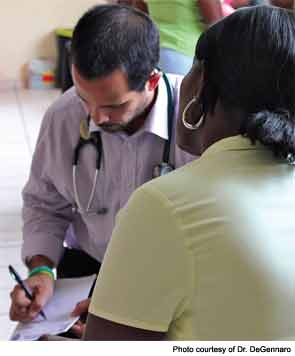
Western medicine has a long tradition of humanitarian service in developing countries. But, over the past two decades, the manner in which medical services are provided to under-resourced nations has evolved. Rather than volunteering to deliver acute care through humanitarian missions, a new generation of global health physicians aims to become dispensable. Through new nonprofit and collaborative models, they are establishing ongoing relationships with medical professionals in host countries to actively promote capacity building, from construction of new facilities to medical education and training.
“Global health work needs to be collaborative and bilateral, not just an export of our Western medical model to a low-resource setting,” says HealthPartners hospitalist Brett R. Hendel-Paterson, MD, an assistant professor of medicine at the University of Minnesota who also practices in HealthPartners’ Travel and Tropical Medicine Center in St. Paul, Minn., and is co-director of the UM/CDC online global health course.
Sriram Shamasunder, MD, DTM&H, hospitalist, health sciences assistant clinical professor, and co-director of the University of California San Francisco (UCSF) Global Health-Hospital Medicine Fellowship, agrees. “Mission medicine has incredibly well-meaning and committed people, but to address the upstream problems that bring people to the hospital, there need to be systems-based solutions,” he says.
And that is where hospitalists come in.
Growing numbers of hospitalists are joining in global health efforts, as Marwa Shoeb, MD, MS, and Phuoc Le, MD, MPH, DTM&H, discovered when they surveyed SHM members about participation in global health activities. Drs. Shoeb and Le are assistant clinical professors in the division of hospital medicine at UCSF. The survey (J Hosp Med. 2013;8(13):162-163) revealed that 51% of 232 respondents had done global health work prior to becoming a hospitalist; another third continued global health work after they began their HM careers.
Many believe hospitalists are uniquely qualified for global health initiatives. HM’s emphasis on systems of care delivery and quality improvement can supply much-needed knowledge as under-resourced countries strive to increase access to health care, says Michelle Morse, MD, MPH, an instructor in medicine at Harvard Medical School in Boston and deputy chief medical officer of Partners in Health (PIH) in Haiti (www.pih.org).
“Being a hospitalist is incredibly complementary to doing global health work,” Dr. Morse says. PIH has maintained a presence in Haiti for more than two decades and just recently celebrated a milestone with the Haitian medical community: establishment of the country’s newest medical residency training at University Hospital in Mirebalais.
Embrace Challenges
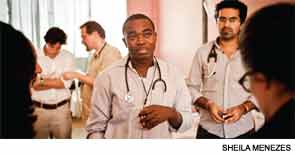
In early December, a group of UCSF hospitalists visited another PIH site, a Haitian Ministry of Health hospital in Hinche, located in the central plateau region of the country. Robin Tittle, MD, and Varun Verma, MD, were nearing the end of their first three-month rotation in the country as clinical fellows in the two-year-old Global Health-Hospital Medicine Fellowship.
According to Dr. Tittle, working in a resource-challenged hospital such as the one in Hinche is an irreplaceable experience. She and Dr. Verma discovered new levels of meaning in the term “workaround.” For example, “we have really limited lab capacity,” Dr. Tittle says. “One interesting thing I learned is how much your lab depends on access to reliable electricity. A number of our machines have been ruined because of electrical power surges. There are only certain people in the lab who know how to run certain tests.”
Dr. Tittle has learned that “you can’t practice medicine [in Haiti] without addressing the system.” Exposure to QI methods during training have been useful, she says, as she and Dr. Verma designed a medical education seminar for their Haitian colleagues by identifying the top 10 diagnoses in the nursing discharge registry. Still, she admits that the effort was hampered by nonspecific diagnoses—again a result of their inability to run diagnostic tests.
The learning has been reciprocal, notes Dr. Jacquelin Pierre Auguste, one of the Haitian internists in Hinche.
“We share a lot of knowledge,” he says, enthusiastically.
One example Dr. Pierre shared was being able to bring the clinical fellows into the case of a young mother who had developed postpartum cardiomyopathy. For unknown reasons, the condition is 10-20 times as common in Haiti as in the U.S., according to Dr. Le, who is co-director of the UCSF Global Health-Hospital Medicine Fellowship program. “Our fellows are also learning much more about the management of late-stage disease in tuberculosis and HIV,” he adds.
Several hospitalists have witnessed misappropriation of resources in global health projects, which can occur during emergency situations, such as in post-earthquake Haiti. For benefits to be sustainable, it’s best not to “charge in,” but to carefully assess the needs of the host setting. Although needs assessment should be handled by the sponsoring organization, hospitalists can contribute to this effort so that well-intentioned relief efforts do not cause unintended consequences, Dr. Hendel-Paterson says.
Hospitalists Unite
In the global health survey conducted in 2012, Drs. Shoeb and Le found that 46% of respondents were interested in collaborating with other hospitalists in order to increase their impact on health equity. In response to these and other observations about a need for mentorship, SHM established a Global Health and Human Rights Section, chaired by Drs. Shoeb and Le. They will be hosting a special global health forum at HM14 later this month in Las Vegas (www.hospitalmedicine2014.org).
The section goals are to:
- Provide a forum for like-minded hospitalists to share experiences and knowledge;
- Enhance the skill sets of hospitalists to apply their expertise in resource-poor settings; and
- Strengthen the capacity of local health systems through long-term collaborations and training in quality improvement.
Dr. Le, who has been affiliated with Partners in Health since his residency at Harvard Medical School, has spent time in sub-Saharan Africa as well as Haiti. He has been instrumental in advancing the HM global health agenda at UCSF and helped to organize the first national retreat on global health in HM last year. The program held its second annual retreat in February 2014.
Besides UCSF, two other global health fellowships are designed specifically for hospitalists: the University of Chicago Global Hospital Medicine Fellowship is headed by Evan Lyon, MD, an assistant professor of medicine in the section of hospital medicine in the UC Department of Medicine; the University of Florida College of Medicine’s Global Health-Hospitalist Fellowship program in Gainesville is headed by Vincent DeGennaro, Jr., MD, MPH, assistant professor in the division of hospital medicine.
In addition, hospitalist Deepak Asudani, MD, MPH, FHM, health sciences assistant clinical professor at the University of California San Diego, reports that his department is interested in organizing a global health fellowship program. A firm believer in the distinction between global health and international health, Dr. Asudani explains that the UCSD program will be geared to teach U.S.-trained physicians how to practice medicine in resource-limited countries. It will have a track for physicians from other countries to study hospital medicine here.
Sustainable Care
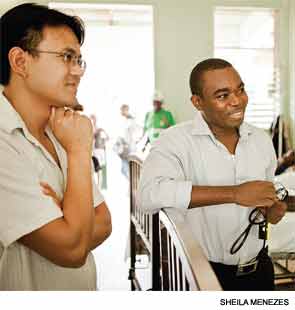
During their rotations in Haiti, Dr. Le says the UCSF clinical fellows’ mission is capacity building, meaning they usually do not deliver care as primary physicians but rather engage in what he calls “clinical accompaniment.” They assist with care delivery and teach clinical skills to Haitian trainees.
“We do not want to be a substitute for doctors who are there,” he says. “We want to support Haitian residents and give consultative advice on difficult cases. We do not want to go, provide care, and leave. We are moving toward long-term relationships that foster systemic change.”
Clinical fellows teach quality improvement methods, and then the local partners, whether in Liberia or Haiti, generate ideas for QI projects around their most pressing needs. The fellows then offer support in the development and implementation of those projects.
Congruent Practice
The global health program at the University of Minnesota, led by Patricia Walker, MD, DTM&H, has established a medical teaching collaboration with Selian Lutheran Hospital in Arusha, Tanzania. Its name, Tufundishane, is a Swahili word meaning “let us all teach one another” and points out one of the many benefits for hospitalists who pursue this type of work. They report that the work changes the way they practice when they resume clinical duties back home.
Dr. Verma, a UCSF clinical fellow, can attest to those changes. After a three-month stint at St. Thérèse Hospital in Hinche, Dr. Verma says he intended to challenge his residents on the teaching service to “think about every single test they’re ordering.” That resolve was just one consequence of working in a resource-challenged hospital environment.
Speaking from Hinche in December, Dr. Verma says that in the U.S., “you can order a complete blood count and electrolytes for your patients every day they’re in the hospital. But here, if I want to get a renal test on a patient, I have to find the lab manager and find out if we have the reagents for those tests. It makes me question whether I really need that test or whether I am ordering it to make myself feel better.”
Dr. Verma views the workaround challenges as a net positive.
“Many times, you can do a lot of good for patients with an incomplete picture,” he says. It’s a view shared by other hospitalists who incorporate global health work into their clinical duties back in the U.S.
Dr. Hendel-Paterson has a wealth of global health experience: He worked in India and Zimbabwe during medical school, conducted research in Uganda, volunteered in Haiti, and has taught a tropical medicine course in Thailand. He says hospitalists can benefit from knowledge about global health when treating their own patients. For example, seeing patients with malaria or dengue fever during volunteer or service work can help providers recognize, diagnose, and treat those diseases in returning U.S. travelers. It also can help hospitalists avoid causing iatrogenic disease, as in the case of disseminated strongyloidiasis, which can result when people who have lived in or visited endemic areas are treated with immunosuppressants like corticosteroids.
Even if the experience does not give enough expertise to diagnose and treat, he says it can help providers realize that they should be asking for more testing or consultation in appropriate settings.

—Brett R. Hendel-Paterson, MD, assistant professor of medicine, University of Minnesota, hospitalist, HealthPartners’ Travel and Tropical Medicine Center in St. Paul, Minn., co-director, UM/CDC online global health course.
Expand Your Thinking
Global health hospitalists interviewed by The Hospitalist believe good medicine is not tied to any particular place. Many find that work in other countries enriches their own core competencies as physicians.
As partnerships between health systems in other countries and the U.S. continue to grow, leaders hope the exchange will bring improvements for all parties. Dr. Shamasunder points out that as the healthcare dollar becomes scarcer in the U.S., those who work abroad might have much to contribute to the systems they work.
For Dr. Shamasunder and his colleagues, global health is not just about making people’s lives better but is also about taking into consideration the social determinants of health. What becomes clear after doing this work, he says, is that resource-challenged environments are everywhere and that patients’ social histories are relevant no matter the locale.
“If you simply treat a patient who has anemia from lead exposure, and you have no mechanism to address the presence of that toxin in their substandard housing, that patient may end up with lead poisoning,” he says.
As Dr. Hendel-Paterson sums it up: “There is no such thing as healthcare over here and healthcare over there.” That’s why he and other global health hospitalists are convinced that “global is local.”
Gretchen Henkel is a freelance writer in southern California.
Western medicine has a long tradition of humanitarian service in developing countries. But, over the past two decades, the manner in which medical services are provided to under-resourced nations has evolved. Rather than volunteering to deliver acute care through humanitarian missions, a new generation of global health physicians aims to become dispensable. Through new nonprofit and collaborative models, they are establishing ongoing relationships with medical professionals in host countries to actively promote capacity building, from construction of new facilities to medical education and training.
“Global health work needs to be collaborative and bilateral, not just an export of our Western medical model to a low-resource setting,” says HealthPartners hospitalist Brett R. Hendel-Paterson, MD, an assistant professor of medicine at the University of Minnesota who also practices in HealthPartners’ Travel and Tropical Medicine Center in St. Paul, Minn., and is co-director of the UM/CDC online global health course.
Sriram Shamasunder, MD, DTM&H, hospitalist, health sciences assistant clinical professor, and co-director of the University of California San Francisco (UCSF) Global Health-Hospital Medicine Fellowship, agrees. “Mission medicine has incredibly well-meaning and committed people, but to address the upstream problems that bring people to the hospital, there need to be systems-based solutions,” he says.
And that is where hospitalists come in.
Growing numbers of hospitalists are joining in global health efforts, as Marwa Shoeb, MD, MS, and Phuoc Le, MD, MPH, DTM&H, discovered when they surveyed SHM members about participation in global health activities. Drs. Shoeb and Le are assistant clinical professors in the division of hospital medicine at UCSF. The survey (J Hosp Med. 2013;8(13):162-163) revealed that 51% of 232 respondents had done global health work prior to becoming a hospitalist; another third continued global health work after they began their HM careers.
Many believe hospitalists are uniquely qualified for global health initiatives. HM’s emphasis on systems of care delivery and quality improvement can supply much-needed knowledge as under-resourced countries strive to increase access to health care, says Michelle Morse, MD, MPH, an instructor in medicine at Harvard Medical School in Boston and deputy chief medical officer of Partners in Health (PIH) in Haiti (www.pih.org).
“Being a hospitalist is incredibly complementary to doing global health work,” Dr. Morse says. PIH has maintained a presence in Haiti for more than two decades and just recently celebrated a milestone with the Haitian medical community: establishment of the country’s newest medical residency training at University Hospital in Mirebalais.
Embrace Challenges
In early December, a group of UCSF hospitalists visited another PIH site, a Haitian Ministry of Health hospital in Hinche, located in the central plateau region of the country. Robin Tittle, MD, and Varun Verma, MD, were nearing the end of their first three-month rotation in the country as clinical fellows in the two-year-old Global Health-Hospital Medicine Fellowship.
According to Dr. Tittle, working in a resource-challenged hospital such as the one in Hinche is an irreplaceable experience. She and Dr. Verma discovered new levels of meaning in the term “workaround.” For example, “we have really limited lab capacity,” Dr. Tittle says. “One interesting thing I learned is how much your lab depends on access to reliable electricity. A number of our machines have been ruined because of electrical power surges. There are only certain people in the lab who know how to run certain tests.”
Dr. Tittle has learned that “you can’t practice medicine [in Haiti] without addressing the system.” Exposure to QI methods during training have been useful, she says, as she and Dr. Verma designed a medical education seminar for their Haitian colleagues by identifying the top 10 diagnoses in the nursing discharge registry. Still, she admits that the effort was hampered by nonspecific diagnoses—again a result of their inability to run diagnostic tests.
The learning has been reciprocal, notes Dr. Jacquelin Pierre Auguste, one of the Haitian internists in Hinche.
“We share a lot of knowledge,” he says, enthusiastically.
One example Dr. Pierre shared was being able to bring the clinical fellows into the case of a young mother who had developed postpartum cardiomyopathy. For unknown reasons, the condition is 10-20 times as common in Haiti as in the U.S., according to Dr. Le, who is co-director of the UCSF Global Health-Hospital Medicine Fellowship program. “Our fellows are also learning much more about the management of late-stage disease in tuberculosis and HIV,” he adds.
Several hospitalists have witnessed misappropriation of resources in global health projects, which can occur during emergency situations, such as in post-earthquake Haiti. For benefits to be sustainable, it’s best not to “charge in,” but to carefully assess the needs of the host setting. Although needs assessment should be handled by the sponsoring organization, hospitalists can contribute to this effort so that well-intentioned relief efforts do not cause unintended consequences, Dr. Hendel-Paterson says.
Hospitalists Unite
In the global health survey conducted in 2012, Drs. Shoeb and Le found that 46% of respondents were interested in collaborating with other hospitalists in order to increase their impact on health equity. In response to these and other observations about a need for mentorship, SHM established a Global Health and Human Rights Section, chaired by Drs. Shoeb and Le. They will be hosting a special global health forum at HM14 later this month in Las Vegas (www.hospitalmedicine2014.org).
The section goals are to:
- Provide a forum for like-minded hospitalists to share experiences and knowledge;
- Enhance the skill sets of hospitalists to apply their expertise in resource-poor settings; and
- Strengthen the capacity of local health systems through long-term collaborations and training in quality improvement.
Dr. Le, who has been affiliated with Partners in Health since his residency at Harvard Medical School, has spent time in sub-Saharan Africa as well as Haiti. He has been instrumental in advancing the HM global health agenda at UCSF and helped to organize the first national retreat on global health in HM last year. The program held its second annual retreat in February 2014.
Besides UCSF, two other global health fellowships are designed specifically for hospitalists: the University of Chicago Global Hospital Medicine Fellowship is headed by Evan Lyon, MD, an assistant professor of medicine in the section of hospital medicine in the UC Department of Medicine; the University of Florida College of Medicine’s Global Health-Hospitalist Fellowship program in Gainesville is headed by Vincent DeGennaro, Jr., MD, MPH, assistant professor in the division of hospital medicine.
In addition, hospitalist Deepak Asudani, MD, MPH, FHM, health sciences assistant clinical professor at the University of California San Diego, reports that his department is interested in organizing a global health fellowship program. A firm believer in the distinction between global health and international health, Dr. Asudani explains that the UCSD program will be geared to teach U.S.-trained physicians how to practice medicine in resource-limited countries. It will have a track for physicians from other countries to study hospital medicine here.
Sustainable Care
During their rotations in Haiti, Dr. Le says the UCSF clinical fellows’ mission is capacity building, meaning they usually do not deliver care as primary physicians but rather engage in what he calls “clinical accompaniment.” They assist with care delivery and teach clinical skills to Haitian trainees.
“We do not want to be a substitute for doctors who are there,” he says. “We want to support Haitian residents and give consultative advice on difficult cases. We do not want to go, provide care, and leave. We are moving toward long-term relationships that foster systemic change.”
Clinical fellows teach quality improvement methods, and then the local partners, whether in Liberia or Haiti, generate ideas for QI projects around their most pressing needs. The fellows then offer support in the development and implementation of those projects.
Congruent Practice
The global health program at the University of Minnesota, led by Patricia Walker, MD, DTM&H, has established a medical teaching collaboration with Selian Lutheran Hospital in Arusha, Tanzania. Its name, Tufundishane, is a Swahili word meaning “let us all teach one another” and points out one of the many benefits for hospitalists who pursue this type of work. They report that the work changes the way they practice when they resume clinical duties back home.
Dr. Verma, a UCSF clinical fellow, can attest to those changes. After a three-month stint at St. Thérèse Hospital in Hinche, Dr. Verma says he intended to challenge his residents on the teaching service to “think about every single test they’re ordering.” That resolve was just one consequence of working in a resource-challenged hospital environment.
Speaking from Hinche in December, Dr. Verma says that in the U.S., “you can order a complete blood count and electrolytes for your patients every day they’re in the hospital. But here, if I want to get a renal test on a patient, I have to find the lab manager and find out if we have the reagents for those tests. It makes me question whether I really need that test or whether I am ordering it to make myself feel better.”
Dr. Verma views the workaround challenges as a net positive.
“Many times, you can do a lot of good for patients with an incomplete picture,” he says. It’s a view shared by other hospitalists who incorporate global health work into their clinical duties back in the U.S.
Dr. Hendel-Paterson has a wealth of global health experience: He worked in India and Zimbabwe during medical school, conducted research in Uganda, volunteered in Haiti, and has taught a tropical medicine course in Thailand. He says hospitalists can benefit from knowledge about global health when treating their own patients. For example, seeing patients with malaria or dengue fever during volunteer or service work can help providers recognize, diagnose, and treat those diseases in returning U.S. travelers. It also can help hospitalists avoid causing iatrogenic disease, as in the case of disseminated strongyloidiasis, which can result when people who have lived in or visited endemic areas are treated with immunosuppressants like corticosteroids.
Even if the experience does not give enough expertise to diagnose and treat, he says it can help providers realize that they should be asking for more testing or consultation in appropriate settings.
—Brett R. Hendel-Paterson, MD, assistant professor of medicine, University of Minnesota, hospitalist, HealthPartners’ Travel and Tropical Medicine Center in St. Paul, Minn., co-director, UM/CDC online global health course.
Expand Your Thinking
Global health hospitalists interviewed by The Hospitalist believe good medicine is not tied to any particular place. Many find that work in other countries enriches their own core competencies as physicians.
As partnerships between health systems in other countries and the U.S. continue to grow, leaders hope the exchange will bring improvements for all parties. Dr. Shamasunder points out that as the healthcare dollar becomes scarcer in the U.S., those who work abroad might have much to contribute to the systems they work.
For Dr. Shamasunder and his colleagues, global health is not just about making people’s lives better but is also about taking into consideration the social determinants of health. What becomes clear after doing this work, he says, is that resource-challenged environments are everywhere and that patients’ social histories are relevant no matter the locale.
“If you simply treat a patient who has anemia from lead exposure, and you have no mechanism to address the presence of that toxin in their substandard housing, that patient may end up with lead poisoning,” he says.
As Dr. Hendel-Paterson sums it up: “There is no such thing as healthcare over here and healthcare over there.” That’s why he and other global health hospitalists are convinced that “global is local.”
Gretchen Henkel is a freelance writer in southern California.
Western medicine has a long tradition of humanitarian service in developing countries. But, over the past two decades, the manner in which medical services are provided to under-resourced nations has evolved. Rather than volunteering to deliver acute care through humanitarian missions, a new generation of global health physicians aims to become dispensable. Through new nonprofit and collaborative models, they are establishing ongoing relationships with medical professionals in host countries to actively promote capacity building, from construction of new facilities to medical education and training.
“Global health work needs to be collaborative and bilateral, not just an export of our Western medical model to a low-resource setting,” says HealthPartners hospitalist Brett R. Hendel-Paterson, MD, an assistant professor of medicine at the University of Minnesota who also practices in HealthPartners’ Travel and Tropical Medicine Center in St. Paul, Minn., and is co-director of the UM/CDC online global health course.
Sriram Shamasunder, MD, DTM&H, hospitalist, health sciences assistant clinical professor, and co-director of the University of California San Francisco (UCSF) Global Health-Hospital Medicine Fellowship, agrees. “Mission medicine has incredibly well-meaning and committed people, but to address the upstream problems that bring people to the hospital, there need to be systems-based solutions,” he says.
And that is where hospitalists come in.
Growing numbers of hospitalists are joining in global health efforts, as Marwa Shoeb, MD, MS, and Phuoc Le, MD, MPH, DTM&H, discovered when they surveyed SHM members about participation in global health activities. Drs. Shoeb and Le are assistant clinical professors in the division of hospital medicine at UCSF. The survey (J Hosp Med. 2013;8(13):162-163) revealed that 51% of 232 respondents had done global health work prior to becoming a hospitalist; another third continued global health work after they began their HM careers.
Many believe hospitalists are uniquely qualified for global health initiatives. HM’s emphasis on systems of care delivery and quality improvement can supply much-needed knowledge as under-resourced countries strive to increase access to health care, says Michelle Morse, MD, MPH, an instructor in medicine at Harvard Medical School in Boston and deputy chief medical officer of Partners in Health (PIH) in Haiti (www.pih.org).
“Being a hospitalist is incredibly complementary to doing global health work,” Dr. Morse says. PIH has maintained a presence in Haiti for more than two decades and just recently celebrated a milestone with the Haitian medical community: establishment of the country’s newest medical residency training at University Hospital in Mirebalais.
Embrace Challenges
In early December, a group of UCSF hospitalists visited another PIH site, a Haitian Ministry of Health hospital in Hinche, located in the central plateau region of the country. Robin Tittle, MD, and Varun Verma, MD, were nearing the end of their first three-month rotation in the country as clinical fellows in the two-year-old Global Health-Hospital Medicine Fellowship.
According to Dr. Tittle, working in a resource-challenged hospital such as the one in Hinche is an irreplaceable experience. She and Dr. Verma discovered new levels of meaning in the term “workaround.” For example, “we have really limited lab capacity,” Dr. Tittle says. “One interesting thing I learned is how much your lab depends on access to reliable electricity. A number of our machines have been ruined because of electrical power surges. There are only certain people in the lab who know how to run certain tests.”
Dr. Tittle has learned that “you can’t practice medicine [in Haiti] without addressing the system.” Exposure to QI methods during training have been useful, she says, as she and Dr. Verma designed a medical education seminar for their Haitian colleagues by identifying the top 10 diagnoses in the nursing discharge registry. Still, she admits that the effort was hampered by nonspecific diagnoses—again a result of their inability to run diagnostic tests.
The learning has been reciprocal, notes Dr. Jacquelin Pierre Auguste, one of the Haitian internists in Hinche.
“We share a lot of knowledge,” he says, enthusiastically.
One example Dr. Pierre shared was being able to bring the clinical fellows into the case of a young mother who had developed postpartum cardiomyopathy. For unknown reasons, the condition is 10-20 times as common in Haiti as in the U.S., according to Dr. Le, who is co-director of the UCSF Global Health-Hospital Medicine Fellowship program. “Our fellows are also learning much more about the management of late-stage disease in tuberculosis and HIV,” he adds.
Several hospitalists have witnessed misappropriation of resources in global health projects, which can occur during emergency situations, such as in post-earthquake Haiti. For benefits to be sustainable, it’s best not to “charge in,” but to carefully assess the needs of the host setting. Although needs assessment should be handled by the sponsoring organization, hospitalists can contribute to this effort so that well-intentioned relief efforts do not cause unintended consequences, Dr. Hendel-Paterson says.
Hospitalists Unite
In the global health survey conducted in 2012, Drs. Shoeb and Le found that 46% of respondents were interested in collaborating with other hospitalists in order to increase their impact on health equity. In response to these and other observations about a need for mentorship, SHM established a Global Health and Human Rights Section, chaired by Drs. Shoeb and Le. They will be hosting a special global health forum at HM14 later this month in Las Vegas (www.hospitalmedicine2014.org).
The section goals are to:
- Provide a forum for like-minded hospitalists to share experiences and knowledge;
- Enhance the skill sets of hospitalists to apply their expertise in resource-poor settings; and
- Strengthen the capacity of local health systems through long-term collaborations and training in quality improvement.
Dr. Le, who has been affiliated with Partners in Health since his residency at Harvard Medical School, has spent time in sub-Saharan Africa as well as Haiti. He has been instrumental in advancing the HM global health agenda at UCSF and helped to organize the first national retreat on global health in HM last year. The program held its second annual retreat in February 2014.
Besides UCSF, two other global health fellowships are designed specifically for hospitalists: the University of Chicago Global Hospital Medicine Fellowship is headed by Evan Lyon, MD, an assistant professor of medicine in the section of hospital medicine in the UC Department of Medicine; the University of Florida College of Medicine’s Global Health-Hospitalist Fellowship program in Gainesville is headed by Vincent DeGennaro, Jr., MD, MPH, assistant professor in the division of hospital medicine.
In addition, hospitalist Deepak Asudani, MD, MPH, FHM, health sciences assistant clinical professor at the University of California San Diego, reports that his department is interested in organizing a global health fellowship program. A firm believer in the distinction between global health and international health, Dr. Asudani explains that the UCSD program will be geared to teach U.S.-trained physicians how to practice medicine in resource-limited countries. It will have a track for physicians from other countries to study hospital medicine here.
Sustainable Care
During their rotations in Haiti, Dr. Le says the UCSF clinical fellows’ mission is capacity building, meaning they usually do not deliver care as primary physicians but rather engage in what he calls “clinical accompaniment.” They assist with care delivery and teach clinical skills to Haitian trainees.
“We do not want to be a substitute for doctors who are there,” he says. “We want to support Haitian residents and give consultative advice on difficult cases. We do not want to go, provide care, and leave. We are moving toward long-term relationships that foster systemic change.”
Clinical fellows teach quality improvement methods, and then the local partners, whether in Liberia or Haiti, generate ideas for QI projects around their most pressing needs. The fellows then offer support in the development and implementation of those projects.
Congruent Practice
The global health program at the University of Minnesota, led by Patricia Walker, MD, DTM&H, has established a medical teaching collaboration with Selian Lutheran Hospital in Arusha, Tanzania. Its name, Tufundishane, is a Swahili word meaning “let us all teach one another” and points out one of the many benefits for hospitalists who pursue this type of work. They report that the work changes the way they practice when they resume clinical duties back home.
Dr. Verma, a UCSF clinical fellow, can attest to those changes. After a three-month stint at St. Thérèse Hospital in Hinche, Dr. Verma says he intended to challenge his residents on the teaching service to “think about every single test they’re ordering.” That resolve was just one consequence of working in a resource-challenged hospital environment.
Speaking from Hinche in December, Dr. Verma says that in the U.S., “you can order a complete blood count and electrolytes for your patients every day they’re in the hospital. But here, if I want to get a renal test on a patient, I have to find the lab manager and find out if we have the reagents for those tests. It makes me question whether I really need that test or whether I am ordering it to make myself feel better.”
Dr. Verma views the workaround challenges as a net positive.
“Many times, you can do a lot of good for patients with an incomplete picture,” he says. It’s a view shared by other hospitalists who incorporate global health work into their clinical duties back in the U.S.
Dr. Hendel-Paterson has a wealth of global health experience: He worked in India and Zimbabwe during medical school, conducted research in Uganda, volunteered in Haiti, and has taught a tropical medicine course in Thailand. He says hospitalists can benefit from knowledge about global health when treating their own patients. For example, seeing patients with malaria or dengue fever during volunteer or service work can help providers recognize, diagnose, and treat those diseases in returning U.S. travelers. It also can help hospitalists avoid causing iatrogenic disease, as in the case of disseminated strongyloidiasis, which can result when people who have lived in or visited endemic areas are treated with immunosuppressants like corticosteroids.
Even if the experience does not give enough expertise to diagnose and treat, he says it can help providers realize that they should be asking for more testing or consultation in appropriate settings.
—Brett R. Hendel-Paterson, MD, assistant professor of medicine, University of Minnesota, hospitalist, HealthPartners’ Travel and Tropical Medicine Center in St. Paul, Minn., co-director, UM/CDC online global health course.
Expand Your Thinking
Global health hospitalists interviewed by The Hospitalist believe good medicine is not tied to any particular place. Many find that work in other countries enriches their own core competencies as physicians.
As partnerships between health systems in other countries and the U.S. continue to grow, leaders hope the exchange will bring improvements for all parties. Dr. Shamasunder points out that as the healthcare dollar becomes scarcer in the U.S., those who work abroad might have much to contribute to the systems they work.
For Dr. Shamasunder and his colleagues, global health is not just about making people’s lives better but is also about taking into consideration the social determinants of health. What becomes clear after doing this work, he says, is that resource-challenged environments are everywhere and that patients’ social histories are relevant no matter the locale.
“If you simply treat a patient who has anemia from lead exposure, and you have no mechanism to address the presence of that toxin in their substandard housing, that patient may end up with lead poisoning,” he says.
As Dr. Hendel-Paterson sums it up: “There is no such thing as healthcare over here and healthcare over there.” That’s why he and other global health hospitalists are convinced that “global is local.”
Gretchen Henkel is a freelance writer in southern California.
Society of Hospital Medicine Creates Self-Assessment Tool for Hospitalist Groups
Are you looking to improve your hospital medicine group (HMG)? Would you like to measure your group against other groups?
The February 2013 issue of the Journal of Hospital Medicine included a seminal article for our specialty, “The Key Principles and Characteristics of an Effective Hospital Medicine Group: an assessment guide for hospitals and hospitalists.” This paper has received a vast amount of attention around the country from hospitalists, hospitalist leaders, HMGs, and hospital executives. The report (www.hospitalmedicine.org/keychar) is a first step for physicians and executives looking to benchmark their practices, and it has stimulated discussions among many HMGs, beginning a process of self-review and considering action.
I am coming up on my 20th year as a hospitalist, and the debate over what makes a high-performing HMG has continued that entire time. In the beginning, there were questions about the mere existence of hospital medicine and HMGs. The discussion about what makes a high-performing HMG started among the physicians, medical groups, and hospitals that signed on early to the HM movement. At conferences, HMG leaders debated how to set up a program. A series of pioneer hospitalists, many with only a few years of experience, roamed the country as consultants giving advice on best practices. A professional society, the National Association of Inpatient Physicians, was born and, later, recast as the Society of Hospital Medicine (SHM)—and the discussion continued.
SHM furthered the debate with such important milestones as The Core Competencies in Hospital Medicine: A Framework for Curriculum Development, white papers on career satisfaction and hospitalist involvement in quality/safety and transitions of care. Different types of practice arrangements developed. Some were hospital-based, some physician practice-centered. Some were local, and others were regional and national. Each of these spawned innovations in HMG processes and contributed to the growing body of best practices.
Over the past five years, a consensus regarding those best practices has seemingly developed, and the discussions are centered on fine details rather than significant differences. To that end, approximately three years ago, a small group of SHM members met and discussed how to capture this information and disseminate it better among hospitalists, HMGs, and hospitals. We had all come to a similar conclusion—high-performing HMGs share common characteristics. Furthermore, every hospital and HMG seeks excellence, striving to be the best that they can be. We settled on a plan to write this up.
After a year of debate, we sought SHM’s help in the development phase and, in early 2012, SHM’s board of directors appointed a workgroup to identify the key principles and characteristics of an effective HMG. The initial group was widened to make sure we included different backgrounds and experiences in hospital medicine. The group had a wide array of involvement in HMG models, including HMG members, HMG leaders, hospital executives, and some involved in consulting. Many of the individuals had multiple experiences. The conversation among these individuals was lively!
The workgroup developed an initial draft of characteristics, which then went through a multi-step process of review and redrafting. More than 200 individuals, representing a broad group of stakeholders in hospital medicine and in the healthcare industry in general, provided comments and feedback. In addition, the workgroup went through a two-step Delphi process to consolidate and/or eliminate characteristics that were redundant or unnecessary.
In the final framework, 47 key characteristics were defined and organized under 10 principles (see Figure 1).
The authors and SHM’s board of directors view this document as an aspirational approach to improvement. We feel it helps to “raise the bar” for the specialty of hospital medicine by laying out a roadmap of potential improvement. These principles and characteristics provide a framework for HMGs seeking to conduct self-assessments, outlining a pathway for improvement, and better defining the central role of hospitalists in coordinating team-based, patient-centered care in the acute care setting.
In enhancing quality, the approach of a gap analysis is a very effective tool. These principles provide an excellent approach to begin that review.
So how do you get started? Hopefully, your HMG has a regular meeting. Take a principle and have a conversation. For example, what do we have? What don’t we have?
Other groups may want to tackle the entire document in a daylong strategy review. Some may want an outside facilitator. Bottom line: It doesn’t matter how you do it; just start with a conversation.
Dr. Cawley is CEO of Medical University of South Carolina Medical Center in Charleston. He is past president of SHM.
Reference
Are you looking to improve your hospital medicine group (HMG)? Would you like to measure your group against other groups?
The February 2013 issue of the Journal of Hospital Medicine included a seminal article for our specialty, “The Key Principles and Characteristics of an Effective Hospital Medicine Group: an assessment guide for hospitals and hospitalists.” This paper has received a vast amount of attention around the country from hospitalists, hospitalist leaders, HMGs, and hospital executives. The report (www.hospitalmedicine.org/keychar) is a first step for physicians and executives looking to benchmark their practices, and it has stimulated discussions among many HMGs, beginning a process of self-review and considering action.
I am coming up on my 20th year as a hospitalist, and the debate over what makes a high-performing HMG has continued that entire time. In the beginning, there were questions about the mere existence of hospital medicine and HMGs. The discussion about what makes a high-performing HMG started among the physicians, medical groups, and hospitals that signed on early to the HM movement. At conferences, HMG leaders debated how to set up a program. A series of pioneer hospitalists, many with only a few years of experience, roamed the country as consultants giving advice on best practices. A professional society, the National Association of Inpatient Physicians, was born and, later, recast as the Society of Hospital Medicine (SHM)—and the discussion continued.
SHM furthered the debate with such important milestones as The Core Competencies in Hospital Medicine: A Framework for Curriculum Development, white papers on career satisfaction and hospitalist involvement in quality/safety and transitions of care. Different types of practice arrangements developed. Some were hospital-based, some physician practice-centered. Some were local, and others were regional and national. Each of these spawned innovations in HMG processes and contributed to the growing body of best practices.
Over the past five years, a consensus regarding those best practices has seemingly developed, and the discussions are centered on fine details rather than significant differences. To that end, approximately three years ago, a small group of SHM members met and discussed how to capture this information and disseminate it better among hospitalists, HMGs, and hospitals. We had all come to a similar conclusion—high-performing HMGs share common characteristics. Furthermore, every hospital and HMG seeks excellence, striving to be the best that they can be. We settled on a plan to write this up.
After a year of debate, we sought SHM’s help in the development phase and, in early 2012, SHM’s board of directors appointed a workgroup to identify the key principles and characteristics of an effective HMG. The initial group was widened to make sure we included different backgrounds and experiences in hospital medicine. The group had a wide array of involvement in HMG models, including HMG members, HMG leaders, hospital executives, and some involved in consulting. Many of the individuals had multiple experiences. The conversation among these individuals was lively!
The workgroup developed an initial draft of characteristics, which then went through a multi-step process of review and redrafting. More than 200 individuals, representing a broad group of stakeholders in hospital medicine and in the healthcare industry in general, provided comments and feedback. In addition, the workgroup went through a two-step Delphi process to consolidate and/or eliminate characteristics that were redundant or unnecessary.
In the final framework, 47 key characteristics were defined and organized under 10 principles (see Figure 1).
The authors and SHM’s board of directors view this document as an aspirational approach to improvement. We feel it helps to “raise the bar” for the specialty of hospital medicine by laying out a roadmap of potential improvement. These principles and characteristics provide a framework for HMGs seeking to conduct self-assessments, outlining a pathway for improvement, and better defining the central role of hospitalists in coordinating team-based, patient-centered care in the acute care setting.
In enhancing quality, the approach of a gap analysis is a very effective tool. These principles provide an excellent approach to begin that review.
So how do you get started? Hopefully, your HMG has a regular meeting. Take a principle and have a conversation. For example, what do we have? What don’t we have?
Other groups may want to tackle the entire document in a daylong strategy review. Some may want an outside facilitator. Bottom line: It doesn’t matter how you do it; just start with a conversation.
Dr. Cawley is CEO of Medical University of South Carolina Medical Center in Charleston. He is past president of SHM.
Reference
Are you looking to improve your hospital medicine group (HMG)? Would you like to measure your group against other groups?
The February 2013 issue of the Journal of Hospital Medicine included a seminal article for our specialty, “The Key Principles and Characteristics of an Effective Hospital Medicine Group: an assessment guide for hospitals and hospitalists.” This paper has received a vast amount of attention around the country from hospitalists, hospitalist leaders, HMGs, and hospital executives. The report (www.hospitalmedicine.org/keychar) is a first step for physicians and executives looking to benchmark their practices, and it has stimulated discussions among many HMGs, beginning a process of self-review and considering action.
I am coming up on my 20th year as a hospitalist, and the debate over what makes a high-performing HMG has continued that entire time. In the beginning, there were questions about the mere existence of hospital medicine and HMGs. The discussion about what makes a high-performing HMG started among the physicians, medical groups, and hospitals that signed on early to the HM movement. At conferences, HMG leaders debated how to set up a program. A series of pioneer hospitalists, many with only a few years of experience, roamed the country as consultants giving advice on best practices. A professional society, the National Association of Inpatient Physicians, was born and, later, recast as the Society of Hospital Medicine (SHM)—and the discussion continued.
SHM furthered the debate with such important milestones as The Core Competencies in Hospital Medicine: A Framework for Curriculum Development, white papers on career satisfaction and hospitalist involvement in quality/safety and transitions of care. Different types of practice arrangements developed. Some were hospital-based, some physician practice-centered. Some were local, and others were regional and national. Each of these spawned innovations in HMG processes and contributed to the growing body of best practices.
Over the past five years, a consensus regarding those best practices has seemingly developed, and the discussions are centered on fine details rather than significant differences. To that end, approximately three years ago, a small group of SHM members met and discussed how to capture this information and disseminate it better among hospitalists, HMGs, and hospitals. We had all come to a similar conclusion—high-performing HMGs share common characteristics. Furthermore, every hospital and HMG seeks excellence, striving to be the best that they can be. We settled on a plan to write this up.
After a year of debate, we sought SHM’s help in the development phase and, in early 2012, SHM’s board of directors appointed a workgroup to identify the key principles and characteristics of an effective HMG. The initial group was widened to make sure we included different backgrounds and experiences in hospital medicine. The group had a wide array of involvement in HMG models, including HMG members, HMG leaders, hospital executives, and some involved in consulting. Many of the individuals had multiple experiences. The conversation among these individuals was lively!
The workgroup developed an initial draft of characteristics, which then went through a multi-step process of review and redrafting. More than 200 individuals, representing a broad group of stakeholders in hospital medicine and in the healthcare industry in general, provided comments and feedback. In addition, the workgroup went through a two-step Delphi process to consolidate and/or eliminate characteristics that were redundant or unnecessary.
In the final framework, 47 key characteristics were defined and organized under 10 principles (see Figure 1).
The authors and SHM’s board of directors view this document as an aspirational approach to improvement. We feel it helps to “raise the bar” for the specialty of hospital medicine by laying out a roadmap of potential improvement. These principles and characteristics provide a framework for HMGs seeking to conduct self-assessments, outlining a pathway for improvement, and better defining the central role of hospitalists in coordinating team-based, patient-centered care in the acute care setting.
In enhancing quality, the approach of a gap analysis is a very effective tool. These principles provide an excellent approach to begin that review.
So how do you get started? Hopefully, your HMG has a regular meeting. Take a principle and have a conversation. For example, what do we have? What don’t we have?
Other groups may want to tackle the entire document in a daylong strategy review. Some may want an outside facilitator. Bottom line: It doesn’t matter how you do it; just start with a conversation.
Dr. Cawley is CEO of Medical University of South Carolina Medical Center in Charleston. He is past president of SHM.
Reference
How Will New Physician Value-Based Payment Modifier Affect Medicare Reimbursements?

We talk a lot about value in healthcare—about how to enhance quality and reduce cost—because we all know both need an incredible amount of work. One tactic Medicare is using to improve the value equation on a large scale is aggregating and displaying physician-specific “value” metrics. These metrics, which will be used to deduct or enhance reimbursement for physicians, are known as the Physician Value-Based Payment Modifier (PVBM).
This program has been enacted fairly rapidly since the passage of the Affordable Care Act; it is being rolled out first to large physician practices, then to all groups by 2017. Those with superior performance in both quality and cost will experience as much as a 2% higher reimbursement, while groups with average performance will remain financially neutral and those who show lower performance or choose not to report will be penalized up to 1% of Medicare reimbursement. This first round, for larger groups of 100-plus physicians, will affect about 30% of all U.S. physicians. The second round, for groups of 10 or more physicians, will affect about another third of physicians. The last round, for groups with fewer than 10 physicians, will be applicable to the remaining physicians practicing in the U.S.
On the face of it, the program does seem to be a potentially effective tactic for improving value on a large scale, holding individual physicians accountable for their own individual patient-care performance. A few fatal flaws in the program as it currently stands make it extraordinarily unlikely to be universally adopted by all physicians, however. Here are a few of those flaws:1,2
1 Uncertain yield: Because it is essentially a “zero-sum game” for Medicare, the incentive or penalty for a physician (or the physician’s group) depends on the performance of all the other physicians’ or groups’ performance. As a result, there is incredible uncertainty as to how strong a physician’s performance actually needs to be, year to year, to result in a bonus payment. Given that many of the metrics will require some type of investment to perform well, such as information technology infrastructure or a quality coordinator, there is an equal amount of uncertainty about how much investment will be needed to get a certain budgetary yield. For smaller physician practices, taking a 1% to 2% reduction in Medicare reimbursements may be easier to weather financially than investing in the infrastructure needed to reliably hit the quality metrics for every relevant patient.
2 Uncertain benchmarks: Unlike many hospital quality metrics, which have been publicly displayed for years, physician-level value metrics are just now being reported publicly. This leaves uncertainty about how strong a physician’s performance needs to be in order to be better than average. In the hospital value-based purchasing program, “average” performance is extremely good, in the 98% to 99% compliance range for most metrics. It is less clear what compliance range will be “average” in the physician-based program.
3 Physician variability: More than a half million physicians in the U.S. bill Medicare, and their practice types range from primary care solo practice to multi-group specialty practice. Motivating all brands to understand, measure, report, and improve quality metrics is a yeoman’s task, unlikely to be successful in the short term. Most physicians have not received any formal education or training in quality improvement, so they may not even have the skill set required to improve their metrics into a highly reliable range, worthy of bonus designation.
4 Metric identity and attribution: Because the repertoire of physician types is broad, the ability of each physician type to have a set of metrics that they understand and can identify with is extremely unlikely. In addition, attribution of patients and their associated metrics to any single physician is complicated, especially for patients who are cared for by many different physicians across a number of settings. For hospitalists, the attribution issue is a fatal flaw, as many groups routinely “hand off” patients among other hospitalists in their group, at least once if not several times during a typical hospital stay. The same is true of many other hospital-based specialty physicians.
5 Playing to the test: As with other pay-for-performance programs, there is a legitimate concern that physicians will be overwhelmingly motivated to play to the test, so that their efforts to perform exceedingly well at a few metrics will crowd out and hinder their performance on unmeasured metrics. This tendency can result in lower-value care in the sum total, even if the metrics show stellar performance.
6 Reducing the risk: As seen in other pay-for-performance programs, there is a legitimate concern that physicians will be overwhelmingly motivated to avoid caring for patients who are likely to be unpredictable, including those with multiple co-morbid conditions or with complex social situations; these patients are likely to perform less well on any metric, despite risk adjusting (which is inherently imperfect). This is a well-known and documented risk of publicly reported programs, and there is no reason to believe the PVBM program will be immune to this risk.
In Sum
Because these flaws seem so daunting at first glance, many physicians and physician groups will be tempted to reject the program outright and take the financial hit induced by nonparticipation. An alternative approach is to embrace all of the value programs outright, investing time and energy in improving the metrics that are truly valuable to both patients and providers.
Regardless of which regulatory agency is demanding performance, we need to be active participants in foraging out what metrics and attribution logic are most appropriate. For hospitalists, these could include risk-adjusted device days, appropriate prescribing and unprescribing of antibiotics, judicious utilization of diagnostic testing, and measurements of patient functional status and/or mobility.
Value metrics are here to stay, including those attributable to individual physicians; our job now is to advocate for meaningful metrics and meaningful attribution, which can and should motivate hospitalists to enhance their patients’ quality of life at a lower cost.
Dr. Scheurer is a hospitalist and chief quality officer at the Medical University of South Carolina in Charleston. She is physician editor of The Hospitalist. Email her at [email protected].
References
We talk a lot about value in healthcare—about how to enhance quality and reduce cost—because we all know both need an incredible amount of work. One tactic Medicare is using to improve the value equation on a large scale is aggregating and displaying physician-specific “value” metrics. These metrics, which will be used to deduct or enhance reimbursement for physicians, are known as the Physician Value-Based Payment Modifier (PVBM).
This program has been enacted fairly rapidly since the passage of the Affordable Care Act; it is being rolled out first to large physician practices, then to all groups by 2017. Those with superior performance in both quality and cost will experience as much as a 2% higher reimbursement, while groups with average performance will remain financially neutral and those who show lower performance or choose not to report will be penalized up to 1% of Medicare reimbursement. This first round, for larger groups of 100-plus physicians, will affect about 30% of all U.S. physicians. The second round, for groups of 10 or more physicians, will affect about another third of physicians. The last round, for groups with fewer than 10 physicians, will be applicable to the remaining physicians practicing in the U.S.
On the face of it, the program does seem to be a potentially effective tactic for improving value on a large scale, holding individual physicians accountable for their own individual patient-care performance. A few fatal flaws in the program as it currently stands make it extraordinarily unlikely to be universally adopted by all physicians, however. Here are a few of those flaws:1,2
1 Uncertain yield: Because it is essentially a “zero-sum game” for Medicare, the incentive or penalty for a physician (or the physician’s group) depends on the performance of all the other physicians’ or groups’ performance. As a result, there is incredible uncertainty as to how strong a physician’s performance actually needs to be, year to year, to result in a bonus payment. Given that many of the metrics will require some type of investment to perform well, such as information technology infrastructure or a quality coordinator, there is an equal amount of uncertainty about how much investment will be needed to get a certain budgetary yield. For smaller physician practices, taking a 1% to 2% reduction in Medicare reimbursements may be easier to weather financially than investing in the infrastructure needed to reliably hit the quality metrics for every relevant patient.
2 Uncertain benchmarks: Unlike many hospital quality metrics, which have been publicly displayed for years, physician-level value metrics are just now being reported publicly. This leaves uncertainty about how strong a physician’s performance needs to be in order to be better than average. In the hospital value-based purchasing program, “average” performance is extremely good, in the 98% to 99% compliance range for most metrics. It is less clear what compliance range will be “average” in the physician-based program.
3 Physician variability: More than a half million physicians in the U.S. bill Medicare, and their practice types range from primary care solo practice to multi-group specialty practice. Motivating all brands to understand, measure, report, and improve quality metrics is a yeoman’s task, unlikely to be successful in the short term. Most physicians have not received any formal education or training in quality improvement, so they may not even have the skill set required to improve their metrics into a highly reliable range, worthy of bonus designation.
4 Metric identity and attribution: Because the repertoire of physician types is broad, the ability of each physician type to have a set of metrics that they understand and can identify with is extremely unlikely. In addition, attribution of patients and their associated metrics to any single physician is complicated, especially for patients who are cared for by many different physicians across a number of settings. For hospitalists, the attribution issue is a fatal flaw, as many groups routinely “hand off” patients among other hospitalists in their group, at least once if not several times during a typical hospital stay. The same is true of many other hospital-based specialty physicians.
5 Playing to the test: As with other pay-for-performance programs, there is a legitimate concern that physicians will be overwhelmingly motivated to play to the test, so that their efforts to perform exceedingly well at a few metrics will crowd out and hinder their performance on unmeasured metrics. This tendency can result in lower-value care in the sum total, even if the metrics show stellar performance.
6 Reducing the risk: As seen in other pay-for-performance programs, there is a legitimate concern that physicians will be overwhelmingly motivated to avoid caring for patients who are likely to be unpredictable, including those with multiple co-morbid conditions or with complex social situations; these patients are likely to perform less well on any metric, despite risk adjusting (which is inherently imperfect). This is a well-known and documented risk of publicly reported programs, and there is no reason to believe the PVBM program will be immune to this risk.
In Sum
Because these flaws seem so daunting at first glance, many physicians and physician groups will be tempted to reject the program outright and take the financial hit induced by nonparticipation. An alternative approach is to embrace all of the value programs outright, investing time and energy in improving the metrics that are truly valuable to both patients and providers.
Regardless of which regulatory agency is demanding performance, we need to be active participants in foraging out what metrics and attribution logic are most appropriate. For hospitalists, these could include risk-adjusted device days, appropriate prescribing and unprescribing of antibiotics, judicious utilization of diagnostic testing, and measurements of patient functional status and/or mobility.
Value metrics are here to stay, including those attributable to individual physicians; our job now is to advocate for meaningful metrics and meaningful attribution, which can and should motivate hospitalists to enhance their patients’ quality of life at a lower cost.
Dr. Scheurer is a hospitalist and chief quality officer at the Medical University of South Carolina in Charleston. She is physician editor of The Hospitalist. Email her at [email protected].
References
We talk a lot about value in healthcare—about how to enhance quality and reduce cost—because we all know both need an incredible amount of work. One tactic Medicare is using to improve the value equation on a large scale is aggregating and displaying physician-specific “value” metrics. These metrics, which will be used to deduct or enhance reimbursement for physicians, are known as the Physician Value-Based Payment Modifier (PVBM).
This program has been enacted fairly rapidly since the passage of the Affordable Care Act; it is being rolled out first to large physician practices, then to all groups by 2017. Those with superior performance in both quality and cost will experience as much as a 2% higher reimbursement, while groups with average performance will remain financially neutral and those who show lower performance or choose not to report will be penalized up to 1% of Medicare reimbursement. This first round, for larger groups of 100-plus physicians, will affect about 30% of all U.S. physicians. The second round, for groups of 10 or more physicians, will affect about another third of physicians. The last round, for groups with fewer than 10 physicians, will be applicable to the remaining physicians practicing in the U.S.
On the face of it, the program does seem to be a potentially effective tactic for improving value on a large scale, holding individual physicians accountable for their own individual patient-care performance. A few fatal flaws in the program as it currently stands make it extraordinarily unlikely to be universally adopted by all physicians, however. Here are a few of those flaws:1,2
1 Uncertain yield: Because it is essentially a “zero-sum game” for Medicare, the incentive or penalty for a physician (or the physician’s group) depends on the performance of all the other physicians’ or groups’ performance. As a result, there is incredible uncertainty as to how strong a physician’s performance actually needs to be, year to year, to result in a bonus payment. Given that many of the metrics will require some type of investment to perform well, such as information technology infrastructure or a quality coordinator, there is an equal amount of uncertainty about how much investment will be needed to get a certain budgetary yield. For smaller physician practices, taking a 1% to 2% reduction in Medicare reimbursements may be easier to weather financially than investing in the infrastructure needed to reliably hit the quality metrics for every relevant patient.
2 Uncertain benchmarks: Unlike many hospital quality metrics, which have been publicly displayed for years, physician-level value metrics are just now being reported publicly. This leaves uncertainty about how strong a physician’s performance needs to be in order to be better than average. In the hospital value-based purchasing program, “average” performance is extremely good, in the 98% to 99% compliance range for most metrics. It is less clear what compliance range will be “average” in the physician-based program.
3 Physician variability: More than a half million physicians in the U.S. bill Medicare, and their practice types range from primary care solo practice to multi-group specialty practice. Motivating all brands to understand, measure, report, and improve quality metrics is a yeoman’s task, unlikely to be successful in the short term. Most physicians have not received any formal education or training in quality improvement, so they may not even have the skill set required to improve their metrics into a highly reliable range, worthy of bonus designation.
4 Metric identity and attribution: Because the repertoire of physician types is broad, the ability of each physician type to have a set of metrics that they understand and can identify with is extremely unlikely. In addition, attribution of patients and their associated metrics to any single physician is complicated, especially for patients who are cared for by many different physicians across a number of settings. For hospitalists, the attribution issue is a fatal flaw, as many groups routinely “hand off” patients among other hospitalists in their group, at least once if not several times during a typical hospital stay. The same is true of many other hospital-based specialty physicians.
5 Playing to the test: As with other pay-for-performance programs, there is a legitimate concern that physicians will be overwhelmingly motivated to play to the test, so that their efforts to perform exceedingly well at a few metrics will crowd out and hinder their performance on unmeasured metrics. This tendency can result in lower-value care in the sum total, even if the metrics show stellar performance.
6 Reducing the risk: As seen in other pay-for-performance programs, there is a legitimate concern that physicians will be overwhelmingly motivated to avoid caring for patients who are likely to be unpredictable, including those with multiple co-morbid conditions or with complex social situations; these patients are likely to perform less well on any metric, despite risk adjusting (which is inherently imperfect). This is a well-known and documented risk of publicly reported programs, and there is no reason to believe the PVBM program will be immune to this risk.
In Sum
Because these flaws seem so daunting at first glance, many physicians and physician groups will be tempted to reject the program outright and take the financial hit induced by nonparticipation. An alternative approach is to embrace all of the value programs outright, investing time and energy in improving the metrics that are truly valuable to both patients and providers.
Regardless of which regulatory agency is demanding performance, we need to be active participants in foraging out what metrics and attribution logic are most appropriate. For hospitalists, these could include risk-adjusted device days, appropriate prescribing and unprescribing of antibiotics, judicious utilization of diagnostic testing, and measurements of patient functional status and/or mobility.
Value metrics are here to stay, including those attributable to individual physicians; our job now is to advocate for meaningful metrics and meaningful attribution, which can and should motivate hospitalists to enhance their patients’ quality of life at a lower cost.
Dr. Scheurer is a hospitalist and chief quality officer at the Medical University of South Carolina in Charleston. She is physician editor of The Hospitalist. Email her at [email protected].
References
Hospital Medicine Blends Academic, Clinical Pursuits to Create Optimal Career Path
Are you attracted to research but not sure if it’s your sole calling as a prospective hospitalist? Whether you think you might want to steer quality improvement (QI) studies in the community setting or veer toward an academic/research career, hospital medicine offers an array of paths to career satisfaction.
“There is so much room in hospital medicine to find your research niche,” says Luci K. Leykum, MD, MBA, MSc, SFHM, hospital medicine division chief and associate dean for clinical affairs at University of Texas Health Science Center in San Antonio. As chair of SHM’s Research Committee, Dr. Leykum can attest to the range of hospitalists’ research pursuits: from basic science (what biomarkers best predict poor outcomes in patients with acute lung injury?) to care organization (are hospitalist schedules and workload associated with patient outcomes?) to implementation (how do we most effectively implement best practices for care transitions?) studies.1-6

In addition to Dr. Leykum, The Hospitalist consulted Vineet Arora, MD, MPP, FACP, SFHM, associate professor of medicine at the University of Chicago and chair of SHM’s Physicians in Training Committee, and Margaret Fang, MD, MPH, FHM, associate professor and clinician-investigator in the department of medicine at University of California San Francisco (UCSF) Medical Center and a member of the SHM Research Committee. Critical to research success, they agree, is acquiring skills in research methodology and project design, finding the right mentor(s) to help guide your career, and committing to and preserving time to focus on your research.
“After residency,” Dr. Arora notes, “you have accumulated the clinical skills to become a hospitalist, but you usually have not accumulated the skill it takes to be a researcher, which is why you need to do additional training.”
Is a Fellowship Necessary?
The paths to incorporating research into one’s HM career can be diverse. Although a fellowship is often the recommended route, there are other ways to acquire research methodology and experience with project design. Dr. Leykum began her career as a clinician-educator at Columbia University in New York. Although she found the QI work enjoyable, she realized she wanted to understand how to create more meaningful and sustainable changes in inpatient care delivery. She later acquired a master’s degree in clinical investigation. She has published more than 25 journal articles, several in collaboration with other SHM colleagues.
As a result, perhaps, of her own experience—and the fact that HM is still a young subspecialty with limited HM-specific fellowship opportunities—Dr. Leykum says that she would consider hiring a junior faculty member who had not yet completed a fellowship. “I think you have to consider people who might be talented candidates that you are willing to groom,” she says. However, she says she would structure the position so that the faculty member could immediately pursue additional research training.

–Dr. Fang
Dr. Fang completed a two-year, general medical research fellowship right after her residency and obtained her master of public health degree at that time. “I do agree,” she says, “that the fastest way to doing research well is to get some additional training.”
Even if you are not aiming to become a full-time investigator, Dr. Arora says a research fellowship “gives you very marketable skills. You will still gain skills that will be helpful to your career—and not all research is done by clinician investigators in academic settings.”
Another advantage of a fellowship, Dr. Arora says, is that it allows you to explore whether you are truly suited for a research career. All three hospitalists agreed that researchers share many of the same abilities: to focus, accept uncertainty, persevere, work in teams, and handle rejection.
The Right Mentorship
Dr. Fang says working with an experienced mentor is a vital ingredient to launching a research career. One key factor in selecting a fellowship program, according to Dr. Leykum, is the institution’s or group’s track record in developing junior faculty. To gain an understanding of how the partnership would work on a practical level, the candidate should ask specific questions of prospective mentors, such as:
- How well do research interests and methodological expertise match?
- How often would we meet?
- Who would be involved in the mentorship team?
- What would each person contribute?
In hospital medicine, it could be challenging to find a mentor within one’s own division. Dr. Fang points out that there are a variety of other ways to obtain career, academic, and research mentorship: For example, SHM’s Research Committee has a fledgling mentoring program, and the Society of General Internal Medicine offers both one-on-one and longitudinal year-long mentoring. “You can also look to other specialty divisions that are complementary,” she suggests. If you’re interested in antimicrobial stewardship, for example, your institution’s division of infectious disease might be a logical choice for your mentorship and collaboration search.
Balance Clinical, Research Time
Although securing protected research time concerns trainees as well as academic faculty (see “Protect, Make the Most of Your Time,”), deleting clinical time from the equation is not the answer.
“I find, from being a researcher,” says Dr. Arora, “that sometimes you need a break from research. And clinical work can provide that break. Whatever you do, you need a balance.”
Dr. Leykum says she learned, about five years ago, that 10 weeks of clinical rotation was too little. By choice, she elects to put in more clinical time. Why? “Being in that [clinical] environment helps you hone your questions, especially if they concern how to better deliver care,” she says. “In addition, you interact with specialists and learn about the new research that they are implementing.”
The cross-feed between clinical and research pursuits can be particularly rich, Dr. Fang says. In addition to her other posts at UCSF, she is medical director of the anticoagulation clinic.
“I find a lot of my research ideas flow very naturally out of the situations I see as a hospitalist,” she says. “You often see something that you want to improve and design a project to try and achieve those aims.”
Gretchen Henkel is a freelance writer in southern California.
Protect, Make the Most of Your Time
Transitioning from a research fellowship to your first job, you will be negotiating for protected research time. A typical junior faculty position might involve 70% research time and 30% clinical time, says Dr. Arora, who cautions candidates to clarify how the 30% clinical time will be structured. “In a hospitalist group, 30% clinical time can look quite different and have varying amounts of nights and undesirable shifts.” It is appropriate, she noted, to ask this question, because this may have implications for your research time.
Candidates also need clarity from prospective institutions about funding expectations. Be prepared to secure your own funding as soon as possible. “You need to always look ahead,” says Dr. Arora, who suggests that young investigators view their first job as a “mini-grant” and use their time during that period to develop other funding sources, such as the NIH K, or career development, awards. —GH
References
- Leykum LK, Parekh VI, Sharpe B, Boonyasai RT, Centor RM. Tried and true: a survey of successfully promoted academic hospitalists. J Hosp Med. 2011;6(7):411-415.
- McKenna K, Leykum LK, McDaniel RR. The role of improvising in patient care. Health Care Manage Rev. 2013;38(1):1-8.
- Arora VM, Fish M, Basu A, et al. Relationship between quality of care of hospitalized vulnerable elders and postdischarge mortality. J Am Geriatr Soc. 2010;58(9):1642-1648.
- Arora VM, Georgitis E, Siddique J, et al. Association of workload of on-call medical interns with on-call sleep duration, shift duration, and participation in educational activities. JAMA. 2008;300(10):1146-1153.
- Fang MC, Go AS, Chang Y, et al. A new risk scheme to predict warfarin-associated hemorrhage: the ATRIA (Anticoagulation and Risk Factors in Atrial Fibrillation) Study. J Am Coll Cardiol. 2011;58(4): 395-401.
- Mission JF, Kerlan RK, Tan JH, Fang MC. Rates and predictors of plans for inferior vena cava filter retrieval in hospitalized patients. J Gen Intern Med. 2010;25(4):321-325.
Are you attracted to research but not sure if it’s your sole calling as a prospective hospitalist? Whether you think you might want to steer quality improvement (QI) studies in the community setting or veer toward an academic/research career, hospital medicine offers an array of paths to career satisfaction.
“There is so much room in hospital medicine to find your research niche,” says Luci K. Leykum, MD, MBA, MSc, SFHM, hospital medicine division chief and associate dean for clinical affairs at University of Texas Health Science Center in San Antonio. As chair of SHM’s Research Committee, Dr. Leykum can attest to the range of hospitalists’ research pursuits: from basic science (what biomarkers best predict poor outcomes in patients with acute lung injury?) to care organization (are hospitalist schedules and workload associated with patient outcomes?) to implementation (how do we most effectively implement best practices for care transitions?) studies.1-6
In addition to Dr. Leykum, The Hospitalist consulted Vineet Arora, MD, MPP, FACP, SFHM, associate professor of medicine at the University of Chicago and chair of SHM’s Physicians in Training Committee, and Margaret Fang, MD, MPH, FHM, associate professor and clinician-investigator in the department of medicine at University of California San Francisco (UCSF) Medical Center and a member of the SHM Research Committee. Critical to research success, they agree, is acquiring skills in research methodology and project design, finding the right mentor(s) to help guide your career, and committing to and preserving time to focus on your research.
“After residency,” Dr. Arora notes, “you have accumulated the clinical skills to become a hospitalist, but you usually have not accumulated the skill it takes to be a researcher, which is why you need to do additional training.”
Is a Fellowship Necessary?
The paths to incorporating research into one’s HM career can be diverse. Although a fellowship is often the recommended route, there are other ways to acquire research methodology and experience with project design. Dr. Leykum began her career as a clinician-educator at Columbia University in New York. Although she found the QI work enjoyable, she realized she wanted to understand how to create more meaningful and sustainable changes in inpatient care delivery. She later acquired a master’s degree in clinical investigation. She has published more than 25 journal articles, several in collaboration with other SHM colleagues.
As a result, perhaps, of her own experience—and the fact that HM is still a young subspecialty with limited HM-specific fellowship opportunities—Dr. Leykum says that she would consider hiring a junior faculty member who had not yet completed a fellowship. “I think you have to consider people who might be talented candidates that you are willing to groom,” she says. However, she says she would structure the position so that the faculty member could immediately pursue additional research training.
–Dr. Fang
Dr. Fang completed a two-year, general medical research fellowship right after her residency and obtained her master of public health degree at that time. “I do agree,” she says, “that the fastest way to doing research well is to get some additional training.”
Even if you are not aiming to become a full-time investigator, Dr. Arora says a research fellowship “gives you very marketable skills. You will still gain skills that will be helpful to your career—and not all research is done by clinician investigators in academic settings.”
Another advantage of a fellowship, Dr. Arora says, is that it allows you to explore whether you are truly suited for a research career. All three hospitalists agreed that researchers share many of the same abilities: to focus, accept uncertainty, persevere, work in teams, and handle rejection.
The Right Mentorship
Dr. Fang says working with an experienced mentor is a vital ingredient to launching a research career. One key factor in selecting a fellowship program, according to Dr. Leykum, is the institution’s or group’s track record in developing junior faculty. To gain an understanding of how the partnership would work on a practical level, the candidate should ask specific questions of prospective mentors, such as:
- How well do research interests and methodological expertise match?
- How often would we meet?
- Who would be involved in the mentorship team?
- What would each person contribute?
In hospital medicine, it could be challenging to find a mentor within one’s own division. Dr. Fang points out that there are a variety of other ways to obtain career, academic, and research mentorship: For example, SHM’s Research Committee has a fledgling mentoring program, and the Society of General Internal Medicine offers both one-on-one and longitudinal year-long mentoring. “You can also look to other specialty divisions that are complementary,” she suggests. If you’re interested in antimicrobial stewardship, for example, your institution’s division of infectious disease might be a logical choice for your mentorship and collaboration search.
Balance Clinical, Research Time
Although securing protected research time concerns trainees as well as academic faculty (see “Protect, Make the Most of Your Time,”), deleting clinical time from the equation is not the answer.
“I find, from being a researcher,” says Dr. Arora, “that sometimes you need a break from research. And clinical work can provide that break. Whatever you do, you need a balance.”
Dr. Leykum says she learned, about five years ago, that 10 weeks of clinical rotation was too little. By choice, she elects to put in more clinical time. Why? “Being in that [clinical] environment helps you hone your questions, especially if they concern how to better deliver care,” she says. “In addition, you interact with specialists and learn about the new research that they are implementing.”
The cross-feed between clinical and research pursuits can be particularly rich, Dr. Fang says. In addition to her other posts at UCSF, she is medical director of the anticoagulation clinic.
“I find a lot of my research ideas flow very naturally out of the situations I see as a hospitalist,” she says. “You often see something that you want to improve and design a project to try and achieve those aims.”
Gretchen Henkel is a freelance writer in southern California.
Protect, Make the Most of Your Time
Transitioning from a research fellowship to your first job, you will be negotiating for protected research time. A typical junior faculty position might involve 70% research time and 30% clinical time, says Dr. Arora, who cautions candidates to clarify how the 30% clinical time will be structured. “In a hospitalist group, 30% clinical time can look quite different and have varying amounts of nights and undesirable shifts.” It is appropriate, she noted, to ask this question, because this may have implications for your research time.
Candidates also need clarity from prospective institutions about funding expectations. Be prepared to secure your own funding as soon as possible. “You need to always look ahead,” says Dr. Arora, who suggests that young investigators view their first job as a “mini-grant” and use their time during that period to develop other funding sources, such as the NIH K, or career development, awards. —GH
References
- Leykum LK, Parekh VI, Sharpe B, Boonyasai RT, Centor RM. Tried and true: a survey of successfully promoted academic hospitalists. J Hosp Med. 2011;6(7):411-415.
- McKenna K, Leykum LK, McDaniel RR. The role of improvising in patient care. Health Care Manage Rev. 2013;38(1):1-8.
- Arora VM, Fish M, Basu A, et al. Relationship between quality of care of hospitalized vulnerable elders and postdischarge mortality. J Am Geriatr Soc. 2010;58(9):1642-1648.
- Arora VM, Georgitis E, Siddique J, et al. Association of workload of on-call medical interns with on-call sleep duration, shift duration, and participation in educational activities. JAMA. 2008;300(10):1146-1153.
- Fang MC, Go AS, Chang Y, et al. A new risk scheme to predict warfarin-associated hemorrhage: the ATRIA (Anticoagulation and Risk Factors in Atrial Fibrillation) Study. J Am Coll Cardiol. 2011;58(4): 395-401.
- Mission JF, Kerlan RK, Tan JH, Fang MC. Rates and predictors of plans for inferior vena cava filter retrieval in hospitalized patients. J Gen Intern Med. 2010;25(4):321-325.
Are you attracted to research but not sure if it’s your sole calling as a prospective hospitalist? Whether you think you might want to steer quality improvement (QI) studies in the community setting or veer toward an academic/research career, hospital medicine offers an array of paths to career satisfaction.
“There is so much room in hospital medicine to find your research niche,” says Luci K. Leykum, MD, MBA, MSc, SFHM, hospital medicine division chief and associate dean for clinical affairs at University of Texas Health Science Center in San Antonio. As chair of SHM’s Research Committee, Dr. Leykum can attest to the range of hospitalists’ research pursuits: from basic science (what biomarkers best predict poor outcomes in patients with acute lung injury?) to care organization (are hospitalist schedules and workload associated with patient outcomes?) to implementation (how do we most effectively implement best practices for care transitions?) studies.1-6
In addition to Dr. Leykum, The Hospitalist consulted Vineet Arora, MD, MPP, FACP, SFHM, associate professor of medicine at the University of Chicago and chair of SHM’s Physicians in Training Committee, and Margaret Fang, MD, MPH, FHM, associate professor and clinician-investigator in the department of medicine at University of California San Francisco (UCSF) Medical Center and a member of the SHM Research Committee. Critical to research success, they agree, is acquiring skills in research methodology and project design, finding the right mentor(s) to help guide your career, and committing to and preserving time to focus on your research.
“After residency,” Dr. Arora notes, “you have accumulated the clinical skills to become a hospitalist, but you usually have not accumulated the skill it takes to be a researcher, which is why you need to do additional training.”
Is a Fellowship Necessary?
The paths to incorporating research into one’s HM career can be diverse. Although a fellowship is often the recommended route, there are other ways to acquire research methodology and experience with project design. Dr. Leykum began her career as a clinician-educator at Columbia University in New York. Although she found the QI work enjoyable, she realized she wanted to understand how to create more meaningful and sustainable changes in inpatient care delivery. She later acquired a master’s degree in clinical investigation. She has published more than 25 journal articles, several in collaboration with other SHM colleagues.
As a result, perhaps, of her own experience—and the fact that HM is still a young subspecialty with limited HM-specific fellowship opportunities—Dr. Leykum says that she would consider hiring a junior faculty member who had not yet completed a fellowship. “I think you have to consider people who might be talented candidates that you are willing to groom,” she says. However, she says she would structure the position so that the faculty member could immediately pursue additional research training.
–Dr. Fang
Dr. Fang completed a two-year, general medical research fellowship right after her residency and obtained her master of public health degree at that time. “I do agree,” she says, “that the fastest way to doing research well is to get some additional training.”
Even if you are not aiming to become a full-time investigator, Dr. Arora says a research fellowship “gives you very marketable skills. You will still gain skills that will be helpful to your career—and not all research is done by clinician investigators in academic settings.”
Another advantage of a fellowship, Dr. Arora says, is that it allows you to explore whether you are truly suited for a research career. All three hospitalists agreed that researchers share many of the same abilities: to focus, accept uncertainty, persevere, work in teams, and handle rejection.
The Right Mentorship
Dr. Fang says working with an experienced mentor is a vital ingredient to launching a research career. One key factor in selecting a fellowship program, according to Dr. Leykum, is the institution’s or group’s track record in developing junior faculty. To gain an understanding of how the partnership would work on a practical level, the candidate should ask specific questions of prospective mentors, such as:
- How well do research interests and methodological expertise match?
- How often would we meet?
- Who would be involved in the mentorship team?
- What would each person contribute?
In hospital medicine, it could be challenging to find a mentor within one’s own division. Dr. Fang points out that there are a variety of other ways to obtain career, academic, and research mentorship: For example, SHM’s Research Committee has a fledgling mentoring program, and the Society of General Internal Medicine offers both one-on-one and longitudinal year-long mentoring. “You can also look to other specialty divisions that are complementary,” she suggests. If you’re interested in antimicrobial stewardship, for example, your institution’s division of infectious disease might be a logical choice for your mentorship and collaboration search.
Balance Clinical, Research Time
Although securing protected research time concerns trainees as well as academic faculty (see “Protect, Make the Most of Your Time,”), deleting clinical time from the equation is not the answer.
“I find, from being a researcher,” says Dr. Arora, “that sometimes you need a break from research. And clinical work can provide that break. Whatever you do, you need a balance.”
Dr. Leykum says she learned, about five years ago, that 10 weeks of clinical rotation was too little. By choice, she elects to put in more clinical time. Why? “Being in that [clinical] environment helps you hone your questions, especially if they concern how to better deliver care,” she says. “In addition, you interact with specialists and learn about the new research that they are implementing.”
The cross-feed between clinical and research pursuits can be particularly rich, Dr. Fang says. In addition to her other posts at UCSF, she is medical director of the anticoagulation clinic.
“I find a lot of my research ideas flow very naturally out of the situations I see as a hospitalist,” she says. “You often see something that you want to improve and design a project to try and achieve those aims.”
Gretchen Henkel is a freelance writer in southern California.
Protect, Make the Most of Your Time
Transitioning from a research fellowship to your first job, you will be negotiating for protected research time. A typical junior faculty position might involve 70% research time and 30% clinical time, says Dr. Arora, who cautions candidates to clarify how the 30% clinical time will be structured. “In a hospitalist group, 30% clinical time can look quite different and have varying amounts of nights and undesirable shifts.” It is appropriate, she noted, to ask this question, because this may have implications for your research time.
Candidates also need clarity from prospective institutions about funding expectations. Be prepared to secure your own funding as soon as possible. “You need to always look ahead,” says Dr. Arora, who suggests that young investigators view their first job as a “mini-grant” and use their time during that period to develop other funding sources, such as the NIH K, or career development, awards. —GH
References
- Leykum LK, Parekh VI, Sharpe B, Boonyasai RT, Centor RM. Tried and true: a survey of successfully promoted academic hospitalists. J Hosp Med. 2011;6(7):411-415.
- McKenna K, Leykum LK, McDaniel RR. The role of improvising in patient care. Health Care Manage Rev. 2013;38(1):1-8.
- Arora VM, Fish M, Basu A, et al. Relationship between quality of care of hospitalized vulnerable elders and postdischarge mortality. J Am Geriatr Soc. 2010;58(9):1642-1648.
- Arora VM, Georgitis E, Siddique J, et al. Association of workload of on-call medical interns with on-call sleep duration, shift duration, and participation in educational activities. JAMA. 2008;300(10):1146-1153.
- Fang MC, Go AS, Chang Y, et al. A new risk scheme to predict warfarin-associated hemorrhage: the ATRIA (Anticoagulation and Risk Factors in Atrial Fibrillation) Study. J Am Coll Cardiol. 2011;58(4): 395-401.
- Mission JF, Kerlan RK, Tan JH, Fang MC. Rates and predictors of plans for inferior vena cava filter retrieval in hospitalized patients. J Gen Intern Med. 2010;25(4):321-325.
Hospital Medicine Blends Academic and Clinical Pursuits to Create Optimal Career Path
Enter text here
Enter text here
Enter text here
Hospital Medicine’s Work-Life Balance Keeps Midori Larrabee Grounded

When she isn’t attending to patients or grappling with the latest update to electronic health records (EHR), Midori Larrabee, MD, is getting her hands dirty.
Literally.
Dr. Larrabee, a former hospitalist medical director at the 30-bed Valley General Hospital in Monroe, Wash., and her husband live on 2.5 acres of “paradise” outside of Seattle. They grow their own vegetables and recently planted an orchard. “We hope to get chickens next year,” she says.
“I love cooking and spending time with my husband, enjoying our little paradise,” says Dr. Larrabee, now working full-time as a hospitalist at 349-bed Overlake Medical Center in Bellevue, Wash. “I think being a hospitalist will only be sustainable if I have time away from the hospital to think about non-medical issues—like what worm is eating my radishes.”
Leisure-time passions aside, Dr. Larrabee chose HM for many of the same reasons hospitalists around the country do: “a variety of patients, the acuity of care, and the flexibility of the schedule. With half of the month off, I have time for activities other than clinical medicine.”
She considers herself a problem solver, using both sides of the brain to care for patients, mitigate staff schedules, and contribute to quality improvement projects.
“Initially, I was attracted to medicine due to my interest in biochemistry and the physiology of how we function,” says Dr. Larrabee, one of nine new members of Team Hospitalist, the volunteer, editorial advisory group for The Hospitalist. “As I’ve grown up, I started to see the value in being a part of patients/families’ lives during an event like a hospitalization. I can use my knowledge to help guide them, educate them, and, hopefully, reassure them during a time when they may feel helpless.”
Question: How did you decide to become a hospitalist?
Answer: I decided to become a hospitalist during residency. Even though the ward months were grueling, I loved being part of an inpatient team and managing the variety of patients that came through the door. I liked all of my subspecialty rotations but didn’t want to lose the ability to manage multiple diseases. Also, I liked dealing with sicker patients where more acute decisions had to be made and the results were quickly evident.
Q: Outside of patient care, tell me about your career interests?
A: I am on the P&T committee at (Overlake), and work as part of a team developing projects to improve patient satisfaction during their hospitalization. During the summers I perform evaluations of local medic students at the end of their training program (done through the Seattle Fire Department). I have previously been on the Medical Executive Committee at my smaller hospital and really enjoyed those activities. I would like to be more involved in quality projects at my hospital and hopefully will find some opportunities in the next year.

–Dr. Larrabee
Q: What’s the best advice you ever received?
A: Make yourself happy. If you keep coming back to the question “Am I happy?” you can always have a way to center yourself. If you say “Yes,” then you can feel good about where you are in life, even if that wasn’t what you were expecting or planning. If you say “No,” then at least you now know that something needs to change.
Q: What’s the one thing you most dislike about your job?
A: The time spent with the electronic health record. I am spending more time figuring out how to order a therapy, write a note, or sign an order than actually at the bedside interacting with the patient.
Q: What is your biggest professional challenge?
A: My lack of patience. I want to be in more leadership positions, be a respected physician at my hospital, and have a greater role in the community NOW. I have only worked at my larger hospital for about a year, and I know it takes time to get to know everyone, get to know the culture of the hospital, and work my way up the ranks.
Q: What is your biggest professional reward?
A: I love when I really connect with a patient or family and feel like I’ve made a difference. As a hospitalist, it sometimes feels like I am admitting patients with chronic medical problems that will never get better, get them just well enough to leave the hospital, but never really make a difference. When you can really connect, that is always a great reward. An example is an elderly patient I cared for recently. He was clearly dying, but the family was having a hard time accepting his course. I spent time with the family and helped them reconcile their hopes to keep him comfortable with their fears about killing the patriarch of the family. They eventually transitioned the patient to hospice care, and although he did pass away, I feel like I was able to make the patient’s death a little better for the family and for him.
Q: Where do you see yourself in 10 years?
A: I always see myself working clinically for at least part of my time. Medicine would get too boring if it wasn’t for the patients. That said, I like a variety of activities and stay motivated when something new is on the horizon. I don’t know if a climb up the ladder is in my future, but if things work out that way, I would be open to the chance. Otherwise, I try and keep my eyes out for new challenges. If I try and plan my path out too much, I will miss those great, unexpected opportunities.
Q: What’s the best book you’ve read recently?
A: “Vegetable Literacy” by Deborah Madison. I love to cook and garden, and this book describes the different edible members of botanical families—and then gives recipes. The book motivates you to try new varieties in the garden and kitchen. The beautiful pictures didn’t hurt, either. Pictures always make a book better.
Q: How many Apple products do you interface with in a given week?
A: One, my iPhone. AppleTV never works right, so we stopped trying to use that months ago.
Richard Quinn is a freelance writer in New Jersey.
When she isn’t attending to patients or grappling with the latest update to electronic health records (EHR), Midori Larrabee, MD, is getting her hands dirty.
Literally.
Dr. Larrabee, a former hospitalist medical director at the 30-bed Valley General Hospital in Monroe, Wash., and her husband live on 2.5 acres of “paradise” outside of Seattle. They grow their own vegetables and recently planted an orchard. “We hope to get chickens next year,” she says.
“I love cooking and spending time with my husband, enjoying our little paradise,” says Dr. Larrabee, now working full-time as a hospitalist at 349-bed Overlake Medical Center in Bellevue, Wash. “I think being a hospitalist will only be sustainable if I have time away from the hospital to think about non-medical issues—like what worm is eating my radishes.”
Leisure-time passions aside, Dr. Larrabee chose HM for many of the same reasons hospitalists around the country do: “a variety of patients, the acuity of care, and the flexibility of the schedule. With half of the month off, I have time for activities other than clinical medicine.”
She considers herself a problem solver, using both sides of the brain to care for patients, mitigate staff schedules, and contribute to quality improvement projects.
“Initially, I was attracted to medicine due to my interest in biochemistry and the physiology of how we function,” says Dr. Larrabee, one of nine new members of Team Hospitalist, the volunteer, editorial advisory group for The Hospitalist. “As I’ve grown up, I started to see the value in being a part of patients/families’ lives during an event like a hospitalization. I can use my knowledge to help guide them, educate them, and, hopefully, reassure them during a time when they may feel helpless.”
Question: How did you decide to become a hospitalist?
Answer: I decided to become a hospitalist during residency. Even though the ward months were grueling, I loved being part of an inpatient team and managing the variety of patients that came through the door. I liked all of my subspecialty rotations but didn’t want to lose the ability to manage multiple diseases. Also, I liked dealing with sicker patients where more acute decisions had to be made and the results were quickly evident.
Q: Outside of patient care, tell me about your career interests?
A: I am on the P&T committee at (Overlake), and work as part of a team developing projects to improve patient satisfaction during their hospitalization. During the summers I perform evaluations of local medic students at the end of their training program (done through the Seattle Fire Department). I have previously been on the Medical Executive Committee at my smaller hospital and really enjoyed those activities. I would like to be more involved in quality projects at my hospital and hopefully will find some opportunities in the next year.
–Dr. Larrabee
Q: What’s the best advice you ever received?
A: Make yourself happy. If you keep coming back to the question “Am I happy?” you can always have a way to center yourself. If you say “Yes,” then you can feel good about where you are in life, even if that wasn’t what you were expecting or planning. If you say “No,” then at least you now know that something needs to change.
Q: What’s the one thing you most dislike about your job?
A: The time spent with the electronic health record. I am spending more time figuring out how to order a therapy, write a note, or sign an order than actually at the bedside interacting with the patient.
Q: What is your biggest professional challenge?
A: My lack of patience. I want to be in more leadership positions, be a respected physician at my hospital, and have a greater role in the community NOW. I have only worked at my larger hospital for about a year, and I know it takes time to get to know everyone, get to know the culture of the hospital, and work my way up the ranks.
Q: What is your biggest professional reward?
A: I love when I really connect with a patient or family and feel like I’ve made a difference. As a hospitalist, it sometimes feels like I am admitting patients with chronic medical problems that will never get better, get them just well enough to leave the hospital, but never really make a difference. When you can really connect, that is always a great reward. An example is an elderly patient I cared for recently. He was clearly dying, but the family was having a hard time accepting his course. I spent time with the family and helped them reconcile their hopes to keep him comfortable with their fears about killing the patriarch of the family. They eventually transitioned the patient to hospice care, and although he did pass away, I feel like I was able to make the patient’s death a little better for the family and for him.
Q: Where do you see yourself in 10 years?
A: I always see myself working clinically for at least part of my time. Medicine would get too boring if it wasn’t for the patients. That said, I like a variety of activities and stay motivated when something new is on the horizon. I don’t know if a climb up the ladder is in my future, but if things work out that way, I would be open to the chance. Otherwise, I try and keep my eyes out for new challenges. If I try and plan my path out too much, I will miss those great, unexpected opportunities.
Q: What’s the best book you’ve read recently?
A: “Vegetable Literacy” by Deborah Madison. I love to cook and garden, and this book describes the different edible members of botanical families—and then gives recipes. The book motivates you to try new varieties in the garden and kitchen. The beautiful pictures didn’t hurt, either. Pictures always make a book better.
Q: How many Apple products do you interface with in a given week?
A: One, my iPhone. AppleTV never works right, so we stopped trying to use that months ago.
Richard Quinn is a freelance writer in New Jersey.
When she isn’t attending to patients or grappling with the latest update to electronic health records (EHR), Midori Larrabee, MD, is getting her hands dirty.
Literally.
Dr. Larrabee, a former hospitalist medical director at the 30-bed Valley General Hospital in Monroe, Wash., and her husband live on 2.5 acres of “paradise” outside of Seattle. They grow their own vegetables and recently planted an orchard. “We hope to get chickens next year,” she says.
“I love cooking and spending time with my husband, enjoying our little paradise,” says Dr. Larrabee, now working full-time as a hospitalist at 349-bed Overlake Medical Center in Bellevue, Wash. “I think being a hospitalist will only be sustainable if I have time away from the hospital to think about non-medical issues—like what worm is eating my radishes.”
Leisure-time passions aside, Dr. Larrabee chose HM for many of the same reasons hospitalists around the country do: “a variety of patients, the acuity of care, and the flexibility of the schedule. With half of the month off, I have time for activities other than clinical medicine.”
She considers herself a problem solver, using both sides of the brain to care for patients, mitigate staff schedules, and contribute to quality improvement projects.
“Initially, I was attracted to medicine due to my interest in biochemistry and the physiology of how we function,” says Dr. Larrabee, one of nine new members of Team Hospitalist, the volunteer, editorial advisory group for The Hospitalist. “As I’ve grown up, I started to see the value in being a part of patients/families’ lives during an event like a hospitalization. I can use my knowledge to help guide them, educate them, and, hopefully, reassure them during a time when they may feel helpless.”
Question: How did you decide to become a hospitalist?
Answer: I decided to become a hospitalist during residency. Even though the ward months were grueling, I loved being part of an inpatient team and managing the variety of patients that came through the door. I liked all of my subspecialty rotations but didn’t want to lose the ability to manage multiple diseases. Also, I liked dealing with sicker patients where more acute decisions had to be made and the results were quickly evident.
Q: Outside of patient care, tell me about your career interests?
A: I am on the P&T committee at (Overlake), and work as part of a team developing projects to improve patient satisfaction during their hospitalization. During the summers I perform evaluations of local medic students at the end of their training program (done through the Seattle Fire Department). I have previously been on the Medical Executive Committee at my smaller hospital and really enjoyed those activities. I would like to be more involved in quality projects at my hospital and hopefully will find some opportunities in the next year.
–Dr. Larrabee
Q: What’s the best advice you ever received?
A: Make yourself happy. If you keep coming back to the question “Am I happy?” you can always have a way to center yourself. If you say “Yes,” then you can feel good about where you are in life, even if that wasn’t what you were expecting or planning. If you say “No,” then at least you now know that something needs to change.
Q: What’s the one thing you most dislike about your job?
A: The time spent with the electronic health record. I am spending more time figuring out how to order a therapy, write a note, or sign an order than actually at the bedside interacting with the patient.
Q: What is your biggest professional challenge?
A: My lack of patience. I want to be in more leadership positions, be a respected physician at my hospital, and have a greater role in the community NOW. I have only worked at my larger hospital for about a year, and I know it takes time to get to know everyone, get to know the culture of the hospital, and work my way up the ranks.
Q: What is your biggest professional reward?
A: I love when I really connect with a patient or family and feel like I’ve made a difference. As a hospitalist, it sometimes feels like I am admitting patients with chronic medical problems that will never get better, get them just well enough to leave the hospital, but never really make a difference. When you can really connect, that is always a great reward. An example is an elderly patient I cared for recently. He was clearly dying, but the family was having a hard time accepting his course. I spent time with the family and helped them reconcile their hopes to keep him comfortable with their fears about killing the patriarch of the family. They eventually transitioned the patient to hospice care, and although he did pass away, I feel like I was able to make the patient’s death a little better for the family and for him.
Q: Where do you see yourself in 10 years?
A: I always see myself working clinically for at least part of my time. Medicine would get too boring if it wasn’t for the patients. That said, I like a variety of activities and stay motivated when something new is on the horizon. I don’t know if a climb up the ladder is in my future, but if things work out that way, I would be open to the chance. Otherwise, I try and keep my eyes out for new challenges. If I try and plan my path out too much, I will miss those great, unexpected opportunities.
Q: What’s the best book you’ve read recently?
A: “Vegetable Literacy” by Deborah Madison. I love to cook and garden, and this book describes the different edible members of botanical families—and then gives recipes. The book motivates you to try new varieties in the garden and kitchen. The beautiful pictures didn’t hurt, either. Pictures always make a book better.
Q: How many Apple products do you interface with in a given week?
A: One, my iPhone. AppleTV never works right, so we stopped trying to use that months ago.
Richard Quinn is a freelance writer in New Jersey.
University of Chicago Hospitalist Scholars Program Wins Award
Under the leadership of David Meltzer, MD, PhD, MHM, the University of Chicago Hospitalist Scholars Program is one of 13 organizations to earn the prestigious Association of American Medical Colleges’ Learning Health System Challenge and Planning Awards.
The program provides training in research, medical education, and quality improvement to help young physicians develop into successful academic hospitalists who can become leaders in these domains. Required resources include mentorship and opportunities for formal didactic instruction for the scholars and a functioning clinical research environment.
The AAMC Learning Health System Challenge and Planning Awards recognize innovations in medical education, care delivery, research, and diversity and inclusion.
Under the leadership of David Meltzer, MD, PhD, MHM, the University of Chicago Hospitalist Scholars Program is one of 13 organizations to earn the prestigious Association of American Medical Colleges’ Learning Health System Challenge and Planning Awards.
The program provides training in research, medical education, and quality improvement to help young physicians develop into successful academic hospitalists who can become leaders in these domains. Required resources include mentorship and opportunities for formal didactic instruction for the scholars and a functioning clinical research environment.
The AAMC Learning Health System Challenge and Planning Awards recognize innovations in medical education, care delivery, research, and diversity and inclusion.
Under the leadership of David Meltzer, MD, PhD, MHM, the University of Chicago Hospitalist Scholars Program is one of 13 organizations to earn the prestigious Association of American Medical Colleges’ Learning Health System Challenge and Planning Awards.
The program provides training in research, medical education, and quality improvement to help young physicians develop into successful academic hospitalists who can become leaders in these domains. Required resources include mentorship and opportunities for formal didactic instruction for the scholars and a functioning clinical research environment.
The AAMC Learning Health System Challenge and Planning Awards recognize innovations in medical education, care delivery, research, and diversity and inclusion.
Physician Value-Based Payment Modifier To Make Changes for Hospitalists
“No man is an island.” Many of the reforms included in the Affordable Care Act (ACA) and other major healthcare legislation in the past decade put that sentiment into practice. This is a seismic shift in medicine and one that will reshape the way consumers and providers understand and relate to the healthcare system.
For consumers, the mandate to maintain health insurance coverage suggests the existence of a shared responsibility around health and wellness. This idea of community is central to many of the reforms for providers, as well. Value-based payment programs for both physicians and hospitals suggest that, given a scarce set of healthcare resources, we should be making sure that what Medicare is purchasing is of value. Even more telling, value is increasingly considered within a context of team-based and coordinated care. The future of healthcare, it seems, is pinned squarely on working together toward a common good.
The Physician Value-Based Payment Modifier (VBPM) is complementary to hospital value-based purchasing, moving the basis of physician payment toward the quality of care delivered, not simply the quantity of services rendered. The cost measures in the VBPM are unambiguously aligned with this ethos of community. Resource use per beneficiary is evaluated as an expression of the total costs borne by the healthcare system annually or within the context of an episode of care. So, in the value modifier, hospitalist groups can expect to see not just the costs that they charge, but also the costs of other physicians and other groups caring for the same Medicare patients. This is an explicit recognition of the myriad of providers engaged with each patient and their collective impact on the healthcare system.
At the same time, the VBPM strives to compare physicians by specialty, acknowledging that these separate communities within the healthcare system have different costs, patterns, and norms. For hospitalists, this comparison highlights some of the complexities of professional identity in what is still a relatively new field. For the measures to be meaningful and actionable, it is critical that comparisons be made amongst like providers.
SHM, through its Public Policy Committee and Performance Measurement and Reporting Committee, is diligently working to ensure that hospitalists are able to report on quality measures that make sense for their practices and that assessments are based on applicable and useful data for quality improvement. At the same time, these committees are working to ensure that hospitalists are evaluated using fair comparisons. In other words, hospitalists should be compared with other hospitalists.
At SHM’s annual meeting next month in Las Vegas (www.hospitalmedicine2014.org), healthcare reform will be discussed in greater detail during two sessions. One will focus on the current state of the ACA and reform efforts in general, and the other will be a workshop focusing specifically on participation in the VBPM. It is imperative that hospitalists are prepared to be successful as many of these changes unfold.
Joshua Lapps is SHM’s government relations specialist.
“No man is an island.” Many of the reforms included in the Affordable Care Act (ACA) and other major healthcare legislation in the past decade put that sentiment into practice. This is a seismic shift in medicine and one that will reshape the way consumers and providers understand and relate to the healthcare system.
For consumers, the mandate to maintain health insurance coverage suggests the existence of a shared responsibility around health and wellness. This idea of community is central to many of the reforms for providers, as well. Value-based payment programs for both physicians and hospitals suggest that, given a scarce set of healthcare resources, we should be making sure that what Medicare is purchasing is of value. Even more telling, value is increasingly considered within a context of team-based and coordinated care. The future of healthcare, it seems, is pinned squarely on working together toward a common good.
The Physician Value-Based Payment Modifier (VBPM) is complementary to hospital value-based purchasing, moving the basis of physician payment toward the quality of care delivered, not simply the quantity of services rendered. The cost measures in the VBPM are unambiguously aligned with this ethos of community. Resource use per beneficiary is evaluated as an expression of the total costs borne by the healthcare system annually or within the context of an episode of care. So, in the value modifier, hospitalist groups can expect to see not just the costs that they charge, but also the costs of other physicians and other groups caring for the same Medicare patients. This is an explicit recognition of the myriad of providers engaged with each patient and their collective impact on the healthcare system.
At the same time, the VBPM strives to compare physicians by specialty, acknowledging that these separate communities within the healthcare system have different costs, patterns, and norms. For hospitalists, this comparison highlights some of the complexities of professional identity in what is still a relatively new field. For the measures to be meaningful and actionable, it is critical that comparisons be made amongst like providers.
SHM, through its Public Policy Committee and Performance Measurement and Reporting Committee, is diligently working to ensure that hospitalists are able to report on quality measures that make sense for their practices and that assessments are based on applicable and useful data for quality improvement. At the same time, these committees are working to ensure that hospitalists are evaluated using fair comparisons. In other words, hospitalists should be compared with other hospitalists.
At SHM’s annual meeting next month in Las Vegas (www.hospitalmedicine2014.org), healthcare reform will be discussed in greater detail during two sessions. One will focus on the current state of the ACA and reform efforts in general, and the other will be a workshop focusing specifically on participation in the VBPM. It is imperative that hospitalists are prepared to be successful as many of these changes unfold.
Joshua Lapps is SHM’s government relations specialist.
“No man is an island.” Many of the reforms included in the Affordable Care Act (ACA) and other major healthcare legislation in the past decade put that sentiment into practice. This is a seismic shift in medicine and one that will reshape the way consumers and providers understand and relate to the healthcare system.
For consumers, the mandate to maintain health insurance coverage suggests the existence of a shared responsibility around health and wellness. This idea of community is central to many of the reforms for providers, as well. Value-based payment programs for both physicians and hospitals suggest that, given a scarce set of healthcare resources, we should be making sure that what Medicare is purchasing is of value. Even more telling, value is increasingly considered within a context of team-based and coordinated care. The future of healthcare, it seems, is pinned squarely on working together toward a common good.
The Physician Value-Based Payment Modifier (VBPM) is complementary to hospital value-based purchasing, moving the basis of physician payment toward the quality of care delivered, not simply the quantity of services rendered. The cost measures in the VBPM are unambiguously aligned with this ethos of community. Resource use per beneficiary is evaluated as an expression of the total costs borne by the healthcare system annually or within the context of an episode of care. So, in the value modifier, hospitalist groups can expect to see not just the costs that they charge, but also the costs of other physicians and other groups caring for the same Medicare patients. This is an explicit recognition of the myriad of providers engaged with each patient and their collective impact on the healthcare system.
At the same time, the VBPM strives to compare physicians by specialty, acknowledging that these separate communities within the healthcare system have different costs, patterns, and norms. For hospitalists, this comparison highlights some of the complexities of professional identity in what is still a relatively new field. For the measures to be meaningful and actionable, it is critical that comparisons be made amongst like providers.
SHM, through its Public Policy Committee and Performance Measurement and Reporting Committee, is diligently working to ensure that hospitalists are able to report on quality measures that make sense for their practices and that assessments are based on applicable and useful data for quality improvement. At the same time, these committees are working to ensure that hospitalists are evaluated using fair comparisons. In other words, hospitalists should be compared with other hospitalists.
At SHM’s annual meeting next month in Las Vegas (www.hospitalmedicine2014.org), healthcare reform will be discussed in greater detail during two sessions. One will focus on the current state of the ACA and reform efforts in general, and the other will be a workshop focusing specifically on participation in the VBPM. It is imperative that hospitalists are prepared to be successful as many of these changes unfold.
Joshua Lapps is SHM’s government relations specialist.
HM14 At Hand Mobile App Enhanced Functionality Helps Hospitalists Plan For Annual Meeting

With its added functionality, the HM14 at Hand app is likely to be even more popular. This year, the HM14 at Hand includes:
- Full program schedule, with the ability to schedule and set reminders for selected sessions;
- Options for presenters and conference-goers to provide contact information to other attendees;
- Presentation notes from speakers;
- The “Scan-to-Win” game, with even more locations to scan in 2014;
- Real-time program alerts for breaking news about the conference;
- Links to other resources for hospitalists;
- NEW: Integration with social media to help you connect with other conference bloggers, tweeters, and posters; and
- NEW: A section for job seekers and career networkers to connect with recruiters.
But don’t wait until you get to the meeting to download the app. HM14 at Hand helps hospitalists plan for the meeting ahead of time by highlighting and saving sessions to attend, lists contact information for other attendees who’ve opted to network via the app, and provides conference updates before and during the meeting.
With its added functionality, the HM14 at Hand app is likely to be even more popular. This year, the HM14 at Hand includes:
- Full program schedule, with the ability to schedule and set reminders for selected sessions;
- Options for presenters and conference-goers to provide contact information to other attendees;
- Presentation notes from speakers;
- The “Scan-to-Win” game, with even more locations to scan in 2014;
- Real-time program alerts for breaking news about the conference;
- Links to other resources for hospitalists;
- NEW: Integration with social media to help you connect with other conference bloggers, tweeters, and posters; and
- NEW: A section for job seekers and career networkers to connect with recruiters.
But don’t wait until you get to the meeting to download the app. HM14 at Hand helps hospitalists plan for the meeting ahead of time by highlighting and saving sessions to attend, lists contact information for other attendees who’ve opted to network via the app, and provides conference updates before and during the meeting.
With its added functionality, the HM14 at Hand app is likely to be even more popular. This year, the HM14 at Hand includes:
- Full program schedule, with the ability to schedule and set reminders for selected sessions;
- Options for presenters and conference-goers to provide contact information to other attendees;
- Presentation notes from speakers;
- The “Scan-to-Win” game, with even more locations to scan in 2014;
- Real-time program alerts for breaking news about the conference;
- Links to other resources for hospitalists;
- NEW: Integration with social media to help you connect with other conference bloggers, tweeters, and posters; and
- NEW: A section for job seekers and career networkers to connect with recruiters.
But don’t wait until you get to the meeting to download the app. HM14 at Hand helps hospitalists plan for the meeting ahead of time by highlighting and saving sessions to attend, lists contact information for other attendees who’ve opted to network via the app, and provides conference updates before and during the meeting.
Movers and Shakers in Hospital Medicine
HM MOVERS AND SHAKERS


Business Moves
Sound Physicians, based in Tacoma, Wash., is now providing hospitalist services at both Christus Santa Rosa Health System in San Antonio, Texas, and John Peter Smith Hospital in Fort Worth, Texas. Christus Santa Rosa consists of four acute care hospitals, the Children’s Hospital of San Antonio, and several outpatient clinics and emergency centers in the greater San Antonio area. John Peter Smith Hospital is a 537-bed trauma center serving the central Fort Worth area.
IPC The Hospitalist Company, based in North Hollywood, Calif., has acquired the practice groups of Bruce G. Johnson, DO, PC, in Roseville, Mich.; Allen Trager, DO, PC, in Flint, Mich.; and Victor Toledano, MD, PA, in Ft. Lauderdale, Fla. IPC also completed its acquisition of Park Avenue Health Care Management, LLC; Park Avenue Medical Associates, PC; Park Avenue Medical Associates, LLC; and Geriatric Services, PC, (collectively, “Park Avenue”), all based in White Plains, N.Y. IPC now provides hospitalist services in 28 states.
Heart of Lancaster Regional Medical Center in Lititz, Pa., is now providing pediatric hospitalist services. Initially, the program will staff six pediatric hospitalists at the 148-bed facility. The facility joins Lancaster General Hospital as the second in the county to provide pediatric hospital medicine services.
Morthland College Health Services (MCHS) in West Frankfort, Ill., has assumed coverage of hospitalist services at Harrisburg Medical Center (HMC) in Harrisburg, Ill. MCHS already provides hospital medicine services at Franklin Hospital in Benton, Ill. Morthland College is a small liberal arts college founded in 2009. Harrisburg Medical Center is a 98-bed acute care hospital serving greater Saline County, Ill.
The Ob Hospitalist Group (OBHG), based in Mauldin, S.C., is providing services to Bayhealth Milford Memorial Hospital in Milford, Del. Milford Memorial has served communities in the Milford area since 1938. OBHG provides inpatient OB/GYN services to nearly 50 hospitals and clinics nationwide.
St. Alexius Medical Center in Bismarck, N.D., has partnered with the University of North Dakota to institute a new hospitalist fellowship program in North Dakota. The one-year program is the first of its kind in North Dakota.
HM MOVERS AND SHAKERS
Business Moves
Sound Physicians, based in Tacoma, Wash., is now providing hospitalist services at both Christus Santa Rosa Health System in San Antonio, Texas, and John Peter Smith Hospital in Fort Worth, Texas. Christus Santa Rosa consists of four acute care hospitals, the Children’s Hospital of San Antonio, and several outpatient clinics and emergency centers in the greater San Antonio area. John Peter Smith Hospital is a 537-bed trauma center serving the central Fort Worth area.
IPC The Hospitalist Company, based in North Hollywood, Calif., has acquired the practice groups of Bruce G. Johnson, DO, PC, in Roseville, Mich.; Allen Trager, DO, PC, in Flint, Mich.; and Victor Toledano, MD, PA, in Ft. Lauderdale, Fla. IPC also completed its acquisition of Park Avenue Health Care Management, LLC; Park Avenue Medical Associates, PC; Park Avenue Medical Associates, LLC; and Geriatric Services, PC, (collectively, “Park Avenue”), all based in White Plains, N.Y. IPC now provides hospitalist services in 28 states.
Heart of Lancaster Regional Medical Center in Lititz, Pa., is now providing pediatric hospitalist services. Initially, the program will staff six pediatric hospitalists at the 148-bed facility. The facility joins Lancaster General Hospital as the second in the county to provide pediatric hospital medicine services.
Morthland College Health Services (MCHS) in West Frankfort, Ill., has assumed coverage of hospitalist services at Harrisburg Medical Center (HMC) in Harrisburg, Ill. MCHS already provides hospital medicine services at Franklin Hospital in Benton, Ill. Morthland College is a small liberal arts college founded in 2009. Harrisburg Medical Center is a 98-bed acute care hospital serving greater Saline County, Ill.
The Ob Hospitalist Group (OBHG), based in Mauldin, S.C., is providing services to Bayhealth Milford Memorial Hospital in Milford, Del. Milford Memorial has served communities in the Milford area since 1938. OBHG provides inpatient OB/GYN services to nearly 50 hospitals and clinics nationwide.
St. Alexius Medical Center in Bismarck, N.D., has partnered with the University of North Dakota to institute a new hospitalist fellowship program in North Dakota. The one-year program is the first of its kind in North Dakota.
HM MOVERS AND SHAKERS
Business Moves
Sound Physicians, based in Tacoma, Wash., is now providing hospitalist services at both Christus Santa Rosa Health System in San Antonio, Texas, and John Peter Smith Hospital in Fort Worth, Texas. Christus Santa Rosa consists of four acute care hospitals, the Children’s Hospital of San Antonio, and several outpatient clinics and emergency centers in the greater San Antonio area. John Peter Smith Hospital is a 537-bed trauma center serving the central Fort Worth area.
IPC The Hospitalist Company, based in North Hollywood, Calif., has acquired the practice groups of Bruce G. Johnson, DO, PC, in Roseville, Mich.; Allen Trager, DO, PC, in Flint, Mich.; and Victor Toledano, MD, PA, in Ft. Lauderdale, Fla. IPC also completed its acquisition of Park Avenue Health Care Management, LLC; Park Avenue Medical Associates, PC; Park Avenue Medical Associates, LLC; and Geriatric Services, PC, (collectively, “Park Avenue”), all based in White Plains, N.Y. IPC now provides hospitalist services in 28 states.
Heart of Lancaster Regional Medical Center in Lititz, Pa., is now providing pediatric hospitalist services. Initially, the program will staff six pediatric hospitalists at the 148-bed facility. The facility joins Lancaster General Hospital as the second in the county to provide pediatric hospital medicine services.
Morthland College Health Services (MCHS) in West Frankfort, Ill., has assumed coverage of hospitalist services at Harrisburg Medical Center (HMC) in Harrisburg, Ill. MCHS already provides hospital medicine services at Franklin Hospital in Benton, Ill. Morthland College is a small liberal arts college founded in 2009. Harrisburg Medical Center is a 98-bed acute care hospital serving greater Saline County, Ill.
The Ob Hospitalist Group (OBHG), based in Mauldin, S.C., is providing services to Bayhealth Milford Memorial Hospital in Milford, Del. Milford Memorial has served communities in the Milford area since 1938. OBHG provides inpatient OB/GYN services to nearly 50 hospitals and clinics nationwide.
St. Alexius Medical Center in Bismarck, N.D., has partnered with the University of North Dakota to institute a new hospitalist fellowship program in North Dakota. The one-year program is the first of its kind in North Dakota.