User login
Most acute VTE therapies yield similar outcomes
For patients with acute venous thromboembolism, both clinical and safety outcomes were similar among seven of eight possible treatment strategies assessed in a network meta-analysis published online Sept. 16 in JAMA.
Clinicians have several treatment options but little guidance for choosing among them when managing acute VTE. Many strategies have shown promising results when assessed in single studies, but there have been few direct comparison studies. So investigators performed a network meta-analysis of 45 articles involving 44,989 patients, which enabled them to compare the safety and efficacy of eight possible approaches. The sample sizes of these studies ranged from 60 to 8,240 participants, with a median of 298. The median follow-up period was 3 months, with a range of 3-8 months.
The currently accepted standard treatment for acute VTE is the use of parenteral low-molecular-weight heparin (LMWH) for a minimum of 5 days, followed by transition to a vitamin K antagonist. This approach was compared against parenteral unfractionated heparin followed by a vitamin K antagonist; parenteral fondaparinux followed by a vitamin K antagonist; parenteral LMWH combined with dabigatran; parenteral LMWH combined with edoxaban; oral rivaroxaban; oral apixaban; and parenteral LMWH alone, said Dr. Lana A. Castellucci of the Ottawa Hospital Research Institute, University of Ottawa, and her associates.
Compared with standard parenteral LMWH plus a vitamin K antagonist, six of these approaches yielded comparable reductions in recurrent VTE and induced comparable rates of major bleeding, the investigators said (JAMA 2014 September 16 [doi:10.1001/jama.2014.10538]).
The only strategy that was less effective at reducing the rate of recurrent VTE was parenteral unfractionated heparin plus a vitamin K antagonist. However, “there are clinical circumstances that necessitate the use of unfractionated heparin, including for patients with severe renal insufficiency and those with massive or submassive pulmonary embolism who are potential candidates for thrombolysis or thrombectomy,” Dr. Castellucci and her associates noted.
Oral rivaroxaban and oral apixaban appeared to be associated with the lowest risk of major bleeding. “Future direct comparison trials, patient-level network meta-analyses, or high-quality nonrandomized studies are required to confirm our findings,” they added.
This study was supported by the Heart and Stroke Foundation of Canada, the University of Ottawa, the Canadian Institutes of Health Research, the Canadian Network and Centre for Trials Internationally, and the Heart and Stroke Foundation of Ontario. Dr. Castellucci reported no financial conflicts of interest; some of her associates reported ties to Bayer, Biomerieux, Boehringer Ingelheim, Bristol-Myers Squibb, Leo Pharma, Pfizer, and Sanofi.
*Correction, 9/17/2014: An earlier version of this article misstated the Key Clinical Point in the Vitals section.
For patients with acute venous thromboembolism, both clinical and safety outcomes were similar among seven of eight possible treatment strategies assessed in a network meta-analysis published online Sept. 16 in JAMA.
Clinicians have several treatment options but little guidance for choosing among them when managing acute VTE. Many strategies have shown promising results when assessed in single studies, but there have been few direct comparison studies. So investigators performed a network meta-analysis of 45 articles involving 44,989 patients, which enabled them to compare the safety and efficacy of eight possible approaches. The sample sizes of these studies ranged from 60 to 8,240 participants, with a median of 298. The median follow-up period was 3 months, with a range of 3-8 months.
The currently accepted standard treatment for acute VTE is the use of parenteral low-molecular-weight heparin (LMWH) for a minimum of 5 days, followed by transition to a vitamin K antagonist. This approach was compared against parenteral unfractionated heparin followed by a vitamin K antagonist; parenteral fondaparinux followed by a vitamin K antagonist; parenteral LMWH combined with dabigatran; parenteral LMWH combined with edoxaban; oral rivaroxaban; oral apixaban; and parenteral LMWH alone, said Dr. Lana A. Castellucci of the Ottawa Hospital Research Institute, University of Ottawa, and her associates.
Compared with standard parenteral LMWH plus a vitamin K antagonist, six of these approaches yielded comparable reductions in recurrent VTE and induced comparable rates of major bleeding, the investigators said (JAMA 2014 September 16 [doi:10.1001/jama.2014.10538]).
The only strategy that was less effective at reducing the rate of recurrent VTE was parenteral unfractionated heparin plus a vitamin K antagonist. However, “there are clinical circumstances that necessitate the use of unfractionated heparin, including for patients with severe renal insufficiency and those with massive or submassive pulmonary embolism who are potential candidates for thrombolysis or thrombectomy,” Dr. Castellucci and her associates noted.
Oral rivaroxaban and oral apixaban appeared to be associated with the lowest risk of major bleeding. “Future direct comparison trials, patient-level network meta-analyses, or high-quality nonrandomized studies are required to confirm our findings,” they added.
This study was supported by the Heart and Stroke Foundation of Canada, the University of Ottawa, the Canadian Institutes of Health Research, the Canadian Network and Centre for Trials Internationally, and the Heart and Stroke Foundation of Ontario. Dr. Castellucci reported no financial conflicts of interest; some of her associates reported ties to Bayer, Biomerieux, Boehringer Ingelheim, Bristol-Myers Squibb, Leo Pharma, Pfizer, and Sanofi.
*Correction, 9/17/2014: An earlier version of this article misstated the Key Clinical Point in the Vitals section.
For patients with acute venous thromboembolism, both clinical and safety outcomes were similar among seven of eight possible treatment strategies assessed in a network meta-analysis published online Sept. 16 in JAMA.
Clinicians have several treatment options but little guidance for choosing among them when managing acute VTE. Many strategies have shown promising results when assessed in single studies, but there have been few direct comparison studies. So investigators performed a network meta-analysis of 45 articles involving 44,989 patients, which enabled them to compare the safety and efficacy of eight possible approaches. The sample sizes of these studies ranged from 60 to 8,240 participants, with a median of 298. The median follow-up period was 3 months, with a range of 3-8 months.
The currently accepted standard treatment for acute VTE is the use of parenteral low-molecular-weight heparin (LMWH) for a minimum of 5 days, followed by transition to a vitamin K antagonist. This approach was compared against parenteral unfractionated heparin followed by a vitamin K antagonist; parenteral fondaparinux followed by a vitamin K antagonist; parenteral LMWH combined with dabigatran; parenteral LMWH combined with edoxaban; oral rivaroxaban; oral apixaban; and parenteral LMWH alone, said Dr. Lana A. Castellucci of the Ottawa Hospital Research Institute, University of Ottawa, and her associates.
Compared with standard parenteral LMWH plus a vitamin K antagonist, six of these approaches yielded comparable reductions in recurrent VTE and induced comparable rates of major bleeding, the investigators said (JAMA 2014 September 16 [doi:10.1001/jama.2014.10538]).
The only strategy that was less effective at reducing the rate of recurrent VTE was parenteral unfractionated heparin plus a vitamin K antagonist. However, “there are clinical circumstances that necessitate the use of unfractionated heparin, including for patients with severe renal insufficiency and those with massive or submassive pulmonary embolism who are potential candidates for thrombolysis or thrombectomy,” Dr. Castellucci and her associates noted.
Oral rivaroxaban and oral apixaban appeared to be associated with the lowest risk of major bleeding. “Future direct comparison trials, patient-level network meta-analyses, or high-quality nonrandomized studies are required to confirm our findings,” they added.
This study was supported by the Heart and Stroke Foundation of Canada, the University of Ottawa, the Canadian Institutes of Health Research, the Canadian Network and Centre for Trials Internationally, and the Heart and Stroke Foundation of Ontario. Dr. Castellucci reported no financial conflicts of interest; some of her associates reported ties to Bayer, Biomerieux, Boehringer Ingelheim, Bristol-Myers Squibb, Leo Pharma, Pfizer, and Sanofi.
*Correction, 9/17/2014: An earlier version of this article misstated the Key Clinical Point in the Vitals section.
FROM JAMA
Key clinical point: Seven of the eight available VTE therapies are equally safe and effective.*
Major finding: Compared with standard parenteral LMWH plus a vitamin K antagonist, six treatment approaches yielded comparable reductions in recurrent VTE and induced comparable rates of major bleeding; the only approach that was less effective at reducing the rate of recurrent VTE was parenteral unfractionated heparin plus a vitamin K antagonist.
Data source: A network meta-analysis of 45 articles on studies involving 44,989 patients with acute VTE who were treated using any of eight strategies and followed for a median of 3 months.
Disclosures: This study was supported by the Heart and Stroke Foundation of Canada, the University of Ottawa, the Canadian Institutes of Health Research, the Canadian Network and Centre for Trials Internationally, and the Heart and Stroke Foundation of Ontario. Dr. Castellucci reported no financial conflicts of interest; some of her associates reported ties to Bayer, Biomerieux, Boehringer Ingelheim, Bristol-Myers Squibb, Leo Pharma, Pfizer, and Sanofi.
Probiotics for IBS
Irritable bowel syndrome affects up to 15% of the U.S. adult population, which may be an underestimate. When patients are managing themselves well, their clinical course can be routine. When their self-management is poor, IBS can make life exceedingly challenging for both patients and their clinicians. Many of us may be stepping up our game in patients with known IBS experiencing symptoms, first by recommending a diet low in FODMAPs (fermentable oligo-, di-, and monosaccharides and polyols), which have been shown to reduce IBS symptoms.
My experience is that patients who have been struggling for years with IBS have a high degree of health literacy. And they are usually receptive to trying new things that might make their lives better. The exceptions are the occasional patients who are convinced that they do not have IBS and that their clinicians are just too poorly informed to figure out what the real cause is.
Anything else we can recommend?
Jun Sik Yoon and colleagues have published a clinical trial evaluating the effectiveness of multispecies probiotics on IBS symptoms and changes in the gut microbiota. In this randomized, placebo-controlled trial, 49 subjects (25 probiotics, 24 placebo) with clinically-diagnosed IBS received tablets twice a day for 4 weeks. The primary outcome was the proportion of individuals whose IBS symptoms were substantially relieved at 4 weeks.
Probiotics were associated with a significantly higher proportion of patients with reductions in IBS symptoms (68% vs. 37.5%; P < .05). Probiotics also improved abdominal pain/discomfort and bloating. Fecal analysis revealed increases in the microbiota obtained with the probiotics (J. Gastroenterol. Hepatol. 2014;29:52-9).
So probiotics may help our patients with IBS if a low FODMAP diet does not. But what probiotic (i.e., containing which species) should we select? Species may have different effects on gut motility. Importantly, taking probiotics with certain species does not mean that those species will set up permanent residence in the colon. In the current study, only three of the six species contained in the probiotics were still in the stool after 4 weeks. The author concluded that the alleviation in bowel symptoms was attributable to Bifidobacterium lactis, Lactobacillus rhamnosus, and Streptococcus thermophiles. So let’s tell patients to look for probiotics with these species.
Probiotics are generally safe with the only possible contraindication being their use in patients with a severely immunocompromised state, but this is debatable. But now we have another evidence-based tool for our patients struggling with symptom recrudescence.
Dr. Ebbert is professor of medicine, a general internist at the Mayo Clinic in Rochester, Minn., and a diplomate of the American Board of Addiction Medicine. The opinions expressed are those of the author. The opinions expressed in this article should not be used to diagnose or treat any medical condition nor should they be used as a substitute for medical advice from a qualified, board-certified practicing clinician.
Irritable bowel syndrome affects up to 15% of the U.S. adult population, which may be an underestimate. When patients are managing themselves well, their clinical course can be routine. When their self-management is poor, IBS can make life exceedingly challenging for both patients and their clinicians. Many of us may be stepping up our game in patients with known IBS experiencing symptoms, first by recommending a diet low in FODMAPs (fermentable oligo-, di-, and monosaccharides and polyols), which have been shown to reduce IBS symptoms.
My experience is that patients who have been struggling for years with IBS have a high degree of health literacy. And they are usually receptive to trying new things that might make their lives better. The exceptions are the occasional patients who are convinced that they do not have IBS and that their clinicians are just too poorly informed to figure out what the real cause is.
Anything else we can recommend?
Jun Sik Yoon and colleagues have published a clinical trial evaluating the effectiveness of multispecies probiotics on IBS symptoms and changes in the gut microbiota. In this randomized, placebo-controlled trial, 49 subjects (25 probiotics, 24 placebo) with clinically-diagnosed IBS received tablets twice a day for 4 weeks. The primary outcome was the proportion of individuals whose IBS symptoms were substantially relieved at 4 weeks.
Probiotics were associated with a significantly higher proportion of patients with reductions in IBS symptoms (68% vs. 37.5%; P < .05). Probiotics also improved abdominal pain/discomfort and bloating. Fecal analysis revealed increases in the microbiota obtained with the probiotics (J. Gastroenterol. Hepatol. 2014;29:52-9).
So probiotics may help our patients with IBS if a low FODMAP diet does not. But what probiotic (i.e., containing which species) should we select? Species may have different effects on gut motility. Importantly, taking probiotics with certain species does not mean that those species will set up permanent residence in the colon. In the current study, only three of the six species contained in the probiotics were still in the stool after 4 weeks. The author concluded that the alleviation in bowel symptoms was attributable to Bifidobacterium lactis, Lactobacillus rhamnosus, and Streptococcus thermophiles. So let’s tell patients to look for probiotics with these species.
Probiotics are generally safe with the only possible contraindication being their use in patients with a severely immunocompromised state, but this is debatable. But now we have another evidence-based tool for our patients struggling with symptom recrudescence.
Dr. Ebbert is professor of medicine, a general internist at the Mayo Clinic in Rochester, Minn., and a diplomate of the American Board of Addiction Medicine. The opinions expressed are those of the author. The opinions expressed in this article should not be used to diagnose or treat any medical condition nor should they be used as a substitute for medical advice from a qualified, board-certified practicing clinician.
Irritable bowel syndrome affects up to 15% of the U.S. adult population, which may be an underestimate. When patients are managing themselves well, their clinical course can be routine. When their self-management is poor, IBS can make life exceedingly challenging for both patients and their clinicians. Many of us may be stepping up our game in patients with known IBS experiencing symptoms, first by recommending a diet low in FODMAPs (fermentable oligo-, di-, and monosaccharides and polyols), which have been shown to reduce IBS symptoms.
My experience is that patients who have been struggling for years with IBS have a high degree of health literacy. And they are usually receptive to trying new things that might make their lives better. The exceptions are the occasional patients who are convinced that they do not have IBS and that their clinicians are just too poorly informed to figure out what the real cause is.
Anything else we can recommend?
Jun Sik Yoon and colleagues have published a clinical trial evaluating the effectiveness of multispecies probiotics on IBS symptoms and changes in the gut microbiota. In this randomized, placebo-controlled trial, 49 subjects (25 probiotics, 24 placebo) with clinically-diagnosed IBS received tablets twice a day for 4 weeks. The primary outcome was the proportion of individuals whose IBS symptoms were substantially relieved at 4 weeks.
Probiotics were associated with a significantly higher proportion of patients with reductions in IBS symptoms (68% vs. 37.5%; P < .05). Probiotics also improved abdominal pain/discomfort and bloating. Fecal analysis revealed increases in the microbiota obtained with the probiotics (J. Gastroenterol. Hepatol. 2014;29:52-9).
So probiotics may help our patients with IBS if a low FODMAP diet does not. But what probiotic (i.e., containing which species) should we select? Species may have different effects on gut motility. Importantly, taking probiotics with certain species does not mean that those species will set up permanent residence in the colon. In the current study, only three of the six species contained in the probiotics were still in the stool after 4 weeks. The author concluded that the alleviation in bowel symptoms was attributable to Bifidobacterium lactis, Lactobacillus rhamnosus, and Streptococcus thermophiles. So let’s tell patients to look for probiotics with these species.
Probiotics are generally safe with the only possible contraindication being their use in patients with a severely immunocompromised state, but this is debatable. But now we have another evidence-based tool for our patients struggling with symptom recrudescence.
Dr. Ebbert is professor of medicine, a general internist at the Mayo Clinic in Rochester, Minn., and a diplomate of the American Board of Addiction Medicine. The opinions expressed are those of the author. The opinions expressed in this article should not be used to diagnose or treat any medical condition nor should they be used as a substitute for medical advice from a qualified, board-certified practicing clinician.

VIDEO: A fib screening finds 5% of elderly undiagnosed
BARCELONA – Roughly 5% of people aged 75 years or older have undiagnosed atrial fibrillation, based on a population-based screening study in Sweden that has assessed nearly 7,000 people, Dr. Mårten Rosenqvist said during an interview at the annual congress of the European Society of Cardiology.
Once diagnosed with atrial fibrillation, all these people immediately qualified for anticoagulant treatment because of their age-related stroke risk. The StrokeStop study will follow all the screened people for 5 years, as well as a concurrently assembled cohort of unscreened controls, to determine the benefit from screening for preventing strokes. “If we can reduce the rate of stroke, it would be a reason to implement a national atrial fibrillation screening program” for all people aged 75 years and older, said Dr. Rosenqvist, professor of cardiology at the Karolinska Institute in Stockholm.
Dr. Rosenqvist said that he is a consultant to Zenicor, a company that markets an ECG-based device for diagnosing atrial fibrillation being used in the StrokeStop study. He also is a consultant to several drug companies.
The video associated with this article is no longer available on this site. Please view all of our videos on the MDedge YouTube channel
On Twitter@mitchelzoler
BARCELONA – Roughly 5% of people aged 75 years or older have undiagnosed atrial fibrillation, based on a population-based screening study in Sweden that has assessed nearly 7,000 people, Dr. Mårten Rosenqvist said during an interview at the annual congress of the European Society of Cardiology.
Once diagnosed with atrial fibrillation, all these people immediately qualified for anticoagulant treatment because of their age-related stroke risk. The StrokeStop study will follow all the screened people for 5 years, as well as a concurrently assembled cohort of unscreened controls, to determine the benefit from screening for preventing strokes. “If we can reduce the rate of stroke, it would be a reason to implement a national atrial fibrillation screening program” for all people aged 75 years and older, said Dr. Rosenqvist, professor of cardiology at the Karolinska Institute in Stockholm.
Dr. Rosenqvist said that he is a consultant to Zenicor, a company that markets an ECG-based device for diagnosing atrial fibrillation being used in the StrokeStop study. He also is a consultant to several drug companies.
The video associated with this article is no longer available on this site. Please view all of our videos on the MDedge YouTube channel
On Twitter@mitchelzoler
BARCELONA – Roughly 5% of people aged 75 years or older have undiagnosed atrial fibrillation, based on a population-based screening study in Sweden that has assessed nearly 7,000 people, Dr. Mårten Rosenqvist said during an interview at the annual congress of the European Society of Cardiology.
Once diagnosed with atrial fibrillation, all these people immediately qualified for anticoagulant treatment because of their age-related stroke risk. The StrokeStop study will follow all the screened people for 5 years, as well as a concurrently assembled cohort of unscreened controls, to determine the benefit from screening for preventing strokes. “If we can reduce the rate of stroke, it would be a reason to implement a national atrial fibrillation screening program” for all people aged 75 years and older, said Dr. Rosenqvist, professor of cardiology at the Karolinska Institute in Stockholm.
Dr. Rosenqvist said that he is a consultant to Zenicor, a company that markets an ECG-based device for diagnosing atrial fibrillation being used in the StrokeStop study. He also is a consultant to several drug companies.
The video associated with this article is no longer available on this site. Please view all of our videos on the MDedge YouTube channel
On Twitter@mitchelzoler
AT THE ESC CONGRESS 2014

Understanding and Treating Balance Impairment in Multiple Sclerosis
From the Department of Rehabilitation and Movement Science, University of Vermont, Burlington, VT.
Abstract
- Objective: To provide insight into the mechanisms and treatment options associated with balance impairments in individuals with multiple sclerosis (MS).
- Methods: Systematic reviews, randomized controlled trials, and noncontrolled studies were examined to collect current data regarding treatment options aimed at improving balance in MS.
- Results: Balance deficits are common in individuals with MS and result from a diverse set of constraints across multiple systems of postural control. Poor balance often leads to increased fall risk, reduced physical activity, added comorbidities, and decreased quality of life. A variety of exercise options are available for individuals with MS who experience balance and mobility problems. Physical interventions include targeted therapies, such as vestibular rehabilitation and weighted torso training, as well as more general exercise and balance training prescriptions.
- Conclusion: The evidence, albeit preliminary, suggests that therapeutic intervention aimed at ameliorating balance deficits associated with MS be multimodal. Exercise prescriptions should include sensory and motor strategy training, strength development, as well as functional gait activities. Further evidence-based research is needed to improve the management of balance deficits in those with MS and to identify the impact of improved balance on activity participation and quality of life.
Multiple sclerosis (MS) is one of the most common nontraumatic neurologic causes of disability among young adults. With greater awareness and improved diagnostics, more people are being diagnosed with the disease today than in the past. Prevalence estimates in the United States range from 90 to 135 per 100,000 individuals [1], with approximately 400,000 people currently diagnosed [2,3].
MS is a chronic inflammatory disease of the central nervous system typically characterized by increasing muscle weakness, spasticity, fatigue, pain, depression, visual and sensory disturbances, and cognitive difficulties. The clinical course of MS is highly variable and often unpredictable with increasing disability and physical decline spanning a 30- to 40-year period post diagnosis [4]. During this time, advancing symptoms can lead to a number of comorbidities and negatively impact daily functioning, mobility, and community participation [5–7]. From a public health standpoint, the early and disabling impact of symptoms and prolonged physical decline create a significant economic burden. The projected national heath care costs of MS are greater than $7 billion annually [8], with the average total annual cost per patient estimated at over $47,000 [9]. Of this annual cost, indirect costs associated with lost productivity represent the single highest component cost [9,10].
Of the wide range of disease-related challenges, mobility difficulties are most significant. Over 90% of people with MS report mobility difficulties [11], and maintaining mobility is consistently ranked as one of the highest priorities for this group, independent of disease duration or disability level [10,12]. Several studies have demonstrated that loss of balance and mobility contributes to substantial patient burden [13] and lower perceived quality of life [10]. Moreover, poor balance and increased fall risk have been associated with reduced physical activity and other health-related behaviors [14,15].
Because balance and mobility limitations are so prevalent and impacting, targeted treatments aimed at maintaining ambulation and function are critical goals in the management of MS. It is important for physicians and rehabilitation professionals to understand and recognize the underlying sensorimotor mechanisms related to postural instability and initiate appropriate evidenced-based treatments that can improve balance, reduce fall risk, and enhance quality of life for individuals with MS. This review seeks to analyze the evidence on the physical interventions aimed at ameliorating balance and mobility impairments associated with MS in the context of a case example.
Case Study
Initital Presentation and History
Ms. D is a 41-year-old woman with relapse-remitting MS. She was diagnosed 6 years ago after experiencing initial symptoms of optic neuritis and some numbness in her right hand. Since then, she has developed greater weakness in both her legs and reports that her MS significantly impacts her ability to walk, both in terms of distance and the effort needed to ambulate.
Ms. D is independently ambulatory without the use of any assistive device. She reports that her balance is worse when walking on uneven surfaces, moving about in dimly lit environments, turning, or when walking in crowded spaces. Ms. D also shares that she has difficulty standing on one leg while pulling on socks. She states that she must concentrate and focus on her balance when in these challenging situations and that she has to consistently look where she is stepping.
Ms. D does not have any spasticity in muscles of the lower extremities, but on occasion does experience some numbness and tingling in her left foot. She experiences moderate fatigue that requires her to pace herself throughout her daily activities. She reports that her fatigue impacts her ability to concentrate or pay attention for long periods of time and impacts her motivation to engage in social activities. She states that she sleeps restlessly and is consequently tired when she wakes in the morning. Although she is sedentary, she has no history of cardiopulmonary issues or orthopedic problems.
Physical Examination
Ms. D is 5’7” and weighs 175 pounds, with a BMI of 27.4. She presents with observable gait and balance impairment. On physical examination, she exhibits reduced bilateral strength of knee flexors and extensors as well as hip adductors, although the weakness is more evident on the left. On neurologic exam, she exhibits moderate disability in both sensory and cerebellar functioning (resulting in an Expanded Disability Status Scale score of 3.5) [16].
What is postural control?
What balance impairments are associated with MS?
Postural Equilibrium and Balance
For all individuals, postural orientation and equilibrium underlie the effective performance of life’s daily tasks. Postural orientation refers to the alignment of body segments to a reference (such as gravity, the support surface, or an object in the visual field), while postural equilibrium—often equated with balance—refers to maintaining or re-acquiring the body’s center of gravity (CoG) within the base of support (BoS) [17,18]. This paper will focus on postural equilibrium with MS across multiple contexts of balance tasks.
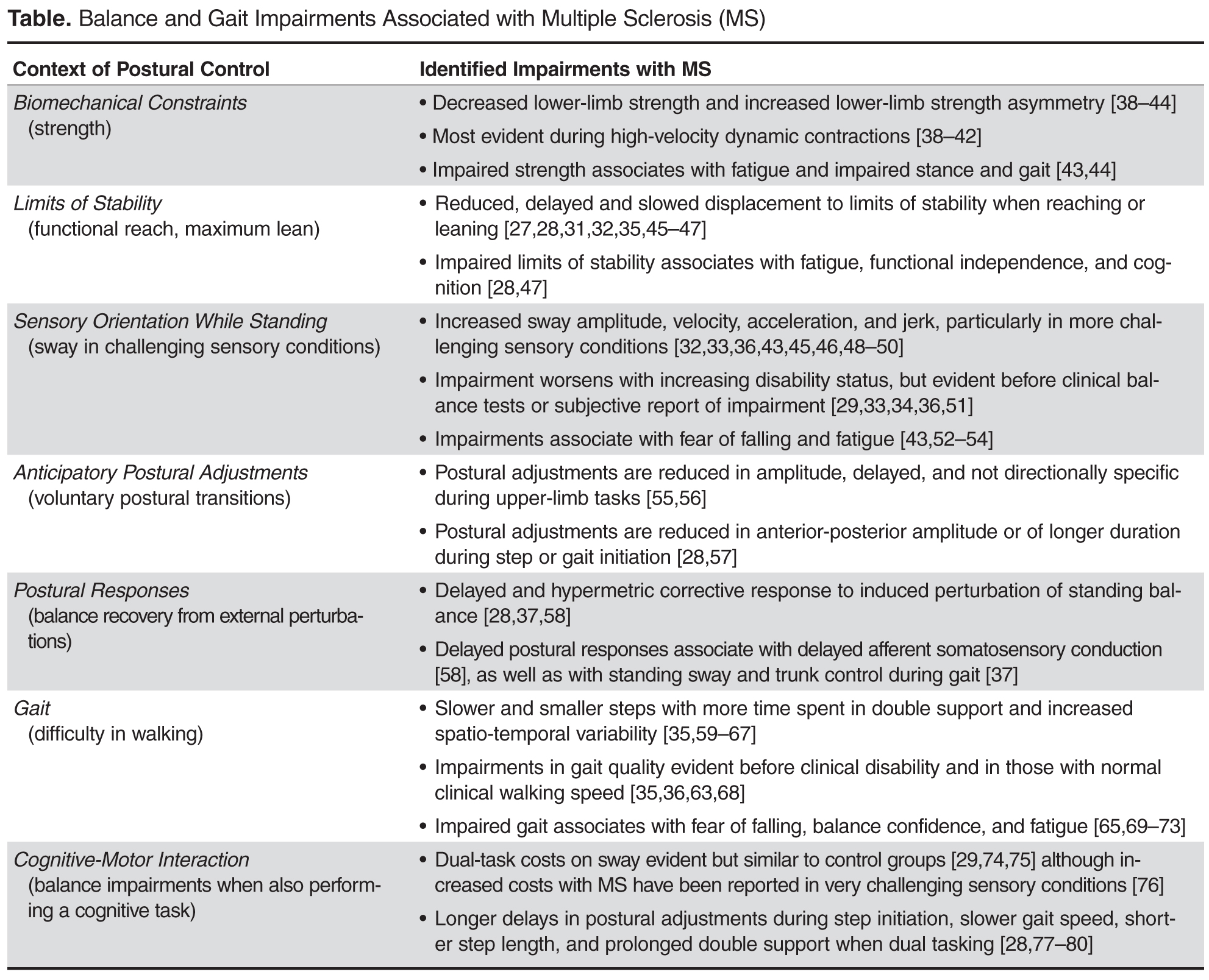
Horak [18] described contexts of balance tasks that affect the mechanisms of maintaining postural equilibrium. Some of these contextual variables include
- Biomechanical constraints (eg, strength)
- Limits of stability (functional reach, maximum lean)
- Anticipatory postural adjustments (voluntary postural transitions)
- Automatic postural responses (balance recovery from external perturbations)
- Sensory orientation (ability to reweight sensory information [somatosensory, visual, vestibular] depending on context
- Dynamic control during gait
- Cognitive-motor interaction (balance impairments when also performing a cognitive task)
Emotion represents another contextual variable of interest, because mood and fear can significantly modify postural control [19–23]. Knowing the contextual factors that modify balance control provides insight into underlying neuropathology associated with impairments of these postural control variables [24,25] as well as insight into what should be included during the examination of patients with MS based on patient descriptions of their symptoms and functional challenges.
Balance Assessment
Balance assessment indicates that Ms. D cannot abduct and hold either leg to her side for any noticeable length of time, cannot reach forward adequately without lifting her heels off the ground or falling forward, and cannot stand on one leg for more than 10 seconds without losing balance. She also needs to take multiple steps to recover balance with any slight perturbation and is unable to maintain stability while standing on foam with her eyes closed. She shows significant imbalance when rising from a chair, walking forward, and turning to come back to sit.
For Ms. D, the clinical balance exam suggests pervasive impairment of hip strength, limits of stability, anticipatory postural adjustments, postural responses, sensory integration, and gait. Furthermore, her reported need to focus vision on her gait is in accordance with compensation for existing sensory impairments. Lastly, fatigue and attention demand likely enhance the presentation of balance impairment.
What are the consequences of balance impairments associated with MS?
Balance impairments present considerable health problems for adults with MS. Greater than 50% of individuals with MS report falling in any 6-month period [81–85], with the incidence of recurrent falls reported to be as high as 9 falls per year [86]. In addition, fall-related injuries, including fractures, are more common with MS, although this increased risk is considerably greater for women with MS than men [86–90].
Common risk factors for falling in people with MS include variable or deteriorating MS status [90–96], problems with balance or mobility [88,92–94,96–99], use of walking aids [88,93,97], lower balance confidence [86,98], reduced executive functioning [99] and greater fatigue [85]. Increased postural sway [52,99,100], slower walking speed [99], greater gait asymmetry and variability [92,101], slower choice stepping reaction time [99], impaired forward limits of stability [92,99], impaired visually dependent sway [92,99], and leg weakness [88,92] have also been found predictive of future falls in MS. A link has also emerged between cognitive impairment and fall risk [86,95,99,102].
Fear of falling and fall-induced injuries are also the most common causes of restricted activity and disability for individuals with MS [14]. Research has shown that future physical activity associates with fear of falling, and fear of falling subsequently associated with lower-limb strength asymmetry and decreased limits of stability rather than past experience of falling [103]. Similarly, the perceived benefits of physical activity and an individual’s self-efficacy to engage in physical activity predict reported levels of physical activity independent of disability level for individuals with MS [104]. Thus, psychological perception represents an important, and potentially modifiable, correlate of physical activity.
Moreover, individuals with MS experience a high risk of cardiovascular disease and other chronic health conditions associated with deconditioning, as unfavorable blood lipid levels, poor glucose profiles, and obesity have been observed in this population [105]. Comorbid conditions, secondary conditions, and health behaviors are increasingly recognized to be important factors influencing a range of outcomes in MS [107].
Further History
Consistent with the consequences of balance and mobility impairment, Ms. D reports that she loses her balance and nearly falls at least 1 time per week while engaged in daily activities. She also shares that she fell 2 months ago while walking outside and across the lawn to get the mail. Her confidence is low for many daily tasks such as climbing stairs, picking up objects from the floor, reaching when on tiptoes, or walking on ramps or on slippery surfaces. While Ms. D is independent in all activities of daily living, she currently does not work due to her fatigue and poor balance. She indicates that she is not very physically active and feels somewhat isolated and depressed because her balance and mobility challenges keep her from going out with friends and socializing.
What exercise approaches are available to ameliorate the balance deficits associated with MS?
There are a variety of therapeutic approaches for the treatment of poor balance in MS. While pharmacologic treatment typically encompasses disease-modifying therapies, specific medications can also help in the management of symptoms (ie, fatigue, spasticity, gait variability) that can negatively impact balance and mobility. Other rehabilitative strategies for balance impairment include gait training, assistive devices for mobility, and environmental modifications for fall prevention. Although all of these avenues offer viable treatment options for improving balance, exercise is increasingly appreciated as an important adjunct to the rehabilitation management of MS [107], especially in terms of improving balance deficits, optimizing daily functioning, and increasing participation across various life contexts.
The diversity of exercise options available for individuals with MS who experience balance and mobility problems is expanding. Moreover, mounting evidence suggests that exercise is well tolerated by participants with the disease[108–110] and that individuals with MS can exercise sufficiently to improve their fitness, function, and quality of life [109,110]. Given the inherent variability of MS and the heterogeneity of symptoms and disease course across individuals, however, no one exercise prescription is optimal for all those diagnosed. Instead, treatment goals must be individualized and functionally based [107] with ongoing evaluation and modification of treatment plans due to disease progression, symptom fluctuations, and functional decline [107,111]. Regardless of specific approach, the aim of any exercise intervention is to reduce activity limitations, encourage participation, and facilitate independence and life satisfaction in those with the disease [112].
Resistance Training
There have been several structured reviews of exercise research in MS [108,110,113,114]. The existing evidence supports resistance exercise as compared with no exercise for improving general balance [115] or performing tasks such as a chair transfer [116] or sit-to-stand [117]. Two randomized controlled trials (RCTs) also revealed significant increases in functional reach (ie, limits of stability) as a result of progressive resistance exercise [118,119]. Resistance exercise has not, however, facilitated greater benefit over traditional rehabilitation in other postural control contexts such as those involving postural transitions, sensory integration, or postural sway [120–122].
The effects of resistance training on mobility have also been inconsistent. While several studies showed no significant improvement in functional mobility [118,122,123], a positive improvement was observed in other research [119,124,125]. Likewise, stair climbing was shown to improve in 2 noncontrolled studies [125,126] and one RCT [117] but not in another [127].
In a recent RCT to evaluate the comparative effectiveness of different methods of resistance training, Hayes et al [123] determined that the addition of high-intensity, eccentric resistance training offered no additional benefit over standard concentric resistance exercise in improving static standing balance and stair climbing. In addition, compared with no exercise or a home-based program to improve strength and balance, progressive resistance cycling showed significantly greater effect on functional reach and timed up-and-go in individuals with moderate MS [128]. Nonetheless, evidence for the efficacy of home-based training remains equivocal given issues of motivation, adherence, and training intensity [115,118,128].
Taken together, the systematic reviews to date conclude that there is insufficient evidence for the effects of resistance exercise on balance in MS, thus making solid evidenced-based conclusions difficult [108,110,113,129]. Moreover, it is difficult to ascertain a definitive and most efficacious exercise prescription for improving balance in MS given the inconsistency in protocols and findings across studies. There is some support, albeit preliminary, for progressive resistance training as a modality to improve balance, especially those functional tasks demanding greater strength [113]. Nonetheless, resistance training may contribute to improved posture and gait given it directly addresses one context of postural control, but it may not be fully effective due to lack of training to modify central neural control of posture in other contexts.
Aerobic Exercise
Many of the studies examining aerobic exercise in MS more often target walking capacity, exercise tolerance, fatigue, and quality of life than balance [130]. The limited research that has focused on aerobic exercise for balance improvement has shown equal benefit to that achieved from resistance exercise in those contexts involving limits of stability and dynamic balance while stepping or walking [119]. This finding was reasonable given that the aerobic exercise included step-up and treadmill walking. Still, it has been recommended that, for most people with MS, aerobic exercise also incorporate a degree of balance training [109].
Combined Exercise
The more recent exercise research involving people with MS often combines some aspect of aerobic, strengthening, and/or balance exercise. While only a few RCTs have examined the effects of combined training in this population, preliminary evidence suggests it is well tolerated and may have some benefit for improving function [110]. While one study found no differences in static balance after a combined strength and aerobic training program [131], review of the exercise protocol revealed that the training regime had only incorporated 2 standing exercises. Other studies more intentionally combining strength and balance exercise have demonstrated benefits in balance confidence [132], standing static balance or postural sway [132–134], step climbing [133], and functional mobility [135]. Combining aerobic exercise and strengthening has also been effective in reducing falls in those with MS [85].
Balance-Specific Exercise
Only one balance-specific RCT has been published to date. In this study, outcomes from balance training involving both motor and sensory strategies were compared to training of only motor strategies and to standard therapy [136]. Both the balance training groups significantly reduced the number of falls post intervention as compared to the conventional treatment group. There were no observed differences in self-reported balance confidence across the groups, although both the balance training groups significantly improved in static and dynamic standing balance over that achieved by the standard treatment group. The fact that only the group engaged in sensory training differed significantly on dynamic gait highlights the importance of sensory integration for dynamic balance and gait.
Video Game–Assisted Exercises
Novel rehabilitative approaches have taken advantage of advances in virtual reality and visual feedback training to improve balance and mobility deficits in people with MS. Exercise using the general physical activity games on the Nintendo Wii Fit provided short-term improvement in standing balance, strength, gait and physical activity in people with MS [137]. This general exercise offered no significant gains in self-efficacy, fatigue impact or quality of life, and physical activity levels returned to baseline levels 14 weeks after exercising. Subsequent review has, however, highlighted concerns that current commercially available video options for general exercise may not be sufficiently adaptive for people with moderate disability, leading to intimidation and low adherence [138].
Beyond general physical activity, the Wii Balance Board System has also been used to specifically target balance and mobility deficits in MS. Although one study found no significant benefit from Wii Fit balance exercise in balance performance and walking ability [139], other studies have shown positive effects in standing sway, static balance, dynamic stepping, walking speed, and MS impact [140–142].
The evidence, albeit preliminary, thus suggests that the Wii Fit may offer a feasible adjunct to traditional rehabilitation approaches, especially because the exercise can be done at home without the need for continuous support from a practitioner and because the technology aids in overcoming access barriers often associated with community-based physical activity programs [138]. Nonetheless, research shows that Wii Balance Board System training is more specific for static standing balance than for dynamic balance or mobility, the technology is not positively viewed by those with more advanced symptoms, and there exists a risk of adverse affects and training-related injuries associated with home-based use of the Wii [137,140].
Vestibular Rehabilitation Exercise
Vestibular rehabilitation is a specialized treatment approach that strengthens the vestibular sensory system by retraining the brain to recognize and process signals from the vestibular system and coordinate these with visual and proprioceptive inputs. To date, there has only been one RCT investigating the effects of vestibular rehabilitation on balance in adults with MS [143]. In this study, the outcomes of a standard vestibular rehabilitation program to those of an exercise regime as well as to no intervention were compared. The vestibular rehabilitation program consisted of static and dynamic tasks performed with changing bases of support, on various surfaces, with eyes open or closed, and different head movements. The 6-week vestibular rehabilitation program resulted in both statistically significant and clinically relevant change in standing balance under various sensory conditions compared with either of the other two groups, although no significant difference was found in walking capacity across groups.
Weighted Torso Training
Balance-based torso weighting (BBTW) involves strategically placing small weights on the trunk of an individual to decrease balance deviations observed during quiet stance, perturbed standing, walking, and transitioning [144]. While the specific mechanism underlying the therapeutic effect of rehabilitative weighting has been debated [145], various suggestions include joint compression to encourage co-contraction, enhanced conscious awareness of body segments, and biomechanical changes via shifting of the center of mass [146].
The one RCT examining the effectiveness of BBTW in people with MS found immediate and significant effects of BBTW on postural control and upright mobility [146]. The research confirmed preliminary investigations of BBTW in MS [144,147], demonstrating that BBTW can improve walking speed as well as functional tasks involving standing, walking, turning, and sitting down.
Whole Body Vibration
Whole body vibration (WBV) has been employed across a variety of neurological populations as a means of improving muscle tone, sensation, strength, stability, and functional performance. In WBV, multidimensional vibrations are transferred to an individual performing static or dynamic movements on an oscillating platform. The vibrations are believed to facilitate both neuroendocrine responses as well as motor unit recruitment [148–150].
Results have been inconsistent regarding the effectiveness of WBV as a way of improving postural control and functional mobility in individuals with MS. A few studies have shown significant positive effects of WBV lasting from 1 to 4 weeks on functional mobility [151–153], strength [151,153,154], walking speed [152,155], and standing balance [152]. Walking endurance has also been affected by vibration training designed to improve muscular endurance [156]. Although there have been noted benefits of WBV, these benefits were not significantly more advantageous than those offered by a vibration program in conjunction with lower-limb stretching and strengthening exercises [157] or in addition to a traditional rehabilitation program [154].
There has also been some evidence to show that prolonged WBV does not improve postural stability or functional mobility in individuals with MS after training [155,156,158]. Likewise, there is contradictory evidence supporting the use of WBV in improving walking speed [157], functional reaching [152,153] or overall quality of life [152].
While WBV does not appear to have a detrimental effect on symptoms of MS, there is insufficient evidence regarding its beneficial effects on balance, gait, muscle strength and quality of life compared to other interventions. Future research is necessary to examine various protocols in terms of vibratory parameters and length of intervention before specific prescriptions can be offered [159].
Aquatics
Although aquatic exercise has often been recommended for individuals with MS, much of the research employing this therapeutic modality has focused on outcomes of pain, fatigue, cardiorespiratory fitness, gait, and quality of life [160–164]. Research focused on aquatic exercise for improved balance is limited. Nonetheless, significant improvements in standing balance and functional mobility have been shown for individuals with MS following aquatic exercise [165,166]. Similar results on standing balance and functional mobility have also been shown from Ai Chi, a program in which Tai Chi is combined with other techniques and performed standing in shoulder-depth water using a combination of deep breathing and slow, broad movements of the arms, legs, and torso [167]. These methods of intervention, however, still lack evidence from rigorous designs involving control groups and randomization.
Yoga
Yoga has also been explored as a means to improve physical and mental health outcomes in MS. While an initial study showed no significant changes in one-leg stance from an Iyengar yoga program [168], more recent research found Ananda yoga practice effective in improving standing balance [169]. Likewise, other research has shown that static and dynamic standing balance improved after yoga practice, although not significantly better than that from treadmill exercise training [170].
Kickboxing
There has been only one study to date, albeit not an RCT, that has examined kickboxing as a training modality to improve balance in MS. Although kickboxing was found to be a feasible exercise activity, not all participants demonstrated improved balance and mobility outcomes [171]. As such, further investigation of this novel treatment approach is warranted.
Hippotherapy
Hippotherapy has also been employed as a means of balance training because the multidimensional and random nature of the horse’s movement requires the rider to process increased sensory information and make the necessary anticipatory and reactive adjustments for postural control. While one study reported no improvement in postural sway after hippotherapy [172], other research has shown some benefit in balance and gait after riding [173,174]. Although preliminary, findings from 2 of the studies reveal that hippotherapy may be most beneficial for those with primary progressive MS compared to other subtypes of MS [175]. While hippotherapy may have a positive effect on balance in individuals with MS, the data is limited and lacks rigorous examination through randomized controlled study of large samples in order to allow for its advocacy as a primary rehabilitation modality at this time.
What exercise prescription is indicated for Ms. D?
Because Ms. D’s balance deficits have begun to limit her daily functioning and increase her risk of falling, a formal and targeted balance intervention is warranted. Research confirms that exercise would be well tolerated by Ms. D and supports the feasibility of her engaging in various exercise modalities. Although a number of exercise inter-vention studies involving people with MS have been described in the literature, their clinical utility and results in improving balance and mobility are varied. Nonetheless, there is preliminary evidence suggesting that exercise training may have positive effects on balance and functional mobility and could offer Ms. D benefit. This is especially true given that much of the exercise research included individuals with mild or minimal disability and at same stage of disease progression as Ms. D.
Since Ms. D’s balance problems stem from a range of postural impairments across multiple contexts of balance control, her treatment approach must incorporate exercises that include and integrate these underlying control systems. A targeted and multimodal balance exercise program, rather than general physical activity, may be most efficacious toward this end.
Intervention Prescription
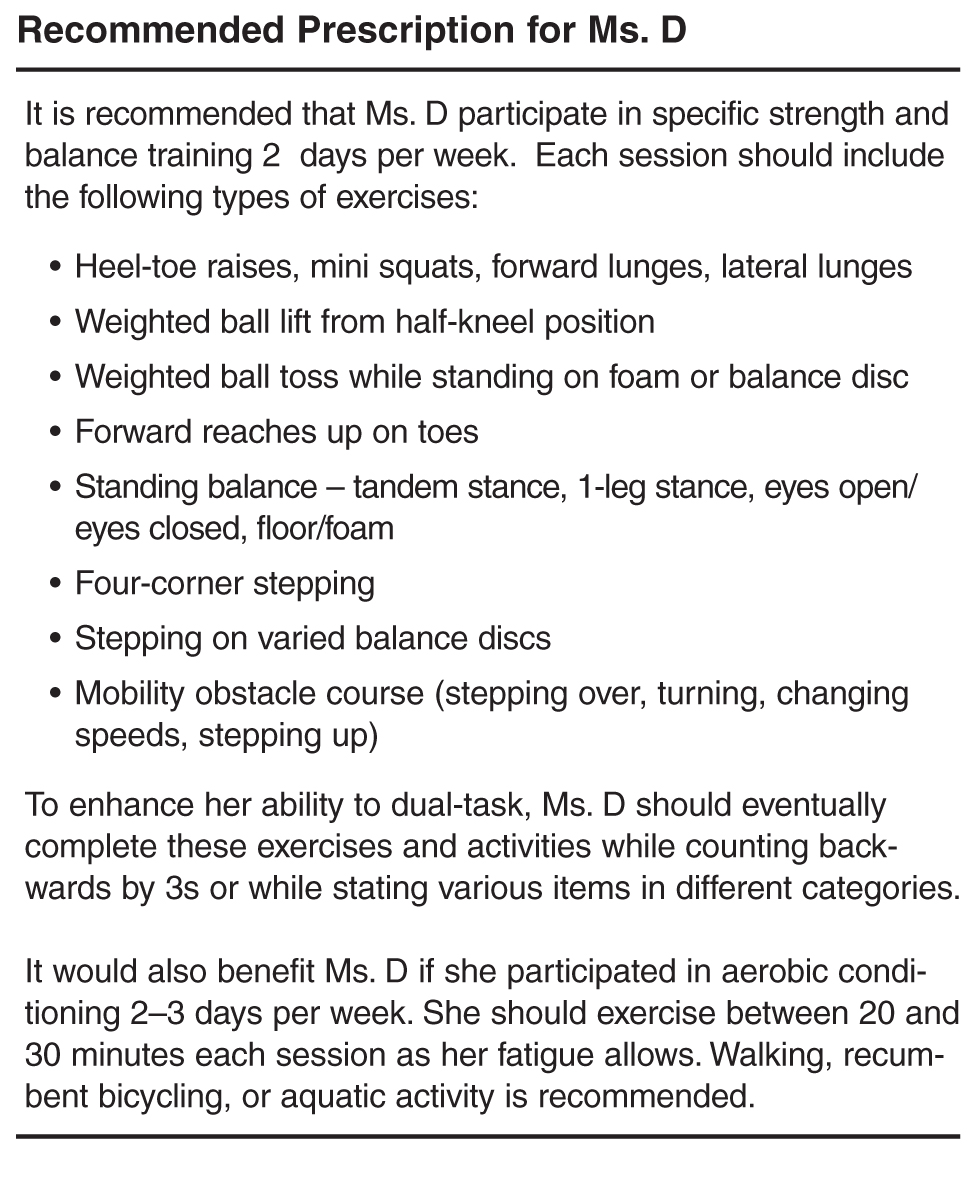
Ms. D has poor ability to utilize somatosensory and vestibular inputs in order to dynamically weight the influence of multiple sensory modalities for the control of standing sway under varying sensory conditions. This visual dependence contributes to her poor balance and increases her fall risk when visual inputs are absent (ie, walking in dimly lit rooms) or when optic flow is incongruent or when visual distractions are present (ie, walking in dynamic contexts such as crowded spaces). Ms. D would benefit from exercises requiring greater use of proprioceptive and vestibular inputs, thereby facilitating improved sensory integration. Exercises performed with eyes closed as well as those completed on mats, foam, or other compliant surfaces would be beneficial. She might also benefit from specific vestibular rehabilitation exercises as this approach has resulted in improved sensory integration [143]. Given that Ms. D must regularly concentrate and focus on her balance and consistently look where she is stepping, her balance exercise program should also address her central processing and attentional deficits by including dual-task training [26].
Ms. D also noted that her MS significantly impacts her ability to walk both in terms of effort and distance and adversely affects her participation in social events. Supplemental to her balance exercise program, aerobic exercise, particularly treadmill walking, may offer some benefit both in terms of her endurance as well as gait. While some of the more targeted modalities such as hippotherapy, yoga, and kickboxing have not been extensively studied, they do offer promise and could be used as adjuncts in order to facilitate Ms. D’s motivation and adherence through more diverse programming. Lastly, and although requiring further study, cognitive-behavioral interventions and patient education may be warranted to help Ms. D overcome her fear of falling, low exercise self-efficacy, and any negative beliefs regarding the potential benefits of exercise.
What additional research is needed?
Although valuable insight has been gained from studies of balance and gait impairment with MS, many contexts remain understudied, particularly with regard to understanding both the neuroanatomical and neurophysiologic pathologies that underlie the behavioral impairments of balance and gait in MS. Further, the value of applying this knowledge of balance impairment to clinical diagnostics and prognostics requires further study in order to develop the most cost- and time-effective exams and evidence-based treatment approaches.
Based on the research to date, it remains difficult to draw definitive evidenced-based conclusions regarding what specific exercise mode or training dose would be most beneficial for Ms. D and others with MS. Moreover, while there exists some evidence of efficacious balance outcomes from exercise training, many of the studies involved individuals with mild MS. Only a few studies to date have included those with more advanced disability, thus making prescription generalizations to those more moderately affected by MS tenuous. Irrespective of specific approach, all modalities of balance-oriented interventions require larger controlled studies, inclusion of those with advancing disability status, long-term follow-up, an evaluation of optimal dose or duration, and outcomes on the neural mechanisms of effect.
Summary
Challenges to balance and mobility present serious consequences for those with MS, as falls and fear of falling lead to poor health outcomes and low quality of life. Given that postural impairments result from a diverse set of deficits in different underlying control systems, therapeutic intervention should be multimodal. Exercise prescription should address all affected contexts of postural control, including sensory and motor strategy training during postural transitions as well as induced postural perturbations, strength development, and gait activity. Evidence from clinical trials suggests that targeted balance oriented exercise in people with MS has the potential to improve balance and functional mobility, although more rigorous study on the topic is needed.
Corresponding author: Susan L. Kasser, PhD, Dept. of Rehabilitation and Movement Science, Univ. of Vermont, 306 Rowell Bldg, 106 Carrigan Dr, Burlington, VT 05405, [email protected]
Financial disclosures: None.
1. Hirtz D, Thurman DJ, Gwinn-Hardy K, et al. How common are the “common” neurologic disorders? Neurology 2007;68:326–37.
2. Keegan BM, Noseworthy JH. Multiple sclerosis. Annu Rev Med 2002;53:285–302.
3. National Multiple Sclerosis Society: Who gets MS? Accessed 5 Mar 2014 at http://www.nationalmssociety.org/about-multiple-sclerosis/what-we-know-about-ms/who-gets-ms/index.aspx.
4. Confavreux C, Vukusic S, Moreau T, Adeleine P. Relapses and progression of disability in multiple sclerosis. N Engl J Med 2000;343:1430–8.
5. Overs S, Hughes C, Haselkorn J, Turner A. Modifiable comorbidities and disability in multiple sclerosis. Curr Neurol Neurosci Rep 2012;12:610–7.
6. Motl R. Physical activity and irreversible disability in multiple sclerosis. Exerc Sport Sci Rev 2010;38:186–91.
7. Naci H, Fleurence R, Birt J, Duhig A. The impact of increasing neurological disability of multiple sclerosis on health utilities: a systematic review of the literature. J Med Econ 2010;13:78–89.
8. Bainbridge JL. Economics of multiple sclerosis. Adv Stud Pharm 2007;4:330–3.
9. Kobelt G, Berg J, Atherly D, Hadjimichael O. Costs and quality of life in multiple sclerosis: a cross sectional study in the United States. Neurology 2006;66:1696–702.
10. Zwibel H. Contribution of impaired mobility and general symptoms to the burden of multiple sclerosis. Adv Ther 2009;26:1043–57.
11. Hemmett L, Holmes J, Barnes M, Russell N. What drives quality of life in multiple sclerosis? QJM 2004;97:671–6.
12. Heesen C, Bohm J, Reich C, et al. Patient perception of bodily functions in multiple sclerosis: gait and visual function are the most valuable. Mult Scler 2008;14:988–91.
13. Sutliff MH. Contribution of impaired mobility to patient burden in multiple sclerosis. Curr Med Res Opin 2010; 26:109–19.
14. Peterson EW, Cho CC, Finlayson ML. Fear of falling and associated activity curtailment among middle aged and older adults with multiple sclerosis. Mult Scler 2007;13:1168–75.
15. Matsuda PN, Shumway-Cook A, Ciol MA, et al. Understanding falls in multiple sclerosis: association of mobility status, concerns about falling, and accumulated impairments. Phys Ther 2012;92:407–15.
16. Kurtzke JF: Rating neurologic impairment in multiple sclerosis: an expended disability status scale (EDSS). Neurology 1983,33:1444–52.
17. Pollock AS, Durward BR, Rowe PJ, Paul JP. What is balance? Clin Rehabil 2000;14:402–6.
18. Horak FB. Postural orientation and equilibrium: what do we need to know about neural control of balance to prevent falls? Age Ageing 2006;35 Suppl 2: ii7–ii11.
19. Carpenter MG, Frank JS, Silcher CP, Peysar GW. The influence of postural threat on the control of upright stance. Exp Brain Res 2001;138:210–8.
20. Adkin Al, Frank JS, Carpenter MG, Petsar GW. Fear of falling modifies anticipatory postural control. Exp Brain Res 2002;143:160–70.
21. Bolmont B, Gangloff P, Vouriot A, Perrin P. Mood states and anxiety influence abilities to maintain balance control in healthy human subjects. Neurosci Lett 2002;329:96–100.
22. Carpenter MG, Frank JS, Adkin AL, et al. Influence of postural anxiety on postural reactions to multi-directional surface rotations. J Neurophysiol 2004;92:3255–65.
23. Kitaoka K, Ito R, Araki H, et al. Effect of mood state on anticipatory postural adjustments. Neurosci Lett 2004;370:65–8.
24. Jacobs JV, Horak FB. Cortical control of postural responses. J Neural Transm 2007; 114:1339–48.
25. Takakusaki K. Neurophysiology of gait: from the spinal cord to the frontal lobe. Movement Disord 2013;28:1483–91.
26. Cameron MH, Lord S. Postural control in multiple sclerosis: implications for fall prevention. Curr Neurol Neurosci Rep 2010;10:407–12.
27. Jacobs JV, Kasser SL. Balance impairment in people with multiple sclerosis: preliminary evidence for the Balance Evaluation Systems Test. Gait Posture 2012;36:414–8.
28. Jacobs JV, Kasser SL. Effects of dual tasking on the postural performance of people with and without multiple sclerosis: a pilot study. J Neurol 2012;259:1166–76.
29. Boes MK, Sosnoff JJ, Socie MJ, et al. Postural control in multiple sclerosis: effect of disability status and dual task. J Neurol Sci 2012;315:44–8.
30. Wajda A, Achiron A, Dvir Z. Motor impairments at presentation of clinically isolated syndrome suggestive of multiple sclerosis: characterization of different disease subtypes. NeuroRehab 2012;31:147–55.
31. Karst GM, Venema DM, Roehrs TG, Tyler AE. Center of pressure measures during standing tasks in minimally impaired persons with multiple sclerosis. J Neurol Phys Ther 2005;29:170–80.
32. Soyuer F, Mirza M, Erkorkmaz U. Balance performance in three forms of multiple sclerosis. Neurol Res 2006;28:555–62.
33. Findling O, Sellner J, Meler N, et al. Trunk sway in mildly disables multiple sclerosis patients with and without balance impairment. Exp Brain Res 2011;213:363–70.
34. Corporaal SH, Gensicke H, Kuhle J, et al. Balance control in multiple sclerosis: correlations of trunk sway during stance and gait tests with disease severity. Gait Posture 2013;37:55–60.
35. Martin CL, Phillips BA, Kilpatrick TJ, et al. Gait and balance impairment in early multiple sclerosis in the absence of clinical disability. Mult Scler 2006;12:620–8.
36. Spain RI, St. George RJ, Salarian A, et al. Body-worn motion sensors detect balance and gait deficits in people with multiple sclerosis who have normal walking speed. Gait Posture 2012;35:573–8.
37. Huisinga JM, St George RJ, Spain R, et al. Postural response latencies are related to balance control during standing and walking in patients with multiple sclerosis. Arch Phys Med Rehab 2014;
38. Lambert CP, Archer RL, Evans WJ. Muscle strength and fatigue during isokinetic exercise in individuals with multiple sclerosis. Med Sci Sports Exerc 2001;33:1613–9.
39. Carroll CC, Gallagher PM, Seidle ME, Trappe SW. Skeletal muscle characteristics of people with multiple sclerosis. Arch Phys Med Rehab 2005;86:224–9.
40. Ng AV, Miller RG, Gelinas D, Kent-Braun JA. Functional relationships of central and peripheral muscle alterations in multiple sclerosis. Muscle Nerve 2004;29:843–52.
41. Garner DJ, Widrick JJ. Cross-bridge mechanisms of muscle weakness in multiple sclerosis. Muscle Nerve 2003;27:456–64.
42. Ponichtera JA. Concentric and eccentric isokinetic lower extremity strength in multiple sclerosis and able-bodied. J Orthop Sports Phys Ther 2006;16:114–22.
43. Chung LH, Remelius JG, Van Emmerik RE, Kent-Braun JA. Leg power asymmetry and postural control in women with multiple sclerosis. Med Sci Sports Exerc 2008;40:1717–24.
44. Yahia A, Ghroubi S, Mhiri C, Elleuch MH. Relationship between muscle strength, gait and postural parameters in multiple sclerosis. Ann Phys Rehab Med 2011;54:144–55.
45. Frzovic D, Morris ME, Vowels L. Clinical tests of standing balance: performance of persons with multiple sclerosis. Arch Phys Med Rehab 2000;81:215–21.
46. van Emmerik REA, Remelius JG, Johnson MB, et al. Postural control in women with multiple sclerosis: effects of task, vision and symptomatic fatigue. Gait Posture 2010; 32:608–14.
47. Kanekar N, Aruin AS. Clinical and instrumented outcomes measures in balance control of individuals with multiple sclerosis. Mult Scler Int 2013;
48. Huisinga JM, Yentes JM, Filipi ML, Stergiou N. Postural control strategy during standing is altered in patients with multiple sclerosis. Neurosci Lett 2012;524:124–8.
49. Cattaneo D, Jonsdottir J. Sensory impairments in quiet standing in subjects with multiple sclerosis. Mult Scler 2009;15:59–67.
50. Kanekar N, Lee YJ, Aruin AS. Frequency analysis approach to study balance control in individuals with multiple sclerosis. J Neurosci Meth 2014:222:91–6.
51. Cao H, Peyrodie L, Boudet S, et al. Expanded disability status scale (EDSS) estimation in multiple sclerosis from posturographic data. Gait Posture 2013;37:242–5.
52. Kalron A, Achiron A. Postural control, falls and fear of falling in people with multiple sclerosis without mobility aids. J Neurol Sci 2013;335:186–90.
53. Hebert JR, Corboy JR. The association between multiple sclerosis-related fatigue and balance as a function of central sensory integration. Gait Posture 2013;38:37–42.
54. Jackson K, Bigelow KE. Measures of balance performance are affected by a rested versus fatigued testing condition in people with multiple sclerosis. Phys Med Rehabil 2013;5:949–56.
55. Krishnan V, Kanekar N, Aruin AS. Anticipatory postural adjustments in individuals with multiple sclerosis. Neurosci Lett 2012;506:256–60.
56. Krishnan V, Kanekar N, Aruin AS. Feedforard postural control in individuals with multiple sclerosis during load release. Gait Posture 2012;36:225–30.
57. Remelius JG, Hamill J, Kent-Braun J, Van Emmerik R. Gait initiation in multiple sclerosis. Motor Control 2008;12:93–106.
58. Cameron MH, Horak FB, Herndon RR, Bourdette D. Imbalance in multiple sclerosis: a result of slowed spinal somatosensory conduction. Somatosens Mot Res 2008,25:113–22.
59. Crenshaw SJ, Royer TD, Richards JG, Hudson DJ. Gait variability in people with multiple sclerosis. Mult Scler 2006;12:613–9.
60. Sosnoff JJ, Sandroff BM, Motl RW. Quantifying gait abnormalities in persons with multiple sclerosis with minimal disability. Gait Posture 2012;36:154–6.
61. Givon U, Zeilig G, Achiron A. Gait analysis in multiple sclerosis: characterization of temporal–spatial parameters using GAITRite functional ambulation system. Gait Posture 2009;29:138–42.
62. Sosnoff JJ, Weikert M, Dlugonski D, et al. Quantifying gait impairment in multiple sclerosis using GAITRite technology. Gait Posture 2011;34:145–7.
63. Benedetti MG, Piperno R, Simoncini L, et al. Gait abnormalities in minimally impaired multiple sclerosis patients. Mult Scler 1999;5:363–8.
64. Kelleher KJ, Spence W, Solomonidis S, Apatsidis D. The characterisation of gait patterns of people with multiple sclerosis. Disabil Rehabil 2010;32:1242–50.
65. Sacco R, Bussman R, Oesch P, et al. Assessment of gait parameters and fatigue in MS patients during inpatient rehabilitation: a pilot trial. J Neurol 2011;258:889–94.
66. Gianfrancesco MA, Triche EW, Fawcett JA, et al. Speed- and cane-related alterations in gait parameters in individuals with multiple sclerosis. Gait Posture 2011;33:140–2.
67. Morris ME, Cantwell C, Vowels L, Dodd K. Changes in gait and fatigue from morning to afternoon in people with multiple sclerosis.J Neurol Neurosurg Psychiatry 2002;72:361–5.
68. Nogueira LAC, Teixeira L, Sabino P, et al. Gait characteristics of multiple sclerosis patients in the absence of clinical disability. Disabil Rehabil 2013;35:1472–8.
69. Nilsagard Y, Carling A, Forsberg A. Activities-specific balance confidence in people with multiple sclerosis. Mult Scler Int 2012;2012:613925.
70. Kalron A, Achiron A. Relationship between fear of falling to spatiotemporal gait parameters measured by an instrumented treadmill in people with multiple sclerosis. Gait Posture 2014;39:739–44.
71. Huisinga JM, Filipi ML, Schmid KK, Stergiou N. Is there a relationship between fatigue questionnaires and gait mechanics in persons with multiple sclerosis? Arch Phys Med Rehabil 2011;92:1594–601.
72. Motl RW, Sandroff BM, Suh Y, Sosnoff JJ. Energy cost of walking and its association with gait parameters, daily activity, and fatigue in persons with mild multiple sclerosis. Neurorehabil Neural Repair 2012;26:1015–21.
73. Burschka JM, Keune PM, Menge U, et al. An exploration of impaired walking dynamics and fatigue in multiple sclerosis. BMC Neurol 2012;12:161.
74. Kalron A, Dvir Z, Achiron A. Effect of a cognitive task on postural control in patients with a clinically isolated syndrome suggestive of multiple sclerosis. Eur J Phys Rehabil Med 2011;47:579–86.
75. Negahban H, Sanjari M, Mofateh R, Parnianpou M. Nonlinear dynamical structure of sway path during standing in patients with multiple sclerosis and in healthy controls is affected by changes in sensory input and cognitive load. Neurosci Lett 2013;553:126–31.
76. Negahban H, Mofateh R, Arastoo AA, et al. The effect of cognitive loading on balance control in patients with multiple sclerosis. Gait Posture 2011;34:479–84.
77. Sosnoff JJ, Boes MK, Sandroff BM, et al. Walking and thinking in persons with multiple sclerosis who vary in disability. Arch Phys Med Rehabil 2011;92:2028–33.
78. Hamilton F, Rochester L, Paul L, et al. Walking and talking: an investigation of cognitive-motor dual tasking in multiple sclerosis. Mult Scler 2010;15:1215–27.
79. Kalron A, Dvir Z, Achiron A. Walking while talking - difficulties incurred during the initial stages of multiple sclerosis disease process. Gait Posture 2010;32:332–5.
80. Wajda DA, Motl RW, Sosnoff JJ. Dual task cost of walking is related to fall risk in persons with multiple sclerosis. J Neuro Sci 2013;335:160–3.
81. Cameron MH, Asano M, Bourdette D, Finlayson ML. People with multiple sclerosis use many fall prevention strategies but still fall frequently. Arch Phys Med Rehabil 2013;94;1562–6.
82. Cameron MH, Thielman E, Mazumder R, Bourdette D. Predicting falls in people with multiple sclerosis: fall history is as accurate as more complex measures. Mult Scler Int 2013;2013:496325
83. Finlayson ML, Peterson EW, Cho CC. Risk factors for falling among people aged 45 to 90 years with multiple sclerosis. Arch Phys Med Rehabil 2006;87:1274–9.
84. Gunn H, Creanor S, Haas B, et al. Risk factors for falls in multiple sclerosis: an observational study. Mult Scler J 2013;19:1913–22.
85. Coote S, Hogan N. Franklin S. Falls in people with multiple sclerosis who use a walking aid: prevalence, factors, and effect of strength and balance interventions. Arch Phys Med Rehabil 2013;94:616–21.
86. Peterson EW, Cho CC, von Koch L, Finlayson ML. Injurious falls among middle aged and older adults with multiple sclerosis. Arch Phys Med Rehabil 2008;89:1031–7.
87. Cameron MH, Poel AJ, Haselkorn JK, et al. Falls requiring medical attention among veterans with multiple sclerosis: a cohort study. J Rehab Res Dev 2011;48:13–20.
88. Matsuda PN, Shumway-Cook A, Bamer AM, et al. Falls in multiple sclerosis. Phys Med Rehabil 2011;3:624–32.
89. Tremlet H, Lucas R. The risks for falls and fractures in multiple sclerosis. Neurology 2012;78:1902–3.
90. Zikan V. Bone health in patients with multiple sclerosis. J Osteoporos 2011;2011:596294.
91. Nilsagard Y, Lundholm C, Denison E, Gunnarsson LG. Predicting accidental falls in people with multiple sclerosis: a longitudinal study. Clin Rehabil 2009;23:259–69.
92. Kasser SL, Jacobs JV, Foley JT, et al. A prospective evaluation of balance, gait, and strength to predict falling in women with multiple sclerosis. Arch Phys Med Rehabil 2011;92:1840–6.
93. Gunn H, Newell P, Haas B, et al. Identification of risk factors for falls in multiple sclerosis: a systematic review and meta-analysis. Phys Ther 2013;93:504–13.
94. Sosnoff JJ, Socie MJ, Boes MK, et al. Mobility, balance and falls in persons with multiple sclerosis. PLoS ONE 2011;6(11):e28021.
95. D’Orio VL, Foley FW, Armentano F, et al. Cognitive and motor functioning in patients with multiple sclerosis: neuropsychological predictors of walking speed and falls. J Neurol Sci 2012;316:42–6.
96. Prosperini L, Kouleridou A, Petsas N, et al. The relationship between infratentorial lesions, balance deficit, and accidental falls in multiple sclerosis. J Neuro Sci 2011; 304:55–60.
97. Cattaneo D, De Nuzzo C, Fascia T, et al. Risks of falls in subjects with multiple sclerosis. Arch Phys Med Rehabil 2002;83:864–7.
98. Finlayson ML, Peterson EW, Cho CC. Risk factors for falling among people aged 45 to 90 years with multiple sclerosis. Arch Phys Med Rehabil 2006;87:1274–9.
99. Hoang PD, Cameron MH, Gandevia SC, Lord SR. Neuropsychologcial, balance, and mobility risk factors for falls in people with multiple sclerosis: a prospective cohort study. Arch Phys Med Rehabil 2014;95:480–6.
100. Prosperini L, Fortuna D, Gianni C, et al. The diagnostic accuracy of static posturography in predicting accidental falls in people with multiple sclerosis. Neurorehabi Neural Repair 2013;27:45–52.
101. Socie MJ, Sandroff BM, Pula JH, et al. Footfall placement variability and falls in multiple sclerosis. Ann Biomed Eng 2013;41:1740–7.
102. Sosnoff JJ, Balantrapu S, Pilutti L, et al. Cognitive processing speed is related to fall frequency in older adults with multiple sclerosis. Arch Phys Med Rehabil 2013;94:1567–72.
103. Kasser SL, Jacobs JV, Littenberg B, et al. Exploring physical activity in women with multiple sclerosis: associations with fear of falling and underlying impairments. Am J Phys Med Rehabil 2014; Jan 6. [Epub ahead of print].
104. Kasser SL, Kosma M. Health beliefs and physical activity behavior in adults with multiple sclerosis. Disabil Health J 2012;5:261–8.
105. Slawta JN, Wilcox AR, McCubbin JA, et al. Health behaviors, body composition, and coronary heart disease risk in women with multiple sclerosis. Arch Phys Med Rehabil 2003;84:
1823–30.
106. Marrie RA, Hanwell H. General health issues in multiple sclerosis: comorbidities, secondary conditions, and health behaviors. Continuum (Minneap Minn). 2013;19:1046–57.
107. Beer S, Khan F, Kesselring J. Rehabilitation interventions in multiple sclerosis. J Neurol 2012;259:1994–2008.
108. Rietberg MB, Brooks D, Uitdehaag BMJ, Kwakkel G. Exercise therapy for multiple sclerosis. Cochrane Database Syst Rev 2004;(3):CD003980.
109. Brown TR, Kraft GH. Exercise and rehabilitation for individuals with multiple sclerosis. Phys Med Rehabil Clin N Am 2005;16:513–55.
110. Dalgas U, Stenager E, Ingemann-Hansen T. Multiple sclerosis and physical exercise: recommendations for the application of resistance-, endurance- and combined training. Mult Scler 2008;14:35–53.
111. Khan F, Turner-Stokes L, Ng L, et al. Multidisciplinary rehabilitation for adults with multiple sclerosis. Cochrane Database Syst Rev 2007;2:CD006036.
112. Kesslering J, Beer S. Symptomatic therapy and neurorehabilitation in multiple sclerosis. Lancet Neurol 2005;4:643–52.
113. Kjolhede T, Vissing K, Dalgas U. Multiple sclerosis and preogressive resistance training: a systematic review. Mult Scler 2012;18:1215–28.
114. Paltamaa J, Sjogren T, Peurala, SH, Heinonen A. Effects of physiotherapy interventions on balance in multiple sclerosis: a systematic review and meta-analysis of randomized controlled trials. J Rehabil Med 2012;44:811–23.
115. Wiles CM, Newcombe RG, Fuller KJ, et al. Controlled randomized crossover trial of the effects of physiotherapy on mobility in chronic multiple sclerosis. J Neurol Neurosurg Psychiatry 2001;70:174–9.
116. Harvey L, Davies Smith A, Jones R. The effect of weighted leg raises on quadriceps strength, EMG parameters and functional activities in people with multiple sclerosis. Physiother 1999;85:154–61.
117. Dalgas U, Stenager E, Jakobsen J, et al. Resistance training improves muscle strength and functional capacity in multiple sclerosis. Neurology 2009;73:1478–84.
118. Broekmans T, Roelants M, Feys P, et al. Effects of long-term resistance training and simultaneous electro-stimulation on muscle strength and functional mobility in multiple sclerosis. Mult Scler 2010;17:468–77.
119. Sabapathy NM, Minihan CL, Turner GT, Broadley SA. Comparing endurance- and resitance-exercise training in people with multiple sclerosis: a randomized pilot study. Clin Rehabil 2011;25:14–24.
120. Lord SE, Wade DT, Halligan PW. A comparison of two physiotherapy treatment approaches to improve walking in multiple sclerosis: a pilot randomized controlled study. Clin Rehabil 1998;12:477–86.
121. Plow MA, Mathiowetz V, Lowe DA. Comparing individualized rehabilitation to a group wellness intervention for persons with multiple sclerosis. Am J Health Prom 2009;24:23–6.
122. DeBolt LS, McCubbin JA. The effects of home-based resistance exercise on balance, power, and mobility in adults with multiple sclerosis. Arch Phys Med Rehabil 2004;85:290–7.
123. Hayes HA, Gappmaier E, LaStayo PC. Effects of high-intensity resistance training on strength, mobility, balance, and fatigue in individuals with multiple sclerosis: a randomized controlled trial. J Neurol Phys Ther 2011;35:2–10.
124. de Souza-Teixeira F, Costilla S, Ayan C, et al. Effects of resistance training in multiple sclerosis. Int J Sports Med 2009;30:245–50.
125. Kraft G, Alquist A, Lateur B. Effects of resistive exercise on function in multiple sclerosis (MS). Arch Phys Med Rehabil 1996;77:984.
126. White LJ, McCoy SC, Castellano V, et al. Resistance training improves strength and functional capacity in persons with multiple sclerosis. Mult Scler 2004;10:668–74.
127. Taylor NF, Dodd KJ, Prasad D, Denisenko S. Progressive resistance exercise for people with multiple sclerosis. Disabil Rehabil 2006;28:1119–26.
128. Cakit BD, Nacir B, Genc¸ H, et al. Cycling progressive resistance training for people with multiple sclerosis: a randomized controlled study. Am J Phys Med Rehabil 2010;89:446–57.
129. Motl RW, Pilutti, LA. The benefits of exercise training in multiple sclerosis. Nat Rev Neurol 2012;8:487–97.
130. Asano M, Arafah A, Moriello C, Mayo NE. What does a structured review of the effectiveness of exercise interventions for persons with multiple sclerosis tell us about the challenges of designing trials? Mult Scler 2009;15:412–21.
131. Romberg A, Virtanen A, Ruutiainen J, et al. Effects of a 6-month exercise program on patients with multiple sclerosis. Neurology 2004;63:2034–8.
132. Learmonth YC, Paul L, Miller L, et al. The effects of a 12-week leisure centre-based, group exercise intervention for people moderately affected with multiple sclerosis: a randomized controlled pilot study. Clin Rehabil 2011;26:579–93.
133. Tarakci E, Yeldan I, Huseyinsinoglu B, et al. Group exercise training for balance, functional status, spasticity, fatigue and quality of life in multiple sclerosis: a randomized controlled trial. Clin Rehabil 2013;27:813–22.
134. Huisinga JM, Filipi ML, Stergiou N. Supervised resistance training results in changes in postural control in patients with multiple sclerosis. Motor Control 2012;16:50–63.
135. Negahban H, Rezaie S, Goharpey S. Massage therapy and exercise therapy in patients with multiple sclerosis: a randomized controlled pilot study. Clin Rehabil 2013;27:1126–36.
136. Cattaneo D, Jonsdottir J, Zocchi M, Regola A. Effects of balance exercises on people with multiple sclerosis: a pilot study. Clin Rehabil 2007;21:771–81.
137. Plow M, Finlayson M. Potential benefits of Nintendo Wii Fit among people with multiple sclerosis: a longitudinal pilot study. Int J MS Care 2011;13:21–30.
138. Plow M, Finlayson M. A qualitative study exploring the usability of Nintendo Wii Fit among persons with multiple sclerosis. Occup Ther Int 2014;21:21–32.
139. Nilsgard YE, Forsberg AS, von Koch L. Balance exercise for persons with multiple sclerosis using Wii games: a randomized, controlled multi-centre study. Mult Scler J 2012;19:209–16.
140. Prosperini L, Fortuna D, Gianni C, et al. Home-based balance training using the Wii Balance Board: a randomized, crossover pilot study in multiple sclerosis. Neurorehabil Neural Repair 2013;27:516–25.
141. Bruchetta G, Spallarossa P, Lopes de Carvalho ML, Battaglia MA. The effect of Nintendo Wii on balance in people with multiple sclerosis: a pilot randomized control study. Mult Scler J 2013;19:1219–21.
142. Guidi I, Giovannelli T, Paci M. Effects of Wii exercise on balance in people with multiple sclerosis. Mult Scler 2013;19:965.
143. Hebert JR, Corboy JR, Manago MM, Schenkman M. Effects of vestibular rehabilitation on multiple sclerosis–related fatigue and upright postural control: a randomized controlled trial. Phys Ther 2011;91:1166–83.
144. Gibson-Horn C. Balance-based torso-weighting in a patient with ataxia and multiple sclerosis: a case report. J Neurol Phys Ther 2008;32:139-146.
145. Crittendon A, O’Neill D, Widener GL, Allen DD. Standing data disproves biomechanical mechanism for balance-based torso-weighting. Arch Phys Med Rehabil 2014;95:43–9.
146. Widener GL, Allen DD, Gibson-Horn C. Balance-based torso-weighting may enhance balance in persons with multiple sclerosis: preliminary evidence. Arch Phys Med Rehabil 2009;90:602–9.
147. Widener GL, Allen DD, Gibson C. Randomized clinical trial of balance-based torso weighting for improving upright mobility in people with multiple sclerosis. Neurorehabil Neural Repair 2009;23:784–91.
148. Abercromby AF, Amonette WE, Layne CS, et al. Vibration exposure and biodynamic responses during whole-body vibration training. Med Sci Sports Exerc 2007;39:1794–800.
149. Rittweger J. Vibration as an exercise modality: how it may work, and what its potential might be. Eur J Appl Phys 2010;108:877–904.
150. Prisby RD, Lafage-Proust MH, Malaval L, et al. Effects of whole body vibration on the skeleton and other organ systems in man and animal models: what we know and what we need to know. Age Res Rev 2008;7:319–29.
151. Wunderer K, Schabrun SM, Chipchase LS. Effects of whole body vibration on strength and functional mobility in multiple sclerosis. Physiother Theory Practice 2010;26:374–84.
152. Mason RR, Cochrane DJ, Denny GJ, et al. Is 8 weeks of side-alternating whole-body vibration a safe and acceptable modality to improve functional performance in multiple sclerosis? Dis Rehabil 2012;34:647–54.
153. Schuhfried O, Mittermaier C, Jovanovic T, et al. Effects of whole-body vibration in patients with multiple sclerosis: a pilot study. Clin Rehabil 2005;19:834–42.
154. Claerbout M, Gebara B, Ilsbroukx S, et al. Effects of 3 weeks’ whole body vibration training on muscle strength and functional mobility in hospitalized persons with multiple sclerosis. Mult Scler J 2012;18:498–505.
155. Eftekhari E, Mostahfezian M, Etemadifar M, Zafari A. Resistance training and vibration improve musle strength and functional capacity in female patients with multiple sclerosis. Asian J Sports Med 2012;3:279–84.
156. Hilgers C, Mundermann A, Riehle H, Dettmers C. Effects of whole-body vibration training on physical function inpatients with multiple sclerosis. Neurorehabil 2013;32:655–63.
157. Schyns F, Paul L, Finlay K, et al. Vibration therapy in multiple sclerosis: a pilot study exploring its effects on tone, muscle force, sensation and functional performance. Clin Rehabil 2009;23:771–81.
158. Broekmans T, Roelants M, Alders G, et al. Exploring the effects of a 20-week whole-body vibration training program on leg muscle performance and function in persons with multiple sclerosis. J Rehabil Med 2010;42:866–72.
159. Santos-Fihlo SD, Cameron MH, Bernardo-Filho M. Benefits of whole-body vibration with an oscillating platform for people with multiple sclerosis: a systematic review. Mult Scler Int 2012;2012:274728.
160. Castro-Sanchez AM, Mataran-Penarrocha GA, Lara-Palomo I, et al. Hydrotherapy for the treatment of pain in people with multiple sclerosis: a randomized controlled trial. eCAM. 2012;473963.
161. Kargarfard M, Etemadifar M, Baker P, et al. Effects of aquatic exercise training on fatigue and health-related quality of life in patients with multiple sclerosis. Arch Phys Med Rehabil 2012;93:1701–8.
162. Pariser G, Madras D, Weiss E. Outcomes of an aquatic exercise program including aerobic capacity, lactate threshold, and fatigue in two individuals with multiple sclerosis. J Neurol Phys Ther 2006;30:82–90.
163. Rafeeyan Z, Azarbarzin M, Moosa FM, Hasanzadeh A. Effect of aquatic exercise on the multiple sclerosis patients’ quality of life. Iranian J Nurs Midwifery Res 2010;15:43–7.
164. Gehlsen G, Beekman K, Assmann N, et al. Carter A. Gait characteristics in multiple sclerosis: progressive changes and effects of exercise on parameters. Arch Phys Med Rehabil 1986;67:536–9.
165. Salem Y, Scott AH, Karpatkin H, et al. Community-based group aquatic programme for individuals with multiple sclerosis: a pilot study. Dis Rehabil 2011;33:720–8.
166. Marandi SM, Nejad VS, Shanazari Z, Zolaktaf V. A comparison of 12 weeks of pilates and aquatic training on the dynamic balance of women with multiple sclerosis. Int J Preventive Med 2013;4(Suppl 1):S110-7.
167. Bayraktar D, Guclu-Gunduz A, Yazici G, et al. Effects of Ai-Chi on balance, functional mobility, sytrength and fatigue in patients with multiple sclerosis: a pilot study. Neurorehabil 2013;33:431–7.
168. Oken BS, Kishiyama S, Zajdel D, et al. Randomized controlled trial of yoga and exercise in multiple sclerosis. Neurology 2004;62:2058–64.
169. Salgado BC, Jones M, Ilgun S, et al. Effects of a 4-month Ananda yoga program on physical and mental health outcomes for persons with multiple sclerosis. Int J Yoga Ther 2013;23:27–38.
170. Ahmadi A, Arastoo AA, Nikbakht Met al. Comparison of the effect of 8 weeks aerobic and yoga training on ambulatory function, fatigue and mood status in MS patients. Iranian Red Crescent Med J 2013;15:449–54.
171. Jackson K, Edginton-Bigelow K, Bowsheir C, et al. Feasibility and effects of a group kickboxing program for individuals with multiple sclerosis: a pilot report. J Bodywork Movement Ther 2012;16:7–13.
172. Mackay-Lyons M, Conway C, Roberts W. Effects of therapeutic riding on patients with multiple sclerosis: a preliminary trial. Physiother Can 1988;40:104–9.
173. Hammer A, Nilsagard Y, Forsberg A, et al. Evaluation of therapeutic riding (Sweden)/hippotherapy (United States): a single-subject experimental design study replicated in eleven patients with multiple sclerosis. Physiother Theory Prac 2005;21:51–77.
174. Silkwood-Sherer D, Warmbier H. Effects of hippotherapy on postural stability in persons with multiple sclerosis: a pilot study. J Neurol Phys Ther 2007;31:77–84.
175. Bronson C, Brewerton K, Ong J, et al. Does hippotherapy improve balance in persons with multiple sclerosis: a systematic review. Eur J Phys Rehabil Med 2010;46:347–53.
From the Department of Rehabilitation and Movement Science, University of Vermont, Burlington, VT.
Abstract
- Objective: To provide insight into the mechanisms and treatment options associated with balance impairments in individuals with multiple sclerosis (MS).
- Methods: Systematic reviews, randomized controlled trials, and noncontrolled studies were examined to collect current data regarding treatment options aimed at improving balance in MS.
- Results: Balance deficits are common in individuals with MS and result from a diverse set of constraints across multiple systems of postural control. Poor balance often leads to increased fall risk, reduced physical activity, added comorbidities, and decreased quality of life. A variety of exercise options are available for individuals with MS who experience balance and mobility problems. Physical interventions include targeted therapies, such as vestibular rehabilitation and weighted torso training, as well as more general exercise and balance training prescriptions.
- Conclusion: The evidence, albeit preliminary, suggests that therapeutic intervention aimed at ameliorating balance deficits associated with MS be multimodal. Exercise prescriptions should include sensory and motor strategy training, strength development, as well as functional gait activities. Further evidence-based research is needed to improve the management of balance deficits in those with MS and to identify the impact of improved balance on activity participation and quality of life.
Multiple sclerosis (MS) is one of the most common nontraumatic neurologic causes of disability among young adults. With greater awareness and improved diagnostics, more people are being diagnosed with the disease today than in the past. Prevalence estimates in the United States range from 90 to 135 per 100,000 individuals [1], with approximately 400,000 people currently diagnosed [2,3].
MS is a chronic inflammatory disease of the central nervous system typically characterized by increasing muscle weakness, spasticity, fatigue, pain, depression, visual and sensory disturbances, and cognitive difficulties. The clinical course of MS is highly variable and often unpredictable with increasing disability and physical decline spanning a 30- to 40-year period post diagnosis [4]. During this time, advancing symptoms can lead to a number of comorbidities and negatively impact daily functioning, mobility, and community participation [5–7]. From a public health standpoint, the early and disabling impact of symptoms and prolonged physical decline create a significant economic burden. The projected national heath care costs of MS are greater than $7 billion annually [8], with the average total annual cost per patient estimated at over $47,000 [9]. Of this annual cost, indirect costs associated with lost productivity represent the single highest component cost [9,10].
Of the wide range of disease-related challenges, mobility difficulties are most significant. Over 90% of people with MS report mobility difficulties [11], and maintaining mobility is consistently ranked as one of the highest priorities for this group, independent of disease duration or disability level [10,12]. Several studies have demonstrated that loss of balance and mobility contributes to substantial patient burden [13] and lower perceived quality of life [10]. Moreover, poor balance and increased fall risk have been associated with reduced physical activity and other health-related behaviors [14,15].
Because balance and mobility limitations are so prevalent and impacting, targeted treatments aimed at maintaining ambulation and function are critical goals in the management of MS. It is important for physicians and rehabilitation professionals to understand and recognize the underlying sensorimotor mechanisms related to postural instability and initiate appropriate evidenced-based treatments that can improve balance, reduce fall risk, and enhance quality of life for individuals with MS. This review seeks to analyze the evidence on the physical interventions aimed at ameliorating balance and mobility impairments associated with MS in the context of a case example.
Case Study
Initital Presentation and History
Ms. D is a 41-year-old woman with relapse-remitting MS. She was diagnosed 6 years ago after experiencing initial symptoms of optic neuritis and some numbness in her right hand. Since then, she has developed greater weakness in both her legs and reports that her MS significantly impacts her ability to walk, both in terms of distance and the effort needed to ambulate.
Ms. D is independently ambulatory without the use of any assistive device. She reports that her balance is worse when walking on uneven surfaces, moving about in dimly lit environments, turning, or when walking in crowded spaces. Ms. D also shares that she has difficulty standing on one leg while pulling on socks. She states that she must concentrate and focus on her balance when in these challenging situations and that she has to consistently look where she is stepping.
Ms. D does not have any spasticity in muscles of the lower extremities, but on occasion does experience some numbness and tingling in her left foot. She experiences moderate fatigue that requires her to pace herself throughout her daily activities. She reports that her fatigue impacts her ability to concentrate or pay attention for long periods of time and impacts her motivation to engage in social activities. She states that she sleeps restlessly and is consequently tired when she wakes in the morning. Although she is sedentary, she has no history of cardiopulmonary issues or orthopedic problems.
Physical Examination
Ms. D is 5’7” and weighs 175 pounds, with a BMI of 27.4. She presents with observable gait and balance impairment. On physical examination, she exhibits reduced bilateral strength of knee flexors and extensors as well as hip adductors, although the weakness is more evident on the left. On neurologic exam, she exhibits moderate disability in both sensory and cerebellar functioning (resulting in an Expanded Disability Status Scale score of 3.5) [16].
What is postural control?
What balance impairments are associated with MS?
Postural Equilibrium and Balance
For all individuals, postural orientation and equilibrium underlie the effective performance of life’s daily tasks. Postural orientation refers to the alignment of body segments to a reference (such as gravity, the support surface, or an object in the visual field), while postural equilibrium—often equated with balance—refers to maintaining or re-acquiring the body’s center of gravity (CoG) within the base of support (BoS) [17,18]. This paper will focus on postural equilibrium with MS across multiple contexts of balance tasks.
Horak [18] described contexts of balance tasks that affect the mechanisms of maintaining postural equilibrium. Some of these contextual variables include
- Biomechanical constraints (eg, strength)
- Limits of stability (functional reach, maximum lean)
- Anticipatory postural adjustments (voluntary postural transitions)
- Automatic postural responses (balance recovery from external perturbations)
- Sensory orientation (ability to reweight sensory information [somatosensory, visual, vestibular] depending on context
- Dynamic control during gait
- Cognitive-motor interaction (balance impairments when also performing a cognitive task)
Emotion represents another contextual variable of interest, because mood and fear can significantly modify postural control [19–23]. Knowing the contextual factors that modify balance control provides insight into underlying neuropathology associated with impairments of these postural control variables [24,25] as well as insight into what should be included during the examination of patients with MS based on patient descriptions of their symptoms and functional challenges.
Balance Assessment
Balance assessment indicates that Ms. D cannot abduct and hold either leg to her side for any noticeable length of time, cannot reach forward adequately without lifting her heels off the ground or falling forward, and cannot stand on one leg for more than 10 seconds without losing balance. She also needs to take multiple steps to recover balance with any slight perturbation and is unable to maintain stability while standing on foam with her eyes closed. She shows significant imbalance when rising from a chair, walking forward, and turning to come back to sit.
For Ms. D, the clinical balance exam suggests pervasive impairment of hip strength, limits of stability, anticipatory postural adjustments, postural responses, sensory integration, and gait. Furthermore, her reported need to focus vision on her gait is in accordance with compensation for existing sensory impairments. Lastly, fatigue and attention demand likely enhance the presentation of balance impairment.
What are the consequences of balance impairments associated with MS?
Balance impairments present considerable health problems for adults with MS. Greater than 50% of individuals with MS report falling in any 6-month period [81–85], with the incidence of recurrent falls reported to be as high as 9 falls per year [86]. In addition, fall-related injuries, including fractures, are more common with MS, although this increased risk is considerably greater for women with MS than men [86–90].
Common risk factors for falling in people with MS include variable or deteriorating MS status [90–96], problems with balance or mobility [88,92–94,96–99], use of walking aids [88,93,97], lower balance confidence [86,98], reduced executive functioning [99] and greater fatigue [85]. Increased postural sway [52,99,100], slower walking speed [99], greater gait asymmetry and variability [92,101], slower choice stepping reaction time [99], impaired forward limits of stability [92,99], impaired visually dependent sway [92,99], and leg weakness [88,92] have also been found predictive of future falls in MS. A link has also emerged between cognitive impairment and fall risk [86,95,99,102].
Fear of falling and fall-induced injuries are also the most common causes of restricted activity and disability for individuals with MS [14]. Research has shown that future physical activity associates with fear of falling, and fear of falling subsequently associated with lower-limb strength asymmetry and decreased limits of stability rather than past experience of falling [103]. Similarly, the perceived benefits of physical activity and an individual’s self-efficacy to engage in physical activity predict reported levels of physical activity independent of disability level for individuals with MS [104]. Thus, psychological perception represents an important, and potentially modifiable, correlate of physical activity.
Moreover, individuals with MS experience a high risk of cardiovascular disease and other chronic health conditions associated with deconditioning, as unfavorable blood lipid levels, poor glucose profiles, and obesity have been observed in this population [105]. Comorbid conditions, secondary conditions, and health behaviors are increasingly recognized to be important factors influencing a range of outcomes in MS [107].
Further History
Consistent with the consequences of balance and mobility impairment, Ms. D reports that she loses her balance and nearly falls at least 1 time per week while engaged in daily activities. She also shares that she fell 2 months ago while walking outside and across the lawn to get the mail. Her confidence is low for many daily tasks such as climbing stairs, picking up objects from the floor, reaching when on tiptoes, or walking on ramps or on slippery surfaces. While Ms. D is independent in all activities of daily living, she currently does not work due to her fatigue and poor balance. She indicates that she is not very physically active and feels somewhat isolated and depressed because her balance and mobility challenges keep her from going out with friends and socializing.
What exercise approaches are available to ameliorate the balance deficits associated with MS?
There are a variety of therapeutic approaches for the treatment of poor balance in MS. While pharmacologic treatment typically encompasses disease-modifying therapies, specific medications can also help in the management of symptoms (ie, fatigue, spasticity, gait variability) that can negatively impact balance and mobility. Other rehabilitative strategies for balance impairment include gait training, assistive devices for mobility, and environmental modifications for fall prevention. Although all of these avenues offer viable treatment options for improving balance, exercise is increasingly appreciated as an important adjunct to the rehabilitation management of MS [107], especially in terms of improving balance deficits, optimizing daily functioning, and increasing participation across various life contexts.
The diversity of exercise options available for individuals with MS who experience balance and mobility problems is expanding. Moreover, mounting evidence suggests that exercise is well tolerated by participants with the disease[108–110] and that individuals with MS can exercise sufficiently to improve their fitness, function, and quality of life [109,110]. Given the inherent variability of MS and the heterogeneity of symptoms and disease course across individuals, however, no one exercise prescription is optimal for all those diagnosed. Instead, treatment goals must be individualized and functionally based [107] with ongoing evaluation and modification of treatment plans due to disease progression, symptom fluctuations, and functional decline [107,111]. Regardless of specific approach, the aim of any exercise intervention is to reduce activity limitations, encourage participation, and facilitate independence and life satisfaction in those with the disease [112].
Resistance Training
There have been several structured reviews of exercise research in MS [108,110,113,114]. The existing evidence supports resistance exercise as compared with no exercise for improving general balance [115] or performing tasks such as a chair transfer [116] or sit-to-stand [117]. Two randomized controlled trials (RCTs) also revealed significant increases in functional reach (ie, limits of stability) as a result of progressive resistance exercise [118,119]. Resistance exercise has not, however, facilitated greater benefit over traditional rehabilitation in other postural control contexts such as those involving postural transitions, sensory integration, or postural sway [120–122].
The effects of resistance training on mobility have also been inconsistent. While several studies showed no significant improvement in functional mobility [118,122,123], a positive improvement was observed in other research [119,124,125]. Likewise, stair climbing was shown to improve in 2 noncontrolled studies [125,126] and one RCT [117] but not in another [127].
In a recent RCT to evaluate the comparative effectiveness of different methods of resistance training, Hayes et al [123] determined that the addition of high-intensity, eccentric resistance training offered no additional benefit over standard concentric resistance exercise in improving static standing balance and stair climbing. In addition, compared with no exercise or a home-based program to improve strength and balance, progressive resistance cycling showed significantly greater effect on functional reach and timed up-and-go in individuals with moderate MS [128]. Nonetheless, evidence for the efficacy of home-based training remains equivocal given issues of motivation, adherence, and training intensity [115,118,128].
Taken together, the systematic reviews to date conclude that there is insufficient evidence for the effects of resistance exercise on balance in MS, thus making solid evidenced-based conclusions difficult [108,110,113,129]. Moreover, it is difficult to ascertain a definitive and most efficacious exercise prescription for improving balance in MS given the inconsistency in protocols and findings across studies. There is some support, albeit preliminary, for progressive resistance training as a modality to improve balance, especially those functional tasks demanding greater strength [113]. Nonetheless, resistance training may contribute to improved posture and gait given it directly addresses one context of postural control, but it may not be fully effective due to lack of training to modify central neural control of posture in other contexts.
Aerobic Exercise
Many of the studies examining aerobic exercise in MS more often target walking capacity, exercise tolerance, fatigue, and quality of life than balance [130]. The limited research that has focused on aerobic exercise for balance improvement has shown equal benefit to that achieved from resistance exercise in those contexts involving limits of stability and dynamic balance while stepping or walking [119]. This finding was reasonable given that the aerobic exercise included step-up and treadmill walking. Still, it has been recommended that, for most people with MS, aerobic exercise also incorporate a degree of balance training [109].
Combined Exercise
The more recent exercise research involving people with MS often combines some aspect of aerobic, strengthening, and/or balance exercise. While only a few RCTs have examined the effects of combined training in this population, preliminary evidence suggests it is well tolerated and may have some benefit for improving function [110]. While one study found no differences in static balance after a combined strength and aerobic training program [131], review of the exercise protocol revealed that the training regime had only incorporated 2 standing exercises. Other studies more intentionally combining strength and balance exercise have demonstrated benefits in balance confidence [132], standing static balance or postural sway [132–134], step climbing [133], and functional mobility [135]. Combining aerobic exercise and strengthening has also been effective in reducing falls in those with MS [85].
Balance-Specific Exercise
Only one balance-specific RCT has been published to date. In this study, outcomes from balance training involving both motor and sensory strategies were compared to training of only motor strategies and to standard therapy [136]. Both the balance training groups significantly reduced the number of falls post intervention as compared to the conventional treatment group. There were no observed differences in self-reported balance confidence across the groups, although both the balance training groups significantly improved in static and dynamic standing balance over that achieved by the standard treatment group. The fact that only the group engaged in sensory training differed significantly on dynamic gait highlights the importance of sensory integration for dynamic balance and gait.
Video Game–Assisted Exercises
Novel rehabilitative approaches have taken advantage of advances in virtual reality and visual feedback training to improve balance and mobility deficits in people with MS. Exercise using the general physical activity games on the Nintendo Wii Fit provided short-term improvement in standing balance, strength, gait and physical activity in people with MS [137]. This general exercise offered no significant gains in self-efficacy, fatigue impact or quality of life, and physical activity levels returned to baseline levels 14 weeks after exercising. Subsequent review has, however, highlighted concerns that current commercially available video options for general exercise may not be sufficiently adaptive for people with moderate disability, leading to intimidation and low adherence [138].
Beyond general physical activity, the Wii Balance Board System has also been used to specifically target balance and mobility deficits in MS. Although one study found no significant benefit from Wii Fit balance exercise in balance performance and walking ability [139], other studies have shown positive effects in standing sway, static balance, dynamic stepping, walking speed, and MS impact [140–142].
The evidence, albeit preliminary, thus suggests that the Wii Fit may offer a feasible adjunct to traditional rehabilitation approaches, especially because the exercise can be done at home without the need for continuous support from a practitioner and because the technology aids in overcoming access barriers often associated with community-based physical activity programs [138]. Nonetheless, research shows that Wii Balance Board System training is more specific for static standing balance than for dynamic balance or mobility, the technology is not positively viewed by those with more advanced symptoms, and there exists a risk of adverse affects and training-related injuries associated with home-based use of the Wii [137,140].
Vestibular Rehabilitation Exercise
Vestibular rehabilitation is a specialized treatment approach that strengthens the vestibular sensory system by retraining the brain to recognize and process signals from the vestibular system and coordinate these with visual and proprioceptive inputs. To date, there has only been one RCT investigating the effects of vestibular rehabilitation on balance in adults with MS [143]. In this study, the outcomes of a standard vestibular rehabilitation program to those of an exercise regime as well as to no intervention were compared. The vestibular rehabilitation program consisted of static and dynamic tasks performed with changing bases of support, on various surfaces, with eyes open or closed, and different head movements. The 6-week vestibular rehabilitation program resulted in both statistically significant and clinically relevant change in standing balance under various sensory conditions compared with either of the other two groups, although no significant difference was found in walking capacity across groups.
Weighted Torso Training
Balance-based torso weighting (BBTW) involves strategically placing small weights on the trunk of an individual to decrease balance deviations observed during quiet stance, perturbed standing, walking, and transitioning [144]. While the specific mechanism underlying the therapeutic effect of rehabilitative weighting has been debated [145], various suggestions include joint compression to encourage co-contraction, enhanced conscious awareness of body segments, and biomechanical changes via shifting of the center of mass [146].
The one RCT examining the effectiveness of BBTW in people with MS found immediate and significant effects of BBTW on postural control and upright mobility [146]. The research confirmed preliminary investigations of BBTW in MS [144,147], demonstrating that BBTW can improve walking speed as well as functional tasks involving standing, walking, turning, and sitting down.
Whole Body Vibration
Whole body vibration (WBV) has been employed across a variety of neurological populations as a means of improving muscle tone, sensation, strength, stability, and functional performance. In WBV, multidimensional vibrations are transferred to an individual performing static or dynamic movements on an oscillating platform. The vibrations are believed to facilitate both neuroendocrine responses as well as motor unit recruitment [148–150].
Results have been inconsistent regarding the effectiveness of WBV as a way of improving postural control and functional mobility in individuals with MS. A few studies have shown significant positive effects of WBV lasting from 1 to 4 weeks on functional mobility [151–153], strength [151,153,154], walking speed [152,155], and standing balance [152]. Walking endurance has also been affected by vibration training designed to improve muscular endurance [156]. Although there have been noted benefits of WBV, these benefits were not significantly more advantageous than those offered by a vibration program in conjunction with lower-limb stretching and strengthening exercises [157] or in addition to a traditional rehabilitation program [154].
There has also been some evidence to show that prolonged WBV does not improve postural stability or functional mobility in individuals with MS after training [155,156,158]. Likewise, there is contradictory evidence supporting the use of WBV in improving walking speed [157], functional reaching [152,153] or overall quality of life [152].
While WBV does not appear to have a detrimental effect on symptoms of MS, there is insufficient evidence regarding its beneficial effects on balance, gait, muscle strength and quality of life compared to other interventions. Future research is necessary to examine various protocols in terms of vibratory parameters and length of intervention before specific prescriptions can be offered [159].
Aquatics
Although aquatic exercise has often been recommended for individuals with MS, much of the research employing this therapeutic modality has focused on outcomes of pain, fatigue, cardiorespiratory fitness, gait, and quality of life [160–164]. Research focused on aquatic exercise for improved balance is limited. Nonetheless, significant improvements in standing balance and functional mobility have been shown for individuals with MS following aquatic exercise [165,166]. Similar results on standing balance and functional mobility have also been shown from Ai Chi, a program in which Tai Chi is combined with other techniques and performed standing in shoulder-depth water using a combination of deep breathing and slow, broad movements of the arms, legs, and torso [167]. These methods of intervention, however, still lack evidence from rigorous designs involving control groups and randomization.
Yoga
Yoga has also been explored as a means to improve physical and mental health outcomes in MS. While an initial study showed no significant changes in one-leg stance from an Iyengar yoga program [168], more recent research found Ananda yoga practice effective in improving standing balance [169]. Likewise, other research has shown that static and dynamic standing balance improved after yoga practice, although not significantly better than that from treadmill exercise training [170].
Kickboxing
There has been only one study to date, albeit not an RCT, that has examined kickboxing as a training modality to improve balance in MS. Although kickboxing was found to be a feasible exercise activity, not all participants demonstrated improved balance and mobility outcomes [171]. As such, further investigation of this novel treatment approach is warranted.
Hippotherapy
Hippotherapy has also been employed as a means of balance training because the multidimensional and random nature of the horse’s movement requires the rider to process increased sensory information and make the necessary anticipatory and reactive adjustments for postural control. While one study reported no improvement in postural sway after hippotherapy [172], other research has shown some benefit in balance and gait after riding [173,174]. Although preliminary, findings from 2 of the studies reveal that hippotherapy may be most beneficial for those with primary progressive MS compared to other subtypes of MS [175]. While hippotherapy may have a positive effect on balance in individuals with MS, the data is limited and lacks rigorous examination through randomized controlled study of large samples in order to allow for its advocacy as a primary rehabilitation modality at this time.
What exercise prescription is indicated for Ms. D?
Because Ms. D’s balance deficits have begun to limit her daily functioning and increase her risk of falling, a formal and targeted balance intervention is warranted. Research confirms that exercise would be well tolerated by Ms. D and supports the feasibility of her engaging in various exercise modalities. Although a number of exercise inter-vention studies involving people with MS have been described in the literature, their clinical utility and results in improving balance and mobility are varied. Nonetheless, there is preliminary evidence suggesting that exercise training may have positive effects on balance and functional mobility and could offer Ms. D benefit. This is especially true given that much of the exercise research included individuals with mild or minimal disability and at same stage of disease progression as Ms. D.
Since Ms. D’s balance problems stem from a range of postural impairments across multiple contexts of balance control, her treatment approach must incorporate exercises that include and integrate these underlying control systems. A targeted and multimodal balance exercise program, rather than general physical activity, may be most efficacious toward this end.
Intervention Prescription
Ms. D has poor ability to utilize somatosensory and vestibular inputs in order to dynamically weight the influence of multiple sensory modalities for the control of standing sway under varying sensory conditions. This visual dependence contributes to her poor balance and increases her fall risk when visual inputs are absent (ie, walking in dimly lit rooms) or when optic flow is incongruent or when visual distractions are present (ie, walking in dynamic contexts such as crowded spaces). Ms. D would benefit from exercises requiring greater use of proprioceptive and vestibular inputs, thereby facilitating improved sensory integration. Exercises performed with eyes closed as well as those completed on mats, foam, or other compliant surfaces would be beneficial. She might also benefit from specific vestibular rehabilitation exercises as this approach has resulted in improved sensory integration [143]. Given that Ms. D must regularly concentrate and focus on her balance and consistently look where she is stepping, her balance exercise program should also address her central processing and attentional deficits by including dual-task training [26].
Ms. D also noted that her MS significantly impacts her ability to walk both in terms of effort and distance and adversely affects her participation in social events. Supplemental to her balance exercise program, aerobic exercise, particularly treadmill walking, may offer some benefit both in terms of her endurance as well as gait. While some of the more targeted modalities such as hippotherapy, yoga, and kickboxing have not been extensively studied, they do offer promise and could be used as adjuncts in order to facilitate Ms. D’s motivation and adherence through more diverse programming. Lastly, and although requiring further study, cognitive-behavioral interventions and patient education may be warranted to help Ms. D overcome her fear of falling, low exercise self-efficacy, and any negative beliefs regarding the potential benefits of exercise.
What additional research is needed?
Although valuable insight has been gained from studies of balance and gait impairment with MS, many contexts remain understudied, particularly with regard to understanding both the neuroanatomical and neurophysiologic pathologies that underlie the behavioral impairments of balance and gait in MS. Further, the value of applying this knowledge of balance impairment to clinical diagnostics and prognostics requires further study in order to develop the most cost- and time-effective exams and evidence-based treatment approaches.
Based on the research to date, it remains difficult to draw definitive evidenced-based conclusions regarding what specific exercise mode or training dose would be most beneficial for Ms. D and others with MS. Moreover, while there exists some evidence of efficacious balance outcomes from exercise training, many of the studies involved individuals with mild MS. Only a few studies to date have included those with more advanced disability, thus making prescription generalizations to those more moderately affected by MS tenuous. Irrespective of specific approach, all modalities of balance-oriented interventions require larger controlled studies, inclusion of those with advancing disability status, long-term follow-up, an evaluation of optimal dose or duration, and outcomes on the neural mechanisms of effect.
Summary
Challenges to balance and mobility present serious consequences for those with MS, as falls and fear of falling lead to poor health outcomes and low quality of life. Given that postural impairments result from a diverse set of deficits in different underlying control systems, therapeutic intervention should be multimodal. Exercise prescription should address all affected contexts of postural control, including sensory and motor strategy training during postural transitions as well as induced postural perturbations, strength development, and gait activity. Evidence from clinical trials suggests that targeted balance oriented exercise in people with MS has the potential to improve balance and functional mobility, although more rigorous study on the topic is needed.
Corresponding author: Susan L. Kasser, PhD, Dept. of Rehabilitation and Movement Science, Univ. of Vermont, 306 Rowell Bldg, 106 Carrigan Dr, Burlington, VT 05405, [email protected]
Financial disclosures: None.
From the Department of Rehabilitation and Movement Science, University of Vermont, Burlington, VT.
Abstract
- Objective: To provide insight into the mechanisms and treatment options associated with balance impairments in individuals with multiple sclerosis (MS).
- Methods: Systematic reviews, randomized controlled trials, and noncontrolled studies were examined to collect current data regarding treatment options aimed at improving balance in MS.
- Results: Balance deficits are common in individuals with MS and result from a diverse set of constraints across multiple systems of postural control. Poor balance often leads to increased fall risk, reduced physical activity, added comorbidities, and decreased quality of life. A variety of exercise options are available for individuals with MS who experience balance and mobility problems. Physical interventions include targeted therapies, such as vestibular rehabilitation and weighted torso training, as well as more general exercise and balance training prescriptions.
- Conclusion: The evidence, albeit preliminary, suggests that therapeutic intervention aimed at ameliorating balance deficits associated with MS be multimodal. Exercise prescriptions should include sensory and motor strategy training, strength development, as well as functional gait activities. Further evidence-based research is needed to improve the management of balance deficits in those with MS and to identify the impact of improved balance on activity participation and quality of life.
Multiple sclerosis (MS) is one of the most common nontraumatic neurologic causes of disability among young adults. With greater awareness and improved diagnostics, more people are being diagnosed with the disease today than in the past. Prevalence estimates in the United States range from 90 to 135 per 100,000 individuals [1], with approximately 400,000 people currently diagnosed [2,3].
MS is a chronic inflammatory disease of the central nervous system typically characterized by increasing muscle weakness, spasticity, fatigue, pain, depression, visual and sensory disturbances, and cognitive difficulties. The clinical course of MS is highly variable and often unpredictable with increasing disability and physical decline spanning a 30- to 40-year period post diagnosis [4]. During this time, advancing symptoms can lead to a number of comorbidities and negatively impact daily functioning, mobility, and community participation [5–7]. From a public health standpoint, the early and disabling impact of symptoms and prolonged physical decline create a significant economic burden. The projected national heath care costs of MS are greater than $7 billion annually [8], with the average total annual cost per patient estimated at over $47,000 [9]. Of this annual cost, indirect costs associated with lost productivity represent the single highest component cost [9,10].
Of the wide range of disease-related challenges, mobility difficulties are most significant. Over 90% of people with MS report mobility difficulties [11], and maintaining mobility is consistently ranked as one of the highest priorities for this group, independent of disease duration or disability level [10,12]. Several studies have demonstrated that loss of balance and mobility contributes to substantial patient burden [13] and lower perceived quality of life [10]. Moreover, poor balance and increased fall risk have been associated with reduced physical activity and other health-related behaviors [14,15].
Because balance and mobility limitations are so prevalent and impacting, targeted treatments aimed at maintaining ambulation and function are critical goals in the management of MS. It is important for physicians and rehabilitation professionals to understand and recognize the underlying sensorimotor mechanisms related to postural instability and initiate appropriate evidenced-based treatments that can improve balance, reduce fall risk, and enhance quality of life for individuals with MS. This review seeks to analyze the evidence on the physical interventions aimed at ameliorating balance and mobility impairments associated with MS in the context of a case example.
Case Study
Initital Presentation and History
Ms. D is a 41-year-old woman with relapse-remitting MS. She was diagnosed 6 years ago after experiencing initial symptoms of optic neuritis and some numbness in her right hand. Since then, she has developed greater weakness in both her legs and reports that her MS significantly impacts her ability to walk, both in terms of distance and the effort needed to ambulate.
Ms. D is independently ambulatory without the use of any assistive device. She reports that her balance is worse when walking on uneven surfaces, moving about in dimly lit environments, turning, or when walking in crowded spaces. Ms. D also shares that she has difficulty standing on one leg while pulling on socks. She states that she must concentrate and focus on her balance when in these challenging situations and that she has to consistently look where she is stepping.
Ms. D does not have any spasticity in muscles of the lower extremities, but on occasion does experience some numbness and tingling in her left foot. She experiences moderate fatigue that requires her to pace herself throughout her daily activities. She reports that her fatigue impacts her ability to concentrate or pay attention for long periods of time and impacts her motivation to engage in social activities. She states that she sleeps restlessly and is consequently tired when she wakes in the morning. Although she is sedentary, she has no history of cardiopulmonary issues or orthopedic problems.
Physical Examination
Ms. D is 5’7” and weighs 175 pounds, with a BMI of 27.4. She presents with observable gait and balance impairment. On physical examination, she exhibits reduced bilateral strength of knee flexors and extensors as well as hip adductors, although the weakness is more evident on the left. On neurologic exam, she exhibits moderate disability in both sensory and cerebellar functioning (resulting in an Expanded Disability Status Scale score of 3.5) [16].
What is postural control?
What balance impairments are associated with MS?
Postural Equilibrium and Balance
For all individuals, postural orientation and equilibrium underlie the effective performance of life’s daily tasks. Postural orientation refers to the alignment of body segments to a reference (such as gravity, the support surface, or an object in the visual field), while postural equilibrium—often equated with balance—refers to maintaining or re-acquiring the body’s center of gravity (CoG) within the base of support (BoS) [17,18]. This paper will focus on postural equilibrium with MS across multiple contexts of balance tasks.
Horak [18] described contexts of balance tasks that affect the mechanisms of maintaining postural equilibrium. Some of these contextual variables include
- Biomechanical constraints (eg, strength)
- Limits of stability (functional reach, maximum lean)
- Anticipatory postural adjustments (voluntary postural transitions)
- Automatic postural responses (balance recovery from external perturbations)
- Sensory orientation (ability to reweight sensory information [somatosensory, visual, vestibular] depending on context
- Dynamic control during gait
- Cognitive-motor interaction (balance impairments when also performing a cognitive task)
Emotion represents another contextual variable of interest, because mood and fear can significantly modify postural control [19–23]. Knowing the contextual factors that modify balance control provides insight into underlying neuropathology associated with impairments of these postural control variables [24,25] as well as insight into what should be included during the examination of patients with MS based on patient descriptions of their symptoms and functional challenges.
Balance Assessment
Balance assessment indicates that Ms. D cannot abduct and hold either leg to her side for any noticeable length of time, cannot reach forward adequately without lifting her heels off the ground or falling forward, and cannot stand on one leg for more than 10 seconds without losing balance. She also needs to take multiple steps to recover balance with any slight perturbation and is unable to maintain stability while standing on foam with her eyes closed. She shows significant imbalance when rising from a chair, walking forward, and turning to come back to sit.
For Ms. D, the clinical balance exam suggests pervasive impairment of hip strength, limits of stability, anticipatory postural adjustments, postural responses, sensory integration, and gait. Furthermore, her reported need to focus vision on her gait is in accordance with compensation for existing sensory impairments. Lastly, fatigue and attention demand likely enhance the presentation of balance impairment.
What are the consequences of balance impairments associated with MS?
Balance impairments present considerable health problems for adults with MS. Greater than 50% of individuals with MS report falling in any 6-month period [81–85], with the incidence of recurrent falls reported to be as high as 9 falls per year [86]. In addition, fall-related injuries, including fractures, are more common with MS, although this increased risk is considerably greater for women with MS than men [86–90].
Common risk factors for falling in people with MS include variable or deteriorating MS status [90–96], problems with balance or mobility [88,92–94,96–99], use of walking aids [88,93,97], lower balance confidence [86,98], reduced executive functioning [99] and greater fatigue [85]. Increased postural sway [52,99,100], slower walking speed [99], greater gait asymmetry and variability [92,101], slower choice stepping reaction time [99], impaired forward limits of stability [92,99], impaired visually dependent sway [92,99], and leg weakness [88,92] have also been found predictive of future falls in MS. A link has also emerged between cognitive impairment and fall risk [86,95,99,102].
Fear of falling and fall-induced injuries are also the most common causes of restricted activity and disability for individuals with MS [14]. Research has shown that future physical activity associates with fear of falling, and fear of falling subsequently associated with lower-limb strength asymmetry and decreased limits of stability rather than past experience of falling [103]. Similarly, the perceived benefits of physical activity and an individual’s self-efficacy to engage in physical activity predict reported levels of physical activity independent of disability level for individuals with MS [104]. Thus, psychological perception represents an important, and potentially modifiable, correlate of physical activity.
Moreover, individuals with MS experience a high risk of cardiovascular disease and other chronic health conditions associated with deconditioning, as unfavorable blood lipid levels, poor glucose profiles, and obesity have been observed in this population [105]. Comorbid conditions, secondary conditions, and health behaviors are increasingly recognized to be important factors influencing a range of outcomes in MS [107].
Further History
Consistent with the consequences of balance and mobility impairment, Ms. D reports that she loses her balance and nearly falls at least 1 time per week while engaged in daily activities. She also shares that she fell 2 months ago while walking outside and across the lawn to get the mail. Her confidence is low for many daily tasks such as climbing stairs, picking up objects from the floor, reaching when on tiptoes, or walking on ramps or on slippery surfaces. While Ms. D is independent in all activities of daily living, she currently does not work due to her fatigue and poor balance. She indicates that she is not very physically active and feels somewhat isolated and depressed because her balance and mobility challenges keep her from going out with friends and socializing.
What exercise approaches are available to ameliorate the balance deficits associated with MS?
There are a variety of therapeutic approaches for the treatment of poor balance in MS. While pharmacologic treatment typically encompasses disease-modifying therapies, specific medications can also help in the management of symptoms (ie, fatigue, spasticity, gait variability) that can negatively impact balance and mobility. Other rehabilitative strategies for balance impairment include gait training, assistive devices for mobility, and environmental modifications for fall prevention. Although all of these avenues offer viable treatment options for improving balance, exercise is increasingly appreciated as an important adjunct to the rehabilitation management of MS [107], especially in terms of improving balance deficits, optimizing daily functioning, and increasing participation across various life contexts.
The diversity of exercise options available for individuals with MS who experience balance and mobility problems is expanding. Moreover, mounting evidence suggests that exercise is well tolerated by participants with the disease[108–110] and that individuals with MS can exercise sufficiently to improve their fitness, function, and quality of life [109,110]. Given the inherent variability of MS and the heterogeneity of symptoms and disease course across individuals, however, no one exercise prescription is optimal for all those diagnosed. Instead, treatment goals must be individualized and functionally based [107] with ongoing evaluation and modification of treatment plans due to disease progression, symptom fluctuations, and functional decline [107,111]. Regardless of specific approach, the aim of any exercise intervention is to reduce activity limitations, encourage participation, and facilitate independence and life satisfaction in those with the disease [112].
Resistance Training
There have been several structured reviews of exercise research in MS [108,110,113,114]. The existing evidence supports resistance exercise as compared with no exercise for improving general balance [115] or performing tasks such as a chair transfer [116] or sit-to-stand [117]. Two randomized controlled trials (RCTs) also revealed significant increases in functional reach (ie, limits of stability) as a result of progressive resistance exercise [118,119]. Resistance exercise has not, however, facilitated greater benefit over traditional rehabilitation in other postural control contexts such as those involving postural transitions, sensory integration, or postural sway [120–122].
The effects of resistance training on mobility have also been inconsistent. While several studies showed no significant improvement in functional mobility [118,122,123], a positive improvement was observed in other research [119,124,125]. Likewise, stair climbing was shown to improve in 2 noncontrolled studies [125,126] and one RCT [117] but not in another [127].
In a recent RCT to evaluate the comparative effectiveness of different methods of resistance training, Hayes et al [123] determined that the addition of high-intensity, eccentric resistance training offered no additional benefit over standard concentric resistance exercise in improving static standing balance and stair climbing. In addition, compared with no exercise or a home-based program to improve strength and balance, progressive resistance cycling showed significantly greater effect on functional reach and timed up-and-go in individuals with moderate MS [128]. Nonetheless, evidence for the efficacy of home-based training remains equivocal given issues of motivation, adherence, and training intensity [115,118,128].
Taken together, the systematic reviews to date conclude that there is insufficient evidence for the effects of resistance exercise on balance in MS, thus making solid evidenced-based conclusions difficult [108,110,113,129]. Moreover, it is difficult to ascertain a definitive and most efficacious exercise prescription for improving balance in MS given the inconsistency in protocols and findings across studies. There is some support, albeit preliminary, for progressive resistance training as a modality to improve balance, especially those functional tasks demanding greater strength [113]. Nonetheless, resistance training may contribute to improved posture and gait given it directly addresses one context of postural control, but it may not be fully effective due to lack of training to modify central neural control of posture in other contexts.
Aerobic Exercise
Many of the studies examining aerobic exercise in MS more often target walking capacity, exercise tolerance, fatigue, and quality of life than balance [130]. The limited research that has focused on aerobic exercise for balance improvement has shown equal benefit to that achieved from resistance exercise in those contexts involving limits of stability and dynamic balance while stepping or walking [119]. This finding was reasonable given that the aerobic exercise included step-up and treadmill walking. Still, it has been recommended that, for most people with MS, aerobic exercise also incorporate a degree of balance training [109].
Combined Exercise
The more recent exercise research involving people with MS often combines some aspect of aerobic, strengthening, and/or balance exercise. While only a few RCTs have examined the effects of combined training in this population, preliminary evidence suggests it is well tolerated and may have some benefit for improving function [110]. While one study found no differences in static balance after a combined strength and aerobic training program [131], review of the exercise protocol revealed that the training regime had only incorporated 2 standing exercises. Other studies more intentionally combining strength and balance exercise have demonstrated benefits in balance confidence [132], standing static balance or postural sway [132–134], step climbing [133], and functional mobility [135]. Combining aerobic exercise and strengthening has also been effective in reducing falls in those with MS [85].
Balance-Specific Exercise
Only one balance-specific RCT has been published to date. In this study, outcomes from balance training involving both motor and sensory strategies were compared to training of only motor strategies and to standard therapy [136]. Both the balance training groups significantly reduced the number of falls post intervention as compared to the conventional treatment group. There were no observed differences in self-reported balance confidence across the groups, although both the balance training groups significantly improved in static and dynamic standing balance over that achieved by the standard treatment group. The fact that only the group engaged in sensory training differed significantly on dynamic gait highlights the importance of sensory integration for dynamic balance and gait.
Video Game–Assisted Exercises
Novel rehabilitative approaches have taken advantage of advances in virtual reality and visual feedback training to improve balance and mobility deficits in people with MS. Exercise using the general physical activity games on the Nintendo Wii Fit provided short-term improvement in standing balance, strength, gait and physical activity in people with MS [137]. This general exercise offered no significant gains in self-efficacy, fatigue impact or quality of life, and physical activity levels returned to baseline levels 14 weeks after exercising. Subsequent review has, however, highlighted concerns that current commercially available video options for general exercise may not be sufficiently adaptive for people with moderate disability, leading to intimidation and low adherence [138].
Beyond general physical activity, the Wii Balance Board System has also been used to specifically target balance and mobility deficits in MS. Although one study found no significant benefit from Wii Fit balance exercise in balance performance and walking ability [139], other studies have shown positive effects in standing sway, static balance, dynamic stepping, walking speed, and MS impact [140–142].
The evidence, albeit preliminary, thus suggests that the Wii Fit may offer a feasible adjunct to traditional rehabilitation approaches, especially because the exercise can be done at home without the need for continuous support from a practitioner and because the technology aids in overcoming access barriers often associated with community-based physical activity programs [138]. Nonetheless, research shows that Wii Balance Board System training is more specific for static standing balance than for dynamic balance or mobility, the technology is not positively viewed by those with more advanced symptoms, and there exists a risk of adverse affects and training-related injuries associated with home-based use of the Wii [137,140].
Vestibular Rehabilitation Exercise
Vestibular rehabilitation is a specialized treatment approach that strengthens the vestibular sensory system by retraining the brain to recognize and process signals from the vestibular system and coordinate these with visual and proprioceptive inputs. To date, there has only been one RCT investigating the effects of vestibular rehabilitation on balance in adults with MS [143]. In this study, the outcomes of a standard vestibular rehabilitation program to those of an exercise regime as well as to no intervention were compared. The vestibular rehabilitation program consisted of static and dynamic tasks performed with changing bases of support, on various surfaces, with eyes open or closed, and different head movements. The 6-week vestibular rehabilitation program resulted in both statistically significant and clinically relevant change in standing balance under various sensory conditions compared with either of the other two groups, although no significant difference was found in walking capacity across groups.
Weighted Torso Training
Balance-based torso weighting (BBTW) involves strategically placing small weights on the trunk of an individual to decrease balance deviations observed during quiet stance, perturbed standing, walking, and transitioning [144]. While the specific mechanism underlying the therapeutic effect of rehabilitative weighting has been debated [145], various suggestions include joint compression to encourage co-contraction, enhanced conscious awareness of body segments, and biomechanical changes via shifting of the center of mass [146].
The one RCT examining the effectiveness of BBTW in people with MS found immediate and significant effects of BBTW on postural control and upright mobility [146]. The research confirmed preliminary investigations of BBTW in MS [144,147], demonstrating that BBTW can improve walking speed as well as functional tasks involving standing, walking, turning, and sitting down.
Whole Body Vibration
Whole body vibration (WBV) has been employed across a variety of neurological populations as a means of improving muscle tone, sensation, strength, stability, and functional performance. In WBV, multidimensional vibrations are transferred to an individual performing static or dynamic movements on an oscillating platform. The vibrations are believed to facilitate both neuroendocrine responses as well as motor unit recruitment [148–150].
Results have been inconsistent regarding the effectiveness of WBV as a way of improving postural control and functional mobility in individuals with MS. A few studies have shown significant positive effects of WBV lasting from 1 to 4 weeks on functional mobility [151–153], strength [151,153,154], walking speed [152,155], and standing balance [152]. Walking endurance has also been affected by vibration training designed to improve muscular endurance [156]. Although there have been noted benefits of WBV, these benefits were not significantly more advantageous than those offered by a vibration program in conjunction with lower-limb stretching and strengthening exercises [157] or in addition to a traditional rehabilitation program [154].
There has also been some evidence to show that prolonged WBV does not improve postural stability or functional mobility in individuals with MS after training [155,156,158]. Likewise, there is contradictory evidence supporting the use of WBV in improving walking speed [157], functional reaching [152,153] or overall quality of life [152].
While WBV does not appear to have a detrimental effect on symptoms of MS, there is insufficient evidence regarding its beneficial effects on balance, gait, muscle strength and quality of life compared to other interventions. Future research is necessary to examine various protocols in terms of vibratory parameters and length of intervention before specific prescriptions can be offered [159].
Aquatics
Although aquatic exercise has often been recommended for individuals with MS, much of the research employing this therapeutic modality has focused on outcomes of pain, fatigue, cardiorespiratory fitness, gait, and quality of life [160–164]. Research focused on aquatic exercise for improved balance is limited. Nonetheless, significant improvements in standing balance and functional mobility have been shown for individuals with MS following aquatic exercise [165,166]. Similar results on standing balance and functional mobility have also been shown from Ai Chi, a program in which Tai Chi is combined with other techniques and performed standing in shoulder-depth water using a combination of deep breathing and slow, broad movements of the arms, legs, and torso [167]. These methods of intervention, however, still lack evidence from rigorous designs involving control groups and randomization.
Yoga
Yoga has also been explored as a means to improve physical and mental health outcomes in MS. While an initial study showed no significant changes in one-leg stance from an Iyengar yoga program [168], more recent research found Ananda yoga practice effective in improving standing balance [169]. Likewise, other research has shown that static and dynamic standing balance improved after yoga practice, although not significantly better than that from treadmill exercise training [170].
Kickboxing
There has been only one study to date, albeit not an RCT, that has examined kickboxing as a training modality to improve balance in MS. Although kickboxing was found to be a feasible exercise activity, not all participants demonstrated improved balance and mobility outcomes [171]. As such, further investigation of this novel treatment approach is warranted.
Hippotherapy
Hippotherapy has also been employed as a means of balance training because the multidimensional and random nature of the horse’s movement requires the rider to process increased sensory information and make the necessary anticipatory and reactive adjustments for postural control. While one study reported no improvement in postural sway after hippotherapy [172], other research has shown some benefit in balance and gait after riding [173,174]. Although preliminary, findings from 2 of the studies reveal that hippotherapy may be most beneficial for those with primary progressive MS compared to other subtypes of MS [175]. While hippotherapy may have a positive effect on balance in individuals with MS, the data is limited and lacks rigorous examination through randomized controlled study of large samples in order to allow for its advocacy as a primary rehabilitation modality at this time.
What exercise prescription is indicated for Ms. D?
Because Ms. D’s balance deficits have begun to limit her daily functioning and increase her risk of falling, a formal and targeted balance intervention is warranted. Research confirms that exercise would be well tolerated by Ms. D and supports the feasibility of her engaging in various exercise modalities. Although a number of exercise inter-vention studies involving people with MS have been described in the literature, their clinical utility and results in improving balance and mobility are varied. Nonetheless, there is preliminary evidence suggesting that exercise training may have positive effects on balance and functional mobility and could offer Ms. D benefit. This is especially true given that much of the exercise research included individuals with mild or minimal disability and at same stage of disease progression as Ms. D.
Since Ms. D’s balance problems stem from a range of postural impairments across multiple contexts of balance control, her treatment approach must incorporate exercises that include and integrate these underlying control systems. A targeted and multimodal balance exercise program, rather than general physical activity, may be most efficacious toward this end.
Intervention Prescription
Ms. D has poor ability to utilize somatosensory and vestibular inputs in order to dynamically weight the influence of multiple sensory modalities for the control of standing sway under varying sensory conditions. This visual dependence contributes to her poor balance and increases her fall risk when visual inputs are absent (ie, walking in dimly lit rooms) or when optic flow is incongruent or when visual distractions are present (ie, walking in dynamic contexts such as crowded spaces). Ms. D would benefit from exercises requiring greater use of proprioceptive and vestibular inputs, thereby facilitating improved sensory integration. Exercises performed with eyes closed as well as those completed on mats, foam, or other compliant surfaces would be beneficial. She might also benefit from specific vestibular rehabilitation exercises as this approach has resulted in improved sensory integration [143]. Given that Ms. D must regularly concentrate and focus on her balance and consistently look where she is stepping, her balance exercise program should also address her central processing and attentional deficits by including dual-task training [26].
Ms. D also noted that her MS significantly impacts her ability to walk both in terms of effort and distance and adversely affects her participation in social events. Supplemental to her balance exercise program, aerobic exercise, particularly treadmill walking, may offer some benefit both in terms of her endurance as well as gait. While some of the more targeted modalities such as hippotherapy, yoga, and kickboxing have not been extensively studied, they do offer promise and could be used as adjuncts in order to facilitate Ms. D’s motivation and adherence through more diverse programming. Lastly, and although requiring further study, cognitive-behavioral interventions and patient education may be warranted to help Ms. D overcome her fear of falling, low exercise self-efficacy, and any negative beliefs regarding the potential benefits of exercise.
What additional research is needed?
Although valuable insight has been gained from studies of balance and gait impairment with MS, many contexts remain understudied, particularly with regard to understanding both the neuroanatomical and neurophysiologic pathologies that underlie the behavioral impairments of balance and gait in MS. Further, the value of applying this knowledge of balance impairment to clinical diagnostics and prognostics requires further study in order to develop the most cost- and time-effective exams and evidence-based treatment approaches.
Based on the research to date, it remains difficult to draw definitive evidenced-based conclusions regarding what specific exercise mode or training dose would be most beneficial for Ms. D and others with MS. Moreover, while there exists some evidence of efficacious balance outcomes from exercise training, many of the studies involved individuals with mild MS. Only a few studies to date have included those with more advanced disability, thus making prescription generalizations to those more moderately affected by MS tenuous. Irrespective of specific approach, all modalities of balance-oriented interventions require larger controlled studies, inclusion of those with advancing disability status, long-term follow-up, an evaluation of optimal dose or duration, and outcomes on the neural mechanisms of effect.
Summary
Challenges to balance and mobility present serious consequences for those with MS, as falls and fear of falling lead to poor health outcomes and low quality of life. Given that postural impairments result from a diverse set of deficits in different underlying control systems, therapeutic intervention should be multimodal. Exercise prescription should address all affected contexts of postural control, including sensory and motor strategy training during postural transitions as well as induced postural perturbations, strength development, and gait activity. Evidence from clinical trials suggests that targeted balance oriented exercise in people with MS has the potential to improve balance and functional mobility, although more rigorous study on the topic is needed.
Corresponding author: Susan L. Kasser, PhD, Dept. of Rehabilitation and Movement Science, Univ. of Vermont, 306 Rowell Bldg, 106 Carrigan Dr, Burlington, VT 05405, [email protected]
Financial disclosures: None.
1. Hirtz D, Thurman DJ, Gwinn-Hardy K, et al. How common are the “common” neurologic disorders? Neurology 2007;68:326–37.
2. Keegan BM, Noseworthy JH. Multiple sclerosis. Annu Rev Med 2002;53:285–302.
3. National Multiple Sclerosis Society: Who gets MS? Accessed 5 Mar 2014 at http://www.nationalmssociety.org/about-multiple-sclerosis/what-we-know-about-ms/who-gets-ms/index.aspx.
4. Confavreux C, Vukusic S, Moreau T, Adeleine P. Relapses and progression of disability in multiple sclerosis. N Engl J Med 2000;343:1430–8.
5. Overs S, Hughes C, Haselkorn J, Turner A. Modifiable comorbidities and disability in multiple sclerosis. Curr Neurol Neurosci Rep 2012;12:610–7.
6. Motl R. Physical activity and irreversible disability in multiple sclerosis. Exerc Sport Sci Rev 2010;38:186–91.
7. Naci H, Fleurence R, Birt J, Duhig A. The impact of increasing neurological disability of multiple sclerosis on health utilities: a systematic review of the literature. J Med Econ 2010;13:78–89.
8. Bainbridge JL. Economics of multiple sclerosis. Adv Stud Pharm 2007;4:330–3.
9. Kobelt G, Berg J, Atherly D, Hadjimichael O. Costs and quality of life in multiple sclerosis: a cross sectional study in the United States. Neurology 2006;66:1696–702.
10. Zwibel H. Contribution of impaired mobility and general symptoms to the burden of multiple sclerosis. Adv Ther 2009;26:1043–57.
11. Hemmett L, Holmes J, Barnes M, Russell N. What drives quality of life in multiple sclerosis? QJM 2004;97:671–6.
12. Heesen C, Bohm J, Reich C, et al. Patient perception of bodily functions in multiple sclerosis: gait and visual function are the most valuable. Mult Scler 2008;14:988–91.
13. Sutliff MH. Contribution of impaired mobility to patient burden in multiple sclerosis. Curr Med Res Opin 2010; 26:109–19.
14. Peterson EW, Cho CC, Finlayson ML. Fear of falling and associated activity curtailment among middle aged and older adults with multiple sclerosis. Mult Scler 2007;13:1168–75.
15. Matsuda PN, Shumway-Cook A, Ciol MA, et al. Understanding falls in multiple sclerosis: association of mobility status, concerns about falling, and accumulated impairments. Phys Ther 2012;92:407–15.
16. Kurtzke JF: Rating neurologic impairment in multiple sclerosis: an expended disability status scale (EDSS). Neurology 1983,33:1444–52.
17. Pollock AS, Durward BR, Rowe PJ, Paul JP. What is balance? Clin Rehabil 2000;14:402–6.
18. Horak FB. Postural orientation and equilibrium: what do we need to know about neural control of balance to prevent falls? Age Ageing 2006;35 Suppl 2: ii7–ii11.
19. Carpenter MG, Frank JS, Silcher CP, Peysar GW. The influence of postural threat on the control of upright stance. Exp Brain Res 2001;138:210–8.
20. Adkin Al, Frank JS, Carpenter MG, Petsar GW. Fear of falling modifies anticipatory postural control. Exp Brain Res 2002;143:160–70.
21. Bolmont B, Gangloff P, Vouriot A, Perrin P. Mood states and anxiety influence abilities to maintain balance control in healthy human subjects. Neurosci Lett 2002;329:96–100.
22. Carpenter MG, Frank JS, Adkin AL, et al. Influence of postural anxiety on postural reactions to multi-directional surface rotations. J Neurophysiol 2004;92:3255–65.
23. Kitaoka K, Ito R, Araki H, et al. Effect of mood state on anticipatory postural adjustments. Neurosci Lett 2004;370:65–8.
24. Jacobs JV, Horak FB. Cortical control of postural responses. J Neural Transm 2007; 114:1339–48.
25. Takakusaki K. Neurophysiology of gait: from the spinal cord to the frontal lobe. Movement Disord 2013;28:1483–91.
26. Cameron MH, Lord S. Postural control in multiple sclerosis: implications for fall prevention. Curr Neurol Neurosci Rep 2010;10:407–12.
27. Jacobs JV, Kasser SL. Balance impairment in people with multiple sclerosis: preliminary evidence for the Balance Evaluation Systems Test. Gait Posture 2012;36:414–8.
28. Jacobs JV, Kasser SL. Effects of dual tasking on the postural performance of people with and without multiple sclerosis: a pilot study. J Neurol 2012;259:1166–76.
29. Boes MK, Sosnoff JJ, Socie MJ, et al. Postural control in multiple sclerosis: effect of disability status and dual task. J Neurol Sci 2012;315:44–8.
30. Wajda A, Achiron A, Dvir Z. Motor impairments at presentation of clinically isolated syndrome suggestive of multiple sclerosis: characterization of different disease subtypes. NeuroRehab 2012;31:147–55.
31. Karst GM, Venema DM, Roehrs TG, Tyler AE. Center of pressure measures during standing tasks in minimally impaired persons with multiple sclerosis. J Neurol Phys Ther 2005;29:170–80.
32. Soyuer F, Mirza M, Erkorkmaz U. Balance performance in three forms of multiple sclerosis. Neurol Res 2006;28:555–62.
33. Findling O, Sellner J, Meler N, et al. Trunk sway in mildly disables multiple sclerosis patients with and without balance impairment. Exp Brain Res 2011;213:363–70.
34. Corporaal SH, Gensicke H, Kuhle J, et al. Balance control in multiple sclerosis: correlations of trunk sway during stance and gait tests with disease severity. Gait Posture 2013;37:55–60.
35. Martin CL, Phillips BA, Kilpatrick TJ, et al. Gait and balance impairment in early multiple sclerosis in the absence of clinical disability. Mult Scler 2006;12:620–8.
36. Spain RI, St. George RJ, Salarian A, et al. Body-worn motion sensors detect balance and gait deficits in people with multiple sclerosis who have normal walking speed. Gait Posture 2012;35:573–8.
37. Huisinga JM, St George RJ, Spain R, et al. Postural response latencies are related to balance control during standing and walking in patients with multiple sclerosis. Arch Phys Med Rehab 2014;
38. Lambert CP, Archer RL, Evans WJ. Muscle strength and fatigue during isokinetic exercise in individuals with multiple sclerosis. Med Sci Sports Exerc 2001;33:1613–9.
39. Carroll CC, Gallagher PM, Seidle ME, Trappe SW. Skeletal muscle characteristics of people with multiple sclerosis. Arch Phys Med Rehab 2005;86:224–9.
40. Ng AV, Miller RG, Gelinas D, Kent-Braun JA. Functional relationships of central and peripheral muscle alterations in multiple sclerosis. Muscle Nerve 2004;29:843–52.
41. Garner DJ, Widrick JJ. Cross-bridge mechanisms of muscle weakness in multiple sclerosis. Muscle Nerve 2003;27:456–64.
42. Ponichtera JA. Concentric and eccentric isokinetic lower extremity strength in multiple sclerosis and able-bodied. J Orthop Sports Phys Ther 2006;16:114–22.
43. Chung LH, Remelius JG, Van Emmerik RE, Kent-Braun JA. Leg power asymmetry and postural control in women with multiple sclerosis. Med Sci Sports Exerc 2008;40:1717–24.
44. Yahia A, Ghroubi S, Mhiri C, Elleuch MH. Relationship between muscle strength, gait and postural parameters in multiple sclerosis. Ann Phys Rehab Med 2011;54:144–55.
45. Frzovic D, Morris ME, Vowels L. Clinical tests of standing balance: performance of persons with multiple sclerosis. Arch Phys Med Rehab 2000;81:215–21.
46. van Emmerik REA, Remelius JG, Johnson MB, et al. Postural control in women with multiple sclerosis: effects of task, vision and symptomatic fatigue. Gait Posture 2010; 32:608–14.
47. Kanekar N, Aruin AS. Clinical and instrumented outcomes measures in balance control of individuals with multiple sclerosis. Mult Scler Int 2013;
48. Huisinga JM, Yentes JM, Filipi ML, Stergiou N. Postural control strategy during standing is altered in patients with multiple sclerosis. Neurosci Lett 2012;524:124–8.
49. Cattaneo D, Jonsdottir J. Sensory impairments in quiet standing in subjects with multiple sclerosis. Mult Scler 2009;15:59–67.
50. Kanekar N, Lee YJ, Aruin AS. Frequency analysis approach to study balance control in individuals with multiple sclerosis. J Neurosci Meth 2014:222:91–6.
51. Cao H, Peyrodie L, Boudet S, et al. Expanded disability status scale (EDSS) estimation in multiple sclerosis from posturographic data. Gait Posture 2013;37:242–5.
52. Kalron A, Achiron A. Postural control, falls and fear of falling in people with multiple sclerosis without mobility aids. J Neurol Sci 2013;335:186–90.
53. Hebert JR, Corboy JR. The association between multiple sclerosis-related fatigue and balance as a function of central sensory integration. Gait Posture 2013;38:37–42.
54. Jackson K, Bigelow KE. Measures of balance performance are affected by a rested versus fatigued testing condition in people with multiple sclerosis. Phys Med Rehabil 2013;5:949–56.
55. Krishnan V, Kanekar N, Aruin AS. Anticipatory postural adjustments in individuals with multiple sclerosis. Neurosci Lett 2012;506:256–60.
56. Krishnan V, Kanekar N, Aruin AS. Feedforard postural control in individuals with multiple sclerosis during load release. Gait Posture 2012;36:225–30.
57. Remelius JG, Hamill J, Kent-Braun J, Van Emmerik R. Gait initiation in multiple sclerosis. Motor Control 2008;12:93–106.
58. Cameron MH, Horak FB, Herndon RR, Bourdette D. Imbalance in multiple sclerosis: a result of slowed spinal somatosensory conduction. Somatosens Mot Res 2008,25:113–22.
59. Crenshaw SJ, Royer TD, Richards JG, Hudson DJ. Gait variability in people with multiple sclerosis. Mult Scler 2006;12:613–9.
60. Sosnoff JJ, Sandroff BM, Motl RW. Quantifying gait abnormalities in persons with multiple sclerosis with minimal disability. Gait Posture 2012;36:154–6.
61. Givon U, Zeilig G, Achiron A. Gait analysis in multiple sclerosis: characterization of temporal–spatial parameters using GAITRite functional ambulation system. Gait Posture 2009;29:138–42.
62. Sosnoff JJ, Weikert M, Dlugonski D, et al. Quantifying gait impairment in multiple sclerosis using GAITRite technology. Gait Posture 2011;34:145–7.
63. Benedetti MG, Piperno R, Simoncini L, et al. Gait abnormalities in minimally impaired multiple sclerosis patients. Mult Scler 1999;5:363–8.
64. Kelleher KJ, Spence W, Solomonidis S, Apatsidis D. The characterisation of gait patterns of people with multiple sclerosis. Disabil Rehabil 2010;32:1242–50.
65. Sacco R, Bussman R, Oesch P, et al. Assessment of gait parameters and fatigue in MS patients during inpatient rehabilitation: a pilot trial. J Neurol 2011;258:889–94.
66. Gianfrancesco MA, Triche EW, Fawcett JA, et al. Speed- and cane-related alterations in gait parameters in individuals with multiple sclerosis. Gait Posture 2011;33:140–2.
67. Morris ME, Cantwell C, Vowels L, Dodd K. Changes in gait and fatigue from morning to afternoon in people with multiple sclerosis.J Neurol Neurosurg Psychiatry 2002;72:361–5.
68. Nogueira LAC, Teixeira L, Sabino P, et al. Gait characteristics of multiple sclerosis patients in the absence of clinical disability. Disabil Rehabil 2013;35:1472–8.
69. Nilsagard Y, Carling A, Forsberg A. Activities-specific balance confidence in people with multiple sclerosis. Mult Scler Int 2012;2012:613925.
70. Kalron A, Achiron A. Relationship between fear of falling to spatiotemporal gait parameters measured by an instrumented treadmill in people with multiple sclerosis. Gait Posture 2014;39:739–44.
71. Huisinga JM, Filipi ML, Schmid KK, Stergiou N. Is there a relationship between fatigue questionnaires and gait mechanics in persons with multiple sclerosis? Arch Phys Med Rehabil 2011;92:1594–601.
72. Motl RW, Sandroff BM, Suh Y, Sosnoff JJ. Energy cost of walking and its association with gait parameters, daily activity, and fatigue in persons with mild multiple sclerosis. Neurorehabil Neural Repair 2012;26:1015–21.
73. Burschka JM, Keune PM, Menge U, et al. An exploration of impaired walking dynamics and fatigue in multiple sclerosis. BMC Neurol 2012;12:161.
74. Kalron A, Dvir Z, Achiron A. Effect of a cognitive task on postural control in patients with a clinically isolated syndrome suggestive of multiple sclerosis. Eur J Phys Rehabil Med 2011;47:579–86.
75. Negahban H, Sanjari M, Mofateh R, Parnianpou M. Nonlinear dynamical structure of sway path during standing in patients with multiple sclerosis and in healthy controls is affected by changes in sensory input and cognitive load. Neurosci Lett 2013;553:126–31.
76. Negahban H, Mofateh R, Arastoo AA, et al. The effect of cognitive loading on balance control in patients with multiple sclerosis. Gait Posture 2011;34:479–84.
77. Sosnoff JJ, Boes MK, Sandroff BM, et al. Walking and thinking in persons with multiple sclerosis who vary in disability. Arch Phys Med Rehabil 2011;92:2028–33.
78. Hamilton F, Rochester L, Paul L, et al. Walking and talking: an investigation of cognitive-motor dual tasking in multiple sclerosis. Mult Scler 2010;15:1215–27.
79. Kalron A, Dvir Z, Achiron A. Walking while talking - difficulties incurred during the initial stages of multiple sclerosis disease process. Gait Posture 2010;32:332–5.
80. Wajda DA, Motl RW, Sosnoff JJ. Dual task cost of walking is related to fall risk in persons with multiple sclerosis. J Neuro Sci 2013;335:160–3.
81. Cameron MH, Asano M, Bourdette D, Finlayson ML. People with multiple sclerosis use many fall prevention strategies but still fall frequently. Arch Phys Med Rehabil 2013;94;1562–6.
82. Cameron MH, Thielman E, Mazumder R, Bourdette D. Predicting falls in people with multiple sclerosis: fall history is as accurate as more complex measures. Mult Scler Int 2013;2013:496325
83. Finlayson ML, Peterson EW, Cho CC. Risk factors for falling among people aged 45 to 90 years with multiple sclerosis. Arch Phys Med Rehabil 2006;87:1274–9.
84. Gunn H, Creanor S, Haas B, et al. Risk factors for falls in multiple sclerosis: an observational study. Mult Scler J 2013;19:1913–22.
85. Coote S, Hogan N. Franklin S. Falls in people with multiple sclerosis who use a walking aid: prevalence, factors, and effect of strength and balance interventions. Arch Phys Med Rehabil 2013;94:616–21.
86. Peterson EW, Cho CC, von Koch L, Finlayson ML. Injurious falls among middle aged and older adults with multiple sclerosis. Arch Phys Med Rehabil 2008;89:1031–7.
87. Cameron MH, Poel AJ, Haselkorn JK, et al. Falls requiring medical attention among veterans with multiple sclerosis: a cohort study. J Rehab Res Dev 2011;48:13–20.
88. Matsuda PN, Shumway-Cook A, Bamer AM, et al. Falls in multiple sclerosis. Phys Med Rehabil 2011;3:624–32.
89. Tremlet H, Lucas R. The risks for falls and fractures in multiple sclerosis. Neurology 2012;78:1902–3.
90. Zikan V. Bone health in patients with multiple sclerosis. J Osteoporos 2011;2011:596294.
91. Nilsagard Y, Lundholm C, Denison E, Gunnarsson LG. Predicting accidental falls in people with multiple sclerosis: a longitudinal study. Clin Rehabil 2009;23:259–69.
92. Kasser SL, Jacobs JV, Foley JT, et al. A prospective evaluation of balance, gait, and strength to predict falling in women with multiple sclerosis. Arch Phys Med Rehabil 2011;92:1840–6.
93. Gunn H, Newell P, Haas B, et al. Identification of risk factors for falls in multiple sclerosis: a systematic review and meta-analysis. Phys Ther 2013;93:504–13.
94. Sosnoff JJ, Socie MJ, Boes MK, et al. Mobility, balance and falls in persons with multiple sclerosis. PLoS ONE 2011;6(11):e28021.
95. D’Orio VL, Foley FW, Armentano F, et al. Cognitive and motor functioning in patients with multiple sclerosis: neuropsychological predictors of walking speed and falls. J Neurol Sci 2012;316:42–6.
96. Prosperini L, Kouleridou A, Petsas N, et al. The relationship between infratentorial lesions, balance deficit, and accidental falls in multiple sclerosis. J Neuro Sci 2011; 304:55–60.
97. Cattaneo D, De Nuzzo C, Fascia T, et al. Risks of falls in subjects with multiple sclerosis. Arch Phys Med Rehabil 2002;83:864–7.
98. Finlayson ML, Peterson EW, Cho CC. Risk factors for falling among people aged 45 to 90 years with multiple sclerosis. Arch Phys Med Rehabil 2006;87:1274–9.
99. Hoang PD, Cameron MH, Gandevia SC, Lord SR. Neuropsychologcial, balance, and mobility risk factors for falls in people with multiple sclerosis: a prospective cohort study. Arch Phys Med Rehabil 2014;95:480–6.
100. Prosperini L, Fortuna D, Gianni C, et al. The diagnostic accuracy of static posturography in predicting accidental falls in people with multiple sclerosis. Neurorehabi Neural Repair 2013;27:45–52.
101. Socie MJ, Sandroff BM, Pula JH, et al. Footfall placement variability and falls in multiple sclerosis. Ann Biomed Eng 2013;41:1740–7.
102. Sosnoff JJ, Balantrapu S, Pilutti L, et al. Cognitive processing speed is related to fall frequency in older adults with multiple sclerosis. Arch Phys Med Rehabil 2013;94:1567–72.
103. Kasser SL, Jacobs JV, Littenberg B, et al. Exploring physical activity in women with multiple sclerosis: associations with fear of falling and underlying impairments. Am J Phys Med Rehabil 2014; Jan 6. [Epub ahead of print].
104. Kasser SL, Kosma M. Health beliefs and physical activity behavior in adults with multiple sclerosis. Disabil Health J 2012;5:261–8.
105. Slawta JN, Wilcox AR, McCubbin JA, et al. Health behaviors, body composition, and coronary heart disease risk in women with multiple sclerosis. Arch Phys Med Rehabil 2003;84:
1823–30.
106. Marrie RA, Hanwell H. General health issues in multiple sclerosis: comorbidities, secondary conditions, and health behaviors. Continuum (Minneap Minn). 2013;19:1046–57.
107. Beer S, Khan F, Kesselring J. Rehabilitation interventions in multiple sclerosis. J Neurol 2012;259:1994–2008.
108. Rietberg MB, Brooks D, Uitdehaag BMJ, Kwakkel G. Exercise therapy for multiple sclerosis. Cochrane Database Syst Rev 2004;(3):CD003980.
109. Brown TR, Kraft GH. Exercise and rehabilitation for individuals with multiple sclerosis. Phys Med Rehabil Clin N Am 2005;16:513–55.
110. Dalgas U, Stenager E, Ingemann-Hansen T. Multiple sclerosis and physical exercise: recommendations for the application of resistance-, endurance- and combined training. Mult Scler 2008;14:35–53.
111. Khan F, Turner-Stokes L, Ng L, et al. Multidisciplinary rehabilitation for adults with multiple sclerosis. Cochrane Database Syst Rev 2007;2:CD006036.
112. Kesslering J, Beer S. Symptomatic therapy and neurorehabilitation in multiple sclerosis. Lancet Neurol 2005;4:643–52.
113. Kjolhede T, Vissing K, Dalgas U. Multiple sclerosis and preogressive resistance training: a systematic review. Mult Scler 2012;18:1215–28.
114. Paltamaa J, Sjogren T, Peurala, SH, Heinonen A. Effects of physiotherapy interventions on balance in multiple sclerosis: a systematic review and meta-analysis of randomized controlled trials. J Rehabil Med 2012;44:811–23.
115. Wiles CM, Newcombe RG, Fuller KJ, et al. Controlled randomized crossover trial of the effects of physiotherapy on mobility in chronic multiple sclerosis. J Neurol Neurosurg Psychiatry 2001;70:174–9.
116. Harvey L, Davies Smith A, Jones R. The effect of weighted leg raises on quadriceps strength, EMG parameters and functional activities in people with multiple sclerosis. Physiother 1999;85:154–61.
117. Dalgas U, Stenager E, Jakobsen J, et al. Resistance training improves muscle strength and functional capacity in multiple sclerosis. Neurology 2009;73:1478–84.
118. Broekmans T, Roelants M, Feys P, et al. Effects of long-term resistance training and simultaneous electro-stimulation on muscle strength and functional mobility in multiple sclerosis. Mult Scler 2010;17:468–77.
119. Sabapathy NM, Minihan CL, Turner GT, Broadley SA. Comparing endurance- and resitance-exercise training in people with multiple sclerosis: a randomized pilot study. Clin Rehabil 2011;25:14–24.
120. Lord SE, Wade DT, Halligan PW. A comparison of two physiotherapy treatment approaches to improve walking in multiple sclerosis: a pilot randomized controlled study. Clin Rehabil 1998;12:477–86.
121. Plow MA, Mathiowetz V, Lowe DA. Comparing individualized rehabilitation to a group wellness intervention for persons with multiple sclerosis. Am J Health Prom 2009;24:23–6.
122. DeBolt LS, McCubbin JA. The effects of home-based resistance exercise on balance, power, and mobility in adults with multiple sclerosis. Arch Phys Med Rehabil 2004;85:290–7.
123. Hayes HA, Gappmaier E, LaStayo PC. Effects of high-intensity resistance training on strength, mobility, balance, and fatigue in individuals with multiple sclerosis: a randomized controlled trial. J Neurol Phys Ther 2011;35:2–10.
124. de Souza-Teixeira F, Costilla S, Ayan C, et al. Effects of resistance training in multiple sclerosis. Int J Sports Med 2009;30:245–50.
125. Kraft G, Alquist A, Lateur B. Effects of resistive exercise on function in multiple sclerosis (MS). Arch Phys Med Rehabil 1996;77:984.
126. White LJ, McCoy SC, Castellano V, et al. Resistance training improves strength and functional capacity in persons with multiple sclerosis. Mult Scler 2004;10:668–74.
127. Taylor NF, Dodd KJ, Prasad D, Denisenko S. Progressive resistance exercise for people with multiple sclerosis. Disabil Rehabil 2006;28:1119–26.
128. Cakit BD, Nacir B, Genc¸ H, et al. Cycling progressive resistance training for people with multiple sclerosis: a randomized controlled study. Am J Phys Med Rehabil 2010;89:446–57.
129. Motl RW, Pilutti, LA. The benefits of exercise training in multiple sclerosis. Nat Rev Neurol 2012;8:487–97.
130. Asano M, Arafah A, Moriello C, Mayo NE. What does a structured review of the effectiveness of exercise interventions for persons with multiple sclerosis tell us about the challenges of designing trials? Mult Scler 2009;15:412–21.
131. Romberg A, Virtanen A, Ruutiainen J, et al. Effects of a 6-month exercise program on patients with multiple sclerosis. Neurology 2004;63:2034–8.
132. Learmonth YC, Paul L, Miller L, et al. The effects of a 12-week leisure centre-based, group exercise intervention for people moderately affected with multiple sclerosis: a randomized controlled pilot study. Clin Rehabil 2011;26:579–93.
133. Tarakci E, Yeldan I, Huseyinsinoglu B, et al. Group exercise training for balance, functional status, spasticity, fatigue and quality of life in multiple sclerosis: a randomized controlled trial. Clin Rehabil 2013;27:813–22.
134. Huisinga JM, Filipi ML, Stergiou N. Supervised resistance training results in changes in postural control in patients with multiple sclerosis. Motor Control 2012;16:50–63.
135. Negahban H, Rezaie S, Goharpey S. Massage therapy and exercise therapy in patients with multiple sclerosis: a randomized controlled pilot study. Clin Rehabil 2013;27:1126–36.
136. Cattaneo D, Jonsdottir J, Zocchi M, Regola A. Effects of balance exercises on people with multiple sclerosis: a pilot study. Clin Rehabil 2007;21:771–81.
137. Plow M, Finlayson M. Potential benefits of Nintendo Wii Fit among people with multiple sclerosis: a longitudinal pilot study. Int J MS Care 2011;13:21–30.
138. Plow M, Finlayson M. A qualitative study exploring the usability of Nintendo Wii Fit among persons with multiple sclerosis. Occup Ther Int 2014;21:21–32.
139. Nilsgard YE, Forsberg AS, von Koch L. Balance exercise for persons with multiple sclerosis using Wii games: a randomized, controlled multi-centre study. Mult Scler J 2012;19:209–16.
140. Prosperini L, Fortuna D, Gianni C, et al. Home-based balance training using the Wii Balance Board: a randomized, crossover pilot study in multiple sclerosis. Neurorehabil Neural Repair 2013;27:516–25.
141. Bruchetta G, Spallarossa P, Lopes de Carvalho ML, Battaglia MA. The effect of Nintendo Wii on balance in people with multiple sclerosis: a pilot randomized control study. Mult Scler J 2013;19:1219–21.
142. Guidi I, Giovannelli T, Paci M. Effects of Wii exercise on balance in people with multiple sclerosis. Mult Scler 2013;19:965.
143. Hebert JR, Corboy JR, Manago MM, Schenkman M. Effects of vestibular rehabilitation on multiple sclerosis–related fatigue and upright postural control: a randomized controlled trial. Phys Ther 2011;91:1166–83.
144. Gibson-Horn C. Balance-based torso-weighting in a patient with ataxia and multiple sclerosis: a case report. J Neurol Phys Ther 2008;32:139-146.
145. Crittendon A, O’Neill D, Widener GL, Allen DD. Standing data disproves biomechanical mechanism for balance-based torso-weighting. Arch Phys Med Rehabil 2014;95:43–9.
146. Widener GL, Allen DD, Gibson-Horn C. Balance-based torso-weighting may enhance balance in persons with multiple sclerosis: preliminary evidence. Arch Phys Med Rehabil 2009;90:602–9.
147. Widener GL, Allen DD, Gibson C. Randomized clinical trial of balance-based torso weighting for improving upright mobility in people with multiple sclerosis. Neurorehabil Neural Repair 2009;23:784–91.
148. Abercromby AF, Amonette WE, Layne CS, et al. Vibration exposure and biodynamic responses during whole-body vibration training. Med Sci Sports Exerc 2007;39:1794–800.
149. Rittweger J. Vibration as an exercise modality: how it may work, and what its potential might be. Eur J Appl Phys 2010;108:877–904.
150. Prisby RD, Lafage-Proust MH, Malaval L, et al. Effects of whole body vibration on the skeleton and other organ systems in man and animal models: what we know and what we need to know. Age Res Rev 2008;7:319–29.
151. Wunderer K, Schabrun SM, Chipchase LS. Effects of whole body vibration on strength and functional mobility in multiple sclerosis. Physiother Theory Practice 2010;26:374–84.
152. Mason RR, Cochrane DJ, Denny GJ, et al. Is 8 weeks of side-alternating whole-body vibration a safe and acceptable modality to improve functional performance in multiple sclerosis? Dis Rehabil 2012;34:647–54.
153. Schuhfried O, Mittermaier C, Jovanovic T, et al. Effects of whole-body vibration in patients with multiple sclerosis: a pilot study. Clin Rehabil 2005;19:834–42.
154. Claerbout M, Gebara B, Ilsbroukx S, et al. Effects of 3 weeks’ whole body vibration training on muscle strength and functional mobility in hospitalized persons with multiple sclerosis. Mult Scler J 2012;18:498–505.
155. Eftekhari E, Mostahfezian M, Etemadifar M, Zafari A. Resistance training and vibration improve musle strength and functional capacity in female patients with multiple sclerosis. Asian J Sports Med 2012;3:279–84.
156. Hilgers C, Mundermann A, Riehle H, Dettmers C. Effects of whole-body vibration training on physical function inpatients with multiple sclerosis. Neurorehabil 2013;32:655–63.
157. Schyns F, Paul L, Finlay K, et al. Vibration therapy in multiple sclerosis: a pilot study exploring its effects on tone, muscle force, sensation and functional performance. Clin Rehabil 2009;23:771–81.
158. Broekmans T, Roelants M, Alders G, et al. Exploring the effects of a 20-week whole-body vibration training program on leg muscle performance and function in persons with multiple sclerosis. J Rehabil Med 2010;42:866–72.
159. Santos-Fihlo SD, Cameron MH, Bernardo-Filho M. Benefits of whole-body vibration with an oscillating platform for people with multiple sclerosis: a systematic review. Mult Scler Int 2012;2012:274728.
160. Castro-Sanchez AM, Mataran-Penarrocha GA, Lara-Palomo I, et al. Hydrotherapy for the treatment of pain in people with multiple sclerosis: a randomized controlled trial. eCAM. 2012;473963.
161. Kargarfard M, Etemadifar M, Baker P, et al. Effects of aquatic exercise training on fatigue and health-related quality of life in patients with multiple sclerosis. Arch Phys Med Rehabil 2012;93:1701–8.
162. Pariser G, Madras D, Weiss E. Outcomes of an aquatic exercise program including aerobic capacity, lactate threshold, and fatigue in two individuals with multiple sclerosis. J Neurol Phys Ther 2006;30:82–90.
163. Rafeeyan Z, Azarbarzin M, Moosa FM, Hasanzadeh A. Effect of aquatic exercise on the multiple sclerosis patients’ quality of life. Iranian J Nurs Midwifery Res 2010;15:43–7.
164. Gehlsen G, Beekman K, Assmann N, et al. Carter A. Gait characteristics in multiple sclerosis: progressive changes and effects of exercise on parameters. Arch Phys Med Rehabil 1986;67:536–9.
165. Salem Y, Scott AH, Karpatkin H, et al. Community-based group aquatic programme for individuals with multiple sclerosis: a pilot study. Dis Rehabil 2011;33:720–8.
166. Marandi SM, Nejad VS, Shanazari Z, Zolaktaf V. A comparison of 12 weeks of pilates and aquatic training on the dynamic balance of women with multiple sclerosis. Int J Preventive Med 2013;4(Suppl 1):S110-7.
167. Bayraktar D, Guclu-Gunduz A, Yazici G, et al. Effects of Ai-Chi on balance, functional mobility, sytrength and fatigue in patients with multiple sclerosis: a pilot study. Neurorehabil 2013;33:431–7.
168. Oken BS, Kishiyama S, Zajdel D, et al. Randomized controlled trial of yoga and exercise in multiple sclerosis. Neurology 2004;62:2058–64.
169. Salgado BC, Jones M, Ilgun S, et al. Effects of a 4-month Ananda yoga program on physical and mental health outcomes for persons with multiple sclerosis. Int J Yoga Ther 2013;23:27–38.
170. Ahmadi A, Arastoo AA, Nikbakht Met al. Comparison of the effect of 8 weeks aerobic and yoga training on ambulatory function, fatigue and mood status in MS patients. Iranian Red Crescent Med J 2013;15:449–54.
171. Jackson K, Edginton-Bigelow K, Bowsheir C, et al. Feasibility and effects of a group kickboxing program for individuals with multiple sclerosis: a pilot report. J Bodywork Movement Ther 2012;16:7–13.
172. Mackay-Lyons M, Conway C, Roberts W. Effects of therapeutic riding on patients with multiple sclerosis: a preliminary trial. Physiother Can 1988;40:104–9.
173. Hammer A, Nilsagard Y, Forsberg A, et al. Evaluation of therapeutic riding (Sweden)/hippotherapy (United States): a single-subject experimental design study replicated in eleven patients with multiple sclerosis. Physiother Theory Prac 2005;21:51–77.
174. Silkwood-Sherer D, Warmbier H. Effects of hippotherapy on postural stability in persons with multiple sclerosis: a pilot study. J Neurol Phys Ther 2007;31:77–84.
175. Bronson C, Brewerton K, Ong J, et al. Does hippotherapy improve balance in persons with multiple sclerosis: a systematic review. Eur J Phys Rehabil Med 2010;46:347–53.
1. Hirtz D, Thurman DJ, Gwinn-Hardy K, et al. How common are the “common” neurologic disorders? Neurology 2007;68:326–37.
2. Keegan BM, Noseworthy JH. Multiple sclerosis. Annu Rev Med 2002;53:285–302.
3. National Multiple Sclerosis Society: Who gets MS? Accessed 5 Mar 2014 at http://www.nationalmssociety.org/about-multiple-sclerosis/what-we-know-about-ms/who-gets-ms/index.aspx.
4. Confavreux C, Vukusic S, Moreau T, Adeleine P. Relapses and progression of disability in multiple sclerosis. N Engl J Med 2000;343:1430–8.
5. Overs S, Hughes C, Haselkorn J, Turner A. Modifiable comorbidities and disability in multiple sclerosis. Curr Neurol Neurosci Rep 2012;12:610–7.
6. Motl R. Physical activity and irreversible disability in multiple sclerosis. Exerc Sport Sci Rev 2010;38:186–91.
7. Naci H, Fleurence R, Birt J, Duhig A. The impact of increasing neurological disability of multiple sclerosis on health utilities: a systematic review of the literature. J Med Econ 2010;13:78–89.
8. Bainbridge JL. Economics of multiple sclerosis. Adv Stud Pharm 2007;4:330–3.
9. Kobelt G, Berg J, Atherly D, Hadjimichael O. Costs and quality of life in multiple sclerosis: a cross sectional study in the United States. Neurology 2006;66:1696–702.
10. Zwibel H. Contribution of impaired mobility and general symptoms to the burden of multiple sclerosis. Adv Ther 2009;26:1043–57.
11. Hemmett L, Holmes J, Barnes M, Russell N. What drives quality of life in multiple sclerosis? QJM 2004;97:671–6.
12. Heesen C, Bohm J, Reich C, et al. Patient perception of bodily functions in multiple sclerosis: gait and visual function are the most valuable. Mult Scler 2008;14:988–91.
13. Sutliff MH. Contribution of impaired mobility to patient burden in multiple sclerosis. Curr Med Res Opin 2010; 26:109–19.
14. Peterson EW, Cho CC, Finlayson ML. Fear of falling and associated activity curtailment among middle aged and older adults with multiple sclerosis. Mult Scler 2007;13:1168–75.
15. Matsuda PN, Shumway-Cook A, Ciol MA, et al. Understanding falls in multiple sclerosis: association of mobility status, concerns about falling, and accumulated impairments. Phys Ther 2012;92:407–15.
16. Kurtzke JF: Rating neurologic impairment in multiple sclerosis: an expended disability status scale (EDSS). Neurology 1983,33:1444–52.
17. Pollock AS, Durward BR, Rowe PJ, Paul JP. What is balance? Clin Rehabil 2000;14:402–6.
18. Horak FB. Postural orientation and equilibrium: what do we need to know about neural control of balance to prevent falls? Age Ageing 2006;35 Suppl 2: ii7–ii11.
19. Carpenter MG, Frank JS, Silcher CP, Peysar GW. The influence of postural threat on the control of upright stance. Exp Brain Res 2001;138:210–8.
20. Adkin Al, Frank JS, Carpenter MG, Petsar GW. Fear of falling modifies anticipatory postural control. Exp Brain Res 2002;143:160–70.
21. Bolmont B, Gangloff P, Vouriot A, Perrin P. Mood states and anxiety influence abilities to maintain balance control in healthy human subjects. Neurosci Lett 2002;329:96–100.
22. Carpenter MG, Frank JS, Adkin AL, et al. Influence of postural anxiety on postural reactions to multi-directional surface rotations. J Neurophysiol 2004;92:3255–65.
23. Kitaoka K, Ito R, Araki H, et al. Effect of mood state on anticipatory postural adjustments. Neurosci Lett 2004;370:65–8.
24. Jacobs JV, Horak FB. Cortical control of postural responses. J Neural Transm 2007; 114:1339–48.
25. Takakusaki K. Neurophysiology of gait: from the spinal cord to the frontal lobe. Movement Disord 2013;28:1483–91.
26. Cameron MH, Lord S. Postural control in multiple sclerosis: implications for fall prevention. Curr Neurol Neurosci Rep 2010;10:407–12.
27. Jacobs JV, Kasser SL. Balance impairment in people with multiple sclerosis: preliminary evidence for the Balance Evaluation Systems Test. Gait Posture 2012;36:414–8.
28. Jacobs JV, Kasser SL. Effects of dual tasking on the postural performance of people with and without multiple sclerosis: a pilot study. J Neurol 2012;259:1166–76.
29. Boes MK, Sosnoff JJ, Socie MJ, et al. Postural control in multiple sclerosis: effect of disability status and dual task. J Neurol Sci 2012;315:44–8.
30. Wajda A, Achiron A, Dvir Z. Motor impairments at presentation of clinically isolated syndrome suggestive of multiple sclerosis: characterization of different disease subtypes. NeuroRehab 2012;31:147–55.
31. Karst GM, Venema DM, Roehrs TG, Tyler AE. Center of pressure measures during standing tasks in minimally impaired persons with multiple sclerosis. J Neurol Phys Ther 2005;29:170–80.
32. Soyuer F, Mirza M, Erkorkmaz U. Balance performance in three forms of multiple sclerosis. Neurol Res 2006;28:555–62.
33. Findling O, Sellner J, Meler N, et al. Trunk sway in mildly disables multiple sclerosis patients with and without balance impairment. Exp Brain Res 2011;213:363–70.
34. Corporaal SH, Gensicke H, Kuhle J, et al. Balance control in multiple sclerosis: correlations of trunk sway during stance and gait tests with disease severity. Gait Posture 2013;37:55–60.
35. Martin CL, Phillips BA, Kilpatrick TJ, et al. Gait and balance impairment in early multiple sclerosis in the absence of clinical disability. Mult Scler 2006;12:620–8.
36. Spain RI, St. George RJ, Salarian A, et al. Body-worn motion sensors detect balance and gait deficits in people with multiple sclerosis who have normal walking speed. Gait Posture 2012;35:573–8.
37. Huisinga JM, St George RJ, Spain R, et al. Postural response latencies are related to balance control during standing and walking in patients with multiple sclerosis. Arch Phys Med Rehab 2014;
38. Lambert CP, Archer RL, Evans WJ. Muscle strength and fatigue during isokinetic exercise in individuals with multiple sclerosis. Med Sci Sports Exerc 2001;33:1613–9.
39. Carroll CC, Gallagher PM, Seidle ME, Trappe SW. Skeletal muscle characteristics of people with multiple sclerosis. Arch Phys Med Rehab 2005;86:224–9.
40. Ng AV, Miller RG, Gelinas D, Kent-Braun JA. Functional relationships of central and peripheral muscle alterations in multiple sclerosis. Muscle Nerve 2004;29:843–52.
41. Garner DJ, Widrick JJ. Cross-bridge mechanisms of muscle weakness in multiple sclerosis. Muscle Nerve 2003;27:456–64.
42. Ponichtera JA. Concentric and eccentric isokinetic lower extremity strength in multiple sclerosis and able-bodied. J Orthop Sports Phys Ther 2006;16:114–22.
43. Chung LH, Remelius JG, Van Emmerik RE, Kent-Braun JA. Leg power asymmetry and postural control in women with multiple sclerosis. Med Sci Sports Exerc 2008;40:1717–24.
44. Yahia A, Ghroubi S, Mhiri C, Elleuch MH. Relationship between muscle strength, gait and postural parameters in multiple sclerosis. Ann Phys Rehab Med 2011;54:144–55.
45. Frzovic D, Morris ME, Vowels L. Clinical tests of standing balance: performance of persons with multiple sclerosis. Arch Phys Med Rehab 2000;81:215–21.
46. van Emmerik REA, Remelius JG, Johnson MB, et al. Postural control in women with multiple sclerosis: effects of task, vision and symptomatic fatigue. Gait Posture 2010; 32:608–14.
47. Kanekar N, Aruin AS. Clinical and instrumented outcomes measures in balance control of individuals with multiple sclerosis. Mult Scler Int 2013;
48. Huisinga JM, Yentes JM, Filipi ML, Stergiou N. Postural control strategy during standing is altered in patients with multiple sclerosis. Neurosci Lett 2012;524:124–8.
49. Cattaneo D, Jonsdottir J. Sensory impairments in quiet standing in subjects with multiple sclerosis. Mult Scler 2009;15:59–67.
50. Kanekar N, Lee YJ, Aruin AS. Frequency analysis approach to study balance control in individuals with multiple sclerosis. J Neurosci Meth 2014:222:91–6.
51. Cao H, Peyrodie L, Boudet S, et al. Expanded disability status scale (EDSS) estimation in multiple sclerosis from posturographic data. Gait Posture 2013;37:242–5.
52. Kalron A, Achiron A. Postural control, falls and fear of falling in people with multiple sclerosis without mobility aids. J Neurol Sci 2013;335:186–90.
53. Hebert JR, Corboy JR. The association between multiple sclerosis-related fatigue and balance as a function of central sensory integration. Gait Posture 2013;38:37–42.
54. Jackson K, Bigelow KE. Measures of balance performance are affected by a rested versus fatigued testing condition in people with multiple sclerosis. Phys Med Rehabil 2013;5:949–56.
55. Krishnan V, Kanekar N, Aruin AS. Anticipatory postural adjustments in individuals with multiple sclerosis. Neurosci Lett 2012;506:256–60.
56. Krishnan V, Kanekar N, Aruin AS. Feedforard postural control in individuals with multiple sclerosis during load release. Gait Posture 2012;36:225–30.
57. Remelius JG, Hamill J, Kent-Braun J, Van Emmerik R. Gait initiation in multiple sclerosis. Motor Control 2008;12:93–106.
58. Cameron MH, Horak FB, Herndon RR, Bourdette D. Imbalance in multiple sclerosis: a result of slowed spinal somatosensory conduction. Somatosens Mot Res 2008,25:113–22.
59. Crenshaw SJ, Royer TD, Richards JG, Hudson DJ. Gait variability in people with multiple sclerosis. Mult Scler 2006;12:613–9.
60. Sosnoff JJ, Sandroff BM, Motl RW. Quantifying gait abnormalities in persons with multiple sclerosis with minimal disability. Gait Posture 2012;36:154–6.
61. Givon U, Zeilig G, Achiron A. Gait analysis in multiple sclerosis: characterization of temporal–spatial parameters using GAITRite functional ambulation system. Gait Posture 2009;29:138–42.
62. Sosnoff JJ, Weikert M, Dlugonski D, et al. Quantifying gait impairment in multiple sclerosis using GAITRite technology. Gait Posture 2011;34:145–7.
63. Benedetti MG, Piperno R, Simoncini L, et al. Gait abnormalities in minimally impaired multiple sclerosis patients. Mult Scler 1999;5:363–8.
64. Kelleher KJ, Spence W, Solomonidis S, Apatsidis D. The characterisation of gait patterns of people with multiple sclerosis. Disabil Rehabil 2010;32:1242–50.
65. Sacco R, Bussman R, Oesch P, et al. Assessment of gait parameters and fatigue in MS patients during inpatient rehabilitation: a pilot trial. J Neurol 2011;258:889–94.
66. Gianfrancesco MA, Triche EW, Fawcett JA, et al. Speed- and cane-related alterations in gait parameters in individuals with multiple sclerosis. Gait Posture 2011;33:140–2.
67. Morris ME, Cantwell C, Vowels L, Dodd K. Changes in gait and fatigue from morning to afternoon in people with multiple sclerosis.J Neurol Neurosurg Psychiatry 2002;72:361–5.
68. Nogueira LAC, Teixeira L, Sabino P, et al. Gait characteristics of multiple sclerosis patients in the absence of clinical disability. Disabil Rehabil 2013;35:1472–8.
69. Nilsagard Y, Carling A, Forsberg A. Activities-specific balance confidence in people with multiple sclerosis. Mult Scler Int 2012;2012:613925.
70. Kalron A, Achiron A. Relationship between fear of falling to spatiotemporal gait parameters measured by an instrumented treadmill in people with multiple sclerosis. Gait Posture 2014;39:739–44.
71. Huisinga JM, Filipi ML, Schmid KK, Stergiou N. Is there a relationship between fatigue questionnaires and gait mechanics in persons with multiple sclerosis? Arch Phys Med Rehabil 2011;92:1594–601.
72. Motl RW, Sandroff BM, Suh Y, Sosnoff JJ. Energy cost of walking and its association with gait parameters, daily activity, and fatigue in persons with mild multiple sclerosis. Neurorehabil Neural Repair 2012;26:1015–21.
73. Burschka JM, Keune PM, Menge U, et al. An exploration of impaired walking dynamics and fatigue in multiple sclerosis. BMC Neurol 2012;12:161.
74. Kalron A, Dvir Z, Achiron A. Effect of a cognitive task on postural control in patients with a clinically isolated syndrome suggestive of multiple sclerosis. Eur J Phys Rehabil Med 2011;47:579–86.
75. Negahban H, Sanjari M, Mofateh R, Parnianpou M. Nonlinear dynamical structure of sway path during standing in patients with multiple sclerosis and in healthy controls is affected by changes in sensory input and cognitive load. Neurosci Lett 2013;553:126–31.
76. Negahban H, Mofateh R, Arastoo AA, et al. The effect of cognitive loading on balance control in patients with multiple sclerosis. Gait Posture 2011;34:479–84.
77. Sosnoff JJ, Boes MK, Sandroff BM, et al. Walking and thinking in persons with multiple sclerosis who vary in disability. Arch Phys Med Rehabil 2011;92:2028–33.
78. Hamilton F, Rochester L, Paul L, et al. Walking and talking: an investigation of cognitive-motor dual tasking in multiple sclerosis. Mult Scler 2010;15:1215–27.
79. Kalron A, Dvir Z, Achiron A. Walking while talking - difficulties incurred during the initial stages of multiple sclerosis disease process. Gait Posture 2010;32:332–5.
80. Wajda DA, Motl RW, Sosnoff JJ. Dual task cost of walking is related to fall risk in persons with multiple sclerosis. J Neuro Sci 2013;335:160–3.
81. Cameron MH, Asano M, Bourdette D, Finlayson ML. People with multiple sclerosis use many fall prevention strategies but still fall frequently. Arch Phys Med Rehabil 2013;94;1562–6.
82. Cameron MH, Thielman E, Mazumder R, Bourdette D. Predicting falls in people with multiple sclerosis: fall history is as accurate as more complex measures. Mult Scler Int 2013;2013:496325
83. Finlayson ML, Peterson EW, Cho CC. Risk factors for falling among people aged 45 to 90 years with multiple sclerosis. Arch Phys Med Rehabil 2006;87:1274–9.
84. Gunn H, Creanor S, Haas B, et al. Risk factors for falls in multiple sclerosis: an observational study. Mult Scler J 2013;19:1913–22.
85. Coote S, Hogan N. Franklin S. Falls in people with multiple sclerosis who use a walking aid: prevalence, factors, and effect of strength and balance interventions. Arch Phys Med Rehabil 2013;94:616–21.
86. Peterson EW, Cho CC, von Koch L, Finlayson ML. Injurious falls among middle aged and older adults with multiple sclerosis. Arch Phys Med Rehabil 2008;89:1031–7.
87. Cameron MH, Poel AJ, Haselkorn JK, et al. Falls requiring medical attention among veterans with multiple sclerosis: a cohort study. J Rehab Res Dev 2011;48:13–20.
88. Matsuda PN, Shumway-Cook A, Bamer AM, et al. Falls in multiple sclerosis. Phys Med Rehabil 2011;3:624–32.
89. Tremlet H, Lucas R. The risks for falls and fractures in multiple sclerosis. Neurology 2012;78:1902–3.
90. Zikan V. Bone health in patients with multiple sclerosis. J Osteoporos 2011;2011:596294.
91. Nilsagard Y, Lundholm C, Denison E, Gunnarsson LG. Predicting accidental falls in people with multiple sclerosis: a longitudinal study. Clin Rehabil 2009;23:259–69.
92. Kasser SL, Jacobs JV, Foley JT, et al. A prospective evaluation of balance, gait, and strength to predict falling in women with multiple sclerosis. Arch Phys Med Rehabil 2011;92:1840–6.
93. Gunn H, Newell P, Haas B, et al. Identification of risk factors for falls in multiple sclerosis: a systematic review and meta-analysis. Phys Ther 2013;93:504–13.
94. Sosnoff JJ, Socie MJ, Boes MK, et al. Mobility, balance and falls in persons with multiple sclerosis. PLoS ONE 2011;6(11):e28021.
95. D’Orio VL, Foley FW, Armentano F, et al. Cognitive and motor functioning in patients with multiple sclerosis: neuropsychological predictors of walking speed and falls. J Neurol Sci 2012;316:42–6.
96. Prosperini L, Kouleridou A, Petsas N, et al. The relationship between infratentorial lesions, balance deficit, and accidental falls in multiple sclerosis. J Neuro Sci 2011; 304:55–60.
97. Cattaneo D, De Nuzzo C, Fascia T, et al. Risks of falls in subjects with multiple sclerosis. Arch Phys Med Rehabil 2002;83:864–7.
98. Finlayson ML, Peterson EW, Cho CC. Risk factors for falling among people aged 45 to 90 years with multiple sclerosis. Arch Phys Med Rehabil 2006;87:1274–9.
99. Hoang PD, Cameron MH, Gandevia SC, Lord SR. Neuropsychologcial, balance, and mobility risk factors for falls in people with multiple sclerosis: a prospective cohort study. Arch Phys Med Rehabil 2014;95:480–6.
100. Prosperini L, Fortuna D, Gianni C, et al. The diagnostic accuracy of static posturography in predicting accidental falls in people with multiple sclerosis. Neurorehabi Neural Repair 2013;27:45–52.
101. Socie MJ, Sandroff BM, Pula JH, et al. Footfall placement variability and falls in multiple sclerosis. Ann Biomed Eng 2013;41:1740–7.
102. Sosnoff JJ, Balantrapu S, Pilutti L, et al. Cognitive processing speed is related to fall frequency in older adults with multiple sclerosis. Arch Phys Med Rehabil 2013;94:1567–72.
103. Kasser SL, Jacobs JV, Littenberg B, et al. Exploring physical activity in women with multiple sclerosis: associations with fear of falling and underlying impairments. Am J Phys Med Rehabil 2014; Jan 6. [Epub ahead of print].
104. Kasser SL, Kosma M. Health beliefs and physical activity behavior in adults with multiple sclerosis. Disabil Health J 2012;5:261–8.
105. Slawta JN, Wilcox AR, McCubbin JA, et al. Health behaviors, body composition, and coronary heart disease risk in women with multiple sclerosis. Arch Phys Med Rehabil 2003;84:
1823–30.
106. Marrie RA, Hanwell H. General health issues in multiple sclerosis: comorbidities, secondary conditions, and health behaviors. Continuum (Minneap Minn). 2013;19:1046–57.
107. Beer S, Khan F, Kesselring J. Rehabilitation interventions in multiple sclerosis. J Neurol 2012;259:1994–2008.
108. Rietberg MB, Brooks D, Uitdehaag BMJ, Kwakkel G. Exercise therapy for multiple sclerosis. Cochrane Database Syst Rev 2004;(3):CD003980.
109. Brown TR, Kraft GH. Exercise and rehabilitation for individuals with multiple sclerosis. Phys Med Rehabil Clin N Am 2005;16:513–55.
110. Dalgas U, Stenager E, Ingemann-Hansen T. Multiple sclerosis and physical exercise: recommendations for the application of resistance-, endurance- and combined training. Mult Scler 2008;14:35–53.
111. Khan F, Turner-Stokes L, Ng L, et al. Multidisciplinary rehabilitation for adults with multiple sclerosis. Cochrane Database Syst Rev 2007;2:CD006036.
112. Kesslering J, Beer S. Symptomatic therapy and neurorehabilitation in multiple sclerosis. Lancet Neurol 2005;4:643–52.
113. Kjolhede T, Vissing K, Dalgas U. Multiple sclerosis and preogressive resistance training: a systematic review. Mult Scler 2012;18:1215–28.
114. Paltamaa J, Sjogren T, Peurala, SH, Heinonen A. Effects of physiotherapy interventions on balance in multiple sclerosis: a systematic review and meta-analysis of randomized controlled trials. J Rehabil Med 2012;44:811–23.
115. Wiles CM, Newcombe RG, Fuller KJ, et al. Controlled randomized crossover trial of the effects of physiotherapy on mobility in chronic multiple sclerosis. J Neurol Neurosurg Psychiatry 2001;70:174–9.
116. Harvey L, Davies Smith A, Jones R. The effect of weighted leg raises on quadriceps strength, EMG parameters and functional activities in people with multiple sclerosis. Physiother 1999;85:154–61.
117. Dalgas U, Stenager E, Jakobsen J, et al. Resistance training improves muscle strength and functional capacity in multiple sclerosis. Neurology 2009;73:1478–84.
118. Broekmans T, Roelants M, Feys P, et al. Effects of long-term resistance training and simultaneous electro-stimulation on muscle strength and functional mobility in multiple sclerosis. Mult Scler 2010;17:468–77.
119. Sabapathy NM, Minihan CL, Turner GT, Broadley SA. Comparing endurance- and resitance-exercise training in people with multiple sclerosis: a randomized pilot study. Clin Rehabil 2011;25:14–24.
120. Lord SE, Wade DT, Halligan PW. A comparison of two physiotherapy treatment approaches to improve walking in multiple sclerosis: a pilot randomized controlled study. Clin Rehabil 1998;12:477–86.
121. Plow MA, Mathiowetz V, Lowe DA. Comparing individualized rehabilitation to a group wellness intervention for persons with multiple sclerosis. Am J Health Prom 2009;24:23–6.
122. DeBolt LS, McCubbin JA. The effects of home-based resistance exercise on balance, power, and mobility in adults with multiple sclerosis. Arch Phys Med Rehabil 2004;85:290–7.
123. Hayes HA, Gappmaier E, LaStayo PC. Effects of high-intensity resistance training on strength, mobility, balance, and fatigue in individuals with multiple sclerosis: a randomized controlled trial. J Neurol Phys Ther 2011;35:2–10.
124. de Souza-Teixeira F, Costilla S, Ayan C, et al. Effects of resistance training in multiple sclerosis. Int J Sports Med 2009;30:245–50.
125. Kraft G, Alquist A, Lateur B. Effects of resistive exercise on function in multiple sclerosis (MS). Arch Phys Med Rehabil 1996;77:984.
126. White LJ, McCoy SC, Castellano V, et al. Resistance training improves strength and functional capacity in persons with multiple sclerosis. Mult Scler 2004;10:668–74.
127. Taylor NF, Dodd KJ, Prasad D, Denisenko S. Progressive resistance exercise for people with multiple sclerosis. Disabil Rehabil 2006;28:1119–26.
128. Cakit BD, Nacir B, Genc¸ H, et al. Cycling progressive resistance training for people with multiple sclerosis: a randomized controlled study. Am J Phys Med Rehabil 2010;89:446–57.
129. Motl RW, Pilutti, LA. The benefits of exercise training in multiple sclerosis. Nat Rev Neurol 2012;8:487–97.
130. Asano M, Arafah A, Moriello C, Mayo NE. What does a structured review of the effectiveness of exercise interventions for persons with multiple sclerosis tell us about the challenges of designing trials? Mult Scler 2009;15:412–21.
131. Romberg A, Virtanen A, Ruutiainen J, et al. Effects of a 6-month exercise program on patients with multiple sclerosis. Neurology 2004;63:2034–8.
132. Learmonth YC, Paul L, Miller L, et al. The effects of a 12-week leisure centre-based, group exercise intervention for people moderately affected with multiple sclerosis: a randomized controlled pilot study. Clin Rehabil 2011;26:579–93.
133. Tarakci E, Yeldan I, Huseyinsinoglu B, et al. Group exercise training for balance, functional status, spasticity, fatigue and quality of life in multiple sclerosis: a randomized controlled trial. Clin Rehabil 2013;27:813–22.
134. Huisinga JM, Filipi ML, Stergiou N. Supervised resistance training results in changes in postural control in patients with multiple sclerosis. Motor Control 2012;16:50–63.
135. Negahban H, Rezaie S, Goharpey S. Massage therapy and exercise therapy in patients with multiple sclerosis: a randomized controlled pilot study. Clin Rehabil 2013;27:1126–36.
136. Cattaneo D, Jonsdottir J, Zocchi M, Regola A. Effects of balance exercises on people with multiple sclerosis: a pilot study. Clin Rehabil 2007;21:771–81.
137. Plow M, Finlayson M. Potential benefits of Nintendo Wii Fit among people with multiple sclerosis: a longitudinal pilot study. Int J MS Care 2011;13:21–30.
138. Plow M, Finlayson M. A qualitative study exploring the usability of Nintendo Wii Fit among persons with multiple sclerosis. Occup Ther Int 2014;21:21–32.
139. Nilsgard YE, Forsberg AS, von Koch L. Balance exercise for persons with multiple sclerosis using Wii games: a randomized, controlled multi-centre study. Mult Scler J 2012;19:209–16.
140. Prosperini L, Fortuna D, Gianni C, et al. Home-based balance training using the Wii Balance Board: a randomized, crossover pilot study in multiple sclerosis. Neurorehabil Neural Repair 2013;27:516–25.
141. Bruchetta G, Spallarossa P, Lopes de Carvalho ML, Battaglia MA. The effect of Nintendo Wii on balance in people with multiple sclerosis: a pilot randomized control study. Mult Scler J 2013;19:1219–21.
142. Guidi I, Giovannelli T, Paci M. Effects of Wii exercise on balance in people with multiple sclerosis. Mult Scler 2013;19:965.
143. Hebert JR, Corboy JR, Manago MM, Schenkman M. Effects of vestibular rehabilitation on multiple sclerosis–related fatigue and upright postural control: a randomized controlled trial. Phys Ther 2011;91:1166–83.
144. Gibson-Horn C. Balance-based torso-weighting in a patient with ataxia and multiple sclerosis: a case report. J Neurol Phys Ther 2008;32:139-146.
145. Crittendon A, O’Neill D, Widener GL, Allen DD. Standing data disproves biomechanical mechanism for balance-based torso-weighting. Arch Phys Med Rehabil 2014;95:43–9.
146. Widener GL, Allen DD, Gibson-Horn C. Balance-based torso-weighting may enhance balance in persons with multiple sclerosis: preliminary evidence. Arch Phys Med Rehabil 2009;90:602–9.
147. Widener GL, Allen DD, Gibson C. Randomized clinical trial of balance-based torso weighting for improving upright mobility in people with multiple sclerosis. Neurorehabil Neural Repair 2009;23:784–91.
148. Abercromby AF, Amonette WE, Layne CS, et al. Vibration exposure and biodynamic responses during whole-body vibration training. Med Sci Sports Exerc 2007;39:1794–800.
149. Rittweger J. Vibration as an exercise modality: how it may work, and what its potential might be. Eur J Appl Phys 2010;108:877–904.
150. Prisby RD, Lafage-Proust MH, Malaval L, et al. Effects of whole body vibration on the skeleton and other organ systems in man and animal models: what we know and what we need to know. Age Res Rev 2008;7:319–29.
151. Wunderer K, Schabrun SM, Chipchase LS. Effects of whole body vibration on strength and functional mobility in multiple sclerosis. Physiother Theory Practice 2010;26:374–84.
152. Mason RR, Cochrane DJ, Denny GJ, et al. Is 8 weeks of side-alternating whole-body vibration a safe and acceptable modality to improve functional performance in multiple sclerosis? Dis Rehabil 2012;34:647–54.
153. Schuhfried O, Mittermaier C, Jovanovic T, et al. Effects of whole-body vibration in patients with multiple sclerosis: a pilot study. Clin Rehabil 2005;19:834–42.
154. Claerbout M, Gebara B, Ilsbroukx S, et al. Effects of 3 weeks’ whole body vibration training on muscle strength and functional mobility in hospitalized persons with multiple sclerosis. Mult Scler J 2012;18:498–505.
155. Eftekhari E, Mostahfezian M, Etemadifar M, Zafari A. Resistance training and vibration improve musle strength and functional capacity in female patients with multiple sclerosis. Asian J Sports Med 2012;3:279–84.
156. Hilgers C, Mundermann A, Riehle H, Dettmers C. Effects of whole-body vibration training on physical function inpatients with multiple sclerosis. Neurorehabil 2013;32:655–63.
157. Schyns F, Paul L, Finlay K, et al. Vibration therapy in multiple sclerosis: a pilot study exploring its effects on tone, muscle force, sensation and functional performance. Clin Rehabil 2009;23:771–81.
158. Broekmans T, Roelants M, Alders G, et al. Exploring the effects of a 20-week whole-body vibration training program on leg muscle performance and function in persons with multiple sclerosis. J Rehabil Med 2010;42:866–72.
159. Santos-Fihlo SD, Cameron MH, Bernardo-Filho M. Benefits of whole-body vibration with an oscillating platform for people with multiple sclerosis: a systematic review. Mult Scler Int 2012;2012:274728.
160. Castro-Sanchez AM, Mataran-Penarrocha GA, Lara-Palomo I, et al. Hydrotherapy for the treatment of pain in people with multiple sclerosis: a randomized controlled trial. eCAM. 2012;473963.
161. Kargarfard M, Etemadifar M, Baker P, et al. Effects of aquatic exercise training on fatigue and health-related quality of life in patients with multiple sclerosis. Arch Phys Med Rehabil 2012;93:1701–8.
162. Pariser G, Madras D, Weiss E. Outcomes of an aquatic exercise program including aerobic capacity, lactate threshold, and fatigue in two individuals with multiple sclerosis. J Neurol Phys Ther 2006;30:82–90.
163. Rafeeyan Z, Azarbarzin M, Moosa FM, Hasanzadeh A. Effect of aquatic exercise on the multiple sclerosis patients’ quality of life. Iranian J Nurs Midwifery Res 2010;15:43–7.
164. Gehlsen G, Beekman K, Assmann N, et al. Carter A. Gait characteristics in multiple sclerosis: progressive changes and effects of exercise on parameters. Arch Phys Med Rehabil 1986;67:536–9.
165. Salem Y, Scott AH, Karpatkin H, et al. Community-based group aquatic programme for individuals with multiple sclerosis: a pilot study. Dis Rehabil 2011;33:720–8.
166. Marandi SM, Nejad VS, Shanazari Z, Zolaktaf V. A comparison of 12 weeks of pilates and aquatic training on the dynamic balance of women with multiple sclerosis. Int J Preventive Med 2013;4(Suppl 1):S110-7.
167. Bayraktar D, Guclu-Gunduz A, Yazici G, et al. Effects of Ai-Chi on balance, functional mobility, sytrength and fatigue in patients with multiple sclerosis: a pilot study. Neurorehabil 2013;33:431–7.
168. Oken BS, Kishiyama S, Zajdel D, et al. Randomized controlled trial of yoga and exercise in multiple sclerosis. Neurology 2004;62:2058–64.
169. Salgado BC, Jones M, Ilgun S, et al. Effects of a 4-month Ananda yoga program on physical and mental health outcomes for persons with multiple sclerosis. Int J Yoga Ther 2013;23:27–38.
170. Ahmadi A, Arastoo AA, Nikbakht Met al. Comparison of the effect of 8 weeks aerobic and yoga training on ambulatory function, fatigue and mood status in MS patients. Iranian Red Crescent Med J 2013;15:449–54.
171. Jackson K, Edginton-Bigelow K, Bowsheir C, et al. Feasibility and effects of a group kickboxing program for individuals with multiple sclerosis: a pilot report. J Bodywork Movement Ther 2012;16:7–13.
172. Mackay-Lyons M, Conway C, Roberts W. Effects of therapeutic riding on patients with multiple sclerosis: a preliminary trial. Physiother Can 1988;40:104–9.
173. Hammer A, Nilsagard Y, Forsberg A, et al. Evaluation of therapeutic riding (Sweden)/hippotherapy (United States): a single-subject experimental design study replicated in eleven patients with multiple sclerosis. Physiother Theory Prac 2005;21:51–77.
174. Silkwood-Sherer D, Warmbier H. Effects of hippotherapy on postural stability in persons with multiple sclerosis: a pilot study. J Neurol Phys Ther 2007;31:77–84.
175. Bronson C, Brewerton K, Ong J, et al. Does hippotherapy improve balance in persons with multiple sclerosis: a systematic review. Eur J Phys Rehabil Med 2010;46:347–53.
Noninvasive Bladder Cancer: Diagnosis and Management
From the William Beaumont Hospital, Royal Oak, MI.
Abstract
- Objective: To review the diagnosis and management of noninvasive bladder cancer.
- Methods: Literature review.
- Results: Nonmuscle invasive bladder cancer is a common malignancy that affects more men than women. It is estimated that smoking accounts for half of all cases. Direct visualization of the bladder mucosa remains the standard in diagnosing bladder malignancy. The natural history of superficial bladder cancer is characterized by disease recurrence and disease progression. First-line treatment of patients with noninvasive bladder cancer is transurethral resection of bladder tumor. Adjuvant treatment with intravesical chemotherapy and immunotherapy has become an important component of therapy.
- Conclusion: The results of ongoing studies are eagerly anticipated and will improve our understanding of the disease.
Nonmuscle invasive bladder cancer is a common malignancy and the second most common urologic malignancy after prostate cancer. It accounts for approximately 73,500 new cancer diagnoses yearly in the United States [1]. An estimated 14,880 persons die each year as a result of the disease. Despite improvements in diagnosis and management of noninvasive bladder tumors, the risk of both recurrence and progression remains significant. In this article, we review the etiology, diagnosis, and management of noninvasive bladder cancer.
Epidemiology And Risk Factors
Bladder cancer affects men more commonly than women, with an approximate 3 to 4:1 ratio [1,2].The incidence in men over the past 8 years has been stable, and the incidence in women has decreased by 0.3% over the same time period. Bladder cancer affects Caucasians twice as often as African Americans, and affects Hispanics and Asians even less frequently than African Americans [2]. More than 90% of patients diagnosed with bladder cancer will be older than 55 years of age.
Histologically, urothelial (transitional cell) carcinoma accounts for over 90% of all diagnosed bladder cancers [3].Other subtypes in order of prevalence include squamous cell carcinoma, adenocarcinoma, and small cell carcinomas. Of those diagnosed with urothelial carcinoma, nonmuscle invasive (superficial) bladder cancer (NMIBC) accounts for almost 75% of cases [2]. Muscle invasion is seen in 20% of newly diagnosed cases, and metastatic disease is seen approximately 5% of the time.
It is estimated that smoking accounts for half of all cases of bladder cancer, with smokers having a 2- to 6-fold greater risk of bladder cancer as compared with nonsmokers [4–6]. At 25 years after smoking cessation, the risk of bladder cancer continues to decrease but is still higher than that of nonsmokers [7]. Continued smoking despite the diagnosis of urothelial carcinoma increases the risk of recurrence 2.2-fold [8].
Environmental exposures also have been linked to the development of urothelial carcinoma, particularly exposure to aromatic amines [9]. Occupations associated with an increased risk of bladder cancer include tire/rubber workers, leather workers, textile workers, hairdressers, painters, dry cleaners, and chemical workers.
Exposure to certain medications has been associated with an increased risk of bladder cancer, including the analgesic phenacetin, which has since been taken off the market [10]. Additionally, patients treated with the chemotherapeutic agent cyclophosphamide have a higher risk of bladder cancer, with a dose-response relationship between cyclophosphamide and the risk for bladder cancer [11,12]. The increased risk of bladder cancer and risk of hemorrhagic cystitis associated with cyclophosphamide therapy is secondary to exposure to the urinary metabolite acrolein. Concomitant administration of sodium 2-mercaptoethanesulfonate (MESNA) provides regional detoxification of acrolein in the urinary tract [13].
Urothelial carcinoma does not have a strong inherited disease association. It is felt, however, that there are 2 separate molecular pathways that may lead to the development of bladder cancer [14]. Mutation of the p53 gene has been shown to be associated with carcinoma in situ and invasive disease, whereas mutation of FGFR3 is seen more frequently with Ta disease [15]. Accumulation of p53 in cell nuclei is an independent predictor of tumor recurrence and overall poor prognosis [16]. The identification of molecular markers of tumor progression is an active field of research in bladder cancer [17].
Case Patient 1
Initial Presentation and Evaluation
A 63-year-old man with a 60 pack-year history of smoking presents to a urologist with a urinalysis from his primary care physician showing 20 to 50 red blood cells per high-power field (RBCs/HPF). He denies any urgency, frequency, or recent urinary tract infections. A urine culture from his primary care doctor is negative.
What are the common presenting features of bladder cancer?
Hematuria is the most common presenting feature of bladder cancer. It is present as the initial symptom in up to 90% of patients with urothelial carcinoma [18]. Other symptoms include irritative voiding symptoms such as urgency, frequency, and dysuria. Irritative voiding symptoms tend to occur more commonly with carcinoma in situ [19].
What are the next steps in the workup of this patient?
Initial Evaluation
American Urological Association (AUA) guidelines for the evaluation and management of asymptomatic microhematuria were updated in 2011 [20]. They recommend that every patient who presents with microscopic hematuria (> 3 RBCs/HPF) undergo a thorough history and physical exam, including rectal exam and bimanual evaluation in females to assess for any masses or pelvic fixation. Once benign sources of hematuria (eg, infection, menstruation, vigorous exercise, medical renal disease, viral illness, trauma, or recent urological procedures) have been ruled out, further testing will include a renal function panel, upper tract imaging, as well as cystoscopy in high-risk patients and those older than age 35 years. Urine cytology may be utilized in high-risk patients, but it is no longer generally recommended for routine workup.
Imaging
The imaging modality of choice during the hematuria workup is the computed tomography urogram (CTU), a multiphasic CT scan that images the urinary tract before and after contrast administration and includes excretory stage imaging [21]. Sadow et al found that CTU had a negative predictive value (NPV) of 95% for the detection of bladder cancer, while cystoscopy had an NPV of 99% [22]. In addition to radiographic evaluation of the urinary system, CT offers useful staging information regarding metastatic disease. In patients with renal failure or other contraindications to CTU, magnetic resonance urography (MRU) has become an acceptable alternative for hematuria evaluation. MRU allows for improved characterization of tissue and does not utilize ionizing radiation. During MRU, the high T2 signal intensity of urine is utilized to provide contrast in the images in static phase MRU and after gadolinium administration for excretory-phase MRU [21]. The bladder is typically best evaluated in T1-weighted images a few minutes after gadolinium administration, before the contrast reaches the bladder; it may also be evaluated during the late excretory phase when signal enhancement from gadolinium is greatest. The effectiveness of MRU in collecting system evaluation is still evolving, and therefore, in appropriately selected patients who would benefit from further collecting system evaluation, MRU should be utilized in conjunction with retrograde pyelograms [20]. Though previously considered the gold standard in imaging, intravenous pyelography is no longer a recommended imaging modality for hematuria evaluation.
Urine Cytology and Urine Markers
Urine markers and urine cytology are a debated topic in the workup and follow-up of bladder cancer. Urine cytology evaluates sloughed cells for malignant features [23]. Due to the lack of cohesion of carcinoma in situ cells and high-grade lesions, these cells are more likely to slough than are low-grade lesions [24]. The range of sensitivity of urine cytology reported in the literature varies widely. Studies report that the sensitivity of urine cytology in high-grade tumors approaches 95%, and in carcinoma in situ is up to 100% when 3 consecutive specimens are obtained [25]. However, Yafi et al recently reported that the sensitivity of urine cytology in high-grade tumors is 51% and in low-grade tumors is only 10% [26]. It is recommended that urine cytology be evaluated as part of a hematuria work-up in high-risk patients.
Aside from cytology, more than a dozen urine marker tests for bladder cancer detection and surveillance have been developed [27]. Current urine markers tests include protein-based assays such as the nuclear matrix protein 22 (NMP22) assay (NMP22 Test Kit; Alere, Waltham, MA) and bladder tumor antigen assays (BTA stat and BTA-TRAK; Polymedco, Cortlandt, NY) as well as cellular marker tests such as UroVysion FISH (Abbott Molecular, Abbott Park, IL) and ImmunoCyt (Scimedx, Denville, NJ) [27–31]. NMP22 is a nuclear matrix protein that is elevated in bladder cancer patients, and BTA stat/TRAK (qualitative/quantitative) detects complement factor H. Much controversy surrounds the utilization of these markers for screening and monitoring of bladder cancer, and currently they are not routinely recommended for these purposes nor are they recommended for follow-up in patients with bowel interposition [32].
Cystoscopy
Ultimately, direct visualization of the bladder mucosa remains a gold standard in diagnosing bladder malignancy. Office-based cystoscopy allows for rapid assessment and also allows biopsy to be performed for suspicious lesions. It can be performed easily with local anesthetic.
The use of fluorescence and narrow-band cystoscopy has been evaluated in recent years. The premise of fluorescence cystoscopy is that there is preferential accumulation of porphyrin in neoplastic cells. Therefore, intravesically instilled photoactive heme precursors such as 5-aminolevulinic acid (5-ALA) or hexaminolevulinate (HAL) have increased uptake within these neoplastic cells and subsequent enhancement. Preliminary studies have shown that approximately one quarter to one third more cases of small papillary tumors and carcinoma in situ are identified using fluorescence cystoscopy as compared with standard white light cystoscopy [33–36]. In one prospective study, the use of fluorescence cystoscopy resulted in a 16% decrease in the recurrence rate [37]. Denzinger et al found that 8-year recurrence-free survival in those who underwent fluorescence transurethral resection (TUR) was 71% as compared with 45% in conventional TUR patients [36]. Caution is required, however, because false-positives may occur in patients with inflammatory lesions.
Narrow-band cystoscopy works by filtering white light into bandwidths of 415 and 540 nm, wavelengths absorbed by hemoglobin. This allows for added contrast between vascular structures and normal urothelium [38]. Narrow-band imaging has an advantage over fluorescence cystoscopy in that no preoperative intravesical instillations are required. Detection rates of NMIBC were as high as 94.7% with narrow-band imaging, as compared to 79.2% with white light cystoscopy [39]. In the case of recurrent low-grade papillary lesions, resection with narrow-band imaging reduces recurrence rates by approximately 30% when patients are followed for 3 years [40]. While both fluorescence cystoscopy and narrow-band imaging appear to be promising technology, higher false-positive rates are seen with both as compared to white light cystoscopy [3,41]. Neither modality is a recommended treatment option [42].
Case 1 Continued
On office-based cystoscopy, a 2.5-cm papillary lesion is noted on the left lateral wall of the bladder. There are no other suspicious lesions within the bladder. A CTU is obtained, which reveals no hydronephrosis or lymphadenopathy and correlates with the cystoscopic examination of a bladder lesion on the left lateral wall.
What are the next steps in management?
Transurethral Resection
Transurethral resection of bladder tumor (TURBT) is paramount in the treatment and diagnosis of bladder tumors. TURBT allows for complete resection of the tumor and also allows for histologic diagnosis, staging, and grading. The bladder wall consists of 3 principle layers: the mucosa, submucosa, and muscularis. An important factor in identifying the stage of disease is determining the depth of invasion as well as the size and mobility of masses. Adequate resection, with inclusion of muscle in the TURBT specimen, allows for proper staging of urothelial carcinoma. When pathology reveals high-grade Ta or T1 disease or does not contain muscle, re-resection is recommended [42]. In a study involving 150 patients with bladder tumors, when re-resection was undertaken within 2 to 6 weeks, 29% of NMIBC lesions were upstaged, and treatment options were changed based on re-resection results in one third of patients [43].
TURBT is a relatively safe procedure that can be performed in an outpatient setting. The most common complications of TURBT are urinary tract infection and hematuria [44]. Other complications include the risk of bladder perforation with deep resection. In the event of bladder perforation, it is important to determine the location and depth of the perforation to decide on appropriate treatment. Many small extraperitoneal perforations may be managed with simple Foley drainage, whereas large perforations may require open or laparoscopic repair [45–46]. The incidence of extravesical recurrence of NMIBC after bladder perforation varies in the literature from 0% to 6% [47]. Numerous studies report open bladder repair following any intraperitoneal perforation, but laparoscopic repair is becoming more common [48,49].In any case of intraperitoneal rupture, the recommendation is for close follow-up for the rare event of recurrence.
While performing TURBT, one must be cognizant of the obturator nerve reflex. The obturator nerve runs in close proximity to the inferolateral wall of the bladder. Stimulation from the electrocautery current will cause external rotation and adduction of the thigh in a sudden jerking movement, thus increasing the risk of bladder perforation [50]. Bipolar technology has been found to be a safe alternative to conventional monopolar electrocautery for resection of bladder tumors, with decreased length of catheterization and fewer bladder perforations documented [51]. While bipolar technology may decrease stimulation of the obturator reflex, it is important to note that it still may occur, resulting in bladder perforation [52.53].
Staging, Grading, and Risk Stratification
In 2004 the World Health Organization revised the classification of urothelial malignancies to include tumors designated as either high- or low-grade as well as carcinoma in situ [55]. The differentiation of low- and high-grade is based on the degree of nuclear anaplasia and architectural abnormalities. Those with high-grade tumors as well as increased depth of invasion have an increased risk of recurrence and progression of disease compared to low-grade tumors [56].
When determining treatment and surveillance options for NMIBC patients, not only are the stage and grade determining factors, but future risk of recurrence and progression dictates 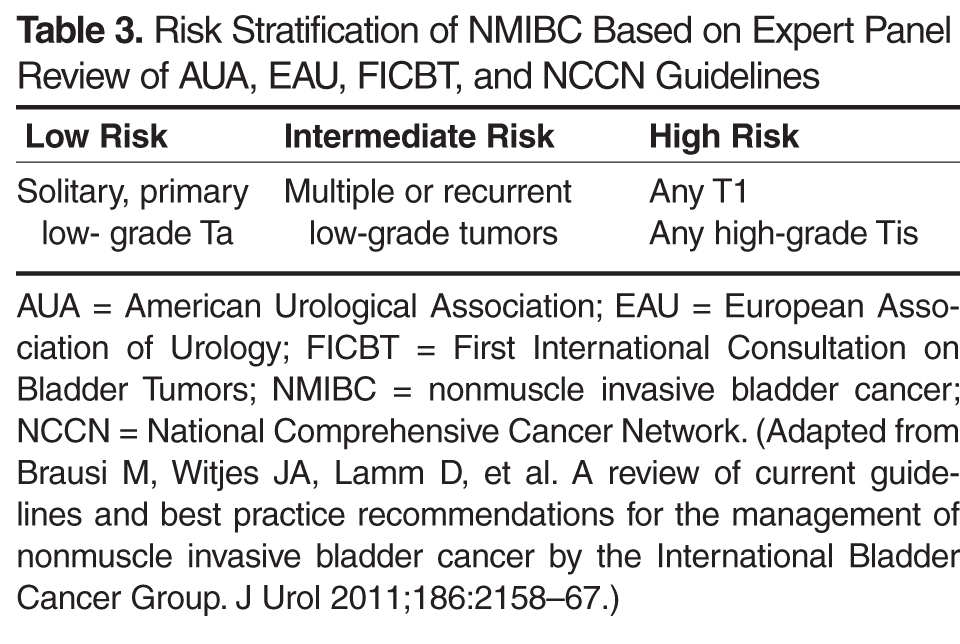
Intravesical Chemotherapy/Immunotherapy
Intravesical therapy is the use of chemotherapeutic or immunotherapeutic substances instilled within the bladder. It is indicated for the treatment of NMIBC but is not the recommended treatment for T2 or greater lesions. The goals of intravesical therapy are to reduce recurrence and progression of resected disease and eradicate carcinoma in situ as well as incompletely resected papillary tumor [42].
Intravesical chemotherapeutic agents include mitomycin C, thiotepa, doxorubicin, valrubicin, epirubicin, and gemcitabine [42]. Mitomycin C is an alkylating agent that acts by inhibiting DNA synthesis. Because of mitomycin C’s relatively high molecular weight, systemic absorption is minimal, although there is a small risk of myelosuppression. Thiotepa is an alkylating agent that cross-links nucleic acids. Doxorubicin, epirubicin, and valrubicin are intercalating agents that inhibit DNA synthesis. Gemcitabine is a deoxycytidine analog that also inhibits DNA synthesis.
Immunotherapy utilizes bacillus Calmette-Guérin (BCG), a live, attenuated strain of Mycobacterium bovis. Though the mechanism of action of BCG is not fully understood, it is known that instillation of BCG stimulates a large immune response [57]. BCG is taken up by antigen-presenting cells as well as urothelial cells and bladder cancer cells, initiating the immune response. Cytokine release in response to BCG is thought to be mediated by macrophages and activated lymphocytes as well as urothelial cells directly [58]. Recent studies have found that interleukin-17 plays an important role in neutrophil recruitment and the generation of the Th1- cell response, which mediates the antitumor effect [59,60]. The innate immune response is also felt to be important in the antitumor effect of BCG, with studies suggesting that BCG is ineffective in the absence of natural killer cell activity and that neutrophils and macrophages are important in the immune response [58,61,62].
Administration of BCG is typically held for at least 2 weeks following TURBT to minimize the risk of sepsis and adverse events. BCG also should not be used in patients who have had traumatic catheterization, recent gross hematuria, or urinary tract infection, in immunocompromised hosts, or in patients with active autoimmune disease, known allergy, or history of BCG sepsis. Adverse events associated with BCG use include sepsis, prostatitis, epididymitis, cystitis, and flu-like symptoms [63].
Interferon alpha-2b is a cytokine that helps modulate the immune response. In cases of refractory bladder cancer that have failed BCG treatment, modulation with interferon alfa-2b therapy has been investigated. In vitro studies show that administration of interferon alfa-2b enhanced the ability of BCG to induce interferon-gamma production, upregulated tumor necrosis factor-α and interleukin-12, and down-regulated interleukin-10, thus favoring the upregulation of the Th1 immune-mediated response [64]. Used in conjunction with BCG in patients who have failed BCG therapy, interferon alfa-2b has been shown to have a 2-year recurrence-free survival rate of up to 45% [65].
Immediately following TURBT, it is recommended that patients with low-risk disease undergo single-dose intravesical chemotherapy [66]. When performed within 24 hours (and ideally 6 hours) of resection, intravesical chemotherapy has been shown to decrease the odds of bladder cancer recurrence by up to 40% in low-risk disease [67].The mechanism of action of single-dose intravesical chemotherapy instilled immediately after resection is not definitively known, but it is hypothesized that it destroys any remaining microscopic disease and prevents reimplantation of any freely circulating cells [67]. Single-dose mitomycin C, however, does not decrease the rate of progression in incompletely resected tumors [68]. Administration of intravesical chemotherapeutic agents should be avoided when there is bladder perforation [69].
There is some debate regarding the best approach to treating intermediate-risk bladder cancer. In guidelines released by the International Bladder Cancer Group, a group of experts who evaluated and set forth guidelines based on current recommendations from the NCCN, AUA, European Association of Urology, and the First International Consultation on Bladder Tumors, initiation of BCG therapy with maintenance or intravesical chemotherapy for up to 1 year of adjuvant treatment is recommended following the diagnosis of intermediate-risk bladder cancer [66]. Induction treatments are single intravesical instillations administered weekly for 6 weeks and begun 2 to 4 weeks after resection. Maintenance courses consist of once weekly instillations for 3 weeks undertaken at 3 months, 6 months, and then every 6 months for up to a total of 3 years of treatment [70].
For the management of high-risk disease, most guidelines concur that the optimal treatment is BCG with maintenance, although the recommended length of maintenance varies from 1 to 3 years [66]. The EORTC-GU recently reported the results of a randomized study in which high-risk Ta and T1 lesions were treated with BCG maintenance; they found that a full-dose, 3-year maintenance course of BCG decreased recurrences without increasing toxicity [71].
Although both intravesical chemotherapy and immunotherapy are recommended treatments for NMIBC, there is a preference in the published guidelines toward the use of BCG over intravesical chemotherapy. In multiple meta-analyses, BCG, and especially BCG with maintenance, has been shown to have improved disease-free recurrence when compared with intravesical chemotherapy [72,73]. Malmström et al showed a 32% reduction in the recurrence rate in BCG-treated patients compared with those treated with mitomycin C [74]. Similarly, high-risk patients treated with gemcitabine therapy had a higher recurrence rate and more rapid time to recurrence as compared with those treated with BCG therapy; in intermediate-risk patients, the rate of recurrence was not statistically significant [75].
Cystectomy
In certain high-risk patients, it is also appropriate to offer cystectomy as initial therapy. Though much more invasive than other treatment options, it does offer a chance for cure in a select group of patients with high likelihood of progression of disease. Risk factors associated with progression and consideration for immediate or early cystectomy include large tumor size (> 3 cm), inability to completely resect tumor, difficult resection site, multifocal/ diffuse disease, presence of carcinoma in situ, prostatic urethral involvement, female sex, suspected understaging secondary to lymphovascular invasion, or unfavorable histology [76–81]. While tumor upstaging has been noted in up to one-quarter of high-risk immediate cystectomy patients, it is important to note that multiple retrospective reviews have not found a cancer-specific survival (CSS) benefit to immediate cystectomy versus conservative treatment [82–85]. Hautmann et al examined immediate cystectomy versus deferred cystectomy until after recurrence in high-risk patients and demonstrated a clear 10-year CSS benefit of 79% versus 65% [86]. Because the number of patients who have undergone immediate cystectomy is still relatively small and predictors of aggressive disease are still evolving, immediate cystectomy is still considered a viable treatment option in the appropriately selected patient.
Case Patient 2
A 72-year-old woman with a history of T1 bladder cancer presents for routine follow-up. She has completed a course of BCG with maintenance for her initial lesion. On follow-up cystoscopy, she is found to have multiple velvety red patches throughout the bladder and a 1-cm sessile lesion.
What is the follow-up for bladder cancer?
Bladder cancer causes what is known as a field defect. As urine bathes the urothelium, theoretically, so do the carcinogens within the urine, exposing cells throughout the bladder. Bladder cancer therefore does not just recur at the initial site of the tumor, but can occur anywhere in the bladder. For example, Heney et al found that initial tumors were only occasionally located at the dome (5% of the time), whereas new tumor occurrences were found at the dome in 29% of patients [87].
Though there is no consensus in the literature as to the ideal timing of cystoscopic follow-up, NCCN guidelines recommend cystoscopy every 3 months with increasing intervals as indicated for low-risk lesions [88]. For all other lesions, they recommend cystoscopy and cytology every 3 to 6 months with increasing intervals as indicated, upper tract imaging every 1 to 2 years for high-grade tumors, and the optional use of urine markers for follow-up. The AUA varies slightly in recommending cystoscopy and cytology for all patients every 3 months for 2 years, followed by every 6 months for 2 to 3 years, and then annually. They recommend imaging of the upper tracts but do not specify timing, and current recommendations do not support the use of urine markers [89].
How are recurrences/treatment failures managed?
When recurrence or treatment failure is identified, it is important to consider the initial lesion and treatment as well as stage and grade of any follow-up lesions. Low-risk disease may be treated with re-resection and BCG or mitomycin C with or without maintenance [42]. With treatment failure of intermediate disease, resection followed by a change in the modality of intravesical treatment is an option. When recurrences occur in intermediate-risk disease, one might change modalities or reinstitute a second induction therapy course after resection [66].
High-risk NMIBC provides a challenging dilemma in management. In a systematic literature review of 19 published trials, van den Bosch and Witjes [90] reported a 21% progression to muscle-invasive disease in high-risk NMIBC patients. Management of recurrences in this population in an effort to decrease progression and increase CSS is a highly debated topic, with no clear answer currently available. In the case of high-risk disease that has recurred, treatment options include a second induction course of BCG, cystectomy, or alternative intravesical chemotherapeutic options. Those patients who underwent early cystectomy for high-risk recurrence after BCG therapy had an overall greater survival compared to those who delayed cystectomy over 2 years [91]. In their study evaluating early versus delayed cystectomy, Jäger et al [92] found that as the number of TURBTs performed before cystectomy for high-risk disease went from 1 to 2–4 to greater than 4, the 10-year CSS decreased from 84% to 77% to 45%. Additionally, they found that when cystectomy was performed 1 year after initial TURBT, the 10-year CSS decreased from 79% to 61%.
In patients who have failed BCG treatment and are not surgical candidates or do not desire surgical intervention, intravesical valrubicin is emerging as a treatment alternative. It is currently the only therapy that is approved by the U.S. Food and Drug Administration for treatment of BCG-refractory carcinoma in situ in nonsurgical candidates. Dinney et al examined the efficacy and safety of valrubicin in BCG-refractory carcinoma in situ and found an 18% complete response rate over the 6-month follow-up period, which correlated with the previously reported response rates in phase II/III trials [93]. Other therapies being investigated for BCG failure include thermochemotherapy, photodynamic therapy, as well as combination intravesical chemotherapies [94].
Conclusion
Though much research is under way on the surveillance, diagnosis, and treatment of NMIBC, time-tested modalities remain the mainstay of management. Ongoing studies will improve our understanding of the disease as new information regarding novel ways of delivering intravesical therapeutics, surveillance modalities, and optimal treatment and follow-up strategies becomes available.
Corresponding author: Frank N. Burks, MD, 31157 Woodward Ave., Royal Oak, MI 48073, [email protected].
Financial disclosures: None.
1. American Cancer Society. Cancer facts & figures 2012. Accessed 2 May 2013 at www.cancer.org/research/cancerfactsfigures/cancerfactsfigures/cancer-facts-figures-2012.
2. National Cancer Institute. SEER Stat Fact Sheets: Bladder. Accessed 14 December 2012 at seer.cancer.gov/statfacts/html/urinb.html.
3. Lynch CF, Davila JA, Platz CE. Cancer of the urinary bladder. In: Ries LAG, Young JL, Keel GE, et al, editors. SEER survival monograph: cancer survival among adults: US SEER program 1988-2001, patient and tumor characteristics. NIH Pub. No. 07-6215. Bethesda (MD): National Cancer Institute; 2007:181–92.
4. Brennan P, Bogillot O, Cordier S, et al. Cigarette smoking and bladder cancer in men: a pooled analysis of 11 case-control studies. Int J Cancer 2000;86:289–94.
5. Castelao JE, Yuan JM, Skipper PL, et al. Gender and smoking-related bladder cancer risk. J Natl Cancer Inst 2001;93:538–45.
6. Freedman ND, Silverman DT, Hollenbeck AR, et al. Association between smoking and risk of bladder cancer among men and women. JAMA 2011;306:737–45.
7. World Health Organization International Agency for Research on Cancer. IARC Monographs on the Evaluation of Carcinogenic Risks to Humans, volume 83. Tobacco smoke and involuntary smoking. Lyon, France: World Health Organization; 2004. Accessed 2 May 2013 at http://monographs.iarc.fr/ENG/Monographs/vol83/index.php.
8. Chen CH, Shun CT, Huang KH, et al. Stopping smoking might reduce tumour recurrence in nonmuscle-invasive bladder cancer, BJU Int 2007;100:281–6.
9. Murta-Nascimento C, Schmitz-Dräger BJ, Zeegers MP, et al. Epidemiology of urinary bladder cancer: from tumor development to patient’s death. World J Urology 2007;25:285–95.
10. Piper JM, Tonascia J, Matanoski GM. Heavy phenacetin use and bladder cancer in women aged 20 to 49 years. N Engl J Med 1985;313:292–5.
11. Knight A, Askling J, Granath F, et al. Urinary bladder cancer in Wegener’s granulomatosis: risks and relation to cyclophosphamide. Ann Rheum Dis 2004;63:1307–11.
12. Fairchild WV, Spence CR, Solomon HD, Gangai MP. The incidence of bladder cancer after cyclophosphamide therapy. J Urology 1979; 122:163.
13. Brock N. The development of mesna for the inhibition of urotoxic side effects of cyclophosphamide, ifosfamide, and other oxazaphosphorine cytostatics. Recent Results Cancer Res 1980;74:270–8.
14. Spruck CH, Ohneseit PF, Gonzalez-Zulueta M, et al. Two molecular pathways to transitional cell carcinoma of the bladder. Cancer Res 1994;54:784–8.
15. Bakkar AA, Wallerand H, Radvanyi F, et al. FGFR3 and TP53 gene mutations define two distinct pathways in urothelial cell carcinoma of the bladder. Cancer Res 2003;63:8108–12.
16. Esrig D, Elmajian D, Groshen S, et al. Accumulation of nuclear p53 and tumor progression in bladder cancer. N Engl J Med 1994;331:1259–64.
17. Mitra AP, Datar RH, Cote RJ. Molecular pathways in invasive bladder cancer: new insights into mechanisms, progression, and target identification. J Clin Oncol 2006;24:5552–64.
18. National Cancer Institute. Bladder and other urothelial cancers screening (PDQ). January 23, 2012. Accessed 14 December 2012 at www.cancer.gov/cancertopics/pdq/screening/bladder/HealthProfessional.
19. Farrow GM, Utz DC, Rife CC, Greene LF. Clinical observations on sixty-nine cases of in situ carcinoma of the urinary bladder. Cancer Res 1977;37:2794–8.
20. Davis R, Jones J, Barocas DA, et al. Diagnosis, evaluation and follow-up of asymptomatic microhematuria (AMH) in adults: AUA guideline. J Urol 2012;188(6 Suppl):2473–81.
21. Silverman SG, Leyendecker JR, Amis ES Jr. What is the current role of CT urography and MR urography in the evaluation of the urinary tract? Radiology 2009;250:309–23.
22. Sadow CA, Silverman SG, O’Leary MP, Signorovitch JE. Bladder cancer detection with CT urography in an academic medical center. Radiology 2008;249:195–202.
23. Murphy WM, Soloway MS, Jukkola AF, et al. Urinary cytology and bladder cancer. The cellular features of transitional cell neoplasms. Cancer 1984;53:1555–65.
24. Halachmi S, Linn JF, Amiel GE, et al. Urine cytology, tumour markers and bladder cancer. Br J Urol 1998;82:647–54.
25. Koss LG, Deitch D, Ramanathan R, Sherman AB. Diagnostic value of cytology of voided urine. Acta Cytol 1985;29:810–6.
26. Yafi FA, Brimo F, Auger M, et al. Is the performance of urinary cytology as high as reported historically? A contemporary analysis in the detection and surveillance of bladder cancer. Urol Oncol 11 Feb 2013. [Epub ahead of print]
27. van Rhijn BW, van der Poel HG, van der Kwast TH. Urine markers for bladder cancer surveillance: a systematic review. Eur Urol 2005;47:736–48.
28. Vrooman OPJ, Witjes JA. Urinary markers in bladder cancer. Eur Urol 2008;53:909–16.
29. Toma MI, Friedrich MG, Hautmann SH, et al. Comparison of the ImmunoCyt test and urinary cytology with other urine tests in the detection and surveillance of bladder cancer. World J Urol 2004;22:145–9.
30. Jones JS. DNA–based molecular cytology for bladder cancer surveillance. Urology 2006;67(3 Suppl 1):35–45.
31. Glas AS, Roos D, Deutekom M, et al. Tumor markers in the diagnosis of primary bladder cancer. A systematic review. J Urol 2003;169:1975–82.
32. Sharma S, Zippe CD, Pandrangi L, et al. Exclusion criteria enhance the specificity and positive predictive value of NMP22 and BTA stat. J Urol 1999;162:53–7.
33. Fradet Y, Grossman HB, Gomella L, et al. A comparison of hexaminolevulinate fluorescence cystoscopy and white light cystoscopy for the detection of carcinoma in situ in patients with bladder cancer: a phase III, multicenter study. J Urol 2007;178:68–73.
34. Grossman HB, Gomella L, Fradet Y, et al. A phase III, multicenter comparison of hexaminolevulinate fluorescence cystoscopy and white light cystoscopy for the detection of superficial papillary lesions in patients with bladder cancer. J Urol 2007;178:62–7.
35. Schmidbauer J, Witjes F, Schmeller N, et al. Improved detection of urothelial carcinoma in situ with hexaminolevulinate fluorescence cystoscopy. J Urol 2004;171:135–8.
36. Denzinger S, Burger M, Walter B, et al. Clinically relevant reduction in risk of recurrence of superficial bladder cancer using 5-aminolevulinic acid-induced fluorescence diagnosis: 8-year results of prospective randomized study. Urology 2007;69:675–9.
37. Stenzl A, Burger M, Fradet Y, et al. Hexaminolevulinate guided fluorescence cystoscopy reduces recurrence in patients with nonmuscle invasive bladder cancer. J Urol 2010;184:
1907–14.
38. Cauberg EC, Mamoulakis C, de la Rosette JJ, de Reijke TM. Narrow band imaging-assisted transurethral resection for non-muscle invasive bladder cancer significantly reduces residual tumour rate. World J Urol 2011;29:503–9.
39. Cauberg EC, Kloen S, Visser M, et al. Narrow band imaging cystoscopy improves the detection of non–muscle-invasive bladder cancer. Urology 2010;76:658–63.
40. Herr HW, Donat SM. Reduced bladder tumour recurrence rate associated with narrow-band imaging surveillance cystoscopy. Br J Urol Intl 211;107:396–8.
41. Zaak D, Karl A, Knüchel R, et al. Diagnosis of urothelial carcinoma of the bladder using fluorescence endoscopy. Br J Urol Intl 2005;96:217–22.
42. Hall MC, Chang SS, Dalbagni G, et al. Guideline for the management of nonmuscle invasive bladder cancer (stages Ta, T1, and Tis): 2007 update. J Urol 2007;178:2314–30.
43. Herr HW. The value of a second transurethral resection in evaluating patients with bladder tumors. J Urol 1999;162:74–6.
44. Hollenbeck BK, Miller DC, Taub D, et al. Risk factors for adverse outcomes after transurethral resection of bladder tumors. Cancer 2006;106:1527–35.
45. Nieder AM, Meinbach DS, Kim SS, Soloway MS. Transurethral bladder tumor resection: intraoperative and postoperative complications in a residency setting. J Urol 2005;174:2307–9.
46. Traxer O, Pasqui F, Gattegno B, Pearle MS. Technique and complications of transurethral surgery for bladder tumours. Br J Urol Intl 2004;94:492–6.
47. Mydlo JH, Weinstein R, Shah S, et al. Long-term consequences from bladder perforation and/or violation in the presence of transitional cell carcinoma: results of a small series and a review of the literature. J Urol 1999;161:1128–32.
48. Frachet O, Cordier G, Henry N, et al. Bladder perforation during transurethral resection of bladder tumour: a review. Prog Urol 2007;17:1310–2.
49. Golan S, Baniel J, Lask D, et al. Transurethral resection of bladder tumour complicated by perforation requiring open surgical repair - clinical characteristics and oncological outcomes. Br J Urol Intl 2011; 107:1065–8.
50. Kihl B, Nilson AE, Pettersson S. Thigh adductor contraction during transurethral resection of bladder tumours: evaluation of inactive electrode placement and obturator nerve topography. Scand J Urol Nephrol 1981;15:121–5.
51. Del Rosso A, Pace G, Masciovecchio S, et al. Plasmakinetic bipolar versus monopolar transurethral resection of non-muscle invasive bladder cancer: a single center randomized controlled trial. Intl J Urol 2013;20:399–403.
52. Puppo P, Bertolotto F, Introini C, et al. Bipolar transurethral resection in saline (TURis): outcome and complication rates after the first 1000 cases. J Endourol 2009;23:1145–9.
53. Kitamura T, Mori Y, Ohno N, et al. Case of bladder perforation due to the obturator nerve reflex during transurethral resection (TUR) of bladder tumor using the TUR in saline (Turis) system under spinal anesthesia [in Japanese]. Masui 2010;59:386–9.
54. American Joint Committee on Cancer.: Urinary bladder. In: Edge SB, Byrd DR, Compton CC, et al, editors. AJCC Cancer Staging Manual. 7th ed. New York: Springer, 2010:497–505.
55. Elbe J, Sauter G, Epstein J, Sesterhenn I. World Health Organization classification of tumours: pathology and genetics of tumours of the urinary and male genital organs. Lyon, France: IARC Press;2004.
56. Millan-Rodriguez F, Chechile-Toniolo G, Salvador-Bayarri J, et al. Primary superficial bladder cancer risk groups according to progression, mortality and recurrence. J Urol 2000;164:680–4.
57. Böhle A, Brandau S. Immune mechanisms in bacillus Calmette-Guérin immunotherapy for superficial bladder cancer. J Urol 2003;170964–9.
58. Kawai K, Miyazaki J, Joraku A, et al. Bacillus Calmette-Guérin (BCG) immunotherapy for bladder cancer: current understanding and perspectives on engineered BCG vaccine. Cancer Sci 2013;104:22–7.
59. Takeuchi A, Dejima T, Yamada H, et al. IL-17 production by γδ T cells is important for the antitumor effect of Mycobacterium bovis bacillus Calmette-Guérin treatment against bladder cancer. Eur J Immunol 2011;41:246–51.
60. Gopal R, Lin Y, Obermajer N, et al. IL-23-dependent IL-17 drives Th1-cell responses following Mycobacterium bovis BCG vaccination. Eur J Immunol 2012;42:364–73.
61. Suttmann H, Jacobsen M, Reiss K, et al. Mechanisms of bacillus Calmette-Guerin mediated natural killer cell activation. J Urol 2004;172:1490–5.
62. Luo Y, Knudson MJ. Mycobacterium bovis bacillus Calmette-Guérin-induced macrophage cytotoxicity against bladder cancer cells. Clin Dev Immunol 2010;2010:357591.
63. Rischmann P, Desgrandchamps F, Malavaud B, Chopin DK. BCG intravesical instillations: recommendations for side-effects management. Eur Urol 2000;37(Suppl 1):33–6.
64. Luo Y, Chen X, Downs TM, et al. IFN-α 2B enhances Th1 cytokine responses in bladder cancer patients receiving Mycobacterium bovis bacillus Calmette-Guérin immunotherapy. J Immnuol 1999;162:2399–2405.
65. Joudi FN, Smith BJ, O’Donnell MA. Final results from a national multicenter phase II trial of combination bacillus Calmette-Guérin plus interferon α-2B for reducing recurrence of superficial bladder cancer. Urol Oncol 2006;24:344–8.
66. Brausi M, Witjes JA, Lamm D, et al. A review of current guidelines and best practice recommendations for the management of nonmuscle invasive bladder cancer by the International Bladder Cancer Group. J Urol 2011;186:2158–67.
67. Sylvester RJ, Oosterlinck W, van der Meijden AP. A single immediate postoperative instillation of chemotherapy decreases the risk of recurrence in patients with stage Ta T1 bladder cancer: a meta-analysis of published results of randomized clinical trials. J Urol 2004;171:2186–90.
68. Divrik RT, Yildirim U, Zorlu F, Ozen H. The effect of repeat transurethral resection on recurrence and progression rates in patients with T1 tumors of the bladder who received intravesical mitomycin: a prospective, randomized clinical trial. J Urol 2006;175:1641–4.
69. Oddens JR, Van der Meijden AP, Sylvester R. One immediate postoperative instillation of chemotherapy in low risk Ta, T1 bladder cancer patients. Is it always safe? Eur Urol 2004;46:336–8.
70. Lamm DL, Blumenstein BA, Crissman JD, et al. Maintenance bacillus Calmette-Guerin immunotherapy for recurrent TA, T1 and carcinoma in situ transitional cell carcinoma of the bladder: a randomized Southwest Oncology Group Study. J Urol 2000;163:1124–9.
71. Oddens J, Brausi M, Sylvester R, et al. Final results of an EORTC-GU cancers group randomized study of maintenance bacillus Calmette-Guérin in intermediate- and high-risk Ta, T1 papillary carcinoma of the urinary bladder: one-third dose versus full dose and 1 year versus 3 years of maintenance. Eur Urol 2013;63:462–72.
72. Böhle A, Jocham D, Bock PR. Intravesical bacillus Calmette-Guerin versus mitomycin C for superficial bladder cancer: a formal meta-analysis of comparative studies on recurrence and toxicity. J Urol 2003;169:90–5.
73. Sylvester RJ, van der Meijden AP, Witjes JA, Kurth J. Bacillus calmette-guerin versus chemotherapy for the intravesical treatment of patients with carcinoma in situ of the bladder: a meta-analysis of the published results of randomized clinical trials. J Urol 2005;174:86–91.
74. Malmström PU, Sylvester RJ, Crawford DE, et al. An individual patient data meta-analysis of the long-term outcome of randomised studies comparing intravesical mitomycin C versus bacillus Calmette-Guérin for non-muscle-invasive bladder cancer. Eur Urol 2009;56:247–56.
75. Jones G, Cleves A, Wilt TJ, et al. Intravesical gemcitabine for non-muscle invasive bladder cancer. Cochrane Database Syst Rev 2012;CD009294.
76. Kurth H, Denis L, Bouffioux C, et al. Factors affecting recurrence and progression in superficial bladder tumours. Eur J Cancer 1995;31A:1840–6.
77. Sylvester RJ, van der Meijden AP, Oosterlinck W, et al. Predicting recurrence and progression in individual patients with stage Ta T1 bladder cancer using EORTC risk tables: a combined analysis of 2596 patients from seven EORTC trials. Eur Urol 2006;49:465–66.
78. Rodríguez Faba O, Palou J. Predictive factors for recurrence progression and cancer specific survival in high-risk bladder cancer. Curr Opin Urol 2012;22:415–20.
79. Streeper NM, Simons CM, Konety BR, et al. The significance of lymphovascular invasion in transurethral resection of bladder tumour and cystectomy specimens on the survival of patients with urothelial bladder cancer. Br J Urol Intl 2009;103:475–9.
80. Witjes JA. Prognosis of T1G3 bladder cancer: how well can we predict progression? Eur Urol 2012; 62:126–7.
81. Khochikar M. Early vs delayed radical cystectomy for ‘high-risk’ carcinoma not invading bladder muscle: delay of cystectomy reduces cancer-specific survival. Br J Urol Intl 2011;108(Pt 2):E288–9.
82. De Berardinis E, Busetto GM, Antonini G, et al. T1G3 high-risk NMIBC (non-muscle invasive bladder cancer): conservative treatment versus immediate cystectomy. Intl Urol Nephrol 2011;43:1047–57.
83. Badalato GM, Gaya JM, Hruby G, et al. Immediate radical cystectomy vs conservative management for high grade cT1 bladder cancer: is there a survival difference? Br J Urol Intl 2012;110:1471–7.
84. Sternberg IA, Keren Paz GE, Chen LY, et al. Role of immediate radical cystectomy in the treatment of patients with residual T1 bladder cancer on restaging transurethral resection. BJU Intl 2012;112:54–9.
85. Canter D, Egleston B, Wong YN, et al. Use of radical cystectomy as initial therapy for the treatment of high-grade T1 urothelial carcinoma of the bladder: A SEER database analysis. Urol Oncol 2013;31:866–70.
86. Hautmann RE, Volkmer BG, Gust K. Quantification of the survival benefit of early versus deferred cystectomy in high-risk non-muscle invasive bladder cancer (T1 G3). World J Urol 2009;27:347–51.
87. Heney NM, Nocks BN, Daly JJ, et al. Ta and T1 Bladder cancer: location, recurrence and progression. Br J Urol 2008;54:152–7.
88. National Comprehensive Cancer Network clinical practice guidelines in oncology (NCCN Guidelines): Bladder cancer. Jenkintown (PA): NCCN; 2012.
89. Hall MC, Chang SS, Dalbagni G, et al. Guideline for the management of nonmuscle invasive bladder cancer (stages Ta, T1 and Tis): a 2007 update. J Urol 2007;178:2314–30.
90. van den Bosch S, Witjes JA. Long-term cancer-specific survival in patients with high-risk, non-muscle-invasive bladder cancer and tumour progression: a systematic review. Eur Urol 2011;60:493–500.
91. Herr HW, Sogani PC. Does early cystectomy improve the survival of patients with high risk superficial bladder tumors? J Urol 2001;166:1296–9.
92. Jäger W, Thomas C, Haag S, et al. Early vs delayed radical cystectomy for ‘high-risk’ carcinoma not invading bladder muscle: delay of cystectomy reduces cancer-specific survival. BJU Int; 2011;108(Pt 2):E284–8.
93. Dinney CP, Greenberg RE, Steinberg GD. Intravesical valrubicin in patients with bladder carcinoma in situ and contraindication to or failure after bacillus Calmette-Guérin. Urol Oncol 2012 May 9. [Epub ahead of print]
94. Yates DR, Rouprêt M. Contemporary management of patients with high-risk non-muscle-invasive bladder cancer who fail intravesical BCG therapy. World J Urol 2011;29:415–22.
From the William Beaumont Hospital, Royal Oak, MI.
Abstract
- Objective: To review the diagnosis and management of noninvasive bladder cancer.
- Methods: Literature review.
- Results: Nonmuscle invasive bladder cancer is a common malignancy that affects more men than women. It is estimated that smoking accounts for half of all cases. Direct visualization of the bladder mucosa remains the standard in diagnosing bladder malignancy. The natural history of superficial bladder cancer is characterized by disease recurrence and disease progression. First-line treatment of patients with noninvasive bladder cancer is transurethral resection of bladder tumor. Adjuvant treatment with intravesical chemotherapy and immunotherapy has become an important component of therapy.
- Conclusion: The results of ongoing studies are eagerly anticipated and will improve our understanding of the disease.
Nonmuscle invasive bladder cancer is a common malignancy and the second most common urologic malignancy after prostate cancer. It accounts for approximately 73,500 new cancer diagnoses yearly in the United States [1]. An estimated 14,880 persons die each year as a result of the disease. Despite improvements in diagnosis and management of noninvasive bladder tumors, the risk of both recurrence and progression remains significant. In this article, we review the etiology, diagnosis, and management of noninvasive bladder cancer.
Epidemiology And Risk Factors
Bladder cancer affects men more commonly than women, with an approximate 3 to 4:1 ratio [1,2].The incidence in men over the past 8 years has been stable, and the incidence in women has decreased by 0.3% over the same time period. Bladder cancer affects Caucasians twice as often as African Americans, and affects Hispanics and Asians even less frequently than African Americans [2]. More than 90% of patients diagnosed with bladder cancer will be older than 55 years of age.
Histologically, urothelial (transitional cell) carcinoma accounts for over 90% of all diagnosed bladder cancers [3].Other subtypes in order of prevalence include squamous cell carcinoma, adenocarcinoma, and small cell carcinomas. Of those diagnosed with urothelial carcinoma, nonmuscle invasive (superficial) bladder cancer (NMIBC) accounts for almost 75% of cases [2]. Muscle invasion is seen in 20% of newly diagnosed cases, and metastatic disease is seen approximately 5% of the time.
It is estimated that smoking accounts for half of all cases of bladder cancer, with smokers having a 2- to 6-fold greater risk of bladder cancer as compared with nonsmokers [4–6]. At 25 years after smoking cessation, the risk of bladder cancer continues to decrease but is still higher than that of nonsmokers [7]. Continued smoking despite the diagnosis of urothelial carcinoma increases the risk of recurrence 2.2-fold [8].
Environmental exposures also have been linked to the development of urothelial carcinoma, particularly exposure to aromatic amines [9]. Occupations associated with an increased risk of bladder cancer include tire/rubber workers, leather workers, textile workers, hairdressers, painters, dry cleaners, and chemical workers.
Exposure to certain medications has been associated with an increased risk of bladder cancer, including the analgesic phenacetin, which has since been taken off the market [10]. Additionally, patients treated with the chemotherapeutic agent cyclophosphamide have a higher risk of bladder cancer, with a dose-response relationship between cyclophosphamide and the risk for bladder cancer [11,12]. The increased risk of bladder cancer and risk of hemorrhagic cystitis associated with cyclophosphamide therapy is secondary to exposure to the urinary metabolite acrolein. Concomitant administration of sodium 2-mercaptoethanesulfonate (MESNA) provides regional detoxification of acrolein in the urinary tract [13].
Urothelial carcinoma does not have a strong inherited disease association. It is felt, however, that there are 2 separate molecular pathways that may lead to the development of bladder cancer [14]. Mutation of the p53 gene has been shown to be associated with carcinoma in situ and invasive disease, whereas mutation of FGFR3 is seen more frequently with Ta disease [15]. Accumulation of p53 in cell nuclei is an independent predictor of tumor recurrence and overall poor prognosis [16]. The identification of molecular markers of tumor progression is an active field of research in bladder cancer [17].
Case Patient 1
Initial Presentation and Evaluation
A 63-year-old man with a 60 pack-year history of smoking presents to a urologist with a urinalysis from his primary care physician showing 20 to 50 red blood cells per high-power field (RBCs/HPF). He denies any urgency, frequency, or recent urinary tract infections. A urine culture from his primary care doctor is negative.
What are the common presenting features of bladder cancer?
Hematuria is the most common presenting feature of bladder cancer. It is present as the initial symptom in up to 90% of patients with urothelial carcinoma [18]. Other symptoms include irritative voiding symptoms such as urgency, frequency, and dysuria. Irritative voiding symptoms tend to occur more commonly with carcinoma in situ [19].
What are the next steps in the workup of this patient?
Initial Evaluation
American Urological Association (AUA) guidelines for the evaluation and management of asymptomatic microhematuria were updated in 2011 [20]. They recommend that every patient who presents with microscopic hematuria (> 3 RBCs/HPF) undergo a thorough history and physical exam, including rectal exam and bimanual evaluation in females to assess for any masses or pelvic fixation. Once benign sources of hematuria (eg, infection, menstruation, vigorous exercise, medical renal disease, viral illness, trauma, or recent urological procedures) have been ruled out, further testing will include a renal function panel, upper tract imaging, as well as cystoscopy in high-risk patients and those older than age 35 years. Urine cytology may be utilized in high-risk patients, but it is no longer generally recommended for routine workup.
Imaging
The imaging modality of choice during the hematuria workup is the computed tomography urogram (CTU), a multiphasic CT scan that images the urinary tract before and after contrast administration and includes excretory stage imaging [21]. Sadow et al found that CTU had a negative predictive value (NPV) of 95% for the detection of bladder cancer, while cystoscopy had an NPV of 99% [22]. In addition to radiographic evaluation of the urinary system, CT offers useful staging information regarding metastatic disease. In patients with renal failure or other contraindications to CTU, magnetic resonance urography (MRU) has become an acceptable alternative for hematuria evaluation. MRU allows for improved characterization of tissue and does not utilize ionizing radiation. During MRU, the high T2 signal intensity of urine is utilized to provide contrast in the images in static phase MRU and after gadolinium administration for excretory-phase MRU [21]. The bladder is typically best evaluated in T1-weighted images a few minutes after gadolinium administration, before the contrast reaches the bladder; it may also be evaluated during the late excretory phase when signal enhancement from gadolinium is greatest. The effectiveness of MRU in collecting system evaluation is still evolving, and therefore, in appropriately selected patients who would benefit from further collecting system evaluation, MRU should be utilized in conjunction with retrograde pyelograms [20]. Though previously considered the gold standard in imaging, intravenous pyelography is no longer a recommended imaging modality for hematuria evaluation.
Urine Cytology and Urine Markers
Urine markers and urine cytology are a debated topic in the workup and follow-up of bladder cancer. Urine cytology evaluates sloughed cells for malignant features [23]. Due to the lack of cohesion of carcinoma in situ cells and high-grade lesions, these cells are more likely to slough than are low-grade lesions [24]. The range of sensitivity of urine cytology reported in the literature varies widely. Studies report that the sensitivity of urine cytology in high-grade tumors approaches 95%, and in carcinoma in situ is up to 100% when 3 consecutive specimens are obtained [25]. However, Yafi et al recently reported that the sensitivity of urine cytology in high-grade tumors is 51% and in low-grade tumors is only 10% [26]. It is recommended that urine cytology be evaluated as part of a hematuria work-up in high-risk patients.
Aside from cytology, more than a dozen urine marker tests for bladder cancer detection and surveillance have been developed [27]. Current urine markers tests include protein-based assays such as the nuclear matrix protein 22 (NMP22) assay (NMP22 Test Kit; Alere, Waltham, MA) and bladder tumor antigen assays (BTA stat and BTA-TRAK; Polymedco, Cortlandt, NY) as well as cellular marker tests such as UroVysion FISH (Abbott Molecular, Abbott Park, IL) and ImmunoCyt (Scimedx, Denville, NJ) [27–31]. NMP22 is a nuclear matrix protein that is elevated in bladder cancer patients, and BTA stat/TRAK (qualitative/quantitative) detects complement factor H. Much controversy surrounds the utilization of these markers for screening and monitoring of bladder cancer, and currently they are not routinely recommended for these purposes nor are they recommended for follow-up in patients with bowel interposition [32].
Cystoscopy
Ultimately, direct visualization of the bladder mucosa remains a gold standard in diagnosing bladder malignancy. Office-based cystoscopy allows for rapid assessment and also allows biopsy to be performed for suspicious lesions. It can be performed easily with local anesthetic.
The use of fluorescence and narrow-band cystoscopy has been evaluated in recent years. The premise of fluorescence cystoscopy is that there is preferential accumulation of porphyrin in neoplastic cells. Therefore, intravesically instilled photoactive heme precursors such as 5-aminolevulinic acid (5-ALA) or hexaminolevulinate (HAL) have increased uptake within these neoplastic cells and subsequent enhancement. Preliminary studies have shown that approximately one quarter to one third more cases of small papillary tumors and carcinoma in situ are identified using fluorescence cystoscopy as compared with standard white light cystoscopy [33–36]. In one prospective study, the use of fluorescence cystoscopy resulted in a 16% decrease in the recurrence rate [37]. Denzinger et al found that 8-year recurrence-free survival in those who underwent fluorescence transurethral resection (TUR) was 71% as compared with 45% in conventional TUR patients [36]. Caution is required, however, because false-positives may occur in patients with inflammatory lesions.
Narrow-band cystoscopy works by filtering white light into bandwidths of 415 and 540 nm, wavelengths absorbed by hemoglobin. This allows for added contrast between vascular structures and normal urothelium [38]. Narrow-band imaging has an advantage over fluorescence cystoscopy in that no preoperative intravesical instillations are required. Detection rates of NMIBC were as high as 94.7% with narrow-band imaging, as compared to 79.2% with white light cystoscopy [39]. In the case of recurrent low-grade papillary lesions, resection with narrow-band imaging reduces recurrence rates by approximately 30% when patients are followed for 3 years [40]. While both fluorescence cystoscopy and narrow-band imaging appear to be promising technology, higher false-positive rates are seen with both as compared to white light cystoscopy [3,41]. Neither modality is a recommended treatment option [42].
Case 1 Continued
On office-based cystoscopy, a 2.5-cm papillary lesion is noted on the left lateral wall of the bladder. There are no other suspicious lesions within the bladder. A CTU is obtained, which reveals no hydronephrosis or lymphadenopathy and correlates with the cystoscopic examination of a bladder lesion on the left lateral wall.
What are the next steps in management?
Transurethral Resection
Transurethral resection of bladder tumor (TURBT) is paramount in the treatment and diagnosis of bladder tumors. TURBT allows for complete resection of the tumor and also allows for histologic diagnosis, staging, and grading. The bladder wall consists of 3 principle layers: the mucosa, submucosa, and muscularis. An important factor in identifying the stage of disease is determining the depth of invasion as well as the size and mobility of masses. Adequate resection, with inclusion of muscle in the TURBT specimen, allows for proper staging of urothelial carcinoma. When pathology reveals high-grade Ta or T1 disease or does not contain muscle, re-resection is recommended [42]. In a study involving 150 patients with bladder tumors, when re-resection was undertaken within 2 to 6 weeks, 29% of NMIBC lesions were upstaged, and treatment options were changed based on re-resection results in one third of patients [43].
TURBT is a relatively safe procedure that can be performed in an outpatient setting. The most common complications of TURBT are urinary tract infection and hematuria [44]. Other complications include the risk of bladder perforation with deep resection. In the event of bladder perforation, it is important to determine the location and depth of the perforation to decide on appropriate treatment. Many small extraperitoneal perforations may be managed with simple Foley drainage, whereas large perforations may require open or laparoscopic repair [45–46]. The incidence of extravesical recurrence of NMIBC after bladder perforation varies in the literature from 0% to 6% [47]. Numerous studies report open bladder repair following any intraperitoneal perforation, but laparoscopic repair is becoming more common [48,49].In any case of intraperitoneal rupture, the recommendation is for close follow-up for the rare event of recurrence.
While performing TURBT, one must be cognizant of the obturator nerve reflex. The obturator nerve runs in close proximity to the inferolateral wall of the bladder. Stimulation from the electrocautery current will cause external rotation and adduction of the thigh in a sudden jerking movement, thus increasing the risk of bladder perforation [50]. Bipolar technology has been found to be a safe alternative to conventional monopolar electrocautery for resection of bladder tumors, with decreased length of catheterization and fewer bladder perforations documented [51]. While bipolar technology may decrease stimulation of the obturator reflex, it is important to note that it still may occur, resulting in bladder perforation [52.53].
Staging, Grading, and Risk Stratification
In 2004 the World Health Organization revised the classification of urothelial malignancies to include tumors designated as either high- or low-grade as well as carcinoma in situ [55]. The differentiation of low- and high-grade is based on the degree of nuclear anaplasia and architectural abnormalities. Those with high-grade tumors as well as increased depth of invasion have an increased risk of recurrence and progression of disease compared to low-grade tumors [56].
When determining treatment and surveillance options for NMIBC patients, not only are the stage and grade determining factors, but future risk of recurrence and progression dictates
Intravesical Chemotherapy/Immunotherapy
Intravesical therapy is the use of chemotherapeutic or immunotherapeutic substances instilled within the bladder. It is indicated for the treatment of NMIBC but is not the recommended treatment for T2 or greater lesions. The goals of intravesical therapy are to reduce recurrence and progression of resected disease and eradicate carcinoma in situ as well as incompletely resected papillary tumor [42].
Intravesical chemotherapeutic agents include mitomycin C, thiotepa, doxorubicin, valrubicin, epirubicin, and gemcitabine [42]. Mitomycin C is an alkylating agent that acts by inhibiting DNA synthesis. Because of mitomycin C’s relatively high molecular weight, systemic absorption is minimal, although there is a small risk of myelosuppression. Thiotepa is an alkylating agent that cross-links nucleic acids. Doxorubicin, epirubicin, and valrubicin are intercalating agents that inhibit DNA synthesis. Gemcitabine is a deoxycytidine analog that also inhibits DNA synthesis.
Immunotherapy utilizes bacillus Calmette-Guérin (BCG), a live, attenuated strain of Mycobacterium bovis. Though the mechanism of action of BCG is not fully understood, it is known that instillation of BCG stimulates a large immune response [57]. BCG is taken up by antigen-presenting cells as well as urothelial cells and bladder cancer cells, initiating the immune response. Cytokine release in response to BCG is thought to be mediated by macrophages and activated lymphocytes as well as urothelial cells directly [58]. Recent studies have found that interleukin-17 plays an important role in neutrophil recruitment and the generation of the Th1- cell response, which mediates the antitumor effect [59,60]. The innate immune response is also felt to be important in the antitumor effect of BCG, with studies suggesting that BCG is ineffective in the absence of natural killer cell activity and that neutrophils and macrophages are important in the immune response [58,61,62].
Administration of BCG is typically held for at least 2 weeks following TURBT to minimize the risk of sepsis and adverse events. BCG also should not be used in patients who have had traumatic catheterization, recent gross hematuria, or urinary tract infection, in immunocompromised hosts, or in patients with active autoimmune disease, known allergy, or history of BCG sepsis. Adverse events associated with BCG use include sepsis, prostatitis, epididymitis, cystitis, and flu-like symptoms [63].
Interferon alpha-2b is a cytokine that helps modulate the immune response. In cases of refractory bladder cancer that have failed BCG treatment, modulation with interferon alfa-2b therapy has been investigated. In vitro studies show that administration of interferon alfa-2b enhanced the ability of BCG to induce interferon-gamma production, upregulated tumor necrosis factor-α and interleukin-12, and down-regulated interleukin-10, thus favoring the upregulation of the Th1 immune-mediated response [64]. Used in conjunction with BCG in patients who have failed BCG therapy, interferon alfa-2b has been shown to have a 2-year recurrence-free survival rate of up to 45% [65].
Immediately following TURBT, it is recommended that patients with low-risk disease undergo single-dose intravesical chemotherapy [66]. When performed within 24 hours (and ideally 6 hours) of resection, intravesical chemotherapy has been shown to decrease the odds of bladder cancer recurrence by up to 40% in low-risk disease [67].The mechanism of action of single-dose intravesical chemotherapy instilled immediately after resection is not definitively known, but it is hypothesized that it destroys any remaining microscopic disease and prevents reimplantation of any freely circulating cells [67]. Single-dose mitomycin C, however, does not decrease the rate of progression in incompletely resected tumors [68]. Administration of intravesical chemotherapeutic agents should be avoided when there is bladder perforation [69].
There is some debate regarding the best approach to treating intermediate-risk bladder cancer. In guidelines released by the International Bladder Cancer Group, a group of experts who evaluated and set forth guidelines based on current recommendations from the NCCN, AUA, European Association of Urology, and the First International Consultation on Bladder Tumors, initiation of BCG therapy with maintenance or intravesical chemotherapy for up to 1 year of adjuvant treatment is recommended following the diagnosis of intermediate-risk bladder cancer [66]. Induction treatments are single intravesical instillations administered weekly for 6 weeks and begun 2 to 4 weeks after resection. Maintenance courses consist of once weekly instillations for 3 weeks undertaken at 3 months, 6 months, and then every 6 months for up to a total of 3 years of treatment [70].
For the management of high-risk disease, most guidelines concur that the optimal treatment is BCG with maintenance, although the recommended length of maintenance varies from 1 to 3 years [66]. The EORTC-GU recently reported the results of a randomized study in which high-risk Ta and T1 lesions were treated with BCG maintenance; they found that a full-dose, 3-year maintenance course of BCG decreased recurrences without increasing toxicity [71].
Although both intravesical chemotherapy and immunotherapy are recommended treatments for NMIBC, there is a preference in the published guidelines toward the use of BCG over intravesical chemotherapy. In multiple meta-analyses, BCG, and especially BCG with maintenance, has been shown to have improved disease-free recurrence when compared with intravesical chemotherapy [72,73]. Malmström et al showed a 32% reduction in the recurrence rate in BCG-treated patients compared with those treated with mitomycin C [74]. Similarly, high-risk patients treated with gemcitabine therapy had a higher recurrence rate and more rapid time to recurrence as compared with those treated with BCG therapy; in intermediate-risk patients, the rate of recurrence was not statistically significant [75].
Cystectomy
In certain high-risk patients, it is also appropriate to offer cystectomy as initial therapy. Though much more invasive than other treatment options, it does offer a chance for cure in a select group of patients with high likelihood of progression of disease. Risk factors associated with progression and consideration for immediate or early cystectomy include large tumor size (> 3 cm), inability to completely resect tumor, difficult resection site, multifocal/ diffuse disease, presence of carcinoma in situ, prostatic urethral involvement, female sex, suspected understaging secondary to lymphovascular invasion, or unfavorable histology [76–81]. While tumor upstaging has been noted in up to one-quarter of high-risk immediate cystectomy patients, it is important to note that multiple retrospective reviews have not found a cancer-specific survival (CSS) benefit to immediate cystectomy versus conservative treatment [82–85]. Hautmann et al examined immediate cystectomy versus deferred cystectomy until after recurrence in high-risk patients and demonstrated a clear 10-year CSS benefit of 79% versus 65% [86]. Because the number of patients who have undergone immediate cystectomy is still relatively small and predictors of aggressive disease are still evolving, immediate cystectomy is still considered a viable treatment option in the appropriately selected patient.
Case Patient 2
A 72-year-old woman with a history of T1 bladder cancer presents for routine follow-up. She has completed a course of BCG with maintenance for her initial lesion. On follow-up cystoscopy, she is found to have multiple velvety red patches throughout the bladder and a 1-cm sessile lesion.
What is the follow-up for bladder cancer?
Bladder cancer causes what is known as a field defect. As urine bathes the urothelium, theoretically, so do the carcinogens within the urine, exposing cells throughout the bladder. Bladder cancer therefore does not just recur at the initial site of the tumor, but can occur anywhere in the bladder. For example, Heney et al found that initial tumors were only occasionally located at the dome (5% of the time), whereas new tumor occurrences were found at the dome in 29% of patients [87].
Though there is no consensus in the literature as to the ideal timing of cystoscopic follow-up, NCCN guidelines recommend cystoscopy every 3 months with increasing intervals as indicated for low-risk lesions [88]. For all other lesions, they recommend cystoscopy and cytology every 3 to 6 months with increasing intervals as indicated, upper tract imaging every 1 to 2 years for high-grade tumors, and the optional use of urine markers for follow-up. The AUA varies slightly in recommending cystoscopy and cytology for all patients every 3 months for 2 years, followed by every 6 months for 2 to 3 years, and then annually. They recommend imaging of the upper tracts but do not specify timing, and current recommendations do not support the use of urine markers [89].
How are recurrences/treatment failures managed?
When recurrence or treatment failure is identified, it is important to consider the initial lesion and treatment as well as stage and grade of any follow-up lesions. Low-risk disease may be treated with re-resection and BCG or mitomycin C with or without maintenance [42]. With treatment failure of intermediate disease, resection followed by a change in the modality of intravesical treatment is an option. When recurrences occur in intermediate-risk disease, one might change modalities or reinstitute a second induction therapy course after resection [66].
High-risk NMIBC provides a challenging dilemma in management. In a systematic literature review of 19 published trials, van den Bosch and Witjes [90] reported a 21% progression to muscle-invasive disease in high-risk NMIBC patients. Management of recurrences in this population in an effort to decrease progression and increase CSS is a highly debated topic, with no clear answer currently available. In the case of high-risk disease that has recurred, treatment options include a second induction course of BCG, cystectomy, or alternative intravesical chemotherapeutic options. Those patients who underwent early cystectomy for high-risk recurrence after BCG therapy had an overall greater survival compared to those who delayed cystectomy over 2 years [91]. In their study evaluating early versus delayed cystectomy, Jäger et al [92] found that as the number of TURBTs performed before cystectomy for high-risk disease went from 1 to 2–4 to greater than 4, the 10-year CSS decreased from 84% to 77% to 45%. Additionally, they found that when cystectomy was performed 1 year after initial TURBT, the 10-year CSS decreased from 79% to 61%.
In patients who have failed BCG treatment and are not surgical candidates or do not desire surgical intervention, intravesical valrubicin is emerging as a treatment alternative. It is currently the only therapy that is approved by the U.S. Food and Drug Administration for treatment of BCG-refractory carcinoma in situ in nonsurgical candidates. Dinney et al examined the efficacy and safety of valrubicin in BCG-refractory carcinoma in situ and found an 18% complete response rate over the 6-month follow-up period, which correlated with the previously reported response rates in phase II/III trials [93]. Other therapies being investigated for BCG failure include thermochemotherapy, photodynamic therapy, as well as combination intravesical chemotherapies [94].
Conclusion
Though much research is under way on the surveillance, diagnosis, and treatment of NMIBC, time-tested modalities remain the mainstay of management. Ongoing studies will improve our understanding of the disease as new information regarding novel ways of delivering intravesical therapeutics, surveillance modalities, and optimal treatment and follow-up strategies becomes available.
Corresponding author: Frank N. Burks, MD, 31157 Woodward Ave., Royal Oak, MI 48073, [email protected].
Financial disclosures: None.
From the William Beaumont Hospital, Royal Oak, MI.
Abstract
- Objective: To review the diagnosis and management of noninvasive bladder cancer.
- Methods: Literature review.
- Results: Nonmuscle invasive bladder cancer is a common malignancy that affects more men than women. It is estimated that smoking accounts for half of all cases. Direct visualization of the bladder mucosa remains the standard in diagnosing bladder malignancy. The natural history of superficial bladder cancer is characterized by disease recurrence and disease progression. First-line treatment of patients with noninvasive bladder cancer is transurethral resection of bladder tumor. Adjuvant treatment with intravesical chemotherapy and immunotherapy has become an important component of therapy.
- Conclusion: The results of ongoing studies are eagerly anticipated and will improve our understanding of the disease.
Nonmuscle invasive bladder cancer is a common malignancy and the second most common urologic malignancy after prostate cancer. It accounts for approximately 73,500 new cancer diagnoses yearly in the United States [1]. An estimated 14,880 persons die each year as a result of the disease. Despite improvements in diagnosis and management of noninvasive bladder tumors, the risk of both recurrence and progression remains significant. In this article, we review the etiology, diagnosis, and management of noninvasive bladder cancer.
Epidemiology And Risk Factors
Bladder cancer affects men more commonly than women, with an approximate 3 to 4:1 ratio [1,2].The incidence in men over the past 8 years has been stable, and the incidence in women has decreased by 0.3% over the same time period. Bladder cancer affects Caucasians twice as often as African Americans, and affects Hispanics and Asians even less frequently than African Americans [2]. More than 90% of patients diagnosed with bladder cancer will be older than 55 years of age.
Histologically, urothelial (transitional cell) carcinoma accounts for over 90% of all diagnosed bladder cancers [3].Other subtypes in order of prevalence include squamous cell carcinoma, adenocarcinoma, and small cell carcinomas. Of those diagnosed with urothelial carcinoma, nonmuscle invasive (superficial) bladder cancer (NMIBC) accounts for almost 75% of cases [2]. Muscle invasion is seen in 20% of newly diagnosed cases, and metastatic disease is seen approximately 5% of the time.
It is estimated that smoking accounts for half of all cases of bladder cancer, with smokers having a 2- to 6-fold greater risk of bladder cancer as compared with nonsmokers [4–6]. At 25 years after smoking cessation, the risk of bladder cancer continues to decrease but is still higher than that of nonsmokers [7]. Continued smoking despite the diagnosis of urothelial carcinoma increases the risk of recurrence 2.2-fold [8].
Environmental exposures also have been linked to the development of urothelial carcinoma, particularly exposure to aromatic amines [9]. Occupations associated with an increased risk of bladder cancer include tire/rubber workers, leather workers, textile workers, hairdressers, painters, dry cleaners, and chemical workers.
Exposure to certain medications has been associated with an increased risk of bladder cancer, including the analgesic phenacetin, which has since been taken off the market [10]. Additionally, patients treated with the chemotherapeutic agent cyclophosphamide have a higher risk of bladder cancer, with a dose-response relationship between cyclophosphamide and the risk for bladder cancer [11,12]. The increased risk of bladder cancer and risk of hemorrhagic cystitis associated with cyclophosphamide therapy is secondary to exposure to the urinary metabolite acrolein. Concomitant administration of sodium 2-mercaptoethanesulfonate (MESNA) provides regional detoxification of acrolein in the urinary tract [13].
Urothelial carcinoma does not have a strong inherited disease association. It is felt, however, that there are 2 separate molecular pathways that may lead to the development of bladder cancer [14]. Mutation of the p53 gene has been shown to be associated with carcinoma in situ and invasive disease, whereas mutation of FGFR3 is seen more frequently with Ta disease [15]. Accumulation of p53 in cell nuclei is an independent predictor of tumor recurrence and overall poor prognosis [16]. The identification of molecular markers of tumor progression is an active field of research in bladder cancer [17].
Case Patient 1
Initial Presentation and Evaluation
A 63-year-old man with a 60 pack-year history of smoking presents to a urologist with a urinalysis from his primary care physician showing 20 to 50 red blood cells per high-power field (RBCs/HPF). He denies any urgency, frequency, or recent urinary tract infections. A urine culture from his primary care doctor is negative.
What are the common presenting features of bladder cancer?
Hematuria is the most common presenting feature of bladder cancer. It is present as the initial symptom in up to 90% of patients with urothelial carcinoma [18]. Other symptoms include irritative voiding symptoms such as urgency, frequency, and dysuria. Irritative voiding symptoms tend to occur more commonly with carcinoma in situ [19].
What are the next steps in the workup of this patient?
Initial Evaluation
American Urological Association (AUA) guidelines for the evaluation and management of asymptomatic microhematuria were updated in 2011 [20]. They recommend that every patient who presents with microscopic hematuria (> 3 RBCs/HPF) undergo a thorough history and physical exam, including rectal exam and bimanual evaluation in females to assess for any masses or pelvic fixation. Once benign sources of hematuria (eg, infection, menstruation, vigorous exercise, medical renal disease, viral illness, trauma, or recent urological procedures) have been ruled out, further testing will include a renal function panel, upper tract imaging, as well as cystoscopy in high-risk patients and those older than age 35 years. Urine cytology may be utilized in high-risk patients, but it is no longer generally recommended for routine workup.
Imaging
The imaging modality of choice during the hematuria workup is the computed tomography urogram (CTU), a multiphasic CT scan that images the urinary tract before and after contrast administration and includes excretory stage imaging [21]. Sadow et al found that CTU had a negative predictive value (NPV) of 95% for the detection of bladder cancer, while cystoscopy had an NPV of 99% [22]. In addition to radiographic evaluation of the urinary system, CT offers useful staging information regarding metastatic disease. In patients with renal failure or other contraindications to CTU, magnetic resonance urography (MRU) has become an acceptable alternative for hematuria evaluation. MRU allows for improved characterization of tissue and does not utilize ionizing radiation. During MRU, the high T2 signal intensity of urine is utilized to provide contrast in the images in static phase MRU and after gadolinium administration for excretory-phase MRU [21]. The bladder is typically best evaluated in T1-weighted images a few minutes after gadolinium administration, before the contrast reaches the bladder; it may also be evaluated during the late excretory phase when signal enhancement from gadolinium is greatest. The effectiveness of MRU in collecting system evaluation is still evolving, and therefore, in appropriately selected patients who would benefit from further collecting system evaluation, MRU should be utilized in conjunction with retrograde pyelograms [20]. Though previously considered the gold standard in imaging, intravenous pyelography is no longer a recommended imaging modality for hematuria evaluation.
Urine Cytology and Urine Markers
Urine markers and urine cytology are a debated topic in the workup and follow-up of bladder cancer. Urine cytology evaluates sloughed cells for malignant features [23]. Due to the lack of cohesion of carcinoma in situ cells and high-grade lesions, these cells are more likely to slough than are low-grade lesions [24]. The range of sensitivity of urine cytology reported in the literature varies widely. Studies report that the sensitivity of urine cytology in high-grade tumors approaches 95%, and in carcinoma in situ is up to 100% when 3 consecutive specimens are obtained [25]. However, Yafi et al recently reported that the sensitivity of urine cytology in high-grade tumors is 51% and in low-grade tumors is only 10% [26]. It is recommended that urine cytology be evaluated as part of a hematuria work-up in high-risk patients.
Aside from cytology, more than a dozen urine marker tests for bladder cancer detection and surveillance have been developed [27]. Current urine markers tests include protein-based assays such as the nuclear matrix protein 22 (NMP22) assay (NMP22 Test Kit; Alere, Waltham, MA) and bladder tumor antigen assays (BTA stat and BTA-TRAK; Polymedco, Cortlandt, NY) as well as cellular marker tests such as UroVysion FISH (Abbott Molecular, Abbott Park, IL) and ImmunoCyt (Scimedx, Denville, NJ) [27–31]. NMP22 is a nuclear matrix protein that is elevated in bladder cancer patients, and BTA stat/TRAK (qualitative/quantitative) detects complement factor H. Much controversy surrounds the utilization of these markers for screening and monitoring of bladder cancer, and currently they are not routinely recommended for these purposes nor are they recommended for follow-up in patients with bowel interposition [32].
Cystoscopy
Ultimately, direct visualization of the bladder mucosa remains a gold standard in diagnosing bladder malignancy. Office-based cystoscopy allows for rapid assessment and also allows biopsy to be performed for suspicious lesions. It can be performed easily with local anesthetic.
The use of fluorescence and narrow-band cystoscopy has been evaluated in recent years. The premise of fluorescence cystoscopy is that there is preferential accumulation of porphyrin in neoplastic cells. Therefore, intravesically instilled photoactive heme precursors such as 5-aminolevulinic acid (5-ALA) or hexaminolevulinate (HAL) have increased uptake within these neoplastic cells and subsequent enhancement. Preliminary studies have shown that approximately one quarter to one third more cases of small papillary tumors and carcinoma in situ are identified using fluorescence cystoscopy as compared with standard white light cystoscopy [33–36]. In one prospective study, the use of fluorescence cystoscopy resulted in a 16% decrease in the recurrence rate [37]. Denzinger et al found that 8-year recurrence-free survival in those who underwent fluorescence transurethral resection (TUR) was 71% as compared with 45% in conventional TUR patients [36]. Caution is required, however, because false-positives may occur in patients with inflammatory lesions.
Narrow-band cystoscopy works by filtering white light into bandwidths of 415 and 540 nm, wavelengths absorbed by hemoglobin. This allows for added contrast between vascular structures and normal urothelium [38]. Narrow-band imaging has an advantage over fluorescence cystoscopy in that no preoperative intravesical instillations are required. Detection rates of NMIBC were as high as 94.7% with narrow-band imaging, as compared to 79.2% with white light cystoscopy [39]. In the case of recurrent low-grade papillary lesions, resection with narrow-band imaging reduces recurrence rates by approximately 30% when patients are followed for 3 years [40]. While both fluorescence cystoscopy and narrow-band imaging appear to be promising technology, higher false-positive rates are seen with both as compared to white light cystoscopy [3,41]. Neither modality is a recommended treatment option [42].
Case 1 Continued
On office-based cystoscopy, a 2.5-cm papillary lesion is noted on the left lateral wall of the bladder. There are no other suspicious lesions within the bladder. A CTU is obtained, which reveals no hydronephrosis or lymphadenopathy and correlates with the cystoscopic examination of a bladder lesion on the left lateral wall.
What are the next steps in management?
Transurethral Resection
Transurethral resection of bladder tumor (TURBT) is paramount in the treatment and diagnosis of bladder tumors. TURBT allows for complete resection of the tumor and also allows for histologic diagnosis, staging, and grading. The bladder wall consists of 3 principle layers: the mucosa, submucosa, and muscularis. An important factor in identifying the stage of disease is determining the depth of invasion as well as the size and mobility of masses. Adequate resection, with inclusion of muscle in the TURBT specimen, allows for proper staging of urothelial carcinoma. When pathology reveals high-grade Ta or T1 disease or does not contain muscle, re-resection is recommended [42]. In a study involving 150 patients with bladder tumors, when re-resection was undertaken within 2 to 6 weeks, 29% of NMIBC lesions were upstaged, and treatment options were changed based on re-resection results in one third of patients [43].
TURBT is a relatively safe procedure that can be performed in an outpatient setting. The most common complications of TURBT are urinary tract infection and hematuria [44]. Other complications include the risk of bladder perforation with deep resection. In the event of bladder perforation, it is important to determine the location and depth of the perforation to decide on appropriate treatment. Many small extraperitoneal perforations may be managed with simple Foley drainage, whereas large perforations may require open or laparoscopic repair [45–46]. The incidence of extravesical recurrence of NMIBC after bladder perforation varies in the literature from 0% to 6% [47]. Numerous studies report open bladder repair following any intraperitoneal perforation, but laparoscopic repair is becoming more common [48,49].In any case of intraperitoneal rupture, the recommendation is for close follow-up for the rare event of recurrence.
While performing TURBT, one must be cognizant of the obturator nerve reflex. The obturator nerve runs in close proximity to the inferolateral wall of the bladder. Stimulation from the electrocautery current will cause external rotation and adduction of the thigh in a sudden jerking movement, thus increasing the risk of bladder perforation [50]. Bipolar technology has been found to be a safe alternative to conventional monopolar electrocautery for resection of bladder tumors, with decreased length of catheterization and fewer bladder perforations documented [51]. While bipolar technology may decrease stimulation of the obturator reflex, it is important to note that it still may occur, resulting in bladder perforation [52.53].
Staging, Grading, and Risk Stratification
In 2004 the World Health Organization revised the classification of urothelial malignancies to include tumors designated as either high- or low-grade as well as carcinoma in situ [55]. The differentiation of low- and high-grade is based on the degree of nuclear anaplasia and architectural abnormalities. Those with high-grade tumors as well as increased depth of invasion have an increased risk of recurrence and progression of disease compared to low-grade tumors [56].
When determining treatment and surveillance options for NMIBC patients, not only are the stage and grade determining factors, but future risk of recurrence and progression dictates
Intravesical Chemotherapy/Immunotherapy
Intravesical therapy is the use of chemotherapeutic or immunotherapeutic substances instilled within the bladder. It is indicated for the treatment of NMIBC but is not the recommended treatment for T2 or greater lesions. The goals of intravesical therapy are to reduce recurrence and progression of resected disease and eradicate carcinoma in situ as well as incompletely resected papillary tumor [42].
Intravesical chemotherapeutic agents include mitomycin C, thiotepa, doxorubicin, valrubicin, epirubicin, and gemcitabine [42]. Mitomycin C is an alkylating agent that acts by inhibiting DNA synthesis. Because of mitomycin C’s relatively high molecular weight, systemic absorption is minimal, although there is a small risk of myelosuppression. Thiotepa is an alkylating agent that cross-links nucleic acids. Doxorubicin, epirubicin, and valrubicin are intercalating agents that inhibit DNA synthesis. Gemcitabine is a deoxycytidine analog that also inhibits DNA synthesis.
Immunotherapy utilizes bacillus Calmette-Guérin (BCG), a live, attenuated strain of Mycobacterium bovis. Though the mechanism of action of BCG is not fully understood, it is known that instillation of BCG stimulates a large immune response [57]. BCG is taken up by antigen-presenting cells as well as urothelial cells and bladder cancer cells, initiating the immune response. Cytokine release in response to BCG is thought to be mediated by macrophages and activated lymphocytes as well as urothelial cells directly [58]. Recent studies have found that interleukin-17 plays an important role in neutrophil recruitment and the generation of the Th1- cell response, which mediates the antitumor effect [59,60]. The innate immune response is also felt to be important in the antitumor effect of BCG, with studies suggesting that BCG is ineffective in the absence of natural killer cell activity and that neutrophils and macrophages are important in the immune response [58,61,62].
Administration of BCG is typically held for at least 2 weeks following TURBT to minimize the risk of sepsis and adverse events. BCG also should not be used in patients who have had traumatic catheterization, recent gross hematuria, or urinary tract infection, in immunocompromised hosts, or in patients with active autoimmune disease, known allergy, or history of BCG sepsis. Adverse events associated with BCG use include sepsis, prostatitis, epididymitis, cystitis, and flu-like symptoms [63].
Interferon alpha-2b is a cytokine that helps modulate the immune response. In cases of refractory bladder cancer that have failed BCG treatment, modulation with interferon alfa-2b therapy has been investigated. In vitro studies show that administration of interferon alfa-2b enhanced the ability of BCG to induce interferon-gamma production, upregulated tumor necrosis factor-α and interleukin-12, and down-regulated interleukin-10, thus favoring the upregulation of the Th1 immune-mediated response [64]. Used in conjunction with BCG in patients who have failed BCG therapy, interferon alfa-2b has been shown to have a 2-year recurrence-free survival rate of up to 45% [65].
Immediately following TURBT, it is recommended that patients with low-risk disease undergo single-dose intravesical chemotherapy [66]. When performed within 24 hours (and ideally 6 hours) of resection, intravesical chemotherapy has been shown to decrease the odds of bladder cancer recurrence by up to 40% in low-risk disease [67].The mechanism of action of single-dose intravesical chemotherapy instilled immediately after resection is not definitively known, but it is hypothesized that it destroys any remaining microscopic disease and prevents reimplantation of any freely circulating cells [67]. Single-dose mitomycin C, however, does not decrease the rate of progression in incompletely resected tumors [68]. Administration of intravesical chemotherapeutic agents should be avoided when there is bladder perforation [69].
There is some debate regarding the best approach to treating intermediate-risk bladder cancer. In guidelines released by the International Bladder Cancer Group, a group of experts who evaluated and set forth guidelines based on current recommendations from the NCCN, AUA, European Association of Urology, and the First International Consultation on Bladder Tumors, initiation of BCG therapy with maintenance or intravesical chemotherapy for up to 1 year of adjuvant treatment is recommended following the diagnosis of intermediate-risk bladder cancer [66]. Induction treatments are single intravesical instillations administered weekly for 6 weeks and begun 2 to 4 weeks after resection. Maintenance courses consist of once weekly instillations for 3 weeks undertaken at 3 months, 6 months, and then every 6 months for up to a total of 3 years of treatment [70].
For the management of high-risk disease, most guidelines concur that the optimal treatment is BCG with maintenance, although the recommended length of maintenance varies from 1 to 3 years [66]. The EORTC-GU recently reported the results of a randomized study in which high-risk Ta and T1 lesions were treated with BCG maintenance; they found that a full-dose, 3-year maintenance course of BCG decreased recurrences without increasing toxicity [71].
Although both intravesical chemotherapy and immunotherapy are recommended treatments for NMIBC, there is a preference in the published guidelines toward the use of BCG over intravesical chemotherapy. In multiple meta-analyses, BCG, and especially BCG with maintenance, has been shown to have improved disease-free recurrence when compared with intravesical chemotherapy [72,73]. Malmström et al showed a 32% reduction in the recurrence rate in BCG-treated patients compared with those treated with mitomycin C [74]. Similarly, high-risk patients treated with gemcitabine therapy had a higher recurrence rate and more rapid time to recurrence as compared with those treated with BCG therapy; in intermediate-risk patients, the rate of recurrence was not statistically significant [75].
Cystectomy
In certain high-risk patients, it is also appropriate to offer cystectomy as initial therapy. Though much more invasive than other treatment options, it does offer a chance for cure in a select group of patients with high likelihood of progression of disease. Risk factors associated with progression and consideration for immediate or early cystectomy include large tumor size (> 3 cm), inability to completely resect tumor, difficult resection site, multifocal/ diffuse disease, presence of carcinoma in situ, prostatic urethral involvement, female sex, suspected understaging secondary to lymphovascular invasion, or unfavorable histology [76–81]. While tumor upstaging has been noted in up to one-quarter of high-risk immediate cystectomy patients, it is important to note that multiple retrospective reviews have not found a cancer-specific survival (CSS) benefit to immediate cystectomy versus conservative treatment [82–85]. Hautmann et al examined immediate cystectomy versus deferred cystectomy until after recurrence in high-risk patients and demonstrated a clear 10-year CSS benefit of 79% versus 65% [86]. Because the number of patients who have undergone immediate cystectomy is still relatively small and predictors of aggressive disease are still evolving, immediate cystectomy is still considered a viable treatment option in the appropriately selected patient.
Case Patient 2
A 72-year-old woman with a history of T1 bladder cancer presents for routine follow-up. She has completed a course of BCG with maintenance for her initial lesion. On follow-up cystoscopy, she is found to have multiple velvety red patches throughout the bladder and a 1-cm sessile lesion.
What is the follow-up for bladder cancer?
Bladder cancer causes what is known as a field defect. As urine bathes the urothelium, theoretically, so do the carcinogens within the urine, exposing cells throughout the bladder. Bladder cancer therefore does not just recur at the initial site of the tumor, but can occur anywhere in the bladder. For example, Heney et al found that initial tumors were only occasionally located at the dome (5% of the time), whereas new tumor occurrences were found at the dome in 29% of patients [87].
Though there is no consensus in the literature as to the ideal timing of cystoscopic follow-up, NCCN guidelines recommend cystoscopy every 3 months with increasing intervals as indicated for low-risk lesions [88]. For all other lesions, they recommend cystoscopy and cytology every 3 to 6 months with increasing intervals as indicated, upper tract imaging every 1 to 2 years for high-grade tumors, and the optional use of urine markers for follow-up. The AUA varies slightly in recommending cystoscopy and cytology for all patients every 3 months for 2 years, followed by every 6 months for 2 to 3 years, and then annually. They recommend imaging of the upper tracts but do not specify timing, and current recommendations do not support the use of urine markers [89].
How are recurrences/treatment failures managed?
When recurrence or treatment failure is identified, it is important to consider the initial lesion and treatment as well as stage and grade of any follow-up lesions. Low-risk disease may be treated with re-resection and BCG or mitomycin C with or without maintenance [42]. With treatment failure of intermediate disease, resection followed by a change in the modality of intravesical treatment is an option. When recurrences occur in intermediate-risk disease, one might change modalities or reinstitute a second induction therapy course after resection [66].
High-risk NMIBC provides a challenging dilemma in management. In a systematic literature review of 19 published trials, van den Bosch and Witjes [90] reported a 21% progression to muscle-invasive disease in high-risk NMIBC patients. Management of recurrences in this population in an effort to decrease progression and increase CSS is a highly debated topic, with no clear answer currently available. In the case of high-risk disease that has recurred, treatment options include a second induction course of BCG, cystectomy, or alternative intravesical chemotherapeutic options. Those patients who underwent early cystectomy for high-risk recurrence after BCG therapy had an overall greater survival compared to those who delayed cystectomy over 2 years [91]. In their study evaluating early versus delayed cystectomy, Jäger et al [92] found that as the number of TURBTs performed before cystectomy for high-risk disease went from 1 to 2–4 to greater than 4, the 10-year CSS decreased from 84% to 77% to 45%. Additionally, they found that when cystectomy was performed 1 year after initial TURBT, the 10-year CSS decreased from 79% to 61%.
In patients who have failed BCG treatment and are not surgical candidates or do not desire surgical intervention, intravesical valrubicin is emerging as a treatment alternative. It is currently the only therapy that is approved by the U.S. Food and Drug Administration for treatment of BCG-refractory carcinoma in situ in nonsurgical candidates. Dinney et al examined the efficacy and safety of valrubicin in BCG-refractory carcinoma in situ and found an 18% complete response rate over the 6-month follow-up period, which correlated with the previously reported response rates in phase II/III trials [93]. Other therapies being investigated for BCG failure include thermochemotherapy, photodynamic therapy, as well as combination intravesical chemotherapies [94].
Conclusion
Though much research is under way on the surveillance, diagnosis, and treatment of NMIBC, time-tested modalities remain the mainstay of management. Ongoing studies will improve our understanding of the disease as new information regarding novel ways of delivering intravesical therapeutics, surveillance modalities, and optimal treatment and follow-up strategies becomes available.
Corresponding author: Frank N. Burks, MD, 31157 Woodward Ave., Royal Oak, MI 48073, [email protected].
Financial disclosures: None.
1. American Cancer Society. Cancer facts & figures 2012. Accessed 2 May 2013 at www.cancer.org/research/cancerfactsfigures/cancerfactsfigures/cancer-facts-figures-2012.
2. National Cancer Institute. SEER Stat Fact Sheets: Bladder. Accessed 14 December 2012 at seer.cancer.gov/statfacts/html/urinb.html.
3. Lynch CF, Davila JA, Platz CE. Cancer of the urinary bladder. In: Ries LAG, Young JL, Keel GE, et al, editors. SEER survival monograph: cancer survival among adults: US SEER program 1988-2001, patient and tumor characteristics. NIH Pub. No. 07-6215. Bethesda (MD): National Cancer Institute; 2007:181–92.
4. Brennan P, Bogillot O, Cordier S, et al. Cigarette smoking and bladder cancer in men: a pooled analysis of 11 case-control studies. Int J Cancer 2000;86:289–94.
5. Castelao JE, Yuan JM, Skipper PL, et al. Gender and smoking-related bladder cancer risk. J Natl Cancer Inst 2001;93:538–45.
6. Freedman ND, Silverman DT, Hollenbeck AR, et al. Association between smoking and risk of bladder cancer among men and women. JAMA 2011;306:737–45.
7. World Health Organization International Agency for Research on Cancer. IARC Monographs on the Evaluation of Carcinogenic Risks to Humans, volume 83. Tobacco smoke and involuntary smoking. Lyon, France: World Health Organization; 2004. Accessed 2 May 2013 at http://monographs.iarc.fr/ENG/Monographs/vol83/index.php.
8. Chen CH, Shun CT, Huang KH, et al. Stopping smoking might reduce tumour recurrence in nonmuscle-invasive bladder cancer, BJU Int 2007;100:281–6.
9. Murta-Nascimento C, Schmitz-Dräger BJ, Zeegers MP, et al. Epidemiology of urinary bladder cancer: from tumor development to patient’s death. World J Urology 2007;25:285–95.
10. Piper JM, Tonascia J, Matanoski GM. Heavy phenacetin use and bladder cancer in women aged 20 to 49 years. N Engl J Med 1985;313:292–5.
11. Knight A, Askling J, Granath F, et al. Urinary bladder cancer in Wegener’s granulomatosis: risks and relation to cyclophosphamide. Ann Rheum Dis 2004;63:1307–11.
12. Fairchild WV, Spence CR, Solomon HD, Gangai MP. The incidence of bladder cancer after cyclophosphamide therapy. J Urology 1979; 122:163.
13. Brock N. The development of mesna for the inhibition of urotoxic side effects of cyclophosphamide, ifosfamide, and other oxazaphosphorine cytostatics. Recent Results Cancer Res 1980;74:270–8.
14. Spruck CH, Ohneseit PF, Gonzalez-Zulueta M, et al. Two molecular pathways to transitional cell carcinoma of the bladder. Cancer Res 1994;54:784–8.
15. Bakkar AA, Wallerand H, Radvanyi F, et al. FGFR3 and TP53 gene mutations define two distinct pathways in urothelial cell carcinoma of the bladder. Cancer Res 2003;63:8108–12.
16. Esrig D, Elmajian D, Groshen S, et al. Accumulation of nuclear p53 and tumor progression in bladder cancer. N Engl J Med 1994;331:1259–64.
17. Mitra AP, Datar RH, Cote RJ. Molecular pathways in invasive bladder cancer: new insights into mechanisms, progression, and target identification. J Clin Oncol 2006;24:5552–64.
18. National Cancer Institute. Bladder and other urothelial cancers screening (PDQ). January 23, 2012. Accessed 14 December 2012 at www.cancer.gov/cancertopics/pdq/screening/bladder/HealthProfessional.
19. Farrow GM, Utz DC, Rife CC, Greene LF. Clinical observations on sixty-nine cases of in situ carcinoma of the urinary bladder. Cancer Res 1977;37:2794–8.
20. Davis R, Jones J, Barocas DA, et al. Diagnosis, evaluation and follow-up of asymptomatic microhematuria (AMH) in adults: AUA guideline. J Urol 2012;188(6 Suppl):2473–81.
21. Silverman SG, Leyendecker JR, Amis ES Jr. What is the current role of CT urography and MR urography in the evaluation of the urinary tract? Radiology 2009;250:309–23.
22. Sadow CA, Silverman SG, O’Leary MP, Signorovitch JE. Bladder cancer detection with CT urography in an academic medical center. Radiology 2008;249:195–202.
23. Murphy WM, Soloway MS, Jukkola AF, et al. Urinary cytology and bladder cancer. The cellular features of transitional cell neoplasms. Cancer 1984;53:1555–65.
24. Halachmi S, Linn JF, Amiel GE, et al. Urine cytology, tumour markers and bladder cancer. Br J Urol 1998;82:647–54.
25. Koss LG, Deitch D, Ramanathan R, Sherman AB. Diagnostic value of cytology of voided urine. Acta Cytol 1985;29:810–6.
26. Yafi FA, Brimo F, Auger M, et al. Is the performance of urinary cytology as high as reported historically? A contemporary analysis in the detection and surveillance of bladder cancer. Urol Oncol 11 Feb 2013. [Epub ahead of print]
27. van Rhijn BW, van der Poel HG, van der Kwast TH. Urine markers for bladder cancer surveillance: a systematic review. Eur Urol 2005;47:736–48.
28. Vrooman OPJ, Witjes JA. Urinary markers in bladder cancer. Eur Urol 2008;53:909–16.
29. Toma MI, Friedrich MG, Hautmann SH, et al. Comparison of the ImmunoCyt test and urinary cytology with other urine tests in the detection and surveillance of bladder cancer. World J Urol 2004;22:145–9.
30. Jones JS. DNA–based molecular cytology for bladder cancer surveillance. Urology 2006;67(3 Suppl 1):35–45.
31. Glas AS, Roos D, Deutekom M, et al. Tumor markers in the diagnosis of primary bladder cancer. A systematic review. J Urol 2003;169:1975–82.
32. Sharma S, Zippe CD, Pandrangi L, et al. Exclusion criteria enhance the specificity and positive predictive value of NMP22 and BTA stat. J Urol 1999;162:53–7.
33. Fradet Y, Grossman HB, Gomella L, et al. A comparison of hexaminolevulinate fluorescence cystoscopy and white light cystoscopy for the detection of carcinoma in situ in patients with bladder cancer: a phase III, multicenter study. J Urol 2007;178:68–73.
34. Grossman HB, Gomella L, Fradet Y, et al. A phase III, multicenter comparison of hexaminolevulinate fluorescence cystoscopy and white light cystoscopy for the detection of superficial papillary lesions in patients with bladder cancer. J Urol 2007;178:62–7.
35. Schmidbauer J, Witjes F, Schmeller N, et al. Improved detection of urothelial carcinoma in situ with hexaminolevulinate fluorescence cystoscopy. J Urol 2004;171:135–8.
36. Denzinger S, Burger M, Walter B, et al. Clinically relevant reduction in risk of recurrence of superficial bladder cancer using 5-aminolevulinic acid-induced fluorescence diagnosis: 8-year results of prospective randomized study. Urology 2007;69:675–9.
37. Stenzl A, Burger M, Fradet Y, et al. Hexaminolevulinate guided fluorescence cystoscopy reduces recurrence in patients with nonmuscle invasive bladder cancer. J Urol 2010;184:
1907–14.
38. Cauberg EC, Mamoulakis C, de la Rosette JJ, de Reijke TM. Narrow band imaging-assisted transurethral resection for non-muscle invasive bladder cancer significantly reduces residual tumour rate. World J Urol 2011;29:503–9.
39. Cauberg EC, Kloen S, Visser M, et al. Narrow band imaging cystoscopy improves the detection of non–muscle-invasive bladder cancer. Urology 2010;76:658–63.
40. Herr HW, Donat SM. Reduced bladder tumour recurrence rate associated with narrow-band imaging surveillance cystoscopy. Br J Urol Intl 211;107:396–8.
41. Zaak D, Karl A, Knüchel R, et al. Diagnosis of urothelial carcinoma of the bladder using fluorescence endoscopy. Br J Urol Intl 2005;96:217–22.
42. Hall MC, Chang SS, Dalbagni G, et al. Guideline for the management of nonmuscle invasive bladder cancer (stages Ta, T1, and Tis): 2007 update. J Urol 2007;178:2314–30.
43. Herr HW. The value of a second transurethral resection in evaluating patients with bladder tumors. J Urol 1999;162:74–6.
44. Hollenbeck BK, Miller DC, Taub D, et al. Risk factors for adverse outcomes after transurethral resection of bladder tumors. Cancer 2006;106:1527–35.
45. Nieder AM, Meinbach DS, Kim SS, Soloway MS. Transurethral bladder tumor resection: intraoperative and postoperative complications in a residency setting. J Urol 2005;174:2307–9.
46. Traxer O, Pasqui F, Gattegno B, Pearle MS. Technique and complications of transurethral surgery for bladder tumours. Br J Urol Intl 2004;94:492–6.
47. Mydlo JH, Weinstein R, Shah S, et al. Long-term consequences from bladder perforation and/or violation in the presence of transitional cell carcinoma: results of a small series and a review of the literature. J Urol 1999;161:1128–32.
48. Frachet O, Cordier G, Henry N, et al. Bladder perforation during transurethral resection of bladder tumour: a review. Prog Urol 2007;17:1310–2.
49. Golan S, Baniel J, Lask D, et al. Transurethral resection of bladder tumour complicated by perforation requiring open surgical repair - clinical characteristics and oncological outcomes. Br J Urol Intl 2011; 107:1065–8.
50. Kihl B, Nilson AE, Pettersson S. Thigh adductor contraction during transurethral resection of bladder tumours: evaluation of inactive electrode placement and obturator nerve topography. Scand J Urol Nephrol 1981;15:121–5.
51. Del Rosso A, Pace G, Masciovecchio S, et al. Plasmakinetic bipolar versus monopolar transurethral resection of non-muscle invasive bladder cancer: a single center randomized controlled trial. Intl J Urol 2013;20:399–403.
52. Puppo P, Bertolotto F, Introini C, et al. Bipolar transurethral resection in saline (TURis): outcome and complication rates after the first 1000 cases. J Endourol 2009;23:1145–9.
53. Kitamura T, Mori Y, Ohno N, et al. Case of bladder perforation due to the obturator nerve reflex during transurethral resection (TUR) of bladder tumor using the TUR in saline (Turis) system under spinal anesthesia [in Japanese]. Masui 2010;59:386–9.
54. American Joint Committee on Cancer.: Urinary bladder. In: Edge SB, Byrd DR, Compton CC, et al, editors. AJCC Cancer Staging Manual. 7th ed. New York: Springer, 2010:497–505.
55. Elbe J, Sauter G, Epstein J, Sesterhenn I. World Health Organization classification of tumours: pathology and genetics of tumours of the urinary and male genital organs. Lyon, France: IARC Press;2004.
56. Millan-Rodriguez F, Chechile-Toniolo G, Salvador-Bayarri J, et al. Primary superficial bladder cancer risk groups according to progression, mortality and recurrence. J Urol 2000;164:680–4.
57. Böhle A, Brandau S. Immune mechanisms in bacillus Calmette-Guérin immunotherapy for superficial bladder cancer. J Urol 2003;170964–9.
58. Kawai K, Miyazaki J, Joraku A, et al. Bacillus Calmette-Guérin (BCG) immunotherapy for bladder cancer: current understanding and perspectives on engineered BCG vaccine. Cancer Sci 2013;104:22–7.
59. Takeuchi A, Dejima T, Yamada H, et al. IL-17 production by γδ T cells is important for the antitumor effect of Mycobacterium bovis bacillus Calmette-Guérin treatment against bladder cancer. Eur J Immunol 2011;41:246–51.
60. Gopal R, Lin Y, Obermajer N, et al. IL-23-dependent IL-17 drives Th1-cell responses following Mycobacterium bovis BCG vaccination. Eur J Immunol 2012;42:364–73.
61. Suttmann H, Jacobsen M, Reiss K, et al. Mechanisms of bacillus Calmette-Guerin mediated natural killer cell activation. J Urol 2004;172:1490–5.
62. Luo Y, Knudson MJ. Mycobacterium bovis bacillus Calmette-Guérin-induced macrophage cytotoxicity against bladder cancer cells. Clin Dev Immunol 2010;2010:357591.
63. Rischmann P, Desgrandchamps F, Malavaud B, Chopin DK. BCG intravesical instillations: recommendations for side-effects management. Eur Urol 2000;37(Suppl 1):33–6.
64. Luo Y, Chen X, Downs TM, et al. IFN-α 2B enhances Th1 cytokine responses in bladder cancer patients receiving Mycobacterium bovis bacillus Calmette-Guérin immunotherapy. J Immnuol 1999;162:2399–2405.
65. Joudi FN, Smith BJ, O’Donnell MA. Final results from a national multicenter phase II trial of combination bacillus Calmette-Guérin plus interferon α-2B for reducing recurrence of superficial bladder cancer. Urol Oncol 2006;24:344–8.
66. Brausi M, Witjes JA, Lamm D, et al. A review of current guidelines and best practice recommendations for the management of nonmuscle invasive bladder cancer by the International Bladder Cancer Group. J Urol 2011;186:2158–67.
67. Sylvester RJ, Oosterlinck W, van der Meijden AP. A single immediate postoperative instillation of chemotherapy decreases the risk of recurrence in patients with stage Ta T1 bladder cancer: a meta-analysis of published results of randomized clinical trials. J Urol 2004;171:2186–90.
68. Divrik RT, Yildirim U, Zorlu F, Ozen H. The effect of repeat transurethral resection on recurrence and progression rates in patients with T1 tumors of the bladder who received intravesical mitomycin: a prospective, randomized clinical trial. J Urol 2006;175:1641–4.
69. Oddens JR, Van der Meijden AP, Sylvester R. One immediate postoperative instillation of chemotherapy in low risk Ta, T1 bladder cancer patients. Is it always safe? Eur Urol 2004;46:336–8.
70. Lamm DL, Blumenstein BA, Crissman JD, et al. Maintenance bacillus Calmette-Guerin immunotherapy for recurrent TA, T1 and carcinoma in situ transitional cell carcinoma of the bladder: a randomized Southwest Oncology Group Study. J Urol 2000;163:1124–9.
71. Oddens J, Brausi M, Sylvester R, et al. Final results of an EORTC-GU cancers group randomized study of maintenance bacillus Calmette-Guérin in intermediate- and high-risk Ta, T1 papillary carcinoma of the urinary bladder: one-third dose versus full dose and 1 year versus 3 years of maintenance. Eur Urol 2013;63:462–72.
72. Böhle A, Jocham D, Bock PR. Intravesical bacillus Calmette-Guerin versus mitomycin C for superficial bladder cancer: a formal meta-analysis of comparative studies on recurrence and toxicity. J Urol 2003;169:90–5.
73. Sylvester RJ, van der Meijden AP, Witjes JA, Kurth J. Bacillus calmette-guerin versus chemotherapy for the intravesical treatment of patients with carcinoma in situ of the bladder: a meta-analysis of the published results of randomized clinical trials. J Urol 2005;174:86–91.
74. Malmström PU, Sylvester RJ, Crawford DE, et al. An individual patient data meta-analysis of the long-term outcome of randomised studies comparing intravesical mitomycin C versus bacillus Calmette-Guérin for non-muscle-invasive bladder cancer. Eur Urol 2009;56:247–56.
75. Jones G, Cleves A, Wilt TJ, et al. Intravesical gemcitabine for non-muscle invasive bladder cancer. Cochrane Database Syst Rev 2012;CD009294.
76. Kurth H, Denis L, Bouffioux C, et al. Factors affecting recurrence and progression in superficial bladder tumours. Eur J Cancer 1995;31A:1840–6.
77. Sylvester RJ, van der Meijden AP, Oosterlinck W, et al. Predicting recurrence and progression in individual patients with stage Ta T1 bladder cancer using EORTC risk tables: a combined analysis of 2596 patients from seven EORTC trials. Eur Urol 2006;49:465–66.
78. Rodríguez Faba O, Palou J. Predictive factors for recurrence progression and cancer specific survival in high-risk bladder cancer. Curr Opin Urol 2012;22:415–20.
79. Streeper NM, Simons CM, Konety BR, et al. The significance of lymphovascular invasion in transurethral resection of bladder tumour and cystectomy specimens on the survival of patients with urothelial bladder cancer. Br J Urol Intl 2009;103:475–9.
80. Witjes JA. Prognosis of T1G3 bladder cancer: how well can we predict progression? Eur Urol 2012; 62:126–7.
81. Khochikar M. Early vs delayed radical cystectomy for ‘high-risk’ carcinoma not invading bladder muscle: delay of cystectomy reduces cancer-specific survival. Br J Urol Intl 2011;108(Pt 2):E288–9.
82. De Berardinis E, Busetto GM, Antonini G, et al. T1G3 high-risk NMIBC (non-muscle invasive bladder cancer): conservative treatment versus immediate cystectomy. Intl Urol Nephrol 2011;43:1047–57.
83. Badalato GM, Gaya JM, Hruby G, et al. Immediate radical cystectomy vs conservative management for high grade cT1 bladder cancer: is there a survival difference? Br J Urol Intl 2012;110:1471–7.
84. Sternberg IA, Keren Paz GE, Chen LY, et al. Role of immediate radical cystectomy in the treatment of patients with residual T1 bladder cancer on restaging transurethral resection. BJU Intl 2012;112:54–9.
85. Canter D, Egleston B, Wong YN, et al. Use of radical cystectomy as initial therapy for the treatment of high-grade T1 urothelial carcinoma of the bladder: A SEER database analysis. Urol Oncol 2013;31:866–70.
86. Hautmann RE, Volkmer BG, Gust K. Quantification of the survival benefit of early versus deferred cystectomy in high-risk non-muscle invasive bladder cancer (T1 G3). World J Urol 2009;27:347–51.
87. Heney NM, Nocks BN, Daly JJ, et al. Ta and T1 Bladder cancer: location, recurrence and progression. Br J Urol 2008;54:152–7.
88. National Comprehensive Cancer Network clinical practice guidelines in oncology (NCCN Guidelines): Bladder cancer. Jenkintown (PA): NCCN; 2012.
89. Hall MC, Chang SS, Dalbagni G, et al. Guideline for the management of nonmuscle invasive bladder cancer (stages Ta, T1 and Tis): a 2007 update. J Urol 2007;178:2314–30.
90. van den Bosch S, Witjes JA. Long-term cancer-specific survival in patients with high-risk, non-muscle-invasive bladder cancer and tumour progression: a systematic review. Eur Urol 2011;60:493–500.
91. Herr HW, Sogani PC. Does early cystectomy improve the survival of patients with high risk superficial bladder tumors? J Urol 2001;166:1296–9.
92. Jäger W, Thomas C, Haag S, et al. Early vs delayed radical cystectomy for ‘high-risk’ carcinoma not invading bladder muscle: delay of cystectomy reduces cancer-specific survival. BJU Int; 2011;108(Pt 2):E284–8.
93. Dinney CP, Greenberg RE, Steinberg GD. Intravesical valrubicin in patients with bladder carcinoma in situ and contraindication to or failure after bacillus Calmette-Guérin. Urol Oncol 2012 May 9. [Epub ahead of print]
94. Yates DR, Rouprêt M. Contemporary management of patients with high-risk non-muscle-invasive bladder cancer who fail intravesical BCG therapy. World J Urol 2011;29:415–22.
1. American Cancer Society. Cancer facts & figures 2012. Accessed 2 May 2013 at www.cancer.org/research/cancerfactsfigures/cancerfactsfigures/cancer-facts-figures-2012.
2. National Cancer Institute. SEER Stat Fact Sheets: Bladder. Accessed 14 December 2012 at seer.cancer.gov/statfacts/html/urinb.html.
3. Lynch CF, Davila JA, Platz CE. Cancer of the urinary bladder. In: Ries LAG, Young JL, Keel GE, et al, editors. SEER survival monograph: cancer survival among adults: US SEER program 1988-2001, patient and tumor characteristics. NIH Pub. No. 07-6215. Bethesda (MD): National Cancer Institute; 2007:181–92.
4. Brennan P, Bogillot O, Cordier S, et al. Cigarette smoking and bladder cancer in men: a pooled analysis of 11 case-control studies. Int J Cancer 2000;86:289–94.
5. Castelao JE, Yuan JM, Skipper PL, et al. Gender and smoking-related bladder cancer risk. J Natl Cancer Inst 2001;93:538–45.
6. Freedman ND, Silverman DT, Hollenbeck AR, et al. Association between smoking and risk of bladder cancer among men and women. JAMA 2011;306:737–45.
7. World Health Organization International Agency for Research on Cancer. IARC Monographs on the Evaluation of Carcinogenic Risks to Humans, volume 83. Tobacco smoke and involuntary smoking. Lyon, France: World Health Organization; 2004. Accessed 2 May 2013 at http://monographs.iarc.fr/ENG/Monographs/vol83/index.php.
8. Chen CH, Shun CT, Huang KH, et al. Stopping smoking might reduce tumour recurrence in nonmuscle-invasive bladder cancer, BJU Int 2007;100:281–6.
9. Murta-Nascimento C, Schmitz-Dräger BJ, Zeegers MP, et al. Epidemiology of urinary bladder cancer: from tumor development to patient’s death. World J Urology 2007;25:285–95.
10. Piper JM, Tonascia J, Matanoski GM. Heavy phenacetin use and bladder cancer in women aged 20 to 49 years. N Engl J Med 1985;313:292–5.
11. Knight A, Askling J, Granath F, et al. Urinary bladder cancer in Wegener’s granulomatosis: risks and relation to cyclophosphamide. Ann Rheum Dis 2004;63:1307–11.
12. Fairchild WV, Spence CR, Solomon HD, Gangai MP. The incidence of bladder cancer after cyclophosphamide therapy. J Urology 1979; 122:163.
13. Brock N. The development of mesna for the inhibition of urotoxic side effects of cyclophosphamide, ifosfamide, and other oxazaphosphorine cytostatics. Recent Results Cancer Res 1980;74:270–8.
14. Spruck CH, Ohneseit PF, Gonzalez-Zulueta M, et al. Two molecular pathways to transitional cell carcinoma of the bladder. Cancer Res 1994;54:784–8.
15. Bakkar AA, Wallerand H, Radvanyi F, et al. FGFR3 and TP53 gene mutations define two distinct pathways in urothelial cell carcinoma of the bladder. Cancer Res 2003;63:8108–12.
16. Esrig D, Elmajian D, Groshen S, et al. Accumulation of nuclear p53 and tumor progression in bladder cancer. N Engl J Med 1994;331:1259–64.
17. Mitra AP, Datar RH, Cote RJ. Molecular pathways in invasive bladder cancer: new insights into mechanisms, progression, and target identification. J Clin Oncol 2006;24:5552–64.
18. National Cancer Institute. Bladder and other urothelial cancers screening (PDQ). January 23, 2012. Accessed 14 December 2012 at www.cancer.gov/cancertopics/pdq/screening/bladder/HealthProfessional.
19. Farrow GM, Utz DC, Rife CC, Greene LF. Clinical observations on sixty-nine cases of in situ carcinoma of the urinary bladder. Cancer Res 1977;37:2794–8.
20. Davis R, Jones J, Barocas DA, et al. Diagnosis, evaluation and follow-up of asymptomatic microhematuria (AMH) in adults: AUA guideline. J Urol 2012;188(6 Suppl):2473–81.
21. Silverman SG, Leyendecker JR, Amis ES Jr. What is the current role of CT urography and MR urography in the evaluation of the urinary tract? Radiology 2009;250:309–23.
22. Sadow CA, Silverman SG, O’Leary MP, Signorovitch JE. Bladder cancer detection with CT urography in an academic medical center. Radiology 2008;249:195–202.
23. Murphy WM, Soloway MS, Jukkola AF, et al. Urinary cytology and bladder cancer. The cellular features of transitional cell neoplasms. Cancer 1984;53:1555–65.
24. Halachmi S, Linn JF, Amiel GE, et al. Urine cytology, tumour markers and bladder cancer. Br J Urol 1998;82:647–54.
25. Koss LG, Deitch D, Ramanathan R, Sherman AB. Diagnostic value of cytology of voided urine. Acta Cytol 1985;29:810–6.
26. Yafi FA, Brimo F, Auger M, et al. Is the performance of urinary cytology as high as reported historically? A contemporary analysis in the detection and surveillance of bladder cancer. Urol Oncol 11 Feb 2013. [Epub ahead of print]
27. van Rhijn BW, van der Poel HG, van der Kwast TH. Urine markers for bladder cancer surveillance: a systematic review. Eur Urol 2005;47:736–48.
28. Vrooman OPJ, Witjes JA. Urinary markers in bladder cancer. Eur Urol 2008;53:909–16.
29. Toma MI, Friedrich MG, Hautmann SH, et al. Comparison of the ImmunoCyt test and urinary cytology with other urine tests in the detection and surveillance of bladder cancer. World J Urol 2004;22:145–9.
30. Jones JS. DNA–based molecular cytology for bladder cancer surveillance. Urology 2006;67(3 Suppl 1):35–45.
31. Glas AS, Roos D, Deutekom M, et al. Tumor markers in the diagnosis of primary bladder cancer. A systematic review. J Urol 2003;169:1975–82.
32. Sharma S, Zippe CD, Pandrangi L, et al. Exclusion criteria enhance the specificity and positive predictive value of NMP22 and BTA stat. J Urol 1999;162:53–7.
33. Fradet Y, Grossman HB, Gomella L, et al. A comparison of hexaminolevulinate fluorescence cystoscopy and white light cystoscopy for the detection of carcinoma in situ in patients with bladder cancer: a phase III, multicenter study. J Urol 2007;178:68–73.
34. Grossman HB, Gomella L, Fradet Y, et al. A phase III, multicenter comparison of hexaminolevulinate fluorescence cystoscopy and white light cystoscopy for the detection of superficial papillary lesions in patients with bladder cancer. J Urol 2007;178:62–7.
35. Schmidbauer J, Witjes F, Schmeller N, et al. Improved detection of urothelial carcinoma in situ with hexaminolevulinate fluorescence cystoscopy. J Urol 2004;171:135–8.
36. Denzinger S, Burger M, Walter B, et al. Clinically relevant reduction in risk of recurrence of superficial bladder cancer using 5-aminolevulinic acid-induced fluorescence diagnosis: 8-year results of prospective randomized study. Urology 2007;69:675–9.
37. Stenzl A, Burger M, Fradet Y, et al. Hexaminolevulinate guided fluorescence cystoscopy reduces recurrence in patients with nonmuscle invasive bladder cancer. J Urol 2010;184:
1907–14.
38. Cauberg EC, Mamoulakis C, de la Rosette JJ, de Reijke TM. Narrow band imaging-assisted transurethral resection for non-muscle invasive bladder cancer significantly reduces residual tumour rate. World J Urol 2011;29:503–9.
39. Cauberg EC, Kloen S, Visser M, et al. Narrow band imaging cystoscopy improves the detection of non–muscle-invasive bladder cancer. Urology 2010;76:658–63.
40. Herr HW, Donat SM. Reduced bladder tumour recurrence rate associated with narrow-band imaging surveillance cystoscopy. Br J Urol Intl 211;107:396–8.
41. Zaak D, Karl A, Knüchel R, et al. Diagnosis of urothelial carcinoma of the bladder using fluorescence endoscopy. Br J Urol Intl 2005;96:217–22.
42. Hall MC, Chang SS, Dalbagni G, et al. Guideline for the management of nonmuscle invasive bladder cancer (stages Ta, T1, and Tis): 2007 update. J Urol 2007;178:2314–30.
43. Herr HW. The value of a second transurethral resection in evaluating patients with bladder tumors. J Urol 1999;162:74–6.
44. Hollenbeck BK, Miller DC, Taub D, et al. Risk factors for adverse outcomes after transurethral resection of bladder tumors. Cancer 2006;106:1527–35.
45. Nieder AM, Meinbach DS, Kim SS, Soloway MS. Transurethral bladder tumor resection: intraoperative and postoperative complications in a residency setting. J Urol 2005;174:2307–9.
46. Traxer O, Pasqui F, Gattegno B, Pearle MS. Technique and complications of transurethral surgery for bladder tumours. Br J Urol Intl 2004;94:492–6.
47. Mydlo JH, Weinstein R, Shah S, et al. Long-term consequences from bladder perforation and/or violation in the presence of transitional cell carcinoma: results of a small series and a review of the literature. J Urol 1999;161:1128–32.
48. Frachet O, Cordier G, Henry N, et al. Bladder perforation during transurethral resection of bladder tumour: a review. Prog Urol 2007;17:1310–2.
49. Golan S, Baniel J, Lask D, et al. Transurethral resection of bladder tumour complicated by perforation requiring open surgical repair - clinical characteristics and oncological outcomes. Br J Urol Intl 2011; 107:1065–8.
50. Kihl B, Nilson AE, Pettersson S. Thigh adductor contraction during transurethral resection of bladder tumours: evaluation of inactive electrode placement and obturator nerve topography. Scand J Urol Nephrol 1981;15:121–5.
51. Del Rosso A, Pace G, Masciovecchio S, et al. Plasmakinetic bipolar versus monopolar transurethral resection of non-muscle invasive bladder cancer: a single center randomized controlled trial. Intl J Urol 2013;20:399–403.
52. Puppo P, Bertolotto F, Introini C, et al. Bipolar transurethral resection in saline (TURis): outcome and complication rates after the first 1000 cases. J Endourol 2009;23:1145–9.
53. Kitamura T, Mori Y, Ohno N, et al. Case of bladder perforation due to the obturator nerve reflex during transurethral resection (TUR) of bladder tumor using the TUR in saline (Turis) system under spinal anesthesia [in Japanese]. Masui 2010;59:386–9.
54. American Joint Committee on Cancer.: Urinary bladder. In: Edge SB, Byrd DR, Compton CC, et al, editors. AJCC Cancer Staging Manual. 7th ed. New York: Springer, 2010:497–505.
55. Elbe J, Sauter G, Epstein J, Sesterhenn I. World Health Organization classification of tumours: pathology and genetics of tumours of the urinary and male genital organs. Lyon, France: IARC Press;2004.
56. Millan-Rodriguez F, Chechile-Toniolo G, Salvador-Bayarri J, et al. Primary superficial bladder cancer risk groups according to progression, mortality and recurrence. J Urol 2000;164:680–4.
57. Böhle A, Brandau S. Immune mechanisms in bacillus Calmette-Guérin immunotherapy for superficial bladder cancer. J Urol 2003;170964–9.
58. Kawai K, Miyazaki J, Joraku A, et al. Bacillus Calmette-Guérin (BCG) immunotherapy for bladder cancer: current understanding and perspectives on engineered BCG vaccine. Cancer Sci 2013;104:22–7.
59. Takeuchi A, Dejima T, Yamada H, et al. IL-17 production by γδ T cells is important for the antitumor effect of Mycobacterium bovis bacillus Calmette-Guérin treatment against bladder cancer. Eur J Immunol 2011;41:246–51.
60. Gopal R, Lin Y, Obermajer N, et al. IL-23-dependent IL-17 drives Th1-cell responses following Mycobacterium bovis BCG vaccination. Eur J Immunol 2012;42:364–73.
61. Suttmann H, Jacobsen M, Reiss K, et al. Mechanisms of bacillus Calmette-Guerin mediated natural killer cell activation. J Urol 2004;172:1490–5.
62. Luo Y, Knudson MJ. Mycobacterium bovis bacillus Calmette-Guérin-induced macrophage cytotoxicity against bladder cancer cells. Clin Dev Immunol 2010;2010:357591.
63. Rischmann P, Desgrandchamps F, Malavaud B, Chopin DK. BCG intravesical instillations: recommendations for side-effects management. Eur Urol 2000;37(Suppl 1):33–6.
64. Luo Y, Chen X, Downs TM, et al. IFN-α 2B enhances Th1 cytokine responses in bladder cancer patients receiving Mycobacterium bovis bacillus Calmette-Guérin immunotherapy. J Immnuol 1999;162:2399–2405.
65. Joudi FN, Smith BJ, O’Donnell MA. Final results from a national multicenter phase II trial of combination bacillus Calmette-Guérin plus interferon α-2B for reducing recurrence of superficial bladder cancer. Urol Oncol 2006;24:344–8.
66. Brausi M, Witjes JA, Lamm D, et al. A review of current guidelines and best practice recommendations for the management of nonmuscle invasive bladder cancer by the International Bladder Cancer Group. J Urol 2011;186:2158–67.
67. Sylvester RJ, Oosterlinck W, van der Meijden AP. A single immediate postoperative instillation of chemotherapy decreases the risk of recurrence in patients with stage Ta T1 bladder cancer: a meta-analysis of published results of randomized clinical trials. J Urol 2004;171:2186–90.
68. Divrik RT, Yildirim U, Zorlu F, Ozen H. The effect of repeat transurethral resection on recurrence and progression rates in patients with T1 tumors of the bladder who received intravesical mitomycin: a prospective, randomized clinical trial. J Urol 2006;175:1641–4.
69. Oddens JR, Van der Meijden AP, Sylvester R. One immediate postoperative instillation of chemotherapy in low risk Ta, T1 bladder cancer patients. Is it always safe? Eur Urol 2004;46:336–8.
70. Lamm DL, Blumenstein BA, Crissman JD, et al. Maintenance bacillus Calmette-Guerin immunotherapy for recurrent TA, T1 and carcinoma in situ transitional cell carcinoma of the bladder: a randomized Southwest Oncology Group Study. J Urol 2000;163:1124–9.
71. Oddens J, Brausi M, Sylvester R, et al. Final results of an EORTC-GU cancers group randomized study of maintenance bacillus Calmette-Guérin in intermediate- and high-risk Ta, T1 papillary carcinoma of the urinary bladder: one-third dose versus full dose and 1 year versus 3 years of maintenance. Eur Urol 2013;63:462–72.
72. Böhle A, Jocham D, Bock PR. Intravesical bacillus Calmette-Guerin versus mitomycin C for superficial bladder cancer: a formal meta-analysis of comparative studies on recurrence and toxicity. J Urol 2003;169:90–5.
73. Sylvester RJ, van der Meijden AP, Witjes JA, Kurth J. Bacillus calmette-guerin versus chemotherapy for the intravesical treatment of patients with carcinoma in situ of the bladder: a meta-analysis of the published results of randomized clinical trials. J Urol 2005;174:86–91.
74. Malmström PU, Sylvester RJ, Crawford DE, et al. An individual patient data meta-analysis of the long-term outcome of randomised studies comparing intravesical mitomycin C versus bacillus Calmette-Guérin for non-muscle-invasive bladder cancer. Eur Urol 2009;56:247–56.
75. Jones G, Cleves A, Wilt TJ, et al. Intravesical gemcitabine for non-muscle invasive bladder cancer. Cochrane Database Syst Rev 2012;CD009294.
76. Kurth H, Denis L, Bouffioux C, et al. Factors affecting recurrence and progression in superficial bladder tumours. Eur J Cancer 1995;31A:1840–6.
77. Sylvester RJ, van der Meijden AP, Oosterlinck W, et al. Predicting recurrence and progression in individual patients with stage Ta T1 bladder cancer using EORTC risk tables: a combined analysis of 2596 patients from seven EORTC trials. Eur Urol 2006;49:465–66.
78. Rodríguez Faba O, Palou J. Predictive factors for recurrence progression and cancer specific survival in high-risk bladder cancer. Curr Opin Urol 2012;22:415–20.
79. Streeper NM, Simons CM, Konety BR, et al. The significance of lymphovascular invasion in transurethral resection of bladder tumour and cystectomy specimens on the survival of patients with urothelial bladder cancer. Br J Urol Intl 2009;103:475–9.
80. Witjes JA. Prognosis of T1G3 bladder cancer: how well can we predict progression? Eur Urol 2012; 62:126–7.
81. Khochikar M. Early vs delayed radical cystectomy for ‘high-risk’ carcinoma not invading bladder muscle: delay of cystectomy reduces cancer-specific survival. Br J Urol Intl 2011;108(Pt 2):E288–9.
82. De Berardinis E, Busetto GM, Antonini G, et al. T1G3 high-risk NMIBC (non-muscle invasive bladder cancer): conservative treatment versus immediate cystectomy. Intl Urol Nephrol 2011;43:1047–57.
83. Badalato GM, Gaya JM, Hruby G, et al. Immediate radical cystectomy vs conservative management for high grade cT1 bladder cancer: is there a survival difference? Br J Urol Intl 2012;110:1471–7.
84. Sternberg IA, Keren Paz GE, Chen LY, et al. Role of immediate radical cystectomy in the treatment of patients with residual T1 bladder cancer on restaging transurethral resection. BJU Intl 2012;112:54–9.
85. Canter D, Egleston B, Wong YN, et al. Use of radical cystectomy as initial therapy for the treatment of high-grade T1 urothelial carcinoma of the bladder: A SEER database analysis. Urol Oncol 2013;31:866–70.
86. Hautmann RE, Volkmer BG, Gust K. Quantification of the survival benefit of early versus deferred cystectomy in high-risk non-muscle invasive bladder cancer (T1 G3). World J Urol 2009;27:347–51.
87. Heney NM, Nocks BN, Daly JJ, et al. Ta and T1 Bladder cancer: location, recurrence and progression. Br J Urol 2008;54:152–7.
88. National Comprehensive Cancer Network clinical practice guidelines in oncology (NCCN Guidelines): Bladder cancer. Jenkintown (PA): NCCN; 2012.
89. Hall MC, Chang SS, Dalbagni G, et al. Guideline for the management of nonmuscle invasive bladder cancer (stages Ta, T1 and Tis): a 2007 update. J Urol 2007;178:2314–30.
90. van den Bosch S, Witjes JA. Long-term cancer-specific survival in patients with high-risk, non-muscle-invasive bladder cancer and tumour progression: a systematic review. Eur Urol 2011;60:493–500.
91. Herr HW, Sogani PC. Does early cystectomy improve the survival of patients with high risk superficial bladder tumors? J Urol 2001;166:1296–9.
92. Jäger W, Thomas C, Haag S, et al. Early vs delayed radical cystectomy for ‘high-risk’ carcinoma not invading bladder muscle: delay of cystectomy reduces cancer-specific survival. BJU Int; 2011;108(Pt 2):E284–8.
93. Dinney CP, Greenberg RE, Steinberg GD. Intravesical valrubicin in patients with bladder carcinoma in situ and contraindication to or failure after bacillus Calmette-Guérin. Urol Oncol 2012 May 9. [Epub ahead of print]
94. Yates DR, Rouprêt M. Contemporary management of patients with high-risk non-muscle-invasive bladder cancer who fail intravesical BCG therapy. World J Urol 2011;29:415–22.
“It’s Hard Work, but It’s Good for the Soul”: Accountable Care in the Trenches
From Brigham and Women’s Hospital, Boston, MA.
I have always grazed on the medical commons [1]. My practice style was “accountable” years before I even knew what that meant. It wasn’t a conscious choice. It certainly wasn’t a statement about how the school district where my mom worked couldn’t afford to hire new teachers because of the rising cost of health care. When I finished medical training in 1991, I was more worried about killing a patient than about the patient losing health insurance if they left their job to start a business, let alone the downstream effects of that on the US economy.
I’ve just always had a value practice style. I never liked hospitals. I’m proud of my control issues, and there were just too many people, too much chaos, and too many opportunities for a medical error in the hospital. And it always seemed to me that most patients would rather feel lousy in their own bed, with a home-cooked meal and their family near, than in a hospital surrounded by strangers eating lousy food on an uncomfortable mattress (remember, I’m talking the 90s).
But my value bent is not just pro-home and anti-hospital. It’s my personal aesthetic of care. I enjoy the intellectual challenge of figuring out the right test to use to answer the question fastest with the least inconvenience for the patient. There is nothing quite like hitting upon the exact right medication regimen for a depressed alcoholic hypertensive diabetic patient with COPD and gout. And oh the joy when the patient calls and says their abdominal pain resolved on its own, meaning your plan to use watchful waiting rather than order an expensive abdominal CT of uncertain benefit saved the patient from unnecessary harm. Volume-driven care is a temptation to lazy thinking. Why would I want to do that?
I’ve been practicing for 23 years. I spent the bulk of my career practicing in what was arguably, in its time, the best Medicare ACO in the country—before anyone had invented the idea of an ACO [2]. I also led its department of general internal medicine in 2004 when the clinic decided to dis-integrate and de-capitate—transition from single-payer capitation to multipayer fee-for-service (oops!). In 2008, trying to understand why no medical students wanted to do what I love doing (being a general internist), I moved to an academic medical system and found myself back in the heart of fee-for-service medicine. And now, completing the circle, that same academic medical system is in the process of trying to move from volume to value, signing up to become a Medicare Pioneer ACO as well as entering into the Blue Cross Blue Shield of Massachusetts Alternative Quality Contract [3].
So how does it feel to practice in the trenches of an accountable care organization? Honestly, I’m not sure. First I’ll write what I do know: what it feels like to practice in a fee-for-service organization, and what it feels like to practice in a capitated organization.
Fee-for-service tempts one to do too much; capitation tempts one to do too little. The most ethical reimbursement proposal I’ve ever heard was that half of my patients would be fee-for-service and half capitated, and I wouldn’t find out which ones were which until the next year. No one would agree to write or sign that contract, but you can’t ignore its appeal.
Stylistically, I prefer capitation. I like the flexibility to think “outside the exam room” and do the right thing for the patient without having to worry about whether there is a relative value unit (RVU) tied to it. But value-based care is hard. The incentive in fee-for-service medicine is to see 2 healthy patients with sore throats and send the decompensating patient with multiple complex medical and psychosocial problems to the emergency room. The incentive in capitation is to add the complex patient on to the end of the schedule. In fee-for-service care, the metrics you are judged on are visits and RVUs. Nice and concrete—and something you can control. In capitation, the metrics are number of patients cared for and how much their care costs—a lot harder to measure, a lot more responsibility, and a lot less control since in the end it is the patient who takes the medication, gets the test done, sees the consultant, and changes their lifestyle. Or not.
I have never been particularly enamored of practicing in a pure fee-for-service system. Admittedly, I have only practiced in the CPT/RVU version of the fee-for-service system that has existed since the 1990s. An awfully weird version of fee-for-service if you ask me, since it only pays for one thing—me in a room with a patient. Not on the phone, not e-mailing, not video chatting. Not talking to their family, even if it’s in person. Not talking to the hospitalist, or ED doc, or their cardiologist.
Even weirder, it pays me a lot more for doing (procedures and tests) than for talking and thinking. And it refuses to pay many of the nonphysician clinicians I’ve worked with over the years for doing the same work, even if they can do it better than I can for less.
Continuing down the strangeness path, even if the system valued talking and thinking as much as I do, that’s not really what it pays me for. Instead, it pays me for documenting from a Chinese menu of CPT codes (one from column A, two from column B). Do I do 3 History of Present Illness (HPI) elements or 4? Did my Review of Systems contain 9 systems or 10? How many body systems did I examine? Why is it that a 99214 requires only 3 stable chronic diseases to max out my diagnostic/management options when it feels like most patients I see have so many more? Don’t I deserve a bonus for each additional one? And, not to hurt the feelings of whomever created this system, it takes a lot more time and energy to explain to the patient about false positives and the danger of doing an MRI for new-onset back pain than to just fill out the form and order it. Do they have any idea how long it takes to explain to a patient why antibiotics don’t cure viral infections? Yet I receive more medical decision-making points for ordering than not ordering the MRI or antibiotic. Really???
And, weirdest of all, they pay me whether or not I help the patient feel better or live a longer, healthier life. They even pay me for fixing my own complications.
As probably every parent in the world has told every child in the world, you get what you pay for. Nothing I’ve described above is actually paying me for the heart of what I do as a PCP—providing accessible, comprehensive, coordinated and continuous (person-focused care over time) care. Yes, at least for my generation, relationships are built, one-on-one in the exam room with the patient. But relationships require quality time together (ask your spouse), something that is hard to do when you are seeing patients every 15 minutes, and half that time is spent tapping away at a keyboard to meet CPT requirements (not to mention Meaningful Use and Joint Commission and every other regulatory body who wants a piece of my time with the patient).
In theory, it would be easy to construct a fee-for-service system that pays for many of the things I’ve mentioned above. I could be much more accessible if you paid me for email and video chats, plus a little extra to cover the cost of keeping the office open late on weekdays and opening on weekends. I could be much more comprehensive if you paid me to provide all the care the patient needed during a visit, not just what they came in for, and to build and work a registry to provide care between visits. I could be much more coordinated if you paid me (or the nurse or social worker I team with) to check in on patients and to communicate with the specialists and other clinicians my patients are seeing. Changing the reimbursement scheme so that I can focus on seeing only the patients who really need to be seen in person by a doctor, and paying enough for that visit so we can have the time together we need, would go a long way to building those all-important continuous relationships.
And some payers are trying to do this. Hence, new CPT codes from Medicare to report transitional care management (TCM) services for patients, and Blue Cross Blue Shield of Michigan making itself a nice return on investment and simultaneously improving quality of care by creating fee-for-service reimbursements that pay for only a small portion of the activities I mentioned above [4].
So when I say I prefer capitation to fee-for-service, what I’m really saying is I dislike the usual fee-for-service system, but I liked the capitation of the physician-led organization that was committed to value-based care and meeting the needs of the community it served [2]. Not the capitation I experienced in the first year and a half of my career, where there were no adjustments for patient complexity, no balancing quality measures, and no idea how to care manage a patient—a system where certain practices “won” by subtly pushing sick patients to seek care elsewhere.
Which brings me back to: How does it feel to practice in the trenches of an accountable care organization? Or specifically, what does it feel like to practice in an academic medical system 2 years into its transition into becoming an ACO?
In 2011, when ACOs were first appearing, they were compared to unicorns: everyone knows what they look like, but no one has actually seen one. Three years on, that seems a bit unfair. I suspect the current analogy should be that ACOs are like werewolves: they behave like fee-for-service organizations day-to-day, but at some mysterious reconciliation moment in the future, they magically turn into capitated organizations. As best as I can figure out, no full moon is involved.
What do I mean? I am lucky enough to spend 5/8 of my time practicing and 1/8 of my time leading a primary care innovation site for my employer—think Patient-Centered Medical Home on steroids. We’ve made it clear to everyone on the team that we are a Triple Aim–driven practice, and that our job is to keep people healthy, and by keeping them healthy we keep them out of the emergency department and the hospital. By being proactive, coordinating care, having same-day phone, email, and in-person access, staying open until 7 pm and opening on Saturday, booking on a 20-minute schedule, and by aggressively addressing our patients’ psychosocial issues on top of their medical issues, this hardy band of doctors, physician assistants, nurses, medical assistants, administrative assistants, social workers, pharmacist, nutritionist, and community health worker have spent our 3 years together improving population health, providing a great patient experience, and preventing more than enough unnecessary ED visits and hospital admissions to cover the cost of the team many times over. I look forward to going to work in the morning, and leave at night tired but satisfied.
One of our assumptions in designing the practice was that reimbursements would shift from volume to value. When we interviewed pharmacists and nutritionists, we were very clear that if they didn’t create value and if reimbursement didn’t change, we could not guarantee their jobs beyond 2 years. We were surprised, but also breathed a sigh of relief, when 4 months after we opened the organization signed the accountable care agreements. We wouldn’t be too far ahead of reimbursement reform, and if we just executed our vision we would easily financially justify our existence.
Oops. The organization was still being paid fee-for-service in real time. The monthly budget was still fee-for-service. That reconciliation of actual vs. expected cost of care was a theoretical event somewhere off in the future that no one knew how to divvy up. The cost of the extra team members was a current expense in the budget not matched by any revenue. We spent a lot of time explaining a very large variance.
Furthermore, a key financial metric for the organization is percentage of hospital beds occupied, while the practice is hoping to use percentage decrease in ambulatory-sensitive admissions as a metric of our economic success. It feels like a potential conflict, though thankfully this has never become a concern like the budget variance.
And by the way, 80% of our doctors’ clinical salary is still based on RVUs. And we’ve built a perfect system to minimize the docs’ RVUs. Easy visits are done by phone and email, slightly harder visits by the PAs. Visits to manage patients with 1 or 2 chronic diseases the pharmacist and nurses do. Doctors work at the top of their licenses, seeing patients with 5 to 10 problems who don’t fit into any protocol. But that top of the license still usually codes as a 99214. There are no RVUs for working with the team. So the need to generate RVUs (and the revenue that comes with them) remains a major constraint on the practice’s imagination.
Thankfully, there are many people in the organization who recognize our value beyond the revenue line in our budget. The team allows physicians to carry a much larger panel, so we talk about new patients to the system and downstream revenue to those who still think of us as a fee-for-service organization. For those who still live by the percent occupancy metric, we point out that the hospital is still full, and the medical admissions we tend to prevent wouldn't be nearly as profitable as the elective procedures that fill the beds instead. We take complex patients who are running amok through the system and bring them under control, allowing specialists to concentrate on what they do best. We take patients who can’t be discharged safely from the emergency room and inpatient floors because they lack the functioning primary care relationship needed for follow-up and see them within 3 days. And, to their credit, many people can think beyond this year’s budget, and even beyond the ACO reconciliation next year, to our mission of caring for populations.
And maybe, just maybe, that is why accountable care organizations will succeed. Because the people who run our ACO know our practice cares for a culturally diverse inner-city population where obesity and diabetes are huge problems. And they’ve seen our data that the nutritionist-pharmacist team is significantly lowering A1cs. So despite the budget variance they create, the organization keeps paying their salaries. Maybe because the mission of the organization includes meeting the medical needs of the community we serve. Maybe because those lower A1cs earn us quality bonuses. Maybe because those newly in-control diabetic patients make fewer visits to the ED and have fewer costly complications. I’m not sure it even matters why. What matters is they understand my practice and its population in a way that someone in Washington never will and never can.
Imagine if the practice was independent, and I wanted Medicare to pay my docs for working with the team and for all the phone and email care they provide. I wouldn’t even know where to start and, honestly, there is no chance it would happen. Of course, it hasn’t happened yet in the ACO I’m in. But at least in our ACO I know which human being to talk to, and that human being is also a doctor, and he knows my practice and the patients it serves. Yes, he’s my boss, and yes, he has bosses of his own, but at least we are having a dialogue about the possibility of tying less compensation to RVUs.
I tend to be skeptical. It’s a good internist skill. You don’t really want a doc who says, “I just saw it on Oprah, let’s give it a try.” I remain skeptical that ACOs will succeed. But if they do, it will be because they push the decisions about how to allocate resources much closer to the trenches.
Do I have concerns about the ACO in which I live? Plenty. I’ve already mentioned 3: the fact that we continue to budget like we are a fee-for-service organization, the need to “feed the beast” and keep the hospital full, and the disconnect between the system being paid for value while the doctors continue to be paid for volume. To be fair to the naysayers, most of our revenue still comes from fee-for-service reimbursement, with a small but rising percentage coming from ACO contracts. It’s hard to stand in 2 canoes. We have this huge, expensive FFS infrastructure—hospital beds, MRI machines, cath labs, etc. There is a leap of faith involved in hiring the people (RN care coordinators, nutritionists, pharmacists, social workers, and community health workers) who make up the “infrastructure” of an ACO. What if we don’t bend cost trend and having paid all these salaries also have to pay a penalty after we already decreased our day-to-day fee-for-service revenue? Even in the best case, it’s not like systems learn to provide value-based care overnight. So you are hiring the RN care managers now, but it could be years before you see a big enough drop off in visits to shelve the plans to expand the ED.
And all this involves eventually shifting resources from the ED to primary care, from inpatient to outpatient. No department is going to volunteer to do this. Even no-brainers, such as building systems that increase necessary fee-for-service revenue-generating care (screening mammograms and colonoscopies, for example) can create food fights. The most effective outreach to get patients in for these tests comes from the patient’s primary care team. But it takes time, and time is money. And after primary care spends that money, the revenue accrues to radiology and gastroenterology. How do you deal with that? And if you can’t deal with that, how do you divvy up any future bonus the system gets from splitting savings in total cost of care with the insurers?
I have this strong impression that the organization is trying as hard as possible to transform itself with an absolute commitment to not upsetting the very difficult to recruit and retain specialists who fill the beds with all those high-paying elective procedures. If encouraging them to provide care in a less expensive setting within the ACO gets them upset, why risk finding out what happens when we ask them to fundamentally change how they spend their day, who they work with, and how they interact with patients?
But from my point of view in the trenches, it seems to me that we can’t really achieve accountable care until my day as a doctor, and the day of every nurse, pharmacist, social worker, administrative assistant, medical assistant, and administrator, feels fundamentally different than it did in a volume-based system. Patients make changes when it takes less energy to make the change than to maintain the status quo. Organizations aren’t any different. Primary care usually goes first in moving toward accountable care because the status quo is so dysfunctional. But primary care is only a fraction of the cost of care in the United States. The status quo for specialists, especially those procedural specialists, is pretty darned good. How many of them will make the leap, and how many will resist?
Society is entitled to some say in what it gets for its money. Meaning we, primary care and specialists alike, need to take responsibility for the societal benefits that the high cost of health care is forcing out: the new teacher not hired, the new business not started.
I don’t like change any more than any other doctor. Nor am I fully convinced that accountable care organizations are the right solution to the problems with fee-for-service medicine. But I do know that as doctors we have spent our careers making some pretty big sacrifices for our patients. Maybe I’m naive, but I do believe that most of us will agree to make massive changes in our day-to-day lives. But only after we’re convinced that those changes are the right thing for our patients and society, and hence the right thing for us.
Of course, I don’t need convincing; it’s the way I’ve always practiced. How many visits I’m going to do that day is not what gets me out of bed in the morning. I don’t want my lifetime RVU total on my gravestone. I went to medical school to help people, not to accumulate widgets of care.
So, where to start? I was talking with one of the younger docs in our practice a few weeks ago, asking how things were going. His response is the best argument I’ve ever heard for justifying transformation in the trenches from volume to value: “It’s hard work, but it’s good for the soul.”
Corresponding author: Stuart M. Pollack, MD, 301 S. Huntington Ave., Jamaica Plain, MA 02130, [email protected]
Financial disclosures: None.
1. Cassel CK, Brennan TE. Managing medical resources: return to the commons? JAMA 2007;297:2518–21.
2. Fallon Community Health Plan. Available at www.fchp.org/news/press-kit/summit-eldercare.aspx.
3. Chernew ME, Mechanic RE, Landon BE, Safran DG. Private-payer innovation in Massachusetts: the ‘alternative quality contract’. Health Aff (Millwood) 2011;30:51–61.
4. Paustian ML, Alexander JA, El Reda DK, et al. Partial and incremental PCMH practice transformation: implications for quality and costs. Health Serv Res 2014;49:52–74.
From Brigham and Women’s Hospital, Boston, MA.
I have always grazed on the medical commons [1]. My practice style was “accountable” years before I even knew what that meant. It wasn’t a conscious choice. It certainly wasn’t a statement about how the school district where my mom worked couldn’t afford to hire new teachers because of the rising cost of health care. When I finished medical training in 1991, I was more worried about killing a patient than about the patient losing health insurance if they left their job to start a business, let alone the downstream effects of that on the US economy.
I’ve just always had a value practice style. I never liked hospitals. I’m proud of my control issues, and there were just too many people, too much chaos, and too many opportunities for a medical error in the hospital. And it always seemed to me that most patients would rather feel lousy in their own bed, with a home-cooked meal and their family near, than in a hospital surrounded by strangers eating lousy food on an uncomfortable mattress (remember, I’m talking the 90s).
But my value bent is not just pro-home and anti-hospital. It’s my personal aesthetic of care. I enjoy the intellectual challenge of figuring out the right test to use to answer the question fastest with the least inconvenience for the patient. There is nothing quite like hitting upon the exact right medication regimen for a depressed alcoholic hypertensive diabetic patient with COPD and gout. And oh the joy when the patient calls and says their abdominal pain resolved on its own, meaning your plan to use watchful waiting rather than order an expensive abdominal CT of uncertain benefit saved the patient from unnecessary harm. Volume-driven care is a temptation to lazy thinking. Why would I want to do that?
I’ve been practicing for 23 years. I spent the bulk of my career practicing in what was arguably, in its time, the best Medicare ACO in the country—before anyone had invented the idea of an ACO [2]. I also led its department of general internal medicine in 2004 when the clinic decided to dis-integrate and de-capitate—transition from single-payer capitation to multipayer fee-for-service (oops!). In 2008, trying to understand why no medical students wanted to do what I love doing (being a general internist), I moved to an academic medical system and found myself back in the heart of fee-for-service medicine. And now, completing the circle, that same academic medical system is in the process of trying to move from volume to value, signing up to become a Medicare Pioneer ACO as well as entering into the Blue Cross Blue Shield of Massachusetts Alternative Quality Contract [3].
So how does it feel to practice in the trenches of an accountable care organization? Honestly, I’m not sure. First I’ll write what I do know: what it feels like to practice in a fee-for-service organization, and what it feels like to practice in a capitated organization.
Fee-for-service tempts one to do too much; capitation tempts one to do too little. The most ethical reimbursement proposal I’ve ever heard was that half of my patients would be fee-for-service and half capitated, and I wouldn’t find out which ones were which until the next year. No one would agree to write or sign that contract, but you can’t ignore its appeal.
Stylistically, I prefer capitation. I like the flexibility to think “outside the exam room” and do the right thing for the patient without having to worry about whether there is a relative value unit (RVU) tied to it. But value-based care is hard. The incentive in fee-for-service medicine is to see 2 healthy patients with sore throats and send the decompensating patient with multiple complex medical and psychosocial problems to the emergency room. The incentive in capitation is to add the complex patient on to the end of the schedule. In fee-for-service care, the metrics you are judged on are visits and RVUs. Nice and concrete—and something you can control. In capitation, the metrics are number of patients cared for and how much their care costs—a lot harder to measure, a lot more responsibility, and a lot less control since in the end it is the patient who takes the medication, gets the test done, sees the consultant, and changes their lifestyle. Or not.
I have never been particularly enamored of practicing in a pure fee-for-service system. Admittedly, I have only practiced in the CPT/RVU version of the fee-for-service system that has existed since the 1990s. An awfully weird version of fee-for-service if you ask me, since it only pays for one thing—me in a room with a patient. Not on the phone, not e-mailing, not video chatting. Not talking to their family, even if it’s in person. Not talking to the hospitalist, or ED doc, or their cardiologist.
Even weirder, it pays me a lot more for doing (procedures and tests) than for talking and thinking. And it refuses to pay many of the nonphysician clinicians I’ve worked with over the years for doing the same work, even if they can do it better than I can for less.
Continuing down the strangeness path, even if the system valued talking and thinking as much as I do, that’s not really what it pays me for. Instead, it pays me for documenting from a Chinese menu of CPT codes (one from column A, two from column B). Do I do 3 History of Present Illness (HPI) elements or 4? Did my Review of Systems contain 9 systems or 10? How many body systems did I examine? Why is it that a 99214 requires only 3 stable chronic diseases to max out my diagnostic/management options when it feels like most patients I see have so many more? Don’t I deserve a bonus for each additional one? And, not to hurt the feelings of whomever created this system, it takes a lot more time and energy to explain to the patient about false positives and the danger of doing an MRI for new-onset back pain than to just fill out the form and order it. Do they have any idea how long it takes to explain to a patient why antibiotics don’t cure viral infections? Yet I receive more medical decision-making points for ordering than not ordering the MRI or antibiotic. Really???
And, weirdest of all, they pay me whether or not I help the patient feel better or live a longer, healthier life. They even pay me for fixing my own complications.
As probably every parent in the world has told every child in the world, you get what you pay for. Nothing I’ve described above is actually paying me for the heart of what I do as a PCP—providing accessible, comprehensive, coordinated and continuous (person-focused care over time) care. Yes, at least for my generation, relationships are built, one-on-one in the exam room with the patient. But relationships require quality time together (ask your spouse), something that is hard to do when you are seeing patients every 15 minutes, and half that time is spent tapping away at a keyboard to meet CPT requirements (not to mention Meaningful Use and Joint Commission and every other regulatory body who wants a piece of my time with the patient).
In theory, it would be easy to construct a fee-for-service system that pays for many of the things I’ve mentioned above. I could be much more accessible if you paid me for email and video chats, plus a little extra to cover the cost of keeping the office open late on weekdays and opening on weekends. I could be much more comprehensive if you paid me to provide all the care the patient needed during a visit, not just what they came in for, and to build and work a registry to provide care between visits. I could be much more coordinated if you paid me (or the nurse or social worker I team with) to check in on patients and to communicate with the specialists and other clinicians my patients are seeing. Changing the reimbursement scheme so that I can focus on seeing only the patients who really need to be seen in person by a doctor, and paying enough for that visit so we can have the time together we need, would go a long way to building those all-important continuous relationships.
And some payers are trying to do this. Hence, new CPT codes from Medicare to report transitional care management (TCM) services for patients, and Blue Cross Blue Shield of Michigan making itself a nice return on investment and simultaneously improving quality of care by creating fee-for-service reimbursements that pay for only a small portion of the activities I mentioned above [4].
So when I say I prefer capitation to fee-for-service, what I’m really saying is I dislike the usual fee-for-service system, but I liked the capitation of the physician-led organization that was committed to value-based care and meeting the needs of the community it served [2]. Not the capitation I experienced in the first year and a half of my career, where there were no adjustments for patient complexity, no balancing quality measures, and no idea how to care manage a patient—a system where certain practices “won” by subtly pushing sick patients to seek care elsewhere.
Which brings me back to: How does it feel to practice in the trenches of an accountable care organization? Or specifically, what does it feel like to practice in an academic medical system 2 years into its transition into becoming an ACO?
In 2011, when ACOs were first appearing, they were compared to unicorns: everyone knows what they look like, but no one has actually seen one. Three years on, that seems a bit unfair. I suspect the current analogy should be that ACOs are like werewolves: they behave like fee-for-service organizations day-to-day, but at some mysterious reconciliation moment in the future, they magically turn into capitated organizations. As best as I can figure out, no full moon is involved.
What do I mean? I am lucky enough to spend 5/8 of my time practicing and 1/8 of my time leading a primary care innovation site for my employer—think Patient-Centered Medical Home on steroids. We’ve made it clear to everyone on the team that we are a Triple Aim–driven practice, and that our job is to keep people healthy, and by keeping them healthy we keep them out of the emergency department and the hospital. By being proactive, coordinating care, having same-day phone, email, and in-person access, staying open until 7 pm and opening on Saturday, booking on a 20-minute schedule, and by aggressively addressing our patients’ psychosocial issues on top of their medical issues, this hardy band of doctors, physician assistants, nurses, medical assistants, administrative assistants, social workers, pharmacist, nutritionist, and community health worker have spent our 3 years together improving population health, providing a great patient experience, and preventing more than enough unnecessary ED visits and hospital admissions to cover the cost of the team many times over. I look forward to going to work in the morning, and leave at night tired but satisfied.
One of our assumptions in designing the practice was that reimbursements would shift from volume to value. When we interviewed pharmacists and nutritionists, we were very clear that if they didn’t create value and if reimbursement didn’t change, we could not guarantee their jobs beyond 2 years. We were surprised, but also breathed a sigh of relief, when 4 months after we opened the organization signed the accountable care agreements. We wouldn’t be too far ahead of reimbursement reform, and if we just executed our vision we would easily financially justify our existence.
Oops. The organization was still being paid fee-for-service in real time. The monthly budget was still fee-for-service. That reconciliation of actual vs. expected cost of care was a theoretical event somewhere off in the future that no one knew how to divvy up. The cost of the extra team members was a current expense in the budget not matched by any revenue. We spent a lot of time explaining a very large variance.
Furthermore, a key financial metric for the organization is percentage of hospital beds occupied, while the practice is hoping to use percentage decrease in ambulatory-sensitive admissions as a metric of our economic success. It feels like a potential conflict, though thankfully this has never become a concern like the budget variance.
And by the way, 80% of our doctors’ clinical salary is still based on RVUs. And we’ve built a perfect system to minimize the docs’ RVUs. Easy visits are done by phone and email, slightly harder visits by the PAs. Visits to manage patients with 1 or 2 chronic diseases the pharmacist and nurses do. Doctors work at the top of their licenses, seeing patients with 5 to 10 problems who don’t fit into any protocol. But that top of the license still usually codes as a 99214. There are no RVUs for working with the team. So the need to generate RVUs (and the revenue that comes with them) remains a major constraint on the practice’s imagination.
Thankfully, there are many people in the organization who recognize our value beyond the revenue line in our budget. The team allows physicians to carry a much larger panel, so we talk about new patients to the system and downstream revenue to those who still think of us as a fee-for-service organization. For those who still live by the percent occupancy metric, we point out that the hospital is still full, and the medical admissions we tend to prevent wouldn't be nearly as profitable as the elective procedures that fill the beds instead. We take complex patients who are running amok through the system and bring them under control, allowing specialists to concentrate on what they do best. We take patients who can’t be discharged safely from the emergency room and inpatient floors because they lack the functioning primary care relationship needed for follow-up and see them within 3 days. And, to their credit, many people can think beyond this year’s budget, and even beyond the ACO reconciliation next year, to our mission of caring for populations.
And maybe, just maybe, that is why accountable care organizations will succeed. Because the people who run our ACO know our practice cares for a culturally diverse inner-city population where obesity and diabetes are huge problems. And they’ve seen our data that the nutritionist-pharmacist team is significantly lowering A1cs. So despite the budget variance they create, the organization keeps paying their salaries. Maybe because the mission of the organization includes meeting the medical needs of the community we serve. Maybe because those lower A1cs earn us quality bonuses. Maybe because those newly in-control diabetic patients make fewer visits to the ED and have fewer costly complications. I’m not sure it even matters why. What matters is they understand my practice and its population in a way that someone in Washington never will and never can.
Imagine if the practice was independent, and I wanted Medicare to pay my docs for working with the team and for all the phone and email care they provide. I wouldn’t even know where to start and, honestly, there is no chance it would happen. Of course, it hasn’t happened yet in the ACO I’m in. But at least in our ACO I know which human being to talk to, and that human being is also a doctor, and he knows my practice and the patients it serves. Yes, he’s my boss, and yes, he has bosses of his own, but at least we are having a dialogue about the possibility of tying less compensation to RVUs.
I tend to be skeptical. It’s a good internist skill. You don’t really want a doc who says, “I just saw it on Oprah, let’s give it a try.” I remain skeptical that ACOs will succeed. But if they do, it will be because they push the decisions about how to allocate resources much closer to the trenches.
Do I have concerns about the ACO in which I live? Plenty. I’ve already mentioned 3: the fact that we continue to budget like we are a fee-for-service organization, the need to “feed the beast” and keep the hospital full, and the disconnect between the system being paid for value while the doctors continue to be paid for volume. To be fair to the naysayers, most of our revenue still comes from fee-for-service reimbursement, with a small but rising percentage coming from ACO contracts. It’s hard to stand in 2 canoes. We have this huge, expensive FFS infrastructure—hospital beds, MRI machines, cath labs, etc. There is a leap of faith involved in hiring the people (RN care coordinators, nutritionists, pharmacists, social workers, and community health workers) who make up the “infrastructure” of an ACO. What if we don’t bend cost trend and having paid all these salaries also have to pay a penalty after we already decreased our day-to-day fee-for-service revenue? Even in the best case, it’s not like systems learn to provide value-based care overnight. So you are hiring the RN care managers now, but it could be years before you see a big enough drop off in visits to shelve the plans to expand the ED.
And all this involves eventually shifting resources from the ED to primary care, from inpatient to outpatient. No department is going to volunteer to do this. Even no-brainers, such as building systems that increase necessary fee-for-service revenue-generating care (screening mammograms and colonoscopies, for example) can create food fights. The most effective outreach to get patients in for these tests comes from the patient’s primary care team. But it takes time, and time is money. And after primary care spends that money, the revenue accrues to radiology and gastroenterology. How do you deal with that? And if you can’t deal with that, how do you divvy up any future bonus the system gets from splitting savings in total cost of care with the insurers?
I have this strong impression that the organization is trying as hard as possible to transform itself with an absolute commitment to not upsetting the very difficult to recruit and retain specialists who fill the beds with all those high-paying elective procedures. If encouraging them to provide care in a less expensive setting within the ACO gets them upset, why risk finding out what happens when we ask them to fundamentally change how they spend their day, who they work with, and how they interact with patients?
But from my point of view in the trenches, it seems to me that we can’t really achieve accountable care until my day as a doctor, and the day of every nurse, pharmacist, social worker, administrative assistant, medical assistant, and administrator, feels fundamentally different than it did in a volume-based system. Patients make changes when it takes less energy to make the change than to maintain the status quo. Organizations aren’t any different. Primary care usually goes first in moving toward accountable care because the status quo is so dysfunctional. But primary care is only a fraction of the cost of care in the United States. The status quo for specialists, especially those procedural specialists, is pretty darned good. How many of them will make the leap, and how many will resist?
Society is entitled to some say in what it gets for its money. Meaning we, primary care and specialists alike, need to take responsibility for the societal benefits that the high cost of health care is forcing out: the new teacher not hired, the new business not started.
I don’t like change any more than any other doctor. Nor am I fully convinced that accountable care organizations are the right solution to the problems with fee-for-service medicine. But I do know that as doctors we have spent our careers making some pretty big sacrifices for our patients. Maybe I’m naive, but I do believe that most of us will agree to make massive changes in our day-to-day lives. But only after we’re convinced that those changes are the right thing for our patients and society, and hence the right thing for us.
Of course, I don’t need convincing; it’s the way I’ve always practiced. How many visits I’m going to do that day is not what gets me out of bed in the morning. I don’t want my lifetime RVU total on my gravestone. I went to medical school to help people, not to accumulate widgets of care.
So, where to start? I was talking with one of the younger docs in our practice a few weeks ago, asking how things were going. His response is the best argument I’ve ever heard for justifying transformation in the trenches from volume to value: “It’s hard work, but it’s good for the soul.”
Corresponding author: Stuart M. Pollack, MD, 301 S. Huntington Ave., Jamaica Plain, MA 02130, [email protected]
Financial disclosures: None.
From Brigham and Women’s Hospital, Boston, MA.
I have always grazed on the medical commons [1]. My practice style was “accountable” years before I even knew what that meant. It wasn’t a conscious choice. It certainly wasn’t a statement about how the school district where my mom worked couldn’t afford to hire new teachers because of the rising cost of health care. When I finished medical training in 1991, I was more worried about killing a patient than about the patient losing health insurance if they left their job to start a business, let alone the downstream effects of that on the US economy.
I’ve just always had a value practice style. I never liked hospitals. I’m proud of my control issues, and there were just too many people, too much chaos, and too many opportunities for a medical error in the hospital. And it always seemed to me that most patients would rather feel lousy in their own bed, with a home-cooked meal and their family near, than in a hospital surrounded by strangers eating lousy food on an uncomfortable mattress (remember, I’m talking the 90s).
But my value bent is not just pro-home and anti-hospital. It’s my personal aesthetic of care. I enjoy the intellectual challenge of figuring out the right test to use to answer the question fastest with the least inconvenience for the patient. There is nothing quite like hitting upon the exact right medication regimen for a depressed alcoholic hypertensive diabetic patient with COPD and gout. And oh the joy when the patient calls and says their abdominal pain resolved on its own, meaning your plan to use watchful waiting rather than order an expensive abdominal CT of uncertain benefit saved the patient from unnecessary harm. Volume-driven care is a temptation to lazy thinking. Why would I want to do that?
I’ve been practicing for 23 years. I spent the bulk of my career practicing in what was arguably, in its time, the best Medicare ACO in the country—before anyone had invented the idea of an ACO [2]. I also led its department of general internal medicine in 2004 when the clinic decided to dis-integrate and de-capitate—transition from single-payer capitation to multipayer fee-for-service (oops!). In 2008, trying to understand why no medical students wanted to do what I love doing (being a general internist), I moved to an academic medical system and found myself back in the heart of fee-for-service medicine. And now, completing the circle, that same academic medical system is in the process of trying to move from volume to value, signing up to become a Medicare Pioneer ACO as well as entering into the Blue Cross Blue Shield of Massachusetts Alternative Quality Contract [3].
So how does it feel to practice in the trenches of an accountable care organization? Honestly, I’m not sure. First I’ll write what I do know: what it feels like to practice in a fee-for-service organization, and what it feels like to practice in a capitated organization.
Fee-for-service tempts one to do too much; capitation tempts one to do too little. The most ethical reimbursement proposal I’ve ever heard was that half of my patients would be fee-for-service and half capitated, and I wouldn’t find out which ones were which until the next year. No one would agree to write or sign that contract, but you can’t ignore its appeal.
Stylistically, I prefer capitation. I like the flexibility to think “outside the exam room” and do the right thing for the patient without having to worry about whether there is a relative value unit (RVU) tied to it. But value-based care is hard. The incentive in fee-for-service medicine is to see 2 healthy patients with sore throats and send the decompensating patient with multiple complex medical and psychosocial problems to the emergency room. The incentive in capitation is to add the complex patient on to the end of the schedule. In fee-for-service care, the metrics you are judged on are visits and RVUs. Nice and concrete—and something you can control. In capitation, the metrics are number of patients cared for and how much their care costs—a lot harder to measure, a lot more responsibility, and a lot less control since in the end it is the patient who takes the medication, gets the test done, sees the consultant, and changes their lifestyle. Or not.
I have never been particularly enamored of practicing in a pure fee-for-service system. Admittedly, I have only practiced in the CPT/RVU version of the fee-for-service system that has existed since the 1990s. An awfully weird version of fee-for-service if you ask me, since it only pays for one thing—me in a room with a patient. Not on the phone, not e-mailing, not video chatting. Not talking to their family, even if it’s in person. Not talking to the hospitalist, or ED doc, or their cardiologist.
Even weirder, it pays me a lot more for doing (procedures and tests) than for talking and thinking. And it refuses to pay many of the nonphysician clinicians I’ve worked with over the years for doing the same work, even if they can do it better than I can for less.
Continuing down the strangeness path, even if the system valued talking and thinking as much as I do, that’s not really what it pays me for. Instead, it pays me for documenting from a Chinese menu of CPT codes (one from column A, two from column B). Do I do 3 History of Present Illness (HPI) elements or 4? Did my Review of Systems contain 9 systems or 10? How many body systems did I examine? Why is it that a 99214 requires only 3 stable chronic diseases to max out my diagnostic/management options when it feels like most patients I see have so many more? Don’t I deserve a bonus for each additional one? And, not to hurt the feelings of whomever created this system, it takes a lot more time and energy to explain to the patient about false positives and the danger of doing an MRI for new-onset back pain than to just fill out the form and order it. Do they have any idea how long it takes to explain to a patient why antibiotics don’t cure viral infections? Yet I receive more medical decision-making points for ordering than not ordering the MRI or antibiotic. Really???
And, weirdest of all, they pay me whether or not I help the patient feel better or live a longer, healthier life. They even pay me for fixing my own complications.
As probably every parent in the world has told every child in the world, you get what you pay for. Nothing I’ve described above is actually paying me for the heart of what I do as a PCP—providing accessible, comprehensive, coordinated and continuous (person-focused care over time) care. Yes, at least for my generation, relationships are built, one-on-one in the exam room with the patient. But relationships require quality time together (ask your spouse), something that is hard to do when you are seeing patients every 15 minutes, and half that time is spent tapping away at a keyboard to meet CPT requirements (not to mention Meaningful Use and Joint Commission and every other regulatory body who wants a piece of my time with the patient).
In theory, it would be easy to construct a fee-for-service system that pays for many of the things I’ve mentioned above. I could be much more accessible if you paid me for email and video chats, plus a little extra to cover the cost of keeping the office open late on weekdays and opening on weekends. I could be much more comprehensive if you paid me to provide all the care the patient needed during a visit, not just what they came in for, and to build and work a registry to provide care between visits. I could be much more coordinated if you paid me (or the nurse or social worker I team with) to check in on patients and to communicate with the specialists and other clinicians my patients are seeing. Changing the reimbursement scheme so that I can focus on seeing only the patients who really need to be seen in person by a doctor, and paying enough for that visit so we can have the time together we need, would go a long way to building those all-important continuous relationships.
And some payers are trying to do this. Hence, new CPT codes from Medicare to report transitional care management (TCM) services for patients, and Blue Cross Blue Shield of Michigan making itself a nice return on investment and simultaneously improving quality of care by creating fee-for-service reimbursements that pay for only a small portion of the activities I mentioned above [4].
So when I say I prefer capitation to fee-for-service, what I’m really saying is I dislike the usual fee-for-service system, but I liked the capitation of the physician-led organization that was committed to value-based care and meeting the needs of the community it served [2]. Not the capitation I experienced in the first year and a half of my career, where there were no adjustments for patient complexity, no balancing quality measures, and no idea how to care manage a patient—a system where certain practices “won” by subtly pushing sick patients to seek care elsewhere.
Which brings me back to: How does it feel to practice in the trenches of an accountable care organization? Or specifically, what does it feel like to practice in an academic medical system 2 years into its transition into becoming an ACO?
In 2011, when ACOs were first appearing, they were compared to unicorns: everyone knows what they look like, but no one has actually seen one. Three years on, that seems a bit unfair. I suspect the current analogy should be that ACOs are like werewolves: they behave like fee-for-service organizations day-to-day, but at some mysterious reconciliation moment in the future, they magically turn into capitated organizations. As best as I can figure out, no full moon is involved.
What do I mean? I am lucky enough to spend 5/8 of my time practicing and 1/8 of my time leading a primary care innovation site for my employer—think Patient-Centered Medical Home on steroids. We’ve made it clear to everyone on the team that we are a Triple Aim–driven practice, and that our job is to keep people healthy, and by keeping them healthy we keep them out of the emergency department and the hospital. By being proactive, coordinating care, having same-day phone, email, and in-person access, staying open until 7 pm and opening on Saturday, booking on a 20-minute schedule, and by aggressively addressing our patients’ psychosocial issues on top of their medical issues, this hardy band of doctors, physician assistants, nurses, medical assistants, administrative assistants, social workers, pharmacist, nutritionist, and community health worker have spent our 3 years together improving population health, providing a great patient experience, and preventing more than enough unnecessary ED visits and hospital admissions to cover the cost of the team many times over. I look forward to going to work in the morning, and leave at night tired but satisfied.
One of our assumptions in designing the practice was that reimbursements would shift from volume to value. When we interviewed pharmacists and nutritionists, we were very clear that if they didn’t create value and if reimbursement didn’t change, we could not guarantee their jobs beyond 2 years. We were surprised, but also breathed a sigh of relief, when 4 months after we opened the organization signed the accountable care agreements. We wouldn’t be too far ahead of reimbursement reform, and if we just executed our vision we would easily financially justify our existence.
Oops. The organization was still being paid fee-for-service in real time. The monthly budget was still fee-for-service. That reconciliation of actual vs. expected cost of care was a theoretical event somewhere off in the future that no one knew how to divvy up. The cost of the extra team members was a current expense in the budget not matched by any revenue. We spent a lot of time explaining a very large variance.
Furthermore, a key financial metric for the organization is percentage of hospital beds occupied, while the practice is hoping to use percentage decrease in ambulatory-sensitive admissions as a metric of our economic success. It feels like a potential conflict, though thankfully this has never become a concern like the budget variance.
And by the way, 80% of our doctors’ clinical salary is still based on RVUs. And we’ve built a perfect system to minimize the docs’ RVUs. Easy visits are done by phone and email, slightly harder visits by the PAs. Visits to manage patients with 1 or 2 chronic diseases the pharmacist and nurses do. Doctors work at the top of their licenses, seeing patients with 5 to 10 problems who don’t fit into any protocol. But that top of the license still usually codes as a 99214. There are no RVUs for working with the team. So the need to generate RVUs (and the revenue that comes with them) remains a major constraint on the practice’s imagination.
Thankfully, there are many people in the organization who recognize our value beyond the revenue line in our budget. The team allows physicians to carry a much larger panel, so we talk about new patients to the system and downstream revenue to those who still think of us as a fee-for-service organization. For those who still live by the percent occupancy metric, we point out that the hospital is still full, and the medical admissions we tend to prevent wouldn't be nearly as profitable as the elective procedures that fill the beds instead. We take complex patients who are running amok through the system and bring them under control, allowing specialists to concentrate on what they do best. We take patients who can’t be discharged safely from the emergency room and inpatient floors because they lack the functioning primary care relationship needed for follow-up and see them within 3 days. And, to their credit, many people can think beyond this year’s budget, and even beyond the ACO reconciliation next year, to our mission of caring for populations.
And maybe, just maybe, that is why accountable care organizations will succeed. Because the people who run our ACO know our practice cares for a culturally diverse inner-city population where obesity and diabetes are huge problems. And they’ve seen our data that the nutritionist-pharmacist team is significantly lowering A1cs. So despite the budget variance they create, the organization keeps paying their salaries. Maybe because the mission of the organization includes meeting the medical needs of the community we serve. Maybe because those lower A1cs earn us quality bonuses. Maybe because those newly in-control diabetic patients make fewer visits to the ED and have fewer costly complications. I’m not sure it even matters why. What matters is they understand my practice and its population in a way that someone in Washington never will and never can.
Imagine if the practice was independent, and I wanted Medicare to pay my docs for working with the team and for all the phone and email care they provide. I wouldn’t even know where to start and, honestly, there is no chance it would happen. Of course, it hasn’t happened yet in the ACO I’m in. But at least in our ACO I know which human being to talk to, and that human being is also a doctor, and he knows my practice and the patients it serves. Yes, he’s my boss, and yes, he has bosses of his own, but at least we are having a dialogue about the possibility of tying less compensation to RVUs.
I tend to be skeptical. It’s a good internist skill. You don’t really want a doc who says, “I just saw it on Oprah, let’s give it a try.” I remain skeptical that ACOs will succeed. But if they do, it will be because they push the decisions about how to allocate resources much closer to the trenches.
Do I have concerns about the ACO in which I live? Plenty. I’ve already mentioned 3: the fact that we continue to budget like we are a fee-for-service organization, the need to “feed the beast” and keep the hospital full, and the disconnect between the system being paid for value while the doctors continue to be paid for volume. To be fair to the naysayers, most of our revenue still comes from fee-for-service reimbursement, with a small but rising percentage coming from ACO contracts. It’s hard to stand in 2 canoes. We have this huge, expensive FFS infrastructure—hospital beds, MRI machines, cath labs, etc. There is a leap of faith involved in hiring the people (RN care coordinators, nutritionists, pharmacists, social workers, and community health workers) who make up the “infrastructure” of an ACO. What if we don’t bend cost trend and having paid all these salaries also have to pay a penalty after we already decreased our day-to-day fee-for-service revenue? Even in the best case, it’s not like systems learn to provide value-based care overnight. So you are hiring the RN care managers now, but it could be years before you see a big enough drop off in visits to shelve the plans to expand the ED.
And all this involves eventually shifting resources from the ED to primary care, from inpatient to outpatient. No department is going to volunteer to do this. Even no-brainers, such as building systems that increase necessary fee-for-service revenue-generating care (screening mammograms and colonoscopies, for example) can create food fights. The most effective outreach to get patients in for these tests comes from the patient’s primary care team. But it takes time, and time is money. And after primary care spends that money, the revenue accrues to radiology and gastroenterology. How do you deal with that? And if you can’t deal with that, how do you divvy up any future bonus the system gets from splitting savings in total cost of care with the insurers?
I have this strong impression that the organization is trying as hard as possible to transform itself with an absolute commitment to not upsetting the very difficult to recruit and retain specialists who fill the beds with all those high-paying elective procedures. If encouraging them to provide care in a less expensive setting within the ACO gets them upset, why risk finding out what happens when we ask them to fundamentally change how they spend their day, who they work with, and how they interact with patients?
But from my point of view in the trenches, it seems to me that we can’t really achieve accountable care until my day as a doctor, and the day of every nurse, pharmacist, social worker, administrative assistant, medical assistant, and administrator, feels fundamentally different than it did in a volume-based system. Patients make changes when it takes less energy to make the change than to maintain the status quo. Organizations aren’t any different. Primary care usually goes first in moving toward accountable care because the status quo is so dysfunctional. But primary care is only a fraction of the cost of care in the United States. The status quo for specialists, especially those procedural specialists, is pretty darned good. How many of them will make the leap, and how many will resist?
Society is entitled to some say in what it gets for its money. Meaning we, primary care and specialists alike, need to take responsibility for the societal benefits that the high cost of health care is forcing out: the new teacher not hired, the new business not started.
I don’t like change any more than any other doctor. Nor am I fully convinced that accountable care organizations are the right solution to the problems with fee-for-service medicine. But I do know that as doctors we have spent our careers making some pretty big sacrifices for our patients. Maybe I’m naive, but I do believe that most of us will agree to make massive changes in our day-to-day lives. But only after we’re convinced that those changes are the right thing for our patients and society, and hence the right thing for us.
Of course, I don’t need convincing; it’s the way I’ve always practiced. How many visits I’m going to do that day is not what gets me out of bed in the morning. I don’t want my lifetime RVU total on my gravestone. I went to medical school to help people, not to accumulate widgets of care.
So, where to start? I was talking with one of the younger docs in our practice a few weeks ago, asking how things were going. His response is the best argument I’ve ever heard for justifying transformation in the trenches from volume to value: “It’s hard work, but it’s good for the soul.”
Corresponding author: Stuart M. Pollack, MD, 301 S. Huntington Ave., Jamaica Plain, MA 02130, [email protected]
Financial disclosures: None.
1. Cassel CK, Brennan TE. Managing medical resources: return to the commons? JAMA 2007;297:2518–21.
2. Fallon Community Health Plan. Available at www.fchp.org/news/press-kit/summit-eldercare.aspx.
3. Chernew ME, Mechanic RE, Landon BE, Safran DG. Private-payer innovation in Massachusetts: the ‘alternative quality contract’. Health Aff (Millwood) 2011;30:51–61.
4. Paustian ML, Alexander JA, El Reda DK, et al. Partial and incremental PCMH practice transformation: implications for quality and costs. Health Serv Res 2014;49:52–74.
1. Cassel CK, Brennan TE. Managing medical resources: return to the commons? JAMA 2007;297:2518–21.
2. Fallon Community Health Plan. Available at www.fchp.org/news/press-kit/summit-eldercare.aspx.
3. Chernew ME, Mechanic RE, Landon BE, Safran DG. Private-payer innovation in Massachusetts: the ‘alternative quality contract’. Health Aff (Millwood) 2011;30:51–61.
4. Paustian ML, Alexander JA, El Reda DK, et al. Partial and incremental PCMH practice transformation: implications for quality and costs. Health Serv Res 2014;49:52–74.
Effect of Substituting Nurses for Doctors in Primary Care
Study Overview
Objective. To investigate the clinical effectiveness and costs of nurses working as substitutes for physicians in primary care.
Design. Systematic review and meta-analysis of published randomized controlled trials (RCTs) and 2 economic studies that compared nurse-led care with care by primary care physicians on numerous variables, including satisfaction, hospital admission, mortality, and costs of health care.
Settings and participants. The 24 RCTs were drawn from 5 different countries (UK, Netherlands, USA, Russia, and South Africa). In total, there were 38, 974 participants. Eleven of the studies had less than 200 participants and 13 studies had more than 200 (median, 1624). Mean age was reported in 20 trials and ranged from 10 to 83 years.
Analysis. The authors assessed risk of bias in the studies, calculated the study-specific and pooled relative risks (RR) or standardized mean differences (SMD), and performed fixed-effects meta-analyses.
Main results. Nurse-led care was effective at reducing the overall risk of hospital admission (RR 0.76, 95% CI 0.64–0.91) and mortality (RR 0.89, 95% CI 0.84–0.96) in RCTs of ongoing or non-urgent care, longer (at least 12 months) follow-up episodes, and in larger (n > 200) RCTs. Pooled analysis showed higher overall scores of patient satisfaction with nurse led care (SMD 0.18, 95% Cl 0.13–0.23). Higher-quality RCTs (with better allocation concealment and less attrition) showed higher rates of hospital admissions and mortality with nurse-led care, but the difference was not significant. Subgroup analysis showed that RNs had a stronger effect than nurse practitioners (NPs) on patient satisfaction. The results of cost-effectiveness and improved quality of care analysis with nurses were inconclusive.
Conclusion. Nurse-led care appears to have a positive effect on patient care and outcomes but more rigorous research is needed to confirm these findings.
Commentary
As the backbone of health care systems around the world, primary care is facing numerous challenges threatening patient access to care. Aging populations, economically strapped governments, and an increasing non-communicable disease burden in developing countries are pushing global health systems to their capacity. In addition, the World Health Organization has highlighted the increasing health worker shortage which further limits the capabilities of health systems [1,2]. One proposed solution to addressing physician shortages is using NPs. Recent studies have shown patient satisfaction, physical, emotional, and social function, and other outcomes associated with nurse-led care to be similar to if not better than those associated achieved by physicians [3–5].
The current meta-analysis has some weaknesses. For example, 13 of the 24 studies had attrition rates of at least 20% and only 10 trials had a sufficient sample size to achieve adequate power in at least 1 outcome, making it more difficult to identify true differences between control and intervention groups. The sample of RCTs were heterogeneous in terms of settings, tasks, and reporting of outcomes. Also, study heterogeneity increased the difficulty of data synthesis and limited the amount of information on cost-effective nursing care and quality of care of patients.
In many of the studies, quality of life among patients was measured inconsistently, using various disease specific and generic scales, making it difficult to compare and provide comprehensive results. Additionally, less than 50% of the patient satisfaction scales used validated questionnaires.
Results should be interpreted with caution as the studies were compiled from 5 different countries. The scope of nursing practice differs in each country and the different cadres of nurses (RN vs NP vs licensed practical nurse [LPN]) also have varying responsibilities. Cross comparisons between RN/LPN, NP/physician, and RN/NP need to consider the country context, regulating bodies, and government policies that dictate the capabilities and practice of each of these licensed professionals.
There was a dearth of economic information. Generally, direct costs such as consultations and cases involving patients less than 65 year of age were lower with nurse-led care, but in other studies costs of nurse-led and physician-led care were not significantly different.
Applications for Clinical Practice
As the health worker shortage continues, health care facilities will have to decide on the appropriate skill mix to provide the best patient outcomes while maximizing cost benefit. While this systematic review and meta-analysis is promising in supporting nursing-led primary care, more research is needed, including longer-term studies with larger sample sizes and more extensive assessment of cost and quality of life. The use of validated and standardized instruments to measure patient satisfaction and quality of care will increase study quality and rigor.
—Melissa T. Martelly, MA, BSN, RN, PCCN, and Allison Squires, PhD, New York University College of Nursing
1. World Health Organization. World health report 2006: Working together for health. Geneva: World Health Organization; 2006. Available at www.who.int/whr/2006/en.
2. World Health Organization. A universal truth: No health without a workforce. Geneva: World Health Organization; 2013. Available at www.who.int/workforcealliance/knowledge/resources/GHWA_AUniversalTruthReport.pdf.
3. Horrocks S, Anderson E, Salisbury C. Systematic review of whether nurse practitioners working in primary care can provide equivalent care to doctors. BMJ 2002;3:819–23
4. Naylor MD, Kurtzman ET. The role of nurse practitioners in reinventing primary care. Health Affairs 2010;29:893–9.
5. Carter A, JE, Chochinov AH. Systematic review of the impact of nurse practitioners on cost, quality of care, satisfaction and wait times in the emergency department. CJEM 2007;9: 286–95.
Study Overview
Objective. To investigate the clinical effectiveness and costs of nurses working as substitutes for physicians in primary care.
Design. Systematic review and meta-analysis of published randomized controlled trials (RCTs) and 2 economic studies that compared nurse-led care with care by primary care physicians on numerous variables, including satisfaction, hospital admission, mortality, and costs of health care.
Settings and participants. The 24 RCTs were drawn from 5 different countries (UK, Netherlands, USA, Russia, and South Africa). In total, there were 38, 974 participants. Eleven of the studies had less than 200 participants and 13 studies had more than 200 (median, 1624). Mean age was reported in 20 trials and ranged from 10 to 83 years.
Analysis. The authors assessed risk of bias in the studies, calculated the study-specific and pooled relative risks (RR) or standardized mean differences (SMD), and performed fixed-effects meta-analyses.
Main results. Nurse-led care was effective at reducing the overall risk of hospital admission (RR 0.76, 95% CI 0.64–0.91) and mortality (RR 0.89, 95% CI 0.84–0.96) in RCTs of ongoing or non-urgent care, longer (at least 12 months) follow-up episodes, and in larger (n > 200) RCTs. Pooled analysis showed higher overall scores of patient satisfaction with nurse led care (SMD 0.18, 95% Cl 0.13–0.23). Higher-quality RCTs (with better allocation concealment and less attrition) showed higher rates of hospital admissions and mortality with nurse-led care, but the difference was not significant. Subgroup analysis showed that RNs had a stronger effect than nurse practitioners (NPs) on patient satisfaction. The results of cost-effectiveness and improved quality of care analysis with nurses were inconclusive.
Conclusion. Nurse-led care appears to have a positive effect on patient care and outcomes but more rigorous research is needed to confirm these findings.
Commentary
As the backbone of health care systems around the world, primary care is facing numerous challenges threatening patient access to care. Aging populations, economically strapped governments, and an increasing non-communicable disease burden in developing countries are pushing global health systems to their capacity. In addition, the World Health Organization has highlighted the increasing health worker shortage which further limits the capabilities of health systems [1,2]. One proposed solution to addressing physician shortages is using NPs. Recent studies have shown patient satisfaction, physical, emotional, and social function, and other outcomes associated with nurse-led care to be similar to if not better than those associated achieved by physicians [3–5].
The current meta-analysis has some weaknesses. For example, 13 of the 24 studies had attrition rates of at least 20% and only 10 trials had a sufficient sample size to achieve adequate power in at least 1 outcome, making it more difficult to identify true differences between control and intervention groups. The sample of RCTs were heterogeneous in terms of settings, tasks, and reporting of outcomes. Also, study heterogeneity increased the difficulty of data synthesis and limited the amount of information on cost-effective nursing care and quality of care of patients.
In many of the studies, quality of life among patients was measured inconsistently, using various disease specific and generic scales, making it difficult to compare and provide comprehensive results. Additionally, less than 50% of the patient satisfaction scales used validated questionnaires.
Results should be interpreted with caution as the studies were compiled from 5 different countries. The scope of nursing practice differs in each country and the different cadres of nurses (RN vs NP vs licensed practical nurse [LPN]) also have varying responsibilities. Cross comparisons between RN/LPN, NP/physician, and RN/NP need to consider the country context, regulating bodies, and government policies that dictate the capabilities and practice of each of these licensed professionals.
There was a dearth of economic information. Generally, direct costs such as consultations and cases involving patients less than 65 year of age were lower with nurse-led care, but in other studies costs of nurse-led and physician-led care were not significantly different.
Applications for Clinical Practice
As the health worker shortage continues, health care facilities will have to decide on the appropriate skill mix to provide the best patient outcomes while maximizing cost benefit. While this systematic review and meta-analysis is promising in supporting nursing-led primary care, more research is needed, including longer-term studies with larger sample sizes and more extensive assessment of cost and quality of life. The use of validated and standardized instruments to measure patient satisfaction and quality of care will increase study quality and rigor.
—Melissa T. Martelly, MA, BSN, RN, PCCN, and Allison Squires, PhD, New York University College of Nursing
Study Overview
Objective. To investigate the clinical effectiveness and costs of nurses working as substitutes for physicians in primary care.
Design. Systematic review and meta-analysis of published randomized controlled trials (RCTs) and 2 economic studies that compared nurse-led care with care by primary care physicians on numerous variables, including satisfaction, hospital admission, mortality, and costs of health care.
Settings and participants. The 24 RCTs were drawn from 5 different countries (UK, Netherlands, USA, Russia, and South Africa). In total, there were 38, 974 participants. Eleven of the studies had less than 200 participants and 13 studies had more than 200 (median, 1624). Mean age was reported in 20 trials and ranged from 10 to 83 years.
Analysis. The authors assessed risk of bias in the studies, calculated the study-specific and pooled relative risks (RR) or standardized mean differences (SMD), and performed fixed-effects meta-analyses.
Main results. Nurse-led care was effective at reducing the overall risk of hospital admission (RR 0.76, 95% CI 0.64–0.91) and mortality (RR 0.89, 95% CI 0.84–0.96) in RCTs of ongoing or non-urgent care, longer (at least 12 months) follow-up episodes, and in larger (n > 200) RCTs. Pooled analysis showed higher overall scores of patient satisfaction with nurse led care (SMD 0.18, 95% Cl 0.13–0.23). Higher-quality RCTs (with better allocation concealment and less attrition) showed higher rates of hospital admissions and mortality with nurse-led care, but the difference was not significant. Subgroup analysis showed that RNs had a stronger effect than nurse practitioners (NPs) on patient satisfaction. The results of cost-effectiveness and improved quality of care analysis with nurses were inconclusive.
Conclusion. Nurse-led care appears to have a positive effect on patient care and outcomes but more rigorous research is needed to confirm these findings.
Commentary
As the backbone of health care systems around the world, primary care is facing numerous challenges threatening patient access to care. Aging populations, economically strapped governments, and an increasing non-communicable disease burden in developing countries are pushing global health systems to their capacity. In addition, the World Health Organization has highlighted the increasing health worker shortage which further limits the capabilities of health systems [1,2]. One proposed solution to addressing physician shortages is using NPs. Recent studies have shown patient satisfaction, physical, emotional, and social function, and other outcomes associated with nurse-led care to be similar to if not better than those associated achieved by physicians [3–5].
The current meta-analysis has some weaknesses. For example, 13 of the 24 studies had attrition rates of at least 20% and only 10 trials had a sufficient sample size to achieve adequate power in at least 1 outcome, making it more difficult to identify true differences between control and intervention groups. The sample of RCTs were heterogeneous in terms of settings, tasks, and reporting of outcomes. Also, study heterogeneity increased the difficulty of data synthesis and limited the amount of information on cost-effective nursing care and quality of care of patients.
In many of the studies, quality of life among patients was measured inconsistently, using various disease specific and generic scales, making it difficult to compare and provide comprehensive results. Additionally, less than 50% of the patient satisfaction scales used validated questionnaires.
Results should be interpreted with caution as the studies were compiled from 5 different countries. The scope of nursing practice differs in each country and the different cadres of nurses (RN vs NP vs licensed practical nurse [LPN]) also have varying responsibilities. Cross comparisons between RN/LPN, NP/physician, and RN/NP need to consider the country context, regulating bodies, and government policies that dictate the capabilities and practice of each of these licensed professionals.
There was a dearth of economic information. Generally, direct costs such as consultations and cases involving patients less than 65 year of age were lower with nurse-led care, but in other studies costs of nurse-led and physician-led care were not significantly different.
Applications for Clinical Practice
As the health worker shortage continues, health care facilities will have to decide on the appropriate skill mix to provide the best patient outcomes while maximizing cost benefit. While this systematic review and meta-analysis is promising in supporting nursing-led primary care, more research is needed, including longer-term studies with larger sample sizes and more extensive assessment of cost and quality of life. The use of validated and standardized instruments to measure patient satisfaction and quality of care will increase study quality and rigor.
—Melissa T. Martelly, MA, BSN, RN, PCCN, and Allison Squires, PhD, New York University College of Nursing
1. World Health Organization. World health report 2006: Working together for health. Geneva: World Health Organization; 2006. Available at www.who.int/whr/2006/en.
2. World Health Organization. A universal truth: No health without a workforce. Geneva: World Health Organization; 2013. Available at www.who.int/workforcealliance/knowledge/resources/GHWA_AUniversalTruthReport.pdf.
3. Horrocks S, Anderson E, Salisbury C. Systematic review of whether nurse practitioners working in primary care can provide equivalent care to doctors. BMJ 2002;3:819–23
4. Naylor MD, Kurtzman ET. The role of nurse practitioners in reinventing primary care. Health Affairs 2010;29:893–9.
5. Carter A, JE, Chochinov AH. Systematic review of the impact of nurse practitioners on cost, quality of care, satisfaction and wait times in the emergency department. CJEM 2007;9: 286–95.
1. World Health Organization. World health report 2006: Working together for health. Geneva: World Health Organization; 2006. Available at www.who.int/whr/2006/en.
2. World Health Organization. A universal truth: No health without a workforce. Geneva: World Health Organization; 2013. Available at www.who.int/workforcealliance/knowledge/resources/GHWA_AUniversalTruthReport.pdf.
3. Horrocks S, Anderson E, Salisbury C. Systematic review of whether nurse practitioners working in primary care can provide equivalent care to doctors. BMJ 2002;3:819–23
4. Naylor MD, Kurtzman ET. The role of nurse practitioners in reinventing primary care. Health Affairs 2010;29:893–9.
5. Carter A, JE, Chochinov AH. Systematic review of the impact of nurse practitioners on cost, quality of care, satisfaction and wait times in the emergency department. CJEM 2007;9: 286–95.
Co-Infection with HIV Increases Risk for Decompensation in Patients with HCV
Study Overview
Objective. To compare the incidence of hepatic decompensation in patients who are co-infected with HIV and hepatitis C (HCV) and who underwent antiretroviral treatment and patients who are HCV-monoinfected.
Design. Retrospective cohort study.
Participants and setting. This study used the Veterans Aging Cohort Study Virtual Cohort (VACS-VC), which includes electronic medical record data from patients who are HIV-infected and are receiving care at Veterans Affairs (VA) medical facilities in the United States. Inclusion criteria for patients who were co-infected were: detectable HCV RNA, recently initiated antiretroviral therapy (ART), defined as use of ≥ 3 antiretroviral drugs from 2 classes or ≥ 3 nucleoside analogues within the VA system, HIV RNA level > 500 copies/mL within 180 days before starting ART, and were seen in the VACS-VC for at least 12 months after initiating ART. Inclusion criteria for patients who were monoinfected with HCV were detectable HCV RNA, no HIV diagnosis or antiretroviral prescriptions, and seen in the VACS-VC for at least 12 months prior to inclusion into the study. Exclusion criteria were hepatic decompensation, hepatocellular carcinoma, and liver transplant during the 12-month baseline period or receipt of interferon-based HCV therapy.
Main outcome measure. The primary outcome was incident hepatic decompensation, defined as diagnosis of ascites, spontaneous bacterial peritonitis, or esophageal variceal hemorrhage at hospital discharge or 2 such outpatient diagnoses.
Main results. A total of 10,359 patients met inclusion criteria and were enrolled between 1997 and 2010. Of these, 4280 were patients co-infected with HIV and HCV and treated with antiretroviral agents and 6079 were patients who were HCV-monoinfected. Age, race/ethnicity, and history of diabetes, alcohol dependence or abuse, and injection or non-injection drug were similar between the 2 groups. The majority of participants were men. HCV genotype 1 was most prevalent in both groups. There were more patients who had HCV RNA levels ≥ 400,000 IU/mL and/or ≥ 1x10⁶ copies/mL in the co-infected group versus the monoinfected group.
Hepatic decompensation occurred more frequently among those who were co-infected and receiving ART (271 [6.3%]) than among those who were monoinfected (305 [5.0%], P = 0.004). The incidence rate was 9.5 events per 1000 person-years (95% CI, 7.6–11.9) among patients co-infected with HIV and HCV and treated with ART and 5.7 events per 1000 person-years (95% CI, 4.4–7.4) among patients who were monoinfected. Variceal hemorrhage was less common among patients who were co-infected as compared to those who were monoinfected (71 [26.2%] vs. 168 [55.1%], P < 0.001). The proportion of patients with ascites (226 [83.4%] in the co-infected group vs. 236 [77.4%] in the monoinfected, P = 0.070) and spontaneous bacterial peritonitis (48 [17.7%] in the co-infected group vs. 68 [22.3%] in the monoinfected, P = 0.171) were similar. After adjustment for age, race/ethnicity, diabetes, BMI, history of alcohol abuse, injection or non-injection drug use, and VA center patient volume, patients who were co-infected and receiving ART had a higher rate of hepatic decompensation than monoinfected patients (hazard ratio, 1.83 [95% CI, 1.54–2.18]).
In subgroup analysis, rates of decompensation remained higher even among co-infected patients who maintained HIV RNA levels < 1000 copies/mL (hazard ratio 1.65 [95% CI 1.20–2.27])
Conclusion. Patients who were co-infected with HIV and HCV and treated with ART had higher rates of hepatic decompensation compared with patients monoinfected with HCV. Good control of HIV viral loads in co-infected patients may not be sufficient to improve health outcomes.
Commentary
Currently, it is estimated that there are 3.5 to 5.5 million people in the United States infected with HCV, accounting for about 1.5% of the population. Approximately 20% to 40% of those infected will develop chronic infection and 10% to 25% of these patients will progress to experience severe liver disease [1]. Yet of the 3.5 million people who are thought be chronically infected with HCV, only 50% are diagnosed and are aware of the infection and a mere 16% are treated for HCV [2].
Estimates suggest that about 10% of those with HCV are also infected with HIV. In the era prior to ART for HIV infections, patients with HIV and HCV most commonly died of HIV-related causes. In the post-ART era, patients are surviving longer and are now experiencing HCV-related comorbidities [3].
This study compares the incidence of hepatic decompensation in patients with HIV and HCV co-infection who are undergoing treatment with ART and those with HCV monoinfection. The results show that patients who were co-infected and treated with ART had higher incidence of hepatic decompensation as compared with those who were monoinfected. This study’s strengths are the large enrollment numbers (> 10,000 patients) and the long follow-up periods (6.8 and 9.9 years for the co-infected and monoinfected cohorts, respectively). As the authors indicate, the weakness of this study is the exclusion of the diagnosis of hepatic encephalopathy and jaundice from their definition of hepatic decompensation. Their reasoning for doing so is that these frequently occur due to unrelated causes, such as narcotic overdose and biliary obstruction. It is possible that this resulted in an underestimation of hepatic decompensation. Finally, 98.8% of the enrolled patients were male. The study results cannot be generalized to women.
Since 2011, the availability of direct-acting antivirals for the treatment of HCV has rapidly increased. These new agents have improved treatment outcomes with better sustained virological response, shorter treatment duration, and better adverse event rates [4]. Telaprevir and boceprevir were first-generation protease inhibitors, and these were followed by simeprevir in 2013. Sofosbuvir also became available in 2013 as the first polymerase inhibitor. These agents were and continue to be evaluated for use in HIV/HCV co-infected patients both in treatment-naive and previously treated patients with good outcomes. A fifth agent, faldaprevir, another protease inhibitor, is expected to become available this year and others are in clinical trials [5]. Sustained virologic response rates of 67% to 88% depending on genotype with regimens using sofosbuvir in co-infected patients for example, have been achieved, which are similar to rates in monoinfected patients [6].
Applications for Clinical Practice
The authors found that management of HIV viral loads to less than 1000 copies/mL reduced the risk for hepatic decompensation. However, the difference in incidence rates between those whose HIV load was < 1000 copies/mL and those whose viral load was ≥ 1000 copies/mL was small (9.4 [95% CI, 5.4–16.2] vs. 9.6 [95% CI, 7.5–12.2]). The findings suggest that control of HIV viral loads in co-infected patients is not sufficient to reduce the rate of liver complications. The authors propose that earlier consideration be given to treatment of HCV infection in co-infected patients to improve health outcomes. The American Association for the Study of Liver Diseases and the Infectious Diseases Society of America have published guidelines for the diagnosis and management of HCV [7]. The difference in hepatic decompensation rates between mono- and co-infected patients should become less relevant as use of direct-acting antivirals expands.
—Mayu O. Frank, MS, ANP-BC and Allison Squires, PhD, RN, New York University College of Nursing
1. Action plan for the prevention, care, and treatment of viral hepatitis (2014-2016). US Department of Health and Human Services; 2014. Available at http://aids.gov/news-and-events/hepatitis/.
2. Yehia BR, Schranz AJ, Umscheid CA, Lo Re V. The treatment cascade for chronic hepatitis C virus infection in the United States: a systematic review and meta-analysis. PLOS One 2014;9:1–7.
3. Highleyman L. HIV/HCV coinfection: a new era of treatment. BETA 2001; Fall/Winter: 30–47.
4. Shiffman ML. Hepatitis C virus therapy in the direct acting antiviral era. Curr Opin Gastroenterol 2014;30:217–22.
5. Bichoupan K, Dieterich DT, Martel-Laferriere V. HIV-Hepatitis C virus co-infection in the era of direct-acting antivirals. Curr HIV/AIDS Rep. 2014 July 5. [Epub ahead of print]
6. Sulkowski M, Rodriguez-Torres M, Lalezari J, et al. All-oral therapy with sofosbuvir plus ribavirin for the treatment of HCV genotype 1,2, and 3 infection in patients co-infected with HIV (PHOTON-1). 64th annual meeting of the American Association for the Study of Liver Diseases. Washington, DC; Nov 2013.
7. The American Association for the Study of Liver Diseases and the Infectious Diseases Society of America. Recommendations for testing, managing, and treating hepatitis C. Accessed 1 Aug 2014 at www.hcvguidelines.org.
Study Overview
Objective. To compare the incidence of hepatic decompensation in patients who are co-infected with HIV and hepatitis C (HCV) and who underwent antiretroviral treatment and patients who are HCV-monoinfected.
Design. Retrospective cohort study.
Participants and setting. This study used the Veterans Aging Cohort Study Virtual Cohort (VACS-VC), which includes electronic medical record data from patients who are HIV-infected and are receiving care at Veterans Affairs (VA) medical facilities in the United States. Inclusion criteria for patients who were co-infected were: detectable HCV RNA, recently initiated antiretroviral therapy (ART), defined as use of ≥ 3 antiretroviral drugs from 2 classes or ≥ 3 nucleoside analogues within the VA system, HIV RNA level > 500 copies/mL within 180 days before starting ART, and were seen in the VACS-VC for at least 12 months after initiating ART. Inclusion criteria for patients who were monoinfected with HCV were detectable HCV RNA, no HIV diagnosis or antiretroviral prescriptions, and seen in the VACS-VC for at least 12 months prior to inclusion into the study. Exclusion criteria were hepatic decompensation, hepatocellular carcinoma, and liver transplant during the 12-month baseline period or receipt of interferon-based HCV therapy.
Main outcome measure. The primary outcome was incident hepatic decompensation, defined as diagnosis of ascites, spontaneous bacterial peritonitis, or esophageal variceal hemorrhage at hospital discharge or 2 such outpatient diagnoses.
Main results. A total of 10,359 patients met inclusion criteria and were enrolled between 1997 and 2010. Of these, 4280 were patients co-infected with HIV and HCV and treated with antiretroviral agents and 6079 were patients who were HCV-monoinfected. Age, race/ethnicity, and history of diabetes, alcohol dependence or abuse, and injection or non-injection drug were similar between the 2 groups. The majority of participants were men. HCV genotype 1 was most prevalent in both groups. There were more patients who had HCV RNA levels ≥ 400,000 IU/mL and/or ≥ 1x10⁶ copies/mL in the co-infected group versus the monoinfected group.
Hepatic decompensation occurred more frequently among those who were co-infected and receiving ART (271 [6.3%]) than among those who were monoinfected (305 [5.0%], P = 0.004). The incidence rate was 9.5 events per 1000 person-years (95% CI, 7.6–11.9) among patients co-infected with HIV and HCV and treated with ART and 5.7 events per 1000 person-years (95% CI, 4.4–7.4) among patients who were monoinfected. Variceal hemorrhage was less common among patients who were co-infected as compared to those who were monoinfected (71 [26.2%] vs. 168 [55.1%], P < 0.001). The proportion of patients with ascites (226 [83.4%] in the co-infected group vs. 236 [77.4%] in the monoinfected, P = 0.070) and spontaneous bacterial peritonitis (48 [17.7%] in the co-infected group vs. 68 [22.3%] in the monoinfected, P = 0.171) were similar. After adjustment for age, race/ethnicity, diabetes, BMI, history of alcohol abuse, injection or non-injection drug use, and VA center patient volume, patients who were co-infected and receiving ART had a higher rate of hepatic decompensation than monoinfected patients (hazard ratio, 1.83 [95% CI, 1.54–2.18]).
In subgroup analysis, rates of decompensation remained higher even among co-infected patients who maintained HIV RNA levels < 1000 copies/mL (hazard ratio 1.65 [95% CI 1.20–2.27])
Conclusion. Patients who were co-infected with HIV and HCV and treated with ART had higher rates of hepatic decompensation compared with patients monoinfected with HCV. Good control of HIV viral loads in co-infected patients may not be sufficient to improve health outcomes.
Commentary
Currently, it is estimated that there are 3.5 to 5.5 million people in the United States infected with HCV, accounting for about 1.5% of the population. Approximately 20% to 40% of those infected will develop chronic infection and 10% to 25% of these patients will progress to experience severe liver disease [1]. Yet of the 3.5 million people who are thought be chronically infected with HCV, only 50% are diagnosed and are aware of the infection and a mere 16% are treated for HCV [2].
Estimates suggest that about 10% of those with HCV are also infected with HIV. In the era prior to ART for HIV infections, patients with HIV and HCV most commonly died of HIV-related causes. In the post-ART era, patients are surviving longer and are now experiencing HCV-related comorbidities [3].
This study compares the incidence of hepatic decompensation in patients with HIV and HCV co-infection who are undergoing treatment with ART and those with HCV monoinfection. The results show that patients who were co-infected and treated with ART had higher incidence of hepatic decompensation as compared with those who were monoinfected. This study’s strengths are the large enrollment numbers (> 10,000 patients) and the long follow-up periods (6.8 and 9.9 years for the co-infected and monoinfected cohorts, respectively). As the authors indicate, the weakness of this study is the exclusion of the diagnosis of hepatic encephalopathy and jaundice from their definition of hepatic decompensation. Their reasoning for doing so is that these frequently occur due to unrelated causes, such as narcotic overdose and biliary obstruction. It is possible that this resulted in an underestimation of hepatic decompensation. Finally, 98.8% of the enrolled patients were male. The study results cannot be generalized to women.
Since 2011, the availability of direct-acting antivirals for the treatment of HCV has rapidly increased. These new agents have improved treatment outcomes with better sustained virological response, shorter treatment duration, and better adverse event rates [4]. Telaprevir and boceprevir were first-generation protease inhibitors, and these were followed by simeprevir in 2013. Sofosbuvir also became available in 2013 as the first polymerase inhibitor. These agents were and continue to be evaluated for use in HIV/HCV co-infected patients both in treatment-naive and previously treated patients with good outcomes. A fifth agent, faldaprevir, another protease inhibitor, is expected to become available this year and others are in clinical trials [5]. Sustained virologic response rates of 67% to 88% depending on genotype with regimens using sofosbuvir in co-infected patients for example, have been achieved, which are similar to rates in monoinfected patients [6].
Applications for Clinical Practice
The authors found that management of HIV viral loads to less than 1000 copies/mL reduced the risk for hepatic decompensation. However, the difference in incidence rates between those whose HIV load was < 1000 copies/mL and those whose viral load was ≥ 1000 copies/mL was small (9.4 [95% CI, 5.4–16.2] vs. 9.6 [95% CI, 7.5–12.2]). The findings suggest that control of HIV viral loads in co-infected patients is not sufficient to reduce the rate of liver complications. The authors propose that earlier consideration be given to treatment of HCV infection in co-infected patients to improve health outcomes. The American Association for the Study of Liver Diseases and the Infectious Diseases Society of America have published guidelines for the diagnosis and management of HCV [7]. The difference in hepatic decompensation rates between mono- and co-infected patients should become less relevant as use of direct-acting antivirals expands.
—Mayu O. Frank, MS, ANP-BC and Allison Squires, PhD, RN, New York University College of Nursing
Study Overview
Objective. To compare the incidence of hepatic decompensation in patients who are co-infected with HIV and hepatitis C (HCV) and who underwent antiretroviral treatment and patients who are HCV-monoinfected.
Design. Retrospective cohort study.
Participants and setting. This study used the Veterans Aging Cohort Study Virtual Cohort (VACS-VC), which includes electronic medical record data from patients who are HIV-infected and are receiving care at Veterans Affairs (VA) medical facilities in the United States. Inclusion criteria for patients who were co-infected were: detectable HCV RNA, recently initiated antiretroviral therapy (ART), defined as use of ≥ 3 antiretroviral drugs from 2 classes or ≥ 3 nucleoside analogues within the VA system, HIV RNA level > 500 copies/mL within 180 days before starting ART, and were seen in the VACS-VC for at least 12 months after initiating ART. Inclusion criteria for patients who were monoinfected with HCV were detectable HCV RNA, no HIV diagnosis or antiretroviral prescriptions, and seen in the VACS-VC for at least 12 months prior to inclusion into the study. Exclusion criteria were hepatic decompensation, hepatocellular carcinoma, and liver transplant during the 12-month baseline period or receipt of interferon-based HCV therapy.
Main outcome measure. The primary outcome was incident hepatic decompensation, defined as diagnosis of ascites, spontaneous bacterial peritonitis, or esophageal variceal hemorrhage at hospital discharge or 2 such outpatient diagnoses.
Main results. A total of 10,359 patients met inclusion criteria and were enrolled between 1997 and 2010. Of these, 4280 were patients co-infected with HIV and HCV and treated with antiretroviral agents and 6079 were patients who were HCV-monoinfected. Age, race/ethnicity, and history of diabetes, alcohol dependence or abuse, and injection or non-injection drug were similar between the 2 groups. The majority of participants were men. HCV genotype 1 was most prevalent in both groups. There were more patients who had HCV RNA levels ≥ 400,000 IU/mL and/or ≥ 1x10⁶ copies/mL in the co-infected group versus the monoinfected group.
Hepatic decompensation occurred more frequently among those who were co-infected and receiving ART (271 [6.3%]) than among those who were monoinfected (305 [5.0%], P = 0.004). The incidence rate was 9.5 events per 1000 person-years (95% CI, 7.6–11.9) among patients co-infected with HIV and HCV and treated with ART and 5.7 events per 1000 person-years (95% CI, 4.4–7.4) among patients who were monoinfected. Variceal hemorrhage was less common among patients who were co-infected as compared to those who were monoinfected (71 [26.2%] vs. 168 [55.1%], P < 0.001). The proportion of patients with ascites (226 [83.4%] in the co-infected group vs. 236 [77.4%] in the monoinfected, P = 0.070) and spontaneous bacterial peritonitis (48 [17.7%] in the co-infected group vs. 68 [22.3%] in the monoinfected, P = 0.171) were similar. After adjustment for age, race/ethnicity, diabetes, BMI, history of alcohol abuse, injection or non-injection drug use, and VA center patient volume, patients who were co-infected and receiving ART had a higher rate of hepatic decompensation than monoinfected patients (hazard ratio, 1.83 [95% CI, 1.54–2.18]).
In subgroup analysis, rates of decompensation remained higher even among co-infected patients who maintained HIV RNA levels < 1000 copies/mL (hazard ratio 1.65 [95% CI 1.20–2.27])
Conclusion. Patients who were co-infected with HIV and HCV and treated with ART had higher rates of hepatic decompensation compared with patients monoinfected with HCV. Good control of HIV viral loads in co-infected patients may not be sufficient to improve health outcomes.
Commentary
Currently, it is estimated that there are 3.5 to 5.5 million people in the United States infected with HCV, accounting for about 1.5% of the population. Approximately 20% to 40% of those infected will develop chronic infection and 10% to 25% of these patients will progress to experience severe liver disease [1]. Yet of the 3.5 million people who are thought be chronically infected with HCV, only 50% are diagnosed and are aware of the infection and a mere 16% are treated for HCV [2].
Estimates suggest that about 10% of those with HCV are also infected with HIV. In the era prior to ART for HIV infections, patients with HIV and HCV most commonly died of HIV-related causes. In the post-ART era, patients are surviving longer and are now experiencing HCV-related comorbidities [3].
This study compares the incidence of hepatic decompensation in patients with HIV and HCV co-infection who are undergoing treatment with ART and those with HCV monoinfection. The results show that patients who were co-infected and treated with ART had higher incidence of hepatic decompensation as compared with those who were monoinfected. This study’s strengths are the large enrollment numbers (> 10,000 patients) and the long follow-up periods (6.8 and 9.9 years for the co-infected and monoinfected cohorts, respectively). As the authors indicate, the weakness of this study is the exclusion of the diagnosis of hepatic encephalopathy and jaundice from their definition of hepatic decompensation. Their reasoning for doing so is that these frequently occur due to unrelated causes, such as narcotic overdose and biliary obstruction. It is possible that this resulted in an underestimation of hepatic decompensation. Finally, 98.8% of the enrolled patients were male. The study results cannot be generalized to women.
Since 2011, the availability of direct-acting antivirals for the treatment of HCV has rapidly increased. These new agents have improved treatment outcomes with better sustained virological response, shorter treatment duration, and better adverse event rates [4]. Telaprevir and boceprevir were first-generation protease inhibitors, and these were followed by simeprevir in 2013. Sofosbuvir also became available in 2013 as the first polymerase inhibitor. These agents were and continue to be evaluated for use in HIV/HCV co-infected patients both in treatment-naive and previously treated patients with good outcomes. A fifth agent, faldaprevir, another protease inhibitor, is expected to become available this year and others are in clinical trials [5]. Sustained virologic response rates of 67% to 88% depending on genotype with regimens using sofosbuvir in co-infected patients for example, have been achieved, which are similar to rates in monoinfected patients [6].
Applications for Clinical Practice
The authors found that management of HIV viral loads to less than 1000 copies/mL reduced the risk for hepatic decompensation. However, the difference in incidence rates between those whose HIV load was < 1000 copies/mL and those whose viral load was ≥ 1000 copies/mL was small (9.4 [95% CI, 5.4–16.2] vs. 9.6 [95% CI, 7.5–12.2]). The findings suggest that control of HIV viral loads in co-infected patients is not sufficient to reduce the rate of liver complications. The authors propose that earlier consideration be given to treatment of HCV infection in co-infected patients to improve health outcomes. The American Association for the Study of Liver Diseases and the Infectious Diseases Society of America have published guidelines for the diagnosis and management of HCV [7]. The difference in hepatic decompensation rates between mono- and co-infected patients should become less relevant as use of direct-acting antivirals expands.
—Mayu O. Frank, MS, ANP-BC and Allison Squires, PhD, RN, New York University College of Nursing
1. Action plan for the prevention, care, and treatment of viral hepatitis (2014-2016). US Department of Health and Human Services; 2014. Available at http://aids.gov/news-and-events/hepatitis/.
2. Yehia BR, Schranz AJ, Umscheid CA, Lo Re V. The treatment cascade for chronic hepatitis C virus infection in the United States: a systematic review and meta-analysis. PLOS One 2014;9:1–7.
3. Highleyman L. HIV/HCV coinfection: a new era of treatment. BETA 2001; Fall/Winter: 30–47.
4. Shiffman ML. Hepatitis C virus therapy in the direct acting antiviral era. Curr Opin Gastroenterol 2014;30:217–22.
5. Bichoupan K, Dieterich DT, Martel-Laferriere V. HIV-Hepatitis C virus co-infection in the era of direct-acting antivirals. Curr HIV/AIDS Rep. 2014 July 5. [Epub ahead of print]
6. Sulkowski M, Rodriguez-Torres M, Lalezari J, et al. All-oral therapy with sofosbuvir plus ribavirin for the treatment of HCV genotype 1,2, and 3 infection in patients co-infected with HIV (PHOTON-1). 64th annual meeting of the American Association for the Study of Liver Diseases. Washington, DC; Nov 2013.
7. The American Association for the Study of Liver Diseases and the Infectious Diseases Society of America. Recommendations for testing, managing, and treating hepatitis C. Accessed 1 Aug 2014 at www.hcvguidelines.org.
1. Action plan for the prevention, care, and treatment of viral hepatitis (2014-2016). US Department of Health and Human Services; 2014. Available at http://aids.gov/news-and-events/hepatitis/.
2. Yehia BR, Schranz AJ, Umscheid CA, Lo Re V. The treatment cascade for chronic hepatitis C virus infection in the United States: a systematic review and meta-analysis. PLOS One 2014;9:1–7.
3. Highleyman L. HIV/HCV coinfection: a new era of treatment. BETA 2001; Fall/Winter: 30–47.
4. Shiffman ML. Hepatitis C virus therapy in the direct acting antiviral era. Curr Opin Gastroenterol 2014;30:217–22.
5. Bichoupan K, Dieterich DT, Martel-Laferriere V. HIV-Hepatitis C virus co-infection in the era of direct-acting antivirals. Curr HIV/AIDS Rep. 2014 July 5. [Epub ahead of print]
6. Sulkowski M, Rodriguez-Torres M, Lalezari J, et al. All-oral therapy with sofosbuvir plus ribavirin for the treatment of HCV genotype 1,2, and 3 infection in patients co-infected with HIV (PHOTON-1). 64th annual meeting of the American Association for the Study of Liver Diseases. Washington, DC; Nov 2013.
7. The American Association for the Study of Liver Diseases and the Infectious Diseases Society of America. Recommendations for testing, managing, and treating hepatitis C. Accessed 1 Aug 2014 at www.hcvguidelines.org.
Frailty as a Predictive Factor in Geriatric Trauma Patient Outcomes
Study Overview
Objective. To evaluate the usefulness of the Frailty Index (FI) as a prognostic indicator of adverse outcomes in geriatric trauma patients.
Design. Prospective cohort study.
Setting and participants. Geriatric (aged 65 and over) trauma patients admitted to inpatient units at a Level 1 trauma center in Arizona were enrolled. Patients were excluded if they were intubated/nonresponsive with no family members present or transferred from another institution (eg, skilled nursing facility). The following categories of data were collected: (a) patient demographics, (b) type and mechanism of injury, (c) vital signs (eg, Glasgow coma scale score, systolic blood pressure, heart rate, body temperature), (d) need for operative intervention, (e) in-hospital complications, (f) hospital and intensive care unit (ICU) lengths of stay, and (g) discharge disposition.
Patients or, in the case of nonresponsive patients, their closest relative, responded to the 50-item Frailty Index questionnaire, which includes questions regarding age, comorbid conditions, medications, activities of daily living (ADLs), social activities, mood, and nutrition. FI score ranges from 0 (non-frail) to 1 (frail), with an FI of 0.25 or more indicative of frailty based on established guidelines. Patients were categorized as frail or non-frail according to their FI scores and were followed during the course of their hospitalization.
Main outcome measure. The primary outcome measure was in-hospital complications. In-hospital complications included myocardial infarction, cardiopulmonary arrest, pneumonia, pulmonary embolism, sepsis, urinary tract infection, deep venous thrombosis, disseminated intravascular coagulation, renal insufficiency, and reoperation. The secondary outcome measure was adverse discharge disposition, which was defined as death during the course of hospitalization or discharge to a skilled nursing facility.
Main results. The sample consisted of 250 patients with a mean age of 77.9 years. Among these, 44.0% were considered frail. Patients with frailty were more likely to have a higher Injury Severity Score (P = 0.04) and a higher mean FI (P = 0.01) than those without frailty. There were no statistically significant differences with respect to age (P = 0.21), mechanism of injury (P = 0.09), systolic blood pressure (P = 0.30), or Glasgow Coma Scale score (P = 0.91) between the groups.
Patients with frailty were more likely to develop in-hospital complications (37.3% vs 21.4%, P = 0.001) than those without frailty. Among these complications, pneumonia and urinary tract infection were the most common. There were no differences in the rate of re-operation (P = 0.54) between the 2 groups. An FI of 0.25 or higher was associated with the development of in-hospital complications (P = 0.001) even after adjust-ing for age, systolic blood pressure, heart rate, and Injury Severity Score.
Frail patients had longer hospital length of stay (P = 0.01) and ICU length of stay (P = 0.01), and were more likely to have adverse discharge disposition (37.3% vs. 12.9%, P = 0.001). All patients who died during the course of hospitalization (n = 5) were considered frail. Frailty was also found to be a predictor of adverse discharge disposition (P = 0.001) after adjustment for age, male sex, Injury Severity Score, and mechanism of injury.
Conclusion. The FI is effective in identifying geriatric trauma patients who are vulnerable to poor health outcomes.
Commentary
The diagnosis and treatment of elderly patients is complicated by the presence of multiple geriatric syndromes, including frailty [1]. Frailty is defined as increased vulnerability to negative health outcomes, marked by physical and functional decline, that eventually leads to disability, dependency, and mortality [2]. Factors such as age, malnutrition, and disease give way to dysregulations of bodily systems that eventually lead to reductions in mobility, strength, and cognition in frail older adults [3]. In turn, frail patients, who lack the physiological reserves to withstand illness and adapt to stressors, experience high incidences of hospitalizations, mortality, and reduced quality of life. Unsurprisingly, mortality rates among geriatric trauma patients are higher than those found in ordinary adult trauma patients [4]. It is, therefore, essential to identify patients with frailty at the outset of hospitalization in order to improve health outcomes and reduce mortality rates in this population. Yet, there is a dearth of assessment tools to predict outcomes in frail trauma patients [5].
This study has several strengths. Outcome measures are plainly stated. The inclusion criteria was broad enough to include most geriatric trauma patients, but the authors eliminated a number of confounders by excluding patients admitted from institutional settings, who may have been more susceptible to negative health outcomes at baseline than noninstitutionalized adults. Recruitment strategies were acceptable and reflect ethical standards. Groups were defined based on an accepted and previously validated FI cutoff. Lack of blinding did not threaten the study’s design given that most outcomes were beyond the control of study participants. Multivariate regression adjusted for a number of potential confounders including age, length of hospitalization, and injury severity. The Injury Severity Score, the Abbreviated Injury Scale score, and the Glasgow Coma Scale score are validated instruments that are widely used and enable standardized assessments of cognition and degree of injury.
The study methodology also possesses a number of weaknesses. The authors followed patients from admission to discharge; however, they did not re-evaluate patients following their release from the inpatient setting. It is, therefore, not clear whether the FI is predictive of quality of life, functional status, or hospital readmissions upon discharge into the community. The cohort was largely male (69.2%) and predominately Caucasian. Participants were recruited from only one medical center. All of these limit the study’s generalizability. In addition, the authors do not clarify how they came to define the criteria for in-hospital complications or adverse discharge disposition. For example, the study does not consider skin breakdown, a common concern among older patients who are hospitalized, as an in-hospital complication. In addition, the authors did not adjust for the number of diagnoses at baseline or the presence of chronic comorbid conditions, which are also associated with negative health outcomes.
Applications for Clinical Practice
Although lengthy, with over 50 variables in 5 categories, the FI has the potential to help health care providers improve risk stratification, assess patient acuity, and formulate treatment plans to improve the health of frail elderly patients. The FI will enable hospitals to direct appropriate resources, including staff, to the most vulnerable subsets of patients in order to improve outcomes and reduce costs. Moreover, awareness of frailty enables greater discussion between patients and families of trauma patients about the risks and benefits of complex intervention, increases referrals to palliative care, and improves quality of life in this population [6].
—Tina Sadarangani, MSN, APRN, and Allison Squires, PhD, RN, New York University College of Nursing
1. Rich MW. Heart failure in the oldest patients: the impact of comorbid conditions. Am J Geriatr Cardiol 2005;14:134–41.
2. Fried LP, Ferrucci L, Darer J, et al. Untangling the concepts of disability, frailty, and comorbidity: implications for improved targeting and care. J Gerontol A Biol Sci Med Sci 2004;59:255–63.
3. Lang PO, Michel JP, Zekry D. Frailty syndrome: a transitional state in a dynamic process. Gerontology 2009;55:539–49.
4. Hashmi A, Ibrahim-Zada I, Rhee P, et al. Predictors of mortality in geriatric trauma patients: a systematic review and meta-analysis. J Trauma Acute Care Surg 2014;76:894–901.
5. American College of Surgeons Trauma Quality Improvement Program. ACS TQIP geriatric trauma management guidelines. Available at https://mtqip.org/docs/.
6. Koller K, Rockwood K. Frailty in older adults: implications for end-of-life care. Cleve Clin J Med 2013;80:168–74.
Study Overview
Objective. To evaluate the usefulness of the Frailty Index (FI) as a prognostic indicator of adverse outcomes in geriatric trauma patients.
Design. Prospective cohort study.
Setting and participants. Geriatric (aged 65 and over) trauma patients admitted to inpatient units at a Level 1 trauma center in Arizona were enrolled. Patients were excluded if they were intubated/nonresponsive with no family members present or transferred from another institution (eg, skilled nursing facility). The following categories of data were collected: (a) patient demographics, (b) type and mechanism of injury, (c) vital signs (eg, Glasgow coma scale score, systolic blood pressure, heart rate, body temperature), (d) need for operative intervention, (e) in-hospital complications, (f) hospital and intensive care unit (ICU) lengths of stay, and (g) discharge disposition.
Patients or, in the case of nonresponsive patients, their closest relative, responded to the 50-item Frailty Index questionnaire, which includes questions regarding age, comorbid conditions, medications, activities of daily living (ADLs), social activities, mood, and nutrition. FI score ranges from 0 (non-frail) to 1 (frail), with an FI of 0.25 or more indicative of frailty based on established guidelines. Patients were categorized as frail or non-frail according to their FI scores and were followed during the course of their hospitalization.
Main outcome measure. The primary outcome measure was in-hospital complications. In-hospital complications included myocardial infarction, cardiopulmonary arrest, pneumonia, pulmonary embolism, sepsis, urinary tract infection, deep venous thrombosis, disseminated intravascular coagulation, renal insufficiency, and reoperation. The secondary outcome measure was adverse discharge disposition, which was defined as death during the course of hospitalization or discharge to a skilled nursing facility.
Main results. The sample consisted of 250 patients with a mean age of 77.9 years. Among these, 44.0% were considered frail. Patients with frailty were more likely to have a higher Injury Severity Score (P = 0.04) and a higher mean FI (P = 0.01) than those without frailty. There were no statistically significant differences with respect to age (P = 0.21), mechanism of injury (P = 0.09), systolic blood pressure (P = 0.30), or Glasgow Coma Scale score (P = 0.91) between the groups.
Patients with frailty were more likely to develop in-hospital complications (37.3% vs 21.4%, P = 0.001) than those without frailty. Among these complications, pneumonia and urinary tract infection were the most common. There were no differences in the rate of re-operation (P = 0.54) between the 2 groups. An FI of 0.25 or higher was associated with the development of in-hospital complications (P = 0.001) even after adjust-ing for age, systolic blood pressure, heart rate, and Injury Severity Score.
Frail patients had longer hospital length of stay (P = 0.01) and ICU length of stay (P = 0.01), and were more likely to have adverse discharge disposition (37.3% vs. 12.9%, P = 0.001). All patients who died during the course of hospitalization (n = 5) were considered frail. Frailty was also found to be a predictor of adverse discharge disposition (P = 0.001) after adjustment for age, male sex, Injury Severity Score, and mechanism of injury.
Conclusion. The FI is effective in identifying geriatric trauma patients who are vulnerable to poor health outcomes.
Commentary
The diagnosis and treatment of elderly patients is complicated by the presence of multiple geriatric syndromes, including frailty [1]. Frailty is defined as increased vulnerability to negative health outcomes, marked by physical and functional decline, that eventually leads to disability, dependency, and mortality [2]. Factors such as age, malnutrition, and disease give way to dysregulations of bodily systems that eventually lead to reductions in mobility, strength, and cognition in frail older adults [3]. In turn, frail patients, who lack the physiological reserves to withstand illness and adapt to stressors, experience high incidences of hospitalizations, mortality, and reduced quality of life. Unsurprisingly, mortality rates among geriatric trauma patients are higher than those found in ordinary adult trauma patients [4]. It is, therefore, essential to identify patients with frailty at the outset of hospitalization in order to improve health outcomes and reduce mortality rates in this population. Yet, there is a dearth of assessment tools to predict outcomes in frail trauma patients [5].
This study has several strengths. Outcome measures are plainly stated. The inclusion criteria was broad enough to include most geriatric trauma patients, but the authors eliminated a number of confounders by excluding patients admitted from institutional settings, who may have been more susceptible to negative health outcomes at baseline than noninstitutionalized adults. Recruitment strategies were acceptable and reflect ethical standards. Groups were defined based on an accepted and previously validated FI cutoff. Lack of blinding did not threaten the study’s design given that most outcomes were beyond the control of study participants. Multivariate regression adjusted for a number of potential confounders including age, length of hospitalization, and injury severity. The Injury Severity Score, the Abbreviated Injury Scale score, and the Glasgow Coma Scale score are validated instruments that are widely used and enable standardized assessments of cognition and degree of injury.
The study methodology also possesses a number of weaknesses. The authors followed patients from admission to discharge; however, they did not re-evaluate patients following their release from the inpatient setting. It is, therefore, not clear whether the FI is predictive of quality of life, functional status, or hospital readmissions upon discharge into the community. The cohort was largely male (69.2%) and predominately Caucasian. Participants were recruited from only one medical center. All of these limit the study’s generalizability. In addition, the authors do not clarify how they came to define the criteria for in-hospital complications or adverse discharge disposition. For example, the study does not consider skin breakdown, a common concern among older patients who are hospitalized, as an in-hospital complication. In addition, the authors did not adjust for the number of diagnoses at baseline or the presence of chronic comorbid conditions, which are also associated with negative health outcomes.
Applications for Clinical Practice
Although lengthy, with over 50 variables in 5 categories, the FI has the potential to help health care providers improve risk stratification, assess patient acuity, and formulate treatment plans to improve the health of frail elderly patients. The FI will enable hospitals to direct appropriate resources, including staff, to the most vulnerable subsets of patients in order to improve outcomes and reduce costs. Moreover, awareness of frailty enables greater discussion between patients and families of trauma patients about the risks and benefits of complex intervention, increases referrals to palliative care, and improves quality of life in this population [6].
—Tina Sadarangani, MSN, APRN, and Allison Squires, PhD, RN, New York University College of Nursing
Study Overview
Objective. To evaluate the usefulness of the Frailty Index (FI) as a prognostic indicator of adverse outcomes in geriatric trauma patients.
Design. Prospective cohort study.
Setting and participants. Geriatric (aged 65 and over) trauma patients admitted to inpatient units at a Level 1 trauma center in Arizona were enrolled. Patients were excluded if they were intubated/nonresponsive with no family members present or transferred from another institution (eg, skilled nursing facility). The following categories of data were collected: (a) patient demographics, (b) type and mechanism of injury, (c) vital signs (eg, Glasgow coma scale score, systolic blood pressure, heart rate, body temperature), (d) need for operative intervention, (e) in-hospital complications, (f) hospital and intensive care unit (ICU) lengths of stay, and (g) discharge disposition.
Patients or, in the case of nonresponsive patients, their closest relative, responded to the 50-item Frailty Index questionnaire, which includes questions regarding age, comorbid conditions, medications, activities of daily living (ADLs), social activities, mood, and nutrition. FI score ranges from 0 (non-frail) to 1 (frail), with an FI of 0.25 or more indicative of frailty based on established guidelines. Patients were categorized as frail or non-frail according to their FI scores and were followed during the course of their hospitalization.
Main outcome measure. The primary outcome measure was in-hospital complications. In-hospital complications included myocardial infarction, cardiopulmonary arrest, pneumonia, pulmonary embolism, sepsis, urinary tract infection, deep venous thrombosis, disseminated intravascular coagulation, renal insufficiency, and reoperation. The secondary outcome measure was adverse discharge disposition, which was defined as death during the course of hospitalization or discharge to a skilled nursing facility.
Main results. The sample consisted of 250 patients with a mean age of 77.9 years. Among these, 44.0% were considered frail. Patients with frailty were more likely to have a higher Injury Severity Score (P = 0.04) and a higher mean FI (P = 0.01) than those without frailty. There were no statistically significant differences with respect to age (P = 0.21), mechanism of injury (P = 0.09), systolic blood pressure (P = 0.30), or Glasgow Coma Scale score (P = 0.91) between the groups.
Patients with frailty were more likely to develop in-hospital complications (37.3% vs 21.4%, P = 0.001) than those without frailty. Among these complications, pneumonia and urinary tract infection were the most common. There were no differences in the rate of re-operation (P = 0.54) between the 2 groups. An FI of 0.25 or higher was associated with the development of in-hospital complications (P = 0.001) even after adjust-ing for age, systolic blood pressure, heart rate, and Injury Severity Score.
Frail patients had longer hospital length of stay (P = 0.01) and ICU length of stay (P = 0.01), and were more likely to have adverse discharge disposition (37.3% vs. 12.9%, P = 0.001). All patients who died during the course of hospitalization (n = 5) were considered frail. Frailty was also found to be a predictor of adverse discharge disposition (P = 0.001) after adjustment for age, male sex, Injury Severity Score, and mechanism of injury.
Conclusion. The FI is effective in identifying geriatric trauma patients who are vulnerable to poor health outcomes.
Commentary
The diagnosis and treatment of elderly patients is complicated by the presence of multiple geriatric syndromes, including frailty [1]. Frailty is defined as increased vulnerability to negative health outcomes, marked by physical and functional decline, that eventually leads to disability, dependency, and mortality [2]. Factors such as age, malnutrition, and disease give way to dysregulations of bodily systems that eventually lead to reductions in mobility, strength, and cognition in frail older adults [3]. In turn, frail patients, who lack the physiological reserves to withstand illness and adapt to stressors, experience high incidences of hospitalizations, mortality, and reduced quality of life. Unsurprisingly, mortality rates among geriatric trauma patients are higher than those found in ordinary adult trauma patients [4]. It is, therefore, essential to identify patients with frailty at the outset of hospitalization in order to improve health outcomes and reduce mortality rates in this population. Yet, there is a dearth of assessment tools to predict outcomes in frail trauma patients [5].
This study has several strengths. Outcome measures are plainly stated. The inclusion criteria was broad enough to include most geriatric trauma patients, but the authors eliminated a number of confounders by excluding patients admitted from institutional settings, who may have been more susceptible to negative health outcomes at baseline than noninstitutionalized adults. Recruitment strategies were acceptable and reflect ethical standards. Groups were defined based on an accepted and previously validated FI cutoff. Lack of blinding did not threaten the study’s design given that most outcomes were beyond the control of study participants. Multivariate regression adjusted for a number of potential confounders including age, length of hospitalization, and injury severity. The Injury Severity Score, the Abbreviated Injury Scale score, and the Glasgow Coma Scale score are validated instruments that are widely used and enable standardized assessments of cognition and degree of injury.
The study methodology also possesses a number of weaknesses. The authors followed patients from admission to discharge; however, they did not re-evaluate patients following their release from the inpatient setting. It is, therefore, not clear whether the FI is predictive of quality of life, functional status, or hospital readmissions upon discharge into the community. The cohort was largely male (69.2%) and predominately Caucasian. Participants were recruited from only one medical center. All of these limit the study’s generalizability. In addition, the authors do not clarify how they came to define the criteria for in-hospital complications or adverse discharge disposition. For example, the study does not consider skin breakdown, a common concern among older patients who are hospitalized, as an in-hospital complication. In addition, the authors did not adjust for the number of diagnoses at baseline or the presence of chronic comorbid conditions, which are also associated with negative health outcomes.
Applications for Clinical Practice
Although lengthy, with over 50 variables in 5 categories, the FI has the potential to help health care providers improve risk stratification, assess patient acuity, and formulate treatment plans to improve the health of frail elderly patients. The FI will enable hospitals to direct appropriate resources, including staff, to the most vulnerable subsets of patients in order to improve outcomes and reduce costs. Moreover, awareness of frailty enables greater discussion between patients and families of trauma patients about the risks and benefits of complex intervention, increases referrals to palliative care, and improves quality of life in this population [6].
—Tina Sadarangani, MSN, APRN, and Allison Squires, PhD, RN, New York University College of Nursing
1. Rich MW. Heart failure in the oldest patients: the impact of comorbid conditions. Am J Geriatr Cardiol 2005;14:134–41.
2. Fried LP, Ferrucci L, Darer J, et al. Untangling the concepts of disability, frailty, and comorbidity: implications for improved targeting and care. J Gerontol A Biol Sci Med Sci 2004;59:255–63.
3. Lang PO, Michel JP, Zekry D. Frailty syndrome: a transitional state in a dynamic process. Gerontology 2009;55:539–49.
4. Hashmi A, Ibrahim-Zada I, Rhee P, et al. Predictors of mortality in geriatric trauma patients: a systematic review and meta-analysis. J Trauma Acute Care Surg 2014;76:894–901.
5. American College of Surgeons Trauma Quality Improvement Program. ACS TQIP geriatric trauma management guidelines. Available at https://mtqip.org/docs/.
6. Koller K, Rockwood K. Frailty in older adults: implications for end-of-life care. Cleve Clin J Med 2013;80:168–74.
1. Rich MW. Heart failure in the oldest patients: the impact of comorbid conditions. Am J Geriatr Cardiol 2005;14:134–41.
2. Fried LP, Ferrucci L, Darer J, et al. Untangling the concepts of disability, frailty, and comorbidity: implications for improved targeting and care. J Gerontol A Biol Sci Med Sci 2004;59:255–63.
3. Lang PO, Michel JP, Zekry D. Frailty syndrome: a transitional state in a dynamic process. Gerontology 2009;55:539–49.
4. Hashmi A, Ibrahim-Zada I, Rhee P, et al. Predictors of mortality in geriatric trauma patients: a systematic review and meta-analysis. J Trauma Acute Care Surg 2014;76:894–901.
5. American College of Surgeons Trauma Quality Improvement Program. ACS TQIP geriatric trauma management guidelines. Available at https://mtqip.org/docs/.
6. Koller K, Rockwood K. Frailty in older adults: implications for end-of-life care. Cleve Clin J Med 2013;80:168–74.
Generic statins topped costlier branded meds in adherence, clinical outcomes
Patients started on less costly generic statin drugs have significantly better adherence than those started on brand name statins, as well as improved cardiovascular outcomes, according to results from a study that looked at records from more than 90,000 Medicare patients aged 65 and older (mean age 75.6, 61% female) over a 2-year period.
The study, led by Joshua J. Gagne, Pharm.D., Sc.D., of Brigham and Women’s Hospital and Harvard Medical School, Boston, Massachusetts, and published online Sept. 15 in Annals of Internal Medicine (doi:10.7326/M13-2942), found that the average portion of days covered under prescribed statin therapy was 77% for patients started on generic lovastatin, pravastatin, or simvastatin, and 71% for patients started on name brands of these medications (P < .001). Researchers pinpointed cost as the likeliest reason for the differences in adherence; mean copay in the study was $10 for generics and $48 for brand-name drugs.

Dr. Gagne and colleagues also reported that patients on generics saw an 8% reduction in cardiovascular events (as measured by a composite outcome of hospitalization for an acute coronary syndrome, stroke, or all-cause mortality), compared with those on brand-name medications (hazard ratio, 0.92; 95% confidence interval, 0.86-0.99).
Dr. Gagne and colleagues called the difference in cardiovascular outcomes “commensurate with the expected effect” based on differences in adherence, while noting that theirs was the first study to demonstrate differences in health outcomes related to the dispensing of generic or brand-name statins. Most patients in the study (n = 83,731) were started on generics. Generic drug recipients were more likely to be women (62% vs. 54%), and brand-name statin recipients were more likely to be white (66% vs. 48%).
“In the setting of tiered copayments in typical pharmacy benefit designs, initiating a generic versus a brand-name statin seems to be associated with lower out-of-pocket costs, improved adherence to therapy, and improved clinical outcomes,” the researchers concluded (Ann. Int. Med. 2014;161:400-7. [doi:10.7326/M13-2942]).
Dr. Gagne and colleagues noted among the limitations of their study its nonrandomized design, the use of only three statins, and the fact that they could not determine who decided whether patients initiated a generic or brand-name drug, noting that many states require pharmacists to dispense generics unless a prescriber or patient requests otherwise. The results may not apply to patients with types of insurance other than Medicare, they noted.
Teva pharmaceuticals, a manufacturer of generic medications, sponsored the study; Dr. Gagne and a coauthor, Niteesh K. Choudhry, M.D., Ph.D., disclosed grant support from Teva, while three coauthors disclosed being employees of CVS Caremark, a major pharmacy benefits administrator.
This retrospective study used administrative data to robustly test an important hypothesis and provides evidence of the effectiveness of generic drugs in improving patient adherence and clinical outcomes. The clinical benefits may be explained by low out-of-pocket prescription expenses leading to improved patient adherence. These benefits and the lower costs to the health system strongly support the implied cost-effectiveness of prescribing generic drugs.
Dr. Walter Cullen and Dr. Patrick Murray are with UCD School of Medicine and Medical Science, Dublin. Ms. Anne Harnett is a pharmacist with the University of Limerick (Ireland). Their remarks were taken from an editorial accompanying the research in the Annals of Internal Medicine (Ann Intern Med. 2014;161:447-8 [doi:10.7326/M14-1778]).
This retrospective study used administrative data to robustly test an important hypothesis and provides evidence of the effectiveness of generic drugs in improving patient adherence and clinical outcomes. The clinical benefits may be explained by low out-of-pocket prescription expenses leading to improved patient adherence. These benefits and the lower costs to the health system strongly support the implied cost-effectiveness of prescribing generic drugs.
Dr. Walter Cullen and Dr. Patrick Murray are with UCD School of Medicine and Medical Science, Dublin. Ms. Anne Harnett is a pharmacist with the University of Limerick (Ireland). Their remarks were taken from an editorial accompanying the research in the Annals of Internal Medicine (Ann Intern Med. 2014;161:447-8 [doi:10.7326/M14-1778]).
This retrospective study used administrative data to robustly test an important hypothesis and provides evidence of the effectiveness of generic drugs in improving patient adherence and clinical outcomes. The clinical benefits may be explained by low out-of-pocket prescription expenses leading to improved patient adherence. These benefits and the lower costs to the health system strongly support the implied cost-effectiveness of prescribing generic drugs.
Dr. Walter Cullen and Dr. Patrick Murray are with UCD School of Medicine and Medical Science, Dublin. Ms. Anne Harnett is a pharmacist with the University of Limerick (Ireland). Their remarks were taken from an editorial accompanying the research in the Annals of Internal Medicine (Ann Intern Med. 2014;161:447-8 [doi:10.7326/M14-1778]).
Patients started on less costly generic statin drugs have significantly better adherence than those started on brand name statins, as well as improved cardiovascular outcomes, according to results from a study that looked at records from more than 90,000 Medicare patients aged 65 and older (mean age 75.6, 61% female) over a 2-year period.
The study, led by Joshua J. Gagne, Pharm.D., Sc.D., of Brigham and Women’s Hospital and Harvard Medical School, Boston, Massachusetts, and published online Sept. 15 in Annals of Internal Medicine (doi:10.7326/M13-2942), found that the average portion of days covered under prescribed statin therapy was 77% for patients started on generic lovastatin, pravastatin, or simvastatin, and 71% for patients started on name brands of these medications (P < .001). Researchers pinpointed cost as the likeliest reason for the differences in adherence; mean copay in the study was $10 for generics and $48 for brand-name drugs.
Dr. Gagne and colleagues also reported that patients on generics saw an 8% reduction in cardiovascular events (as measured by a composite outcome of hospitalization for an acute coronary syndrome, stroke, or all-cause mortality), compared with those on brand-name medications (hazard ratio, 0.92; 95% confidence interval, 0.86-0.99).
Dr. Gagne and colleagues called the difference in cardiovascular outcomes “commensurate with the expected effect” based on differences in adherence, while noting that theirs was the first study to demonstrate differences in health outcomes related to the dispensing of generic or brand-name statins. Most patients in the study (n = 83,731) were started on generics. Generic drug recipients were more likely to be women (62% vs. 54%), and brand-name statin recipients were more likely to be white (66% vs. 48%).
“In the setting of tiered copayments in typical pharmacy benefit designs, initiating a generic versus a brand-name statin seems to be associated with lower out-of-pocket costs, improved adherence to therapy, and improved clinical outcomes,” the researchers concluded (Ann. Int. Med. 2014;161:400-7. [doi:10.7326/M13-2942]).
Dr. Gagne and colleagues noted among the limitations of their study its nonrandomized design, the use of only three statins, and the fact that they could not determine who decided whether patients initiated a generic or brand-name drug, noting that many states require pharmacists to dispense generics unless a prescriber or patient requests otherwise. The results may not apply to patients with types of insurance other than Medicare, they noted.
Teva pharmaceuticals, a manufacturer of generic medications, sponsored the study; Dr. Gagne and a coauthor, Niteesh K. Choudhry, M.D., Ph.D., disclosed grant support from Teva, while three coauthors disclosed being employees of CVS Caremark, a major pharmacy benefits administrator.
Patients started on less costly generic statin drugs have significantly better adherence than those started on brand name statins, as well as improved cardiovascular outcomes, according to results from a study that looked at records from more than 90,000 Medicare patients aged 65 and older (mean age 75.6, 61% female) over a 2-year period.
The study, led by Joshua J. Gagne, Pharm.D., Sc.D., of Brigham and Women’s Hospital and Harvard Medical School, Boston, Massachusetts, and published online Sept. 15 in Annals of Internal Medicine (doi:10.7326/M13-2942), found that the average portion of days covered under prescribed statin therapy was 77% for patients started on generic lovastatin, pravastatin, or simvastatin, and 71% for patients started on name brands of these medications (P < .001). Researchers pinpointed cost as the likeliest reason for the differences in adherence; mean copay in the study was $10 for generics and $48 for brand-name drugs.
Dr. Gagne and colleagues also reported that patients on generics saw an 8% reduction in cardiovascular events (as measured by a composite outcome of hospitalization for an acute coronary syndrome, stroke, or all-cause mortality), compared with those on brand-name medications (hazard ratio, 0.92; 95% confidence interval, 0.86-0.99).
Dr. Gagne and colleagues called the difference in cardiovascular outcomes “commensurate with the expected effect” based on differences in adherence, while noting that theirs was the first study to demonstrate differences in health outcomes related to the dispensing of generic or brand-name statins. Most patients in the study (n = 83,731) were started on generics. Generic drug recipients were more likely to be women (62% vs. 54%), and brand-name statin recipients were more likely to be white (66% vs. 48%).
“In the setting of tiered copayments in typical pharmacy benefit designs, initiating a generic versus a brand-name statin seems to be associated with lower out-of-pocket costs, improved adherence to therapy, and improved clinical outcomes,” the researchers concluded (Ann. Int. Med. 2014;161:400-7. [doi:10.7326/M13-2942]).
Dr. Gagne and colleagues noted among the limitations of their study its nonrandomized design, the use of only three statins, and the fact that they could not determine who decided whether patients initiated a generic or brand-name drug, noting that many states require pharmacists to dispense generics unless a prescriber or patient requests otherwise. The results may not apply to patients with types of insurance other than Medicare, they noted.
Teva pharmaceuticals, a manufacturer of generic medications, sponsored the study; Dr. Gagne and a coauthor, Niteesh K. Choudhry, M.D., Ph.D., disclosed grant support from Teva, while three coauthors disclosed being employees of CVS Caremark, a major pharmacy benefits administrator.
FROM ANNALS OF INTERNAL MEDICINE
Key clinical point: Patients adhere better to generic statin prescriptions than brand-name statins, likely because of lower out-of-pocket costs.
Major finding: Patients receiving generics had 77% adherence vs. 71% for brand names, and better cardiovascular outcomes over 2 years.
Data source: Cohort of 90,111 Medicare patients started on lovastatin, pravastatin, or simvastatin between 2006 and 2008.
Disclosures: Teva, a manufacturer of generic medications, funded the study. The lead author and one coauthor report grants from Teva, and three coauthors are employees of the pharmacy benefits manager CVS Caremark.