User login
Bringing you the latest news, research and reviews, exclusive interviews, podcasts, quizzes, and more.
div[contains(@class, 'header__large-screen')]
div[contains(@class, 'read-next-article')]
div[contains(@class, 'nav-primary')]
nav[contains(@class, 'nav-primary')]
section[contains(@class, 'footer-nav-section-wrapper')]
footer[@id='footer']
div[contains(@class, 'main-prefix')]
section[contains(@class, 'nav-hidden')]
div[contains(@class, 'ce-card-content')]
nav[contains(@class, 'nav-ce-stack')]
Study Evaluates Factors Driving Fatigue in Patients With Psoriasis, PsA
TOPLINE:
Many factors may influence fatigue in patients with psoriasis and psoriatic arthritis (PsA), researchers report.
METHODOLOGY:
- The individual components of fatigue in psoriasis and PsA have not been examined thoroughly.
- Researchers drew from the nationwide prospective Danish Skin Cohort to identify 2741 adults with dermatologist-diagnosed psoriasis (of which 593 also had PsA) and 3788 controls in the general population.
- All adults in the analysis completed the multidimensional fatigue inventory (MIF-20), a validated 20-item tool that measures five dimensions of fatigue: General fatigue, physical fatigue, reduced activity, reduced motivation, and mental fatigue. A higher score indicates more severe fatigue.
- All adults were also asked about their current intensity of joint pain over the previous 7 days, severity of pruritus and skin pain over the previous 24 hours, and sleep problems over the previous 72 hours on a numerical rating scale (NRS). The researchers applied linear regression models to continuous outcomes and adjusted for age, sex, socioeconomic status, psoriasis severity, and joint pain intensity, and beta coefficients (β) for the slopes were estimated with 95% CIs.
TAKEAWAY:
- Compared with the general population, higher total MFI-20 scores were observed for psoriasis and PsA, respectively. However, on the adjusted analysis, the impact on total fatigue was greatest for those with PsA (β = 5.23; 95% CI, 3.55-6.90), followed by psoriasis (β = 2.10; 95% CI, 0.96-3.25) compared with the general population (P trend < .0001).
- Increasing age was associated with a lower impact on total fatigue in psoriasis (β = −0.13; 95% CI, −0.18 to −0.08) and in PsA (β = −0.10; 95% CI, −0.19 to −0.01).
- Among patients with psoriasis with or without PsA, increasing joint pain intensity was associated with overall fatigue (β = 2.23; 95% CI, 2.03-2.44) for each one-point increase in joint pain on the NRS.
- In other findings, greater intensity of itch was associated with higher fatigue scores for both psoriasis and PsA, while skin pain was significantly associated with fatigue in PsA (β = 0.65; 95% CI, 0.08-1.22) but not in psoriasis without PsA (P = .2043).
IN PRACTICE:
“The when treating psoriasis, rather than focusing on objective severity measures alone,” the authors wrote.
SOURCE:
Corresponding author Alexander Egeberg, MD, of the Department of Dermatology at Bispebjerg Hospital, University of Copenhagen, Copenhagen, Denmark, and colleagues conducted the research, which was published in the Journal of the American Academy of Dermatology.
LIMITATIONS:
The researchers were unable to assess whether the pain was inflammatory or noninflammatory or the number of affected joints. They also lacked information about the use of methotrexate, which commonly causes fatigue.
DISCLOSURES:
Dr. Egeberg is now an employee at LEO Pharma. He has received research funding from Pfizer, Eli Lilly, the Danish National Psoriasis Foundation, and the Royal Hofbundtmager Aage Bang Foundation, and honoraria as a consultant and/or speaker from AbbVie, Almirall, Bristol-Myers Squibb, Leo Pharma, Samsung Bioepis Co., Ltd., Pfizer, Eli Lilly, Novartis, UCB, Union Therapeutics, Horizon Therapeutics, Galderma, and Janssen Pharmaceuticals. Three of the coauthors reported being a consultant to, an adviser for, and/or having received research support from many pharmaceutical companies.
A version of this article appeared on Medscape.com.
TOPLINE:
Many factors may influence fatigue in patients with psoriasis and psoriatic arthritis (PsA), researchers report.
METHODOLOGY:
- The individual components of fatigue in psoriasis and PsA have not been examined thoroughly.
- Researchers drew from the nationwide prospective Danish Skin Cohort to identify 2741 adults with dermatologist-diagnosed psoriasis (of which 593 also had PsA) and 3788 controls in the general population.
- All adults in the analysis completed the multidimensional fatigue inventory (MIF-20), a validated 20-item tool that measures five dimensions of fatigue: General fatigue, physical fatigue, reduced activity, reduced motivation, and mental fatigue. A higher score indicates more severe fatigue.
- All adults were also asked about their current intensity of joint pain over the previous 7 days, severity of pruritus and skin pain over the previous 24 hours, and sleep problems over the previous 72 hours on a numerical rating scale (NRS). The researchers applied linear regression models to continuous outcomes and adjusted for age, sex, socioeconomic status, psoriasis severity, and joint pain intensity, and beta coefficients (β) for the slopes were estimated with 95% CIs.
TAKEAWAY:
- Compared with the general population, higher total MFI-20 scores were observed for psoriasis and PsA, respectively. However, on the adjusted analysis, the impact on total fatigue was greatest for those with PsA (β = 5.23; 95% CI, 3.55-6.90), followed by psoriasis (β = 2.10; 95% CI, 0.96-3.25) compared with the general population (P trend < .0001).
- Increasing age was associated with a lower impact on total fatigue in psoriasis (β = −0.13; 95% CI, −0.18 to −0.08) and in PsA (β = −0.10; 95% CI, −0.19 to −0.01).
- Among patients with psoriasis with or without PsA, increasing joint pain intensity was associated with overall fatigue (β = 2.23; 95% CI, 2.03-2.44) for each one-point increase in joint pain on the NRS.
- In other findings, greater intensity of itch was associated with higher fatigue scores for both psoriasis and PsA, while skin pain was significantly associated with fatigue in PsA (β = 0.65; 95% CI, 0.08-1.22) but not in psoriasis without PsA (P = .2043).
IN PRACTICE:
“The when treating psoriasis, rather than focusing on objective severity measures alone,” the authors wrote.
SOURCE:
Corresponding author Alexander Egeberg, MD, of the Department of Dermatology at Bispebjerg Hospital, University of Copenhagen, Copenhagen, Denmark, and colleagues conducted the research, which was published in the Journal of the American Academy of Dermatology.
LIMITATIONS:
The researchers were unable to assess whether the pain was inflammatory or noninflammatory or the number of affected joints. They also lacked information about the use of methotrexate, which commonly causes fatigue.
DISCLOSURES:
Dr. Egeberg is now an employee at LEO Pharma. He has received research funding from Pfizer, Eli Lilly, the Danish National Psoriasis Foundation, and the Royal Hofbundtmager Aage Bang Foundation, and honoraria as a consultant and/or speaker from AbbVie, Almirall, Bristol-Myers Squibb, Leo Pharma, Samsung Bioepis Co., Ltd., Pfizer, Eli Lilly, Novartis, UCB, Union Therapeutics, Horizon Therapeutics, Galderma, and Janssen Pharmaceuticals. Three of the coauthors reported being a consultant to, an adviser for, and/or having received research support from many pharmaceutical companies.
A version of this article appeared on Medscape.com.
TOPLINE:
Many factors may influence fatigue in patients with psoriasis and psoriatic arthritis (PsA), researchers report.
METHODOLOGY:
- The individual components of fatigue in psoriasis and PsA have not been examined thoroughly.
- Researchers drew from the nationwide prospective Danish Skin Cohort to identify 2741 adults with dermatologist-diagnosed psoriasis (of which 593 also had PsA) and 3788 controls in the general population.
- All adults in the analysis completed the multidimensional fatigue inventory (MIF-20), a validated 20-item tool that measures five dimensions of fatigue: General fatigue, physical fatigue, reduced activity, reduced motivation, and mental fatigue. A higher score indicates more severe fatigue.
- All adults were also asked about their current intensity of joint pain over the previous 7 days, severity of pruritus and skin pain over the previous 24 hours, and sleep problems over the previous 72 hours on a numerical rating scale (NRS). The researchers applied linear regression models to continuous outcomes and adjusted for age, sex, socioeconomic status, psoriasis severity, and joint pain intensity, and beta coefficients (β) for the slopes were estimated with 95% CIs.
TAKEAWAY:
- Compared with the general population, higher total MFI-20 scores were observed for psoriasis and PsA, respectively. However, on the adjusted analysis, the impact on total fatigue was greatest for those with PsA (β = 5.23; 95% CI, 3.55-6.90), followed by psoriasis (β = 2.10; 95% CI, 0.96-3.25) compared with the general population (P trend < .0001).
- Increasing age was associated with a lower impact on total fatigue in psoriasis (β = −0.13; 95% CI, −0.18 to −0.08) and in PsA (β = −0.10; 95% CI, −0.19 to −0.01).
- Among patients with psoriasis with or without PsA, increasing joint pain intensity was associated with overall fatigue (β = 2.23; 95% CI, 2.03-2.44) for each one-point increase in joint pain on the NRS.
- In other findings, greater intensity of itch was associated with higher fatigue scores for both psoriasis and PsA, while skin pain was significantly associated with fatigue in PsA (β = 0.65; 95% CI, 0.08-1.22) but not in psoriasis without PsA (P = .2043).
IN PRACTICE:
“The when treating psoriasis, rather than focusing on objective severity measures alone,” the authors wrote.
SOURCE:
Corresponding author Alexander Egeberg, MD, of the Department of Dermatology at Bispebjerg Hospital, University of Copenhagen, Copenhagen, Denmark, and colleagues conducted the research, which was published in the Journal of the American Academy of Dermatology.
LIMITATIONS:
The researchers were unable to assess whether the pain was inflammatory or noninflammatory or the number of affected joints. They also lacked information about the use of methotrexate, which commonly causes fatigue.
DISCLOSURES:
Dr. Egeberg is now an employee at LEO Pharma. He has received research funding from Pfizer, Eli Lilly, the Danish National Psoriasis Foundation, and the Royal Hofbundtmager Aage Bang Foundation, and honoraria as a consultant and/or speaker from AbbVie, Almirall, Bristol-Myers Squibb, Leo Pharma, Samsung Bioepis Co., Ltd., Pfizer, Eli Lilly, Novartis, UCB, Union Therapeutics, Horizon Therapeutics, Galderma, and Janssen Pharmaceuticals. Three of the coauthors reported being a consultant to, an adviser for, and/or having received research support from many pharmaceutical companies.
A version of this article appeared on Medscape.com.
Be Wary of TikTok Content on Infantile Hemangiomas: Study
TOPLINE:
.
METHODOLOGY:
- New parents may turn to TikTok for information about IHs, but little is known about the quality of videos on the social media platform related to the topic.
- Using the search term “hemangioma,” researchers reviewed the top 50 English-language TikTok videos that resulted from the query in November 2022.
- The researchers analyzed the videos for their content source, accuracy, and purpose and used Infantile Hemangioma Referral Score criteria to determine if the lesions pictured on the videos met criteria for referral to a specialist or not.
TAKEAWAY:
- Combined, the 50 videos were viewed 25.1 million times, had 2.6 million likes, and received 17,600 comments.
- Only 36 were considered likely to be IH. Of those 36 videos, the researchers deemed 33 (92%) to be potentially problematic, meriting referral to a specialist. The remaining three lesions could not be classified because of insufficient information.
- Of the 50 videos, 45 were created by individuals personally affected by IH (parents of a child with IH or young adults living with residual impacts), and only three were created by physicians (two by plastic surgeons and one by a neonatologist).
- In terms of content, 2 of the 45 videos created by someone personally affected by IH contained inaccurate information, while all three of videos created by physicians contained inaccurate information, such as oversimplification of the prognosis or incorrect nomenclature.
IN PRACTICE:
“Providers should be aware that TikTok may be useful for promoting birthmark awareness, but that it should not be relied on for accurate information about IHs,” the authors wrote.
SOURCE:
First author Sonora Yun, a medical student at Columbia University College of Physicians and Surgeons, New York City, conducted the research with Maria C. Garzon, MD, and Kimberly D. Morel, MD, who are board-certified pediatric dermatologists at Columbia. The study was published in Pediatric Dermatology.
LIMITATIONS:
The authors noted no specific limitations to the study.
DISCLOSURES:
The researchers reported having no disclosures.
A version of this article appeared on Medscape.com.
TOPLINE:
.
METHODOLOGY:
- New parents may turn to TikTok for information about IHs, but little is known about the quality of videos on the social media platform related to the topic.
- Using the search term “hemangioma,” researchers reviewed the top 50 English-language TikTok videos that resulted from the query in November 2022.
- The researchers analyzed the videos for their content source, accuracy, and purpose and used Infantile Hemangioma Referral Score criteria to determine if the lesions pictured on the videos met criteria for referral to a specialist or not.
TAKEAWAY:
- Combined, the 50 videos were viewed 25.1 million times, had 2.6 million likes, and received 17,600 comments.
- Only 36 were considered likely to be IH. Of those 36 videos, the researchers deemed 33 (92%) to be potentially problematic, meriting referral to a specialist. The remaining three lesions could not be classified because of insufficient information.
- Of the 50 videos, 45 were created by individuals personally affected by IH (parents of a child with IH or young adults living with residual impacts), and only three were created by physicians (two by plastic surgeons and one by a neonatologist).
- In terms of content, 2 of the 45 videos created by someone personally affected by IH contained inaccurate information, while all three of videos created by physicians contained inaccurate information, such as oversimplification of the prognosis or incorrect nomenclature.
IN PRACTICE:
“Providers should be aware that TikTok may be useful for promoting birthmark awareness, but that it should not be relied on for accurate information about IHs,” the authors wrote.
SOURCE:
First author Sonora Yun, a medical student at Columbia University College of Physicians and Surgeons, New York City, conducted the research with Maria C. Garzon, MD, and Kimberly D. Morel, MD, who are board-certified pediatric dermatologists at Columbia. The study was published in Pediatric Dermatology.
LIMITATIONS:
The authors noted no specific limitations to the study.
DISCLOSURES:
The researchers reported having no disclosures.
A version of this article appeared on Medscape.com.
TOPLINE:
.
METHODOLOGY:
- New parents may turn to TikTok for information about IHs, but little is known about the quality of videos on the social media platform related to the topic.
- Using the search term “hemangioma,” researchers reviewed the top 50 English-language TikTok videos that resulted from the query in November 2022.
- The researchers analyzed the videos for their content source, accuracy, and purpose and used Infantile Hemangioma Referral Score criteria to determine if the lesions pictured on the videos met criteria for referral to a specialist or not.
TAKEAWAY:
- Combined, the 50 videos were viewed 25.1 million times, had 2.6 million likes, and received 17,600 comments.
- Only 36 were considered likely to be IH. Of those 36 videos, the researchers deemed 33 (92%) to be potentially problematic, meriting referral to a specialist. The remaining three lesions could not be classified because of insufficient information.
- Of the 50 videos, 45 were created by individuals personally affected by IH (parents of a child with IH or young adults living with residual impacts), and only three were created by physicians (two by plastic surgeons and one by a neonatologist).
- In terms of content, 2 of the 45 videos created by someone personally affected by IH contained inaccurate information, while all three of videos created by physicians contained inaccurate information, such as oversimplification of the prognosis or incorrect nomenclature.
IN PRACTICE:
“Providers should be aware that TikTok may be useful for promoting birthmark awareness, but that it should not be relied on for accurate information about IHs,” the authors wrote.
SOURCE:
First author Sonora Yun, a medical student at Columbia University College of Physicians and Surgeons, New York City, conducted the research with Maria C. Garzon, MD, and Kimberly D. Morel, MD, who are board-certified pediatric dermatologists at Columbia. The study was published in Pediatric Dermatology.
LIMITATIONS:
The authors noted no specific limitations to the study.
DISCLOSURES:
The researchers reported having no disclosures.
A version of this article appeared on Medscape.com.
Omalizumab for Food Allergies: What PCPs Should Know
Sandra Hong, MD, chair of allergy and immunology and director of the Food Allergy Center of Excellence at Cleveland Clinic, in Ohio, sees firsthand how situations that feel ordinary to most people strike fear in the hearts of her patients with food allergies.
Not only do some experience reactions to milk when they eat a cheese pizza — they can’t be in the same room with someone enjoying a slice nearby. “That would be terrifying,” Dr. Hong said.
Omalizumab (Xolair), recently approved by the US Food and Drug Administration as monotherapy for the treatment of food allergies, may now bring peace of mind to these patients and their families by reducing their risk of dangerous allergic reactions to accidental exposure.
While the drug does not cure food allergies, a phase 3, placebo-controlled trial found that after 16 weeks of treatment, two thirds of participants were able to tolerate at least 600 mg of peanut protein — equal to about 2.5 peanuts — without experiencing moderate to severe reactions.
An open-label extension trial also found the monoclonal antibody reduced the likelihood of serious reactions to eggs by 67%, milk by 66%, and cashews by 42%. The results of the study were published in The New England Journal of Medicine.
The treatment is approved for children as young as the age of 1 year and is the only treatment approved for multiple food allergies. It does not treat anaphylaxis or other emergency situations.
Patient Selection Key
While 8% of children and 10% of adults in the United States have a true food allergy, Brian Vickery, MD, chief of allergy and immunology and director of the Food Allergy Center at Children’s Healthcare of Atlanta, noted that a significantly higher proportion of the population restricts their diet based on perceived food intolerances.
“Most important for family doctors prior to prescribing the medication will be to be sure that the diagnosis is correct,” Kim said. “We know that allergy blood and skin testing is good but not perfect, and false positive results can occur,” said Edwin Kim, MD, chief of the Division of Pediatric Allergy and Immunology and director of the University of North Carolina Food Allergy Initiative at the University of North Carolina School of Medicine, Chapel Hill, who was a coauthor on the study in the New England Journal of Medicine. “ An allergist can conduct food challenges to confirm the diagnosis if results are unclear.”
Even for patients with confirmed IgE-mediated allergies, Dr. Hong said selecting patients who are good candidates for the therapy has “nuances.”
Patients must be willing and able to commit to injections every 2-4 weeks. Dosing depends on body weight and the total IgE levels of each patient. Patients with IgE levels > 1850 UI/mL likely will be disqualified from treatment since the clinical trial did not enroll patients with total IgE above this level and the appropriate dose in those patients is unknown.
“My recommendation for family physicians who are counseling food-allergic patients interested in omalizumab treatment is to partner with an allergist-immunologist, if at all possible,” Dr. Vickery said. He added that patients should have a comprehensive workup before beginning treatment because starting omalizumab would reduce reactivity and alter the outcome a diagnostic oral food challenge.
Two populations Dr. Hong thinks might particularly benefit from the therapy are college students and preschoolers, who may be unable to completely avoid allergens because of poor impulse control and food sharing in group settings.
“The concerns we have about this age group are whether or not there might be other factors involved that may impede their ability to make good decisions.”
Less control of the environment in dorms or other group living situations also could increase the risk of accidental exposure to a food allergen.
For the right patients, the treatment regimen has significant advantages over oral immunotherapy treatment (OIT), including the fact that it’s not a daily medication and it has the potential to treat allergic asthma at the same time.
“The biggest pro for omalizumab is that it can treat all of your food allergies, whether you have one or many, and do it all in one medication,” Dr. Kim said.
Managing Potential Harms
Omalizumab carries risks both primary care providers and patients must consider. First among them is that the drug carries a “black box” warning for an increased risk of anaphylaxis, Dr. Hong said.
Although patients with multiple food allergies typically already have prescriptions for epinephrine, primary care physicians (PCPs) considering offering omalizumab must be comfortable treating severe systemic reactions and their offices capable of post-dose monitoring, Dr. Hong said.
Anaphylaxis “can occur after the first dose or it can be delayed,” she said. “Typically, allergists will give these in our offices and we’ll actually have people wait for delayed amounts of time, for hours.”
The drug has been available since 2003 as a treatment for allergic asthma and urticaria. In addition to the warning for anaphylaxis, common reactions include joint pain and injection-site reactions. It also increases the risk for parasitic infection, and some studies show an increase in the risk for cancer.
Still, Dr. Kim said omalizumab’s safety profile is reassuring and noted it has advantages over OIT. “Since the patient is not exposing themselves to the food they are allergic to like in OIT, the safety is expected to be far better,” he said.
Lifelong Treatment
Dr. Vickery, Dr. Hong, and Dr. Kim all cautioned that patients should understand that, while omalizumab offers protection against accidental exposure and can meaningfully improve quality of life, it won’t allow them to loosen their allergen-avoidant diets.
Further, maintaining protection requires receiving injections every 2-4 weeks for life. For those without insurance, or whose insurance does not cover the treatment, costs could reach thousands of dollars each month, Dr. Hong said.
Omalizumab “has been well covered by insurance for asthma and chronic hives, but we will have to see what it looks like for food allergy. The range of plans and out-of-pocket deductibles available to patients will also play a big role,” Dr. Kim said.
Other novel approaches to food allergies are currently in clinical trials, and both Dr. Hong and Dr. Vickery are optimistic about potential options in the pipeline.
“We’re just on the brink of really exciting therapies coming forward in the future,” Dr. Hong said.
The study was supported by the National Institute of Allergy and Infectious Diseases and the National Center for Advancing Translational Sciences, both part of the National Institutes of Health; the Claudia and Steve Stange Family Fund; Genentech; and Novartis. Dr. Hong, Dr. Kim, and Dr. Vickery reported no relevant financial relationships.
A version of this article appeared on Medscape.com.
Sandra Hong, MD, chair of allergy and immunology and director of the Food Allergy Center of Excellence at Cleveland Clinic, in Ohio, sees firsthand how situations that feel ordinary to most people strike fear in the hearts of her patients with food allergies.
Not only do some experience reactions to milk when they eat a cheese pizza — they can’t be in the same room with someone enjoying a slice nearby. “That would be terrifying,” Dr. Hong said.
Omalizumab (Xolair), recently approved by the US Food and Drug Administration as monotherapy for the treatment of food allergies, may now bring peace of mind to these patients and their families by reducing their risk of dangerous allergic reactions to accidental exposure.
While the drug does not cure food allergies, a phase 3, placebo-controlled trial found that after 16 weeks of treatment, two thirds of participants were able to tolerate at least 600 mg of peanut protein — equal to about 2.5 peanuts — without experiencing moderate to severe reactions.
An open-label extension trial also found the monoclonal antibody reduced the likelihood of serious reactions to eggs by 67%, milk by 66%, and cashews by 42%. The results of the study were published in The New England Journal of Medicine.
The treatment is approved for children as young as the age of 1 year and is the only treatment approved for multiple food allergies. It does not treat anaphylaxis or other emergency situations.
Patient Selection Key
While 8% of children and 10% of adults in the United States have a true food allergy, Brian Vickery, MD, chief of allergy and immunology and director of the Food Allergy Center at Children’s Healthcare of Atlanta, noted that a significantly higher proportion of the population restricts their diet based on perceived food intolerances.
“Most important for family doctors prior to prescribing the medication will be to be sure that the diagnosis is correct,” Kim said. “We know that allergy blood and skin testing is good but not perfect, and false positive results can occur,” said Edwin Kim, MD, chief of the Division of Pediatric Allergy and Immunology and director of the University of North Carolina Food Allergy Initiative at the University of North Carolina School of Medicine, Chapel Hill, who was a coauthor on the study in the New England Journal of Medicine. “ An allergist can conduct food challenges to confirm the diagnosis if results are unclear.”
Even for patients with confirmed IgE-mediated allergies, Dr. Hong said selecting patients who are good candidates for the therapy has “nuances.”
Patients must be willing and able to commit to injections every 2-4 weeks. Dosing depends on body weight and the total IgE levels of each patient. Patients with IgE levels > 1850 UI/mL likely will be disqualified from treatment since the clinical trial did not enroll patients with total IgE above this level and the appropriate dose in those patients is unknown.
“My recommendation for family physicians who are counseling food-allergic patients interested in omalizumab treatment is to partner with an allergist-immunologist, if at all possible,” Dr. Vickery said. He added that patients should have a comprehensive workup before beginning treatment because starting omalizumab would reduce reactivity and alter the outcome a diagnostic oral food challenge.
Two populations Dr. Hong thinks might particularly benefit from the therapy are college students and preschoolers, who may be unable to completely avoid allergens because of poor impulse control and food sharing in group settings.
“The concerns we have about this age group are whether or not there might be other factors involved that may impede their ability to make good decisions.”
Less control of the environment in dorms or other group living situations also could increase the risk of accidental exposure to a food allergen.
For the right patients, the treatment regimen has significant advantages over oral immunotherapy treatment (OIT), including the fact that it’s not a daily medication and it has the potential to treat allergic asthma at the same time.
“The biggest pro for omalizumab is that it can treat all of your food allergies, whether you have one or many, and do it all in one medication,” Dr. Kim said.
Managing Potential Harms
Omalizumab carries risks both primary care providers and patients must consider. First among them is that the drug carries a “black box” warning for an increased risk of anaphylaxis, Dr. Hong said.
Although patients with multiple food allergies typically already have prescriptions for epinephrine, primary care physicians (PCPs) considering offering omalizumab must be comfortable treating severe systemic reactions and their offices capable of post-dose monitoring, Dr. Hong said.
Anaphylaxis “can occur after the first dose or it can be delayed,” she said. “Typically, allergists will give these in our offices and we’ll actually have people wait for delayed amounts of time, for hours.”
The drug has been available since 2003 as a treatment for allergic asthma and urticaria. In addition to the warning for anaphylaxis, common reactions include joint pain and injection-site reactions. It also increases the risk for parasitic infection, and some studies show an increase in the risk for cancer.
Still, Dr. Kim said omalizumab’s safety profile is reassuring and noted it has advantages over OIT. “Since the patient is not exposing themselves to the food they are allergic to like in OIT, the safety is expected to be far better,” he said.
Lifelong Treatment
Dr. Vickery, Dr. Hong, and Dr. Kim all cautioned that patients should understand that, while omalizumab offers protection against accidental exposure and can meaningfully improve quality of life, it won’t allow them to loosen their allergen-avoidant diets.
Further, maintaining protection requires receiving injections every 2-4 weeks for life. For those without insurance, or whose insurance does not cover the treatment, costs could reach thousands of dollars each month, Dr. Hong said.
Omalizumab “has been well covered by insurance for asthma and chronic hives, but we will have to see what it looks like for food allergy. The range of plans and out-of-pocket deductibles available to patients will also play a big role,” Dr. Kim said.
Other novel approaches to food allergies are currently in clinical trials, and both Dr. Hong and Dr. Vickery are optimistic about potential options in the pipeline.
“We’re just on the brink of really exciting therapies coming forward in the future,” Dr. Hong said.
The study was supported by the National Institute of Allergy and Infectious Diseases and the National Center for Advancing Translational Sciences, both part of the National Institutes of Health; the Claudia and Steve Stange Family Fund; Genentech; and Novartis. Dr. Hong, Dr. Kim, and Dr. Vickery reported no relevant financial relationships.
A version of this article appeared on Medscape.com.
Sandra Hong, MD, chair of allergy and immunology and director of the Food Allergy Center of Excellence at Cleveland Clinic, in Ohio, sees firsthand how situations that feel ordinary to most people strike fear in the hearts of her patients with food allergies.
Not only do some experience reactions to milk when they eat a cheese pizza — they can’t be in the same room with someone enjoying a slice nearby. “That would be terrifying,” Dr. Hong said.
Omalizumab (Xolair), recently approved by the US Food and Drug Administration as monotherapy for the treatment of food allergies, may now bring peace of mind to these patients and their families by reducing their risk of dangerous allergic reactions to accidental exposure.
While the drug does not cure food allergies, a phase 3, placebo-controlled trial found that after 16 weeks of treatment, two thirds of participants were able to tolerate at least 600 mg of peanut protein — equal to about 2.5 peanuts — without experiencing moderate to severe reactions.
An open-label extension trial also found the monoclonal antibody reduced the likelihood of serious reactions to eggs by 67%, milk by 66%, and cashews by 42%. The results of the study were published in The New England Journal of Medicine.
The treatment is approved for children as young as the age of 1 year and is the only treatment approved for multiple food allergies. It does not treat anaphylaxis or other emergency situations.
Patient Selection Key
While 8% of children and 10% of adults in the United States have a true food allergy, Brian Vickery, MD, chief of allergy and immunology and director of the Food Allergy Center at Children’s Healthcare of Atlanta, noted that a significantly higher proportion of the population restricts their diet based on perceived food intolerances.
“Most important for family doctors prior to prescribing the medication will be to be sure that the diagnosis is correct,” Kim said. “We know that allergy blood and skin testing is good but not perfect, and false positive results can occur,” said Edwin Kim, MD, chief of the Division of Pediatric Allergy and Immunology and director of the University of North Carolina Food Allergy Initiative at the University of North Carolina School of Medicine, Chapel Hill, who was a coauthor on the study in the New England Journal of Medicine. “ An allergist can conduct food challenges to confirm the diagnosis if results are unclear.”
Even for patients with confirmed IgE-mediated allergies, Dr. Hong said selecting patients who are good candidates for the therapy has “nuances.”
Patients must be willing and able to commit to injections every 2-4 weeks. Dosing depends on body weight and the total IgE levels of each patient. Patients with IgE levels > 1850 UI/mL likely will be disqualified from treatment since the clinical trial did not enroll patients with total IgE above this level and the appropriate dose in those patients is unknown.
“My recommendation for family physicians who are counseling food-allergic patients interested in omalizumab treatment is to partner with an allergist-immunologist, if at all possible,” Dr. Vickery said. He added that patients should have a comprehensive workup before beginning treatment because starting omalizumab would reduce reactivity and alter the outcome a diagnostic oral food challenge.
Two populations Dr. Hong thinks might particularly benefit from the therapy are college students and preschoolers, who may be unable to completely avoid allergens because of poor impulse control and food sharing in group settings.
“The concerns we have about this age group are whether or not there might be other factors involved that may impede their ability to make good decisions.”
Less control of the environment in dorms or other group living situations also could increase the risk of accidental exposure to a food allergen.
For the right patients, the treatment regimen has significant advantages over oral immunotherapy treatment (OIT), including the fact that it’s not a daily medication and it has the potential to treat allergic asthma at the same time.
“The biggest pro for omalizumab is that it can treat all of your food allergies, whether you have one or many, and do it all in one medication,” Dr. Kim said.
Managing Potential Harms
Omalizumab carries risks both primary care providers and patients must consider. First among them is that the drug carries a “black box” warning for an increased risk of anaphylaxis, Dr. Hong said.
Although patients with multiple food allergies typically already have prescriptions for epinephrine, primary care physicians (PCPs) considering offering omalizumab must be comfortable treating severe systemic reactions and their offices capable of post-dose monitoring, Dr. Hong said.
Anaphylaxis “can occur after the first dose or it can be delayed,” she said. “Typically, allergists will give these in our offices and we’ll actually have people wait for delayed amounts of time, for hours.”
The drug has been available since 2003 as a treatment for allergic asthma and urticaria. In addition to the warning for anaphylaxis, common reactions include joint pain and injection-site reactions. It also increases the risk for parasitic infection, and some studies show an increase in the risk for cancer.
Still, Dr. Kim said omalizumab’s safety profile is reassuring and noted it has advantages over OIT. “Since the patient is not exposing themselves to the food they are allergic to like in OIT, the safety is expected to be far better,” he said.
Lifelong Treatment
Dr. Vickery, Dr. Hong, and Dr. Kim all cautioned that patients should understand that, while omalizumab offers protection against accidental exposure and can meaningfully improve quality of life, it won’t allow them to loosen their allergen-avoidant diets.
Further, maintaining protection requires receiving injections every 2-4 weeks for life. For those without insurance, or whose insurance does not cover the treatment, costs could reach thousands of dollars each month, Dr. Hong said.
Omalizumab “has been well covered by insurance for asthma and chronic hives, but we will have to see what it looks like for food allergy. The range of plans and out-of-pocket deductibles available to patients will also play a big role,” Dr. Kim said.
Other novel approaches to food allergies are currently in clinical trials, and both Dr. Hong and Dr. Vickery are optimistic about potential options in the pipeline.
“We’re just on the brink of really exciting therapies coming forward in the future,” Dr. Hong said.
The study was supported by the National Institute of Allergy and Infectious Diseases and the National Center for Advancing Translational Sciences, both part of the National Institutes of Health; the Claudia and Steve Stange Family Fund; Genentech; and Novartis. Dr. Hong, Dr. Kim, and Dr. Vickery reported no relevant financial relationships.
A version of this article appeared on Medscape.com.
Patient-Reported Outcomes Predict Mortality in Cutaneous Chronic GVHD
. Independent of potential confounders, these PROs moreover predicted non-relapse mortality for all three disease subtypes, making PROs potentially useful adjuncts for risk stratification and treatment decisions, the study authors said.
“These two findings highlight the importance of patient-reported outcomes in measuring this disease,” lead author Emily Baumrin, MD, MSCE, assistant professor of dermatology and medicine at the University of Pennsylvania, Philadelphia, told this news organization. The study was published online February 28 in JAMA Dermatology.

Symptoms and QOL
The investigators monitored 436 patients from the Chronic GVHD Consortium until December 2020. The Lee Symptom Scale (LSS) skin subscale was used to evaluate symptom burden and the Functional Assessment of Cancer Therapy–Bone Marrow Transplantation (FACT-BMT) was used to measure quality of life.
Patients with sclerotic GVHD and combination disease at diagnosis had significantly worse median LSS scores than did those with epidermal disease (25, 35, and 20 points, respectively; P = .01). Patients with sclerotic disease had worse median FACT-BMT scores versus those with epidermal involvement (104 versus 109 points, respectively; P = .08).
Although these scores improved with all skin subtypes, LSS skin subscale and FACT-BMT scores remained significantly worse (by 9.0 points and 6.1 points, respectively) for patients with combination and sclerotic disease versus those with epidermal disease after adjusting for potential confounders.
Regarding mortality, every 7-point worsening (clinically meaningful difference) in FACT-BMT score at diagnosis of skin chronic GVHD conferred 9.1% increases in odds of both all-cause mortality and non-relapse mortality, after adjustment for factors such as age and sex. Likewise, for every 11 points worsening (clinically meaningful difference) in LSS skin subscale scores at diagnosis, researchers observed odds increases of 10% in all-cause mortality and 16.4% in non-relapse mortality.
Because patients with combination disease had only slightly more epidermal body surface area (BSA) involvement but significantly higher symptom burden than the other subtypes, the authors added, combination disease may represent a distinct phenotype. “Since we’ve also shown that the severity of patient-reported outcomes is associated with mortality,” Dr. Baumrin said in the interview, “perhaps these patients are at the highest risk of mortality as well.”
A growing population
Although many might think of chronic GVHD as rare, she noted, the number of allogeneic hematopoietic cell transplant (HCT) survivors living in the United States is growing. In a modeling study published in October of 2013 in Biology of Blood and Marrow Transplantation, authors predicted that by 2030, this figure will reach 502,000 — about half of whom will develop chronic GVHD, she said.
With more HCTs being performed each year and ongoing improvements in supportive care, patients are living longer post transplant. “Therefore, many transplant survivors are being taken care of in the community outside of transplant centers.”
Accordingly, Dr. Baumrin said, study findings are relevant to dermatologists in academic and transplant centers and the community who provide skin cancer screenings or other dermatologic care for transplant recipients. “Upon diagnosis of chronic GVHD, the evaluation of disease burden by patient-reported outcome measures may assist in assessing disease severity and response to treatments over time — and to stratify patients at higher risk for mortality and communicate that back to transplant physicians.”
Incorporating PROs into clinical practice might prove especially helpful for patients with sclerotic chronic cutaneous GVHD. Currently, clinicians assess cutaneous GVHD clinically, using parameters including skin thickness. The National Institutes of Health (NIH) Skin Score, used in clinical trials, also measures BSA.
“The issue with sclerosis is, it’s hard to determine clinical severity based on physical examination alone,” Dr. Baumrin said. It can be difficult to quantify skin thickness and changes over time. “So it’s hard to detect improvements, which are often slow. Patient-reported outcome measures may be a more sensitive way to detect response to treatment than our clinical assessments, which are often crude for sclerotic disease.”
In a secondary analysis of the phase 2 clinical trial of belumosudil, a treatment for chronic GVHD, published in October 2022 in Transplantation and Cellular Therapy, response rate was around 30% measured by NIH Skin Score and 77% by PROs. “Our clinical examination in sclerotic type disease falls short in terms of determining therapeutic benefit. PROs might complement those clinical measures,” she said.
Future research will involve determining and validating which PROs matter most clinically and to patients, added Dr. Baumrin. Although widely used in evaluating transplant patients, LSS skin subscale and FACT-BMT scores may not represent patients’ experience of living with cutaneous chronic GVHD as effectively as might other tools such as the Dermatology Life Quality Index (DLQI) or Patient-Reported Outcomes Measurement Information System (PROMIS) measures, she explained.
Study strengths included authors’ use of well-validated PROs rather than novel unvalidated measures, Sandra A. Mitchell, PhD, CRNP, of the National Cancer Institute, Rockville, Maryland, and Edward W. Cowen, MD, MHSc, of the Dermatology Branch at the National Institute of Arthritis and Musculoskeletal and Skin Diseases (NIAMS), Bethesda, Maryland, wrote in an accompanying editorial in JAMA Dermatology. However, they added, incorporating causes of death might have revealed that the excess mortality associated with sclerotic disease stemmed at least partly from adverse effects of prolonged immunosuppression, particularly infection.
If future studies establish this to be the case, said Dr. Baumrin, reducing immunosuppression might be warranted for these patients. “And if death is primarily due to chronic GVHD itself, maybe we should treat more aggressively. PROs can help guide this decision.”
The study was supported by the NIH/NIAMS and the University of Pennsylvania. Dr. Baumrin and three coauthors report no relevant financial relationships; other authors had disclosures related to several pharmaceutical companies. Dr. Mitchell and Dr. Cowen had no disclosures.
. Independent of potential confounders, these PROs moreover predicted non-relapse mortality for all three disease subtypes, making PROs potentially useful adjuncts for risk stratification and treatment decisions, the study authors said.
“These two findings highlight the importance of patient-reported outcomes in measuring this disease,” lead author Emily Baumrin, MD, MSCE, assistant professor of dermatology and medicine at the University of Pennsylvania, Philadelphia, told this news organization. The study was published online February 28 in JAMA Dermatology.
Symptoms and QOL
The investigators monitored 436 patients from the Chronic GVHD Consortium until December 2020. The Lee Symptom Scale (LSS) skin subscale was used to evaluate symptom burden and the Functional Assessment of Cancer Therapy–Bone Marrow Transplantation (FACT-BMT) was used to measure quality of life.
Patients with sclerotic GVHD and combination disease at diagnosis had significantly worse median LSS scores than did those with epidermal disease (25, 35, and 20 points, respectively; P = .01). Patients with sclerotic disease had worse median FACT-BMT scores versus those with epidermal involvement (104 versus 109 points, respectively; P = .08).
Although these scores improved with all skin subtypes, LSS skin subscale and FACT-BMT scores remained significantly worse (by 9.0 points and 6.1 points, respectively) for patients with combination and sclerotic disease versus those with epidermal disease after adjusting for potential confounders.
Regarding mortality, every 7-point worsening (clinically meaningful difference) in FACT-BMT score at diagnosis of skin chronic GVHD conferred 9.1% increases in odds of both all-cause mortality and non-relapse mortality, after adjustment for factors such as age and sex. Likewise, for every 11 points worsening (clinically meaningful difference) in LSS skin subscale scores at diagnosis, researchers observed odds increases of 10% in all-cause mortality and 16.4% in non-relapse mortality.
Because patients with combination disease had only slightly more epidermal body surface area (BSA) involvement but significantly higher symptom burden than the other subtypes, the authors added, combination disease may represent a distinct phenotype. “Since we’ve also shown that the severity of patient-reported outcomes is associated with mortality,” Dr. Baumrin said in the interview, “perhaps these patients are at the highest risk of mortality as well.”
A growing population
Although many might think of chronic GVHD as rare, she noted, the number of allogeneic hematopoietic cell transplant (HCT) survivors living in the United States is growing. In a modeling study published in October of 2013 in Biology of Blood and Marrow Transplantation, authors predicted that by 2030, this figure will reach 502,000 — about half of whom will develop chronic GVHD, she said.
With more HCTs being performed each year and ongoing improvements in supportive care, patients are living longer post transplant. “Therefore, many transplant survivors are being taken care of in the community outside of transplant centers.”
Accordingly, Dr. Baumrin said, study findings are relevant to dermatologists in academic and transplant centers and the community who provide skin cancer screenings or other dermatologic care for transplant recipients. “Upon diagnosis of chronic GVHD, the evaluation of disease burden by patient-reported outcome measures may assist in assessing disease severity and response to treatments over time — and to stratify patients at higher risk for mortality and communicate that back to transplant physicians.”
Incorporating PROs into clinical practice might prove especially helpful for patients with sclerotic chronic cutaneous GVHD. Currently, clinicians assess cutaneous GVHD clinically, using parameters including skin thickness. The National Institutes of Health (NIH) Skin Score, used in clinical trials, also measures BSA.
“The issue with sclerosis is, it’s hard to determine clinical severity based on physical examination alone,” Dr. Baumrin said. It can be difficult to quantify skin thickness and changes over time. “So it’s hard to detect improvements, which are often slow. Patient-reported outcome measures may be a more sensitive way to detect response to treatment than our clinical assessments, which are often crude for sclerotic disease.”
In a secondary analysis of the phase 2 clinical trial of belumosudil, a treatment for chronic GVHD, published in October 2022 in Transplantation and Cellular Therapy, response rate was around 30% measured by NIH Skin Score and 77% by PROs. “Our clinical examination in sclerotic type disease falls short in terms of determining therapeutic benefit. PROs might complement those clinical measures,” she said.
Future research will involve determining and validating which PROs matter most clinically and to patients, added Dr. Baumrin. Although widely used in evaluating transplant patients, LSS skin subscale and FACT-BMT scores may not represent patients’ experience of living with cutaneous chronic GVHD as effectively as might other tools such as the Dermatology Life Quality Index (DLQI) or Patient-Reported Outcomes Measurement Information System (PROMIS) measures, she explained.
Study strengths included authors’ use of well-validated PROs rather than novel unvalidated measures, Sandra A. Mitchell, PhD, CRNP, of the National Cancer Institute, Rockville, Maryland, and Edward W. Cowen, MD, MHSc, of the Dermatology Branch at the National Institute of Arthritis and Musculoskeletal and Skin Diseases (NIAMS), Bethesda, Maryland, wrote in an accompanying editorial in JAMA Dermatology. However, they added, incorporating causes of death might have revealed that the excess mortality associated with sclerotic disease stemmed at least partly from adverse effects of prolonged immunosuppression, particularly infection.
If future studies establish this to be the case, said Dr. Baumrin, reducing immunosuppression might be warranted for these patients. “And if death is primarily due to chronic GVHD itself, maybe we should treat more aggressively. PROs can help guide this decision.”
The study was supported by the NIH/NIAMS and the University of Pennsylvania. Dr. Baumrin and three coauthors report no relevant financial relationships; other authors had disclosures related to several pharmaceutical companies. Dr. Mitchell and Dr. Cowen had no disclosures.
. Independent of potential confounders, these PROs moreover predicted non-relapse mortality for all three disease subtypes, making PROs potentially useful adjuncts for risk stratification and treatment decisions, the study authors said.
“These two findings highlight the importance of patient-reported outcomes in measuring this disease,” lead author Emily Baumrin, MD, MSCE, assistant professor of dermatology and medicine at the University of Pennsylvania, Philadelphia, told this news organization. The study was published online February 28 in JAMA Dermatology.
Symptoms and QOL
The investigators monitored 436 patients from the Chronic GVHD Consortium until December 2020. The Lee Symptom Scale (LSS) skin subscale was used to evaluate symptom burden and the Functional Assessment of Cancer Therapy–Bone Marrow Transplantation (FACT-BMT) was used to measure quality of life.
Patients with sclerotic GVHD and combination disease at diagnosis had significantly worse median LSS scores than did those with epidermal disease (25, 35, and 20 points, respectively; P = .01). Patients with sclerotic disease had worse median FACT-BMT scores versus those with epidermal involvement (104 versus 109 points, respectively; P = .08).
Although these scores improved with all skin subtypes, LSS skin subscale and FACT-BMT scores remained significantly worse (by 9.0 points and 6.1 points, respectively) for patients with combination and sclerotic disease versus those with epidermal disease after adjusting for potential confounders.
Regarding mortality, every 7-point worsening (clinically meaningful difference) in FACT-BMT score at diagnosis of skin chronic GVHD conferred 9.1% increases in odds of both all-cause mortality and non-relapse mortality, after adjustment for factors such as age and sex. Likewise, for every 11 points worsening (clinically meaningful difference) in LSS skin subscale scores at diagnosis, researchers observed odds increases of 10% in all-cause mortality and 16.4% in non-relapse mortality.
Because patients with combination disease had only slightly more epidermal body surface area (BSA) involvement but significantly higher symptom burden than the other subtypes, the authors added, combination disease may represent a distinct phenotype. “Since we’ve also shown that the severity of patient-reported outcomes is associated with mortality,” Dr. Baumrin said in the interview, “perhaps these patients are at the highest risk of mortality as well.”
A growing population
Although many might think of chronic GVHD as rare, she noted, the number of allogeneic hematopoietic cell transplant (HCT) survivors living in the United States is growing. In a modeling study published in October of 2013 in Biology of Blood and Marrow Transplantation, authors predicted that by 2030, this figure will reach 502,000 — about half of whom will develop chronic GVHD, she said.
With more HCTs being performed each year and ongoing improvements in supportive care, patients are living longer post transplant. “Therefore, many transplant survivors are being taken care of in the community outside of transplant centers.”
Accordingly, Dr. Baumrin said, study findings are relevant to dermatologists in academic and transplant centers and the community who provide skin cancer screenings or other dermatologic care for transplant recipients. “Upon diagnosis of chronic GVHD, the evaluation of disease burden by patient-reported outcome measures may assist in assessing disease severity and response to treatments over time — and to stratify patients at higher risk for mortality and communicate that back to transplant physicians.”
Incorporating PROs into clinical practice might prove especially helpful for patients with sclerotic chronic cutaneous GVHD. Currently, clinicians assess cutaneous GVHD clinically, using parameters including skin thickness. The National Institutes of Health (NIH) Skin Score, used in clinical trials, also measures BSA.
“The issue with sclerosis is, it’s hard to determine clinical severity based on physical examination alone,” Dr. Baumrin said. It can be difficult to quantify skin thickness and changes over time. “So it’s hard to detect improvements, which are often slow. Patient-reported outcome measures may be a more sensitive way to detect response to treatment than our clinical assessments, which are often crude for sclerotic disease.”
In a secondary analysis of the phase 2 clinical trial of belumosudil, a treatment for chronic GVHD, published in October 2022 in Transplantation and Cellular Therapy, response rate was around 30% measured by NIH Skin Score and 77% by PROs. “Our clinical examination in sclerotic type disease falls short in terms of determining therapeutic benefit. PROs might complement those clinical measures,” she said.
Future research will involve determining and validating which PROs matter most clinically and to patients, added Dr. Baumrin. Although widely used in evaluating transplant patients, LSS skin subscale and FACT-BMT scores may not represent patients’ experience of living with cutaneous chronic GVHD as effectively as might other tools such as the Dermatology Life Quality Index (DLQI) or Patient-Reported Outcomes Measurement Information System (PROMIS) measures, she explained.
Study strengths included authors’ use of well-validated PROs rather than novel unvalidated measures, Sandra A. Mitchell, PhD, CRNP, of the National Cancer Institute, Rockville, Maryland, and Edward W. Cowen, MD, MHSc, of the Dermatology Branch at the National Institute of Arthritis and Musculoskeletal and Skin Diseases (NIAMS), Bethesda, Maryland, wrote in an accompanying editorial in JAMA Dermatology. However, they added, incorporating causes of death might have revealed that the excess mortality associated with sclerotic disease stemmed at least partly from adverse effects of prolonged immunosuppression, particularly infection.
If future studies establish this to be the case, said Dr. Baumrin, reducing immunosuppression might be warranted for these patients. “And if death is primarily due to chronic GVHD itself, maybe we should treat more aggressively. PROs can help guide this decision.”
The study was supported by the NIH/NIAMS and the University of Pennsylvania. Dr. Baumrin and three coauthors report no relevant financial relationships; other authors had disclosures related to several pharmaceutical companies. Dr. Mitchell and Dr. Cowen had no disclosures.
FROM JAMA DERMATOLOGY
Receiving Unfair Negative Patient Reviews Online? These Apps Pledge Relief
Physicians’ negative online reviews — fair or unfair — can scare away new patients. But practices don’t have to sit idly by and watch their revenue shrink.
Increasingly, they’re turning to
Not all of these systems are effective, according to physicians who’ve used them. Asking patients for reviews is still not fully accepted, either. Still, some apps have proved their worth, doctors say.
Karen Horton, MD, a plastic surgeon in San Francisco, California, has used an automated system for 3 years. Even though reviews from plastic surgery patients can be difficult to get, Dr. Horton said, she has accumulated 535, with an average rating of just under 5 stars on a 1- to 5-star scale.
Dr. Horton, who speaks on the topic, said unfair negative reviews are a problem that needs addressing.
“A bad review sometimes says more about the patient than the provider,” she said. “Patients can use online reviews to vent about some perceived misgiving.”
Automated requests can address this problem. “The best way to deal with negative reviews is to ask average patients to post reviews,” she said. “These patients are more likely to be positive, but they wouldn’t leave a review unless asked.”
How Automated Systems Work
A variety of vendors provide an automated review request process to practices and hospitals. DearDoc, Loyal Health, Rater8, and Simple Interact work with healthcare providers, while Birdeye, Reputation, and Thrive Management work with all businesses.
Typically, these vendors access the practice’s electronic health record to get patients’ contact information and the daily appointment schedule to know which patients to contact. Patients are contacted after their appointment and are given the opportunity to go directly to a review site and post.
Inviting patients digitally rather than in person may seem unwelcoming, but many people prefer it, said Fred Horton, president of AMGA consulting in Alexandria, Virginia, a subsidiary of the American Medical Group Association. (He is not related to Karen Horton.)
“People tend to be more honest and detailed when responding to an automated message than to a person,” Mr. Horton told this news organization. “And younger patients actually prefer digital communications.”
But Mike Coppola, vice president of AMGA consulting, isn’t keen about automation.
He said practices can instead assign staff to ask patients to post reviews or an office can use signage displaying a Quick Response (QR) code, a two-dimensional matrix often used in restaurants to access a menu. Patients who put their smartphone cameras over the code are taken directly to a review site.
Still, staff would still need to help each patient access the site to be as effective as automation, and a QR invitation may be ignored. Pat Pazmino, MD, a plastic surgeon in Miami, Florida, told this news organization his office displays QR codes for reviews, but “I’m not sure many patients really use them.”
Some automated systems can go too far. Dr. Pazmino said a vendor he hired several years ago contacted “every patient who had ever called my office. A lot of them were annoyed.”
He said the service generated only 20 or 30 reviews, and some were negative. He did not like that he was soliciting patients to make negative reviews. He canceled the service.
What Is the Cost and Return on Investment?
“Our system makes it as easy as possible for patients to place reviews,” said Ravi Kalidindi, CEO of Simple Interact, a Dallas-based vendor that markets to doctors.
Dr. Kalidindi said Simple Interact charges $95-$145 per provider per month, depending on how the tool is used. For each dollar in cost, the practice typically earns $10 in extra revenue, he said.
Orrin Franko, MD, a hand surgeon in San Leandro, California, started using an automated patient review tool several years ago. He said that after installation received 10 reviews per month, all 5-star. “Now we have well over 700 reviews that generate close to $500,000 a year for our three-doctor practice,” he said.
Karen Horton reports more modest results. One new review comes in every 3-4 weeks. “Getting online reviews is a challenge for plastic surgeons,” he said. “Most patients are very private about having work done.”
Dr. Kalidindi reported that very few patients respond to Simple Interact’s invitation, but the numbers add up. “Typically, 3 of 100 patients contacted will ultimately post a positive review,” he said. “That means that a practice that sees 600 patients a month could get 18 positive reviews a month.”
Practices can also build their own systems and avoid vendors’ monthly fees. Dr. Franko built his own system, while Dr. Horton contracted with SILVR Agency, a digital marketing company in Solana Beach, California, to build hers for a one-time cost of about $3000.
Why Should Doctors Care About Online Reviews?
Online review sites for doctors include HealthGrades, RateMDs, Realself, Vitals, WebMD, and Zocdoc. (Medscape Medical News is part of WebMD.) Potential patients also consult general review sites like Facebook, Google My Business, and Yelp.
Consumers tend to prefer doctors who have many reviews, but most doctors get very few. One survey found that the average doctor has only seven online reviews, while competitors may have hundreds.
Having too few reviews also means that just one or two negative reviews can produce a poor average rating. It’s virtually impossible to remove negative reviews, and they can have a big impact. A 1-star rating reduces consumers’ clicks by 11%, according to Brightlocal, a company that surveys consumers’ use of online ratings.
Online reviews also influence Google searches, even when consumers never access a review site, said Lee Rensch, product director at Loyal Health, an Atlanta, Georgia–based vendor that works exclusively with hospitals.
By far the most common way to find a doctor is to use Google to search for doctors “near me,” Mr. Rensch told this news organization. The Google search brings up a ranked list of doctors, based partly on each doctor’s ratings on review sites.
Mr. Rensch said 15%-20% of Google’s ranking involves the number of reviews the doctor has, the average star rating, and the newness of the reviews. Other factors include whether the provider has responded to reviews and the description of the practice, he said.
How many people use the internet to find doctors? One survey found that 72% of healthcare consumers do so. Furthermore, healthcare ranks second in the most common use of reviews, after service businesses and before restaurants, according to a Brightlocal survey.
Is it OK to Ask for Reviews?
Dr. Franko said asking for reviews is still not fully accepted. “There remains a spectrum of opinions and emotions regarding the appropriateness of ‘soliciting’ online reviews from patients,” he said.
Dr. Horton said review sites are also divided. “Google encourages businesses to remind customers to leave reviews, but Yelp discourages it,” she said. “It wants reviews to be organic and spontaneous.”
“I don’t think this is a problem,” said E. Scot Davis, a practice management consultant in Little Rock, Arkansas, and a board member of the Large Urology Group Practice Association. “Not enough people leave positive reviews, so it’s a way of balancing out the impact of a few people who make negative reviews.”
Indeed, other businesses routinely ask for online reviews and customers are often willing to oblige. Brightlocal reported that in 2022, 80% of consumers said they were prompted by local businesses to leave a review and 65% did so.
Some physicians may wonder whether it’s ethical to limit requests for reviews to patients who had positive experiences. Some vendors first ask patients about their experiences and then invite only those with positive ones to post.
Dr. Kalidindi said Simple Interact asks patients about their experiences as a way to help practices improve their services. He said patients’ experiences aren’t normally used to cull out dissatisfied patients unless the customer asks for it.
Loyal Health’s tool does not ask patients about their experiences, according to Loyal Health President Brian Gresh. He told this news organization he is opposed to culling negative reviewers and said it’s against Google policy.
Mr. Coppola at AMGA Consulting also opposes the practice. “It’s misleading not to ask people who had a bad experience,” he said. “Besides, if you only have glowing reviews, consumers would be suspicious.”
Meanwhile, everyone agrees that practices shouldn’t pay for online reviews. Dr. Horton said she believes this would be considered unprofessional conduct by the Medical Board of California.
Conclusion
Automated systems have helped practices attain more and better online reviews, boosting their revenue. Although some frown on the idea of prompting patients to leave reviews, others say it is necessary because some negative online reviews can be unfair and harm practices.
A version of this article appeared on Medscape.com.
Physicians’ negative online reviews — fair or unfair — can scare away new patients. But practices don’t have to sit idly by and watch their revenue shrink.
Increasingly, they’re turning to
Not all of these systems are effective, according to physicians who’ve used them. Asking patients for reviews is still not fully accepted, either. Still, some apps have proved their worth, doctors say.
Karen Horton, MD, a plastic surgeon in San Francisco, California, has used an automated system for 3 years. Even though reviews from plastic surgery patients can be difficult to get, Dr. Horton said, she has accumulated 535, with an average rating of just under 5 stars on a 1- to 5-star scale.
Dr. Horton, who speaks on the topic, said unfair negative reviews are a problem that needs addressing.
“A bad review sometimes says more about the patient than the provider,” she said. “Patients can use online reviews to vent about some perceived misgiving.”
Automated requests can address this problem. “The best way to deal with negative reviews is to ask average patients to post reviews,” she said. “These patients are more likely to be positive, but they wouldn’t leave a review unless asked.”
How Automated Systems Work
A variety of vendors provide an automated review request process to practices and hospitals. DearDoc, Loyal Health, Rater8, and Simple Interact work with healthcare providers, while Birdeye, Reputation, and Thrive Management work with all businesses.
Typically, these vendors access the practice’s electronic health record to get patients’ contact information and the daily appointment schedule to know which patients to contact. Patients are contacted after their appointment and are given the opportunity to go directly to a review site and post.
Inviting patients digitally rather than in person may seem unwelcoming, but many people prefer it, said Fred Horton, president of AMGA consulting in Alexandria, Virginia, a subsidiary of the American Medical Group Association. (He is not related to Karen Horton.)
“People tend to be more honest and detailed when responding to an automated message than to a person,” Mr. Horton told this news organization. “And younger patients actually prefer digital communications.”
But Mike Coppola, vice president of AMGA consulting, isn’t keen about automation.
He said practices can instead assign staff to ask patients to post reviews or an office can use signage displaying a Quick Response (QR) code, a two-dimensional matrix often used in restaurants to access a menu. Patients who put their smartphone cameras over the code are taken directly to a review site.
Still, staff would still need to help each patient access the site to be as effective as automation, and a QR invitation may be ignored. Pat Pazmino, MD, a plastic surgeon in Miami, Florida, told this news organization his office displays QR codes for reviews, but “I’m not sure many patients really use them.”
Some automated systems can go too far. Dr. Pazmino said a vendor he hired several years ago contacted “every patient who had ever called my office. A lot of them were annoyed.”
He said the service generated only 20 or 30 reviews, and some were negative. He did not like that he was soliciting patients to make negative reviews. He canceled the service.
What Is the Cost and Return on Investment?
“Our system makes it as easy as possible for patients to place reviews,” said Ravi Kalidindi, CEO of Simple Interact, a Dallas-based vendor that markets to doctors.
Dr. Kalidindi said Simple Interact charges $95-$145 per provider per month, depending on how the tool is used. For each dollar in cost, the practice typically earns $10 in extra revenue, he said.
Orrin Franko, MD, a hand surgeon in San Leandro, California, started using an automated patient review tool several years ago. He said that after installation received 10 reviews per month, all 5-star. “Now we have well over 700 reviews that generate close to $500,000 a year for our three-doctor practice,” he said.
Karen Horton reports more modest results. One new review comes in every 3-4 weeks. “Getting online reviews is a challenge for plastic surgeons,” he said. “Most patients are very private about having work done.”
Dr. Kalidindi reported that very few patients respond to Simple Interact’s invitation, but the numbers add up. “Typically, 3 of 100 patients contacted will ultimately post a positive review,” he said. “That means that a practice that sees 600 patients a month could get 18 positive reviews a month.”
Practices can also build their own systems and avoid vendors’ monthly fees. Dr. Franko built his own system, while Dr. Horton contracted with SILVR Agency, a digital marketing company in Solana Beach, California, to build hers for a one-time cost of about $3000.
Why Should Doctors Care About Online Reviews?
Online review sites for doctors include HealthGrades, RateMDs, Realself, Vitals, WebMD, and Zocdoc. (Medscape Medical News is part of WebMD.) Potential patients also consult general review sites like Facebook, Google My Business, and Yelp.
Consumers tend to prefer doctors who have many reviews, but most doctors get very few. One survey found that the average doctor has only seven online reviews, while competitors may have hundreds.
Having too few reviews also means that just one or two negative reviews can produce a poor average rating. It’s virtually impossible to remove negative reviews, and they can have a big impact. A 1-star rating reduces consumers’ clicks by 11%, according to Brightlocal, a company that surveys consumers’ use of online ratings.
Online reviews also influence Google searches, even when consumers never access a review site, said Lee Rensch, product director at Loyal Health, an Atlanta, Georgia–based vendor that works exclusively with hospitals.
By far the most common way to find a doctor is to use Google to search for doctors “near me,” Mr. Rensch told this news organization. The Google search brings up a ranked list of doctors, based partly on each doctor’s ratings on review sites.
Mr. Rensch said 15%-20% of Google’s ranking involves the number of reviews the doctor has, the average star rating, and the newness of the reviews. Other factors include whether the provider has responded to reviews and the description of the practice, he said.
How many people use the internet to find doctors? One survey found that 72% of healthcare consumers do so. Furthermore, healthcare ranks second in the most common use of reviews, after service businesses and before restaurants, according to a Brightlocal survey.
Is it OK to Ask for Reviews?
Dr. Franko said asking for reviews is still not fully accepted. “There remains a spectrum of opinions and emotions regarding the appropriateness of ‘soliciting’ online reviews from patients,” he said.
Dr. Horton said review sites are also divided. “Google encourages businesses to remind customers to leave reviews, but Yelp discourages it,” she said. “It wants reviews to be organic and spontaneous.”
“I don’t think this is a problem,” said E. Scot Davis, a practice management consultant in Little Rock, Arkansas, and a board member of the Large Urology Group Practice Association. “Not enough people leave positive reviews, so it’s a way of balancing out the impact of a few people who make negative reviews.”
Indeed, other businesses routinely ask for online reviews and customers are often willing to oblige. Brightlocal reported that in 2022, 80% of consumers said they were prompted by local businesses to leave a review and 65% did so.
Some physicians may wonder whether it’s ethical to limit requests for reviews to patients who had positive experiences. Some vendors first ask patients about their experiences and then invite only those with positive ones to post.
Dr. Kalidindi said Simple Interact asks patients about their experiences as a way to help practices improve their services. He said patients’ experiences aren’t normally used to cull out dissatisfied patients unless the customer asks for it.
Loyal Health’s tool does not ask patients about their experiences, according to Loyal Health President Brian Gresh. He told this news organization he is opposed to culling negative reviewers and said it’s against Google policy.
Mr. Coppola at AMGA Consulting also opposes the practice. “It’s misleading not to ask people who had a bad experience,” he said. “Besides, if you only have glowing reviews, consumers would be suspicious.”
Meanwhile, everyone agrees that practices shouldn’t pay for online reviews. Dr. Horton said she believes this would be considered unprofessional conduct by the Medical Board of California.
Conclusion
Automated systems have helped practices attain more and better online reviews, boosting their revenue. Although some frown on the idea of prompting patients to leave reviews, others say it is necessary because some negative online reviews can be unfair and harm practices.
A version of this article appeared on Medscape.com.
Physicians’ negative online reviews — fair or unfair — can scare away new patients. But practices don’t have to sit idly by and watch their revenue shrink.
Increasingly, they’re turning to
Not all of these systems are effective, according to physicians who’ve used them. Asking patients for reviews is still not fully accepted, either. Still, some apps have proved their worth, doctors say.
Karen Horton, MD, a plastic surgeon in San Francisco, California, has used an automated system for 3 years. Even though reviews from plastic surgery patients can be difficult to get, Dr. Horton said, she has accumulated 535, with an average rating of just under 5 stars on a 1- to 5-star scale.
Dr. Horton, who speaks on the topic, said unfair negative reviews are a problem that needs addressing.
“A bad review sometimes says more about the patient than the provider,” she said. “Patients can use online reviews to vent about some perceived misgiving.”
Automated requests can address this problem. “The best way to deal with negative reviews is to ask average patients to post reviews,” she said. “These patients are more likely to be positive, but they wouldn’t leave a review unless asked.”
How Automated Systems Work
A variety of vendors provide an automated review request process to practices and hospitals. DearDoc, Loyal Health, Rater8, and Simple Interact work with healthcare providers, while Birdeye, Reputation, and Thrive Management work with all businesses.
Typically, these vendors access the practice’s electronic health record to get patients’ contact information and the daily appointment schedule to know which patients to contact. Patients are contacted after their appointment and are given the opportunity to go directly to a review site and post.
Inviting patients digitally rather than in person may seem unwelcoming, but many people prefer it, said Fred Horton, president of AMGA consulting in Alexandria, Virginia, a subsidiary of the American Medical Group Association. (He is not related to Karen Horton.)
“People tend to be more honest and detailed when responding to an automated message than to a person,” Mr. Horton told this news organization. “And younger patients actually prefer digital communications.”
But Mike Coppola, vice president of AMGA consulting, isn’t keen about automation.
He said practices can instead assign staff to ask patients to post reviews or an office can use signage displaying a Quick Response (QR) code, a two-dimensional matrix often used in restaurants to access a menu. Patients who put their smartphone cameras over the code are taken directly to a review site.
Still, staff would still need to help each patient access the site to be as effective as automation, and a QR invitation may be ignored. Pat Pazmino, MD, a plastic surgeon in Miami, Florida, told this news organization his office displays QR codes for reviews, but “I’m not sure many patients really use them.”
Some automated systems can go too far. Dr. Pazmino said a vendor he hired several years ago contacted “every patient who had ever called my office. A lot of them were annoyed.”
He said the service generated only 20 or 30 reviews, and some were negative. He did not like that he was soliciting patients to make negative reviews. He canceled the service.
What Is the Cost and Return on Investment?
“Our system makes it as easy as possible for patients to place reviews,” said Ravi Kalidindi, CEO of Simple Interact, a Dallas-based vendor that markets to doctors.
Dr. Kalidindi said Simple Interact charges $95-$145 per provider per month, depending on how the tool is used. For each dollar in cost, the practice typically earns $10 in extra revenue, he said.
Orrin Franko, MD, a hand surgeon in San Leandro, California, started using an automated patient review tool several years ago. He said that after installation received 10 reviews per month, all 5-star. “Now we have well over 700 reviews that generate close to $500,000 a year for our three-doctor practice,” he said.
Karen Horton reports more modest results. One new review comes in every 3-4 weeks. “Getting online reviews is a challenge for plastic surgeons,” he said. “Most patients are very private about having work done.”
Dr. Kalidindi reported that very few patients respond to Simple Interact’s invitation, but the numbers add up. “Typically, 3 of 100 patients contacted will ultimately post a positive review,” he said. “That means that a practice that sees 600 patients a month could get 18 positive reviews a month.”
Practices can also build their own systems and avoid vendors’ monthly fees. Dr. Franko built his own system, while Dr. Horton contracted with SILVR Agency, a digital marketing company in Solana Beach, California, to build hers for a one-time cost of about $3000.
Why Should Doctors Care About Online Reviews?
Online review sites for doctors include HealthGrades, RateMDs, Realself, Vitals, WebMD, and Zocdoc. (Medscape Medical News is part of WebMD.) Potential patients also consult general review sites like Facebook, Google My Business, and Yelp.
Consumers tend to prefer doctors who have many reviews, but most doctors get very few. One survey found that the average doctor has only seven online reviews, while competitors may have hundreds.
Having too few reviews also means that just one or two negative reviews can produce a poor average rating. It’s virtually impossible to remove negative reviews, and they can have a big impact. A 1-star rating reduces consumers’ clicks by 11%, according to Brightlocal, a company that surveys consumers’ use of online ratings.
Online reviews also influence Google searches, even when consumers never access a review site, said Lee Rensch, product director at Loyal Health, an Atlanta, Georgia–based vendor that works exclusively with hospitals.
By far the most common way to find a doctor is to use Google to search for doctors “near me,” Mr. Rensch told this news organization. The Google search brings up a ranked list of doctors, based partly on each doctor’s ratings on review sites.
Mr. Rensch said 15%-20% of Google’s ranking involves the number of reviews the doctor has, the average star rating, and the newness of the reviews. Other factors include whether the provider has responded to reviews and the description of the practice, he said.
How many people use the internet to find doctors? One survey found that 72% of healthcare consumers do so. Furthermore, healthcare ranks second in the most common use of reviews, after service businesses and before restaurants, according to a Brightlocal survey.
Is it OK to Ask for Reviews?
Dr. Franko said asking for reviews is still not fully accepted. “There remains a spectrum of opinions and emotions regarding the appropriateness of ‘soliciting’ online reviews from patients,” he said.
Dr. Horton said review sites are also divided. “Google encourages businesses to remind customers to leave reviews, but Yelp discourages it,” she said. “It wants reviews to be organic and spontaneous.”
“I don’t think this is a problem,” said E. Scot Davis, a practice management consultant in Little Rock, Arkansas, and a board member of the Large Urology Group Practice Association. “Not enough people leave positive reviews, so it’s a way of balancing out the impact of a few people who make negative reviews.”
Indeed, other businesses routinely ask for online reviews and customers are often willing to oblige. Brightlocal reported that in 2022, 80% of consumers said they were prompted by local businesses to leave a review and 65% did so.
Some physicians may wonder whether it’s ethical to limit requests for reviews to patients who had positive experiences. Some vendors first ask patients about their experiences and then invite only those with positive ones to post.
Dr. Kalidindi said Simple Interact asks patients about their experiences as a way to help practices improve their services. He said patients’ experiences aren’t normally used to cull out dissatisfied patients unless the customer asks for it.
Loyal Health’s tool does not ask patients about their experiences, according to Loyal Health President Brian Gresh. He told this news organization he is opposed to culling negative reviewers and said it’s against Google policy.
Mr. Coppola at AMGA Consulting also opposes the practice. “It’s misleading not to ask people who had a bad experience,” he said. “Besides, if you only have glowing reviews, consumers would be suspicious.”
Meanwhile, everyone agrees that practices shouldn’t pay for online reviews. Dr. Horton said she believes this would be considered unprofessional conduct by the Medical Board of California.
Conclusion
Automated systems have helped practices attain more and better online reviews, boosting their revenue. Although some frown on the idea of prompting patients to leave reviews, others say it is necessary because some negative online reviews can be unfair and harm practices.
A version of this article appeared on Medscape.com.
Climate Change and AD: New Review Shows Negative Impacts and Unknowns
A new . But it also showed the extent to which research is lacking.
“There’s not as much out there as one might expect, given that this is the most common dermatologic disease and one of the most burdensome diseases worldwide,” said Katrina Abuabara, MD, of the department of dermatology at the University of California, San Francisco, one of the senior authors of the review.

“There’s a genetic predisposition to AD, but it’s certainly very environmentally patterned,” she said in an interview. “Given that we know there are strong environmental influences, it’s an obvious example of how climate change affects our health ... It is one that may be underappreciated and that could give us near-term information.”
Indeed, she and her coauthors emphasized in their paper, “AD could serve as a case study for climatic impacts on health.” The review, which looked beyond the realm of air pollution, was published in Allergy, the journal of the European Academy of Allergy and Clinical Immunology.
Dr. Abuabara, UCSF dermatologist Sheng-Pei Wang, MD, MPH, and their coauthors — dermatologists and others from the United States, Europe, Brazil, and India — were convened by the International Eczema Council and teamed up with a biologist and climate science expert, Camilo Mora, PhD, of the University of Hawaii at Mānoa, Honolulu. Because research to date has focused on air pollution, with the impact of other hazards that Dr. Abuabara said were “a lot less developed and organized,” they used a framework and search strategy developed by Dr. Mora that looks at 10 climatic hazards related to greenhouse gas emissions, including heat waves, drought, precipitation, wildfires, and sea level rise.
“Given that this [framework] was already out there in the literature, we thought it would give us a structure and a nice way to organize the literature,” Dr. Abuabara said. While the literature is too heterogeneous for a systematic review and meta-analysis, the researchers used a systematic approach, she explained.
Lawrence Eichenfield, MD, professor of dermatology and pediatrics at the University of California, San Diego, and a coauthor of the paper, said in an e-mail that the review raises “our consciousness about how these [climate] changes may be impacting atopic dermatitis.”

Researchers have “much work to do to understand the evolving impact on AD development and course, and even more to figure out how to avoid extreme weather’s impact to minimize its effects on inflammatory skin diseases,” he said. “In the meantime, this paper is a call for the health care community to recognize a set of factors that can influence our patients’ dermatitis and lives.”
Mixed Results, But Negative Impacts Overall
The researchers identified 18 studies across most of the 10 climatic hazards with evidence for an impact on AD, the majority of which demonstrated harmful effects on various aspects of AD — most commonly on AD-related health care utilization and severity/flares. Only three of the studies examined AD prevalence and notably, none looked at incidence.

The impact of climatic hazards on AD appears to vary depending on the geographic region and its baseline climate, the authors said. A study in South Korea, for instance, found that in areas declared as disaster zones after storms and heavy rains, the number of AD-related outpatient visits increased for all ages. And a study in the United States showed an increased prevalence of childhood eczema in states with higher mean annual precipitation. However, some other studies on precipitation found no associations.
Just as published studies on precipitation yielded mixed results, so have studies on warming temperatures, Dr. Abuabara and her colleagues reported in their paper, with higher temperatures found to be positively associated with severity of AD symptoms in a study among patients with AD living in a region of Southern Italy, but decreased AD-related health care utilization in a study in Denmark.
In another study of over 5,500 children enrolled in an eczema registry in the United States between 2004 and 2012, higher temperature (odds ratio [OR] = 0.90, P < .001) and increased sun exposure (OR = 0.93, P = .009) were associated with poorly controlled eczema, after the researchers controlled for gender, race, income, and topical medication use.
Studies From 10 Countries Reviewed
Across the 18 studies identified in the review, data were collected in 10 countries. Five studies were conducted in the United States, one used global data, six were from Asia, and the others were from Europe and Africa. Data are lacking, the researchers wrote, in many parts of the world, including coastal regions of the tropics that are projected to experience the largest cumulative climatic hazards.
Future research should not only cover more geographic areas — especially those most impacted by climate change — but should examine impacts on AD incidence, prevalence, and “long-term monitoring of disease activity over time at the individual level,” the researchers recommended. Research should also aim to integrate multiple climatic factors and types of climate data, they said.
“As researchers, we always like to distill things down, but with climatic hazards like warming, you have to integrate other factors such as what the baseline temperature is and how precipitation is involved,” Dr. Abuabara said in the interview. With precipitation, similarly, associated factors such as outdoor humidity, pollen, and pollution exposure may also be at play for AD. Overall, she said, “you have to integrate many types of data.”
In addition to their literature review, the researchers created maps comparing the past, present, and future burden of climatic hazards to AD prevalence data. One pair of maps illustrates global cumulative exposure to climatic hazards in 2005 in parallel with the estimated annual change in AD prevalence in the subsequent decade. “It’s meant to be descriptive,” Dr. Abuabara said in the interview. The maps show alignment “between the areas experiencing the most climatic hazards and those where we subsequently saw the most rapid changes in AD.”
The paper also describes how climatic factors impact skin physiology and AD — exacerbating barrier impairment, immune dysregulation, dysbiosis, and pruritus — and how there are differential impacts on vulnerable and displaced populations with AD. It also briefly addresses air pollution, which was not included in the review framework but is impacted by wildfire and other included climatic factors.
The Need to Better Track AD, Anticipate Clinical Impact
“Outside of epidemiology, [clinicians and others] may not realize we actually have fairly poor measures of prevalence and severity of AD and disease flare over time,” Dr. Abuabara said. So “improving the ways we can measure this disease and getting more detailed data is important” for assessing the impact of climate changes.
More skin measures should be incorporated into large national health surveys, for one. “Skin doesn’t come to mind as much as diseases like heart disease and diabetes,” she said, and when surveys ask about AD, “they often don’t ask specific enough questions or ask about severity.” The clinical impacts of adverse climatic changes and extreme weather events — sudden therapy interruption, particularly of systemic agents, and delayed treatment, for instance — should be reflected in the planning and provision of dermatology services, Dr. Abuabara and her coauthors wrote.
There are currently no evidence-based recommendations for what patients with AD can do differently when faced with wildfire smoke or other climatic hazards, other than general recommendations, for instance, to reduce exposure to wildfire smoke and aeroallergens, she said in the interview. But “overall, the field has moved to more proactive treatment patterns ... toward providing anticipatory guidance and having individualized treatment plans that give people the tools to be ready to step things up or counteract [flares or worsening] if they need to.”
She and her San Francisco–based coauthors have already experienced the impact of wildfires firsthand. “It was amazing — in the period right after a major wildfire hundreds of miles away from the Bay area, we saw a huge spike in visits for itch and for eczema,” she said, referring to research on AD clinic visits after the 2018 California Camp Fire. “It showed up dramatically in the data,” said Dr. Abuabara, one of the authors of that study.
The new review adds to a growing body of literature documenting health impacts of climate change and advocating for action. In September 2021, more than 230 medical journals, including the New England Journal of Medicine — though not any dermatology journals — published an editorial calling for emergency action to limit global warming and protect health.
The following year, a commentary published across four dermatology journals discussed current and future impacts of climate change and urged dermatologists to become more engaged in finding solutions to help mitigate and adapt to climate change.
More recently, dermatologists have published about the environmental impact of professional practices such as print journals and meeting samples using single-use plastics.
Dr. Abuabara disclosed to Allergy that she is a consultant for TARGET RWE and Amgen and that her institution receives grants for research from Pfizer and LaRoche Posay. Dr. Eichenfield reported serving as a scientific adviser, consultant, and/or study investigator for Pfizer, AbbVie, Amgen and other companies. Dr. Wang disclosed that she is an International Eczema Council Fellow with financial support from Abbvie. Other authors had multiple disclosures.
A new . But it also showed the extent to which research is lacking.
“There’s not as much out there as one might expect, given that this is the most common dermatologic disease and one of the most burdensome diseases worldwide,” said Katrina Abuabara, MD, of the department of dermatology at the University of California, San Francisco, one of the senior authors of the review.
“There’s a genetic predisposition to AD, but it’s certainly very environmentally patterned,” she said in an interview. “Given that we know there are strong environmental influences, it’s an obvious example of how climate change affects our health ... It is one that may be underappreciated and that could give us near-term information.”
Indeed, she and her coauthors emphasized in their paper, “AD could serve as a case study for climatic impacts on health.” The review, which looked beyond the realm of air pollution, was published in Allergy, the journal of the European Academy of Allergy and Clinical Immunology.
Dr. Abuabara, UCSF dermatologist Sheng-Pei Wang, MD, MPH, and their coauthors — dermatologists and others from the United States, Europe, Brazil, and India — were convened by the International Eczema Council and teamed up with a biologist and climate science expert, Camilo Mora, PhD, of the University of Hawaii at Mānoa, Honolulu. Because research to date has focused on air pollution, with the impact of other hazards that Dr. Abuabara said were “a lot less developed and organized,” they used a framework and search strategy developed by Dr. Mora that looks at 10 climatic hazards related to greenhouse gas emissions, including heat waves, drought, precipitation, wildfires, and sea level rise.
“Given that this [framework] was already out there in the literature, we thought it would give us a structure and a nice way to organize the literature,” Dr. Abuabara said. While the literature is too heterogeneous for a systematic review and meta-analysis, the researchers used a systematic approach, she explained.
Lawrence Eichenfield, MD, professor of dermatology and pediatrics at the University of California, San Diego, and a coauthor of the paper, said in an e-mail that the review raises “our consciousness about how these [climate] changes may be impacting atopic dermatitis.”
Researchers have “much work to do to understand the evolving impact on AD development and course, and even more to figure out how to avoid extreme weather’s impact to minimize its effects on inflammatory skin diseases,” he said. “In the meantime, this paper is a call for the health care community to recognize a set of factors that can influence our patients’ dermatitis and lives.”
Mixed Results, But Negative Impacts Overall
The researchers identified 18 studies across most of the 10 climatic hazards with evidence for an impact on AD, the majority of which demonstrated harmful effects on various aspects of AD — most commonly on AD-related health care utilization and severity/flares. Only three of the studies examined AD prevalence and notably, none looked at incidence.
The impact of climatic hazards on AD appears to vary depending on the geographic region and its baseline climate, the authors said. A study in South Korea, for instance, found that in areas declared as disaster zones after storms and heavy rains, the number of AD-related outpatient visits increased for all ages. And a study in the United States showed an increased prevalence of childhood eczema in states with higher mean annual precipitation. However, some other studies on precipitation found no associations.
Just as published studies on precipitation yielded mixed results, so have studies on warming temperatures, Dr. Abuabara and her colleagues reported in their paper, with higher temperatures found to be positively associated with severity of AD symptoms in a study among patients with AD living in a region of Southern Italy, but decreased AD-related health care utilization in a study in Denmark.
In another study of over 5,500 children enrolled in an eczema registry in the United States between 2004 and 2012, higher temperature (odds ratio [OR] = 0.90, P < .001) and increased sun exposure (OR = 0.93, P = .009) were associated with poorly controlled eczema, after the researchers controlled for gender, race, income, and topical medication use.
Studies From 10 Countries Reviewed
Across the 18 studies identified in the review, data were collected in 10 countries. Five studies were conducted in the United States, one used global data, six were from Asia, and the others were from Europe and Africa. Data are lacking, the researchers wrote, in many parts of the world, including coastal regions of the tropics that are projected to experience the largest cumulative climatic hazards.
Future research should not only cover more geographic areas — especially those most impacted by climate change — but should examine impacts on AD incidence, prevalence, and “long-term monitoring of disease activity over time at the individual level,” the researchers recommended. Research should also aim to integrate multiple climatic factors and types of climate data, they said.
“As researchers, we always like to distill things down, but with climatic hazards like warming, you have to integrate other factors such as what the baseline temperature is and how precipitation is involved,” Dr. Abuabara said in the interview. With precipitation, similarly, associated factors such as outdoor humidity, pollen, and pollution exposure may also be at play for AD. Overall, she said, “you have to integrate many types of data.”
In addition to their literature review, the researchers created maps comparing the past, present, and future burden of climatic hazards to AD prevalence data. One pair of maps illustrates global cumulative exposure to climatic hazards in 2005 in parallel with the estimated annual change in AD prevalence in the subsequent decade. “It’s meant to be descriptive,” Dr. Abuabara said in the interview. The maps show alignment “between the areas experiencing the most climatic hazards and those where we subsequently saw the most rapid changes in AD.”
The paper also describes how climatic factors impact skin physiology and AD — exacerbating barrier impairment, immune dysregulation, dysbiosis, and pruritus — and how there are differential impacts on vulnerable and displaced populations with AD. It also briefly addresses air pollution, which was not included in the review framework but is impacted by wildfire and other included climatic factors.
The Need to Better Track AD, Anticipate Clinical Impact
“Outside of epidemiology, [clinicians and others] may not realize we actually have fairly poor measures of prevalence and severity of AD and disease flare over time,” Dr. Abuabara said. So “improving the ways we can measure this disease and getting more detailed data is important” for assessing the impact of climate changes.
More skin measures should be incorporated into large national health surveys, for one. “Skin doesn’t come to mind as much as diseases like heart disease and diabetes,” she said, and when surveys ask about AD, “they often don’t ask specific enough questions or ask about severity.” The clinical impacts of adverse climatic changes and extreme weather events — sudden therapy interruption, particularly of systemic agents, and delayed treatment, for instance — should be reflected in the planning and provision of dermatology services, Dr. Abuabara and her coauthors wrote.
There are currently no evidence-based recommendations for what patients with AD can do differently when faced with wildfire smoke or other climatic hazards, other than general recommendations, for instance, to reduce exposure to wildfire smoke and aeroallergens, she said in the interview. But “overall, the field has moved to more proactive treatment patterns ... toward providing anticipatory guidance and having individualized treatment plans that give people the tools to be ready to step things up or counteract [flares or worsening] if they need to.”
She and her San Francisco–based coauthors have already experienced the impact of wildfires firsthand. “It was amazing — in the period right after a major wildfire hundreds of miles away from the Bay area, we saw a huge spike in visits for itch and for eczema,” she said, referring to research on AD clinic visits after the 2018 California Camp Fire. “It showed up dramatically in the data,” said Dr. Abuabara, one of the authors of that study.
The new review adds to a growing body of literature documenting health impacts of climate change and advocating for action. In September 2021, more than 230 medical journals, including the New England Journal of Medicine — though not any dermatology journals — published an editorial calling for emergency action to limit global warming and protect health.
The following year, a commentary published across four dermatology journals discussed current and future impacts of climate change and urged dermatologists to become more engaged in finding solutions to help mitigate and adapt to climate change.
More recently, dermatologists have published about the environmental impact of professional practices such as print journals and meeting samples using single-use plastics.
Dr. Abuabara disclosed to Allergy that she is a consultant for TARGET RWE and Amgen and that her institution receives grants for research from Pfizer and LaRoche Posay. Dr. Eichenfield reported serving as a scientific adviser, consultant, and/or study investigator for Pfizer, AbbVie, Amgen and other companies. Dr. Wang disclosed that she is an International Eczema Council Fellow with financial support from Abbvie. Other authors had multiple disclosures.
A new . But it also showed the extent to which research is lacking.
“There’s not as much out there as one might expect, given that this is the most common dermatologic disease and one of the most burdensome diseases worldwide,” said Katrina Abuabara, MD, of the department of dermatology at the University of California, San Francisco, one of the senior authors of the review.
“There’s a genetic predisposition to AD, but it’s certainly very environmentally patterned,” she said in an interview. “Given that we know there are strong environmental influences, it’s an obvious example of how climate change affects our health ... It is one that may be underappreciated and that could give us near-term information.”
Indeed, she and her coauthors emphasized in their paper, “AD could serve as a case study for climatic impacts on health.” The review, which looked beyond the realm of air pollution, was published in Allergy, the journal of the European Academy of Allergy and Clinical Immunology.
Dr. Abuabara, UCSF dermatologist Sheng-Pei Wang, MD, MPH, and their coauthors — dermatologists and others from the United States, Europe, Brazil, and India — were convened by the International Eczema Council and teamed up with a biologist and climate science expert, Camilo Mora, PhD, of the University of Hawaii at Mānoa, Honolulu. Because research to date has focused on air pollution, with the impact of other hazards that Dr. Abuabara said were “a lot less developed and organized,” they used a framework and search strategy developed by Dr. Mora that looks at 10 climatic hazards related to greenhouse gas emissions, including heat waves, drought, precipitation, wildfires, and sea level rise.
“Given that this [framework] was already out there in the literature, we thought it would give us a structure and a nice way to organize the literature,” Dr. Abuabara said. While the literature is too heterogeneous for a systematic review and meta-analysis, the researchers used a systematic approach, she explained.
Lawrence Eichenfield, MD, professor of dermatology and pediatrics at the University of California, San Diego, and a coauthor of the paper, said in an e-mail that the review raises “our consciousness about how these [climate] changes may be impacting atopic dermatitis.”
Researchers have “much work to do to understand the evolving impact on AD development and course, and even more to figure out how to avoid extreme weather’s impact to minimize its effects on inflammatory skin diseases,” he said. “In the meantime, this paper is a call for the health care community to recognize a set of factors that can influence our patients’ dermatitis and lives.”
Mixed Results, But Negative Impacts Overall
The researchers identified 18 studies across most of the 10 climatic hazards with evidence for an impact on AD, the majority of which demonstrated harmful effects on various aspects of AD — most commonly on AD-related health care utilization and severity/flares. Only three of the studies examined AD prevalence and notably, none looked at incidence.
The impact of climatic hazards on AD appears to vary depending on the geographic region and its baseline climate, the authors said. A study in South Korea, for instance, found that in areas declared as disaster zones after storms and heavy rains, the number of AD-related outpatient visits increased for all ages. And a study in the United States showed an increased prevalence of childhood eczema in states with higher mean annual precipitation. However, some other studies on precipitation found no associations.
Just as published studies on precipitation yielded mixed results, so have studies on warming temperatures, Dr. Abuabara and her colleagues reported in their paper, with higher temperatures found to be positively associated with severity of AD symptoms in a study among patients with AD living in a region of Southern Italy, but decreased AD-related health care utilization in a study in Denmark.
In another study of over 5,500 children enrolled in an eczema registry in the United States between 2004 and 2012, higher temperature (odds ratio [OR] = 0.90, P < .001) and increased sun exposure (OR = 0.93, P = .009) were associated with poorly controlled eczema, after the researchers controlled for gender, race, income, and topical medication use.
Studies From 10 Countries Reviewed
Across the 18 studies identified in the review, data were collected in 10 countries. Five studies were conducted in the United States, one used global data, six were from Asia, and the others were from Europe and Africa. Data are lacking, the researchers wrote, in many parts of the world, including coastal regions of the tropics that are projected to experience the largest cumulative climatic hazards.
Future research should not only cover more geographic areas — especially those most impacted by climate change — but should examine impacts on AD incidence, prevalence, and “long-term monitoring of disease activity over time at the individual level,” the researchers recommended. Research should also aim to integrate multiple climatic factors and types of climate data, they said.
“As researchers, we always like to distill things down, but with climatic hazards like warming, you have to integrate other factors such as what the baseline temperature is and how precipitation is involved,” Dr. Abuabara said in the interview. With precipitation, similarly, associated factors such as outdoor humidity, pollen, and pollution exposure may also be at play for AD. Overall, she said, “you have to integrate many types of data.”
In addition to their literature review, the researchers created maps comparing the past, present, and future burden of climatic hazards to AD prevalence data. One pair of maps illustrates global cumulative exposure to climatic hazards in 2005 in parallel with the estimated annual change in AD prevalence in the subsequent decade. “It’s meant to be descriptive,” Dr. Abuabara said in the interview. The maps show alignment “between the areas experiencing the most climatic hazards and those where we subsequently saw the most rapid changes in AD.”
The paper also describes how climatic factors impact skin physiology and AD — exacerbating barrier impairment, immune dysregulation, dysbiosis, and pruritus — and how there are differential impacts on vulnerable and displaced populations with AD. It also briefly addresses air pollution, which was not included in the review framework but is impacted by wildfire and other included climatic factors.
The Need to Better Track AD, Anticipate Clinical Impact
“Outside of epidemiology, [clinicians and others] may not realize we actually have fairly poor measures of prevalence and severity of AD and disease flare over time,” Dr. Abuabara said. So “improving the ways we can measure this disease and getting more detailed data is important” for assessing the impact of climate changes.
More skin measures should be incorporated into large national health surveys, for one. “Skin doesn’t come to mind as much as diseases like heart disease and diabetes,” she said, and when surveys ask about AD, “they often don’t ask specific enough questions or ask about severity.” The clinical impacts of adverse climatic changes and extreme weather events — sudden therapy interruption, particularly of systemic agents, and delayed treatment, for instance — should be reflected in the planning and provision of dermatology services, Dr. Abuabara and her coauthors wrote.
There are currently no evidence-based recommendations for what patients with AD can do differently when faced with wildfire smoke or other climatic hazards, other than general recommendations, for instance, to reduce exposure to wildfire smoke and aeroallergens, she said in the interview. But “overall, the field has moved to more proactive treatment patterns ... toward providing anticipatory guidance and having individualized treatment plans that give people the tools to be ready to step things up or counteract [flares or worsening] if they need to.”
She and her San Francisco–based coauthors have already experienced the impact of wildfires firsthand. “It was amazing — in the period right after a major wildfire hundreds of miles away from the Bay area, we saw a huge spike in visits for itch and for eczema,” she said, referring to research on AD clinic visits after the 2018 California Camp Fire. “It showed up dramatically in the data,” said Dr. Abuabara, one of the authors of that study.
The new review adds to a growing body of literature documenting health impacts of climate change and advocating for action. In September 2021, more than 230 medical journals, including the New England Journal of Medicine — though not any dermatology journals — published an editorial calling for emergency action to limit global warming and protect health.
The following year, a commentary published across four dermatology journals discussed current and future impacts of climate change and urged dermatologists to become more engaged in finding solutions to help mitigate and adapt to climate change.
More recently, dermatologists have published about the environmental impact of professional practices such as print journals and meeting samples using single-use plastics.
Dr. Abuabara disclosed to Allergy that she is a consultant for TARGET RWE and Amgen and that her institution receives grants for research from Pfizer and LaRoche Posay. Dr. Eichenfield reported serving as a scientific adviser, consultant, and/or study investigator for Pfizer, AbbVie, Amgen and other companies. Dr. Wang disclosed that she is an International Eczema Council Fellow with financial support from Abbvie. Other authors had multiple disclosures.
FROM ALLERGY
Photoexposed Rash in an Older Adult
The Diagnosis: Pellagra
The patient was diagnosed with pellagra based on the clinical and laboratory findings. He was discharged with nicotinamide 250 mg and folic acid 5 mg supplementation daily. After 3 months, all symptoms resolved.
Pellagra is a condition usually associated with the 4 Ds: dermatitis; diarrhea; dementia; and, if untreated, death.1 The word pellagra is derived from the Italian terms pelle and agra, which mean skin and rough, respectively.2 Spanish physician Gasper Casal first described pellagra in 1762 after observing the disease in poorer peasants in Asturias who mainly relied on maize and rarely consumed fresh meat.1,2 Joseph Goldberger conducted research in the early 20th century, provoking the disease in jail prisoners by modifying their diets. However, it was not until 1926 that Goldberger discovered the true cause of the illness to be a poor diet and named what would become known as nicotinamide as the pellagra preventative factor.1,2 Niacin (vitamin B3), the deficient molecule in pellagra, also is known as nicotinic acid, nicotinamide, or niacinamide. It is a water-soluble vitamin that is converted into nicotinamide-adenine-dinucleotide (NAD) and its phosphate NADP.1,2 It has been hypothesized that pellagra symptoms arise from insufficient amounts of NAD and NADP, making the body unable to support cellular energy transfer processes.3
Pellagra manifests 50 to 60 days after starting a diet low in niacin. Niacin and nicotinamide are absorbed from the digested food to the stomach through a sodiumdependent mechanism, and then nicotinamide may be transformed into nicotinic acid with microsomal deamidation.3 Niacin may be obtained from one’s diet or produced from tryptophan. Foods with the highest amounts of niacin include liver, poultry, fish, eggs, milk, pork, mushrooms, avocados, almonds, and legumes.1,3 Coffee also contains trigonelline, which may be transformed into nicotinic acid when roasted, increasing the niacin level by 30 times.3 Approximately 60 mg of dietary tryptophan is needed to produce up to 1 mg of niacin in the presence of B2 and B6 vitamins. This mechanism provides approximately half of the needs for niacin.3 Insufficient dietary intake of niacin or the essential amino acid tryptophan can cause pellagra (primary pellagra), which is a concern in resource-limited countries. Alternatively, the body may not be able to properly utilize niacin for metabolic processes (secondary pellagra), which occurs more frequently in developed countries.1 Secondary pellagra also may be caused by alcoholism, colitis, cirrhosis, carcinoid tumors, Hartnup disease, or gastrointestinal tuberculosis, as these conditions prevent niacin from being consumed, absorbed, or processed. Certain medications can cause pellagra by interfering with the tryptophan-niacin pathway, including isoniazid, 5-fluorouracil, pyrazinamide, 6-mercaptopurine, hydantoins, ethionamide, phenobarbital, azathioprine, and chloramphenicol.2
The clinical manifestations of pellagra are diverse because it affects tissues with high turnover rates. Clinical features of pellagra include symmetric photosensitive skin eruptions, gastrointestinal tract symptoms, and neurologic and mental disorders.3 The first signs of pellagra may include muscle weakness, digestive concerns, and psychological or emotional discomfort.2 Pellagra dermatitis manifests as an acute or intermittent, bilaterally symmetrical eruption on sun-exposed areas and is markedly distinct from healthy skin.3 Some individuals may experience vesiculation and bullae development (wet pellagra). The erythema is first brilliant red then turns into a cinnamon-brown color. Over time, the skin becomes thickened, scaly, cracked, and hyperpigmented.1 The dryness of the skin likely is due to a remarkable decrease in wax ester and sebaceous gland atrophy seen on histopathology.4 Pellagra most frequently affects the back of the hands (77%–97% of cases), which can extend upward to create the so-called pellagra glove or gauntlet.3 It is common to see symmetrical eruptions in the shape of a butterfly following an anatomical pattern innervated by the trigeminal nerve, which resembles lupus erythematosus on the face. Another common manifestation is Casal necklace, a well-marginated eruption frequently seen on the front of the neck (Figure).2 On the foot, lesions often do not develop close to the malleoli but rather terminate distally on the backs of the toes. Sometimes a boot pattern may form that covers the front and back of the leg.1-3
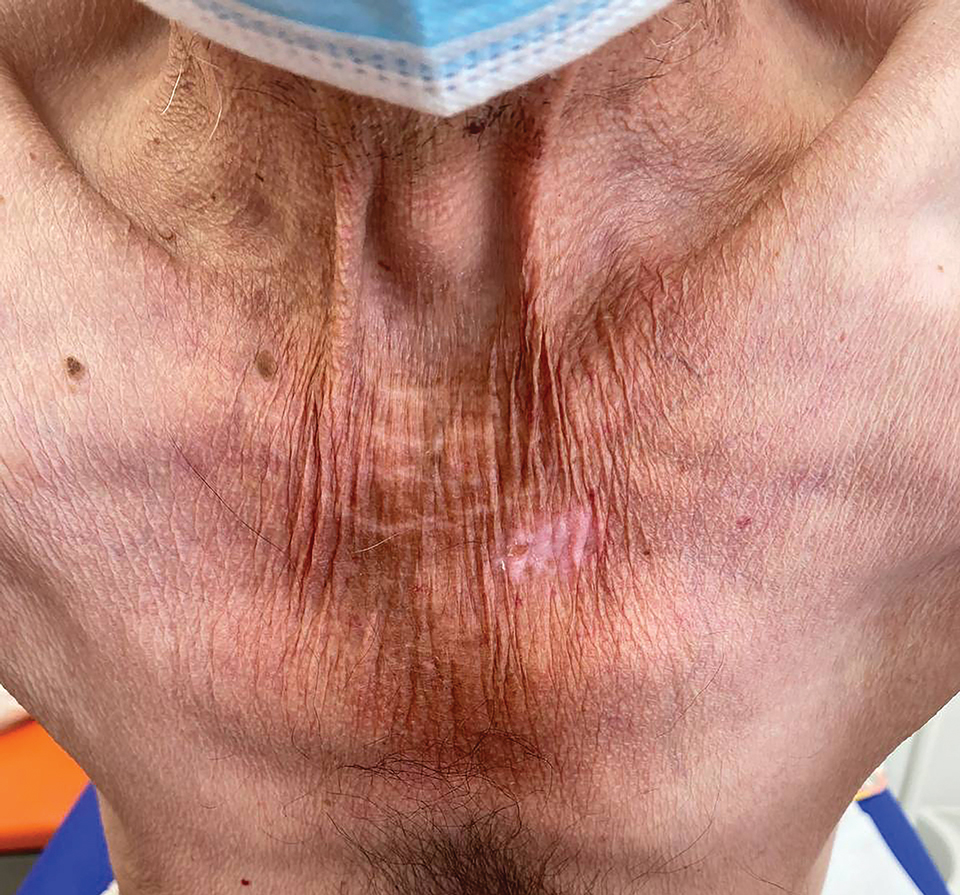
The pathophysiology of photosensitivity in pellagra was hypothesized by Karthikeyan and Thappa.3 They discovered an excessive synthesis of a phototoxic substance, kynurenic acid, and a deficiency in urocanic acid, which normally protects the skin by absorbing light in the UVB range. Niacin deprivation leads to the production of kynurenic acid through the tryptophan-kynurenine-nicotinic acid pathway and reduces the amount of urocanic acid by affecting the enzyme histidase in the stratum corneum.1-3 In one-third of patients, pellagra affects the oral mucosa, causing characteristic symptoms such as glossitis, angular stomatitis, and cheilitis.2 In nearly 50% of patients, poor appetite, nausea, epigastric discomfort, diarrhea, and excessive salivation are present. Most of the gastrointestinal tract is affected by mucosal inflammation and atrophy, which can cause malnutrition and cachexia due to anorexia and malabsorptive diarrhea.2 Headache, irritability, poor concentration, hallucinations, photophobia, tremor, and depression are some of the neuropsychiatric symptoms. Patients experience delirium and disorientation as pellagra progresses, followed by a comatose state and ultimately death.2
The patient’s history and physical examination are used to make the diagnosis, with particular attention to the patient’s dietary details. The diagnosis is made in part ex juvantibus by seeing how the patient responds to higher niacin doses. Anemia, hypoproteinemia, elevated blood calcium, reduced serum potassium and phosphorus, abnormal liver function tests, and elevated serum porphyrin levels also indicate pellagra. Niacin 300 mg in divided doses for up to 4 weeks has been recommended by the World Health Organization to treat pellagra.5 The flushing seen with niacin administration is not linked to the usage of nicotinamide. The recommended nicotinamide dosage for adults is 100 mg orally every 6 hours until most acute symptoms have disappeared, followed by oral administration of 50 mg every 8 to 12 hours until all skin lesions have healed.2
Among the differential diagnoses, necrolytic migratory erythema is characterized by an episodic eruption of crusted, erosive, annular erythematous plaques with blister development, which occurs in 70% of patients with glucagonoma syndrome. The perioral region, perineum, lower belly, thighs, and distal extremities are the usual locations.6,7 Laboratory test results include elevated fasting serum glucagon (>1000 ng/L) and normocytic anemia, which aided in ruling out this diagnosis in our patient. Generalized acute cutaneous lupus erythematosus may appear as a broad morbilliform eruption. The hands frequently exhibit erythema and edema, especially across the dorsal and interphalangeal regions.8 Other typical findings of systemic lupus erythematosus such as antinuclear antibody were not seen in our patient, making this diagnosis unlikely. Porphyria cutanea tarda also must be considered in the differential diagnosis. The hepatic deficiency of uroporphyrinogen decarboxylase is the primary cause of this condition. Although it is characterized by blistering lesions, patients more frequently describe increased skin fragility in sun-exposed regions. Hypertrichosis, hyperpigmentation or hypopigmentation, hirsutism, or scarring may appear in the later stage of the disease.9 Phototoxic reaction was ruled out because the patient spent most of the time at home, and no new drugs had been prescribed in the previous months.
- Prabhu D, Dawe RS, Mponda K. Pellagra a review exploring causes and mechanisms, including isoniazid-induced pellagra. Photodermatol Photoimmunol Photomed. 2021;37:99-104. doi:10.1111 /phpp.12659
- Hegyi J, Schwartz RA, Hegyi V. Pellagra: dermatitis, dementia, and diarrhea. Int J Dermatol. 2004;43:1-5. doi:10.1111/j.1365-4632.2004.01959.x
- Karthikeyan K, Thappa DM. Pellagra and skin. Int J Dermatol. 2002;41:476-481. doi:10.1046/j.1365-4362.2002.01551.x
- Dogliotti M, Liebowitz M, Downing DT, et al. Nutritional influences of pellagra on sebum composition. Br J Dermatol. 1977;97:25-28. doi:10.1111/j.1365-2133.1977.tb15423.x
- World Health Organization. Pellagra and Its Prevention and Control in Major Emergencies. Published February 23, 2000. Accessed February 15, 2024. https://www.who.int/publications/i/item/WHO-NHD-00.10
- Liu JW, Qian YT, Ma DL. Necrolytic migratory erythema. JAMA Dermatol. 2019;155:1180. doi:10.1001/jamadermatol.2019.1658
- Tolliver S, Graham J, Kaffenberger BH. A review of cutaneous manifestations within glucagonoma syndrome: necrolytic migratory erythema. Int J Dermatol. 2018;57:642-645. doi:10.1111/ijd.13947
- Walling HW, Sontheimer RD. Cutaneous lupus erythematosus: issues in diagnosis and treatment. Am J Clin Dermatol. 2009;10:365-381. doi:10.2165/11310780-000000000-00000
- Singal AK. Porphyria cutanea tarda: recent update. Mol Genet Metab. 2019;128:271-281. doi:10.1016/j.ymgme.2019.01.004
The Diagnosis: Pellagra
The patient was diagnosed with pellagra based on the clinical and laboratory findings. He was discharged with nicotinamide 250 mg and folic acid 5 mg supplementation daily. After 3 months, all symptoms resolved.
Pellagra is a condition usually associated with the 4 Ds: dermatitis; diarrhea; dementia; and, if untreated, death.1 The word pellagra is derived from the Italian terms pelle and agra, which mean skin and rough, respectively.2 Spanish physician Gasper Casal first described pellagra in 1762 after observing the disease in poorer peasants in Asturias who mainly relied on maize and rarely consumed fresh meat.1,2 Joseph Goldberger conducted research in the early 20th century, provoking the disease in jail prisoners by modifying their diets. However, it was not until 1926 that Goldberger discovered the true cause of the illness to be a poor diet and named what would become known as nicotinamide as the pellagra preventative factor.1,2 Niacin (vitamin B3), the deficient molecule in pellagra, also is known as nicotinic acid, nicotinamide, or niacinamide. It is a water-soluble vitamin that is converted into nicotinamide-adenine-dinucleotide (NAD) and its phosphate NADP.1,2 It has been hypothesized that pellagra symptoms arise from insufficient amounts of NAD and NADP, making the body unable to support cellular energy transfer processes.3
Pellagra manifests 50 to 60 days after starting a diet low in niacin. Niacin and nicotinamide are absorbed from the digested food to the stomach through a sodiumdependent mechanism, and then nicotinamide may be transformed into nicotinic acid with microsomal deamidation.3 Niacin may be obtained from one’s diet or produced from tryptophan. Foods with the highest amounts of niacin include liver, poultry, fish, eggs, milk, pork, mushrooms, avocados, almonds, and legumes.1,3 Coffee also contains trigonelline, which may be transformed into nicotinic acid when roasted, increasing the niacin level by 30 times.3 Approximately 60 mg of dietary tryptophan is needed to produce up to 1 mg of niacin in the presence of B2 and B6 vitamins. This mechanism provides approximately half of the needs for niacin.3 Insufficient dietary intake of niacin or the essential amino acid tryptophan can cause pellagra (primary pellagra), which is a concern in resource-limited countries. Alternatively, the body may not be able to properly utilize niacin for metabolic processes (secondary pellagra), which occurs more frequently in developed countries.1 Secondary pellagra also may be caused by alcoholism, colitis, cirrhosis, carcinoid tumors, Hartnup disease, or gastrointestinal tuberculosis, as these conditions prevent niacin from being consumed, absorbed, or processed. Certain medications can cause pellagra by interfering with the tryptophan-niacin pathway, including isoniazid, 5-fluorouracil, pyrazinamide, 6-mercaptopurine, hydantoins, ethionamide, phenobarbital, azathioprine, and chloramphenicol.2
The clinical manifestations of pellagra are diverse because it affects tissues with high turnover rates. Clinical features of pellagra include symmetric photosensitive skin eruptions, gastrointestinal tract symptoms, and neurologic and mental disorders.3 The first signs of pellagra may include muscle weakness, digestive concerns, and psychological or emotional discomfort.2 Pellagra dermatitis manifests as an acute or intermittent, bilaterally symmetrical eruption on sun-exposed areas and is markedly distinct from healthy skin.3 Some individuals may experience vesiculation and bullae development (wet pellagra). The erythema is first brilliant red then turns into a cinnamon-brown color. Over time, the skin becomes thickened, scaly, cracked, and hyperpigmented.1 The dryness of the skin likely is due to a remarkable decrease in wax ester and sebaceous gland atrophy seen on histopathology.4 Pellagra most frequently affects the back of the hands (77%–97% of cases), which can extend upward to create the so-called pellagra glove or gauntlet.3 It is common to see symmetrical eruptions in the shape of a butterfly following an anatomical pattern innervated by the trigeminal nerve, which resembles lupus erythematosus on the face. Another common manifestation is Casal necklace, a well-marginated eruption frequently seen on the front of the neck (Figure).2 On the foot, lesions often do not develop close to the malleoli but rather terminate distally on the backs of the toes. Sometimes a boot pattern may form that covers the front and back of the leg.1-3
The pathophysiology of photosensitivity in pellagra was hypothesized by Karthikeyan and Thappa.3 They discovered an excessive synthesis of a phototoxic substance, kynurenic acid, and a deficiency in urocanic acid, which normally protects the skin by absorbing light in the UVB range. Niacin deprivation leads to the production of kynurenic acid through the tryptophan-kynurenine-nicotinic acid pathway and reduces the amount of urocanic acid by affecting the enzyme histidase in the stratum corneum.1-3 In one-third of patients, pellagra affects the oral mucosa, causing characteristic symptoms such as glossitis, angular stomatitis, and cheilitis.2 In nearly 50% of patients, poor appetite, nausea, epigastric discomfort, diarrhea, and excessive salivation are present. Most of the gastrointestinal tract is affected by mucosal inflammation and atrophy, which can cause malnutrition and cachexia due to anorexia and malabsorptive diarrhea.2 Headache, irritability, poor concentration, hallucinations, photophobia, tremor, and depression are some of the neuropsychiatric symptoms. Patients experience delirium and disorientation as pellagra progresses, followed by a comatose state and ultimately death.2
The patient’s history and physical examination are used to make the diagnosis, with particular attention to the patient’s dietary details. The diagnosis is made in part ex juvantibus by seeing how the patient responds to higher niacin doses. Anemia, hypoproteinemia, elevated blood calcium, reduced serum potassium and phosphorus, abnormal liver function tests, and elevated serum porphyrin levels also indicate pellagra. Niacin 300 mg in divided doses for up to 4 weeks has been recommended by the World Health Organization to treat pellagra.5 The flushing seen with niacin administration is not linked to the usage of nicotinamide. The recommended nicotinamide dosage for adults is 100 mg orally every 6 hours until most acute symptoms have disappeared, followed by oral administration of 50 mg every 8 to 12 hours until all skin lesions have healed.2
Among the differential diagnoses, necrolytic migratory erythema is characterized by an episodic eruption of crusted, erosive, annular erythematous plaques with blister development, which occurs in 70% of patients with glucagonoma syndrome. The perioral region, perineum, lower belly, thighs, and distal extremities are the usual locations.6,7 Laboratory test results include elevated fasting serum glucagon (>1000 ng/L) and normocytic anemia, which aided in ruling out this diagnosis in our patient. Generalized acute cutaneous lupus erythematosus may appear as a broad morbilliform eruption. The hands frequently exhibit erythema and edema, especially across the dorsal and interphalangeal regions.8 Other typical findings of systemic lupus erythematosus such as antinuclear antibody were not seen in our patient, making this diagnosis unlikely. Porphyria cutanea tarda also must be considered in the differential diagnosis. The hepatic deficiency of uroporphyrinogen decarboxylase is the primary cause of this condition. Although it is characterized by blistering lesions, patients more frequently describe increased skin fragility in sun-exposed regions. Hypertrichosis, hyperpigmentation or hypopigmentation, hirsutism, or scarring may appear in the later stage of the disease.9 Phototoxic reaction was ruled out because the patient spent most of the time at home, and no new drugs had been prescribed in the previous months.
The Diagnosis: Pellagra
The patient was diagnosed with pellagra based on the clinical and laboratory findings. He was discharged with nicotinamide 250 mg and folic acid 5 mg supplementation daily. After 3 months, all symptoms resolved.
Pellagra is a condition usually associated with the 4 Ds: dermatitis; diarrhea; dementia; and, if untreated, death.1 The word pellagra is derived from the Italian terms pelle and agra, which mean skin and rough, respectively.2 Spanish physician Gasper Casal first described pellagra in 1762 after observing the disease in poorer peasants in Asturias who mainly relied on maize and rarely consumed fresh meat.1,2 Joseph Goldberger conducted research in the early 20th century, provoking the disease in jail prisoners by modifying their diets. However, it was not until 1926 that Goldberger discovered the true cause of the illness to be a poor diet and named what would become known as nicotinamide as the pellagra preventative factor.1,2 Niacin (vitamin B3), the deficient molecule in pellagra, also is known as nicotinic acid, nicotinamide, or niacinamide. It is a water-soluble vitamin that is converted into nicotinamide-adenine-dinucleotide (NAD) and its phosphate NADP.1,2 It has been hypothesized that pellagra symptoms arise from insufficient amounts of NAD and NADP, making the body unable to support cellular energy transfer processes.3
Pellagra manifests 50 to 60 days after starting a diet low in niacin. Niacin and nicotinamide are absorbed from the digested food to the stomach through a sodiumdependent mechanism, and then nicotinamide may be transformed into nicotinic acid with microsomal deamidation.3 Niacin may be obtained from one’s diet or produced from tryptophan. Foods with the highest amounts of niacin include liver, poultry, fish, eggs, milk, pork, mushrooms, avocados, almonds, and legumes.1,3 Coffee also contains trigonelline, which may be transformed into nicotinic acid when roasted, increasing the niacin level by 30 times.3 Approximately 60 mg of dietary tryptophan is needed to produce up to 1 mg of niacin in the presence of B2 and B6 vitamins. This mechanism provides approximately half of the needs for niacin.3 Insufficient dietary intake of niacin or the essential amino acid tryptophan can cause pellagra (primary pellagra), which is a concern in resource-limited countries. Alternatively, the body may not be able to properly utilize niacin for metabolic processes (secondary pellagra), which occurs more frequently in developed countries.1 Secondary pellagra also may be caused by alcoholism, colitis, cirrhosis, carcinoid tumors, Hartnup disease, or gastrointestinal tuberculosis, as these conditions prevent niacin from being consumed, absorbed, or processed. Certain medications can cause pellagra by interfering with the tryptophan-niacin pathway, including isoniazid, 5-fluorouracil, pyrazinamide, 6-mercaptopurine, hydantoins, ethionamide, phenobarbital, azathioprine, and chloramphenicol.2
The clinical manifestations of pellagra are diverse because it affects tissues with high turnover rates. Clinical features of pellagra include symmetric photosensitive skin eruptions, gastrointestinal tract symptoms, and neurologic and mental disorders.3 The first signs of pellagra may include muscle weakness, digestive concerns, and psychological or emotional discomfort.2 Pellagra dermatitis manifests as an acute or intermittent, bilaterally symmetrical eruption on sun-exposed areas and is markedly distinct from healthy skin.3 Some individuals may experience vesiculation and bullae development (wet pellagra). The erythema is first brilliant red then turns into a cinnamon-brown color. Over time, the skin becomes thickened, scaly, cracked, and hyperpigmented.1 The dryness of the skin likely is due to a remarkable decrease in wax ester and sebaceous gland atrophy seen on histopathology.4 Pellagra most frequently affects the back of the hands (77%–97% of cases), which can extend upward to create the so-called pellagra glove or gauntlet.3 It is common to see symmetrical eruptions in the shape of a butterfly following an anatomical pattern innervated by the trigeminal nerve, which resembles lupus erythematosus on the face. Another common manifestation is Casal necklace, a well-marginated eruption frequently seen on the front of the neck (Figure).2 On the foot, lesions often do not develop close to the malleoli but rather terminate distally on the backs of the toes. Sometimes a boot pattern may form that covers the front and back of the leg.1-3
The pathophysiology of photosensitivity in pellagra was hypothesized by Karthikeyan and Thappa.3 They discovered an excessive synthesis of a phototoxic substance, kynurenic acid, and a deficiency in urocanic acid, which normally protects the skin by absorbing light in the UVB range. Niacin deprivation leads to the production of kynurenic acid through the tryptophan-kynurenine-nicotinic acid pathway and reduces the amount of urocanic acid by affecting the enzyme histidase in the stratum corneum.1-3 In one-third of patients, pellagra affects the oral mucosa, causing characteristic symptoms such as glossitis, angular stomatitis, and cheilitis.2 In nearly 50% of patients, poor appetite, nausea, epigastric discomfort, diarrhea, and excessive salivation are present. Most of the gastrointestinal tract is affected by mucosal inflammation and atrophy, which can cause malnutrition and cachexia due to anorexia and malabsorptive diarrhea.2 Headache, irritability, poor concentration, hallucinations, photophobia, tremor, and depression are some of the neuropsychiatric symptoms. Patients experience delirium and disorientation as pellagra progresses, followed by a comatose state and ultimately death.2
The patient’s history and physical examination are used to make the diagnosis, with particular attention to the patient’s dietary details. The diagnosis is made in part ex juvantibus by seeing how the patient responds to higher niacin doses. Anemia, hypoproteinemia, elevated blood calcium, reduced serum potassium and phosphorus, abnormal liver function tests, and elevated serum porphyrin levels also indicate pellagra. Niacin 300 mg in divided doses for up to 4 weeks has been recommended by the World Health Organization to treat pellagra.5 The flushing seen with niacin administration is not linked to the usage of nicotinamide. The recommended nicotinamide dosage for adults is 100 mg orally every 6 hours until most acute symptoms have disappeared, followed by oral administration of 50 mg every 8 to 12 hours until all skin lesions have healed.2
Among the differential diagnoses, necrolytic migratory erythema is characterized by an episodic eruption of crusted, erosive, annular erythematous plaques with blister development, which occurs in 70% of patients with glucagonoma syndrome. The perioral region, perineum, lower belly, thighs, and distal extremities are the usual locations.6,7 Laboratory test results include elevated fasting serum glucagon (>1000 ng/L) and normocytic anemia, which aided in ruling out this diagnosis in our patient. Generalized acute cutaneous lupus erythematosus may appear as a broad morbilliform eruption. The hands frequently exhibit erythema and edema, especially across the dorsal and interphalangeal regions.8 Other typical findings of systemic lupus erythematosus such as antinuclear antibody were not seen in our patient, making this diagnosis unlikely. Porphyria cutanea tarda also must be considered in the differential diagnosis. The hepatic deficiency of uroporphyrinogen decarboxylase is the primary cause of this condition. Although it is characterized by blistering lesions, patients more frequently describe increased skin fragility in sun-exposed regions. Hypertrichosis, hyperpigmentation or hypopigmentation, hirsutism, or scarring may appear in the later stage of the disease.9 Phototoxic reaction was ruled out because the patient spent most of the time at home, and no new drugs had been prescribed in the previous months.
- Prabhu D, Dawe RS, Mponda K. Pellagra a review exploring causes and mechanisms, including isoniazid-induced pellagra. Photodermatol Photoimmunol Photomed. 2021;37:99-104. doi:10.1111 /phpp.12659
- Hegyi J, Schwartz RA, Hegyi V. Pellagra: dermatitis, dementia, and diarrhea. Int J Dermatol. 2004;43:1-5. doi:10.1111/j.1365-4632.2004.01959.x
- Karthikeyan K, Thappa DM. Pellagra and skin. Int J Dermatol. 2002;41:476-481. doi:10.1046/j.1365-4362.2002.01551.x
- Dogliotti M, Liebowitz M, Downing DT, et al. Nutritional influences of pellagra on sebum composition. Br J Dermatol. 1977;97:25-28. doi:10.1111/j.1365-2133.1977.tb15423.x
- World Health Organization. Pellagra and Its Prevention and Control in Major Emergencies. Published February 23, 2000. Accessed February 15, 2024. https://www.who.int/publications/i/item/WHO-NHD-00.10
- Liu JW, Qian YT, Ma DL. Necrolytic migratory erythema. JAMA Dermatol. 2019;155:1180. doi:10.1001/jamadermatol.2019.1658
- Tolliver S, Graham J, Kaffenberger BH. A review of cutaneous manifestations within glucagonoma syndrome: necrolytic migratory erythema. Int J Dermatol. 2018;57:642-645. doi:10.1111/ijd.13947
- Walling HW, Sontheimer RD. Cutaneous lupus erythematosus: issues in diagnosis and treatment. Am J Clin Dermatol. 2009;10:365-381. doi:10.2165/11310780-000000000-00000
- Singal AK. Porphyria cutanea tarda: recent update. Mol Genet Metab. 2019;128:271-281. doi:10.1016/j.ymgme.2019.01.004
- Prabhu D, Dawe RS, Mponda K. Pellagra a review exploring causes and mechanisms, including isoniazid-induced pellagra. Photodermatol Photoimmunol Photomed. 2021;37:99-104. doi:10.1111 /phpp.12659
- Hegyi J, Schwartz RA, Hegyi V. Pellagra: dermatitis, dementia, and diarrhea. Int J Dermatol. 2004;43:1-5. doi:10.1111/j.1365-4632.2004.01959.x
- Karthikeyan K, Thappa DM. Pellagra and skin. Int J Dermatol. 2002;41:476-481. doi:10.1046/j.1365-4362.2002.01551.x
- Dogliotti M, Liebowitz M, Downing DT, et al. Nutritional influences of pellagra on sebum composition. Br J Dermatol. 1977;97:25-28. doi:10.1111/j.1365-2133.1977.tb15423.x
- World Health Organization. Pellagra and Its Prevention and Control in Major Emergencies. Published February 23, 2000. Accessed February 15, 2024. https://www.who.int/publications/i/item/WHO-NHD-00.10
- Liu JW, Qian YT, Ma DL. Necrolytic migratory erythema. JAMA Dermatol. 2019;155:1180. doi:10.1001/jamadermatol.2019.1658
- Tolliver S, Graham J, Kaffenberger BH. A review of cutaneous manifestations within glucagonoma syndrome: necrolytic migratory erythema. Int J Dermatol. 2018;57:642-645. doi:10.1111/ijd.13947
- Walling HW, Sontheimer RD. Cutaneous lupus erythematosus: issues in diagnosis and treatment. Am J Clin Dermatol. 2009;10:365-381. doi:10.2165/11310780-000000000-00000
- Singal AK. Porphyria cutanea tarda: recent update. Mol Genet Metab. 2019;128:271-281. doi:10.1016/j.ymgme.2019.01.004
A 66-year-old man presented with an intermittent pruriginous symmetric rash on the dorsal aspects of the arms, legs, and upper chest of 4 months' duration. The patient’s hands, forearms, and neck were diffusely hyperpigmented, dry, cracked, and scaling with a ring of peripheral erythema. He also experienced recurrent photosensitivity reactions on the legs. His poor clinical condition including confusion and diarrhea hindered intake of a balanced diet. He also reported a history of excessive alcohol use. The patient’s vital signs were normal, and Doppler ultrasonography ruled out deep venous thrombosis of the lower legs. A complete blood cell count showed anemia with decreased hemoglobin levels (117 g/L [reference range, 140–180 g/L]) and increased mean corpuscular volume (107.1 fL [reference range, 80–100 fL]). Additionally, low serum levels of albumin, folate, and vitamin B12 were noted. The patient had been taking hydrochlorothiazide and salicylic acid for hypertension with no recent changes in his medication regimen.
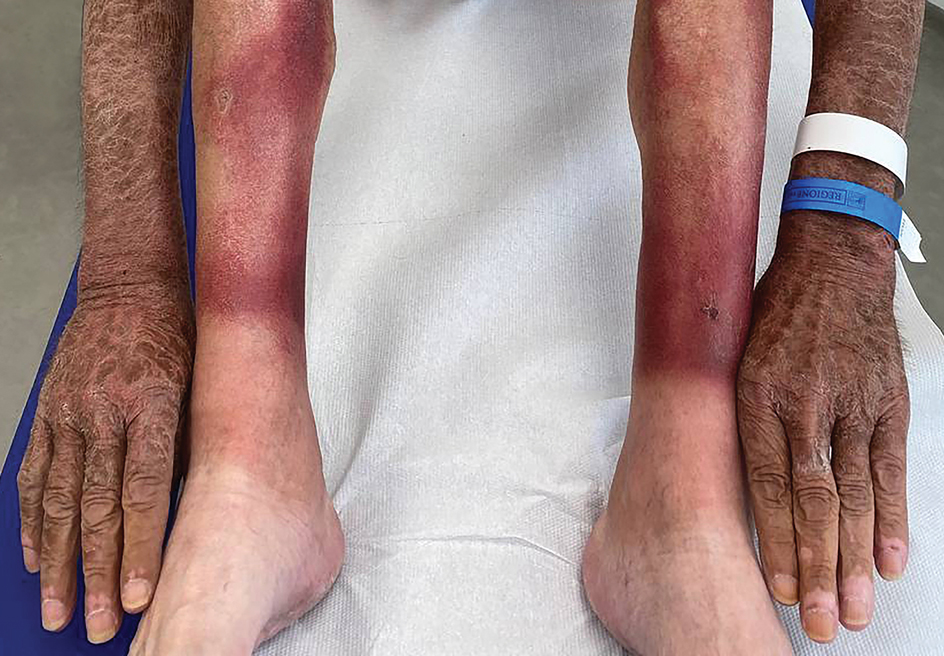
Commentary: Medication Timing and Other Dupilumab Concerns, March 2024

When skin diseases affect the palm or sole, they can have a disproportionately large negative effect on patients' lives. Hand and foot dermatitis can be disabling. Simpson and colleagues find that dupilumab is an effective treatment for AD of the hands and feet. Having safe and effective treatment for hand and foot dermatitis will be life-changing for many of our patients.
Patients often do very well with biologic treatment. When they do, they often wonder, Do I need to continue taking the medication? Lasheras-Pérez and colleagues found that the great majority of patients doing well taking dupilumab for AD could stretch out their dosing interval. I suspect a lot of our patients are doing this already. I used to worry that stretching out the dosing interval might lead to antidrug antibodies and loss of activity. Such loss of activity doesn't appear common. Because we also have multiple alternative treatments for severe AD, I think it may be quite reasonable for patients to try spreading out their doses after their disease has been well controlled for a good long time.
Superficial skin infections aren't rare in children, particularly children with AD. Paller and colleagues' study is informative about the safety of dupilumab in children. The drug, which blocks a pathway of the immune system, was associated with fewer infections. This is good news. The reduction in infections could be through restoring "immune balance" (whatever that means) or by improving skin barrier function. Perhaps the low rate of infection explains why dupilumab is not considered immunosuppressive.
I love studies of drug survival because I think that knowing the percentage of patients who stay with drug treatment is a good measure of overall safety and efficacy. Pezzolo and colleagues found — perhaps not surprisingly given the extraordinary efficacy of upadacitinib for AD — that almost no one discontinued the drug over 1.5 years due to lack of efficacy. There were patients who discontinued due to adverse events (and additional patients lost to follow-up who perhaps also discontinued the drug), but 80% of patients were still in the study at the end of 1.5 years. Three patients who weren't vaccinated for shingles developed shingles; encouraging patients to get the shingles vaccine may be a prudent measure when starting patients taking upadacitinib.
When skin diseases affect the palm or sole, they can have a disproportionately large negative effect on patients' lives. Hand and foot dermatitis can be disabling. Simpson and colleagues find that dupilumab is an effective treatment for AD of the hands and feet. Having safe and effective treatment for hand and foot dermatitis will be life-changing for many of our patients.
Patients often do very well with biologic treatment. When they do, they often wonder, Do I need to continue taking the medication? Lasheras-Pérez and colleagues found that the great majority of patients doing well taking dupilumab for AD could stretch out their dosing interval. I suspect a lot of our patients are doing this already. I used to worry that stretching out the dosing interval might lead to antidrug antibodies and loss of activity. Such loss of activity doesn't appear common. Because we also have multiple alternative treatments for severe AD, I think it may be quite reasonable for patients to try spreading out their doses after their disease has been well controlled for a good long time.
Superficial skin infections aren't rare in children, particularly children with AD. Paller and colleagues' study is informative about the safety of dupilumab in children. The drug, which blocks a pathway of the immune system, was associated with fewer infections. This is good news. The reduction in infections could be through restoring "immune balance" (whatever that means) or by improving skin barrier function. Perhaps the low rate of infection explains why dupilumab is not considered immunosuppressive.
I love studies of drug survival because I think that knowing the percentage of patients who stay with drug treatment is a good measure of overall safety and efficacy. Pezzolo and colleagues found — perhaps not surprisingly given the extraordinary efficacy of upadacitinib for AD — that almost no one discontinued the drug over 1.5 years due to lack of efficacy. There were patients who discontinued due to adverse events (and additional patients lost to follow-up who perhaps also discontinued the drug), but 80% of patients were still in the study at the end of 1.5 years. Three patients who weren't vaccinated for shingles developed shingles; encouraging patients to get the shingles vaccine may be a prudent measure when starting patients taking upadacitinib.
When skin diseases affect the palm or sole, they can have a disproportionately large negative effect on patients' lives. Hand and foot dermatitis can be disabling. Simpson and colleagues find that dupilumab is an effective treatment for AD of the hands and feet. Having safe and effective treatment for hand and foot dermatitis will be life-changing for many of our patients.
Patients often do very well with biologic treatment. When they do, they often wonder, Do I need to continue taking the medication? Lasheras-Pérez and colleagues found that the great majority of patients doing well taking dupilumab for AD could stretch out their dosing interval. I suspect a lot of our patients are doing this already. I used to worry that stretching out the dosing interval might lead to antidrug antibodies and loss of activity. Such loss of activity doesn't appear common. Because we also have multiple alternative treatments for severe AD, I think it may be quite reasonable for patients to try spreading out their doses after their disease has been well controlled for a good long time.
Superficial skin infections aren't rare in children, particularly children with AD. Paller and colleagues' study is informative about the safety of dupilumab in children. The drug, which blocks a pathway of the immune system, was associated with fewer infections. This is good news. The reduction in infections could be through restoring "immune balance" (whatever that means) or by improving skin barrier function. Perhaps the low rate of infection explains why dupilumab is not considered immunosuppressive.
I love studies of drug survival because I think that knowing the percentage of patients who stay with drug treatment is a good measure of overall safety and efficacy. Pezzolo and colleagues found — perhaps not surprisingly given the extraordinary efficacy of upadacitinib for AD — that almost no one discontinued the drug over 1.5 years due to lack of efficacy. There were patients who discontinued due to adverse events (and additional patients lost to follow-up who perhaps also discontinued the drug), but 80% of patients were still in the study at the end of 1.5 years. Three patients who weren't vaccinated for shingles developed shingles; encouraging patients to get the shingles vaccine may be a prudent measure when starting patients taking upadacitinib.
FDA Approves 10th Humira Biosimilar, With Interchangeability
The US Food and Drug Administration has approved the first interchangeable, high-concentration, citrate-free adalimumab biosimilar, adalimumab-ryvk (Simlandi).
This is the 10th adalimumab biosimilar approved by the regulatory agency and the first biosimilar approval in the US market for the Icelandic pharmaceutical company Alvotech in partnership with Teva Pharmaceuticals.
“An interchangeable citrate-free, high-concentration biosimilar adalimumab has the potential to change the market dynamics in a rapidly evolving environment for biosimilars in the U.S.,” said Robert Wessman, chairman and CEO of Alvotech, in a company press release on February 23.
Adalimumab-ryvk was approved in the European Union in 2021 and in Australia and Canada in 2022.
Adalimumab-ryvk is indicated for adults with rheumatoid arthritis, psoriatic arthritis, ankylosing spondylitis, ulcerative colitis, Crohn’s disease, plaque psoriasis, hidradenitis suppurativa, and noninfectious intermediate and posterior uveitis and panuveitis. In pediatric patients, it is indicated for polyarticular juvenile idiopathic arthritis in children 2 years of age and older and Crohn’s disease in children 6 years of age and older.
Adalimumab-ryvk is the third Humira biosimilar overall granted interchangeability status, which allows pharmacists (depending on state law) to substitute the biosimilar for the reference product without involving the prescribing clinician. Adalimumab-adbm (Cyltezo), manufactured by Boehringer Ingelheim, and adalimumab-afzb (Abrilada), manufactured by Pfizer, were previously granted interchangeability status; however, they both are interchangeable with the low-concentration formulation of Humira, which make up only an estimated 15% of Humira prescriptions, according to a report by Goodroot.
Adalimumab-ryvk will be launched “imminently” in the United States, according to the press release, but no specific dates were provided. It is also not yet known how the biosimilar will be priced compared with Humira. Other adalimumab biosimilars have launched with discounts from 5% to 85% of Humira’s list price.
A version of this article appeared on Medscape.com.
The US Food and Drug Administration has approved the first interchangeable, high-concentration, citrate-free adalimumab biosimilar, adalimumab-ryvk (Simlandi).
This is the 10th adalimumab biosimilar approved by the regulatory agency and the first biosimilar approval in the US market for the Icelandic pharmaceutical company Alvotech in partnership with Teva Pharmaceuticals.
“An interchangeable citrate-free, high-concentration biosimilar adalimumab has the potential to change the market dynamics in a rapidly evolving environment for biosimilars in the U.S.,” said Robert Wessman, chairman and CEO of Alvotech, in a company press release on February 23.
Adalimumab-ryvk was approved in the European Union in 2021 and in Australia and Canada in 2022.
Adalimumab-ryvk is indicated for adults with rheumatoid arthritis, psoriatic arthritis, ankylosing spondylitis, ulcerative colitis, Crohn’s disease, plaque psoriasis, hidradenitis suppurativa, and noninfectious intermediate and posterior uveitis and panuveitis. In pediatric patients, it is indicated for polyarticular juvenile idiopathic arthritis in children 2 years of age and older and Crohn’s disease in children 6 years of age and older.
Adalimumab-ryvk is the third Humira biosimilar overall granted interchangeability status, which allows pharmacists (depending on state law) to substitute the biosimilar for the reference product without involving the prescribing clinician. Adalimumab-adbm (Cyltezo), manufactured by Boehringer Ingelheim, and adalimumab-afzb (Abrilada), manufactured by Pfizer, were previously granted interchangeability status; however, they both are interchangeable with the low-concentration formulation of Humira, which make up only an estimated 15% of Humira prescriptions, according to a report by Goodroot.
Adalimumab-ryvk will be launched “imminently” in the United States, according to the press release, but no specific dates were provided. It is also not yet known how the biosimilar will be priced compared with Humira. Other adalimumab biosimilars have launched with discounts from 5% to 85% of Humira’s list price.
A version of this article appeared on Medscape.com.
The US Food and Drug Administration has approved the first interchangeable, high-concentration, citrate-free adalimumab biosimilar, adalimumab-ryvk (Simlandi).
This is the 10th adalimumab biosimilar approved by the regulatory agency and the first biosimilar approval in the US market for the Icelandic pharmaceutical company Alvotech in partnership with Teva Pharmaceuticals.
“An interchangeable citrate-free, high-concentration biosimilar adalimumab has the potential to change the market dynamics in a rapidly evolving environment for biosimilars in the U.S.,” said Robert Wessman, chairman and CEO of Alvotech, in a company press release on February 23.
Adalimumab-ryvk was approved in the European Union in 2021 and in Australia and Canada in 2022.
Adalimumab-ryvk is indicated for adults with rheumatoid arthritis, psoriatic arthritis, ankylosing spondylitis, ulcerative colitis, Crohn’s disease, plaque psoriasis, hidradenitis suppurativa, and noninfectious intermediate and posterior uveitis and panuveitis. In pediatric patients, it is indicated for polyarticular juvenile idiopathic arthritis in children 2 years of age and older and Crohn’s disease in children 6 years of age and older.
Adalimumab-ryvk is the third Humira biosimilar overall granted interchangeability status, which allows pharmacists (depending on state law) to substitute the biosimilar for the reference product without involving the prescribing clinician. Adalimumab-adbm (Cyltezo), manufactured by Boehringer Ingelheim, and adalimumab-afzb (Abrilada), manufactured by Pfizer, were previously granted interchangeability status; however, they both are interchangeable with the low-concentration formulation of Humira, which make up only an estimated 15% of Humira prescriptions, according to a report by Goodroot.
Adalimumab-ryvk will be launched “imminently” in the United States, according to the press release, but no specific dates were provided. It is also not yet known how the biosimilar will be priced compared with Humira. Other adalimumab biosimilars have launched with discounts from 5% to 85% of Humira’s list price.
A version of this article appeared on Medscape.com.
Ixekizumab’s Final Safety Results Reported Across 25 Trials in Psoriasis, PsA, Axial SpA
TOPLINE:
Pooled data from 9225 adults with psoriasis (PsO), psoriatic arthritis (PsA), and axial spondyloarthritis (axSpA) showed no new safety signals with extended exposure to ixekizumab (Taltz).
METHODOLOGY:
- Researchers combined patient data from 25 randomized, controlled trials of the safety and effectiveness of at least one dose of ixekizumab in adults with PsO (n = 6892), PsA (n = 1401), and axSpA (n = 932).
- The study population included patients with a mean age of approximately 43-49 years; at least 49% were male and at least 74% were White across the three conditions.
- Patients’ median duration of ixekizumab exposure was 1.3 years for PsO, 1.4 years for PsA, and 2.7 years for axSpA, with data up to 6 years for PsO and up to 3 years for PsA and axSpA.
- The primary outcomes were exposure-adjusted incidence rates per 100 patient-years overall and at successive year intervals for treatment-emergent adverse events, serious adverse events, and selected adverse events of interest.
TAKEAWAY:
- The incidence rate per 100 person-years for any treatment-emergent adverse event was 32.5 for PsO, 50.3 for PsA, and 38.0 for axSpA; these did not increase with lengthier exposure.
- The incidence rates for serious adverse events for patients with PsO, PsA, or axSpA were 5.4, 6.0, and 4.8 per 100 person-years, respectively.
- A total of 45 deaths were reported across the studies, including 36 in patients with PsO, six with PsA, and three with axSpA.
- Infections were the most common treatment-emergent adverse events across all patient groups, reported in patients at rates of 62.5% with PsO, 52.4% with PsA, and 57.9% with axSpA; incidence of infections did not increase over time.
IN PRACTICE:
“These final, end-of-study program results surrounding the long-term use of [ixekizumab] in patients with PsO, PsA, and axSpA should serve as an important point of reference for physicians considering [ixekizumab],” the researchers wrote.
SOURCE:
The lead author on the study was Atul Deodhar, MD, of Oregon Health & Science University, Portland. The study was published online on February 12 in Arthritis Research & Therapy.
LIMITATIONS:
Study limitations included the small sample sizes and short treatment durations in some studies, the primarily White study population, the inability to stratify risk, the lack of a long-term comparator, and potential survivor bias.
DISCLOSURES:
The studies in the review were supported by Eli Lilly. Lead author Dr. Deodhar disclosed an honorarium and serving on advisory boards at AbbVie, Bristol-Myers Squibb, Eli Lilly, Janssen, Novartis, Pfizer, and UCB, as well as research grants from AbbVie, Bristol-Myers Squibb, Celgene, Eli Lilly, Janssen, MoonLake, Novartis, Pfizer, and UCB.
A version of this article appeared on Medscape.com.
TOPLINE:
Pooled data from 9225 adults with psoriasis (PsO), psoriatic arthritis (PsA), and axial spondyloarthritis (axSpA) showed no new safety signals with extended exposure to ixekizumab (Taltz).
METHODOLOGY:
- Researchers combined patient data from 25 randomized, controlled trials of the safety and effectiveness of at least one dose of ixekizumab in adults with PsO (n = 6892), PsA (n = 1401), and axSpA (n = 932).
- The study population included patients with a mean age of approximately 43-49 years; at least 49% were male and at least 74% were White across the three conditions.
- Patients’ median duration of ixekizumab exposure was 1.3 years for PsO, 1.4 years for PsA, and 2.7 years for axSpA, with data up to 6 years for PsO and up to 3 years for PsA and axSpA.
- The primary outcomes were exposure-adjusted incidence rates per 100 patient-years overall and at successive year intervals for treatment-emergent adverse events, serious adverse events, and selected adverse events of interest.
TAKEAWAY:
- The incidence rate per 100 person-years for any treatment-emergent adverse event was 32.5 for PsO, 50.3 for PsA, and 38.0 for axSpA; these did not increase with lengthier exposure.
- The incidence rates for serious adverse events for patients with PsO, PsA, or axSpA were 5.4, 6.0, and 4.8 per 100 person-years, respectively.
- A total of 45 deaths were reported across the studies, including 36 in patients with PsO, six with PsA, and three with axSpA.
- Infections were the most common treatment-emergent adverse events across all patient groups, reported in patients at rates of 62.5% with PsO, 52.4% with PsA, and 57.9% with axSpA; incidence of infections did not increase over time.
IN PRACTICE:
“These final, end-of-study program results surrounding the long-term use of [ixekizumab] in patients with PsO, PsA, and axSpA should serve as an important point of reference for physicians considering [ixekizumab],” the researchers wrote.
SOURCE:
The lead author on the study was Atul Deodhar, MD, of Oregon Health & Science University, Portland. The study was published online on February 12 in Arthritis Research & Therapy.
LIMITATIONS:
Study limitations included the small sample sizes and short treatment durations in some studies, the primarily White study population, the inability to stratify risk, the lack of a long-term comparator, and potential survivor bias.
DISCLOSURES:
The studies in the review were supported by Eli Lilly. Lead author Dr. Deodhar disclosed an honorarium and serving on advisory boards at AbbVie, Bristol-Myers Squibb, Eli Lilly, Janssen, Novartis, Pfizer, and UCB, as well as research grants from AbbVie, Bristol-Myers Squibb, Celgene, Eli Lilly, Janssen, MoonLake, Novartis, Pfizer, and UCB.
A version of this article appeared on Medscape.com.
TOPLINE:
Pooled data from 9225 adults with psoriasis (PsO), psoriatic arthritis (PsA), and axial spondyloarthritis (axSpA) showed no new safety signals with extended exposure to ixekizumab (Taltz).
METHODOLOGY:
- Researchers combined patient data from 25 randomized, controlled trials of the safety and effectiveness of at least one dose of ixekizumab in adults with PsO (n = 6892), PsA (n = 1401), and axSpA (n = 932).
- The study population included patients with a mean age of approximately 43-49 years; at least 49% were male and at least 74% were White across the three conditions.
- Patients’ median duration of ixekizumab exposure was 1.3 years for PsO, 1.4 years for PsA, and 2.7 years for axSpA, with data up to 6 years for PsO and up to 3 years for PsA and axSpA.
- The primary outcomes were exposure-adjusted incidence rates per 100 patient-years overall and at successive year intervals for treatment-emergent adverse events, serious adverse events, and selected adverse events of interest.
TAKEAWAY:
- The incidence rate per 100 person-years for any treatment-emergent adverse event was 32.5 for PsO, 50.3 for PsA, and 38.0 for axSpA; these did not increase with lengthier exposure.
- The incidence rates for serious adverse events for patients with PsO, PsA, or axSpA were 5.4, 6.0, and 4.8 per 100 person-years, respectively.
- A total of 45 deaths were reported across the studies, including 36 in patients with PsO, six with PsA, and three with axSpA.
- Infections were the most common treatment-emergent adverse events across all patient groups, reported in patients at rates of 62.5% with PsO, 52.4% with PsA, and 57.9% with axSpA; incidence of infections did not increase over time.
IN PRACTICE:
“These final, end-of-study program results surrounding the long-term use of [ixekizumab] in patients with PsO, PsA, and axSpA should serve as an important point of reference for physicians considering [ixekizumab],” the researchers wrote.
SOURCE:
The lead author on the study was Atul Deodhar, MD, of Oregon Health & Science University, Portland. The study was published online on February 12 in Arthritis Research & Therapy.
LIMITATIONS:
Study limitations included the small sample sizes and short treatment durations in some studies, the primarily White study population, the inability to stratify risk, the lack of a long-term comparator, and potential survivor bias.
DISCLOSURES:
The studies in the review were supported by Eli Lilly. Lead author Dr. Deodhar disclosed an honorarium and serving on advisory boards at AbbVie, Bristol-Myers Squibb, Eli Lilly, Janssen, Novartis, Pfizer, and UCB, as well as research grants from AbbVie, Bristol-Myers Squibb, Celgene, Eli Lilly, Janssen, MoonLake, Novartis, Pfizer, and UCB.
A version of this article appeared on Medscape.com.