User login
Bringing you the latest news, research and reviews, exclusive interviews, podcasts, quizzes, and more.
div[contains(@class, 'header__large-screen')]
div[contains(@class, 'read-next-article')]
div[contains(@class, 'nav-primary')]
nav[contains(@class, 'nav-primary')]
section[contains(@class, 'footer-nav-section-wrapper')]
footer[@id='footer']
div[contains(@class, 'main-prefix')]
section[contains(@class, 'nav-hidden')]
div[contains(@class, 'ce-card-content')]
nav[contains(@class, 'nav-ce-stack')]
Eosinophilic Pustular Folliculitis in the Setting of Untreated Chronic Lymphocytic Leukemia
To the Editor:
Eosinophilic pustular folliculitis (EPF) is a noninfectious dermatosis that typically manifests as recurrent follicular papulopustules that generally affect the face and occasionally the trunk and arms. There are several subtypes of EPF: classic EPF (Ofuji disease), infancy-associated EPF, and immunosuppression-associated EPF.1,2 We report a rare case of EPF in the setting of untreated chronic lymphocytic leukemia (CLL), a subtype of immunosuppression-associated EPF that has been associated with hematologic malignancy EPF (HM-EPF).3-5
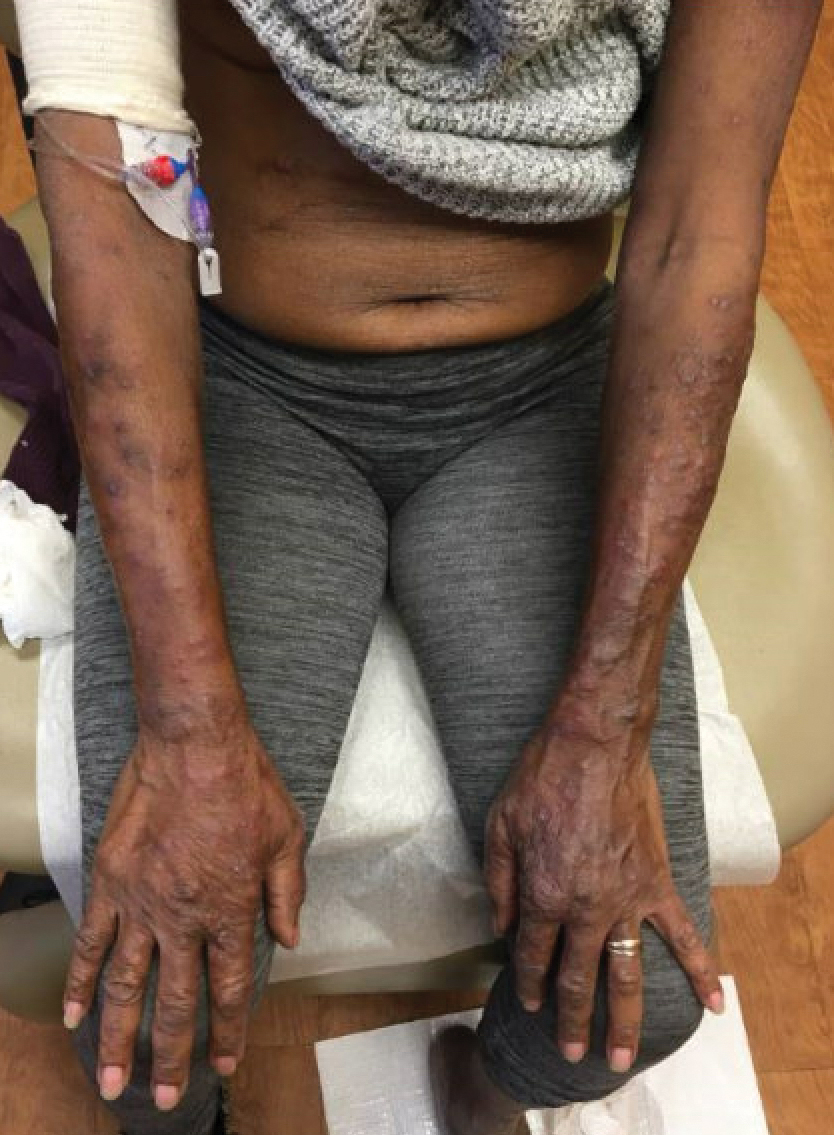
A 69-year-old woman presented with diffusely scattered, pruritic, erythematous, erosive lesions on the back, arms, legs, and forehead (Figure 1) of 4 months’ duration, as well as an ulcerative lesion on the left third toe due to a suspected insect bite. She had a history of untreated CLL that was diagnosed 2 years prior. The patient was empirically started on clindamycin for presumed infection of the toe. A punch biopsy of the left wrist revealed superficial and deep dermal perivascular and interstitial inflammatory infiltrates composed of lymphocytes, histiocytes, and numerous eosinophils in association with edema and necrosis. Histopathology was overall most consistent with an exuberant arthropod reaction; however, at 2-week follow-up, the patient reported that the pustular lesions improved upon starting antibiotics, which raised concerns for a bacterial process. The patient initially was continued on clindamycin given subjective improvement but was later switched to daptomycin, as she developed clindamycin-resistant methicillin-resistant Staphylococcus aureus osteomyelitis from the necrotic toe.
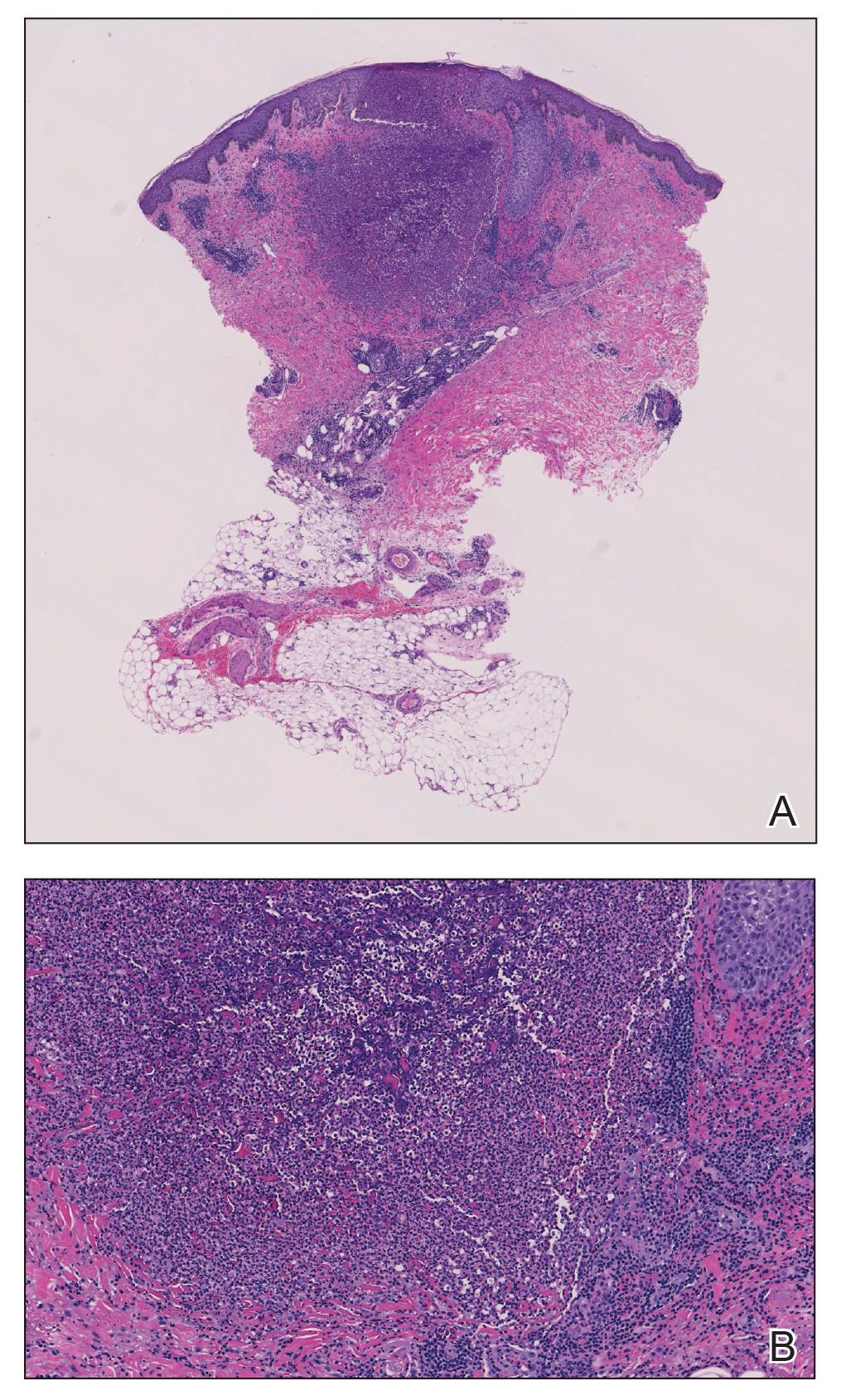
A month later, the patient returned with new papules and pustules on the arms and trunk. A repeat biopsy showed notable dermal collections comprised predominantly of neutrophils and eosinophils as well as involvement of follicular structures by dense inflammation (Figure 2). Immunohistochemistry demonstrated a predominant population of small CD3+ T cells, which raised concern for cutaneous T-cell lymphoma. However, retention of CD5 expression made this less likely. Few scattered CD20+ B cells with limited CD23 reactivity and without CD5 co-expression were detected, which ruled out cutaneous involvement of the patient’s CLL. Bacterial culture and Grocott methenamine-silver, Gram, acid-fast bacilli, and periodic acid-Schiff stains were negative. Polymerase chain reaction testing for varicella-zoster virus and herpes simplex virus also were negative. Thus, a diagnosis of EPF secondary to CLL was favored, as an infectious process also was unlikely. The patient was started on triamcinolone cream 0.1% with gradual improvement.
Cases of HM-EPF predominantly have been reported in patients who have undergone chemotherapy, bone marrow transplantation, or hematopoietic stem cell transplantation. Furthermore, a vast majority of these cases have been reported in older males.3-16 In a retrospective study of more than 750 patients with established CLL, Agnew et al7 identified 125 different skin complications in 40 patients. Of this subset, only a small number (2/40) were associated with eosinophilic folliculitis, with 1 case noted in a middle-aged woman with a history of CLL treatment.7 Moreover, Motaparthi et al4 reported 3 additional cases of HM-EPF, with all patients identified as middle-aged men who were treated with chemotherapy for underlying CLL. Our patient represents a case of EPF in the context of untreated CLL in a woman.
Although topical corticosteroids remain the first-line treatment for EPF, a survey study conducted across 67 hospitals in Japan indicated that antibiotics were moderately or highly effective in 79% of EPF patients (n=143).17 This association may explain the subjective improvement reported by our patient upon starting clindamycin. Furthermore, in HIV-associated EPF, high-dose cetirizine, itraconazole, and metronidazole have been successful when topical therapies have failed.18 Although the precise pathogenesis of EPF is unknown, histopathologic features, clinical appearance, and identification of the accurate EPF subtype can still prove valuable in informing empiric treatment strategies. Consequently, the initial histopathologic diagnosis of an arthropod bite reaction in our patient highlights the importance of clinical correlation and additional ancillary studies in the determination of EPF vs other inflammatory dermatoses that manifest microscopically with lymphocytic infiltrates, prominent eosinophils, and follicular involvement.4 The histopathologic features of EPF demonstrate considerable overlap with eosinophilic dermatosis of hematologic malignancy (also known as eosinophilic dermatosis of myeloproliferative disease). It is suspected that eosinophilic dermatosis of hematologic malignancy and EPF may exist on a spectrum, and additional cases may improve categorization of these entities.19
In conclusion, this report adds to the medical practitioner’s awareness of EPF manifestations in patients with underlying CLL, an infrequently reported subtype of HM-EPF.
- Fujiyama T, Tokura Y. Clinical and histopathological differential diagnosis of eosinophilic pustular folliculitis. J Dermatol. 2013;40:419-423. doi:10.1111/1346-8138.12125
- Katoh M, Nomura T, Miyachi Y, et al. Eosinophilic pustular folliculitis: a review of the Japanese published works. J Dermatol. 2013;40:15-20. doi:10.1111/1346-8138.12008
- Takamura S, Teraki Y. Eosinophilic pustular folliculitis associated with hematological disorders: a report of two cases and review of Japanese literature. J Dermatol. 2016;43:432-435. doi: 10.1111/1346-8138.13088
- Motaparthi K, Kapil J, Hsu S. Eosinophilic folliculitis in association with chronic lymphocytic leukemia: a clinicopathologic series. JAAD Case Rep. 2017;3:263-268. doi:10.1016/j.jdcr.2017.03.007
- Lambert J, Berneman Z, Dockx P, et al. Eosinophilic pustular folliculitis and B-cell chronic lymphatic leukaemia. Dermatology. 1994;189(suppl 2):58-59. doi:10.1159/000246994
- Patrizi A, Chieregato C, Visani G, et al. Leukaemia-associated eosinophilic folliculitis (Ofuji’s disease). J Eur Acad Dermatol Venereol. 2004;18:596-598. doi:10.1111/j.1468-3083.2004.00982.x
- Agnew KL, Ruchlemer R, Catovsky D, et al. Cutaneous findings in chronic lymphocytic leukaemia. Br J Dermatol. 2004;150:1129-1135. doi:10.1111/j.1365-2133.2004.05982.x
- Zitelli K, Fernandes N, Adams BB. Eosinophilic folliculitis occurring after stem cell transplant for acute lymphoblastic leukemia: a case report and review. Int J Dermatol. 2015;54:785-789. doi:10.1111/j.1365-2133.2004.05982.x
- Goiriz R, Guhl-Millán G, Peñas PF, et al. Eosinophilic folliculitis following allogeneic peripheral blood stem cell transplantation: case report and review. J Cutan Pathol. 2007;34(suppl 1):33-36. doi:10.1111/j.1600-0560.2006.00725.x
- Bhandare PC, Ghodge RR, Bhobe MR, et al. Eosinophilic pustular folliculitis post chemotherapy in a patient of non-Hodgkins lymphoma: a case report. Indian J Dermatol. 2015;60:521. doi:10.4103/0019-5154.164432
- Sugaya M, Suga H, Miyagaki T, et al. Eosinophilic pustular folliculitis associated with Sézary syndrome. Clin Exp Dermatol. 2014;39:536-538. doi:10.1111/ced.12315
- Keida T, Hayashi N, Kawashima M. Eosinophilic pustular folliculitis following autologous peripheral blood stem-cell transplantation. J Dermatol. 2004;31:21-26. doi:10.1111/j.1346-8138.2004.tb00499.x
- Ota M, Shimizu T, Hashino S, et al. Eosinophilic folliculitis in a patient after allogeneic bone marrow transplantation: case report and review of the literature. Am J Hematol. 2004;76:295-296. doi:10.1002/ajh.20080
- Vassallo C, Ciocca O, Arcaini L, et al. Eosinophilic folliculitis occurring in a patient affected by Hodgkin lymphoma. Int J Dermatol. 2002;41:298-300. doi:10.1046/j.1365-4362.2002.01356_6.x
- Evans TR, Mansi JL, Bull R, et al. Eosinophilic folliculitis occurring after bone marrow autograft in a patient with non-Hodgkin’s lymphoma. Cancer. 1994;73:2512-2514. doi:10.1002/1097-0142(19940515)73:10<2512::aid-cncr2820731010>3.0.co;2-s
- Patrizi A, Di Lernia V, Neri I, et al. Eosinophilic pustular folliculitis (Ofuji’s disease) and non-Hodgkin lymphoma. Acta Derm Venereol. 1992;72:146-147.
- Ono S, Yamamoto Y, Otsuka A, et al. Evaluation of the effectiveness of antibiotics against eosinophilic pustular folliculitis. Case Rep Dermatol. 2013;5:144-147. doi:10.1159/000351330
- Ellis E, Scheinfeld N. Eosinophilic pustular folliculitis. Am J Clin Dermatol. 2004;5:189-197. doi:10.2165/00128071-200405030-00007
- Bailey CAR, Laurain DA, Sheinbein DM, et al. Eosinophilic folliculitis, eosinophilic dermatosis of hematologic malignancy and acneiform follicular mucinosis: two case reports and a review of the literature highlighting the spectrum of histopathology. J Cutan Pathol. 2021;48:439-450. doi:10.1111/cup.13932
To the Editor:
Eosinophilic pustular folliculitis (EPF) is a noninfectious dermatosis that typically manifests as recurrent follicular papulopustules that generally affect the face and occasionally the trunk and arms. There are several subtypes of EPF: classic EPF (Ofuji disease), infancy-associated EPF, and immunosuppression-associated EPF.1,2 We report a rare case of EPF in the setting of untreated chronic lymphocytic leukemia (CLL), a subtype of immunosuppression-associated EPF that has been associated with hematologic malignancy EPF (HM-EPF).3-5
A 69-year-old woman presented with diffusely scattered, pruritic, erythematous, erosive lesions on the back, arms, legs, and forehead (Figure 1) of 4 months’ duration, as well as an ulcerative lesion on the left third toe due to a suspected insect bite. She had a history of untreated CLL that was diagnosed 2 years prior. The patient was empirically started on clindamycin for presumed infection of the toe. A punch biopsy of the left wrist revealed superficial and deep dermal perivascular and interstitial inflammatory infiltrates composed of lymphocytes, histiocytes, and numerous eosinophils in association with edema and necrosis. Histopathology was overall most consistent with an exuberant arthropod reaction; however, at 2-week follow-up, the patient reported that the pustular lesions improved upon starting antibiotics, which raised concerns for a bacterial process. The patient initially was continued on clindamycin given subjective improvement but was later switched to daptomycin, as she developed clindamycin-resistant methicillin-resistant Staphylococcus aureus osteomyelitis from the necrotic toe.
A month later, the patient returned with new papules and pustules on the arms and trunk. A repeat biopsy showed notable dermal collections comprised predominantly of neutrophils and eosinophils as well as involvement of follicular structures by dense inflammation (Figure 2). Immunohistochemistry demonstrated a predominant population of small CD3+ T cells, which raised concern for cutaneous T-cell lymphoma. However, retention of CD5 expression made this less likely. Few scattered CD20+ B cells with limited CD23 reactivity and without CD5 co-expression were detected, which ruled out cutaneous involvement of the patient’s CLL. Bacterial culture and Grocott methenamine-silver, Gram, acid-fast bacilli, and periodic acid-Schiff stains were negative. Polymerase chain reaction testing for varicella-zoster virus and herpes simplex virus also were negative. Thus, a diagnosis of EPF secondary to CLL was favored, as an infectious process also was unlikely. The patient was started on triamcinolone cream 0.1% with gradual improvement.
Cases of HM-EPF predominantly have been reported in patients who have undergone chemotherapy, bone marrow transplantation, or hematopoietic stem cell transplantation. Furthermore, a vast majority of these cases have been reported in older males.3-16 In a retrospective study of more than 750 patients with established CLL, Agnew et al7 identified 125 different skin complications in 40 patients. Of this subset, only a small number (2/40) were associated with eosinophilic folliculitis, with 1 case noted in a middle-aged woman with a history of CLL treatment.7 Moreover, Motaparthi et al4 reported 3 additional cases of HM-EPF, with all patients identified as middle-aged men who were treated with chemotherapy for underlying CLL. Our patient represents a case of EPF in the context of untreated CLL in a woman.
Although topical corticosteroids remain the first-line treatment for EPF, a survey study conducted across 67 hospitals in Japan indicated that antibiotics were moderately or highly effective in 79% of EPF patients (n=143).17 This association may explain the subjective improvement reported by our patient upon starting clindamycin. Furthermore, in HIV-associated EPF, high-dose cetirizine, itraconazole, and metronidazole have been successful when topical therapies have failed.18 Although the precise pathogenesis of EPF is unknown, histopathologic features, clinical appearance, and identification of the accurate EPF subtype can still prove valuable in informing empiric treatment strategies. Consequently, the initial histopathologic diagnosis of an arthropod bite reaction in our patient highlights the importance of clinical correlation and additional ancillary studies in the determination of EPF vs other inflammatory dermatoses that manifest microscopically with lymphocytic infiltrates, prominent eosinophils, and follicular involvement.4 The histopathologic features of EPF demonstrate considerable overlap with eosinophilic dermatosis of hematologic malignancy (also known as eosinophilic dermatosis of myeloproliferative disease). It is suspected that eosinophilic dermatosis of hematologic malignancy and EPF may exist on a spectrum, and additional cases may improve categorization of these entities.19
In conclusion, this report adds to the medical practitioner’s awareness of EPF manifestations in patients with underlying CLL, an infrequently reported subtype of HM-EPF.
To the Editor:
Eosinophilic pustular folliculitis (EPF) is a noninfectious dermatosis that typically manifests as recurrent follicular papulopustules that generally affect the face and occasionally the trunk and arms. There are several subtypes of EPF: classic EPF (Ofuji disease), infancy-associated EPF, and immunosuppression-associated EPF.1,2 We report a rare case of EPF in the setting of untreated chronic lymphocytic leukemia (CLL), a subtype of immunosuppression-associated EPF that has been associated with hematologic malignancy EPF (HM-EPF).3-5
A 69-year-old woman presented with diffusely scattered, pruritic, erythematous, erosive lesions on the back, arms, legs, and forehead (Figure 1) of 4 months’ duration, as well as an ulcerative lesion on the left third toe due to a suspected insect bite. She had a history of untreated CLL that was diagnosed 2 years prior. The patient was empirically started on clindamycin for presumed infection of the toe. A punch biopsy of the left wrist revealed superficial and deep dermal perivascular and interstitial inflammatory infiltrates composed of lymphocytes, histiocytes, and numerous eosinophils in association with edema and necrosis. Histopathology was overall most consistent with an exuberant arthropod reaction; however, at 2-week follow-up, the patient reported that the pustular lesions improved upon starting antibiotics, which raised concerns for a bacterial process. The patient initially was continued on clindamycin given subjective improvement but was later switched to daptomycin, as she developed clindamycin-resistant methicillin-resistant Staphylococcus aureus osteomyelitis from the necrotic toe.
A month later, the patient returned with new papules and pustules on the arms and trunk. A repeat biopsy showed notable dermal collections comprised predominantly of neutrophils and eosinophils as well as involvement of follicular structures by dense inflammation (Figure 2). Immunohistochemistry demonstrated a predominant population of small CD3+ T cells, which raised concern for cutaneous T-cell lymphoma. However, retention of CD5 expression made this less likely. Few scattered CD20+ B cells with limited CD23 reactivity and without CD5 co-expression were detected, which ruled out cutaneous involvement of the patient’s CLL. Bacterial culture and Grocott methenamine-silver, Gram, acid-fast bacilli, and periodic acid-Schiff stains were negative. Polymerase chain reaction testing for varicella-zoster virus and herpes simplex virus also were negative. Thus, a diagnosis of EPF secondary to CLL was favored, as an infectious process also was unlikely. The patient was started on triamcinolone cream 0.1% with gradual improvement.
Cases of HM-EPF predominantly have been reported in patients who have undergone chemotherapy, bone marrow transplantation, or hematopoietic stem cell transplantation. Furthermore, a vast majority of these cases have been reported in older males.3-16 In a retrospective study of more than 750 patients with established CLL, Agnew et al7 identified 125 different skin complications in 40 patients. Of this subset, only a small number (2/40) were associated with eosinophilic folliculitis, with 1 case noted in a middle-aged woman with a history of CLL treatment.7 Moreover, Motaparthi et al4 reported 3 additional cases of HM-EPF, with all patients identified as middle-aged men who were treated with chemotherapy for underlying CLL. Our patient represents a case of EPF in the context of untreated CLL in a woman.
Although topical corticosteroids remain the first-line treatment for EPF, a survey study conducted across 67 hospitals in Japan indicated that antibiotics were moderately or highly effective in 79% of EPF patients (n=143).17 This association may explain the subjective improvement reported by our patient upon starting clindamycin. Furthermore, in HIV-associated EPF, high-dose cetirizine, itraconazole, and metronidazole have been successful when topical therapies have failed.18 Although the precise pathogenesis of EPF is unknown, histopathologic features, clinical appearance, and identification of the accurate EPF subtype can still prove valuable in informing empiric treatment strategies. Consequently, the initial histopathologic diagnosis of an arthropod bite reaction in our patient highlights the importance of clinical correlation and additional ancillary studies in the determination of EPF vs other inflammatory dermatoses that manifest microscopically with lymphocytic infiltrates, prominent eosinophils, and follicular involvement.4 The histopathologic features of EPF demonstrate considerable overlap with eosinophilic dermatosis of hematologic malignancy (also known as eosinophilic dermatosis of myeloproliferative disease). It is suspected that eosinophilic dermatosis of hematologic malignancy and EPF may exist on a spectrum, and additional cases may improve categorization of these entities.19
In conclusion, this report adds to the medical practitioner’s awareness of EPF manifestations in patients with underlying CLL, an infrequently reported subtype of HM-EPF.
- Fujiyama T, Tokura Y. Clinical and histopathological differential diagnosis of eosinophilic pustular folliculitis. J Dermatol. 2013;40:419-423. doi:10.1111/1346-8138.12125
- Katoh M, Nomura T, Miyachi Y, et al. Eosinophilic pustular folliculitis: a review of the Japanese published works. J Dermatol. 2013;40:15-20. doi:10.1111/1346-8138.12008
- Takamura S, Teraki Y. Eosinophilic pustular folliculitis associated with hematological disorders: a report of two cases and review of Japanese literature. J Dermatol. 2016;43:432-435. doi: 10.1111/1346-8138.13088
- Motaparthi K, Kapil J, Hsu S. Eosinophilic folliculitis in association with chronic lymphocytic leukemia: a clinicopathologic series. JAAD Case Rep. 2017;3:263-268. doi:10.1016/j.jdcr.2017.03.007
- Lambert J, Berneman Z, Dockx P, et al. Eosinophilic pustular folliculitis and B-cell chronic lymphatic leukaemia. Dermatology. 1994;189(suppl 2):58-59. doi:10.1159/000246994
- Patrizi A, Chieregato C, Visani G, et al. Leukaemia-associated eosinophilic folliculitis (Ofuji’s disease). J Eur Acad Dermatol Venereol. 2004;18:596-598. doi:10.1111/j.1468-3083.2004.00982.x
- Agnew KL, Ruchlemer R, Catovsky D, et al. Cutaneous findings in chronic lymphocytic leukaemia. Br J Dermatol. 2004;150:1129-1135. doi:10.1111/j.1365-2133.2004.05982.x
- Zitelli K, Fernandes N, Adams BB. Eosinophilic folliculitis occurring after stem cell transplant for acute lymphoblastic leukemia: a case report and review. Int J Dermatol. 2015;54:785-789. doi:10.1111/j.1365-2133.2004.05982.x
- Goiriz R, Guhl-Millán G, Peñas PF, et al. Eosinophilic folliculitis following allogeneic peripheral blood stem cell transplantation: case report and review. J Cutan Pathol. 2007;34(suppl 1):33-36. doi:10.1111/j.1600-0560.2006.00725.x
- Bhandare PC, Ghodge RR, Bhobe MR, et al. Eosinophilic pustular folliculitis post chemotherapy in a patient of non-Hodgkins lymphoma: a case report. Indian J Dermatol. 2015;60:521. doi:10.4103/0019-5154.164432
- Sugaya M, Suga H, Miyagaki T, et al. Eosinophilic pustular folliculitis associated with Sézary syndrome. Clin Exp Dermatol. 2014;39:536-538. doi:10.1111/ced.12315
- Keida T, Hayashi N, Kawashima M. Eosinophilic pustular folliculitis following autologous peripheral blood stem-cell transplantation. J Dermatol. 2004;31:21-26. doi:10.1111/j.1346-8138.2004.tb00499.x
- Ota M, Shimizu T, Hashino S, et al. Eosinophilic folliculitis in a patient after allogeneic bone marrow transplantation: case report and review of the literature. Am J Hematol. 2004;76:295-296. doi:10.1002/ajh.20080
- Vassallo C, Ciocca O, Arcaini L, et al. Eosinophilic folliculitis occurring in a patient affected by Hodgkin lymphoma. Int J Dermatol. 2002;41:298-300. doi:10.1046/j.1365-4362.2002.01356_6.x
- Evans TR, Mansi JL, Bull R, et al. Eosinophilic folliculitis occurring after bone marrow autograft in a patient with non-Hodgkin’s lymphoma. Cancer. 1994;73:2512-2514. doi:10.1002/1097-0142(19940515)73:10<2512::aid-cncr2820731010>3.0.co;2-s
- Patrizi A, Di Lernia V, Neri I, et al. Eosinophilic pustular folliculitis (Ofuji’s disease) and non-Hodgkin lymphoma. Acta Derm Venereol. 1992;72:146-147.
- Ono S, Yamamoto Y, Otsuka A, et al. Evaluation of the effectiveness of antibiotics against eosinophilic pustular folliculitis. Case Rep Dermatol. 2013;5:144-147. doi:10.1159/000351330
- Ellis E, Scheinfeld N. Eosinophilic pustular folliculitis. Am J Clin Dermatol. 2004;5:189-197. doi:10.2165/00128071-200405030-00007
- Bailey CAR, Laurain DA, Sheinbein DM, et al. Eosinophilic folliculitis, eosinophilic dermatosis of hematologic malignancy and acneiform follicular mucinosis: two case reports and a review of the literature highlighting the spectrum of histopathology. J Cutan Pathol. 2021;48:439-450. doi:10.1111/cup.13932
- Fujiyama T, Tokura Y. Clinical and histopathological differential diagnosis of eosinophilic pustular folliculitis. J Dermatol. 2013;40:419-423. doi:10.1111/1346-8138.12125
- Katoh M, Nomura T, Miyachi Y, et al. Eosinophilic pustular folliculitis: a review of the Japanese published works. J Dermatol. 2013;40:15-20. doi:10.1111/1346-8138.12008
- Takamura S, Teraki Y. Eosinophilic pustular folliculitis associated with hematological disorders: a report of two cases and review of Japanese literature. J Dermatol. 2016;43:432-435. doi: 10.1111/1346-8138.13088
- Motaparthi K, Kapil J, Hsu S. Eosinophilic folliculitis in association with chronic lymphocytic leukemia: a clinicopathologic series. JAAD Case Rep. 2017;3:263-268. doi:10.1016/j.jdcr.2017.03.007
- Lambert J, Berneman Z, Dockx P, et al. Eosinophilic pustular folliculitis and B-cell chronic lymphatic leukaemia. Dermatology. 1994;189(suppl 2):58-59. doi:10.1159/000246994
- Patrizi A, Chieregato C, Visani G, et al. Leukaemia-associated eosinophilic folliculitis (Ofuji’s disease). J Eur Acad Dermatol Venereol. 2004;18:596-598. doi:10.1111/j.1468-3083.2004.00982.x
- Agnew KL, Ruchlemer R, Catovsky D, et al. Cutaneous findings in chronic lymphocytic leukaemia. Br J Dermatol. 2004;150:1129-1135. doi:10.1111/j.1365-2133.2004.05982.x
- Zitelli K, Fernandes N, Adams BB. Eosinophilic folliculitis occurring after stem cell transplant for acute lymphoblastic leukemia: a case report and review. Int J Dermatol. 2015;54:785-789. doi:10.1111/j.1365-2133.2004.05982.x
- Goiriz R, Guhl-Millán G, Peñas PF, et al. Eosinophilic folliculitis following allogeneic peripheral blood stem cell transplantation: case report and review. J Cutan Pathol. 2007;34(suppl 1):33-36. doi:10.1111/j.1600-0560.2006.00725.x
- Bhandare PC, Ghodge RR, Bhobe MR, et al. Eosinophilic pustular folliculitis post chemotherapy in a patient of non-Hodgkins lymphoma: a case report. Indian J Dermatol. 2015;60:521. doi:10.4103/0019-5154.164432
- Sugaya M, Suga H, Miyagaki T, et al. Eosinophilic pustular folliculitis associated with Sézary syndrome. Clin Exp Dermatol. 2014;39:536-538. doi:10.1111/ced.12315
- Keida T, Hayashi N, Kawashima M. Eosinophilic pustular folliculitis following autologous peripheral blood stem-cell transplantation. J Dermatol. 2004;31:21-26. doi:10.1111/j.1346-8138.2004.tb00499.x
- Ota M, Shimizu T, Hashino S, et al. Eosinophilic folliculitis in a patient after allogeneic bone marrow transplantation: case report and review of the literature. Am J Hematol. 2004;76:295-296. doi:10.1002/ajh.20080
- Vassallo C, Ciocca O, Arcaini L, et al. Eosinophilic folliculitis occurring in a patient affected by Hodgkin lymphoma. Int J Dermatol. 2002;41:298-300. doi:10.1046/j.1365-4362.2002.01356_6.x
- Evans TR, Mansi JL, Bull R, et al. Eosinophilic folliculitis occurring after bone marrow autograft in a patient with non-Hodgkin’s lymphoma. Cancer. 1994;73:2512-2514. doi:10.1002/1097-0142(19940515)73:10<2512::aid-cncr2820731010>3.0.co;2-s
- Patrizi A, Di Lernia V, Neri I, et al. Eosinophilic pustular folliculitis (Ofuji’s disease) and non-Hodgkin lymphoma. Acta Derm Venereol. 1992;72:146-147.
- Ono S, Yamamoto Y, Otsuka A, et al. Evaluation of the effectiveness of antibiotics against eosinophilic pustular folliculitis. Case Rep Dermatol. 2013;5:144-147. doi:10.1159/000351330
- Ellis E, Scheinfeld N. Eosinophilic pustular folliculitis. Am J Clin Dermatol. 2004;5:189-197. doi:10.2165/00128071-200405030-00007
- Bailey CAR, Laurain DA, Sheinbein DM, et al. Eosinophilic folliculitis, eosinophilic dermatosis of hematologic malignancy and acneiform follicular mucinosis: two case reports and a review of the literature highlighting the spectrum of histopathology. J Cutan Pathol. 2021;48:439-450. doi:10.1111/cup.13932
Practice Points
- Eosinophilic pustular folliculitis (EPF) is associated with an immunosuppressed state, as in patients with underlying hematologic malignancy.
- Topical corticosteroids remain the first-line treatment for EPF; however, antimicrobial agents have been used with moderate success when topical therapies have failed.
Papulosquamous Dermatophytid Reaction in a Child With Tinea Capitis
To the Editor:
Tinea capitis is a common childhood infection seen worldwide and is more prevalent in children of African descent.1 Treatment can be effective; however, the diagnosis may be delayed due to variability in presentation, camouflage of scalp scale with ointment, and the diagnostic experience of the provider. A common complication of tinea capitis is the dermatophytid (id) reaction, which commonly manifests as multiple 1- to 2-mm monomorphic papules. We report a case of a papulosquamous variant of an id reaction secondary to tinea capitis.
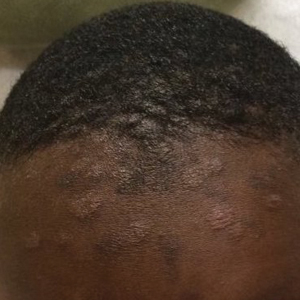
An 8-year-old African American child presented with annular hyperpigmented patches on the face and trunk of several months’ duration. There was no preceding fever, illness, scalp pruritus, or alopecia according to the patient’s mother. The hyperpigmented patches persisted despite use of hydrocortisone and antifungal creams prescribed by a primary care provider. A fungal culture of a scalp specimen was negative. Physical examination during the initial dermatology visit revealed multiple annular hyperpigmented patches on the trunk and extremities. No plaques were evident; however, the mother reported that when the lesions first developed, they were raised and mildly pruritic. The patient was prescribed triamcinolone ointment 0.1% twice daily as needed for itching, and sun protection was emphasized.
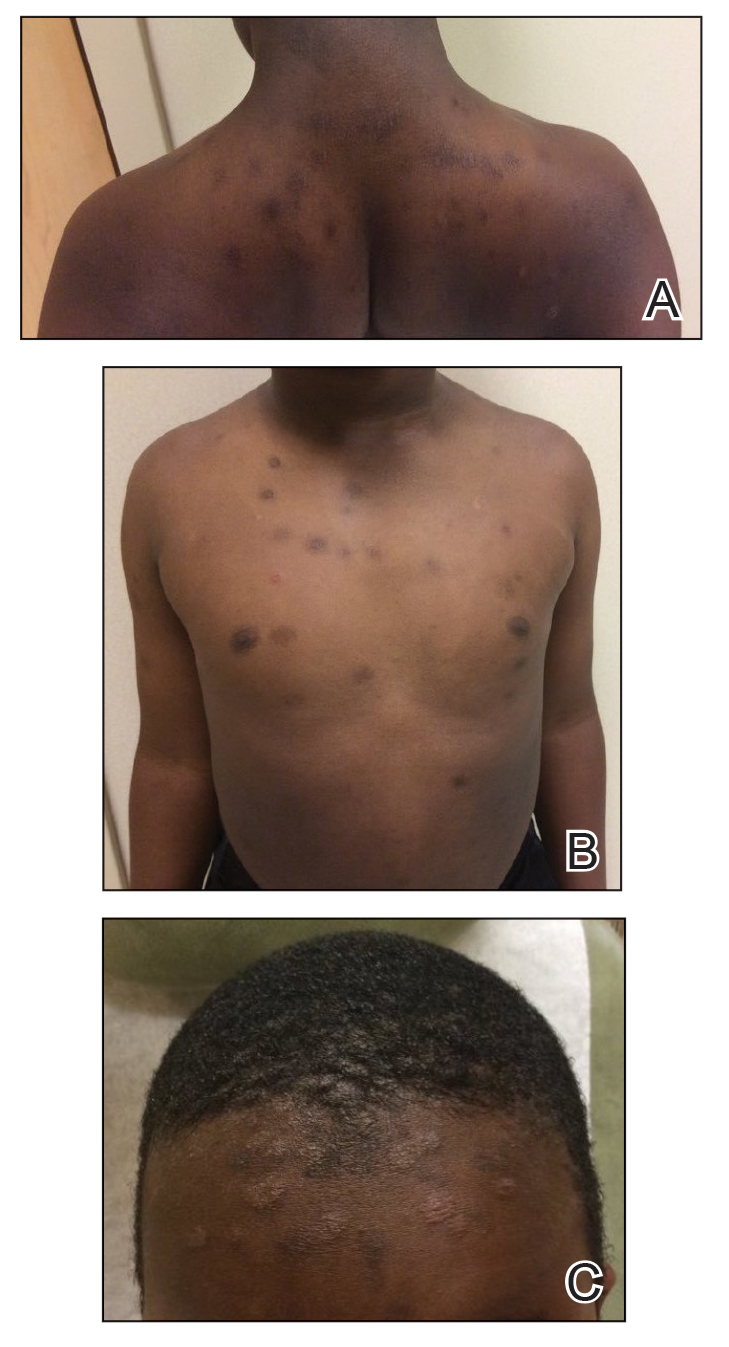
At the follow-up visit weeks later, the patient’s mother reported that the ointment had helped the lesions resolve faster, but new lesions continued to appear. Physical examination at this visit was notable for scattered hyperpigmented patches, annular hyperpigmented plaques, and erythematous plaques on the trunk, arms, and legs, in addition to papulosquamous plaques and hyperpigmented patches on the forehead (Figure 1). Suspicion for tinea capitis was discussed, a repeat scalp fungal culture was performed, and oral terbinafine 250 mg once daily was started empirically. The culture was positive for Trichophyton tonsurans supporting the diagnosis of concomitant tinea capitis. The rash resolved with terbinafine, and annular patches of postinflammatory hyperpigmentation remained.
Dermatophytid reactions are immunologically mediated, disseminated, eczematous eruptions occurring after cutaneous infections or inflammatory skin conditions. Reactions occur days to weeks after exposure to antigens of dermatophytes causing tinea pedis or capitis.2
Common culprits include Microsporum canis and T tonsurans.3 Dermatophytid reactions with tinea capitis exhibit morphologic variability including a symmetric distribution of grouped or diffuse,4 pruritic, erythematous or flesh-colored, follicular papules on the trunk, with or without progression to the face, torso, upper extremities, and/or lower extremities.3 Other reported manifestations include erythema multiforme, erythema nodosum,3 or lupuslike lesions, and crops of dyshidrotic vesicles on the hands in the setting of Trichophyton mentagrophytes–induced tinea pedis.5
The papulosquamous variant id reaction should be considered in a wider differential that includes psoriasis, nummular eczema, and pityriasis rosea. Unlike psoriasis, the id reaction is not chronic and responds to systemic antifungal therapy. Nummular eczema can be ruled out, though not entirely, by a lack of personal or family history of atopy. The characteristic cleavage lines of pityriasis rosea on the trunk are absent in patients with an id reaction, and there would be no preceding illness or herald patches seen in the id reaction.
Tinea capitis may cause a variety of id manifestations, including the papulosquamous phenotype. This case addresses practice gaps that may lead to delayed diagnosis. It also highlights the importance of recognizing uncommon morphologies, performing repeat cultures of the scalp after a negative fungal culture, and lowering the threshold of suspicion for tinea capitis in the appropriate age group and demographic, specifically pediatric patients of African descent.
- Sharma V, Silverberg NB, Howard R, et al. Do hair care practices affect the acquisition of tinea capitis? a case-control study. Arch Pediatr Adolesc Med. 2001;155:818-821.
- Cheng N, Rucker Wright D, Cohen BA. Dermatophytid in tinea capitis: rarely reported common phenomenon with clinical implications. Pediatrics. 2011;128:e453-e457.
- Mayser P. Dermatophyte: current situation [in German]. Hautarzt. 2017;68:316-323.
- Nowicki R. Allergic phenomena in the course of dermatomycoses [in Polish]. Pol Merkur Lekarski. 2003;14:532-534.
5. Boralevi F, Léauté-Labrèze C, Roul S, et al. Lupus-erythematosus-like eruption induced by Trichophyton mentagrophytes infection. Dermatology. 2003;206:303-306.
To the Editor:
Tinea capitis is a common childhood infection seen worldwide and is more prevalent in children of African descent.1 Treatment can be effective; however, the diagnosis may be delayed due to variability in presentation, camouflage of scalp scale with ointment, and the diagnostic experience of the provider. A common complication of tinea capitis is the dermatophytid (id) reaction, which commonly manifests as multiple 1- to 2-mm monomorphic papules. We report a case of a papulosquamous variant of an id reaction secondary to tinea capitis.
An 8-year-old African American child presented with annular hyperpigmented patches on the face and trunk of several months’ duration. There was no preceding fever, illness, scalp pruritus, or alopecia according to the patient’s mother. The hyperpigmented patches persisted despite use of hydrocortisone and antifungal creams prescribed by a primary care provider. A fungal culture of a scalp specimen was negative. Physical examination during the initial dermatology visit revealed multiple annular hyperpigmented patches on the trunk and extremities. No plaques were evident; however, the mother reported that when the lesions first developed, they were raised and mildly pruritic. The patient was prescribed triamcinolone ointment 0.1% twice daily as needed for itching, and sun protection was emphasized.
At the follow-up visit weeks later, the patient’s mother reported that the ointment had helped the lesions resolve faster, but new lesions continued to appear. Physical examination at this visit was notable for scattered hyperpigmented patches, annular hyperpigmented plaques, and erythematous plaques on the trunk, arms, and legs, in addition to papulosquamous plaques and hyperpigmented patches on the forehead (Figure 1). Suspicion for tinea capitis was discussed, a repeat scalp fungal culture was performed, and oral terbinafine 250 mg once daily was started empirically. The culture was positive for Trichophyton tonsurans supporting the diagnosis of concomitant tinea capitis. The rash resolved with terbinafine, and annular patches of postinflammatory hyperpigmentation remained.
Dermatophytid reactions are immunologically mediated, disseminated, eczematous eruptions occurring after cutaneous infections or inflammatory skin conditions. Reactions occur days to weeks after exposure to antigens of dermatophytes causing tinea pedis or capitis.2
Common culprits include Microsporum canis and T tonsurans.3 Dermatophytid reactions with tinea capitis exhibit morphologic variability including a symmetric distribution of grouped or diffuse,4 pruritic, erythematous or flesh-colored, follicular papules on the trunk, with or without progression to the face, torso, upper extremities, and/or lower extremities.3 Other reported manifestations include erythema multiforme, erythema nodosum,3 or lupuslike lesions, and crops of dyshidrotic vesicles on the hands in the setting of Trichophyton mentagrophytes–induced tinea pedis.5
The papulosquamous variant id reaction should be considered in a wider differential that includes psoriasis, nummular eczema, and pityriasis rosea. Unlike psoriasis, the id reaction is not chronic and responds to systemic antifungal therapy. Nummular eczema can be ruled out, though not entirely, by a lack of personal or family history of atopy. The characteristic cleavage lines of pityriasis rosea on the trunk are absent in patients with an id reaction, and there would be no preceding illness or herald patches seen in the id reaction.
Tinea capitis may cause a variety of id manifestations, including the papulosquamous phenotype. This case addresses practice gaps that may lead to delayed diagnosis. It also highlights the importance of recognizing uncommon morphologies, performing repeat cultures of the scalp after a negative fungal culture, and lowering the threshold of suspicion for tinea capitis in the appropriate age group and demographic, specifically pediatric patients of African descent.
To the Editor:
Tinea capitis is a common childhood infection seen worldwide and is more prevalent in children of African descent.1 Treatment can be effective; however, the diagnosis may be delayed due to variability in presentation, camouflage of scalp scale with ointment, and the diagnostic experience of the provider. A common complication of tinea capitis is the dermatophytid (id) reaction, which commonly manifests as multiple 1- to 2-mm monomorphic papules. We report a case of a papulosquamous variant of an id reaction secondary to tinea capitis.
An 8-year-old African American child presented with annular hyperpigmented patches on the face and trunk of several months’ duration. There was no preceding fever, illness, scalp pruritus, or alopecia according to the patient’s mother. The hyperpigmented patches persisted despite use of hydrocortisone and antifungal creams prescribed by a primary care provider. A fungal culture of a scalp specimen was negative. Physical examination during the initial dermatology visit revealed multiple annular hyperpigmented patches on the trunk and extremities. No plaques were evident; however, the mother reported that when the lesions first developed, they were raised and mildly pruritic. The patient was prescribed triamcinolone ointment 0.1% twice daily as needed for itching, and sun protection was emphasized.
At the follow-up visit weeks later, the patient’s mother reported that the ointment had helped the lesions resolve faster, but new lesions continued to appear. Physical examination at this visit was notable for scattered hyperpigmented patches, annular hyperpigmented plaques, and erythematous plaques on the trunk, arms, and legs, in addition to papulosquamous plaques and hyperpigmented patches on the forehead (Figure 1). Suspicion for tinea capitis was discussed, a repeat scalp fungal culture was performed, and oral terbinafine 250 mg once daily was started empirically. The culture was positive for Trichophyton tonsurans supporting the diagnosis of concomitant tinea capitis. The rash resolved with terbinafine, and annular patches of postinflammatory hyperpigmentation remained.
Dermatophytid reactions are immunologically mediated, disseminated, eczematous eruptions occurring after cutaneous infections or inflammatory skin conditions. Reactions occur days to weeks after exposure to antigens of dermatophytes causing tinea pedis or capitis.2
Common culprits include Microsporum canis and T tonsurans.3 Dermatophytid reactions with tinea capitis exhibit morphologic variability including a symmetric distribution of grouped or diffuse,4 pruritic, erythematous or flesh-colored, follicular papules on the trunk, with or without progression to the face, torso, upper extremities, and/or lower extremities.3 Other reported manifestations include erythema multiforme, erythema nodosum,3 or lupuslike lesions, and crops of dyshidrotic vesicles on the hands in the setting of Trichophyton mentagrophytes–induced tinea pedis.5
The papulosquamous variant id reaction should be considered in a wider differential that includes psoriasis, nummular eczema, and pityriasis rosea. Unlike psoriasis, the id reaction is not chronic and responds to systemic antifungal therapy. Nummular eczema can be ruled out, though not entirely, by a lack of personal or family history of atopy. The characteristic cleavage lines of pityriasis rosea on the trunk are absent in patients with an id reaction, and there would be no preceding illness or herald patches seen in the id reaction.
Tinea capitis may cause a variety of id manifestations, including the papulosquamous phenotype. This case addresses practice gaps that may lead to delayed diagnosis. It also highlights the importance of recognizing uncommon morphologies, performing repeat cultures of the scalp after a negative fungal culture, and lowering the threshold of suspicion for tinea capitis in the appropriate age group and demographic, specifically pediatric patients of African descent.
- Sharma V, Silverberg NB, Howard R, et al. Do hair care practices affect the acquisition of tinea capitis? a case-control study. Arch Pediatr Adolesc Med. 2001;155:818-821.
- Cheng N, Rucker Wright D, Cohen BA. Dermatophytid in tinea capitis: rarely reported common phenomenon with clinical implications. Pediatrics. 2011;128:e453-e457.
- Mayser P. Dermatophyte: current situation [in German]. Hautarzt. 2017;68:316-323.
- Nowicki R. Allergic phenomena in the course of dermatomycoses [in Polish]. Pol Merkur Lekarski. 2003;14:532-534.
5. Boralevi F, Léauté-Labrèze C, Roul S, et al. Lupus-erythematosus-like eruption induced by Trichophyton mentagrophytes infection. Dermatology. 2003;206:303-306.
- Sharma V, Silverberg NB, Howard R, et al. Do hair care practices affect the acquisition of tinea capitis? a case-control study. Arch Pediatr Adolesc Med. 2001;155:818-821.
- Cheng N, Rucker Wright D, Cohen BA. Dermatophytid in tinea capitis: rarely reported common phenomenon with clinical implications. Pediatrics. 2011;128:e453-e457.
- Mayser P. Dermatophyte: current situation [in German]. Hautarzt. 2017;68:316-323.
- Nowicki R. Allergic phenomena in the course of dermatomycoses [in Polish]. Pol Merkur Lekarski. 2003;14:532-534.
5. Boralevi F, Léauté-Labrèze C, Roul S, et al. Lupus-erythematosus-like eruption induced by Trichophyton mentagrophytes infection. Dermatology. 2003;206:303-306.
Practice Points
- Dermatophytid (id) reactions can manifest as papulosquamous eruptions after cutaneous infections or inflammatory skin conditions.
- High clinical suspicion for id reaction in patients of the appropriate age group and demographic—pediatric patients of African descent—is imperative for reaching the correct diagnosis.
- Repeat cultures of the scalp may be indicated in patients with high clinical probability for an id reaction despite a negative fungal culture or empiric systemic treatment.
The Role of Dermatology in Identifying and Reporting a Primary Varicella Outbreak
To the Editor:
Cases of primary varicella-zoster virus (VZV) are relatively uncommon in the United States since the introduction of the varicella vaccine in 1995, with an overall decline in cases of more than 97%.1 Prior to the vaccine, 70% of hospitalizations occurred in children; subsequently, hospitalizations among the pediatric population (aged ≤20 years) declined by 97%. Compared to children, adults and immunocompromised patients with VZV infection may present with more severe disease and experience more complications.1
Most children in the United States are vaccinated against VZV, with 90.3% receiving at least 1 dose by 24 months of age.2 However, many countries do not implement universal varicella vaccination for infants.3 As a result, physicians should remember to include primary varicella in the differential when clinically correlated, especially when evaluating patients who have immigrated to the United States or who may be living in unvaccinated communities. We report 2 cases of primary VZV manifesting in adults to remind readers of the salient clinical features of this disease and how dermatologists play a critical role in early and accurate identification of diseases that can have wide-reaching public health implications.
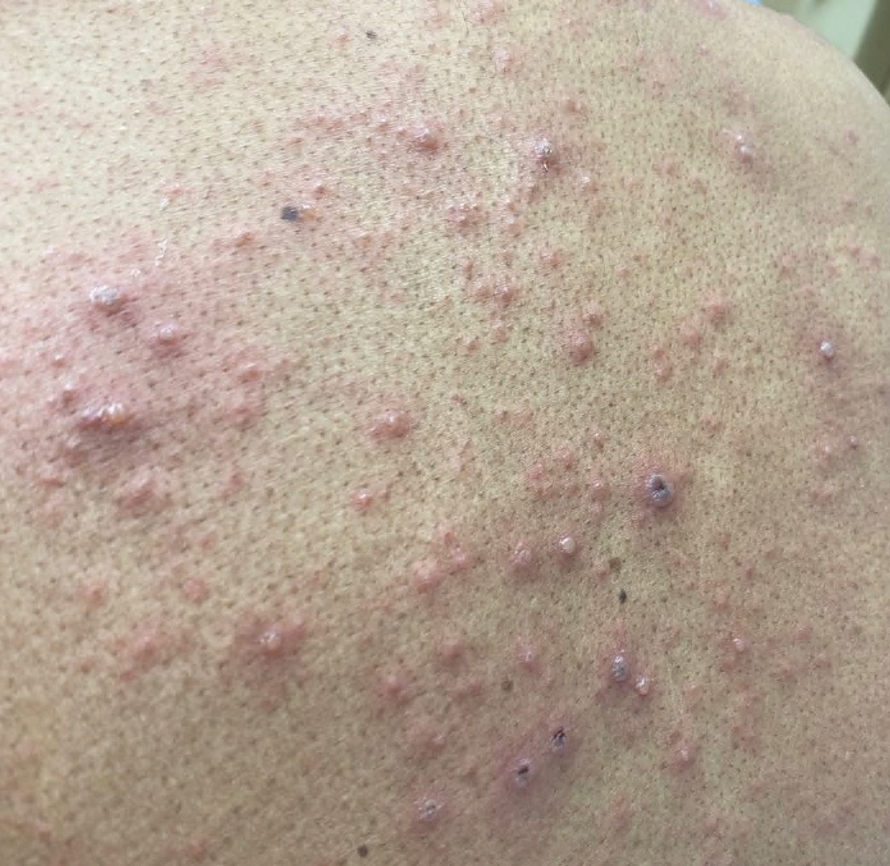
A 26-year-old man with no relevant medical history presented to the emergency department with an itchy and painful rash of 5 days’ duration that began on the trunk and spread to the face, lips, feet, hands, arms, and legs. He also reported shortness of breath, cough, and chills, and he had a temperature of 100.8 °F (38.2 °C). Physical examination revealed numerous erythematous papules and vesiculopustules, some with central umbilication and some with overlying gold crusts (Figure 1).
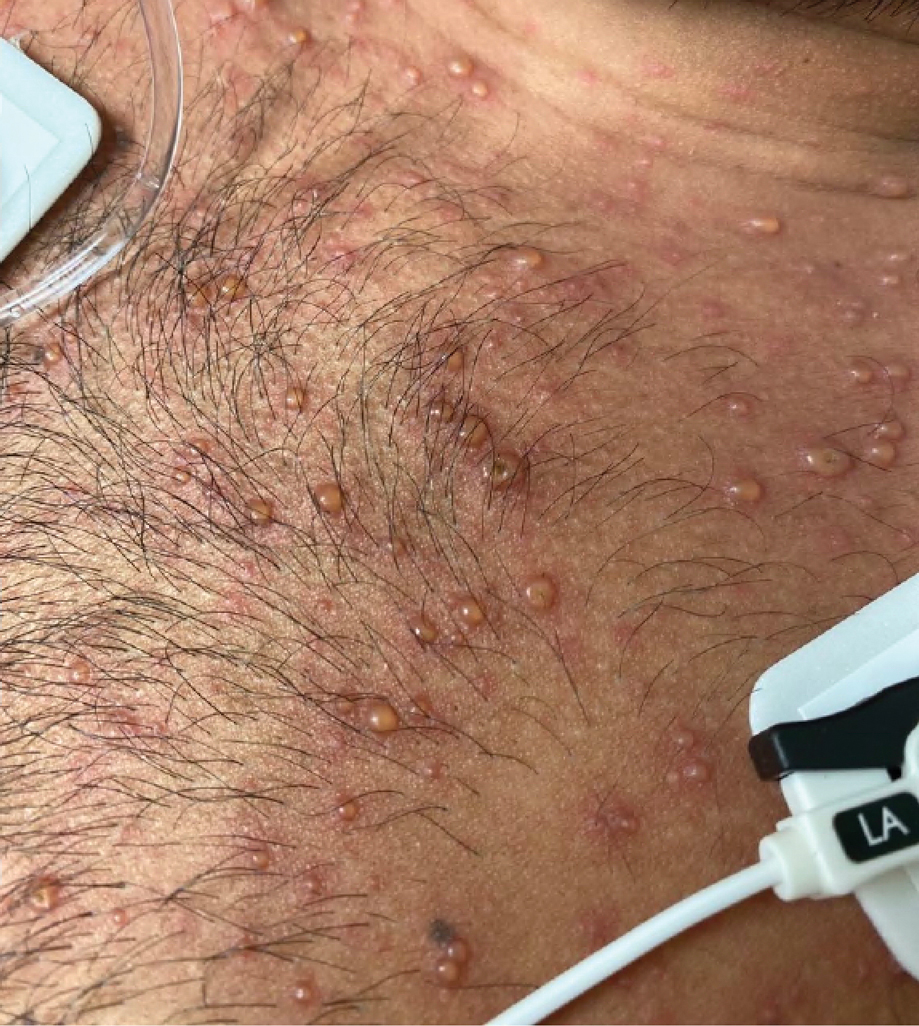
Later that day, a 47-year-old man with no relevant medical history presented to the same emergency department with a rash along with self-reported fever and sore throat of 3 days’ duration. Physical examination found innumerable erythematous vesicopustules scattered on the face, scalp, neck, trunk, arms, and legs, some with a “dew drop on a rose petal” appearance and some with overlying hemorrhagic crust (Figure 2).
Although infection was of primary concern for the first patient, the presentation of the second patient prompted specific concern for primary VZV infection in both patients, who were placed on airborne and contact isolation precautions.
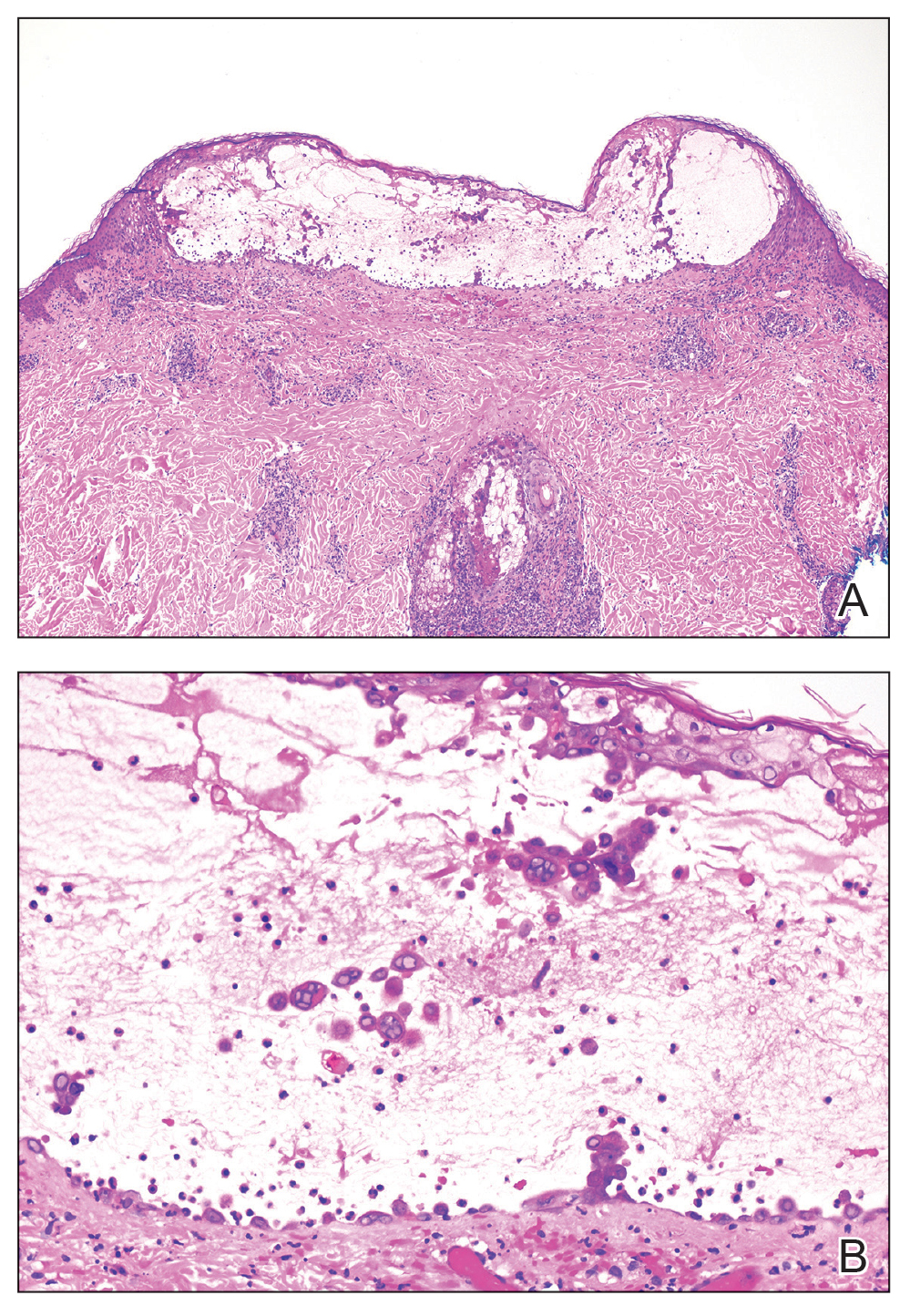
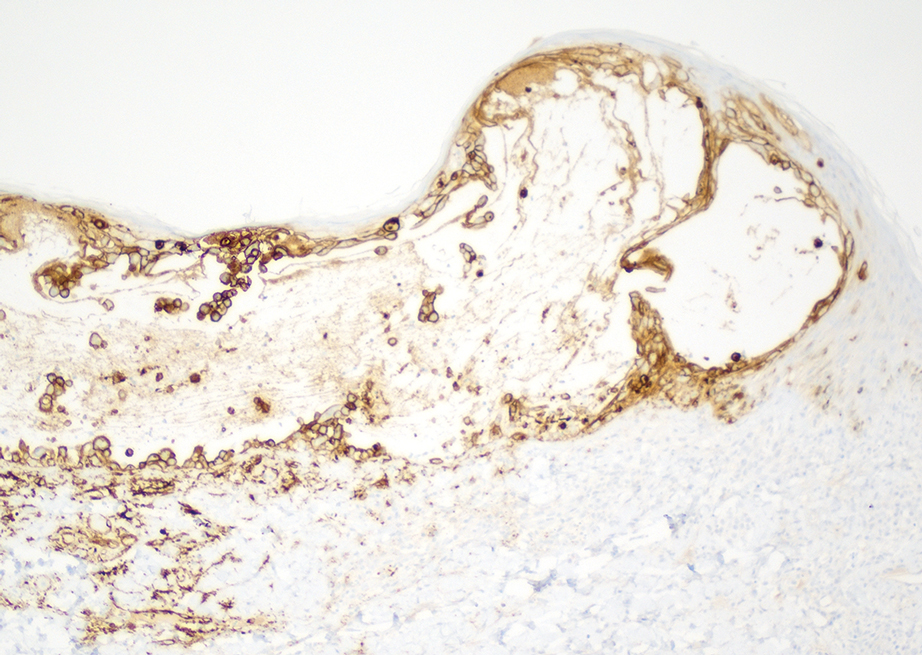
Skin biopsies from both patients showed acantholytic blisters, hair follicle necrosis, and marked dermal inflammation (Figure 3). Herpetic viral changes were seen in keratinocytes, with steel-grey nuclei, multinucleated keratinocytes, and chromatin margination. An immunostain for VZV was diffusely positive, and VZV antibody IgG was positive (Figure 4).
Upon additional questioning, both patients reported recent exposure to VZV-like illnesses in family members without a history of international travel. Neither of the patients was sure of their vaccination status or prior infection history. Both patients received intravenous acyclovir 10 mg/kg administered every 8 hours. Both patients experienced improvement and were discharged after 3 days on oral valacyclovir (1 g 3 times daily for a 7-day treatment course).
The similar presentation and timing of these 2 VZV cases caused concern for an unidentified community outbreak. The infection control team was notified; additionally, per hospital protocol the state health department was alerted as well as the clinicians and staff of the hospital with a request to be vigilant for further cases.
Despite high vaccination rates in the United States, outbreaks of varicella still occur, particularly among unvaccinated individuals, and a robust and efficient response is necessary to control the spread of such outbreaks.4 Many states, including Arkansas where our cases occurred, have laws mandating report of VZV cases to the department of health.5 Dermatologists play an important role in reporting cases, aiding in diagnosis through recognition of the physical examination findings, obtaining appropriate biopsy, and recommending additional laboratory testing.
Typical skin manifestations include a pruritic rash of macules, papules, vesicles, and crusted lesions distributed throughout the trunk, face, arms, and legs. Because new lesions appear over several days, they will be in different stages of healing, resulting in the simultaneous presence of papules, vesicles, and crusted lesions.6 This unique characteristic helps distinguish VZV from other skin diseases such as smallpox or mpox (monkeypox), which generally show lesions in similar stages of evolution.
Biopsy also can aid in identification. Viruses in the herpes family reveal similar histopathologic characteristics, including acantholysis and vesicle formation, intranuclear inclusions with margination of chromatin, multinucleation, and nuclear molding.7 Immunohistochemistry can be used to differentiate VZV from herpes simplex virus; however, neither microscopic examination nor immunohistochemistry distinguish primary VZV infection from herpes zoster (HZ).8
The mpox rash progresses more slowly than a VZV rash and has a centrifugal rather than central distribution that can involve the palms and soles. Lymphadenopathy is a characteristic finding in mpox.9 Rickettsialpox is distinguished from VZV primarily by the appearance of brown or black eschar after the original papulovesicular lesions dry out.10 Atypical hand, foot, and mouth disease can manifest in adults as widespread papulovesicular lesions. This form is associated with coxsackievirus A6 and may require direct fluorescent antibody assay or polymerase chain reaction of keratinocytes to rule out VZV.11
Herpes zoster occurs in older adults with a history of primary VZV.6 It manifests as vesicular lesions confined to 1 or 2 adjacent dermatomes vs the diffuse spread of VZV over the entire body. However, HZ can become disseminated in immunocompromised individuals, making it difficult to clinically distinguish from VZV.6 Serology can be helpful, as high IgM titers indicate an acute primary VZV infection. Subsequently increased IgG titers steadily wane over time and spike during reactivation.12
Dermatology and infectious disease consultations in our cases yielded a preliminary diagnosis through physical examination that was confirmed by biopsy and subsequent laboratory testing, which allowed for a swift response by the infection control team including isolation precautions to control a potential outbreak. Patients with VZV should remain in respiratory isolation until all lesions have crusted over.6
Individuals who had face-to-face indoor contact for at least 5 minutes or who shared a living space with an infected individual should be assessed for VZV immunity, which is defined as confirmed prior immunization or infection.5,13 Lack of VZV immunity requires postexposure prophylaxis—active immunization for the immunocompetent and passive immunization for the immunocompromised.13 Ultimately, no additional cases were reported in the community where our patients resided.
Immunocompetent children with primary VZV require supportive care only. Oral antiviral therapy is the treatment of choice for immunocompetent adults or anyone at increased risk for complications, while intravenous antivirals are recommended for the immunocompromised or those with VZV-related complications.14 A similar approach is used for HZ. Uncomplicated cases are treated with oral antivirals, and complicated cases (eg, HZ ophthalmicus) are treated with intravenous antivirals.15 Commonly used antivirals include acyclovir, valacyclovir, and famciclovir.14
Our cases highlight the ongoing risk for varicella outbreaks in unvaccinated or undervaccinated communities. Physician vigilance is necessary, and dermatology plays a particularly important role in swift and accurate detection of VZV, as demonstrated in our cases by the recognition of classic physical examination findings of erythematous and vesicular papules in each of the patients. Because primary VZV infection can result in life-threatening complications including hepatitis, encephalitis, and pancreatitis, prompt identification and initiation of therapy is important.6 Similarly, quick notification of public health officials about detected primary VZV cases is vital to containing potential community outbreaks.
- Centers for Disease Control and Prevention. Chickenpox (varicella) for healthcare professionals. Published October 21, 2022. Accessed March 6, 2024. https://www.cdc.gov/chickenpox/hcp/index.html#vaccination-impact
- National Center for Health Statistics. Immunization. Published June 13, 2023. Accessed March 6, 2024. https://www.cdc.gov/nchs/fastats/immunize.htm
- Lee YH, Choe YJ, Lee J, et al. Global varicella vaccination programs. Clin Exp Pediatr. 2022;65:555. doi:10.3345/CEP.2021.01564
- Leung J, Lopez AS, Marin M. Changing epidemiology of varicella outbreaks in the United States during the Varicella Vaccination Program, 1995–2019. J Infect Dis. 2022;226(suppl 4):S400-S406.
- Arkansas Department of Health. Rules Pertaining to Reportable Diseases. Published September 11, 2023. Accessed March 6, 2024. https://www.healthy.arkansas.gov/images/uploads/rules/ReportableDiseaseList.pdf
- Pergam S, Limaye A; The AST Infectious Diseases Community of Practice. Varicella zoster virus (VZV). Am J Transplant. 2009;9(suppl 4):S108-S115. doi:10.1111/J.1600-9143.2009.02901.X
- Hoyt B, Bhawan J. Histological spectrum of cutaneous herpes infections. Am J Dermatopathol. 2014;36:609-619. doi:10.1097/DAD.0000000000000148
- Oumarou Hama H, Aboudharam G, Barbieri R, et al. Immunohistochemical diagnosis of human infectious diseases: a review. Diagn Pathol. 2022;17. doi:10.1186/S13000-022-01197-5
- World Health Organization. Mpox (monkeypox). Published April 18, 2023. Accessed March 7, 2024. https://www.who.int/news-room/fact-sheets/detail/monkeypox
- Akram SM, Jamil RT, Gossman W. Rickettsia akari (Rickettsialpox). StatPearls [Internet]. Updated May 8, 2023. Accessed February 29, 2024. https://www.ncbi.nlm.nih.gov/books/NBK448081/
- Lott JP, Liu K, Landry ML, et al. Atypical hand-foot-mouth disease associated with coxsackievirus A6 infection. J Am Acad Dermatol. 2013;69:736. doi:10.1016/J.JAAD.2013.07.024
- Petrun B, Williams V, Brice S. Disseminated varicella-zoster virus in an immunocompetent adult. Dermatol Online J. 2015;21. doi:10.5070/D3213022343
- Kimberlin D, Barnett E, Lynfield R, et al. Exposure to specific pathogens. In: Red Book: 2021-2024 Report of the Committee of Infectious Disease. 32nd ed. American Academy of Pediatrics; 2021:1007-1009.
- Treatment of varicella (chickenpox) infection. UpToDate [Internet]. Updated February 7, 2024. Accessed March 6, 2024. https://www.uptodate.com/contents/treatment-of-varicella-chickenpox-infection
- Treatment of herpes zoster in the immunocompetent host. UpToDate [Internet]. Updated November 29, 2023. Accessed March 6, 2024. https://www.uptodate.com/contents/treatment-of-herpes-zoster
To the Editor:
Cases of primary varicella-zoster virus (VZV) are relatively uncommon in the United States since the introduction of the varicella vaccine in 1995, with an overall decline in cases of more than 97%.1 Prior to the vaccine, 70% of hospitalizations occurred in children; subsequently, hospitalizations among the pediatric population (aged ≤20 years) declined by 97%. Compared to children, adults and immunocompromised patients with VZV infection may present with more severe disease and experience more complications.1
Most children in the United States are vaccinated against VZV, with 90.3% receiving at least 1 dose by 24 months of age.2 However, many countries do not implement universal varicella vaccination for infants.3 As a result, physicians should remember to include primary varicella in the differential when clinically correlated, especially when evaluating patients who have immigrated to the United States or who may be living in unvaccinated communities. We report 2 cases of primary VZV manifesting in adults to remind readers of the salient clinical features of this disease and how dermatologists play a critical role in early and accurate identification of diseases that can have wide-reaching public health implications.
A 26-year-old man with no relevant medical history presented to the emergency department with an itchy and painful rash of 5 days’ duration that began on the trunk and spread to the face, lips, feet, hands, arms, and legs. He also reported shortness of breath, cough, and chills, and he had a temperature of 100.8 °F (38.2 °C). Physical examination revealed numerous erythematous papules and vesiculopustules, some with central umbilication and some with overlying gold crusts (Figure 1).
Later that day, a 47-year-old man with no relevant medical history presented to the same emergency department with a rash along with self-reported fever and sore throat of 3 days’ duration. Physical examination found innumerable erythematous vesicopustules scattered on the face, scalp, neck, trunk, arms, and legs, some with a “dew drop on a rose petal” appearance and some with overlying hemorrhagic crust (Figure 2).
Although infection was of primary concern for the first patient, the presentation of the second patient prompted specific concern for primary VZV infection in both patients, who were placed on airborne and contact isolation precautions.
Skin biopsies from both patients showed acantholytic blisters, hair follicle necrosis, and marked dermal inflammation (Figure 3). Herpetic viral changes were seen in keratinocytes, with steel-grey nuclei, multinucleated keratinocytes, and chromatin margination. An immunostain for VZV was diffusely positive, and VZV antibody IgG was positive (Figure 4).
Upon additional questioning, both patients reported recent exposure to VZV-like illnesses in family members without a history of international travel. Neither of the patients was sure of their vaccination status or prior infection history. Both patients received intravenous acyclovir 10 mg/kg administered every 8 hours. Both patients experienced improvement and were discharged after 3 days on oral valacyclovir (1 g 3 times daily for a 7-day treatment course).
The similar presentation and timing of these 2 VZV cases caused concern for an unidentified community outbreak. The infection control team was notified; additionally, per hospital protocol the state health department was alerted as well as the clinicians and staff of the hospital with a request to be vigilant for further cases.
Despite high vaccination rates in the United States, outbreaks of varicella still occur, particularly among unvaccinated individuals, and a robust and efficient response is necessary to control the spread of such outbreaks.4 Many states, including Arkansas where our cases occurred, have laws mandating report of VZV cases to the department of health.5 Dermatologists play an important role in reporting cases, aiding in diagnosis through recognition of the physical examination findings, obtaining appropriate biopsy, and recommending additional laboratory testing.
Typical skin manifestations include a pruritic rash of macules, papules, vesicles, and crusted lesions distributed throughout the trunk, face, arms, and legs. Because new lesions appear over several days, they will be in different stages of healing, resulting in the simultaneous presence of papules, vesicles, and crusted lesions.6 This unique characteristic helps distinguish VZV from other skin diseases such as smallpox or mpox (monkeypox), which generally show lesions in similar stages of evolution.
Biopsy also can aid in identification. Viruses in the herpes family reveal similar histopathologic characteristics, including acantholysis and vesicle formation, intranuclear inclusions with margination of chromatin, multinucleation, and nuclear molding.7 Immunohistochemistry can be used to differentiate VZV from herpes simplex virus; however, neither microscopic examination nor immunohistochemistry distinguish primary VZV infection from herpes zoster (HZ).8
The mpox rash progresses more slowly than a VZV rash and has a centrifugal rather than central distribution that can involve the palms and soles. Lymphadenopathy is a characteristic finding in mpox.9 Rickettsialpox is distinguished from VZV primarily by the appearance of brown or black eschar after the original papulovesicular lesions dry out.10 Atypical hand, foot, and mouth disease can manifest in adults as widespread papulovesicular lesions. This form is associated with coxsackievirus A6 and may require direct fluorescent antibody assay or polymerase chain reaction of keratinocytes to rule out VZV.11
Herpes zoster occurs in older adults with a history of primary VZV.6 It manifests as vesicular lesions confined to 1 or 2 adjacent dermatomes vs the diffuse spread of VZV over the entire body. However, HZ can become disseminated in immunocompromised individuals, making it difficult to clinically distinguish from VZV.6 Serology can be helpful, as high IgM titers indicate an acute primary VZV infection. Subsequently increased IgG titers steadily wane over time and spike during reactivation.12
Dermatology and infectious disease consultations in our cases yielded a preliminary diagnosis through physical examination that was confirmed by biopsy and subsequent laboratory testing, which allowed for a swift response by the infection control team including isolation precautions to control a potential outbreak. Patients with VZV should remain in respiratory isolation until all lesions have crusted over.6
Individuals who had face-to-face indoor contact for at least 5 minutes or who shared a living space with an infected individual should be assessed for VZV immunity, which is defined as confirmed prior immunization or infection.5,13 Lack of VZV immunity requires postexposure prophylaxis—active immunization for the immunocompetent and passive immunization for the immunocompromised.13 Ultimately, no additional cases were reported in the community where our patients resided.
Immunocompetent children with primary VZV require supportive care only. Oral antiviral therapy is the treatment of choice for immunocompetent adults or anyone at increased risk for complications, while intravenous antivirals are recommended for the immunocompromised or those with VZV-related complications.14 A similar approach is used for HZ. Uncomplicated cases are treated with oral antivirals, and complicated cases (eg, HZ ophthalmicus) are treated with intravenous antivirals.15 Commonly used antivirals include acyclovir, valacyclovir, and famciclovir.14
Our cases highlight the ongoing risk for varicella outbreaks in unvaccinated or undervaccinated communities. Physician vigilance is necessary, and dermatology plays a particularly important role in swift and accurate detection of VZV, as demonstrated in our cases by the recognition of classic physical examination findings of erythematous and vesicular papules in each of the patients. Because primary VZV infection can result in life-threatening complications including hepatitis, encephalitis, and pancreatitis, prompt identification and initiation of therapy is important.6 Similarly, quick notification of public health officials about detected primary VZV cases is vital to containing potential community outbreaks.
To the Editor:
Cases of primary varicella-zoster virus (VZV) are relatively uncommon in the United States since the introduction of the varicella vaccine in 1995, with an overall decline in cases of more than 97%.1 Prior to the vaccine, 70% of hospitalizations occurred in children; subsequently, hospitalizations among the pediatric population (aged ≤20 years) declined by 97%. Compared to children, adults and immunocompromised patients with VZV infection may present with more severe disease and experience more complications.1
Most children in the United States are vaccinated against VZV, with 90.3% receiving at least 1 dose by 24 months of age.2 However, many countries do not implement universal varicella vaccination for infants.3 As a result, physicians should remember to include primary varicella in the differential when clinically correlated, especially when evaluating patients who have immigrated to the United States or who may be living in unvaccinated communities. We report 2 cases of primary VZV manifesting in adults to remind readers of the salient clinical features of this disease and how dermatologists play a critical role in early and accurate identification of diseases that can have wide-reaching public health implications.
A 26-year-old man with no relevant medical history presented to the emergency department with an itchy and painful rash of 5 days’ duration that began on the trunk and spread to the face, lips, feet, hands, arms, and legs. He also reported shortness of breath, cough, and chills, and he had a temperature of 100.8 °F (38.2 °C). Physical examination revealed numerous erythematous papules and vesiculopustules, some with central umbilication and some with overlying gold crusts (Figure 1).
Later that day, a 47-year-old man with no relevant medical history presented to the same emergency department with a rash along with self-reported fever and sore throat of 3 days’ duration. Physical examination found innumerable erythematous vesicopustules scattered on the face, scalp, neck, trunk, arms, and legs, some with a “dew drop on a rose petal” appearance and some with overlying hemorrhagic crust (Figure 2).
Although infection was of primary concern for the first patient, the presentation of the second patient prompted specific concern for primary VZV infection in both patients, who were placed on airborne and contact isolation precautions.
Skin biopsies from both patients showed acantholytic blisters, hair follicle necrosis, and marked dermal inflammation (Figure 3). Herpetic viral changes were seen in keratinocytes, with steel-grey nuclei, multinucleated keratinocytes, and chromatin margination. An immunostain for VZV was diffusely positive, and VZV antibody IgG was positive (Figure 4).
Upon additional questioning, both patients reported recent exposure to VZV-like illnesses in family members without a history of international travel. Neither of the patients was sure of their vaccination status or prior infection history. Both patients received intravenous acyclovir 10 mg/kg administered every 8 hours. Both patients experienced improvement and were discharged after 3 days on oral valacyclovir (1 g 3 times daily for a 7-day treatment course).
The similar presentation and timing of these 2 VZV cases caused concern for an unidentified community outbreak. The infection control team was notified; additionally, per hospital protocol the state health department was alerted as well as the clinicians and staff of the hospital with a request to be vigilant for further cases.
Despite high vaccination rates in the United States, outbreaks of varicella still occur, particularly among unvaccinated individuals, and a robust and efficient response is necessary to control the spread of such outbreaks.4 Many states, including Arkansas where our cases occurred, have laws mandating report of VZV cases to the department of health.5 Dermatologists play an important role in reporting cases, aiding in diagnosis through recognition of the physical examination findings, obtaining appropriate biopsy, and recommending additional laboratory testing.
Typical skin manifestations include a pruritic rash of macules, papules, vesicles, and crusted lesions distributed throughout the trunk, face, arms, and legs. Because new lesions appear over several days, they will be in different stages of healing, resulting in the simultaneous presence of papules, vesicles, and crusted lesions.6 This unique characteristic helps distinguish VZV from other skin diseases such as smallpox or mpox (monkeypox), which generally show lesions in similar stages of evolution.
Biopsy also can aid in identification. Viruses in the herpes family reveal similar histopathologic characteristics, including acantholysis and vesicle formation, intranuclear inclusions with margination of chromatin, multinucleation, and nuclear molding.7 Immunohistochemistry can be used to differentiate VZV from herpes simplex virus; however, neither microscopic examination nor immunohistochemistry distinguish primary VZV infection from herpes zoster (HZ).8
The mpox rash progresses more slowly than a VZV rash and has a centrifugal rather than central distribution that can involve the palms and soles. Lymphadenopathy is a characteristic finding in mpox.9 Rickettsialpox is distinguished from VZV primarily by the appearance of brown or black eschar after the original papulovesicular lesions dry out.10 Atypical hand, foot, and mouth disease can manifest in adults as widespread papulovesicular lesions. This form is associated with coxsackievirus A6 and may require direct fluorescent antibody assay or polymerase chain reaction of keratinocytes to rule out VZV.11
Herpes zoster occurs in older adults with a history of primary VZV.6 It manifests as vesicular lesions confined to 1 or 2 adjacent dermatomes vs the diffuse spread of VZV over the entire body. However, HZ can become disseminated in immunocompromised individuals, making it difficult to clinically distinguish from VZV.6 Serology can be helpful, as high IgM titers indicate an acute primary VZV infection. Subsequently increased IgG titers steadily wane over time and spike during reactivation.12
Dermatology and infectious disease consultations in our cases yielded a preliminary diagnosis through physical examination that was confirmed by biopsy and subsequent laboratory testing, which allowed for a swift response by the infection control team including isolation precautions to control a potential outbreak. Patients with VZV should remain in respiratory isolation until all lesions have crusted over.6
Individuals who had face-to-face indoor contact for at least 5 minutes or who shared a living space with an infected individual should be assessed for VZV immunity, which is defined as confirmed prior immunization or infection.5,13 Lack of VZV immunity requires postexposure prophylaxis—active immunization for the immunocompetent and passive immunization for the immunocompromised.13 Ultimately, no additional cases were reported in the community where our patients resided.
Immunocompetent children with primary VZV require supportive care only. Oral antiviral therapy is the treatment of choice for immunocompetent adults or anyone at increased risk for complications, while intravenous antivirals are recommended for the immunocompromised or those with VZV-related complications.14 A similar approach is used for HZ. Uncomplicated cases are treated with oral antivirals, and complicated cases (eg, HZ ophthalmicus) are treated with intravenous antivirals.15 Commonly used antivirals include acyclovir, valacyclovir, and famciclovir.14
Our cases highlight the ongoing risk for varicella outbreaks in unvaccinated or undervaccinated communities. Physician vigilance is necessary, and dermatology plays a particularly important role in swift and accurate detection of VZV, as demonstrated in our cases by the recognition of classic physical examination findings of erythematous and vesicular papules in each of the patients. Because primary VZV infection can result in life-threatening complications including hepatitis, encephalitis, and pancreatitis, prompt identification and initiation of therapy is important.6 Similarly, quick notification of public health officials about detected primary VZV cases is vital to containing potential community outbreaks.
- Centers for Disease Control and Prevention. Chickenpox (varicella) for healthcare professionals. Published October 21, 2022. Accessed March 6, 2024. https://www.cdc.gov/chickenpox/hcp/index.html#vaccination-impact
- National Center for Health Statistics. Immunization. Published June 13, 2023. Accessed March 6, 2024. https://www.cdc.gov/nchs/fastats/immunize.htm
- Lee YH, Choe YJ, Lee J, et al. Global varicella vaccination programs. Clin Exp Pediatr. 2022;65:555. doi:10.3345/CEP.2021.01564
- Leung J, Lopez AS, Marin M. Changing epidemiology of varicella outbreaks in the United States during the Varicella Vaccination Program, 1995–2019. J Infect Dis. 2022;226(suppl 4):S400-S406.
- Arkansas Department of Health. Rules Pertaining to Reportable Diseases. Published September 11, 2023. Accessed March 6, 2024. https://www.healthy.arkansas.gov/images/uploads/rules/ReportableDiseaseList.pdf
- Pergam S, Limaye A; The AST Infectious Diseases Community of Practice. Varicella zoster virus (VZV). Am J Transplant. 2009;9(suppl 4):S108-S115. doi:10.1111/J.1600-9143.2009.02901.X
- Hoyt B, Bhawan J. Histological spectrum of cutaneous herpes infections. Am J Dermatopathol. 2014;36:609-619. doi:10.1097/DAD.0000000000000148
- Oumarou Hama H, Aboudharam G, Barbieri R, et al. Immunohistochemical diagnosis of human infectious diseases: a review. Diagn Pathol. 2022;17. doi:10.1186/S13000-022-01197-5
- World Health Organization. Mpox (monkeypox). Published April 18, 2023. Accessed March 7, 2024. https://www.who.int/news-room/fact-sheets/detail/monkeypox
- Akram SM, Jamil RT, Gossman W. Rickettsia akari (Rickettsialpox). StatPearls [Internet]. Updated May 8, 2023. Accessed February 29, 2024. https://www.ncbi.nlm.nih.gov/books/NBK448081/
- Lott JP, Liu K, Landry ML, et al. Atypical hand-foot-mouth disease associated with coxsackievirus A6 infection. J Am Acad Dermatol. 2013;69:736. doi:10.1016/J.JAAD.2013.07.024
- Petrun B, Williams V, Brice S. Disseminated varicella-zoster virus in an immunocompetent adult. Dermatol Online J. 2015;21. doi:10.5070/D3213022343
- Kimberlin D, Barnett E, Lynfield R, et al. Exposure to specific pathogens. In: Red Book: 2021-2024 Report of the Committee of Infectious Disease. 32nd ed. American Academy of Pediatrics; 2021:1007-1009.
- Treatment of varicella (chickenpox) infection. UpToDate [Internet]. Updated February 7, 2024. Accessed March 6, 2024. https://www.uptodate.com/contents/treatment-of-varicella-chickenpox-infection
- Treatment of herpes zoster in the immunocompetent host. UpToDate [Internet]. Updated November 29, 2023. Accessed March 6, 2024. https://www.uptodate.com/contents/treatment-of-herpes-zoster
- Centers for Disease Control and Prevention. Chickenpox (varicella) for healthcare professionals. Published October 21, 2022. Accessed March 6, 2024. https://www.cdc.gov/chickenpox/hcp/index.html#vaccination-impact
- National Center for Health Statistics. Immunization. Published June 13, 2023. Accessed March 6, 2024. https://www.cdc.gov/nchs/fastats/immunize.htm
- Lee YH, Choe YJ, Lee J, et al. Global varicella vaccination programs. Clin Exp Pediatr. 2022;65:555. doi:10.3345/CEP.2021.01564
- Leung J, Lopez AS, Marin M. Changing epidemiology of varicella outbreaks in the United States during the Varicella Vaccination Program, 1995–2019. J Infect Dis. 2022;226(suppl 4):S400-S406.
- Arkansas Department of Health. Rules Pertaining to Reportable Diseases. Published September 11, 2023. Accessed March 6, 2024. https://www.healthy.arkansas.gov/images/uploads/rules/ReportableDiseaseList.pdf
- Pergam S, Limaye A; The AST Infectious Diseases Community of Practice. Varicella zoster virus (VZV). Am J Transplant. 2009;9(suppl 4):S108-S115. doi:10.1111/J.1600-9143.2009.02901.X
- Hoyt B, Bhawan J. Histological spectrum of cutaneous herpes infections. Am J Dermatopathol. 2014;36:609-619. doi:10.1097/DAD.0000000000000148
- Oumarou Hama H, Aboudharam G, Barbieri R, et al. Immunohistochemical diagnosis of human infectious diseases: a review. Diagn Pathol. 2022;17. doi:10.1186/S13000-022-01197-5
- World Health Organization. Mpox (monkeypox). Published April 18, 2023. Accessed March 7, 2024. https://www.who.int/news-room/fact-sheets/detail/monkeypox
- Akram SM, Jamil RT, Gossman W. Rickettsia akari (Rickettsialpox). StatPearls [Internet]. Updated May 8, 2023. Accessed February 29, 2024. https://www.ncbi.nlm.nih.gov/books/NBK448081/
- Lott JP, Liu K, Landry ML, et al. Atypical hand-foot-mouth disease associated with coxsackievirus A6 infection. J Am Acad Dermatol. 2013;69:736. doi:10.1016/J.JAAD.2013.07.024
- Petrun B, Williams V, Brice S. Disseminated varicella-zoster virus in an immunocompetent adult. Dermatol Online J. 2015;21. doi:10.5070/D3213022343
- Kimberlin D, Barnett E, Lynfield R, et al. Exposure to specific pathogens. In: Red Book: 2021-2024 Report of the Committee of Infectious Disease. 32nd ed. American Academy of Pediatrics; 2021:1007-1009.
- Treatment of varicella (chickenpox) infection. UpToDate [Internet]. Updated February 7, 2024. Accessed March 6, 2024. https://www.uptodate.com/contents/treatment-of-varicella-chickenpox-infection
- Treatment of herpes zoster in the immunocompetent host. UpToDate [Internet]. Updated November 29, 2023. Accessed March 6, 2024. https://www.uptodate.com/contents/treatment-of-herpes-zoster
Practice Points
- Primary varicella is a relatively infrequent occurrence since the introduction of vaccination, creating the need for a reminder on the importance of including it in the differential when clinically appropriate.
- When outbreaks do happen, typically among unvaccinated communities, swift identification via physical examination and histology is imperative to allow infection control teams and public health officials to quickly take action.
Why Do So Many Doctors Embrace Superstitions and Rituals?
The second-floor operating rooms at Lehigh Valley Hospital in Allentown, Pennsylvania, are numbered sequentially — except when you get to what should be operation room (OR) 13. It’s OR M. The M doesn’t stand for Maternity or any other specialty. Rather in this high-tech, state-of-the art healthcare center, it’s there to ward off bad juju and evil spirits.
“Just as taller buildings usually don’t have a 13th floor or hotels don’t have a room 13, it revolves around the common superstition of the unlucky nature of number 13,” said a hospital spokesperson.
During the pandemic, the public was told repeatedly that modern medicine is science-based. But when I started talking to surgeons and other physicians for this article, I uncovered something decidedly unscientific.
In ORs and emergency rooms (ERs), small-town doctor’s offices, and mega hospitals, there’s a measure of dread before full moons and Friday the 13th, and no one dares utter the Q word (as in, “It sure is quiet today.”) That would risk bringing the wrath of the medical gods, and you’d earn the reputation of being a jinx or “black cloud.” Likewise, the songs “Stairway to Heaven” or “Another One Bites the Dust” will never be heard in any waiting room, elevator, or OR.
Indeed, when it comes to superstitions and rituals in medicine, it seems everyone has a story or a belief. …
A 2-Hour Ritual
Carmen Fong, MD, a colorectal surgeon in New York City, had a presurgical ritual that took her nearly 2 hours to complete. “I’d wake up at the same time every day, pack two hard-boiled eggs and a thermos of coffee in my small leather bag, walk to work via the same route, and swipe into the preop area while waving hi to the front desk,” she recounted. “I’d talk to the patient, sign the consent with the same ballpoint pen, go upstairs to my office, change into my scrubs [same cap and Danskos], then turn on my computer, and take a sip of coffee before heading back down to the OR. I’d always remove my badge and place it near the nurses’ workstation, then put on the patient’s SCDs [sequential compression devices] myself. I’d hold the oxygen mask while telling the patient, ‘See you later.’ Never ‘It will be okay’ or ‘Have a good sleep.’ Always ‘See you later.’ ”
Dr. Fong did this for 5 years prior to more than a thousand surgeries. She did it because it made her feel calm and in control, which translated to more successful operations. “It never failed me.”
Wonder Woman Clogs
Anureet Bajaj, MD, a plastic surgeon in Oklahoma City, wore Wonder Woman clogs in the OR for years because “they made me feel stronger, and my surgeries went better.” She’s also very specific about her OR playlist; “it must be ‘80s music.” And for a time, she wore a friendship bracelet that one of her employees made to commemorate getting through a particularly hard day. “If I forgot it, my heart sank, and my anxiety rose,” she said. “Wearing it gave me security and confidence that the day would go well.”
A Moment of Silence
Juliet Emamaullee, MD, PhD, is a liver and kidney transplant surgeon at Keck Hospital and Children’s Hospital Los Angeles. Because of the complexity of her operations, she must know every aspect of her patients’ medical history. This leads to a level of intimacy that most people never have with their doctors. “Transplant surgeons are playing god in many ways,” she said. “During procurement, after we prep and drape the donor and right before I make the incision, everyone in the OR has a moment of silence to acknowledge the donation. If the organ has been transported, then I’ll say a prayer to myself that I do good work with this generous gift of life.”
Magical Thinking
Before we go any further, I should clarify that there’s a difference between rituals and superstitions like the ones just shared and routines and practices such as handwashing or doublechecking that it’s the right hip and not the left. All pilots have a preflight checklist that’s necessary for safety, but some might also make the sign of the cross.
Lester Gottesman, MD, has been a surgeon at the Icahn School of Medicine at Mount Sinai Hospital in New York City for nearly 50 years. He believes rituals and superstitions are more prevalent in medicine than in any other profession, despite there being no definitive research confirming their effectiveness.
In fact, it’s the opposite.
One of the few studies to examine superstitions among physicians was published in the Annals of Surgery in 2021. Researchers analyzed the operational records of 27,914 consecutive patients who underwent general, visceral, or vascular surgery. They found no association of moon phases, zodiac signs, or Friday the 13th with poor outcomes. Having acute coronary syndrome on Friday the 13th also did not influence the 13-year mortality rate compared to other dates in the year. And although 70% of physicians believe that some colleagues are “black clouds,” an analysis of 96 physicians and 6149 admissions found no such pattern.
Granted, this is just one analysis, but the results aren’t surprising. No one really believes in this stuff. So, why does it persist?
Dr. Gottesman cited an episode from the popular medical TV show Grey’s Anatomy, in which chief surgeon Meredith Grey puts it this way: “Superstition lies in the space between what we can control and what we can’t. …We rely on superstitions because we are smart enough to know we don’t have all the answers and that life works in mysterious ways. Don’t diss the juju from wherever it comes.”
“Superstition and science both start at the same place — to explain an unexplainable event,” said Dr. Gottesman, who always checks his suture lines at the end of a surgery in the order in which he did them. “If science provides a coherent answer, so be it. If not, the human’s need for order will assign causality to otherwise inanimate objects, noncausal events, or divine influence.”
In other words, the more unknowns and trepidation, the greater the tendency toward what Dr. Gottesman called “magical thinking.” And when you consider healing’s long history, you realize that ritual and superstition defined medicine for centuries. Gottesman pointed out that it wasn’t until Hippocrates separated religion and superstition from disease around 430 BC that modern medicine was born. But because doctors still don’t know everything, an element of magic endures.
The question is, in this high-tech age, do these stubborn beliefs still have a place? Do they help or hinder doctors, and, most important, do they have any effect on patient outcomes?
Five Benefits
To reiterate, there are no studies showing that Wonder Woman clogs convey surgical superpowers or that eating two hard-boiled eggs boosts OR performance. But anecdotally, many doctors admit to experiencing noticeable perks from their quirks. Let’s start with the supposed benefits:
- Less stress: A quarter of US clinicians are considering switching careers, primarily due to burnout, according to a 2022 Bain survey. “The fact that [rituals and superstitions] are so prevalent in such a high-stress field can’t be coincidence,” said Dr. Fong. “Offloading some of the responsibility to whatever gods there may be is a way of taming our anxieties so we can function better.”
- Hyperfocus: Dr. Emamaullee played volleyball in high school and college. She suggested that her presurgical routine isn’t all that different from her warmup before a championship match. It’s habitual behavior that helps induce a state of heightened concentration, confidence, and immersion. Athletes call it being “in the zone” or in a “state of flow,” and Dr. Emamaullee said she experiences the same thing in the OR.
- More control: Remember those horrific images of patients with COVID-19 overwhelming ERs in Brooklyn and Queens during the pandemic? Dr. Fong was in the middle of that. “In crisis situations where there are more unknowns, rituals and superstitions become even more important,” she said. “I may not be able to control what’s happening, but I can control myself. Rituals help restore some normalcy and organization, and they give me a sense of calm.”
- Better performance: A series of general-population experiments published in the journal Psychological Science in 2010 concluded that “good-luck–related superstitions” boosted self-confidence in mastering upcoming tasks and improved motor dexterity, memory, and overall performance.
- Placebo effect: This phenomenon is well-established in medicine. Give someone a special pill or treatment, and a significant portion will claim benefit. “Placebo is magical thinking,” said Dr. Gottesman. “It has identifiable and quantifiable effects on human disease.” And perhaps on medical practitioners, too. If a doctor believes her friendship bracelet has special powers and helps her be a better physician, then it just might.
Four Drawbacks
- Compulsive behavior: When superstitious beliefs or repetitive behaviors begin causing personal distress, interfering with daily duties, or negatively affecting patient outcomes, then there’s a problem. There’s a story on Quora about a neurosurgeon who always ate two Hostess Ho Hos chocolate cakes before operations. When he forgot to do so one day, he supposedly left his patient on the table and ran off to eat them. Even if it’s urban legend, it’s a useful illustration of quirk disrupting work.
- Less flexibility: Every human body and every surgery is different. “When ritualistic behaviors or habits become so rigid that you lose the ability to adapt, then that becomes dangerous for the patient,” said Dr. Fong. “The art of medicine, not unlike jazz, often comes from the improvisation.”
- Self-fulfilling: Just as rituals and superstitions can empower and provide a sense of control, they can quickly turn on physicians who forget a part of their routine or leave their talisman on the bureau. Instead of confidence, they supply doubt. The karma becomes kryptonite.
- Avoiding responsibility: After years of friendship bracelets and Wonder Woman clogs, Dr. Bajaj is making a deliberate effort to excise magical thinking from her practice. “It can hold you back if you’re not careful,” she said. “If you start using it as a crutch when something goes wrong — like ‘Oh, I wasn’t wearing my clogs today and that’s why my flap failed’ — then you’re not doing your due diligence and figuring out what really happened.” Rather than placing the responsibility for her day going well on superstition, she’s trying to own it herself by living with more intent.
The Diagnosis
Most of the medical experts I spoke with didn’t think there was anything wrong with rituals or superstitions as long as they didn’t become compulsive or a convenient repository of blame.
“Rituals and superstitions are an acknowledgment that forces external to ourselves exist,” concluded Dr. Fong. “They’re like tiny offerings to whatever gods are out there to please be on our side. And we keep doing them because there’s a reward — better patient outcomes, which is all we want to achieve in the end. I say embrace them.”
A version of this article first appeared on Medscape.com.
The second-floor operating rooms at Lehigh Valley Hospital in Allentown, Pennsylvania, are numbered sequentially — except when you get to what should be operation room (OR) 13. It’s OR M. The M doesn’t stand for Maternity or any other specialty. Rather in this high-tech, state-of-the art healthcare center, it’s there to ward off bad juju and evil spirits.
“Just as taller buildings usually don’t have a 13th floor or hotels don’t have a room 13, it revolves around the common superstition of the unlucky nature of number 13,” said a hospital spokesperson.
During the pandemic, the public was told repeatedly that modern medicine is science-based. But when I started talking to surgeons and other physicians for this article, I uncovered something decidedly unscientific.
In ORs and emergency rooms (ERs), small-town doctor’s offices, and mega hospitals, there’s a measure of dread before full moons and Friday the 13th, and no one dares utter the Q word (as in, “It sure is quiet today.”) That would risk bringing the wrath of the medical gods, and you’d earn the reputation of being a jinx or “black cloud.” Likewise, the songs “Stairway to Heaven” or “Another One Bites the Dust” will never be heard in any waiting room, elevator, or OR.
Indeed, when it comes to superstitions and rituals in medicine, it seems everyone has a story or a belief. …
A 2-Hour Ritual
Carmen Fong, MD, a colorectal surgeon in New York City, had a presurgical ritual that took her nearly 2 hours to complete. “I’d wake up at the same time every day, pack two hard-boiled eggs and a thermos of coffee in my small leather bag, walk to work via the same route, and swipe into the preop area while waving hi to the front desk,” she recounted. “I’d talk to the patient, sign the consent with the same ballpoint pen, go upstairs to my office, change into my scrubs [same cap and Danskos], then turn on my computer, and take a sip of coffee before heading back down to the OR. I’d always remove my badge and place it near the nurses’ workstation, then put on the patient’s SCDs [sequential compression devices] myself. I’d hold the oxygen mask while telling the patient, ‘See you later.’ Never ‘It will be okay’ or ‘Have a good sleep.’ Always ‘See you later.’ ”
Dr. Fong did this for 5 years prior to more than a thousand surgeries. She did it because it made her feel calm and in control, which translated to more successful operations. “It never failed me.”
Wonder Woman Clogs
Anureet Bajaj, MD, a plastic surgeon in Oklahoma City, wore Wonder Woman clogs in the OR for years because “they made me feel stronger, and my surgeries went better.” She’s also very specific about her OR playlist; “it must be ‘80s music.” And for a time, she wore a friendship bracelet that one of her employees made to commemorate getting through a particularly hard day. “If I forgot it, my heart sank, and my anxiety rose,” she said. “Wearing it gave me security and confidence that the day would go well.”
A Moment of Silence
Juliet Emamaullee, MD, PhD, is a liver and kidney transplant surgeon at Keck Hospital and Children’s Hospital Los Angeles. Because of the complexity of her operations, she must know every aspect of her patients’ medical history. This leads to a level of intimacy that most people never have with their doctors. “Transplant surgeons are playing god in many ways,” she said. “During procurement, after we prep and drape the donor and right before I make the incision, everyone in the OR has a moment of silence to acknowledge the donation. If the organ has been transported, then I’ll say a prayer to myself that I do good work with this generous gift of life.”
Magical Thinking
Before we go any further, I should clarify that there’s a difference between rituals and superstitions like the ones just shared and routines and practices such as handwashing or doublechecking that it’s the right hip and not the left. All pilots have a preflight checklist that’s necessary for safety, but some might also make the sign of the cross.
Lester Gottesman, MD, has been a surgeon at the Icahn School of Medicine at Mount Sinai Hospital in New York City for nearly 50 years. He believes rituals and superstitions are more prevalent in medicine than in any other profession, despite there being no definitive research confirming their effectiveness.
In fact, it’s the opposite.
One of the few studies to examine superstitions among physicians was published in the Annals of Surgery in 2021. Researchers analyzed the operational records of 27,914 consecutive patients who underwent general, visceral, or vascular surgery. They found no association of moon phases, zodiac signs, or Friday the 13th with poor outcomes. Having acute coronary syndrome on Friday the 13th also did not influence the 13-year mortality rate compared to other dates in the year. And although 70% of physicians believe that some colleagues are “black clouds,” an analysis of 96 physicians and 6149 admissions found no such pattern.
Granted, this is just one analysis, but the results aren’t surprising. No one really believes in this stuff. So, why does it persist?
Dr. Gottesman cited an episode from the popular medical TV show Grey’s Anatomy, in which chief surgeon Meredith Grey puts it this way: “Superstition lies in the space between what we can control and what we can’t. …We rely on superstitions because we are smart enough to know we don’t have all the answers and that life works in mysterious ways. Don’t diss the juju from wherever it comes.”
“Superstition and science both start at the same place — to explain an unexplainable event,” said Dr. Gottesman, who always checks his suture lines at the end of a surgery in the order in which he did them. “If science provides a coherent answer, so be it. If not, the human’s need for order will assign causality to otherwise inanimate objects, noncausal events, or divine influence.”
In other words, the more unknowns and trepidation, the greater the tendency toward what Dr. Gottesman called “magical thinking.” And when you consider healing’s long history, you realize that ritual and superstition defined medicine for centuries. Gottesman pointed out that it wasn’t until Hippocrates separated religion and superstition from disease around 430 BC that modern medicine was born. But because doctors still don’t know everything, an element of magic endures.
The question is, in this high-tech age, do these stubborn beliefs still have a place? Do they help or hinder doctors, and, most important, do they have any effect on patient outcomes?
Five Benefits
To reiterate, there are no studies showing that Wonder Woman clogs convey surgical superpowers or that eating two hard-boiled eggs boosts OR performance. But anecdotally, many doctors admit to experiencing noticeable perks from their quirks. Let’s start with the supposed benefits:
- Less stress: A quarter of US clinicians are considering switching careers, primarily due to burnout, according to a 2022 Bain survey. “The fact that [rituals and superstitions] are so prevalent in such a high-stress field can’t be coincidence,” said Dr. Fong. “Offloading some of the responsibility to whatever gods there may be is a way of taming our anxieties so we can function better.”
- Hyperfocus: Dr. Emamaullee played volleyball in high school and college. She suggested that her presurgical routine isn’t all that different from her warmup before a championship match. It’s habitual behavior that helps induce a state of heightened concentration, confidence, and immersion. Athletes call it being “in the zone” or in a “state of flow,” and Dr. Emamaullee said she experiences the same thing in the OR.
- More control: Remember those horrific images of patients with COVID-19 overwhelming ERs in Brooklyn and Queens during the pandemic? Dr. Fong was in the middle of that. “In crisis situations where there are more unknowns, rituals and superstitions become even more important,” she said. “I may not be able to control what’s happening, but I can control myself. Rituals help restore some normalcy and organization, and they give me a sense of calm.”
- Better performance: A series of general-population experiments published in the journal Psychological Science in 2010 concluded that “good-luck–related superstitions” boosted self-confidence in mastering upcoming tasks and improved motor dexterity, memory, and overall performance.
- Placebo effect: This phenomenon is well-established in medicine. Give someone a special pill or treatment, and a significant portion will claim benefit. “Placebo is magical thinking,” said Dr. Gottesman. “It has identifiable and quantifiable effects on human disease.” And perhaps on medical practitioners, too. If a doctor believes her friendship bracelet has special powers and helps her be a better physician, then it just might.
Four Drawbacks
- Compulsive behavior: When superstitious beliefs or repetitive behaviors begin causing personal distress, interfering with daily duties, or negatively affecting patient outcomes, then there’s a problem. There’s a story on Quora about a neurosurgeon who always ate two Hostess Ho Hos chocolate cakes before operations. When he forgot to do so one day, he supposedly left his patient on the table and ran off to eat them. Even if it’s urban legend, it’s a useful illustration of quirk disrupting work.
- Less flexibility: Every human body and every surgery is different. “When ritualistic behaviors or habits become so rigid that you lose the ability to adapt, then that becomes dangerous for the patient,” said Dr. Fong. “The art of medicine, not unlike jazz, often comes from the improvisation.”
- Self-fulfilling: Just as rituals and superstitions can empower and provide a sense of control, they can quickly turn on physicians who forget a part of their routine or leave their talisman on the bureau. Instead of confidence, they supply doubt. The karma becomes kryptonite.
- Avoiding responsibility: After years of friendship bracelets and Wonder Woman clogs, Dr. Bajaj is making a deliberate effort to excise magical thinking from her practice. “It can hold you back if you’re not careful,” she said. “If you start using it as a crutch when something goes wrong — like ‘Oh, I wasn’t wearing my clogs today and that’s why my flap failed’ — then you’re not doing your due diligence and figuring out what really happened.” Rather than placing the responsibility for her day going well on superstition, she’s trying to own it herself by living with more intent.
The Diagnosis
Most of the medical experts I spoke with didn’t think there was anything wrong with rituals or superstitions as long as they didn’t become compulsive or a convenient repository of blame.
“Rituals and superstitions are an acknowledgment that forces external to ourselves exist,” concluded Dr. Fong. “They’re like tiny offerings to whatever gods are out there to please be on our side. And we keep doing them because there’s a reward — better patient outcomes, which is all we want to achieve in the end. I say embrace them.”
A version of this article first appeared on Medscape.com.
The second-floor operating rooms at Lehigh Valley Hospital in Allentown, Pennsylvania, are numbered sequentially — except when you get to what should be operation room (OR) 13. It’s OR M. The M doesn’t stand for Maternity or any other specialty. Rather in this high-tech, state-of-the art healthcare center, it’s there to ward off bad juju and evil spirits.
“Just as taller buildings usually don’t have a 13th floor or hotels don’t have a room 13, it revolves around the common superstition of the unlucky nature of number 13,” said a hospital spokesperson.
During the pandemic, the public was told repeatedly that modern medicine is science-based. But when I started talking to surgeons and other physicians for this article, I uncovered something decidedly unscientific.
In ORs and emergency rooms (ERs), small-town doctor’s offices, and mega hospitals, there’s a measure of dread before full moons and Friday the 13th, and no one dares utter the Q word (as in, “It sure is quiet today.”) That would risk bringing the wrath of the medical gods, and you’d earn the reputation of being a jinx or “black cloud.” Likewise, the songs “Stairway to Heaven” or “Another One Bites the Dust” will never be heard in any waiting room, elevator, or OR.
Indeed, when it comes to superstitions and rituals in medicine, it seems everyone has a story or a belief. …
A 2-Hour Ritual
Carmen Fong, MD, a colorectal surgeon in New York City, had a presurgical ritual that took her nearly 2 hours to complete. “I’d wake up at the same time every day, pack two hard-boiled eggs and a thermos of coffee in my small leather bag, walk to work via the same route, and swipe into the preop area while waving hi to the front desk,” she recounted. “I’d talk to the patient, sign the consent with the same ballpoint pen, go upstairs to my office, change into my scrubs [same cap and Danskos], then turn on my computer, and take a sip of coffee before heading back down to the OR. I’d always remove my badge and place it near the nurses’ workstation, then put on the patient’s SCDs [sequential compression devices] myself. I’d hold the oxygen mask while telling the patient, ‘See you later.’ Never ‘It will be okay’ or ‘Have a good sleep.’ Always ‘See you later.’ ”
Dr. Fong did this for 5 years prior to more than a thousand surgeries. She did it because it made her feel calm and in control, which translated to more successful operations. “It never failed me.”
Wonder Woman Clogs
Anureet Bajaj, MD, a plastic surgeon in Oklahoma City, wore Wonder Woman clogs in the OR for years because “they made me feel stronger, and my surgeries went better.” She’s also very specific about her OR playlist; “it must be ‘80s music.” And for a time, she wore a friendship bracelet that one of her employees made to commemorate getting through a particularly hard day. “If I forgot it, my heart sank, and my anxiety rose,” she said. “Wearing it gave me security and confidence that the day would go well.”
A Moment of Silence
Juliet Emamaullee, MD, PhD, is a liver and kidney transplant surgeon at Keck Hospital and Children’s Hospital Los Angeles. Because of the complexity of her operations, she must know every aspect of her patients’ medical history. This leads to a level of intimacy that most people never have with their doctors. “Transplant surgeons are playing god in many ways,” she said. “During procurement, after we prep and drape the donor and right before I make the incision, everyone in the OR has a moment of silence to acknowledge the donation. If the organ has been transported, then I’ll say a prayer to myself that I do good work with this generous gift of life.”
Magical Thinking
Before we go any further, I should clarify that there’s a difference between rituals and superstitions like the ones just shared and routines and practices such as handwashing or doublechecking that it’s the right hip and not the left. All pilots have a preflight checklist that’s necessary for safety, but some might also make the sign of the cross.
Lester Gottesman, MD, has been a surgeon at the Icahn School of Medicine at Mount Sinai Hospital in New York City for nearly 50 years. He believes rituals and superstitions are more prevalent in medicine than in any other profession, despite there being no definitive research confirming their effectiveness.
In fact, it’s the opposite.
One of the few studies to examine superstitions among physicians was published in the Annals of Surgery in 2021. Researchers analyzed the operational records of 27,914 consecutive patients who underwent general, visceral, or vascular surgery. They found no association of moon phases, zodiac signs, or Friday the 13th with poor outcomes. Having acute coronary syndrome on Friday the 13th also did not influence the 13-year mortality rate compared to other dates in the year. And although 70% of physicians believe that some colleagues are “black clouds,” an analysis of 96 physicians and 6149 admissions found no such pattern.
Granted, this is just one analysis, but the results aren’t surprising. No one really believes in this stuff. So, why does it persist?
Dr. Gottesman cited an episode from the popular medical TV show Grey’s Anatomy, in which chief surgeon Meredith Grey puts it this way: “Superstition lies in the space between what we can control and what we can’t. …We rely on superstitions because we are smart enough to know we don’t have all the answers and that life works in mysterious ways. Don’t diss the juju from wherever it comes.”
“Superstition and science both start at the same place — to explain an unexplainable event,” said Dr. Gottesman, who always checks his suture lines at the end of a surgery in the order in which he did them. “If science provides a coherent answer, so be it. If not, the human’s need for order will assign causality to otherwise inanimate objects, noncausal events, or divine influence.”
In other words, the more unknowns and trepidation, the greater the tendency toward what Dr. Gottesman called “magical thinking.” And when you consider healing’s long history, you realize that ritual and superstition defined medicine for centuries. Gottesman pointed out that it wasn’t until Hippocrates separated religion and superstition from disease around 430 BC that modern medicine was born. But because doctors still don’t know everything, an element of magic endures.
The question is, in this high-tech age, do these stubborn beliefs still have a place? Do they help or hinder doctors, and, most important, do they have any effect on patient outcomes?
Five Benefits
To reiterate, there are no studies showing that Wonder Woman clogs convey surgical superpowers or that eating two hard-boiled eggs boosts OR performance. But anecdotally, many doctors admit to experiencing noticeable perks from their quirks. Let’s start with the supposed benefits:
- Less stress: A quarter of US clinicians are considering switching careers, primarily due to burnout, according to a 2022 Bain survey. “The fact that [rituals and superstitions] are so prevalent in such a high-stress field can’t be coincidence,” said Dr. Fong. “Offloading some of the responsibility to whatever gods there may be is a way of taming our anxieties so we can function better.”
- Hyperfocus: Dr. Emamaullee played volleyball in high school and college. She suggested that her presurgical routine isn’t all that different from her warmup before a championship match. It’s habitual behavior that helps induce a state of heightened concentration, confidence, and immersion. Athletes call it being “in the zone” or in a “state of flow,” and Dr. Emamaullee said she experiences the same thing in the OR.
- More control: Remember those horrific images of patients with COVID-19 overwhelming ERs in Brooklyn and Queens during the pandemic? Dr. Fong was in the middle of that. “In crisis situations where there are more unknowns, rituals and superstitions become even more important,” she said. “I may not be able to control what’s happening, but I can control myself. Rituals help restore some normalcy and organization, and they give me a sense of calm.”
- Better performance: A series of general-population experiments published in the journal Psychological Science in 2010 concluded that “good-luck–related superstitions” boosted self-confidence in mastering upcoming tasks and improved motor dexterity, memory, and overall performance.
- Placebo effect: This phenomenon is well-established in medicine. Give someone a special pill or treatment, and a significant portion will claim benefit. “Placebo is magical thinking,” said Dr. Gottesman. “It has identifiable and quantifiable effects on human disease.” And perhaps on medical practitioners, too. If a doctor believes her friendship bracelet has special powers and helps her be a better physician, then it just might.
Four Drawbacks
- Compulsive behavior: When superstitious beliefs or repetitive behaviors begin causing personal distress, interfering with daily duties, or negatively affecting patient outcomes, then there’s a problem. There’s a story on Quora about a neurosurgeon who always ate two Hostess Ho Hos chocolate cakes before operations. When he forgot to do so one day, he supposedly left his patient on the table and ran off to eat them. Even if it’s urban legend, it’s a useful illustration of quirk disrupting work.
- Less flexibility: Every human body and every surgery is different. “When ritualistic behaviors or habits become so rigid that you lose the ability to adapt, then that becomes dangerous for the patient,” said Dr. Fong. “The art of medicine, not unlike jazz, often comes from the improvisation.”
- Self-fulfilling: Just as rituals and superstitions can empower and provide a sense of control, they can quickly turn on physicians who forget a part of their routine or leave their talisman on the bureau. Instead of confidence, they supply doubt. The karma becomes kryptonite.
- Avoiding responsibility: After years of friendship bracelets and Wonder Woman clogs, Dr. Bajaj is making a deliberate effort to excise magical thinking from her practice. “It can hold you back if you’re not careful,” she said. “If you start using it as a crutch when something goes wrong — like ‘Oh, I wasn’t wearing my clogs today and that’s why my flap failed’ — then you’re not doing your due diligence and figuring out what really happened.” Rather than placing the responsibility for her day going well on superstition, she’s trying to own it herself by living with more intent.
The Diagnosis
Most of the medical experts I spoke with didn’t think there was anything wrong with rituals or superstitions as long as they didn’t become compulsive or a convenient repository of blame.
“Rituals and superstitions are an acknowledgment that forces external to ourselves exist,” concluded Dr. Fong. “They’re like tiny offerings to whatever gods are out there to please be on our side. And we keep doing them because there’s a reward — better patient outcomes, which is all we want to achieve in the end. I say embrace them.”
A version of this article first appeared on Medscape.com.
Immunohistochemistry May Improve Melanoma Diagnosis
. Rising utilization — and substantial geographic variation in practice patterns — argue for further research to optimize IHC use in the diagnoses of melanoma, according to the authors.
But with sparse guidance regarding best practices for IHC in melanoma diagnosis, concerns for appropriate use are rising, they wrote in their report, recently published in JAMA Dermatology.
Kenechukwu Ojukwu, MD, MPP, of the department of pathology and laboratory medicine, University of California, Los Angeles, and coinvestigators, searched the Surveillance, Epidemiology, and End Results (SEER)–Medicare database for incident in situ or invasive cutaneous melanoma in patients 65 years and older and accompanying IHC claims made during the month of diagnosis through 14 days afterward.
Among 132,547 melanomas in 116,117 patients, 43,396 (33%) had accompanying IHC claims. Such claims were less common with increasing age, declining from 44% in patients aged 65-74 years to 18% in patients 85 aged years and older. Although melanoma incidence increased throughout the period studied, melanoma mortality rates remained relatively stable.
By summary stage at diagnosis, IHC utilization ranged from 29% of in situ cases to 75% of distant cases. After the researchers controlled for year of diagnosis, IHC use was statistically significantly associated with all demographic, tumor, and geographic characteristics examined, except race and ethnicity. Across all the years of the study, regional usage ranged from a low of 22% in Detroit to a high of 44% in both Louisiana and San Jose-Monterey, California. Figures for 2017 ranged from 39% of cases in Kentucky and Atlanta to 68% in New Mexico.
“Given the extensive use of IHC in clinical practice,” the authors concluded, “studies examining the resulting outcomes of IHC on different domains, such as symptom burden, quality of life, and mortality, are crucial.”
The “notable” regional variation in IHC utilization suggests uncertainty about its optimal employment in clinical practice, and, they wrote, “these findings highlight the need for research to identify where IHC provides the most value and to develop guidelines regarding the appropriate use of IHC.”
In an accompanying JAMA Dermatology editorial, Alexandra Flamm, MD, wrote, “now is an exciting time to practice dermatopathology, with an increased number of ancillary tests, such as IHC, that can be used to diagnose malignant neoplasms more precisely and to more accurately determine prognosis and therapeutic options in this age of precision medicine”.
However, added Dr. Flamm, a dermatologist and dermatopathologist at New York University, New York City, the increasing number of ancillary tests is fueling awareness of appropriate use and the importance of ensuring high-quality, value-based healthcare. “With this increased scrutiny on the appropriateness of ancillary histopathologic testing within dermatopathology,” she wrote, “the need is growing for parameters that can be used to guide when to use IHC testing and other ancillary testing.” And using dermatopathologist-developed tools such as American Society of Dermatopathology guidelines for 11 IHC tests can help ensure that appropriate medical decision-making is taken into account when creating these tools, she added.
IHC Usage Growing
“The paper confirms what I already knew,” said Whitney High, MD, JD, who was not involved with the study and was asked to comment on the results. “Use of IHC in dermatopathology has increased substantially, and probably will continue to increase over time.” The societal burden of IHC costs represents a legitimate concern, said Dr. High, professor of dermatology and pathology and director of dermatopathology at the University of Colorado, Aurora.
“However,” he told this news organization, “the histologic diagnosis of melanoma is sometimes substantially subjective — and all physicians, including pathologists, even though they are not providing care in the physical presence of the patient, are fiduciaries.” If an IHC stain would meaningfully improve a patient’s care, he said, physicians should attempt to provide it, unless strictly disallowed by a payer. Controlling medical-care costs might be better left to professional societies to guide care standards over time, he noted.

IHC has the potential to improve the accuracy and reliability of melanoma assessments by providing additional data, said Dr. High.“To this end, disallowing the use of immunostains simply due to cost, without substantial evidence, has the potential to alter diagnoses and impact care negatively.” This is particularly true for melanoma, he said, where “finding even one additional melanoma with IHC has life-altering consequences for that patient.”
How IHC might impact melanoma overdiagnosis remains unclear without additional study. IHC might allow dermatologists to avoid diagnosing melanoma in borderline cases unsupported by IHC, explained Dr. High, or false-positive results could further fuel melanoma overdiagnosis.
Limitations of the IHC paper included an inability to determine whether IHC improved outcomes. Additional shortcomings included use of a SEER-specific older population. And because CPT codes are not site-specific, some samples may have come from surgical margins or non-skin locations.
Study authors reported receiving grants from the National Cancer Institute (NCI) during the conduct of the study. The study was funded by the University of California, Los Angeles (UCLA) National Clinician Scholars Program, the UCLA Department of Pathology, the California Department of Public Health, and the NCI. Dr. High reports no relevant financial interests.
. Rising utilization — and substantial geographic variation in practice patterns — argue for further research to optimize IHC use in the diagnoses of melanoma, according to the authors.
But with sparse guidance regarding best practices for IHC in melanoma diagnosis, concerns for appropriate use are rising, they wrote in their report, recently published in JAMA Dermatology.
Kenechukwu Ojukwu, MD, MPP, of the department of pathology and laboratory medicine, University of California, Los Angeles, and coinvestigators, searched the Surveillance, Epidemiology, and End Results (SEER)–Medicare database for incident in situ or invasive cutaneous melanoma in patients 65 years and older and accompanying IHC claims made during the month of diagnosis through 14 days afterward.
Among 132,547 melanomas in 116,117 patients, 43,396 (33%) had accompanying IHC claims. Such claims were less common with increasing age, declining from 44% in patients aged 65-74 years to 18% in patients 85 aged years and older. Although melanoma incidence increased throughout the period studied, melanoma mortality rates remained relatively stable.
By summary stage at diagnosis, IHC utilization ranged from 29% of in situ cases to 75% of distant cases. After the researchers controlled for year of diagnosis, IHC use was statistically significantly associated with all demographic, tumor, and geographic characteristics examined, except race and ethnicity. Across all the years of the study, regional usage ranged from a low of 22% in Detroit to a high of 44% in both Louisiana and San Jose-Monterey, California. Figures for 2017 ranged from 39% of cases in Kentucky and Atlanta to 68% in New Mexico.
“Given the extensive use of IHC in clinical practice,” the authors concluded, “studies examining the resulting outcomes of IHC on different domains, such as symptom burden, quality of life, and mortality, are crucial.”
The “notable” regional variation in IHC utilization suggests uncertainty about its optimal employment in clinical practice, and, they wrote, “these findings highlight the need for research to identify where IHC provides the most value and to develop guidelines regarding the appropriate use of IHC.”
In an accompanying JAMA Dermatology editorial, Alexandra Flamm, MD, wrote, “now is an exciting time to practice dermatopathology, with an increased number of ancillary tests, such as IHC, that can be used to diagnose malignant neoplasms more precisely and to more accurately determine prognosis and therapeutic options in this age of precision medicine”.
However, added Dr. Flamm, a dermatologist and dermatopathologist at New York University, New York City, the increasing number of ancillary tests is fueling awareness of appropriate use and the importance of ensuring high-quality, value-based healthcare. “With this increased scrutiny on the appropriateness of ancillary histopathologic testing within dermatopathology,” she wrote, “the need is growing for parameters that can be used to guide when to use IHC testing and other ancillary testing.” And using dermatopathologist-developed tools such as American Society of Dermatopathology guidelines for 11 IHC tests can help ensure that appropriate medical decision-making is taken into account when creating these tools, she added.
IHC Usage Growing
“The paper confirms what I already knew,” said Whitney High, MD, JD, who was not involved with the study and was asked to comment on the results. “Use of IHC in dermatopathology has increased substantially, and probably will continue to increase over time.” The societal burden of IHC costs represents a legitimate concern, said Dr. High, professor of dermatology and pathology and director of dermatopathology at the University of Colorado, Aurora.
“However,” he told this news organization, “the histologic diagnosis of melanoma is sometimes substantially subjective — and all physicians, including pathologists, even though they are not providing care in the physical presence of the patient, are fiduciaries.” If an IHC stain would meaningfully improve a patient’s care, he said, physicians should attempt to provide it, unless strictly disallowed by a payer. Controlling medical-care costs might be better left to professional societies to guide care standards over time, he noted.
IHC has the potential to improve the accuracy and reliability of melanoma assessments by providing additional data, said Dr. High.“To this end, disallowing the use of immunostains simply due to cost, without substantial evidence, has the potential to alter diagnoses and impact care negatively.” This is particularly true for melanoma, he said, where “finding even one additional melanoma with IHC has life-altering consequences for that patient.”
How IHC might impact melanoma overdiagnosis remains unclear without additional study. IHC might allow dermatologists to avoid diagnosing melanoma in borderline cases unsupported by IHC, explained Dr. High, or false-positive results could further fuel melanoma overdiagnosis.
Limitations of the IHC paper included an inability to determine whether IHC improved outcomes. Additional shortcomings included use of a SEER-specific older population. And because CPT codes are not site-specific, some samples may have come from surgical margins or non-skin locations.
Study authors reported receiving grants from the National Cancer Institute (NCI) during the conduct of the study. The study was funded by the University of California, Los Angeles (UCLA) National Clinician Scholars Program, the UCLA Department of Pathology, the California Department of Public Health, and the NCI. Dr. High reports no relevant financial interests.
. Rising utilization — and substantial geographic variation in practice patterns — argue for further research to optimize IHC use in the diagnoses of melanoma, according to the authors.
But with sparse guidance regarding best practices for IHC in melanoma diagnosis, concerns for appropriate use are rising, they wrote in their report, recently published in JAMA Dermatology.
Kenechukwu Ojukwu, MD, MPP, of the department of pathology and laboratory medicine, University of California, Los Angeles, and coinvestigators, searched the Surveillance, Epidemiology, and End Results (SEER)–Medicare database for incident in situ or invasive cutaneous melanoma in patients 65 years and older and accompanying IHC claims made during the month of diagnosis through 14 days afterward.
Among 132,547 melanomas in 116,117 patients, 43,396 (33%) had accompanying IHC claims. Such claims were less common with increasing age, declining from 44% in patients aged 65-74 years to 18% in patients 85 aged years and older. Although melanoma incidence increased throughout the period studied, melanoma mortality rates remained relatively stable.
By summary stage at diagnosis, IHC utilization ranged from 29% of in situ cases to 75% of distant cases. After the researchers controlled for year of diagnosis, IHC use was statistically significantly associated with all demographic, tumor, and geographic characteristics examined, except race and ethnicity. Across all the years of the study, regional usage ranged from a low of 22% in Detroit to a high of 44% in both Louisiana and San Jose-Monterey, California. Figures for 2017 ranged from 39% of cases in Kentucky and Atlanta to 68% in New Mexico.
“Given the extensive use of IHC in clinical practice,” the authors concluded, “studies examining the resulting outcomes of IHC on different domains, such as symptom burden, quality of life, and mortality, are crucial.”
The “notable” regional variation in IHC utilization suggests uncertainty about its optimal employment in clinical practice, and, they wrote, “these findings highlight the need for research to identify where IHC provides the most value and to develop guidelines regarding the appropriate use of IHC.”
In an accompanying JAMA Dermatology editorial, Alexandra Flamm, MD, wrote, “now is an exciting time to practice dermatopathology, with an increased number of ancillary tests, such as IHC, that can be used to diagnose malignant neoplasms more precisely and to more accurately determine prognosis and therapeutic options in this age of precision medicine”.
However, added Dr. Flamm, a dermatologist and dermatopathologist at New York University, New York City, the increasing number of ancillary tests is fueling awareness of appropriate use and the importance of ensuring high-quality, value-based healthcare. “With this increased scrutiny on the appropriateness of ancillary histopathologic testing within dermatopathology,” she wrote, “the need is growing for parameters that can be used to guide when to use IHC testing and other ancillary testing.” And using dermatopathologist-developed tools such as American Society of Dermatopathology guidelines for 11 IHC tests can help ensure that appropriate medical decision-making is taken into account when creating these tools, she added.
IHC Usage Growing
“The paper confirms what I already knew,” said Whitney High, MD, JD, who was not involved with the study and was asked to comment on the results. “Use of IHC in dermatopathology has increased substantially, and probably will continue to increase over time.” The societal burden of IHC costs represents a legitimate concern, said Dr. High, professor of dermatology and pathology and director of dermatopathology at the University of Colorado, Aurora.
“However,” he told this news organization, “the histologic diagnosis of melanoma is sometimes substantially subjective — and all physicians, including pathologists, even though they are not providing care in the physical presence of the patient, are fiduciaries.” If an IHC stain would meaningfully improve a patient’s care, he said, physicians should attempt to provide it, unless strictly disallowed by a payer. Controlling medical-care costs might be better left to professional societies to guide care standards over time, he noted.
IHC has the potential to improve the accuracy and reliability of melanoma assessments by providing additional data, said Dr. High.“To this end, disallowing the use of immunostains simply due to cost, without substantial evidence, has the potential to alter diagnoses and impact care negatively.” This is particularly true for melanoma, he said, where “finding even one additional melanoma with IHC has life-altering consequences for that patient.”
How IHC might impact melanoma overdiagnosis remains unclear without additional study. IHC might allow dermatologists to avoid diagnosing melanoma in borderline cases unsupported by IHC, explained Dr. High, or false-positive results could further fuel melanoma overdiagnosis.
Limitations of the IHC paper included an inability to determine whether IHC improved outcomes. Additional shortcomings included use of a SEER-specific older population. And because CPT codes are not site-specific, some samples may have come from surgical margins or non-skin locations.
Study authors reported receiving grants from the National Cancer Institute (NCI) during the conduct of the study. The study was funded by the University of California, Los Angeles (UCLA) National Clinician Scholars Program, the UCLA Department of Pathology, the California Department of Public Health, and the NCI. Dr. High reports no relevant financial interests.
FROM JAMA DERMATOLOGY
Hospitals Cash In on a Private Equity-Backed Trend: Concierge Physician Care
Nonprofit hospitals created largely to serve the poor are adding concierge physician practices, charging patients annual membership fees of $2,000 or more for easier access to their doctors.
It’s a trend that began decades ago with physician practices. Thousands of doctors have shifted to the concierge model, in which they can increase their income while decreasing their patient load.
Northwestern Medicine in Chicago, Penn Medicine in Philadelphia, University Hospitals in the Cleveland area, and Baptist Health in Miami are among the large hospital systems offering concierge physician services. The fees, which can exceed $4,000 a year, are in addition to copayments, deductibles, and other charges not paid by patients’ insurance plans.
Critics of concierge medicine say the practice exacerbates primary care shortages, ensuring access only for the affluent, while driving up health care costs. But for tax-exempt hospitals, the financial benefits can be twofold.
“Hospitals are attracted to physicians that offer concierge services because their patients do not come with bad debts or a need for charity care, and most of them have private insurance which pays the hospital very well,” said Gerard Anderson, a hospital finance expert at Johns Hopkins University.
“They are the ideal patient, from the hospitals’ perspective.”
Concierge physicians typically limit their practices to a few hundred patients, compared with a couple of thousand for a traditional primary care doctor, so they can promise immediate access and longer visits.
“Every time we see these models expand, we are contracting the availability of primary care doctors for the general population,” said Jewel Mullen, associate dean for health equity at the University of Texas-Austin’s Dell Medical School. The former Connecticut health commissioner said concierge doctors join large hospital systems because of the institutions’ reputations, while hospitals sign up concierge physicians to ensure referrals to specialists and inpatient care. “It helps hospitals secure a bigger piece of their market,” she said.
Concierge physicians typically promise same-day or next-day appointments. Many provide patients their mobile phone number.
Aaron Klein, who oversees the concierge physician practices at Baptist Health, said the program was initially intended to serve donors.
“High-end donors wanted to make sure they have doctors to care for them,” he said.
Baptist opened its concierge program in 2019 and now has three practices across South Florida, where patients pay $2,500 a year.
“My philosophy is: It’s better to give world-class care to a few hundred patients rather than provide inadequate care to a few thousand patients,” Klein said.
Concierge physician practices started more than 20 years ago, mainly in upscale areas such as Boca Raton, Florida, and La Jolla, California. They catered mostly to wealthy retirees willing to pay extra for better physician access. Some of the first physician practices to enter the business were backed by private equity firms.
One of the largest, Boca Raton-based MDVIP, has more than 1,100 physicians and more than 390,000 patients. It was started in 2000, and since 2014 private equity firms have owned a majority stake in the company.
Some concierge physicians say their more attentive care means healthier patients. A study published last year by researchers at the University of California-Berkeley and University of Pennsylvania found no impact on mortality rates. What the study did find: higher costs.
Using Medicare claims data, the researchers found that concierge medicine enrollment corresponded with a 30%-50% increase in total health care spending by patients.
For hospitals, “this is an extension of them consolidating the market,” said Adam Leive, a study co-author and an assistant professor of public policy at UC Berkeley. Inova Health Care Services in Fairfax, Virginia, one of the state’s largest tax-exempt hospital chains, employs 18 concierge doctors, who each handle no more than 400 patients. Those patients pay $2,200 a year for the privilege.
George Salem, 70, of McLean, Virginia, has been a patient in Inova’s concierge practice for several years along with his wife. Earlier this year he slammed his finger in a hotel door, he said. As soon as he got home, he called his physician, who saw him immediately and stitched up the wound. He said he sees his doctor about 10 to 12 times a year.
“I loved my internist before, but it was impossible to get to see him,” Salem said. Immediate access to his doctor “very much gives me peace of mind,” he said.
Craig Cheifetz, a vice president at Inova who oversees the concierge program, said the hospital system took interest in the model after MDVIP began moving aggressively into the Washington, D.C., suburbs about a decade ago. Today, Inova’s program has 6,000 patients.
Cheifetz disputes the charge that concierge physician programs exacerbate primary care shortages. The model keeps doctors who were considering retiring early in the business with a lighter caseload, he said. And the fees amount to no more than a few dollars a day — about what some people spend on coffee, he said.
“Inova has an incredible primary care network for those who can’t afford the concierge care,” he said. “We are still providing all that is necessary in primary care for those who need it.”
Some hospitals are starting concierge physician practices far from their home locations. For example, Tampa General Hospital in Florida last year opened a concierge practice in upper-middle-class Palm Beach Gardens, a roughly three-hour drive from Tampa. Mount Sinai Health System in New York runs a concierge physician practice in West Palm Beach.
NCH Healthcare System in Naples, Florida, employs 12 concierge physicians who treat about 3,000 patients total. “We found a need in this community for those who wanted a more personalized health care experience,” said James Brinkert, regional administrator for the system. Members pay an annual fee of at least $3,500.
NCH patients whose doctors convert to concierge and who don’t want to pay the membership fee are referred to other primary care practices or to urgent care, Brinkert said.
KFF Health News is a national newsroom that produces in-depth journalism about health issues and is one of the core operating programs at KFF—an independent source of health policy research, polling, and journalism. Learn more about KFF .
Nonprofit hospitals created largely to serve the poor are adding concierge physician practices, charging patients annual membership fees of $2,000 or more for easier access to their doctors.
It’s a trend that began decades ago with physician practices. Thousands of doctors have shifted to the concierge model, in which they can increase their income while decreasing their patient load.
Northwestern Medicine in Chicago, Penn Medicine in Philadelphia, University Hospitals in the Cleveland area, and Baptist Health in Miami are among the large hospital systems offering concierge physician services. The fees, which can exceed $4,000 a year, are in addition to copayments, deductibles, and other charges not paid by patients’ insurance plans.
Critics of concierge medicine say the practice exacerbates primary care shortages, ensuring access only for the affluent, while driving up health care costs. But for tax-exempt hospitals, the financial benefits can be twofold.
“Hospitals are attracted to physicians that offer concierge services because their patients do not come with bad debts or a need for charity care, and most of them have private insurance which pays the hospital very well,” said Gerard Anderson, a hospital finance expert at Johns Hopkins University.
“They are the ideal patient, from the hospitals’ perspective.”
Concierge physicians typically limit their practices to a few hundred patients, compared with a couple of thousand for a traditional primary care doctor, so they can promise immediate access and longer visits.
“Every time we see these models expand, we are contracting the availability of primary care doctors for the general population,” said Jewel Mullen, associate dean for health equity at the University of Texas-Austin’s Dell Medical School. The former Connecticut health commissioner said concierge doctors join large hospital systems because of the institutions’ reputations, while hospitals sign up concierge physicians to ensure referrals to specialists and inpatient care. “It helps hospitals secure a bigger piece of their market,” she said.
Concierge physicians typically promise same-day or next-day appointments. Many provide patients their mobile phone number.
Aaron Klein, who oversees the concierge physician practices at Baptist Health, said the program was initially intended to serve donors.
“High-end donors wanted to make sure they have doctors to care for them,” he said.
Baptist opened its concierge program in 2019 and now has three practices across South Florida, where patients pay $2,500 a year.
“My philosophy is: It’s better to give world-class care to a few hundred patients rather than provide inadequate care to a few thousand patients,” Klein said.
Concierge physician practices started more than 20 years ago, mainly in upscale areas such as Boca Raton, Florida, and La Jolla, California. They catered mostly to wealthy retirees willing to pay extra for better physician access. Some of the first physician practices to enter the business were backed by private equity firms.
One of the largest, Boca Raton-based MDVIP, has more than 1,100 physicians and more than 390,000 patients. It was started in 2000, and since 2014 private equity firms have owned a majority stake in the company.
Some concierge physicians say their more attentive care means healthier patients. A study published last year by researchers at the University of California-Berkeley and University of Pennsylvania found no impact on mortality rates. What the study did find: higher costs.
Using Medicare claims data, the researchers found that concierge medicine enrollment corresponded with a 30%-50% increase in total health care spending by patients.
For hospitals, “this is an extension of them consolidating the market,” said Adam Leive, a study co-author and an assistant professor of public policy at UC Berkeley. Inova Health Care Services in Fairfax, Virginia, one of the state’s largest tax-exempt hospital chains, employs 18 concierge doctors, who each handle no more than 400 patients. Those patients pay $2,200 a year for the privilege.
George Salem, 70, of McLean, Virginia, has been a patient in Inova’s concierge practice for several years along with his wife. Earlier this year he slammed his finger in a hotel door, he said. As soon as he got home, he called his physician, who saw him immediately and stitched up the wound. He said he sees his doctor about 10 to 12 times a year.
“I loved my internist before, but it was impossible to get to see him,” Salem said. Immediate access to his doctor “very much gives me peace of mind,” he said.
Craig Cheifetz, a vice president at Inova who oversees the concierge program, said the hospital system took interest in the model after MDVIP began moving aggressively into the Washington, D.C., suburbs about a decade ago. Today, Inova’s program has 6,000 patients.
Cheifetz disputes the charge that concierge physician programs exacerbate primary care shortages. The model keeps doctors who were considering retiring early in the business with a lighter caseload, he said. And the fees amount to no more than a few dollars a day — about what some people spend on coffee, he said.
“Inova has an incredible primary care network for those who can’t afford the concierge care,” he said. “We are still providing all that is necessary in primary care for those who need it.”
Some hospitals are starting concierge physician practices far from their home locations. For example, Tampa General Hospital in Florida last year opened a concierge practice in upper-middle-class Palm Beach Gardens, a roughly three-hour drive from Tampa. Mount Sinai Health System in New York runs a concierge physician practice in West Palm Beach.
NCH Healthcare System in Naples, Florida, employs 12 concierge physicians who treat about 3,000 patients total. “We found a need in this community for those who wanted a more personalized health care experience,” said James Brinkert, regional administrator for the system. Members pay an annual fee of at least $3,500.
NCH patients whose doctors convert to concierge and who don’t want to pay the membership fee are referred to other primary care practices or to urgent care, Brinkert said.
KFF Health News is a national newsroom that produces in-depth journalism about health issues and is one of the core operating programs at KFF—an independent source of health policy research, polling, and journalism. Learn more about KFF .
Nonprofit hospitals created largely to serve the poor are adding concierge physician practices, charging patients annual membership fees of $2,000 or more for easier access to their doctors.
It’s a trend that began decades ago with physician practices. Thousands of doctors have shifted to the concierge model, in which they can increase their income while decreasing their patient load.
Northwestern Medicine in Chicago, Penn Medicine in Philadelphia, University Hospitals in the Cleveland area, and Baptist Health in Miami are among the large hospital systems offering concierge physician services. The fees, which can exceed $4,000 a year, are in addition to copayments, deductibles, and other charges not paid by patients’ insurance plans.
Critics of concierge medicine say the practice exacerbates primary care shortages, ensuring access only for the affluent, while driving up health care costs. But for tax-exempt hospitals, the financial benefits can be twofold.
“Hospitals are attracted to physicians that offer concierge services because their patients do not come with bad debts or a need for charity care, and most of them have private insurance which pays the hospital very well,” said Gerard Anderson, a hospital finance expert at Johns Hopkins University.
“They are the ideal patient, from the hospitals’ perspective.”
Concierge physicians typically limit their practices to a few hundred patients, compared with a couple of thousand for a traditional primary care doctor, so they can promise immediate access and longer visits.
“Every time we see these models expand, we are contracting the availability of primary care doctors for the general population,” said Jewel Mullen, associate dean for health equity at the University of Texas-Austin’s Dell Medical School. The former Connecticut health commissioner said concierge doctors join large hospital systems because of the institutions’ reputations, while hospitals sign up concierge physicians to ensure referrals to specialists and inpatient care. “It helps hospitals secure a bigger piece of their market,” she said.
Concierge physicians typically promise same-day or next-day appointments. Many provide patients their mobile phone number.
Aaron Klein, who oversees the concierge physician practices at Baptist Health, said the program was initially intended to serve donors.
“High-end donors wanted to make sure they have doctors to care for them,” he said.
Baptist opened its concierge program in 2019 and now has three practices across South Florida, where patients pay $2,500 a year.
“My philosophy is: It’s better to give world-class care to a few hundred patients rather than provide inadequate care to a few thousand patients,” Klein said.
Concierge physician practices started more than 20 years ago, mainly in upscale areas such as Boca Raton, Florida, and La Jolla, California. They catered mostly to wealthy retirees willing to pay extra for better physician access. Some of the first physician practices to enter the business were backed by private equity firms.
One of the largest, Boca Raton-based MDVIP, has more than 1,100 physicians and more than 390,000 patients. It was started in 2000, and since 2014 private equity firms have owned a majority stake in the company.
Some concierge physicians say their more attentive care means healthier patients. A study published last year by researchers at the University of California-Berkeley and University of Pennsylvania found no impact on mortality rates. What the study did find: higher costs.
Using Medicare claims data, the researchers found that concierge medicine enrollment corresponded with a 30%-50% increase in total health care spending by patients.
For hospitals, “this is an extension of them consolidating the market,” said Adam Leive, a study co-author and an assistant professor of public policy at UC Berkeley. Inova Health Care Services in Fairfax, Virginia, one of the state’s largest tax-exempt hospital chains, employs 18 concierge doctors, who each handle no more than 400 patients. Those patients pay $2,200 a year for the privilege.
George Salem, 70, of McLean, Virginia, has been a patient in Inova’s concierge practice for several years along with his wife. Earlier this year he slammed his finger in a hotel door, he said. As soon as he got home, he called his physician, who saw him immediately and stitched up the wound. He said he sees his doctor about 10 to 12 times a year.
“I loved my internist before, but it was impossible to get to see him,” Salem said. Immediate access to his doctor “very much gives me peace of mind,” he said.
Craig Cheifetz, a vice president at Inova who oversees the concierge program, said the hospital system took interest in the model after MDVIP began moving aggressively into the Washington, D.C., suburbs about a decade ago. Today, Inova’s program has 6,000 patients.
Cheifetz disputes the charge that concierge physician programs exacerbate primary care shortages. The model keeps doctors who were considering retiring early in the business with a lighter caseload, he said. And the fees amount to no more than a few dollars a day — about what some people spend on coffee, he said.
“Inova has an incredible primary care network for those who can’t afford the concierge care,” he said. “We are still providing all that is necessary in primary care for those who need it.”
Some hospitals are starting concierge physician practices far from their home locations. For example, Tampa General Hospital in Florida last year opened a concierge practice in upper-middle-class Palm Beach Gardens, a roughly three-hour drive from Tampa. Mount Sinai Health System in New York runs a concierge physician practice in West Palm Beach.
NCH Healthcare System in Naples, Florida, employs 12 concierge physicians who treat about 3,000 patients total. “We found a need in this community for those who wanted a more personalized health care experience,” said James Brinkert, regional administrator for the system. Members pay an annual fee of at least $3,500.
NCH patients whose doctors convert to concierge and who don’t want to pay the membership fee are referred to other primary care practices or to urgent care, Brinkert said.
KFF Health News is a national newsroom that produces in-depth journalism about health issues and is one of the core operating programs at KFF—an independent source of health policy research, polling, and journalism. Learn more about KFF .
Physicians Received $12 Billion from Drug, Device Makers in Less Than 10 Years
A review of the federal Open Payments database found that the pharmaceutical and medical device industry paid physicians $12.1 billion over nearly a decade.
Almost two thirds of eligible physicians — 826,313 doctors — received a payment from a drug or device maker from 2013 to 2022, according to a study published online in JAMA on March 28. Overall, the median payment was $48 per physician.
Orthopedists received the largest amount of payments in aggregate, $1.3 billion, followed by neurologists and psychiatrists at $1.2 billion and cardiologists at $1.29 billion.
Geriatric and nuclear medicine specialists and trauma and pediatric surgeons received the least amount of money in aggregate, and the mean amount paid to a pediatric surgeon in the top 0.1% was just $338,183 over the 9-year study period.
Excluding 2013 (the database was established in August that year), the total value of payments was highest in 2019 at $1.6 billion, up from $1.34 billion in 2014. It was lowest in 2020, the peak year of the COVID-19 pandemic, but dipped to $864 billion that year and rebounded to $1.28 billion in 2022, wrote the authors.
The Open Payments database, administered by the Centers for Medicare & Medicaid Services, requires drug and device makers and group purchasing organizations to report payments made to physicians, including for consulting services, speaking fees, food and beverages, travel and lodging, education, gifts, grants, and honoraria.
The database was created to shed light on these payments, which have been linked in multiple studies to more prescribing of a particular drug or more use of a particular device.
The JAMA review appeared to show that with the exception of the pandemic year, the relationships have more or less stayed the same since Open Payments began.
“There’s been no sea change, no massive shift in how these interactions are happening,” said Deborah C. Marshall, MD, assistant professor in the Department of Radiation Oncology at the Icahn School of Medicine at Mount Sinai in New York City, who has studied industry payments.
“There’s no suggestion that anything is really changing other than that’s there is transparency,” said Robert Steinbrook, MD, director of the Health Research Group at Public Citizen.
Still, Dr. Steinbrook told this news organization, “it’s better to know this than to not know this.”
The unchanging nature of industry-physician relationships “suggests that to reduce the volume and magnitude of payments, more would need to be done,” he said.
“Really, this should be banned. Doctors should not be allowed to get gifts from pharmaceutical companies,” said Adriane Fugh-Berman, MD, professor of pharmacology and physiology at Georgetown University, and director of PharmedOut, a Georgetown-based project that advances evidence-based prescribing and educates healthcare professionals about pharmaceutical marketing practices.
“The interactions wouldn’t be happening unless there was a purpose for them,” said Dr. Marshall. The relationships are “built with intention,” Dr. Marshall told this news organization.
Top Earners Range From $195,000 to $4.8 Million
Payments to the median physician over the study period ranged from $0 to $2339, but the mean payment to top earners — those in the top 0.1% — ranged from $194,933 for hospitalists to $4.8 million for orthopedic specialists.
Overall, the median payment was $48 per physician.
But small dollar amounts should not be discounted — even if it’s just a $25-catered lunch — said Aaron Mitchell, MD, a medical oncologist and assistant attending physician at Memorial Sloan Kettering Cancer Center in New York City who has studied industry-physician relationships. “The influence is not just in the dollar value,” Dr. Mitchell told this news organization. “It’s about the time listening to and the time in personal contact with industry representatives that these dollars are a marker for,” he said.
“There’s no such thing as a free lunch,” agreed Dr. Marshall. It’s “pretty well established” that lower-value payments do have influence, which is why academic institutions have established policies that limit gifts and meals and other payments from industry, she said.
Dr. Fugh-Berman said, “the size of the gift doesn’t really matter,” adding that research she conducted had shown that “accepting a meal increased not only the expense of the prescriptions that Medicare physicians wrote but also the number of prescriptions.”
Payments Mostly for High-Dollar Products
The top 25 drugs and devices that were related to industry payments tended to be high-cost brand-name products.
The top drug was Janssen’s Xarelto, an anticoagulant first approved in 2011 that costs about $600 a month, according to GoodRx. The drug has had annual sales of $4-$6 billion.
Xarelto was followed by Eliquis, another anticoagulant; Humira, used for a variety of autoimmune conditions including plaque psoriasis, rheumatoid arthritis, Crohn’s disease, and ulcerative colitis; Invokana, Jardiance, and Farxiga, all for type 2 diabetes.
The top medical devices included the da Vinci Surgical System, Mako SmartRobotics, CoreValve Evolut, Natrelle Implants, and Impella, a heart pump that received a US Food and Drug Administration (FDA) warning that it was associated with a heightened risk for death.
Industry Influence May Lead to Higher Cost, Poor Quality Care
Multiple studies have shown that payments to physicians tend to lead to increased prescribing and, often, higher costs for Medicare, a health system, or patients.
“I’m sure there are still a lot of physicians out there who think they’re getting away with something, that they can take meals, or they can take consulting fees and not be influenced, but there’s overwhelming data showing that it always influences you,” said Dr. Fugh-Berman.
One study in 2020 that used the Open Payments database found that physicians increase prescribing of the drugs for which they receive payment in the months just after the payment. The authors also showed that physicians who are paid prescribe lower-quality drugs following the payment, “although the magnitude is small and unlikely to be clinically significant.”
Dr. Marshall said that more studies are needed to determine whether quality of care is being affected when a physician prescribes a drug after an industry payment.
For now, there seems to be little appetite among physicians to give up the payments, said Dr. Marshall and others.
Physicians in some specialties see the payments as “an implicit statement about their value,” said Dr. Marshall.
In oncology, having received a lot of payments “gets worn more as a badge of honor,” said Dr. Mitchell.
The clinicians believe that “by collaborating with industry we are providing scientific expertise to help develop the next generation of technology and cures,” Dr. Mitchell said, adding that they see the payments “as a mark of their impact.”
Among the JAMA study authors, Joseph S. Ross, MD, reported that he is a deputy editor of JAMA but was not involved in decisions regarding acceptance of the manuscript or its review. Dr. Ross also reported receiving grants from the FDA, Johnson and Johnson, the Medical Devices Innovation Consortium, the Agency for Healthcare Research and Quality, and the National Heart, Lung, and Blood Institute. He was an expert witness in a qui tam suit alleging violations of the False Claims Act and Anti-Kickback Statute against Biogen that was settled in 2022. Dr. Steinbrook, Dr. Marshall, and Dr. Mitchell reported no relevant financial relationships. Dr. Fugh-Berman reported being an expert witness for plaintiffs in complaints about drug and device marketing practices.
A version of this article appeared on Medscape.com.
A review of the federal Open Payments database found that the pharmaceutical and medical device industry paid physicians $12.1 billion over nearly a decade.
Almost two thirds of eligible physicians — 826,313 doctors — received a payment from a drug or device maker from 2013 to 2022, according to a study published online in JAMA on March 28. Overall, the median payment was $48 per physician.
Orthopedists received the largest amount of payments in aggregate, $1.3 billion, followed by neurologists and psychiatrists at $1.2 billion and cardiologists at $1.29 billion.
Geriatric and nuclear medicine specialists and trauma and pediatric surgeons received the least amount of money in aggregate, and the mean amount paid to a pediatric surgeon in the top 0.1% was just $338,183 over the 9-year study period.
Excluding 2013 (the database was established in August that year), the total value of payments was highest in 2019 at $1.6 billion, up from $1.34 billion in 2014. It was lowest in 2020, the peak year of the COVID-19 pandemic, but dipped to $864 billion that year and rebounded to $1.28 billion in 2022, wrote the authors.
The Open Payments database, administered by the Centers for Medicare & Medicaid Services, requires drug and device makers and group purchasing organizations to report payments made to physicians, including for consulting services, speaking fees, food and beverages, travel and lodging, education, gifts, grants, and honoraria.
The database was created to shed light on these payments, which have been linked in multiple studies to more prescribing of a particular drug or more use of a particular device.
The JAMA review appeared to show that with the exception of the pandemic year, the relationships have more or less stayed the same since Open Payments began.
“There’s been no sea change, no massive shift in how these interactions are happening,” said Deborah C. Marshall, MD, assistant professor in the Department of Radiation Oncology at the Icahn School of Medicine at Mount Sinai in New York City, who has studied industry payments.
“There’s no suggestion that anything is really changing other than that’s there is transparency,” said Robert Steinbrook, MD, director of the Health Research Group at Public Citizen.
Still, Dr. Steinbrook told this news organization, “it’s better to know this than to not know this.”
The unchanging nature of industry-physician relationships “suggests that to reduce the volume and magnitude of payments, more would need to be done,” he said.
“Really, this should be banned. Doctors should not be allowed to get gifts from pharmaceutical companies,” said Adriane Fugh-Berman, MD, professor of pharmacology and physiology at Georgetown University, and director of PharmedOut, a Georgetown-based project that advances evidence-based prescribing and educates healthcare professionals about pharmaceutical marketing practices.
“The interactions wouldn’t be happening unless there was a purpose for them,” said Dr. Marshall. The relationships are “built with intention,” Dr. Marshall told this news organization.
Top Earners Range From $195,000 to $4.8 Million
Payments to the median physician over the study period ranged from $0 to $2339, but the mean payment to top earners — those in the top 0.1% — ranged from $194,933 for hospitalists to $4.8 million for orthopedic specialists.
Overall, the median payment was $48 per physician.
But small dollar amounts should not be discounted — even if it’s just a $25-catered lunch — said Aaron Mitchell, MD, a medical oncologist and assistant attending physician at Memorial Sloan Kettering Cancer Center in New York City who has studied industry-physician relationships. “The influence is not just in the dollar value,” Dr. Mitchell told this news organization. “It’s about the time listening to and the time in personal contact with industry representatives that these dollars are a marker for,” he said.
“There’s no such thing as a free lunch,” agreed Dr. Marshall. It’s “pretty well established” that lower-value payments do have influence, which is why academic institutions have established policies that limit gifts and meals and other payments from industry, she said.
Dr. Fugh-Berman said, “the size of the gift doesn’t really matter,” adding that research she conducted had shown that “accepting a meal increased not only the expense of the prescriptions that Medicare physicians wrote but also the number of prescriptions.”
Payments Mostly for High-Dollar Products
The top 25 drugs and devices that were related to industry payments tended to be high-cost brand-name products.
The top drug was Janssen’s Xarelto, an anticoagulant first approved in 2011 that costs about $600 a month, according to GoodRx. The drug has had annual sales of $4-$6 billion.
Xarelto was followed by Eliquis, another anticoagulant; Humira, used for a variety of autoimmune conditions including plaque psoriasis, rheumatoid arthritis, Crohn’s disease, and ulcerative colitis; Invokana, Jardiance, and Farxiga, all for type 2 diabetes.
The top medical devices included the da Vinci Surgical System, Mako SmartRobotics, CoreValve Evolut, Natrelle Implants, and Impella, a heart pump that received a US Food and Drug Administration (FDA) warning that it was associated with a heightened risk for death.
Industry Influence May Lead to Higher Cost, Poor Quality Care
Multiple studies have shown that payments to physicians tend to lead to increased prescribing and, often, higher costs for Medicare, a health system, or patients.
“I’m sure there are still a lot of physicians out there who think they’re getting away with something, that they can take meals, or they can take consulting fees and not be influenced, but there’s overwhelming data showing that it always influences you,” said Dr. Fugh-Berman.
One study in 2020 that used the Open Payments database found that physicians increase prescribing of the drugs for which they receive payment in the months just after the payment. The authors also showed that physicians who are paid prescribe lower-quality drugs following the payment, “although the magnitude is small and unlikely to be clinically significant.”
Dr. Marshall said that more studies are needed to determine whether quality of care is being affected when a physician prescribes a drug after an industry payment.
For now, there seems to be little appetite among physicians to give up the payments, said Dr. Marshall and others.
Physicians in some specialties see the payments as “an implicit statement about their value,” said Dr. Marshall.
In oncology, having received a lot of payments “gets worn more as a badge of honor,” said Dr. Mitchell.
The clinicians believe that “by collaborating with industry we are providing scientific expertise to help develop the next generation of technology and cures,” Dr. Mitchell said, adding that they see the payments “as a mark of their impact.”
Among the JAMA study authors, Joseph S. Ross, MD, reported that he is a deputy editor of JAMA but was not involved in decisions regarding acceptance of the manuscript or its review. Dr. Ross also reported receiving grants from the FDA, Johnson and Johnson, the Medical Devices Innovation Consortium, the Agency for Healthcare Research and Quality, and the National Heart, Lung, and Blood Institute. He was an expert witness in a qui tam suit alleging violations of the False Claims Act and Anti-Kickback Statute against Biogen that was settled in 2022. Dr. Steinbrook, Dr. Marshall, and Dr. Mitchell reported no relevant financial relationships. Dr. Fugh-Berman reported being an expert witness for plaintiffs in complaints about drug and device marketing practices.
A version of this article appeared on Medscape.com.
A review of the federal Open Payments database found that the pharmaceutical and medical device industry paid physicians $12.1 billion over nearly a decade.
Almost two thirds of eligible physicians — 826,313 doctors — received a payment from a drug or device maker from 2013 to 2022, according to a study published online in JAMA on March 28. Overall, the median payment was $48 per physician.
Orthopedists received the largest amount of payments in aggregate, $1.3 billion, followed by neurologists and psychiatrists at $1.2 billion and cardiologists at $1.29 billion.
Geriatric and nuclear medicine specialists and trauma and pediatric surgeons received the least amount of money in aggregate, and the mean amount paid to a pediatric surgeon in the top 0.1% was just $338,183 over the 9-year study period.
Excluding 2013 (the database was established in August that year), the total value of payments was highest in 2019 at $1.6 billion, up from $1.34 billion in 2014. It was lowest in 2020, the peak year of the COVID-19 pandemic, but dipped to $864 billion that year and rebounded to $1.28 billion in 2022, wrote the authors.
The Open Payments database, administered by the Centers for Medicare & Medicaid Services, requires drug and device makers and group purchasing organizations to report payments made to physicians, including for consulting services, speaking fees, food and beverages, travel and lodging, education, gifts, grants, and honoraria.
The database was created to shed light on these payments, which have been linked in multiple studies to more prescribing of a particular drug or more use of a particular device.
The JAMA review appeared to show that with the exception of the pandemic year, the relationships have more or less stayed the same since Open Payments began.
“There’s been no sea change, no massive shift in how these interactions are happening,” said Deborah C. Marshall, MD, assistant professor in the Department of Radiation Oncology at the Icahn School of Medicine at Mount Sinai in New York City, who has studied industry payments.
“There’s no suggestion that anything is really changing other than that’s there is transparency,” said Robert Steinbrook, MD, director of the Health Research Group at Public Citizen.
Still, Dr. Steinbrook told this news organization, “it’s better to know this than to not know this.”
The unchanging nature of industry-physician relationships “suggests that to reduce the volume and magnitude of payments, more would need to be done,” he said.
“Really, this should be banned. Doctors should not be allowed to get gifts from pharmaceutical companies,” said Adriane Fugh-Berman, MD, professor of pharmacology and physiology at Georgetown University, and director of PharmedOut, a Georgetown-based project that advances evidence-based prescribing and educates healthcare professionals about pharmaceutical marketing practices.
“The interactions wouldn’t be happening unless there was a purpose for them,” said Dr. Marshall. The relationships are “built with intention,” Dr. Marshall told this news organization.
Top Earners Range From $195,000 to $4.8 Million
Payments to the median physician over the study period ranged from $0 to $2339, but the mean payment to top earners — those in the top 0.1% — ranged from $194,933 for hospitalists to $4.8 million for orthopedic specialists.
Overall, the median payment was $48 per physician.
But small dollar amounts should not be discounted — even if it’s just a $25-catered lunch — said Aaron Mitchell, MD, a medical oncologist and assistant attending physician at Memorial Sloan Kettering Cancer Center in New York City who has studied industry-physician relationships. “The influence is not just in the dollar value,” Dr. Mitchell told this news organization. “It’s about the time listening to and the time in personal contact with industry representatives that these dollars are a marker for,” he said.
“There’s no such thing as a free lunch,” agreed Dr. Marshall. It’s “pretty well established” that lower-value payments do have influence, which is why academic institutions have established policies that limit gifts and meals and other payments from industry, she said.
Dr. Fugh-Berman said, “the size of the gift doesn’t really matter,” adding that research she conducted had shown that “accepting a meal increased not only the expense of the prescriptions that Medicare physicians wrote but also the number of prescriptions.”
Payments Mostly for High-Dollar Products
The top 25 drugs and devices that were related to industry payments tended to be high-cost brand-name products.
The top drug was Janssen’s Xarelto, an anticoagulant first approved in 2011 that costs about $600 a month, according to GoodRx. The drug has had annual sales of $4-$6 billion.
Xarelto was followed by Eliquis, another anticoagulant; Humira, used for a variety of autoimmune conditions including plaque psoriasis, rheumatoid arthritis, Crohn’s disease, and ulcerative colitis; Invokana, Jardiance, and Farxiga, all for type 2 diabetes.
The top medical devices included the da Vinci Surgical System, Mako SmartRobotics, CoreValve Evolut, Natrelle Implants, and Impella, a heart pump that received a US Food and Drug Administration (FDA) warning that it was associated with a heightened risk for death.
Industry Influence May Lead to Higher Cost, Poor Quality Care
Multiple studies have shown that payments to physicians tend to lead to increased prescribing and, often, higher costs for Medicare, a health system, or patients.
“I’m sure there are still a lot of physicians out there who think they’re getting away with something, that they can take meals, or they can take consulting fees and not be influenced, but there’s overwhelming data showing that it always influences you,” said Dr. Fugh-Berman.
One study in 2020 that used the Open Payments database found that physicians increase prescribing of the drugs for which they receive payment in the months just after the payment. The authors also showed that physicians who are paid prescribe lower-quality drugs following the payment, “although the magnitude is small and unlikely to be clinically significant.”
Dr. Marshall said that more studies are needed to determine whether quality of care is being affected when a physician prescribes a drug after an industry payment.
For now, there seems to be little appetite among physicians to give up the payments, said Dr. Marshall and others.
Physicians in some specialties see the payments as “an implicit statement about their value,” said Dr. Marshall.
In oncology, having received a lot of payments “gets worn more as a badge of honor,” said Dr. Mitchell.
The clinicians believe that “by collaborating with industry we are providing scientific expertise to help develop the next generation of technology and cures,” Dr. Mitchell said, adding that they see the payments “as a mark of their impact.”
Among the JAMA study authors, Joseph S. Ross, MD, reported that he is a deputy editor of JAMA but was not involved in decisions regarding acceptance of the manuscript or its review. Dr. Ross also reported receiving grants from the FDA, Johnson and Johnson, the Medical Devices Innovation Consortium, the Agency for Healthcare Research and Quality, and the National Heart, Lung, and Blood Institute. He was an expert witness in a qui tam suit alleging violations of the False Claims Act and Anti-Kickback Statute against Biogen that was settled in 2022. Dr. Steinbrook, Dr. Marshall, and Dr. Mitchell reported no relevant financial relationships. Dr. Fugh-Berman reported being an expert witness for plaintiffs in complaints about drug and device marketing practices.
A version of this article appeared on Medscape.com.
FROM JAMA
Autoimmunity’s Female Bias and the Mysteries of Xist
Female bias in autoimmune disease can be profound, with nine females developing lupus for every male affected, and nearly twice that ratio seen in Sjögren disease.
For years, researchers have worked to determine the reasons for sex-linked differences in immune response and autoimmunity, with environmental factors, sex hormones, and X-chromosome inactivation — the process by which a second X chromosome is silenced — all seen as having roles.
More recently, different groups of researchers have homed in on a long noncoding RNA fragment called X-inactive specific transcript, or Xist, as a potential driver of sex bias in autoimmune disease. Xist, which occurs in female mammals, has been known since the 1990s as the master regulator of X-chromosome inactivation, the process by which the second X chromosome is silenced, averting a fatal double dose of X-linked genes.
The inactivation process, which scientists liken to wrapping the extra X with a fluffy cloud of proteins, occurs early in embryonic development. After its initial work silencing the X, Xist is produced throughout the female’s life, allowing X inactivation to be maintained.
But is it possible that Xist, and the many dozens of proteins it recruits to keep that extra X chromosome silent, can also provoke autoimmunity? This is the question that several teams of researchers have been grappling with, resulting in provocative findings and opening exciting new avenues of discovery.
Xist Protein Complexes Make Male Mice Vulnerable to Lupus
In February, researchers Howard Chang, MD, PhD, and Diana Dou, PhD, of Stanford University in Stanford, California, made worldwide news when they published results from an experiment using male mice genetically engineered to carry a non-silencing form of Xist on one of their chromosomes.

Xist acts like a scaffold, recruiting multiple protein complexes to help it do its job. Dr. Dou explained in an interview that her team has been eyeing suspiciously for years the dozens of proteins Xist recruits in the process of X-chromosome inactivation, many of which are known autoantigens.
When the mice were injected with pristane, a chemical that induces lupus-like autoimmunity in mice, the Xist-producing males developed symptoms at a rate similar to that of females, while wild-type male mice did not.
By using a male model, the scientists could determine whether Xist could cause an increased vulnerability for autoimmunity absent the influence of female hormones and development. “Everything else about the animal is male,” Dr. Dou commented. “You just add the formation of the Xist ribonucleoprotein particles — Xist RNA plus the associating proteins — to male cells that would not ordinarily have these particles. Is just having the particles present in these animals sufficient to increase their autoimmunity? This is what our paper showed: That just having expression of Xist, the presence of these Xist [ribonucleoproteins], is enough in permissive genetic backgrounds to invoke higher incidence and severity of autoimmune disease development in our pristane-induced lupus model.”
The Stanford group sees the Xist protein complex, which they have studied extensively, as a key to understanding how Xist might provoke autoimmunity. Nonetheless, Dr. Dou said, “It’s important to note that there are other contributing factors, which is why not all females develop autoimmunity, and we had very different results in our autoimmune-resistant mouse strain compared to the more autoimmune-prone strain. Xist is a factor, but many factors are required to subvert the checkpoints in immune balance and allow the progression to full-blown autoimmunity.”
Faulty X Inactivation and Gene Escape
The understanding that Xist might be implicated in autoimmune disease — and explain some of its female bias — is not new.
About a decade ago, Montserrat Anguera, PhD, a biologist at the University of Pennsylvania, Philadelphia, began looking at the relationship of X-chromosome inactivation, which by definition involves Xist, and lupus.

Dr. Anguera hypothesized that imperfect X inactivation allowed for greater escape of genes associated with immunity and autoimmunity. Studying patients with lupus, Dr. Anguera found that the silencing process was abnormal, allowing more of these genes to escape the silenced X — including toll-like receptor 7 (TLR-7) and other genes implicated in the pathogenesis of lupus.
“If you get increased expression of certain genes from the [silenced] X, like TLR-7, it can result in autoimmune disease,” Dr. Anguera said. “So what we think is that in the lupus patients, because the silencing is impacted, you’re going to have more expression happening from the inactive X. And then in conjunction with the active X, that’s going to throw off the dosage [of autoimmunity-linked genes]. You’re changing the dosage of genes, and that’s what’s critical.”
Even among patients with lupus whose symptoms are well controlled with medication, “if you look at their T cells and B cells, they still have messed up X inactivation,” Dr. Anguera said. “The Xist RNA that’s supposed to be tethered to the inactive X in a fluffy cloud is not localized, and instead is dispersed all over the nucleus.”
Dr. Anguera pointed out that autoimmune diseases are complex and can result from a combination of factors. “You also have a host of hormonal and environmental contributors, such as previous viral infections,” she said. And of course men can also develop lupus, meaning that the X chromosome cannot explain everything.
Dr. Anguera said that, while the findings by the Stanford scientists do not explain the full pathogenesis of lupus and related diseases, they still support a strong role for Xist in sex-biased autoimmune diseases. “It’s sort of another take on it,” she said.
Is It the Proteins, the RNA, or Both?
The Stanford team points to the proteins recruited by Xist in the process of X-chromosome inactivation as the likely trigger of autoimmunity. However, a group of researchers at Johns Hopkins University in Baltimore, Maryland, made the case in a 2022 paper that Xist RNA itself was dangerous. They found that numerous short RNA sequences within the Xist molecule serve as ligands for TLR-7. And TLR-7 ligation causes plasmacytoid dendritic cells to overproduce type 1 interferon, a classic hallmark of lupus.
“Within rheumatology, the diseases that tend to be most female biased are the ones that are antibody positive and have this presence of upregulated interferon,” explained Brendan Antiochos, MD. “Lupus is an example of that. Sjögren’s syndrome is another. So there’s always been this quest to want to understand the mechanisms that explain why women would have more autoimmunity. And are there specific pathways which could contribute? One of the key pathways that’s been shown in humans and in mice to be important in lupus is toll-like receptor signaling.” Most convincingly, one recent study showed that people who have a gain-of-function mutation in their TLR-7 gene get a spontaneous form of lupus.

These findings led Erika Darrah, PhD, and her colleague Dr. Antiochos to begin looking more deeply into which RNAs could be triggering this signaling pathway. “We started to think: Well, there is this sex bias. Could it be that women have unique RNAs that could potentially act as triggers for TLR-7 signaling?” Dr. Darrah said.
Dr. Darrah and Dr. Antiochos looked at publicly available genetic data to identify sex-biased sources of self-RNA containing TLR-7 ligands. Xist, they found, was chock full of them. “Every time we analyzed that data, no matter what filter we applied, Xist kept popping out over and over again as the most highly female skewed RNA, the RNA most likely to contain these TLR-7 binding motifs,” Dr. Darrah said. “We started to formulate the hypothesis that Xist was actually promoting responses that were dangerous and pathogenic in lupus.”
That finding led the team to conduct in-vitro experiments that showed different fragments of Xist can activate TLR-7, resulting in higher interferon production. Finally, they looked at blood and kidney cells from women with lupus and found that higher Xist expression correlated with more interferon production, and higher disease activity. “The more Xist, the sicker people were,” Dr. Darrah said.
Xist’s Other Functions
Xist was first studied in the 1990s, and most research has centered on its primary role in X-chromosome inactivation. A research group led by Kathrin Plath, PhD, at the University of California, Los Angeles, has been occupied for years with untangling exactly how Xist does what it does. “It’s a very clever RNA, right? It can silence the whole chromosome,” Dr. Plath said in an interview.

In 2021, Dr. Plath and her colleagues established in detail how Xist executes silencing, setting down pairs of molecules in specific spots along the chromosome and building huge protein clouds around them. “We worked on learning where Xist binds and what proteins it binds, drilling down to understand how these proteins and the RNA are coming together.”
Dr. Plath has long suspected that Xist has other functions besides X inactivation, and she and her colleagues are starting to identify them. Early this year they published the surprising finding that Xist can regulate gene expression in autosomes, or non–sex-linked chromosomes, “which it might well also do in cancer cells and lymphocytes,” Dr. Plath said. “And now there is this new evidence of an autoimmune function,” she said. “It’s a super exciting time.”
The different hypotheses surrounding Xist’s role in sex-biased autoimmunity aren’t mutually exclusive, Dr. Plath said. “There’s a tremendous enrichment of proteins occurring” during X inactivation, she said, supporting the Stanford team’s hypothesis that proteins are triggering autoimmunity. As for the Johns Hopkins researchers’ understanding that Xist RNA itself is the trigger, “I’m totally open to that,” she said. “Why can’t it be an autoantigen?”
The other model in the field, Dr. Plath noted, is the one proposed by Dr. Anguera — “that there’s [gene] escape from X-inactivation — that females have more escape expression, and that Xist is more dispersed in the lymphocytes [of patients with lupus]. In fact, Xist becoming a little dispersed might make it a better antigen. So I do think everything is possible.”
The plethora of new findings related to autoimmunity has caused Dr. Plath to consider redirecting her lab’s focus toward more translational work, “because we are obviously good at studying Xist.” Among the mysteries Dr. Plath would like to solve is how some genes manage to escape the Xist cloud.
What is needed, she said, is collaboration. “Everyone will come up with different ideas. So I think it’s good to have more people look at things together. Then the field will achieve a breakthrough treatment.”
Female bias in autoimmune disease can be profound, with nine females developing lupus for every male affected, and nearly twice that ratio seen in Sjögren disease.
For years, researchers have worked to determine the reasons for sex-linked differences in immune response and autoimmunity, with environmental factors, sex hormones, and X-chromosome inactivation — the process by which a second X chromosome is silenced — all seen as having roles.
More recently, different groups of researchers have homed in on a long noncoding RNA fragment called X-inactive specific transcript, or Xist, as a potential driver of sex bias in autoimmune disease. Xist, which occurs in female mammals, has been known since the 1990s as the master regulator of X-chromosome inactivation, the process by which the second X chromosome is silenced, averting a fatal double dose of X-linked genes.
The inactivation process, which scientists liken to wrapping the extra X with a fluffy cloud of proteins, occurs early in embryonic development. After its initial work silencing the X, Xist is produced throughout the female’s life, allowing X inactivation to be maintained.
But is it possible that Xist, and the many dozens of proteins it recruits to keep that extra X chromosome silent, can also provoke autoimmunity? This is the question that several teams of researchers have been grappling with, resulting in provocative findings and opening exciting new avenues of discovery.
Xist Protein Complexes Make Male Mice Vulnerable to Lupus
In February, researchers Howard Chang, MD, PhD, and Diana Dou, PhD, of Stanford University in Stanford, California, made worldwide news when they published results from an experiment using male mice genetically engineered to carry a non-silencing form of Xist on one of their chromosomes.
Xist acts like a scaffold, recruiting multiple protein complexes to help it do its job. Dr. Dou explained in an interview that her team has been eyeing suspiciously for years the dozens of proteins Xist recruits in the process of X-chromosome inactivation, many of which are known autoantigens.
When the mice were injected with pristane, a chemical that induces lupus-like autoimmunity in mice, the Xist-producing males developed symptoms at a rate similar to that of females, while wild-type male mice did not.
By using a male model, the scientists could determine whether Xist could cause an increased vulnerability for autoimmunity absent the influence of female hormones and development. “Everything else about the animal is male,” Dr. Dou commented. “You just add the formation of the Xist ribonucleoprotein particles — Xist RNA plus the associating proteins — to male cells that would not ordinarily have these particles. Is just having the particles present in these animals sufficient to increase their autoimmunity? This is what our paper showed: That just having expression of Xist, the presence of these Xist [ribonucleoproteins], is enough in permissive genetic backgrounds to invoke higher incidence and severity of autoimmune disease development in our pristane-induced lupus model.”
The Stanford group sees the Xist protein complex, which they have studied extensively, as a key to understanding how Xist might provoke autoimmunity. Nonetheless, Dr. Dou said, “It’s important to note that there are other contributing factors, which is why not all females develop autoimmunity, and we had very different results in our autoimmune-resistant mouse strain compared to the more autoimmune-prone strain. Xist is a factor, but many factors are required to subvert the checkpoints in immune balance and allow the progression to full-blown autoimmunity.”
Faulty X Inactivation and Gene Escape
The understanding that Xist might be implicated in autoimmune disease — and explain some of its female bias — is not new.
About a decade ago, Montserrat Anguera, PhD, a biologist at the University of Pennsylvania, Philadelphia, began looking at the relationship of X-chromosome inactivation, which by definition involves Xist, and lupus.
Dr. Anguera hypothesized that imperfect X inactivation allowed for greater escape of genes associated with immunity and autoimmunity. Studying patients with lupus, Dr. Anguera found that the silencing process was abnormal, allowing more of these genes to escape the silenced X — including toll-like receptor 7 (TLR-7) and other genes implicated in the pathogenesis of lupus.
“If you get increased expression of certain genes from the [silenced] X, like TLR-7, it can result in autoimmune disease,” Dr. Anguera said. “So what we think is that in the lupus patients, because the silencing is impacted, you’re going to have more expression happening from the inactive X. And then in conjunction with the active X, that’s going to throw off the dosage [of autoimmunity-linked genes]. You’re changing the dosage of genes, and that’s what’s critical.”
Even among patients with lupus whose symptoms are well controlled with medication, “if you look at their T cells and B cells, they still have messed up X inactivation,” Dr. Anguera said. “The Xist RNA that’s supposed to be tethered to the inactive X in a fluffy cloud is not localized, and instead is dispersed all over the nucleus.”
Dr. Anguera pointed out that autoimmune diseases are complex and can result from a combination of factors. “You also have a host of hormonal and environmental contributors, such as previous viral infections,” she said. And of course men can also develop lupus, meaning that the X chromosome cannot explain everything.
Dr. Anguera said that, while the findings by the Stanford scientists do not explain the full pathogenesis of lupus and related diseases, they still support a strong role for Xist in sex-biased autoimmune diseases. “It’s sort of another take on it,” she said.
Is It the Proteins, the RNA, or Both?
The Stanford team points to the proteins recruited by Xist in the process of X-chromosome inactivation as the likely trigger of autoimmunity. However, a group of researchers at Johns Hopkins University in Baltimore, Maryland, made the case in a 2022 paper that Xist RNA itself was dangerous. They found that numerous short RNA sequences within the Xist molecule serve as ligands for TLR-7. And TLR-7 ligation causes plasmacytoid dendritic cells to overproduce type 1 interferon, a classic hallmark of lupus.
“Within rheumatology, the diseases that tend to be most female biased are the ones that are antibody positive and have this presence of upregulated interferon,” explained Brendan Antiochos, MD. “Lupus is an example of that. Sjögren’s syndrome is another. So there’s always been this quest to want to understand the mechanisms that explain why women would have more autoimmunity. And are there specific pathways which could contribute? One of the key pathways that’s been shown in humans and in mice to be important in lupus is toll-like receptor signaling.” Most convincingly, one recent study showed that people who have a gain-of-function mutation in their TLR-7 gene get a spontaneous form of lupus.
These findings led Erika Darrah, PhD, and her colleague Dr. Antiochos to begin looking more deeply into which RNAs could be triggering this signaling pathway. “We started to think: Well, there is this sex bias. Could it be that women have unique RNAs that could potentially act as triggers for TLR-7 signaling?” Dr. Darrah said.
Dr. Darrah and Dr. Antiochos looked at publicly available genetic data to identify sex-biased sources of self-RNA containing TLR-7 ligands. Xist, they found, was chock full of them. “Every time we analyzed that data, no matter what filter we applied, Xist kept popping out over and over again as the most highly female skewed RNA, the RNA most likely to contain these TLR-7 binding motifs,” Dr. Darrah said. “We started to formulate the hypothesis that Xist was actually promoting responses that were dangerous and pathogenic in lupus.”
That finding led the team to conduct in-vitro experiments that showed different fragments of Xist can activate TLR-7, resulting in higher interferon production. Finally, they looked at blood and kidney cells from women with lupus and found that higher Xist expression correlated with more interferon production, and higher disease activity. “The more Xist, the sicker people were,” Dr. Darrah said.
Xist’s Other Functions
Xist was first studied in the 1990s, and most research has centered on its primary role in X-chromosome inactivation. A research group led by Kathrin Plath, PhD, at the University of California, Los Angeles, has been occupied for years with untangling exactly how Xist does what it does. “It’s a very clever RNA, right? It can silence the whole chromosome,” Dr. Plath said in an interview.
In 2021, Dr. Plath and her colleagues established in detail how Xist executes silencing, setting down pairs of molecules in specific spots along the chromosome and building huge protein clouds around them. “We worked on learning where Xist binds and what proteins it binds, drilling down to understand how these proteins and the RNA are coming together.”
Dr. Plath has long suspected that Xist has other functions besides X inactivation, and she and her colleagues are starting to identify them. Early this year they published the surprising finding that Xist can regulate gene expression in autosomes, or non–sex-linked chromosomes, “which it might well also do in cancer cells and lymphocytes,” Dr. Plath said. “And now there is this new evidence of an autoimmune function,” she said. “It’s a super exciting time.”
The different hypotheses surrounding Xist’s role in sex-biased autoimmunity aren’t mutually exclusive, Dr. Plath said. “There’s a tremendous enrichment of proteins occurring” during X inactivation, she said, supporting the Stanford team’s hypothesis that proteins are triggering autoimmunity. As for the Johns Hopkins researchers’ understanding that Xist RNA itself is the trigger, “I’m totally open to that,” she said. “Why can’t it be an autoantigen?”
The other model in the field, Dr. Plath noted, is the one proposed by Dr. Anguera — “that there’s [gene] escape from X-inactivation — that females have more escape expression, and that Xist is more dispersed in the lymphocytes [of patients with lupus]. In fact, Xist becoming a little dispersed might make it a better antigen. So I do think everything is possible.”
The plethora of new findings related to autoimmunity has caused Dr. Plath to consider redirecting her lab’s focus toward more translational work, “because we are obviously good at studying Xist.” Among the mysteries Dr. Plath would like to solve is how some genes manage to escape the Xist cloud.
What is needed, she said, is collaboration. “Everyone will come up with different ideas. So I think it’s good to have more people look at things together. Then the field will achieve a breakthrough treatment.”
Female bias in autoimmune disease can be profound, with nine females developing lupus for every male affected, and nearly twice that ratio seen in Sjögren disease.
For years, researchers have worked to determine the reasons for sex-linked differences in immune response and autoimmunity, with environmental factors, sex hormones, and X-chromosome inactivation — the process by which a second X chromosome is silenced — all seen as having roles.
More recently, different groups of researchers have homed in on a long noncoding RNA fragment called X-inactive specific transcript, or Xist, as a potential driver of sex bias in autoimmune disease. Xist, which occurs in female mammals, has been known since the 1990s as the master regulator of X-chromosome inactivation, the process by which the second X chromosome is silenced, averting a fatal double dose of X-linked genes.
The inactivation process, which scientists liken to wrapping the extra X with a fluffy cloud of proteins, occurs early in embryonic development. After its initial work silencing the X, Xist is produced throughout the female’s life, allowing X inactivation to be maintained.
But is it possible that Xist, and the many dozens of proteins it recruits to keep that extra X chromosome silent, can also provoke autoimmunity? This is the question that several teams of researchers have been grappling with, resulting in provocative findings and opening exciting new avenues of discovery.
Xist Protein Complexes Make Male Mice Vulnerable to Lupus
In February, researchers Howard Chang, MD, PhD, and Diana Dou, PhD, of Stanford University in Stanford, California, made worldwide news when they published results from an experiment using male mice genetically engineered to carry a non-silencing form of Xist on one of their chromosomes.
Xist acts like a scaffold, recruiting multiple protein complexes to help it do its job. Dr. Dou explained in an interview that her team has been eyeing suspiciously for years the dozens of proteins Xist recruits in the process of X-chromosome inactivation, many of which are known autoantigens.
When the mice were injected with pristane, a chemical that induces lupus-like autoimmunity in mice, the Xist-producing males developed symptoms at a rate similar to that of females, while wild-type male mice did not.
By using a male model, the scientists could determine whether Xist could cause an increased vulnerability for autoimmunity absent the influence of female hormones and development. “Everything else about the animal is male,” Dr. Dou commented. “You just add the formation of the Xist ribonucleoprotein particles — Xist RNA plus the associating proteins — to male cells that would not ordinarily have these particles. Is just having the particles present in these animals sufficient to increase their autoimmunity? This is what our paper showed: That just having expression of Xist, the presence of these Xist [ribonucleoproteins], is enough in permissive genetic backgrounds to invoke higher incidence and severity of autoimmune disease development in our pristane-induced lupus model.”
The Stanford group sees the Xist protein complex, which they have studied extensively, as a key to understanding how Xist might provoke autoimmunity. Nonetheless, Dr. Dou said, “It’s important to note that there are other contributing factors, which is why not all females develop autoimmunity, and we had very different results in our autoimmune-resistant mouse strain compared to the more autoimmune-prone strain. Xist is a factor, but many factors are required to subvert the checkpoints in immune balance and allow the progression to full-blown autoimmunity.”
Faulty X Inactivation and Gene Escape
The understanding that Xist might be implicated in autoimmune disease — and explain some of its female bias — is not new.
About a decade ago, Montserrat Anguera, PhD, a biologist at the University of Pennsylvania, Philadelphia, began looking at the relationship of X-chromosome inactivation, which by definition involves Xist, and lupus.
Dr. Anguera hypothesized that imperfect X inactivation allowed for greater escape of genes associated with immunity and autoimmunity. Studying patients with lupus, Dr. Anguera found that the silencing process was abnormal, allowing more of these genes to escape the silenced X — including toll-like receptor 7 (TLR-7) and other genes implicated in the pathogenesis of lupus.
“If you get increased expression of certain genes from the [silenced] X, like TLR-7, it can result in autoimmune disease,” Dr. Anguera said. “So what we think is that in the lupus patients, because the silencing is impacted, you’re going to have more expression happening from the inactive X. And then in conjunction with the active X, that’s going to throw off the dosage [of autoimmunity-linked genes]. You’re changing the dosage of genes, and that’s what’s critical.”
Even among patients with lupus whose symptoms are well controlled with medication, “if you look at their T cells and B cells, they still have messed up X inactivation,” Dr. Anguera said. “The Xist RNA that’s supposed to be tethered to the inactive X in a fluffy cloud is not localized, and instead is dispersed all over the nucleus.”
Dr. Anguera pointed out that autoimmune diseases are complex and can result from a combination of factors. “You also have a host of hormonal and environmental contributors, such as previous viral infections,” she said. And of course men can also develop lupus, meaning that the X chromosome cannot explain everything.
Dr. Anguera said that, while the findings by the Stanford scientists do not explain the full pathogenesis of lupus and related diseases, they still support a strong role for Xist in sex-biased autoimmune diseases. “It’s sort of another take on it,” she said.
Is It the Proteins, the RNA, or Both?
The Stanford team points to the proteins recruited by Xist in the process of X-chromosome inactivation as the likely trigger of autoimmunity. However, a group of researchers at Johns Hopkins University in Baltimore, Maryland, made the case in a 2022 paper that Xist RNA itself was dangerous. They found that numerous short RNA sequences within the Xist molecule serve as ligands for TLR-7. And TLR-7 ligation causes plasmacytoid dendritic cells to overproduce type 1 interferon, a classic hallmark of lupus.
“Within rheumatology, the diseases that tend to be most female biased are the ones that are antibody positive and have this presence of upregulated interferon,” explained Brendan Antiochos, MD. “Lupus is an example of that. Sjögren’s syndrome is another. So there’s always been this quest to want to understand the mechanisms that explain why women would have more autoimmunity. And are there specific pathways which could contribute? One of the key pathways that’s been shown in humans and in mice to be important in lupus is toll-like receptor signaling.” Most convincingly, one recent study showed that people who have a gain-of-function mutation in their TLR-7 gene get a spontaneous form of lupus.
These findings led Erika Darrah, PhD, and her colleague Dr. Antiochos to begin looking more deeply into which RNAs could be triggering this signaling pathway. “We started to think: Well, there is this sex bias. Could it be that women have unique RNAs that could potentially act as triggers for TLR-7 signaling?” Dr. Darrah said.
Dr. Darrah and Dr. Antiochos looked at publicly available genetic data to identify sex-biased sources of self-RNA containing TLR-7 ligands. Xist, they found, was chock full of them. “Every time we analyzed that data, no matter what filter we applied, Xist kept popping out over and over again as the most highly female skewed RNA, the RNA most likely to contain these TLR-7 binding motifs,” Dr. Darrah said. “We started to formulate the hypothesis that Xist was actually promoting responses that were dangerous and pathogenic in lupus.”
That finding led the team to conduct in-vitro experiments that showed different fragments of Xist can activate TLR-7, resulting in higher interferon production. Finally, they looked at blood and kidney cells from women with lupus and found that higher Xist expression correlated with more interferon production, and higher disease activity. “The more Xist, the sicker people were,” Dr. Darrah said.
Xist’s Other Functions
Xist was first studied in the 1990s, and most research has centered on its primary role in X-chromosome inactivation. A research group led by Kathrin Plath, PhD, at the University of California, Los Angeles, has been occupied for years with untangling exactly how Xist does what it does. “It’s a very clever RNA, right? It can silence the whole chromosome,” Dr. Plath said in an interview.
In 2021, Dr. Plath and her colleagues established in detail how Xist executes silencing, setting down pairs of molecules in specific spots along the chromosome and building huge protein clouds around them. “We worked on learning where Xist binds and what proteins it binds, drilling down to understand how these proteins and the RNA are coming together.”
Dr. Plath has long suspected that Xist has other functions besides X inactivation, and she and her colleagues are starting to identify them. Early this year they published the surprising finding that Xist can regulate gene expression in autosomes, or non–sex-linked chromosomes, “which it might well also do in cancer cells and lymphocytes,” Dr. Plath said. “And now there is this new evidence of an autoimmune function,” she said. “It’s a super exciting time.”
The different hypotheses surrounding Xist’s role in sex-biased autoimmunity aren’t mutually exclusive, Dr. Plath said. “There’s a tremendous enrichment of proteins occurring” during X inactivation, she said, supporting the Stanford team’s hypothesis that proteins are triggering autoimmunity. As for the Johns Hopkins researchers’ understanding that Xist RNA itself is the trigger, “I’m totally open to that,” she said. “Why can’t it be an autoantigen?”
The other model in the field, Dr. Plath noted, is the one proposed by Dr. Anguera — “that there’s [gene] escape from X-inactivation — that females have more escape expression, and that Xist is more dispersed in the lymphocytes [of patients with lupus]. In fact, Xist becoming a little dispersed might make it a better antigen. So I do think everything is possible.”
The plethora of new findings related to autoimmunity has caused Dr. Plath to consider redirecting her lab’s focus toward more translational work, “because we are obviously good at studying Xist.” Among the mysteries Dr. Plath would like to solve is how some genes manage to escape the Xist cloud.
What is needed, she said, is collaboration. “Everyone will come up with different ideas. So I think it’s good to have more people look at things together. Then the field will achieve a breakthrough treatment.”
Asymptomatic Erythematous Plaque in an Outdoorsman
The Diagnosis: Erythema Migrans
The patient was clinically diagnosed with erythema migrans. He did not recall a tick bite but spent a lot of time outdoors. He was treated with 10 days of doxycycline 100 mg twice daily with complete resolution of the rash.
Lyme disease is a spirochete infection caused by the Borrelia burgdorferi sensu lato species complex and transmitted by the Ixodidae tick family. It is the most common tick-borne disease in the United States and mostly is reported in the northeastern and upper midwestern states during the warmer seasons, but it is prevalent worldwide. In geographic areas where Lyme disease is common, the incidence is approximately 40 cases per 100,000 individuals.1 Our patient resided in coastal South Carolina. Lyme disease is more commonly reported in White individuals. The skin lesions may be more difficult to discern and diagnose in patients with darker skin types, leading to delayed diagnosis and treatment.2,3
Patients may be diagnosed with early localized, early disseminated, or late Lyme disease. Erythema migrans is the early localized form of the disease and is classically described as an erythematous targetlike plaque with raised borders arising at the site of the tick bite 1 to 2 weeks later.4 However, many patients simply have a homogeneous erythematous plaque with raised advancing borders ranging in size from 5 to 68 cm.5 In a 2022 study of 69 patients with suspected Lyme disease, only 35 (50.7%) were determined to truly have acute Lyme disease.6 Of them, only 2 (5.7%) had the classic ringwithin- a-ring pattern. Most plaques were uniform, pink, oval-shaped lesions with well-demarcated borders.6
The rash may present with a burning sensation, or patients may experience no symptoms at all, which can lead to delayed diagnosis and progression to late disease. Patients may develop malaise, fever, headache, body aches, or joint pain. Early disseminated disease manifests similarly. Patients with disseminated disease also may develop more serious complications, including lymphadenopathy; cranial nerve palsies; ocular involvement; meningitis; or cardiac abnormalities such as myocarditis, pericarditis, or arrhythmia. Late disease most often causes arthritis of the large joints, though it also can have cardiac or neurologic manifestations. Some patients with chronic disease—the majority of whom were diagnosed in Europe—may develop acrodermatitis chronica atrophicans with edematous blue-red plaques that become atrophic and hyperpigmented fibrotic plaques over the course of years.
Allergic contact dermatitis to a plant more likely would cause itchy or painful, oozy, weepy, vesicular lesions arranged in a linear pattern. A dermatophyte infection likely would cause a scaly eruption. Although our patient presented with a sharply demarcated, raised, erythematous lesion, the distribution did not follow normal clothing lines and would be unusual for a photosensitive drug eruption. Cellulitis likely would be associated with tenderness or warmth to the touch. Finally, southern tick-associated rash illness, which is associated with Amblyomma americanum (lone star tick) bites, may appear with a similar rash but few systemic symptoms. It also can be treated with tetracycline antibiotics.7
Our case in South Carolina demonstrates the importance of keeping Lyme disease in the differential. Clinicians should remember to ask patients about their travel history. In endemic areas, patients with erythema migrans can be started on treatment without waiting for serology. Patients with early Lyme disease may or may not have positive serologies at the time of presentation.6 Guidelines for the treatment of Lyme disease have been revised in recent years to decrease patient antibiotic exposure by reducing the number of days of antibiotic therapy.8 A recent randomized controlled trial found no significant difference in recurrence for patients treated with 7 days of doxycycline compared with 14 days.9 We typically prescribe a 10-day course of doxycycline, which also is adequate for concurrent rickettsial disease. Patients who develop malarialike symptoms should be evaluated for babesiosis, which is treated with clindamycin.
- Skar GL, Simonsen KA. Lyme disease. StatPearls [Internet]. Updated February 4, 2024. Accessed March 20, 2024. https://www.ncbi.nlm.nih.gov/books/NBK431066/
- Dennison R, Novak C, Rebman A, et al. Lyme disease with erythema migrans and seventh nerve palsy in an African-American man. Cureus. 2019;11:E6509.
- Bax CE, Clark AK, Oboite M, et al. A case of disseminated Lyme disease in a child with skin of color. Pediatr Dermatol. 2021;38 (suppl 2):140-141.
- Shah AS, Varatharaj Palraj BR. Multiple erythema migrans rashes characteristic of early disseminated lyme disease, before and after therapy. Mayo Clin Proc. 2019;94:172-173.
- Feder HM Jr, Abeles M, Bernstein M, et al. Diagnosis, treatment, and prognosis of erythema migrans and Lyme arthritis. Clin Dermatol. 2006;24:509-520.
- Schotthoefer AM, Green CB, Dempsey G, et al. The spectrum of erythema migrans in early Lyme disease: can we improve its recognition? Cureus. 2022;14:E30673.
- Strle F, Wormser GP. Early Lyme disease (erythema migrans) and its mimics (southern tick-associated rash illness and tick-associated rash illness). Infect Dis Clin North Am. 2022;36:523-539.
- Torbahn G, Hofmann H, Rücker G, et al. Efficacy and safety of antibiotic therapy in early cutaneous Lyme borreliosis: a network meta-analysis. JAMA Dermatol. 2018;154:1292-1303.
- Stupica D, Collinet-Adler S, Blagus R, et al. Treatment of erythema migrans with doxycycline for 7 days versus 14 days in Slovenia: a randomised open-label non-inferiority trial. Lancet Infect Dis. 2023;23:371-379.
The Diagnosis: Erythema Migrans
The patient was clinically diagnosed with erythema migrans. He did not recall a tick bite but spent a lot of time outdoors. He was treated with 10 days of doxycycline 100 mg twice daily with complete resolution of the rash.
Lyme disease is a spirochete infection caused by the Borrelia burgdorferi sensu lato species complex and transmitted by the Ixodidae tick family. It is the most common tick-borne disease in the United States and mostly is reported in the northeastern and upper midwestern states during the warmer seasons, but it is prevalent worldwide. In geographic areas where Lyme disease is common, the incidence is approximately 40 cases per 100,000 individuals.1 Our patient resided in coastal South Carolina. Lyme disease is more commonly reported in White individuals. The skin lesions may be more difficult to discern and diagnose in patients with darker skin types, leading to delayed diagnosis and treatment.2,3
Patients may be diagnosed with early localized, early disseminated, or late Lyme disease. Erythema migrans is the early localized form of the disease and is classically described as an erythematous targetlike plaque with raised borders arising at the site of the tick bite 1 to 2 weeks later.4 However, many patients simply have a homogeneous erythematous plaque with raised advancing borders ranging in size from 5 to 68 cm.5 In a 2022 study of 69 patients with suspected Lyme disease, only 35 (50.7%) were determined to truly have acute Lyme disease.6 Of them, only 2 (5.7%) had the classic ringwithin- a-ring pattern. Most plaques were uniform, pink, oval-shaped lesions with well-demarcated borders.6
The rash may present with a burning sensation, or patients may experience no symptoms at all, which can lead to delayed diagnosis and progression to late disease. Patients may develop malaise, fever, headache, body aches, or joint pain. Early disseminated disease manifests similarly. Patients with disseminated disease also may develop more serious complications, including lymphadenopathy; cranial nerve palsies; ocular involvement; meningitis; or cardiac abnormalities such as myocarditis, pericarditis, or arrhythmia. Late disease most often causes arthritis of the large joints, though it also can have cardiac or neurologic manifestations. Some patients with chronic disease—the majority of whom were diagnosed in Europe—may develop acrodermatitis chronica atrophicans with edematous blue-red plaques that become atrophic and hyperpigmented fibrotic plaques over the course of years.
Allergic contact dermatitis to a plant more likely would cause itchy or painful, oozy, weepy, vesicular lesions arranged in a linear pattern. A dermatophyte infection likely would cause a scaly eruption. Although our patient presented with a sharply demarcated, raised, erythematous lesion, the distribution did not follow normal clothing lines and would be unusual for a photosensitive drug eruption. Cellulitis likely would be associated with tenderness or warmth to the touch. Finally, southern tick-associated rash illness, which is associated with Amblyomma americanum (lone star tick) bites, may appear with a similar rash but few systemic symptoms. It also can be treated with tetracycline antibiotics.7
Our case in South Carolina demonstrates the importance of keeping Lyme disease in the differential. Clinicians should remember to ask patients about their travel history. In endemic areas, patients with erythema migrans can be started on treatment without waiting for serology. Patients with early Lyme disease may or may not have positive serologies at the time of presentation.6 Guidelines for the treatment of Lyme disease have been revised in recent years to decrease patient antibiotic exposure by reducing the number of days of antibiotic therapy.8 A recent randomized controlled trial found no significant difference in recurrence for patients treated with 7 days of doxycycline compared with 14 days.9 We typically prescribe a 10-day course of doxycycline, which also is adequate for concurrent rickettsial disease. Patients who develop malarialike symptoms should be evaluated for babesiosis, which is treated with clindamycin.
The Diagnosis: Erythema Migrans
The patient was clinically diagnosed with erythema migrans. He did not recall a tick bite but spent a lot of time outdoors. He was treated with 10 days of doxycycline 100 mg twice daily with complete resolution of the rash.
Lyme disease is a spirochete infection caused by the Borrelia burgdorferi sensu lato species complex and transmitted by the Ixodidae tick family. It is the most common tick-borne disease in the United States and mostly is reported in the northeastern and upper midwestern states during the warmer seasons, but it is prevalent worldwide. In geographic areas where Lyme disease is common, the incidence is approximately 40 cases per 100,000 individuals.1 Our patient resided in coastal South Carolina. Lyme disease is more commonly reported in White individuals. The skin lesions may be more difficult to discern and diagnose in patients with darker skin types, leading to delayed diagnosis and treatment.2,3
Patients may be diagnosed with early localized, early disseminated, or late Lyme disease. Erythema migrans is the early localized form of the disease and is classically described as an erythematous targetlike plaque with raised borders arising at the site of the tick bite 1 to 2 weeks later.4 However, many patients simply have a homogeneous erythematous plaque with raised advancing borders ranging in size from 5 to 68 cm.5 In a 2022 study of 69 patients with suspected Lyme disease, only 35 (50.7%) were determined to truly have acute Lyme disease.6 Of them, only 2 (5.7%) had the classic ringwithin- a-ring pattern. Most plaques were uniform, pink, oval-shaped lesions with well-demarcated borders.6
The rash may present with a burning sensation, or patients may experience no symptoms at all, which can lead to delayed diagnosis and progression to late disease. Patients may develop malaise, fever, headache, body aches, or joint pain. Early disseminated disease manifests similarly. Patients with disseminated disease also may develop more serious complications, including lymphadenopathy; cranial nerve palsies; ocular involvement; meningitis; or cardiac abnormalities such as myocarditis, pericarditis, or arrhythmia. Late disease most often causes arthritis of the large joints, though it also can have cardiac or neurologic manifestations. Some patients with chronic disease—the majority of whom were diagnosed in Europe—may develop acrodermatitis chronica atrophicans with edematous blue-red plaques that become atrophic and hyperpigmented fibrotic plaques over the course of years.
Allergic contact dermatitis to a plant more likely would cause itchy or painful, oozy, weepy, vesicular lesions arranged in a linear pattern. A dermatophyte infection likely would cause a scaly eruption. Although our patient presented with a sharply demarcated, raised, erythematous lesion, the distribution did not follow normal clothing lines and would be unusual for a photosensitive drug eruption. Cellulitis likely would be associated with tenderness or warmth to the touch. Finally, southern tick-associated rash illness, which is associated with Amblyomma americanum (lone star tick) bites, may appear with a similar rash but few systemic symptoms. It also can be treated with tetracycline antibiotics.7
Our case in South Carolina demonstrates the importance of keeping Lyme disease in the differential. Clinicians should remember to ask patients about their travel history. In endemic areas, patients with erythema migrans can be started on treatment without waiting for serology. Patients with early Lyme disease may or may not have positive serologies at the time of presentation.6 Guidelines for the treatment of Lyme disease have been revised in recent years to decrease patient antibiotic exposure by reducing the number of days of antibiotic therapy.8 A recent randomized controlled trial found no significant difference in recurrence for patients treated with 7 days of doxycycline compared with 14 days.9 We typically prescribe a 10-day course of doxycycline, which also is adequate for concurrent rickettsial disease. Patients who develop malarialike symptoms should be evaluated for babesiosis, which is treated with clindamycin.
- Skar GL, Simonsen KA. Lyme disease. StatPearls [Internet]. Updated February 4, 2024. Accessed March 20, 2024. https://www.ncbi.nlm.nih.gov/books/NBK431066/
- Dennison R, Novak C, Rebman A, et al. Lyme disease with erythema migrans and seventh nerve palsy in an African-American man. Cureus. 2019;11:E6509.
- Bax CE, Clark AK, Oboite M, et al. A case of disseminated Lyme disease in a child with skin of color. Pediatr Dermatol. 2021;38 (suppl 2):140-141.
- Shah AS, Varatharaj Palraj BR. Multiple erythema migrans rashes characteristic of early disseminated lyme disease, before and after therapy. Mayo Clin Proc. 2019;94:172-173.
- Feder HM Jr, Abeles M, Bernstein M, et al. Diagnosis, treatment, and prognosis of erythema migrans and Lyme arthritis. Clin Dermatol. 2006;24:509-520.
- Schotthoefer AM, Green CB, Dempsey G, et al. The spectrum of erythema migrans in early Lyme disease: can we improve its recognition? Cureus. 2022;14:E30673.
- Strle F, Wormser GP. Early Lyme disease (erythema migrans) and its mimics (southern tick-associated rash illness and tick-associated rash illness). Infect Dis Clin North Am. 2022;36:523-539.
- Torbahn G, Hofmann H, Rücker G, et al. Efficacy and safety of antibiotic therapy in early cutaneous Lyme borreliosis: a network meta-analysis. JAMA Dermatol. 2018;154:1292-1303.
- Stupica D, Collinet-Adler S, Blagus R, et al. Treatment of erythema migrans with doxycycline for 7 days versus 14 days in Slovenia: a randomised open-label non-inferiority trial. Lancet Infect Dis. 2023;23:371-379.
- Skar GL, Simonsen KA. Lyme disease. StatPearls [Internet]. Updated February 4, 2024. Accessed March 20, 2024. https://www.ncbi.nlm.nih.gov/books/NBK431066/
- Dennison R, Novak C, Rebman A, et al. Lyme disease with erythema migrans and seventh nerve palsy in an African-American man. Cureus. 2019;11:E6509.
- Bax CE, Clark AK, Oboite M, et al. A case of disseminated Lyme disease in a child with skin of color. Pediatr Dermatol. 2021;38 (suppl 2):140-141.
- Shah AS, Varatharaj Palraj BR. Multiple erythema migrans rashes characteristic of early disseminated lyme disease, before and after therapy. Mayo Clin Proc. 2019;94:172-173.
- Feder HM Jr, Abeles M, Bernstein M, et al. Diagnosis, treatment, and prognosis of erythema migrans and Lyme arthritis. Clin Dermatol. 2006;24:509-520.
- Schotthoefer AM, Green CB, Dempsey G, et al. The spectrum of erythema migrans in early Lyme disease: can we improve its recognition? Cureus. 2022;14:E30673.
- Strle F, Wormser GP. Early Lyme disease (erythema migrans) and its mimics (southern tick-associated rash illness and tick-associated rash illness). Infect Dis Clin North Am. 2022;36:523-539.
- Torbahn G, Hofmann H, Rücker G, et al. Efficacy and safety of antibiotic therapy in early cutaneous Lyme borreliosis: a network meta-analysis. JAMA Dermatol. 2018;154:1292-1303.
- Stupica D, Collinet-Adler S, Blagus R, et al. Treatment of erythema migrans with doxycycline for 7 days versus 14 days in Slovenia: a randomised open-label non-inferiority trial. Lancet Infect Dis. 2023;23:371-379.
A middle-aged man presented with a well-demarcated, hyperpigmented, erythematous patch with an annular erythematous border that extended from the mid-back to the lower back. The patient was otherwise asymptomatic. He was an avid gardener who resided in South Carolina and had recently adopted 2 puppies.
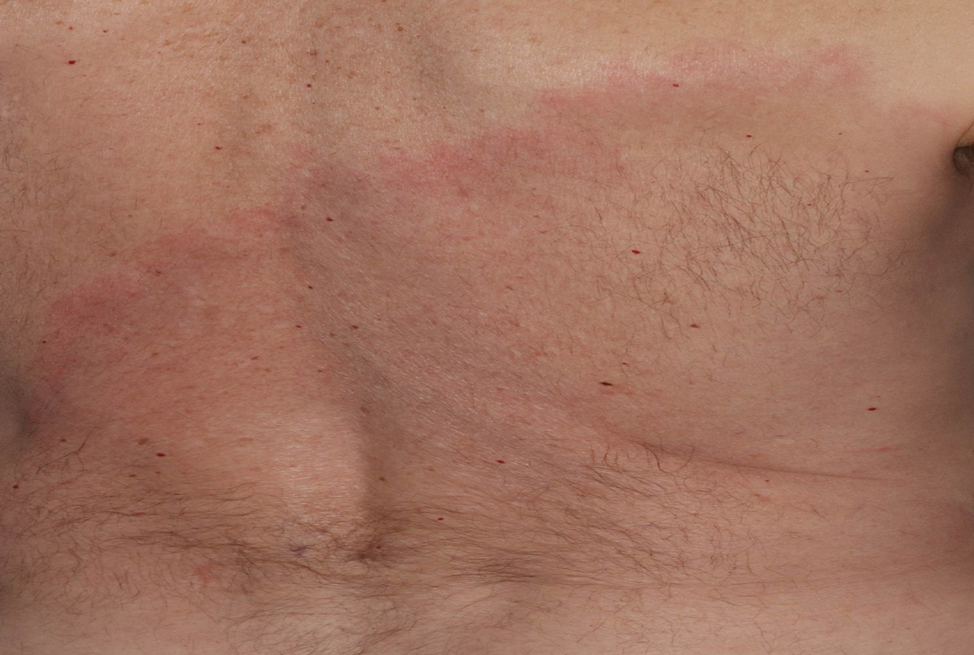
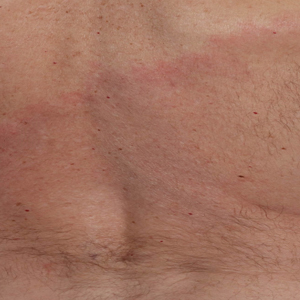
Think Beyond the ‘Go-Tos’ for Wart Management, Expert Advises
SAN DIEGO — When Jennifer Adams, MD, recently entered the search term “warts” on the ClinicalTrials.gov web site, nearly 240 results popped up.
“There is a lot of research activity around this topic,” Dr. Adams, vice chair of the department of dermatology at the University of Nebraska Medical Center, said at the annual meeting of the American Academy of Dermatology. “We just don’t have fantastic, well-run trials on many of the currently available treatments.”
In a 2012 Cochrane review on the topical treatment of non-genital cutaneous warts, authors drew from 85 trials involving 8,815 randomized patients. They found that most warts spontaneously resolved, and the authors determined salicylic acid to be safe and modestly beneficial. Specifically, trials of salicylic acid (SA) versus placebo showed that the former significantly increased the chance of clearance of warts at all sites (risk ratio, 1.56, 95% confidence interval [CI], 1.20-2.03). A meta-analysis of cryotherapy versus placebo for warts at all sites favored neither intervention nor control (RR, 1.45, 95% CI, 0.65-3.23).
“The authors determined that there is less evidence for cryotherapy but stated that it may work when salicylic acid does not, or in combination with salicylic acid,” Dr. Adams said. “However, salicylic acid and cryotherapy don’t do enough for our patients [with warts]. There are a lot of situations where we need to reach further into the toolbox.”
A 2021 review article listed many options for managing difficult-to-treat warts, including intralesional Candida antigen, intralesional measles-mumps-rubella (MMR), intralesional HPV vaccine, intralesional vitamin D, intralesional cidofovir, intralesional bleomycin, and intralesional 5-FU injections, and topical vitamin D, topical cidofovir, and topical bleomycin. According to Dr. Adams, clinical data exist for cidofovir and vitamin D but studies evaluated different formulations, doses, sites of administration, and limited randomized controlled trials.
“Intralesional cidofovir is more effective than the topical form, but intralesional cidofovir can be painful and both forms are expensive,” she said. “Topical vitamin D is less likely to cause dyspigmentation compared to other available treatments, so it’s a great option in skin of color, but it has been less effective compared to some of our other topical treatments.”
Newer Options Promising
On the horizon, berdazimer gel was approved in January of 2024 for the treatment of molluscum but results from trials of its use for extragenital warts are encouraging. Another promising option is topical ionic contraviral therapy (ICVT) with digoxin and furosemide combined, which inhibits cellular potassium influx. A phase 2a randomized controlled trial of 80 adults found a statistically significant reduction in the diameter of cutaneous warts among those who received ICVT compared with those who received placebo (P = .002). “It’s cheap and well tolerated,” Dr. Adams added.
Intralesional approaches to treating warts offer another alternative. A 2020 review of 43 articles concluded that intralesional treatments for warts have equal or superior efficacy to first-line salicylic acid or cryotherapy.
Dr. Adams said that she considers intralesional treatments such as vitamin D, MMR vaccine antigen, and Candida antigen for refractory, numerous, or distant site warts. “Injecting the MMR vaccine into the largest wart every 2 weeks has been found to lead to complete clearance in 60%-68% of cases in one study,” she said. “The benefit is that it’s $21 per dose, which is nice, but as with any vaccination, patients can develop flu-like symptoms as side effects.”
Use of the HPV vaccine for treating cutaneous warts remains controversial, she continued, but it seems to work better in younger patients. In one open-label study that evaluated the HPV vaccine for the treatment of multiple recalcitrant warts, with doses administered at 0. 2, and 6 months, the response rate 3 months after the third dose was 55% among those older than age 26, compared with 84% among those ages 9-26 years.
Another option, intralesional cidofovir, has been shown to be especially effective for refractory warts. “It has also been shown to work for warts in immunocompetent and immunocompromised patients,” Dr. Adams said.
In the realm of adjuvant treatments, microneedling has been found to have similar efficacy to needling, Dr. Adams said, but with minimal pain. “When we combine it with topical treatments like 5-FU, it’s even more efficacious,” she said.
One study found that combining microneedling with topical 5-FU had clearance similar to that of intralesional 5-FU or microneedling alone, but involved fewer treatment sessions and less pain in the combination group.
Autoinoculation has been used to stimulate an immune response in patients with warts, leading to clearance rates of 4% (mild clearance) to 66% (complete clearance) in one study. “We would expect this to work better in immunocompetent patients, but it’s something to keep in mind if you’re limited in the medications you can get for a patient,” Dr. Adams said. Also, results from a systematic review and meta-analysis suggest that systemic retinoids combined with intralesional immunotherapy leads to higher clearance rates and lower rates of recurrence of warts. The top performer among those tested was acitretin plus Candida antigen.
Dr. Adams advised dermatologists who try alternatives to salicylic acid and cryotherapy for warts to be “wary of a lack of high-level evidence” for their use. “They can be helpful for patients who have failed traditional therapies or have a contraindication to the usual go-tos.”
She reported having no relevant financial disclosures.
SAN DIEGO — When Jennifer Adams, MD, recently entered the search term “warts” on the ClinicalTrials.gov web site, nearly 240 results popped up.
“There is a lot of research activity around this topic,” Dr. Adams, vice chair of the department of dermatology at the University of Nebraska Medical Center, said at the annual meeting of the American Academy of Dermatology. “We just don’t have fantastic, well-run trials on many of the currently available treatments.”
In a 2012 Cochrane review on the topical treatment of non-genital cutaneous warts, authors drew from 85 trials involving 8,815 randomized patients. They found that most warts spontaneously resolved, and the authors determined salicylic acid to be safe and modestly beneficial. Specifically, trials of salicylic acid (SA) versus placebo showed that the former significantly increased the chance of clearance of warts at all sites (risk ratio, 1.56, 95% confidence interval [CI], 1.20-2.03). A meta-analysis of cryotherapy versus placebo for warts at all sites favored neither intervention nor control (RR, 1.45, 95% CI, 0.65-3.23).
“The authors determined that there is less evidence for cryotherapy but stated that it may work when salicylic acid does not, or in combination with salicylic acid,” Dr. Adams said. “However, salicylic acid and cryotherapy don’t do enough for our patients [with warts]. There are a lot of situations where we need to reach further into the toolbox.”
A 2021 review article listed many options for managing difficult-to-treat warts, including intralesional Candida antigen, intralesional measles-mumps-rubella (MMR), intralesional HPV vaccine, intralesional vitamin D, intralesional cidofovir, intralesional bleomycin, and intralesional 5-FU injections, and topical vitamin D, topical cidofovir, and topical bleomycin. According to Dr. Adams, clinical data exist for cidofovir and vitamin D but studies evaluated different formulations, doses, sites of administration, and limited randomized controlled trials.
“Intralesional cidofovir is more effective than the topical form, but intralesional cidofovir can be painful and both forms are expensive,” she said. “Topical vitamin D is less likely to cause dyspigmentation compared to other available treatments, so it’s a great option in skin of color, but it has been less effective compared to some of our other topical treatments.”
Newer Options Promising
On the horizon, berdazimer gel was approved in January of 2024 for the treatment of molluscum but results from trials of its use for extragenital warts are encouraging. Another promising option is topical ionic contraviral therapy (ICVT) with digoxin and furosemide combined, which inhibits cellular potassium influx. A phase 2a randomized controlled trial of 80 adults found a statistically significant reduction in the diameter of cutaneous warts among those who received ICVT compared with those who received placebo (P = .002). “It’s cheap and well tolerated,” Dr. Adams added.
Intralesional approaches to treating warts offer another alternative. A 2020 review of 43 articles concluded that intralesional treatments for warts have equal or superior efficacy to first-line salicylic acid or cryotherapy.
Dr. Adams said that she considers intralesional treatments such as vitamin D, MMR vaccine antigen, and Candida antigen for refractory, numerous, or distant site warts. “Injecting the MMR vaccine into the largest wart every 2 weeks has been found to lead to complete clearance in 60%-68% of cases in one study,” she said. “The benefit is that it’s $21 per dose, which is nice, but as with any vaccination, patients can develop flu-like symptoms as side effects.”
Use of the HPV vaccine for treating cutaneous warts remains controversial, she continued, but it seems to work better in younger patients. In one open-label study that evaluated the HPV vaccine for the treatment of multiple recalcitrant warts, with doses administered at 0. 2, and 6 months, the response rate 3 months after the third dose was 55% among those older than age 26, compared with 84% among those ages 9-26 years.
Another option, intralesional cidofovir, has been shown to be especially effective for refractory warts. “It has also been shown to work for warts in immunocompetent and immunocompromised patients,” Dr. Adams said.
In the realm of adjuvant treatments, microneedling has been found to have similar efficacy to needling, Dr. Adams said, but with minimal pain. “When we combine it with topical treatments like 5-FU, it’s even more efficacious,” she said.
One study found that combining microneedling with topical 5-FU had clearance similar to that of intralesional 5-FU or microneedling alone, but involved fewer treatment sessions and less pain in the combination group.
Autoinoculation has been used to stimulate an immune response in patients with warts, leading to clearance rates of 4% (mild clearance) to 66% (complete clearance) in one study. “We would expect this to work better in immunocompetent patients, but it’s something to keep in mind if you’re limited in the medications you can get for a patient,” Dr. Adams said. Also, results from a systematic review and meta-analysis suggest that systemic retinoids combined with intralesional immunotherapy leads to higher clearance rates and lower rates of recurrence of warts. The top performer among those tested was acitretin plus Candida antigen.
Dr. Adams advised dermatologists who try alternatives to salicylic acid and cryotherapy for warts to be “wary of a lack of high-level evidence” for their use. “They can be helpful for patients who have failed traditional therapies or have a contraindication to the usual go-tos.”
She reported having no relevant financial disclosures.
SAN DIEGO — When Jennifer Adams, MD, recently entered the search term “warts” on the ClinicalTrials.gov web site, nearly 240 results popped up.
“There is a lot of research activity around this topic,” Dr. Adams, vice chair of the department of dermatology at the University of Nebraska Medical Center, said at the annual meeting of the American Academy of Dermatology. “We just don’t have fantastic, well-run trials on many of the currently available treatments.”
In a 2012 Cochrane review on the topical treatment of non-genital cutaneous warts, authors drew from 85 trials involving 8,815 randomized patients. They found that most warts spontaneously resolved, and the authors determined salicylic acid to be safe and modestly beneficial. Specifically, trials of salicylic acid (SA) versus placebo showed that the former significantly increased the chance of clearance of warts at all sites (risk ratio, 1.56, 95% confidence interval [CI], 1.20-2.03). A meta-analysis of cryotherapy versus placebo for warts at all sites favored neither intervention nor control (RR, 1.45, 95% CI, 0.65-3.23).
“The authors determined that there is less evidence for cryotherapy but stated that it may work when salicylic acid does not, or in combination with salicylic acid,” Dr. Adams said. “However, salicylic acid and cryotherapy don’t do enough for our patients [with warts]. There are a lot of situations where we need to reach further into the toolbox.”
A 2021 review article listed many options for managing difficult-to-treat warts, including intralesional Candida antigen, intralesional measles-mumps-rubella (MMR), intralesional HPV vaccine, intralesional vitamin D, intralesional cidofovir, intralesional bleomycin, and intralesional 5-FU injections, and topical vitamin D, topical cidofovir, and topical bleomycin. According to Dr. Adams, clinical data exist for cidofovir and vitamin D but studies evaluated different formulations, doses, sites of administration, and limited randomized controlled trials.
“Intralesional cidofovir is more effective than the topical form, but intralesional cidofovir can be painful and both forms are expensive,” she said. “Topical vitamin D is less likely to cause dyspigmentation compared to other available treatments, so it’s a great option in skin of color, but it has been less effective compared to some of our other topical treatments.”
Newer Options Promising
On the horizon, berdazimer gel was approved in January of 2024 for the treatment of molluscum but results from trials of its use for extragenital warts are encouraging. Another promising option is topical ionic contraviral therapy (ICVT) with digoxin and furosemide combined, which inhibits cellular potassium influx. A phase 2a randomized controlled trial of 80 adults found a statistically significant reduction in the diameter of cutaneous warts among those who received ICVT compared with those who received placebo (P = .002). “It’s cheap and well tolerated,” Dr. Adams added.
Intralesional approaches to treating warts offer another alternative. A 2020 review of 43 articles concluded that intralesional treatments for warts have equal or superior efficacy to first-line salicylic acid or cryotherapy.
Dr. Adams said that she considers intralesional treatments such as vitamin D, MMR vaccine antigen, and Candida antigen for refractory, numerous, or distant site warts. “Injecting the MMR vaccine into the largest wart every 2 weeks has been found to lead to complete clearance in 60%-68% of cases in one study,” she said. “The benefit is that it’s $21 per dose, which is nice, but as with any vaccination, patients can develop flu-like symptoms as side effects.”
Use of the HPV vaccine for treating cutaneous warts remains controversial, she continued, but it seems to work better in younger patients. In one open-label study that evaluated the HPV vaccine for the treatment of multiple recalcitrant warts, with doses administered at 0. 2, and 6 months, the response rate 3 months after the third dose was 55% among those older than age 26, compared with 84% among those ages 9-26 years.
Another option, intralesional cidofovir, has been shown to be especially effective for refractory warts. “It has also been shown to work for warts in immunocompetent and immunocompromised patients,” Dr. Adams said.
In the realm of adjuvant treatments, microneedling has been found to have similar efficacy to needling, Dr. Adams said, but with minimal pain. “When we combine it with topical treatments like 5-FU, it’s even more efficacious,” she said.
One study found that combining microneedling with topical 5-FU had clearance similar to that of intralesional 5-FU or microneedling alone, but involved fewer treatment sessions and less pain in the combination group.
Autoinoculation has been used to stimulate an immune response in patients with warts, leading to clearance rates of 4% (mild clearance) to 66% (complete clearance) in one study. “We would expect this to work better in immunocompetent patients, but it’s something to keep in mind if you’re limited in the medications you can get for a patient,” Dr. Adams said. Also, results from a systematic review and meta-analysis suggest that systemic retinoids combined with intralesional immunotherapy leads to higher clearance rates and lower rates of recurrence of warts. The top performer among those tested was acitretin plus Candida antigen.
Dr. Adams advised dermatologists who try alternatives to salicylic acid and cryotherapy for warts to be “wary of a lack of high-level evidence” for their use. “They can be helpful for patients who have failed traditional therapies or have a contraindication to the usual go-tos.”
She reported having no relevant financial disclosures.
FROM AAD 2024