User login
Sunshine Act: Tracking of gifts, payments starts in August
CHICAGO – Worried that erroneous data about your relationships with industry will be publicly reported under the federal Sunshine Act? Officials from the Centers for Medicare and Medicaid Services spoke at the annual meeting of the American Medical Association House of Delegates June 17 in an effort to allay those fears.
The Sunshine Act, which requires manufacturers to report to the CMS almost all payments and gifts made to physicians and teaching hospitals, became law as part of the Affordable Care Act. Final rules for the ACA’s Sunshine Act provisions, which the government is now calling the Open Payments Program, were issued in February.
Once data have been collected and processed, physicians will have 45 days to dispute and correct manufacturers’ reports, the CMS officials said.

After that, the data will be made public. The 5 months of data that will be collected for this year – starting Aug. 1 – will be released publicly in September 2014. Going forward, the previous year’s data will be reported each June.
Although physicians will not report their data directly to the CMS, they will be expected to take an active role in ensuring the program is successful, according to Anita Griner, deputy director of the data sharing and partnership group at the agency’s Center for Program Integrity.
Manufacturers will start compiling data on Aug. 1 on payments to physicians for consulting, honoraria, grants, gifts, meals, travel, royalties, and speaking at events, including continuing education programs. In January, the CMS will encourage physicians and teaching hospitals to register with the agency, most likely through a web portal. Once registered, doctors will be notified when data about them has been submitted, Ms. Griner explained.
Providers will have 45 days to dispute the data. If they see something false, misleading, or wrong, they must indicate their dispute to the agency and then work out the dispute with the manufacturer. The data will be flagged as "disputed" on the public website.
If physicians don’t bring a dispute to the agency’s attention within the 45-day window, it could take months for the dispute to be noted on the website, Ms. Griner said, and if the dispute is not settled within a year, the manufacturer’s data will be the de facto report to the public.
"We encourage you to come in, get involved, and dispute things that are inaccurate," she said.
She and her colleague, Dr. Shantanu Agrawal, medical director of the agency’s Center for Program Integrity, urged physicians to track their own data.
In July, the CMS plans to release a free app for Android and Apple smartphones that will include all the categories that manufacturers must report. The agency also plans to release one for industry so that sales reps and others can upload data directly to physician contacts.
One physician questioned whether the public would "stampede" to get a look at the payment data, noting that he had never been asked by any patients whether a manufacturer had taken him to dinner. "I think it will be interesting to see if that occurs," said Dr. Agrawal.
On Twitter @aliciaault
CHICAGO – Worried that erroneous data about your relationships with industry will be publicly reported under the federal Sunshine Act? Officials from the Centers for Medicare and Medicaid Services spoke at the annual meeting of the American Medical Association House of Delegates June 17 in an effort to allay those fears.
The Sunshine Act, which requires manufacturers to report to the CMS almost all payments and gifts made to physicians and teaching hospitals, became law as part of the Affordable Care Act. Final rules for the ACA’s Sunshine Act provisions, which the government is now calling the Open Payments Program, were issued in February.
Once data have been collected and processed, physicians will have 45 days to dispute and correct manufacturers’ reports, the CMS officials said.
After that, the data will be made public. The 5 months of data that will be collected for this year – starting Aug. 1 – will be released publicly in September 2014. Going forward, the previous year’s data will be reported each June.
Although physicians will not report their data directly to the CMS, they will be expected to take an active role in ensuring the program is successful, according to Anita Griner, deputy director of the data sharing and partnership group at the agency’s Center for Program Integrity.
Manufacturers will start compiling data on Aug. 1 on payments to physicians for consulting, honoraria, grants, gifts, meals, travel, royalties, and speaking at events, including continuing education programs. In January, the CMS will encourage physicians and teaching hospitals to register with the agency, most likely through a web portal. Once registered, doctors will be notified when data about them has been submitted, Ms. Griner explained.
Providers will have 45 days to dispute the data. If they see something false, misleading, or wrong, they must indicate their dispute to the agency and then work out the dispute with the manufacturer. The data will be flagged as "disputed" on the public website.
If physicians don’t bring a dispute to the agency’s attention within the 45-day window, it could take months for the dispute to be noted on the website, Ms. Griner said, and if the dispute is not settled within a year, the manufacturer’s data will be the de facto report to the public.
"We encourage you to come in, get involved, and dispute things that are inaccurate," she said.
She and her colleague, Dr. Shantanu Agrawal, medical director of the agency’s Center for Program Integrity, urged physicians to track their own data.
In July, the CMS plans to release a free app for Android and Apple smartphones that will include all the categories that manufacturers must report. The agency also plans to release one for industry so that sales reps and others can upload data directly to physician contacts.
One physician questioned whether the public would "stampede" to get a look at the payment data, noting that he had never been asked by any patients whether a manufacturer had taken him to dinner. "I think it will be interesting to see if that occurs," said Dr. Agrawal.
On Twitter @aliciaault
CHICAGO – Worried that erroneous data about your relationships with industry will be publicly reported under the federal Sunshine Act? Officials from the Centers for Medicare and Medicaid Services spoke at the annual meeting of the American Medical Association House of Delegates June 17 in an effort to allay those fears.
The Sunshine Act, which requires manufacturers to report to the CMS almost all payments and gifts made to physicians and teaching hospitals, became law as part of the Affordable Care Act. Final rules for the ACA’s Sunshine Act provisions, which the government is now calling the Open Payments Program, were issued in February.
Once data have been collected and processed, physicians will have 45 days to dispute and correct manufacturers’ reports, the CMS officials said.
After that, the data will be made public. The 5 months of data that will be collected for this year – starting Aug. 1 – will be released publicly in September 2014. Going forward, the previous year’s data will be reported each June.
Although physicians will not report their data directly to the CMS, they will be expected to take an active role in ensuring the program is successful, according to Anita Griner, deputy director of the data sharing and partnership group at the agency’s Center for Program Integrity.
Manufacturers will start compiling data on Aug. 1 on payments to physicians for consulting, honoraria, grants, gifts, meals, travel, royalties, and speaking at events, including continuing education programs. In January, the CMS will encourage physicians and teaching hospitals to register with the agency, most likely through a web portal. Once registered, doctors will be notified when data about them has been submitted, Ms. Griner explained.
Providers will have 45 days to dispute the data. If they see something false, misleading, or wrong, they must indicate their dispute to the agency and then work out the dispute with the manufacturer. The data will be flagged as "disputed" on the public website.
If physicians don’t bring a dispute to the agency’s attention within the 45-day window, it could take months for the dispute to be noted on the website, Ms. Griner said, and if the dispute is not settled within a year, the manufacturer’s data will be the de facto report to the public.
"We encourage you to come in, get involved, and dispute things that are inaccurate," she said.
She and her colleague, Dr. Shantanu Agrawal, medical director of the agency’s Center for Program Integrity, urged physicians to track their own data.
In July, the CMS plans to release a free app for Android and Apple smartphones that will include all the categories that manufacturers must report. The agency also plans to release one for industry so that sales reps and others can upload data directly to physician contacts.
One physician questioned whether the public would "stampede" to get a look at the payment data, noting that he had never been asked by any patients whether a manufacturer had taken him to dinner. "I think it will be interesting to see if that occurs," said Dr. Agrawal.
On Twitter @aliciaault
AT THE AMA HOUSE OF DELEGATES

AMA delegates say obesity is a disease
CHICAGO – The American Medical Association’s chief policy-making body has decided that obesity should be considered not just a disease risk factor, but an actual disease state that warrants insurance coverage for all aspects of prevention and treatment.
At the annual meeting of the AMA House of Delegates, it voted 276-181 on June 18 to support a resolution that was brought forward by several specialty organizations that called on the AMA to "recognize obesity as a disease state with multiple pathophysiological aspects requiring a range of interventions to advance obesity treatment and prevention."

The vote ensures that the resolution becomes official AMA policy.
The resolution was sponsored by the American Association of Clinical Endocrinologists, the American College of Cardiology, the Endocrine Society, the American Society for Reproductive Medicine, the Society for Cardiovascular Angiography and Interventions, the American Urological Association, and the American College of Surgeons.
Preliminary testimony on the resolution a few days before the floor vote was "mixed," according to the committee report presented to the delegates. The committee recommended adopting the resolution, but the AMA’s Council on Science and Public Health had urged against it in its report to the delegates.
Speaking to the House of Delegates, Dr. Robert Gilchick, a member of the council, said, "We did not think the evidence rose to the level where obesity could be recognized as its own distinct medical disease state."
He noted that, although obesity is a risk factor, it may not in and of itself indicate illness. Some people who are considered obese by virtue of their body mass index might actually be healthy and fit, said Dr. Gilchick. "Why should a third of Americans be diagnosed with having a disease if they aren’t necessarily sick?" he asked.
Calling it a disease risks promoting medical interventions over other potential solutions, like lifestyle changes and advocating policies to improve nutrition and the exercise environment, Dr. Gilchick added.

Dr. Jonathan D. Leffert, a delegate from the AACE, said that the resolution should pass because obesity, like other diseases, has multifactorial causes and can be addressed through behavioral, medical, and surgical treatments. "The scientific evidence is overwhelming," he said.
"We know that it is a disease," Dr. Jeffrey Cain, president of the American Academy of Family Physicians, said in an interview after the vote. By calling obesity a disease, physicians will get more resources to help their patients. Hopefully, the AMA’s call to action will move insurers to improve coverage sooner rather than later, he said.
Immediately after the vote, the AACE issued a statement lauding the AMA delegates’ action. "The action by the AMA House of Delegates represents a major step in addressing obesity head-on and helping patients to get appropriate interventions and treatment they need," AACE President Jeffrey Mechanick said in the statement.
Being overweight or obese increases the risk of breast cancer, coronary heart disease, type 2 diabetes, gallbladder disease, osteoarthritis, colon cancer, hypertension, and stroke and contributes as much as $210 billion a year to the nation’s health costs, according to the AACE.
On Twitter @aliciaault
CHICAGO – The American Medical Association’s chief policy-making body has decided that obesity should be considered not just a disease risk factor, but an actual disease state that warrants insurance coverage for all aspects of prevention and treatment.
At the annual meeting of the AMA House of Delegates, it voted 276-181 on June 18 to support a resolution that was brought forward by several specialty organizations that called on the AMA to "recognize obesity as a disease state with multiple pathophysiological aspects requiring a range of interventions to advance obesity treatment and prevention."
The vote ensures that the resolution becomes official AMA policy.
The resolution was sponsored by the American Association of Clinical Endocrinologists, the American College of Cardiology, the Endocrine Society, the American Society for Reproductive Medicine, the Society for Cardiovascular Angiography and Interventions, the American Urological Association, and the American College of Surgeons.
Preliminary testimony on the resolution a few days before the floor vote was "mixed," according to the committee report presented to the delegates. The committee recommended adopting the resolution, but the AMA’s Council on Science and Public Health had urged against it in its report to the delegates.
Speaking to the House of Delegates, Dr. Robert Gilchick, a member of the council, said, "We did not think the evidence rose to the level where obesity could be recognized as its own distinct medical disease state."
He noted that, although obesity is a risk factor, it may not in and of itself indicate illness. Some people who are considered obese by virtue of their body mass index might actually be healthy and fit, said Dr. Gilchick. "Why should a third of Americans be diagnosed with having a disease if they aren’t necessarily sick?" he asked.
Calling it a disease risks promoting medical interventions over other potential solutions, like lifestyle changes and advocating policies to improve nutrition and the exercise environment, Dr. Gilchick added.
Dr. Jonathan D. Leffert, a delegate from the AACE, said that the resolution should pass because obesity, like other diseases, has multifactorial causes and can be addressed through behavioral, medical, and surgical treatments. "The scientific evidence is overwhelming," he said.
"We know that it is a disease," Dr. Jeffrey Cain, president of the American Academy of Family Physicians, said in an interview after the vote. By calling obesity a disease, physicians will get more resources to help their patients. Hopefully, the AMA’s call to action will move insurers to improve coverage sooner rather than later, he said.
Immediately after the vote, the AACE issued a statement lauding the AMA delegates’ action. "The action by the AMA House of Delegates represents a major step in addressing obesity head-on and helping patients to get appropriate interventions and treatment they need," AACE President Jeffrey Mechanick said in the statement.
Being overweight or obese increases the risk of breast cancer, coronary heart disease, type 2 diabetes, gallbladder disease, osteoarthritis, colon cancer, hypertension, and stroke and contributes as much as $210 billion a year to the nation’s health costs, according to the AACE.
On Twitter @aliciaault
CHICAGO – The American Medical Association’s chief policy-making body has decided that obesity should be considered not just a disease risk factor, but an actual disease state that warrants insurance coverage for all aspects of prevention and treatment.
At the annual meeting of the AMA House of Delegates, it voted 276-181 on June 18 to support a resolution that was brought forward by several specialty organizations that called on the AMA to "recognize obesity as a disease state with multiple pathophysiological aspects requiring a range of interventions to advance obesity treatment and prevention."
The vote ensures that the resolution becomes official AMA policy.
The resolution was sponsored by the American Association of Clinical Endocrinologists, the American College of Cardiology, the Endocrine Society, the American Society for Reproductive Medicine, the Society for Cardiovascular Angiography and Interventions, the American Urological Association, and the American College of Surgeons.
Preliminary testimony on the resolution a few days before the floor vote was "mixed," according to the committee report presented to the delegates. The committee recommended adopting the resolution, but the AMA’s Council on Science and Public Health had urged against it in its report to the delegates.
Speaking to the House of Delegates, Dr. Robert Gilchick, a member of the council, said, "We did not think the evidence rose to the level where obesity could be recognized as its own distinct medical disease state."
He noted that, although obesity is a risk factor, it may not in and of itself indicate illness. Some people who are considered obese by virtue of their body mass index might actually be healthy and fit, said Dr. Gilchick. "Why should a third of Americans be diagnosed with having a disease if they aren’t necessarily sick?" he asked.
Calling it a disease risks promoting medical interventions over other potential solutions, like lifestyle changes and advocating policies to improve nutrition and the exercise environment, Dr. Gilchick added.
Dr. Jonathan D. Leffert, a delegate from the AACE, said that the resolution should pass because obesity, like other diseases, has multifactorial causes and can be addressed through behavioral, medical, and surgical treatments. "The scientific evidence is overwhelming," he said.
"We know that it is a disease," Dr. Jeffrey Cain, president of the American Academy of Family Physicians, said in an interview after the vote. By calling obesity a disease, physicians will get more resources to help their patients. Hopefully, the AMA’s call to action will move insurers to improve coverage sooner rather than later, he said.
Immediately after the vote, the AACE issued a statement lauding the AMA delegates’ action. "The action by the AMA House of Delegates represents a major step in addressing obesity head-on and helping patients to get appropriate interventions and treatment they need," AACE President Jeffrey Mechanick said in the statement.
Being overweight or obese increases the risk of breast cancer, coronary heart disease, type 2 diabetes, gallbladder disease, osteoarthritis, colon cancer, hypertension, and stroke and contributes as much as $210 billion a year to the nation’s health costs, according to the AACE.
On Twitter @aliciaault
AT THE AMA HOUSE OF DELEGATES

AMA delegates say obesity is a disease
CHICAGO – The American Medical Association’s chief policy-making body has decided that obesity should be considered not just a disease risk factor, but an actual disease state that warrants insurance coverage for all aspects of prevention and treatment.
At the annual meeting of the AMA House of Delegates, it voted 276-181 on June 18 to support a resolution that was brought forward by several specialty organizations that called on the AMA to "recognize obesity as a disease state with multiple pathophysiological aspects requiring a range of interventions to advance obesity treatment and prevention."
The vote ensures that the resolution becomes official AMA policy.
The resolution was sponsored by the American Association of Clinical Endocrinologists, the American College of Cardiology, the Endocrine Society, the American Society for Reproductive Medicine, the Society for Cardiovascular Angiography and Interventions, the American Urological Association, and the American College of Surgeons.
Preliminary testimony on the resolution a few days before the floor vote was "mixed," according to the committee report presented to the delegates. The committee recommended adopting the resolution, but the AMA’s Council on Science and Public Health had urged against it in its report to the delegates.
Speaking to the House of Delegates, Dr. Robert Gilchick, a member of the council, said, "We did not think the evidence rose to the level where obesity could be recognized as its own distinct medical disease state."
He noted that, although obesity is a risk factor, it may not in and of itself indicate illness. Some people who are considered obese by virtue of their body mass index might actually be healthy and fit, said Dr. Gilchick. "Why should a third of Americans be diagnosed with having a disease if they aren’t necessarily sick?" he asked.
Calling it a disease risks promoting medical interventions over other potential solutions, like lifestyle changes and advocating policies to improve nutrition and the exercise environment, Dr. Gilchick added.
Dr. Jonathan D. Leffert, a delegate from the AACE, said that the resolution should pass because obesity, like other diseases, has multifactorial causes and can be addressed through behavioral, medical, and surgical treatments. "The scientific evidence is overwhelming," he said.
"We know that it is a disease," Dr. Jeffrey Cain, president of the American Academy of Family Physicians, said in an interview after the vote. By calling obesity a disease, physicians will get more resources to help their patients. Hopefully, the AMA’s call to action will move insurers to improve coverage sooner rather than later, he said.
Immediately after the vote, the AACE issued a statement lauding the AMA delegates’ action. "The action by the AMA House of Delegates represents a major step in addressing obesity head-on and helping patients to get appropriate interventions and treatment they need," AACE President Jeffrey Mechanick said in the statement.
Being overweight or obese increases the risk of breast cancer, coronary heart disease, type 2 diabetes, gallbladder disease, osteoarthritis, colon cancer, hypertension, and stroke and contributes as much as $210 billion a year to the nation’s health costs, according to the AACE.
On Twitter @aliciaault
CHICAGO – The American Medical Association’s chief policy-making body has decided that obesity should be considered not just a disease risk factor, but an actual disease state that warrants insurance coverage for all aspects of prevention and treatment.
At the annual meeting of the AMA House of Delegates, it voted 276-181 on June 18 to support a resolution that was brought forward by several specialty organizations that called on the AMA to "recognize obesity as a disease state with multiple pathophysiological aspects requiring a range of interventions to advance obesity treatment and prevention."
The vote ensures that the resolution becomes official AMA policy.
The resolution was sponsored by the American Association of Clinical Endocrinologists, the American College of Cardiology, the Endocrine Society, the American Society for Reproductive Medicine, the Society for Cardiovascular Angiography and Interventions, the American Urological Association, and the American College of Surgeons.
Preliminary testimony on the resolution a few days before the floor vote was "mixed," according to the committee report presented to the delegates. The committee recommended adopting the resolution, but the AMA’s Council on Science and Public Health had urged against it in its report to the delegates.
Speaking to the House of Delegates, Dr. Robert Gilchick, a member of the council, said, "We did not think the evidence rose to the level where obesity could be recognized as its own distinct medical disease state."
He noted that, although obesity is a risk factor, it may not in and of itself indicate illness. Some people who are considered obese by virtue of their body mass index might actually be healthy and fit, said Dr. Gilchick. "Why should a third of Americans be diagnosed with having a disease if they aren’t necessarily sick?" he asked.
Calling it a disease risks promoting medical interventions over other potential solutions, like lifestyle changes and advocating policies to improve nutrition and the exercise environment, Dr. Gilchick added.
Dr. Jonathan D. Leffert, a delegate from the AACE, said that the resolution should pass because obesity, like other diseases, has multifactorial causes and can be addressed through behavioral, medical, and surgical treatments. "The scientific evidence is overwhelming," he said.
"We know that it is a disease," Dr. Jeffrey Cain, president of the American Academy of Family Physicians, said in an interview after the vote. By calling obesity a disease, physicians will get more resources to help their patients. Hopefully, the AMA’s call to action will move insurers to improve coverage sooner rather than later, he said.
Immediately after the vote, the AACE issued a statement lauding the AMA delegates’ action. "The action by the AMA House of Delegates represents a major step in addressing obesity head-on and helping patients to get appropriate interventions and treatment they need," AACE President Jeffrey Mechanick said in the statement.
Being overweight or obese increases the risk of breast cancer, coronary heart disease, type 2 diabetes, gallbladder disease, osteoarthritis, colon cancer, hypertension, and stroke and contributes as much as $210 billion a year to the nation’s health costs, according to the AACE.
On Twitter @aliciaault
CHICAGO – The American Medical Association’s chief policy-making body has decided that obesity should be considered not just a disease risk factor, but an actual disease state that warrants insurance coverage for all aspects of prevention and treatment.
At the annual meeting of the AMA House of Delegates, it voted 276-181 on June 18 to support a resolution that was brought forward by several specialty organizations that called on the AMA to "recognize obesity as a disease state with multiple pathophysiological aspects requiring a range of interventions to advance obesity treatment and prevention."
The vote ensures that the resolution becomes official AMA policy.
The resolution was sponsored by the American Association of Clinical Endocrinologists, the American College of Cardiology, the Endocrine Society, the American Society for Reproductive Medicine, the Society for Cardiovascular Angiography and Interventions, the American Urological Association, and the American College of Surgeons.
Preliminary testimony on the resolution a few days before the floor vote was "mixed," according to the committee report presented to the delegates. The committee recommended adopting the resolution, but the AMA’s Council on Science and Public Health had urged against it in its report to the delegates.
Speaking to the House of Delegates, Dr. Robert Gilchick, a member of the council, said, "We did not think the evidence rose to the level where obesity could be recognized as its own distinct medical disease state."
He noted that, although obesity is a risk factor, it may not in and of itself indicate illness. Some people who are considered obese by virtue of their body mass index might actually be healthy and fit, said Dr. Gilchick. "Why should a third of Americans be diagnosed with having a disease if they aren’t necessarily sick?" he asked.
Calling it a disease risks promoting medical interventions over other potential solutions, like lifestyle changes and advocating policies to improve nutrition and the exercise environment, Dr. Gilchick added.
Dr. Jonathan D. Leffert, a delegate from the AACE, said that the resolution should pass because obesity, like other diseases, has multifactorial causes and can be addressed through behavioral, medical, and surgical treatments. "The scientific evidence is overwhelming," he said.
"We know that it is a disease," Dr. Jeffrey Cain, president of the American Academy of Family Physicians, said in an interview after the vote. By calling obesity a disease, physicians will get more resources to help their patients. Hopefully, the AMA’s call to action will move insurers to improve coverage sooner rather than later, he said.
Immediately after the vote, the AACE issued a statement lauding the AMA delegates’ action. "The action by the AMA House of Delegates represents a major step in addressing obesity head-on and helping patients to get appropriate interventions and treatment they need," AACE President Jeffrey Mechanick said in the statement.
Being overweight or obese increases the risk of breast cancer, coronary heart disease, type 2 diabetes, gallbladder disease, osteoarthritis, colon cancer, hypertension, and stroke and contributes as much as $210 billion a year to the nation’s health costs, according to the AACE.
On Twitter @aliciaault
AT THE AMA HOUSE OF DELEGATES

Workplace wellness programs: Helpful or burdensome?
Workplace wellness programs seem poised for takeoff, and yet there are still many questions about whether they can truly improve patients’ health and if they will do enough to include physicians as partners, or just add to the ever-growing administrative burden.
The programs have been gaining popularity over the years, especially with large employers. An estimated half to three-quarters now offer some type of wellness program. The typical – and most common – program offers the employee a small reward – cash or otherwise – to fill out a health risk assessment survey or be screened for diabetes or high blood pressure, for instance, or to participate in a self-help or educational program. Less common are programs that offer incentives for, say, getting blood pressure to a certain target. Used even less often are penalties for failure to participate at all or to reach certain goals.
Physician groups like the American College of Physicians have seen some merit in the programs. But there are concerns about potential downsides, too, said Dr. Molly Cooke, president of the American College of Physicians (ACP). Among them: the potential for discrimination against workers who can’t meet the standards. These workers might be disadvantaged by genetics, socioeconomic status, or a medical condition, Dr. Cooke said in an interview.

The ACP is also concerned about the carrot-and-stick philosophy being used more frequently by wellness programs. "The ACP generally prefers an approach that rewards people for being healthy as opposed to penalizing them for doing things that are unhealthy," said Dr. Cooke, who is also a professor of medicine at the University of California, San Francisco.
Dr. Reid Blackwelder, president-elect of the American Academy of Physicians, agreed. "We’d rather see employers incentivize healthy choices," he said in an interview.
"Incentives can be an effective way to motivate some employees to participate in workplace wellness programs and to begin behavior changes," said Larry Hausner, CEO of the American Diabetes Association, in a statement in July 2012. "If not implemented carefully, however, incentives can also operate as penalties – imposing financial or other burdens on employees which may be counterproductive," he said.
The ADA, along with the Health Enhancement Research Organization, American College of Occupational and Environmental Medicine, American Cancer Society, American Cancer Society Cancer Action Network (ACS CAN), and American Heart Association, issued guidelines for the programs, with the aim of protecting workers.
It’s also not clear that just offering incentives will somehow get people to change their lifestyles, said Dr. Cooke.
The programs are premised on the idea that workers aren’t sufficiently motivated, she said. But years of caring for patients who have unhealthy lifestyles have taught her that "the real issue is as simple as that they just haven’t gotten with the program yet."
Dr. Cooke said that charging patients an additional $25 or so a month for their health insurance if they don’t lose weight "may not be that powerful an additional factor for a lot of people who already recognize the complications in their lives."
Another issue: whether the physician will become an integral part of the process of improving the employee’s health. A key step would be for employers to create a connection with family physicians in the community, said Dr. Blackwelder. With wellness programs, "there’s a potential to fragment care further," he said.
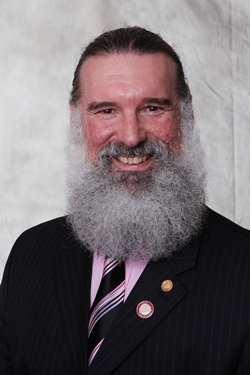
The American College of Cardiology sees wellness programs as an opportunity, said Dr. Joanne Foody, chief medical expert for the ACC’s CardioSmart@Work program. "The workplace is a logical place for us to address cardiovascular disease and stroke prevention," said Dr. Foody, who is also the medical director of the Cardiovascular Wellness Service at Brigham and Women’s Hospital, Boston.
CardioSmart@Work builds on the ACC’s CardioSmart program. Started in 2008, CardioSmart offers patients and physicians tools to manage heart disease, primarily through a website. This year, the ACC partnered with INTERVENT, a Savannah, Ga.–based disease management company, to join the CardioSmart tools with INTERVENT’s work-site wellness programs. Now the ACC’s imprimatur is on programs offered to at least one major employer, and several others. CardioSmart@Work aims to eventually expand to help physicians steer patients to the wellness programs.
The Obama administration is also giving its backing to wellness programs – specifically encouraging them in the Affordable Care Act. The workplace programs have been regulated by a hodgepodge of rules from a variety of federal agencies. They must comply with federal and state laws, including the Americans with Disabilities Act of 1990 (ACA), the Genetic Information Nondiscrimination Act of 2008, and the Health Insurance Portability and Accountability Act of 1996 (HIPAA).
In late May, the administration clarified how the programs should also comply with the ACA and with rules issued jointly by the Department of Health and Human Services, the Labor Department, and the Treasury Department. In a statement HHS said, "The final rules support workplace health promotion and prevention as a means to reduce the burden of chronic illness, improve health, and limit growth of health care costs, while ensuring that individuals are protected from unfair underwriting practices that could otherwise reduce benefits based on health status."
The ACA also set aside $10 million from the Prevention and Public Health Fund for the Centers for Disease Control and Prevention to work with small and mid-sized employers to develop wellness programs. The CDC announced in June that 104 employers had voluntarily chosen to participate in the National Healthy Worksite Program.
Do they improve health or cut costs?
Wellness programs have been envisioned as a way to get employees interested in being engaged in their own health care, but they also are seen as a way to reduce health costs. The evidence so far suggests the programs have done more to improve health than to cut costs, but the database is fairly thin – despite the growing adoption of the programs.
A recent survey of 800 large and mid-sized employers by Aon Hewitt found that 83% said they offered an incentive – the vast majority, a reward – for participating in basic programs such as completing a health risk survey or biometric screening.
Another study by the RAND Corporation, conducted for the Department of Health and Human Services and issued in late May, found that at least half of employers with more than 50 workers offer a wellness program.
Employee participation was underwhelming, though. Less than half of workers participated in even the most basic screenings, and only 7%-21% took part in programs designed to help them lose weight or lower their blood pressure, for instance.
The literature is mixed on whether wellness programs cut costs or save employers money. The RAND researchers reported that a review of randomized controlled trials found significant cost decreases, ranging from $11 to $626 per year per employee. More than half of the employers surveyed believed that their programs saved money, and an even greater number thought they reduced absenteeism and increased productivity. Interestingly, however, according to the report, "less than half of the employers reported regularly evaluating their wellness programs, and only 2 percent provided actual savings estimates."
The RAND group concluded that wellness programs were successful when it came to diet, exercise, smoking, and alcohol use, but that there was "limited evidence for effects on absenteeism and mental health." Even so, the authors said their findings should be viewed with caution because most of the studies they looked at were not particularly rigorous.
A study published in Health Affairs in 2010 found medical cost savings of $3.27 for every dollar spent on wellness programs, and that absentee day costs dropped by about $2.73 for every dollar spent. The authors concluded that "the wider adoption of such programs could prove beneficial for budgets as well as health."
A more recent article by Jill R. Horwitz, a professor at the University of California, Los Angeles, School of Law, suggests that wellness programs create savings by essentially shifting costs onto employees – and are discriminatory, to boot. "The most vulnerable employees – those from lower socioeconomic strata with the most health risks – probably bear greater costs that in effect subsidize their healthier colleagues," Ms. Horwitz and her colleagues wrote. The study was funded by University of Michigan Law School Cook Fund.
The laws governing wellness programs allow employers to give employees a discount for meeting health goals of up to 30% of the premium. For quitting tobacco, the discount can go as high as 50%. Employers can also penalize workers by the same amounts.
Most surveys have shown that, for now, employers are giving discounts, not levying penalties. That could change. According to the Aon Hewitt survey, within the next few years 58% of employers plan to "impose consequences" on workers.
What’s in it for you?
Ostensibly, workplace wellness programs can assist physicians in helping patients to make lifestyle changes. But there’s also the possibility that the programs can increase the paperwork without any real improvement in patient outcomes.
In comments to HHS, the Labor department, and the Treasury department in January, ACP’s immediate past president, David Bronson, wrote that the organization was "concerned that plans may impose an undue administrative burden on physicians and their staffs."
The rules issued in late May did not clarify what might be reasonably expected from doctors.
At a minimum, physicians will likely be asked to sign off on health risk assessment forms for patients. Dr. Cooke said she’s noticed an uptick in patients asking for that, whereas 3 or 4 years ago she’d never encountered such a request. For now, it’s "not hugely onerous," but as requests have increased, "I began to wonder where this would go next," she said.
The regulations for programs that ask employees to participate in education programs or smoking cessation programs, or to meet particular health outcomes, may end up steering more patients to their doctors’ offices. That’s because employers are required to provide "a reasonable alternative standard." For so-called participatory programs, the alternative has to be provided for workers for whom "it is either unreasonably difficult due to a medical condition to meet the otherwise applicable standard, or for whom it is medically inadvisable to attempt to satisfy the otherwise applicable standard."
For outcomes-based programs, an alternative "must be provided to all individuals who do not meet the initial standard, to ensure that the program is reasonably designed to improve health and is not a subterfuge for underwriting or reducing benefits based on health status," according to the rules.
The rules say that an individual’s personal physician is the arbiter of what’s medically appropriate – and of coming up with a reasonable alternative that will allow the employee to be eligible for the incentive program.
Dr. Blackwelder said it’s important for physicians to be involved. For instance, he said, "For some diabetics, getting their hemoglobin A1c to a normal level might not be the best thing." Only a doctor could make that determination, he said.
Finally, there are concerns that incentives might not be enough to get people to change their lifestyle.
Ms. Horowitz and her colleagues said that "evidence is sparse that financial incentives induce behavior that improves health." They said it was not surprising, given that "powerful personal, social, and financial incentives to be healthy, nonsmoking, and thin already exist." Even so, "people often fail at efforts to lose weight and stop smoking."
Dr. Cooke agrees, noting that "from the practicing clinician’s side, it’s not news to someone who smokes or weighs twice as much as they should that they’re doing something unhealthy." She added, "I haven’t spoken to a significantly overweight person who hasn’t tried to lose weight."
In the meantime, wellness programs are expected to continue to grow – despite no clear evidence that they accomplish their stated goals of improving health and cutting costs.
Dr. Cooke said she hoped that employers look at what works and what doesn’t "before they just hand money hand over fist to programs to produce a result that we’re all interested in."
On Twitter @aliciaault
Workplace wellness programs seem poised for takeoff, and yet there are still many questions about whether they can truly improve patients’ health and if they will do enough to include physicians as partners, or just add to the ever-growing administrative burden.
The programs have been gaining popularity over the years, especially with large employers. An estimated half to three-quarters now offer some type of wellness program. The typical – and most common – program offers the employee a small reward – cash or otherwise – to fill out a health risk assessment survey or be screened for diabetes or high blood pressure, for instance, or to participate in a self-help or educational program. Less common are programs that offer incentives for, say, getting blood pressure to a certain target. Used even less often are penalties for failure to participate at all or to reach certain goals.
Physician groups like the American College of Physicians have seen some merit in the programs. But there are concerns about potential downsides, too, said Dr. Molly Cooke, president of the American College of Physicians (ACP). Among them: the potential for discrimination against workers who can’t meet the standards. These workers might be disadvantaged by genetics, socioeconomic status, or a medical condition, Dr. Cooke said in an interview.
The ACP is also concerned about the carrot-and-stick philosophy being used more frequently by wellness programs. "The ACP generally prefers an approach that rewards people for being healthy as opposed to penalizing them for doing things that are unhealthy," said Dr. Cooke, who is also a professor of medicine at the University of California, San Francisco.
Dr. Reid Blackwelder, president-elect of the American Academy of Physicians, agreed. "We’d rather see employers incentivize healthy choices," he said in an interview.
"Incentives can be an effective way to motivate some employees to participate in workplace wellness programs and to begin behavior changes," said Larry Hausner, CEO of the American Diabetes Association, in a statement in July 2012. "If not implemented carefully, however, incentives can also operate as penalties – imposing financial or other burdens on employees which may be counterproductive," he said.
The ADA, along with the Health Enhancement Research Organization, American College of Occupational and Environmental Medicine, American Cancer Society, American Cancer Society Cancer Action Network (ACS CAN), and American Heart Association, issued guidelines for the programs, with the aim of protecting workers.
It’s also not clear that just offering incentives will somehow get people to change their lifestyles, said Dr. Cooke.
The programs are premised on the idea that workers aren’t sufficiently motivated, she said. But years of caring for patients who have unhealthy lifestyles have taught her that "the real issue is as simple as that they just haven’t gotten with the program yet."
Dr. Cooke said that charging patients an additional $25 or so a month for their health insurance if they don’t lose weight "may not be that powerful an additional factor for a lot of people who already recognize the complications in their lives."
Another issue: whether the physician will become an integral part of the process of improving the employee’s health. A key step would be for employers to create a connection with family physicians in the community, said Dr. Blackwelder. With wellness programs, "there’s a potential to fragment care further," he said.
The American College of Cardiology sees wellness programs as an opportunity, said Dr. Joanne Foody, chief medical expert for the ACC’s CardioSmart@Work program. "The workplace is a logical place for us to address cardiovascular disease and stroke prevention," said Dr. Foody, who is also the medical director of the Cardiovascular Wellness Service at Brigham and Women’s Hospital, Boston.
CardioSmart@Work builds on the ACC’s CardioSmart program. Started in 2008, CardioSmart offers patients and physicians tools to manage heart disease, primarily through a website. This year, the ACC partnered with INTERVENT, a Savannah, Ga.–based disease management company, to join the CardioSmart tools with INTERVENT’s work-site wellness programs. Now the ACC’s imprimatur is on programs offered to at least one major employer, and several others. CardioSmart@Work aims to eventually expand to help physicians steer patients to the wellness programs.
The Obama administration is also giving its backing to wellness programs – specifically encouraging them in the Affordable Care Act. The workplace programs have been regulated by a hodgepodge of rules from a variety of federal agencies. They must comply with federal and state laws, including the Americans with Disabilities Act of 1990 (ACA), the Genetic Information Nondiscrimination Act of 2008, and the Health Insurance Portability and Accountability Act of 1996 (HIPAA).
In late May, the administration clarified how the programs should also comply with the ACA and with rules issued jointly by the Department of Health and Human Services, the Labor Department, and the Treasury Department. In a statement HHS said, "The final rules support workplace health promotion and prevention as a means to reduce the burden of chronic illness, improve health, and limit growth of health care costs, while ensuring that individuals are protected from unfair underwriting practices that could otherwise reduce benefits based on health status."
The ACA also set aside $10 million from the Prevention and Public Health Fund for the Centers for Disease Control and Prevention to work with small and mid-sized employers to develop wellness programs. The CDC announced in June that 104 employers had voluntarily chosen to participate in the National Healthy Worksite Program.
Do they improve health or cut costs?
Wellness programs have been envisioned as a way to get employees interested in being engaged in their own health care, but they also are seen as a way to reduce health costs. The evidence so far suggests the programs have done more to improve health than to cut costs, but the database is fairly thin – despite the growing adoption of the programs.
A recent survey of 800 large and mid-sized employers by Aon Hewitt found that 83% said they offered an incentive – the vast majority, a reward – for participating in basic programs such as completing a health risk survey or biometric screening.
Another study by the RAND Corporation, conducted for the Department of Health and Human Services and issued in late May, found that at least half of employers with more than 50 workers offer a wellness program.
Employee participation was underwhelming, though. Less than half of workers participated in even the most basic screenings, and only 7%-21% took part in programs designed to help them lose weight or lower their blood pressure, for instance.
The literature is mixed on whether wellness programs cut costs or save employers money. The RAND researchers reported that a review of randomized controlled trials found significant cost decreases, ranging from $11 to $626 per year per employee. More than half of the employers surveyed believed that their programs saved money, and an even greater number thought they reduced absenteeism and increased productivity. Interestingly, however, according to the report, "less than half of the employers reported regularly evaluating their wellness programs, and only 2 percent provided actual savings estimates."
The RAND group concluded that wellness programs were successful when it came to diet, exercise, smoking, and alcohol use, but that there was "limited evidence for effects on absenteeism and mental health." Even so, the authors said their findings should be viewed with caution because most of the studies they looked at were not particularly rigorous.
A study published in Health Affairs in 2010 found medical cost savings of $3.27 for every dollar spent on wellness programs, and that absentee day costs dropped by about $2.73 for every dollar spent. The authors concluded that "the wider adoption of such programs could prove beneficial for budgets as well as health."
A more recent article by Jill R. Horwitz, a professor at the University of California, Los Angeles, School of Law, suggests that wellness programs create savings by essentially shifting costs onto employees – and are discriminatory, to boot. "The most vulnerable employees – those from lower socioeconomic strata with the most health risks – probably bear greater costs that in effect subsidize their healthier colleagues," Ms. Horwitz and her colleagues wrote. The study was funded by University of Michigan Law School Cook Fund.
The laws governing wellness programs allow employers to give employees a discount for meeting health goals of up to 30% of the premium. For quitting tobacco, the discount can go as high as 50%. Employers can also penalize workers by the same amounts.
Most surveys have shown that, for now, employers are giving discounts, not levying penalties. That could change. According to the Aon Hewitt survey, within the next few years 58% of employers plan to "impose consequences" on workers.
What’s in it for you?
Ostensibly, workplace wellness programs can assist physicians in helping patients to make lifestyle changes. But there’s also the possibility that the programs can increase the paperwork without any real improvement in patient outcomes.
In comments to HHS, the Labor department, and the Treasury department in January, ACP’s immediate past president, David Bronson, wrote that the organization was "concerned that plans may impose an undue administrative burden on physicians and their staffs."
The rules issued in late May did not clarify what might be reasonably expected from doctors.
At a minimum, physicians will likely be asked to sign off on health risk assessment forms for patients. Dr. Cooke said she’s noticed an uptick in patients asking for that, whereas 3 or 4 years ago she’d never encountered such a request. For now, it’s "not hugely onerous," but as requests have increased, "I began to wonder where this would go next," she said.
The regulations for programs that ask employees to participate in education programs or smoking cessation programs, or to meet particular health outcomes, may end up steering more patients to their doctors’ offices. That’s because employers are required to provide "a reasonable alternative standard." For so-called participatory programs, the alternative has to be provided for workers for whom "it is either unreasonably difficult due to a medical condition to meet the otherwise applicable standard, or for whom it is medically inadvisable to attempt to satisfy the otherwise applicable standard."
For outcomes-based programs, an alternative "must be provided to all individuals who do not meet the initial standard, to ensure that the program is reasonably designed to improve health and is not a subterfuge for underwriting or reducing benefits based on health status," according to the rules.
The rules say that an individual’s personal physician is the arbiter of what’s medically appropriate – and of coming up with a reasonable alternative that will allow the employee to be eligible for the incentive program.
Dr. Blackwelder said it’s important for physicians to be involved. For instance, he said, "For some diabetics, getting their hemoglobin A1c to a normal level might not be the best thing." Only a doctor could make that determination, he said.
Finally, there are concerns that incentives might not be enough to get people to change their lifestyle.
Ms. Horowitz and her colleagues said that "evidence is sparse that financial incentives induce behavior that improves health." They said it was not surprising, given that "powerful personal, social, and financial incentives to be healthy, nonsmoking, and thin already exist." Even so, "people often fail at efforts to lose weight and stop smoking."
Dr. Cooke agrees, noting that "from the practicing clinician’s side, it’s not news to someone who smokes or weighs twice as much as they should that they’re doing something unhealthy." She added, "I haven’t spoken to a significantly overweight person who hasn’t tried to lose weight."
In the meantime, wellness programs are expected to continue to grow – despite no clear evidence that they accomplish their stated goals of improving health and cutting costs.
Dr. Cooke said she hoped that employers look at what works and what doesn’t "before they just hand money hand over fist to programs to produce a result that we’re all interested in."
On Twitter @aliciaault
Workplace wellness programs seem poised for takeoff, and yet there are still many questions about whether they can truly improve patients’ health and if they will do enough to include physicians as partners, or just add to the ever-growing administrative burden.
The programs have been gaining popularity over the years, especially with large employers. An estimated half to three-quarters now offer some type of wellness program. The typical – and most common – program offers the employee a small reward – cash or otherwise – to fill out a health risk assessment survey or be screened for diabetes or high blood pressure, for instance, or to participate in a self-help or educational program. Less common are programs that offer incentives for, say, getting blood pressure to a certain target. Used even less often are penalties for failure to participate at all or to reach certain goals.
Physician groups like the American College of Physicians have seen some merit in the programs. But there are concerns about potential downsides, too, said Dr. Molly Cooke, president of the American College of Physicians (ACP). Among them: the potential for discrimination against workers who can’t meet the standards. These workers might be disadvantaged by genetics, socioeconomic status, or a medical condition, Dr. Cooke said in an interview.
The ACP is also concerned about the carrot-and-stick philosophy being used more frequently by wellness programs. "The ACP generally prefers an approach that rewards people for being healthy as opposed to penalizing them for doing things that are unhealthy," said Dr. Cooke, who is also a professor of medicine at the University of California, San Francisco.
Dr. Reid Blackwelder, president-elect of the American Academy of Physicians, agreed. "We’d rather see employers incentivize healthy choices," he said in an interview.
"Incentives can be an effective way to motivate some employees to participate in workplace wellness programs and to begin behavior changes," said Larry Hausner, CEO of the American Diabetes Association, in a statement in July 2012. "If not implemented carefully, however, incentives can also operate as penalties – imposing financial or other burdens on employees which may be counterproductive," he said.
The ADA, along with the Health Enhancement Research Organization, American College of Occupational and Environmental Medicine, American Cancer Society, American Cancer Society Cancer Action Network (ACS CAN), and American Heart Association, issued guidelines for the programs, with the aim of protecting workers.
It’s also not clear that just offering incentives will somehow get people to change their lifestyles, said Dr. Cooke.
The programs are premised on the idea that workers aren’t sufficiently motivated, she said. But years of caring for patients who have unhealthy lifestyles have taught her that "the real issue is as simple as that they just haven’t gotten with the program yet."
Dr. Cooke said that charging patients an additional $25 or so a month for their health insurance if they don’t lose weight "may not be that powerful an additional factor for a lot of people who already recognize the complications in their lives."
Another issue: whether the physician will become an integral part of the process of improving the employee’s health. A key step would be for employers to create a connection with family physicians in the community, said Dr. Blackwelder. With wellness programs, "there’s a potential to fragment care further," he said.
The American College of Cardiology sees wellness programs as an opportunity, said Dr. Joanne Foody, chief medical expert for the ACC’s CardioSmart@Work program. "The workplace is a logical place for us to address cardiovascular disease and stroke prevention," said Dr. Foody, who is also the medical director of the Cardiovascular Wellness Service at Brigham and Women’s Hospital, Boston.
CardioSmart@Work builds on the ACC’s CardioSmart program. Started in 2008, CardioSmart offers patients and physicians tools to manage heart disease, primarily through a website. This year, the ACC partnered with INTERVENT, a Savannah, Ga.–based disease management company, to join the CardioSmart tools with INTERVENT’s work-site wellness programs. Now the ACC’s imprimatur is on programs offered to at least one major employer, and several others. CardioSmart@Work aims to eventually expand to help physicians steer patients to the wellness programs.
The Obama administration is also giving its backing to wellness programs – specifically encouraging them in the Affordable Care Act. The workplace programs have been regulated by a hodgepodge of rules from a variety of federal agencies. They must comply with federal and state laws, including the Americans with Disabilities Act of 1990 (ACA), the Genetic Information Nondiscrimination Act of 2008, and the Health Insurance Portability and Accountability Act of 1996 (HIPAA).
In late May, the administration clarified how the programs should also comply with the ACA and with rules issued jointly by the Department of Health and Human Services, the Labor Department, and the Treasury Department. In a statement HHS said, "The final rules support workplace health promotion and prevention as a means to reduce the burden of chronic illness, improve health, and limit growth of health care costs, while ensuring that individuals are protected from unfair underwriting practices that could otherwise reduce benefits based on health status."
The ACA also set aside $10 million from the Prevention and Public Health Fund for the Centers for Disease Control and Prevention to work with small and mid-sized employers to develop wellness programs. The CDC announced in June that 104 employers had voluntarily chosen to participate in the National Healthy Worksite Program.
Do they improve health or cut costs?
Wellness programs have been envisioned as a way to get employees interested in being engaged in their own health care, but they also are seen as a way to reduce health costs. The evidence so far suggests the programs have done more to improve health than to cut costs, but the database is fairly thin – despite the growing adoption of the programs.
A recent survey of 800 large and mid-sized employers by Aon Hewitt found that 83% said they offered an incentive – the vast majority, a reward – for participating in basic programs such as completing a health risk survey or biometric screening.
Another study by the RAND Corporation, conducted for the Department of Health and Human Services and issued in late May, found that at least half of employers with more than 50 workers offer a wellness program.
Employee participation was underwhelming, though. Less than half of workers participated in even the most basic screenings, and only 7%-21% took part in programs designed to help them lose weight or lower their blood pressure, for instance.
The literature is mixed on whether wellness programs cut costs or save employers money. The RAND researchers reported that a review of randomized controlled trials found significant cost decreases, ranging from $11 to $626 per year per employee. More than half of the employers surveyed believed that their programs saved money, and an even greater number thought they reduced absenteeism and increased productivity. Interestingly, however, according to the report, "less than half of the employers reported regularly evaluating their wellness programs, and only 2 percent provided actual savings estimates."
The RAND group concluded that wellness programs were successful when it came to diet, exercise, smoking, and alcohol use, but that there was "limited evidence for effects on absenteeism and mental health." Even so, the authors said their findings should be viewed with caution because most of the studies they looked at were not particularly rigorous.
A study published in Health Affairs in 2010 found medical cost savings of $3.27 for every dollar spent on wellness programs, and that absentee day costs dropped by about $2.73 for every dollar spent. The authors concluded that "the wider adoption of such programs could prove beneficial for budgets as well as health."
A more recent article by Jill R. Horwitz, a professor at the University of California, Los Angeles, School of Law, suggests that wellness programs create savings by essentially shifting costs onto employees – and are discriminatory, to boot. "The most vulnerable employees – those from lower socioeconomic strata with the most health risks – probably bear greater costs that in effect subsidize their healthier colleagues," Ms. Horwitz and her colleagues wrote. The study was funded by University of Michigan Law School Cook Fund.
The laws governing wellness programs allow employers to give employees a discount for meeting health goals of up to 30% of the premium. For quitting tobacco, the discount can go as high as 50%. Employers can also penalize workers by the same amounts.
Most surveys have shown that, for now, employers are giving discounts, not levying penalties. That could change. According to the Aon Hewitt survey, within the next few years 58% of employers plan to "impose consequences" on workers.
What’s in it for you?
Ostensibly, workplace wellness programs can assist physicians in helping patients to make lifestyle changes. But there’s also the possibility that the programs can increase the paperwork without any real improvement in patient outcomes.
In comments to HHS, the Labor department, and the Treasury department in January, ACP’s immediate past president, David Bronson, wrote that the organization was "concerned that plans may impose an undue administrative burden on physicians and their staffs."
The rules issued in late May did not clarify what might be reasonably expected from doctors.
At a minimum, physicians will likely be asked to sign off on health risk assessment forms for patients. Dr. Cooke said she’s noticed an uptick in patients asking for that, whereas 3 or 4 years ago she’d never encountered such a request. For now, it’s "not hugely onerous," but as requests have increased, "I began to wonder where this would go next," she said.
The regulations for programs that ask employees to participate in education programs or smoking cessation programs, or to meet particular health outcomes, may end up steering more patients to their doctors’ offices. That’s because employers are required to provide "a reasonable alternative standard." For so-called participatory programs, the alternative has to be provided for workers for whom "it is either unreasonably difficult due to a medical condition to meet the otherwise applicable standard, or for whom it is medically inadvisable to attempt to satisfy the otherwise applicable standard."
For outcomes-based programs, an alternative "must be provided to all individuals who do not meet the initial standard, to ensure that the program is reasonably designed to improve health and is not a subterfuge for underwriting or reducing benefits based on health status," according to the rules.
The rules say that an individual’s personal physician is the arbiter of what’s medically appropriate – and of coming up with a reasonable alternative that will allow the employee to be eligible for the incentive program.
Dr. Blackwelder said it’s important for physicians to be involved. For instance, he said, "For some diabetics, getting their hemoglobin A1c to a normal level might not be the best thing." Only a doctor could make that determination, he said.
Finally, there are concerns that incentives might not be enough to get people to change their lifestyle.
Ms. Horowitz and her colleagues said that "evidence is sparse that financial incentives induce behavior that improves health." They said it was not surprising, given that "powerful personal, social, and financial incentives to be healthy, nonsmoking, and thin already exist." Even so, "people often fail at efforts to lose weight and stop smoking."
Dr. Cooke agrees, noting that "from the practicing clinician’s side, it’s not news to someone who smokes or weighs twice as much as they should that they’re doing something unhealthy." She added, "I haven’t spoken to a significantly overweight person who hasn’t tried to lose weight."
In the meantime, wellness programs are expected to continue to grow – despite no clear evidence that they accomplish their stated goals of improving health and cutting costs.
Dr. Cooke said she hoped that employers look at what works and what doesn’t "before they just hand money hand over fist to programs to produce a result that we’re all interested in."
On Twitter @aliciaault

Report: Retail clinic growth to be driven by physician partnerships
Look to retail clinics as a way to meet the potential growing patient loads from full implementation of the Affordable Care Act.
That’s the advice from consulting firm Accenture, which says that by 2015, there may be as many as 2,800 clinics able to log 10.8 million patient visits a year.
"Who will come to the aid of 30-plus million patients with no place to go?" Accenture analysts ask in a new report, "Retail medical clinics: From Foe to Friend?" Under the ACA, demand for primary care services, in particular, is expected to grow. Accenture analysts recommended that doctors consider referring patients to retail clinics for lower acuity care, while treating more complex cases – those with higher reimbursement – in their practices.
The analysts noted that the number of retail clinics grew 5% last year after 2 years of very slow (1%-3%) growth in 2009 and 2010. That slowdown followed robust growth from 2005 to 2008.
"A return to more stellar growth rates may now follow, not least as the perception of retail clinics as rivals switches to something more practical," according to the report.
Accenture said that growing backing for the clinics – and potentially increasing numbers of partnerships with physicians and hospitals – mean that the retail sector may see 25%-30% growth a year between now and 2015.
Last year, the Health and Human Services department announced that it was is teaming with retail clinics to educate Medicare patients on preventive services under Medicare as well as prescription drug coverage under Medicare Part D. CVS Caremark, Walgreens, Thrifty White, Walmart, and Sam’s Club were included in that partnership.
There have been predictions for big growth before, though. Another market research firm – Kalorama – predicted 20-30% a year growth back in 2009. Instead, the sector massively contracted, beginning that year.
On Twitter @aliciaault
Look to retail clinics as a way to meet the potential growing patient loads from full implementation of the Affordable Care Act.
That’s the advice from consulting firm Accenture, which says that by 2015, there may be as many as 2,800 clinics able to log 10.8 million patient visits a year.
"Who will come to the aid of 30-plus million patients with no place to go?" Accenture analysts ask in a new report, "Retail medical clinics: From Foe to Friend?" Under the ACA, demand for primary care services, in particular, is expected to grow. Accenture analysts recommended that doctors consider referring patients to retail clinics for lower acuity care, while treating more complex cases – those with higher reimbursement – in their practices.
The analysts noted that the number of retail clinics grew 5% last year after 2 years of very slow (1%-3%) growth in 2009 and 2010. That slowdown followed robust growth from 2005 to 2008.
"A return to more stellar growth rates may now follow, not least as the perception of retail clinics as rivals switches to something more practical," according to the report.
Accenture said that growing backing for the clinics – and potentially increasing numbers of partnerships with physicians and hospitals – mean that the retail sector may see 25%-30% growth a year between now and 2015.
Last year, the Health and Human Services department announced that it was is teaming with retail clinics to educate Medicare patients on preventive services under Medicare as well as prescription drug coverage under Medicare Part D. CVS Caremark, Walgreens, Thrifty White, Walmart, and Sam’s Club were included in that partnership.
There have been predictions for big growth before, though. Another market research firm – Kalorama – predicted 20-30% a year growth back in 2009. Instead, the sector massively contracted, beginning that year.
On Twitter @aliciaault
Look to retail clinics as a way to meet the potential growing patient loads from full implementation of the Affordable Care Act.
That’s the advice from consulting firm Accenture, which says that by 2015, there may be as many as 2,800 clinics able to log 10.8 million patient visits a year.
"Who will come to the aid of 30-plus million patients with no place to go?" Accenture analysts ask in a new report, "Retail medical clinics: From Foe to Friend?" Under the ACA, demand for primary care services, in particular, is expected to grow. Accenture analysts recommended that doctors consider referring patients to retail clinics for lower acuity care, while treating more complex cases – those with higher reimbursement – in their practices.
The analysts noted that the number of retail clinics grew 5% last year after 2 years of very slow (1%-3%) growth in 2009 and 2010. That slowdown followed robust growth from 2005 to 2008.
"A return to more stellar growth rates may now follow, not least as the perception of retail clinics as rivals switches to something more practical," according to the report.
Accenture said that growing backing for the clinics – and potentially increasing numbers of partnerships with physicians and hospitals – mean that the retail sector may see 25%-30% growth a year between now and 2015.
Last year, the Health and Human Services department announced that it was is teaming with retail clinics to educate Medicare patients on preventive services under Medicare as well as prescription drug coverage under Medicare Part D. CVS Caremark, Walgreens, Thrifty White, Walmart, and Sam’s Club were included in that partnership.
There have been predictions for big growth before, though. Another market research firm – Kalorama – predicted 20-30% a year growth back in 2009. Instead, the sector massively contracted, beginning that year.
On Twitter @aliciaault
FDA okays PCC for warfarin-induced bleeding
The Food and Drug Administration has approved a new agent for the urgent reversal of vitamin K antagonist anticoagulation in adults with acute major bleeding.
Kcentra (Prothrombin Complex Concentrate, Human), manufactured by CSL Behring of King of Prussia, Pa., is a nonactivated 4-factor prothrombin complex concentrate (PCC). It contains the coagulation factors that are low in warfarin-treated patients: factors II (prothrombin), VII, IX, and X. The product also contains antithrombotic proteins C and S. Fresh frozen plasma is the only FDA-approved product for reversing warfarin-induced acute bleeding.Like plasma, Kcentra is used with administration of vitamin K to reverse the anticoagulation effect and stop bleeding. Unlike plasma, Kcentra can be given quickly because it does not require thawing or determination of blood type.
"The FDA’s approval of this new product gives physicians a choice when deciding how to treat patients requiring urgent reversal of VKA [vitamin K antagonist] anticoagulation," Dr. Karen Midthun, director of the FDA’s Center for Biologics Evaluation and Research, said in a statement. "Kcentra is administered in a significantly lower volume than plasma at recommended doses, providing an alternative for those patients who may not tolerate the volume of plasma required to reverse VKA anticoagulation."
The American College of Chest Physicians endorsed use of PCC for rapid reversal of VKA-associated bleeding in its 2012 consensus guidelines on anticoagulant therapy (CHEST 2012;141(Suppl):e152S- e184S).
"Kcentra has been shown to restore the decreased vitamin K–dependent clotting factors significantly faster than plasma in patients on warfarin," Dr. Ravi Sarode, the coordinating investigator for the pivotal Kcentra trial and director of transfusion medicine and hemostasis reference laboratory at the University of Texas Southwestern Medical Center, said in a statement issued by CSL Behring.
According to the company, 3-4 million people in the United States each year receive warfarin to prevent clots after a stroke, heart attack, heart valve surgery, or deep vein thrombosis/pulmonary embolism, or for atrial fibrillation. Severe bleeding is possible, however, because of the warfarin-induced clotting factor deficiency. CSL Behring said that some 29,000 emergency department visits annually are for warfarin-associated bleeding.
The FDA said that Kcentra will carry a boxed warning on the risk of blood clots. Patients should be monitored for signs and symptoms of thromboembolic events. "Both fatal and nonfatal arterial and venous thromboembolic complications have been reported in clinical trials and postmarketing surveillance," said the FDA. The warning further states that Kcentra was not studied in subjects who had a thromboembolic event, myocardial infarction, disseminated intravascular coagulation, cerebral vascular accident, transient ischemic attack, unstable angina pectoris, or severe peripheral vascular disease within the prior 3 months, and as such might not be suitable in patients who had any of those events in the 3 months before starting therapy.
Kcentra, made from pooled plasma of healthy donors, is processed to minimize risk of transmitting viral and other diseases, the agency said. It is marketed as Beriplex or Confidex in 25 countries.
Dr. Sarode received compensation as coordinating principal investigator of the study.
The Food and Drug Administration has approved a new agent for the urgent reversal of vitamin K antagonist anticoagulation in adults with acute major bleeding.
Kcentra (Prothrombin Complex Concentrate, Human), manufactured by CSL Behring of King of Prussia, Pa., is a nonactivated 4-factor prothrombin complex concentrate (PCC). It contains the coagulation factors that are low in warfarin-treated patients: factors II (prothrombin), VII, IX, and X. The product also contains antithrombotic proteins C and S. Fresh frozen plasma is the only FDA-approved product for reversing warfarin-induced acute bleeding.Like plasma, Kcentra is used with administration of vitamin K to reverse the anticoagulation effect and stop bleeding. Unlike plasma, Kcentra can be given quickly because it does not require thawing or determination of blood type.
"The FDA’s approval of this new product gives physicians a choice when deciding how to treat patients requiring urgent reversal of VKA [vitamin K antagonist] anticoagulation," Dr. Karen Midthun, director of the FDA’s Center for Biologics Evaluation and Research, said in a statement. "Kcentra is administered in a significantly lower volume than plasma at recommended doses, providing an alternative for those patients who may not tolerate the volume of plasma required to reverse VKA anticoagulation."
The American College of Chest Physicians endorsed use of PCC for rapid reversal of VKA-associated bleeding in its 2012 consensus guidelines on anticoagulant therapy (CHEST 2012;141(Suppl):e152S- e184S).
"Kcentra has been shown to restore the decreased vitamin K–dependent clotting factors significantly faster than plasma in patients on warfarin," Dr. Ravi Sarode, the coordinating investigator for the pivotal Kcentra trial and director of transfusion medicine and hemostasis reference laboratory at the University of Texas Southwestern Medical Center, said in a statement issued by CSL Behring.
According to the company, 3-4 million people in the United States each year receive warfarin to prevent clots after a stroke, heart attack, heart valve surgery, or deep vein thrombosis/pulmonary embolism, or for atrial fibrillation. Severe bleeding is possible, however, because of the warfarin-induced clotting factor deficiency. CSL Behring said that some 29,000 emergency department visits annually are for warfarin-associated bleeding.
The FDA said that Kcentra will carry a boxed warning on the risk of blood clots. Patients should be monitored for signs and symptoms of thromboembolic events. "Both fatal and nonfatal arterial and venous thromboembolic complications have been reported in clinical trials and postmarketing surveillance," said the FDA. The warning further states that Kcentra was not studied in subjects who had a thromboembolic event, myocardial infarction, disseminated intravascular coagulation, cerebral vascular accident, transient ischemic attack, unstable angina pectoris, or severe peripheral vascular disease within the prior 3 months, and as such might not be suitable in patients who had any of those events in the 3 months before starting therapy.
Kcentra, made from pooled plasma of healthy donors, is processed to minimize risk of transmitting viral and other diseases, the agency said. It is marketed as Beriplex or Confidex in 25 countries.
Dr. Sarode received compensation as coordinating principal investigator of the study.
The Food and Drug Administration has approved a new agent for the urgent reversal of vitamin K antagonist anticoagulation in adults with acute major bleeding.
Kcentra (Prothrombin Complex Concentrate, Human), manufactured by CSL Behring of King of Prussia, Pa., is a nonactivated 4-factor prothrombin complex concentrate (PCC). It contains the coagulation factors that are low in warfarin-treated patients: factors II (prothrombin), VII, IX, and X. The product also contains antithrombotic proteins C and S. Fresh frozen plasma is the only FDA-approved product for reversing warfarin-induced acute bleeding.Like plasma, Kcentra is used with administration of vitamin K to reverse the anticoagulation effect and stop bleeding. Unlike plasma, Kcentra can be given quickly because it does not require thawing or determination of blood type.
"The FDA’s approval of this new product gives physicians a choice when deciding how to treat patients requiring urgent reversal of VKA [vitamin K antagonist] anticoagulation," Dr. Karen Midthun, director of the FDA’s Center for Biologics Evaluation and Research, said in a statement. "Kcentra is administered in a significantly lower volume than plasma at recommended doses, providing an alternative for those patients who may not tolerate the volume of plasma required to reverse VKA anticoagulation."
The American College of Chest Physicians endorsed use of PCC for rapid reversal of VKA-associated bleeding in its 2012 consensus guidelines on anticoagulant therapy (CHEST 2012;141(Suppl):e152S- e184S).
"Kcentra has been shown to restore the decreased vitamin K–dependent clotting factors significantly faster than plasma in patients on warfarin," Dr. Ravi Sarode, the coordinating investigator for the pivotal Kcentra trial and director of transfusion medicine and hemostasis reference laboratory at the University of Texas Southwestern Medical Center, said in a statement issued by CSL Behring.
According to the company, 3-4 million people in the United States each year receive warfarin to prevent clots after a stroke, heart attack, heart valve surgery, or deep vein thrombosis/pulmonary embolism, or for atrial fibrillation. Severe bleeding is possible, however, because of the warfarin-induced clotting factor deficiency. CSL Behring said that some 29,000 emergency department visits annually are for warfarin-associated bleeding.
The FDA said that Kcentra will carry a boxed warning on the risk of blood clots. Patients should be monitored for signs and symptoms of thromboembolic events. "Both fatal and nonfatal arterial and venous thromboembolic complications have been reported in clinical trials and postmarketing surveillance," said the FDA. The warning further states that Kcentra was not studied in subjects who had a thromboembolic event, myocardial infarction, disseminated intravascular coagulation, cerebral vascular accident, transient ischemic attack, unstable angina pectoris, or severe peripheral vascular disease within the prior 3 months, and as such might not be suitable in patients who had any of those events in the 3 months before starting therapy.
Kcentra, made from pooled plasma of healthy donors, is processed to minimize risk of transmitting viral and other diseases, the agency said. It is marketed as Beriplex or Confidex in 25 countries.
Dr. Sarode received compensation as coordinating principal investigator of the study.
IRS issues final rule on tanning tax
The Internal Revenue Service has issued the final regulation on collecting a 10% tax on tanning salon receipts as called for by the Affordable Care Act.
The tax first went into effect in July 2010 under temporary regulations while the IRS collected comments on the proposal. Updated regulations were issued and opened for comments in 2012.
Tanning salons have widely complained about the tax, which they said would help drive many of them out of business.
It’s not clear whether that has come to pass, Dr. Jack Resneck Jr., a member of the American Academy of Dermatology board of directors, said in a statement.
"It’s too early to assess the full impact of the tanning tax, but we know it has provided countless opportunities to raise awareness about the dangers of indoor tanning," said Dr. Resneck, vice-chair of clinical dermatology at the University of California, San Francisco.
In 2011, the Indoor Tanning Association was able to rally Republicans in the House and Senate to sponsor a bill to repeal the tax. The campaign did not gain much ground.
"Efforts by the tanning industry to fight this important public health measure have only furthered our efforts to communicate through the media about the overwhelming evidence on the risks of indoor UV tanning," Dr. Resneck said.
"Combined with the FDA’s recent proposal to reclassify tanning beds, as well as efforts in numerous states to restrict minors’ access to indoor tanning, I am optimistic that we are witnessing a real turning point in public awareness and sentiment," he added.
The final rule exempts "qualified physical fitness facilities" that offer tanning services from collecting the tax, as was proposed in 2010.
Phototherapy performed by, and on the premises of, a licensed medical professional also is exempted.
[email protected] On Twitter @aliciaault
The Internal Revenue Service has issued the final regulation on collecting a 10% tax on tanning salon receipts as called for by the Affordable Care Act.
The tax first went into effect in July 2010 under temporary regulations while the IRS collected comments on the proposal. Updated regulations were issued and opened for comments in 2012.
Tanning salons have widely complained about the tax, which they said would help drive many of them out of business.
It’s not clear whether that has come to pass, Dr. Jack Resneck Jr., a member of the American Academy of Dermatology board of directors, said in a statement.
"It’s too early to assess the full impact of the tanning tax, but we know it has provided countless opportunities to raise awareness about the dangers of indoor tanning," said Dr. Resneck, vice-chair of clinical dermatology at the University of California, San Francisco.
In 2011, the Indoor Tanning Association was able to rally Republicans in the House and Senate to sponsor a bill to repeal the tax. The campaign did not gain much ground.
"Efforts by the tanning industry to fight this important public health measure have only furthered our efforts to communicate through the media about the overwhelming evidence on the risks of indoor UV tanning," Dr. Resneck said.
"Combined with the FDA’s recent proposal to reclassify tanning beds, as well as efforts in numerous states to restrict minors’ access to indoor tanning, I am optimistic that we are witnessing a real turning point in public awareness and sentiment," he added.
The final rule exempts "qualified physical fitness facilities" that offer tanning services from collecting the tax, as was proposed in 2010.
Phototherapy performed by, and on the premises of, a licensed medical professional also is exempted.
[email protected] On Twitter @aliciaault
The Internal Revenue Service has issued the final regulation on collecting a 10% tax on tanning salon receipts as called for by the Affordable Care Act.
The tax first went into effect in July 2010 under temporary regulations while the IRS collected comments on the proposal. Updated regulations were issued and opened for comments in 2012.
Tanning salons have widely complained about the tax, which they said would help drive many of them out of business.
It’s not clear whether that has come to pass, Dr. Jack Resneck Jr., a member of the American Academy of Dermatology board of directors, said in a statement.
"It’s too early to assess the full impact of the tanning tax, but we know it has provided countless opportunities to raise awareness about the dangers of indoor tanning," said Dr. Resneck, vice-chair of clinical dermatology at the University of California, San Francisco.
In 2011, the Indoor Tanning Association was able to rally Republicans in the House and Senate to sponsor a bill to repeal the tax. The campaign did not gain much ground.
"Efforts by the tanning industry to fight this important public health measure have only furthered our efforts to communicate through the media about the overwhelming evidence on the risks of indoor UV tanning," Dr. Resneck said.
"Combined with the FDA’s recent proposal to reclassify tanning beds, as well as efforts in numerous states to restrict minors’ access to indoor tanning, I am optimistic that we are witnessing a real turning point in public awareness and sentiment," he added.
The final rule exempts "qualified physical fitness facilities" that offer tanning services from collecting the tax, as was proposed in 2010.
Phototherapy performed by, and on the premises of, a licensed medical professional also is exempted.
[email protected] On Twitter @aliciaault
FDA approves lenalidomide for mantle cell lymphoma
The Food and Drug Administration has approved lenalidomide for the treatment of patients whose mantle cell lymphoma has relapsed or progressed after two prior therapies, one of which included bortezomib.
Lenalidomide, a thalidomide analogue, is already approved for use in combination with dexamethasone for multiple myeloma in patients who have received at least one prior therapy. Lenalidomide also is approved for transfusion-dependent anemia due to low- or intermediate-1-risk myelodysplastic syndromes associated with a deletion 5q abnormality with or without additional cytogenetic abnormalities.

"There remains a tremendous unmet need for [therapies for] patients with previously treated mantle cell lymphoma," said Dr. Andre Goy, chairman and director, and chief of the division of lymphoma at the John Theurer Cancer Center at Hackensack (N.J.) University Medical Center, in a statement issued by lenalidomide maker Celgene. "The approval of lenalidomide delivers a new option and the first oral therapy in this area of lymphoma."
Mantle cell lymphoma is fairly rare, accounting for about 6% of the 66,360 new cases of non-Hodgkin’s lymphoma diagnosed in the United States each year, according to the Leukemia and Lymphoma Society.
The Food and Drug Administration (FDA) said it based its approval on a single-arm, multicenter study with 134 patients who had relapsed after or were refractory to bortezomib or a bortezomib-containing regimen. In the 133 patients who were evaluable for efficacy, the overall lenalidomide response rate was 26%. Nine patients (7%) had a complete response or unconfirmed complete response, and 25 (19%) had a partial response. In the 34 responders, the median duration of response was 16.6 months.
Due to adverse events, a little more than half of the patients had to interrupt therapy; 38% had a dose reduction and 19% discontinued therapy. The most common reactions included neutropenia, thrombocytopenia, fatigue, anemia, diarrhea, nausea, cough, pyrexia, rash, dyspnea, pruritus, constipation, peripheral edema, and leukopenia, according to the FDA.
In May 2012, the agency also determined that patients taking the drug for newly diagnosed multiple myeloma are at increased risk for secondary cancers.
Lenalidomide was approved at a recommended dose and schedule of 25 mg orally once daily on days 1-21 of repeated 28-day cycles. Celgene also received approval for a new 20-mg strength of lenalidomide.
On Twitter @aliciaault
The Food and Drug Administration has approved lenalidomide for the treatment of patients whose mantle cell lymphoma has relapsed or progressed after two prior therapies, one of which included bortezomib.
Lenalidomide, a thalidomide analogue, is already approved for use in combination with dexamethasone for multiple myeloma in patients who have received at least one prior therapy. Lenalidomide also is approved for transfusion-dependent anemia due to low- or intermediate-1-risk myelodysplastic syndromes associated with a deletion 5q abnormality with or without additional cytogenetic abnormalities.
"There remains a tremendous unmet need for [therapies for] patients with previously treated mantle cell lymphoma," said Dr. Andre Goy, chairman and director, and chief of the division of lymphoma at the John Theurer Cancer Center at Hackensack (N.J.) University Medical Center, in a statement issued by lenalidomide maker Celgene. "The approval of lenalidomide delivers a new option and the first oral therapy in this area of lymphoma."
Mantle cell lymphoma is fairly rare, accounting for about 6% of the 66,360 new cases of non-Hodgkin’s lymphoma diagnosed in the United States each year, according to the Leukemia and Lymphoma Society.
The Food and Drug Administration (FDA) said it based its approval on a single-arm, multicenter study with 134 patients who had relapsed after or were refractory to bortezomib or a bortezomib-containing regimen. In the 133 patients who were evaluable for efficacy, the overall lenalidomide response rate was 26%. Nine patients (7%) had a complete response or unconfirmed complete response, and 25 (19%) had a partial response. In the 34 responders, the median duration of response was 16.6 months.
Due to adverse events, a little more than half of the patients had to interrupt therapy; 38% had a dose reduction and 19% discontinued therapy. The most common reactions included neutropenia, thrombocytopenia, fatigue, anemia, diarrhea, nausea, cough, pyrexia, rash, dyspnea, pruritus, constipation, peripheral edema, and leukopenia, according to the FDA.
In May 2012, the agency also determined that patients taking the drug for newly diagnosed multiple myeloma are at increased risk for secondary cancers.
Lenalidomide was approved at a recommended dose and schedule of 25 mg orally once daily on days 1-21 of repeated 28-day cycles. Celgene also received approval for a new 20-mg strength of lenalidomide.
On Twitter @aliciaault
The Food and Drug Administration has approved lenalidomide for the treatment of patients whose mantle cell lymphoma has relapsed or progressed after two prior therapies, one of which included bortezomib.
Lenalidomide, a thalidomide analogue, is already approved for use in combination with dexamethasone for multiple myeloma in patients who have received at least one prior therapy. Lenalidomide also is approved for transfusion-dependent anemia due to low- or intermediate-1-risk myelodysplastic syndromes associated with a deletion 5q abnormality with or without additional cytogenetic abnormalities.
"There remains a tremendous unmet need for [therapies for] patients with previously treated mantle cell lymphoma," said Dr. Andre Goy, chairman and director, and chief of the division of lymphoma at the John Theurer Cancer Center at Hackensack (N.J.) University Medical Center, in a statement issued by lenalidomide maker Celgene. "The approval of lenalidomide delivers a new option and the first oral therapy in this area of lymphoma."
Mantle cell lymphoma is fairly rare, accounting for about 6% of the 66,360 new cases of non-Hodgkin’s lymphoma diagnosed in the United States each year, according to the Leukemia and Lymphoma Society.
The Food and Drug Administration (FDA) said it based its approval on a single-arm, multicenter study with 134 patients who had relapsed after or were refractory to bortezomib or a bortezomib-containing regimen. In the 133 patients who were evaluable for efficacy, the overall lenalidomide response rate was 26%. Nine patients (7%) had a complete response or unconfirmed complete response, and 25 (19%) had a partial response. In the 34 responders, the median duration of response was 16.6 months.
Due to adverse events, a little more than half of the patients had to interrupt therapy; 38% had a dose reduction and 19% discontinued therapy. The most common reactions included neutropenia, thrombocytopenia, fatigue, anemia, diarrhea, nausea, cough, pyrexia, rash, dyspnea, pruritus, constipation, peripheral edema, and leukopenia, according to the FDA.
In May 2012, the agency also determined that patients taking the drug for newly diagnosed multiple myeloma are at increased risk for secondary cancers.
Lenalidomide was approved at a recommended dose and schedule of 25 mg orally once daily on days 1-21 of repeated 28-day cycles. Celgene also received approval for a new 20-mg strength of lenalidomide.
On Twitter @aliciaault

Feds turn to crowdsourcing for health care answers
WASHINGTON – The government wants you to analyze its data and come up with solutions to health system problems.
At Health Datapalooza IV, an annual conference dedicated to health data transparency, the Health and Human Services Department released vast amounts of data on electronic health record use and vendors, top outpatient procedures, and county-level data on Medicare expenditures and chronic conditions.

"A more data driven and transparent health care marketplace can help consumers and their families make important decisions about their care," HHS Secretary Kathleen Sebelius said in a statement. "The administration is committed to making the health system more transparent and harnessing data to empower consumers."
When it comes to electronic health records (EHR), the HHS Office of the National Coordinator for Health Information Technology (ONC) made public a huge database of information on 146,000 physicians who have sought help on how to become meaningful users of EHRs from the ONC’s 62 Regional Extension Centers.
The extension centers were established largely to help primary care physicians, especially those who work in underserved communities, Mat Kendall, director of the ONC Office of Provider Adoption Support, said in an interview. There are about 310,000 primary care physicians in the United States; a little less than half are working with an extension center, he said.
The database includes a unique identification for each provider or practice, and lists practice type, specialty, the stage of meaningful use, EHR vendor, and whether the practice has had issues that vendor.
If the data were aggregated, physicians might be able to see how many of their colleagues have experienced similar challenges with a particular EHR or vendor. Or, physicians could tell how many of their peers had reached meaningful use via a particular EHR, said Mr. Kendall.
"Ultimately what we’re trying to do is facilitate a way for people linking together," he said.
Sharing the data on those 146,000 physicians’ experience could help more physicians get to meaningful use, Mr. Kendall said. "We’ve really been working hard to analyze the data ourselves to identify opportunities for improvement, as well as challenges," he said. Now, others will be able to sift through it and look for weak and strong points, he said.
Overall, as of the end of April, more than 291,000 physicians and other eligible professionals had received incentive payments from the Medicare and Medicaid EHR Incentive Programs. Physicians can earn up to $44,000 in bonus payments from Medicare by being meaningful users of EHRs, and up to $63,750 over 6 years from Medicaid.
Also at the meeting, HHS officials announced they were releasing data on hospital charges for 30 outpatient procedures, including clinic visits, echocardiograms, and endoscopies, following the release in May of charge data on the 100 most common inpatient procedures performed on Medicare patients.
"I know that those of you in this room can help us figure out ways to make that data come alive, for policy makers, for researchers, and consumers," said Ms. Sebelius.
Finally, the agency made public a database on Medicare spending and use and chronic conditions in beneficiaries, down to the county level. In a statement, HHS officials said that these databases will help researchers, data innovators, and the public better understand Medicare spending and service use.
On Twitter @aliciaault
WASHINGTON – The government wants you to analyze its data and come up with solutions to health system problems.
At Health Datapalooza IV, an annual conference dedicated to health data transparency, the Health and Human Services Department released vast amounts of data on electronic health record use and vendors, top outpatient procedures, and county-level data on Medicare expenditures and chronic conditions.
"A more data driven and transparent health care marketplace can help consumers and their families make important decisions about their care," HHS Secretary Kathleen Sebelius said in a statement. "The administration is committed to making the health system more transparent and harnessing data to empower consumers."
When it comes to electronic health records (EHR), the HHS Office of the National Coordinator for Health Information Technology (ONC) made public a huge database of information on 146,000 physicians who have sought help on how to become meaningful users of EHRs from the ONC’s 62 Regional Extension Centers.
The extension centers were established largely to help primary care physicians, especially those who work in underserved communities, Mat Kendall, director of the ONC Office of Provider Adoption Support, said in an interview. There are about 310,000 primary care physicians in the United States; a little less than half are working with an extension center, he said.
The database includes a unique identification for each provider or practice, and lists practice type, specialty, the stage of meaningful use, EHR vendor, and whether the practice has had issues that vendor.
If the data were aggregated, physicians might be able to see how many of their colleagues have experienced similar challenges with a particular EHR or vendor. Or, physicians could tell how many of their peers had reached meaningful use via a particular EHR, said Mr. Kendall.
"Ultimately what we’re trying to do is facilitate a way for people linking together," he said.
Sharing the data on those 146,000 physicians’ experience could help more physicians get to meaningful use, Mr. Kendall said. "We’ve really been working hard to analyze the data ourselves to identify opportunities for improvement, as well as challenges," he said. Now, others will be able to sift through it and look for weak and strong points, he said.
Overall, as of the end of April, more than 291,000 physicians and other eligible professionals had received incentive payments from the Medicare and Medicaid EHR Incentive Programs. Physicians can earn up to $44,000 in bonus payments from Medicare by being meaningful users of EHRs, and up to $63,750 over 6 years from Medicaid.
Also at the meeting, HHS officials announced they were releasing data on hospital charges for 30 outpatient procedures, including clinic visits, echocardiograms, and endoscopies, following the release in May of charge data on the 100 most common inpatient procedures performed on Medicare patients.
"I know that those of you in this room can help us figure out ways to make that data come alive, for policy makers, for researchers, and consumers," said Ms. Sebelius.
Finally, the agency made public a database on Medicare spending and use and chronic conditions in beneficiaries, down to the county level. In a statement, HHS officials said that these databases will help researchers, data innovators, and the public better understand Medicare spending and service use.
On Twitter @aliciaault
WASHINGTON – The government wants you to analyze its data and come up with solutions to health system problems.
At Health Datapalooza IV, an annual conference dedicated to health data transparency, the Health and Human Services Department released vast amounts of data on electronic health record use and vendors, top outpatient procedures, and county-level data on Medicare expenditures and chronic conditions.
"A more data driven and transparent health care marketplace can help consumers and their families make important decisions about their care," HHS Secretary Kathleen Sebelius said in a statement. "The administration is committed to making the health system more transparent and harnessing data to empower consumers."
When it comes to electronic health records (EHR), the HHS Office of the National Coordinator for Health Information Technology (ONC) made public a huge database of information on 146,000 physicians who have sought help on how to become meaningful users of EHRs from the ONC’s 62 Regional Extension Centers.
The extension centers were established largely to help primary care physicians, especially those who work in underserved communities, Mat Kendall, director of the ONC Office of Provider Adoption Support, said in an interview. There are about 310,000 primary care physicians in the United States; a little less than half are working with an extension center, he said.
The database includes a unique identification for each provider or practice, and lists practice type, specialty, the stage of meaningful use, EHR vendor, and whether the practice has had issues that vendor.
If the data were aggregated, physicians might be able to see how many of their colleagues have experienced similar challenges with a particular EHR or vendor. Or, physicians could tell how many of their peers had reached meaningful use via a particular EHR, said Mr. Kendall.
"Ultimately what we’re trying to do is facilitate a way for people linking together," he said.
Sharing the data on those 146,000 physicians’ experience could help more physicians get to meaningful use, Mr. Kendall said. "We’ve really been working hard to analyze the data ourselves to identify opportunities for improvement, as well as challenges," he said. Now, others will be able to sift through it and look for weak and strong points, he said.
Overall, as of the end of April, more than 291,000 physicians and other eligible professionals had received incentive payments from the Medicare and Medicaid EHR Incentive Programs. Physicians can earn up to $44,000 in bonus payments from Medicare by being meaningful users of EHRs, and up to $63,750 over 6 years from Medicaid.
Also at the meeting, HHS officials announced they were releasing data on hospital charges for 30 outpatient procedures, including clinic visits, echocardiograms, and endoscopies, following the release in May of charge data on the 100 most common inpatient procedures performed on Medicare patients.
"I know that those of you in this room can help us figure out ways to make that data come alive, for policy makers, for researchers, and consumers," said Ms. Sebelius.
Finally, the agency made public a database on Medicare spending and use and chronic conditions in beneficiaries, down to the county level. In a statement, HHS officials said that these databases will help researchers, data innovators, and the public better understand Medicare spending and service use.
On Twitter @aliciaault
AT HEALTH DATAPALOOZA IV
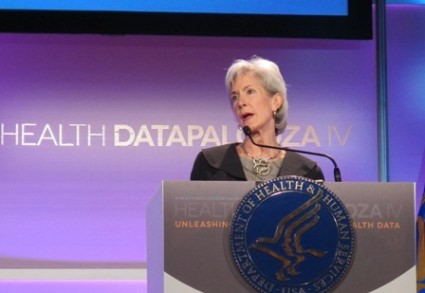
House Republicans proffer SGR fix legislation
Republicans on the House Energy and Commerce Committee have released a draft bill that would eliminate the Medicare Sustainable Growth Rate formula that they say has a good chance of being enacted.
Physician groups have been involved in the crafting of the draft, which was first circulated in early February.
"This discussion draft carries on the trend of soliciting more provider feedback than at any point in history on this issue," Rep. Michael Burgess (R-Tex.) said in a statement. "We are taking an important next step with this release by showing providers that we are committed to repealing the SGR and maintaining the option of fee-for-service for providers, while improving the Medicare program."
Rep. Burgess, who is an ob.gyn., and also vice chairman of the Energy and Commerce Health Subcommittee, said that he and his colleagues looked forward to hearing more from physicians.
The draft legislation would repeal the SGR and replace it with a fee-for-service system that would put more emphasis on rewarding quality. Physicians would have a guiding hand in developing quality measures in conjunction with the secretary of Health and Human Services. They would also be given the ability to opt out of fee-for-service and practice instead under new delivery models like accountable care organizations or patient-centered medical homes.
"We are working to restore certainty, fiscal sanity, and we will responsibly pay for these reforms," said Rep. Fred Upton (R-Mich.), chairman of the House Energy and Commerce committee, in a statement. "We will continue working closely with Ways and Means Committee Chairman [Dave] Camp [R-Mich.] as well as maintain our ongoing dialogue with committee Democrats as we work toward long-term solutions in the effort to improve quality of care."
Physician groups were cautious about the proposal at press time. In a statement, Dr. Jeremy Lazarus, president of the American Medical Association, said, "The Energy and Commerce Committee’s framework is another step in the important process of eliminating the SGR and moving toward new ways of delivering and paying for care that reward quality and reduce costs."
He said that the AMA "look[ed] forward to continuing to work to see that progress is made this year."
The American Academy of Family Physicians supports the proposal’s goal of establishing "a period of stable and predictable payment increases," and incentives to improve quality of care, said Dr. Jeffrey Cain, AAFP president, in an interview.
But by largely focusing on the fee-for-service payment system, the committee is overlooking the bigger picture of how physician payment affects health care costs and quality, he said. The AAFP would like to see an increase in pay for primary care because "investing in primary care would improve our country’s health care by increasing quality and decreasing overall costs by reducing unnecessary medical utilization," said Dr. Cain.
In early February, the American College of Physicians and several other groups lent their support to an SGR replacement bill that has elements similar to the Energy and Commerce draft. The bill, the Medicare Physician Payment Innovation Act (H.R. 574), was introduced by Reps. Allyson Schwartz (D-Penn.) and Joe Heck (R-Nev.).
In early May, Rep. Schwartz commended the Energy and Commerce bill, noting that it shared principles in common with H.R. 574. The bill also showed "that there is common ground on a framework for fixing the Medicare reimbursement system," said Rep. Schwartz in a statement.
The Energy and Commerce Committee said that comments on its draft legislation would be accepted until June 10, at [email protected].
On Twitter @aliciaault
Republicans on the House Energy and Commerce Committee have released a draft bill that would eliminate the Medicare Sustainable Growth Rate formula that they say has a good chance of being enacted.
Physician groups have been involved in the crafting of the draft, which was first circulated in early February.
"This discussion draft carries on the trend of soliciting more provider feedback than at any point in history on this issue," Rep. Michael Burgess (R-Tex.) said in a statement. "We are taking an important next step with this release by showing providers that we are committed to repealing the SGR and maintaining the option of fee-for-service for providers, while improving the Medicare program."
Rep. Burgess, who is an ob.gyn., and also vice chairman of the Energy and Commerce Health Subcommittee, said that he and his colleagues looked forward to hearing more from physicians.
The draft legislation would repeal the SGR and replace it with a fee-for-service system that would put more emphasis on rewarding quality. Physicians would have a guiding hand in developing quality measures in conjunction with the secretary of Health and Human Services. They would also be given the ability to opt out of fee-for-service and practice instead under new delivery models like accountable care organizations or patient-centered medical homes.
"We are working to restore certainty, fiscal sanity, and we will responsibly pay for these reforms," said Rep. Fred Upton (R-Mich.), chairman of the House Energy and Commerce committee, in a statement. "We will continue working closely with Ways and Means Committee Chairman [Dave] Camp [R-Mich.] as well as maintain our ongoing dialogue with committee Democrats as we work toward long-term solutions in the effort to improve quality of care."
Physician groups were cautious about the proposal at press time. In a statement, Dr. Jeremy Lazarus, president of the American Medical Association, said, "The Energy and Commerce Committee’s framework is another step in the important process of eliminating the SGR and moving toward new ways of delivering and paying for care that reward quality and reduce costs."
He said that the AMA "look[ed] forward to continuing to work to see that progress is made this year."
The American Academy of Family Physicians supports the proposal’s goal of establishing "a period of stable and predictable payment increases," and incentives to improve quality of care, said Dr. Jeffrey Cain, AAFP president, in an interview.
But by largely focusing on the fee-for-service payment system, the committee is overlooking the bigger picture of how physician payment affects health care costs and quality, he said. The AAFP would like to see an increase in pay for primary care because "investing in primary care would improve our country’s health care by increasing quality and decreasing overall costs by reducing unnecessary medical utilization," said Dr. Cain.
In early February, the American College of Physicians and several other groups lent their support to an SGR replacement bill that has elements similar to the Energy and Commerce draft. The bill, the Medicare Physician Payment Innovation Act (H.R. 574), was introduced by Reps. Allyson Schwartz (D-Penn.) and Joe Heck (R-Nev.).
In early May, Rep. Schwartz commended the Energy and Commerce bill, noting that it shared principles in common with H.R. 574. The bill also showed "that there is common ground on a framework for fixing the Medicare reimbursement system," said Rep. Schwartz in a statement.
The Energy and Commerce Committee said that comments on its draft legislation would be accepted until June 10, at [email protected].
On Twitter @aliciaault
Republicans on the House Energy and Commerce Committee have released a draft bill that would eliminate the Medicare Sustainable Growth Rate formula that they say has a good chance of being enacted.
Physician groups have been involved in the crafting of the draft, which was first circulated in early February.
"This discussion draft carries on the trend of soliciting more provider feedback than at any point in history on this issue," Rep. Michael Burgess (R-Tex.) said in a statement. "We are taking an important next step with this release by showing providers that we are committed to repealing the SGR and maintaining the option of fee-for-service for providers, while improving the Medicare program."
Rep. Burgess, who is an ob.gyn., and also vice chairman of the Energy and Commerce Health Subcommittee, said that he and his colleagues looked forward to hearing more from physicians.
The draft legislation would repeal the SGR and replace it with a fee-for-service system that would put more emphasis on rewarding quality. Physicians would have a guiding hand in developing quality measures in conjunction with the secretary of Health and Human Services. They would also be given the ability to opt out of fee-for-service and practice instead under new delivery models like accountable care organizations or patient-centered medical homes.
"We are working to restore certainty, fiscal sanity, and we will responsibly pay for these reforms," said Rep. Fred Upton (R-Mich.), chairman of the House Energy and Commerce committee, in a statement. "We will continue working closely with Ways and Means Committee Chairman [Dave] Camp [R-Mich.] as well as maintain our ongoing dialogue with committee Democrats as we work toward long-term solutions in the effort to improve quality of care."
Physician groups were cautious about the proposal at press time. In a statement, Dr. Jeremy Lazarus, president of the American Medical Association, said, "The Energy and Commerce Committee’s framework is another step in the important process of eliminating the SGR and moving toward new ways of delivering and paying for care that reward quality and reduce costs."
He said that the AMA "look[ed] forward to continuing to work to see that progress is made this year."
The American Academy of Family Physicians supports the proposal’s goal of establishing "a period of stable and predictable payment increases," and incentives to improve quality of care, said Dr. Jeffrey Cain, AAFP president, in an interview.
But by largely focusing on the fee-for-service payment system, the committee is overlooking the bigger picture of how physician payment affects health care costs and quality, he said. The AAFP would like to see an increase in pay for primary care because "investing in primary care would improve our country’s health care by increasing quality and decreasing overall costs by reducing unnecessary medical utilization," said Dr. Cain.
In early February, the American College of Physicians and several other groups lent their support to an SGR replacement bill that has elements similar to the Energy and Commerce draft. The bill, the Medicare Physician Payment Innovation Act (H.R. 574), was introduced by Reps. Allyson Schwartz (D-Penn.) and Joe Heck (R-Nev.).
In early May, Rep. Schwartz commended the Energy and Commerce bill, noting that it shared principles in common with H.R. 574. The bill also showed "that there is common ground on a framework for fixing the Medicare reimbursement system," said Rep. Schwartz in a statement.
The Energy and Commerce Committee said that comments on its draft legislation would be accepted until June 10, at [email protected].
On Twitter @aliciaault