User login
Psychodiagnostic testing services: The elusive quest for clinicians
Assessment psychologists should be colocated in specialty practices
Imagine the clinical care consequences if patients seen in specialty or primary care practices did not have ready access to laboratory, other medical tests, and/or consultative services deemed critical to quickly establishing diagnostic status and the development of an appropriate treatment plan. For instance, what would be the implications if a dentistry practice did not employ a dental hygienist; an otolaryngology group was not staffed with an audiologist; or a gastroenterology practice had no one available for digestive/nutritional consultation support.

Consider a neurologist who suspects that a patient has a potentially life-threatening brain condition, but the patient has to wait months for brain imaging or – even worse – is tasked to find their own provider for this diagnostic test only to be told that the neuroimaging service does not take their insurance and/or there are no available appointments for several months.
Situations of this kind would not be – and should not be – tolerated by medical professionals or their patients.
A common “real-world” scenario: After evaluation, a psychiatrist needs clarification regarding a possible subtle psychotic process, or, in another instance, suspects that there is an early degenerative cognitive change underlying recent changes in mood and personality. However, the psychiatrist has no dependable access to an assessment psychologist to assist in cases of this kind.
Patients are frequently told by psychiatrists and other physicians that they should have psychodiagnostic testing to arrive at a clearer picture of their clinical status and treatment needs. However, most medical practices, in particular, psychiatry, pediatrics, neurology, and neurosurgery, who see substantial numbers of patients who could benefit from testing, do not employ psychologists. When they do, many do not possess the requisite assessment skills to address the reason(s) for referral.
If the patient needing testing services is fortunate enough, he/she is referred to a well-trained psychologist within commuting distance who takes the patient’s insurance and is able to set up a timely appointment – an unlikely set of circumstances in today’s health care environment.
Some state psychological associations allow for a “matching service” of sorts in the form of announcements in the organization’s listserv, which reviews the referral and includes a back channel for psychologists to contact the patient regarding their availability for testing.
Over the past 2 decades, significant advancements have been made in the integration of primary and mental health care. Those need to continue to include colocating assessment psychologists in medical specialty practices, such as psychiatry, which make frequent referrals for psychodiagnostic testing or would like to but have no place to turn.
Dr. Pollak is affiliated with the Seacoast Mental Health Center in Portsmouth, N.H.
Assessment psychologists should be colocated in specialty practices
Assessment psychologists should be colocated in specialty practices
Imagine the clinical care consequences if patients seen in specialty or primary care practices did not have ready access to laboratory, other medical tests, and/or consultative services deemed critical to quickly establishing diagnostic status and the development of an appropriate treatment plan. For instance, what would be the implications if a dentistry practice did not employ a dental hygienist; an otolaryngology group was not staffed with an audiologist; or a gastroenterology practice had no one available for digestive/nutritional consultation support.
Consider a neurologist who suspects that a patient has a potentially life-threatening brain condition, but the patient has to wait months for brain imaging or – even worse – is tasked to find their own provider for this diagnostic test only to be told that the neuroimaging service does not take their insurance and/or there are no available appointments for several months.
Situations of this kind would not be – and should not be – tolerated by medical professionals or their patients.
A common “real-world” scenario: After evaluation, a psychiatrist needs clarification regarding a possible subtle psychotic process, or, in another instance, suspects that there is an early degenerative cognitive change underlying recent changes in mood and personality. However, the psychiatrist has no dependable access to an assessment psychologist to assist in cases of this kind.
Patients are frequently told by psychiatrists and other physicians that they should have psychodiagnostic testing to arrive at a clearer picture of their clinical status and treatment needs. However, most medical practices, in particular, psychiatry, pediatrics, neurology, and neurosurgery, who see substantial numbers of patients who could benefit from testing, do not employ psychologists. When they do, many do not possess the requisite assessment skills to address the reason(s) for referral.
If the patient needing testing services is fortunate enough, he/she is referred to a well-trained psychologist within commuting distance who takes the patient’s insurance and is able to set up a timely appointment – an unlikely set of circumstances in today’s health care environment.
Some state psychological associations allow for a “matching service” of sorts in the form of announcements in the organization’s listserv, which reviews the referral and includes a back channel for psychologists to contact the patient regarding their availability for testing.
Over the past 2 decades, significant advancements have been made in the integration of primary and mental health care. Those need to continue to include colocating assessment psychologists in medical specialty practices, such as psychiatry, which make frequent referrals for psychodiagnostic testing or would like to but have no place to turn.
Dr. Pollak is affiliated with the Seacoast Mental Health Center in Portsmouth, N.H.
Imagine the clinical care consequences if patients seen in specialty or primary care practices did not have ready access to laboratory, other medical tests, and/or consultative services deemed critical to quickly establishing diagnostic status and the development of an appropriate treatment plan. For instance, what would be the implications if a dentistry practice did not employ a dental hygienist; an otolaryngology group was not staffed with an audiologist; or a gastroenterology practice had no one available for digestive/nutritional consultation support.
Consider a neurologist who suspects that a patient has a potentially life-threatening brain condition, but the patient has to wait months for brain imaging or – even worse – is tasked to find their own provider for this diagnostic test only to be told that the neuroimaging service does not take their insurance and/or there are no available appointments for several months.
Situations of this kind would not be – and should not be – tolerated by medical professionals or their patients.
A common “real-world” scenario: After evaluation, a psychiatrist needs clarification regarding a possible subtle psychotic process, or, in another instance, suspects that there is an early degenerative cognitive change underlying recent changes in mood and personality. However, the psychiatrist has no dependable access to an assessment psychologist to assist in cases of this kind.
Patients are frequently told by psychiatrists and other physicians that they should have psychodiagnostic testing to arrive at a clearer picture of their clinical status and treatment needs. However, most medical practices, in particular, psychiatry, pediatrics, neurology, and neurosurgery, who see substantial numbers of patients who could benefit from testing, do not employ psychologists. When they do, many do not possess the requisite assessment skills to address the reason(s) for referral.
If the patient needing testing services is fortunate enough, he/she is referred to a well-trained psychologist within commuting distance who takes the patient’s insurance and is able to set up a timely appointment – an unlikely set of circumstances in today’s health care environment.
Some state psychological associations allow for a “matching service” of sorts in the form of announcements in the organization’s listserv, which reviews the referral and includes a back channel for psychologists to contact the patient regarding their availability for testing.
Over the past 2 decades, significant advancements have been made in the integration of primary and mental health care. Those need to continue to include colocating assessment psychologists in medical specialty practices, such as psychiatry, which make frequent referrals for psychodiagnostic testing or would like to but have no place to turn.
Dr. Pollak is affiliated with the Seacoast Mental Health Center in Portsmouth, N.H.
Agitation in psychosis: Still no ‘magic bullet’
SAN DIEGO – The Food and Drug Administration has not approved a drug to treat agitation in dementia, and the absence of medication candidates is only part of the picture. As a geriatric psychiatrist explained to colleagues, the FDA has not taken the step of recognizing that the condition exists. But there are still options to treat this dangerous disorder – although none is ideal.
Research into efficacy of potential treatments for agitation is limited, variable, and “have high placebo effects,” said Marc E. Agronin, MD, of the MIND Institute and Miami Jewish Health, at the annual Psych Congress. “There is no one single magic bullet, especially since there are so many manifestations of agitation, and there are side effects of medication. This is a tough area to focus on.”
What can clinicians do? Dr. Agronin recommended starting with the steps in the DICE algorithm.
- Describe: Learn about the aspects of agitation by talking to caregivers and understanding the circumstances when symptoms develop.
- Investigate: Identify contributing factors, such as those related to illness, medication, and the environment.
- Create: Come up with a team strategy to address the contributing factors. Delirium is especially dangerous since it can lead to injury and subacute cognitive decline. And keep in mind, Dr. Agorin said, that it may be risky to do nothing or undertreat.
- Evaluate: Track the results of the strategy while realizing that there’s “not always a quick fix.” Research suggests that therapeutic approaches such as music, aromatherapy, exercise, group activities, hand massage, and thermal baths can be helpful, Dr. Agronin said.
As for medications, he advised starting with lower doses, perhaps 50%, because older people are less tolerant of medication. And beware of oversedation, dizziness, and lowered blood pressure, which can lead to falls. A hip fracture can “spiral down to someone’s demise very quickly,” he said.
Here’s a closer look at Dr. Agronin’s comments regarding specific medications.
- Antipsychotics: “Every antipsychotic has been used for agitation,” he said, “and they probably have the best efficacy,” compared with other drugs. But the risk of side effects is moderate to high, and atypical antipsychotics have a black-box warning about their use in dementia-related psychosis in elderly patients. Also, discontinuation of antipsychotics can trigger worsening symptoms in some patients. There has been tremendous controversy in recent years over the use of antipsychotics in older patients, but other drugs might be less effective than antipsychotics while still having similar side effect profiles, he said. And clinicians might be too cautious about doses even when they do use these drugs.
- Benzodiazepines: They can work quickly but come with a risk of sedation. Trazodone is an “excellent” alternative to reduce agitation in the short-term, he said.
- Antidepressants: These drugs can address underlying depression. Study results have been mixed.
- Mood stabilizers: Study results are mixed. “Unfortunately, in many situations [clinicians] get scared away from antipsychotics and use mood stabilizers, but there is less data for them in terms of efficacy, and there are a lot of side effects that have to be monitored,” he said.
Dr. Agronin is the author of “How We Age” (Da Capo Lifelong Books, 2012) and “The End of Old Age” (Da Capo Lifelong Books, 2018). He has no relevant disclosures.
SAN DIEGO – The Food and Drug Administration has not approved a drug to treat agitation in dementia, and the absence of medication candidates is only part of the picture. As a geriatric psychiatrist explained to colleagues, the FDA has not taken the step of recognizing that the condition exists. But there are still options to treat this dangerous disorder – although none is ideal.
Research into efficacy of potential treatments for agitation is limited, variable, and “have high placebo effects,” said Marc E. Agronin, MD, of the MIND Institute and Miami Jewish Health, at the annual Psych Congress. “There is no one single magic bullet, especially since there are so many manifestations of agitation, and there are side effects of medication. This is a tough area to focus on.”
What can clinicians do? Dr. Agronin recommended starting with the steps in the DICE algorithm.
- Describe: Learn about the aspects of agitation by talking to caregivers and understanding the circumstances when symptoms develop.
- Investigate: Identify contributing factors, such as those related to illness, medication, and the environment.
- Create: Come up with a team strategy to address the contributing factors. Delirium is especially dangerous since it can lead to injury and subacute cognitive decline. And keep in mind, Dr. Agorin said, that it may be risky to do nothing or undertreat.
- Evaluate: Track the results of the strategy while realizing that there’s “not always a quick fix.” Research suggests that therapeutic approaches such as music, aromatherapy, exercise, group activities, hand massage, and thermal baths can be helpful, Dr. Agronin said.
As for medications, he advised starting with lower doses, perhaps 50%, because older people are less tolerant of medication. And beware of oversedation, dizziness, and lowered blood pressure, which can lead to falls. A hip fracture can “spiral down to someone’s demise very quickly,” he said.
Here’s a closer look at Dr. Agronin’s comments regarding specific medications.
- Antipsychotics: “Every antipsychotic has been used for agitation,” he said, “and they probably have the best efficacy,” compared with other drugs. But the risk of side effects is moderate to high, and atypical antipsychotics have a black-box warning about their use in dementia-related psychosis in elderly patients. Also, discontinuation of antipsychotics can trigger worsening symptoms in some patients. There has been tremendous controversy in recent years over the use of antipsychotics in older patients, but other drugs might be less effective than antipsychotics while still having similar side effect profiles, he said. And clinicians might be too cautious about doses even when they do use these drugs.
- Benzodiazepines: They can work quickly but come with a risk of sedation. Trazodone is an “excellent” alternative to reduce agitation in the short-term, he said.
- Antidepressants: These drugs can address underlying depression. Study results have been mixed.
- Mood stabilizers: Study results are mixed. “Unfortunately, in many situations [clinicians] get scared away from antipsychotics and use mood stabilizers, but there is less data for them in terms of efficacy, and there are a lot of side effects that have to be monitored,” he said.
Dr. Agronin is the author of “How We Age” (Da Capo Lifelong Books, 2012) and “The End of Old Age” (Da Capo Lifelong Books, 2018). He has no relevant disclosures.
SAN DIEGO – The Food and Drug Administration has not approved a drug to treat agitation in dementia, and the absence of medication candidates is only part of the picture. As a geriatric psychiatrist explained to colleagues, the FDA has not taken the step of recognizing that the condition exists. But there are still options to treat this dangerous disorder – although none is ideal.
Research into efficacy of potential treatments for agitation is limited, variable, and “have high placebo effects,” said Marc E. Agronin, MD, of the MIND Institute and Miami Jewish Health, at the annual Psych Congress. “There is no one single magic bullet, especially since there are so many manifestations of agitation, and there are side effects of medication. This is a tough area to focus on.”
What can clinicians do? Dr. Agronin recommended starting with the steps in the DICE algorithm.
- Describe: Learn about the aspects of agitation by talking to caregivers and understanding the circumstances when symptoms develop.
- Investigate: Identify contributing factors, such as those related to illness, medication, and the environment.
- Create: Come up with a team strategy to address the contributing factors. Delirium is especially dangerous since it can lead to injury and subacute cognitive decline. And keep in mind, Dr. Agorin said, that it may be risky to do nothing or undertreat.
- Evaluate: Track the results of the strategy while realizing that there’s “not always a quick fix.” Research suggests that therapeutic approaches such as music, aromatherapy, exercise, group activities, hand massage, and thermal baths can be helpful, Dr. Agronin said.
As for medications, he advised starting with lower doses, perhaps 50%, because older people are less tolerant of medication. And beware of oversedation, dizziness, and lowered blood pressure, which can lead to falls. A hip fracture can “spiral down to someone’s demise very quickly,” he said.
Here’s a closer look at Dr. Agronin’s comments regarding specific medications.
- Antipsychotics: “Every antipsychotic has been used for agitation,” he said, “and they probably have the best efficacy,” compared with other drugs. But the risk of side effects is moderate to high, and atypical antipsychotics have a black-box warning about their use in dementia-related psychosis in elderly patients. Also, discontinuation of antipsychotics can trigger worsening symptoms in some patients. There has been tremendous controversy in recent years over the use of antipsychotics in older patients, but other drugs might be less effective than antipsychotics while still having similar side effect profiles, he said. And clinicians might be too cautious about doses even when they do use these drugs.
- Benzodiazepines: They can work quickly but come with a risk of sedation. Trazodone is an “excellent” alternative to reduce agitation in the short-term, he said.
- Antidepressants: These drugs can address underlying depression. Study results have been mixed.
- Mood stabilizers: Study results are mixed. “Unfortunately, in many situations [clinicians] get scared away from antipsychotics and use mood stabilizers, but there is less data for them in terms of efficacy, and there are a lot of side effects that have to be monitored,” he said.
Dr. Agronin is the author of “How We Age” (Da Capo Lifelong Books, 2012) and “The End of Old Age” (Da Capo Lifelong Books, 2018). He has no relevant disclosures.
REPORTING FROM PSYCH CONGRESS 2019
FDA approves transdermal asenapine system for schizophrenia
The Food and Drug Administration has approved a transdermal asenapine delivery system (Secuado) for treatment of schizophrenia in adults, according to a release from Noven Pharmaceuticals.

The patch formulation is designed to deliver sustained concentrations of asenapine over 24-hour periods, so the system is a once-daily treatment. The efficacy and safety profile for children younger than 18 years is unknown.
The approval is based on an international, phase 3, double-blind, placebo-controlled study that included 616 adults with schizophrenia. The transdermal system achieved the study’s primary endpoint of statistically significant improvement at week 6 in the Positive and Negative Syndrome Scale, compared with placebo.
The safety profile of the system was consistent with the known profile of sublingual asenapine, and the most commonly observed adverse reactions were extrapyramidal disorder, application site reaction, and weight gain. The full prescribing information includes a boxed warning explaining that antipsychotics, such as asenapine, are associated with increased risk of death among elderly patients with dementia-related psychosis, an indication not approved for this transdermal asenapine-delivery system. Other warnings described in the prescribing information include neuroleptic malignant syndrome, tardive dyskinesia, and metabolic changes.
clinical professor of psychiatry and behavioral sciences at New York Medical College, in the release.
Noven is a subsidiary of Hisamitsu Pharmaceutical.
The Food and Drug Administration has approved a transdermal asenapine delivery system (Secuado) for treatment of schizophrenia in adults, according to a release from Noven Pharmaceuticals.
The patch formulation is designed to deliver sustained concentrations of asenapine over 24-hour periods, so the system is a once-daily treatment. The efficacy and safety profile for children younger than 18 years is unknown.
The approval is based on an international, phase 3, double-blind, placebo-controlled study that included 616 adults with schizophrenia. The transdermal system achieved the study’s primary endpoint of statistically significant improvement at week 6 in the Positive and Negative Syndrome Scale, compared with placebo.
The safety profile of the system was consistent with the known profile of sublingual asenapine, and the most commonly observed adverse reactions were extrapyramidal disorder, application site reaction, and weight gain. The full prescribing information includes a boxed warning explaining that antipsychotics, such as asenapine, are associated with increased risk of death among elderly patients with dementia-related psychosis, an indication not approved for this transdermal asenapine-delivery system. Other warnings described in the prescribing information include neuroleptic malignant syndrome, tardive dyskinesia, and metabolic changes.
clinical professor of psychiatry and behavioral sciences at New York Medical College, in the release.
Noven is a subsidiary of Hisamitsu Pharmaceutical.
The Food and Drug Administration has approved a transdermal asenapine delivery system (Secuado) for treatment of schizophrenia in adults, according to a release from Noven Pharmaceuticals.
The patch formulation is designed to deliver sustained concentrations of asenapine over 24-hour periods, so the system is a once-daily treatment. The efficacy and safety profile for children younger than 18 years is unknown.
The approval is based on an international, phase 3, double-blind, placebo-controlled study that included 616 adults with schizophrenia. The transdermal system achieved the study’s primary endpoint of statistically significant improvement at week 6 in the Positive and Negative Syndrome Scale, compared with placebo.
The safety profile of the system was consistent with the known profile of sublingual asenapine, and the most commonly observed adverse reactions were extrapyramidal disorder, application site reaction, and weight gain. The full prescribing information includes a boxed warning explaining that antipsychotics, such as asenapine, are associated with increased risk of death among elderly patients with dementia-related psychosis, an indication not approved for this transdermal asenapine-delivery system. Other warnings described in the prescribing information include neuroleptic malignant syndrome, tardive dyskinesia, and metabolic changes.
clinical professor of psychiatry and behavioral sciences at New York Medical College, in the release.
Noven is a subsidiary of Hisamitsu Pharmaceutical.
Schizophrenia patients have ‘aberrant’ response to Epstein-Barr
Individuals with schizophrenia had elevated levels of one Epstein-Barr virus (EBV) antibody but atypically low levels of another, which investigators deemed an “aberrant immune response.”
Faith Dickerson, PhD, MPH, Lorraine Jones-Brando, PhD,and colleagues investigated the IgG antibodies and genetics of 432 individuals with schizophrenia and 311 without. The investigators used solid-phase immunoassays to measure antibodies, and they measured titers of antibodies not just for EBV but also for related viruses. The group with schizophrenia was slightly older, with a mean age of 38.2 years, compared with a mean age of 32.03 years in the group without schizophrenia. Also, 65.7% of the study participants in the schizophrenia group were male, compared with 39.2% of those in the group without schizophrenia. More than 60% of participants in the schizophrenia group were cigarette smokers, compared with 14.8% of the controls. The study was published in Schizophrenia Bulletin.
Compared with the controls, individuals with schizophrenia had elevated levels of EBV viral capsid antibody (EBV-VCA) with a mean effect size of 0.356 (P less than .002); however, the levels of EBV nuclear antigen-1 (EBNA-1) were not significantly different from those seen in individuals without schizophrenia, reported Dr. Dickerson of the Stanley Research Program at Sheppard Pratt, and Dr. Jones-Brando of Johns Hopkins University, both in Baltimore.
The investigators also examined adjusted odds ratios for individuals with schizophrenia having levels of antibodies higher than percentile cutoffs of the controls; for example, the aOR for those individuals having EBV VCA levels at the 90th percentile of controls was 2.03 (95% confidence interval, 1.23-3.37; P = .007). The aORs for EBNA-1 were not significant.
Those results suggest an aberrant immune response to EBV because, in most cases, EBV VCA and EBNA-1 are expressed at roughly equal levels, the investigators said.
“An increased understanding of the role of EBV infection might thus lead to novel methods for the prevention and treatment of schizophrenia.”
The study was funded by the Silvio O. Conte Center at Johns Hopkins University in Baltimore, and the Stanley Medical Research Institute, Chevy Chase, Md. Dr. Dickerson, Dr. Jones-Brando, and colleagues reported having no conflicts of interest.
SOURCE: Dickerson F et al. Schizophr Bull. 2019 Sep 11;45(5):1112-9.
Individuals with schizophrenia had elevated levels of one Epstein-Barr virus (EBV) antibody but atypically low levels of another, which investigators deemed an “aberrant immune response.”
Faith Dickerson, PhD, MPH, Lorraine Jones-Brando, PhD,and colleagues investigated the IgG antibodies and genetics of 432 individuals with schizophrenia and 311 without. The investigators used solid-phase immunoassays to measure antibodies, and they measured titers of antibodies not just for EBV but also for related viruses. The group with schizophrenia was slightly older, with a mean age of 38.2 years, compared with a mean age of 32.03 years in the group without schizophrenia. Also, 65.7% of the study participants in the schizophrenia group were male, compared with 39.2% of those in the group without schizophrenia. More than 60% of participants in the schizophrenia group were cigarette smokers, compared with 14.8% of the controls. The study was published in Schizophrenia Bulletin.
Compared with the controls, individuals with schizophrenia had elevated levels of EBV viral capsid antibody (EBV-VCA) with a mean effect size of 0.356 (P less than .002); however, the levels of EBV nuclear antigen-1 (EBNA-1) were not significantly different from those seen in individuals without schizophrenia, reported Dr. Dickerson of the Stanley Research Program at Sheppard Pratt, and Dr. Jones-Brando of Johns Hopkins University, both in Baltimore.
The investigators also examined adjusted odds ratios for individuals with schizophrenia having levels of antibodies higher than percentile cutoffs of the controls; for example, the aOR for those individuals having EBV VCA levels at the 90th percentile of controls was 2.03 (95% confidence interval, 1.23-3.37; P = .007). The aORs for EBNA-1 were not significant.
Those results suggest an aberrant immune response to EBV because, in most cases, EBV VCA and EBNA-1 are expressed at roughly equal levels, the investigators said.
“An increased understanding of the role of EBV infection might thus lead to novel methods for the prevention and treatment of schizophrenia.”
The study was funded by the Silvio O. Conte Center at Johns Hopkins University in Baltimore, and the Stanley Medical Research Institute, Chevy Chase, Md. Dr. Dickerson, Dr. Jones-Brando, and colleagues reported having no conflicts of interest.
SOURCE: Dickerson F et al. Schizophr Bull. 2019 Sep 11;45(5):1112-9.
Individuals with schizophrenia had elevated levels of one Epstein-Barr virus (EBV) antibody but atypically low levels of another, which investigators deemed an “aberrant immune response.”
Faith Dickerson, PhD, MPH, Lorraine Jones-Brando, PhD,and colleagues investigated the IgG antibodies and genetics of 432 individuals with schizophrenia and 311 without. The investigators used solid-phase immunoassays to measure antibodies, and they measured titers of antibodies not just for EBV but also for related viruses. The group with schizophrenia was slightly older, with a mean age of 38.2 years, compared with a mean age of 32.03 years in the group without schizophrenia. Also, 65.7% of the study participants in the schizophrenia group were male, compared with 39.2% of those in the group without schizophrenia. More than 60% of participants in the schizophrenia group were cigarette smokers, compared with 14.8% of the controls. The study was published in Schizophrenia Bulletin.
Compared with the controls, individuals with schizophrenia had elevated levels of EBV viral capsid antibody (EBV-VCA) with a mean effect size of 0.356 (P less than .002); however, the levels of EBV nuclear antigen-1 (EBNA-1) were not significantly different from those seen in individuals without schizophrenia, reported Dr. Dickerson of the Stanley Research Program at Sheppard Pratt, and Dr. Jones-Brando of Johns Hopkins University, both in Baltimore.
The investigators also examined adjusted odds ratios for individuals with schizophrenia having levels of antibodies higher than percentile cutoffs of the controls; for example, the aOR for those individuals having EBV VCA levels at the 90th percentile of controls was 2.03 (95% confidence interval, 1.23-3.37; P = .007). The aORs for EBNA-1 were not significant.
Those results suggest an aberrant immune response to EBV because, in most cases, EBV VCA and EBNA-1 are expressed at roughly equal levels, the investigators said.
“An increased understanding of the role of EBV infection might thus lead to novel methods for the prevention and treatment of schizophrenia.”
The study was funded by the Silvio O. Conte Center at Johns Hopkins University in Baltimore, and the Stanley Medical Research Institute, Chevy Chase, Md. Dr. Dickerson, Dr. Jones-Brando, and colleagues reported having no conflicts of interest.
SOURCE: Dickerson F et al. Schizophr Bull. 2019 Sep 11;45(5):1112-9.
FROM SCHIZOPHRENIA BULLETIN
Patients with nonaffective psychosis offer treatment target preferences
‘Worrying less,’ ‘feeling happier,’ and sleeping better were among top targets identified
Patients with nonaffective psychosis want the “causal mechanisms” for their psychotic experiences treated, according to a study conducted by researchers at the University of Oxford (England).
“The findings indicate a need to adopt into services for people with severe mental health difficulties interventions shown by research to treat anxious avoidance, worry, low self-esteem, insomnia, and other such transdiagnostic mechanisms and evaluate the outcomes,” wrote Daniel Freeman, PhD, DClinPsy, of the department of psychiatry at Oxford, and colleagues. The study was published in Schizophrenia Research.
In previous research, Dr. Freeman and colleagues identified factors that appear to maintain symptoms of nonaffective psychosis, such as paranoia (Behav Cogn Psychother. 2016 Sep;44[5]:539-52).Those factors include anxious avoidance, worry, low self-esteem, insomnia, and reasoning bias. In additional research, the researchers demonstrated that addressing those targets can lead to led to reductions in paranoia.
In the current study, 1,809 patients were recruited from 39 National Health Services mental health trusts across England. The researchers analyzed responses to eight clinical assessment tools and a patient-reported questionnaire about treatment preferences.
Dr. Freeman and colleagues found consistency in the relationships observed among the factors and nonaffective psychosis with the theoretical model they had developed, such as positive correlations between paranoia and anxious avoidance (correlation coefficient [r] = 0.37), worry (r = 0.40), and hallucinations (r = 0.54). They found negative correlations between paranoia and levels of positive self-beliefs (r = –0.17), rational reasoning (r = –0.14), and psychological wellbeing (r = –0.29). Those correlations were all statistically significant with P values less than .001.
Most of the patients (90.3%) wanted at least one of the eight problem areas assessed in the study treated, and on average, they wanted more than four (mean, 4.5) treated. The most frequently identified top treatment priorities identified by patients were worrying (50.8%), feeling happier (42.9%), and sleeping better (41.2%).
the researchers wrote.
Among the study limitations: The assessments selected were based on the theoretical model the researchers had developed and therefore may not have captured all difficulties experienced by the patients. Furthermore, although the sample was large, it’s unclear whether it was truly representative because they were drawn from certain mental health services that, for example, patients with milder symptoms might not seek out.
Dr. Freeman is a cofounder and chief clinical officer of Oxford VR. He has received funding from the National Institute of Health Research, Medical Research Council, and Wellcome Trust. No other authors reported conflicts of interest.
SOURCE: Freeman D et al. Schizophr Res. 2019. doi: 10.1016/j.schres.2019.07.016.
‘Worrying less,’ ‘feeling happier,’ and sleeping better were among top targets identified
‘Worrying less,’ ‘feeling happier,’ and sleeping better were among top targets identified
Patients with nonaffective psychosis want the “causal mechanisms” for their psychotic experiences treated, according to a study conducted by researchers at the University of Oxford (England).
“The findings indicate a need to adopt into services for people with severe mental health difficulties interventions shown by research to treat anxious avoidance, worry, low self-esteem, insomnia, and other such transdiagnostic mechanisms and evaluate the outcomes,” wrote Daniel Freeman, PhD, DClinPsy, of the department of psychiatry at Oxford, and colleagues. The study was published in Schizophrenia Research.
In previous research, Dr. Freeman and colleagues identified factors that appear to maintain symptoms of nonaffective psychosis, such as paranoia (Behav Cogn Psychother. 2016 Sep;44[5]:539-52).Those factors include anxious avoidance, worry, low self-esteem, insomnia, and reasoning bias. In additional research, the researchers demonstrated that addressing those targets can lead to led to reductions in paranoia.
In the current study, 1,809 patients were recruited from 39 National Health Services mental health trusts across England. The researchers analyzed responses to eight clinical assessment tools and a patient-reported questionnaire about treatment preferences.
Dr. Freeman and colleagues found consistency in the relationships observed among the factors and nonaffective psychosis with the theoretical model they had developed, such as positive correlations between paranoia and anxious avoidance (correlation coefficient [r] = 0.37), worry (r = 0.40), and hallucinations (r = 0.54). They found negative correlations between paranoia and levels of positive self-beliefs (r = –0.17), rational reasoning (r = –0.14), and psychological wellbeing (r = –0.29). Those correlations were all statistically significant with P values less than .001.
Most of the patients (90.3%) wanted at least one of the eight problem areas assessed in the study treated, and on average, they wanted more than four (mean, 4.5) treated. The most frequently identified top treatment priorities identified by patients were worrying (50.8%), feeling happier (42.9%), and sleeping better (41.2%).
the researchers wrote.
Among the study limitations: The assessments selected were based on the theoretical model the researchers had developed and therefore may not have captured all difficulties experienced by the patients. Furthermore, although the sample was large, it’s unclear whether it was truly representative because they were drawn from certain mental health services that, for example, patients with milder symptoms might not seek out.
Dr. Freeman is a cofounder and chief clinical officer of Oxford VR. He has received funding from the National Institute of Health Research, Medical Research Council, and Wellcome Trust. No other authors reported conflicts of interest.
SOURCE: Freeman D et al. Schizophr Res. 2019. doi: 10.1016/j.schres.2019.07.016.
Patients with nonaffective psychosis want the “causal mechanisms” for their psychotic experiences treated, according to a study conducted by researchers at the University of Oxford (England).
“The findings indicate a need to adopt into services for people with severe mental health difficulties interventions shown by research to treat anxious avoidance, worry, low self-esteem, insomnia, and other such transdiagnostic mechanisms and evaluate the outcomes,” wrote Daniel Freeman, PhD, DClinPsy, of the department of psychiatry at Oxford, and colleagues. The study was published in Schizophrenia Research.
In previous research, Dr. Freeman and colleagues identified factors that appear to maintain symptoms of nonaffective psychosis, such as paranoia (Behav Cogn Psychother. 2016 Sep;44[5]:539-52).Those factors include anxious avoidance, worry, low self-esteem, insomnia, and reasoning bias. In additional research, the researchers demonstrated that addressing those targets can lead to led to reductions in paranoia.
In the current study, 1,809 patients were recruited from 39 National Health Services mental health trusts across England. The researchers analyzed responses to eight clinical assessment tools and a patient-reported questionnaire about treatment preferences.
Dr. Freeman and colleagues found consistency in the relationships observed among the factors and nonaffective psychosis with the theoretical model they had developed, such as positive correlations between paranoia and anxious avoidance (correlation coefficient [r] = 0.37), worry (r = 0.40), and hallucinations (r = 0.54). They found negative correlations between paranoia and levels of positive self-beliefs (r = –0.17), rational reasoning (r = –0.14), and psychological wellbeing (r = –0.29). Those correlations were all statistically significant with P values less than .001.
Most of the patients (90.3%) wanted at least one of the eight problem areas assessed in the study treated, and on average, they wanted more than four (mean, 4.5) treated. The most frequently identified top treatment priorities identified by patients were worrying (50.8%), feeling happier (42.9%), and sleeping better (41.2%).
the researchers wrote.
Among the study limitations: The assessments selected were based on the theoretical model the researchers had developed and therefore may not have captured all difficulties experienced by the patients. Furthermore, although the sample was large, it’s unclear whether it was truly representative because they were drawn from certain mental health services that, for example, patients with milder symptoms might not seek out.
Dr. Freeman is a cofounder and chief clinical officer of Oxford VR. He has received funding from the National Institute of Health Research, Medical Research Council, and Wellcome Trust. No other authors reported conflicts of interest.
SOURCE: Freeman D et al. Schizophr Res. 2019. doi: 10.1016/j.schres.2019.07.016.
FROM SCHIZOPHRENIA RESEARCH
New themes emerging about antipsychotic maintenance therapy
COPENHAGEN – Recent studies emphasize the long-term merits of extending antipsychotic therapy beyond 1 year for patients in remission after a first psychotic episode, Mark Weiser, MD, observed at the annual congress of the European College of Neuropsychopharmacology.

Another emerging theme in the research literature, albeit a somewhat heretical one, is the value of antipsychotic polypharmacy, added Dr. Weiser, professor and chairman of the department of psychiatry at Sackler Faculty of Medicine, Tel Aviv University.
“Polypharmacy might not be so bad,” he declared in a keynote lecture in which he highlighted recent major publications addressing issues involving pharmacotherapy of schizophrenia.
“When we were residents, we were all taught that it’s not good to give two antipsychotics together, that all antipsychotics work only through dopamine D2 [receptor] blockade, hence there’s no point in giving more than one antipsychotic because all you’re doing is increasing side effects. But maybe it’s not as simple as that,” the psychiatrist said.
Exhibit 1: A recent Finnish national registry study of 62,250 patients with schizophrenia featuring up to 20-year follow-up showing that any antipsychotic polypharmacy was associated with a significantly lower risk of rehospitalization, compared with any antipsychotic monotherapy. The combination that stood out as having the lowest rehospitalization risk was clozapine plus aripiprazole, with a 14%-23% lower risk than for clozapine alone, which was the most effective monotherapy (JAMA Psychiatry. 2019 May; 76[5]:499-507).
Dr. Weiser pronounced himself a firm believer in the Finnish experience.
“The reason I think that this is true is that it’s exactly what I find in my own VA data,” he said.
Indeed, he and his coinvestigators are preparing to publish the results of their longitudinal study of 37,368 schizophrenia patients in the U.S. Veterans Affairs system. A key finding was that patients on antipsychotic polypharmacy had a longer time to treatment discontinuation than did those on monotherapy.
“Polypharmacy, at least in real-world study designs, seems to be good,” he noted.
Moreover, even in the world of highly selective randomized clinical trials, polypharmacy appears to fare pretty well as a treatment strategy, Dr. Weiser noted. A recent meta-analysis of six RCTs totaling 341 patients showed that switching patients from two antipsychotics to one was associated with a 2.2-fold increased risk of study discontinuation, although the investigators rated the quality of the trials as low to very low (Schizophr Res. 2019 Jul;209:50-7).
“I’m doing more polypharmacy now because of these data,” Dr. Weiser said. “My understanding of the polypharmacy data is that it’s not just blocking dopamine that’s important for treatment efficacy in schizophrenia.”
Getting a handle on first-episode psychosis
Dr. Weiser was a coinvestigator in the European Commission–funded OPTiMiSE study, in which 446 patients with first-episode schizophrenia or schizophreniform disorder in 14 European countries and Israel received 4 weeks of oral amisulpride. Then, if they were not in symptomatic remission, they were randomized double-blind to 6 weeks more of amisulpride or a switch to olanzapine. Those who weren’t in remission at 10 weeks were then placed on 12 weeks of open-label clozapine.
OPTiMiSE validated the clinical utility of a simple treatment algorithm, as 56% of patients achieved remission using stringent criteria by week 4 on amisulpride, and an additional 7% reached that endpoint by week 10, with the switch to olanzapine offering no added value over continued amisulpride. Switching week-10 nonresponders to clozapine enabled 28% of them to achieve remission (Lancet Psychiatry. 2018 Oct 1;5[10]:797-807).
A key take-home message of the trial, Dr. Weiser said, is that a switch to clozapine is justified after 10 weeks of unsuccessful treatment with a first-line antipsychotic; there’s no need to wait until patients have failed on two consecutive antipsychotics, as guidelines now recommend.
He observed that it can be a lot more challenging to keep patients in remission after a first psychotic episode than it is to get them to respond in the first place. For this reason, he found particularly instructive a recent study by psychiatrists at the University of Hong Kong that shined a light on the understudied long-term adverse consequences of stopping antipsychotic therapy after 1 year in patients successfully treated for a first-episode psychosis. At the 1-year point in this randomized trial, the successfully remitted patients were given maintenance therapy or their antipsychotic therapy was discontinued for 12 months. Ten years later, the investigators reported, the rate of a composite endpoint comprising persistent psychotic symptoms, requirement for clozapine, or completed suicide was 21% in the maintenance therapy group and significantly worse at 39% in those who had stopped treatment at 1 year (Lancet Psychiatry. 2018 May 1;5[5]:432-42).
“It’s probably a good idea to keep patients who are stable on maintenance therapy for longer than a year. A lot of first-episode patients don’t want to hear this. A lot of family members don’t want to hear this. And a lot of patients, of course, decide for themselves and stop treatment, although I tell them they should not.
Asked how low his low-dose long-term maintenance therapy is, he replied: “Negotiate with your patient about the lowest dose he or she is willing to take. In my opinion, 1 mg of risperidone is a lot better than 0 mg of risperidone, although that’s not an opinion supported by data.”
Dr. Weiser reported having no financial conflicts regarding his presentation.
COPENHAGEN – Recent studies emphasize the long-term merits of extending antipsychotic therapy beyond 1 year for patients in remission after a first psychotic episode, Mark Weiser, MD, observed at the annual congress of the European College of Neuropsychopharmacology.
Another emerging theme in the research literature, albeit a somewhat heretical one, is the value of antipsychotic polypharmacy, added Dr. Weiser, professor and chairman of the department of psychiatry at Sackler Faculty of Medicine, Tel Aviv University.
“Polypharmacy might not be so bad,” he declared in a keynote lecture in which he highlighted recent major publications addressing issues involving pharmacotherapy of schizophrenia.
“When we were residents, we were all taught that it’s not good to give two antipsychotics together, that all antipsychotics work only through dopamine D2 [receptor] blockade, hence there’s no point in giving more than one antipsychotic because all you’re doing is increasing side effects. But maybe it’s not as simple as that,” the psychiatrist said.
Exhibit 1: A recent Finnish national registry study of 62,250 patients with schizophrenia featuring up to 20-year follow-up showing that any antipsychotic polypharmacy was associated with a significantly lower risk of rehospitalization, compared with any antipsychotic monotherapy. The combination that stood out as having the lowest rehospitalization risk was clozapine plus aripiprazole, with a 14%-23% lower risk than for clozapine alone, which was the most effective monotherapy (JAMA Psychiatry. 2019 May; 76[5]:499-507).
Dr. Weiser pronounced himself a firm believer in the Finnish experience.
“The reason I think that this is true is that it’s exactly what I find in my own VA data,” he said.
Indeed, he and his coinvestigators are preparing to publish the results of their longitudinal study of 37,368 schizophrenia patients in the U.S. Veterans Affairs system. A key finding was that patients on antipsychotic polypharmacy had a longer time to treatment discontinuation than did those on monotherapy.
“Polypharmacy, at least in real-world study designs, seems to be good,” he noted.
Moreover, even in the world of highly selective randomized clinical trials, polypharmacy appears to fare pretty well as a treatment strategy, Dr. Weiser noted. A recent meta-analysis of six RCTs totaling 341 patients showed that switching patients from two antipsychotics to one was associated with a 2.2-fold increased risk of study discontinuation, although the investigators rated the quality of the trials as low to very low (Schizophr Res. 2019 Jul;209:50-7).
“I’m doing more polypharmacy now because of these data,” Dr. Weiser said. “My understanding of the polypharmacy data is that it’s not just blocking dopamine that’s important for treatment efficacy in schizophrenia.”
Getting a handle on first-episode psychosis
Dr. Weiser was a coinvestigator in the European Commission–funded OPTiMiSE study, in which 446 patients with first-episode schizophrenia or schizophreniform disorder in 14 European countries and Israel received 4 weeks of oral amisulpride. Then, if they were not in symptomatic remission, they were randomized double-blind to 6 weeks more of amisulpride or a switch to olanzapine. Those who weren’t in remission at 10 weeks were then placed on 12 weeks of open-label clozapine.
OPTiMiSE validated the clinical utility of a simple treatment algorithm, as 56% of patients achieved remission using stringent criteria by week 4 on amisulpride, and an additional 7% reached that endpoint by week 10, with the switch to olanzapine offering no added value over continued amisulpride. Switching week-10 nonresponders to clozapine enabled 28% of them to achieve remission (Lancet Psychiatry. 2018 Oct 1;5[10]:797-807).
A key take-home message of the trial, Dr. Weiser said, is that a switch to clozapine is justified after 10 weeks of unsuccessful treatment with a first-line antipsychotic; there’s no need to wait until patients have failed on two consecutive antipsychotics, as guidelines now recommend.
He observed that it can be a lot more challenging to keep patients in remission after a first psychotic episode than it is to get them to respond in the first place. For this reason, he found particularly instructive a recent study by psychiatrists at the University of Hong Kong that shined a light on the understudied long-term adverse consequences of stopping antipsychotic therapy after 1 year in patients successfully treated for a first-episode psychosis. At the 1-year point in this randomized trial, the successfully remitted patients were given maintenance therapy or their antipsychotic therapy was discontinued for 12 months. Ten years later, the investigators reported, the rate of a composite endpoint comprising persistent psychotic symptoms, requirement for clozapine, or completed suicide was 21% in the maintenance therapy group and significantly worse at 39% in those who had stopped treatment at 1 year (Lancet Psychiatry. 2018 May 1;5[5]:432-42).
“It’s probably a good idea to keep patients who are stable on maintenance therapy for longer than a year. A lot of first-episode patients don’t want to hear this. A lot of family members don’t want to hear this. And a lot of patients, of course, decide for themselves and stop treatment, although I tell them they should not.
Asked how low his low-dose long-term maintenance therapy is, he replied: “Negotiate with your patient about the lowest dose he or she is willing to take. In my opinion, 1 mg of risperidone is a lot better than 0 mg of risperidone, although that’s not an opinion supported by data.”
Dr. Weiser reported having no financial conflicts regarding his presentation.
COPENHAGEN – Recent studies emphasize the long-term merits of extending antipsychotic therapy beyond 1 year for patients in remission after a first psychotic episode, Mark Weiser, MD, observed at the annual congress of the European College of Neuropsychopharmacology.
Another emerging theme in the research literature, albeit a somewhat heretical one, is the value of antipsychotic polypharmacy, added Dr. Weiser, professor and chairman of the department of psychiatry at Sackler Faculty of Medicine, Tel Aviv University.
“Polypharmacy might not be so bad,” he declared in a keynote lecture in which he highlighted recent major publications addressing issues involving pharmacotherapy of schizophrenia.
“When we were residents, we were all taught that it’s not good to give two antipsychotics together, that all antipsychotics work only through dopamine D2 [receptor] blockade, hence there’s no point in giving more than one antipsychotic because all you’re doing is increasing side effects. But maybe it’s not as simple as that,” the psychiatrist said.
Exhibit 1: A recent Finnish national registry study of 62,250 patients with schizophrenia featuring up to 20-year follow-up showing that any antipsychotic polypharmacy was associated with a significantly lower risk of rehospitalization, compared with any antipsychotic monotherapy. The combination that stood out as having the lowest rehospitalization risk was clozapine plus aripiprazole, with a 14%-23% lower risk than for clozapine alone, which was the most effective monotherapy (JAMA Psychiatry. 2019 May; 76[5]:499-507).
Dr. Weiser pronounced himself a firm believer in the Finnish experience.
“The reason I think that this is true is that it’s exactly what I find in my own VA data,” he said.
Indeed, he and his coinvestigators are preparing to publish the results of their longitudinal study of 37,368 schizophrenia patients in the U.S. Veterans Affairs system. A key finding was that patients on antipsychotic polypharmacy had a longer time to treatment discontinuation than did those on monotherapy.
“Polypharmacy, at least in real-world study designs, seems to be good,” he noted.
Moreover, even in the world of highly selective randomized clinical trials, polypharmacy appears to fare pretty well as a treatment strategy, Dr. Weiser noted. A recent meta-analysis of six RCTs totaling 341 patients showed that switching patients from two antipsychotics to one was associated with a 2.2-fold increased risk of study discontinuation, although the investigators rated the quality of the trials as low to very low (Schizophr Res. 2019 Jul;209:50-7).
“I’m doing more polypharmacy now because of these data,” Dr. Weiser said. “My understanding of the polypharmacy data is that it’s not just blocking dopamine that’s important for treatment efficacy in schizophrenia.”
Getting a handle on first-episode psychosis
Dr. Weiser was a coinvestigator in the European Commission–funded OPTiMiSE study, in which 446 patients with first-episode schizophrenia or schizophreniform disorder in 14 European countries and Israel received 4 weeks of oral amisulpride. Then, if they were not in symptomatic remission, they were randomized double-blind to 6 weeks more of amisulpride or a switch to olanzapine. Those who weren’t in remission at 10 weeks were then placed on 12 weeks of open-label clozapine.
OPTiMiSE validated the clinical utility of a simple treatment algorithm, as 56% of patients achieved remission using stringent criteria by week 4 on amisulpride, and an additional 7% reached that endpoint by week 10, with the switch to olanzapine offering no added value over continued amisulpride. Switching week-10 nonresponders to clozapine enabled 28% of them to achieve remission (Lancet Psychiatry. 2018 Oct 1;5[10]:797-807).
A key take-home message of the trial, Dr. Weiser said, is that a switch to clozapine is justified after 10 weeks of unsuccessful treatment with a first-line antipsychotic; there’s no need to wait until patients have failed on two consecutive antipsychotics, as guidelines now recommend.
He observed that it can be a lot more challenging to keep patients in remission after a first psychotic episode than it is to get them to respond in the first place. For this reason, he found particularly instructive a recent study by psychiatrists at the University of Hong Kong that shined a light on the understudied long-term adverse consequences of stopping antipsychotic therapy after 1 year in patients successfully treated for a first-episode psychosis. At the 1-year point in this randomized trial, the successfully remitted patients were given maintenance therapy or their antipsychotic therapy was discontinued for 12 months. Ten years later, the investigators reported, the rate of a composite endpoint comprising persistent psychotic symptoms, requirement for clozapine, or completed suicide was 21% in the maintenance therapy group and significantly worse at 39% in those who had stopped treatment at 1 year (Lancet Psychiatry. 2018 May 1;5[5]:432-42).
“It’s probably a good idea to keep patients who are stable on maintenance therapy for longer than a year. A lot of first-episode patients don’t want to hear this. A lot of family members don’t want to hear this. And a lot of patients, of course, decide for themselves and stop treatment, although I tell them they should not.
Asked how low his low-dose long-term maintenance therapy is, he replied: “Negotiate with your patient about the lowest dose he or she is willing to take. In my opinion, 1 mg of risperidone is a lot better than 0 mg of risperidone, although that’s not an opinion supported by data.”
Dr. Weiser reported having no financial conflicts regarding his presentation.
REPORTING FROM ECNP 2019
Premature mortality across most psychiatric disorders
The evidence is robust and disheartening: As if the personal suffering and societal stigma of mental illness are not bad enough, psychiatric patients also have a shorter lifespan.1 In the past, most studies have focused on early mortality and loss of potential life-years in schizophrenia,2 but many subsequent reports indicate that premature death occurs in all major psychiatric disorders.
Here is a summary of the sobering facts:
- Schizophrenia. In a study of 30,210 patients with schizophrenia, compared with >5 million individuals in the general population in Denmark (where they have an excellent registry), mortality was 16-fold higher among patients with schizophrenia if they had a single somatic illness.3 The illnesses were mostly respiratory, gastrointestinal, or cardiovascular).3 The loss of potential years of life was staggeringly high: 18.7 years for men, 16.3 years for women.4 A study conducted in 8 US states reported a loss of 2 to 3 decades of life across each of these states.5 The causes of death in patients with schizophrenia were mainly heart disease, cancer, stroke, and pulmonary diseases. A national database in Sweden found that unmedicated patients with schizophrenia had a significantly higher death rate than those receiving antipsychotics.6,7 Similar findings were reported by researchers in Finland.8 The Swedish study by Tiihonen et al6 also found that mortality was highest in patients receiving benzodiazepines along with antipsychotics, but there was no increased mortality among patients with schizophrenia receiving antidepressants.
- Bipolar disorder. A shorter life expectancy has also been reported in bipolar disorder,9 with a loss of 13.6 years for men and 12.1 years for women. Early death was caused by physical illness (even when suicide deaths were excluded), especially cardiovascular disease.10
- Major depressive disorder (MDD). A reduction of life expectancy in persons with MDD (unipolar depression) has been reported, with a loss of 14 years in men and 10 years in women.11 Although suicide contributed to the shorter lifespan, death due to accidents was 500% higher among persons with unipolar depression; the largest causes of death were physical illnesses. Further, Zubenko et al12 reported alarming findings about excess mortality among first- and second-degree relatives of persons with early-onset depression (some of whom were bipolar). The relatives died an average of 8 years earlier than the local population, and 40% died before reaching age 65. Also, there was a 5-fold increase in infant mortality (in the first year of life) among the relatives. The most common causes of death in adult relatives were heart disease, cancer, and stroke. It is obvious that MDD has a significant negative impact on health and longevity in both patients and their relatives.
- Attention-deficit/hyperactivity disorder (ADHD). A 220% increase in mortality was reported in persons with ADHD at all ages.13 Accidents were the most common cause of death. The mortality rate ratio (MRR) was 1.86 for ADHD before age 6, 1.58 for ADHD between age 6 to 17, and 4.25 for those age ≥18. The rate of early mortality was higher in girls and women (MRR = 2.85) than boys and men (MRR = 1.27).
- Obsessive-compulsive disorder (OCD). A study from Denmark of 10,155 persons with OCD followed for 10 years reported a significantly higher risk of death from both natural (MRR = 1.68) and unnatural causes (MRR = 2.61), compared with the general population.14 Patients with OCD and comorbid depression, anxiety, or substance use had a further increase in mortality risk, but the mortality risk of individuals with OCD without psychiatric comorbidity was still 200% higher than that of the general population.
- Anxiety disorders. One study found no increase in mortality among patients who have generalized anxiety, unless it was associated with depression.15 Another study reported that the presence of anxiety reduced the risk of cardiovascular mortality in persons with depression.16 The absence of increased mortality in anxiety disorders was also confirmed in a meta-analysis of 36 studies.17 However, a study of postmenopausal women with panic attacks found a 3-fold increase in coronary artery disease and stroke in that cohort,18 which confirmed the findings of an older study19 that demonstrated a 2-fold increase of mortality among 155 men with panic disorder after a 12-year follow-up. Also, a 25-year follow-up study found that suicide accounted for 20% of deaths in the anxiety group compared with 16.2% in the depression group,20 showing a significant risk of suicide in panic disorder, even exceeding that of depression.
- Oppositional defiant disorder (ODD) and conduct disorder (CD). In a 12-year follow-up study of 9,495 individuals with “disruptive behavioral disorders,” which included ODD and CD, the mortality rate was >400% higher in these patients compared with 1.92 million individuals in the general population (9.66 vs 2.22 per 10,000 person-years).21 Comorbid substance use disorder and ADHD further increased the mortality rate in this cohort.
- Posttraumatic stress disorder (PTSD). Studies show that there is a significantly increased risk of early cardiovascular mortality in PTSD,22 and that the death rate may be associated with accelerated “DNA methylation age” that leads to a 13% increased risk for all-cause mortality.23
- Borderline personality disorder (BPD). A recent longitudinal study (24 years of follow-up with evaluation every 2 years) reported a significantly higher mortality in patients with BPD compared with those with other personality disorders. The age range when the study started was 18 to 35. The rate of suicide death was Palatino LT Std>400% higher in BPD (5.9% vs 1.4%). Also, non-suicidal death was 250% higher in BPD (14% vs 5.5%). The causes of non-suicidal death included cardiovascular disease, substance-related complications, cancer, and accidents.24
- Other personality disorders. Certain personality traits have been associated with shorter leukocyte telomeres, which signal early death. These traits include neuroticism, conscientiousness, harm avoidance, and reward dependence.25 Another study found shorter telomeres in persons with high neuroticism and low agreeableness26 regardless of age or sex. Short telomeres, which reflect accelerated cellular senescence and aging, have also been reported in several major psychiatric disorders (schizophrenia, bipolar disorder, MDD, and anxiety).27-29 The cumulative evidence is unassailable; psychiatric brain disorders are not only associated with premature death due to high suicide rates, but also with multiple medical diseases that lead to early mortality and a shorter lifespan. The shortened telomeres reflect high oxidative stress and inflammation, and both those toxic processes are known to be associated with major psychiatric disorders. Compounding the dismal facts about early mortality due to mental illness are the additional grave medical consequences of alcohol and substance use, which are highly comorbid with most psychiatric disorders, further exacerbating the premature death rates among psychiatric patients.
Continue to: There is an important take-home message...
There is an important take-home message in all of this: Our patients are at high risk for potentially fatal medical conditions that require early detection, and intensive ongoing treatment by a primary care clinician (not “provider”; I abhor the widespread use of that term for physicians or nurse practitioners) is an indispensable component of psychiatric care. Thus, collaborative care is vital to protect our psychiatric patients from early mortality and a shortened lifespan. Psychiatrists and psychiatric nurse practitioners must not only win the battle against mental illness, but also diligently avoid losing the war of life and death.
1. Walker ER, McGee RE, Druss BG. Mortality in mental disorders and global disease burden implications: a systematic review and meta-analysis. JAMA Psychiatry. 2015;72(4):334-341.
2. Laursen TM, Wahlbeck K, Hällgren J, et al. Life expectancy and death by diseases of the circulatory system in patients with bipolar disorder or schizophrenia in the Nordic countries. PLoS One. 2013;8(6):e67133. doi: 10.1371/journal.pone.0067133.
3. Kugathasan P, Stubbs B, Aagaard J, et al. Increased mortality from somatic multimorbidity in patients with schizophrenia: a Danish nationwide cohort study. Acta Psychiatr Scand. 2019. doi: 10.1111/acps.13076.
4. Laursen TM. Life expectancy among persons with schizophrenia or bipolar affective disorder. Schizophr Res. 2011;131(1-3):101-104.
5. Colton CW, Manderscheid RW. Congruencies in increased mortality rates, years of potential life lost, and causes of death among public mental health clients in eight states. Prev Chronic Dis. 2006;3(2):A42.
6. Tiihonen J, Mittendorfer-Rutz E, Torniainen M, et al. Mortality and cumulative exposure to antipsychotics, antidepressants, and benzodiazepines in patients with schizophrenia: an observational follow-up study. Am J Psychiatry. 2016;173(6):600-606.
7. Torniainen M, Mittendorfer-Rutz E, Tanskanen A, et al. Antipsychotic treatment and mortality in schizophrenia. Schizophr Bull. 2015;41(3):656-663.
8. Tiihonen J, Lönnqvist J, Wahlbeck K, et al. 11-year follow-up of mortality in patients with schizophrenia: a population-based cohort study (FIN11 study). Lancet. 2009;374(9690):620-627.
9. Wilson R, Gaughran F, Whitburn T, et al. Place of death and other factors associated with unnatural mortality in patients with serious mental disorders: population-based retrospective cohort study. BJPsych Open. 2019;5(2):e23. doi: 10.1192/bjo.2019.5.
10. Ösby U, Westman J, Hällgren J, et al. Mortality trends in cardiovascular causes in schizophrenia, bipolar and unipolar mood disorder in Sweden 1987-2010. Eur J Public Health. 2016;26(5):867-871.
11. Laursen TM, Musliner KL, Benros ME, et al. Mortality and life expectancy in persons with severe unipolar depression. J Affect Disord. 2016;193:203-207.
12. Zubenko GS, Zubenko WN, Spiker DG, et al. Malignancy of recurrent, early-onset major depression: a family study. Am J Med Genet. 2001;105(8):690-699.
13. Dalsgaard S, Østergaard SD, Leckman JF, et al. Mortality in children, adolescents, and adults with attention deficit hyperactivity disorder: a nationwide cohort study. Lancet. 2015;385(9983):2190-2196.
14. Meier SM, Mattheisen M, Mors O, et al. Mortality among persons with obsessive-compulsive disorder in Denmark. JAMA Psychiatry. 2016;73(3):268-274.
15. Holwerda TJ, Schoevers RA, Dekker J, et al. The relationship between generalized anxiety disorder, depression and mortality in old age. Int J Geriatr Psychiatry. 2007;22(3):241-249.
16. Ivanovs R, Kivite A, Ziedonis D, et al. Association of depression and anxiety with the 10-year risk of cardiovascular mortality in a primary care population of Latvia using the SCORE system. Front Psychiatry. 2018;9:276.
17. Miloyan B, Bulley A, Bandeen-Roche K, et al. Anxiety disorders and all-cause mortality: systematic review and meta-analysis. Soc Psychiatry Psychiatr Epidemiol. 2016;51(11):1467-1475.
18. Smoller JW, Pollack MH, Wassertheil-Smoller S, et al. Panic attacks and risk of incident cardiovascular events among postmenopausal women in the Women’s Health Initiative Observational Study. Arch Gen Psychiatry. 2007;64(10):1153-1160.
19. Coryell W, Noyes R Jr, House JD. Mortality among outpatients with anxiety disorders. Am J Psychiatry. 1986;143(4):508-510.
20. Coryell W, Noyes R, Clancy J. Excess mortality in panic disorder. A comparison with primary unipolar depression. Arch Gen Psychiatry. 1982;39(6):701-703.
21. Scott JG, Giørtz Pedersen M, Erskine HE, et al. Mortality in individuals with disruptive behavior disorders diagnosed by specialist services - a nationwide cohort study. Psychiatry Res. 2017;251:255-260.
22. Burg MM, Soufer R. Post-traumatic stress disorder and cardiovascular disease. Curr Cardiol Rep. 2016;18(10):94.
23. Wolf EJ, Logue MW, Stoop TB, et al. Accelerated DNA methylation age: associations with PTSD and mortality. Psychosom Med. 2017. doi: 10.1097/PSY.0000000000000506.
24. Temes CM, Frankenburg FR, Fitzmaurice MC, et al. Deaths by suicide and other causes among patients with borderline personality disorder and personality-disordered comparison subjects over 24 years of prospective follow-up. J Clin Psychiatry. 2019;80(1). doi: 10.4088/JCP.18m12436.
25. Sadahiro R, Suzuki A, Enokido M, et al. Relationship between leukocyte telomere length and personality traits in healthy subjects. Eur Psychiatry. 2015;30(2):291-295.
26. Schoormans D, Verhoeven JE, Denollet J, et al. Leukocyte telomere length and personality: associations with the Big Five and Type D personality traits. Psychol Med. 2018;48(6):1008-1019.
27. Muneer A, Minhas FA. Telomere biology in mood disorders: an updated, comprehensive review of the literature. Clin Psychopharmacol Neurosci. 2019;17(3):343-363.
28. Vakonaki E, Tsiminikaki K, Plaitis S, et al. Common mental disorders and association with telomere length. Biomed Rep. 2018;8(2):111-116.
29. Malouff
The evidence is robust and disheartening: As if the personal suffering and societal stigma of mental illness are not bad enough, psychiatric patients also have a shorter lifespan.1 In the past, most studies have focused on early mortality and loss of potential life-years in schizophrenia,2 but many subsequent reports indicate that premature death occurs in all major psychiatric disorders.
Here is a summary of the sobering facts:
- Schizophrenia. In a study of 30,210 patients with schizophrenia, compared with >5 million individuals in the general population in Denmark (where they have an excellent registry), mortality was 16-fold higher among patients with schizophrenia if they had a single somatic illness.3 The illnesses were mostly respiratory, gastrointestinal, or cardiovascular).3 The loss of potential years of life was staggeringly high: 18.7 years for men, 16.3 years for women.4 A study conducted in 8 US states reported a loss of 2 to 3 decades of life across each of these states.5 The causes of death in patients with schizophrenia were mainly heart disease, cancer, stroke, and pulmonary diseases. A national database in Sweden found that unmedicated patients with schizophrenia had a significantly higher death rate than those receiving antipsychotics.6,7 Similar findings were reported by researchers in Finland.8 The Swedish study by Tiihonen et al6 also found that mortality was highest in patients receiving benzodiazepines along with antipsychotics, but there was no increased mortality among patients with schizophrenia receiving antidepressants.
- Bipolar disorder. A shorter life expectancy has also been reported in bipolar disorder,9 with a loss of 13.6 years for men and 12.1 years for women. Early death was caused by physical illness (even when suicide deaths were excluded), especially cardiovascular disease.10
- Major depressive disorder (MDD). A reduction of life expectancy in persons with MDD (unipolar depression) has been reported, with a loss of 14 years in men and 10 years in women.11 Although suicide contributed to the shorter lifespan, death due to accidents was 500% higher among persons with unipolar depression; the largest causes of death were physical illnesses. Further, Zubenko et al12 reported alarming findings about excess mortality among first- and second-degree relatives of persons with early-onset depression (some of whom were bipolar). The relatives died an average of 8 years earlier than the local population, and 40% died before reaching age 65. Also, there was a 5-fold increase in infant mortality (in the first year of life) among the relatives. The most common causes of death in adult relatives were heart disease, cancer, and stroke. It is obvious that MDD has a significant negative impact on health and longevity in both patients and their relatives.
- Attention-deficit/hyperactivity disorder (ADHD). A 220% increase in mortality was reported in persons with ADHD at all ages.13 Accidents were the most common cause of death. The mortality rate ratio (MRR) was 1.86 for ADHD before age 6, 1.58 for ADHD between age 6 to 17, and 4.25 for those age ≥18. The rate of early mortality was higher in girls and women (MRR = 2.85) than boys and men (MRR = 1.27).
- Obsessive-compulsive disorder (OCD). A study from Denmark of 10,155 persons with OCD followed for 10 years reported a significantly higher risk of death from both natural (MRR = 1.68) and unnatural causes (MRR = 2.61), compared with the general population.14 Patients with OCD and comorbid depression, anxiety, or substance use had a further increase in mortality risk, but the mortality risk of individuals with OCD without psychiatric comorbidity was still 200% higher than that of the general population.
- Anxiety disorders. One study found no increase in mortality among patients who have generalized anxiety, unless it was associated with depression.15 Another study reported that the presence of anxiety reduced the risk of cardiovascular mortality in persons with depression.16 The absence of increased mortality in anxiety disorders was also confirmed in a meta-analysis of 36 studies.17 However, a study of postmenopausal women with panic attacks found a 3-fold increase in coronary artery disease and stroke in that cohort,18 which confirmed the findings of an older study19 that demonstrated a 2-fold increase of mortality among 155 men with panic disorder after a 12-year follow-up. Also, a 25-year follow-up study found that suicide accounted for 20% of deaths in the anxiety group compared with 16.2% in the depression group,20 showing a significant risk of suicide in panic disorder, even exceeding that of depression.
- Oppositional defiant disorder (ODD) and conduct disorder (CD). In a 12-year follow-up study of 9,495 individuals with “disruptive behavioral disorders,” which included ODD and CD, the mortality rate was >400% higher in these patients compared with 1.92 million individuals in the general population (9.66 vs 2.22 per 10,000 person-years).21 Comorbid substance use disorder and ADHD further increased the mortality rate in this cohort.
- Posttraumatic stress disorder (PTSD). Studies show that there is a significantly increased risk of early cardiovascular mortality in PTSD,22 and that the death rate may be associated with accelerated “DNA methylation age” that leads to a 13% increased risk for all-cause mortality.23
- Borderline personality disorder (BPD). A recent longitudinal study (24 years of follow-up with evaluation every 2 years) reported a significantly higher mortality in patients with BPD compared with those with other personality disorders. The age range when the study started was 18 to 35. The rate of suicide death was Palatino LT Std>400% higher in BPD (5.9% vs 1.4%). Also, non-suicidal death was 250% higher in BPD (14% vs 5.5%). The causes of non-suicidal death included cardiovascular disease, substance-related complications, cancer, and accidents.24
- Other personality disorders. Certain personality traits have been associated with shorter leukocyte telomeres, which signal early death. These traits include neuroticism, conscientiousness, harm avoidance, and reward dependence.25 Another study found shorter telomeres in persons with high neuroticism and low agreeableness26 regardless of age or sex. Short telomeres, which reflect accelerated cellular senescence and aging, have also been reported in several major psychiatric disorders (schizophrenia, bipolar disorder, MDD, and anxiety).27-29 The cumulative evidence is unassailable; psychiatric brain disorders are not only associated with premature death due to high suicide rates, but also with multiple medical diseases that lead to early mortality and a shorter lifespan. The shortened telomeres reflect high oxidative stress and inflammation, and both those toxic processes are known to be associated with major psychiatric disorders. Compounding the dismal facts about early mortality due to mental illness are the additional grave medical consequences of alcohol and substance use, which are highly comorbid with most psychiatric disorders, further exacerbating the premature death rates among psychiatric patients.
Continue to: There is an important take-home message...
There is an important take-home message in all of this: Our patients are at high risk for potentially fatal medical conditions that require early detection, and intensive ongoing treatment by a primary care clinician (not “provider”; I abhor the widespread use of that term for physicians or nurse practitioners) is an indispensable component of psychiatric care. Thus, collaborative care is vital to protect our psychiatric patients from early mortality and a shortened lifespan. Psychiatrists and psychiatric nurse practitioners must not only win the battle against mental illness, but also diligently avoid losing the war of life and death.
The evidence is robust and disheartening: As if the personal suffering and societal stigma of mental illness are not bad enough, psychiatric patients also have a shorter lifespan.1 In the past, most studies have focused on early mortality and loss of potential life-years in schizophrenia,2 but many subsequent reports indicate that premature death occurs in all major psychiatric disorders.
Here is a summary of the sobering facts:
- Schizophrenia. In a study of 30,210 patients with schizophrenia, compared with >5 million individuals in the general population in Denmark (where they have an excellent registry), mortality was 16-fold higher among patients with schizophrenia if they had a single somatic illness.3 The illnesses were mostly respiratory, gastrointestinal, or cardiovascular).3 The loss of potential years of life was staggeringly high: 18.7 years for men, 16.3 years for women.4 A study conducted in 8 US states reported a loss of 2 to 3 decades of life across each of these states.5 The causes of death in patients with schizophrenia were mainly heart disease, cancer, stroke, and pulmonary diseases. A national database in Sweden found that unmedicated patients with schizophrenia had a significantly higher death rate than those receiving antipsychotics.6,7 Similar findings were reported by researchers in Finland.8 The Swedish study by Tiihonen et al6 also found that mortality was highest in patients receiving benzodiazepines along with antipsychotics, but there was no increased mortality among patients with schizophrenia receiving antidepressants.
- Bipolar disorder. A shorter life expectancy has also been reported in bipolar disorder,9 with a loss of 13.6 years for men and 12.1 years for women. Early death was caused by physical illness (even when suicide deaths were excluded), especially cardiovascular disease.10
- Major depressive disorder (MDD). A reduction of life expectancy in persons with MDD (unipolar depression) has been reported, with a loss of 14 years in men and 10 years in women.11 Although suicide contributed to the shorter lifespan, death due to accidents was 500% higher among persons with unipolar depression; the largest causes of death were physical illnesses. Further, Zubenko et al12 reported alarming findings about excess mortality among first- and second-degree relatives of persons with early-onset depression (some of whom were bipolar). The relatives died an average of 8 years earlier than the local population, and 40% died before reaching age 65. Also, there was a 5-fold increase in infant mortality (in the first year of life) among the relatives. The most common causes of death in adult relatives were heart disease, cancer, and stroke. It is obvious that MDD has a significant negative impact on health and longevity in both patients and their relatives.
- Attention-deficit/hyperactivity disorder (ADHD). A 220% increase in mortality was reported in persons with ADHD at all ages.13 Accidents were the most common cause of death. The mortality rate ratio (MRR) was 1.86 for ADHD before age 6, 1.58 for ADHD between age 6 to 17, and 4.25 for those age ≥18. The rate of early mortality was higher in girls and women (MRR = 2.85) than boys and men (MRR = 1.27).
- Obsessive-compulsive disorder (OCD). A study from Denmark of 10,155 persons with OCD followed for 10 years reported a significantly higher risk of death from both natural (MRR = 1.68) and unnatural causes (MRR = 2.61), compared with the general population.14 Patients with OCD and comorbid depression, anxiety, or substance use had a further increase in mortality risk, but the mortality risk of individuals with OCD without psychiatric comorbidity was still 200% higher than that of the general population.
- Anxiety disorders. One study found no increase in mortality among patients who have generalized anxiety, unless it was associated with depression.15 Another study reported that the presence of anxiety reduced the risk of cardiovascular mortality in persons with depression.16 The absence of increased mortality in anxiety disorders was also confirmed in a meta-analysis of 36 studies.17 However, a study of postmenopausal women with panic attacks found a 3-fold increase in coronary artery disease and stroke in that cohort,18 which confirmed the findings of an older study19 that demonstrated a 2-fold increase of mortality among 155 men with panic disorder after a 12-year follow-up. Also, a 25-year follow-up study found that suicide accounted for 20% of deaths in the anxiety group compared with 16.2% in the depression group,20 showing a significant risk of suicide in panic disorder, even exceeding that of depression.
- Oppositional defiant disorder (ODD) and conduct disorder (CD). In a 12-year follow-up study of 9,495 individuals with “disruptive behavioral disorders,” which included ODD and CD, the mortality rate was >400% higher in these patients compared with 1.92 million individuals in the general population (9.66 vs 2.22 per 10,000 person-years).21 Comorbid substance use disorder and ADHD further increased the mortality rate in this cohort.
- Posttraumatic stress disorder (PTSD). Studies show that there is a significantly increased risk of early cardiovascular mortality in PTSD,22 and that the death rate may be associated with accelerated “DNA methylation age” that leads to a 13% increased risk for all-cause mortality.23
- Borderline personality disorder (BPD). A recent longitudinal study (24 years of follow-up with evaluation every 2 years) reported a significantly higher mortality in patients with BPD compared with those with other personality disorders. The age range when the study started was 18 to 35. The rate of suicide death was Palatino LT Std>400% higher in BPD (5.9% vs 1.4%). Also, non-suicidal death was 250% higher in BPD (14% vs 5.5%). The causes of non-suicidal death included cardiovascular disease, substance-related complications, cancer, and accidents.24
- Other personality disorders. Certain personality traits have been associated with shorter leukocyte telomeres, which signal early death. These traits include neuroticism, conscientiousness, harm avoidance, and reward dependence.25 Another study found shorter telomeres in persons with high neuroticism and low agreeableness26 regardless of age or sex. Short telomeres, which reflect accelerated cellular senescence and aging, have also been reported in several major psychiatric disorders (schizophrenia, bipolar disorder, MDD, and anxiety).27-29 The cumulative evidence is unassailable; psychiatric brain disorders are not only associated with premature death due to high suicide rates, but also with multiple medical diseases that lead to early mortality and a shorter lifespan. The shortened telomeres reflect high oxidative stress and inflammation, and both those toxic processes are known to be associated with major psychiatric disorders. Compounding the dismal facts about early mortality due to mental illness are the additional grave medical consequences of alcohol and substance use, which are highly comorbid with most psychiatric disorders, further exacerbating the premature death rates among psychiatric patients.
Continue to: There is an important take-home message...
There is an important take-home message in all of this: Our patients are at high risk for potentially fatal medical conditions that require early detection, and intensive ongoing treatment by a primary care clinician (not “provider”; I abhor the widespread use of that term for physicians or nurse practitioners) is an indispensable component of psychiatric care. Thus, collaborative care is vital to protect our psychiatric patients from early mortality and a shortened lifespan. Psychiatrists and psychiatric nurse practitioners must not only win the battle against mental illness, but also diligently avoid losing the war of life and death.
1. Walker ER, McGee RE, Druss BG. Mortality in mental disorders and global disease burden implications: a systematic review and meta-analysis. JAMA Psychiatry. 2015;72(4):334-341.
2. Laursen TM, Wahlbeck K, Hällgren J, et al. Life expectancy and death by diseases of the circulatory system in patients with bipolar disorder or schizophrenia in the Nordic countries. PLoS One. 2013;8(6):e67133. doi: 10.1371/journal.pone.0067133.
3. Kugathasan P, Stubbs B, Aagaard J, et al. Increased mortality from somatic multimorbidity in patients with schizophrenia: a Danish nationwide cohort study. Acta Psychiatr Scand. 2019. doi: 10.1111/acps.13076.
4. Laursen TM. Life expectancy among persons with schizophrenia or bipolar affective disorder. Schizophr Res. 2011;131(1-3):101-104.
5. Colton CW, Manderscheid RW. Congruencies in increased mortality rates, years of potential life lost, and causes of death among public mental health clients in eight states. Prev Chronic Dis. 2006;3(2):A42.
6. Tiihonen J, Mittendorfer-Rutz E, Torniainen M, et al. Mortality and cumulative exposure to antipsychotics, antidepressants, and benzodiazepines in patients with schizophrenia: an observational follow-up study. Am J Psychiatry. 2016;173(6):600-606.
7. Torniainen M, Mittendorfer-Rutz E, Tanskanen A, et al. Antipsychotic treatment and mortality in schizophrenia. Schizophr Bull. 2015;41(3):656-663.
8. Tiihonen J, Lönnqvist J, Wahlbeck K, et al. 11-year follow-up of mortality in patients with schizophrenia: a population-based cohort study (FIN11 study). Lancet. 2009;374(9690):620-627.
9. Wilson R, Gaughran F, Whitburn T, et al. Place of death and other factors associated with unnatural mortality in patients with serious mental disorders: population-based retrospective cohort study. BJPsych Open. 2019;5(2):e23. doi: 10.1192/bjo.2019.5.
10. Ösby U, Westman J, Hällgren J, et al. Mortality trends in cardiovascular causes in schizophrenia, bipolar and unipolar mood disorder in Sweden 1987-2010. Eur J Public Health. 2016;26(5):867-871.
11. Laursen TM, Musliner KL, Benros ME, et al. Mortality and life expectancy in persons with severe unipolar depression. J Affect Disord. 2016;193:203-207.
12. Zubenko GS, Zubenko WN, Spiker DG, et al. Malignancy of recurrent, early-onset major depression: a family study. Am J Med Genet. 2001;105(8):690-699.
13. Dalsgaard S, Østergaard SD, Leckman JF, et al. Mortality in children, adolescents, and adults with attention deficit hyperactivity disorder: a nationwide cohort study. Lancet. 2015;385(9983):2190-2196.
14. Meier SM, Mattheisen M, Mors O, et al. Mortality among persons with obsessive-compulsive disorder in Denmark. JAMA Psychiatry. 2016;73(3):268-274.
15. Holwerda TJ, Schoevers RA, Dekker J, et al. The relationship between generalized anxiety disorder, depression and mortality in old age. Int J Geriatr Psychiatry. 2007;22(3):241-249.
16. Ivanovs R, Kivite A, Ziedonis D, et al. Association of depression and anxiety with the 10-year risk of cardiovascular mortality in a primary care population of Latvia using the SCORE system. Front Psychiatry. 2018;9:276.
17. Miloyan B, Bulley A, Bandeen-Roche K, et al. Anxiety disorders and all-cause mortality: systematic review and meta-analysis. Soc Psychiatry Psychiatr Epidemiol. 2016;51(11):1467-1475.
18. Smoller JW, Pollack MH, Wassertheil-Smoller S, et al. Panic attacks and risk of incident cardiovascular events among postmenopausal women in the Women’s Health Initiative Observational Study. Arch Gen Psychiatry. 2007;64(10):1153-1160.
19. Coryell W, Noyes R Jr, House JD. Mortality among outpatients with anxiety disorders. Am J Psychiatry. 1986;143(4):508-510.
20. Coryell W, Noyes R, Clancy J. Excess mortality in panic disorder. A comparison with primary unipolar depression. Arch Gen Psychiatry. 1982;39(6):701-703.
21. Scott JG, Giørtz Pedersen M, Erskine HE, et al. Mortality in individuals with disruptive behavior disorders diagnosed by specialist services - a nationwide cohort study. Psychiatry Res. 2017;251:255-260.
22. Burg MM, Soufer R. Post-traumatic stress disorder and cardiovascular disease. Curr Cardiol Rep. 2016;18(10):94.
23. Wolf EJ, Logue MW, Stoop TB, et al. Accelerated DNA methylation age: associations with PTSD and mortality. Psychosom Med. 2017. doi: 10.1097/PSY.0000000000000506.
24. Temes CM, Frankenburg FR, Fitzmaurice MC, et al. Deaths by suicide and other causes among patients with borderline personality disorder and personality-disordered comparison subjects over 24 years of prospective follow-up. J Clin Psychiatry. 2019;80(1). doi: 10.4088/JCP.18m12436.
25. Sadahiro R, Suzuki A, Enokido M, et al. Relationship between leukocyte telomere length and personality traits in healthy subjects. Eur Psychiatry. 2015;30(2):291-295.
26. Schoormans D, Verhoeven JE, Denollet J, et al. Leukocyte telomere length and personality: associations with the Big Five and Type D personality traits. Psychol Med. 2018;48(6):1008-1019.
27. Muneer A, Minhas FA. Telomere biology in mood disorders: an updated, comprehensive review of the literature. Clin Psychopharmacol Neurosci. 2019;17(3):343-363.
28. Vakonaki E, Tsiminikaki K, Plaitis S, et al. Common mental disorders and association with telomere length. Biomed Rep. 2018;8(2):111-116.
29. Malouff
1. Walker ER, McGee RE, Druss BG. Mortality in mental disorders and global disease burden implications: a systematic review and meta-analysis. JAMA Psychiatry. 2015;72(4):334-341.
2. Laursen TM, Wahlbeck K, Hällgren J, et al. Life expectancy and death by diseases of the circulatory system in patients with bipolar disorder or schizophrenia in the Nordic countries. PLoS One. 2013;8(6):e67133. doi: 10.1371/journal.pone.0067133.
3. Kugathasan P, Stubbs B, Aagaard J, et al. Increased mortality from somatic multimorbidity in patients with schizophrenia: a Danish nationwide cohort study. Acta Psychiatr Scand. 2019. doi: 10.1111/acps.13076.
4. Laursen TM. Life expectancy among persons with schizophrenia or bipolar affective disorder. Schizophr Res. 2011;131(1-3):101-104.
5. Colton CW, Manderscheid RW. Congruencies in increased mortality rates, years of potential life lost, and causes of death among public mental health clients in eight states. Prev Chronic Dis. 2006;3(2):A42.
6. Tiihonen J, Mittendorfer-Rutz E, Torniainen M, et al. Mortality and cumulative exposure to antipsychotics, antidepressants, and benzodiazepines in patients with schizophrenia: an observational follow-up study. Am J Psychiatry. 2016;173(6):600-606.
7. Torniainen M, Mittendorfer-Rutz E, Tanskanen A, et al. Antipsychotic treatment and mortality in schizophrenia. Schizophr Bull. 2015;41(3):656-663.
8. Tiihonen J, Lönnqvist J, Wahlbeck K, et al. 11-year follow-up of mortality in patients with schizophrenia: a population-based cohort study (FIN11 study). Lancet. 2009;374(9690):620-627.
9. Wilson R, Gaughran F, Whitburn T, et al. Place of death and other factors associated with unnatural mortality in patients with serious mental disorders: population-based retrospective cohort study. BJPsych Open. 2019;5(2):e23. doi: 10.1192/bjo.2019.5.
10. Ösby U, Westman J, Hällgren J, et al. Mortality trends in cardiovascular causes in schizophrenia, bipolar and unipolar mood disorder in Sweden 1987-2010. Eur J Public Health. 2016;26(5):867-871.
11. Laursen TM, Musliner KL, Benros ME, et al. Mortality and life expectancy in persons with severe unipolar depression. J Affect Disord. 2016;193:203-207.
12. Zubenko GS, Zubenko WN, Spiker DG, et al. Malignancy of recurrent, early-onset major depression: a family study. Am J Med Genet. 2001;105(8):690-699.
13. Dalsgaard S, Østergaard SD, Leckman JF, et al. Mortality in children, adolescents, and adults with attention deficit hyperactivity disorder: a nationwide cohort study. Lancet. 2015;385(9983):2190-2196.
14. Meier SM, Mattheisen M, Mors O, et al. Mortality among persons with obsessive-compulsive disorder in Denmark. JAMA Psychiatry. 2016;73(3):268-274.
15. Holwerda TJ, Schoevers RA, Dekker J, et al. The relationship between generalized anxiety disorder, depression and mortality in old age. Int J Geriatr Psychiatry. 2007;22(3):241-249.
16. Ivanovs R, Kivite A, Ziedonis D, et al. Association of depression and anxiety with the 10-year risk of cardiovascular mortality in a primary care population of Latvia using the SCORE system. Front Psychiatry. 2018;9:276.
17. Miloyan B, Bulley A, Bandeen-Roche K, et al. Anxiety disorders and all-cause mortality: systematic review and meta-analysis. Soc Psychiatry Psychiatr Epidemiol. 2016;51(11):1467-1475.
18. Smoller JW, Pollack MH, Wassertheil-Smoller S, et al. Panic attacks and risk of incident cardiovascular events among postmenopausal women in the Women’s Health Initiative Observational Study. Arch Gen Psychiatry. 2007;64(10):1153-1160.
19. Coryell W, Noyes R Jr, House JD. Mortality among outpatients with anxiety disorders. Am J Psychiatry. 1986;143(4):508-510.
20. Coryell W, Noyes R, Clancy J. Excess mortality in panic disorder. A comparison with primary unipolar depression. Arch Gen Psychiatry. 1982;39(6):701-703.
21. Scott JG, Giørtz Pedersen M, Erskine HE, et al. Mortality in individuals with disruptive behavior disorders diagnosed by specialist services - a nationwide cohort study. Psychiatry Res. 2017;251:255-260.
22. Burg MM, Soufer R. Post-traumatic stress disorder and cardiovascular disease. Curr Cardiol Rep. 2016;18(10):94.
23. Wolf EJ, Logue MW, Stoop TB, et al. Accelerated DNA methylation age: associations with PTSD and mortality. Psychosom Med. 2017. doi: 10.1097/PSY.0000000000000506.
24. Temes CM, Frankenburg FR, Fitzmaurice MC, et al. Deaths by suicide and other causes among patients with borderline personality disorder and personality-disordered comparison subjects over 24 years of prospective follow-up. J Clin Psychiatry. 2019;80(1). doi: 10.4088/JCP.18m12436.
25. Sadahiro R, Suzuki A, Enokido M, et al. Relationship between leukocyte telomere length and personality traits in healthy subjects. Eur Psychiatry. 2015;30(2):291-295.
26. Schoormans D, Verhoeven JE, Denollet J, et al. Leukocyte telomere length and personality: associations with the Big Five and Type D personality traits. Psychol Med. 2018;48(6):1008-1019.
27. Muneer A, Minhas FA. Telomere biology in mood disorders: an updated, comprehensive review of the literature. Clin Psychopharmacol Neurosci. 2019;17(3):343-363.
28. Vakonaki E, Tsiminikaki K, Plaitis S, et al. Common mental disorders and association with telomere length. Biomed Rep. 2018;8(2):111-116.
29. Malouff

The 84-year-old state boxing champ: Bipolar disorder, or something else?
CASE Agitated, uncooperative, and irritable
Mr. X, age 84, presents to the emergency department with agitation, mania-like symptoms, and mood-congruent psychotic symptoms that started 2 weeks ago. Mr. X, who is accompanied by his wife, has no psychiatric history.
On examination, Mr. X is easily agitated and uncooperative. His speech is fast, but not pressured, with increased volume and tone. He states, “My mood is fantastic” with mood-congruent affect. His thought process reveals circumstantiality and loose association. Mr. X’s thought content includes flight of ideas and delusions of grandeur; he claims to be a state boxing champion and a psychologist. He also claims that he will run for Congress in the near future. He reports that he’s started knocking on his neighbors’ doors, pitched the idea to buy their house, and convinced them to vote for him as their congressman. He denies any suicidal or homicidal ideations. There is no evidence of perceptual disturbance. Mr. X undergoes a Mini-Mental State Examination (MMSE) and scores 26/30, which suggests no cognitive impairment. However, his insight and judgment are poor.
Mr. X’s physical examination is unremarkable. His laboratory workup includes a complete blood count, comprehensive metabolic panel, urinalysis, thyroid function test, vitamin B12 and folate levels, urine drug screen, and blood alcohol level. All results are within normal limits. He has no history of alcohol or recreational drug use as evident by the laboratory results and collateral information from his wife. Further, a non-contrast CT scan of his head shows no abnormality.
Approximately 1 month ago, Mr. X was diagnosed with restless leg syndrome (RLS). Mr. X’s medication regimen consists of gabapentin, 300 mg 3 times daily, prescribed years ago by his neurologist for neuropathic pain; and ropinirole, 3 mg/d, for RLS. His neurologist had prescribed him ropinirole, which was started at 1 mg/d and titrated to 3 mg/d within a 1-week span. Two weeks after Mr. X started this medication regimen, his wife reports that she noticed changes in his behavior, including severe agitation, irritability, delusions of grandeur, decreased need for sleep, and racing of thoughts.
[polldaddy:10417490]
The authors’ observations
Mr. X was diagnosed with medication (ropinirole)-induced bipolar and related disorder with mood-congruent psychotic features.
To determine this diagnosis, we initially considered Mr. X’s age and medical conditions, including stroke and space-occupying lesions of the brain. However, the laboratory and neuroimaging studies, which included a CT scan of the head and MRI of the brain, were negative. Next, because Mr. X had sudden onset manic symptoms after ropinirole was initiated, we considered the possibility of a substance/medication-induced bipolar and related disorder. Further, ropinirole is capable of producing the symptoms in criterion A of DSM-5 criteria for substance/medication-induced bipolar and related disorder. Mr. X met all DSM-5 criteria for substance/medication-induced bipolar and related disorder (Table1).
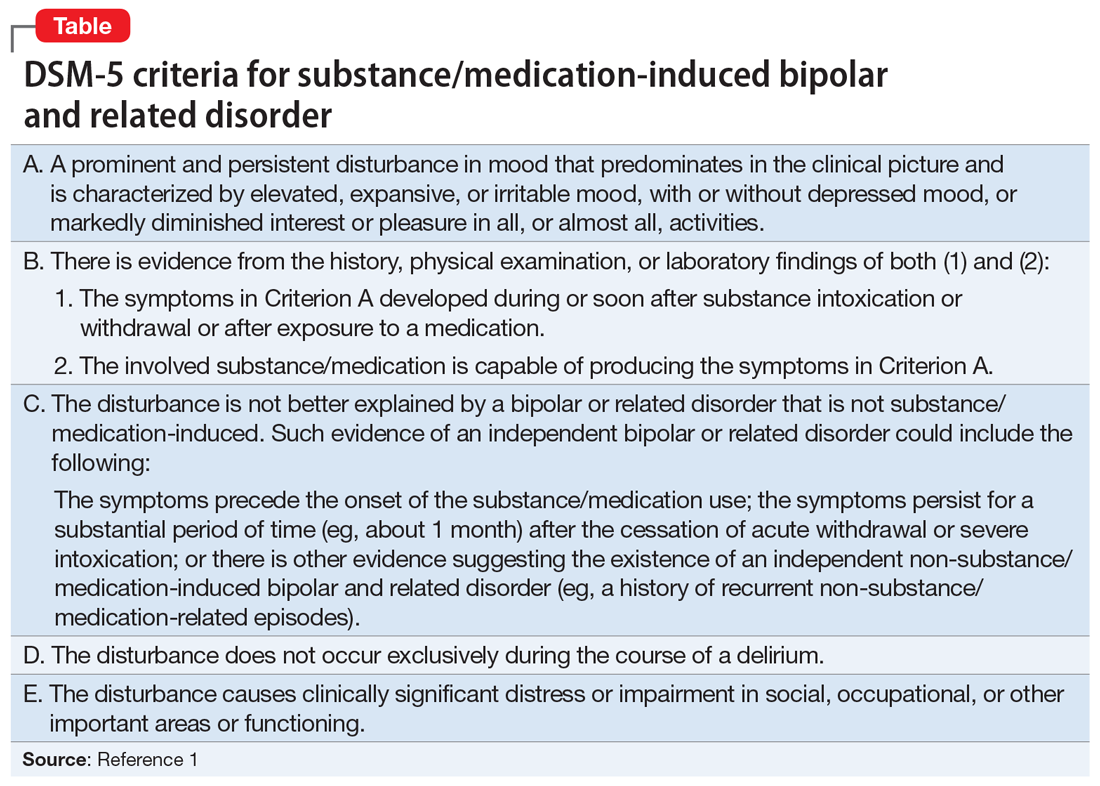
[polldaddy:10417494]
TREATMENT Medication adjustments and improvement
The admitting clinician discontinues ropinirole and initiates divalproex sodium, 500 mg twice a day. By Day 4, Mr. X shows significant improvement, including no irritable mood and regression of delusions of grandeur, and his sleep cycle returns to normal. At this time, the divalproex sodium is also discontinued.
Continue to: The authors' observations
The authors’ observations
Dopamine agonist agents are a standard treatment in the management of Parkinson’s disease and RLS.2-5 Ropinirole, a dopamine receptor agonist, has a high affinity for dopamine D2 and D3 receptor subtypes.4 Published reports have linked dopamine agonists to mania with psychotic features.6,7 In a study by Stoner et al,8 of 95 patients treated with ropinirole, 13 patients developed psychotic features that necessitated the use of antipsychotic medications or a lower dose of ropinirole.
The recommended starting dose for ropinirole is 0.25 mg/d. The dose can be increased to 0.5 mg in the next 2 days, and to 1 mg/d at the end of the first week.9 The mean effective daily dose is 2 mg/d, and maximum recommended dose is 4 mg/d.9 For Mr. X, ropinirole was quickly titrated to 3 mg/d over 1 week, which resulted in mania and psychosis. We suggest that when treating geriatric patients, clinicians should consider prescribing the lowest effective dose of psychotropic medications, such as ropinirole, to prevent adverse effects. Higher doses of dopamine agonists, especially in geriatric patients, increase the risk of common adverse effects, such as nausea (25% to 50%), headache (7% to 22%), fatigue (1% to 19%), dizziness (6% to 18%), and vomiting (5% to 11%).10 When prescribing dopamine agonists, clinicians should educate patients and their caregivers about the rare but potential risk of medication-induced mania and psychosis.
Mr. X’s case emphasizes the importance of a comprehensive psychiatric evaluation and medical workup to rule out a wide differential diagnosis when approaching new-onset mania and psychosis in geriatric patients.11 Our case contributes to the evidence that dopamine agonist medications are associated with mania and psychotic symptoms.
OUTCOME A return to baseline
On Day 12, Mr. X is discharged home in a stable condition. Two weeks later, at an outpatient follow-up visit, Mr. X is asymptomatic and has returned to his baseline functioning.
Bottom Line
When approaching new-onset mania and psychosis in geriatric patients, a comprehensive psychiatric evaluation and medical workup are necessary to rule out a wide differential diagnosis. Ropinirole use can lead to mania and psychotic symptoms, especially in geriatric patients. As should be done with all other dopaminergic agents, increase the dose of ropinirole with caution, and be vigilant for the emergence of signs of mania and/or psychosis.
Continue to: Related Resources
Related Resources
- Adabie A, Jackson JC, Torrence CL. Older-age bipolar disorder: A case series. Current Psychiatry. 2019;18(2):24-29.
- Chen P, Dols A, Rej S, et al. Update on the epidemiology, diagnosis, and treatment of mania in older-age bipolar disorder. Curr Psychiatry Rep. 2017;19(8):46.
Drug Brand Names
Divalproex sodium • Depakote
Gabapentin • Neurontin
Ropinirole • Requip
1. Diagnostic and statistical manual of mental disorders, 5th ed. Washington, DC: American Psychiatric Association; 2013.
2. Singh A, Althoff R, Martineau RJ, et al. Pramipexole, ropinirole, and mania in Parkinson’s disease. Am J Psychiatry. 2005;162(4):814-815.
3. Weiss HD, Pontone GM. Dopamine receptor agonist drugs and impulse control disorders. JAMA Intern Med. 2014;174(12):1935-1937.
4 Shill HA, Stacy M. Update on ropinirole in the treatment of Parkinson’s disease. Neuropsychiatr Dis Treat. 2009;5:33-36.
5. Borovac JA. Side effects of a dopamine agonist therapy for Parkinson’s disease: a mini-review of clinical pharmacology. Yale J Biol Med. 2016;89(1):37-47.
6. Yüksel RN, Elyas Kaya Z, Dilbaz N, et al. Cabergoline-induced manic episode: case report. Ther Adv Psychopharmacol. 2016;6(3):229-231.
7. Perea E, Robbins BV, Hutto B. Psychosis related to ropinirole. Am J Psychiatry. 2006;163(3):547-548.
8. Stoner SC, Dahmen MM, Makos M, et al. An exploratory retrospective evaluation of ropinirole-associated psychotic symptoms in an outpatient population treated for restless legs syndrome or Parkinson’s disease. Ann Pharmacother. 2009;43(9):1426-1432.
9. Trenkwalder C, Hening WA, Montagna P, et al. Treatment of restless legs syndrome: an evidence-based review and implications for clinical practice. Mov Disord. 2008;23(16):2267-2302.
10. Garcia-Borreguero D, Kohnen R, Silber MH, et al. The long-term treatment of restless legs syndrome/Willis-Ekbom disease: evidence-based guidelines and clinical consensus best practice guidance: a report from the International Restless Legs Syndrome Study Group. Sleep Med. 2013;14(7):675-684.
11. Dols A, Beekman A. Older age bipolar disorder. Psychiatr Clin North Am. 2018;41(1):95-110.
CASE Agitated, uncooperative, and irritable
Mr. X, age 84, presents to the emergency department with agitation, mania-like symptoms, and mood-congruent psychotic symptoms that started 2 weeks ago. Mr. X, who is accompanied by his wife, has no psychiatric history.
On examination, Mr. X is easily agitated and uncooperative. His speech is fast, but not pressured, with increased volume and tone. He states, “My mood is fantastic” with mood-congruent affect. His thought process reveals circumstantiality and loose association. Mr. X’s thought content includes flight of ideas and delusions of grandeur; he claims to be a state boxing champion and a psychologist. He also claims that he will run for Congress in the near future. He reports that he’s started knocking on his neighbors’ doors, pitched the idea to buy their house, and convinced them to vote for him as their congressman. He denies any suicidal or homicidal ideations. There is no evidence of perceptual disturbance. Mr. X undergoes a Mini-Mental State Examination (MMSE) and scores 26/30, which suggests no cognitive impairment. However, his insight and judgment are poor.
Mr. X’s physical examination is unremarkable. His laboratory workup includes a complete blood count, comprehensive metabolic panel, urinalysis, thyroid function test, vitamin B12 and folate levels, urine drug screen, and blood alcohol level. All results are within normal limits. He has no history of alcohol or recreational drug use as evident by the laboratory results and collateral information from his wife. Further, a non-contrast CT scan of his head shows no abnormality.
Approximately 1 month ago, Mr. X was diagnosed with restless leg syndrome (RLS). Mr. X’s medication regimen consists of gabapentin, 300 mg 3 times daily, prescribed years ago by his neurologist for neuropathic pain; and ropinirole, 3 mg/d, for RLS. His neurologist had prescribed him ropinirole, which was started at 1 mg/d and titrated to 3 mg/d within a 1-week span. Two weeks after Mr. X started this medication regimen, his wife reports that she noticed changes in his behavior, including severe agitation, irritability, delusions of grandeur, decreased need for sleep, and racing of thoughts.
[polldaddy:10417490]
The authors’ observations
Mr. X was diagnosed with medication (ropinirole)-induced bipolar and related disorder with mood-congruent psychotic features.
To determine this diagnosis, we initially considered Mr. X’s age and medical conditions, including stroke and space-occupying lesions of the brain. However, the laboratory and neuroimaging studies, which included a CT scan of the head and MRI of the brain, were negative. Next, because Mr. X had sudden onset manic symptoms after ropinirole was initiated, we considered the possibility of a substance/medication-induced bipolar and related disorder. Further, ropinirole is capable of producing the symptoms in criterion A of DSM-5 criteria for substance/medication-induced bipolar and related disorder. Mr. X met all DSM-5 criteria for substance/medication-induced bipolar and related disorder (Table1).
[polldaddy:10417494]
TREATMENT Medication adjustments and improvement
The admitting clinician discontinues ropinirole and initiates divalproex sodium, 500 mg twice a day. By Day 4, Mr. X shows significant improvement, including no irritable mood and regression of delusions of grandeur, and his sleep cycle returns to normal. At this time, the divalproex sodium is also discontinued.
Continue to: The authors' observations
The authors’ observations
Dopamine agonist agents are a standard treatment in the management of Parkinson’s disease and RLS.2-5 Ropinirole, a dopamine receptor agonist, has a high affinity for dopamine D2 and D3 receptor subtypes.4 Published reports have linked dopamine agonists to mania with psychotic features.6,7 In a study by Stoner et al,8 of 95 patients treated with ropinirole, 13 patients developed psychotic features that necessitated the use of antipsychotic medications or a lower dose of ropinirole.
The recommended starting dose for ropinirole is 0.25 mg/d. The dose can be increased to 0.5 mg in the next 2 days, and to 1 mg/d at the end of the first week.9 The mean effective daily dose is 2 mg/d, and maximum recommended dose is 4 mg/d.9 For Mr. X, ropinirole was quickly titrated to 3 mg/d over 1 week, which resulted in mania and psychosis. We suggest that when treating geriatric patients, clinicians should consider prescribing the lowest effective dose of psychotropic medications, such as ropinirole, to prevent adverse effects. Higher doses of dopamine agonists, especially in geriatric patients, increase the risk of common adverse effects, such as nausea (25% to 50%), headache (7% to 22%), fatigue (1% to 19%), dizziness (6% to 18%), and vomiting (5% to 11%).10 When prescribing dopamine agonists, clinicians should educate patients and their caregivers about the rare but potential risk of medication-induced mania and psychosis.
Mr. X’s case emphasizes the importance of a comprehensive psychiatric evaluation and medical workup to rule out a wide differential diagnosis when approaching new-onset mania and psychosis in geriatric patients.11 Our case contributes to the evidence that dopamine agonist medications are associated with mania and psychotic symptoms.
OUTCOME A return to baseline
On Day 12, Mr. X is discharged home in a stable condition. Two weeks later, at an outpatient follow-up visit, Mr. X is asymptomatic and has returned to his baseline functioning.
Bottom Line
When approaching new-onset mania and psychosis in geriatric patients, a comprehensive psychiatric evaluation and medical workup are necessary to rule out a wide differential diagnosis. Ropinirole use can lead to mania and psychotic symptoms, especially in geriatric patients. As should be done with all other dopaminergic agents, increase the dose of ropinirole with caution, and be vigilant for the emergence of signs of mania and/or psychosis.
Continue to: Related Resources
Related Resources
- Adabie A, Jackson JC, Torrence CL. Older-age bipolar disorder: A case series. Current Psychiatry. 2019;18(2):24-29.
- Chen P, Dols A, Rej S, et al. Update on the epidemiology, diagnosis, and treatment of mania in older-age bipolar disorder. Curr Psychiatry Rep. 2017;19(8):46.
Drug Brand Names
Divalproex sodium • Depakote
Gabapentin • Neurontin
Ropinirole • Requip
CASE Agitated, uncooperative, and irritable
Mr. X, age 84, presents to the emergency department with agitation, mania-like symptoms, and mood-congruent psychotic symptoms that started 2 weeks ago. Mr. X, who is accompanied by his wife, has no psychiatric history.
On examination, Mr. X is easily agitated and uncooperative. His speech is fast, but not pressured, with increased volume and tone. He states, “My mood is fantastic” with mood-congruent affect. His thought process reveals circumstantiality and loose association. Mr. X’s thought content includes flight of ideas and delusions of grandeur; he claims to be a state boxing champion and a psychologist. He also claims that he will run for Congress in the near future. He reports that he’s started knocking on his neighbors’ doors, pitched the idea to buy their house, and convinced them to vote for him as their congressman. He denies any suicidal or homicidal ideations. There is no evidence of perceptual disturbance. Mr. X undergoes a Mini-Mental State Examination (MMSE) and scores 26/30, which suggests no cognitive impairment. However, his insight and judgment are poor.
Mr. X’s physical examination is unremarkable. His laboratory workup includes a complete blood count, comprehensive metabolic panel, urinalysis, thyroid function test, vitamin B12 and folate levels, urine drug screen, and blood alcohol level. All results are within normal limits. He has no history of alcohol or recreational drug use as evident by the laboratory results and collateral information from his wife. Further, a non-contrast CT scan of his head shows no abnormality.
Approximately 1 month ago, Mr. X was diagnosed with restless leg syndrome (RLS). Mr. X’s medication regimen consists of gabapentin, 300 mg 3 times daily, prescribed years ago by his neurologist for neuropathic pain; and ropinirole, 3 mg/d, for RLS. His neurologist had prescribed him ropinirole, which was started at 1 mg/d and titrated to 3 mg/d within a 1-week span. Two weeks after Mr. X started this medication regimen, his wife reports that she noticed changes in his behavior, including severe agitation, irritability, delusions of grandeur, decreased need for sleep, and racing of thoughts.
[polldaddy:10417490]
The authors’ observations
Mr. X was diagnosed with medication (ropinirole)-induced bipolar and related disorder with mood-congruent psychotic features.
To determine this diagnosis, we initially considered Mr. X’s age and medical conditions, including stroke and space-occupying lesions of the brain. However, the laboratory and neuroimaging studies, which included a CT scan of the head and MRI of the brain, were negative. Next, because Mr. X had sudden onset manic symptoms after ropinirole was initiated, we considered the possibility of a substance/medication-induced bipolar and related disorder. Further, ropinirole is capable of producing the symptoms in criterion A of DSM-5 criteria for substance/medication-induced bipolar and related disorder. Mr. X met all DSM-5 criteria for substance/medication-induced bipolar and related disorder (Table1).
[polldaddy:10417494]
TREATMENT Medication adjustments and improvement
The admitting clinician discontinues ropinirole and initiates divalproex sodium, 500 mg twice a day. By Day 4, Mr. X shows significant improvement, including no irritable mood and regression of delusions of grandeur, and his sleep cycle returns to normal. At this time, the divalproex sodium is also discontinued.
Continue to: The authors' observations
The authors’ observations
Dopamine agonist agents are a standard treatment in the management of Parkinson’s disease and RLS.2-5 Ropinirole, a dopamine receptor agonist, has a high affinity for dopamine D2 and D3 receptor subtypes.4 Published reports have linked dopamine agonists to mania with psychotic features.6,7 In a study by Stoner et al,8 of 95 patients treated with ropinirole, 13 patients developed psychotic features that necessitated the use of antipsychotic medications or a lower dose of ropinirole.
The recommended starting dose for ropinirole is 0.25 mg/d. The dose can be increased to 0.5 mg in the next 2 days, and to 1 mg/d at the end of the first week.9 The mean effective daily dose is 2 mg/d, and maximum recommended dose is 4 mg/d.9 For Mr. X, ropinirole was quickly titrated to 3 mg/d over 1 week, which resulted in mania and psychosis. We suggest that when treating geriatric patients, clinicians should consider prescribing the lowest effective dose of psychotropic medications, such as ropinirole, to prevent adverse effects. Higher doses of dopamine agonists, especially in geriatric patients, increase the risk of common adverse effects, such as nausea (25% to 50%), headache (7% to 22%), fatigue (1% to 19%), dizziness (6% to 18%), and vomiting (5% to 11%).10 When prescribing dopamine agonists, clinicians should educate patients and their caregivers about the rare but potential risk of medication-induced mania and psychosis.
Mr. X’s case emphasizes the importance of a comprehensive psychiatric evaluation and medical workup to rule out a wide differential diagnosis when approaching new-onset mania and psychosis in geriatric patients.11 Our case contributes to the evidence that dopamine agonist medications are associated with mania and psychotic symptoms.
OUTCOME A return to baseline
On Day 12, Mr. X is discharged home in a stable condition. Two weeks later, at an outpatient follow-up visit, Mr. X is asymptomatic and has returned to his baseline functioning.
Bottom Line
When approaching new-onset mania and psychosis in geriatric patients, a comprehensive psychiatric evaluation and medical workup are necessary to rule out a wide differential diagnosis. Ropinirole use can lead to mania and psychotic symptoms, especially in geriatric patients. As should be done with all other dopaminergic agents, increase the dose of ropinirole with caution, and be vigilant for the emergence of signs of mania and/or psychosis.
Continue to: Related Resources
Related Resources
- Adabie A, Jackson JC, Torrence CL. Older-age bipolar disorder: A case series. Current Psychiatry. 2019;18(2):24-29.
- Chen P, Dols A, Rej S, et al. Update on the epidemiology, diagnosis, and treatment of mania in older-age bipolar disorder. Curr Psychiatry Rep. 2017;19(8):46.
Drug Brand Names
Divalproex sodium • Depakote
Gabapentin • Neurontin
Ropinirole • Requip
1. Diagnostic and statistical manual of mental disorders, 5th ed. Washington, DC: American Psychiatric Association; 2013.
2. Singh A, Althoff R, Martineau RJ, et al. Pramipexole, ropinirole, and mania in Parkinson’s disease. Am J Psychiatry. 2005;162(4):814-815.
3. Weiss HD, Pontone GM. Dopamine receptor agonist drugs and impulse control disorders. JAMA Intern Med. 2014;174(12):1935-1937.
4 Shill HA, Stacy M. Update on ropinirole in the treatment of Parkinson’s disease. Neuropsychiatr Dis Treat. 2009;5:33-36.
5. Borovac JA. Side effects of a dopamine agonist therapy for Parkinson’s disease: a mini-review of clinical pharmacology. Yale J Biol Med. 2016;89(1):37-47.
6. Yüksel RN, Elyas Kaya Z, Dilbaz N, et al. Cabergoline-induced manic episode: case report. Ther Adv Psychopharmacol. 2016;6(3):229-231.
7. Perea E, Robbins BV, Hutto B. Psychosis related to ropinirole. Am J Psychiatry. 2006;163(3):547-548.
8. Stoner SC, Dahmen MM, Makos M, et al. An exploratory retrospective evaluation of ropinirole-associated psychotic symptoms in an outpatient population treated for restless legs syndrome or Parkinson’s disease. Ann Pharmacother. 2009;43(9):1426-1432.
9. Trenkwalder C, Hening WA, Montagna P, et al. Treatment of restless legs syndrome: an evidence-based review and implications for clinical practice. Mov Disord. 2008;23(16):2267-2302.
10. Garcia-Borreguero D, Kohnen R, Silber MH, et al. The long-term treatment of restless legs syndrome/Willis-Ekbom disease: evidence-based guidelines and clinical consensus best practice guidance: a report from the International Restless Legs Syndrome Study Group. Sleep Med. 2013;14(7):675-684.
11. Dols A, Beekman A. Older age bipolar disorder. Psychiatr Clin North Am. 2018;41(1):95-110.
1. Diagnostic and statistical manual of mental disorders, 5th ed. Washington, DC: American Psychiatric Association; 2013.
2. Singh A, Althoff R, Martineau RJ, et al. Pramipexole, ropinirole, and mania in Parkinson’s disease. Am J Psychiatry. 2005;162(4):814-815.
3. Weiss HD, Pontone GM. Dopamine receptor agonist drugs and impulse control disorders. JAMA Intern Med. 2014;174(12):1935-1937.
4 Shill HA, Stacy M. Update on ropinirole in the treatment of Parkinson’s disease. Neuropsychiatr Dis Treat. 2009;5:33-36.
5. Borovac JA. Side effects of a dopamine agonist therapy for Parkinson’s disease: a mini-review of clinical pharmacology. Yale J Biol Med. 2016;89(1):37-47.
6. Yüksel RN, Elyas Kaya Z, Dilbaz N, et al. Cabergoline-induced manic episode: case report. Ther Adv Psychopharmacol. 2016;6(3):229-231.
7. Perea E, Robbins BV, Hutto B. Psychosis related to ropinirole. Am J Psychiatry. 2006;163(3):547-548.
8. Stoner SC, Dahmen MM, Makos M, et al. An exploratory retrospective evaluation of ropinirole-associated psychotic symptoms in an outpatient population treated for restless legs syndrome or Parkinson’s disease. Ann Pharmacother. 2009;43(9):1426-1432.
9. Trenkwalder C, Hening WA, Montagna P, et al. Treatment of restless legs syndrome: an evidence-based review and implications for clinical practice. Mov Disord. 2008;23(16):2267-2302.
10. Garcia-Borreguero D, Kohnen R, Silber MH, et al. The long-term treatment of restless legs syndrome/Willis-Ekbom disease: evidence-based guidelines and clinical consensus best practice guidance: a report from the International Restless Legs Syndrome Study Group. Sleep Med. 2013;14(7):675-684.
11. Dols A, Beekman A. Older age bipolar disorder. Psychiatr Clin North Am. 2018;41(1):95-110.

Four genetic variants link psychotic experiences to multiple mental disorders
Four genetic variations appear to link psychotic experiences with other psychiatric disorders, including schizophrenia, major depressive disorder, bipolar disorder, and neurodevelopmental disorders, a large genetic study has concluded.
, reported Sophie E. Legge, PhD, and colleagues. Their study was published in JAMA Psychiatry.
Although it is informative, the study is unlikely to expand the knowledge of schizophrenia-specific genetics.
“Consistent with other studies, the heritability estimate (1.71%) was low, and given that the variance explained in our polygenic risk analysis was also low, the finding suggests that understanding the genetics of psychotic experiences is unlikely to have an important effect on understanding the genetics of schizophrenia specifically,” wrote Dr. Legge, of the MRC Center for Neuropsychiatric Genetics and Genomics in the division of psychological medicine and clinical neurosciences at Cardiff (Wales) University, and colleagues.
The team conducted a genomewide association study (GWAS) using data from 127,966 individuals in the U.K. Biobank. Of these, 6,123 reported any psychotic experience, 2,143 reported distressing psychotic experiences, and 3,337 reported multiple experiences. The remainder served as controls. At the time of the biobank data collection, the subjects were a mean of 64 years of age; 56% were women.
First psychotic experience occurred at a mean of almost 32 years of age, but about a third reported that the first episode occurred before age 20, or that psychotic experiences had been happening ever since they could remember. Another third reported their first experience between ages 40 and 76 years.
The investigators conducted three GWAS studies: one for any psychotic experience, one for distressing experiences, and one for multiple experiences.
No significant genetic associations were found among those with multiple psychotic experiences, the authors said.
But they did find four variants significantly associated with the other experience categories.
Two variants were associated with any psychotic experience. Those with rs10994278, an intronic variant within Ankyrin-3 (ANK3), were 16% more likely to have a psychotic experience (odds ratio, 1.16). Those with intergenic variant rs549656827 were 39% less likely (OR, 0.61). “The ANK3 gene encodes ankyrin-G, a protein that has been shown to regulate the assembly of voltage-gated sodium channels and is essential for normal synaptic function,” the authors said. “ANK3 is one of strongest and most replicated genes for bipolar disorder, and variants within ANK3 have also been associated in the Psychiatric Genomics Consortium cross-disorder GWAS, and in a rare variant analysis of autism spectrum disorder.”
Two variants were linked to distressing psychotic experiences: rs75459873, intronic to cannabinoid receptor 2 (CNR2), decreased the risk by 34% (OR, 0.66). Intergenic variant rs3849810 increased the risk by 12% (OR, 1.12).
“CNR2 encodes for CB2, one of two well-characterized cannabinoid receptors. Several lines of evidence have implicated the endocannabinoid system in psychiatric disorders, including schizophrenia and depression. The main psychoactive agent of cannabis, tetrahydrocannabinol, can cause acute psychotic symptoms and cognitive impairment. Given that cannabis use is strongly associated with psychotic experiences, we tested, but found no evidence for, a mediating or moderating effect of cannabis use on the association of rs75459873 and distressing psychotic experiences. However, while no evidence was found in this study, a mediating effect of cannabis use cannot be ruled out given the relatively low power of such analyses and the potential measurement error.”
Also, significant genetic correlations were found between any psychotic experiences and major depressive disorder, autism spectrum disorder, ADHD, and schizophrenia. However, the polygenic risk scores for schizophrenia, major depressive disorder, bipolar disorder, ADHD, and autism spectrum disorder, were low.
“We also considered individual psychotic symptoms and found that polygenic risk scores for schizophrenia, bipolar disorder, depression, and ADHD were more strongly associated with delusions of persecution than with the other psychotic symptoms.”
Those with distressing psychotic experiences tended to have more copy number variations (CNVs) associated with schizophrenia (OR, 2.04) and neurodevelopmental disorders (OR, 1.75). The team also found significant associations between distressing experiences and major depressive disorder, ADHD, autism spectrum disorder, and schizophrenia.
“We found particular enrichment of these [polygenic risk scores] in distressing psychotic experiences and for delusions of persecution,” they noted. “ ... All schizophrenia-associated [copy number variations] are also associated with neurodevelopmental disorders such as intellectual disability and autism.”
The study’s strengths include its large sample size. Among its limitations, the researchers said, are the study’s retrospective measurement of psychotic experiences based on self-report from a questionnaire that was online. Gathering the data in that way raised the likelihood of possible error, they said.
Dr. Legge reported having no disclosures.
SOURCE: Legge SE et al. JAMA Psychiatry. 2019 Sep 25. doi: 10.1001/jamapsychiatry.2019.2508.
The genetic links uncovered in this study offer an intriguing, but incomplete look at the risks of psychotic experiences and their complicated intertwinings with other mental disorders, wrote Albert R. Powers III, MD, PhD.
“Penetrance of the genes in question likely depends at least in part on environmental influences, some of which have been studied extensively,” he wrote. “Recently, some have proposed risk stratification by exposome – a composite score of relevant exposures that may increase risk for psychosis and is analogous to the polygenic risk score used [here].
“The combination of environmental and genetic composite scores may lead to improved insight into individualized pathways toward psychotic experiences, highlighting genetic vulnerabilities to specific stressors likely to lead to phenotypic expression. Ultimately, this will require a more sophisticated mapping between phenomenology and biology than currently exists.”
One approach would be to combine deep phenotyping and behavioral analyses in a framework that could link all relevant levels from symptoms to neurophysiology.
“One such framework is predictive processing theory, which is linked closely with the free energy principle and the Bayesian brain hypothesis and attempts to explain perceptual and cognitive phenomena as manifestations of a drive to maintain as accurate an internal model of one’s surroundings as possible by minimizing prediction errors. This relatively simple scheme makes specific – and, importantly, falsifiable – assessments of the mathematical signatures of neurotypical processes and the ways they might break down to produce specific psychiatric symptoms.”
Dr. Powers is an assistant professor at the department of psychiatry at Yale University, New Haven, Conn., and serves as medical director of the PRIME Psychosis Research Clinic at Yale. His comments came in an accompanying editorial (JAMA Psychiatry. 2019 Sep 25. doi: 10.1001/jamapsychiatry.2019.2391 ).
The genetic links uncovered in this study offer an intriguing, but incomplete look at the risks of psychotic experiences and their complicated intertwinings with other mental disorders, wrote Albert R. Powers III, MD, PhD.
“Penetrance of the genes in question likely depends at least in part on environmental influences, some of which have been studied extensively,” he wrote. “Recently, some have proposed risk stratification by exposome – a composite score of relevant exposures that may increase risk for psychosis and is analogous to the polygenic risk score used [here].
“The combination of environmental and genetic composite scores may lead to improved insight into individualized pathways toward psychotic experiences, highlighting genetic vulnerabilities to specific stressors likely to lead to phenotypic expression. Ultimately, this will require a more sophisticated mapping between phenomenology and biology than currently exists.”
One approach would be to combine deep phenotyping and behavioral analyses in a framework that could link all relevant levels from symptoms to neurophysiology.
“One such framework is predictive processing theory, which is linked closely with the free energy principle and the Bayesian brain hypothesis and attempts to explain perceptual and cognitive phenomena as manifestations of a drive to maintain as accurate an internal model of one’s surroundings as possible by minimizing prediction errors. This relatively simple scheme makes specific – and, importantly, falsifiable – assessments of the mathematical signatures of neurotypical processes and the ways they might break down to produce specific psychiatric symptoms.”
Dr. Powers is an assistant professor at the department of psychiatry at Yale University, New Haven, Conn., and serves as medical director of the PRIME Psychosis Research Clinic at Yale. His comments came in an accompanying editorial (JAMA Psychiatry. 2019 Sep 25. doi: 10.1001/jamapsychiatry.2019.2391 ).
The genetic links uncovered in this study offer an intriguing, but incomplete look at the risks of psychotic experiences and their complicated intertwinings with other mental disorders, wrote Albert R. Powers III, MD, PhD.
“Penetrance of the genes in question likely depends at least in part on environmental influences, some of which have been studied extensively,” he wrote. “Recently, some have proposed risk stratification by exposome – a composite score of relevant exposures that may increase risk for psychosis and is analogous to the polygenic risk score used [here].
“The combination of environmental and genetic composite scores may lead to improved insight into individualized pathways toward psychotic experiences, highlighting genetic vulnerabilities to specific stressors likely to lead to phenotypic expression. Ultimately, this will require a more sophisticated mapping between phenomenology and biology than currently exists.”
One approach would be to combine deep phenotyping and behavioral analyses in a framework that could link all relevant levels from symptoms to neurophysiology.
“One such framework is predictive processing theory, which is linked closely with the free energy principle and the Bayesian brain hypothesis and attempts to explain perceptual and cognitive phenomena as manifestations of a drive to maintain as accurate an internal model of one’s surroundings as possible by minimizing prediction errors. This relatively simple scheme makes specific – and, importantly, falsifiable – assessments of the mathematical signatures of neurotypical processes and the ways they might break down to produce specific psychiatric symptoms.”
Dr. Powers is an assistant professor at the department of psychiatry at Yale University, New Haven, Conn., and serves as medical director of the PRIME Psychosis Research Clinic at Yale. His comments came in an accompanying editorial (JAMA Psychiatry. 2019 Sep 25. doi: 10.1001/jamapsychiatry.2019.2391 ).
Four genetic variations appear to link psychotic experiences with other psychiatric disorders, including schizophrenia, major depressive disorder, bipolar disorder, and neurodevelopmental disorders, a large genetic study has concluded.
, reported Sophie E. Legge, PhD, and colleagues. Their study was published in JAMA Psychiatry.
Although it is informative, the study is unlikely to expand the knowledge of schizophrenia-specific genetics.
“Consistent with other studies, the heritability estimate (1.71%) was low, and given that the variance explained in our polygenic risk analysis was also low, the finding suggests that understanding the genetics of psychotic experiences is unlikely to have an important effect on understanding the genetics of schizophrenia specifically,” wrote Dr. Legge, of the MRC Center for Neuropsychiatric Genetics and Genomics in the division of psychological medicine and clinical neurosciences at Cardiff (Wales) University, and colleagues.
The team conducted a genomewide association study (GWAS) using data from 127,966 individuals in the U.K. Biobank. Of these, 6,123 reported any psychotic experience, 2,143 reported distressing psychotic experiences, and 3,337 reported multiple experiences. The remainder served as controls. At the time of the biobank data collection, the subjects were a mean of 64 years of age; 56% were women.
First psychotic experience occurred at a mean of almost 32 years of age, but about a third reported that the first episode occurred before age 20, or that psychotic experiences had been happening ever since they could remember. Another third reported their first experience between ages 40 and 76 years.
The investigators conducted three GWAS studies: one for any psychotic experience, one for distressing experiences, and one for multiple experiences.
No significant genetic associations were found among those with multiple psychotic experiences, the authors said.
But they did find four variants significantly associated with the other experience categories.
Two variants were associated with any psychotic experience. Those with rs10994278, an intronic variant within Ankyrin-3 (ANK3), were 16% more likely to have a psychotic experience (odds ratio, 1.16). Those with intergenic variant rs549656827 were 39% less likely (OR, 0.61). “The ANK3 gene encodes ankyrin-G, a protein that has been shown to regulate the assembly of voltage-gated sodium channels and is essential for normal synaptic function,” the authors said. “ANK3 is one of strongest and most replicated genes for bipolar disorder, and variants within ANK3 have also been associated in the Psychiatric Genomics Consortium cross-disorder GWAS, and in a rare variant analysis of autism spectrum disorder.”
Two variants were linked to distressing psychotic experiences: rs75459873, intronic to cannabinoid receptor 2 (CNR2), decreased the risk by 34% (OR, 0.66). Intergenic variant rs3849810 increased the risk by 12% (OR, 1.12).
“CNR2 encodes for CB2, one of two well-characterized cannabinoid receptors. Several lines of evidence have implicated the endocannabinoid system in psychiatric disorders, including schizophrenia and depression. The main psychoactive agent of cannabis, tetrahydrocannabinol, can cause acute psychotic symptoms and cognitive impairment. Given that cannabis use is strongly associated with psychotic experiences, we tested, but found no evidence for, a mediating or moderating effect of cannabis use on the association of rs75459873 and distressing psychotic experiences. However, while no evidence was found in this study, a mediating effect of cannabis use cannot be ruled out given the relatively low power of such analyses and the potential measurement error.”
Also, significant genetic correlations were found between any psychotic experiences and major depressive disorder, autism spectrum disorder, ADHD, and schizophrenia. However, the polygenic risk scores for schizophrenia, major depressive disorder, bipolar disorder, ADHD, and autism spectrum disorder, were low.
“We also considered individual psychotic symptoms and found that polygenic risk scores for schizophrenia, bipolar disorder, depression, and ADHD were more strongly associated with delusions of persecution than with the other psychotic symptoms.”
Those with distressing psychotic experiences tended to have more copy number variations (CNVs) associated with schizophrenia (OR, 2.04) and neurodevelopmental disorders (OR, 1.75). The team also found significant associations between distressing experiences and major depressive disorder, ADHD, autism spectrum disorder, and schizophrenia.
“We found particular enrichment of these [polygenic risk scores] in distressing psychotic experiences and for delusions of persecution,” they noted. “ ... All schizophrenia-associated [copy number variations] are also associated with neurodevelopmental disorders such as intellectual disability and autism.”
The study’s strengths include its large sample size. Among its limitations, the researchers said, are the study’s retrospective measurement of psychotic experiences based on self-report from a questionnaire that was online. Gathering the data in that way raised the likelihood of possible error, they said.
Dr. Legge reported having no disclosures.
SOURCE: Legge SE et al. JAMA Psychiatry. 2019 Sep 25. doi: 10.1001/jamapsychiatry.2019.2508.
Four genetic variations appear to link psychotic experiences with other psychiatric disorders, including schizophrenia, major depressive disorder, bipolar disorder, and neurodevelopmental disorders, a large genetic study has concluded.
, reported Sophie E. Legge, PhD, and colleagues. Their study was published in JAMA Psychiatry.
Although it is informative, the study is unlikely to expand the knowledge of schizophrenia-specific genetics.
“Consistent with other studies, the heritability estimate (1.71%) was low, and given that the variance explained in our polygenic risk analysis was also low, the finding suggests that understanding the genetics of psychotic experiences is unlikely to have an important effect on understanding the genetics of schizophrenia specifically,” wrote Dr. Legge, of the MRC Center for Neuropsychiatric Genetics and Genomics in the division of psychological medicine and clinical neurosciences at Cardiff (Wales) University, and colleagues.
The team conducted a genomewide association study (GWAS) using data from 127,966 individuals in the U.K. Biobank. Of these, 6,123 reported any psychotic experience, 2,143 reported distressing psychotic experiences, and 3,337 reported multiple experiences. The remainder served as controls. At the time of the biobank data collection, the subjects were a mean of 64 years of age; 56% were women.
First psychotic experience occurred at a mean of almost 32 years of age, but about a third reported that the first episode occurred before age 20, or that psychotic experiences had been happening ever since they could remember. Another third reported their first experience between ages 40 and 76 years.
The investigators conducted three GWAS studies: one for any psychotic experience, one for distressing experiences, and one for multiple experiences.
No significant genetic associations were found among those with multiple psychotic experiences, the authors said.
But they did find four variants significantly associated with the other experience categories.
Two variants were associated with any psychotic experience. Those with rs10994278, an intronic variant within Ankyrin-3 (ANK3), were 16% more likely to have a psychotic experience (odds ratio, 1.16). Those with intergenic variant rs549656827 were 39% less likely (OR, 0.61). “The ANK3 gene encodes ankyrin-G, a protein that has been shown to regulate the assembly of voltage-gated sodium channels and is essential for normal synaptic function,” the authors said. “ANK3 is one of strongest and most replicated genes for bipolar disorder, and variants within ANK3 have also been associated in the Psychiatric Genomics Consortium cross-disorder GWAS, and in a rare variant analysis of autism spectrum disorder.”
Two variants were linked to distressing psychotic experiences: rs75459873, intronic to cannabinoid receptor 2 (CNR2), decreased the risk by 34% (OR, 0.66). Intergenic variant rs3849810 increased the risk by 12% (OR, 1.12).
“CNR2 encodes for CB2, one of two well-characterized cannabinoid receptors. Several lines of evidence have implicated the endocannabinoid system in psychiatric disorders, including schizophrenia and depression. The main psychoactive agent of cannabis, tetrahydrocannabinol, can cause acute psychotic symptoms and cognitive impairment. Given that cannabis use is strongly associated with psychotic experiences, we tested, but found no evidence for, a mediating or moderating effect of cannabis use on the association of rs75459873 and distressing psychotic experiences. However, while no evidence was found in this study, a mediating effect of cannabis use cannot be ruled out given the relatively low power of such analyses and the potential measurement error.”
Also, significant genetic correlations were found between any psychotic experiences and major depressive disorder, autism spectrum disorder, ADHD, and schizophrenia. However, the polygenic risk scores for schizophrenia, major depressive disorder, bipolar disorder, ADHD, and autism spectrum disorder, were low.
“We also considered individual psychotic symptoms and found that polygenic risk scores for schizophrenia, bipolar disorder, depression, and ADHD were more strongly associated with delusions of persecution than with the other psychotic symptoms.”
Those with distressing psychotic experiences tended to have more copy number variations (CNVs) associated with schizophrenia (OR, 2.04) and neurodevelopmental disorders (OR, 1.75). The team also found significant associations between distressing experiences and major depressive disorder, ADHD, autism spectrum disorder, and schizophrenia.
“We found particular enrichment of these [polygenic risk scores] in distressing psychotic experiences and for delusions of persecution,” they noted. “ ... All schizophrenia-associated [copy number variations] are also associated with neurodevelopmental disorders such as intellectual disability and autism.”
The study’s strengths include its large sample size. Among its limitations, the researchers said, are the study’s retrospective measurement of psychotic experiences based on self-report from a questionnaire that was online. Gathering the data in that way raised the likelihood of possible error, they said.
Dr. Legge reported having no disclosures.
SOURCE: Legge SE et al. JAMA Psychiatry. 2019 Sep 25. doi: 10.1001/jamapsychiatry.2019.2508.
FROM JAMA PSYCHIATRY
Lumateperone for schizophrenia shows safety, tolerability in long-term study
COPENHAGEN – Lumateperone, a novel investigational drug for schizophrenia with a unique triple mechanism of action, showed impressive safety and tolerability while achieving a continuous decline in schizophrenia symptoms over the course of a year in a long-term, open-label study, Suresh Durgam, MD, said at the annual congress of the European College of Neuropsychopharmacology.

Indeed, patients on lumateperone at the 1-year mark showed significant reductions in LDL cholesterol, total cholesterol, serum prolactin, and body weight, compared with baseline values recorded when participants were on various standard-of-care antipsychotics prior to switching. Other cardiometabolic parameters, including fasting blood glucose, insulin, triglycerides, and HDL cholesterol, showed only negligible change over the course of study, according to Dr. Durgam, a psychiatrist and senior vice president for late-stage clinical development and medical affairs at Intra-Cellular Therapies, the New York–based company developing lumateperone as its lead product.
This favorable cardiometabolic profile contrasts sharply with those of currently available antipsychotic agents, many of which worsen cardiometabolic risk factors. That would seem to be a major advantage for lumateperone and is likely to be a factor in the Food and Drug Administration’s ongoing deliberation over the company’s new drug application. Dr. Durgam said.
Intra-Cellular Therapies’ stock price took a hit in July 2019, when the FDA abruptly canceled an advisory committee meeting scheduled to consider lumateperone. The agency sought additional information on animal toxicology studies. Having received it from the company, the FDA now no longer plans to schedule an advisory committee meeting before issuing its marketing approval decision.
Lumateperone is an oral once-daily drug that doesn’t require titration. Its high degree of tolerability is thought to be attributable to the drug’s mechanism of action, which involves simultaneous modulation of three different neurotransmitter pathways: serotonin, dopamine, and glutamate. The drug is a potent serotonin 5-HT2a antagonist and serotonin reuptake inhibitor, a dopamine D2 presynaptic partial agonist and postsynaptic antagonist, and it also modulates glutamate via activation of the D1 receptor.
Three phase 3, double-blind, placebo-controlled randomized clinical trials of 4-6 weeks duration have been completed in a total of 1,481 patients with acute exacerbation of schizophrenia. Two trials were positive, with lumateperone achieving significantly greater mean reductions in the Positive and Negative Syndrome Scale (PANSS) total score than placebo, while the third was negative, with no significant between-group difference. Of note, the safety profile of lumateperone was indistinguishable from placebo with the sole exception of somnolence, where the 20% incidence was twice that of placebo-treated controls. However, in the open-label program, dosing was switched from morning to evening, with a resultant drop in somnolence to the placebo level, Dr. Durgam said.
The open-label program has two parts. Part 1 was conducted in 302 patients with stable, generally mild schizophrenia symptoms while on risperidone, olanzapine, or various other antipsychotics commonly prescribed in the United States. They were switched to lumateperone at 42 mg once daily for 6 weeks, at which point they demonstrated significant reductions in body weight, serum prolactin, insulin, total cholesterol, and LDL cholesterol. They then were switched back to their former medications, with a resultant worsening of those parameters to prelumateperone levels, providing evidence of a cause-and-effect relationship with cardiometabolic risk factors.
Part 2 of the open-label program is the long-term study, in which 603 patients with stable symptoms on standard-of-care antipsychotics were switched to lumateperone at 42 mg/day, to be followed for 1 year or more. Dr. Durgam presented an interim analysis focused on the first 107 patients to achieve the 1-year treatment milestone. Most were obese at baseline: the group’s mean body mass index was 31.3 kg/m2. They experienced progressive weight loss, with a mean reduction of 1.82 kg on day 175 and 3.16 kg on day 350. About 24% of subjects had a 7% or greater reduction in body weight, while 8% had at least a 7% weight gain. Waist circumference decreased by an average of 5.2 cm from a baseline of 103.2 cm in men and by 1.9 cm in women.
The primary focus of the ongoing long-term study is safety. The most common treatment-emergent adverse events during a full year of therapy were dry mouth, headache, and diarrhea, each occurring in about 7% of patients. Only 0.8% of patients developed extrapyramidal symptoms.
At 150 days of treatment in 340 patients, 30% had achieved a PANSS response, defined as at least a 20% improvement in PANSS total score, compared with baseline. At 300 days in the smaller group who had reached that milestone at the time of the interim analysis, the PANSS response rate had grown to 41%.
Among patients with schizophrenia and comorbid depression as defined by a Calgary Depression Scale for Schizophrenia (CDSS) score of 6 or more at baseline, lumateperone at 42 mg/day improved depressive symptoms, such that 60% of those patients achieved a CDSS response – that is, at least a 50% reduction in the score – by day 75. This finding supports data from earlier short-term studies, and suggests that lumateperone’s multiple mechanisms of action and high tolerability make it a promising candidate for treatment of depression and other symptom domains of schizophrenia that are currently inadequately treated, according to Dr. Durgam.
Dr. Durgam also presented an update on the lumateperone program for bipolar depression, which consists of three phase 3, double-blind, placebo-controlled, 6-week-long clinical trials totaling 1,455 patients. Two have been completed: one positive and the other negative with an unusually high placebo response rate. The ongoing third trial will be the tiebreaker. Safety and tolerability have been as noted in other lumateperone studies.
In the positive trial, the primary efficacy endpoint was change in Montgomery-Åsberg Depression Rating Scale, which improved in lumateperone-treated patients by an average of 16.7 points from a baseline score of just over 30, a significantly better result than the 12.1-point reduction in placebo-treated controls. The treatment benefit was similar in bipolar I and bipolar II patients.
The phase 3 trial* for treatment of agitation in patients with Alzheimer’s disease and other dementias was stopped early for lack of efficacy in an interim analysis. And lumateperone is in ongoing phase 2 trials for sleep disturbances associated with neuropsychiatric disorders. The phase 2 study* in major depressive disorder has been completed.
*This article was updated 9/28/2019.
COPENHAGEN – Lumateperone, a novel investigational drug for schizophrenia with a unique triple mechanism of action, showed impressive safety and tolerability while achieving a continuous decline in schizophrenia symptoms over the course of a year in a long-term, open-label study, Suresh Durgam, MD, said at the annual congress of the European College of Neuropsychopharmacology.
Indeed, patients on lumateperone at the 1-year mark showed significant reductions in LDL cholesterol, total cholesterol, serum prolactin, and body weight, compared with baseline values recorded when participants were on various standard-of-care antipsychotics prior to switching. Other cardiometabolic parameters, including fasting blood glucose, insulin, triglycerides, and HDL cholesterol, showed only negligible change over the course of study, according to Dr. Durgam, a psychiatrist and senior vice president for late-stage clinical development and medical affairs at Intra-Cellular Therapies, the New York–based company developing lumateperone as its lead product.
This favorable cardiometabolic profile contrasts sharply with those of currently available antipsychotic agents, many of which worsen cardiometabolic risk factors. That would seem to be a major advantage for lumateperone and is likely to be a factor in the Food and Drug Administration’s ongoing deliberation over the company’s new drug application. Dr. Durgam said.
Intra-Cellular Therapies’ stock price took a hit in July 2019, when the FDA abruptly canceled an advisory committee meeting scheduled to consider lumateperone. The agency sought additional information on animal toxicology studies. Having received it from the company, the FDA now no longer plans to schedule an advisory committee meeting before issuing its marketing approval decision.
Lumateperone is an oral once-daily drug that doesn’t require titration. Its high degree of tolerability is thought to be attributable to the drug’s mechanism of action, which involves simultaneous modulation of three different neurotransmitter pathways: serotonin, dopamine, and glutamate. The drug is a potent serotonin 5-HT2a antagonist and serotonin reuptake inhibitor, a dopamine D2 presynaptic partial agonist and postsynaptic antagonist, and it also modulates glutamate via activation of the D1 receptor.
Three phase 3, double-blind, placebo-controlled randomized clinical trials of 4-6 weeks duration have been completed in a total of 1,481 patients with acute exacerbation of schizophrenia. Two trials were positive, with lumateperone achieving significantly greater mean reductions in the Positive and Negative Syndrome Scale (PANSS) total score than placebo, while the third was negative, with no significant between-group difference. Of note, the safety profile of lumateperone was indistinguishable from placebo with the sole exception of somnolence, where the 20% incidence was twice that of placebo-treated controls. However, in the open-label program, dosing was switched from morning to evening, with a resultant drop in somnolence to the placebo level, Dr. Durgam said.
The open-label program has two parts. Part 1 was conducted in 302 patients with stable, generally mild schizophrenia symptoms while on risperidone, olanzapine, or various other antipsychotics commonly prescribed in the United States. They were switched to lumateperone at 42 mg once daily for 6 weeks, at which point they demonstrated significant reductions in body weight, serum prolactin, insulin, total cholesterol, and LDL cholesterol. They then were switched back to their former medications, with a resultant worsening of those parameters to prelumateperone levels, providing evidence of a cause-and-effect relationship with cardiometabolic risk factors.
Part 2 of the open-label program is the long-term study, in which 603 patients with stable symptoms on standard-of-care antipsychotics were switched to lumateperone at 42 mg/day, to be followed for 1 year or more. Dr. Durgam presented an interim analysis focused on the first 107 patients to achieve the 1-year treatment milestone. Most were obese at baseline: the group’s mean body mass index was 31.3 kg/m2. They experienced progressive weight loss, with a mean reduction of 1.82 kg on day 175 and 3.16 kg on day 350. About 24% of subjects had a 7% or greater reduction in body weight, while 8% had at least a 7% weight gain. Waist circumference decreased by an average of 5.2 cm from a baseline of 103.2 cm in men and by 1.9 cm in women.
The primary focus of the ongoing long-term study is safety. The most common treatment-emergent adverse events during a full year of therapy were dry mouth, headache, and diarrhea, each occurring in about 7% of patients. Only 0.8% of patients developed extrapyramidal symptoms.
At 150 days of treatment in 340 patients, 30% had achieved a PANSS response, defined as at least a 20% improvement in PANSS total score, compared with baseline. At 300 days in the smaller group who had reached that milestone at the time of the interim analysis, the PANSS response rate had grown to 41%.
Among patients with schizophrenia and comorbid depression as defined by a Calgary Depression Scale for Schizophrenia (CDSS) score of 6 or more at baseline, lumateperone at 42 mg/day improved depressive symptoms, such that 60% of those patients achieved a CDSS response – that is, at least a 50% reduction in the score – by day 75. This finding supports data from earlier short-term studies, and suggests that lumateperone’s multiple mechanisms of action and high tolerability make it a promising candidate for treatment of depression and other symptom domains of schizophrenia that are currently inadequately treated, according to Dr. Durgam.
Dr. Durgam also presented an update on the lumateperone program for bipolar depression, which consists of three phase 3, double-blind, placebo-controlled, 6-week-long clinical trials totaling 1,455 patients. Two have been completed: one positive and the other negative with an unusually high placebo response rate. The ongoing third trial will be the tiebreaker. Safety and tolerability have been as noted in other lumateperone studies.
In the positive trial, the primary efficacy endpoint was change in Montgomery-Åsberg Depression Rating Scale, which improved in lumateperone-treated patients by an average of 16.7 points from a baseline score of just over 30, a significantly better result than the 12.1-point reduction in placebo-treated controls. The treatment benefit was similar in bipolar I and bipolar II patients.
The phase 3 trial* for treatment of agitation in patients with Alzheimer’s disease and other dementias was stopped early for lack of efficacy in an interim analysis. And lumateperone is in ongoing phase 2 trials for sleep disturbances associated with neuropsychiatric disorders. The phase 2 study* in major depressive disorder has been completed.
*This article was updated 9/28/2019.
COPENHAGEN – Lumateperone, a novel investigational drug for schizophrenia with a unique triple mechanism of action, showed impressive safety and tolerability while achieving a continuous decline in schizophrenia symptoms over the course of a year in a long-term, open-label study, Suresh Durgam, MD, said at the annual congress of the European College of Neuropsychopharmacology.
Indeed, patients on lumateperone at the 1-year mark showed significant reductions in LDL cholesterol, total cholesterol, serum prolactin, and body weight, compared with baseline values recorded when participants were on various standard-of-care antipsychotics prior to switching. Other cardiometabolic parameters, including fasting blood glucose, insulin, triglycerides, and HDL cholesterol, showed only negligible change over the course of study, according to Dr. Durgam, a psychiatrist and senior vice president for late-stage clinical development and medical affairs at Intra-Cellular Therapies, the New York–based company developing lumateperone as its lead product.
This favorable cardiometabolic profile contrasts sharply with those of currently available antipsychotic agents, many of which worsen cardiometabolic risk factors. That would seem to be a major advantage for lumateperone and is likely to be a factor in the Food and Drug Administration’s ongoing deliberation over the company’s new drug application. Dr. Durgam said.
Intra-Cellular Therapies’ stock price took a hit in July 2019, when the FDA abruptly canceled an advisory committee meeting scheduled to consider lumateperone. The agency sought additional information on animal toxicology studies. Having received it from the company, the FDA now no longer plans to schedule an advisory committee meeting before issuing its marketing approval decision.
Lumateperone is an oral once-daily drug that doesn’t require titration. Its high degree of tolerability is thought to be attributable to the drug’s mechanism of action, which involves simultaneous modulation of three different neurotransmitter pathways: serotonin, dopamine, and glutamate. The drug is a potent serotonin 5-HT2a antagonist and serotonin reuptake inhibitor, a dopamine D2 presynaptic partial agonist and postsynaptic antagonist, and it also modulates glutamate via activation of the D1 receptor.
Three phase 3, double-blind, placebo-controlled randomized clinical trials of 4-6 weeks duration have been completed in a total of 1,481 patients with acute exacerbation of schizophrenia. Two trials were positive, with lumateperone achieving significantly greater mean reductions in the Positive and Negative Syndrome Scale (PANSS) total score than placebo, while the third was negative, with no significant between-group difference. Of note, the safety profile of lumateperone was indistinguishable from placebo with the sole exception of somnolence, where the 20% incidence was twice that of placebo-treated controls. However, in the open-label program, dosing was switched from morning to evening, with a resultant drop in somnolence to the placebo level, Dr. Durgam said.
The open-label program has two parts. Part 1 was conducted in 302 patients with stable, generally mild schizophrenia symptoms while on risperidone, olanzapine, or various other antipsychotics commonly prescribed in the United States. They were switched to lumateperone at 42 mg once daily for 6 weeks, at which point they demonstrated significant reductions in body weight, serum prolactin, insulin, total cholesterol, and LDL cholesterol. They then were switched back to their former medications, with a resultant worsening of those parameters to prelumateperone levels, providing evidence of a cause-and-effect relationship with cardiometabolic risk factors.
Part 2 of the open-label program is the long-term study, in which 603 patients with stable symptoms on standard-of-care antipsychotics were switched to lumateperone at 42 mg/day, to be followed for 1 year or more. Dr. Durgam presented an interim analysis focused on the first 107 patients to achieve the 1-year treatment milestone. Most were obese at baseline: the group’s mean body mass index was 31.3 kg/m2. They experienced progressive weight loss, with a mean reduction of 1.82 kg on day 175 and 3.16 kg on day 350. About 24% of subjects had a 7% or greater reduction in body weight, while 8% had at least a 7% weight gain. Waist circumference decreased by an average of 5.2 cm from a baseline of 103.2 cm in men and by 1.9 cm in women.
The primary focus of the ongoing long-term study is safety. The most common treatment-emergent adverse events during a full year of therapy were dry mouth, headache, and diarrhea, each occurring in about 7% of patients. Only 0.8% of patients developed extrapyramidal symptoms.
At 150 days of treatment in 340 patients, 30% had achieved a PANSS response, defined as at least a 20% improvement in PANSS total score, compared with baseline. At 300 days in the smaller group who had reached that milestone at the time of the interim analysis, the PANSS response rate had grown to 41%.
Among patients with schizophrenia and comorbid depression as defined by a Calgary Depression Scale for Schizophrenia (CDSS) score of 6 or more at baseline, lumateperone at 42 mg/day improved depressive symptoms, such that 60% of those patients achieved a CDSS response – that is, at least a 50% reduction in the score – by day 75. This finding supports data from earlier short-term studies, and suggests that lumateperone’s multiple mechanisms of action and high tolerability make it a promising candidate for treatment of depression and other symptom domains of schizophrenia that are currently inadequately treated, according to Dr. Durgam.
Dr. Durgam also presented an update on the lumateperone program for bipolar depression, which consists of three phase 3, double-blind, placebo-controlled, 6-week-long clinical trials totaling 1,455 patients. Two have been completed: one positive and the other negative with an unusually high placebo response rate. The ongoing third trial will be the tiebreaker. Safety and tolerability have been as noted in other lumateperone studies.
In the positive trial, the primary efficacy endpoint was change in Montgomery-Åsberg Depression Rating Scale, which improved in lumateperone-treated patients by an average of 16.7 points from a baseline score of just over 30, a significantly better result than the 12.1-point reduction in placebo-treated controls. The treatment benefit was similar in bipolar I and bipolar II patients.
The phase 3 trial* for treatment of agitation in patients with Alzheimer’s disease and other dementias was stopped early for lack of efficacy in an interim analysis. And lumateperone is in ongoing phase 2 trials for sleep disturbances associated with neuropsychiatric disorders. The phase 2 study* in major depressive disorder has been completed.
*This article was updated 9/28/2019.
REPORTING FROM ECNP 2019