User login
For MD-IQ use only
How, and when, to use fat grafting for scars
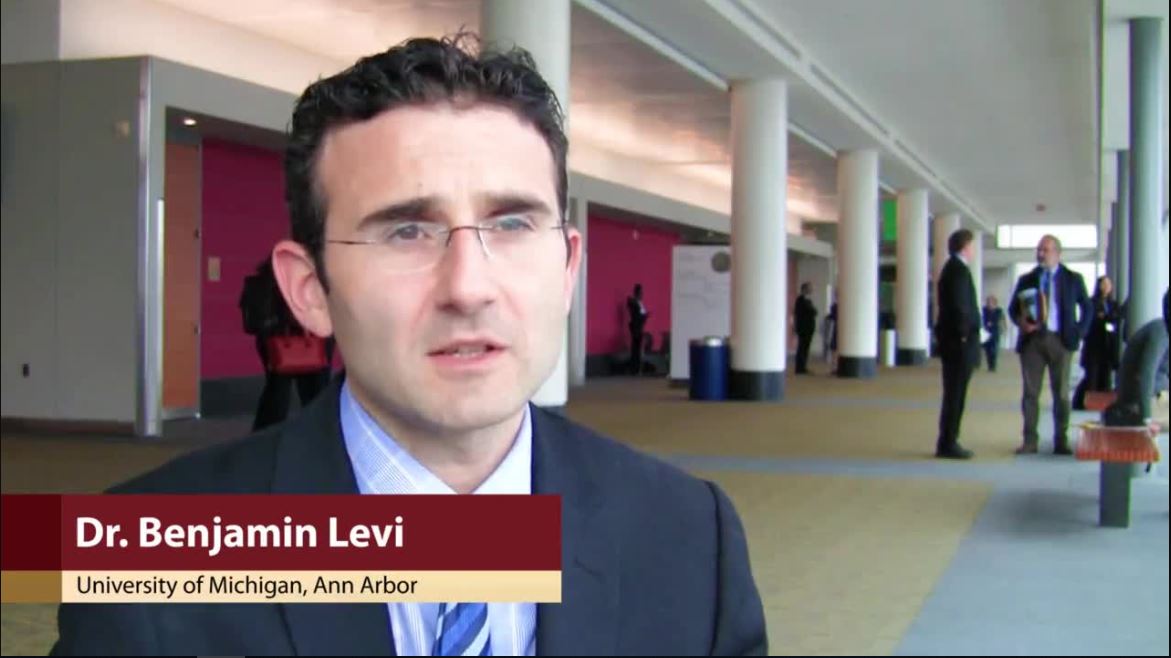
BOSTON – according to Benjamin Levi, MD, director of the burn/wound and regenerative medicine laboratory at the University of Michigan, Ann Arbor.
Some corners of the Internet tout it as “some sort of magic stem cell surgery,” Dr. Levi said, but in reality, for scar surgeons, it’s just another useful tool in the armamentarium, one that excels at filling skin depressions due to underlying tissue loss, whether from burns, trauma, or surgery. Unlike hyaluronic acid and other options, fat grafts last; about half of injected adipocytes remain indefinitely. Fat grafting might also help soften scars, he said.
To get the most out of the procedure, of course, it has to be done correctly, so Dr. Levi took a few minutes at the annual clinical congress of the American College of Surgeons to share his tips on harvesting and spinning down fat grafts, injecting adipocytes, and other matters. Although the concepts of fat grafting are straightforward, the techniques are a bit tricky. Dr. Levi hoped his treatment pearls would help other physicians, especially those considering adding fat grafting to their practice.
BOSTON – according to Benjamin Levi, MD, director of the burn/wound and regenerative medicine laboratory at the University of Michigan, Ann Arbor.
Some corners of the Internet tout it as “some sort of magic stem cell surgery,” Dr. Levi said, but in reality, for scar surgeons, it’s just another useful tool in the armamentarium, one that excels at filling skin depressions due to underlying tissue loss, whether from burns, trauma, or surgery. Unlike hyaluronic acid and other options, fat grafts last; about half of injected adipocytes remain indefinitely. Fat grafting might also help soften scars, he said.
To get the most out of the procedure, of course, it has to be done correctly, so Dr. Levi took a few minutes at the annual clinical congress of the American College of Surgeons to share his tips on harvesting and spinning down fat grafts, injecting adipocytes, and other matters. Although the concepts of fat grafting are straightforward, the techniques are a bit tricky. Dr. Levi hoped his treatment pearls would help other physicians, especially those considering adding fat grafting to their practice.
BOSTON – according to Benjamin Levi, MD, director of the burn/wound and regenerative medicine laboratory at the University of Michigan, Ann Arbor.
Some corners of the Internet tout it as “some sort of magic stem cell surgery,” Dr. Levi said, but in reality, for scar surgeons, it’s just another useful tool in the armamentarium, one that excels at filling skin depressions due to underlying tissue loss, whether from burns, trauma, or surgery. Unlike hyaluronic acid and other options, fat grafts last; about half of injected adipocytes remain indefinitely. Fat grafting might also help soften scars, he said.
To get the most out of the procedure, of course, it has to be done correctly, so Dr. Levi took a few minutes at the annual clinical congress of the American College of Surgeons to share his tips on harvesting and spinning down fat grafts, injecting adipocytes, and other matters. Although the concepts of fat grafting are straightforward, the techniques are a bit tricky. Dr. Levi hoped his treatment pearls would help other physicians, especially those considering adding fat grafting to their practice.
EXPERT ANALYSIS FROM THE ACS CLINICAL CONGRESS
Trump rule and ACA contraception
Also today, physical activity is tied to lower depression risk among older adults, high rates of prescription benzodiazepine observed in chronic liver disease, and rates of sexually transmitted infections are rising among U.S. teens who are sexually active.
Amazon Alexa
Apple Podcasts
Spotify
Also today, physical activity is tied to lower depression risk among older adults, high rates of prescription benzodiazepine observed in chronic liver disease, and rates of sexually transmitted infections are rising among U.S. teens who are sexually active.
Amazon Alexa
Apple Podcasts
Spotify
Also today, physical activity is tied to lower depression risk among older adults, high rates of prescription benzodiazepine observed in chronic liver disease, and rates of sexually transmitted infections are rising among U.S. teens who are sexually active.
Amazon Alexa
Apple Podcasts
Spotify

Can Probiotics Beat MRSA?
An unexpected finding in a study by National Institute of Health (NIH) researchers suggests that a “good” bacterium commonly found in probiotic digestive supplements works against Staphylococcus aureus (S aureus).
The researchers recruited 200 volunteers in Thailand for the study. They speculated that Thais would not be as affected by food sterilization or antibiotics as people in highly developed urban areas. The researchers analyzed fecal samples from each participant for bacteria correlated with the absence of S aureus. They found 101 samples positive for bacillus, primarily Bacillus subtilis (B subtilis), which is often mixed with other bacteria in probiotic products. The researchers then sampled for S aureus and found 25 positive gut samples and 26 positive nose samples. Strikingly, the researchers say, they found no S aureus in any of the samples that contained bacillus.
Using chromatography and mass spectrometry, the study team identified fengycins—a class of lipopeptides—as the specific bacillus substance that inhibited the S aureus sensing system. Other tests showed that fengycins had the same effect on several different strains of S aureus, including high-risk USA300 methicillin-resistant S aureus (MRSA).
To further validate their findings, the researchers colonized the gut of mice with S aureus and fed them B subtilis spores. Probiotic bacillus given every 2 days eliminated S aureus. The same test using bacillus where fengycin production had been removed had no effect: S aureus grew as expected.
An unexpected finding in a study by National Institute of Health (NIH) researchers suggests that a “good” bacterium commonly found in probiotic digestive supplements works against Staphylococcus aureus (S aureus).
The researchers recruited 200 volunteers in Thailand for the study. They speculated that Thais would not be as affected by food sterilization or antibiotics as people in highly developed urban areas. The researchers analyzed fecal samples from each participant for bacteria correlated with the absence of S aureus. They found 101 samples positive for bacillus, primarily Bacillus subtilis (B subtilis), which is often mixed with other bacteria in probiotic products. The researchers then sampled for S aureus and found 25 positive gut samples and 26 positive nose samples. Strikingly, the researchers say, they found no S aureus in any of the samples that contained bacillus.
Using chromatography and mass spectrometry, the study team identified fengycins—a class of lipopeptides—as the specific bacillus substance that inhibited the S aureus sensing system. Other tests showed that fengycins had the same effect on several different strains of S aureus, including high-risk USA300 methicillin-resistant S aureus (MRSA).
To further validate their findings, the researchers colonized the gut of mice with S aureus and fed them B subtilis spores. Probiotic bacillus given every 2 days eliminated S aureus. The same test using bacillus where fengycin production had been removed had no effect: S aureus grew as expected.
An unexpected finding in a study by National Institute of Health (NIH) researchers suggests that a “good” bacterium commonly found in probiotic digestive supplements works against Staphylococcus aureus (S aureus).
The researchers recruited 200 volunteers in Thailand for the study. They speculated that Thais would not be as affected by food sterilization or antibiotics as people in highly developed urban areas. The researchers analyzed fecal samples from each participant for bacteria correlated with the absence of S aureus. They found 101 samples positive for bacillus, primarily Bacillus subtilis (B subtilis), which is often mixed with other bacteria in probiotic products. The researchers then sampled for S aureus and found 25 positive gut samples and 26 positive nose samples. Strikingly, the researchers say, they found no S aureus in any of the samples that contained bacillus.
Using chromatography and mass spectrometry, the study team identified fengycins—a class of lipopeptides—as the specific bacillus substance that inhibited the S aureus sensing system. Other tests showed that fengycins had the same effect on several different strains of S aureus, including high-risk USA300 methicillin-resistant S aureus (MRSA).
To further validate their findings, the researchers colonized the gut of mice with S aureus and fed them B subtilis spores. Probiotic bacillus given every 2 days eliminated S aureus. The same test using bacillus where fengycin production had been removed had no effect: S aureus grew as expected.
Nearly half of infants don’t sleep through the night at 1 year
Just over half of infants get 8 hours of uninterrupted sleep at 12 months of age, an analysis of findings from a longitudinal birth cohort study showed.
It also found that whether an infant sleeps through night has no significant associated with any variations in mental or psychomotor development.
However, the rate of breastfeeding was significantly higher among infants who did not sleep through the night, investigators said in their report on the analysis, published in Pediatrics.
Being informed about the normal development of the sleep-wake cycle could be reassuring for parents, according to the authors, who said that new mothers tend to be “greatly surprised” by the sleep disturbance and exhaustion they experience.
“Keeping in mind the wide variability in the age when an infant starts to sleep through the night, expectations for early sleep consolidation could be moderated,” said Marie-Hélène Pennestri, PhD, of the Department of Educational and Counselling Psychology at McGill University, Montreal, and her coauthors.
Dr. Pennestri and colleagues reported on 388 mother-infant dyads in a longitudinal birth cohort study called Maternal Adversity, Vulnerability, and Neurodevelopment (MAVAN). Pregnant mothers were recruited from obstetric clinics in Canada. When their infants reached the age of 6 and 12 months, the mothers responded to questionnaires about sleep habits.
At 6 months, 62.4% of infants attained at least 6 hours of uninterrupted sleep, mothers reported, while 43.0% had reached 8 hours, the mothers reported. By 12 months of age, 72.1% of the infants attained 6 hours, and 56.6% attained 8 hours.
There were no associations between sleeping through the night and concurrent mental or psychomotor development, as measured by the Bayley Scales of Infant Development II at both 6 or 12 months of age, with P values greater than 0.05, investigators reported.
A similar lack of association between uninterrupted sleep and development or maternal mood was seen in a follow-up measurement at 36 months of age.
Sleeping through the night was likewise not associated with maternal mood, assessed using a depression scale with items that reflected symptom frequency in the previous week. “This is noteworthy because maternal sleep deprivation is often invoked to support the introduction of early behavioral interventions,” investigators said in a discussion of the results.
By contrast, sleeping through the night was linked to lower rates of breastfeeding as reported by mothers on retrospective questionnaires administered at both 6 and 12 months. At 12 months of age, 22.1% of infants sleeping through the night were breastfed, compared to 47.1% of infants not sleeping through the night (P less than 0.0001), Dr. Pennestri and colleagues reported.
However, that breastfeeding observation needs to be further investigated, according to the authors.
“The results of our study do not allow for the drawing of any causality between not sleeping through the night and breastfeeding,” they wrote.
Dr. Pennestri and coauthors said they had no financial relationships or potential conflicts of interest to disclose relevant to their report. They reported funding from the Ludmer Center for Neuroinformatics and Mental Health, Canadian Institutes of Health Research, and several other research institutions.
SOURCE: Pennestri MH, et al. Pediatrics. 2018;142(6):e20174330.
Multiple studies looking at whether sleep matters in infants and no clear consensus, the answer going forward may depend on the primary outcome evaluated, Jodi A. Mindell, PhD, and Melisa Moore, PhD
“The jury is still out,” Dr. Mindell and Dr. Moore wrote in an editorial discussing the present study, which like others before it have found no relationship or limited relationships between infant sleep and later development.
On the other hand, several studies have found that fragmented sleep is associated with negative outcomes with respect to development, the editorial authors said.
One reason for the lack of agreement between studies may be differences in measurement, as the studies to date have used a variety of different measures for both sleep and development, they said. Moreover, the age of infants varies across studies, as does their location, raising the possibility that cultural differences may account for the disparate results.
Beyond that, they added, there is no single primary sleep outcome that has been applied, with some studies looking at sleep duration, and others looking at sleep consolidation, longest stretch of sleep, or duration of night wakings.
What some of these studies may miss is that many other factors may influence development, including genetics, nutrition, parental education, and interaction between child and parent.
“Sleep may be a drop in the bucket for broad development but, instead, have a more significant impact on next-day functioning,” they said.
Thus, the editorialists propose that future studies evaluate function instead of development to assess the importance of infant sleep, as some studies to date have shown that sleep in infants is important for language learning and memory consolidation.
“Rather than investigate gross development, we propose that day-to-day functioning and skill development may be better indicators of the impact of sleep on development in early childhood,” they concluded.
Dr. Mindell, and Dr. Moore are with the Sleep Center, Children’s Hospital of Philadelphia. Their editorial appears in Pediatrics. Dr. Mindell reported she is a consultant for Johnson & Johnson Consumer. Dr. Moore reported no financial relationships relevant to the article.
Multiple studies looking at whether sleep matters in infants and no clear consensus, the answer going forward may depend on the primary outcome evaluated, Jodi A. Mindell, PhD, and Melisa Moore, PhD
“The jury is still out,” Dr. Mindell and Dr. Moore wrote in an editorial discussing the present study, which like others before it have found no relationship or limited relationships between infant sleep and later development.
On the other hand, several studies have found that fragmented sleep is associated with negative outcomes with respect to development, the editorial authors said.
One reason for the lack of agreement between studies may be differences in measurement, as the studies to date have used a variety of different measures for both sleep and development, they said. Moreover, the age of infants varies across studies, as does their location, raising the possibility that cultural differences may account for the disparate results.
Beyond that, they added, there is no single primary sleep outcome that has been applied, with some studies looking at sleep duration, and others looking at sleep consolidation, longest stretch of sleep, or duration of night wakings.
What some of these studies may miss is that many other factors may influence development, including genetics, nutrition, parental education, and interaction between child and parent.
“Sleep may be a drop in the bucket for broad development but, instead, have a more significant impact on next-day functioning,” they said.
Thus, the editorialists propose that future studies evaluate function instead of development to assess the importance of infant sleep, as some studies to date have shown that sleep in infants is important for language learning and memory consolidation.
“Rather than investigate gross development, we propose that day-to-day functioning and skill development may be better indicators of the impact of sleep on development in early childhood,” they concluded.
Dr. Mindell, and Dr. Moore are with the Sleep Center, Children’s Hospital of Philadelphia. Their editorial appears in Pediatrics. Dr. Mindell reported she is a consultant for Johnson & Johnson Consumer. Dr. Moore reported no financial relationships relevant to the article.
Multiple studies looking at whether sleep matters in infants and no clear consensus, the answer going forward may depend on the primary outcome evaluated, Jodi A. Mindell, PhD, and Melisa Moore, PhD
“The jury is still out,” Dr. Mindell and Dr. Moore wrote in an editorial discussing the present study, which like others before it have found no relationship or limited relationships between infant sleep and later development.
On the other hand, several studies have found that fragmented sleep is associated with negative outcomes with respect to development, the editorial authors said.
One reason for the lack of agreement between studies may be differences in measurement, as the studies to date have used a variety of different measures for both sleep and development, they said. Moreover, the age of infants varies across studies, as does their location, raising the possibility that cultural differences may account for the disparate results.
Beyond that, they added, there is no single primary sleep outcome that has been applied, with some studies looking at sleep duration, and others looking at sleep consolidation, longest stretch of sleep, or duration of night wakings.
What some of these studies may miss is that many other factors may influence development, including genetics, nutrition, parental education, and interaction between child and parent.
“Sleep may be a drop in the bucket for broad development but, instead, have a more significant impact on next-day functioning,” they said.
Thus, the editorialists propose that future studies evaluate function instead of development to assess the importance of infant sleep, as some studies to date have shown that sleep in infants is important for language learning and memory consolidation.
“Rather than investigate gross development, we propose that day-to-day functioning and skill development may be better indicators of the impact of sleep on development in early childhood,” they concluded.
Dr. Mindell, and Dr. Moore are with the Sleep Center, Children’s Hospital of Philadelphia. Their editorial appears in Pediatrics. Dr. Mindell reported she is a consultant for Johnson & Johnson Consumer. Dr. Moore reported no financial relationships relevant to the article.
Just over half of infants get 8 hours of uninterrupted sleep at 12 months of age, an analysis of findings from a longitudinal birth cohort study showed.
It also found that whether an infant sleeps through night has no significant associated with any variations in mental or psychomotor development.
However, the rate of breastfeeding was significantly higher among infants who did not sleep through the night, investigators said in their report on the analysis, published in Pediatrics.
Being informed about the normal development of the sleep-wake cycle could be reassuring for parents, according to the authors, who said that new mothers tend to be “greatly surprised” by the sleep disturbance and exhaustion they experience.
“Keeping in mind the wide variability in the age when an infant starts to sleep through the night, expectations for early sleep consolidation could be moderated,” said Marie-Hélène Pennestri, PhD, of the Department of Educational and Counselling Psychology at McGill University, Montreal, and her coauthors.
Dr. Pennestri and colleagues reported on 388 mother-infant dyads in a longitudinal birth cohort study called Maternal Adversity, Vulnerability, and Neurodevelopment (MAVAN). Pregnant mothers were recruited from obstetric clinics in Canada. When their infants reached the age of 6 and 12 months, the mothers responded to questionnaires about sleep habits.
At 6 months, 62.4% of infants attained at least 6 hours of uninterrupted sleep, mothers reported, while 43.0% had reached 8 hours, the mothers reported. By 12 months of age, 72.1% of the infants attained 6 hours, and 56.6% attained 8 hours.
There were no associations between sleeping through the night and concurrent mental or psychomotor development, as measured by the Bayley Scales of Infant Development II at both 6 or 12 months of age, with P values greater than 0.05, investigators reported.
A similar lack of association between uninterrupted sleep and development or maternal mood was seen in a follow-up measurement at 36 months of age.
Sleeping through the night was likewise not associated with maternal mood, assessed using a depression scale with items that reflected symptom frequency in the previous week. “This is noteworthy because maternal sleep deprivation is often invoked to support the introduction of early behavioral interventions,” investigators said in a discussion of the results.
By contrast, sleeping through the night was linked to lower rates of breastfeeding as reported by mothers on retrospective questionnaires administered at both 6 and 12 months. At 12 months of age, 22.1% of infants sleeping through the night were breastfed, compared to 47.1% of infants not sleeping through the night (P less than 0.0001), Dr. Pennestri and colleagues reported.
However, that breastfeeding observation needs to be further investigated, according to the authors.
“The results of our study do not allow for the drawing of any causality between not sleeping through the night and breastfeeding,” they wrote.
Dr. Pennestri and coauthors said they had no financial relationships or potential conflicts of interest to disclose relevant to their report. They reported funding from the Ludmer Center for Neuroinformatics and Mental Health, Canadian Institutes of Health Research, and several other research institutions.
SOURCE: Pennestri MH, et al. Pediatrics. 2018;142(6):e20174330.
Just over half of infants get 8 hours of uninterrupted sleep at 12 months of age, an analysis of findings from a longitudinal birth cohort study showed.
It also found that whether an infant sleeps through night has no significant associated with any variations in mental or psychomotor development.
However, the rate of breastfeeding was significantly higher among infants who did not sleep through the night, investigators said in their report on the analysis, published in Pediatrics.
Being informed about the normal development of the sleep-wake cycle could be reassuring for parents, according to the authors, who said that new mothers tend to be “greatly surprised” by the sleep disturbance and exhaustion they experience.
“Keeping in mind the wide variability in the age when an infant starts to sleep through the night, expectations for early sleep consolidation could be moderated,” said Marie-Hélène Pennestri, PhD, of the Department of Educational and Counselling Psychology at McGill University, Montreal, and her coauthors.
Dr. Pennestri and colleagues reported on 388 mother-infant dyads in a longitudinal birth cohort study called Maternal Adversity, Vulnerability, and Neurodevelopment (MAVAN). Pregnant mothers were recruited from obstetric clinics in Canada. When their infants reached the age of 6 and 12 months, the mothers responded to questionnaires about sleep habits.
At 6 months, 62.4% of infants attained at least 6 hours of uninterrupted sleep, mothers reported, while 43.0% had reached 8 hours, the mothers reported. By 12 months of age, 72.1% of the infants attained 6 hours, and 56.6% attained 8 hours.
There were no associations between sleeping through the night and concurrent mental or psychomotor development, as measured by the Bayley Scales of Infant Development II at both 6 or 12 months of age, with P values greater than 0.05, investigators reported.
A similar lack of association between uninterrupted sleep and development or maternal mood was seen in a follow-up measurement at 36 months of age.
Sleeping through the night was likewise not associated with maternal mood, assessed using a depression scale with items that reflected symptom frequency in the previous week. “This is noteworthy because maternal sleep deprivation is often invoked to support the introduction of early behavioral interventions,” investigators said in a discussion of the results.
By contrast, sleeping through the night was linked to lower rates of breastfeeding as reported by mothers on retrospective questionnaires administered at both 6 and 12 months. At 12 months of age, 22.1% of infants sleeping through the night were breastfed, compared to 47.1% of infants not sleeping through the night (P less than 0.0001), Dr. Pennestri and colleagues reported.
However, that breastfeeding observation needs to be further investigated, according to the authors.
“The results of our study do not allow for the drawing of any causality between not sleeping through the night and breastfeeding,” they wrote.
Dr. Pennestri and coauthors said they had no financial relationships or potential conflicts of interest to disclose relevant to their report. They reported funding from the Ludmer Center for Neuroinformatics and Mental Health, Canadian Institutes of Health Research, and several other research institutions.
SOURCE: Pennestri MH, et al. Pediatrics. 2018;142(6):e20174330.
FROM PEDIATRICS
Key clinical point: Sleeping through the night in infancy was not significantly associated with any variations in development or maternal mood.
Major finding: There were no associations between 6 or 8 hours of uninterrupted sleep and concurrent mental or psychomotor development or reported depressive symptoms.
Study details: An analysis of 388 mother-infant dyads in a longitudinal birth cohort study.
Disclosures: Authors said they had no financial relationships or potential conflicts of interest to disclose.
Source: Pennestri MH, et al. Pediatrics. 2018;142(6):e20174330.
Brain stimulation device improved fluency in persons who stutter
ATLANTA – After undergoing 10 days of noninvasive magnetic brain stimulation with a novel device, eight of nine persons who stutter experienced improvements in speech fluency.
“This is the first step in what we believe is a major breakthrough in treatment,” lead study author David B. Rosenfield, MD, said in an interview at the annual meeting of the American Neurological Association.
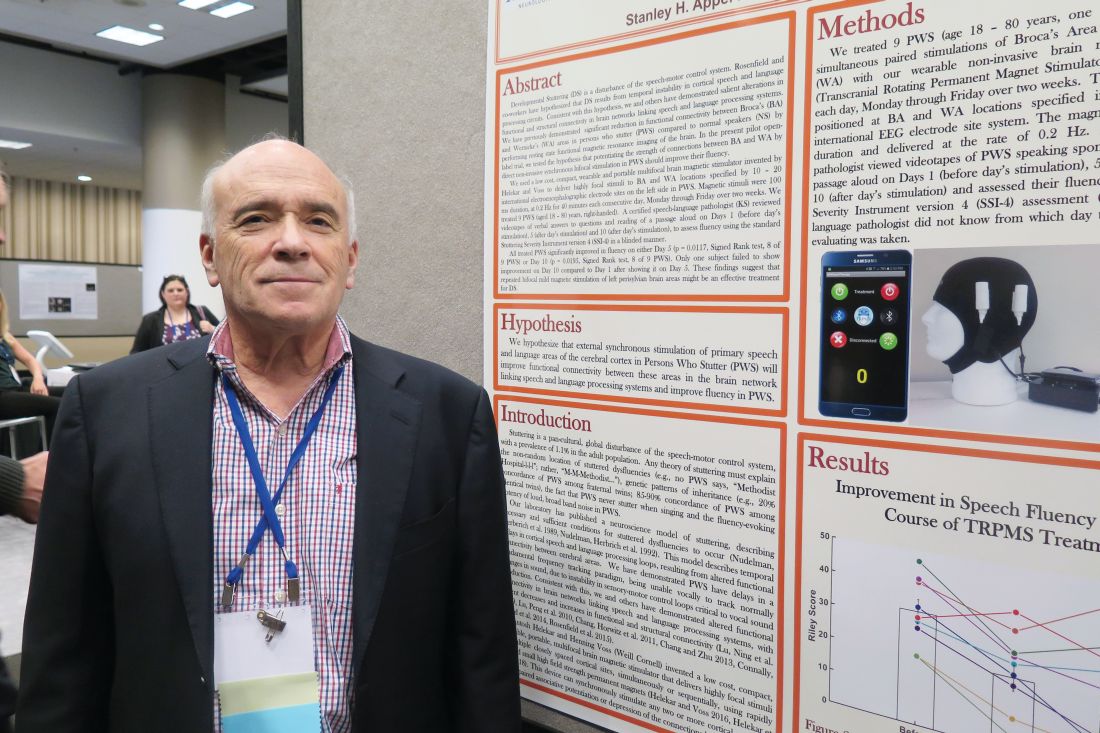
In previously published work, Dr. Rosenfield, Director of the Speech and Language Center at Houston Methodist Neurological Institute, and his colleagues showed significant reduction in functional connectivity between Broca’s and Wernicke’s areas in persons who stutter, compared with normal speakers, by performing resting-state functional MRI of the brain. In the current open-label pilot trial, they tested the hypothesis that using direct noninvasive synchronous bifocal stimulation to potentiate the strength of connectivity between Broca’s and Wernicke’s areas in persons who stutter should improve their fluency.
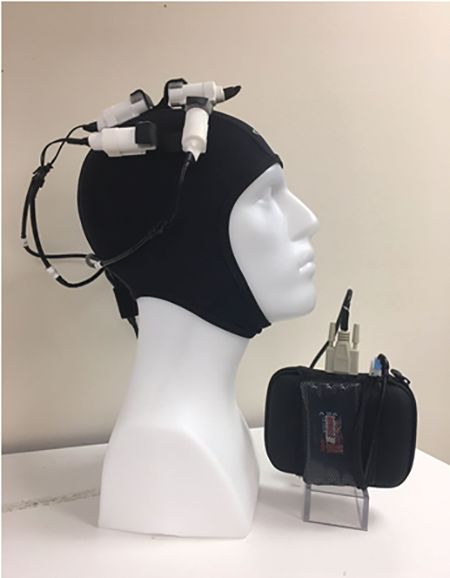
Researchers enrolled nine persons who stutter who ranged in age from 18 to 80 years. For 40 minutes each consecutive weekday over the course of 2 weeks, the participants wore a compact, portable device known as a Transcranial Rotating Permanent Magnetic Stimulator (TRPMS) to deliver highly focal stimuli to Broca’s and Wernicke’s area locations specified by 10-20 international electroencephalographic electrode sites on the left side. Magnetic stimuli were 100 milliseconds in duration and delivered at 0.2 Hz. Next, a certified speech-language pathologist viewed video recordings of the study subjects both speaking spontaneously and reading a passage aloud on day 1 (before stimulation), day 5 (after stimulation), and day 10 (after stimulation), to assess fluency using the Stuttering Speech Severity Instrument version 4 (SSI-4).
The researchers found that all study participants significantly improved in fluency on either day 5 (P = 0.01) or day 10 (P = 0.02). Only one subject failed to show improvement on day 10 compared with day 1 after showing it on day 5. “This wasn’t meant to be a 10-day treatment that would last forever; this was meant to be a 10-day treatment to see whether the magnetic stimulation would work,” Dr. Rosenfield said. “It might well be that patients need treatment every day, once a week, or once a month. All we can say is that we have an input and an output. We gave them the treatment and they improved. One patient was so happy with it that he begged us to come back for additional treatment. It seems as though it’s a robust therapy.”
Going forward, the researchers plan to study fMRI brain imaging before and following external magnetic treatments to speech and language areas to confirm the efficacy of this therapy in a randomized, double-blind, sham treatment-controlled trial.
The TRPMS device was coinvented by Santosh A. Helekar, MD, PhD, and Henning Voss, PhD, both at Weill Cornell Medical College. The study received funding support from The Houston Methodist Hospital System Physicians Organization. Dr. Rosenfield reported having no financial disclosures. He noted that commercialization of the patented technology underlying the TRPMS device used in this study and in other diseases is currently being advanced by Seraya Medical Systems LLC.
[email protected]
Source: Ann Neurol. 2018;84[S22]:S45-6. Abstract S115.
ATLANTA – After undergoing 10 days of noninvasive magnetic brain stimulation with a novel device, eight of nine persons who stutter experienced improvements in speech fluency.
“This is the first step in what we believe is a major breakthrough in treatment,” lead study author David B. Rosenfield, MD, said in an interview at the annual meeting of the American Neurological Association.
In previously published work, Dr. Rosenfield, Director of the Speech and Language Center at Houston Methodist Neurological Institute, and his colleagues showed significant reduction in functional connectivity between Broca’s and Wernicke’s areas in persons who stutter, compared with normal speakers, by performing resting-state functional MRI of the brain. In the current open-label pilot trial, they tested the hypothesis that using direct noninvasive synchronous bifocal stimulation to potentiate the strength of connectivity between Broca’s and Wernicke’s areas in persons who stutter should improve their fluency.
Researchers enrolled nine persons who stutter who ranged in age from 18 to 80 years. For 40 minutes each consecutive weekday over the course of 2 weeks, the participants wore a compact, portable device known as a Transcranial Rotating Permanent Magnetic Stimulator (TRPMS) to deliver highly focal stimuli to Broca’s and Wernicke’s area locations specified by 10-20 international electroencephalographic electrode sites on the left side. Magnetic stimuli were 100 milliseconds in duration and delivered at 0.2 Hz. Next, a certified speech-language pathologist viewed video recordings of the study subjects both speaking spontaneously and reading a passage aloud on day 1 (before stimulation), day 5 (after stimulation), and day 10 (after stimulation), to assess fluency using the Stuttering Speech Severity Instrument version 4 (SSI-4).
The researchers found that all study participants significantly improved in fluency on either day 5 (P = 0.01) or day 10 (P = 0.02). Only one subject failed to show improvement on day 10 compared with day 1 after showing it on day 5. “This wasn’t meant to be a 10-day treatment that would last forever; this was meant to be a 10-day treatment to see whether the magnetic stimulation would work,” Dr. Rosenfield said. “It might well be that patients need treatment every day, once a week, or once a month. All we can say is that we have an input and an output. We gave them the treatment and they improved. One patient was so happy with it that he begged us to come back for additional treatment. It seems as though it’s a robust therapy.”
Going forward, the researchers plan to study fMRI brain imaging before and following external magnetic treatments to speech and language areas to confirm the efficacy of this therapy in a randomized, double-blind, sham treatment-controlled trial.
The TRPMS device was coinvented by Santosh A. Helekar, MD, PhD, and Henning Voss, PhD, both at Weill Cornell Medical College. The study received funding support from The Houston Methodist Hospital System Physicians Organization. Dr. Rosenfield reported having no financial disclosures. He noted that commercialization of the patented technology underlying the TRPMS device used in this study and in other diseases is currently being advanced by Seraya Medical Systems LLC.
[email protected]
Source: Ann Neurol. 2018;84[S22]:S45-6. Abstract S115.
ATLANTA – After undergoing 10 days of noninvasive magnetic brain stimulation with a novel device, eight of nine persons who stutter experienced improvements in speech fluency.
“This is the first step in what we believe is a major breakthrough in treatment,” lead study author David B. Rosenfield, MD, said in an interview at the annual meeting of the American Neurological Association.
In previously published work, Dr. Rosenfield, Director of the Speech and Language Center at Houston Methodist Neurological Institute, and his colleagues showed significant reduction in functional connectivity between Broca’s and Wernicke’s areas in persons who stutter, compared with normal speakers, by performing resting-state functional MRI of the brain. In the current open-label pilot trial, they tested the hypothesis that using direct noninvasive synchronous bifocal stimulation to potentiate the strength of connectivity between Broca’s and Wernicke’s areas in persons who stutter should improve their fluency.
Researchers enrolled nine persons who stutter who ranged in age from 18 to 80 years. For 40 minutes each consecutive weekday over the course of 2 weeks, the participants wore a compact, portable device known as a Transcranial Rotating Permanent Magnetic Stimulator (TRPMS) to deliver highly focal stimuli to Broca’s and Wernicke’s area locations specified by 10-20 international electroencephalographic electrode sites on the left side. Magnetic stimuli were 100 milliseconds in duration and delivered at 0.2 Hz. Next, a certified speech-language pathologist viewed video recordings of the study subjects both speaking spontaneously and reading a passage aloud on day 1 (before stimulation), day 5 (after stimulation), and day 10 (after stimulation), to assess fluency using the Stuttering Speech Severity Instrument version 4 (SSI-4).
The researchers found that all study participants significantly improved in fluency on either day 5 (P = 0.01) or day 10 (P = 0.02). Only one subject failed to show improvement on day 10 compared with day 1 after showing it on day 5. “This wasn’t meant to be a 10-day treatment that would last forever; this was meant to be a 10-day treatment to see whether the magnetic stimulation would work,” Dr. Rosenfield said. “It might well be that patients need treatment every day, once a week, or once a month. All we can say is that we have an input and an output. We gave them the treatment and they improved. One patient was so happy with it that he begged us to come back for additional treatment. It seems as though it’s a robust therapy.”
Going forward, the researchers plan to study fMRI brain imaging before and following external magnetic treatments to speech and language areas to confirm the efficacy of this therapy in a randomized, double-blind, sham treatment-controlled trial.
The TRPMS device was coinvented by Santosh A. Helekar, MD, PhD, and Henning Voss, PhD, both at Weill Cornell Medical College. The study received funding support from The Houston Methodist Hospital System Physicians Organization. Dr. Rosenfield reported having no financial disclosures. He noted that commercialization of the patented technology underlying the TRPMS device used in this study and in other diseases is currently being advanced by Seraya Medical Systems LLC.
[email protected]
Source: Ann Neurol. 2018;84[S22]:S45-6. Abstract S115.
AT ANA 2018
Key clinical point: .
Major finding: All study participants significantly improved in speech fluency on either day 5 of treatment or on day 10.
Study details: An open-label pilot trial of a novel devices used in nine persons who stutter.
Disclosures: The study received funding support from The Houston Methodist Hospital System Physicians Organization. Dr. Rosenfield reported having no financial disclosures. He noted that commercialization of the patented technology underlying the TRPMS device used in this study and in other diseases is currently being advanced by Seraya Medical Systems LLC.
Source: Ann Neurol. 2018;84[S22]:S45-6. Abstract S115.
'Real food' called key to healthful eating; Peer mentors seek to prevent suicides
Nutritious eating need not involve counting calories, carbohydrates, or points, according to food and nutrition editor Paul Kita.
After talking with experts and studying various diets, Mr. Kita said he found an approach that works for him.
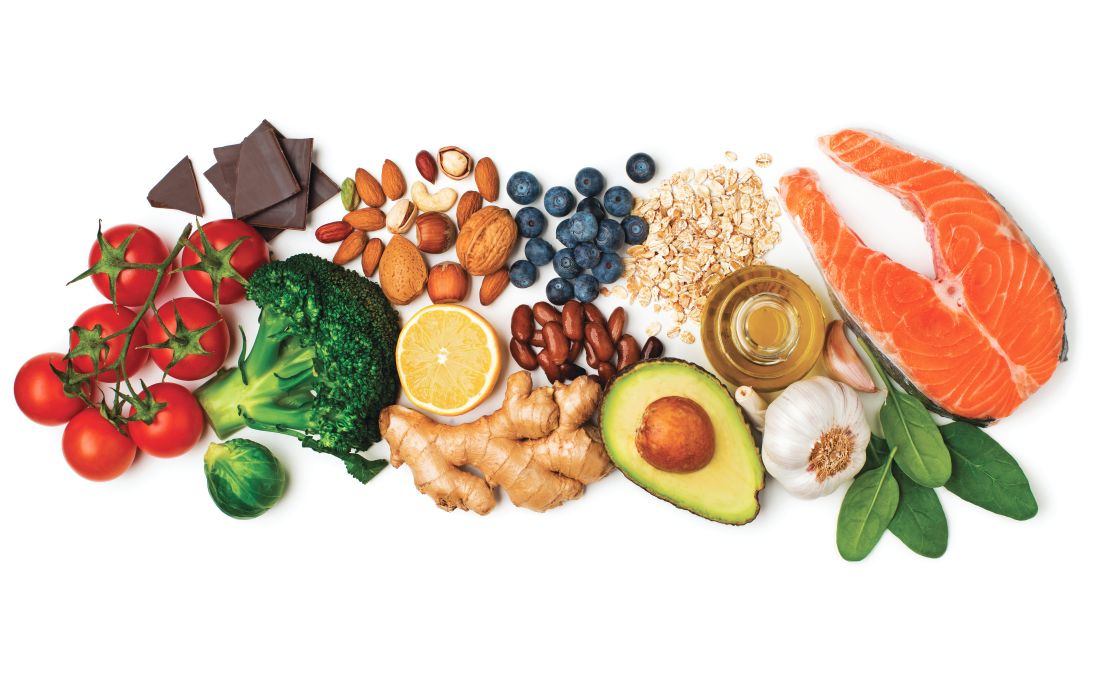
The key is eating “real food,” such as chicken, tomatoes, eggs, and avocados; avoiding processed foods; and not demonizing anything. Approaching food this way for 10 years has allowed Mr. Kita to keep his weight at 155 pounds – give or take 5, – he wrote in Men’s Health.
“I eat cookies. I eat carbs. I even drink coffee supposedly loaded with mycotoxins,” Mr. Kita wrote. “I [eat] fruits and vegetables with every meal and cut back on booze and desserts. I have two clementines or a banana or a split broiled tomato for breakfast. I eat a big salad of mixed greens or a side of coleslaw or a ripe, juicy pear for lunch.”
He said dinner might include sautéed spinach or a carrot salad and roasted sweet potatoes. “And then I either choose to have a beer with or after dinner or a simple dessert. If I’m not craving something sweet, I’ll have a cup of tea.”
He said he tries for about 30 grams of protein at each meal.
“Here’s my main takeaway ... if the plan you have for what you feed yourself causes you more stress and adds more work to your already-busy life, you’re not eating well. The best diet ... doesn’t have celebrity endorsements. The best diet is one that is based on the inclusion of healthful foods – not the exclusion of food groups.”
Students seek to prevent suicides
The beauty of mountains can be breathtaking for someone passing through. For residents, living in the shadow of the giants, however, can be isolating, especially for small mountain communities. Grand Junction, Colo., is located in a valley ringed by tall mountains, desert mesas, and red-rock cliffs. For local residents, and especially teenagers, it can feel like the end of the world.
“I know we can’t really fix this because it’s nature,” 17-year-old Victoria Mendoza said in an NPR interview. “I feel like the people in our valley feel like there’s only life inside of Grand Junction.”
Ms. Mendoza has fought depression, as have other members of her family and others in the community. Seven student suicides occurred in the 2016-2017 school year. “It felt like there was this cloud around our whole valley,” Ms. Mendoza said. “It got to a point where we were just waiting for the next one.”
Rural settings can foster the loneliness that, for some, is only cured by self-inflicted death. Of the top 10 U.S. states with the highest rates of suicide, 8 are located in the rural mountain West. The view of mental illness as a sign of personal weakness remains prevalent, and having ready access to guns is not helpful.
In Grand Junction, students have seized the reins of a suicide prevention in which they act as peer mentors to younger students that either seek help or appear to be floundering. The approach, called the Sources of Strength suicide program, exemplifies a broader shift in public health thinking that is taking place. In Grand Junction, the strategy is to zero in on the mental health and well-being of everyone. That encourages a sense of community, even in a setting of physical isolation.
Cannabidiol and substance-free living
With cannabis use becoming more part of the norm and with its legalization, the idea of altering the way we see the world is, for some, moving from a no-go option to a practice that can help ease the strains of life. For those who struggle with PTSD or other anxieties, cannabis can be a way to alleviate paranoia, anxiety, and mood swings without the use of prescription drugs.
Of course, there will be many who will overenthusiastically embrace the chance to legally alter themselves, such as what occurs with alcohol. Sobriety means different things to different people. Some alcoholics happily live with an occasional drink. They consider themselves on a path of sobriety. Others must go cold turkey forever. This is a different sobriety. Each can be effective and can bring happiness.
“Does using cannabidiol count as a strike against recovery or a substance-free lifestyle? This can lead into particularly tricky terrain as many people turn to cannabis products as a solution for all manner of ailments – from mental health to addiction. As we reckon with cannabis legalization as a country, perhaps what we really should be asking ourselves is how we’re going to redefine the traditional meaning of sobriety,” Amanda Scriver wrote in the Walrus.
“As cannabidiol gains popularity, we must give people the capacity to examine, evaluate, and possibly amend their own health, wellness, or recovery journey in a way that feels right for them. Yes, we need better medical understanding of cannabis and its related products, and yes, we also need training in the harm-reduction model. But we also need compassion and the courage to rethink old definitions,” Ms. Scriver wrote.
Masculinity tied to mental health
As a celebrity, Lenard Larry McKelvey, aka Charlamagne Tha God, makes his living being brash and bold. On his radio show, The Breakfast Club, he asks questions some do not want asked. But, like many, he is also anxious about the world. As a father, he worries about his daughters. As a black man, he worries about police brutality.
But unlike many, he has a forum and an audience. And he is using his forum to speak out about his fears and anxieties in the hope that it helps others deal with their demons. A recent example is his book, “Shook One: Anxiety Playing Tricks On Me” (Touchstone, 2018).
He is a strong advocate of therapy. “I go to therapy just to push those negative thoughts out of my mind. None of us can escape thinking negatively. Negative thoughts are going to pop up in your head. You’re going to have self-doubt sometimes; you’re going to be insecure sometimes. You’re going to worry about your kids; you’re going to worry about your wife, but it’s about pushing that %@C# out and not holding onto it. When you hold onto it, that’s when it grows,” he explained in an interview with the Boston Globe.
He espoused the freedom that comes from self-acceptance. “My whole life, people have said to me, ‘You can’t be soft.’ I don’t care about that anymore. I don’t care about how people perceive me when it comes to masculinity. You know what’s masculine? Masculine is taking care of your mind, your body, and your soul. We spend so much time on our body. We want that six-pack. But what about your mental health? What about your mental well-being? I go to the gym three, four times a week. Why can’t I put that same effort and same energy into getting mentally strong?”
Can extremists’ mindsets change?
The recent massacre at the Pittsburgh synagogue was yet another vile example of hatred and bigotry. But, in the United States and elsewhere, the shooter was one of many. Why?
According to an NPR piece, there are several possible explanations. Those brimming with racist hated might have little opportunity to get off that track. “We haven’t wanted to acknowledge that we have a problem with violent right-wing extremism in this kind of domestic terrorism,” said sociologist Pete Simi, PhD, of Chapman University in Orange, Calif. Dr. Simi has studied violent white nationalists and other hate groups for decades.
“White supremacy is really a problem throughout the United States,” Dr. Simi said. “It doesn’t know any geographic boundaries. It’s not isolated to either urban or rural or suburban – it cuts across all.”
There is little knowledge of how to deal with home-grown hatred. Banning immigrants perceived as being a threat is one attempt to deal with foreign-born terrorism, but that doesn’t work for citizens. For them, rehabilitation is possible, according to Dr. Simi, but it comes with a big price tag of revamped social, education, housing, and employment programs. Governments are loathe to take on those costs, in part because it is an admission that society is broken.
“A big, big problem that we face as a society is abdicating our responsibility in terms of providing this kind of social support and social safety net for individuals that suffer from mental health, as well as drug problems,” Dr. Simi said in the interview.
Small-scale local efforts, such as the Chicago-based Life After Hate, are working for change. How to scale up such efforts is a vexing problem.
Nutritious eating need not involve counting calories, carbohydrates, or points, according to food and nutrition editor Paul Kita.
After talking with experts and studying various diets, Mr. Kita said he found an approach that works for him.
The key is eating “real food,” such as chicken, tomatoes, eggs, and avocados; avoiding processed foods; and not demonizing anything. Approaching food this way for 10 years has allowed Mr. Kita to keep his weight at 155 pounds – give or take 5, – he wrote in Men’s Health.
“I eat cookies. I eat carbs. I even drink coffee supposedly loaded with mycotoxins,” Mr. Kita wrote. “I [eat] fruits and vegetables with every meal and cut back on booze and desserts. I have two clementines or a banana or a split broiled tomato for breakfast. I eat a big salad of mixed greens or a side of coleslaw or a ripe, juicy pear for lunch.”
He said dinner might include sautéed spinach or a carrot salad and roasted sweet potatoes. “And then I either choose to have a beer with or after dinner or a simple dessert. If I’m not craving something sweet, I’ll have a cup of tea.”
He said he tries for about 30 grams of protein at each meal.
“Here’s my main takeaway ... if the plan you have for what you feed yourself causes you more stress and adds more work to your already-busy life, you’re not eating well. The best diet ... doesn’t have celebrity endorsements. The best diet is one that is based on the inclusion of healthful foods – not the exclusion of food groups.”
Students seek to prevent suicides
The beauty of mountains can be breathtaking for someone passing through. For residents, living in the shadow of the giants, however, can be isolating, especially for small mountain communities. Grand Junction, Colo., is located in a valley ringed by tall mountains, desert mesas, and red-rock cliffs. For local residents, and especially teenagers, it can feel like the end of the world.
“I know we can’t really fix this because it’s nature,” 17-year-old Victoria Mendoza said in an NPR interview. “I feel like the people in our valley feel like there’s only life inside of Grand Junction.”
Ms. Mendoza has fought depression, as have other members of her family and others in the community. Seven student suicides occurred in the 2016-2017 school year. “It felt like there was this cloud around our whole valley,” Ms. Mendoza said. “It got to a point where we were just waiting for the next one.”
Rural settings can foster the loneliness that, for some, is only cured by self-inflicted death. Of the top 10 U.S. states with the highest rates of suicide, 8 are located in the rural mountain West. The view of mental illness as a sign of personal weakness remains prevalent, and having ready access to guns is not helpful.
In Grand Junction, students have seized the reins of a suicide prevention in which they act as peer mentors to younger students that either seek help or appear to be floundering. The approach, called the Sources of Strength suicide program, exemplifies a broader shift in public health thinking that is taking place. In Grand Junction, the strategy is to zero in on the mental health and well-being of everyone. That encourages a sense of community, even in a setting of physical isolation.
Cannabidiol and substance-free living
With cannabis use becoming more part of the norm and with its legalization, the idea of altering the way we see the world is, for some, moving from a no-go option to a practice that can help ease the strains of life. For those who struggle with PTSD or other anxieties, cannabis can be a way to alleviate paranoia, anxiety, and mood swings without the use of prescription drugs.
Of course, there will be many who will overenthusiastically embrace the chance to legally alter themselves, such as what occurs with alcohol. Sobriety means different things to different people. Some alcoholics happily live with an occasional drink. They consider themselves on a path of sobriety. Others must go cold turkey forever. This is a different sobriety. Each can be effective and can bring happiness.
“Does using cannabidiol count as a strike against recovery or a substance-free lifestyle? This can lead into particularly tricky terrain as many people turn to cannabis products as a solution for all manner of ailments – from mental health to addiction. As we reckon with cannabis legalization as a country, perhaps what we really should be asking ourselves is how we’re going to redefine the traditional meaning of sobriety,” Amanda Scriver wrote in the Walrus.
“As cannabidiol gains popularity, we must give people the capacity to examine, evaluate, and possibly amend their own health, wellness, or recovery journey in a way that feels right for them. Yes, we need better medical understanding of cannabis and its related products, and yes, we also need training in the harm-reduction model. But we also need compassion and the courage to rethink old definitions,” Ms. Scriver wrote.
Masculinity tied to mental health
As a celebrity, Lenard Larry McKelvey, aka Charlamagne Tha God, makes his living being brash and bold. On his radio show, The Breakfast Club, he asks questions some do not want asked. But, like many, he is also anxious about the world. As a father, he worries about his daughters. As a black man, he worries about police brutality.
But unlike many, he has a forum and an audience. And he is using his forum to speak out about his fears and anxieties in the hope that it helps others deal with their demons. A recent example is his book, “Shook One: Anxiety Playing Tricks On Me” (Touchstone, 2018).
He is a strong advocate of therapy. “I go to therapy just to push those negative thoughts out of my mind. None of us can escape thinking negatively. Negative thoughts are going to pop up in your head. You’re going to have self-doubt sometimes; you’re going to be insecure sometimes. You’re going to worry about your kids; you’re going to worry about your wife, but it’s about pushing that %@C# out and not holding onto it. When you hold onto it, that’s when it grows,” he explained in an interview with the Boston Globe.
He espoused the freedom that comes from self-acceptance. “My whole life, people have said to me, ‘You can’t be soft.’ I don’t care about that anymore. I don’t care about how people perceive me when it comes to masculinity. You know what’s masculine? Masculine is taking care of your mind, your body, and your soul. We spend so much time on our body. We want that six-pack. But what about your mental health? What about your mental well-being? I go to the gym three, four times a week. Why can’t I put that same effort and same energy into getting mentally strong?”
Can extremists’ mindsets change?
The recent massacre at the Pittsburgh synagogue was yet another vile example of hatred and bigotry. But, in the United States and elsewhere, the shooter was one of many. Why?
According to an NPR piece, there are several possible explanations. Those brimming with racist hated might have little opportunity to get off that track. “We haven’t wanted to acknowledge that we have a problem with violent right-wing extremism in this kind of domestic terrorism,” said sociologist Pete Simi, PhD, of Chapman University in Orange, Calif. Dr. Simi has studied violent white nationalists and other hate groups for decades.
“White supremacy is really a problem throughout the United States,” Dr. Simi said. “It doesn’t know any geographic boundaries. It’s not isolated to either urban or rural or suburban – it cuts across all.”
There is little knowledge of how to deal with home-grown hatred. Banning immigrants perceived as being a threat is one attempt to deal with foreign-born terrorism, but that doesn’t work for citizens. For them, rehabilitation is possible, according to Dr. Simi, but it comes with a big price tag of revamped social, education, housing, and employment programs. Governments are loathe to take on those costs, in part because it is an admission that society is broken.
“A big, big problem that we face as a society is abdicating our responsibility in terms of providing this kind of social support and social safety net for individuals that suffer from mental health, as well as drug problems,” Dr. Simi said in the interview.
Small-scale local efforts, such as the Chicago-based Life After Hate, are working for change. How to scale up such efforts is a vexing problem.
Nutritious eating need not involve counting calories, carbohydrates, or points, according to food and nutrition editor Paul Kita.
After talking with experts and studying various diets, Mr. Kita said he found an approach that works for him.
The key is eating “real food,” such as chicken, tomatoes, eggs, and avocados; avoiding processed foods; and not demonizing anything. Approaching food this way for 10 years has allowed Mr. Kita to keep his weight at 155 pounds – give or take 5, – he wrote in Men’s Health.
“I eat cookies. I eat carbs. I even drink coffee supposedly loaded with mycotoxins,” Mr. Kita wrote. “I [eat] fruits and vegetables with every meal and cut back on booze and desserts. I have two clementines or a banana or a split broiled tomato for breakfast. I eat a big salad of mixed greens or a side of coleslaw or a ripe, juicy pear for lunch.”
He said dinner might include sautéed spinach or a carrot salad and roasted sweet potatoes. “And then I either choose to have a beer with or after dinner or a simple dessert. If I’m not craving something sweet, I’ll have a cup of tea.”
He said he tries for about 30 grams of protein at each meal.
“Here’s my main takeaway ... if the plan you have for what you feed yourself causes you more stress and adds more work to your already-busy life, you’re not eating well. The best diet ... doesn’t have celebrity endorsements. The best diet is one that is based on the inclusion of healthful foods – not the exclusion of food groups.”
Students seek to prevent suicides
The beauty of mountains can be breathtaking for someone passing through. For residents, living in the shadow of the giants, however, can be isolating, especially for small mountain communities. Grand Junction, Colo., is located in a valley ringed by tall mountains, desert mesas, and red-rock cliffs. For local residents, and especially teenagers, it can feel like the end of the world.
“I know we can’t really fix this because it’s nature,” 17-year-old Victoria Mendoza said in an NPR interview. “I feel like the people in our valley feel like there’s only life inside of Grand Junction.”
Ms. Mendoza has fought depression, as have other members of her family and others in the community. Seven student suicides occurred in the 2016-2017 school year. “It felt like there was this cloud around our whole valley,” Ms. Mendoza said. “It got to a point where we were just waiting for the next one.”
Rural settings can foster the loneliness that, for some, is only cured by self-inflicted death. Of the top 10 U.S. states with the highest rates of suicide, 8 are located in the rural mountain West. The view of mental illness as a sign of personal weakness remains prevalent, and having ready access to guns is not helpful.
In Grand Junction, students have seized the reins of a suicide prevention in which they act as peer mentors to younger students that either seek help or appear to be floundering. The approach, called the Sources of Strength suicide program, exemplifies a broader shift in public health thinking that is taking place. In Grand Junction, the strategy is to zero in on the mental health and well-being of everyone. That encourages a sense of community, even in a setting of physical isolation.
Cannabidiol and substance-free living
With cannabis use becoming more part of the norm and with its legalization, the idea of altering the way we see the world is, for some, moving from a no-go option to a practice that can help ease the strains of life. For those who struggle with PTSD or other anxieties, cannabis can be a way to alleviate paranoia, anxiety, and mood swings without the use of prescription drugs.
Of course, there will be many who will overenthusiastically embrace the chance to legally alter themselves, such as what occurs with alcohol. Sobriety means different things to different people. Some alcoholics happily live with an occasional drink. They consider themselves on a path of sobriety. Others must go cold turkey forever. This is a different sobriety. Each can be effective and can bring happiness.
“Does using cannabidiol count as a strike against recovery or a substance-free lifestyle? This can lead into particularly tricky terrain as many people turn to cannabis products as a solution for all manner of ailments – from mental health to addiction. As we reckon with cannabis legalization as a country, perhaps what we really should be asking ourselves is how we’re going to redefine the traditional meaning of sobriety,” Amanda Scriver wrote in the Walrus.
“As cannabidiol gains popularity, we must give people the capacity to examine, evaluate, and possibly amend their own health, wellness, or recovery journey in a way that feels right for them. Yes, we need better medical understanding of cannabis and its related products, and yes, we also need training in the harm-reduction model. But we also need compassion and the courage to rethink old definitions,” Ms. Scriver wrote.
Masculinity tied to mental health
As a celebrity, Lenard Larry McKelvey, aka Charlamagne Tha God, makes his living being brash and bold. On his radio show, The Breakfast Club, he asks questions some do not want asked. But, like many, he is also anxious about the world. As a father, he worries about his daughters. As a black man, he worries about police brutality.
But unlike many, he has a forum and an audience. And he is using his forum to speak out about his fears and anxieties in the hope that it helps others deal with their demons. A recent example is his book, “Shook One: Anxiety Playing Tricks On Me” (Touchstone, 2018).
He is a strong advocate of therapy. “I go to therapy just to push those negative thoughts out of my mind. None of us can escape thinking negatively. Negative thoughts are going to pop up in your head. You’re going to have self-doubt sometimes; you’re going to be insecure sometimes. You’re going to worry about your kids; you’re going to worry about your wife, but it’s about pushing that %@C# out and not holding onto it. When you hold onto it, that’s when it grows,” he explained in an interview with the Boston Globe.
He espoused the freedom that comes from self-acceptance. “My whole life, people have said to me, ‘You can’t be soft.’ I don’t care about that anymore. I don’t care about how people perceive me when it comes to masculinity. You know what’s masculine? Masculine is taking care of your mind, your body, and your soul. We spend so much time on our body. We want that six-pack. But what about your mental health? What about your mental well-being? I go to the gym three, four times a week. Why can’t I put that same effort and same energy into getting mentally strong?”
Can extremists’ mindsets change?
The recent massacre at the Pittsburgh synagogue was yet another vile example of hatred and bigotry. But, in the United States and elsewhere, the shooter was one of many. Why?
According to an NPR piece, there are several possible explanations. Those brimming with racist hated might have little opportunity to get off that track. “We haven’t wanted to acknowledge that we have a problem with violent right-wing extremism in this kind of domestic terrorism,” said sociologist Pete Simi, PhD, of Chapman University in Orange, Calif. Dr. Simi has studied violent white nationalists and other hate groups for decades.
“White supremacy is really a problem throughout the United States,” Dr. Simi said. “It doesn’t know any geographic boundaries. It’s not isolated to either urban or rural or suburban – it cuts across all.”
There is little knowledge of how to deal with home-grown hatred. Banning immigrants perceived as being a threat is one attempt to deal with foreign-born terrorism, but that doesn’t work for citizens. For them, rehabilitation is possible, according to Dr. Simi, but it comes with a big price tag of revamped social, education, housing, and employment programs. Governments are loathe to take on those costs, in part because it is an admission that society is broken.
“A big, big problem that we face as a society is abdicating our responsibility in terms of providing this kind of social support and social safety net for individuals that suffer from mental health, as well as drug problems,” Dr. Simi said in the interview.
Small-scale local efforts, such as the Chicago-based Life After Hate, are working for change. How to scale up such efforts is a vexing problem.
Samuel Shem: Part II
Mr. Shem is the author of the satirical novel The House of God, which examined medical residency in the United States in the 1970s.
Mr. Shem is the author of the satirical novel The House of God, which examined medical residency in the United States in the 1970s.
Mr. Shem is the author of the satirical novel The House of God, which examined medical residency in the United States in the 1970s.

Biomarkers and concussions
A novel theory explains the variable efficacy of SSRIs, single-dose zoliflodacin is successful for uncomplicated urogenital gonorrhea, and drinking regular, caffeinated coffee is linked with a decreased risk of rosacea.
Amazon Alexa
Apple Podcasts
Spotify
A novel theory explains the variable efficacy of SSRIs, single-dose zoliflodacin is successful for uncomplicated urogenital gonorrhea, and drinking regular, caffeinated coffee is linked with a decreased risk of rosacea.
Amazon Alexa
Apple Podcasts
Spotify
A novel theory explains the variable efficacy of SSRIs, single-dose zoliflodacin is successful for uncomplicated urogenital gonorrhea, and drinking regular, caffeinated coffee is linked with a decreased risk of rosacea.
Amazon Alexa
Apple Podcasts
Spotify

Some statins worse than others for musculoskeletal adverse event onset time
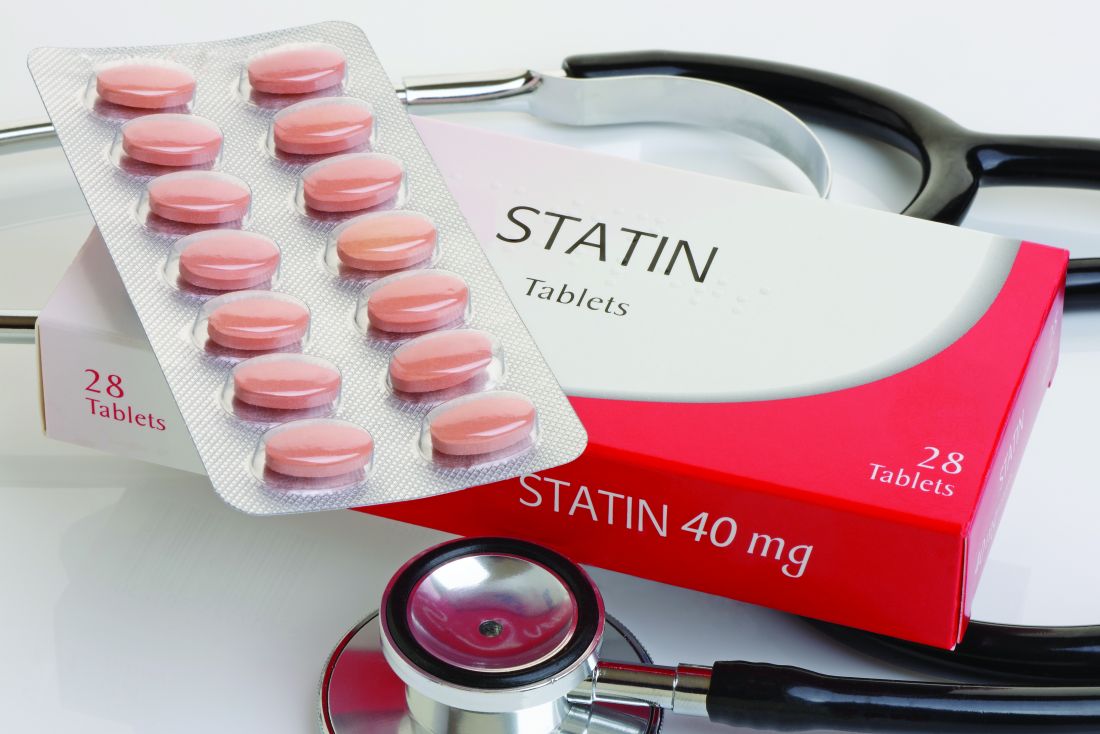
The FDA Adverse Event Reporting System database Quarterly Data Files (Q1 2004 to Q3 2017) published by the FDA (downloaded in February 2018) was used to evaluate the adverse events associated with statin therapy. Among the seven statins looked at in this study, atorvastatin and rosuvastatin contributed to both the most cases of musculoskeletal adverse events and also to some of the shortest times to onset; atorvastatin was associated with 454 cases and a median time to onset of 24.5 days, and rosuvastatin was associated with 413 cases and a median time to onset of 30 days. Simvastatin also contributed to a large number of cases (409), but the median time to onset was significantly faster with the other two statins according to a Steel-Dwass test.
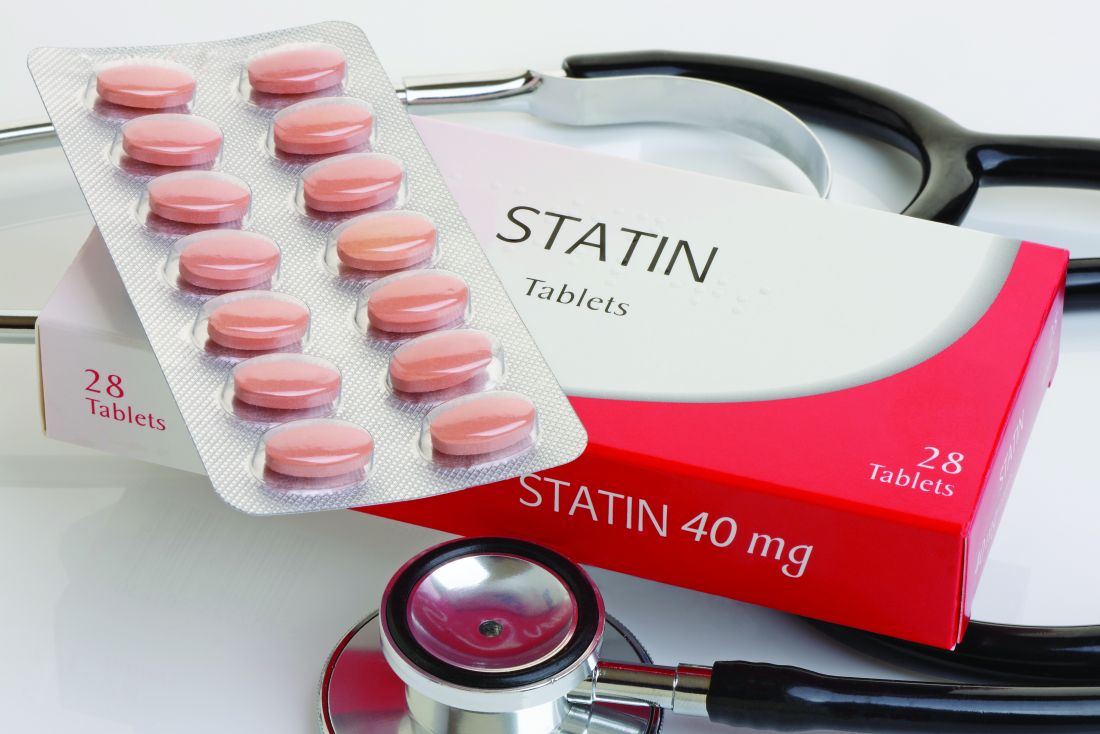
The study also looked at whether and how much concomitant use of nonstatin drugs affected time to onset, but it found that none of the drugs evaluated in the study had an effect on time to onset.
Read more about this study in Pharmacology Research & Perspectives.
The FDA Adverse Event Reporting System database Quarterly Data Files (Q1 2004 to Q3 2017) published by the FDA (downloaded in February 2018) was used to evaluate the adverse events associated with statin therapy. Among the seven statins looked at in this study, atorvastatin and rosuvastatin contributed to both the most cases of musculoskeletal adverse events and also to some of the shortest times to onset; atorvastatin was associated with 454 cases and a median time to onset of 24.5 days, and rosuvastatin was associated with 413 cases and a median time to onset of 30 days. Simvastatin also contributed to a large number of cases (409), but the median time to onset was significantly faster with the other two statins according to a Steel-Dwass test.
The study also looked at whether and how much concomitant use of nonstatin drugs affected time to onset, but it found that none of the drugs evaluated in the study had an effect on time to onset.
Read more about this study in Pharmacology Research & Perspectives.
The FDA Adverse Event Reporting System database Quarterly Data Files (Q1 2004 to Q3 2017) published by the FDA (downloaded in February 2018) was used to evaluate the adverse events associated with statin therapy. Among the seven statins looked at in this study, atorvastatin and rosuvastatin contributed to both the most cases of musculoskeletal adverse events and also to some of the shortest times to onset; atorvastatin was associated with 454 cases and a median time to onset of 24.5 days, and rosuvastatin was associated with 413 cases and a median time to onset of 30 days. Simvastatin also contributed to a large number of cases (409), but the median time to onset was significantly faster with the other two statins according to a Steel-Dwass test.
The study also looked at whether and how much concomitant use of nonstatin drugs affected time to onset, but it found that none of the drugs evaluated in the study had an effect on time to onset.
Read more about this study in Pharmacology Research & Perspectives.
FROM PHARMACOLOGY RESEARCH & PERSPECTIVES
Portable hematology analyzer gets FDA nod
The Food and Drug Administration has granted .

HemoScreen requires a single drop of blood and uses disposable cartridges that provide automatic sample preparation.
HemoScreen can analyze 20 standard complete blood count parameters and produces results within 5 minutes.
Study results suggested that HemoScreen provides results comparable to those of another hematology analyzer, Sysmex XE-2100 (J Clin Pathol. 2016 Aug;69[8]:720-5).
“The HemoScreen delivers lab accurate results,” Avishay Bransky, PhD, CEO of PixCell, said in a statement.
HemoScreen “would be especially useful” in physicians’ offices, emergency rooms, intensive care units, oncology clinics, and remote locations, he added.
HemoScreen makes use of a technology called viscoelastic focusing, which employs microfluidics and machine vision algorithms to analyze cells.
The Food and Drug Administration has granted .
HemoScreen requires a single drop of blood and uses disposable cartridges that provide automatic sample preparation.
HemoScreen can analyze 20 standard complete blood count parameters and produces results within 5 minutes.
Study results suggested that HemoScreen provides results comparable to those of another hematology analyzer, Sysmex XE-2100 (J Clin Pathol. 2016 Aug;69[8]:720-5).
“The HemoScreen delivers lab accurate results,” Avishay Bransky, PhD, CEO of PixCell, said in a statement.
HemoScreen “would be especially useful” in physicians’ offices, emergency rooms, intensive care units, oncology clinics, and remote locations, he added.
HemoScreen makes use of a technology called viscoelastic focusing, which employs microfluidics and machine vision algorithms to analyze cells.
The Food and Drug Administration has granted .
HemoScreen requires a single drop of blood and uses disposable cartridges that provide automatic sample preparation.
HemoScreen can analyze 20 standard complete blood count parameters and produces results within 5 minutes.
Study results suggested that HemoScreen provides results comparable to those of another hematology analyzer, Sysmex XE-2100 (J Clin Pathol. 2016 Aug;69[8]:720-5).
“The HemoScreen delivers lab accurate results,” Avishay Bransky, PhD, CEO of PixCell, said in a statement.
HemoScreen “would be especially useful” in physicians’ offices, emergency rooms, intensive care units, oncology clinics, and remote locations, he added.
HemoScreen makes use of a technology called viscoelastic focusing, which employs microfluidics and machine vision algorithms to analyze cells.