User login
Taxanes followed by PLD show promise in metastatic BC under real-world settings
Key clinical point: First-line treatment with taxanes followed by pegylated liposomal doxorubicin (PLD) was associated with improved prognostic outcomes in patients with human epidermal growth factor receptor 2-negative (HER2−) metastatic breast cancer (BC) than with PLD followed by taxanes.
Major finding: First-line taxane followed by PLD vs first-line PLD followed by taxane significantly improved time to next chemotherapy (9.9 vs 4.9 months; P = .006) and progression-free survival outcomes (9.0 vs 4.4 months; P = .005).
Study details: Findings are from a retrospective study including 42 patients with HER2− metastatic BC who received first-line PLD and later taxane (n = 23) or first-line taxane and later PLD (n = 19).
Disclosures: This study did not receive any specific grants. The authors declared no conflicts of interest.
Source: Wallrabenstein T et al. Upfront taxane could be superior to pegylated liposomal doxorubicin (PLD): A retrospective real-world analysis of treatment sequence taxane-PLD versus PLD-taxane in patients with metastatic breast cancer. Cancers (Basel). 2023;15(20):4953 (Oct 12). doi: 10.3390/cancers15204953
Key clinical point: First-line treatment with taxanes followed by pegylated liposomal doxorubicin (PLD) was associated with improved prognostic outcomes in patients with human epidermal growth factor receptor 2-negative (HER2−) metastatic breast cancer (BC) than with PLD followed by taxanes.
Major finding: First-line taxane followed by PLD vs first-line PLD followed by taxane significantly improved time to next chemotherapy (9.9 vs 4.9 months; P = .006) and progression-free survival outcomes (9.0 vs 4.4 months; P = .005).
Study details: Findings are from a retrospective study including 42 patients with HER2− metastatic BC who received first-line PLD and later taxane (n = 23) or first-line taxane and later PLD (n = 19).
Disclosures: This study did not receive any specific grants. The authors declared no conflicts of interest.
Source: Wallrabenstein T et al. Upfront taxane could be superior to pegylated liposomal doxorubicin (PLD): A retrospective real-world analysis of treatment sequence taxane-PLD versus PLD-taxane in patients with metastatic breast cancer. Cancers (Basel). 2023;15(20):4953 (Oct 12). doi: 10.3390/cancers15204953
Key clinical point: First-line treatment with taxanes followed by pegylated liposomal doxorubicin (PLD) was associated with improved prognostic outcomes in patients with human epidermal growth factor receptor 2-negative (HER2−) metastatic breast cancer (BC) than with PLD followed by taxanes.
Major finding: First-line taxane followed by PLD vs first-line PLD followed by taxane significantly improved time to next chemotherapy (9.9 vs 4.9 months; P = .006) and progression-free survival outcomes (9.0 vs 4.4 months; P = .005).
Study details: Findings are from a retrospective study including 42 patients with HER2− metastatic BC who received first-line PLD and later taxane (n = 23) or first-line taxane and later PLD (n = 19).
Disclosures: This study did not receive any specific grants. The authors declared no conflicts of interest.
Source: Wallrabenstein T et al. Upfront taxane could be superior to pegylated liposomal doxorubicin (PLD): A retrospective real-world analysis of treatment sequence taxane-PLD versus PLD-taxane in patients with metastatic breast cancer. Cancers (Basel). 2023;15(20):4953 (Oct 12). doi: 10.3390/cancers15204953
Better efficacy-safety with 3-week vs 4-week nab-paclitaxel in HER2− metastatic BC
Key clinical point: A 3-week vs 4-week nab-paclitaxel schedule showed more effective anti-tumor activity and a more manageable safety profile in patients with human epidermal growth factor receptor 2-negative (HER2−) metastatic breast cancer (BC).
Major finding: Compared with a 4-week paclitaxel regimen, a 3-week regimen led to a 56% improvement in progression-free survival outcomes (hazard ratio 0.44; P = .029) and was associated with a lower rate of grade ≥ 3 adverse events (14.9% vs 42.6%).
Study details: Findings are from a phase 2 study including 94 patients with HER2− metastatic BC who were randomly assigned to receive nab-paclitaxel for either a 3-week or 4-week schedule.
Disclosures: This study was sponsored by CSPC Ouyi Pharmaceutical Co., Ltd, China. The authors declared no conflicts of interest.
Source: Liu Y et al. Three-week versus 4-week schedule of nab-paclitaxel in patients with metastatic breast cancer: A randomized phase II study. Oncologist. 2023 (Oct 26). doi: 10.1093/oncolo/oyad288
Key clinical point: A 3-week vs 4-week nab-paclitaxel schedule showed more effective anti-tumor activity and a more manageable safety profile in patients with human epidermal growth factor receptor 2-negative (HER2−) metastatic breast cancer (BC).
Major finding: Compared with a 4-week paclitaxel regimen, a 3-week regimen led to a 56% improvement in progression-free survival outcomes (hazard ratio 0.44; P = .029) and was associated with a lower rate of grade ≥ 3 adverse events (14.9% vs 42.6%).
Study details: Findings are from a phase 2 study including 94 patients with HER2− metastatic BC who were randomly assigned to receive nab-paclitaxel for either a 3-week or 4-week schedule.
Disclosures: This study was sponsored by CSPC Ouyi Pharmaceutical Co., Ltd, China. The authors declared no conflicts of interest.
Source: Liu Y et al. Three-week versus 4-week schedule of nab-paclitaxel in patients with metastatic breast cancer: A randomized phase II study. Oncologist. 2023 (Oct 26). doi: 10.1093/oncolo/oyad288
Key clinical point: A 3-week vs 4-week nab-paclitaxel schedule showed more effective anti-tumor activity and a more manageable safety profile in patients with human epidermal growth factor receptor 2-negative (HER2−) metastatic breast cancer (BC).
Major finding: Compared with a 4-week paclitaxel regimen, a 3-week regimen led to a 56% improvement in progression-free survival outcomes (hazard ratio 0.44; P = .029) and was associated with a lower rate of grade ≥ 3 adverse events (14.9% vs 42.6%).
Study details: Findings are from a phase 2 study including 94 patients with HER2− metastatic BC who were randomly assigned to receive nab-paclitaxel for either a 3-week or 4-week schedule.
Disclosures: This study was sponsored by CSPC Ouyi Pharmaceutical Co., Ltd, China. The authors declared no conflicts of interest.
Source: Liu Y et al. Three-week versus 4-week schedule of nab-paclitaxel in patients with metastatic breast cancer: A randomized phase II study. Oncologist. 2023 (Oct 26). doi: 10.1093/oncolo/oyad288
MRI as effective as MRI+mammography for BC screening in women with dense breasts
Key clinical point: In women with dense breasts, who are generally at an intermediate risk for breast cancer (BC), screening with magnetic resonance imaging (MRI) alone or with mammography increased the rates of screen-detected early-stage cancer and false-positive recalls compared with mammography alone.
Major finding: The rate of screen-detected early-stage cancer in women with dense breasts was higher with MRI alone vs MRI + mammography (difference 11.7/1000 examinations; 95% CI 4.6-18.8/1000 examinations) and MR + mammography vs mammography alone (difference 4.0/1000 examinations; 95% CI 1.4-6.7/1000 examinations); however, false-positive recall rates were higher with MRI + mammography vs mammography alone (difference 149.8/1000 examinations; 95% CI 135.7-163.9/1000 examinations) and comparable with both MRI and MRI + mammography.
Study details: This cohort study analyzed the data of women aged 40-79 years who had undergone screening with MRI (2611 screenings), MRI + mammography (6518 screenings), or mammography (65,180 screenings) from the Breast Cancer Surveillance Consortium registry.
Disclosures: This study was funded by the US Patient-Centered Outcomes Research Institute award and other sources. The authors declared no conflicts of interest.
Source: Kerlikowske K et al. Supplemental magnetic resonance imaging plus mammography compared with magnetic resonance imaging or mammography by extent of breast density. J Natl Cancer Inst. 2023 (Oct 27). doi: 10.1093/jnci/djad201
Key clinical point: In women with dense breasts, who are generally at an intermediate risk for breast cancer (BC), screening with magnetic resonance imaging (MRI) alone or with mammography increased the rates of screen-detected early-stage cancer and false-positive recalls compared with mammography alone.
Major finding: The rate of screen-detected early-stage cancer in women with dense breasts was higher with MRI alone vs MRI + mammography (difference 11.7/1000 examinations; 95% CI 4.6-18.8/1000 examinations) and MR + mammography vs mammography alone (difference 4.0/1000 examinations; 95% CI 1.4-6.7/1000 examinations); however, false-positive recall rates were higher with MRI + mammography vs mammography alone (difference 149.8/1000 examinations; 95% CI 135.7-163.9/1000 examinations) and comparable with both MRI and MRI + mammography.
Study details: This cohort study analyzed the data of women aged 40-79 years who had undergone screening with MRI (2611 screenings), MRI + mammography (6518 screenings), or mammography (65,180 screenings) from the Breast Cancer Surveillance Consortium registry.
Disclosures: This study was funded by the US Patient-Centered Outcomes Research Institute award and other sources. The authors declared no conflicts of interest.
Source: Kerlikowske K et al. Supplemental magnetic resonance imaging plus mammography compared with magnetic resonance imaging or mammography by extent of breast density. J Natl Cancer Inst. 2023 (Oct 27). doi: 10.1093/jnci/djad201
Key clinical point: In women with dense breasts, who are generally at an intermediate risk for breast cancer (BC), screening with magnetic resonance imaging (MRI) alone or with mammography increased the rates of screen-detected early-stage cancer and false-positive recalls compared with mammography alone.
Major finding: The rate of screen-detected early-stage cancer in women with dense breasts was higher with MRI alone vs MRI + mammography (difference 11.7/1000 examinations; 95% CI 4.6-18.8/1000 examinations) and MR + mammography vs mammography alone (difference 4.0/1000 examinations; 95% CI 1.4-6.7/1000 examinations); however, false-positive recall rates were higher with MRI + mammography vs mammography alone (difference 149.8/1000 examinations; 95% CI 135.7-163.9/1000 examinations) and comparable with both MRI and MRI + mammography.
Study details: This cohort study analyzed the data of women aged 40-79 years who had undergone screening with MRI (2611 screenings), MRI + mammography (6518 screenings), or mammography (65,180 screenings) from the Breast Cancer Surveillance Consortium registry.
Disclosures: This study was funded by the US Patient-Centered Outcomes Research Institute award and other sources. The authors declared no conflicts of interest.
Source: Kerlikowske K et al. Supplemental magnetic resonance imaging plus mammography compared with magnetic resonance imaging or mammography by extent of breast density. J Natl Cancer Inst. 2023 (Oct 27). doi: 10.1093/jnci/djad201
Prognosis remains poor in inflammatory BC despite neoadjuvant chemotherapy
Key clinical point: Despite treatment with neoadjuvant chemotherapy (NAC), patients with locally advanced inflammatory breast cancer (BC) showed poorer survival outcomes than those with noninflammatory BC.
Major finding: Patients with inflammatory vs noninflammatory locally advanced BC who received NAC had significantly lower rates of 5-year overall survival (58.9% vs 86.7%; P = .00005), relapse-free survival (53.0% vs 80.3%; P = .0001), and distant relapse-free survival (53.3% vs 80.9%; P = .0001).
Study details: This retrospective analysis included 84 patients with stage III inflammatory BC and 81 matched-control individuals with stage III noninflammatory BC, all of whom received neoadjuvant chemotherapy.
Disclosures: This study did not receive any specific funding. KU Park declared being a consultant with Bayer LLC. The other authors declared no conflicts of interest.
Source: Johnson KCC et al. Survival outcomes seen with neoadjuvant chemotherapy in the management of locally advanced inflammatory breast cancer (IBC) versus matched controls. Breast. 2023;72:103591 (Oct 13). doi: 10.1016/j.breast.2023.103591
Key clinical point: Despite treatment with neoadjuvant chemotherapy (NAC), patients with locally advanced inflammatory breast cancer (BC) showed poorer survival outcomes than those with noninflammatory BC.
Major finding: Patients with inflammatory vs noninflammatory locally advanced BC who received NAC had significantly lower rates of 5-year overall survival (58.9% vs 86.7%; P = .00005), relapse-free survival (53.0% vs 80.3%; P = .0001), and distant relapse-free survival (53.3% vs 80.9%; P = .0001).
Study details: This retrospective analysis included 84 patients with stage III inflammatory BC and 81 matched-control individuals with stage III noninflammatory BC, all of whom received neoadjuvant chemotherapy.
Disclosures: This study did not receive any specific funding. KU Park declared being a consultant with Bayer LLC. The other authors declared no conflicts of interest.
Source: Johnson KCC et al. Survival outcomes seen with neoadjuvant chemotherapy in the management of locally advanced inflammatory breast cancer (IBC) versus matched controls. Breast. 2023;72:103591 (Oct 13). doi: 10.1016/j.breast.2023.103591
Key clinical point: Despite treatment with neoadjuvant chemotherapy (NAC), patients with locally advanced inflammatory breast cancer (BC) showed poorer survival outcomes than those with noninflammatory BC.
Major finding: Patients with inflammatory vs noninflammatory locally advanced BC who received NAC had significantly lower rates of 5-year overall survival (58.9% vs 86.7%; P = .00005), relapse-free survival (53.0% vs 80.3%; P = .0001), and distant relapse-free survival (53.3% vs 80.9%; P = .0001).
Study details: This retrospective analysis included 84 patients with stage III inflammatory BC and 81 matched-control individuals with stage III noninflammatory BC, all of whom received neoadjuvant chemotherapy.
Disclosures: This study did not receive any specific funding. KU Park declared being a consultant with Bayer LLC. The other authors declared no conflicts of interest.
Source: Johnson KCC et al. Survival outcomes seen with neoadjuvant chemotherapy in the management of locally advanced inflammatory breast cancer (IBC) versus matched controls. Breast. 2023;72:103591 (Oct 13). doi: 10.1016/j.breast.2023.103591
Oral SERD improve PFS in ER+/HER2− metastatic BC, shows meta-analysis
Key clinical point: Oral selective estrogen receptor degraders (SERD) improved the progression-free survival (PFS) outcomes in patients with estrogen receptor-positive (ER+) human epidermal growth factor receptor 2-negative (HER2−) metastatic breast cancer (BC), particularly in those with ESR1 mutations.
Major finding: Compared with endocrine therapies (ET) of the physician’s choice, oral SERD led to a greater improvement in PFS outcomes in the overall population (hazard ratio [HR] 0.783; P < .001) and in the subgroup of patients with ESR1 mutations (HR 0.557; P < .001); however, no PFS benefit was observed in the ESR1 wild-type subgroup (P = .543).
Study details: Findings are from a meta-analysis of individual patient data from four randomized clinical trials including 1290 patients with ER+/HER2− metastatic BC who received oral SERD or ET of physician’s choice.
Disclosures: This study did not receive any specific funding. Some authors declared receiving honoraria, research funding, or travel grants from or serving in advisory or consulting roles for various sources.
Source: Wong NZH et al. Efficacy of oral SERDs in the treatment of ER+, HER2 - metastatic breast cancer, a stratified analysis of the ESR1 wild type and mutant subgroups. Ann Oncol. 2023 (Oct 21). doi: 10.1016/j.annonc.2023.10.122
Key clinical point: Oral selective estrogen receptor degraders (SERD) improved the progression-free survival (PFS) outcomes in patients with estrogen receptor-positive (ER+) human epidermal growth factor receptor 2-negative (HER2−) metastatic breast cancer (BC), particularly in those with ESR1 mutations.
Major finding: Compared with endocrine therapies (ET) of the physician’s choice, oral SERD led to a greater improvement in PFS outcomes in the overall population (hazard ratio [HR] 0.783; P < .001) and in the subgroup of patients with ESR1 mutations (HR 0.557; P < .001); however, no PFS benefit was observed in the ESR1 wild-type subgroup (P = .543).
Study details: Findings are from a meta-analysis of individual patient data from four randomized clinical trials including 1290 patients with ER+/HER2− metastatic BC who received oral SERD or ET of physician’s choice.
Disclosures: This study did not receive any specific funding. Some authors declared receiving honoraria, research funding, or travel grants from or serving in advisory or consulting roles for various sources.
Source: Wong NZH et al. Efficacy of oral SERDs in the treatment of ER+, HER2 - metastatic breast cancer, a stratified analysis of the ESR1 wild type and mutant subgroups. Ann Oncol. 2023 (Oct 21). doi: 10.1016/j.annonc.2023.10.122
Key clinical point: Oral selective estrogen receptor degraders (SERD) improved the progression-free survival (PFS) outcomes in patients with estrogen receptor-positive (ER+) human epidermal growth factor receptor 2-negative (HER2−) metastatic breast cancer (BC), particularly in those with ESR1 mutations.
Major finding: Compared with endocrine therapies (ET) of the physician’s choice, oral SERD led to a greater improvement in PFS outcomes in the overall population (hazard ratio [HR] 0.783; P < .001) and in the subgroup of patients with ESR1 mutations (HR 0.557; P < .001); however, no PFS benefit was observed in the ESR1 wild-type subgroup (P = .543).
Study details: Findings are from a meta-analysis of individual patient data from four randomized clinical trials including 1290 patients with ER+/HER2− metastatic BC who received oral SERD or ET of physician’s choice.
Disclosures: This study did not receive any specific funding. Some authors declared receiving honoraria, research funding, or travel grants from or serving in advisory or consulting roles for various sources.
Source: Wong NZH et al. Efficacy of oral SERDs in the treatment of ER+, HER2 - metastatic breast cancer, a stratified analysis of the ESR1 wild type and mutant subgroups. Ann Oncol. 2023 (Oct 21). doi: 10.1016/j.annonc.2023.10.122
Neoadjuvant camrelizumab plus chemo shows promising efficacy and safety in early TNBC
Key clinical point: Neoadjuvant immunotherapy with camrelizumab plus chemotherapy with nab-paclitaxel and epirubicin showed promising anti-tumor activity and a manageable safety profile in patients with early triple-negative breast cancer (TNBC).
Major finding: The majority of patients achieved a pathological complete response rate (64.1%; 95% CI 47.2%-78.8%) and an objective response rate (89.7%; 95% CI 74.8%-96.7%). Decreased white blood cell (56.4%), neutropenia (41.0%), and anemia (20.5%) were the most common grade 3 or 4 adverse events, and no treatment-related deaths were reported.
Study details: This phase 2 trial included 39 treatment-naive patients with early TNBC who received neoadjuvant camrelizumab, nab-paclitaxel, and epirubicin every 3 weeks for 6 cycles.
Disclosures: This study was supported by Jiangsu Hengrui Pharmaceuticals Co., Ltd, China. The authors declared no conflicts of interest.
Source: Wang C et al. Neoadjuvant camrelizumab plus nab-paclitaxel and epirubicin in early triple-negative breast cancer: A single-arm phase II trial. Nat Commun. 2023;14:6654 (Oct 20). doi: 10.1038/s41467-023-42479-w
Key clinical point: Neoadjuvant immunotherapy with camrelizumab plus chemotherapy with nab-paclitaxel and epirubicin showed promising anti-tumor activity and a manageable safety profile in patients with early triple-negative breast cancer (TNBC).
Major finding: The majority of patients achieved a pathological complete response rate (64.1%; 95% CI 47.2%-78.8%) and an objective response rate (89.7%; 95% CI 74.8%-96.7%). Decreased white blood cell (56.4%), neutropenia (41.0%), and anemia (20.5%) were the most common grade 3 or 4 adverse events, and no treatment-related deaths were reported.
Study details: This phase 2 trial included 39 treatment-naive patients with early TNBC who received neoadjuvant camrelizumab, nab-paclitaxel, and epirubicin every 3 weeks for 6 cycles.
Disclosures: This study was supported by Jiangsu Hengrui Pharmaceuticals Co., Ltd, China. The authors declared no conflicts of interest.
Source: Wang C et al. Neoadjuvant camrelizumab plus nab-paclitaxel and epirubicin in early triple-negative breast cancer: A single-arm phase II trial. Nat Commun. 2023;14:6654 (Oct 20). doi: 10.1038/s41467-023-42479-w
Key clinical point: Neoadjuvant immunotherapy with camrelizumab plus chemotherapy with nab-paclitaxel and epirubicin showed promising anti-tumor activity and a manageable safety profile in patients with early triple-negative breast cancer (TNBC).
Major finding: The majority of patients achieved a pathological complete response rate (64.1%; 95% CI 47.2%-78.8%) and an objective response rate (89.7%; 95% CI 74.8%-96.7%). Decreased white blood cell (56.4%), neutropenia (41.0%), and anemia (20.5%) were the most common grade 3 or 4 adverse events, and no treatment-related deaths were reported.
Study details: This phase 2 trial included 39 treatment-naive patients with early TNBC who received neoadjuvant camrelizumab, nab-paclitaxel, and epirubicin every 3 weeks for 6 cycles.
Disclosures: This study was supported by Jiangsu Hengrui Pharmaceuticals Co., Ltd, China. The authors declared no conflicts of interest.
Source: Wang C et al. Neoadjuvant camrelizumab plus nab-paclitaxel and epirubicin in early triple-negative breast cancer: A single-arm phase II trial. Nat Commun. 2023;14:6654 (Oct 20). doi: 10.1038/s41467-023-42479-w
Worsened long-term survival in premenopausal women with invasive lobular carcinoma
Key clinical point: Premenopausal women with invasive lobular carcinoma (ILC) vs invasive ductal carcinoma (IDC) had better breast cancer-specific survival (BCSS) outcomes within 10 years after disease diagnosis, but the prognosis worsened in the long run.
Major finding: In the Surveillance, Epidemiology, and End Results (SEER) database, patients with ILC vs IDC showed improved BCSS outcomes during the first 10 years after diagnosis (hazard ratio [HR] 0.73; P < .001); however, after 10 years, the trend reversed and BCSS outcomes worsened by 80% in patients with ILC (HR 1.80; P < .001). ILC was also associated with worsened long-term prognosis in patients from the Korean Breast Cancer Registry and Asan Medical Center Research database.
Study details: This retrospective cohort study analyzed the data from three databases and included 225,938 premenopausal women (age < 50 years) with stages I-III ILC or IDC.
Disclosures: This study was supported by a grant from the Korea Health Technology R&D Project. O Metzger declared receiving grant funding and personal fees from various sources.
Source: Yoon TI et al. Survival outcomes in premenopausal patients with invasive lobular carcinoma. JAMA Netw Open. 2023;6(11):e2342270 (Nov 8). doi: 10.1001/jamanetworkopen.2023.42270
Key clinical point: Premenopausal women with invasive lobular carcinoma (ILC) vs invasive ductal carcinoma (IDC) had better breast cancer-specific survival (BCSS) outcomes within 10 years after disease diagnosis, but the prognosis worsened in the long run.
Major finding: In the Surveillance, Epidemiology, and End Results (SEER) database, patients with ILC vs IDC showed improved BCSS outcomes during the first 10 years after diagnosis (hazard ratio [HR] 0.73; P < .001); however, after 10 years, the trend reversed and BCSS outcomes worsened by 80% in patients with ILC (HR 1.80; P < .001). ILC was also associated with worsened long-term prognosis in patients from the Korean Breast Cancer Registry and Asan Medical Center Research database.
Study details: This retrospective cohort study analyzed the data from three databases and included 225,938 premenopausal women (age < 50 years) with stages I-III ILC or IDC.
Disclosures: This study was supported by a grant from the Korea Health Technology R&D Project. O Metzger declared receiving grant funding and personal fees from various sources.
Source: Yoon TI et al. Survival outcomes in premenopausal patients with invasive lobular carcinoma. JAMA Netw Open. 2023;6(11):e2342270 (Nov 8). doi: 10.1001/jamanetworkopen.2023.42270
Key clinical point: Premenopausal women with invasive lobular carcinoma (ILC) vs invasive ductal carcinoma (IDC) had better breast cancer-specific survival (BCSS) outcomes within 10 years after disease diagnosis, but the prognosis worsened in the long run.
Major finding: In the Surveillance, Epidemiology, and End Results (SEER) database, patients with ILC vs IDC showed improved BCSS outcomes during the first 10 years after diagnosis (hazard ratio [HR] 0.73; P < .001); however, after 10 years, the trend reversed and BCSS outcomes worsened by 80% in patients with ILC (HR 1.80; P < .001). ILC was also associated with worsened long-term prognosis in patients from the Korean Breast Cancer Registry and Asan Medical Center Research database.
Study details: This retrospective cohort study analyzed the data from three databases and included 225,938 premenopausal women (age < 50 years) with stages I-III ILC or IDC.
Disclosures: This study was supported by a grant from the Korea Health Technology R&D Project. O Metzger declared receiving grant funding and personal fees from various sources.
Source: Yoon TI et al. Survival outcomes in premenopausal patients with invasive lobular carcinoma. JAMA Netw Open. 2023;6(11):e2342270 (Nov 8). doi: 10.1001/jamanetworkopen.2023.42270
Vaginal estrogen therapy may be prescribed in BC patients with genitourinary symptoms
Key clinical point: Vaginal estrogen therapy did not worsen mortality outcomes in patients with breast cancer (BC) and genitourinary symptoms and can be considered if nonhormonal treatments prove unsuccessful.
Major finding: BC-specific mortality was not worsened in patients with BC who received vaginal estrogen therapy vs no hormone replacement therapy (hazard ratio 0.77; 95% CI 0.63-0.94).
Study details: Findings are from an analysis of two large cohorts including 49,237 females with BC, of which 5% of females used vaginal estrogen therapy after BC diagnosis.
Disclosures: This study was supported by grants from Cancer Research UK. Some authors declared receiving grants, personal fees, or nonfinancial support from and having other ties with several sources.
Source: McVicker L et al. Vaginal estrogen therapy use and survival in females with breast cancer. JAMA Oncol. 2023 (Nov 2). doi: 10.1001/jamaoncol.2023.4508
Key clinical point: Vaginal estrogen therapy did not worsen mortality outcomes in patients with breast cancer (BC) and genitourinary symptoms and can be considered if nonhormonal treatments prove unsuccessful.
Major finding: BC-specific mortality was not worsened in patients with BC who received vaginal estrogen therapy vs no hormone replacement therapy (hazard ratio 0.77; 95% CI 0.63-0.94).
Study details: Findings are from an analysis of two large cohorts including 49,237 females with BC, of which 5% of females used vaginal estrogen therapy after BC diagnosis.
Disclosures: This study was supported by grants from Cancer Research UK. Some authors declared receiving grants, personal fees, or nonfinancial support from and having other ties with several sources.
Source: McVicker L et al. Vaginal estrogen therapy use and survival in females with breast cancer. JAMA Oncol. 2023 (Nov 2). doi: 10.1001/jamaoncol.2023.4508
Key clinical point: Vaginal estrogen therapy did not worsen mortality outcomes in patients with breast cancer (BC) and genitourinary symptoms and can be considered if nonhormonal treatments prove unsuccessful.
Major finding: BC-specific mortality was not worsened in patients with BC who received vaginal estrogen therapy vs no hormone replacement therapy (hazard ratio 0.77; 95% CI 0.63-0.94).
Study details: Findings are from an analysis of two large cohorts including 49,237 females with BC, of which 5% of females used vaginal estrogen therapy after BC diagnosis.
Disclosures: This study was supported by grants from Cancer Research UK. Some authors declared receiving grants, personal fees, or nonfinancial support from and having other ties with several sources.
Source: McVicker L et al. Vaginal estrogen therapy use and survival in females with breast cancer. JAMA Oncol. 2023 (Nov 2). doi: 10.1001/jamaoncol.2023.4508
Highlights in Early Breast Cancer From ESMO 2023
Developments in early breast cancer reported at the European Society for Medical Oncology (ESMO) 2023 Congress are discussed by Dr Lisa Carey of University of North Carolina, Chapel Hill.
Dr Carey begins with 5-year results from the KEYNOTE-522 study in patients with early triple-negative breast cancer in which the immune checkpoint inhibitor pembrolizumab was incorporated into combination therapy both pre- and postoperatively. The new findings were consistent with earlier results, showing that pembrolizumab improved pathologic complete response (pCR) and event-free survival.
Turning to human epidermal growth factor receptor 2–positive (HER2+) disease, Dr Carey discusses the PHERGain trial's use of a genomic assay to define risk and predict pCR. She suggests that such assays could lead to tailored therapy for HER2+ patients.
On estrogen receptor–positive (ER+)/HER2- disease, Dr Carey reports first on KEYNOTE-756, which examined the addition of pembrolizumab to combination therapy for high-risk patients in both the neoadjuvant and adjuvant settings. Pembrolizumab improved pCR compared with placebo.
Dr Carey closes by discussing another study in high-risk ER+/HER2- disease. Similar in design to KEYNOTE-756, CheckMate 7FL found that nivolumab added to combination therapy again augmented pCR results.
--
Lisa A. Carey, MD, Distinguished Professor or Breast Cancer Research, University of North Carolina Lineberger Comprehensive Cancer Center; Professor, Division of Medical Oncology, Bassnight North Carolina Cancer Hospital, Chapel Hill, North Carolina
Lisa A. Carey, MD, has disclosed no relevant financial relationships.
Developments in early breast cancer reported at the European Society for Medical Oncology (ESMO) 2023 Congress are discussed by Dr Lisa Carey of University of North Carolina, Chapel Hill.
Dr Carey begins with 5-year results from the KEYNOTE-522 study in patients with early triple-negative breast cancer in which the immune checkpoint inhibitor pembrolizumab was incorporated into combination therapy both pre- and postoperatively. The new findings were consistent with earlier results, showing that pembrolizumab improved pathologic complete response (pCR) and event-free survival.
Turning to human epidermal growth factor receptor 2–positive (HER2+) disease, Dr Carey discusses the PHERGain trial's use of a genomic assay to define risk and predict pCR. She suggests that such assays could lead to tailored therapy for HER2+ patients.
On estrogen receptor–positive (ER+)/HER2- disease, Dr Carey reports first on KEYNOTE-756, which examined the addition of pembrolizumab to combination therapy for high-risk patients in both the neoadjuvant and adjuvant settings. Pembrolizumab improved pCR compared with placebo.
Dr Carey closes by discussing another study in high-risk ER+/HER2- disease. Similar in design to KEYNOTE-756, CheckMate 7FL found that nivolumab added to combination therapy again augmented pCR results.
--
Lisa A. Carey, MD, Distinguished Professor or Breast Cancer Research, University of North Carolina Lineberger Comprehensive Cancer Center; Professor, Division of Medical Oncology, Bassnight North Carolina Cancer Hospital, Chapel Hill, North Carolina
Lisa A. Carey, MD, has disclosed no relevant financial relationships.
Developments in early breast cancer reported at the European Society for Medical Oncology (ESMO) 2023 Congress are discussed by Dr Lisa Carey of University of North Carolina, Chapel Hill.
Dr Carey begins with 5-year results from the KEYNOTE-522 study in patients with early triple-negative breast cancer in which the immune checkpoint inhibitor pembrolizumab was incorporated into combination therapy both pre- and postoperatively. The new findings were consistent with earlier results, showing that pembrolizumab improved pathologic complete response (pCR) and event-free survival.
Turning to human epidermal growth factor receptor 2–positive (HER2+) disease, Dr Carey discusses the PHERGain trial's use of a genomic assay to define risk and predict pCR. She suggests that such assays could lead to tailored therapy for HER2+ patients.
On estrogen receptor–positive (ER+)/HER2- disease, Dr Carey reports first on KEYNOTE-756, which examined the addition of pembrolizumab to combination therapy for high-risk patients in both the neoadjuvant and adjuvant settings. Pembrolizumab improved pCR compared with placebo.
Dr Carey closes by discussing another study in high-risk ER+/HER2- disease. Similar in design to KEYNOTE-756, CheckMate 7FL found that nivolumab added to combination therapy again augmented pCR results.
--
Lisa A. Carey, MD, Distinguished Professor or Breast Cancer Research, University of North Carolina Lineberger Comprehensive Cancer Center; Professor, Division of Medical Oncology, Bassnight North Carolina Cancer Hospital, Chapel Hill, North Carolina
Lisa A. Carey, MD, has disclosed no relevant financial relationships.

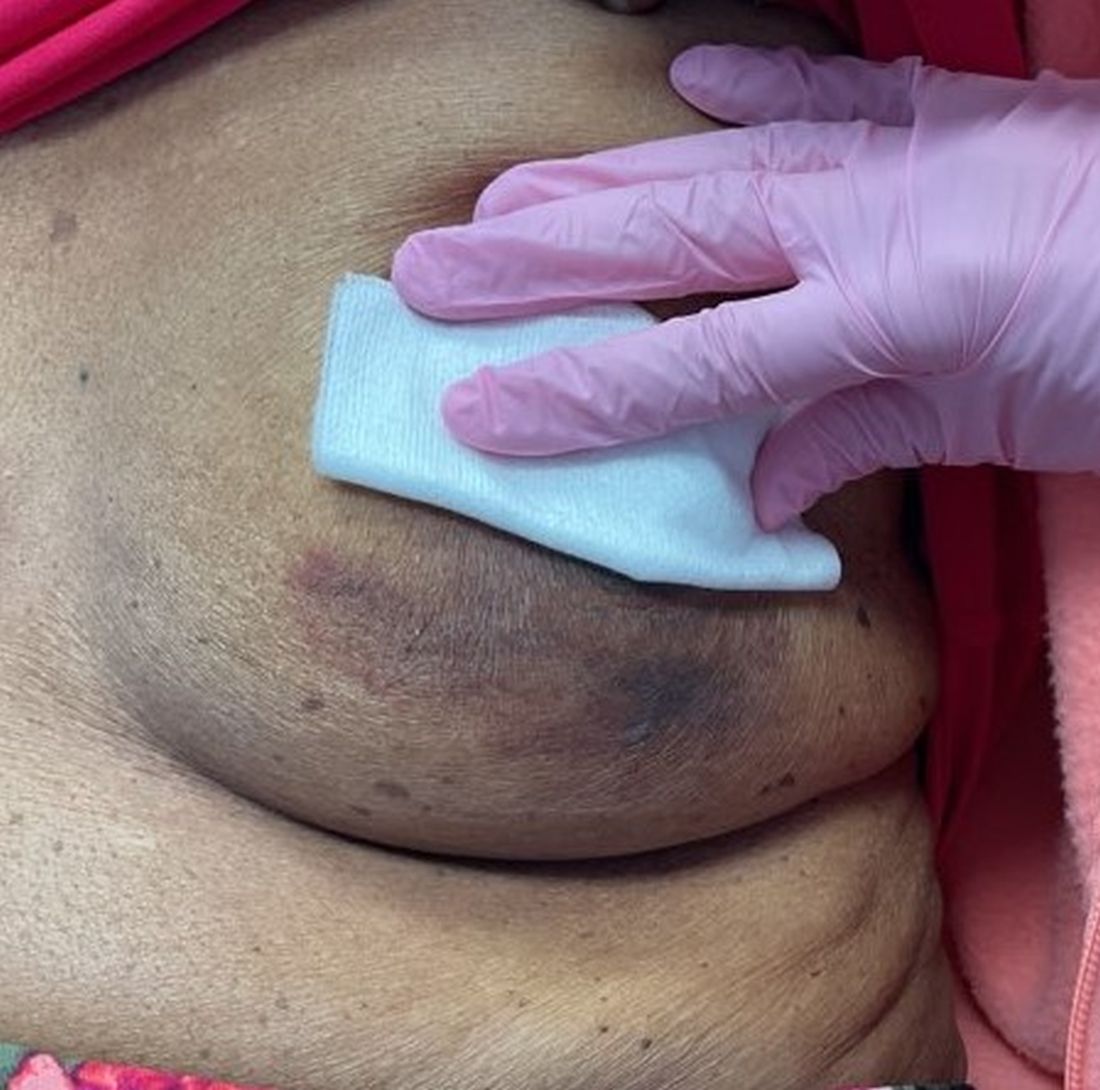
An 88-year-old Black woman presented with 3 months duration of asymptomatic, violaceous patches on the left breast
Angiosarcomas are uncommon, high-grade malignant tumors of endothelial cell origin that can arise via the lymphatics or vasculature. They typically occur spontaneously; however, there have been cases reported of benign vascular transformation. These tumors are more commonly found in elderly men on the head and neck in sun-damaged skin. . This is a late complication, typically occurring about 5-10 years after radiation. Stewart-Treves syndrome, chronic lymphedema occurring after breast cancer treatment with axillary node dissection, increases the risk of angiosarcoma. As a vascular tumor, angiosarcoma spreads hematogenously and carries a poor prognosis if not caught early. Differential diagnoses include other vascular tumors such as retiform hemangioendothelioma. In this specific patient, the differential diagnosis includes Paget’s disease, chronic radiation skin changes, and eczema.

Histopathologically, angiosarcomas exhibit abnormal, pleomorphic, malignant endothelial cells. As the tumor progresses, the cell architecture becomes more distorted and cells form layers with papillary projections into the vascular lumen. Malignant cells may stain positive for CD31, CD34, the oncogene ERG and the proto-oncogene FLI-1. Histology in this patient revealed radiation changes in the dermis, as well as few vascular channels lined by large endothelial cells with marked nuclear atypia, in the form of large nucleoli and variably coarse chromatin. The cells were positive for MYC.
Treatment of angiosarcoma involves a multidisciplinary approach. Resection with wide margins is generally the treatment of choice. However, recurrence is relatively common, which may be a result of microsatellite deposits of the tumor. Perioperative radiation is recommended, and adjuvant chemotherapy often is recommended for metastatic disease. Specifically, paclitaxel has been found to promote survival in some cases of cutaneous angiosarcoma. Metastatic disease may be treated with cytotoxic drugs such as anthracyclines and taxanes. Additionally, targeted therapy including anti-VEGF drugs and tyrosine kinase inhibitors have been tested.
The case and photo were submitted by Mr. Shapiro of Nova Southeastern University College of Osteopathic Medicine, Fort Lauderdale, Fla., and Dr. Bilu Martin. The column was edited by Dr. Bilu Martin.
Dr. Bilu Martin is a board-certified dermatologist in private practice at Premier Dermatology, MD, in Aventura, Fla. More diagnostic cases are available at mdedge.com/dermatology. To submit a case for possible publication, send an email to [email protected].
References
Cohen-Hallaleh RB et al. Clin Sarcoma Res. 2017 Aug 7:7:15.
Cozzi S et al. Rep Pract Oncol Radiother. 2021 Sep 30;26(5):827-32.
Spiker AM, Mangla A, Ramsey ML. Angiosarcoma. [Updated 2023 Jul 17]. In: StatPearls [Internet]. Treasure Island, Fla.: StatPearls Publishing; 2023 Jan-. Available from: www.ncbi.nlm.nih.gov/books/NBK441983/
Angiosarcomas are uncommon, high-grade malignant tumors of endothelial cell origin that can arise via the lymphatics or vasculature. They typically occur spontaneously; however, there have been cases reported of benign vascular transformation. These tumors are more commonly found in elderly men on the head and neck in sun-damaged skin. . This is a late complication, typically occurring about 5-10 years after radiation. Stewart-Treves syndrome, chronic lymphedema occurring after breast cancer treatment with axillary node dissection, increases the risk of angiosarcoma. As a vascular tumor, angiosarcoma spreads hematogenously and carries a poor prognosis if not caught early. Differential diagnoses include other vascular tumors such as retiform hemangioendothelioma. In this specific patient, the differential diagnosis includes Paget’s disease, chronic radiation skin changes, and eczema.
Histopathologically, angiosarcomas exhibit abnormal, pleomorphic, malignant endothelial cells. As the tumor progresses, the cell architecture becomes more distorted and cells form layers with papillary projections into the vascular lumen. Malignant cells may stain positive for CD31, CD34, the oncogene ERG and the proto-oncogene FLI-1. Histology in this patient revealed radiation changes in the dermis, as well as few vascular channels lined by large endothelial cells with marked nuclear atypia, in the form of large nucleoli and variably coarse chromatin. The cells were positive for MYC.
Treatment of angiosarcoma involves a multidisciplinary approach. Resection with wide margins is generally the treatment of choice. However, recurrence is relatively common, which may be a result of microsatellite deposits of the tumor. Perioperative radiation is recommended, and adjuvant chemotherapy often is recommended for metastatic disease. Specifically, paclitaxel has been found to promote survival in some cases of cutaneous angiosarcoma. Metastatic disease may be treated with cytotoxic drugs such as anthracyclines and taxanes. Additionally, targeted therapy including anti-VEGF drugs and tyrosine kinase inhibitors have been tested.
The case and photo were submitted by Mr. Shapiro of Nova Southeastern University College of Osteopathic Medicine, Fort Lauderdale, Fla., and Dr. Bilu Martin. The column was edited by Dr. Bilu Martin.
Dr. Bilu Martin is a board-certified dermatologist in private practice at Premier Dermatology, MD, in Aventura, Fla. More diagnostic cases are available at mdedge.com/dermatology. To submit a case for possible publication, send an email to [email protected].
References
Cohen-Hallaleh RB et al. Clin Sarcoma Res. 2017 Aug 7:7:15.
Cozzi S et al. Rep Pract Oncol Radiother. 2021 Sep 30;26(5):827-32.
Spiker AM, Mangla A, Ramsey ML. Angiosarcoma. [Updated 2023 Jul 17]. In: StatPearls [Internet]. Treasure Island, Fla.: StatPearls Publishing; 2023 Jan-. Available from: www.ncbi.nlm.nih.gov/books/NBK441983/
Angiosarcomas are uncommon, high-grade malignant tumors of endothelial cell origin that can arise via the lymphatics or vasculature. They typically occur spontaneously; however, there have been cases reported of benign vascular transformation. These tumors are more commonly found in elderly men on the head and neck in sun-damaged skin. . This is a late complication, typically occurring about 5-10 years after radiation. Stewart-Treves syndrome, chronic lymphedema occurring after breast cancer treatment with axillary node dissection, increases the risk of angiosarcoma. As a vascular tumor, angiosarcoma spreads hematogenously and carries a poor prognosis if not caught early. Differential diagnoses include other vascular tumors such as retiform hemangioendothelioma. In this specific patient, the differential diagnosis includes Paget’s disease, chronic radiation skin changes, and eczema.
Histopathologically, angiosarcomas exhibit abnormal, pleomorphic, malignant endothelial cells. As the tumor progresses, the cell architecture becomes more distorted and cells form layers with papillary projections into the vascular lumen. Malignant cells may stain positive for CD31, CD34, the oncogene ERG and the proto-oncogene FLI-1. Histology in this patient revealed radiation changes in the dermis, as well as few vascular channels lined by large endothelial cells with marked nuclear atypia, in the form of large nucleoli and variably coarse chromatin. The cells were positive for MYC.
Treatment of angiosarcoma involves a multidisciplinary approach. Resection with wide margins is generally the treatment of choice. However, recurrence is relatively common, which may be a result of microsatellite deposits of the tumor. Perioperative radiation is recommended, and adjuvant chemotherapy often is recommended for metastatic disease. Specifically, paclitaxel has been found to promote survival in some cases of cutaneous angiosarcoma. Metastatic disease may be treated with cytotoxic drugs such as anthracyclines and taxanes. Additionally, targeted therapy including anti-VEGF drugs and tyrosine kinase inhibitors have been tested.
The case and photo were submitted by Mr. Shapiro of Nova Southeastern University College of Osteopathic Medicine, Fort Lauderdale, Fla., and Dr. Bilu Martin. The column was edited by Dr. Bilu Martin.
Dr. Bilu Martin is a board-certified dermatologist in private practice at Premier Dermatology, MD, in Aventura, Fla. More diagnostic cases are available at mdedge.com/dermatology. To submit a case for possible publication, send an email to [email protected].
References
Cohen-Hallaleh RB et al. Clin Sarcoma Res. 2017 Aug 7:7:15.
Cozzi S et al. Rep Pract Oncol Radiother. 2021 Sep 30;26(5):827-32.
Spiker AM, Mangla A, Ramsey ML. Angiosarcoma. [Updated 2023 Jul 17]. In: StatPearls [Internet]. Treasure Island, Fla.: StatPearls Publishing; 2023 Jan-. Available from: www.ncbi.nlm.nih.gov/books/NBK441983/