User login
Pruritic rash on arms and legs
Atopic dermatitis (AD) is one of the most common chronic, inflammatory skin diseases encountered by dermatologists. AD is characterized by pruritus and a chronic course of exacerbations and remissions. AD is thought to involve the interplay of genetic predisposition, immune dysregulation, and environmental factors. It is also associated with other allergic conditions, including asthma.
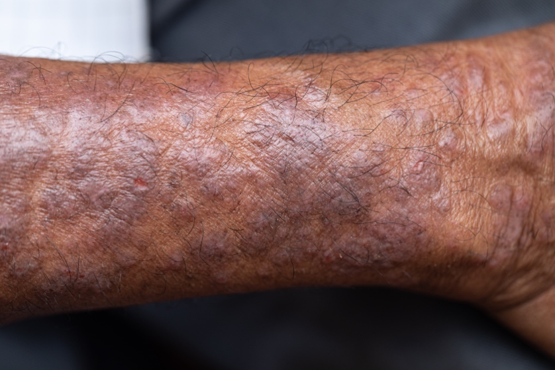
Although AD typically presents with pruritus as the hallmark symptom in all patients, the appearance of skin lesions may vary among different skin types. In individuals with light-colored skin, AD often appears as erythematous patches and plaques. It also more commonly affects the flexor surfaces of the skin. In individuals with darker skin tones, AD may more often result in follicularly centered papules, lichenification, and pigmentary changes. Lesions may also present on extensor surfaces rather than the typical flexure surfaces. Erythema in darker skin types may appear reddish-brown, have a violaceous hue, or be an ashen gray or darker brown color rather than bright red. Because erythema is more difficult to detect in darker skin types, clinicians may mistakenly minimize the severity of AD.
Clinical severity may also differ between ethnicities. Black patients have an increased tendency toward hyperlinearity of the palms, periorbital dark circles, Dennie-Morgan lines, and diffuse xerosis. Compared with White patients, Black patients with AD are also more likely to develop prurigo nodularis and lichenification. In contrast, Asian patients with AD often experience psoriasiform features, with lesions having more well-defined borders and increased scaling and lichenification.
Beyond differences in clinical appearance, AD may appear molecularly and histologically distinct in ethnic skin. One study suggests that Black patients with AD may have decreased Th1 and Th17 but share similar upregulation of Th2 and Th22 as seen in White patients. Another study showed that Asian patients may have higher Th17 and Th22 and lower Th1/interferon compared with White patients.
Regardless of skin type, treatment goals remain the same. Treatment goals aim to repair and improve the function of the skin barrier while preventing and managing flares. Clinical studies have shown that skincare regimens incorporating ceramide-containing moisturizers may improve AD by increasing the lipid content in the skin. This may offer clinical benefit in patients with skin of color. However, some treatments often used for AD may lead to other skin issues in skin in color. For example, long-term use of topical steroids may worsen hypopigmentation in darker skin types. Management strategies should take into account the unique clinical and genetic features of AD among different patient demographic groups.
William D. James, MD, Professor, Department of Dermatology, University of Pennsylvania, Philadelphia.
Disclosure: William D. James, MD, has disclosed the following relevant financial relationships:
Received income in an amount equal to or greater than $250 from: Elsevier.
Image Quizzes are fictional or fictionalized clinical scenarios intended to provide evidence-based educational takeaways.
Atopic dermatitis (AD) is one of the most common chronic, inflammatory skin diseases encountered by dermatologists. AD is characterized by pruritus and a chronic course of exacerbations and remissions. AD is thought to involve the interplay of genetic predisposition, immune dysregulation, and environmental factors. It is also associated with other allergic conditions, including asthma.
Although AD typically presents with pruritus as the hallmark symptom in all patients, the appearance of skin lesions may vary among different skin types. In individuals with light-colored skin, AD often appears as erythematous patches and plaques. It also more commonly affects the flexor surfaces of the skin. In individuals with darker skin tones, AD may more often result in follicularly centered papules, lichenification, and pigmentary changes. Lesions may also present on extensor surfaces rather than the typical flexure surfaces. Erythema in darker skin types may appear reddish-brown, have a violaceous hue, or be an ashen gray or darker brown color rather than bright red. Because erythema is more difficult to detect in darker skin types, clinicians may mistakenly minimize the severity of AD.
Clinical severity may also differ between ethnicities. Black patients have an increased tendency toward hyperlinearity of the palms, periorbital dark circles, Dennie-Morgan lines, and diffuse xerosis. Compared with White patients, Black patients with AD are also more likely to develop prurigo nodularis and lichenification. In contrast, Asian patients with AD often experience psoriasiform features, with lesions having more well-defined borders and increased scaling and lichenification.
Beyond differences in clinical appearance, AD may appear molecularly and histologically distinct in ethnic skin. One study suggests that Black patients with AD may have decreased Th1 and Th17 but share similar upregulation of Th2 and Th22 as seen in White patients. Another study showed that Asian patients may have higher Th17 and Th22 and lower Th1/interferon compared with White patients.
Regardless of skin type, treatment goals remain the same. Treatment goals aim to repair and improve the function of the skin barrier while preventing and managing flares. Clinical studies have shown that skincare regimens incorporating ceramide-containing moisturizers may improve AD by increasing the lipid content in the skin. This may offer clinical benefit in patients with skin of color. However, some treatments often used for AD may lead to other skin issues in skin in color. For example, long-term use of topical steroids may worsen hypopigmentation in darker skin types. Management strategies should take into account the unique clinical and genetic features of AD among different patient demographic groups.
William D. James, MD, Professor, Department of Dermatology, University of Pennsylvania, Philadelphia.
Disclosure: William D. James, MD, has disclosed the following relevant financial relationships:
Received income in an amount equal to or greater than $250 from: Elsevier.
Image Quizzes are fictional or fictionalized clinical scenarios intended to provide evidence-based educational takeaways.
Atopic dermatitis (AD) is one of the most common chronic, inflammatory skin diseases encountered by dermatologists. AD is characterized by pruritus and a chronic course of exacerbations and remissions. AD is thought to involve the interplay of genetic predisposition, immune dysregulation, and environmental factors. It is also associated with other allergic conditions, including asthma.
Although AD typically presents with pruritus as the hallmark symptom in all patients, the appearance of skin lesions may vary among different skin types. In individuals with light-colored skin, AD often appears as erythematous patches and plaques. It also more commonly affects the flexor surfaces of the skin. In individuals with darker skin tones, AD may more often result in follicularly centered papules, lichenification, and pigmentary changes. Lesions may also present on extensor surfaces rather than the typical flexure surfaces. Erythema in darker skin types may appear reddish-brown, have a violaceous hue, or be an ashen gray or darker brown color rather than bright red. Because erythema is more difficult to detect in darker skin types, clinicians may mistakenly minimize the severity of AD.
Clinical severity may also differ between ethnicities. Black patients have an increased tendency toward hyperlinearity of the palms, periorbital dark circles, Dennie-Morgan lines, and diffuse xerosis. Compared with White patients, Black patients with AD are also more likely to develop prurigo nodularis and lichenification. In contrast, Asian patients with AD often experience psoriasiform features, with lesions having more well-defined borders and increased scaling and lichenification.
Beyond differences in clinical appearance, AD may appear molecularly and histologically distinct in ethnic skin. One study suggests that Black patients with AD may have decreased Th1 and Th17 but share similar upregulation of Th2 and Th22 as seen in White patients. Another study showed that Asian patients may have higher Th17 and Th22 and lower Th1/interferon compared with White patients.
Regardless of skin type, treatment goals remain the same. Treatment goals aim to repair and improve the function of the skin barrier while preventing and managing flares. Clinical studies have shown that skincare regimens incorporating ceramide-containing moisturizers may improve AD by increasing the lipid content in the skin. This may offer clinical benefit in patients with skin of color. However, some treatments often used for AD may lead to other skin issues in skin in color. For example, long-term use of topical steroids may worsen hypopigmentation in darker skin types. Management strategies should take into account the unique clinical and genetic features of AD among different patient demographic groups.
William D. James, MD, Professor, Department of Dermatology, University of Pennsylvania, Philadelphia.
Disclosure: William D. James, MD, has disclosed the following relevant financial relationships:
Received income in an amount equal to or greater than $250 from: Elsevier.
Image Quizzes are fictional or fictionalized clinical scenarios intended to provide evidence-based educational takeaways.
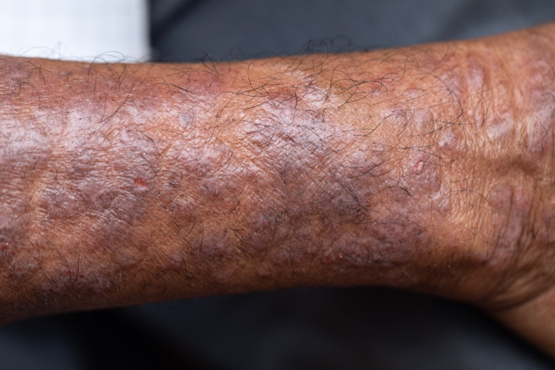
A 27-year-old student presents with a pruritic rash on his hands and in the bends of his arms and legs. He recently started clinical rotations in a nursing facility and has been using hand sanitizer multiple times per day, which has exacerbated the rash on his hands, causing them to ooze and sting. He describes the rash as itchy, especially at night. At times he reports that the itching causes difficulty sleeping. In addition, his skin has little cracks that frequently bleed. He notes that he has experienced similar symptoms in the past, which resolved with moisturizers and topical cream from the drugstore. He has tried over-the-counter hydrocortisone during this episode, with minimal improvement in symptoms. He denies any change in laundry detergents or use of new household products.
Physical examination reveals large erythematous plaques on the hands and flexure surfaces of his neck, antecubital fossa, and behind the knees with scattered excoriations. Erythematous, slightly lichenified coalescing papules are noted on the proximal arms. His face is clear. General skin pigmentation is brown and free of masses and lumps.
Atopic Dermatitis Medication
Commentary: A New Drug, and Pediatric Concerns, February 2023

I love registries! With large numbers of participants, registries can be very helpful to identify rare side effects and to assess the efficacy and safety of medications in populations that may not be fully represented in clinical trials. I also love dupilumab; it was revolutionary in the management of patients with AD.
Vittrup and colleagues have created a registry of 347 participants treated with dupilumab. This does not yet have the large number of participants needed to identify new issues that wouldn't have been detected in clinical trials, but the study is informative about real-life use. The dramatic improvement in the Eczema Area and Severity Index (EASI) score is consistent with the high efficacy of dupilumab. The high rate of treatment persistence is also consistent with dupilumab being a very effective and safe treatment (because if the drug wasn't working well or was causing a severe problem, patients would probably stop the treatment). Though the study reported persistent head and neck involvement, the residual involvement may be quite minimal.
The EASI-75 and Investigator Global Assessment response rates reported in dupilumab trials underestimate the value of this drug. With a 2-year persistence rate of nearly 90%, it's clear that dupilumab is making a huge difference in the lives of patients with AD.
Fatigue is a fascinating issue in AD. We might wonder if all the inflammation in patients with AD would directly cause fatigue. Almost certainly all the itching in AD adversely affects sleep and would cause tremendous fatigue. It surprised me that most of the children in the study by Rangel and colleagues were reported as having no or mild fatigue; severe fatigue was very uncommon. It leaves me wondering whether the assessments of fatigue fully capture what's happening. Also, since the fatigue score was reported by the parents, I (as the parent of a child with AD) am wondering whether the parents were projecting, with the score more reflective of the parents' fatigue than with that of the child; alternatively, perhaps the child's hyperactivity leaves parents thinking there is no fatigue when there actually is (and possibly even causing the perceived hyperactivity).
The lack of a control group without AD is another major limitation in our ability to interpret the study findings. Is fatigue more common or less common in children with AD than in children without AD? I cannot tell from these findings. Does fatigue warrant, as the authors suggest, more attention in clinical practice? I don't know. If we are already treating our patients based on patients' global impressions of how they are doing — combined, of course, with our observations of their objective disease severity — I'm not sure how asking about fatigue would change anything, even if future studies were to definitively show that AD is associated with fatigue.
I hate new drugs (well, maybe not hate, but I worry about unknown long-term risks). Clinical trials that help a drug get approved can tell us a lot about a drug's efficacy, but these studies are generally limited in what they tell us about a drug's safety. Clinical trials are generally not powered enough (not enough participants and not followed for long enough) to be informative about rare risks. I love long-term studies of new drugs in large numbers of people because those studies can be very reassuring about the risks of medications. Studying nearly 10,000 patients for 5 years is quite reassuring, confirming my impression that dupilumab has a remarkable, excellent safety profile (Owji et al). Blocking interleukin 4 and interleukin 13 seems to be very specific to AD. Finding no association to cancer is what I would have expected; being able to share this information with patients is likely to be reassuring to them.
Oh, lord help me, another study that claims we should change our disease management because they've identified an increased risk for something. When you compare 70,000 patients with 270,000 controls, you have huge power to detect statistically significant associations of no clinical consequence. Let's assume for the moment that the detected association the authors found between AD and juvenile idiopathic arthritis (JIA) is real. The odds ratio is 2; the odds ratio for smoking causing cancer is on the order of 100.
In this study, over 99% of individuals in both AD and control groups did not have JIA. The difference between rates of JIA in patients with AD compared with controls was 0.3%! The authors conclude "it is important to inquire actively about symptoms not directly linked to the patients' skin disease"; based on the findings of this study, I would conclude that we don't need to worry about JIA in patients with AD even if there is a (marginally) higher prevalence of JIA in this group.
I love registries! With large numbers of participants, registries can be very helpful to identify rare side effects and to assess the efficacy and safety of medications in populations that may not be fully represented in clinical trials. I also love dupilumab; it was revolutionary in the management of patients with AD.
Vittrup and colleagues have created a registry of 347 participants treated with dupilumab. This does not yet have the large number of participants needed to identify new issues that wouldn't have been detected in clinical trials, but the study is informative about real-life use. The dramatic improvement in the Eczema Area and Severity Index (EASI) score is consistent with the high efficacy of dupilumab. The high rate of treatment persistence is also consistent with dupilumab being a very effective and safe treatment (because if the drug wasn't working well or was causing a severe problem, patients would probably stop the treatment). Though the study reported persistent head and neck involvement, the residual involvement may be quite minimal.
The EASI-75 and Investigator Global Assessment response rates reported in dupilumab trials underestimate the value of this drug. With a 2-year persistence rate of nearly 90%, it's clear that dupilumab is making a huge difference in the lives of patients with AD.
Fatigue is a fascinating issue in AD. We might wonder if all the inflammation in patients with AD would directly cause fatigue. Almost certainly all the itching in AD adversely affects sleep and would cause tremendous fatigue. It surprised me that most of the children in the study by Rangel and colleagues were reported as having no or mild fatigue; severe fatigue was very uncommon. It leaves me wondering whether the assessments of fatigue fully capture what's happening. Also, since the fatigue score was reported by the parents, I (as the parent of a child with AD) am wondering whether the parents were projecting, with the score more reflective of the parents' fatigue than with that of the child; alternatively, perhaps the child's hyperactivity leaves parents thinking there is no fatigue when there actually is (and possibly even causing the perceived hyperactivity).
The lack of a control group without AD is another major limitation in our ability to interpret the study findings. Is fatigue more common or less common in children with AD than in children without AD? I cannot tell from these findings. Does fatigue warrant, as the authors suggest, more attention in clinical practice? I don't know. If we are already treating our patients based on patients' global impressions of how they are doing — combined, of course, with our observations of their objective disease severity — I'm not sure how asking about fatigue would change anything, even if future studies were to definitively show that AD is associated with fatigue.
I hate new drugs (well, maybe not hate, but I worry about unknown long-term risks). Clinical trials that help a drug get approved can tell us a lot about a drug's efficacy, but these studies are generally limited in what they tell us about a drug's safety. Clinical trials are generally not powered enough (not enough participants and not followed for long enough) to be informative about rare risks. I love long-term studies of new drugs in large numbers of people because those studies can be very reassuring about the risks of medications. Studying nearly 10,000 patients for 5 years is quite reassuring, confirming my impression that dupilumab has a remarkable, excellent safety profile (Owji et al). Blocking interleukin 4 and interleukin 13 seems to be very specific to AD. Finding no association to cancer is what I would have expected; being able to share this information with patients is likely to be reassuring to them.
Oh, lord help me, another study that claims we should change our disease management because they've identified an increased risk for something. When you compare 70,000 patients with 270,000 controls, you have huge power to detect statistically significant associations of no clinical consequence. Let's assume for the moment that the detected association the authors found between AD and juvenile idiopathic arthritis (JIA) is real. The odds ratio is 2; the odds ratio for smoking causing cancer is on the order of 100.
In this study, over 99% of individuals in both AD and control groups did not have JIA. The difference between rates of JIA in patients with AD compared with controls was 0.3%! The authors conclude "it is important to inquire actively about symptoms not directly linked to the patients' skin disease"; based on the findings of this study, I would conclude that we don't need to worry about JIA in patients with AD even if there is a (marginally) higher prevalence of JIA in this group.
I love registries! With large numbers of participants, registries can be very helpful to identify rare side effects and to assess the efficacy and safety of medications in populations that may not be fully represented in clinical trials. I also love dupilumab; it was revolutionary in the management of patients with AD.
Vittrup and colleagues have created a registry of 347 participants treated with dupilumab. This does not yet have the large number of participants needed to identify new issues that wouldn't have been detected in clinical trials, but the study is informative about real-life use. The dramatic improvement in the Eczema Area and Severity Index (EASI) score is consistent with the high efficacy of dupilumab. The high rate of treatment persistence is also consistent with dupilumab being a very effective and safe treatment (because if the drug wasn't working well or was causing a severe problem, patients would probably stop the treatment). Though the study reported persistent head and neck involvement, the residual involvement may be quite minimal.
The EASI-75 and Investigator Global Assessment response rates reported in dupilumab trials underestimate the value of this drug. With a 2-year persistence rate of nearly 90%, it's clear that dupilumab is making a huge difference in the lives of patients with AD.
Fatigue is a fascinating issue in AD. We might wonder if all the inflammation in patients with AD would directly cause fatigue. Almost certainly all the itching in AD adversely affects sleep and would cause tremendous fatigue. It surprised me that most of the children in the study by Rangel and colleagues were reported as having no or mild fatigue; severe fatigue was very uncommon. It leaves me wondering whether the assessments of fatigue fully capture what's happening. Also, since the fatigue score was reported by the parents, I (as the parent of a child with AD) am wondering whether the parents were projecting, with the score more reflective of the parents' fatigue than with that of the child; alternatively, perhaps the child's hyperactivity leaves parents thinking there is no fatigue when there actually is (and possibly even causing the perceived hyperactivity).
The lack of a control group without AD is another major limitation in our ability to interpret the study findings. Is fatigue more common or less common in children with AD than in children without AD? I cannot tell from these findings. Does fatigue warrant, as the authors suggest, more attention in clinical practice? I don't know. If we are already treating our patients based on patients' global impressions of how they are doing — combined, of course, with our observations of their objective disease severity — I'm not sure how asking about fatigue would change anything, even if future studies were to definitively show that AD is associated with fatigue.
I hate new drugs (well, maybe not hate, but I worry about unknown long-term risks). Clinical trials that help a drug get approved can tell us a lot about a drug's efficacy, but these studies are generally limited in what they tell us about a drug's safety. Clinical trials are generally not powered enough (not enough participants and not followed for long enough) to be informative about rare risks. I love long-term studies of new drugs in large numbers of people because those studies can be very reassuring about the risks of medications. Studying nearly 10,000 patients for 5 years is quite reassuring, confirming my impression that dupilumab has a remarkable, excellent safety profile (Owji et al). Blocking interleukin 4 and interleukin 13 seems to be very specific to AD. Finding no association to cancer is what I would have expected; being able to share this information with patients is likely to be reassuring to them.
Oh, lord help me, another study that claims we should change our disease management because they've identified an increased risk for something. When you compare 70,000 patients with 270,000 controls, you have huge power to detect statistically significant associations of no clinical consequence. Let's assume for the moment that the detected association the authors found between AD and juvenile idiopathic arthritis (JIA) is real. The odds ratio is 2; the odds ratio for smoking causing cancer is on the order of 100.
In this study, over 99% of individuals in both AD and control groups did not have JIA. The difference between rates of JIA in patients with AD compared with controls was 0.3%! The authors conclude "it is important to inquire actively about symptoms not directly linked to the patients' skin disease"; based on the findings of this study, I would conclude that we don't need to worry about JIA in patients with AD even if there is a (marginally) higher prevalence of JIA in this group.
Meta-analysis reveals that most atopic dermatitis therapies are effective against pruritus
Key clinical point: The majority of topical and systemic therapies for atopic dermatitis (AD) effectively reduced pruritus, the most common patient-reported symptom.
Major finding: Topical and systemic treatments led to a mean reduction of 3.32 (99% CI 2.32-4.33) and 3.07 (99% CI 2.58-3.56) points in pruritus score, respectively. Wet-wrap therapy using halometasone (−4.75 points) was the most effective topical treatment, and 30 mg upadacitinib (−4.90 points) was the most effective systemic treatment.
Study details: This study analyzed 22 studies that included patients aged ≥ 10 years with AD who received topical or systemic treatments.
Disclosures: No information on the source of funding was provided. Two authors reported ties with various organizations.
Source: Rodriguez-Le Roy Y et al. Efficacy of topical and systemic treatments for atopic dermatitis on pruritus: A systematic literature review and meta-analysis. Front Med (Lausanne). 2022;9:1079323 (Dec 22). Doi: 10.3389/fmed.2022.1079323
Key clinical point: The majority of topical and systemic therapies for atopic dermatitis (AD) effectively reduced pruritus, the most common patient-reported symptom.
Major finding: Topical and systemic treatments led to a mean reduction of 3.32 (99% CI 2.32-4.33) and 3.07 (99% CI 2.58-3.56) points in pruritus score, respectively. Wet-wrap therapy using halometasone (−4.75 points) was the most effective topical treatment, and 30 mg upadacitinib (−4.90 points) was the most effective systemic treatment.
Study details: This study analyzed 22 studies that included patients aged ≥ 10 years with AD who received topical or systemic treatments.
Disclosures: No information on the source of funding was provided. Two authors reported ties with various organizations.
Source: Rodriguez-Le Roy Y et al. Efficacy of topical and systemic treatments for atopic dermatitis on pruritus: A systematic literature review and meta-analysis. Front Med (Lausanne). 2022;9:1079323 (Dec 22). Doi: 10.3389/fmed.2022.1079323
Key clinical point: The majority of topical and systemic therapies for atopic dermatitis (AD) effectively reduced pruritus, the most common patient-reported symptom.
Major finding: Topical and systemic treatments led to a mean reduction of 3.32 (99% CI 2.32-4.33) and 3.07 (99% CI 2.58-3.56) points in pruritus score, respectively. Wet-wrap therapy using halometasone (−4.75 points) was the most effective topical treatment, and 30 mg upadacitinib (−4.90 points) was the most effective systemic treatment.
Study details: This study analyzed 22 studies that included patients aged ≥ 10 years with AD who received topical or systemic treatments.
Disclosures: No information on the source of funding was provided. Two authors reported ties with various organizations.
Source: Rodriguez-Le Roy Y et al. Efficacy of topical and systemic treatments for atopic dermatitis on pruritus: A systematic literature review and meta-analysis. Front Med (Lausanne). 2022;9:1079323 (Dec 22). Doi: 10.3389/fmed.2022.1079323
Atopic dermatitis is positively linked with the risk for juvenile idiopathic arthritis
Key clinical point: Children and adolescents with atopic dermatitis (AD) are at an increased risk of developing juvenile idiopathic arthritis (JIA).
Major finding: Patients with AD vs control individuals had an increased risk for JIA (adjusted odds ratio [aOR] 1.58; 95% CI 1.41-1.77), especially for psoriatic JIA (aOR 2.75; 95% CI 1.64-4.60).
Study details: This population-based register study included 70,584 patients with AD aged <18 years at the time of the first AD diagnosis and 270,783 age- and sex-matched control individuals without AD.
Disclosures: This study did not receive any funding. Some authors declared serving as investigators for or receiving educational grants, speaker honoraria, or consultation honoraria from various organizations.
Source: Keskitalo PL et al. Juvenile idiopathic arthritis in children and adolescents with atopic dermatitis: A Finnish nationwide registry study. J Am Acad Dermatol. 2023 (Jan 3). Doi: 10.1016/j.jaad.2022.12.025
Key clinical point: Children and adolescents with atopic dermatitis (AD) are at an increased risk of developing juvenile idiopathic arthritis (JIA).
Major finding: Patients with AD vs control individuals had an increased risk for JIA (adjusted odds ratio [aOR] 1.58; 95% CI 1.41-1.77), especially for psoriatic JIA (aOR 2.75; 95% CI 1.64-4.60).
Study details: This population-based register study included 70,584 patients with AD aged <18 years at the time of the first AD diagnosis and 270,783 age- and sex-matched control individuals without AD.
Disclosures: This study did not receive any funding. Some authors declared serving as investigators for or receiving educational grants, speaker honoraria, or consultation honoraria from various organizations.
Source: Keskitalo PL et al. Juvenile idiopathic arthritis in children and adolescents with atopic dermatitis: A Finnish nationwide registry study. J Am Acad Dermatol. 2023 (Jan 3). Doi: 10.1016/j.jaad.2022.12.025
Key clinical point: Children and adolescents with atopic dermatitis (AD) are at an increased risk of developing juvenile idiopathic arthritis (JIA).
Major finding: Patients with AD vs control individuals had an increased risk for JIA (adjusted odds ratio [aOR] 1.58; 95% CI 1.41-1.77), especially for psoriatic JIA (aOR 2.75; 95% CI 1.64-4.60).
Study details: This population-based register study included 70,584 patients with AD aged <18 years at the time of the first AD diagnosis and 270,783 age- and sex-matched control individuals without AD.
Disclosures: This study did not receive any funding. Some authors declared serving as investigators for or receiving educational grants, speaker honoraria, or consultation honoraria from various organizations.
Source: Keskitalo PL et al. Juvenile idiopathic arthritis in children and adolescents with atopic dermatitis: A Finnish nationwide registry study. J Am Acad Dermatol. 2023 (Jan 3). Doi: 10.1016/j.jaad.2022.12.025
Atopic dermatitis: No association between dupilumab use and malignancy
Key clinical point: Treatment of patients with atopic dermatitis (AD) with dupilumab is not associated with the development of primary or recurrent malignancy.
Major finding: Dupilumab-exposed and unexposed patients had comparable incidence rates of primary malignancies (adjusted hazard ratio [aHR], 1.010; P = .946), keratinocyte cancers (aHR, 0.994; P = .973), and recurrent cancers (aHR, 0.828; P = .758) per 1,000 person-years.
Study details: This single-center 5-year retrospective study included 9,707 patients with AD, of which 1,627 patients received dupilumab treatment.
Disclosures: This study did not receive any funding. Some authors declared serving as consultants for and/or receiving research funds from various organizations.
Source: Owji S et al. No association between dupilumab use and short-term cancer development in atopic dermatitis patients. J Allergy Clin Immunol Pract. 2022 (Dec 26). Doi: 10.1016/j.jaip.2022.12.018.
Key clinical point: Treatment of patients with atopic dermatitis (AD) with dupilumab is not associated with the development of primary or recurrent malignancy.
Major finding: Dupilumab-exposed and unexposed patients had comparable incidence rates of primary malignancies (adjusted hazard ratio [aHR], 1.010; P = .946), keratinocyte cancers (aHR, 0.994; P = .973), and recurrent cancers (aHR, 0.828; P = .758) per 1,000 person-years.
Study details: This single-center 5-year retrospective study included 9,707 patients with AD, of which 1,627 patients received dupilumab treatment.
Disclosures: This study did not receive any funding. Some authors declared serving as consultants for and/or receiving research funds from various organizations.
Source: Owji S et al. No association between dupilumab use and short-term cancer development in atopic dermatitis patients. J Allergy Clin Immunol Pract. 2022 (Dec 26). Doi: 10.1016/j.jaip.2022.12.018.
Key clinical point: Treatment of patients with atopic dermatitis (AD) with dupilumab is not associated with the development of primary or recurrent malignancy.
Major finding: Dupilumab-exposed and unexposed patients had comparable incidence rates of primary malignancies (adjusted hazard ratio [aHR], 1.010; P = .946), keratinocyte cancers (aHR, 0.994; P = .973), and recurrent cancers (aHR, 0.828; P = .758) per 1,000 person-years.
Study details: This single-center 5-year retrospective study included 9,707 patients with AD, of which 1,627 patients received dupilumab treatment.
Disclosures: This study did not receive any funding. Some authors declared serving as consultants for and/or receiving research funds from various organizations.
Source: Owji S et al. No association between dupilumab use and short-term cancer development in atopic dermatitis patients. J Allergy Clin Immunol Pract. 2022 (Dec 26). Doi: 10.1016/j.jaip.2022.12.018.
Childhood atopic dermatitis is associated with increased fatigue
Key clinical point: Fatigue is a common symptom in children with atopic dermatitis (AD), particularly those with moderate-to-severe AD, and thus should be considered in clinical practice and trials.
Major finding: Most children had no (38.6%) or mild (32.1%) parent-proxy fatigue, but 27.2% had moderate fatigue and 2.0% had severe fatigue. Higher proportions of children with moderate-to-severe parent-proxy Patient-Reported Outcome Measurement Information System Pediatric fatigue scores were those with moderate (25.7%/1.4%) and severe (39.3%/5.4%) AD vs mild AD (18.0%/0.0%), as determined by Investigator’s Global Assessment, especially those with 5-6 (44.4%/0.0%) or 7 (44.2%/5.2%) nights of sleep disturbance from eczema.
Study details: This cross-sectional observational study included 248 children aged 0-17 years with AD.
Disclosures: This study was funded by the US National Institute of Arthritis and Musculoskeletal and Skin Diseases. The authors declared no conflicts of interest.
Source: Rangel SM et al. Prevalence and associations of fatigue in childhood atopic dermatitis: A cross-sectional study. J Eur Acad Dermatol Venereol. 2022 (Dec 21). Doi: 10.1111/jdv.18819
Key clinical point: Fatigue is a common symptom in children with atopic dermatitis (AD), particularly those with moderate-to-severe AD, and thus should be considered in clinical practice and trials.
Major finding: Most children had no (38.6%) or mild (32.1%) parent-proxy fatigue, but 27.2% had moderate fatigue and 2.0% had severe fatigue. Higher proportions of children with moderate-to-severe parent-proxy Patient-Reported Outcome Measurement Information System Pediatric fatigue scores were those with moderate (25.7%/1.4%) and severe (39.3%/5.4%) AD vs mild AD (18.0%/0.0%), as determined by Investigator’s Global Assessment, especially those with 5-6 (44.4%/0.0%) or 7 (44.2%/5.2%) nights of sleep disturbance from eczema.
Study details: This cross-sectional observational study included 248 children aged 0-17 years with AD.
Disclosures: This study was funded by the US National Institute of Arthritis and Musculoskeletal and Skin Diseases. The authors declared no conflicts of interest.
Source: Rangel SM et al. Prevalence and associations of fatigue in childhood atopic dermatitis: A cross-sectional study. J Eur Acad Dermatol Venereol. 2022 (Dec 21). Doi: 10.1111/jdv.18819
Key clinical point: Fatigue is a common symptom in children with atopic dermatitis (AD), particularly those with moderate-to-severe AD, and thus should be considered in clinical practice and trials.
Major finding: Most children had no (38.6%) or mild (32.1%) parent-proxy fatigue, but 27.2% had moderate fatigue and 2.0% had severe fatigue. Higher proportions of children with moderate-to-severe parent-proxy Patient-Reported Outcome Measurement Information System Pediatric fatigue scores were those with moderate (25.7%/1.4%) and severe (39.3%/5.4%) AD vs mild AD (18.0%/0.0%), as determined by Investigator’s Global Assessment, especially those with 5-6 (44.4%/0.0%) or 7 (44.2%/5.2%) nights of sleep disturbance from eczema.
Study details: This cross-sectional observational study included 248 children aged 0-17 years with AD.
Disclosures: This study was funded by the US National Institute of Arthritis and Musculoskeletal and Skin Diseases. The authors declared no conflicts of interest.
Source: Rangel SM et al. Prevalence and associations of fatigue in childhood atopic dermatitis: A cross-sectional study. J Eur Acad Dermatol Venereol. 2022 (Dec 21). Doi: 10.1111/jdv.18819
Prolonged dupilumab therapy is safe and effective in moderate-to-severe atopic dermatitis
Key clinical point: Dupilumab maintained efficacy against moderate-to-severe atopic dermatitis (AD) with no new safety signals over 104 weeks; however, it was ineffective in treating head-and-neck AD.
Major finding: The median Eczema Area and Severity Index score decreased significantly from 18.0 at baseline to 2.0 at week 52 and 1.7 at week 104 (both P < .0001); 35% of patients reported an adverse event, with conjunctivitis being the most common (25%). Although the 104-week treatment persistence rate was 86%, the majority of patients still had AD in the head-and-neck area.
Study details: This real-world study included 347 adult patients with moderate-to-severe AD who received dupilumab and were registered in the prospective Severe and ChRonic Atopic dermatitis Treatment CoHort (SCRATCH) registry during 2017-2022.
Disclosures: The SCRATCH registry was supported by research grants from Sanofi-Genzyme and Pfizer. Some authors reported ties with various organizations, including Sanofi-Genzyme and Pfizer.
Source: Vittrup I et al. A nationwide 104 weeks real-world study of dupilumab in adults with atopic dermatitis: Ineffectiveness in head-and-neck dermatitis. J Eur Acad Dermatol Venereol. 2023 (Jan 6). Doi: 10.1111/jdv.18849
Key clinical point: Dupilumab maintained efficacy against moderate-to-severe atopic dermatitis (AD) with no new safety signals over 104 weeks; however, it was ineffective in treating head-and-neck AD.
Major finding: The median Eczema Area and Severity Index score decreased significantly from 18.0 at baseline to 2.0 at week 52 and 1.7 at week 104 (both P < .0001); 35% of patients reported an adverse event, with conjunctivitis being the most common (25%). Although the 104-week treatment persistence rate was 86%, the majority of patients still had AD in the head-and-neck area.
Study details: This real-world study included 347 adult patients with moderate-to-severe AD who received dupilumab and were registered in the prospective Severe and ChRonic Atopic dermatitis Treatment CoHort (SCRATCH) registry during 2017-2022.
Disclosures: The SCRATCH registry was supported by research grants from Sanofi-Genzyme and Pfizer. Some authors reported ties with various organizations, including Sanofi-Genzyme and Pfizer.
Source: Vittrup I et al. A nationwide 104 weeks real-world study of dupilumab in adults with atopic dermatitis: Ineffectiveness in head-and-neck dermatitis. J Eur Acad Dermatol Venereol. 2023 (Jan 6). Doi: 10.1111/jdv.18849
Key clinical point: Dupilumab maintained efficacy against moderate-to-severe atopic dermatitis (AD) with no new safety signals over 104 weeks; however, it was ineffective in treating head-and-neck AD.
Major finding: The median Eczema Area and Severity Index score decreased significantly from 18.0 at baseline to 2.0 at week 52 and 1.7 at week 104 (both P < .0001); 35% of patients reported an adverse event, with conjunctivitis being the most common (25%). Although the 104-week treatment persistence rate was 86%, the majority of patients still had AD in the head-and-neck area.
Study details: This real-world study included 347 adult patients with moderate-to-severe AD who received dupilumab and were registered in the prospective Severe and ChRonic Atopic dermatitis Treatment CoHort (SCRATCH) registry during 2017-2022.
Disclosures: The SCRATCH registry was supported by research grants from Sanofi-Genzyme and Pfizer. Some authors reported ties with various organizations, including Sanofi-Genzyme and Pfizer.
Source: Vittrup I et al. A nationwide 104 weeks real-world study of dupilumab in adults with atopic dermatitis: Ineffectiveness in head-and-neck dermatitis. J Eur Acad Dermatol Venereol. 2023 (Jan 6). Doi: 10.1111/jdv.18849
Upadacitinib is effective in treating difficult-to-treat moderate-to-severe atopic dermatitis
Key clinical point: Upadacitinib is effective and safe for the treatment of patients with difficult-to-treat moderate-to-severe atopic dermatitis (AD).
Major finding: At week 16, the percentages of patients achieving the Eczema Area and Severity Index (EASI) 50, EASI 75, EASI 90, and EASI 100 were 94.29%, 91.43%, 74.29%, and 60.0%, respectively; 91.43% of patients achieved a ≥4-point decrease in itch-numerical rating scale score. No severe adverse events were reported.
Study details: This single-center retrospective real-life study included 38 patients aged ≥12 years with moderate-to-severe AD and inadequate response, intolerance, or contraindications to cyclosporine or dupilumab who had received upadacitinib (15/30 mg daily) for ≥8 weeks; 35 patients received the treatment for 16 weeks.
Disclosures: This study was supported by grants from Fondazione Roma, Italian Ministry of Health (Rome, Italy), “Ricerca Finalizzata” project. Some authors reported ties with various organizations.
Source: Gargiulo L et al. Real-life effectiveness and safety of upadacitinib in adults and adolescents with moderate-to-severe atopic dermatitis: A single-center 16-week study. Dermatol Ther (Heidelb). 2023 (Jan 9). Doi: 10.1007/s13555-022-00882-z
Key clinical point: Upadacitinib is effective and safe for the treatment of patients with difficult-to-treat moderate-to-severe atopic dermatitis (AD).
Major finding: At week 16, the percentages of patients achieving the Eczema Area and Severity Index (EASI) 50, EASI 75, EASI 90, and EASI 100 were 94.29%, 91.43%, 74.29%, and 60.0%, respectively; 91.43% of patients achieved a ≥4-point decrease in itch-numerical rating scale score. No severe adverse events were reported.
Study details: This single-center retrospective real-life study included 38 patients aged ≥12 years with moderate-to-severe AD and inadequate response, intolerance, or contraindications to cyclosporine or dupilumab who had received upadacitinib (15/30 mg daily) for ≥8 weeks; 35 patients received the treatment for 16 weeks.
Disclosures: This study was supported by grants from Fondazione Roma, Italian Ministry of Health (Rome, Italy), “Ricerca Finalizzata” project. Some authors reported ties with various organizations.
Source: Gargiulo L et al. Real-life effectiveness and safety of upadacitinib in adults and adolescents with moderate-to-severe atopic dermatitis: A single-center 16-week study. Dermatol Ther (Heidelb). 2023 (Jan 9). Doi: 10.1007/s13555-022-00882-z
Key clinical point: Upadacitinib is effective and safe for the treatment of patients with difficult-to-treat moderate-to-severe atopic dermatitis (AD).
Major finding: At week 16, the percentages of patients achieving the Eczema Area and Severity Index (EASI) 50, EASI 75, EASI 90, and EASI 100 were 94.29%, 91.43%, 74.29%, and 60.0%, respectively; 91.43% of patients achieved a ≥4-point decrease in itch-numerical rating scale score. No severe adverse events were reported.
Study details: This single-center retrospective real-life study included 38 patients aged ≥12 years with moderate-to-severe AD and inadequate response, intolerance, or contraindications to cyclosporine or dupilumab who had received upadacitinib (15/30 mg daily) for ≥8 weeks; 35 patients received the treatment for 16 weeks.
Disclosures: This study was supported by grants from Fondazione Roma, Italian Ministry of Health (Rome, Italy), “Ricerca Finalizzata” project. Some authors reported ties with various organizations.
Source: Gargiulo L et al. Real-life effectiveness and safety of upadacitinib in adults and adolescents with moderate-to-severe atopic dermatitis: A single-center 16-week study. Dermatol Ther (Heidelb). 2023 (Jan 9). Doi: 10.1007/s13555-022-00882-z
Long-term integrated safety of baricitinib in moderate-to-severe atopic dermatitis
Key clinical point: The safety profile of baricitinib in patients with moderate-to-severe atopic dermatitis (AD) was similar to that reported in earlier analyses; major adverse cardiovascular event (MACE), pulmonary embolism (PE), and malignancy were within the background range.
Major finding: The adjusted incidence rate/100 patient-years at risk for any infection was 67.2 and that for herpes simplex, herpes zoster, opportunistic infections, serious adverse events, MACE, PE, and 14 malignancies excluding nonmelanoma skin cancer was 6.7, 2.8, 0.3, 5.2, 0.15, 0.06, and 0.3, respectively.
Study details: This updated integrated analysis of eight clinical trials included 2636 patients with moderate-to-severe AD treated with ≥1 baricitinib dose (1/2/4 mg) through 3.9 years (4628.4 patient-years of exposure).
Disclosures: Baricitinib is developed by Eli Lilly and Company, under license from Incyte Corporation. Some authors reported ties with various organizations, including Eli Lilly. Five authors declared being employees and stockholders of Eli Lilly.
Source: Bieber T et al. Safety of baricitinib for the treatment of atopic dermatitis over a median of 1.6 years and up to 3.9 years of treatment: An updated integrated analysis of eight clinical trials. J Dermatolog Treat. 2022 (Dec 22). Doi: 10.1080/09546634.2022.2161812
Key clinical point: The safety profile of baricitinib in patients with moderate-to-severe atopic dermatitis (AD) was similar to that reported in earlier analyses; major adverse cardiovascular event (MACE), pulmonary embolism (PE), and malignancy were within the background range.
Major finding: The adjusted incidence rate/100 patient-years at risk for any infection was 67.2 and that for herpes simplex, herpes zoster, opportunistic infections, serious adverse events, MACE, PE, and 14 malignancies excluding nonmelanoma skin cancer was 6.7, 2.8, 0.3, 5.2, 0.15, 0.06, and 0.3, respectively.
Study details: This updated integrated analysis of eight clinical trials included 2636 patients with moderate-to-severe AD treated with ≥1 baricitinib dose (1/2/4 mg) through 3.9 years (4628.4 patient-years of exposure).
Disclosures: Baricitinib is developed by Eli Lilly and Company, under license from Incyte Corporation. Some authors reported ties with various organizations, including Eli Lilly. Five authors declared being employees and stockholders of Eli Lilly.
Source: Bieber T et al. Safety of baricitinib for the treatment of atopic dermatitis over a median of 1.6 years and up to 3.9 years of treatment: An updated integrated analysis of eight clinical trials. J Dermatolog Treat. 2022 (Dec 22). Doi: 10.1080/09546634.2022.2161812
Key clinical point: The safety profile of baricitinib in patients with moderate-to-severe atopic dermatitis (AD) was similar to that reported in earlier analyses; major adverse cardiovascular event (MACE), pulmonary embolism (PE), and malignancy were within the background range.
Major finding: The adjusted incidence rate/100 patient-years at risk for any infection was 67.2 and that for herpes simplex, herpes zoster, opportunistic infections, serious adverse events, MACE, PE, and 14 malignancies excluding nonmelanoma skin cancer was 6.7, 2.8, 0.3, 5.2, 0.15, 0.06, and 0.3, respectively.
Study details: This updated integrated analysis of eight clinical trials included 2636 patients with moderate-to-severe AD treated with ≥1 baricitinib dose (1/2/4 mg) through 3.9 years (4628.4 patient-years of exposure).
Disclosures: Baricitinib is developed by Eli Lilly and Company, under license from Incyte Corporation. Some authors reported ties with various organizations, including Eli Lilly. Five authors declared being employees and stockholders of Eli Lilly.
Source: Bieber T et al. Safety of baricitinib for the treatment of atopic dermatitis over a median of 1.6 years and up to 3.9 years of treatment: An updated integrated analysis of eight clinical trials. J Dermatolog Treat. 2022 (Dec 22). Doi: 10.1080/09546634.2022.2161812