User login
Register for the 2015 Vascular Research Initiatives Conference
This one-day scientific conference is designed for scientists investigating peripheral vascular disease, as well as vascular surgery trainees, research trainees in vascular surgery and biology, and industry personnel. We’ll be meeting in San Francisco just one day before the Arteriosclerosis, Thrombosis and Vascular Biology/Peripheral Vascular Disease 2015 Scientific Sessions. Attendance at both meetings is encouraged.
May 6, 2015
Hilton San Francisco Union Square
San Francisco, California
Pricing: Members, $275; non-members, $300; residents, $125.
This one-day scientific conference is designed for scientists investigating peripheral vascular disease, as well as vascular surgery trainees, research trainees in vascular surgery and biology, and industry personnel. We’ll be meeting in San Francisco just one day before the Arteriosclerosis, Thrombosis and Vascular Biology/Peripheral Vascular Disease 2015 Scientific Sessions. Attendance at both meetings is encouraged.
May 6, 2015
Hilton San Francisco Union Square
San Francisco, California
Pricing: Members, $275; non-members, $300; residents, $125.
This one-day scientific conference is designed for scientists investigating peripheral vascular disease, as well as vascular surgery trainees, research trainees in vascular surgery and biology, and industry personnel. We’ll be meeting in San Francisco just one day before the Arteriosclerosis, Thrombosis and Vascular Biology/Peripheral Vascular Disease 2015 Scientific Sessions. Attendance at both meetings is encouraged.
May 6, 2015
Hilton San Francisco Union Square
San Francisco, California
Pricing: Members, $275; non-members, $300; residents, $125.
Vascular Annual Meeting – register now
The 2015 VAM, set for June 17-20 in Chicago, is your chance to hear first-hand about important new research, sit in on interesting sessions, meet up with fellow alumni and colleagues, and enjoy the Windy City. A record 705 abstract and video submissions were received, which should ensure invigorating sessions and debates.
This year we have added several new features based on what last year’s attendees said they wanted. You find more hands-training, more interdisciplinary topics, more presentations and speakers, and more for international guests. Plus the popular Vascular Live will be back.
Register and make hotel reservations while special pricing lasts.
For more information about registration, click here
For hotel reservations, click here
The 2015 VAM, set for June 17-20 in Chicago, is your chance to hear first-hand about important new research, sit in on interesting sessions, meet up with fellow alumni and colleagues, and enjoy the Windy City. A record 705 abstract and video submissions were received, which should ensure invigorating sessions and debates.
This year we have added several new features based on what last year’s attendees said they wanted. You find more hands-training, more interdisciplinary topics, more presentations and speakers, and more for international guests. Plus the popular Vascular Live will be back.
Register and make hotel reservations while special pricing lasts.
For more information about registration, click here
For hotel reservations, click here
The 2015 VAM, set for June 17-20 in Chicago, is your chance to hear first-hand about important new research, sit in on interesting sessions, meet up with fellow alumni and colleagues, and enjoy the Windy City. A record 705 abstract and video submissions were received, which should ensure invigorating sessions and debates.
This year we have added several new features based on what last year’s attendees said they wanted. You find more hands-training, more interdisciplinary topics, more presentations and speakers, and more for international guests. Plus the popular Vascular Live will be back.
Register and make hotel reservations while special pricing lasts.
For more information about registration, click here
For hotel reservations, click here
Register now for annual meeting
Registration is now open for the Vascular Annual Meeting, scheduled for June 17-20 in Chicago.
Many popular events, such as “Vascular Live,” are returning for 2015, and numerous improvements will make the meeting more inclusive and varied.
Visit vascularannualmeeting.org for details, and to register for the conference and hotel.
Registration is now open for the Vascular Annual Meeting, scheduled for June 17-20 in Chicago.
Many popular events, such as “Vascular Live,” are returning for 2015, and numerous improvements will make the meeting more inclusive and varied.
Visit vascularannualmeeting.org for details, and to register for the conference and hotel.
Registration is now open for the Vascular Annual Meeting, scheduled for June 17-20 in Chicago.
Many popular events, such as “Vascular Live,” are returning for 2015, and numerous improvements will make the meeting more inclusive and varied.
Visit vascularannualmeeting.org for details, and to register for the conference and hotel.
Register for April Coding Class
If ever-changing coding procedures are giving your office fits, here’s a solution: “Challenges in Vascular Surgery 2015: Coding and Reimbursement for Vascular Surgeons.” The course is designed for surgeons and office staff, including practice managers, nurse practitioners, physician assistants, coders and schedulers.
The two-day, intensive course is slated for April 17-18 near Chicago’s O’Hare International Airport. An additional workshop, “E&M Coding for Vascular Surgeons,” is also offered Friday morning.
To download a PDF on discounted rates at the Rosemont Hilton click here; hotel reservations should be made by April 2.
Learn more and register for the class by clicking here.
If ever-changing coding procedures are giving your office fits, here’s a solution: “Challenges in Vascular Surgery 2015: Coding and Reimbursement for Vascular Surgeons.” The course is designed for surgeons and office staff, including practice managers, nurse practitioners, physician assistants, coders and schedulers.
The two-day, intensive course is slated for April 17-18 near Chicago’s O’Hare International Airport. An additional workshop, “E&M Coding for Vascular Surgeons,” is also offered Friday morning.
To download a PDF on discounted rates at the Rosemont Hilton click here; hotel reservations should be made by April 2.
Learn more and register for the class by clicking here.
If ever-changing coding procedures are giving your office fits, here’s a solution: “Challenges in Vascular Surgery 2015: Coding and Reimbursement for Vascular Surgeons.” The course is designed for surgeons and office staff, including practice managers, nurse practitioners, physician assistants, coders and schedulers.
The two-day, intensive course is slated for April 17-18 near Chicago’s O’Hare International Airport. An additional workshop, “E&M Coding for Vascular Surgeons,” is also offered Friday morning.
To download a PDF on discounted rates at the Rosemont Hilton click here; hotel reservations should be made by April 2.
Learn more and register for the class by clicking here.
The changing face of vascular surgery
The NSA might know how often you order Chinese after midnight, or the topics of your text messages to your dog sitter. But when it comes to crunching numbers, SVS just gets down to a few basics. Thanks to the SVS Clinical Practice Council, we will be able to track trends and membership needs.
“The Council felt that a more consistent set of data on the SVS membership was needed,” explained council chairman Dr. George H. Meier, professor and chief of vascular surgery at the University of Cincinnati College of Medicine. “Hopefully this survey can be used yearly to collect data on SVS membership trends and help focus the SVS on appropriate issues. This is our initial effort to collect this yearly data. While the data is intriguing, hopefully trends over five or 10 years will be even more interesting.”
Some of the member info will give you insight into who we are. For instance:
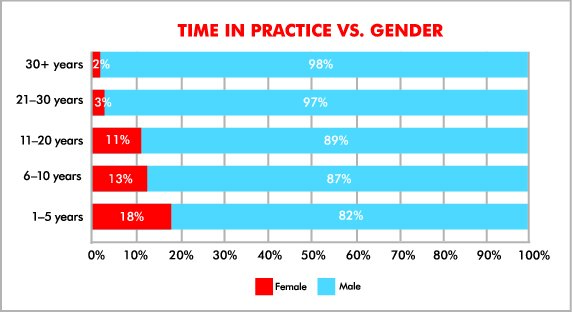
• The percentage of female members is growing among our newer, younger members. While only 9 percent of us overall are female, the percentage is 18 percent among those who have been in practice five years or less. Among members who have been in practice 30 years or more, the percentage of females is 2 percent.
• The most commonly practiced procedure is LE endovascular, with members reporting it accounts for nearly 20 percent of their cases. The most seldom performed is CAS, accounting for 1.2 percent of cases.
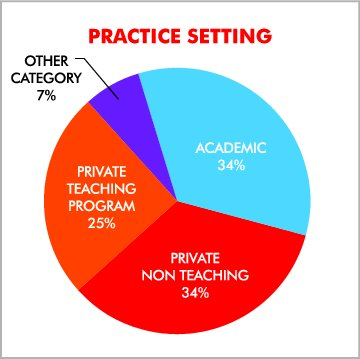
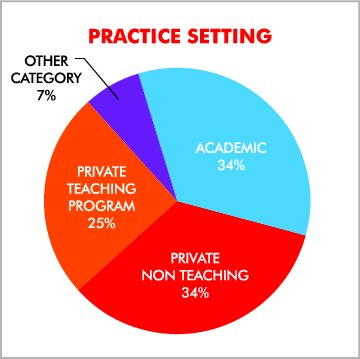
• Some folks will tell you that all of our members are academics, but in fact, 34 percent work in an academic setting, 25 percent in a private teaching program and 34 percent in a non-teaching role.
• Members were recently polled on their opinion of the Affordable Care Act. Sixty-seven percent said it had had either no impact or a positive impact on their practices, while the remaining third said it had had a negative impact.
The NSA might know how often you order Chinese after midnight, or the topics of your text messages to your dog sitter. But when it comes to crunching numbers, SVS just gets down to a few basics. Thanks to the SVS Clinical Practice Council, we will be able to track trends and membership needs.
“The Council felt that a more consistent set of data on the SVS membership was needed,” explained council chairman Dr. George H. Meier, professor and chief of vascular surgery at the University of Cincinnati College of Medicine. “Hopefully this survey can be used yearly to collect data on SVS membership trends and help focus the SVS on appropriate issues. This is our initial effort to collect this yearly data. While the data is intriguing, hopefully trends over five or 10 years will be even more interesting.”
Some of the member info will give you insight into who we are. For instance:
• The percentage of female members is growing among our newer, younger members. While only 9 percent of us overall are female, the percentage is 18 percent among those who have been in practice five years or less. Among members who have been in practice 30 years or more, the percentage of females is 2 percent.
• The most commonly practiced procedure is LE endovascular, with members reporting it accounts for nearly 20 percent of their cases. The most seldom performed is CAS, accounting for 1.2 percent of cases.
• Some folks will tell you that all of our members are academics, but in fact, 34 percent work in an academic setting, 25 percent in a private teaching program and 34 percent in a non-teaching role.
• Members were recently polled on their opinion of the Affordable Care Act. Sixty-seven percent said it had had either no impact or a positive impact on their practices, while the remaining third said it had had a negative impact.
The NSA might know how often you order Chinese after midnight, or the topics of your text messages to your dog sitter. But when it comes to crunching numbers, SVS just gets down to a few basics. Thanks to the SVS Clinical Practice Council, we will be able to track trends and membership needs.
“The Council felt that a more consistent set of data on the SVS membership was needed,” explained council chairman Dr. George H. Meier, professor and chief of vascular surgery at the University of Cincinnati College of Medicine. “Hopefully this survey can be used yearly to collect data on SVS membership trends and help focus the SVS on appropriate issues. This is our initial effort to collect this yearly data. While the data is intriguing, hopefully trends over five or 10 years will be even more interesting.”
Some of the member info will give you insight into who we are. For instance:
• The percentage of female members is growing among our newer, younger members. While only 9 percent of us overall are female, the percentage is 18 percent among those who have been in practice five years or less. Among members who have been in practice 30 years or more, the percentage of females is 2 percent.
• The most commonly practiced procedure is LE endovascular, with members reporting it accounts for nearly 20 percent of their cases. The most seldom performed is CAS, accounting for 1.2 percent of cases.
• Some folks will tell you that all of our members are academics, but in fact, 34 percent work in an academic setting, 25 percent in a private teaching program and 34 percent in a non-teaching role.
• Members were recently polled on their opinion of the Affordable Care Act. Sixty-seven percent said it had had either no impact or a positive impact on their practices, while the remaining third said it had had a negative impact.
What Millennial physicians want – and why the surgeon drain may not get as bad as you think
You’ve heard the drumbeat – in years to come we won’t have nearly enough vascular surgeons to treat an aging population.
“Folks, we need more of us,” Dr. Anton Sidawy announced at a recent vascular surgery symposium hosted by Northwestern University. That’s not just because in 2010 some 40 percent were over age 55, but because the elderly U.S. population will double by 2030.
Plus, vascular surgery has the distinction of having the largest ratio of people per active physician for all medical subspecialties in the country. In 2010, the U.S. had 108,325 patients per vascular surgeon.
While Dr. Sidawy is correct, the Society is making some genuine progress with recruitment and programming.
Thanks to a multipronged endeavor –
• 33 new fellowship and 0+5 programs are in development.
• The number of 0+5 programs has risen dramatically, from three in 2007 to 44 in 2014.
• The number of 0+5 positions accepted has risen equally, from four in 2007 to 51 in 2014.
• While some fellowship programs have closed (primarily those that have started a 0+5 program) during that same time period, the number of fellowship positions has stayed flat. In 2007, 106 fellowship positions were offered, and in 2014, the number was 115.
The profession has done some soul searching in recent years, since med students, residents and fellows are showing the same values as the rest of the Millennial generation. Millennials, researchers note, tend to want a better work/life balance than their parents had.
They are socially oriented, mission-driven and tech-savvy. Having grown up with technology, they expect to get information fast and often – as an example – will review an online video of a procedure just before going into the operating room.
The Society, along with the Resident Student Outreach Committee-Recruitment and the ADPDVS Ad Hoc Committee on Recruitment of Surgical Residents and Students, has developed a number of strategies, including:
• Identifying which schools are sending students into surgical programs and developing best practice guidelines.
• Offering student and resident scholarships to attend the Vascular Annual Meeting where they get encouragement, ideas, and mentoring.
• Creating the Fellowship Development Task Force with the goal of increasing total training programs, currently totaling 151 at 113 institutions with 455 vascular surgery trainees.
These efforts will take time and some success has already been seen with vascular surgery experiencing a 54 percent increase in the number of first-year ACGME residents and fellows between 2005 and 2010. The reasons for the shortage, Dr. Sidawy believes, are multiple. For example:
• Young doctors want a work/life balance; those 80-hours-plus residencies over five years don’t lead to life quality. The prevailing mindset, says Dr. Sidawy, is that work is not an end in itself, but what they do in order to have a life, family, and children.
• Mentors and residents may have a disconnect. Older mentors have a belief that young residents don’t want to work hard, while 55 percent of residents believe their mentors have a negative attitude.
More interaction, such as after-work get-togethers, may help, he suggested. Additional efforts to encourage more female and minority residents into the specialty are important.
• Older specialists may have learned by default, but Millennials want specific instruction.
• Meanwhile, it’s now common knowledge that the shortage of open surgery opportunities is leading to a generation of doctors without that skill set, and that is worrisome to both residents and mentors.
The 80-hour limit has compounded that issue, he said.
“We need to find a way to produce surgeons like we used to,” Dr. Sidawy said.
One effort that is underway to help address these gaps, is a collaborative project by the SVS Young Surgeons Committee and the Education Council to assess the training needs of vascular surgeon members at all career levels, with a special emphasis on identifying training gaps and needs for young surgeons. An online list of experts and useful links should be completed later this year.
You’ve heard the drumbeat – in years to come we won’t have nearly enough vascular surgeons to treat an aging population.
“Folks, we need more of us,” Dr. Anton Sidawy announced at a recent vascular surgery symposium hosted by Northwestern University. That’s not just because in 2010 some 40 percent were over age 55, but because the elderly U.S. population will double by 2030.
Plus, vascular surgery has the distinction of having the largest ratio of people per active physician for all medical subspecialties in the country. In 2010, the U.S. had 108,325 patients per vascular surgeon.
While Dr. Sidawy is correct, the Society is making some genuine progress with recruitment and programming.
Thanks to a multipronged endeavor –
• 33 new fellowship and 0+5 programs are in development.
• The number of 0+5 programs has risen dramatically, from three in 2007 to 44 in 2014.
• The number of 0+5 positions accepted has risen equally, from four in 2007 to 51 in 2014.
• While some fellowship programs have closed (primarily those that have started a 0+5 program) during that same time period, the number of fellowship positions has stayed flat. In 2007, 106 fellowship positions were offered, and in 2014, the number was 115.
The profession has done some soul searching in recent years, since med students, residents and fellows are showing the same values as the rest of the Millennial generation. Millennials, researchers note, tend to want a better work/life balance than their parents had.
They are socially oriented, mission-driven and tech-savvy. Having grown up with technology, they expect to get information fast and often – as an example – will review an online video of a procedure just before going into the operating room.
The Society, along with the Resident Student Outreach Committee-Recruitment and the ADPDVS Ad Hoc Committee on Recruitment of Surgical Residents and Students, has developed a number of strategies, including:
• Identifying which schools are sending students into surgical programs and developing best practice guidelines.
• Offering student and resident scholarships to attend the Vascular Annual Meeting where they get encouragement, ideas, and mentoring.
• Creating the Fellowship Development Task Force with the goal of increasing total training programs, currently totaling 151 at 113 institutions with 455 vascular surgery trainees.
These efforts will take time and some success has already been seen with vascular surgery experiencing a 54 percent increase in the number of first-year ACGME residents and fellows between 2005 and 2010. The reasons for the shortage, Dr. Sidawy believes, are multiple. For example:
• Young doctors want a work/life balance; those 80-hours-plus residencies over five years don’t lead to life quality. The prevailing mindset, says Dr. Sidawy, is that work is not an end in itself, but what they do in order to have a life, family, and children.
• Mentors and residents may have a disconnect. Older mentors have a belief that young residents don’t want to work hard, while 55 percent of residents believe their mentors have a negative attitude.
More interaction, such as after-work get-togethers, may help, he suggested. Additional efforts to encourage more female and minority residents into the specialty are important.
• Older specialists may have learned by default, but Millennials want specific instruction.
• Meanwhile, it’s now common knowledge that the shortage of open surgery opportunities is leading to a generation of doctors without that skill set, and that is worrisome to both residents and mentors.
The 80-hour limit has compounded that issue, he said.
“We need to find a way to produce surgeons like we used to,” Dr. Sidawy said.
One effort that is underway to help address these gaps, is a collaborative project by the SVS Young Surgeons Committee and the Education Council to assess the training needs of vascular surgeon members at all career levels, with a special emphasis on identifying training gaps and needs for young surgeons. An online list of experts and useful links should be completed later this year.
You’ve heard the drumbeat – in years to come we won’t have nearly enough vascular surgeons to treat an aging population.
“Folks, we need more of us,” Dr. Anton Sidawy announced at a recent vascular surgery symposium hosted by Northwestern University. That’s not just because in 2010 some 40 percent were over age 55, but because the elderly U.S. population will double by 2030.
Plus, vascular surgery has the distinction of having the largest ratio of people per active physician for all medical subspecialties in the country. In 2010, the U.S. had 108,325 patients per vascular surgeon.
While Dr. Sidawy is correct, the Society is making some genuine progress with recruitment and programming.
Thanks to a multipronged endeavor –
• 33 new fellowship and 0+5 programs are in development.
• The number of 0+5 programs has risen dramatically, from three in 2007 to 44 in 2014.
• The number of 0+5 positions accepted has risen equally, from four in 2007 to 51 in 2014.
• While some fellowship programs have closed (primarily those that have started a 0+5 program) during that same time period, the number of fellowship positions has stayed flat. In 2007, 106 fellowship positions were offered, and in 2014, the number was 115.
The profession has done some soul searching in recent years, since med students, residents and fellows are showing the same values as the rest of the Millennial generation. Millennials, researchers note, tend to want a better work/life balance than their parents had.
They are socially oriented, mission-driven and tech-savvy. Having grown up with technology, they expect to get information fast and often – as an example – will review an online video of a procedure just before going into the operating room.
The Society, along with the Resident Student Outreach Committee-Recruitment and the ADPDVS Ad Hoc Committee on Recruitment of Surgical Residents and Students, has developed a number of strategies, including:
• Identifying which schools are sending students into surgical programs and developing best practice guidelines.
• Offering student and resident scholarships to attend the Vascular Annual Meeting where they get encouragement, ideas, and mentoring.
• Creating the Fellowship Development Task Force with the goal of increasing total training programs, currently totaling 151 at 113 institutions with 455 vascular surgery trainees.
These efforts will take time and some success has already been seen with vascular surgery experiencing a 54 percent increase in the number of first-year ACGME residents and fellows between 2005 and 2010. The reasons for the shortage, Dr. Sidawy believes, are multiple. For example:
• Young doctors want a work/life balance; those 80-hours-plus residencies over five years don’t lead to life quality. The prevailing mindset, says Dr. Sidawy, is that work is not an end in itself, but what they do in order to have a life, family, and children.
• Mentors and residents may have a disconnect. Older mentors have a belief that young residents don’t want to work hard, while 55 percent of residents believe their mentors have a negative attitude.
More interaction, such as after-work get-togethers, may help, he suggested. Additional efforts to encourage more female and minority residents into the specialty are important.
• Older specialists may have learned by default, but Millennials want specific instruction.
• Meanwhile, it’s now common knowledge that the shortage of open surgery opportunities is leading to a generation of doctors without that skill set, and that is worrisome to both residents and mentors.
The 80-hour limit has compounded that issue, he said.
“We need to find a way to produce surgeons like we used to,” Dr. Sidawy said.
One effort that is underway to help address these gaps, is a collaborative project by the SVS Young Surgeons Committee and the Education Council to assess the training needs of vascular surgeon members at all career levels, with a special emphasis on identifying training gaps and needs for young surgeons. An online list of experts and useful links should be completed later this year.
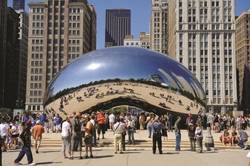
Da VAM – better known as the 2015 Vascular Annual Meeting
We’ve been having some fun with the Chicago stereotype – sports fans who eat a lot of sausage and change their “th” sounds to a “d,” but you might have some fun at the annual meeting yourself.
Here’s some things you need to know:It’s worth your while to come on Wednesday. We’ve beefed up events on the pre-plenaries day. If you usually come on Thursdays, be sure to arrive a day earlier. The plenary sessions and exhibits will be June 18-20. To top it off, Wednesday’s post-graduate courses are included with registration, a savings of $300 for SVS members.
Wednesday highlights
• Hands-on/interactive workshops. Ten different workshop topics will be offered during one-hour, hands-on sessions. Each workshop topic will repeat, so that participants can get to several sessions of their choice. Registration is required along with a workshop fee for each session. Attendance will be limited to 15 registrants for each workshop. The final workshop schedule will be available in March. Be sure to register early to get the session you want.
• International events. A poster session for international abstract presenters starts at 2 p.m. and is followed by the International Forum from 3-6 p.m. and the International Guest Reception from 6-7:30 p.m.
Other highlights
• Additional Poster Session. Approximately 120 abstracts will be presented at a poster session during the opening reception from 5:30-6:30 p.m. Thursday in the exhibit hall. Authors will be available for presentation and questions.
• SVS Member Business Lunch is Saturday. Traditionally on Fridays, the SVS Member Business Lunch will be Saturday this year. We elect officers and hand out awards. You should come.
RPVI exam preparation course
Get more out of your trip – stay for the RPVI exam preparation course, set for 1:30-5 p.m. Saturday. The course will also include audience polling. An additional registration fee is required. Self-assessment credit will also be available for this course.
9th annual meeting of the World Federation of Vascular Societies
SVS hosts this event during the 2015 VAM, also the morning’s plenary session, from 8-10 a.m. Saturday.
Texting encouraged
Attendees will be able to text questions to the moderator during all plenary sessions. Details will be available in the on-site program.
Self-assessment credit available
Self-assessment credit will be available for all plenary sessions throughout the meeting. Attendees will be able to claim self-assessment credit online following the meeting. Attendees must attend all seven plenary sessions in order to apply for self-assessment credit.
Content for sale
All general meeting content will be for sale in audio/PowerPoint formats following the event. Some videos will also be available. (Sessions requiring additional fees are excluded.) Attendees will be sent a link to the order page.
We’ve been having some fun with the Chicago stereotype – sports fans who eat a lot of sausage and change their “th” sounds to a “d,” but you might have some fun at the annual meeting yourself.
Here’s some things you need to know:It’s worth your while to come on Wednesday. We’ve beefed up events on the pre-plenaries day. If you usually come on Thursdays, be sure to arrive a day earlier. The plenary sessions and exhibits will be June 18-20. To top it off, Wednesday’s post-graduate courses are included with registration, a savings of $300 for SVS members.
Wednesday highlights
• Hands-on/interactive workshops. Ten different workshop topics will be offered during one-hour, hands-on sessions. Each workshop topic will repeat, so that participants can get to several sessions of their choice. Registration is required along with a workshop fee for each session. Attendance will be limited to 15 registrants for each workshop. The final workshop schedule will be available in March. Be sure to register early to get the session you want.
• International events. A poster session for international abstract presenters starts at 2 p.m. and is followed by the International Forum from 3-6 p.m. and the International Guest Reception from 6-7:30 p.m.
Other highlights
• Additional Poster Session. Approximately 120 abstracts will be presented at a poster session during the opening reception from 5:30-6:30 p.m. Thursday in the exhibit hall. Authors will be available for presentation and questions.
• SVS Member Business Lunch is Saturday. Traditionally on Fridays, the SVS Member Business Lunch will be Saturday this year. We elect officers and hand out awards. You should come.
RPVI exam preparation course
Get more out of your trip – stay for the RPVI exam preparation course, set for 1:30-5 p.m. Saturday. The course will also include audience polling. An additional registration fee is required. Self-assessment credit will also be available for this course.
9th annual meeting of the World Federation of Vascular Societies
SVS hosts this event during the 2015 VAM, also the morning’s plenary session, from 8-10 a.m. Saturday.
Texting encouraged
Attendees will be able to text questions to the moderator during all plenary sessions. Details will be available in the on-site program.
Self-assessment credit available
Self-assessment credit will be available for all plenary sessions throughout the meeting. Attendees will be able to claim self-assessment credit online following the meeting. Attendees must attend all seven plenary sessions in order to apply for self-assessment credit.
Content for sale
All general meeting content will be for sale in audio/PowerPoint formats following the event. Some videos will also be available. (Sessions requiring additional fees are excluded.) Attendees will be sent a link to the order page.
We’ve been having some fun with the Chicago stereotype – sports fans who eat a lot of sausage and change their “th” sounds to a “d,” but you might have some fun at the annual meeting yourself.
Here’s some things you need to know:It’s worth your while to come on Wednesday. We’ve beefed up events on the pre-plenaries day. If you usually come on Thursdays, be sure to arrive a day earlier. The plenary sessions and exhibits will be June 18-20. To top it off, Wednesday’s post-graduate courses are included with registration, a savings of $300 for SVS members.
Wednesday highlights
• Hands-on/interactive workshops. Ten different workshop topics will be offered during one-hour, hands-on sessions. Each workshop topic will repeat, so that participants can get to several sessions of their choice. Registration is required along with a workshop fee for each session. Attendance will be limited to 15 registrants for each workshop. The final workshop schedule will be available in March. Be sure to register early to get the session you want.
• International events. A poster session for international abstract presenters starts at 2 p.m. and is followed by the International Forum from 3-6 p.m. and the International Guest Reception from 6-7:30 p.m.
Other highlights
• Additional Poster Session. Approximately 120 abstracts will be presented at a poster session during the opening reception from 5:30-6:30 p.m. Thursday in the exhibit hall. Authors will be available for presentation and questions.
• SVS Member Business Lunch is Saturday. Traditionally on Fridays, the SVS Member Business Lunch will be Saturday this year. We elect officers and hand out awards. You should come.
RPVI exam preparation course
Get more out of your trip – stay for the RPVI exam preparation course, set for 1:30-5 p.m. Saturday. The course will also include audience polling. An additional registration fee is required. Self-assessment credit will also be available for this course.
9th annual meeting of the World Federation of Vascular Societies
SVS hosts this event during the 2015 VAM, also the morning’s plenary session, from 8-10 a.m. Saturday.
Texting encouraged
Attendees will be able to text questions to the moderator during all plenary sessions. Details will be available in the on-site program.
Self-assessment credit available
Self-assessment credit will be available for all plenary sessions throughout the meeting. Attendees will be able to claim self-assessment credit online following the meeting. Attendees must attend all seven plenary sessions in order to apply for self-assessment credit.
Content for sale
All general meeting content will be for sale in audio/PowerPoint formats following the event. Some videos will also be available. (Sessions requiring additional fees are excluded.) Attendees will be sent a link to the order page.

Presidential update: My, how we’ve grown
The start of the new year—a little more than halfway through my presidential term—is a fitting time to reflect upon the accomplishments of our society and its future direction.
When I became president in June 2014, I saw opportunities for SVS to pitch a “big tent” for those dedicated to the treatment of vascular disease and provide the best education to physicians so that all patients benefit.
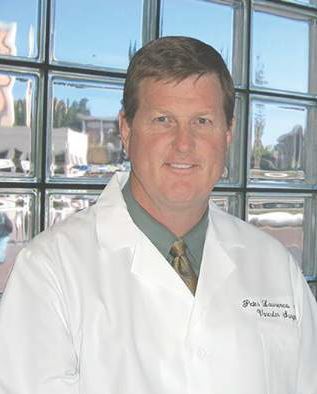
Over the past several months, thanks to the contributions of SVS members, I am proud to say we have made meaningful strides.
Practice guidelines. Last month, SVS published Lower Extremity Practice Guidelines in JVS for the treatment of asymptomatic PAD and intermittent claudication. These guidelines are an important step in assuring the quality of care for vascular patients, and help establish vascular surgeons as the best qualified providers
Vascular Annual Meeting. While VAM has a well-deserved reputation for excellence, it is always evolving. In 2015, we will be offering self-assessment credits for Maintenance of Certification, enlarging our international programming, and offering more presentation opportunities for a greater diversity of speakers than ever before.
International membership. SVS membership grows each year across the world, and 15% of our 5,000 members are now vascular surgeons practicing outside of the U.S. and Canada. We all benefit from a worldwide perspective on vascular disease.
Global Vascular Guidelines. Together with the European Society for Vascular Surgery and the World Federation of Vascular Societies, SVS is participating in the Global Vascular Guidelines to develop a practice guideline on the evaluation and management of patients with limb-threatening ischemia related to peripheral artery occlusive disease.
Multi-disciplinary outreach. SVS has strengthened its relationships with other like-minded societies, such as the American Podiatric Medical Association, American Venous Forum, the Society for Interventional Radiology, Society for Vascular Medicine and the Society for Vascular Ultrasound. Collaborative projects are underway or in planning with these groups.
Practice support. SVS has an array of programs to keep physicians informed on coding, reimbursement and political issues that can impact their practice. These programs and the SVS PAC, vascular’s voice in Washington, help us protect quality patient care.
VQI. Our registry program provides data to our patient safety organization to improve patient care. Over the past several months, VQI has added a new registry, the Varicose Vein Registry, in collaboration with the American Venous Forum, gained two new regional quality groups to review data reported, and contributed new information that is changing how care is delivered.
JVS. Since the first issue was published in 1984, the Journal for Vascular Surgery’s impact on patient care over the last 30 years is substantial. The JVS family has branched out, with the Journal for Vascular Surgery: Venous and Lymphatic Disease and the new JVS Cases, an online only, open-access journal that is set to debut in March 2015.
I’ve learned over my years of gradually increased involvement in SVS that this is an organization that will thrive only when members get involved. SVS has thrived, and will continue to thrive in the future, as people recognize they have an opportunity to participate, but also a responsibility. Our society will only be as strong as our members make it. I encourage you to get involved with SVS.
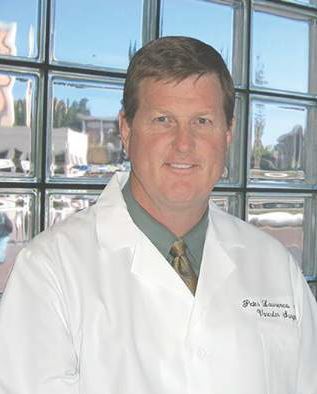
Thank you for the opportunity to serve as your president.- Peter
The start of the new year—a little more than halfway through my presidential term—is a fitting time to reflect upon the accomplishments of our society and its future direction.
When I became president in June 2014, I saw opportunities for SVS to pitch a “big tent” for those dedicated to the treatment of vascular disease and provide the best education to physicians so that all patients benefit.
Over the past several months, thanks to the contributions of SVS members, I am proud to say we have made meaningful strides.
Practice guidelines. Last month, SVS published Lower Extremity Practice Guidelines in JVS for the treatment of asymptomatic PAD and intermittent claudication. These guidelines are an important step in assuring the quality of care for vascular patients, and help establish vascular surgeons as the best qualified providers
Vascular Annual Meeting. While VAM has a well-deserved reputation for excellence, it is always evolving. In 2015, we will be offering self-assessment credits for Maintenance of Certification, enlarging our international programming, and offering more presentation opportunities for a greater diversity of speakers than ever before.
International membership. SVS membership grows each year across the world, and 15% of our 5,000 members are now vascular surgeons practicing outside of the U.S. and Canada. We all benefit from a worldwide perspective on vascular disease.
Global Vascular Guidelines. Together with the European Society for Vascular Surgery and the World Federation of Vascular Societies, SVS is participating in the Global Vascular Guidelines to develop a practice guideline on the evaluation and management of patients with limb-threatening ischemia related to peripheral artery occlusive disease.
Multi-disciplinary outreach. SVS has strengthened its relationships with other like-minded societies, such as the American Podiatric Medical Association, American Venous Forum, the Society for Interventional Radiology, Society for Vascular Medicine and the Society for Vascular Ultrasound. Collaborative projects are underway or in planning with these groups.
Practice support. SVS has an array of programs to keep physicians informed on coding, reimbursement and political issues that can impact their practice. These programs and the SVS PAC, vascular’s voice in Washington, help us protect quality patient care.
VQI. Our registry program provides data to our patient safety organization to improve patient care. Over the past several months, VQI has added a new registry, the Varicose Vein Registry, in collaboration with the American Venous Forum, gained two new regional quality groups to review data reported, and contributed new information that is changing how care is delivered.
JVS. Since the first issue was published in 1984, the Journal for Vascular Surgery’s impact on patient care over the last 30 years is substantial. The JVS family has branched out, with the Journal for Vascular Surgery: Venous and Lymphatic Disease and the new JVS Cases, an online only, open-access journal that is set to debut in March 2015.
I’ve learned over my years of gradually increased involvement in SVS that this is an organization that will thrive only when members get involved. SVS has thrived, and will continue to thrive in the future, as people recognize they have an opportunity to participate, but also a responsibility. Our society will only be as strong as our members make it. I encourage you to get involved with SVS.
Thank you for the opportunity to serve as your president.- Peter
The start of the new year—a little more than halfway through my presidential term—is a fitting time to reflect upon the accomplishments of our society and its future direction.
When I became president in June 2014, I saw opportunities for SVS to pitch a “big tent” for those dedicated to the treatment of vascular disease and provide the best education to physicians so that all patients benefit.
Over the past several months, thanks to the contributions of SVS members, I am proud to say we have made meaningful strides.
Practice guidelines. Last month, SVS published Lower Extremity Practice Guidelines in JVS for the treatment of asymptomatic PAD and intermittent claudication. These guidelines are an important step in assuring the quality of care for vascular patients, and help establish vascular surgeons as the best qualified providers
Vascular Annual Meeting. While VAM has a well-deserved reputation for excellence, it is always evolving. In 2015, we will be offering self-assessment credits for Maintenance of Certification, enlarging our international programming, and offering more presentation opportunities for a greater diversity of speakers than ever before.
International membership. SVS membership grows each year across the world, and 15% of our 5,000 members are now vascular surgeons practicing outside of the U.S. and Canada. We all benefit from a worldwide perspective on vascular disease.
Global Vascular Guidelines. Together with the European Society for Vascular Surgery and the World Federation of Vascular Societies, SVS is participating in the Global Vascular Guidelines to develop a practice guideline on the evaluation and management of patients with limb-threatening ischemia related to peripheral artery occlusive disease.
Multi-disciplinary outreach. SVS has strengthened its relationships with other like-minded societies, such as the American Podiatric Medical Association, American Venous Forum, the Society for Interventional Radiology, Society for Vascular Medicine and the Society for Vascular Ultrasound. Collaborative projects are underway or in planning with these groups.
Practice support. SVS has an array of programs to keep physicians informed on coding, reimbursement and political issues that can impact their practice. These programs and the SVS PAC, vascular’s voice in Washington, help us protect quality patient care.
VQI. Our registry program provides data to our patient safety organization to improve patient care. Over the past several months, VQI has added a new registry, the Varicose Vein Registry, in collaboration with the American Venous Forum, gained two new regional quality groups to review data reported, and contributed new information that is changing how care is delivered.
JVS. Since the first issue was published in 1984, the Journal for Vascular Surgery’s impact on patient care over the last 30 years is substantial. The JVS family has branched out, with the Journal for Vascular Surgery: Venous and Lymphatic Disease and the new JVS Cases, an online only, open-access journal that is set to debut in March 2015.
I’ve learned over my years of gradually increased involvement in SVS that this is an organization that will thrive only when members get involved. SVS has thrived, and will continue to thrive in the future, as people recognize they have an opportunity to participate, but also a responsibility. Our society will only be as strong as our members make it. I encourage you to get involved with SVS.
Thank you for the opportunity to serve as your president.- Peter
March 2 – Deadline for two SVS Foundation awards
Two awards are offered by the SVS Foundation with deadlines of March 2, 2015. They are the prestigious Student Research Fellowship Award and the E. J. Wylie Traveling Fellowship Award.
Student Research Fellowship Award
This $3,000 student stipend stimulates laboratory and clinical vascular research by undergraduate college students and medical school students registered at universities in the United States and Canada. Award recipients are eligible for a travel scholarship to attend the 2015 Vascular Annual Meeting in Chicago, June 17-20. For more information, click here.
E. J. Wylie Traveling Fellowship
This award offers the opportunity to visit vascular surgery centers worldwide for professional exchange and academic inspiration. The fellowship is open to active members of SVS who have finished their postgraduate vascular training in the past 10 years. For more information, click here.
Two awards are offered by the SVS Foundation with deadlines of March 2, 2015. They are the prestigious Student Research Fellowship Award and the E. J. Wylie Traveling Fellowship Award.
Student Research Fellowship Award
This $3,000 student stipend stimulates laboratory and clinical vascular research by undergraduate college students and medical school students registered at universities in the United States and Canada. Award recipients are eligible for a travel scholarship to attend the 2015 Vascular Annual Meeting in Chicago, June 17-20. For more information, click here.
E. J. Wylie Traveling Fellowship
This award offers the opportunity to visit vascular surgery centers worldwide for professional exchange and academic inspiration. The fellowship is open to active members of SVS who have finished their postgraduate vascular training in the past 10 years. For more information, click here.
Two awards are offered by the SVS Foundation with deadlines of March 2, 2015. They are the prestigious Student Research Fellowship Award and the E. J. Wylie Traveling Fellowship Award.
Student Research Fellowship Award
This $3,000 student stipend stimulates laboratory and clinical vascular research by undergraduate college students and medical school students registered at universities in the United States and Canada. Award recipients are eligible for a travel scholarship to attend the 2015 Vascular Annual Meeting in Chicago, June 17-20. For more information, click here.
E. J. Wylie Traveling Fellowship
This award offers the opportunity to visit vascular surgery centers worldwide for professional exchange and academic inspiration. The fellowship is open to active members of SVS who have finished their postgraduate vascular training in the past 10 years. For more information, click here.
Asymptomatic PAD treatment - New clinical guidelines add to LE debate
The Society for Vascular Surgery has just released its long-awaited, “SVS practice guidelines for atherosclerotic occlusive disease of the lower extremities: Management of asymptomatic disease and claudication,” and they are available online.
View the guidelines at this link.
The guidelines represent more than four years of collaborative effort by a team of physicians, led by co-chairmen Drs. Michael S. Conte and Frank B. Pomposelli.
The Society for Vascular Surgery has just released its long-awaited, “SVS practice guidelines for atherosclerotic occlusive disease of the lower extremities: Management of asymptomatic disease and claudication,” and they are available online.
View the guidelines at this link.
The guidelines represent more than four years of collaborative effort by a team of physicians, led by co-chairmen Drs. Michael S. Conte and Frank B. Pomposelli.
The Society for Vascular Surgery has just released its long-awaited, “SVS practice guidelines for atherosclerotic occlusive disease of the lower extremities: Management of asymptomatic disease and claudication,” and they are available online.
View the guidelines at this link.
The guidelines represent more than four years of collaborative effort by a team of physicians, led by co-chairmen Drs. Michael S. Conte and Frank B. Pomposelli.