User login
AGA Research Foundation funds new wave of young GIs
The American Gastroenterological Association (AGA) Research Foundation is pleased to reveal its 2015 research award recipients. This year’s honorees are young researchers who are pursuing independent research careers in gastroenterology, hepatology, nutrition and related fields. A grant from the AGA Research Foundation ensures that a major proportion of the recipient’s time is protected for research.
To continue to preserve the lifeline of new researchers, AGA established the Looking Forward: Giving Back campaign in October of 2011, which called on our industry partners, AGA members, national and family foundations, grateful patients and the entire GI community to commit their support to the AGA Research Foundation. Since its inception, the Looking Forward: Giving Back campaign has raised more than $10.5 million, surpassing our original goal of $7.5 million. These funds will enable AGA to create a self-sustaining endowment that will ensure annual research funding for young investigators for years to come.
“It is an exciting time in medical research, and AGA is proud to support young investigators as they embark on challenging and promising research projects that have the potential to advance our understanding of digestive diseases and improve patient care,” said Martin Brotman, MD, AGAF, chair of the AGA Research Foundation. “Thanks to the generous support of the Looking Forward: Giving Back campaign donors, we are able to support the next generation of young scientists committed to advancing our field.”
Below are the 2015 AGA Research Foundation award recipients:
Research Scholar Awards
Arthur Beyder, MD, PhD, Mayo Clinic, Rochester, MN
Daniel E. Freedberg, MD, MS, Columbia University, New York, NY
Jeffrey K. Lee, MD, MAS, University of California, San Francisco
Christina A. Twyman-Saint Victor, MD, University of Pennsylvania, Philadelphia
Xiang Xue, PhD, University of Michigan, Ann Arbor
AGA-Pfizer JAK-IBD Research Grant
Clara Abraham, MD, Yale University, New Haven, CT
AGA-Providence Food Intolerance Research Award
Rodney D. Newberry, MD, Washington University, St. Louis, MO
AGA-Actavis Research Award in Pancreatic Disorders
Maximilian Reichert, MD, University of Pennsylvania, Philadelphia
R. Robert & Sally D. Funderburg Research Award in Gastric Cancer
Linda C. Samuelson, PhD, University of Michigan, Ann Arbor
AGA Microbiome Junior Investigator Research Award
Amir Zarrinpar, MD, PHD, University of California, San Diego
AGA-Rome Foundation Pilot Award in Functional Gastroenterology & Motility
Madhusudan Grover, MBBS, Mayo Clinic, Rochester, MN
Miranda A.L. van Tilburg, PhD, University of North Carolina, Chapel Hill
AGA-Caroline Craig Augustyn & Damian Augustyn Award in Digestive Cancer
Janelle C. Arthur, PhD, University of North Carolina, Chapel Hill
AGA-Covidien Research & Development Pilot Award in Technology
David A. Katzka, MD, Mayo Clinic, Rochester, MN
AGA-June & Donald O. Castell, MD, Esophageal Clinical Research Award
Amanda B. Muir, MD, Children’s Hospital, Philadelphia, PA
AGA-Elsevier Gut Microbiome Pilot Research Award
Hani Conjeevaram, MD, MSc, University of Michigan, Ann Arbor
AGA-Elsevier Pilot Research Award
Juan Gonzalez Abraldes MD, MMSc, University of Alberta, Canada
Diego V. Bohórquez, PhD, Duke University, Durham, NC
AGA-Moti L. & Kamla Rustgi International Travel Award
Ryan Chang-Ho Choi, MBBS, Queen Mary University, London, UK
Steven C. M. Fong, MBBS, Guy’s and St Thomas’ NHS Foundation Trust, London, UK
AGA Investing in the Future Student Research Fellowship
Hawa Ali, University of Minnesota-Rochester
Alicia A. Frieburg, University of Iowa, Iowa City
Marcos A. Lares, University of Wisconsin, Whitewater
Pierre B. Leconte, Boston College, MA
Erick M. Marigi, University of Minnesota Medical School, Minneapolis
Vivian Ortiz, Meharry Medical College, Nashville, TN
Luz E. Reiley, San Juan Bautista School of Medicine, Puerto Rico
Luis Vazquez-Montesino, University of Puerto Rico, San Juan
AGA-Eli & Edythe Broad Student Research Fellowships (High School)
Richard T. Alonso, Evanston Township High School, IL
Kaeley R. Bogan, Washington Township High School, Sewell, NJ
Chiara L. Commineli, Hawken School, Gates Mills, OH
Nathaniel S. Corley, San Francisco University High School, CA
Hannah R. Friedman, Hawken School, Gates Mill, OH
Karissa D. Kao, Skyline High School, Ann Arbor, MI
Anjali Shankar, Sayre School, Lexington, KY
Wendy Y. Yao, Walton High School, Marietta, GA
AGA Student Research Fellowship Award (Undergraduate)
Aaron R. Brussels, University of Arizona, Tucson
Andy C. Guo, University of Pennsylvania, Philadelphia
David E. Heller, Massachusetts Institute of Technology, Cambridge
Edmund M. Qiao, University of Michigan, Ann Arbor
Michael J. Rufo, Trinity College, Hartford, CT
Jonathan J. Ruiz, University of California, Los Angeles
Jeffrey L. Saltzman, Tufts University, Medford, MA
Jessica Tsui, University of California, Los Angeles
AGA Student Research Fellowship Award (Graduate/Medical School)
Iris Chen, Icahn School of Medicine, New York, NY
Narek Isrealyan, Columbia University, New York, NY
Cindy CY Law, University of Ottawa, CN
The American Gastroenterological Association (AGA) Research Foundation is pleased to reveal its 2015 research award recipients. This year’s honorees are young researchers who are pursuing independent research careers in gastroenterology, hepatology, nutrition and related fields. A grant from the AGA Research Foundation ensures that a major proportion of the recipient’s time is protected for research.
To continue to preserve the lifeline of new researchers, AGA established the Looking Forward: Giving Back campaign in October of 2011, which called on our industry partners, AGA members, national and family foundations, grateful patients and the entire GI community to commit their support to the AGA Research Foundation. Since its inception, the Looking Forward: Giving Back campaign has raised more than $10.5 million, surpassing our original goal of $7.5 million. These funds will enable AGA to create a self-sustaining endowment that will ensure annual research funding for young investigators for years to come.
“It is an exciting time in medical research, and AGA is proud to support young investigators as they embark on challenging and promising research projects that have the potential to advance our understanding of digestive diseases and improve patient care,” said Martin Brotman, MD, AGAF, chair of the AGA Research Foundation. “Thanks to the generous support of the Looking Forward: Giving Back campaign donors, we are able to support the next generation of young scientists committed to advancing our field.”
Below are the 2015 AGA Research Foundation award recipients:
Research Scholar Awards
Arthur Beyder, MD, PhD, Mayo Clinic, Rochester, MN
Daniel E. Freedberg, MD, MS, Columbia University, New York, NY
Jeffrey K. Lee, MD, MAS, University of California, San Francisco
Christina A. Twyman-Saint Victor, MD, University of Pennsylvania, Philadelphia
Xiang Xue, PhD, University of Michigan, Ann Arbor
AGA-Pfizer JAK-IBD Research Grant
Clara Abraham, MD, Yale University, New Haven, CT
AGA-Providence Food Intolerance Research Award
Rodney D. Newberry, MD, Washington University, St. Louis, MO
AGA-Actavis Research Award in Pancreatic Disorders
Maximilian Reichert, MD, University of Pennsylvania, Philadelphia
R. Robert & Sally D. Funderburg Research Award in Gastric Cancer
Linda C. Samuelson, PhD, University of Michigan, Ann Arbor
AGA Microbiome Junior Investigator Research Award
Amir Zarrinpar, MD, PHD, University of California, San Diego
AGA-Rome Foundation Pilot Award in Functional Gastroenterology & Motility
Madhusudan Grover, MBBS, Mayo Clinic, Rochester, MN
Miranda A.L. van Tilburg, PhD, University of North Carolina, Chapel Hill
AGA-Caroline Craig Augustyn & Damian Augustyn Award in Digestive Cancer
Janelle C. Arthur, PhD, University of North Carolina, Chapel Hill
AGA-Covidien Research & Development Pilot Award in Technology
David A. Katzka, MD, Mayo Clinic, Rochester, MN
AGA-June & Donald O. Castell, MD, Esophageal Clinical Research Award
Amanda B. Muir, MD, Children’s Hospital, Philadelphia, PA
AGA-Elsevier Gut Microbiome Pilot Research Award
Hani Conjeevaram, MD, MSc, University of Michigan, Ann Arbor
AGA-Elsevier Pilot Research Award
Juan Gonzalez Abraldes MD, MMSc, University of Alberta, Canada
Diego V. Bohórquez, PhD, Duke University, Durham, NC
AGA-Moti L. & Kamla Rustgi International Travel Award
Ryan Chang-Ho Choi, MBBS, Queen Mary University, London, UK
Steven C. M. Fong, MBBS, Guy’s and St Thomas’ NHS Foundation Trust, London, UK
AGA Investing in the Future Student Research Fellowship
Hawa Ali, University of Minnesota-Rochester
Alicia A. Frieburg, University of Iowa, Iowa City
Marcos A. Lares, University of Wisconsin, Whitewater
Pierre B. Leconte, Boston College, MA
Erick M. Marigi, University of Minnesota Medical School, Minneapolis
Vivian Ortiz, Meharry Medical College, Nashville, TN
Luz E. Reiley, San Juan Bautista School of Medicine, Puerto Rico
Luis Vazquez-Montesino, University of Puerto Rico, San Juan
AGA-Eli & Edythe Broad Student Research Fellowships (High School)
Richard T. Alonso, Evanston Township High School, IL
Kaeley R. Bogan, Washington Township High School, Sewell, NJ
Chiara L. Commineli, Hawken School, Gates Mills, OH
Nathaniel S. Corley, San Francisco University High School, CA
Hannah R. Friedman, Hawken School, Gates Mill, OH
Karissa D. Kao, Skyline High School, Ann Arbor, MI
Anjali Shankar, Sayre School, Lexington, KY
Wendy Y. Yao, Walton High School, Marietta, GA
AGA Student Research Fellowship Award (Undergraduate)
Aaron R. Brussels, University of Arizona, Tucson
Andy C. Guo, University of Pennsylvania, Philadelphia
David E. Heller, Massachusetts Institute of Technology, Cambridge
Edmund M. Qiao, University of Michigan, Ann Arbor
Michael J. Rufo, Trinity College, Hartford, CT
Jonathan J. Ruiz, University of California, Los Angeles
Jeffrey L. Saltzman, Tufts University, Medford, MA
Jessica Tsui, University of California, Los Angeles
AGA Student Research Fellowship Award (Graduate/Medical School)
Iris Chen, Icahn School of Medicine, New York, NY
Narek Isrealyan, Columbia University, New York, NY
Cindy CY Law, University of Ottawa, CN
The American Gastroenterological Association (AGA) Research Foundation is pleased to reveal its 2015 research award recipients. This year’s honorees are young researchers who are pursuing independent research careers in gastroenterology, hepatology, nutrition and related fields. A grant from the AGA Research Foundation ensures that a major proportion of the recipient’s time is protected for research.
To continue to preserve the lifeline of new researchers, AGA established the Looking Forward: Giving Back campaign in October of 2011, which called on our industry partners, AGA members, national and family foundations, grateful patients and the entire GI community to commit their support to the AGA Research Foundation. Since its inception, the Looking Forward: Giving Back campaign has raised more than $10.5 million, surpassing our original goal of $7.5 million. These funds will enable AGA to create a self-sustaining endowment that will ensure annual research funding for young investigators for years to come.
“It is an exciting time in medical research, and AGA is proud to support young investigators as they embark on challenging and promising research projects that have the potential to advance our understanding of digestive diseases and improve patient care,” said Martin Brotman, MD, AGAF, chair of the AGA Research Foundation. “Thanks to the generous support of the Looking Forward: Giving Back campaign donors, we are able to support the next generation of young scientists committed to advancing our field.”
Below are the 2015 AGA Research Foundation award recipients:
Research Scholar Awards
Arthur Beyder, MD, PhD, Mayo Clinic, Rochester, MN
Daniel E. Freedberg, MD, MS, Columbia University, New York, NY
Jeffrey K. Lee, MD, MAS, University of California, San Francisco
Christina A. Twyman-Saint Victor, MD, University of Pennsylvania, Philadelphia
Xiang Xue, PhD, University of Michigan, Ann Arbor
AGA-Pfizer JAK-IBD Research Grant
Clara Abraham, MD, Yale University, New Haven, CT
AGA-Providence Food Intolerance Research Award
Rodney D. Newberry, MD, Washington University, St. Louis, MO
AGA-Actavis Research Award in Pancreatic Disorders
Maximilian Reichert, MD, University of Pennsylvania, Philadelphia
R. Robert & Sally D. Funderburg Research Award in Gastric Cancer
Linda C. Samuelson, PhD, University of Michigan, Ann Arbor
AGA Microbiome Junior Investigator Research Award
Amir Zarrinpar, MD, PHD, University of California, San Diego
AGA-Rome Foundation Pilot Award in Functional Gastroenterology & Motility
Madhusudan Grover, MBBS, Mayo Clinic, Rochester, MN
Miranda A.L. van Tilburg, PhD, University of North Carolina, Chapel Hill
AGA-Caroline Craig Augustyn & Damian Augustyn Award in Digestive Cancer
Janelle C. Arthur, PhD, University of North Carolina, Chapel Hill
AGA-Covidien Research & Development Pilot Award in Technology
David A. Katzka, MD, Mayo Clinic, Rochester, MN
AGA-June & Donald O. Castell, MD, Esophageal Clinical Research Award
Amanda B. Muir, MD, Children’s Hospital, Philadelphia, PA
AGA-Elsevier Gut Microbiome Pilot Research Award
Hani Conjeevaram, MD, MSc, University of Michigan, Ann Arbor
AGA-Elsevier Pilot Research Award
Juan Gonzalez Abraldes MD, MMSc, University of Alberta, Canada
Diego V. Bohórquez, PhD, Duke University, Durham, NC
AGA-Moti L. & Kamla Rustgi International Travel Award
Ryan Chang-Ho Choi, MBBS, Queen Mary University, London, UK
Steven C. M. Fong, MBBS, Guy’s and St Thomas’ NHS Foundation Trust, London, UK
AGA Investing in the Future Student Research Fellowship
Hawa Ali, University of Minnesota-Rochester
Alicia A. Frieburg, University of Iowa, Iowa City
Marcos A. Lares, University of Wisconsin, Whitewater
Pierre B. Leconte, Boston College, MA
Erick M. Marigi, University of Minnesota Medical School, Minneapolis
Vivian Ortiz, Meharry Medical College, Nashville, TN
Luz E. Reiley, San Juan Bautista School of Medicine, Puerto Rico
Luis Vazquez-Montesino, University of Puerto Rico, San Juan
AGA-Eli & Edythe Broad Student Research Fellowships (High School)
Richard T. Alonso, Evanston Township High School, IL
Kaeley R. Bogan, Washington Township High School, Sewell, NJ
Chiara L. Commineli, Hawken School, Gates Mills, OH
Nathaniel S. Corley, San Francisco University High School, CA
Hannah R. Friedman, Hawken School, Gates Mill, OH
Karissa D. Kao, Skyline High School, Ann Arbor, MI
Anjali Shankar, Sayre School, Lexington, KY
Wendy Y. Yao, Walton High School, Marietta, GA
AGA Student Research Fellowship Award (Undergraduate)
Aaron R. Brussels, University of Arizona, Tucson
Andy C. Guo, University of Pennsylvania, Philadelphia
David E. Heller, Massachusetts Institute of Technology, Cambridge
Edmund M. Qiao, University of Michigan, Ann Arbor
Michael J. Rufo, Trinity College, Hartford, CT
Jonathan J. Ruiz, University of California, Los Angeles
Jeffrey L. Saltzman, Tufts University, Medford, MA
Jessica Tsui, University of California, Los Angeles
AGA Student Research Fellowship Award (Graduate/Medical School)
Iris Chen, Icahn School of Medicine, New York, NY
Narek Isrealyan, Columbia University, New York, NY
Cindy CY Law, University of Ottawa, CN
AGA Research Foundation celebrates success of Looking Forward: Giving Back Campaign
More than 100 people celebrated the success of the AGA Research Foundation’s Looking Forward: Giving Back fundraising campaign on May 16 at the AGA Research Foundation Benefactors’ Dinner. The income from the $10.5 million dollar endowment raised will support young investigators in perpetuity. The campaign began in October 2011.
AGA Research Foundation Chair and National Campaign chairman Dr. Martin Brotman, AGAF, said the endowment would provide a safe, secure source of funding for the AGA Research Foundation to support future grant awards. Although endowment campaigns are more difficult to conduct than cash gift drives, he said, the end result justified the efforts of the many volunteers, as research funding will become available at a time that federal funding has become more difficult to secure.

“Those that are particularly vulnerable to this problem are the young, well-trained investigators, who are launching their careers,” he said. “It’s very, very hard for them to be competitive for federal funding at a critical time in their careers when they are transitioning from dependency on their mentors to independent research.”
The Benefactors’ Dinner was an opportunity to thank both the donors and the volunteer fundraisers, and also awardees had an opportunity to say thank you in person to the individuals and corporations who are supporting the AGA Research Foundation’s efforts. A number of investigators provided the attendees with updates on their AGA Research Foundation–funded research.
As a clinical practitioner, Dr. Brotman said he is well aware that what he does in clinical practice is the result of research done by dedicated GI research investigators.
Also during the dinner, Dr. Brotman received a special award saluting his work that made the campaign a success. As a clinical practitioner, Dr. Brotman said he understood that everything he does in his practice comes from work done by people dedicated to research.
“We all have an obligation to give something back to the field that made us so successful, whether you’re a researcher or a clinician,” Dr. Brotman said before Saturday’s dinner. “That’s why I agreed to take on the chairmanship of the national campaign, because I, along with my colleagues, owe a huge debt of gratitude to the field of research in gastroenterology.”
The work continues, as the AGA Research Foundation has now developed a 5-year plan to assist in building the endowment to $75 million. This will strongly support the future of AGA’s research mission.
About the AGA Research Foundation
The AGA Research Foundation, formerly known as the Foundation for Digestive Health and Nutrition, is the cornerstone of AGA’s effort to expand digestive disease research funding. Since 1984, the AGA, through its foundations, has provided more than $44 million in research grants to more than 830 scientists.
The AGA Research Foundation serves as a bridge to the future of research in gastroenterology and hepatology by providing critical funding to advance the careers of young researchers between the end of training and the establishment of credentials that earn National Institutes of Health grants. Learn more about the AGA Research Foundation or make a contribution at www.gastro.org/about/aga-research-foundation.
More than 100 people celebrated the success of the AGA Research Foundation’s Looking Forward: Giving Back fundraising campaign on May 16 at the AGA Research Foundation Benefactors’ Dinner. The income from the $10.5 million dollar endowment raised will support young investigators in perpetuity. The campaign began in October 2011.
AGA Research Foundation Chair and National Campaign chairman Dr. Martin Brotman, AGAF, said the endowment would provide a safe, secure source of funding for the AGA Research Foundation to support future grant awards. Although endowment campaigns are more difficult to conduct than cash gift drives, he said, the end result justified the efforts of the many volunteers, as research funding will become available at a time that federal funding has become more difficult to secure.
“Those that are particularly vulnerable to this problem are the young, well-trained investigators, who are launching their careers,” he said. “It’s very, very hard for them to be competitive for federal funding at a critical time in their careers when they are transitioning from dependency on their mentors to independent research.”
The Benefactors’ Dinner was an opportunity to thank both the donors and the volunteer fundraisers, and also awardees had an opportunity to say thank you in person to the individuals and corporations who are supporting the AGA Research Foundation’s efforts. A number of investigators provided the attendees with updates on their AGA Research Foundation–funded research.
As a clinical practitioner, Dr. Brotman said he is well aware that what he does in clinical practice is the result of research done by dedicated GI research investigators.
Also during the dinner, Dr. Brotman received a special award saluting his work that made the campaign a success. As a clinical practitioner, Dr. Brotman said he understood that everything he does in his practice comes from work done by people dedicated to research.
“We all have an obligation to give something back to the field that made us so successful, whether you’re a researcher or a clinician,” Dr. Brotman said before Saturday’s dinner. “That’s why I agreed to take on the chairmanship of the national campaign, because I, along with my colleagues, owe a huge debt of gratitude to the field of research in gastroenterology.”
The work continues, as the AGA Research Foundation has now developed a 5-year plan to assist in building the endowment to $75 million. This will strongly support the future of AGA’s research mission.
About the AGA Research Foundation
The AGA Research Foundation, formerly known as the Foundation for Digestive Health and Nutrition, is the cornerstone of AGA’s effort to expand digestive disease research funding. Since 1984, the AGA, through its foundations, has provided more than $44 million in research grants to more than 830 scientists.
The AGA Research Foundation serves as a bridge to the future of research in gastroenterology and hepatology by providing critical funding to advance the careers of young researchers between the end of training and the establishment of credentials that earn National Institutes of Health grants. Learn more about the AGA Research Foundation or make a contribution at www.gastro.org/about/aga-research-foundation.
More than 100 people celebrated the success of the AGA Research Foundation’s Looking Forward: Giving Back fundraising campaign on May 16 at the AGA Research Foundation Benefactors’ Dinner. The income from the $10.5 million dollar endowment raised will support young investigators in perpetuity. The campaign began in October 2011.
AGA Research Foundation Chair and National Campaign chairman Dr. Martin Brotman, AGAF, said the endowment would provide a safe, secure source of funding for the AGA Research Foundation to support future grant awards. Although endowment campaigns are more difficult to conduct than cash gift drives, he said, the end result justified the efforts of the many volunteers, as research funding will become available at a time that federal funding has become more difficult to secure.
“Those that are particularly vulnerable to this problem are the young, well-trained investigators, who are launching their careers,” he said. “It’s very, very hard for them to be competitive for federal funding at a critical time in their careers when they are transitioning from dependency on their mentors to independent research.”
The Benefactors’ Dinner was an opportunity to thank both the donors and the volunteer fundraisers, and also awardees had an opportunity to say thank you in person to the individuals and corporations who are supporting the AGA Research Foundation’s efforts. A number of investigators provided the attendees with updates on their AGA Research Foundation–funded research.
As a clinical practitioner, Dr. Brotman said he is well aware that what he does in clinical practice is the result of research done by dedicated GI research investigators.
Also during the dinner, Dr. Brotman received a special award saluting his work that made the campaign a success. As a clinical practitioner, Dr. Brotman said he understood that everything he does in his practice comes from work done by people dedicated to research.
“We all have an obligation to give something back to the field that made us so successful, whether you’re a researcher or a clinician,” Dr. Brotman said before Saturday’s dinner. “That’s why I agreed to take on the chairmanship of the national campaign, because I, along with my colleagues, owe a huge debt of gratitude to the field of research in gastroenterology.”
The work continues, as the AGA Research Foundation has now developed a 5-year plan to assist in building the endowment to $75 million. This will strongly support the future of AGA’s research mission.
About the AGA Research Foundation
The AGA Research Foundation, formerly known as the Foundation for Digestive Health and Nutrition, is the cornerstone of AGA’s effort to expand digestive disease research funding. Since 1984, the AGA, through its foundations, has provided more than $44 million in research grants to more than 830 scientists.
The AGA Research Foundation serves as a bridge to the future of research in gastroenterology and hepatology by providing critical funding to advance the careers of young researchers between the end of training and the establishment of credentials that earn National Institutes of Health grants. Learn more about the AGA Research Foundation or make a contribution at www.gastro.org/about/aga-research-foundation.

Special issue of Gastroenterology focuses on food, the immune system, and GI tract
Each May, Gastroenterology publishes a special 13th issue that examines a major topic that impacts the science and practice of gastroenterology from a variety of perspectives. This year’s issue, “Food, the Immune System and the Gastrointestinal Tract,” reviews the latest research in how food and nutritional elements influence health and disease.
In conjunction with Editor-in-Chief Bishr Omary, PhD, MD, the 13th issue was developed by expert Associate Editors Douglas A. Corley, MD, PhD, from Kaiser Permanente in Oakland, CA, andDetlef Schuppan, MD, PhD, from Harvard Medical School in Boston, MA, and the University of Mainz Medical Center in Mainz, Germany. Drs. Corley and Schuppan collaborated with internationally renowned authorities in their respective fields to create a comprehensive issue covering the immunology, biological mechanisms, and latest clinical study findings related to the health effects of food and food-related diseases.
The issue is divided into eight main topics:
• Food and the microbiome
• Food allergies
• Eosinophilic esophagitis
• Food and functional bowel disease
• The clinical spectrum and management of celiac disease
• Non-celiac gluten and wheat sensitivity
• How the brain responds to nutrients
• Nutrients and GI malignancies
The editors hope this special issue will inform future research by identifying gaps in knowledge, while providing both patients and clinicians with evidence-based summaries and clinical recommendations on the interactions of food and the GI tract. Access this special issue by visiting www.gastrojournal.org.
Each May, Gastroenterology publishes a special 13th issue that examines a major topic that impacts the science and practice of gastroenterology from a variety of perspectives. This year’s issue, “Food, the Immune System and the Gastrointestinal Tract,” reviews the latest research in how food and nutritional elements influence health and disease.
In conjunction with Editor-in-Chief Bishr Omary, PhD, MD, the 13th issue was developed by expert Associate Editors Douglas A. Corley, MD, PhD, from Kaiser Permanente in Oakland, CA, andDetlef Schuppan, MD, PhD, from Harvard Medical School in Boston, MA, and the University of Mainz Medical Center in Mainz, Germany. Drs. Corley and Schuppan collaborated with internationally renowned authorities in their respective fields to create a comprehensive issue covering the immunology, biological mechanisms, and latest clinical study findings related to the health effects of food and food-related diseases.
The issue is divided into eight main topics:
• Food and the microbiome
• Food allergies
• Eosinophilic esophagitis
• Food and functional bowel disease
• The clinical spectrum and management of celiac disease
• Non-celiac gluten and wheat sensitivity
• How the brain responds to nutrients
• Nutrients and GI malignancies
The editors hope this special issue will inform future research by identifying gaps in knowledge, while providing both patients and clinicians with evidence-based summaries and clinical recommendations on the interactions of food and the GI tract. Access this special issue by visiting www.gastrojournal.org.
Each May, Gastroenterology publishes a special 13th issue that examines a major topic that impacts the science and practice of gastroenterology from a variety of perspectives. This year’s issue, “Food, the Immune System and the Gastrointestinal Tract,” reviews the latest research in how food and nutritional elements influence health and disease.
In conjunction with Editor-in-Chief Bishr Omary, PhD, MD, the 13th issue was developed by expert Associate Editors Douglas A. Corley, MD, PhD, from Kaiser Permanente in Oakland, CA, andDetlef Schuppan, MD, PhD, from Harvard Medical School in Boston, MA, and the University of Mainz Medical Center in Mainz, Germany. Drs. Corley and Schuppan collaborated with internationally renowned authorities in their respective fields to create a comprehensive issue covering the immunology, biological mechanisms, and latest clinical study findings related to the health effects of food and food-related diseases.
The issue is divided into eight main topics:
• Food and the microbiome
• Food allergies
• Eosinophilic esophagitis
• Food and functional bowel disease
• The clinical spectrum and management of celiac disease
• Non-celiac gluten and wheat sensitivity
• How the brain responds to nutrients
• Nutrients and GI malignancies
The editors hope this special issue will inform future research by identifying gaps in knowledge, while providing both patients and clinicians with evidence-based summaries and clinical recommendations on the interactions of food and the GI tract. Access this special issue by visiting www.gastrojournal.org.
The SGR is repealed, now what?
The physician community secured a huge victory in April when Congress finally passed legislation to repeal the broken sustainable growth rate (SGR) formula, which set reimbursement for physicians under Medicare. For years, the entire physician community has been advocating that Congress repeal the broken, outdated formula since it didn’t accurately reflect the costs of providing care to Medicare beneficiaries.
History of SGR repeal
Since 2002, both Congressional Republicans and Democrats have been saying that the system needed to be changed, with the incentives for physicians changing from quantity to quality. However, each and every year, physicians ran into the same obstacle: How do we pay for a repeal of the SGR?

This obstacle doomed any type of meaningful reform as Congress would wait until the 11th hour to figure out how to prevent deep cuts in physician reimbursement, which led to a temporary fix. Every year we would be told, “We’ll fix this temporarily so that next year we can focus on a permanent solution.” And every year, we just received the same old temporary “doc-fix.” The term “doc-fix” became such common nomenclature around Washington that even people outside of health care knew that this was a “must pass” piece of legislation that Congress needed to address every year.
Physician groups were also told by Congressional leaders throughout the years that Congress wasn’t just going to hand them billions of dollars to make this problem go away, but that physicians needed to make initiatives to demonstrate that they were willing to invest in quality improvement and value-based care. Many organizations, including AGA, invested millions of dollars to develop quality improvement measures, clinical service lines, clinical data registries, initiatives with private payers and other initiatives to improve outcomes for patients.
AGA, through the leadership of John I. Allen, MD, MBA, president, AGA Institute, developed the AGA Roadmap for the Future of GI Practice, which recognized that the health-care landscape was changing and that AGA needed to be the leader in determining quality measurement for gastroenterology or that it would be dictated to us by Medicare and other payers. Dr. Allen recognized that, regardless of whether Congress repealed the SGR or not, private payers were implementing many of these changes and there was a real opportunity for AGA to lead the way to ensure that our members would be ready and prepared for a value-based payment system.
The SGR repeal

Unbeknownst to many health care lobbyists in Washington, House Speaker John Boehner (R-OH), and House Minority Leader Nancy Pelosi, D-CA, were secretly negotiating an SGR repeal package based on legislation that was crafted last year by a bipartisan, bicameral group of legislators that won the support of the entire physician community. That legislation, the SGR Repeal and Medicare Provider Payment Modernization Act of 2014, was the model that became the Medicare Access and CHIP Reauthorization Act, which overwhelmingly passed both chambers of Congress and that President Obama signed into law. This legislation repeals the SGR, transitions physicians into a value-based payment system and empowers physicians to determine their updates by how much risk they are willing take on by enrolling in either the Merit-Based Incentive Payment System (MIPS) or an alternative payment model (APMs). APMs, such as bundle payment models, will yield a higher return since the physician takes on more risk and MIPS is based on some of the current quality improvement programs, such as the Physician Quality Reporting System, value-based payment modifier and meaningful use, which are combined in the new legislation.
What’s next
Like most major pieces of legislation, the real work will come during implementation. Our work will continue during the regulation and comment period. We know that we have our work cut out for us, but we are confident that AGA has the foundation in place to ensure that our members have the tools they need to survive and thrive in a value-based world. We will continue to work to insure that the transition to a value-based world is as seamless as possible.
The physician community secured a huge victory in April when Congress finally passed legislation to repeal the broken sustainable growth rate (SGR) formula, which set reimbursement for physicians under Medicare. For years, the entire physician community has been advocating that Congress repeal the broken, outdated formula since it didn’t accurately reflect the costs of providing care to Medicare beneficiaries.
History of SGR repeal
Since 2002, both Congressional Republicans and Democrats have been saying that the system needed to be changed, with the incentives for physicians changing from quantity to quality. However, each and every year, physicians ran into the same obstacle: How do we pay for a repeal of the SGR?
This obstacle doomed any type of meaningful reform as Congress would wait until the 11th hour to figure out how to prevent deep cuts in physician reimbursement, which led to a temporary fix. Every year we would be told, “We’ll fix this temporarily so that next year we can focus on a permanent solution.” And every year, we just received the same old temporary “doc-fix.” The term “doc-fix” became such common nomenclature around Washington that even people outside of health care knew that this was a “must pass” piece of legislation that Congress needed to address every year.
Physician groups were also told by Congressional leaders throughout the years that Congress wasn’t just going to hand them billions of dollars to make this problem go away, but that physicians needed to make initiatives to demonstrate that they were willing to invest in quality improvement and value-based care. Many organizations, including AGA, invested millions of dollars to develop quality improvement measures, clinical service lines, clinical data registries, initiatives with private payers and other initiatives to improve outcomes for patients.
AGA, through the leadership of John I. Allen, MD, MBA, president, AGA Institute, developed the AGA Roadmap for the Future of GI Practice, which recognized that the health-care landscape was changing and that AGA needed to be the leader in determining quality measurement for gastroenterology or that it would be dictated to us by Medicare and other payers. Dr. Allen recognized that, regardless of whether Congress repealed the SGR or not, private payers were implementing many of these changes and there was a real opportunity for AGA to lead the way to ensure that our members would be ready and prepared for a value-based payment system.
The SGR repeal
Unbeknownst to many health care lobbyists in Washington, House Speaker John Boehner (R-OH), and House Minority Leader Nancy Pelosi, D-CA, were secretly negotiating an SGR repeal package based on legislation that was crafted last year by a bipartisan, bicameral group of legislators that won the support of the entire physician community. That legislation, the SGR Repeal and Medicare Provider Payment Modernization Act of 2014, was the model that became the Medicare Access and CHIP Reauthorization Act, which overwhelmingly passed both chambers of Congress and that President Obama signed into law. This legislation repeals the SGR, transitions physicians into a value-based payment system and empowers physicians to determine their updates by how much risk they are willing take on by enrolling in either the Merit-Based Incentive Payment System (MIPS) or an alternative payment model (APMs). APMs, such as bundle payment models, will yield a higher return since the physician takes on more risk and MIPS is based on some of the current quality improvement programs, such as the Physician Quality Reporting System, value-based payment modifier and meaningful use, which are combined in the new legislation.
What’s next
Like most major pieces of legislation, the real work will come during implementation. Our work will continue during the regulation and comment period. We know that we have our work cut out for us, but we are confident that AGA has the foundation in place to ensure that our members have the tools they need to survive and thrive in a value-based world. We will continue to work to insure that the transition to a value-based world is as seamless as possible.
The physician community secured a huge victory in April when Congress finally passed legislation to repeal the broken sustainable growth rate (SGR) formula, which set reimbursement for physicians under Medicare. For years, the entire physician community has been advocating that Congress repeal the broken, outdated formula since it didn’t accurately reflect the costs of providing care to Medicare beneficiaries.
History of SGR repeal
Since 2002, both Congressional Republicans and Democrats have been saying that the system needed to be changed, with the incentives for physicians changing from quantity to quality. However, each and every year, physicians ran into the same obstacle: How do we pay for a repeal of the SGR?
This obstacle doomed any type of meaningful reform as Congress would wait until the 11th hour to figure out how to prevent deep cuts in physician reimbursement, which led to a temporary fix. Every year we would be told, “We’ll fix this temporarily so that next year we can focus on a permanent solution.” And every year, we just received the same old temporary “doc-fix.” The term “doc-fix” became such common nomenclature around Washington that even people outside of health care knew that this was a “must pass” piece of legislation that Congress needed to address every year.
Physician groups were also told by Congressional leaders throughout the years that Congress wasn’t just going to hand them billions of dollars to make this problem go away, but that physicians needed to make initiatives to demonstrate that they were willing to invest in quality improvement and value-based care. Many organizations, including AGA, invested millions of dollars to develop quality improvement measures, clinical service lines, clinical data registries, initiatives with private payers and other initiatives to improve outcomes for patients.
AGA, through the leadership of John I. Allen, MD, MBA, president, AGA Institute, developed the AGA Roadmap for the Future of GI Practice, which recognized that the health-care landscape was changing and that AGA needed to be the leader in determining quality measurement for gastroenterology or that it would be dictated to us by Medicare and other payers. Dr. Allen recognized that, regardless of whether Congress repealed the SGR or not, private payers were implementing many of these changes and there was a real opportunity for AGA to lead the way to ensure that our members would be ready and prepared for a value-based payment system.
The SGR repeal
Unbeknownst to many health care lobbyists in Washington, House Speaker John Boehner (R-OH), and House Minority Leader Nancy Pelosi, D-CA, were secretly negotiating an SGR repeal package based on legislation that was crafted last year by a bipartisan, bicameral group of legislators that won the support of the entire physician community. That legislation, the SGR Repeal and Medicare Provider Payment Modernization Act of 2014, was the model that became the Medicare Access and CHIP Reauthorization Act, which overwhelmingly passed both chambers of Congress and that President Obama signed into law. This legislation repeals the SGR, transitions physicians into a value-based payment system and empowers physicians to determine their updates by how much risk they are willing take on by enrolling in either the Merit-Based Incentive Payment System (MIPS) or an alternative payment model (APMs). APMs, such as bundle payment models, will yield a higher return since the physician takes on more risk and MIPS is based on some of the current quality improvement programs, such as the Physician Quality Reporting System, value-based payment modifier and meaningful use, which are combined in the new legislation.
What’s next
Like most major pieces of legislation, the real work will come during implementation. Our work will continue during the regulation and comment period. We know that we have our work cut out for us, but we are confident that AGA has the foundation in place to ensure that our members have the tools they need to survive and thrive in a value-based world. We will continue to work to insure that the transition to a value-based world is as seamless as possible.

New AGA guideline: Management of pancreatic cysts
A new AGA guideline provides direction to GIs and their patients with pancreatic cysts identified during abdominal imaging. The guideline recommends that most patients with asymptomatic pancreatic cysts should be conservatively monitored with a longer surveillance period and more consideration of risks and benefits to patients before moving to surgery. To view this guideline, as well as the accompanying technical review and clinical decision tool, visit www.gastro.org/guidelines.
A new AGA guideline provides direction to GIs and their patients with pancreatic cysts identified during abdominal imaging. The guideline recommends that most patients with asymptomatic pancreatic cysts should be conservatively monitored with a longer surveillance period and more consideration of risks and benefits to patients before moving to surgery. To view this guideline, as well as the accompanying technical review and clinical decision tool, visit www.gastro.org/guidelines.
A new AGA guideline provides direction to GIs and their patients with pancreatic cysts identified during abdominal imaging. The guideline recommends that most patients with asymptomatic pancreatic cysts should be conservatively monitored with a longer surveillance period and more consideration of risks and benefits to patients before moving to surgery. To view this guideline, as well as the accompanying technical review and clinical decision tool, visit www.gastro.org/guidelines.
AGA Strategic Plan 2015–2020: Something that matters
I’m proud to share with you the new strategic plan of the American Gastroenterological Association (AGA). Thanks to the hundreds of members who worked to ensure that the plan is responsive to the needs of thousands in the gastroenterology community and their patients.
Throughout the process of developing the strategic plan, the phrase “start something that matters1” echoed through my head. In 1897, a group of physicians started the AGA to make a difference in the lives of their colleagues and their patients. Since that time, AGA has been the driving force behind advances that matter in gastroenterology and hepatology research and practice. We have made staggering scientific discoveries and applied them to improve patient care. However, we still have so much more to learn, and that’s why the AGA Strategic Plan matters.
AGA, at our heart, is a learning organization. This new strategic plan will lead us to new discoveries in GI science, new tools to improve patient care, new ways to educate ourselves and the gastroenterologists of the future. Together we will shape a bright future for gastroenterology and our patients.
Ultimately, the AGA Strategic Plan will mobilize the resources of our organization to fulfill our mission of advancing the science and practice of gastroenterology.
Overview of the plan
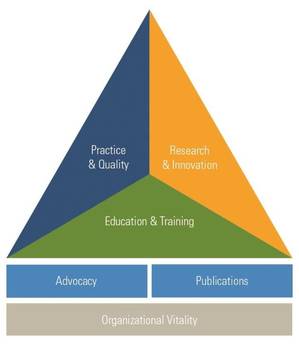
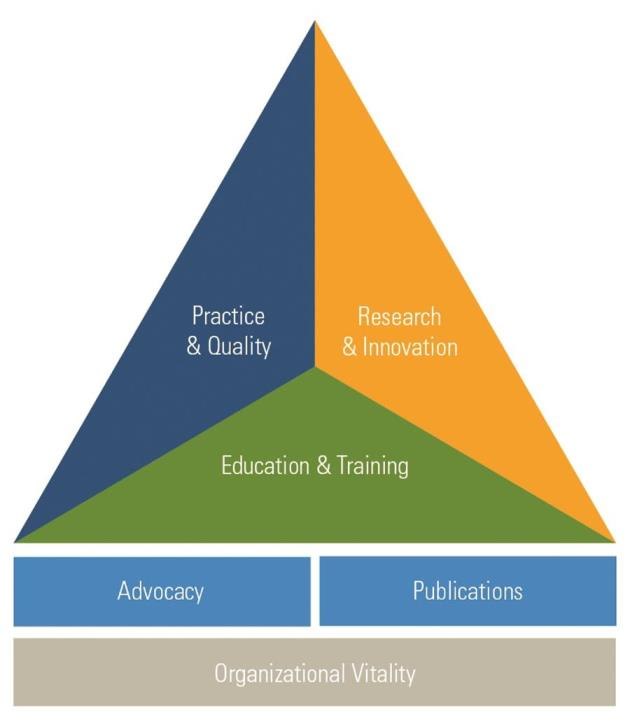
Two words describe each of the 3 fundamental AGA areas as illustrated in the triangular portion of the plan (Figure 1). For example practice and quality were paired intentionally to emphasize their close connection and the AGA’s increasing commitment to increasing the “value” (defined as quality per unit cost) of our GI and liver care.
Research is critical to our advancing science, but needs to be coupled with AGA’s commitment to promote innovation in medical device and therapeutic advances, through the AGA Center for GI Innovation and Technology and the AGA Center for Diagnostics and Therapeutics.
Finally, education must be paired with training our physician and provider workforce in new and emerging technologies. The plan includes specific reference to patients. Throughout the four goals and supporting strategies, patient engagement, patient voice and patient experience all are emphasized.
AGA Strategic Plan at a glance
Practice & quality
Define optimal clinical practice and help gastroenterologists provide high-quality, high-value care.
• Within the framework of the Triple Aim, define high value care for GI disorders.
• Increase the number of gastroenterologists reporting on quality of care.
• Build and engage an active grassroots network to communicate and advise AGA of emerging practice issues and trends.
• Address evolving practice and reimbursement models in all practice settings.
Research & innovation
Foster scientific discovery and the application of new knowledge to improve care of patients with digestive disease.
• Target junior faculty engaged in research for special support.
• Increase strategic innovation and research collaborations to promote high-value clinical care.
• Support promising advances in research and innovation.
Education & training
Engage members and other GI health providers through personalized education across the continuum of their careers.
• Help members satisfy requirements for certification, recertification, continuing medical education and licensure.
• Educate members about emerging technologies, procedures and scientific discoveries to improve patient care.
• Help members and other learners develop their careers and navigate transitions.
• Use state-of-the-art and innovative technology platforms for learning.
Advocacy
Influence public policies to support quality patient care, improve the practice of gastroenterology, and advance digestive disease research and education.
• Pursue policies that ensure patients have access to appropriate, affordable, high-value GI care.
• Increase opportunities for funding digestive disease research.
• Develop a grassroots network to advocate for improvements in patient care, increased research funding and the viability of GI practice.
• Strongly advocate for sufficient federal funding of academic training programs.
Publications
Lead the GI/hepatology category of scientific journals in rank, reach and accessibility while meeting the readership needs of basic and clinical investigators, practitioners, young GIs and trainees.
• Achieve and maintain high impact factors for all journals.
• Rank highest in the field for meeting the readership needs of basic and clinical investigators, practitioners, young GIs and trainees.
• Expand journals’ reach via new content dissemination technologies.
• Increase usage of the journals’ digital platforms.
Organizational vitality
Maintain a robust and diverse membership, develop society leaders, foster strategic collaborations, and maintain an infrastructure that supports AGA mission and goals.
• Increase AGA’s membership.
• Develop a sustainable global strategy.
• Conduct leadership development and prepare members to serve in volunteer leadership positions within AGA.
• Strive for diversity at all levels within the association, including governance, committee structure, staffing and program development. Diversity is an inclusive concept that encompasses race, ethnicity, national origin, religion, gender, age, sexual orientation and disability.
The planning process
In revising the plan, AGA leadership decided to focus in some interesting and innovative ways. Before Digestive Disease Week (DDW) 2014, Anil Rustgi (immediate past president) and I appointed 4 task forces each composed of scientists, academic clinicians, community practitioners, and AGA staff. The task forces were assigned to consider 1 of 3 topics, reflected in the triangular figure of our plan (Figure 1): research and innovation, practice and quality, and education and training. We also assigned AGA leadership and staff to focus on additional AGA areas including advocacy, publications, communications and organizational vitality.
The task forces identified key goals and strategies at meetings during DDW and subsequent teleconferences. Input from more than 75 members and staff helped shape the initial plan. In July 2014, the AGA Governing Board met for a 3-day retreat during which ideas were distilled into the plan we have today.
Reference
1. Mycoskie B. Start something that matters. New York, NY: Spiegel and Grau, 2011.
Acknowledgements
Thanks to everyone who contributed to this plan and those who will use it and improve upon it in the future. We all look forward to a bright future for gastroenterology. This article appeared previously in Gastroenterology (2015;148:1053–4). The author discloses no conflicts.
I’m proud to share with you the new strategic plan of the American Gastroenterological Association (AGA). Thanks to the hundreds of members who worked to ensure that the plan is responsive to the needs of thousands in the gastroenterology community and their patients.
Throughout the process of developing the strategic plan, the phrase “start something that matters1” echoed through my head. In 1897, a group of physicians started the AGA to make a difference in the lives of their colleagues and their patients. Since that time, AGA has been the driving force behind advances that matter in gastroenterology and hepatology research and practice. We have made staggering scientific discoveries and applied them to improve patient care. However, we still have so much more to learn, and that’s why the AGA Strategic Plan matters.
AGA, at our heart, is a learning organization. This new strategic plan will lead us to new discoveries in GI science, new tools to improve patient care, new ways to educate ourselves and the gastroenterologists of the future. Together we will shape a bright future for gastroenterology and our patients.
Ultimately, the AGA Strategic Plan will mobilize the resources of our organization to fulfill our mission of advancing the science and practice of gastroenterology.
Overview of the plan
Two words describe each of the 3 fundamental AGA areas as illustrated in the triangular portion of the plan (Figure 1). For example practice and quality were paired intentionally to emphasize their close connection and the AGA’s increasing commitment to increasing the “value” (defined as quality per unit cost) of our GI and liver care.
Research is critical to our advancing science, but needs to be coupled with AGA’s commitment to promote innovation in medical device and therapeutic advances, through the AGA Center for GI Innovation and Technology and the AGA Center for Diagnostics and Therapeutics.
Finally, education must be paired with training our physician and provider workforce in new and emerging technologies. The plan includes specific reference to patients. Throughout the four goals and supporting strategies, patient engagement, patient voice and patient experience all are emphasized.
AGA Strategic Plan at a glance
Practice & quality
Define optimal clinical practice and help gastroenterologists provide high-quality, high-value care.
• Within the framework of the Triple Aim, define high value care for GI disorders.
• Increase the number of gastroenterologists reporting on quality of care.
• Build and engage an active grassroots network to communicate and advise AGA of emerging practice issues and trends.
• Address evolving practice and reimbursement models in all practice settings.
Research & innovation
Foster scientific discovery and the application of new knowledge to improve care of patients with digestive disease.
• Target junior faculty engaged in research for special support.
• Increase strategic innovation and research collaborations to promote high-value clinical care.
• Support promising advances in research and innovation.
Education & training
Engage members and other GI health providers through personalized education across the continuum of their careers.
• Help members satisfy requirements for certification, recertification, continuing medical education and licensure.
• Educate members about emerging technologies, procedures and scientific discoveries to improve patient care.
• Help members and other learners develop their careers and navigate transitions.
• Use state-of-the-art and innovative technology platforms for learning.
Advocacy
Influence public policies to support quality patient care, improve the practice of gastroenterology, and advance digestive disease research and education.
• Pursue policies that ensure patients have access to appropriate, affordable, high-value GI care.
• Increase opportunities for funding digestive disease research.
• Develop a grassroots network to advocate for improvements in patient care, increased research funding and the viability of GI practice.
• Strongly advocate for sufficient federal funding of academic training programs.
Publications
Lead the GI/hepatology category of scientific journals in rank, reach and accessibility while meeting the readership needs of basic and clinical investigators, practitioners, young GIs and trainees.
• Achieve and maintain high impact factors for all journals.
• Rank highest in the field for meeting the readership needs of basic and clinical investigators, practitioners, young GIs and trainees.
• Expand journals’ reach via new content dissemination technologies.
• Increase usage of the journals’ digital platforms.
Organizational vitality
Maintain a robust and diverse membership, develop society leaders, foster strategic collaborations, and maintain an infrastructure that supports AGA mission and goals.
• Increase AGA’s membership.
• Develop a sustainable global strategy.
• Conduct leadership development and prepare members to serve in volunteer leadership positions within AGA.
• Strive for diversity at all levels within the association, including governance, committee structure, staffing and program development. Diversity is an inclusive concept that encompasses race, ethnicity, national origin, religion, gender, age, sexual orientation and disability.
The planning process
In revising the plan, AGA leadership decided to focus in some interesting and innovative ways. Before Digestive Disease Week (DDW) 2014, Anil Rustgi (immediate past president) and I appointed 4 task forces each composed of scientists, academic clinicians, community practitioners, and AGA staff. The task forces were assigned to consider 1 of 3 topics, reflected in the triangular figure of our plan (Figure 1): research and innovation, practice and quality, and education and training. We also assigned AGA leadership and staff to focus on additional AGA areas including advocacy, publications, communications and organizational vitality.
The task forces identified key goals and strategies at meetings during DDW and subsequent teleconferences. Input from more than 75 members and staff helped shape the initial plan. In July 2014, the AGA Governing Board met for a 3-day retreat during which ideas were distilled into the plan we have today.
Reference
1. Mycoskie B. Start something that matters. New York, NY: Spiegel and Grau, 2011.
Acknowledgements
Thanks to everyone who contributed to this plan and those who will use it and improve upon it in the future. We all look forward to a bright future for gastroenterology. This article appeared previously in Gastroenterology (2015;148:1053–4). The author discloses no conflicts.
I’m proud to share with you the new strategic plan of the American Gastroenterological Association (AGA). Thanks to the hundreds of members who worked to ensure that the plan is responsive to the needs of thousands in the gastroenterology community and their patients.
Throughout the process of developing the strategic plan, the phrase “start something that matters1” echoed through my head. In 1897, a group of physicians started the AGA to make a difference in the lives of their colleagues and their patients. Since that time, AGA has been the driving force behind advances that matter in gastroenterology and hepatology research and practice. We have made staggering scientific discoveries and applied them to improve patient care. However, we still have so much more to learn, and that’s why the AGA Strategic Plan matters.
AGA, at our heart, is a learning organization. This new strategic plan will lead us to new discoveries in GI science, new tools to improve patient care, new ways to educate ourselves and the gastroenterologists of the future. Together we will shape a bright future for gastroenterology and our patients.
Ultimately, the AGA Strategic Plan will mobilize the resources of our organization to fulfill our mission of advancing the science and practice of gastroenterology.
Overview of the plan
Two words describe each of the 3 fundamental AGA areas as illustrated in the triangular portion of the plan (Figure 1). For example practice and quality were paired intentionally to emphasize their close connection and the AGA’s increasing commitment to increasing the “value” (defined as quality per unit cost) of our GI and liver care.
Research is critical to our advancing science, but needs to be coupled with AGA’s commitment to promote innovation in medical device and therapeutic advances, through the AGA Center for GI Innovation and Technology and the AGA Center for Diagnostics and Therapeutics.
Finally, education must be paired with training our physician and provider workforce in new and emerging technologies. The plan includes specific reference to patients. Throughout the four goals and supporting strategies, patient engagement, patient voice and patient experience all are emphasized.
AGA Strategic Plan at a glance
Practice & quality
Define optimal clinical practice and help gastroenterologists provide high-quality, high-value care.
• Within the framework of the Triple Aim, define high value care for GI disorders.
• Increase the number of gastroenterologists reporting on quality of care.
• Build and engage an active grassroots network to communicate and advise AGA of emerging practice issues and trends.
• Address evolving practice and reimbursement models in all practice settings.
Research & innovation
Foster scientific discovery and the application of new knowledge to improve care of patients with digestive disease.
• Target junior faculty engaged in research for special support.
• Increase strategic innovation and research collaborations to promote high-value clinical care.
• Support promising advances in research and innovation.
Education & training
Engage members and other GI health providers through personalized education across the continuum of their careers.
• Help members satisfy requirements for certification, recertification, continuing medical education and licensure.
• Educate members about emerging technologies, procedures and scientific discoveries to improve patient care.
• Help members and other learners develop their careers and navigate transitions.
• Use state-of-the-art and innovative technology platforms for learning.
Advocacy
Influence public policies to support quality patient care, improve the practice of gastroenterology, and advance digestive disease research and education.
• Pursue policies that ensure patients have access to appropriate, affordable, high-value GI care.
• Increase opportunities for funding digestive disease research.
• Develop a grassroots network to advocate for improvements in patient care, increased research funding and the viability of GI practice.
• Strongly advocate for sufficient federal funding of academic training programs.
Publications
Lead the GI/hepatology category of scientific journals in rank, reach and accessibility while meeting the readership needs of basic and clinical investigators, practitioners, young GIs and trainees.
• Achieve and maintain high impact factors for all journals.
• Rank highest in the field for meeting the readership needs of basic and clinical investigators, practitioners, young GIs and trainees.
• Expand journals’ reach via new content dissemination technologies.
• Increase usage of the journals’ digital platforms.
Organizational vitality
Maintain a robust and diverse membership, develop society leaders, foster strategic collaborations, and maintain an infrastructure that supports AGA mission and goals.
• Increase AGA’s membership.
• Develop a sustainable global strategy.
• Conduct leadership development and prepare members to serve in volunteer leadership positions within AGA.
• Strive for diversity at all levels within the association, including governance, committee structure, staffing and program development. Diversity is an inclusive concept that encompasses race, ethnicity, national origin, religion, gender, age, sexual orientation and disability.
The planning process
In revising the plan, AGA leadership decided to focus in some interesting and innovative ways. Before Digestive Disease Week (DDW) 2014, Anil Rustgi (immediate past president) and I appointed 4 task forces each composed of scientists, academic clinicians, community practitioners, and AGA staff. The task forces were assigned to consider 1 of 3 topics, reflected in the triangular figure of our plan (Figure 1): research and innovation, practice and quality, and education and training. We also assigned AGA leadership and staff to focus on additional AGA areas including advocacy, publications, communications and organizational vitality.
The task forces identified key goals and strategies at meetings during DDW and subsequent teleconferences. Input from more than 75 members and staff helped shape the initial plan. In July 2014, the AGA Governing Board met for a 3-day retreat during which ideas were distilled into the plan we have today.
Reference
1. Mycoskie B. Start something that matters. New York, NY: Spiegel and Grau, 2011.
Acknowledgements
Thanks to everyone who contributed to this plan and those who will use it and improve upon it in the future. We all look forward to a bright future for gastroenterology. This article appeared previously in Gastroenterology (2015;148:1053–4). The author discloses no conflicts.
President, AGA Institute
Technological innovation to help patients with chronic liver disease
The American Gastroenterological Association (AGA) Research Foundation is pleased to announce that Ashish Nimgaonkar, MBBS, MTech, MS, from John Hopkins University, has received the inaugural AGA–Boston Scientific Career Development Technology & Innovation Award. This award is graciously supported by a grant from Boston Scientific, a leading innovator of medical solutions.
“Dr. Nimgaonkar’s research represents a potential breakthrough in the treatment of patients with chronic liver disease,” said Dr. Martin Brotman, AGAF, chair, AGA Research Foundation. “The AGA Research Foundation is proud to support Dr. Nimgaonkar as he works to enhance this technology and bring it one step closer to clinical practice.”
Dr. Nimgaonkar’s research focuses on developing technology to manage patients with refractory ascites – a condition in which fluid builds up in the abdomen. This fluid accumulation eventually becomes resistant to medical therapy and the only definitive treatment at this stage is liver transplantation, which is limited by organ availability. Patients with refractory ascites experience considerable deterioration in quality of life from abdominal discomfort and difficulty breathing. The only option for them is removal of this fluid every few weeks in a hospital or clinical setting. Dr. Nimgaonkar and his colleagues have developed a wireless implantable shunt technology to pull the fluid from the peritoneal space into the stomach. With this approach, patients can manage their fluid drainage needs at home – significantly improving their quality of life, as well as reducing the cost of care associated with frequent hospital visits.
Dr. Nimgaonkar and colleagues have demonstrated proof-of-concept for this approach in animal models and built shunt prototypes. The AGA–Boston Scientific Career Development Technology & Innovation Award will enable Dr. Nimgaonkar to continue to refine and test this newly developed technology.
“This award enables young investigators to develop their research careers and ensures that their valuable time is spent researching unique and novel technology for clinical care,” said David Pierce, senior vice president and president, endoscopy, Boston Scientific. “We are pleased to support this project and wish Dr. Nimgaonkar much success in his endeavors.”
The AGA–Boston Scientific Career Development Technology & Innovation Award provides Dr. Nimgaonkar with $180,000 over 2o years – ensuring that a major proportion of his time is protected for research.
AGA announced its partnership with Boston Scientific in September 2013. In addition to funding this award, Boston Scientific’s grant provides ongoing support to AGA’s central initiatives in technology and research, including the AGA Center for GI Innovation and Technology, the annual AGA Technology Summit, and the AGA Research Foundation Corporate Roundtable.
The American Gastroenterological Association (AGA) Research Foundation is pleased to announce that Ashish Nimgaonkar, MBBS, MTech, MS, from John Hopkins University, has received the inaugural AGA–Boston Scientific Career Development Technology & Innovation Award. This award is graciously supported by a grant from Boston Scientific, a leading innovator of medical solutions.
“Dr. Nimgaonkar’s research represents a potential breakthrough in the treatment of patients with chronic liver disease,” said Dr. Martin Brotman, AGAF, chair, AGA Research Foundation. “The AGA Research Foundation is proud to support Dr. Nimgaonkar as he works to enhance this technology and bring it one step closer to clinical practice.”
Dr. Nimgaonkar’s research focuses on developing technology to manage patients with refractory ascites – a condition in which fluid builds up in the abdomen. This fluid accumulation eventually becomes resistant to medical therapy and the only definitive treatment at this stage is liver transplantation, which is limited by organ availability. Patients with refractory ascites experience considerable deterioration in quality of life from abdominal discomfort and difficulty breathing. The only option for them is removal of this fluid every few weeks in a hospital or clinical setting. Dr. Nimgaonkar and his colleagues have developed a wireless implantable shunt technology to pull the fluid from the peritoneal space into the stomach. With this approach, patients can manage their fluid drainage needs at home – significantly improving their quality of life, as well as reducing the cost of care associated with frequent hospital visits.
Dr. Nimgaonkar and colleagues have demonstrated proof-of-concept for this approach in animal models and built shunt prototypes. The AGA–Boston Scientific Career Development Technology & Innovation Award will enable Dr. Nimgaonkar to continue to refine and test this newly developed technology.
“This award enables young investigators to develop their research careers and ensures that their valuable time is spent researching unique and novel technology for clinical care,” said David Pierce, senior vice president and president, endoscopy, Boston Scientific. “We are pleased to support this project and wish Dr. Nimgaonkar much success in his endeavors.”
The AGA–Boston Scientific Career Development Technology & Innovation Award provides Dr. Nimgaonkar with $180,000 over 2o years – ensuring that a major proportion of his time is protected for research.
AGA announced its partnership with Boston Scientific in September 2013. In addition to funding this award, Boston Scientific’s grant provides ongoing support to AGA’s central initiatives in technology and research, including the AGA Center for GI Innovation and Technology, the annual AGA Technology Summit, and the AGA Research Foundation Corporate Roundtable.
The American Gastroenterological Association (AGA) Research Foundation is pleased to announce that Ashish Nimgaonkar, MBBS, MTech, MS, from John Hopkins University, has received the inaugural AGA–Boston Scientific Career Development Technology & Innovation Award. This award is graciously supported by a grant from Boston Scientific, a leading innovator of medical solutions.
“Dr. Nimgaonkar’s research represents a potential breakthrough in the treatment of patients with chronic liver disease,” said Dr. Martin Brotman, AGAF, chair, AGA Research Foundation. “The AGA Research Foundation is proud to support Dr. Nimgaonkar as he works to enhance this technology and bring it one step closer to clinical practice.”
Dr. Nimgaonkar’s research focuses on developing technology to manage patients with refractory ascites – a condition in which fluid builds up in the abdomen. This fluid accumulation eventually becomes resistant to medical therapy and the only definitive treatment at this stage is liver transplantation, which is limited by organ availability. Patients with refractory ascites experience considerable deterioration in quality of life from abdominal discomfort and difficulty breathing. The only option for them is removal of this fluid every few weeks in a hospital or clinical setting. Dr. Nimgaonkar and his colleagues have developed a wireless implantable shunt technology to pull the fluid from the peritoneal space into the stomach. With this approach, patients can manage their fluid drainage needs at home – significantly improving their quality of life, as well as reducing the cost of care associated with frequent hospital visits.
Dr. Nimgaonkar and colleagues have demonstrated proof-of-concept for this approach in animal models and built shunt prototypes. The AGA–Boston Scientific Career Development Technology & Innovation Award will enable Dr. Nimgaonkar to continue to refine and test this newly developed technology.
“This award enables young investigators to develop their research careers and ensures that their valuable time is spent researching unique and novel technology for clinical care,” said David Pierce, senior vice president and president, endoscopy, Boston Scientific. “We are pleased to support this project and wish Dr. Nimgaonkar much success in his endeavors.”
The AGA–Boston Scientific Career Development Technology & Innovation Award provides Dr. Nimgaonkar with $180,000 over 2o years – ensuring that a major proportion of his time is protected for research.
AGA announced its partnership with Boston Scientific in September 2013. In addition to funding this award, Boston Scientific’s grant provides ongoing support to AGA’s central initiatives in technology and research, including the AGA Center for GI Innovation and Technology, the annual AGA Technology Summit, and the AGA Research Foundation Corporate Roundtable.
Application period now open: 2016 AGA Fellows Program
AGA honors superior professional achievement in clinical private or academic practice and in basic or clinical research with fellowship in the organization. Fellowships are awarded to members whose accomplishments and contributions demonstrate personal commitment to the field of gastroenterology.
AGA Fellows will be acknowledged in several ways, including a certificate commemorating their accomplishment and the privilege of using the prestigious designation “AGAF” in professional activities. They also receive recognition at Digestive Disease Week® and on the AGA website.
Learn more and complete the online application today at www.gastro.org/about/aga-fellows-program. The deadline for submissions is Friday, July 24, 2015.
AGA honors superior professional achievement in clinical private or academic practice and in basic or clinical research with fellowship in the organization. Fellowships are awarded to members whose accomplishments and contributions demonstrate personal commitment to the field of gastroenterology.
AGA Fellows will be acknowledged in several ways, including a certificate commemorating their accomplishment and the privilege of using the prestigious designation “AGAF” in professional activities. They also receive recognition at Digestive Disease Week® and on the AGA website.
Learn more and complete the online application today at www.gastro.org/about/aga-fellows-program. The deadline for submissions is Friday, July 24, 2015.
AGA honors superior professional achievement in clinical private or academic practice and in basic or clinical research with fellowship in the organization. Fellowships are awarded to members whose accomplishments and contributions demonstrate personal commitment to the field of gastroenterology.
AGA Fellows will be acknowledged in several ways, including a certificate commemorating their accomplishment and the privilege of using the prestigious designation “AGAF” in professional activities. They also receive recognition at Digestive Disease Week® and on the AGA website.
Learn more and complete the online application today at www.gastro.org/about/aga-fellows-program. The deadline for submissions is Friday, July 24, 2015.
Consensus statement on dysplasia in IBD patients
AGA and ASGE have issued updated recommendations for the surveillance and management of dysplasia in patients with IBD. The consensus statement represents an effort to develop unifying consensus recommendations to address two primary issues: 1) how should surveillance to detect dysplasia be performed, and 2) how should dysplasia be managed.
The consensus statement addresses the optimal types of endoscopic procedures and equipment to be used, recommended practices for removal of lesions, or referral for the more invasive surgical procedure, known as colectomy. In particular, the updated recommendations reflect a shift to using chromoendoscopy for patients with IBD during screening and surveillance to better visualize the tissue. Chromoendoscopy involves the use of dye sprayed onto the mucosa during the procedure, and it often is used in conjunction with other advances in endoscopic imaging.
The new recommendations were developed by an international group of experts and stakeholders in IBD surveillance, in accordance with suggested standards from the Institute of Medicine. Existing guidelines on this topic, which have been written by numerous expert groups, were considered, and in some cases, accepted in the new consensus statement.
The consensus statement was published in the March issues of Gastroenterology and GIE: Gastrointestinal Endoscopy.
AGA and ASGE have issued updated recommendations for the surveillance and management of dysplasia in patients with IBD. The consensus statement represents an effort to develop unifying consensus recommendations to address two primary issues: 1) how should surveillance to detect dysplasia be performed, and 2) how should dysplasia be managed.
The consensus statement addresses the optimal types of endoscopic procedures and equipment to be used, recommended practices for removal of lesions, or referral for the more invasive surgical procedure, known as colectomy. In particular, the updated recommendations reflect a shift to using chromoendoscopy for patients with IBD during screening and surveillance to better visualize the tissue. Chromoendoscopy involves the use of dye sprayed onto the mucosa during the procedure, and it often is used in conjunction with other advances in endoscopic imaging.
The new recommendations were developed by an international group of experts and stakeholders in IBD surveillance, in accordance with suggested standards from the Institute of Medicine. Existing guidelines on this topic, which have been written by numerous expert groups, were considered, and in some cases, accepted in the new consensus statement.
The consensus statement was published in the March issues of Gastroenterology and GIE: Gastrointestinal Endoscopy.
AGA and ASGE have issued updated recommendations for the surveillance and management of dysplasia in patients with IBD. The consensus statement represents an effort to develop unifying consensus recommendations to address two primary issues: 1) how should surveillance to detect dysplasia be performed, and 2) how should dysplasia be managed.
The consensus statement addresses the optimal types of endoscopic procedures and equipment to be used, recommended practices for removal of lesions, or referral for the more invasive surgical procedure, known as colectomy. In particular, the updated recommendations reflect a shift to using chromoendoscopy for patients with IBD during screening and surveillance to better visualize the tissue. Chromoendoscopy involves the use of dye sprayed onto the mucosa during the procedure, and it often is used in conjunction with other advances in endoscopic imaging.
The new recommendations were developed by an international group of experts and stakeholders in IBD surveillance, in accordance with suggested standards from the Institute of Medicine. Existing guidelines on this topic, which have been written by numerous expert groups, were considered, and in some cases, accepted in the new consensus statement.
The consensus statement was published in the March issues of Gastroenterology and GIE: Gastrointestinal Endoscopy.
AGA launches new publication for fellows and young GIs
The AGA is delighted to announce the newest addition to its publication armamentarium, The New Gastroenterologist: Insights for Fellows & Young GIs. This new quarterly publication will be the first of its kind in the gastroenterology community and will specifically target the needs of fellows and young-career gastroenterologists, while at the same time undoubtedly having global appeal to gastroenterologists in all stages of their careers.

Each issue of The New Gastroenterologist will feature a selection of exceptional expert-authored articles that provide focused updates on “hot” clinical topics, perspectives on postfellowship career pathways, primers on pertinent financial and insurance topics that are important to all gastroenterologists, inspiring stories from our GI colleagues, and a plethora of other resources that will be useful for the young GI community. Given the ever-increasing demands on our time, the ultimate goal of this new publication is to provide a concise, high-yield, and informative collection of articles that can be read and digested quickly.
The inaugural issue of The New Gastroenterologist will be distributed this year in print with April’s GI & Hepatology News, and will also be available freely online at www.gastro.org and www.gihepnews.com. As the editor-in-chief of The New Gastroenterologist, it has been a true pleasure developing this publication. The AGA leadership and I are eagerly anticipating its launch. We hope that The New Gastroenterologist will quickly become a key resource that is part of every fellow and young GI’s panel of regular reading, while at the same time being equally enjoyed by all gastroenterologists. We look forward to hearing your feedback about The New Gastroenterologist, and we would also welcome your ideas for future issue topics. Please send questions or comments to me at [email protected] or Erin Dubnansky at [email protected].
The AGA is delighted to announce the newest addition to its publication armamentarium, The New Gastroenterologist: Insights for Fellows & Young GIs. This new quarterly publication will be the first of its kind in the gastroenterology community and will specifically target the needs of fellows and young-career gastroenterologists, while at the same time undoubtedly having global appeal to gastroenterologists in all stages of their careers.
Each issue of The New Gastroenterologist will feature a selection of exceptional expert-authored articles that provide focused updates on “hot” clinical topics, perspectives on postfellowship career pathways, primers on pertinent financial and insurance topics that are important to all gastroenterologists, inspiring stories from our GI colleagues, and a plethora of other resources that will be useful for the young GI community. Given the ever-increasing demands on our time, the ultimate goal of this new publication is to provide a concise, high-yield, and informative collection of articles that can be read and digested quickly.
The inaugural issue of The New Gastroenterologist will be distributed this year in print with April’s GI & Hepatology News, and will also be available freely online at www.gastro.org and www.gihepnews.com. As the editor-in-chief of The New Gastroenterologist, it has been a true pleasure developing this publication. The AGA leadership and I are eagerly anticipating its launch. We hope that The New Gastroenterologist will quickly become a key resource that is part of every fellow and young GI’s panel of regular reading, while at the same time being equally enjoyed by all gastroenterologists. We look forward to hearing your feedback about The New Gastroenterologist, and we would also welcome your ideas for future issue topics. Please send questions or comments to me at [email protected] or Erin Dubnansky at [email protected].
The AGA is delighted to announce the newest addition to its publication armamentarium, The New Gastroenterologist: Insights for Fellows & Young GIs. This new quarterly publication will be the first of its kind in the gastroenterology community and will specifically target the needs of fellows and young-career gastroenterologists, while at the same time undoubtedly having global appeal to gastroenterologists in all stages of their careers.
Each issue of The New Gastroenterologist will feature a selection of exceptional expert-authored articles that provide focused updates on “hot” clinical topics, perspectives on postfellowship career pathways, primers on pertinent financial and insurance topics that are important to all gastroenterologists, inspiring stories from our GI colleagues, and a plethora of other resources that will be useful for the young GI community. Given the ever-increasing demands on our time, the ultimate goal of this new publication is to provide a concise, high-yield, and informative collection of articles that can be read and digested quickly.
The inaugural issue of The New Gastroenterologist will be distributed this year in print with April’s GI & Hepatology News, and will also be available freely online at www.gastro.org and www.gihepnews.com. As the editor-in-chief of The New Gastroenterologist, it has been a true pleasure developing this publication. The AGA leadership and I are eagerly anticipating its launch. We hope that The New Gastroenterologist will quickly become a key resource that is part of every fellow and young GI’s panel of regular reading, while at the same time being equally enjoyed by all gastroenterologists. We look forward to hearing your feedback about The New Gastroenterologist, and we would also welcome your ideas for future issue topics. Please send questions or comments to me at [email protected] or Erin Dubnansky at [email protected].