User login
When your patients disclose ‘insider information’
Discuss this article at www.facebook.com/CurrentPsychiatry
Dear Dr. Mossman:
My patient is an officer in a large corporation. During therapy, he sometimes talks about how the company is doing. Would I risk malpractice liability if I used this information in managing my retirement investments?
Submitted by “Dr. B”
As most physicians find out within a short time of finishing medical school, doctors learn all kinds of useful things from their patients, including information that can help them manage personal matters outside their practices. But are you allowed to use nonpublic business information to make investment decisions?
As this article explains, legal rules and case law suggest that if psychiatrists or therapists act on potentially profitable business information incidentally mentioned by a patient during treatment, they may be subject to serious legal problems. To explain why, we’ll begin with a brief overview of business terms, including “securities” and “insider trading.” Then, to answer Dr. B’s question, we’ll look at what kind of legal consequences may result if mental health professionals are found guilty of “misappropriating” confidential business information.
Securities and security rules
Approximately one-half to two-thirds of Americans have money invested in the stock market—either through their retirement plans, by owning mutual funds, or by holding stocks of individual companies.1 Stocks are a type of financial instrument, or security, that companies issue to raise capital. Companies also raise money by issuing debt, typically in the form of bonds that pay interest to the holder, who in buying the bond has in effect loaned money to the company. Derivatives refer to securities that have prices that move up or down depending on the value of some underlying asset, such as stock prices.2
Stock prices fluctuate in reaction to general economic developments—changes in the unemployment rate, in the cost of basic materials (eg, oil or metals used in manufacturing), or in government policies that influence consumers’ purchasing decisions. But the key factor in determining the price of a company’s stock is investors’ beliefs about the company’s future earnings.3 Because investors usually have to make educated guesses about a company’s future, actually knowing something about a company before the general public finds out would give an investor a huge—but possibly unfair—advantage over other investors.
Making markets fair for all investors is the key purpose of U.S. laws on trading securities. In the 1930s, Congress created the Securities and Exchange Commission (SEC), a federal agency charged with ensuring that companies report the truth about their financial situation and that potential investors receive full, fair disclosure of available public information.4 Among the many ways that the SEC does this is by enforcing regulations concerning “insider trading.”
‘Insider trading’
Corporate “insiders” (eg, directors or employees) often know a lot about how their businesses are doing, and they buy or sell stock in their own companies. Such trading is legal if the insiders follow federal regulations about the timing of their investments and report them publicly.
Insider trading is illegal, however, if an individual acquires material, nonpublic information about a corporation through a relationship that involves trust and confidence and then uses that information when buying or selling a security. The SEC has prosecuted corporate employees who traded securities after learning of confidential developments in their companies, friends and family members of corporate officers who bought or sold securities after getting such information, and employees of law firms who misused information they received while providing services to corporations whose securities they traded.5
To be guilty of insider trading, a person must:
- buy or sell a security based on information that the person realizes is material and nonpublic,6 and
- have received the confidential information under circumstances that create a duty of trust or confidence.7
If both of these conditions are met, the person has wrongfully used confidential information with which he was entrusted, or “misappropriated” that information for personal gain.8
Physicians sometimes gain information that, if used for investment decisions, might lead to accusations of insider trading. Stock prices of pharmaceutical companies rise before public announcements of clinical drug trials, which suggests that information about those results leaks out in advance.9 Recently, physicians have gotten into well-publicized legal trouble by making investment decisions based on information they obtained while participating on an institution’s board10 and from learning early results of clinical drug trials.11
But would it be wrong for a psychiatrist to make a potentially profitable investment based on information obtained incidentally during a treatment encounter? After all, it’s not as though the psychiatrist would be a corporate insider or would have acquired the information improperly. Yet courts have ruled that a psychiatrist’s trading on such information might constitute malpractice and could be grounds for even more serious legal consequences.
Potential malpractice issues
The federal court ruling in United States v Willis12 describes how a psychiatrist learned during treatment that a patient’s husband was seeking to become CEO of a large bank. Realizing that this development might make the bank more valuable, the psychiatrist told his broker what he had learned and purchased 13,000 shares of the bank’s stock for himself and his children. When the husband’s efforts were announced publicly a few weeks later, the psychiatrist sold the shares at a big profit.
Quoting the vow of confidentiality contained in the Hippocratic Oath (Box),13 the court held that the psychiatrist had an obligation to the patient not to disclose information learned during her treatment without her permission. The court said the patient “had an economic interest in preserving the confidentiality of the information disclosed,” and the psychiatrist’s actions “might have jeopardized her husband’s advancement” and financial benefits the wife would have gained. Also, the psychiatrist’s “disclosures jeopardized the psychiatrist-patient relationship,” which might negate the wife’s financial investment in her care, require her to find a new psychiatrist, or require additional treatment to deal with how the psychiatrist’s behavior had affected her.12
And about whatever I may see or hear in treatment, or even without treatment, in the life of human beings—things that should not ever be blurted out outside—I will remain silent, holding such things to be unutterable.
Source: Reference 13
More legal consequences
Dr. Willis had legal problems more serious than just a malpractice lawsuit. He faced criminal prosecution for insider trading and mail fraud, and the court refused to dismiss these charges. The court reasoned that the psychiatrist received the information while in a position of trust and confidence, and breached that trust when he used that confidential information for his personal benefit—behavior that meets the legal definition of “misappropriation.” Because the psychiatrist received stock trade confirmations through the U.S. mail, he also could face federal charges of mail fraud. Ultimately, Dr. Willis pled guilty and paid $137,000 in fines and penalties. Although Dr. Willis retained his New Jersey medical license and avoided a prison sentence, the district court sentenced him to 5 years of probation and required that he perform 3,000 hours of community service.14,15
In a second case,16 a licensed clinical social worker made investments through a broker based on information learned during a therapy session about upcoming business developments (the 1994 Lockheed-Martin Marietta merger). The social worker pled guilty to insider trading, forfeited the illegal gains, and paid a large fine.
Related Resources
- Insider trading versus medical professionalism. Lancet. 2005;366(9488):781.
- Nijm LM. The online message board controversy. Physicians hit with claims of libel and insider trading by their employers. J Leg Med. 2000;21(2):223-239.
Disclosure
Dr. Mossman reports no financial relationship with any company whose products are mentioned in this article or with manufacturers of competing products.
1. Jacobe D. In U.S., 54% have stock market investments, lowest since 1999. Gallup Economy. http://www.gallup.com/poll/147206/stock-market-investments-lowest-1999.aspx. Published April 20, 2011. Accessed October 9, 2012.
2. Roman S. Introduction to the mathematics of finance: from risk management to options pricing. New York NY: Springer-Verlag; 2004.
3. Elton EJ, Gruber MJ, Brown SJ, et al. Modern portfolio theory and investment analysis. Hoboken, NJ: John Wiley & Sons; 2010.
4. Keller E, Gehlmann GA. Introductory comment: a historical introduction to the Securities Act of 1933 and the Securities Exchange Act of 1934. Ohio State Law Journal. 1988;49:329-352.
5. U.S. Securities and Exchange Commission. Insider trading. http://www.sec.gov/answers/insider.htm. Published April 19, 2001. Accessed October 9, 2012.
6. 17 CFR 240. 10b5-1.
7. 17 CFR 240. 10b5-2.
8. United States v O’Hagan, 521 U.S. 642 (1997).
9. Rothenstein JM, Tomlinson G, Tannock IF, et al. Company stock prices before and after public announcements related to oncology drugs. J Natl Cancer Inst. 2011;103(20):1507-1512.
10. U.S. Securities and Exchange Commission. SEC charges five physicians with insider trading in stock of medical professional liability insurer. http://www.sec.gov/news/press/2012/2012-132.htm. Published July 10, 2012. Accessed October 9, 2012.
11. Two more are sentenced in insider trading cases. New York Times. December 21 2011:B9. http://www.nytimes.com/2011/12/22/business/in-crackdown-on-insider-trading-two-more-are-sentenced.html?_r=0. Accessed October 9, 2012.
12. United States v Willis, 737 F Supp 269 (SD NY 1990).
13. von Staden H. “In a pure and holy way”: personal and professional conduct in the Hippocratic Oath? J Hist Med Allied Sci. 1996;51(4):404-437.
14. 24 Sec Reg & L Rep (BNA) 7 (1992).
15. Psychiatrist is sentenced. New York Times. January 8 1992. http://www.nytimes.com/1992/01/08/business/credit-markets-psychiatrist-is-sentenced.html. Accessed November 5, 2012.
16. SEC v Cooper, Litigation Rel. No. 14754, 60 S.E.C. Docket 2430 (1995).

Douglas Mossman, MD
Dr. Mossman is Professor and Program Director, University of Cincinnati Forensic Psychiatry Fellowship, Cincinnati, OH
Douglas Mossman, MD
Dr. Mossman is Professor and Program Director, University of Cincinnati Forensic Psychiatry Fellowship, Cincinnati, OH
Douglas Mossman, MD
Dr. Mossman is Professor and Program Director, University of Cincinnati Forensic Psychiatry Fellowship, Cincinnati, OH
Discuss this article at www.facebook.com/CurrentPsychiatry
Dear Dr. Mossman:
My patient is an officer in a large corporation. During therapy, he sometimes talks about how the company is doing. Would I risk malpractice liability if I used this information in managing my retirement investments?
Submitted by “Dr. B”
As most physicians find out within a short time of finishing medical school, doctors learn all kinds of useful things from their patients, including information that can help them manage personal matters outside their practices. But are you allowed to use nonpublic business information to make investment decisions?
As this article explains, legal rules and case law suggest that if psychiatrists or therapists act on potentially profitable business information incidentally mentioned by a patient during treatment, they may be subject to serious legal problems. To explain why, we’ll begin with a brief overview of business terms, including “securities” and “insider trading.” Then, to answer Dr. B’s question, we’ll look at what kind of legal consequences may result if mental health professionals are found guilty of “misappropriating” confidential business information.
Securities and security rules
Approximately one-half to two-thirds of Americans have money invested in the stock market—either through their retirement plans, by owning mutual funds, or by holding stocks of individual companies.1 Stocks are a type of financial instrument, or security, that companies issue to raise capital. Companies also raise money by issuing debt, typically in the form of bonds that pay interest to the holder, who in buying the bond has in effect loaned money to the company. Derivatives refer to securities that have prices that move up or down depending on the value of some underlying asset, such as stock prices.2
Stock prices fluctuate in reaction to general economic developments—changes in the unemployment rate, in the cost of basic materials (eg, oil or metals used in manufacturing), or in government policies that influence consumers’ purchasing decisions. But the key factor in determining the price of a company’s stock is investors’ beliefs about the company’s future earnings.3 Because investors usually have to make educated guesses about a company’s future, actually knowing something about a company before the general public finds out would give an investor a huge—but possibly unfair—advantage over other investors.
Making markets fair for all investors is the key purpose of U.S. laws on trading securities. In the 1930s, Congress created the Securities and Exchange Commission (SEC), a federal agency charged with ensuring that companies report the truth about their financial situation and that potential investors receive full, fair disclosure of available public information.4 Among the many ways that the SEC does this is by enforcing regulations concerning “insider trading.”
‘Insider trading’
Corporate “insiders” (eg, directors or employees) often know a lot about how their businesses are doing, and they buy or sell stock in their own companies. Such trading is legal if the insiders follow federal regulations about the timing of their investments and report them publicly.
Insider trading is illegal, however, if an individual acquires material, nonpublic information about a corporation through a relationship that involves trust and confidence and then uses that information when buying or selling a security. The SEC has prosecuted corporate employees who traded securities after learning of confidential developments in their companies, friends and family members of corporate officers who bought or sold securities after getting such information, and employees of law firms who misused information they received while providing services to corporations whose securities they traded.5
To be guilty of insider trading, a person must:
- buy or sell a security based on information that the person realizes is material and nonpublic,6 and
- have received the confidential information under circumstances that create a duty of trust or confidence.7
If both of these conditions are met, the person has wrongfully used confidential information with which he was entrusted, or “misappropriated” that information for personal gain.8
Physicians sometimes gain information that, if used for investment decisions, might lead to accusations of insider trading. Stock prices of pharmaceutical companies rise before public announcements of clinical drug trials, which suggests that information about those results leaks out in advance.9 Recently, physicians have gotten into well-publicized legal trouble by making investment decisions based on information they obtained while participating on an institution’s board10 and from learning early results of clinical drug trials.11
But would it be wrong for a psychiatrist to make a potentially profitable investment based on information obtained incidentally during a treatment encounter? After all, it’s not as though the psychiatrist would be a corporate insider or would have acquired the information improperly. Yet courts have ruled that a psychiatrist’s trading on such information might constitute malpractice and could be grounds for even more serious legal consequences.
Potential malpractice issues
The federal court ruling in United States v Willis12 describes how a psychiatrist learned during treatment that a patient’s husband was seeking to become CEO of a large bank. Realizing that this development might make the bank more valuable, the psychiatrist told his broker what he had learned and purchased 13,000 shares of the bank’s stock for himself and his children. When the husband’s efforts were announced publicly a few weeks later, the psychiatrist sold the shares at a big profit.
Quoting the vow of confidentiality contained in the Hippocratic Oath (Box),13 the court held that the psychiatrist had an obligation to the patient not to disclose information learned during her treatment without her permission. The court said the patient “had an economic interest in preserving the confidentiality of the information disclosed,” and the psychiatrist’s actions “might have jeopardized her husband’s advancement” and financial benefits the wife would have gained. Also, the psychiatrist’s “disclosures jeopardized the psychiatrist-patient relationship,” which might negate the wife’s financial investment in her care, require her to find a new psychiatrist, or require additional treatment to deal with how the psychiatrist’s behavior had affected her.12
And about whatever I may see or hear in treatment, or even without treatment, in the life of human beings—things that should not ever be blurted out outside—I will remain silent, holding such things to be unutterable.
Source: Reference 13
More legal consequences
Dr. Willis had legal problems more serious than just a malpractice lawsuit. He faced criminal prosecution for insider trading and mail fraud, and the court refused to dismiss these charges. The court reasoned that the psychiatrist received the information while in a position of trust and confidence, and breached that trust when he used that confidential information for his personal benefit—behavior that meets the legal definition of “misappropriation.” Because the psychiatrist received stock trade confirmations through the U.S. mail, he also could face federal charges of mail fraud. Ultimately, Dr. Willis pled guilty and paid $137,000 in fines and penalties. Although Dr. Willis retained his New Jersey medical license and avoided a prison sentence, the district court sentenced him to 5 years of probation and required that he perform 3,000 hours of community service.14,15
In a second case,16 a licensed clinical social worker made investments through a broker based on information learned during a therapy session about upcoming business developments (the 1994 Lockheed-Martin Marietta merger). The social worker pled guilty to insider trading, forfeited the illegal gains, and paid a large fine.
Related Resources
- Insider trading versus medical professionalism. Lancet. 2005;366(9488):781.
- Nijm LM. The online message board controversy. Physicians hit with claims of libel and insider trading by their employers. J Leg Med. 2000;21(2):223-239.
Disclosure
Dr. Mossman reports no financial relationship with any company whose products are mentioned in this article or with manufacturers of competing products.
Discuss this article at www.facebook.com/CurrentPsychiatry
Dear Dr. Mossman:
My patient is an officer in a large corporation. During therapy, he sometimes talks about how the company is doing. Would I risk malpractice liability if I used this information in managing my retirement investments?
Submitted by “Dr. B”
As most physicians find out within a short time of finishing medical school, doctors learn all kinds of useful things from their patients, including information that can help them manage personal matters outside their practices. But are you allowed to use nonpublic business information to make investment decisions?
As this article explains, legal rules and case law suggest that if psychiatrists or therapists act on potentially profitable business information incidentally mentioned by a patient during treatment, they may be subject to serious legal problems. To explain why, we’ll begin with a brief overview of business terms, including “securities” and “insider trading.” Then, to answer Dr. B’s question, we’ll look at what kind of legal consequences may result if mental health professionals are found guilty of “misappropriating” confidential business information.
Securities and security rules
Approximately one-half to two-thirds of Americans have money invested in the stock market—either through their retirement plans, by owning mutual funds, or by holding stocks of individual companies.1 Stocks are a type of financial instrument, or security, that companies issue to raise capital. Companies also raise money by issuing debt, typically in the form of bonds that pay interest to the holder, who in buying the bond has in effect loaned money to the company. Derivatives refer to securities that have prices that move up or down depending on the value of some underlying asset, such as stock prices.2
Stock prices fluctuate in reaction to general economic developments—changes in the unemployment rate, in the cost of basic materials (eg, oil or metals used in manufacturing), or in government policies that influence consumers’ purchasing decisions. But the key factor in determining the price of a company’s stock is investors’ beliefs about the company’s future earnings.3 Because investors usually have to make educated guesses about a company’s future, actually knowing something about a company before the general public finds out would give an investor a huge—but possibly unfair—advantage over other investors.
Making markets fair for all investors is the key purpose of U.S. laws on trading securities. In the 1930s, Congress created the Securities and Exchange Commission (SEC), a federal agency charged with ensuring that companies report the truth about their financial situation and that potential investors receive full, fair disclosure of available public information.4 Among the many ways that the SEC does this is by enforcing regulations concerning “insider trading.”
‘Insider trading’
Corporate “insiders” (eg, directors or employees) often know a lot about how their businesses are doing, and they buy or sell stock in their own companies. Such trading is legal if the insiders follow federal regulations about the timing of their investments and report them publicly.
Insider trading is illegal, however, if an individual acquires material, nonpublic information about a corporation through a relationship that involves trust and confidence and then uses that information when buying or selling a security. The SEC has prosecuted corporate employees who traded securities after learning of confidential developments in their companies, friends and family members of corporate officers who bought or sold securities after getting such information, and employees of law firms who misused information they received while providing services to corporations whose securities they traded.5
To be guilty of insider trading, a person must:
- buy or sell a security based on information that the person realizes is material and nonpublic,6 and
- have received the confidential information under circumstances that create a duty of trust or confidence.7
If both of these conditions are met, the person has wrongfully used confidential information with which he was entrusted, or “misappropriated” that information for personal gain.8
Physicians sometimes gain information that, if used for investment decisions, might lead to accusations of insider trading. Stock prices of pharmaceutical companies rise before public announcements of clinical drug trials, which suggests that information about those results leaks out in advance.9 Recently, physicians have gotten into well-publicized legal trouble by making investment decisions based on information they obtained while participating on an institution’s board10 and from learning early results of clinical drug trials.11
But would it be wrong for a psychiatrist to make a potentially profitable investment based on information obtained incidentally during a treatment encounter? After all, it’s not as though the psychiatrist would be a corporate insider or would have acquired the information improperly. Yet courts have ruled that a psychiatrist’s trading on such information might constitute malpractice and could be grounds for even more serious legal consequences.
Potential malpractice issues
The federal court ruling in United States v Willis12 describes how a psychiatrist learned during treatment that a patient’s husband was seeking to become CEO of a large bank. Realizing that this development might make the bank more valuable, the psychiatrist told his broker what he had learned and purchased 13,000 shares of the bank’s stock for himself and his children. When the husband’s efforts were announced publicly a few weeks later, the psychiatrist sold the shares at a big profit.
Quoting the vow of confidentiality contained in the Hippocratic Oath (Box),13 the court held that the psychiatrist had an obligation to the patient not to disclose information learned during her treatment without her permission. The court said the patient “had an economic interest in preserving the confidentiality of the information disclosed,” and the psychiatrist’s actions “might have jeopardized her husband’s advancement” and financial benefits the wife would have gained. Also, the psychiatrist’s “disclosures jeopardized the psychiatrist-patient relationship,” which might negate the wife’s financial investment in her care, require her to find a new psychiatrist, or require additional treatment to deal with how the psychiatrist’s behavior had affected her.12
And about whatever I may see or hear in treatment, or even without treatment, in the life of human beings—things that should not ever be blurted out outside—I will remain silent, holding such things to be unutterable.
Source: Reference 13
More legal consequences
Dr. Willis had legal problems more serious than just a malpractice lawsuit. He faced criminal prosecution for insider trading and mail fraud, and the court refused to dismiss these charges. The court reasoned that the psychiatrist received the information while in a position of trust and confidence, and breached that trust when he used that confidential information for his personal benefit—behavior that meets the legal definition of “misappropriation.” Because the psychiatrist received stock trade confirmations through the U.S. mail, he also could face federal charges of mail fraud. Ultimately, Dr. Willis pled guilty and paid $137,000 in fines and penalties. Although Dr. Willis retained his New Jersey medical license and avoided a prison sentence, the district court sentenced him to 5 years of probation and required that he perform 3,000 hours of community service.14,15
In a second case,16 a licensed clinical social worker made investments through a broker based on information learned during a therapy session about upcoming business developments (the 1994 Lockheed-Martin Marietta merger). The social worker pled guilty to insider trading, forfeited the illegal gains, and paid a large fine.
Related Resources
- Insider trading versus medical professionalism. Lancet. 2005;366(9488):781.
- Nijm LM. The online message board controversy. Physicians hit with claims of libel and insider trading by their employers. J Leg Med. 2000;21(2):223-239.
Disclosure
Dr. Mossman reports no financial relationship with any company whose products are mentioned in this article or with manufacturers of competing products.
1. Jacobe D. In U.S., 54% have stock market investments, lowest since 1999. Gallup Economy. http://www.gallup.com/poll/147206/stock-market-investments-lowest-1999.aspx. Published April 20, 2011. Accessed October 9, 2012.
2. Roman S. Introduction to the mathematics of finance: from risk management to options pricing. New York NY: Springer-Verlag; 2004.
3. Elton EJ, Gruber MJ, Brown SJ, et al. Modern portfolio theory and investment analysis. Hoboken, NJ: John Wiley & Sons; 2010.
4. Keller E, Gehlmann GA. Introductory comment: a historical introduction to the Securities Act of 1933 and the Securities Exchange Act of 1934. Ohio State Law Journal. 1988;49:329-352.
5. U.S. Securities and Exchange Commission. Insider trading. http://www.sec.gov/answers/insider.htm. Published April 19, 2001. Accessed October 9, 2012.
6. 17 CFR 240. 10b5-1.
7. 17 CFR 240. 10b5-2.
8. United States v O’Hagan, 521 U.S. 642 (1997).
9. Rothenstein JM, Tomlinson G, Tannock IF, et al. Company stock prices before and after public announcements related to oncology drugs. J Natl Cancer Inst. 2011;103(20):1507-1512.
10. U.S. Securities and Exchange Commission. SEC charges five physicians with insider trading in stock of medical professional liability insurer. http://www.sec.gov/news/press/2012/2012-132.htm. Published July 10, 2012. Accessed October 9, 2012.
11. Two more are sentenced in insider trading cases. New York Times. December 21 2011:B9. http://www.nytimes.com/2011/12/22/business/in-crackdown-on-insider-trading-two-more-are-sentenced.html?_r=0. Accessed October 9, 2012.
12. United States v Willis, 737 F Supp 269 (SD NY 1990).
13. von Staden H. “In a pure and holy way”: personal and professional conduct in the Hippocratic Oath? J Hist Med Allied Sci. 1996;51(4):404-437.
14. 24 Sec Reg & L Rep (BNA) 7 (1992).
15. Psychiatrist is sentenced. New York Times. January 8 1992. http://www.nytimes.com/1992/01/08/business/credit-markets-psychiatrist-is-sentenced.html. Accessed November 5, 2012.
16. SEC v Cooper, Litigation Rel. No. 14754, 60 S.E.C. Docket 2430 (1995).
1. Jacobe D. In U.S., 54% have stock market investments, lowest since 1999. Gallup Economy. http://www.gallup.com/poll/147206/stock-market-investments-lowest-1999.aspx. Published April 20, 2011. Accessed October 9, 2012.
2. Roman S. Introduction to the mathematics of finance: from risk management to options pricing. New York NY: Springer-Verlag; 2004.
3. Elton EJ, Gruber MJ, Brown SJ, et al. Modern portfolio theory and investment analysis. Hoboken, NJ: John Wiley & Sons; 2010.
4. Keller E, Gehlmann GA. Introductory comment: a historical introduction to the Securities Act of 1933 and the Securities Exchange Act of 1934. Ohio State Law Journal. 1988;49:329-352.
5. U.S. Securities and Exchange Commission. Insider trading. http://www.sec.gov/answers/insider.htm. Published April 19, 2001. Accessed October 9, 2012.
6. 17 CFR 240. 10b5-1.
7. 17 CFR 240. 10b5-2.
8. United States v O’Hagan, 521 U.S. 642 (1997).
9. Rothenstein JM, Tomlinson G, Tannock IF, et al. Company stock prices before and after public announcements related to oncology drugs. J Natl Cancer Inst. 2011;103(20):1507-1512.
10. U.S. Securities and Exchange Commission. SEC charges five physicians with insider trading in stock of medical professional liability insurer. http://www.sec.gov/news/press/2012/2012-132.htm. Published July 10, 2012. Accessed October 9, 2012.
11. Two more are sentenced in insider trading cases. New York Times. December 21 2011:B9. http://www.nytimes.com/2011/12/22/business/in-crackdown-on-insider-trading-two-more-are-sentenced.html?_r=0. Accessed October 9, 2012.
12. United States v Willis, 737 F Supp 269 (SD NY 1990).
13. von Staden H. “In a pure and holy way”: personal and professional conduct in the Hippocratic Oath? J Hist Med Allied Sci. 1996;51(4):404-437.
14. 24 Sec Reg & L Rep (BNA) 7 (1992).
15. Psychiatrist is sentenced. New York Times. January 8 1992. http://www.nytimes.com/1992/01/08/business/credit-markets-psychiatrist-is-sentenced.html. Accessed November 5, 2012.
16. SEC v Cooper, Litigation Rel. No. 14754, 60 S.E.C. Docket 2430 (1995).
BRCA1/2 testing and cancer risk management in underserved women at a public hospital
Background and objective Genetic test uptake and cancer risk management have been understudied in medically underserved populations. Study aims were to quantify rates of BRCA1/2 genetic testing and evidence-based cancer risk management (ie, prophylactic surgeries and surveillance practices) in women who were seen for breast and ovarian cancer genetic counseling in a public, safety net health system.
Methods We conducted a retrospective medical record abstraction of 195 women who presented for breast or ovarian genetic counseling within a 2-year period (2008-2009) at Parkland Health & Hospital System in Dallas, Texas.
Results The identified women represented a racially and ethnically diverse population: 48% Hispanic, 37% non-Hispanic black, 12% non-Hispanic white, and 3% Asian. Among the 158 women who were medically eligible for genetic testing, 134 (84.8%) received BRCA1/2 results, with most tests funded through a financial assistance program. In all, 29 women (22%) tested positive for BRCA1/2 mutations. Financial and funding barriers were identified for 20 of the untested women. Among the identified high-risk women (mutation carriers, selected variants, and noncarriers with pretest BRCAPRO scores 30 or more), 26% had prophylactic breast surgeries and 33% had prophylactic ovarian surgeries within the follow-up period averaging 35 months. Of those who opted for surveillance, 71% had at least 1 mammogram or MRI and 38% had CA-125 tests. Trends indicated lower rates of all risk management behaviors, except for mammogram or MRI, among non-Hispanic black women.
Conclusions Within this racially and ethnically diverse sample, BRCA1/2 test uptake was high, but financial barriers were identified for nontested women. The rates of breast cancer risk management were generally comparable with other studies, but risk management for ovarian cancer was limited, especially among non-Hispanic black women. The reasons for these apparen disparities should be further explored.
Click on the PDF icon at the top of this introduction to read the full article.
Background and objective Genetic test uptake and cancer risk management have been understudied in medically underserved populations. Study aims were to quantify rates of BRCA1/2 genetic testing and evidence-based cancer risk management (ie, prophylactic surgeries and surveillance practices) in women who were seen for breast and ovarian cancer genetic counseling in a public, safety net health system.
Methods We conducted a retrospective medical record abstraction of 195 women who presented for breast or ovarian genetic counseling within a 2-year period (2008-2009) at Parkland Health & Hospital System in Dallas, Texas.
Results The identified women represented a racially and ethnically diverse population: 48% Hispanic, 37% non-Hispanic black, 12% non-Hispanic white, and 3% Asian. Among the 158 women who were medically eligible for genetic testing, 134 (84.8%) received BRCA1/2 results, with most tests funded through a financial assistance program. In all, 29 women (22%) tested positive for BRCA1/2 mutations. Financial and funding barriers were identified for 20 of the untested women. Among the identified high-risk women (mutation carriers, selected variants, and noncarriers with pretest BRCAPRO scores 30 or more), 26% had prophylactic breast surgeries and 33% had prophylactic ovarian surgeries within the follow-up period averaging 35 months. Of those who opted for surveillance, 71% had at least 1 mammogram or MRI and 38% had CA-125 tests. Trends indicated lower rates of all risk management behaviors, except for mammogram or MRI, among non-Hispanic black women.
Conclusions Within this racially and ethnically diverse sample, BRCA1/2 test uptake was high, but financial barriers were identified for nontested women. The rates of breast cancer risk management were generally comparable with other studies, but risk management for ovarian cancer was limited, especially among non-Hispanic black women. The reasons for these apparen disparities should be further explored.
Click on the PDF icon at the top of this introduction to read the full article.
Background and objective Genetic test uptake and cancer risk management have been understudied in medically underserved populations. Study aims were to quantify rates of BRCA1/2 genetic testing and evidence-based cancer risk management (ie, prophylactic surgeries and surveillance practices) in women who were seen for breast and ovarian cancer genetic counseling in a public, safety net health system.
Methods We conducted a retrospective medical record abstraction of 195 women who presented for breast or ovarian genetic counseling within a 2-year period (2008-2009) at Parkland Health & Hospital System in Dallas, Texas.
Results The identified women represented a racially and ethnically diverse population: 48% Hispanic, 37% non-Hispanic black, 12% non-Hispanic white, and 3% Asian. Among the 158 women who were medically eligible for genetic testing, 134 (84.8%) received BRCA1/2 results, with most tests funded through a financial assistance program. In all, 29 women (22%) tested positive for BRCA1/2 mutations. Financial and funding barriers were identified for 20 of the untested women. Among the identified high-risk women (mutation carriers, selected variants, and noncarriers with pretest BRCAPRO scores 30 or more), 26% had prophylactic breast surgeries and 33% had prophylactic ovarian surgeries within the follow-up period averaging 35 months. Of those who opted for surveillance, 71% had at least 1 mammogram or MRI and 38% had CA-125 tests. Trends indicated lower rates of all risk management behaviors, except for mammogram or MRI, among non-Hispanic black women.
Conclusions Within this racially and ethnically diverse sample, BRCA1/2 test uptake was high, but financial barriers were identified for nontested women. The rates of breast cancer risk management were generally comparable with other studies, but risk management for ovarian cancer was limited, especially among non-Hispanic black women. The reasons for these apparen disparities should be further explored.
Click on the PDF icon at the top of this introduction to read the full article.
Community Oncology Podcast - Pazopanib in soft tissue sarcoma
Dr. David Henry's podcast covers highlights of the November issue including pazopanib in soft tissue sarcoma and dasatinib in first-line treatment of chronic myeloid leukemia.
Dr. David Henry's podcast covers highlights of the November issue including pazopanib in soft tissue sarcoma and dasatinib in first-line treatment of chronic myeloid leukemia.
Dr. David Henry's podcast covers highlights of the November issue including pazopanib in soft tissue sarcoma and dasatinib in first-line treatment of chronic myeloid leukemia.
Federal Grant Supports "eHospitalist" Pilot Program in Wisconsin
John Almquist, MD, FHM, director of hospitalist services for Ministry Health Care, a 15-hospital system serving rural Wisconsin, believes that an "e-hospitalist" pilot project now being tested at Ministry St. Mary's Hospital in Rhinelander, Wis., could be a boon for rural communities that have difficulty recruiting primary-care physicians (PCPs).
When the hospitals in those communities are unable to offer hospitalist coverage, it makes the setting less attractive to PCPs because they might have to follow their patients in the hospital day and night, he explains.
Ministry recruited and trained two nurse practitioners who will soon be deployed at a critical-access hospital in Eagle River, population 1,443, supported remotely by the eight-member HM group in Rhinelander for consultations, supervision, and multidisciplinary rounds. The training is bolstered by written order sets focused on 30 common medical conditions that lead to admissions to rural hospitals.
"The hospitalist in Rhinelander is also able to talk directly to the patient at the remote site," Dr. Almquist says.
The e-hospitalist program uses a telehealth network developed by Marshfield Clinic, a multispecialty physician group practice based in Marshfield, Wis. The clinic recently received a $1 million grant from the federal government to expand its 15-year-old telemedicine program. Part of the grant money is being used to expand the ehospitalist approach to new sites.
Visit our website for more information about hospitalists and telemedicine.
John Almquist, MD, FHM, director of hospitalist services for Ministry Health Care, a 15-hospital system serving rural Wisconsin, believes that an "e-hospitalist" pilot project now being tested at Ministry St. Mary's Hospital in Rhinelander, Wis., could be a boon for rural communities that have difficulty recruiting primary-care physicians (PCPs).
When the hospitals in those communities are unable to offer hospitalist coverage, it makes the setting less attractive to PCPs because they might have to follow their patients in the hospital day and night, he explains.
Ministry recruited and trained two nurse practitioners who will soon be deployed at a critical-access hospital in Eagle River, population 1,443, supported remotely by the eight-member HM group in Rhinelander for consultations, supervision, and multidisciplinary rounds. The training is bolstered by written order sets focused on 30 common medical conditions that lead to admissions to rural hospitals.
"The hospitalist in Rhinelander is also able to talk directly to the patient at the remote site," Dr. Almquist says.
The e-hospitalist program uses a telehealth network developed by Marshfield Clinic, a multispecialty physician group practice based in Marshfield, Wis. The clinic recently received a $1 million grant from the federal government to expand its 15-year-old telemedicine program. Part of the grant money is being used to expand the ehospitalist approach to new sites.
Visit our website for more information about hospitalists and telemedicine.
John Almquist, MD, FHM, director of hospitalist services for Ministry Health Care, a 15-hospital system serving rural Wisconsin, believes that an "e-hospitalist" pilot project now being tested at Ministry St. Mary's Hospital in Rhinelander, Wis., could be a boon for rural communities that have difficulty recruiting primary-care physicians (PCPs).
When the hospitals in those communities are unable to offer hospitalist coverage, it makes the setting less attractive to PCPs because they might have to follow their patients in the hospital day and night, he explains.
Ministry recruited and trained two nurse practitioners who will soon be deployed at a critical-access hospital in Eagle River, population 1,443, supported remotely by the eight-member HM group in Rhinelander for consultations, supervision, and multidisciplinary rounds. The training is bolstered by written order sets focused on 30 common medical conditions that lead to admissions to rural hospitals.
"The hospitalist in Rhinelander is also able to talk directly to the patient at the remote site," Dr. Almquist says.
The e-hospitalist program uses a telehealth network developed by Marshfield Clinic, a multispecialty physician group practice based in Marshfield, Wis. The clinic recently received a $1 million grant from the federal government to expand its 15-year-old telemedicine program. Part of the grant money is being used to expand the ehospitalist approach to new sites.
Visit our website for more information about hospitalists and telemedicine.
ITL: Physician Reviews of HM-Relevant Research
Clinical question: Does the addition of clopidogrel to aspirin reduce the risk of any type of recurrent stroke, or affect the risk of bleeding or death, in patients who recently suffered a lacunar stroke?
Background: There are no prior randomized, multicenter trials on secondary prevention of lacunar stroke; aspirin is the standard antiplatelet therapy in this setting.
Study design: Double-blind, randomized, multicenter trial.
Setting: Eighty-two clinical centers in North America, Latin America, and Spain.
Synopsis: Researchers enrolled 3,020 patients from 2003 to 2011; criteria included age >30 years old and symptomatic lacunar stroke (proven by MRI) in the preceding 180 days.
Results showed no significant difference between recurrent strokes (any type) in the aspirin-only group (2.7% per year) versus the aspirin-plus-clopidogrel group (2.5% per year). Major hemorrhage risk was much higher in the aspirin-plus-clopidogrel group (2.1% per year) versus aspirin-only group (1.1% per year). All-cause mortality also was much higher in the aspirin-plus-clopidogrel group (N=113) versus the aspirin-only group (N=77).
Bottom line: The addition of clopidogrel to aspirin for secondary prevention does not significantly reduce the risk of recurrent stroke, but it does significantly increase the risk of bleeding and death.
Citation: Benavente OR, Hart RG, McClure LA, et al. Effects of clopidogrel added to aspirin in patients with recent lacunar stroke. N Engl J Med. 2012;367:817-825.
For more physician reviews of recent HM-relevant literature, visit our website.
Clinical question: Does the addition of clopidogrel to aspirin reduce the risk of any type of recurrent stroke, or affect the risk of bleeding or death, in patients who recently suffered a lacunar stroke?
Background: There are no prior randomized, multicenter trials on secondary prevention of lacunar stroke; aspirin is the standard antiplatelet therapy in this setting.
Study design: Double-blind, randomized, multicenter trial.
Setting: Eighty-two clinical centers in North America, Latin America, and Spain.
Synopsis: Researchers enrolled 3,020 patients from 2003 to 2011; criteria included age >30 years old and symptomatic lacunar stroke (proven by MRI) in the preceding 180 days.
Results showed no significant difference between recurrent strokes (any type) in the aspirin-only group (2.7% per year) versus the aspirin-plus-clopidogrel group (2.5% per year). Major hemorrhage risk was much higher in the aspirin-plus-clopidogrel group (2.1% per year) versus aspirin-only group (1.1% per year). All-cause mortality also was much higher in the aspirin-plus-clopidogrel group (N=113) versus the aspirin-only group (N=77).
Bottom line: The addition of clopidogrel to aspirin for secondary prevention does not significantly reduce the risk of recurrent stroke, but it does significantly increase the risk of bleeding and death.
Citation: Benavente OR, Hart RG, McClure LA, et al. Effects of clopidogrel added to aspirin in patients with recent lacunar stroke. N Engl J Med. 2012;367:817-825.
For more physician reviews of recent HM-relevant literature, visit our website.
Clinical question: Does the addition of clopidogrel to aspirin reduce the risk of any type of recurrent stroke, or affect the risk of bleeding or death, in patients who recently suffered a lacunar stroke?
Background: There are no prior randomized, multicenter trials on secondary prevention of lacunar stroke; aspirin is the standard antiplatelet therapy in this setting.
Study design: Double-blind, randomized, multicenter trial.
Setting: Eighty-two clinical centers in North America, Latin America, and Spain.
Synopsis: Researchers enrolled 3,020 patients from 2003 to 2011; criteria included age >30 years old and symptomatic lacunar stroke (proven by MRI) in the preceding 180 days.
Results showed no significant difference between recurrent strokes (any type) in the aspirin-only group (2.7% per year) versus the aspirin-plus-clopidogrel group (2.5% per year). Major hemorrhage risk was much higher in the aspirin-plus-clopidogrel group (2.1% per year) versus aspirin-only group (1.1% per year). All-cause mortality also was much higher in the aspirin-plus-clopidogrel group (N=113) versus the aspirin-only group (N=77).
Bottom line: The addition of clopidogrel to aspirin for secondary prevention does not significantly reduce the risk of recurrent stroke, but it does significantly increase the risk of bleeding and death.
Citation: Benavente OR, Hart RG, McClure LA, et al. Effects of clopidogrel added to aspirin in patients with recent lacunar stroke. N Engl J Med. 2012;367:817-825.
For more physician reviews of recent HM-relevant literature, visit our website.
Woman with “Dull, Achy” Back Pain and Shortness of Breath
ANSWER
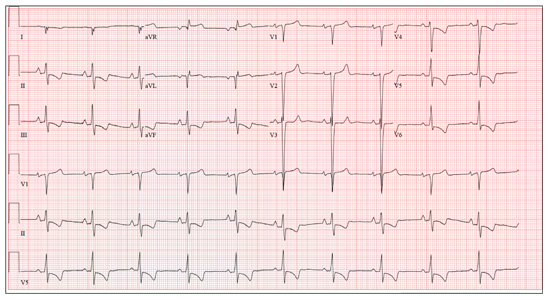
This ECG demonstrates normal sinus rhythm, right-axis deviation, evidence of a lateral MI, and inferolateral ST- and T-wave abnormalities.
Right-axis deviation is indicated by an R-wave axis between 90° and 180° and QS or QR complexes in lead I and/or aVL. While the most common cause of a right-axis deviation is right ventricular hypertrophy, it is also evident in a lateral MI. Evidence for the latter includes the presence of significant Q waves in leads I and aVL. Finally, inferolateral ST- and T-wave changes are evidenced by inverted T waves in leads II, III, aVF, and precordial leads V4 to V6.
ECG evidence of a lateral MI not present on a previous scan (eight months ago), in the presence of a normal troponin level, suggests a recent MI.
ANSWER
This ECG demonstrates normal sinus rhythm, right-axis deviation, evidence of a lateral MI, and inferolateral ST- and T-wave abnormalities.
Right-axis deviation is indicated by an R-wave axis between 90° and 180° and QS or QR complexes in lead I and/or aVL. While the most common cause of a right-axis deviation is right ventricular hypertrophy, it is also evident in a lateral MI. Evidence for the latter includes the presence of significant Q waves in leads I and aVL. Finally, inferolateral ST- and T-wave changes are evidenced by inverted T waves in leads II, III, aVF, and precordial leads V4 to V6.
ECG evidence of a lateral MI not present on a previous scan (eight months ago), in the presence of a normal troponin level, suggests a recent MI.
ANSWER
This ECG demonstrates normal sinus rhythm, right-axis deviation, evidence of a lateral MI, and inferolateral ST- and T-wave abnormalities.
Right-axis deviation is indicated by an R-wave axis between 90° and 180° and QS or QR complexes in lead I and/or aVL. While the most common cause of a right-axis deviation is right ventricular hypertrophy, it is also evident in a lateral MI. Evidence for the latter includes the presence of significant Q waves in leads I and aVL. Finally, inferolateral ST- and T-wave changes are evidenced by inverted T waves in leads II, III, aVF, and precordial leads V4 to V6.
ECG evidence of a lateral MI not present on a previous scan (eight months ago), in the presence of a normal troponin level, suggests a recent MI.
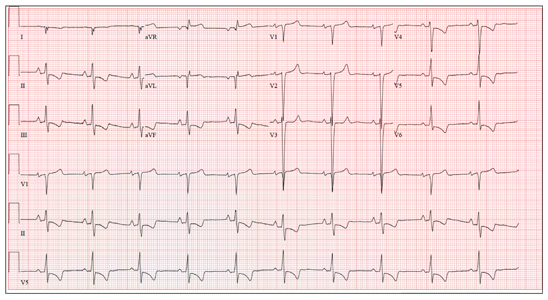
A 70-year-old woman has a 10-year history of a dilated nonischemic cardiomyopathy and New York Heart Association Class II heart failure. She presents with a one-week history of back pain and shortness of breath. She describes the pain as a “dull, achy” pressure, exacerbated by exertion and relieved with rest. She says the pain is localized in the back between her scapulas and does not radiate. She denies substernal chest pain, nausea, vomiting, or diaphoresis; the only associated symptom is dyspnea. Her most recent echocardiogram showed a dilated left ventricle, with a left ventricular ejection fraction of 29%, and a normal right ventricle, with mild hypertrophy and mildly reduced systolic function. She was also noted to have atherosclerotic changes in her ascending and descending thoracic aorta. Medical history is remarkable for diabetes, hypertension, chronic renal insufficiency, hyperlipidemia, and cataracts. Her current medications include aspirin, fer-rous sulfate, furosemide, hydralazine, glargine insulin, isosorbide dinitrate, lisinopril, metoprolol, and raloxifene. She is allergic to codeine, amiodarone, and radi-ographic contrast. Family history is positive for coronary artery disease, diabetes, and stroke. The patient is widowed, does not smoke, and does not consume alcohol. She is very active in her local quilting club. The review of systems is positive for increased weakness and diarrhea. She states that approximately two weeks ago, she experienced vague epigastric pain and diaphoresis; she did not seek medical attention, as it resolved. The physical exam reveals a thin, elderly woman in mild distress. Blood pressure is 139/82 mm Hg; pulse, 66 beats/min; respiratory rate, 21 breaths/¬min-1; and temperature, 35.9°C. Her weight is 108 lb. Pertinent physical findings include a grade II/VI diastolic murmur at the left lower sternal border, 2+ peripheral pulses with a bruit present in the right femoral artery, occasional late expiratory wheezes in both lung bases, vertebral tenderness at the T6-T7 level with no evidence of scoliosis or kyphosis, and no evidence of peripheral edema. She is intact from a neurologic standpoint. Significant laboratory data include a serum glucose level of 294 mg/dL; blood urea nitrogen (BUN), 68 mg/dL; creatinine, 1.75 mg/dL; glomerular filtration rate, 30 mL/min; B-type natriuretic peptide, 984 pg/mL; and serum troponin, 0.11 ng/mL. An ECG is obtained that reveals the following: a ventricular rate of 62 beats/min; PR interval, 160 ms; QRS duration, 94 ms; QT/QTc interval, 404/410 ms; P ax-is, 84°; R axis, 151°; and T axis, 253°. What is your interpretation of this ECG?
Topical Steroids: the Solution or the Cause?
ANSWER
The correct answer is all of the above (choice “d”). Prolonged injudicious use of topical steroids can cause a number of problems, including these; they are collectively termed iatrogenic since they are ultimately caused by prescribed medication. One of the more difficult aspects of this problem to deal with is the “addictive” state, in which withdrawal symptoms compel the patient to continue applying the offending steroid cream.
DISCUSSION
This is a relatively common scenario in dermatology offices. The misuse of topical steroids is well known, and something we strive to prevent—but with mixed results. It’s one of the reasons we’re stingy with refills of such medications, requiring the patient to be seen at least once a year. Unfortunately, this patient had been getting “refills” from friends in Mexico; patients often “borrow” steroid creams from household members or friends, or use products prescribed for one condition to treat others for which they were not intended.
The primary mode of action of topical steroids is vasoconstriction, a positive thing in terms of reduction of inflammation. The bad news is that continuous use of class 1 (the most powerful) steroids, such as clobetasol, can cause such profound and prolonged vasoconstriction that the skin effectively loses its blood supply and withers, sometimes down to adipose tissue. As one might suspect, this is more likely in already thin-skinned areas, including the antecubital area, face, neck, eyelids, and genitals, where the creation of striae is especially common.
Fairly early on in this process, before frank atrophy occurs, the condition being treated usually resolves. However, when the steroid is stopped, stinging and itching immediately return—which, of course, causes the patient to reapply the medication, perpetuating the vicious cycle.
The cycle is ultimately broken by gradual reduction in the frequency of application of successively weaker steroids. Usually, the skin gradually regenerates and returns to normal. In this case, the process will be lengthy and will almost certainly result in significant scarring.
Even injudicious application of weaker classes of steroids (eg, hydrocortisone 2.5% cream) to areas such as the face can result in a range of deleterious effects, including localized rosacea-like eruption or erythema. It has been reported that approximately 75% of cases of perioral dermatitis are either caused by or exacerbated by the application of topical steroids.
Topical application of even mid-strength steroids can also have systemic effects (eg, adrenal suppression, hyperglycemia) if applied over large areas. This is especially true when pediatric patients are involved.
Prevention of these iatrogenic effects lies in selecting the lowest strength steroid for the condition and area in question, then using them sparingly: no more than twice a day, and for no more than five days in a row, stopping for two consecutive days to allow the skin to regenerate. Even more caution should be exercised in treating children and when applying the product to intertriginous areas (skin-on-skin areas, such as the groin, in axillae, or under the breasts). Covering steroid-treated areas with anything—bandages, socks, even skin—effectively potentiates the positive and negative effects of steroids.
ANSWER
The correct answer is all of the above (choice “d”). Prolonged injudicious use of topical steroids can cause a number of problems, including these; they are collectively termed iatrogenic since they are ultimately caused by prescribed medication. One of the more difficult aspects of this problem to deal with is the “addictive” state, in which withdrawal symptoms compel the patient to continue applying the offending steroid cream.
DISCUSSION
This is a relatively common scenario in dermatology offices. The misuse of topical steroids is well known, and something we strive to prevent—but with mixed results. It’s one of the reasons we’re stingy with refills of such medications, requiring the patient to be seen at least once a year. Unfortunately, this patient had been getting “refills” from friends in Mexico; patients often “borrow” steroid creams from household members or friends, or use products prescribed for one condition to treat others for which they were not intended.
The primary mode of action of topical steroids is vasoconstriction, a positive thing in terms of reduction of inflammation. The bad news is that continuous use of class 1 (the most powerful) steroids, such as clobetasol, can cause such profound and prolonged vasoconstriction that the skin effectively loses its blood supply and withers, sometimes down to adipose tissue. As one might suspect, this is more likely in already thin-skinned areas, including the antecubital area, face, neck, eyelids, and genitals, where the creation of striae is especially common.
Fairly early on in this process, before frank atrophy occurs, the condition being treated usually resolves. However, when the steroid is stopped, stinging and itching immediately return—which, of course, causes the patient to reapply the medication, perpetuating the vicious cycle.
The cycle is ultimately broken by gradual reduction in the frequency of application of successively weaker steroids. Usually, the skin gradually regenerates and returns to normal. In this case, the process will be lengthy and will almost certainly result in significant scarring.
Even injudicious application of weaker classes of steroids (eg, hydrocortisone 2.5% cream) to areas such as the face can result in a range of deleterious effects, including localized rosacea-like eruption or erythema. It has been reported that approximately 75% of cases of perioral dermatitis are either caused by or exacerbated by the application of topical steroids.
Topical application of even mid-strength steroids can also have systemic effects (eg, adrenal suppression, hyperglycemia) if applied over large areas. This is especially true when pediatric patients are involved.
Prevention of these iatrogenic effects lies in selecting the lowest strength steroid for the condition and area in question, then using them sparingly: no more than twice a day, and for no more than five days in a row, stopping for two consecutive days to allow the skin to regenerate. Even more caution should be exercised in treating children and when applying the product to intertriginous areas (skin-on-skin areas, such as the groin, in axillae, or under the breasts). Covering steroid-treated areas with anything—bandages, socks, even skin—effectively potentiates the positive and negative effects of steroids.
ANSWER
The correct answer is all of the above (choice “d”). Prolonged injudicious use of topical steroids can cause a number of problems, including these; they are collectively termed iatrogenic since they are ultimately caused by prescribed medication. One of the more difficult aspects of this problem to deal with is the “addictive” state, in which withdrawal symptoms compel the patient to continue applying the offending steroid cream.
DISCUSSION
This is a relatively common scenario in dermatology offices. The misuse of topical steroids is well known, and something we strive to prevent—but with mixed results. It’s one of the reasons we’re stingy with refills of such medications, requiring the patient to be seen at least once a year. Unfortunately, this patient had been getting “refills” from friends in Mexico; patients often “borrow” steroid creams from household members or friends, or use products prescribed for one condition to treat others for which they were not intended.
The primary mode of action of topical steroids is vasoconstriction, a positive thing in terms of reduction of inflammation. The bad news is that continuous use of class 1 (the most powerful) steroids, such as clobetasol, can cause such profound and prolonged vasoconstriction that the skin effectively loses its blood supply and withers, sometimes down to adipose tissue. As one might suspect, this is more likely in already thin-skinned areas, including the antecubital area, face, neck, eyelids, and genitals, where the creation of striae is especially common.
Fairly early on in this process, before frank atrophy occurs, the condition being treated usually resolves. However, when the steroid is stopped, stinging and itching immediately return—which, of course, causes the patient to reapply the medication, perpetuating the vicious cycle.
The cycle is ultimately broken by gradual reduction in the frequency of application of successively weaker steroids. Usually, the skin gradually regenerates and returns to normal. In this case, the process will be lengthy and will almost certainly result in significant scarring.
Even injudicious application of weaker classes of steroids (eg, hydrocortisone 2.5% cream) to areas such as the face can result in a range of deleterious effects, including localized rosacea-like eruption or erythema. It has been reported that approximately 75% of cases of perioral dermatitis are either caused by or exacerbated by the application of topical steroids.
Topical application of even mid-strength steroids can also have systemic effects (eg, adrenal suppression, hyperglycemia) if applied over large areas. This is especially true when pediatric patients are involved.
Prevention of these iatrogenic effects lies in selecting the lowest strength steroid for the condition and area in question, then using them sparingly: no more than twice a day, and for no more than five days in a row, stopping for two consecutive days to allow the skin to regenerate. Even more caution should be exercised in treating children and when applying the product to intertriginous areas (skin-on-skin areas, such as the groin, in axillae, or under the breasts). Covering steroid-treated areas with anything—bandages, socks, even skin—effectively potentiates the positive and negative effects of steroids.
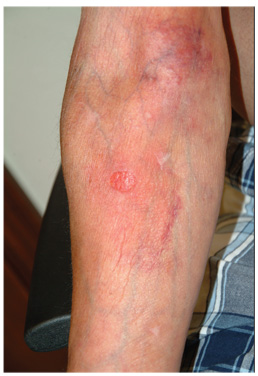
A 59-year-old man presents with skin changes on both antecubital areas. For more than a year, he has applied clobetasol 0.05% cream at least twice daily to the area ostensibly for treatment of long-standing eczema, which has affected not only the antecubital areas but also the patient’s legs. In addition to the eczema, he has a history of atopy, marked by seasonal allergies and asthma. He notes that his stress level has increased in the past several months, which he suspects has contributed to his itching. On examination, marked epidermal atrophy is seen in both antecubital areas, along with extensive purpura. Surface adnexal structures, such as hair, follicles, and skin lines, are sparse at best, but dermal and subdermal vasculature are readily visible. In the midst of the affected area on the right arm, a nickel-sized, full-thickness defect is noted. Beneath it, adipose tissue can be seen. Clearly, these changes are attributable to the effects of the clobetasol, which the patient is advised to stop. But he replies that when he does, the treated areas burn and itch even more, until he obtains relief by applying more clobetasol.

Cold weather and diarrhea: Don't forget yersiniosis
The genus Yersinia includes 11 species. Three species are generally associated with human disease; Y. enterocolitica, Y. pestis, and Y. pseudotuberculosis. Yersinia pestis is the causative agent of plague. Yersinia pseudotuberculosis can manifest with fever, abdominal pain, and scarlatiniform rash. Additional symptoms include diarrhea, sterile joint effusions, erythema nodosum, and septicemia; these symptoms can be indistinguishable from Kawasaki Disease. By report, almost 10 % of cases of Kawasaki Disease in Japan have serologic or bacteriologic evidence of Y. pseudotuberculosis infection [Redbook: 2012 Report of the Committee on Infectious Diseases, 795-7]. Y. enterocolitica is most often associated with yersiniosis.
Although Y. enterocolitica is not the most common cause of diarrheal illness in the United States, it is one of the nine pathogens that have been monitored by the Foodborne Diseases Active Surveillance Network (FoodNet) since 1996. In the United States, it is estimated that Y. enterocolitica causes slightly over 115,000 infections annually (Emerg. Infect. Dis. 2011;17:7-15). The disease is more common in cooler months. It is transmitted by consumption of contaminated food, especially raw or undercooked pork products.

Only a few outbreaks have been reported in the United States, and these were usually associated with consumption of pork, specifically chitterlings (pig intestines), a winter holiday dish prepared most frequently in black households in the South (MMWR 1990;39:819-20). Transmission to infants and young children is thought to occur from caretakers preparing chitterlings who have not adequately cleaned their hands prior to touching objects subsequently handled by the child.
The incubation period is usually 4-6 days (range, 1-14 days). The duration of diarrhea is variable and can persist up to 3 weeks. Organisms can be excreted an average of 6 weeks. Clinical manifestations vary by age. Younger children usually present with fever and diarrhea. Stools frequently contain blood and leucocytes. Vomiting is also reported in most series. In contrast, older children and adults often present with a pseudoappendicitis syndrome with right-sided abdominal pain and fever. Leukocytosis is often present. At surgery, mesenteric adenitis is observed, and the appendix generally is normal.
Bacteremia can occur and is usually associated with infection in children less than 1 year of age and in those with iron-overloaded states, including persons with sickle cell disease, beta-thalassemia, and those receiving deferoxamine therapy. While uncommon, focal manifestations including pharyngitis, osteomyelitis, pyomyositis, pneumonia, empyema, and meningitis may occur.

Diagnosis is confirmed by isolation of the organism from stool, blood, peritoneal fluid, lymph nodes, and throat cultures. Most laboratories do not routinely test for Yersinia in stool cultures. If Y. enterocolitica is suspected, you should notify the laboratory so the stool can be plated on appropriate media (CIN agar). Serologic tests to detect a rise in serum antibody titers to confirm infection are available in reference and research laboratories, but are not generally used for diagnosis. Cross reactivity with Brucella, Salmonella, Vibrio, and Rickettsia may lead to false positive titer results. Y. enterocolitica antibodies also have antigenic similarity with thyroid tissue. You may see persistent elevation of titers in patients with thyroid disease.
Benefit of antimicrobial therapy for isolated Y. enterocolitica gastrointestinal disease and Y. pseudotuberculosis has not been established. Therapy may decrease the duration of fecal shedding. Treatment is indicated for immunocompromised hosts and persons with septicemia and focal infections. Y. enterocolitica and Y. pseudotuberculosis are usually sensitive to trimethoprim-sulfamethoxazole, aminoglycosides, cefotaxime, fluoroquinolones (persons greater than 18 years of age or older), and tetracycline or doxycycline (for children at least 8 years of age and older).
So what is the actual incidence and when should the practitioner be concerned? Initial population based surveillance data for Y. enterocolitica infections in FoodNet sites between 1996 and 1999 reported an overall incidence of 0.9 cases per 100,000 population. The highest incidence was among black and Asian individuals and was 3.2 cases and 1.5 cases per 100,000 population, respectively. The incidence in Hispanics and whites was 0.6 and 0.4 cases per 100,000 respectively. Incidence increased with decreasing age in all racial/ethnic groups. Blacks infants had the highest incidence, 141.9 cases/100,000 population, and the highest incidence in infants was reported from Georgia (207 cases/100,000). Seasonal variation in incidence was noted only in black individuals with peak activity occurring in December (Clin. Infect. Dis. 2004;38[Suppl 3]:S181-9).

The most recent data from FoodNet (1996-2009) reveals an overall incidence of 0.5/100,000. There was a decline in incidence in all racial and ethnic groups. The highest incidence is still observed in black and Asians (0.9 and 0.7 per 100,000). The most dramatic decline occurred in black individuals (3.2 vs. 0.9 per 100,000). In 1998, an educational campaign was initiated in Georgia that targeted high-risk individuals and provided information on the safe handling and preparation of chitterlings. The state of Georgia reported the greatest decline to 0.4/100,000, which has almost eliminated the racial disparity reported in 2009. It is unclear if this campaign was the only reason for the decline in Georgia. The incidence in whites is 0.2/100,000. Since 2007, the incidence in Asian children less than 5 years of ages has been the highest amongst all racial and ethnic groups. Pork consumption is still assumed to be the major source. Seasonal variability persists amongst Black children less 5 years of age, implying that chitterlings may still be the source of infection for individuals in this group (Clin. Infect. Dis. 2012:54 [Suppl 5]:S385-S90).
In general, yersiniosis should be included in the differential of a febrile diarrheal illness, particularly during the cooler months and holiday season. It is prudent to determine if consumption and/or preparation of chitterlings or other pork products by the patient or caretakers has occurred. This will enable you to alert the laboratory so stool specimens can be cultured on the appropriate medium (CIN agar). Consumption of chitterlings is not limited to any specific racial or ethnic group. Individuals from rural and farming areas may also consume this product.
Dr. Word is a pediatric infectious disease specialist and director of the Houston Travel Medicine Clinic. She said she had no relevant financial disclosures. Write to Dr. Word at [email protected].
The genus Yersinia includes 11 species. Three species are generally associated with human disease; Y. enterocolitica, Y. pestis, and Y. pseudotuberculosis. Yersinia pestis is the causative agent of plague. Yersinia pseudotuberculosis can manifest with fever, abdominal pain, and scarlatiniform rash. Additional symptoms include diarrhea, sterile joint effusions, erythema nodosum, and septicemia; these symptoms can be indistinguishable from Kawasaki Disease. By report, almost 10 % of cases of Kawasaki Disease in Japan have serologic or bacteriologic evidence of Y. pseudotuberculosis infection [Redbook: 2012 Report of the Committee on Infectious Diseases, 795-7]. Y. enterocolitica is most often associated with yersiniosis.
Although Y. enterocolitica is not the most common cause of diarrheal illness in the United States, it is one of the nine pathogens that have been monitored by the Foodborne Diseases Active Surveillance Network (FoodNet) since 1996. In the United States, it is estimated that Y. enterocolitica causes slightly over 115,000 infections annually (Emerg. Infect. Dis. 2011;17:7-15). The disease is more common in cooler months. It is transmitted by consumption of contaminated food, especially raw or undercooked pork products.
Only a few outbreaks have been reported in the United States, and these were usually associated with consumption of pork, specifically chitterlings (pig intestines), a winter holiday dish prepared most frequently in black households in the South (MMWR 1990;39:819-20). Transmission to infants and young children is thought to occur from caretakers preparing chitterlings who have not adequately cleaned their hands prior to touching objects subsequently handled by the child.
The incubation period is usually 4-6 days (range, 1-14 days). The duration of diarrhea is variable and can persist up to 3 weeks. Organisms can be excreted an average of 6 weeks. Clinical manifestations vary by age. Younger children usually present with fever and diarrhea. Stools frequently contain blood and leucocytes. Vomiting is also reported in most series. In contrast, older children and adults often present with a pseudoappendicitis syndrome with right-sided abdominal pain and fever. Leukocytosis is often present. At surgery, mesenteric adenitis is observed, and the appendix generally is normal.
Bacteremia can occur and is usually associated with infection in children less than 1 year of age and in those with iron-overloaded states, including persons with sickle cell disease, beta-thalassemia, and those receiving deferoxamine therapy. While uncommon, focal manifestations including pharyngitis, osteomyelitis, pyomyositis, pneumonia, empyema, and meningitis may occur.
Diagnosis is confirmed by isolation of the organism from stool, blood, peritoneal fluid, lymph nodes, and throat cultures. Most laboratories do not routinely test for Yersinia in stool cultures. If Y. enterocolitica is suspected, you should notify the laboratory so the stool can be plated on appropriate media (CIN agar). Serologic tests to detect a rise in serum antibody titers to confirm infection are available in reference and research laboratories, but are not generally used for diagnosis. Cross reactivity with Brucella, Salmonella, Vibrio, and Rickettsia may lead to false positive titer results. Y. enterocolitica antibodies also have antigenic similarity with thyroid tissue. You may see persistent elevation of titers in patients with thyroid disease.
Benefit of antimicrobial therapy for isolated Y. enterocolitica gastrointestinal disease and Y. pseudotuberculosis has not been established. Therapy may decrease the duration of fecal shedding. Treatment is indicated for immunocompromised hosts and persons with septicemia and focal infections. Y. enterocolitica and Y. pseudotuberculosis are usually sensitive to trimethoprim-sulfamethoxazole, aminoglycosides, cefotaxime, fluoroquinolones (persons greater than 18 years of age or older), and tetracycline or doxycycline (for children at least 8 years of age and older).
So what is the actual incidence and when should the practitioner be concerned? Initial population based surveillance data for Y. enterocolitica infections in FoodNet sites between 1996 and 1999 reported an overall incidence of 0.9 cases per 100,000 population. The highest incidence was among black and Asian individuals and was 3.2 cases and 1.5 cases per 100,000 population, respectively. The incidence in Hispanics and whites was 0.6 and 0.4 cases per 100,000 respectively. Incidence increased with decreasing age in all racial/ethnic groups. Blacks infants had the highest incidence, 141.9 cases/100,000 population, and the highest incidence in infants was reported from Georgia (207 cases/100,000). Seasonal variation in incidence was noted only in black individuals with peak activity occurring in December (Clin. Infect. Dis. 2004;38[Suppl 3]:S181-9).
The most recent data from FoodNet (1996-2009) reveals an overall incidence of 0.5/100,000. There was a decline in incidence in all racial and ethnic groups. The highest incidence is still observed in black and Asians (0.9 and 0.7 per 100,000). The most dramatic decline occurred in black individuals (3.2 vs. 0.9 per 100,000). In 1998, an educational campaign was initiated in Georgia that targeted high-risk individuals and provided information on the safe handling and preparation of chitterlings. The state of Georgia reported the greatest decline to 0.4/100,000, which has almost eliminated the racial disparity reported in 2009. It is unclear if this campaign was the only reason for the decline in Georgia. The incidence in whites is 0.2/100,000. Since 2007, the incidence in Asian children less than 5 years of ages has been the highest amongst all racial and ethnic groups. Pork consumption is still assumed to be the major source. Seasonal variability persists amongst Black children less 5 years of age, implying that chitterlings may still be the source of infection for individuals in this group (Clin. Infect. Dis. 2012:54 [Suppl 5]:S385-S90).
In general, yersiniosis should be included in the differential of a febrile diarrheal illness, particularly during the cooler months and holiday season. It is prudent to determine if consumption and/or preparation of chitterlings or other pork products by the patient or caretakers has occurred. This will enable you to alert the laboratory so stool specimens can be cultured on the appropriate medium (CIN agar). Consumption of chitterlings is not limited to any specific racial or ethnic group. Individuals from rural and farming areas may also consume this product.
Dr. Word is a pediatric infectious disease specialist and director of the Houston Travel Medicine Clinic. She said she had no relevant financial disclosures. Write to Dr. Word at [email protected].
The genus Yersinia includes 11 species. Three species are generally associated with human disease; Y. enterocolitica, Y. pestis, and Y. pseudotuberculosis. Yersinia pestis is the causative agent of plague. Yersinia pseudotuberculosis can manifest with fever, abdominal pain, and scarlatiniform rash. Additional symptoms include diarrhea, sterile joint effusions, erythema nodosum, and septicemia; these symptoms can be indistinguishable from Kawasaki Disease. By report, almost 10 % of cases of Kawasaki Disease in Japan have serologic or bacteriologic evidence of Y. pseudotuberculosis infection [Redbook: 2012 Report of the Committee on Infectious Diseases, 795-7]. Y. enterocolitica is most often associated with yersiniosis.
Although Y. enterocolitica is not the most common cause of diarrheal illness in the United States, it is one of the nine pathogens that have been monitored by the Foodborne Diseases Active Surveillance Network (FoodNet) since 1996. In the United States, it is estimated that Y. enterocolitica causes slightly over 115,000 infections annually (Emerg. Infect. Dis. 2011;17:7-15). The disease is more common in cooler months. It is transmitted by consumption of contaminated food, especially raw or undercooked pork products.
Only a few outbreaks have been reported in the United States, and these were usually associated with consumption of pork, specifically chitterlings (pig intestines), a winter holiday dish prepared most frequently in black households in the South (MMWR 1990;39:819-20). Transmission to infants and young children is thought to occur from caretakers preparing chitterlings who have not adequately cleaned their hands prior to touching objects subsequently handled by the child.
The incubation period is usually 4-6 days (range, 1-14 days). The duration of diarrhea is variable and can persist up to 3 weeks. Organisms can be excreted an average of 6 weeks. Clinical manifestations vary by age. Younger children usually present with fever and diarrhea. Stools frequently contain blood and leucocytes. Vomiting is also reported in most series. In contrast, older children and adults often present with a pseudoappendicitis syndrome with right-sided abdominal pain and fever. Leukocytosis is often present. At surgery, mesenteric adenitis is observed, and the appendix generally is normal.
Bacteremia can occur and is usually associated with infection in children less than 1 year of age and in those with iron-overloaded states, including persons with sickle cell disease, beta-thalassemia, and those receiving deferoxamine therapy. While uncommon, focal manifestations including pharyngitis, osteomyelitis, pyomyositis, pneumonia, empyema, and meningitis may occur.
Diagnosis is confirmed by isolation of the organism from stool, blood, peritoneal fluid, lymph nodes, and throat cultures. Most laboratories do not routinely test for Yersinia in stool cultures. If Y. enterocolitica is suspected, you should notify the laboratory so the stool can be plated on appropriate media (CIN agar). Serologic tests to detect a rise in serum antibody titers to confirm infection are available in reference and research laboratories, but are not generally used for diagnosis. Cross reactivity with Brucella, Salmonella, Vibrio, and Rickettsia may lead to false positive titer results. Y. enterocolitica antibodies also have antigenic similarity with thyroid tissue. You may see persistent elevation of titers in patients with thyroid disease.
Benefit of antimicrobial therapy for isolated Y. enterocolitica gastrointestinal disease and Y. pseudotuberculosis has not been established. Therapy may decrease the duration of fecal shedding. Treatment is indicated for immunocompromised hosts and persons with septicemia and focal infections. Y. enterocolitica and Y. pseudotuberculosis are usually sensitive to trimethoprim-sulfamethoxazole, aminoglycosides, cefotaxime, fluoroquinolones (persons greater than 18 years of age or older), and tetracycline or doxycycline (for children at least 8 years of age and older).
So what is the actual incidence and when should the practitioner be concerned? Initial population based surveillance data for Y. enterocolitica infections in FoodNet sites between 1996 and 1999 reported an overall incidence of 0.9 cases per 100,000 population. The highest incidence was among black and Asian individuals and was 3.2 cases and 1.5 cases per 100,000 population, respectively. The incidence in Hispanics and whites was 0.6 and 0.4 cases per 100,000 respectively. Incidence increased with decreasing age in all racial/ethnic groups. Blacks infants had the highest incidence, 141.9 cases/100,000 population, and the highest incidence in infants was reported from Georgia (207 cases/100,000). Seasonal variation in incidence was noted only in black individuals with peak activity occurring in December (Clin. Infect. Dis. 2004;38[Suppl 3]:S181-9).
The most recent data from FoodNet (1996-2009) reveals an overall incidence of 0.5/100,000. There was a decline in incidence in all racial and ethnic groups. The highest incidence is still observed in black and Asians (0.9 and 0.7 per 100,000). The most dramatic decline occurred in black individuals (3.2 vs. 0.9 per 100,000). In 1998, an educational campaign was initiated in Georgia that targeted high-risk individuals and provided information on the safe handling and preparation of chitterlings. The state of Georgia reported the greatest decline to 0.4/100,000, which has almost eliminated the racial disparity reported in 2009. It is unclear if this campaign was the only reason for the decline in Georgia. The incidence in whites is 0.2/100,000. Since 2007, the incidence in Asian children less than 5 years of ages has been the highest amongst all racial and ethnic groups. Pork consumption is still assumed to be the major source. Seasonal variability persists amongst Black children less 5 years of age, implying that chitterlings may still be the source of infection for individuals in this group (Clin. Infect. Dis. 2012:54 [Suppl 5]:S385-S90).
In general, yersiniosis should be included in the differential of a febrile diarrheal illness, particularly during the cooler months and holiday season. It is prudent to determine if consumption and/or preparation of chitterlings or other pork products by the patient or caretakers has occurred. This will enable you to alert the laboratory so stool specimens can be cultured on the appropriate medium (CIN agar). Consumption of chitterlings is not limited to any specific racial or ethnic group. Individuals from rural and farming areas may also consume this product.
Dr. Word is a pediatric infectious disease specialist and director of the Houston Travel Medicine Clinic. She said she had no relevant financial disclosures. Write to Dr. Word at [email protected].

Is the Relational Approach to Diagnosis Possible or Desirable?
The American Family Therapy Academy recently issued a policy statement protesting the DSM-5, and asks the American Psychiatric Association to consider the importance of relational and family context to psychiatric diagnoses.
AFTA, a multidisciplinary group, does not support the current revision of the DSM, stating that it "continues a long history of ignoring research and excluding vital contributions of nonpsychiatric mental health disciplines." This statement refers to the substantial body of research concerning the role of relational factors in mental health and mental illness, and also refers to the large number of effective family treatments, including, but not limited to, family therapy.
The academy criticizes the DSM’s use of the biomedical model and its omission of the role of family and sociocultural contexts on well-being. AFTA states that the DSM "delegitimizes the focus on relationship, life stage, community, and access to power and resources." AFTA points out that the DSM fails to take into account culture, class and ‘destructive unjust social factors,’ such as poverty, hunger, homelessness, violence, racism, and other forms of oppression. AFTA considers these factors to be important in reaching a diagnosis that accurately describes patients.
Many psychiatrists, especially family, social, and cultural psychiatrists, agree with AFTA’s position. Several family researchers and family psychiatrists have been pushing for many years to get relational diagnoses included in the DSM-IV and the DSM-5 (J. Fam. Psychol. 2006;20:359-68), citing decades of excellent research into relational diagnoses. Their attempts are supported by nonmedical health care professionals who complain that they cannot get paid by insurance companies for treating families. However, putting any diagnosis in the DSM so the insurance companies get paid is a backward way of thinking. Any diagnostic system of American psychiatry should not be framed or influenced by financial organizations that want to ration health care.
Some psychiatrists who contributed to the DSM offer the disclaimer that "they do not mean this to be a bible." However, the DSM is frequently used "as a bible," for example, in the courts. More importantly, reductionist diagnostic descriptions in the DSM narrow the public’s and the professionals’ thinking about psychological difficulties, and, by extrapolation, limit the conceptualization of what types of interventions might be helpful.
For example, describing psychiatric illnesses as biological leads to the assumption that biological interventions are needed. If an illness is defined using a biopsychosocial explanation, however, this broader understanding leads to a wider array of possible treatments. A psychiatric diagnostic system should recognize all the factors that are known to contribute to psychological health and illness to be of most use in patient care.
There is also a strong argument for not including relational diagnoses in the DSM. The argument is this: Relational factors are process factors, rather than static factors. For example, expressed emotion (EE) is not a characteristic of a family but rather a description of family distress that arises as a result of living with a disease. It is a description of a family process. Providing psychoeducation to a distressed family substantially reduces the level of EE and the subsequent risk of patient relapse. EE is a measure of relational process. If EE is entered into the DSM, there is a danger of its being seen as a static entity.
A delicate balance exists between the utilitarian need for a system of diagnoses and the risk of overdefining people and their relationships as "pathological." It was not that long ago that we pathologized homosexuality and described the entity of the "schizophrenogenic mother."
Dr. Larry Freeman, a member of the Association of Family Psychiatrists, adds: "Be wary of a pressure beyond medical circles to utilize psychiatry as a force for social control. I do a great deal of workers’ [compensation], and so-called ‘preexisting conditions’ are commonly framed as the "cause" of a worker’s emotional response to injury, and therefore, [the worker’s] current psychiatric conditions are not accepted as a consequence of the original injury event.
"Be careful that we do not enable this distortion further in our efforts to include context and history."
How should we include patient contexts such as violence, abuse, trauma, poverty, injustice, or relational dysfunction? How do we acknowledge that these factors play a significant role in the lives of our patients? For children, this is especially important as treatment often focuses on changing or stabilizing their environment, and ensuring that there is adequate attachment and nurturance.
How do we ensure that these relationships and contexts are adequately defined so we can monitor the effectiveness (or not) of interventions? AFTA supports the creation of a work group that will focus on developing an alternative to the DSM for the conceptualization of emotional distress. David Elkins, Ph.D., is planning an international summit in 2013 with representatives from all therapist groups to discuss the feasibility of such a system.
Another way forward is to develop a diagnostic system that focuses on health. The Global Assessment of Functioning (GAF), describes with reasonable accuracy a person’s individual level of functioning on a scale of 1 to 100. The Global Assessment of Relational Functioning (GARF) describes the health of a relationship on a scale of 1-100. Using these scales, pathology and health coexist on a continuum, with anchors throughout the scale. These systems are currently crude instruments, but imagine how much better they could become if they were the focus of research, clinical trials, etc.
There will always be the need for individual diagnoses, where the melancholic continues to suffer despite having an excellent social and family context, and there will always be cases where we cannot decide if the patient is ill unto himself or if his illness is informed by the context of his life.
But consider the inverse, the person who is optimistic and functional in spite of the dire context of his life, people who hold beliefs, convictions, and so on that raise them above their life circumstances. (Think of visionaries like Gandhi or Mandela). In the same way, there are relationships that function well, despite the presence of adversity. How do we develop a system that aspires to "health" instead of pathology? The American health care system (or rather its illness care system) needs to morph into true health care with a focus on prevention on both an individual and relational front.
For additional information, see Relational Processes and DSM-V: Neuroscience, Assessment, Prevention, and Treatment (Washington: American Psychiatric Association Publishing, 2006).
Dr. Alison Heru is with the department of psychiatry at the University of Colorado at Denver, Aurora. She has been a member of the Association of Family Psychiatrists since 2002 and currently serves as the organization’s treasurer. In addition, she is the coauthor of two books on working with families and is the author of numerous articles on this topic.
The American Family Therapy Academy recently issued a policy statement protesting the DSM-5, and asks the American Psychiatric Association to consider the importance of relational and family context to psychiatric diagnoses.
AFTA, a multidisciplinary group, does not support the current revision of the DSM, stating that it "continues a long history of ignoring research and excluding vital contributions of nonpsychiatric mental health disciplines." This statement refers to the substantial body of research concerning the role of relational factors in mental health and mental illness, and also refers to the large number of effective family treatments, including, but not limited to, family therapy.
The academy criticizes the DSM’s use of the biomedical model and its omission of the role of family and sociocultural contexts on well-being. AFTA states that the DSM "delegitimizes the focus on relationship, life stage, community, and access to power and resources." AFTA points out that the DSM fails to take into account culture, class and ‘destructive unjust social factors,’ such as poverty, hunger, homelessness, violence, racism, and other forms of oppression. AFTA considers these factors to be important in reaching a diagnosis that accurately describes patients.
Many psychiatrists, especially family, social, and cultural psychiatrists, agree with AFTA’s position. Several family researchers and family psychiatrists have been pushing for many years to get relational diagnoses included in the DSM-IV and the DSM-5 (J. Fam. Psychol. 2006;20:359-68), citing decades of excellent research into relational diagnoses. Their attempts are supported by nonmedical health care professionals who complain that they cannot get paid by insurance companies for treating families. However, putting any diagnosis in the DSM so the insurance companies get paid is a backward way of thinking. Any diagnostic system of American psychiatry should not be framed or influenced by financial organizations that want to ration health care.
Some psychiatrists who contributed to the DSM offer the disclaimer that "they do not mean this to be a bible." However, the DSM is frequently used "as a bible," for example, in the courts. More importantly, reductionist diagnostic descriptions in the DSM narrow the public’s and the professionals’ thinking about psychological difficulties, and, by extrapolation, limit the conceptualization of what types of interventions might be helpful.
For example, describing psychiatric illnesses as biological leads to the assumption that biological interventions are needed. If an illness is defined using a biopsychosocial explanation, however, this broader understanding leads to a wider array of possible treatments. A psychiatric diagnostic system should recognize all the factors that are known to contribute to psychological health and illness to be of most use in patient care.
There is also a strong argument for not including relational diagnoses in the DSM. The argument is this: Relational factors are process factors, rather than static factors. For example, expressed emotion (EE) is not a characteristic of a family but rather a description of family distress that arises as a result of living with a disease. It is a description of a family process. Providing psychoeducation to a distressed family substantially reduces the level of EE and the subsequent risk of patient relapse. EE is a measure of relational process. If EE is entered into the DSM, there is a danger of its being seen as a static entity.
A delicate balance exists between the utilitarian need for a system of diagnoses and the risk of overdefining people and their relationships as "pathological." It was not that long ago that we pathologized homosexuality and described the entity of the "schizophrenogenic mother."
Dr. Larry Freeman, a member of the Association of Family Psychiatrists, adds: "Be wary of a pressure beyond medical circles to utilize psychiatry as a force for social control. I do a great deal of workers’ [compensation], and so-called ‘preexisting conditions’ are commonly framed as the "cause" of a worker’s emotional response to injury, and therefore, [the worker’s] current psychiatric conditions are not accepted as a consequence of the original injury event.
"Be careful that we do not enable this distortion further in our efforts to include context and history."
How should we include patient contexts such as violence, abuse, trauma, poverty, injustice, or relational dysfunction? How do we acknowledge that these factors play a significant role in the lives of our patients? For children, this is especially important as treatment often focuses on changing or stabilizing their environment, and ensuring that there is adequate attachment and nurturance.
How do we ensure that these relationships and contexts are adequately defined so we can monitor the effectiveness (or not) of interventions? AFTA supports the creation of a work group that will focus on developing an alternative to the DSM for the conceptualization of emotional distress. David Elkins, Ph.D., is planning an international summit in 2013 with representatives from all therapist groups to discuss the feasibility of such a system.
Another way forward is to develop a diagnostic system that focuses on health. The Global Assessment of Functioning (GAF), describes with reasonable accuracy a person’s individual level of functioning on a scale of 1 to 100. The Global Assessment of Relational Functioning (GARF) describes the health of a relationship on a scale of 1-100. Using these scales, pathology and health coexist on a continuum, with anchors throughout the scale. These systems are currently crude instruments, but imagine how much better they could become if they were the focus of research, clinical trials, etc.
There will always be the need for individual diagnoses, where the melancholic continues to suffer despite having an excellent social and family context, and there will always be cases where we cannot decide if the patient is ill unto himself or if his illness is informed by the context of his life.
But consider the inverse, the person who is optimistic and functional in spite of the dire context of his life, people who hold beliefs, convictions, and so on that raise them above their life circumstances. (Think of visionaries like Gandhi or Mandela). In the same way, there are relationships that function well, despite the presence of adversity. How do we develop a system that aspires to "health" instead of pathology? The American health care system (or rather its illness care system) needs to morph into true health care with a focus on prevention on both an individual and relational front.
For additional information, see Relational Processes and DSM-V: Neuroscience, Assessment, Prevention, and Treatment (Washington: American Psychiatric Association Publishing, 2006).
Dr. Alison Heru is with the department of psychiatry at the University of Colorado at Denver, Aurora. She has been a member of the Association of Family Psychiatrists since 2002 and currently serves as the organization’s treasurer. In addition, she is the coauthor of two books on working with families and is the author of numerous articles on this topic.
The American Family Therapy Academy recently issued a policy statement protesting the DSM-5, and asks the American Psychiatric Association to consider the importance of relational and family context to psychiatric diagnoses.
AFTA, a multidisciplinary group, does not support the current revision of the DSM, stating that it "continues a long history of ignoring research and excluding vital contributions of nonpsychiatric mental health disciplines." This statement refers to the substantial body of research concerning the role of relational factors in mental health and mental illness, and also refers to the large number of effective family treatments, including, but not limited to, family therapy.
The academy criticizes the DSM’s use of the biomedical model and its omission of the role of family and sociocultural contexts on well-being. AFTA states that the DSM "delegitimizes the focus on relationship, life stage, community, and access to power and resources." AFTA points out that the DSM fails to take into account culture, class and ‘destructive unjust social factors,’ such as poverty, hunger, homelessness, violence, racism, and other forms of oppression. AFTA considers these factors to be important in reaching a diagnosis that accurately describes patients.
Many psychiatrists, especially family, social, and cultural psychiatrists, agree with AFTA’s position. Several family researchers and family psychiatrists have been pushing for many years to get relational diagnoses included in the DSM-IV and the DSM-5 (J. Fam. Psychol. 2006;20:359-68), citing decades of excellent research into relational diagnoses. Their attempts are supported by nonmedical health care professionals who complain that they cannot get paid by insurance companies for treating families. However, putting any diagnosis in the DSM so the insurance companies get paid is a backward way of thinking. Any diagnostic system of American psychiatry should not be framed or influenced by financial organizations that want to ration health care.
Some psychiatrists who contributed to the DSM offer the disclaimer that "they do not mean this to be a bible." However, the DSM is frequently used "as a bible," for example, in the courts. More importantly, reductionist diagnostic descriptions in the DSM narrow the public’s and the professionals’ thinking about psychological difficulties, and, by extrapolation, limit the conceptualization of what types of interventions might be helpful.
For example, describing psychiatric illnesses as biological leads to the assumption that biological interventions are needed. If an illness is defined using a biopsychosocial explanation, however, this broader understanding leads to a wider array of possible treatments. A psychiatric diagnostic system should recognize all the factors that are known to contribute to psychological health and illness to be of most use in patient care.
There is also a strong argument for not including relational diagnoses in the DSM. The argument is this: Relational factors are process factors, rather than static factors. For example, expressed emotion (EE) is not a characteristic of a family but rather a description of family distress that arises as a result of living with a disease. It is a description of a family process. Providing psychoeducation to a distressed family substantially reduces the level of EE and the subsequent risk of patient relapse. EE is a measure of relational process. If EE is entered into the DSM, there is a danger of its being seen as a static entity.
A delicate balance exists between the utilitarian need for a system of diagnoses and the risk of overdefining people and their relationships as "pathological." It was not that long ago that we pathologized homosexuality and described the entity of the "schizophrenogenic mother."
Dr. Larry Freeman, a member of the Association of Family Psychiatrists, adds: "Be wary of a pressure beyond medical circles to utilize psychiatry as a force for social control. I do a great deal of workers’ [compensation], and so-called ‘preexisting conditions’ are commonly framed as the "cause" of a worker’s emotional response to injury, and therefore, [the worker’s] current psychiatric conditions are not accepted as a consequence of the original injury event.
"Be careful that we do not enable this distortion further in our efforts to include context and history."
How should we include patient contexts such as violence, abuse, trauma, poverty, injustice, or relational dysfunction? How do we acknowledge that these factors play a significant role in the lives of our patients? For children, this is especially important as treatment often focuses on changing or stabilizing their environment, and ensuring that there is adequate attachment and nurturance.
How do we ensure that these relationships and contexts are adequately defined so we can monitor the effectiveness (or not) of interventions? AFTA supports the creation of a work group that will focus on developing an alternative to the DSM for the conceptualization of emotional distress. David Elkins, Ph.D., is planning an international summit in 2013 with representatives from all therapist groups to discuss the feasibility of such a system.
Another way forward is to develop a diagnostic system that focuses on health. The Global Assessment of Functioning (GAF), describes with reasonable accuracy a person’s individual level of functioning on a scale of 1 to 100. The Global Assessment of Relational Functioning (GARF) describes the health of a relationship on a scale of 1-100. Using these scales, pathology and health coexist on a continuum, with anchors throughout the scale. These systems are currently crude instruments, but imagine how much better they could become if they were the focus of research, clinical trials, etc.
There will always be the need for individual diagnoses, where the melancholic continues to suffer despite having an excellent social and family context, and there will always be cases where we cannot decide if the patient is ill unto himself or if his illness is informed by the context of his life.
But consider the inverse, the person who is optimistic and functional in spite of the dire context of his life, people who hold beliefs, convictions, and so on that raise them above their life circumstances. (Think of visionaries like Gandhi or Mandela). In the same way, there are relationships that function well, despite the presence of adversity. How do we develop a system that aspires to "health" instead of pathology? The American health care system (or rather its illness care system) needs to morph into true health care with a focus on prevention on both an individual and relational front.
For additional information, see Relational Processes and DSM-V: Neuroscience, Assessment, Prevention, and Treatment (Washington: American Psychiatric Association Publishing, 2006).
Dr. Alison Heru is with the department of psychiatry at the University of Colorado at Denver, Aurora. She has been a member of the Association of Family Psychiatrists since 2002 and currently serves as the organization’s treasurer. In addition, she is the coauthor of two books on working with families and is the author of numerous articles on this topic.

Preventing VTE with Decision Support
Over 900,000 incident and recurrent venous thromboembolism (VTE) events occur in the United States each year, resulting in nearly 300,000 fatalities.[1] VTE, including deep vein thrombosis (DVT) and pulmonary embolism (PE), is among the most common causes of death in the United States, with more people dying annually from VTE than motor vehicle accidents and breast cancer.[2]
Accordingly, healthcare policy makers and regulators have placed greater emphasis on VTE prevention, including use of VTE prophylaxis measures in the Centers for Medicare and Medicaid Services (CMS) value‐based purchasing (pay for performance) program and the Joint Commission's adoption of a national hospital patient safety goal related to anticoagulation therapy.[3, 4] Beginning in 2008, VTE events following hip and knee procedures were included as 1 of 10 hospital‐acquired conditions for which CMS would not pay for associated additional costs of care.[5]
A typical 300‐bed hospital can expect roughly 150 cases of hospital‐acquired VTE annually.[6] Up to 75% of these cases will occur on the medicine service, where nearly every patient has 1 or more VTE risk factor.[7] Although effective preventive modalities exist, prophylaxis rates among medical patients have been noted to be <50%.[8, 9] While quality improvement interventions have been shown to be effective in improving compliance with VTE prophylaxis, there are few studies describing effectiveness of these interventions in electronic health record (EHR) environments.[10] As EHR implementation accelerates, it will be essential to define the strengths and limitations of various decision support approaches to optimally improve patient safety.
We sought to evaluate the effectiveness and safety of a computerized decision support application, which was designed as part of a quality improvement initiative to improve rates of VTE prophylaxis rates on the medicine services at 2 hospital sites.
METHODS
Setting
The initiative was conducted at Montefiore Medical Center, an academic medical center in the Bronx, New York. This article describes results from an effort to improve inpatient VTE prophylaxis rates as part of an overall medical center initiative to improve anticoagulation management beginning in 2007. The initiative was led by an interdisciplinary committee consisting of administrators, medical and surgical physicians, nursing staff, and information technology and performance improvement personnel.
Intervention
As part of the initial quality improvement project, the group analyzed factors associated with and rates of hospital‐acquired VTE. Among the findings was a predominance of hospital‐acquired VTE cases and suboptimal rates of VTE prophylaxis on medicine services. Accordingly, the medicine service, whose discharge volume was 36,500 in 2010, was the population of focus for the improvement effort. The analysis also demonstrated a 99% agreement rate between administratively coded VTE events and VTE diagnoses verified from chart review, validating the utility of institutional administrative data for ongoing study of VTE events. As the hospital sites had computerized physician order entry, the group sought to develop an electronic clinical decision support module. The primary objective of the quality improvement effort was to increase VTE prophylaxis rates and decrease VTE incidence among medicine patients.
A range of clinical decision support approaches was explored. Based on team review, key decision support design objectives were to:
- Minimize alert fatigue
Utilize existing clinical information system variables to:
- Avoid de novo physician data entry solely to support the application
- Automatically identify and exclude patients in whom pharmacologic VTE prophylaxis was contraindicated
- Utilize the 8th edition of the American College of Chest Physicians VTE guidelines[8] as a basis for recommendations (as the study was conducted prior to the 9th edition release)
The VTE decision support module was comprised of order sets with the following features:
- Patients were identified as on the medicine service based on admitting service designation.
- An order set was populated from this triggering mechanism offering pharmacologic VTE prophylaxis options, or alternately, options to document lack of a clinical indication for pharmacologic VTE prophylaxis, planned therapeutic anticoagulation, or contraindication to VTE prophylaxis.
- Alternate order sets were offered with mechanical VTE prophylaxis options if the physician indicated pharmacologic VTE prophylaxis was contraindicated or if the information system identified a clinical contraindication.
- If pharmacologic VTE prophylaxis was not prescribed, the rules logic was repeated every 5 days.
Analyses
The evaluation sought to assess the effectiveness and safety of the decision support module. VTE processes and outcomes for the 6‐month periods immediately before and after full scale decision support go‐live on September 9, 2009, were evaluated. This time window was chosen in relation to CMS' requirement that hospitals use present on admission codes for discharge diagnoses (including VTE) on October 1, 2007, and first implementation of a hospital‐acquired condition policy on October 1, 2008.[5] The 6‐month period prior to September 2009 was within the first calendar year where both CMS policies were in effect.
Effectiveness of the decision support module was measured by evaluating the proportion of medicine service discharges before and after module deployment who:
- Received any VTE prophylaxis modality
- Received a pharmacologic VTE prophylaxis modality
- Developed a hospital‐acquired VTE
Successful receipt of any VTE prophylaxis modality was defined as use of compression stockings, pneumatic compression devices, or pharmacologic VTE prophylaxis modalities, including therapeutic anticoagulation (eg, mechanical heart valve). Medications counting toward the definition of pharmacologic agents included unfractionated heparin, dalteparin, warfarin, fondaparinux, lepirudin, argatroban, or bivalirudin, which are all on formulary at the medical center. Heparin used as an intravenous flush or associated with dialysis was excluded. Hospital‐acquired VTE was defined by the numerator International Classification of Diseases, 9th Revision (ICD‐9) discharge diagnosis codes for DVT or PE events as specified in the Agency for Healthcare Research and Quality (AHRQ) postoperative PE or DVT Patient Safety Indicator 12, and where the codes were not present on admission.[11]
Patient discharges excluded from analyses were those with patient age <18 years, length of stay 1 day or less, VTE diagnosis present on admission, or patient with an inferior vena cava filter during the stay. For evaluation of pharmacologic VTE prophylaxis, patients were additionally excluded if they had a platelet count <50,000/L during their stay, were a neurosurgical patient, or had a discharge diagnosis that included gastrointestinal bleeding or coagulopathy.
The safety of the decision support application was measured by assessing the proportion of medicine service discharges before and after decision support deployment who developed bleeding or thrombocytopenia. Bleeding was defined as receipt of 1 or more packed red blood cell units following administration of an anticoagulant medication at a VTE prophylaxis dosage range. Exclusion criteria for bleeding evaluation were patients aged <18 years, with length of stay 1 day or less, VTE diagnosis present on admission, platelet count <50,000/L during the stay, were a neurosurgical patient, or had diagnoses of anemia, hematologic malignancy, or inferior vena cava filter during the stay, or diagnoses of gastrointestinal bleeding, hemorrhage, or hematoma on admission.
Thrombocytopenia was defined as a >50% decrease from the initial platelet count during the hospital stay, or a decrease from an admission platelet count of >100,000/L to <100,000/L during the hospital stay. Criteria for exclusion from these analyses were age <18 years, length of stay 1 day or less, diagnosis of VTE present on admission, and vena cava filter during the stay.
A medical center comparison group was defined to contrast the magnitude of change in study end points on medicine services where the intervention was deployed with the change on other services where decision support was not used, and to distinguish potential changes observed on medicine services from secular trends. The comparison group consisted of discharges from cardiology, cardiothoracic surgery, family medicine, general surgery, surgical subspecialty, oncology, psychiatry, and rehabilitation medicine services. Newborn, neurosurgery, obstetrics, and pediatrics service discharges were excluded from the comparison group because of their being at low risk for VTE or in a high‐risk group in whom pharmacologic VTE prophylaxis was frequently contraindicated. All parameters described above were evaluated in the comparison group using inclusion and exclusion criteria similar to the intervention group. Outcomes (hospital‐acquired VTE, bleeding, thrombocytopenia) were assessed similarly across index admissions and readmissions.
The significance of change in rates of prescribing, VTE incidence, and adverse event occurrence, were tested by comparing event proportions before and after decision support module implementation in both groups. As all variables were categorical, significance was assessed using 2‐sided Pearson 2 tests at an level of 0.05. Statistical analyses were performed using SPSS software (IBM, Armonk, NY). This project was reviewed by the Albert Einstein College of Medicine/Montefiore Medical Center institutional review board (protocol number 12‐02‐058X) and deemed exempt. Design of the decision support module and definition of the implementation and evaluation plan required approximately 1 year of monthly interdisciplinary team meetings and 200 hours of programmer development time.
RESULTS
Table 1 compares the effectiveness of the decision support module intervention in medicine intervention and in nonmedicine (nonintervention) services. Among medicine service patients, any VTE prophylaxis ordering increased from 61.9% to 82.1% (P < 0.001), and pharmacologic VTE prophylaxis increased from 59.0% to 74.5% (P < 0.001). Smaller but significant increases were observed on nonmedicine services. Hospital‐acquired VTE incidence on medicine services decreased significantly, from 0.65% to 0.42% (P = 0.008) and nonsignificantly on nonmedicine services.
| Medicine Service | Nonmedicine Services | |||||||
|---|---|---|---|---|---|---|---|---|
| Pre | Post | Pre | Post | |||||
| % (n) | % (n) | Relative Change | Significance | % (n) | % (n) | Relative Change | Significance | |
| ||||||||
| Any VTE prophylaxis | ||||||||
| Eligible | N = 15,254 | N = 15,065 | N/A | N/A | N = 8566 | N = 8162 | N/A | N/A |
| Received | 61.9 (9443) | 82.1 (12,372) | +32.7% | P < 0.001 | 70.5 (6040) | 73.6 (6010) | +4.4% | P < 0.001 |
| Pharmacologic VTE prophylaxis | ||||||||
| Eligible | N = 14,768 | N = 14,588 | N/A | N/A | N = 7883 | N = 7567 | N/A | N/A |
| Received | 59.0 (8712) | 74.5 (10,869) | +26.3% | P < 0.001 | 59.3 (4677) | 63.3 (4791) | +6.7% | P < 0.001 |
| Hospital‐acquired VTE incidence | ||||||||
| Susceptible | N = 15,254 | N = 15,065 | N/A | N/A | N = 8566 | N = 8162 | N/A | N/A |
| Developed | 0.65 (99) | 0.42 (64) | 34.5% | P = 0.008 | 0.82 (70) | 0.72 (59) | 11.5% | P = 0.486 |
Table 2 shows ordering patterns for major VTE prophylaxis modalities. Among eligible medicine service patients, rates of low molecular weight heparin prophylaxis increased from 13.0% to 23.7% (P < 0.001), and of unfractionated heparin prophylaxis from 35.1% to 40.7% (P < 0.001). On nonmedicine services, there was no significant change in low molecular weight heparin use, and unfractionated heparin use increased significantly from 37.2% to 40.9% (P < 0.001). Proportions of patients receiving mechanical prophylaxis or not receiving prophylaxis decreased significantly by 37.8% on medicine services and by 9.8% on nonmedicine services Table 3 shows the safety of the decision support module. Bleeding rates increased on medicine services from 2.9% to 4.0% (P < 0.001) and on nonmedicine services from 7.7% to 8.6% (P = 0.043). Nonsignificant changes in thrombocytopenia rates were observed on both services.
| Medicine Service | Nonmedicine Services | |||||||
|---|---|---|---|---|---|---|---|---|
| Pre % (n) | Post % (n) | Relative Change | Significance | Pre % (n) | Post % (n) | Relative Change | Significance | |
| ||||||||
| Eligible for pharmacologic VTE prophylaxis | N = 14,768 | N = 14,588 | N/A | N = 7883 | N = 7567 | N/A | ||
| Low molecular weight heparin | 13.0 (1922) | 23.7 (3463) | +82.4% | P < 0.001 | 15.3 (1206) | 15.9 (1204) | +4.0% | P = 0.294 |
| Unfractionated heparin | 35.1 (5181) | 40.7 (5936) | +16.0% | P < 0.001 | 37.2 (2932) | 40.9 (3093) | +9.9% | P < 0.001 |
| Warfarin | 10.8 (1594) | 10.0 (1461) | 7.2% | P = 0.029 | 6.8 (532) | 6.4 (483) | 5.4% | P = 0.359 |
| Other agent | 0.1 (15) | 0.1 (9) | 39.3% | P = 0.232 | 0.1 (7) | 0.2 (11) | +63.7 | P = 0.303 |
| Mechanical prophylaxis or did not receive | 41.0 (6056) | 25.5 (3719) | 37.8% | P < 0.001 | 40.7 (3206) | 36.7 (2776) | 9.8% | P < 0.001 |
| Medicine Service | Nonmedicine Services | |||||||
|---|---|---|---|---|---|---|---|---|
| Pre % (n) | Post % (n) | Relative Change | Significance | Pre % (n) | Post % (n) | Relative Change | Significance | |
| ||||||||
| Bleeding | ||||||||
| Susceptible | N = 13,614 | N = 13,445 | N/A | N = 7372 | N = 7061 | N/A | ||
| Developed | 2.9 (401) | 4.0 (534) | +34.8% | P < 0.001 | 7.7 (565) | 8.6 (606) | +12.0% | P = 0.043 |
| Thrombocytopenia | ||||||||
| Susceptible | N = 15,254 | N = 15,065 | N/A | N = 8566 | N = 8162 | N/A | ||
| Developed | 7.4 (1123) | 6.9 (1047) | 5.6% | P = 0.164 | 8.7 (749) | 8.8 (716) | +0.3% | P = 0.948 |
DISCUSSION
Following implementation of a computerized decision support application to improve VTE prophylaxis on 2 hospital medicine services, we observed a significant increase in the rate of overall and pharmacologic VTE prophylaxis use and a significant decrease in the incidence of hospital‐acquired VTE. Changes were of greater magnitude and significance on medicine services where the intervention was deployed.
Rates of any VTE prophylaxis and pharmacologic VTE prophylaxis ordering on medicine services increased significantly by 32.7% and 26.3%, respectively. These rates increased on nonmedicine comparison services by a more modest 4.4% for any VTE prophylaxis and 6.7% for pharmacologic VTE prophylaxis. Although the medicine service intervention was designed to be agnostic to the type of prophylactic heparin preparation, the intervention resulted in a significant 82.4% increase in low molecular weight heparin use and a significant 16.0% increase in unfractionated heparin use. With respect to outcomes, we observed a 34.5% decrease (P < 0.001) in hospital‐acquired VTE incidence on medicine services and a nonsignificant decrease on nonmedicine services.
In assessing intervention safety, increased usage of VTE prophylaxis was not accompanied by an increase in thrombocytopenia, but was associated with an increase in bleeding from 2.9% to 4.0% (P < 0.001) on medicine services and from 7.7% to 8.6% (P = 0.043) on non‐medicine services. As our intervention was a quality improvement project, we conducted a brief post hoc analysis to evaluate the increased bleeding rate on the medicine service following intervention. A random sample of 50 records of medicine patients who had received VTE prophylaxis and had a subsequent bleeding event was reviewed. Findings are summarized in Table 4. Prophylaxis was used appropriately in 100% of cases. Bleeding episodes were minor in that no case required more than 2 U of packed red blood cells. The most common clinical scenario was a patient with baseline anemia, typically with chronic kidney disease, who had a slight decrease in hematocrit of unclear etiology requiring 1 U of blood.
| Characteristic | % (N = 50) |
|---|---|
| |
| Prophylaxis indication | |
| Pharmacologic VTE prophylaxis indicateda | 100.0 |
| Clinical characteristic | |
| Anemia upon admission | 92.0 |
| Chronic kidney disease | 66.0 |
| Suspected bleeding source | |
| Unclear | 62.0 |
| Gastrointestinal | 18.0 |
| Catheter/external device site | 8.0 |
| Operative | 6.0 |
| Epistaxis | 4.0 |
| Gynecologic | 2.0 |
| Medication use | |
| Prophylactic agent associated with bleeding | |
| Unfractionated heparin | 66.0 |
| Dalteparin | 34.0 |
| On antiplatelet agent at time of bleedb | 52.0 |
| Transfusion outcome | |
| Required >2 packed red blood cell units | 0.0 |
Although the intervention occurred on medicine services, favorable albeit smaller changes were observed on nonmedicine services. We expected this favorable secular trend because of VTE prophylaxis awareness efforts across the organization as a whole. There was also ongoing focus on VTE prevention and outcomes by policymakers, regulatory agencies, and professional societies during the time period of study.[3, 4, 5, 12] Public reporting of CMS inpatient surgical VTE prophylaxis measures was required throughout the study period.[13] Changes observed on medicine services occurred during a period where there were no publicly reported measures of VTE prophylaxis for inpatient medicine services.
Our study had several limitations. We derived our eligibility criteria for VTE prophylaxis based on administrative data. To address this, we incorporated accepted standardized definitions,[11] used clinical data elements in our queries beyond ICD‐9 codes (eg, platelet count), and applied pertinent exclusion criteria (eg, length of stay 1 day or less). VTE events that were present on admission were excluded from analyses. However, as these community‐acquired VTE events may be caused by inadequate VTE prophylaxis during a prior hospitalization, the overall true incidence of hospital‐acquired VTE was likely underestimated.
With respect to the hospital‐acquired VTE outcome, we did not distinguish superficial from deep VTE. A consistent AHRQ definition of 13 ICD‐9 VTE codes was used to identify clinically significant VTE events for the periods before and after the intervention. Although the present on admission code identified VTE events that were hospital acquired, 1 new acute VTE ICD‐9 code was added in October 2009, allowing for more specific coding of acute, isolated, upper extremity VTE. Accordingly, our postintervention hospital‐acquired VTE rate may have slightly underestimated the true hospital‐acquired VTE incidence by omitting some coded acute, isolated, upper extremity VTE cases (if not coded using the prior Other VTE codes). In a study in a teaching hospital setting, isolated upper extremity VTE accounted for up to 21% of all symptomatic VTE events among adults.[14]
With respect to VTE prophylaxis, the study evaluated use in a dichotomous fashion but did not assess appropriateness, or adequacy of dosing of pharmacologic agents. We did not employ the intervention in a randomized fashion on the medicine service. As our project was a quality improvement intervention, we used a concurrent control group of nonmedicine service patients to assess potential secular trend bias.
With respect to the safety of the intervention, the record review we performed supported the appropriateness of prophylaxis use following the intervention, but was not designed to establish whether the increase in prophylaxis use was the proximate cause of bleeding events observed. Similarly, as specific testing for heparin‐induced thrombocytopenia was not used, the lack of significant change in thrombocytopenia rates before and after the intervention cannot directly establish the intervention's safety. Finally, our study also included only in‐hospital end points.
The rate of VTE prophylaxis use in hospitals has been noted to be disappointing.[15] Two large multinational studies found that VTE prophylaxis rates in at‐risk hospitalized medical patients in the United States were 48% and 52%.[9, 16] Amin and colleagues found the overall rate of VTE prophylaxis among 227 US hospitals to be 62%.[17] Accordingly, our intervention, which resulted in an 82% compliance rate on a large medical service and was associated with a significantly reduced VTE incidence, appears to be highly effective. Our results are likely more favorable in that beyond length of stay criteria, we did not exclude less acutely ill medical patients from analyses.
Michota summarized quality improvement studies for VTE prevention.[10] Among 9 studies attempting to improve VTE prophylaxis, 2 used electronic decision support as a primary strategy, and only 1, by Kucher et al., used a computerized approach on a medical service.[18] This study showed significant improvement in VTE prophylaxis and incidence in patients randomized to a provider computer program. The intervention was complex, requiring specification of 8 patient‐level risk factors via a customized database, and the physician to recommend specific prophylactic regimens accordingly. Our findings, using a more basic approach, similarly support the effectiveness of using automated decision support, which can be readily modified as evidence‐based guidelines evolve.
Overall adoption of information technology systems in US hospitals is low: only 7.6% of hospitals have a basic system, and 17% have computerized physician order entry.[19] As hospitals have been financially incentivized to adopt such systems, our relatively simple intervention may prove to be readily generalizable across varied vendor systems.[20] The intervention involved order sets triggered by automated logic, corollary information, and a hard stop to prompt VTE prophylaxis. Within the context of intensified emphasis on reducing harm in the inpatient setting and various pay for performance programs, our intervention is also of importance to payers.[3, 5] Using national data in year 2000, Zhan and Miller calculated the excess charges per case associated with VTE to be $21,709.[21]
In conclusion, a relatively simple automated clinical decision support application significantly improved rates of VTE prophylaxis and was associated with significantly lower hospital‐acquired VTE incidence in hospitalized medicine patients, with a reasonable safety profile.
Acknowledgments
The authors acknowledge the roles of Gillian Wendt and Maggie Feng in data acquisition.
Disclosure: The authors declare no conflict of interest related to the research, analyses, or preparation of this manuscript. M. J. Sinnett reports receiving payment for speaking on behalf of Amgen, which was not a funder of this study. All coauthors have seen and agree with the contents of the manuscript, and all coauthors fulfill the authorship criteria specified by the Journal of Hospital Medicine. Rohit Bhalla, MD, MPH, takes responsibility for the entire manuscript. This submission is not under review by any other publication. Development of the electronic decision support application was supported in part by funding under the 2008 Cardinal Health Foundation Patient Safety Grant Program.
- . The epidemiology of venous thromboembolism: implications for prevention and management. Paper presented at: Surgeon General's Workshop on Deep Vein Thrombosis; May 8, 2006; Bethesda, MD. Available at: http://www.surgeongeneral.gov/topics/deepvein/workshop/agenda.html. Accessed February 17,2012.
- American Public Health Association White Paper. Deep‐vein thrombosis: advancing awareness to protect patient lives. Public Health Leadership Conference on Deep‐Vein Thrombosis. Washington, D.C.; February 26,2003. Available at: http://www.apha.org/NR/rdonlyres/A209F84A‐7C0E‐4761–9ECF‐61D22E1E11F7/0/DVT_ White_Paper.pdf. Accessed February 27, 2012.
- Department of Health and Human Services. Centers for Medicare and Medicaid Services. Medicare program: hospital inpatient value based purchasing program. Fed Regist.2011;76(88):26490–26547.
- The Joint Commission. 2011 hospital national patient safety goals. Available at: http://www.jointcommission.org/assets/1/6/HAP_NPSG_6–10‐11.pdf. Accessed October 23,2011.
- US Department of Health and Human Services. Centers for Medicare and Medicaid Services. Medicare Learning Network. Hospital acquired conditions in acute inpatient prospective payment system (IPPS) hospitals. Available at: https://www.cms.gov/HospitalAcqCond/downloads/HACFactsheet.pdf. Accessed February 17,2012.
- , .Preventing Hospital‐Acquired Venous Thromboembolism: A Guide For Effective Quality Improvement. Society of Hospital Medicine. AHRQ Publication No. 08–0075.Rockville, MD:Agency for Healthcare Research and Quality;2008.
- . Prophylaxis for thromboembolism in hospitalized medical patients. N Engl J Med.2007;356:1438–1444.
- , , , et al. Prevention of venous thromboembolism: American College of Chest Physicians Evidence‐Based Clinical Practice Guidelines (8th Edition). Chest.2008;133;381S–453S.
- , , , et al. Venous thromboembolism risk and prophylaxis in the acute hospital care setting (ENDORSE study): a multinational cross‐sectional study. Lancet.2008;371(9610):387–394.
- . Bridging the gap between evidence and practice in venous thromboembolism prophylaxis: the quality improvement process. J Gen Intern Med.2007;22(12):1762–1770.
- Agency for Healthcare Research and Quality. PSI #12: Postoperative pulmonary embolism or deep vein thrombosis. Version 4.1.; 2009. Available at: http://www.qualityindicators.ahrq.gov/Downloads/Modules/PSI/V41/TechSpecs/PSI%2012%20Postoperative%20Pulmonary %20Embolism%20or%20Deep%20Vein%20Thrombosis.pdf. Accessed February 19,2012.
- , . The CMS ruling on venous thromboembolism after total knee or hip arthroplasty: weighing risks and benefits. JAMA.2009;301(10):1063–1065.
- US Department of Health and Human Services. Centers for Medicare and Medicaid Services. Hospital compare. Available at: http://www.hospitalcompare.hhs.gov. Accessed October 23,2011.
- , , , , , . Upper extremity deep venous thrombosis. Chest.2003;123;1953–1956.
- , . Thromboprophylaxis for adults in hospital: an intervention that would save many lives is still not being implemented. BMJ.2007;334:1017–1018.
- , , , et al. Venous thromboembolism prophylaxis in acutely ill hospitalized medical patients: findings from the International Medical Prevention Registry on Venous Thromboembolism. Chest.2007:132:936–945.
- , , , . Thromboprophylaxis rates in US medical centers: success or failure?J Thromb Haemost.2007;5:1610–1616.
- , , , et al. Electronic alerts to prevent venous thromboembolism among hospitalized patients. N Engl J Med.2005;352:969–977.
- , , , et al. Use of electronic health records in U.S. hospitals. N Engl J Med.2009;360:1628–1638.
- , . The “meaningful use” regulation for electronic health records. N Engl J Med.2010;363(6):501–504.
- , . Excess length of stay, charges, and mortality attributable to medical injuries during hospitalization. JAMA.2003;290(14):1868–1874.
Over 900,000 incident and recurrent venous thromboembolism (VTE) events occur in the United States each year, resulting in nearly 300,000 fatalities.[1] VTE, including deep vein thrombosis (DVT) and pulmonary embolism (PE), is among the most common causes of death in the United States, with more people dying annually from VTE than motor vehicle accidents and breast cancer.[2]
Accordingly, healthcare policy makers and regulators have placed greater emphasis on VTE prevention, including use of VTE prophylaxis measures in the Centers for Medicare and Medicaid Services (CMS) value‐based purchasing (pay for performance) program and the Joint Commission's adoption of a national hospital patient safety goal related to anticoagulation therapy.[3, 4] Beginning in 2008, VTE events following hip and knee procedures were included as 1 of 10 hospital‐acquired conditions for which CMS would not pay for associated additional costs of care.[5]
A typical 300‐bed hospital can expect roughly 150 cases of hospital‐acquired VTE annually.[6] Up to 75% of these cases will occur on the medicine service, where nearly every patient has 1 or more VTE risk factor.[7] Although effective preventive modalities exist, prophylaxis rates among medical patients have been noted to be <50%.[8, 9] While quality improvement interventions have been shown to be effective in improving compliance with VTE prophylaxis, there are few studies describing effectiveness of these interventions in electronic health record (EHR) environments.[10] As EHR implementation accelerates, it will be essential to define the strengths and limitations of various decision support approaches to optimally improve patient safety.
We sought to evaluate the effectiveness and safety of a computerized decision support application, which was designed as part of a quality improvement initiative to improve rates of VTE prophylaxis rates on the medicine services at 2 hospital sites.
METHODS
Setting
The initiative was conducted at Montefiore Medical Center, an academic medical center in the Bronx, New York. This article describes results from an effort to improve inpatient VTE prophylaxis rates as part of an overall medical center initiative to improve anticoagulation management beginning in 2007. The initiative was led by an interdisciplinary committee consisting of administrators, medical and surgical physicians, nursing staff, and information technology and performance improvement personnel.
Intervention
As part of the initial quality improvement project, the group analyzed factors associated with and rates of hospital‐acquired VTE. Among the findings was a predominance of hospital‐acquired VTE cases and suboptimal rates of VTE prophylaxis on medicine services. Accordingly, the medicine service, whose discharge volume was 36,500 in 2010, was the population of focus for the improvement effort. The analysis also demonstrated a 99% agreement rate between administratively coded VTE events and VTE diagnoses verified from chart review, validating the utility of institutional administrative data for ongoing study of VTE events. As the hospital sites had computerized physician order entry, the group sought to develop an electronic clinical decision support module. The primary objective of the quality improvement effort was to increase VTE prophylaxis rates and decrease VTE incidence among medicine patients.
A range of clinical decision support approaches was explored. Based on team review, key decision support design objectives were to:
- Minimize alert fatigue
Utilize existing clinical information system variables to:
- Avoid de novo physician data entry solely to support the application
- Automatically identify and exclude patients in whom pharmacologic VTE prophylaxis was contraindicated
- Utilize the 8th edition of the American College of Chest Physicians VTE guidelines[8] as a basis for recommendations (as the study was conducted prior to the 9th edition release)
The VTE decision support module was comprised of order sets with the following features:
- Patients were identified as on the medicine service based on admitting service designation.
- An order set was populated from this triggering mechanism offering pharmacologic VTE prophylaxis options, or alternately, options to document lack of a clinical indication for pharmacologic VTE prophylaxis, planned therapeutic anticoagulation, or contraindication to VTE prophylaxis.
- Alternate order sets were offered with mechanical VTE prophylaxis options if the physician indicated pharmacologic VTE prophylaxis was contraindicated or if the information system identified a clinical contraindication.
- If pharmacologic VTE prophylaxis was not prescribed, the rules logic was repeated every 5 days.
Analyses
The evaluation sought to assess the effectiveness and safety of the decision support module. VTE processes and outcomes for the 6‐month periods immediately before and after full scale decision support go‐live on September 9, 2009, were evaluated. This time window was chosen in relation to CMS' requirement that hospitals use present on admission codes for discharge diagnoses (including VTE) on October 1, 2007, and first implementation of a hospital‐acquired condition policy on October 1, 2008.[5] The 6‐month period prior to September 2009 was within the first calendar year where both CMS policies were in effect.
Effectiveness of the decision support module was measured by evaluating the proportion of medicine service discharges before and after module deployment who:
- Received any VTE prophylaxis modality
- Received a pharmacologic VTE prophylaxis modality
- Developed a hospital‐acquired VTE
Successful receipt of any VTE prophylaxis modality was defined as use of compression stockings, pneumatic compression devices, or pharmacologic VTE prophylaxis modalities, including therapeutic anticoagulation (eg, mechanical heart valve). Medications counting toward the definition of pharmacologic agents included unfractionated heparin, dalteparin, warfarin, fondaparinux, lepirudin, argatroban, or bivalirudin, which are all on formulary at the medical center. Heparin used as an intravenous flush or associated with dialysis was excluded. Hospital‐acquired VTE was defined by the numerator International Classification of Diseases, 9th Revision (ICD‐9) discharge diagnosis codes for DVT or PE events as specified in the Agency for Healthcare Research and Quality (AHRQ) postoperative PE or DVT Patient Safety Indicator 12, and where the codes were not present on admission.[11]
Patient discharges excluded from analyses were those with patient age <18 years, length of stay 1 day or less, VTE diagnosis present on admission, or patient with an inferior vena cava filter during the stay. For evaluation of pharmacologic VTE prophylaxis, patients were additionally excluded if they had a platelet count <50,000/L during their stay, were a neurosurgical patient, or had a discharge diagnosis that included gastrointestinal bleeding or coagulopathy.
The safety of the decision support application was measured by assessing the proportion of medicine service discharges before and after decision support deployment who developed bleeding or thrombocytopenia. Bleeding was defined as receipt of 1 or more packed red blood cell units following administration of an anticoagulant medication at a VTE prophylaxis dosage range. Exclusion criteria for bleeding evaluation were patients aged <18 years, with length of stay 1 day or less, VTE diagnosis present on admission, platelet count <50,000/L during the stay, were a neurosurgical patient, or had diagnoses of anemia, hematologic malignancy, or inferior vena cava filter during the stay, or diagnoses of gastrointestinal bleeding, hemorrhage, or hematoma on admission.
Thrombocytopenia was defined as a >50% decrease from the initial platelet count during the hospital stay, or a decrease from an admission platelet count of >100,000/L to <100,000/L during the hospital stay. Criteria for exclusion from these analyses were age <18 years, length of stay 1 day or less, diagnosis of VTE present on admission, and vena cava filter during the stay.
A medical center comparison group was defined to contrast the magnitude of change in study end points on medicine services where the intervention was deployed with the change on other services where decision support was not used, and to distinguish potential changes observed on medicine services from secular trends. The comparison group consisted of discharges from cardiology, cardiothoracic surgery, family medicine, general surgery, surgical subspecialty, oncology, psychiatry, and rehabilitation medicine services. Newborn, neurosurgery, obstetrics, and pediatrics service discharges were excluded from the comparison group because of their being at low risk for VTE or in a high‐risk group in whom pharmacologic VTE prophylaxis was frequently contraindicated. All parameters described above were evaluated in the comparison group using inclusion and exclusion criteria similar to the intervention group. Outcomes (hospital‐acquired VTE, bleeding, thrombocytopenia) were assessed similarly across index admissions and readmissions.
The significance of change in rates of prescribing, VTE incidence, and adverse event occurrence, were tested by comparing event proportions before and after decision support module implementation in both groups. As all variables were categorical, significance was assessed using 2‐sided Pearson 2 tests at an level of 0.05. Statistical analyses were performed using SPSS software (IBM, Armonk, NY). This project was reviewed by the Albert Einstein College of Medicine/Montefiore Medical Center institutional review board (protocol number 12‐02‐058X) and deemed exempt. Design of the decision support module and definition of the implementation and evaluation plan required approximately 1 year of monthly interdisciplinary team meetings and 200 hours of programmer development time.
RESULTS
Table 1 compares the effectiveness of the decision support module intervention in medicine intervention and in nonmedicine (nonintervention) services. Among medicine service patients, any VTE prophylaxis ordering increased from 61.9% to 82.1% (P < 0.001), and pharmacologic VTE prophylaxis increased from 59.0% to 74.5% (P < 0.001). Smaller but significant increases were observed on nonmedicine services. Hospital‐acquired VTE incidence on medicine services decreased significantly, from 0.65% to 0.42% (P = 0.008) and nonsignificantly on nonmedicine services.
| Medicine Service | Nonmedicine Services | |||||||
|---|---|---|---|---|---|---|---|---|
| Pre | Post | Pre | Post | |||||
| % (n) | % (n) | Relative Change | Significance | % (n) | % (n) | Relative Change | Significance | |
| ||||||||
| Any VTE prophylaxis | ||||||||
| Eligible | N = 15,254 | N = 15,065 | N/A | N/A | N = 8566 | N = 8162 | N/A | N/A |
| Received | 61.9 (9443) | 82.1 (12,372) | +32.7% | P < 0.001 | 70.5 (6040) | 73.6 (6010) | +4.4% | P < 0.001 |
| Pharmacologic VTE prophylaxis | ||||||||
| Eligible | N = 14,768 | N = 14,588 | N/A | N/A | N = 7883 | N = 7567 | N/A | N/A |
| Received | 59.0 (8712) | 74.5 (10,869) | +26.3% | P < 0.001 | 59.3 (4677) | 63.3 (4791) | +6.7% | P < 0.001 |
| Hospital‐acquired VTE incidence | ||||||||
| Susceptible | N = 15,254 | N = 15,065 | N/A | N/A | N = 8566 | N = 8162 | N/A | N/A |
| Developed | 0.65 (99) | 0.42 (64) | 34.5% | P = 0.008 | 0.82 (70) | 0.72 (59) | 11.5% | P = 0.486 |
Table 2 shows ordering patterns for major VTE prophylaxis modalities. Among eligible medicine service patients, rates of low molecular weight heparin prophylaxis increased from 13.0% to 23.7% (P < 0.001), and of unfractionated heparin prophylaxis from 35.1% to 40.7% (P < 0.001). On nonmedicine services, there was no significant change in low molecular weight heparin use, and unfractionated heparin use increased significantly from 37.2% to 40.9% (P < 0.001). Proportions of patients receiving mechanical prophylaxis or not receiving prophylaxis decreased significantly by 37.8% on medicine services and by 9.8% on nonmedicine services Table 3 shows the safety of the decision support module. Bleeding rates increased on medicine services from 2.9% to 4.0% (P < 0.001) and on nonmedicine services from 7.7% to 8.6% (P = 0.043). Nonsignificant changes in thrombocytopenia rates were observed on both services.
| Medicine Service | Nonmedicine Services | |||||||
|---|---|---|---|---|---|---|---|---|
| Pre % (n) | Post % (n) | Relative Change | Significance | Pre % (n) | Post % (n) | Relative Change | Significance | |
| ||||||||
| Eligible for pharmacologic VTE prophylaxis | N = 14,768 | N = 14,588 | N/A | N = 7883 | N = 7567 | N/A | ||
| Low molecular weight heparin | 13.0 (1922) | 23.7 (3463) | +82.4% | P < 0.001 | 15.3 (1206) | 15.9 (1204) | +4.0% | P = 0.294 |
| Unfractionated heparin | 35.1 (5181) | 40.7 (5936) | +16.0% | P < 0.001 | 37.2 (2932) | 40.9 (3093) | +9.9% | P < 0.001 |
| Warfarin | 10.8 (1594) | 10.0 (1461) | 7.2% | P = 0.029 | 6.8 (532) | 6.4 (483) | 5.4% | P = 0.359 |
| Other agent | 0.1 (15) | 0.1 (9) | 39.3% | P = 0.232 | 0.1 (7) | 0.2 (11) | +63.7 | P = 0.303 |
| Mechanical prophylaxis or did not receive | 41.0 (6056) | 25.5 (3719) | 37.8% | P < 0.001 | 40.7 (3206) | 36.7 (2776) | 9.8% | P < 0.001 |
| Medicine Service | Nonmedicine Services | |||||||
|---|---|---|---|---|---|---|---|---|
| Pre % (n) | Post % (n) | Relative Change | Significance | Pre % (n) | Post % (n) | Relative Change | Significance | |
| ||||||||
| Bleeding | ||||||||
| Susceptible | N = 13,614 | N = 13,445 | N/A | N = 7372 | N = 7061 | N/A | ||
| Developed | 2.9 (401) | 4.0 (534) | +34.8% | P < 0.001 | 7.7 (565) | 8.6 (606) | +12.0% | P = 0.043 |
| Thrombocytopenia | ||||||||
| Susceptible | N = 15,254 | N = 15,065 | N/A | N = 8566 | N = 8162 | N/A | ||
| Developed | 7.4 (1123) | 6.9 (1047) | 5.6% | P = 0.164 | 8.7 (749) | 8.8 (716) | +0.3% | P = 0.948 |
DISCUSSION
Following implementation of a computerized decision support application to improve VTE prophylaxis on 2 hospital medicine services, we observed a significant increase in the rate of overall and pharmacologic VTE prophylaxis use and a significant decrease in the incidence of hospital‐acquired VTE. Changes were of greater magnitude and significance on medicine services where the intervention was deployed.
Rates of any VTE prophylaxis and pharmacologic VTE prophylaxis ordering on medicine services increased significantly by 32.7% and 26.3%, respectively. These rates increased on nonmedicine comparison services by a more modest 4.4% for any VTE prophylaxis and 6.7% for pharmacologic VTE prophylaxis. Although the medicine service intervention was designed to be agnostic to the type of prophylactic heparin preparation, the intervention resulted in a significant 82.4% increase in low molecular weight heparin use and a significant 16.0% increase in unfractionated heparin use. With respect to outcomes, we observed a 34.5% decrease (P < 0.001) in hospital‐acquired VTE incidence on medicine services and a nonsignificant decrease on nonmedicine services.
In assessing intervention safety, increased usage of VTE prophylaxis was not accompanied by an increase in thrombocytopenia, but was associated with an increase in bleeding from 2.9% to 4.0% (P < 0.001) on medicine services and from 7.7% to 8.6% (P = 0.043) on non‐medicine services. As our intervention was a quality improvement project, we conducted a brief post hoc analysis to evaluate the increased bleeding rate on the medicine service following intervention. A random sample of 50 records of medicine patients who had received VTE prophylaxis and had a subsequent bleeding event was reviewed. Findings are summarized in Table 4. Prophylaxis was used appropriately in 100% of cases. Bleeding episodes were minor in that no case required more than 2 U of packed red blood cells. The most common clinical scenario was a patient with baseline anemia, typically with chronic kidney disease, who had a slight decrease in hematocrit of unclear etiology requiring 1 U of blood.
| Characteristic | % (N = 50) |
|---|---|
| |
| Prophylaxis indication | |
| Pharmacologic VTE prophylaxis indicateda | 100.0 |
| Clinical characteristic | |
| Anemia upon admission | 92.0 |
| Chronic kidney disease | 66.0 |
| Suspected bleeding source | |
| Unclear | 62.0 |
| Gastrointestinal | 18.0 |
| Catheter/external device site | 8.0 |
| Operative | 6.0 |
| Epistaxis | 4.0 |
| Gynecologic | 2.0 |
| Medication use | |
| Prophylactic agent associated with bleeding | |
| Unfractionated heparin | 66.0 |
| Dalteparin | 34.0 |
| On antiplatelet agent at time of bleedb | 52.0 |
| Transfusion outcome | |
| Required >2 packed red blood cell units | 0.0 |
Although the intervention occurred on medicine services, favorable albeit smaller changes were observed on nonmedicine services. We expected this favorable secular trend because of VTE prophylaxis awareness efforts across the organization as a whole. There was also ongoing focus on VTE prevention and outcomes by policymakers, regulatory agencies, and professional societies during the time period of study.[3, 4, 5, 12] Public reporting of CMS inpatient surgical VTE prophylaxis measures was required throughout the study period.[13] Changes observed on medicine services occurred during a period where there were no publicly reported measures of VTE prophylaxis for inpatient medicine services.
Our study had several limitations. We derived our eligibility criteria for VTE prophylaxis based on administrative data. To address this, we incorporated accepted standardized definitions,[11] used clinical data elements in our queries beyond ICD‐9 codes (eg, platelet count), and applied pertinent exclusion criteria (eg, length of stay 1 day or less). VTE events that were present on admission were excluded from analyses. However, as these community‐acquired VTE events may be caused by inadequate VTE prophylaxis during a prior hospitalization, the overall true incidence of hospital‐acquired VTE was likely underestimated.
With respect to the hospital‐acquired VTE outcome, we did not distinguish superficial from deep VTE. A consistent AHRQ definition of 13 ICD‐9 VTE codes was used to identify clinically significant VTE events for the periods before and after the intervention. Although the present on admission code identified VTE events that were hospital acquired, 1 new acute VTE ICD‐9 code was added in October 2009, allowing for more specific coding of acute, isolated, upper extremity VTE. Accordingly, our postintervention hospital‐acquired VTE rate may have slightly underestimated the true hospital‐acquired VTE incidence by omitting some coded acute, isolated, upper extremity VTE cases (if not coded using the prior Other VTE codes). In a study in a teaching hospital setting, isolated upper extremity VTE accounted for up to 21% of all symptomatic VTE events among adults.[14]
With respect to VTE prophylaxis, the study evaluated use in a dichotomous fashion but did not assess appropriateness, or adequacy of dosing of pharmacologic agents. We did not employ the intervention in a randomized fashion on the medicine service. As our project was a quality improvement intervention, we used a concurrent control group of nonmedicine service patients to assess potential secular trend bias.
With respect to the safety of the intervention, the record review we performed supported the appropriateness of prophylaxis use following the intervention, but was not designed to establish whether the increase in prophylaxis use was the proximate cause of bleeding events observed. Similarly, as specific testing for heparin‐induced thrombocytopenia was not used, the lack of significant change in thrombocytopenia rates before and after the intervention cannot directly establish the intervention's safety. Finally, our study also included only in‐hospital end points.
The rate of VTE prophylaxis use in hospitals has been noted to be disappointing.[15] Two large multinational studies found that VTE prophylaxis rates in at‐risk hospitalized medical patients in the United States were 48% and 52%.[9, 16] Amin and colleagues found the overall rate of VTE prophylaxis among 227 US hospitals to be 62%.[17] Accordingly, our intervention, which resulted in an 82% compliance rate on a large medical service and was associated with a significantly reduced VTE incidence, appears to be highly effective. Our results are likely more favorable in that beyond length of stay criteria, we did not exclude less acutely ill medical patients from analyses.
Michota summarized quality improvement studies for VTE prevention.[10] Among 9 studies attempting to improve VTE prophylaxis, 2 used electronic decision support as a primary strategy, and only 1, by Kucher et al., used a computerized approach on a medical service.[18] This study showed significant improvement in VTE prophylaxis and incidence in patients randomized to a provider computer program. The intervention was complex, requiring specification of 8 patient‐level risk factors via a customized database, and the physician to recommend specific prophylactic regimens accordingly. Our findings, using a more basic approach, similarly support the effectiveness of using automated decision support, which can be readily modified as evidence‐based guidelines evolve.
Overall adoption of information technology systems in US hospitals is low: only 7.6% of hospitals have a basic system, and 17% have computerized physician order entry.[19] As hospitals have been financially incentivized to adopt such systems, our relatively simple intervention may prove to be readily generalizable across varied vendor systems.[20] The intervention involved order sets triggered by automated logic, corollary information, and a hard stop to prompt VTE prophylaxis. Within the context of intensified emphasis on reducing harm in the inpatient setting and various pay for performance programs, our intervention is also of importance to payers.[3, 5] Using national data in year 2000, Zhan and Miller calculated the excess charges per case associated with VTE to be $21,709.[21]
In conclusion, a relatively simple automated clinical decision support application significantly improved rates of VTE prophylaxis and was associated with significantly lower hospital‐acquired VTE incidence in hospitalized medicine patients, with a reasonable safety profile.
Acknowledgments
The authors acknowledge the roles of Gillian Wendt and Maggie Feng in data acquisition.
Disclosure: The authors declare no conflict of interest related to the research, analyses, or preparation of this manuscript. M. J. Sinnett reports receiving payment for speaking on behalf of Amgen, which was not a funder of this study. All coauthors have seen and agree with the contents of the manuscript, and all coauthors fulfill the authorship criteria specified by the Journal of Hospital Medicine. Rohit Bhalla, MD, MPH, takes responsibility for the entire manuscript. This submission is not under review by any other publication. Development of the electronic decision support application was supported in part by funding under the 2008 Cardinal Health Foundation Patient Safety Grant Program.
Over 900,000 incident and recurrent venous thromboembolism (VTE) events occur in the United States each year, resulting in nearly 300,000 fatalities.[1] VTE, including deep vein thrombosis (DVT) and pulmonary embolism (PE), is among the most common causes of death in the United States, with more people dying annually from VTE than motor vehicle accidents and breast cancer.[2]
Accordingly, healthcare policy makers and regulators have placed greater emphasis on VTE prevention, including use of VTE prophylaxis measures in the Centers for Medicare and Medicaid Services (CMS) value‐based purchasing (pay for performance) program and the Joint Commission's adoption of a national hospital patient safety goal related to anticoagulation therapy.[3, 4] Beginning in 2008, VTE events following hip and knee procedures were included as 1 of 10 hospital‐acquired conditions for which CMS would not pay for associated additional costs of care.[5]
A typical 300‐bed hospital can expect roughly 150 cases of hospital‐acquired VTE annually.[6] Up to 75% of these cases will occur on the medicine service, where nearly every patient has 1 or more VTE risk factor.[7] Although effective preventive modalities exist, prophylaxis rates among medical patients have been noted to be <50%.[8, 9] While quality improvement interventions have been shown to be effective in improving compliance with VTE prophylaxis, there are few studies describing effectiveness of these interventions in electronic health record (EHR) environments.[10] As EHR implementation accelerates, it will be essential to define the strengths and limitations of various decision support approaches to optimally improve patient safety.
We sought to evaluate the effectiveness and safety of a computerized decision support application, which was designed as part of a quality improvement initiative to improve rates of VTE prophylaxis rates on the medicine services at 2 hospital sites.
METHODS
Setting
The initiative was conducted at Montefiore Medical Center, an academic medical center in the Bronx, New York. This article describes results from an effort to improve inpatient VTE prophylaxis rates as part of an overall medical center initiative to improve anticoagulation management beginning in 2007. The initiative was led by an interdisciplinary committee consisting of administrators, medical and surgical physicians, nursing staff, and information technology and performance improvement personnel.
Intervention
As part of the initial quality improvement project, the group analyzed factors associated with and rates of hospital‐acquired VTE. Among the findings was a predominance of hospital‐acquired VTE cases and suboptimal rates of VTE prophylaxis on medicine services. Accordingly, the medicine service, whose discharge volume was 36,500 in 2010, was the population of focus for the improvement effort. The analysis also demonstrated a 99% agreement rate between administratively coded VTE events and VTE diagnoses verified from chart review, validating the utility of institutional administrative data for ongoing study of VTE events. As the hospital sites had computerized physician order entry, the group sought to develop an electronic clinical decision support module. The primary objective of the quality improvement effort was to increase VTE prophylaxis rates and decrease VTE incidence among medicine patients.
A range of clinical decision support approaches was explored. Based on team review, key decision support design objectives were to:
- Minimize alert fatigue
Utilize existing clinical information system variables to:
- Avoid de novo physician data entry solely to support the application
- Automatically identify and exclude patients in whom pharmacologic VTE prophylaxis was contraindicated
- Utilize the 8th edition of the American College of Chest Physicians VTE guidelines[8] as a basis for recommendations (as the study was conducted prior to the 9th edition release)
The VTE decision support module was comprised of order sets with the following features:
- Patients were identified as on the medicine service based on admitting service designation.
- An order set was populated from this triggering mechanism offering pharmacologic VTE prophylaxis options, or alternately, options to document lack of a clinical indication for pharmacologic VTE prophylaxis, planned therapeutic anticoagulation, or contraindication to VTE prophylaxis.
- Alternate order sets were offered with mechanical VTE prophylaxis options if the physician indicated pharmacologic VTE prophylaxis was contraindicated or if the information system identified a clinical contraindication.
- If pharmacologic VTE prophylaxis was not prescribed, the rules logic was repeated every 5 days.
Analyses
The evaluation sought to assess the effectiveness and safety of the decision support module. VTE processes and outcomes for the 6‐month periods immediately before and after full scale decision support go‐live on September 9, 2009, were evaluated. This time window was chosen in relation to CMS' requirement that hospitals use present on admission codes for discharge diagnoses (including VTE) on October 1, 2007, and first implementation of a hospital‐acquired condition policy on October 1, 2008.[5] The 6‐month period prior to September 2009 was within the first calendar year where both CMS policies were in effect.
Effectiveness of the decision support module was measured by evaluating the proportion of medicine service discharges before and after module deployment who:
- Received any VTE prophylaxis modality
- Received a pharmacologic VTE prophylaxis modality
- Developed a hospital‐acquired VTE
Successful receipt of any VTE prophylaxis modality was defined as use of compression stockings, pneumatic compression devices, or pharmacologic VTE prophylaxis modalities, including therapeutic anticoagulation (eg, mechanical heart valve). Medications counting toward the definition of pharmacologic agents included unfractionated heparin, dalteparin, warfarin, fondaparinux, lepirudin, argatroban, or bivalirudin, which are all on formulary at the medical center. Heparin used as an intravenous flush or associated with dialysis was excluded. Hospital‐acquired VTE was defined by the numerator International Classification of Diseases, 9th Revision (ICD‐9) discharge diagnosis codes for DVT or PE events as specified in the Agency for Healthcare Research and Quality (AHRQ) postoperative PE or DVT Patient Safety Indicator 12, and where the codes were not present on admission.[11]
Patient discharges excluded from analyses were those with patient age <18 years, length of stay 1 day or less, VTE diagnosis present on admission, or patient with an inferior vena cava filter during the stay. For evaluation of pharmacologic VTE prophylaxis, patients were additionally excluded if they had a platelet count <50,000/L during their stay, were a neurosurgical patient, or had a discharge diagnosis that included gastrointestinal bleeding or coagulopathy.
The safety of the decision support application was measured by assessing the proportion of medicine service discharges before and after decision support deployment who developed bleeding or thrombocytopenia. Bleeding was defined as receipt of 1 or more packed red blood cell units following administration of an anticoagulant medication at a VTE prophylaxis dosage range. Exclusion criteria for bleeding evaluation were patients aged <18 years, with length of stay 1 day or less, VTE diagnosis present on admission, platelet count <50,000/L during the stay, were a neurosurgical patient, or had diagnoses of anemia, hematologic malignancy, or inferior vena cava filter during the stay, or diagnoses of gastrointestinal bleeding, hemorrhage, or hematoma on admission.
Thrombocytopenia was defined as a >50% decrease from the initial platelet count during the hospital stay, or a decrease from an admission platelet count of >100,000/L to <100,000/L during the hospital stay. Criteria for exclusion from these analyses were age <18 years, length of stay 1 day or less, diagnosis of VTE present on admission, and vena cava filter during the stay.
A medical center comparison group was defined to contrast the magnitude of change in study end points on medicine services where the intervention was deployed with the change on other services where decision support was not used, and to distinguish potential changes observed on medicine services from secular trends. The comparison group consisted of discharges from cardiology, cardiothoracic surgery, family medicine, general surgery, surgical subspecialty, oncology, psychiatry, and rehabilitation medicine services. Newborn, neurosurgery, obstetrics, and pediatrics service discharges were excluded from the comparison group because of their being at low risk for VTE or in a high‐risk group in whom pharmacologic VTE prophylaxis was frequently contraindicated. All parameters described above were evaluated in the comparison group using inclusion and exclusion criteria similar to the intervention group. Outcomes (hospital‐acquired VTE, bleeding, thrombocytopenia) were assessed similarly across index admissions and readmissions.
The significance of change in rates of prescribing, VTE incidence, and adverse event occurrence, were tested by comparing event proportions before and after decision support module implementation in both groups. As all variables were categorical, significance was assessed using 2‐sided Pearson 2 tests at an level of 0.05. Statistical analyses were performed using SPSS software (IBM, Armonk, NY). This project was reviewed by the Albert Einstein College of Medicine/Montefiore Medical Center institutional review board (protocol number 12‐02‐058X) and deemed exempt. Design of the decision support module and definition of the implementation and evaluation plan required approximately 1 year of monthly interdisciplinary team meetings and 200 hours of programmer development time.
RESULTS
Table 1 compares the effectiveness of the decision support module intervention in medicine intervention and in nonmedicine (nonintervention) services. Among medicine service patients, any VTE prophylaxis ordering increased from 61.9% to 82.1% (P < 0.001), and pharmacologic VTE prophylaxis increased from 59.0% to 74.5% (P < 0.001). Smaller but significant increases were observed on nonmedicine services. Hospital‐acquired VTE incidence on medicine services decreased significantly, from 0.65% to 0.42% (P = 0.008) and nonsignificantly on nonmedicine services.
| Medicine Service | Nonmedicine Services | |||||||
|---|---|---|---|---|---|---|---|---|
| Pre | Post | Pre | Post | |||||
| % (n) | % (n) | Relative Change | Significance | % (n) | % (n) | Relative Change | Significance | |
| ||||||||
| Any VTE prophylaxis | ||||||||
| Eligible | N = 15,254 | N = 15,065 | N/A | N/A | N = 8566 | N = 8162 | N/A | N/A |
| Received | 61.9 (9443) | 82.1 (12,372) | +32.7% | P < 0.001 | 70.5 (6040) | 73.6 (6010) | +4.4% | P < 0.001 |
| Pharmacologic VTE prophylaxis | ||||||||
| Eligible | N = 14,768 | N = 14,588 | N/A | N/A | N = 7883 | N = 7567 | N/A | N/A |
| Received | 59.0 (8712) | 74.5 (10,869) | +26.3% | P < 0.001 | 59.3 (4677) | 63.3 (4791) | +6.7% | P < 0.001 |
| Hospital‐acquired VTE incidence | ||||||||
| Susceptible | N = 15,254 | N = 15,065 | N/A | N/A | N = 8566 | N = 8162 | N/A | N/A |
| Developed | 0.65 (99) | 0.42 (64) | 34.5% | P = 0.008 | 0.82 (70) | 0.72 (59) | 11.5% | P = 0.486 |
Table 2 shows ordering patterns for major VTE prophylaxis modalities. Among eligible medicine service patients, rates of low molecular weight heparin prophylaxis increased from 13.0% to 23.7% (P < 0.001), and of unfractionated heparin prophylaxis from 35.1% to 40.7% (P < 0.001). On nonmedicine services, there was no significant change in low molecular weight heparin use, and unfractionated heparin use increased significantly from 37.2% to 40.9% (P < 0.001). Proportions of patients receiving mechanical prophylaxis or not receiving prophylaxis decreased significantly by 37.8% on medicine services and by 9.8% on nonmedicine services Table 3 shows the safety of the decision support module. Bleeding rates increased on medicine services from 2.9% to 4.0% (P < 0.001) and on nonmedicine services from 7.7% to 8.6% (P = 0.043). Nonsignificant changes in thrombocytopenia rates were observed on both services.
| Medicine Service | Nonmedicine Services | |||||||
|---|---|---|---|---|---|---|---|---|
| Pre % (n) | Post % (n) | Relative Change | Significance | Pre % (n) | Post % (n) | Relative Change | Significance | |
| ||||||||
| Eligible for pharmacologic VTE prophylaxis | N = 14,768 | N = 14,588 | N/A | N = 7883 | N = 7567 | N/A | ||
| Low molecular weight heparin | 13.0 (1922) | 23.7 (3463) | +82.4% | P < 0.001 | 15.3 (1206) | 15.9 (1204) | +4.0% | P = 0.294 |
| Unfractionated heparin | 35.1 (5181) | 40.7 (5936) | +16.0% | P < 0.001 | 37.2 (2932) | 40.9 (3093) | +9.9% | P < 0.001 |
| Warfarin | 10.8 (1594) | 10.0 (1461) | 7.2% | P = 0.029 | 6.8 (532) | 6.4 (483) | 5.4% | P = 0.359 |
| Other agent | 0.1 (15) | 0.1 (9) | 39.3% | P = 0.232 | 0.1 (7) | 0.2 (11) | +63.7 | P = 0.303 |
| Mechanical prophylaxis or did not receive | 41.0 (6056) | 25.5 (3719) | 37.8% | P < 0.001 | 40.7 (3206) | 36.7 (2776) | 9.8% | P < 0.001 |
| Medicine Service | Nonmedicine Services | |||||||
|---|---|---|---|---|---|---|---|---|
| Pre % (n) | Post % (n) | Relative Change | Significance | Pre % (n) | Post % (n) | Relative Change | Significance | |
| ||||||||
| Bleeding | ||||||||
| Susceptible | N = 13,614 | N = 13,445 | N/A | N = 7372 | N = 7061 | N/A | ||
| Developed | 2.9 (401) | 4.0 (534) | +34.8% | P < 0.001 | 7.7 (565) | 8.6 (606) | +12.0% | P = 0.043 |
| Thrombocytopenia | ||||||||
| Susceptible | N = 15,254 | N = 15,065 | N/A | N = 8566 | N = 8162 | N/A | ||
| Developed | 7.4 (1123) | 6.9 (1047) | 5.6% | P = 0.164 | 8.7 (749) | 8.8 (716) | +0.3% | P = 0.948 |
DISCUSSION
Following implementation of a computerized decision support application to improve VTE prophylaxis on 2 hospital medicine services, we observed a significant increase in the rate of overall and pharmacologic VTE prophylaxis use and a significant decrease in the incidence of hospital‐acquired VTE. Changes were of greater magnitude and significance on medicine services where the intervention was deployed.
Rates of any VTE prophylaxis and pharmacologic VTE prophylaxis ordering on medicine services increased significantly by 32.7% and 26.3%, respectively. These rates increased on nonmedicine comparison services by a more modest 4.4% for any VTE prophylaxis and 6.7% for pharmacologic VTE prophylaxis. Although the medicine service intervention was designed to be agnostic to the type of prophylactic heparin preparation, the intervention resulted in a significant 82.4% increase in low molecular weight heparin use and a significant 16.0% increase in unfractionated heparin use. With respect to outcomes, we observed a 34.5% decrease (P < 0.001) in hospital‐acquired VTE incidence on medicine services and a nonsignificant decrease on nonmedicine services.
In assessing intervention safety, increased usage of VTE prophylaxis was not accompanied by an increase in thrombocytopenia, but was associated with an increase in bleeding from 2.9% to 4.0% (P < 0.001) on medicine services and from 7.7% to 8.6% (P = 0.043) on non‐medicine services. As our intervention was a quality improvement project, we conducted a brief post hoc analysis to evaluate the increased bleeding rate on the medicine service following intervention. A random sample of 50 records of medicine patients who had received VTE prophylaxis and had a subsequent bleeding event was reviewed. Findings are summarized in Table 4. Prophylaxis was used appropriately in 100% of cases. Bleeding episodes were minor in that no case required more than 2 U of packed red blood cells. The most common clinical scenario was a patient with baseline anemia, typically with chronic kidney disease, who had a slight decrease in hematocrit of unclear etiology requiring 1 U of blood.
| Characteristic | % (N = 50) |
|---|---|
| |
| Prophylaxis indication | |
| Pharmacologic VTE prophylaxis indicateda | 100.0 |
| Clinical characteristic | |
| Anemia upon admission | 92.0 |
| Chronic kidney disease | 66.0 |
| Suspected bleeding source | |
| Unclear | 62.0 |
| Gastrointestinal | 18.0 |
| Catheter/external device site | 8.0 |
| Operative | 6.0 |
| Epistaxis | 4.0 |
| Gynecologic | 2.0 |
| Medication use | |
| Prophylactic agent associated with bleeding | |
| Unfractionated heparin | 66.0 |
| Dalteparin | 34.0 |
| On antiplatelet agent at time of bleedb | 52.0 |
| Transfusion outcome | |
| Required >2 packed red blood cell units | 0.0 |
Although the intervention occurred on medicine services, favorable albeit smaller changes were observed on nonmedicine services. We expected this favorable secular trend because of VTE prophylaxis awareness efforts across the organization as a whole. There was also ongoing focus on VTE prevention and outcomes by policymakers, regulatory agencies, and professional societies during the time period of study.[3, 4, 5, 12] Public reporting of CMS inpatient surgical VTE prophylaxis measures was required throughout the study period.[13] Changes observed on medicine services occurred during a period where there were no publicly reported measures of VTE prophylaxis for inpatient medicine services.
Our study had several limitations. We derived our eligibility criteria for VTE prophylaxis based on administrative data. To address this, we incorporated accepted standardized definitions,[11] used clinical data elements in our queries beyond ICD‐9 codes (eg, platelet count), and applied pertinent exclusion criteria (eg, length of stay 1 day or less). VTE events that were present on admission were excluded from analyses. However, as these community‐acquired VTE events may be caused by inadequate VTE prophylaxis during a prior hospitalization, the overall true incidence of hospital‐acquired VTE was likely underestimated.
With respect to the hospital‐acquired VTE outcome, we did not distinguish superficial from deep VTE. A consistent AHRQ definition of 13 ICD‐9 VTE codes was used to identify clinically significant VTE events for the periods before and after the intervention. Although the present on admission code identified VTE events that were hospital acquired, 1 new acute VTE ICD‐9 code was added in October 2009, allowing for more specific coding of acute, isolated, upper extremity VTE. Accordingly, our postintervention hospital‐acquired VTE rate may have slightly underestimated the true hospital‐acquired VTE incidence by omitting some coded acute, isolated, upper extremity VTE cases (if not coded using the prior Other VTE codes). In a study in a teaching hospital setting, isolated upper extremity VTE accounted for up to 21% of all symptomatic VTE events among adults.[14]
With respect to VTE prophylaxis, the study evaluated use in a dichotomous fashion but did not assess appropriateness, or adequacy of dosing of pharmacologic agents. We did not employ the intervention in a randomized fashion on the medicine service. As our project was a quality improvement intervention, we used a concurrent control group of nonmedicine service patients to assess potential secular trend bias.
With respect to the safety of the intervention, the record review we performed supported the appropriateness of prophylaxis use following the intervention, but was not designed to establish whether the increase in prophylaxis use was the proximate cause of bleeding events observed. Similarly, as specific testing for heparin‐induced thrombocytopenia was not used, the lack of significant change in thrombocytopenia rates before and after the intervention cannot directly establish the intervention's safety. Finally, our study also included only in‐hospital end points.
The rate of VTE prophylaxis use in hospitals has been noted to be disappointing.[15] Two large multinational studies found that VTE prophylaxis rates in at‐risk hospitalized medical patients in the United States were 48% and 52%.[9, 16] Amin and colleagues found the overall rate of VTE prophylaxis among 227 US hospitals to be 62%.[17] Accordingly, our intervention, which resulted in an 82% compliance rate on a large medical service and was associated with a significantly reduced VTE incidence, appears to be highly effective. Our results are likely more favorable in that beyond length of stay criteria, we did not exclude less acutely ill medical patients from analyses.
Michota summarized quality improvement studies for VTE prevention.[10] Among 9 studies attempting to improve VTE prophylaxis, 2 used electronic decision support as a primary strategy, and only 1, by Kucher et al., used a computerized approach on a medical service.[18] This study showed significant improvement in VTE prophylaxis and incidence in patients randomized to a provider computer program. The intervention was complex, requiring specification of 8 patient‐level risk factors via a customized database, and the physician to recommend specific prophylactic regimens accordingly. Our findings, using a more basic approach, similarly support the effectiveness of using automated decision support, which can be readily modified as evidence‐based guidelines evolve.
Overall adoption of information technology systems in US hospitals is low: only 7.6% of hospitals have a basic system, and 17% have computerized physician order entry.[19] As hospitals have been financially incentivized to adopt such systems, our relatively simple intervention may prove to be readily generalizable across varied vendor systems.[20] The intervention involved order sets triggered by automated logic, corollary information, and a hard stop to prompt VTE prophylaxis. Within the context of intensified emphasis on reducing harm in the inpatient setting and various pay for performance programs, our intervention is also of importance to payers.[3, 5] Using national data in year 2000, Zhan and Miller calculated the excess charges per case associated with VTE to be $21,709.[21]
In conclusion, a relatively simple automated clinical decision support application significantly improved rates of VTE prophylaxis and was associated with significantly lower hospital‐acquired VTE incidence in hospitalized medicine patients, with a reasonable safety profile.
Acknowledgments
The authors acknowledge the roles of Gillian Wendt and Maggie Feng in data acquisition.
Disclosure: The authors declare no conflict of interest related to the research, analyses, or preparation of this manuscript. M. J. Sinnett reports receiving payment for speaking on behalf of Amgen, which was not a funder of this study. All coauthors have seen and agree with the contents of the manuscript, and all coauthors fulfill the authorship criteria specified by the Journal of Hospital Medicine. Rohit Bhalla, MD, MPH, takes responsibility for the entire manuscript. This submission is not under review by any other publication. Development of the electronic decision support application was supported in part by funding under the 2008 Cardinal Health Foundation Patient Safety Grant Program.
- . The epidemiology of venous thromboembolism: implications for prevention and management. Paper presented at: Surgeon General's Workshop on Deep Vein Thrombosis; May 8, 2006; Bethesda, MD. Available at: http://www.surgeongeneral.gov/topics/deepvein/workshop/agenda.html. Accessed February 17,2012.
- American Public Health Association White Paper. Deep‐vein thrombosis: advancing awareness to protect patient lives. Public Health Leadership Conference on Deep‐Vein Thrombosis. Washington, D.C.; February 26,2003. Available at: http://www.apha.org/NR/rdonlyres/A209F84A‐7C0E‐4761–9ECF‐61D22E1E11F7/0/DVT_ White_Paper.pdf. Accessed February 27, 2012.
- Department of Health and Human Services. Centers for Medicare and Medicaid Services. Medicare program: hospital inpatient value based purchasing program. Fed Regist.2011;76(88):26490–26547.
- The Joint Commission. 2011 hospital national patient safety goals. Available at: http://www.jointcommission.org/assets/1/6/HAP_NPSG_6–10‐11.pdf. Accessed October 23,2011.
- US Department of Health and Human Services. Centers for Medicare and Medicaid Services. Medicare Learning Network. Hospital acquired conditions in acute inpatient prospective payment system (IPPS) hospitals. Available at: https://www.cms.gov/HospitalAcqCond/downloads/HACFactsheet.pdf. Accessed February 17,2012.
- , .Preventing Hospital‐Acquired Venous Thromboembolism: A Guide For Effective Quality Improvement. Society of Hospital Medicine. AHRQ Publication No. 08–0075.Rockville, MD:Agency for Healthcare Research and Quality;2008.
- . Prophylaxis for thromboembolism in hospitalized medical patients. N Engl J Med.2007;356:1438–1444.
- , , , et al. Prevention of venous thromboembolism: American College of Chest Physicians Evidence‐Based Clinical Practice Guidelines (8th Edition). Chest.2008;133;381S–453S.
- , , , et al. Venous thromboembolism risk and prophylaxis in the acute hospital care setting (ENDORSE study): a multinational cross‐sectional study. Lancet.2008;371(9610):387–394.
- . Bridging the gap between evidence and practice in venous thromboembolism prophylaxis: the quality improvement process. J Gen Intern Med.2007;22(12):1762–1770.
- Agency for Healthcare Research and Quality. PSI #12: Postoperative pulmonary embolism or deep vein thrombosis. Version 4.1.; 2009. Available at: http://www.qualityindicators.ahrq.gov/Downloads/Modules/PSI/V41/TechSpecs/PSI%2012%20Postoperative%20Pulmonary %20Embolism%20or%20Deep%20Vein%20Thrombosis.pdf. Accessed February 19,2012.
- , . The CMS ruling on venous thromboembolism after total knee or hip arthroplasty: weighing risks and benefits. JAMA.2009;301(10):1063–1065.
- US Department of Health and Human Services. Centers for Medicare and Medicaid Services. Hospital compare. Available at: http://www.hospitalcompare.hhs.gov. Accessed October 23,2011.
- , , , , , . Upper extremity deep venous thrombosis. Chest.2003;123;1953–1956.
- , . Thromboprophylaxis for adults in hospital: an intervention that would save many lives is still not being implemented. BMJ.2007;334:1017–1018.
- , , , et al. Venous thromboembolism prophylaxis in acutely ill hospitalized medical patients: findings from the International Medical Prevention Registry on Venous Thromboembolism. Chest.2007:132:936–945.
- , , , . Thromboprophylaxis rates in US medical centers: success or failure?J Thromb Haemost.2007;5:1610–1616.
- , , , et al. Electronic alerts to prevent venous thromboembolism among hospitalized patients. N Engl J Med.2005;352:969–977.
- , , , et al. Use of electronic health records in U.S. hospitals. N Engl J Med.2009;360:1628–1638.
- , . The “meaningful use” regulation for electronic health records. N Engl J Med.2010;363(6):501–504.
- , . Excess length of stay, charges, and mortality attributable to medical injuries during hospitalization. JAMA.2003;290(14):1868–1874.
- . The epidemiology of venous thromboembolism: implications for prevention and management. Paper presented at: Surgeon General's Workshop on Deep Vein Thrombosis; May 8, 2006; Bethesda, MD. Available at: http://www.surgeongeneral.gov/topics/deepvein/workshop/agenda.html. Accessed February 17,2012.
- American Public Health Association White Paper. Deep‐vein thrombosis: advancing awareness to protect patient lives. Public Health Leadership Conference on Deep‐Vein Thrombosis. Washington, D.C.; February 26,2003. Available at: http://www.apha.org/NR/rdonlyres/A209F84A‐7C0E‐4761–9ECF‐61D22E1E11F7/0/DVT_ White_Paper.pdf. Accessed February 27, 2012.
- Department of Health and Human Services. Centers for Medicare and Medicaid Services. Medicare program: hospital inpatient value based purchasing program. Fed Regist.2011;76(88):26490–26547.
- The Joint Commission. 2011 hospital national patient safety goals. Available at: http://www.jointcommission.org/assets/1/6/HAP_NPSG_6–10‐11.pdf. Accessed October 23,2011.
- US Department of Health and Human Services. Centers for Medicare and Medicaid Services. Medicare Learning Network. Hospital acquired conditions in acute inpatient prospective payment system (IPPS) hospitals. Available at: https://www.cms.gov/HospitalAcqCond/downloads/HACFactsheet.pdf. Accessed February 17,2012.
- , .Preventing Hospital‐Acquired Venous Thromboembolism: A Guide For Effective Quality Improvement. Society of Hospital Medicine. AHRQ Publication No. 08–0075.Rockville, MD:Agency for Healthcare Research and Quality;2008.
- . Prophylaxis for thromboembolism in hospitalized medical patients. N Engl J Med.2007;356:1438–1444.
- , , , et al. Prevention of venous thromboembolism: American College of Chest Physicians Evidence‐Based Clinical Practice Guidelines (8th Edition). Chest.2008;133;381S–453S.
- , , , et al. Venous thromboembolism risk and prophylaxis in the acute hospital care setting (ENDORSE study): a multinational cross‐sectional study. Lancet.2008;371(9610):387–394.
- . Bridging the gap between evidence and practice in venous thromboembolism prophylaxis: the quality improvement process. J Gen Intern Med.2007;22(12):1762–1770.
- Agency for Healthcare Research and Quality. PSI #12: Postoperative pulmonary embolism or deep vein thrombosis. Version 4.1.; 2009. Available at: http://www.qualityindicators.ahrq.gov/Downloads/Modules/PSI/V41/TechSpecs/PSI%2012%20Postoperative%20Pulmonary %20Embolism%20or%20Deep%20Vein%20Thrombosis.pdf. Accessed February 19,2012.
- , . The CMS ruling on venous thromboembolism after total knee or hip arthroplasty: weighing risks and benefits. JAMA.2009;301(10):1063–1065.
- US Department of Health and Human Services. Centers for Medicare and Medicaid Services. Hospital compare. Available at: http://www.hospitalcompare.hhs.gov. Accessed October 23,2011.
- , , , , , . Upper extremity deep venous thrombosis. Chest.2003;123;1953–1956.
- , . Thromboprophylaxis for adults in hospital: an intervention that would save many lives is still not being implemented. BMJ.2007;334:1017–1018.
- , , , et al. Venous thromboembolism prophylaxis in acutely ill hospitalized medical patients: findings from the International Medical Prevention Registry on Venous Thromboembolism. Chest.2007:132:936–945.
- , , , . Thromboprophylaxis rates in US medical centers: success or failure?J Thromb Haemost.2007;5:1610–1616.
- , , , et al. Electronic alerts to prevent venous thromboembolism among hospitalized patients. N Engl J Med.2005;352:969–977.
- , , , et al. Use of electronic health records in U.S. hospitals. N Engl J Med.2009;360:1628–1638.
- , . The “meaningful use” regulation for electronic health records. N Engl J Med.2010;363(6):501–504.
- , . Excess length of stay, charges, and mortality attributable to medical injuries during hospitalization. JAMA.2003;290(14):1868–1874.
Copyright © 2012 Society of Hospital Medicine