User login
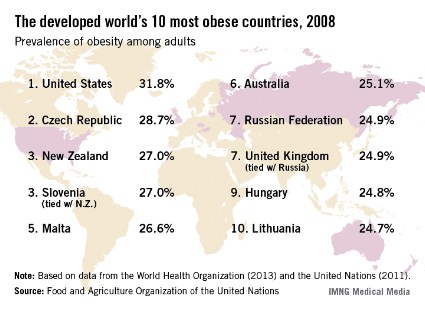
With an adult obesity rate of 31.8%, the United States is the most obese of the world’s developed countries, according to a report by the Food and Agriculture Organization of the United Nations.
As of 2008 – the year considered in the report – the Czech Republic was second in obesity among the developed world, with an adult obesity rate of 28.7%, the Food and Agriculture Organization said in "The State of Food and Agriculture 2013."
The most obese country in the developing world – in the entire world, in fact – was the Pacific island nation of Nauru, with an adult obesity rate of 71.1% and an overall population of around 10,000. The second-most obese country in the world was another tropical Pacific nation, the Cook Islands, with an adult obesity rate of 64.1%.
The report defined obesity as a body mass index of 30 kg/m2 or higher and considered adults to be anyone over age 20. The United Nations categorizes approximately 25% of countries as the developed world, which consists of all of Europe, northern America (Bermuda, Canada, Greenland, Saint Pierre and Miquelon, and the United States), Australia, Japan, and New Zealand.

With an adult obesity rate of 31.8%, the United States is the most obese of the world’s developed countries, according to a report by the Food and Agriculture Organization of the United Nations.
As of 2008 – the year considered in the report – the Czech Republic was second in obesity among the developed world, with an adult obesity rate of 28.7%, the Food and Agriculture Organization said in "The State of Food and Agriculture 2013."
The most obese country in the developing world – in the entire world, in fact – was the Pacific island nation of Nauru, with an adult obesity rate of 71.1% and an overall population of around 10,000. The second-most obese country in the world was another tropical Pacific nation, the Cook Islands, with an adult obesity rate of 64.1%.
The report defined obesity as a body mass index of 30 kg/m2 or higher and considered adults to be anyone over age 20. The United Nations categorizes approximately 25% of countries as the developed world, which consists of all of Europe, northern America (Bermuda, Canada, Greenland, Saint Pierre and Miquelon, and the United States), Australia, Japan, and New Zealand.
With an adult obesity rate of 31.8%, the United States is the most obese of the world’s developed countries, according to a report by the Food and Agriculture Organization of the United Nations.
As of 2008 – the year considered in the report – the Czech Republic was second in obesity among the developed world, with an adult obesity rate of 28.7%, the Food and Agriculture Organization said in "The State of Food and Agriculture 2013."
The most obese country in the developing world – in the entire world, in fact – was the Pacific island nation of Nauru, with an adult obesity rate of 71.1% and an overall population of around 10,000. The second-most obese country in the world was another tropical Pacific nation, the Cook Islands, with an adult obesity rate of 64.1%.
The report defined obesity as a body mass index of 30 kg/m2 or higher and considered adults to be anyone over age 20. The United Nations categorizes approximately 25% of countries as the developed world, which consists of all of Europe, northern America (Bermuda, Canada, Greenland, Saint Pierre and Miquelon, and the United States), Australia, Japan, and New Zealand.