User login
Investigational nivolumab beats chemo in pretreated advanced melanoma
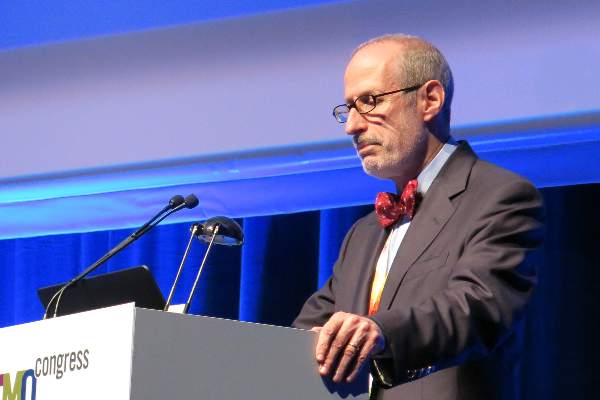
MADRID – The investigational anti-PD-1 drug nivolumab bested investigator’s choice of chemotherapy in pretreated advanced melanoma in the phase III CheckMate-037 trial.
The coprimary end point of objective response rate by central review was 32% with nivolumab vs. 11% with investigator’s choice chemotherapy among patients with unresectable metastatic melanoma that progressed despite prior ipilimumab or a BRAF inhibitor, if BRAF mutation-positive.
The median duration of response for chemotherapy was 3.6 months, but has not been reached with nivolumab. Five patients on chemotherapy continue to respond, whereas 95% of nivolumab responders (36/38) continue in remission with a minimum follow-up of 24 weeks, Dr. Jeffrey Weber reported during a presidential symposium at the European Society for Medical Oncology Congress.

Grade 3-4 treatment-related adverse events also were significantly lower with nivolumab than with chemotherapy (9% vs. 31%), as were toxicity-related treatment discontinuations (2% vs. 8%).
“Overall nivolumab was superior to chemotherapy in terms of toxicity and response rate in patients that fail prior ipilimumab and in my view should replace chemotherapy in practice for second-line or even third-line melanoma,” said Dr. Weber, director of the Donald A. Adam Comprehensive Melanoma Research Center of Excellence, Moffitt Cancer Center, Tampa, Fla.
Survival data are pending, but the impressive data on duration of response suggest there will be significant prolongation of progression-free and overall survival with the programmed death (PD)-1 blocking antibody when the analysis of those data is mature, Dr. Weber said in a statement.
Nivolumab is under priority review with the Food and Drug Administration and accelerated assessment with the European Medicines Agency based on these data. The drug is already approved for unresectable melanoma in Japan, where it is sold under the trade name Opdivo.
Dr. Weber told reporters in a press briefing that he rarely uses chemotherapy in his practice for patients with melanoma. This sentiment was echoed by invited discussant Ignacio Melero of the University of Navarra, Pamplona, Spain. “The trends that one can foresee are that we will be moving PD-1 blockade up front in treatment and will probably get rid of chemotherapy or save it as a last-ditch effort,” said Dr. Melero.

He added that the “best is yet to come,” and that this is particularly true about immunotherapy combinations. Dr. Melero highlighted recent phase I data for pembrolizumab (Keytruda), which just gained approval in September as the first PD-1 checkpoint inhibitor in the United States in advanced melanoma. The overall response rate with pembrolizumab was in the same range as nivolumab at 26% and overall survival was “impressive,” with the median not yet reached after 14 months in patients who also had ipilimumab-refractory advanced melanoma (Lancet 2014;384:1109-17).
CheckMate-037 randomized 405 patients in a 2:1 fashion to intravenous nivolumab 3 mg/kg or investigator’s choice of chemotherapy regimens: dacarbazine 1,000 mg/m2 or carboplatin AUC 6 plus paclitaxel 175 mg/m2 . Response data were based on 120 patients in the nivolumab and 47 in the chemotherapy arm, and safety data were based on the entire population. The best overall response in the nivolumab arm was complete response in 3%, partial response in 28%, and stable disease in 23%, compared with 0%, 11%, and 34%, respectively, in the chemotherapy arm.
Subgroup analysis revealed consistently higher clinical activity with nivolumab regardless of pretreatment PD-ligand 1 expression status, BRAF mutation status, or prior ipilimumab benefit, Dr. Weber said.
Ten patients (8%) given nivolumab had an immune-related response pattern involving 30% or more reduction in target lesion tumor burden.
Dr. Weber reported serving on the advisory board for Genentech, Merck, and the study sponsor, Bristol-Myers Squibb. His institution also receives research funding from BMS and Genentech.
MADRID – The investigational anti-PD-1 drug nivolumab bested investigator’s choice of chemotherapy in pretreated advanced melanoma in the phase III CheckMate-037 trial.
The coprimary end point of objective response rate by central review was 32% with nivolumab vs. 11% with investigator’s choice chemotherapy among patients with unresectable metastatic melanoma that progressed despite prior ipilimumab or a BRAF inhibitor, if BRAF mutation-positive.
The median duration of response for chemotherapy was 3.6 months, but has not been reached with nivolumab. Five patients on chemotherapy continue to respond, whereas 95% of nivolumab responders (36/38) continue in remission with a minimum follow-up of 24 weeks, Dr. Jeffrey Weber reported during a presidential symposium at the European Society for Medical Oncology Congress.
Grade 3-4 treatment-related adverse events also were significantly lower with nivolumab than with chemotherapy (9% vs. 31%), as were toxicity-related treatment discontinuations (2% vs. 8%).
“Overall nivolumab was superior to chemotherapy in terms of toxicity and response rate in patients that fail prior ipilimumab and in my view should replace chemotherapy in practice for second-line or even third-line melanoma,” said Dr. Weber, director of the Donald A. Adam Comprehensive Melanoma Research Center of Excellence, Moffitt Cancer Center, Tampa, Fla.
Survival data are pending, but the impressive data on duration of response suggest there will be significant prolongation of progression-free and overall survival with the programmed death (PD)-1 blocking antibody when the analysis of those data is mature, Dr. Weber said in a statement.
Nivolumab is under priority review with the Food and Drug Administration and accelerated assessment with the European Medicines Agency based on these data. The drug is already approved for unresectable melanoma in Japan, where it is sold under the trade name Opdivo.
Dr. Weber told reporters in a press briefing that he rarely uses chemotherapy in his practice for patients with melanoma. This sentiment was echoed by invited discussant Ignacio Melero of the University of Navarra, Pamplona, Spain. “The trends that one can foresee are that we will be moving PD-1 blockade up front in treatment and will probably get rid of chemotherapy or save it as a last-ditch effort,” said Dr. Melero.
He added that the “best is yet to come,” and that this is particularly true about immunotherapy combinations. Dr. Melero highlighted recent phase I data for pembrolizumab (Keytruda), which just gained approval in September as the first PD-1 checkpoint inhibitor in the United States in advanced melanoma. The overall response rate with pembrolizumab was in the same range as nivolumab at 26% and overall survival was “impressive,” with the median not yet reached after 14 months in patients who also had ipilimumab-refractory advanced melanoma (Lancet 2014;384:1109-17).
CheckMate-037 randomized 405 patients in a 2:1 fashion to intravenous nivolumab 3 mg/kg or investigator’s choice of chemotherapy regimens: dacarbazine 1,000 mg/m2 or carboplatin AUC 6 plus paclitaxel 175 mg/m2 . Response data were based on 120 patients in the nivolumab and 47 in the chemotherapy arm, and safety data were based on the entire population. The best overall response in the nivolumab arm was complete response in 3%, partial response in 28%, and stable disease in 23%, compared with 0%, 11%, and 34%, respectively, in the chemotherapy arm.
Subgroup analysis revealed consistently higher clinical activity with nivolumab regardless of pretreatment PD-ligand 1 expression status, BRAF mutation status, or prior ipilimumab benefit, Dr. Weber said.
Ten patients (8%) given nivolumab had an immune-related response pattern involving 30% or more reduction in target lesion tumor burden.
Dr. Weber reported serving on the advisory board for Genentech, Merck, and the study sponsor, Bristol-Myers Squibb. His institution also receives research funding from BMS and Genentech.
MADRID – The investigational anti-PD-1 drug nivolumab bested investigator’s choice of chemotherapy in pretreated advanced melanoma in the phase III CheckMate-037 trial.
The coprimary end point of objective response rate by central review was 32% with nivolumab vs. 11% with investigator’s choice chemotherapy among patients with unresectable metastatic melanoma that progressed despite prior ipilimumab or a BRAF inhibitor, if BRAF mutation-positive.
The median duration of response for chemotherapy was 3.6 months, but has not been reached with nivolumab. Five patients on chemotherapy continue to respond, whereas 95% of nivolumab responders (36/38) continue in remission with a minimum follow-up of 24 weeks, Dr. Jeffrey Weber reported during a presidential symposium at the European Society for Medical Oncology Congress.
Grade 3-4 treatment-related adverse events also were significantly lower with nivolumab than with chemotherapy (9% vs. 31%), as were toxicity-related treatment discontinuations (2% vs. 8%).
“Overall nivolumab was superior to chemotherapy in terms of toxicity and response rate in patients that fail prior ipilimumab and in my view should replace chemotherapy in practice for second-line or even third-line melanoma,” said Dr. Weber, director of the Donald A. Adam Comprehensive Melanoma Research Center of Excellence, Moffitt Cancer Center, Tampa, Fla.
Survival data are pending, but the impressive data on duration of response suggest there will be significant prolongation of progression-free and overall survival with the programmed death (PD)-1 blocking antibody when the analysis of those data is mature, Dr. Weber said in a statement.
Nivolumab is under priority review with the Food and Drug Administration and accelerated assessment with the European Medicines Agency based on these data. The drug is already approved for unresectable melanoma in Japan, where it is sold under the trade name Opdivo.
Dr. Weber told reporters in a press briefing that he rarely uses chemotherapy in his practice for patients with melanoma. This sentiment was echoed by invited discussant Ignacio Melero of the University of Navarra, Pamplona, Spain. “The trends that one can foresee are that we will be moving PD-1 blockade up front in treatment and will probably get rid of chemotherapy or save it as a last-ditch effort,” said Dr. Melero.
He added that the “best is yet to come,” and that this is particularly true about immunotherapy combinations. Dr. Melero highlighted recent phase I data for pembrolizumab (Keytruda), which just gained approval in September as the first PD-1 checkpoint inhibitor in the United States in advanced melanoma. The overall response rate with pembrolizumab was in the same range as nivolumab at 26% and overall survival was “impressive,” with the median not yet reached after 14 months in patients who also had ipilimumab-refractory advanced melanoma (Lancet 2014;384:1109-17).
CheckMate-037 randomized 405 patients in a 2:1 fashion to intravenous nivolumab 3 mg/kg or investigator’s choice of chemotherapy regimens: dacarbazine 1,000 mg/m2 or carboplatin AUC 6 plus paclitaxel 175 mg/m2 . Response data were based on 120 patients in the nivolumab and 47 in the chemotherapy arm, and safety data were based on the entire population. The best overall response in the nivolumab arm was complete response in 3%, partial response in 28%, and stable disease in 23%, compared with 0%, 11%, and 34%, respectively, in the chemotherapy arm.
Subgroup analysis revealed consistently higher clinical activity with nivolumab regardless of pretreatment PD-ligand 1 expression status, BRAF mutation status, or prior ipilimumab benefit, Dr. Weber said.
Ten patients (8%) given nivolumab had an immune-related response pattern involving 30% or more reduction in target lesion tumor burden.
Dr. Weber reported serving on the advisory board for Genentech, Merck, and the study sponsor, Bristol-Myers Squibb. His institution also receives research funding from BMS and Genentech.
AT ESMO 2014
Key clinical point: The trend in care for treating advanced melanoma will be moving PD-1 blockade up front in treatment with less reliance on chemotherapy.
Major finding: The median duration of response for chemotherapy was 3.6 months, but has not been reached with nivolumab. Five patients on chemotherapy continue to respond, whereas 95% of nivolumab responders (36/38) continue in remission with a minimum follow-up of 24 weeks.
Data source: Phase III study in 405 patients with previously treated advanced melanoma.
Disclosures: Dr. Weber reported serving on the advisory board for Genentech, Merck, and the study sponsor, Bristol-Myers Squibb. His institution also receives research funding from BMS and Genentech.
CLEOPATRA sets new standard treatment paradigm for metastatic breast cancer
MADRID – First-line dual targeted therapy with pertuzumab and trastuzumab plus chemotherapy gives women with HER2-positive metastatic breast cancer an additional 15.7 months of life, according to the final overall survival analysis of the long-running CLEOPATRA trial.
After a median of 50 months follow-up, median overall survival was 40.8 months with trastuzumab (Herceptin) and docetaxel chemotherapy and 56.5 months with the addition of pertuzumab (Perjeta) (Hazard ratio, 0.68; P = .0002).
The benefit was consistent across all subgroups and did not come at the expense of added toxicities or long-term cardiac safety.
The 56.5-month survival advantage is unprecedented in this indication and sets a new standard of care, lead author Dr. Sandra Swain said during a presidential symposium at the European Society for Medical Oncology Congress.

Discussant Dr. Luca Gianni, with the San Raffaele Scientific Institute, in Milan, Italy, agreed, saying “CLEOPATRA is an unprecedented therapeutic success, with the unquestionable clinical implication that docetaxel, trastuzumab, and pertuzumab is the new standard, and not an option, for first-line treatment of HER2-positive metastatic breast cancer.”
In the first interim survival analysis from CLEOPATRA, there was a trend toward improved overall survival favoring pertuzumab, trastuzumab, and docetaxel.
The overall survival benefit reached statistical significance after a median follow-up of 30 months in the second interim analysis (Lancet Oncol. 2013;14:461-71) and was accompanied by a 6.3-month benefit in median progression-free survival (PFS) (18.7 months vs. 12.4 months).
The PFS gain was maintained with the longer follow-up (HR, 0.68; P less than .0001), indicating that PFS is a good surrogate for overall survival, noted Dr. Swain, medical director of the Washington Cancer Institute, Medstar Washington Hospital Center.
The phase III, double-blind trial randomized 808 women with HER2-positive metastatic, locally recurrent, or unresectable breast cancer to trastuzumab and at least six cycles of docetaxel chemotherapy with placebo or pertuzumab. The final survival analysis was planned after 385 reported deaths.
More than 70% of patients had visceral disease, roughly half were hormone receptor (HR) status positive and half HR negative, 53% had no prior neoadjuvant/adjuvant chemotherapy, and only about 10% had received prior trastuzumab. Their median age was 54 years.
During a press briefing on CLEOPATRA, Dr. Swain said the median survival with trastuzumab is already quite good at 40.8 months, but that the 15.6-month gain in overall survival with the addition of pertuzumab has not been seen before in this setting and is the kind of improvement oncologists hope for throughout their careers.
Cardiac safety was a concern with the two monoclonal antibodies, but there was only one new symptomatic heart failure in the pertuzumab group after 40 months and it resolved after treatment was stopped, she said. Rates of left ventricular ejection fraction (LVEF) decline to less than 50% and by at least 10% from baseline were also lower in the pertuzumab group than in the trastuzumab/docetaxel group (6.1% vs. 7.4%). LVEF declines were reversed in 88% of pertuzumab patients.
When asked whether both monoclonal antibodies are needed in the regimen, Dr. Swain said she would give her patients both.
Dr. Gianni observed that pertuzumab acts synergistically with trastuzumab and that neoadjuvant pertuzumab and trastuzumab plus chemotherapy improved complete responses in early breast cancer in the phase II NeoSphere trial he led (Lancet Oncol. 2012;13:25-32).

The phase III APHINITYtrial is also well underway in the adjuvant setting of HER2-positive disease, comparing pertuzumab, trastuzumab, and chemotherapy against trastuzumab and chemotherapy alone. If the results from CLEOPATRA in the metastatic setting are confirmed in APHINITY, it could provide a new standard of care in the adjuvant setting, he said.
Dr. Gianni said the CLEOPATRA results can be improved only by addressing key features of HER2-positive breast cancer linked to different sensitivity such as hormone receptor status, P1K3CA status, and the immune environment. NeoSphere and other studies have shown, for example, that estrogen- and progesterone-receptor positive, HER2-positive disease is less responsive to the treatment used in CLEOPATRA. The CLEOPATRA protocol, however, did not allow for endocrine therapy of patients with estrogen-receptor positive tumors, though dual blockade of HER2 with pertuzumab, trastuzumab, and concomitant endocrine therapy has been shown to be feasible and is actually being done in the adjuvant setting in APHINITY.
Thus, “The question is whether the addition of endocrine therapy after the end of chemotherapy in CLEOPATRA could have increased the already large benefit observed in women with HER2-positive, estrogen receptor-positive metastatic breast cancer,” he said.
MADRID – First-line dual targeted therapy with pertuzumab and trastuzumab plus chemotherapy gives women with HER2-positive metastatic breast cancer an additional 15.7 months of life, according to the final overall survival analysis of the long-running CLEOPATRA trial.
After a median of 50 months follow-up, median overall survival was 40.8 months with trastuzumab (Herceptin) and docetaxel chemotherapy and 56.5 months with the addition of pertuzumab (Perjeta) (Hazard ratio, 0.68; P = .0002).
The benefit was consistent across all subgroups and did not come at the expense of added toxicities or long-term cardiac safety.
The 56.5-month survival advantage is unprecedented in this indication and sets a new standard of care, lead author Dr. Sandra Swain said during a presidential symposium at the European Society for Medical Oncology Congress.
Discussant Dr. Luca Gianni, with the San Raffaele Scientific Institute, in Milan, Italy, agreed, saying “CLEOPATRA is an unprecedented therapeutic success, with the unquestionable clinical implication that docetaxel, trastuzumab, and pertuzumab is the new standard, and not an option, for first-line treatment of HER2-positive metastatic breast cancer.”
In the first interim survival analysis from CLEOPATRA, there was a trend toward improved overall survival favoring pertuzumab, trastuzumab, and docetaxel.
The overall survival benefit reached statistical significance after a median follow-up of 30 months in the second interim analysis (Lancet Oncol. 2013;14:461-71) and was accompanied by a 6.3-month benefit in median progression-free survival (PFS) (18.7 months vs. 12.4 months).
The PFS gain was maintained with the longer follow-up (HR, 0.68; P less than .0001), indicating that PFS is a good surrogate for overall survival, noted Dr. Swain, medical director of the Washington Cancer Institute, Medstar Washington Hospital Center.
The phase III, double-blind trial randomized 808 women with HER2-positive metastatic, locally recurrent, or unresectable breast cancer to trastuzumab and at least six cycles of docetaxel chemotherapy with placebo or pertuzumab. The final survival analysis was planned after 385 reported deaths.
More than 70% of patients had visceral disease, roughly half were hormone receptor (HR) status positive and half HR negative, 53% had no prior neoadjuvant/adjuvant chemotherapy, and only about 10% had received prior trastuzumab. Their median age was 54 years.
During a press briefing on CLEOPATRA, Dr. Swain said the median survival with trastuzumab is already quite good at 40.8 months, but that the 15.6-month gain in overall survival with the addition of pertuzumab has not been seen before in this setting and is the kind of improvement oncologists hope for throughout their careers.
Cardiac safety was a concern with the two monoclonal antibodies, but there was only one new symptomatic heart failure in the pertuzumab group after 40 months and it resolved after treatment was stopped, she said. Rates of left ventricular ejection fraction (LVEF) decline to less than 50% and by at least 10% from baseline were also lower in the pertuzumab group than in the trastuzumab/docetaxel group (6.1% vs. 7.4%). LVEF declines were reversed in 88% of pertuzumab patients.
When asked whether both monoclonal antibodies are needed in the regimen, Dr. Swain said she would give her patients both.
Dr. Gianni observed that pertuzumab acts synergistically with trastuzumab and that neoadjuvant pertuzumab and trastuzumab plus chemotherapy improved complete responses in early breast cancer in the phase II NeoSphere trial he led (Lancet Oncol. 2012;13:25-32).
The phase III APHINITYtrial is also well underway in the adjuvant setting of HER2-positive disease, comparing pertuzumab, trastuzumab, and chemotherapy against trastuzumab and chemotherapy alone. If the results from CLEOPATRA in the metastatic setting are confirmed in APHINITY, it could provide a new standard of care in the adjuvant setting, he said.
Dr. Gianni said the CLEOPATRA results can be improved only by addressing key features of HER2-positive breast cancer linked to different sensitivity such as hormone receptor status, P1K3CA status, and the immune environment. NeoSphere and other studies have shown, for example, that estrogen- and progesterone-receptor positive, HER2-positive disease is less responsive to the treatment used in CLEOPATRA. The CLEOPATRA protocol, however, did not allow for endocrine therapy of patients with estrogen-receptor positive tumors, though dual blockade of HER2 with pertuzumab, trastuzumab, and concomitant endocrine therapy has been shown to be feasible and is actually being done in the adjuvant setting in APHINITY.
Thus, “The question is whether the addition of endocrine therapy after the end of chemotherapy in CLEOPATRA could have increased the already large benefit observed in women with HER2-positive, estrogen receptor-positive metastatic breast cancer,” he said.
MADRID – First-line dual targeted therapy with pertuzumab and trastuzumab plus chemotherapy gives women with HER2-positive metastatic breast cancer an additional 15.7 months of life, according to the final overall survival analysis of the long-running CLEOPATRA trial.
After a median of 50 months follow-up, median overall survival was 40.8 months with trastuzumab (Herceptin) and docetaxel chemotherapy and 56.5 months with the addition of pertuzumab (Perjeta) (Hazard ratio, 0.68; P = .0002).
The benefit was consistent across all subgroups and did not come at the expense of added toxicities or long-term cardiac safety.
The 56.5-month survival advantage is unprecedented in this indication and sets a new standard of care, lead author Dr. Sandra Swain said during a presidential symposium at the European Society for Medical Oncology Congress.
Discussant Dr. Luca Gianni, with the San Raffaele Scientific Institute, in Milan, Italy, agreed, saying “CLEOPATRA is an unprecedented therapeutic success, with the unquestionable clinical implication that docetaxel, trastuzumab, and pertuzumab is the new standard, and not an option, for first-line treatment of HER2-positive metastatic breast cancer.”
In the first interim survival analysis from CLEOPATRA, there was a trend toward improved overall survival favoring pertuzumab, trastuzumab, and docetaxel.
The overall survival benefit reached statistical significance after a median follow-up of 30 months in the second interim analysis (Lancet Oncol. 2013;14:461-71) and was accompanied by a 6.3-month benefit in median progression-free survival (PFS) (18.7 months vs. 12.4 months).
The PFS gain was maintained with the longer follow-up (HR, 0.68; P less than .0001), indicating that PFS is a good surrogate for overall survival, noted Dr. Swain, medical director of the Washington Cancer Institute, Medstar Washington Hospital Center.
The phase III, double-blind trial randomized 808 women with HER2-positive metastatic, locally recurrent, or unresectable breast cancer to trastuzumab and at least six cycles of docetaxel chemotherapy with placebo or pertuzumab. The final survival analysis was planned after 385 reported deaths.
More than 70% of patients had visceral disease, roughly half were hormone receptor (HR) status positive and half HR negative, 53% had no prior neoadjuvant/adjuvant chemotherapy, and only about 10% had received prior trastuzumab. Their median age was 54 years.
During a press briefing on CLEOPATRA, Dr. Swain said the median survival with trastuzumab is already quite good at 40.8 months, but that the 15.6-month gain in overall survival with the addition of pertuzumab has not been seen before in this setting and is the kind of improvement oncologists hope for throughout their careers.
Cardiac safety was a concern with the two monoclonal antibodies, but there was only one new symptomatic heart failure in the pertuzumab group after 40 months and it resolved after treatment was stopped, she said. Rates of left ventricular ejection fraction (LVEF) decline to less than 50% and by at least 10% from baseline were also lower in the pertuzumab group than in the trastuzumab/docetaxel group (6.1% vs. 7.4%). LVEF declines were reversed in 88% of pertuzumab patients.
When asked whether both monoclonal antibodies are needed in the regimen, Dr. Swain said she would give her patients both.
Dr. Gianni observed that pertuzumab acts synergistically with trastuzumab and that neoadjuvant pertuzumab and trastuzumab plus chemotherapy improved complete responses in early breast cancer in the phase II NeoSphere trial he led (Lancet Oncol. 2012;13:25-32).
The phase III APHINITYtrial is also well underway in the adjuvant setting of HER2-positive disease, comparing pertuzumab, trastuzumab, and chemotherapy against trastuzumab and chemotherapy alone. If the results from CLEOPATRA in the metastatic setting are confirmed in APHINITY, it could provide a new standard of care in the adjuvant setting, he said.
Dr. Gianni said the CLEOPATRA results can be improved only by addressing key features of HER2-positive breast cancer linked to different sensitivity such as hormone receptor status, P1K3CA status, and the immune environment. NeoSphere and other studies have shown, for example, that estrogen- and progesterone-receptor positive, HER2-positive disease is less responsive to the treatment used in CLEOPATRA. The CLEOPATRA protocol, however, did not allow for endocrine therapy of patients with estrogen-receptor positive tumors, though dual blockade of HER2 with pertuzumab, trastuzumab, and concomitant endocrine therapy has been shown to be feasible and is actually being done in the adjuvant setting in APHINITY.
Thus, “The question is whether the addition of endocrine therapy after the end of chemotherapy in CLEOPATRA could have increased the already large benefit observed in women with HER2-positive, estrogen receptor-positive metastatic breast cancer,” he said.
AT ESMO 2014
Key clinical point: Pertuzumab, trastuzumab, and docetaxel chemotherapy is the new standard for first-line metastatic HER2-positive breast cancer.
Major finding: Median overall survival was 40.8 months with trastuzumab and chemotherapy and 56.5 months with the addition of pertuzumab.
Data source: Phase III trial in 808 women with metastatic HER2-positive breast cancer.
Disclosures: The study was funded by Hoffman-LaRoche and Genentech. Dr. Swain reported serving as an uncompensated consultant for Genentech/Roche.

Rolapitant curbs chemo-induced nausea and vomiting
MADRID – The investigational neurokinin-1 receptor antagonist rolapitant met all of its endpoints in the prevention of chemotherapy-induced nausea and vomiting in a phase III trial.
Among 532 patients receiving cisplatin chemotherapy, 72.7% randomized to oral rolapitant versus 58.4% on placebo achieved the primary endpoint of complete response, defined as no emesis or use of rescue medication, in the delayed phase of more than 24 hours to 120 hours following chemotherapy (P less than .001).
Complete responses also were higher with rolapitant in the acute phase (0-24 hours) post chemotherapy (83.7% vs. 73.7%; P = .005) and the overall phase (0-120 hours) post chemotherapy (70.1% vs. 56.5%; P = .001), according to a late-breaking abstract reported at the European Society for Medical Oncology Congress.
Rolapitant works by blocking activation of neurokinin (NK)-1 receptors concentrated in the brain, which play a central role in nausea and vomiting.
Rolapitant is unique in that it has an extremely long half-life of 180 hours and NK-1 receptor occupancy of more than 90% for up to 5 days, study coauthor Dr. Bernardo Rapoport of the Medical Oncology Centre of Rosebank, Johannesburg, South Africa, explained during a press briefing on the study.
Kaplan-Meier analysis suggests that the effect of rolapitant begins in the acute phase, with separation of the curves beginning at about 12 hours.
More than 85% of cancer patients not treated appropriately can be affected by chemotherapy-induced nausea and vomiting, Dr. Rapoport said, adding that active management of this “most feared” side effect can improve quality of life and compliance with cancer treatment.
There was a slight improvement in quality of life in the rolapitant arm versus controls, as measured by the Functional Living Index-Emesis questionnaire (mean total score 112.5 vs. 108.4; P = .032).
Patients in the study were evenly randomized on the day of chemotherapy to oral rolapitant 200 mg or placebo, plus intravenous granisetron and oral dexamethasone.
Treatment-related adverse events were consistent across both arms, with most considered related to chemotherapy or the underlying cancer, Dr. Rapoport said.
Rolapitant is being developed by Tesaro in oral and intravenous formulations. A new drug application was filed in September 2014 with the U.S. Food and Drug Administration for oral rolapitant based on results from four controlled trials.
Rolapitant will face stiff competition in the market from Merck’s long-standing NK1 receptor antagonist, aprepitant (Emend), which is approved for prevention of chemotherapy-induced nausea and vomiting in combination with a corticosteroid and a 5-HT₃ antagonist. Rolapitant failed to meet a key secondary endpoint in a phase III trial last year, sending Tesaro stocks tumbling.
MADRID – The investigational neurokinin-1 receptor antagonist rolapitant met all of its endpoints in the prevention of chemotherapy-induced nausea and vomiting in a phase III trial.
Among 532 patients receiving cisplatin chemotherapy, 72.7% randomized to oral rolapitant versus 58.4% on placebo achieved the primary endpoint of complete response, defined as no emesis or use of rescue medication, in the delayed phase of more than 24 hours to 120 hours following chemotherapy (P less than .001).
Complete responses also were higher with rolapitant in the acute phase (0-24 hours) post chemotherapy (83.7% vs. 73.7%; P = .005) and the overall phase (0-120 hours) post chemotherapy (70.1% vs. 56.5%; P = .001), according to a late-breaking abstract reported at the European Society for Medical Oncology Congress.
Rolapitant works by blocking activation of neurokinin (NK)-1 receptors concentrated in the brain, which play a central role in nausea and vomiting.
Rolapitant is unique in that it has an extremely long half-life of 180 hours and NK-1 receptor occupancy of more than 90% for up to 5 days, study coauthor Dr. Bernardo Rapoport of the Medical Oncology Centre of Rosebank, Johannesburg, South Africa, explained during a press briefing on the study.
Kaplan-Meier analysis suggests that the effect of rolapitant begins in the acute phase, with separation of the curves beginning at about 12 hours.
More than 85% of cancer patients not treated appropriately can be affected by chemotherapy-induced nausea and vomiting, Dr. Rapoport said, adding that active management of this “most feared” side effect can improve quality of life and compliance with cancer treatment.
There was a slight improvement in quality of life in the rolapitant arm versus controls, as measured by the Functional Living Index-Emesis questionnaire (mean total score 112.5 vs. 108.4; P = .032).
Patients in the study were evenly randomized on the day of chemotherapy to oral rolapitant 200 mg or placebo, plus intravenous granisetron and oral dexamethasone.
Treatment-related adverse events were consistent across both arms, with most considered related to chemotherapy or the underlying cancer, Dr. Rapoport said.
Rolapitant is being developed by Tesaro in oral and intravenous formulations. A new drug application was filed in September 2014 with the U.S. Food and Drug Administration for oral rolapitant based on results from four controlled trials.
Rolapitant will face stiff competition in the market from Merck’s long-standing NK1 receptor antagonist, aprepitant (Emend), which is approved for prevention of chemotherapy-induced nausea and vomiting in combination with a corticosteroid and a 5-HT₃ antagonist. Rolapitant failed to meet a key secondary endpoint in a phase III trial last year, sending Tesaro stocks tumbling.
MADRID – The investigational neurokinin-1 receptor antagonist rolapitant met all of its endpoints in the prevention of chemotherapy-induced nausea and vomiting in a phase III trial.
Among 532 patients receiving cisplatin chemotherapy, 72.7% randomized to oral rolapitant versus 58.4% on placebo achieved the primary endpoint of complete response, defined as no emesis or use of rescue medication, in the delayed phase of more than 24 hours to 120 hours following chemotherapy (P less than .001).
Complete responses also were higher with rolapitant in the acute phase (0-24 hours) post chemotherapy (83.7% vs. 73.7%; P = .005) and the overall phase (0-120 hours) post chemotherapy (70.1% vs. 56.5%; P = .001), according to a late-breaking abstract reported at the European Society for Medical Oncology Congress.
Rolapitant works by blocking activation of neurokinin (NK)-1 receptors concentrated in the brain, which play a central role in nausea and vomiting.
Rolapitant is unique in that it has an extremely long half-life of 180 hours and NK-1 receptor occupancy of more than 90% for up to 5 days, study coauthor Dr. Bernardo Rapoport of the Medical Oncology Centre of Rosebank, Johannesburg, South Africa, explained during a press briefing on the study.
Kaplan-Meier analysis suggests that the effect of rolapitant begins in the acute phase, with separation of the curves beginning at about 12 hours.
More than 85% of cancer patients not treated appropriately can be affected by chemotherapy-induced nausea and vomiting, Dr. Rapoport said, adding that active management of this “most feared” side effect can improve quality of life and compliance with cancer treatment.
There was a slight improvement in quality of life in the rolapitant arm versus controls, as measured by the Functional Living Index-Emesis questionnaire (mean total score 112.5 vs. 108.4; P = .032).
Patients in the study were evenly randomized on the day of chemotherapy to oral rolapitant 200 mg or placebo, plus intravenous granisetron and oral dexamethasone.
Treatment-related adverse events were consistent across both arms, with most considered related to chemotherapy or the underlying cancer, Dr. Rapoport said.
Rolapitant is being developed by Tesaro in oral and intravenous formulations. A new drug application was filed in September 2014 with the U.S. Food and Drug Administration for oral rolapitant based on results from four controlled trials.
Rolapitant will face stiff competition in the market from Merck’s long-standing NK1 receptor antagonist, aprepitant (Emend), which is approved for prevention of chemotherapy-induced nausea and vomiting in combination with a corticosteroid and a 5-HT₃ antagonist. Rolapitant failed to meet a key secondary endpoint in a phase III trial last year, sending Tesaro stocks tumbling.
AT ESMO 2014
Key clinical point: Rolapitant was significantly better than placebo in reducing chemotherapy-induced nausea and vomiting.
Major finding: Complete responses were significantly higher with rolapitant than placebo in the delayed phase post chemotherapy (72.7% vs. 58.4%; P < .001).
Data source: Phase III trial in 532 patients receiving cisplatin chemotherapy.
Disclosures: Dr. Rapoport and lead author Dr. Martin Chasen reported no financial disclosures; several coauthors are employees of the study sponsor, Tesaro.

VIDEO: MEK/BRAF combo puts brakes on BRAF-mutated advanced melanoma progression
MADRID – Combining the investigational MEK inhibitor cobimetinib with the BRAF inhibitor vemurafenib nearly halved the risk of progression in previously untreated patients with BRAF-mutated advanced melanoma in the ongoing, phase III coBRIM study.
Median progression-free survival by investigator was 6.2 months with vemurafenib (Zelboraf) and 9.9 months with the combination (Hazard ratio 0.51; P less than .0001); by independent review, median progression-free survival was 6.0 months versus 11.3 months, respectively (HR, 0.60; P = .0003), study author Dr. Grant McArthur reported in a late-breaking abstract at the European Society for Medical Oncology Congress.
Combination therapy also resulted in a significantly higher objective response rate (68% vs. 45%; P less than .0001) and more complete responses (10% vs. 4%) among the 495 patients with unresectable, locally advanced or metastatic BRAF V600 mutation–positive disease.
Overall survival data are not yet mature, but the interim analysis showed a promising 35% reduction in the risk of death at 9 months (HR, 0.65), said Dr. McArthur of the Peter MacCallum Cancer Centre, Melbourne, Australia. The corresponding P value of .046 is descriptive, as it did not cross the prespecified stopping boundary for the interim analysis.
Grade 3 toxicity, albeit fairly common, was slightly higher with combination therapy vs. vemurafenib alone (65% vs. 59%). Adverse event–related treatment discontinuations were similar between arms (13% vs. 12%), he said.
The data, which were simultaneously published in the New England Journal of Medicine (2014 Sept. 29 [doi:10.1056/NEJMoa1408868]) are expected to be submitted to the U.S. Food and Drug Administration later this year for potential approval of cobimetinib. Vemurafenib was approved in the United States for late-stage or unresectable melanoma in August 2011.
In our video interview, Dr. McArthur discusses coBRIM and his suggestions for how clinicians may incorporate this novel strategy into practice.
coBRIM was funded by F. Hoffmann-LaRoche/Genentech. Dr. McArthur reported grants from Roche, Novartis, Pfizer, Millennium, and Celegene, and consulting for Provectus.
The video associated with this article is no longer available on this site. Please view all of our videos on the MDedge YouTube channel
MADRID – Combining the investigational MEK inhibitor cobimetinib with the BRAF inhibitor vemurafenib nearly halved the risk of progression in previously untreated patients with BRAF-mutated advanced melanoma in the ongoing, phase III coBRIM study.
Median progression-free survival by investigator was 6.2 months with vemurafenib (Zelboraf) and 9.9 months with the combination (Hazard ratio 0.51; P less than .0001); by independent review, median progression-free survival was 6.0 months versus 11.3 months, respectively (HR, 0.60; P = .0003), study author Dr. Grant McArthur reported in a late-breaking abstract at the European Society for Medical Oncology Congress.
Combination therapy also resulted in a significantly higher objective response rate (68% vs. 45%; P less than .0001) and more complete responses (10% vs. 4%) among the 495 patients with unresectable, locally advanced or metastatic BRAF V600 mutation–positive disease.
Overall survival data are not yet mature, but the interim analysis showed a promising 35% reduction in the risk of death at 9 months (HR, 0.65), said Dr. McArthur of the Peter MacCallum Cancer Centre, Melbourne, Australia. The corresponding P value of .046 is descriptive, as it did not cross the prespecified stopping boundary for the interim analysis.
Grade 3 toxicity, albeit fairly common, was slightly higher with combination therapy vs. vemurafenib alone (65% vs. 59%). Adverse event–related treatment discontinuations were similar between arms (13% vs. 12%), he said.
The data, which were simultaneously published in the New England Journal of Medicine (2014 Sept. 29 [doi:10.1056/NEJMoa1408868]) are expected to be submitted to the U.S. Food and Drug Administration later this year for potential approval of cobimetinib. Vemurafenib was approved in the United States for late-stage or unresectable melanoma in August 2011.
In our video interview, Dr. McArthur discusses coBRIM and his suggestions for how clinicians may incorporate this novel strategy into practice.
coBRIM was funded by F. Hoffmann-LaRoche/Genentech. Dr. McArthur reported grants from Roche, Novartis, Pfizer, Millennium, and Celegene, and consulting for Provectus.
The video associated with this article is no longer available on this site. Please view all of our videos on the MDedge YouTube channel
MADRID – Combining the investigational MEK inhibitor cobimetinib with the BRAF inhibitor vemurafenib nearly halved the risk of progression in previously untreated patients with BRAF-mutated advanced melanoma in the ongoing, phase III coBRIM study.
Median progression-free survival by investigator was 6.2 months with vemurafenib (Zelboraf) and 9.9 months with the combination (Hazard ratio 0.51; P less than .0001); by independent review, median progression-free survival was 6.0 months versus 11.3 months, respectively (HR, 0.60; P = .0003), study author Dr. Grant McArthur reported in a late-breaking abstract at the European Society for Medical Oncology Congress.
Combination therapy also resulted in a significantly higher objective response rate (68% vs. 45%; P less than .0001) and more complete responses (10% vs. 4%) among the 495 patients with unresectable, locally advanced or metastatic BRAF V600 mutation–positive disease.
Overall survival data are not yet mature, but the interim analysis showed a promising 35% reduction in the risk of death at 9 months (HR, 0.65), said Dr. McArthur of the Peter MacCallum Cancer Centre, Melbourne, Australia. The corresponding P value of .046 is descriptive, as it did not cross the prespecified stopping boundary for the interim analysis.
Grade 3 toxicity, albeit fairly common, was slightly higher with combination therapy vs. vemurafenib alone (65% vs. 59%). Adverse event–related treatment discontinuations were similar between arms (13% vs. 12%), he said.
The data, which were simultaneously published in the New England Journal of Medicine (2014 Sept. 29 [doi:10.1056/NEJMoa1408868]) are expected to be submitted to the U.S. Food and Drug Administration later this year for potential approval of cobimetinib. Vemurafenib was approved in the United States for late-stage or unresectable melanoma in August 2011.
In our video interview, Dr. McArthur discusses coBRIM and his suggestions for how clinicians may incorporate this novel strategy into practice.
coBRIM was funded by F. Hoffmann-LaRoche/Genentech. Dr. McArthur reported grants from Roche, Novartis, Pfizer, Millennium, and Celegene, and consulting for Provectus.
The video associated with this article is no longer available on this site. Please view all of our videos on the MDedge YouTube channel
AT ESMO 2014

3-D images aid total body mole mapping
EDINBURGH – The advent of three-dimensional total body photography overcomes many, but not all, of the drawbacks of two-dimensional imaging as an aid to melanoma detection.
“There are challenges to using two-dimensional images, both in terms of acquiring them and reviewing them, but the simplest of which is a 5-mm lesion that’s perfectly perpendicular to the camera will not look like 5 mm if it’s at an angle to the camera, an inherent problem of consistency in looking at size over time on curved surfaces,” Dr. Allan Halpern said at the 15th World Congress on Cancers of the Skin.

Over the last several months, the dermatology service Dr. Halpern heads at Memorial Sloan-Kettering Cancer Center in New York has shifted to 3-D total body photography in patients at high risk of melanoma.
“The new system (Vectra WB360, Canfield Imaging Systems) uses 40 some odd cameras behind a series of panels, and in 3 milliseconds allows the clinician to image the entire patient in 3-D,” he said.
A touch-screen interface allows for additional close-up pictures of areas of particular interest and tags their location to the corresponding body map photographs. The onscreen 3-D images also can be used for consultation and patient education.
In a recent open-ended survey of 199 of his patients who had already undergone 2-D imaging, participants said 3-D mole mapping was faster, easier, less invasive, and required fewer poses, Dr. Halpern said.
Among their concerns, the admittedly motivated patient cohort wanted even better resolution and more images to catch moles in body folds or on the soles of their feet.
Dr. Halpern was quick to acknowledge that, like population-based melanoma screening, total body photography (TBP) has not been shown in a definitive trial to reduce mortality. In fact, clinical practice guidelines issued this year in Germany and Australia strongly recommend training and use of dermoscopy for examination of pigmented lesions, but note that the value of TBP in melanoma-risk patients remains ‘unproven.’
Research also has shown that uptake of TBP in clinical practice has remained relatively flat in the United States since 2000 (J. Am. Acad. Dermatol. 2010:62:794-803). Obstacles include expense, privacy, and security of stored images, and a lack of imaging standards.
The International Society for Digital Imaging of the Skin, however, is working with dermatology specialists, informatics experts, and imaging technology developers through its Melanoma Project to develop international imaging standards and a public-access archive of clinical and dermoscopic images of skin lesions, Dr. Halpern said.
“One of the encouraging things to me is that the CEOs of six of those imaging developers have already signed on. They recognize the importance of having international standards and interchangeability of images,” he said at the meeting sponsored by the Skin Cancer Foundation.
Dr. Halpern has consulted for and shared research grants with Canfield Scientific and consulted for Caliber I.D., Scibase, and DermTech.
EDINBURGH – The advent of three-dimensional total body photography overcomes many, but not all, of the drawbacks of two-dimensional imaging as an aid to melanoma detection.
“There are challenges to using two-dimensional images, both in terms of acquiring them and reviewing them, but the simplest of which is a 5-mm lesion that’s perfectly perpendicular to the camera will not look like 5 mm if it’s at an angle to the camera, an inherent problem of consistency in looking at size over time on curved surfaces,” Dr. Allan Halpern said at the 15th World Congress on Cancers of the Skin.
Over the last several months, the dermatology service Dr. Halpern heads at Memorial Sloan-Kettering Cancer Center in New York has shifted to 3-D total body photography in patients at high risk of melanoma.
“The new system (Vectra WB360, Canfield Imaging Systems) uses 40 some odd cameras behind a series of panels, and in 3 milliseconds allows the clinician to image the entire patient in 3-D,” he said.
A touch-screen interface allows for additional close-up pictures of areas of particular interest and tags their location to the corresponding body map photographs. The onscreen 3-D images also can be used for consultation and patient education.
In a recent open-ended survey of 199 of his patients who had already undergone 2-D imaging, participants said 3-D mole mapping was faster, easier, less invasive, and required fewer poses, Dr. Halpern said.
Among their concerns, the admittedly motivated patient cohort wanted even better resolution and more images to catch moles in body folds or on the soles of their feet.
Dr. Halpern was quick to acknowledge that, like population-based melanoma screening, total body photography (TBP) has not been shown in a definitive trial to reduce mortality. In fact, clinical practice guidelines issued this year in Germany and Australia strongly recommend training and use of dermoscopy for examination of pigmented lesions, but note that the value of TBP in melanoma-risk patients remains ‘unproven.’
Research also has shown that uptake of TBP in clinical practice has remained relatively flat in the United States since 2000 (J. Am. Acad. Dermatol. 2010:62:794-803). Obstacles include expense, privacy, and security of stored images, and a lack of imaging standards.
The International Society for Digital Imaging of the Skin, however, is working with dermatology specialists, informatics experts, and imaging technology developers through its Melanoma Project to develop international imaging standards and a public-access archive of clinical and dermoscopic images of skin lesions, Dr. Halpern said.
“One of the encouraging things to me is that the CEOs of six of those imaging developers have already signed on. They recognize the importance of having international standards and interchangeability of images,” he said at the meeting sponsored by the Skin Cancer Foundation.
Dr. Halpern has consulted for and shared research grants with Canfield Scientific and consulted for Caliber I.D., Scibase, and DermTech.
EDINBURGH – The advent of three-dimensional total body photography overcomes many, but not all, of the drawbacks of two-dimensional imaging as an aid to melanoma detection.
“There are challenges to using two-dimensional images, both in terms of acquiring them and reviewing them, but the simplest of which is a 5-mm lesion that’s perfectly perpendicular to the camera will not look like 5 mm if it’s at an angle to the camera, an inherent problem of consistency in looking at size over time on curved surfaces,” Dr. Allan Halpern said at the 15th World Congress on Cancers of the Skin.
Over the last several months, the dermatology service Dr. Halpern heads at Memorial Sloan-Kettering Cancer Center in New York has shifted to 3-D total body photography in patients at high risk of melanoma.
“The new system (Vectra WB360, Canfield Imaging Systems) uses 40 some odd cameras behind a series of panels, and in 3 milliseconds allows the clinician to image the entire patient in 3-D,” he said.
A touch-screen interface allows for additional close-up pictures of areas of particular interest and tags their location to the corresponding body map photographs. The onscreen 3-D images also can be used for consultation and patient education.
In a recent open-ended survey of 199 of his patients who had already undergone 2-D imaging, participants said 3-D mole mapping was faster, easier, less invasive, and required fewer poses, Dr. Halpern said.
Among their concerns, the admittedly motivated patient cohort wanted even better resolution and more images to catch moles in body folds or on the soles of their feet.
Dr. Halpern was quick to acknowledge that, like population-based melanoma screening, total body photography (TBP) has not been shown in a definitive trial to reduce mortality. In fact, clinical practice guidelines issued this year in Germany and Australia strongly recommend training and use of dermoscopy for examination of pigmented lesions, but note that the value of TBP in melanoma-risk patients remains ‘unproven.’
Research also has shown that uptake of TBP in clinical practice has remained relatively flat in the United States since 2000 (J. Am. Acad. Dermatol. 2010:62:794-803). Obstacles include expense, privacy, and security of stored images, and a lack of imaging standards.
The International Society for Digital Imaging of the Skin, however, is working with dermatology specialists, informatics experts, and imaging technology developers through its Melanoma Project to develop international imaging standards and a public-access archive of clinical and dermoscopic images of skin lesions, Dr. Halpern said.
“One of the encouraging things to me is that the CEOs of six of those imaging developers have already signed on. They recognize the importance of having international standards and interchangeability of images,” he said at the meeting sponsored by the Skin Cancer Foundation.
Dr. Halpern has consulted for and shared research grants with Canfield Scientific and consulted for Caliber I.D., Scibase, and DermTech.
AT WCCS 2014

More people die from thin melanomas than thick melanomas
EDINBURGH – Contrary to the perception that most melanoma deaths result from thick melanomas, long-term data from Australia show that more people die who initially present with thin melanomas.
Among 4,218 Australians who died from melanoma between 1990 and 2009, thin melanomas (1 mm or less) accounted for 19% of melanoma deaths overall, but increased steadily from 14% of deaths in 1990-1994 to 23% in 2005-2009.
During the most recent time period (2005-2009), more people died from thin melanomas (296 deaths, 23%) than from thick melanomas more than 4 mm in thickness (186 deaths, 14%) or from metastatic presentations (207 deaths, 16%).
The number of deaths in the intermediate thickness categories was also higher for lesions of thickness 1.01-2.0 mm (272 deaths, 21%) than for lesions of thickness 2.01-4.0 mm (267 deaths, 20%).
The patterns of mortality were essentially unchanged when the analyses were restricted to patients with only one primary melanoma, Dr. David Whiteman and Dr. Catherine Olsen of the QIMR Berghofer Medical Research Institute, Brisbane, Australia, reported at the 15th World Congress on Cancers of the Skin.
The melanoma incidence has been rising steadily around the world, mostly because of the greater numbers of thin lesions being diagnosed. The perception that most people who die from melanoma present initially with thick lesions is widespread, but the veracity of this proposition has never been tested because population-based data describing total mortality by the thickness of the primary tumor are scarce, according to the researchers. They used linked histology and death data from the Queensland Cancer Registry, where notification of melanoma has been compulsory since 1982, to calculate age-standardized mortality rates for each year for all melanomas, and by thickness of the first primary lesion. Overall, 67% of patients were male, 68% presented with a single primary lesion, and 68% of all melanomas were thin (1 mm or less).
Deaths from melanoma were most common among those who were in the seventh and eighth decades of life, male, or had a melanoma arising on the trunk. As expected, the intervals from diagnosis to death were significantly shorter for thicker tumors than thinner tumors, Dr. Whiteman and Dr. Olsen noted in the poster presentation.
The average annual rate of change in melanoma mortality increased significantly for men for thin lesions and those of intermediate thickness. Mortality rates from metastatic lesions, however, declined during the observation period.
“From a public health perspective, it can be argued that primary prevention activities aimed at reducing the occurrence of melanoma in the entire population should be accorded the highest priority,” the authors concluded at the meeting, sponsored by the Skin Cancer Foundation.
EDINBURGH – Contrary to the perception that most melanoma deaths result from thick melanomas, long-term data from Australia show that more people die who initially present with thin melanomas.
Among 4,218 Australians who died from melanoma between 1990 and 2009, thin melanomas (1 mm or less) accounted for 19% of melanoma deaths overall, but increased steadily from 14% of deaths in 1990-1994 to 23% in 2005-2009.
During the most recent time period (2005-2009), more people died from thin melanomas (296 deaths, 23%) than from thick melanomas more than 4 mm in thickness (186 deaths, 14%) or from metastatic presentations (207 deaths, 16%).
The number of deaths in the intermediate thickness categories was also higher for lesions of thickness 1.01-2.0 mm (272 deaths, 21%) than for lesions of thickness 2.01-4.0 mm (267 deaths, 20%).
The patterns of mortality were essentially unchanged when the analyses were restricted to patients with only one primary melanoma, Dr. David Whiteman and Dr. Catherine Olsen of the QIMR Berghofer Medical Research Institute, Brisbane, Australia, reported at the 15th World Congress on Cancers of the Skin.
The melanoma incidence has been rising steadily around the world, mostly because of the greater numbers of thin lesions being diagnosed. The perception that most people who die from melanoma present initially with thick lesions is widespread, but the veracity of this proposition has never been tested because population-based data describing total mortality by the thickness of the primary tumor are scarce, according to the researchers. They used linked histology and death data from the Queensland Cancer Registry, where notification of melanoma has been compulsory since 1982, to calculate age-standardized mortality rates for each year for all melanomas, and by thickness of the first primary lesion. Overall, 67% of patients were male, 68% presented with a single primary lesion, and 68% of all melanomas were thin (1 mm or less).
Deaths from melanoma were most common among those who were in the seventh and eighth decades of life, male, or had a melanoma arising on the trunk. As expected, the intervals from diagnosis to death were significantly shorter for thicker tumors than thinner tumors, Dr. Whiteman and Dr. Olsen noted in the poster presentation.
The average annual rate of change in melanoma mortality increased significantly for men for thin lesions and those of intermediate thickness. Mortality rates from metastatic lesions, however, declined during the observation period.
“From a public health perspective, it can be argued that primary prevention activities aimed at reducing the occurrence of melanoma in the entire population should be accorded the highest priority,” the authors concluded at the meeting, sponsored by the Skin Cancer Foundation.
EDINBURGH – Contrary to the perception that most melanoma deaths result from thick melanomas, long-term data from Australia show that more people die who initially present with thin melanomas.
Among 4,218 Australians who died from melanoma between 1990 and 2009, thin melanomas (1 mm or less) accounted for 19% of melanoma deaths overall, but increased steadily from 14% of deaths in 1990-1994 to 23% in 2005-2009.
During the most recent time period (2005-2009), more people died from thin melanomas (296 deaths, 23%) than from thick melanomas more than 4 mm in thickness (186 deaths, 14%) or from metastatic presentations (207 deaths, 16%).
The number of deaths in the intermediate thickness categories was also higher for lesions of thickness 1.01-2.0 mm (272 deaths, 21%) than for lesions of thickness 2.01-4.0 mm (267 deaths, 20%).
The patterns of mortality were essentially unchanged when the analyses were restricted to patients with only one primary melanoma, Dr. David Whiteman and Dr. Catherine Olsen of the QIMR Berghofer Medical Research Institute, Brisbane, Australia, reported at the 15th World Congress on Cancers of the Skin.
The melanoma incidence has been rising steadily around the world, mostly because of the greater numbers of thin lesions being diagnosed. The perception that most people who die from melanoma present initially with thick lesions is widespread, but the veracity of this proposition has never been tested because population-based data describing total mortality by the thickness of the primary tumor are scarce, according to the researchers. They used linked histology and death data from the Queensland Cancer Registry, where notification of melanoma has been compulsory since 1982, to calculate age-standardized mortality rates for each year for all melanomas, and by thickness of the first primary lesion. Overall, 67% of patients were male, 68% presented with a single primary lesion, and 68% of all melanomas were thin (1 mm or less).
Deaths from melanoma were most common among those who were in the seventh and eighth decades of life, male, or had a melanoma arising on the trunk. As expected, the intervals from diagnosis to death were significantly shorter for thicker tumors than thinner tumors, Dr. Whiteman and Dr. Olsen noted in the poster presentation.
The average annual rate of change in melanoma mortality increased significantly for men for thin lesions and those of intermediate thickness. Mortality rates from metastatic lesions, however, declined during the observation period.
“From a public health perspective, it can be argued that primary prevention activities aimed at reducing the occurrence of melanoma in the entire population should be accorded the highest priority,” the authors concluded at the meeting, sponsored by the Skin Cancer Foundation.
AT WCCS 2014
Key clinical point: Thin lesions are associated with substantial mortality, so primary prevention of melanoma should remain the principal strategy.
Major finding: From 2005 to 2009, 23% of residents of Queensland, Australia, died from thin melanomas versus 14% with thick melanomas.
Data source: State cancer registry analysis of 4,218 melanoma deaths in Queensland.
Disclosures: The researchers had no relevant financial conflicts to disclose.
AUDIO: Hope Rugo reviews pivotal breast cancer trials at ESMO
MADRID – From CLEOPATRA to IMELDA and TANIA, Dr. Hope S. Rugo shared her insights on these three breast cancer trials and more making headlines at the European Society for Medical Oncology Congress.
The final overall survival analysis from the phase III CLEOPATRA trial is certainly the blockbuster in breast cancer at the meeting in Madrid, establishing a new treatment regimen of dual targeted therapy plus chemotherapy in first-line HER2-positive metastatic disease.
Other breast cancer trials, such as IMELDA, TANIA, and RESILIENCE, provide a mixture of thought-provoking results for practicing oncologists, according to Dr. Rugo, director of the breast oncology clinical trials program at the University of California, San Francisco.
Dr. Rugo reported financial relationships with Genomic Health, Merck, Novartis, and Plexxikon.
MADRID – From CLEOPATRA to IMELDA and TANIA, Dr. Hope S. Rugo shared her insights on these three breast cancer trials and more making headlines at the European Society for Medical Oncology Congress.
The final overall survival analysis from the phase III CLEOPATRA trial is certainly the blockbuster in breast cancer at the meeting in Madrid, establishing a new treatment regimen of dual targeted therapy plus chemotherapy in first-line HER2-positive metastatic disease.
Other breast cancer trials, such as IMELDA, TANIA, and RESILIENCE, provide a mixture of thought-provoking results for practicing oncologists, according to Dr. Rugo, director of the breast oncology clinical trials program at the University of California, San Francisco.
Dr. Rugo reported financial relationships with Genomic Health, Merck, Novartis, and Plexxikon.
MADRID – From CLEOPATRA to IMELDA and TANIA, Dr. Hope S. Rugo shared her insights on these three breast cancer trials and more making headlines at the European Society for Medical Oncology Congress.
The final overall survival analysis from the phase III CLEOPATRA trial is certainly the blockbuster in breast cancer at the meeting in Madrid, establishing a new treatment regimen of dual targeted therapy plus chemotherapy in first-line HER2-positive metastatic disease.
Other breast cancer trials, such as IMELDA, TANIA, and RESILIENCE, provide a mixture of thought-provoking results for practicing oncologists, according to Dr. Rugo, director of the breast oncology clinical trials program at the University of California, San Francisco.
Dr. Rugo reported financial relationships with Genomic Health, Merck, Novartis, and Plexxikon.
AT ESMO 2014

Moles quadruple risk for melanoma
EDINBURGH – Patients with moles had more than four times the risk of developing melanoma, compared with those without moles in a large record-linkage study.
The overall rate ratio for melanoma, based on person-years at risk, was 4.68 among patients with moles recorded in their medical record (95% confidence interval, 4.39-4.98), Dr. Eugene Ong reported at the 15th World Congress on Cancers of the Skin.
Rate ratios were also significantly higher for individuals with moles of both sexes and in all age groups, including those aged younger than 25 years (RR, 3.79), 25-59 years (RR, 5.02), and at least 60 years (RR, 4.68).
Prior research has shown that high numbers of melanocytic or dysplastic nevi are strong risk factors for the development of melanoma. The investigators sought to further characterize the risk of melanoma in persons with melanocytic nevus (MN) using linked hospital and mortality records covering the entire population of England from 1999 to 2011.
The analysis included 271,656 patients with a hospital or day-case record of moles and a control cohort of 10,130,417 persons with no moles recorded. Anyone diagnosed with melanoma within 1 year of study entry was excluded.
Patients with a record of moles had a significantly higher risk of developing melanoma both around the site of the mole and elsewhere on their body, and therefore may benefit from increased surveillance, said Dr. Ong of the University of Oxford, England. For patients with a mole on the trunk, the rate ratio for a melanoma on the trunk was 8.99 (95% CI, 7.69-10.46) and 5.66 for a melanoma elsewhere (95% CI, 4.97-6.42).
The investigators were unable to distinguish between different types of moles or to determine the number of moles in each patient. Further, a mole or moles were the principal reason for hospital contact for 91% of patients, so it’s likely they presented with unusual appearing moles in order for them to warrant recording, Dr. Ong acknowledged.
“So while this study does not suggest that everyone with a single mole is far more likely to develop melanoma, it does illustrate the link between moles and skin cancer. This is why it is vital people check their moles regularly and report any changes to their doctor,” he said in a statement released during the meeting, sponsored in part by the Skin Cancer Foundation.
EDINBURGH – Patients with moles had more than four times the risk of developing melanoma, compared with those without moles in a large record-linkage study.
The overall rate ratio for melanoma, based on person-years at risk, was 4.68 among patients with moles recorded in their medical record (95% confidence interval, 4.39-4.98), Dr. Eugene Ong reported at the 15th World Congress on Cancers of the Skin.
Rate ratios were also significantly higher for individuals with moles of both sexes and in all age groups, including those aged younger than 25 years (RR, 3.79), 25-59 years (RR, 5.02), and at least 60 years (RR, 4.68).
Prior research has shown that high numbers of melanocytic or dysplastic nevi are strong risk factors for the development of melanoma. The investigators sought to further characterize the risk of melanoma in persons with melanocytic nevus (MN) using linked hospital and mortality records covering the entire population of England from 1999 to 2011.
The analysis included 271,656 patients with a hospital or day-case record of moles and a control cohort of 10,130,417 persons with no moles recorded. Anyone diagnosed with melanoma within 1 year of study entry was excluded.
Patients with a record of moles had a significantly higher risk of developing melanoma both around the site of the mole and elsewhere on their body, and therefore may benefit from increased surveillance, said Dr. Ong of the University of Oxford, England. For patients with a mole on the trunk, the rate ratio for a melanoma on the trunk was 8.99 (95% CI, 7.69-10.46) and 5.66 for a melanoma elsewhere (95% CI, 4.97-6.42).
The investigators were unable to distinguish between different types of moles or to determine the number of moles in each patient. Further, a mole or moles were the principal reason for hospital contact for 91% of patients, so it’s likely they presented with unusual appearing moles in order for them to warrant recording, Dr. Ong acknowledged.
“So while this study does not suggest that everyone with a single mole is far more likely to develop melanoma, it does illustrate the link between moles and skin cancer. This is why it is vital people check their moles regularly and report any changes to their doctor,” he said in a statement released during the meeting, sponsored in part by the Skin Cancer Foundation.
EDINBURGH – Patients with moles had more than four times the risk of developing melanoma, compared with those without moles in a large record-linkage study.
The overall rate ratio for melanoma, based on person-years at risk, was 4.68 among patients with moles recorded in their medical record (95% confidence interval, 4.39-4.98), Dr. Eugene Ong reported at the 15th World Congress on Cancers of the Skin.
Rate ratios were also significantly higher for individuals with moles of both sexes and in all age groups, including those aged younger than 25 years (RR, 3.79), 25-59 years (RR, 5.02), and at least 60 years (RR, 4.68).
Prior research has shown that high numbers of melanocytic or dysplastic nevi are strong risk factors for the development of melanoma. The investigators sought to further characterize the risk of melanoma in persons with melanocytic nevus (MN) using linked hospital and mortality records covering the entire population of England from 1999 to 2011.
The analysis included 271,656 patients with a hospital or day-case record of moles and a control cohort of 10,130,417 persons with no moles recorded. Anyone diagnosed with melanoma within 1 year of study entry was excluded.
Patients with a record of moles had a significantly higher risk of developing melanoma both around the site of the mole and elsewhere on their body, and therefore may benefit from increased surveillance, said Dr. Ong of the University of Oxford, England. For patients with a mole on the trunk, the rate ratio for a melanoma on the trunk was 8.99 (95% CI, 7.69-10.46) and 5.66 for a melanoma elsewhere (95% CI, 4.97-6.42).
The investigators were unable to distinguish between different types of moles or to determine the number of moles in each patient. Further, a mole or moles were the principal reason for hospital contact for 91% of patients, so it’s likely they presented with unusual appearing moles in order for them to warrant recording, Dr. Ong acknowledged.
“So while this study does not suggest that everyone with a single mole is far more likely to develop melanoma, it does illustrate the link between moles and skin cancer. This is why it is vital people check their moles regularly and report any changes to their doctor,” he said in a statement released during the meeting, sponsored in part by the Skin Cancer Foundation.
AT THE WCCS 2014
Key clinical point: Individuals with moles are at significantly increased risk for developing melanoma in the same body region as the mole, and in other regions, and could benefit from increased surveillance.
Major finding: The rate ratio for melanoma, based on person-years at risk, was 4.68 times among patients with moles than those without moles (95% CI 4.39-4.98).
Data source: A record-linkage study in 271,656 patients with a diagnosis of moles and 10,130,417 controls without moles.
Disclosures: Dr. Ong had no financial conflicts to disclose.
Veterans at Increased Risk for Skin Cancer
EDINBURGH – U.S. military personnel deployed overseas during the past decade have increased risk factors for skin cancer, a new survey suggests.
Researchers reported that 77% of veterans were exposed to 4 or more hours of bright sun during a typical day, but only 27% had ready access to sunscreen while working. Another 32% had no access to sunscreen.
A full 62% of veterans reported getting sunburned while deployed, with 42% having two or more sunburns, 16% four or more sunburns, and 15% at least one blistering sunburn.
Twenty-nine percent of veterans noticed changes in size, shape, or color of moles since deployment, but only 4% reported receiving a skin exam by a physician since returning home.
“This study demonstrates room for improvement for skin cancer prevention in veterans’ populations,” dermatologist Jennifer Powers of Vanderbilt University, Nashville, Tenn., reported at the 15th World Congress on Cancers of the Skin.
The 30-question survey was given to U.S. military workers engaged in Operation Enduring Freedom, Operation Iraqi Freedom, or Operation New Dawn presenting at the Nashville postdeployment clinic, Tennessee Valley Healthcare System, U.S. Department of Veterans. The combat missions occurred at a more equatorial latitude than the mean center of the United States population, increasing the potential for ultraviolet exposure and the development of skin cancer, Dr. Powers noted.
Of the 197 respondents, 64% identified as white, 22% as African American, and 8% as Hispanic. Almost half (48%) were fair-skinned.
Only 22% of veterans reported being made very aware of the risks of skin cancer, compared with 41% who reported not being made aware at all.
Dr. Powers highlighted a prior retrospective review of tumor registries showing that the melanoma incidence increased from 1990-1994 to 2000-2004 among white active-duty military personnel and that rates were significantly higher among those 45 years or older (Cancer Epidemiol. Biomarkers Prev. 2011;20:318-23).
The congress was sponsored by the Skin Cancer Foundation.
EDINBURGH – U.S. military personnel deployed overseas during the past decade have increased risk factors for skin cancer, a new survey suggests.
Researchers reported that 77% of veterans were exposed to 4 or more hours of bright sun during a typical day, but only 27% had ready access to sunscreen while working. Another 32% had no access to sunscreen.
A full 62% of veterans reported getting sunburned while deployed, with 42% having two or more sunburns, 16% four or more sunburns, and 15% at least one blistering sunburn.
Twenty-nine percent of veterans noticed changes in size, shape, or color of moles since deployment, but only 4% reported receiving a skin exam by a physician since returning home.
“This study demonstrates room for improvement for skin cancer prevention in veterans’ populations,” dermatologist Jennifer Powers of Vanderbilt University, Nashville, Tenn., reported at the 15th World Congress on Cancers of the Skin.
The 30-question survey was given to U.S. military workers engaged in Operation Enduring Freedom, Operation Iraqi Freedom, or Operation New Dawn presenting at the Nashville postdeployment clinic, Tennessee Valley Healthcare System, U.S. Department of Veterans. The combat missions occurred at a more equatorial latitude than the mean center of the United States population, increasing the potential for ultraviolet exposure and the development of skin cancer, Dr. Powers noted.
Of the 197 respondents, 64% identified as white, 22% as African American, and 8% as Hispanic. Almost half (48%) were fair-skinned.
Only 22% of veterans reported being made very aware of the risks of skin cancer, compared with 41% who reported not being made aware at all.
Dr. Powers highlighted a prior retrospective review of tumor registries showing that the melanoma incidence increased from 1990-1994 to 2000-2004 among white active-duty military personnel and that rates were significantly higher among those 45 years or older (Cancer Epidemiol. Biomarkers Prev. 2011;20:318-23).
The congress was sponsored by the Skin Cancer Foundation.
EDINBURGH – U.S. military personnel deployed overseas during the past decade have increased risk factors for skin cancer, a new survey suggests.
Researchers reported that 77% of veterans were exposed to 4 or more hours of bright sun during a typical day, but only 27% had ready access to sunscreen while working. Another 32% had no access to sunscreen.
A full 62% of veterans reported getting sunburned while deployed, with 42% having two or more sunburns, 16% four or more sunburns, and 15% at least one blistering sunburn.
Twenty-nine percent of veterans noticed changes in size, shape, or color of moles since deployment, but only 4% reported receiving a skin exam by a physician since returning home.
“This study demonstrates room for improvement for skin cancer prevention in veterans’ populations,” dermatologist Jennifer Powers of Vanderbilt University, Nashville, Tenn., reported at the 15th World Congress on Cancers of the Skin.
The 30-question survey was given to U.S. military workers engaged in Operation Enduring Freedom, Operation Iraqi Freedom, or Operation New Dawn presenting at the Nashville postdeployment clinic, Tennessee Valley Healthcare System, U.S. Department of Veterans. The combat missions occurred at a more equatorial latitude than the mean center of the United States population, increasing the potential for ultraviolet exposure and the development of skin cancer, Dr. Powers noted.
Of the 197 respondents, 64% identified as white, 22% as African American, and 8% as Hispanic. Almost half (48%) were fair-skinned.
Only 22% of veterans reported being made very aware of the risks of skin cancer, compared with 41% who reported not being made aware at all.
Dr. Powers highlighted a prior retrospective review of tumor registries showing that the melanoma incidence increased from 1990-1994 to 2000-2004 among white active-duty military personnel and that rates were significantly higher among those 45 years or older (Cancer Epidemiol. Biomarkers Prev. 2011;20:318-23).
The congress was sponsored by the Skin Cancer Foundation.
AT WCCS 2014

Veterans at increased risk of skin cancer
EDINBURGH – U.S. military personnel deployed overseas during the past decade have increased risk factors for skin cancer, a new survey suggests.
Researchers reported that 77% of veterans were exposed to 4 or more hours of bright sun during a typical day, but only 27% had ready access to sunscreen while working. Another 32% had no access to sunscreen.

A full 62% of veterans reported getting sunburned while deployed, with 42% having two or more sunburns, 16% four or more sunburns, and 15% at least one blistering sunburn.
Twenty-nine percent of veterans noticed changes in size, shape, or color of moles since deployment, but only 4% reported receiving a skin exam by a physician since returning home.
“This study demonstrates room for improvement for skin cancer prevention in veterans’ populations,” dermatologist Jennifer Powers of Vanderbilt University, Nashville, Tenn., reported at the 15th World Congress on Cancers of the Skin.
The 30-question survey was given to U.S. military workers engaged in Operation Enduring Freedom, Operation Iraqi Freedom, or Operation New Dawn presenting at the Nashville postdeployment clinic, Tennessee Valley Healthcare System, U.S. Department of Veterans. The combat missions occurred at a more equatorial latitude than the mean center of the United States population, increasing the potential for ultraviolet exposure and the development of skin cancer, Dr. Powers noted.
Of the 197 respondents, 64% identified as white, 22% as African American, and 8% as Hispanic. Almost half (48%) were fair-skinned.
Only 22% of veterans reported being made very aware of the risks of skin cancer, compared with 41% who reported not being made aware at all.
Dr. Powers highlighted a prior retrospective review of tumor registries showing that the melanoma incidence increased from 1990-1994 to 2000-2004 among white active-duty military personnel and that rates were significantly higher among those 45 years or older (Cancer Epidemiol. Biomarkers Prev. 2011;20:318-23).
The congress was sponsored by the Skin Cancer Foundation.
EDINBURGH – U.S. military personnel deployed overseas during the past decade have increased risk factors for skin cancer, a new survey suggests.
Researchers reported that 77% of veterans were exposed to 4 or more hours of bright sun during a typical day, but only 27% had ready access to sunscreen while working. Another 32% had no access to sunscreen.
A full 62% of veterans reported getting sunburned while deployed, with 42% having two or more sunburns, 16% four or more sunburns, and 15% at least one blistering sunburn.
Twenty-nine percent of veterans noticed changes in size, shape, or color of moles since deployment, but only 4% reported receiving a skin exam by a physician since returning home.
“This study demonstrates room for improvement for skin cancer prevention in veterans’ populations,” dermatologist Jennifer Powers of Vanderbilt University, Nashville, Tenn., reported at the 15th World Congress on Cancers of the Skin.
The 30-question survey was given to U.S. military workers engaged in Operation Enduring Freedom, Operation Iraqi Freedom, or Operation New Dawn presenting at the Nashville postdeployment clinic, Tennessee Valley Healthcare System, U.S. Department of Veterans. The combat missions occurred at a more equatorial latitude than the mean center of the United States population, increasing the potential for ultraviolet exposure and the development of skin cancer, Dr. Powers noted.
Of the 197 respondents, 64% identified as white, 22% as African American, and 8% as Hispanic. Almost half (48%) were fair-skinned.
Only 22% of veterans reported being made very aware of the risks of skin cancer, compared with 41% who reported not being made aware at all.
Dr. Powers highlighted a prior retrospective review of tumor registries showing that the melanoma incidence increased from 1990-1994 to 2000-2004 among white active-duty military personnel and that rates were significantly higher among those 45 years or older (Cancer Epidemiol. Biomarkers Prev. 2011;20:318-23).
The congress was sponsored by the Skin Cancer Foundation.
EDINBURGH – U.S. military personnel deployed overseas during the past decade have increased risk factors for skin cancer, a new survey suggests.
Researchers reported that 77% of veterans were exposed to 4 or more hours of bright sun during a typical day, but only 27% had ready access to sunscreen while working. Another 32% had no access to sunscreen.
A full 62% of veterans reported getting sunburned while deployed, with 42% having two or more sunburns, 16% four or more sunburns, and 15% at least one blistering sunburn.
Twenty-nine percent of veterans noticed changes in size, shape, or color of moles since deployment, but only 4% reported receiving a skin exam by a physician since returning home.
“This study demonstrates room for improvement for skin cancer prevention in veterans’ populations,” dermatologist Jennifer Powers of Vanderbilt University, Nashville, Tenn., reported at the 15th World Congress on Cancers of the Skin.
The 30-question survey was given to U.S. military workers engaged in Operation Enduring Freedom, Operation Iraqi Freedom, or Operation New Dawn presenting at the Nashville postdeployment clinic, Tennessee Valley Healthcare System, U.S. Department of Veterans. The combat missions occurred at a more equatorial latitude than the mean center of the United States population, increasing the potential for ultraviolet exposure and the development of skin cancer, Dr. Powers noted.
Of the 197 respondents, 64% identified as white, 22% as African American, and 8% as Hispanic. Almost half (48%) were fair-skinned.
Only 22% of veterans reported being made very aware of the risks of skin cancer, compared with 41% who reported not being made aware at all.
Dr. Powers highlighted a prior retrospective review of tumor registries showing that the melanoma incidence increased from 1990-1994 to 2000-2004 among white active-duty military personnel and that rates were significantly higher among those 45 years or older (Cancer Epidemiol. Biomarkers Prev. 2011;20:318-23).
The congress was sponsored by the Skin Cancer Foundation.
AT WCCS 2014
Key clinical point: Skin cancer prevention can be improved among U.S. military personnel.
Major finding: Seventy-seven percent of veterans were exposed to 4 or more hours of bright sun during a typical day, but 27% had ready access to sunscreen.
Data source: Survey of 197 recent veterans.
Disclosures: Dr. Powers reported no conflicts of interest. The study was supported by the Nashville Tennessee Valley Healthcare System, which employs some of the coauthors.