User login
Official Newspaper of the American College of Surgeons
Forgo axillary dissection for single suspicious node on ultrasound
LAS VEGAS – About half of breast cancer patients without palpable lymphadenopathy but with preoperative ultrasound-guided, biopsy-proven axillary lymph node metastases have N1 disease, according to a review of 129 women.
Among the 30 women with a primary tumor 2 cm or smaller and only one abnormal lymph node on axillary ultrasound, 22 (73%) had metastases limited to the one lymph node, suggesting that such patients “may undergo ... sentinel lymph node biopsy” instead of a complete axillary lymph node dissection (ALND), the investigators concluded.
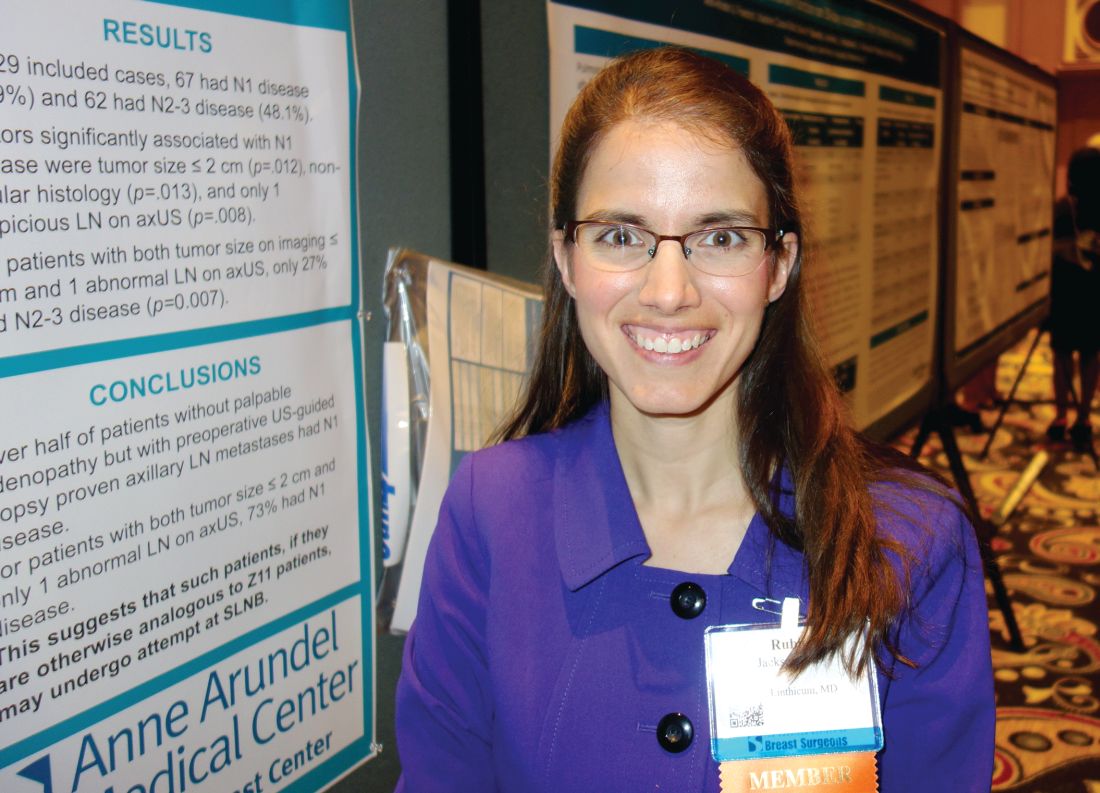
The problem that has come up in clinical practice is that axillary ultrasound is now a routine part of breast cancer workup, but the original trial didn’t address ultrasound, said senior investigator Rubie Sue Jackson, MD, at the annual meeting of the American Society of Breast Surgeons. As a result, “surgeons don’t know what to do with an ultrasound-detected suspicious node. I think a lot of surgeons, if they detect a positive lymph node by ultrasound, even if it’s nonpalpable, would not consider the patient a candidate for sentinel lymph node biopsy. Our data suggest that many of these patients are being overtreated if they have an upfront axillary lymph node dissection,” she said.
The 129 women had 1-3 suspicious, nonpalpable nodes on ultrasound that turned out to have metastatic disease on needle biopsy. They all had subsequent ALNDs.
On final pathology, 67 women (52%) had only one metastatic node. For those women, a sentinel lymph node biopsy was likely all that they required. “They probably did not benefit from having an ALND,” said Dr. Jackson, a breast surgeon at the Anne Arundel Medical Center in Annapolis, Md. The other 62 women (48%) had N2-3 disease.
A primary tumor sized 2 cm or smaller (P = .012); nonlobular histology (P = .013), and having only one suspicious nonpalpable node on ultrasound (P = .008) were all associated with NI disease. Of the women who met the criteria, only eight (27%) had N 2-3 disease (P = .007).
“Patients meeting the three criteria are particularly unlikely to have three or more positive sentinel lymph nodes” and require subsequent ALND. “You don’t need to do a complete axillary lymph node dissection upfront, as long as they are getting a lumpectomy and whole breast radiation,” Dr. Jackson said.
These days at Anne Arundel, “we do the axillary ultrasound, we biopsy the lymph node if it looks suspicious, but we don’t feel forced to do an ALND. If a patient has tumor biology that’s likely to be highly responsive, we do upfront chemotherapy. If they have luminal tumor biology that’s not going to be very responsive to neoadjuvant therapy,” with one or two suspicious nodes, “and they are planning to get breast conserving therapy, I would do a sentinel lymph node biopsy and x-ray the specimen to make sure that I’ve retrieved the clip,” she said.
Dr. Jackson didn’t have any disclosures, and there was no industry funding for the work.
[email protected]
LAS VEGAS – About half of breast cancer patients without palpable lymphadenopathy but with preoperative ultrasound-guided, biopsy-proven axillary lymph node metastases have N1 disease, according to a review of 129 women.
Among the 30 women with a primary tumor 2 cm or smaller and only one abnormal lymph node on axillary ultrasound, 22 (73%) had metastases limited to the one lymph node, suggesting that such patients “may undergo ... sentinel lymph node biopsy” instead of a complete axillary lymph node dissection (ALND), the investigators concluded.
The problem that has come up in clinical practice is that axillary ultrasound is now a routine part of breast cancer workup, but the original trial didn’t address ultrasound, said senior investigator Rubie Sue Jackson, MD, at the annual meeting of the American Society of Breast Surgeons. As a result, “surgeons don’t know what to do with an ultrasound-detected suspicious node. I think a lot of surgeons, if they detect a positive lymph node by ultrasound, even if it’s nonpalpable, would not consider the patient a candidate for sentinel lymph node biopsy. Our data suggest that many of these patients are being overtreated if they have an upfront axillary lymph node dissection,” she said.
The 129 women had 1-3 suspicious, nonpalpable nodes on ultrasound that turned out to have metastatic disease on needle biopsy. They all had subsequent ALNDs.
On final pathology, 67 women (52%) had only one metastatic node. For those women, a sentinel lymph node biopsy was likely all that they required. “They probably did not benefit from having an ALND,” said Dr. Jackson, a breast surgeon at the Anne Arundel Medical Center in Annapolis, Md. The other 62 women (48%) had N2-3 disease.
A primary tumor sized 2 cm or smaller (P = .012); nonlobular histology (P = .013), and having only one suspicious nonpalpable node on ultrasound (P = .008) were all associated with NI disease. Of the women who met the criteria, only eight (27%) had N 2-3 disease (P = .007).
“Patients meeting the three criteria are particularly unlikely to have three or more positive sentinel lymph nodes” and require subsequent ALND. “You don’t need to do a complete axillary lymph node dissection upfront, as long as they are getting a lumpectomy and whole breast radiation,” Dr. Jackson said.
These days at Anne Arundel, “we do the axillary ultrasound, we biopsy the lymph node if it looks suspicious, but we don’t feel forced to do an ALND. If a patient has tumor biology that’s likely to be highly responsive, we do upfront chemotherapy. If they have luminal tumor biology that’s not going to be very responsive to neoadjuvant therapy,” with one or two suspicious nodes, “and they are planning to get breast conserving therapy, I would do a sentinel lymph node biopsy and x-ray the specimen to make sure that I’ve retrieved the clip,” she said.
Dr. Jackson didn’t have any disclosures, and there was no industry funding for the work.
[email protected]
LAS VEGAS – About half of breast cancer patients without palpable lymphadenopathy but with preoperative ultrasound-guided, biopsy-proven axillary lymph node metastases have N1 disease, according to a review of 129 women.
Among the 30 women with a primary tumor 2 cm or smaller and only one abnormal lymph node on axillary ultrasound, 22 (73%) had metastases limited to the one lymph node, suggesting that such patients “may undergo ... sentinel lymph node biopsy” instead of a complete axillary lymph node dissection (ALND), the investigators concluded.
The problem that has come up in clinical practice is that axillary ultrasound is now a routine part of breast cancer workup, but the original trial didn’t address ultrasound, said senior investigator Rubie Sue Jackson, MD, at the annual meeting of the American Society of Breast Surgeons. As a result, “surgeons don’t know what to do with an ultrasound-detected suspicious node. I think a lot of surgeons, if they detect a positive lymph node by ultrasound, even if it’s nonpalpable, would not consider the patient a candidate for sentinel lymph node biopsy. Our data suggest that many of these patients are being overtreated if they have an upfront axillary lymph node dissection,” she said.
The 129 women had 1-3 suspicious, nonpalpable nodes on ultrasound that turned out to have metastatic disease on needle biopsy. They all had subsequent ALNDs.
On final pathology, 67 women (52%) had only one metastatic node. For those women, a sentinel lymph node biopsy was likely all that they required. “They probably did not benefit from having an ALND,” said Dr. Jackson, a breast surgeon at the Anne Arundel Medical Center in Annapolis, Md. The other 62 women (48%) had N2-3 disease.
A primary tumor sized 2 cm or smaller (P = .012); nonlobular histology (P = .013), and having only one suspicious nonpalpable node on ultrasound (P = .008) were all associated with NI disease. Of the women who met the criteria, only eight (27%) had N 2-3 disease (P = .007).
“Patients meeting the three criteria are particularly unlikely to have three or more positive sentinel lymph nodes” and require subsequent ALND. “You don’t need to do a complete axillary lymph node dissection upfront, as long as they are getting a lumpectomy and whole breast radiation,” Dr. Jackson said.
These days at Anne Arundel, “we do the axillary ultrasound, we biopsy the lymph node if it looks suspicious, but we don’t feel forced to do an ALND. If a patient has tumor biology that’s likely to be highly responsive, we do upfront chemotherapy. If they have luminal tumor biology that’s not going to be very responsive to neoadjuvant therapy,” with one or two suspicious nodes, “and they are planning to get breast conserving therapy, I would do a sentinel lymph node biopsy and x-ray the specimen to make sure that I’ve retrieved the clip,” she said.
Dr. Jackson didn’t have any disclosures, and there was no industry funding for the work.
[email protected]
AT ASBS 2017
Key clinical point:
Major finding: Among the 30 women with tumors 2 cm or smaller, and only one abnormal lymph node on axillary ultrasound, 22 (73%) had metastasis limited to the one lymph node.
Data source: A review of 129 women with breast cancer.
Disclosures: There was no industry funding, and the senior investigator had no disclosures.
Consider switch to clopidogrel for DAPT early post ACS
PARIS – A strategy of switching from prasugrel or ticagrelor to clopidogrel 1 month after percutaneous coronary intervention for acute coronary syndrome is superior to the guideline-recommended full 12 months of dual-antiplatelet therapy with either of the newer P2Y12 inhibitors, according to Thomas Cuisset, MD.
In the randomized TOPIC (Timing of Platelet Inhibition After Acute Coronary Syndrome) trial, this switch strategy resulted in a marked reduction in bleeding without an increased risk of ischemic events, compared with a full 12 months of standard dual-antiplatelet therapy (DAPT) using prasugrel (Effient) or ticagrelor (Brilinta).

He added that the cost savings of this switch strategy would be enormous, since generic clopidogrel is vastly less expensive than prasugrel or ticagrelor.
Twelve months of DAPT with aspirin plus either prasugrel or ticagrelor is the guideline-recommended DAPT regimen following PCI for ACS on the strength of the TRITON and PLATO trials, respectively, which showed that those agents were more effective than clopidogrel for the prevention of thrombotic events. But Dr. Cuisset and his coinvestigators noted that the risk of ischemic events was highest in the first month or so following ACS, while the risk of DAPT-related serious bleeding increased after the first month and continued for the duration.
“We need to use the new drugs, and we need to go for 1 year with DAPT. But does that mean we need to go for 1 year with the new drugs?” he asked.
This question was the impetus for TOPIC, an open-label, single-center randomized trial that included 646 ACS patients who were free of major adverse cardiovascular events during their first month on DAPT with prasugrel or ticagrelor. At that point they were randomized to remain on their standard regimen or switch to aspirin at 75 mg/day plus clopidogrel at 75 mg/day for months 2-12. The switch strategy is similar to the way pulmonary embolism is managed: an early phase of high-intensity therapy followed by a backing off to a less intensive regimen, said Dr. Cuisset, a cardiologist at Aix-Marseille University, Provence, France.
The primary endpoint in TOPIC was the cumulative 1-year rate of a composite of all-cause mortality, stroke, urgent revascularization, or clinically significant bleeding as reflected in a Bleeding Academic Research Consortium (BARC) grade 2 or greater bleeding. The primary endpoint occurred in 13.4% of the switch group, a 52% relative risk reduction, compared with the 26.3% cumulative incidence with standard DAPT.
This difference wasn’t due to any between-group disparity in ischemic events, but rather to a 70% reduction in the risk of BARC grade 2 or greater bleeding in the switch group: 4.0% vs. 14.9%.
Some physicians have already been switching to clopidogrel for DAPT after ACS, either because of safety or cost concerns. Now their practice is evidence based, Dr. Cuisset noted.
Asked why TOPIC didn’t use the more stringent bleeding endpoint of BARC grade 3-5 bleeding, the cardiologist replied that it would have required a larger trial to show a significant difference. Besides, he added, BARC grade 2 bleeding is clinically important because it has a negative impact on quality of life and can cause patients to discontinue DAPT, thereby increasing their risk of thrombosis.
The TOPIC protocol didn’t utilize a loading dose of clopidogrel when making the switch. Investigators started clopidogrel the day after stopping prasugrel and at least 12 hours after the final dose of ticagrelor.
Ideally, the novel TOPIC findings should be confirmed in a much larger, randomized, double-blind clinical trial capable of detecting any small differences in stent thrombosis or MI rates before physicians adopt a change in practice, but discussant Chaim Lotan, MD, director of the Heart Institute at Hadassah Medical Center in Jerusalem, dismissed that prospect as unlikely.
“I tried myself to do a similar study and found I got a lot of opposition from the pharma companies as well as from physicians who said, ‘How can you go against the guidelines?’ ” he said.
“I want to congratulate your team because I think this is a groundbreaking study that is going to dictate a changing of the guidelines,” he told Dr. Cuisset.
Dr. Cuisset reported having no financial conflicts regarding this investigator-driven study funded without commercial support.
Simultaneous with his presentation in Paris, the TOPIC findings were published online (Eur Heart J. 2017 May 16. doi: 10.1093/eurheartj/ehx175).
Dr. Cuisset reported no financial conflicts regarding this investigator-driven study funded without commercial support.
[email protected]
PARIS – A strategy of switching from prasugrel or ticagrelor to clopidogrel 1 month after percutaneous coronary intervention for acute coronary syndrome is superior to the guideline-recommended full 12 months of dual-antiplatelet therapy with either of the newer P2Y12 inhibitors, according to Thomas Cuisset, MD.
In the randomized TOPIC (Timing of Platelet Inhibition After Acute Coronary Syndrome) trial, this switch strategy resulted in a marked reduction in bleeding without an increased risk of ischemic events, compared with a full 12 months of standard dual-antiplatelet therapy (DAPT) using prasugrel (Effient) or ticagrelor (Brilinta).
He added that the cost savings of this switch strategy would be enormous, since generic clopidogrel is vastly less expensive than prasugrel or ticagrelor.
Twelve months of DAPT with aspirin plus either prasugrel or ticagrelor is the guideline-recommended DAPT regimen following PCI for ACS on the strength of the TRITON and PLATO trials, respectively, which showed that those agents were more effective than clopidogrel for the prevention of thrombotic events. But Dr. Cuisset and his coinvestigators noted that the risk of ischemic events was highest in the first month or so following ACS, while the risk of DAPT-related serious bleeding increased after the first month and continued for the duration.
“We need to use the new drugs, and we need to go for 1 year with DAPT. But does that mean we need to go for 1 year with the new drugs?” he asked.
This question was the impetus for TOPIC, an open-label, single-center randomized trial that included 646 ACS patients who were free of major adverse cardiovascular events during their first month on DAPT with prasugrel or ticagrelor. At that point they were randomized to remain on their standard regimen or switch to aspirin at 75 mg/day plus clopidogrel at 75 mg/day for months 2-12. The switch strategy is similar to the way pulmonary embolism is managed: an early phase of high-intensity therapy followed by a backing off to a less intensive regimen, said Dr. Cuisset, a cardiologist at Aix-Marseille University, Provence, France.
The primary endpoint in TOPIC was the cumulative 1-year rate of a composite of all-cause mortality, stroke, urgent revascularization, or clinically significant bleeding as reflected in a Bleeding Academic Research Consortium (BARC) grade 2 or greater bleeding. The primary endpoint occurred in 13.4% of the switch group, a 52% relative risk reduction, compared with the 26.3% cumulative incidence with standard DAPT.
This difference wasn’t due to any between-group disparity in ischemic events, but rather to a 70% reduction in the risk of BARC grade 2 or greater bleeding in the switch group: 4.0% vs. 14.9%.
Some physicians have already been switching to clopidogrel for DAPT after ACS, either because of safety or cost concerns. Now their practice is evidence based, Dr. Cuisset noted.
Asked why TOPIC didn’t use the more stringent bleeding endpoint of BARC grade 3-5 bleeding, the cardiologist replied that it would have required a larger trial to show a significant difference. Besides, he added, BARC grade 2 bleeding is clinically important because it has a negative impact on quality of life and can cause patients to discontinue DAPT, thereby increasing their risk of thrombosis.
The TOPIC protocol didn’t utilize a loading dose of clopidogrel when making the switch. Investigators started clopidogrel the day after stopping prasugrel and at least 12 hours after the final dose of ticagrelor.
Ideally, the novel TOPIC findings should be confirmed in a much larger, randomized, double-blind clinical trial capable of detecting any small differences in stent thrombosis or MI rates before physicians adopt a change in practice, but discussant Chaim Lotan, MD, director of the Heart Institute at Hadassah Medical Center in Jerusalem, dismissed that prospect as unlikely.
“I tried myself to do a similar study and found I got a lot of opposition from the pharma companies as well as from physicians who said, ‘How can you go against the guidelines?’ ” he said.
“I want to congratulate your team because I think this is a groundbreaking study that is going to dictate a changing of the guidelines,” he told Dr. Cuisset.
Dr. Cuisset reported having no financial conflicts regarding this investigator-driven study funded without commercial support.
Simultaneous with his presentation in Paris, the TOPIC findings were published online (Eur Heart J. 2017 May 16. doi: 10.1093/eurheartj/ehx175).
Dr. Cuisset reported no financial conflicts regarding this investigator-driven study funded without commercial support.
[email protected]
PARIS – A strategy of switching from prasugrel or ticagrelor to clopidogrel 1 month after percutaneous coronary intervention for acute coronary syndrome is superior to the guideline-recommended full 12 months of dual-antiplatelet therapy with either of the newer P2Y12 inhibitors, according to Thomas Cuisset, MD.
In the randomized TOPIC (Timing of Platelet Inhibition After Acute Coronary Syndrome) trial, this switch strategy resulted in a marked reduction in bleeding without an increased risk of ischemic events, compared with a full 12 months of standard dual-antiplatelet therapy (DAPT) using prasugrel (Effient) or ticagrelor (Brilinta).
He added that the cost savings of this switch strategy would be enormous, since generic clopidogrel is vastly less expensive than prasugrel or ticagrelor.
Twelve months of DAPT with aspirin plus either prasugrel or ticagrelor is the guideline-recommended DAPT regimen following PCI for ACS on the strength of the TRITON and PLATO trials, respectively, which showed that those agents were more effective than clopidogrel for the prevention of thrombotic events. But Dr. Cuisset and his coinvestigators noted that the risk of ischemic events was highest in the first month or so following ACS, while the risk of DAPT-related serious bleeding increased after the first month and continued for the duration.
“We need to use the new drugs, and we need to go for 1 year with DAPT. But does that mean we need to go for 1 year with the new drugs?” he asked.
This question was the impetus for TOPIC, an open-label, single-center randomized trial that included 646 ACS patients who were free of major adverse cardiovascular events during their first month on DAPT with prasugrel or ticagrelor. At that point they were randomized to remain on their standard regimen or switch to aspirin at 75 mg/day plus clopidogrel at 75 mg/day for months 2-12. The switch strategy is similar to the way pulmonary embolism is managed: an early phase of high-intensity therapy followed by a backing off to a less intensive regimen, said Dr. Cuisset, a cardiologist at Aix-Marseille University, Provence, France.
The primary endpoint in TOPIC was the cumulative 1-year rate of a composite of all-cause mortality, stroke, urgent revascularization, or clinically significant bleeding as reflected in a Bleeding Academic Research Consortium (BARC) grade 2 or greater bleeding. The primary endpoint occurred in 13.4% of the switch group, a 52% relative risk reduction, compared with the 26.3% cumulative incidence with standard DAPT.
This difference wasn’t due to any between-group disparity in ischemic events, but rather to a 70% reduction in the risk of BARC grade 2 or greater bleeding in the switch group: 4.0% vs. 14.9%.
Some physicians have already been switching to clopidogrel for DAPT after ACS, either because of safety or cost concerns. Now their practice is evidence based, Dr. Cuisset noted.
Asked why TOPIC didn’t use the more stringent bleeding endpoint of BARC grade 3-5 bleeding, the cardiologist replied that it would have required a larger trial to show a significant difference. Besides, he added, BARC grade 2 bleeding is clinically important because it has a negative impact on quality of life and can cause patients to discontinue DAPT, thereby increasing their risk of thrombosis.
The TOPIC protocol didn’t utilize a loading dose of clopidogrel when making the switch. Investigators started clopidogrel the day after stopping prasugrel and at least 12 hours after the final dose of ticagrelor.
Ideally, the novel TOPIC findings should be confirmed in a much larger, randomized, double-blind clinical trial capable of detecting any small differences in stent thrombosis or MI rates before physicians adopt a change in practice, but discussant Chaim Lotan, MD, director of the Heart Institute at Hadassah Medical Center in Jerusalem, dismissed that prospect as unlikely.
“I tried myself to do a similar study and found I got a lot of opposition from the pharma companies as well as from physicians who said, ‘How can you go against the guidelines?’ ” he said.
“I want to congratulate your team because I think this is a groundbreaking study that is going to dictate a changing of the guidelines,” he told Dr. Cuisset.
Dr. Cuisset reported having no financial conflicts regarding this investigator-driven study funded without commercial support.
Simultaneous with his presentation in Paris, the TOPIC findings were published online (Eur Heart J. 2017 May 16. doi: 10.1093/eurheartj/ehx175).
Dr. Cuisset reported no financial conflicts regarding this investigator-driven study funded without commercial support.
[email protected]
AT EuroPCR
Key clinical point:
Major finding: The cumulative 1-year incidence of all-cause mortality, stroke, urgent revascularization, or clinically significant bleeding was 13.4% in acute coronary syndrome patients who switched to clopidogrel after 1 month on prasugrel or ticagrelor for dual-antiplatelet therapy, compared with 26.3% in those who didn’t switch.
Data source: An open-label, single-center, randomized trial including 646 ACS patients.
Disclosures: The presenter reported no financial conflicts regarding this investigator-driven study funded without commercial support.
Research gaps identified for palliative surgical care
Palliative care is a well-established specialty of medicine with several decades of research to guide its implementation in a variety of contexts. Palliative care for surgical patients, however, remains understudied, according to a work group convened by the National Institutes of Health and the National Palliative Care Research Center. The work group, comprising palliative specialists from a range of medical institutions, reviewed the existing literature on palliative surgical care to identify areas in which research is needed to support palliative programs and clinicians.
Despite the 2003 call to action by the American College of Surgeons’ Palliative Care Workgroup for research in seven priority areas of palliative care (surgical, patient-oriented, and end-of-life decision making; symptom management; communications; processes of care; and surgical education on palliative care), few studies have been conducted specifically targeting surgical palliative care. The empirical basis for implementation in the surgical context remains thin, according to the work group, which argues that when it comes to palliative care – and the research to support it – the needs of surgical and nonsurgical patients differ significantly.
The report, published in the Annals of Surgery (2017 May 3. doi: 10.1097/SLA.0000000000002253), outlines an ambitious agenda of recommended research priorities in the areas of outcomes, communication, and delivery aimed at filling the gap.
Measuring outcomes
The report pointed to two areas of outcomes research that are understudied. One is defining outcomes that are meaningful to patients. Surgical research frequently defines outcomes in terms of survival, 30-day readmission, and morbidity, but patients accessing palliative surgical care may not prioritize these outcomes. “Measures of functional independence, disability-free survival, days spent at home, or freedom from pain after surgery provide information on outcomes that are both clinically meaningful and important to patients,” the study authors wrote.
In addition, measures of timely and appropriate delivery of high-quality palliative care in surgery are in scant supply for surgeons and institutions looking to identify targets for improvement. Surgeons searching for studies on effective documentation of advance directives, and quality indicators for care at the end of life, such as hospice enrollment and death on life-sustaining treatments, will find the research cupboard nearly bare.
Communication and decision making
Decision making and communication with patients, family, and surgical team members are made especially challenging by the short time frames and crisis situations in which palliative surgical care typically occurs. For many of these patients, the “trade-offs between cure and quality of life (that is, impaired functional status and prolonged pain and suffering) are typically value sensitive.” But surgeons who want to communicate information about these trade-offs “are severely hampered by the paucity of data comparing longer-term survival, quality of life, and function ... the lack of data hinders the consideration of palliative care as an adjunct or alternative to surgery,” the study authors wrote.
Surgeons have few studies and little evidence to guide them on issues such as advance care planning conversations with surrogates in the crisis-prone surgical ICU setting. Future studies are needed to develop communication tools for in-the-moment crises in which patients, surrogates, and surgeons must choose a course of action that is both clinically sound and in accordance with patient values or wishes.
Delivery of palliative care to surgical patients
The work group reviewed the scanty literature on integrating palliative care principles into routine surgical practice and concluded that much work remains to be done in this area. “Studies of physician- and systems-targeted interventions are needed to redirect treatment options so that surgery is not the default modality for patients known to have extremely poor survival due to baseline serious illness or acute surgical conditions.” Optimal timing of palliative care, patient selection, development of scalable models of palliative care in different settings, and residency training models are all understudied, according to the report. And yet, the demand for evidence and data on these issues continues to rise.
The work group concluded, “As the population ages and technical innovation advances, surgical patients will become increasingly complex as surgeons and patients navigate the blurred boundaries between technically feasible, clinically appropriate, and value-concordant care.”
The study was supported by the National Institute on Aging, a division of NIH, and the National Palliative Care Research Center. The authors report no disclosures relevant to this study.
This report is an overdue assessment of an American College of Surgeons’ initiative to improve palliative care for surgical patients. The initiative commenced 15 years ago, and it is safe to say that at that time we surgeons didn’t know what we didn’t know about palliative care.

This move would eliminate much of the dated, pejorative connotation of palliative surgery as well as the incentive to intervene surgically on behalf of highly symptomatic, fragile patients, which was imposed by fear of the 30-day postop mortality metric. This research agenda is a realistic and compassionate appeal to the engagement of all surgeons in the assimilation of palliative principles in surgical practice.
Geoffrey P. Dunn, MD, FACS, is medical director of the palliative care consultation service at the University of Pittsburgh Medical Center Hamot, and vice chair of the ACS Committee on Surgical Palliative Care.
This report is an overdue assessment of an American College of Surgeons’ initiative to improve palliative care for surgical patients. The initiative commenced 15 years ago, and it is safe to say that at that time we surgeons didn’t know what we didn’t know about palliative care.
This move would eliminate much of the dated, pejorative connotation of palliative surgery as well as the incentive to intervene surgically on behalf of highly symptomatic, fragile patients, which was imposed by fear of the 30-day postop mortality metric. This research agenda is a realistic and compassionate appeal to the engagement of all surgeons in the assimilation of palliative principles in surgical practice.
Geoffrey P. Dunn, MD, FACS, is medical director of the palliative care consultation service at the University of Pittsburgh Medical Center Hamot, and vice chair of the ACS Committee on Surgical Palliative Care.
This report is an overdue assessment of an American College of Surgeons’ initiative to improve palliative care for surgical patients. The initiative commenced 15 years ago, and it is safe to say that at that time we surgeons didn’t know what we didn’t know about palliative care.
This move would eliminate much of the dated, pejorative connotation of palliative surgery as well as the incentive to intervene surgically on behalf of highly symptomatic, fragile patients, which was imposed by fear of the 30-day postop mortality metric. This research agenda is a realistic and compassionate appeal to the engagement of all surgeons in the assimilation of palliative principles in surgical practice.
Geoffrey P. Dunn, MD, FACS, is medical director of the palliative care consultation service at the University of Pittsburgh Medical Center Hamot, and vice chair of the ACS Committee on Surgical Palliative Care.
Palliative care is a well-established specialty of medicine with several decades of research to guide its implementation in a variety of contexts. Palliative care for surgical patients, however, remains understudied, according to a work group convened by the National Institutes of Health and the National Palliative Care Research Center. The work group, comprising palliative specialists from a range of medical institutions, reviewed the existing literature on palliative surgical care to identify areas in which research is needed to support palliative programs and clinicians.
Despite the 2003 call to action by the American College of Surgeons’ Palliative Care Workgroup for research in seven priority areas of palliative care (surgical, patient-oriented, and end-of-life decision making; symptom management; communications; processes of care; and surgical education on palliative care), few studies have been conducted specifically targeting surgical palliative care. The empirical basis for implementation in the surgical context remains thin, according to the work group, which argues that when it comes to palliative care – and the research to support it – the needs of surgical and nonsurgical patients differ significantly.
The report, published in the Annals of Surgery (2017 May 3. doi: 10.1097/SLA.0000000000002253), outlines an ambitious agenda of recommended research priorities in the areas of outcomes, communication, and delivery aimed at filling the gap.
Measuring outcomes
The report pointed to two areas of outcomes research that are understudied. One is defining outcomes that are meaningful to patients. Surgical research frequently defines outcomes in terms of survival, 30-day readmission, and morbidity, but patients accessing palliative surgical care may not prioritize these outcomes. “Measures of functional independence, disability-free survival, days spent at home, or freedom from pain after surgery provide information on outcomes that are both clinically meaningful and important to patients,” the study authors wrote.
In addition, measures of timely and appropriate delivery of high-quality palliative care in surgery are in scant supply for surgeons and institutions looking to identify targets for improvement. Surgeons searching for studies on effective documentation of advance directives, and quality indicators for care at the end of life, such as hospice enrollment and death on life-sustaining treatments, will find the research cupboard nearly bare.
Communication and decision making
Decision making and communication with patients, family, and surgical team members are made especially challenging by the short time frames and crisis situations in which palliative surgical care typically occurs. For many of these patients, the “trade-offs between cure and quality of life (that is, impaired functional status and prolonged pain and suffering) are typically value sensitive.” But surgeons who want to communicate information about these trade-offs “are severely hampered by the paucity of data comparing longer-term survival, quality of life, and function ... the lack of data hinders the consideration of palliative care as an adjunct or alternative to surgery,” the study authors wrote.
Surgeons have few studies and little evidence to guide them on issues such as advance care planning conversations with surrogates in the crisis-prone surgical ICU setting. Future studies are needed to develop communication tools for in-the-moment crises in which patients, surrogates, and surgeons must choose a course of action that is both clinically sound and in accordance with patient values or wishes.
Delivery of palliative care to surgical patients
The work group reviewed the scanty literature on integrating palliative care principles into routine surgical practice and concluded that much work remains to be done in this area. “Studies of physician- and systems-targeted interventions are needed to redirect treatment options so that surgery is not the default modality for patients known to have extremely poor survival due to baseline serious illness or acute surgical conditions.” Optimal timing of palliative care, patient selection, development of scalable models of palliative care in different settings, and residency training models are all understudied, according to the report. And yet, the demand for evidence and data on these issues continues to rise.
The work group concluded, “As the population ages and technical innovation advances, surgical patients will become increasingly complex as surgeons and patients navigate the blurred boundaries between technically feasible, clinically appropriate, and value-concordant care.”
The study was supported by the National Institute on Aging, a division of NIH, and the National Palliative Care Research Center. The authors report no disclosures relevant to this study.
Palliative care is a well-established specialty of medicine with several decades of research to guide its implementation in a variety of contexts. Palliative care for surgical patients, however, remains understudied, according to a work group convened by the National Institutes of Health and the National Palliative Care Research Center. The work group, comprising palliative specialists from a range of medical institutions, reviewed the existing literature on palliative surgical care to identify areas in which research is needed to support palliative programs and clinicians.
Despite the 2003 call to action by the American College of Surgeons’ Palliative Care Workgroup for research in seven priority areas of palliative care (surgical, patient-oriented, and end-of-life decision making; symptom management; communications; processes of care; and surgical education on palliative care), few studies have been conducted specifically targeting surgical palliative care. The empirical basis for implementation in the surgical context remains thin, according to the work group, which argues that when it comes to palliative care – and the research to support it – the needs of surgical and nonsurgical patients differ significantly.
The report, published in the Annals of Surgery (2017 May 3. doi: 10.1097/SLA.0000000000002253), outlines an ambitious agenda of recommended research priorities in the areas of outcomes, communication, and delivery aimed at filling the gap.
Measuring outcomes
The report pointed to two areas of outcomes research that are understudied. One is defining outcomes that are meaningful to patients. Surgical research frequently defines outcomes in terms of survival, 30-day readmission, and morbidity, but patients accessing palliative surgical care may not prioritize these outcomes. “Measures of functional independence, disability-free survival, days spent at home, or freedom from pain after surgery provide information on outcomes that are both clinically meaningful and important to patients,” the study authors wrote.
In addition, measures of timely and appropriate delivery of high-quality palliative care in surgery are in scant supply for surgeons and institutions looking to identify targets for improvement. Surgeons searching for studies on effective documentation of advance directives, and quality indicators for care at the end of life, such as hospice enrollment and death on life-sustaining treatments, will find the research cupboard nearly bare.
Communication and decision making
Decision making and communication with patients, family, and surgical team members are made especially challenging by the short time frames and crisis situations in which palliative surgical care typically occurs. For many of these patients, the “trade-offs between cure and quality of life (that is, impaired functional status and prolonged pain and suffering) are typically value sensitive.” But surgeons who want to communicate information about these trade-offs “are severely hampered by the paucity of data comparing longer-term survival, quality of life, and function ... the lack of data hinders the consideration of palliative care as an adjunct or alternative to surgery,” the study authors wrote.
Surgeons have few studies and little evidence to guide them on issues such as advance care planning conversations with surrogates in the crisis-prone surgical ICU setting. Future studies are needed to develop communication tools for in-the-moment crises in which patients, surrogates, and surgeons must choose a course of action that is both clinically sound and in accordance with patient values or wishes.
Delivery of palliative care to surgical patients
The work group reviewed the scanty literature on integrating palliative care principles into routine surgical practice and concluded that much work remains to be done in this area. “Studies of physician- and systems-targeted interventions are needed to redirect treatment options so that surgery is not the default modality for patients known to have extremely poor survival due to baseline serious illness or acute surgical conditions.” Optimal timing of palliative care, patient selection, development of scalable models of palliative care in different settings, and residency training models are all understudied, according to the report. And yet, the demand for evidence and data on these issues continues to rise.
The work group concluded, “As the population ages and technical innovation advances, surgical patients will become increasingly complex as surgeons and patients navigate the blurred boundaries between technically feasible, clinically appropriate, and value-concordant care.”
The study was supported by the National Institute on Aging, a division of NIH, and the National Palliative Care Research Center. The authors report no disclosures relevant to this study.
FROM ANNALS OF SURGERY
Postop satisfaction scores not tied to restricted opioid prescribing
Reduced opioid prescribing did not correlate with inpatient pain management scores, a study has shown.
The Centers for Medicare & Medicaid Services announced recently that, as of 2018, pain management will no longer be rated in the Hospital Consumer Assessment of Healthcare Providers and Systems (HCAHPS) survey, citing concerns that patient satisfaction surveys given at the time of postoperative discharge incentivizes clinicians to over-prescribe pain medication. Surgical patients are key contributors to HCAHPS scores, and opioids account for almost 40% of surgical prescriptions, according to the study.
A new study throws some shade on the CMS decision to delete pain management from the HCAHPS survey.
Pain management scores were calculated as the percentage of patients who reported that their pain was “always” well controlled. The pain dimension was calculated from the number of opioid prescriptions and also pain management scores compared to national benchmarks. Hospitals were then grouped into quintiles according to opioid prescriptions measured in oral morphine equivalents. The first quintile has the lowest number of prescriptions.
Unadjusted comparisons showed no significant differences in pain management or pain dimension scores between the first and fifth quintiles of hospitals. For pain management scores that ranked hospital staff as always controlling pain, the first quintile had a mean score of 69.5 (95% confidence interval, 66.7-71.7) out of 100, compared with 69.1 for the fifth quintile (95% CI, 67.2-71.4). On a scale of 1-10, pain dimension scores in the first quintile averaged 1.9 (mean 95% CI, 1.5-2.0), compared with 1.4 in the fifth quintile (mean 95% CI, 0.9-1.9).
So, for these institutions, the number of pain prescriptions was not correlated with HCAHPS scores for pain management. The study suggests that the concern that reducing opioid prescriptions may have a negative impact on patient satisfaction assessments may not be realized.
Other analyses controlling for a variety of comorbidities also showed no correlations between pain management scores and opioid prescribing. Of the surgeries considered – orthopedic, general, gynecologic, cancer, cardiac, and vascular – gynecologic procedures were most likely to be associated with improved pain management and pain dimension scores.
Dr. Brummett disclosed relationships with Tonix and Neuros Medical. He also holds a patent for peripheral perineural dexmedetomidine. Mr. Syrjamaki and Dr. Dupree received support from Blue Cross Blue Shield of Michigan for their respective roles in the Michigan Value Collaborative. Dr. Waljee is an unpaid consultant for 3MHealth.
[email protected]
On Twitter @whitneymcknight
Reduced opioid prescribing did not correlate with inpatient pain management scores, a study has shown.
The Centers for Medicare & Medicaid Services announced recently that, as of 2018, pain management will no longer be rated in the Hospital Consumer Assessment of Healthcare Providers and Systems (HCAHPS) survey, citing concerns that patient satisfaction surveys given at the time of postoperative discharge incentivizes clinicians to over-prescribe pain medication. Surgical patients are key contributors to HCAHPS scores, and opioids account for almost 40% of surgical prescriptions, according to the study.
A new study throws some shade on the CMS decision to delete pain management from the HCAHPS survey.
Pain management scores were calculated as the percentage of patients who reported that their pain was “always” well controlled. The pain dimension was calculated from the number of opioid prescriptions and also pain management scores compared to national benchmarks. Hospitals were then grouped into quintiles according to opioid prescriptions measured in oral morphine equivalents. The first quintile has the lowest number of prescriptions.
Unadjusted comparisons showed no significant differences in pain management or pain dimension scores between the first and fifth quintiles of hospitals. For pain management scores that ranked hospital staff as always controlling pain, the first quintile had a mean score of 69.5 (95% confidence interval, 66.7-71.7) out of 100, compared with 69.1 for the fifth quintile (95% CI, 67.2-71.4). On a scale of 1-10, pain dimension scores in the first quintile averaged 1.9 (mean 95% CI, 1.5-2.0), compared with 1.4 in the fifth quintile (mean 95% CI, 0.9-1.9).
So, for these institutions, the number of pain prescriptions was not correlated with HCAHPS scores for pain management. The study suggests that the concern that reducing opioid prescriptions may have a negative impact on patient satisfaction assessments may not be realized.
Other analyses controlling for a variety of comorbidities also showed no correlations between pain management scores and opioid prescribing. Of the surgeries considered – orthopedic, general, gynecologic, cancer, cardiac, and vascular – gynecologic procedures were most likely to be associated with improved pain management and pain dimension scores.
Dr. Brummett disclosed relationships with Tonix and Neuros Medical. He also holds a patent for peripheral perineural dexmedetomidine. Mr. Syrjamaki and Dr. Dupree received support from Blue Cross Blue Shield of Michigan for their respective roles in the Michigan Value Collaborative. Dr. Waljee is an unpaid consultant for 3MHealth.
[email protected]
On Twitter @whitneymcknight
Reduced opioid prescribing did not correlate with inpatient pain management scores, a study has shown.
The Centers for Medicare & Medicaid Services announced recently that, as of 2018, pain management will no longer be rated in the Hospital Consumer Assessment of Healthcare Providers and Systems (HCAHPS) survey, citing concerns that patient satisfaction surveys given at the time of postoperative discharge incentivizes clinicians to over-prescribe pain medication. Surgical patients are key contributors to HCAHPS scores, and opioids account for almost 40% of surgical prescriptions, according to the study.
A new study throws some shade on the CMS decision to delete pain management from the HCAHPS survey.
Pain management scores were calculated as the percentage of patients who reported that their pain was “always” well controlled. The pain dimension was calculated from the number of opioid prescriptions and also pain management scores compared to national benchmarks. Hospitals were then grouped into quintiles according to opioid prescriptions measured in oral morphine equivalents. The first quintile has the lowest number of prescriptions.
Unadjusted comparisons showed no significant differences in pain management or pain dimension scores between the first and fifth quintiles of hospitals. For pain management scores that ranked hospital staff as always controlling pain, the first quintile had a mean score of 69.5 (95% confidence interval, 66.7-71.7) out of 100, compared with 69.1 for the fifth quintile (95% CI, 67.2-71.4). On a scale of 1-10, pain dimension scores in the first quintile averaged 1.9 (mean 95% CI, 1.5-2.0), compared with 1.4 in the fifth quintile (mean 95% CI, 0.9-1.9).
So, for these institutions, the number of pain prescriptions was not correlated with HCAHPS scores for pain management. The study suggests that the concern that reducing opioid prescriptions may have a negative impact on patient satisfaction assessments may not be realized.
Other analyses controlling for a variety of comorbidities also showed no correlations between pain management scores and opioid prescribing. Of the surgeries considered – orthopedic, general, gynecologic, cancer, cardiac, and vascular – gynecologic procedures were most likely to be associated with improved pain management and pain dimension scores.
Dr. Brummett disclosed relationships with Tonix and Neuros Medical. He also holds a patent for peripheral perineural dexmedetomidine. Mr. Syrjamaki and Dr. Dupree received support from Blue Cross Blue Shield of Michigan for their respective roles in the Michigan Value Collaborative. Dr. Waljee is an unpaid consultant for 3MHealth.
[email protected]
On Twitter @whitneymcknight
Key clinical point:
Major finding: No significant differences between top and bottom quintiles of 47 Michigan hospitals’ opioid prescribing patterns existed when comparing their HCAHPS scores.
Data source: Pharmacy and insurance claims and HCAHPS pain management for 31,481 surgery patients between 2012 and 2014.
Disclosures: Dr. Brummett disclosed relationships with Tonix and Neuros Medical. He also holds a patent for peripheral perineural dexmedetomidine. Mr. Syrjamaki and Dr. Dupree received support from Blue Cross Blue Shield of Michigan for their respective roles in the Michigan Value Collaborative. Dr. Waljee is an unpaid consultant for 3MHealth.

Omitting ALND in some breast cancer patients may be the right choice
PHILADELPHIA – The safety of sentinel lymph node biopsy (SLNB) alone without axillary lymph node dissection (ALND) has been established for patients with cT1-2N0 cancer that are found to have one or two metastatic sentinel lymph nodes who undergo breast conservation therapy, but questions regarding the role of regional radiation have persisted.
This issue is addressed by the results of a large, prospective, 5+ year study at Memorial Sloan Kettering Cancer Center which confirmed the safety of omitting axillary lymph node dissection and suggested that regional radiation provides minimal benefit.

Dr. Morrow explained that, in August 2010, the breast surgery service at MSKCC adopted the guidelines that arose from the American College of Surgeons Oncology Group’s multicenter Z0011 trial and abandoned routine use of ALND in eligible patients. The goal of the study, she reported, was to determine how frequently axillary dissection was avoided in a consecutive, otherwise unselected, series of patients and to determine the incidence of local regional recurrence after SLNB alone in a population treated with known radiotherapy fields.
Eligible subjects had T1 or T2 node-negative breast cancer, were undergoing breast-conserving surgery with planned whole-breast irradiation, and were found to have hematoxylin-eosin-detected sentinel node metastases. Patients receiving neoadjuvant chemotherapy or requiring conversion to mastectomy, or those in whom partial breast irradiation or no radiotherapy was planned, were ineligible. Axillary imaging was not used in select patients. Criteria for axillary dissection were metastases in three or more sentinel nodes or the presence of matted nodes identified intraoperatively. The researchers did not use the MSKCC nomogram to predict the likelihood of non–sentinel node metastases.
Median patient age was 58 years and median tumor size 1.7 cm. With regard to tumor pathology, 87% had infiltrating ductal tumors, 94% had grade 2 or 3 disease, and the most common subtype was HR+, HER2– disease in 84%. “In this node-positive cohort of patients, 98% received adjuvant systemic therapy, most commonly both chemotherapy and endocrine therapy (received by 65%), and 93% completed radiotherapy,” Dr. Morrow said.
In the entire patient cohort, 84% (663) were treated with SLNB alone, Dr. Morrow said. Among the 130 patients requiring ALND, 68% (88) had metastases in three or more nodes, 26% (34) were found to have had matted nodes intraoperatively, and 6% (8) were eligible for SLNB alone but opted for ALND or had it recommended by their surgeon. “All of these occurred early in our experience, and this has not been repeated since,” Dr. Morrow said.
Among the SLNB-only patients, the 5-year event-free survival was 93%. “There were no isolated axillary recurrences,” Dr. Morrow said. The study reported four combined breast and axillary recurrences, three in nonradiated patients, and four combined nodal and distant recurrences, only one of which involved the axillary nodes. “The median time to any nodal recurrence was 25 months,” Dr. Morrow added. Among 484 patients who had 1 year or more of follow-up, 58% (280) received conventional supine breast tangents, 21% were treated prone – “meaning their axilla received essentially no radiotherapy,” Dr. Morrow said – and 21% had node field irradiation.
“If we compare patient characteristics based on radiotherapy fields treated, it’s clear that the patients who received nodal irradiation were a higher-risk group,” Dr. Morrow said. While all three groups had a median of one positive sentinel node, that “skewed towards two” in the nodal irradiation group, she said. This group also had higher rates of lymphovascular invasion (72% vs. 56% and 49% in the supine and prone groups, respectively) and extracapsular extension (41% vs. 31% and 25%).
The rates of nodal relapse were not statistically significant among the three groups: 1% in the prone group, 1.4% in the supine group, and 0% in the node irradiation group.
“Factors associated with a higher risk of distant metastases, such as young patient age, estrogen receptor negativity, or HER2 over-expression, were not associated with the need for axillary dissection and should not be used as priority selection criteria,” Dr. Morrow said. “Nodal recurrence was uncommon in the absence of routine nodal radiation therapy, and no isolated nodal failures were observed.
In his comments, Armando Giuliano, MD, of Cedars Sinai Medical Center in Los Angeles, principal investigator of the Z0011 trial, said the MSKCC study “extends and informs” the Z0011 findings. He noted that the prone treatment group in the MSKCC trial had a low rate of axillary recurrence. “Can you speculate how such excellent results are achieved without resection or irradiation?” he asked Dr. Morrow. “To me it appears that nodal irradiation provides very little benefit to this selected group of patients.”
The patients in the prone group were in the lowest-risk category of the study, Dr. Morrow said, but the fact that not all nodal disease becomes clinically evident, even in patients who do not receive radiotherapy or systemic therapy, along with the high use of systemic therapy in this group, may explain the low rates of axillary recurrence. “What I think we still need to find out, though, is whether or not failure to irradiate the nodes at all is in any way associated with decreased survival, as would be suggested in the MA.20 trial,” she said. “I think we will find that out from ongoing trials looking at no axillary dissection in mastectomy patients.”
Dr. Morrow and Dr. Giuliano reported no financial disclosures.
The complete manuscript of this study and its presentation at the American Surgical Association’s 137th Annual Meeting, April 2017, in Philadelphia, Pennsylvania, is to be published in Annals of Surgery pending editorial review.
PHILADELPHIA – The safety of sentinel lymph node biopsy (SLNB) alone without axillary lymph node dissection (ALND) has been established for patients with cT1-2N0 cancer that are found to have one or two metastatic sentinel lymph nodes who undergo breast conservation therapy, but questions regarding the role of regional radiation have persisted.
This issue is addressed by the results of a large, prospective, 5+ year study at Memorial Sloan Kettering Cancer Center which confirmed the safety of omitting axillary lymph node dissection and suggested that regional radiation provides minimal benefit.
Dr. Morrow explained that, in August 2010, the breast surgery service at MSKCC adopted the guidelines that arose from the American College of Surgeons Oncology Group’s multicenter Z0011 trial and abandoned routine use of ALND in eligible patients. The goal of the study, she reported, was to determine how frequently axillary dissection was avoided in a consecutive, otherwise unselected, series of patients and to determine the incidence of local regional recurrence after SLNB alone in a population treated with known radiotherapy fields.
Eligible subjects had T1 or T2 node-negative breast cancer, were undergoing breast-conserving surgery with planned whole-breast irradiation, and were found to have hematoxylin-eosin-detected sentinel node metastases. Patients receiving neoadjuvant chemotherapy or requiring conversion to mastectomy, or those in whom partial breast irradiation or no radiotherapy was planned, were ineligible. Axillary imaging was not used in select patients. Criteria for axillary dissection were metastases in three or more sentinel nodes or the presence of matted nodes identified intraoperatively. The researchers did not use the MSKCC nomogram to predict the likelihood of non–sentinel node metastases.
Median patient age was 58 years and median tumor size 1.7 cm. With regard to tumor pathology, 87% had infiltrating ductal tumors, 94% had grade 2 or 3 disease, and the most common subtype was HR+, HER2– disease in 84%. “In this node-positive cohort of patients, 98% received adjuvant systemic therapy, most commonly both chemotherapy and endocrine therapy (received by 65%), and 93% completed radiotherapy,” Dr. Morrow said.
In the entire patient cohort, 84% (663) were treated with SLNB alone, Dr. Morrow said. Among the 130 patients requiring ALND, 68% (88) had metastases in three or more nodes, 26% (34) were found to have had matted nodes intraoperatively, and 6% (8) were eligible for SLNB alone but opted for ALND or had it recommended by their surgeon. “All of these occurred early in our experience, and this has not been repeated since,” Dr. Morrow said.
Among the SLNB-only patients, the 5-year event-free survival was 93%. “There were no isolated axillary recurrences,” Dr. Morrow said. The study reported four combined breast and axillary recurrences, three in nonradiated patients, and four combined nodal and distant recurrences, only one of which involved the axillary nodes. “The median time to any nodal recurrence was 25 months,” Dr. Morrow added. Among 484 patients who had 1 year or more of follow-up, 58% (280) received conventional supine breast tangents, 21% were treated prone – “meaning their axilla received essentially no radiotherapy,” Dr. Morrow said – and 21% had node field irradiation.
“If we compare patient characteristics based on radiotherapy fields treated, it’s clear that the patients who received nodal irradiation were a higher-risk group,” Dr. Morrow said. While all three groups had a median of one positive sentinel node, that “skewed towards two” in the nodal irradiation group, she said. This group also had higher rates of lymphovascular invasion (72% vs. 56% and 49% in the supine and prone groups, respectively) and extracapsular extension (41% vs. 31% and 25%).
The rates of nodal relapse were not statistically significant among the three groups: 1% in the prone group, 1.4% in the supine group, and 0% in the node irradiation group.
“Factors associated with a higher risk of distant metastases, such as young patient age, estrogen receptor negativity, or HER2 over-expression, were not associated with the need for axillary dissection and should not be used as priority selection criteria,” Dr. Morrow said. “Nodal recurrence was uncommon in the absence of routine nodal radiation therapy, and no isolated nodal failures were observed.
In his comments, Armando Giuliano, MD, of Cedars Sinai Medical Center in Los Angeles, principal investigator of the Z0011 trial, said the MSKCC study “extends and informs” the Z0011 findings. He noted that the prone treatment group in the MSKCC trial had a low rate of axillary recurrence. “Can you speculate how such excellent results are achieved without resection or irradiation?” he asked Dr. Morrow. “To me it appears that nodal irradiation provides very little benefit to this selected group of patients.”
The patients in the prone group were in the lowest-risk category of the study, Dr. Morrow said, but the fact that not all nodal disease becomes clinically evident, even in patients who do not receive radiotherapy or systemic therapy, along with the high use of systemic therapy in this group, may explain the low rates of axillary recurrence. “What I think we still need to find out, though, is whether or not failure to irradiate the nodes at all is in any way associated with decreased survival, as would be suggested in the MA.20 trial,” she said. “I think we will find that out from ongoing trials looking at no axillary dissection in mastectomy patients.”
Dr. Morrow and Dr. Giuliano reported no financial disclosures.
The complete manuscript of this study and its presentation at the American Surgical Association’s 137th Annual Meeting, April 2017, in Philadelphia, Pennsylvania, is to be published in Annals of Surgery pending editorial review.
PHILADELPHIA – The safety of sentinel lymph node biopsy (SLNB) alone without axillary lymph node dissection (ALND) has been established for patients with cT1-2N0 cancer that are found to have one or two metastatic sentinel lymph nodes who undergo breast conservation therapy, but questions regarding the role of regional radiation have persisted.
This issue is addressed by the results of a large, prospective, 5+ year study at Memorial Sloan Kettering Cancer Center which confirmed the safety of omitting axillary lymph node dissection and suggested that regional radiation provides minimal benefit.
Dr. Morrow explained that, in August 2010, the breast surgery service at MSKCC adopted the guidelines that arose from the American College of Surgeons Oncology Group’s multicenter Z0011 trial and abandoned routine use of ALND in eligible patients. The goal of the study, she reported, was to determine how frequently axillary dissection was avoided in a consecutive, otherwise unselected, series of patients and to determine the incidence of local regional recurrence after SLNB alone in a population treated with known radiotherapy fields.
Eligible subjects had T1 or T2 node-negative breast cancer, were undergoing breast-conserving surgery with planned whole-breast irradiation, and were found to have hematoxylin-eosin-detected sentinel node metastases. Patients receiving neoadjuvant chemotherapy or requiring conversion to mastectomy, or those in whom partial breast irradiation or no radiotherapy was planned, were ineligible. Axillary imaging was not used in select patients. Criteria for axillary dissection were metastases in three or more sentinel nodes or the presence of matted nodes identified intraoperatively. The researchers did not use the MSKCC nomogram to predict the likelihood of non–sentinel node metastases.
Median patient age was 58 years and median tumor size 1.7 cm. With regard to tumor pathology, 87% had infiltrating ductal tumors, 94% had grade 2 or 3 disease, and the most common subtype was HR+, HER2– disease in 84%. “In this node-positive cohort of patients, 98% received adjuvant systemic therapy, most commonly both chemotherapy and endocrine therapy (received by 65%), and 93% completed radiotherapy,” Dr. Morrow said.
In the entire patient cohort, 84% (663) were treated with SLNB alone, Dr. Morrow said. Among the 130 patients requiring ALND, 68% (88) had metastases in three or more nodes, 26% (34) were found to have had matted nodes intraoperatively, and 6% (8) were eligible for SLNB alone but opted for ALND or had it recommended by their surgeon. “All of these occurred early in our experience, and this has not been repeated since,” Dr. Morrow said.
Among the SLNB-only patients, the 5-year event-free survival was 93%. “There were no isolated axillary recurrences,” Dr. Morrow said. The study reported four combined breast and axillary recurrences, three in nonradiated patients, and four combined nodal and distant recurrences, only one of which involved the axillary nodes. “The median time to any nodal recurrence was 25 months,” Dr. Morrow added. Among 484 patients who had 1 year or more of follow-up, 58% (280) received conventional supine breast tangents, 21% were treated prone – “meaning their axilla received essentially no radiotherapy,” Dr. Morrow said – and 21% had node field irradiation.
“If we compare patient characteristics based on radiotherapy fields treated, it’s clear that the patients who received nodal irradiation were a higher-risk group,” Dr. Morrow said. While all three groups had a median of one positive sentinel node, that “skewed towards two” in the nodal irradiation group, she said. This group also had higher rates of lymphovascular invasion (72% vs. 56% and 49% in the supine and prone groups, respectively) and extracapsular extension (41% vs. 31% and 25%).
The rates of nodal relapse were not statistically significant among the three groups: 1% in the prone group, 1.4% in the supine group, and 0% in the node irradiation group.
“Factors associated with a higher risk of distant metastases, such as young patient age, estrogen receptor negativity, or HER2 over-expression, were not associated with the need for axillary dissection and should not be used as priority selection criteria,” Dr. Morrow said. “Nodal recurrence was uncommon in the absence of routine nodal radiation therapy, and no isolated nodal failures were observed.
In his comments, Armando Giuliano, MD, of Cedars Sinai Medical Center in Los Angeles, principal investigator of the Z0011 trial, said the MSKCC study “extends and informs” the Z0011 findings. He noted that the prone treatment group in the MSKCC trial had a low rate of axillary recurrence. “Can you speculate how such excellent results are achieved without resection or irradiation?” he asked Dr. Morrow. “To me it appears that nodal irradiation provides very little benefit to this selected group of patients.”
The patients in the prone group were in the lowest-risk category of the study, Dr. Morrow said, but the fact that not all nodal disease becomes clinically evident, even in patients who do not receive radiotherapy or systemic therapy, along with the high use of systemic therapy in this group, may explain the low rates of axillary recurrence. “What I think we still need to find out, though, is whether or not failure to irradiate the nodes at all is in any way associated with decreased survival, as would be suggested in the MA.20 trial,” she said. “I think we will find that out from ongoing trials looking at no axillary dissection in mastectomy patients.”
Dr. Morrow and Dr. Giuliano reported no financial disclosures.
The complete manuscript of this study and its presentation at the American Surgical Association’s 137th Annual Meeting, April 2017, in Philadelphia, Pennsylvania, is to be published in Annals of Surgery pending editorial review.
AT THE ANNUAL ASA MEETING
New device that treats esophageal atresia in infants has been authorized
The FDA has authorized a medical device to treat infants up to age 1 year for esophageal atresia, called the Flourish Pediatric Esophageal Atresia Anastomosis.
The device uses magnets attached to two catheters to pull the upper and lower esophagus together, closing the gap for several days until a connection is formed. The catheters are then removed, and the infant can begin feeding via mouth.
Cook Medical provided data on 16 patients implanted with Flourish devices. All patients had successful joining of their esophagus within 3-10 days after receiving the device. A total of 13 of the 16 patients developed anastomotic stricture that required a balloon dilation procedure, a stent, or both to repair. Such strictures also occur with traditional surgery.
The Flourish device should not be used in patients older than 1 year. Other potential complications that may occur include stomach or mouth irritation near the catheter insertion sites and gastroesophageal reflux.
Learn more about the study at www.fda.gov/newsevents/newsroom/pressannouncements/ucm558241.htm.
The FDA has authorized a medical device to treat infants up to age 1 year for esophageal atresia, called the Flourish Pediatric Esophageal Atresia Anastomosis.
The device uses magnets attached to two catheters to pull the upper and lower esophagus together, closing the gap for several days until a connection is formed. The catheters are then removed, and the infant can begin feeding via mouth.
Cook Medical provided data on 16 patients implanted with Flourish devices. All patients had successful joining of their esophagus within 3-10 days after receiving the device. A total of 13 of the 16 patients developed anastomotic stricture that required a balloon dilation procedure, a stent, or both to repair. Such strictures also occur with traditional surgery.
The Flourish device should not be used in patients older than 1 year. Other potential complications that may occur include stomach or mouth irritation near the catheter insertion sites and gastroesophageal reflux.
Learn more about the study at www.fda.gov/newsevents/newsroom/pressannouncements/ucm558241.htm.
The FDA has authorized a medical device to treat infants up to age 1 year for esophageal atresia, called the Flourish Pediatric Esophageal Atresia Anastomosis.
The device uses magnets attached to two catheters to pull the upper and lower esophagus together, closing the gap for several days until a connection is formed. The catheters are then removed, and the infant can begin feeding via mouth.
Cook Medical provided data on 16 patients implanted with Flourish devices. All patients had successful joining of their esophagus within 3-10 days after receiving the device. A total of 13 of the 16 patients developed anastomotic stricture that required a balloon dilation procedure, a stent, or both to repair. Such strictures also occur with traditional surgery.
The Flourish device should not be used in patients older than 1 year. Other potential complications that may occur include stomach or mouth irritation near the catheter insertion sites and gastroesophageal reflux.
Learn more about the study at www.fda.gov/newsevents/newsroom/pressannouncements/ucm558241.htm.
Key clinical point:
Major finding: All of the 16 patients implanted with the Flourish device were successfully treated for esophageal atresia.
Data source: Data was provided by Cook Medical under a humanitarian device exemption. A total of 16 patients were implanted with the Flourish device.
Disclosures: This study was sponsored by Cook Medical.
BILCAP: adjuvant capecitabine boosts overall survival of biliary tract cancers
Patients who have undergone complete resection of biliary tract cancers live longer if they receive the oral chemotherapy agent capecitabine instead of simple observation, according to findings of the phase III randomized controlled BILCAP trial.
“The only curative treatment [for these cancers] is surgical resection, but even in that circumstance, most patients will ultimately succumb to the disease,” lead study author John N. Primrose, MD, professor of surgery at the University of Southampton (England), said in a presscast leading up to the annual meeting of the American Society of Clinical Oncology.

Results of the trial showed that compared with observation, capecitabine prolonged survival by a nonsignificant 15 months in the intention-to-treat population but by a significant 17 months in the per-protocol population. The drug had modest toxicity consistent with past experience and little impact on quality of life.
“On this basis, we believe that capecitabine should now become the standard of care for patients following curative resection of biliary tract cancer,” Dr. Primrose maintained.
The trial took place in a U.K. population, noted ASCO President Daniel F. Hayes, MD, clinical director of the breast oncology program and Stuart B. Padnos Professor in Breast Cancer Research at the University of Michigan Comprehensive Cancer Center in Ann Arbor.
“This is a cancer that is much more common in Asia than it is in the western world, and I think that will be one of the questions that will be raised, as to whether these [results] apply to patients from Asia with the same cancer,” he said. “Otherwise, this is an impressive study, an enormous amount of work, and a very important finding.”
Study coauthor John A. Bridgewater, PhD, a professor at University College Hospital in London, said that he was not concerned that the trial missed its primary endpoint.
“It would of course have been much nicer if it had been significant, but I don’t think there is any doubt that there is a genuine effect here,” he maintained, agreeing that capecitabine should be standard of care going forward.
Other chemotherapies have made their way into similar adjuvant trials since BILCAP began, including the combination of cisplatin and gemcitabine being tested in the randomized ACTICCA-1 trial, Dr. Bridgewater acknowledged. “We’ve been discussing the possible permutations if BILCAP turned out to be positive with [those investigators], and that study, cisplatin-gemcitabine compared to surveillance, will now be modified to cisplatin-gemcitabine versus capecitabine. We came to that agreement some time ago.”
The BILCAP investigators are undertaking biomarker analyses of patients’ tumors. “The genotype of a bile duct cancer that will do well with fluoropyrimidine [such as capecitabine] is unknown, and that is exactly what we’ll be looking at when we look at the material. That surely will be one of the most important questions,” he said.
At present, there is no evidence to suggest that biliary tract cancers arising in Asian populations, which are mainly due to chronic infection with liver flukes, will differ in their response to capecitabine, according to Dr. Bridgewater.
“Certainly, you’ll be able to see in the clinical subgroup analyses, the long and the short of it is that it’s actually very difficult to distinguish, certainly on clinical grounds, any group that benefits more than other groups,” he said. “So the short answer is, there shouldn’t be any difference. But do we really know? Not yet.”
Study details
Patients enrolled in BILCAP had macroscopically completely resected cholangiocarcinoma or gallbladder cancer (including liver and pancreatic resection, as appropriate). They were randomized evenly to eight cycles of capecitabine (Xeloda) at a conventional dose or observation (Capecitabine is approved by the Food and Drug Administration for treatment of breast and colorectal cancers).
With more than 80% of patients having at least 3 years of follow-up, median overall survival in the intention-to-treat population – the trial’s primary endpoint – was 51 months with capecitabine and 36 months with observation (hazard ratio [HR], 0.81; P = .097), Dr. Primrose reported. The benefit became significant in a sensitivity analysis that adjusted for prognostic factors (HR, 0.70; P = .007).
In addition, median overall survival in the per-protocol population was significantly longer with capecitabine, at 53 months, than with observation, at 36 months (HR, 0.75; P = .028).
Median recurrence-free survival in the intention-to-treat population was 25 months for the capecitabine group and 18 months for the observation group.
“The toxicity associated with chemotherapy was relatively modest and in fact very similar to what has been observed in other studies,” Dr. Primrose said. The predominant grade 3 or 4 toxicity seen with capecitabine was plantar-palmar erythema, which occurred in 20.7% of patients who received the drug. There were no capecitabine-related deaths.
“Our quality of life analysis showed that there was very little difference in quality of life related to chemotherapy over those who did not have chemotherapy,” he added.
Dr. Primrose reported that he had no disclosures. Dr. Bridgewater disclosed ties with Merck Serono, Servier, Roche, Celgene, and MSD Oncology.
Patients who have undergone complete resection of biliary tract cancers live longer if they receive the oral chemotherapy agent capecitabine instead of simple observation, according to findings of the phase III randomized controlled BILCAP trial.
“The only curative treatment [for these cancers] is surgical resection, but even in that circumstance, most patients will ultimately succumb to the disease,” lead study author John N. Primrose, MD, professor of surgery at the University of Southampton (England), said in a presscast leading up to the annual meeting of the American Society of Clinical Oncology.
Results of the trial showed that compared with observation, capecitabine prolonged survival by a nonsignificant 15 months in the intention-to-treat population but by a significant 17 months in the per-protocol population. The drug had modest toxicity consistent with past experience and little impact on quality of life.
“On this basis, we believe that capecitabine should now become the standard of care for patients following curative resection of biliary tract cancer,” Dr. Primrose maintained.
The trial took place in a U.K. population, noted ASCO President Daniel F. Hayes, MD, clinical director of the breast oncology program and Stuart B. Padnos Professor in Breast Cancer Research at the University of Michigan Comprehensive Cancer Center in Ann Arbor.
“This is a cancer that is much more common in Asia than it is in the western world, and I think that will be one of the questions that will be raised, as to whether these [results] apply to patients from Asia with the same cancer,” he said. “Otherwise, this is an impressive study, an enormous amount of work, and a very important finding.”
Study coauthor John A. Bridgewater, PhD, a professor at University College Hospital in London, said that he was not concerned that the trial missed its primary endpoint.
“It would of course have been much nicer if it had been significant, but I don’t think there is any doubt that there is a genuine effect here,” he maintained, agreeing that capecitabine should be standard of care going forward.
Other chemotherapies have made their way into similar adjuvant trials since BILCAP began, including the combination of cisplatin and gemcitabine being tested in the randomized ACTICCA-1 trial, Dr. Bridgewater acknowledged. “We’ve been discussing the possible permutations if BILCAP turned out to be positive with [those investigators], and that study, cisplatin-gemcitabine compared to surveillance, will now be modified to cisplatin-gemcitabine versus capecitabine. We came to that agreement some time ago.”
The BILCAP investigators are undertaking biomarker analyses of patients’ tumors. “The genotype of a bile duct cancer that will do well with fluoropyrimidine [such as capecitabine] is unknown, and that is exactly what we’ll be looking at when we look at the material. That surely will be one of the most important questions,” he said.
At present, there is no evidence to suggest that biliary tract cancers arising in Asian populations, which are mainly due to chronic infection with liver flukes, will differ in their response to capecitabine, according to Dr. Bridgewater.
“Certainly, you’ll be able to see in the clinical subgroup analyses, the long and the short of it is that it’s actually very difficult to distinguish, certainly on clinical grounds, any group that benefits more than other groups,” he said. “So the short answer is, there shouldn’t be any difference. But do we really know? Not yet.”
Study details
Patients enrolled in BILCAP had macroscopically completely resected cholangiocarcinoma or gallbladder cancer (including liver and pancreatic resection, as appropriate). They were randomized evenly to eight cycles of capecitabine (Xeloda) at a conventional dose or observation (Capecitabine is approved by the Food and Drug Administration for treatment of breast and colorectal cancers).
With more than 80% of patients having at least 3 years of follow-up, median overall survival in the intention-to-treat population – the trial’s primary endpoint – was 51 months with capecitabine and 36 months with observation (hazard ratio [HR], 0.81; P = .097), Dr. Primrose reported. The benefit became significant in a sensitivity analysis that adjusted for prognostic factors (HR, 0.70; P = .007).
In addition, median overall survival in the per-protocol population was significantly longer with capecitabine, at 53 months, than with observation, at 36 months (HR, 0.75; P = .028).
Median recurrence-free survival in the intention-to-treat population was 25 months for the capecitabine group and 18 months for the observation group.
“The toxicity associated with chemotherapy was relatively modest and in fact very similar to what has been observed in other studies,” Dr. Primrose said. The predominant grade 3 or 4 toxicity seen with capecitabine was plantar-palmar erythema, which occurred in 20.7% of patients who received the drug. There were no capecitabine-related deaths.
“Our quality of life analysis showed that there was very little difference in quality of life related to chemotherapy over those who did not have chemotherapy,” he added.
Dr. Primrose reported that he had no disclosures. Dr. Bridgewater disclosed ties with Merck Serono, Servier, Roche, Celgene, and MSD Oncology.
Patients who have undergone complete resection of biliary tract cancers live longer if they receive the oral chemotherapy agent capecitabine instead of simple observation, according to findings of the phase III randomized controlled BILCAP trial.
“The only curative treatment [for these cancers] is surgical resection, but even in that circumstance, most patients will ultimately succumb to the disease,” lead study author John N. Primrose, MD, professor of surgery at the University of Southampton (England), said in a presscast leading up to the annual meeting of the American Society of Clinical Oncology.
Results of the trial showed that compared with observation, capecitabine prolonged survival by a nonsignificant 15 months in the intention-to-treat population but by a significant 17 months in the per-protocol population. The drug had modest toxicity consistent with past experience and little impact on quality of life.
“On this basis, we believe that capecitabine should now become the standard of care for patients following curative resection of biliary tract cancer,” Dr. Primrose maintained.
The trial took place in a U.K. population, noted ASCO President Daniel F. Hayes, MD, clinical director of the breast oncology program and Stuart B. Padnos Professor in Breast Cancer Research at the University of Michigan Comprehensive Cancer Center in Ann Arbor.
“This is a cancer that is much more common in Asia than it is in the western world, and I think that will be one of the questions that will be raised, as to whether these [results] apply to patients from Asia with the same cancer,” he said. “Otherwise, this is an impressive study, an enormous amount of work, and a very important finding.”
Study coauthor John A. Bridgewater, PhD, a professor at University College Hospital in London, said that he was not concerned that the trial missed its primary endpoint.
“It would of course have been much nicer if it had been significant, but I don’t think there is any doubt that there is a genuine effect here,” he maintained, agreeing that capecitabine should be standard of care going forward.
Other chemotherapies have made their way into similar adjuvant trials since BILCAP began, including the combination of cisplatin and gemcitabine being tested in the randomized ACTICCA-1 trial, Dr. Bridgewater acknowledged. “We’ve been discussing the possible permutations if BILCAP turned out to be positive with [those investigators], and that study, cisplatin-gemcitabine compared to surveillance, will now be modified to cisplatin-gemcitabine versus capecitabine. We came to that agreement some time ago.”
The BILCAP investigators are undertaking biomarker analyses of patients’ tumors. “The genotype of a bile duct cancer that will do well with fluoropyrimidine [such as capecitabine] is unknown, and that is exactly what we’ll be looking at when we look at the material. That surely will be one of the most important questions,” he said.
At present, there is no evidence to suggest that biliary tract cancers arising in Asian populations, which are mainly due to chronic infection with liver flukes, will differ in their response to capecitabine, according to Dr. Bridgewater.
“Certainly, you’ll be able to see in the clinical subgroup analyses, the long and the short of it is that it’s actually very difficult to distinguish, certainly on clinical grounds, any group that benefits more than other groups,” he said. “So the short answer is, there shouldn’t be any difference. But do we really know? Not yet.”
Study details
Patients enrolled in BILCAP had macroscopically completely resected cholangiocarcinoma or gallbladder cancer (including liver and pancreatic resection, as appropriate). They were randomized evenly to eight cycles of capecitabine (Xeloda) at a conventional dose or observation (Capecitabine is approved by the Food and Drug Administration for treatment of breast and colorectal cancers).
With more than 80% of patients having at least 3 years of follow-up, median overall survival in the intention-to-treat population – the trial’s primary endpoint – was 51 months with capecitabine and 36 months with observation (hazard ratio [HR], 0.81; P = .097), Dr. Primrose reported. The benefit became significant in a sensitivity analysis that adjusted for prognostic factors (HR, 0.70; P = .007).
In addition, median overall survival in the per-protocol population was significantly longer with capecitabine, at 53 months, than with observation, at 36 months (HR, 0.75; P = .028).
Median recurrence-free survival in the intention-to-treat population was 25 months for the capecitabine group and 18 months for the observation group.
“The toxicity associated with chemotherapy was relatively modest and in fact very similar to what has been observed in other studies,” Dr. Primrose said. The predominant grade 3 or 4 toxicity seen with capecitabine was plantar-palmar erythema, which occurred in 20.7% of patients who received the drug. There were no capecitabine-related deaths.
“Our quality of life analysis showed that there was very little difference in quality of life related to chemotherapy over those who did not have chemotherapy,” he added.
Dr. Primrose reported that he had no disclosures. Dr. Bridgewater disclosed ties with Merck Serono, Servier, Roche, Celgene, and MSD Oncology.
FROM THE 2017 ASCO ANNUAL MEETING
Key clinical point:
Major finding: Compared with observation, capecitabine prolonged median overall survival by 15 months in the intention-to-treat population (P = .097) and by 17 months in the per-protocol population (P = .028).
Data source: BILCAP, a phase III randomized controlled trial among 447 patients who had undergone complete resection of biliary tract cancers.
Disclosures: Dr. Primrose reported that he had no disclosures. Dr. Bridgewater disclosed ties with Merck Serono, Servier, Roche, Celgene, and MSD Oncology.
VIDEO: Sutureless aortic valve shows promise in IDE trial
BOSTON – A new study highlights the success, safety, and effectiveness of a new sutureless aortic valve device in patients with severe symptomatic aortic valve stenosis (AS).
The findings, reported at the annual meeting of the American Association for Thoracic Surgery, were based on a prospective, single-arm clinical trial approved under a Food and Drug Administration Investigational Device Exemption (IDE) that aimed to assess the safety and efficacy of a new bovine pericardial sutureless aortic valve in patients with severe AS undergoing aortic valve replacement with or without concomitant procedures. In this video interview, Michael Borger, MD, explains how the study was conducted and what the findings mean for future use of the sutureless aortic valve device.
The video associated with this article is no longer available on this site. Please view all of our videos on the MDedge YouTube channel
[email protected]
On Twitter @legal_med
BOSTON – A new study highlights the success, safety, and effectiveness of a new sutureless aortic valve device in patients with severe symptomatic aortic valve stenosis (AS).
The findings, reported at the annual meeting of the American Association for Thoracic Surgery, were based on a prospective, single-arm clinical trial approved under a Food and Drug Administration Investigational Device Exemption (IDE) that aimed to assess the safety and efficacy of a new bovine pericardial sutureless aortic valve in patients with severe AS undergoing aortic valve replacement with or without concomitant procedures. In this video interview, Michael Borger, MD, explains how the study was conducted and what the findings mean for future use of the sutureless aortic valve device.
The video associated with this article is no longer available on this site. Please view all of our videos on the MDedge YouTube channel
[email protected]
On Twitter @legal_med
BOSTON – A new study highlights the success, safety, and effectiveness of a new sutureless aortic valve device in patients with severe symptomatic aortic valve stenosis (AS).
The findings, reported at the annual meeting of the American Association for Thoracic Surgery, were based on a prospective, single-arm clinical trial approved under a Food and Drug Administration Investigational Device Exemption (IDE) that aimed to assess the safety and efficacy of a new bovine pericardial sutureless aortic valve in patients with severe AS undergoing aortic valve replacement with or without concomitant procedures. In this video interview, Michael Borger, MD, explains how the study was conducted and what the findings mean for future use of the sutureless aortic valve device.
The video associated with this article is no longer available on this site. Please view all of our videos on the MDedge YouTube channel
[email protected]
On Twitter @legal_med
AT THE AATS ANNUAL MEETING

Postcesarean outpatient opioid needs predicted by inpatient use
SAN DIEGO – The amount of pain medication a women requires in the hospital after a cesarean delivery was an accurate predictor of postdischarge needs, and could provide guidance to tailor home prescriptions, reducing the amount of unused opioids left after recovery, according to a new study.
Jenna Emerson, MD, and her colleagues also found that more than half of the opioid medications prescribed for home postcesarean use went untaken, and that one in five women used no opioid medication after leaving the hospital.

The prospective cohort study, one of two awarded the Donald F. Richardson Prize at the meeting, looked at how much opioid medication was used by women while they were inpatients, and also asked women to keep track of how much medication they used at home, to see if one could predict the other.
The pilot study enrolled 100 women who had a postdelivery inpatient stay of less than 8 days, who spoke English, and who had given birth to a live viable infant. The study’s statistical analysis looked for relationships not only between inpatient and outpatient use of opioids, but also between patient characteristics and level of opioid use in the hospital and at home.
A total of 76 women completed follow-up, said Dr. Emerson, who is a fourth-year ob.gyn. resident at Brown University, Providence, R.I. One patient was excluded because she was on high opioid doses for addiction treatment before delivery, and her postdelivery opioid requirements represented a clear outlier in the data.
The investigators used medical record data to determine opioid requirements as inpatients after cesarean delivery. For standardization of different strengths of opioids, use was expressed by using Mean Morphine Equivalents (MME). Baseline patient demographic characteristics and comorbidities were also obtained from medical record review.
Patients were asked to track their home opioid use for 2 weeks postdischarge, and also received a follow-up phone call at the end of their first 2 weeks at home.
Inpatient opioid use was divided into tertiles according to low (less than 40 MME), medium (41-70 MME), and high (greater than 70 MME) use. Overall, the group’s mean opioid use in the final 24 hours before discharge was 59 MME, an amount Dr. Emerson said was equivalent to about eight tablets of oxycodone/acetaminophen or 12 tablets of hydrocodone/acetaminophen.
Most patients (89%) went home with a prescription for oxycodone/acetaminophen, and the mean number of pills prescribed per patient was 35. For the original group of 100 patients, this meant that prescriptions were written for 3,150 oxycodone/acetaminophen tablets, 162 hydrocodone/acetaminophen tablets, and 139 oxycodone tablets.
Home use over the first 2 weeks postdischarge was a mean 126 MME, or the equivalent of about 17 oxycodone/acetaminophen tablets. A total of 39% of women reported they had used less than half of their opioid medication; 21% had used all or required more opioids, and 20% had used at least half of their opioids. One in five patients (20%) had not taken a single opioid tablet after discharge from the hospital, and only 2 of the 75 women were still using opioids at the time of the 2-week follow-up call, Dr. Emerson said.
This means there was a total of 1,538 tablets of unused prescription opioid medication left in the homes of the 75 women included in the final analysis, Dr. Emerson said.
When the investigators compared inpatient and outpatient opioid use, they found that 26 women (34.7%) had been in the lowest tertile of inpatient opioid use. These women also had the lowest mean MME at home, using 53 MME in the first 2 weeks post discharge. The middle tertile for inpatient use used a mean 111 MME at home, while the highest used 195 MME (analysis of variance P less than .001).
Higher outpatient opioid use was seen in patients with a history of psychiatric comorbidities (MME 172 vs. 103 for no psychiatric comorbidities; P = .046). Other factors associated with numerically higher use that did not reach statistical significance included breastfeeding status (MME 197 for no breastfeeding, 112 for breastfeeding; P = .068) and insurance status (MME 154 for public, 95 for private; P = .058).
Patients’ mean age was 30.3 years; 63% of participants were Caucasian, 5% were black, and 19% identified their ethnicity as Hispanic. Patients were about evenly divided between having public and private insurance, and most (72%) had some post-high school education. Just 5% had a prior history of drug use or abuse, and about half (49%) were having a repeat cesarean delivery. Three quarters were breastfeeding their infants.
Unused opioid prescriptions are a significant contributor to the pool of opioids available for diversion and recent work has shown that up to 23% of opioids prescribed are used for “nonmedical” purposes, Dr. Emerson said. Since cesarean deliveries are the most commonly performed major surgery in the United States, the opportunity to reduce the number of opioids available for diversion is significant, she said.
“Opioid prescription use after cesarean delivery should be tailored to patient needs,” she said, calling for larger studies to validate and expand on the findings.
Dr. Emerson reported having no outside sources of funding and no relevant financial disclosures.
[email protected]
On Twitter @karioakes
SAN DIEGO – The amount of pain medication a women requires in the hospital after a cesarean delivery was an accurate predictor of postdischarge needs, and could provide guidance to tailor home prescriptions, reducing the amount of unused opioids left after recovery, according to a new study.
Jenna Emerson, MD, and her colleagues also found that more than half of the opioid medications prescribed for home postcesarean use went untaken, and that one in five women used no opioid medication after leaving the hospital.
The prospective cohort study, one of two awarded the Donald F. Richardson Prize at the meeting, looked at how much opioid medication was used by women while they were inpatients, and also asked women to keep track of how much medication they used at home, to see if one could predict the other.
The pilot study enrolled 100 women who had a postdelivery inpatient stay of less than 8 days, who spoke English, and who had given birth to a live viable infant. The study’s statistical analysis looked for relationships not only between inpatient and outpatient use of opioids, but also between patient characteristics and level of opioid use in the hospital and at home.
A total of 76 women completed follow-up, said Dr. Emerson, who is a fourth-year ob.gyn. resident at Brown University, Providence, R.I. One patient was excluded because she was on high opioid doses for addiction treatment before delivery, and her postdelivery opioid requirements represented a clear outlier in the data.
The investigators used medical record data to determine opioid requirements as inpatients after cesarean delivery. For standardization of different strengths of opioids, use was expressed by using Mean Morphine Equivalents (MME). Baseline patient demographic characteristics and comorbidities were also obtained from medical record review.
Patients were asked to track their home opioid use for 2 weeks postdischarge, and also received a follow-up phone call at the end of their first 2 weeks at home.
Inpatient opioid use was divided into tertiles according to low (less than 40 MME), medium (41-70 MME), and high (greater than 70 MME) use. Overall, the group’s mean opioid use in the final 24 hours before discharge was 59 MME, an amount Dr. Emerson said was equivalent to about eight tablets of oxycodone/acetaminophen or 12 tablets of hydrocodone/acetaminophen.
Most patients (89%) went home with a prescription for oxycodone/acetaminophen, and the mean number of pills prescribed per patient was 35. For the original group of 100 patients, this meant that prescriptions were written for 3,150 oxycodone/acetaminophen tablets, 162 hydrocodone/acetaminophen tablets, and 139 oxycodone tablets.
Home use over the first 2 weeks postdischarge was a mean 126 MME, or the equivalent of about 17 oxycodone/acetaminophen tablets. A total of 39% of women reported they had used less than half of their opioid medication; 21% had used all or required more opioids, and 20% had used at least half of their opioids. One in five patients (20%) had not taken a single opioid tablet after discharge from the hospital, and only 2 of the 75 women were still using opioids at the time of the 2-week follow-up call, Dr. Emerson said.
This means there was a total of 1,538 tablets of unused prescription opioid medication left in the homes of the 75 women included in the final analysis, Dr. Emerson said.
When the investigators compared inpatient and outpatient opioid use, they found that 26 women (34.7%) had been in the lowest tertile of inpatient opioid use. These women also had the lowest mean MME at home, using 53 MME in the first 2 weeks post discharge. The middle tertile for inpatient use used a mean 111 MME at home, while the highest used 195 MME (analysis of variance P less than .001).
Higher outpatient opioid use was seen in patients with a history of psychiatric comorbidities (MME 172 vs. 103 for no psychiatric comorbidities; P = .046). Other factors associated with numerically higher use that did not reach statistical significance included breastfeeding status (MME 197 for no breastfeeding, 112 for breastfeeding; P = .068) and insurance status (MME 154 for public, 95 for private; P = .058).
Patients’ mean age was 30.3 years; 63% of participants were Caucasian, 5% were black, and 19% identified their ethnicity as Hispanic. Patients were about evenly divided between having public and private insurance, and most (72%) had some post-high school education. Just 5% had a prior history of drug use or abuse, and about half (49%) were having a repeat cesarean delivery. Three quarters were breastfeeding their infants.
Unused opioid prescriptions are a significant contributor to the pool of opioids available for diversion and recent work has shown that up to 23% of opioids prescribed are used for “nonmedical” purposes, Dr. Emerson said. Since cesarean deliveries are the most commonly performed major surgery in the United States, the opportunity to reduce the number of opioids available for diversion is significant, she said.
“Opioid prescription use after cesarean delivery should be tailored to patient needs,” she said, calling for larger studies to validate and expand on the findings.
Dr. Emerson reported having no outside sources of funding and no relevant financial disclosures.
[email protected]
On Twitter @karioakes
SAN DIEGO – The amount of pain medication a women requires in the hospital after a cesarean delivery was an accurate predictor of postdischarge needs, and could provide guidance to tailor home prescriptions, reducing the amount of unused opioids left after recovery, according to a new study.
Jenna Emerson, MD, and her colleagues also found that more than half of the opioid medications prescribed for home postcesarean use went untaken, and that one in five women used no opioid medication after leaving the hospital.
The prospective cohort study, one of two awarded the Donald F. Richardson Prize at the meeting, looked at how much opioid medication was used by women while they were inpatients, and also asked women to keep track of how much medication they used at home, to see if one could predict the other.
The pilot study enrolled 100 women who had a postdelivery inpatient stay of less than 8 days, who spoke English, and who had given birth to a live viable infant. The study’s statistical analysis looked for relationships not only between inpatient and outpatient use of opioids, but also between patient characteristics and level of opioid use in the hospital and at home.
A total of 76 women completed follow-up, said Dr. Emerson, who is a fourth-year ob.gyn. resident at Brown University, Providence, R.I. One patient was excluded because she was on high opioid doses for addiction treatment before delivery, and her postdelivery opioid requirements represented a clear outlier in the data.
The investigators used medical record data to determine opioid requirements as inpatients after cesarean delivery. For standardization of different strengths of opioids, use was expressed by using Mean Morphine Equivalents (MME). Baseline patient demographic characteristics and comorbidities were also obtained from medical record review.
Patients were asked to track their home opioid use for 2 weeks postdischarge, and also received a follow-up phone call at the end of their first 2 weeks at home.
Inpatient opioid use was divided into tertiles according to low (less than 40 MME), medium (41-70 MME), and high (greater than 70 MME) use. Overall, the group’s mean opioid use in the final 24 hours before discharge was 59 MME, an amount Dr. Emerson said was equivalent to about eight tablets of oxycodone/acetaminophen or 12 tablets of hydrocodone/acetaminophen.
Most patients (89%) went home with a prescription for oxycodone/acetaminophen, and the mean number of pills prescribed per patient was 35. For the original group of 100 patients, this meant that prescriptions were written for 3,150 oxycodone/acetaminophen tablets, 162 hydrocodone/acetaminophen tablets, and 139 oxycodone tablets.
Home use over the first 2 weeks postdischarge was a mean 126 MME, or the equivalent of about 17 oxycodone/acetaminophen tablets. A total of 39% of women reported they had used less than half of their opioid medication; 21% had used all or required more opioids, and 20% had used at least half of their opioids. One in five patients (20%) had not taken a single opioid tablet after discharge from the hospital, and only 2 of the 75 women were still using opioids at the time of the 2-week follow-up call, Dr. Emerson said.
This means there was a total of 1,538 tablets of unused prescription opioid medication left in the homes of the 75 women included in the final analysis, Dr. Emerson said.
When the investigators compared inpatient and outpatient opioid use, they found that 26 women (34.7%) had been in the lowest tertile of inpatient opioid use. These women also had the lowest mean MME at home, using 53 MME in the first 2 weeks post discharge. The middle tertile for inpatient use used a mean 111 MME at home, while the highest used 195 MME (analysis of variance P less than .001).
Higher outpatient opioid use was seen in patients with a history of psychiatric comorbidities (MME 172 vs. 103 for no psychiatric comorbidities; P = .046). Other factors associated with numerically higher use that did not reach statistical significance included breastfeeding status (MME 197 for no breastfeeding, 112 for breastfeeding; P = .068) and insurance status (MME 154 for public, 95 for private; P = .058).
Patients’ mean age was 30.3 years; 63% of participants were Caucasian, 5% were black, and 19% identified their ethnicity as Hispanic. Patients were about evenly divided between having public and private insurance, and most (72%) had some post-high school education. Just 5% had a prior history of drug use or abuse, and about half (49%) were having a repeat cesarean delivery. Three quarters were breastfeeding their infants.
Unused opioid prescriptions are a significant contributor to the pool of opioids available for diversion and recent work has shown that up to 23% of opioids prescribed are used for “nonmedical” purposes, Dr. Emerson said. Since cesarean deliveries are the most commonly performed major surgery in the United States, the opportunity to reduce the number of opioids available for diversion is significant, she said.
“Opioid prescription use after cesarean delivery should be tailored to patient needs,” she said, calling for larger studies to validate and expand on the findings.
Dr. Emerson reported having no outside sources of funding and no relevant financial disclosures.
[email protected]
On Twitter @karioakes
AT ACOG 2017
Key clinical point:
Major finding: Inpatient opioid use by tertile was highly associated with outpatient opioid use by tertile (P less than .001).
Data source: A prospective cohort study of 75 women with cesarean deliveries of live viable infants.
Disclosures: The study authors reported no outside sources of funding and no conflicts of interest.
Consider invasive mediastinal staging in higher risk NSCLC patients, despite guidelines
Endobronchial ultrasound transbronchial needle aspiration (EBUS-TBNA) appears to be cost effective for use in non–small cell lung cancer (NSCLC) staging if the prevalence of mediastinal lymph node metastasis (MLNM) is greater than or equal to 2.5%, according to the results of single institution modeling study. In addition, the study found that confirmatory mediastinoscopy should be performed in high-risk patients in cases of negative EBUS-TBNA.
Katarzyna Czarnecka-Kujawa, MD, of the University of Toronto and Toronto General Hospital, and her colleagues performed a decision analysis to compare health outcomes and costs of four mediastinal staging strategies. They assessed the following: no invasive staging, endobronchial ultrasound-guided transbronchial need aspiration (EBUS-TBNA), mediastinoscopy, and EBUS-TBNA followed by mediastinoscopy if EBUS-TBNA results were negative. They determined incremental cost-effectiveness ratios (ICER) for all strategies and performed comprehensive sensitivity analyses using a willingness to pay threshold of $80,000 [Canadian]/quality adjusted life-year (QALY).
They used data obtained for staging, outcomes, and costs from the patients in the lung cancer program at the Toronto General Hospital from Jan. 1, 2005 to Dec. 31, 2014, as detailed in a report published in the June issue of the Journal of Thoracic and Cardiovascular Surgery (2017. doi: 10.1016/j.jtcvs.2016.12.048).
After exclusions, they utilized a final case count of 499 cases for developing their surgical and procedure cost analysis, and a total of 750 cases in their endoscopy database for endoscopy analysis. For the base-case analysis, they assumed a prevalence of mediastinal metastasis of 9%, and obtained the prevalence of a pathologic lymph nodal stage disease following EBUS-TBNA from their institutional data.
Their results showed that EBUS-TBNA followed by mediastinoscopy was the strategy that resulted in the highest QALYs, but that it had a prohibitive ICER of greater than $1.4 million/QALY. Accordingly, it may not be justifiable to use mediastinoscopy after negative EBUS-TBNA in all patients, the researchers noted. However, the researchers’ data suggest that invasive screening may be justified in a very-low-risk population (MLNM above 2.5%).
In addition, the researchers stated that “[the] benefit conveyed by detecting mediastinal metastatic disease becomes more apparent as the prevalence of MLNM increases, with confirmatory mediastinoscopy becoming cost effective in cases of negative EBUS-TBNA in patients with moderate to high probability of MLNM” (greater than 57%).
Our model points out that there is a well-defined role for the use of different modalities, including mediastinoscopy. This stresses the need for ongoing focus on maintenance of competency and skill acquisition in mediastinoscopy and EBUS-TBNA by currently practicing and future thoracic surgeons respectively,” the researchers concluded.
Dr. Czarnecka-Kujawa disclosed that she is a research consultant with Olympus America. The study was funded in part by agencies of the Austrian government.
The authors make a compelling argument for invasive mediastinal staging in patients with clinical stage I non–small cell lung cancer and acknowledge that this conflicts with current guidelines, according to Biniam Kidane, MD, of the University of Manitoba, Winnipeg, in his invited comments on the study in the Journal of Thoracic and Cardiovascular Surgery (2017 Mar 10. doi: 10.1016/j.jtcvs.2017.02.051).
Their single-payer system is likely to have a different willingness-to-pay threshold, compared with those in other countries, especially the United States, where the EBUS-TBNA strategy without invasive staging is likely to remain the cost-effective choice.

“Cost-economic analyses such as these provide a window into the factors necessary to bridge guidelines from the realm of the abstract to the realm of local reality. When interpreting these findings, clinicians should consider: 1) What EBUS resources are available? (2) What is your local EBUS sensitivity? 3) What is the prevalence of MLNM?” Dr. Kidane concluded, with the caveat that such studies are not infallible and models are based on assumptions and must be treated with care.
Dr. Kidane reported no disclosures with regard to commercial support.
The authors make a compelling argument for invasive mediastinal staging in patients with clinical stage I non–small cell lung cancer and acknowledge that this conflicts with current guidelines, according to Biniam Kidane, MD, of the University of Manitoba, Winnipeg, in his invited comments on the study in the Journal of Thoracic and Cardiovascular Surgery (2017 Mar 10. doi: 10.1016/j.jtcvs.2017.02.051).
Their single-payer system is likely to have a different willingness-to-pay threshold, compared with those in other countries, especially the United States, where the EBUS-TBNA strategy without invasive staging is likely to remain the cost-effective choice.
“Cost-economic analyses such as these provide a window into the factors necessary to bridge guidelines from the realm of the abstract to the realm of local reality. When interpreting these findings, clinicians should consider: 1) What EBUS resources are available? (2) What is your local EBUS sensitivity? 3) What is the prevalence of MLNM?” Dr. Kidane concluded, with the caveat that such studies are not infallible and models are based on assumptions and must be treated with care.
Dr. Kidane reported no disclosures with regard to commercial support.
The authors make a compelling argument for invasive mediastinal staging in patients with clinical stage I non–small cell lung cancer and acknowledge that this conflicts with current guidelines, according to Biniam Kidane, MD, of the University of Manitoba, Winnipeg, in his invited comments on the study in the Journal of Thoracic and Cardiovascular Surgery (2017 Mar 10. doi: 10.1016/j.jtcvs.2017.02.051).
Their single-payer system is likely to have a different willingness-to-pay threshold, compared with those in other countries, especially the United States, where the EBUS-TBNA strategy without invasive staging is likely to remain the cost-effective choice.
“Cost-economic analyses such as these provide a window into the factors necessary to bridge guidelines from the realm of the abstract to the realm of local reality. When interpreting these findings, clinicians should consider: 1) What EBUS resources are available? (2) What is your local EBUS sensitivity? 3) What is the prevalence of MLNM?” Dr. Kidane concluded, with the caveat that such studies are not infallible and models are based on assumptions and must be treated with care.
Dr. Kidane reported no disclosures with regard to commercial support.
Endobronchial ultrasound transbronchial needle aspiration (EBUS-TBNA) appears to be cost effective for use in non–small cell lung cancer (NSCLC) staging if the prevalence of mediastinal lymph node metastasis (MLNM) is greater than or equal to 2.5%, according to the results of single institution modeling study. In addition, the study found that confirmatory mediastinoscopy should be performed in high-risk patients in cases of negative EBUS-TBNA.
Katarzyna Czarnecka-Kujawa, MD, of the University of Toronto and Toronto General Hospital, and her colleagues performed a decision analysis to compare health outcomes and costs of four mediastinal staging strategies. They assessed the following: no invasive staging, endobronchial ultrasound-guided transbronchial need aspiration (EBUS-TBNA), mediastinoscopy, and EBUS-TBNA followed by mediastinoscopy if EBUS-TBNA results were negative. They determined incremental cost-effectiveness ratios (ICER) for all strategies and performed comprehensive sensitivity analyses using a willingness to pay threshold of $80,000 [Canadian]/quality adjusted life-year (QALY).
They used data obtained for staging, outcomes, and costs from the patients in the lung cancer program at the Toronto General Hospital from Jan. 1, 2005 to Dec. 31, 2014, as detailed in a report published in the June issue of the Journal of Thoracic and Cardiovascular Surgery (2017. doi: 10.1016/j.jtcvs.2016.12.048).
After exclusions, they utilized a final case count of 499 cases for developing their surgical and procedure cost analysis, and a total of 750 cases in their endoscopy database for endoscopy analysis. For the base-case analysis, they assumed a prevalence of mediastinal metastasis of 9%, and obtained the prevalence of a pathologic lymph nodal stage disease following EBUS-TBNA from their institutional data.
Their results showed that EBUS-TBNA followed by mediastinoscopy was the strategy that resulted in the highest QALYs, but that it had a prohibitive ICER of greater than $1.4 million/QALY. Accordingly, it may not be justifiable to use mediastinoscopy after negative EBUS-TBNA in all patients, the researchers noted. However, the researchers’ data suggest that invasive screening may be justified in a very-low-risk population (MLNM above 2.5%).
In addition, the researchers stated that “[the] benefit conveyed by detecting mediastinal metastatic disease becomes more apparent as the prevalence of MLNM increases, with confirmatory mediastinoscopy becoming cost effective in cases of negative EBUS-TBNA in patients with moderate to high probability of MLNM” (greater than 57%).
Our model points out that there is a well-defined role for the use of different modalities, including mediastinoscopy. This stresses the need for ongoing focus on maintenance of competency and skill acquisition in mediastinoscopy and EBUS-TBNA by currently practicing and future thoracic surgeons respectively,” the researchers concluded.
Dr. Czarnecka-Kujawa disclosed that she is a research consultant with Olympus America. The study was funded in part by agencies of the Austrian government.
Endobronchial ultrasound transbronchial needle aspiration (EBUS-TBNA) appears to be cost effective for use in non–small cell lung cancer (NSCLC) staging if the prevalence of mediastinal lymph node metastasis (MLNM) is greater than or equal to 2.5%, according to the results of single institution modeling study. In addition, the study found that confirmatory mediastinoscopy should be performed in high-risk patients in cases of negative EBUS-TBNA.
Katarzyna Czarnecka-Kujawa, MD, of the University of Toronto and Toronto General Hospital, and her colleagues performed a decision analysis to compare health outcomes and costs of four mediastinal staging strategies. They assessed the following: no invasive staging, endobronchial ultrasound-guided transbronchial need aspiration (EBUS-TBNA), mediastinoscopy, and EBUS-TBNA followed by mediastinoscopy if EBUS-TBNA results were negative. They determined incremental cost-effectiveness ratios (ICER) for all strategies and performed comprehensive sensitivity analyses using a willingness to pay threshold of $80,000 [Canadian]/quality adjusted life-year (QALY).
They used data obtained for staging, outcomes, and costs from the patients in the lung cancer program at the Toronto General Hospital from Jan. 1, 2005 to Dec. 31, 2014, as detailed in a report published in the June issue of the Journal of Thoracic and Cardiovascular Surgery (2017. doi: 10.1016/j.jtcvs.2016.12.048).
After exclusions, they utilized a final case count of 499 cases for developing their surgical and procedure cost analysis, and a total of 750 cases in their endoscopy database for endoscopy analysis. For the base-case analysis, they assumed a prevalence of mediastinal metastasis of 9%, and obtained the prevalence of a pathologic lymph nodal stage disease following EBUS-TBNA from their institutional data.
Their results showed that EBUS-TBNA followed by mediastinoscopy was the strategy that resulted in the highest QALYs, but that it had a prohibitive ICER of greater than $1.4 million/QALY. Accordingly, it may not be justifiable to use mediastinoscopy after negative EBUS-TBNA in all patients, the researchers noted. However, the researchers’ data suggest that invasive screening may be justified in a very-low-risk population (MLNM above 2.5%).
In addition, the researchers stated that “[the] benefit conveyed by detecting mediastinal metastatic disease becomes more apparent as the prevalence of MLNM increases, with confirmatory mediastinoscopy becoming cost effective in cases of negative EBUS-TBNA in patients with moderate to high probability of MLNM” (greater than 57%).
Our model points out that there is a well-defined role for the use of different modalities, including mediastinoscopy. This stresses the need for ongoing focus on maintenance of competency and skill acquisition in mediastinoscopy and EBUS-TBNA by currently practicing and future thoracic surgeons respectively,” the researchers concluded.
Dr. Czarnecka-Kujawa disclosed that she is a research consultant with Olympus America. The study was funded in part by agencies of the Austrian government.
FROM THE JOURNAL OF THORACIC AND CARDIOVASCULAR SURGERY
Key clinical point:
Major finding: Once the pathologic lymph nodal stage reaches 57%, EBUS-TBNA followed by mediastinoscopy is cost effective.
Data source: A model of health care outcomes and costs was developed from data obtained from patients treated over a 10-year period at a single institution.
Disclosures: Dr. Czarnecka-Kujawa disclosed that she is a research consultant with Olympus America. The study was funded in part by agencies of the Austrian government.