User login
Impact of the AGA Research Foundation
As the charitable arm of the American Gastroenterological Association (AGA), the AGA Research Foundation plays an important role in medical research by providing grants to young scientists at a critical time in their career. The AGA Research Foundation’s mission is to raise funds to support young researchers in gastroenterology and hepatology.
The foundation’s research program has had a significant impact on digestive disease research since 1984.
• More than $40 million have been provided in research grants.
• More than 750 scientists have been awarded grants.
• 90% of investigators who received an AGA Research Scholar Award (RSA) over the past 10 years have stayed in gastroenterology and hepatology research.
• Over 85% of AGA-funded researchers in the past 10 years received NIH funding subsequent to their AGA award with over 50% receiving $1 million or more in NIH grant support.
At a time when funds from NIH and other traditional sources of support are in decline, the AGA Research Foundation is committed and ready to support young investigators and fund discoveries that will continue to improve GI practice and better patient care.

"Building a thriving research laboratory focused on pancreatic cancer research has been one of the greatest joys of my life," said Kenneth P. Olive, Ph.D., Columbia University Herbert Irving Comprehensive Cancer Center, 2010 Bernard L. Schwartz Designated Research Scholar Award in Pancreatic Cancer recipient. "I feel an immense pride when I walk into my lab and see over a dozen scientists engaged in research and interacting energetically. The freedom to pursue research stories in whatever direction the science leads is one of the reasons I chose academic science. The AGA Research Foundation has been extremely supportive of my work."
Many breakthroughs have been achieved through gastroenterological and hepatological research over the past century, forming the basis of the modern medical practice. The AGA Research Foundation contributes to this tradition of discovery to combat the continued loss of life and suffering brought on by digestive diseases.
The AGA Research Foundation provides a key source of funding at a critical juncture in a young researcher’s career. By joining others in donating to the AGA Research Foundation, you will ensure that researchers have opportunities to continue their life-saving work.
Support the AGA Research Foundation
The AGA Research Foundation serves the physicians and scientists who research, diagnose, prevent, and treat diseases of the gastrointestinal tract and liver and serves the patients whose lives and well-being depend on AGA’s members. Now more than ever, the AGA Research Foundation needs your support.
Help provide critical funding to young researchers today by making a donation to the AGA Research Foundation on the foundation’s website at www.gastro.org/contribute or by mail to 4930 Del Ray Avenue, Bethesda, MD 20814.
As the charitable arm of the American Gastroenterological Association (AGA), the AGA Research Foundation plays an important role in medical research by providing grants to young scientists at a critical time in their career. The AGA Research Foundation’s mission is to raise funds to support young researchers in gastroenterology and hepatology.
The foundation’s research program has had a significant impact on digestive disease research since 1984.
• More than $40 million have been provided in research grants.
• More than 750 scientists have been awarded grants.
• 90% of investigators who received an AGA Research Scholar Award (RSA) over the past 10 years have stayed in gastroenterology and hepatology research.
• Over 85% of AGA-funded researchers in the past 10 years received NIH funding subsequent to their AGA award with over 50% receiving $1 million or more in NIH grant support.
At a time when funds from NIH and other traditional sources of support are in decline, the AGA Research Foundation is committed and ready to support young investigators and fund discoveries that will continue to improve GI practice and better patient care.
"Building a thriving research laboratory focused on pancreatic cancer research has been one of the greatest joys of my life," said Kenneth P. Olive, Ph.D., Columbia University Herbert Irving Comprehensive Cancer Center, 2010 Bernard L. Schwartz Designated Research Scholar Award in Pancreatic Cancer recipient. "I feel an immense pride when I walk into my lab and see over a dozen scientists engaged in research and interacting energetically. The freedom to pursue research stories in whatever direction the science leads is one of the reasons I chose academic science. The AGA Research Foundation has been extremely supportive of my work."
Many breakthroughs have been achieved through gastroenterological and hepatological research over the past century, forming the basis of the modern medical practice. The AGA Research Foundation contributes to this tradition of discovery to combat the continued loss of life and suffering brought on by digestive diseases.
The AGA Research Foundation provides a key source of funding at a critical juncture in a young researcher’s career. By joining others in donating to the AGA Research Foundation, you will ensure that researchers have opportunities to continue their life-saving work.
Support the AGA Research Foundation
The AGA Research Foundation serves the physicians and scientists who research, diagnose, prevent, and treat diseases of the gastrointestinal tract and liver and serves the patients whose lives and well-being depend on AGA’s members. Now more than ever, the AGA Research Foundation needs your support.
Help provide critical funding to young researchers today by making a donation to the AGA Research Foundation on the foundation’s website at www.gastro.org/contribute or by mail to 4930 Del Ray Avenue, Bethesda, MD 20814.
As the charitable arm of the American Gastroenterological Association (AGA), the AGA Research Foundation plays an important role in medical research by providing grants to young scientists at a critical time in their career. The AGA Research Foundation’s mission is to raise funds to support young researchers in gastroenterology and hepatology.
The foundation’s research program has had a significant impact on digestive disease research since 1984.
• More than $40 million have been provided in research grants.
• More than 750 scientists have been awarded grants.
• 90% of investigators who received an AGA Research Scholar Award (RSA) over the past 10 years have stayed in gastroenterology and hepatology research.
• Over 85% of AGA-funded researchers in the past 10 years received NIH funding subsequent to their AGA award with over 50% receiving $1 million or more in NIH grant support.
At a time when funds from NIH and other traditional sources of support are in decline, the AGA Research Foundation is committed and ready to support young investigators and fund discoveries that will continue to improve GI practice and better patient care.
"Building a thriving research laboratory focused on pancreatic cancer research has been one of the greatest joys of my life," said Kenneth P. Olive, Ph.D., Columbia University Herbert Irving Comprehensive Cancer Center, 2010 Bernard L. Schwartz Designated Research Scholar Award in Pancreatic Cancer recipient. "I feel an immense pride when I walk into my lab and see over a dozen scientists engaged in research and interacting energetically. The freedom to pursue research stories in whatever direction the science leads is one of the reasons I chose academic science. The AGA Research Foundation has been extremely supportive of my work."
Many breakthroughs have been achieved through gastroenterological and hepatological research over the past century, forming the basis of the modern medical practice. The AGA Research Foundation contributes to this tradition of discovery to combat the continued loss of life and suffering brought on by digestive diseases.
The AGA Research Foundation provides a key source of funding at a critical juncture in a young researcher’s career. By joining others in donating to the AGA Research Foundation, you will ensure that researchers have opportunities to continue their life-saving work.
Support the AGA Research Foundation
The AGA Research Foundation serves the physicians and scientists who research, diagnose, prevent, and treat diseases of the gastrointestinal tract and liver and serves the patients whose lives and well-being depend on AGA’s members. Now more than ever, the AGA Research Foundation needs your support.
Help provide critical funding to young researchers today by making a donation to the AGA Research Foundation on the foundation’s website at www.gastro.org/contribute or by mail to 4930 Del Ray Avenue, Bethesda, MD 20814.

AGA is working for you in Washington
Virtually every day that Congress is in session, AGA representatives are on Capitol Hill advocating for initiatives to advance the science and practice of gastroenterology. We’re taking a stand on the top issues facing GIs, including reforming the Medicare payment system, easing the regulatory burden, increasing NIH funding, and eliminating colonoscopy cost sharing.
In 2012, AGA:
• Members made hundreds of calls to legislators urging them to prevent cuts in Medicare reimbursement.

• Held 94 meetings with legislators urging them to repeal the broken Medicare payment system and transition physicians into a new system that provides stability and equity, and reward physicians for improved quality.
• Spent 40 hours meeting with regulatory agencies, including MedPAC, CMS, USPSTF, HHS, and ONC, to discuss Medicare payment reform, quality programs, health IT, and the value-based payment modifier.
• Commented on 14 proposed regulations.
And since AGA PAC’s inception, we have raised $500,000. One hundred percent of contributions to AGA PAC go directly to candidate support; no monies are used for overhead costs.
For more stats and details on how the AGA is working for you in Washington, view the full AGA Action Report online at www.gastro.org/advocacy-regulation/take-action/AGA_Action_Report_2012.pdf.
AGA Institute Council Announces Committee Members
The AGA Institute Council is proud to announce the results of the 2013 section elections. With congratulations, we welcome the new section vice-chairs and nominating committee members into service for the AGA Institute Council.
Esophageal, Gastric and Duodenal Disorders
Nominating Committee
C. Prakash Gyawali, MD, MRCP, AGAF
Jean Marie Houghton, MD
Joel E. Richter, MD, FASGE
Marcelo F. Vela, MD
Growth, Development and Child Health
Vice-Chair Noah F. Shroyer, PhD
Nominating Committee
Valeria C. Cohran, MD
Edwin Fulco De Zoeten, MD, PhD
Sohail Z. Husain, MD
Sandra C. Kim, MD
Hormones, Transmitters, Growth Factors and Their Receptors
Vice-Chair Charalabos Pothoulakis, MD
Nominating Committee
Anthony J.M. Bauer, PhD
Roberto De Giorgio, MD, PhD
B. Mark Evers, MD
Yana Zavros, PhD
Liver and Biliary
Vice-Chair Jayant A. Talwalkar, MD, MPH
Nominating Committee
Andrew Muir, MD, MHS
Charmaine A. Stewart, MD
Kymberly Watt, MD
Rebecca G. Wells, MD
Neurogastroenterology and Motility
Vice-Chair Satish S.C. Rao, MD, PhD, AGAF
Nominating Committee
Beverly Greenwood-Van Meerveld, PhD, AGAF
Braden Kuo, MD
Reza Shaker, MD
William J. Snape, Jr., MD
Nutrition and Obesity
Vice-Chair Dennis D. Black, MD
Nominating Committee
Sheila Eileen Crowe, MD, AGAF
John C. Fang, MD
Samuel Klein, MD
Stephen J.D. O’Keefe, MD, PhD
Volunteer to be an AGA Alternate CPT or RUC Advisor
AGA is requesting applications from interested members for two prestigious volunteer positions:
• Alternate advisor to the AMA’s Current Procedural Terminology (CPT®) process
• Alternate advisor to the AMA’s Relative Value Update Committee (RUC)
The alternate advisors would work with either the CPT or RUC advisor and society staff to assist with AGA’s efforts in developing recommendations. These volunteer positions would require:
• Monthly calls.
• Frequent e-mail communication.
• Development of written materials.
• Collaborative discussions and work with ASGE, ACG, and other societies, as appropriate.
• Attendance at meetings three times per year. Travel is reimbursed by AGA.
You can learn more about the CPT or RUC positions via the AMA website at www.ama-assn.org. Please apply to either position by submitting your CV and a one-page statement of interest to Tricia Bardon, director of practice management and reimbursement at [email protected]. Your submission will be reviewed by the AGA Institute Practice Management and Economic Committee and you may be contacted to interview for this volunteer position. All applications are due at 5:00 p.m. ET, Aug. 1, 2013.
Virtually every day that Congress is in session, AGA representatives are on Capitol Hill advocating for initiatives to advance the science and practice of gastroenterology. We’re taking a stand on the top issues facing GIs, including reforming the Medicare payment system, easing the regulatory burden, increasing NIH funding, and eliminating colonoscopy cost sharing.
In 2012, AGA:
• Members made hundreds of calls to legislators urging them to prevent cuts in Medicare reimbursement.
• Held 94 meetings with legislators urging them to repeal the broken Medicare payment system and transition physicians into a new system that provides stability and equity, and reward physicians for improved quality.
• Spent 40 hours meeting with regulatory agencies, including MedPAC, CMS, USPSTF, HHS, and ONC, to discuss Medicare payment reform, quality programs, health IT, and the value-based payment modifier.
• Commented on 14 proposed regulations.
And since AGA PAC’s inception, we have raised $500,000. One hundred percent of contributions to AGA PAC go directly to candidate support; no monies are used for overhead costs.
For more stats and details on how the AGA is working for you in Washington, view the full AGA Action Report online at www.gastro.org/advocacy-regulation/take-action/AGA_Action_Report_2012.pdf.
AGA Institute Council Announces Committee Members
The AGA Institute Council is proud to announce the results of the 2013 section elections. With congratulations, we welcome the new section vice-chairs and nominating committee members into service for the AGA Institute Council.
Esophageal, Gastric and Duodenal Disorders
Nominating Committee
C. Prakash Gyawali, MD, MRCP, AGAF
Jean Marie Houghton, MD
Joel E. Richter, MD, FASGE
Marcelo F. Vela, MD
Growth, Development and Child Health
Vice-Chair Noah F. Shroyer, PhD
Nominating Committee
Valeria C. Cohran, MD
Edwin Fulco De Zoeten, MD, PhD
Sohail Z. Husain, MD
Sandra C. Kim, MD
Hormones, Transmitters, Growth Factors and Their Receptors
Vice-Chair Charalabos Pothoulakis, MD
Nominating Committee
Anthony J.M. Bauer, PhD
Roberto De Giorgio, MD, PhD
B. Mark Evers, MD
Yana Zavros, PhD
Liver and Biliary
Vice-Chair Jayant A. Talwalkar, MD, MPH
Nominating Committee
Andrew Muir, MD, MHS
Charmaine A. Stewart, MD
Kymberly Watt, MD
Rebecca G. Wells, MD
Neurogastroenterology and Motility
Vice-Chair Satish S.C. Rao, MD, PhD, AGAF
Nominating Committee
Beverly Greenwood-Van Meerveld, PhD, AGAF
Braden Kuo, MD
Reza Shaker, MD
William J. Snape, Jr., MD
Nutrition and Obesity
Vice-Chair Dennis D. Black, MD
Nominating Committee
Sheila Eileen Crowe, MD, AGAF
John C. Fang, MD
Samuel Klein, MD
Stephen J.D. O’Keefe, MD, PhD
Volunteer to be an AGA Alternate CPT or RUC Advisor
AGA is requesting applications from interested members for two prestigious volunteer positions:
• Alternate advisor to the AMA’s Current Procedural Terminology (CPT®) process
• Alternate advisor to the AMA’s Relative Value Update Committee (RUC)
The alternate advisors would work with either the CPT or RUC advisor and society staff to assist with AGA’s efforts in developing recommendations. These volunteer positions would require:
• Monthly calls.
• Frequent e-mail communication.
• Development of written materials.
• Collaborative discussions and work with ASGE, ACG, and other societies, as appropriate.
• Attendance at meetings three times per year. Travel is reimbursed by AGA.
You can learn more about the CPT or RUC positions via the AMA website at www.ama-assn.org. Please apply to either position by submitting your CV and a one-page statement of interest to Tricia Bardon, director of practice management and reimbursement at [email protected]. Your submission will be reviewed by the AGA Institute Practice Management and Economic Committee and you may be contacted to interview for this volunteer position. All applications are due at 5:00 p.m. ET, Aug. 1, 2013.
Virtually every day that Congress is in session, AGA representatives are on Capitol Hill advocating for initiatives to advance the science and practice of gastroenterology. We’re taking a stand on the top issues facing GIs, including reforming the Medicare payment system, easing the regulatory burden, increasing NIH funding, and eliminating colonoscopy cost sharing.
In 2012, AGA:
• Members made hundreds of calls to legislators urging them to prevent cuts in Medicare reimbursement.
• Held 94 meetings with legislators urging them to repeal the broken Medicare payment system and transition physicians into a new system that provides stability and equity, and reward physicians for improved quality.
• Spent 40 hours meeting with regulatory agencies, including MedPAC, CMS, USPSTF, HHS, and ONC, to discuss Medicare payment reform, quality programs, health IT, and the value-based payment modifier.
• Commented on 14 proposed regulations.
And since AGA PAC’s inception, we have raised $500,000. One hundred percent of contributions to AGA PAC go directly to candidate support; no monies are used for overhead costs.
For more stats and details on how the AGA is working for you in Washington, view the full AGA Action Report online at www.gastro.org/advocacy-regulation/take-action/AGA_Action_Report_2012.pdf.
AGA Institute Council Announces Committee Members
The AGA Institute Council is proud to announce the results of the 2013 section elections. With congratulations, we welcome the new section vice-chairs and nominating committee members into service for the AGA Institute Council.
Esophageal, Gastric and Duodenal Disorders
Nominating Committee
C. Prakash Gyawali, MD, MRCP, AGAF
Jean Marie Houghton, MD
Joel E. Richter, MD, FASGE
Marcelo F. Vela, MD
Growth, Development and Child Health
Vice-Chair Noah F. Shroyer, PhD
Nominating Committee
Valeria C. Cohran, MD
Edwin Fulco De Zoeten, MD, PhD
Sohail Z. Husain, MD
Sandra C. Kim, MD
Hormones, Transmitters, Growth Factors and Their Receptors
Vice-Chair Charalabos Pothoulakis, MD
Nominating Committee
Anthony J.M. Bauer, PhD
Roberto De Giorgio, MD, PhD
B. Mark Evers, MD
Yana Zavros, PhD
Liver and Biliary
Vice-Chair Jayant A. Talwalkar, MD, MPH
Nominating Committee
Andrew Muir, MD, MHS
Charmaine A. Stewart, MD
Kymberly Watt, MD
Rebecca G. Wells, MD
Neurogastroenterology and Motility
Vice-Chair Satish S.C. Rao, MD, PhD, AGAF
Nominating Committee
Beverly Greenwood-Van Meerveld, PhD, AGAF
Braden Kuo, MD
Reza Shaker, MD
William J. Snape, Jr., MD
Nutrition and Obesity
Vice-Chair Dennis D. Black, MD
Nominating Committee
Sheila Eileen Crowe, MD, AGAF
John C. Fang, MD
Samuel Klein, MD
Stephen J.D. O’Keefe, MD, PhD
Volunteer to be an AGA Alternate CPT or RUC Advisor
AGA is requesting applications from interested members for two prestigious volunteer positions:
• Alternate advisor to the AMA’s Current Procedural Terminology (CPT®) process
• Alternate advisor to the AMA’s Relative Value Update Committee (RUC)
The alternate advisors would work with either the CPT or RUC advisor and society staff to assist with AGA’s efforts in developing recommendations. These volunteer positions would require:
• Monthly calls.
• Frequent e-mail communication.
• Development of written materials.
• Collaborative discussions and work with ASGE, ACG, and other societies, as appropriate.
• Attendance at meetings three times per year. Travel is reimbursed by AGA.
You can learn more about the CPT or RUC positions via the AMA website at www.ama-assn.org. Please apply to either position by submitting your CV and a one-page statement of interest to Tricia Bardon, director of practice management and reimbursement at [email protected]. Your submission will be reviewed by the AGA Institute Practice Management and Economic Committee and you may be contacted to interview for this volunteer position. All applications are due at 5:00 p.m. ET, Aug. 1, 2013.

AGA Research Foundation Research Scholar Awards
The American Gastroenterological Association (AGA) Research Foundation is pleased to announce its 2013 research scholars. This year’s honorees are outstanding young gastroenterologists working toward independent careers in gastroenterology, hepatology, or related areas, and with this award, their research time will be protected.
"These young researchers are the future of our field. AGA is committed to supporting young scholars who are paving the way for promising research developments and new therapies," said Nicholas F. LaRusso, M.D., AGAF, chair of the AGA Research Foundation. "This year’s honorees have embarked on their extraordinary research careers and demonstrate exceptional promise, and we look forward to seeing what they will accomplish with the help of this funding."

The 2013 AGA research scholars are:
• Edaire Cheng, M.D., University of Texas Southwestern Medical Center, Dallas; Eosinophilic Esophagitis Fibrogenesis.
• Barham Abu Dayyeh, M.D., MPH, Mayo Clinic, Rochester, Minn.; Gastric and Hypothalamic Functions in Human Satiation.
• Hamed Khalili, M.D., MPH, Massachusetts General Hospital; Oral Contraceptive Use in the Etiopathogenesis of Crohn’s Disease.
AGA is also pleased to announce the AGA Institute President’s Research Scholar honoree, a new award that will be presented every 2 years to an applicant of exceptional merit:
• Carol M. Aherne, Ph.D., University of Colorado, Aurora; Epithelial Netrin-1 Controls CD4 Th1 T Cell Trafficking to the Inflamed Intestine.
The prestigious Research Scholar Awards provide $90,000 per year for 2 years (total $180,000) to the honorees to support their research. The goal of the Research Scholar Awards is to guarantee the perpetuation of strong science through the encouragement of young physician investigators and, ultimately, to improve patient care through digestive diseases research.
These extremely competitive awards ensure that bright, young scientists devote their careers to advancing the field of digestive health through research. Awards are based on the qualifications of the candidate, the quality of the candidate’s research proposal and the commitment of the candidate’s institution to support the required protected time for his or her research and adequate laboratory space.
The Research Scholar Awards program was launched in 1984 to provide crucial early support to investigators who show promise in academic gastroenterological research. The program recognized that resources awarded early on could provide a stable platform from which future research funding would be derived. During and after their time as an AGA research scholar, recipients have made important contributions to the field of gastroenterology, and many former award recipients have gone on to hold distinguished appointments in major medical institutions in the U.S. and Canada.
The 2013 scholars were chosen by the AGA Research Awards Panel, a distinguished national advisory committee chaired by M. Bishr Omary, Ph.D., M.D., professor and chair of the department of molecular and integrative physiology at the University of Michigan, Ann Arbor. Members of the committee include leading gastroenterologists from Beth Israel Deaconess Medical Center, Boston; Mayo Medical Center, Rochester, Minn.; Mount Sinai Medical Center, New York; Stanford University School of Medicine; and the University of Pennsylvania, Philadelphia; among others.
The American Gastroenterological Association (AGA) Research Foundation is pleased to announce its 2013 research scholars. This year’s honorees are outstanding young gastroenterologists working toward independent careers in gastroenterology, hepatology, or related areas, and with this award, their research time will be protected.
"These young researchers are the future of our field. AGA is committed to supporting young scholars who are paving the way for promising research developments and new therapies," said Nicholas F. LaRusso, M.D., AGAF, chair of the AGA Research Foundation. "This year’s honorees have embarked on their extraordinary research careers and demonstrate exceptional promise, and we look forward to seeing what they will accomplish with the help of this funding."
The 2013 AGA research scholars are:
• Edaire Cheng, M.D., University of Texas Southwestern Medical Center, Dallas; Eosinophilic Esophagitis Fibrogenesis.
• Barham Abu Dayyeh, M.D., MPH, Mayo Clinic, Rochester, Minn.; Gastric and Hypothalamic Functions in Human Satiation.
• Hamed Khalili, M.D., MPH, Massachusetts General Hospital; Oral Contraceptive Use in the Etiopathogenesis of Crohn’s Disease.
AGA is also pleased to announce the AGA Institute President’s Research Scholar honoree, a new award that will be presented every 2 years to an applicant of exceptional merit:
• Carol M. Aherne, Ph.D., University of Colorado, Aurora; Epithelial Netrin-1 Controls CD4 Th1 T Cell Trafficking to the Inflamed Intestine.
The prestigious Research Scholar Awards provide $90,000 per year for 2 years (total $180,000) to the honorees to support their research. The goal of the Research Scholar Awards is to guarantee the perpetuation of strong science through the encouragement of young physician investigators and, ultimately, to improve patient care through digestive diseases research.
These extremely competitive awards ensure that bright, young scientists devote their careers to advancing the field of digestive health through research. Awards are based on the qualifications of the candidate, the quality of the candidate’s research proposal and the commitment of the candidate’s institution to support the required protected time for his or her research and adequate laboratory space.
The Research Scholar Awards program was launched in 1984 to provide crucial early support to investigators who show promise in academic gastroenterological research. The program recognized that resources awarded early on could provide a stable platform from which future research funding would be derived. During and after their time as an AGA research scholar, recipients have made important contributions to the field of gastroenterology, and many former award recipients have gone on to hold distinguished appointments in major medical institutions in the U.S. and Canada.
The 2013 scholars were chosen by the AGA Research Awards Panel, a distinguished national advisory committee chaired by M. Bishr Omary, Ph.D., M.D., professor and chair of the department of molecular and integrative physiology at the University of Michigan, Ann Arbor. Members of the committee include leading gastroenterologists from Beth Israel Deaconess Medical Center, Boston; Mayo Medical Center, Rochester, Minn.; Mount Sinai Medical Center, New York; Stanford University School of Medicine; and the University of Pennsylvania, Philadelphia; among others.
The American Gastroenterological Association (AGA) Research Foundation is pleased to announce its 2013 research scholars. This year’s honorees are outstanding young gastroenterologists working toward independent careers in gastroenterology, hepatology, or related areas, and with this award, their research time will be protected.
"These young researchers are the future of our field. AGA is committed to supporting young scholars who are paving the way for promising research developments and new therapies," said Nicholas F. LaRusso, M.D., AGAF, chair of the AGA Research Foundation. "This year’s honorees have embarked on their extraordinary research careers and demonstrate exceptional promise, and we look forward to seeing what they will accomplish with the help of this funding."
The 2013 AGA research scholars are:
• Edaire Cheng, M.D., University of Texas Southwestern Medical Center, Dallas; Eosinophilic Esophagitis Fibrogenesis.
• Barham Abu Dayyeh, M.D., MPH, Mayo Clinic, Rochester, Minn.; Gastric and Hypothalamic Functions in Human Satiation.
• Hamed Khalili, M.D., MPH, Massachusetts General Hospital; Oral Contraceptive Use in the Etiopathogenesis of Crohn’s Disease.
AGA is also pleased to announce the AGA Institute President’s Research Scholar honoree, a new award that will be presented every 2 years to an applicant of exceptional merit:
• Carol M. Aherne, Ph.D., University of Colorado, Aurora; Epithelial Netrin-1 Controls CD4 Th1 T Cell Trafficking to the Inflamed Intestine.
The prestigious Research Scholar Awards provide $90,000 per year for 2 years (total $180,000) to the honorees to support their research. The goal of the Research Scholar Awards is to guarantee the perpetuation of strong science through the encouragement of young physician investigators and, ultimately, to improve patient care through digestive diseases research.
These extremely competitive awards ensure that bright, young scientists devote their careers to advancing the field of digestive health through research. Awards are based on the qualifications of the candidate, the quality of the candidate’s research proposal and the commitment of the candidate’s institution to support the required protected time for his or her research and adequate laboratory space.
The Research Scholar Awards program was launched in 1984 to provide crucial early support to investigators who show promise in academic gastroenterological research. The program recognized that resources awarded early on could provide a stable platform from which future research funding would be derived. During and after their time as an AGA research scholar, recipients have made important contributions to the field of gastroenterology, and many former award recipients have gone on to hold distinguished appointments in major medical institutions in the U.S. and Canada.
The 2013 scholars were chosen by the AGA Research Awards Panel, a distinguished national advisory committee chaired by M. Bishr Omary, Ph.D., M.D., professor and chair of the department of molecular and integrative physiology at the University of Michigan, Ann Arbor. Members of the committee include leading gastroenterologists from Beth Israel Deaconess Medical Center, Boston; Mayo Medical Center, Rochester, Minn.; Mount Sinai Medical Center, New York; Stanford University School of Medicine; and the University of Pennsylvania, Philadelphia; among others.

FDA taps AGA for expert guidance
AGA is developing strong relationships with the FDA. In 2012, AGA was invited to join the FDA Network of Experts program, a vetted network of outside scientists, clinicians, and engineers who will provide the FDA Center for Devices and Radiological Health (CDRH) staff with rapid access to scientific, engineering and medical expertise when it is needed to supplement existing knowledge and expertise within the CDRH.
Building on the success of this program, the FDA Center for Drug Evaluation and Research recently invited AGA to help them pilot the Network of Experts program under their division. This program will facilitate the exchange of scientific understanding from sources outside of the federal government; this feedback will be critical when it comes to new and emerging drugs and pioneering technologies.
By identifying GI experts to provide feedback and information to the FDA through this program, AGA is playing a powerful role in shaping regulations that will impact the GI community. AGA looks forward to collaborating with the FDA in new ways, with the ultimate goal of advancing the science and practice of GI.
AGA confirms IND is required for fecal microbiota transplantation
Due to member inquiries and concerns and the lack of clear guidance on regulations surrounding fecal microbiota transplantation (FMT), AGA, ACG, ASGE, and NASPGHAN have sought clarification about regulatory issues dealing with FMT from the FDA. The Center for Biologics Evaluation and Research (CBER) has determined that fecal microbiota falls within the definition of a biological product and drug that is regulated by the FDA.
Because FMT is not approved for any therapeutic purposes, an investigational new drug (IND) application is needed for the use of FMT to treat any disease including C. difficile infection.
AGA will work with the FDA to help ensure patients who may benefit from FMT will be able to gain access to such treatments in a timely manner.
In May, Dr. Gary Wu, chair of the AGA Center for Gut Microbiome Research and Education, attended a FDA workshop on "Fecal Microbiota for Transplantation" where this decision was reaffirmed (see the related story in this issue about the workshop). Based on the active interchange between basic and clinical researchers, clinical practitioners, as well as patients and participants from industry at this meeting, the FDA will hold internal discussions to further refine the regulatory issues surrounding this modality of treatment. The FDA will seek input from various societies, including AGA, and intends to post a summary of this meeting as well as updates on its website.
AGA and the FDA recognize that there may be critical clinical situations where FMT for the treatment of C. difficile infection may require urgent action. The FDA recommends calling 301-827-2000 (after hours 866-300-4374) to obtain information about an "emergency use" IND (part of an expanded access IND).
The gut microbiome is one of the most exciting and promising areas of science today. The AGA Governing Board has made a major commitment to the gut microbiome through the AGA Center for Gut Microbiome Research and Education. Visit the center online at www.gastro.org/microbiome.
AGA is developing strong relationships with the FDA. In 2012, AGA was invited to join the FDA Network of Experts program, a vetted network of outside scientists, clinicians, and engineers who will provide the FDA Center for Devices and Radiological Health (CDRH) staff with rapid access to scientific, engineering and medical expertise when it is needed to supplement existing knowledge and expertise within the CDRH.
Building on the success of this program, the FDA Center for Drug Evaluation and Research recently invited AGA to help them pilot the Network of Experts program under their division. This program will facilitate the exchange of scientific understanding from sources outside of the federal government; this feedback will be critical when it comes to new and emerging drugs and pioneering technologies.
By identifying GI experts to provide feedback and information to the FDA through this program, AGA is playing a powerful role in shaping regulations that will impact the GI community. AGA looks forward to collaborating with the FDA in new ways, with the ultimate goal of advancing the science and practice of GI.
AGA confirms IND is required for fecal microbiota transplantation
Due to member inquiries and concerns and the lack of clear guidance on regulations surrounding fecal microbiota transplantation (FMT), AGA, ACG, ASGE, and NASPGHAN have sought clarification about regulatory issues dealing with FMT from the FDA. The Center for Biologics Evaluation and Research (CBER) has determined that fecal microbiota falls within the definition of a biological product and drug that is regulated by the FDA.
Because FMT is not approved for any therapeutic purposes, an investigational new drug (IND) application is needed for the use of FMT to treat any disease including C. difficile infection.
AGA will work with the FDA to help ensure patients who may benefit from FMT will be able to gain access to such treatments in a timely manner.
In May, Dr. Gary Wu, chair of the AGA Center for Gut Microbiome Research and Education, attended a FDA workshop on "Fecal Microbiota for Transplantation" where this decision was reaffirmed (see the related story in this issue about the workshop). Based on the active interchange between basic and clinical researchers, clinical practitioners, as well as patients and participants from industry at this meeting, the FDA will hold internal discussions to further refine the regulatory issues surrounding this modality of treatment. The FDA will seek input from various societies, including AGA, and intends to post a summary of this meeting as well as updates on its website.
AGA and the FDA recognize that there may be critical clinical situations where FMT for the treatment of C. difficile infection may require urgent action. The FDA recommends calling 301-827-2000 (after hours 866-300-4374) to obtain information about an "emergency use" IND (part of an expanded access IND).
The gut microbiome is one of the most exciting and promising areas of science today. The AGA Governing Board has made a major commitment to the gut microbiome through the AGA Center for Gut Microbiome Research and Education. Visit the center online at www.gastro.org/microbiome.
AGA is developing strong relationships with the FDA. In 2012, AGA was invited to join the FDA Network of Experts program, a vetted network of outside scientists, clinicians, and engineers who will provide the FDA Center for Devices and Radiological Health (CDRH) staff with rapid access to scientific, engineering and medical expertise when it is needed to supplement existing knowledge and expertise within the CDRH.
Building on the success of this program, the FDA Center for Drug Evaluation and Research recently invited AGA to help them pilot the Network of Experts program under their division. This program will facilitate the exchange of scientific understanding from sources outside of the federal government; this feedback will be critical when it comes to new and emerging drugs and pioneering technologies.
By identifying GI experts to provide feedback and information to the FDA through this program, AGA is playing a powerful role in shaping regulations that will impact the GI community. AGA looks forward to collaborating with the FDA in new ways, with the ultimate goal of advancing the science and practice of GI.
AGA confirms IND is required for fecal microbiota transplantation
Due to member inquiries and concerns and the lack of clear guidance on regulations surrounding fecal microbiota transplantation (FMT), AGA, ACG, ASGE, and NASPGHAN have sought clarification about regulatory issues dealing with FMT from the FDA. The Center for Biologics Evaluation and Research (CBER) has determined that fecal microbiota falls within the definition of a biological product and drug that is regulated by the FDA.
Because FMT is not approved for any therapeutic purposes, an investigational new drug (IND) application is needed for the use of FMT to treat any disease including C. difficile infection.
AGA will work with the FDA to help ensure patients who may benefit from FMT will be able to gain access to such treatments in a timely manner.
In May, Dr. Gary Wu, chair of the AGA Center for Gut Microbiome Research and Education, attended a FDA workshop on "Fecal Microbiota for Transplantation" where this decision was reaffirmed (see the related story in this issue about the workshop). Based on the active interchange between basic and clinical researchers, clinical practitioners, as well as patients and participants from industry at this meeting, the FDA will hold internal discussions to further refine the regulatory issues surrounding this modality of treatment. The FDA will seek input from various societies, including AGA, and intends to post a summary of this meeting as well as updates on its website.
AGA and the FDA recognize that there may be critical clinical situations where FMT for the treatment of C. difficile infection may require urgent action. The FDA recommends calling 301-827-2000 (after hours 866-300-4374) to obtain information about an "emergency use" IND (part of an expanded access IND).
The gut microbiome is one of the most exciting and promising areas of science today. The AGA Governing Board has made a major commitment to the gut microbiome through the AGA Center for Gut Microbiome Research and Education. Visit the center online at www.gastro.org/microbiome.
Shire Pharmaceuticals gives $200K to AGA research
The AGA Research Foundation is pleased to welcome Shire Pharmaceuticals as a supporter of the foundation’s endowment.
The AGA Research Foundation provides research grants to young investigators in gastroenterology and hepatology. The foundation’s grants transform young researchers’ lives by encouraging them to embark on careers in research. Many ultimately make discoveries that improve patient care.
"Young scientists funded by the AGA Research Foundation are working to improve our understanding of the pathogenesis of gastrointestinal and liver diseases. AGA applauds Shire’s support of these young researchers, who hold the keys to the patient care improvements of the future," said Dr. Nicholas F. LaRusso, AGAF, chair of the AGA Research Foundation.
Shire Pharmaceuticals’ $200,000 gift to the AGA Research Foundation endowment will help ensure that researchers have the tools they need to discover ways to better diagnose, treat, and cure digestive diseases.
Dedicated to enabling people with life-altering conditions to lead better lives, Shire develops and provides health care in the areas of behavioral health and GI conditions, rare diseases, and regenerative medicine, as well as other symptomatic conditions treated by specialist physicians.
"Shire’s support of the AGA Research Foundation reflects our long-standing commitment to fostering innovation to benefit GI patients," said Shire Senior Vice President Roger Adsett, who leads the company’s GI business. "As a leader in GI health, we are dedicated to finding the future of GI and are proud to assist those who are seeking next-generation solutions."
Many breakthroughs have been achieved through gastroenterological and hepatological research over the past century, forming the basis of the modern medical practice. The AGA Research Foundation is working to continue this tradition of discovery and ultimately improve the lives of patients with digestive diseases.
The AGA Research Foundation is pleased to welcome Shire Pharmaceuticals as a supporter of the foundation’s endowment.
The AGA Research Foundation provides research grants to young investigators in gastroenterology and hepatology. The foundation’s grants transform young researchers’ lives by encouraging them to embark on careers in research. Many ultimately make discoveries that improve patient care.
"Young scientists funded by the AGA Research Foundation are working to improve our understanding of the pathogenesis of gastrointestinal and liver diseases. AGA applauds Shire’s support of these young researchers, who hold the keys to the patient care improvements of the future," said Dr. Nicholas F. LaRusso, AGAF, chair of the AGA Research Foundation.
Shire Pharmaceuticals’ $200,000 gift to the AGA Research Foundation endowment will help ensure that researchers have the tools they need to discover ways to better diagnose, treat, and cure digestive diseases.
Dedicated to enabling people with life-altering conditions to lead better lives, Shire develops and provides health care in the areas of behavioral health and GI conditions, rare diseases, and regenerative medicine, as well as other symptomatic conditions treated by specialist physicians.
"Shire’s support of the AGA Research Foundation reflects our long-standing commitment to fostering innovation to benefit GI patients," said Shire Senior Vice President Roger Adsett, who leads the company’s GI business. "As a leader in GI health, we are dedicated to finding the future of GI and are proud to assist those who are seeking next-generation solutions."
Many breakthroughs have been achieved through gastroenterological and hepatological research over the past century, forming the basis of the modern medical practice. The AGA Research Foundation is working to continue this tradition of discovery and ultimately improve the lives of patients with digestive diseases.
The AGA Research Foundation is pleased to welcome Shire Pharmaceuticals as a supporter of the foundation’s endowment.
The AGA Research Foundation provides research grants to young investigators in gastroenterology and hepatology. The foundation’s grants transform young researchers’ lives by encouraging them to embark on careers in research. Many ultimately make discoveries that improve patient care.
"Young scientists funded by the AGA Research Foundation are working to improve our understanding of the pathogenesis of gastrointestinal and liver diseases. AGA applauds Shire’s support of these young researchers, who hold the keys to the patient care improvements of the future," said Dr. Nicholas F. LaRusso, AGAF, chair of the AGA Research Foundation.
Shire Pharmaceuticals’ $200,000 gift to the AGA Research Foundation endowment will help ensure that researchers have the tools they need to discover ways to better diagnose, treat, and cure digestive diseases.
Dedicated to enabling people with life-altering conditions to lead better lives, Shire develops and provides health care in the areas of behavioral health and GI conditions, rare diseases, and regenerative medicine, as well as other symptomatic conditions treated by specialist physicians.
"Shire’s support of the AGA Research Foundation reflects our long-standing commitment to fostering innovation to benefit GI patients," said Shire Senior Vice President Roger Adsett, who leads the company’s GI business. "As a leader in GI health, we are dedicated to finding the future of GI and are proud to assist those who are seeking next-generation solutions."
Many breakthroughs have been achieved through gastroenterological and hepatological research over the past century, forming the basis of the modern medical practice. The AGA Research Foundation is working to continue this tradition of discovery and ultimately improve the lives of patients with digestive diseases.
Become an AGA Fellow
Applications for AGA Fellowship are now being accepted.
Advance your AGA membership and be recognized for your outstanding contributions to the field of gastroenterology by applying for AGA Fellowship, the organization’s highest level of membership. To date, only 1,888 members have been honored with this exclusive designation.
Fellowship in the AGA is by online application only and applicants must meet rigorous criteria in order to apply. One such criterion is membership in the AGA for at least 7 years.
As an AGA Fellow, you will:
• Have use of the letters "AGAF" in your professional activities.
• Receive a recognition pin and certificate upon acceptance.
• Be listed as a fellow on the AGA website.
• Have your name honored on signage and in the Research and Recognition Awards booklet, and be recognized with a ribbon denoting your fellowship status during DDW® 2014.
The review and selection process for this program falls under the oversight of the AGA Fellowship Recognition Committee, and new fellows will be selected based on outstanding merit, leadership, and excellence in clinical practice or research. Applicants will be notified of their acceptance by Jan. 31, 2014. Fellowship will commence upon notification of acceptance.
The application deadline is July 26, 2013. Eligibility requirements and an application can be found online at www.gastro.org/about-aga/aga-fellows-program.
Applications for AGA Fellowship are now being accepted.
Advance your AGA membership and be recognized for your outstanding contributions to the field of gastroenterology by applying for AGA Fellowship, the organization’s highest level of membership. To date, only 1,888 members have been honored with this exclusive designation.
Fellowship in the AGA is by online application only and applicants must meet rigorous criteria in order to apply. One such criterion is membership in the AGA for at least 7 years.
As an AGA Fellow, you will:
• Have use of the letters "AGAF" in your professional activities.
• Receive a recognition pin and certificate upon acceptance.
• Be listed as a fellow on the AGA website.
• Have your name honored on signage and in the Research and Recognition Awards booklet, and be recognized with a ribbon denoting your fellowship status during DDW® 2014.
The review and selection process for this program falls under the oversight of the AGA Fellowship Recognition Committee, and new fellows will be selected based on outstanding merit, leadership, and excellence in clinical practice or research. Applicants will be notified of their acceptance by Jan. 31, 2014. Fellowship will commence upon notification of acceptance.
The application deadline is July 26, 2013. Eligibility requirements and an application can be found online at www.gastro.org/about-aga/aga-fellows-program.
Applications for AGA Fellowship are now being accepted.
Advance your AGA membership and be recognized for your outstanding contributions to the field of gastroenterology by applying for AGA Fellowship, the organization’s highest level of membership. To date, only 1,888 members have been honored with this exclusive designation.
Fellowship in the AGA is by online application only and applicants must meet rigorous criteria in order to apply. One such criterion is membership in the AGA for at least 7 years.
As an AGA Fellow, you will:
• Have use of the letters "AGAF" in your professional activities.
• Receive a recognition pin and certificate upon acceptance.
• Be listed as a fellow on the AGA website.
• Have your name honored on signage and in the Research and Recognition Awards booklet, and be recognized with a ribbon denoting your fellowship status during DDW® 2014.
The review and selection process for this program falls under the oversight of the AGA Fellowship Recognition Committee, and new fellows will be selected based on outstanding merit, leadership, and excellence in clinical practice or research. Applicants will be notified of their acceptance by Jan. 31, 2014. Fellowship will commence upon notification of acceptance.
The application deadline is July 26, 2013. Eligibility requirements and an application can be found online at www.gastro.org/about-aga/aga-fellows-program.
Improve IBD patient care with AGA's new mobile app
A new mobile app from the AGA Institute provides instant recommendations for the management of patients with inflammatory bowel disease (IBD). It is now available for free from Apple’s app store.
The app, which is called AGA’s Instant Recommendations for IBD Quality(tm), uses national IBD quality measures to deliver quick, concise, and actionable recommendations for treatment at the point of patient care.
It’s the quickest and easiest way to improve quality care and identify gaps in coverage for each of your IBD patients. Just answer six yes-or-no questions and get instant feedback.
The app uses the same quality measures as the AGA Digestive Health Recognition Program(tm) (DHRP), which helps clinicians achieve rewards and recognition for their success. The AGA DHRP, which is a Bridges to Excellence IBD Care Recognition program, recognizes clinicians for superior quality of care in the treatment of IBD and is also a way to qualify for CMS Physician Quality Reporting System incentives.
Download the app for free from Apple’s app store.
A new mobile app from the AGA Institute provides instant recommendations for the management of patients with inflammatory bowel disease (IBD). It is now available for free from Apple’s app store.
The app, which is called AGA’s Instant Recommendations for IBD Quality(tm), uses national IBD quality measures to deliver quick, concise, and actionable recommendations for treatment at the point of patient care.
It’s the quickest and easiest way to improve quality care and identify gaps in coverage for each of your IBD patients. Just answer six yes-or-no questions and get instant feedback.
The app uses the same quality measures as the AGA Digestive Health Recognition Program(tm) (DHRP), which helps clinicians achieve rewards and recognition for their success. The AGA DHRP, which is a Bridges to Excellence IBD Care Recognition program, recognizes clinicians for superior quality of care in the treatment of IBD and is also a way to qualify for CMS Physician Quality Reporting System incentives.
Download the app for free from Apple’s app store.
A new mobile app from the AGA Institute provides instant recommendations for the management of patients with inflammatory bowel disease (IBD). It is now available for free from Apple’s app store.
The app, which is called AGA’s Instant Recommendations for IBD Quality(tm), uses national IBD quality measures to deliver quick, concise, and actionable recommendations for treatment at the point of patient care.
It’s the quickest and easiest way to improve quality care and identify gaps in coverage for each of your IBD patients. Just answer six yes-or-no questions and get instant feedback.
The app uses the same quality measures as the AGA Digestive Health Recognition Program(tm) (DHRP), which helps clinicians achieve rewards and recognition for their success. The AGA DHRP, which is a Bridges to Excellence IBD Care Recognition program, recognizes clinicians for superior quality of care in the treatment of IBD and is also a way to qualify for CMS Physician Quality Reporting System incentives.
Download the app for free from Apple’s app store.
RUC Update: Mission made possible
In January, I attended the AMA’s Relative Value Update Committee (RUC) as an observer. As many of you are aware, the Centers for Medicare and Medicaid Services has requested a systematic review of the physician work and practice expenses for more than 100 endoscopic procedures performed by gastroenterologists. Several very dedicated physicians and staff from the AGA and the American Society for Gastrointestinal Endoscopy (ASGE) are heavily involved with this process, which will take several years to complete. Their dedication and passion for the process is truly impressive.
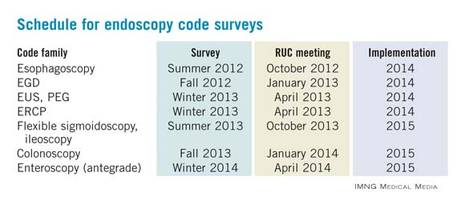
The schedule for the endoscopy codes to be surveyed is as follows:
Almost 20 years ago, when Medicare transitioned to a physician payment system based on the Resource Based-Relative Value Scale (RBRVS), the American Medical Association formulated a multispecialty committee, known as the RUC. The RUC carefully reviews survey data presented by specialty societies and develops recommendations for consideration by CMS. The RUC’s cycle for developing recommendations is closely coordinated with both the Current Procedural Terminology (CPT) Editorial Panel’s schedule for annual code revisions and the CMS schedule for annual updates in the Medicare Physician Payment Schedule.
The survey process asks physicians to assess the time, intensity, complexity, and the medical decision making to perform a procedure. Surveys are obtained from a random sample of practicing physicians. The surveyed physician is asked to value the pre-, intra- and postservice work of a given service, using the total work of a reference procedure for comparison.
The survey asks physicians to estimate the following in detail:
• Intraservice time of the procedure.
• Work of the service, compared with the work of a specialty standard.
• Times of preoperative tasks including preprocedure evaluation, positioning, and scrub, dress, and wait time.
• Times of immediate postoperative services, including monitoring the patient.
Once the surveys are completed, the societies analyze the data and prepare recommendations to ensure that the time, effort, and complexity of your work is accurately estimated in the hierarchy of the other codes in both the GI family and the rest of the fee schedule. Responding to a survey is critical, for the more people who respond to the survey, the better are the data that the societies can present to the RUC.
Over the fall of 2012, the EGD (esophagogastroduodenoscopy) codes were surveyed. During the holidays, the data were aggregated and analyzed. An expert panel was convened by the AGA, ASGE, and the Society of American Gastrointestinal and Endoscopic Surgeons to review the data and to prepare recommendations for the RUC. This is where I became involved in the process. The physicians and staff met throughout the month of January, with more than 25 hours of telephone and in-person meetings and almost another 70 hours of behind-the-scenes work to prepare for the RUC meeting.
As you can see, the physicians and staff were challenged with multiple major issues. The RUC meeting is not a vacation to an exotic location. The meeting took place in an airport hotel located between two freeways where there was nothing to do except work. From the time we arrived on Wednesday afternoon until the meeting ended on Saturday evening, our RUC advisers and staff were constantly in meetings 12-16 hours each day. During the meetings, the societies met with teams of physicians from the RUC who analyze the survey data. Ultimately, the societies make a facilitated recommendation to the RUC regarding the physician work, practice expense, and professional liability that ranks procedures within a family (for example, the EGD codes) against procedures in similar families (for example, the esophagoscopy codes), and to procedures outside of gastroenterology (for example, evaluation and management services, radiology, surgery, cardiology, etc.).
The wealth of knowledge that is possessed by our RUC advisers is much more than one can master in the course of these meetings. Our physicians and staff are very passionate about the process and have mastered a knowledge base that has required significant time and much effort to understand. This group of dedicated individuals should be commended on the tremendous amount of work they perform on behalf of our specialty. We all owe them much for their service.
We will await the final review by CMS, who will publish their first set of recommendations when the final rule is released this November. In the meantime, if you receive a request to participate in an RUC survey, make sure you do so.
In January, I attended the AMA’s Relative Value Update Committee (RUC) as an observer. As many of you are aware, the Centers for Medicare and Medicaid Services has requested a systematic review of the physician work and practice expenses for more than 100 endoscopic procedures performed by gastroenterologists. Several very dedicated physicians and staff from the AGA and the American Society for Gastrointestinal Endoscopy (ASGE) are heavily involved with this process, which will take several years to complete. Their dedication and passion for the process is truly impressive.
The schedule for the endoscopy codes to be surveyed is as follows:
Almost 20 years ago, when Medicare transitioned to a physician payment system based on the Resource Based-Relative Value Scale (RBRVS), the American Medical Association formulated a multispecialty committee, known as the RUC. The RUC carefully reviews survey data presented by specialty societies and develops recommendations for consideration by CMS. The RUC’s cycle for developing recommendations is closely coordinated with both the Current Procedural Terminology (CPT) Editorial Panel’s schedule for annual code revisions and the CMS schedule for annual updates in the Medicare Physician Payment Schedule.
The survey process asks physicians to assess the time, intensity, complexity, and the medical decision making to perform a procedure. Surveys are obtained from a random sample of practicing physicians. The surveyed physician is asked to value the pre-, intra- and postservice work of a given service, using the total work of a reference procedure for comparison.
The survey asks physicians to estimate the following in detail:
• Intraservice time of the procedure.
• Work of the service, compared with the work of a specialty standard.
• Times of preoperative tasks including preprocedure evaluation, positioning, and scrub, dress, and wait time.
• Times of immediate postoperative services, including monitoring the patient.
Once the surveys are completed, the societies analyze the data and prepare recommendations to ensure that the time, effort, and complexity of your work is accurately estimated in the hierarchy of the other codes in both the GI family and the rest of the fee schedule. Responding to a survey is critical, for the more people who respond to the survey, the better are the data that the societies can present to the RUC.
Over the fall of 2012, the EGD (esophagogastroduodenoscopy) codes were surveyed. During the holidays, the data were aggregated and analyzed. An expert panel was convened by the AGA, ASGE, and the Society of American Gastrointestinal and Endoscopic Surgeons to review the data and to prepare recommendations for the RUC. This is where I became involved in the process. The physicians and staff met throughout the month of January, with more than 25 hours of telephone and in-person meetings and almost another 70 hours of behind-the-scenes work to prepare for the RUC meeting.
As you can see, the physicians and staff were challenged with multiple major issues. The RUC meeting is not a vacation to an exotic location. The meeting took place in an airport hotel located between two freeways where there was nothing to do except work. From the time we arrived on Wednesday afternoon until the meeting ended on Saturday evening, our RUC advisers and staff were constantly in meetings 12-16 hours each day. During the meetings, the societies met with teams of physicians from the RUC who analyze the survey data. Ultimately, the societies make a facilitated recommendation to the RUC regarding the physician work, practice expense, and professional liability that ranks procedures within a family (for example, the EGD codes) against procedures in similar families (for example, the esophagoscopy codes), and to procedures outside of gastroenterology (for example, evaluation and management services, radiology, surgery, cardiology, etc.).
The wealth of knowledge that is possessed by our RUC advisers is much more than one can master in the course of these meetings. Our physicians and staff are very passionate about the process and have mastered a knowledge base that has required significant time and much effort to understand. This group of dedicated individuals should be commended on the tremendous amount of work they perform on behalf of our specialty. We all owe them much for their service.
We will await the final review by CMS, who will publish their first set of recommendations when the final rule is released this November. In the meantime, if you receive a request to participate in an RUC survey, make sure you do so.
In January, I attended the AMA’s Relative Value Update Committee (RUC) as an observer. As many of you are aware, the Centers for Medicare and Medicaid Services has requested a systematic review of the physician work and practice expenses for more than 100 endoscopic procedures performed by gastroenterologists. Several very dedicated physicians and staff from the AGA and the American Society for Gastrointestinal Endoscopy (ASGE) are heavily involved with this process, which will take several years to complete. Their dedication and passion for the process is truly impressive.
The schedule for the endoscopy codes to be surveyed is as follows:
Almost 20 years ago, when Medicare transitioned to a physician payment system based on the Resource Based-Relative Value Scale (RBRVS), the American Medical Association formulated a multispecialty committee, known as the RUC. The RUC carefully reviews survey data presented by specialty societies and develops recommendations for consideration by CMS. The RUC’s cycle for developing recommendations is closely coordinated with both the Current Procedural Terminology (CPT) Editorial Panel’s schedule for annual code revisions and the CMS schedule for annual updates in the Medicare Physician Payment Schedule.
The survey process asks physicians to assess the time, intensity, complexity, and the medical decision making to perform a procedure. Surveys are obtained from a random sample of practicing physicians. The surveyed physician is asked to value the pre-, intra- and postservice work of a given service, using the total work of a reference procedure for comparison.
The survey asks physicians to estimate the following in detail:
• Intraservice time of the procedure.
• Work of the service, compared with the work of a specialty standard.
• Times of preoperative tasks including preprocedure evaluation, positioning, and scrub, dress, and wait time.
• Times of immediate postoperative services, including monitoring the patient.
Once the surveys are completed, the societies analyze the data and prepare recommendations to ensure that the time, effort, and complexity of your work is accurately estimated in the hierarchy of the other codes in both the GI family and the rest of the fee schedule. Responding to a survey is critical, for the more people who respond to the survey, the better are the data that the societies can present to the RUC.
Over the fall of 2012, the EGD (esophagogastroduodenoscopy) codes were surveyed. During the holidays, the data were aggregated and analyzed. An expert panel was convened by the AGA, ASGE, and the Society of American Gastrointestinal and Endoscopic Surgeons to review the data and to prepare recommendations for the RUC. This is where I became involved in the process. The physicians and staff met throughout the month of January, with more than 25 hours of telephone and in-person meetings and almost another 70 hours of behind-the-scenes work to prepare for the RUC meeting.
As you can see, the physicians and staff were challenged with multiple major issues. The RUC meeting is not a vacation to an exotic location. The meeting took place in an airport hotel located between two freeways where there was nothing to do except work. From the time we arrived on Wednesday afternoon until the meeting ended on Saturday evening, our RUC advisers and staff were constantly in meetings 12-16 hours each day. During the meetings, the societies met with teams of physicians from the RUC who analyze the survey data. Ultimately, the societies make a facilitated recommendation to the RUC regarding the physician work, practice expense, and professional liability that ranks procedures within a family (for example, the EGD codes) against procedures in similar families (for example, the esophagoscopy codes), and to procedures outside of gastroenterology (for example, evaluation and management services, radiology, surgery, cardiology, etc.).
The wealth of knowledge that is possessed by our RUC advisers is much more than one can master in the course of these meetings. Our physicians and staff are very passionate about the process and have mastered a knowledge base that has required significant time and much effort to understand. This group of dedicated individuals should be commended on the tremendous amount of work they perform on behalf of our specialty. We all owe them much for their service.
We will await the final review by CMS, who will publish their first set of recommendations when the final rule is released this November. In the meantime, if you receive a request to participate in an RUC survey, make sure you do so.
Salix Pharmaceuticals Commits $1.125M to AGA Research Foundation
The American Gastroenterological Association (AGA) Research Foundation is pleased to welcome Salix Pharmaceuticals as a supporter of the foundation’s endowment.
The AGA Research Foundation provides research funding grants to young investigators in gastroenterology and hepatology. The foundation’s grants transform young researchers’ lives by encouraging them to embark on and continue careers in research. Many ultimately make discoveries that improve patient care.
Salix Pharmaceuticals is a specialty pharmaceutical company committed to the prevention and treatment of gastrointestinal (GI) disorders.
"AGA is committed to helping young scientists investigate the GI and liver diseases that plague millions of people. AGA-funded researchers hold the keys to the patient care advances of tomorrow. AGA is thrilled that Salix recognizes the importance of supporting discovery and has made a significant commitment to the AGA Research Foundation for years to come," said Nicholas F. LaRusso, M.D., AGAF, chair of the AGA Research Foundation.
Salix Pharmaceuticals’ $1.125 million, 5-year commitment to the AGA Research Foundation endowment will help ensure that researchers have the tools they need to discover ways to better diagnose, treat, and cure digestive diseases.
"Salix is passionate about providing solutions to address unmet treatment needs for people with GI disorders," said Carolyn Logan, president and chief executive officer, Salix Pharmaceuticals. "We are pleased to support the AGA Research Foundation in its mission of the advancement of gastroenterological and hepatological research."
Many breakthroughs have been achieved through gastroenterological and hepatological research over the past century, forming the basis of the modern medical practice. The AGA Research Foundation is working to continue this tradition of discovery and ultimately improve the lives of patients with digestive diseases through the researchers it funds. Salix’s support of the AGA Research Foundation’s mission is a critical investment in the future of the field of gastroenterology.
The American Gastroenterological Association (AGA) Research Foundation is pleased to welcome Salix Pharmaceuticals as a supporter of the foundation’s endowment.
The AGA Research Foundation provides research funding grants to young investigators in gastroenterology and hepatology. The foundation’s grants transform young researchers’ lives by encouraging them to embark on and continue careers in research. Many ultimately make discoveries that improve patient care.
Salix Pharmaceuticals is a specialty pharmaceutical company committed to the prevention and treatment of gastrointestinal (GI) disorders.
"AGA is committed to helping young scientists investigate the GI and liver diseases that plague millions of people. AGA-funded researchers hold the keys to the patient care advances of tomorrow. AGA is thrilled that Salix recognizes the importance of supporting discovery and has made a significant commitment to the AGA Research Foundation for years to come," said Nicholas F. LaRusso, M.D., AGAF, chair of the AGA Research Foundation.
Salix Pharmaceuticals’ $1.125 million, 5-year commitment to the AGA Research Foundation endowment will help ensure that researchers have the tools they need to discover ways to better diagnose, treat, and cure digestive diseases.
"Salix is passionate about providing solutions to address unmet treatment needs for people with GI disorders," said Carolyn Logan, president and chief executive officer, Salix Pharmaceuticals. "We are pleased to support the AGA Research Foundation in its mission of the advancement of gastroenterological and hepatological research."
Many breakthroughs have been achieved through gastroenterological and hepatological research over the past century, forming the basis of the modern medical practice. The AGA Research Foundation is working to continue this tradition of discovery and ultimately improve the lives of patients with digestive diseases through the researchers it funds. Salix’s support of the AGA Research Foundation’s mission is a critical investment in the future of the field of gastroenterology.
The American Gastroenterological Association (AGA) Research Foundation is pleased to welcome Salix Pharmaceuticals as a supporter of the foundation’s endowment.
The AGA Research Foundation provides research funding grants to young investigators in gastroenterology and hepatology. The foundation’s grants transform young researchers’ lives by encouraging them to embark on and continue careers in research. Many ultimately make discoveries that improve patient care.
Salix Pharmaceuticals is a specialty pharmaceutical company committed to the prevention and treatment of gastrointestinal (GI) disorders.
"AGA is committed to helping young scientists investigate the GI and liver diseases that plague millions of people. AGA-funded researchers hold the keys to the patient care advances of tomorrow. AGA is thrilled that Salix recognizes the importance of supporting discovery and has made a significant commitment to the AGA Research Foundation for years to come," said Nicholas F. LaRusso, M.D., AGAF, chair of the AGA Research Foundation.
Salix Pharmaceuticals’ $1.125 million, 5-year commitment to the AGA Research Foundation endowment will help ensure that researchers have the tools they need to discover ways to better diagnose, treat, and cure digestive diseases.
"Salix is passionate about providing solutions to address unmet treatment needs for people with GI disorders," said Carolyn Logan, president and chief executive officer, Salix Pharmaceuticals. "We are pleased to support the AGA Research Foundation in its mission of the advancement of gastroenterological and hepatological research."
Many breakthroughs have been achieved through gastroenterological and hepatological research over the past century, forming the basis of the modern medical practice. The AGA Research Foundation is working to continue this tradition of discovery and ultimately improve the lives of patients with digestive diseases through the researchers it funds. Salix’s support of the AGA Research Foundation’s mission is a critical investment in the future of the field of gastroenterology.
AGA introduces a new process for clinical practice guideline development
As reimbursement shifts from fee for service to value based, it is essential for physicians to focus on the quality – rather than quantity – of services provided. Given that physician reimbursement will increasingly hinge on achieving high-quality health outcomes, it is essential to address how health care "quality" is defined. AGA is committed to leading efforts to define the metrics by which clinical services and health outcomes are judged. As a result, AGA has recently introduced a new process for clinical practice guideline development, utilizing the Grading of Recommendations Assessment, Development and Evaluation (GRADE) framework. A complete review of the revised process will be published in the April issue of Clinical Gastroenterology and Hepatology in the "Practice Management: The Road Ahead" column.
Employed by more than 70 organizations and accepted by the National Quality Forum, GRADE is an internationally recognized method to determine the strength of current clinical evidence. The GRADE framework allows for comparison between published studies that vary in methods, comparison populations and statistical strength, allowing clinicians to judge strength of evidence and provide clinical recommendations. A "strong recommendation" means that most patients should receive the recommended course of action, whereas a conditional or "weak recommendation" means that different choices may be appropriate for different patients. Importantly, GRADE provides clear and actionable direction to patients, clinicians, and policy makers.
In addition to utilizing GRADE, the AGA’s new process for clinical practice guideline development fundamentally reshapes how topics are solicited. Beginning this month – and annually every March – AGA will make a "call for topics" to all members. By completing an online form, members may submit topics to be developed within the coming year. The AGA Institute Council will review guideline topics in May, prioritizing and ranking topics based on the following criteria: prevalence of disease, resource utilization, variation in care, other existing guidelines, new data/changes in diagnosis or treatment, and potential for measure/quality development. Once vetted, four new guidelines will be recommended for development across the year.
We encourage you to take part in this important process and submit your topic recommendations. AGA believes that gastroenterologists should define the quality metrics upon which they will be judged and reimbursed. In taking an active role, we can improve patient outcomes and be appropriately rewarded for performing high-quality care.
As reimbursement shifts from fee for service to value based, it is essential for physicians to focus on the quality – rather than quantity – of services provided. Given that physician reimbursement will increasingly hinge on achieving high-quality health outcomes, it is essential to address how health care "quality" is defined. AGA is committed to leading efforts to define the metrics by which clinical services and health outcomes are judged. As a result, AGA has recently introduced a new process for clinical practice guideline development, utilizing the Grading of Recommendations Assessment, Development and Evaluation (GRADE) framework. A complete review of the revised process will be published in the April issue of Clinical Gastroenterology and Hepatology in the "Practice Management: The Road Ahead" column.
Employed by more than 70 organizations and accepted by the National Quality Forum, GRADE is an internationally recognized method to determine the strength of current clinical evidence. The GRADE framework allows for comparison between published studies that vary in methods, comparison populations and statistical strength, allowing clinicians to judge strength of evidence and provide clinical recommendations. A "strong recommendation" means that most patients should receive the recommended course of action, whereas a conditional or "weak recommendation" means that different choices may be appropriate for different patients. Importantly, GRADE provides clear and actionable direction to patients, clinicians, and policy makers.
In addition to utilizing GRADE, the AGA’s new process for clinical practice guideline development fundamentally reshapes how topics are solicited. Beginning this month – and annually every March – AGA will make a "call for topics" to all members. By completing an online form, members may submit topics to be developed within the coming year. The AGA Institute Council will review guideline topics in May, prioritizing and ranking topics based on the following criteria: prevalence of disease, resource utilization, variation in care, other existing guidelines, new data/changes in diagnosis or treatment, and potential for measure/quality development. Once vetted, four new guidelines will be recommended for development across the year.
We encourage you to take part in this important process and submit your topic recommendations. AGA believes that gastroenterologists should define the quality metrics upon which they will be judged and reimbursed. In taking an active role, we can improve patient outcomes and be appropriately rewarded for performing high-quality care.
As reimbursement shifts from fee for service to value based, it is essential for physicians to focus on the quality – rather than quantity – of services provided. Given that physician reimbursement will increasingly hinge on achieving high-quality health outcomes, it is essential to address how health care "quality" is defined. AGA is committed to leading efforts to define the metrics by which clinical services and health outcomes are judged. As a result, AGA has recently introduced a new process for clinical practice guideline development, utilizing the Grading of Recommendations Assessment, Development and Evaluation (GRADE) framework. A complete review of the revised process will be published in the April issue of Clinical Gastroenterology and Hepatology in the "Practice Management: The Road Ahead" column.
Employed by more than 70 organizations and accepted by the National Quality Forum, GRADE is an internationally recognized method to determine the strength of current clinical evidence. The GRADE framework allows for comparison between published studies that vary in methods, comparison populations and statistical strength, allowing clinicians to judge strength of evidence and provide clinical recommendations. A "strong recommendation" means that most patients should receive the recommended course of action, whereas a conditional or "weak recommendation" means that different choices may be appropriate for different patients. Importantly, GRADE provides clear and actionable direction to patients, clinicians, and policy makers.
In addition to utilizing GRADE, the AGA’s new process for clinical practice guideline development fundamentally reshapes how topics are solicited. Beginning this month – and annually every March – AGA will make a "call for topics" to all members. By completing an online form, members may submit topics to be developed within the coming year. The AGA Institute Council will review guideline topics in May, prioritizing and ranking topics based on the following criteria: prevalence of disease, resource utilization, variation in care, other existing guidelines, new data/changes in diagnosis or treatment, and potential for measure/quality development. Once vetted, four new guidelines will be recommended for development across the year.
We encourage you to take part in this important process and submit your topic recommendations. AGA believes that gastroenterologists should define the quality metrics upon which they will be judged and reimbursed. In taking an active role, we can improve patient outcomes and be appropriately rewarded for performing high-quality care.