User login
Submit an abstract for DDW® 2016
The Digestive Disease Week® (DDW) 2016 call for abstracts opened this October. The deadline to submit is Dec. 1, 2015, at 9 p.m. ET.
Abstracts presented at national meetings held outside of the U.S. may be submitted to DDW. Abstracts that have been submitted to DDW in previous years but not accepted for presentation may also be resubmitted.
Easily navigate the online abstract submission process, with a tutorial video, step-by-step guide, and full abstract submission guidelines at www.ddw.org/abstracts.
Showcase your innovations in GI, hepatology, GI endoscopy, and GI surgery, and share your work at the world’s largest gathering of leaders in the field of digestive diseases. Submit an abstract at https://ddw2016.abstractcentral.com/.
Travel awards available
Twenty inaugural DDW Basic Science Travel Grants will be awarded to abstract authors for the 2016 meeting. Presenting authors of selected abstracts featuring basic science research will receive travel awards and recognition at a reception at DDW.
Domestic and international travel awards are also available through the AGA Research Foundation. These awards were created to support travel and related expenses to attend DDW. Learn more at http://www.gastro.org/research-funding.
The Digestive Disease Week® (DDW) 2016 call for abstracts opened this October. The deadline to submit is Dec. 1, 2015, at 9 p.m. ET.
Abstracts presented at national meetings held outside of the U.S. may be submitted to DDW. Abstracts that have been submitted to DDW in previous years but not accepted for presentation may also be resubmitted.
Easily navigate the online abstract submission process, with a tutorial video, step-by-step guide, and full abstract submission guidelines at www.ddw.org/abstracts.
Showcase your innovations in GI, hepatology, GI endoscopy, and GI surgery, and share your work at the world’s largest gathering of leaders in the field of digestive diseases. Submit an abstract at https://ddw2016.abstractcentral.com/.
Travel awards available
Twenty inaugural DDW Basic Science Travel Grants will be awarded to abstract authors for the 2016 meeting. Presenting authors of selected abstracts featuring basic science research will receive travel awards and recognition at a reception at DDW.
Domestic and international travel awards are also available through the AGA Research Foundation. These awards were created to support travel and related expenses to attend DDW. Learn more at http://www.gastro.org/research-funding.
The Digestive Disease Week® (DDW) 2016 call for abstracts opened this October. The deadline to submit is Dec. 1, 2015, at 9 p.m. ET.
Abstracts presented at national meetings held outside of the U.S. may be submitted to DDW. Abstracts that have been submitted to DDW in previous years but not accepted for presentation may also be resubmitted.
Easily navigate the online abstract submission process, with a tutorial video, step-by-step guide, and full abstract submission guidelines at www.ddw.org/abstracts.
Showcase your innovations in GI, hepatology, GI endoscopy, and GI surgery, and share your work at the world’s largest gathering of leaders in the field of digestive diseases. Submit an abstract at https://ddw2016.abstractcentral.com/.
Travel awards available
Twenty inaugural DDW Basic Science Travel Grants will be awarded to abstract authors for the 2016 meeting. Presenting authors of selected abstracts featuring basic science research will receive travel awards and recognition at a reception at DDW.
Domestic and international travel awards are also available through the AGA Research Foundation. These awards were created to support travel and related expenses to attend DDW. Learn more at http://www.gastro.org/research-funding.
AGA says ‘yes’ to national initiative on microbiomes
Leading scientists have joined together with a very important message: We need to better understand microbiomes, and the path forward requires a unified approach. AGA supports this call for a major multidisciplinary, public-private initiative to improve our understanding of the microbial communities critical to all ecosystems, particularly the human body.
Despite continued scientific and technological advances, we know little about the interplay between microbes, their hosts, and their environments. Gastroenterology is poised to play a critical role in future research due to its unique insight into the gut microbiome. Rob Knight, Ph.D., member of the AGA Center for Gut Microbiome Research and Education scientific advisory board and professor of pediatrics and computer science at the University of California in San Diego, explains:
“The gut microbiome is a particularly illustrative example of microbiomes, because everyone has one and has experienced what it is like when that ecosystem is out of balance. The accessibility of the site — you don’t have to go to the rainforest to see thousands of species interacting, you just have to go to the bathroom — positions gastroenterology to make fundamental contributions, not just to human health but to ecosystem science.”
Through our center and its promotion of microbiome research and education, AGA is committed to moving this national discussion forward. Current activities of the center include:
AGA recently issued a call for gut microbiota samples. Through a partnership with American Gut, 500 samples collected from AGA volunteers will be analyzed and interesting trends will be reported during a special session at Digestive Disease Week® 2016.
AGA, in conjunction with the European Society of Neurogastroenterology and Motility, is in the midst of planning a robust research-focused agenda for the 2016 Gut Microbiota for Health World Summit. Registration is now open for this meeting, which will take place March 5 and 6, 2016, in Miami.
AGA is planning a congressional briefing to address gut microbiome opportunities and needs, as well as the pertinent microbiome issues of antibiotic resistance and fecal transplants.
AGA, in collaboration with the Crohn’s & Colitis Foundation of America, Infectious Diseases Society of America, and the North American Society for Pediatric Gastroenterology, Hepatology and Nutrition, is working to develop a national registry on fecal microbiota transplantation.
AGA offers several research grants to support gut microbiome research, including the AGA-Elsevier Gut Microbiome Pilot Research Award (applications due Jan. 15, 2016).
Stay tuned: the AGA Center for Gut Microbiome Research and Education will continue to update members on the latest science and educational opportunities, as well as national strategy, related to the microbiome.
Leading scientists have joined together with a very important message: We need to better understand microbiomes, and the path forward requires a unified approach. AGA supports this call for a major multidisciplinary, public-private initiative to improve our understanding of the microbial communities critical to all ecosystems, particularly the human body.
Despite continued scientific and technological advances, we know little about the interplay between microbes, their hosts, and their environments. Gastroenterology is poised to play a critical role in future research due to its unique insight into the gut microbiome. Rob Knight, Ph.D., member of the AGA Center for Gut Microbiome Research and Education scientific advisory board and professor of pediatrics and computer science at the University of California in San Diego, explains:
“The gut microbiome is a particularly illustrative example of microbiomes, because everyone has one and has experienced what it is like when that ecosystem is out of balance. The accessibility of the site — you don’t have to go to the rainforest to see thousands of species interacting, you just have to go to the bathroom — positions gastroenterology to make fundamental contributions, not just to human health but to ecosystem science.”
Through our center and its promotion of microbiome research and education, AGA is committed to moving this national discussion forward. Current activities of the center include:
AGA recently issued a call for gut microbiota samples. Through a partnership with American Gut, 500 samples collected from AGA volunteers will be analyzed and interesting trends will be reported during a special session at Digestive Disease Week® 2016.
AGA, in conjunction with the European Society of Neurogastroenterology and Motility, is in the midst of planning a robust research-focused agenda for the 2016 Gut Microbiota for Health World Summit. Registration is now open for this meeting, which will take place March 5 and 6, 2016, in Miami.
AGA is planning a congressional briefing to address gut microbiome opportunities and needs, as well as the pertinent microbiome issues of antibiotic resistance and fecal transplants.
AGA, in collaboration with the Crohn’s & Colitis Foundation of America, Infectious Diseases Society of America, and the North American Society for Pediatric Gastroenterology, Hepatology and Nutrition, is working to develop a national registry on fecal microbiota transplantation.
AGA offers several research grants to support gut microbiome research, including the AGA-Elsevier Gut Microbiome Pilot Research Award (applications due Jan. 15, 2016).
Stay tuned: the AGA Center for Gut Microbiome Research and Education will continue to update members on the latest science and educational opportunities, as well as national strategy, related to the microbiome.
Leading scientists have joined together with a very important message: We need to better understand microbiomes, and the path forward requires a unified approach. AGA supports this call for a major multidisciplinary, public-private initiative to improve our understanding of the microbial communities critical to all ecosystems, particularly the human body.
Despite continued scientific and technological advances, we know little about the interplay between microbes, their hosts, and their environments. Gastroenterology is poised to play a critical role in future research due to its unique insight into the gut microbiome. Rob Knight, Ph.D., member of the AGA Center for Gut Microbiome Research and Education scientific advisory board and professor of pediatrics and computer science at the University of California in San Diego, explains:
“The gut microbiome is a particularly illustrative example of microbiomes, because everyone has one and has experienced what it is like when that ecosystem is out of balance. The accessibility of the site — you don’t have to go to the rainforest to see thousands of species interacting, you just have to go to the bathroom — positions gastroenterology to make fundamental contributions, not just to human health but to ecosystem science.”
Through our center and its promotion of microbiome research and education, AGA is committed to moving this national discussion forward. Current activities of the center include:
AGA recently issued a call for gut microbiota samples. Through a partnership with American Gut, 500 samples collected from AGA volunteers will be analyzed and interesting trends will be reported during a special session at Digestive Disease Week® 2016.
AGA, in conjunction with the European Society of Neurogastroenterology and Motility, is in the midst of planning a robust research-focused agenda for the 2016 Gut Microbiota for Health World Summit. Registration is now open for this meeting, which will take place March 5 and 6, 2016, in Miami.
AGA is planning a congressional briefing to address gut microbiome opportunities and needs, as well as the pertinent microbiome issues of antibiotic resistance and fecal transplants.
AGA, in collaboration with the Crohn’s & Colitis Foundation of America, Infectious Diseases Society of America, and the North American Society for Pediatric Gastroenterology, Hepatology and Nutrition, is working to develop a national registry on fecal microbiota transplantation.
AGA offers several research grants to support gut microbiome research, including the AGA-Elsevier Gut Microbiome Pilot Research Award (applications due Jan. 15, 2016).
Stay tuned: the AGA Center for Gut Microbiome Research and Education will continue to update members on the latest science and educational opportunities, as well as national strategy, related to the microbiome.
CMS cuts reimbursement to colonoscopy
In late October, the Centers for Medicare & Medicaid Services released the CY 2016 Physician Fee Schedule Final Rule. AGA, ACG, and ASGE are outraged at the failure of CMS to accept the GI societies’ reimbursement recommendations. The cuts to the colonoscopy family of codes are inappropriately deep and, at their highest, slash payment for some colonoscopy procedures by more than 17%. The cuts proposed in July were as high as 20%, and AGA, ACG, and ASGE, and thousands of our member gastroenterologists advocated strongly against these cuts.
The societies provided research-driven data to support the values recommended by our organizations. The cuts in the final rule were not based on the data submitted; ultimately, our recommendations were disregarded. We intend to shine a light on this fact to Congress and the public.
In the months ahead, we will call on you to reach out to CMS and legislators on Capitol Hill, so that they can better understand the direct impact that these cuts are having on your practice and on patients.
We will also provide more detailed information and resources to help practices prepare for payment and policy changes. AGA, ACG, and ASGE are committed to working together to fight for fair reimbursement for GI procedures. Watch your email for updates on this important issue.
See a chart of affected codes and the latest news on gastro.org.
In late October, the Centers for Medicare & Medicaid Services released the CY 2016 Physician Fee Schedule Final Rule. AGA, ACG, and ASGE are outraged at the failure of CMS to accept the GI societies’ reimbursement recommendations. The cuts to the colonoscopy family of codes are inappropriately deep and, at their highest, slash payment for some colonoscopy procedures by more than 17%. The cuts proposed in July were as high as 20%, and AGA, ACG, and ASGE, and thousands of our member gastroenterologists advocated strongly against these cuts.
The societies provided research-driven data to support the values recommended by our organizations. The cuts in the final rule were not based on the data submitted; ultimately, our recommendations were disregarded. We intend to shine a light on this fact to Congress and the public.
In the months ahead, we will call on you to reach out to CMS and legislators on Capitol Hill, so that they can better understand the direct impact that these cuts are having on your practice and on patients.
We will also provide more detailed information and resources to help practices prepare for payment and policy changes. AGA, ACG, and ASGE are committed to working together to fight for fair reimbursement for GI procedures. Watch your email for updates on this important issue.
See a chart of affected codes and the latest news on gastro.org.
In late October, the Centers for Medicare & Medicaid Services released the CY 2016 Physician Fee Schedule Final Rule. AGA, ACG, and ASGE are outraged at the failure of CMS to accept the GI societies’ reimbursement recommendations. The cuts to the colonoscopy family of codes are inappropriately deep and, at their highest, slash payment for some colonoscopy procedures by more than 17%. The cuts proposed in July were as high as 20%, and AGA, ACG, and ASGE, and thousands of our member gastroenterologists advocated strongly against these cuts.
The societies provided research-driven data to support the values recommended by our organizations. The cuts in the final rule were not based on the data submitted; ultimately, our recommendations were disregarded. We intend to shine a light on this fact to Congress and the public.
In the months ahead, we will call on you to reach out to CMS and legislators on Capitol Hill, so that they can better understand the direct impact that these cuts are having on your practice and on patients.
We will also provide more detailed information and resources to help practices prepare for payment and policy changes. AGA, ACG, and ASGE are committed to working together to fight for fair reimbursement for GI procedures. Watch your email for updates on this important issue.
See a chart of affected codes and the latest news on gastro.org.
Support young researchers through the AGA Research Foundation
Thanks to the generous support of our donors, the AGA Research Foundation is cultivating the future of the GI community through research grants to young investigators. The work and discoveries of AGA Research Foundation grant recipients will open doors to new treatments and exciting new areas of knowledge.
Through your contributions, you can help to ensure the future of gastroenterology and hepatology research and practice.
Donate today to help us fulfill our vision of fostering the future of young researchers in gastroenterology and hepatology.
2015 Award Recipients
In the 2015 research award cycle, the AGA Research Foundation provided more than $2.3 million in research award support to 69 scientists. We funded five Research Scholar Award (RSA) recipients at $90,000 for 3 years. Outside of the RSAs, the foundation provided several other funding vehicles for individuals ranging from high school students to established investigators.
With your support, we are building a community of researchers whose work serves the greater community and benefits all our patients.
Here are just a few of the researchers the AGA Research Foundation is funding.
Christina A. Twyman-Saint Victor, M.D.
University of Pennsylvania, Philadelphia
2015 AGA Research Scholar Award Recipient
“I am deeply honored to receive the 2015 AGA Research Scholar Award. I would like to thank the AGA Research Foundation for this award, which will support me as I pursue a career as a physician-scientist and transition to an independent physician-researcher.” – Her research focused on pancreatic cancer, which has a dismal prognosis and is expected to be the second leading cause of cancer-related deaths by 2020.
Arthur Beyder, M.D., Ph.D.
Mayo Clinic, Rochester, Minn.
2015 AGA Research Scholar Award Recipient
“I am grateful to the selection committee for recognizing my work and would like to thank the AGA Research Foundation and foundation donors for their generous support. This award will be instrumental for my development as an academic gastroenterologist.” – He will use this research funding to improve our understanding of functional GI disorders, specifically IBS.
Luis Vazquez-Montesino
San Juan Bautista School of Medicine, Puerto Rico
2015 AGA Investing in the Future Student Research Fellowship
“Coming from a small island, opportunities like this are scarce. But, if life here has taught me anything, it is that with hard work, dedication, and passion, incredible things can come about. This experience is an example of that. I am certain that this grant will be a huge stepping-stone for my future career path.” – This award will allow Luis to travel out of state to work with top investigators in the field.
Give back and ensure continued advances in the diagnosis, treatment, and cure of digestive diseases. Support talented researchers in gastroenterology and hepatology like Dr. Christina Twyman-Saint Victor and Dr. Arthur Beyder, and student Luis Vazquez-Montesino through the AGA Research Foundation. Make a tax-deductible donation today at www.gastro.org/donateonline.
Thanks to the generous support of our donors, the AGA Research Foundation is cultivating the future of the GI community through research grants to young investigators. The work and discoveries of AGA Research Foundation grant recipients will open doors to new treatments and exciting new areas of knowledge.
Through your contributions, you can help to ensure the future of gastroenterology and hepatology research and practice.
Donate today to help us fulfill our vision of fostering the future of young researchers in gastroenterology and hepatology.
2015 Award Recipients
In the 2015 research award cycle, the AGA Research Foundation provided more than $2.3 million in research award support to 69 scientists. We funded five Research Scholar Award (RSA) recipients at $90,000 for 3 years. Outside of the RSAs, the foundation provided several other funding vehicles for individuals ranging from high school students to established investigators.
With your support, we are building a community of researchers whose work serves the greater community and benefits all our patients.
Here are just a few of the researchers the AGA Research Foundation is funding.
Christina A. Twyman-Saint Victor, M.D.
University of Pennsylvania, Philadelphia
2015 AGA Research Scholar Award Recipient
“I am deeply honored to receive the 2015 AGA Research Scholar Award. I would like to thank the AGA Research Foundation for this award, which will support me as I pursue a career as a physician-scientist and transition to an independent physician-researcher.” – Her research focused on pancreatic cancer, which has a dismal prognosis and is expected to be the second leading cause of cancer-related deaths by 2020.
Arthur Beyder, M.D., Ph.D.
Mayo Clinic, Rochester, Minn.
2015 AGA Research Scholar Award Recipient
“I am grateful to the selection committee for recognizing my work and would like to thank the AGA Research Foundation and foundation donors for their generous support. This award will be instrumental for my development as an academic gastroenterologist.” – He will use this research funding to improve our understanding of functional GI disorders, specifically IBS.
Luis Vazquez-Montesino
San Juan Bautista School of Medicine, Puerto Rico
2015 AGA Investing in the Future Student Research Fellowship
“Coming from a small island, opportunities like this are scarce. But, if life here has taught me anything, it is that with hard work, dedication, and passion, incredible things can come about. This experience is an example of that. I am certain that this grant will be a huge stepping-stone for my future career path.” – This award will allow Luis to travel out of state to work with top investigators in the field.
Give back and ensure continued advances in the diagnosis, treatment, and cure of digestive diseases. Support talented researchers in gastroenterology and hepatology like Dr. Christina Twyman-Saint Victor and Dr. Arthur Beyder, and student Luis Vazquez-Montesino through the AGA Research Foundation. Make a tax-deductible donation today at www.gastro.org/donateonline.
Thanks to the generous support of our donors, the AGA Research Foundation is cultivating the future of the GI community through research grants to young investigators. The work and discoveries of AGA Research Foundation grant recipients will open doors to new treatments and exciting new areas of knowledge.
Through your contributions, you can help to ensure the future of gastroenterology and hepatology research and practice.
Donate today to help us fulfill our vision of fostering the future of young researchers in gastroenterology and hepatology.
2015 Award Recipients
In the 2015 research award cycle, the AGA Research Foundation provided more than $2.3 million in research award support to 69 scientists. We funded five Research Scholar Award (RSA) recipients at $90,000 for 3 years. Outside of the RSAs, the foundation provided several other funding vehicles for individuals ranging from high school students to established investigators.
With your support, we are building a community of researchers whose work serves the greater community and benefits all our patients.
Here are just a few of the researchers the AGA Research Foundation is funding.
Christina A. Twyman-Saint Victor, M.D.
University of Pennsylvania, Philadelphia
2015 AGA Research Scholar Award Recipient
“I am deeply honored to receive the 2015 AGA Research Scholar Award. I would like to thank the AGA Research Foundation for this award, which will support me as I pursue a career as a physician-scientist and transition to an independent physician-researcher.” – Her research focused on pancreatic cancer, which has a dismal prognosis and is expected to be the second leading cause of cancer-related deaths by 2020.
Arthur Beyder, M.D., Ph.D.
Mayo Clinic, Rochester, Minn.
2015 AGA Research Scholar Award Recipient
“I am grateful to the selection committee for recognizing my work and would like to thank the AGA Research Foundation and foundation donors for their generous support. This award will be instrumental for my development as an academic gastroenterologist.” – He will use this research funding to improve our understanding of functional GI disorders, specifically IBS.
Luis Vazquez-Montesino
San Juan Bautista School of Medicine, Puerto Rico
2015 AGA Investing in the Future Student Research Fellowship
“Coming from a small island, opportunities like this are scarce. But, if life here has taught me anything, it is that with hard work, dedication, and passion, incredible things can come about. This experience is an example of that. I am certain that this grant will be a huge stepping-stone for my future career path.” – This award will allow Luis to travel out of state to work with top investigators in the field.
Give back and ensure continued advances in the diagnosis, treatment, and cure of digestive diseases. Support talented researchers in gastroenterology and hepatology like Dr. Christina Twyman-Saint Victor and Dr. Arthur Beyder, and student Luis Vazquez-Montesino through the AGA Research Foundation. Make a tax-deductible donation today at www.gastro.org/donateonline.
Future leaders share their visions for AGA
During the AGA Leadership Cabinet Meeting in Washington, DC, on Sept. 18, members of the inaugural class of the AGA Future Leaders Program presented on how they envision advancing AGA’s Strategic Plan. This was part of a larger Future Leaders Program that coincided with the AGA Joint Committee Meetings, which included leadership training and advocacy activities on Capitol Hill.
Over the past several months, future leaders worked in teams of two along with their mentors to develop proposals that support AGA’s strategic goals related to practice and quality, research and innovation, education and training, advocacy, publications, or member engagement.
Each team then presented its proposals at the Leadership Cabinet Meeting to the AGA Governing Board, committee chairs, and chairs-elect, who were encouraged to ask questions and evaluate and rate the presentations in real time.

The three highest-rated presentations and presenters (pictured with AGA Governing Board members Suzanne Rose, M.D., MSEd, AGAF, Byron L. Cryer, M.D., Sheila E. Crowe, M.D., AGAF, and Michael Camilleri, M.D., AGAF) include:
• “Maintaining and enhancing the physician scientist researcher in gastroenterology,” presented by Neelandu Dey, M.D., and Kara Gross Margolis, M.D., with their mentor Xavier Llor, M.D.
• “Trends in the delivery of medical education,” presented by Silvio de Melo Jr., M.D., and Brijen J. Shaw, M.D., with their mentor Gary W. Falk, M.D., MS, AGAF
• “Fostering global gastrointestinal health,” presented by Gilaad G. Kaplan, M.D., and Benjamin Lebwohl, M.D., with mentor Darrell Pardi, M.D., MS
Read more about the AGA Future Leaders Program in Clinical Gastroenterology and Hepatology. AGA congratulates all of the future leaders and their mentors for proposing many new and innovative programs that will help advance the science and practice of gastroenterology.
See the full list of future leaders and mentors at gastro.org
During the AGA Leadership Cabinet Meeting in Washington, DC, on Sept. 18, members of the inaugural class of the AGA Future Leaders Program presented on how they envision advancing AGA’s Strategic Plan. This was part of a larger Future Leaders Program that coincided with the AGA Joint Committee Meetings, which included leadership training and advocacy activities on Capitol Hill.
Over the past several months, future leaders worked in teams of two along with their mentors to develop proposals that support AGA’s strategic goals related to practice and quality, research and innovation, education and training, advocacy, publications, or member engagement.
Each team then presented its proposals at the Leadership Cabinet Meeting to the AGA Governing Board, committee chairs, and chairs-elect, who were encouraged to ask questions and evaluate and rate the presentations in real time.
The three highest-rated presentations and presenters (pictured with AGA Governing Board members Suzanne Rose, M.D., MSEd, AGAF, Byron L. Cryer, M.D., Sheila E. Crowe, M.D., AGAF, and Michael Camilleri, M.D., AGAF) include:
• “Maintaining and enhancing the physician scientist researcher in gastroenterology,” presented by Neelandu Dey, M.D., and Kara Gross Margolis, M.D., with their mentor Xavier Llor, M.D.
• “Trends in the delivery of medical education,” presented by Silvio de Melo Jr., M.D., and Brijen J. Shaw, M.D., with their mentor Gary W. Falk, M.D., MS, AGAF
• “Fostering global gastrointestinal health,” presented by Gilaad G. Kaplan, M.D., and Benjamin Lebwohl, M.D., with mentor Darrell Pardi, M.D., MS
Read more about the AGA Future Leaders Program in Clinical Gastroenterology and Hepatology. AGA congratulates all of the future leaders and their mentors for proposing many new and innovative programs that will help advance the science and practice of gastroenterology.
See the full list of future leaders and mentors at gastro.org
During the AGA Leadership Cabinet Meeting in Washington, DC, on Sept. 18, members of the inaugural class of the AGA Future Leaders Program presented on how they envision advancing AGA’s Strategic Plan. This was part of a larger Future Leaders Program that coincided with the AGA Joint Committee Meetings, which included leadership training and advocacy activities on Capitol Hill.
Over the past several months, future leaders worked in teams of two along with their mentors to develop proposals that support AGA’s strategic goals related to practice and quality, research and innovation, education and training, advocacy, publications, or member engagement.
Each team then presented its proposals at the Leadership Cabinet Meeting to the AGA Governing Board, committee chairs, and chairs-elect, who were encouraged to ask questions and evaluate and rate the presentations in real time.
The three highest-rated presentations and presenters (pictured with AGA Governing Board members Suzanne Rose, M.D., MSEd, AGAF, Byron L. Cryer, M.D., Sheila E. Crowe, M.D., AGAF, and Michael Camilleri, M.D., AGAF) include:
• “Maintaining and enhancing the physician scientist researcher in gastroenterology,” presented by Neelandu Dey, M.D., and Kara Gross Margolis, M.D., with their mentor Xavier Llor, M.D.
• “Trends in the delivery of medical education,” presented by Silvio de Melo Jr., M.D., and Brijen J. Shaw, M.D., with their mentor Gary W. Falk, M.D., MS, AGAF
• “Fostering global gastrointestinal health,” presented by Gilaad G. Kaplan, M.D., and Benjamin Lebwohl, M.D., with mentor Darrell Pardi, M.D., MS
Read more about the AGA Future Leaders Program in Clinical Gastroenterology and Hepatology. AGA congratulates all of the future leaders and their mentors for proposing many new and innovative programs that will help advance the science and practice of gastroenterology.
See the full list of future leaders and mentors at gastro.org

AGA Digestive Health Recognition Program™ now open for 2015 PQRS filing
The data submission period for the AGA Digestive Health Recognition Program™ (DHRP) is now open for 2015 filing. DHRP was developed as a quality improvement program and clinical data registry to allow clinicians to demonstrate quality of care in colon cancer screening and the management of patients with HCV and/or IBD. The program allows participants to submit data for the CMS Physician Quality Reporting System (PQRS) and avoid significant Medicare reimbursement penalties.
Enrolling in DHRP has several benefits. Clinicians can report on as few as 20 patients when providing data for IBD or HCV. They can also monitor their performance on quality measures, benchmark themselves in relation to their peers, identify gaps in care and improve patient outcomes – all while avoiding PQRS penalties. The deadline to enroll for the 2015 PQRS year is Feb. 8, 2016. DHRP is made possible by support from: AbbVie; Gilead Science, Inc.; Janssen Biotech, Inc. and Janssen Therapeutics, Division of Janssen Products, LLP; and Shire Pharmaceuticals.
Members pay $300 to enroll by visiting http://www.gastro.org/DHRP.
The data submission period for the AGA Digestive Health Recognition Program™ (DHRP) is now open for 2015 filing. DHRP was developed as a quality improvement program and clinical data registry to allow clinicians to demonstrate quality of care in colon cancer screening and the management of patients with HCV and/or IBD. The program allows participants to submit data for the CMS Physician Quality Reporting System (PQRS) and avoid significant Medicare reimbursement penalties.
Enrolling in DHRP has several benefits. Clinicians can report on as few as 20 patients when providing data for IBD or HCV. They can also monitor their performance on quality measures, benchmark themselves in relation to their peers, identify gaps in care and improve patient outcomes – all while avoiding PQRS penalties. The deadline to enroll for the 2015 PQRS year is Feb. 8, 2016. DHRP is made possible by support from: AbbVie; Gilead Science, Inc.; Janssen Biotech, Inc. and Janssen Therapeutics, Division of Janssen Products, LLP; and Shire Pharmaceuticals.
Members pay $300 to enroll by visiting http://www.gastro.org/DHRP.
The data submission period for the AGA Digestive Health Recognition Program™ (DHRP) is now open for 2015 filing. DHRP was developed as a quality improvement program and clinical data registry to allow clinicians to demonstrate quality of care in colon cancer screening and the management of patients with HCV and/or IBD. The program allows participants to submit data for the CMS Physician Quality Reporting System (PQRS) and avoid significant Medicare reimbursement penalties.
Enrolling in DHRP has several benefits. Clinicians can report on as few as 20 patients when providing data for IBD or HCV. They can also monitor their performance on quality measures, benchmark themselves in relation to their peers, identify gaps in care and improve patient outcomes – all while avoiding PQRS penalties. The deadline to enroll for the 2015 PQRS year is Feb. 8, 2016. DHRP is made possible by support from: AbbVie; Gilead Science, Inc.; Janssen Biotech, Inc. and Janssen Therapeutics, Division of Janssen Products, LLP; and Shire Pharmaceuticals.
Members pay $300 to enroll by visiting http://www.gastro.org/DHRP.
Congress supports CRC screening
The AGA, ASGE, and ACG applaud 27 members of the U.S. Senate and 94 members of the U.S. House of Representatives for calling on the Centers for Medicare & Medicaid Services in late September to consider the effect colonoscopy has had in reducing the incidence of colorectal cancer when determining whether a drastic reduction in Medicare payment for colonoscopy is justified.
The three gastroenterology societies, which together represent virtually every gastroenterologist in the nation, specifically thank Sen. Ben Cardin (D-Md.) and Sen. Bill Cassidy, M.D. (R-La.), and Rep. Donald Payne Jr. (D-N.J.) and Rep. Leonard Lance (R-N.J.), who championed these U.S. Senate and House letters to the CMS.
“Thanks to increased screening rates, colorectal cancer incidence rates in the United States have dropped by more than 30% over the past decade,” Sen. Cardin said. “We must avoid any action that could jeopardize the significant progress we’ve made. Working together, we can reach HHS’s goal of an 80% screening rate by 2018.”
“As a gastroenterologist, I know the value of improving colorectal cancer screening rates in Medicare. We must ensure that any changes made in Medicare reimbursement don’t hamper the progress made in cancer screening,” Sen. Cassidy said. “These screenings help reduce the rate of colorectal cancer, which is devastating for patients, and costly to the system.”
On Sept. 8, the AGA, ASGE, and ACG submitted formal comments to the CMS that included an in-depth and detailed review of the CMS’s flawed methodologies and rationale for making these cuts.
Fortunately, Sen. Ben Cardin and Sen. Bill Cassidy, and Rep. Donald Payne Jr. and Rep. Leonard Lance, “see that the proposed 2016 Medicare reimbursement cuts could limit patient access to colorectal cancer screening,” said Michael Camilleri, M.D., AGAF, president, AGA Institute. “We thank them for asking CMS to carefully consider stakeholder comments on the proposed rule and determine whether deep reductions in reimbursement rates are justified by the evidence and whether cuts are in the interests of Medicare beneficiaries.”
Find out more information about the value of colorectal cancer screening and prevention at www.valueofcolonoscopy.org.
The AGA, ASGE, and ACG applaud 27 members of the U.S. Senate and 94 members of the U.S. House of Representatives for calling on the Centers for Medicare & Medicaid Services in late September to consider the effect colonoscopy has had in reducing the incidence of colorectal cancer when determining whether a drastic reduction in Medicare payment for colonoscopy is justified.
The three gastroenterology societies, which together represent virtually every gastroenterologist in the nation, specifically thank Sen. Ben Cardin (D-Md.) and Sen. Bill Cassidy, M.D. (R-La.), and Rep. Donald Payne Jr. (D-N.J.) and Rep. Leonard Lance (R-N.J.), who championed these U.S. Senate and House letters to the CMS.
“Thanks to increased screening rates, colorectal cancer incidence rates in the United States have dropped by more than 30% over the past decade,” Sen. Cardin said. “We must avoid any action that could jeopardize the significant progress we’ve made. Working together, we can reach HHS’s goal of an 80% screening rate by 2018.”
“As a gastroenterologist, I know the value of improving colorectal cancer screening rates in Medicare. We must ensure that any changes made in Medicare reimbursement don’t hamper the progress made in cancer screening,” Sen. Cassidy said. “These screenings help reduce the rate of colorectal cancer, which is devastating for patients, and costly to the system.”
On Sept. 8, the AGA, ASGE, and ACG submitted formal comments to the CMS that included an in-depth and detailed review of the CMS’s flawed methodologies and rationale for making these cuts.
Fortunately, Sen. Ben Cardin and Sen. Bill Cassidy, and Rep. Donald Payne Jr. and Rep. Leonard Lance, “see that the proposed 2016 Medicare reimbursement cuts could limit patient access to colorectal cancer screening,” said Michael Camilleri, M.D., AGAF, president, AGA Institute. “We thank them for asking CMS to carefully consider stakeholder comments on the proposed rule and determine whether deep reductions in reimbursement rates are justified by the evidence and whether cuts are in the interests of Medicare beneficiaries.”
Find out more information about the value of colorectal cancer screening and prevention at www.valueofcolonoscopy.org.
The AGA, ASGE, and ACG applaud 27 members of the U.S. Senate and 94 members of the U.S. House of Representatives for calling on the Centers for Medicare & Medicaid Services in late September to consider the effect colonoscopy has had in reducing the incidence of colorectal cancer when determining whether a drastic reduction in Medicare payment for colonoscopy is justified.
The three gastroenterology societies, which together represent virtually every gastroenterologist in the nation, specifically thank Sen. Ben Cardin (D-Md.) and Sen. Bill Cassidy, M.D. (R-La.), and Rep. Donald Payne Jr. (D-N.J.) and Rep. Leonard Lance (R-N.J.), who championed these U.S. Senate and House letters to the CMS.
“Thanks to increased screening rates, colorectal cancer incidence rates in the United States have dropped by more than 30% over the past decade,” Sen. Cardin said. “We must avoid any action that could jeopardize the significant progress we’ve made. Working together, we can reach HHS’s goal of an 80% screening rate by 2018.”
“As a gastroenterologist, I know the value of improving colorectal cancer screening rates in Medicare. We must ensure that any changes made in Medicare reimbursement don’t hamper the progress made in cancer screening,” Sen. Cassidy said. “These screenings help reduce the rate of colorectal cancer, which is devastating for patients, and costly to the system.”
On Sept. 8, the AGA, ASGE, and ACG submitted formal comments to the CMS that included an in-depth and detailed review of the CMS’s flawed methodologies and rationale for making these cuts.
Fortunately, Sen. Ben Cardin and Sen. Bill Cassidy, and Rep. Donald Payne Jr. and Rep. Leonard Lance, “see that the proposed 2016 Medicare reimbursement cuts could limit patient access to colorectal cancer screening,” said Michael Camilleri, M.D., AGAF, president, AGA Institute. “We thank them for asking CMS to carefully consider stakeholder comments on the proposed rule and determine whether deep reductions in reimbursement rates are justified by the evidence and whether cuts are in the interests of Medicare beneficiaries.”
Find out more information about the value of colorectal cancer screening and prevention at www.valueofcolonoscopy.org.
Plan a gift that offers a better future for GI
Planned giving provides an opportunity for all who have benefited from digestive disease research to give back to the field in a unique and lasting way.
Your investment in the AGA Research Foundation will enable the foundation to continue our investment in the future of gastroenterological research and innovation. With donations from AGA members, we can provide young researchers with a secure, ongoing stable source of funding that drives advancement in the diagnosis, treatment and cure of digestive diseases.
If you make a contribution, it will be because you believe in what we do and because you want to help make a difference in the lives of others. But we’d also like to make sure you benefit from making a gift to the AGA Research Foundation.
Your giving options
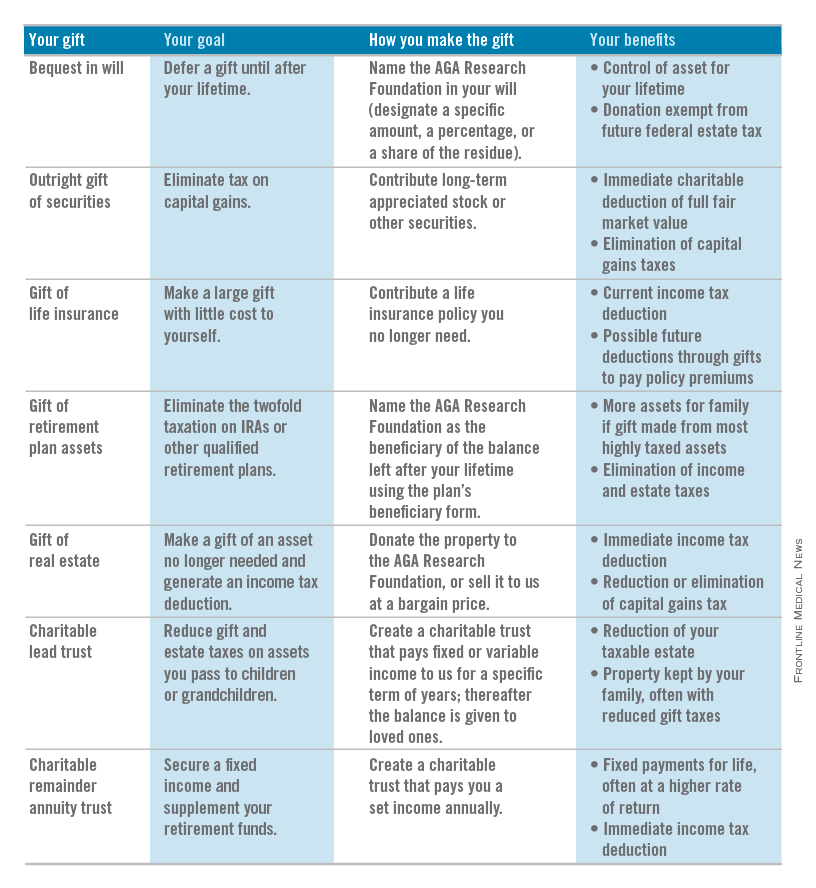
There are several gift arrangements to choose from. The chart below summarizes the benefits of some of the main types of charitable gifts. Just think of what you want to accomplish with your gift, and there’s probably a way to do it!
Please contact us for more information at [email protected] or visit http://gastro.planmylegacy.org/.
Planned giving provides an opportunity for all who have benefited from digestive disease research to give back to the field in a unique and lasting way.
Your investment in the AGA Research Foundation will enable the foundation to continue our investment in the future of gastroenterological research and innovation. With donations from AGA members, we can provide young researchers with a secure, ongoing stable source of funding that drives advancement in the diagnosis, treatment and cure of digestive diseases.
If you make a contribution, it will be because you believe in what we do and because you want to help make a difference in the lives of others. But we’d also like to make sure you benefit from making a gift to the AGA Research Foundation.
Your giving options
There are several gift arrangements to choose from. The chart below summarizes the benefits of some of the main types of charitable gifts. Just think of what you want to accomplish with your gift, and there’s probably a way to do it!
Please contact us for more information at [email protected] or visit http://gastro.planmylegacy.org/.
Planned giving provides an opportunity for all who have benefited from digestive disease research to give back to the field in a unique and lasting way.
Your investment in the AGA Research Foundation will enable the foundation to continue our investment in the future of gastroenterological research and innovation. With donations from AGA members, we can provide young researchers with a secure, ongoing stable source of funding that drives advancement in the diagnosis, treatment and cure of digestive diseases.
If you make a contribution, it will be because you believe in what we do and because you want to help make a difference in the lives of others. But we’d also like to make sure you benefit from making a gift to the AGA Research Foundation.
Your giving options
There are several gift arrangements to choose from. The chart below summarizes the benefits of some of the main types of charitable gifts. Just think of what you want to accomplish with your gift, and there’s probably a way to do it!
Please contact us for more information at [email protected] or visit http://gastro.planmylegacy.org/.

Nominations: Honor colleagues with recognition
Do you know a colleague whose professional accomplishments deserve acclaim? Nominate him or her for a member recognition prize. Each year, AGA presents these awards to individuals who have made outstanding contributions to the field of gastroenterology.
Nominations are due Nov. 6 for:
• The Distinguished Achievement Award in Basic Science, which recognizes a senior investigator who has made major accomplishments in basic research that have significantly advanced the science and/or practice of gastroenterology.
• The William Beaumont Prize in Gastroenterology, recognizing a senior investigator who has made a major contribution (a single accomplishment or series of accomplishments) that has significantly advanced the care of patients with digestive diseases through clinical or translational research.
• The Distinguished Clinician Award, which recognizes two individuals who have exemplified leadership and excellence in the practice of gastroenterology, in either private practice or clinical academic practice.
• The Distinguished Educator Award, which recognizes two individuals for achievements as an outstanding educator over a lifelong career.
• The Distinguished Mentor Award, recognizing two individuals for achievements as an outstanding mentor over a lifelong career.
• The AGA Research Service Award, which recognizes an individual who has dedicated an extraordinary effort to advocacy for the advancement of GI science and research.
• The AGA-GRG Young Investigator Award, which recognizes two young investigators, one in basic science and one in clinical science, who have innovative insight into a major scientific problem in gastroenterology.
Complete nomination instructions, selection criteria, and more information about each award are available. For more information, visit http://www.gastro.org/about/awards.
Do you know a colleague whose professional accomplishments deserve acclaim? Nominate him or her for a member recognition prize. Each year, AGA presents these awards to individuals who have made outstanding contributions to the field of gastroenterology.
Nominations are due Nov. 6 for:
• The Distinguished Achievement Award in Basic Science, which recognizes a senior investigator who has made major accomplishments in basic research that have significantly advanced the science and/or practice of gastroenterology.
• The William Beaumont Prize in Gastroenterology, recognizing a senior investigator who has made a major contribution (a single accomplishment or series of accomplishments) that has significantly advanced the care of patients with digestive diseases through clinical or translational research.
• The Distinguished Clinician Award, which recognizes two individuals who have exemplified leadership and excellence in the practice of gastroenterology, in either private practice or clinical academic practice.
• The Distinguished Educator Award, which recognizes two individuals for achievements as an outstanding educator over a lifelong career.
• The Distinguished Mentor Award, recognizing two individuals for achievements as an outstanding mentor over a lifelong career.
• The AGA Research Service Award, which recognizes an individual who has dedicated an extraordinary effort to advocacy for the advancement of GI science and research.
• The AGA-GRG Young Investigator Award, which recognizes two young investigators, one in basic science and one in clinical science, who have innovative insight into a major scientific problem in gastroenterology.
Complete nomination instructions, selection criteria, and more information about each award are available. For more information, visit http://www.gastro.org/about/awards.
Do you know a colleague whose professional accomplishments deserve acclaim? Nominate him or her for a member recognition prize. Each year, AGA presents these awards to individuals who have made outstanding contributions to the field of gastroenterology.
Nominations are due Nov. 6 for:
• The Distinguished Achievement Award in Basic Science, which recognizes a senior investigator who has made major accomplishments in basic research that have significantly advanced the science and/or practice of gastroenterology.
• The William Beaumont Prize in Gastroenterology, recognizing a senior investigator who has made a major contribution (a single accomplishment or series of accomplishments) that has significantly advanced the care of patients with digestive diseases through clinical or translational research.
• The Distinguished Clinician Award, which recognizes two individuals who have exemplified leadership and excellence in the practice of gastroenterology, in either private practice or clinical academic practice.
• The Distinguished Educator Award, which recognizes two individuals for achievements as an outstanding educator over a lifelong career.
• The Distinguished Mentor Award, recognizing two individuals for achievements as an outstanding mentor over a lifelong career.
• The AGA Research Service Award, which recognizes an individual who has dedicated an extraordinary effort to advocacy for the advancement of GI science and research.
• The AGA-GRG Young Investigator Award, which recognizes two young investigators, one in basic science and one in clinical science, who have innovative insight into a major scientific problem in gastroenterology.
Complete nomination instructions, selection criteria, and more information about each award are available. For more information, visit http://www.gastro.org/about/awards.
Workshop provides insight on building a career in academic medicine
Trainees and junior faculty are encouraged to submit an application for an opportunity to attend the AGA-AASLD Academic Skills Workshop March 11 and 12, 2016, in Phoenix, AZ.
This is a chance to get insight from accomplished academicians on what it takes to successfully shape a career in academic medicine. Not only will participants be able to better understand academic processes, they’ll also develop the skills necessary to help position themselves for future success.
The workshop will address topics such as:
• Your first academic job — Learn how changes in health care reimbursement are impacting academic medicine and discover how to manage personal and workplace expectations.
• Academic medicine: tracks and pathways — Learn about available opportunities and strategies that can lead to future promotions.
• How to be a successful mentee — Find out how to get the most out of your mentor-mentee relationship to help with achieving short- and long-term goals.
• Writing and presentation skills — Acquire tips and strategies for writing grants and preparing, editing and submitting manuscripts.
• Career development: strategy and funding — Get information on early career funding opportunities, including grants available for young investigators.
Forty candidates will be selected to participate in the workshop and all interested candidates must be a member of either AGA or AASLD. Women and underrepresented minorities are strongly encouraged to apply. Applications are due no later than Monday, Oct. 26, 2015.
Learn more about the AGA-AASLD Academic Skills Workshop on gastro.org and apply today.
Trainees and junior faculty are encouraged to submit an application for an opportunity to attend the AGA-AASLD Academic Skills Workshop March 11 and 12, 2016, in Phoenix, AZ.
This is a chance to get insight from accomplished academicians on what it takes to successfully shape a career in academic medicine. Not only will participants be able to better understand academic processes, they’ll also develop the skills necessary to help position themselves for future success.
The workshop will address topics such as:
• Your first academic job — Learn how changes in health care reimbursement are impacting academic medicine and discover how to manage personal and workplace expectations.
• Academic medicine: tracks and pathways — Learn about available opportunities and strategies that can lead to future promotions.
• How to be a successful mentee — Find out how to get the most out of your mentor-mentee relationship to help with achieving short- and long-term goals.
• Writing and presentation skills — Acquire tips and strategies for writing grants and preparing, editing and submitting manuscripts.
• Career development: strategy and funding — Get information on early career funding opportunities, including grants available for young investigators.
Forty candidates will be selected to participate in the workshop and all interested candidates must be a member of either AGA or AASLD. Women and underrepresented minorities are strongly encouraged to apply. Applications are due no later than Monday, Oct. 26, 2015.
Learn more about the AGA-AASLD Academic Skills Workshop on gastro.org and apply today.
Trainees and junior faculty are encouraged to submit an application for an opportunity to attend the AGA-AASLD Academic Skills Workshop March 11 and 12, 2016, in Phoenix, AZ.
This is a chance to get insight from accomplished academicians on what it takes to successfully shape a career in academic medicine. Not only will participants be able to better understand academic processes, they’ll also develop the skills necessary to help position themselves for future success.
The workshop will address topics such as:
• Your first academic job — Learn how changes in health care reimbursement are impacting academic medicine and discover how to manage personal and workplace expectations.
• Academic medicine: tracks and pathways — Learn about available opportunities and strategies that can lead to future promotions.
• How to be a successful mentee — Find out how to get the most out of your mentor-mentee relationship to help with achieving short- and long-term goals.
• Writing and presentation skills — Acquire tips and strategies for writing grants and preparing, editing and submitting manuscripts.
• Career development: strategy and funding — Get information on early career funding opportunities, including grants available for young investigators.
Forty candidates will be selected to participate in the workshop and all interested candidates must be a member of either AGA or AASLD. Women and underrepresented minorities are strongly encouraged to apply. Applications are due no later than Monday, Oct. 26, 2015.
Learn more about the AGA-AASLD Academic Skills Workshop on gastro.org and apply today.