User login
Catch the next wave in science, medicine at DDW® 2016
Early bird registration (www.xpressreg.net/register/ddwk0516/attendee/landing.asp?hkey=&ea=&sc=&iq) and housing for Digestive Disease Week® (DDW) 2016 are now open. Register by April 6 to save at least $75 on your registration, receive additional discounts on the sponsoring societies’ courses, and book your hotel.
DDW On Demand (www.ddw.org/attendees/maximize-your-experience/ddw-on-demand), an online-only library that will include nearly 450 hours of nonticketed presentations from DDW 2016, is once again included in the cost of registration.
Registration is also now open for the 2016 AGA Postgraduate Course: Cognitive and Technical Skills for the Gastroenterologist. The course, which is scheduled for May 21 and 22, features six general sessions, 13 clinical challenge sessions, and 12 lunch breakout sessions that will teach you critical updates for 2016. This live activity will be eligible for a maximum of 11.5 AMA PRA Category 1 Credits™.
Additional details, including the program agenda and learning objectives, are available online at www. gastro.org/in-person/2015/10/27/2016-aga-postgraduate-course.
Early bird registration (www.xpressreg.net/register/ddwk0516/attendee/landing.asp?hkey=&ea=&sc=&iq) and housing for Digestive Disease Week® (DDW) 2016 are now open. Register by April 6 to save at least $75 on your registration, receive additional discounts on the sponsoring societies’ courses, and book your hotel.
DDW On Demand (www.ddw.org/attendees/maximize-your-experience/ddw-on-demand), an online-only library that will include nearly 450 hours of nonticketed presentations from DDW 2016, is once again included in the cost of registration.
Registration is also now open for the 2016 AGA Postgraduate Course: Cognitive and Technical Skills for the Gastroenterologist. The course, which is scheduled for May 21 and 22, features six general sessions, 13 clinical challenge sessions, and 12 lunch breakout sessions that will teach you critical updates for 2016. This live activity will be eligible for a maximum of 11.5 AMA PRA Category 1 Credits™.
Additional details, including the program agenda and learning objectives, are available online at www. gastro.org/in-person/2015/10/27/2016-aga-postgraduate-course.
Early bird registration (www.xpressreg.net/register/ddwk0516/attendee/landing.asp?hkey=&ea=&sc=&iq) and housing for Digestive Disease Week® (DDW) 2016 are now open. Register by April 6 to save at least $75 on your registration, receive additional discounts on the sponsoring societies’ courses, and book your hotel.
DDW On Demand (www.ddw.org/attendees/maximize-your-experience/ddw-on-demand), an online-only library that will include nearly 450 hours of nonticketed presentations from DDW 2016, is once again included in the cost of registration.
Registration is also now open for the 2016 AGA Postgraduate Course: Cognitive and Technical Skills for the Gastroenterologist. The course, which is scheduled for May 21 and 22, features six general sessions, 13 clinical challenge sessions, and 12 lunch breakout sessions that will teach you critical updates for 2016. This live activity will be eligible for a maximum of 11.5 AMA PRA Category 1 Credits™.
Additional details, including the program agenda and learning objectives, are available online at www. gastro.org/in-person/2015/10/27/2016-aga-postgraduate-course.
Gastroenterology research needs your support
Many breakthroughs have been achieved through gastroenterological and hepatological research over the past century, forming the basis of the modern medical practice. As the charitable arm of the American Gastroenterological Association (AGA), the AGA Research Foundation contributes to this tradition of discovery to combat the continued loss of life and suffering brought on by digestive diseases.
The AGA Research Foundation is committed to closing the gap in research funding. The foundation serves the physicians and scientists who research, diagnose, prevent, and treat diseases of the gastrointestinal tract and liver and serves the patients whose lives and well-being depend on AGA’s members.
“This award is an invaluable asset to the start of my career in the field of pediatric gastroenterology and eosinophilic esophagitis research. It will foster continual growth in my research proficiency during my early years as a young physician-scientist,” said Dr. Edaire Cheng, UT Southwestern Medical Center, 2013 Research Scholar Award recipient.
“I have the great opportunity to pursue my research endeavors with protected time and resources. I also aim to encourage other young physicians to the field of gastroenterology and participation in research. The AGA Research Foundation has been extremely supportive of my work.”
The Foundation’s impact
• More than 863 scientists have been awarded grants.
• 90% of investigators who received an AGA Research Scholar Award (RSA) over the past 10 years have stayed in gastroenterology and hepatology research.
• Over 85% of AGA-funded researchers in the past 10 years received NIH funding subsequent to their AGA award with over 50% receiving $1 million or more in NIH grant support.
The AGA Research Foundation provides a key source of funding at a critical juncture in a young researcher’s career. Help provide critical funding to young researchers today by making a donation to the AGA Research Foundation on the foundation’s website or by mail to 4930 Del Ray Avenue, Bethesda, MD 20814.
Many breakthroughs have been achieved through gastroenterological and hepatological research over the past century, forming the basis of the modern medical practice. As the charitable arm of the American Gastroenterological Association (AGA), the AGA Research Foundation contributes to this tradition of discovery to combat the continued loss of life and suffering brought on by digestive diseases.
The AGA Research Foundation is committed to closing the gap in research funding. The foundation serves the physicians and scientists who research, diagnose, prevent, and treat diseases of the gastrointestinal tract and liver and serves the patients whose lives and well-being depend on AGA’s members.
“This award is an invaluable asset to the start of my career in the field of pediatric gastroenterology and eosinophilic esophagitis research. It will foster continual growth in my research proficiency during my early years as a young physician-scientist,” said Dr. Edaire Cheng, UT Southwestern Medical Center, 2013 Research Scholar Award recipient.
“I have the great opportunity to pursue my research endeavors with protected time and resources. I also aim to encourage other young physicians to the field of gastroenterology and participation in research. The AGA Research Foundation has been extremely supportive of my work.”
The Foundation’s impact
• More than 863 scientists have been awarded grants.
• 90% of investigators who received an AGA Research Scholar Award (RSA) over the past 10 years have stayed in gastroenterology and hepatology research.
• Over 85% of AGA-funded researchers in the past 10 years received NIH funding subsequent to their AGA award with over 50% receiving $1 million or more in NIH grant support.
The AGA Research Foundation provides a key source of funding at a critical juncture in a young researcher’s career. Help provide critical funding to young researchers today by making a donation to the AGA Research Foundation on the foundation’s website or by mail to 4930 Del Ray Avenue, Bethesda, MD 20814.
Many breakthroughs have been achieved through gastroenterological and hepatological research over the past century, forming the basis of the modern medical practice. As the charitable arm of the American Gastroenterological Association (AGA), the AGA Research Foundation contributes to this tradition of discovery to combat the continued loss of life and suffering brought on by digestive diseases.
The AGA Research Foundation is committed to closing the gap in research funding. The foundation serves the physicians and scientists who research, diagnose, prevent, and treat diseases of the gastrointestinal tract and liver and serves the patients whose lives and well-being depend on AGA’s members.
“This award is an invaluable asset to the start of my career in the field of pediatric gastroenterology and eosinophilic esophagitis research. It will foster continual growth in my research proficiency during my early years as a young physician-scientist,” said Dr. Edaire Cheng, UT Southwestern Medical Center, 2013 Research Scholar Award recipient.
“I have the great opportunity to pursue my research endeavors with protected time and resources. I also aim to encourage other young physicians to the field of gastroenterology and participation in research. The AGA Research Foundation has been extremely supportive of my work.”
The Foundation’s impact
• More than 863 scientists have been awarded grants.
• 90% of investigators who received an AGA Research Scholar Award (RSA) over the past 10 years have stayed in gastroenterology and hepatology research.
• Over 85% of AGA-funded researchers in the past 10 years received NIH funding subsequent to their AGA award with over 50% receiving $1 million or more in NIH grant support.
The AGA Research Foundation provides a key source of funding at a critical juncture in a young researcher’s career. Help provide critical funding to young researchers today by making a donation to the AGA Research Foundation on the foundation’s website or by mail to 4930 Del Ray Avenue, Bethesda, MD 20814.
Call for abstracts: Gut Microbiota for Health World Summit 2016
Share your research at the Gut Microbiota for Health World Summit 2016 with an international audience of researchers and clinicians.
Students, medical residents, trainees, postdoctoral fellows and junior faculty (within 3 years of their first appointment) are invited to submit an abstract for oral or poster presentation. Only a select number of abstracts will be accepted for oral presentation.
If selected, presenters will receive discounted registration and a travel grant to help cover the cost of airfare and accommodations. Abstracts must be submitted to Sandra Megally at [email protected] no later than Sunday, Jan. 17, 2016.
The summit is cosponsored by AGA Institute, European Society of Neurogastroenterology and Motility, European Society for Pediatric Gastroenterology, Hepatology and Nutrition, European Crohn’s and Colitis Organization, and the European Association for the Study of Liver.
Gut Microbiota for Health World Summit 2016 is supported by grants from Danone Dairy and Biocodex.
Share your research at the Gut Microbiota for Health World Summit 2016 with an international audience of researchers and clinicians.
Students, medical residents, trainees, postdoctoral fellows and junior faculty (within 3 years of their first appointment) are invited to submit an abstract for oral or poster presentation. Only a select number of abstracts will be accepted for oral presentation.
If selected, presenters will receive discounted registration and a travel grant to help cover the cost of airfare and accommodations. Abstracts must be submitted to Sandra Megally at [email protected] no later than Sunday, Jan. 17, 2016.
The summit is cosponsored by AGA Institute, European Society of Neurogastroenterology and Motility, European Society for Pediatric Gastroenterology, Hepatology and Nutrition, European Crohn’s and Colitis Organization, and the European Association for the Study of Liver.
Gut Microbiota for Health World Summit 2016 is supported by grants from Danone Dairy and Biocodex.
Share your research at the Gut Microbiota for Health World Summit 2016 with an international audience of researchers and clinicians.
Students, medical residents, trainees, postdoctoral fellows and junior faculty (within 3 years of their first appointment) are invited to submit an abstract for oral or poster presentation. Only a select number of abstracts will be accepted for oral presentation.
If selected, presenters will receive discounted registration and a travel grant to help cover the cost of airfare and accommodations. Abstracts must be submitted to Sandra Megally at [email protected] no later than Sunday, Jan. 17, 2016.
The summit is cosponsored by AGA Institute, European Society of Neurogastroenterology and Motility, European Society for Pediatric Gastroenterology, Hepatology and Nutrition, European Crohn’s and Colitis Organization, and the European Association for the Study of Liver.
Gut Microbiota for Health World Summit 2016 is supported by grants from Danone Dairy and Biocodex.
Help your patients manage chronic constipation
AGA has published the latest in a series of guideline-based resources for members to provide their patients. Based on the published AGA guideline on constipation, the new patient guide explains how a gastroenterologist can help when diet and lifestyle modifications fail.
The guide also explains defecatory disorders, slow-transit and normal-transit constipation, as well as information about tests and medication options in language that is accessible to patients.
AGA’s evidence-based patient guides can help improve the efficiency of office visits and the value you provide patients.
If your patients are suffering from chronic constipation, make sure to let them know about this helpful AGA patient guide.
AGA has published the latest in a series of guideline-based resources for members to provide their patients. Based on the published AGA guideline on constipation, the new patient guide explains how a gastroenterologist can help when diet and lifestyle modifications fail.
The guide also explains defecatory disorders, slow-transit and normal-transit constipation, as well as information about tests and medication options in language that is accessible to patients.
AGA’s evidence-based patient guides can help improve the efficiency of office visits and the value you provide patients.
If your patients are suffering from chronic constipation, make sure to let them know about this helpful AGA patient guide.
AGA has published the latest in a series of guideline-based resources for members to provide their patients. Based on the published AGA guideline on constipation, the new patient guide explains how a gastroenterologist can help when diet and lifestyle modifications fail.
The guide also explains defecatory disorders, slow-transit and normal-transit constipation, as well as information about tests and medication options in language that is accessible to patients.
AGA’s evidence-based patient guides can help improve the efficiency of office visits and the value you provide patients.
If your patients are suffering from chronic constipation, make sure to let them know about this helpful AGA patient guide.
Apply for 2016 research grants
Six grant deadlines are approaching in January 2016; make sure you’re prepared to submit your application by the deadline. Awards are available for both established and young investigators.
AGA is now accepting online applications through the new Grants Management System, which streamlines the application submission process and will be used to facilitate grant reviews.
Apply now for:
• The AGA-Elsevier Gut Microbiome Pilot Research Award. It will provide $25,000 to support pilot research projects pertaining to the gut microbiome. The application deadline is Jan. 15.
• The AGA-Elsevier Pilot Research Award. This is a 1-year grant providing young investigators, instructors, research associates, or equivalents $25,000 to support pilot research projects in gastroenterology- or hepatology-related areas. Two award recipients will be selected. The deadline is Jan. 15.
• The AGA–Rome Foundation Functional GI and Motility Disorders Pilot Research Award. This research initiative grant for $50,000 for 1 year is offered to early-stage investigators to support pilot research projects pertaining to functional GI and motility disorders. This award is jointly sponsored by the Rome Foundation and AGA. The deadline is Jan. 15.
• The AGA–Caroline Craig Augustyn & Damian Augustyn Award in Digestive Cancer. One award of $40,000 will support a young investigator, instructor, research associate, or equivalent who currently holds a federal or nonfederal career development award devoted to conducting research related to digestive cancer. The deadline is Jan. 29.
• The AGA–Covidien Research & Development Pilot Award in Technology. This $30,000 research initiative is offered to investigators to support the research and development of novel devices or technologies that will potentially impact the diagnosis or treatment of digestive disease. The award also includes a $1,000 travel stipend to attend the 2016 AGA Technology Summit. The deadline is Jan. 29.
• The 16th AGA–June & Donald O. Castell, M.D., Esophageal Clinical Research Award. This is a $25,000 grant, which provides research and/or salary support for junior faculty involved in clinical research in esophageal diseases. The deadline is Jan. 29.
We are also now accepting applications for the AGA Investing in the Future Student Research Fellowship. This provides 12 awards at $5,000 for underrepresented minority undergraduate and medical school students to perform 8-10 weeks of research related to digestive diseases or nutrition. The deadline to apply is Feb. 5.
Complete information about these and other research awards is available on www.gastro.org. All recipients will be acknowledged at the Research Recognition Celebration at Digestive Disease Week® 2016 in San Diego.
Six grant deadlines are approaching in January 2016; make sure you’re prepared to submit your application by the deadline. Awards are available for both established and young investigators.
AGA is now accepting online applications through the new Grants Management System, which streamlines the application submission process and will be used to facilitate grant reviews.
Apply now for:
• The AGA-Elsevier Gut Microbiome Pilot Research Award. It will provide $25,000 to support pilot research projects pertaining to the gut microbiome. The application deadline is Jan. 15.
• The AGA-Elsevier Pilot Research Award. This is a 1-year grant providing young investigators, instructors, research associates, or equivalents $25,000 to support pilot research projects in gastroenterology- or hepatology-related areas. Two award recipients will be selected. The deadline is Jan. 15.
• The AGA–Rome Foundation Functional GI and Motility Disorders Pilot Research Award. This research initiative grant for $50,000 for 1 year is offered to early-stage investigators to support pilot research projects pertaining to functional GI and motility disorders. This award is jointly sponsored by the Rome Foundation and AGA. The deadline is Jan. 15.
• The AGA–Caroline Craig Augustyn & Damian Augustyn Award in Digestive Cancer. One award of $40,000 will support a young investigator, instructor, research associate, or equivalent who currently holds a federal or nonfederal career development award devoted to conducting research related to digestive cancer. The deadline is Jan. 29.
• The AGA–Covidien Research & Development Pilot Award in Technology. This $30,000 research initiative is offered to investigators to support the research and development of novel devices or technologies that will potentially impact the diagnosis or treatment of digestive disease. The award also includes a $1,000 travel stipend to attend the 2016 AGA Technology Summit. The deadline is Jan. 29.
• The 16th AGA–June & Donald O. Castell, M.D., Esophageal Clinical Research Award. This is a $25,000 grant, which provides research and/or salary support for junior faculty involved in clinical research in esophageal diseases. The deadline is Jan. 29.
We are also now accepting applications for the AGA Investing in the Future Student Research Fellowship. This provides 12 awards at $5,000 for underrepresented minority undergraduate and medical school students to perform 8-10 weeks of research related to digestive diseases or nutrition. The deadline to apply is Feb. 5.
Complete information about these and other research awards is available on www.gastro.org. All recipients will be acknowledged at the Research Recognition Celebration at Digestive Disease Week® 2016 in San Diego.
Six grant deadlines are approaching in January 2016; make sure you’re prepared to submit your application by the deadline. Awards are available for both established and young investigators.
AGA is now accepting online applications through the new Grants Management System, which streamlines the application submission process and will be used to facilitate grant reviews.
Apply now for:
• The AGA-Elsevier Gut Microbiome Pilot Research Award. It will provide $25,000 to support pilot research projects pertaining to the gut microbiome. The application deadline is Jan. 15.
• The AGA-Elsevier Pilot Research Award. This is a 1-year grant providing young investigators, instructors, research associates, or equivalents $25,000 to support pilot research projects in gastroenterology- or hepatology-related areas. Two award recipients will be selected. The deadline is Jan. 15.
• The AGA–Rome Foundation Functional GI and Motility Disorders Pilot Research Award. This research initiative grant for $50,000 for 1 year is offered to early-stage investigators to support pilot research projects pertaining to functional GI and motility disorders. This award is jointly sponsored by the Rome Foundation and AGA. The deadline is Jan. 15.
• The AGA–Caroline Craig Augustyn & Damian Augustyn Award in Digestive Cancer. One award of $40,000 will support a young investigator, instructor, research associate, or equivalent who currently holds a federal or nonfederal career development award devoted to conducting research related to digestive cancer. The deadline is Jan. 29.
• The AGA–Covidien Research & Development Pilot Award in Technology. This $30,000 research initiative is offered to investigators to support the research and development of novel devices or technologies that will potentially impact the diagnosis or treatment of digestive disease. The award also includes a $1,000 travel stipend to attend the 2016 AGA Technology Summit. The deadline is Jan. 29.
• The 16th AGA–June & Donald O. Castell, M.D., Esophageal Clinical Research Award. This is a $25,000 grant, which provides research and/or salary support for junior faculty involved in clinical research in esophageal diseases. The deadline is Jan. 29.
We are also now accepting applications for the AGA Investing in the Future Student Research Fellowship. This provides 12 awards at $5,000 for underrepresented minority undergraduate and medical school students to perform 8-10 weeks of research related to digestive diseases or nutrition. The deadline to apply is Feb. 5.
Complete information about these and other research awards is available on www.gastro.org. All recipients will be acknowledged at the Research Recognition Celebration at Digestive Disease Week® 2016 in San Diego.
Learn how to avoid a reimbursement loss
The Physician Quality Reporting System (PQRS) will apply a negative 2% payment adjustment in 2017 if practices do not report data on quality measures for covered professional services furnished to Medicare beneficiaries in 2015. By participating in AGA’s Digestive Health Recognition Program™ (www.agarecognition.org), or DHRP, members can report on quality measures and work to avoid this negative payment adjustment.
To learn more about DHRP, register for a free, 30-minute webinar taking place during these two dates (attendee.gotowebinar.com/rt/2452555612218433025):
• Jan 28, 2016, 5 p.m. ET
• Feb. 25, 2016, noon ET
The deadline to enroll for the 2015 PQRS year through DHRP is Feb. 26, 2016. Members pay $300 to enroll.
DHRP is made possible by support from AbbVie; Gilead Science, Inc.; Janssen Biotech, Inc. and Janssen Therapeutics, Division of Janssen Products, LLP; and Shire Pharmaceuticals.
The Physician Quality Reporting System (PQRS) will apply a negative 2% payment adjustment in 2017 if practices do not report data on quality measures for covered professional services furnished to Medicare beneficiaries in 2015. By participating in AGA’s Digestive Health Recognition Program™ (www.agarecognition.org), or DHRP, members can report on quality measures and work to avoid this negative payment adjustment.
To learn more about DHRP, register for a free, 30-minute webinar taking place during these two dates (attendee.gotowebinar.com/rt/2452555612218433025):
• Jan 28, 2016, 5 p.m. ET
• Feb. 25, 2016, noon ET
The deadline to enroll for the 2015 PQRS year through DHRP is Feb. 26, 2016. Members pay $300 to enroll.
DHRP is made possible by support from AbbVie; Gilead Science, Inc.; Janssen Biotech, Inc. and Janssen Therapeutics, Division of Janssen Products, LLP; and Shire Pharmaceuticals.
The Physician Quality Reporting System (PQRS) will apply a negative 2% payment adjustment in 2017 if practices do not report data on quality measures for covered professional services furnished to Medicare beneficiaries in 2015. By participating in AGA’s Digestive Health Recognition Program™ (www.agarecognition.org), or DHRP, members can report on quality measures and work to avoid this negative payment adjustment.
To learn more about DHRP, register for a free, 30-minute webinar taking place during these two dates (attendee.gotowebinar.com/rt/2452555612218433025):
• Jan 28, 2016, 5 p.m. ET
• Feb. 25, 2016, noon ET
The deadline to enroll for the 2015 PQRS year through DHRP is Feb. 26, 2016. Members pay $300 to enroll.
DHRP is made possible by support from AbbVie; Gilead Science, Inc.; Janssen Biotech, Inc. and Janssen Therapeutics, Division of Janssen Products, LLP; and Shire Pharmaceuticals.
ABIM continues to lighten recertification load
AGA applauds the announcement by the American Board of Internal Medicine that it is extending the suspension of the practice improvement, patient safety, and patient voice requirements until at least December 2018.
Throughout 2015, AGA has pushed ABIM to reconsider the burdensome recertification process. Gastroenterologists need a recertification system that fosters active learning, not high-stakes testing.
Our campaign continues – AGA is communicating with other subspecialty societies to work together to secure the best approach to MOC consistent with the principles we previously published:
• MOC needs to be simpler, less intrusive, and less expensive.
• We support ending the high‐stakes, every-10‐year exam.
• We do not support closed‐book assessments as they do not represent the current realities of medicine in the digital age.
• We support the principles of lifelong learning as evidenced by ongoing CME activities, rather than lifelong testing.
• We support the concept that, for the many diplomates who specialize within certain areas of gastroenterology and hepatology, MOC should not need to include high‐stakes assessments of areas where the diplomate may not practice.
We hear you that MOC is a burden and we will continue to push for the principles of individualization, specialization, and dropping the high-stakes exam – sooner rather than later.
Practicalities for those up for recertification
While we advocate for a new MOC system, there are requirements that still stand. Make sure you are up to date before the end of 2015:
• If you need to complete MOC points by Dec. 31, 2015, AGA has activities you can complete to earn those points. Please visit the MOC section of the AGA website to see how we can help you.
• Each board certified physician’s requirements are slightly different based on the year of your certification or most recent recertification. For details specific to you, we urge you to log in to your ABIM Physician Portal.
For more information, read our paper, The Gastroenterologist-accountable Professionalism in Practice Pathway, and consensus principles for reform that AGA developed with ACG, ASGE, AASLD, ANMS and NASPGHAN.
AGA applauds the announcement by the American Board of Internal Medicine that it is extending the suspension of the practice improvement, patient safety, and patient voice requirements until at least December 2018.
Throughout 2015, AGA has pushed ABIM to reconsider the burdensome recertification process. Gastroenterologists need a recertification system that fosters active learning, not high-stakes testing.
Our campaign continues – AGA is communicating with other subspecialty societies to work together to secure the best approach to MOC consistent with the principles we previously published:
• MOC needs to be simpler, less intrusive, and less expensive.
• We support ending the high‐stakes, every-10‐year exam.
• We do not support closed‐book assessments as they do not represent the current realities of medicine in the digital age.
• We support the principles of lifelong learning as evidenced by ongoing CME activities, rather than lifelong testing.
• We support the concept that, for the many diplomates who specialize within certain areas of gastroenterology and hepatology, MOC should not need to include high‐stakes assessments of areas where the diplomate may not practice.
We hear you that MOC is a burden and we will continue to push for the principles of individualization, specialization, and dropping the high-stakes exam – sooner rather than later.
Practicalities for those up for recertification
While we advocate for a new MOC system, there are requirements that still stand. Make sure you are up to date before the end of 2015:
• If you need to complete MOC points by Dec. 31, 2015, AGA has activities you can complete to earn those points. Please visit the MOC section of the AGA website to see how we can help you.
• Each board certified physician’s requirements are slightly different based on the year of your certification or most recent recertification. For details specific to you, we urge you to log in to your ABIM Physician Portal.
For more information, read our paper, The Gastroenterologist-accountable Professionalism in Practice Pathway, and consensus principles for reform that AGA developed with ACG, ASGE, AASLD, ANMS and NASPGHAN.
AGA applauds the announcement by the American Board of Internal Medicine that it is extending the suspension of the practice improvement, patient safety, and patient voice requirements until at least December 2018.
Throughout 2015, AGA has pushed ABIM to reconsider the burdensome recertification process. Gastroenterologists need a recertification system that fosters active learning, not high-stakes testing.
Our campaign continues – AGA is communicating with other subspecialty societies to work together to secure the best approach to MOC consistent with the principles we previously published:
• MOC needs to be simpler, less intrusive, and less expensive.
• We support ending the high‐stakes, every-10‐year exam.
• We do not support closed‐book assessments as they do not represent the current realities of medicine in the digital age.
• We support the principles of lifelong learning as evidenced by ongoing CME activities, rather than lifelong testing.
• We support the concept that, for the many diplomates who specialize within certain areas of gastroenterology and hepatology, MOC should not need to include high‐stakes assessments of areas where the diplomate may not practice.
We hear you that MOC is a burden and we will continue to push for the principles of individualization, specialization, and dropping the high-stakes exam – sooner rather than later.
Practicalities for those up for recertification
While we advocate for a new MOC system, there are requirements that still stand. Make sure you are up to date before the end of 2015:
• If you need to complete MOC points by Dec. 31, 2015, AGA has activities you can complete to earn those points. Please visit the MOC section of the AGA website to see how we can help you.
• Each board certified physician’s requirements are slightly different based on the year of your certification or most recent recertification. For details specific to you, we urge you to log in to your ABIM Physician Portal.
For more information, read our paper, The Gastroenterologist-accountable Professionalism in Practice Pathway, and consensus principles for reform that AGA developed with ACG, ASGE, AASLD, ANMS and NASPGHAN.

Help save a life through GI research
An appeal from Martin Brotman, M.D., AGAF, Chair, AGA Research Foundation
Past Senior Vice President, Education, Research, and Philanthropy, CPMC Sutter Health
This holiday season is a good time to reflect on our many blessings and thank those who have helped make our lives and careers worthwhile, successful, and prosperous. What better way than to pass on something to those who will ensure that gastroenterology will advance in decades to come?
Progress in this lifesaving work is made possible by the generosity of many supporters, like you, who understand the devastating physical, emotional, and financial costs of digestive diseases. We simply cannot allow a slowdown in the pace of GI research, and we cannot afford to lose talent when research offers so much promise for the future.
What can you do to ensure the progress continues?
Show your support and give back.
Help close the gap in research funding and save lives. Make your tax-deductible donation online at www.gastro.org/donateonline.
The foundation funds promising young investigators who might not receive funding otherwise at crucial times in their early careers. The research of these individuals, while important to the field, if left unfunded, could end prematurely. That’s something the field can’t afford, and that’s why I’ve supported the AGA Research Foundation over the years through my donations. We must maintain a robust pipeline of research that will help safeguard the success of clinical medicine. I urge you to support the future of GI with a generous donation to the AGA Research Foundation endowment fund. Your donation of $250, $500, $1,000, $2,500, or any amount you can give today will keep giving for years to come.
May 2016 will mark the end of my tenure as chair of the AGA Research Foundation. I am proud of our accomplishments over these past years, and, while I will no longer occupy the chair at the head of the table, I will continue to be involved in the foundation’s important work. I am hoping that my last year at the helm of the foundation will be our most successful yet. A gift from you will be a vote of confidence in our work and will send a message that you share in our hopes for the future of digestive disease research.
Thank you in advance for support and best wishes for a happy, healthy holiday season and prosperous New Year.
Three easy ways to give
Online: www.gastro.org/contribute
Through the mail:
AGA Research Foundation
4930 Del Ray Avenue
Bethesda, MD 20814
Over the phone: 301-222-4002
All gifts are tax-deductible to the fullest extent of U.S. law.
An appeal from Martin Brotman, M.D., AGAF, Chair, AGA Research Foundation
Past Senior Vice President, Education, Research, and Philanthropy, CPMC Sutter Health
This holiday season is a good time to reflect on our many blessings and thank those who have helped make our lives and careers worthwhile, successful, and prosperous. What better way than to pass on something to those who will ensure that gastroenterology will advance in decades to come?
Progress in this lifesaving work is made possible by the generosity of many supporters, like you, who understand the devastating physical, emotional, and financial costs of digestive diseases. We simply cannot allow a slowdown in the pace of GI research, and we cannot afford to lose talent when research offers so much promise for the future.
What can you do to ensure the progress continues?
Show your support and give back.
Help close the gap in research funding and save lives. Make your tax-deductible donation online at www.gastro.org/donateonline.
The foundation funds promising young investigators who might not receive funding otherwise at crucial times in their early careers. The research of these individuals, while important to the field, if left unfunded, could end prematurely. That’s something the field can’t afford, and that’s why I’ve supported the AGA Research Foundation over the years through my donations. We must maintain a robust pipeline of research that will help safeguard the success of clinical medicine. I urge you to support the future of GI with a generous donation to the AGA Research Foundation endowment fund. Your donation of $250, $500, $1,000, $2,500, or any amount you can give today will keep giving for years to come.
May 2016 will mark the end of my tenure as chair of the AGA Research Foundation. I am proud of our accomplishments over these past years, and, while I will no longer occupy the chair at the head of the table, I will continue to be involved in the foundation’s important work. I am hoping that my last year at the helm of the foundation will be our most successful yet. A gift from you will be a vote of confidence in our work and will send a message that you share in our hopes for the future of digestive disease research.
Thank you in advance for support and best wishes for a happy, healthy holiday season and prosperous New Year.
Three easy ways to give
Online: www.gastro.org/contribute
Through the mail:
AGA Research Foundation
4930 Del Ray Avenue
Bethesda, MD 20814
Over the phone: 301-222-4002
All gifts are tax-deductible to the fullest extent of U.S. law.
An appeal from Martin Brotman, M.D., AGAF, Chair, AGA Research Foundation
Past Senior Vice President, Education, Research, and Philanthropy, CPMC Sutter Health
This holiday season is a good time to reflect on our many blessings and thank those who have helped make our lives and careers worthwhile, successful, and prosperous. What better way than to pass on something to those who will ensure that gastroenterology will advance in decades to come?
Progress in this lifesaving work is made possible by the generosity of many supporters, like you, who understand the devastating physical, emotional, and financial costs of digestive diseases. We simply cannot allow a slowdown in the pace of GI research, and we cannot afford to lose talent when research offers so much promise for the future.
What can you do to ensure the progress continues?
Show your support and give back.
Help close the gap in research funding and save lives. Make your tax-deductible donation online at www.gastro.org/donateonline.
The foundation funds promising young investigators who might not receive funding otherwise at crucial times in their early careers. The research of these individuals, while important to the field, if left unfunded, could end prematurely. That’s something the field can’t afford, and that’s why I’ve supported the AGA Research Foundation over the years through my donations. We must maintain a robust pipeline of research that will help safeguard the success of clinical medicine. I urge you to support the future of GI with a generous donation to the AGA Research Foundation endowment fund. Your donation of $250, $500, $1,000, $2,500, or any amount you can give today will keep giving for years to come.
May 2016 will mark the end of my tenure as chair of the AGA Research Foundation. I am proud of our accomplishments over these past years, and, while I will no longer occupy the chair at the head of the table, I will continue to be involved in the foundation’s important work. I am hoping that my last year at the helm of the foundation will be our most successful yet. A gift from you will be a vote of confidence in our work and will send a message that you share in our hopes for the future of digestive disease research.
Thank you in advance for support and best wishes for a happy, healthy holiday season and prosperous New Year.
Three easy ways to give
Online: www.gastro.org/contribute
Through the mail:
AGA Research Foundation
4930 Del Ray Avenue
Bethesda, MD 20814
Over the phone: 301-222-4002
All gifts are tax-deductible to the fullest extent of U.S. law.
AGA convened GI and hepatology societies to develop consensus principles on MOC
AGA, in its role as a leader and reformer in the dialogue with the American Board of Internal Medicine (ABIM) on reforming the maintenance of certification (MOC) process, convened the gastroenterology and hepatology societies, including ACG, ASGE, AASLD, ANMS and NASPGHAN to develop a set of consensus principles on this issue at the end of October. AGA shared the following consensus principles with ABIM:
• MOC needs to be simpler, less intrusive, and less expensive.

• We, the societies listed above, support ending the high-stakes, every-10-years exam.
• We, the societies listed above, do not support closed-book assessments as they do not represent the current realities of medicine in the digital age.
• We, the societies listed above, support the principles of lifelong learning as evidenced by ongoing CME activities, rather than lifelong testing.
• We, the societies listed above, support the concept that, for the many diplomates who specialize in certain areas of gastroenterology and hepatology, MOC should not need to include high-stakes assessments of areas where the diplomate may not practice.
For more information, review AGA’s alternate pathway to recertification, The Gastroenterologist: Accountable Professionalism in Practice or G-APP, which was authored by AGA’s education and training councilor, Dr. Suzanne Rose, and a group of AGA colleagues.
AGA, in its role as a leader and reformer in the dialogue with the American Board of Internal Medicine (ABIM) on reforming the maintenance of certification (MOC) process, convened the gastroenterology and hepatology societies, including ACG, ASGE, AASLD, ANMS and NASPGHAN to develop a set of consensus principles on this issue at the end of October. AGA shared the following consensus principles with ABIM:
• MOC needs to be simpler, less intrusive, and less expensive.
• We, the societies listed above, support ending the high-stakes, every-10-years exam.
• We, the societies listed above, do not support closed-book assessments as they do not represent the current realities of medicine in the digital age.
• We, the societies listed above, support the principles of lifelong learning as evidenced by ongoing CME activities, rather than lifelong testing.
• We, the societies listed above, support the concept that, for the many diplomates who specialize in certain areas of gastroenterology and hepatology, MOC should not need to include high-stakes assessments of areas where the diplomate may not practice.
For more information, review AGA’s alternate pathway to recertification, The Gastroenterologist: Accountable Professionalism in Practice or G-APP, which was authored by AGA’s education and training councilor, Dr. Suzanne Rose, and a group of AGA colleagues.
AGA, in its role as a leader and reformer in the dialogue with the American Board of Internal Medicine (ABIM) on reforming the maintenance of certification (MOC) process, convened the gastroenterology and hepatology societies, including ACG, ASGE, AASLD, ANMS and NASPGHAN to develop a set of consensus principles on this issue at the end of October. AGA shared the following consensus principles with ABIM:
• MOC needs to be simpler, less intrusive, and less expensive.
• We, the societies listed above, support ending the high-stakes, every-10-years exam.
• We, the societies listed above, do not support closed-book assessments as they do not represent the current realities of medicine in the digital age.
• We, the societies listed above, support the principles of lifelong learning as evidenced by ongoing CME activities, rather than lifelong testing.
• We, the societies listed above, support the concept that, for the many diplomates who specialize in certain areas of gastroenterology and hepatology, MOC should not need to include high-stakes assessments of areas where the diplomate may not practice.
For more information, review AGA’s alternate pathway to recertification, The Gastroenterologist: Accountable Professionalism in Practice or G-APP, which was authored by AGA’s education and training councilor, Dr. Suzanne Rose, and a group of AGA colleagues.

AGA, UEG celebrate young scholars in Barcelona
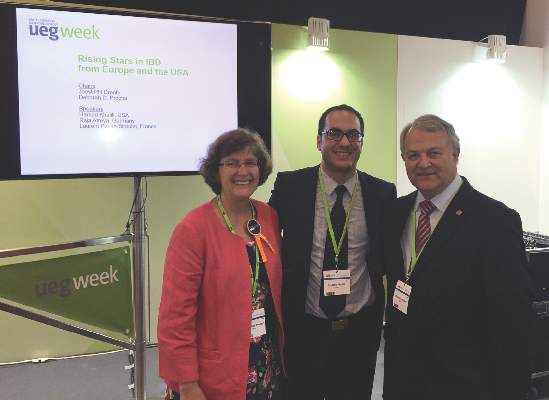
Leaders from AGA and United European Gastroenterology (UEG) gathered Tuesday, Oct. 27, 2015, in Barcelona, to celebrate the AGA Research Scholar/UEG Rising Star Scientific Exchange Program during UEG Week 2015 (http://live.ueg.eu/week). During the session, AGA honoree, Dr. Khalili, presented on oral contraceptive use in the etiopathogenesis of Crohn’s disease.
This recurring program fosters collaboration and goodwill with the international community and offers a unique opportunity for GI’s best and brightest to share research advances in a small group setting.
It is the ninth year of the program, which is held twice a year – once at Digestive Disease Week® (DDW) in May and once at UEG Week in October.
Leaders from AGA and United European Gastroenterology (UEG) gathered Tuesday, Oct. 27, 2015, in Barcelona, to celebrate the AGA Research Scholar/UEG Rising Star Scientific Exchange Program during UEG Week 2015 (http://live.ueg.eu/week). During the session, AGA honoree, Dr. Khalili, presented on oral contraceptive use in the etiopathogenesis of Crohn’s disease.
This recurring program fosters collaboration and goodwill with the international community and offers a unique opportunity for GI’s best and brightest to share research advances in a small group setting.
It is the ninth year of the program, which is held twice a year – once at Digestive Disease Week® (DDW) in May and once at UEG Week in October.
Leaders from AGA and United European Gastroenterology (UEG) gathered Tuesday, Oct. 27, 2015, in Barcelona, to celebrate the AGA Research Scholar/UEG Rising Star Scientific Exchange Program during UEG Week 2015 (http://live.ueg.eu/week). During the session, AGA honoree, Dr. Khalili, presented on oral contraceptive use in the etiopathogenesis of Crohn’s disease.
This recurring program fosters collaboration and goodwill with the international community and offers a unique opportunity for GI’s best and brightest to share research advances in a small group setting.
It is the ninth year of the program, which is held twice a year – once at Digestive Disease Week® (DDW) in May and once at UEG Week in October.