User login
AGA members take Capitol Hill
More than 40 AGA members, representing 24 states, visited Capitol Hill earlier this fall to fight for the science and practice of gastroenterology during AGA’s annual Advocacy Day.
NIH funding
AGA members met with lawmakers and their staffs on Sept. 16 to discuss the success that research and medical breakthroughs have had for their patients and encouraged Congress to support increased funding for NIH. Many members of Congress support increased funding for NIH, but a small group of House members is preventing passage of a bill that would increase funding for the institute by $1.25 billion in fiscal year (FY) 2017. The Senate Appropriations Committee passed a bill in June, on a vote of 29-1, to increase funding for NIH by $2 billion. Advocacy Day attendees urged their congressional offices to support the higher Senate number.
MACRA implementation
Members also discussed the need for congressional oversight to ensure that the Medicare Access & CHIP Reauthorization Act of 2015 (MACRA) law is being implemented as Congress intended. They shared their concerns over the impact this law could have on gastroenterologists, especially those in small or solo practices, and emphasized the need for CMS to provide flexibility to physicians to enable them to comply with the new requirements.
Participants highlighted the recent announcement that CMS will allow physicians more options for reporting in the first year as a positive sign that it is listening to the concerns voiced by Congress and the physician community on the regulatory burdens. AGA members also discussed the barriers that currently exist in qualifying as a specialty-focused alternative payment model (APM) and the need for continued flexibility to ensure that all physicians have the opportunity to participate in more value-based payment models.
Virtual advocacy
In conjunction with the Capitol Hill meetings, all AGA members were invited to participate in a Virtual Advocacy Day campaign. This additional component allowed all members to contact their members of Congress via email to voice their concerns about sustainable NIH funding for FY 2017 and the need for more congressional oversight of MACRA.
It’s not too late for you to show your support for the science and practice of GI. Contact your congressional representatives in support of important issues at www.gastroadvocacy.org/actionalerts.aspx.
More than 40 AGA members, representing 24 states, visited Capitol Hill earlier this fall to fight for the science and practice of gastroenterology during AGA’s annual Advocacy Day.
NIH funding
AGA members met with lawmakers and their staffs on Sept. 16 to discuss the success that research and medical breakthroughs have had for their patients and encouraged Congress to support increased funding for NIH. Many members of Congress support increased funding for NIH, but a small group of House members is preventing passage of a bill that would increase funding for the institute by $1.25 billion in fiscal year (FY) 2017. The Senate Appropriations Committee passed a bill in June, on a vote of 29-1, to increase funding for NIH by $2 billion. Advocacy Day attendees urged their congressional offices to support the higher Senate number.
MACRA implementation
Members also discussed the need for congressional oversight to ensure that the Medicare Access & CHIP Reauthorization Act of 2015 (MACRA) law is being implemented as Congress intended. They shared their concerns over the impact this law could have on gastroenterologists, especially those in small or solo practices, and emphasized the need for CMS to provide flexibility to physicians to enable them to comply with the new requirements.
Participants highlighted the recent announcement that CMS will allow physicians more options for reporting in the first year as a positive sign that it is listening to the concerns voiced by Congress and the physician community on the regulatory burdens. AGA members also discussed the barriers that currently exist in qualifying as a specialty-focused alternative payment model (APM) and the need for continued flexibility to ensure that all physicians have the opportunity to participate in more value-based payment models.
Virtual advocacy
In conjunction with the Capitol Hill meetings, all AGA members were invited to participate in a Virtual Advocacy Day campaign. This additional component allowed all members to contact their members of Congress via email to voice their concerns about sustainable NIH funding for FY 2017 and the need for more congressional oversight of MACRA.
It’s not too late for you to show your support for the science and practice of GI. Contact your congressional representatives in support of important issues at www.gastroadvocacy.org/actionalerts.aspx.
More than 40 AGA members, representing 24 states, visited Capitol Hill earlier this fall to fight for the science and practice of gastroenterology during AGA’s annual Advocacy Day.
NIH funding
AGA members met with lawmakers and their staffs on Sept. 16 to discuss the success that research and medical breakthroughs have had for their patients and encouraged Congress to support increased funding for NIH. Many members of Congress support increased funding for NIH, but a small group of House members is preventing passage of a bill that would increase funding for the institute by $1.25 billion in fiscal year (FY) 2017. The Senate Appropriations Committee passed a bill in June, on a vote of 29-1, to increase funding for NIH by $2 billion. Advocacy Day attendees urged their congressional offices to support the higher Senate number.
MACRA implementation
Members also discussed the need for congressional oversight to ensure that the Medicare Access & CHIP Reauthorization Act of 2015 (MACRA) law is being implemented as Congress intended. They shared their concerns over the impact this law could have on gastroenterologists, especially those in small or solo practices, and emphasized the need for CMS to provide flexibility to physicians to enable them to comply with the new requirements.
Participants highlighted the recent announcement that CMS will allow physicians more options for reporting in the first year as a positive sign that it is listening to the concerns voiced by Congress and the physician community on the regulatory burdens. AGA members also discussed the barriers that currently exist in qualifying as a specialty-focused alternative payment model (APM) and the need for continued flexibility to ensure that all physicians have the opportunity to participate in more value-based payment models.
Virtual advocacy
In conjunction with the Capitol Hill meetings, all AGA members were invited to participate in a Virtual Advocacy Day campaign. This additional component allowed all members to contact their members of Congress via email to voice their concerns about sustainable NIH funding for FY 2017 and the need for more congressional oversight of MACRA.
It’s not too late for you to show your support for the science and practice of GI. Contact your congressional representatives in support of important issues at www.gastroadvocacy.org/actionalerts.aspx.
2017 Membership renewal period now open
AGA is committed to your success in gastroenterology. Make sure to renew your membership at www.gastro.org/renew to maintain your benefits and stay up to date on the latest discoveries in GI through subscriptions to leading publications. These include Gastroenterology, Clinical Gastroenterology and Hepatology, and Cellular and Molecular Gastroenterology and Hepatology, as well as members-only publications covering leading trends in the field.
Renew today and also maintain access to the AGA Community forum, where you can share topics and challenges spanning the GI landscape. You can also sign up for up to 6 of 13 section affiliations to discuss the needs and issues facing GI professionals.
Take advantage of these and other career-enhancing, members-only benefits like valuable patient care resources or research funding and publishing opportunities.
Renew before the Dec. 1 deadline.
While renewing your membership, please take a moment to update your AGA member profile and communications preferences to receive content customized to your needs and interests.
If you have any questions, please contact AGA Member Relations and Constituency Programs at [email protected] or 301-941-2651.
AGA is committed to your success in gastroenterology. Make sure to renew your membership at www.gastro.org/renew to maintain your benefits and stay up to date on the latest discoveries in GI through subscriptions to leading publications. These include Gastroenterology, Clinical Gastroenterology and Hepatology, and Cellular and Molecular Gastroenterology and Hepatology, as well as members-only publications covering leading trends in the field.
Renew today and also maintain access to the AGA Community forum, where you can share topics and challenges spanning the GI landscape. You can also sign up for up to 6 of 13 section affiliations to discuss the needs and issues facing GI professionals.
Take advantage of these and other career-enhancing, members-only benefits like valuable patient care resources or research funding and publishing opportunities.
Renew before the Dec. 1 deadline.
While renewing your membership, please take a moment to update your AGA member profile and communications preferences to receive content customized to your needs and interests.
If you have any questions, please contact AGA Member Relations and Constituency Programs at [email protected] or 301-941-2651.
AGA is committed to your success in gastroenterology. Make sure to renew your membership at www.gastro.org/renew to maintain your benefits and stay up to date on the latest discoveries in GI through subscriptions to leading publications. These include Gastroenterology, Clinical Gastroenterology and Hepatology, and Cellular and Molecular Gastroenterology and Hepatology, as well as members-only publications covering leading trends in the field.
Renew today and also maintain access to the AGA Community forum, where you can share topics and challenges spanning the GI landscape. You can also sign up for up to 6 of 13 section affiliations to discuss the needs and issues facing GI professionals.
Take advantage of these and other career-enhancing, members-only benefits like valuable patient care resources or research funding and publishing opportunities.
Renew before the Dec. 1 deadline.
While renewing your membership, please take a moment to update your AGA member profile and communications preferences to receive content customized to your needs and interests.
If you have any questions, please contact AGA Member Relations and Constituency Programs at [email protected] or 301-941-2651.
Support young researchers through the AGA Research Foundation
The AGA Research Foundation plays an important role in medical research by providing grants to young scientists at a critical time in their careers. In the 2016 research award cycle, the foundation provided more than $2.5 million in research award support to 66 scientists. We funded four Research Scholar Award (RSA) recipients; outside of the RSAs, the foundation provided several other funding vehicles for individuals ranging from high school students to established investigators.
With the support of our donors, we are building a community of researchers whose work serves the greater community and benefits all our patients. Here are just a few of the investigators the AGA Research Foundation is funding.

Massachusetts General Hospital
2016 AGA Research Scholar Award Recipient
“I would like to thank the AGA Research Foundation and its donors for their generous support. This award is a critical step in allowing me to develop an infrastructure to support future research examining additional lifestyle risk factors for IBS.” – He will use this research funding to evaluate the association of early-life risk factors and risk of irritable bowel syndrome (IBS) in prospective multicenter cohorts.

University of Pennsylvania
2016 AGA Microbiome Junior Investigator Research Award
“I am extremely honored to have received this award. This grant is instrumental in my career development as a physician-scientist working in the gut microbiome field. The opportunities and resources this award affords will gear me toward achieving my research goals.” – His research project aims to investigate the role of bacterial urease, which hydrolyzes host-derived urea into ammonia in the colon, in host and gut microbiota amino acid metabolism.

Mt. Saint Mary’s University
2016 AGA Investing in the Future Student Research Fellowship
“I would like to thank the AGA Research Foundation for giving me this once-in-a-lifetime opportunity to conduct valuable research under the mantles of so many well-known scientists in the GI field. This award motivates me to continue to strive for excellence in my professional pursuits.” – Elizabeth notes receiving this grant will enable more students from her university to embark on research activities.
Support talented investigators in gastroenterology and hepatology like Drs. Kyle Staller and Ting-Chin Shen, and student Elizabeth Edouard through the AGA Research Foundation. Make a tax-deductible donation today at www.gastro.org/donateonline.
The AGA Research Foundation plays an important role in medical research by providing grants to young scientists at a critical time in their careers. In the 2016 research award cycle, the foundation provided more than $2.5 million in research award support to 66 scientists. We funded four Research Scholar Award (RSA) recipients; outside of the RSAs, the foundation provided several other funding vehicles for individuals ranging from high school students to established investigators.
With the support of our donors, we are building a community of researchers whose work serves the greater community and benefits all our patients. Here are just a few of the investigators the AGA Research Foundation is funding.
Massachusetts General Hospital
2016 AGA Research Scholar Award Recipient
“I would like to thank the AGA Research Foundation and its donors for their generous support. This award is a critical step in allowing me to develop an infrastructure to support future research examining additional lifestyle risk factors for IBS.” – He will use this research funding to evaluate the association of early-life risk factors and risk of irritable bowel syndrome (IBS) in prospective multicenter cohorts.
University of Pennsylvania
2016 AGA Microbiome Junior Investigator Research Award
“I am extremely honored to have received this award. This grant is instrumental in my career development as a physician-scientist working in the gut microbiome field. The opportunities and resources this award affords will gear me toward achieving my research goals.” – His research project aims to investigate the role of bacterial urease, which hydrolyzes host-derived urea into ammonia in the colon, in host and gut microbiota amino acid metabolism.
Mt. Saint Mary’s University
2016 AGA Investing in the Future Student Research Fellowship
“I would like to thank the AGA Research Foundation for giving me this once-in-a-lifetime opportunity to conduct valuable research under the mantles of so many well-known scientists in the GI field. This award motivates me to continue to strive for excellence in my professional pursuits.” – Elizabeth notes receiving this grant will enable more students from her university to embark on research activities.
Support talented investigators in gastroenterology and hepatology like Drs. Kyle Staller and Ting-Chin Shen, and student Elizabeth Edouard through the AGA Research Foundation. Make a tax-deductible donation today at www.gastro.org/donateonline.
The AGA Research Foundation plays an important role in medical research by providing grants to young scientists at a critical time in their careers. In the 2016 research award cycle, the foundation provided more than $2.5 million in research award support to 66 scientists. We funded four Research Scholar Award (RSA) recipients; outside of the RSAs, the foundation provided several other funding vehicles for individuals ranging from high school students to established investigators.
With the support of our donors, we are building a community of researchers whose work serves the greater community and benefits all our patients. Here are just a few of the investigators the AGA Research Foundation is funding.
Massachusetts General Hospital
2016 AGA Research Scholar Award Recipient
“I would like to thank the AGA Research Foundation and its donors for their generous support. This award is a critical step in allowing me to develop an infrastructure to support future research examining additional lifestyle risk factors for IBS.” – He will use this research funding to evaluate the association of early-life risk factors and risk of irritable bowel syndrome (IBS) in prospective multicenter cohorts.
University of Pennsylvania
2016 AGA Microbiome Junior Investigator Research Award
“I am extremely honored to have received this award. This grant is instrumental in my career development as a physician-scientist working in the gut microbiome field. The opportunities and resources this award affords will gear me toward achieving my research goals.” – His research project aims to investigate the role of bacterial urease, which hydrolyzes host-derived urea into ammonia in the colon, in host and gut microbiota amino acid metabolism.
Mt. Saint Mary’s University
2016 AGA Investing in the Future Student Research Fellowship
“I would like to thank the AGA Research Foundation for giving me this once-in-a-lifetime opportunity to conduct valuable research under the mantles of so many well-known scientists in the GI field. This award motivates me to continue to strive for excellence in my professional pursuits.” – Elizabeth notes receiving this grant will enable more students from her university to embark on research activities.
Support talented investigators in gastroenterology and hepatology like Drs. Kyle Staller and Ting-Chin Shen, and student Elizabeth Edouard through the AGA Research Foundation. Make a tax-deductible donation today at www.gastro.org/donateonline.
MOC debate heats up
The American Board of Internal Medicine (ABIM) recently unveiled its first attempt to revitalize the maintenance of certification (MOC) program with pathway alternatives to the 10-year exam. While AGA has advocated for MOC reform and welcomed the efforts of the ABIM in responding to demands for change, we object to the pathways proposed by ABIM, which fall short of our principles of individualization, lifelong education, and low-stakes testing.
ABIM proposes to replace the 10-year exam with either a 2- (or 5-) year alternative MOC pathway. Every 2 (or 5) years, diplomates can take a single, 2- (or 5-) hour open-book exam, from their office or home. The exam would provide granular feedback on learning objectives in need of remediation. The exam is promoted as “low-stakes” since failure does not result in immediate loss of certification. Rather, the diplomate has the opportunity to take the next exam and, if they pass, continue on the pathway. Failure of two exams in a row means the diplomate must pass the traditional 10-year exam before continuing the MOC pathway.
AGA joined unanimously with other GI societies and the majority of other internal medicine societies in rejecting both proposed pathways as unacceptable in their present format.
AGA’s liaison to the ABIM Liaison Committee on Certification and Recertification (LCCR), Art DeCross, MD, outlined AGA’s issues with the proposal on the AGA Community in late September and kicked off a lively discussion about the future of MOC. Visit the AGA Community at community.gasto.org to read or join the conversation.
Additionally, here are two key things to know:
1. Regarding state legislation, AGA President Tim Wang, MD, notes that “We’re monitoring legislative actions in various states and note that there would need to be commitment to the same approach by all 50 states in order to have the necessary impact to completely unlink MOC certification from hospital and insurance credentialing for AGA members. So instead, AGA is focusing our work on national advocacy, which is where we can have the most impact.”
2. While there is a lot of activity related to reforming MOC, the time horizon for changes is long. Dr. DeCross notes that “members really should plan on continuing their current, standard MOC pathway process, including taking their recertification examinations, if they want to retain that credential at this time.”
This conversation is the latest in a long advocacy campaign lead by AGA to push ABIM to reform MOC. Learn more at www.gastro.org/career-center/maintenance-of-certification.
The American Board of Internal Medicine (ABIM) recently unveiled its first attempt to revitalize the maintenance of certification (MOC) program with pathway alternatives to the 10-year exam. While AGA has advocated for MOC reform and welcomed the efforts of the ABIM in responding to demands for change, we object to the pathways proposed by ABIM, which fall short of our principles of individualization, lifelong education, and low-stakes testing.
ABIM proposes to replace the 10-year exam with either a 2- (or 5-) year alternative MOC pathway. Every 2 (or 5) years, diplomates can take a single, 2- (or 5-) hour open-book exam, from their office or home. The exam would provide granular feedback on learning objectives in need of remediation. The exam is promoted as “low-stakes” since failure does not result in immediate loss of certification. Rather, the diplomate has the opportunity to take the next exam and, if they pass, continue on the pathway. Failure of two exams in a row means the diplomate must pass the traditional 10-year exam before continuing the MOC pathway.
AGA joined unanimously with other GI societies and the majority of other internal medicine societies in rejecting both proposed pathways as unacceptable in their present format.
AGA’s liaison to the ABIM Liaison Committee on Certification and Recertification (LCCR), Art DeCross, MD, outlined AGA’s issues with the proposal on the AGA Community in late September and kicked off a lively discussion about the future of MOC. Visit the AGA Community at community.gasto.org to read or join the conversation.
Additionally, here are two key things to know:
1. Regarding state legislation, AGA President Tim Wang, MD, notes that “We’re monitoring legislative actions in various states and note that there would need to be commitment to the same approach by all 50 states in order to have the necessary impact to completely unlink MOC certification from hospital and insurance credentialing for AGA members. So instead, AGA is focusing our work on national advocacy, which is where we can have the most impact.”
2. While there is a lot of activity related to reforming MOC, the time horizon for changes is long. Dr. DeCross notes that “members really should plan on continuing their current, standard MOC pathway process, including taking their recertification examinations, if they want to retain that credential at this time.”
This conversation is the latest in a long advocacy campaign lead by AGA to push ABIM to reform MOC. Learn more at www.gastro.org/career-center/maintenance-of-certification.
The American Board of Internal Medicine (ABIM) recently unveiled its first attempt to revitalize the maintenance of certification (MOC) program with pathway alternatives to the 10-year exam. While AGA has advocated for MOC reform and welcomed the efforts of the ABIM in responding to demands for change, we object to the pathways proposed by ABIM, which fall short of our principles of individualization, lifelong education, and low-stakes testing.
ABIM proposes to replace the 10-year exam with either a 2- (or 5-) year alternative MOC pathway. Every 2 (or 5) years, diplomates can take a single, 2- (or 5-) hour open-book exam, from their office or home. The exam would provide granular feedback on learning objectives in need of remediation. The exam is promoted as “low-stakes” since failure does not result in immediate loss of certification. Rather, the diplomate has the opportunity to take the next exam and, if they pass, continue on the pathway. Failure of two exams in a row means the diplomate must pass the traditional 10-year exam before continuing the MOC pathway.
AGA joined unanimously with other GI societies and the majority of other internal medicine societies in rejecting both proposed pathways as unacceptable in their present format.
AGA’s liaison to the ABIM Liaison Committee on Certification and Recertification (LCCR), Art DeCross, MD, outlined AGA’s issues with the proposal on the AGA Community in late September and kicked off a lively discussion about the future of MOC. Visit the AGA Community at community.gasto.org to read or join the conversation.
Additionally, here are two key things to know:
1. Regarding state legislation, AGA President Tim Wang, MD, notes that “We’re monitoring legislative actions in various states and note that there would need to be commitment to the same approach by all 50 states in order to have the necessary impact to completely unlink MOC certification from hospital and insurance credentialing for AGA members. So instead, AGA is focusing our work on national advocacy, which is where we can have the most impact.”
2. While there is a lot of activity related to reforming MOC, the time horizon for changes is long. Dr. DeCross notes that “members really should plan on continuing their current, standard MOC pathway process, including taking their recertification examinations, if they want to retain that credential at this time.”
This conversation is the latest in a long advocacy campaign lead by AGA to push ABIM to reform MOC. Learn more at www.gastro.org/career-center/maintenance-of-certification.
New Board of Editors for GI & Hepatology News
Editor in Chief:
John I. Allen, MD, MBA, AGAF

In 1980, Dr. Allen completed training at the University of Minnesota, Minneapolis, and then spent 10 years on their faculty. In 1991, he joined a private gastroenterology practice in Minneapolis and helped build this single-specialty GI practice into Minnesota Gastroenterology, one of the largest GI practices in the country. In 2013, he left practice to become clinical chief of digestive diseases and professor of medicine at Yale University School of Medicine. In September, 2016, he joined the faculty at the University of Michigan Medical Center, Ann Arbor. He currently remains on the Board of Directors of Allina Health, a large integrated health system in Minnesota.
Dr. Allen has served the American Gastroenterological Association (AGA) in multiple roles. He chaired the Clinical Practice Committee and led development of most quality measures currently in Medicare’s value-based payment system. Dr. Allen serves on the GI Specialty Board of the American Board of Internal Medicine and from May 2014 until May 2015, was president of the AGA Institute.
Associate Editors:
Megan A. Adams, MD, JD, MSc

Dr. Adams is a general gastroenterologist at the Ann Arbor VA and investigator in the VA Ann Arbor Center for Clinical Management Research, with an academic appointment as a clinical lecturer in the division of gastroenterology at the University of Michigan. As a gastroenterologist, attorney, and health services/policy researcher, her primary area of interest lies in improving GI health care delivery. Her current work focuses on improving our understanding of the drivers of inappropriate use of endoscopic resources in order to devise mechanisms to deliver higher-value care. She also has expertise in medicolegal issues in gastroenterology, as well as patient safety and quality improvement. She has served various roles in the AGA over the past 4 years, including as a previous member of the Trainee and Young GI Committee and Future Leaders Program Advisory Board. She currently serves as chair-elect of the AGA Quality Measures Committee.
Ziad F. Gellad, MD, MPH

Dr. Gellad is an associate professor of medicine in the division of gastroenterology at Duke University Medical Center, Durham, N.C., and a faculty member of the Duke Clinical Research Institute. He is also a VA Career Development Awardee and holds an appointment in the Health Services Research and Development Center of Innovation at the Durham VA Medical Center. Dr. Gellad received his MD and MPH degrees from Johns Hopkins University. He completed a residency in internal medicine and a fellowship in gastroenterology at Duke University Medical Center. Dr. Gellad’s research is focused on the implementation of systems engineering methods, including discrete event simulation, to improve the value of health care delivery. He is the director of quality for the division of gastroenterology and director of clinical improvement for the department of medicine at Duke University Medical Center. He also serves as chair of the AGA Quality Measures Committee.
Kim L. Isaacs, MD, PhD, AGAF

Dr. Isaacs is professor of medicine in the division of gastroenterology and hepatology at the University of North Carolina at Chapel Hill. She is codirector of the UNC Center for Inflammatory Bowel Disease and associate program director of the gastroenterology fellowship program at the university. She received her MD and PhD at the State University of New York at Stony Brook and completed her internship, residency, and fellowship in gastroenterology at the University of North Carolina at Chapel Hill. She is active in the clinical care of patients with inflammatory bowel disease and is an investigator in numerous clinical studies in the management and treatment of gastrointestinal disorders including ulcerative colitis, pouchitis, and Crohn’s disease. She has served on the AGA’s constitution and bylaws committee and the Education and Training Committee.
Gyanprakash A. Ketwaroo MD, MSc

Dr. Ketwaroo is an assistant professor in the division of gastroenterology and hepatology at Baylor College of Medicine, Houston, and an advanced endoscopist at the Michael E. Debakey VA Medical Center in Houston. After graduating with a degree in chemical physics from Brown University, he studied at Oxford University on a Rhodes Scholarship. He attended Harvard Medical School and completed an internal medicine residency at the Massachusetts General Hospital. This was followed by gastroenterology and advanced endoscopy fellowship training at the Beth Israel Deaconess Medical Center. He is chair of the AGA Trainee and Young GI Committee. His research interests include Barrett’s esophagus, chronic pancreatitis, and advanced imaging of gastrointestinal disease.
Lawrence R. Kosinski, MD, MBA, AGAF, FACG

Dr. Kosinski has been in the practice of gastroenterology since 1984. He received his MD from Loyola University Chicago Stritch School of Medicine in 1978 and earned his MBA from Northwestern University Kellogg School of Management in 1998. He is currently one of the managing partners of the Illinois Gastroenterology Group (IGG), the largest gastroenterology practice in Illinois.
In addition to his medical practice, Dr. Kosinski is the Clinical Private Practice Councilor for the American Gastroenterological Association and serves on its Governing Board. Locally, he is a member of the Advocate Sherman Hospital Board of Directors, Elgin, Ill.
In January 2014, Dr. Kosinski started SonarMD, a technology company formed to bring the success of Project Sonar to a national presence. He serves as its president and chief medical officer.
Sonia S. Kupfer, MD
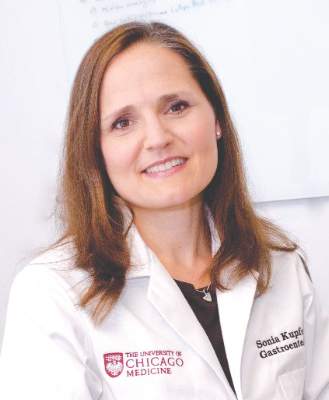
Dr. Kupfer is an adult gastroenterologist with clinical and research interests in the genetics of gastrointestinal diseases. She is an assistant professor in the section of gastroenterology and serves as director of the Gastrointestinal Cancer Risk and Prevention Clinic at the University of Chicago. She is also a member of the University of Chicago Celiac Disease Center. She graduated from Yale University and completed her medical training including chief residency and gastroenterology fellowship at the University of Chicago. She received an F32 individual training grant and an NCI K08 career development award to study colorectal cancer genetics in African Americans. She is site primary investigator on a number of National Institutes of Health–sponsored clinical trials in colorectal cancer chemoprevention and screening. She served as codirector of two national clinical cancer genetics conferences and is a core faculty member in the City of Hope cancer genetics educational program. Dr. Kupfer is active on several AGA committees and is president-elect of the Collaborative Group of the Americas on Inherited Colorectal Cancer. She has mentored numerous medical students, residents, and fellows and teaches in the medical school.
Wajahat Mehal, MD, DPhil

Dr. Mehal is a hepatologist and director of the Yale Weight Loss Program at Yale University, New Haven, Conn. He obtained his medical training and DPhil at the University of Oxford, and completed his residency, chief residency, and Howard Hughes postdoctoral fellowship at Yale University. He has an active research group working in the area of sterile liver inflammation which covers alcoholic and nonalcoholic steatohepatitis. His clinical training is in transplant hepatology, obesity medicine, and endobariatrics. His laboratory training is in immunobiology and liver fibrosis. He has published widely in areas of inflammation and liver disease.
Editor in Chief:
John I. Allen, MD, MBA, AGAF
In 1980, Dr. Allen completed training at the University of Minnesota, Minneapolis, and then spent 10 years on their faculty. In 1991, he joined a private gastroenterology practice in Minneapolis and helped build this single-specialty GI practice into Minnesota Gastroenterology, one of the largest GI practices in the country. In 2013, he left practice to become clinical chief of digestive diseases and professor of medicine at Yale University School of Medicine. In September, 2016, he joined the faculty at the University of Michigan Medical Center, Ann Arbor. He currently remains on the Board of Directors of Allina Health, a large integrated health system in Minnesota.
Dr. Allen has served the American Gastroenterological Association (AGA) in multiple roles. He chaired the Clinical Practice Committee and led development of most quality measures currently in Medicare’s value-based payment system. Dr. Allen serves on the GI Specialty Board of the American Board of Internal Medicine and from May 2014 until May 2015, was president of the AGA Institute.
Associate Editors:
Megan A. Adams, MD, JD, MSc
Dr. Adams is a general gastroenterologist at the Ann Arbor VA and investigator in the VA Ann Arbor Center for Clinical Management Research, with an academic appointment as a clinical lecturer in the division of gastroenterology at the University of Michigan. As a gastroenterologist, attorney, and health services/policy researcher, her primary area of interest lies in improving GI health care delivery. Her current work focuses on improving our understanding of the drivers of inappropriate use of endoscopic resources in order to devise mechanisms to deliver higher-value care. She also has expertise in medicolegal issues in gastroenterology, as well as patient safety and quality improvement. She has served various roles in the AGA over the past 4 years, including as a previous member of the Trainee and Young GI Committee and Future Leaders Program Advisory Board. She currently serves as chair-elect of the AGA Quality Measures Committee.
Ziad F. Gellad, MD, MPH
Dr. Gellad is an associate professor of medicine in the division of gastroenterology at Duke University Medical Center, Durham, N.C., and a faculty member of the Duke Clinical Research Institute. He is also a VA Career Development Awardee and holds an appointment in the Health Services Research and Development Center of Innovation at the Durham VA Medical Center. Dr. Gellad received his MD and MPH degrees from Johns Hopkins University. He completed a residency in internal medicine and a fellowship in gastroenterology at Duke University Medical Center. Dr. Gellad’s research is focused on the implementation of systems engineering methods, including discrete event simulation, to improve the value of health care delivery. He is the director of quality for the division of gastroenterology and director of clinical improvement for the department of medicine at Duke University Medical Center. He also serves as chair of the AGA Quality Measures Committee.
Kim L. Isaacs, MD, PhD, AGAF
Dr. Isaacs is professor of medicine in the division of gastroenterology and hepatology at the University of North Carolina at Chapel Hill. She is codirector of the UNC Center for Inflammatory Bowel Disease and associate program director of the gastroenterology fellowship program at the university. She received her MD and PhD at the State University of New York at Stony Brook and completed her internship, residency, and fellowship in gastroenterology at the University of North Carolina at Chapel Hill. She is active in the clinical care of patients with inflammatory bowel disease and is an investigator in numerous clinical studies in the management and treatment of gastrointestinal disorders including ulcerative colitis, pouchitis, and Crohn’s disease. She has served on the AGA’s constitution and bylaws committee and the Education and Training Committee.
Gyanprakash A. Ketwaroo MD, MSc
Dr. Ketwaroo is an assistant professor in the division of gastroenterology and hepatology at Baylor College of Medicine, Houston, and an advanced endoscopist at the Michael E. Debakey VA Medical Center in Houston. After graduating with a degree in chemical physics from Brown University, he studied at Oxford University on a Rhodes Scholarship. He attended Harvard Medical School and completed an internal medicine residency at the Massachusetts General Hospital. This was followed by gastroenterology and advanced endoscopy fellowship training at the Beth Israel Deaconess Medical Center. He is chair of the AGA Trainee and Young GI Committee. His research interests include Barrett’s esophagus, chronic pancreatitis, and advanced imaging of gastrointestinal disease.
Lawrence R. Kosinski, MD, MBA, AGAF, FACG
Dr. Kosinski has been in the practice of gastroenterology since 1984. He received his MD from Loyola University Chicago Stritch School of Medicine in 1978 and earned his MBA from Northwestern University Kellogg School of Management in 1998. He is currently one of the managing partners of the Illinois Gastroenterology Group (IGG), the largest gastroenterology practice in Illinois.
In addition to his medical practice, Dr. Kosinski is the Clinical Private Practice Councilor for the American Gastroenterological Association and serves on its Governing Board. Locally, he is a member of the Advocate Sherman Hospital Board of Directors, Elgin, Ill.
In January 2014, Dr. Kosinski started SonarMD, a technology company formed to bring the success of Project Sonar to a national presence. He serves as its president and chief medical officer.
Sonia S. Kupfer, MD
Dr. Kupfer is an adult gastroenterologist with clinical and research interests in the genetics of gastrointestinal diseases. She is an assistant professor in the section of gastroenterology and serves as director of the Gastrointestinal Cancer Risk and Prevention Clinic at the University of Chicago. She is also a member of the University of Chicago Celiac Disease Center. She graduated from Yale University and completed her medical training including chief residency and gastroenterology fellowship at the University of Chicago. She received an F32 individual training grant and an NCI K08 career development award to study colorectal cancer genetics in African Americans. She is site primary investigator on a number of National Institutes of Health–sponsored clinical trials in colorectal cancer chemoprevention and screening. She served as codirector of two national clinical cancer genetics conferences and is a core faculty member in the City of Hope cancer genetics educational program. Dr. Kupfer is active on several AGA committees and is president-elect of the Collaborative Group of the Americas on Inherited Colorectal Cancer. She has mentored numerous medical students, residents, and fellows and teaches in the medical school.
Wajahat Mehal, MD, DPhil
Dr. Mehal is a hepatologist and director of the Yale Weight Loss Program at Yale University, New Haven, Conn. He obtained his medical training and DPhil at the University of Oxford, and completed his residency, chief residency, and Howard Hughes postdoctoral fellowship at Yale University. He has an active research group working in the area of sterile liver inflammation which covers alcoholic and nonalcoholic steatohepatitis. His clinical training is in transplant hepatology, obesity medicine, and endobariatrics. His laboratory training is in immunobiology and liver fibrosis. He has published widely in areas of inflammation and liver disease.
Editor in Chief:
John I. Allen, MD, MBA, AGAF
In 1980, Dr. Allen completed training at the University of Minnesota, Minneapolis, and then spent 10 years on their faculty. In 1991, he joined a private gastroenterology practice in Minneapolis and helped build this single-specialty GI practice into Minnesota Gastroenterology, one of the largest GI practices in the country. In 2013, he left practice to become clinical chief of digestive diseases and professor of medicine at Yale University School of Medicine. In September, 2016, he joined the faculty at the University of Michigan Medical Center, Ann Arbor. He currently remains on the Board of Directors of Allina Health, a large integrated health system in Minnesota.
Dr. Allen has served the American Gastroenterological Association (AGA) in multiple roles. He chaired the Clinical Practice Committee and led development of most quality measures currently in Medicare’s value-based payment system. Dr. Allen serves on the GI Specialty Board of the American Board of Internal Medicine and from May 2014 until May 2015, was president of the AGA Institute.
Associate Editors:
Megan A. Adams, MD, JD, MSc
Dr. Adams is a general gastroenterologist at the Ann Arbor VA and investigator in the VA Ann Arbor Center for Clinical Management Research, with an academic appointment as a clinical lecturer in the division of gastroenterology at the University of Michigan. As a gastroenterologist, attorney, and health services/policy researcher, her primary area of interest lies in improving GI health care delivery. Her current work focuses on improving our understanding of the drivers of inappropriate use of endoscopic resources in order to devise mechanisms to deliver higher-value care. She also has expertise in medicolegal issues in gastroenterology, as well as patient safety and quality improvement. She has served various roles in the AGA over the past 4 years, including as a previous member of the Trainee and Young GI Committee and Future Leaders Program Advisory Board. She currently serves as chair-elect of the AGA Quality Measures Committee.
Ziad F. Gellad, MD, MPH
Dr. Gellad is an associate professor of medicine in the division of gastroenterology at Duke University Medical Center, Durham, N.C., and a faculty member of the Duke Clinical Research Institute. He is also a VA Career Development Awardee and holds an appointment in the Health Services Research and Development Center of Innovation at the Durham VA Medical Center. Dr. Gellad received his MD and MPH degrees from Johns Hopkins University. He completed a residency in internal medicine and a fellowship in gastroenterology at Duke University Medical Center. Dr. Gellad’s research is focused on the implementation of systems engineering methods, including discrete event simulation, to improve the value of health care delivery. He is the director of quality for the division of gastroenterology and director of clinical improvement for the department of medicine at Duke University Medical Center. He also serves as chair of the AGA Quality Measures Committee.
Kim L. Isaacs, MD, PhD, AGAF
Dr. Isaacs is professor of medicine in the division of gastroenterology and hepatology at the University of North Carolina at Chapel Hill. She is codirector of the UNC Center for Inflammatory Bowel Disease and associate program director of the gastroenterology fellowship program at the university. She received her MD and PhD at the State University of New York at Stony Brook and completed her internship, residency, and fellowship in gastroenterology at the University of North Carolina at Chapel Hill. She is active in the clinical care of patients with inflammatory bowel disease and is an investigator in numerous clinical studies in the management and treatment of gastrointestinal disorders including ulcerative colitis, pouchitis, and Crohn’s disease. She has served on the AGA’s constitution and bylaws committee and the Education and Training Committee.
Gyanprakash A. Ketwaroo MD, MSc
Dr. Ketwaroo is an assistant professor in the division of gastroenterology and hepatology at Baylor College of Medicine, Houston, and an advanced endoscopist at the Michael E. Debakey VA Medical Center in Houston. After graduating with a degree in chemical physics from Brown University, he studied at Oxford University on a Rhodes Scholarship. He attended Harvard Medical School and completed an internal medicine residency at the Massachusetts General Hospital. This was followed by gastroenterology and advanced endoscopy fellowship training at the Beth Israel Deaconess Medical Center. He is chair of the AGA Trainee and Young GI Committee. His research interests include Barrett’s esophagus, chronic pancreatitis, and advanced imaging of gastrointestinal disease.
Lawrence R. Kosinski, MD, MBA, AGAF, FACG
Dr. Kosinski has been in the practice of gastroenterology since 1984. He received his MD from Loyola University Chicago Stritch School of Medicine in 1978 and earned his MBA from Northwestern University Kellogg School of Management in 1998. He is currently one of the managing partners of the Illinois Gastroenterology Group (IGG), the largest gastroenterology practice in Illinois.
In addition to his medical practice, Dr. Kosinski is the Clinical Private Practice Councilor for the American Gastroenterological Association and serves on its Governing Board. Locally, he is a member of the Advocate Sherman Hospital Board of Directors, Elgin, Ill.
In January 2014, Dr. Kosinski started SonarMD, a technology company formed to bring the success of Project Sonar to a national presence. He serves as its president and chief medical officer.
Sonia S. Kupfer, MD
Dr. Kupfer is an adult gastroenterologist with clinical and research interests in the genetics of gastrointestinal diseases. She is an assistant professor in the section of gastroenterology and serves as director of the Gastrointestinal Cancer Risk and Prevention Clinic at the University of Chicago. She is also a member of the University of Chicago Celiac Disease Center. She graduated from Yale University and completed her medical training including chief residency and gastroenterology fellowship at the University of Chicago. She received an F32 individual training grant and an NCI K08 career development award to study colorectal cancer genetics in African Americans. She is site primary investigator on a number of National Institutes of Health–sponsored clinical trials in colorectal cancer chemoprevention and screening. She served as codirector of two national clinical cancer genetics conferences and is a core faculty member in the City of Hope cancer genetics educational program. Dr. Kupfer is active on several AGA committees and is president-elect of the Collaborative Group of the Americas on Inherited Colorectal Cancer. She has mentored numerous medical students, residents, and fellows and teaches in the medical school.
Wajahat Mehal, MD, DPhil
Dr. Mehal is a hepatologist and director of the Yale Weight Loss Program at Yale University, New Haven, Conn. He obtained his medical training and DPhil at the University of Oxford, and completed his residency, chief residency, and Howard Hughes postdoctoral fellowship at Yale University. He has an active research group working in the area of sterile liver inflammation which covers alcoholic and nonalcoholic steatohepatitis. His clinical training is in transplant hepatology, obesity medicine, and endobariatrics. His laboratory training is in immunobiology and liver fibrosis. He has published widely in areas of inflammation and liver disease.

Preparing for the GI boards
The latest installment of AGA’s Digestive Diseases Self Education Program® (DDSEP®) 8 not only helps prepare you for the in-depth gastroenterology and hepatology material on the GI board exam, but also for the test-taking process itself, thanks to a helpful piece by Suzanne Rose, MD, MSEd, and Norma Saks, EdD.
Dr. Rose, professor of medicine and senior associate dean for education at the University of Connecticut School of Medicine, and Dr. Saks, professor of the department of psychiatry, assistant dean for educational programs and director of the Cognitive Skills Program at the Robert Wood Johnson Medical School, compiled their experience and knowledge into a helpful and comprehensive list of test-taking tips for practitioners taking the GI board exams.
The article, “How to Prepare for the Gastroenterology Boards,” delves into each stage of test preparation, including studying, practice testing, and taking the test itself. Below are just a few summaries of the many tips they provide. You can access the full article by purchasing DDSEP® 8. To learn more about AGA’s DDSEP® offerings, visit http://buyddsep8.gastro.org.
Before the exam
Get to know the rules and familiarize yourself with the American Board of Internal Medicine’s (ABIM) certification process. Make sure you allow enough time to prepare for the exam when you’re signing up, and also get familiar with the location, scheduling, and potential penalties of the exam.
Preparing for the exam
While studying, Dr. Rose and Dr. Saks recommend first identifying your strengths and weaknesses so that you can take the time to prepare where you need it. Also, make a study schedule and take practice tests so that you can better identify topics you should spend more time studying for. For instance, even though you might think something’s a test strength, practicing could help show you that you’re overthinking topics you’re most comfortable with. Also, consider working with a partner or larger group to help increase learning retention and keep you on track with your study schedule.
Taking the exam
In addition to obvious things like double-checking ABIM’s website before the test day and getting a good night’s sleep, the authors provide some helpful time management suggestions. Some topics they address include guessing, pacing yourself during the exam and how to best address those difficult questions. One big tip they offer: don’t leave questions blank, as those will automatically be counted as incorrect answers.
The latest installment of AGA’s Digestive Diseases Self Education Program® (DDSEP®) 8 not only helps prepare you for the in-depth gastroenterology and hepatology material on the GI board exam, but also for the test-taking process itself, thanks to a helpful piece by Suzanne Rose, MD, MSEd, and Norma Saks, EdD.
Dr. Rose, professor of medicine and senior associate dean for education at the University of Connecticut School of Medicine, and Dr. Saks, professor of the department of psychiatry, assistant dean for educational programs and director of the Cognitive Skills Program at the Robert Wood Johnson Medical School, compiled their experience and knowledge into a helpful and comprehensive list of test-taking tips for practitioners taking the GI board exams.
The article, “How to Prepare for the Gastroenterology Boards,” delves into each stage of test preparation, including studying, practice testing, and taking the test itself. Below are just a few summaries of the many tips they provide. You can access the full article by purchasing DDSEP® 8. To learn more about AGA’s DDSEP® offerings, visit http://buyddsep8.gastro.org.
Before the exam
Get to know the rules and familiarize yourself with the American Board of Internal Medicine’s (ABIM) certification process. Make sure you allow enough time to prepare for the exam when you’re signing up, and also get familiar with the location, scheduling, and potential penalties of the exam.
Preparing for the exam
While studying, Dr. Rose and Dr. Saks recommend first identifying your strengths and weaknesses so that you can take the time to prepare where you need it. Also, make a study schedule and take practice tests so that you can better identify topics you should spend more time studying for. For instance, even though you might think something’s a test strength, practicing could help show you that you’re overthinking topics you’re most comfortable with. Also, consider working with a partner or larger group to help increase learning retention and keep you on track with your study schedule.
Taking the exam
In addition to obvious things like double-checking ABIM’s website before the test day and getting a good night’s sleep, the authors provide some helpful time management suggestions. Some topics they address include guessing, pacing yourself during the exam and how to best address those difficult questions. One big tip they offer: don’t leave questions blank, as those will automatically be counted as incorrect answers.
The latest installment of AGA’s Digestive Diseases Self Education Program® (DDSEP®) 8 not only helps prepare you for the in-depth gastroenterology and hepatology material on the GI board exam, but also for the test-taking process itself, thanks to a helpful piece by Suzanne Rose, MD, MSEd, and Norma Saks, EdD.
Dr. Rose, professor of medicine and senior associate dean for education at the University of Connecticut School of Medicine, and Dr. Saks, professor of the department of psychiatry, assistant dean for educational programs and director of the Cognitive Skills Program at the Robert Wood Johnson Medical School, compiled their experience and knowledge into a helpful and comprehensive list of test-taking tips for practitioners taking the GI board exams.
The article, “How to Prepare for the Gastroenterology Boards,” delves into each stage of test preparation, including studying, practice testing, and taking the test itself. Below are just a few summaries of the many tips they provide. You can access the full article by purchasing DDSEP® 8. To learn more about AGA’s DDSEP® offerings, visit http://buyddsep8.gastro.org.
Before the exam
Get to know the rules and familiarize yourself with the American Board of Internal Medicine’s (ABIM) certification process. Make sure you allow enough time to prepare for the exam when you’re signing up, and also get familiar with the location, scheduling, and potential penalties of the exam.
Preparing for the exam
While studying, Dr. Rose and Dr. Saks recommend first identifying your strengths and weaknesses so that you can take the time to prepare where you need it. Also, make a study schedule and take practice tests so that you can better identify topics you should spend more time studying for. For instance, even though you might think something’s a test strength, practicing could help show you that you’re overthinking topics you’re most comfortable with. Also, consider working with a partner or larger group to help increase learning retention and keep you on track with your study schedule.
Taking the exam
In addition to obvious things like double-checking ABIM’s website before the test day and getting a good night’s sleep, the authors provide some helpful time management suggestions. Some topics they address include guessing, pacing yourself during the exam and how to best address those difficult questions. One big tip they offer: don’t leave questions blank, as those will automatically be counted as incorrect answers.
Honor a loved one and support the AGA Research Awards Program
Did you know that you can honor a family member, friend, or colleague through a gift to the AGA Research Foundation? A simple, flexible, and versatile way to ensure the AGA Research Foundation can continue our work for years to come is a gift in your will or living trust, known as a charitable bequest. To make a charitable gift in a will, you need a current will or living trust.
You can include a gift in your will or living trust stating that a specific asset, certain dollar amount, or – more commonly – a percentage of your estate will pass to the AGA following your death in honor of your loved one. A gift of $50,000 or more in your will qualifies for membership in the AGA Legacy Society.
We hope you’ll consider including a gift to the AGA Research Foundation in your will or living trust. It’s simple – just a few sentences in your will or trust are all that is needed. The official bequest language for the AGA Research Foundation is: “I, [name], of [city, state, ZIP], give, devise and bequeath to the AGA Research Foundation [written amount or percentage of the estate or description of property] for its unrestricted use and purpose.”
For more information on how to give and recognize your loved one, contact Harmony Excellent at 301-272-1602 or [email protected] or visit http://gastro.planmylegacy.org/.
Did you know that you can honor a family member, friend, or colleague through a gift to the AGA Research Foundation? A simple, flexible, and versatile way to ensure the AGA Research Foundation can continue our work for years to come is a gift in your will or living trust, known as a charitable bequest. To make a charitable gift in a will, you need a current will or living trust.
You can include a gift in your will or living trust stating that a specific asset, certain dollar amount, or – more commonly – a percentage of your estate will pass to the AGA following your death in honor of your loved one. A gift of $50,000 or more in your will qualifies for membership in the AGA Legacy Society.
We hope you’ll consider including a gift to the AGA Research Foundation in your will or living trust. It’s simple – just a few sentences in your will or trust are all that is needed. The official bequest language for the AGA Research Foundation is: “I, [name], of [city, state, ZIP], give, devise and bequeath to the AGA Research Foundation [written amount or percentage of the estate or description of property] for its unrestricted use and purpose.”
For more information on how to give and recognize your loved one, contact Harmony Excellent at 301-272-1602 or [email protected] or visit http://gastro.planmylegacy.org/.
Did you know that you can honor a family member, friend, or colleague through a gift to the AGA Research Foundation? A simple, flexible, and versatile way to ensure the AGA Research Foundation can continue our work for years to come is a gift in your will or living trust, known as a charitable bequest. To make a charitable gift in a will, you need a current will or living trust.
You can include a gift in your will or living trust stating that a specific asset, certain dollar amount, or – more commonly – a percentage of your estate will pass to the AGA following your death in honor of your loved one. A gift of $50,000 or more in your will qualifies for membership in the AGA Legacy Society.
We hope you’ll consider including a gift to the AGA Research Foundation in your will or living trust. It’s simple – just a few sentences in your will or trust are all that is needed. The official bequest language for the AGA Research Foundation is: “I, [name], of [city, state, ZIP], give, devise and bequeath to the AGA Research Foundation [written amount or percentage of the estate or description of property] for its unrestricted use and purpose.”
For more information on how to give and recognize your loved one, contact Harmony Excellent at 301-272-1602 or [email protected] or visit http://gastro.planmylegacy.org/.
CMGH now in PubMed
Cellular and Molecular Gastroenterology and Hepatology (CMGH) – AGA’s newest scientific journal, which launched in January 2015 – has been accepted to PubMed Central. This means that all CMGH articles, beginning with the very first issue of the journal, will now be available when you search in the PubMed database. Articles should be available by the end of September.
Being searchable in PubMed will increase the visibility of the high-quality digestive biology research published in CMGH, and will also allow easier access to journal content.
Visit the journal at www.cmghjournal.org.
Cellular and Molecular Gastroenterology and Hepatology (CMGH) – AGA’s newest scientific journal, which launched in January 2015 – has been accepted to PubMed Central. This means that all CMGH articles, beginning with the very first issue of the journal, will now be available when you search in the PubMed database. Articles should be available by the end of September.
Being searchable in PubMed will increase the visibility of the high-quality digestive biology research published in CMGH, and will also allow easier access to journal content.
Visit the journal at www.cmghjournal.org.
Cellular and Molecular Gastroenterology and Hepatology (CMGH) – AGA’s newest scientific journal, which launched in January 2015 – has been accepted to PubMed Central. This means that all CMGH articles, beginning with the very first issue of the journal, will now be available when you search in the PubMed database. Articles should be available by the end of September.
Being searchable in PubMed will increase the visibility of the high-quality digestive biology research published in CMGH, and will also allow easier access to journal content.
Visit the journal at www.cmghjournal.org.
AGA: Preparing Practicing GIs for the New World of Reimbursement
Progress toward value-based care by Medicare and commercial payors will continue regardless of the election outcome in November. The health care market will continue to move away from fee-for-service and toward reimbursement systems that reward physicians for improving the quality of patient care and controlling costs. AGA is shaping the future of practice. We continue to be at the forefront of the value-based movement, creating the tools gastroenterologists need for success in new reimbursement environments and preparing our members for a successful future.
Did you know?
• AGA has created bundle and episode payment models for GI issues, including colonoscopy screening and surveillance and GERD, with obesity to launch in 2016 and more to come. These alternative payment models reward providers for identifying efficiency gains, effectively coordinating patient care and improving quality. By the time the Medicare Access and CHIP Reauthorization Act (MACRA) was enacted in 2015, AGA was ready with fully developed, practical alternative payment model solutions for GI.
• AGA is the only GI society to advocate for Medicare to recognize established GI payment models as advanced alternative payment models (APMs) so that gastroenterologists will have a pathway to greater earnings than under the Merit-based Incentive Payment System (MIPS). Not sure what MACRA, MIPS, and APMs are? AGA can help.
• AGA is also the only GI society to develop a MACRA education tool that explains, in plain language, MACRA’s impact on GIs and offers a customized plan for how to prepare based on your practice situation.
• AGA has established relationships with Medicare and commercial payors that allow us to provide input on coverage decisions. We recognize that payor coverage of procedures and technology plays a vital role in reimbursement success and we take every opportunity to provide payors with input from AGA member experts.
• In addition to AGA’s rigorous, evidence-based clinical practice guidelines, we provide expert reviews and other clinical practice guidance documents to provide best practice advice for physicians in areas in which there is not yet enough literature to produce a clinical guideline. Additionally, Technology Coverage Statements provide support when working with payors on coverage and reimbursement for proven procedures, diagnostics, and therapies that advance the science and practice of gastroenterology and improve care for the patients you treat.
AGA works hard for the gastroenterology field to ensure that you are poised for success under new reimbursement models and will continue to do so. Learn more at http://www.gastro.org/practice-management.
Progress toward value-based care by Medicare and commercial payors will continue regardless of the election outcome in November. The health care market will continue to move away from fee-for-service and toward reimbursement systems that reward physicians for improving the quality of patient care and controlling costs. AGA is shaping the future of practice. We continue to be at the forefront of the value-based movement, creating the tools gastroenterologists need for success in new reimbursement environments and preparing our members for a successful future.
Did you know?
• AGA has created bundle and episode payment models for GI issues, including colonoscopy screening and surveillance and GERD, with obesity to launch in 2016 and more to come. These alternative payment models reward providers for identifying efficiency gains, effectively coordinating patient care and improving quality. By the time the Medicare Access and CHIP Reauthorization Act (MACRA) was enacted in 2015, AGA was ready with fully developed, practical alternative payment model solutions for GI.
• AGA is the only GI society to advocate for Medicare to recognize established GI payment models as advanced alternative payment models (APMs) so that gastroenterologists will have a pathway to greater earnings than under the Merit-based Incentive Payment System (MIPS). Not sure what MACRA, MIPS, and APMs are? AGA can help.
• AGA is also the only GI society to develop a MACRA education tool that explains, in plain language, MACRA’s impact on GIs and offers a customized plan for how to prepare based on your practice situation.
• AGA has established relationships with Medicare and commercial payors that allow us to provide input on coverage decisions. We recognize that payor coverage of procedures and technology plays a vital role in reimbursement success and we take every opportunity to provide payors with input from AGA member experts.
• In addition to AGA’s rigorous, evidence-based clinical practice guidelines, we provide expert reviews and other clinical practice guidance documents to provide best practice advice for physicians in areas in which there is not yet enough literature to produce a clinical guideline. Additionally, Technology Coverage Statements provide support when working with payors on coverage and reimbursement for proven procedures, diagnostics, and therapies that advance the science and practice of gastroenterology and improve care for the patients you treat.
AGA works hard for the gastroenterology field to ensure that you are poised for success under new reimbursement models and will continue to do so. Learn more at http://www.gastro.org/practice-management.
Progress toward value-based care by Medicare and commercial payors will continue regardless of the election outcome in November. The health care market will continue to move away from fee-for-service and toward reimbursement systems that reward physicians for improving the quality of patient care and controlling costs. AGA is shaping the future of practice. We continue to be at the forefront of the value-based movement, creating the tools gastroenterologists need for success in new reimbursement environments and preparing our members for a successful future.
Did you know?
• AGA has created bundle and episode payment models for GI issues, including colonoscopy screening and surveillance and GERD, with obesity to launch in 2016 and more to come. These alternative payment models reward providers for identifying efficiency gains, effectively coordinating patient care and improving quality. By the time the Medicare Access and CHIP Reauthorization Act (MACRA) was enacted in 2015, AGA was ready with fully developed, practical alternative payment model solutions for GI.
• AGA is the only GI society to advocate for Medicare to recognize established GI payment models as advanced alternative payment models (APMs) so that gastroenterologists will have a pathway to greater earnings than under the Merit-based Incentive Payment System (MIPS). Not sure what MACRA, MIPS, and APMs are? AGA can help.
• AGA is also the only GI society to develop a MACRA education tool that explains, in plain language, MACRA’s impact on GIs and offers a customized plan for how to prepare based on your practice situation.
• AGA has established relationships with Medicare and commercial payors that allow us to provide input on coverage decisions. We recognize that payor coverage of procedures and technology plays a vital role in reimbursement success and we take every opportunity to provide payors with input from AGA member experts.
• In addition to AGA’s rigorous, evidence-based clinical practice guidelines, we provide expert reviews and other clinical practice guidance documents to provide best practice advice for physicians in areas in which there is not yet enough literature to produce a clinical guideline. Additionally, Technology Coverage Statements provide support when working with payors on coverage and reimbursement for proven procedures, diagnostics, and therapies that advance the science and practice of gastroenterology and improve care for the patients you treat.
AGA works hard for the gastroenterology field to ensure that you are poised for success under new reimbursement models and will continue to do so. Learn more at http://www.gastro.org/practice-management.
DDSEP® 8: Everything you need to succeed
Trusted by GIs for more than 15 years, the Digestive Diseases Self-Education Program® (DDSEP), which is now in its eighth edition, builds upon prior success by incorporating a number of innovations and adaptations to deliver a diverse and highly engaging learning platform.
You can tailor your learning experience as you see fit with our app-based format and flexible options.
What’s new?
• Web and app based – Learn at your computer or on-the-go with your smart device. When and how you learn is up to you.
• Mock exams – Evaluate your exam readiness with American Board of Internal Medicine–style mock exams, each with 60 questions.
• Enhanced flexibility – Access all resources with DDSEP 8 Complete or customize your learning by purchasing individual chapters, questions only, or mock exams.
To purchase and learn more, visit the DDSEP 8 website.
Trusted by GIs for more than 15 years, the Digestive Diseases Self-Education Program® (DDSEP), which is now in its eighth edition, builds upon prior success by incorporating a number of innovations and adaptations to deliver a diverse and highly engaging learning platform.
You can tailor your learning experience as you see fit with our app-based format and flexible options.
What’s new?
• Web and app based – Learn at your computer or on-the-go with your smart device. When and how you learn is up to you.
• Mock exams – Evaluate your exam readiness with American Board of Internal Medicine–style mock exams, each with 60 questions.
• Enhanced flexibility – Access all resources with DDSEP 8 Complete or customize your learning by purchasing individual chapters, questions only, or mock exams.
To purchase and learn more, visit the DDSEP 8 website.
Trusted by GIs for more than 15 years, the Digestive Diseases Self-Education Program® (DDSEP), which is now in its eighth edition, builds upon prior success by incorporating a number of innovations and adaptations to deliver a diverse and highly engaging learning platform.
You can tailor your learning experience as you see fit with our app-based format and flexible options.
What’s new?
• Web and app based – Learn at your computer or on-the-go with your smart device. When and how you learn is up to you.
• Mock exams – Evaluate your exam readiness with American Board of Internal Medicine–style mock exams, each with 60 questions.
• Enhanced flexibility – Access all resources with DDSEP 8 Complete or customize your learning by purchasing individual chapters, questions only, or mock exams.
To purchase and learn more, visit the DDSEP 8 website.