User login
Review Finds No Short-term MACE, VTE risk with JAK Inhibitors For Dermatoses
, at least in the short term, say the authors of a new meta-analysis published in JAMA Dermatology.
Considering data on over 17,000 patients with different dermatoses from 45 placebo-controlled randomized clinical trials with an average follow up of 16 weeks, they found there was no significant increase in the occurrence of major adverse cardiovascular events (MACE) or venous thromboembolism (VTE) in people with dermatoses treated with JAK-STAT inhibitors, compared with placebo.
The I² statistic was 0.00% for both MACE and VTE comparing the two arms, indicating that the results were unlikely to be due to chance. There was no increased risk in MACE between those on placebo and those on JAK-STAT inhibitors, with a risk ratio (RR) of 0.47; or for VTE risk, with an RR of 0.46.
Similar findings were obtained when data were analyzed according to the dermatological condition being treated, mechanism of action of the medication, or whether the medication carried a boxed warning.
These data “suggest inconsistency with established sentiments,” that JAK-STAT inhibitors increase the risk for cardiovascular events, Patrick Ireland, MD, of the University of New South Wales, Randwick, Australia, and coauthors wrote in the article. “This may be owing to the limited time frames in which these rare events could be adequately captured, or the ages of enrolled patients being too young to realize the well established heightened risks of developing MACE and VTE,” they suggested.
However, the findings challenge the notion that the cardiovascular complications of these drugs are the same in all patients; dermatological use may not be associated with the same risks as with use for rheumatologic indications.
Class-Wide Boxed Warning
“JAK-STAT [inhibitors] have had some pretty indemnifying data against their use, with the ORAL [Surveillance] study demonstrating increased all-cause mortality, cardiovascular events, venous thromboembolism, and malignancy,” Dr. Ireland said in an interview.
ORAL Surveillance was an open-label, postmarketing trial conducted in patients with rheumatoid arthritis treated with tofacitinib or a tumor necrosis factor (TNF) inhibitor. The results led the US Food and Drug Administration to require information about the risks of serious heart-related events, cancer, blood clots, and death in a boxed warning for JAK-STAT inhibitors in 2022.
“I think it’s important to recognize that these [ORAL Surveillance participants] are very different patients to the typical dermatological patient being treated with a JAK-STAT [inhibitors], with newer studies demonstrating a much safer profile than initially thought,” Dr. Ireland said.
Examining Risk in Dermatological Conditions
The meta-analysis performed by Dr. Ireland and associates focused specifically on the risk for MACE and VTE in patients being treated for dermatological conditions, and included trials published up until June 2023. Only trials that had included a placebo arm were considered; pooled analyses, long-term extension trial data, post hoc analyses, and pediatric-specific trials were excluded.
Most (25) of the trials were phase 2b or phase 3 trials, 18 were phase 2 to 2b, and two were phase 1 trials. The studies included 12,996 participants, mostly with atopic dermatitis or psoriasis, who were treated with JAK-STAT inhibitors, which included baricitinib (2846 patients), tofacitinib (2470), upadacitinib (2218), abrocitinib (1904), and deucravacitinib (1492), among others. There were 4925 patients on placebo.
Overall, MACE — defined as a combined endpoint of acute myocardial infarction, stroke, cardiovascular mortality, heart failure, and unstable angina, as well as arterial embolism — occurred in 13 of the JAK-STAT inhibitor-treated patients and in four of those on placebo. VTE — defined as deep vein thrombosis, pulmonary embolism, and any unusual site thrombosis — was reported in eight JAK-STAT inhibitor-treated patients and in one patient on placebo.
The pooled incidence ratios for MACE and VTE were calculated as 0.20 per 100 person exposure years (PEY) for JAK-STAT inhibitor treatment and 0.13 PEY for placebo. The pooled RRs comparing the two treatment groups were a respective 1.13 for MACE and 2.79 for VTE, but neither RR reached statistical significance.
No difference was seen between the treatment arms in terms of treatment emergent adverse events (RR, 1.05), serious adverse events (RR, 0.92), or study discontinuation because of adverse events (RR, 0.94).
Reassuring Results?
Dr. Ireland and coauthors said the finding should help to reassure clinicians that the short-term use of JAK-STAT inhibitors in patients with dermatological conditions with low cardiovascular risk profiles “appears to be both safe and well tolerated.” They cautioned, however, that “clinicians must remain judicious” when using these medications for longer periods and in high-risk patient populations.
This was a pragmatic meta-analysis that provides useful information for dermatologists, Adam Friedman, MD, professor and chair of dermatology at George Washington University, Washington, DC, said in an interview.
“When there are safety concerns, I think that’s where data like this are so important to not just allay the fears of practitioners, but also to arm the practitioner with information for when they discuss a possible treatment with a patient,” said Dr. Friedman, who was not involved in the study.
“What’s unique here is that they’re looking at any possible use of JAK inhibitors for dermatological disease,” so this represents patients that dermatologists would be seeing, he added.
“The limitation here is time, we only can say so much about the safety of the medication with the data that we have,” Dr. Friedman said. Almost 4 months is “a good amount of time” to know about the cardiovascular risks, he said, but added, what happens then? Will the risk increase and will patients need to be switched to another medication?
“There’s no line in the sand,” with regard to using a JAK-STAT inhibitor. “If you look at the label, they’re not meant to be used incrementally,” but as ongoing treatment, while considering the needs of the patient and the relative risks and benefits, he said.
With that in mind, “the open label extension studies for all these [JAK-STAT inhibitors] are really, really important to get a sense of ‘do new signals emerge down the road.’ ”
The meta-analysis received no commercial funding. One author of the work reported personal fees from several pharmaceutical companies which were done outside of analysis. Dr. Friedman has received research funding from or acted as a consultant for several pharmaceutical companies including, Incyte, Pfizer, Eli Lily, and AbbVie.
, at least in the short term, say the authors of a new meta-analysis published in JAMA Dermatology.
Considering data on over 17,000 patients with different dermatoses from 45 placebo-controlled randomized clinical trials with an average follow up of 16 weeks, they found there was no significant increase in the occurrence of major adverse cardiovascular events (MACE) or venous thromboembolism (VTE) in people with dermatoses treated with JAK-STAT inhibitors, compared with placebo.
The I² statistic was 0.00% for both MACE and VTE comparing the two arms, indicating that the results were unlikely to be due to chance. There was no increased risk in MACE between those on placebo and those on JAK-STAT inhibitors, with a risk ratio (RR) of 0.47; or for VTE risk, with an RR of 0.46.
Similar findings were obtained when data were analyzed according to the dermatological condition being treated, mechanism of action of the medication, or whether the medication carried a boxed warning.
These data “suggest inconsistency with established sentiments,” that JAK-STAT inhibitors increase the risk for cardiovascular events, Patrick Ireland, MD, of the University of New South Wales, Randwick, Australia, and coauthors wrote in the article. “This may be owing to the limited time frames in which these rare events could be adequately captured, or the ages of enrolled patients being too young to realize the well established heightened risks of developing MACE and VTE,” they suggested.
However, the findings challenge the notion that the cardiovascular complications of these drugs are the same in all patients; dermatological use may not be associated with the same risks as with use for rheumatologic indications.
Class-Wide Boxed Warning
“JAK-STAT [inhibitors] have had some pretty indemnifying data against their use, with the ORAL [Surveillance] study demonstrating increased all-cause mortality, cardiovascular events, venous thromboembolism, and malignancy,” Dr. Ireland said in an interview.
ORAL Surveillance was an open-label, postmarketing trial conducted in patients with rheumatoid arthritis treated with tofacitinib or a tumor necrosis factor (TNF) inhibitor. The results led the US Food and Drug Administration to require information about the risks of serious heart-related events, cancer, blood clots, and death in a boxed warning for JAK-STAT inhibitors in 2022.
“I think it’s important to recognize that these [ORAL Surveillance participants] are very different patients to the typical dermatological patient being treated with a JAK-STAT [inhibitors], with newer studies demonstrating a much safer profile than initially thought,” Dr. Ireland said.
Examining Risk in Dermatological Conditions
The meta-analysis performed by Dr. Ireland and associates focused specifically on the risk for MACE and VTE in patients being treated for dermatological conditions, and included trials published up until June 2023. Only trials that had included a placebo arm were considered; pooled analyses, long-term extension trial data, post hoc analyses, and pediatric-specific trials were excluded.
Most (25) of the trials were phase 2b or phase 3 trials, 18 were phase 2 to 2b, and two were phase 1 trials. The studies included 12,996 participants, mostly with atopic dermatitis or psoriasis, who were treated with JAK-STAT inhibitors, which included baricitinib (2846 patients), tofacitinib (2470), upadacitinib (2218), abrocitinib (1904), and deucravacitinib (1492), among others. There were 4925 patients on placebo.
Overall, MACE — defined as a combined endpoint of acute myocardial infarction, stroke, cardiovascular mortality, heart failure, and unstable angina, as well as arterial embolism — occurred in 13 of the JAK-STAT inhibitor-treated patients and in four of those on placebo. VTE — defined as deep vein thrombosis, pulmonary embolism, and any unusual site thrombosis — was reported in eight JAK-STAT inhibitor-treated patients and in one patient on placebo.
The pooled incidence ratios for MACE and VTE were calculated as 0.20 per 100 person exposure years (PEY) for JAK-STAT inhibitor treatment and 0.13 PEY for placebo. The pooled RRs comparing the two treatment groups were a respective 1.13 for MACE and 2.79 for VTE, but neither RR reached statistical significance.
No difference was seen between the treatment arms in terms of treatment emergent adverse events (RR, 1.05), serious adverse events (RR, 0.92), or study discontinuation because of adverse events (RR, 0.94).
Reassuring Results?
Dr. Ireland and coauthors said the finding should help to reassure clinicians that the short-term use of JAK-STAT inhibitors in patients with dermatological conditions with low cardiovascular risk profiles “appears to be both safe and well tolerated.” They cautioned, however, that “clinicians must remain judicious” when using these medications for longer periods and in high-risk patient populations.
This was a pragmatic meta-analysis that provides useful information for dermatologists, Adam Friedman, MD, professor and chair of dermatology at George Washington University, Washington, DC, said in an interview.
“When there are safety concerns, I think that’s where data like this are so important to not just allay the fears of practitioners, but also to arm the practitioner with information for when they discuss a possible treatment with a patient,” said Dr. Friedman, who was not involved in the study.
“What’s unique here is that they’re looking at any possible use of JAK inhibitors for dermatological disease,” so this represents patients that dermatologists would be seeing, he added.
“The limitation here is time, we only can say so much about the safety of the medication with the data that we have,” Dr. Friedman said. Almost 4 months is “a good amount of time” to know about the cardiovascular risks, he said, but added, what happens then? Will the risk increase and will patients need to be switched to another medication?
“There’s no line in the sand,” with regard to using a JAK-STAT inhibitor. “If you look at the label, they’re not meant to be used incrementally,” but as ongoing treatment, while considering the needs of the patient and the relative risks and benefits, he said.
With that in mind, “the open label extension studies for all these [JAK-STAT inhibitors] are really, really important to get a sense of ‘do new signals emerge down the road.’ ”
The meta-analysis received no commercial funding. One author of the work reported personal fees from several pharmaceutical companies which were done outside of analysis. Dr. Friedman has received research funding from or acted as a consultant for several pharmaceutical companies including, Incyte, Pfizer, Eli Lily, and AbbVie.
, at least in the short term, say the authors of a new meta-analysis published in JAMA Dermatology.
Considering data on over 17,000 patients with different dermatoses from 45 placebo-controlled randomized clinical trials with an average follow up of 16 weeks, they found there was no significant increase in the occurrence of major adverse cardiovascular events (MACE) or venous thromboembolism (VTE) in people with dermatoses treated with JAK-STAT inhibitors, compared with placebo.
The I² statistic was 0.00% for both MACE and VTE comparing the two arms, indicating that the results were unlikely to be due to chance. There was no increased risk in MACE between those on placebo and those on JAK-STAT inhibitors, with a risk ratio (RR) of 0.47; or for VTE risk, with an RR of 0.46.
Similar findings were obtained when data were analyzed according to the dermatological condition being treated, mechanism of action of the medication, or whether the medication carried a boxed warning.
These data “suggest inconsistency with established sentiments,” that JAK-STAT inhibitors increase the risk for cardiovascular events, Patrick Ireland, MD, of the University of New South Wales, Randwick, Australia, and coauthors wrote in the article. “This may be owing to the limited time frames in which these rare events could be adequately captured, or the ages of enrolled patients being too young to realize the well established heightened risks of developing MACE and VTE,” they suggested.
However, the findings challenge the notion that the cardiovascular complications of these drugs are the same in all patients; dermatological use may not be associated with the same risks as with use for rheumatologic indications.
Class-Wide Boxed Warning
“JAK-STAT [inhibitors] have had some pretty indemnifying data against their use, with the ORAL [Surveillance] study demonstrating increased all-cause mortality, cardiovascular events, venous thromboembolism, and malignancy,” Dr. Ireland said in an interview.
ORAL Surveillance was an open-label, postmarketing trial conducted in patients with rheumatoid arthritis treated with tofacitinib or a tumor necrosis factor (TNF) inhibitor. The results led the US Food and Drug Administration to require information about the risks of serious heart-related events, cancer, blood clots, and death in a boxed warning for JAK-STAT inhibitors in 2022.
“I think it’s important to recognize that these [ORAL Surveillance participants] are very different patients to the typical dermatological patient being treated with a JAK-STAT [inhibitors], with newer studies demonstrating a much safer profile than initially thought,” Dr. Ireland said.
Examining Risk in Dermatological Conditions
The meta-analysis performed by Dr. Ireland and associates focused specifically on the risk for MACE and VTE in patients being treated for dermatological conditions, and included trials published up until June 2023. Only trials that had included a placebo arm were considered; pooled analyses, long-term extension trial data, post hoc analyses, and pediatric-specific trials were excluded.
Most (25) of the trials were phase 2b or phase 3 trials, 18 were phase 2 to 2b, and two were phase 1 trials. The studies included 12,996 participants, mostly with atopic dermatitis or psoriasis, who were treated with JAK-STAT inhibitors, which included baricitinib (2846 patients), tofacitinib (2470), upadacitinib (2218), abrocitinib (1904), and deucravacitinib (1492), among others. There were 4925 patients on placebo.
Overall, MACE — defined as a combined endpoint of acute myocardial infarction, stroke, cardiovascular mortality, heart failure, and unstable angina, as well as arterial embolism — occurred in 13 of the JAK-STAT inhibitor-treated patients and in four of those on placebo. VTE — defined as deep vein thrombosis, pulmonary embolism, and any unusual site thrombosis — was reported in eight JAK-STAT inhibitor-treated patients and in one patient on placebo.
The pooled incidence ratios for MACE and VTE were calculated as 0.20 per 100 person exposure years (PEY) for JAK-STAT inhibitor treatment and 0.13 PEY for placebo. The pooled RRs comparing the two treatment groups were a respective 1.13 for MACE and 2.79 for VTE, but neither RR reached statistical significance.
No difference was seen between the treatment arms in terms of treatment emergent adverse events (RR, 1.05), serious adverse events (RR, 0.92), or study discontinuation because of adverse events (RR, 0.94).
Reassuring Results?
Dr. Ireland and coauthors said the finding should help to reassure clinicians that the short-term use of JAK-STAT inhibitors in patients with dermatological conditions with low cardiovascular risk profiles “appears to be both safe and well tolerated.” They cautioned, however, that “clinicians must remain judicious” when using these medications for longer periods and in high-risk patient populations.
This was a pragmatic meta-analysis that provides useful information for dermatologists, Adam Friedman, MD, professor and chair of dermatology at George Washington University, Washington, DC, said in an interview.
“When there are safety concerns, I think that’s where data like this are so important to not just allay the fears of practitioners, but also to arm the practitioner with information for when they discuss a possible treatment with a patient,” said Dr. Friedman, who was not involved in the study.
“What’s unique here is that they’re looking at any possible use of JAK inhibitors for dermatological disease,” so this represents patients that dermatologists would be seeing, he added.
“The limitation here is time, we only can say so much about the safety of the medication with the data that we have,” Dr. Friedman said. Almost 4 months is “a good amount of time” to know about the cardiovascular risks, he said, but added, what happens then? Will the risk increase and will patients need to be switched to another medication?
“There’s no line in the sand,” with regard to using a JAK-STAT inhibitor. “If you look at the label, they’re not meant to be used incrementally,” but as ongoing treatment, while considering the needs of the patient and the relative risks and benefits, he said.
With that in mind, “the open label extension studies for all these [JAK-STAT inhibitors] are really, really important to get a sense of ‘do new signals emerge down the road.’ ”
The meta-analysis received no commercial funding. One author of the work reported personal fees from several pharmaceutical companies which were done outside of analysis. Dr. Friedman has received research funding from or acted as a consultant for several pharmaceutical companies including, Incyte, Pfizer, Eli Lily, and AbbVie.
FROM JAMA DERMATOLOGY
Guidelines Aren’t For Everybody
An 88-year-old man comes for clinic follow up. He has a medical history of type 2 diabetes, hypertension, heart failure with reduced ejection fraction, and chronic kidney disease. He recently had laboratory tests done: BUN, 32 mg/dL; creatinine, 2.3 mg/dL; potassium, 4.5 mmol/L; bicarbonate, 22 Eq/L; and A1c, 8.2%.
He checks his blood glucose daily (alternating between fasting blood glucose and before dinner) and his fasting blood glucose levels are around 130 mg/dL. His highest glucose reading was 240 mg/dL. He does not have polyuria or visual changes. Current medications: atorvastatin, irbesartan, empagliflozin, and amlodipine. On physical exam his blood pressure is 130/70 mm Hg, pulse is 80, and his BMI 20.
What medication adjustments would you recommend?
A. Begin insulin glargine at bedtime
B. Begin mealtime insulin aspart
C. Begin semaglutide
D. Begin metformin
E. No changes
I think the correct approach here would be no changes. Most physicians know guideline recommendations for A1c of less than 7% are used for patients with diabetes with few comorbid conditions, normal cognition, and functional status. Many of our elderly patients do not meet these criteria and the goal of intense medical treatment of diabetes is different in those patients. The American Diabetes Association has issued a thoughtful paper on treatment of diabetes in elderly people, stressing that patients should have very individualized goals, and that there is no one-size-fits all A1c goal.1

In this patient I would avoid adding insulin, given hypoglycemia risk. A GLP-1 agonist might appear attractive given his multiple cardiovascular risk factors, but his low BMI is a major concern for frailty that may well be worsened with reduced nutrient intake. Diabetes is the chronic condition that probably has the most guidance for management in elderly patients.
I recently saw a 92-year-old man with heart failure with reduced ejection fraction and atrial fibrillation who had been losing weight and becoming weaker. He had suffered several falls in the previous 2 weeks. His medication list included amiodarone, apixaban, sacubitril/valsartan, carvedilol, empagliflozin, spironolactone, and furosemide. He was extremely frail and had stopped eating. He was receiving all guideline-directed therapies, yet he was miserable and dying. Falls in this population are potentially as fatal as decompensated heart disease.
I stopped his amiodarone, furosemide, and spironolactone, and reduced his doses of sacubitril/valsartan and carvedilol. His appetite returned and his will to live returned. Heart failure guidelines do not include robust studies of very elderly patients because few studies exist in this population. Frailty assessment is crucial in decision making in your elderly patients.2,3 and frequent check-ins to make sure that they are not suffering from the effects of polypharmacy are crucial. Our goal in our very elderly patients is quality life-years. Polypharmacy has the potential to decrease the quality of life, as well as potentially shorten life.
The very elderly are at risk of the negative consequences of polypharmacy, especially if they have several diseases like diabetes, congestive heart failure, and hypertension that may require multiple medications. Gutierrez-Valencia and colleagues performed a systematic review of 25 articles on frailty and polypharmacy.4 Their findings demonstrated a significant association between an increased number of medications and frailty. They postulated that polypharmacy could actually be a contributor to frailty. There just isn’t enough evidence for the benefit of guidelines in the very aged and the risks of polypharmacy are real. We should use the lowest possible doses of medications in this population, frequently reassess goals, and monitor closely for side effects.
Pearl: Always consider the risks of polypharmacy when considering therapies for your elderly patients.
Dr. Paauw is professor of medicine in the division of general internal medicine at the University of Washington, Seattle, and he serves as third-year medical student clerkship director at the University of Washington. Contact Dr. Paauw at [email protected].
References
1. Older Adults: Standards of Medical Care in Diabetes — 2021. Diabetes Care 2021;44(Suppl 1):S168–S179.
2. Gaur A et al. Cardiogeriatrics: The current state of the art. Heart. 2024 Jan 11:heartjnl-2022-322117.
3. Denfeld QE et al. Assessing and managing frailty in advanced heart failure: An International Society for Heart and Lung Transplantation consensus statement. J Heart Lung Transplant. 2023 Nov 29:S1053-2498(23)02028-4.
4. Gutiérrez-Valencia M et al. The relationship between frailty and polypharmacy in older people: A systematic review. Br J Clin Pharmacol. 2018 Jul;84(7):1432-44.
An 88-year-old man comes for clinic follow up. He has a medical history of type 2 diabetes, hypertension, heart failure with reduced ejection fraction, and chronic kidney disease. He recently had laboratory tests done: BUN, 32 mg/dL; creatinine, 2.3 mg/dL; potassium, 4.5 mmol/L; bicarbonate, 22 Eq/L; and A1c, 8.2%.
He checks his blood glucose daily (alternating between fasting blood glucose and before dinner) and his fasting blood glucose levels are around 130 mg/dL. His highest glucose reading was 240 mg/dL. He does not have polyuria or visual changes. Current medications: atorvastatin, irbesartan, empagliflozin, and amlodipine. On physical exam his blood pressure is 130/70 mm Hg, pulse is 80, and his BMI 20.
What medication adjustments would you recommend?
A. Begin insulin glargine at bedtime
B. Begin mealtime insulin aspart
C. Begin semaglutide
D. Begin metformin
E. No changes
I think the correct approach here would be no changes. Most physicians know guideline recommendations for A1c of less than 7% are used for patients with diabetes with few comorbid conditions, normal cognition, and functional status. Many of our elderly patients do not meet these criteria and the goal of intense medical treatment of diabetes is different in those patients. The American Diabetes Association has issued a thoughtful paper on treatment of diabetes in elderly people, stressing that patients should have very individualized goals, and that there is no one-size-fits all A1c goal.1
In this patient I would avoid adding insulin, given hypoglycemia risk. A GLP-1 agonist might appear attractive given his multiple cardiovascular risk factors, but his low BMI is a major concern for frailty that may well be worsened with reduced nutrient intake. Diabetes is the chronic condition that probably has the most guidance for management in elderly patients.
I recently saw a 92-year-old man with heart failure with reduced ejection fraction and atrial fibrillation who had been losing weight and becoming weaker. He had suffered several falls in the previous 2 weeks. His medication list included amiodarone, apixaban, sacubitril/valsartan, carvedilol, empagliflozin, spironolactone, and furosemide. He was extremely frail and had stopped eating. He was receiving all guideline-directed therapies, yet he was miserable and dying. Falls in this population are potentially as fatal as decompensated heart disease.
I stopped his amiodarone, furosemide, and spironolactone, and reduced his doses of sacubitril/valsartan and carvedilol. His appetite returned and his will to live returned. Heart failure guidelines do not include robust studies of very elderly patients because few studies exist in this population. Frailty assessment is crucial in decision making in your elderly patients.2,3 and frequent check-ins to make sure that they are not suffering from the effects of polypharmacy are crucial. Our goal in our very elderly patients is quality life-years. Polypharmacy has the potential to decrease the quality of life, as well as potentially shorten life.
The very elderly are at risk of the negative consequences of polypharmacy, especially if they have several diseases like diabetes, congestive heart failure, and hypertension that may require multiple medications. Gutierrez-Valencia and colleagues performed a systematic review of 25 articles on frailty and polypharmacy.4 Their findings demonstrated a significant association between an increased number of medications and frailty. They postulated that polypharmacy could actually be a contributor to frailty. There just isn’t enough evidence for the benefit of guidelines in the very aged and the risks of polypharmacy are real. We should use the lowest possible doses of medications in this population, frequently reassess goals, and monitor closely for side effects.
Pearl: Always consider the risks of polypharmacy when considering therapies for your elderly patients.
Dr. Paauw is professor of medicine in the division of general internal medicine at the University of Washington, Seattle, and he serves as third-year medical student clerkship director at the University of Washington. Contact Dr. Paauw at [email protected].
References
1. Older Adults: Standards of Medical Care in Diabetes — 2021. Diabetes Care 2021;44(Suppl 1):S168–S179.
2. Gaur A et al. Cardiogeriatrics: The current state of the art. Heart. 2024 Jan 11:heartjnl-2022-322117.
3. Denfeld QE et al. Assessing and managing frailty in advanced heart failure: An International Society for Heart and Lung Transplantation consensus statement. J Heart Lung Transplant. 2023 Nov 29:S1053-2498(23)02028-4.
4. Gutiérrez-Valencia M et al. The relationship between frailty and polypharmacy in older people: A systematic review. Br J Clin Pharmacol. 2018 Jul;84(7):1432-44.
An 88-year-old man comes for clinic follow up. He has a medical history of type 2 diabetes, hypertension, heart failure with reduced ejection fraction, and chronic kidney disease. He recently had laboratory tests done: BUN, 32 mg/dL; creatinine, 2.3 mg/dL; potassium, 4.5 mmol/L; bicarbonate, 22 Eq/L; and A1c, 8.2%.
He checks his blood glucose daily (alternating between fasting blood glucose and before dinner) and his fasting blood glucose levels are around 130 mg/dL. His highest glucose reading was 240 mg/dL. He does not have polyuria or visual changes. Current medications: atorvastatin, irbesartan, empagliflozin, and amlodipine. On physical exam his blood pressure is 130/70 mm Hg, pulse is 80, and his BMI 20.
What medication adjustments would you recommend?
A. Begin insulin glargine at bedtime
B. Begin mealtime insulin aspart
C. Begin semaglutide
D. Begin metformin
E. No changes
I think the correct approach here would be no changes. Most physicians know guideline recommendations for A1c of less than 7% are used for patients with diabetes with few comorbid conditions, normal cognition, and functional status. Many of our elderly patients do not meet these criteria and the goal of intense medical treatment of diabetes is different in those patients. The American Diabetes Association has issued a thoughtful paper on treatment of diabetes in elderly people, stressing that patients should have very individualized goals, and that there is no one-size-fits all A1c goal.1
In this patient I would avoid adding insulin, given hypoglycemia risk. A GLP-1 agonist might appear attractive given his multiple cardiovascular risk factors, but his low BMI is a major concern for frailty that may well be worsened with reduced nutrient intake. Diabetes is the chronic condition that probably has the most guidance for management in elderly patients.
I recently saw a 92-year-old man with heart failure with reduced ejection fraction and atrial fibrillation who had been losing weight and becoming weaker. He had suffered several falls in the previous 2 weeks. His medication list included amiodarone, apixaban, sacubitril/valsartan, carvedilol, empagliflozin, spironolactone, and furosemide. He was extremely frail and had stopped eating. He was receiving all guideline-directed therapies, yet he was miserable and dying. Falls in this population are potentially as fatal as decompensated heart disease.
I stopped his amiodarone, furosemide, and spironolactone, and reduced his doses of sacubitril/valsartan and carvedilol. His appetite returned and his will to live returned. Heart failure guidelines do not include robust studies of very elderly patients because few studies exist in this population. Frailty assessment is crucial in decision making in your elderly patients.2,3 and frequent check-ins to make sure that they are not suffering from the effects of polypharmacy are crucial. Our goal in our very elderly patients is quality life-years. Polypharmacy has the potential to decrease the quality of life, as well as potentially shorten life.
The very elderly are at risk of the negative consequences of polypharmacy, especially if they have several diseases like diabetes, congestive heart failure, and hypertension that may require multiple medications. Gutierrez-Valencia and colleagues performed a systematic review of 25 articles on frailty and polypharmacy.4 Their findings demonstrated a significant association between an increased number of medications and frailty. They postulated that polypharmacy could actually be a contributor to frailty. There just isn’t enough evidence for the benefit of guidelines in the very aged and the risks of polypharmacy are real. We should use the lowest possible doses of medications in this population, frequently reassess goals, and monitor closely for side effects.
Pearl: Always consider the risks of polypharmacy when considering therapies for your elderly patients.
Dr. Paauw is professor of medicine in the division of general internal medicine at the University of Washington, Seattle, and he serves as third-year medical student clerkship director at the University of Washington. Contact Dr. Paauw at [email protected].
References
1. Older Adults: Standards of Medical Care in Diabetes — 2021. Diabetes Care 2021;44(Suppl 1):S168–S179.
2. Gaur A et al. Cardiogeriatrics: The current state of the art. Heart. 2024 Jan 11:heartjnl-2022-322117.
3. Denfeld QE et al. Assessing and managing frailty in advanced heart failure: An International Society for Heart and Lung Transplantation consensus statement. J Heart Lung Transplant. 2023 Nov 29:S1053-2498(23)02028-4.
4. Gutiérrez-Valencia M et al. The relationship between frailty and polypharmacy in older people: A systematic review. Br J Clin Pharmacol. 2018 Jul;84(7):1432-44.
Hypertension Before 35 Tied to Triple Stroke Risk in Midlife
The Black Women’s Health Study, which has followed 59,000 participants in the United States since the 1990s, also showed that those who develop hypertension before age 45 have twice the risk of suffering a stroke.
“The really concerning thing about this data is the high proportion of young Black women who had high blood pressure and are suffering strokes relatively early in life,” the study’s lead author, Hugo J. Aparicio, MD, associate professor of neurology at Boston University Chobanian & Avedisian School of Medicine, told this news organization. “This can lead to a burden of disability in relatively young women who may be at the prime of their life, pursuing careers and looking after family.”
Dr. Aparicio will present the data in full at the International Stroke Conference 2024 to be held in Phoenix, Arizona, Feb. 7-9.
He explained that while there has been good progress in reducing stroke rates in older people over the past decades, there is a concerning observation from multiple datasets showing that stroke rates in midlife have been plateauing or even increasing in recent years.
“For Black women specifically, there is a concern, as we know this group has higher rates of raised blood pressure and stroke overall,” said Dr. Aparicio. “We were interested in looking at whether the onset of hypertension at an earlier age in this group is one of the reasons for the increased stroke risk in midlife.”
The researchers analyzed data from the Black Women’s Health Study, a prospective study of 59,000 Black women from across the United States. The baseline year for this analysis, which included 46,754 stroke-free participants younger than age 65 (mean age, 42 years), was the 1999 questionnaire.
History of hypertension, defined as physician-diagnosed hypertension with the use of an antihypertensive medication, and of stroke occurrence was determined by self-report. It has been shown in previous studies that these self-reported data on incidence of hypertension in this dataset are highly reliable, Dr. Aparicio noted.
At baseline, 10.5% of participants aged 45-64 years had hypertension. Stroke occurred in 3.2% of individuals over a mean follow-up of 17 years.
Black women with hypertension before age 45 had a higher risk for midlife stroke (hazard ratio [HR], 2.23; 95% CI, 1.79-2.78), after adjustment for age, neighborhood socioeconomic status, residence in Stroke Belt, smoking, body mass index, and diabetes than women with no history of hypertension.
The risk was also increased with hypertension at midlife ages 45-64 years (HR, 1.69; 95% CI, 1.47-1.95) and was highest among those with hypertension at ages 24-34 years (HR, 3.15; 95% CI, 1.92-5.16).
“Our results show that among young Black women, those with hypertension have a much higher stroke risk than those without hypertension, even if they are taking antihypertensive medication,” Dr. Aparicio said. “This underscores how potent hypertension is as a risk factor for stroke.”
He concluded that both individuals and doctors need to realize that hypertension and stroke are not problems of the elderly exclusively.
“These are conditions that need to be addressed very early in life. This is even more important for Black women, as they are a high-risk group. They need to pay attention to blood pressure numbers early in life — ideally from adolescence — to catch levels before they become too elevated,” Dr. Aparicio said.
“We also need to address lifestyle changes including diet, physical activity, sleep habits, and address other cardiovascular risk factors such as cholesterol and body mass index, so we can prevent strokes from occurring,” he added. “At the policy level, we need to advocate, provide and fund primary prevention measures, and enable earlier screening and better treatment.”
The Role of Psychosocial Stressors
Commenting on the study, the American Heart Association immediate past president, Michelle A. Albert, MD, professor of medicine at the University of California, San Francisco, emphasized the importance of regular primary care appointments to screen for high blood pressure and other cardiovascular risk factors.
She pointed out that one of the contributing factors that may increase the risk for Black women is their disproportionate experience of psychosocial stressors and chronic cumulative stress.
This could include stress related to financial issues, racism and other forms of bias, the neighborhood environment, and having to take care of multiple generations of family with limited resources.
“These are some of the things that are less talked about as going into the heightened risk for many cardiovascular risk factors, including hypertension, very early in life for Black women that we need to bring to the forefront of conversations,” Dr. Albert said.
“These stressors not only impact hypertension onset but also they impact one’s ability to be able to seek help, and once the help is sought, to be able to sustain the therapies recommended and the interventions recommended,” she added.
The authors reported no relevant disclosures.
A version of this article appeared on Medscape.com.
The Black Women’s Health Study, which has followed 59,000 participants in the United States since the 1990s, also showed that those who develop hypertension before age 45 have twice the risk of suffering a stroke.
“The really concerning thing about this data is the high proportion of young Black women who had high blood pressure and are suffering strokes relatively early in life,” the study’s lead author, Hugo J. Aparicio, MD, associate professor of neurology at Boston University Chobanian & Avedisian School of Medicine, told this news organization. “This can lead to a burden of disability in relatively young women who may be at the prime of their life, pursuing careers and looking after family.”
Dr. Aparicio will present the data in full at the International Stroke Conference 2024 to be held in Phoenix, Arizona, Feb. 7-9.
He explained that while there has been good progress in reducing stroke rates in older people over the past decades, there is a concerning observation from multiple datasets showing that stroke rates in midlife have been plateauing or even increasing in recent years.
“For Black women specifically, there is a concern, as we know this group has higher rates of raised blood pressure and stroke overall,” said Dr. Aparicio. “We were interested in looking at whether the onset of hypertension at an earlier age in this group is one of the reasons for the increased stroke risk in midlife.”
The researchers analyzed data from the Black Women’s Health Study, a prospective study of 59,000 Black women from across the United States. The baseline year for this analysis, which included 46,754 stroke-free participants younger than age 65 (mean age, 42 years), was the 1999 questionnaire.
History of hypertension, defined as physician-diagnosed hypertension with the use of an antihypertensive medication, and of stroke occurrence was determined by self-report. It has been shown in previous studies that these self-reported data on incidence of hypertension in this dataset are highly reliable, Dr. Aparicio noted.
At baseline, 10.5% of participants aged 45-64 years had hypertension. Stroke occurred in 3.2% of individuals over a mean follow-up of 17 years.
Black women with hypertension before age 45 had a higher risk for midlife stroke (hazard ratio [HR], 2.23; 95% CI, 1.79-2.78), after adjustment for age, neighborhood socioeconomic status, residence in Stroke Belt, smoking, body mass index, and diabetes than women with no history of hypertension.
The risk was also increased with hypertension at midlife ages 45-64 years (HR, 1.69; 95% CI, 1.47-1.95) and was highest among those with hypertension at ages 24-34 years (HR, 3.15; 95% CI, 1.92-5.16).
“Our results show that among young Black women, those with hypertension have a much higher stroke risk than those without hypertension, even if they are taking antihypertensive medication,” Dr. Aparicio said. “This underscores how potent hypertension is as a risk factor for stroke.”
He concluded that both individuals and doctors need to realize that hypertension and stroke are not problems of the elderly exclusively.
“These are conditions that need to be addressed very early in life. This is even more important for Black women, as they are a high-risk group. They need to pay attention to blood pressure numbers early in life — ideally from adolescence — to catch levels before they become too elevated,” Dr. Aparicio said.
“We also need to address lifestyle changes including diet, physical activity, sleep habits, and address other cardiovascular risk factors such as cholesterol and body mass index, so we can prevent strokes from occurring,” he added. “At the policy level, we need to advocate, provide and fund primary prevention measures, and enable earlier screening and better treatment.”
The Role of Psychosocial Stressors
Commenting on the study, the American Heart Association immediate past president, Michelle A. Albert, MD, professor of medicine at the University of California, San Francisco, emphasized the importance of regular primary care appointments to screen for high blood pressure and other cardiovascular risk factors.
She pointed out that one of the contributing factors that may increase the risk for Black women is their disproportionate experience of psychosocial stressors and chronic cumulative stress.
This could include stress related to financial issues, racism and other forms of bias, the neighborhood environment, and having to take care of multiple generations of family with limited resources.
“These are some of the things that are less talked about as going into the heightened risk for many cardiovascular risk factors, including hypertension, very early in life for Black women that we need to bring to the forefront of conversations,” Dr. Albert said.
“These stressors not only impact hypertension onset but also they impact one’s ability to be able to seek help, and once the help is sought, to be able to sustain the therapies recommended and the interventions recommended,” she added.
The authors reported no relevant disclosures.
A version of this article appeared on Medscape.com.
The Black Women’s Health Study, which has followed 59,000 participants in the United States since the 1990s, also showed that those who develop hypertension before age 45 have twice the risk of suffering a stroke.
“The really concerning thing about this data is the high proportion of young Black women who had high blood pressure and are suffering strokes relatively early in life,” the study’s lead author, Hugo J. Aparicio, MD, associate professor of neurology at Boston University Chobanian & Avedisian School of Medicine, told this news organization. “This can lead to a burden of disability in relatively young women who may be at the prime of their life, pursuing careers and looking after family.”
Dr. Aparicio will present the data in full at the International Stroke Conference 2024 to be held in Phoenix, Arizona, Feb. 7-9.
He explained that while there has been good progress in reducing stroke rates in older people over the past decades, there is a concerning observation from multiple datasets showing that stroke rates in midlife have been plateauing or even increasing in recent years.
“For Black women specifically, there is a concern, as we know this group has higher rates of raised blood pressure and stroke overall,” said Dr. Aparicio. “We were interested in looking at whether the onset of hypertension at an earlier age in this group is one of the reasons for the increased stroke risk in midlife.”
The researchers analyzed data from the Black Women’s Health Study, a prospective study of 59,000 Black women from across the United States. The baseline year for this analysis, which included 46,754 stroke-free participants younger than age 65 (mean age, 42 years), was the 1999 questionnaire.
History of hypertension, defined as physician-diagnosed hypertension with the use of an antihypertensive medication, and of stroke occurrence was determined by self-report. It has been shown in previous studies that these self-reported data on incidence of hypertension in this dataset are highly reliable, Dr. Aparicio noted.
At baseline, 10.5% of participants aged 45-64 years had hypertension. Stroke occurred in 3.2% of individuals over a mean follow-up of 17 years.
Black women with hypertension before age 45 had a higher risk for midlife stroke (hazard ratio [HR], 2.23; 95% CI, 1.79-2.78), after adjustment for age, neighborhood socioeconomic status, residence in Stroke Belt, smoking, body mass index, and diabetes than women with no history of hypertension.
The risk was also increased with hypertension at midlife ages 45-64 years (HR, 1.69; 95% CI, 1.47-1.95) and was highest among those with hypertension at ages 24-34 years (HR, 3.15; 95% CI, 1.92-5.16).
“Our results show that among young Black women, those with hypertension have a much higher stroke risk than those without hypertension, even if they are taking antihypertensive medication,” Dr. Aparicio said. “This underscores how potent hypertension is as a risk factor for stroke.”
He concluded that both individuals and doctors need to realize that hypertension and stroke are not problems of the elderly exclusively.
“These are conditions that need to be addressed very early in life. This is even more important for Black women, as they are a high-risk group. They need to pay attention to blood pressure numbers early in life — ideally from adolescence — to catch levels before they become too elevated,” Dr. Aparicio said.
“We also need to address lifestyle changes including diet, physical activity, sleep habits, and address other cardiovascular risk factors such as cholesterol and body mass index, so we can prevent strokes from occurring,” he added. “At the policy level, we need to advocate, provide and fund primary prevention measures, and enable earlier screening and better treatment.”
The Role of Psychosocial Stressors
Commenting on the study, the American Heart Association immediate past president, Michelle A. Albert, MD, professor of medicine at the University of California, San Francisco, emphasized the importance of regular primary care appointments to screen for high blood pressure and other cardiovascular risk factors.
She pointed out that one of the contributing factors that may increase the risk for Black women is their disproportionate experience of psychosocial stressors and chronic cumulative stress.
This could include stress related to financial issues, racism and other forms of bias, the neighborhood environment, and having to take care of multiple generations of family with limited resources.
“These are some of the things that are less talked about as going into the heightened risk for many cardiovascular risk factors, including hypertension, very early in life for Black women that we need to bring to the forefront of conversations,” Dr. Albert said.
“These stressors not only impact hypertension onset but also they impact one’s ability to be able to seek help, and once the help is sought, to be able to sustain the therapies recommended and the interventions recommended,” she added.
The authors reported no relevant disclosures.
A version of this article appeared on Medscape.com.
Cardiorespiratory Fitness May Cut Prostate Cancer Risk
Men with cardiorespiratory fitness (CRF) who increased their CRF by more than 3% had a significantly lower risk of prostate cancer incidence, a large Swedish study found.
The prospective analysis, published in the British Journal of Sports Medicine, done in a cohort of nearly 58,000, was conducted by Kate A. Bolam, PhD, a clinical exercise physiologist at the Swedish School of Sport and Health Sciences in Stockholm.
“The findings suggest that physicians could work toward supporting patients to understand what types of activities could improve their fitness and ways they can incorporate these activities into their lives in an enjoyable way, or at the very least refer patients on to an exercise specialist,” Dr. Bolam said in an interview.
Grouped by baseline CRF, the association between change in absolute CRF and prostate cancer incidence was significant only for participants with a moderate baseline CRF. Moreover, changes in both absolute and relative CRF were not associated with prostate cancer mortality.
The lack of mortality significance may be due to the relatively few deaths from prostate cancer in the cohort, Dr. Bolam said. “It may be we weren’t powered to detect anything with such low numbers. And it’s not likely men will die from prostate cancer but more likely from more common chronic diseases such as heart disease.” The authors noted that unlike the case with other common cancers, there are relatively few preventable risk factors with strong evidence for reducing overall prostate cancer risk. “Aside from developmental factors, being diagnosed with overweight or obesity are the main risk factors for developing advanced prostate cancer, but insufficient evidence exists to extend this conclusion to non-advanced prostate cancer,” they wrote.
There is evidence, however, that exercise reduces all-cause mortality risk across many cancer types, including prostate.
Study details
The cohort was drawn from Swedish national health-profile database figures from 1982 to 2019. Participants completed an occupational health profile assessment including at least two valid CRF tests on a cycle ergometer. During a mean follow-up of 6.7 years, 592 (1%) of 57,652 men (mean age 41.3 years, standard deviation 10.55) were diagnosed with prostate cancer, and in 46 (.08%) prostate cancer was the primary cause of death.
An increase in absolute CRF (as a percentage of liters per minute of cardiac output) was associated with a reduced incidence risk, with a hazard ratio of 0.98 (95% CI, 0.96-0.99). Grouping participants as having increased (+3%), stable (±3%), or decreased (−3%) CRF, the investigators found increased fitness was associated with an HR for prostate cancer incidence of 0.65 (95% CI, 0.49-0.86), vs decreased fitness.
According to the authors, this and similar investigations of mechanisms behind physical activity benefits will lead to more targeted prevention recommendations. The results highlight the importance of encouraging the general public to increase CRF or reach moderate fitness levels, Dr. Bolam’s group wrote. The group is planning a similar study in breast cancer.
This study was funded by the Swedish Cancer Society. The authors declared no competing interests.
Men with cardiorespiratory fitness (CRF) who increased their CRF by more than 3% had a significantly lower risk of prostate cancer incidence, a large Swedish study found.
The prospective analysis, published in the British Journal of Sports Medicine, done in a cohort of nearly 58,000, was conducted by Kate A. Bolam, PhD, a clinical exercise physiologist at the Swedish School of Sport and Health Sciences in Stockholm.
“The findings suggest that physicians could work toward supporting patients to understand what types of activities could improve their fitness and ways they can incorporate these activities into their lives in an enjoyable way, or at the very least refer patients on to an exercise specialist,” Dr. Bolam said in an interview.
Grouped by baseline CRF, the association between change in absolute CRF and prostate cancer incidence was significant only for participants with a moderate baseline CRF. Moreover, changes in both absolute and relative CRF were not associated with prostate cancer mortality.
The lack of mortality significance may be due to the relatively few deaths from prostate cancer in the cohort, Dr. Bolam said. “It may be we weren’t powered to detect anything with such low numbers. And it’s not likely men will die from prostate cancer but more likely from more common chronic diseases such as heart disease.” The authors noted that unlike the case with other common cancers, there are relatively few preventable risk factors with strong evidence for reducing overall prostate cancer risk. “Aside from developmental factors, being diagnosed with overweight or obesity are the main risk factors for developing advanced prostate cancer, but insufficient evidence exists to extend this conclusion to non-advanced prostate cancer,” they wrote.
There is evidence, however, that exercise reduces all-cause mortality risk across many cancer types, including prostate.
Study details
The cohort was drawn from Swedish national health-profile database figures from 1982 to 2019. Participants completed an occupational health profile assessment including at least two valid CRF tests on a cycle ergometer. During a mean follow-up of 6.7 years, 592 (1%) of 57,652 men (mean age 41.3 years, standard deviation 10.55) were diagnosed with prostate cancer, and in 46 (.08%) prostate cancer was the primary cause of death.
An increase in absolute CRF (as a percentage of liters per minute of cardiac output) was associated with a reduced incidence risk, with a hazard ratio of 0.98 (95% CI, 0.96-0.99). Grouping participants as having increased (+3%), stable (±3%), or decreased (−3%) CRF, the investigators found increased fitness was associated with an HR for prostate cancer incidence of 0.65 (95% CI, 0.49-0.86), vs decreased fitness.
According to the authors, this and similar investigations of mechanisms behind physical activity benefits will lead to more targeted prevention recommendations. The results highlight the importance of encouraging the general public to increase CRF or reach moderate fitness levels, Dr. Bolam’s group wrote. The group is planning a similar study in breast cancer.
This study was funded by the Swedish Cancer Society. The authors declared no competing interests.
Men with cardiorespiratory fitness (CRF) who increased their CRF by more than 3% had a significantly lower risk of prostate cancer incidence, a large Swedish study found.
The prospective analysis, published in the British Journal of Sports Medicine, done in a cohort of nearly 58,000, was conducted by Kate A. Bolam, PhD, a clinical exercise physiologist at the Swedish School of Sport and Health Sciences in Stockholm.
“The findings suggest that physicians could work toward supporting patients to understand what types of activities could improve their fitness and ways they can incorporate these activities into their lives in an enjoyable way, or at the very least refer patients on to an exercise specialist,” Dr. Bolam said in an interview.
Grouped by baseline CRF, the association between change in absolute CRF and prostate cancer incidence was significant only for participants with a moderate baseline CRF. Moreover, changes in both absolute and relative CRF were not associated with prostate cancer mortality.
The lack of mortality significance may be due to the relatively few deaths from prostate cancer in the cohort, Dr. Bolam said. “It may be we weren’t powered to detect anything with such low numbers. And it’s not likely men will die from prostate cancer but more likely from more common chronic diseases such as heart disease.” The authors noted that unlike the case with other common cancers, there are relatively few preventable risk factors with strong evidence for reducing overall prostate cancer risk. “Aside from developmental factors, being diagnosed with overweight or obesity are the main risk factors for developing advanced prostate cancer, but insufficient evidence exists to extend this conclusion to non-advanced prostate cancer,” they wrote.
There is evidence, however, that exercise reduces all-cause mortality risk across many cancer types, including prostate.
Study details
The cohort was drawn from Swedish national health-profile database figures from 1982 to 2019. Participants completed an occupational health profile assessment including at least two valid CRF tests on a cycle ergometer. During a mean follow-up of 6.7 years, 592 (1%) of 57,652 men (mean age 41.3 years, standard deviation 10.55) were diagnosed with prostate cancer, and in 46 (.08%) prostate cancer was the primary cause of death.
An increase in absolute CRF (as a percentage of liters per minute of cardiac output) was associated with a reduced incidence risk, with a hazard ratio of 0.98 (95% CI, 0.96-0.99). Grouping participants as having increased (+3%), stable (±3%), or decreased (−3%) CRF, the investigators found increased fitness was associated with an HR for prostate cancer incidence of 0.65 (95% CI, 0.49-0.86), vs decreased fitness.
According to the authors, this and similar investigations of mechanisms behind physical activity benefits will lead to more targeted prevention recommendations. The results highlight the importance of encouraging the general public to increase CRF or reach moderate fitness levels, Dr. Bolam’s group wrote. The group is planning a similar study in breast cancer.
This study was funded by the Swedish Cancer Society. The authors declared no competing interests.
FROM BRITISH JOURNAL OF SPORTS MEDICINE
Thiazide-Induced Hyponatremia Presenting as a Fall in an Older Adult
Hypertension is a major risk factor for heart disease, stroke, and kidney disease. The prevalence of hypertension increases with age, primarily due to age-related changes in arterial physiology.1 For older adults, current guidelines regarding blood pressure (BP) treatment goals vary. The American Heart Association/American College of Cardiology 2017 clinical practice guidelines recommend a systolic BP (SBP) treatment goal of < 130 mm Hg for community-dwelling, ambulatory, noninstitutionalized adults aged ≥ 65 years; whereas the American College of Physicians/American Academy of Family Physicians recommend a goal of < 150 mm Hg for those aged ≥ 60 years without comorbidities and < 140 mm Hg for those with increased cardiovascular risk.1-3 Regardless of the specific threshold, agreement that some degree of BP control even in those with advanced age improves outcomes.2
First-line therapy for uncomplicated hypertension includes thiazide diuretics, long-acting calcium channel blockers, and renin-angiotensin system inhibitors. When choosing between these options, it is recommended to engage in shared decision making and to consider the patient’s comorbidities. Among patients who are likely to require a second agent (eg, if initial BP is > 20/10 mm Hg above goal), it is recommended to begin both drugs at the same time, preferably benazepril plus amlodipine due to the reduction in cardiovascular events reported in the ACCOMPLISH trial.4 If BP remains elevated despite 2 agents at moderate to maximum doses, it is important to investigate for secondary hypertension causes and to explore medication adherence as possible etiologies of treatment failure. Older adults are often at higher risk of adverse drug events due to age-related changes in pharmacodynamics. Despite this, there are no guidelines for choosing between different classes of antihypertensives in this population. We present a case of thiazide-induced hyponatremia in an older adult and review the risks of thiazide use in this population.
Case Presentation
A man aged > 90 years was admitted to the hospital after a syncopal episode. His history was significant for hypertension, hyperlipidemia, and vitamin D deficiency. At the time, his home medications were amlodipine 5 mg daily, atorvastatin 40 mg daily, ergocalciferol 50,000 IU weekly, and polyethylene glycol 17 g daily as needed. His syncope workup was unremarkable and included negative orthostatic vital signs, normal serial troponins, an electrocardiogram without ischemic changes, normal serum creatinine, sodium, and glucose, and a head computed tomography without any acute abnormality. Throughout the patient’s hospital stay, he had multiple elevated SBP readings, including many > 200 mm Hg. On discharge, in addition to continuing his home medications, he was started on valsartan 20 mg daily and enrolled in a remote BP monitoring program.
Three weeks later, the patient was seen by their primary care practitioner for follow-up. He reported adherence to his antihypertensive regimen. However, his remote BP monitoring revealed persistently elevated BPs, with an average of 179/79 mm Hg, a high of 205/85 mm Hg, and a low of 150/67 mm Hg over the previous 7 days. Laboratory tests obtained at the visit were notable for serum sodium of 138 mmol/L and potassium of 4.1 mmol/L. His weight was 87 kg. Given persistently elevated BP readings, in addition to continuing his amlodipine 5 mg daily and valsartan 20 mg daily, he was started on hydrochlorothiazide 25 mg daily, with plans to repeat a basic metabolic panel in 2 weeks.
Two weeks later, he fell after getting out of his bed. On examination, he was noted to have dry mucous membranes, and although no formal delirium screening was performed, he was able to repeat the months of the year backward. Vital signs were notable for positive postural hypertension, and his laboratory tests revealed a normal serum creatinine, serum sodium of 117 mmol/L
Discussion
Although thiazide diuretics are recommended as first-line therapy for uncomplicated hypertension, they are known to cause electrolyte abnormalities, including hypomagnesemia, hypokalemia, and hyponatremia.4 These metabolic derangements are more likely to occur in older adults. One study of adults aged ≥ 65 years found that at 9 months of follow-up, 14.3% of new thiazide users had developed a thiazide-related metabolic adverse event (hyponatremia < 135 mmol/L, hypokalemia < 3.5 mmol/L, and decrease in estimated glomerular filtration rate by > 25%) compared with 6.0% of nonusers (P < .001; number needed to harm [NNH] = 12).5 In addition, 3.8% of new thiazide users had an emergency department visit or were hospitalized for complications related to thiazides compared with only 2.0% of nonusers (P = .02; NNH = 56).5 Independent risk factors for thiazide-induced hyponatremia include high-comorbidity burden, low body weight, low-normal or unmeasured serum sodium, low potassium, and aged > 70 years.5-7 Each 10-year increment in age is associated with a 2-fold increase in risk, suggesting that older adults are at a much higher risk for hyponatremia than their younger peers.6
Despite their designation as a first-line option for uncomplicated hypertension, thiazide diuretics may cause more harm than good in some older adults, especially those with additional risk factors for thiazide-induced hyponatremia. In this population, these adverse effects should be discussed before starting thiazides for the treatment of hypertension. If thiazides are initiated, they should be started at the lowest possible dose, and plans made to monitor bloodwork within 1 to 2 weeks of initiation or dose change and periodically thereafter while the patient remains on the therapy.
Medication Management in Older Adults
Due to the risks of medication use in older adults, the phrase “start low, go slow” is commonly used in geriatric medicine to describe the optimal method for initiation and up-titration of new medication with the hope of mitigating adverse drug events. In our case, we started valsartan at 20 mg daily—one-fourth the recommended initial dose. Although this strategy is reasonable to “start low,” we were not surprised to find that the patient’s BP did not markedly improve on such a low dose. The team could have increased the valsartan dose to a therapeutically efficacious dose before choosing to add another hypertensive agent. In alignment with geriatric prescribing principles, starting at the lowest possible dose of hydrochlorothiazide is recommended.5 However, the clinician started hydrochlorothiazide at 25 mg daily, potentially increasing this patient’s risk of electrolyte abnormalities and eventual fall.
Managing hypertension also invites a discussion of polypharmacy and medication adherence. Older adults are at risk of polypharmacy, defined as the prescription of 5 or more medications.8 Polypharmacy is associated with increased hospitalizations, higher costs of care for individuals and health care systems, increased risks of adverse drug events, medication nonadherence, and lower quality of life for patients.9 In some situations, the risks of polypharmacy may outweigh the benefits of using multiple antihypertensives with different mechanisms of action if patients can reach their BP goal on the maximum dose of a single agent. For patients taking multiple antihypertensives, it is important to routinely monitor BP and assess whether deprescribing is indicated. Cognitive impairment and decreased social support may affect medication adherence for older adults.6 Clinicians should be aware of strategies, such as medication reminders and pillboxes, to increase antihypertensive medication adherence. Polypills that contain 2 antihypertensives can be another tool used to manage older adults to increase adherence and decrease health care costs.10
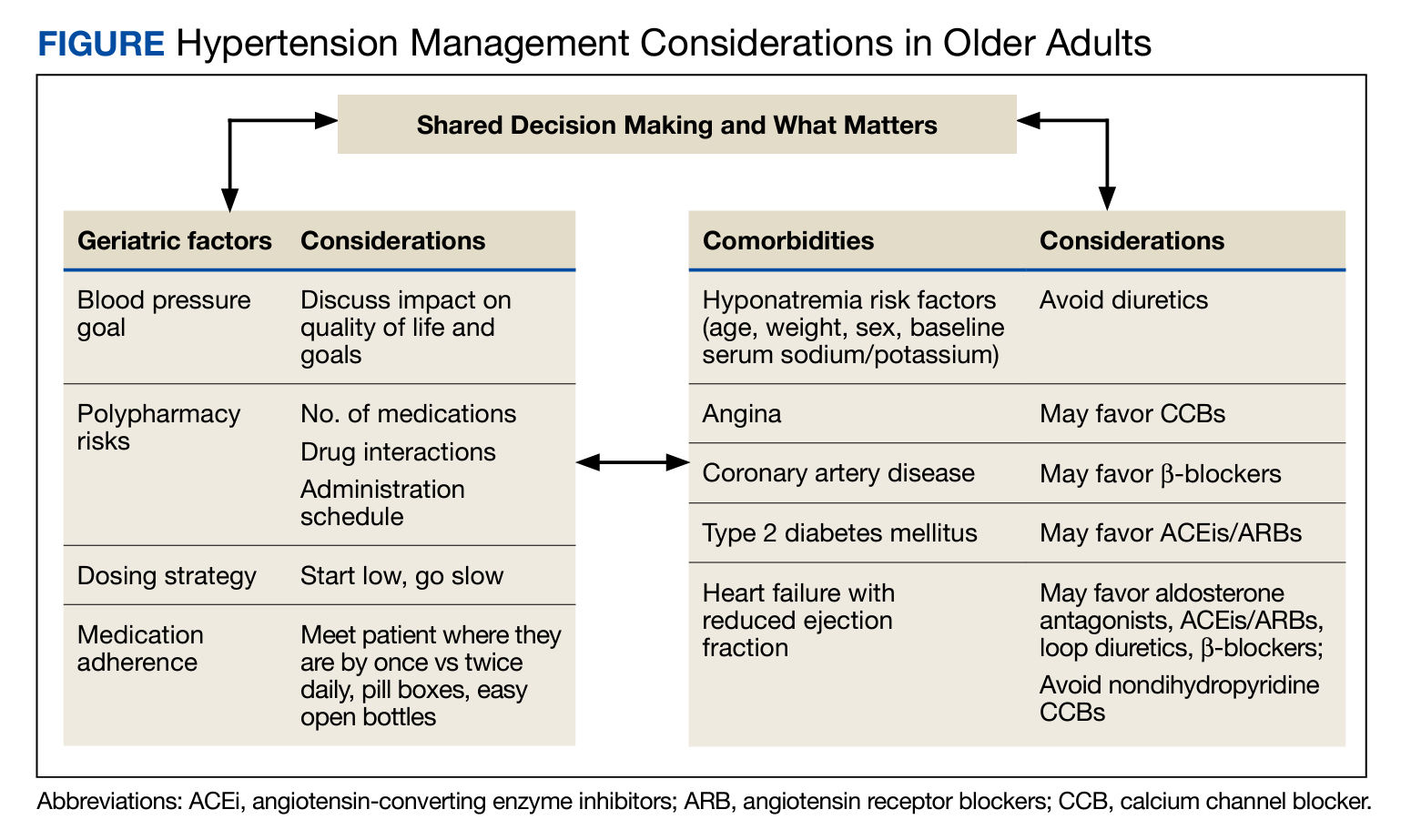
A current strategy that encompasses discussing many, if not all, of these noted elements is the Institute for Healthcare Improvement’s Age-Friendly Health System. This framework uses evidence-based tools to provide care for older adults across all clinical settings and highlights the 4Ms: what matters, medication, mentation, and mobility.11 Medication considers whether a medication is necessary, whether its use has benefits that outweigh the risks, and how it interacts with what matters, mentation, and mobility. In particular, what matters plays an important role in hypertension management in older adults given the recommended target BP differs, depending on which specialty organization guideline is followed. By better understanding what matters to patients, including their goals and priorities, clinicians can engage patients in shared decision making and provide individualized recommendations based on geriatric principles (eg, start low, go slow, principles of medication adherence) and patient comorbidities (eg, medical history and risk factors for hyponatremia) to help patients make a more informed choice about their antihypertensive treatment regimen (Figure).
Conclusions
This case illustrates the need for a specialized approach to hypertension management in older adults and the risks of thiazide diuretics in this population. Clinicians should consider BP goals, patient-specific factors, and principles of medication management in older adults. If initiating thiazide therapy, discuss the risks associated with use, start at the lowest possible dose, and monitor bloodwork within 1 to 2 weeks of initiation/dose change and periodically thereafter while the patient remains on the therapy to decrease the risk of adverse events. Finally, the Institute for Healthcare Improvement’s Age-Friendly Health System framework can be a useful when considering the addition of a new medication in an older adult’s treatment plan.
Acknowledgments
This material is the result of work supported with resources and the use of facilities at the New England Geriatrics Research, Education, and Clinical Center, Veterans Affairs Boston Healthcare System, and the Cincinnati VeteransAffairs Medical Center.
1. Whelton PK, Carey RM, Aronow WS, et al. 2017 ACC/AHA/AAPA/ABC/ACPM/AGS/APhA/ASH/ASPC/NMA/PCNA Guideline for the Prevention, Detection, Evaluation and Management of High Blood Pressure in Adults: A Report of the American College of Cardiology/American Heart Association Task Force on Clinical Practice Guidelines. J Am Coll Cardiol. 2018;71(19):e127-e248. doi:10.1016/j.jacc.2017.11.006
2. Davis LL. Hypertension: how low to go when treating older adults. J Nurse Pract. 2019;15(1):1-6. doi:10.1016/j.nurpra.2018.10.010
3. Qaseem A, Wilt TJ, Rich R, et al. Pharmacologic Treatment of Hypertension in Adults Aged 60 Years or Older to Higher Versus Lower Blood Pressure Targets: A Clinical Practice Guideline From the American College of Physicians and the American Academy of Family Physicians. Ann Intern Med. 2017;166(6):430-437. doi:10.7326/M16-1785
4. Aronow WS, Fleg JL, Pepine CJ, et al. ACCF/AHA 2011 expert consensus document on hypertension in the elderly: a report of the American College of Cardiology Foundation Task Force on Clinical Expert Consensus documents developed in collaboration with the American Academy of Neurology, American Geriatrics Society, American Society for Preventive Cardiology, American Society of Hypertension, American Society of Nephrology, Association of Black Cardiologists, and European Society of Hypertension. J Am Coll Cardiol. 2011;57(20):2037-2114. doi:10.1016/j.jacc.2011.01.008
5. Makam AN, Boscardin WJ, Miao Y, Steinman MA. Risk of thiazide-induced metabolic adverse events in older adults. J Am Geriatr Soc. 2014;62(6):1039-1045. doi:10.1111/jgs.12839
6. Chow KM, Szeto CC, Wong TY, Leung CB, Li PK. Risk factors for thiazide-induced hyponatraemia. QJM. 2003;96(12):911-917. doi:10.1093/qjmed/hcg157
7. Clayton JA, Rodgers S, Blakey J, Avery A, Hall IP. Thiazide diuretic prescription and electrolyte abnormalities in primary care. Br J Clin Pharmacol. 2006;61(1):87-95. doi:10.1111/j.1365-2125.2005.02531.x
8. Shah BM, Hajjar ER. Polypharmacy, adverse drug reactions, and geriatric syndromes. Clin Geriatr Med. 2012;28(2):173-186. doi:10.1016/j.cger.2012.01.002
9. Benetos A, Petrovic M, Strandberg T. Hypertension management in older and frail older patients. Circ Res. 2019;124(7):1045-1060. doi:10.1161/CIRCRESAHA.118.313236
10. Sherrill B, Halpern M, Khan S, Zhang J, Panjabi S. Single-pill vs free-equivalent combination therapies for hypertension: a meta-analysis of health care costs and adherence. J Clin Hypertens (Greenwich). 2011;13(12):898-909. doi:10.1111/j.1751-7176.2011.00550.x
11. Mate K, Fulmer T, Pelton L, et al. Evidence for the 4Ms: interactions and outcomes across the care continuum. J Aging Health. 2021;33(7-8):469-481. doi:10.1177/0898264321991658
Hypertension is a major risk factor for heart disease, stroke, and kidney disease. The prevalence of hypertension increases with age, primarily due to age-related changes in arterial physiology.1 For older adults, current guidelines regarding blood pressure (BP) treatment goals vary. The American Heart Association/American College of Cardiology 2017 clinical practice guidelines recommend a systolic BP (SBP) treatment goal of < 130 mm Hg for community-dwelling, ambulatory, noninstitutionalized adults aged ≥ 65 years; whereas the American College of Physicians/American Academy of Family Physicians recommend a goal of < 150 mm Hg for those aged ≥ 60 years without comorbidities and < 140 mm Hg for those with increased cardiovascular risk.1-3 Regardless of the specific threshold, agreement that some degree of BP control even in those with advanced age improves outcomes.2
First-line therapy for uncomplicated hypertension includes thiazide diuretics, long-acting calcium channel blockers, and renin-angiotensin system inhibitors. When choosing between these options, it is recommended to engage in shared decision making and to consider the patient’s comorbidities. Among patients who are likely to require a second agent (eg, if initial BP is > 20/10 mm Hg above goal), it is recommended to begin both drugs at the same time, preferably benazepril plus amlodipine due to the reduction in cardiovascular events reported in the ACCOMPLISH trial.4 If BP remains elevated despite 2 agents at moderate to maximum doses, it is important to investigate for secondary hypertension causes and to explore medication adherence as possible etiologies of treatment failure. Older adults are often at higher risk of adverse drug events due to age-related changes in pharmacodynamics. Despite this, there are no guidelines for choosing between different classes of antihypertensives in this population. We present a case of thiazide-induced hyponatremia in an older adult and review the risks of thiazide use in this population.
Case Presentation
A man aged > 90 years was admitted to the hospital after a syncopal episode. His history was significant for hypertension, hyperlipidemia, and vitamin D deficiency. At the time, his home medications were amlodipine 5 mg daily, atorvastatin 40 mg daily, ergocalciferol 50,000 IU weekly, and polyethylene glycol 17 g daily as needed. His syncope workup was unremarkable and included negative orthostatic vital signs, normal serial troponins, an electrocardiogram without ischemic changes, normal serum creatinine, sodium, and glucose, and a head computed tomography without any acute abnormality. Throughout the patient’s hospital stay, he had multiple elevated SBP readings, including many > 200 mm Hg. On discharge, in addition to continuing his home medications, he was started on valsartan 20 mg daily and enrolled in a remote BP monitoring program.
Three weeks later, the patient was seen by their primary care practitioner for follow-up. He reported adherence to his antihypertensive regimen. However, his remote BP monitoring revealed persistently elevated BPs, with an average of 179/79 mm Hg, a high of 205/85 mm Hg, and a low of 150/67 mm Hg over the previous 7 days. Laboratory tests obtained at the visit were notable for serum sodium of 138 mmol/L and potassium of 4.1 mmol/L. His weight was 87 kg. Given persistently elevated BP readings, in addition to continuing his amlodipine 5 mg daily and valsartan 20 mg daily, he was started on hydrochlorothiazide 25 mg daily, with plans to repeat a basic metabolic panel in 2 weeks.
Two weeks later, he fell after getting out of his bed. On examination, he was noted to have dry mucous membranes, and although no formal delirium screening was performed, he was able to repeat the months of the year backward. Vital signs were notable for positive postural hypertension, and his laboratory tests revealed a normal serum creatinine, serum sodium of 117 mmol/L
Discussion
Although thiazide diuretics are recommended as first-line therapy for uncomplicated hypertension, they are known to cause electrolyte abnormalities, including hypomagnesemia, hypokalemia, and hyponatremia.4 These metabolic derangements are more likely to occur in older adults. One study of adults aged ≥ 65 years found that at 9 months of follow-up, 14.3% of new thiazide users had developed a thiazide-related metabolic adverse event (hyponatremia < 135 mmol/L, hypokalemia < 3.5 mmol/L, and decrease in estimated glomerular filtration rate by > 25%) compared with 6.0% of nonusers (P < .001; number needed to harm [NNH] = 12).5 In addition, 3.8% of new thiazide users had an emergency department visit or were hospitalized for complications related to thiazides compared with only 2.0% of nonusers (P = .02; NNH = 56).5 Independent risk factors for thiazide-induced hyponatremia include high-comorbidity burden, low body weight, low-normal or unmeasured serum sodium, low potassium, and aged > 70 years.5-7 Each 10-year increment in age is associated with a 2-fold increase in risk, suggesting that older adults are at a much higher risk for hyponatremia than their younger peers.6
Despite their designation as a first-line option for uncomplicated hypertension, thiazide diuretics may cause more harm than good in some older adults, especially those with additional risk factors for thiazide-induced hyponatremia. In this population, these adverse effects should be discussed before starting thiazides for the treatment of hypertension. If thiazides are initiated, they should be started at the lowest possible dose, and plans made to monitor bloodwork within 1 to 2 weeks of initiation or dose change and periodically thereafter while the patient remains on the therapy.
Medication Management in Older Adults
Due to the risks of medication use in older adults, the phrase “start low, go slow” is commonly used in geriatric medicine to describe the optimal method for initiation and up-titration of new medication with the hope of mitigating adverse drug events. In our case, we started valsartan at 20 mg daily—one-fourth the recommended initial dose. Although this strategy is reasonable to “start low,” we were not surprised to find that the patient’s BP did not markedly improve on such a low dose. The team could have increased the valsartan dose to a therapeutically efficacious dose before choosing to add another hypertensive agent. In alignment with geriatric prescribing principles, starting at the lowest possible dose of hydrochlorothiazide is recommended.5 However, the clinician started hydrochlorothiazide at 25 mg daily, potentially increasing this patient’s risk of electrolyte abnormalities and eventual fall.
Managing hypertension also invites a discussion of polypharmacy and medication adherence. Older adults are at risk of polypharmacy, defined as the prescription of 5 or more medications.8 Polypharmacy is associated with increased hospitalizations, higher costs of care for individuals and health care systems, increased risks of adverse drug events, medication nonadherence, and lower quality of life for patients.9 In some situations, the risks of polypharmacy may outweigh the benefits of using multiple antihypertensives with different mechanisms of action if patients can reach their BP goal on the maximum dose of a single agent. For patients taking multiple antihypertensives, it is important to routinely monitor BP and assess whether deprescribing is indicated. Cognitive impairment and decreased social support may affect medication adherence for older adults.6 Clinicians should be aware of strategies, such as medication reminders and pillboxes, to increase antihypertensive medication adherence. Polypills that contain 2 antihypertensives can be another tool used to manage older adults to increase adherence and decrease health care costs.10
A current strategy that encompasses discussing many, if not all, of these noted elements is the Institute for Healthcare Improvement’s Age-Friendly Health System. This framework uses evidence-based tools to provide care for older adults across all clinical settings and highlights the 4Ms: what matters, medication, mentation, and mobility.11 Medication considers whether a medication is necessary, whether its use has benefits that outweigh the risks, and how it interacts with what matters, mentation, and mobility. In particular, what matters plays an important role in hypertension management in older adults given the recommended target BP differs, depending on which specialty organization guideline is followed. By better understanding what matters to patients, including their goals and priorities, clinicians can engage patients in shared decision making and provide individualized recommendations based on geriatric principles (eg, start low, go slow, principles of medication adherence) and patient comorbidities (eg, medical history and risk factors for hyponatremia) to help patients make a more informed choice about their antihypertensive treatment regimen (Figure).
Conclusions
This case illustrates the need for a specialized approach to hypertension management in older adults and the risks of thiazide diuretics in this population. Clinicians should consider BP goals, patient-specific factors, and principles of medication management in older adults. If initiating thiazide therapy, discuss the risks associated with use, start at the lowest possible dose, and monitor bloodwork within 1 to 2 weeks of initiation/dose change and periodically thereafter while the patient remains on the therapy to decrease the risk of adverse events. Finally, the Institute for Healthcare Improvement’s Age-Friendly Health System framework can be a useful when considering the addition of a new medication in an older adult’s treatment plan.
Acknowledgments
This material is the result of work supported with resources and the use of facilities at the New England Geriatrics Research, Education, and Clinical Center, Veterans Affairs Boston Healthcare System, and the Cincinnati VeteransAffairs Medical Center.
Hypertension is a major risk factor for heart disease, stroke, and kidney disease. The prevalence of hypertension increases with age, primarily due to age-related changes in arterial physiology.1 For older adults, current guidelines regarding blood pressure (BP) treatment goals vary. The American Heart Association/American College of Cardiology 2017 clinical practice guidelines recommend a systolic BP (SBP) treatment goal of < 130 mm Hg for community-dwelling, ambulatory, noninstitutionalized adults aged ≥ 65 years; whereas the American College of Physicians/American Academy of Family Physicians recommend a goal of < 150 mm Hg for those aged ≥ 60 years without comorbidities and < 140 mm Hg for those with increased cardiovascular risk.1-3 Regardless of the specific threshold, agreement that some degree of BP control even in those with advanced age improves outcomes.2
First-line therapy for uncomplicated hypertension includes thiazide diuretics, long-acting calcium channel blockers, and renin-angiotensin system inhibitors. When choosing between these options, it is recommended to engage in shared decision making and to consider the patient’s comorbidities. Among patients who are likely to require a second agent (eg, if initial BP is > 20/10 mm Hg above goal), it is recommended to begin both drugs at the same time, preferably benazepril plus amlodipine due to the reduction in cardiovascular events reported in the ACCOMPLISH trial.4 If BP remains elevated despite 2 agents at moderate to maximum doses, it is important to investigate for secondary hypertension causes and to explore medication adherence as possible etiologies of treatment failure. Older adults are often at higher risk of adverse drug events due to age-related changes in pharmacodynamics. Despite this, there are no guidelines for choosing between different classes of antihypertensives in this population. We present a case of thiazide-induced hyponatremia in an older adult and review the risks of thiazide use in this population.
Case Presentation
A man aged > 90 years was admitted to the hospital after a syncopal episode. His history was significant for hypertension, hyperlipidemia, and vitamin D deficiency. At the time, his home medications were amlodipine 5 mg daily, atorvastatin 40 mg daily, ergocalciferol 50,000 IU weekly, and polyethylene glycol 17 g daily as needed. His syncope workup was unremarkable and included negative orthostatic vital signs, normal serial troponins, an electrocardiogram without ischemic changes, normal serum creatinine, sodium, and glucose, and a head computed tomography without any acute abnormality. Throughout the patient’s hospital stay, he had multiple elevated SBP readings, including many > 200 mm Hg. On discharge, in addition to continuing his home medications, he was started on valsartan 20 mg daily and enrolled in a remote BP monitoring program.
Three weeks later, the patient was seen by their primary care practitioner for follow-up. He reported adherence to his antihypertensive regimen. However, his remote BP monitoring revealed persistently elevated BPs, with an average of 179/79 mm Hg, a high of 205/85 mm Hg, and a low of 150/67 mm Hg over the previous 7 days. Laboratory tests obtained at the visit were notable for serum sodium of 138 mmol/L and potassium of 4.1 mmol/L. His weight was 87 kg. Given persistently elevated BP readings, in addition to continuing his amlodipine 5 mg daily and valsartan 20 mg daily, he was started on hydrochlorothiazide 25 mg daily, with plans to repeat a basic metabolic panel in 2 weeks.
Two weeks later, he fell after getting out of his bed. On examination, he was noted to have dry mucous membranes, and although no formal delirium screening was performed, he was able to repeat the months of the year backward. Vital signs were notable for positive postural hypertension, and his laboratory tests revealed a normal serum creatinine, serum sodium of 117 mmol/L
Discussion
Although thiazide diuretics are recommended as first-line therapy for uncomplicated hypertension, they are known to cause electrolyte abnormalities, including hypomagnesemia, hypokalemia, and hyponatremia.4 These metabolic derangements are more likely to occur in older adults. One study of adults aged ≥ 65 years found that at 9 months of follow-up, 14.3% of new thiazide users had developed a thiazide-related metabolic adverse event (hyponatremia < 135 mmol/L, hypokalemia < 3.5 mmol/L, and decrease in estimated glomerular filtration rate by > 25%) compared with 6.0% of nonusers (P < .001; number needed to harm [NNH] = 12).5 In addition, 3.8% of new thiazide users had an emergency department visit or were hospitalized for complications related to thiazides compared with only 2.0% of nonusers (P = .02; NNH = 56).5 Independent risk factors for thiazide-induced hyponatremia include high-comorbidity burden, low body weight, low-normal or unmeasured serum sodium, low potassium, and aged > 70 years.5-7 Each 10-year increment in age is associated with a 2-fold increase in risk, suggesting that older adults are at a much higher risk for hyponatremia than their younger peers.6
Despite their designation as a first-line option for uncomplicated hypertension, thiazide diuretics may cause more harm than good in some older adults, especially those with additional risk factors for thiazide-induced hyponatremia. In this population, these adverse effects should be discussed before starting thiazides for the treatment of hypertension. If thiazides are initiated, they should be started at the lowest possible dose, and plans made to monitor bloodwork within 1 to 2 weeks of initiation or dose change and periodically thereafter while the patient remains on the therapy.
Medication Management in Older Adults
Due to the risks of medication use in older adults, the phrase “start low, go slow” is commonly used in geriatric medicine to describe the optimal method for initiation and up-titration of new medication with the hope of mitigating adverse drug events. In our case, we started valsartan at 20 mg daily—one-fourth the recommended initial dose. Although this strategy is reasonable to “start low,” we were not surprised to find that the patient’s BP did not markedly improve on such a low dose. The team could have increased the valsartan dose to a therapeutically efficacious dose before choosing to add another hypertensive agent. In alignment with geriatric prescribing principles, starting at the lowest possible dose of hydrochlorothiazide is recommended.5 However, the clinician started hydrochlorothiazide at 25 mg daily, potentially increasing this patient’s risk of electrolyte abnormalities and eventual fall.
Managing hypertension also invites a discussion of polypharmacy and medication adherence. Older adults are at risk of polypharmacy, defined as the prescription of 5 or more medications.8 Polypharmacy is associated with increased hospitalizations, higher costs of care for individuals and health care systems, increased risks of adverse drug events, medication nonadherence, and lower quality of life for patients.9 In some situations, the risks of polypharmacy may outweigh the benefits of using multiple antihypertensives with different mechanisms of action if patients can reach their BP goal on the maximum dose of a single agent. For patients taking multiple antihypertensives, it is important to routinely monitor BP and assess whether deprescribing is indicated. Cognitive impairment and decreased social support may affect medication adherence for older adults.6 Clinicians should be aware of strategies, such as medication reminders and pillboxes, to increase antihypertensive medication adherence. Polypills that contain 2 antihypertensives can be another tool used to manage older adults to increase adherence and decrease health care costs.10
A current strategy that encompasses discussing many, if not all, of these noted elements is the Institute for Healthcare Improvement’s Age-Friendly Health System. This framework uses evidence-based tools to provide care for older adults across all clinical settings and highlights the 4Ms: what matters, medication, mentation, and mobility.11 Medication considers whether a medication is necessary, whether its use has benefits that outweigh the risks, and how it interacts with what matters, mentation, and mobility. In particular, what matters plays an important role in hypertension management in older adults given the recommended target BP differs, depending on which specialty organization guideline is followed. By better understanding what matters to patients, including their goals and priorities, clinicians can engage patients in shared decision making and provide individualized recommendations based on geriatric principles (eg, start low, go slow, principles of medication adherence) and patient comorbidities (eg, medical history and risk factors for hyponatremia) to help patients make a more informed choice about their antihypertensive treatment regimen (Figure).
Conclusions
This case illustrates the need for a specialized approach to hypertension management in older adults and the risks of thiazide diuretics in this population. Clinicians should consider BP goals, patient-specific factors, and principles of medication management in older adults. If initiating thiazide therapy, discuss the risks associated with use, start at the lowest possible dose, and monitor bloodwork within 1 to 2 weeks of initiation/dose change and periodically thereafter while the patient remains on the therapy to decrease the risk of adverse events. Finally, the Institute for Healthcare Improvement’s Age-Friendly Health System framework can be a useful when considering the addition of a new medication in an older adult’s treatment plan.
Acknowledgments
This material is the result of work supported with resources and the use of facilities at the New England Geriatrics Research, Education, and Clinical Center, Veterans Affairs Boston Healthcare System, and the Cincinnati VeteransAffairs Medical Center.
1. Whelton PK, Carey RM, Aronow WS, et al. 2017 ACC/AHA/AAPA/ABC/ACPM/AGS/APhA/ASH/ASPC/NMA/PCNA Guideline for the Prevention, Detection, Evaluation and Management of High Blood Pressure in Adults: A Report of the American College of Cardiology/American Heart Association Task Force on Clinical Practice Guidelines. J Am Coll Cardiol. 2018;71(19):e127-e248. doi:10.1016/j.jacc.2017.11.006
2. Davis LL. Hypertension: how low to go when treating older adults. J Nurse Pract. 2019;15(1):1-6. doi:10.1016/j.nurpra.2018.10.010
3. Qaseem A, Wilt TJ, Rich R, et al. Pharmacologic Treatment of Hypertension in Adults Aged 60 Years or Older to Higher Versus Lower Blood Pressure Targets: A Clinical Practice Guideline From the American College of Physicians and the American Academy of Family Physicians. Ann Intern Med. 2017;166(6):430-437. doi:10.7326/M16-1785
4. Aronow WS, Fleg JL, Pepine CJ, et al. ACCF/AHA 2011 expert consensus document on hypertension in the elderly: a report of the American College of Cardiology Foundation Task Force on Clinical Expert Consensus documents developed in collaboration with the American Academy of Neurology, American Geriatrics Society, American Society for Preventive Cardiology, American Society of Hypertension, American Society of Nephrology, Association of Black Cardiologists, and European Society of Hypertension. J Am Coll Cardiol. 2011;57(20):2037-2114. doi:10.1016/j.jacc.2011.01.008
5. Makam AN, Boscardin WJ, Miao Y, Steinman MA. Risk of thiazide-induced metabolic adverse events in older adults. J Am Geriatr Soc. 2014;62(6):1039-1045. doi:10.1111/jgs.12839
6. Chow KM, Szeto CC, Wong TY, Leung CB, Li PK. Risk factors for thiazide-induced hyponatraemia. QJM. 2003;96(12):911-917. doi:10.1093/qjmed/hcg157
7. Clayton JA, Rodgers S, Blakey J, Avery A, Hall IP. Thiazide diuretic prescription and electrolyte abnormalities in primary care. Br J Clin Pharmacol. 2006;61(1):87-95. doi:10.1111/j.1365-2125.2005.02531.x
8. Shah BM, Hajjar ER. Polypharmacy, adverse drug reactions, and geriatric syndromes. Clin Geriatr Med. 2012;28(2):173-186. doi:10.1016/j.cger.2012.01.002
9. Benetos A, Petrovic M, Strandberg T. Hypertension management in older and frail older patients. Circ Res. 2019;124(7):1045-1060. doi:10.1161/CIRCRESAHA.118.313236
10. Sherrill B, Halpern M, Khan S, Zhang J, Panjabi S. Single-pill vs free-equivalent combination therapies for hypertension: a meta-analysis of health care costs and adherence. J Clin Hypertens (Greenwich). 2011;13(12):898-909. doi:10.1111/j.1751-7176.2011.00550.x
11. Mate K, Fulmer T, Pelton L, et al. Evidence for the 4Ms: interactions and outcomes across the care continuum. J Aging Health. 2021;33(7-8):469-481. doi:10.1177/0898264321991658
1. Whelton PK, Carey RM, Aronow WS, et al. 2017 ACC/AHA/AAPA/ABC/ACPM/AGS/APhA/ASH/ASPC/NMA/PCNA Guideline for the Prevention, Detection, Evaluation and Management of High Blood Pressure in Adults: A Report of the American College of Cardiology/American Heart Association Task Force on Clinical Practice Guidelines. J Am Coll Cardiol. 2018;71(19):e127-e248. doi:10.1016/j.jacc.2017.11.006
2. Davis LL. Hypertension: how low to go when treating older adults. J Nurse Pract. 2019;15(1):1-6. doi:10.1016/j.nurpra.2018.10.010
3. Qaseem A, Wilt TJ, Rich R, et al. Pharmacologic Treatment of Hypertension in Adults Aged 60 Years or Older to Higher Versus Lower Blood Pressure Targets: A Clinical Practice Guideline From the American College of Physicians and the American Academy of Family Physicians. Ann Intern Med. 2017;166(6):430-437. doi:10.7326/M16-1785
4. Aronow WS, Fleg JL, Pepine CJ, et al. ACCF/AHA 2011 expert consensus document on hypertension in the elderly: a report of the American College of Cardiology Foundation Task Force on Clinical Expert Consensus documents developed in collaboration with the American Academy of Neurology, American Geriatrics Society, American Society for Preventive Cardiology, American Society of Hypertension, American Society of Nephrology, Association of Black Cardiologists, and European Society of Hypertension. J Am Coll Cardiol. 2011;57(20):2037-2114. doi:10.1016/j.jacc.2011.01.008
5. Makam AN, Boscardin WJ, Miao Y, Steinman MA. Risk of thiazide-induced metabolic adverse events in older adults. J Am Geriatr Soc. 2014;62(6):1039-1045. doi:10.1111/jgs.12839
6. Chow KM, Szeto CC, Wong TY, Leung CB, Li PK. Risk factors for thiazide-induced hyponatraemia. QJM. 2003;96(12):911-917. doi:10.1093/qjmed/hcg157
7. Clayton JA, Rodgers S, Blakey J, Avery A, Hall IP. Thiazide diuretic prescription and electrolyte abnormalities in primary care. Br J Clin Pharmacol. 2006;61(1):87-95. doi:10.1111/j.1365-2125.2005.02531.x
8. Shah BM, Hajjar ER. Polypharmacy, adverse drug reactions, and geriatric syndromes. Clin Geriatr Med. 2012;28(2):173-186. doi:10.1016/j.cger.2012.01.002
9. Benetos A, Petrovic M, Strandberg T. Hypertension management in older and frail older patients. Circ Res. 2019;124(7):1045-1060. doi:10.1161/CIRCRESAHA.118.313236
10. Sherrill B, Halpern M, Khan S, Zhang J, Panjabi S. Single-pill vs free-equivalent combination therapies for hypertension: a meta-analysis of health care costs and adherence. J Clin Hypertens (Greenwich). 2011;13(12):898-909. doi:10.1111/j.1751-7176.2011.00550.x
11. Mate K, Fulmer T, Pelton L, et al. Evidence for the 4Ms: interactions and outcomes across the care continuum. J Aging Health. 2021;33(7-8):469-481. doi:10.1177/0898264321991658
Psychotherapy as Effective as Drugs for Depression in HF
TOPLINE:
, a comparative trial of these interventions found.
METHODOLOGY:
- The study included 416 patients with HF and a confirmed depressive disorder from the Cedars-Sinai Health System, with a mean age of 60.71 years, including nearly 42% women and 30% Black individuals, who were randomized to receive one of two evidence-based treatments for depression in HF: Antidepressant medication management (MEDS) or behavioral activation (BA) psychotherapy. BA therapy promotes engaging in pleasurable and rewarding activities without delving into complex cognitive domains explored in cognitive behavioral therapy, another psychotherapy type.
- All patients received 12 weekly sessions delivered via video or telephone, followed by monthly sessions for 3 months, and were then contacted as needed for an additional 6 months.
- The primary outcome was depressive symptom severity at 6 months, measured by the Patient Health Questionnaire 9-Item (PHQ-9), and secondary outcomes included three measures of health-related quality of life (HRQOL) — caregiver burden, morbidity, and mortality — collected at 3, 6, and 12 months.
- Physical and mental HRQOL were measured with the 12-Item Short-Form Medical Outcomes Study (SF-12), HF-specific HRQOL with the 23-item patient-reported Kansas City Cardiomyopathy Questionnaire, caregiver burden with the 26-item Caregiver Burden Questionnaire for HF, morbidity by ED visits, hospital readmissions, and days hospitalized, and mortality data came from medical records and family or caregiver reports, with survival assessed using Kaplan-Meier plots at 3, 6, and 12 months.
- Covariates included age, sex, race, ethnicity, marital status, employment, education, insurance type, recruitment site (inpatient or outpatient), ejection fraction (preserved or reduced), New York Heart Association class, medical history, and medications.
TAKEAWAY:
- Depressive symptom severity was reduced at 6 months by nearly 50% for both BA (mean PHQ-9 score, 7.53; P vs baseline < .001) and MEDS (mean PHQ-9 score, 8.09; P vs baseline < .001) participants, with reductions persisting at 12 months and no significant difference between groups.
- Compared with MEDS recipients, those who received BA had slightly higher improvement in physical HRQOL at 6 months (multivariable mean difference without imputation, 2.13; 95% CI, 0.06-4.20; P = .04), but there were no statistically significant differences between groups in mental HRQOL, HF-specific HRQOL, or caregiver burden at 3, 6, or 12 months.
- Patients who received BA were significantly less likely than those in the MEDS group to have ED visits and spent fewer days in hospital at 3, 6, and 12 months, but there was no significant difference in number of hospital readmissions or in mortality at 3, 6, or 12 months.
IN PRACTICE:
“Our findings of comparable primary effects between BA and MEDS suggest both options are effective and that personal preferences, patient values, and availability of services could inform decisions,” the authors wrote. They noted BA has no pharmacological adverse effects but requires more engagement than drug therapy and might be less accessible.
SOURCE:
The study was conducted by Waguih William IsHak, MD, Department of Psychiatry and Behavioral Neurosciences, Cedars-Sinai Medical Center, Los Angeles, and others. It was published online on January 17, 2024, in JAMA Network Open.
LIMITATIONS:
As the study had no control group, such as a waiting list, it was impossible to draw conclusions about the natural course of depressive symptoms in HF. However, the authors noted improvements were sustained at 12 months despite substantially diminished contact with intervention teams after 6 months. Researchers were unable to collect data for ED visits, readmissions, and hospital stays outside of California and didn’t assess treatment preference at enrollment, which could have helped inform the association with outcomes and adherence.
DISCLOSURES:
The study was funded by the Patient-Centered Outcome Research Institute, paid to Cedars-Sinai Medical Center. Dr. IsHak reported receiving royalties from Springer Nature and Cambridge University Press. No other disclosures were reported.
A version of this article appeared on Medscape.com.
TOPLINE:
, a comparative trial of these interventions found.
METHODOLOGY:
- The study included 416 patients with HF and a confirmed depressive disorder from the Cedars-Sinai Health System, with a mean age of 60.71 years, including nearly 42% women and 30% Black individuals, who were randomized to receive one of two evidence-based treatments for depression in HF: Antidepressant medication management (MEDS) or behavioral activation (BA) psychotherapy. BA therapy promotes engaging in pleasurable and rewarding activities without delving into complex cognitive domains explored in cognitive behavioral therapy, another psychotherapy type.
- All patients received 12 weekly sessions delivered via video or telephone, followed by monthly sessions for 3 months, and were then contacted as needed for an additional 6 months.
- The primary outcome was depressive symptom severity at 6 months, measured by the Patient Health Questionnaire 9-Item (PHQ-9), and secondary outcomes included three measures of health-related quality of life (HRQOL) — caregiver burden, morbidity, and mortality — collected at 3, 6, and 12 months.
- Physical and mental HRQOL were measured with the 12-Item Short-Form Medical Outcomes Study (SF-12), HF-specific HRQOL with the 23-item patient-reported Kansas City Cardiomyopathy Questionnaire, caregiver burden with the 26-item Caregiver Burden Questionnaire for HF, morbidity by ED visits, hospital readmissions, and days hospitalized, and mortality data came from medical records and family or caregiver reports, with survival assessed using Kaplan-Meier plots at 3, 6, and 12 months.
- Covariates included age, sex, race, ethnicity, marital status, employment, education, insurance type, recruitment site (inpatient or outpatient), ejection fraction (preserved or reduced), New York Heart Association class, medical history, and medications.
TAKEAWAY:
- Depressive symptom severity was reduced at 6 months by nearly 50% for both BA (mean PHQ-9 score, 7.53; P vs baseline < .001) and MEDS (mean PHQ-9 score, 8.09; P vs baseline < .001) participants, with reductions persisting at 12 months and no significant difference between groups.
- Compared with MEDS recipients, those who received BA had slightly higher improvement in physical HRQOL at 6 months (multivariable mean difference without imputation, 2.13; 95% CI, 0.06-4.20; P = .04), but there were no statistically significant differences between groups in mental HRQOL, HF-specific HRQOL, or caregiver burden at 3, 6, or 12 months.
- Patients who received BA were significantly less likely than those in the MEDS group to have ED visits and spent fewer days in hospital at 3, 6, and 12 months, but there was no significant difference in number of hospital readmissions or in mortality at 3, 6, or 12 months.
IN PRACTICE:
“Our findings of comparable primary effects between BA and MEDS suggest both options are effective and that personal preferences, patient values, and availability of services could inform decisions,” the authors wrote. They noted BA has no pharmacological adverse effects but requires more engagement than drug therapy and might be less accessible.
SOURCE:
The study was conducted by Waguih William IsHak, MD, Department of Psychiatry and Behavioral Neurosciences, Cedars-Sinai Medical Center, Los Angeles, and others. It was published online on January 17, 2024, in JAMA Network Open.
LIMITATIONS:
As the study had no control group, such as a waiting list, it was impossible to draw conclusions about the natural course of depressive symptoms in HF. However, the authors noted improvements were sustained at 12 months despite substantially diminished contact with intervention teams after 6 months. Researchers were unable to collect data for ED visits, readmissions, and hospital stays outside of California and didn’t assess treatment preference at enrollment, which could have helped inform the association with outcomes and adherence.
DISCLOSURES:
The study was funded by the Patient-Centered Outcome Research Institute, paid to Cedars-Sinai Medical Center. Dr. IsHak reported receiving royalties from Springer Nature and Cambridge University Press. No other disclosures were reported.
A version of this article appeared on Medscape.com.
TOPLINE:
, a comparative trial of these interventions found.
METHODOLOGY:
- The study included 416 patients with HF and a confirmed depressive disorder from the Cedars-Sinai Health System, with a mean age of 60.71 years, including nearly 42% women and 30% Black individuals, who were randomized to receive one of two evidence-based treatments for depression in HF: Antidepressant medication management (MEDS) or behavioral activation (BA) psychotherapy. BA therapy promotes engaging in pleasurable and rewarding activities without delving into complex cognitive domains explored in cognitive behavioral therapy, another psychotherapy type.
- All patients received 12 weekly sessions delivered via video or telephone, followed by monthly sessions for 3 months, and were then contacted as needed for an additional 6 months.
- The primary outcome was depressive symptom severity at 6 months, measured by the Patient Health Questionnaire 9-Item (PHQ-9), and secondary outcomes included three measures of health-related quality of life (HRQOL) — caregiver burden, morbidity, and mortality — collected at 3, 6, and 12 months.
- Physical and mental HRQOL were measured with the 12-Item Short-Form Medical Outcomes Study (SF-12), HF-specific HRQOL with the 23-item patient-reported Kansas City Cardiomyopathy Questionnaire, caregiver burden with the 26-item Caregiver Burden Questionnaire for HF, morbidity by ED visits, hospital readmissions, and days hospitalized, and mortality data came from medical records and family or caregiver reports, with survival assessed using Kaplan-Meier plots at 3, 6, and 12 months.
- Covariates included age, sex, race, ethnicity, marital status, employment, education, insurance type, recruitment site (inpatient or outpatient), ejection fraction (preserved or reduced), New York Heart Association class, medical history, and medications.
TAKEAWAY:
- Depressive symptom severity was reduced at 6 months by nearly 50% for both BA (mean PHQ-9 score, 7.53; P vs baseline < .001) and MEDS (mean PHQ-9 score, 8.09; P vs baseline < .001) participants, with reductions persisting at 12 months and no significant difference between groups.
- Compared with MEDS recipients, those who received BA had slightly higher improvement in physical HRQOL at 6 months (multivariable mean difference without imputation, 2.13; 95% CI, 0.06-4.20; P = .04), but there were no statistically significant differences between groups in mental HRQOL, HF-specific HRQOL, or caregiver burden at 3, 6, or 12 months.
- Patients who received BA were significantly less likely than those in the MEDS group to have ED visits and spent fewer days in hospital at 3, 6, and 12 months, but there was no significant difference in number of hospital readmissions or in mortality at 3, 6, or 12 months.
IN PRACTICE:
“Our findings of comparable primary effects between BA and MEDS suggest both options are effective and that personal preferences, patient values, and availability of services could inform decisions,” the authors wrote. They noted BA has no pharmacological adverse effects but requires more engagement than drug therapy and might be less accessible.
SOURCE:
The study was conducted by Waguih William IsHak, MD, Department of Psychiatry and Behavioral Neurosciences, Cedars-Sinai Medical Center, Los Angeles, and others. It was published online on January 17, 2024, in JAMA Network Open.
LIMITATIONS:
As the study had no control group, such as a waiting list, it was impossible to draw conclusions about the natural course of depressive symptoms in HF. However, the authors noted improvements were sustained at 12 months despite substantially diminished contact with intervention teams after 6 months. Researchers were unable to collect data for ED visits, readmissions, and hospital stays outside of California and didn’t assess treatment preference at enrollment, which could have helped inform the association with outcomes and adherence.
DISCLOSURES:
The study was funded by the Patient-Centered Outcome Research Institute, paid to Cedars-Sinai Medical Center. Dr. IsHak reported receiving royalties from Springer Nature and Cambridge University Press. No other disclosures were reported.
A version of this article appeared on Medscape.com.
Ibuprofen Fails for Patent Ductus Arteriosus in Preterm Infants
The study population included infants born between 23 weeks 0 days’ and 28 weeks 6 days’ gestation. The researchers randomized 326 extremely preterm infants with patent ductus arteriosus (PDA) at 72 hours or less after birth to ibuprofen at a loading dose of 10 mg/kg followed by two doses of 5 mg/kg at least 24 hours apart, and 327 to placebo.
The PDAs in the infants had a diameter of at least 1.5 mm with pulsatile flow.
Severe dysplasia outcome
The study’s primary outcome was a composite of death or moderate to severe bronchopulmonary dysplasia at 36 weeks’ postmenstrual age. Overall, a primary outcome occurred in 69.2% of infants who received ibuprofen and 63.5% of those who received a placebo.
Risk of death or bronchopulmonary dysplasia at 36 weeks’ postmenstrual age was not reduced by early ibuprofen vs. placebo for preterm infants, the researchers concluded. Moderate or severe bronchopulmonary dysplasia occurred in 64.2% of the infants in the ibuprofen group and 59.3% of the placebo group who survived to 36 weeks’ postmenstrual age.
‘Unforeseeable’ serious adverse events
Forty-four deaths occurred in the ibuprofen group and 33 in the placebo group (adjusted risk ratio 1.09). Two “unforeseeable” serious adverse events occurred during the study that were potentially related to ibuprofen.
The lead author was Samir Gupta, MD, of Sidra Medicine, Doha, Qatar. The study was published online in the New England Journal of Medicine.
Study limitations include incomplete data for some patients.
The study was supported by the National Institute for Health Research Health Technology Assessment Programme. The researchers had no financial conflicts to disclose.
The study population included infants born between 23 weeks 0 days’ and 28 weeks 6 days’ gestation. The researchers randomized 326 extremely preterm infants with patent ductus arteriosus (PDA) at 72 hours or less after birth to ibuprofen at a loading dose of 10 mg/kg followed by two doses of 5 mg/kg at least 24 hours apart, and 327 to placebo.
The PDAs in the infants had a diameter of at least 1.5 mm with pulsatile flow.
Severe dysplasia outcome
The study’s primary outcome was a composite of death or moderate to severe bronchopulmonary dysplasia at 36 weeks’ postmenstrual age. Overall, a primary outcome occurred in 69.2% of infants who received ibuprofen and 63.5% of those who received a placebo.
Risk of death or bronchopulmonary dysplasia at 36 weeks’ postmenstrual age was not reduced by early ibuprofen vs. placebo for preterm infants, the researchers concluded. Moderate or severe bronchopulmonary dysplasia occurred in 64.2% of the infants in the ibuprofen group and 59.3% of the placebo group who survived to 36 weeks’ postmenstrual age.
‘Unforeseeable’ serious adverse events
Forty-four deaths occurred in the ibuprofen group and 33 in the placebo group (adjusted risk ratio 1.09). Two “unforeseeable” serious adverse events occurred during the study that were potentially related to ibuprofen.
The lead author was Samir Gupta, MD, of Sidra Medicine, Doha, Qatar. The study was published online in the New England Journal of Medicine.
Study limitations include incomplete data for some patients.
The study was supported by the National Institute for Health Research Health Technology Assessment Programme. The researchers had no financial conflicts to disclose.
The study population included infants born between 23 weeks 0 days’ and 28 weeks 6 days’ gestation. The researchers randomized 326 extremely preterm infants with patent ductus arteriosus (PDA) at 72 hours or less after birth to ibuprofen at a loading dose of 10 mg/kg followed by two doses of 5 mg/kg at least 24 hours apart, and 327 to placebo.
The PDAs in the infants had a diameter of at least 1.5 mm with pulsatile flow.
Severe dysplasia outcome
The study’s primary outcome was a composite of death or moderate to severe bronchopulmonary dysplasia at 36 weeks’ postmenstrual age. Overall, a primary outcome occurred in 69.2% of infants who received ibuprofen and 63.5% of those who received a placebo.
Risk of death or bronchopulmonary dysplasia at 36 weeks’ postmenstrual age was not reduced by early ibuprofen vs. placebo for preterm infants, the researchers concluded. Moderate or severe bronchopulmonary dysplasia occurred in 64.2% of the infants in the ibuprofen group and 59.3% of the placebo group who survived to 36 weeks’ postmenstrual age.
‘Unforeseeable’ serious adverse events
Forty-four deaths occurred in the ibuprofen group and 33 in the placebo group (adjusted risk ratio 1.09). Two “unforeseeable” serious adverse events occurred during the study that were potentially related to ibuprofen.
The lead author was Samir Gupta, MD, of Sidra Medicine, Doha, Qatar. The study was published online in the New England Journal of Medicine.
Study limitations include incomplete data for some patients.
The study was supported by the National Institute for Health Research Health Technology Assessment Programme. The researchers had no financial conflicts to disclose.
Colchicine May Benefit Patients With Diabetes and Recent MI
TOPLINE:
A daily low dose of colchicine significantly reduces ischemic cardiovascular events in patients with type 2 diabetes (T2D) and a recent myocardial infarction (MI).
METHODOLOGY:
- After an MI, patients with vs without T2D have a higher risk for another cardiovascular event.
- The Colchicine Cardiovascular Outcomes Trial (COLCOT), a randomized, double-blinded trial, found a lower risk for ischemic cardiovascular events with 0.5 mg colchicine taken daily vs placebo, initiated within 30 days of an MI.
- Researchers conducted a prespecified subgroup analysis of 959 adult patients with T2D (mean age, 62.4 years; 22.2% women) in COLCOT (462 patients in colchicine and 497 patients in placebo groups).
- The primary efficacy endpoint was a composite of cardiovascular death, resuscitated cardiac arrest, MI, stroke, or urgent hospitalization for angina requiring coronary revascularization within a median 23 months.
- The patients were taking a variety of appropriate medications, including aspirin and another antiplatelet agent and a statin (98%-99%) and metformin (75%-76%).
TAKEAWAY:
- The risk for the primary endpoint was reduced by 35% in patients with T2D who received colchicine than in those who received placebo (hazard ratio, 0.65; P = .03).
- The primary endpoint event rate per 100 patient-months was significantly lower in the colchicine group than in the placebo group (rate ratio, 0.53; P = .01).
- The frequencies of adverse events were similar in both the treatment and placebo groups (14.6% and 12.8%, respectively; P = .41), with gastrointestinal adverse events being the most common.
- In COLCOT, patients with T2D had a 1.86-fold higher risk for a primary endpoint cardiovascular event, but there was no significant difference in the primary endpoint between those with and without T2D on colchicine.
IN PRACTICE:
“Patients with both T2D and a recent MI derive a large benefit from inflammation-reducing therapy with colchicine,” the authors noted.
SOURCE:
This study, led by François Roubille, University Hospital of Montpellier, France, was published online on January 5, 2024, in Diabetes Care.
LIMITATIONS:
Patients were not stratified at inclusion for the presence of diabetes. Also, the study did not evaluate the role of glycated hemoglobin and low-density lipoprotein cholesterol, as well as the effects of different glucose-lowering medications or possible hypoglycemic episodes.
DISCLOSURES:
The COLCOT study was funded by the Government of Quebec, the Canadian Institutes of Health Research, and philanthropic foundations. Coauthors Jean-Claude Tardif and Wolfgang Koenig declared receiving research grants, honoraria, advisory board fees, and lecture fees from pharmaceutical companies, as well as having other ties with various sources.
A version of this article appeared on Medscape.com.
TOPLINE:
A daily low dose of colchicine significantly reduces ischemic cardiovascular events in patients with type 2 diabetes (T2D) and a recent myocardial infarction (MI).
METHODOLOGY:
- After an MI, patients with vs without T2D have a higher risk for another cardiovascular event.
- The Colchicine Cardiovascular Outcomes Trial (COLCOT), a randomized, double-blinded trial, found a lower risk for ischemic cardiovascular events with 0.5 mg colchicine taken daily vs placebo, initiated within 30 days of an MI.
- Researchers conducted a prespecified subgroup analysis of 959 adult patients with T2D (mean age, 62.4 years; 22.2% women) in COLCOT (462 patients in colchicine and 497 patients in placebo groups).
- The primary efficacy endpoint was a composite of cardiovascular death, resuscitated cardiac arrest, MI, stroke, or urgent hospitalization for angina requiring coronary revascularization within a median 23 months.
- The patients were taking a variety of appropriate medications, including aspirin and another antiplatelet agent and a statin (98%-99%) and metformin (75%-76%).
TAKEAWAY:
- The risk for the primary endpoint was reduced by 35% in patients with T2D who received colchicine than in those who received placebo (hazard ratio, 0.65; P = .03).
- The primary endpoint event rate per 100 patient-months was significantly lower in the colchicine group than in the placebo group (rate ratio, 0.53; P = .01).
- The frequencies of adverse events were similar in both the treatment and placebo groups (14.6% and 12.8%, respectively; P = .41), with gastrointestinal adverse events being the most common.
- In COLCOT, patients with T2D had a 1.86-fold higher risk for a primary endpoint cardiovascular event, but there was no significant difference in the primary endpoint between those with and without T2D on colchicine.
IN PRACTICE:
“Patients with both T2D and a recent MI derive a large benefit from inflammation-reducing therapy with colchicine,” the authors noted.
SOURCE:
This study, led by François Roubille, University Hospital of Montpellier, France, was published online on January 5, 2024, in Diabetes Care.
LIMITATIONS:
Patients were not stratified at inclusion for the presence of diabetes. Also, the study did not evaluate the role of glycated hemoglobin and low-density lipoprotein cholesterol, as well as the effects of different glucose-lowering medications or possible hypoglycemic episodes.
DISCLOSURES:
The COLCOT study was funded by the Government of Quebec, the Canadian Institutes of Health Research, and philanthropic foundations. Coauthors Jean-Claude Tardif and Wolfgang Koenig declared receiving research grants, honoraria, advisory board fees, and lecture fees from pharmaceutical companies, as well as having other ties with various sources.
A version of this article appeared on Medscape.com.
TOPLINE:
A daily low dose of colchicine significantly reduces ischemic cardiovascular events in patients with type 2 diabetes (T2D) and a recent myocardial infarction (MI).
METHODOLOGY:
- After an MI, patients with vs without T2D have a higher risk for another cardiovascular event.
- The Colchicine Cardiovascular Outcomes Trial (COLCOT), a randomized, double-blinded trial, found a lower risk for ischemic cardiovascular events with 0.5 mg colchicine taken daily vs placebo, initiated within 30 days of an MI.
- Researchers conducted a prespecified subgroup analysis of 959 adult patients with T2D (mean age, 62.4 years; 22.2% women) in COLCOT (462 patients in colchicine and 497 patients in placebo groups).
- The primary efficacy endpoint was a composite of cardiovascular death, resuscitated cardiac arrest, MI, stroke, or urgent hospitalization for angina requiring coronary revascularization within a median 23 months.
- The patients were taking a variety of appropriate medications, including aspirin and another antiplatelet agent and a statin (98%-99%) and metformin (75%-76%).
TAKEAWAY:
- The risk for the primary endpoint was reduced by 35% in patients with T2D who received colchicine than in those who received placebo (hazard ratio, 0.65; P = .03).
- The primary endpoint event rate per 100 patient-months was significantly lower in the colchicine group than in the placebo group (rate ratio, 0.53; P = .01).
- The frequencies of adverse events were similar in both the treatment and placebo groups (14.6% and 12.8%, respectively; P = .41), with gastrointestinal adverse events being the most common.
- In COLCOT, patients with T2D had a 1.86-fold higher risk for a primary endpoint cardiovascular event, but there was no significant difference in the primary endpoint between those with and without T2D on colchicine.
IN PRACTICE:
“Patients with both T2D and a recent MI derive a large benefit from inflammation-reducing therapy with colchicine,” the authors noted.
SOURCE:
This study, led by François Roubille, University Hospital of Montpellier, France, was published online on January 5, 2024, in Diabetes Care.
LIMITATIONS:
Patients were not stratified at inclusion for the presence of diabetes. Also, the study did not evaluate the role of glycated hemoglobin and low-density lipoprotein cholesterol, as well as the effects of different glucose-lowering medications or possible hypoglycemic episodes.
DISCLOSURES:
The COLCOT study was funded by the Government of Quebec, the Canadian Institutes of Health Research, and philanthropic foundations. Coauthors Jean-Claude Tardif and Wolfgang Koenig declared receiving research grants, honoraria, advisory board fees, and lecture fees from pharmaceutical companies, as well as having other ties with various sources.
A version of this article appeared on Medscape.com.
Lp(a) Packs a More Powerful Atherogenic Punch Than LDL
TOPLINE:
While low-density lipoprotein (LDL) particles are much more abundant than lipoprotein(a) [Lp(a)] particles and carry the greatest overall risk for coronary heart disease (CHD), .
METHODOLOGY:
- To compare the atherogenicity of Lp(a) relative to LDL on a per-particle basis, researchers used a genetic analysis because Lp(a) and LDL both contain one apolipoprotein B (apoB) per particle.
- In a genome-wide association study of 502,413 UK Biobank participants, they identified genetic variants uniquely affecting plasma levels of either Lp(a) or LDL particles.
- For these two genetic clusters, they related the change in apoB to the respective change in CHD risk, which allowed them to directly compare the atherogenicity of LDL and Lp(a), particle to particle.
TAKEAWAY:
- The odds ratio for CHD for a 50 nmol/L higher Lp(a)-apoB was 1.28 (95% CI, 1.24-1.33) compared with 1.04 (95% CI, 1.03-1.05) for the same increment in LDL-apoB.
- Additional supporting evidence was provided by using polygenic scores to rank participants according to the difference in Lp(a)-apoB vs LDL-apoB, which revealed a greater risk for CHD per 50 nmol/L apoB for the Lp(a) cluster (hazard ratio [HR], 1.47; 95% CI, 1.36-1.58) than the LDL cluster (HR, 1.04; 95% CI, 1.02-1.05).
- Based on the data, the researchers estimate that the atherogenicity of Lp(a) is roughly sixfold greater (point estimate of 6.6; 95% CI, 5.1-8.8) than that of LDL on a per-particle basis.
IN PRACTICE:
“There are two clinical implications. First, to completely characterize atherosclerotic cardiovascular disease risk, it is imperative to measure Lp(a) in all adult patients at least once. Second, these studies provide a rationale that targeting Lp(a) with potent and specific drugs may lead to clinically meaningful benefit,” wrote the authors of an accompanying commentary on the study.
SOURCE:
The study, with first author Elias Björnson, PhD, University of Gothenburg, Gothenburg, Sweden, and an editorial by Sotirios Tsimikas, MD, University of California, San Diego, and Vera Bittner, MD, University of Alabama at Birmingham, was published in the Journal of the American College of Cardiology.
LIMITATIONS:
The UK Biobank consists primarily of a Caucasian population, and confirmatory studies in more diverse samples are needed. The working range for the Lp(a) assay used in the study did not cover the full range of Lp(a) values seen in the population. Variations in Lp(a)-apoB and LDL-apoB were estimated from genetic analysis and not measured specifically in biochemical assays.
DISCLOSURES:
The study had no commercial funding. Some authors received honoraria from the pharmaceutical industry. A complete list of author disclosures is available with the original article.
A version of this article first appeared on Medscape.com.
TOPLINE:
While low-density lipoprotein (LDL) particles are much more abundant than lipoprotein(a) [Lp(a)] particles and carry the greatest overall risk for coronary heart disease (CHD), .
METHODOLOGY:
- To compare the atherogenicity of Lp(a) relative to LDL on a per-particle basis, researchers used a genetic analysis because Lp(a) and LDL both contain one apolipoprotein B (apoB) per particle.
- In a genome-wide association study of 502,413 UK Biobank participants, they identified genetic variants uniquely affecting plasma levels of either Lp(a) or LDL particles.
- For these two genetic clusters, they related the change in apoB to the respective change in CHD risk, which allowed them to directly compare the atherogenicity of LDL and Lp(a), particle to particle.
TAKEAWAY:
- The odds ratio for CHD for a 50 nmol/L higher Lp(a)-apoB was 1.28 (95% CI, 1.24-1.33) compared with 1.04 (95% CI, 1.03-1.05) for the same increment in LDL-apoB.
- Additional supporting evidence was provided by using polygenic scores to rank participants according to the difference in Lp(a)-apoB vs LDL-apoB, which revealed a greater risk for CHD per 50 nmol/L apoB for the Lp(a) cluster (hazard ratio [HR], 1.47; 95% CI, 1.36-1.58) than the LDL cluster (HR, 1.04; 95% CI, 1.02-1.05).
- Based on the data, the researchers estimate that the atherogenicity of Lp(a) is roughly sixfold greater (point estimate of 6.6; 95% CI, 5.1-8.8) than that of LDL on a per-particle basis.
IN PRACTICE:
“There are two clinical implications. First, to completely characterize atherosclerotic cardiovascular disease risk, it is imperative to measure Lp(a) in all adult patients at least once. Second, these studies provide a rationale that targeting Lp(a) with potent and specific drugs may lead to clinically meaningful benefit,” wrote the authors of an accompanying commentary on the study.
SOURCE:
The study, with first author Elias Björnson, PhD, University of Gothenburg, Gothenburg, Sweden, and an editorial by Sotirios Tsimikas, MD, University of California, San Diego, and Vera Bittner, MD, University of Alabama at Birmingham, was published in the Journal of the American College of Cardiology.
LIMITATIONS:
The UK Biobank consists primarily of a Caucasian population, and confirmatory studies in more diverse samples are needed. The working range for the Lp(a) assay used in the study did not cover the full range of Lp(a) values seen in the population. Variations in Lp(a)-apoB and LDL-apoB were estimated from genetic analysis and not measured specifically in biochemical assays.
DISCLOSURES:
The study had no commercial funding. Some authors received honoraria from the pharmaceutical industry. A complete list of author disclosures is available with the original article.
A version of this article first appeared on Medscape.com.
TOPLINE:
While low-density lipoprotein (LDL) particles are much more abundant than lipoprotein(a) [Lp(a)] particles and carry the greatest overall risk for coronary heart disease (CHD), .
METHODOLOGY:
- To compare the atherogenicity of Lp(a) relative to LDL on a per-particle basis, researchers used a genetic analysis because Lp(a) and LDL both contain one apolipoprotein B (apoB) per particle.
- In a genome-wide association study of 502,413 UK Biobank participants, they identified genetic variants uniquely affecting plasma levels of either Lp(a) or LDL particles.
- For these two genetic clusters, they related the change in apoB to the respective change in CHD risk, which allowed them to directly compare the atherogenicity of LDL and Lp(a), particle to particle.
TAKEAWAY:
- The odds ratio for CHD for a 50 nmol/L higher Lp(a)-apoB was 1.28 (95% CI, 1.24-1.33) compared with 1.04 (95% CI, 1.03-1.05) for the same increment in LDL-apoB.
- Additional supporting evidence was provided by using polygenic scores to rank participants according to the difference in Lp(a)-apoB vs LDL-apoB, which revealed a greater risk for CHD per 50 nmol/L apoB for the Lp(a) cluster (hazard ratio [HR], 1.47; 95% CI, 1.36-1.58) than the LDL cluster (HR, 1.04; 95% CI, 1.02-1.05).
- Based on the data, the researchers estimate that the atherogenicity of Lp(a) is roughly sixfold greater (point estimate of 6.6; 95% CI, 5.1-8.8) than that of LDL on a per-particle basis.
IN PRACTICE:
“There are two clinical implications. First, to completely characterize atherosclerotic cardiovascular disease risk, it is imperative to measure Lp(a) in all adult patients at least once. Second, these studies provide a rationale that targeting Lp(a) with potent and specific drugs may lead to clinically meaningful benefit,” wrote the authors of an accompanying commentary on the study.
SOURCE:
The study, with first author Elias Björnson, PhD, University of Gothenburg, Gothenburg, Sweden, and an editorial by Sotirios Tsimikas, MD, University of California, San Diego, and Vera Bittner, MD, University of Alabama at Birmingham, was published in the Journal of the American College of Cardiology.
LIMITATIONS:
The UK Biobank consists primarily of a Caucasian population, and confirmatory studies in more diverse samples are needed. The working range for the Lp(a) assay used in the study did not cover the full range of Lp(a) values seen in the population. Variations in Lp(a)-apoB and LDL-apoB were estimated from genetic analysis and not measured specifically in biochemical assays.
DISCLOSURES:
The study had no commercial funding. Some authors received honoraria from the pharmaceutical industry. A complete list of author disclosures is available with the original article.
A version of this article first appeared on Medscape.com.
Insulin Resistance Doesn’t Affect Finerenone’s Efficacy
TOPLINE:
In patients with chronic kidney disease (CKD) and type 2 diabetes, baseline insulin resistance was associated with increased cardiovascular (CV) but not kidney risk and did not affect the efficacy of finerenone.
METHODOLOGY:
- Insulin resistance is implicated in CV disease in patients with CKD, but its role in CKD progression is less clear.
- This post hoc analysis of FIDELITY, a pooled analysis of the and trials, randomly assigned patients with type 2 diabetes and CKD (who received optimized renin-angiotensin system blockade) to receive finerenone (10 mg or 20 mg) once daily or placebo and followed them for a median of 3 years.
- An estimated glucose disposal rate (eGDR), a measure of insulin resistance, was calculated for 12,964 patients (median age, 65 years), using waist circumference, hypertension status, and glycated hemoglobin.
- Outcomes included a CV composite (time to CV death, nonfatal myocardial infarction, nonfatal stroke, or hospitalization for heart failure) and a kidney composite (time to renal failure, a sustained decrease ≥ 57% in the initial estimated glomerular filtration rate, or renal death).
TAKEAWAY:
- The median eGDR was 4.1 mg/kg/min. The 50% of patients with a lower eGDR were considered insulin resistant, whereas the remaining half with a higher eGDR were considered insulin sensitive.
- The incidence rate of CV outcomes was higher among patients with insulin resistance in both the finerenone group (incidence rate per 100 patient-years, 5.18 vs 3.47 among insulin-sensitive patients) and the placebo group (6.34 vs 3.76), but eGDR showed no association with kidney outcomes.
- The efficacy of finerenone vs placebo on CV (Wald test P = .063) and kidney outcomes (Wald test P = .51) did not change significantly across the range of baseline eGDR values.
- The incidences of treatment-emergent adverse events and severe adverse events with finerenone were similar between the insulin-resistant and insulin-sensitive subgroups.
IN PRACTICE:
“The efficacy and safety of finerenone were not modified by baseline insulin resistance. A higher risk of CV — but not kidney outcomes was observed in patients with CKD and T2D with greater insulin resistance,” the authors wrote.
SOURCE:
This study was led by Thomas Ebert of the Medical Department III — Endocrinology, Nephrology, Rheumatology, University of Leipzig Medical Center, Leipzig, Germany, and published online in Diabetes Care.
LIMITATIONS:
This study was not adequately powered to evaluate the statistical significance of the association of eGDR with CV and kidney outcomes and was hypothesis-generating. Further studies are needed to examine whether the effects of insulin resistance differ between individuals with diabetes vs those with advanced CKD with or without diabetes.
DISCLOSURES:
The FIDELIO-DKD and FIGARO-DKD trials were conducted and sponsored by Bayer AG. Three authors declared being full-time employees of Bayer. Several authors declared receiving personal fees, consulting fees, grants, or research support from; holding patents with; or having ownership interests in various pharmaceutical companies, including Bayer.
A version of this article appeared on Medscape.com.
TOPLINE:
In patients with chronic kidney disease (CKD) and type 2 diabetes, baseline insulin resistance was associated with increased cardiovascular (CV) but not kidney risk and did not affect the efficacy of finerenone.
METHODOLOGY:
- Insulin resistance is implicated in CV disease in patients with CKD, but its role in CKD progression is less clear.
- This post hoc analysis of FIDELITY, a pooled analysis of the and trials, randomly assigned patients with type 2 diabetes and CKD (who received optimized renin-angiotensin system blockade) to receive finerenone (10 mg or 20 mg) once daily or placebo and followed them for a median of 3 years.
- An estimated glucose disposal rate (eGDR), a measure of insulin resistance, was calculated for 12,964 patients (median age, 65 years), using waist circumference, hypertension status, and glycated hemoglobin.
- Outcomes included a CV composite (time to CV death, nonfatal myocardial infarction, nonfatal stroke, or hospitalization for heart failure) and a kidney composite (time to renal failure, a sustained decrease ≥ 57% in the initial estimated glomerular filtration rate, or renal death).
TAKEAWAY:
- The median eGDR was 4.1 mg/kg/min. The 50% of patients with a lower eGDR were considered insulin resistant, whereas the remaining half with a higher eGDR were considered insulin sensitive.
- The incidence rate of CV outcomes was higher among patients with insulin resistance in both the finerenone group (incidence rate per 100 patient-years, 5.18 vs 3.47 among insulin-sensitive patients) and the placebo group (6.34 vs 3.76), but eGDR showed no association with kidney outcomes.
- The efficacy of finerenone vs placebo on CV (Wald test P = .063) and kidney outcomes (Wald test P = .51) did not change significantly across the range of baseline eGDR values.
- The incidences of treatment-emergent adverse events and severe adverse events with finerenone were similar between the insulin-resistant and insulin-sensitive subgroups.
IN PRACTICE:
“The efficacy and safety of finerenone were not modified by baseline insulin resistance. A higher risk of CV — but not kidney outcomes was observed in patients with CKD and T2D with greater insulin resistance,” the authors wrote.
SOURCE:
This study was led by Thomas Ebert of the Medical Department III — Endocrinology, Nephrology, Rheumatology, University of Leipzig Medical Center, Leipzig, Germany, and published online in Diabetes Care.
LIMITATIONS:
This study was not adequately powered to evaluate the statistical significance of the association of eGDR with CV and kidney outcomes and was hypothesis-generating. Further studies are needed to examine whether the effects of insulin resistance differ between individuals with diabetes vs those with advanced CKD with or without diabetes.
DISCLOSURES:
The FIDELIO-DKD and FIGARO-DKD trials were conducted and sponsored by Bayer AG. Three authors declared being full-time employees of Bayer. Several authors declared receiving personal fees, consulting fees, grants, or research support from; holding patents with; or having ownership interests in various pharmaceutical companies, including Bayer.
A version of this article appeared on Medscape.com.
TOPLINE:
In patients with chronic kidney disease (CKD) and type 2 diabetes, baseline insulin resistance was associated with increased cardiovascular (CV) but not kidney risk and did not affect the efficacy of finerenone.
METHODOLOGY:
- Insulin resistance is implicated in CV disease in patients with CKD, but its role in CKD progression is less clear.
- This post hoc analysis of FIDELITY, a pooled analysis of the and trials, randomly assigned patients with type 2 diabetes and CKD (who received optimized renin-angiotensin system blockade) to receive finerenone (10 mg or 20 mg) once daily or placebo and followed them for a median of 3 years.
- An estimated glucose disposal rate (eGDR), a measure of insulin resistance, was calculated for 12,964 patients (median age, 65 years), using waist circumference, hypertension status, and glycated hemoglobin.
- Outcomes included a CV composite (time to CV death, nonfatal myocardial infarction, nonfatal stroke, or hospitalization for heart failure) and a kidney composite (time to renal failure, a sustained decrease ≥ 57% in the initial estimated glomerular filtration rate, or renal death).
TAKEAWAY:
- The median eGDR was 4.1 mg/kg/min. The 50% of patients with a lower eGDR were considered insulin resistant, whereas the remaining half with a higher eGDR were considered insulin sensitive.
- The incidence rate of CV outcomes was higher among patients with insulin resistance in both the finerenone group (incidence rate per 100 patient-years, 5.18 vs 3.47 among insulin-sensitive patients) and the placebo group (6.34 vs 3.76), but eGDR showed no association with kidney outcomes.
- The efficacy of finerenone vs placebo on CV (Wald test P = .063) and kidney outcomes (Wald test P = .51) did not change significantly across the range of baseline eGDR values.
- The incidences of treatment-emergent adverse events and severe adverse events with finerenone were similar between the insulin-resistant and insulin-sensitive subgroups.
IN PRACTICE:
“The efficacy and safety of finerenone were not modified by baseline insulin resistance. A higher risk of CV — but not kidney outcomes was observed in patients with CKD and T2D with greater insulin resistance,” the authors wrote.
SOURCE:
This study was led by Thomas Ebert of the Medical Department III — Endocrinology, Nephrology, Rheumatology, University of Leipzig Medical Center, Leipzig, Germany, and published online in Diabetes Care.
LIMITATIONS:
This study was not adequately powered to evaluate the statistical significance of the association of eGDR with CV and kidney outcomes and was hypothesis-generating. Further studies are needed to examine whether the effects of insulin resistance differ between individuals with diabetes vs those with advanced CKD with or without diabetes.
DISCLOSURES:
The FIDELIO-DKD and FIGARO-DKD trials were conducted and sponsored by Bayer AG. Three authors declared being full-time employees of Bayer. Several authors declared receiving personal fees, consulting fees, grants, or research support from; holding patents with; or having ownership interests in various pharmaceutical companies, including Bayer.
A version of this article appeared on Medscape.com.