User login
Bringing you the latest news, research and reviews, exclusive interviews, podcasts, quizzes, and more.
div[contains(@class, 'header__large-screen')]
div[contains(@class, 'read-next-article')]
div[contains(@class, 'nav-primary')]
nav[contains(@class, 'nav-primary')]
section[contains(@class, 'footer-nav-section-wrapper')]
footer[@id='footer']
div[contains(@class, 'main-prefix')]
section[contains(@class, 'nav-hidden')]
div[contains(@class, 'ce-card-content')]
nav[contains(@class, 'nav-ce-stack')]
Acne in Transmasculine Patients: Management Recommendations
SAN DIEGO — , a dermatologist told colleagues in a session at the American Academy of Dermatology annual meeting.
In these patients, treatment of acne is crucial, said Howa Yeung, MD, MSc, assistant professor of dermatology, Emory University, Atlanta. “These are patients who are suffering and reporting that they’re having mental health impacts” related to acne.

In transmasculine patients — those who were biologically female at birth but identify as masculine — testosterone therapy greatly boosts the risk for acne, even in adults who are long past adolescence, Dr. Yeung said. Data suggest that acne appears within the first 6 months after testosterone therapy begins, he said, “and the maximal and complete effect occurs within 1-2 years.”
A 2021 study tracked 988 transgender patients receiving testosterone at Fenway Health in Boston and found that 31% had a diagnosis of acne, up from 6.3% prior to taking hormones. And 2 years following the start of therapy, 25.1% had acne, with cases especially common among those aged 18-20.75 years (29.6%). Even among those aged 28.25-66.5 years, 17.1% had acne.
Transmasculine patients may develop acne in areas across the body “in places that you normally won’t see by just looking at the patient,” Dr. Yeung said. Excoriation in addition to comedones, papules, pustules, and nodules can be common, he added.
Dr. Yeung highlighted a 2019 study of transgender men that linked higher levels of acne to higher levels of serum testosterone, higher body mass index, and current smoking. And in a 2014 study, 6% of 50 transmasculine patients had moderate to severe acne after an average of 10 years on testosterone therapy.
A 2020 study of 696 transgender adults surveyed in California and Georgia found that 14% of transmasculine patients had moderate to severe acne — two thirds attributed it to hormone therapy — vs 1% of transfeminine patients, said Dr. Yeung, the lead author of the study. However, transmasculine patients were less likely to have seen a dermatologist.
Dr. Yeung also highlighted a 2021 study he coauthored that linked current moderate to severe acne in transmasculine patients taking testosterone to higher levels of depression and anxiety vs counterparts who had never had those forms of acne.
Another factor affecting acne in transmasculine patients is the use of chest binders to reduce breast size. “Wearing a chest binder is really helpful for a lot of our patients and is associated with improved self-esteem, mood, mental health, and safety in public,” Dr. Yeung said. However, the binders can contribute to skin problems.
Dr. Yeung said he and his colleagues emphasize the importance of breathable material in binders and suggest to patients that they not wear them when they’re in “safe spaces.”
Isotretinoin, Contraception Considerations
As for treatment of acne in transgender patients, Dr. Yeung cautioned colleagues to not automatically reject isotretinoin as an option for transgender patients who have a history of depression. Dermatologists may be tempted to avoid the drug in these patients because of its link to suicide, he said. (This apparent association has long been debated.) But, Dr. Yeung said, it’s important to consider that many of these patients suffered from anxiety and depression because of the lack of access to proper gender-reassignment treatment.
When using isotretinoin, he emphasized, it’s crucial to consider whether transmasculine patients could become pregnant while on this therapy. Consider whether the patient has the organs needed to become pregnant and ask questions about the potential that they could be impregnated.
“Remember that sexual behavior is different from gender identity,” Dr. Yeung said. A transmasculine person with a uterus and vagina, for example, may still have vaginal intercourse with males and potentially become pregnant. “So, we need to assess what kind of sexual behavior our patients are taking part in.”
Contraceptives such as intrauterine devices, implants, and injectable options may be helpful for transmasculine patients because they can reduce menstrual symptoms like spotting that can be distressing to them, he said. By helping a patient take a contraceptive, “you may actually be helping with their gender dysphoria and helping them get on isotretinoin.”
Dr. Yeung disclosed fees from JAMA and American Academy of Dermatology; grants/research funding from the American Acne & Rosacea Society, Dermatology Foundation, Department of Veterans Affairs, National Eczema Association, and National Institutes of Health; and speaker/faculty education honoraria from Dermatology Digest.
A version of this article appeared on Medscape.com.
SAN DIEGO — , a dermatologist told colleagues in a session at the American Academy of Dermatology annual meeting.
In these patients, treatment of acne is crucial, said Howa Yeung, MD, MSc, assistant professor of dermatology, Emory University, Atlanta. “These are patients who are suffering and reporting that they’re having mental health impacts” related to acne.
In transmasculine patients — those who were biologically female at birth but identify as masculine — testosterone therapy greatly boosts the risk for acne, even in adults who are long past adolescence, Dr. Yeung said. Data suggest that acne appears within the first 6 months after testosterone therapy begins, he said, “and the maximal and complete effect occurs within 1-2 years.”
A 2021 study tracked 988 transgender patients receiving testosterone at Fenway Health in Boston and found that 31% had a diagnosis of acne, up from 6.3% prior to taking hormones. And 2 years following the start of therapy, 25.1% had acne, with cases especially common among those aged 18-20.75 years (29.6%). Even among those aged 28.25-66.5 years, 17.1% had acne.
Transmasculine patients may develop acne in areas across the body “in places that you normally won’t see by just looking at the patient,” Dr. Yeung said. Excoriation in addition to comedones, papules, pustules, and nodules can be common, he added.
Dr. Yeung highlighted a 2019 study of transgender men that linked higher levels of acne to higher levels of serum testosterone, higher body mass index, and current smoking. And in a 2014 study, 6% of 50 transmasculine patients had moderate to severe acne after an average of 10 years on testosterone therapy.
A 2020 study of 696 transgender adults surveyed in California and Georgia found that 14% of transmasculine patients had moderate to severe acne — two thirds attributed it to hormone therapy — vs 1% of transfeminine patients, said Dr. Yeung, the lead author of the study. However, transmasculine patients were less likely to have seen a dermatologist.
Dr. Yeung also highlighted a 2021 study he coauthored that linked current moderate to severe acne in transmasculine patients taking testosterone to higher levels of depression and anxiety vs counterparts who had never had those forms of acne.
Another factor affecting acne in transmasculine patients is the use of chest binders to reduce breast size. “Wearing a chest binder is really helpful for a lot of our patients and is associated with improved self-esteem, mood, mental health, and safety in public,” Dr. Yeung said. However, the binders can contribute to skin problems.
Dr. Yeung said he and his colleagues emphasize the importance of breathable material in binders and suggest to patients that they not wear them when they’re in “safe spaces.”
Isotretinoin, Contraception Considerations
As for treatment of acne in transgender patients, Dr. Yeung cautioned colleagues to not automatically reject isotretinoin as an option for transgender patients who have a history of depression. Dermatologists may be tempted to avoid the drug in these patients because of its link to suicide, he said. (This apparent association has long been debated.) But, Dr. Yeung said, it’s important to consider that many of these patients suffered from anxiety and depression because of the lack of access to proper gender-reassignment treatment.
When using isotretinoin, he emphasized, it’s crucial to consider whether transmasculine patients could become pregnant while on this therapy. Consider whether the patient has the organs needed to become pregnant and ask questions about the potential that they could be impregnated.
“Remember that sexual behavior is different from gender identity,” Dr. Yeung said. A transmasculine person with a uterus and vagina, for example, may still have vaginal intercourse with males and potentially become pregnant. “So, we need to assess what kind of sexual behavior our patients are taking part in.”
Contraceptives such as intrauterine devices, implants, and injectable options may be helpful for transmasculine patients because they can reduce menstrual symptoms like spotting that can be distressing to them, he said. By helping a patient take a contraceptive, “you may actually be helping with their gender dysphoria and helping them get on isotretinoin.”
Dr. Yeung disclosed fees from JAMA and American Academy of Dermatology; grants/research funding from the American Acne & Rosacea Society, Dermatology Foundation, Department of Veterans Affairs, National Eczema Association, and National Institutes of Health; and speaker/faculty education honoraria from Dermatology Digest.
A version of this article appeared on Medscape.com.
SAN DIEGO — , a dermatologist told colleagues in a session at the American Academy of Dermatology annual meeting.
In these patients, treatment of acne is crucial, said Howa Yeung, MD, MSc, assistant professor of dermatology, Emory University, Atlanta. “These are patients who are suffering and reporting that they’re having mental health impacts” related to acne.
In transmasculine patients — those who were biologically female at birth but identify as masculine — testosterone therapy greatly boosts the risk for acne, even in adults who are long past adolescence, Dr. Yeung said. Data suggest that acne appears within the first 6 months after testosterone therapy begins, he said, “and the maximal and complete effect occurs within 1-2 years.”
A 2021 study tracked 988 transgender patients receiving testosterone at Fenway Health in Boston and found that 31% had a diagnosis of acne, up from 6.3% prior to taking hormones. And 2 years following the start of therapy, 25.1% had acne, with cases especially common among those aged 18-20.75 years (29.6%). Even among those aged 28.25-66.5 years, 17.1% had acne.
Transmasculine patients may develop acne in areas across the body “in places that you normally won’t see by just looking at the patient,” Dr. Yeung said. Excoriation in addition to comedones, papules, pustules, and nodules can be common, he added.
Dr. Yeung highlighted a 2019 study of transgender men that linked higher levels of acne to higher levels of serum testosterone, higher body mass index, and current smoking. And in a 2014 study, 6% of 50 transmasculine patients had moderate to severe acne after an average of 10 years on testosterone therapy.
A 2020 study of 696 transgender adults surveyed in California and Georgia found that 14% of transmasculine patients had moderate to severe acne — two thirds attributed it to hormone therapy — vs 1% of transfeminine patients, said Dr. Yeung, the lead author of the study. However, transmasculine patients were less likely to have seen a dermatologist.
Dr. Yeung also highlighted a 2021 study he coauthored that linked current moderate to severe acne in transmasculine patients taking testosterone to higher levels of depression and anxiety vs counterparts who had never had those forms of acne.
Another factor affecting acne in transmasculine patients is the use of chest binders to reduce breast size. “Wearing a chest binder is really helpful for a lot of our patients and is associated with improved self-esteem, mood, mental health, and safety in public,” Dr. Yeung said. However, the binders can contribute to skin problems.
Dr. Yeung said he and his colleagues emphasize the importance of breathable material in binders and suggest to patients that they not wear them when they’re in “safe spaces.”
Isotretinoin, Contraception Considerations
As for treatment of acne in transgender patients, Dr. Yeung cautioned colleagues to not automatically reject isotretinoin as an option for transgender patients who have a history of depression. Dermatologists may be tempted to avoid the drug in these patients because of its link to suicide, he said. (This apparent association has long been debated.) But, Dr. Yeung said, it’s important to consider that many of these patients suffered from anxiety and depression because of the lack of access to proper gender-reassignment treatment.
When using isotretinoin, he emphasized, it’s crucial to consider whether transmasculine patients could become pregnant while on this therapy. Consider whether the patient has the organs needed to become pregnant and ask questions about the potential that they could be impregnated.
“Remember that sexual behavior is different from gender identity,” Dr. Yeung said. A transmasculine person with a uterus and vagina, for example, may still have vaginal intercourse with males and potentially become pregnant. “So, we need to assess what kind of sexual behavior our patients are taking part in.”
Contraceptives such as intrauterine devices, implants, and injectable options may be helpful for transmasculine patients because they can reduce menstrual symptoms like spotting that can be distressing to them, he said. By helping a patient take a contraceptive, “you may actually be helping with their gender dysphoria and helping them get on isotretinoin.”
Dr. Yeung disclosed fees from JAMA and American Academy of Dermatology; grants/research funding from the American Acne & Rosacea Society, Dermatology Foundation, Department of Veterans Affairs, National Eczema Association, and National Institutes of Health; and speaker/faculty education honoraria from Dermatology Digest.
A version of this article appeared on Medscape.com.
FROM AAD 2024
Novel Agent Shows Promise for Hidradenitis Suppurativa
SAN DIEGO — After 24 weeks of treatment with subcutaneously administered relative to baseline, results from a randomized clinical trial showed.
Sonelokimab is a novel humanized nanobody that selectively binds to interleukin (IL)-17A and IL-17F, presenting author Brian Kirby, MD, a dermatologist at St. Vincent’s Private Hospital, Dublin, Ireland, said during a late-breaking abstract session at the annual meeting of the American Academy of Dermatology. Sonelokimab is smaller than traditional monoclonal antibodies, he said, “which means it may be able to penetrate tissues better and stay there longer.” It is being developed by MoonLake Immunotherapeutics, based in Zug, Switzerland

According to a press release from the company, nanobodies represent a new generation of targeted therapies derived from antibodies. They consist of one or more domains based on the small antigen-binding variable regions of heavy-chain-only antibodies.
In a phase 2 study known as the MIRA trial, researchers recruited 234 patients with moderate to severe HS to evaluate two different doses of sonelokimab (120 mg and 240 mg every 2 weeks) with a placebo control arm and adalimumab as an active reference arm. The primary endpoint of was the percentage of participants who achieved a HiSCR75. The study population included adults with Hurley Stage II or III HS who had HS lesions in 2 or more anatomical areas and a total abscess and inflammatory nodule (AN) count of 5 or more lesions; and had been treated with 2 or fewer biologics.
Dr. Kirby reported results from 67 patients in the sonelokimab 120 mg arm, 66 in the sonelokimab 240 mg arm, and 39 in the placebo arm. “It’s worth noting that the baseline AN count ranged between 12 and nearly 15, the mean draining tunnel count ranged between 2.9 and 3.7, and between 7% and 13% of patients were on concomitant antibiotics,” he said.
At 24 weeks, 43.3% of patients in the sonelokimab 120 mg arm achieved a HiSCR 75, compared with 34.8% of those in the sonelokimab 240 mg arm and 14.7% of those in the placebo arm, he reported. Meanwhile, 65.7% of patients in the sonelokimab 120 mg arm achieved an HiSCR 75, compared with 53% of those in the sonelokimab 240 mg arm and 27.9% of those in the placebo arm. Discontinuation rates were low and similar between treatment arms, with fewer than 10% of patients failing to complete week 24 of treatment.
In other findings, 69% of patients in the 120 mg arm achieved a HiSCR 50 at week 24 compared with 60.3% in the 240 mg arm; 56.9% in the 120 mg arm achieved a HiSCR 75 compared with 37.9% in the 240 mg arm; and 37.9% in the 120 mg arm achieved a HiSCR 75 compared with 27.6% in the 240 mg arm.
In addition, complete inflammatory remission as defined by the International HS Severity Score System (IHS4-100) continued to increase to week 24, with 24.1% of patients in the 120 mg arm achieving complete remission, compared with 15.5% of those in the 240 mg arm. Meaningful improvements in quality of life, skin pain, and HS symptoms reported by patients treated with sonelokimab were maintained or increased to week 24. Specifically, more than 60% of patients had a meaningful clinical improvement in their Dermatology Life Quality Index, over 45% had a minimum of a 30% increase in the Numerical Rating Scale **30, and more than 41% of patients reported absent or minimal symptoms on the Patient’s Global Impression of their Disease Severity, “which is a high bar to achieve in HS,” Dr. Kirby said.
No Serious Safety Signals Noted
There were no unexpected safety signals to week 24. The incidence of treatment-related adverse events was low, and there were no cases of inflammatory bowel disease. There were no serious infections, no major adverse cardiovascular event (MACE) reports, and no significant abnormalities on liver function tests. “There were also no safety signals on suicidal behavior, attempted suicides, or completed suicides,” he said.
“As you would expect with in IL-17 inhibitor, there was a signal for candidiasis, but all cases were judged to be mild or moderate, and no cases led to discontinuation of treatment from the trial because of candidal infection.”
Based on these data, Dr. Kirby said that larger and longer-term phase 3 trials are planned to further examine the safety and efficacy of sonelokimab at the 120 mg dose for the treatment of moderate-to-severe HS.
One of the session moderators, Joel M. Gelfand, MD, professor of dermatology and epidemiology at the University of Pennsylvania, Philadelphia, asked Dr. Kirby why he thought the lower dose resulted in generally better outcomes compared with the higher dose.
“There were no statistically significant differences between the two groups,” Dr. Kirby responded. “The 120 mg dose we know is highly effective in psoriasis, so there may be a ceiling effect. This may also be due to population variability, but the bottom line is that the 120 mg dose performs extremely well.”
Dr. Kirby disclosed that he has received research support from/has been a principal investigator for several pharmaceutical companies, including MoonLake Immunotherapeutics. Dr. Gelfand reported that he has been a consultant to and/or a member of the data safety monitoring board member for several pharmaceutical companies, including MoonLake.
SAN DIEGO — After 24 weeks of treatment with subcutaneously administered relative to baseline, results from a randomized clinical trial showed.
Sonelokimab is a novel humanized nanobody that selectively binds to interleukin (IL)-17A and IL-17F, presenting author Brian Kirby, MD, a dermatologist at St. Vincent’s Private Hospital, Dublin, Ireland, said during a late-breaking abstract session at the annual meeting of the American Academy of Dermatology. Sonelokimab is smaller than traditional monoclonal antibodies, he said, “which means it may be able to penetrate tissues better and stay there longer.” It is being developed by MoonLake Immunotherapeutics, based in Zug, Switzerland
According to a press release from the company, nanobodies represent a new generation of targeted therapies derived from antibodies. They consist of one or more domains based on the small antigen-binding variable regions of heavy-chain-only antibodies.
In a phase 2 study known as the MIRA trial, researchers recruited 234 patients with moderate to severe HS to evaluate two different doses of sonelokimab (120 mg and 240 mg every 2 weeks) with a placebo control arm and adalimumab as an active reference arm. The primary endpoint of was the percentage of participants who achieved a HiSCR75. The study population included adults with Hurley Stage II or III HS who had HS lesions in 2 or more anatomical areas and a total abscess and inflammatory nodule (AN) count of 5 or more lesions; and had been treated with 2 or fewer biologics.
Dr. Kirby reported results from 67 patients in the sonelokimab 120 mg arm, 66 in the sonelokimab 240 mg arm, and 39 in the placebo arm. “It’s worth noting that the baseline AN count ranged between 12 and nearly 15, the mean draining tunnel count ranged between 2.9 and 3.7, and between 7% and 13% of patients were on concomitant antibiotics,” he said.
At 24 weeks, 43.3% of patients in the sonelokimab 120 mg arm achieved a HiSCR 75, compared with 34.8% of those in the sonelokimab 240 mg arm and 14.7% of those in the placebo arm, he reported. Meanwhile, 65.7% of patients in the sonelokimab 120 mg arm achieved an HiSCR 75, compared with 53% of those in the sonelokimab 240 mg arm and 27.9% of those in the placebo arm. Discontinuation rates were low and similar between treatment arms, with fewer than 10% of patients failing to complete week 24 of treatment.
In other findings, 69% of patients in the 120 mg arm achieved a HiSCR 50 at week 24 compared with 60.3% in the 240 mg arm; 56.9% in the 120 mg arm achieved a HiSCR 75 compared with 37.9% in the 240 mg arm; and 37.9% in the 120 mg arm achieved a HiSCR 75 compared with 27.6% in the 240 mg arm.
In addition, complete inflammatory remission as defined by the International HS Severity Score System (IHS4-100) continued to increase to week 24, with 24.1% of patients in the 120 mg arm achieving complete remission, compared with 15.5% of those in the 240 mg arm. Meaningful improvements in quality of life, skin pain, and HS symptoms reported by patients treated with sonelokimab were maintained or increased to week 24. Specifically, more than 60% of patients had a meaningful clinical improvement in their Dermatology Life Quality Index, over 45% had a minimum of a 30% increase in the Numerical Rating Scale **30, and more than 41% of patients reported absent or minimal symptoms on the Patient’s Global Impression of their Disease Severity, “which is a high bar to achieve in HS,” Dr. Kirby said.
No Serious Safety Signals Noted
There were no unexpected safety signals to week 24. The incidence of treatment-related adverse events was low, and there were no cases of inflammatory bowel disease. There were no serious infections, no major adverse cardiovascular event (MACE) reports, and no significant abnormalities on liver function tests. “There were also no safety signals on suicidal behavior, attempted suicides, or completed suicides,” he said.
“As you would expect with in IL-17 inhibitor, there was a signal for candidiasis, but all cases were judged to be mild or moderate, and no cases led to discontinuation of treatment from the trial because of candidal infection.”
Based on these data, Dr. Kirby said that larger and longer-term phase 3 trials are planned to further examine the safety and efficacy of sonelokimab at the 120 mg dose for the treatment of moderate-to-severe HS.
One of the session moderators, Joel M. Gelfand, MD, professor of dermatology and epidemiology at the University of Pennsylvania, Philadelphia, asked Dr. Kirby why he thought the lower dose resulted in generally better outcomes compared with the higher dose.
“There were no statistically significant differences between the two groups,” Dr. Kirby responded. “The 120 mg dose we know is highly effective in psoriasis, so there may be a ceiling effect. This may also be due to population variability, but the bottom line is that the 120 mg dose performs extremely well.”
Dr. Kirby disclosed that he has received research support from/has been a principal investigator for several pharmaceutical companies, including MoonLake Immunotherapeutics. Dr. Gelfand reported that he has been a consultant to and/or a member of the data safety monitoring board member for several pharmaceutical companies, including MoonLake.
SAN DIEGO — After 24 weeks of treatment with subcutaneously administered relative to baseline, results from a randomized clinical trial showed.
Sonelokimab is a novel humanized nanobody that selectively binds to interleukin (IL)-17A and IL-17F, presenting author Brian Kirby, MD, a dermatologist at St. Vincent’s Private Hospital, Dublin, Ireland, said during a late-breaking abstract session at the annual meeting of the American Academy of Dermatology. Sonelokimab is smaller than traditional monoclonal antibodies, he said, “which means it may be able to penetrate tissues better and stay there longer.” It is being developed by MoonLake Immunotherapeutics, based in Zug, Switzerland
According to a press release from the company, nanobodies represent a new generation of targeted therapies derived from antibodies. They consist of one or more domains based on the small antigen-binding variable regions of heavy-chain-only antibodies.
In a phase 2 study known as the MIRA trial, researchers recruited 234 patients with moderate to severe HS to evaluate two different doses of sonelokimab (120 mg and 240 mg every 2 weeks) with a placebo control arm and adalimumab as an active reference arm. The primary endpoint of was the percentage of participants who achieved a HiSCR75. The study population included adults with Hurley Stage II or III HS who had HS lesions in 2 or more anatomical areas and a total abscess and inflammatory nodule (AN) count of 5 or more lesions; and had been treated with 2 or fewer biologics.
Dr. Kirby reported results from 67 patients in the sonelokimab 120 mg arm, 66 in the sonelokimab 240 mg arm, and 39 in the placebo arm. “It’s worth noting that the baseline AN count ranged between 12 and nearly 15, the mean draining tunnel count ranged between 2.9 and 3.7, and between 7% and 13% of patients were on concomitant antibiotics,” he said.
At 24 weeks, 43.3% of patients in the sonelokimab 120 mg arm achieved a HiSCR 75, compared with 34.8% of those in the sonelokimab 240 mg arm and 14.7% of those in the placebo arm, he reported. Meanwhile, 65.7% of patients in the sonelokimab 120 mg arm achieved an HiSCR 75, compared with 53% of those in the sonelokimab 240 mg arm and 27.9% of those in the placebo arm. Discontinuation rates were low and similar between treatment arms, with fewer than 10% of patients failing to complete week 24 of treatment.
In other findings, 69% of patients in the 120 mg arm achieved a HiSCR 50 at week 24 compared with 60.3% in the 240 mg arm; 56.9% in the 120 mg arm achieved a HiSCR 75 compared with 37.9% in the 240 mg arm; and 37.9% in the 120 mg arm achieved a HiSCR 75 compared with 27.6% in the 240 mg arm.
In addition, complete inflammatory remission as defined by the International HS Severity Score System (IHS4-100) continued to increase to week 24, with 24.1% of patients in the 120 mg arm achieving complete remission, compared with 15.5% of those in the 240 mg arm. Meaningful improvements in quality of life, skin pain, and HS symptoms reported by patients treated with sonelokimab were maintained or increased to week 24. Specifically, more than 60% of patients had a meaningful clinical improvement in their Dermatology Life Quality Index, over 45% had a minimum of a 30% increase in the Numerical Rating Scale **30, and more than 41% of patients reported absent or minimal symptoms on the Patient’s Global Impression of their Disease Severity, “which is a high bar to achieve in HS,” Dr. Kirby said.
No Serious Safety Signals Noted
There were no unexpected safety signals to week 24. The incidence of treatment-related adverse events was low, and there were no cases of inflammatory bowel disease. There were no serious infections, no major adverse cardiovascular event (MACE) reports, and no significant abnormalities on liver function tests. “There were also no safety signals on suicidal behavior, attempted suicides, or completed suicides,” he said.
“As you would expect with in IL-17 inhibitor, there was a signal for candidiasis, but all cases were judged to be mild or moderate, and no cases led to discontinuation of treatment from the trial because of candidal infection.”
Based on these data, Dr. Kirby said that larger and longer-term phase 3 trials are planned to further examine the safety and efficacy of sonelokimab at the 120 mg dose for the treatment of moderate-to-severe HS.
One of the session moderators, Joel M. Gelfand, MD, professor of dermatology and epidemiology at the University of Pennsylvania, Philadelphia, asked Dr. Kirby why he thought the lower dose resulted in generally better outcomes compared with the higher dose.
“There were no statistically significant differences between the two groups,” Dr. Kirby responded. “The 120 mg dose we know is highly effective in psoriasis, so there may be a ceiling effect. This may also be due to population variability, but the bottom line is that the 120 mg dose performs extremely well.”
Dr. Kirby disclosed that he has received research support from/has been a principal investigator for several pharmaceutical companies, including MoonLake Immunotherapeutics. Dr. Gelfand reported that he has been a consultant to and/or a member of the data safety monitoring board member for several pharmaceutical companies, including MoonLake.
FROM AAD 2024
Flexibility Recommended for Patients With Personality Disorders
SAN DIEGO — .
“You want to recognize the personality disorder, understand that there are underlying conflicts and needs, and adjust accordingly,” Dr. Nakamura, clinical assistant professor of dermatology at the University of Michigan, Ann Arbor, said at the annual meeting of the American Academy of Dermatology.

Personality disorders, which she defined as enduring patterns of maladaptive thinking and behavior that deviate from the cultural norm, affect up to 15% of the general population and can be difficult “if not impossible to treat, which can be frustrating.” She shared her approach to providing dermatologic care for individuals with these three conditions:
Borderline personality disorder (BPD). This condition is marked by instability in interpersonal relationships, self-image, and emotions. Affected individuals are usually impulsive and often demonstrate self-injurious conduct such as risky sexual behaviors, cutting, or suicide attempts. “They often express feelings of emptiness, a fear of abandonment, and they are labile and sensitive to environmental circumstances,” Dr. Nakamura said. “They can be needy and display inappropriate, intense anger.”
In her clinical experience, a patient’s presenting dermatologic complaint is often a “screen” to hide a real, inner psychological problem, “a need to fill the emptiness,” she explained. “They’re kind of lonely, and there is a fear of abandonment. Rejection is frequently perceived as abandonment, creating intense anger and other negative emotions such as splitting.”
She advises against providing tests, treatments, or procedures for individuals with BPD that are not clinically indicated. “If the test is negative, such patients may ask for further testing,” she said. “Especially for cosmetic procedures, the patient may be more dissatisfied with the outcome of a procedure compared to before. Don’t let the patient’s emotions cloud your judgment. Trying to reason with the patient is often ineffective.”
To avoid saying “no” to such patients, Dr. Nakamura recommended discussing other treatment options so that they don’t feel abandoned. “Show that you care,” she said. “Meet the patient’s emotional needs, which may be the real agenda, and schedule regular follow-ups.”
Obsessive-compulsive personality disorder (OCPD). This condition is characterized by a preoccupation with orderliness, perfectionism, and control. “OCPD individuals are excessively concerned with details, rules, and organization to the extent that the major point of the activity is often lost,” Dr. Nakamura said. “They can be over-conscientious with excessive regard for morality and ethics.”
Such patients often fear losing control, she continued, which can lead to anxiety, depression, and sometimes anger. During office visits with patients with OCPD, she recommends that dermatologists “focus on facts and knowledge to replace or subdue emotions. Knowledge and information give a sense of control over illness.” Her approach involves professional, structured encounters that include detailed explanations and plans. “Provide step-by-step written instructions and give specific reasons for the prescribed treatment,” Dr. Nakamura advised. “Schedule regular follow-up appointments.”
Narcissistic personality disorder (NPD). This condition is characterized by a grandiose sense of self-importance, in which the person believes that they are special, unique, and superior to others. These individuals have a sense of entitlement, fantasize about unlimited success or power, display a lack of empathy toward others, and show a constant need for admiration. “The patient’s personality traits are often a ‘screen’ to hide a real, inner psychological problem such as unrecognized low self-esteem or insecurity,” Dr. Nakamura said. “These patients need praise and a sense of power.”
To provide patients with NPD with “a sense of uniqueness,” she recommended engaging with them at a medical level as one might with a work colleague. “Such patients often respond better to respect and concern rather than warmth and caring,” she said. Asking them to make decisions about their care can also give them a sense of power: asking them, for example, about which type of topical steroid they might prefer from those in the same class, whether they prefer creams or ointments, and that they can choose to follow up in 4 weeks or 6 weeks.
“Do not let the patient dictate the encounter [or] get under your skin,” Dr. Nakamura emphasized. “Be careful about rejecting the patient from your practice. Even though that is perfectly within your rights, it could lead to ‘narcissistic injury’ where the patient becomes very angry and wants to get back at you.”
Dr. Nakamura disclosed that she is an investigator for Amgen, argenx, Boehringer Ingelheim, Bristol-Myers Squibb, Pfizer, and Regeneron. She is also a member of the advisory board for argenx, Boehringer Ingelheim, and Bristol-Myers Squibb.
A version of this article appeared on Medscape.com.
SAN DIEGO — .
“You want to recognize the personality disorder, understand that there are underlying conflicts and needs, and adjust accordingly,” Dr. Nakamura, clinical assistant professor of dermatology at the University of Michigan, Ann Arbor, said at the annual meeting of the American Academy of Dermatology.
Personality disorders, which she defined as enduring patterns of maladaptive thinking and behavior that deviate from the cultural norm, affect up to 15% of the general population and can be difficult “if not impossible to treat, which can be frustrating.” She shared her approach to providing dermatologic care for individuals with these three conditions:
Borderline personality disorder (BPD). This condition is marked by instability in interpersonal relationships, self-image, and emotions. Affected individuals are usually impulsive and often demonstrate self-injurious conduct such as risky sexual behaviors, cutting, or suicide attempts. “They often express feelings of emptiness, a fear of abandonment, and they are labile and sensitive to environmental circumstances,” Dr. Nakamura said. “They can be needy and display inappropriate, intense anger.”
In her clinical experience, a patient’s presenting dermatologic complaint is often a “screen” to hide a real, inner psychological problem, “a need to fill the emptiness,” she explained. “They’re kind of lonely, and there is a fear of abandonment. Rejection is frequently perceived as abandonment, creating intense anger and other negative emotions such as splitting.”
She advises against providing tests, treatments, or procedures for individuals with BPD that are not clinically indicated. “If the test is negative, such patients may ask for further testing,” she said. “Especially for cosmetic procedures, the patient may be more dissatisfied with the outcome of a procedure compared to before. Don’t let the patient’s emotions cloud your judgment. Trying to reason with the patient is often ineffective.”
To avoid saying “no” to such patients, Dr. Nakamura recommended discussing other treatment options so that they don’t feel abandoned. “Show that you care,” she said. “Meet the patient’s emotional needs, which may be the real agenda, and schedule regular follow-ups.”
Obsessive-compulsive personality disorder (OCPD). This condition is characterized by a preoccupation with orderliness, perfectionism, and control. “OCPD individuals are excessively concerned with details, rules, and organization to the extent that the major point of the activity is often lost,” Dr. Nakamura said. “They can be over-conscientious with excessive regard for morality and ethics.”
Such patients often fear losing control, she continued, which can lead to anxiety, depression, and sometimes anger. During office visits with patients with OCPD, she recommends that dermatologists “focus on facts and knowledge to replace or subdue emotions. Knowledge and information give a sense of control over illness.” Her approach involves professional, structured encounters that include detailed explanations and plans. “Provide step-by-step written instructions and give specific reasons for the prescribed treatment,” Dr. Nakamura advised. “Schedule regular follow-up appointments.”
Narcissistic personality disorder (NPD). This condition is characterized by a grandiose sense of self-importance, in which the person believes that they are special, unique, and superior to others. These individuals have a sense of entitlement, fantasize about unlimited success or power, display a lack of empathy toward others, and show a constant need for admiration. “The patient’s personality traits are often a ‘screen’ to hide a real, inner psychological problem such as unrecognized low self-esteem or insecurity,” Dr. Nakamura said. “These patients need praise and a sense of power.”
To provide patients with NPD with “a sense of uniqueness,” she recommended engaging with them at a medical level as one might with a work colleague. “Such patients often respond better to respect and concern rather than warmth and caring,” she said. Asking them to make decisions about their care can also give them a sense of power: asking them, for example, about which type of topical steroid they might prefer from those in the same class, whether they prefer creams or ointments, and that they can choose to follow up in 4 weeks or 6 weeks.
“Do not let the patient dictate the encounter [or] get under your skin,” Dr. Nakamura emphasized. “Be careful about rejecting the patient from your practice. Even though that is perfectly within your rights, it could lead to ‘narcissistic injury’ where the patient becomes very angry and wants to get back at you.”
Dr. Nakamura disclosed that she is an investigator for Amgen, argenx, Boehringer Ingelheim, Bristol-Myers Squibb, Pfizer, and Regeneron. She is also a member of the advisory board for argenx, Boehringer Ingelheim, and Bristol-Myers Squibb.
A version of this article appeared on Medscape.com.
SAN DIEGO — .
“You want to recognize the personality disorder, understand that there are underlying conflicts and needs, and adjust accordingly,” Dr. Nakamura, clinical assistant professor of dermatology at the University of Michigan, Ann Arbor, said at the annual meeting of the American Academy of Dermatology.
Personality disorders, which she defined as enduring patterns of maladaptive thinking and behavior that deviate from the cultural norm, affect up to 15% of the general population and can be difficult “if not impossible to treat, which can be frustrating.” She shared her approach to providing dermatologic care for individuals with these three conditions:
Borderline personality disorder (BPD). This condition is marked by instability in interpersonal relationships, self-image, and emotions. Affected individuals are usually impulsive and often demonstrate self-injurious conduct such as risky sexual behaviors, cutting, or suicide attempts. “They often express feelings of emptiness, a fear of abandonment, and they are labile and sensitive to environmental circumstances,” Dr. Nakamura said. “They can be needy and display inappropriate, intense anger.”
In her clinical experience, a patient’s presenting dermatologic complaint is often a “screen” to hide a real, inner psychological problem, “a need to fill the emptiness,” she explained. “They’re kind of lonely, and there is a fear of abandonment. Rejection is frequently perceived as abandonment, creating intense anger and other negative emotions such as splitting.”
She advises against providing tests, treatments, or procedures for individuals with BPD that are not clinically indicated. “If the test is negative, such patients may ask for further testing,” she said. “Especially for cosmetic procedures, the patient may be more dissatisfied with the outcome of a procedure compared to before. Don’t let the patient’s emotions cloud your judgment. Trying to reason with the patient is often ineffective.”
To avoid saying “no” to such patients, Dr. Nakamura recommended discussing other treatment options so that they don’t feel abandoned. “Show that you care,” she said. “Meet the patient’s emotional needs, which may be the real agenda, and schedule regular follow-ups.”
Obsessive-compulsive personality disorder (OCPD). This condition is characterized by a preoccupation with orderliness, perfectionism, and control. “OCPD individuals are excessively concerned with details, rules, and organization to the extent that the major point of the activity is often lost,” Dr. Nakamura said. “They can be over-conscientious with excessive regard for morality and ethics.”
Such patients often fear losing control, she continued, which can lead to anxiety, depression, and sometimes anger. During office visits with patients with OCPD, she recommends that dermatologists “focus on facts and knowledge to replace or subdue emotions. Knowledge and information give a sense of control over illness.” Her approach involves professional, structured encounters that include detailed explanations and plans. “Provide step-by-step written instructions and give specific reasons for the prescribed treatment,” Dr. Nakamura advised. “Schedule regular follow-up appointments.”
Narcissistic personality disorder (NPD). This condition is characterized by a grandiose sense of self-importance, in which the person believes that they are special, unique, and superior to others. These individuals have a sense of entitlement, fantasize about unlimited success or power, display a lack of empathy toward others, and show a constant need for admiration. “The patient’s personality traits are often a ‘screen’ to hide a real, inner psychological problem such as unrecognized low self-esteem or insecurity,” Dr. Nakamura said. “These patients need praise and a sense of power.”
To provide patients with NPD with “a sense of uniqueness,” she recommended engaging with them at a medical level as one might with a work colleague. “Such patients often respond better to respect and concern rather than warmth and caring,” she said. Asking them to make decisions about their care can also give them a sense of power: asking them, for example, about which type of topical steroid they might prefer from those in the same class, whether they prefer creams or ointments, and that they can choose to follow up in 4 weeks or 6 weeks.
“Do not let the patient dictate the encounter [or] get under your skin,” Dr. Nakamura emphasized. “Be careful about rejecting the patient from your practice. Even though that is perfectly within your rights, it could lead to ‘narcissistic injury’ where the patient becomes very angry and wants to get back at you.”
Dr. Nakamura disclosed that she is an investigator for Amgen, argenx, Boehringer Ingelheim, Bristol-Myers Squibb, Pfizer, and Regeneron. She is also a member of the advisory board for argenx, Boehringer Ingelheim, and Bristol-Myers Squibb.
A version of this article appeared on Medscape.com.
FROM AAD 2024
Clock Watchers
The following scenario was discussed during a forum at a meeting recently:
Two employees managing the front desk are clock watchers, always the first to leave at 11:59 a.m. for lunch and at 4:59 p.m. for the end of the day no matter what is happening. This leaves the other employees stuck with their work.
I have seen clock watching often enough to know that it is widely practiced, and widely reviled by coworkers and managers alike. Generally, clock watchers — sometimes referred to in modern parlance as “quiet quitters” — radiate a palpable sense of “I don’t want to be here.”
; if that involves working past the usual “quitting time,” so be it. So your first task in dealing with this problem is to determine its cause. The clock watcher label may be unfair. There may be legitimate reasons for certain employees to leave work at precisely 4:59 every day. Perhaps they must pick up children, or they have a second job to get to. The label usually comes from a pattern of consistent, repeated behavior. And if more than one employee is exhibiting the same behavior in the same office, the likelihood of a valid explanation decreases proportionally.
A common cause of clock watching is a lack of employees’ commitment to their jobs. They don’t see the point in putting in extra effort, so they run out the door as soon as possible. There are many reasons why this might be the case. For example, the workload in your office may be too large to be accomplished in the time available by the number of people you employ. The solution might be to simply hire additional personnel.
Another common cause is a lack of communication between physicians, managers, and lower-level employees. If staffers are raising concerns or potential solutions, and management is not listening to their opinions or ideas, they will stop offering them. Alternatively, other staff members may not be pulling their weight. When there is a large imbalance in the contribution of team members, the higher performers will stop trying.

Over my 40 plus years in practice, I have had my share of clock watchers. I try the best I can not to let employees’ time commitment practices impact my valuation of their work. I always attempt to focus on quality and productivity. It isn’t easy, but I always try to address the issues behind clock watching behavior. As such, I can’t recall ever having to fire anyone for clock watching. Here are some of the strategies that have worked for me over the years:
1. Set clear expectations. Clearly communicate job responsibilities and expectations regarding time management and patient care. Ensure that all staff understand the importance of dedicating the necessary time to each patient, regardless of the time of day.
2. Foster a patient-centered culture. Cultivate a work environment that prioritizes patient care above all. This can help shift the focus from watching the clock to ensuring high-quality patient care.
3. Provide adequate breaks. Ensure that staff schedules include sufficient breaks. Overworked staff are more likely to watch the clock. Adequate rest periods can help alleviate this issue.
4. Offer flexibility where possible. If feasible, offer some degree of scheduling flexibility. This can help staff manage their personal time more effectively, potentially reducing the tendency to watch the clock.
5. Implement time management training. Offer training sessions focused on time management and efficiency. This can help staff manage their duties more effectively, reducing the need to constantly check the time.
6. Encourage open communication. Create an environment where staff feel comfortable discussing their concerns, including issues related to workload and time management. This can help identify and address specific factors contributing to clock watching.
7. Monitor and provide feedback. Regularly monitor staff performance and provide constructive feedback. If clock watching is observed, discuss it directly with the employee, focusing on the impact on patient care and the work environment.
8. Recognize and reward. Acknowledge and reward staff who consistently provide high-quality care and demonstrate effective time management. Recognition can motivate others to adjust their behavior.
9. Evaluate workloads. Regularly assess staff workloads to ensure they are manageable. Overburdened employees are more likely to engage in clock watching.
10. Lead by example. Management should model the behavior they wish to see in their staff. Demonstrating a commitment to patient care and effective time management can set a positive example.
Dr. Eastern practices dermatology and dermatologic surgery in Belleville, N.J. He is the author of numerous articles and textbook chapters, and is a longtime monthly columnist for Dermatology News. Write to him at [email protected].
The following scenario was discussed during a forum at a meeting recently:
Two employees managing the front desk are clock watchers, always the first to leave at 11:59 a.m. for lunch and at 4:59 p.m. for the end of the day no matter what is happening. This leaves the other employees stuck with their work.
I have seen clock watching often enough to know that it is widely practiced, and widely reviled by coworkers and managers alike. Generally, clock watchers — sometimes referred to in modern parlance as “quiet quitters” — radiate a palpable sense of “I don’t want to be here.”
; if that involves working past the usual “quitting time,” so be it. So your first task in dealing with this problem is to determine its cause. The clock watcher label may be unfair. There may be legitimate reasons for certain employees to leave work at precisely 4:59 every day. Perhaps they must pick up children, or they have a second job to get to. The label usually comes from a pattern of consistent, repeated behavior. And if more than one employee is exhibiting the same behavior in the same office, the likelihood of a valid explanation decreases proportionally.
A common cause of clock watching is a lack of employees’ commitment to their jobs. They don’t see the point in putting in extra effort, so they run out the door as soon as possible. There are many reasons why this might be the case. For example, the workload in your office may be too large to be accomplished in the time available by the number of people you employ. The solution might be to simply hire additional personnel.
Another common cause is a lack of communication between physicians, managers, and lower-level employees. If staffers are raising concerns or potential solutions, and management is not listening to their opinions or ideas, they will stop offering them. Alternatively, other staff members may not be pulling their weight. When there is a large imbalance in the contribution of team members, the higher performers will stop trying.
Over my 40 plus years in practice, I have had my share of clock watchers. I try the best I can not to let employees’ time commitment practices impact my valuation of their work. I always attempt to focus on quality and productivity. It isn’t easy, but I always try to address the issues behind clock watching behavior. As such, I can’t recall ever having to fire anyone for clock watching. Here are some of the strategies that have worked for me over the years:
1. Set clear expectations. Clearly communicate job responsibilities and expectations regarding time management and patient care. Ensure that all staff understand the importance of dedicating the necessary time to each patient, regardless of the time of day.
2. Foster a patient-centered culture. Cultivate a work environment that prioritizes patient care above all. This can help shift the focus from watching the clock to ensuring high-quality patient care.
3. Provide adequate breaks. Ensure that staff schedules include sufficient breaks. Overworked staff are more likely to watch the clock. Adequate rest periods can help alleviate this issue.
4. Offer flexibility where possible. If feasible, offer some degree of scheduling flexibility. This can help staff manage their personal time more effectively, potentially reducing the tendency to watch the clock.
5. Implement time management training. Offer training sessions focused on time management and efficiency. This can help staff manage their duties more effectively, reducing the need to constantly check the time.
6. Encourage open communication. Create an environment where staff feel comfortable discussing their concerns, including issues related to workload and time management. This can help identify and address specific factors contributing to clock watching.
7. Monitor and provide feedback. Regularly monitor staff performance and provide constructive feedback. If clock watching is observed, discuss it directly with the employee, focusing on the impact on patient care and the work environment.
8. Recognize and reward. Acknowledge and reward staff who consistently provide high-quality care and demonstrate effective time management. Recognition can motivate others to adjust their behavior.
9. Evaluate workloads. Regularly assess staff workloads to ensure they are manageable. Overburdened employees are more likely to engage in clock watching.
10. Lead by example. Management should model the behavior they wish to see in their staff. Demonstrating a commitment to patient care and effective time management can set a positive example.
Dr. Eastern practices dermatology and dermatologic surgery in Belleville, N.J. He is the author of numerous articles and textbook chapters, and is a longtime monthly columnist for Dermatology News. Write to him at [email protected].
The following scenario was discussed during a forum at a meeting recently:
Two employees managing the front desk are clock watchers, always the first to leave at 11:59 a.m. for lunch and at 4:59 p.m. for the end of the day no matter what is happening. This leaves the other employees stuck with their work.
I have seen clock watching often enough to know that it is widely practiced, and widely reviled by coworkers and managers alike. Generally, clock watchers — sometimes referred to in modern parlance as “quiet quitters” — radiate a palpable sense of “I don’t want to be here.”
; if that involves working past the usual “quitting time,” so be it. So your first task in dealing with this problem is to determine its cause. The clock watcher label may be unfair. There may be legitimate reasons for certain employees to leave work at precisely 4:59 every day. Perhaps they must pick up children, or they have a second job to get to. The label usually comes from a pattern of consistent, repeated behavior. And if more than one employee is exhibiting the same behavior in the same office, the likelihood of a valid explanation decreases proportionally.
A common cause of clock watching is a lack of employees’ commitment to their jobs. They don’t see the point in putting in extra effort, so they run out the door as soon as possible. There are many reasons why this might be the case. For example, the workload in your office may be too large to be accomplished in the time available by the number of people you employ. The solution might be to simply hire additional personnel.
Another common cause is a lack of communication between physicians, managers, and lower-level employees. If staffers are raising concerns or potential solutions, and management is not listening to their opinions or ideas, they will stop offering them. Alternatively, other staff members may not be pulling their weight. When there is a large imbalance in the contribution of team members, the higher performers will stop trying.
Over my 40 plus years in practice, I have had my share of clock watchers. I try the best I can not to let employees’ time commitment practices impact my valuation of their work. I always attempt to focus on quality and productivity. It isn’t easy, but I always try to address the issues behind clock watching behavior. As such, I can’t recall ever having to fire anyone for clock watching. Here are some of the strategies that have worked for me over the years:
1. Set clear expectations. Clearly communicate job responsibilities and expectations regarding time management and patient care. Ensure that all staff understand the importance of dedicating the necessary time to each patient, regardless of the time of day.
2. Foster a patient-centered culture. Cultivate a work environment that prioritizes patient care above all. This can help shift the focus from watching the clock to ensuring high-quality patient care.
3. Provide adequate breaks. Ensure that staff schedules include sufficient breaks. Overworked staff are more likely to watch the clock. Adequate rest periods can help alleviate this issue.
4. Offer flexibility where possible. If feasible, offer some degree of scheduling flexibility. This can help staff manage their personal time more effectively, potentially reducing the tendency to watch the clock.
5. Implement time management training. Offer training sessions focused on time management and efficiency. This can help staff manage their duties more effectively, reducing the need to constantly check the time.
6. Encourage open communication. Create an environment where staff feel comfortable discussing their concerns, including issues related to workload and time management. This can help identify and address specific factors contributing to clock watching.
7. Monitor and provide feedback. Regularly monitor staff performance and provide constructive feedback. If clock watching is observed, discuss it directly with the employee, focusing on the impact on patient care and the work environment.
8. Recognize and reward. Acknowledge and reward staff who consistently provide high-quality care and demonstrate effective time management. Recognition can motivate others to adjust their behavior.
9. Evaluate workloads. Regularly assess staff workloads to ensure they are manageable. Overburdened employees are more likely to engage in clock watching.
10. Lead by example. Management should model the behavior they wish to see in their staff. Demonstrating a commitment to patient care and effective time management can set a positive example.
Dr. Eastern practices dermatology and dermatologic surgery in Belleville, N.J. He is the author of numerous articles and textbook chapters, and is a longtime monthly columnist for Dermatology News. Write to him at [email protected].
Topical Roflumilast Effective in 4 Weeks for Atopic Dermatitis in Young Children
SAN DIEGO — Treatment with (AD), according to the results of a phase 3 study reported at the annual meeting of the American Academy of Dermatology.
Among patients treated with roflumilast cream, 0.05%, 25.4% reached the primary endpoint of “clear” or “almost clear” plus a two-grade improvement from baseline at week 4 vs 10.7% among those in the vehicle group (P < .0001) in a phase 3 randomized controlled trial of children. The findings were released in a late-breaker session at the meeting.
Roflumilast cream, 0.3% (Zoryve), is approved by the Food and Drug Administration (FDA) for treating psoriasis in patients 6 years and older, and lower doses are being evaluated for AD: 0.15% for adults and children ages 6 and older, and 0.05% for ages 2-5. Roflumilast is a phosphodiesterase-4 inhibitor. In 2023, the FDA accepted a supplemental drug application from the manufacturer, Arcutis, for roflumilast, 0.15%, for treating AD in patients ages 6 and older, based on the results from two recently published phase 3 trials, INTEGUMENT-1 and INTEGUMENT-2.
The study of younger children, INTEGUMENT-PED, recruited 652 patients aged 2-5 with mild to moderate AD, with a Validated Investigator Global Assessment scale for AD (vlGA-AD) score of 2 or 3, a mean body surface area of 22% overall (range, 3%-82%), and an Eczema Area and Severity Index (EASI) score of at least 5. Of the patients enrolled, 437 were assigned to 0.05% roflumilast cream, applied once a day for 4 weeks (mean age, 3.3 years; 51.6% male; 67.4% White; 15.6% Black; 8.5% Asian; 8.5% other or more than one race; 80.5% not Latino/Hispanic). The remaining 215 children were assigned to vehicle cream and had similar characteristics.
About 52% of the patients in both groups had an inadequate response, intolerance, or contraindications to topical corticosteroids (and about 17% for topical calcineurin inhibitors and about 9% for crisaborole).
The proportions of patients who reached “clear” (0) or “almost clear” (1) on the vlGA-AD scale were 35.4% and 14.6%, respectively, at week 4 (P < .0001) for roflumilast and vehicle, respectively, according to the lead author of the study, Lawrence M. Eichenfield, MD, professor of dermatology and pediatrics at the University of California, San Diego, who presented the results at the meeting. In addition, 39.4% and 20.6% achieved an EASI-75 (a secondary endpoint), respectively (P < .0001), and itch also improved within 24 hours of starting treatment.
With regard to safety, 29.7% of patients taking roflumilast had treatment-emergent adverse effects (including upper respiratory tract infections in 4.1%) vs 21.9% of those in the vehicle arm (including upper respiratory tract infections in 1.4%). Reports of pain at the administration site were low (1.6% for roflumilast vs 1.9% for vehicle). Only one patient, a 2-year-old girl, had a treatment-emergent serious adverse event. The child, who was in the roflumilast group, had cellulitis involving noneczematous skin and was treated with antibiotics in the hospital for 3 days. The event was not attributed to roflumilast, which was stopped for 5 days, according to Dr. Eichenfield.
In an interview, Fairfield, Connecticut–based dermatologist Brittany Craiglow, MD, who was not involved in the study, said topical roflumilast would be an “important” new treatment because there are still few nonsteroidal options for the treatment of AD in children under 12. “The excellent local tolerability combined with early improvements in itch and skin clearance will make this a particularly attractive option, if approved,” she said.
Dr. Eichenfield disclosed multiple relationships with various drugmakers. He and several other study authors are investigators and/or consultants for Arcutis and received grants/research funding and/or honoraria. Two authors are Arcutis employees. Other disclosure information for the authors was not immediately available. Dr. Craiglow had no disclosures.
A version of this article appeared on Medscape.com .
SAN DIEGO — Treatment with (AD), according to the results of a phase 3 study reported at the annual meeting of the American Academy of Dermatology.
Among patients treated with roflumilast cream, 0.05%, 25.4% reached the primary endpoint of “clear” or “almost clear” plus a two-grade improvement from baseline at week 4 vs 10.7% among those in the vehicle group (P < .0001) in a phase 3 randomized controlled trial of children. The findings were released in a late-breaker session at the meeting.
Roflumilast cream, 0.3% (Zoryve), is approved by the Food and Drug Administration (FDA) for treating psoriasis in patients 6 years and older, and lower doses are being evaluated for AD: 0.15% for adults and children ages 6 and older, and 0.05% for ages 2-5. Roflumilast is a phosphodiesterase-4 inhibitor. In 2023, the FDA accepted a supplemental drug application from the manufacturer, Arcutis, for roflumilast, 0.15%, for treating AD in patients ages 6 and older, based on the results from two recently published phase 3 trials, INTEGUMENT-1 and INTEGUMENT-2.
The study of younger children, INTEGUMENT-PED, recruited 652 patients aged 2-5 with mild to moderate AD, with a Validated Investigator Global Assessment scale for AD (vlGA-AD) score of 2 or 3, a mean body surface area of 22% overall (range, 3%-82%), and an Eczema Area and Severity Index (EASI) score of at least 5. Of the patients enrolled, 437 were assigned to 0.05% roflumilast cream, applied once a day for 4 weeks (mean age, 3.3 years; 51.6% male; 67.4% White; 15.6% Black; 8.5% Asian; 8.5% other or more than one race; 80.5% not Latino/Hispanic). The remaining 215 children were assigned to vehicle cream and had similar characteristics.
About 52% of the patients in both groups had an inadequate response, intolerance, or contraindications to topical corticosteroids (and about 17% for topical calcineurin inhibitors and about 9% for crisaborole).
The proportions of patients who reached “clear” (0) or “almost clear” (1) on the vlGA-AD scale were 35.4% and 14.6%, respectively, at week 4 (P < .0001) for roflumilast and vehicle, respectively, according to the lead author of the study, Lawrence M. Eichenfield, MD, professor of dermatology and pediatrics at the University of California, San Diego, who presented the results at the meeting. In addition, 39.4% and 20.6% achieved an EASI-75 (a secondary endpoint), respectively (P < .0001), and itch also improved within 24 hours of starting treatment.
With regard to safety, 29.7% of patients taking roflumilast had treatment-emergent adverse effects (including upper respiratory tract infections in 4.1%) vs 21.9% of those in the vehicle arm (including upper respiratory tract infections in 1.4%). Reports of pain at the administration site were low (1.6% for roflumilast vs 1.9% for vehicle). Only one patient, a 2-year-old girl, had a treatment-emergent serious adverse event. The child, who was in the roflumilast group, had cellulitis involving noneczematous skin and was treated with antibiotics in the hospital for 3 days. The event was not attributed to roflumilast, which was stopped for 5 days, according to Dr. Eichenfield.
In an interview, Fairfield, Connecticut–based dermatologist Brittany Craiglow, MD, who was not involved in the study, said topical roflumilast would be an “important” new treatment because there are still few nonsteroidal options for the treatment of AD in children under 12. “The excellent local tolerability combined with early improvements in itch and skin clearance will make this a particularly attractive option, if approved,” she said.
Dr. Eichenfield disclosed multiple relationships with various drugmakers. He and several other study authors are investigators and/or consultants for Arcutis and received grants/research funding and/or honoraria. Two authors are Arcutis employees. Other disclosure information for the authors was not immediately available. Dr. Craiglow had no disclosures.
A version of this article appeared on Medscape.com .
SAN DIEGO — Treatment with (AD), according to the results of a phase 3 study reported at the annual meeting of the American Academy of Dermatology.
Among patients treated with roflumilast cream, 0.05%, 25.4% reached the primary endpoint of “clear” or “almost clear” plus a two-grade improvement from baseline at week 4 vs 10.7% among those in the vehicle group (P < .0001) in a phase 3 randomized controlled trial of children. The findings were released in a late-breaker session at the meeting.
Roflumilast cream, 0.3% (Zoryve), is approved by the Food and Drug Administration (FDA) for treating psoriasis in patients 6 years and older, and lower doses are being evaluated for AD: 0.15% for adults and children ages 6 and older, and 0.05% for ages 2-5. Roflumilast is a phosphodiesterase-4 inhibitor. In 2023, the FDA accepted a supplemental drug application from the manufacturer, Arcutis, for roflumilast, 0.15%, for treating AD in patients ages 6 and older, based on the results from two recently published phase 3 trials, INTEGUMENT-1 and INTEGUMENT-2.
The study of younger children, INTEGUMENT-PED, recruited 652 patients aged 2-5 with mild to moderate AD, with a Validated Investigator Global Assessment scale for AD (vlGA-AD) score of 2 or 3, a mean body surface area of 22% overall (range, 3%-82%), and an Eczema Area and Severity Index (EASI) score of at least 5. Of the patients enrolled, 437 were assigned to 0.05% roflumilast cream, applied once a day for 4 weeks (mean age, 3.3 years; 51.6% male; 67.4% White; 15.6% Black; 8.5% Asian; 8.5% other or more than one race; 80.5% not Latino/Hispanic). The remaining 215 children were assigned to vehicle cream and had similar characteristics.
About 52% of the patients in both groups had an inadequate response, intolerance, or contraindications to topical corticosteroids (and about 17% for topical calcineurin inhibitors and about 9% for crisaborole).
The proportions of patients who reached “clear” (0) or “almost clear” (1) on the vlGA-AD scale were 35.4% and 14.6%, respectively, at week 4 (P < .0001) for roflumilast and vehicle, respectively, according to the lead author of the study, Lawrence M. Eichenfield, MD, professor of dermatology and pediatrics at the University of California, San Diego, who presented the results at the meeting. In addition, 39.4% and 20.6% achieved an EASI-75 (a secondary endpoint), respectively (P < .0001), and itch also improved within 24 hours of starting treatment.
With regard to safety, 29.7% of patients taking roflumilast had treatment-emergent adverse effects (including upper respiratory tract infections in 4.1%) vs 21.9% of those in the vehicle arm (including upper respiratory tract infections in 1.4%). Reports of pain at the administration site were low (1.6% for roflumilast vs 1.9% for vehicle). Only one patient, a 2-year-old girl, had a treatment-emergent serious adverse event. The child, who was in the roflumilast group, had cellulitis involving noneczematous skin and was treated with antibiotics in the hospital for 3 days. The event was not attributed to roflumilast, which was stopped for 5 days, according to Dr. Eichenfield.
In an interview, Fairfield, Connecticut–based dermatologist Brittany Craiglow, MD, who was not involved in the study, said topical roflumilast would be an “important” new treatment because there are still few nonsteroidal options for the treatment of AD in children under 12. “The excellent local tolerability combined with early improvements in itch and skin clearance will make this a particularly attractive option, if approved,” she said.
Dr. Eichenfield disclosed multiple relationships with various drugmakers. He and several other study authors are investigators and/or consultants for Arcutis and received grants/research funding and/or honoraria. Two authors are Arcutis employees. Other disclosure information for the authors was not immediately available. Dr. Craiglow had no disclosures.
A version of this article appeared on Medscape.com .
FROM AAD 2024
Early Diagnosis Improves Clinical Outcomes in Psoriatic Arthritis
TOPLINE:
An earlier diagnosis of psoriatic arthritis (PsA) following symptom onset increases the likelihood of achieving improved clinical outcomes, highlighting the presence of a diagnostic window of opportunity in PsA.
METHODOLOGY:
- A diagnostic delay in PsA leads to increased joint erosions and functional impairment; however, whether a “window of opportunity” (< 12 weeks) exists in PsA requires further evaluation.
- Researchers assessed the impact of diagnostic delay on clinical outcomes in 708 newly diagnosed, disease-modifying antirheumatic drug-naive patients with PsA from the Dutch southwest Early PsA cohort.
- Total diagnostic delay was calculated as the time period between symptom onset and PsA diagnosis made by a rheumatologist.
- On the basis of the total diagnostic delay, patients were categorized into those with a short delay of < 12 weeks (n = 136), intermediate delay of 12 weeks to 1 year (n = 237), and a long delay of > 1 year (n = 335).
- The groups were compared for clinical (Minimal Disease Activity [MDA] and Disease Activity index for Psoriatic Arthritis [DAPSA] remission) and patient-reported outcomes during 3 years of follow-up.
TAKEAWAY:
- The probability of achieving MDA was higher in patients with a short vs long diagnostic delay (odds ratio [OR], 2.55; 95% CI, 1.37-4.76).
- Compared with patients in the long diagnostic delay group, those in the short (OR, 2.35; 95% CI, 1.32-4.19) and intermediate (OR, 1.94; 95% CI, 1.19-3.15) diagnostic delay groups were more likely to achieve DAPSA remission.
- Compared with patients in the long diagnostic delay group, those in the short (estimated mean difference [Δ], −1.09; 95% CI, −1.88 to −0.30) or intermediate (Δ, −0.85; 95% CI, −1.50 to −0.19) groups had slightly less tender joints.
IN PRACTICE:
“A delay of > 1 year is associated with worse clinical outcomes, which includes almost 50% of the PsA population” in this study, wrote the authors, adding that for better long-term outcomes, “it is important that PsA patients are diagnosed by a rheumatologist within 1 year after symptom onset.”
SOURCE:
This study, led by Selinde V.J. Snoeck Henkemans, MD, of the department of rheumatology at Erasmus University Medical Center, Rotterdam, the Netherlands, was published online February 27, 2024, in RMD Open.
LIMITATIONS:
The study’s dropout rates (25%-31% across groups) may have influenced the findings. Patients with a long diagnostic delay might have dropped out owing to treatment dissatisfaction, and those with a short or intermediate delay might have dropped out due to inactive disease.
DISCLOSURES:
This study did not declare any specific source of funding. The authors declared no conflicts of interest.
A version of this article appeared on Medscape.com.
TOPLINE:
An earlier diagnosis of psoriatic arthritis (PsA) following symptom onset increases the likelihood of achieving improved clinical outcomes, highlighting the presence of a diagnostic window of opportunity in PsA.
METHODOLOGY:
- A diagnostic delay in PsA leads to increased joint erosions and functional impairment; however, whether a “window of opportunity” (< 12 weeks) exists in PsA requires further evaluation.
- Researchers assessed the impact of diagnostic delay on clinical outcomes in 708 newly diagnosed, disease-modifying antirheumatic drug-naive patients with PsA from the Dutch southwest Early PsA cohort.
- Total diagnostic delay was calculated as the time period between symptom onset and PsA diagnosis made by a rheumatologist.
- On the basis of the total diagnostic delay, patients were categorized into those with a short delay of < 12 weeks (n = 136), intermediate delay of 12 weeks to 1 year (n = 237), and a long delay of > 1 year (n = 335).
- The groups were compared for clinical (Minimal Disease Activity [MDA] and Disease Activity index for Psoriatic Arthritis [DAPSA] remission) and patient-reported outcomes during 3 years of follow-up.
TAKEAWAY:
- The probability of achieving MDA was higher in patients with a short vs long diagnostic delay (odds ratio [OR], 2.55; 95% CI, 1.37-4.76).
- Compared with patients in the long diagnostic delay group, those in the short (OR, 2.35; 95% CI, 1.32-4.19) and intermediate (OR, 1.94; 95% CI, 1.19-3.15) diagnostic delay groups were more likely to achieve DAPSA remission.
- Compared with patients in the long diagnostic delay group, those in the short (estimated mean difference [Δ], −1.09; 95% CI, −1.88 to −0.30) or intermediate (Δ, −0.85; 95% CI, −1.50 to −0.19) groups had slightly less tender joints.
IN PRACTICE:
“A delay of > 1 year is associated with worse clinical outcomes, which includes almost 50% of the PsA population” in this study, wrote the authors, adding that for better long-term outcomes, “it is important that PsA patients are diagnosed by a rheumatologist within 1 year after symptom onset.”
SOURCE:
This study, led by Selinde V.J. Snoeck Henkemans, MD, of the department of rheumatology at Erasmus University Medical Center, Rotterdam, the Netherlands, was published online February 27, 2024, in RMD Open.
LIMITATIONS:
The study’s dropout rates (25%-31% across groups) may have influenced the findings. Patients with a long diagnostic delay might have dropped out owing to treatment dissatisfaction, and those with a short or intermediate delay might have dropped out due to inactive disease.
DISCLOSURES:
This study did not declare any specific source of funding. The authors declared no conflicts of interest.
A version of this article appeared on Medscape.com.
TOPLINE:
An earlier diagnosis of psoriatic arthritis (PsA) following symptom onset increases the likelihood of achieving improved clinical outcomes, highlighting the presence of a diagnostic window of opportunity in PsA.
METHODOLOGY:
- A diagnostic delay in PsA leads to increased joint erosions and functional impairment; however, whether a “window of opportunity” (< 12 weeks) exists in PsA requires further evaluation.
- Researchers assessed the impact of diagnostic delay on clinical outcomes in 708 newly diagnosed, disease-modifying antirheumatic drug-naive patients with PsA from the Dutch southwest Early PsA cohort.
- Total diagnostic delay was calculated as the time period between symptom onset and PsA diagnosis made by a rheumatologist.
- On the basis of the total diagnostic delay, patients were categorized into those with a short delay of < 12 weeks (n = 136), intermediate delay of 12 weeks to 1 year (n = 237), and a long delay of > 1 year (n = 335).
- The groups were compared for clinical (Minimal Disease Activity [MDA] and Disease Activity index for Psoriatic Arthritis [DAPSA] remission) and patient-reported outcomes during 3 years of follow-up.
TAKEAWAY:
- The probability of achieving MDA was higher in patients with a short vs long diagnostic delay (odds ratio [OR], 2.55; 95% CI, 1.37-4.76).
- Compared with patients in the long diagnostic delay group, those in the short (OR, 2.35; 95% CI, 1.32-4.19) and intermediate (OR, 1.94; 95% CI, 1.19-3.15) diagnostic delay groups were more likely to achieve DAPSA remission.
- Compared with patients in the long diagnostic delay group, those in the short (estimated mean difference [Δ], −1.09; 95% CI, −1.88 to −0.30) or intermediate (Δ, −0.85; 95% CI, −1.50 to −0.19) groups had slightly less tender joints.
IN PRACTICE:
“A delay of > 1 year is associated with worse clinical outcomes, which includes almost 50% of the PsA population” in this study, wrote the authors, adding that for better long-term outcomes, “it is important that PsA patients are diagnosed by a rheumatologist within 1 year after symptom onset.”
SOURCE:
This study, led by Selinde V.J. Snoeck Henkemans, MD, of the department of rheumatology at Erasmus University Medical Center, Rotterdam, the Netherlands, was published online February 27, 2024, in RMD Open.
LIMITATIONS:
The study’s dropout rates (25%-31% across groups) may have influenced the findings. Patients with a long diagnostic delay might have dropped out owing to treatment dissatisfaction, and those with a short or intermediate delay might have dropped out due to inactive disease.
DISCLOSURES:
This study did not declare any specific source of funding. The authors declared no conflicts of interest.
A version of this article appeared on Medscape.com.
Rare Cutaneous Presentation of Burkitt Lymphoma
To the Editor:
A 73-year-old man was admitted to the hospital with progressive abdominal and hip pain of several weeks’ duration that was accompanied by unilateral swelling of the left leg. He had a medical history of hypertension, hyperlipidemia, and prediabetes. Computed tomography (CT) showed extensive intra-abdominal, retroperitoneal, and pelvic lymphadenopathy in addition to poorly defined hepatic lesions.
A CT-guided core biopsy of a left inguinal lymph node showed Burkitt lymphoma. Fluorescence in situ hybridization was positive for oncogene c-MYC rearrangement on chromosome 8q24 and negative for B-cell lymphoma 2 (BCL2) and B-cell lymphoma 6 (BCL6) gene rearrangements. Flow cytometry demonstrated an aberrant population of κ light chain-restricted CD5−CD10+ B lymphocytes.
The patient’s overall disease burden was consistent with stage IV Burkitt lymphoma. R-miniCHOP chemotherapy—rituximab plus a reduced dose of cyclophosphamide, doxorubicin, vincristine sulfate, and prednisone—was initiated. Approximately 2 weeks after chemotherapy was initiated, the patient developed a firm erythematous eruption on the left hip (Figure 1A). His regimen was then switched to R-EPOCH—rituximab, etoposide phosphate, prednisone, vincristine sulfate, cyclophosphamide, and doxorubicin—at the time of discharge, and he was referred to dermatology due to an initial concern of an adverse reaction to R-EPOCH chemotherapy. The patient denied any pain, pruritus, or irritation. Physical examination showed multifocal, subcutaneous, indurated, erythematous and violaceous nodules without epidermal changes. Some nodules on the lateral aspect of the hip coalesced to form firm plaques.
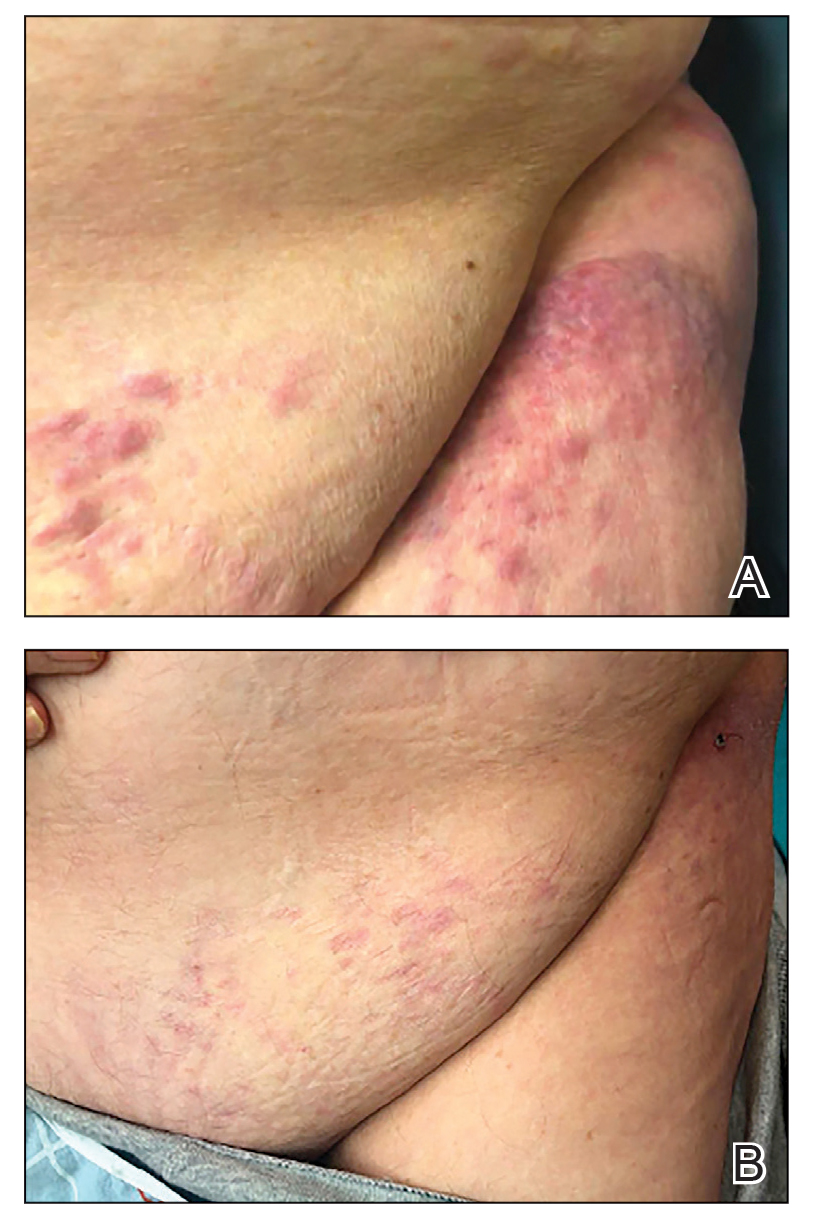
A punch biopsy specimen showed markedly atypical lymphocytes with enlarged nuclei and scant cytoplasm present throughout the dermis (Figures 2A and 2B). Numerous apoptotic cells and cellular debris were seen. Immunohistochemical staining demonstrated that the lymphocytic infiltrate comprised CD79a+ B cells that were positive for Bcl-6 and CD10 and negative for Bcl-2 (Figures 2C and 2D). There also was diminished focal expression of CD20. Ki-67 protein staining was intensely positive and demonstrated a very high proliferative index.
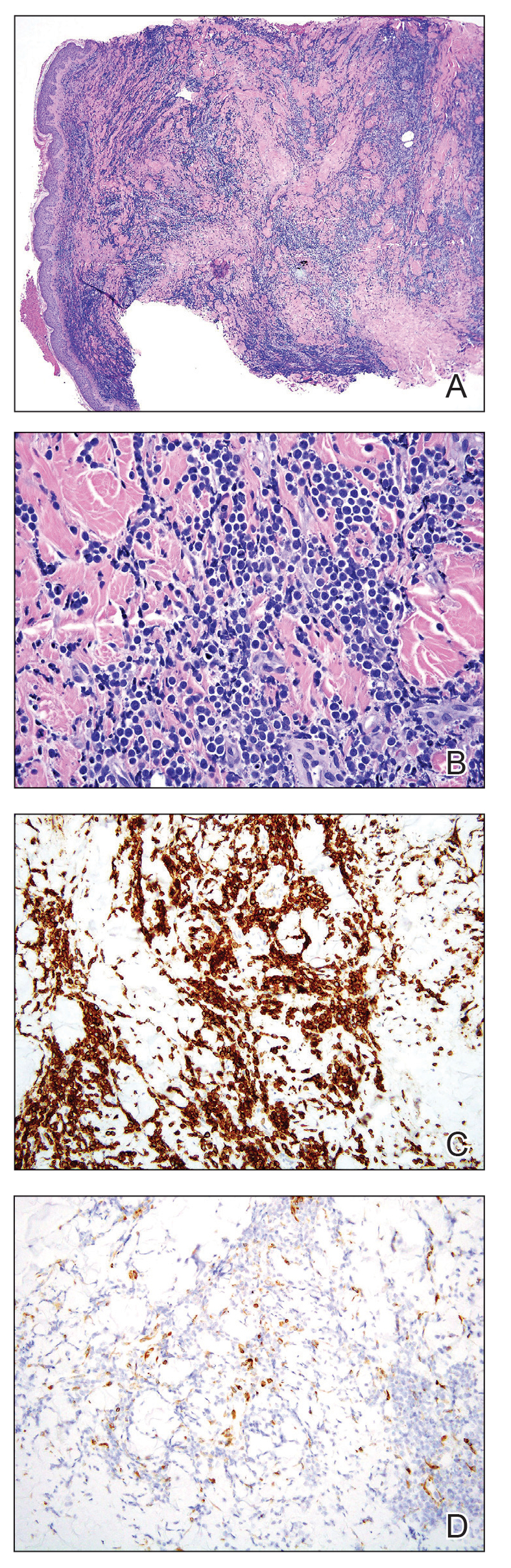
Taken together, these findings were consistent with a diagnosis of cutaneous metastasis of Burkitt lymphoma. The patient’s cutaneous lesions improved after continued aggressive chemotherapy. At follow-up 2 weeks after biopsy, he was receiving his second round of R-EPOCH chemotherapy with appreciable regression of skin lesions (Figure 1B). However, he then developed right-side double vision, ptosis, and right-side facial paresthesia. Although magnetic resonance imaging of the brain and lumbar puncture did not show evidence of central nervous system involvement, the chemotherapy regimen was switched to dose-adjusted CVAD-R—hypercyclophosphamide, vincristine, doxorubicin hydrochloride, and dexamethasone plus rituximab—for empiric treatment of central nervous system disease. Although treatment was complicated by sepsis with extended-spectrum β-lactamase-producing Enterobacter cloacae, Burkitt lymphoma was found to be in remission after 3 cycles of CVAD-R and 5 months of chemotherapy.
Burkitt lymphoma is a B-cell non-Hodgkin malignancy caused by translocation of chromosome 8 and chromosome 14, leading to overexpression of c-MYC and subsequent hyperproliferation of B lymphocytes.1,2 The disease is divided into 3 major categories: sporadic, endemic, and immunodeficiency related.3 The endemic variant is the most prevalent subtype in Africa and is associated with Plasmodium falciparum malaria; the sporadic variant is the most common subtype in the rest of the world.4
Burkitt lymphoma is highly aggressive and is characterized by unusually high rates of mitosis and apoptosis that result in abundant cellular debris and a distinctive starry-sky pattern on histopathology.5,6 Extranodal metastasis is common,7 but cutaneous involvement is exceedingly rare, with only a few cases having been reported.8-14 Cutaneous metastasis of Burkitt lymphoma often is associated with a high overall disease burden and poor prognosis.8,11
Immunodeficiency-related Burkitt lymphoma is particularly aggressive. Notably, 3 of 7 (42.9%) reported cases of cutaneous Burkitt lymphoma occurred in HIV-positive patients.11,13 In one case, cutaneous involvement was the first sign of relapsed disease that had been in remission.12
Although c-MYC rearrangement is required to make a diagnosis of Burkitt lymphoma, the disease also is present in a minority of cases of diffuse large B-cell lymphoma (DLBCL)(6%).15 Although DLBCL typically can be differentiated from Burkitt lymphoma by the large nuclear size and characteristic vesicular nuclei of B cells, few cases of DLBCL with c-MYC rearrangement histologically mimic Burkitt lymphoma. However, key features such as immunohistochemical staining for Bcl-2 and CD10 can be used to distinguish these 2 entities.16 Bcl-2 negativity and CD10 positivity, as seen in our patient, is considered more characteristic of Burkitt lymphoma. This staining pattern in combination with a high Ki-67 fraction (>95%) and the presence of monomorphic medium-sized cells is more consistent with a diagnosis of Burkitt lymphoma than of DLBCL.17
Earlier case reports have documented that cutaneous lesions of Burkitt lymphoma can occur in a variety of ways. Hematogenous spread is the likely route of metastasis for lesions distant to the primary site or those that have widespread distribution.18 Alternatively, other reports have suggested that cutaneous metastases can occur from local invasion and subcutaneous extension of malignant cells after a surgical procedure.10,19 For example, cutaneous Burkitt lymphoma has been reported in the setting of celioscopy, occurring directly at the surgical site.19 In our patient, we believe that the route of metastatic spread likely was through subcutaneous invasion secondary to CT-guided core biopsy, which was supported by the observation that the onset of cutaneous manifestations was temporally related to the procedure and that the lesions occurred on the skin directly overlying the biopsy site.
In conclusion, we describe an exceedingly rare presentation of cutaneous Burkitt lymphoma in which a surgical procedure likely served as an inciting event that triggered seeding of malignant cells to the skin. Cutaneous spread of Burkitt lymphoma is infrequently reported; all such reports that provide long-term follow-up data have described it in association with high disease burden and often a lethal outcome.8,11,12 Our patient had complete resolution of cutaneous lesions with chemotherapy. It is unclear if the presence of cutaneous lesions can serve as a prognostic indicator and requires further investigation. However, our case provides preliminary evidence to suggest that cutaneous metastases do not always represent aggressive disease and that cutaneous lesions may respond well to chemotherapy.
- Kalisz K, Alessandrino F, Beck R, et al. An update on Burkitt lymphoma: a review of pathogenesis and multimodality imaging assessment of disease presentation, treatment response, and recurrence. Insights Imaging. 2019;10:56. doi:10.1186/s13244-019-0733-7
- Dunleavy K, Gross TG. Management of aggressive B-cell NHLs in the AYA population: an adult vs pediatric perspective. Blood. 2018;132:369-375. doi:10.1182/blood-2018-02-778480
- Noy A. Burkitt lymphoma—subtypes, pathogenesis, and treatment strategies. Clin Lymphoma Myeloma Leuk. 2020;20(Suppl 1):S37-S38. doi:10.1016/S2152-2650(20)30455-9
- Lenze D, Leoncini L, Hummel M, et al. The different epidemiologic subtypes of Burkitt lymphoma share a homogenous micro RNA profile distinct from diffuse large B-cell lymphoma. Leukemia. 2011;25:1869-1876. doi:10.1038/leu.2011.156
- Bellan C, Lazzi S, De Falco G, et al. Burkitt’s lymphoma: new insights into molecular pathogenesis. J Clin Pathol. 2003;56:188-192. doi:10.1136/jcp.56.3.188
- Chuang S-S, Ye H, Du M-Q, et al. Histopathology and immunohistochemistry in distinguishing Burkitt lymphoma from diffuse large B-cell lymphoma with very high proliferation index and with or without a starry-sky pattern: a comparative study with EBER and FISH. Am J Clin Pathol. 2007;128:558-564. doi:10.1309/EQJR3D3V0CCQGP04
- Baker PS, Gold KG, Lane KA, et al. Orbital burkitt lymphoma in immunocompetent patients: a report of 3 cases and a review of the literature. Ophthalmic Plast Reconstr Surg. 2009;25:464-468. doi:10.1097/IOP.0b013e3181b80fde
- Fuhrmann TL, Ignatovich YV, Pentland A. Cutaneous metastatic disease: Burkitt lymphoma. J Am Acad Dermatol. 2011;64:1196-1197. doi:10.1016/j.jaad.2009.08.033
- Burns CA, Scott GA, Miller CC. Leukemia cutis at the site of trauma in a patient with Burkitt leukemia. Cutis. 2005;75:54-56.
- Jacobson MA, Hutcheson ACS, Hurray DH, et al. Cutaneous involvement by Burkitt lymphoma. J Am Acad Dermatol. 2006;54:1111-1113. doi:10.1016/j.jaad.2006.02.030
- Berk DR, Cheng A, Lind AC, et al. Burkitt lymphoma with cutaneous involvement. Dermatol Online J. 2008;14:14.
- Bachmeyer C, Bazarbachi A, Rio B, et al. Specific cutaneous involvement indicating relapse of Burkitt’s lymphoma. Am J Hematol. 1997;54:176. doi:10.1002/(sici)1096-8652(199702)54:2<176::aid-ajh20>3.0.co;2-c
- Rogers A, Graves M, Toscano M, et al. A unique cutaneous presentation of Burkitt lymphoma. Am J Dermatopathol. 2014;36:997-1001. doi:10.1097/DAD.0000000000000004
- Thakkar D, Lipi L, Misra R, et al. Skin involvement in Burkitt’s lymphoma. Hematol Oncol Stem Cell Ther. 2018;11:251-252. doi:10.1016/j.hemonc.2018.01.002
- Akasaka T, Akasaka H, Ueda C, et al. Molecular and clinical features of non-Burkitt’s, diffuse large-cell lymphoma of B-cell type associated with the c-MYC/immunoglobulin heavy-chain fusion gene. J Clin Oncol. 2000;18:510-518. doi:10.1200/JCO.2000.18.3.510
- Nakamura N, Nakamine H, Tamaru J-I, et al. The distinction between Burkitt lymphoma and diffuse large B-cell lymphoma with c-myc rearrangement. Mod Pathol. 2002;15:771-776. doi:10.1097/01.MP.0000019577.73786.64
- Bellan C, Stefano L, Giulia de F, et al. Burkitt lymphoma versus diffuse large B-cell lymphoma: a practical approach. Hematol Oncol. 2010;28:53-56. doi:10.1002/hon.916
- Amonchaisakda N, Aiempanakit K, Apinantriyo B. Burkitt lymphoma initially mimicking varicella zoster infection. IDCases. 2020;21:E00818. doi:10.1016/j.idcr.2020.e00818
- Aractingi S, Marolleau JP, Daniel MT, et al. Subcutaneous localizations of Burkitt lymphoma after celioscopy. Am J Hematol. 1993;42:408. doi:10.1002/ajh.2830420421
To the Editor:
A 73-year-old man was admitted to the hospital with progressive abdominal and hip pain of several weeks’ duration that was accompanied by unilateral swelling of the left leg. He had a medical history of hypertension, hyperlipidemia, and prediabetes. Computed tomography (CT) showed extensive intra-abdominal, retroperitoneal, and pelvic lymphadenopathy in addition to poorly defined hepatic lesions.
A CT-guided core biopsy of a left inguinal lymph node showed Burkitt lymphoma. Fluorescence in situ hybridization was positive for oncogene c-MYC rearrangement on chromosome 8q24 and negative for B-cell lymphoma 2 (BCL2) and B-cell lymphoma 6 (BCL6) gene rearrangements. Flow cytometry demonstrated an aberrant population of κ light chain-restricted CD5−CD10+ B lymphocytes.
The patient’s overall disease burden was consistent with stage IV Burkitt lymphoma. R-miniCHOP chemotherapy—rituximab plus a reduced dose of cyclophosphamide, doxorubicin, vincristine sulfate, and prednisone—was initiated. Approximately 2 weeks after chemotherapy was initiated, the patient developed a firm erythematous eruption on the left hip (Figure 1A). His regimen was then switched to R-EPOCH—rituximab, etoposide phosphate, prednisone, vincristine sulfate, cyclophosphamide, and doxorubicin—at the time of discharge, and he was referred to dermatology due to an initial concern of an adverse reaction to R-EPOCH chemotherapy. The patient denied any pain, pruritus, or irritation. Physical examination showed multifocal, subcutaneous, indurated, erythematous and violaceous nodules without epidermal changes. Some nodules on the lateral aspect of the hip coalesced to form firm plaques.
A punch biopsy specimen showed markedly atypical lymphocytes with enlarged nuclei and scant cytoplasm present throughout the dermis (Figures 2A and 2B). Numerous apoptotic cells and cellular debris were seen. Immunohistochemical staining demonstrated that the lymphocytic infiltrate comprised CD79a+ B cells that were positive for Bcl-6 and CD10 and negative for Bcl-2 (Figures 2C and 2D). There also was diminished focal expression of CD20. Ki-67 protein staining was intensely positive and demonstrated a very high proliferative index.
Taken together, these findings were consistent with a diagnosis of cutaneous metastasis of Burkitt lymphoma. The patient’s cutaneous lesions improved after continued aggressive chemotherapy. At follow-up 2 weeks after biopsy, he was receiving his second round of R-EPOCH chemotherapy with appreciable regression of skin lesions (Figure 1B). However, he then developed right-side double vision, ptosis, and right-side facial paresthesia. Although magnetic resonance imaging of the brain and lumbar puncture did not show evidence of central nervous system involvement, the chemotherapy regimen was switched to dose-adjusted CVAD-R—hypercyclophosphamide, vincristine, doxorubicin hydrochloride, and dexamethasone plus rituximab—for empiric treatment of central nervous system disease. Although treatment was complicated by sepsis with extended-spectrum β-lactamase-producing Enterobacter cloacae, Burkitt lymphoma was found to be in remission after 3 cycles of CVAD-R and 5 months of chemotherapy.
Burkitt lymphoma is a B-cell non-Hodgkin malignancy caused by translocation of chromosome 8 and chromosome 14, leading to overexpression of c-MYC and subsequent hyperproliferation of B lymphocytes.1,2 The disease is divided into 3 major categories: sporadic, endemic, and immunodeficiency related.3 The endemic variant is the most prevalent subtype in Africa and is associated with Plasmodium falciparum malaria; the sporadic variant is the most common subtype in the rest of the world.4
Burkitt lymphoma is highly aggressive and is characterized by unusually high rates of mitosis and apoptosis that result in abundant cellular debris and a distinctive starry-sky pattern on histopathology.5,6 Extranodal metastasis is common,7 but cutaneous involvement is exceedingly rare, with only a few cases having been reported.8-14 Cutaneous metastasis of Burkitt lymphoma often is associated with a high overall disease burden and poor prognosis.8,11
Immunodeficiency-related Burkitt lymphoma is particularly aggressive. Notably, 3 of 7 (42.9%) reported cases of cutaneous Burkitt lymphoma occurred in HIV-positive patients.11,13 In one case, cutaneous involvement was the first sign of relapsed disease that had been in remission.12
Although c-MYC rearrangement is required to make a diagnosis of Burkitt lymphoma, the disease also is present in a minority of cases of diffuse large B-cell lymphoma (DLBCL)(6%).15 Although DLBCL typically can be differentiated from Burkitt lymphoma by the large nuclear size and characteristic vesicular nuclei of B cells, few cases of DLBCL with c-MYC rearrangement histologically mimic Burkitt lymphoma. However, key features such as immunohistochemical staining for Bcl-2 and CD10 can be used to distinguish these 2 entities.16 Bcl-2 negativity and CD10 positivity, as seen in our patient, is considered more characteristic of Burkitt lymphoma. This staining pattern in combination with a high Ki-67 fraction (>95%) and the presence of monomorphic medium-sized cells is more consistent with a diagnosis of Burkitt lymphoma than of DLBCL.17
Earlier case reports have documented that cutaneous lesions of Burkitt lymphoma can occur in a variety of ways. Hematogenous spread is the likely route of metastasis for lesions distant to the primary site or those that have widespread distribution.18 Alternatively, other reports have suggested that cutaneous metastases can occur from local invasion and subcutaneous extension of malignant cells after a surgical procedure.10,19 For example, cutaneous Burkitt lymphoma has been reported in the setting of celioscopy, occurring directly at the surgical site.19 In our patient, we believe that the route of metastatic spread likely was through subcutaneous invasion secondary to CT-guided core biopsy, which was supported by the observation that the onset of cutaneous manifestations was temporally related to the procedure and that the lesions occurred on the skin directly overlying the biopsy site.
In conclusion, we describe an exceedingly rare presentation of cutaneous Burkitt lymphoma in which a surgical procedure likely served as an inciting event that triggered seeding of malignant cells to the skin. Cutaneous spread of Burkitt lymphoma is infrequently reported; all such reports that provide long-term follow-up data have described it in association with high disease burden and often a lethal outcome.8,11,12 Our patient had complete resolution of cutaneous lesions with chemotherapy. It is unclear if the presence of cutaneous lesions can serve as a prognostic indicator and requires further investigation. However, our case provides preliminary evidence to suggest that cutaneous metastases do not always represent aggressive disease and that cutaneous lesions may respond well to chemotherapy.
To the Editor:
A 73-year-old man was admitted to the hospital with progressive abdominal and hip pain of several weeks’ duration that was accompanied by unilateral swelling of the left leg. He had a medical history of hypertension, hyperlipidemia, and prediabetes. Computed tomography (CT) showed extensive intra-abdominal, retroperitoneal, and pelvic lymphadenopathy in addition to poorly defined hepatic lesions.
A CT-guided core biopsy of a left inguinal lymph node showed Burkitt lymphoma. Fluorescence in situ hybridization was positive for oncogene c-MYC rearrangement on chromosome 8q24 and negative for B-cell lymphoma 2 (BCL2) and B-cell lymphoma 6 (BCL6) gene rearrangements. Flow cytometry demonstrated an aberrant population of κ light chain-restricted CD5−CD10+ B lymphocytes.
The patient’s overall disease burden was consistent with stage IV Burkitt lymphoma. R-miniCHOP chemotherapy—rituximab plus a reduced dose of cyclophosphamide, doxorubicin, vincristine sulfate, and prednisone—was initiated. Approximately 2 weeks after chemotherapy was initiated, the patient developed a firm erythematous eruption on the left hip (Figure 1A). His regimen was then switched to R-EPOCH—rituximab, etoposide phosphate, prednisone, vincristine sulfate, cyclophosphamide, and doxorubicin—at the time of discharge, and he was referred to dermatology due to an initial concern of an adverse reaction to R-EPOCH chemotherapy. The patient denied any pain, pruritus, or irritation. Physical examination showed multifocal, subcutaneous, indurated, erythematous and violaceous nodules without epidermal changes. Some nodules on the lateral aspect of the hip coalesced to form firm plaques.
A punch biopsy specimen showed markedly atypical lymphocytes with enlarged nuclei and scant cytoplasm present throughout the dermis (Figures 2A and 2B). Numerous apoptotic cells and cellular debris were seen. Immunohistochemical staining demonstrated that the lymphocytic infiltrate comprised CD79a+ B cells that were positive for Bcl-6 and CD10 and negative for Bcl-2 (Figures 2C and 2D). There also was diminished focal expression of CD20. Ki-67 protein staining was intensely positive and demonstrated a very high proliferative index.
Taken together, these findings were consistent with a diagnosis of cutaneous metastasis of Burkitt lymphoma. The patient’s cutaneous lesions improved after continued aggressive chemotherapy. At follow-up 2 weeks after biopsy, he was receiving his second round of R-EPOCH chemotherapy with appreciable regression of skin lesions (Figure 1B). However, he then developed right-side double vision, ptosis, and right-side facial paresthesia. Although magnetic resonance imaging of the brain and lumbar puncture did not show evidence of central nervous system involvement, the chemotherapy regimen was switched to dose-adjusted CVAD-R—hypercyclophosphamide, vincristine, doxorubicin hydrochloride, and dexamethasone plus rituximab—for empiric treatment of central nervous system disease. Although treatment was complicated by sepsis with extended-spectrum β-lactamase-producing Enterobacter cloacae, Burkitt lymphoma was found to be in remission after 3 cycles of CVAD-R and 5 months of chemotherapy.
Burkitt lymphoma is a B-cell non-Hodgkin malignancy caused by translocation of chromosome 8 and chromosome 14, leading to overexpression of c-MYC and subsequent hyperproliferation of B lymphocytes.1,2 The disease is divided into 3 major categories: sporadic, endemic, and immunodeficiency related.3 The endemic variant is the most prevalent subtype in Africa and is associated with Plasmodium falciparum malaria; the sporadic variant is the most common subtype in the rest of the world.4
Burkitt lymphoma is highly aggressive and is characterized by unusually high rates of mitosis and apoptosis that result in abundant cellular debris and a distinctive starry-sky pattern on histopathology.5,6 Extranodal metastasis is common,7 but cutaneous involvement is exceedingly rare, with only a few cases having been reported.8-14 Cutaneous metastasis of Burkitt lymphoma often is associated with a high overall disease burden and poor prognosis.8,11
Immunodeficiency-related Burkitt lymphoma is particularly aggressive. Notably, 3 of 7 (42.9%) reported cases of cutaneous Burkitt lymphoma occurred in HIV-positive patients.11,13 In one case, cutaneous involvement was the first sign of relapsed disease that had been in remission.12
Although c-MYC rearrangement is required to make a diagnosis of Burkitt lymphoma, the disease also is present in a minority of cases of diffuse large B-cell lymphoma (DLBCL)(6%).15 Although DLBCL typically can be differentiated from Burkitt lymphoma by the large nuclear size and characteristic vesicular nuclei of B cells, few cases of DLBCL with c-MYC rearrangement histologically mimic Burkitt lymphoma. However, key features such as immunohistochemical staining for Bcl-2 and CD10 can be used to distinguish these 2 entities.16 Bcl-2 negativity and CD10 positivity, as seen in our patient, is considered more characteristic of Burkitt lymphoma. This staining pattern in combination with a high Ki-67 fraction (>95%) and the presence of monomorphic medium-sized cells is more consistent with a diagnosis of Burkitt lymphoma than of DLBCL.17
Earlier case reports have documented that cutaneous lesions of Burkitt lymphoma can occur in a variety of ways. Hematogenous spread is the likely route of metastasis for lesions distant to the primary site or those that have widespread distribution.18 Alternatively, other reports have suggested that cutaneous metastases can occur from local invasion and subcutaneous extension of malignant cells after a surgical procedure.10,19 For example, cutaneous Burkitt lymphoma has been reported in the setting of celioscopy, occurring directly at the surgical site.19 In our patient, we believe that the route of metastatic spread likely was through subcutaneous invasion secondary to CT-guided core biopsy, which was supported by the observation that the onset of cutaneous manifestations was temporally related to the procedure and that the lesions occurred on the skin directly overlying the biopsy site.
In conclusion, we describe an exceedingly rare presentation of cutaneous Burkitt lymphoma in which a surgical procedure likely served as an inciting event that triggered seeding of malignant cells to the skin. Cutaneous spread of Burkitt lymphoma is infrequently reported; all such reports that provide long-term follow-up data have described it in association with high disease burden and often a lethal outcome.8,11,12 Our patient had complete resolution of cutaneous lesions with chemotherapy. It is unclear if the presence of cutaneous lesions can serve as a prognostic indicator and requires further investigation. However, our case provides preliminary evidence to suggest that cutaneous metastases do not always represent aggressive disease and that cutaneous lesions may respond well to chemotherapy.
- Kalisz K, Alessandrino F, Beck R, et al. An update on Burkitt lymphoma: a review of pathogenesis and multimodality imaging assessment of disease presentation, treatment response, and recurrence. Insights Imaging. 2019;10:56. doi:10.1186/s13244-019-0733-7
- Dunleavy K, Gross TG. Management of aggressive B-cell NHLs in the AYA population: an adult vs pediatric perspective. Blood. 2018;132:369-375. doi:10.1182/blood-2018-02-778480
- Noy A. Burkitt lymphoma—subtypes, pathogenesis, and treatment strategies. Clin Lymphoma Myeloma Leuk. 2020;20(Suppl 1):S37-S38. doi:10.1016/S2152-2650(20)30455-9
- Lenze D, Leoncini L, Hummel M, et al. The different epidemiologic subtypes of Burkitt lymphoma share a homogenous micro RNA profile distinct from diffuse large B-cell lymphoma. Leukemia. 2011;25:1869-1876. doi:10.1038/leu.2011.156
- Bellan C, Lazzi S, De Falco G, et al. Burkitt’s lymphoma: new insights into molecular pathogenesis. J Clin Pathol. 2003;56:188-192. doi:10.1136/jcp.56.3.188
- Chuang S-S, Ye H, Du M-Q, et al. Histopathology and immunohistochemistry in distinguishing Burkitt lymphoma from diffuse large B-cell lymphoma with very high proliferation index and with or without a starry-sky pattern: a comparative study with EBER and FISH. Am J Clin Pathol. 2007;128:558-564. doi:10.1309/EQJR3D3V0CCQGP04
- Baker PS, Gold KG, Lane KA, et al. Orbital burkitt lymphoma in immunocompetent patients: a report of 3 cases and a review of the literature. Ophthalmic Plast Reconstr Surg. 2009;25:464-468. doi:10.1097/IOP.0b013e3181b80fde
- Fuhrmann TL, Ignatovich YV, Pentland A. Cutaneous metastatic disease: Burkitt lymphoma. J Am Acad Dermatol. 2011;64:1196-1197. doi:10.1016/j.jaad.2009.08.033
- Burns CA, Scott GA, Miller CC. Leukemia cutis at the site of trauma in a patient with Burkitt leukemia. Cutis. 2005;75:54-56.
- Jacobson MA, Hutcheson ACS, Hurray DH, et al. Cutaneous involvement by Burkitt lymphoma. J Am Acad Dermatol. 2006;54:1111-1113. doi:10.1016/j.jaad.2006.02.030
- Berk DR, Cheng A, Lind AC, et al. Burkitt lymphoma with cutaneous involvement. Dermatol Online J. 2008;14:14.
- Bachmeyer C, Bazarbachi A, Rio B, et al. Specific cutaneous involvement indicating relapse of Burkitt’s lymphoma. Am J Hematol. 1997;54:176. doi:10.1002/(sici)1096-8652(199702)54:2<176::aid-ajh20>3.0.co;2-c
- Rogers A, Graves M, Toscano M, et al. A unique cutaneous presentation of Burkitt lymphoma. Am J Dermatopathol. 2014;36:997-1001. doi:10.1097/DAD.0000000000000004
- Thakkar D, Lipi L, Misra R, et al. Skin involvement in Burkitt’s lymphoma. Hematol Oncol Stem Cell Ther. 2018;11:251-252. doi:10.1016/j.hemonc.2018.01.002
- Akasaka T, Akasaka H, Ueda C, et al. Molecular and clinical features of non-Burkitt’s, diffuse large-cell lymphoma of B-cell type associated with the c-MYC/immunoglobulin heavy-chain fusion gene. J Clin Oncol. 2000;18:510-518. doi:10.1200/JCO.2000.18.3.510
- Nakamura N, Nakamine H, Tamaru J-I, et al. The distinction between Burkitt lymphoma and diffuse large B-cell lymphoma with c-myc rearrangement. Mod Pathol. 2002;15:771-776. doi:10.1097/01.MP.0000019577.73786.64
- Bellan C, Stefano L, Giulia de F, et al. Burkitt lymphoma versus diffuse large B-cell lymphoma: a practical approach. Hematol Oncol. 2010;28:53-56. doi:10.1002/hon.916
- Amonchaisakda N, Aiempanakit K, Apinantriyo B. Burkitt lymphoma initially mimicking varicella zoster infection. IDCases. 2020;21:E00818. doi:10.1016/j.idcr.2020.e00818
- Aractingi S, Marolleau JP, Daniel MT, et al. Subcutaneous localizations of Burkitt lymphoma after celioscopy. Am J Hematol. 1993;42:408. doi:10.1002/ajh.2830420421
- Kalisz K, Alessandrino F, Beck R, et al. An update on Burkitt lymphoma: a review of pathogenesis and multimodality imaging assessment of disease presentation, treatment response, and recurrence. Insights Imaging. 2019;10:56. doi:10.1186/s13244-019-0733-7
- Dunleavy K, Gross TG. Management of aggressive B-cell NHLs in the AYA population: an adult vs pediatric perspective. Blood. 2018;132:369-375. doi:10.1182/blood-2018-02-778480
- Noy A. Burkitt lymphoma—subtypes, pathogenesis, and treatment strategies. Clin Lymphoma Myeloma Leuk. 2020;20(Suppl 1):S37-S38. doi:10.1016/S2152-2650(20)30455-9
- Lenze D, Leoncini L, Hummel M, et al. The different epidemiologic subtypes of Burkitt lymphoma share a homogenous micro RNA profile distinct from diffuse large B-cell lymphoma. Leukemia. 2011;25:1869-1876. doi:10.1038/leu.2011.156
- Bellan C, Lazzi S, De Falco G, et al. Burkitt’s lymphoma: new insights into molecular pathogenesis. J Clin Pathol. 2003;56:188-192. doi:10.1136/jcp.56.3.188
- Chuang S-S, Ye H, Du M-Q, et al. Histopathology and immunohistochemistry in distinguishing Burkitt lymphoma from diffuse large B-cell lymphoma with very high proliferation index and with or without a starry-sky pattern: a comparative study with EBER and FISH. Am J Clin Pathol. 2007;128:558-564. doi:10.1309/EQJR3D3V0CCQGP04
- Baker PS, Gold KG, Lane KA, et al. Orbital burkitt lymphoma in immunocompetent patients: a report of 3 cases and a review of the literature. Ophthalmic Plast Reconstr Surg. 2009;25:464-468. doi:10.1097/IOP.0b013e3181b80fde
- Fuhrmann TL, Ignatovich YV, Pentland A. Cutaneous metastatic disease: Burkitt lymphoma. J Am Acad Dermatol. 2011;64:1196-1197. doi:10.1016/j.jaad.2009.08.033
- Burns CA, Scott GA, Miller CC. Leukemia cutis at the site of trauma in a patient with Burkitt leukemia. Cutis. 2005;75:54-56.
- Jacobson MA, Hutcheson ACS, Hurray DH, et al. Cutaneous involvement by Burkitt lymphoma. J Am Acad Dermatol. 2006;54:1111-1113. doi:10.1016/j.jaad.2006.02.030
- Berk DR, Cheng A, Lind AC, et al. Burkitt lymphoma with cutaneous involvement. Dermatol Online J. 2008;14:14.
- Bachmeyer C, Bazarbachi A, Rio B, et al. Specific cutaneous involvement indicating relapse of Burkitt’s lymphoma. Am J Hematol. 1997;54:176. doi:10.1002/(sici)1096-8652(199702)54:2<176::aid-ajh20>3.0.co;2-c
- Rogers A, Graves M, Toscano M, et al. A unique cutaneous presentation of Burkitt lymphoma. Am J Dermatopathol. 2014;36:997-1001. doi:10.1097/DAD.0000000000000004
- Thakkar D, Lipi L, Misra R, et al. Skin involvement in Burkitt’s lymphoma. Hematol Oncol Stem Cell Ther. 2018;11:251-252. doi:10.1016/j.hemonc.2018.01.002
- Akasaka T, Akasaka H, Ueda C, et al. Molecular and clinical features of non-Burkitt’s, diffuse large-cell lymphoma of B-cell type associated with the c-MYC/immunoglobulin heavy-chain fusion gene. J Clin Oncol. 2000;18:510-518. doi:10.1200/JCO.2000.18.3.510
- Nakamura N, Nakamine H, Tamaru J-I, et al. The distinction between Burkitt lymphoma and diffuse large B-cell lymphoma with c-myc rearrangement. Mod Pathol. 2002;15:771-776. doi:10.1097/01.MP.0000019577.73786.64
- Bellan C, Stefano L, Giulia de F, et al. Burkitt lymphoma versus diffuse large B-cell lymphoma: a practical approach. Hematol Oncol. 2010;28:53-56. doi:10.1002/hon.916
- Amonchaisakda N, Aiempanakit K, Apinantriyo B. Burkitt lymphoma initially mimicking varicella zoster infection. IDCases. 2020;21:E00818. doi:10.1016/j.idcr.2020.e00818
- Aractingi S, Marolleau JP, Daniel MT, et al. Subcutaneous localizations of Burkitt lymphoma after celioscopy. Am J Hematol. 1993;42:408. doi:10.1002/ajh.2830420421
Practice Points
- Cutaneous metastasis is exceedingly rare in Burkitt lymphoma. When cutaneous involvement does occur, it can represent an uncommon consequence of a surgical procedure, serving as the inciting event for hematogenous spread and local tumor extension into the skin.
- Although cutaneous metasis of Burkitt lymphoma typically is associated with high disease burden and mortality, our case demonstrated that cutaneous spread can be present even in a patient who has a positive outcome. Our patient was able to achieve disease remission and complete resolution of cutaneous lesions with continued chemotherapy, suggesting that cutaneous metastasis does not always portend a poor prognosis.
OTC Birth Control Pill Headed to US Pharmacies: What Your Patients Should Know
Primary care clinicians have largely welcomed the arrival of Opill, the first over-the-counter (OTC) birth control pill from Perrigo, which will reach US pharmacy shelves this month. Although the medicine has a long-track record of safe use, physicians and nurse practitioners may want to ready themselves to answer questions from patients about shifting to the option.
The switch to OTC status for the norgestrel-only contraceptive has the support of many physician groups, including the American Medical Association, the American Academy of Family Physicians, and the American College of Obstetricians and Gynecologists (ACOG).
The end of the prescription-requirement removes a barrier to access for many women, especially those who lack insurance. But it also will take away a chief reason many women in their childbearing years make appointments with doctors, as they will no longer need prescriptions for birth control pills.
Anne-Marie Amies Oelschlager, MD, professor of obstetrics and gynecology at University of Washington School of Medicine, in Seattle, Washington, said she is also worried that the availability of an OTC pill will lead to missed opportunities to help patients avoid sexually transmitted diseases. For example, patients can get counseling about the need for testing for sexually transmitted diseases at the start of new relationships during a visit made to obtain a prescription for the pill.
“My hope is that they still follow our recommendations, which is to get tested with every partner,” said Dr. Oelschlager, who cares for many patients in their teens. “Adolescents are at a particularly high risk of infection compared to older ones.”
When clinicians do see patients, they may want to raise the issue of the OTC option and proper use. Patients will need to closely read materials provided for Opill, a step they might skip due to the ready access, according to Diana Zuckerman, PhD, president of the nonprofit National Center for Health Research, which scrutinizes the safety of medical products.
“When something is sold over the counter, it’s perceived by individuals as being safe,” Dr. Zuckerman told this news organization. “There’s less concern and a little less interest in reading the instructions and reading the warnings.”
Considerations for Safety
The US Food and Drug Administration (FDA) in July approved the sales of a daily 0.075 mg norgestrel tablet without prescription. Perrigo told this news organization that it spent the intervening months ensuring retailers and consumers will receive education on the drug.
One of the biggest challenges for people using Opill may be sticking with the dosing schedule, according to Dr. Oelschlager.
“There are going to be people that have a harder time remembering to take a pill every day,” at the same time, said Dr. Oelschlager, who is chair of ACOG’s Clinical Consensus Gynecology Committee. “We need to watch and see what happens as it becomes more widely available, and people start using it.”
Unexpected vaginal bleeding is the most common adverse event linked to this form of birth control, with over one fifth of participants from one study of the OTC drug reporting this side effect, according to an FDA memo.
“It is more likely to be a tolerability issue rather than a safety issue,” the FDA wrote.
Many prescription of birth control options contain estrogen, which is associated with venous thromboembolism (VTE). But Opill contains only norgestrel, a form of progestin, which is not associated with thrombosis. Patients may be more likely to overestimate their potential risks for VTE than to underestimate them, according to Kwuan Paruchabutr, DNP, president of National Association of Nurse Practitioners in Women’s Health and an assistant professor at Georgetown University in Washington, DC.
“This is a progesterone-only pill: The risk is relatively low” of VTE, Dr. Paruchabutr said.
Clinicians should also take special care with patients who are prescribed drugs for seizures, tuberculosis, HIV/AIDS, and pulmonary hypertension or who are taking supplements containing St John’s wort.
Patients in their childbearing years who take isotretinoin are already expected to use some form of birth control.
“All patients on isotretinoin must be registered in the iPLEDGE program, which mandates monthly contraception counseling and monthly pregnancy tests for persons of childbearing potential,” Terrence A. Cronin, Jr, MD, president of the American Academy of Dermatology, told news organization through email.
Dr. Oelschlager noted that many patients who take isotretinoin may benefit from taking a birth control pill containing estrogen, for which they will need a prescription. At least three pills have an FDA-approved indication for treating moderate acne, including Ortho Tri-Cyclen, Estrostep, and Yaz.
The FDA has posted consumer-friendly information about the OTC pill that clinicians can refer their patients to. For clinicians who want more information, ACOG released a practice advisory about the switch in status for this progestin-only pill.
The Cost
While federal laws mandate employer-based and Medicaid plans cover prescription birth control pills for free, the OTC version will carry a cost, according to A. Mark Fendrick, MD, director of the University of Michigan Center for Value-Based Insurance Design in Ann Arbor, Michigan.
Seven states, including New Mexico and New York, already have laws in effect that require health plans to cover certain OTC contraceptives without a prescription, according to a tally kept by the nonprofit research organization KFF.
Dr. Fendrick said it would be helpful for health plans to offer coverage for the OTC pill without copays even if they are not required to do so.
Priced at about $20 a month, Opill “is likely out of reach for many of the individuals who would most benefit from an OTC option,” Dr. Fendrick told this news organization in an email.
The new pill may be utilized most by those who do not have health insurance or have low incomes and cannot afford to see a doctor for a prescription, according to Sally Rafie, PharmD, a pharmacist specialist at University of California San Diego Health and founder of the Birth Control Pharmacist.
The manufacturer’s suggested retail prices will be $19.99 for a 1-month supply and $49.99 for a 3-month supply. Dublin-based Perrigo said it plans to offer a cost-assistance program for the drug in the coming weeks for people who have low incomes and lack insurance.
A version of this article appeared on Medscape.com.
Primary care clinicians have largely welcomed the arrival of Opill, the first over-the-counter (OTC) birth control pill from Perrigo, which will reach US pharmacy shelves this month. Although the medicine has a long-track record of safe use, physicians and nurse practitioners may want to ready themselves to answer questions from patients about shifting to the option.
The switch to OTC status for the norgestrel-only contraceptive has the support of many physician groups, including the American Medical Association, the American Academy of Family Physicians, and the American College of Obstetricians and Gynecologists (ACOG).
The end of the prescription-requirement removes a barrier to access for many women, especially those who lack insurance. But it also will take away a chief reason many women in their childbearing years make appointments with doctors, as they will no longer need prescriptions for birth control pills.
Anne-Marie Amies Oelschlager, MD, professor of obstetrics and gynecology at University of Washington School of Medicine, in Seattle, Washington, said she is also worried that the availability of an OTC pill will lead to missed opportunities to help patients avoid sexually transmitted diseases. For example, patients can get counseling about the need for testing for sexually transmitted diseases at the start of new relationships during a visit made to obtain a prescription for the pill.
“My hope is that they still follow our recommendations, which is to get tested with every partner,” said Dr. Oelschlager, who cares for many patients in their teens. “Adolescents are at a particularly high risk of infection compared to older ones.”
When clinicians do see patients, they may want to raise the issue of the OTC option and proper use. Patients will need to closely read materials provided for Opill, a step they might skip due to the ready access, according to Diana Zuckerman, PhD, president of the nonprofit National Center for Health Research, which scrutinizes the safety of medical products.
“When something is sold over the counter, it’s perceived by individuals as being safe,” Dr. Zuckerman told this news organization. “There’s less concern and a little less interest in reading the instructions and reading the warnings.”
Considerations for Safety
The US Food and Drug Administration (FDA) in July approved the sales of a daily 0.075 mg norgestrel tablet without prescription. Perrigo told this news organization that it spent the intervening months ensuring retailers and consumers will receive education on the drug.
One of the biggest challenges for people using Opill may be sticking with the dosing schedule, according to Dr. Oelschlager.
“There are going to be people that have a harder time remembering to take a pill every day,” at the same time, said Dr. Oelschlager, who is chair of ACOG’s Clinical Consensus Gynecology Committee. “We need to watch and see what happens as it becomes more widely available, and people start using it.”
Unexpected vaginal bleeding is the most common adverse event linked to this form of birth control, with over one fifth of participants from one study of the OTC drug reporting this side effect, according to an FDA memo.
“It is more likely to be a tolerability issue rather than a safety issue,” the FDA wrote.
Many prescription of birth control options contain estrogen, which is associated with venous thromboembolism (VTE). But Opill contains only norgestrel, a form of progestin, which is not associated with thrombosis. Patients may be more likely to overestimate their potential risks for VTE than to underestimate them, according to Kwuan Paruchabutr, DNP, president of National Association of Nurse Practitioners in Women’s Health and an assistant professor at Georgetown University in Washington, DC.
“This is a progesterone-only pill: The risk is relatively low” of VTE, Dr. Paruchabutr said.
Clinicians should also take special care with patients who are prescribed drugs for seizures, tuberculosis, HIV/AIDS, and pulmonary hypertension or who are taking supplements containing St John’s wort.
Patients in their childbearing years who take isotretinoin are already expected to use some form of birth control.
“All patients on isotretinoin must be registered in the iPLEDGE program, which mandates monthly contraception counseling and monthly pregnancy tests for persons of childbearing potential,” Terrence A. Cronin, Jr, MD, president of the American Academy of Dermatology, told news organization through email.
Dr. Oelschlager noted that many patients who take isotretinoin may benefit from taking a birth control pill containing estrogen, for which they will need a prescription. At least three pills have an FDA-approved indication for treating moderate acne, including Ortho Tri-Cyclen, Estrostep, and Yaz.
The FDA has posted consumer-friendly information about the OTC pill that clinicians can refer their patients to. For clinicians who want more information, ACOG released a practice advisory about the switch in status for this progestin-only pill.
The Cost
While federal laws mandate employer-based and Medicaid plans cover prescription birth control pills for free, the OTC version will carry a cost, according to A. Mark Fendrick, MD, director of the University of Michigan Center for Value-Based Insurance Design in Ann Arbor, Michigan.
Seven states, including New Mexico and New York, already have laws in effect that require health plans to cover certain OTC contraceptives without a prescription, according to a tally kept by the nonprofit research organization KFF.
Dr. Fendrick said it would be helpful for health plans to offer coverage for the OTC pill without copays even if they are not required to do so.
Priced at about $20 a month, Opill “is likely out of reach for many of the individuals who would most benefit from an OTC option,” Dr. Fendrick told this news organization in an email.
The new pill may be utilized most by those who do not have health insurance or have low incomes and cannot afford to see a doctor for a prescription, according to Sally Rafie, PharmD, a pharmacist specialist at University of California San Diego Health and founder of the Birth Control Pharmacist.
The manufacturer’s suggested retail prices will be $19.99 for a 1-month supply and $49.99 for a 3-month supply. Dublin-based Perrigo said it plans to offer a cost-assistance program for the drug in the coming weeks for people who have low incomes and lack insurance.
A version of this article appeared on Medscape.com.
Primary care clinicians have largely welcomed the arrival of Opill, the first over-the-counter (OTC) birth control pill from Perrigo, which will reach US pharmacy shelves this month. Although the medicine has a long-track record of safe use, physicians and nurse practitioners may want to ready themselves to answer questions from patients about shifting to the option.
The switch to OTC status for the norgestrel-only contraceptive has the support of many physician groups, including the American Medical Association, the American Academy of Family Physicians, and the American College of Obstetricians and Gynecologists (ACOG).
The end of the prescription-requirement removes a barrier to access for many women, especially those who lack insurance. But it also will take away a chief reason many women in their childbearing years make appointments with doctors, as they will no longer need prescriptions for birth control pills.
Anne-Marie Amies Oelschlager, MD, professor of obstetrics and gynecology at University of Washington School of Medicine, in Seattle, Washington, said she is also worried that the availability of an OTC pill will lead to missed opportunities to help patients avoid sexually transmitted diseases. For example, patients can get counseling about the need for testing for sexually transmitted diseases at the start of new relationships during a visit made to obtain a prescription for the pill.
“My hope is that they still follow our recommendations, which is to get tested with every partner,” said Dr. Oelschlager, who cares for many patients in their teens. “Adolescents are at a particularly high risk of infection compared to older ones.”
When clinicians do see patients, they may want to raise the issue of the OTC option and proper use. Patients will need to closely read materials provided for Opill, a step they might skip due to the ready access, according to Diana Zuckerman, PhD, president of the nonprofit National Center for Health Research, which scrutinizes the safety of medical products.
“When something is sold over the counter, it’s perceived by individuals as being safe,” Dr. Zuckerman told this news organization. “There’s less concern and a little less interest in reading the instructions and reading the warnings.”
Considerations for Safety
The US Food and Drug Administration (FDA) in July approved the sales of a daily 0.075 mg norgestrel tablet without prescription. Perrigo told this news organization that it spent the intervening months ensuring retailers and consumers will receive education on the drug.
One of the biggest challenges for people using Opill may be sticking with the dosing schedule, according to Dr. Oelschlager.
“There are going to be people that have a harder time remembering to take a pill every day,” at the same time, said Dr. Oelschlager, who is chair of ACOG’s Clinical Consensus Gynecology Committee. “We need to watch and see what happens as it becomes more widely available, and people start using it.”
Unexpected vaginal bleeding is the most common adverse event linked to this form of birth control, with over one fifth of participants from one study of the OTC drug reporting this side effect, according to an FDA memo.
“It is more likely to be a tolerability issue rather than a safety issue,” the FDA wrote.
Many prescription of birth control options contain estrogen, which is associated with venous thromboembolism (VTE). But Opill contains only norgestrel, a form of progestin, which is not associated with thrombosis. Patients may be more likely to overestimate their potential risks for VTE than to underestimate them, according to Kwuan Paruchabutr, DNP, president of National Association of Nurse Practitioners in Women’s Health and an assistant professor at Georgetown University in Washington, DC.
“This is a progesterone-only pill: The risk is relatively low” of VTE, Dr. Paruchabutr said.
Clinicians should also take special care with patients who are prescribed drugs for seizures, tuberculosis, HIV/AIDS, and pulmonary hypertension or who are taking supplements containing St John’s wort.
Patients in their childbearing years who take isotretinoin are already expected to use some form of birth control.
“All patients on isotretinoin must be registered in the iPLEDGE program, which mandates monthly contraception counseling and monthly pregnancy tests for persons of childbearing potential,” Terrence A. Cronin, Jr, MD, president of the American Academy of Dermatology, told news organization through email.
Dr. Oelschlager noted that many patients who take isotretinoin may benefit from taking a birth control pill containing estrogen, for which they will need a prescription. At least three pills have an FDA-approved indication for treating moderate acne, including Ortho Tri-Cyclen, Estrostep, and Yaz.
The FDA has posted consumer-friendly information about the OTC pill that clinicians can refer their patients to. For clinicians who want more information, ACOG released a practice advisory about the switch in status for this progestin-only pill.
The Cost
While federal laws mandate employer-based and Medicaid plans cover prescription birth control pills for free, the OTC version will carry a cost, according to A. Mark Fendrick, MD, director of the University of Michigan Center for Value-Based Insurance Design in Ann Arbor, Michigan.
Seven states, including New Mexico and New York, already have laws in effect that require health plans to cover certain OTC contraceptives without a prescription, according to a tally kept by the nonprofit research organization KFF.
Dr. Fendrick said it would be helpful for health plans to offer coverage for the OTC pill without copays even if they are not required to do so.
Priced at about $20 a month, Opill “is likely out of reach for many of the individuals who would most benefit from an OTC option,” Dr. Fendrick told this news organization in an email.
The new pill may be utilized most by those who do not have health insurance or have low incomes and cannot afford to see a doctor for a prescription, according to Sally Rafie, PharmD, a pharmacist specialist at University of California San Diego Health and founder of the Birth Control Pharmacist.
The manufacturer’s suggested retail prices will be $19.99 for a 1-month supply and $49.99 for a 3-month supply. Dublin-based Perrigo said it plans to offer a cost-assistance program for the drug in the coming weeks for people who have low incomes and lack insurance.
A version of this article appeared on Medscape.com.
Papules on the Breast, Flank, and Arm Following Breast Cancer Treatment
The Diagnosis: Acquired Cutaneous Lymphangiectasia
Histopathology showed a cluster of widely ectatic, thin-walled lymphatic spaces immediately subjacent to the epidermis and flanked by an epidermal collarette (Figure, A). The vessels did not extend any further than the papillary dermis and were not accompanied by any notable inflammation (Figure, B). A single layer of bland endothelial cells lined each lymphatic space (Figure, C). A diagnosis of acquired cutaneous lymphangiectasia secondary to surgical and radiation treatment of breast cancer was made. Clinical monitoring was recommended, but no treatment was required unless symptoms arose. At 2-year follow-up, she continued to do well.
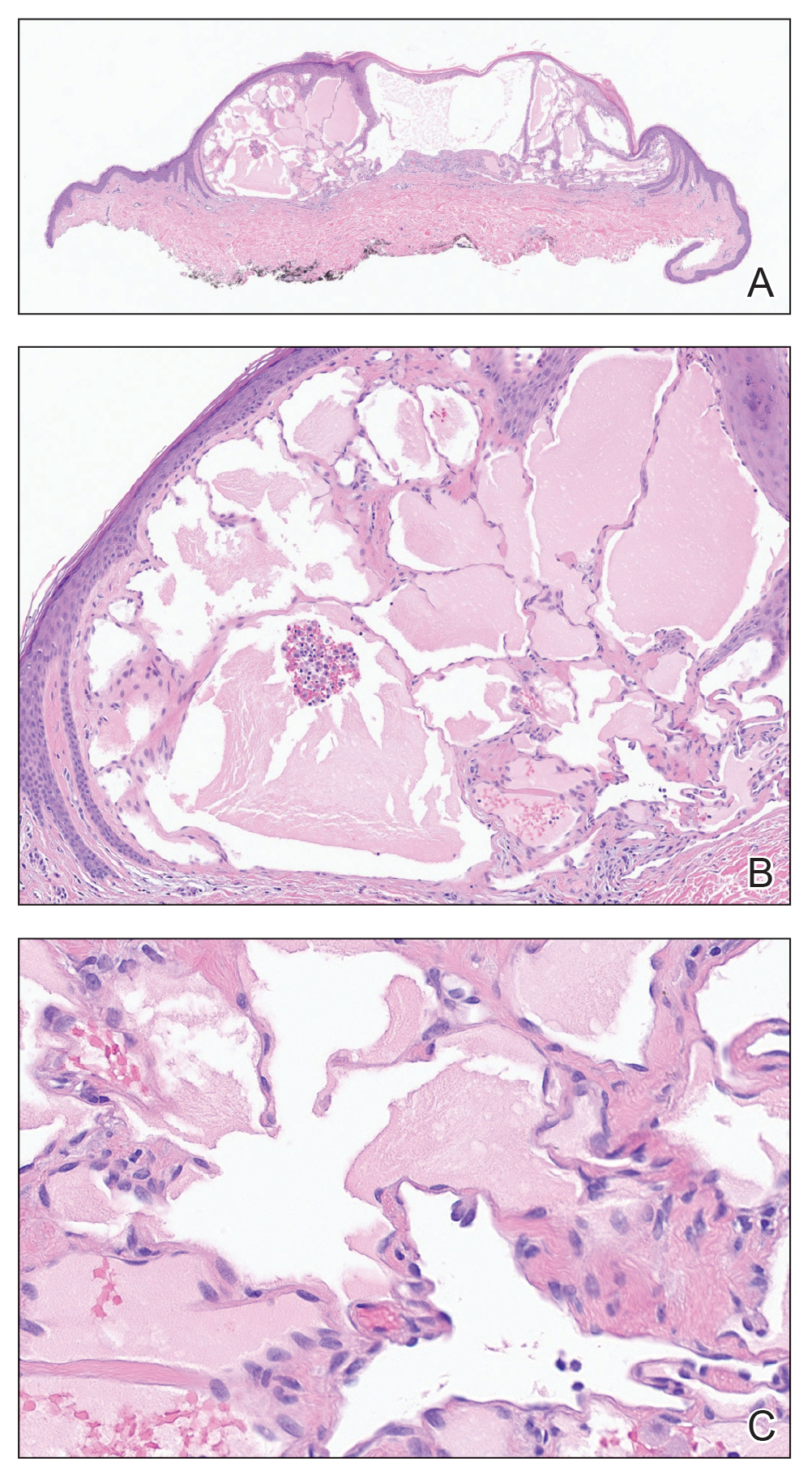
Acquired cutaneous lymphangiectasia is characterized by benign dilations of surface lymphatic vessels, likely resulting from disruption of the lymphatic system.1 This finding most commonly occurs on the external genitalia following combined surgical and radiation treatment of malignancy, though in a minority of cases it is seen with surgical or radiation treatment alone.2 Acquired cutaneous lymphangiectasia secondary to radical mastectomy for breast cancer was first reported in 1956 in a patient with persistent ipsilateral lymphadenopathy.3 The presentation in a patient with Cowden syndrome is rare. Cowden syndrome (also called PTEN hamartoma tumor syndrome) is a rare autosomal-dominant disorder caused by mutations in the tumor suppressor phosphatase and tensin homolog gene, PTEN. It is characterized by multiple hamartomas and substantially increased risk for breast, endometrial, and thyroid malignancy.4 In addition to breast cancer, our patient had a history of papillary thyroid carcinoma, cerebellar dysplastic gangliocytoma, and multiple cutaneous fibromas and angiolipomas.
A diagnosis of syringomas—benign tumors that arise from the intraepidermal aspect of eccrine sweat ducts— could be considered in the differential diagnosis. Cases of eruptive syringoma on the breast have been reported, but the biopsy would show a circumscribed proliferation of tadpole-shaped tubules comprised of secretory cells in a sclerotic stroma.5 Hidrocystomas are benign sweat gland cysts that present on the face, especially around the eyes, but rarely have been reported on the trunk, particularly the axillae.6 Although they clinically manifest as translucent papules, histopathology shows fluid-filled cysts lined by a layer of secretory columnar epithelium.7 Metastatic breast carcinoma was considered, given the patient’s history of breast cancer. Cutaneous metastases often are found on the chest wall but also can occur at distant sites. Histopathology can reveal various patterns, including islands of tumor cells with glandular formation or single files of cells infiltrating through dermal collagen.
Angiosarcoma also must be considered in the setting of any vasoformative proliferation arising on previously irradiated skin. Angiosarcomas can sometimes be well differentiated with paradoxically bland cytomorphology but characteristically have anastomosing vessels and infiltrative architecture, which were not identified in our patient. Other diagnostic features of angiosarcoma include endothelial nuclear atypia, multilayering, and mitoses. Radiation-associated angiosarcomas amplify MYC, a transcription factor that affects multiple aspects of the cell cycle and is an oncogene implicated in several different types of malignancy.8 MYC immunohistochemistry testing should be performed whenever a vasoformative proliferation on irradiated skin is partially sampled or shows any features concerning for angiosarcoma. Lastly, the term postradiation atypical vascular lesion has been introduced to describe discrete papular proliferations that show close histopathologic overlap with lymphangioma/lymphatic malformations. In contrast, atypical vascular lesions show wedge-shaped intradermal growth that can cause diagnostic confusion with well-differentiated angiosarcoma. Unlike angiosarcomas, they do not express MYC. Postradiation atypical vascular lesions sometimes have an associated inflammatory infiltrate.9 Considerable histomorphologic overlap among lymphangiomas, atypical vascular lesions, and well-differentiated angiosarcomas exists; thus, lesions should be removed in their perceived totality whenever possible to help permit diagnostic distinction. In our patient, the abrupt discontinuation of vessels at the interface of the papillary and reticular dermis was reassuring of benignancy.
Our patient’s diagnosis of acquired cutaneous lymphangiectasia was a benign adverse effect of prior breast cancer treatments. This case demonstrates a rare dermatologic sequela that may arise in patients who receive surgical or radiation treatment of breast cancer. Given the heightened risk for angiosarcoma after radiation therapy as well as the increased risk for malignancy in patients with Cowden syndrome, biopsy can be an important diagnostic step in the management of these patients.
- Valdés F, Peteiro C, Toribio J. Acquired lymphangiectases and breast cancer. Actas Dermosifiliogr (Engl Ed). 2007;98:347-350.
- Chiyomaru K, Nishigori C. Acquired lymphangiectasia associated with treatment for preceding malignant neoplasm: a retrospective series of 73 Japanese patients. AMA Arch Derm. 2009;145:841-842.
- Plotnick H, Richfield D. Tuberous lymphangiectatic varices secondary to radical mastectomy. AMA Arch Derm. 1956;74:466-468.
- Pilarski R, Burt R, Kohlman W, et al. Cowden syndrome and the PTEN hamartoma tumor syndrome: systematic review and revised diagnostic criteria. J Natl Cancer Inst. 2013;105:1607-1616.
- Müller CSL, Tilgen W, Pföhler C. Clinicopathological diversity of syringomas: a study on current clinical and histopathologic concepts. Dermatoendocrinol. 2009;1:282-288.
- Anzai S, Goto M, Fujiwara S, et al. Apocrine hidrocystoma: a case report and analysis of 167 Japanese cases. Int J Dermatol. 2005;44:702-703.
- Sarabi K, Khachemoune A. Hidrocystomas—a brief review. MedGenMed. 2006;8:57.
- Ahmadi SE, Rahimi S, Zarandi B, et al. MYC: a multipurpose oncogene with prognostic and therapeutic implications in blood malignancies. J Hematol Oncol. 2021;14:121. doi:10.1186/s13045-021-01111-4
- Ronen S, Ivan D, Torres-Cabala CA, et al. Post-radiation vascular lesions of the breast. J Cutan Pathol. 2019;46:52-58.
The Diagnosis: Acquired Cutaneous Lymphangiectasia
Histopathology showed a cluster of widely ectatic, thin-walled lymphatic spaces immediately subjacent to the epidermis and flanked by an epidermal collarette (Figure, A). The vessels did not extend any further than the papillary dermis and were not accompanied by any notable inflammation (Figure, B). A single layer of bland endothelial cells lined each lymphatic space (Figure, C). A diagnosis of acquired cutaneous lymphangiectasia secondary to surgical and radiation treatment of breast cancer was made. Clinical monitoring was recommended, but no treatment was required unless symptoms arose. At 2-year follow-up, she continued to do well.
Acquired cutaneous lymphangiectasia is characterized by benign dilations of surface lymphatic vessels, likely resulting from disruption of the lymphatic system.1 This finding most commonly occurs on the external genitalia following combined surgical and radiation treatment of malignancy, though in a minority of cases it is seen with surgical or radiation treatment alone.2 Acquired cutaneous lymphangiectasia secondary to radical mastectomy for breast cancer was first reported in 1956 in a patient with persistent ipsilateral lymphadenopathy.3 The presentation in a patient with Cowden syndrome is rare. Cowden syndrome (also called PTEN hamartoma tumor syndrome) is a rare autosomal-dominant disorder caused by mutations in the tumor suppressor phosphatase and tensin homolog gene, PTEN. It is characterized by multiple hamartomas and substantially increased risk for breast, endometrial, and thyroid malignancy.4 In addition to breast cancer, our patient had a history of papillary thyroid carcinoma, cerebellar dysplastic gangliocytoma, and multiple cutaneous fibromas and angiolipomas.
A diagnosis of syringomas—benign tumors that arise from the intraepidermal aspect of eccrine sweat ducts— could be considered in the differential diagnosis. Cases of eruptive syringoma on the breast have been reported, but the biopsy would show a circumscribed proliferation of tadpole-shaped tubules comprised of secretory cells in a sclerotic stroma.5 Hidrocystomas are benign sweat gland cysts that present on the face, especially around the eyes, but rarely have been reported on the trunk, particularly the axillae.6 Although they clinically manifest as translucent papules, histopathology shows fluid-filled cysts lined by a layer of secretory columnar epithelium.7 Metastatic breast carcinoma was considered, given the patient’s history of breast cancer. Cutaneous metastases often are found on the chest wall but also can occur at distant sites. Histopathology can reveal various patterns, including islands of tumor cells with glandular formation or single files of cells infiltrating through dermal collagen.
Angiosarcoma also must be considered in the setting of any vasoformative proliferation arising on previously irradiated skin. Angiosarcomas can sometimes be well differentiated with paradoxically bland cytomorphology but characteristically have anastomosing vessels and infiltrative architecture, which were not identified in our patient. Other diagnostic features of angiosarcoma include endothelial nuclear atypia, multilayering, and mitoses. Radiation-associated angiosarcomas amplify MYC, a transcription factor that affects multiple aspects of the cell cycle and is an oncogene implicated in several different types of malignancy.8 MYC immunohistochemistry testing should be performed whenever a vasoformative proliferation on irradiated skin is partially sampled or shows any features concerning for angiosarcoma. Lastly, the term postradiation atypical vascular lesion has been introduced to describe discrete papular proliferations that show close histopathologic overlap with lymphangioma/lymphatic malformations. In contrast, atypical vascular lesions show wedge-shaped intradermal growth that can cause diagnostic confusion with well-differentiated angiosarcoma. Unlike angiosarcomas, they do not express MYC. Postradiation atypical vascular lesions sometimes have an associated inflammatory infiltrate.9 Considerable histomorphologic overlap among lymphangiomas, atypical vascular lesions, and well-differentiated angiosarcomas exists; thus, lesions should be removed in their perceived totality whenever possible to help permit diagnostic distinction. In our patient, the abrupt discontinuation of vessels at the interface of the papillary and reticular dermis was reassuring of benignancy.
Our patient’s diagnosis of acquired cutaneous lymphangiectasia was a benign adverse effect of prior breast cancer treatments. This case demonstrates a rare dermatologic sequela that may arise in patients who receive surgical or radiation treatment of breast cancer. Given the heightened risk for angiosarcoma after radiation therapy as well as the increased risk for malignancy in patients with Cowden syndrome, biopsy can be an important diagnostic step in the management of these patients.
The Diagnosis: Acquired Cutaneous Lymphangiectasia
Histopathology showed a cluster of widely ectatic, thin-walled lymphatic spaces immediately subjacent to the epidermis and flanked by an epidermal collarette (Figure, A). The vessels did not extend any further than the papillary dermis and were not accompanied by any notable inflammation (Figure, B). A single layer of bland endothelial cells lined each lymphatic space (Figure, C). A diagnosis of acquired cutaneous lymphangiectasia secondary to surgical and radiation treatment of breast cancer was made. Clinical monitoring was recommended, but no treatment was required unless symptoms arose. At 2-year follow-up, she continued to do well.
Acquired cutaneous lymphangiectasia is characterized by benign dilations of surface lymphatic vessels, likely resulting from disruption of the lymphatic system.1 This finding most commonly occurs on the external genitalia following combined surgical and radiation treatment of malignancy, though in a minority of cases it is seen with surgical or radiation treatment alone.2 Acquired cutaneous lymphangiectasia secondary to radical mastectomy for breast cancer was first reported in 1956 in a patient with persistent ipsilateral lymphadenopathy.3 The presentation in a patient with Cowden syndrome is rare. Cowden syndrome (also called PTEN hamartoma tumor syndrome) is a rare autosomal-dominant disorder caused by mutations in the tumor suppressor phosphatase and tensin homolog gene, PTEN. It is characterized by multiple hamartomas and substantially increased risk for breast, endometrial, and thyroid malignancy.4 In addition to breast cancer, our patient had a history of papillary thyroid carcinoma, cerebellar dysplastic gangliocytoma, and multiple cutaneous fibromas and angiolipomas.
A diagnosis of syringomas—benign tumors that arise from the intraepidermal aspect of eccrine sweat ducts— could be considered in the differential diagnosis. Cases of eruptive syringoma on the breast have been reported, but the biopsy would show a circumscribed proliferation of tadpole-shaped tubules comprised of secretory cells in a sclerotic stroma.5 Hidrocystomas are benign sweat gland cysts that present on the face, especially around the eyes, but rarely have been reported on the trunk, particularly the axillae.6 Although they clinically manifest as translucent papules, histopathology shows fluid-filled cysts lined by a layer of secretory columnar epithelium.7 Metastatic breast carcinoma was considered, given the patient’s history of breast cancer. Cutaneous metastases often are found on the chest wall but also can occur at distant sites. Histopathology can reveal various patterns, including islands of tumor cells with glandular formation or single files of cells infiltrating through dermal collagen.
Angiosarcoma also must be considered in the setting of any vasoformative proliferation arising on previously irradiated skin. Angiosarcomas can sometimes be well differentiated with paradoxically bland cytomorphology but characteristically have anastomosing vessels and infiltrative architecture, which were not identified in our patient. Other diagnostic features of angiosarcoma include endothelial nuclear atypia, multilayering, and mitoses. Radiation-associated angiosarcomas amplify MYC, a transcription factor that affects multiple aspects of the cell cycle and is an oncogene implicated in several different types of malignancy.8 MYC immunohistochemistry testing should be performed whenever a vasoformative proliferation on irradiated skin is partially sampled or shows any features concerning for angiosarcoma. Lastly, the term postradiation atypical vascular lesion has been introduced to describe discrete papular proliferations that show close histopathologic overlap with lymphangioma/lymphatic malformations. In contrast, atypical vascular lesions show wedge-shaped intradermal growth that can cause diagnostic confusion with well-differentiated angiosarcoma. Unlike angiosarcomas, they do not express MYC. Postradiation atypical vascular lesions sometimes have an associated inflammatory infiltrate.9 Considerable histomorphologic overlap among lymphangiomas, atypical vascular lesions, and well-differentiated angiosarcomas exists; thus, lesions should be removed in their perceived totality whenever possible to help permit diagnostic distinction. In our patient, the abrupt discontinuation of vessels at the interface of the papillary and reticular dermis was reassuring of benignancy.
Our patient’s diagnosis of acquired cutaneous lymphangiectasia was a benign adverse effect of prior breast cancer treatments. This case demonstrates a rare dermatologic sequela that may arise in patients who receive surgical or radiation treatment of breast cancer. Given the heightened risk for angiosarcoma after radiation therapy as well as the increased risk for malignancy in patients with Cowden syndrome, biopsy can be an important diagnostic step in the management of these patients.
- Valdés F, Peteiro C, Toribio J. Acquired lymphangiectases and breast cancer. Actas Dermosifiliogr (Engl Ed). 2007;98:347-350.
- Chiyomaru K, Nishigori C. Acquired lymphangiectasia associated with treatment for preceding malignant neoplasm: a retrospective series of 73 Japanese patients. AMA Arch Derm. 2009;145:841-842.
- Plotnick H, Richfield D. Tuberous lymphangiectatic varices secondary to radical mastectomy. AMA Arch Derm. 1956;74:466-468.
- Pilarski R, Burt R, Kohlman W, et al. Cowden syndrome and the PTEN hamartoma tumor syndrome: systematic review and revised diagnostic criteria. J Natl Cancer Inst. 2013;105:1607-1616.
- Müller CSL, Tilgen W, Pföhler C. Clinicopathological diversity of syringomas: a study on current clinical and histopathologic concepts. Dermatoendocrinol. 2009;1:282-288.
- Anzai S, Goto M, Fujiwara S, et al. Apocrine hidrocystoma: a case report and analysis of 167 Japanese cases. Int J Dermatol. 2005;44:702-703.
- Sarabi K, Khachemoune A. Hidrocystomas—a brief review. MedGenMed. 2006;8:57.
- Ahmadi SE, Rahimi S, Zarandi B, et al. MYC: a multipurpose oncogene with prognostic and therapeutic implications in blood malignancies. J Hematol Oncol. 2021;14:121. doi:10.1186/s13045-021-01111-4
- Ronen S, Ivan D, Torres-Cabala CA, et al. Post-radiation vascular lesions of the breast. J Cutan Pathol. 2019;46:52-58.
- Valdés F, Peteiro C, Toribio J. Acquired lymphangiectases and breast cancer. Actas Dermosifiliogr (Engl Ed). 2007;98:347-350.
- Chiyomaru K, Nishigori C. Acquired lymphangiectasia associated with treatment for preceding malignant neoplasm: a retrospective series of 73 Japanese patients. AMA Arch Derm. 2009;145:841-842.
- Plotnick H, Richfield D. Tuberous lymphangiectatic varices secondary to radical mastectomy. AMA Arch Derm. 1956;74:466-468.
- Pilarski R, Burt R, Kohlman W, et al. Cowden syndrome and the PTEN hamartoma tumor syndrome: systematic review and revised diagnostic criteria. J Natl Cancer Inst. 2013;105:1607-1616.
- Müller CSL, Tilgen W, Pföhler C. Clinicopathological diversity of syringomas: a study on current clinical and histopathologic concepts. Dermatoendocrinol. 2009;1:282-288.
- Anzai S, Goto M, Fujiwara S, et al. Apocrine hidrocystoma: a case report and analysis of 167 Japanese cases. Int J Dermatol. 2005;44:702-703.
- Sarabi K, Khachemoune A. Hidrocystomas—a brief review. MedGenMed. 2006;8:57.
- Ahmadi SE, Rahimi S, Zarandi B, et al. MYC: a multipurpose oncogene with prognostic and therapeutic implications in blood malignancies. J Hematol Oncol. 2021;14:121. doi:10.1186/s13045-021-01111-4
- Ronen S, Ivan D, Torres-Cabala CA, et al. Post-radiation vascular lesions of the breast. J Cutan Pathol. 2019;46:52-58.
A 47-year-old woman with Cowden syndrome presented to the dermatology clinic with asymptomatic papules on and near the right breast that had increased in number over the last year. She had a medical history of breast cancer treated with mastectomy, chemotherapy, and radiation; papillary thyroid carcinoma treated with thyroidectomy and subsequent thyroid hormone replacement; dysplastic cerebellar gangliocytoma treated with surgical excision; and multiple cutaneous fibromas and angiolipomas. Physical examination revealed multiple clustered, 1- to 5-mm, translucent to red papules on the right breast, flank, and upper arm. A shave biopsy of a papule from the right lateral breast was performed.
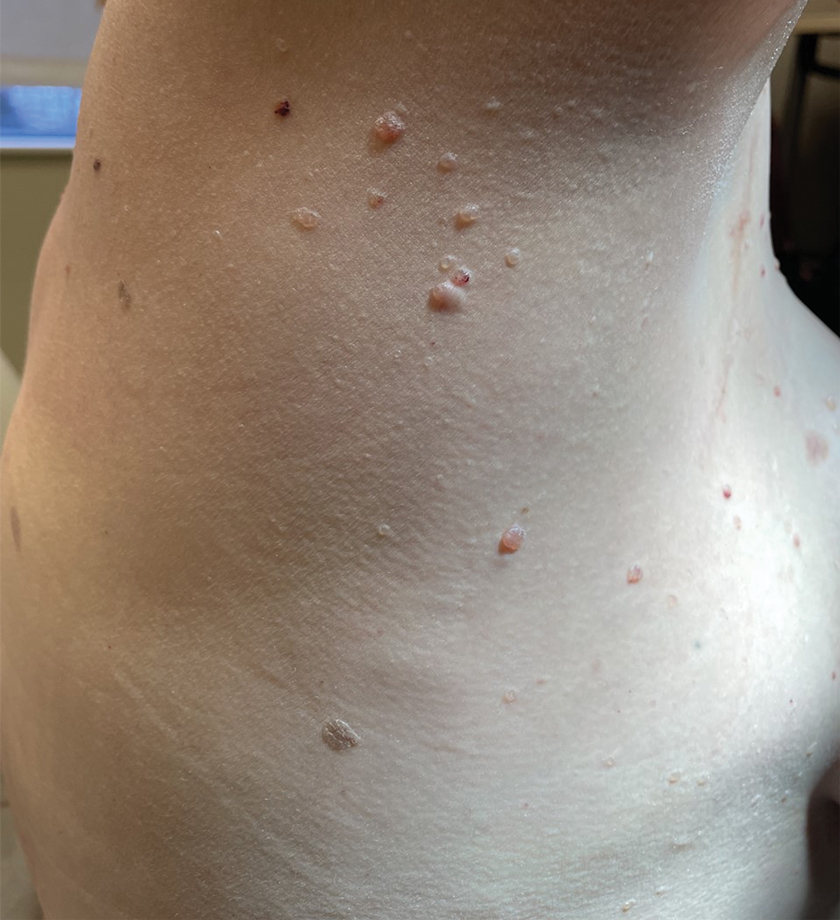
Sustained Control Reported for Anti–IL-17, Anti–IL-23 Psoriasis Treatments
SAN DIEGO — , but late-breaker data presented at the annual meeting of the American Academy of Dermatology show that these types of responses are sustained for as long as patients have remained on therapy.
Of the two, the longer follow up is with the IL-17 inhibitor bimekizumab (Bimzelx). In a 4-year open-label extension study, the Psoriasis Area and Severity Index (PASI) 90 rate was approximately 85% in treated patients, according to Mark Lebwohl, MD, professor and chairman emeritus of the Department of Dermatology, Icahn School of Medicine at Mount Sinai in New York City
A PASI 90 score signifies that 90% of skin surface area is cleared. The proportion of patients who achieved a PASI 100 score, signifying total clearance, approached 70% at 4 years in the group with the greatest response. PASI 90 and PASI 100 rates at this point were only modestly lower than those reported at the end of the double-blind phase 3 trial when evaluated 3 years earlier.
Follow-up with a novel oral anti-IL-23 inhibitor JNJ-2113 (JNJ-77242113) was only 52 weeks, far shorter. But again, the response for the most effective dose at the end of this period was essentially unchanged from that at 16 weeks. Among those on the highest and most effective test dose of once-daily 100 mg, the PASI 90 at 1 year was 64.3%, a rate that was essentially unchanged from week 16.
No Apparent Loss of Benefit Over Time
“We can really look at those dose-response curves and see that there is, overall, a maintenance of response,” reported Laura K. Ferris, MD, PhD, professor and director of clinical trials, Department of Dermatology, University of Pittsburgh Medical Center, Pittsburgh, Pennsylvania. In her presentation of the data, she showed similar sustained control for the most effective doses of JNJ-2113 for multiple clinical outcomes, including an investigator’s global assessment (IGA) score of 0 or 1, also signifying clear or near clear skin.
Bimekizumab, a monoclonal antibody that inhibits both IL-17A and IL-17F, is already approved for the treatment of plaque psoriasis. The 52-week BE SURE trial, which provided the 478 patients who entered into the BE BRIGHT open label extension study, was published in The New England Journal of Medicine in July 2021.
In the 4-year data reported by Dr. Lebwohl, three groups were compared: Those initially randomized to an every-4-week dosing schedule of bimekizumab over the course of the 52-week BE SURE trial; those randomized to an every-4-week bimekizumab schedule who were then subsequently switched to an every-8-week schedule; and those initiated on the TNF-inhibitor adalimumab (Humira) and were then switched at week 24 to every-4-week bimekizumab.
The PASI 90 responses at 52 weeks in these three groups, respectively, were 91.2%, 89.3%, and 95.2%. At 4 years, this almost clear response was observed in 82.4%, 83.2%, and 87.6%, respectively. At 52 weeks, the PASI 100 responses in these three groups, respectively, were 75.3%, 74.2%, and 72.9%. At 4 years, 61.9%, 58.5%, and 69.5% still had complete skin clearance.
Bimekizumab was well tolerated during the randomized trial, reported Dr. Lebwohl. The rates of nasopharyngitis and oral candidiasis, which were observed in approximately 12% and 8%, respectively, of treated patients during the randomized phase remained at about the same level in the long-term follow up. There were no new safety signals, he said.
JNJ-2113 Is First Potential Oral IL-23 Inhibitor
JNJ-2113 is a first-in-class oral peptide that binds to the IL-23 receptor, blocking the IL-23 signaling pathway. If approved, it would be the first oral therapy targeting IL-23. The 16-week outcomes of the dose-finding FRONTIER 1 phase 2b trial were published in The New England Journal of Medicine earlier this year. The primary endpoint was PASI 75, achieved by 79% of those on the 100 mg twice daily dose at week 16, vs 9% on placebo, and at 52 weeks, was 76%.
“The proportion of patients achieving the FRONTIER 1 primary endpoint was maintained from week 16 to the end of week 52 in the extension study,” Dr. Ferris said, but further pointed out that rates of near or complete clearance achieved at week 16 were also essentially unchanged at week 52. This was true of PASI scores and IGA.
Clearance of psoriatic lesions on the scalp was particularly impressive. By scalp-specific IGA, rates of clear or near clear (0/1) were not just maintained but improved over the course of follow-up, reaching 75.1% at 52 weeks in the highest dose group, she said.
JNJ-2113 was well tolerated in FRONTIER 1 and remained so during long-term follow-up, in the FRONTIER 2 extension study, according to Dr. Ferris. The most common complaints with JNJ-2113, such as nasopharyngitis (18.1% vs 25.7% in placebo), did not appear to differ significantly from placebo and the treatment remained well tolerated over the course of the extended follow-up.
There are limited direct comparisons of different biologics active in the treatment of plaque psoriasis for efficacy and safety, but these data appear to show a depth and durability of benefit for psoriasis that is exceptional, Dr. Lebwohl told this news organization. “The PASI 100 scores achieved by bimekizumab exceed anything we have seen to date,” he said. “And the durability of those exceedingly high scores is remarkable.”
Dr. Lebwohl reports financial relationships with approximately 40 pharmaceutical companies, including UCB Pharma, which developed bimekizumab. Dr. Ferris reports financial relationships with more than 20 pharmaceutical companies, including Janssen, which is developing JNJ-2113.
A version of this article appeared on Medscape.com.
SAN DIEGO — , but late-breaker data presented at the annual meeting of the American Academy of Dermatology show that these types of responses are sustained for as long as patients have remained on therapy.
Of the two, the longer follow up is with the IL-17 inhibitor bimekizumab (Bimzelx). In a 4-year open-label extension study, the Psoriasis Area and Severity Index (PASI) 90 rate was approximately 85% in treated patients, according to Mark Lebwohl, MD, professor and chairman emeritus of the Department of Dermatology, Icahn School of Medicine at Mount Sinai in New York City
A PASI 90 score signifies that 90% of skin surface area is cleared. The proportion of patients who achieved a PASI 100 score, signifying total clearance, approached 70% at 4 years in the group with the greatest response. PASI 90 and PASI 100 rates at this point were only modestly lower than those reported at the end of the double-blind phase 3 trial when evaluated 3 years earlier.
Follow-up with a novel oral anti-IL-23 inhibitor JNJ-2113 (JNJ-77242113) was only 52 weeks, far shorter. But again, the response for the most effective dose at the end of this period was essentially unchanged from that at 16 weeks. Among those on the highest and most effective test dose of once-daily 100 mg, the PASI 90 at 1 year was 64.3%, a rate that was essentially unchanged from week 16.
No Apparent Loss of Benefit Over Time
“We can really look at those dose-response curves and see that there is, overall, a maintenance of response,” reported Laura K. Ferris, MD, PhD, professor and director of clinical trials, Department of Dermatology, University of Pittsburgh Medical Center, Pittsburgh, Pennsylvania. In her presentation of the data, she showed similar sustained control for the most effective doses of JNJ-2113 for multiple clinical outcomes, including an investigator’s global assessment (IGA) score of 0 or 1, also signifying clear or near clear skin.
Bimekizumab, a monoclonal antibody that inhibits both IL-17A and IL-17F, is already approved for the treatment of plaque psoriasis. The 52-week BE SURE trial, which provided the 478 patients who entered into the BE BRIGHT open label extension study, was published in The New England Journal of Medicine in July 2021.
In the 4-year data reported by Dr. Lebwohl, three groups were compared: Those initially randomized to an every-4-week dosing schedule of bimekizumab over the course of the 52-week BE SURE trial; those randomized to an every-4-week bimekizumab schedule who were then subsequently switched to an every-8-week schedule; and those initiated on the TNF-inhibitor adalimumab (Humira) and were then switched at week 24 to every-4-week bimekizumab.
The PASI 90 responses at 52 weeks in these three groups, respectively, were 91.2%, 89.3%, and 95.2%. At 4 years, this almost clear response was observed in 82.4%, 83.2%, and 87.6%, respectively. At 52 weeks, the PASI 100 responses in these three groups, respectively, were 75.3%, 74.2%, and 72.9%. At 4 years, 61.9%, 58.5%, and 69.5% still had complete skin clearance.
Bimekizumab was well tolerated during the randomized trial, reported Dr. Lebwohl. The rates of nasopharyngitis and oral candidiasis, which were observed in approximately 12% and 8%, respectively, of treated patients during the randomized phase remained at about the same level in the long-term follow up. There were no new safety signals, he said.
JNJ-2113 Is First Potential Oral IL-23 Inhibitor
JNJ-2113 is a first-in-class oral peptide that binds to the IL-23 receptor, blocking the IL-23 signaling pathway. If approved, it would be the first oral therapy targeting IL-23. The 16-week outcomes of the dose-finding FRONTIER 1 phase 2b trial were published in The New England Journal of Medicine earlier this year. The primary endpoint was PASI 75, achieved by 79% of those on the 100 mg twice daily dose at week 16, vs 9% on placebo, and at 52 weeks, was 76%.
“The proportion of patients achieving the FRONTIER 1 primary endpoint was maintained from week 16 to the end of week 52 in the extension study,” Dr. Ferris said, but further pointed out that rates of near or complete clearance achieved at week 16 were also essentially unchanged at week 52. This was true of PASI scores and IGA.
Clearance of psoriatic lesions on the scalp was particularly impressive. By scalp-specific IGA, rates of clear or near clear (0/1) were not just maintained but improved over the course of follow-up, reaching 75.1% at 52 weeks in the highest dose group, she said.
JNJ-2113 was well tolerated in FRONTIER 1 and remained so during long-term follow-up, in the FRONTIER 2 extension study, according to Dr. Ferris. The most common complaints with JNJ-2113, such as nasopharyngitis (18.1% vs 25.7% in placebo), did not appear to differ significantly from placebo and the treatment remained well tolerated over the course of the extended follow-up.
There are limited direct comparisons of different biologics active in the treatment of plaque psoriasis for efficacy and safety, but these data appear to show a depth and durability of benefit for psoriasis that is exceptional, Dr. Lebwohl told this news organization. “The PASI 100 scores achieved by bimekizumab exceed anything we have seen to date,” he said. “And the durability of those exceedingly high scores is remarkable.”
Dr. Lebwohl reports financial relationships with approximately 40 pharmaceutical companies, including UCB Pharma, which developed bimekizumab. Dr. Ferris reports financial relationships with more than 20 pharmaceutical companies, including Janssen, which is developing JNJ-2113.
A version of this article appeared on Medscape.com.
SAN DIEGO — , but late-breaker data presented at the annual meeting of the American Academy of Dermatology show that these types of responses are sustained for as long as patients have remained on therapy.
Of the two, the longer follow up is with the IL-17 inhibitor bimekizumab (Bimzelx). In a 4-year open-label extension study, the Psoriasis Area and Severity Index (PASI) 90 rate was approximately 85% in treated patients, according to Mark Lebwohl, MD, professor and chairman emeritus of the Department of Dermatology, Icahn School of Medicine at Mount Sinai in New York City
A PASI 90 score signifies that 90% of skin surface area is cleared. The proportion of patients who achieved a PASI 100 score, signifying total clearance, approached 70% at 4 years in the group with the greatest response. PASI 90 and PASI 100 rates at this point were only modestly lower than those reported at the end of the double-blind phase 3 trial when evaluated 3 years earlier.
Follow-up with a novel oral anti-IL-23 inhibitor JNJ-2113 (JNJ-77242113) was only 52 weeks, far shorter. But again, the response for the most effective dose at the end of this period was essentially unchanged from that at 16 weeks. Among those on the highest and most effective test dose of once-daily 100 mg, the PASI 90 at 1 year was 64.3%, a rate that was essentially unchanged from week 16.
No Apparent Loss of Benefit Over Time
“We can really look at those dose-response curves and see that there is, overall, a maintenance of response,” reported Laura K. Ferris, MD, PhD, professor and director of clinical trials, Department of Dermatology, University of Pittsburgh Medical Center, Pittsburgh, Pennsylvania. In her presentation of the data, she showed similar sustained control for the most effective doses of JNJ-2113 for multiple clinical outcomes, including an investigator’s global assessment (IGA) score of 0 or 1, also signifying clear or near clear skin.
Bimekizumab, a monoclonal antibody that inhibits both IL-17A and IL-17F, is already approved for the treatment of plaque psoriasis. The 52-week BE SURE trial, which provided the 478 patients who entered into the BE BRIGHT open label extension study, was published in The New England Journal of Medicine in July 2021.
In the 4-year data reported by Dr. Lebwohl, three groups were compared: Those initially randomized to an every-4-week dosing schedule of bimekizumab over the course of the 52-week BE SURE trial; those randomized to an every-4-week bimekizumab schedule who were then subsequently switched to an every-8-week schedule; and those initiated on the TNF-inhibitor adalimumab (Humira) and were then switched at week 24 to every-4-week bimekizumab.
The PASI 90 responses at 52 weeks in these three groups, respectively, were 91.2%, 89.3%, and 95.2%. At 4 years, this almost clear response was observed in 82.4%, 83.2%, and 87.6%, respectively. At 52 weeks, the PASI 100 responses in these three groups, respectively, were 75.3%, 74.2%, and 72.9%. At 4 years, 61.9%, 58.5%, and 69.5% still had complete skin clearance.
Bimekizumab was well tolerated during the randomized trial, reported Dr. Lebwohl. The rates of nasopharyngitis and oral candidiasis, which were observed in approximately 12% and 8%, respectively, of treated patients during the randomized phase remained at about the same level in the long-term follow up. There were no new safety signals, he said.
JNJ-2113 Is First Potential Oral IL-23 Inhibitor
JNJ-2113 is a first-in-class oral peptide that binds to the IL-23 receptor, blocking the IL-23 signaling pathway. If approved, it would be the first oral therapy targeting IL-23. The 16-week outcomes of the dose-finding FRONTIER 1 phase 2b trial were published in The New England Journal of Medicine earlier this year. The primary endpoint was PASI 75, achieved by 79% of those on the 100 mg twice daily dose at week 16, vs 9% on placebo, and at 52 weeks, was 76%.
“The proportion of patients achieving the FRONTIER 1 primary endpoint was maintained from week 16 to the end of week 52 in the extension study,” Dr. Ferris said, but further pointed out that rates of near or complete clearance achieved at week 16 were also essentially unchanged at week 52. This was true of PASI scores and IGA.
Clearance of psoriatic lesions on the scalp was particularly impressive. By scalp-specific IGA, rates of clear or near clear (0/1) were not just maintained but improved over the course of follow-up, reaching 75.1% at 52 weeks in the highest dose group, she said.
JNJ-2113 was well tolerated in FRONTIER 1 and remained so during long-term follow-up, in the FRONTIER 2 extension study, according to Dr. Ferris. The most common complaints with JNJ-2113, such as nasopharyngitis (18.1% vs 25.7% in placebo), did not appear to differ significantly from placebo and the treatment remained well tolerated over the course of the extended follow-up.
There are limited direct comparisons of different biologics active in the treatment of plaque psoriasis for efficacy and safety, but these data appear to show a depth and durability of benefit for psoriasis that is exceptional, Dr. Lebwohl told this news organization. “The PASI 100 scores achieved by bimekizumab exceed anything we have seen to date,” he said. “And the durability of those exceedingly high scores is remarkable.”
Dr. Lebwohl reports financial relationships with approximately 40 pharmaceutical companies, including UCB Pharma, which developed bimekizumab. Dr. Ferris reports financial relationships with more than 20 pharmaceutical companies, including Janssen, which is developing JNJ-2113.
A version of this article appeared on Medscape.com.
FROM AAD 2024