User login
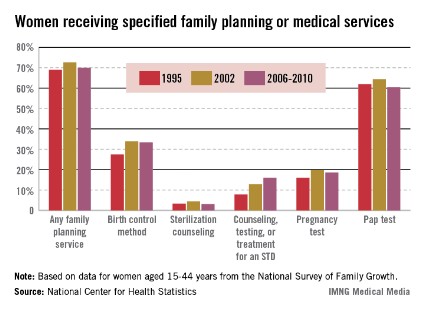
The use of most forms of family planning and related medical services has dropped slightly since 2002 in women aged 15-44 years, but STD counseling, testing, and treatment increased by 27%, the National Center for Health Statistics reported.
The percentage of women 15-44 years old who received any family planning or related medical service was up slightly during 2006-2010 (70%), compared with 1995 (69%), but that was after it had reached almost 73% in 2002, according to data from the National Survey of Family Growth.
Between 2002 and 2006-2010, use also declined for birth control method/prescription, sterilization counseling, pregnancy tests, and Pap tests.
The percentage of women receiving STD counseling, testing, and treatment was 16.0% in 2006-2010, an increase of 27% from 2002’s figure of 12.6% and more than double the 7.6% recorded in 1995. For the 2002 survey, however, the word "counseling" was added to the relevant question, "thereby broadening the scope of the question," the report noted.
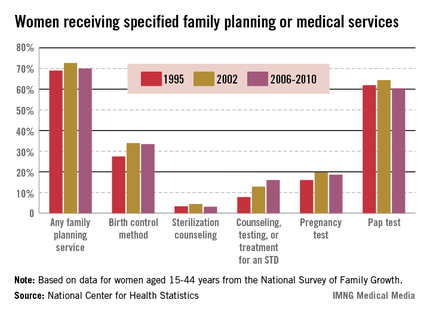
The use of most forms of family planning and related medical services has dropped slightly since 2002 in women aged 15-44 years, but STD counseling, testing, and treatment increased by 27%, the National Center for Health Statistics reported.
The percentage of women 15-44 years old who received any family planning or related medical service was up slightly during 2006-2010 (70%), compared with 1995 (69%), but that was after it had reached almost 73% in 2002, according to data from the National Survey of Family Growth.
Between 2002 and 2006-2010, use also declined for birth control method/prescription, sterilization counseling, pregnancy tests, and Pap tests.
The percentage of women receiving STD counseling, testing, and treatment was 16.0% in 2006-2010, an increase of 27% from 2002’s figure of 12.6% and more than double the 7.6% recorded in 1995. For the 2002 survey, however, the word "counseling" was added to the relevant question, "thereby broadening the scope of the question," the report noted.
The use of most forms of family planning and related medical services has dropped slightly since 2002 in women aged 15-44 years, but STD counseling, testing, and treatment increased by 27%, the National Center for Health Statistics reported.
The percentage of women 15-44 years old who received any family planning or related medical service was up slightly during 2006-2010 (70%), compared with 1995 (69%), but that was after it had reached almost 73% in 2002, according to data from the National Survey of Family Growth.
Between 2002 and 2006-2010, use also declined for birth control method/prescription, sterilization counseling, pregnancy tests, and Pap tests.
The percentage of women receiving STD counseling, testing, and treatment was 16.0% in 2006-2010, an increase of 27% from 2002’s figure of 12.6% and more than double the 7.6% recorded in 1995. For the 2002 survey, however, the word "counseling" was added to the relevant question, "thereby broadening the scope of the question," the report noted.