User login
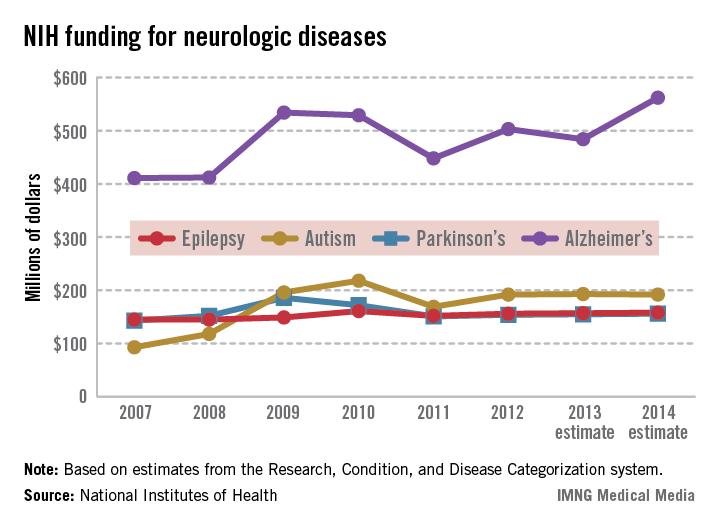
Funding of epilepsy research from the National Institutes of Health has increased by 9% since 2007, compared with increases of 37% for Alzheimer’s research and 106% for autism, according to data from the NIH’s Research, Condition, and Disease Categorization system.
NIH funding for epilepsy research was $145 million in 2007 and is expected to be about $158 million in 2014. Funding for research on Alzheimer’s disease went from $411 million in 2007 to an estimated $562 million in 2014, and autism funding increased from $93 million to $192 million. In comparison, the NIH spent about $143 million on Parkinson’s disease research in 2007 and will spend an estimated $156 million in 2014.
The situation is similar on the private-sector side of the equation. Private funding for epilepsy research was $10 million in 2011, compared with $16 million for Alzheimer’s disease, $63 million for autism, and $59 million for Parkinson’s disease, according to a report from Citizens United for Research in Epilepsy.
Funding of epilepsy research from the National Institutes of Health has increased by 9% since 2007, compared with increases of 37% for Alzheimer’s research and 106% for autism, according to data from the NIH’s Research, Condition, and Disease Categorization system.
NIH funding for epilepsy research was $145 million in 2007 and is expected to be about $158 million in 2014. Funding for research on Alzheimer’s disease went from $411 million in 2007 to an estimated $562 million in 2014, and autism funding increased from $93 million to $192 million. In comparison, the NIH spent about $143 million on Parkinson’s disease research in 2007 and will spend an estimated $156 million in 2014.
The situation is similar on the private-sector side of the equation. Private funding for epilepsy research was $10 million in 2011, compared with $16 million for Alzheimer’s disease, $63 million for autism, and $59 million for Parkinson’s disease, according to a report from Citizens United for Research in Epilepsy.
Funding of epilepsy research from the National Institutes of Health has increased by 9% since 2007, compared with increases of 37% for Alzheimer’s research and 106% for autism, according to data from the NIH’s Research, Condition, and Disease Categorization system.
NIH funding for epilepsy research was $145 million in 2007 and is expected to be about $158 million in 2014. Funding for research on Alzheimer’s disease went from $411 million in 2007 to an estimated $562 million in 2014, and autism funding increased from $93 million to $192 million. In comparison, the NIH spent about $143 million on Parkinson’s disease research in 2007 and will spend an estimated $156 million in 2014.
The situation is similar on the private-sector side of the equation. Private funding for epilepsy research was $10 million in 2011, compared with $16 million for Alzheimer’s disease, $63 million for autism, and $59 million for Parkinson’s disease, according to a report from Citizens United for Research in Epilepsy.