User login
The Hospitalist only
A Taxing Future for HM?
When Congress returns for a likely lame-duck session after the midterm elections, the biggest battle might be fought over whether to extend the 2001 and 2003 tax cuts to everyone or only to those earning less than $200,000 annually ($250,000 for families). And depending on the makeup of the 112th Congress, which will be seated in January, Republicans might try to make good on a campaign pledge to repeal all or most of the healthcare reform legislation.
The expected flashpoints are being teased endlessly with media sound bites featuring phrases that most of us love to hate: higher taxes, spiraling medical bills, soaring insurance premiums. Insurance companies already are blaming a spike in premiums on the healthcare legislation, claiming that new provisions and mandates are forcing them to further hike their rates.
Closer to home, the high-profile frays could put hospitalists in the awkward position of supporting political positions that sock them in the wallet. After all, doctors are workers and healthcare consumers, too. So what impact could higher taxes and higher insurance premiums really have? Let’s start with health insurance.
Insurance Cost Increases
Signed into law in March, the Affordable Care Act includes tax credits for small businesses to help defray the costs of health insurance coverage. But in 2013, it also raises the threshold for medical expense deductions for most taxpayers, to 10% from 7.5% of adjusted gross income. In other words, families can claim tax deductions only after having spent 10% or more of their adjusted gross income on medical bills. For families with hefty medical bills, that 2.5% difference could translate into a significant shortfall.
CMS was able to negotiate with insurers to achieve a slight drop in Medicare Advantage premiums, but many individual states have had less luck in preventing rate increases from private insurers who blame their higher premiums on new mandates. The Wall Street Journal has documented rate increases of 18% in states like Wisconsin and North Carolina—about 9% of which insurance company officials pinned on the new law.1 Such increases are hardly inevitable, however. The Obama administration’s White House blog, for instance, has cited the example of North Carolina Blue Cross and Blue Shield, which announced Sept. 20 that it will provide $156 million in refunds to more than 215,000 customers after state regulators found an overcharge that should be reversed due to new rules in the reform law.2 WellPoint will similarly refund $20 million to its health insurance customers in Colorado.2
The requested premium increases and identified overcharges have contributed to plenty of finger-pointing among insurers, state regulators, and the Obama administration, which has assailed insurers for using the law as a convenient excuse to raise rates. Highlighting the unease of many consumers, however, is the verdict that the proposed increases—if approved—would hit small businesses and individuals hardest.
According to the State of Hospital Medicine: 2010 Report Based on 2009 Data, released in September by SHM and the Medical Group Management Association, participating hospitalist groups have a median of 10 physician full-time equivalents. Roughly 25% of respondents are in physician-owned groups, while 14% are in a management services organization (MSO) or physician practice management company (PPMC). Smaller HM groups wouldn’t be alone in feeling the pinch, but they might need to consider some serious comparison-shopping to avoid costly premium increases.
Cherilyn Murer, president and CEO of Joliet, Ill.-based Murer Consultants Inc., has worked with healthcare systems and providers in 42 states, but even her company has not been immune to having to contend with rising premiums. “Our managing partner just renegotiated our health benefits [premiums] that were supposed to have gone up 30% by our previous carrier,” Murer says. “Through protracted negotiations and diligence, he was able to find a plan that did not increase our costs, and retained pretty much the same benefits.”
For at least the next three to five years, Murer says, niche firms will need to be diligent about shopping around and managing their expenses in a volatile insurance marketplace. Healthcare reform, she says, is certainly not a panacea for reining in costs, but “just the beginning.”
Concerns over healthcare costs, in fact, could be among the factors driving what Robert Zipper, MD, FHM, regional chief medical officer for Tacoma, Wash.-based Sound Physicians, sees as continuing consolidation among hospitalist groups. “By that, I mean that either groups are swallowed up by the hospital in which they work or they become part of a regional or national company,” he says. Sound Physicians, with about 400 hospitalists in seven states, offers health insurance policies that don’t vary by state, easing its negotiations.
Eyes on the Bottom Line
What about the dreaded “T” word? Dr. Zipper says he hasn’t heard that many concerns about the potential tax increase just yet. “I think it’s not an issue to hospitalists in a broad sense yet,” he says, “but if you look at the salary trajectory and where things have been over the past 10 years, it’s pretty easy to predict that it will be an issue for single-income [households] where the hospitalist is the sole breadwinner.”
The 2010 State of Hospital Medicine report, which surveyed 4,211 nonacademic hospitalists from 443 groups, found a median annual income of $215,000. Calculating trends from past income surveys is difficult due to very different respondent populations, but many hospitalists are clearly near or above the $200,000 threshold for individuals and near the $250,000 threshold for families already, even before considering spousal income. The survey, for example, found median salaries of about $235,700 in the 13 states that make up the Southern region.
Even if higher-earning hospitalists are subjected to a higher tax rate next year—if the current rates expire, a climb of 4.6 percentage points, to 39.6% from 35%—not all of them are necessarily opposed to it. Political polling on the issue isn’t broken down by specific professions, but a number of blogs have pointed to a Quinnipiac University poll conducted back in March that suggested nearly two-thirds of upper-income Americans were prepared to sacrifice some of their take-home pay to help reduce the deficit. In that poll (www.quinnipiac.edu/x1295.xml?ReleaseID=1438), some 64% of respondents earning more than $250,000 agreed that raising income taxes on themselves and other households making more than $250,000 should be a main part of any government approach to the deficit.
If taxes and insurance premiums are more immediate concerns, some HM observers are eyeing longer trends that could impact the pre-tax pay of the profession. Most hospitalists still earn far less than their specialist counterparts, of course, but increasing demand for hospitalist services has helped fuel a rise in median salaries. Last year, some observers predicted that after an impressive run, annual pay would plateau or even fall, given the current economic uncertainty, tightening profit margins, and assessment that many hospitals run HM programs at a loss.3 And in the current RVU-driven system, the “What have you done for me lately?” mentality can indeed make it difficult for hospitalists to demonstrate a solid return on the investment.
The State of Hospital Medicine report suggests that respondent HM groups have been subsidized by an average of $111,486 per physician FTE (median is $98,253), with the highest numbers in hospital-owned practices. But many experts see a window of a few years in which new healthcare delivery and payment experiments will be trotted out, whether modeled on a bundled system, accountable-care organization (ACO), or other vehicle. Under these models, payment incentives to physicians—and to hospitalists especially—could be fundamentally restructured to better reflect their true contributions as the emphasis on quality and efficiency increases.
Within the next three years, Murer says, hospitalists need to continue to infiltrate inpatient medical services, demonstrate their worth, and show the cost efficiencies that arise from their profession. “I think they’ve got a window of three years to really decide how much of that [inpatient physician] market they will retain,” she says.
Despite the current volatility, both Murer and Dr. Zipper agree that hospitalists are well positioned to take advantage of the coming changes in the healthcare delivery system. But to seize the opportunity, hospitalists must clearly demonstrate the necessity of their services in the emerging models of care and claim an early seat at the table where decisions will be made about how the pot of money is dispersed. Doing so could help resolve one of the most important financial considerations of all: job security. TH
Bryn Nelson is a freelance medical writer based in Seattle.
References
- Adamy J. Health insurers plan hikes. Wall Street Journal website. Available at: http://online.wsj.com/article/SB10001424052748703720004575478200948908976.html. Accessed Sept. 21, 2010.
- Cutter S. Look you in the eye. The White House website. Available at: www.whitehouse.gov/blog/2010/09/23/look-you-eye. Accessed Sept. 27, 2010.
- How will the economy affect hospitalist salaries? MedPage Today website. Available at: www.kevinmd .com/blog/2009/03/how-will-economy-affect-hospitalist-2.html. Accessed Sept. 27, 2010.
When Congress returns for a likely lame-duck session after the midterm elections, the biggest battle might be fought over whether to extend the 2001 and 2003 tax cuts to everyone or only to those earning less than $200,000 annually ($250,000 for families). And depending on the makeup of the 112th Congress, which will be seated in January, Republicans might try to make good on a campaign pledge to repeal all or most of the healthcare reform legislation.
The expected flashpoints are being teased endlessly with media sound bites featuring phrases that most of us love to hate: higher taxes, spiraling medical bills, soaring insurance premiums. Insurance companies already are blaming a spike in premiums on the healthcare legislation, claiming that new provisions and mandates are forcing them to further hike their rates.
Closer to home, the high-profile frays could put hospitalists in the awkward position of supporting political positions that sock them in the wallet. After all, doctors are workers and healthcare consumers, too. So what impact could higher taxes and higher insurance premiums really have? Let’s start with health insurance.
Insurance Cost Increases
Signed into law in March, the Affordable Care Act includes tax credits for small businesses to help defray the costs of health insurance coverage. But in 2013, it also raises the threshold for medical expense deductions for most taxpayers, to 10% from 7.5% of adjusted gross income. In other words, families can claim tax deductions only after having spent 10% or more of their adjusted gross income on medical bills. For families with hefty medical bills, that 2.5% difference could translate into a significant shortfall.
CMS was able to negotiate with insurers to achieve a slight drop in Medicare Advantage premiums, but many individual states have had less luck in preventing rate increases from private insurers who blame their higher premiums on new mandates. The Wall Street Journal has documented rate increases of 18% in states like Wisconsin and North Carolina—about 9% of which insurance company officials pinned on the new law.1 Such increases are hardly inevitable, however. The Obama administration’s White House blog, for instance, has cited the example of North Carolina Blue Cross and Blue Shield, which announced Sept. 20 that it will provide $156 million in refunds to more than 215,000 customers after state regulators found an overcharge that should be reversed due to new rules in the reform law.2 WellPoint will similarly refund $20 million to its health insurance customers in Colorado.2
The requested premium increases and identified overcharges have contributed to plenty of finger-pointing among insurers, state regulators, and the Obama administration, which has assailed insurers for using the law as a convenient excuse to raise rates. Highlighting the unease of many consumers, however, is the verdict that the proposed increases—if approved—would hit small businesses and individuals hardest.
According to the State of Hospital Medicine: 2010 Report Based on 2009 Data, released in September by SHM and the Medical Group Management Association, participating hospitalist groups have a median of 10 physician full-time equivalents. Roughly 25% of respondents are in physician-owned groups, while 14% are in a management services organization (MSO) or physician practice management company (PPMC). Smaller HM groups wouldn’t be alone in feeling the pinch, but they might need to consider some serious comparison-shopping to avoid costly premium increases.
Cherilyn Murer, president and CEO of Joliet, Ill.-based Murer Consultants Inc., has worked with healthcare systems and providers in 42 states, but even her company has not been immune to having to contend with rising premiums. “Our managing partner just renegotiated our health benefits [premiums] that were supposed to have gone up 30% by our previous carrier,” Murer says. “Through protracted negotiations and diligence, he was able to find a plan that did not increase our costs, and retained pretty much the same benefits.”
For at least the next three to five years, Murer says, niche firms will need to be diligent about shopping around and managing their expenses in a volatile insurance marketplace. Healthcare reform, she says, is certainly not a panacea for reining in costs, but “just the beginning.”
Concerns over healthcare costs, in fact, could be among the factors driving what Robert Zipper, MD, FHM, regional chief medical officer for Tacoma, Wash.-based Sound Physicians, sees as continuing consolidation among hospitalist groups. “By that, I mean that either groups are swallowed up by the hospital in which they work or they become part of a regional or national company,” he says. Sound Physicians, with about 400 hospitalists in seven states, offers health insurance policies that don’t vary by state, easing its negotiations.
Eyes on the Bottom Line
What about the dreaded “T” word? Dr. Zipper says he hasn’t heard that many concerns about the potential tax increase just yet. “I think it’s not an issue to hospitalists in a broad sense yet,” he says, “but if you look at the salary trajectory and where things have been over the past 10 years, it’s pretty easy to predict that it will be an issue for single-income [households] where the hospitalist is the sole breadwinner.”
The 2010 State of Hospital Medicine report, which surveyed 4,211 nonacademic hospitalists from 443 groups, found a median annual income of $215,000. Calculating trends from past income surveys is difficult due to very different respondent populations, but many hospitalists are clearly near or above the $200,000 threshold for individuals and near the $250,000 threshold for families already, even before considering spousal income. The survey, for example, found median salaries of about $235,700 in the 13 states that make up the Southern region.
Even if higher-earning hospitalists are subjected to a higher tax rate next year—if the current rates expire, a climb of 4.6 percentage points, to 39.6% from 35%—not all of them are necessarily opposed to it. Political polling on the issue isn’t broken down by specific professions, but a number of blogs have pointed to a Quinnipiac University poll conducted back in March that suggested nearly two-thirds of upper-income Americans were prepared to sacrifice some of their take-home pay to help reduce the deficit. In that poll (www.quinnipiac.edu/x1295.xml?ReleaseID=1438), some 64% of respondents earning more than $250,000 agreed that raising income taxes on themselves and other households making more than $250,000 should be a main part of any government approach to the deficit.
If taxes and insurance premiums are more immediate concerns, some HM observers are eyeing longer trends that could impact the pre-tax pay of the profession. Most hospitalists still earn far less than their specialist counterparts, of course, but increasing demand for hospitalist services has helped fuel a rise in median salaries. Last year, some observers predicted that after an impressive run, annual pay would plateau or even fall, given the current economic uncertainty, tightening profit margins, and assessment that many hospitals run HM programs at a loss.3 And in the current RVU-driven system, the “What have you done for me lately?” mentality can indeed make it difficult for hospitalists to demonstrate a solid return on the investment.
The State of Hospital Medicine report suggests that respondent HM groups have been subsidized by an average of $111,486 per physician FTE (median is $98,253), with the highest numbers in hospital-owned practices. But many experts see a window of a few years in which new healthcare delivery and payment experiments will be trotted out, whether modeled on a bundled system, accountable-care organization (ACO), or other vehicle. Under these models, payment incentives to physicians—and to hospitalists especially—could be fundamentally restructured to better reflect their true contributions as the emphasis on quality and efficiency increases.
Within the next three years, Murer says, hospitalists need to continue to infiltrate inpatient medical services, demonstrate their worth, and show the cost efficiencies that arise from their profession. “I think they’ve got a window of three years to really decide how much of that [inpatient physician] market they will retain,” she says.
Despite the current volatility, both Murer and Dr. Zipper agree that hospitalists are well positioned to take advantage of the coming changes in the healthcare delivery system. But to seize the opportunity, hospitalists must clearly demonstrate the necessity of their services in the emerging models of care and claim an early seat at the table where decisions will be made about how the pot of money is dispersed. Doing so could help resolve one of the most important financial considerations of all: job security. TH
Bryn Nelson is a freelance medical writer based in Seattle.
References
- Adamy J. Health insurers plan hikes. Wall Street Journal website. Available at: http://online.wsj.com/article/SB10001424052748703720004575478200948908976.html. Accessed Sept. 21, 2010.
- Cutter S. Look you in the eye. The White House website. Available at: www.whitehouse.gov/blog/2010/09/23/look-you-eye. Accessed Sept. 27, 2010.
- How will the economy affect hospitalist salaries? MedPage Today website. Available at: www.kevinmd .com/blog/2009/03/how-will-economy-affect-hospitalist-2.html. Accessed Sept. 27, 2010.
When Congress returns for a likely lame-duck session after the midterm elections, the biggest battle might be fought over whether to extend the 2001 and 2003 tax cuts to everyone or only to those earning less than $200,000 annually ($250,000 for families). And depending on the makeup of the 112th Congress, which will be seated in January, Republicans might try to make good on a campaign pledge to repeal all or most of the healthcare reform legislation.
The expected flashpoints are being teased endlessly with media sound bites featuring phrases that most of us love to hate: higher taxes, spiraling medical bills, soaring insurance premiums. Insurance companies already are blaming a spike in premiums on the healthcare legislation, claiming that new provisions and mandates are forcing them to further hike their rates.
Closer to home, the high-profile frays could put hospitalists in the awkward position of supporting political positions that sock them in the wallet. After all, doctors are workers and healthcare consumers, too. So what impact could higher taxes and higher insurance premiums really have? Let’s start with health insurance.
Insurance Cost Increases
Signed into law in March, the Affordable Care Act includes tax credits for small businesses to help defray the costs of health insurance coverage. But in 2013, it also raises the threshold for medical expense deductions for most taxpayers, to 10% from 7.5% of adjusted gross income. In other words, families can claim tax deductions only after having spent 10% or more of their adjusted gross income on medical bills. For families with hefty medical bills, that 2.5% difference could translate into a significant shortfall.
CMS was able to negotiate with insurers to achieve a slight drop in Medicare Advantage premiums, but many individual states have had less luck in preventing rate increases from private insurers who blame their higher premiums on new mandates. The Wall Street Journal has documented rate increases of 18% in states like Wisconsin and North Carolina—about 9% of which insurance company officials pinned on the new law.1 Such increases are hardly inevitable, however. The Obama administration’s White House blog, for instance, has cited the example of North Carolina Blue Cross and Blue Shield, which announced Sept. 20 that it will provide $156 million in refunds to more than 215,000 customers after state regulators found an overcharge that should be reversed due to new rules in the reform law.2 WellPoint will similarly refund $20 million to its health insurance customers in Colorado.2
The requested premium increases and identified overcharges have contributed to plenty of finger-pointing among insurers, state regulators, and the Obama administration, which has assailed insurers for using the law as a convenient excuse to raise rates. Highlighting the unease of many consumers, however, is the verdict that the proposed increases—if approved—would hit small businesses and individuals hardest.
According to the State of Hospital Medicine: 2010 Report Based on 2009 Data, released in September by SHM and the Medical Group Management Association, participating hospitalist groups have a median of 10 physician full-time equivalents. Roughly 25% of respondents are in physician-owned groups, while 14% are in a management services organization (MSO) or physician practice management company (PPMC). Smaller HM groups wouldn’t be alone in feeling the pinch, but they might need to consider some serious comparison-shopping to avoid costly premium increases.
Cherilyn Murer, president and CEO of Joliet, Ill.-based Murer Consultants Inc., has worked with healthcare systems and providers in 42 states, but even her company has not been immune to having to contend with rising premiums. “Our managing partner just renegotiated our health benefits [premiums] that were supposed to have gone up 30% by our previous carrier,” Murer says. “Through protracted negotiations and diligence, he was able to find a plan that did not increase our costs, and retained pretty much the same benefits.”
For at least the next three to five years, Murer says, niche firms will need to be diligent about shopping around and managing their expenses in a volatile insurance marketplace. Healthcare reform, she says, is certainly not a panacea for reining in costs, but “just the beginning.”
Concerns over healthcare costs, in fact, could be among the factors driving what Robert Zipper, MD, FHM, regional chief medical officer for Tacoma, Wash.-based Sound Physicians, sees as continuing consolidation among hospitalist groups. “By that, I mean that either groups are swallowed up by the hospital in which they work or they become part of a regional or national company,” he says. Sound Physicians, with about 400 hospitalists in seven states, offers health insurance policies that don’t vary by state, easing its negotiations.
Eyes on the Bottom Line
What about the dreaded “T” word? Dr. Zipper says he hasn’t heard that many concerns about the potential tax increase just yet. “I think it’s not an issue to hospitalists in a broad sense yet,” he says, “but if you look at the salary trajectory and where things have been over the past 10 years, it’s pretty easy to predict that it will be an issue for single-income [households] where the hospitalist is the sole breadwinner.”
The 2010 State of Hospital Medicine report, which surveyed 4,211 nonacademic hospitalists from 443 groups, found a median annual income of $215,000. Calculating trends from past income surveys is difficult due to very different respondent populations, but many hospitalists are clearly near or above the $200,000 threshold for individuals and near the $250,000 threshold for families already, even before considering spousal income. The survey, for example, found median salaries of about $235,700 in the 13 states that make up the Southern region.
Even if higher-earning hospitalists are subjected to a higher tax rate next year—if the current rates expire, a climb of 4.6 percentage points, to 39.6% from 35%—not all of them are necessarily opposed to it. Political polling on the issue isn’t broken down by specific professions, but a number of blogs have pointed to a Quinnipiac University poll conducted back in March that suggested nearly two-thirds of upper-income Americans were prepared to sacrifice some of their take-home pay to help reduce the deficit. In that poll (www.quinnipiac.edu/x1295.xml?ReleaseID=1438), some 64% of respondents earning more than $250,000 agreed that raising income taxes on themselves and other households making more than $250,000 should be a main part of any government approach to the deficit.
If taxes and insurance premiums are more immediate concerns, some HM observers are eyeing longer trends that could impact the pre-tax pay of the profession. Most hospitalists still earn far less than their specialist counterparts, of course, but increasing demand for hospitalist services has helped fuel a rise in median salaries. Last year, some observers predicted that after an impressive run, annual pay would plateau or even fall, given the current economic uncertainty, tightening profit margins, and assessment that many hospitals run HM programs at a loss.3 And in the current RVU-driven system, the “What have you done for me lately?” mentality can indeed make it difficult for hospitalists to demonstrate a solid return on the investment.
The State of Hospital Medicine report suggests that respondent HM groups have been subsidized by an average of $111,486 per physician FTE (median is $98,253), with the highest numbers in hospital-owned practices. But many experts see a window of a few years in which new healthcare delivery and payment experiments will be trotted out, whether modeled on a bundled system, accountable-care organization (ACO), or other vehicle. Under these models, payment incentives to physicians—and to hospitalists especially—could be fundamentally restructured to better reflect their true contributions as the emphasis on quality and efficiency increases.
Within the next three years, Murer says, hospitalists need to continue to infiltrate inpatient medical services, demonstrate their worth, and show the cost efficiencies that arise from their profession. “I think they’ve got a window of three years to really decide how much of that [inpatient physician] market they will retain,” she says.
Despite the current volatility, both Murer and Dr. Zipper agree that hospitalists are well positioned to take advantage of the coming changes in the healthcare delivery system. But to seize the opportunity, hospitalists must clearly demonstrate the necessity of their services in the emerging models of care and claim an early seat at the table where decisions will be made about how the pot of money is dispersed. Doing so could help resolve one of the most important financial considerations of all: job security. TH
Bryn Nelson is a freelance medical writer based in Seattle.
References
- Adamy J. Health insurers plan hikes. Wall Street Journal website. Available at: http://online.wsj.com/article/SB10001424052748703720004575478200948908976.html. Accessed Sept. 21, 2010.
- Cutter S. Look you in the eye. The White House website. Available at: www.whitehouse.gov/blog/2010/09/23/look-you-eye. Accessed Sept. 27, 2010.
- How will the economy affect hospitalist salaries? MedPage Today website. Available at: www.kevinmd .com/blog/2009/03/how-will-economy-affect-hospitalist-2.html. Accessed Sept. 27, 2010.
Background Checks
If the hospitalist recruitment process is a puzzle, then the background check is the vacuum cleaner, sweeping the area for any missing puzzle pieces.
“You are trying to get the whole picture,” Tim Lary, vice president of physician staffing at North Hollywood, Calif.-based IPC: The Hospitalist Company, says. “You are trying to see if something doesn’t fit right.”
Any competent healthcare organization will conduct a background check on hospitalist job candidates, first and foremost to ensure patient safety and a safe practice environment for other healthcare providers, Lary says. There also is the issue of liability.
Financial liability for the negative acts of employees, whether accidental or intentional, is an area of exposure for businesses, says Les Rosen, president and CEO of Employment Screening Resources, a consumer reporting agency and human resources consulting firm in Novato, Calif. Businesses can be held liable for injuries resulting from the failure to adequately screen the people it hires. Background checks demonstrate the organization has done its due diligence in assessing the safety and competence of job candidates.
“It enables an organization to hire based upon facts, not just instincts,” Rosen says.
Background Basics
Hospitalists must be prepared to effectively deal with background checks throughout their professional careers. Employment checks often involve three areas: credentials verification, reference checking, and an additional background investigation.
Credentialing includes a review of the hospitalist’s completed education, training, residency, licenses, and any certifications, and often encompasses the candidate’s hospital privileges history, malpractice claims history, and peer reviews.
Reference checking involves verifying dates of employment and title at the hospitalist’s previous jobs, and contacting references to speak with them about the candidate’s qualifications.
Background investigations often are done by a third-party agency. The investigation will vary depending on the policies of the healthcare organization contracting the review, but, generally speaking, it includes a check of the following:
- Criminal and civil court records for criminal convictions, arrests, and lawsuits;
- Motor vehicle records and driver record status;
- The National Practitioner Data Bank for malpractice cases and medical board sanctions;
- Medicare sanction list of the Office of Inspector General in the U.S. Department of Health and Human Services;
- Social Security number; and
- Sex offender and terrorist databases.
Some investigations will include credit checks, which can cover credit payment history, bankruptcies, tax liens, and accounts placed into collections.
It is illegal during a background check to search for information related to a job candidate’s race, age, religion, sexual orientation, or any other protected category under the federal Civil Rights Act, says Cheryl Slack, vice president of human resources at Brentwood, Tenn.-based Cogent Healthcare.
Under the federal Fair Credit Reporting Act (www.ftc.gov/os/statutes/031224fcra.pdf), it also is illegal for a third-party consumer-reporting agency to perform an employment background check in secret, Rosen says. The applicant must authorize the check by signing a standalone disclosure form, he says. For the rare healthcare organizations that do their background checks in-house, most will seek consent.
Disclosure Is Crucial
Hospitalist job candidates should do whatever they can to make sure the people in charge of hiring aren’t surprised by what turns up in a background check, the experts say. “Nothing is more frustrating than finding out there is a problem late in the application process,” Lary says.
Hospitalists should inform the references they list on their resumes that they could be contacted. Such a “heads up” often gives a reference time to organize their thoughts about the job applicant and provide the best possible recommendation.
“You would be shocked at how many references are surprised to learn the hospitalist is looking for a job or how many applicants give as references people who don’t like them personally or professionally,” Lary says. “There are even times when physicians will take a pass on a reference. That speaks volumes.”
The most important thing a candidate should know is if there is something negative in their background that could be professionally damaging if discovered. It is best to make the people hiring aware of the information, Rosen says.
“Disclosure is best 100% of the time,” says Reuben Tovar, MD, chairman of Hospital Internists of Austin, a physician-owned and -managed hospitalist practice in Texas. “To deny or not include something on a resume or in an interview makes it look like you are a liar, or haven’t come to terms with what happened.”
The main impediment to disclosure is embarrassment and shame, says Dr. Tovar, who has encountered a number of physician candidates who have had problems. Those who disclose past issues are in a much better position to explain the situation and show how they have cleaned up a messy situation.
“Physicians are generally willing to at least consider giving their colleagues a second chance in employment and [hospital] credentialing if they are forthright,” Dr. Tovar says. “Not being forthright is an automatic exclusion.” TH
Lisa Ryan is a freelance writer based in New Jersey.
If the hospitalist recruitment process is a puzzle, then the background check is the vacuum cleaner, sweeping the area for any missing puzzle pieces.
“You are trying to get the whole picture,” Tim Lary, vice president of physician staffing at North Hollywood, Calif.-based IPC: The Hospitalist Company, says. “You are trying to see if something doesn’t fit right.”
Any competent healthcare organization will conduct a background check on hospitalist job candidates, first and foremost to ensure patient safety and a safe practice environment for other healthcare providers, Lary says. There also is the issue of liability.
Financial liability for the negative acts of employees, whether accidental or intentional, is an area of exposure for businesses, says Les Rosen, president and CEO of Employment Screening Resources, a consumer reporting agency and human resources consulting firm in Novato, Calif. Businesses can be held liable for injuries resulting from the failure to adequately screen the people it hires. Background checks demonstrate the organization has done its due diligence in assessing the safety and competence of job candidates.
“It enables an organization to hire based upon facts, not just instincts,” Rosen says.
Background Basics
Hospitalists must be prepared to effectively deal with background checks throughout their professional careers. Employment checks often involve three areas: credentials verification, reference checking, and an additional background investigation.
Credentialing includes a review of the hospitalist’s completed education, training, residency, licenses, and any certifications, and often encompasses the candidate’s hospital privileges history, malpractice claims history, and peer reviews.
Reference checking involves verifying dates of employment and title at the hospitalist’s previous jobs, and contacting references to speak with them about the candidate’s qualifications.
Background investigations often are done by a third-party agency. The investigation will vary depending on the policies of the healthcare organization contracting the review, but, generally speaking, it includes a check of the following:
- Criminal and civil court records for criminal convictions, arrests, and lawsuits;
- Motor vehicle records and driver record status;
- The National Practitioner Data Bank for malpractice cases and medical board sanctions;
- Medicare sanction list of the Office of Inspector General in the U.S. Department of Health and Human Services;
- Social Security number; and
- Sex offender and terrorist databases.
Some investigations will include credit checks, which can cover credit payment history, bankruptcies, tax liens, and accounts placed into collections.
It is illegal during a background check to search for information related to a job candidate’s race, age, religion, sexual orientation, or any other protected category under the federal Civil Rights Act, says Cheryl Slack, vice president of human resources at Brentwood, Tenn.-based Cogent Healthcare.
Under the federal Fair Credit Reporting Act (www.ftc.gov/os/statutes/031224fcra.pdf), it also is illegal for a third-party consumer-reporting agency to perform an employment background check in secret, Rosen says. The applicant must authorize the check by signing a standalone disclosure form, he says. For the rare healthcare organizations that do their background checks in-house, most will seek consent.
Disclosure Is Crucial
Hospitalist job candidates should do whatever they can to make sure the people in charge of hiring aren’t surprised by what turns up in a background check, the experts say. “Nothing is more frustrating than finding out there is a problem late in the application process,” Lary says.
Hospitalists should inform the references they list on their resumes that they could be contacted. Such a “heads up” often gives a reference time to organize their thoughts about the job applicant and provide the best possible recommendation.
“You would be shocked at how many references are surprised to learn the hospitalist is looking for a job or how many applicants give as references people who don’t like them personally or professionally,” Lary says. “There are even times when physicians will take a pass on a reference. That speaks volumes.”
The most important thing a candidate should know is if there is something negative in their background that could be professionally damaging if discovered. It is best to make the people hiring aware of the information, Rosen says.
“Disclosure is best 100% of the time,” says Reuben Tovar, MD, chairman of Hospital Internists of Austin, a physician-owned and -managed hospitalist practice in Texas. “To deny or not include something on a resume or in an interview makes it look like you are a liar, or haven’t come to terms with what happened.”
The main impediment to disclosure is embarrassment and shame, says Dr. Tovar, who has encountered a number of physician candidates who have had problems. Those who disclose past issues are in a much better position to explain the situation and show how they have cleaned up a messy situation.
“Physicians are generally willing to at least consider giving their colleagues a second chance in employment and [hospital] credentialing if they are forthright,” Dr. Tovar says. “Not being forthright is an automatic exclusion.” TH
Lisa Ryan is a freelance writer based in New Jersey.
If the hospitalist recruitment process is a puzzle, then the background check is the vacuum cleaner, sweeping the area for any missing puzzle pieces.
“You are trying to get the whole picture,” Tim Lary, vice president of physician staffing at North Hollywood, Calif.-based IPC: The Hospitalist Company, says. “You are trying to see if something doesn’t fit right.”
Any competent healthcare organization will conduct a background check on hospitalist job candidates, first and foremost to ensure patient safety and a safe practice environment for other healthcare providers, Lary says. There also is the issue of liability.
Financial liability for the negative acts of employees, whether accidental or intentional, is an area of exposure for businesses, says Les Rosen, president and CEO of Employment Screening Resources, a consumer reporting agency and human resources consulting firm in Novato, Calif. Businesses can be held liable for injuries resulting from the failure to adequately screen the people it hires. Background checks demonstrate the organization has done its due diligence in assessing the safety and competence of job candidates.
“It enables an organization to hire based upon facts, not just instincts,” Rosen says.
Background Basics
Hospitalists must be prepared to effectively deal with background checks throughout their professional careers. Employment checks often involve three areas: credentials verification, reference checking, and an additional background investigation.
Credentialing includes a review of the hospitalist’s completed education, training, residency, licenses, and any certifications, and often encompasses the candidate’s hospital privileges history, malpractice claims history, and peer reviews.
Reference checking involves verifying dates of employment and title at the hospitalist’s previous jobs, and contacting references to speak with them about the candidate’s qualifications.
Background investigations often are done by a third-party agency. The investigation will vary depending on the policies of the healthcare organization contracting the review, but, generally speaking, it includes a check of the following:
- Criminal and civil court records for criminal convictions, arrests, and lawsuits;
- Motor vehicle records and driver record status;
- The National Practitioner Data Bank for malpractice cases and medical board sanctions;
- Medicare sanction list of the Office of Inspector General in the U.S. Department of Health and Human Services;
- Social Security number; and
- Sex offender and terrorist databases.
Some investigations will include credit checks, which can cover credit payment history, bankruptcies, tax liens, and accounts placed into collections.
It is illegal during a background check to search for information related to a job candidate’s race, age, religion, sexual orientation, or any other protected category under the federal Civil Rights Act, says Cheryl Slack, vice president of human resources at Brentwood, Tenn.-based Cogent Healthcare.
Under the federal Fair Credit Reporting Act (www.ftc.gov/os/statutes/031224fcra.pdf), it also is illegal for a third-party consumer-reporting agency to perform an employment background check in secret, Rosen says. The applicant must authorize the check by signing a standalone disclosure form, he says. For the rare healthcare organizations that do their background checks in-house, most will seek consent.
Disclosure Is Crucial
Hospitalist job candidates should do whatever they can to make sure the people in charge of hiring aren’t surprised by what turns up in a background check, the experts say. “Nothing is more frustrating than finding out there is a problem late in the application process,” Lary says.
Hospitalists should inform the references they list on their resumes that they could be contacted. Such a “heads up” often gives a reference time to organize their thoughts about the job applicant and provide the best possible recommendation.
“You would be shocked at how many references are surprised to learn the hospitalist is looking for a job or how many applicants give as references people who don’t like them personally or professionally,” Lary says. “There are even times when physicians will take a pass on a reference. That speaks volumes.”
The most important thing a candidate should know is if there is something negative in their background that could be professionally damaging if discovered. It is best to make the people hiring aware of the information, Rosen says.
“Disclosure is best 100% of the time,” says Reuben Tovar, MD, chairman of Hospital Internists of Austin, a physician-owned and -managed hospitalist practice in Texas. “To deny or not include something on a resume or in an interview makes it look like you are a liar, or haven’t come to terms with what happened.”
The main impediment to disclosure is embarrassment and shame, says Dr. Tovar, who has encountered a number of physician candidates who have had problems. Those who disclose past issues are in a much better position to explain the situation and show how they have cleaned up a messy situation.
“Physicians are generally willing to at least consider giving their colleagues a second chance in employment and [hospital] credentialing if they are forthright,” Dr. Tovar says. “Not being forthright is an automatic exclusion.” TH
Lisa Ryan is a freelance writer based in New Jersey.
Concurrent Care
Let’s examine a documentation case for hospitalists providing daily care: A 65-year-old male patient is admitted with a left hip fracture. The patient also has hypertension and Type 2 diabetes, which might complicate his care. The orthopedic surgeon manages the patient’s perioperative course for the fracture while the hospitalist provides daily post-op care for hypertension and diabetes.
A common scenario is the hospitalist will provide concurrent care, along with a varying number of specialists, depending on the complexity of the patient’s presenting problems and existing comorbidities. Payors define concurrent care as more than one physician providing care to the same patient on the same date, or during the same hospitalization. Payors often consider two key principles before reimbursing concurrent care:
- Does the patient’s condition warrant more than one physician? and
- Are the services provided by each physician reasonable and necessary?1
When more than one medical condition exists and each physician actively treats the condition related to their expertise, each physician can demonstrate medical necessity. As in the above example, the orthopedic surgeon cares for the patient’s fracture while the hospitalist oversees diabetes and hypertension management. Claim submission follows the same logic. Report each subsequent hospital care code (99231-99233) with the corresponding diagnosis each physician primarily manages (i.e., orthopedic surgeon: 9923x with 820.8; hospitalist: 9923x with 250.00, 401.1).
When each physician assigns a different primary diagnosis code to the visit code, each is more likely to receive payment. Because each of these physicians are in different specialties and different provider groups, most payors do not require modifier 25 (separately identifiable E/M service on the same day as a procedure or other service) appended to the visit code. However, some managed-care payors require each physician to append modifier 25 to the concurrent E/M visit code (i.e., 99232-25) despite claim submission under different tax identification numbers.
Unfortunately, the physicians might not realize this until a claim rejection has been issued. Furthermore, payors might want to see the proof before rendering payment. In other words, they pay the first claim received and deny any subsequent claim in order to confirm medical necessity of the concurrent visit. Appeal denied such claims rejections with supporting documentation that distinguishes each physician visit, if possible. This assists the payors in understanding each physician’s contribution to care.
Reasons for Denial
Concurrent care services are more easily distinguished when separate diagnoses are reported with each service. Conversely, payors are likely to deny services that are hard to differentiate. Furthermore, payors frequently deny concurrent care services for the following reasons:
- Services exceed normal frequency or duration for a given condition without documented circumstances requiring additional care; or
- Services by one physician duplicate or overlap those of another provider without recognizable distinction.2
For example, a hospitalist might be involved in the post-op care of patients with fractures and no other identifiable chronic or acute conditions or complications. In these cases, the hospitalist’s continued involvement might constitute a facility policy (e.g., quality of care, risk reduction, etc.) rather than active clinical management. Claim submission could erroneously occur with each physician reporting 9923x for 820.8. Payors deny medically unnecessary services, or request refunds for inappropriate payments.
Hospitalists might attempt to negotiate other terms with the facility to account for the unpaid time and effort directed toward these types of cases.
Group Practice
Physicians in the same group practice with the same specialty designation must report, and are paid, as a single physician. Multiple visits to the same patient can occur on the same day by members of the same group (e.g., hospitalist A evaluates the patient in the morning, and hospitalist B reviews test results and the resulting course of treatment in the afternoon). However, only one subsequent hospital care service can be reported for the day.
The hospitalists should select the visit level representative of the combined services and submit one appropriately determined code (e.g., 99233), thereby capturing the medically necessary efforts of each physician. To complicate matters, the hospitalists must determine which name to report on the claim: the physician who provided the first encounter, or the physician who provided the most extensive or best-documented encounter.
Tracking productivity for these cases proves challenging. Some practices develop an internal accounting system and credit each physician for their medically necessary efforts (a labor-intensive task for administrators and physicians). TH
Carol Pohlig is a billing and coding expert with the University of Pennsylvania Medical Center in Philadelphia. She is faculty for SHM’s inpatient coding course.
References
- Medicare Benefit Policy Manual: Concurrent Care. Chapter 15, Section 30.E. CMS website. Available at: www.cms.gov/manuals/Downloads/bp102c15.pdf. Accessed July 9, 2010.
- Medicare Claims Processing Manual: Physicians in Group Practice. Chapter 12, Section 30.6.5. CMS website. Available at: www.cms.gov/manuals/downloads/clm104c12.pdf. Accessed July 9, 2010.
- Pohlig, C. Daily care conundrums. The Hospitalist website. Available at: www.the-hospitalist.org/details/article/188735/Daily_Care_Conundrums_.html. Accessed July 9, 2010.
- Medicare Claims Processing Manual: Hospital Visits Same Day But by Different Physicians. Chapter 12, Section 30.6.9.C. CMS website. Available at: www.cms.gov/manuals/downloads/clm104c12.pdf. Accessed July 9, 2010.
- Abraham M, Beebe M, Dalton J, Evans D, Glenn R. Current Procedural Terminology Professional Edition. Chicago: American Medical Association Press; 2010:15.
Let’s examine a documentation case for hospitalists providing daily care: A 65-year-old male patient is admitted with a left hip fracture. The patient also has hypertension and Type 2 diabetes, which might complicate his care. The orthopedic surgeon manages the patient’s perioperative course for the fracture while the hospitalist provides daily post-op care for hypertension and diabetes.
A common scenario is the hospitalist will provide concurrent care, along with a varying number of specialists, depending on the complexity of the patient’s presenting problems and existing comorbidities. Payors define concurrent care as more than one physician providing care to the same patient on the same date, or during the same hospitalization. Payors often consider two key principles before reimbursing concurrent care:
- Does the patient’s condition warrant more than one physician? and
- Are the services provided by each physician reasonable and necessary?1
When more than one medical condition exists and each physician actively treats the condition related to their expertise, each physician can demonstrate medical necessity. As in the above example, the orthopedic surgeon cares for the patient’s fracture while the hospitalist oversees diabetes and hypertension management. Claim submission follows the same logic. Report each subsequent hospital care code (99231-99233) with the corresponding diagnosis each physician primarily manages (i.e., orthopedic surgeon: 9923x with 820.8; hospitalist: 9923x with 250.00, 401.1).
When each physician assigns a different primary diagnosis code to the visit code, each is more likely to receive payment. Because each of these physicians are in different specialties and different provider groups, most payors do not require modifier 25 (separately identifiable E/M service on the same day as a procedure or other service) appended to the visit code. However, some managed-care payors require each physician to append modifier 25 to the concurrent E/M visit code (i.e., 99232-25) despite claim submission under different tax identification numbers.
Unfortunately, the physicians might not realize this until a claim rejection has been issued. Furthermore, payors might want to see the proof before rendering payment. In other words, they pay the first claim received and deny any subsequent claim in order to confirm medical necessity of the concurrent visit. Appeal denied such claims rejections with supporting documentation that distinguishes each physician visit, if possible. This assists the payors in understanding each physician’s contribution to care.
Reasons for Denial
Concurrent care services are more easily distinguished when separate diagnoses are reported with each service. Conversely, payors are likely to deny services that are hard to differentiate. Furthermore, payors frequently deny concurrent care services for the following reasons:
- Services exceed normal frequency or duration for a given condition without documented circumstances requiring additional care; or
- Services by one physician duplicate or overlap those of another provider without recognizable distinction.2
For example, a hospitalist might be involved in the post-op care of patients with fractures and no other identifiable chronic or acute conditions or complications. In these cases, the hospitalist’s continued involvement might constitute a facility policy (e.g., quality of care, risk reduction, etc.) rather than active clinical management. Claim submission could erroneously occur with each physician reporting 9923x for 820.8. Payors deny medically unnecessary services, or request refunds for inappropriate payments.
Hospitalists might attempt to negotiate other terms with the facility to account for the unpaid time and effort directed toward these types of cases.
Group Practice
Physicians in the same group practice with the same specialty designation must report, and are paid, as a single physician. Multiple visits to the same patient can occur on the same day by members of the same group (e.g., hospitalist A evaluates the patient in the morning, and hospitalist B reviews test results and the resulting course of treatment in the afternoon). However, only one subsequent hospital care service can be reported for the day.
The hospitalists should select the visit level representative of the combined services and submit one appropriately determined code (e.g., 99233), thereby capturing the medically necessary efforts of each physician. To complicate matters, the hospitalists must determine which name to report on the claim: the physician who provided the first encounter, or the physician who provided the most extensive or best-documented encounter.
Tracking productivity for these cases proves challenging. Some practices develop an internal accounting system and credit each physician for their medically necessary efforts (a labor-intensive task for administrators and physicians). TH
Carol Pohlig is a billing and coding expert with the University of Pennsylvania Medical Center in Philadelphia. She is faculty for SHM’s inpatient coding course.
References
- Medicare Benefit Policy Manual: Concurrent Care. Chapter 15, Section 30.E. CMS website. Available at: www.cms.gov/manuals/Downloads/bp102c15.pdf. Accessed July 9, 2010.
- Medicare Claims Processing Manual: Physicians in Group Practice. Chapter 12, Section 30.6.5. CMS website. Available at: www.cms.gov/manuals/downloads/clm104c12.pdf. Accessed July 9, 2010.
- Pohlig, C. Daily care conundrums. The Hospitalist website. Available at: www.the-hospitalist.org/details/article/188735/Daily_Care_Conundrums_.html. Accessed July 9, 2010.
- Medicare Claims Processing Manual: Hospital Visits Same Day But by Different Physicians. Chapter 12, Section 30.6.9.C. CMS website. Available at: www.cms.gov/manuals/downloads/clm104c12.pdf. Accessed July 9, 2010.
- Abraham M, Beebe M, Dalton J, Evans D, Glenn R. Current Procedural Terminology Professional Edition. Chicago: American Medical Association Press; 2010:15.
Let’s examine a documentation case for hospitalists providing daily care: A 65-year-old male patient is admitted with a left hip fracture. The patient also has hypertension and Type 2 diabetes, which might complicate his care. The orthopedic surgeon manages the patient’s perioperative course for the fracture while the hospitalist provides daily post-op care for hypertension and diabetes.
A common scenario is the hospitalist will provide concurrent care, along with a varying number of specialists, depending on the complexity of the patient’s presenting problems and existing comorbidities. Payors define concurrent care as more than one physician providing care to the same patient on the same date, or during the same hospitalization. Payors often consider two key principles before reimbursing concurrent care:
- Does the patient’s condition warrant more than one physician? and
- Are the services provided by each physician reasonable and necessary?1
When more than one medical condition exists and each physician actively treats the condition related to their expertise, each physician can demonstrate medical necessity. As in the above example, the orthopedic surgeon cares for the patient’s fracture while the hospitalist oversees diabetes and hypertension management. Claim submission follows the same logic. Report each subsequent hospital care code (99231-99233) with the corresponding diagnosis each physician primarily manages (i.e., orthopedic surgeon: 9923x with 820.8; hospitalist: 9923x with 250.00, 401.1).
When each physician assigns a different primary diagnosis code to the visit code, each is more likely to receive payment. Because each of these physicians are in different specialties and different provider groups, most payors do not require modifier 25 (separately identifiable E/M service on the same day as a procedure or other service) appended to the visit code. However, some managed-care payors require each physician to append modifier 25 to the concurrent E/M visit code (i.e., 99232-25) despite claim submission under different tax identification numbers.
Unfortunately, the physicians might not realize this until a claim rejection has been issued. Furthermore, payors might want to see the proof before rendering payment. In other words, they pay the first claim received and deny any subsequent claim in order to confirm medical necessity of the concurrent visit. Appeal denied such claims rejections with supporting documentation that distinguishes each physician visit, if possible. This assists the payors in understanding each physician’s contribution to care.
Reasons for Denial
Concurrent care services are more easily distinguished when separate diagnoses are reported with each service. Conversely, payors are likely to deny services that are hard to differentiate. Furthermore, payors frequently deny concurrent care services for the following reasons:
- Services exceed normal frequency or duration for a given condition without documented circumstances requiring additional care; or
- Services by one physician duplicate or overlap those of another provider without recognizable distinction.2
For example, a hospitalist might be involved in the post-op care of patients with fractures and no other identifiable chronic or acute conditions or complications. In these cases, the hospitalist’s continued involvement might constitute a facility policy (e.g., quality of care, risk reduction, etc.) rather than active clinical management. Claim submission could erroneously occur with each physician reporting 9923x for 820.8. Payors deny medically unnecessary services, or request refunds for inappropriate payments.
Hospitalists might attempt to negotiate other terms with the facility to account for the unpaid time and effort directed toward these types of cases.
Group Practice
Physicians in the same group practice with the same specialty designation must report, and are paid, as a single physician. Multiple visits to the same patient can occur on the same day by members of the same group (e.g., hospitalist A evaluates the patient in the morning, and hospitalist B reviews test results and the resulting course of treatment in the afternoon). However, only one subsequent hospital care service can be reported for the day.
The hospitalists should select the visit level representative of the combined services and submit one appropriately determined code (e.g., 99233), thereby capturing the medically necessary efforts of each physician. To complicate matters, the hospitalists must determine which name to report on the claim: the physician who provided the first encounter, or the physician who provided the most extensive or best-documented encounter.
Tracking productivity for these cases proves challenging. Some practices develop an internal accounting system and credit each physician for their medically necessary efforts (a labor-intensive task for administrators and physicians). TH
Carol Pohlig is a billing and coding expert with the University of Pennsylvania Medical Center in Philadelphia. She is faculty for SHM’s inpatient coding course.
References
- Medicare Benefit Policy Manual: Concurrent Care. Chapter 15, Section 30.E. CMS website. Available at: www.cms.gov/manuals/Downloads/bp102c15.pdf. Accessed July 9, 2010.
- Medicare Claims Processing Manual: Physicians in Group Practice. Chapter 12, Section 30.6.5. CMS website. Available at: www.cms.gov/manuals/downloads/clm104c12.pdf. Accessed July 9, 2010.
- Pohlig, C. Daily care conundrums. The Hospitalist website. Available at: www.the-hospitalist.org/details/article/188735/Daily_Care_Conundrums_.html. Accessed July 9, 2010.
- Medicare Claims Processing Manual: Hospital Visits Same Day But by Different Physicians. Chapter 12, Section 30.6.9.C. CMS website. Available at: www.cms.gov/manuals/downloads/clm104c12.pdf. Accessed July 9, 2010.
- Abraham M, Beebe M, Dalton J, Evans D, Glenn R. Current Procedural Terminology Professional Edition. Chicago: American Medical Association Press; 2010:15.
Toxic Employees

The providers in every hospitalist practice should be a good fit for the practice’s culture. They should have reasonable relationships with their colleagues in the practice, patients and families, and other staff at the hospital.
I can’t imagine anyone arguing with this point of view. But in my work with hundreds of hospitalist practices over the past 15 years, I’ve found that many practices seem to have a hard time ensuring their providers meet that standard. I can think of lots of reasons for this. The first that comes to mind is the difficult HM recruiting environment. Almost all hospitalist practices needed to grow quickly, and many lowered the bar in the qualifications and the fit of the candidates they hired to make sure they filled all of their positions.
Even if it later becomes clear a provider isn’t a good fit for the group culture, or worse still lacks the knowledge base and judgment to perform well, many practices are reluctant to replace the hospitalist because it might be difficult to find a replacement—and there is no guarantee the new person will perform any better. Because of this, a number of practices have ended up with providers who in many cases have a negative influence on others in the practice, and both the practice and the problem provider would be better off if the provider went elsewhere.
The Problem Physician
To their credit, most practices do act when a provider simply lacks the skill and judgment to perform adequately. This can mean close proctoring/mentoring for an extended period, or requiring specific CME course work to correct a skill that is lacking. But it also means reassigning the person to a different job, or termination.
But in the case of someone with a toxic personality, practices often are more reluctant to act. I’ll often hear the leadership of a practice say something like, “We knew Alice wasn’t a good fit for our practice within a few weeks of her start date.” The start date was several years ago and nothing has been done about this. Not surprisingly, Alice still performs poorly.
I’m not talking about someone who has occasional problems. I’m talking about people who cause problems almost every time they show up to work. Here are some real anecdotes, with fictitious names to ensure anonymity for the person and institution:
- Dr. Lee routinely disappears for several hours, during which he doesn’t answer pages. This even happens when he is the only doctor covering the practice.
- Dr. Lifeson, while generally getting along well with his fellow hospitalists and the nursing staff, can be counted on to complain bitterly about all levels of the hospital administration and leadership. He never misses an opportunity to try to convince other hospitalists that the leadership is not only inept, but also clearly has a malicious intent toward hospitalists.
- Dr. Peart complains incessantly about even tiny inequities in the work schedule or patient load. Others in the group have found that it is easier to ensure he always has the best schedule and lightest patient load, hoping they won’t have to hear his constant complaining. But even that hasn’t stemmed the steady downpour of negativity from him.
In all three of these cases, it seemed clear that the doctor should be terminated. And while the practice leadership agreed with me, they offered several excuses for why they hadn’t taken this step.
- “Who knows if we can find a replacement who will be any better?”
- “But he’s actually a decent doctor and doesn’t get a lot of complaints from patients.”
- “He’s such an angry guy, we worry about litigation if we fire him.”
I can’t offer any clear rule about when a practice should stop trying to improve a provider’s behavior and recognize that it is time to terminate the provider. But it is worth remembering that waiting too long has many costs, including the satisfaction of others in the group. Everyone will think less of the practice they are part of if poor behavior is tolerated.
Assess the Situation, Then Take Action
Most doctors who serve as the lead physician for their group have little or no experience dealing with problem behavior, let alone experience ensuring that necessary steps are followed prior to disciplining or terminating someone. But every hospital has someone who is very knowledgeable about these things; they should be engaged for advice, and, in the case of hospital-employed groups, should participate in the process of counseling and/or termination. It is important to take advantage of the expertise that is available.
Of course, the best approach is to prevent such problems from coming up. The best way to do this is to be very careful when hiring new providers. Checking references carefully is probably the best way to get an idea about whether someone might have behavior or personality problems. There are “job fit” survey instruments that you can use, but I’m not sure how effective they are, or how much value they add for a hospitalist practice beyond other means of assessing the candidate. And in the process of hiring someone, be sure to set behavior expectations very clearly. A new candidate should know that you will not tolerate not living up to behavioral expectations.
When dealing with bad behavior, make sure that you follow a careful and well-documented process. If someone still makes it through the hiring process only to be revealed as a troublemaker soon after their start date, don’t wait to sit that person down for very clear counseling; insist that their behavior change. Take notes of each meeting, and consider having the problem doctor sign and date the notes. While it might be easier to just wait and see if the first instance of bad behavior was an anomaly, that usually is a bad idea.
You should consider bringing the problem provider into the tent. The root of some bad behavior (i.e. criticism of leadership) is a person’s insecurity and lack of a feeling of ownership or control of their role in the practice. In that case, it might be reasonable to invite such a person into a role of greater responsibility in the practice so that they feel more in control. For example, a doctor who constantly complains about the work schedule might be invited to join the group’s executive committee or take on some other formal leadership role in the practice. This could backfire, so it should be tried only in carefully selected cases, and with the problem doctor’s clear understanding that they are being given a chance to have a bigger role in the practice but must improve their behavior or face serious consequences that could include termination.
I have seen this work beautifully in some cases, curing the problem behavior and turning the doctor into a valuable asset. I only wish there were a reliable way to know when to try this strategy. Sadly, it just requires judgment and intuition. TH
Dr. Nelson has been a practicing hospitalist since 1988 and is co-founder and past president of SHM. He is a principal in Nelson Flores Hospital Medicine Consultants, a national hospitalist practice management consulting firm (www.nelsonflores.com). He is course co-director and faculty for SHM’s “Best Practices in Managing a Hospital Medicine Program.” This column represents his views and is not intended to reflect an official position of SHM.
The providers in every hospitalist practice should be a good fit for the practice’s culture. They should have reasonable relationships with their colleagues in the practice, patients and families, and other staff at the hospital.
I can’t imagine anyone arguing with this point of view. But in my work with hundreds of hospitalist practices over the past 15 years, I’ve found that many practices seem to have a hard time ensuring their providers meet that standard. I can think of lots of reasons for this. The first that comes to mind is the difficult HM recruiting environment. Almost all hospitalist practices needed to grow quickly, and many lowered the bar in the qualifications and the fit of the candidates they hired to make sure they filled all of their positions.
Even if it later becomes clear a provider isn’t a good fit for the group culture, or worse still lacks the knowledge base and judgment to perform well, many practices are reluctant to replace the hospitalist because it might be difficult to find a replacement—and there is no guarantee the new person will perform any better. Because of this, a number of practices have ended up with providers who in many cases have a negative influence on others in the practice, and both the practice and the problem provider would be better off if the provider went elsewhere.
The Problem Physician
To their credit, most practices do act when a provider simply lacks the skill and judgment to perform adequately. This can mean close proctoring/mentoring for an extended period, or requiring specific CME course work to correct a skill that is lacking. But it also means reassigning the person to a different job, or termination.
But in the case of someone with a toxic personality, practices often are more reluctant to act. I’ll often hear the leadership of a practice say something like, “We knew Alice wasn’t a good fit for our practice within a few weeks of her start date.” The start date was several years ago and nothing has been done about this. Not surprisingly, Alice still performs poorly.
I’m not talking about someone who has occasional problems. I’m talking about people who cause problems almost every time they show up to work. Here are some real anecdotes, with fictitious names to ensure anonymity for the person and institution:
- Dr. Lee routinely disappears for several hours, during which he doesn’t answer pages. This even happens when he is the only doctor covering the practice.
- Dr. Lifeson, while generally getting along well with his fellow hospitalists and the nursing staff, can be counted on to complain bitterly about all levels of the hospital administration and leadership. He never misses an opportunity to try to convince other hospitalists that the leadership is not only inept, but also clearly has a malicious intent toward hospitalists.
- Dr. Peart complains incessantly about even tiny inequities in the work schedule or patient load. Others in the group have found that it is easier to ensure he always has the best schedule and lightest patient load, hoping they won’t have to hear his constant complaining. But even that hasn’t stemmed the steady downpour of negativity from him.
In all three of these cases, it seemed clear that the doctor should be terminated. And while the practice leadership agreed with me, they offered several excuses for why they hadn’t taken this step.
- “Who knows if we can find a replacement who will be any better?”
- “But he’s actually a decent doctor and doesn’t get a lot of complaints from patients.”
- “He’s such an angry guy, we worry about litigation if we fire him.”
I can’t offer any clear rule about when a practice should stop trying to improve a provider’s behavior and recognize that it is time to terminate the provider. But it is worth remembering that waiting too long has many costs, including the satisfaction of others in the group. Everyone will think less of the practice they are part of if poor behavior is tolerated.
Assess the Situation, Then Take Action
Most doctors who serve as the lead physician for their group have little or no experience dealing with problem behavior, let alone experience ensuring that necessary steps are followed prior to disciplining or terminating someone. But every hospital has someone who is very knowledgeable about these things; they should be engaged for advice, and, in the case of hospital-employed groups, should participate in the process of counseling and/or termination. It is important to take advantage of the expertise that is available.
Of course, the best approach is to prevent such problems from coming up. The best way to do this is to be very careful when hiring new providers. Checking references carefully is probably the best way to get an idea about whether someone might have behavior or personality problems. There are “job fit” survey instruments that you can use, but I’m not sure how effective they are, or how much value they add for a hospitalist practice beyond other means of assessing the candidate. And in the process of hiring someone, be sure to set behavior expectations very clearly. A new candidate should know that you will not tolerate not living up to behavioral expectations.
When dealing with bad behavior, make sure that you follow a careful and well-documented process. If someone still makes it through the hiring process only to be revealed as a troublemaker soon after their start date, don’t wait to sit that person down for very clear counseling; insist that their behavior change. Take notes of each meeting, and consider having the problem doctor sign and date the notes. While it might be easier to just wait and see if the first instance of bad behavior was an anomaly, that usually is a bad idea.
You should consider bringing the problem provider into the tent. The root of some bad behavior (i.e. criticism of leadership) is a person’s insecurity and lack of a feeling of ownership or control of their role in the practice. In that case, it might be reasonable to invite such a person into a role of greater responsibility in the practice so that they feel more in control. For example, a doctor who constantly complains about the work schedule might be invited to join the group’s executive committee or take on some other formal leadership role in the practice. This could backfire, so it should be tried only in carefully selected cases, and with the problem doctor’s clear understanding that they are being given a chance to have a bigger role in the practice but must improve their behavior or face serious consequences that could include termination.
I have seen this work beautifully in some cases, curing the problem behavior and turning the doctor into a valuable asset. I only wish there were a reliable way to know when to try this strategy. Sadly, it just requires judgment and intuition. TH
Dr. Nelson has been a practicing hospitalist since 1988 and is co-founder and past president of SHM. He is a principal in Nelson Flores Hospital Medicine Consultants, a national hospitalist practice management consulting firm (www.nelsonflores.com). He is course co-director and faculty for SHM’s “Best Practices in Managing a Hospital Medicine Program.” This column represents his views and is not intended to reflect an official position of SHM.
The providers in every hospitalist practice should be a good fit for the practice’s culture. They should have reasonable relationships with their colleagues in the practice, patients and families, and other staff at the hospital.
I can’t imagine anyone arguing with this point of view. But in my work with hundreds of hospitalist practices over the past 15 years, I’ve found that many practices seem to have a hard time ensuring their providers meet that standard. I can think of lots of reasons for this. The first that comes to mind is the difficult HM recruiting environment. Almost all hospitalist practices needed to grow quickly, and many lowered the bar in the qualifications and the fit of the candidates they hired to make sure they filled all of their positions.
Even if it later becomes clear a provider isn’t a good fit for the group culture, or worse still lacks the knowledge base and judgment to perform well, many practices are reluctant to replace the hospitalist because it might be difficult to find a replacement—and there is no guarantee the new person will perform any better. Because of this, a number of practices have ended up with providers who in many cases have a negative influence on others in the practice, and both the practice and the problem provider would be better off if the provider went elsewhere.
The Problem Physician
To their credit, most practices do act when a provider simply lacks the skill and judgment to perform adequately. This can mean close proctoring/mentoring for an extended period, or requiring specific CME course work to correct a skill that is lacking. But it also means reassigning the person to a different job, or termination.
But in the case of someone with a toxic personality, practices often are more reluctant to act. I’ll often hear the leadership of a practice say something like, “We knew Alice wasn’t a good fit for our practice within a few weeks of her start date.” The start date was several years ago and nothing has been done about this. Not surprisingly, Alice still performs poorly.
I’m not talking about someone who has occasional problems. I’m talking about people who cause problems almost every time they show up to work. Here are some real anecdotes, with fictitious names to ensure anonymity for the person and institution:
- Dr. Lee routinely disappears for several hours, during which he doesn’t answer pages. This even happens when he is the only doctor covering the practice.
- Dr. Lifeson, while generally getting along well with his fellow hospitalists and the nursing staff, can be counted on to complain bitterly about all levels of the hospital administration and leadership. He never misses an opportunity to try to convince other hospitalists that the leadership is not only inept, but also clearly has a malicious intent toward hospitalists.
- Dr. Peart complains incessantly about even tiny inequities in the work schedule or patient load. Others in the group have found that it is easier to ensure he always has the best schedule and lightest patient load, hoping they won’t have to hear his constant complaining. But even that hasn’t stemmed the steady downpour of negativity from him.
In all three of these cases, it seemed clear that the doctor should be terminated. And while the practice leadership agreed with me, they offered several excuses for why they hadn’t taken this step.
- “Who knows if we can find a replacement who will be any better?”
- “But he’s actually a decent doctor and doesn’t get a lot of complaints from patients.”
- “He’s such an angry guy, we worry about litigation if we fire him.”
I can’t offer any clear rule about when a practice should stop trying to improve a provider’s behavior and recognize that it is time to terminate the provider. But it is worth remembering that waiting too long has many costs, including the satisfaction of others in the group. Everyone will think less of the practice they are part of if poor behavior is tolerated.
Assess the Situation, Then Take Action
Most doctors who serve as the lead physician for their group have little or no experience dealing with problem behavior, let alone experience ensuring that necessary steps are followed prior to disciplining or terminating someone. But every hospital has someone who is very knowledgeable about these things; they should be engaged for advice, and, in the case of hospital-employed groups, should participate in the process of counseling and/or termination. It is important to take advantage of the expertise that is available.
Of course, the best approach is to prevent such problems from coming up. The best way to do this is to be very careful when hiring new providers. Checking references carefully is probably the best way to get an idea about whether someone might have behavior or personality problems. There are “job fit” survey instruments that you can use, but I’m not sure how effective they are, or how much value they add for a hospitalist practice beyond other means of assessing the candidate. And in the process of hiring someone, be sure to set behavior expectations very clearly. A new candidate should know that you will not tolerate not living up to behavioral expectations.
When dealing with bad behavior, make sure that you follow a careful and well-documented process. If someone still makes it through the hiring process only to be revealed as a troublemaker soon after their start date, don’t wait to sit that person down for very clear counseling; insist that their behavior change. Take notes of each meeting, and consider having the problem doctor sign and date the notes. While it might be easier to just wait and see if the first instance of bad behavior was an anomaly, that usually is a bad idea.
You should consider bringing the problem provider into the tent. The root of some bad behavior (i.e. criticism of leadership) is a person’s insecurity and lack of a feeling of ownership or control of their role in the practice. In that case, it might be reasonable to invite such a person into a role of greater responsibility in the practice so that they feel more in control. For example, a doctor who constantly complains about the work schedule might be invited to join the group’s executive committee or take on some other formal leadership role in the practice. This could backfire, so it should be tried only in carefully selected cases, and with the problem doctor’s clear understanding that they are being given a chance to have a bigger role in the practice but must improve their behavior or face serious consequences that could include termination.
I have seen this work beautifully in some cases, curing the problem behavior and turning the doctor into a valuable asset. I only wish there were a reliable way to know when to try this strategy. Sadly, it just requires judgment and intuition. TH
Dr. Nelson has been a practicing hospitalist since 1988 and is co-founder and past president of SHM. He is a principal in Nelson Flores Hospital Medicine Consultants, a national hospitalist practice management consulting firm (www.nelsonflores.com). He is course co-director and faculty for SHM’s “Best Practices in Managing a Hospital Medicine Program.” This column represents his views and is not intended to reflect an official position of SHM.
ONLINE EXCLUSIVE: Early-Career Hospitalists Spark Growth in On-Site Night Coverage
They have grown up in an era of reality television and hyperbolic politics. They prefer news alerts and fantasy football on their handhelds to daily newspapers and leather-bound novels. They text, they text, they text.
The generation known as millennials—those who were born in the years 1982 to 1995—is a breed unto itself. Millennials have grown up in the information age, are adept with new technologies, and have been trained under the umbrella of duty-hour guidelines that protect both the patient and the physician.
So when you hire a millennial for your hospitalist group, you’d better be clear about your expectations. “Millennials are looking for jobs that provide flexibility—time with family, time with friends, time to do other things,” says Troy Ahlstrom, MD, FHM, CFO of Traverse City-based Hospitalists of Northern Michigan and a member of SHM’s Practice Analysis committee. “There is nothing wrong with that, except that the baby boomers look at millennials and say, ‘Gosh, you slugs don’t want to work.’ ”
Dr. Ahlstrom says the influx of millennials into HM in recent years has had a significant impact on group administration—namely, an increase in use of 24/7 on-site coverage. The State of Hospital Medicine: 2010 Report Based on 2009 Data shows 68% of hospitalist groups provide on-site coverage at night. SHM’s 2007-2008 survey data showed only 53% of HM groups provided on-site coverage at night; the 2005-2006 figure was 51%. (Although the 2010 report includes a small percentage of truly academic hospitalist groups and, therefore, probably pushes the on-site coverage a little higher than in past years, Dr. Ahlstrom says he expects the trend toward on-site coverage at night to continue in the near future.)
“Baby boomers are perfectly fine with the idea of working more. They grew up working those horrifically long shifts, 36 hours straight,” Dr. Ahlstrom says. “The millennials would rather have clearly defined shifts, with nocturnists around to work the nights. Or maybe they get to be the nocturnist and work the nights. That’s the trend with younger physicians: They are more interested in seeing that split, where the days and nights are clearly set off.”
Then again, not all physicians, young or old, are against the idea of working long hours. And plenty of well-seasoned physicians are more than happy to have a nocturnist around, “but not if it’s going to cost them a lot of money or productivity,” Dr. Ahlstrom says.
They have grown up in an era of reality television and hyperbolic politics. They prefer news alerts and fantasy football on their handhelds to daily newspapers and leather-bound novels. They text, they text, they text.
The generation known as millennials—those who were born in the years 1982 to 1995—is a breed unto itself. Millennials have grown up in the information age, are adept with new technologies, and have been trained under the umbrella of duty-hour guidelines that protect both the patient and the physician.
So when you hire a millennial for your hospitalist group, you’d better be clear about your expectations. “Millennials are looking for jobs that provide flexibility—time with family, time with friends, time to do other things,” says Troy Ahlstrom, MD, FHM, CFO of Traverse City-based Hospitalists of Northern Michigan and a member of SHM’s Practice Analysis committee. “There is nothing wrong with that, except that the baby boomers look at millennials and say, ‘Gosh, you slugs don’t want to work.’ ”
Dr. Ahlstrom says the influx of millennials into HM in recent years has had a significant impact on group administration—namely, an increase in use of 24/7 on-site coverage. The State of Hospital Medicine: 2010 Report Based on 2009 Data shows 68% of hospitalist groups provide on-site coverage at night. SHM’s 2007-2008 survey data showed only 53% of HM groups provided on-site coverage at night; the 2005-2006 figure was 51%. (Although the 2010 report includes a small percentage of truly academic hospitalist groups and, therefore, probably pushes the on-site coverage a little higher than in past years, Dr. Ahlstrom says he expects the trend toward on-site coverage at night to continue in the near future.)
“Baby boomers are perfectly fine with the idea of working more. They grew up working those horrifically long shifts, 36 hours straight,” Dr. Ahlstrom says. “The millennials would rather have clearly defined shifts, with nocturnists around to work the nights. Or maybe they get to be the nocturnist and work the nights. That’s the trend with younger physicians: They are more interested in seeing that split, where the days and nights are clearly set off.”
Then again, not all physicians, young or old, are against the idea of working long hours. And plenty of well-seasoned physicians are more than happy to have a nocturnist around, “but not if it’s going to cost them a lot of money or productivity,” Dr. Ahlstrom says.
They have grown up in an era of reality television and hyperbolic politics. They prefer news alerts and fantasy football on their handhelds to daily newspapers and leather-bound novels. They text, they text, they text.
The generation known as millennials—those who were born in the years 1982 to 1995—is a breed unto itself. Millennials have grown up in the information age, are adept with new technologies, and have been trained under the umbrella of duty-hour guidelines that protect both the patient and the physician.
So when you hire a millennial for your hospitalist group, you’d better be clear about your expectations. “Millennials are looking for jobs that provide flexibility—time with family, time with friends, time to do other things,” says Troy Ahlstrom, MD, FHM, CFO of Traverse City-based Hospitalists of Northern Michigan and a member of SHM’s Practice Analysis committee. “There is nothing wrong with that, except that the baby boomers look at millennials and say, ‘Gosh, you slugs don’t want to work.’ ”
Dr. Ahlstrom says the influx of millennials into HM in recent years has had a significant impact on group administration—namely, an increase in use of 24/7 on-site coverage. The State of Hospital Medicine: 2010 Report Based on 2009 Data shows 68% of hospitalist groups provide on-site coverage at night. SHM’s 2007-2008 survey data showed only 53% of HM groups provided on-site coverage at night; the 2005-2006 figure was 51%. (Although the 2010 report includes a small percentage of truly academic hospitalist groups and, therefore, probably pushes the on-site coverage a little higher than in past years, Dr. Ahlstrom says he expects the trend toward on-site coverage at night to continue in the near future.)
“Baby boomers are perfectly fine with the idea of working more. They grew up working those horrifically long shifts, 36 hours straight,” Dr. Ahlstrom says. “The millennials would rather have clearly defined shifts, with nocturnists around to work the nights. Or maybe they get to be the nocturnist and work the nights. That’s the trend with younger physicians: They are more interested in seeing that split, where the days and nights are clearly set off.”
Then again, not all physicians, young or old, are against the idea of working long hours. And plenty of well-seasoned physicians are more than happy to have a nocturnist around, “but not if it’s going to cost them a lot of money or productivity,” Dr. Ahlstrom says.
ONLINE EXCLUSIVE: Audio interview with MGMA systems analyst David Litzau
MGMA analyst David Litzau discusses the new compensation and productivity report, and gives advice on how best to use benchmarking data in your practice
MGMA analyst David Litzau discusses the new compensation and productivity report, and gives advice on how best to use benchmarking data in your practice
MGMA analyst David Litzau discusses the new compensation and productivity report, and gives advice on how best to use benchmarking data in your practice
Innovative Use of Scribes in the Inpatient Setting
Over the past couple of decades, the ever-increasing medical-legal, financial, and patient-safety demands have led to a mushrooming of the amount of documentation needed during patient care, especially in the inpatient setting. With the advent of HM, that burden simply shifted to hospitalists, along with rapidly expanding patient loads as PCPs started delegating inpatient care. The problem was further compounded in teaching hospitals by a gradual decline in resident support as patient caps and work-hour limits were instituted.
Not surprisingly, the quality and accuracy of physicians’ progress notes started to suffer. It became frequently difficult to remember the details of encounters from earlier in the day, and fatigue sometimes led to details essential to continuity of care being left out completely.
A potential—and very intriguing—solution presented itself, however, as we were designing family-centered team rounds. Apparently, the ED group at the adjacent Abbott-Northwestern Hospital in Minneapolis had been using scribes for several years. The scribes captured the providers’ notes during each encounter, and the group had developed a polished system of scribe recruitment and training (mostly pre-med students awaiting acceptance to medical schools).
But would this model work in the inpatient setting where workflow was completely different? This was a total unknown, given that there has been no precedent in the literature about inpatient scribe utilization. Although relatively meager in number, the published articles about outpatient use of scribes were generally favorable, with the authors noting improved productivity and increased patient and staff satisfaction.1,2,3,4
Operationally, the main difference between inpatient and outpatient scribe use lied in the rounding mechanism itself; it was not just a provider-patient interaction, as in the ED, but rather a sometimes cacophonous collection of multiple inputs from families, providers, students, residents, nurses, and ancillary staff. The challenge here was to train the scribes (natural ability played a significant role) to produce a coherent document out of this interaction; the document had to accurately reflect current status and plans of care. The first step was to create a template for the daily progress notes with all the necessary headings, as well as age-appropriate normal exams, with the ability to directly import from the EMR such dynamic data as vital signs, medication lists, and lab results.
Each morning prior to rounds, the scribe was provided a list of patients to be rounded on, and the scribe spent about 30 minutes creating partial notes on each patient, as well as a brief patient identification statement. This proved to be a significant time-saver during rounds and allowed the scribes to keep up with the care team. Each note was pre-pended with the following statements, as recommended by the hospital’s risk-management team:
- I, (scribe name), am serving as a scribe to document services personally performed by (hospitalist name), MD, based on my observation and the provider’s statements to me.
- I, (hospitalist name), MD, attest that (scribe name) is acting in a scribe capacity, has observed my performance of the services, and has documented them in accordance with my direction.
A computer-on-wheels (COW) station was assigned to the scribes and accompanied the rounding team into the patient rooms, making it possible for them to follow the interactions in real time. The scribes were encouraged to hold their hands up and interrupt the conversation at any time if they needed clarification, something that happened rather infrequently. On the other hand, the care team was directed to speak clearly and the residents were instructed to present their cases using the same format as the progress-note template, thus minimizing guesswork on the part of the scribes. The only part of the interaction the scribes could not transcribe directly was the physical examination, and typically the attending physician dictated abnormal findings as well as systems not assessed, if any, at the end. All the scribe-generated notes were forwarded to the rounding provider’s EMR inbox and reviewed by the latter, amended when necessary, and signed electronically. The review of the scribe-generated notes proved to be initially a time-consuming process, typically two hours. However, as the scribes gained experience, the time commitment on the part of the providers decreased rapidly; after about three months, the time spent was about 30 minutes on busy days, even less otherwise, with a concomitant increase in satisfaction with the scribing process.
Not too unexpectedly, our transcription service initially pushed back on this idea because of their fear of job loss. However, this issue was resolved by eliminating the need for outsourcing overflow dictations. In addition, the relative terseness of the scribed notes did not sit well initially with some of our colleagues used to excessive verbosity, and this issue again gradually faded away as physicians realized that all the necessary information for care was preserved.
Does a scribe program make sense in all situations? Not likely. This kind of setup will work best in busy tertiary-care centers with residency programs and family-centered team rounds. Furthermore, a nearby college or university is a must if cost-efficient hiring of pre-med students is to be possible.
Walid Maalouli, MD, FAAP,
medical director, hospitalist department,
Children’s Hospitals & Clinics of Minnesota, Minneapolis
References
- Arya R, Salovich DM, Ohman-Strickland P, Merlin MA. Impact of scribes on performance indicators in the emergency department. Acad Emerg Med. 2010;17(5):490- 494.
- Koshy S, Feustel PJ, Hong M, Kogan BA. Scribes in an ambulatory urology practice: patient and physician satisfaction. J Urol. 2010;184(1):258-262.
- Conn J. Getting it in writing. Docs using scribes to ease the transition to EHRs. Mod Healthc. 2010;40(6):30,32.
- Expanded scribe role boosts staff morale. ED Manag. 2009;21(7):75-77.
Over the past couple of decades, the ever-increasing medical-legal, financial, and patient-safety demands have led to a mushrooming of the amount of documentation needed during patient care, especially in the inpatient setting. With the advent of HM, that burden simply shifted to hospitalists, along with rapidly expanding patient loads as PCPs started delegating inpatient care. The problem was further compounded in teaching hospitals by a gradual decline in resident support as patient caps and work-hour limits were instituted.
Not surprisingly, the quality and accuracy of physicians’ progress notes started to suffer. It became frequently difficult to remember the details of encounters from earlier in the day, and fatigue sometimes led to details essential to continuity of care being left out completely.
A potential—and very intriguing—solution presented itself, however, as we were designing family-centered team rounds. Apparently, the ED group at the adjacent Abbott-Northwestern Hospital in Minneapolis had been using scribes for several years. The scribes captured the providers’ notes during each encounter, and the group had developed a polished system of scribe recruitment and training (mostly pre-med students awaiting acceptance to medical schools).
But would this model work in the inpatient setting where workflow was completely different? This was a total unknown, given that there has been no precedent in the literature about inpatient scribe utilization. Although relatively meager in number, the published articles about outpatient use of scribes were generally favorable, with the authors noting improved productivity and increased patient and staff satisfaction.1,2,3,4
Operationally, the main difference between inpatient and outpatient scribe use lied in the rounding mechanism itself; it was not just a provider-patient interaction, as in the ED, but rather a sometimes cacophonous collection of multiple inputs from families, providers, students, residents, nurses, and ancillary staff. The challenge here was to train the scribes (natural ability played a significant role) to produce a coherent document out of this interaction; the document had to accurately reflect current status and plans of care. The first step was to create a template for the daily progress notes with all the necessary headings, as well as age-appropriate normal exams, with the ability to directly import from the EMR such dynamic data as vital signs, medication lists, and lab results.
Each morning prior to rounds, the scribe was provided a list of patients to be rounded on, and the scribe spent about 30 minutes creating partial notes on each patient, as well as a brief patient identification statement. This proved to be a significant time-saver during rounds and allowed the scribes to keep up with the care team. Each note was pre-pended with the following statements, as recommended by the hospital’s risk-management team:
- I, (scribe name), am serving as a scribe to document services personally performed by (hospitalist name), MD, based on my observation and the provider’s statements to me.
- I, (hospitalist name), MD, attest that (scribe name) is acting in a scribe capacity, has observed my performance of the services, and has documented them in accordance with my direction.
A computer-on-wheels (COW) station was assigned to the scribes and accompanied the rounding team into the patient rooms, making it possible for them to follow the interactions in real time. The scribes were encouraged to hold their hands up and interrupt the conversation at any time if they needed clarification, something that happened rather infrequently. On the other hand, the care team was directed to speak clearly and the residents were instructed to present their cases using the same format as the progress-note template, thus minimizing guesswork on the part of the scribes. The only part of the interaction the scribes could not transcribe directly was the physical examination, and typically the attending physician dictated abnormal findings as well as systems not assessed, if any, at the end. All the scribe-generated notes were forwarded to the rounding provider’s EMR inbox and reviewed by the latter, amended when necessary, and signed electronically. The review of the scribe-generated notes proved to be initially a time-consuming process, typically two hours. However, as the scribes gained experience, the time commitment on the part of the providers decreased rapidly; after about three months, the time spent was about 30 minutes on busy days, even less otherwise, with a concomitant increase in satisfaction with the scribing process.
Not too unexpectedly, our transcription service initially pushed back on this idea because of their fear of job loss. However, this issue was resolved by eliminating the need for outsourcing overflow dictations. In addition, the relative terseness of the scribed notes did not sit well initially with some of our colleagues used to excessive verbosity, and this issue again gradually faded away as physicians realized that all the necessary information for care was preserved.
Does a scribe program make sense in all situations? Not likely. This kind of setup will work best in busy tertiary-care centers with residency programs and family-centered team rounds. Furthermore, a nearby college or university is a must if cost-efficient hiring of pre-med students is to be possible.
Walid Maalouli, MD, FAAP,
medical director, hospitalist department,
Children’s Hospitals & Clinics of Minnesota, Minneapolis
References
- Arya R, Salovich DM, Ohman-Strickland P, Merlin MA. Impact of scribes on performance indicators in the emergency department. Acad Emerg Med. 2010;17(5):490- 494.
- Koshy S, Feustel PJ, Hong M, Kogan BA. Scribes in an ambulatory urology practice: patient and physician satisfaction. J Urol. 2010;184(1):258-262.
- Conn J. Getting it in writing. Docs using scribes to ease the transition to EHRs. Mod Healthc. 2010;40(6):30,32.
- Expanded scribe role boosts staff morale. ED Manag. 2009;21(7):75-77.
Over the past couple of decades, the ever-increasing medical-legal, financial, and patient-safety demands have led to a mushrooming of the amount of documentation needed during patient care, especially in the inpatient setting. With the advent of HM, that burden simply shifted to hospitalists, along with rapidly expanding patient loads as PCPs started delegating inpatient care. The problem was further compounded in teaching hospitals by a gradual decline in resident support as patient caps and work-hour limits were instituted.
Not surprisingly, the quality and accuracy of physicians’ progress notes started to suffer. It became frequently difficult to remember the details of encounters from earlier in the day, and fatigue sometimes led to details essential to continuity of care being left out completely.
A potential—and very intriguing—solution presented itself, however, as we were designing family-centered team rounds. Apparently, the ED group at the adjacent Abbott-Northwestern Hospital in Minneapolis had been using scribes for several years. The scribes captured the providers’ notes during each encounter, and the group had developed a polished system of scribe recruitment and training (mostly pre-med students awaiting acceptance to medical schools).
But would this model work in the inpatient setting where workflow was completely different? This was a total unknown, given that there has been no precedent in the literature about inpatient scribe utilization. Although relatively meager in number, the published articles about outpatient use of scribes were generally favorable, with the authors noting improved productivity and increased patient and staff satisfaction.1,2,3,4
Operationally, the main difference between inpatient and outpatient scribe use lied in the rounding mechanism itself; it was not just a provider-patient interaction, as in the ED, but rather a sometimes cacophonous collection of multiple inputs from families, providers, students, residents, nurses, and ancillary staff. The challenge here was to train the scribes (natural ability played a significant role) to produce a coherent document out of this interaction; the document had to accurately reflect current status and plans of care. The first step was to create a template for the daily progress notes with all the necessary headings, as well as age-appropriate normal exams, with the ability to directly import from the EMR such dynamic data as vital signs, medication lists, and lab results.
Each morning prior to rounds, the scribe was provided a list of patients to be rounded on, and the scribe spent about 30 minutes creating partial notes on each patient, as well as a brief patient identification statement. This proved to be a significant time-saver during rounds and allowed the scribes to keep up with the care team. Each note was pre-pended with the following statements, as recommended by the hospital’s risk-management team:
- I, (scribe name), am serving as a scribe to document services personally performed by (hospitalist name), MD, based on my observation and the provider’s statements to me.
- I, (hospitalist name), MD, attest that (scribe name) is acting in a scribe capacity, has observed my performance of the services, and has documented them in accordance with my direction.
A computer-on-wheels (COW) station was assigned to the scribes and accompanied the rounding team into the patient rooms, making it possible for them to follow the interactions in real time. The scribes were encouraged to hold their hands up and interrupt the conversation at any time if they needed clarification, something that happened rather infrequently. On the other hand, the care team was directed to speak clearly and the residents were instructed to present their cases using the same format as the progress-note template, thus minimizing guesswork on the part of the scribes. The only part of the interaction the scribes could not transcribe directly was the physical examination, and typically the attending physician dictated abnormal findings as well as systems not assessed, if any, at the end. All the scribe-generated notes were forwarded to the rounding provider’s EMR inbox and reviewed by the latter, amended when necessary, and signed electronically. The review of the scribe-generated notes proved to be initially a time-consuming process, typically two hours. However, as the scribes gained experience, the time commitment on the part of the providers decreased rapidly; after about three months, the time spent was about 30 minutes on busy days, even less otherwise, with a concomitant increase in satisfaction with the scribing process.
Not too unexpectedly, our transcription service initially pushed back on this idea because of their fear of job loss. However, this issue was resolved by eliminating the need for outsourcing overflow dictations. In addition, the relative terseness of the scribed notes did not sit well initially with some of our colleagues used to excessive verbosity, and this issue again gradually faded away as physicians realized that all the necessary information for care was preserved.
Does a scribe program make sense in all situations? Not likely. This kind of setup will work best in busy tertiary-care centers with residency programs and family-centered team rounds. Furthermore, a nearby college or university is a must if cost-efficient hiring of pre-med students is to be possible.
Walid Maalouli, MD, FAAP,
medical director, hospitalist department,
Children’s Hospitals & Clinics of Minnesota, Minneapolis
References
- Arya R, Salovich DM, Ohman-Strickland P, Merlin MA. Impact of scribes on performance indicators in the emergency department. Acad Emerg Med. 2010;17(5):490- 494.
- Koshy S, Feustel PJ, Hong M, Kogan BA. Scribes in an ambulatory urology practice: patient and physician satisfaction. J Urol. 2010;184(1):258-262.
- Conn J. Getting it in writing. Docs using scribes to ease the transition to EHRs. Mod Healthc. 2010;40(6):30,32.
- Expanded scribe role boosts staff morale. ED Manag. 2009;21(7):75-77.
What Should I Do If I Get a Needlestick?
Case
While placing a central line, you sustain a needlestick. You’ve washed the area thoroughly with soap and water, but you are concerned about contracting a bloodborne pathogen. What is the risk of contracting such a pathogen, and what can be done to reduce this risk?
Overview
Needlestick injuries are a common occupational hazard in the hospital setting. According to the International Health Care Worker Safety Center (IHCWSC), approximately 295,000 hospital-based healthcare workers experience occupational percutaneous injuries annually. In 1991, Mangione et al surveyed internal-medicine house staff and found an annual incidence of 674 needlestick injuries per 1,000 participants.1 Other retrospective data estimate this risk to be as high as 839 per 1,000 healthcare workers annually.2 Evidence from the Centers for Disease Control and Prevention (CDC) in 2004 suggests that because these are only self-reported injuries, the annual incidence of such injuries is in fact much higher than the current estimates suggest.2,3,4

More than 20 bloodborne pathogens (see Table 1, right) might be transmitted from contaminated needles or sharps, including human immunodeficiency virus (HIV), hepatitis B virus (HBV), and hepatitis C virus (HCV). A quick and appropriate response to a needlestick injury can greatly decrease the risk of disease transmission following an occupational exposure to potentially infectious materials.
Review of the Data
After any needlestick injury, an affected healthcare worker should wash the area with soap and water immediately. There is no contraindication to using antiseptic solutions, but there is also no evidence to suggest that this reduces the rates of disease transmission.
As decisions for post-exposure prophylaxis often need to be made within hours, a healthcare worker should seek care in the facility areas responsible for managing occupational exposures. Healthcare providers should always be encouraged and supported to report all sharps-related injuries to such departments.
The source patient should be identified and evaluated for potentially transmissible diseases, including HIV, HBV, and HCV. If indicated, the source patient should then undergo appropriate serological testing, and any indicated antiviral prophylaxis should be initiated (see Table 2, p. 19).
Risk of Seroconversion
For all bloodborne pathogens, a needlestick injury carries a greater risk for transmission than other occupational exposures (e.g. mucous membrane exposure). If a needlestick injury occurs in the setting of an infected patient source, the risk of disease transmission varies for HIV, HBV, and HCV (see Table 3, p. 19). In general, risk for seroconversion is increased with a deep injury, an injury with a device visibly contaminated with the source patient’s blood, or an injury involving a needle placed in the source patient’s artery or vein.3,5,6
Human immunodeficiency virus. Contracting HIV after needlestick injury is rare. From 1981 to 2006, the CDC documented only 57 cases of HIV/AIDS in healthcare workers following occupational exposure and identified an additional “possible” 140 cases post-exposure.5,6 Of the 57 documented cases, 48 sustained a percutaneous injury.
Following needlestick injury involving a known HIV-positive source, the one-year risk of seroconversion has been estimated to be 0.3%.5,6 In 1997, Cardo and colleagues identified four factors associated with increased risk for seroconversion after a needlestick/sharps injury from a known positive-HIV source:
- Deep injury;
- Injury with a device visibly contaminated with the source patient’s blood;
- A procedure involving a needle placed in the source patient’s artery or vein; and
- Exposure to a source patient who died of AIDS in the two months following the occupational exposure.5
Hepatitis B virus. Wides-pread immunization of healthcare workers has led to a dramatic decline in occupationally acquired HBV. The CDC estimated that in 1985, approximately 12,500 new HBV infections occurred in healthcare workers.3 This estimate plummeted to approximately 500 new occupationally acquired HBV infections in 1997.3
Despite this, hospital-based healthcare personnel remain at risk for HBV transmission after a needlestick injury from a known positive patient source. Few studies have evaluated the occupational risk of HBV transmission after a needlestick injury. Buergler et al reported that following a needlestick injury involving a known HBV-positive source, the one-year risk of seroconversion was 0.76% to 7.35% for nonimmunized surgeons, and 0.23% to 2.28% for nonimmunized anesthesiologists.7
In the absence of post-exposure prophylaxis, an exposed healthcare worker has a 6% to 30% risk of becoming infected with HBV.3,8 The risk is greatest if the patient source is known to be hepatitis B e antigen-positive, a marker for greater disease infectivity. When given within one week of injury, post-exposure prophylaxis (PEP) with multiple doses of hepatitis B immune globulin (HBIG) provides an estimated 75% protection from transmission.
Healthcare workers who have received the hepatitis B vaccine and developed immunity have virtually no risk for infection.6,7
Hepatitis C virus. Prospective evaluation has demonstrated that the average risk of HCV transmission after percutaneous exposure to a known HCV-positive source is from 0% to 7%.3 The Italian Study Group on Occupational Risk of HIV and Other Bloodborne Infections evaluated HCV seroconversion within six months of a reported exposure with enzyme immunoassay and immunoblot assay. In this study, the authors found a seroconversion rate of 1.2%.9
Further, they suggested that HCV seroconversion only occurred from hollow-bore needles, as no seroconversions were noted in healthcare workers who sustained injuries with solid sharp objects.
Post-Exposure Management
The CDC does not recommend prophylaxis when source fluids make contact with intact skin. However, if a percutaneous occupational exposure has occurred, PEPs exist for HIV and HBV but not for HCV.3,6 If a source patient’s HIV, HBV, and HCV statuses are unknown, occupational-health personnel can interview the patient to evaluate his or her risks and initiate testing. Specific information about the time and nature of exposure should be documented.
When testing is indicated, it should be done following institutional and state-specific exposure-control policies and informed consent guidelines. In all situations, the decision to begin antiviral PEP should be carefully considered, weighing benefits of PEP versus the risks and toxicity of treatment.
Human immunodeficiency virus. If a source patient is known to be HIV-positive, has a positive rapid HIV test, or if HIV status cannot be quickly determined, PEP is indicated. Healthcare providers should be aware of rare cases in which the source patient initially tested HIV-seronegative but was subsequently found to have primary HIV infection.
Per 2004 CDC recommendations, PEP is indicated for all healthcare workers who sustain a percuanteous injury from a known HIV-positive source.3,8 For a less severe injury (e.g. solid needle or superficial injury), PEP with either a basic two-drug or three-drug regimen is indicated, depending on the source patient’s viral load.3,5,6,8
If the source patient has unknown HIV status, two-drug PEP is indicated based on the source patient’s HIV risk factors. In such patients, rapid HIV testing also is indicated to aid in determining the need for PEP. When the source HIV status is unknown, PEP is indicated in settings where exposure to HIV-infected persons is likely.
If PEP is indicated, it should be started as quickly as possible. The 2005 U.S. Public Health Service Recommendations for PEP recommend initiating two nucleosides for low-risk exposures and two nucleosides plus a boosted protease inhibitor for high-risk exposures.
Examples of commonly used dual nucleoside regimens are Zidovudine plus Lamivudine (coformulated as Combivir) or Tenofovir plus Emtricitabine (coformulated as Truvada). Current recommendations indicate that PEP should be continued for four weeks, with concurrent clinical and laboratory evaluation for drug toxicity.
Hepatitis B virus. Numerous prospective studies have evaluated the post-exposure effectiveness of HBIG. When administered within 24 hours of exposure, HBIG might offer immediate passive protection against HBV infection. Additionally, if initiated within one week of percutaneous injury with a known HBV-positive source, multiple doses of HGIB provide an estimated 75% protection from transmission.
Although the combination of HBIG and the hepatitis vaccine B series has not been evaluated as PEP in the occupational setting, evidence in the perinatal setting suggests this regimen is more effective than HBIG alone.3,6,8
Hepatitis C virus. No PEP exists for HCV, and current recommendations for post-exposure management focus on early identification and treatment of chronic disease. There are insufficient data for a treatment recommendation for patients with acute HCV infection with no evidence of disease; the appropriate dosing of such a regimen is unknown. Further, evidence suggests that treatment started early in the course of chronic infection could be just as effective and might eliminate the need to treat persons whose infection will spontaneously resolve.7
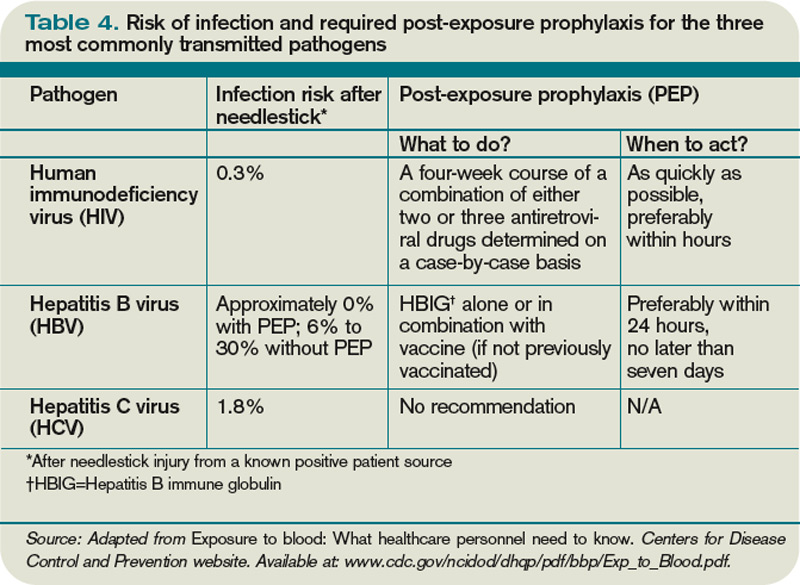
Back to the Case
Your needlestick occurred while using a hollow-bore needle to cannulate a source patient’s vein, placing you at higher risk for seroconversion. You immediately reported the exposure to the department of occupational health at your hospital. The source patient’s HIV, HBV, and HCV serological statuses were tested, and the patient was found to be HBV-positive. After appropriate counseling, you decide to receive HGIB prophylaxis to reduce your chances of becoming infected with HBV infection.
Bottom Line
Healthcare workers who suffer occupational needlestick injuries require immediate identification and attention to avoid transmission of such infectious diseases as HIV, HBV, and HCV. Source patients should undergo rapid serological testing to determine appropriate PEP. TH
Dr. Zehnder is a hospitalist in the Section of Hospital Medicine at the University of Colorado Denver.
References
- Mangione CM, Gerberding JL, Cummings, SR. Occupational exposure to HIV: Frequency and rates of underreporting of percutaneous and mucocutaneous exposures by medical housestaff. Am J Med. 1991;90(1):85-90.
- Lee JM, Botteman MF, Nicklasson L, et al. Needlestick injury in acute care nurses caring for patients with diabetes mellitus: a retrospective study. Curr Med Res Opinion. 2005;21(5):741-747.
- Workbook for designing, implementing, and evaluating a sharps injury prevention program. Centers for Disease Control and Prevention website. Available at: www.cdc.gov/sharpssafety/pdf/WorkbookComplete.pdf. Accessed Sept. 13, 2010.
- Lee JM, Botteman MF, Xanthakos N, Nicklasson L. Needlestick injuries in the United States. Epidemiologic, economic, and quality of life issues. AAOHN J. 2005;53(3):117-133.
- Cardo DM, Culver DH, Ciesielski CA, et al. A case-control study of HIV seroconversion in health care workers after percutaneous exposure. Centers for Disease Control and Prevention Needlestick Surveillance Group. N Engl J Med. 1997;337(21):1485-1490.
- Exposure to blood: What healthcare personnel need to know. CDC website. Available at: www.cdc.gov/ncidod /dhqp/pdf/bbp/Exp_to_Blood.pdf. Accessed Aug. 31, 2010.
- Buergler JM, Kim R, Thisted RA, Cohn SJ, Lichtor JL, Roizen MF. Risk of human immunodeficiency virus in surgeons, anesthesiologists, and medical students. Anesth Analg. 1992;75(1):118-124.
- Updated U.S. Public Health Service guidelines for the management of occupational exposures to HBV, HCV, and HIV and recommendations for postexposure prophylaxis. CDC website. Available at: www.cdc.gov/mmwr/preview/mmwrhtml/rr5011a1.htm. Accessed Aug. 31, 2010.
- Puro V, Petrosillo N, Ippolito G. Risk of hepatitis C seroconversion after occupational exposure in health care workers. Italian Study Group on Occupational Risk of HIV and Other Bloodborne Infections. Am J Infect Control. 1995;23(5):273-277.
Case
While placing a central line, you sustain a needlestick. You’ve washed the area thoroughly with soap and water, but you are concerned about contracting a bloodborne pathogen. What is the risk of contracting such a pathogen, and what can be done to reduce this risk?
Overview
Needlestick injuries are a common occupational hazard in the hospital setting. According to the International Health Care Worker Safety Center (IHCWSC), approximately 295,000 hospital-based healthcare workers experience occupational percutaneous injuries annually. In 1991, Mangione et al surveyed internal-medicine house staff and found an annual incidence of 674 needlestick injuries per 1,000 participants.1 Other retrospective data estimate this risk to be as high as 839 per 1,000 healthcare workers annually.2 Evidence from the Centers for Disease Control and Prevention (CDC) in 2004 suggests that because these are only self-reported injuries, the annual incidence of such injuries is in fact much higher than the current estimates suggest.2,3,4
More than 20 bloodborne pathogens (see Table 1, right) might be transmitted from contaminated needles or sharps, including human immunodeficiency virus (HIV), hepatitis B virus (HBV), and hepatitis C virus (HCV). A quick and appropriate response to a needlestick injury can greatly decrease the risk of disease transmission following an occupational exposure to potentially infectious materials.
Review of the Data
After any needlestick injury, an affected healthcare worker should wash the area with soap and water immediately. There is no contraindication to using antiseptic solutions, but there is also no evidence to suggest that this reduces the rates of disease transmission.
As decisions for post-exposure prophylaxis often need to be made within hours, a healthcare worker should seek care in the facility areas responsible for managing occupational exposures. Healthcare providers should always be encouraged and supported to report all sharps-related injuries to such departments.
The source patient should be identified and evaluated for potentially transmissible diseases, including HIV, HBV, and HCV. If indicated, the source patient should then undergo appropriate serological testing, and any indicated antiviral prophylaxis should be initiated (see Table 2, p. 19).
Risk of Seroconversion
For all bloodborne pathogens, a needlestick injury carries a greater risk for transmission than other occupational exposures (e.g. mucous membrane exposure). If a needlestick injury occurs in the setting of an infected patient source, the risk of disease transmission varies for HIV, HBV, and HCV (see Table 3, p. 19). In general, risk for seroconversion is increased with a deep injury, an injury with a device visibly contaminated with the source patient’s blood, or an injury involving a needle placed in the source patient’s artery or vein.3,5,6
Human immunodeficiency virus. Contracting HIV after needlestick injury is rare. From 1981 to 2006, the CDC documented only 57 cases of HIV/AIDS in healthcare workers following occupational exposure and identified an additional “possible” 140 cases post-exposure.5,6 Of the 57 documented cases, 48 sustained a percutaneous injury.
Following needlestick injury involving a known HIV-positive source, the one-year risk of seroconversion has been estimated to be 0.3%.5,6 In 1997, Cardo and colleagues identified four factors associated with increased risk for seroconversion after a needlestick/sharps injury from a known positive-HIV source:
- Deep injury;
- Injury with a device visibly contaminated with the source patient’s blood;
- A procedure involving a needle placed in the source patient’s artery or vein; and
- Exposure to a source patient who died of AIDS in the two months following the occupational exposure.5
Hepatitis B virus. Wides-pread immunization of healthcare workers has led to a dramatic decline in occupationally acquired HBV. The CDC estimated that in 1985, approximately 12,500 new HBV infections occurred in healthcare workers.3 This estimate plummeted to approximately 500 new occupationally acquired HBV infections in 1997.3
Despite this, hospital-based healthcare personnel remain at risk for HBV transmission after a needlestick injury from a known positive patient source. Few studies have evaluated the occupational risk of HBV transmission after a needlestick injury. Buergler et al reported that following a needlestick injury involving a known HBV-positive source, the one-year risk of seroconversion was 0.76% to 7.35% for nonimmunized surgeons, and 0.23% to 2.28% for nonimmunized anesthesiologists.7
In the absence of post-exposure prophylaxis, an exposed healthcare worker has a 6% to 30% risk of becoming infected with HBV.3,8 The risk is greatest if the patient source is known to be hepatitis B e antigen-positive, a marker for greater disease infectivity. When given within one week of injury, post-exposure prophylaxis (PEP) with multiple doses of hepatitis B immune globulin (HBIG) provides an estimated 75% protection from transmission.
Healthcare workers who have received the hepatitis B vaccine and developed immunity have virtually no risk for infection.6,7
Hepatitis C virus. Prospective evaluation has demonstrated that the average risk of HCV transmission after percutaneous exposure to a known HCV-positive source is from 0% to 7%.3 The Italian Study Group on Occupational Risk of HIV and Other Bloodborne Infections evaluated HCV seroconversion within six months of a reported exposure with enzyme immunoassay and immunoblot assay. In this study, the authors found a seroconversion rate of 1.2%.9
Further, they suggested that HCV seroconversion only occurred from hollow-bore needles, as no seroconversions were noted in healthcare workers who sustained injuries with solid sharp objects.
Post-Exposure Management
The CDC does not recommend prophylaxis when source fluids make contact with intact skin. However, if a percutaneous occupational exposure has occurred, PEPs exist for HIV and HBV but not for HCV.3,6 If a source patient’s HIV, HBV, and HCV statuses are unknown, occupational-health personnel can interview the patient to evaluate his or her risks and initiate testing. Specific information about the time and nature of exposure should be documented.
When testing is indicated, it should be done following institutional and state-specific exposure-control policies and informed consent guidelines. In all situations, the decision to begin antiviral PEP should be carefully considered, weighing benefits of PEP versus the risks and toxicity of treatment.
Human immunodeficiency virus. If a source patient is known to be HIV-positive, has a positive rapid HIV test, or if HIV status cannot be quickly determined, PEP is indicated. Healthcare providers should be aware of rare cases in which the source patient initially tested HIV-seronegative but was subsequently found to have primary HIV infection.
Per 2004 CDC recommendations, PEP is indicated for all healthcare workers who sustain a percuanteous injury from a known HIV-positive source.3,8 For a less severe injury (e.g. solid needle or superficial injury), PEP with either a basic two-drug or three-drug regimen is indicated, depending on the source patient’s viral load.3,5,6,8
If the source patient has unknown HIV status, two-drug PEP is indicated based on the source patient’s HIV risk factors. In such patients, rapid HIV testing also is indicated to aid in determining the need for PEP. When the source HIV status is unknown, PEP is indicated in settings where exposure to HIV-infected persons is likely.
If PEP is indicated, it should be started as quickly as possible. The 2005 U.S. Public Health Service Recommendations for PEP recommend initiating two nucleosides for low-risk exposures and two nucleosides plus a boosted protease inhibitor for high-risk exposures.
Examples of commonly used dual nucleoside regimens are Zidovudine plus Lamivudine (coformulated as Combivir) or Tenofovir plus Emtricitabine (coformulated as Truvada). Current recommendations indicate that PEP should be continued for four weeks, with concurrent clinical and laboratory evaluation for drug toxicity.
Hepatitis B virus. Numerous prospective studies have evaluated the post-exposure effectiveness of HBIG. When administered within 24 hours of exposure, HBIG might offer immediate passive protection against HBV infection. Additionally, if initiated within one week of percutaneous injury with a known HBV-positive source, multiple doses of HGIB provide an estimated 75% protection from transmission.
Although the combination of HBIG and the hepatitis vaccine B series has not been evaluated as PEP in the occupational setting, evidence in the perinatal setting suggests this regimen is more effective than HBIG alone.3,6,8
Hepatitis C virus. No PEP exists for HCV, and current recommendations for post-exposure management focus on early identification and treatment of chronic disease. There are insufficient data for a treatment recommendation for patients with acute HCV infection with no evidence of disease; the appropriate dosing of such a regimen is unknown. Further, evidence suggests that treatment started early in the course of chronic infection could be just as effective and might eliminate the need to treat persons whose infection will spontaneously resolve.7
Back to the Case
Your needlestick occurred while using a hollow-bore needle to cannulate a source patient’s vein, placing you at higher risk for seroconversion. You immediately reported the exposure to the department of occupational health at your hospital. The source patient’s HIV, HBV, and HCV serological statuses were tested, and the patient was found to be HBV-positive. After appropriate counseling, you decide to receive HGIB prophylaxis to reduce your chances of becoming infected with HBV infection.
Bottom Line
Healthcare workers who suffer occupational needlestick injuries require immediate identification and attention to avoid transmission of such infectious diseases as HIV, HBV, and HCV. Source patients should undergo rapid serological testing to determine appropriate PEP. TH
Dr. Zehnder is a hospitalist in the Section of Hospital Medicine at the University of Colorado Denver.
References
- Mangione CM, Gerberding JL, Cummings, SR. Occupational exposure to HIV: Frequency and rates of underreporting of percutaneous and mucocutaneous exposures by medical housestaff. Am J Med. 1991;90(1):85-90.
- Lee JM, Botteman MF, Nicklasson L, et al. Needlestick injury in acute care nurses caring for patients with diabetes mellitus: a retrospective study. Curr Med Res Opinion. 2005;21(5):741-747.
- Workbook for designing, implementing, and evaluating a sharps injury prevention program. Centers for Disease Control and Prevention website. Available at: www.cdc.gov/sharpssafety/pdf/WorkbookComplete.pdf. Accessed Sept. 13, 2010.
- Lee JM, Botteman MF, Xanthakos N, Nicklasson L. Needlestick injuries in the United States. Epidemiologic, economic, and quality of life issues. AAOHN J. 2005;53(3):117-133.
- Cardo DM, Culver DH, Ciesielski CA, et al. A case-control study of HIV seroconversion in health care workers after percutaneous exposure. Centers for Disease Control and Prevention Needlestick Surveillance Group. N Engl J Med. 1997;337(21):1485-1490.
- Exposure to blood: What healthcare personnel need to know. CDC website. Available at: www.cdc.gov/ncidod /dhqp/pdf/bbp/Exp_to_Blood.pdf. Accessed Aug. 31, 2010.
- Buergler JM, Kim R, Thisted RA, Cohn SJ, Lichtor JL, Roizen MF. Risk of human immunodeficiency virus in surgeons, anesthesiologists, and medical students. Anesth Analg. 1992;75(1):118-124.
- Updated U.S. Public Health Service guidelines for the management of occupational exposures to HBV, HCV, and HIV and recommendations for postexposure prophylaxis. CDC website. Available at: www.cdc.gov/mmwr/preview/mmwrhtml/rr5011a1.htm. Accessed Aug. 31, 2010.
- Puro V, Petrosillo N, Ippolito G. Risk of hepatitis C seroconversion after occupational exposure in health care workers. Italian Study Group on Occupational Risk of HIV and Other Bloodborne Infections. Am J Infect Control. 1995;23(5):273-277.
Case
While placing a central line, you sustain a needlestick. You’ve washed the area thoroughly with soap and water, but you are concerned about contracting a bloodborne pathogen. What is the risk of contracting such a pathogen, and what can be done to reduce this risk?
Overview
Needlestick injuries are a common occupational hazard in the hospital setting. According to the International Health Care Worker Safety Center (IHCWSC), approximately 295,000 hospital-based healthcare workers experience occupational percutaneous injuries annually. In 1991, Mangione et al surveyed internal-medicine house staff and found an annual incidence of 674 needlestick injuries per 1,000 participants.1 Other retrospective data estimate this risk to be as high as 839 per 1,000 healthcare workers annually.2 Evidence from the Centers for Disease Control and Prevention (CDC) in 2004 suggests that because these are only self-reported injuries, the annual incidence of such injuries is in fact much higher than the current estimates suggest.2,3,4
More than 20 bloodborne pathogens (see Table 1, right) might be transmitted from contaminated needles or sharps, including human immunodeficiency virus (HIV), hepatitis B virus (HBV), and hepatitis C virus (HCV). A quick and appropriate response to a needlestick injury can greatly decrease the risk of disease transmission following an occupational exposure to potentially infectious materials.
Review of the Data
After any needlestick injury, an affected healthcare worker should wash the area with soap and water immediately. There is no contraindication to using antiseptic solutions, but there is also no evidence to suggest that this reduces the rates of disease transmission.
As decisions for post-exposure prophylaxis often need to be made within hours, a healthcare worker should seek care in the facility areas responsible for managing occupational exposures. Healthcare providers should always be encouraged and supported to report all sharps-related injuries to such departments.
The source patient should be identified and evaluated for potentially transmissible diseases, including HIV, HBV, and HCV. If indicated, the source patient should then undergo appropriate serological testing, and any indicated antiviral prophylaxis should be initiated (see Table 2, p. 19).
Risk of Seroconversion
For all bloodborne pathogens, a needlestick injury carries a greater risk for transmission than other occupational exposures (e.g. mucous membrane exposure). If a needlestick injury occurs in the setting of an infected patient source, the risk of disease transmission varies for HIV, HBV, and HCV (see Table 3, p. 19). In general, risk for seroconversion is increased with a deep injury, an injury with a device visibly contaminated with the source patient’s blood, or an injury involving a needle placed in the source patient’s artery or vein.3,5,6
Human immunodeficiency virus. Contracting HIV after needlestick injury is rare. From 1981 to 2006, the CDC documented only 57 cases of HIV/AIDS in healthcare workers following occupational exposure and identified an additional “possible” 140 cases post-exposure.5,6 Of the 57 documented cases, 48 sustained a percutaneous injury.
Following needlestick injury involving a known HIV-positive source, the one-year risk of seroconversion has been estimated to be 0.3%.5,6 In 1997, Cardo and colleagues identified four factors associated with increased risk for seroconversion after a needlestick/sharps injury from a known positive-HIV source:
- Deep injury;
- Injury with a device visibly contaminated with the source patient’s blood;
- A procedure involving a needle placed in the source patient’s artery or vein; and
- Exposure to a source patient who died of AIDS in the two months following the occupational exposure.5
Hepatitis B virus. Wides-pread immunization of healthcare workers has led to a dramatic decline in occupationally acquired HBV. The CDC estimated that in 1985, approximately 12,500 new HBV infections occurred in healthcare workers.3 This estimate plummeted to approximately 500 new occupationally acquired HBV infections in 1997.3
Despite this, hospital-based healthcare personnel remain at risk for HBV transmission after a needlestick injury from a known positive patient source. Few studies have evaluated the occupational risk of HBV transmission after a needlestick injury. Buergler et al reported that following a needlestick injury involving a known HBV-positive source, the one-year risk of seroconversion was 0.76% to 7.35% for nonimmunized surgeons, and 0.23% to 2.28% for nonimmunized anesthesiologists.7
In the absence of post-exposure prophylaxis, an exposed healthcare worker has a 6% to 30% risk of becoming infected with HBV.3,8 The risk is greatest if the patient source is known to be hepatitis B e antigen-positive, a marker for greater disease infectivity. When given within one week of injury, post-exposure prophylaxis (PEP) with multiple doses of hepatitis B immune globulin (HBIG) provides an estimated 75% protection from transmission.
Healthcare workers who have received the hepatitis B vaccine and developed immunity have virtually no risk for infection.6,7
Hepatitis C virus. Prospective evaluation has demonstrated that the average risk of HCV transmission after percutaneous exposure to a known HCV-positive source is from 0% to 7%.3 The Italian Study Group on Occupational Risk of HIV and Other Bloodborne Infections evaluated HCV seroconversion within six months of a reported exposure with enzyme immunoassay and immunoblot assay. In this study, the authors found a seroconversion rate of 1.2%.9
Further, they suggested that HCV seroconversion only occurred from hollow-bore needles, as no seroconversions were noted in healthcare workers who sustained injuries with solid sharp objects.
Post-Exposure Management
The CDC does not recommend prophylaxis when source fluids make contact with intact skin. However, if a percutaneous occupational exposure has occurred, PEPs exist for HIV and HBV but not for HCV.3,6 If a source patient’s HIV, HBV, and HCV statuses are unknown, occupational-health personnel can interview the patient to evaluate his or her risks and initiate testing. Specific information about the time and nature of exposure should be documented.
When testing is indicated, it should be done following institutional and state-specific exposure-control policies and informed consent guidelines. In all situations, the decision to begin antiviral PEP should be carefully considered, weighing benefits of PEP versus the risks and toxicity of treatment.
Human immunodeficiency virus. If a source patient is known to be HIV-positive, has a positive rapid HIV test, or if HIV status cannot be quickly determined, PEP is indicated. Healthcare providers should be aware of rare cases in which the source patient initially tested HIV-seronegative but was subsequently found to have primary HIV infection.
Per 2004 CDC recommendations, PEP is indicated for all healthcare workers who sustain a percuanteous injury from a known HIV-positive source.3,8 For a less severe injury (e.g. solid needle or superficial injury), PEP with either a basic two-drug or three-drug regimen is indicated, depending on the source patient’s viral load.3,5,6,8
If the source patient has unknown HIV status, two-drug PEP is indicated based on the source patient’s HIV risk factors. In such patients, rapid HIV testing also is indicated to aid in determining the need for PEP. When the source HIV status is unknown, PEP is indicated in settings where exposure to HIV-infected persons is likely.
If PEP is indicated, it should be started as quickly as possible. The 2005 U.S. Public Health Service Recommendations for PEP recommend initiating two nucleosides for low-risk exposures and two nucleosides plus a boosted protease inhibitor for high-risk exposures.
Examples of commonly used dual nucleoside regimens are Zidovudine plus Lamivudine (coformulated as Combivir) or Tenofovir plus Emtricitabine (coformulated as Truvada). Current recommendations indicate that PEP should be continued for four weeks, with concurrent clinical and laboratory evaluation for drug toxicity.
Hepatitis B virus. Numerous prospective studies have evaluated the post-exposure effectiveness of HBIG. When administered within 24 hours of exposure, HBIG might offer immediate passive protection against HBV infection. Additionally, if initiated within one week of percutaneous injury with a known HBV-positive source, multiple doses of HGIB provide an estimated 75% protection from transmission.
Although the combination of HBIG and the hepatitis vaccine B series has not been evaluated as PEP in the occupational setting, evidence in the perinatal setting suggests this regimen is more effective than HBIG alone.3,6,8
Hepatitis C virus. No PEP exists for HCV, and current recommendations for post-exposure management focus on early identification and treatment of chronic disease. There are insufficient data for a treatment recommendation for patients with acute HCV infection with no evidence of disease; the appropriate dosing of such a regimen is unknown. Further, evidence suggests that treatment started early in the course of chronic infection could be just as effective and might eliminate the need to treat persons whose infection will spontaneously resolve.7
Back to the Case
Your needlestick occurred while using a hollow-bore needle to cannulate a source patient’s vein, placing you at higher risk for seroconversion. You immediately reported the exposure to the department of occupational health at your hospital. The source patient’s HIV, HBV, and HCV serological statuses were tested, and the patient was found to be HBV-positive. After appropriate counseling, you decide to receive HGIB prophylaxis to reduce your chances of becoming infected with HBV infection.
Bottom Line
Healthcare workers who suffer occupational needlestick injuries require immediate identification and attention to avoid transmission of such infectious diseases as HIV, HBV, and HCV. Source patients should undergo rapid serological testing to determine appropriate PEP. TH
Dr. Zehnder is a hospitalist in the Section of Hospital Medicine at the University of Colorado Denver.
References
- Mangione CM, Gerberding JL, Cummings, SR. Occupational exposure to HIV: Frequency and rates of underreporting of percutaneous and mucocutaneous exposures by medical housestaff. Am J Med. 1991;90(1):85-90.
- Lee JM, Botteman MF, Nicklasson L, et al. Needlestick injury in acute care nurses caring for patients with diabetes mellitus: a retrospective study. Curr Med Res Opinion. 2005;21(5):741-747.
- Workbook for designing, implementing, and evaluating a sharps injury prevention program. Centers for Disease Control and Prevention website. Available at: www.cdc.gov/sharpssafety/pdf/WorkbookComplete.pdf. Accessed Sept. 13, 2010.
- Lee JM, Botteman MF, Xanthakos N, Nicklasson L. Needlestick injuries in the United States. Epidemiologic, economic, and quality of life issues. AAOHN J. 2005;53(3):117-133.
- Cardo DM, Culver DH, Ciesielski CA, et al. A case-control study of HIV seroconversion in health care workers after percutaneous exposure. Centers for Disease Control and Prevention Needlestick Surveillance Group. N Engl J Med. 1997;337(21):1485-1490.
- Exposure to blood: What healthcare personnel need to know. CDC website. Available at: www.cdc.gov/ncidod /dhqp/pdf/bbp/Exp_to_Blood.pdf. Accessed Aug. 31, 2010.
- Buergler JM, Kim R, Thisted RA, Cohn SJ, Lichtor JL, Roizen MF. Risk of human immunodeficiency virus in surgeons, anesthesiologists, and medical students. Anesth Analg. 1992;75(1):118-124.
- Updated U.S. Public Health Service guidelines for the management of occupational exposures to HBV, HCV, and HIV and recommendations for postexposure prophylaxis. CDC website. Available at: www.cdc.gov/mmwr/preview/mmwrhtml/rr5011a1.htm. Accessed Aug. 31, 2010.
- Puro V, Petrosillo N, Ippolito G. Risk of hepatitis C seroconversion after occupational exposure in health care workers. Italian Study Group on Occupational Risk of HIV and Other Bloodborne Infections. Am J Infect Control. 1995;23(5):273-277.
Back to Basics
Let’s examine a documentation case for hospitalists providing daily care: A 65-year-old male patient is admitted with a left hip fracture. The patient also has hypertension and Type 2 diabetes, which might complicate his care. The orthopedic surgeon manages the patient’s perioperative course for the fracture while the hospitalist provides daily post-op care for hypertension and diabetes.
A common scenario is the hospitalist will provide concurrent care, along with a varying number of specialists, depending on the complexity of the patient’s presenting problems and existing comorbidities. Payors define concurrent care as more than one physician providing care to the same patient on the same date, or during the same hospitalization. Payors often consider two key principles before reimbursing concurrent care:
- Does the patient’s condition warrant more than one physician? and
- Are the services provided by each physician reasonable and necessary?1
When more than one medical condition exists and each physician actively treats the condition related to their expertise, each physician can demonstrate medical necessity. As in the above example, the orthopedic surgeon cares for the patient’s fracture while the hospitalist oversees diabetes and hypertension management. Claim submission follows the same logic. Report each subsequent hospital care code (99231-99233) with the corresponding diagnosis each physician primarily manages (i.e., orthopedic surgeon: 9923x with 820.8; hospitalist: 9923x with 250.00, 401.1).
When each physician assigns a different primary diagnosis code to the visit code, each is more likely to receive payment. Because each of these physicians are in different specialties and different provider groups, most payors do not require modifier 25 (separately identifiable E/M service on the same day as a procedure or other service) appended to the visit code. However, some managed-care payors require each physician to append modifier 25 to the concurrent E/M visit code (i.e., 99232-25) despite claim submission under different tax identification numbers.
Unfortunately, the physicians might not realize this until a claim rejection has been issued. Furthermore, payors might want to see the proof before rendering payment. In other words, they pay the first claim received and deny any subsequent claim in order to confirm medical necessity of the concurrent visit. Appeal denied such claims rejections with supporting documentation that distinguishes each physician visit, if possible. This assists the payors in understanding each physician’s contribution to care.
Reasons for Denial
Concurrent care services are more easily distinguished when separate diagnoses are reported with each service. Conversely, payors are likely to deny services that are hard to differentiate. Furthermore, payors frequently deny concurrent care services for the following reasons:
- Services exceed normal frequency or duration for a given condition without documented circumstances requiring additional care; or
- Services by one physician duplicate or overlap those of another provider without recognizable distinction.2
For example, a hospitalist might be involved in the post-op care of patients with fractures and no other identifiable chronic or acute conditions or complications. In these cases, the hospitalist’s continued involvement might constitute a facility policy (e.g., quality of care, risk reduction, etc.) rather than active clinical management. Claim submission could erroneously occur with each physician reporting 9923x for 820.8. Payors deny medically unnecessary services, or request refunds for inappropriate payments.
Hospitalists might attempt to negotiate other terms with the facility to account for the unpaid time and effort directed toward these types of cases.
Group Practice
Physicians in the same group practice with the same specialty designation must report, and are paid, as a single physician. Multiple visits to the same patient can occur on the same day by members of the same group (e.g., hospitalist A evaluates the patient in the morning, and hospitalist B reviews test results and the resulting course of treatment in the afternoon). However, only one subsequent hospital care service can be reported for the day.
The hospitalists should select the visit level representative of the combined services and submit one appropriately determined code (e.g., 99233), thereby capturing the medically necessary efforts of each physician. To complicate matters, the hospitalists must determine which name to report on the claim: the physician who provided the first encounter, or the physician who provided the most extensive or best-documented encounter.
Tracking productivity for these cases proves challenging. Some practices develop an internal accounting system and credit each physician for their medically necessary efforts (a labor-intensive task for administrators and physicians). TH
Carol Pohlig is a billing and coding expert with the University of Pennsylvania Medical Center in Philadelphia. She is faculty for SHM’s inpatient coding course.
References
- Medicare Benefit Policy Manual: Concurrent Care. Chapter 15, Section 30.E. CMS website. Available at: www.cms.gov/manuals/Downloads/bp102c15.pdf. Accessed July 9, 2010.
- Medicare Claims Processing Manual: Physicians in Group Practice. Chapter 12, Section 30.6.5. CMS website. Available at: www.cms.gov/manuals/downloads/clm104c12.pdf. Accessed July 9, 2010.
- Pohlig, C. Daily care conundrums. The Hospitalist website. Available at: www.the-hospitalist.org/details/article/188735/Daily_Care_Conundrums_.html. Accessed July 9, 2010.
- Medicare Claims Processing Manual: Hospital Visits Same Day But by Different Physicians. Chapter 12, Section 30.6.9.C. CMS website. Available at: www.cms.gov/manuals/downloads/clm104c12.pdf. Accessed July 9, 2010.
- Abraham M, Beebe M, Dalton J, Evans D, Glenn R. Current Procedural Terminology Professional Edition. Chicago: American Medical Association Press; 2010:15.
Let’s examine a documentation case for hospitalists providing daily care: A 65-year-old male patient is admitted with a left hip fracture. The patient also has hypertension and Type 2 diabetes, which might complicate his care. The orthopedic surgeon manages the patient’s perioperative course for the fracture while the hospitalist provides daily post-op care for hypertension and diabetes.
A common scenario is the hospitalist will provide concurrent care, along with a varying number of specialists, depending on the complexity of the patient’s presenting problems and existing comorbidities. Payors define concurrent care as more than one physician providing care to the same patient on the same date, or during the same hospitalization. Payors often consider two key principles before reimbursing concurrent care:
- Does the patient’s condition warrant more than one physician? and
- Are the services provided by each physician reasonable and necessary?1
When more than one medical condition exists and each physician actively treats the condition related to their expertise, each physician can demonstrate medical necessity. As in the above example, the orthopedic surgeon cares for the patient’s fracture while the hospitalist oversees diabetes and hypertension management. Claim submission follows the same logic. Report each subsequent hospital care code (99231-99233) with the corresponding diagnosis each physician primarily manages (i.e., orthopedic surgeon: 9923x with 820.8; hospitalist: 9923x with 250.00, 401.1).
When each physician assigns a different primary diagnosis code to the visit code, each is more likely to receive payment. Because each of these physicians are in different specialties and different provider groups, most payors do not require modifier 25 (separately identifiable E/M service on the same day as a procedure or other service) appended to the visit code. However, some managed-care payors require each physician to append modifier 25 to the concurrent E/M visit code (i.e., 99232-25) despite claim submission under different tax identification numbers.
Unfortunately, the physicians might not realize this until a claim rejection has been issued. Furthermore, payors might want to see the proof before rendering payment. In other words, they pay the first claim received and deny any subsequent claim in order to confirm medical necessity of the concurrent visit. Appeal denied such claims rejections with supporting documentation that distinguishes each physician visit, if possible. This assists the payors in understanding each physician’s contribution to care.
Reasons for Denial
Concurrent care services are more easily distinguished when separate diagnoses are reported with each service. Conversely, payors are likely to deny services that are hard to differentiate. Furthermore, payors frequently deny concurrent care services for the following reasons:
- Services exceed normal frequency or duration for a given condition without documented circumstances requiring additional care; or
- Services by one physician duplicate or overlap those of another provider without recognizable distinction.2
For example, a hospitalist might be involved in the post-op care of patients with fractures and no other identifiable chronic or acute conditions or complications. In these cases, the hospitalist’s continued involvement might constitute a facility policy (e.g., quality of care, risk reduction, etc.) rather than active clinical management. Claim submission could erroneously occur with each physician reporting 9923x for 820.8. Payors deny medically unnecessary services, or request refunds for inappropriate payments.
Hospitalists might attempt to negotiate other terms with the facility to account for the unpaid time and effort directed toward these types of cases.
Group Practice
Physicians in the same group practice with the same specialty designation must report, and are paid, as a single physician. Multiple visits to the same patient can occur on the same day by members of the same group (e.g., hospitalist A evaluates the patient in the morning, and hospitalist B reviews test results and the resulting course of treatment in the afternoon). However, only one subsequent hospital care service can be reported for the day.
The hospitalists should select the visit level representative of the combined services and submit one appropriately determined code (e.g., 99233), thereby capturing the medically necessary efforts of each physician. To complicate matters, the hospitalists must determine which name to report on the claim: the physician who provided the first encounter, or the physician who provided the most extensive or best-documented encounter.
Tracking productivity for these cases proves challenging. Some practices develop an internal accounting system and credit each physician for their medically necessary efforts (a labor-intensive task for administrators and physicians). TH
Carol Pohlig is a billing and coding expert with the University of Pennsylvania Medical Center in Philadelphia. She is faculty for SHM’s inpatient coding course.
References
- Medicare Benefit Policy Manual: Concurrent Care. Chapter 15, Section 30.E. CMS website. Available at: www.cms.gov/manuals/Downloads/bp102c15.pdf. Accessed July 9, 2010.
- Medicare Claims Processing Manual: Physicians in Group Practice. Chapter 12, Section 30.6.5. CMS website. Available at: www.cms.gov/manuals/downloads/clm104c12.pdf. Accessed July 9, 2010.
- Pohlig, C. Daily care conundrums. The Hospitalist website. Available at: www.the-hospitalist.org/details/article/188735/Daily_Care_Conundrums_.html. Accessed July 9, 2010.
- Medicare Claims Processing Manual: Hospital Visits Same Day But by Different Physicians. Chapter 12, Section 30.6.9.C. CMS website. Available at: www.cms.gov/manuals/downloads/clm104c12.pdf. Accessed July 9, 2010.
- Abraham M, Beebe M, Dalton J, Evans D, Glenn R. Current Procedural Terminology Professional Edition. Chicago: American Medical Association Press; 2010:15.
Let’s examine a documentation case for hospitalists providing daily care: A 65-year-old male patient is admitted with a left hip fracture. The patient also has hypertension and Type 2 diabetes, which might complicate his care. The orthopedic surgeon manages the patient’s perioperative course for the fracture while the hospitalist provides daily post-op care for hypertension and diabetes.
A common scenario is the hospitalist will provide concurrent care, along with a varying number of specialists, depending on the complexity of the patient’s presenting problems and existing comorbidities. Payors define concurrent care as more than one physician providing care to the same patient on the same date, or during the same hospitalization. Payors often consider two key principles before reimbursing concurrent care:
- Does the patient’s condition warrant more than one physician? and
- Are the services provided by each physician reasonable and necessary?1
When more than one medical condition exists and each physician actively treats the condition related to their expertise, each physician can demonstrate medical necessity. As in the above example, the orthopedic surgeon cares for the patient’s fracture while the hospitalist oversees diabetes and hypertension management. Claim submission follows the same logic. Report each subsequent hospital care code (99231-99233) with the corresponding diagnosis each physician primarily manages (i.e., orthopedic surgeon: 9923x with 820.8; hospitalist: 9923x with 250.00, 401.1).
When each physician assigns a different primary diagnosis code to the visit code, each is more likely to receive payment. Because each of these physicians are in different specialties and different provider groups, most payors do not require modifier 25 (separately identifiable E/M service on the same day as a procedure or other service) appended to the visit code. However, some managed-care payors require each physician to append modifier 25 to the concurrent E/M visit code (i.e., 99232-25) despite claim submission under different tax identification numbers.
Unfortunately, the physicians might not realize this until a claim rejection has been issued. Furthermore, payors might want to see the proof before rendering payment. In other words, they pay the first claim received and deny any subsequent claim in order to confirm medical necessity of the concurrent visit. Appeal denied such claims rejections with supporting documentation that distinguishes each physician visit, if possible. This assists the payors in understanding each physician’s contribution to care.
Reasons for Denial
Concurrent care services are more easily distinguished when separate diagnoses are reported with each service. Conversely, payors are likely to deny services that are hard to differentiate. Furthermore, payors frequently deny concurrent care services for the following reasons:
- Services exceed normal frequency or duration for a given condition without documented circumstances requiring additional care; or
- Services by one physician duplicate or overlap those of another provider without recognizable distinction.2
For example, a hospitalist might be involved in the post-op care of patients with fractures and no other identifiable chronic or acute conditions or complications. In these cases, the hospitalist’s continued involvement might constitute a facility policy (e.g., quality of care, risk reduction, etc.) rather than active clinical management. Claim submission could erroneously occur with each physician reporting 9923x for 820.8. Payors deny medically unnecessary services, or request refunds for inappropriate payments.
Hospitalists might attempt to negotiate other terms with the facility to account for the unpaid time and effort directed toward these types of cases.
Group Practice
Physicians in the same group practice with the same specialty designation must report, and are paid, as a single physician. Multiple visits to the same patient can occur on the same day by members of the same group (e.g., hospitalist A evaluates the patient in the morning, and hospitalist B reviews test results and the resulting course of treatment in the afternoon). However, only one subsequent hospital care service can be reported for the day.
The hospitalists should select the visit level representative of the combined services and submit one appropriately determined code (e.g., 99233), thereby capturing the medically necessary efforts of each physician. To complicate matters, the hospitalists must determine which name to report on the claim: the physician who provided the first encounter, or the physician who provided the most extensive or best-documented encounter.
Tracking productivity for these cases proves challenging. Some practices develop an internal accounting system and credit each physician for their medically necessary efforts (a labor-intensive task for administrators and physicians). TH
Carol Pohlig is a billing and coding expert with the University of Pennsylvania Medical Center in Philadelphia. She is faculty for SHM’s inpatient coding course.
References
- Medicare Benefit Policy Manual: Concurrent Care. Chapter 15, Section 30.E. CMS website. Available at: www.cms.gov/manuals/Downloads/bp102c15.pdf. Accessed July 9, 2010.
- Medicare Claims Processing Manual: Physicians in Group Practice. Chapter 12, Section 30.6.5. CMS website. Available at: www.cms.gov/manuals/downloads/clm104c12.pdf. Accessed July 9, 2010.
- Pohlig, C. Daily care conundrums. The Hospitalist website. Available at: www.the-hospitalist.org/details/article/188735/Daily_Care_Conundrums_.html. Accessed July 9, 2010.
- Medicare Claims Processing Manual: Hospital Visits Same Day But by Different Physicians. Chapter 12, Section 30.6.9.C. CMS website. Available at: www.cms.gov/manuals/downloads/clm104c12.pdf. Accessed July 9, 2010.
- Abraham M, Beebe M, Dalton J, Evans D, Glenn R. Current Procedural Terminology Professional Edition. Chicago: American Medical Association Press; 2010:15.
Should hospitalists accept gifts from pharmaceutical, medical device, and biotech companies?

Recent discussions on conflicts of interest in medical publications underscore the significance of the important yet fragile relationship between the pharmaceutical industry and healthcare professionals. Among these is an examination of how academic departments can maintain a relationship with the industry.1 This study suggests that if appropriate boundaries are established between industry and academia, it is possible to collaborate. However, part of the policy in this investigation included “elimination of industry-supplied meals, gifts, and favors.”2
The Institute of Medicine’s “Conflict of Interest in Medical Research, Education, and Practice” included groundbreaking recommendations.3 Among them was a call for professionals to adopt a policy that prohibits “the acceptance of items of material value from pharmaceutical, medical device, and biotechnology companies, except in specified situations.”3
Our nation has been embroiled in a healthcare debate. Questions of right versus privilege, access versus affordability, and, of course, the perpetual political overlay have monopolized most of the discourse. Some contend that healthcare reform will redefine the current relationship between pharma and physicians . . . and not a moment too soon.
Lest there be ambiguity, though, the medical profession remains a noble vocation. This notwithstanding, until 2002, physicians freely participated in golf outings, received athletic tickets, and dined at five-star restaurants. But after the pharmaceutical industry smartly adopted voluntary guidelines that restrict gifting to doctors, we are left with drug samples and, of course, the “free lunch.” Certainly, pharma can claim it has made significant contributions to furthering medical education and research. Many could argue the tangible negative effects that would follow if the funding suddenly were absent.
But let’s not kid ourselves: There is a good reason the pharmaceutical industry spends more than $12 billion per year on marketing to doctors.4 In 2006, Rep. Henry Waxman (D-Calif.) said, “It is obvious that drug companies provide these free lunches so their sales reps can get the doctor’s ear and influence the prescribing practices.”2 Most doctors would never admit any such influence. It would be, however, disingenuous for any practicing physician to say there is none.
A randomized trial conducted by Adair et al concluded the “access to drug samples in clinic influences resident prescribing decisions. This could affect resident education and increase drug costs for patients.”5 An earlier study by Chew et al concluded “the availability of drug samples led physicians to dispense and subsequently prescribe drugs that differ from their preferred drug choice. Physicians most often report using drug samples to avoid cost to the patient.”6
Sure, local culture drives some prescribing practice, but one must be mindful of the reality that the pharmaceutical industry has significant influence. Plus, free drug samples help patients in the short term. Once the samples are gone, an expensive prescription for that new drug will follow. It’s another win for the industry and another loss for the patient and the healthcare system.
Many studies have shown that gifting exerts influence, even if doctors are unwilling to admit it. But patients and doctors alike would like to state with clarity of conscience that the medication prescribed is only based on clinical evidence, not influence. TH
Dr. Pyke is a hospitalist at Geisinger Wyoming Valley Medical Systems in Mountain Top, Pa.
References
- Dubovsky SL, Kaye DL, Pristach CA, DelRegno P, Pessar L, Stiles K. Can academic departments maintain industry relationships while promoting physician professionalism? Acad Med. 2010;85(1):68-73.
- Salganik MW, Hopkins JS, Rockoff JD. Medical salesmen prescribe lunches. Catering trade feeds on rep-doctor meals. The Baltimore Sun. July 29, 2006.
- Institute of Medicine Conflict of Interest in Medical Research, Education and Practice Full Recommendations. 4-28-09.
- Wolfe SM. Why do American drug companies spend more than $12 billion a year pushing drugs? Is it education or promotion? J Gen Intern Med. 2007;11(10):637-639.
- Adair RF, Holmgren LR. Do drug samples influence resident prescribing behavior? A randomized trial. Am J Med. 2005;118(8):881-884.
- Chew LD, O’Young TS, Hazlet TK, Bradley KA, Maynard C, Lessler DS. A physician survey of the effect of drug sample availability on physicians’ behavior. J Gen Intern Med. 2000;15(7):478-483.
Recent discussions on conflicts of interest in medical publications underscore the significance of the important yet fragile relationship between the pharmaceutical industry and healthcare professionals. Among these is an examination of how academic departments can maintain a relationship with the industry.1 This study suggests that if appropriate boundaries are established between industry and academia, it is possible to collaborate. However, part of the policy in this investigation included “elimination of industry-supplied meals, gifts, and favors.”2
The Institute of Medicine’s “Conflict of Interest in Medical Research, Education, and Practice” included groundbreaking recommendations.3 Among them was a call for professionals to adopt a policy that prohibits “the acceptance of items of material value from pharmaceutical, medical device, and biotechnology companies, except in specified situations.”3
Our nation has been embroiled in a healthcare debate. Questions of right versus privilege, access versus affordability, and, of course, the perpetual political overlay have monopolized most of the discourse. Some contend that healthcare reform will redefine the current relationship between pharma and physicians . . . and not a moment too soon.
Lest there be ambiguity, though, the medical profession remains a noble vocation. This notwithstanding, until 2002, physicians freely participated in golf outings, received athletic tickets, and dined at five-star restaurants. But after the pharmaceutical industry smartly adopted voluntary guidelines that restrict gifting to doctors, we are left with drug samples and, of course, the “free lunch.” Certainly, pharma can claim it has made significant contributions to furthering medical education and research. Many could argue the tangible negative effects that would follow if the funding suddenly were absent.
But let’s not kid ourselves: There is a good reason the pharmaceutical industry spends more than $12 billion per year on marketing to doctors.4 In 2006, Rep. Henry Waxman (D-Calif.) said, “It is obvious that drug companies provide these free lunches so their sales reps can get the doctor’s ear and influence the prescribing practices.”2 Most doctors would never admit any such influence. It would be, however, disingenuous for any practicing physician to say there is none.
A randomized trial conducted by Adair et al concluded the “access to drug samples in clinic influences resident prescribing decisions. This could affect resident education and increase drug costs for patients.”5 An earlier study by Chew et al concluded “the availability of drug samples led physicians to dispense and subsequently prescribe drugs that differ from their preferred drug choice. Physicians most often report using drug samples to avoid cost to the patient.”6
Sure, local culture drives some prescribing practice, but one must be mindful of the reality that the pharmaceutical industry has significant influence. Plus, free drug samples help patients in the short term. Once the samples are gone, an expensive prescription for that new drug will follow. It’s another win for the industry and another loss for the patient and the healthcare system.
Many studies have shown that gifting exerts influence, even if doctors are unwilling to admit it. But patients and doctors alike would like to state with clarity of conscience that the medication prescribed is only based on clinical evidence, not influence. TH
Dr. Pyke is a hospitalist at Geisinger Wyoming Valley Medical Systems in Mountain Top, Pa.
References
- Dubovsky SL, Kaye DL, Pristach CA, DelRegno P, Pessar L, Stiles K. Can academic departments maintain industry relationships while promoting physician professionalism? Acad Med. 2010;85(1):68-73.
- Salganik MW, Hopkins JS, Rockoff JD. Medical salesmen prescribe lunches. Catering trade feeds on rep-doctor meals. The Baltimore Sun. July 29, 2006.
- Institute of Medicine Conflict of Interest in Medical Research, Education and Practice Full Recommendations. 4-28-09.
- Wolfe SM. Why do American drug companies spend more than $12 billion a year pushing drugs? Is it education or promotion? J Gen Intern Med. 2007;11(10):637-639.
- Adair RF, Holmgren LR. Do drug samples influence resident prescribing behavior? A randomized trial. Am J Med. 2005;118(8):881-884.
- Chew LD, O’Young TS, Hazlet TK, Bradley KA, Maynard C, Lessler DS. A physician survey of the effect of drug sample availability on physicians’ behavior. J Gen Intern Med. 2000;15(7):478-483.
Recent discussions on conflicts of interest in medical publications underscore the significance of the important yet fragile relationship between the pharmaceutical industry and healthcare professionals. Among these is an examination of how academic departments can maintain a relationship with the industry.1 This study suggests that if appropriate boundaries are established between industry and academia, it is possible to collaborate. However, part of the policy in this investigation included “elimination of industry-supplied meals, gifts, and favors.”2
The Institute of Medicine’s “Conflict of Interest in Medical Research, Education, and Practice” included groundbreaking recommendations.3 Among them was a call for professionals to adopt a policy that prohibits “the acceptance of items of material value from pharmaceutical, medical device, and biotechnology companies, except in specified situations.”3
Our nation has been embroiled in a healthcare debate. Questions of right versus privilege, access versus affordability, and, of course, the perpetual political overlay have monopolized most of the discourse. Some contend that healthcare reform will redefine the current relationship between pharma and physicians . . . and not a moment too soon.
Lest there be ambiguity, though, the medical profession remains a noble vocation. This notwithstanding, until 2002, physicians freely participated in golf outings, received athletic tickets, and dined at five-star restaurants. But after the pharmaceutical industry smartly adopted voluntary guidelines that restrict gifting to doctors, we are left with drug samples and, of course, the “free lunch.” Certainly, pharma can claim it has made significant contributions to furthering medical education and research. Many could argue the tangible negative effects that would follow if the funding suddenly were absent.
But let’s not kid ourselves: There is a good reason the pharmaceutical industry spends more than $12 billion per year on marketing to doctors.4 In 2006, Rep. Henry Waxman (D-Calif.) said, “It is obvious that drug companies provide these free lunches so their sales reps can get the doctor’s ear and influence the prescribing practices.”2 Most doctors would never admit any such influence. It would be, however, disingenuous for any practicing physician to say there is none.
A randomized trial conducted by Adair et al concluded the “access to drug samples in clinic influences resident prescribing decisions. This could affect resident education and increase drug costs for patients.”5 An earlier study by Chew et al concluded “the availability of drug samples led physicians to dispense and subsequently prescribe drugs that differ from their preferred drug choice. Physicians most often report using drug samples to avoid cost to the patient.”6
Sure, local culture drives some prescribing practice, but one must be mindful of the reality that the pharmaceutical industry has significant influence. Plus, free drug samples help patients in the short term. Once the samples are gone, an expensive prescription for that new drug will follow. It’s another win for the industry and another loss for the patient and the healthcare system.
Many studies have shown that gifting exerts influence, even if doctors are unwilling to admit it. But patients and doctors alike would like to state with clarity of conscience that the medication prescribed is only based on clinical evidence, not influence. TH
Dr. Pyke is a hospitalist at Geisinger Wyoming Valley Medical Systems in Mountain Top, Pa.
References
- Dubovsky SL, Kaye DL, Pristach CA, DelRegno P, Pessar L, Stiles K. Can academic departments maintain industry relationships while promoting physician professionalism? Acad Med. 2010;85(1):68-73.
- Salganik MW, Hopkins JS, Rockoff JD. Medical salesmen prescribe lunches. Catering trade feeds on rep-doctor meals. The Baltimore Sun. July 29, 2006.
- Institute of Medicine Conflict of Interest in Medical Research, Education and Practice Full Recommendations. 4-28-09.
- Wolfe SM. Why do American drug companies spend more than $12 billion a year pushing drugs? Is it education or promotion? J Gen Intern Med. 2007;11(10):637-639.
- Adair RF, Holmgren LR. Do drug samples influence resident prescribing behavior? A randomized trial. Am J Med. 2005;118(8):881-884.
- Chew LD, O’Young TS, Hazlet TK, Bradley KA, Maynard C, Lessler DS. A physician survey of the effect of drug sample availability on physicians’ behavior. J Gen Intern Med. 2000;15(7):478-483.