User login
Reflections on the Hospital Environment

Six years ago, after I had been in clinical practice for almost a decade, my career took several unusual turns that now have me sitting in the position of president of a 500-bed, full-service, very successful community hospital and referral center. While that has inevitably whittled my clinical time down to a mere fraction of what it used to be, I still spend a lot of time “on the dance floor,” although the steps are different at the bedside.
Whether you spend your day going from patient to patient or meeting to meeting, over time it’s nearly inevitable that you will lose some perspective and appreciation for the hospital settings that we have chosen to spend our careers in. From time to time, whether you are in clinical medicine or administration, take the time to step off that dance floor and get a different perspective, to reflect upon our hospital environment. It’s a critical skill for “systems-based thinkers.” Take a minute to reconnect and appreciate some extraordinary things about the places we work in.
Here are a handful of my own reflections:
Hospitals are remarkable places. Lives are transformed in hospitals—some by the miraculous skills and technology available, and some despite that technology. Last week, I saw a 23-week-old baby in our neonatal ICU, barely a pound, intubated, being tube-fed breast milk, with skin more delicate than tissue paper. When I was a medical student, such prematurity was simply incompatible with life.
We also walk patients and families through the end-of-life journey. To organize families and patients around such issues and help them find a path toward understanding and closure is a remarkable experience as well.
The difference between a good hospital and a great one is culture, not just “quality.” Over Labor Day, I went to my parents’ house outside Cincinnati. When I arrived, near midnight, my mother greeted my three children and me and then announced that she had to take my father to the hospital. Evidently, he had a skin/soft tissue infection that had gotten worse over the last couple of days, and when contacted that evening, his physician had made arrangements for him to be admitted directly to a nearby community hospital. It sure seemed to me that it would make more sense for me to take him to the hospital, so off we went.
I will say at this point that the quality of his care was fine. He was guided from registration to his room promptly. His IV antibiotics were started and were appropriately chosen. A surgeon saw him and debrided a large purulent lesion. The wound was packed, and he started feeling better. His pain was well controlled, and he went home a few days later with correct discharge instructions. There were no medication errors and no “near-misses” or harm events.
Yet, on that first night, no one was introduced by name or role. On the wheelchair ride up to the room, we passed at least six employees—four nurses or aides, a clerk, and a housekeeper. No one broke away from what they were doing (or not doing) to make eye contact, much less to smile or greet us. This hospital has EHR stations right in patient rooms, and the nurse and charge nurse stood in front of the machine, where we could hear them, complaining about the EHR. No one was able to step back from “the dance floor” of the minute-by-minute work and acknowledge the bummer reality that my father was going to spend Labor Day weekend in the hospital. And this is at a well-regarded community hospital, well-appointed with private rooms, in a relatively affluent community, with resources that most hospitals dream of. I left that night disappointed, not in the quality but in the culture.
Empathy matters. At the Cleveland Clinic, all employed physicians are now required to take a course called “Foundations of Healthcare Communication.” I recently took the class with about a dozen others. Our facilitator led us through several workshops and simulations of patients who were struggling with emotions—fear, uncertainly, anxiety. What struck me in participating in these workshops was our natural tendency as physicians when in these situations to try to “fix the problem.” We try to reassure, for instance, that a patient has “nothing to worry about,” that “everything will be fine,” or that “you are in good hands.”
While these statements may have a role, jumping to them as an immediate response misses a critical step: the acknowledgement of the fear, anxiety, or sense of hopelessness that our patients feel. It’s terribly difficult, when surrounded by so much sickness, to stay in touch with our ability to express empathy. Therefore, it’s all the more important to be able to step back and appreciate the need to do so.
Change is difficult—and hospitals are not airplanes. In healthcare, we are attempting to apply the principles of high reliability, continuous improvement, and “lean workflows” to our systems and to the bedside. This is absolutely necessary to improve patient safety and the outcomes and lives in our communities, with comparisons to the airline industry and other “high reliability” industries as benchmarks. I couldn’t agree more that our focus should not just be on prevention of errors; we should be eliminating them. Every central line-associated bloodstream infection, every “never event,” every patient who does not feel touched by our empathy—we should think of each of these as our industry’s equivalent of a “plane crash.”
As leaders, however, it’s critical that we step back and remember that healthcare is far behind in terms of integrated technologies and decision support—and more dependent on “human factors.” We are more complex, more variable, and more fallible.
A nurse arriving on his or her shift at my hospital is coming in to care for somewhere between four and seven patients, each of whom have different conditions, different complexities, different levels of understanding and expectation, different provider teams and family support. I am not sure that the comparison to the airline industry is appropriate, unless we level the playing field: How safe and reliable would air travel be if, until he or she sat down in the cockpit, the pilot had no idea what kind of plane he would be flying, how many of her flight crew had shown up, what the weather would be like on takeoff, or where the flight was even going. That is more similar to our reality at the bedside.
The answer, of course, is that the airline industry has made the decisions necessary to ensure that pilots, crew, and passengers are never in such situations. We need to re-engineer our own systems, even as they are more reliant upon these human factors. We also need the higher perspective to manage our teams through these extraordinarily difficult changes.
In Sum
I believe that the skills that successful physician leaders need come, either naturally or through self-selection, to many who work in hospital-based environments: teamwork, collaboration, communication, deference to expertise, and a focus on results. I also believe that the physician leaders who will stand out and become leaders in hospitals, systems, and policy will be those who are able stand back, gain perspective, and organize teams and systems toward aspirational strategies that engage our idealism and empathy, and continuously raise the bar.
From my 15 years with SHM and hospital medicine, I’ve seen that our organization is full of such individuals. Those of us in administrative and hospital leadership positions are looking to all of you to learn and showcase those skills, and to lead the way forward to improve care for our patients and communities.
Dr. Harte is president of Hillcrest Hospital in Mayfield Heights, Ohio, part of the Cleveland Clinic Health System. He is associate professor of medicine at the Lerner College of Medicine in Cleveland and an SHM board member.
Six years ago, after I had been in clinical practice for almost a decade, my career took several unusual turns that now have me sitting in the position of president of a 500-bed, full-service, very successful community hospital and referral center. While that has inevitably whittled my clinical time down to a mere fraction of what it used to be, I still spend a lot of time “on the dance floor,” although the steps are different at the bedside.
Whether you spend your day going from patient to patient or meeting to meeting, over time it’s nearly inevitable that you will lose some perspective and appreciation for the hospital settings that we have chosen to spend our careers in. From time to time, whether you are in clinical medicine or administration, take the time to step off that dance floor and get a different perspective, to reflect upon our hospital environment. It’s a critical skill for “systems-based thinkers.” Take a minute to reconnect and appreciate some extraordinary things about the places we work in.
Here are a handful of my own reflections:
Hospitals are remarkable places. Lives are transformed in hospitals—some by the miraculous skills and technology available, and some despite that technology. Last week, I saw a 23-week-old baby in our neonatal ICU, barely a pound, intubated, being tube-fed breast milk, with skin more delicate than tissue paper. When I was a medical student, such prematurity was simply incompatible with life.
We also walk patients and families through the end-of-life journey. To organize families and patients around such issues and help them find a path toward understanding and closure is a remarkable experience as well.
The difference between a good hospital and a great one is culture, not just “quality.” Over Labor Day, I went to my parents’ house outside Cincinnati. When I arrived, near midnight, my mother greeted my three children and me and then announced that she had to take my father to the hospital. Evidently, he had a skin/soft tissue infection that had gotten worse over the last couple of days, and when contacted that evening, his physician had made arrangements for him to be admitted directly to a nearby community hospital. It sure seemed to me that it would make more sense for me to take him to the hospital, so off we went.
I will say at this point that the quality of his care was fine. He was guided from registration to his room promptly. His IV antibiotics were started and were appropriately chosen. A surgeon saw him and debrided a large purulent lesion. The wound was packed, and he started feeling better. His pain was well controlled, and he went home a few days later with correct discharge instructions. There were no medication errors and no “near-misses” or harm events.
Yet, on that first night, no one was introduced by name or role. On the wheelchair ride up to the room, we passed at least six employees—four nurses or aides, a clerk, and a housekeeper. No one broke away from what they were doing (or not doing) to make eye contact, much less to smile or greet us. This hospital has EHR stations right in patient rooms, and the nurse and charge nurse stood in front of the machine, where we could hear them, complaining about the EHR. No one was able to step back from “the dance floor” of the minute-by-minute work and acknowledge the bummer reality that my father was going to spend Labor Day weekend in the hospital. And this is at a well-regarded community hospital, well-appointed with private rooms, in a relatively affluent community, with resources that most hospitals dream of. I left that night disappointed, not in the quality but in the culture.
Empathy matters. At the Cleveland Clinic, all employed physicians are now required to take a course called “Foundations of Healthcare Communication.” I recently took the class with about a dozen others. Our facilitator led us through several workshops and simulations of patients who were struggling with emotions—fear, uncertainly, anxiety. What struck me in participating in these workshops was our natural tendency as physicians when in these situations to try to “fix the problem.” We try to reassure, for instance, that a patient has “nothing to worry about,” that “everything will be fine,” or that “you are in good hands.”
While these statements may have a role, jumping to them as an immediate response misses a critical step: the acknowledgement of the fear, anxiety, or sense of hopelessness that our patients feel. It’s terribly difficult, when surrounded by so much sickness, to stay in touch with our ability to express empathy. Therefore, it’s all the more important to be able to step back and appreciate the need to do so.
Change is difficult—and hospitals are not airplanes. In healthcare, we are attempting to apply the principles of high reliability, continuous improvement, and “lean workflows” to our systems and to the bedside. This is absolutely necessary to improve patient safety and the outcomes and lives in our communities, with comparisons to the airline industry and other “high reliability” industries as benchmarks. I couldn’t agree more that our focus should not just be on prevention of errors; we should be eliminating them. Every central line-associated bloodstream infection, every “never event,” every patient who does not feel touched by our empathy—we should think of each of these as our industry’s equivalent of a “plane crash.”
As leaders, however, it’s critical that we step back and remember that healthcare is far behind in terms of integrated technologies and decision support—and more dependent on “human factors.” We are more complex, more variable, and more fallible.
A nurse arriving on his or her shift at my hospital is coming in to care for somewhere between four and seven patients, each of whom have different conditions, different complexities, different levels of understanding and expectation, different provider teams and family support. I am not sure that the comparison to the airline industry is appropriate, unless we level the playing field: How safe and reliable would air travel be if, until he or she sat down in the cockpit, the pilot had no idea what kind of plane he would be flying, how many of her flight crew had shown up, what the weather would be like on takeoff, or where the flight was even going. That is more similar to our reality at the bedside.
The answer, of course, is that the airline industry has made the decisions necessary to ensure that pilots, crew, and passengers are never in such situations. We need to re-engineer our own systems, even as they are more reliant upon these human factors. We also need the higher perspective to manage our teams through these extraordinarily difficult changes.
In Sum
I believe that the skills that successful physician leaders need come, either naturally or through self-selection, to many who work in hospital-based environments: teamwork, collaboration, communication, deference to expertise, and a focus on results. I also believe that the physician leaders who will stand out and become leaders in hospitals, systems, and policy will be those who are able stand back, gain perspective, and organize teams and systems toward aspirational strategies that engage our idealism and empathy, and continuously raise the bar.
From my 15 years with SHM and hospital medicine, I’ve seen that our organization is full of such individuals. Those of us in administrative and hospital leadership positions are looking to all of you to learn and showcase those skills, and to lead the way forward to improve care for our patients and communities.
Dr. Harte is president of Hillcrest Hospital in Mayfield Heights, Ohio, part of the Cleveland Clinic Health System. He is associate professor of medicine at the Lerner College of Medicine in Cleveland and an SHM board member.
Six years ago, after I had been in clinical practice for almost a decade, my career took several unusual turns that now have me sitting in the position of president of a 500-bed, full-service, very successful community hospital and referral center. While that has inevitably whittled my clinical time down to a mere fraction of what it used to be, I still spend a lot of time “on the dance floor,” although the steps are different at the bedside.
Whether you spend your day going from patient to patient or meeting to meeting, over time it’s nearly inevitable that you will lose some perspective and appreciation for the hospital settings that we have chosen to spend our careers in. From time to time, whether you are in clinical medicine or administration, take the time to step off that dance floor and get a different perspective, to reflect upon our hospital environment. It’s a critical skill for “systems-based thinkers.” Take a minute to reconnect and appreciate some extraordinary things about the places we work in.
Here are a handful of my own reflections:
Hospitals are remarkable places. Lives are transformed in hospitals—some by the miraculous skills and technology available, and some despite that technology. Last week, I saw a 23-week-old baby in our neonatal ICU, barely a pound, intubated, being tube-fed breast milk, with skin more delicate than tissue paper. When I was a medical student, such prematurity was simply incompatible with life.
We also walk patients and families through the end-of-life journey. To organize families and patients around such issues and help them find a path toward understanding and closure is a remarkable experience as well.
The difference between a good hospital and a great one is culture, not just “quality.” Over Labor Day, I went to my parents’ house outside Cincinnati. When I arrived, near midnight, my mother greeted my three children and me and then announced that she had to take my father to the hospital. Evidently, he had a skin/soft tissue infection that had gotten worse over the last couple of days, and when contacted that evening, his physician had made arrangements for him to be admitted directly to a nearby community hospital. It sure seemed to me that it would make more sense for me to take him to the hospital, so off we went.
I will say at this point that the quality of his care was fine. He was guided from registration to his room promptly. His IV antibiotics were started and were appropriately chosen. A surgeon saw him and debrided a large purulent lesion. The wound was packed, and he started feeling better. His pain was well controlled, and he went home a few days later with correct discharge instructions. There were no medication errors and no “near-misses” or harm events.
Yet, on that first night, no one was introduced by name or role. On the wheelchair ride up to the room, we passed at least six employees—four nurses or aides, a clerk, and a housekeeper. No one broke away from what they were doing (or not doing) to make eye contact, much less to smile or greet us. This hospital has EHR stations right in patient rooms, and the nurse and charge nurse stood in front of the machine, where we could hear them, complaining about the EHR. No one was able to step back from “the dance floor” of the minute-by-minute work and acknowledge the bummer reality that my father was going to spend Labor Day weekend in the hospital. And this is at a well-regarded community hospital, well-appointed with private rooms, in a relatively affluent community, with resources that most hospitals dream of. I left that night disappointed, not in the quality but in the culture.
Empathy matters. At the Cleveland Clinic, all employed physicians are now required to take a course called “Foundations of Healthcare Communication.” I recently took the class with about a dozen others. Our facilitator led us through several workshops and simulations of patients who were struggling with emotions—fear, uncertainly, anxiety. What struck me in participating in these workshops was our natural tendency as physicians when in these situations to try to “fix the problem.” We try to reassure, for instance, that a patient has “nothing to worry about,” that “everything will be fine,” or that “you are in good hands.”
While these statements may have a role, jumping to them as an immediate response misses a critical step: the acknowledgement of the fear, anxiety, or sense of hopelessness that our patients feel. It’s terribly difficult, when surrounded by so much sickness, to stay in touch with our ability to express empathy. Therefore, it’s all the more important to be able to step back and appreciate the need to do so.
Change is difficult—and hospitals are not airplanes. In healthcare, we are attempting to apply the principles of high reliability, continuous improvement, and “lean workflows” to our systems and to the bedside. This is absolutely necessary to improve patient safety and the outcomes and lives in our communities, with comparisons to the airline industry and other “high reliability” industries as benchmarks. I couldn’t agree more that our focus should not just be on prevention of errors; we should be eliminating them. Every central line-associated bloodstream infection, every “never event,” every patient who does not feel touched by our empathy—we should think of each of these as our industry’s equivalent of a “plane crash.”
As leaders, however, it’s critical that we step back and remember that healthcare is far behind in terms of integrated technologies and decision support—and more dependent on “human factors.” We are more complex, more variable, and more fallible.
A nurse arriving on his or her shift at my hospital is coming in to care for somewhere between four and seven patients, each of whom have different conditions, different complexities, different levels of understanding and expectation, different provider teams and family support. I am not sure that the comparison to the airline industry is appropriate, unless we level the playing field: How safe and reliable would air travel be if, until he or she sat down in the cockpit, the pilot had no idea what kind of plane he would be flying, how many of her flight crew had shown up, what the weather would be like on takeoff, or where the flight was even going. That is more similar to our reality at the bedside.
The answer, of course, is that the airline industry has made the decisions necessary to ensure that pilots, crew, and passengers are never in such situations. We need to re-engineer our own systems, even as they are more reliant upon these human factors. We also need the higher perspective to manage our teams through these extraordinarily difficult changes.
In Sum
I believe that the skills that successful physician leaders need come, either naturally or through self-selection, to many who work in hospital-based environments: teamwork, collaboration, communication, deference to expertise, and a focus on results. I also believe that the physician leaders who will stand out and become leaders in hospitals, systems, and policy will be those who are able stand back, gain perspective, and organize teams and systems toward aspirational strategies that engage our idealism and empathy, and continuously raise the bar.
From my 15 years with SHM and hospital medicine, I’ve seen that our organization is full of such individuals. Those of us in administrative and hospital leadership positions are looking to all of you to learn and showcase those skills, and to lead the way forward to improve care for our patients and communities.
Dr. Harte is president of Hillcrest Hospital in Mayfield Heights, Ohio, part of the Cleveland Clinic Health System. He is associate professor of medicine at the Lerner College of Medicine in Cleveland and an SHM board member.
New Feature Melds SHM’s Online Community with LinkedIn
A new feature installed on HMX, LinkedIn Connect, makes it easier for you to fill out your member profile by pulling pieces of your LinkedIn profile into HMX. How does it work exactly?
Login at www.hmxchange.org and click “My Profile.” Midway down the page, you will see a section that reads, “Grab Profile Info from LinkedIn.” Click the link and follow the onscreen instructions. HMX will connect with your LinkedIn profile, pulling information like your photo, bio, education, and job history information.
It makes filling out your profile just a little bit easier.
HMX Highlights
Hospitalists everywhere have been sharing and asking questions through HMX. Here are some recent examples:
- “Does anyone have any ideas on how to get residents involved in quality improvement?”
- “We currently use nurse practitioners at night, but we always have a physician in-house with the NP. We see the NP as a great asset to our team, and this ole has positively impacted our physicians' level of satisfaction.”
- “I've just posted several related files, including our IV insulin protocols … as well as some data and an article related to AutoCal, which is a computerized way to administer the protocol that also collects data.”
A new feature installed on HMX, LinkedIn Connect, makes it easier for you to fill out your member profile by pulling pieces of your LinkedIn profile into HMX. How does it work exactly?
Login at www.hmxchange.org and click “My Profile.” Midway down the page, you will see a section that reads, “Grab Profile Info from LinkedIn.” Click the link and follow the onscreen instructions. HMX will connect with your LinkedIn profile, pulling information like your photo, bio, education, and job history information.
It makes filling out your profile just a little bit easier.
HMX Highlights
Hospitalists everywhere have been sharing and asking questions through HMX. Here are some recent examples:
- “Does anyone have any ideas on how to get residents involved in quality improvement?”
- “We currently use nurse practitioners at night, but we always have a physician in-house with the NP. We see the NP as a great asset to our team, and this ole has positively impacted our physicians' level of satisfaction.”
- “I've just posted several related files, including our IV insulin protocols … as well as some data and an article related to AutoCal, which is a computerized way to administer the protocol that also collects data.”
A new feature installed on HMX, LinkedIn Connect, makes it easier for you to fill out your member profile by pulling pieces of your LinkedIn profile into HMX. How does it work exactly?
Login at www.hmxchange.org and click “My Profile.” Midway down the page, you will see a section that reads, “Grab Profile Info from LinkedIn.” Click the link and follow the onscreen instructions. HMX will connect with your LinkedIn profile, pulling information like your photo, bio, education, and job history information.
It makes filling out your profile just a little bit easier.
HMX Highlights
Hospitalists everywhere have been sharing and asking questions through HMX. Here are some recent examples:
- “Does anyone have any ideas on how to get residents involved in quality improvement?”
- “We currently use nurse practitioners at night, but we always have a physician in-house with the NP. We see the NP as a great asset to our team, and this ole has positively impacted our physicians' level of satisfaction.”
- “I've just posted several related files, including our IV insulin protocols … as well as some data and an article related to AutoCal, which is a computerized way to administer the protocol that also collects data.”
Two Major Studies Show Benefits of CAUTI Reduction Measures
Conscientious handling of urinary catheters is one of the main responsibilities hospitalists have in caring for patients with urological disorders—and, of course, anyone else with a urinary catheter.
Treatment of patients with urological disorders often involves special circumstances requiring physician discretion when deciding whether to remove a catheter or leave it in—removing it too soon could cause problems far worse than an infection. But two compelling studies, nationwide in scope, point to the benefits of systems that help ensure prompt removal of urinary catheters when appropriate.
One, published in 2010, was a review of interventional studies that used reminders to physicians or nurses that a urinary catheter was in use or stop orders to trigger catheter removal in hospitalized adults.
Researchers found that the rate of catheter-associated urinary tract infections, measured as episodes per 1,000 catheter-days, was reduced by 52% (P<0.001) with use of a reminder or stop order. The average duration of catheterization decreased by 37%. That amounted to 2.61 fewer days of catheterization per patient in the intervention compared to control groups.
In a 2013 study published in JAMA Internal Medicine, researchers surveyed infection prevention specialists at a sample of hospitals across the U.S.—and at all hospitals in Michigan, home to a statewide CAUTI-prevention initiative started in 2007. They asked about CAUTI prevention practices and standardized infection ratios on CAUTI.
Michigan hospitals, compared with those elsewhere in the U.S., more frequently participated in collaboratives to reduce healthcare-associated infection—94% to 67%. They also used bladder scanners to measure bladder volume more frequently (53% to 39%), along with catheter reminders or stop orders and/or nurse-initiated discontinuation (44% to 23%).
CAUTI rates in the state of Michigan saw a 25% reduction, significantly greater than the 6% decrease observed in the rest of the U.S.
Sanjay Saint, MD, MPH, a hospitalist and professor of internal medicine at the University of Michigan, says the study verifies how important it is for hospitalists to remove urinary catheters early.
"The data will set us free," he says. "It’s probably better to remove a few of these catheters prematurely and then have to reinsert them than keep all catheters in long past their due date." TH
Tom Collins is a freelance author in South Florida.
Conscientious handling of urinary catheters is one of the main responsibilities hospitalists have in caring for patients with urological disorders—and, of course, anyone else with a urinary catheter.
Treatment of patients with urological disorders often involves special circumstances requiring physician discretion when deciding whether to remove a catheter or leave it in—removing it too soon could cause problems far worse than an infection. But two compelling studies, nationwide in scope, point to the benefits of systems that help ensure prompt removal of urinary catheters when appropriate.
One, published in 2010, was a review of interventional studies that used reminders to physicians or nurses that a urinary catheter was in use or stop orders to trigger catheter removal in hospitalized adults.
Researchers found that the rate of catheter-associated urinary tract infections, measured as episodes per 1,000 catheter-days, was reduced by 52% (P<0.001) with use of a reminder or stop order. The average duration of catheterization decreased by 37%. That amounted to 2.61 fewer days of catheterization per patient in the intervention compared to control groups.
In a 2013 study published in JAMA Internal Medicine, researchers surveyed infection prevention specialists at a sample of hospitals across the U.S.—and at all hospitals in Michigan, home to a statewide CAUTI-prevention initiative started in 2007. They asked about CAUTI prevention practices and standardized infection ratios on CAUTI.
Michigan hospitals, compared with those elsewhere in the U.S., more frequently participated in collaboratives to reduce healthcare-associated infection—94% to 67%. They also used bladder scanners to measure bladder volume more frequently (53% to 39%), along with catheter reminders or stop orders and/or nurse-initiated discontinuation (44% to 23%).
CAUTI rates in the state of Michigan saw a 25% reduction, significantly greater than the 6% decrease observed in the rest of the U.S.
Sanjay Saint, MD, MPH, a hospitalist and professor of internal medicine at the University of Michigan, says the study verifies how important it is for hospitalists to remove urinary catheters early.
"The data will set us free," he says. "It’s probably better to remove a few of these catheters prematurely and then have to reinsert them than keep all catheters in long past their due date." TH
Tom Collins is a freelance author in South Florida.
Conscientious handling of urinary catheters is one of the main responsibilities hospitalists have in caring for patients with urological disorders—and, of course, anyone else with a urinary catheter.
Treatment of patients with urological disorders often involves special circumstances requiring physician discretion when deciding whether to remove a catheter or leave it in—removing it too soon could cause problems far worse than an infection. But two compelling studies, nationwide in scope, point to the benefits of systems that help ensure prompt removal of urinary catheters when appropriate.
One, published in 2010, was a review of interventional studies that used reminders to physicians or nurses that a urinary catheter was in use or stop orders to trigger catheter removal in hospitalized adults.
Researchers found that the rate of catheter-associated urinary tract infections, measured as episodes per 1,000 catheter-days, was reduced by 52% (P<0.001) with use of a reminder or stop order. The average duration of catheterization decreased by 37%. That amounted to 2.61 fewer days of catheterization per patient in the intervention compared to control groups.
In a 2013 study published in JAMA Internal Medicine, researchers surveyed infection prevention specialists at a sample of hospitals across the U.S.—and at all hospitals in Michigan, home to a statewide CAUTI-prevention initiative started in 2007. They asked about CAUTI prevention practices and standardized infection ratios on CAUTI.
Michigan hospitals, compared with those elsewhere in the U.S., more frequently participated in collaboratives to reduce healthcare-associated infection—94% to 67%. They also used bladder scanners to measure bladder volume more frequently (53% to 39%), along with catheter reminders or stop orders and/or nurse-initiated discontinuation (44% to 23%).
CAUTI rates in the state of Michigan saw a 25% reduction, significantly greater than the 6% decrease observed in the rest of the U.S.
Sanjay Saint, MD, MPH, a hospitalist and professor of internal medicine at the University of Michigan, says the study verifies how important it is for hospitalists to remove urinary catheters early.
"The data will set us free," he says. "It’s probably better to remove a few of these catheters prematurely and then have to reinsert them than keep all catheters in long past their due date." TH
Tom Collins is a freelance author in South Florida.
Geisinger Hospitalist, Chief Quality Officer Discusses Issues
Click here to listen to excerpts of our interview with John Bulger, DO, FACP, SFHM, hospitalist and chief quality officer at Geisinger Health System in Pennsylvania.
Click here to listen to excerpts of our interview with John Bulger, DO, FACP, SFHM, hospitalist and chief quality officer at Geisinger Health System in Pennsylvania.
Click here to listen to excerpts of our interview with John Bulger, DO, FACP, SFHM, hospitalist and chief quality officer at Geisinger Health System in Pennsylvania.
American Academy of Hospice and Palliative Medicine EVP Explains Hospitalists' Important Role in End-of-Life Planning
Click here for excerpts of our interview with Porter Storey, MD, executive vice president of the American Academy of Hospice and Palliative Medicine.
Click here for excerpts of our interview with Porter Storey, MD, executive vice president of the American Academy of Hospice and Palliative Medicine.
Click here for excerpts of our interview with Porter Storey, MD, executive vice president of the American Academy of Hospice and Palliative Medicine.
Hospital Costs for Inpatients with Septicemia Total $20.3 Billion in 2011
Total annual cost of hospital care for septicemia (excluding patients in labor) in U.S. hospitals in 2011.
The figure represents 1.094 million discharges. It’s the first among 20 big-ticket medical conditions listed in an August 2013 Agency for Healthcare Research and Quality Statistical Brief, highlighted in Becker’s Hospital Review.3,4
Other high-cost conditions on the list were osteoarthritis ($14.8 billion; 964,000 discharges); complications of device, implement, or graft (12.9 billion; 699,000 discharges); and general childbirth (12.4 billion; 3,819,000).
References
- Chang W, Maynard G, Clay B. Implementation of a computerized COPD inpatient pathway and transition pathway [abstract]. J Hosp Med. 2013;8 Suppl 1:709.
- Schmitt S, McQuillen DP, Nahass R, et al. Infectious diseases specialty intervention is associated with decreased mortality and lower healthcare costs [published online ahead of print September 25, 2013]. Clin Infect Dis.
- Torio CM, Andrews RM. National inpatient hospital costs: the most expensive conditions by payer, 2011. Healthcare Cost and Utilization Project Statistical Brief #160. Available at: http://www.hcup-us.ahrq.gov/reports/statbriefs/sb160.jsp. Accessed October 26, 2013.
- Herman B. Top 20 most expensive inpatient conditions. Becker’s Hospital Review. Oct. 9, 2013. Available at: http://www.beckershospitalreview.com/racs-/-icd-9-/-icd-10/top-20-most-expensive-inpatient-conditions.html. Accessed October 26, 2013.
Total annual cost of hospital care for septicemia (excluding patients in labor) in U.S. hospitals in 2011.
The figure represents 1.094 million discharges. It’s the first among 20 big-ticket medical conditions listed in an August 2013 Agency for Healthcare Research and Quality Statistical Brief, highlighted in Becker’s Hospital Review.3,4
Other high-cost conditions on the list were osteoarthritis ($14.8 billion; 964,000 discharges); complications of device, implement, or graft (12.9 billion; 699,000 discharges); and general childbirth (12.4 billion; 3,819,000).
References
- Chang W, Maynard G, Clay B. Implementation of a computerized COPD inpatient pathway and transition pathway [abstract]. J Hosp Med. 2013;8 Suppl 1:709.
- Schmitt S, McQuillen DP, Nahass R, et al. Infectious diseases specialty intervention is associated with decreased mortality and lower healthcare costs [published online ahead of print September 25, 2013]. Clin Infect Dis.
- Torio CM, Andrews RM. National inpatient hospital costs: the most expensive conditions by payer, 2011. Healthcare Cost and Utilization Project Statistical Brief #160. Available at: http://www.hcup-us.ahrq.gov/reports/statbriefs/sb160.jsp. Accessed October 26, 2013.
- Herman B. Top 20 most expensive inpatient conditions. Becker’s Hospital Review. Oct. 9, 2013. Available at: http://www.beckershospitalreview.com/racs-/-icd-9-/-icd-10/top-20-most-expensive-inpatient-conditions.html. Accessed October 26, 2013.
Total annual cost of hospital care for septicemia (excluding patients in labor) in U.S. hospitals in 2011.
The figure represents 1.094 million discharges. It’s the first among 20 big-ticket medical conditions listed in an August 2013 Agency for Healthcare Research and Quality Statistical Brief, highlighted in Becker’s Hospital Review.3,4
Other high-cost conditions on the list were osteoarthritis ($14.8 billion; 964,000 discharges); complications of device, implement, or graft (12.9 billion; 699,000 discharges); and general childbirth (12.4 billion; 3,819,000).
References
- Chang W, Maynard G, Clay B. Implementation of a computerized COPD inpatient pathway and transition pathway [abstract]. J Hosp Med. 2013;8 Suppl 1:709.
- Schmitt S, McQuillen DP, Nahass R, et al. Infectious diseases specialty intervention is associated with decreased mortality and lower healthcare costs [published online ahead of print September 25, 2013]. Clin Infect Dis.
- Torio CM, Andrews RM. National inpatient hospital costs: the most expensive conditions by payer, 2011. Healthcare Cost and Utilization Project Statistical Brief #160. Available at: http://www.hcup-us.ahrq.gov/reports/statbriefs/sb160.jsp. Accessed October 26, 2013.
- Herman B. Top 20 most expensive inpatient conditions. Becker’s Hospital Review. Oct. 9, 2013. Available at: http://www.beckershospitalreview.com/racs-/-icd-9-/-icd-10/top-20-most-expensive-inpatient-conditions.html. Accessed October 26, 2013.
Hospitalist Physician Assistants Can Apply for Hospital Medicine Credentials in 2014
The National Commission on Certification of Physician Assistants (NCCPA), the organization responsible for credentialing PAs, recently announced an opportunity for certified physician assistants (PA-C) to obtain a Certificate of Added Qualifications (CAQ) in Hospital Medicine. An examination for this voluntary credential will be given for the first time in September 2014.
In the meantime, eligible PAs can register for the process and start gathering the prerequisites, which include 3,000 hours of work in hospital medicine, 150 credits of HM-relevant continuing medical education, and a supervising physician’s sign-off on their ability to perform 10 procedures and patient care requirements derived from SHM’s core competencies (http://www.hospitalmedicine.org/Content/NavigationMenu/Education/CoreCurriculum/Core_Competencies.htm).
–Zachary Hartsell, PA-C
NCCPA, which estimates that 3,000 PAs currently work in hospital medicine, certifies PAs in general medical knowledge and experience and has implemented five specialized CAQs.
Zachary Hartsell, PA-C, who has 12 years of experience and directs PA services at Wake Forest Baptist Medical Center in Winston-Salem, N.C., is one of the question writers for the upcoming CAQ-HM exam. “I also look forward to taking the exam,” he says. “As a hospitalist PA, this is one way to show my hospital-based skills and expertise.”
Hartsell expects the qualification to become an important consideration in hiring PAs for jobs in hospital settings.
“As an administrator, it represents to me that this person has specific skills,” he says. But he emphasizes that the new voluntary qualification should not be viewed as locking PAs into a single setting or specialization. “Our certifying exam as PAs is based on general medicine, and PAs have to keep up general medicine skills to pass that exam every six years,” he notes.
For information about the HM CAQ, visit www.nccpa.net/HospitalMedicine.
Larry Beresford is a freelance writer in San Francisco, Calif.
References
- Chang W, Maynard G, Clay B. Implementation of a computerized COPD inpatient pathway and transition pathway [abstract]. J Hosp Med. 2013;8 Suppl 1:709.
- Schmitt S, McQuillen DP, Nahass R, et al. Infectious diseases specialty intervention is associated with decreased mortality and lower healthcare costs [published online ahead of print September 25, 2013]. Clin Infect Dis.
- Torio CM, Andrews RM. National inpatient hospital costs: the most expensive conditions by payer, 2011. Healthcare Cost and Utilization Project Statistical Brief #160. Available at: http://www.hcup-us.ahrq.gov/reports/statbriefs/sb160.jsp. Accessed October 26, 2013.
- Herman B. Top 20 most expensive inpatient conditions. Becker’s Hospital Review. Oct. 9, 2013. Available at: http://www.beckershospitalreview.com/racs-/-icd-9-/-icd-10/top-20-most-expensive-inpatient-conditions.html. Accessed October 26, 2013.
The National Commission on Certification of Physician Assistants (NCCPA), the organization responsible for credentialing PAs, recently announced an opportunity for certified physician assistants (PA-C) to obtain a Certificate of Added Qualifications (CAQ) in Hospital Medicine. An examination for this voluntary credential will be given for the first time in September 2014.
In the meantime, eligible PAs can register for the process and start gathering the prerequisites, which include 3,000 hours of work in hospital medicine, 150 credits of HM-relevant continuing medical education, and a supervising physician’s sign-off on their ability to perform 10 procedures and patient care requirements derived from SHM’s core competencies (http://www.hospitalmedicine.org/Content/NavigationMenu/Education/CoreCurriculum/Core_Competencies.htm).
–Zachary Hartsell, PA-C
NCCPA, which estimates that 3,000 PAs currently work in hospital medicine, certifies PAs in general medical knowledge and experience and has implemented five specialized CAQs.
Zachary Hartsell, PA-C, who has 12 years of experience and directs PA services at Wake Forest Baptist Medical Center in Winston-Salem, N.C., is one of the question writers for the upcoming CAQ-HM exam. “I also look forward to taking the exam,” he says. “As a hospitalist PA, this is one way to show my hospital-based skills and expertise.”
Hartsell expects the qualification to become an important consideration in hiring PAs for jobs in hospital settings.
“As an administrator, it represents to me that this person has specific skills,” he says. But he emphasizes that the new voluntary qualification should not be viewed as locking PAs into a single setting or specialization. “Our certifying exam as PAs is based on general medicine, and PAs have to keep up general medicine skills to pass that exam every six years,” he notes.
For information about the HM CAQ, visit www.nccpa.net/HospitalMedicine.
Larry Beresford is a freelance writer in San Francisco, Calif.
References
- Chang W, Maynard G, Clay B. Implementation of a computerized COPD inpatient pathway and transition pathway [abstract]. J Hosp Med. 2013;8 Suppl 1:709.
- Schmitt S, McQuillen DP, Nahass R, et al. Infectious diseases specialty intervention is associated with decreased mortality and lower healthcare costs [published online ahead of print September 25, 2013]. Clin Infect Dis.
- Torio CM, Andrews RM. National inpatient hospital costs: the most expensive conditions by payer, 2011. Healthcare Cost and Utilization Project Statistical Brief #160. Available at: http://www.hcup-us.ahrq.gov/reports/statbriefs/sb160.jsp. Accessed October 26, 2013.
- Herman B. Top 20 most expensive inpatient conditions. Becker’s Hospital Review. Oct. 9, 2013. Available at: http://www.beckershospitalreview.com/racs-/-icd-9-/-icd-10/top-20-most-expensive-inpatient-conditions.html. Accessed October 26, 2013.
The National Commission on Certification of Physician Assistants (NCCPA), the organization responsible for credentialing PAs, recently announced an opportunity for certified physician assistants (PA-C) to obtain a Certificate of Added Qualifications (CAQ) in Hospital Medicine. An examination for this voluntary credential will be given for the first time in September 2014.
In the meantime, eligible PAs can register for the process and start gathering the prerequisites, which include 3,000 hours of work in hospital medicine, 150 credits of HM-relevant continuing medical education, and a supervising physician’s sign-off on their ability to perform 10 procedures and patient care requirements derived from SHM’s core competencies (http://www.hospitalmedicine.org/Content/NavigationMenu/Education/CoreCurriculum/Core_Competencies.htm).
–Zachary Hartsell, PA-C
NCCPA, which estimates that 3,000 PAs currently work in hospital medicine, certifies PAs in general medical knowledge and experience and has implemented five specialized CAQs.
Zachary Hartsell, PA-C, who has 12 years of experience and directs PA services at Wake Forest Baptist Medical Center in Winston-Salem, N.C., is one of the question writers for the upcoming CAQ-HM exam. “I also look forward to taking the exam,” he says. “As a hospitalist PA, this is one way to show my hospital-based skills and expertise.”
Hartsell expects the qualification to become an important consideration in hiring PAs for jobs in hospital settings.
“As an administrator, it represents to me that this person has specific skills,” he says. But he emphasizes that the new voluntary qualification should not be viewed as locking PAs into a single setting or specialization. “Our certifying exam as PAs is based on general medicine, and PAs have to keep up general medicine skills to pass that exam every six years,” he notes.
For information about the HM CAQ, visit www.nccpa.net/HospitalMedicine.
Larry Beresford is a freelance writer in San Francisco, Calif.
References
- Chang W, Maynard G, Clay B. Implementation of a computerized COPD inpatient pathway and transition pathway [abstract]. J Hosp Med. 2013;8 Suppl 1:709.
- Schmitt S, McQuillen DP, Nahass R, et al. Infectious diseases specialty intervention is associated with decreased mortality and lower healthcare costs [published online ahead of print September 25, 2013]. Clin Infect Dis.
- Torio CM, Andrews RM. National inpatient hospital costs: the most expensive conditions by payer, 2011. Healthcare Cost and Utilization Project Statistical Brief #160. Available at: http://www.hcup-us.ahrq.gov/reports/statbriefs/sb160.jsp. Accessed October 26, 2013.
- Herman B. Top 20 most expensive inpatient conditions. Becker’s Hospital Review. Oct. 9, 2013. Available at: http://www.beckershospitalreview.com/racs-/-icd-9-/-icd-10/top-20-most-expensive-inpatient-conditions.html. Accessed October 26, 2013.
When Should Antiplatelet Agents and Anticoagulants Be Restarted after Gastrointestinal Bleed?

Source: Adapted from Douketis JD, Spyropoulos AC, Spencer FA, et al. Perioperative management of antithrombotic therapy: Antithrombotic Therapy and Prevention of Thrombosis, 9th ed: American College of Chest Physicians Evidence-Based Clinical Practice Guidelines. Chest. 2012;141(2 Suppl):e326S-350S.
Two Cases
A 76-year-old female with a history of hypertension, diabetes, atrial fibrillation, and diverticulosis is admitted with acute onset of dizziness and several episodes of bright red blood per rectum. Her labs show a new anemia at hemoglobin level 6.9 g/dL and an international normalized ratio (INR) of 2.7. She is transfused several units of packed red blood cells and fresh frozen plasma without further bleeding. She undergoes an esophagogastroduodenoscopy (EGD) and colonoscopy, which are notable only for extensive diverticulosis. In preparing the discharge medication reconciliation, you are uncertain what to do with the patient’s anticoagulation.
An 85-year-old male with coronary artery disease status post-percutaneous coronary intervention, with placement of a drug-eluting stent several years prior, is admitted with multiple weeks of epigastric discomfort and acute onset of hematemesis. His laboratory tests are notable for a new anemia at hemoglobin level 6.5 g/dL. Urgent EGD demonstrates a bleeding ulcer, which is cauterized. He is started on a proton-pump inhibitor (PPI). He inquires as to when he can restart his home medications, including aspirin.
Overview
Gastrointestinal (GI) bleeding is a serious complication of anticoagulant and antiplatelet therapy. Risks for GI bleeding include older age, history of peptic ulcer disease, NSAID or steroid use, and the use of antiplatelet or anticoagulation therapy. The estimated incidence of GI bleeding in the general population is 48 to 160 cases (upper GI) and 21 cases (lower GI) per 1,000 adults per year, with a case-mortality rate between 5% and 14%.1
Although there is consensus on ceasing anticoagulant and antiplatelet agents during an acute GI bleed, debate remains over the appropriate approach to restarting these agents.
Anticoagulant Resumption
A recent study published in Archives of Internal Medicine supports a quick resumption of anticoagulation following a GI bleed.2 Although previous studies on restarting anticoagulants were small and demonstrated mixed results, this retrospective cohort study examined more than 442 warfarin-associated GI bleeds. After adjusting for various clinical indicators (e.g. clinical seriousness of bleeding, requirement of transfusions), the investigators found that the decision not to resume warfarin within 90 days of an initial GI hemorrhage was associated with an increased risk of thrombosis and death. Of note, in those patients restarted on warfarin, the mean time to medication initiation was four days following the initial GI bleed. In those not restarted on warfarin, the earliest incidence of thrombosis was documented at eight days following cessation of anticoagulation.2
Though its clinical implications are limited by the retrospective design, this study is helpful in guiding management decisions. Randomized control trials and society recommendations on this topic are lacking, so the decision to resume anticoagulants rests on patient-specific estimates of the risk of recurrent bleeding and the benefits of resuming anticoagulants.
In identifying those patients most likely to benefit from restarting anticoagulation, the risk of thromboembolism should be determined using an established risk stratification framework, such as Antithrombotic Therapy and Prevention of Thrombosis, 9th edition (see Table 1).3 According to the guidelines, patients at highest risk of thromboembolism (in the absence of anticoagulation) are those with:
- mitral valve prostheses;
- atrial fibrillation with a CHADS2 score of five to six or cerebrovascular accidents (CVA) within the last three months; and/or
- venous thromboembolism (VTE) within the last three months or history of severe thrombophilia.
Patients at the lowest risk of thromboembolism are those with:
- mechanical aortic prostheses with no other stroke risk factors;
- atrial fibrillation with a CHADS2 score of zero to two; and/or
- a single VTE that occurred >12 months prior.
There are several approaches to identifying patients at greatest risk for bleeding. Location-specific modeling for upper GI bleeds (e.g. Rockall score) and lower GI bleeds (e.g. BLEED score) focus on the clinical presentation and/or endoscopic findings. General hemorrhage risk scores (e.g. HAS-BLED, ATRIA) focus on medical comorbidities. While easy to use, the predictive value of such scores as part of anticoagulation resumption after a GI hemorrhage remains uncertain.
Based on the above methods of risk stratification, patients at higher risk of thromboembolism and lower risk of bleeding will likely benefit from waiting only a short time interval before restarting anticoagulation. Based on the trial conducted by Witt and colleagues, anticoagulation typically can be reinitiated within four days of obtaining hemostatic and hemodynamic stability.2 Conversely, those at highest risk of bleeding and lower risk of thromboembolism will benefit from a delayed resumption of anticoagulation. Involvement of a specialist, such as a gastroenterologist, could help further clarify the risk of rebleeding.
The ideal approach for patients with a high risk of both bleeding and thromboembolism remains uncertain. Such cases highlight the need for an informed discussion with the patient and any involved caregivers, as well as involvement of inpatient subspecialists and outpatient longitudinal providers.
There remains a lack of evidence on the best method to restart anticoagulation. Based on small and retrospective trials, we recommend restarting warfarin at the patient’s previous home dose. The duration of inpatient monitoring following warfarin initiation should be individualized, but warfarin is not expected to impair coagulation for four to six days after initiation.
Little data is available with respect to the role of novel oral anticoagulants after a GI bleed. Given the lack of reversing agents for these drugs, we recommend exercising caution in populations with a high risk of rebleeding. Theoretically, given that these agents reach peak effect faster than warfarin, waiting an additional four days after the time frame recommended for starting warfarin is a prudent resumption strategy for novel oral anticoagulants.
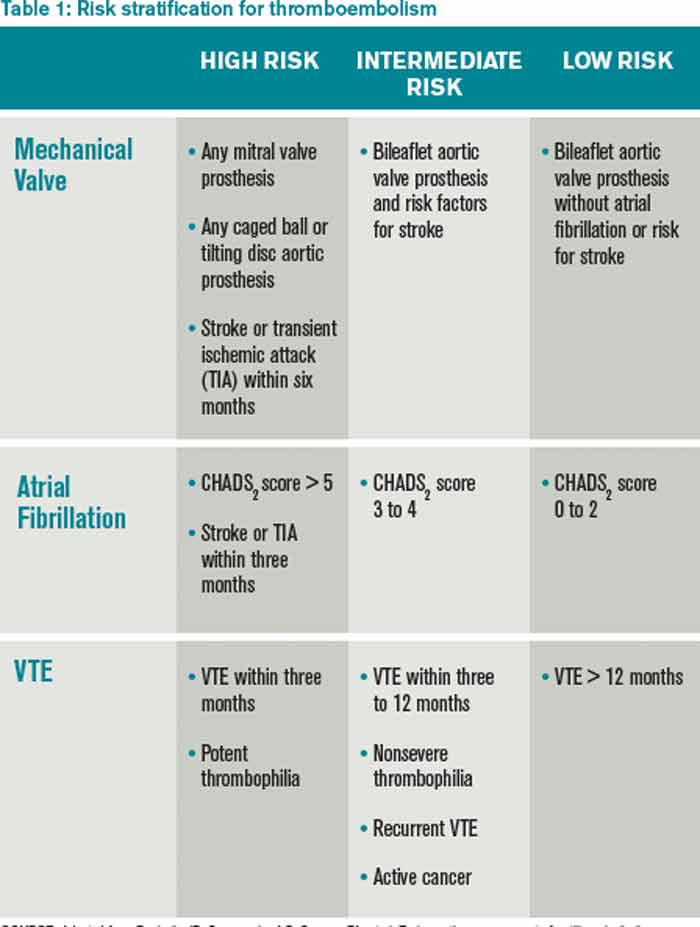
Source: Adapted from Douketis JD, Spyropoulos AC, Spencer FA, et al. Perioperative management of antithrombotic therapy: Antithrombotic Therapy and Prevention of Thrombosis, 9th ed: American College of Chest Physicians Evidence-Based Clinical Practice Guidelines. Chest. 2012;141(2 Suppl):e326S-350S.
Resumption of Antiplatelet Agents
The decision to resume antiplatelet therapy should also be highly individualized. In addition to weighing the risk of bleeding (as described in the previous section), the physician must also estimate the benefits of antiplatelet therapy in decreasing the risk of cardiovascular events.
In low-risk patients on antiplatelet therapy (i.e., for primary cardiovascular prevention) reinitiation after a bleeding episode can be reasonably delayed, because the risk of rebleeding likely outweighs the potential benefit of restarting therapy.
For patients who are at intermediate risk (i.e., those on antiplatelet agents for secondary prevention of cardiovascular disease), emerging evidence argues for early reinstitution after a GI bleed. In a trial published in Annals of Internal Medicine, Sung and colleagues randomized 156 patients to aspirin or placebo therapy immediately following endoscopically obtained hemostasis for peptic ulcer bleeding.4 All patients received PPIs. There was no significant difference in bleeding rates between the two groups, but delayed resumption of aspirin was associated with a significant increase in all-cause mortality.
Two recent meta-analyses provide further insight into the risks of withholding aspirin therapy. The first, which included 50,279 patients on aspirin for secondary prevention, found that aspirin non-adherence or withdrawal after a GI bleed was associated with a three-fold higher risk of major adverse cardiac events.5 Cardiac event rates were highest in the subgroup of patients with a history of prior percutaneous coronary stenting.
A second meta-analysis evaluated patients who had aspirin held perioperatively. In a population of patients on aspirin for secondary prevention, the mean time after withholding aspirin was 8.5 days to coronary events, 14.3 days to cerebrovascular events, and 25.8 days to peripheral arterial events.6 Events occurred as early as five days after withdrawal of aspirin.
Patients with recent intracoronary stenting are at highest risk of thrombosis. In patients with a bare metal stent placed within six weeks, or a drug-eluting stent placed within six months, every effort should be made to minimize interruptions of dual antiplatelet therapy.
Based on the data presented above, for patients at intermediate and/or high risk of adverse cardiac events, we recommend reinstitution of aspirin as soon as possible following a GI hemorrhage, preferably within five days. PPI co-therapy is a mainstay for secondary prevention of upper GI bleeding in patients on antiplatelet therapy. Current research and guidelines have not addressed specifically the role of withholding and reinitiating aspirin in lower GI bleeding, non-peptic ulcer, or upper-GI bleeding, however, a similar strategy is likely appropriate. As with the decision for restarting anticoagulants, discussion with relevant specialists is essential to best define the risk of re-bleeding.
Back to the Cases
Given her CHADS2 score of three, the patient with a diverticular bleed has a 9.6% annual risk of stroke if she does not resume anticoagulation. Using the HAS-BLED and ATRIA scores, this patient has 2.6% to 5.8% annual risk of hemorrhage. We recommend resuming warfarin anticoagulation therapy within four days of achieving hemostasis.
For the patient with coronary artery disease with remote drug-eluting stent placement and upper GI bleed, evidence supports early resumption of appropriate antiplatelet therapy following endoscopic therapy and hemostasis. We recommend resuming aspirin during the current hospitalization and concomitant treatment with a PPI indefinitely.
Bottom Line
Following a GI bleed, the risks and benefits of restarting anticoagulant and antiplatelet agents need to be carefully considered. In patients on oral anticoagulants at high risk for thromboembolism and low risk for rebleeding, consider restarting anticoagulation within four to five days. Patients on antiplatelet agents for secondary prevention should have the medication restarted during hospitalization after endoscopically obtained hemostasis of a peptic ulcer.
In all cases, hospitalists should engage the patient, gastroenterologist, and outpatient provider to best determine when resumption of anticoagulant and/or antiplatelet agents should occur.
Dr. Allen-Dicker is a hospitalist and clinical instructor at Mount Sinai Medical Center in New York City. Dr. Briones is director of perioperative services in the division of hospital medicine and an assistant professor; Dr. Berman is a hospitalist and a clinical instructor, and Dr. Dunn is a professor of medicine and chief of the division of hospital medicine, all at Mount Sinai Medical Center.
References
- Barkun AN, Bardou M, Kuipers EJ, et al. International consensus recommendations on the management of patients with nonvariceal upper gastrointestinal bleeding. Ann Intern Med. 2010;152(2):101-113.
- Witt DM, Delate T, Garcia DA, et al. Risk of thromboembolism, recurrent hemorrhage, and death after warfarin therapy interruption for gastrointestinal tract bleeding. Arch Intern Med. 2012;172(19):1484-1491.
- Douketis JD, Spyropoulos AC, Spencer FA, et al. Perioperative management of antithrombotic therapy: Antithrombotic Therapy and Prevention of Thrombosis, 9th ed: American College of Chest Physicians Evidence-Based Clinical Practice Guidelines. Chest. 2012;141(2 Suppl):e326S-350S.
- Sung JJ, Lau JY, Ching JY, et al. Continuation of low-dose aspirin therapy in peptic ulcer bleeding: A randomized trial. Ann Intern Med. 2010;152(1):1-9.
- Biondi-Zoccai GG, Lotrionte M, Agostoni P, et al. A systematic review and meta-analysis on the hazards of discontinuing or not adhering to aspirin among 50,279 patients at risk for coronary artery disease. Eur Heart J. 2006;27(22):2667-2674.
- Burger W, Chemnitius JM, Kneissl GD, Rücker G. Low-dose aspirin for secondary cardiovascular prevention – cardiovascular risks after its perioperative withdrawal versus bleeding risks with its continuation – review and meta-analysis. J Intern Med. 2005;257(5):399-414.
Source: Adapted from Douketis JD, Spyropoulos AC, Spencer FA, et al. Perioperative management of antithrombotic therapy: Antithrombotic Therapy and Prevention of Thrombosis, 9th ed: American College of Chest Physicians Evidence-Based Clinical Practice Guidelines. Chest. 2012;141(2 Suppl):e326S-350S.
Two Cases
A 76-year-old female with a history of hypertension, diabetes, atrial fibrillation, and diverticulosis is admitted with acute onset of dizziness and several episodes of bright red blood per rectum. Her labs show a new anemia at hemoglobin level 6.9 g/dL and an international normalized ratio (INR) of 2.7. She is transfused several units of packed red blood cells and fresh frozen plasma without further bleeding. She undergoes an esophagogastroduodenoscopy (EGD) and colonoscopy, which are notable only for extensive diverticulosis. In preparing the discharge medication reconciliation, you are uncertain what to do with the patient’s anticoagulation.
An 85-year-old male with coronary artery disease status post-percutaneous coronary intervention, with placement of a drug-eluting stent several years prior, is admitted with multiple weeks of epigastric discomfort and acute onset of hematemesis. His laboratory tests are notable for a new anemia at hemoglobin level 6.5 g/dL. Urgent EGD demonstrates a bleeding ulcer, which is cauterized. He is started on a proton-pump inhibitor (PPI). He inquires as to when he can restart his home medications, including aspirin.
Overview
Gastrointestinal (GI) bleeding is a serious complication of anticoagulant and antiplatelet therapy. Risks for GI bleeding include older age, history of peptic ulcer disease, NSAID or steroid use, and the use of antiplatelet or anticoagulation therapy. The estimated incidence of GI bleeding in the general population is 48 to 160 cases (upper GI) and 21 cases (lower GI) per 1,000 adults per year, with a case-mortality rate between 5% and 14%.1
Although there is consensus on ceasing anticoagulant and antiplatelet agents during an acute GI bleed, debate remains over the appropriate approach to restarting these agents.
Anticoagulant Resumption
A recent study published in Archives of Internal Medicine supports a quick resumption of anticoagulation following a GI bleed.2 Although previous studies on restarting anticoagulants were small and demonstrated mixed results, this retrospective cohort study examined more than 442 warfarin-associated GI bleeds. After adjusting for various clinical indicators (e.g. clinical seriousness of bleeding, requirement of transfusions), the investigators found that the decision not to resume warfarin within 90 days of an initial GI hemorrhage was associated with an increased risk of thrombosis and death. Of note, in those patients restarted on warfarin, the mean time to medication initiation was four days following the initial GI bleed. In those not restarted on warfarin, the earliest incidence of thrombosis was documented at eight days following cessation of anticoagulation.2
Though its clinical implications are limited by the retrospective design, this study is helpful in guiding management decisions. Randomized control trials and society recommendations on this topic are lacking, so the decision to resume anticoagulants rests on patient-specific estimates of the risk of recurrent bleeding and the benefits of resuming anticoagulants.
In identifying those patients most likely to benefit from restarting anticoagulation, the risk of thromboembolism should be determined using an established risk stratification framework, such as Antithrombotic Therapy and Prevention of Thrombosis, 9th edition (see Table 1).3 According to the guidelines, patients at highest risk of thromboembolism (in the absence of anticoagulation) are those with:
- mitral valve prostheses;
- atrial fibrillation with a CHADS2 score of five to six or cerebrovascular accidents (CVA) within the last three months; and/or
- venous thromboembolism (VTE) within the last three months or history of severe thrombophilia.
Patients at the lowest risk of thromboembolism are those with:
- mechanical aortic prostheses with no other stroke risk factors;
- atrial fibrillation with a CHADS2 score of zero to two; and/or
- a single VTE that occurred >12 months prior.
There are several approaches to identifying patients at greatest risk for bleeding. Location-specific modeling for upper GI bleeds (e.g. Rockall score) and lower GI bleeds (e.g. BLEED score) focus on the clinical presentation and/or endoscopic findings. General hemorrhage risk scores (e.g. HAS-BLED, ATRIA) focus on medical comorbidities. While easy to use, the predictive value of such scores as part of anticoagulation resumption after a GI hemorrhage remains uncertain.
Based on the above methods of risk stratification, patients at higher risk of thromboembolism and lower risk of bleeding will likely benefit from waiting only a short time interval before restarting anticoagulation. Based on the trial conducted by Witt and colleagues, anticoagulation typically can be reinitiated within four days of obtaining hemostatic and hemodynamic stability.2 Conversely, those at highest risk of bleeding and lower risk of thromboembolism will benefit from a delayed resumption of anticoagulation. Involvement of a specialist, such as a gastroenterologist, could help further clarify the risk of rebleeding.
The ideal approach for patients with a high risk of both bleeding and thromboembolism remains uncertain. Such cases highlight the need for an informed discussion with the patient and any involved caregivers, as well as involvement of inpatient subspecialists and outpatient longitudinal providers.
There remains a lack of evidence on the best method to restart anticoagulation. Based on small and retrospective trials, we recommend restarting warfarin at the patient’s previous home dose. The duration of inpatient monitoring following warfarin initiation should be individualized, but warfarin is not expected to impair coagulation for four to six days after initiation.
Little data is available with respect to the role of novel oral anticoagulants after a GI bleed. Given the lack of reversing agents for these drugs, we recommend exercising caution in populations with a high risk of rebleeding. Theoretically, given that these agents reach peak effect faster than warfarin, waiting an additional four days after the time frame recommended for starting warfarin is a prudent resumption strategy for novel oral anticoagulants.
Source: Adapted from Douketis JD, Spyropoulos AC, Spencer FA, et al. Perioperative management of antithrombotic therapy: Antithrombotic Therapy and Prevention of Thrombosis, 9th ed: American College of Chest Physicians Evidence-Based Clinical Practice Guidelines. Chest. 2012;141(2 Suppl):e326S-350S.
Resumption of Antiplatelet Agents
The decision to resume antiplatelet therapy should also be highly individualized. In addition to weighing the risk of bleeding (as described in the previous section), the physician must also estimate the benefits of antiplatelet therapy in decreasing the risk of cardiovascular events.
In low-risk patients on antiplatelet therapy (i.e., for primary cardiovascular prevention) reinitiation after a bleeding episode can be reasonably delayed, because the risk of rebleeding likely outweighs the potential benefit of restarting therapy.
For patients who are at intermediate risk (i.e., those on antiplatelet agents for secondary prevention of cardiovascular disease), emerging evidence argues for early reinstitution after a GI bleed. In a trial published in Annals of Internal Medicine, Sung and colleagues randomized 156 patients to aspirin or placebo therapy immediately following endoscopically obtained hemostasis for peptic ulcer bleeding.4 All patients received PPIs. There was no significant difference in bleeding rates between the two groups, but delayed resumption of aspirin was associated with a significant increase in all-cause mortality.
Two recent meta-analyses provide further insight into the risks of withholding aspirin therapy. The first, which included 50,279 patients on aspirin for secondary prevention, found that aspirin non-adherence or withdrawal after a GI bleed was associated with a three-fold higher risk of major adverse cardiac events.5 Cardiac event rates were highest in the subgroup of patients with a history of prior percutaneous coronary stenting.
A second meta-analysis evaluated patients who had aspirin held perioperatively. In a population of patients on aspirin for secondary prevention, the mean time after withholding aspirin was 8.5 days to coronary events, 14.3 days to cerebrovascular events, and 25.8 days to peripheral arterial events.6 Events occurred as early as five days after withdrawal of aspirin.
Patients with recent intracoronary stenting are at highest risk of thrombosis. In patients with a bare metal stent placed within six weeks, or a drug-eluting stent placed within six months, every effort should be made to minimize interruptions of dual antiplatelet therapy.
Based on the data presented above, for patients at intermediate and/or high risk of adverse cardiac events, we recommend reinstitution of aspirin as soon as possible following a GI hemorrhage, preferably within five days. PPI co-therapy is a mainstay for secondary prevention of upper GI bleeding in patients on antiplatelet therapy. Current research and guidelines have not addressed specifically the role of withholding and reinitiating aspirin in lower GI bleeding, non-peptic ulcer, or upper-GI bleeding, however, a similar strategy is likely appropriate. As with the decision for restarting anticoagulants, discussion with relevant specialists is essential to best define the risk of re-bleeding.
Back to the Cases
Given her CHADS2 score of three, the patient with a diverticular bleed has a 9.6% annual risk of stroke if she does not resume anticoagulation. Using the HAS-BLED and ATRIA scores, this patient has 2.6% to 5.8% annual risk of hemorrhage. We recommend resuming warfarin anticoagulation therapy within four days of achieving hemostasis.
For the patient with coronary artery disease with remote drug-eluting stent placement and upper GI bleed, evidence supports early resumption of appropriate antiplatelet therapy following endoscopic therapy and hemostasis. We recommend resuming aspirin during the current hospitalization and concomitant treatment with a PPI indefinitely.
Bottom Line
Following a GI bleed, the risks and benefits of restarting anticoagulant and antiplatelet agents need to be carefully considered. In patients on oral anticoagulants at high risk for thromboembolism and low risk for rebleeding, consider restarting anticoagulation within four to five days. Patients on antiplatelet agents for secondary prevention should have the medication restarted during hospitalization after endoscopically obtained hemostasis of a peptic ulcer.
In all cases, hospitalists should engage the patient, gastroenterologist, and outpatient provider to best determine when resumption of anticoagulant and/or antiplatelet agents should occur.
Dr. Allen-Dicker is a hospitalist and clinical instructor at Mount Sinai Medical Center in New York City. Dr. Briones is director of perioperative services in the division of hospital medicine and an assistant professor; Dr. Berman is a hospitalist and a clinical instructor, and Dr. Dunn is a professor of medicine and chief of the division of hospital medicine, all at Mount Sinai Medical Center.
References
- Barkun AN, Bardou M, Kuipers EJ, et al. International consensus recommendations on the management of patients with nonvariceal upper gastrointestinal bleeding. Ann Intern Med. 2010;152(2):101-113.
- Witt DM, Delate T, Garcia DA, et al. Risk of thromboembolism, recurrent hemorrhage, and death after warfarin therapy interruption for gastrointestinal tract bleeding. Arch Intern Med. 2012;172(19):1484-1491.
- Douketis JD, Spyropoulos AC, Spencer FA, et al. Perioperative management of antithrombotic therapy: Antithrombotic Therapy and Prevention of Thrombosis, 9th ed: American College of Chest Physicians Evidence-Based Clinical Practice Guidelines. Chest. 2012;141(2 Suppl):e326S-350S.
- Sung JJ, Lau JY, Ching JY, et al. Continuation of low-dose aspirin therapy in peptic ulcer bleeding: A randomized trial. Ann Intern Med. 2010;152(1):1-9.
- Biondi-Zoccai GG, Lotrionte M, Agostoni P, et al. A systematic review and meta-analysis on the hazards of discontinuing or not adhering to aspirin among 50,279 patients at risk for coronary artery disease. Eur Heart J. 2006;27(22):2667-2674.
- Burger W, Chemnitius JM, Kneissl GD, Rücker G. Low-dose aspirin for secondary cardiovascular prevention – cardiovascular risks after its perioperative withdrawal versus bleeding risks with its continuation – review and meta-analysis. J Intern Med. 2005;257(5):399-414.
Source: Adapted from Douketis JD, Spyropoulos AC, Spencer FA, et al. Perioperative management of antithrombotic therapy: Antithrombotic Therapy and Prevention of Thrombosis, 9th ed: American College of Chest Physicians Evidence-Based Clinical Practice Guidelines. Chest. 2012;141(2 Suppl):e326S-350S.
Two Cases
A 76-year-old female with a history of hypertension, diabetes, atrial fibrillation, and diverticulosis is admitted with acute onset of dizziness and several episodes of bright red blood per rectum. Her labs show a new anemia at hemoglobin level 6.9 g/dL and an international normalized ratio (INR) of 2.7. She is transfused several units of packed red blood cells and fresh frozen plasma without further bleeding. She undergoes an esophagogastroduodenoscopy (EGD) and colonoscopy, which are notable only for extensive diverticulosis. In preparing the discharge medication reconciliation, you are uncertain what to do with the patient’s anticoagulation.
An 85-year-old male with coronary artery disease status post-percutaneous coronary intervention, with placement of a drug-eluting stent several years prior, is admitted with multiple weeks of epigastric discomfort and acute onset of hematemesis. His laboratory tests are notable for a new anemia at hemoglobin level 6.5 g/dL. Urgent EGD demonstrates a bleeding ulcer, which is cauterized. He is started on a proton-pump inhibitor (PPI). He inquires as to when he can restart his home medications, including aspirin.
Overview
Gastrointestinal (GI) bleeding is a serious complication of anticoagulant and antiplatelet therapy. Risks for GI bleeding include older age, history of peptic ulcer disease, NSAID or steroid use, and the use of antiplatelet or anticoagulation therapy. The estimated incidence of GI bleeding in the general population is 48 to 160 cases (upper GI) and 21 cases (lower GI) per 1,000 adults per year, with a case-mortality rate between 5% and 14%.1
Although there is consensus on ceasing anticoagulant and antiplatelet agents during an acute GI bleed, debate remains over the appropriate approach to restarting these agents.
Anticoagulant Resumption
A recent study published in Archives of Internal Medicine supports a quick resumption of anticoagulation following a GI bleed.2 Although previous studies on restarting anticoagulants were small and demonstrated mixed results, this retrospective cohort study examined more than 442 warfarin-associated GI bleeds. After adjusting for various clinical indicators (e.g. clinical seriousness of bleeding, requirement of transfusions), the investigators found that the decision not to resume warfarin within 90 days of an initial GI hemorrhage was associated with an increased risk of thrombosis and death. Of note, in those patients restarted on warfarin, the mean time to medication initiation was four days following the initial GI bleed. In those not restarted on warfarin, the earliest incidence of thrombosis was documented at eight days following cessation of anticoagulation.2
Though its clinical implications are limited by the retrospective design, this study is helpful in guiding management decisions. Randomized control trials and society recommendations on this topic are lacking, so the decision to resume anticoagulants rests on patient-specific estimates of the risk of recurrent bleeding and the benefits of resuming anticoagulants.
In identifying those patients most likely to benefit from restarting anticoagulation, the risk of thromboembolism should be determined using an established risk stratification framework, such as Antithrombotic Therapy and Prevention of Thrombosis, 9th edition (see Table 1).3 According to the guidelines, patients at highest risk of thromboembolism (in the absence of anticoagulation) are those with:
- mitral valve prostheses;
- atrial fibrillation with a CHADS2 score of five to six or cerebrovascular accidents (CVA) within the last three months; and/or
- venous thromboembolism (VTE) within the last three months or history of severe thrombophilia.
Patients at the lowest risk of thromboembolism are those with:
- mechanical aortic prostheses with no other stroke risk factors;
- atrial fibrillation with a CHADS2 score of zero to two; and/or
- a single VTE that occurred >12 months prior.
There are several approaches to identifying patients at greatest risk for bleeding. Location-specific modeling for upper GI bleeds (e.g. Rockall score) and lower GI bleeds (e.g. BLEED score) focus on the clinical presentation and/or endoscopic findings. General hemorrhage risk scores (e.g. HAS-BLED, ATRIA) focus on medical comorbidities. While easy to use, the predictive value of such scores as part of anticoagulation resumption after a GI hemorrhage remains uncertain.
Based on the above methods of risk stratification, patients at higher risk of thromboembolism and lower risk of bleeding will likely benefit from waiting only a short time interval before restarting anticoagulation. Based on the trial conducted by Witt and colleagues, anticoagulation typically can be reinitiated within four days of obtaining hemostatic and hemodynamic stability.2 Conversely, those at highest risk of bleeding and lower risk of thromboembolism will benefit from a delayed resumption of anticoagulation. Involvement of a specialist, such as a gastroenterologist, could help further clarify the risk of rebleeding.
The ideal approach for patients with a high risk of both bleeding and thromboembolism remains uncertain. Such cases highlight the need for an informed discussion with the patient and any involved caregivers, as well as involvement of inpatient subspecialists and outpatient longitudinal providers.
There remains a lack of evidence on the best method to restart anticoagulation. Based on small and retrospective trials, we recommend restarting warfarin at the patient’s previous home dose. The duration of inpatient monitoring following warfarin initiation should be individualized, but warfarin is not expected to impair coagulation for four to six days after initiation.
Little data is available with respect to the role of novel oral anticoagulants after a GI bleed. Given the lack of reversing agents for these drugs, we recommend exercising caution in populations with a high risk of rebleeding. Theoretically, given that these agents reach peak effect faster than warfarin, waiting an additional four days after the time frame recommended for starting warfarin is a prudent resumption strategy for novel oral anticoagulants.
Source: Adapted from Douketis JD, Spyropoulos AC, Spencer FA, et al. Perioperative management of antithrombotic therapy: Antithrombotic Therapy and Prevention of Thrombosis, 9th ed: American College of Chest Physicians Evidence-Based Clinical Practice Guidelines. Chest. 2012;141(2 Suppl):e326S-350S.
Resumption of Antiplatelet Agents
The decision to resume antiplatelet therapy should also be highly individualized. In addition to weighing the risk of bleeding (as described in the previous section), the physician must also estimate the benefits of antiplatelet therapy in decreasing the risk of cardiovascular events.
In low-risk patients on antiplatelet therapy (i.e., for primary cardiovascular prevention) reinitiation after a bleeding episode can be reasonably delayed, because the risk of rebleeding likely outweighs the potential benefit of restarting therapy.
For patients who are at intermediate risk (i.e., those on antiplatelet agents for secondary prevention of cardiovascular disease), emerging evidence argues for early reinstitution after a GI bleed. In a trial published in Annals of Internal Medicine, Sung and colleagues randomized 156 patients to aspirin or placebo therapy immediately following endoscopically obtained hemostasis for peptic ulcer bleeding.4 All patients received PPIs. There was no significant difference in bleeding rates between the two groups, but delayed resumption of aspirin was associated with a significant increase in all-cause mortality.
Two recent meta-analyses provide further insight into the risks of withholding aspirin therapy. The first, which included 50,279 patients on aspirin for secondary prevention, found that aspirin non-adherence or withdrawal after a GI bleed was associated with a three-fold higher risk of major adverse cardiac events.5 Cardiac event rates were highest in the subgroup of patients with a history of prior percutaneous coronary stenting.
A second meta-analysis evaluated patients who had aspirin held perioperatively. In a population of patients on aspirin for secondary prevention, the mean time after withholding aspirin was 8.5 days to coronary events, 14.3 days to cerebrovascular events, and 25.8 days to peripheral arterial events.6 Events occurred as early as five days after withdrawal of aspirin.
Patients with recent intracoronary stenting are at highest risk of thrombosis. In patients with a bare metal stent placed within six weeks, or a drug-eluting stent placed within six months, every effort should be made to minimize interruptions of dual antiplatelet therapy.
Based on the data presented above, for patients at intermediate and/or high risk of adverse cardiac events, we recommend reinstitution of aspirin as soon as possible following a GI hemorrhage, preferably within five days. PPI co-therapy is a mainstay for secondary prevention of upper GI bleeding in patients on antiplatelet therapy. Current research and guidelines have not addressed specifically the role of withholding and reinitiating aspirin in lower GI bleeding, non-peptic ulcer, or upper-GI bleeding, however, a similar strategy is likely appropriate. As with the decision for restarting anticoagulants, discussion with relevant specialists is essential to best define the risk of re-bleeding.
Back to the Cases
Given her CHADS2 score of three, the patient with a diverticular bleed has a 9.6% annual risk of stroke if she does not resume anticoagulation. Using the HAS-BLED and ATRIA scores, this patient has 2.6% to 5.8% annual risk of hemorrhage. We recommend resuming warfarin anticoagulation therapy within four days of achieving hemostasis.
For the patient with coronary artery disease with remote drug-eluting stent placement and upper GI bleed, evidence supports early resumption of appropriate antiplatelet therapy following endoscopic therapy and hemostasis. We recommend resuming aspirin during the current hospitalization and concomitant treatment with a PPI indefinitely.
Bottom Line
Following a GI bleed, the risks and benefits of restarting anticoagulant and antiplatelet agents need to be carefully considered. In patients on oral anticoagulants at high risk for thromboembolism and low risk for rebleeding, consider restarting anticoagulation within four to five days. Patients on antiplatelet agents for secondary prevention should have the medication restarted during hospitalization after endoscopically obtained hemostasis of a peptic ulcer.
In all cases, hospitalists should engage the patient, gastroenterologist, and outpatient provider to best determine when resumption of anticoagulant and/or antiplatelet agents should occur.
Dr. Allen-Dicker is a hospitalist and clinical instructor at Mount Sinai Medical Center in New York City. Dr. Briones is director of perioperative services in the division of hospital medicine and an assistant professor; Dr. Berman is a hospitalist and a clinical instructor, and Dr. Dunn is a professor of medicine and chief of the division of hospital medicine, all at Mount Sinai Medical Center.
References
- Barkun AN, Bardou M, Kuipers EJ, et al. International consensus recommendations on the management of patients with nonvariceal upper gastrointestinal bleeding. Ann Intern Med. 2010;152(2):101-113.
- Witt DM, Delate T, Garcia DA, et al. Risk of thromboembolism, recurrent hemorrhage, and death after warfarin therapy interruption for gastrointestinal tract bleeding. Arch Intern Med. 2012;172(19):1484-1491.
- Douketis JD, Spyropoulos AC, Spencer FA, et al. Perioperative management of antithrombotic therapy: Antithrombotic Therapy and Prevention of Thrombosis, 9th ed: American College of Chest Physicians Evidence-Based Clinical Practice Guidelines. Chest. 2012;141(2 Suppl):e326S-350S.
- Sung JJ, Lau JY, Ching JY, et al. Continuation of low-dose aspirin therapy in peptic ulcer bleeding: A randomized trial. Ann Intern Med. 2010;152(1):1-9.
- Biondi-Zoccai GG, Lotrionte M, Agostoni P, et al. A systematic review and meta-analysis on the hazards of discontinuing or not adhering to aspirin among 50,279 patients at risk for coronary artery disease. Eur Heart J. 2006;27(22):2667-2674.
- Burger W, Chemnitius JM, Kneissl GD, Rücker G. Low-dose aspirin for secondary cardiovascular prevention – cardiovascular risks after its perioperative withdrawal versus bleeding risks with its continuation – review and meta-analysis. J Intern Med. 2005;257(5):399-414.
Oseltamivir for Healthy Pediatric Inpatients with Influenza Unlikely to Yield Measurable Benefit

Clinical question: What is the benefit of oseltamivir treatment to previously healthy children hospitalized with confirmed influenza infection?
Background: Influenza is generally a mild, self-limited infection that affects all ages but can lead to more serious illness. During the 2012-2013 season, laboratory-confirmed influenza in children zero to four years was associated with a hospitalization rate of 66.4 per 100,000 and 164 pediatric deaths. Currently, the American Academy of Pediatrics and the CDC recommend treatment with either oseltamivir or zanamivir for children hospitalized with influenza. However, despite the recommendations, data are limited regarding the benefits resulting from treating otherwise healthy children hospitalized with influenza.
Study design: Multi-center retrospective study.
Setting: Ten public hospitals in Madrid, Spain, between September 2010 and June 2012.
Synopsis: Researchers identified children ≤14 years admitted to participating hospitals by positive testing with either rapid diagnostic testing or polymerase chain reaction assay of nasal washings. Patients at high risk of serious disease were excluded, including those with chronic disease, immunodeficiency, prematurity (less than 32 weeks gestation), age less than six months at admission, nosocomial infection, and those requiring ICU-level care upon admission. Patients with asthma were included. Decision to treat with oseltamivir was determined by hospital guidelines, with some hospitals treating all hospitalized children with confirmed influenza and others only treating patients with risk factors for severe disease. In addition, only children who had manifested symptoms within 48 hours of admission were included.
Of the 287 children included in the final analysis, 93 were treated with oseltamivir (32%). There were no significant differences between treatment and non-treatment groups in duration of fever, duration of hypoxia, length of stay, or rates of ICU transfer. In addition, the lack of differences in outcomes persisted after subgroup analysis of patients less than one year old.
Bottom line: Treatment with oseltamivir of otherwise healthy children hospitalized with influenza not requiring ICU care is unlikely to yield measurable benefit.
Citation: Bueno M, Calvo C, Mendez-Echevarría A, et al. Oseltamivir treatment for influenza in hospitalized children without underlying diseases. Pediatr Infect Dis J. 2013;32(10):1066-1069.
Reviewed by Pediatric Editor Weijen Chang, MD, SFHM, FAAP, associate clinical professor of medicine and pediatrics at the University of California at San Diego School of Medicine, and a hospitalist at both UCSD Medical Center and Rady Children’s Hospital.
Clinical question: What is the benefit of oseltamivir treatment to previously healthy children hospitalized with confirmed influenza infection?
Background: Influenza is generally a mild, self-limited infection that affects all ages but can lead to more serious illness. During the 2012-2013 season, laboratory-confirmed influenza in children zero to four years was associated with a hospitalization rate of 66.4 per 100,000 and 164 pediatric deaths. Currently, the American Academy of Pediatrics and the CDC recommend treatment with either oseltamivir or zanamivir for children hospitalized with influenza. However, despite the recommendations, data are limited regarding the benefits resulting from treating otherwise healthy children hospitalized with influenza.
Study design: Multi-center retrospective study.
Setting: Ten public hospitals in Madrid, Spain, between September 2010 and June 2012.
Synopsis: Researchers identified children ≤14 years admitted to participating hospitals by positive testing with either rapid diagnostic testing or polymerase chain reaction assay of nasal washings. Patients at high risk of serious disease were excluded, including those with chronic disease, immunodeficiency, prematurity (less than 32 weeks gestation), age less than six months at admission, nosocomial infection, and those requiring ICU-level care upon admission. Patients with asthma were included. Decision to treat with oseltamivir was determined by hospital guidelines, with some hospitals treating all hospitalized children with confirmed influenza and others only treating patients with risk factors for severe disease. In addition, only children who had manifested symptoms within 48 hours of admission were included.
Of the 287 children included in the final analysis, 93 were treated with oseltamivir (32%). There were no significant differences between treatment and non-treatment groups in duration of fever, duration of hypoxia, length of stay, or rates of ICU transfer. In addition, the lack of differences in outcomes persisted after subgroup analysis of patients less than one year old.
Bottom line: Treatment with oseltamivir of otherwise healthy children hospitalized with influenza not requiring ICU care is unlikely to yield measurable benefit.
Citation: Bueno M, Calvo C, Mendez-Echevarría A, et al. Oseltamivir treatment for influenza in hospitalized children without underlying diseases. Pediatr Infect Dis J. 2013;32(10):1066-1069.
Reviewed by Pediatric Editor Weijen Chang, MD, SFHM, FAAP, associate clinical professor of medicine and pediatrics at the University of California at San Diego School of Medicine, and a hospitalist at both UCSD Medical Center and Rady Children’s Hospital.
Clinical question: What is the benefit of oseltamivir treatment to previously healthy children hospitalized with confirmed influenza infection?
Background: Influenza is generally a mild, self-limited infection that affects all ages but can lead to more serious illness. During the 2012-2013 season, laboratory-confirmed influenza in children zero to four years was associated with a hospitalization rate of 66.4 per 100,000 and 164 pediatric deaths. Currently, the American Academy of Pediatrics and the CDC recommend treatment with either oseltamivir or zanamivir for children hospitalized with influenza. However, despite the recommendations, data are limited regarding the benefits resulting from treating otherwise healthy children hospitalized with influenza.
Study design: Multi-center retrospective study.
Setting: Ten public hospitals in Madrid, Spain, between September 2010 and June 2012.
Synopsis: Researchers identified children ≤14 years admitted to participating hospitals by positive testing with either rapid diagnostic testing or polymerase chain reaction assay of nasal washings. Patients at high risk of serious disease were excluded, including those with chronic disease, immunodeficiency, prematurity (less than 32 weeks gestation), age less than six months at admission, nosocomial infection, and those requiring ICU-level care upon admission. Patients with asthma were included. Decision to treat with oseltamivir was determined by hospital guidelines, with some hospitals treating all hospitalized children with confirmed influenza and others only treating patients with risk factors for severe disease. In addition, only children who had manifested symptoms within 48 hours of admission were included.
Of the 287 children included in the final analysis, 93 were treated with oseltamivir (32%). There were no significant differences between treatment and non-treatment groups in duration of fever, duration of hypoxia, length of stay, or rates of ICU transfer. In addition, the lack of differences in outcomes persisted after subgroup analysis of patients less than one year old.
Bottom line: Treatment with oseltamivir of otherwise healthy children hospitalized with influenza not requiring ICU care is unlikely to yield measurable benefit.
Citation: Bueno M, Calvo C, Mendez-Echevarría A, et al. Oseltamivir treatment for influenza in hospitalized children without underlying diseases. Pediatr Infect Dis J. 2013;32(10):1066-1069.
Reviewed by Pediatric Editor Weijen Chang, MD, SFHM, FAAP, associate clinical professor of medicine and pediatrics at the University of California at San Diego School of Medicine, and a hospitalist at both UCSD Medical Center and Rady Children’s Hospital.
Reviews of Research on Haloperidol and ICU Delirium, Proton Pump Inhibitors, Thrombolytics and Stroke

In This Edition
Literature At A Glance
A guide to this month’s studies
- Intravenous haloperidol does not prevent ICU delirium
- Predicting delirium risk in hospitalized adults
- Oral PPIs as effective as IV PPIs in peptic ulcer bleeding
- Probiotic benefit questioned in the elderly
- Colchicine and NSAID better than NSAID alone for acute pericarditis
- Improvement needed in patient understanding at hospital discharge
- Effectiveness of a multihospital effort to reduce rehospitalization
- Hospitals profit from preventing surgical site infections
- Prothrombin complex concentrate safer than fresh frozen plasma in rapidly reversing INR
- Hospital-acquired anemia associated with higher mortality, increased LOS
- Thrombolytics and stroke: the faster the better
Intravenous Haloperidol Does Not Prevent ICU Delirium
Clinical question: Can haloperidol reduce delirium in critically ill patients if initiated early in ICU stay?
Background: Prior studies suggest antipsychotics reduce intensity and duration of delirium in hospitalized patients. Evidence is mixed for preventing delirium. A trial of risperidone demonstrated delirium rate reduction in coronary artery bypass grafting (CABG) patients, but another trial of haloperidol in hip surgery patients failed to prevent onset of delirium. There is little evidence on antipsychotics in ICU delirium.
Study design: Randomized, double-blinded, placebo-controlled trial.
Setting: Single, adult ICU in England.
Synopsis: The study randomized 142 critically ill patients to receive 2.5 mg of intravenous haloperidol versus placebo every eight hours for up to 14 days. There was no significant difference between groups in the total time spent free of delirium or coma. Limitations include the use of open-label haloperidol in 21% of the placebo group patients. More sedation but less agitation was seen with the use of haloperidol, which also prolonged QTc. No severe adverse effects were observed.
This study supports the idea that scheduled antipsychotics should not be used to reduce ICU delirium. Addressing modifiable risk factors and using dexmedetomidine rather than lorazepam for sedation in the ICU continue to be first-line strategies to lower delirium rates.
Bottom line: Prophylactic haloperidol should not be used to prevent ICU delirium.
Citation: Page VJ, Ely EW, Gates S, et al. Effect of intravenous haloperidol on the duration of delirium and coma in critically ill patients (Hope-ICU): a randomized, double-blind, placebo-controlled trial. Lancet Respir Med. 2013;1(7):515-523.
Predicting Delirium Risk in Hospitalized Adults
Clinical question: Can a simple tool be developed and used for predicting delirium in hospitalized adults?
Background: Delirium is a common condition that results in higher mortality, longer length of stays, and higher probability of discharge to nursing home. Current delirium prediction tools are complicated, or restricted to surgical or critically ill patients.
Study design: Prospective cohort study, with separate derivation and validation cohorts.
Setting: Two academic hospitals and a VA hospital in San Francisco.
Synopsis: Investigators enrolled 374 hospitalized patients who were more than 50 years of age and not delirious at time of admission (209 patients in the derivation and 165 in the validation). The authors identified four predictors of delirium: Age >80; failure to spell “World” backwards; disOrientation to place; and higher nurse-rated iLlness severity (AWOL). The authors found that rates of delirium increased with increasing number of predictors (with zero predictors, 2% developed delirium; one predictor, 4%; two predictors, 14%; three predictors, 20%; four predictors, 64%).
These predictors are similar to other previously identified risk factors, as well as to prediction tools that are in use for surgical patients. However, this tool is quick and can be completed by nursing staff, so it may have a role to play in helping triage patients to units more specialized in preventing delirium.
Bottom line: The AWOL prediction tool is simple to use, broadly applicable, and adds another tool to the literature to determine delirium risk.
Citation: Douglas VC, Hessler CS, Dhaliwal G, et al. The AWOL tool: derivation and validation of a delirium prediction rule. J Hosp Med. 2013;8(9);493-499.
Oral Proton Pump Inhibitors (PPIs) as Effective as IV PPIs in Peptic Ulcer Bleeding
Clinical question: In patients with peptic ulcer bleeding, are oral PPIs of equal benefit to intravenous PPIs?
Background: PPI therapy has been shown in several studies to reduce re-bleeding risk in patients when used adjunctively for peptic ulcer bleeding. In spite of this data, there is still uncertainty about the optimal dose and route of administration.
Study design: Meta-analysis of prospective, randomized control trials.
Setting: OVID database search in June 2012.
Synopsis: A literature search identified six prospective, randomized control trials. Overall, 615 patients were included across the six trials. No significant difference in risk of re-bleeding was discovered between the two groups (8.6% oral vs. 9.3% IV, RR: 0.92, 95% CI: 0.56-1.5). Length of hospital stay was statistically significantly lower for oral PPIs (-0.74 day, 95% CI: -1.10 to -0.39 day).
Because these findings are based on a meta-analysis of studies with notable flaws—including lack of blinding—it is difficult to draw any definitive conclusions from this data. Hospitalists should use care before changing their practice patterns, given the risk of bias and need for further study.
Bottom line: Oral PPIs may reduce hospital length of stay without an increased risk of re-bleeding; however, further study with a well-powered, double-blind, randomized control trial is necessary.
Citation: Tsoi KK, Hirai HW, Sung JJ. Meta-analysis: comparison of oral vs. intravenous proton pump inhibitors in patients with peptic ulcer bleeding. Aliment Pharmacol Ther. 2013;38(7):721-728.
Probiotic Benefit Questioned in the Elderly
Clinical question: Do probiotics prevent antibiotic-associated diarrhea (AAD) in patients 65 and older?
Background: Individual studies using different protocols to assess the efficacy of probiotics in preventing AAD, including Clostridium difficile-associated diarrhea (CDAD), suggest a decreased incidence of AAD when taking probiotics. Meta-analysis of this data also suggests that probiotics are effective in prevention of AAD; however, these results are undermined by the high heterogeneity of the studies included.
Study Design: Randomized, double-blind, placebo-controlled trial.
Setting: Multicenter trial in the United Kingdom.
Synopsis: Nearly 3,000 patients ages 65 years and older who had received one or more antibiotics within seven days were randomized to receive placebo or high-dose probiotics for 21 days. After recruitment, the patients were assessed for AAD up to eight weeks and CDAD up to 12 weeks. Results did not demonstrate a reduction of AAD or CDAD in patients taking probiotics. AAD occurred in 10.8% of patients taking the probiotic and 10.4% of patients taking placebo (95% confidence interval 0.83-1.32). CDAD occurred in 0.8% of patients taking the probiotic and 1.2% of patients taking placebo (95% confidence interval 0.34-1.47).
Based on the results of this double-blind, placebo-controlled trial, there is insufficient evidence to support initiation of probiotics for the prevention of AAD and CDAD in patients 65 years and older. Future studies utilizing standardized protocols against specific antibiotics, along with improved understanding of the underlying mechanisms of AAD prevention, are needed.
Bottom line: High-dose probiotics (lactobacillus acidophilus and bifidobacterium bifidum) do not prevent AAD in elderly patients.
Citation: Allen S, Wareham K, Wang D, et al. Lactobacilli and bifidobacteria in the prevention of antibiotic-associated diarrhoea and Clostridium difficile diarrhoea in older inpatients (PLACIDE): a randomised, double-blind, placebo-controlled, multicentre trial. Lancet. 2013;382(9900):1249-1257.
Colchicine and NSAID Better than NSAID Alone for Acute Pericarditis
Clinical question: Is colchicine safe, effective, and able to prevent recurrence in acute pericarditis?
Background: Colchicine is effective for the treatment of recurrent pericarditis. More recent open-label trials have established its role in acute pericarditis when combined with conventional NSAID therapy. However, a definitive randomized control trial has not been performed to establish colchicine’s role in acute pericarditis.
Study design: Double-blinded, randomized, controlled trial.
Setting: Multicenter in Northern Italy.
Synopsis: Investigators randomized 240 patients to receive either colchicine or placebo in addition to standard therapy of either aspirin or ibuprofen. Incessant or recurrent pericarditis occurred in 16.7% of patients treated with colchicine versus 37.5% in patients receiving placebo (RR 0.56; 95% CI 0.30-0.72; P<0.001). The number needed to treat to prevent one episode of incessant or recurrent pericarditis was four. Colchicine therapy also reduced the frequency of symptom persistence at 72 hours, number of recurrences per patient, rate of hospitalization, and the rate of readmission within one week.
It should be noted that the study excluded the following groups: patients with an elevated troponin, elevated transaminases (>1.5 upper limit of normal), and serum creatinine >2.5.
Bottom line: In addition to conventional therapy, colchicine reduces incessant or recurrent pericarditis in patients with a first episode of acute pericarditis.
Citation: Imazio M, Brucato A, Cemin R, et al. A randomized trial of colchicine for acute pericarditis. N Engl J Med. 2013;369(16):1522-1528.
Improvement Needed in Patient Understanding at Hospital Discharge
Clinical question: How well do older patients with heart failure, pneumonia, or acute coronary syndrome understand their diagnosis and post-discharge follow-up plans compared with medical record data?
Background: As hospitals across the country work on preventing 30-day readmissions, more attention has been given to assessing the quality of discharge processes; few evaluations have been conducted from a patient-centered perspective.
Study Design: Prospective, observational cohort study.
Setting: An urban, academic medical center.
Synopsis: This study evaluated the quality of the discharge process among 377 hospitalized patients >65 years old. Medical record data were compared with patient responses during a telephone interview within one week of discharge. By medical records, every patient received discharge instructions that in 97% of cases included discharge diagnosis, activity instructions, follow-up physician information, and warning signs. The authors determined that discharge diagnosis was not written in lay terms 26% of the time. By patient report, 90% expressed that they understood their discharge diagnosis, yet only around 60% fully understood their diagnosis as it was written in the medical record. Although about half of patients reported having a follow-up appointment upon discharge, only about a third of patients had a documented follow-up appointment in the medical record.
Bottom line: Multiple discrepancies were identified between medical record review and patients’ understanding of their discharge diagnosis and plans. Improvements in discharge processes (such as making follow-up appointments) and in patient education (such as increased use of layperson language) are needed.
Citation: Horwitz LI, Moriarty JP, Chen C, et al. Quality of discharge practices and patient understanding at an academic medical center [published online ahead of print August 19, 2013]. JAMA Intern Med.
Effectiveness of a Multihospital Effort to Reduce Rehospitalization
Clinical question: Does Project BOOST reduce 30-day rehospitalization for hospitals participating in a quality improvement collaborative?
Background: With the advent of penalties for hospitals with excessive 30-day readmissions among Medicare beneficiaries, hospitals nationwide are attempting to reduce 30-day readmission rates. Few interventions aimed at reducing 30-day hospital readmissions have been effective, and successful interventions have limited generalizability.
Study design: Semi-controlled, pre-post study.
Setting: Volunteer sample of acute care pilot units within a nationally representative sample of 11 academic and non-academic hospitals.
Synopsis: The 11 hospitals enrolled in this quality improvement collaborative planned and implemented Project BOOST tools over 12 months with support from an external quality improvement mentor. Each hospital tailored the BOOST tools that they implemented based on a needs assessment. Reporting of clinical outcome data was voluntary; administrative sources at each hospital provided these data. Although 30 hospitals participated in this collaborative, only 11 hospitals reported data for this analysis.
Average 30-day rehospitalization rates among BOOST units fell from pre- to post-implementation (14.7% to 12.7%, P=0.010); 30-day rehospitalization rates among control units did not change during this same time period (14.1% to 14.0%, respectively, P=0.831).
Bottom line: Although the 11 hospitals in this collaborative found reduced 30-day readmissions in association with BOOST implementation, this finding may be biased due to voluntary reporting of data and improvements at one hospital driving the overall effect of the intervention. More rigorous evaluation of Project BOOST is needed.
Citation: Hansen LO, Greewald JL, Budnitz T, et al. Project BOOST: Effectiveness of a multihospital effort to reduce rehospitalization. J Hosp Med. 2013;8(8):421-427.
Hospitals Profit from Preventing Surgical Site Infections
Clinical question: Does quality improvement, in this case preventing surgical site infections (SSIs), necessarily lead to improvement in hospital profit?
Background: It’s clear that preventing SSIs benefits patients and saves money for health insurance providers, but it’s unclear what financial impact SSIs have on hospitals and how best to calculate it. This quantification is needed for cost-benefit analyses of interventions designed to prevent SSIs.
Study design: Retrospective study.
Setting: Four Johns Hopkins-affiliated, tertiary care hospitals.
Synopsis: This retrospective study included all patients admitted to or having certain surgical procedures at four Johns Hopkins-affiliated hospitals between Jan. 1, 2007, and Dec. 31, 2010. Patients were first stratified by complexity, and then those who had a SSI (618) were compared to those without SSIs (399,627 admissions and 25,849 surgeries) for differences in daily hospital charges, length of stay, 30-day readmission rates, and hospital profit.
Although daily charges were essentially the same between the groups, patients with SSIs had almost double the mean length of stay than patients without SSIs. SSI patients also had a drastically higher 30-day readmission rate.
The authors propose equations to determine the change in hospital profit due to a single SSI and calculated that preventing one SSI led to an increase in hospital profit between $4,147 and $22,239. These numbers haven’t included the cost of a SSI prevention program, and the limitations in applying these numbers to all hospitals include widely varying hospital costs and differing ability to fill empty beds.
Bottom line: In these four tertiary care hospitals, each SSI prevented could increase hospital profit by thousands of dollars, as well as significantly decrease length of stay and 30-day readmission rates.
Citation: Shepard J, Ward W, Milstone A, et al. Financial impact of surgical site infections on hospitals: the hospital management perspective. JAMA Surg. 2013;148(10):907-914.
Prothrombin Complex Concentrate Is Safer than Fresh Frozen Plasma in Rapidly Reversing INR
Clinical question: Is prothrombin complex concentrate (PCC) safer and more effective than fresh frozen plasma (FFP) in reversing international normalized ratio (INR)?
Background: In Canada, PCC has become the standard of care over FFP for reversal of critical INR due to decreased time of administration, faster preparation, lack of allergic reactions, and small volume. Few studies compare these two products in their adverse effects, time to INR reversal, length of stay, and blood transfusion requirements.
Study design: Retrospective cohort study.
Setting: Two tertiary care EDs in Canada.
Synopsis: Health records of adult patients with an INR ≥1.8 who received FFP over a two-year period prior to PCC introduction (n=149) were compared to those who received PCC in the two years after PCC introduction (n=165). Total serious adverse events, which include mortality, myocardial infarction, and heart failure, were higher in the FFP group (19.5% versus 9.7%, P=0.0164). Heart failure exacerbations, time to reversal of INR, and units of blood transfused were increased in the FFP group. There was no difference in thromboembolic events or in length of stay.
Due to this study’s retrospective nature, there were issues with documentation of INR measurements, so true rapidity of INR reversal is unknown. In the United States, the FDA only recently approved PCC for use, so availability might be limited.
Bottom line: Prothrombin complex concentrate is an effective and fast alternative to FFP for reversal of critical INR levels.
Citation: Hickey M, Gatien M, Taljaard M, Aujnarain A, Giulivi A, Perry JJ. Outcomes of urgent warfarin reversal with frozen plasma versus prothombin complex concentrate in the emergency department. Circulation. 2013;128(4):360-364.
Hospital-Acquired Anemia Associated with Higher Mortality, Increased LOS
Clinical question: What is the prevalence of hospital-acquired anemia (HAA), and does it lead to increased mortality and resource utilization?
Background: HAA is a multifactorial care-based problem that occurs as a result of hemodilution, phlebotomy, blood loss from procedures, and impaired erythropoiesis. In the general hospital population, very little is known about HAA prevalence or whether HAA is associated with increased mortality, greater length of stay (LOS), or higher costs.
Study design: Retrospective cohort study.
Setting: Large academic health system in Ohio.
Synopsis: Using administrative data and electronic health record data, an analysis of 188,447 hospitalizations showed that HAA prevalence was 74%. Worsening HAA was correlated to an increase in mortality, so that the odds ratio of mortality with moderate anemia (Hgb between >9 and ≤11) was 1.51 (95% confidence interval 1.33-1.71, P<0.001) and severe anemia (Hgb ≤9) was 3.28 (95% confidence interval 2.90-3.72, P<0.001). Increased degree of HAA was correlated to increasing LOS (up to 1.88 extra days for patients with severe anemia) and higher hospital costs.
Because this is a retrospective observational study, no true causal relationship can be discerned from this study. However, the body of evidence linking iatrogenic causes of anemia to negative outcomes is compelling. Hospitalists should attempt to limit blood loss through judicious use of phlebotomy and procedures in their patients, so as to avoid anemia and subsequent unnecessary transfusions.
Bottom line: Hospital-acquired anemia is associated with higher mortality, LOS, and hospital costs in all hospitalized patients.
Citation: Koch CG, Li L, Sun Z, et al. Hospital-acquired anemia: prevalence, outcomes, and healthcare implications. J Hosp Med. 2013;8(9):506-512.
Thrombolytics and Stroke: The Faster the Better
Clinical question: Does time from ischemic stroke onset to treatment with intravenous thrombolysis make a difference?
Background: Previous studies have shown that “time is brain.” Quicker treatment with intravenous thrombolysis improves outcomes. Multicenter comparison of very early treatment (i.e., <90 minutes) to a later onset to treatment has not been done.
Study design: Observational study.
Setting: Patient information from 1998 to 2012 from 10 European stroke centers.
Synopsis: A total of 6,856 patients were included, of which 19% received thrombolysis in <90 minutes. None of the patients received endovascular treatment for stroke. Modified Rankin score, a functional assessment, was used to determine outcome. A score of 0 or 1, an “excellent” outcome, was seen more often in patients with a moderate severity stroke (NIH stroke scale of 7-12) who received thrombolysis in <90 minutes, but not in other groups. Thrombolysis in <90 minutes was associated with fewer intracerebral hemorrhages (ICH), but symptomatic ICH was not statistically significantly different. Mortality at three months was not different in the two time groups.
Limitations to this study included an unknown presumed cause of stroke in more than a quarter of patients. Deviations from acute stroke protocols are not described. This study adds to the body of literature supporting the early use of intravenous thrombolysis in eligible acute stroke patients.
Bottom line: Expedient treatment with intravenous thrombolysis should occur in acute stroke patients.
Citation: Strbian D, Ringleb P, Michel P, et al. Ultra-early intravenous stroke thrombolysis: do all patients benefit similarly? Stroke. 2013;44(10):2913-2916.
In This Edition
Literature At A Glance
A guide to this month’s studies
- Intravenous haloperidol does not prevent ICU delirium
- Predicting delirium risk in hospitalized adults
- Oral PPIs as effective as IV PPIs in peptic ulcer bleeding
- Probiotic benefit questioned in the elderly
- Colchicine and NSAID better than NSAID alone for acute pericarditis
- Improvement needed in patient understanding at hospital discharge
- Effectiveness of a multihospital effort to reduce rehospitalization
- Hospitals profit from preventing surgical site infections
- Prothrombin complex concentrate safer than fresh frozen plasma in rapidly reversing INR
- Hospital-acquired anemia associated with higher mortality, increased LOS
- Thrombolytics and stroke: the faster the better
Intravenous Haloperidol Does Not Prevent ICU Delirium
Clinical question: Can haloperidol reduce delirium in critically ill patients if initiated early in ICU stay?
Background: Prior studies suggest antipsychotics reduce intensity and duration of delirium in hospitalized patients. Evidence is mixed for preventing delirium. A trial of risperidone demonstrated delirium rate reduction in coronary artery bypass grafting (CABG) patients, but another trial of haloperidol in hip surgery patients failed to prevent onset of delirium. There is little evidence on antipsychotics in ICU delirium.
Study design: Randomized, double-blinded, placebo-controlled trial.
Setting: Single, adult ICU in England.
Synopsis: The study randomized 142 critically ill patients to receive 2.5 mg of intravenous haloperidol versus placebo every eight hours for up to 14 days. There was no significant difference between groups in the total time spent free of delirium or coma. Limitations include the use of open-label haloperidol in 21% of the placebo group patients. More sedation but less agitation was seen with the use of haloperidol, which also prolonged QTc. No severe adverse effects were observed.
This study supports the idea that scheduled antipsychotics should not be used to reduce ICU delirium. Addressing modifiable risk factors and using dexmedetomidine rather than lorazepam for sedation in the ICU continue to be first-line strategies to lower delirium rates.
Bottom line: Prophylactic haloperidol should not be used to prevent ICU delirium.
Citation: Page VJ, Ely EW, Gates S, et al. Effect of intravenous haloperidol on the duration of delirium and coma in critically ill patients (Hope-ICU): a randomized, double-blind, placebo-controlled trial. Lancet Respir Med. 2013;1(7):515-523.
Predicting Delirium Risk in Hospitalized Adults
Clinical question: Can a simple tool be developed and used for predicting delirium in hospitalized adults?
Background: Delirium is a common condition that results in higher mortality, longer length of stays, and higher probability of discharge to nursing home. Current delirium prediction tools are complicated, or restricted to surgical or critically ill patients.
Study design: Prospective cohort study, with separate derivation and validation cohorts.
Setting: Two academic hospitals and a VA hospital in San Francisco.
Synopsis: Investigators enrolled 374 hospitalized patients who were more than 50 years of age and not delirious at time of admission (209 patients in the derivation and 165 in the validation). The authors identified four predictors of delirium: Age >80; failure to spell “World” backwards; disOrientation to place; and higher nurse-rated iLlness severity (AWOL). The authors found that rates of delirium increased with increasing number of predictors (with zero predictors, 2% developed delirium; one predictor, 4%; two predictors, 14%; three predictors, 20%; four predictors, 64%).
These predictors are similar to other previously identified risk factors, as well as to prediction tools that are in use for surgical patients. However, this tool is quick and can be completed by nursing staff, so it may have a role to play in helping triage patients to units more specialized in preventing delirium.
Bottom line: The AWOL prediction tool is simple to use, broadly applicable, and adds another tool to the literature to determine delirium risk.
Citation: Douglas VC, Hessler CS, Dhaliwal G, et al. The AWOL tool: derivation and validation of a delirium prediction rule. J Hosp Med. 2013;8(9);493-499.
Oral Proton Pump Inhibitors (PPIs) as Effective as IV PPIs in Peptic Ulcer Bleeding
Clinical question: In patients with peptic ulcer bleeding, are oral PPIs of equal benefit to intravenous PPIs?
Background: PPI therapy has been shown in several studies to reduce re-bleeding risk in patients when used adjunctively for peptic ulcer bleeding. In spite of this data, there is still uncertainty about the optimal dose and route of administration.
Study design: Meta-analysis of prospective, randomized control trials.
Setting: OVID database search in June 2012.
Synopsis: A literature search identified six prospective, randomized control trials. Overall, 615 patients were included across the six trials. No significant difference in risk of re-bleeding was discovered between the two groups (8.6% oral vs. 9.3% IV, RR: 0.92, 95% CI: 0.56-1.5). Length of hospital stay was statistically significantly lower for oral PPIs (-0.74 day, 95% CI: -1.10 to -0.39 day).
Because these findings are based on a meta-analysis of studies with notable flaws—including lack of blinding—it is difficult to draw any definitive conclusions from this data. Hospitalists should use care before changing their practice patterns, given the risk of bias and need for further study.
Bottom line: Oral PPIs may reduce hospital length of stay without an increased risk of re-bleeding; however, further study with a well-powered, double-blind, randomized control trial is necessary.
Citation: Tsoi KK, Hirai HW, Sung JJ. Meta-analysis: comparison of oral vs. intravenous proton pump inhibitors in patients with peptic ulcer bleeding. Aliment Pharmacol Ther. 2013;38(7):721-728.
Probiotic Benefit Questioned in the Elderly
Clinical question: Do probiotics prevent antibiotic-associated diarrhea (AAD) in patients 65 and older?
Background: Individual studies using different protocols to assess the efficacy of probiotics in preventing AAD, including Clostridium difficile-associated diarrhea (CDAD), suggest a decreased incidence of AAD when taking probiotics. Meta-analysis of this data also suggests that probiotics are effective in prevention of AAD; however, these results are undermined by the high heterogeneity of the studies included.
Study Design: Randomized, double-blind, placebo-controlled trial.
Setting: Multicenter trial in the United Kingdom.
Synopsis: Nearly 3,000 patients ages 65 years and older who had received one or more antibiotics within seven days were randomized to receive placebo or high-dose probiotics for 21 days. After recruitment, the patients were assessed for AAD up to eight weeks and CDAD up to 12 weeks. Results did not demonstrate a reduction of AAD or CDAD in patients taking probiotics. AAD occurred in 10.8% of patients taking the probiotic and 10.4% of patients taking placebo (95% confidence interval 0.83-1.32). CDAD occurred in 0.8% of patients taking the probiotic and 1.2% of patients taking placebo (95% confidence interval 0.34-1.47).
Based on the results of this double-blind, placebo-controlled trial, there is insufficient evidence to support initiation of probiotics for the prevention of AAD and CDAD in patients 65 years and older. Future studies utilizing standardized protocols against specific antibiotics, along with improved understanding of the underlying mechanisms of AAD prevention, are needed.
Bottom line: High-dose probiotics (lactobacillus acidophilus and bifidobacterium bifidum) do not prevent AAD in elderly patients.
Citation: Allen S, Wareham K, Wang D, et al. Lactobacilli and bifidobacteria in the prevention of antibiotic-associated diarrhoea and Clostridium difficile diarrhoea in older inpatients (PLACIDE): a randomised, double-blind, placebo-controlled, multicentre trial. Lancet. 2013;382(9900):1249-1257.
Colchicine and NSAID Better than NSAID Alone for Acute Pericarditis
Clinical question: Is colchicine safe, effective, and able to prevent recurrence in acute pericarditis?
Background: Colchicine is effective for the treatment of recurrent pericarditis. More recent open-label trials have established its role in acute pericarditis when combined with conventional NSAID therapy. However, a definitive randomized control trial has not been performed to establish colchicine’s role in acute pericarditis.
Study design: Double-blinded, randomized, controlled trial.
Setting: Multicenter in Northern Italy.
Synopsis: Investigators randomized 240 patients to receive either colchicine or placebo in addition to standard therapy of either aspirin or ibuprofen. Incessant or recurrent pericarditis occurred in 16.7% of patients treated with colchicine versus 37.5% in patients receiving placebo (RR 0.56; 95% CI 0.30-0.72; P<0.001). The number needed to treat to prevent one episode of incessant or recurrent pericarditis was four. Colchicine therapy also reduced the frequency of symptom persistence at 72 hours, number of recurrences per patient, rate of hospitalization, and the rate of readmission within one week.
It should be noted that the study excluded the following groups: patients with an elevated troponin, elevated transaminases (>1.5 upper limit of normal), and serum creatinine >2.5.
Bottom line: In addition to conventional therapy, colchicine reduces incessant or recurrent pericarditis in patients with a first episode of acute pericarditis.
Citation: Imazio M, Brucato A, Cemin R, et al. A randomized trial of colchicine for acute pericarditis. N Engl J Med. 2013;369(16):1522-1528.
Improvement Needed in Patient Understanding at Hospital Discharge
Clinical question: How well do older patients with heart failure, pneumonia, or acute coronary syndrome understand their diagnosis and post-discharge follow-up plans compared with medical record data?
Background: As hospitals across the country work on preventing 30-day readmissions, more attention has been given to assessing the quality of discharge processes; few evaluations have been conducted from a patient-centered perspective.
Study Design: Prospective, observational cohort study.
Setting: An urban, academic medical center.
Synopsis: This study evaluated the quality of the discharge process among 377 hospitalized patients >65 years old. Medical record data were compared with patient responses during a telephone interview within one week of discharge. By medical records, every patient received discharge instructions that in 97% of cases included discharge diagnosis, activity instructions, follow-up physician information, and warning signs. The authors determined that discharge diagnosis was not written in lay terms 26% of the time. By patient report, 90% expressed that they understood their discharge diagnosis, yet only around 60% fully understood their diagnosis as it was written in the medical record. Although about half of patients reported having a follow-up appointment upon discharge, only about a third of patients had a documented follow-up appointment in the medical record.
Bottom line: Multiple discrepancies were identified between medical record review and patients’ understanding of their discharge diagnosis and plans. Improvements in discharge processes (such as making follow-up appointments) and in patient education (such as increased use of layperson language) are needed.
Citation: Horwitz LI, Moriarty JP, Chen C, et al. Quality of discharge practices and patient understanding at an academic medical center [published online ahead of print August 19, 2013]. JAMA Intern Med.
Effectiveness of a Multihospital Effort to Reduce Rehospitalization
Clinical question: Does Project BOOST reduce 30-day rehospitalization for hospitals participating in a quality improvement collaborative?
Background: With the advent of penalties for hospitals with excessive 30-day readmissions among Medicare beneficiaries, hospitals nationwide are attempting to reduce 30-day readmission rates. Few interventions aimed at reducing 30-day hospital readmissions have been effective, and successful interventions have limited generalizability.
Study design: Semi-controlled, pre-post study.
Setting: Volunteer sample of acute care pilot units within a nationally representative sample of 11 academic and non-academic hospitals.
Synopsis: The 11 hospitals enrolled in this quality improvement collaborative planned and implemented Project BOOST tools over 12 months with support from an external quality improvement mentor. Each hospital tailored the BOOST tools that they implemented based on a needs assessment. Reporting of clinical outcome data was voluntary; administrative sources at each hospital provided these data. Although 30 hospitals participated in this collaborative, only 11 hospitals reported data for this analysis.
Average 30-day rehospitalization rates among BOOST units fell from pre- to post-implementation (14.7% to 12.7%, P=0.010); 30-day rehospitalization rates among control units did not change during this same time period (14.1% to 14.0%, respectively, P=0.831).
Bottom line: Although the 11 hospitals in this collaborative found reduced 30-day readmissions in association with BOOST implementation, this finding may be biased due to voluntary reporting of data and improvements at one hospital driving the overall effect of the intervention. More rigorous evaluation of Project BOOST is needed.
Citation: Hansen LO, Greewald JL, Budnitz T, et al. Project BOOST: Effectiveness of a multihospital effort to reduce rehospitalization. J Hosp Med. 2013;8(8):421-427.
Hospitals Profit from Preventing Surgical Site Infections
Clinical question: Does quality improvement, in this case preventing surgical site infections (SSIs), necessarily lead to improvement in hospital profit?
Background: It’s clear that preventing SSIs benefits patients and saves money for health insurance providers, but it’s unclear what financial impact SSIs have on hospitals and how best to calculate it. This quantification is needed for cost-benefit analyses of interventions designed to prevent SSIs.
Study design: Retrospective study.
Setting: Four Johns Hopkins-affiliated, tertiary care hospitals.
Synopsis: This retrospective study included all patients admitted to or having certain surgical procedures at four Johns Hopkins-affiliated hospitals between Jan. 1, 2007, and Dec. 31, 2010. Patients were first stratified by complexity, and then those who had a SSI (618) were compared to those without SSIs (399,627 admissions and 25,849 surgeries) for differences in daily hospital charges, length of stay, 30-day readmission rates, and hospital profit.
Although daily charges were essentially the same between the groups, patients with SSIs had almost double the mean length of stay than patients without SSIs. SSI patients also had a drastically higher 30-day readmission rate.
The authors propose equations to determine the change in hospital profit due to a single SSI and calculated that preventing one SSI led to an increase in hospital profit between $4,147 and $22,239. These numbers haven’t included the cost of a SSI prevention program, and the limitations in applying these numbers to all hospitals include widely varying hospital costs and differing ability to fill empty beds.
Bottom line: In these four tertiary care hospitals, each SSI prevented could increase hospital profit by thousands of dollars, as well as significantly decrease length of stay and 30-day readmission rates.
Citation: Shepard J, Ward W, Milstone A, et al. Financial impact of surgical site infections on hospitals: the hospital management perspective. JAMA Surg. 2013;148(10):907-914.
Prothrombin Complex Concentrate Is Safer than Fresh Frozen Plasma in Rapidly Reversing INR
Clinical question: Is prothrombin complex concentrate (PCC) safer and more effective than fresh frozen plasma (FFP) in reversing international normalized ratio (INR)?
Background: In Canada, PCC has become the standard of care over FFP for reversal of critical INR due to decreased time of administration, faster preparation, lack of allergic reactions, and small volume. Few studies compare these two products in their adverse effects, time to INR reversal, length of stay, and blood transfusion requirements.
Study design: Retrospective cohort study.
Setting: Two tertiary care EDs in Canada.
Synopsis: Health records of adult patients with an INR ≥1.8 who received FFP over a two-year period prior to PCC introduction (n=149) were compared to those who received PCC in the two years after PCC introduction (n=165). Total serious adverse events, which include mortality, myocardial infarction, and heart failure, were higher in the FFP group (19.5% versus 9.7%, P=0.0164). Heart failure exacerbations, time to reversal of INR, and units of blood transfused were increased in the FFP group. There was no difference in thromboembolic events or in length of stay.
Due to this study’s retrospective nature, there were issues with documentation of INR measurements, so true rapidity of INR reversal is unknown. In the United States, the FDA only recently approved PCC for use, so availability might be limited.
Bottom line: Prothrombin complex concentrate is an effective and fast alternative to FFP for reversal of critical INR levels.
Citation: Hickey M, Gatien M, Taljaard M, Aujnarain A, Giulivi A, Perry JJ. Outcomes of urgent warfarin reversal with frozen plasma versus prothombin complex concentrate in the emergency department. Circulation. 2013;128(4):360-364.
Hospital-Acquired Anemia Associated with Higher Mortality, Increased LOS
Clinical question: What is the prevalence of hospital-acquired anemia (HAA), and does it lead to increased mortality and resource utilization?
Background: HAA is a multifactorial care-based problem that occurs as a result of hemodilution, phlebotomy, blood loss from procedures, and impaired erythropoiesis. In the general hospital population, very little is known about HAA prevalence or whether HAA is associated with increased mortality, greater length of stay (LOS), or higher costs.
Study design: Retrospective cohort study.
Setting: Large academic health system in Ohio.
Synopsis: Using administrative data and electronic health record data, an analysis of 188,447 hospitalizations showed that HAA prevalence was 74%. Worsening HAA was correlated to an increase in mortality, so that the odds ratio of mortality with moderate anemia (Hgb between >9 and ≤11) was 1.51 (95% confidence interval 1.33-1.71, P<0.001) and severe anemia (Hgb ≤9) was 3.28 (95% confidence interval 2.90-3.72, P<0.001). Increased degree of HAA was correlated to increasing LOS (up to 1.88 extra days for patients with severe anemia) and higher hospital costs.
Because this is a retrospective observational study, no true causal relationship can be discerned from this study. However, the body of evidence linking iatrogenic causes of anemia to negative outcomes is compelling. Hospitalists should attempt to limit blood loss through judicious use of phlebotomy and procedures in their patients, so as to avoid anemia and subsequent unnecessary transfusions.
Bottom line: Hospital-acquired anemia is associated with higher mortality, LOS, and hospital costs in all hospitalized patients.
Citation: Koch CG, Li L, Sun Z, et al. Hospital-acquired anemia: prevalence, outcomes, and healthcare implications. J Hosp Med. 2013;8(9):506-512.
Thrombolytics and Stroke: The Faster the Better
Clinical question: Does time from ischemic stroke onset to treatment with intravenous thrombolysis make a difference?
Background: Previous studies have shown that “time is brain.” Quicker treatment with intravenous thrombolysis improves outcomes. Multicenter comparison of very early treatment (i.e., <90 minutes) to a later onset to treatment has not been done.
Study design: Observational study.
Setting: Patient information from 1998 to 2012 from 10 European stroke centers.
Synopsis: A total of 6,856 patients were included, of which 19% received thrombolysis in <90 minutes. None of the patients received endovascular treatment for stroke. Modified Rankin score, a functional assessment, was used to determine outcome. A score of 0 or 1, an “excellent” outcome, was seen more often in patients with a moderate severity stroke (NIH stroke scale of 7-12) who received thrombolysis in <90 minutes, but not in other groups. Thrombolysis in <90 minutes was associated with fewer intracerebral hemorrhages (ICH), but symptomatic ICH was not statistically significantly different. Mortality at three months was not different in the two time groups.
Limitations to this study included an unknown presumed cause of stroke in more than a quarter of patients. Deviations from acute stroke protocols are not described. This study adds to the body of literature supporting the early use of intravenous thrombolysis in eligible acute stroke patients.
Bottom line: Expedient treatment with intravenous thrombolysis should occur in acute stroke patients.
Citation: Strbian D, Ringleb P, Michel P, et al. Ultra-early intravenous stroke thrombolysis: do all patients benefit similarly? Stroke. 2013;44(10):2913-2916.
In This Edition
Literature At A Glance
A guide to this month’s studies
- Intravenous haloperidol does not prevent ICU delirium
- Predicting delirium risk in hospitalized adults
- Oral PPIs as effective as IV PPIs in peptic ulcer bleeding
- Probiotic benefit questioned in the elderly
- Colchicine and NSAID better than NSAID alone for acute pericarditis
- Improvement needed in patient understanding at hospital discharge
- Effectiveness of a multihospital effort to reduce rehospitalization
- Hospitals profit from preventing surgical site infections
- Prothrombin complex concentrate safer than fresh frozen plasma in rapidly reversing INR
- Hospital-acquired anemia associated with higher mortality, increased LOS
- Thrombolytics and stroke: the faster the better
Intravenous Haloperidol Does Not Prevent ICU Delirium
Clinical question: Can haloperidol reduce delirium in critically ill patients if initiated early in ICU stay?
Background: Prior studies suggest antipsychotics reduce intensity and duration of delirium in hospitalized patients. Evidence is mixed for preventing delirium. A trial of risperidone demonstrated delirium rate reduction in coronary artery bypass grafting (CABG) patients, but another trial of haloperidol in hip surgery patients failed to prevent onset of delirium. There is little evidence on antipsychotics in ICU delirium.
Study design: Randomized, double-blinded, placebo-controlled trial.
Setting: Single, adult ICU in England.
Synopsis: The study randomized 142 critically ill patients to receive 2.5 mg of intravenous haloperidol versus placebo every eight hours for up to 14 days. There was no significant difference between groups in the total time spent free of delirium or coma. Limitations include the use of open-label haloperidol in 21% of the placebo group patients. More sedation but less agitation was seen with the use of haloperidol, which also prolonged QTc. No severe adverse effects were observed.
This study supports the idea that scheduled antipsychotics should not be used to reduce ICU delirium. Addressing modifiable risk factors and using dexmedetomidine rather than lorazepam for sedation in the ICU continue to be first-line strategies to lower delirium rates.
Bottom line: Prophylactic haloperidol should not be used to prevent ICU delirium.
Citation: Page VJ, Ely EW, Gates S, et al. Effect of intravenous haloperidol on the duration of delirium and coma in critically ill patients (Hope-ICU): a randomized, double-blind, placebo-controlled trial. Lancet Respir Med. 2013;1(7):515-523.
Predicting Delirium Risk in Hospitalized Adults
Clinical question: Can a simple tool be developed and used for predicting delirium in hospitalized adults?
Background: Delirium is a common condition that results in higher mortality, longer length of stays, and higher probability of discharge to nursing home. Current delirium prediction tools are complicated, or restricted to surgical or critically ill patients.
Study design: Prospective cohort study, with separate derivation and validation cohorts.
Setting: Two academic hospitals and a VA hospital in San Francisco.
Synopsis: Investigators enrolled 374 hospitalized patients who were more than 50 years of age and not delirious at time of admission (209 patients in the derivation and 165 in the validation). The authors identified four predictors of delirium: Age >80; failure to spell “World” backwards; disOrientation to place; and higher nurse-rated iLlness severity (AWOL). The authors found that rates of delirium increased with increasing number of predictors (with zero predictors, 2% developed delirium; one predictor, 4%; two predictors, 14%; three predictors, 20%; four predictors, 64%).
These predictors are similar to other previously identified risk factors, as well as to prediction tools that are in use for surgical patients. However, this tool is quick and can be completed by nursing staff, so it may have a role to play in helping triage patients to units more specialized in preventing delirium.
Bottom line: The AWOL prediction tool is simple to use, broadly applicable, and adds another tool to the literature to determine delirium risk.
Citation: Douglas VC, Hessler CS, Dhaliwal G, et al. The AWOL tool: derivation and validation of a delirium prediction rule. J Hosp Med. 2013;8(9);493-499.
Oral Proton Pump Inhibitors (PPIs) as Effective as IV PPIs in Peptic Ulcer Bleeding
Clinical question: In patients with peptic ulcer bleeding, are oral PPIs of equal benefit to intravenous PPIs?
Background: PPI therapy has been shown in several studies to reduce re-bleeding risk in patients when used adjunctively for peptic ulcer bleeding. In spite of this data, there is still uncertainty about the optimal dose and route of administration.
Study design: Meta-analysis of prospective, randomized control trials.
Setting: OVID database search in June 2012.
Synopsis: A literature search identified six prospective, randomized control trials. Overall, 615 patients were included across the six trials. No significant difference in risk of re-bleeding was discovered between the two groups (8.6% oral vs. 9.3% IV, RR: 0.92, 95% CI: 0.56-1.5). Length of hospital stay was statistically significantly lower for oral PPIs (-0.74 day, 95% CI: -1.10 to -0.39 day).
Because these findings are based on a meta-analysis of studies with notable flaws—including lack of blinding—it is difficult to draw any definitive conclusions from this data. Hospitalists should use care before changing their practice patterns, given the risk of bias and need for further study.
Bottom line: Oral PPIs may reduce hospital length of stay without an increased risk of re-bleeding; however, further study with a well-powered, double-blind, randomized control trial is necessary.
Citation: Tsoi KK, Hirai HW, Sung JJ. Meta-analysis: comparison of oral vs. intravenous proton pump inhibitors in patients with peptic ulcer bleeding. Aliment Pharmacol Ther. 2013;38(7):721-728.
Probiotic Benefit Questioned in the Elderly
Clinical question: Do probiotics prevent antibiotic-associated diarrhea (AAD) in patients 65 and older?
Background: Individual studies using different protocols to assess the efficacy of probiotics in preventing AAD, including Clostridium difficile-associated diarrhea (CDAD), suggest a decreased incidence of AAD when taking probiotics. Meta-analysis of this data also suggests that probiotics are effective in prevention of AAD; however, these results are undermined by the high heterogeneity of the studies included.
Study Design: Randomized, double-blind, placebo-controlled trial.
Setting: Multicenter trial in the United Kingdom.
Synopsis: Nearly 3,000 patients ages 65 years and older who had received one or more antibiotics within seven days were randomized to receive placebo or high-dose probiotics for 21 days. After recruitment, the patients were assessed for AAD up to eight weeks and CDAD up to 12 weeks. Results did not demonstrate a reduction of AAD or CDAD in patients taking probiotics. AAD occurred in 10.8% of patients taking the probiotic and 10.4% of patients taking placebo (95% confidence interval 0.83-1.32). CDAD occurred in 0.8% of patients taking the probiotic and 1.2% of patients taking placebo (95% confidence interval 0.34-1.47).
Based on the results of this double-blind, placebo-controlled trial, there is insufficient evidence to support initiation of probiotics for the prevention of AAD and CDAD in patients 65 years and older. Future studies utilizing standardized protocols against specific antibiotics, along with improved understanding of the underlying mechanisms of AAD prevention, are needed.
Bottom line: High-dose probiotics (lactobacillus acidophilus and bifidobacterium bifidum) do not prevent AAD in elderly patients.
Citation: Allen S, Wareham K, Wang D, et al. Lactobacilli and bifidobacteria in the prevention of antibiotic-associated diarrhoea and Clostridium difficile diarrhoea in older inpatients (PLACIDE): a randomised, double-blind, placebo-controlled, multicentre trial. Lancet. 2013;382(9900):1249-1257.
Colchicine and NSAID Better than NSAID Alone for Acute Pericarditis
Clinical question: Is colchicine safe, effective, and able to prevent recurrence in acute pericarditis?
Background: Colchicine is effective for the treatment of recurrent pericarditis. More recent open-label trials have established its role in acute pericarditis when combined with conventional NSAID therapy. However, a definitive randomized control trial has not been performed to establish colchicine’s role in acute pericarditis.
Study design: Double-blinded, randomized, controlled trial.
Setting: Multicenter in Northern Italy.
Synopsis: Investigators randomized 240 patients to receive either colchicine or placebo in addition to standard therapy of either aspirin or ibuprofen. Incessant or recurrent pericarditis occurred in 16.7% of patients treated with colchicine versus 37.5% in patients receiving placebo (RR 0.56; 95% CI 0.30-0.72; P<0.001). The number needed to treat to prevent one episode of incessant or recurrent pericarditis was four. Colchicine therapy also reduced the frequency of symptom persistence at 72 hours, number of recurrences per patient, rate of hospitalization, and the rate of readmission within one week.
It should be noted that the study excluded the following groups: patients with an elevated troponin, elevated transaminases (>1.5 upper limit of normal), and serum creatinine >2.5.
Bottom line: In addition to conventional therapy, colchicine reduces incessant or recurrent pericarditis in patients with a first episode of acute pericarditis.
Citation: Imazio M, Brucato A, Cemin R, et al. A randomized trial of colchicine for acute pericarditis. N Engl J Med. 2013;369(16):1522-1528.
Improvement Needed in Patient Understanding at Hospital Discharge
Clinical question: How well do older patients with heart failure, pneumonia, or acute coronary syndrome understand their diagnosis and post-discharge follow-up plans compared with medical record data?
Background: As hospitals across the country work on preventing 30-day readmissions, more attention has been given to assessing the quality of discharge processes; few evaluations have been conducted from a patient-centered perspective.
Study Design: Prospective, observational cohort study.
Setting: An urban, academic medical center.
Synopsis: This study evaluated the quality of the discharge process among 377 hospitalized patients >65 years old. Medical record data were compared with patient responses during a telephone interview within one week of discharge. By medical records, every patient received discharge instructions that in 97% of cases included discharge diagnosis, activity instructions, follow-up physician information, and warning signs. The authors determined that discharge diagnosis was not written in lay terms 26% of the time. By patient report, 90% expressed that they understood their discharge diagnosis, yet only around 60% fully understood their diagnosis as it was written in the medical record. Although about half of patients reported having a follow-up appointment upon discharge, only about a third of patients had a documented follow-up appointment in the medical record.
Bottom line: Multiple discrepancies were identified between medical record review and patients’ understanding of their discharge diagnosis and plans. Improvements in discharge processes (such as making follow-up appointments) and in patient education (such as increased use of layperson language) are needed.
Citation: Horwitz LI, Moriarty JP, Chen C, et al. Quality of discharge practices and patient understanding at an academic medical center [published online ahead of print August 19, 2013]. JAMA Intern Med.
Effectiveness of a Multihospital Effort to Reduce Rehospitalization
Clinical question: Does Project BOOST reduce 30-day rehospitalization for hospitals participating in a quality improvement collaborative?
Background: With the advent of penalties for hospitals with excessive 30-day readmissions among Medicare beneficiaries, hospitals nationwide are attempting to reduce 30-day readmission rates. Few interventions aimed at reducing 30-day hospital readmissions have been effective, and successful interventions have limited generalizability.
Study design: Semi-controlled, pre-post study.
Setting: Volunteer sample of acute care pilot units within a nationally representative sample of 11 academic and non-academic hospitals.
Synopsis: The 11 hospitals enrolled in this quality improvement collaborative planned and implemented Project BOOST tools over 12 months with support from an external quality improvement mentor. Each hospital tailored the BOOST tools that they implemented based on a needs assessment. Reporting of clinical outcome data was voluntary; administrative sources at each hospital provided these data. Although 30 hospitals participated in this collaborative, only 11 hospitals reported data for this analysis.
Average 30-day rehospitalization rates among BOOST units fell from pre- to post-implementation (14.7% to 12.7%, P=0.010); 30-day rehospitalization rates among control units did not change during this same time period (14.1% to 14.0%, respectively, P=0.831).
Bottom line: Although the 11 hospitals in this collaborative found reduced 30-day readmissions in association with BOOST implementation, this finding may be biased due to voluntary reporting of data and improvements at one hospital driving the overall effect of the intervention. More rigorous evaluation of Project BOOST is needed.
Citation: Hansen LO, Greewald JL, Budnitz T, et al. Project BOOST: Effectiveness of a multihospital effort to reduce rehospitalization. J Hosp Med. 2013;8(8):421-427.
Hospitals Profit from Preventing Surgical Site Infections
Clinical question: Does quality improvement, in this case preventing surgical site infections (SSIs), necessarily lead to improvement in hospital profit?
Background: It’s clear that preventing SSIs benefits patients and saves money for health insurance providers, but it’s unclear what financial impact SSIs have on hospitals and how best to calculate it. This quantification is needed for cost-benefit analyses of interventions designed to prevent SSIs.
Study design: Retrospective study.
Setting: Four Johns Hopkins-affiliated, tertiary care hospitals.
Synopsis: This retrospective study included all patients admitted to or having certain surgical procedures at four Johns Hopkins-affiliated hospitals between Jan. 1, 2007, and Dec. 31, 2010. Patients were first stratified by complexity, and then those who had a SSI (618) were compared to those without SSIs (399,627 admissions and 25,849 surgeries) for differences in daily hospital charges, length of stay, 30-day readmission rates, and hospital profit.
Although daily charges were essentially the same between the groups, patients with SSIs had almost double the mean length of stay than patients without SSIs. SSI patients also had a drastically higher 30-day readmission rate.
The authors propose equations to determine the change in hospital profit due to a single SSI and calculated that preventing one SSI led to an increase in hospital profit between $4,147 and $22,239. These numbers haven’t included the cost of a SSI prevention program, and the limitations in applying these numbers to all hospitals include widely varying hospital costs and differing ability to fill empty beds.
Bottom line: In these four tertiary care hospitals, each SSI prevented could increase hospital profit by thousands of dollars, as well as significantly decrease length of stay and 30-day readmission rates.
Citation: Shepard J, Ward W, Milstone A, et al. Financial impact of surgical site infections on hospitals: the hospital management perspective. JAMA Surg. 2013;148(10):907-914.
Prothrombin Complex Concentrate Is Safer than Fresh Frozen Plasma in Rapidly Reversing INR
Clinical question: Is prothrombin complex concentrate (PCC) safer and more effective than fresh frozen plasma (FFP) in reversing international normalized ratio (INR)?
Background: In Canada, PCC has become the standard of care over FFP for reversal of critical INR due to decreased time of administration, faster preparation, lack of allergic reactions, and small volume. Few studies compare these two products in their adverse effects, time to INR reversal, length of stay, and blood transfusion requirements.
Study design: Retrospective cohort study.
Setting: Two tertiary care EDs in Canada.
Synopsis: Health records of adult patients with an INR ≥1.8 who received FFP over a two-year period prior to PCC introduction (n=149) were compared to those who received PCC in the two years after PCC introduction (n=165). Total serious adverse events, which include mortality, myocardial infarction, and heart failure, were higher in the FFP group (19.5% versus 9.7%, P=0.0164). Heart failure exacerbations, time to reversal of INR, and units of blood transfused were increased in the FFP group. There was no difference in thromboembolic events or in length of stay.
Due to this study’s retrospective nature, there were issues with documentation of INR measurements, so true rapidity of INR reversal is unknown. In the United States, the FDA only recently approved PCC for use, so availability might be limited.
Bottom line: Prothrombin complex concentrate is an effective and fast alternative to FFP for reversal of critical INR levels.
Citation: Hickey M, Gatien M, Taljaard M, Aujnarain A, Giulivi A, Perry JJ. Outcomes of urgent warfarin reversal with frozen plasma versus prothombin complex concentrate in the emergency department. Circulation. 2013;128(4):360-364.
Hospital-Acquired Anemia Associated with Higher Mortality, Increased LOS
Clinical question: What is the prevalence of hospital-acquired anemia (HAA), and does it lead to increased mortality and resource utilization?
Background: HAA is a multifactorial care-based problem that occurs as a result of hemodilution, phlebotomy, blood loss from procedures, and impaired erythropoiesis. In the general hospital population, very little is known about HAA prevalence or whether HAA is associated with increased mortality, greater length of stay (LOS), or higher costs.
Study design: Retrospective cohort study.
Setting: Large academic health system in Ohio.
Synopsis: Using administrative data and electronic health record data, an analysis of 188,447 hospitalizations showed that HAA prevalence was 74%. Worsening HAA was correlated to an increase in mortality, so that the odds ratio of mortality with moderate anemia (Hgb between >9 and ≤11) was 1.51 (95% confidence interval 1.33-1.71, P<0.001) and severe anemia (Hgb ≤9) was 3.28 (95% confidence interval 2.90-3.72, P<0.001). Increased degree of HAA was correlated to increasing LOS (up to 1.88 extra days for patients with severe anemia) and higher hospital costs.
Because this is a retrospective observational study, no true causal relationship can be discerned from this study. However, the body of evidence linking iatrogenic causes of anemia to negative outcomes is compelling. Hospitalists should attempt to limit blood loss through judicious use of phlebotomy and procedures in their patients, so as to avoid anemia and subsequent unnecessary transfusions.
Bottom line: Hospital-acquired anemia is associated with higher mortality, LOS, and hospital costs in all hospitalized patients.
Citation: Koch CG, Li L, Sun Z, et al. Hospital-acquired anemia: prevalence, outcomes, and healthcare implications. J Hosp Med. 2013;8(9):506-512.
Thrombolytics and Stroke: The Faster the Better
Clinical question: Does time from ischemic stroke onset to treatment with intravenous thrombolysis make a difference?
Background: Previous studies have shown that “time is brain.” Quicker treatment with intravenous thrombolysis improves outcomes. Multicenter comparison of very early treatment (i.e., <90 minutes) to a later onset to treatment has not been done.
Study design: Observational study.
Setting: Patient information from 1998 to 2012 from 10 European stroke centers.
Synopsis: A total of 6,856 patients were included, of which 19% received thrombolysis in <90 minutes. None of the patients received endovascular treatment for stroke. Modified Rankin score, a functional assessment, was used to determine outcome. A score of 0 or 1, an “excellent” outcome, was seen more often in patients with a moderate severity stroke (NIH stroke scale of 7-12) who received thrombolysis in <90 minutes, but not in other groups. Thrombolysis in <90 minutes was associated with fewer intracerebral hemorrhages (ICH), but symptomatic ICH was not statistically significantly different. Mortality at three months was not different in the two time groups.
Limitations to this study included an unknown presumed cause of stroke in more than a quarter of patients. Deviations from acute stroke protocols are not described. This study adds to the body of literature supporting the early use of intravenous thrombolysis in eligible acute stroke patients.
Bottom line: Expedient treatment with intravenous thrombolysis should occur in acute stroke patients.
Citation: Strbian D, Ringleb P, Michel P, et al. Ultra-early intravenous stroke thrombolysis: do all patients benefit similarly? Stroke. 2013;44(10):2913-2916.