User login
Breast cancer: PTV of 9 susceptibility genes could guide gene panel testing and risk prediction
Key clinical point: Protein-truncating variants (PTV) of 9 breast cancer (BC) risk genes showed substantial differences in tumor pathology and were generally associated with triple-negative (TN) or high-grade disease.
Major finding: BRCA1 showed the highest association for TN disease (odds ratio [OR] 55.32; 95% CI 40.51-75.55) and ATM variants for the hormone receptor-positive (HR+) erb-b2 receptor tyrosine kinase 2-negative (ERBB2−) high-grade subtype (OR 4.99; 95% CI 3.68-6.76). RAD51C (OR 6.19; 95% CI 3.17-12.12), RAD51D (OR 6.19; 95% CI 2.99-12.79), and BARD1 (OR 10.05; 95% CI 5.27-19.19) were most strongly associated with TN disease. PALB2 PTVs showed higher ORs for HR+ERBB2− high-grade subtype (OR 9.43; 95% CI 6.24- 14.25) and TN disease (OR 8.05; 95% CI 5.17-12.53).
Study details: This was a case-control analysis of the BRIDGES study including 42,680 patients with BC who were matched with 46,387 healthy controls.
Disclosures: This study was funded by the European Union Horizon 2020 research and innovation program, Wellcome Trust, and several other sources. The authors declared receiving grants, honorariums, personal fees, or awards from several sources.
Source: Breast Cancer Association Consortium. JAMA Oncol. 2022 (Jan 27). Doi: 10.1001/jamaoncol.2021.6744.
Key clinical point: Protein-truncating variants (PTV) of 9 breast cancer (BC) risk genes showed substantial differences in tumor pathology and were generally associated with triple-negative (TN) or high-grade disease.
Major finding: BRCA1 showed the highest association for TN disease (odds ratio [OR] 55.32; 95% CI 40.51-75.55) and ATM variants for the hormone receptor-positive (HR+) erb-b2 receptor tyrosine kinase 2-negative (ERBB2−) high-grade subtype (OR 4.99; 95% CI 3.68-6.76). RAD51C (OR 6.19; 95% CI 3.17-12.12), RAD51D (OR 6.19; 95% CI 2.99-12.79), and BARD1 (OR 10.05; 95% CI 5.27-19.19) were most strongly associated with TN disease. PALB2 PTVs showed higher ORs for HR+ERBB2− high-grade subtype (OR 9.43; 95% CI 6.24- 14.25) and TN disease (OR 8.05; 95% CI 5.17-12.53).
Study details: This was a case-control analysis of the BRIDGES study including 42,680 patients with BC who were matched with 46,387 healthy controls.
Disclosures: This study was funded by the European Union Horizon 2020 research and innovation program, Wellcome Trust, and several other sources. The authors declared receiving grants, honorariums, personal fees, or awards from several sources.
Source: Breast Cancer Association Consortium. JAMA Oncol. 2022 (Jan 27). Doi: 10.1001/jamaoncol.2021.6744.
Key clinical point: Protein-truncating variants (PTV) of 9 breast cancer (BC) risk genes showed substantial differences in tumor pathology and were generally associated with triple-negative (TN) or high-grade disease.
Major finding: BRCA1 showed the highest association for TN disease (odds ratio [OR] 55.32; 95% CI 40.51-75.55) and ATM variants for the hormone receptor-positive (HR+) erb-b2 receptor tyrosine kinase 2-negative (ERBB2−) high-grade subtype (OR 4.99; 95% CI 3.68-6.76). RAD51C (OR 6.19; 95% CI 3.17-12.12), RAD51D (OR 6.19; 95% CI 2.99-12.79), and BARD1 (OR 10.05; 95% CI 5.27-19.19) were most strongly associated with TN disease. PALB2 PTVs showed higher ORs for HR+ERBB2− high-grade subtype (OR 9.43; 95% CI 6.24- 14.25) and TN disease (OR 8.05; 95% CI 5.17-12.53).
Study details: This was a case-control analysis of the BRIDGES study including 42,680 patients with BC who were matched with 46,387 healthy controls.
Disclosures: This study was funded by the European Union Horizon 2020 research and innovation program, Wellcome Trust, and several other sources. The authors declared receiving grants, honorariums, personal fees, or awards from several sources.
Source: Breast Cancer Association Consortium. JAMA Oncol. 2022 (Jan 27). Doi: 10.1001/jamaoncol.2021.6744.
Adding capecitabine to adjuvant chemotherapy improves RFS in non-BRCA1-like early TNBC
Key clinical point: A regimen consisting of docetaxel and capecitabine (TX) followed by cyclophosphamide, epirubicin, and capecitabine (CEX) vs. only docetaxel followed by cyclophosphamide, epirubicin, and fluorouracil (T-CEF) prolonged recurrence-free survival (RFS) in patients with non- BRCA1-like early triple-negative breast cancer (TNBC).
Major finding: Overall, patients assigned to TX-CEX vs. T-CEF arms had higher RFS (hazard ratio [HR] 0.39; P = .01), with the capecitabine-containing chemotherapy being significantly more effective than conventional chemotherapy in patients with non-BRCA1-like tumor (HR 0.23; P < .01) but not in patients with BRCA1-like tumor (HR 0.66; P = .42).
Study details: Findings are from the open-label, phase 3 FinXX study including 202 patients with early TNBC who were randomly assigned to TX-CEX or T-CEF arms. BRCA1-like status was obtained for 129 patients.
Disclosures: This work was supported by the Dutch Cancer Society. The authors declared serving as board members and employees or receiving fees, grants, nonfinancial, and research support from several sources.
Source: de Boo LW et al. Br J Cancer. 2022 (Feb 5). Doi: 10.1038/s41416-022-01711-y.
Key clinical point: A regimen consisting of docetaxel and capecitabine (TX) followed by cyclophosphamide, epirubicin, and capecitabine (CEX) vs. only docetaxel followed by cyclophosphamide, epirubicin, and fluorouracil (T-CEF) prolonged recurrence-free survival (RFS) in patients with non- BRCA1-like early triple-negative breast cancer (TNBC).
Major finding: Overall, patients assigned to TX-CEX vs. T-CEF arms had higher RFS (hazard ratio [HR] 0.39; P = .01), with the capecitabine-containing chemotherapy being significantly more effective than conventional chemotherapy in patients with non-BRCA1-like tumor (HR 0.23; P < .01) but not in patients with BRCA1-like tumor (HR 0.66; P = .42).
Study details: Findings are from the open-label, phase 3 FinXX study including 202 patients with early TNBC who were randomly assigned to TX-CEX or T-CEF arms. BRCA1-like status was obtained for 129 patients.
Disclosures: This work was supported by the Dutch Cancer Society. The authors declared serving as board members and employees or receiving fees, grants, nonfinancial, and research support from several sources.
Source: de Boo LW et al. Br J Cancer. 2022 (Feb 5). Doi: 10.1038/s41416-022-01711-y.
Key clinical point: A regimen consisting of docetaxel and capecitabine (TX) followed by cyclophosphamide, epirubicin, and capecitabine (CEX) vs. only docetaxel followed by cyclophosphamide, epirubicin, and fluorouracil (T-CEF) prolonged recurrence-free survival (RFS) in patients with non- BRCA1-like early triple-negative breast cancer (TNBC).
Major finding: Overall, patients assigned to TX-CEX vs. T-CEF arms had higher RFS (hazard ratio [HR] 0.39; P = .01), with the capecitabine-containing chemotherapy being significantly more effective than conventional chemotherapy in patients with non-BRCA1-like tumor (HR 0.23; P < .01) but not in patients with BRCA1-like tumor (HR 0.66; P = .42).
Study details: Findings are from the open-label, phase 3 FinXX study including 202 patients with early TNBC who were randomly assigned to TX-CEX or T-CEF arms. BRCA1-like status was obtained for 129 patients.
Disclosures: This work was supported by the Dutch Cancer Society. The authors declared serving as board members and employees or receiving fees, grants, nonfinancial, and research support from several sources.
Source: de Boo LW et al. Br J Cancer. 2022 (Feb 5). Doi: 10.1038/s41416-022-01711-y.
TNBC: Adding carboplatin to neoadjuvant chemotherapy provides long-term EFS benefit
Key clinical point: Adding carboplatin to neoadjuvant paclitaxel followed by doxorubicin and cyclophosphamide improved long-term event-free survival (EFS) along with a manageable safety profile in patients with triple-negative breast cancer (TNBC).
Major finding: Patients receiving carboplatin+veliparib+paclitaxel vs. paclitaxel showed significant improvements in EFS (hazard ratio [HR] 0.63; P = .02), whereas EFS was not significntly different among patients assigned to carboplatin+veliparib+paclitaxel vs. carboplatin+paclitaxel (HR 1.12; P = .62). Rates of treatment-emergent and post-treatment-emergent adverse events and secondary malignancies were similar across treatment groups.
Study details: Findings are based on the 4.5-year follow-up data from the phase 3 BrighTNess trial including 634 patients with stage II-III TNBC who were randomly assigned to receive carboplatin+veliparib, carboplatin+veliparib placebo, or carboplatin placebo+veliparib placebo, all in combination with paclitaxel.
Disclosures: This study was supported by AbbVie. Some authors declared serving on the advisory board and speaker’s bureau or receiving travel funds, writing support, honoraria, research funds, and consulting fees from several sources including AbbVie. D Maag declared being an employee or stockholder of AbbVie.
Source: Geyer CE Jr et al. Ann Oncol. 2022 (Jan 27). Doi: 10.1016/j.annonc.2022.01.009.
Key clinical point: Adding carboplatin to neoadjuvant paclitaxel followed by doxorubicin and cyclophosphamide improved long-term event-free survival (EFS) along with a manageable safety profile in patients with triple-negative breast cancer (TNBC).
Major finding: Patients receiving carboplatin+veliparib+paclitaxel vs. paclitaxel showed significant improvements in EFS (hazard ratio [HR] 0.63; P = .02), whereas EFS was not significntly different among patients assigned to carboplatin+veliparib+paclitaxel vs. carboplatin+paclitaxel (HR 1.12; P = .62). Rates of treatment-emergent and post-treatment-emergent adverse events and secondary malignancies were similar across treatment groups.
Study details: Findings are based on the 4.5-year follow-up data from the phase 3 BrighTNess trial including 634 patients with stage II-III TNBC who were randomly assigned to receive carboplatin+veliparib, carboplatin+veliparib placebo, or carboplatin placebo+veliparib placebo, all in combination with paclitaxel.
Disclosures: This study was supported by AbbVie. Some authors declared serving on the advisory board and speaker’s bureau or receiving travel funds, writing support, honoraria, research funds, and consulting fees from several sources including AbbVie. D Maag declared being an employee or stockholder of AbbVie.
Source: Geyer CE Jr et al. Ann Oncol. 2022 (Jan 27). Doi: 10.1016/j.annonc.2022.01.009.
Key clinical point: Adding carboplatin to neoadjuvant paclitaxel followed by doxorubicin and cyclophosphamide improved long-term event-free survival (EFS) along with a manageable safety profile in patients with triple-negative breast cancer (TNBC).
Major finding: Patients receiving carboplatin+veliparib+paclitaxel vs. paclitaxel showed significant improvements in EFS (hazard ratio [HR] 0.63; P = .02), whereas EFS was not significntly different among patients assigned to carboplatin+veliparib+paclitaxel vs. carboplatin+paclitaxel (HR 1.12; P = .62). Rates of treatment-emergent and post-treatment-emergent adverse events and secondary malignancies were similar across treatment groups.
Study details: Findings are based on the 4.5-year follow-up data from the phase 3 BrighTNess trial including 634 patients with stage II-III TNBC who were randomly assigned to receive carboplatin+veliparib, carboplatin+veliparib placebo, or carboplatin placebo+veliparib placebo, all in combination with paclitaxel.
Disclosures: This study was supported by AbbVie. Some authors declared serving on the advisory board and speaker’s bureau or receiving travel funds, writing support, honoraria, research funds, and consulting fees from several sources including AbbVie. D Maag declared being an employee or stockholder of AbbVie.
Source: Geyer CE Jr et al. Ann Oncol. 2022 (Jan 27). Doi: 10.1016/j.annonc.2022.01.009.
Pyrotinib+capecitabine shows promise for HER2+ metastatic breast cancer and brain metastases
Key clinical point: Pyrotinib+capecitabine showed intracranial objective response and was well tolerated in patients with human epidermal growth factor receptor 2-positive (HER2+) metastatic breast cancer (BC) and brain metastases in the PERMEATE phase 2 study.
Major finding: The intracranial objective response rate was 74.6% (95% CI 61.6%-85.0%) in radiotherapy-naive patients and 42.1% (95% CI 20.3%-66.5%) in patients with progressive disease after whole-brain radiotherapy. Common grade 3 treatment-emergent adverse events were diarrhea and decreased white blood cell count. No treatment-related deaths were reported.
Study details: Findings are from the single-arm, phase 2 PERMEATE study including 78 patients with HER2+ BC and brain metastases who were either radiotherapy-naive or had progressive disease after radiotherapy. Patients received 400 mg pyrotinib once daily and 1000 mg/m2 capecitabine twice daily for 14 days, followed by 7 days off during each 21-day cycle.
Disclosures: This study was funded by the National Cancer Centre Climbing Foundation Key Project of China and Jiangsu Hengrui Pharmaceuticals. The authors declared no conflicts of interest.
Source: Yan M et al. Lancet Oncol. 2022 (Jan 24). Doi: 10.1016/S1470-2045(21)00716-6.
Key clinical point: Pyrotinib+capecitabine showed intracranial objective response and was well tolerated in patients with human epidermal growth factor receptor 2-positive (HER2+) metastatic breast cancer (BC) and brain metastases in the PERMEATE phase 2 study.
Major finding: The intracranial objective response rate was 74.6% (95% CI 61.6%-85.0%) in radiotherapy-naive patients and 42.1% (95% CI 20.3%-66.5%) in patients with progressive disease after whole-brain radiotherapy. Common grade 3 treatment-emergent adverse events were diarrhea and decreased white blood cell count. No treatment-related deaths were reported.
Study details: Findings are from the single-arm, phase 2 PERMEATE study including 78 patients with HER2+ BC and brain metastases who were either radiotherapy-naive or had progressive disease after radiotherapy. Patients received 400 mg pyrotinib once daily and 1000 mg/m2 capecitabine twice daily for 14 days, followed by 7 days off during each 21-day cycle.
Disclosures: This study was funded by the National Cancer Centre Climbing Foundation Key Project of China and Jiangsu Hengrui Pharmaceuticals. The authors declared no conflicts of interest.
Source: Yan M et al. Lancet Oncol. 2022 (Jan 24). Doi: 10.1016/S1470-2045(21)00716-6.
Key clinical point: Pyrotinib+capecitabine showed intracranial objective response and was well tolerated in patients with human epidermal growth factor receptor 2-positive (HER2+) metastatic breast cancer (BC) and brain metastases in the PERMEATE phase 2 study.
Major finding: The intracranial objective response rate was 74.6% (95% CI 61.6%-85.0%) in radiotherapy-naive patients and 42.1% (95% CI 20.3%-66.5%) in patients with progressive disease after whole-brain radiotherapy. Common grade 3 treatment-emergent adverse events were diarrhea and decreased white blood cell count. No treatment-related deaths were reported.
Study details: Findings are from the single-arm, phase 2 PERMEATE study including 78 patients with HER2+ BC and brain metastases who were either radiotherapy-naive or had progressive disease after radiotherapy. Patients received 400 mg pyrotinib once daily and 1000 mg/m2 capecitabine twice daily for 14 days, followed by 7 days off during each 21-day cycle.
Disclosures: This study was funded by the National Cancer Centre Climbing Foundation Key Project of China and Jiangsu Hengrui Pharmaceuticals. The authors declared no conflicts of interest.
Source: Yan M et al. Lancet Oncol. 2022 (Jan 24). Doi: 10.1016/S1470-2045(21)00716-6.
Breast cancer trials enrolling now: Could your patient benefit?
• Menopausal women at moderate risk of developing breast cancer. A phase 2 study sponsored by the National Cancer Institute is seeking women aged 45-60 in late menopause or post menopause who are at “moderate” risk of developing breast cancer. Examples of criteria for moderate risk include prior proliferative disease on breast biopsy or having a first- or second-degree relative who developed breast cancer at aged 60 or younger. Researchers are looking for a signal that bazedoxifene plus conjugated estrogens (Duavee), a hot-flash therapy, could prevent breast cancer in at-risk people. Participants in the active-therapy group will receive once-daily oral medication for 6 months. The control patients will have the option of taking the medication after 6 months. The trial aims to enroll 120 participants. It began recruiting on Dec. 2, 2021, at the University of Kansas Medical Center; sites in California, Illinois, and Massachusetts are planned. The primary outcome is the change in fibroglandular volume. Overall survival (OS) and quality of life (QOL) will not be measured. More details at clinicaltrials.gov.
• Early high-risk nonmetastatic HER2+ breast cancer with no prior treatment. Adults with this type of breast cancer are invited to join a phase 3 trial of trastuzumab deruxtecan (T-DXd; Enhertu) as neoadjuvant therapy. T-DXd is currently approved for patients with advanced disease, so this study could lead to a new indication. Participants will receive standard intravenous regimens of either T-DXd monotherapy; T-DXd followed by paclitaxel (Taxol), trastuzumab (Herceptin), and pertuzumab (Perjeta), referred to as the THP regime; or doxorubicin plus cyclophosphamide followed by THP. The primary outcome is rate of pathologic complete response, and a secondary outcome is OS over approximately 5 years. QOL won’t be measured. The study opened on Oct. 25, 2021, and eventually hopes to recruit 624 participants in 19 countries and 15 U.S. states. More details at clinicaltrials.gov.
“[This is an] important early trial to move trastuzumab deruxtecan to early disease. If successful as monotherapy, this would be a big win for patients,” commented Kathy Miller, MD, professor of oncology and medicine at Indiana University, Indianapolis, a contributor to this news organization. She cautioned that monitoring rates of pneumonitis will be important in this curable setting.
• Locally advanced unresectable or metastatic HER2+ breast cancer with no prior tyrosine-kinase inhibitor therapy. Adult patients with these clinical features are eligible for a phase 3 study that is also testing a drug in an earlier setting than its current label – tucatinib (Tukysa) as first-line anti-HER2 therapy in advanced disease. Tucatinib was approved in April 2020 by the U.S. Food and Drug Administration as second-line therapy in such patients, so this study could also lead to a new indication. Participants in the experimental arm will receive tucatinib tablets twice daily and a combination of trastuzumab and pertuzumab intravenously or subcutaneously every 3 weeks for up to approximately 3 years. Patients in the control arm will take a placebo instead of tucatinib. Seven sites across Florida, Kentucky, Maryland, and South Carolina aim to start recruiting 650 participants on Feb. 28, 2022. The primary outcome is progression-free survival (PFS). OS and QoL will be tracked. More details at clinicaltrials.gov.
“Tucatinib has real activity,” commented Dr. Miller, adding that “we haven’t [yet] found the best way to exploit that activity for our patients.”
• Inoperable or metastatic HR+ HER2– breast cancer after one or two lines of systemic chemotherapy. Adults with this type of breast cancer are being recruited for a phase 3 study to compare datopotamab deruxtecan (Dato-DXd), an experimental antibody-drug conjugate (ADC), against a range of standard single-agent chemotherapies. Participants will receive either intravenous Dato-DXd or investigator’s choice of one of four chemotherapies: oral capecitabine (Xeloda), IV gemcitabine (Gemzar), IV eribulin (Halaven), or IV vinorelbine (Navelbine). The trial began recruiting for 700 participants at sites worldwide on Oct. 18, 2021. U.S. sites are in Michigan and California; trial centers in 15 other states are planned. Primary outcomes are OS over approximately 3.5 years and PFS over approximately 2 years. QOL is tracked. More details at clinicaltrials.gov.
Commenting on this trial, Dr. Miller said: “ADCs will play an expanded role in our management. This may be one of the first to move into the ER+ population.”
• Advanced ER+, HER2– breast cancer. Adult patients with this type of cancer can join a phase 3 trial testing oral imlunestrant, an experimental selective estrogen-receptor degrader (SERD), against standard endocrine therapy. For up to 3 years, people in the study will take either daily tablets of imlunestrant or once-daily pills of imlunestrant and another SERD, abemaciclib (Verzenio). A third group of participants will receive their investigator’s choice of either daily tablets of exemestane (Aromasin) or monthly intramuscular injections of fulvestrant (Faslodex). The study opened to 800 participants on Oct. 4, 2021, at sites in 11 U.S. states and worldwide. The primary outcome is PFS over approximately 3 years; 5-year OS is a secondary outcome. QOL is not assessed. More details at clinicaltrials.gov
Dr. Miller predicted that “oral SERDs will replace fulvestrant in the future: We already have positive phase 3 data with elacestrant.”
Dr. Miller has a regular column with this news organization, Miller on Oncology. She has disclosed no relevant financial relationships. A version of this article first appeared on Medscape.com.
• Menopausal women at moderate risk of developing breast cancer. A phase 2 study sponsored by the National Cancer Institute is seeking women aged 45-60 in late menopause or post menopause who are at “moderate” risk of developing breast cancer. Examples of criteria for moderate risk include prior proliferative disease on breast biopsy or having a first- or second-degree relative who developed breast cancer at aged 60 or younger. Researchers are looking for a signal that bazedoxifene plus conjugated estrogens (Duavee), a hot-flash therapy, could prevent breast cancer in at-risk people. Participants in the active-therapy group will receive once-daily oral medication for 6 months. The control patients will have the option of taking the medication after 6 months. The trial aims to enroll 120 participants. It began recruiting on Dec. 2, 2021, at the University of Kansas Medical Center; sites in California, Illinois, and Massachusetts are planned. The primary outcome is the change in fibroglandular volume. Overall survival (OS) and quality of life (QOL) will not be measured. More details at clinicaltrials.gov.
• Early high-risk nonmetastatic HER2+ breast cancer with no prior treatment. Adults with this type of breast cancer are invited to join a phase 3 trial of trastuzumab deruxtecan (T-DXd; Enhertu) as neoadjuvant therapy. T-DXd is currently approved for patients with advanced disease, so this study could lead to a new indication. Participants will receive standard intravenous regimens of either T-DXd monotherapy; T-DXd followed by paclitaxel (Taxol), trastuzumab (Herceptin), and pertuzumab (Perjeta), referred to as the THP regime; or doxorubicin plus cyclophosphamide followed by THP. The primary outcome is rate of pathologic complete response, and a secondary outcome is OS over approximately 5 years. QOL won’t be measured. The study opened on Oct. 25, 2021, and eventually hopes to recruit 624 participants in 19 countries and 15 U.S. states. More details at clinicaltrials.gov.
“[This is an] important early trial to move trastuzumab deruxtecan to early disease. If successful as monotherapy, this would be a big win for patients,” commented Kathy Miller, MD, professor of oncology and medicine at Indiana University, Indianapolis, a contributor to this news organization. She cautioned that monitoring rates of pneumonitis will be important in this curable setting.
• Locally advanced unresectable or metastatic HER2+ breast cancer with no prior tyrosine-kinase inhibitor therapy. Adult patients with these clinical features are eligible for a phase 3 study that is also testing a drug in an earlier setting than its current label – tucatinib (Tukysa) as first-line anti-HER2 therapy in advanced disease. Tucatinib was approved in April 2020 by the U.S. Food and Drug Administration as second-line therapy in such patients, so this study could also lead to a new indication. Participants in the experimental arm will receive tucatinib tablets twice daily and a combination of trastuzumab and pertuzumab intravenously or subcutaneously every 3 weeks for up to approximately 3 years. Patients in the control arm will take a placebo instead of tucatinib. Seven sites across Florida, Kentucky, Maryland, and South Carolina aim to start recruiting 650 participants on Feb. 28, 2022. The primary outcome is progression-free survival (PFS). OS and QoL will be tracked. More details at clinicaltrials.gov.
“Tucatinib has real activity,” commented Dr. Miller, adding that “we haven’t [yet] found the best way to exploit that activity for our patients.”
• Inoperable or metastatic HR+ HER2– breast cancer after one or two lines of systemic chemotherapy. Adults with this type of breast cancer are being recruited for a phase 3 study to compare datopotamab deruxtecan (Dato-DXd), an experimental antibody-drug conjugate (ADC), against a range of standard single-agent chemotherapies. Participants will receive either intravenous Dato-DXd or investigator’s choice of one of four chemotherapies: oral capecitabine (Xeloda), IV gemcitabine (Gemzar), IV eribulin (Halaven), or IV vinorelbine (Navelbine). The trial began recruiting for 700 participants at sites worldwide on Oct. 18, 2021. U.S. sites are in Michigan and California; trial centers in 15 other states are planned. Primary outcomes are OS over approximately 3.5 years and PFS over approximately 2 years. QOL is tracked. More details at clinicaltrials.gov.
Commenting on this trial, Dr. Miller said: “ADCs will play an expanded role in our management. This may be one of the first to move into the ER+ population.”
• Advanced ER+, HER2– breast cancer. Adult patients with this type of cancer can join a phase 3 trial testing oral imlunestrant, an experimental selective estrogen-receptor degrader (SERD), against standard endocrine therapy. For up to 3 years, people in the study will take either daily tablets of imlunestrant or once-daily pills of imlunestrant and another SERD, abemaciclib (Verzenio). A third group of participants will receive their investigator’s choice of either daily tablets of exemestane (Aromasin) or monthly intramuscular injections of fulvestrant (Faslodex). The study opened to 800 participants on Oct. 4, 2021, at sites in 11 U.S. states and worldwide. The primary outcome is PFS over approximately 3 years; 5-year OS is a secondary outcome. QOL is not assessed. More details at clinicaltrials.gov
Dr. Miller predicted that “oral SERDs will replace fulvestrant in the future: We already have positive phase 3 data with elacestrant.”
Dr. Miller has a regular column with this news organization, Miller on Oncology. She has disclosed no relevant financial relationships. A version of this article first appeared on Medscape.com.
• Menopausal women at moderate risk of developing breast cancer. A phase 2 study sponsored by the National Cancer Institute is seeking women aged 45-60 in late menopause or post menopause who are at “moderate” risk of developing breast cancer. Examples of criteria for moderate risk include prior proliferative disease on breast biopsy or having a first- or second-degree relative who developed breast cancer at aged 60 or younger. Researchers are looking for a signal that bazedoxifene plus conjugated estrogens (Duavee), a hot-flash therapy, could prevent breast cancer in at-risk people. Participants in the active-therapy group will receive once-daily oral medication for 6 months. The control patients will have the option of taking the medication after 6 months. The trial aims to enroll 120 participants. It began recruiting on Dec. 2, 2021, at the University of Kansas Medical Center; sites in California, Illinois, and Massachusetts are planned. The primary outcome is the change in fibroglandular volume. Overall survival (OS) and quality of life (QOL) will not be measured. More details at clinicaltrials.gov.
• Early high-risk nonmetastatic HER2+ breast cancer with no prior treatment. Adults with this type of breast cancer are invited to join a phase 3 trial of trastuzumab deruxtecan (T-DXd; Enhertu) as neoadjuvant therapy. T-DXd is currently approved for patients with advanced disease, so this study could lead to a new indication. Participants will receive standard intravenous regimens of either T-DXd monotherapy; T-DXd followed by paclitaxel (Taxol), trastuzumab (Herceptin), and pertuzumab (Perjeta), referred to as the THP regime; or doxorubicin plus cyclophosphamide followed by THP. The primary outcome is rate of pathologic complete response, and a secondary outcome is OS over approximately 5 years. QOL won’t be measured. The study opened on Oct. 25, 2021, and eventually hopes to recruit 624 participants in 19 countries and 15 U.S. states. More details at clinicaltrials.gov.
“[This is an] important early trial to move trastuzumab deruxtecan to early disease. If successful as monotherapy, this would be a big win for patients,” commented Kathy Miller, MD, professor of oncology and medicine at Indiana University, Indianapolis, a contributor to this news organization. She cautioned that monitoring rates of pneumonitis will be important in this curable setting.
• Locally advanced unresectable or metastatic HER2+ breast cancer with no prior tyrosine-kinase inhibitor therapy. Adult patients with these clinical features are eligible for a phase 3 study that is also testing a drug in an earlier setting than its current label – tucatinib (Tukysa) as first-line anti-HER2 therapy in advanced disease. Tucatinib was approved in April 2020 by the U.S. Food and Drug Administration as second-line therapy in such patients, so this study could also lead to a new indication. Participants in the experimental arm will receive tucatinib tablets twice daily and a combination of trastuzumab and pertuzumab intravenously or subcutaneously every 3 weeks for up to approximately 3 years. Patients in the control arm will take a placebo instead of tucatinib. Seven sites across Florida, Kentucky, Maryland, and South Carolina aim to start recruiting 650 participants on Feb. 28, 2022. The primary outcome is progression-free survival (PFS). OS and QoL will be tracked. More details at clinicaltrials.gov.
“Tucatinib has real activity,” commented Dr. Miller, adding that “we haven’t [yet] found the best way to exploit that activity for our patients.”
• Inoperable or metastatic HR+ HER2– breast cancer after one or two lines of systemic chemotherapy. Adults with this type of breast cancer are being recruited for a phase 3 study to compare datopotamab deruxtecan (Dato-DXd), an experimental antibody-drug conjugate (ADC), against a range of standard single-agent chemotherapies. Participants will receive either intravenous Dato-DXd or investigator’s choice of one of four chemotherapies: oral capecitabine (Xeloda), IV gemcitabine (Gemzar), IV eribulin (Halaven), or IV vinorelbine (Navelbine). The trial began recruiting for 700 participants at sites worldwide on Oct. 18, 2021. U.S. sites are in Michigan and California; trial centers in 15 other states are planned. Primary outcomes are OS over approximately 3.5 years and PFS over approximately 2 years. QOL is tracked. More details at clinicaltrials.gov.
Commenting on this trial, Dr. Miller said: “ADCs will play an expanded role in our management. This may be one of the first to move into the ER+ population.”
• Advanced ER+, HER2– breast cancer. Adult patients with this type of cancer can join a phase 3 trial testing oral imlunestrant, an experimental selective estrogen-receptor degrader (SERD), against standard endocrine therapy. For up to 3 years, people in the study will take either daily tablets of imlunestrant or once-daily pills of imlunestrant and another SERD, abemaciclib (Verzenio). A third group of participants will receive their investigator’s choice of either daily tablets of exemestane (Aromasin) or monthly intramuscular injections of fulvestrant (Faslodex). The study opened to 800 participants on Oct. 4, 2021, at sites in 11 U.S. states and worldwide. The primary outcome is PFS over approximately 3 years; 5-year OS is a secondary outcome. QOL is not assessed. More details at clinicaltrials.gov
Dr. Miller predicted that “oral SERDs will replace fulvestrant in the future: We already have positive phase 3 data with elacestrant.”
Dr. Miller has a regular column with this news organization, Miller on Oncology. She has disclosed no relevant financial relationships. A version of this article first appeared on Medscape.com.
Experimental breast cancer immunotherapy treatment passes important hurdle in pilot study
Three of 6 patients treated had a response, including one that lasted more than five years. TILs were expanded ex vivo, and patients treated with lymphodepleting chemotherapy before the infusion, along with the checkpoint inhibitor pembrolizumab (Keytruda, Merck).
The results pave the way for recruitment of more patients as researchers at the National Cancer Institute ramp up the experimental treatment. They also help to overturn the long-held dogma that breast cancer is not immunogenic, according to lead researcher Steven A. Rosenberg, MD, PhD, who is chief of the surgery branch of the National Cancer Institute.
Although common hormone positive breast cancer doesn’t respond to immunotherapy, the study found that two-thirds of patients with metastatic breast cancer have mutations recognized by TILs. “We can identify the antigens [that] T cells recognize,” said Dr. Rosenberg, who is the lead author on a paper describing the pilot study, published online Feb. 1 in the Journal of Clinical Oncology.
There has been wide speculation that some solid tumors, including common hormone-positive breast cancers, are not immunogenic, because they don’t respond to cancer vaccines or checkpoint inhibitors. However, newer research has unearthed an explanation: Patients with these solid tumors produce immunogenic antigens, but they differ from patient to patient. There was not a single shared antigen among the 42 patients in the study. “Every patient reacts with a unique antigen, so the treatments have to be highly personalized,” said Dr. Rosenberg.
In the phase 2 study, the researchers recruited 42 participants, who underwent screening for novel tumor antigens. Sixty percent were hormone-receptor positive and HER2 negative, 26% were triple negative, and 14% were HER2 enriched.
Of 42 patients, 28 (67%) had at least one detectable, immunogenic tumor antigen, including 46% of HR+/Her2– patients, 32% of triple-negative patients, and 21% of HER2-enriched patients. Thirteen patients had a positive TIL screen, making them candidates for treatment.
Six patients underwent the procedure. Researchers selected TIL culture fragments that responded when stimulated with mutant peptides. They expanded those cells externally over 24 days and then administered lymphodepleting chemotherapy 1 week before the infusion of the expanded TILs. Patients received aldesleukin (Proleukin, Prometheus Laboratories) every 8 hours after TIL infusion, as tolerated. Patients also received pembrolizumab 2 days before the TIL infusion and up to three more doses at 3-week intervals.
Three patients experienced objective tumor regression, including a complete response that has lasted for 5.5 years. Two had partial responses that lasted 6 and 10 months. One patient with a partial response had a limited recurrence that could be excised, followed by further regression of other lesions, and was disease free 2 years after treatment.
The National Cancer Institute has just constructed a new building on the National Institutes of Health campus to pursue this research, and Dr. Rosenberg is actively recruiting patients to further study the treatment protocol. “We’re prepared to start treating large numbers of breast cancer patients with this. It’s highly experimental, it needs to be improved, it’s not ready for primetime. But we have now a signal that it can work,” said Dr. Rosenberg.
The study was funded by the National Cancer Institute. Dr. Rosenberg has received research funding from Kite, Iovance Biotherapeutics, and ZIOPHARM Oncology.
Three of 6 patients treated had a response, including one that lasted more than five years. TILs were expanded ex vivo, and patients treated with lymphodepleting chemotherapy before the infusion, along with the checkpoint inhibitor pembrolizumab (Keytruda, Merck).
The results pave the way for recruitment of more patients as researchers at the National Cancer Institute ramp up the experimental treatment. They also help to overturn the long-held dogma that breast cancer is not immunogenic, according to lead researcher Steven A. Rosenberg, MD, PhD, who is chief of the surgery branch of the National Cancer Institute.
Although common hormone positive breast cancer doesn’t respond to immunotherapy, the study found that two-thirds of patients with metastatic breast cancer have mutations recognized by TILs. “We can identify the antigens [that] T cells recognize,” said Dr. Rosenberg, who is the lead author on a paper describing the pilot study, published online Feb. 1 in the Journal of Clinical Oncology.
There has been wide speculation that some solid tumors, including common hormone-positive breast cancers, are not immunogenic, because they don’t respond to cancer vaccines or checkpoint inhibitors. However, newer research has unearthed an explanation: Patients with these solid tumors produce immunogenic antigens, but they differ from patient to patient. There was not a single shared antigen among the 42 patients in the study. “Every patient reacts with a unique antigen, so the treatments have to be highly personalized,” said Dr. Rosenberg.
In the phase 2 study, the researchers recruited 42 participants, who underwent screening for novel tumor antigens. Sixty percent were hormone-receptor positive and HER2 negative, 26% were triple negative, and 14% were HER2 enriched.
Of 42 patients, 28 (67%) had at least one detectable, immunogenic tumor antigen, including 46% of HR+/Her2– patients, 32% of triple-negative patients, and 21% of HER2-enriched patients. Thirteen patients had a positive TIL screen, making them candidates for treatment.
Six patients underwent the procedure. Researchers selected TIL culture fragments that responded when stimulated with mutant peptides. They expanded those cells externally over 24 days and then administered lymphodepleting chemotherapy 1 week before the infusion of the expanded TILs. Patients received aldesleukin (Proleukin, Prometheus Laboratories) every 8 hours after TIL infusion, as tolerated. Patients also received pembrolizumab 2 days before the TIL infusion and up to three more doses at 3-week intervals.
Three patients experienced objective tumor regression, including a complete response that has lasted for 5.5 years. Two had partial responses that lasted 6 and 10 months. One patient with a partial response had a limited recurrence that could be excised, followed by further regression of other lesions, and was disease free 2 years after treatment.
The National Cancer Institute has just constructed a new building on the National Institutes of Health campus to pursue this research, and Dr. Rosenberg is actively recruiting patients to further study the treatment protocol. “We’re prepared to start treating large numbers of breast cancer patients with this. It’s highly experimental, it needs to be improved, it’s not ready for primetime. But we have now a signal that it can work,” said Dr. Rosenberg.
The study was funded by the National Cancer Institute. Dr. Rosenberg has received research funding from Kite, Iovance Biotherapeutics, and ZIOPHARM Oncology.
Three of 6 patients treated had a response, including one that lasted more than five years. TILs were expanded ex vivo, and patients treated with lymphodepleting chemotherapy before the infusion, along with the checkpoint inhibitor pembrolizumab (Keytruda, Merck).
The results pave the way for recruitment of more patients as researchers at the National Cancer Institute ramp up the experimental treatment. They also help to overturn the long-held dogma that breast cancer is not immunogenic, according to lead researcher Steven A. Rosenberg, MD, PhD, who is chief of the surgery branch of the National Cancer Institute.
Although common hormone positive breast cancer doesn’t respond to immunotherapy, the study found that two-thirds of patients with metastatic breast cancer have mutations recognized by TILs. “We can identify the antigens [that] T cells recognize,” said Dr. Rosenberg, who is the lead author on a paper describing the pilot study, published online Feb. 1 in the Journal of Clinical Oncology.
There has been wide speculation that some solid tumors, including common hormone-positive breast cancers, are not immunogenic, because they don’t respond to cancer vaccines or checkpoint inhibitors. However, newer research has unearthed an explanation: Patients with these solid tumors produce immunogenic antigens, but they differ from patient to patient. There was not a single shared antigen among the 42 patients in the study. “Every patient reacts with a unique antigen, so the treatments have to be highly personalized,” said Dr. Rosenberg.
In the phase 2 study, the researchers recruited 42 participants, who underwent screening for novel tumor antigens. Sixty percent were hormone-receptor positive and HER2 negative, 26% were triple negative, and 14% were HER2 enriched.
Of 42 patients, 28 (67%) had at least one detectable, immunogenic tumor antigen, including 46% of HR+/Her2– patients, 32% of triple-negative patients, and 21% of HER2-enriched patients. Thirteen patients had a positive TIL screen, making them candidates for treatment.
Six patients underwent the procedure. Researchers selected TIL culture fragments that responded when stimulated with mutant peptides. They expanded those cells externally over 24 days and then administered lymphodepleting chemotherapy 1 week before the infusion of the expanded TILs. Patients received aldesleukin (Proleukin, Prometheus Laboratories) every 8 hours after TIL infusion, as tolerated. Patients also received pembrolizumab 2 days before the TIL infusion and up to three more doses at 3-week intervals.
Three patients experienced objective tumor regression, including a complete response that has lasted for 5.5 years. Two had partial responses that lasted 6 and 10 months. One patient with a partial response had a limited recurrence that could be excised, followed by further regression of other lesions, and was disease free 2 years after treatment.
The National Cancer Institute has just constructed a new building on the National Institutes of Health campus to pursue this research, and Dr. Rosenberg is actively recruiting patients to further study the treatment protocol. “We’re prepared to start treating large numbers of breast cancer patients with this. It’s highly experimental, it needs to be improved, it’s not ready for primetime. But we have now a signal that it can work,” said Dr. Rosenberg.
The study was funded by the National Cancer Institute. Dr. Rosenberg has received research funding from Kite, Iovance Biotherapeutics, and ZIOPHARM Oncology.
FROM JOURNAL OF CLINICAL ONCOLOGY
Increase in late-stage cancer diagnoses after pandemic
at Moores Cancer Center in La Jolla, Calif., according to a research letter in JAMA Network Open.
“The number of patients presenting at late, incurable stages is increasing,” say the authors, led by Jade Zifei Zhou, MD, PhD, a hematology/oncology fellow at the center, which is affiliated with the University of California, San Diego.
As the pandemic unfolded and much of routine medicine was put on hold, the postponement or delay in mammograms, colonoscopies, and other screenings led many cancer experts to warn of trouble ahead. In June 2020, for instance, the National Cancer Institute predicted tens of thousands of excess cancer deaths through 2030 because of missed screenings and delays in care.
The message now, Dr. Zhou and colleagues say, is that “patients who have delayed preventative care during the pandemic should be encouraged to resume treatment as soon as possible.”
The team compared the number of people presenting to their cancer center with stage I and IV disease, either for a new diagnosis or a second opinion, during 2019 and with the number during 2020, the first year of the pandemic. The review included over 500 patients, almost 90% of whom were women aged 58 years on average.
While 63.9% of patients with breast cancer presented with stage I disease in 2019, 51.3% did so in 2020. Conversely, while just 1.9% presented with stage IV breast cancer in 2019, the number went up to 6.2% in 2020.
The numbers were even worse from January through March 2021, with only 41.9% of women presenting with stage I and 8% presenting with stage IV breast cancer.
It was the same story for colon cancer, but because of smaller numbers, the findings were not statistically significant.
After the start of the pandemic, the number of patients presenting with stage I colon cancer fell from 17.8% (eight patients) to 14.6% (six patients), while stage IV presentations climbed from 6.7% (three) to 19.5% (eight).
Across all cancer types, stage I presentations fell from 31.9% in 2019 to 29% in 2020, while stage IV presentations rose from 26% to 26.4%.
One of the study limitations is that the patients who came in for a second opinion could have been newly diagnosed but might also have been referred for refractory disease, the authors comment.
No funding for this study was reported. Senior author Kathryn Ann Gold, MD, reported personal fees from AstraZeneca, Takeda, Rakuten, and Regeneron as well as grants from Pfizer and Pharmacyclics.
A version of this article first appeared on Medscape.com.
at Moores Cancer Center in La Jolla, Calif., according to a research letter in JAMA Network Open.
“The number of patients presenting at late, incurable stages is increasing,” say the authors, led by Jade Zifei Zhou, MD, PhD, a hematology/oncology fellow at the center, which is affiliated with the University of California, San Diego.
As the pandemic unfolded and much of routine medicine was put on hold, the postponement or delay in mammograms, colonoscopies, and other screenings led many cancer experts to warn of trouble ahead. In June 2020, for instance, the National Cancer Institute predicted tens of thousands of excess cancer deaths through 2030 because of missed screenings and delays in care.
The message now, Dr. Zhou and colleagues say, is that “patients who have delayed preventative care during the pandemic should be encouraged to resume treatment as soon as possible.”
The team compared the number of people presenting to their cancer center with stage I and IV disease, either for a new diagnosis or a second opinion, during 2019 and with the number during 2020, the first year of the pandemic. The review included over 500 patients, almost 90% of whom were women aged 58 years on average.
While 63.9% of patients with breast cancer presented with stage I disease in 2019, 51.3% did so in 2020. Conversely, while just 1.9% presented with stage IV breast cancer in 2019, the number went up to 6.2% in 2020.
The numbers were even worse from January through March 2021, with only 41.9% of women presenting with stage I and 8% presenting with stage IV breast cancer.
It was the same story for colon cancer, but because of smaller numbers, the findings were not statistically significant.
After the start of the pandemic, the number of patients presenting with stage I colon cancer fell from 17.8% (eight patients) to 14.6% (six patients), while stage IV presentations climbed from 6.7% (three) to 19.5% (eight).
Across all cancer types, stage I presentations fell from 31.9% in 2019 to 29% in 2020, while stage IV presentations rose from 26% to 26.4%.
One of the study limitations is that the patients who came in for a second opinion could have been newly diagnosed but might also have been referred for refractory disease, the authors comment.
No funding for this study was reported. Senior author Kathryn Ann Gold, MD, reported personal fees from AstraZeneca, Takeda, Rakuten, and Regeneron as well as grants from Pfizer and Pharmacyclics.
A version of this article first appeared on Medscape.com.
at Moores Cancer Center in La Jolla, Calif., according to a research letter in JAMA Network Open.
“The number of patients presenting at late, incurable stages is increasing,” say the authors, led by Jade Zifei Zhou, MD, PhD, a hematology/oncology fellow at the center, which is affiliated with the University of California, San Diego.
As the pandemic unfolded and much of routine medicine was put on hold, the postponement or delay in mammograms, colonoscopies, and other screenings led many cancer experts to warn of trouble ahead. In June 2020, for instance, the National Cancer Institute predicted tens of thousands of excess cancer deaths through 2030 because of missed screenings and delays in care.
The message now, Dr. Zhou and colleagues say, is that “patients who have delayed preventative care during the pandemic should be encouraged to resume treatment as soon as possible.”
The team compared the number of people presenting to their cancer center with stage I and IV disease, either for a new diagnosis or a second opinion, during 2019 and with the number during 2020, the first year of the pandemic. The review included over 500 patients, almost 90% of whom were women aged 58 years on average.
While 63.9% of patients with breast cancer presented with stage I disease in 2019, 51.3% did so in 2020. Conversely, while just 1.9% presented with stage IV breast cancer in 2019, the number went up to 6.2% in 2020.
The numbers were even worse from January through March 2021, with only 41.9% of women presenting with stage I and 8% presenting with stage IV breast cancer.
It was the same story for colon cancer, but because of smaller numbers, the findings were not statistically significant.
After the start of the pandemic, the number of patients presenting with stage I colon cancer fell from 17.8% (eight patients) to 14.6% (six patients), while stage IV presentations climbed from 6.7% (three) to 19.5% (eight).
Across all cancer types, stage I presentations fell from 31.9% in 2019 to 29% in 2020, while stage IV presentations rose from 26% to 26.4%.
One of the study limitations is that the patients who came in for a second opinion could have been newly diagnosed but might also have been referred for refractory disease, the authors comment.
No funding for this study was reported. Senior author Kathryn Ann Gold, MD, reported personal fees from AstraZeneca, Takeda, Rakuten, and Regeneron as well as grants from Pfizer and Pharmacyclics.
A version of this article first appeared on Medscape.com.
FROM JAMA NETWORK OPEN
Late-onset recurrence in breast cancer: Implications for women’s health clinicians in survivorship care
Improved treatments for breast cancer (BC) and effective screening programs have resulted in a BC mortality rate reduction of 41% since 1989.1 Because BC is the leading cause of cancer in women, these mortality improvements have resulted in more than 3 million BC survivors in the United States.2,3 With longer-term survival, there is increasing interest in late-onset recurrences.4,5 A recent study has provided an improved understanding of the risk of lateonset recurrence in women with 10 years of disease-free survival, an important finding for women’s health providers because oncologists do not typically follow survivors after 10 years of disease-free survival.4
Recent study looks at incidence of late-onset recurrence
Pederson and colleagues evaluated all patients diagnosed with BC in Denmark from 1987 through 2004.4 Those patients without evidence of recurrence at 10 years were then followed utilizing population-based linked registries to identify patients who subsequently developed a local, regional, or distant late-onset recurrence. The authors evaluated the frequency of late recurrence and identified associations with demographic and tumor characteristics.
What they found
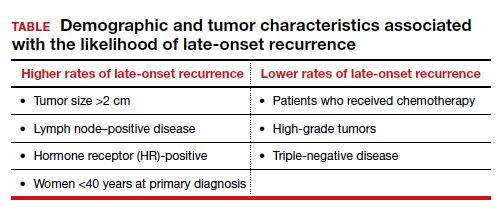
A total of 36,920 patients were diagnosed with BC in Denmark between 1987-2004, of whom 20,315 (55%) were identified as disease free for at least 10 years. Late-onset recurrence occurred in 2,595 (12.8%) with the strongest associations of recurrence seen in patients who had a tumor size >2 cm and lymph node‒positive (involving 4 or more nodes) disease (24.6%), compared with 12.7% in patients with tumors <2 cm and node-negative disease. Several other factors were associated with a higher risk of late-onset recurrence and are included in the TABLE. Half of the recurrences occurred between 10 and 15 years after the primary diagnosis.
Prior research
These findings are consistent with another recent study showing that BC patients have a 1% to 2%/year risk of recurrence after 10 disease-free years.5 Strengths of this study include:
- population-based, including all women with BC
- long-term follow-up for up to 32 years
- universal health care in Denmark, which results in robust and linked databases and very few missing data points.
There were two notable weaknesses to consider:
- Treatment regimens changed considerably during the time frame of the study (1997-2018), particularly the duration of tamoxifen use in patients with HR-positive disease. In this study nearly all patients received 5 years or less of tamoxifen. Since the mid-2010s, 10 years of hormonal adjuvant therapy has become routine in HR-positive BC, which reduces recurrences, including late-onset recurrence.6 The effect of 10 years of tamoxifen would very likely have resulted in less late-onset recurrence in the HR-positive population in this study.
- There is a lack of racial diversity in the Danish population, and the study findings may not translate to Black patients who have a higher frequency of triple-negative BC with a different risk of late-onset recurrence.7
Practice takeaways
Cancer surveillance. There are 3+ million BC survivors in the United States, and a 55%+ likelihood that they will be disease free for 10 years. This is clearly an important population to the women’s health care provider. This study, and previous research, suggests that among 10-year-disease-free survivors, 1% to 2% will recur annually, with higher rates amongst HR-positive, lymph-node positive women under age 40, and in the first 5 years following the 10-year post–initial diagnosis mark, so ongoing surveillance is imperative. Annual clinical breast examinations along with annual (not biennial) mammography should be performed.8 Digital breast tomosynthesis has improved specificity and sensitivity for BC detection and is the preferred modality when it is available.
Management of menopausal symptoms. These findings also have implications for menopausal hormone therapy for patients with symptoms. Because HR-positive patients have an increased risk of late-onset recurrence, nonhormonal therapies should be considered as first-line therapy for patients with menopausal symptoms. If hormone therapy is being considered, providers and patients should use shared decision making to balance the potential benefits (reduction in symptoms, possible cardiovascular benefits, and reduction in bone loss) with the risks (increased risk of recurrence and venous thromboembolism), even if patients are remote from the original diagnosis (ie, 10-year disease-free survival).
Topical estrogen therapies would be preferred for patients with significant urogenital atrophic symptoms who fail nonhormonal therapies due to substantially less systemic absorption and the lack of need to add a progestin.9,10 If oral therapy is being considered, I carefully counsel these women about the likely increased risk of recurrence and, if possible, include their breast oncologist in the discussion. ●
- Siegel RL, Miller KD, Fuchs HE, et al. Cancer statistics, 2021. CA Cancer J Clin. 2021;71:7-33. doi: 10.3322/caac.21654.
- de Moor JS, Mariotto AB, Parry C, et al. Cancer survivors in the United States: prevalence across the survivorship trajectory and implications for care. Cancer Epidemiol Biomarkers Prev. 2013;22:561- 570. doi: 10.1158/1055-9965.EPI-12-1356.
- Carreira H, Williams R, Funston G, et al. Associations between breast cancer survivorship and adverse mental health outcomes: a matched population-based cohort study in the United Kingdom. PLOS Med. 2021;18:e1003504. doi: 10.1371/journal.pmed.1003504.
- Pedersen RN, Esen BÖ, Mellemkjær L, et al. The incidence of breast cancer recurrence 10-32 years after primary diagnosis. J Natl Cancer Inst. November 8, 2021. doi: 10.1093/jnci/djab202.
- Pan H, Gray R, Braybrooke J, et al. 20-year risks of breast-cancer recurrence after stopping endocrine therapy at 5 years. N Engl J Med. 2017;377:1836- 1846. doi: 10.1056/NEJMoa1701830.
- Davies C, Pan H, Godwin J, et al. Long-term effects of continuing adjuvant tamoxifen to 10 years versus stopping at 5 years after diagnosis of oestrogen receptor-positive breast cancer: ATLAS, a randomised trial. Lancet. 2013;381:805-816. doi: 10.1016/S0140-6736(12)61963-1.
- Scott LC, Mobley LR, Kuo TM, et al. Update on triple‐negative breast cancer disparities for the United States: a population‐based study from the United States Cancer Statistics database, 2010 through 2014. Cancer. 2019;125:3412-3417. doi: 10.1002/cncr.32207.
- NCCN Clinical Practice Guidelines in Oncology: Breast Cancer. 2021; Version 2.2022.
- Crandall CJ, Diamant A, Santoro N. Safety of vaginal estrogens: a systematic review. Menopause. 2020;27:339-360. doi: 10.1097 /GME.0000000000001468.
- Treatment of urogenital symptoms in individuals with a history of estrogen-dependent breast cancer: clinical consensus. Obstet Gynecol. 2021;138:950-960. doi: 10.1097/AOG .0000000000004601.

Mark D. Pearlman, MD
Dr. Pearlman is Professor Active Emeritus, Departments of Obstetrics & Gynecology and Surgery University of Michigan Health System, Ann Arbor. He serves as an OBG Management Contributing Editor
The author reports no financial relationships relevant to this article.
Mark D. Pearlman, MD
Dr. Pearlman is Professor Active Emeritus, Departments of Obstetrics & Gynecology and Surgery University of Michigan Health System, Ann Arbor. He serves as an OBG Management Contributing Editor
The author reports no financial relationships relevant to this article.
Mark D. Pearlman, MD
Dr. Pearlman is Professor Active Emeritus, Departments of Obstetrics & Gynecology and Surgery University of Michigan Health System, Ann Arbor. He serves as an OBG Management Contributing Editor
The author reports no financial relationships relevant to this article.
Improved treatments for breast cancer (BC) and effective screening programs have resulted in a BC mortality rate reduction of 41% since 1989.1 Because BC is the leading cause of cancer in women, these mortality improvements have resulted in more than 3 million BC survivors in the United States.2,3 With longer-term survival, there is increasing interest in late-onset recurrences.4,5 A recent study has provided an improved understanding of the risk of lateonset recurrence in women with 10 years of disease-free survival, an important finding for women’s health providers because oncologists do not typically follow survivors after 10 years of disease-free survival.4
Recent study looks at incidence of late-onset recurrence
Pederson and colleagues evaluated all patients diagnosed with BC in Denmark from 1987 through 2004.4 Those patients without evidence of recurrence at 10 years were then followed utilizing population-based linked registries to identify patients who subsequently developed a local, regional, or distant late-onset recurrence. The authors evaluated the frequency of late recurrence and identified associations with demographic and tumor characteristics.
What they found
A total of 36,920 patients were diagnosed with BC in Denmark between 1987-2004, of whom 20,315 (55%) were identified as disease free for at least 10 years. Late-onset recurrence occurred in 2,595 (12.8%) with the strongest associations of recurrence seen in patients who had a tumor size >2 cm and lymph node‒positive (involving 4 or more nodes) disease (24.6%), compared with 12.7% in patients with tumors <2 cm and node-negative disease. Several other factors were associated with a higher risk of late-onset recurrence and are included in the TABLE. Half of the recurrences occurred between 10 and 15 years after the primary diagnosis.
Prior research
These findings are consistent with another recent study showing that BC patients have a 1% to 2%/year risk of recurrence after 10 disease-free years.5 Strengths of this study include:
- population-based, including all women with BC
- long-term follow-up for up to 32 years
- universal health care in Denmark, which results in robust and linked databases and very few missing data points.
There were two notable weaknesses to consider:
- Treatment regimens changed considerably during the time frame of the study (1997-2018), particularly the duration of tamoxifen use in patients with HR-positive disease. In this study nearly all patients received 5 years or less of tamoxifen. Since the mid-2010s, 10 years of hormonal adjuvant therapy has become routine in HR-positive BC, which reduces recurrences, including late-onset recurrence.6 The effect of 10 years of tamoxifen would very likely have resulted in less late-onset recurrence in the HR-positive population in this study.
- There is a lack of racial diversity in the Danish population, and the study findings may not translate to Black patients who have a higher frequency of triple-negative BC with a different risk of late-onset recurrence.7
Practice takeaways
Cancer surveillance. There are 3+ million BC survivors in the United States, and a 55%+ likelihood that they will be disease free for 10 years. This is clearly an important population to the women’s health care provider. This study, and previous research, suggests that among 10-year-disease-free survivors, 1% to 2% will recur annually, with higher rates amongst HR-positive, lymph-node positive women under age 40, and in the first 5 years following the 10-year post–initial diagnosis mark, so ongoing surveillance is imperative. Annual clinical breast examinations along with annual (not biennial) mammography should be performed.8 Digital breast tomosynthesis has improved specificity and sensitivity for BC detection and is the preferred modality when it is available.
Management of menopausal symptoms. These findings also have implications for menopausal hormone therapy for patients with symptoms. Because HR-positive patients have an increased risk of late-onset recurrence, nonhormonal therapies should be considered as first-line therapy for patients with menopausal symptoms. If hormone therapy is being considered, providers and patients should use shared decision making to balance the potential benefits (reduction in symptoms, possible cardiovascular benefits, and reduction in bone loss) with the risks (increased risk of recurrence and venous thromboembolism), even if patients are remote from the original diagnosis (ie, 10-year disease-free survival).
Topical estrogen therapies would be preferred for patients with significant urogenital atrophic symptoms who fail nonhormonal therapies due to substantially less systemic absorption and the lack of need to add a progestin.9,10 If oral therapy is being considered, I carefully counsel these women about the likely increased risk of recurrence and, if possible, include their breast oncologist in the discussion. ●
Improved treatments for breast cancer (BC) and effective screening programs have resulted in a BC mortality rate reduction of 41% since 1989.1 Because BC is the leading cause of cancer in women, these mortality improvements have resulted in more than 3 million BC survivors in the United States.2,3 With longer-term survival, there is increasing interest in late-onset recurrences.4,5 A recent study has provided an improved understanding of the risk of lateonset recurrence in women with 10 years of disease-free survival, an important finding for women’s health providers because oncologists do not typically follow survivors after 10 years of disease-free survival.4
Recent study looks at incidence of late-onset recurrence
Pederson and colleagues evaluated all patients diagnosed with BC in Denmark from 1987 through 2004.4 Those patients without evidence of recurrence at 10 years were then followed utilizing population-based linked registries to identify patients who subsequently developed a local, regional, or distant late-onset recurrence. The authors evaluated the frequency of late recurrence and identified associations with demographic and tumor characteristics.
What they found
A total of 36,920 patients were diagnosed with BC in Denmark between 1987-2004, of whom 20,315 (55%) were identified as disease free for at least 10 years. Late-onset recurrence occurred in 2,595 (12.8%) with the strongest associations of recurrence seen in patients who had a tumor size >2 cm and lymph node‒positive (involving 4 or more nodes) disease (24.6%), compared with 12.7% in patients with tumors <2 cm and node-negative disease. Several other factors were associated with a higher risk of late-onset recurrence and are included in the TABLE. Half of the recurrences occurred between 10 and 15 years after the primary diagnosis.
Prior research
These findings are consistent with another recent study showing that BC patients have a 1% to 2%/year risk of recurrence after 10 disease-free years.5 Strengths of this study include:
- population-based, including all women with BC
- long-term follow-up for up to 32 years
- universal health care in Denmark, which results in robust and linked databases and very few missing data points.
There were two notable weaknesses to consider:
- Treatment regimens changed considerably during the time frame of the study (1997-2018), particularly the duration of tamoxifen use in patients with HR-positive disease. In this study nearly all patients received 5 years or less of tamoxifen. Since the mid-2010s, 10 years of hormonal adjuvant therapy has become routine in HR-positive BC, which reduces recurrences, including late-onset recurrence.6 The effect of 10 years of tamoxifen would very likely have resulted in less late-onset recurrence in the HR-positive population in this study.
- There is a lack of racial diversity in the Danish population, and the study findings may not translate to Black patients who have a higher frequency of triple-negative BC with a different risk of late-onset recurrence.7
Practice takeaways
Cancer surveillance. There are 3+ million BC survivors in the United States, and a 55%+ likelihood that they will be disease free for 10 years. This is clearly an important population to the women’s health care provider. This study, and previous research, suggests that among 10-year-disease-free survivors, 1% to 2% will recur annually, with higher rates amongst HR-positive, lymph-node positive women under age 40, and in the first 5 years following the 10-year post–initial diagnosis mark, so ongoing surveillance is imperative. Annual clinical breast examinations along with annual (not biennial) mammography should be performed.8 Digital breast tomosynthesis has improved specificity and sensitivity for BC detection and is the preferred modality when it is available.
Management of menopausal symptoms. These findings also have implications for menopausal hormone therapy for patients with symptoms. Because HR-positive patients have an increased risk of late-onset recurrence, nonhormonal therapies should be considered as first-line therapy for patients with menopausal symptoms. If hormone therapy is being considered, providers and patients should use shared decision making to balance the potential benefits (reduction in symptoms, possible cardiovascular benefits, and reduction in bone loss) with the risks (increased risk of recurrence and venous thromboembolism), even if patients are remote from the original diagnosis (ie, 10-year disease-free survival).
Topical estrogen therapies would be preferred for patients with significant urogenital atrophic symptoms who fail nonhormonal therapies due to substantially less systemic absorption and the lack of need to add a progestin.9,10 If oral therapy is being considered, I carefully counsel these women about the likely increased risk of recurrence and, if possible, include their breast oncologist in the discussion. ●
- Siegel RL, Miller KD, Fuchs HE, et al. Cancer statistics, 2021. CA Cancer J Clin. 2021;71:7-33. doi: 10.3322/caac.21654.
- de Moor JS, Mariotto AB, Parry C, et al. Cancer survivors in the United States: prevalence across the survivorship trajectory and implications for care. Cancer Epidemiol Biomarkers Prev. 2013;22:561- 570. doi: 10.1158/1055-9965.EPI-12-1356.
- Carreira H, Williams R, Funston G, et al. Associations between breast cancer survivorship and adverse mental health outcomes: a matched population-based cohort study in the United Kingdom. PLOS Med. 2021;18:e1003504. doi: 10.1371/journal.pmed.1003504.
- Pedersen RN, Esen BÖ, Mellemkjær L, et al. The incidence of breast cancer recurrence 10-32 years after primary diagnosis. J Natl Cancer Inst. November 8, 2021. doi: 10.1093/jnci/djab202.
- Pan H, Gray R, Braybrooke J, et al. 20-year risks of breast-cancer recurrence after stopping endocrine therapy at 5 years. N Engl J Med. 2017;377:1836- 1846. doi: 10.1056/NEJMoa1701830.
- Davies C, Pan H, Godwin J, et al. Long-term effects of continuing adjuvant tamoxifen to 10 years versus stopping at 5 years after diagnosis of oestrogen receptor-positive breast cancer: ATLAS, a randomised trial. Lancet. 2013;381:805-816. doi: 10.1016/S0140-6736(12)61963-1.
- Scott LC, Mobley LR, Kuo TM, et al. Update on triple‐negative breast cancer disparities for the United States: a population‐based study from the United States Cancer Statistics database, 2010 through 2014. Cancer. 2019;125:3412-3417. doi: 10.1002/cncr.32207.
- NCCN Clinical Practice Guidelines in Oncology: Breast Cancer. 2021; Version 2.2022.
- Crandall CJ, Diamant A, Santoro N. Safety of vaginal estrogens: a systematic review. Menopause. 2020;27:339-360. doi: 10.1097 /GME.0000000000001468.
- Treatment of urogenital symptoms in individuals with a history of estrogen-dependent breast cancer: clinical consensus. Obstet Gynecol. 2021;138:950-960. doi: 10.1097/AOG .0000000000004601.
- Siegel RL, Miller KD, Fuchs HE, et al. Cancer statistics, 2021. CA Cancer J Clin. 2021;71:7-33. doi: 10.3322/caac.21654.
- de Moor JS, Mariotto AB, Parry C, et al. Cancer survivors in the United States: prevalence across the survivorship trajectory and implications for care. Cancer Epidemiol Biomarkers Prev. 2013;22:561- 570. doi: 10.1158/1055-9965.EPI-12-1356.
- Carreira H, Williams R, Funston G, et al. Associations between breast cancer survivorship and adverse mental health outcomes: a matched population-based cohort study in the United Kingdom. PLOS Med. 2021;18:e1003504. doi: 10.1371/journal.pmed.1003504.
- Pedersen RN, Esen BÖ, Mellemkjær L, et al. The incidence of breast cancer recurrence 10-32 years after primary diagnosis. J Natl Cancer Inst. November 8, 2021. doi: 10.1093/jnci/djab202.
- Pan H, Gray R, Braybrooke J, et al. 20-year risks of breast-cancer recurrence after stopping endocrine therapy at 5 years. N Engl J Med. 2017;377:1836- 1846. doi: 10.1056/NEJMoa1701830.
- Davies C, Pan H, Godwin J, et al. Long-term effects of continuing adjuvant tamoxifen to 10 years versus stopping at 5 years after diagnosis of oestrogen receptor-positive breast cancer: ATLAS, a randomised trial. Lancet. 2013;381:805-816. doi: 10.1016/S0140-6736(12)61963-1.
- Scott LC, Mobley LR, Kuo TM, et al. Update on triple‐negative breast cancer disparities for the United States: a population‐based study from the United States Cancer Statistics database, 2010 through 2014. Cancer. 2019;125:3412-3417. doi: 10.1002/cncr.32207.
- NCCN Clinical Practice Guidelines in Oncology: Breast Cancer. 2021; Version 2.2022.
- Crandall CJ, Diamant A, Santoro N. Safety of vaginal estrogens: a systematic review. Menopause. 2020;27:339-360. doi: 10.1097 /GME.0000000000001468.
- Treatment of urogenital symptoms in individuals with a history of estrogen-dependent breast cancer: clinical consensus. Obstet Gynecol. 2021;138:950-960. doi: 10.1097/AOG .0000000000004601.
Breast cancer now leading cause of cancer death in Black women
Breast cancer has replaced lung cancer as the leading cause of cancer-related death among Black women, but lung cancer remains the leading cause of cancer death in Black men, according to a new report from the American Cancer Society (ACS).
Lung cancer remains the second most commonly diagnosed cancer in both Black women and Black men.
These are among the key findings of the report, Cancer Statistics for African American/Black People 2022 – a triannual compilation of U.S. data on cancer incidence, mortality, survival, screening, and risk factors for Black people – and it marks a major shift as of 2019.
“African American/Black people have a disproportionately high cancer burden compared to other population groups. According to the report, the risk of cancer death for Black individuals remains 19% higher for men and 12% higher for women compared to White individuals,” the ACS says in a statement.
“The gap for breast cancer is more alarming,” it adds. “Black women are 41% more likely to die from breast cancer than White women despite a lower risk of being diagnosed with the disease.”
The new report, published online on Feb. 10 in CA: A Cancer Journal for Clinicians, also notes the following:
An estimated 224,080 new cancer cases and 73,680 cancer deaths will occur among Black people in 2022.
Over the past 5 data years, Black women had an 8% lower overall cancer incidence than White women but 12% higher mortality; Black men have 6% higher cancer incidence than White men but 19% higher cancer mortality.
Prostate cancer mortality among Black men decreased by 1.3% per year from 2015 to 2019 despite a 5% increase in the diagnosis of distant-stage prostate cancer annually since 2012, but the decline was slower than the 5% per year decline from 2010 to 2014.
The overall cancer mortality gap between Black and White people is narrowing. This is due to a steeper drop in prostate, lung, and other smoking-related cancers among Black people.
Colorectal cancer incidence and mortality rates are 21% and 44% higher, respectively, in Black men in comparison with White men and 18% and 31% higher, respectively, in Black women in comparison with White women.
The reasons for the disparities are complex but “largely stem from less access to high-quality care and optimal treatment as a repercussion of long-standing institutional racism,” the report concludes.
“We must address structural racism as a public health issue to close the gaps and advance health equity,” Tawana Thomas-Johnson, senior vice president and chief diversity officer at the ACS, said in the press release.
A version of this article first appeared on Medscape.com.
Breast cancer has replaced lung cancer as the leading cause of cancer-related death among Black women, but lung cancer remains the leading cause of cancer death in Black men, according to a new report from the American Cancer Society (ACS).
Lung cancer remains the second most commonly diagnosed cancer in both Black women and Black men.
These are among the key findings of the report, Cancer Statistics for African American/Black People 2022 – a triannual compilation of U.S. data on cancer incidence, mortality, survival, screening, and risk factors for Black people – and it marks a major shift as of 2019.
“African American/Black people have a disproportionately high cancer burden compared to other population groups. According to the report, the risk of cancer death for Black individuals remains 19% higher for men and 12% higher for women compared to White individuals,” the ACS says in a statement.
“The gap for breast cancer is more alarming,” it adds. “Black women are 41% more likely to die from breast cancer than White women despite a lower risk of being diagnosed with the disease.”
The new report, published online on Feb. 10 in CA: A Cancer Journal for Clinicians, also notes the following:
An estimated 224,080 new cancer cases and 73,680 cancer deaths will occur among Black people in 2022.
Over the past 5 data years, Black women had an 8% lower overall cancer incidence than White women but 12% higher mortality; Black men have 6% higher cancer incidence than White men but 19% higher cancer mortality.
Prostate cancer mortality among Black men decreased by 1.3% per year from 2015 to 2019 despite a 5% increase in the diagnosis of distant-stage prostate cancer annually since 2012, but the decline was slower than the 5% per year decline from 2010 to 2014.
The overall cancer mortality gap between Black and White people is narrowing. This is due to a steeper drop in prostate, lung, and other smoking-related cancers among Black people.
Colorectal cancer incidence and mortality rates are 21% and 44% higher, respectively, in Black men in comparison with White men and 18% and 31% higher, respectively, in Black women in comparison with White women.
The reasons for the disparities are complex but “largely stem from less access to high-quality care and optimal treatment as a repercussion of long-standing institutional racism,” the report concludes.
“We must address structural racism as a public health issue to close the gaps and advance health equity,” Tawana Thomas-Johnson, senior vice president and chief diversity officer at the ACS, said in the press release.
A version of this article first appeared on Medscape.com.
Breast cancer has replaced lung cancer as the leading cause of cancer-related death among Black women, but lung cancer remains the leading cause of cancer death in Black men, according to a new report from the American Cancer Society (ACS).
Lung cancer remains the second most commonly diagnosed cancer in both Black women and Black men.
These are among the key findings of the report, Cancer Statistics for African American/Black People 2022 – a triannual compilation of U.S. data on cancer incidence, mortality, survival, screening, and risk factors for Black people – and it marks a major shift as of 2019.
“African American/Black people have a disproportionately high cancer burden compared to other population groups. According to the report, the risk of cancer death for Black individuals remains 19% higher for men and 12% higher for women compared to White individuals,” the ACS says in a statement.
“The gap for breast cancer is more alarming,” it adds. “Black women are 41% more likely to die from breast cancer than White women despite a lower risk of being diagnosed with the disease.”
The new report, published online on Feb. 10 in CA: A Cancer Journal for Clinicians, also notes the following:
An estimated 224,080 new cancer cases and 73,680 cancer deaths will occur among Black people in 2022.
Over the past 5 data years, Black women had an 8% lower overall cancer incidence than White women but 12% higher mortality; Black men have 6% higher cancer incidence than White men but 19% higher cancer mortality.
Prostate cancer mortality among Black men decreased by 1.3% per year from 2015 to 2019 despite a 5% increase in the diagnosis of distant-stage prostate cancer annually since 2012, but the decline was slower than the 5% per year decline from 2010 to 2014.
The overall cancer mortality gap between Black and White people is narrowing. This is due to a steeper drop in prostate, lung, and other smoking-related cancers among Black people.
Colorectal cancer incidence and mortality rates are 21% and 44% higher, respectively, in Black men in comparison with White men and 18% and 31% higher, respectively, in Black women in comparison with White women.
The reasons for the disparities are complex but “largely stem from less access to high-quality care and optimal treatment as a repercussion of long-standing institutional racism,” the report concludes.
“We must address structural racism as a public health issue to close the gaps and advance health equity,” Tawana Thomas-Johnson, senior vice president and chief diversity officer at the ACS, said in the press release.
A version of this article first appeared on Medscape.com.
Cost not a factor in radiotherapy type for breast cancer patients
A study comparing the cost of hypofractionated radiotherapy for early-stage breast cancer with the more expensive multidose conventional form, finds that physicians are increasingly opting for hypofractionated radiotherapy despite lower reimbursements rates for the procedure.
Hypofractionated radiotherapy is administered in fewer fractions requiring fewer hospital visits, which, in turn, should lead to less expensive procedures. According to previously reported randomized controlled trials of patients with early breast cancer, both procedures are equally efficacious. In 2011, the American Society of Radiation Oncology published guidelines recommending hypofractionated whole-breast irradiation for patients who have not undergone chemotherapy and who are at least 50 years old with a small primary tumor (T1-2).
In the new study, Loren Saulsberry, PhD, of the department of public health at the University of Chicago, and colleagues Chuanhong Liao and Dezheng Huo, hypothesized that a fee-for-service incentive structure in which doctors are paid by volume and quantity of services, would drive up use of conventional therapy among patients with commercial insurance. And, they hypothesized that, when presented with a smaller cost difference between the two procedures, physicians would recommend hypofractionated radiotherapy over the conventional form, but neither theory was proven true.
This was a retrospective study of private employer–sponsored health insurance claims processed between 2008 and 2017 for women with early-stage breast cancer who were treated with lumpectomy and whole-breast irradiation.
The study included 15,869 women who received hypofractionated radiotherapy and 59,328 who received the conventional form. Women who underwent hypofractionated radiotherapy received 15-24 fractions over 21-31 days. Those who received conventional radiotherapy received 25-40 fractions over 39-120 days. The primary outcomes and measures were the use of hypofractionated or conventional radiotherapy, costs incurred by insurers and out-of-pocket patient expenses.
Dr. Saulsberry and colleagues found the use of hypofractionated radiotherapy increased during this period. They found no association between the likelihood of receiving hypofractionated radiotherapy and insurance plan characteristics. At $23,286, conventional radiotherapy was $6,253 more expensive than hypofractionated radiotherapy which averaged $17,763.
After out-of-pocket expenses were paid (average of $502 for conventional and $363 for hypofractionated radiotherapy), insurers paid an average of $6,375 more for conventional therapy after adjustments.
“Hypofractionated radiotherapy represents significant savings to both the health care system and to individual patients. It may soon become the dominant form of radiation treatment in the U.S. if current trends continue,” Dr. Saulsberry said in an interview after she presented the study (Abstract P3-19-07) at the San Antonio Breast Cancer Symposium.
According to the National Cancer Institute, the cost of cancer care grew from $190.2 billion in 2015 to $208.9 billion in 2020.
Dr. Saulsberry declared no conflicts of interest.
A study comparing the cost of hypofractionated radiotherapy for early-stage breast cancer with the more expensive multidose conventional form, finds that physicians are increasingly opting for hypofractionated radiotherapy despite lower reimbursements rates for the procedure.
Hypofractionated radiotherapy is administered in fewer fractions requiring fewer hospital visits, which, in turn, should lead to less expensive procedures. According to previously reported randomized controlled trials of patients with early breast cancer, both procedures are equally efficacious. In 2011, the American Society of Radiation Oncology published guidelines recommending hypofractionated whole-breast irradiation for patients who have not undergone chemotherapy and who are at least 50 years old with a small primary tumor (T1-2).
In the new study, Loren Saulsberry, PhD, of the department of public health at the University of Chicago, and colleagues Chuanhong Liao and Dezheng Huo, hypothesized that a fee-for-service incentive structure in which doctors are paid by volume and quantity of services, would drive up use of conventional therapy among patients with commercial insurance. And, they hypothesized that, when presented with a smaller cost difference between the two procedures, physicians would recommend hypofractionated radiotherapy over the conventional form, but neither theory was proven true.
This was a retrospective study of private employer–sponsored health insurance claims processed between 2008 and 2017 for women with early-stage breast cancer who were treated with lumpectomy and whole-breast irradiation.
The study included 15,869 women who received hypofractionated radiotherapy and 59,328 who received the conventional form. Women who underwent hypofractionated radiotherapy received 15-24 fractions over 21-31 days. Those who received conventional radiotherapy received 25-40 fractions over 39-120 days. The primary outcomes and measures were the use of hypofractionated or conventional radiotherapy, costs incurred by insurers and out-of-pocket patient expenses.
Dr. Saulsberry and colleagues found the use of hypofractionated radiotherapy increased during this period. They found no association between the likelihood of receiving hypofractionated radiotherapy and insurance plan characteristics. At $23,286, conventional radiotherapy was $6,253 more expensive than hypofractionated radiotherapy which averaged $17,763.
After out-of-pocket expenses were paid (average of $502 for conventional and $363 for hypofractionated radiotherapy), insurers paid an average of $6,375 more for conventional therapy after adjustments.
“Hypofractionated radiotherapy represents significant savings to both the health care system and to individual patients. It may soon become the dominant form of radiation treatment in the U.S. if current trends continue,” Dr. Saulsberry said in an interview after she presented the study (Abstract P3-19-07) at the San Antonio Breast Cancer Symposium.
According to the National Cancer Institute, the cost of cancer care grew from $190.2 billion in 2015 to $208.9 billion in 2020.
Dr. Saulsberry declared no conflicts of interest.
A study comparing the cost of hypofractionated radiotherapy for early-stage breast cancer with the more expensive multidose conventional form, finds that physicians are increasingly opting for hypofractionated radiotherapy despite lower reimbursements rates for the procedure.
Hypofractionated radiotherapy is administered in fewer fractions requiring fewer hospital visits, which, in turn, should lead to less expensive procedures. According to previously reported randomized controlled trials of patients with early breast cancer, both procedures are equally efficacious. In 2011, the American Society of Radiation Oncology published guidelines recommending hypofractionated whole-breast irradiation for patients who have not undergone chemotherapy and who are at least 50 years old with a small primary tumor (T1-2).
In the new study, Loren Saulsberry, PhD, of the department of public health at the University of Chicago, and colleagues Chuanhong Liao and Dezheng Huo, hypothesized that a fee-for-service incentive structure in which doctors are paid by volume and quantity of services, would drive up use of conventional therapy among patients with commercial insurance. And, they hypothesized that, when presented with a smaller cost difference between the two procedures, physicians would recommend hypofractionated radiotherapy over the conventional form, but neither theory was proven true.
This was a retrospective study of private employer–sponsored health insurance claims processed between 2008 and 2017 for women with early-stage breast cancer who were treated with lumpectomy and whole-breast irradiation.
The study included 15,869 women who received hypofractionated radiotherapy and 59,328 who received the conventional form. Women who underwent hypofractionated radiotherapy received 15-24 fractions over 21-31 days. Those who received conventional radiotherapy received 25-40 fractions over 39-120 days. The primary outcomes and measures were the use of hypofractionated or conventional radiotherapy, costs incurred by insurers and out-of-pocket patient expenses.
Dr. Saulsberry and colleagues found the use of hypofractionated radiotherapy increased during this period. They found no association between the likelihood of receiving hypofractionated radiotherapy and insurance plan characteristics. At $23,286, conventional radiotherapy was $6,253 more expensive than hypofractionated radiotherapy which averaged $17,763.
After out-of-pocket expenses were paid (average of $502 for conventional and $363 for hypofractionated radiotherapy), insurers paid an average of $6,375 more for conventional therapy after adjustments.
“Hypofractionated radiotherapy represents significant savings to both the health care system and to individual patients. It may soon become the dominant form of radiation treatment in the U.S. if current trends continue,” Dr. Saulsberry said in an interview after she presented the study (Abstract P3-19-07) at the San Antonio Breast Cancer Symposium.
According to the National Cancer Institute, the cost of cancer care grew from $190.2 billion in 2015 to $208.9 billion in 2020.
Dr. Saulsberry declared no conflicts of interest.
FROM SABCS 2021