User login
Pembrolizumab takes on r/r PMBCL
LUGANO, SWITZERLAND – Patients with relapsed/refractory primary mediastinal large B-cell lymphoma (PMBCL) have few good therapeutic options, but pembrolizumab (Keytruda) may be one of them, an interim analysis from a phase 2 trial suggests.
Six of 10 patients with relapsed/refractory PMBCL for whom autologous stem cell transplantation (ASCT) had failed had responses to salvage therapy with pembrolizumab, including three complete responses (CR) and three partial responses (PR), reported Pier Luigi Zinzani, MD, PhD, of the University of Bologna, Italy.
“In relapsed/refractory primary mediastinal large B-cell lymphoma including heavily pretreated patients in our series, pembrolizumab showed promising antitumor activity in these preliminary data from a phase 2 study, and a manageable safety profile,” Dr. Zinzani said at the International Conference on Malignant Lymphoma.
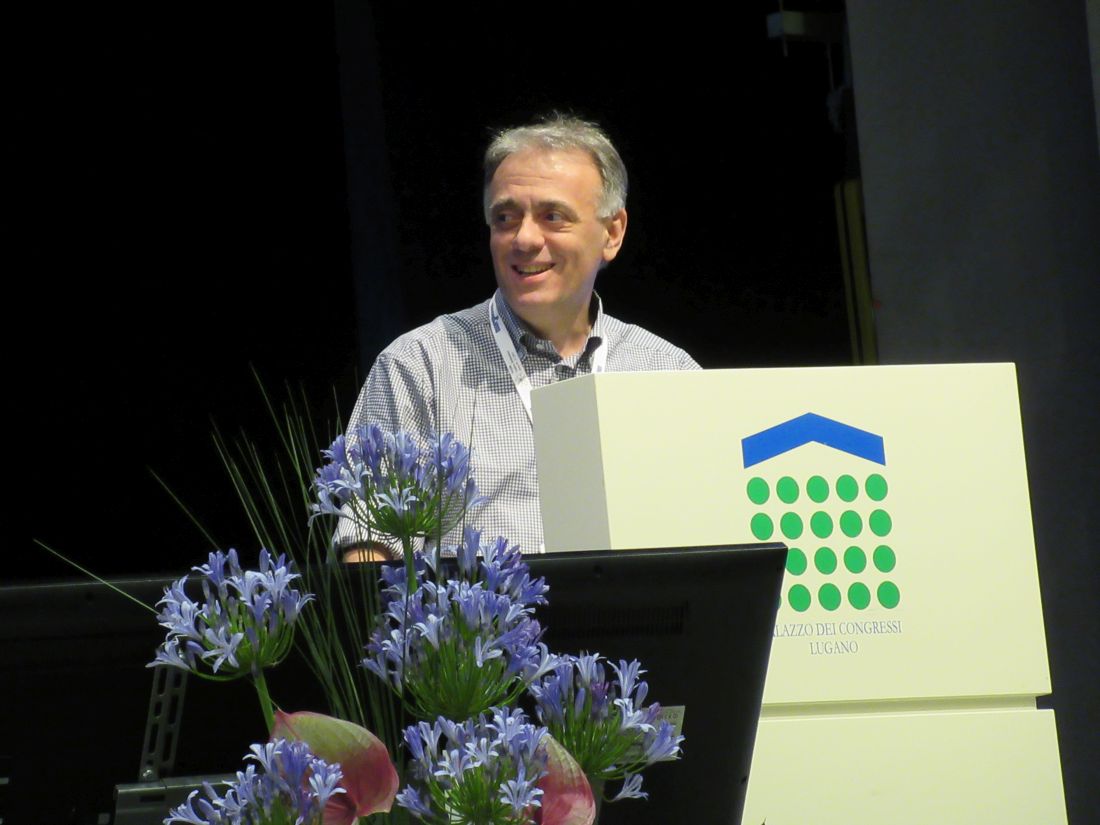
Although standard cytotoxic chemotherapy regimens are curative in approximately 80% of patients with PMBCL, those with relapsed/refractory disease have a poor prognosis and limited treatment options. In the United States, about 200 patients are diagnosed with relapsed/refractory PMBCL each year, Dr. Zinzani noted.
The rationale for using a programmed death-1 (PD-1) inhibitor such as pembrolizumab is that PMBCL tumors frequently harbor amplifications and/or translocations in the 9p24.1 locus that lead to overexpression of PD ligand 1 (PD-L1) or PD-L2. Pembrolizumab blocks interactions between PD-1 and its ligands.
In the Keynote-013 PMBCL cohort, the objective response rate (ORR) was 48%, including 24% CR.
Keynote 170 investigators are enrolling adults with relapsed/refractory PMBCL who are either ineligible for ASCT following at least two prior lines of therapy, or who had a relapse following a transplant.
Patients receive pembrolizumab 200 mg every 3 weeks. Those who achieve a complete response are allowed to discontinue after a minimum of 24 weeks on study, those with partial response or stable disease are treated for 35 cycles or until disease progression or intolerable toxicities, and those with disease progression are discontinued, but are allowed to remain on study until progression is confirmed.
Responses are assessed by PET and CT scans according to 2007 International Working Group criteria.
Among the 29 patients assessable for efficacy at the time of Dr. Zinzani’s presentations, the best response by blinded central review was 41% (12 patients: 4 CR and 8 PR). Three patients had stable disease, and eight had disease progression. Six patients died or discontinued participation prior to the first assessment.
In all, 16 of 22 patients had reductions in target lesions, and all but one of these patients had reductions greater than 50%.
After a median follow-up of 6.6 months, 10 patients had ongoing responses. The median time to response was 2.9 months. The median duration of response has not been reached.
Of the 10 patients for whom ASCT had failed, three had a CR, and three had a PR. Among 19 ASCT-ineligible patients, one had a CR and five had a PR.
The interim safety analysis included 49 patients. Of this group, only one discontinued treatment because of adverse events. There were 26 treatment-related adverse events, but no treatment-related deaths.
The most frequent adverse events were neutropenia, asthenia, hypothyroidism, and pyrexia.
The study is supported by Merck. Dr Zinzani disclosed serving on advisory boards for several companies.
LUGANO, SWITZERLAND – Patients with relapsed/refractory primary mediastinal large B-cell lymphoma (PMBCL) have few good therapeutic options, but pembrolizumab (Keytruda) may be one of them, an interim analysis from a phase 2 trial suggests.
Six of 10 patients with relapsed/refractory PMBCL for whom autologous stem cell transplantation (ASCT) had failed had responses to salvage therapy with pembrolizumab, including three complete responses (CR) and three partial responses (PR), reported Pier Luigi Zinzani, MD, PhD, of the University of Bologna, Italy.
“In relapsed/refractory primary mediastinal large B-cell lymphoma including heavily pretreated patients in our series, pembrolizumab showed promising antitumor activity in these preliminary data from a phase 2 study, and a manageable safety profile,” Dr. Zinzani said at the International Conference on Malignant Lymphoma.
Although standard cytotoxic chemotherapy regimens are curative in approximately 80% of patients with PMBCL, those with relapsed/refractory disease have a poor prognosis and limited treatment options. In the United States, about 200 patients are diagnosed with relapsed/refractory PMBCL each year, Dr. Zinzani noted.
The rationale for using a programmed death-1 (PD-1) inhibitor such as pembrolizumab is that PMBCL tumors frequently harbor amplifications and/or translocations in the 9p24.1 locus that lead to overexpression of PD ligand 1 (PD-L1) or PD-L2. Pembrolizumab blocks interactions between PD-1 and its ligands.
In the Keynote-013 PMBCL cohort, the objective response rate (ORR) was 48%, including 24% CR.
Keynote 170 investigators are enrolling adults with relapsed/refractory PMBCL who are either ineligible for ASCT following at least two prior lines of therapy, or who had a relapse following a transplant.
Patients receive pembrolizumab 200 mg every 3 weeks. Those who achieve a complete response are allowed to discontinue after a minimum of 24 weeks on study, those with partial response or stable disease are treated for 35 cycles or until disease progression or intolerable toxicities, and those with disease progression are discontinued, but are allowed to remain on study until progression is confirmed.
Responses are assessed by PET and CT scans according to 2007 International Working Group criteria.
Among the 29 patients assessable for efficacy at the time of Dr. Zinzani’s presentations, the best response by blinded central review was 41% (12 patients: 4 CR and 8 PR). Three patients had stable disease, and eight had disease progression. Six patients died or discontinued participation prior to the first assessment.
In all, 16 of 22 patients had reductions in target lesions, and all but one of these patients had reductions greater than 50%.
After a median follow-up of 6.6 months, 10 patients had ongoing responses. The median time to response was 2.9 months. The median duration of response has not been reached.
Of the 10 patients for whom ASCT had failed, three had a CR, and three had a PR. Among 19 ASCT-ineligible patients, one had a CR and five had a PR.
The interim safety analysis included 49 patients. Of this group, only one discontinued treatment because of adverse events. There were 26 treatment-related adverse events, but no treatment-related deaths.
The most frequent adverse events were neutropenia, asthenia, hypothyroidism, and pyrexia.
The study is supported by Merck. Dr Zinzani disclosed serving on advisory boards for several companies.
LUGANO, SWITZERLAND – Patients with relapsed/refractory primary mediastinal large B-cell lymphoma (PMBCL) have few good therapeutic options, but pembrolizumab (Keytruda) may be one of them, an interim analysis from a phase 2 trial suggests.
Six of 10 patients with relapsed/refractory PMBCL for whom autologous stem cell transplantation (ASCT) had failed had responses to salvage therapy with pembrolizumab, including three complete responses (CR) and three partial responses (PR), reported Pier Luigi Zinzani, MD, PhD, of the University of Bologna, Italy.
“In relapsed/refractory primary mediastinal large B-cell lymphoma including heavily pretreated patients in our series, pembrolizumab showed promising antitumor activity in these preliminary data from a phase 2 study, and a manageable safety profile,” Dr. Zinzani said at the International Conference on Malignant Lymphoma.
Although standard cytotoxic chemotherapy regimens are curative in approximately 80% of patients with PMBCL, those with relapsed/refractory disease have a poor prognosis and limited treatment options. In the United States, about 200 patients are diagnosed with relapsed/refractory PMBCL each year, Dr. Zinzani noted.
The rationale for using a programmed death-1 (PD-1) inhibitor such as pembrolizumab is that PMBCL tumors frequently harbor amplifications and/or translocations in the 9p24.1 locus that lead to overexpression of PD ligand 1 (PD-L1) or PD-L2. Pembrolizumab blocks interactions between PD-1 and its ligands.
In the Keynote-013 PMBCL cohort, the objective response rate (ORR) was 48%, including 24% CR.
Keynote 170 investigators are enrolling adults with relapsed/refractory PMBCL who are either ineligible for ASCT following at least two prior lines of therapy, or who had a relapse following a transplant.
Patients receive pembrolizumab 200 mg every 3 weeks. Those who achieve a complete response are allowed to discontinue after a minimum of 24 weeks on study, those with partial response or stable disease are treated for 35 cycles or until disease progression or intolerable toxicities, and those with disease progression are discontinued, but are allowed to remain on study until progression is confirmed.
Responses are assessed by PET and CT scans according to 2007 International Working Group criteria.
Among the 29 patients assessable for efficacy at the time of Dr. Zinzani’s presentations, the best response by blinded central review was 41% (12 patients: 4 CR and 8 PR). Three patients had stable disease, and eight had disease progression. Six patients died or discontinued participation prior to the first assessment.
In all, 16 of 22 patients had reductions in target lesions, and all but one of these patients had reductions greater than 50%.
After a median follow-up of 6.6 months, 10 patients had ongoing responses. The median time to response was 2.9 months. The median duration of response has not been reached.
Of the 10 patients for whom ASCT had failed, three had a CR, and three had a PR. Among 19 ASCT-ineligible patients, one had a CR and five had a PR.
The interim safety analysis included 49 patients. Of this group, only one discontinued treatment because of adverse events. There were 26 treatment-related adverse events, but no treatment-related deaths.
The most frequent adverse events were neutropenia, asthenia, hypothyroidism, and pyrexia.
The study is supported by Merck. Dr Zinzani disclosed serving on advisory boards for several companies.
AT 14-ICML
Key clinical point: Poor-prognosis relapsed/refractory primary mediastinal large B-cell lymphoma may respond to PD-1 inhibition.
Major finding: The best response by blinded central review was 41% (12 patients: 4 complete and 8 partial responses).
Data source: Interim analysis from a phase 2 study with 29 patients evaluable for efficacy, 49 for safety.
Disclosures: Merck supports the study. Dr Zinzani disclosed serving on advisory boards for several companies.
IMiD/Anti-CD20 combo induces complete responses in r/r NHL
Lugano, Switzerland – A combination of obinutuzumab (Gazyva) and the experimental immunomodulatory agent CC-122 showed “clinically meaningful” activity against relapsed/refractory diffuse large B cell lymphoma (DLBCL) and indolent non-Hodgkin lymphoma (NHL) in a phase 1b study.
Among 38 patients with heavily pretreated, relapsed/refractory DLBCL, follicular lymphoma (FL), or marginal zone lymphoma (MZL), the overall response rate was 66%, including 12 patients (32%) with a complete response (CR), reported Jean-Marie Michot, MD, from the Goustave-Roussy Cancer Center in Villejuif, France.

CC-122 is a thalidomide analog that shares a molecular target with its cousin lenalidomide (Revlimid). Both molecules bind to the protein cereblon to cause degradation of the lymphoid transcription factors Aiolos and Ikaros.
As a single agent, CC-122 has been shown to have immunomodulatory effects on T-cell and natural killer (NK)–cell functions and has shown clinical activity in heavily pretreated patients with relapsed refractory NHL, including various cell-of-origin–based DLBCL subtypes, Dr, Michot said.
In preclinical studies, the combination of CC-122 and obinutuzumab, an anti-CD20 monoclonal antibody, has shown synergistic effects against FL and greater antilymphoma effects against DLBCL than either agent alone, he added.
In a multicenter, open-label, phase 1b dose-escalation and expansion study, investigators enrolled 19 patients with FL or MZL for whom at least one prior regimen had failed and 19 patients with relapsed/refractory DLBCL following at least two prior regimens and failed autologous stem cell transplant.
The patients received oral CC-122 at different dose levels for 5 of 7 days in each 28 day treatment cycle, plus intravenous obinutuzumab 1000 mg on days 2, 8, and 15 of cycle 1 and day 1 of cycles 2 through 8.
Responses were assessed according to International Working Group 2007 revised response criteria for malignant lymphoma.
Among all 38 patients, 25 (66%) had a response. Responses consisted of 12 CR (3 in patients with DLBCL, and 9 in patients with FL/MZL) and 13 partial responses (six and seven patients, respectively),
The median time to best response was 57 days. Responses were seen in 23 of the 30 patients who received CC-122 at dose level of 3 mg or higher.
“To date, patients receiving CC-122 at a dose of 3 mg and higher have the best and more durable responses to CC-122 plus obinutuzumab,” Dr. Michot said.
Patients generally tolerated the combination well. The most common grade 3 or 4 adverse events were hematologic and included grade 4 febrile neutropenia in two patients. Two patients discontinued treatment because of adverse events.
There was a dose-limiting toxicity, grade 4 neutropenia in one patient who received CC-122 at the 3 mg dose level, and one death from a tumor flare reaction in a patient treated at the 4 mg dose level.
The dose-escalation arm of the study has completed, and investigators are enrolling patients in a dose expansion phase at the 3 mg level.
The study was sponsored by Celgene. Hoffman La-Roche contributed obinutuzumab for the study. Dr. Michot reported serving as an advisor to Bristol-Myers Squibb and receiving travel grants from BMS, Pfizer, and Roche. Seven coauthors are Celgene employees and stockholders.
Lugano, Switzerland – A combination of obinutuzumab (Gazyva) and the experimental immunomodulatory agent CC-122 showed “clinically meaningful” activity against relapsed/refractory diffuse large B cell lymphoma (DLBCL) and indolent non-Hodgkin lymphoma (NHL) in a phase 1b study.
Among 38 patients with heavily pretreated, relapsed/refractory DLBCL, follicular lymphoma (FL), or marginal zone lymphoma (MZL), the overall response rate was 66%, including 12 patients (32%) with a complete response (CR), reported Jean-Marie Michot, MD, from the Goustave-Roussy Cancer Center in Villejuif, France.
CC-122 is a thalidomide analog that shares a molecular target with its cousin lenalidomide (Revlimid). Both molecules bind to the protein cereblon to cause degradation of the lymphoid transcription factors Aiolos and Ikaros.
As a single agent, CC-122 has been shown to have immunomodulatory effects on T-cell and natural killer (NK)–cell functions and has shown clinical activity in heavily pretreated patients with relapsed refractory NHL, including various cell-of-origin–based DLBCL subtypes, Dr, Michot said.
In preclinical studies, the combination of CC-122 and obinutuzumab, an anti-CD20 monoclonal antibody, has shown synergistic effects against FL and greater antilymphoma effects against DLBCL than either agent alone, he added.
In a multicenter, open-label, phase 1b dose-escalation and expansion study, investigators enrolled 19 patients with FL or MZL for whom at least one prior regimen had failed and 19 patients with relapsed/refractory DLBCL following at least two prior regimens and failed autologous stem cell transplant.
The patients received oral CC-122 at different dose levels for 5 of 7 days in each 28 day treatment cycle, plus intravenous obinutuzumab 1000 mg on days 2, 8, and 15 of cycle 1 and day 1 of cycles 2 through 8.
Responses were assessed according to International Working Group 2007 revised response criteria for malignant lymphoma.
Among all 38 patients, 25 (66%) had a response. Responses consisted of 12 CR (3 in patients with DLBCL, and 9 in patients with FL/MZL) and 13 partial responses (six and seven patients, respectively),
The median time to best response was 57 days. Responses were seen in 23 of the 30 patients who received CC-122 at dose level of 3 mg or higher.
“To date, patients receiving CC-122 at a dose of 3 mg and higher have the best and more durable responses to CC-122 plus obinutuzumab,” Dr. Michot said.
Patients generally tolerated the combination well. The most common grade 3 or 4 adverse events were hematologic and included grade 4 febrile neutropenia in two patients. Two patients discontinued treatment because of adverse events.
There was a dose-limiting toxicity, grade 4 neutropenia in one patient who received CC-122 at the 3 mg dose level, and one death from a tumor flare reaction in a patient treated at the 4 mg dose level.
The dose-escalation arm of the study has completed, and investigators are enrolling patients in a dose expansion phase at the 3 mg level.
The study was sponsored by Celgene. Hoffman La-Roche contributed obinutuzumab for the study. Dr. Michot reported serving as an advisor to Bristol-Myers Squibb and receiving travel grants from BMS, Pfizer, and Roche. Seven coauthors are Celgene employees and stockholders.
Lugano, Switzerland – A combination of obinutuzumab (Gazyva) and the experimental immunomodulatory agent CC-122 showed “clinically meaningful” activity against relapsed/refractory diffuse large B cell lymphoma (DLBCL) and indolent non-Hodgkin lymphoma (NHL) in a phase 1b study.
Among 38 patients with heavily pretreated, relapsed/refractory DLBCL, follicular lymphoma (FL), or marginal zone lymphoma (MZL), the overall response rate was 66%, including 12 patients (32%) with a complete response (CR), reported Jean-Marie Michot, MD, from the Goustave-Roussy Cancer Center in Villejuif, France.
CC-122 is a thalidomide analog that shares a molecular target with its cousin lenalidomide (Revlimid). Both molecules bind to the protein cereblon to cause degradation of the lymphoid transcription factors Aiolos and Ikaros.
As a single agent, CC-122 has been shown to have immunomodulatory effects on T-cell and natural killer (NK)–cell functions and has shown clinical activity in heavily pretreated patients with relapsed refractory NHL, including various cell-of-origin–based DLBCL subtypes, Dr, Michot said.
In preclinical studies, the combination of CC-122 and obinutuzumab, an anti-CD20 monoclonal antibody, has shown synergistic effects against FL and greater antilymphoma effects against DLBCL than either agent alone, he added.
In a multicenter, open-label, phase 1b dose-escalation and expansion study, investigators enrolled 19 patients with FL or MZL for whom at least one prior regimen had failed and 19 patients with relapsed/refractory DLBCL following at least two prior regimens and failed autologous stem cell transplant.
The patients received oral CC-122 at different dose levels for 5 of 7 days in each 28 day treatment cycle, plus intravenous obinutuzumab 1000 mg on days 2, 8, and 15 of cycle 1 and day 1 of cycles 2 through 8.
Responses were assessed according to International Working Group 2007 revised response criteria for malignant lymphoma.
Among all 38 patients, 25 (66%) had a response. Responses consisted of 12 CR (3 in patients with DLBCL, and 9 in patients with FL/MZL) and 13 partial responses (six and seven patients, respectively),
The median time to best response was 57 days. Responses were seen in 23 of the 30 patients who received CC-122 at dose level of 3 mg or higher.
“To date, patients receiving CC-122 at a dose of 3 mg and higher have the best and more durable responses to CC-122 plus obinutuzumab,” Dr. Michot said.
Patients generally tolerated the combination well. The most common grade 3 or 4 adverse events were hematologic and included grade 4 febrile neutropenia in two patients. Two patients discontinued treatment because of adverse events.
There was a dose-limiting toxicity, grade 4 neutropenia in one patient who received CC-122 at the 3 mg dose level, and one death from a tumor flare reaction in a patient treated at the 4 mg dose level.
The dose-escalation arm of the study has completed, and investigators are enrolling patients in a dose expansion phase at the 3 mg level.
The study was sponsored by Celgene. Hoffman La-Roche contributed obinutuzumab for the study. Dr. Michot reported serving as an advisor to Bristol-Myers Squibb and receiving travel grants from BMS, Pfizer, and Roche. Seven coauthors are Celgene employees and stockholders.
AT 14-ICML
Key clinical point: A combination of the experimental immunomodulator CC-122 and obinutuzumab showed significant activity against relapsed/refractory non-Hodgkin lymphoma.
Major finding: The overall response rate was 66%, including 32% complete responses.
Data source: A multicenter open-label phase 1b dose-escalation study in 19 patients with DLBCL and 19 with follicular lymphoma or marginal zone lymphoma.
Disclosures: The study was sponsored by Celgene. Hoffman La-Roche contributed obinutuzumab for the study. Dr. Michot reported serving as an advisor to Bristol-Myers Squibb and receiving travel grants from BMS, Pfizer, and Roche. Seven coauthors are Celgene employees and stockholders.
CAR T-cell therapy ‘highly effective’ in high-risk CLL

A chimeric antigen receptor (CAR) T-cell therapy is “highly effective” in high-risk patients with chronic lymphocytic leukemia (CLL), according to researchers.
The CD19 CAR T-cell therapy, JCAR014, produced an overall response rate of 71% and a complete response (CR) rate of 17% in a phase 1/2 trial of patients with relapsed/refractory CLL.
Eighty-three percent of patients experienced cytokine release syndrome (CRS), and 33% developed neurotoxicity. One patient died of CRS/neurotoxicity.
Researchers reported these results in The Journal of Clinical Oncology.
The study was supported by Juno Therapeutics, Life Science Discovery Fund, the Bezos Family, the University of British Columbia Clinical Investigator Program, and grants from the National Cancer Institute and National Institute of Diabetes and Digestive and Kidney Diseases.
The trial included 24 patients with relapsed or refractory CLL. The patients’ median age was 61 (range, 40-73), and they had received a median of 5 prior therapies (range, 3-9). Nineteen patients had progressed while on ibrutinib, and 3 could not tolerate the drug.
“It was not known whether CAR T cells could be used to treat these high-risk CLL patients,” said study author Cameron Turtle, MBBS, PhD, of Fred Hutchinson Cancer Research Center in Seattle, Washington.
“Our study shows that CD19 CAR T cells are a highly promising treatment for CLL patients who have failed ibrutinib.”
Treatment and safety
All 24 patients received lymphodepletion prior to JCAR014. Lymphodepleting regimens consisted of cyclophosphamide, fludarabine, or both.
Patients received JCAR014 at 1 of 3 dose levels—2 x 10⁵, 2 x 10⁶, or 2 x 10⁷ CAR T cells/kg.
Twenty patients (83%) developed CRS—18 with grade 1/2, 1 with grade 4, and 1 with grade 5 CRS.
Eight patients (33%) developed neurotoxicity, all of whom also had CRS. Five patients had grade 3 neurotoxicity, and 1 had grade 5 (same patient with grade 5 CRS).
Initial response
The overall response rate, according to IWCLL criteria, was 71%. Seventeen patients responded, 4 with CRs and 13 with partial responses (PRs).
One of the patients who achieved a CR had received a second dose of JCAR014, without lymphodepletion, 14 days after the first dose.
One of the patients with a PR initially had stable disease (SD) at the 4-week assessment but was in PR 8 weeks later.
Twenty-one patients had a bone marrow evaluation 4 weeks after treatment with JCAR014. Seventeen of these patients (81%) had no residual disease according to high-resolution flow cytometry.
The researchers also performed IGH sequencing of bone marrow in 12 patients with no residual disease by flow cytometry. Seven of these patients (58%) had no detectable malignant IGH sequences 4 weeks after receiving JCAR014.
Second dose
Six patients who had persistent disease or who relapsed after receiving JCAR014 received a second cycle of lymphodepletion and JCAR014 at the same dose (n=1) or a 10-fold higher dose (n=5).
Four of these patients developed CRS (2 grade 3 or higher), and 1 developed reversible neurotoxicity (grade 3).
Two patients achieved a CR and had no residual disease by flow cytometry or IGH sequencing.
Survival
Responders had significantly superior progression-free survival (PFS) and overall survival (OS) compared to non-responders.
The median PFS was 9.8 months in patients who achieved a CR, was not reached in those with a PR, and was 1.1 months in patients with progressive disease (PD) or SD (P=0.0068 for CR/PR vs SD/PD).
The median OS was not reached in patients who achieved a CR or a PR, but it was 11.2 months in patients with SD or PD (P=0.0011 for CR/PR vs SD/PD).
The researchers also found that IGH sequencing revealed patients with durable PFS.
The median PFS was not reached in patients with no malignant IGH sequences, but it was 8.5 months in IGH-positive patients (P=0.253). The median OS was not reached in either group (P=0.25). 
A chimeric antigen receptor (CAR) T-cell therapy is “highly effective” in high-risk patients with chronic lymphocytic leukemia (CLL), according to researchers.
The CD19 CAR T-cell therapy, JCAR014, produced an overall response rate of 71% and a complete response (CR) rate of 17% in a phase 1/2 trial of patients with relapsed/refractory CLL.
Eighty-three percent of patients experienced cytokine release syndrome (CRS), and 33% developed neurotoxicity. One patient died of CRS/neurotoxicity.
Researchers reported these results in The Journal of Clinical Oncology.
The study was supported by Juno Therapeutics, Life Science Discovery Fund, the Bezos Family, the University of British Columbia Clinical Investigator Program, and grants from the National Cancer Institute and National Institute of Diabetes and Digestive and Kidney Diseases.
The trial included 24 patients with relapsed or refractory CLL. The patients’ median age was 61 (range, 40-73), and they had received a median of 5 prior therapies (range, 3-9). Nineteen patients had progressed while on ibrutinib, and 3 could not tolerate the drug.
“It was not known whether CAR T cells could be used to treat these high-risk CLL patients,” said study author Cameron Turtle, MBBS, PhD, of Fred Hutchinson Cancer Research Center in Seattle, Washington.
“Our study shows that CD19 CAR T cells are a highly promising treatment for CLL patients who have failed ibrutinib.”
Treatment and safety
All 24 patients received lymphodepletion prior to JCAR014. Lymphodepleting regimens consisted of cyclophosphamide, fludarabine, or both.
Patients received JCAR014 at 1 of 3 dose levels—2 x 10⁵, 2 x 10⁶, or 2 x 10⁷ CAR T cells/kg.
Twenty patients (83%) developed CRS—18 with grade 1/2, 1 with grade 4, and 1 with grade 5 CRS.
Eight patients (33%) developed neurotoxicity, all of whom also had CRS. Five patients had grade 3 neurotoxicity, and 1 had grade 5 (same patient with grade 5 CRS).
Initial response
The overall response rate, according to IWCLL criteria, was 71%. Seventeen patients responded, 4 with CRs and 13 with partial responses (PRs).
One of the patients who achieved a CR had received a second dose of JCAR014, without lymphodepletion, 14 days after the first dose.
One of the patients with a PR initially had stable disease (SD) at the 4-week assessment but was in PR 8 weeks later.
Twenty-one patients had a bone marrow evaluation 4 weeks after treatment with JCAR014. Seventeen of these patients (81%) had no residual disease according to high-resolution flow cytometry.
The researchers also performed IGH sequencing of bone marrow in 12 patients with no residual disease by flow cytometry. Seven of these patients (58%) had no detectable malignant IGH sequences 4 weeks after receiving JCAR014.
Second dose
Six patients who had persistent disease or who relapsed after receiving JCAR014 received a second cycle of lymphodepletion and JCAR014 at the same dose (n=1) or a 10-fold higher dose (n=5).
Four of these patients developed CRS (2 grade 3 or higher), and 1 developed reversible neurotoxicity (grade 3).
Two patients achieved a CR and had no residual disease by flow cytometry or IGH sequencing.
Survival
Responders had significantly superior progression-free survival (PFS) and overall survival (OS) compared to non-responders.
The median PFS was 9.8 months in patients who achieved a CR, was not reached in those with a PR, and was 1.1 months in patients with progressive disease (PD) or SD (P=0.0068 for CR/PR vs SD/PD).
The median OS was not reached in patients who achieved a CR or a PR, but it was 11.2 months in patients with SD or PD (P=0.0011 for CR/PR vs SD/PD).
The researchers also found that IGH sequencing revealed patients with durable PFS.
The median PFS was not reached in patients with no malignant IGH sequences, but it was 8.5 months in IGH-positive patients (P=0.253). The median OS was not reached in either group (P=0.25).
A chimeric antigen receptor (CAR) T-cell therapy is “highly effective” in high-risk patients with chronic lymphocytic leukemia (CLL), according to researchers.
The CD19 CAR T-cell therapy, JCAR014, produced an overall response rate of 71% and a complete response (CR) rate of 17% in a phase 1/2 trial of patients with relapsed/refractory CLL.
Eighty-three percent of patients experienced cytokine release syndrome (CRS), and 33% developed neurotoxicity. One patient died of CRS/neurotoxicity.
Researchers reported these results in The Journal of Clinical Oncology.
The study was supported by Juno Therapeutics, Life Science Discovery Fund, the Bezos Family, the University of British Columbia Clinical Investigator Program, and grants from the National Cancer Institute and National Institute of Diabetes and Digestive and Kidney Diseases.
The trial included 24 patients with relapsed or refractory CLL. The patients’ median age was 61 (range, 40-73), and they had received a median of 5 prior therapies (range, 3-9). Nineteen patients had progressed while on ibrutinib, and 3 could not tolerate the drug.
“It was not known whether CAR T cells could be used to treat these high-risk CLL patients,” said study author Cameron Turtle, MBBS, PhD, of Fred Hutchinson Cancer Research Center in Seattle, Washington.
“Our study shows that CD19 CAR T cells are a highly promising treatment for CLL patients who have failed ibrutinib.”
Treatment and safety
All 24 patients received lymphodepletion prior to JCAR014. Lymphodepleting regimens consisted of cyclophosphamide, fludarabine, or both.
Patients received JCAR014 at 1 of 3 dose levels—2 x 10⁵, 2 x 10⁶, or 2 x 10⁷ CAR T cells/kg.
Twenty patients (83%) developed CRS—18 with grade 1/2, 1 with grade 4, and 1 with grade 5 CRS.
Eight patients (33%) developed neurotoxicity, all of whom also had CRS. Five patients had grade 3 neurotoxicity, and 1 had grade 5 (same patient with grade 5 CRS).
Initial response
The overall response rate, according to IWCLL criteria, was 71%. Seventeen patients responded, 4 with CRs and 13 with partial responses (PRs).
One of the patients who achieved a CR had received a second dose of JCAR014, without lymphodepletion, 14 days after the first dose.
One of the patients with a PR initially had stable disease (SD) at the 4-week assessment but was in PR 8 weeks later.
Twenty-one patients had a bone marrow evaluation 4 weeks after treatment with JCAR014. Seventeen of these patients (81%) had no residual disease according to high-resolution flow cytometry.
The researchers also performed IGH sequencing of bone marrow in 12 patients with no residual disease by flow cytometry. Seven of these patients (58%) had no detectable malignant IGH sequences 4 weeks after receiving JCAR014.
Second dose
Six patients who had persistent disease or who relapsed after receiving JCAR014 received a second cycle of lymphodepletion and JCAR014 at the same dose (n=1) or a 10-fold higher dose (n=5).
Four of these patients developed CRS (2 grade 3 or higher), and 1 developed reversible neurotoxicity (grade 3).
Two patients achieved a CR and had no residual disease by flow cytometry or IGH sequencing.
Survival
Responders had significantly superior progression-free survival (PFS) and overall survival (OS) compared to non-responders.
The median PFS was 9.8 months in patients who achieved a CR, was not reached in those with a PR, and was 1.1 months in patients with progressive disease (PD) or SD (P=0.0068 for CR/PR vs SD/PD).
The median OS was not reached in patients who achieved a CR or a PR, but it was 11.2 months in patients with SD or PD (P=0.0011 for CR/PR vs SD/PD).
The researchers also found that IGH sequencing revealed patients with durable PFS.
The median PFS was not reached in patients with no malignant IGH sequences, but it was 8.5 months in IGH-positive patients (P=0.253). The median OS was not reached in either group (P=0.25).
PD-1 inhibitors treat resistant gray zone lymphoma

Three case reports published in The New England Journal of Medicine describe the successful use of PD-1 inhibitors in gray zone lymphoma.
Two patients who had failed treatment with DA-EPOCH-R (dose-adjusted etoposide, doxorubicin, and cyclophosphamide with vincristine, prednisone, and rituximab) ultimately responded to treatment with pembrolizumab.
Another patient—who had previously received 2 chemotherapy regimens, monotherapy with brentuximab vedotin, and radiation—responded to treatment with nivolumab.
Pembrolizumab treatment
An 18-year-old woman with mediastinal gray-zone lymphoma initially had a partial response to DA-EPOCH-R. However, she progressed 6 weeks after salvage radiotherapy.
She went on to receive pembrolizumab, had a complete metabolic response, and proceeded to allogeneic transplant after 235 days of treatment.
A 76-year-old man with mediastinal gray-zone lymphoma also had a partial response to DA-EPOCH-R but later progressed.
He proceeded to pembrolizumab and had a complete metabolic response. He was still in remission on day 381 of treatment.
Nivolumab treatment
The patient who received nivolumab is Bobbie Flexer, an 80-year-old retired mathematics professor.
“For me, trying nivolumab was a binary choice: I could try the drug or I could give up,” Flexer said.
She had initially achieved a complete metabolic response to DA-EPOCH-R, but her disease progressed after 6 cycles of treatment.
“Given Bobbie’s age and her resistance to chemotherapy, it was difficult to simply increase her dose,” said Flexer’s oncologist, Manali Kamdar, MD, of the University of Colorado School of Medicine in Aurora.
“Bobbie’s tumor biopsy expressed a protein called CD30, and so we started her on brentuximab, which targets these CD30 cells. Unfortunately, Bobbie’s disease progressed through multiple cycles of brentuximab. Subsequently, we switched her to another combined chemotherapy—namely, gemcitabine with oxaliplatin [plus rituximab].”
When that regimen and mediastinal radiation both proved unsuccessful, Dr Kamdar started Flexer on nivolumab.
“Within one dose, she was in less pain, and she looked much better,” Dr Kamdar said.
A PET scan after 6 doses showed that Flexer’s disease was in complete remission, and she was still in remission on day 161 of treatment.
She did experience adverse effects, including 2 bouts of pneumonitis, which were successfully treated with prednisone.
Flexer also experienced an uptick in pancreas enzymes that caused high blood glucose levels. She is learning to treat that side effect with insulin. And dietitians helped her manage expected gut-related side effects of nivolumab.
To Dr Kamdar, Flexer’s case was striking enough to warrant submitting a report to NEJM.
Coincidentally, the journal had just received 2 similar case reports from the National Institutes of Health, in which researchers had used pembrolizumab to target gray zone lymphoma in a nearly identical way.
Together, these cases suggest a new strategy for treating gray zone lymphoma.
Three case reports published in The New England Journal of Medicine describe the successful use of PD-1 inhibitors in gray zone lymphoma.
Two patients who had failed treatment with DA-EPOCH-R (dose-adjusted etoposide, doxorubicin, and cyclophosphamide with vincristine, prednisone, and rituximab) ultimately responded to treatment with pembrolizumab.
Another patient—who had previously received 2 chemotherapy regimens, monotherapy with brentuximab vedotin, and radiation—responded to treatment with nivolumab.
Pembrolizumab treatment
An 18-year-old woman with mediastinal gray-zone lymphoma initially had a partial response to DA-EPOCH-R. However, she progressed 6 weeks after salvage radiotherapy.
She went on to receive pembrolizumab, had a complete metabolic response, and proceeded to allogeneic transplant after 235 days of treatment.
A 76-year-old man with mediastinal gray-zone lymphoma also had a partial response to DA-EPOCH-R but later progressed.
He proceeded to pembrolizumab and had a complete metabolic response. He was still in remission on day 381 of treatment.
Nivolumab treatment
The patient who received nivolumab is Bobbie Flexer, an 80-year-old retired mathematics professor.
“For me, trying nivolumab was a binary choice: I could try the drug or I could give up,” Flexer said.
She had initially achieved a complete metabolic response to DA-EPOCH-R, but her disease progressed after 6 cycles of treatment.
“Given Bobbie’s age and her resistance to chemotherapy, it was difficult to simply increase her dose,” said Flexer’s oncologist, Manali Kamdar, MD, of the University of Colorado School of Medicine in Aurora.
“Bobbie’s tumor biopsy expressed a protein called CD30, and so we started her on brentuximab, which targets these CD30 cells. Unfortunately, Bobbie’s disease progressed through multiple cycles of brentuximab. Subsequently, we switched her to another combined chemotherapy—namely, gemcitabine with oxaliplatin [plus rituximab].”
When that regimen and mediastinal radiation both proved unsuccessful, Dr Kamdar started Flexer on nivolumab.
“Within one dose, she was in less pain, and she looked much better,” Dr Kamdar said.
A PET scan after 6 doses showed that Flexer’s disease was in complete remission, and she was still in remission on day 161 of treatment.
She did experience adverse effects, including 2 bouts of pneumonitis, which were successfully treated with prednisone.
Flexer also experienced an uptick in pancreas enzymes that caused high blood glucose levels. She is learning to treat that side effect with insulin. And dietitians helped her manage expected gut-related side effects of nivolumab.
To Dr Kamdar, Flexer’s case was striking enough to warrant submitting a report to NEJM.
Coincidentally, the journal had just received 2 similar case reports from the National Institutes of Health, in which researchers had used pembrolizumab to target gray zone lymphoma in a nearly identical way.
Together, these cases suggest a new strategy for treating gray zone lymphoma.
Three case reports published in The New England Journal of Medicine describe the successful use of PD-1 inhibitors in gray zone lymphoma.
Two patients who had failed treatment with DA-EPOCH-R (dose-adjusted etoposide, doxorubicin, and cyclophosphamide with vincristine, prednisone, and rituximab) ultimately responded to treatment with pembrolizumab.
Another patient—who had previously received 2 chemotherapy regimens, monotherapy with brentuximab vedotin, and radiation—responded to treatment with nivolumab.
Pembrolizumab treatment
An 18-year-old woman with mediastinal gray-zone lymphoma initially had a partial response to DA-EPOCH-R. However, she progressed 6 weeks after salvage radiotherapy.
She went on to receive pembrolizumab, had a complete metabolic response, and proceeded to allogeneic transplant after 235 days of treatment.
A 76-year-old man with mediastinal gray-zone lymphoma also had a partial response to DA-EPOCH-R but later progressed.
He proceeded to pembrolizumab and had a complete metabolic response. He was still in remission on day 381 of treatment.
Nivolumab treatment
The patient who received nivolumab is Bobbie Flexer, an 80-year-old retired mathematics professor.
“For me, trying nivolumab was a binary choice: I could try the drug or I could give up,” Flexer said.
She had initially achieved a complete metabolic response to DA-EPOCH-R, but her disease progressed after 6 cycles of treatment.
“Given Bobbie’s age and her resistance to chemotherapy, it was difficult to simply increase her dose,” said Flexer’s oncologist, Manali Kamdar, MD, of the University of Colorado School of Medicine in Aurora.
“Bobbie’s tumor biopsy expressed a protein called CD30, and so we started her on brentuximab, which targets these CD30 cells. Unfortunately, Bobbie’s disease progressed through multiple cycles of brentuximab. Subsequently, we switched her to another combined chemotherapy—namely, gemcitabine with oxaliplatin [plus rituximab].”
When that regimen and mediastinal radiation both proved unsuccessful, Dr Kamdar started Flexer on nivolumab.
“Within one dose, she was in less pain, and she looked much better,” Dr Kamdar said.
A PET scan after 6 doses showed that Flexer’s disease was in complete remission, and she was still in remission on day 161 of treatment.
She did experience adverse effects, including 2 bouts of pneumonitis, which were successfully treated with prednisone.
Flexer also experienced an uptick in pancreas enzymes that caused high blood glucose levels. She is learning to treat that side effect with insulin. And dietitians helped her manage expected gut-related side effects of nivolumab.
To Dr Kamdar, Flexer’s case was striking enough to warrant submitting a report to NEJM.
Coincidentally, the journal had just received 2 similar case reports from the National Institutes of Health, in which researchers had used pembrolizumab to target gray zone lymphoma in a nearly identical way.
Together, these cases suggest a new strategy for treating gray zone lymphoma.
CTL019 produces responses in rel/ref DLBCL
The chimeric antigen receptor (CAR) T-cell therapy CTL019 produced a high response rate in a phase 2 trial of adults with relapsed/refractory diffuse large B-cell lymphoma (DLBCL), according to researchers.
An interim analysis of the JULIET trial revealed a 3-month overall response rate (ORR) of 45%.
Thirty-seven percent of patients had a complete response (CR), and all of the patients who were in CR at 3 months were still in CR at the data cutoff point.
This confirms the high response rates and durable responses observed in a previous single-center trial*, said JULIET investigator Gilles Salles, MD, PhD, of Hospices Civils de Lyon in Lyon, France.
Dr Salles presented results from JULIET at the 22nd Congress of the European Hematology Association (EHA) in Madrid, Spain (abstract LB2604).
The results were also presented at the 14th International Conference on Malignant Lymphoma (ICML) in Lugano, Switzerland (abstract 007).
The study was sponsored by Novartis.
Patients
JULIET enrolled 141 patients age 18 and older with relapsed/refractory DLBCL.
Forty-three patients discontinued the study before receiving CTL019—28 due to progressive disease (including 16 deaths), 9 due to an inability to manufacture CTL019, 2 due to adverse events, 1 due to investigator decision, 1 due to study withdrawal, and 1 due to protocol deviation.
Eighty-five patients were infused. The remaining 13 patients were pending infusion at the data cutoff—December 20, 2016.
The median age of the 85 infused patients was 56 (range, 24-75). Ninety-six percent of patients had DLBCL not otherwise specified. Fifty-one percent had germinal center B-cell type DLBCL.
Fifty-four percent of patients had an ECOG performance status of 0, and 46% had a status of 1. Fifty-three percent of patients had stage IV disease, and 8% had bone marrow involvement.
Forty percent of patients had 2 prior lines of antineoplastic therapy, 29% had 3, and 31% had 4 to 7 prior lines.
Forty-one percent of patients were refractory to their last therapy, and 59% had relapsed after their last therapy. Fifty-one percent of patients had prior autologous stem cell transplant.
Treatment
Seventy-six patients (89%) received bridging chemotherapy to prevent disease progression during CTL019 manufacturing. This treatment was completed 2 to 14 days prior to CTL019 infusion.
The median CTL019 cell dose was 3.1 x 10⁸ (range, 0.1-6.0 x 10⁸).
Response
Fifty-one patients were evaluated for response. The median time from infusion to data cutoff was 3.7 months.
The best ORR was 59%, with a CR rate of 43% and a partial response rate of 16%. Twelve percent of patients had stable disease, and 24% progressed.
At 3 months, the ORR was 45%. The CR rate was 37%, and the partial response rate was 8%.
“All patients in CR at 3 months remained in CR at follow-up, and the median duration of response was not reached,” Dr Salles noted.
None of the responders went on to receive a transplant.
Safety
All 85 patients were evaluated for safety. Adverse events of special interest, occurring within 8 weeks of CTL019 infusion, were:
- Cytokine release syndrome—57% all grades, 17% grade 3, 9% grade 4
- Infections—27% all grades, 12% grade 3, 1% grade 4
- Cytopenias not resolved by day 28—26% all grades, 13% grade 3, 8% grade 4
- Neurologic events—21% all grades, 9% grade 3, 4% grade 4
- Febrile neutropenia—14% all grades, 13% grade 3, 1% grade 4
- Tumor lysis syndrome—1% grade 3.
“Adverse events were reversible and effectively managed at the different centers by appropriately trained study personnel,” Dr Salles noted. “There were no CTL019-related deaths and no cerebral edema.”
The chimeric antigen receptor (CAR) T-cell therapy CTL019 produced a high response rate in a phase 2 trial of adults with relapsed/refractory diffuse large B-cell lymphoma (DLBCL), according to researchers.
An interim analysis of the JULIET trial revealed a 3-month overall response rate (ORR) of 45%.
Thirty-seven percent of patients had a complete response (CR), and all of the patients who were in CR at 3 months were still in CR at the data cutoff point.
This confirms the high response rates and durable responses observed in a previous single-center trial*, said JULIET investigator Gilles Salles, MD, PhD, of Hospices Civils de Lyon in Lyon, France.
Dr Salles presented results from JULIET at the 22nd Congress of the European Hematology Association (EHA) in Madrid, Spain (abstract LB2604).
The results were also presented at the 14th International Conference on Malignant Lymphoma (ICML) in Lugano, Switzerland (abstract 007).
The study was sponsored by Novartis.
Patients
JULIET enrolled 141 patients age 18 and older with relapsed/refractory DLBCL.
Forty-three patients discontinued the study before receiving CTL019—28 due to progressive disease (including 16 deaths), 9 due to an inability to manufacture CTL019, 2 due to adverse events, 1 due to investigator decision, 1 due to study withdrawal, and 1 due to protocol deviation.
Eighty-five patients were infused. The remaining 13 patients were pending infusion at the data cutoff—December 20, 2016.
The median age of the 85 infused patients was 56 (range, 24-75). Ninety-six percent of patients had DLBCL not otherwise specified. Fifty-one percent had germinal center B-cell type DLBCL.
Fifty-four percent of patients had an ECOG performance status of 0, and 46% had a status of 1. Fifty-three percent of patients had stage IV disease, and 8% had bone marrow involvement.
Forty percent of patients had 2 prior lines of antineoplastic therapy, 29% had 3, and 31% had 4 to 7 prior lines.
Forty-one percent of patients were refractory to their last therapy, and 59% had relapsed after their last therapy. Fifty-one percent of patients had prior autologous stem cell transplant.
Treatment
Seventy-six patients (89%) received bridging chemotherapy to prevent disease progression during CTL019 manufacturing. This treatment was completed 2 to 14 days prior to CTL019 infusion.
The median CTL019 cell dose was 3.1 x 10⁸ (range, 0.1-6.0 x 10⁸).
Response
Fifty-one patients were evaluated for response. The median time from infusion to data cutoff was 3.7 months.
The best ORR was 59%, with a CR rate of 43% and a partial response rate of 16%. Twelve percent of patients had stable disease, and 24% progressed.
At 3 months, the ORR was 45%. The CR rate was 37%, and the partial response rate was 8%.
“All patients in CR at 3 months remained in CR at follow-up, and the median duration of response was not reached,” Dr Salles noted.
None of the responders went on to receive a transplant.
Safety
All 85 patients were evaluated for safety. Adverse events of special interest, occurring within 8 weeks of CTL019 infusion, were:
- Cytokine release syndrome—57% all grades, 17% grade 3, 9% grade 4
- Infections—27% all grades, 12% grade 3, 1% grade 4
- Cytopenias not resolved by day 28—26% all grades, 13% grade 3, 8% grade 4
- Neurologic events—21% all grades, 9% grade 3, 4% grade 4
- Febrile neutropenia—14% all grades, 13% grade 3, 1% grade 4
- Tumor lysis syndrome—1% grade 3.
“Adverse events were reversible and effectively managed at the different centers by appropriately trained study personnel,” Dr Salles noted. “There were no CTL019-related deaths and no cerebral edema.”
The chimeric antigen receptor (CAR) T-cell therapy CTL019 produced a high response rate in a phase 2 trial of adults with relapsed/refractory diffuse large B-cell lymphoma (DLBCL), according to researchers.
An interim analysis of the JULIET trial revealed a 3-month overall response rate (ORR) of 45%.
Thirty-seven percent of patients had a complete response (CR), and all of the patients who were in CR at 3 months were still in CR at the data cutoff point.
This confirms the high response rates and durable responses observed in a previous single-center trial*, said JULIET investigator Gilles Salles, MD, PhD, of Hospices Civils de Lyon in Lyon, France.
Dr Salles presented results from JULIET at the 22nd Congress of the European Hematology Association (EHA) in Madrid, Spain (abstract LB2604).
The results were also presented at the 14th International Conference on Malignant Lymphoma (ICML) in Lugano, Switzerland (abstract 007).
The study was sponsored by Novartis.
Patients
JULIET enrolled 141 patients age 18 and older with relapsed/refractory DLBCL.
Forty-three patients discontinued the study before receiving CTL019—28 due to progressive disease (including 16 deaths), 9 due to an inability to manufacture CTL019, 2 due to adverse events, 1 due to investigator decision, 1 due to study withdrawal, and 1 due to protocol deviation.
Eighty-five patients were infused. The remaining 13 patients were pending infusion at the data cutoff—December 20, 2016.
The median age of the 85 infused patients was 56 (range, 24-75). Ninety-six percent of patients had DLBCL not otherwise specified. Fifty-one percent had germinal center B-cell type DLBCL.
Fifty-four percent of patients had an ECOG performance status of 0, and 46% had a status of 1. Fifty-three percent of patients had stage IV disease, and 8% had bone marrow involvement.
Forty percent of patients had 2 prior lines of antineoplastic therapy, 29% had 3, and 31% had 4 to 7 prior lines.
Forty-one percent of patients were refractory to their last therapy, and 59% had relapsed after their last therapy. Fifty-one percent of patients had prior autologous stem cell transplant.
Treatment
Seventy-six patients (89%) received bridging chemotherapy to prevent disease progression during CTL019 manufacturing. This treatment was completed 2 to 14 days prior to CTL019 infusion.
The median CTL019 cell dose was 3.1 x 10⁸ (range, 0.1-6.0 x 10⁸).
Response
Fifty-one patients were evaluated for response. The median time from infusion to data cutoff was 3.7 months.
The best ORR was 59%, with a CR rate of 43% and a partial response rate of 16%. Twelve percent of patients had stable disease, and 24% progressed.
At 3 months, the ORR was 45%. The CR rate was 37%, and the partial response rate was 8%.
“All patients in CR at 3 months remained in CR at follow-up, and the median duration of response was not reached,” Dr Salles noted.
None of the responders went on to receive a transplant.
Safety
All 85 patients were evaluated for safety. Adverse events of special interest, occurring within 8 weeks of CTL019 infusion, were:
- Cytokine release syndrome—57% all grades, 17% grade 3, 9% grade 4
- Infections—27% all grades, 12% grade 3, 1% grade 4
- Cytopenias not resolved by day 28—26% all grades, 13% grade 3, 8% grade 4
- Neurologic events—21% all grades, 9% grade 3, 4% grade 4
- Febrile neutropenia—14% all grades, 13% grade 3, 1% grade 4
- Tumor lysis syndrome—1% grade 3.
“Adverse events were reversible and effectively managed at the different centers by appropriately trained study personnel,” Dr Salles noted. “There were no CTL019-related deaths and no cerebral edema.”
Combo demonstrates activity in CLL/SLL and FL
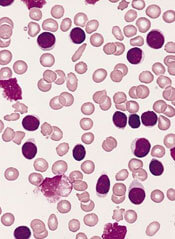
LUGANO, SWITZERLAND—Results of a phase 1 study suggest a 2-drug combination may be safe and effective in patients with chronic lymphocytic leukemia (CLL)/small lymphocytic lymphoma (SLL) and follicular lymphoma (FL).
The ongoing study is a test of the BTK inhibitor BGB-3111 and the anti-CD20 antibody obinutuzumab.
The overall response rate (ORR) with this combination was 81% in the entire study population, 89% in treatment-naïve CLL/SLL patients, 92% in relapsed/refractory CLL/SLL patients, and 73% in relapsed/refractory FL patients.
The rate of serious adverse events (AEs) was 24% in both CLL/SLL and FL patients.
These results were presented at the 14th International Conference on Malignant Lymphoma (ICML). The research was sponsored by BeiGene, Ltd.
“This clinical trial is supported by preclinical work suggesting that BGB-3111 may combine well with antibodies that rely on antibody-dependent cell-mediated cytotoxicity, such as obinutuzumab, because of less off-target inhibition of interleukin-2-inducible T-cell kinase,” said study investigator Constantine Tam, MD, of St. Vincent’s Hospital in Melbourne, Australia.
“The preliminary clinical results to date suggest that the combination is well tolerated and highly active in patients with CLL or SLL and FL. Complete responses have already been observed in patients with both disease types, including CLL or SLL patients with high-risk features, despite a very short follow-up time.”
The trial consists of a dose-escalation phase and a dose-expansion phase in disease-specific cohorts, which include treatment-naive or relapsed/refractory CLL/SLL and relapsed/refractory FL.
The dose-escalation component is testing BGB-3111 at 320 mg once daily or 160 mg twice daily in 28-day cycles, in combination with obinutuzumab. Obinutuzumab is administered in line with standard CLL dosing (3 loading doses of 1000 mg weekly, followed by 1000 mg on day 1 of cycles 2 to 6).
The ongoing dose-expansion component is testing doses of BGB-3111 at 160 mg twice daily with the same obinutuzumab schedule.
As of the data cutoff (March 31, 2017), 45 patients with CLL/SLL and 17 patients with FL were enrolled in the trial.
Patient characteristics
The median age was 68 (range, 28-82) in the CLL/SLL patients and 56 (range, 41-86) in the FL patients.
ECOG performance status was 0 in 42% of CLL/SLL patients, 1 in 56% of these patients, and 2 in 2%. ECOG performance status was 0 in 82% of FL patients, 1 in 12% of these patients, and 2 in 6%.
Twenty CLL/SLL patients were treatment-naïve, and 25 had relapsed/refractory disease. All 17 FL patients had relapsed/refractory disease.
The median number of prior therapies was 1 (range, 1-4) in the relapsed/refractory CLL/SLL patients and 3 (range, 1-7) in the FL patients.
Safety
At the time of the data cutoff, BGB-3111 was deemed well tolerated in patients with CLL/SLL and FL.
The most frequent AEs of any cause occurring in at least 15% of patients with CLL/SLL were petechiae/purpura/contusion (33%), neutropenia (31%), thrombocytopenia (22%), fatigue (18%), pyrexia (18%), upper respiratory tract infection (18%), and diarrhea (16%).
Most of these events were grade 1/2. The exceptions were grade 3/4 neutropenia (20%) and grade 3/4 thrombocytopenia (4%).
The most frequent AEs in FL patients were petechiae/purpura/contusion (35%), fatigue (29%), cough (18%), diarrhea (18%), dizziness (18%), headache (18%), insomnia (18%), nausea (18%), and upper respiratory tract infection (18%). All of these events were grade 1/2.
Serious AEs occurred in 24% of both the CLL/SLL patients and the FL patients.
Infusion-related reactions occurred in 24% of CLL/SLL patients and 6% of FL patients. Nearly all cases were grade 1/2. The exception was 1 grade 4 case in a CLL/SLL patient.
There were no cases of serious hemorrhage (≥ grade 3 hemorrhage or central nervous system hemorrhage of any grade) or atrial fibrillation.
One patient discontinued treatment due to an AE—squamous cell carcinoma. This patient had a prior history of squamous cell carcinoma.
Efficacy
At the time of the data cutoff, 43 patients with CLL/SLL (18 treatment-naive, 25 relapsed/refractory) and 15 patients with relapsed/refractory FL had greater than 12 weeks of follow-up and were evaluable for efficacy.
In treatment-naive CLL/SLL, after a median follow-up of 7.0 months (range, 2.8–11.8 months), the ORR was 89%. The complete response (CR) rate was 22%, the rate of partial response (PR) was 67%, and the rate of stable disease (SD) was 11%.
In relapsed/refractory CLL/SLL, at a median follow-up of 8.0 months (range, 3.8–14.0 months) the ORR was 92%. The CR rate was 16%, the PR rate was 76%, and 4% of patients had SD.
One patient (4%) with relapsed/refractory CLL/SLL had progressive disease (Richter’s transformation).
In relapsed/refractory FL, at a median follow-up of 6.2 months (range, 1.2–10.7 months), the ORR was 73%. The CR rate was 33%, the PR rate was 40%, and 13% of patients had SD.
Two patients (13%) with relapsed/refractory FL had progressive disease.
On the basis of these data, BeiGene plans to expand its global registrational program for BGB-3111 to include a phase 2 trial of BGB-3111 in combination with obinutuzumab compared to obinutuzumab alone in patients with relapsed/refractory FL.
The company is also planning a phase 3 trial comparing BGB-3111 with bendamustine plus rituximab in patients with treatment-naive CLL.
LUGANO, SWITZERLAND—Results of a phase 1 study suggest a 2-drug combination may be safe and effective in patients with chronic lymphocytic leukemia (CLL)/small lymphocytic lymphoma (SLL) and follicular lymphoma (FL).
The ongoing study is a test of the BTK inhibitor BGB-3111 and the anti-CD20 antibody obinutuzumab.
The overall response rate (ORR) with this combination was 81% in the entire study population, 89% in treatment-naïve CLL/SLL patients, 92% in relapsed/refractory CLL/SLL patients, and 73% in relapsed/refractory FL patients.
The rate of serious adverse events (AEs) was 24% in both CLL/SLL and FL patients.
These results were presented at the 14th International Conference on Malignant Lymphoma (ICML). The research was sponsored by BeiGene, Ltd.
“This clinical trial is supported by preclinical work suggesting that BGB-3111 may combine well with antibodies that rely on antibody-dependent cell-mediated cytotoxicity, such as obinutuzumab, because of less off-target inhibition of interleukin-2-inducible T-cell kinase,” said study investigator Constantine Tam, MD, of St. Vincent’s Hospital in Melbourne, Australia.
“The preliminary clinical results to date suggest that the combination is well tolerated and highly active in patients with CLL or SLL and FL. Complete responses have already been observed in patients with both disease types, including CLL or SLL patients with high-risk features, despite a very short follow-up time.”
The trial consists of a dose-escalation phase and a dose-expansion phase in disease-specific cohorts, which include treatment-naive or relapsed/refractory CLL/SLL and relapsed/refractory FL.
The dose-escalation component is testing BGB-3111 at 320 mg once daily or 160 mg twice daily in 28-day cycles, in combination with obinutuzumab. Obinutuzumab is administered in line with standard CLL dosing (3 loading doses of 1000 mg weekly, followed by 1000 mg on day 1 of cycles 2 to 6).
The ongoing dose-expansion component is testing doses of BGB-3111 at 160 mg twice daily with the same obinutuzumab schedule.
As of the data cutoff (March 31, 2017), 45 patients with CLL/SLL and 17 patients with FL were enrolled in the trial.
Patient characteristics
The median age was 68 (range, 28-82) in the CLL/SLL patients and 56 (range, 41-86) in the FL patients.
ECOG performance status was 0 in 42% of CLL/SLL patients, 1 in 56% of these patients, and 2 in 2%. ECOG performance status was 0 in 82% of FL patients, 1 in 12% of these patients, and 2 in 6%.
Twenty CLL/SLL patients were treatment-naïve, and 25 had relapsed/refractory disease. All 17 FL patients had relapsed/refractory disease.
The median number of prior therapies was 1 (range, 1-4) in the relapsed/refractory CLL/SLL patients and 3 (range, 1-7) in the FL patients.
Safety
At the time of the data cutoff, BGB-3111 was deemed well tolerated in patients with CLL/SLL and FL.
The most frequent AEs of any cause occurring in at least 15% of patients with CLL/SLL were petechiae/purpura/contusion (33%), neutropenia (31%), thrombocytopenia (22%), fatigue (18%), pyrexia (18%), upper respiratory tract infection (18%), and diarrhea (16%).
Most of these events were grade 1/2. The exceptions were grade 3/4 neutropenia (20%) and grade 3/4 thrombocytopenia (4%).
The most frequent AEs in FL patients were petechiae/purpura/contusion (35%), fatigue (29%), cough (18%), diarrhea (18%), dizziness (18%), headache (18%), insomnia (18%), nausea (18%), and upper respiratory tract infection (18%). All of these events were grade 1/2.
Serious AEs occurred in 24% of both the CLL/SLL patients and the FL patients.
Infusion-related reactions occurred in 24% of CLL/SLL patients and 6% of FL patients. Nearly all cases were grade 1/2. The exception was 1 grade 4 case in a CLL/SLL patient.
There were no cases of serious hemorrhage (≥ grade 3 hemorrhage or central nervous system hemorrhage of any grade) or atrial fibrillation.
One patient discontinued treatment due to an AE—squamous cell carcinoma. This patient had a prior history of squamous cell carcinoma.
Efficacy
At the time of the data cutoff, 43 patients with CLL/SLL (18 treatment-naive, 25 relapsed/refractory) and 15 patients with relapsed/refractory FL had greater than 12 weeks of follow-up and were evaluable for efficacy.
In treatment-naive CLL/SLL, after a median follow-up of 7.0 months (range, 2.8–11.8 months), the ORR was 89%. The complete response (CR) rate was 22%, the rate of partial response (PR) was 67%, and the rate of stable disease (SD) was 11%.
In relapsed/refractory CLL/SLL, at a median follow-up of 8.0 months (range, 3.8–14.0 months) the ORR was 92%. The CR rate was 16%, the PR rate was 76%, and 4% of patients had SD.
One patient (4%) with relapsed/refractory CLL/SLL had progressive disease (Richter’s transformation).
In relapsed/refractory FL, at a median follow-up of 6.2 months (range, 1.2–10.7 months), the ORR was 73%. The CR rate was 33%, the PR rate was 40%, and 13% of patients had SD.
Two patients (13%) with relapsed/refractory FL had progressive disease.
On the basis of these data, BeiGene plans to expand its global registrational program for BGB-3111 to include a phase 2 trial of BGB-3111 in combination with obinutuzumab compared to obinutuzumab alone in patients with relapsed/refractory FL.
The company is also planning a phase 3 trial comparing BGB-3111 with bendamustine plus rituximab in patients with treatment-naive CLL.
LUGANO, SWITZERLAND—Results of a phase 1 study suggest a 2-drug combination may be safe and effective in patients with chronic lymphocytic leukemia (CLL)/small lymphocytic lymphoma (SLL) and follicular lymphoma (FL).
The ongoing study is a test of the BTK inhibitor BGB-3111 and the anti-CD20 antibody obinutuzumab.
The overall response rate (ORR) with this combination was 81% in the entire study population, 89% in treatment-naïve CLL/SLL patients, 92% in relapsed/refractory CLL/SLL patients, and 73% in relapsed/refractory FL patients.
The rate of serious adverse events (AEs) was 24% in both CLL/SLL and FL patients.
These results were presented at the 14th International Conference on Malignant Lymphoma (ICML). The research was sponsored by BeiGene, Ltd.
“This clinical trial is supported by preclinical work suggesting that BGB-3111 may combine well with antibodies that rely on antibody-dependent cell-mediated cytotoxicity, such as obinutuzumab, because of less off-target inhibition of interleukin-2-inducible T-cell kinase,” said study investigator Constantine Tam, MD, of St. Vincent’s Hospital in Melbourne, Australia.
“The preliminary clinical results to date suggest that the combination is well tolerated and highly active in patients with CLL or SLL and FL. Complete responses have already been observed in patients with both disease types, including CLL or SLL patients with high-risk features, despite a very short follow-up time.”
The trial consists of a dose-escalation phase and a dose-expansion phase in disease-specific cohorts, which include treatment-naive or relapsed/refractory CLL/SLL and relapsed/refractory FL.
The dose-escalation component is testing BGB-3111 at 320 mg once daily or 160 mg twice daily in 28-day cycles, in combination with obinutuzumab. Obinutuzumab is administered in line with standard CLL dosing (3 loading doses of 1000 mg weekly, followed by 1000 mg on day 1 of cycles 2 to 6).
The ongoing dose-expansion component is testing doses of BGB-3111 at 160 mg twice daily with the same obinutuzumab schedule.
As of the data cutoff (March 31, 2017), 45 patients with CLL/SLL and 17 patients with FL were enrolled in the trial.
Patient characteristics
The median age was 68 (range, 28-82) in the CLL/SLL patients and 56 (range, 41-86) in the FL patients.
ECOG performance status was 0 in 42% of CLL/SLL patients, 1 in 56% of these patients, and 2 in 2%. ECOG performance status was 0 in 82% of FL patients, 1 in 12% of these patients, and 2 in 6%.
Twenty CLL/SLL patients were treatment-naïve, and 25 had relapsed/refractory disease. All 17 FL patients had relapsed/refractory disease.
The median number of prior therapies was 1 (range, 1-4) in the relapsed/refractory CLL/SLL patients and 3 (range, 1-7) in the FL patients.
Safety
At the time of the data cutoff, BGB-3111 was deemed well tolerated in patients with CLL/SLL and FL.
The most frequent AEs of any cause occurring in at least 15% of patients with CLL/SLL were petechiae/purpura/contusion (33%), neutropenia (31%), thrombocytopenia (22%), fatigue (18%), pyrexia (18%), upper respiratory tract infection (18%), and diarrhea (16%).
Most of these events were grade 1/2. The exceptions were grade 3/4 neutropenia (20%) and grade 3/4 thrombocytopenia (4%).
The most frequent AEs in FL patients were petechiae/purpura/contusion (35%), fatigue (29%), cough (18%), diarrhea (18%), dizziness (18%), headache (18%), insomnia (18%), nausea (18%), and upper respiratory tract infection (18%). All of these events were grade 1/2.
Serious AEs occurred in 24% of both the CLL/SLL patients and the FL patients.
Infusion-related reactions occurred in 24% of CLL/SLL patients and 6% of FL patients. Nearly all cases were grade 1/2. The exception was 1 grade 4 case in a CLL/SLL patient.
There were no cases of serious hemorrhage (≥ grade 3 hemorrhage or central nervous system hemorrhage of any grade) or atrial fibrillation.
One patient discontinued treatment due to an AE—squamous cell carcinoma. This patient had a prior history of squamous cell carcinoma.
Efficacy
At the time of the data cutoff, 43 patients with CLL/SLL (18 treatment-naive, 25 relapsed/refractory) and 15 patients with relapsed/refractory FL had greater than 12 weeks of follow-up and were evaluable for efficacy.
In treatment-naive CLL/SLL, after a median follow-up of 7.0 months (range, 2.8–11.8 months), the ORR was 89%. The complete response (CR) rate was 22%, the rate of partial response (PR) was 67%, and the rate of stable disease (SD) was 11%.
In relapsed/refractory CLL/SLL, at a median follow-up of 8.0 months (range, 3.8–14.0 months) the ORR was 92%. The CR rate was 16%, the PR rate was 76%, and 4% of patients had SD.
One patient (4%) with relapsed/refractory CLL/SLL had progressive disease (Richter’s transformation).
In relapsed/refractory FL, at a median follow-up of 6.2 months (range, 1.2–10.7 months), the ORR was 73%. The CR rate was 33%, the PR rate was 40%, and 13% of patients had SD.
Two patients (13%) with relapsed/refractory FL had progressive disease.
On the basis of these data, BeiGene plans to expand its global registrational program for BGB-3111 to include a phase 2 trial of BGB-3111 in combination with obinutuzumab compared to obinutuzumab alone in patients with relapsed/refractory FL.
The company is also planning a phase 3 trial comparing BGB-3111 with bendamustine plus rituximab in patients with treatment-naive CLL.
R-CHOP matched more intense regimens for overall survival in high-risk, untreated DLBCL
High-dose chemotherapy with upfront autologous stem cell transplantation did not meaningfully improve survival at 5 years in a phase 3 trial of 399 patients under age 66 years with intermediate to high– or high-risk untreated diffuse large B-cell lymphoma.
Rates of treatment failure-free survival at 2 years were 71% for patients who received rituximab dose–dense chemotherapy followed by autologous stem cell transplantation (ASCT) and 62% for patients who received only the rituximab regimen (hazard ratio, 0.65; 95% confidence interval, 0.47-0.91; P = .01), Annalisa Chiappella, MD, of Azienda Ospedaliero Universitaria Città della Salute e della Scienza di Torino (Italy) reported with her associates in Lancet Oncology.

Patients with diffuse large B-cell lymphoma, whose age-adjusted International Prognostic Index (aa-IPI) scores are 2 or 3 (intermediate to high or high risk), have a poor prognosis despite standard treatment with R-CHOP (rituximab, cyclophosphamide, vincristine, doxorubicin, and prednisone). Given a historic lack of late-phase studies of this population, the researchers designed a multicenter, open-label, randomized phase 3 trial comparing rituximab dose–dense chemotherapy without ASCT with a shorter rituximab regimen followed by consolidation with R-MAD (rituximab plus high-dose cytarabine plus mitoxantrone plus dexamethasone) and high-dose BEAM chemotherapy (carmustine, etoposide, cytarabine, and melphalan) plus ASCT in untreated patients aged 18-65 years.
Rituximab-based chemotherapy consisted of 14-day cycles of either standard R-CHOP or an intensified R-CHOP–like regimen that increased the doses of cyclophosphamide (1200 mg/m2) and doxorubicin (70 mg/m2), the investigators noted (Lancet Oncol. 2017 Jun 28. doi: 10.1016/S1470-2045[17]30444-8).
In all, 96 patients were assigned to receive only standard R-CHOP (eight cycles), 100 patients were assigned to high-dose R-CHOP (six cycles), 103 patients were assigned to standard R-CHOP (four cycles) plus R-MAD (2 cycles) plus BEAM plus ASCT, and 96 patients were assigned to high-dose R-CHOP (four cycles) plus the same sequence of R-MAD, BEAM, and ASCT. A total of 325 (81%) patients completed treatment, and the median follow-up period was 72 months (interquartile range, 57 to 88 months). There was no evidence that treatment efficacy varied by age, sex, bone marrow involvement, or other histology results, but only the intermediate-high risk patients experienced a benefit in terms of failure-free survival.
Grade 3 or higher adverse hematologic events affected 183 (92%) ASCT recipients and 135 (68%) patients who received only R-CHOP or high-dose R-CHOP. Nonhematologic adverse events affected 45% and 16% of patients, respectively, and were mostly gastrointestinal in nature. Of recipients of ASCT, 12 stopped treatment because of infections, prolonged neutropenia, gastrointestinal symptoms, or cardiac abnormalities, and two patients who did not undergo ASCT stopped treatment because of infections or prolonged neutropenia. Three (13%) patients died from treatment-related causes, including eight patients in the transplantation groups and five of the other patients.
Previous studies have reported benefits from intensified R-CHOP–like regimens in diffuse large B-cell lymphoma, but these trials included low-risk patients.
“Our study enrolled only intermediate to high–risk or high-risk patients, and the findings do not support the hypothesis that increasing the dose of R-CHOP improves outcomes in patients with diffuse large B-cell lymphoma who are at high risk,” they wrote. “The addition of novel drugs, such as lenalidomide, ibrutinib, bortezomib, and others, to standard R-CHOP regimens has been reported in phase 1 or 2 studies with promising results in high-risk patients, leading to ongoing phase 3 randomized trials to assess the efficacy of these strategies. While awaiting the results of these randomized studies, the standard treatment in patients with diffuse large B-cell lymphoma at intermediate to high and high risk remains chemoimmunotherapy based on the standard R-CHOP regimen.”
Fondazione Italiana Linfomi funded the study. Dr. Chiappelli and several coinvestigators disclosed ties to Amgen, Celgene, Janssen, Nanostring, Pfizer, and other companies.
High-dose chemotherapy with upfront autologous stem cell transplantation did not meaningfully improve survival at 5 years in a phase 3 trial of 399 patients under age 66 years with intermediate to high– or high-risk untreated diffuse large B-cell lymphoma.
Rates of treatment failure-free survival at 2 years were 71% for patients who received rituximab dose–dense chemotherapy followed by autologous stem cell transplantation (ASCT) and 62% for patients who received only the rituximab regimen (hazard ratio, 0.65; 95% confidence interval, 0.47-0.91; P = .01), Annalisa Chiappella, MD, of Azienda Ospedaliero Universitaria Città della Salute e della Scienza di Torino (Italy) reported with her associates in Lancet Oncology.
Patients with diffuse large B-cell lymphoma, whose age-adjusted International Prognostic Index (aa-IPI) scores are 2 or 3 (intermediate to high or high risk), have a poor prognosis despite standard treatment with R-CHOP (rituximab, cyclophosphamide, vincristine, doxorubicin, and prednisone). Given a historic lack of late-phase studies of this population, the researchers designed a multicenter, open-label, randomized phase 3 trial comparing rituximab dose–dense chemotherapy without ASCT with a shorter rituximab regimen followed by consolidation with R-MAD (rituximab plus high-dose cytarabine plus mitoxantrone plus dexamethasone) and high-dose BEAM chemotherapy (carmustine, etoposide, cytarabine, and melphalan) plus ASCT in untreated patients aged 18-65 years.
Rituximab-based chemotherapy consisted of 14-day cycles of either standard R-CHOP or an intensified R-CHOP–like regimen that increased the doses of cyclophosphamide (1200 mg/m2) and doxorubicin (70 mg/m2), the investigators noted (Lancet Oncol. 2017 Jun 28. doi: 10.1016/S1470-2045[17]30444-8).
In all, 96 patients were assigned to receive only standard R-CHOP (eight cycles), 100 patients were assigned to high-dose R-CHOP (six cycles), 103 patients were assigned to standard R-CHOP (four cycles) plus R-MAD (2 cycles) plus BEAM plus ASCT, and 96 patients were assigned to high-dose R-CHOP (four cycles) plus the same sequence of R-MAD, BEAM, and ASCT. A total of 325 (81%) patients completed treatment, and the median follow-up period was 72 months (interquartile range, 57 to 88 months). There was no evidence that treatment efficacy varied by age, sex, bone marrow involvement, or other histology results, but only the intermediate-high risk patients experienced a benefit in terms of failure-free survival.
Grade 3 or higher adverse hematologic events affected 183 (92%) ASCT recipients and 135 (68%) patients who received only R-CHOP or high-dose R-CHOP. Nonhematologic adverse events affected 45% and 16% of patients, respectively, and were mostly gastrointestinal in nature. Of recipients of ASCT, 12 stopped treatment because of infections, prolonged neutropenia, gastrointestinal symptoms, or cardiac abnormalities, and two patients who did not undergo ASCT stopped treatment because of infections or prolonged neutropenia. Three (13%) patients died from treatment-related causes, including eight patients in the transplantation groups and five of the other patients.
Previous studies have reported benefits from intensified R-CHOP–like regimens in diffuse large B-cell lymphoma, but these trials included low-risk patients.
“Our study enrolled only intermediate to high–risk or high-risk patients, and the findings do not support the hypothesis that increasing the dose of R-CHOP improves outcomes in patients with diffuse large B-cell lymphoma who are at high risk,” they wrote. “The addition of novel drugs, such as lenalidomide, ibrutinib, bortezomib, and others, to standard R-CHOP regimens has been reported in phase 1 or 2 studies with promising results in high-risk patients, leading to ongoing phase 3 randomized trials to assess the efficacy of these strategies. While awaiting the results of these randomized studies, the standard treatment in patients with diffuse large B-cell lymphoma at intermediate to high and high risk remains chemoimmunotherapy based on the standard R-CHOP regimen.”
Fondazione Italiana Linfomi funded the study. Dr. Chiappelli and several coinvestigators disclosed ties to Amgen, Celgene, Janssen, Nanostring, Pfizer, and other companies.
High-dose chemotherapy with upfront autologous stem cell transplantation did not meaningfully improve survival at 5 years in a phase 3 trial of 399 patients under age 66 years with intermediate to high– or high-risk untreated diffuse large B-cell lymphoma.
Rates of treatment failure-free survival at 2 years were 71% for patients who received rituximab dose–dense chemotherapy followed by autologous stem cell transplantation (ASCT) and 62% for patients who received only the rituximab regimen (hazard ratio, 0.65; 95% confidence interval, 0.47-0.91; P = .01), Annalisa Chiappella, MD, of Azienda Ospedaliero Universitaria Città della Salute e della Scienza di Torino (Italy) reported with her associates in Lancet Oncology.
Patients with diffuse large B-cell lymphoma, whose age-adjusted International Prognostic Index (aa-IPI) scores are 2 or 3 (intermediate to high or high risk), have a poor prognosis despite standard treatment with R-CHOP (rituximab, cyclophosphamide, vincristine, doxorubicin, and prednisone). Given a historic lack of late-phase studies of this population, the researchers designed a multicenter, open-label, randomized phase 3 trial comparing rituximab dose–dense chemotherapy without ASCT with a shorter rituximab regimen followed by consolidation with R-MAD (rituximab plus high-dose cytarabine plus mitoxantrone plus dexamethasone) and high-dose BEAM chemotherapy (carmustine, etoposide, cytarabine, and melphalan) plus ASCT in untreated patients aged 18-65 years.
Rituximab-based chemotherapy consisted of 14-day cycles of either standard R-CHOP or an intensified R-CHOP–like regimen that increased the doses of cyclophosphamide (1200 mg/m2) and doxorubicin (70 mg/m2), the investigators noted (Lancet Oncol. 2017 Jun 28. doi: 10.1016/S1470-2045[17]30444-8).
In all, 96 patients were assigned to receive only standard R-CHOP (eight cycles), 100 patients were assigned to high-dose R-CHOP (six cycles), 103 patients were assigned to standard R-CHOP (four cycles) plus R-MAD (2 cycles) plus BEAM plus ASCT, and 96 patients were assigned to high-dose R-CHOP (four cycles) plus the same sequence of R-MAD, BEAM, and ASCT. A total of 325 (81%) patients completed treatment, and the median follow-up period was 72 months (interquartile range, 57 to 88 months). There was no evidence that treatment efficacy varied by age, sex, bone marrow involvement, or other histology results, but only the intermediate-high risk patients experienced a benefit in terms of failure-free survival.
Grade 3 or higher adverse hematologic events affected 183 (92%) ASCT recipients and 135 (68%) patients who received only R-CHOP or high-dose R-CHOP. Nonhematologic adverse events affected 45% and 16% of patients, respectively, and were mostly gastrointestinal in nature. Of recipients of ASCT, 12 stopped treatment because of infections, prolonged neutropenia, gastrointestinal symptoms, or cardiac abnormalities, and two patients who did not undergo ASCT stopped treatment because of infections or prolonged neutropenia. Three (13%) patients died from treatment-related causes, including eight patients in the transplantation groups and five of the other patients.
Previous studies have reported benefits from intensified R-CHOP–like regimens in diffuse large B-cell lymphoma, but these trials included low-risk patients.
“Our study enrolled only intermediate to high–risk or high-risk patients, and the findings do not support the hypothesis that increasing the dose of R-CHOP improves outcomes in patients with diffuse large B-cell lymphoma who are at high risk,” they wrote. “The addition of novel drugs, such as lenalidomide, ibrutinib, bortezomib, and others, to standard R-CHOP regimens has been reported in phase 1 or 2 studies with promising results in high-risk patients, leading to ongoing phase 3 randomized trials to assess the efficacy of these strategies. While awaiting the results of these randomized studies, the standard treatment in patients with diffuse large B-cell lymphoma at intermediate to high and high risk remains chemoimmunotherapy based on the standard R-CHOP regimen.”
Fondazione Italiana Linfomi funded the study. Dr. Chiappelli and several coinvestigators disclosed ties to Amgen, Celgene, Janssen, Nanostring, Pfizer, and other companies.
FROM LANCET ONCOLOGY
Key clinical point: Pending phase 3 trial results for novel drugs, R-CHOP should remain the standard treatment for high-risk diffuse large B-cell lymphoma.
Major finding: For patients given rituximab dose-dense chemotherapy followed by chemoimmunotherapy consolidation and autologous stem cell transplantation, versus rituximab dose-dense chemotherapy alone, 5-year rates of overall survival were 78% and 77%, respectively,
Data source: A randomized, open-label, phase 3 study of 399 patients, aged 18-65 years.
Disclosures: Fondazione Italiana Linfomi funded the study. Dr. Chiappelli and several coinvestigators disclosed ties to Amgen, Celgene, Janssen, Nanostring, Pfizer, and other companies.
Tazemetostat active against follicular lymphoma with EZH2 mutation
LUGANO, SWITZERLAND – Tazemetostat, a first-in-class experimental agent that inhibits an oncogenic protein, shows efficacy in patients with heavily pretreated, relapsed/refractory follicular lymphoma (FL) and diffuse large B cell lymphoma (DLBCL), interim results from a phase II study suggest.
Among patients with relapsed/refractory FL who had mutations in EZH2 (enhancer of zeste homolog 2), a member of a family of proteins that are involved in epigenetic gene silencing, the overall response rate (ORR) was 92%, reported Franck Morschhauser, MD, PhD, of the University of Lille, France.

“What we observed is a four-fold increase in [ORR in] follicular lymphoma-mutated patients compared to wild-type patients, a two-fold increase in DLBCL patients mutated compared to wild-type patients,” he said.
“But if we had focused [only] on the actionable mutation, we would have missed those other complete responders in the wild-type setting,” he added.
EZH2, an epigenetic regulator of gene expression, had been shown in preclinical studies to play an important role in multiple forms of cancers, and activating mutations of EZH2 have been shown to be oncogenic drivers in approximately 20% of FL and germinal center B-cell–like DLBCL, Dr. Morschhauser explained.
EZH2 has also been shown to be over-expressed in leukemia-initiating cells in patients with chronic myeloid leukemia, and EZH2 inhibitors are being explored as a possible therapy for patients with chronic myeloid leukemia that has become resistant to tyrosine kinase inhibitors.
Large multicenter study
Dr. Morschhauser reported interim results from a global, multi-center open-label study of tazemetostat in six cohorts of patients with relapsed/refractory FL (two monotherapy cohorts of 45 patients each) or DLBCL (three monotherapy cohorts of 60 patients each). A sixth cohort consisting of 70 patients with DLBCL treated with tazemetostat and prednisolone was added in 2017.
In the ongoing trial, patients receive oral tazemetostat 800 mg twice daily until disease progression or withdrawal from study, and are being followed for ORR, progression-free survival, overall survival, duration-of response, safety, and pharmacokinetics.
The longest follow-up at the time of data cutoff was approximately 18 months. Among 13 evaluable patients with FL with EZH2 mutations, the ORR was 92%, including one complete response (CR) and 11 partial responses (PR). In contrast, the ORR for 54 patients with FL and wild-type EZH2 was 28%, consisting of three CRs and 11 PRs. One patient with mutated EZH2 and 23 with wild-type EZH2 had stable disease.
Among 17 patients with DLBCL and EZH2 mutations, the ORR was 29%, consisting of 5 PR. For 119 patients with wild-type EZH2, the ORR was 15%, consisting of 10 CR and 8 PR. Six patients with mutations and 22 with wild-type EZH2 had stable disease.
Among the patients with FL, 75% had significant reduction in tumor burden.
The time to response ranged from 2 months to 1 year, with a median of approximately 4 months.
The variability in time to response “makes it a little bit tricky to calculate response duration,” Dr. Morschhauser said.
The drug had a “favorable” safety profile, with treatment-related adverse events of grade 3 or greater in more than 5% of patients including thrombocytopenias in 6% of patients, anemias in 4%, and neutropenias in 6%. Treatment-emergent adverse events leading to dose reductions occurred in 4% of patients, and those leading to drug discontinuation or study withdrawal occurred in 12% of patients.
In a retrospective analysis, the investigators performed molecular profiling studies using next-generation sequencing to look for predictors of response to tazemetostat. They found that patients most likely to respond to tazemetostat were those with activating mutations in EZH2 and MYD88. In contrast, patients with mutations HIST1H1E or MYC were not likely to respond.
Thomas E. Witzig, MD, of the Mayo Clinic in Rochester, Minn., the invited discussant, said that the study is important because “it provides proof of principle that attacking the methylation issue, attacking one of these enzymes, is very important and can produce single-agent responses.
“It also demonstrates the value of mutation status, and this trial knowledge of that mutation status has actually changed the trial design, so that now they are only putting patients on with mutations,” he said.
The trial also raises the possibility of targeting other parts of the methylation pathway to treat cancer, he added.
The study was sponsored by Epizyme, the maker of tazemetostat. Dr. Morschhauser disclosed receiving honoraria from and serving on advisory boards for both companies. Dr. Witzig has disclosed grants for clinical trials from Novartis and Wyeth, and he has served on advisory boards for Cephalon, Novartis, and Wyeth.
LUGANO, SWITZERLAND – Tazemetostat, a first-in-class experimental agent that inhibits an oncogenic protein, shows efficacy in patients with heavily pretreated, relapsed/refractory follicular lymphoma (FL) and diffuse large B cell lymphoma (DLBCL), interim results from a phase II study suggest.
Among patients with relapsed/refractory FL who had mutations in EZH2 (enhancer of zeste homolog 2), a member of a family of proteins that are involved in epigenetic gene silencing, the overall response rate (ORR) was 92%, reported Franck Morschhauser, MD, PhD, of the University of Lille, France.
“What we observed is a four-fold increase in [ORR in] follicular lymphoma-mutated patients compared to wild-type patients, a two-fold increase in DLBCL patients mutated compared to wild-type patients,” he said.
“But if we had focused [only] on the actionable mutation, we would have missed those other complete responders in the wild-type setting,” he added.
EZH2, an epigenetic regulator of gene expression, had been shown in preclinical studies to play an important role in multiple forms of cancers, and activating mutations of EZH2 have been shown to be oncogenic drivers in approximately 20% of FL and germinal center B-cell–like DLBCL, Dr. Morschhauser explained.
EZH2 has also been shown to be over-expressed in leukemia-initiating cells in patients with chronic myeloid leukemia, and EZH2 inhibitors are being explored as a possible therapy for patients with chronic myeloid leukemia that has become resistant to tyrosine kinase inhibitors.
Large multicenter study
Dr. Morschhauser reported interim results from a global, multi-center open-label study of tazemetostat in six cohorts of patients with relapsed/refractory FL (two monotherapy cohorts of 45 patients each) or DLBCL (three monotherapy cohorts of 60 patients each). A sixth cohort consisting of 70 patients with DLBCL treated with tazemetostat and prednisolone was added in 2017.
In the ongoing trial, patients receive oral tazemetostat 800 mg twice daily until disease progression or withdrawal from study, and are being followed for ORR, progression-free survival, overall survival, duration-of response, safety, and pharmacokinetics.
The longest follow-up at the time of data cutoff was approximately 18 months. Among 13 evaluable patients with FL with EZH2 mutations, the ORR was 92%, including one complete response (CR) and 11 partial responses (PR). In contrast, the ORR for 54 patients with FL and wild-type EZH2 was 28%, consisting of three CRs and 11 PRs. One patient with mutated EZH2 and 23 with wild-type EZH2 had stable disease.
Among 17 patients with DLBCL and EZH2 mutations, the ORR was 29%, consisting of 5 PR. For 119 patients with wild-type EZH2, the ORR was 15%, consisting of 10 CR and 8 PR. Six patients with mutations and 22 with wild-type EZH2 had stable disease.
Among the patients with FL, 75% had significant reduction in tumor burden.
The time to response ranged from 2 months to 1 year, with a median of approximately 4 months.
The variability in time to response “makes it a little bit tricky to calculate response duration,” Dr. Morschhauser said.
The drug had a “favorable” safety profile, with treatment-related adverse events of grade 3 or greater in more than 5% of patients including thrombocytopenias in 6% of patients, anemias in 4%, and neutropenias in 6%. Treatment-emergent adverse events leading to dose reductions occurred in 4% of patients, and those leading to drug discontinuation or study withdrawal occurred in 12% of patients.
In a retrospective analysis, the investigators performed molecular profiling studies using next-generation sequencing to look for predictors of response to tazemetostat. They found that patients most likely to respond to tazemetostat were those with activating mutations in EZH2 and MYD88. In contrast, patients with mutations HIST1H1E or MYC were not likely to respond.
Thomas E. Witzig, MD, of the Mayo Clinic in Rochester, Minn., the invited discussant, said that the study is important because “it provides proof of principle that attacking the methylation issue, attacking one of these enzymes, is very important and can produce single-agent responses.
“It also demonstrates the value of mutation status, and this trial knowledge of that mutation status has actually changed the trial design, so that now they are only putting patients on with mutations,” he said.
The trial also raises the possibility of targeting other parts of the methylation pathway to treat cancer, he added.
The study was sponsored by Epizyme, the maker of tazemetostat. Dr. Morschhauser disclosed receiving honoraria from and serving on advisory boards for both companies. Dr. Witzig has disclosed grants for clinical trials from Novartis and Wyeth, and he has served on advisory boards for Cephalon, Novartis, and Wyeth.
LUGANO, SWITZERLAND – Tazemetostat, a first-in-class experimental agent that inhibits an oncogenic protein, shows efficacy in patients with heavily pretreated, relapsed/refractory follicular lymphoma (FL) and diffuse large B cell lymphoma (DLBCL), interim results from a phase II study suggest.
Among patients with relapsed/refractory FL who had mutations in EZH2 (enhancer of zeste homolog 2), a member of a family of proteins that are involved in epigenetic gene silencing, the overall response rate (ORR) was 92%, reported Franck Morschhauser, MD, PhD, of the University of Lille, France.
“What we observed is a four-fold increase in [ORR in] follicular lymphoma-mutated patients compared to wild-type patients, a two-fold increase in DLBCL patients mutated compared to wild-type patients,” he said.
“But if we had focused [only] on the actionable mutation, we would have missed those other complete responders in the wild-type setting,” he added.
EZH2, an epigenetic regulator of gene expression, had been shown in preclinical studies to play an important role in multiple forms of cancers, and activating mutations of EZH2 have been shown to be oncogenic drivers in approximately 20% of FL and germinal center B-cell–like DLBCL, Dr. Morschhauser explained.
EZH2 has also been shown to be over-expressed in leukemia-initiating cells in patients with chronic myeloid leukemia, and EZH2 inhibitors are being explored as a possible therapy for patients with chronic myeloid leukemia that has become resistant to tyrosine kinase inhibitors.
Large multicenter study
Dr. Morschhauser reported interim results from a global, multi-center open-label study of tazemetostat in six cohorts of patients with relapsed/refractory FL (two monotherapy cohorts of 45 patients each) or DLBCL (three monotherapy cohorts of 60 patients each). A sixth cohort consisting of 70 patients with DLBCL treated with tazemetostat and prednisolone was added in 2017.
In the ongoing trial, patients receive oral tazemetostat 800 mg twice daily until disease progression or withdrawal from study, and are being followed for ORR, progression-free survival, overall survival, duration-of response, safety, and pharmacokinetics.
The longest follow-up at the time of data cutoff was approximately 18 months. Among 13 evaluable patients with FL with EZH2 mutations, the ORR was 92%, including one complete response (CR) and 11 partial responses (PR). In contrast, the ORR for 54 patients with FL and wild-type EZH2 was 28%, consisting of three CRs and 11 PRs. One patient with mutated EZH2 and 23 with wild-type EZH2 had stable disease.
Among 17 patients with DLBCL and EZH2 mutations, the ORR was 29%, consisting of 5 PR. For 119 patients with wild-type EZH2, the ORR was 15%, consisting of 10 CR and 8 PR. Six patients with mutations and 22 with wild-type EZH2 had stable disease.
Among the patients with FL, 75% had significant reduction in tumor burden.
The time to response ranged from 2 months to 1 year, with a median of approximately 4 months.
The variability in time to response “makes it a little bit tricky to calculate response duration,” Dr. Morschhauser said.
The drug had a “favorable” safety profile, with treatment-related adverse events of grade 3 or greater in more than 5% of patients including thrombocytopenias in 6% of patients, anemias in 4%, and neutropenias in 6%. Treatment-emergent adverse events leading to dose reductions occurred in 4% of patients, and those leading to drug discontinuation or study withdrawal occurred in 12% of patients.
In a retrospective analysis, the investigators performed molecular profiling studies using next-generation sequencing to look for predictors of response to tazemetostat. They found that patients most likely to respond to tazemetostat were those with activating mutations in EZH2 and MYD88. In contrast, patients with mutations HIST1H1E or MYC were not likely to respond.
Thomas E. Witzig, MD, of the Mayo Clinic in Rochester, Minn., the invited discussant, said that the study is important because “it provides proof of principle that attacking the methylation issue, attacking one of these enzymes, is very important and can produce single-agent responses.
“It also demonstrates the value of mutation status, and this trial knowledge of that mutation status has actually changed the trial design, so that now they are only putting patients on with mutations,” he said.
The trial also raises the possibility of targeting other parts of the methylation pathway to treat cancer, he added.
The study was sponsored by Epizyme, the maker of tazemetostat. Dr. Morschhauser disclosed receiving honoraria from and serving on advisory boards for both companies. Dr. Witzig has disclosed grants for clinical trials from Novartis and Wyeth, and he has served on advisory boards for Cephalon, Novartis, and Wyeth.
AT 14-ICML
Key clinical point: The experimental drug tazemetostat induced responses in patients with heavily pretreated follicular lymphoma (FL) with mutations in EZH2.
Major finding: The overall response rate among patients with FL with mutated EZH2 was 92%.
Data source: Multicenter, open-label phase II study in patients with relapsed/refractory FL and diffuse large B cell lymphoma.
Disclosures: The study is sponsored by Epizyme. Dr. Morschhauser disclosed receiving honoraria from and serving on advisory boards for both companies. Dr. Witzig has disclosed grants for clinical trials from Novartis and Wyeth, and he has served on advisory boards for Cephalon, Novartis, and Wyeth.

Nivolumab for long-term treatment of cHL after auto-HSCT
LUGANO, SWITZERLAND—Nivolumab can provide long-term treatment for a broad range of adults who have relapsed or refractory classical Hodgkin lymphoma (cHL) after autologous hematopoietic stem cell transplant (auto-HSCT), according to a presentation at the 14th International Conference on Malignant Lymphoma (ICML).
In the phase 2 CheckMate-205 study, cHL patients achieved durable responses regardless of the depth of response, previous exposure to brentuximab vedotin (BV), and refractoriness to prior therapies.
Researchers observed sustained progression-free survival (PFS) in patients with stable disease (SD) or better, and the safety profile of nivolumab was considered acceptable.
“Nivolumab offers a favorable treatment outcome for patients who have relapsed disease after autologous stem cell transplant,” said Michelle Fanale, MD, of the University of Texas MD Anderson Cancer Center in Houston.
Dr Fanale presented results from CheckMate-205 at 14-ICML. The study was sponsored by Bristol-Myers Squibb Company.
CheckMate-205 enrolled 243 adults with relapsed or refractory cHL who had undergone auto-HSCT. Patients were divided into 3 cohorts:
- Cohort A included patients who were naïve to BV (n=63)
- Cohort B included patients who received BV only after auto-HSCT (n=80)
- Cohort C included patients who received BV before and/or after auto-HSCT (n=100).
All patients received nivolumab at 3 mg/kg once every 2 weeks until disease progression or unacceptable toxicity.
In cohort C, patients who were in complete response (CR) for 1 year were to discontinue nivolumab, but they could resume treatment with the drug if they relapsed within 2 years.
Patient characteristics
The median age was 33 (range, 18-65) in cohort A, 37 (range, 18-72) in cohort B, and 32 (range, 19-69) in cohort C.
ECOG performance status was 0 for 62% of patients in cohort A, 53% in cohort B, and 50% in cohort C. The remaining patients had a performance status of 1.
The percentage of patients with stage IV disease was 38% in cohort A, 68% in cohort B, and 61% in cohort C.
The median number of prior therapies was 2 (range, 2-8) in cohort A, 4 (range, 3-15) in cohort B, and 4 (range, 2-9) in cohort C. Fifty-nine percent, 74%, and 69% of patients, respectively, had received prior radiotherapy.
The median time from diagnosis to the first dose of nivolumab was 3.1 years (range, 1.0-30.6) in cohort A, 6.2 years (range, 1.3-25.1) in cohort B, and 3.5 years (range, 1.0-24.9) in cohort C.
The median time from auto-HSCT to the first dose of nivolumab was 1.0 years (range, 0.3-18.2) in cohort A, 3.4 years (range, 0.2-19.0) in cohort B, and 1.7 years (range, 0.2-17.0) in cohort C.
Safety
The most common drug-related adverse events (AEs) were fatigue (23% any grade, 1% grade 3/4), diarrhea (15% any grade, 1% grade 3/4), infusion-related reactions (14% any grade, <1% grade 3/4), rash (12% any grade, 1% grade 3/4), nausea (10% grade 1/2), and pruritus (10% grade 1/2).
The most common drug-related serious AEs were infusion-related reactions (2% any grade, <1% grade 3/4) and pneumonitis (1% grade 1/2).
Drug-related AEs leading to treatment discontinuation were pneumonitis (2% grade 1/2) and autoimmune hepatitis (1% grade 3/4).
There were no deaths due to drug-related AEs.
Response
The objective response rate was 69% overall, 65% in cohort A, 68% in cohort B, and 73% in cohort C.
CR was the best response for 16% of all patients, 29% of cohort A, 13% of cohort B, and 12% of cohort C.
Partial response (PR) was the best response for 53% of all patients, 37% of patients in cohort A, 55% in cohort B, and 61% in cohort C.
SD was the best response for 19% of all patients, 24% of patients in cohort A, 21% in cohort B, and 15% in cohort C.
In post-hoc analyses, responses were similar irrespective of BV treatment sequence.
The median duration of response was 17 months overall, 20 months for cohort A, 16 months for cohort B, and 15 months for cohort C.
The median duration of response in patients with a CR was 20 months overall and for cohorts A and B, but it was 15 months for cohort C.
The median duration of response in patients with a PR was 13 months overall, 17 months for cohort A, 11 months for cohort B, and 13 months for cohort C.
Survival
The median PFS for all patients was 15 months (range, 11-19). The median PFS was 22 months (range, 19-not reached) for patients who achieved a CR, 15 months (range, 11-19) for those who achieved a PR, and 11 months (range, 6-18) for those who had SD.
The median PFS was 18 months (range, 11-22) for patients in cohort A, 15 months (range, 11-20) for cohort B, and 12 months (range, 11-18) for cohort C.
The median overall survival (OS) has not been reached in any of the cohorts. The 12-months OS is 92% overall, 93% in cohort A, 95% in cohort B, and 90% in cohort C.
Patient status after extended follow-up
Forty percent of all patients were still on treatment after extended follow-up, as were 48% of patients in cohort A, 40% in cohort B, and 35% in cohort C.
The most common reason for stopping treatment was disease progression—25% of cohort A, 28% of cohort B, and 24% of cohort C.
Patients also stopped treatment due to nivolumab-related toxicity—5% in cohort A, 11% in cohort B, and 7% in cohort C. Three percent, 1%, and 1%, respectively, stopped due to AEs unrelated to nivolumab.
Three percent of patients in cohort C stopped because they had attained the maximum clinical benefit, and 8% in cohort C completed treatment. This includes 7 patients who discontinued treatment because they were in CR for 1 year.
None of the patients in cohort A or B discontinued because they attained the maximum clinical benefit or because they completed treatment.
Eight percent of patients in cohort A, 10% in cohort B, and 17% in cohort C discontinued so they could proceed to HSCT.
Outcomes after allo-HSCT
Forty-four patients received allogeneic (allo-) HSCT after nivolumab. The median post-HSCT follow-up was 5.5 months (range, 0-19), and the median time from last dose of nivolumab to allo-HSCT was 1.6 months (range, 0.5-13.5).
At 100 days, the rate of grade 2-4 acute graft-vs-host disease (GVHD) was 27%. The rate of grade 3-4 acute GVHD was 17%, and the rate of chronic GVHD was 10%. At 6 months, the rates were 30%, 20%, and 15%, respectively.
The incidence of transplant-related mortality was 13% at 100 days and at 6 months.
“While there are risks, potentially, for acute GVHD and transplant-related mortality, these aren’t necessarily significantly different from what we’ve seen from other historical publications,” Dr Fanale said.
She cited data showing that the 100-day incidence of acute GVHD in cHL patients who underwent allo-HSCT ranges from 26% to 60%, and the incidence of transplant-related mortality in these patients ranges from 6% to 28%.
LUGANO, SWITZERLAND—Nivolumab can provide long-term treatment for a broad range of adults who have relapsed or refractory classical Hodgkin lymphoma (cHL) after autologous hematopoietic stem cell transplant (auto-HSCT), according to a presentation at the 14th International Conference on Malignant Lymphoma (ICML).
In the phase 2 CheckMate-205 study, cHL patients achieved durable responses regardless of the depth of response, previous exposure to brentuximab vedotin (BV), and refractoriness to prior therapies.
Researchers observed sustained progression-free survival (PFS) in patients with stable disease (SD) or better, and the safety profile of nivolumab was considered acceptable.
“Nivolumab offers a favorable treatment outcome for patients who have relapsed disease after autologous stem cell transplant,” said Michelle Fanale, MD, of the University of Texas MD Anderson Cancer Center in Houston.
Dr Fanale presented results from CheckMate-205 at 14-ICML. The study was sponsored by Bristol-Myers Squibb Company.
CheckMate-205 enrolled 243 adults with relapsed or refractory cHL who had undergone auto-HSCT. Patients were divided into 3 cohorts:
- Cohort A included patients who were naïve to BV (n=63)
- Cohort B included patients who received BV only after auto-HSCT (n=80)
- Cohort C included patients who received BV before and/or after auto-HSCT (n=100).
All patients received nivolumab at 3 mg/kg once every 2 weeks until disease progression or unacceptable toxicity.
In cohort C, patients who were in complete response (CR) for 1 year were to discontinue nivolumab, but they could resume treatment with the drug if they relapsed within 2 years.
Patient characteristics
The median age was 33 (range, 18-65) in cohort A, 37 (range, 18-72) in cohort B, and 32 (range, 19-69) in cohort C.
ECOG performance status was 0 for 62% of patients in cohort A, 53% in cohort B, and 50% in cohort C. The remaining patients had a performance status of 1.
The percentage of patients with stage IV disease was 38% in cohort A, 68% in cohort B, and 61% in cohort C.
The median number of prior therapies was 2 (range, 2-8) in cohort A, 4 (range, 3-15) in cohort B, and 4 (range, 2-9) in cohort C. Fifty-nine percent, 74%, and 69% of patients, respectively, had received prior radiotherapy.
The median time from diagnosis to the first dose of nivolumab was 3.1 years (range, 1.0-30.6) in cohort A, 6.2 years (range, 1.3-25.1) in cohort B, and 3.5 years (range, 1.0-24.9) in cohort C.
The median time from auto-HSCT to the first dose of nivolumab was 1.0 years (range, 0.3-18.2) in cohort A, 3.4 years (range, 0.2-19.0) in cohort B, and 1.7 years (range, 0.2-17.0) in cohort C.
Safety
The most common drug-related adverse events (AEs) were fatigue (23% any grade, 1% grade 3/4), diarrhea (15% any grade, 1% grade 3/4), infusion-related reactions (14% any grade, <1% grade 3/4), rash (12% any grade, 1% grade 3/4), nausea (10% grade 1/2), and pruritus (10% grade 1/2).
The most common drug-related serious AEs were infusion-related reactions (2% any grade, <1% grade 3/4) and pneumonitis (1% grade 1/2).
Drug-related AEs leading to treatment discontinuation were pneumonitis (2% grade 1/2) and autoimmune hepatitis (1% grade 3/4).
There were no deaths due to drug-related AEs.
Response
The objective response rate was 69% overall, 65% in cohort A, 68% in cohort B, and 73% in cohort C.
CR was the best response for 16% of all patients, 29% of cohort A, 13% of cohort B, and 12% of cohort C.
Partial response (PR) was the best response for 53% of all patients, 37% of patients in cohort A, 55% in cohort B, and 61% in cohort C.
SD was the best response for 19% of all patients, 24% of patients in cohort A, 21% in cohort B, and 15% in cohort C.
In post-hoc analyses, responses were similar irrespective of BV treatment sequence.
The median duration of response was 17 months overall, 20 months for cohort A, 16 months for cohort B, and 15 months for cohort C.
The median duration of response in patients with a CR was 20 months overall and for cohorts A and B, but it was 15 months for cohort C.
The median duration of response in patients with a PR was 13 months overall, 17 months for cohort A, 11 months for cohort B, and 13 months for cohort C.
Survival
The median PFS for all patients was 15 months (range, 11-19). The median PFS was 22 months (range, 19-not reached) for patients who achieved a CR, 15 months (range, 11-19) for those who achieved a PR, and 11 months (range, 6-18) for those who had SD.
The median PFS was 18 months (range, 11-22) for patients in cohort A, 15 months (range, 11-20) for cohort B, and 12 months (range, 11-18) for cohort C.
The median overall survival (OS) has not been reached in any of the cohorts. The 12-months OS is 92% overall, 93% in cohort A, 95% in cohort B, and 90% in cohort C.
Patient status after extended follow-up
Forty percent of all patients were still on treatment after extended follow-up, as were 48% of patients in cohort A, 40% in cohort B, and 35% in cohort C.
The most common reason for stopping treatment was disease progression—25% of cohort A, 28% of cohort B, and 24% of cohort C.
Patients also stopped treatment due to nivolumab-related toxicity—5% in cohort A, 11% in cohort B, and 7% in cohort C. Three percent, 1%, and 1%, respectively, stopped due to AEs unrelated to nivolumab.
Three percent of patients in cohort C stopped because they had attained the maximum clinical benefit, and 8% in cohort C completed treatment. This includes 7 patients who discontinued treatment because they were in CR for 1 year.
None of the patients in cohort A or B discontinued because they attained the maximum clinical benefit or because they completed treatment.
Eight percent of patients in cohort A, 10% in cohort B, and 17% in cohort C discontinued so they could proceed to HSCT.
Outcomes after allo-HSCT
Forty-four patients received allogeneic (allo-) HSCT after nivolumab. The median post-HSCT follow-up was 5.5 months (range, 0-19), and the median time from last dose of nivolumab to allo-HSCT was 1.6 months (range, 0.5-13.5).
At 100 days, the rate of grade 2-4 acute graft-vs-host disease (GVHD) was 27%. The rate of grade 3-4 acute GVHD was 17%, and the rate of chronic GVHD was 10%. At 6 months, the rates were 30%, 20%, and 15%, respectively.
The incidence of transplant-related mortality was 13% at 100 days and at 6 months.
“While there are risks, potentially, for acute GVHD and transplant-related mortality, these aren’t necessarily significantly different from what we’ve seen from other historical publications,” Dr Fanale said.
She cited data showing that the 100-day incidence of acute GVHD in cHL patients who underwent allo-HSCT ranges from 26% to 60%, and the incidence of transplant-related mortality in these patients ranges from 6% to 28%.
LUGANO, SWITZERLAND—Nivolumab can provide long-term treatment for a broad range of adults who have relapsed or refractory classical Hodgkin lymphoma (cHL) after autologous hematopoietic stem cell transplant (auto-HSCT), according to a presentation at the 14th International Conference on Malignant Lymphoma (ICML).
In the phase 2 CheckMate-205 study, cHL patients achieved durable responses regardless of the depth of response, previous exposure to brentuximab vedotin (BV), and refractoriness to prior therapies.
Researchers observed sustained progression-free survival (PFS) in patients with stable disease (SD) or better, and the safety profile of nivolumab was considered acceptable.
“Nivolumab offers a favorable treatment outcome for patients who have relapsed disease after autologous stem cell transplant,” said Michelle Fanale, MD, of the University of Texas MD Anderson Cancer Center in Houston.
Dr Fanale presented results from CheckMate-205 at 14-ICML. The study was sponsored by Bristol-Myers Squibb Company.
CheckMate-205 enrolled 243 adults with relapsed or refractory cHL who had undergone auto-HSCT. Patients were divided into 3 cohorts:
- Cohort A included patients who were naïve to BV (n=63)
- Cohort B included patients who received BV only after auto-HSCT (n=80)
- Cohort C included patients who received BV before and/or after auto-HSCT (n=100).
All patients received nivolumab at 3 mg/kg once every 2 weeks until disease progression or unacceptable toxicity.
In cohort C, patients who were in complete response (CR) for 1 year were to discontinue nivolumab, but they could resume treatment with the drug if they relapsed within 2 years.
Patient characteristics
The median age was 33 (range, 18-65) in cohort A, 37 (range, 18-72) in cohort B, and 32 (range, 19-69) in cohort C.
ECOG performance status was 0 for 62% of patients in cohort A, 53% in cohort B, and 50% in cohort C. The remaining patients had a performance status of 1.
The percentage of patients with stage IV disease was 38% in cohort A, 68% in cohort B, and 61% in cohort C.
The median number of prior therapies was 2 (range, 2-8) in cohort A, 4 (range, 3-15) in cohort B, and 4 (range, 2-9) in cohort C. Fifty-nine percent, 74%, and 69% of patients, respectively, had received prior radiotherapy.
The median time from diagnosis to the first dose of nivolumab was 3.1 years (range, 1.0-30.6) in cohort A, 6.2 years (range, 1.3-25.1) in cohort B, and 3.5 years (range, 1.0-24.9) in cohort C.
The median time from auto-HSCT to the first dose of nivolumab was 1.0 years (range, 0.3-18.2) in cohort A, 3.4 years (range, 0.2-19.0) in cohort B, and 1.7 years (range, 0.2-17.0) in cohort C.
Safety
The most common drug-related adverse events (AEs) were fatigue (23% any grade, 1% grade 3/4), diarrhea (15% any grade, 1% grade 3/4), infusion-related reactions (14% any grade, <1% grade 3/4), rash (12% any grade, 1% grade 3/4), nausea (10% grade 1/2), and pruritus (10% grade 1/2).
The most common drug-related serious AEs were infusion-related reactions (2% any grade, <1% grade 3/4) and pneumonitis (1% grade 1/2).
Drug-related AEs leading to treatment discontinuation were pneumonitis (2% grade 1/2) and autoimmune hepatitis (1% grade 3/4).
There were no deaths due to drug-related AEs.
Response
The objective response rate was 69% overall, 65% in cohort A, 68% in cohort B, and 73% in cohort C.
CR was the best response for 16% of all patients, 29% of cohort A, 13% of cohort B, and 12% of cohort C.
Partial response (PR) was the best response for 53% of all patients, 37% of patients in cohort A, 55% in cohort B, and 61% in cohort C.
SD was the best response for 19% of all patients, 24% of patients in cohort A, 21% in cohort B, and 15% in cohort C.
In post-hoc analyses, responses were similar irrespective of BV treatment sequence.
The median duration of response was 17 months overall, 20 months for cohort A, 16 months for cohort B, and 15 months for cohort C.
The median duration of response in patients with a CR was 20 months overall and for cohorts A and B, but it was 15 months for cohort C.
The median duration of response in patients with a PR was 13 months overall, 17 months for cohort A, 11 months for cohort B, and 13 months for cohort C.
Survival
The median PFS for all patients was 15 months (range, 11-19). The median PFS was 22 months (range, 19-not reached) for patients who achieved a CR, 15 months (range, 11-19) for those who achieved a PR, and 11 months (range, 6-18) for those who had SD.
The median PFS was 18 months (range, 11-22) for patients in cohort A, 15 months (range, 11-20) for cohort B, and 12 months (range, 11-18) for cohort C.
The median overall survival (OS) has not been reached in any of the cohorts. The 12-months OS is 92% overall, 93% in cohort A, 95% in cohort B, and 90% in cohort C.
Patient status after extended follow-up
Forty percent of all patients were still on treatment after extended follow-up, as were 48% of patients in cohort A, 40% in cohort B, and 35% in cohort C.
The most common reason for stopping treatment was disease progression—25% of cohort A, 28% of cohort B, and 24% of cohort C.
Patients also stopped treatment due to nivolumab-related toxicity—5% in cohort A, 11% in cohort B, and 7% in cohort C. Three percent, 1%, and 1%, respectively, stopped due to AEs unrelated to nivolumab.
Three percent of patients in cohort C stopped because they had attained the maximum clinical benefit, and 8% in cohort C completed treatment. This includes 7 patients who discontinued treatment because they were in CR for 1 year.
None of the patients in cohort A or B discontinued because they attained the maximum clinical benefit or because they completed treatment.
Eight percent of patients in cohort A, 10% in cohort B, and 17% in cohort C discontinued so they could proceed to HSCT.
Outcomes after allo-HSCT
Forty-four patients received allogeneic (allo-) HSCT after nivolumab. The median post-HSCT follow-up was 5.5 months (range, 0-19), and the median time from last dose of nivolumab to allo-HSCT was 1.6 months (range, 0.5-13.5).
At 100 days, the rate of grade 2-4 acute graft-vs-host disease (GVHD) was 27%. The rate of grade 3-4 acute GVHD was 17%, and the rate of chronic GVHD was 10%. At 6 months, the rates were 30%, 20%, and 15%, respectively.
The incidence of transplant-related mortality was 13% at 100 days and at 6 months.
“While there are risks, potentially, for acute GVHD and transplant-related mortality, these aren’t necessarily significantly different from what we’ve seen from other historical publications,” Dr Fanale said.
She cited data showing that the 100-day incidence of acute GVHD in cHL patients who underwent allo-HSCT ranges from 26% to 60%, and the incidence of transplant-related mortality in these patients ranges from 6% to 28%.
FDA clears use of reagents to detect hematopoietic neoplasia
The US Food and Drug Administration (FDA) has allowed marketing of the ClearLLab Reagent Panel, a combination of conjugated antibody cocktails designed to aid the detection of hematopoietic neoplasia.
This includes chronic and acute leukemias, non-Hodgkin lymphoma, myeloma, myelodysplastic syndromes, and myeloproliferative neoplasms.
The ClearLLab reagents are intended for in vitro diagnostic use to identify various cell populations by immunophenotyping on an FC 500 flow cytometer.
The reagents are directed against B, T, and myeloid lineage antigens and intended to identify relevant leukocyte surface molecules.
ClearLLab provides 2 T-cell tubes, 2 B-cell tubes, and a myeloid tube, each consisting of pre-mixed 4- to 5-color cocktails. Together, this totals 18 markers as directly conjugated antibodies.
The reagents can be used with peripheral whole blood, bone marrow, and lymph node specimens.
The results obtained via testing with the ClearLLab reagents should be interpreted along with additional clinical and laboratory findings, according to Beckman Coulter, Inc., the company that will be marketing the reagents.
The FDA reviewed data for the ClearLLab reagents through the de novo premarket review pathway, a regulatory pathway for novel, low-to-moderate-risk devices that are not substantially equivalent to an already legally marketed device.
The FDA’s clearance of the ClearLLab reagents was supported by a study designed to demonstrate the reagents’ performance, which was conducted on 279 samples at 4 independent clinical sites.
Results with the ClearLLab reagents were compared to results with alternative detection methods used at the sites.
The ClearLLab results aligned with the study sites’ final diagnosis 93.4% of the time and correctly detected abnormalities 84.2% of the time.
Along with its clearance of the ClearLLab reagents, the FDA is establishing criteria, called special controls, which clarify the agency’s expectations in assuring the reagents’ accuracy, reliability, and clinical relevance.
These special controls, when met along with general controls, provide reasonable assurance of safety and effectiveness for the ClearLLab reagents and similar tools.
The special controls also describe the least burdensome regulatory pathway for future developers of similar diagnostic tests.
The US Food and Drug Administration (FDA) has allowed marketing of the ClearLLab Reagent Panel, a combination of conjugated antibody cocktails designed to aid the detection of hematopoietic neoplasia.
This includes chronic and acute leukemias, non-Hodgkin lymphoma, myeloma, myelodysplastic syndromes, and myeloproliferative neoplasms.
The ClearLLab reagents are intended for in vitro diagnostic use to identify various cell populations by immunophenotyping on an FC 500 flow cytometer.
The reagents are directed against B, T, and myeloid lineage antigens and intended to identify relevant leukocyte surface molecules.
ClearLLab provides 2 T-cell tubes, 2 B-cell tubes, and a myeloid tube, each consisting of pre-mixed 4- to 5-color cocktails. Together, this totals 18 markers as directly conjugated antibodies.
The reagents can be used with peripheral whole blood, bone marrow, and lymph node specimens.
The results obtained via testing with the ClearLLab reagents should be interpreted along with additional clinical and laboratory findings, according to Beckman Coulter, Inc., the company that will be marketing the reagents.
The FDA reviewed data for the ClearLLab reagents through the de novo premarket review pathway, a regulatory pathway for novel, low-to-moderate-risk devices that are not substantially equivalent to an already legally marketed device.
The FDA’s clearance of the ClearLLab reagents was supported by a study designed to demonstrate the reagents’ performance, which was conducted on 279 samples at 4 independent clinical sites.
Results with the ClearLLab reagents were compared to results with alternative detection methods used at the sites.
The ClearLLab results aligned with the study sites’ final diagnosis 93.4% of the time and correctly detected abnormalities 84.2% of the time.
Along with its clearance of the ClearLLab reagents, the FDA is establishing criteria, called special controls, which clarify the agency’s expectations in assuring the reagents’ accuracy, reliability, and clinical relevance.
These special controls, when met along with general controls, provide reasonable assurance of safety and effectiveness for the ClearLLab reagents and similar tools.
The special controls also describe the least burdensome regulatory pathway for future developers of similar diagnostic tests.
The US Food and Drug Administration (FDA) has allowed marketing of the ClearLLab Reagent Panel, a combination of conjugated antibody cocktails designed to aid the detection of hematopoietic neoplasia.
This includes chronic and acute leukemias, non-Hodgkin lymphoma, myeloma, myelodysplastic syndromes, and myeloproliferative neoplasms.
The ClearLLab reagents are intended for in vitro diagnostic use to identify various cell populations by immunophenotyping on an FC 500 flow cytometer.
The reagents are directed against B, T, and myeloid lineage antigens and intended to identify relevant leukocyte surface molecules.
ClearLLab provides 2 T-cell tubes, 2 B-cell tubes, and a myeloid tube, each consisting of pre-mixed 4- to 5-color cocktails. Together, this totals 18 markers as directly conjugated antibodies.
The reagents can be used with peripheral whole blood, bone marrow, and lymph node specimens.
The results obtained via testing with the ClearLLab reagents should be interpreted along with additional clinical and laboratory findings, according to Beckman Coulter, Inc., the company that will be marketing the reagents.
The FDA reviewed data for the ClearLLab reagents through the de novo premarket review pathway, a regulatory pathway for novel, low-to-moderate-risk devices that are not substantially equivalent to an already legally marketed device.
The FDA’s clearance of the ClearLLab reagents was supported by a study designed to demonstrate the reagents’ performance, which was conducted on 279 samples at 4 independent clinical sites.
Results with the ClearLLab reagents were compared to results with alternative detection methods used at the sites.
The ClearLLab results aligned with the study sites’ final diagnosis 93.4% of the time and correctly detected abnormalities 84.2% of the time.
Along with its clearance of the ClearLLab reagents, the FDA is establishing criteria, called special controls, which clarify the agency’s expectations in assuring the reagents’ accuracy, reliability, and clinical relevance.
These special controls, when met along with general controls, provide reasonable assurance of safety and effectiveness for the ClearLLab reagents and similar tools.
The special controls also describe the least burdensome regulatory pathway for future developers of similar diagnostic tests.